COVID-19 TESTING
PHLEBOTOMY
BLOOD TRANSFUSION
THE BIG QUESTION
AT THE DRIVE-THROUGH
TRICKY TRANSFUSIONS
The impact of lateral flow tests in opening up society again: p.14
Developments over the last 12 months at an innovative service: p.39
A look at errors in transplant patients and improving safety: p.42
THE BIOMEDICAL SCIENTIST MAY 2021
THEBIOMEDICALSCIENTIST.NET
MAY 2021
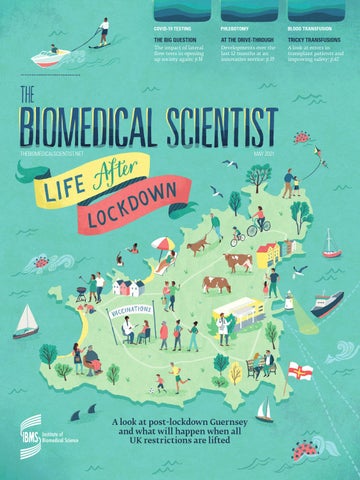
A look at post-lockdown Guernsey and what will happen when all UK restrictions are lifted
P01 Cover_May 2021_Biomedical Scientist.indd 1
22/04/2021 09:24
BEING HELD BACK BY THE LIMITS OF YOUR LIMS? Need to review operational performance, plan more effectively and make more informed decisions?
You need TrakCare Lab Enterprise – so much more than just a LIMS
Learn more at: InterSystems.com/UK/TCLE
© 2021 InterSystems Corporation. All rights reserved. InterSystems is a registered trademark of InterSystems Corporation. All other trademarks are property of their respective owners
p02_BIO.May21.indd 2
21/04/2021 12:13
MAY 2021 Contents
EDITORIAL 5 Sarah May on vaccine hesitancy and risk aversion
NEWS 8 Research, funding, developments and clinical updates
3
CONTENTS IBMS.ORG
7 News in numbers
THE BIOMEDICAL SCIENTIST
MAY 2021
13 Product advances and launches 45 Focus on… Autosomal dominant polycystic kidney disease
OPINION 14 The big question: Will lateral flow tests be transformative in opening up society again?
ADVICE 48 From animals to humans: A personal account of changing career in the pandemic
16 One-to-one: The new IBMS Chief Executive David Wells brings a wealth of pathology experience and expertise to this vital post for the profession
COVER ILLUSTRATION: SARA MULVANNY/AGENCY RUSH
SCIENCE COVER 18 Life after lockdown: FEATURE Life inside and outside a Guernsey lab now restrictions have lifted. And four experts on what will happen when the UK exits lockdown
51 Celebrating success: Diploma of Expert Practice exam pass list for histological dissection and immunocytochemistry
18
MY IBMS 52 Journal-based learning: CPD exercises based on journal articles 54 Institute news: The latest from the IBMS
39
24 IBMS Congress programme: The confirmed sessions for next year’s event
56 Here to help: The benefits of Science Council registration
39 A year at the drive-through: Developments at an innovative phlebotomy service
MY LAB
42 Tricky transfusions: Errors in transplant patients and improving safety
58 Caroline Fillmore gives a guided tour of her lab in the Royal Victoria Hospital, Belfast
14
45
EDITOR
RECRUITMENT ADVERTISING
Rob Dabrowski
+44 (0)20 7880 7621 biomedicaljobs@redactive.co.uk
SENIOR DESIGNER
Gary Hill PICTURE EDITOR
Akin Falope PUBLISHING DIRECTOR
Aaron Nicholls
ISSN 1352-7673 PUBLISHED BY
Redactive Publishing Ltd Level 5, 78 Chamber Street, London E1 8BL +44 (0)20 7880 6200 redactive.co.uk
PRODUCTION
Rachel Young DISPLAY ADVERTISING
+44 (0)20 7880 7556 biomedical@redactive.co.uk
Recycle your magazine’s paper envelope – please recycle with other paper and cardboard.
P03 Contents_May 2021_Biomedical Scientist.indd 3
© 2021 Institute of Biomedical Science PRINTED BY
Warners Midlands plc Bourne, Lincolnshire PE10 9PH
Neither the publisher nor the IBMS is able to take responsibility for any views or opinions expressed in this publication. Readers are advised that while the contents are believed to be accurate, correct and complete, no reliance should be placed upon its contents being applicable to any particular circumstances. Any advice or information published is done so without the Institute, its servants or agents and any contributors having liability in respect of its content.
SUBSCRIPTIONS
Subscriptions are available by calling 01580 883844
22/04/2021 09:25
Specific serology for Covid19 immunity Neutralising antibodies (NAb) account for only 5% of the total antibodies involved in an immune response.
SARS-CoV-2 Virus
Test for SARS-CoV-2 NAb on the high throughput eCL8000 benchtop platform. Neutralising Antibody
SARS-CoV-2 NAb level
CE-IVD marked for SARS-CoV-2 NAb testing.
? Time after Covid Infection
To find out how the SARS-CoV-2 NAb assay differs to total or spike antibody testing please contact us on 01189444100 or enquiries@menarinidiag.co.uk Menarini Diagnostics Wharfedale Road, Winnersh, Wokingham, Berkshire, RG41 5RA. Telephone: 0118 944 4100 | Fax: 0118 944 4111 Email: enquiries@menarinidiag.co.uk
p04_BIO.May21.indd 4
21/04/2021 12:14
EDITORIAL Sarah May
R
isk is a very heavily used word in multiple and varied situations: investment risks, the risk of adrenalinepumping sports and, particularly at this present time, health risk. The peculiar thing about risk is that it is both personal and relative; a risk may be recognised and assessed as acceptable if it is in relation to something we want, or it may be considered as unacceptable if it is in relation to something about which we feel ambivalent or negative. As scientists we spend our lives assessing risks. A risk assessment is an objective evaluation of the risk of harm or error associated with a certain action or activity. As scientists, we are very good at being objective and assessing risks, but as individual people we are as susceptible as anyone else to our own rational or irrational fears. The potential risk of blood clots associated with the AstraZeneca COVID-19 vaccination has been a frequent subject in the news and it is of genuine concern that the small risk associated with the vaccine may be sufficient to deter some people from accepting it, even though the risk of serious illness is greater. This is not a logical response but neither is individual perception of risk. What is seriously worrying though is the apparent campaign of anti-vaccine fear from groups that seek to exploit individual worries and concerns on risk. I know some people express incredulity
Institute of Biomedical Science is the professional body for the biomedical science profession. INSTITUTE OF BIOMEDICAL SCIENCE
12 Coldbath Square London, EC1R 5HL United Kingdom +44 (0)20 7713 0214 +44 (0)20 7837 9658 Email: mail@ibms.org Web: www.ibms.org
5
PERCEPTIONS OF RISK Sarah May, Deputy Chief Executive of the IBMS, on vaccine hesitancy and risk aversion.
that some healthcare workers, with all their knowledge of immunity and risk, are still hesitant to take the COVID-19 vaccine. I must confess that was my initial reaction, but having thought about it, I can understand it because we all have irrational fears that are built around our own personal evaluation of risk. Altering personal perceptions of risk is a slow process – just think back to the MMR vaccine controversy. Confidence building is a slow-burn project built on trust. I am almost legendary for my level of risk aversion; my biggest professional dilemma recently has been whether to keep Congress in September 2021, or move it you March 2022. I am very pleased that the lower-risk decision to change to next year was taken and the full programme can be
found in this edition of The Biomedical Scientist. I am confident that this will be a successful risk-managed event. To close on a light note, I have now discovered the risk of leaving a pair of gardening gloves in the vicinity of a bored dog. Yes, my Easter excitement was a trip to the vet for the administration of a medical emetic (for dog, not me). Thirty minutes, fifteen vomits and one returned gardening glove later gave me plenty of time to re-evaluate that risk.
Sarah May Deputy Chief Executive
PRESIDENT
HEAD OF COMMUNICATIONS
Allan Wilson CSci FIBMS
Dan Nimmo
CHIEF EXECUTIVE
EDUCATION AND TRAINING
Jill Rodney
education@ibms.org
DEPUTY CHIEF EXECUTIVE
EXAMINATIONS
Sarah May CSci FIBMS
examinations@ibms.org
EXECUTIVE HEAD OF EDUCATION
MEMBERSHIP
Alan Wainwright CSci FIBMS
mc@ibms.org
EXECUTIVE HEAD OF MARKETING AND MEMBERSHIP
CHARTERED SCIENTIST
Lynda Rigby
P05 Ed Leader_May 2021_Biomedical Scientist.indd 5
THE BIOMEDICAL SCIENTIST
chartered@ibms.org
FOLLOW THE INSTITUTE Join us on facebook.com/ biomedicalscience Follow us on Twitter @IBMScience Find us on LinkedIn
22/04/2021 09:26
No maintenance Easy to use Is a 5-part diff FBC Analyser
No maintenance Easy to use Is a 5-part diff FBC Analyser
Nothing compares to OLO.
Sight OLO® is easy to install, operate, and manage. There’s no need to buy, store, or dispose of hazardous materials and reagents. minimise downtime, hassles, and headaches. Bottom line? It just works.
See how at sightdx.com Dimensions: L323mm x W284mm x H254mm Weight: 10kg
Indication for use: Sight OLO is CE Marked according to the IVD European directive for performing FBC tests in point of care settings. The device is also FDA 510(k) cleared for use in moderately complex settings in the United States. For full indication for use and safety information, please visit the Quality and Compliance page at www.sightdx.com
p06_BIO.May21.indd 6
21/04/2021 13:00
NEWS In numbers
THE BIOMEDICAL SCIENTIST
7
SCIENCE NEWS
IN NUMBERS 4 Less exercise, more TV Study participants were asked how they spent their last week, compared with how they spent their time in the first lockdown. The study by University College London has followed 70,000 people for more than 40 weeks.
40% 36% 36% 19%
Climate change and hay fever 2 The climate emergency could increase future allergy season severity by up to 60%, a new pollen forecasting system suggests.
CO
An international team gathered 22 years of pollen data from 34 monitoring sites across Europe. Running the results through two statistical models, they calculated the increase, assuming a doubling of atmospheric CO2 levels to around 800 parts per million.
P07 News In Numbers_May 2021_Biomedical Scientist.indd 7
reported doing less exercise, while 13% said they exercised more
reported reduced involvement with arts and crafts, while 11% said they did more reported spending less time volunteering, while 13% said they were volunteering more said they watched more TV or films, compared with 13% watching less.
European countries chose to vaccinate politicians first in their roll-outs: Bulgaria Czech Republic Serbia Turkey Of the other European countries,16 prioritised healthcare workers and 14 prioritised the elderly.
50% HAD ANTIBODIES
By mid-March roughly half of people in the UK had antibodies against COVID-19, either through infection or vaccination, according to the Office for National Statistics. For individual countries, the statistics were: England – 55% Wales – 51% Northern Ireland – 49% Scotland – 43%
£2.35bn
REFUND APPEAL DROPPED
A group of NHS trusts has abandoned legal efforts to get a £2.35bn refund on business rates paid by hospitals. The group of 16 trusts argued they should be treated the same as charities. The High Court rejected the case in 2019 and a petition to the Court of Appeal has now been dropped. Private healthcare groups can receive an 80% discount from local authorities if they register as charities.
22/04/2021 09:27
8
THE BIOMEDICAL SCIENTIST
NEWS Science
SCIENCE
IMAGE: © NORTHWESTERN UNIVERSITY
NEWS BIOTECHNOLOGY
EPIDEMIOLOGY
“Sweat sticker” to diagnose cystic fibrosis
UPDATED COCHRANE REVIEW FOR COVID-19 RAPID TESTS
A novel skin-mounted sticker absorbs sweat and then changes colour to provide an accurate, easy-to-read diagnosis of cystic fibrosis within minutes. While measuring chloride levels in sweat to diagnose cystic fibrosis is standard, the soft, flexible, skin-like “sweat sticker” offers a stark contrast to current diagnostic technologies, which require a rigid, bulky, wriststrapped device to collect sweat. After developing the sweat sticker, US researchers validated it in clinical pilot studies involving cystic fibrosis patients and healthy volunteers. The sticker showed enhanced performance in collected sweat
volume and equivalent accuracy to traditional platforms. By softly adhering to the body, the millimetre-thick sticker makes direct but gentle contact with the skin without harsh adhesives. Not only does this make the sticker more comfortable to the wearer, the intimate coupling also enables the sticker to collect 33% more sweat than current clinical methods. The researchers state that the high collection rate ensures that one test will consistently collect a large enough sample to provide an accurate result. bit.ly/3mc8fJ5
Cochrane, a global independent network that gathers and summarises the best evidence from research to help informed health decision-making, has published an updated systematic review assessing rapid tests for the detection of SARS-CoV-2 infection. It shows that rapid antigen tests are better at correctly identifying cases of COVID-19 in people with symptoms than in people without symptoms. There are large differences in the accuracy of different brands of test, with very few meeting the World Health Organization (WHO) minimum acceptable performance standards The first version of this review included 22 studies and was published in August 2020. The updated review now includes evidence from 64 studies. The review in people with symptoms shows, on average, 72% of people who had COVID-19 were correctly identified as infected and tests performed best in the first week after symptoms began, when they identified 78% of people who had COVID-19. bit.ly/31AikpN
BIOTECHNOLOGY
In medical imaging, 3D images are typically displayed on a 2D monitor. This creates a dimensionality mismatch that must be resolved in a clinical setting where practitioners must search a 2D or a 3D image to find a particular trait or target of interest. Scientists from the University of California Santa Barbara evaluated human performance in localisation tasks, which involve searching a 2D or a 3D image to find a target that is
masked by noise – the addition of noise makes the task difficult, similar to reading images in a clinical setting. The images in the study were simulations intended to approximate high-resolution X-ray computed tomography (CT) imaging. They were generated in 3D and viewed as 2D “slices”. Eight experimental conditions were evaluated (2D versus 3D images, large versus small targets, power-law versus white
P08-11 News-Science_May 2021_Biomedical Scientist.indd 8
noise). The team evaluated performance in terms of task efficiency and classification image technique. Lead author Craig K Abbey said: “The somewhat surprising finding of the paper was that the classification images showed almost no evidence of combining information over multiple sections of the image to
localise a target that spans multiple sections of the image. “The observers are essentially treating the volumetric image as a stack of independent 2D images. This leads to a dissociation in which observers are more efficient at localising larger targets in 2D images, and smaller targets in 3D images.” bit.ly/3rGjTgr
IMAGES: SCIENCE PHOTO LIBRARY/ISTOCK/SHUTTERSTOCK
MEDICAL IMAGING DIMENSIONALITY MISMATCH
22/04/2021 09:28
HAEMATOLOGY
MULTIPLE MYELOMA BLOOD TEST A new method makes it easier to follow the progression of the blood cancer multiple myeloma, it is claimed. With a single drop of blood, it is possible to accurately show whether the number of cancerous cells in the bone marrow is increasing in a patient. Those behind the method say that, in time, this blood test could potentially replace the current bone marrow puncture. Improved treatments have made it possible to keep the disease under long-term control in an increasing number of patients. In some patients it even goes so well that no disease can be measured in the blood. However, this does not mean that the malignant cells are all gone. Often these patients reach a state of minimal residual disease. Whether this is the case is currently measured by means of a bone marrow puncture. This is an unpleasant procedure for patients. Moreover, the test is not sensitive enough. Medical immunologist and research author Hans Jacobs said: “The disease is found almost everywhere in the bone marrow, but in some areas there are more cancerous cells than in other areas. So if you take a biopsy where there are fewer cancer cells, the test result does not accurately reflect the real situation.” The new method uses mass spectrometry and can measure unique molecules, derived from cancer cells, in the blood. These molecules reveal the presence of the cancer cells in just a drop of blood. This allows you to see very quickly if the number of cancer cells in the body, or disease activity, is increasing. A treatment (for example, medication or chemotherapy) can then be started more quickly, if necessary. bit.ly/3wjNu2Q
P08-11 News-Science_May 2021_Biomedical Scientist.indd 9
WHAT’S HOT AND WHAT’S NOT
NEWS Science
THE BIOMEDICAL SCIENTIST
9
HOT
HEARING Researchers have succeeded for the first time in measuring brain waves directly via a cochlear implant – they say the results are important for the further development of smart hearing aids.
HOT
ENEMIES It makes evolutionary sense for long-lived animals to have complex social relationships – such as friends and enemies – according to a new paper from the University of Exeter.
HOT
FACEMASKS A new mathematical model suggests that the easing of lockdown must be accompanied by wider and more effective use of control measures, such as facemasks, even with vaccination, in order to suppress COVID-19.
NOT
COCAINE New research reveals that during cocaine withdrawal, neurons in a brain area associated with depression connect to neurons embedded in an anti-reward system.
NOT
PROCESSED MEAT A study of 134,297 people from 21 countries found a link between eating processed meat and a higher risk of cardiovascular disease.
NOT
SCREAMING NG Screams of happiness s are more often interpreted d as fear when heard without hout any additional context, text, according to the results of a new study by psychologists gists at Emory University. sity.
22/04/2021 09:29
BIOMEDICAL 10 THE SCIENTIST
NEWS Science
ARTIFICIAL INTELLIGENCE
AI FOR BLOOD VESSEL ANOMALIES AND EYE DISEASE
UNDER THE MICROSCOPE
This month: Prime editing What is prime editing? The latest gene editing technology, which it is claimed expands the “genetic toolbox” for more precisely creating disease models and correcting genetic problems. Nope. That doesn’t ring any bells.
INFECTIOUS DISEASES
HIV treatment helps prevent active TB Antiretroviral treatment (ART) reduces the risk of developing active tuberculosis (TB) in people also infected with HIV-1, by dampening the activation of the body’s immune response. TB remains the leading bacterial cause of death worldwide and co-infection with HIV is the biggest risk factor for developing an active infection. But it’s been observed that people taking ART are less likely to have a latent TB infection become active and potentially life-threatening. Researchers at the Francis Crick Institute and the Wellcome Centre for Infectious Diseases Research at the University of Cape Town have been researching links between the two conditions for a number of years. Their latest study is a broad analysis
Don’t worry – it’s very new. In fact, a recent paper by Medical College of Georgia scientists is only the second published study in the use of prime editing in a mouse model. What did their study reveal? They reported that prime editing and traditional CRISPR both successfully shut down a gene involved in the differentiation of smooth muscle cells, which helps give strength and movement to organs and blood vessels.
P08-11 News-Science_May 2021_Biomedical Scientist.indd 10
of blood from individuals with both latent TB infection and HIV-1, during their first six months of ART. They observed a significant drop in the inflammatory signalling activity of immune cells, confirmed by further analysis of plasma samples taken after six months of ART. They then focused on 30 patients and carried out highly detailed multiplex analysis of their blood plasma to better understand the change in inflammatory markers. The team found a consistent decrease in IL-1alpha and IL-1beta concentrations over time. Collectively, their results show that the decreased risk of active TB can be explained by reduced inflammatory immune responses during treatment with ART. bit.ly/3dtvIBo
So it’s as good as CRISPR? Prime editing snips only a single strand of the double-stranded DNA. CRISPR makes double-strand cuts, which can be lethal to cells, and produces unintended edits at both the work site as well as randomly across the genome. What do the authors say? Dr Joseph Miano, genome editor and molecular biologist, said: “Prime editing is a less intrusive cut of the DNA. It’s very clean. This is what we want: No detectable indels,
IMAGES: ISTOCK/SHUTTERSTOCK
An international team of scientists has developed an artificial intelligence (AI) platform that could one day be used in a system to assess vascular diseases that are characterised by the abnormal condition of blood vessels. The AI-powered platform combines machine learning and a specially designed microfluidic chip with analysis of 2D video images of blood flow and the application of physical laws, to infer how blood flows in 3D. In tests it accurately predicted blood flow characteristics, such as speed, pressure, and shear stress, which is the stress exerted by the blood flow on the vessel wall. The ability to determine these characteristics accurately could be a critical support for clinicians in detecting and tracking the progression of vascular diseases since the abnormalities that the platform could spot may indicate the presence or progression of a vascular disease. The scientists tested it on simulated microaneurysms of the eye, using a microfluidic chip that is smaller than a thumbnail. When the platform was given images of blood flow in a device that simulates microaneurysms, it successfully predicted the characteristics of blood circulation within it. bit.ly/39yuCTU
no collateral damage. The bottom line is that unintended consequences are much less and it’s actually less complicated to use.” How much does he know about CRISPR? Quite a bit – Miano was among the first wave of scientists to use CRISPR to alter the mouse genome in 2013. Can I read more? Yep, here’s a link to their full paper online – bit.ly/3cCa1jj
22/04/2021 09:30
NEWS Science
CANCER RESEARCH
High testosterone in men and increased risk of melanoma Melanoma skin cancer is the fifth most common cancer in the UK, with around 16,200 people diagnosed each year. In the last decade the number of cases in men has increased by almost half (47%). A new link between higher levels of testosterone in the blood and increased risk of melanoma skin cancer in men has been found, according to a study funded by Cancer Research UK. Dr Eleanor Watts, lead author, said: “This is the first time a link between testosterone and skin cancer has been seen. We already knew men diagnosed with melanoma have a higher risk of
THE BIOMEDICAL SCIENTIST
11
developing prostate cancer and vice versa, which was a clue that there may be a common biological or behavioural cause. And it looks like this link might be the hormone, testosterone. “The next step will be to see whether this link is seen in other studies and, if it is, to look more closely at why testosterone might be related to the risk of melanoma developing in men.” The researchers’ findings also supported previously known links between testosterone and prostate cancer in men, and breast and endometrial cancer in post-menopausal women. But, because it’s hard to calculate how long people spend in the sun, more research will be needed to determine if this new link is biological or if men with higher testosterone spend more time in the sun. bit.ly/31AKCAf
A Complete, Automated Nucleic Acid Purification System With the New Maxprep™ Liquid Handler and Maxwell® RSC Instruments. • Preloaded automated methods for pre-processing of samples SULRU WR QXFOHLF DFLG SXULðFDWLRQ • Parallel processing of up to 16 (RSC) or 48 (RSC 48) samples in approximately 30 minutes • Purify high-quality DNA, RNA or TNA from a variety of sample types including blood, plasma, ccfDNA, FFPE and tissue • Automated post-extraction sample preparation for quantitation, normalisation and PCR setup • Integrated bar code scanning and Promega Portal Software for complete sample tracking.
For more information, please visit: www.promega.co.uk/maxwell-instruments Or contact: uktechserve@promega.com to arrange a demonstration.
P08-11 News-Science_May 2021_Biomedical Scientist.indd 11
Follow us on
@promegauk
0800 559900 | www.promega.co.uk
22/04/2021 09:30
p12_BIO.May21.indd 12
21/04/2021 12:18
NEWS Technology
THE BIOMEDICAL SCIENTIST
13
TECH
NEWS LGC
INTEGRA BIOSCIENCES
ANTIGEN TESTING
PIPETTING
LGC has released ACCURUN SARS-CoV-2 Antigen Reference Material Kit, a new quality measurement tool to support SARS-CoV-2 antigen testing. It is formulated for use with test methods that detect the nucleocapsid (NP) protein of SARS-CoV-2 virus – the target for the majority of the SARS-CoV-2 antigen assays currently on the market. The product comprises purified recombinant SARS-CoV-2 NP protein in simulated viral transport media. lgcgroup.com
CDI Labs, a biotechnology company in Puerto Rico, is using INTEGRA’s VIAFLO and VOYAGER electronic pipettes to streamline workflows and improve accuracy for the development of next generation proteomics products. The company, well known for the HuProt Human Proteome Microarray, has expanded its portfolio to include a catalogue of over 2000 monoclonal antibodies designed to accelerate research that improves human health. integra-biosciences.com
MENARINI DIAGNOSTICS
SPECIFIC SEROLOGY Menarini Diagnostics is expanding its comprehensive COVID testing portfolio with an automated SARS-CoV-2 Neutralising Antibodies (NAb) test. The CE-IVD marked immunoassay is performed on the eCL8000 benchtop ECLIA platform, capable of 86 test results per hour. The SARS-CoV-2 NAb assay has been specifically designed to match the performance of plaque reduction methodology whilst maintaining the convenience of routine serological analysis. Quantification of NAbs is the best way to determine immune status post-vaccination or infection. menarinidiag.co.uk
Enhanced liver fibrosis markers ELF & PIIINP • NPEX result reporting • Rapid automated immunoassay service • Clinical interpretation service
P13 News-Technology_May 2021_Biomedical Scientist.indd 13
rajvindergarcha@nhs.net www.bcpathology.org.uk 0121 507 5348 Clinical Biochemistry, City Hospital Dudley Road, Birmingham B18 7QH @BCPathology
BCPathology
Black Country Pathology TV News
22/04/2021 09:31
BIOMEDICAL 14 THE SCIENTIST
OPINION The big question
THE BIG QUESTION
THIS MONTH WE ASK
“Will lateral flow tests be transformative in opening up society again?”
P14-15 Big Question_May 2021_Biomedical Scientist.indd 14
22/04/2021 09:32
OPINION The big question
Nicky Hollowood POCT Manager Harrogate and District NHS Foundation Trust
IMAGE: SHUTTERSTOCK
M
uch has been critically written about the accuracy, effectiveness and usefulness of lateral flow tests (LFTs), which are rapidly being deployed across healthcare, education and workplaces in a bid to facilitate the country permanently exiting lockdown. Unfortunately, LFTs are likely to delay long-term progress in reopening society due to the reported high number of false negative and positives especially when used inappropriately. The government proposes that LFTs are used in asymptomatic individuals, proposing that they are a useful tool as part of a combined effort in slowing down the spread of the virus. But LFTs are designed to be used in symptomatic individuals and when used in asymptomatic individuals, sensitivity is further reduced, making this proposal somewhat flawed. LFTs could be useful when used appropriately in the right setting, but throwing them out for widespread public use as a twice-weekly test in asymptomatic individuals could be a massive error. Work is needed to further utilise ongoing scientific evidence to continue to develop the guidance ensuring they are used for a suitable purpose and any ambiguity is identified and removed. Rapid tests can be valuable only if there is a defined, evidence-based care pathway. Without they are, at best, expensive and add no value, but at worse they could be a public healthcare risk contributing to virus rates increasing as the UK reopens.
P14-15 Big Question_May 2021_Biomedical Scientist.indd 15
THE BIOMEDICAL SCIENTIST
Debra Padgett
Carmela Duffy
Infection Sciences Operational Manager North Cumbria Integrated Care NHS Foundation Trust
Biomedical Scientist, Virology Manager Belfast Health & Social Care Trust
I
think we can safely say that LFTs split the crowd. As biomedical scientists, we would be much happier if everyone could have PCR tests, especially now that prevalence is low in the circulating population, but that’s just not feasible. We know that PCR provides the most sensitive test and the rate of false positives remains extremely low. But we still have issues with timeliness of testing and the determination of what is “active” virus. Obviously, some of this doesn’t matter if you’re testing symptomatic patients who are already isolating, but that’s not the case if you’re testing the asymptomatic population. Because LFTs test for proteins produced by the virus and not RNA, it makes the testing technology mass producible. So is this how we can using testing to open society back up? We know the sensitivity of the test is much lower and is prone to false positives, but it can pick up infections at four to eight days in the infection cycle. Tests may also miss asymptomatic positive cases but, these people wouldn’t have been tested anyway, as they weren’t displaying symptoms. Picking up some cases must be better than none? Numerous papers have been published stating different sensitivity rates for LFTs but, ultimately, if you are displaying symptoms get your PCR test and isolate. If you’re not and have been offered LFTs, test twice weekly (but please do it properly, otherwise you may as well not bother) and, should you test positive, get your confirmatory PCR ASAP.
15
T
he last year has been a traumatic experience across society, however, it has also been a period of unprecedented scientific innovation. In diagnostics we have embraced the challenge with new tests being introduced in what feels like a daily event. One of the most innovative techniques is the use of LFTs. We are now presenting society with a methodology to rapidly assess en masse the infection risks of individuals and, therefore, prevent viral spread. This enabling tool empowers us in isolating genuine positive cases quickly and those most infectious. Although LFTs are less sensitive than PCR, they will detect those with a high viral load and hence most infectious. This rapid turnaround enables us to respond more effectively, cutting the transmission pathway and allowing people to carry on with normal life. LFTs have many advantages in that they are inexpensive, easy to use, mass produced and don’t produce many false positives. A big advantage is that you can self-test, which is clearly very useful in maximising availability to testing to population levels. This allows us to control outbreaks and reduce the risk of close contacts but, above all, give people the confidence to embrace normality. Yes, LFTs have the potential to play a key part in reopening of society, however, the combination of vaccination, easily accessible testing, PPE and social distancing are all important.
22/04/2021 09:32
BIOMEDICAL 16 THE SCIENTIST
OPINION One-to-one
MEET YOUR NEW CHIEF EXECUTIVE
David Wells brings a wealth of pathology experience and expertise to this vital post for the profession.
T
he new IBMS Chief Executive, David Wells, has broad experience in providing and leading pathology services for primary, secondary and tertiary care across all pathology disciplines. His earlier roles have included Lead Healthcare Scientist for Great Ormond Street Hospital and Director of Operations at Viapath. Having worked in both the public and private sector, he has developed considerable knowledge of the profession and developed an approach focused on ensuring the sustainability of pathology expertise for the future. In his work with the Institute, David has been an IBMS Council Member for the London Region, Chair of the Membership and Marketing Committee and Deputy Chair of the IBMS Special Advisory Group for Clinical Chemistry. He also represented the IBMS on NICE diagnostic advisory panels and various national forums, including as an observer on the Royal College of Pathologists Council and on the
P16-17 Opinion-OTO_May 2021_Biomedical Scientist.indd 16
Parliamentary and Science committee. For the past year, David has been leading NHS England’s testing response to COVID-19. He has liaised with ministers and senior health leaders as a subject matter expert and provided leadership for all of the 29 pathology networks, ensuring deployment of technology, staffing and IT resources into the NHS. He has also worked with senior leaders across the NHS, Public Health England, Test and Trace and the Department of Health and Social Care to inform strategy and policy to respond to the pandemic. We caught up with David and asked him what he hopes to achieve in his new role as the IBMS Chief Executive. How long have you been involved with the IBMS and why? My involvement with the IBMS began when I joined the Clinical Chemistry Specialist Advisory Panel. I had reached a point where I felt it was important to start giving back to the profession. I came in as the Deputy Examiner and then
ALL ABOUT DAVID David Wells has been recognised as one of the 100 most powerful advocates for pathology – making The Pathologist magazine’s annual Power List in 2018, 2019 and 2020. He has been leading NHS England’s laboratory response to COVID-19 – managing technology deployment, funding and workforce, ensuring that all capacity requirements are met, while also advising ministers and providing policy and strategic direction. In recognition of his work in transforming England’s pathology services, the Royal College of Pathologists awarded David Honorary fellowship in 2020.
22/04/2021 09:34
OPINION One-to-one
I want to support the profession by raising the profile of our biomedical scientists and clinical scientists, and making sure we develop all the opportunities that our members need. This means ensuring further progress with advanced roles, and maintaining and supporting the equivalence route across the UK. It’s also important that the greater recognition we have had during COVID-19 is translated into a wider acknowledgement of our role in healthcare. Not only with what we can do currently, but what we can do in the future as technology advances and the UK’s diagnostics industry expands. As new models of working appear before our workforce, I want to make sure our members are ready to take them on.
IMAGES: GETTY
became the Deputy Chair of the panel. From there, I stood and was successfully elected for Council, Deputy Chair of the Membership and Marketing Committee and then, finally, Chair. I got more and more involved because working with the IBMS seemed to be one of the best and most rewarding ways to help the profession progress. I wanted to make sure I did my part. From the outset, it was a great experience – coming together with like-minded people and contributing in broad-reaching ways. Everybody in the room knows that laboratory staff are vital and central to healthcare. As a scientist, it was where I felt most at home. What do you hope to achieve as CEO of the IBMS? Those who know me are aware that I’m passionate about biomedical science and pathology, and I want to see our impact recognised. It’s also important to me that our scientists are more involved in shaping healthcare for the better.
P16-17 Opinion-OTO_May 2021_Biomedical Scientist.indd 17
How will you help support IBMS members? It’s essential that the IBMS continues to support its members’ needs. That’s what we’re here for. The best way of doing this is through education and training – making sure that we continue to offer courses that are relevant to our members, and accessible in ways that make sense to the way they want to learn. We need to work with government and health bodies to advocate and celebrate what we do, and demonstrate how our work benefits patients and society more broadly. I aim to make sure that the IBMS works with all bodies working within science and healthcare to progress and support biomedical scientists and laboratory staff wherever they work – academia, healthcare or industry. All this while retaining all the excellent and independent work the IBMS does in its own right – so that it can speak freely in support of the membership and profession. Is there anything you would like to say to IBMS members?
THE BIOMEDICAL SCIENTIST
17
I want to support the profession by raising the profile of our biomedical scientists and clinical scientists
I would like to take a moment to recognise the work that our members have been doing over the past year. COVID-19 is the largest and longest lasting major incident in our countries’ histories, affecting members in the UK but also those across the globe. It is the first time that biomedical scientists and pathology teams have been in the centre of a major incident and, no matter the size of the contribution, we should all be proud of what we have achieved. There is a long road to recovery and there has been no let-up this last year. I know how hard it’s going to be – tackling the backlogs in screening, diagnostics and cancer care. Just remember, these challenges will be further evidence of our huge importance to healthcare and we will get through them just like we got through this last year.
22/04/2021 09:34
BIOMEDICAL 18 THE SCIENTIST
SCIENCE Pandemic
ILLUSTRATION: SARA MULVANNY/AGENCY RUSH
Without a single case of COVID-19, Guernsey left lockdown in March. Healthcare Scientist Assistant Zoe Andrews explains what life inside and outside the lab has been like on the island. We then hear from four experts on what the future could hold when the UK exits lockdown.
uernsey is one of the Channel Islands situated in the English Channel. It also consists of Alderney, Sark, Herm, Berqou, and Lihou island; collectively, these form The Bailiwick of Guernsey. Guernsey spent just 88 days in a strict first lockdown from March 2020. The only other time Guernsey would have felt as restricted was in WW2 when the German forces occupied the island. Because Guernsey is a small island it has a good community spirit and throughout lockdowns the slogan #GuernseyTogether became the paradigm. Many people who were unable to work volunteered to provide prescription runs and shopping drop-offs
P18-22 Guernsey_May 2021_Biomedical Scientist.indd 18
for vulnerable and isolated people. The community spirit and drive to keep islanders safe has helped Guernsey to exit lockdowns swiftly. Weekly press conferences with open questions from the public to politicians and public health officials meant that the public had faith in the decision-making process and probably felt like a part of that. Transparency has played a role in adherence to the rules and the fact that our Director of Public Health, Dr Nicola Brink, is a Consultant Virologist probably helped. The colossal task in the first lockdown for our department heads was procuring the right analyser, in the right timeframe and then implementing on-island PCR testing. For the first few
22/04/2021 11:28
SCIENCE Pandemic
P18-22 Guernsey_May 2021_Biomedical Scientist.indd 19
THE BIOMEDICAL SCIENTIST
19
22/04/2021 09:35
BIOMEDICAL 20 THE SCIENTIST
SCIENCE Pandemic
weeks we were packaging and sending our COVID samples to Public Health England laboratories. We knew this wasn’t sustainable. We also had to convert and build a whole new enhanced Containment Level 2 room with a Class 1 cabinet to accommodate the unprecedented workload. At this point, we only had six members of staff in our microbiology team (four of which were part-time). We were joined on some shifts by two of our colleagues from the States of Guernsey analytical laboratory. They were trained in our COVID lab and provided regular shift cover. By June, we had Jeffrey, a locum scientist who joined us from the UK, in routine microbiology as we still had a vacant position unfilled. By the end of September for three months we were joined by Shirley, our other locum. Our achievement of getting full PCR testing up and running on the island by 28 March 2020 was outstanding, and having an understanding management team was helpful.
The second lockdown On 23 January 2021, Guernsey’s second lockdown was announced. There was no time to prepare – the press conference stated the lockdown was immediate. We had community seeding and no known source of transmission. By now, Shirley had left to work on the Shetland Islands. As a community, we knew what to expect and we adhered to the rules. Guernsey has a small population of around 63,000 and the Princess Elizabeth Hospital is the only hospital on this island. We have a small hospital on the island of Alderney and, in emergencies, patients are transferred to Guernsey via air or sea. To say it has been hard in the laboratory would be a slight understatement. Being an island, we cannot draft in scientists and healthcare staff quickly due to border restrictions. So with a team of 10 (two drafted in from our analytical lab) plus our routine microbiology work, we started our extensive screening again. The hours were
P18-22 Guernsey_May 2021_Biomedical Scientist.indd 20
“Since the restrictions were lifted life is back to normal, with no masks” long. The days merged into one another. We often forgot what day it was. Our small COVID lab has processed and tested around 58,833 samples from 1 January to 7 April this year. From 28 March 2020 until mid-April 2021, our laboratory processed and tested around 90,000 (more than our entire population) samples. The learning process has been fast and difficult. The hardest part has been juggling my children and trying to facilitate their home learning with my eldest in his GCSE year, whilst working full-time hours, and more.
Lifting restrictions Working with the public health resulting teams and our swabbing teams we’ve formed new strong working relationships and know how each other function. This helps logistically and planning-wise as we know roughly when we’re expecting our workload. In November I visited the airport to witness the passenger screening process and see how Guernsey’s travel tracker and border controls functioned before the second lockdown. When we have an idea of how the other teams function, we can all learn from each other and work in as streamlined a way as possible. Multi-disciplinary practice is essential to island-hospital life. In microbiology we run the faecal immunological testing (FIT) testing and one of the downsides to lockdowns has been the effect of stopping routine screening programmes, such as bowel screening FIT. The effects of which may not be seen for years. The decline in our FIT programme in the 2020 lockdown
was a drop of 75% versus 2019. In this year’s lockdown there has been a decline of 49% versus 2019 figures. Since the restrictions were lifted on 22 March some people still seem conscious of social distancing. However, life is back to normal, with no masks, although everyone respects if people want to wear them. The only evidence of COVID-19 having been here are the space markings on shop floors and alcohol gel in shop entrances. Tight border restrictions are still in place and 14-day quarantine is required for arrivals. The border agency does visit your given address. Guernsey means business. Life in the laboratory is also starting to resemble normality, albeit a new normal. Our routine workload seems increased; whether this is because people have put off visiting doctors in lockdown or a new form of health anxiety due to COVID, we don’t know. Life outside of the lab is starting to look normal, too. There wasn’t a massive build-up to exit lockdown. It felt different this time – more of an acceptance of a day at a time. I guess this was partly due to how lucky we were last time and having a restriction-free few months in 2020. Looking to the future, I miss my UK family, friends, and travel; however, I wouldn’t change where we were throughout this pandemic – not only from a safety point of view, but a complete once-in-a-lifetime learning perspective and a community feel that’s a one in a million.
22/04/2021 09:36
SCIENCE Pandemic
THE BIOMEDICAL SCIENTIST
21
WE ASKED FOUR EXPERTS WHAT THE FUTURE HOLDS FOR PANDEMIC-RELATED ISSUES. HERE’S WHAT THEY SAID... FACE COVERINGS AND SOCIAL DISTANCING Helene-Mari van der Westhuizen, Doctoral Researcher at the University of Oxford OVID-19 has triggered scientific scrutiny of previously niche topics. Under this gaze, in the field of infection control, some of the old dogmas have had to be revised. At the start of the pandemic, SARS-CoV-2 was categorised as spreading via droplets and close contact. This led to policies that focused on keeping a physical distance from people outside of your household and frequent cleaning of hands. Later, face coverings to capture larger respiratory droplets of people potentially infected with COVID-19 were added. All of these remain important. However, airborne transmission has been acknowledged as an additional mode of contagion, while transmission through surfaces has been downgraded to “unlikely”. As the UK exits lockdown, this should trigger a greater emphasis on improving ventilation in shared indoor settings. Here, mobile carbon dioxide monitors can be valuable tools in measuring and advocating for improved ventilation. Getting adequate ventilation right is important: large amounts of money and energy have been wasted on ineffective infection control measures, such as deep cleaning businesses, temperature screening, setting up Perspex screens and placing objects in quarantine. These ineffectual measures may have come at the cost of interventions that could have curbed the spread of the virus – and saved lives. There has been progress in establishing the most effective infection control guidelines - “hands, face, space, and fresh air”. Shifting from establishing evidence
P18-22 Guernsey_May 2021_Biomedical Scientist.indd 21
for guidelines and moving towards implementation has not always been smooth. Face coverings have provoked a particularly polarising reaction. This demonstrated how infection control measures such as face coverings are also a social practice – informed by norms and expectations – in addition to guidelines. In time, it will be interesting to see which components will remain embedded in our daily lives, when guidelines for COVID-19 become less relevant. It may be more commonplace and accepted to wear a face covering on a crowded tube or during flu season. For now, we need to use our full, most effective preventative toolkit to help us get there.
LOCKDOWNS Sarah Pitt, Principal Lecturer, School of Pharmacy and Biomolecular Sciences, Brighton University ince the beginning of 2020, people in most countries across the world have experienced some form of COVID-19 “lockdown”. SARS-CoV-2 is a very infectious, airborne virus. So reducing the amount of contact people have with each other through lockdowns is a very effective public health measure. Governments have implemented various levels of stringency, ranging from being legally enforced to stay in the house or a hotel, through to being advised to stay indoors. Most European countries have been in a situation where hospitality, leisure centres and non-essential shops have been closed more than once during the COVID-19 pandemic. The development of effective vaccines in less than 12 months has been an amazing international scientific achievement.
Vaccines are being produced in Europe, the US, Russia and China and distributed around the world, in a major feat of logistics. This gives us hope that the pandemic can eventually be brought under control. However, it is unlikely to eliminate SARS-CoV-2 altogether without other control measures remaining in place. Also, until everyone across the globe has been fully vaccinated, there will be a possibility that outbreaks of COVID-19 could occur anywhere. Continued transmission of the virus provides the opportunity for new variants to arise, which, as well as being spread very easily, may evade vaccine-induced immunity. With effective public health surveillance, cases could be identified quickly and then the idea would be to limit the spread of any outbreaks. The most effective way of doing this would be rapid and drastic local lockdowns, possibility with ring booster vaccinations in the immediate area. Hopefully, the world will learn lessons from 2020 and bring the virus under control during 2021. I expect the next six to 12 months to be characterised by local or regional lockdowns, with national lockdowns less frequent.
COVID-19 VACCINATIONS Simon Parker, Clinical Market Manager, Roche Diagnostics Limited espite the enormous input and drive from government, public and industry in making the COVID-19 vaccine programme an apparent success, it is hard to believe that herd
22/04/2021 09:36
BIOMEDICAL 22 THE SCIENTIST
SCIENCE Pandemic
immunity will ever be fully achieved. However, new infections will probably reduce and it is likely that COVID-19 will become endemic rather than eliminated. By mid-April more than 32 million people had received their first vaccine; more than seven million, their second. It will be interesting by the end of the year to contrast the speed and agility of this with influenza where despite best efforts vaccine uptake rarely exceeds 75% in the over 65s and frontline healthcare workers. Determining and predicting those who are immune to reinfection and for how long protection lasts, is still a work in progress. We can identify antibodies to the nucleocapsid, quantify the anti-spike response, qualify using in vitro neutralisation and look at T cell memory, but results appear highly individualised. It looks like most people will have some protection after infection but a proportion will not, which is why vaccination is essential. The evidence for longevity of the immune response only stretches to the start of the pandemic, but with some vaccine manufacturers already promoting a yearly booster it looks like vaccination is here to stay. The emergence of variants of concern means manufacturers will need to plan future formulations carefully. I hope that the frequency of emerging variants reduces over time, but my money is on a regular booster, decided and delivered akin to the influenza programme. Aside from the practicality and expense, a key issue is whether the public will tolerate annual boosters or will the government opt for pre-screening or re-vaccinate at-risk groups only? Manufacturers are developing novel influenza vaccines using the same technology as for COVID-19. I think for now we are looking at two separate annual jabs, but it would be tempting to look at the possibility of adding a COVID-19 variant to the quadrivalent Flu A
P18-22 Guernsey_May 2021_Biomedical Scientist.indd 22
“A key issue is whether the public will tolerate annual boosters” and B cocktail. This might have to wait for mRNA flu vaccines to be developed from their egg-based counterparts. As if life was not complicated enough.
CLEARING THE NHS BACKLOG Allan Wilson, Lead Biomedical Scientist in Cellular Pathology and Advanced Practitioner in Cervical Cytology, Monklands Hospital s we ease out of COVID-19 restrictions, laboratories must work with local clinicians to ensure that laboratories are not overwhelmed with samples generated by additional clinical activity targeted to catch up with the backlog of clinical procedures. This is particularly relevant for histopathology, where there is a significant risk that already stretched labs will be unable to deal with a significant bulge in workload generated from additional activity to deal with long waiting lists. The risk is that we simply move the backlog in the treatment pathways from the surgical procedures to the histopathology lab, where they will sit as a backlog of blocks awaiting microtomy or slides awaiting reporting. Laboratory managers should be engaging with clinicians and should have input to the pace of return and clearly indicate what capacity exists within the lab and what additional resources (if they can be sourced) are required to process and report the resultant bulge in workload.
Ideally, this discussion should start as early as possible and pathology representation from the outset on the various local groups managing the return of normal services is key to ensuring that any additional clinical activity is matched with additional laboratory capacity. If your lab does not have representation on these groups, I strongly urge you to contact the lead clinicians and request representation. The pause in clinical services should lead to a revision of clinical practice to ensure that before services simply return to “business as usual” clinicians are confident of the clinical value of the procedures and the treatment pathways are still valid. This has already started; for example, endoscopy protocols have been reviewed and less invasive procedures have been introduced to reduce endoscopy activity and endoscopic biopsy numbers. Laboratories have an important role in auditing the outcomes from clinical procedures and engaging with their clinical users where they consider the samples they are processing could be of limited clinical value. Laboratories are in a unique position to analyse the data across all users to provide an oversight of the efficacy of samples sent for processing. It is vital that laboratories engage with the wider clinical community to ensure they are able to manage forecast bulges in activity and, where appropriate, challenge what “normal” should look like. We must take this opportunity to challenge the norm and base, but our findings must be based on robust audits.
22/04/2021 09:36
p23_BIO.May21.indd 23
21/04/2021 12:19
Linking learning to the laboratory
Science, education, management. The full IBMS Biomedical Science Congress
PROGRAMME CPD-recognised learning Principal Sponsor
Book your 2022 place now: Register at www.ibms.org/congress
Follow #IBMSCongress2022 for live updates
Main Sponsors
IBMS Congress Programme 2022.indd 24
22/04/2021 10:22
Hj]ka\]fl k O]d[ge] I am delighted to be able to share with you the programme for our 2022 Biomedical Science Congress. We have CNN DGGP VJTQWIJ C XGT[ FKHƂEWNV [GCT and we all need something to look HQTYCTF VQ +oO C ƂTO DGNKGXGT KP nDGVVGT late than never’ and never has that applied more so than with Congress. Rather than cancel our Congress, originally planned for this September, I am pleased that we were able to reschedule it for Monday 14 to Thursday 17 March 2022. I’m conscious this means a longer interval between events than usual, but what makes Congress such a valuable and memorable part of our profession is the opportunity to come together in one place. By moving Congress to next March, I believe we have every chance of being able to meet together safely, and gain the maximum professional and personal DGPGƂV VJCV [QW GZRGEV HTQO %QPITGUU 1WT %QPITGUU YKNN CNUQ DG CP QRRQTVWPKV[ VQ TGƃGEV QP CPF EGNGDTCVG a unique period in our profession’s history. As biomedical scientists, we’ve played a critical role in the testing and diagnosis of COVID-19 and its health effects, while still maintaining our vital work as the UK’s laboratory medicine service. After a year like no other we have much to be proud of; let’s make Congress 2022 a celebration of our science and our central role in the delivery of healthcare. I look forward to seeing you in Birmingham. Allan Wilson, IBMS President
IBMS Congress Programme 2022.indd 25
22/04/2021 10:23
Helpline: 01892 779990 Visit www.ibms.org/congress
Congress Plenaries Tuesday 15 March OPENING PLENARY 14.00 Albert Norman Address Allan Wilson, President, Institute of Biomedical Science 14.20 David Wells, Chief Executive, Institute of Biomedical Science 14.35 Equality of recognition: Access to HSST for biomedical scientists Prof. Berne Ferry, Head of the National School for Healthcare Science 15.05 Managing the UK response to the COVID-19 pandemic 16.00 Supply and administration of medicines Dr Jane Needham, Institute of Biomedical Science Council Member 16.20 Integrating molecular diagnostics across hospital pathology Bruno Ping, Molecular Diagnostics Laboratory Manager, Berkshire & Surrey Pathology Services 16.40 How much does your blood group control your life? Martin Maley, Senior Lecturer in Biomedical Sciences, University of Sunderland
Thursday 17 March CLOSING PLENARY
The hidden dangers in the Victorian home
Congress Keynote Plenary We want our delegates to hear the vviews, thoughts and opinions of VVJG DGUV KP VJGKT ƂGNF YG YCPV QWT d delegates to leave Congress with a clearer understanding of what is happening in pathology in order to help better manage their services and ttheir careers. O Our Plenary programme will introduce tthe milestone achievement of access tto HSST for biomedical scientists; C C TGƃGEVKQP QP VJG EJCNNGPIGU QH managing the response to the UK C COVID-19 pandemic; an overview of how molecular diagnostics is being integrated into our laboratory services, a and a future for biomedical scientists tthat now includes the permission to ssupply and administer medicines. T The programme will also include a presentation from our new Chief Executive and his vision for our profession and our Institute. The intensive afternoon programme will conclude with a fascinating talk from Martin Maley on “How much does your blood group control your life?” This is a programme you cannot afford to miss.
Dr Suzy Lishman CBE, Consultant Histopathologist and Lead Medical Examiner, North West Anglia NHS Foundation Trust It is a well-known fact that despite our safety-conscious high-tech lives, most accidents still happen in the home. However, take a moment to think back to our Victorian forefathers and the average home became a horror story of hazards and dangers. From the toxic chemicals used in cleaning and even in JQOG TGOGFKGU VQ VJG EQPVGPVU QH RCKPV VQ VJG ƃCOOCDKNKV[ QH EQPUVTWEVKQP materials and furnishings; there is no doubt the Victorian home was an absolute death trap. Dr Suzy Lishman CBE is our guest speaker for the Closing Plenary and YKNN DG FGNKXGTKPI C RTGUGPVCVKQP QP n6JG JKFFGP FCPIGTU KP VJG 8KEVQTKCP home’, which was also the subject of a TV documentary. This is an absolutely fascinating talk that will make sharp knives and boiling chip pans look like child’s play in comparison with what our forebears faced once behind their front doors.
IBMS Congress Programme 2022.indd 26
22/04/2021 10:23
More content and extra opportunities Point-of-care testing (POCT) is now an accepted and expanding part of pathology UGTXKEGU CPF VQ TGƃGEV VJKU %QPITGUU JCU GZRCPFGF VQ KPENWFG 21%6 CU CP GPVKTG NGEVWTG programme on Thursday 17 March 2022. Another successful addition we introduced in 2019 was the cellular pathology case studies session. For 2022 we will be having a whole afternoon on Monday 14 March devoted to a guided workshop of case studies covering the pathological features, diagnostic techniques, and differential diagnoses of a range of cases. This session will combine both histopathology and cytopathology and will encourage discussion and learning in an informal setting. 9G MPQY JQY FKHƂEWNV KV KU HQT UVCHH VQ DG QWV QH VJG NCDQTCVQT[ YJKNG UVKNN OCKPVCKPKPI C service and we want to make Congress accessible to as many people as possible. That is why we are again offering our most popular lecture programmes on two separate days. On Monday, in addition to the cellular pathology workshops, we will be opening the lecture programme with Quality Management and Education & Training, providing more chance to hear the presentation you want to hear and less chance of a programme clash with the UEKGPVKƂE NGEVWTG RTQITCOOGU VJCV EQOOGPEG QP 6WGUFC[ /CTEJ
Monday 14 March CELLULAR PATHOLOGY
EDUCATION & MANAGEMENT
QUALITY MANAGEMENT
CYTOPATHOLOGY
13.00 Degree laboratory placement, the success of the symbiotic relationship Dr Sue Jones, York St. John University 13.30 Supporting learning using a virtual environment Andrew Pember, Carina Consulting 14.00 Recognising and supporting the role of the laboratory trainers Dr Mike Carter, Formerly Public Health England 14.30 Too busy to train? Victoria Moyse, HCA Healthcare 15.45 Spotting µÕ> wV>Ì vÀ>Õ` Chris Rea, Jisc 16.15 +Õ> wV>Ì choices: HSD v MSc Christine Murphy, Formerly University of Hull 16.45 Opening HSST to biomedical scientists Dr Jane Needham, IBMS Council
13.00 ISO 15189 it’s all about the patient: What to expect from the new version Dr David Ricketts, Health Services Laboratories LLP 13.30 Quality for the patient, not just for the sake of it Shauna McAulay, Belfast Health and Social Care Trust 14.00 Learning from excellence – recognising when things go right Learning from Excellence 14.30 Investigation of serious incidents – what to do when things go wrong Nigel Coles, Birmingham Women’s and Children’s NHS Foundation Trust 15.45 Ensuring quality in an emergency situation 16.15 Maintaining a permanent state of readiness John Ringrow, UKAS 16.45 Remote auditing David Wilson, IBMS Specialist Advisor, Immunology
13.00-17.15 Tissue recognition session
5EKGPVKƂE Programme Sponsor Roche Diagnostics offers the industry’s broadest range of diagnostic tests. Our pioneering technologies and solutions not only help ensure an accurate diagnosis, they can detect the risk of disease, predict how a disease may progress, and enable the right treatment decision at the outset. And, through our successful collaboration with laboratories, we provide the fast and reliable results needed for life-changing decisions.
IBMS Congress Programme 2022.indd 27
Sponsored by: SONIC H E A L T H C A R E UK
22/04/2021 10:23
Biomedical Laboratory Support Staff programme Tuesday 15 March BIOMEDICAL LABORATORY SUPPORT STAFF PROGRAMME 13.00 Leadership at all levels 13.30 iÀÌ wV>Ìi v čV iÛi i Ì – why take it and how it could help you Lee Ford-Huggins, South Tees Hospitals, NHS Foundation Trust 14.00 +Õ> wV>Ì «Ì Ã v À ÃÕ«« ÀÌ ÃÌ>vv 14.30 Supporting support staff to undertake CPD 15.00 Support staff in quality management – quality training for support staff 16.00 Don’t overlook me! Recognising the skills and potential of support staff 16.30 Making the most of your appraisal
Mary Macdonald Congress Award In memory of Council Member Mary Macdonald, the Institute is offering 20 free places for non-HCPC registered members to attend the Biomedical Support Staff RTQITCOOG QP VJG CHVGTPQQP QH 6WGUFC[ /CTEJ CPF VQYCTFU travelling expenses for those successful applicants. Applicants must be members of the Institute and working in a support staff role.
The Biomedical Laboratory Support Staff programme is now an important and well established part of Congress. The range of topics and speakers on VJKU RTQITCOOG TGƃGEVU VJG ITQYKPI UKIPKƂECPEG QH VJKU UGEVKQP QH QWT workforce and it is hoped that managers and budget holders will see the value of supporting their assistant and associate practitioners to attend this event. We pride ourselves on being an inclusive profession and our Congress offers a truly inclusive programme; from leadership and development to quality management, from apprenticeships to CPD; these are all issues that impact directly on laboratory support staff. These lectures are a complete package. Support staff delegates can attend this session at the special afternoon rate or can book a full Congress day and combine it with a programme of morning lectures.
Application form and how to apply are available on the IBMS website. (Deadline 30 June 2021).
Visit www.ibms.org/congress
IBMS Congress Programme 2022.indd 28
22/04/2021 10:23
Tuesday 15 March – Morning CELLULAR PATHOLOGY 9.00 Silver stains – shining throughout the years #N #OCTC 4CƂ SWG UK NEQAS Cellular 2CVJQNQI[ 6GEJPKSWG 9.30 Disease models and quantitative pathology in liver research Dr Tim Kendall, Royal +PƂ TOCT[ QH 'FKPDWTIJ 10.30 Case studies – lung carcinoma & cholangitis Maria Cunningham 11.00 Case studies – LLETZ and gallbladder Jemma Morris, Manchester University NHS Foundation Trust 11.30 Best practice – andrology David Saunders, DS Consultancy
IMMUNOLOGY 9.00 Hereditary angioedema Dr Patrick Yong, Frimley Health NHS Foundation Trust 9.30 Allergy component refresher Dr Graeme Wild, 5JGHƂ GNF 6GCEJKPI Hospitals NHS Foundation Trust 10.30 Autoimmunity testing on a mutidisciplinary track Dipti Patel, North West London Pathology 11.00 Choosing wisely – an immunology perspective Chris Scott, Barts Health NHS Trust 11.30 GIRFT
CLINICAL CHEMISTRY
-V i Ì w V «À }À> i ë à À\
CYTOPATHOLOGY
9.00 Monitoring asparaginase activity to inform treatment of acute lymphoblastic leukaemia
Cervical Screening Programme Chair: Alison Malkin
9.30 How will the challenges of the pandemic impact how we offer future Clinical Biochemistry services? Dr David Ricketts, Health Services Laboratories LLP
Wales: Louise Dunk, Public Health Wales
10.30 Harveys Gang: From the lab to the ward Sophie Ward, NorthWest London Pathology, Charing Cross Hospital London 11.00 Myeloma and plasma cell disorders – from the laboratory to the clinic Dr Joanne Murdock, Antrim Area Hospital, Northern Health and Social Care Trust 11.30 Cerebrospinal y Õ ` - ® L >À iÀÃ in the investigation of patients with dementia Dr Alison Green, University of Edinburgh
9.00 HPV Screening – Four Nations Update:
Scotland: Gillian Collins, NHS Greater Glasgow & Clyde, Queen Elizabeth Univeristy Hospital Northern Ireland: Jackie Jamieson, Northern Health and Social Care Trust 10.30 Molecular HPV Dr Cara Martin, Coombe Women & Infants University Hospital, Ireland 11.15 NHSCSP HPV Primary update training for all staff 12.45 Cervical Cytology interactive case presentations Peter Heptinstall, North of England Pathology & Screening Education Centre (NEPSEC)
MEDICAL MICROBIOLOGY
9.00 New HCPC Standards of *À w V i VÞ\ > }iÃ] emphasis and impact Alan Wainwright, Executive Head of Education, IBMS 9.30 CPD – what can we learn from other professions? 10.30 Band 6 – w ` }] ii« }] developing Richard Cartwright, Path Links Pathology 11.00 Challenges of delivering training with a limited scope service Dr Mairiead MacLennan, Victoria Hospital, Kirkcaldy 11.30 Embedding leadership – training people to lead? Dr Jo Horne, University Hospital Southampton NHS Foundation Trust
HAEMATOLOGY Morphology 9.00 Morphology quiz Dr Michelle Brereton, Manchester University NHS Foundation Trust 10.30 Integrating morphology and immunophenotyping and other modalities Prof. Barbara Bain, Imperial College NHS Healthcare Trust Drugs and Technology 11.00 Immunodulatory drug resistance in myeloma Dr Charlotte Pawlyn, The Institute of Cancer Research 11.30 Next-generation sequencing in myeloid neoplasma Dr Srinivas Pillai, University Hospitals of North Midlands NHS Trust Sponsored by:
Sponsored by: SONIC H E A L T H C A R E UK
TRANSFUSION SCIENCE
12.45 Demand optimisation in a postCOVID world Claire Lawrie, NHS National Services Scotland
9.00 What the future holds in Microbiology 9.30 Hub/Spoke/ NHSI/STP – does it work for Microbiology?
9.00 Managing O-negative red cells in hospital transfusion laboratories ,KNN %CWNƂ GNF Gateshead Health NHS Foundation Trust
Sponsored by:
10.30 Intracranial nocardiasis – case study
9.30 Managing donation during a pandemic
11.00 Methods for the isolation of nontuberculous mycobacteria (NTM) from respiratory samples and the environment Prof. John Perry, Newcastle upon Tyne Hospitals NHS Foundation Trust
10.30 Managing hospital transfusion during a pandemic Karen Madgwick, North Middlesex University Hospital NHS Trust
11.30 Inhale Study – a game changer for the management of ICU VAPCAP/HAP
IBMS Congress Programme 2022.indd 29
EDUCATION & MANAGEMENT
11.00 Introduction of a new blood component Michael Wiltshire, NHSBT 11.30 Did convalescent plasma work in COVID patients? Dr Lise Estcourt, NHSBT
VIROLOGY 9.00 New strategies for new diseases – capacity building Laura Ryall, UK Health Security Agency 9.30 New strategies for new diseases – crowdsourcing to resolve problems Prof. Jo Martin, NHS England and NHS Improvement 10.30 Pandemic response – from zero to 1 million tests a day. Innovation, lessons learned and legacy Melanie Smith, UK Health Security Agency 11.00 Pandemic response – impact on vaccination programme and virus resurgence Dr Kevin Brown, UK Health Security Agency 11.30 Pandemic response and impact – economic impact on ÀiÃi>ÀV > ` ÃV i Ì w V development Dr Bethan Hussey, Wellcome Sanger Institute
22/04/2021 10:23
Wednesday 16 March – Morning CELLULAR PATHOLOGY 9.00 Consultant scientist reporting – 2 years on Dr Jo Horne, University Hospital Southampton NHS Foundation Trust 9.30 Genomic testing in histopathology: An ethical perspective Dr Mahomed Dada, University Hospitals of Derby & Burton NHS Foundation Trust 10.30 Instrumentation – friend or foe? Rob Hughes, UK NEQAS Cellular 2CVJQNQI[ 6GEJPKSWG 11.00 Digital pathology – pilot to practice William Davies, Worcestershire Acute Hospitals NHS Trust 11.30 Digital «>Ì }Þ q Ì w ÌÞ and beyond Dr David Brettle, Leeds Cancer Centre, St. James’s University Hospital
LABORATORY MANAGEMENT 9.00 Decision making in a crisis situation Denise Cook, Berkshire & Surrey Pathology Services Network 9.30 Developing V w `i Ì i>`iÀÃ « >Ì all levels 10.30 Positive onboarding – making staff induction an investment for success Sue Alexander, Royal Marsden NHS Foundation Trust 11.00 Lead, follow or get out of the way Glenn Noel-Storr, Royal Marsden NHS Foundation Trust, Chelsea 11.30 Applying organisation values to your leadership Sue Alexander, Royal Marsden NHS Foundation Trust Sponsored by:
IBMS Congress Programme 2022.indd 30
CLINICAL CHEMISTRY 9.00 Tumour markers for today and tomorrow Prof. Joe Duffy, St Vincent’s University Hospital, Dublin 9.30 Essential contribution of laboratory diagnostics in COVID-19 Prof. Giuseppe Lippi, University of Verona, Italy 10.30 Biomarkers in the diagnosis of sepsis Andrew Teggert, South Tees Hospitals NHS Foundation Trust 11.00 Urgent Biochemistry – impact of the 1 hour TAT in Ì i ] ` iÃ Ì Li iw Ì patients? Prof. Richard Body, University of Manchester 11.30 COVID-19: Cross skilling of healthcare workers Becky Kay, Guy’s and St Thomas’ NHS Foundation Trust 12.45 Clinical Scientist Experiential Route and Process and Q&A with the Clinical Chemistry Higher Specialist Diploma (HSD) Examiners Jamie West, North West Anglia NHS Foundation Trust; Sheri Scott, Nottingham Trent University; and Jennie Kettlewell, York Teaching Hospital NHS Foundation Trust Sponsored by:
CYTOPATHOLOGY Diagnostic cytopathology Chair: Gary Collins 9.00 Bile duct brushings – LBC versus clinician-prepared slides Hedley Glencross, Portsmouth Hospitals University NHS Trust 9.30 ROSE 10.30 Digital Diagnostic Cytology Dr Cynthia Van der Horst, NHS Greater Glasgow & Clyde, Queen Elizabeth Univeristy Hospital 11.00 Diagnostic Cytology UKNEQAS technical EQA scheme Chantell Hodgson, UK NEQAS Cellular 2CVJQNQI[ 6GEJPKSWG 11.30 Diagnostic Cytology UKNEQAS interpretive EQA scheme John Crossley, UK NEQAS 12.45 Diagnostic cytology workshop: Interactive case studies Dr Behdad Shambayati, Berkshire & Surrey Pathology Services; Tracey Stevenson, Royal Devon & Exeter NHS Foundation Trust
MEDICAL MICROBIOLOGY 9.00 HSST experience in Microbiology Phillipa Burns, Hull University Teaching Hospitals NHS Trust 9.30 CQIN – an opportunity for Microbiology 10.30 MALDI update 11.00 Rapid `i Ì w V>Ì vÀ blood cultures 11.30 The microbiome and mental health Matthew Fairbrother, Notthingham University Hopsitals NHS Trust
-V i Ì w V «À }À> i ë à À\
HAEMATOLOGY COVID-19 9.00 Gene therapy: Curing the incurable! Dr Rashid Kazmi, University Hospital Southampton NHS Foundation Trust 9.30 Anticoagulation in COVID-19: What does not kill Dr Andrew Godfrey, The Royal Marsden NHS Foundation Trust Haemostasis 10.30 Lupus anticoagulant in COVID-19 patients Sean Platton, Barts Health NHS Trust 11.00 Q&A. What we learnt from COVID-19 Dr Steve Kitchen and Dr Annette Bowyer, The Royal Hallamshire Hospital; and Dr Gary Moore, Technoclone
IMMUNOLOGY 9.00 Neuroscience laboratories services Carrie Chadwick, The Walton Centre NHS Foundation Trust 9.30 Testing for the investigation of myasthenia gravis Dr Ross Sadler, Oxford University Hospitals NHS Foundation Trust 10.30 Myositis antibodies: Are we missing something? Dr Liz Furrie, NHS Tayside 11.00 Autoimmune bullous dermatoses Dr John Mee, Viapath Analytics - An NHS partnership with SYNLAB 11.30 Automating antinuclear antibody testing Dr Adrian Heaps, North Cumbria Integrated Care NHS Trust
Sponsored by:
VIROLOGY TRANSFUSION SCIENCE 9.00 Case studies ,KNN %CWNƂ GNF Gateshead Health NHS Foundation Trust 10.30 Blood group – Kidd Martin Maley, University of Sunderland 11.00 Blood Group – MNSs Tom Bullock, University of Sunderland 11.30 International Blood Group Reference Laboratory , ® q w ` } iÜ blood group antigens Shane Grimsley, International Blood Group Reference Laboratory - NHSBT 12.45 Antibody workshop ,KNN %CWNƂ GF Gateshead Health NHS Foundation Trust
9.00 ID COVID-19 – w ÀÃÌ «>Ì i Ì Dr Richard Capstick, Newcastle upon Tyne Hospitals NHS Foundation Trust 9.20 Case studies Outbreak control 10.30 Global controls 11.00 Local controls 11.30 Outbreak control: Value of epidemiology & whole-genome sequencing Derren Ready, UK Health Security Agency
22/04/2021 10:23
Wednesday 16 March – Afternoon CELLULAR PATHOLOGY
CLINICAL CHEMISTRY
14.00 Immunohistochemistry (IHC) in breast pathology Siobhan Taylor, Gloucestershire Hospitals NHS Foundation Trust
14.00 Future of Clinical Biochemistry – health informatics and bioinformatics Prof. Dimitris Grammatopoulos, University of Warwick
14.30 Lymphoma pathology: The impact of immunohistochemistry, past and present 16.00 Head and neck pathology: A new module from UK NEQAS for ICC & ISH Suzanne Parry, UKNEQAS 16.30 Clinical aspects of head and neck pathology
LABORATORY MANAGEMENT 14.00 Pre-empting problems – may the workforce be with you Charley Frampton, Berkshire & Surrey Pathology Services 14.30 Why don’t staff do what they are asked to do? Denise Cook, Berkshire & Surrey Pathology Services Network 15.00 The exit interview – a meaningful goodbye Richard Cartwright, Path Links North Lincolnshire & Goole NHS Foundation Trust 16.00 The importance of good laboratory design on staff health and wellbeing Ian Cocking, Leeds Teaching Hospitals NHS Trust 16.30 Motivating a tired and exhausted workforce Sponsored by:
IBMS Congress Programme 2022.indd 31
14.30 A case of pseudohyperkalaemia and pseudohypercalcaemia in a patient with acute myeloid leukaemia with thrombocytosis Andrew Conner, Northern Lincolnshire and Goole NHS Foundation Trust 14.50 A case of myeloma diagnosed from a random urine protein Charlotte Atkin, Nottingham University Hospitals NHS Trust 15.10 A biochemistry Biomedical Scientist – roles and career development beyond the laboratory Sheri Scott, Nottingham Trent University 16.00 Identifying patients with >`Û> Vi` ÛiÀ w LÀ Ã Ã\ Utility of the enhanced ÛiÀ w LÀ Ã Ã ÌiÃÌ Dr Jenny Nobes, Ninewells Hospital and Medical School 16.30 Biochemical screening for phaeochromocytoma and paraganglioma (PPGL) Craig Livie, NHS Greater Glasgow and Clyde Sponsored by:
CYTOPATHOLOGY Diagnostic cytopathology Chair: Alison Malkin 14.00 Molecular diagnostics in lung cytology Dr Anca Oniscu, NHS Lothian 14.30 Molecular diagnostics in Thyroid Dr Anca Oniscu, NHS Lothian 15.00 IBMS Specialist Portfolio in Diagnostic Pathology Tracey Stevenson, Royal Devon & Exeter NHS Foundation Trust 16.00 Case presentations: The value of molecular adjunctive testing in diagnostic cytology Dr Behdad Shambayati and Bruno Ping, Berkshire & Surrey Pathology Services 16.30 DEP & ASD in diagnostic cytology exam preparation Dr Behdad Shambayati, Berkshire & Surrey Pathology Services
MEDICAL MICROBIOLOGY 14.00 Procalcitonin/ outbreak management 14.30 EUCAST 2021 – interpretation of antibiotic MICs/zone sizes 15.00 Antibiotic resistance in birds of prey 16.00 Whats new in mycology? Prof. Elizabeth Johnson, PHE National Mycology Reference Laboratory 16.30 COVID link to æëiÀ} ÕÃ
-V i Ì w V «À }À> i ë à À\
HAEMATOLOGY
IMMUNOLOGY
Red cells 14.00 Haemoglobinopathy conundrums - small details, big difference! Daniel Monteiro, Viapath - Guy’s and St. Thomas’ Hospital 14.30 Standardised testing for Paroxysmal Haemoglobinuria, why and how? Daniel Payne, Haematological Malignancy Diagnostic Service, The Leeds Teaching Hospitals NHS Trust 15.00 Gene therapy and bone marrow transplant treatment in beta thalassaemia patients Haemostatasis 16.00 Impact of COVID-19 on the haemostasis lab testing 16.30 Rebalancing the scales
14.00 Human leucocyte antigen epitopes Dr Richard Battle, Scottish National Blood Transfusion Service
Sponsored by:
16.30 Primary Õ `iw V i VÞ genetics – case studies Prof. Sophie Hambleton, Newcastle upon Tyne Hospitals NHS Foundation Trust
TRANSFUSION SCIENCE 14.00 Column agglutination technology Kerry Dowling, University Hospital Southampton NHS Foundation Trust 14.30 Technology – solid phase Samantha Reynolds, University Hospitals Plymouth NHS Trust 15.00 Microarray technology Dr Janine Robb, Quotient, Edinburgh 16.00 Regular transfusion –- the patient experience Dipika Shah, UKNEQAS - Blood Transfusion Laboratory Practice 16.30 The therapeutic tissue laboratory Kevin Jestice, Cambridge University Hospitals NHS Foundation Trust
14.30 Clinical applications of the predicted indirectly recognisable HLA epitopes (PIRCHE) software tool in solid organ and bone marrow transplant Neil Marsden, Leeds Teaching Hospitals NHS Trust 15.00 Cell therapies update Dr Katy Latham, NHS Blood & Transplant 16.00 Primary Õ `iw V i VÞ genetics Prof. Sophie Hambleton, Newcastle upon Tyne Hospitals NHS Foundation Trust
VIROLOGY Viral infections 14.00 Viral infections in risk groups – infections in pregnancy 14.30 Viral infections in risk groups – infections in childhood Emma Davies, UK Health Security Agency 15.00 Viral infections in risk groups – infections in prisons Dr Abi Hamoodi, Northeast Health and Justice Lead UK Health Security Agency 16.00 Elimination of hepatitis and HIV by 2030? 16.30 Rabies
22/04/2021 10:24
Thursday 17 March – Morning CELLULAR PATHOLOGY 9.00 Recent advances in immunocytochemistry for melanoma diagnosis Dr Guy Orchard, Viapath Analytics - An NHS partnership with SYNLAB 9.30 Cellular Pathology in subSaharan developing Africa – to share and learn Scott Gable, Cardiff and Vale University Health Board 10.30 Advanced Specialist Diploma in Breast Dissection Rachel Gooch, West Suffolk NHS Foundation Trust 11.00 Histopathological w ` }Ã v "6 £ infections Dr Vivek Sekawat, Guy’s and St. Thomas’ NHS Foundation Trust 11.30 Advantages & disadvantages of using CT for postmortem examination
MEDICAL MICROBIOLOGY 9.00 Anaerobes – latest update and important developments Trefor Morris, Public Health Wales 9.30 Anaerobe case study 10.30 Microbiome – is the reporting v À > y À> ÕÃÌ y >Üi` ÃV i Vi¶ 11.00 Microbiomeassociated metabolites and the gut–brain axis Prof. Lesley Hoyles, Nottingham Trent University 11.30 Whole-genome sequencing in Microbiology
IBMS Congress Programme 2022.indd 32
CLINICAL CHEMISTRY 9.00 Reproductive Biochemistry – Biochemistry in pregnancy Clare Jeffray, Newcastle upon Tyne Hospitals NHS Foundation Trust 9.30 Pre-eclampsia markers: Current status in clinical practice Prof. Tim James, Oxford University Hospitals NHS Foundation Trust 10.30 COVID-19: Clinical Chemistry lessons learned Dr Catherine Bailey, Aneurin Bevan University Health Board 11.00 COVID-19 antibody testing: A crossdiscipline approach 2CWNC )TKHƂ VJU CPF ,COGU Murphy, Swansea Bay University Health Board 11.30 COVID-19: Experiences of setting up the Nightingale Hospitals 12.45 UK NEQAS Clinical Chemistry: More than a tick-box exercise Dr Rachel Marrington, UK NEQAS, Clinical Chemistry Sponsored by:
POINT-OF-CARE TESTING Chair: Dr Sarah Glover 9.00 POCT in pathology networks Lisa Vipond, Royal Cornwall Hospitals NHS Trust 9.30 How COVID-19 has accelerated the POCT landscape David Ryder, University Hospitals of Morecambe Bay NHS Foundation Trust 10.30 *" /\ i iw Ì to users and practical outcomes for patients 11.00 POCT in the anticoagulant service Michelle Carter and Beverley StrakerBennett, Blackpool Teaching Hospitals NHS Foundation Trust 11.30 Implementing and managing quality control in a multiprofessional POCT team Liz Berry, North Cumbria Integrated Care NHS Foundation Trust
-V i Ì w V «À }À> i ë à À\
CYTOPATHOLOGY Cervical Screening Programme Chair: Kirstie Rice 9.00 Cervical cancer audit update Philippa Pearmain, Public Health England 9.30 Enduring impact of HPV vaccination on infection and disease: 10 years and counting Dr Kate Cuschieri, NHS Lothian 10.30 Next-generation sequencing and applications for HPV testing Daniel Guerendiain, NHS Lothian 11.00 HPV EQA 11.30 Self sampling for cervical screening Dr Anita Lim, King’s College London 12.45 Cervical cancer audit and MDT case presentations Sue Mehew, Royal +PƂ TOCT[ QH 'FKPDWTIJ and Eva Halloran, Guy’s and St Thomas’ NHS Foundation Trust
QUALITY MANAGEMENT 9.00 ISO 15189 it’s all about the patient: What to expect from the new version Dr David Ricketts, Health Services Laboratories LLP 9.30 Quality for the patient, not just for the sake of it 10.30 Learning
from excellence recognising when things go right Learning from Excellence
11.00 Investigation of serious incidents – what to do when things go wrong Nigel Coles, Birmingham Women’s and Children’s NHS Foundation Trust 11.30 Maintaining quality while working from home Gary Collins, University Hospital Crosshouse
HAEMATOLOGY Haemostasis 9.00 British Society for Haematology Guidelines – platelet function testing Dr Keith Gomez, Royal Free London NHS Foundation Trust 9.30 British Society for Haematology Guidelines – laboratory assays Peter Baker, Oxford University Hospitals NHS Foundation Trust Case studies 10.30 CAR-T patient 11.00 Immunophenotyping Dr Fiona Clark, University Hospitals Birmingham NHS Foundation Trust 11.30 *° Ü ià Carly Batson, University Hospitals of North Midlands NHS Trust
IMMUNOLOGY 9.00 Cryoprotein analysis – A UK NEQAS update Dina Patel, UK NEQAS +OOWPQNQI[ 5JGHƂ GNF 9.30 Investigating cryoproteins – are we offering the best service possible? Dr Rachel Wheeler, South West London Pathology 10.30 Assay trouble shooting – case study Penny Feather, Scunthorpe General Hospital 11.00 Goodpastures case study Faye Sims, Peterborough City Hospital 11.30 Breaking news in Immunology Dr Graeme Wild, 5JGHƂ GNF 6GCEJKPI Hospitals NHS Foundation Trust
Sponsored by:
VIROLOGY
TRANSFUSION SCIENCE 9.00 Network `iÛi « i Ì q ÃÌ>vw } issues Rashmi Rook, Surrey and Sussex Healthcare NHS Trust 9.30 The challenges of multi-disciplinary staff competencies on a spoke site Catherine Lorenzen, East Kent Hospitals University NHS Foundation Trust 10.30 Major haemorrhage protocols 11.00 Major incident plans 11.30 Blood shortage arrangements 12.45 Antibody workshop, IBMS Transfusion Science Specialist Advisory Panel
9.00 Tummy troubles – GI virology 9.30 Update to enterovirus infections Dr Heli Harvala, NHS Blood and Transplant, Colindale Transplantation 10.30 Transplantation – Update on testing strategies and guidelines Vicki Maddox, NHS Blood & Transplant 11.00 Microbiological safety of organs for transplantation – assessing the risk– Li iw Ì L> > Vi] Dr Ines Ishiro-Lumb, NHS Blood & Transplant 11.30 Transplantation – virology clinical case studies Dr Stephen Pettit, Royal Papworth Hospital NHS Foundation Trust
22/04/2021 10:24
Thursday 17 March – Afternoon CELLULAR PATHOLOGY
CLINICAL CHEMISTRY
14.00 / i Li iw ÌÃ v including pathology in multidisciplinary training days for forensic paediatric post mortems Lorraine Marshall, NHS Lothian
14.00 The screening > ` µÕ> Ì w V>Ì of gabapentin and pregabalin in post-mortem samplers using high performance liquid chromatographyhigh resolution mass spectrometry (HPLCHRMS) Samantha Maslin, University Hospitals of Leicester NHS Trust
14.30 UK NEQAS Tissue EQA Scheme Jane Woods, UK NEQAS Cellular 2CVJQNQI[ 6GEJPKSWG 15.30 The evolution of EQA through Pathology Modernisation Chantell Hodgson, UK NEQAS Cellular 2CVJQNQI[ 6GEJPKSWG
MEDICAL MICROBIOLOGY 14.00 Importance of oral microbiology 14.30 A multiplex PCR for orthopaedic and joint infections 15.00 Parasitology update
14.15 Dinitrophenol – more than an explosive Leanne Boxshill, Northumbria Healthcare NHS Foundation Trust 14.30 Laboratorybased drug adherence testing Dr Alexander Lawson, University Hospitals Birmingham NHS Foundation Trust 15.00 How low are some people prepared to go? Hypoglycaemia and murder Prof. Stephen Morley, University Hospitals of Leicester NHS Trust Sponsored by:
POINT-OF-CARE TESTING 14.00 Molecular advances in POCT testing 14.30 CEP in POCT – value of the µÕ> w V>Ì Lee Peters, Swansea Bay University Health Board
-V i Ì w V «À }À> i ë à À\
CYTOPATHOLOGY
HAEMATOLOGY
Andrology
Quality
Chair: Gary Collins
14.00 EQA Governance – The road ahead for the UK Dr Berenice Lopez, Norfolk & Norwich University Hospitals NHS Foundation Trust
14.00 Is that allowed? Breaking the stereotypes of a Healthcare Scientist Stuart Long, University Hospitals Birmingham NHS Foundation Trust 14.30 After the diagnosis – patient options after an unfavourable result Stephanie Brooks, The Hewitt Fertility Centre, Liverpool Women’s Hospital 15.00 Bringing about changes to reduce the number of failed vasectomies Lesley Walsh, Wrightington, Wigan & Leigh NHS Foundation Trust
QUALITY MANAGEMENT 14.00 Ensuring quality in an emergency situation 14.30 Remote auditing David Wilson, IBMS Specialist Advisor, Immunology 15.00 Patient results – are they as accurate as they can be? Rob Anderson, National Institute for Biological Standards and Controls
14.30 Cytospin case studies Nicki Lawrence, University Hospitals of North Midlands NHS Trust 15.00 Peritoneal ` > ÞÃ>Ìi y Õ ` q ÌiÃÌ } for peritonitis Aimee Pinnington, University Hospitals of North Midlands NHS Trust Sponsored by:
TRANSFUSION SCIENCE
IMMUNOLOGY 14.00 Patient experience – myasthenia gravis, Myaware 14.30 Patient experience – pemphigus/goid British Association of Dermatologists 15.00 Patient experience – primary Õ `iw V i VÞ PID UK
VIROLOGY Virus vaccines 14.00 Vaccine hesitancy – causes and effects 14.30 Vaccine development and production 15.00 Update on SARS-CoV-2 vaccines
14.00 Use of thromboelastography in guiding blood component/product requirements Daniella Winterburn, South Tees Hospital NHS Foundation Trust 14.30 Patient Blood Management – what does this mean? Lisa McKain, University Hospitals Birmingham NHS Foundation Trust 15.00 British Society for Haematology information technology guidelines update Julie Staves, Oxford University Hospitals NHS Foundation Trust
15.00 Teaching and training of POCT for ÃV i Ì w V ÃÌ>vv
IBMS Congress Programme 2022.indd 33
22/04/2021 10:24
The Exhibition
The UK’s largest free-to-attend showcase featuring many of the leading companies and organisations displaying and demonstrating instrumentation, equipment and professional services.
Free-to-attend A. Menarini Diagnostics
CliniSys Solutions
Luminex
Sebia UK
#$ 5EKGPVKƂE
Copan Italia Spa
Serosep
Advanced Instruments
Diagnostica Stago UK
Medical Wire & Equipment
Aesku UK
DiaSorin
MicrosensDx
Siemens Healthineers
Agilent Technologies LDA (UK)
&QP 9JKVNG[ 5EKGPVKƂE
Alpha Laboratories #VQO 5EKGPVKƂE AusDiagnostics UK
Econix ELITech UK Epredia
Nikon UK Nova Biomedical Ortho Clinical Diagnostics Oxford Biosystems
Beckman Coulter UK
Genial Compliance Systems
Becton Dickinson UK
Genmed
BioConnections
Greiner Bio-One
Biomed Online
Hologic
Bio-Medical Laboratory Supplies
HORIBA UK
Randox Laboratories
bioMérieux
+PVGTPCVKQPCN 5EKGPVKƂE Supplies
Roche Diagnostics
CellPath
InterSystems
Sakura Finetek
Cepheid UK
Launch Diagnostics
Sarstedt
Clever Culture Systems
Leica Biosystems
ScheBo Biotech UK
Principal Sponsor
Main Sponsors
IBMS Congress Programme 2022.indd 34
PFM Medical UK Pro-Lab Diagnostics Pyramid Innovations Radiometer R-Biopharm Rhone
Shimadzu UK Solmedia Sonic Healthcare Sterilab Services Sysmex UK TCS Biosciences Technidata UK Technopath Distribution The Binding Site 6JGTOQ (KUJGT 5EKGPVKƂE Una Health Vivid Healthcare Werfen
22/04/2021 10:24
J=?AKL=J FGO
• Online at www.ibms.org/congress • By post or email • Or call the helpline on 01892 779990
Premium early booking discount
Early booking discount period
STANDARD RATE
£145 £280 £385
£180 £340 £470
£210 £400 £550
14 March + 1, 2 or 3 Days £75 £90 14 March ONLY Lab support staff half day £75
£90 £105 £90
£105 £125 £105
£175 £350 £460
£215 £420 £560
£250 £495 £655
14 March + 1, 2 or 3 Days £105 £120 14 March ONLY Lab support staff half day £85
£125 £145 £105
£145 £170 £125
Book by 30 June COMPARISON
IBMS Members 1 Day 2 Days 3 Days
Non-Members 1 Day 2 Days 3 Days
Delivering science, celebrating achievement. The COVID-19 pandemic has put science, and scientists, centre stage in a way we’ve rarely seen. As well as being our most important forum for developing our professional skills and knowledge, Congress 2022 will also be a true EGNGDTCVKQP QH UEKGPEG KP CNN KVU XCTKGV[ KPƃWGPEG RQVGPVKCN and impact on society. The circumstances and timing may be different, but you can be sure it’ll be worth the wait.
Helpline: 01892 779990 All rates include VAT
EARLY RATE
ends 30 October 2021
PREMIUM EARLY RATE
ends 30 June 2021
A discounted rate is available for Retired Members. Please visit www.ibms.org/congress for more details.
IBMS Congress Programme 2022.indd 35
22/04/2021 10:24
Science & celebration I hope you like the programme we have put together for Congress 2022 and will be taking advantage of the savings to be made by booking early. I may be more than a little biased but, in my opinion, there is no other event like Congress and it represents an absolute high point of our achievements. Congress 2022 also has an extra special feel to it as it is the Congress that might not have happened. COVID-19 has disrupted all aspects of our lives so it is incredibly exciting to be putting in place all the preparations for this amazing event. I appreciate that anyone who has never been VQ %QPITGUU OC[ VJKPM nCOC\KPIo KU C UQOGYJCV KPƃCVGF YC[ VQ describe a conference but I can assure you that in this instance it OQUV FGƂPKVGN[ KU PQV It is almost impossible to convey the thrill in seeing one of the largest and most prestigious conference venues in the UK packed to its limits with members of QWT RTQHGUUKQP UWRRQTVGF D[ UQOG QH VJG DGUV URGCMGTU KP QWT ƂGNF CPF YKVJ CP exhibition full of the biggest names in the diagnostics industry. I have been to many conferences but nothing compares to Congress. The feeling of professional strength and unity that Congress engenders is unique and, after such a prolonged period of social isolation, Congress is an opportunity for us to reconnect and to celebrate everything that is good about our science and our profession. Sarah May, Deputy Chief Executive
IBMS Congress Programme 2022.indd 36
22/04/2021 10:24
The Congress Experience Helping more members to come to Congress – the Jen Johnson bursary A grant of up to £1000 to help 20 successful applicants to attend Congress The Jen Johnson bursary, in memory of Council member Jen Johnson, exists to help more members have the opportunity to attend Congress, the event she was so passionate about. For Congress 2022, the bursary will provide 20 successful applicants a grant of up to £1000 (including VAT) to help them attend IBMS Congress.
THE INTERNATIONAL CONVENTION CENTRE (ICC) The ICC is within easy reach of Birmingham International airport and in walking distance of Birmingham New Street station. If travelling by road please use the postcode B1 2EA for your satnav. There is a car park at the venue.
TRAVEL INFO
IBMS Congress Programme 2022.indd 37
To be eligible for the Jen Johnson bursary applicants must: • Be a current IBMS member in the grades of Licentiate, Member or Fellow.
• Be enrolled on an IBMS µÕ> wV>Ì >Ì Ì i Ì i of application (see T&C point 9). • Use the bursary towards Congress 2022 delegate fees, accommodation and travel.
• Submit a 500 word supporting statement outlining their motivations for attending Congress > ` Ü Ì Ü Li iwÌ them and their team/ workplace. An application form and how to apply are available on the IBMS website.
CONGRESS HELPLINE
DISCOUNTED DELEGATE RATES
GAIN VALUABLE CPD
The IBMS Congress Helpline is here to assist with any delegate issue:
Act Early to Take Advantage of Discounted Delegate Rates:
Delegate Rates & Discounts Booking Deadlines Multiple / Group Bookings Booking Conditions Exhibition-Only Registration
Premium Early Deadline: 30 June 2021 Early Booking Deadline: 30 Oct 2021
The full programme of Congress lectures has IBMS recognition for CPD and can be added to your CPD e-Portfolio online.
01892 779990
Or any other question regarding registration.
HELPLINE
Helpline: 01892 779990 www.ibms.org/congress
BOOKING
Institute of Biomedical Science
Continuing Professional Development
CPD
22/04/2021 10:25
Making healthcare smarter and more efficient
End to end solutions for the diagnostic journey Europe’s largest diagnostic IT vendor
For over 30 years CliniSys Group has been at the forefront of
In excess of 400 million tests are processed on CliniSys LIMS across the UK every year.
with solutions supporting all pathology disciplines, genomics, radiology and cardiology.
pathology and diagnostics workflows, encompassing order communications and laboratory information management
Our WinPath Enterprise LIMS combines proven performance with pioneering innovation and has been specifically developed to support the challenges and opportunities facing the modern laboratory service today. CliniSys Group has built an unrivalled reputation for the deployment of scalable and adaptive LIMS supporting laboratories and complex pathology networks – and is the only vendor repeatably delivering across all disciplines end to end.
www.clinisysgroup.com p38_BIO.May21.indd 38 IBMS_CliniSys_Print_255x185_v1.indd 1
21/04/2021 12:26 10/03/2021 08:48:47
SCIENCE Phlebotomy
THE BIOMEDICAL SCIENTIST
39
A YEAR AT THE DRIVE-THROUGH After an innovative phlebotomy service was launched in Sheffield last year, Richard Wardle, Lead Laboratory Manager in Haematology, Coagulation and OPD Phlebotomy Services, gives an update on the changes and developments.
IMAGES: RICHARD WARDLE/SHUTTERSTOCK
I
t has been over a year now since Sheffield Teaching Hospitals NHS Foundation Trust (STHFT) opened its drive-through phlebotomy service in response to COVID-19. Over this time the service has developed to meet the needs of its users. This article aims to provide an update on how things have progressed, the impact it has had, and to share the lessons learnt for anyone thinking of setting out down a similar road.
A simple process At the beginning of the pandemic, in March 2020, with access to phlebotomy limited and patient anxiety high, Laboratory Medicine at STHFT set up a drive-through phlebotomy service. In the
P39-41 Drive Through Facilities_May 2021_Biomedical Scientist.indd 39
car park of the city’s FlyDSA Arena, a large open-sided marquee was erected and an initial five-lane model was developed. The process was simple – once on site and after a series of questions to check for COVID-19 symptoms, patients would drive (or be driven) through the structure and pull up to a phlebotomy station in the middle of the marquee. Utilising ICE order communications on 4G-enabled laptops, paperless requesting from service users reduced contact and risk of infection further. After the usual phlebotomy identification checks and location of the order in the system, the patient placed
their arm through the wounddown car window and had the appropriate samples taken. Once complete and the patient deemed safe to proceed, the car would drive through the other side and away from the site. The service was originally intended for vulnerable patients (e.g. immunosuppressed or anticoagulated); however, by the end of April, the drive-through was open to the entire city. By May, the site was seeing up to 400 vehicles per day. Due to demand for the service, the marquee was extended by a further two lanes, to seven.
22/04/2021 10:33
BIOMEDICAL 40 THE SCIENTIST
SCIENCE Phlebotomy
During this time, the service was also extended to six days per week, opening Saturday mornings and soon seeing 200 patients each weekend. In addition to blood samples being taken on-site, the service also acted as a drop-off point for other samples, such as urines or pre-operative MRSA swabs. As winter approached and with the days becoming shorter and colder, plans were made to relocate the service. The desire was to retain the drive-through format, but place it in to a more elementfriendly location. In December, having just seen its 50,000th attendee, the service moved to the city’s former Blood Transfusion Centre, close to the Northern General Hospital. In the centre’s garage, previously used to house the delivery and collection vans, seven phlebotomy bays were constructed. One-way traffic flow was enabled by large doors at either end.
Positive feedback The impact the service has had for the patients and services of the city has been invaluable, and feedback collected from patients and service users alike has been overwhelmingly positive. From a survey of patients conducted in the summer of 2020, over 90% gave a positive response when asked about ease of use, safety and comfort of the service. A total of 94% of patients said they would use the drivethrough again, with nearly 70% saying they would prefer to have their samples taken there in the future, rather than using traditional services. Frequent themes about the service included: Speed of process – much quicker than other sites. Particularly useful for patients who worked so they didn’t have to take time off work to attend Parking – no need to find and pay for parking on hospital site Mobility – no need to get out of vehicle and walk to phlebotomy unit Safety – no need to sit in crowded waiting rooms Relatives – patients were able to bring
P39-41 Drive Through Facilities_May 2021_Biomedical Scientist.indd 40
dependants with them without having to take them out of the car once on site. This was particularly useful for patients with family members suffering with dementia or mobility issues, or parents with children Comfortable environment – patients were in control of their own environment, as it was their own vehicle. They could control temperature, what they listened to etc. This led to many commenting on how much more relaxed they were. Hospital clinicians and GPs also fed back on how valuable the service has been to enable continued care for their patients. As face-to-face consultations have been limited during the pandemic, the drive-through has allowed remote consultations to be performed with access to relevant laboratory results. To give one example, the trust’s renal services had (as of April 2021) in excess of 4500 phlebotomy events performed at the drive-through service, averaging approximately 20 patients per day. This means 20 vulnerable patients have been kept away from hospital sites per day. The renal team are already planning for a post-COVID world and aim to offer either face-to-face or video/phone appointments to their patients. They expect the majority to opt for the latter and are supportive of a permanent drive-through phlebotomy solution to facilitate this.
Enhance and extend How the drive-through could be used for differing purposes remains under constant review. In addition to regular phlebotomy and sample drop-off, the site is now being utilised for blood gas analysis for certain patient groups. Respiratory services are using the drive-through to perform capillary sample collection via ear prick for MND patients, and are looking to roll this out to different patient groups. There is also a wider interest in extending the use of point-of-care testing (POCT) devices in the drive-through setting
to triage patients. If by use of POCT testing a patient could be signposted appropriately upon rapid result, it is hoped this could ensure more efficient use of time and services by preventing unnecessary attendance. To enhance this and extend the capability for longer phlebotomy visits, the addition of a walk-in service to work alongside the drive-through is currently being assessed. This would also enable those who don’t have access to a vehicle to attend, whilst gaining the benefit from not attending a hospital or GP setting, if this is not required.
Learning points Throughout the past year, interest in the drive-through has been healthy and very much welcomed. Over 30 trusts and institutions have contacted STHFT to enquire about the service. Many have wanted to hear how it works and preferably learn from our mistakes. Whilst genuinely glad to say that we haven’t made too
22/04/2021 10:35
SCIENCE Phlebotomy
THE BIOMEDICAL SCIENTIST
41
LABORATORY BENEFITS The laboratory has also seen benefits.
many mistakes along the way, there are learning points: Site – choose a site with good access and adequate space for vehicle waiting. The site should preferably have an in/out format to enable safe and efficient traffic flow Team – choose your team well. Having a team on site who want to be there and contribute to the service may sound obvious but makes a huge difference. Our staff have been encouraged to own the service and with that it has developed to deliver the best possible patient experience Good transport logistics – one of the biggest benefits to the service is having control over the samples and receipt into the laboratory. Make it regular and direct for maximum benefit Appointments or not – our service chose a non-appointment system and patients attend on a first-come, firstserved basis. This has its issues and we have worked hard to optimise the system, introducing more lanes and extending our working week to accommodate demand.
P39-41 Drive Through Facilities_May 2021_Biomedical Scientist.indd 41
An appointment system may negate the need for some of this, but may also reduce flexibility and patient choice Signage and communications – ensure that patients have good instructions prior to attending site so they know what to expect, including opening times and location. Have good signage on site and encourage staff to communicate with patients at all opportunities to allay fears and reduce anxieties. What does the future hold for drivethrough phlebotomy in Sheffield? It is clear the service has been a success in a period of unprecedented need. We believe it has been demonstrated that drive-through phlebotomy works and has many benefits that could continue to be realised post-COVID. Leaving the final word with one patient (and the patient knows best): “Really efficient. Less time taken. Phlebotomist put me at ease and was great. This service should stay after COVID.”
Turnaround time – with samples being collected every hour and delivered directly to the laboratory, formerly by the Whiteknights Yorkshire Blood Bikes charity and now by trust transport, there is little delay from obtaining the sample to it being processed. Vein to result within two hours from the drive-through is 89.6%, as opposed to data from 2019 of GP and OPD phlebotomy services, which were 17.3% and 72.2%, respectively Communication – results are back with users sooner, facilitating better communication of urgent or abnormal results Quality – the limited time delay from phlebotomy to laboratory, particularly as samples are obtained by competent staff who are part of the laboratory medicine team Optimisation – staff and analyser time is optimised, due to a steady flow of work throughout the day. This also enables the reduced staff group later in the day to concentrate on the urgent, non-routine samples generated out of hours through the A&E department and other urgent services Accuracy – increased use of order communications has streamlined request entry, which has less inherent risk than manual entry.
22/04/2021 10:35
BIOMEDICAL 42 THE SCIENTIST
SCIENCE Transfusions
TRICKY TRANSFUSIONS IN TRANSPLANTS Victoria Tuckley, Laboratory Incident Specialist at SHOT, looks at errors in transplant patients.
H
aemopoietic stem cell transplant (HSCT) can be either autologous (where cells are harvested from the patient themselves) or allogeneic (from a specially selected donor). Patients in both groups are likely to require intensive transfusion support but have different requirements. Allogeneic HSCT patients may change their blood group requirements for transfusion during different stages of transplant, therefore care needs to be taken to ensure the correct blood group is given at the correct time. This is due to potential differences in the blood group of the recipient patient and the donor (see Table 1). Interpretation of blood group results post-transplant may be difficult as dual populations of patient and donor cells may be seen in the forward group and unexpected/loss of reaction may be seen in the reverse group. In addition to changes in component blood group requirements, all HSCT patients will require irradiated cellular blood components prior to and
following transplant. Timings differ depending on whether the patient has received an autologous or allogeneic transplant and are also influenced by donor cell engraftment (how quickly the donor cells populate the recipient’s bone marrow and reproduce blood cells of the new blood group) and the use of immunosuppressants. The British Society for Haematology (BSH) released an updated guideline on provision of irradiated components in 2020 (bit.ly/3ejrgWj). Biomedical scientists should be aware of the recommendations in this guideline and the relevant changes should be incorporated into practice/ standard operating procedures (SOPs). It is important to remember that HSCT donors also require irradiated blood components if transfusion is required from seven days before and during harvest.
Laboratory errors Most errors reported to SHOT in
Improving safety
IMAGES: SCIENCE PHOTO LIBRARY
TABLE 1: COMPATIBLE, MAJOR, MINOR AND BIDIRECTIONAL (BOTH) HSCT Haemopoietic stem cell donor Haemopoietic stem cell recipient
Blood group O
A
B
AB
O
Compatible
Major
Major
Major
A
Minor
Compatible
Both
Major
B
Minor
Both
Compatible
Major
AB
Minor
Minor
Minor
Compatible
P42-43 Transfusion_May 2021_Biomedical Scientist.indd 42
association with HSCT are either failure to administer irradiated cellular components, putting the patient at risk of transfusion-associated graft-versus-host disease (TAGvHD), or transfusion of ABO/D-mismatched red cells. Failure to meet specific requirements is mostly caused by clinical error, particularly failure to inform the laboratory that irradiated cellular components are required. However, most ABO and D errors originate in the laboratory. Laboratory errors are often caused by inappropriate use of the laboratory information management system (LIMS) – either failure to update the LIMS, or failure to heed LIMS warning flags. The number of laboratory errors and near misses (NMs) reported fluctuates yearly, with a marked increase from 2015. The lowest numbers were reported in 2012 and 2013 (10) and the highest was in 2019 (32). The mean number over this period was 20.1 reports per year. These figures include the many NM events that occur where the error is detected after collection, but prior to transfusion to the patient. NMs are often detected by vigilant clinical staff at the bedside by using an administration checklist or by checking against transplant protocol. However, every NM is a potentially unsafe transfusion for the patient and its detection is an opportunity for learning.
It is essential that laboratory staff are aware of the changes in blood group as a result of allogeneic transplant, so they can accurately interpret information for blood group of components required and can query, if needed, allowing the selection of components that are from the appropriate group (Table 2). A comprehensive laboratory SOP should detail blood group compatibility for all
22/04/2021 11:29
SCIENCE Transfusions
THE BIOMEDICAL SCIENTIST
43
TABLE 2: SELECTING APPROPRIATE BLOOD GROUPS FOR RECIPIENT OF ABO MISMATCHED STEM CELL TRANSPLANTS This table is based on the guidance in the ESH-EBMT handbook (https://www.ebmt.org/sites/default/files/2019-01/2019_Book_TheEBMTHandbook.pdf)
Donor
Major ABO incompatibility
Minor ABO incompatibility
Bi-directional ABO incompatibility
Recipient
Phase I: All components
Phase II and Phase III Red cells
Platelets
Fresh frozen plasma
First choice
Second choices**
First choice
Second choices
A
AB
A
O
Recipient
O
A
AB*, B, O
B
O
Recipient
O
B
AB*, A, O
B
AB
AB
O
Recipient
O
AB*
A, B, O
AB
-
AB
A
Recipient
A, O
AB*
A, B, O
AB
-
AB
B
Recipient
B, O
AB*
B, A, O
AB
-
O
A
Recipient
O
A
AB*, B, O
A
AB
O
B
Recipient
O
B
AB*, A, O
B
AB
O
AB
Recipient
O
A
A, B, O
AB
-
A
AB
Recipient
A, O
A
A, B, O
AB
-
B
AB
Recipient
B, O
B
B, A, O
AB
-
A
B
Recipient
O
B
B, A, O
AB
-
B
A
Recipient
O
A
A, B, O
AB
-
*Due to the population distribution of group AB and its value as a universal plasma donor, stocks may be limited **Choices are listed in the order of preference and high-titre-negative platelets should be selected where available to reduce the risk of haemolysis *** Phase I – period from diagnosis to transplant, Phase II- period from transplant to RBC engraftment, Phase III - Post-transplant after engraftment
components in patients receiving a transplant from an ABO-mismatched donor to reduce risks of error. It should cover blood group requirements at all stages of the transplant and the need to follow up patient history when unexpected blood group discrepancies are found during testing. Communication is key in transfusion safety for HSCT. It is crucial that communication between clinical teams, transfusion laboratories and transplant centres is effective and standardised to ensure the correct information is recorded. This should include date of transplant, changes in blood groups and altered specific requirements, and should be updated when the patient changes phase of transplant. When information is provided by the clinical area, processes in the laboratory to record the information, set appropriate LIMS flags, and inform that clinical area that
P42-43 Transfusion_May 2021_Biomedical Scientist.indd 43
the information has been received and acted upon should take place in a timely manner. This closes the communication loop and provides reassurance that safe care will be provided. It may also be appropriate for a senior member of laboratory staff to attend HSCT multidisciplinary team meetings at transplant centres, so they are able to facilitate communication between clinical and transfusion teams. Laboratory staff can also regularly review the LIMS to ensure that flags applied have the appropriate controls (e.g. are not able to be dismissed with a single keystroke) and ensure redundant flags are removed to limit the impact of alert fatigue. This will benefit all patients and not just those who are undergoing HSCT.
ℹ
For more information please visit www.shotuk.org or contact the SHOT team via email shot@nhsbt.nhs.uk
FURTHER STEPS TO TAKE Have you read the BSH 2020 Guidelines on the use of irradiated blood components? Does your laboratory have an SOP for transfusion in HSCT? Does the SOP cover group changes and specific requirements at all stages of transplant? Does the SOP include confirmation of LIMS updates to clinical team? Are LIMS flags updated as soon as information about the transplant is obtained? Are LIMS flags regularly reviewed and redundant flags removed? If you are unsure or the answer is no to any of the above, SHOT encourages discussion with the transfusion laboratory manager or training lead to implement changes.
22/04/2021 09:37
Beckman p44_BIO.May21.indd Coulter FP.indd 44 1
06/07/2020 21/04/2021 11:45 12:40
SCIENCE Kidney disease
THE BIOMEDICAL SCIENTIST
45
FOCUS ON…
AUTOSOMAL DOMINANT POLYCYSTIC KIDNEY DISEASE Kamila Orzechowska, a final-year student at Coventry University, looks at the role of epidermal growth factor receptors and microbial infections in autosomal dominant polycystic kidney disease.
P45-46 Polycystic Kidney_May 2021_Biomedical Scientist.indd 45
A
utosomal dominant polycystic kidney disease (ADPKD) is one of the most frequently inherited diseases in humans. It affects 60,000 patients in the UK and an estimated 10 million worldwide. Some treatment options include the medication tolvaptan and renal replacement therapy (RRT). While tolvaptan is approved for use in the EU and US, NICE guidance stresses that it can only be used for adults at chronic kidney disease (CKD) stage 2/3. ADPKD results from germline mutations in the genes PKD1 or PKD2.
A significant characteristic of the disease is a presence of fluid-filled cysts and enlargement of the total kidney volume (TKV). The decrease in renal function is a major problem in ADPKD and appears when the patient reaches the fourth or fifth decade of life. Additionally, progressive cyst formation and renal function reduction often lead to end-stage renal disease (ESRD). Research shows that the typical characteristics of ADPKD are expansion of the renal collecting tubules and cyst formation, originating from the localised proliferation. Cyst infection in ADPKD affect 30%–50% of ADPKD patients.
22/04/2021 09:38
BIOMEDICAL 46 THE SCIENTIST
SCIENCE Kidney disease
IMAGES: GETTY/SCIENCE PHOTO LIBRARY/SHUTTERSTOCK
Cyst formation Evidence shows that epidermal growth factor receptor (EGFR) is overexpressed and hyperactive in ADPKD. This could be essential to creating renal cysts and cellular proliferation, leading to enlargement of existing cysts. There is a rapidly growing body of literature that identifies overexpression of EGFR in human cancers, including glioblastomas, non-small cell lung cancer (NSCLC), and colorectal cancer. EGFR is a transmembrane receptor and is localised in the basolateral surface of healthy epithelial cells. However, in ADPKD, cell polarity is disturbed, which leads to overexpression and mis-localisation of EGFR to the apical membrane of the epithelia. This change of localisation of EGFR in ADPKD is associated with loss of cilia, resulting in disturbing cell functions. The overexpressed EGFR stimulates the cell proliferation in ADPKD through the mechanism involving the consecutive initiation of biomarker and cell signalling.
Microbial infections Urinary tract infections (UTIs) have been observed in 30%–50% of ADPKD patients and remain associated with progressive
P45-46 Polycystic Kidney_May 2021_Biomedical Scientist.indd 46
renal cyst development and enlargement of kidneys. The most frequent causative factors of infection in ADPKD are E. coli, Klebsiella spp. and Enterococcus spp. These pathogens are more resultantly isolated from cyst fluid cultures than blood culture. The asymptomatic pyuria is observed to have an impact on renal functions in ADPKD and several studies establish a relationship between UTI, kidney function, TKV and PKD gene. The data show that ADPKD patients suffering from UTI have lower estimated glomerular filtration rate (eGFR) and increased TKV. Moreover, the present mutation of PKD1 remains more often associated with increased TKV than PKD2 gene mutations. The most common causative agents of microbial infections in ADPKD are Gram-negative bacteria emerged from intestinal flora. These possess endotoxins in the cell walls, which are lipopolysaccharides (LPS). Endotoxins play a crucial function in the pathogenesis of multi-organ dysfunction and can induce renal dysfunction in humans. Research indicates that systemic endotoxin administration can correlate with increased biologically active mediators, which are responsible for the impairment of renal blood flow and glomerular filtration rate (GFR). Exposure to an excessive level of endotoxin relates to short-term complications, including pyrogenic reactions and septicaemia. Literature from about 20 years ago shows that ADPKD patients are at higher risk of endotoxins originating from diet and gut microflora. It also shows that endotoxin is a leading pathogenic factor that stimulates NSCLC growth. Therefore, the initiation of EGFR is involved in endotoxin-activated cell proliferation. Chronic asymptomatic pyuria or elevated level of endotoxin could possibly be a direct cause of cystogenesis. Hypotheses suggest the origination and development
of renal cysts in ADPKD patients. The cysts’ formation and variability in size depends on a two-hit model. The first hit is a germline mutation, and the second hit is a somatic mutation of the normal tubular cell and inactivates the PKD1 or PKD2 gene. Scientists suggest that continuous inflammation or high endotoxin level is the third hit in ADPKD and may lead to cellular proliferation and cyst development.
Conclusion Further research should focus on establishing the knowledge related to EGFR overexpression and how this affects the signalling cascade in ADPKD. The issue of cyst infections has received minimal attention and, diagnostic criteria and treatment options for cyst infection are not well defined. This incidence illustrates a need to develop better strategies to avoid the wrong diagnosis, development of multi-drug resistance and a progressive onslaught to prompt best practice in the care of ADPKD patients. More research is also required to investigate how asymptomatic pyuria and persistent UTI cause a loss of eGFR and disease progression. The evidence suggests that increased endotoxin levels may have a potential influence on ADPKD development. Therefore, a correlation between endotoxins and EGFR in ADPKD as in lung cancer also requires clinical trials where patient and public involvement is pivotal, and this needs to be incorporated to broaden collaborations. Acknowledgements I would like to acknowledge Dr Shahid Nazir Muhammad, my External Supervisor at the University of the West of England and former co-founder of the Renal Patient Support Group, and Dr Hiela Mokamil, Course Leader at Coventry University. I would also like dedicate this feature to Christine Gaynor who had PKD and passed away during dialysis.
22/04/2021 09:38
Find out more at www.UN3373.co.uk
New ShuttlePouch™ Convenient and Cost-Effective Sample Vial Transport Pouch
Innovative, unique secondary packaging solution Ŷ Leak Proof Pouch Ŷ Contains Absorbent Material Ŷ Designed to carry single 95kPa pressure differential certified
blood or any similar sized specimen tubes Ŷ Also available to fit a Universal (urine) tube Ŷ Printed with easy to follow illustrated instructions Ŷ Just insert into a rigid outer packaging for a complete and
compliant UN3373 solution Ŷ Features easy to open tear area to facilitate processing when
the samples arrive at the lab.
shut tlepac® ĐŽƐƚ ĞīĞĐƟǀĞ ƐƉĞĐŝŵĞŶ ƚƌĂŶƐƉŽƌƚĂƟŽŶ
Available from
T: 023 8048 3000 W: www.alphalabs.co.uk
ShuttlePouch_May21.indd 1
p47_BIO.May21.indd 47
06/04/2021 12:41:15
22/04/2021 14:14
BIOMEDICAL 48 THE SCIENTIST
ADVICE Careers
T
o say that the last 18 months have been challenging is an understatement. There are a number of reasons for me to say this; one of them is obviously the emergence of the SARS-CoV-2 virus, another was being made redundant a fortnight before the first lockdown. The latter blindsided me, after working in a veterinary microbiology laboratory in a remote part of Scotland for 18 years. It had been a really interesting and challenging field of work – we didn’t know what would appear from one day to the next, both in terms of the sample types and the species of animals from which they came. We had to have a good knowledge of the pathogens we’d expect to isolate from the tissues of different animals, gained on a steep learning curve at the bench. Our raison d’être was disease surveillance, so we were always on the lookout for new and emerging diseases. The irony is not lost on me. As well as considering the impact of isolating pathogens from animals, we also had to consider the impact of this finding on human health and give advice about the zoonotic nature of some of them. Hence, my views were of “one health” and that humans were one of the species we were also looking out for.
Upgrading qualifications I’d originally studied microbiology, which included medical microbiology, and then went on to gain an IBMS-accredited MSc in biomedical science, with a specialism in medical microbiology. However, my BSc wasn’t accredited... ay, there’s the rub. Over the years I had considered upgrading my qualifications, but still needed to have them assessed by the IBMS to confirm which top-up modules I’d need to take. With redundancy looming, and very few employment options in my area, the situation was more urgent. I knew I hadn’t thrown out any of my University documentation, but where on earth was it? Over the Christmas and New Year period
P48-49 Changing Specialisms_May 2021_Biomedical Scientist.indd 48
FROM ANIMALS TO HUMANS… Dawn Alderson gives a personal account of her career change in the middle of the pandemic.
I did a thorough search at my mum’s house and, thankfully, found most of what I needed... in an old sheep feed bag in a corner of the garage. I was very grateful that mice hadn’t turned it into bedding, as they had one of my jumpers from the same era. I nearly wept at the sight of documentation about a physiology course. I may have been similarly moved the last time I saw it, but for entirely different reasons. A number of universities provide IBMSaccredited top-up modules, and this information can be found on the IBMS website. However, having completed my MSc though Ulster University, I knew that their teaching methods via distance learning worked for me. I sent away the paperwork so I could have my qualifications assessed. By my reckoning, I needed to cover cellular pathology, clinical biochemistry and
haematology and transfusion, and the choices for the next semester included the first two of these. Perfect timing. Over the next four months I was grateful that I had something constructive to do. It’s unfortunate that my plans to go back to Coleraine to carry out the practical parts of the modules had to be cancelled due to the pandemic. But staff at Ulster University worked really hard to create meaningful alternative assessments, to ensure that we could complete our modules. The outcome of having my qualifications assessed was that I needed to take three top-up modules, as suspected, and I now had two of them under my belt. Over the summer I kept in touch with Rebecca Wright, a biomedical science lecturer at Robert Gordon University in Aberdeen who I’d met at IBMS Congress in 2019. She kept me motivated.
22/04/2021 09:39
ADVICE Careers
passed all of the top-up modules, and am the proud owner of a qualification equivalent to an IBMS accredited BSc in biomedical science. Over the years my CPD ensured that I was continuing to learn about veterinary
Another person who deserves a mention here is Dr Declan McKenna, the module coordinator for haematology and transfusion at Ulster University. Throughout the module, he recorded video clips in which he reminded us when assignments were due in, congratulated us when they’d been handed in, and generally kept us going.
IMAGES: GETTY/SHUTTERSTOCK
A new job So, having signed up for my final top-up module, I applied for a Trainee Biomedical Scientist post in the microbiology department at Raigmore Hospital in Inverness, and was delighted to get the job. I moved in the middle of writing an assignment. Thankfully, I have now
P48-49 Changing Specialisms_May 2021_Biomedical Scientist.indd 49
and medical microbiology, and this has been of value in my new job. Most of the organisms I’ve isolated to date are familiar to me, as are others, such as Listeria monocytogenes and Fusobacterium necrophorum, which are seen much less frequently in humans than in sheep, for example. The odour produced by Streptococcus bovis, which I used to describe as “rancid toffee apple”, has a different source in medical microbiology – the milleri group of streptococci. Other differences that I’ve found so far include the range of media used and the methodology for carrying out antimicrobial sensitivity testing. And then there are the unusual findings, for example seeing that Staphylococcus sciuri appears as mint green colonies on UTI chromogenic agar. The manufacturers don’t mention that one. When this discovery was made by a colleague at the other end of the bench, it took me back to the days of us gathering round a plate when something novel appeared, and inspecting it like a pair of penguins might look at their egg. I love that about microbiology.
The bigger picture Another thing that has been useful to me has been being on one of the Science Council’s voluntary professional registers as a
THE BIOMEDICAL SCIENTIST
49
Chartered Scientist, which has the required competences of: application of knowledge and understanding, personal responsibility, interpersonal skills, professionalism and professional standards. I have seen how parallels can be drawn between these competences and the HCPC standards, as I work through my registration portfolio. A number of things have struck me about working in an NHS Highland laboratory – every member of the support staff, the biomedical scientists, clinical scientists and medical staff is dedicated to making sure that the output of the laboratory is of high quality, that patient safety is paramount and that turnaround times are met. I recently spent some time learning about the role of the infection prevention and control team, and the multidisciplinary nature of patient management based upon some lab results that we had just reported. That’s when you get an appreciation of the bigger picture. It’s a privilege to work here.
THE IBMS JOB BOARD The Biomedical Scientist Jobs is the careers and recruitment website for The Biomedical Scientist magazine and is the official job board for IBMS. Its aim is to help IBMS members and non-members to find jobs and recruit appropriate staff. Both permanent and interim positions in all areas of biomedical science are featured, from veterinary laboratories and medical research to manufacturing and the NHS. For more info and to browse the latest jobs, visit biomedicalscientistjobs.co.uk
22/04/2021 09:39
BIOMEDICAL 50 THE SCIENTIST
RECRUITMENT For recruitment advertising contact our Sales Team +44 (0)20 7880 7621
Quality, Risk and Point of Care Manager About the role and our team
About the Island and relocating
Join our forward-thinking and dedicated team in the Pathology department within Manx Care as a Quality, Risk and Point of Care Manager.
Here you can enjoy a fantastic quality of life, and an excellent work-life balance. You’ll also benefit from low income tax rates (20% maximum rate).
This is varied role based in a district general hospital laboratory setting. This post offers you a rewarding and diverse working environment that comes with an island setting.
If you are relocating or returning to the Island, you can also benefit from the Insurance Holiday Scheme, which allows you to apply for a refund on your NI contributions for your 1st year of living here.
As the Pathology Quality, Risk and Point of Care Manager, you will be responsible for formulating quality policy and the management of the Pathology Quality Management System. One of the pivotal responsibilities of this post will be achieving and maintaining ISO 15189 accreditation in all pathology disciplines.
A relocation package of up to £7,000 based on receipts is available for this role. Housing assistance is also available up to a maximum of £250 per month. This role also qualifies for a recruitment incentive of £3,000, payable in the 1st, 13th, and 25th months of employment.
You will also have responsibility for all point of care services within secondary care on the Isle of Man including quality, audit, training, and clinical governance in association with clinical lead consultant(s), service leads, clinical service users, Pathology heads of departments and the Pathology Manager.
Additional information For more information please contact Steve Doyle, Pathology Manager on 01624 650642 or Charlie Houston, Chief Biomedical Scientist Biochemistry on 01624 650661.
To apply, please visit https://www.jobtrain.co.uk/iomgovjobs/displayjob.aspx?jobid=12297
ONE-TO-ONE
SAMPLE RECEPTION
IBMS GRANTS
CANCER DIAGNOSTICS
REDEFINING ROLES
SUPPORTING RESEARCH
New cancer tests could lead to a breakthrough in understanding: p.16
Making changes for a more stable workforce and fewer errors: p.24
Seven award recipients outline their grantsupported projects: p.28
THE THEBIOMEDICALSCIENTIST.NET
Would you like to advertise your vacancy here?
DECEMBER 2019
SLIME OF THE TIMES
The search for new antibiotics that took scientists out of the lab and into the veg patch
P01 Cover_December 2019_Biomedical Scientist 1
18/11/2019 17:17
To discuss recruitment advertising in The Biomedical Scientist, please contact our Sales Team on +44 (0)20 7880 7621 or email biomedicaljobs@redactive.co.uk
p50_BIO.May21.indd 50
22/04/2021 14:25
ADVICE Examinations
THE BIOMEDICAL SCIENTIST
51
CELEBRATING SUCCESS EXAMINATION PASS LIST The following members were successful in passing the Diploma of Expert Practice (DEP) in Histological Dissection or DEP in Immunocytochemistry exams, which were sat in November 2020.
Histological Dissection Louise Alexander - University Crosshouse Hospital, Kilmarnock Ana Batista - Airedale General Hospital Paul Carter - University Hospitals of Derby and Burton NHS Foundation Trust Chintapuza Chisambo - Royal Victoria Hospital, Belfast Stacey Daneshvar - Victoria Hospital, Kirkcaldy Sarah Devey - University Hospital of the North Midlands Natacha Domingos Addenbrooke’s Hospital Palminder Dunsanjh - Queen’s Medical Centre, Nottingham Chika Eze - Royal Liverpool University Hospital Shirley Freeman - University Hospitals of Derby and Burton NHS Foundation Trust Laura Hanton - University Hospital of the North Midlands Matthew Helferty - Altnagelvin Area Hospital Louise Hunter - NHS Forth Valley, Larbert
Naomi Kamanga - Royal Liverpool University Hospital Leanne Lawson - Gateshead NHS Foundation Trust Helen Love - York Teaching Hospital Jemma Morris - Manchester Royal Infirmary Owen Parris - Swansea Bay University Health Board Carole Reed - Salford Royal NHS Foundation Trust Jennifer Stonard - John Radcliffe Hospital, Oxford Kwok Tang - University Hospitals of Leicester NHS Trust Joanne Wallis - Hull Royal Infirmary Matthew Wickens - Maidstone Hospital Lyn Whelpdale - York Teaching Hospital Emma Wray - Altnagelvin Area Hospital Laura Wright - Norfolk and Norwich Hospital
Immunocytochemistry Frasialyn Mahoney – William Harvey Hospital, Ashford, Kent
P51 Advice-Exam Pass List_May 2021_Biomedical Scientist.indd 51
The following members were successful in passing the Advanced Specialist Diploma in Histological Dissection. The written examination was sat in November 2020 and viva voce examination was sat in March 2021.
Advanced Specialist Diploma in Histological Dissection (Breast Pathology) Cassandra Cretney - Whiston Hospital, St. Helens & Knowsley Teaching Hospitals NHS Trust Elizabeth McDonald – Royal Devon and Exeter Hospital Charanjit Sihota - Birmingham Heartlands Hospital
Advanced Specialist Diploma in Histological Dissection (Lower Gastrointestinal Pathology) Marta Jamroziak - North West London Pathology - Charing Cross Hospital Rebecca Renouf - Portsmouth Hospitals NHS Trust
Higher Specialist Diploma Due to the COVID outbreak, the IBMS was unable to run the Higher Specialist Diploma exams during 2020. The exams took place instead in early February and a list of successful candidates will be published in a future edition of The Biomedical Scientist.
22/04/2021 09:40
BIOMEDICAL 52 THE SCIENTIST
MY IBMS Continuing professional development
JOURNAL-BASED LEARNING EXERCISES
Please select your choice of correct answers and complete the exercises online at: www.ibms.org/cpd/jbl
DEADLINE WEDNESDAY 4 AUGUST 2021 The early detection of cervical cancer. The current and changing landscape of cervical disease detection. Shiraz A, Crawford R, Egawa N, Griffin H, Doorbar J. Cytopathology 2020: 31 (4): 258–70. doi: 10.1111/cyt.12835. Assessment No: 050821
01
Scientific knowledge and understanding of hrHPV-driven neoplasia within the cervical transformation zone is now complete.
11
Colposcopic inspection of the cervix allows aceto-white lesions to be detected following the application of acetic acid.
02
High-risk HPV types are members of the beta genus of papillomaviruses.
12
Inadequate sampling of the cervix may affect test sensitivity adversely.
03
To facilitate infection, HPV requires a wounding event such as trauma and/or inflammation to expose the target basal epithelial cells.
13
There is a high prevalence of HPV infections in the general population and many infections are symptomatic and cause high-grade disease.
04
Persistent E6/E7 gene expression in infected host cells in association with additional genetic changes eventually cause cancer development.
14
05
Low-risk E6 proteins are able to bind and degrade the cellular p53 protein.
06
Many promising biomarkers of disease severity and prognosis reflect the molecular changes that persistent E6/E7 expression can impart on the cell.
HPV DNA tests are most useful in younger women under 30 years of age who often have transient low-grade disease.
15
Colposcopic evaluation of the cervix is subjective and there is a risk of overtreating or undertreating women with low- or high-grade disease, respectively.
16
Low-grade disease where viral genome amplification occurs typically has much higher levels of virus and viral DNA than non-productive high-grade disease where neither virus genome amplification nor virus production are supported.
07
Phenotypic changes such as koilocytosis mark the completion of the early phase of the papillomavirus life cycle and progression to the late phase.
17
DNA is more fragile than mRNA making it susceptible to damage during storage/processing causing problems for its use in screening tests.
08
E4 is thought to play a role in virus release and transmission and is used as a biomarker of low-grade versus high-grade neoplasia.
18
Aberrant methylation can inhibit tumour suppressor gene expression and is now known to play a role in carcinogenesis.
09
hrHPV infection of the vulnerable epithelial sites such as the cervical transformation zone can facilitate the de-regulated expression of E6 and E7 posing a carcinogenic risk for the infected host cell.
19
10
Endocervical abortive infections are characterised by high levels of E4 and low levels of p16/MCM.
20
Hotspots for HPV genome integration are often proximal to sequences that encode miRNAs.
p16INK4a is the most well-studied surrogate cellular biomarker of HPV E6/E7 expression.
REFLECTIVE LEARNING 01
Discuss the reasons for the difference in the prevalence rates of cervical cancer between LMIC and HIC.
P52-53 My IBMS-JBL_May 2021_Biomedical Scientist.indd 52
02
Discuss the advantages and disadvantages of the use of self-sampling testing in cervical screening.
22/04/2021 09:40
MY IBMS Continuing professional development
THE BIOMEDICAL SCIENTIST
53
DEADLINE WEDNESDAY 4 AUGUST 2021 Reticulated platelets and immature platelet fraction: clinical applications and method limitations. Buttarello M, Mezzapelle G, Freguglia F, Plebani M. Int J Lab Hematol 2020; 42 (4): 363–70. doi: 10.1111/ijlh.13177. Assessment No: 050421
01
According to the authors, reticulated platelets (RP) and immature platelet fraction (IPF) are freely interchangeable terms for immature platelets.
11
Flow cytometry gives consistently higher RP/IPF values than automated methods.
02
Mature platelets contain larger amounts of RNA than platelets recently released from the bone marrow.
12
In all methods, increases in RP/IPF are observed over a six-hour period.
13
Intra-individual biological variation in IPF is greater than 5% in some studies.
03
Platelet RNA may be used for protein synthesis.
04
Reticulated platelets remain in the blood stream for a week or so.
14
IPF %CVs obtained with the Sysmex XN and XE2100/5000 were comparable for low-normal values but not high-normal values.
05
Variation in reported reference ranges for RP can be related to fluorochromes used for detection.
15
When reviewing correlation on the Mindray BC-6800, all results within the reference interval for MPV (fL) also had results within the reference interval for IPF(%).
06
RNA content differences between immature and mature platelets can be easily and clearly differentiated.
16
Median/mean % ret PLT on the Abbott Sapphire is lower than the median/mean %RP with flow cytometry.
07
For flow cytometry methods, thiazole orange (TO) is available in solid or solution forms.
17
IPF or RP may be used to evaluate responses to antiplatelet drugs.
08
Exclusively with flow cytometry methods, potential nonspecific labelling cannot be ruled out.
18
A high IPF value may indicate a poor prognosis in some patients with myelodysplastic syndrome (MDS).
09
With the Sysmex XN analyser, mature and IP are discriminated though forward light intensity and fluorescence.
19
IPF increases lag behind increases in the total platelet count following bone marrow transplantation.
10
IPF is detected with the Mindray analyser using a scatterplot of forward scatter and sideways fluorescence.
20
An increased risk of thrombosis may be indicated by increased RP in thrombocytosis cases.
REFLECTIVE LEARNING 01
Discuss the advantages of automated detection of immature cellular components over blood film analysis.
02
Discuss the relative advantages of reporting percentage or absolute numbers of IPF/RP.
IBMS RESOURCES
CONTINUING PROFESSIONAL DEVELOPMENT My CPD Members can enhance their professional practice and development with the IBMS CPD scheme. The scheme offers members a flexible system of recording CPD that
is easy to use and meets the requirements for achieving and maintaining professional registration. The scheme is now electronic, so recording, amending and validating are all carried out online.
P52-53 My IBMS-JBL_May 2021_Biomedical Scientist.indd 53
Journal-Based Learning (JBL) IBMS JBL involves reading and answering questions based on articles in scientific journals. It is an excellent way to learn about scientific
advances and techniques as part of CPD.
Reading resources IBMS reading lists, textbooks and journals support learning and development.
22/04/2021 09:41
BIOMEDICAL 54 THE SCIENTIST
MY IBMS News
MY IBMS NEWS
ANNUAL GENERAL MEETING 2021 longer a useful or reliable guide to what activities the Institute, as a charity, may engage in (as a charity, the Institute cannot operate as a trade union anyway) or to when the Institute may need to seek approvals and consents, or for that matter which organisation would provide the approval or consent. It is proposed that they be deleted.
The Institute is pleased to confirm that the seventy-ninth annual general meeting of the Institute of Biomedical Science (Institute) will be held virtually on Saturday 5th June 2021 at 10.00am to: 1 receive the annual members’ report of the Institute for 2020 and accounts for the year ended 31st December 2020, together with the report of the auditors 2 appoint the auditors for the ensuing year 3 announce the result of the election for national and regional members of Council 4 consider and, if thought fit, to pass the following special resolution proposed by the Council:
SPECIAL RESOLUTION PROPOSED BY THE COUNCIL THAT with effect from the conclusion of the meeting the draft Articles of Association attached to this resolution be adopted as the Articles of Association of the Institute in substitution for, and to the exclusion of, the Institute’s existing Articles of Association.
Explanatory notes Formal notice of the AGM will be given on the IBMS website at www.ibms.org/AGM, where members can find a copy of the Memorandum and Articles of Association showing the full tracked changes as referred to in the special resolution, as well as instructions for joining the meeting online and appointing proxies. The Institute has retained the original format of a Memorandum of Association followed by Articles. Under the Companies Act 2006, provisions previously contained in the Memorandum (other than the original subscribers’ statement of their wish to form a company and their willingness to be members) are treated as provisions of the
P54-55 My IBMS-News-AGM_May 2021_Biomedical Scientist.indd 54
Articles Unless expressly indicated, references to Article numbers below are to the Articles as they are proposed to be amended.
Articles. For this reason, the special resolution refers only to the Articles. It does, however, alter some of the provisions that appear in the Memorandum. The proposed changes fall into three categories: (a) in red below, those to reflect changes in legislation (in particular the Companies Act 2006) and the general law; (b) in green, those intended to provide greater flexibility about the manner of holding meetings, in particular to allow Members to participate in meetings by electronic or other means, or by a combination of means; and (c) in blue, a change to limit the number of consecutive terms of office for Council members, in line with current standards of charity governance. There are also consequential changes to the numbering of the Articles, and genderneutral terms have also been proposed.
Memorandum The last three paragraphs of clause 3 are no
Article 18 deals with the removal of members. It is proposed to add wording here to make it clear that any hearing to which a member may be entitled will be held in such way as the President shall determine, including virtual rather than physical meetings. The existing Articles 21 and 22 purport to restrict the powers of the Council in a way that is no longer usual or helpful. The Council already has a general power under Article 49 to exercise the powers of the Institute that are set out in the Memorandum. It is therefore proposed that these Articles be removed. A new Article 28 is proposed to make it clear that physical presence in a particular location is not required for a Member to be regarded as “present” at a general meeting, provided they are able to communicate effectively at the meeting and cast their votes. It is intended that the Council will always be physically present in the same place in order to participate in general meetings, but in the light of the challenges presented by the coronavirus pandemic it is not proposed that this should be mandated in the Articles.
22/04/2021 09:42
MY IBMS News
Article 31 is to be amended so that there is no longer a requirement for Council members to be present in the UK in order for the Council to hold a meeting to convene an EGM at the request of Members, reflecting the fact that the Council is able, by virtue of the new Article 68, to hold its meeting otherwise than by physical presence.
In Article 32 it is proposed that the Institute should be able, if necessary, to give no more than 14 days’ notice of a general meeting, reflecting the change in the Companies Act 2006 and the fact that participation by Members around the world will be facilitated by Article 28. In practice, the timetable for the nomination of candidates and their election to the Council will dictate
THE BIOMEDICAL SCIENTIST
55
that much longer notice of the AGM will be provided. With minimum notice periods for general meetings being harmonised at 14 days, there is no longer any need to maintain the distinction between ordinary business and special business. Notice of general meetings will no longer have to specify the place of the meeting, and the notice must instead specify the means by which the meeting is to be held (i.e. in person, virtually or by a combination). In Articles 33 and 34 references to voting by proxy are to be added to clarify that Members have this right, and do not have to be physically present.
VOTE FOR YOUR COUNCIL Voting is now open for the two National seats on the IBMS Council. The IBMS Council is the Institute’s governing body and comprises six National and 12 Regional members. It is elected by members to make key decisions, develop policy and strategy, and ensure the organisation achieves its aims and objectives on behalf of IBMS members. Council members will play a central role in shaping the Institute’s future and ensuring that the professional body is run effectively and that it meets members’ needs.
HOW TO VOTE Corporate members who have previously registered an email address with the Institute should have received an email containing their secure link to the voting site on 21st April 2021. Corporate Members who have not registered their email address with the Institute may register to receive their voting details by email using one of the following methods. Your full name and IBMS membership number will be required.
IMAGES: ISTOCK/SHUTTERSTOCK
By internet: www.ibmsballotrequest.org By email: support@mi-voice.com By phone: 023 8076 3987 (this service will be staffed from Monday to Friday, 9.00am – 5.30pm excluding Public Holidays and a voicemail service is available at other times) Registration will close at 5.00pm on Wednesday 19 May 2021 Voting will close at 5.00pm on Thursday 20 May 2021
ALL ELIGIBLE MEMBERS ARE ENCOURAGED TO VOTE
P54-55 My IBMS-News-AGM_May 2021_Biomedical Scientist.indd 55
In Article 50 it is proposed to remove the requirement for a formal “minute book” and for this to be signed by Council members. At Article 56 it is proposed to clarify that there would not normally be an election for the appointment of the Treasurer. Should there be more than one candidate for the position, it will be for the Council to determine what procedure should be followed for their selection. An addition is proposed to Article 60 so that a Council member who has served three consecutive terms of office may not be re-elected until a year has passed. As mentioned above, it is proposed that Article 68 should clarify that Council meetings do not require physical attendance in one place. Article 83 is to be updated to cater for sending notices to Members by email as well as by post, bearing in mind that Members overseas are likely to be interested in participating in general meetings by electronic or other means. Article 86 can be amended to reflect the more relaxed requirements of the Companies Act 2006 and the ability of the Institute to make accounts available online. 12 Coldbath Square London EC1R 5HL 30th April 2021
By order of the Council Sarah May Acting Chief Executive
Should you wish to attend the AGM on 5th June 2021, please email the office at mail@ibms.org by noon on Friday 21st May 2021
22/04/2021 09:42
BIOMEDICAL 56 THE SCIENTIST
MY IBMS Here to help
HERE TO HELP
SCIENCE COUNCIL PROFESSIONAL AWARDS Christian Burt, Professional Support Services Manager at the IBMS, on the benefits of professional registration.
Benefits of registration Professional registration with the Science Council and IBMS provides independent recognition of your achieving and maintaining the exacting standards required to join the global community of professional scientists. There are many benefits of professional registration:
Get recognised Registration recognises your knowledge and experience in addition to any other qualifications you may have. Professional registration captures on-the-job experience and shows the level of competence you have as a practising scientist. It also demonstrates your commitment to integrity, regard for public interest and responsibility for others.
What no one else can do Applying for professional registration supports and encourages you to reflect on what you have achieved in your career so far. Chartership and registration recognises what you do every day – it is a
P56 My IBMS-HTH_May 2021_Biomedical Scientist.indd 56
process that will build your confidence as a practising scientist.
Ethical credentials Registration tells others that you are committed to working to high ethical standards and gives them trust and confidence in you. By becoming registered, professional scientists agree to be bound by the Science Council’s Model Rules of Conduct for Registrants as well as the code of professional conduct of your licensed body. Registration is a mark of quality and competence that is sought after by employers. It commits you to standards of integrity and professional development that helps you stand out from the crowd.
Worldwide community Science Council-registered scientists are spread across many different countries, but they all share a commitment to professional excellence. When you become registered, you also join this community. The awards must be maintained by adherence to CPD, and registrants are making a commitment to standards of integrity and professional development that can help them stand out from the crowd.
My office role In my role as the Professional Support Services Manager at the IBMS, I can assist registrants through the initial application and manage the process of arranging the assessment. Documentation, after my preliminary communication with the applicant, are sent to qualified and trained
assessors of Science Council applications. I also manage the CPD review cycles of audited registrants and can signpost to relevant documents, such as the IBMS reflective learning guidance. For those working at Band 7+ in the NHS, and with suitable qualifications, such as the Higher Specialist Diploma, I would recommend an application at Chartered Scientist award level. The Registered Scientist and Registered Science Technician professional awards are a way of demonstrating an adherence to standards for those working in a non-traditional (i.e. non-NHS environment) laboratory. Healthcare groups, such as research scientists and MLAs, whereby HCPC registration is not a requirement through the protected title of biomedical scientist, can benefit from voluntary registration. For more info, visit bit.ly/3rVHc5Z. To start a discussion on what register would be most appropriate for you, email christianburt@ibms.org
IMAGES: ISTOCK
T
he IBMS is proud to be a licensed body member of the Science Council. This allows the IBMS to hold a register of Chartered Scientists (CSci), Registered Scientists (RSci) and Registered Science Technicians (RSciTech). Being professionally registered is a mark of excellence. Each of the Science Council’s registers reflects stages in your career as a scientist, encouraging you to work towards high standards of professionalism, skills and knowledge.
22/04/2021 09:42
Advertisement Feature RECRUITMENT For recruitment advertising contact our Sales Team +44 (0)20 7880 7621
THE BIOMEDICAL SCIENTIST
57
Sonic Healthcare UK’s laboratory network Not just a state-of-the-art facility in central London
Sonic Healthcare UK, incorporating The Doctors Laboratory (TDL) Group and Health Services Laboratories (HSL), is the UK’s largest provider of pathology services.
patients. In this way our hub and spoke labs can efficiently provide appropriate critical tests at sites close to patient, decreasing turnaround times and positively impacting patient outcomes.
When people think of TDL or +6/ ÀUVW WKRXJKWV DUH XVXDOO\ RI our impressive, technology-based facility in central London housed in the Halo building at Med City, Kings Cross. However, the Halo laboratory forms only part of an integrated network of laboratory sites spread throughout the UK.
While our regional hub and spoke labs might be smaller in size our experienced laboratory design team ensure all our labs are fitted out to Sonic Healthcare UK’s exacting standards. This makes them pleasant and interesting places to work and train. Our regional sites are also able to offer competitive salaries and conditions across a variety of exciting roles - including multidisciplinary BMS positions.
Just as essential, and equally as impressive, are our regional laboratory sites which vary in size from large full service labs with 200 staff to small rapid response sites with just 8 staff. All are UKAS accredited and together process in excess of 3 million tests per annum. We have learned over many years of service that effective healthcare solutions are never ‘one size fits all’. So in addition to larger central ‘hub’ sites, we also have a comprehensive network of smaller ‘spoke’ laboratories that exist to meet the particular needs of the clinicians and patients they serve. Using information on expected testing needs, the test repertoires at each regional site are developed in close consultation with local Trusts, hospitals, clinicians, community centres and
p57_BIO.May21.indd 57
most recent collaboration with the US based Cleveland Clinic to build a lab across the road from Buckingham Palace. So - if you previously thought pursuing a great career at Sonic Healthcare UK was not an option because you couldn’t travel to London or preferred to work in a smaller, local laboratory think again! Our organisation is growing fast in all regions and we invite you to consider a rewarding and challenging career with us. For further information on currently available roles visit our career pages at: HSL - www.hslpathology.com or TDL - www.tdlpathology.com
Whether you prefer to work in a larger lab and specialise in a particular discipline, a medium sized site with some exposure to other departments or a small acute care rapid response lab requiring a truly multidisciplinary approach – Sonic Healthcare UK could be the right fit for you. Wherever you work, you’ll receive the same support for your career development, including access to post-registration training and higher qualifications. Examples of our regional sites include our hub in Manchester, recently moved to brand new premises and spoke labs at The Priory Hospital, Birmingham and the Ridgeway Hospital in Swindon. We also have other London based sites such as our fantastic laboratory at the Hospital of St John & Elizabeth and our
Regional sites at the Hospital of St John & Elizabeth in London and Rivers Hospital in Hertfordshire.
21/04/2021 12:57
BIOMEDICAL 58 THE SCIENTIST
MY LAB Caroline Fillmore
MY LAB
THE LABORATORY THAT ADAPTED Biomedical scientist Caroline Fillmore gives a guided tour of her laboratory at the Royal Victoria Hospital, Belfast.
T
he last year has been unique at the Regional Virus Laboratory in the Royal Victoria Hospital in Belfast – and in the 15 years I have been a biomedical scientist. We are a small laboratory that serves the whole region of Northern Ireland providing molecular, serology, typing and sequencing services. The variety of tests provides a challenge and staff rotate between all sections, but the past year provided an extra challenge with the focus on COVID-19 testing. At the laboratory we were working towards moving to a new contract and had just completed a successful UKAS inspection when there was discussion among our clinical staff of a novel coronavirus in China. I had memories of avian flu in 2009 and how busy the laboratory was, but I had no idea that it would pale in comparison to the current pandemic. We got our first PCR-positive COVID sample last February and had capacity for 16 samples a day. By November, we were testing 1976 COVID samples through numerous platforms, taking on large numbers of new staff and moving to a 24/7 service in a very short period of time. At the beginning of the pandemic, COVID testing was rolled out rapidly on flow instrumentation by our dedicated team of clinical scientists who gave up a lot of time to get the test verified and our
P58 My Lab_May 2021_Biomedical Scientist.indd 58
excellent hard working mastermix section. To increase capacity we received our Cobas 8800 analyser sooner than planned. The histocompatibility and immunogenetics laboratory on the Belfast City Hospital site had helped make the change to a new instrument smoother by taking on testing on the Northern Ireland Blood Transfusion Service’s instrument and continuing to test samples until we felt confident to go it alone. This in itself involved great teamwork between the two sites. The 8800 was required to run out of hours, with a 24-hour turnaround time on samples, so a large number of staff were trained over a short period of time to meet this demand. We were also in a new world of wearing masks and self-isolation and staff absences put a strain on the service and the team, but all challenges were met by the dedicated team of staff from the clinicians and management, the biomedical scientists and the very hardworking and dedicated medical laboratory assistants in our specimen reception.
Our specimen reception is the heart of our laboratory. The small busy team that processes so many different types of samples, from blood to post-mortem tissues, found themselves drowning in orange bags of COVID swabs. Specimen reception staff increased and were divided into teams to protect the service. The dedication of the core staff to train all the new staff while working flat out in a demanding job was amazing. Staff worked long hours without complaining and the quality and dedication of the staff meant that patients got the best service and timely results. Staff in serology and typing, who were still busy with normal tests, supported the COVID testing by sacrificing staff, time and space without complaining and were a great support to the service while maintaining the high standards in their areas. Serology introduced SARS-CoV-2 antibody testing and is currently introducing another test to measure response to the vaccine. I feel our laboratory will never be the same again after this pandemic, but I’m proud to have been part of a great team that has maintained high standards of patient care in unique challenging circumstances. I’m amazed at the teamwork and how quickly we’ve successfully adapted to meet the demands this year has thrown at us. The author would like to thank Carmela Duffy for her assistance with this article.
22/04/2021 09:43
ƫġƫ ƫ ƫ ƫ ƫ ƫ ƫ ƫ ƫ ƫ ƫƫ ƫ ƫ ƫ
!5 5ƫ,+%*0//ƫ+""ƫ 1.% * *ƫ , č
!5 5ƫ,+%*0//ƫ+""ƫ 1.% *č đ
(1+.!/ !*0ƫ * (5/!.ƫĢƫ%),.+2! ,!."+.) * !ƫ3%0$ƫ*+ƫ/1 &! 0%2%05
đ
*01%0%2!ƫ1/!.ƫ%*0!." !ƫĢƫ%*01%0%2!Čƫ" /0 * ƫ! /5ġ0+ġ1/!
đ
/5Čƫ/0 * . %/! ƫ3+.'"(+3ƫĢ %),(!)!*0ƫ * ƫ0. %*ƫ+*(5ƫ+* !
đ
%),(!ƫ/ ),(!ƫ,.!,ƫĢƫ (! *Č / "!ƫ$ * (%*#ƫ+"ƫ/ ),(!/
đ
* (5/!ƫ +3ƫ * ƫ * 1 0!ƫ * ƫ * (5/! +,0%+*/
!0! 0 * +*"%.) !. % 0%+* +" * 0%2! ċ ,5(+.% %*"! 0%+* %* &1/0 )%*10!/
đ
!)+2! /1 &! 0%2%05 * %*0!.,.!0 0%+* !..+./ 0$ 0 * + 1. 3$!* .! %*# 0. %0%+* (ƫ0!/0/ 2%/1 ((5
đ
),.+2! !""% %!* 5 3%0$ /%),(!Č /0 * . %6! 3+.'"(+3 * %+,.!, Ĩ (( * *!ĩ / ),(! ,.!, . 0%+* "+. (! *Č +)"+.0 (!Č * ! /5 / ),(! $ * (%*#
ƫƫ
NEW
đ
1.% *ƫ * (5/!.
1.% *ƫ , ƫ // 5
ćāĀāĊĀ
ĈćĀāăĀ
!5 + . ƫĨćāĀāĊĂĩ
ăĀƫ0!/0/ƫĥƫ'%0
.%*0!.ƫĨćāĀāĊăĩ
For further information please call
+44 (0) 1474 874 426 or visit our website
launchdiagnostics.com p59_BIO.May21.indd 59
21/04/2021 12:44
I KNOW WE’RE DELIVERING ACCURATE RESULTS THE POWER OF KNOWING
Untitled-1 1 p60_BIO.May21.indd 60
Roche Diagnostics gives you The Power of Knowing that you’re providing accurate information to support clinical decisions today, so your patients can experience a healthier tomorrow.
06/01/2021 18:30:54 21/04/2021 12:45