www.cnsc.net | A publication of Cargo Network Services Corporation
Air Cargo
FOCUS
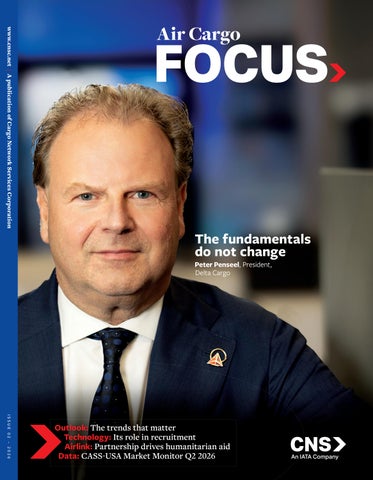
The fundamentals do not change Peter Penseel, President, Delta Cargo
ISSUE 02 – 2026
Outlook: The trends that matter Technology: Its role in recruitment Airlink: Partnership drives humanitarian aid Data: CASS-USA Market Monitor Q2 2026
ACF_Sept26_002.indd 2
10/09/2026 12:49
Contents
Air Cargo Focus
Contents ISSUE 02 – 2026
Comment 5 A more robust future
Alicia Lines, President of CNS, says air cargo’s increasing agility will allow it to be more resilient.
Features 6 The fundamentals do not change
Peter Penseel, President, Delta Cargo, tells Graham Newton that customer service, consistency, transparency, and access to a global network remain essential.
16
10 IATA appoints new Director General
IATA has announced its new Director General, Saadia Zahidi. 16 Cargo resilience
Aevean CEO Marco Bloemen looks at the factors affecting the cargo market.
11 We need better equipped people
Desiree Perez, President of EvolveWell, explains how technology can solve the air cargo industry’s retention problem. 14 Launching CNS FlexiPay
06 19
CNS has launched CNS FlexiPay, a free, optional CASSLink module.
CNS Cargo Network Services CNS President: Alicia Lines Assistant Director Corporate Communications: Markus Ruediger www.cnsc.org Editorial Editor Graham Newton Editorial consultant Markus Ruediger Lead designer Gary Hill Picture editor Jessica Marsh Production Production manager Jane Easterman +44 (0)20 7880 6248 jane.easterman@redactive.co.uk Publishing director Aaron Nicholls
19 Humanitarian responses
Advertising Business development manager +44 (0)20 7324 2763 airlines@redactive.co.uk
Follow CNS on X @CNS_Corp and join our LinkedIn group at linkedin.com/company/ cargo-network-services-corporation
For Air Cargo Focus subscription requests, or change of address notifications, email cnsteam@cnsc.us We welcome feedback and content ideas
www.cnsc.net
P03 Contents_Air Cargo Focus Issue 02-2026_Air Cargo Focus.indd 3
Airlink explains how its partnership model is driving humanitarian efforts. 22 CASS-USA Market Monitor
The opinions expressed in this publication are those of the individual authors or advertisers and do not necessarily reflect those of Redactive, CNS or its members. The mention of specific companies or products in articles or advertisements contained herein does not imply that they are endorsed or recommended by CNS or Redactive. All of this publication’s content is subject to copyright, design rights and trademarks of CNS and third parties.
Printed by The Manson Group, St Albans Published by Redactive Media Group, 9 Dallington Street, London EC1V 0LN www.redactive.co.uk
To access CNS content online, visit www.cnsc.net/en/publications/focus
Issue 02 – 2026 Air Cargo Focus
3
24/09/2026 08:13
dimark.eu
ACF_Sept26_004.indd 4
10/09/2026 12:50
Alicia Lines
Air cargo’s transformation points to a more robust future
ILLUSTRATION: SAM KERR
Alicia Lines, President of CNS, explains how greater agility has made air cargo resilient. The latest IATA figures show total air cargo demand, measured in cargo tonne-kilometres (CTK), rose 8.5% in June compared with the same month last year. Capacity increased 4.4%. Demand also outpaced global trade, driven by high-value technology products and urgent shipments. Although risks remain, this strong demand should not be surprising. Air cargo has evolved from a sector largely shaped by forces beyond its control into an essential part of global trade and the backbone of several industries. Artificial intelligence (AI)—the industry’s buzzword and great hope for a more efficient future—depends on air transport. According to IATA, air cargo
carries more than two-thirds of global AI-related hardware. The scale of air cargo’s transformation in recent years is clear. The sector has faced tariff volatility, geopolitical unrest, and policy shifts in key markets, including recent changes to European Union e-commerce regulations and de minimis rules in the United States. In the past, such events would have led to a downturn in air cargo. But our increased agility has helped sustain demand for our services. That does not mean our work is finished. Our resilience has improved significantly, and we now have the tactical tools to support short-term adjustments, as shifts in trade lanes
www.cnsc.net
P05 Alicia Lines Comment_Air Cargo Focus Issue 02-2026_Air Cargo Focus.indd 5
Comment
caused by conflict have shown. However, structural changes still need to happen—or at least accelerate. So, what must we do to prepare for future demand? Many factors matter, from smart airport facilities and a reliable supply of freighters to stronger security measures. But let me focus on two essentials: digitalization and sustainability. Digitalization is the platform for our future success. I believe AI will be central to a more agile, resilient future and will strengthen the case for many other digitalization initiatives. Digitalization creates data, and data enables insightful, powerful AI. Of course, we will still need talented people, and recruiting the next generation is every bit as important as adopting new technologies. Sustainability is equally critical. Our customers will not choose us to transport their goods unless we do so sustainably. Sustainable aviation fuels (SAF) will be central to our efforts, but they must become cheaper and more widely available. In the meantime, air cargo can take many practical steps, both on the ground and in the air. Think load planning or electrifying ground vehicles. These trends and more will be discussed at IATA Cargo Day in Bogotá, Colombia, on 11 November 2026, kindly hosted by Avianca Cargo. I look forward to seeing you there.
Alicia Lines, President, CNS Issue 02 – 2026 Air Cargo Focus
5
14/09/2026 19:25
Interview
Delta Cargo
6 Air Cargo Focus Issue 02 – 2026
P06-09 Delta Cargo_Air Cargo Focus Issue 02-2026_Air Cargo Focus.indd 6
www.cnsc.net
14/09/2026 19:26
Delta Cargo
Supply chains today must be more flexible than ever, and businesses are evaluating sourcing strategies, inventory positions, and transportation options.
Interview
The fundamentals do not change Peter Penseel, President, Delta Cargo, tells Graham Newton that customer service, consistency, transparency, and access to a global network remain essential. WORDS: GRAHAM NEWTON
D
elta Cargo provides access to a vast global network, moving billions of cargo ton-miles each year. From life-saving pharmaceuticals to fresh flowers and seasonal produce, its broad product portfolio is designed to meet every customer need. How have recent policies affected the business?
Recent policy changes, including tariffs and adjustments to de minimis rules, have added another layer of complexity to an already dynamic global trade environment. The changes to the de minimis rules have had an impact on air cargo traffic between Asia and the United States, and we’re beginning to see similar effects on trade between Asia and Europe. However, the market is already adapting, with growth in other sectors, including artificial intelligence (AI)-related components, helping offset some of that volume. We expect a similar adjustment over time in Europe as well. What I hear most from customers is not necessarily concern over any single policy, but rather the need to adapt quickly as conditions change. Supply www.cnsc.net
P06-09 Delta Cargo_Air Cargo Focus Issue 02-2026_Air Cargo Focus.indd 7
chains today must be more flexible than ever, and businesses are constantly evaluating sourcing strategies, inventory positions, and transportation options to maintain resilience. For Delta Cargo, our focus remains on helping customers navigate that complexity. Regardless of market conditions, customers need a reliable partner that can provide consistency, transparency, and access to a global network. Those fundamentals do not change. Air cargo has always been an industry that responds to change. Although policies may influence trade flows and demand patterns, the need to move critical shipments quickly and reliably continues. Our responsibility is to help customers adapt and keep their supply chains moving. What about the overall geopolitical situation? Has that affected your network, which relies on the passenger side of the business?
Geopolitical developments continue to influence global trade flows, and we see customer demand shift between markets as those dynamics evolve. Issue 02 – 2026 Air Cargo Focus
7
23/09/2026 16:56
Interview
Delta Cargo
However, I would view Delta Cargo’s position as a strength. As part of Delta Air Lines, we benefit from one of the world’s leading global passenger networks, providing customers with extensive connectivity across key markets around the world. That network allows us to remain flexible in how we support our customers as trade patterns evolve. We’ve seen that in markets like Tel Aviv, where ongoing geopolitical developments have required us to continually assess operational conditions. At the same time, our planned restoration of service between New York (JFK) and Tel Aviv in September 2026, followed by Atlanta– Tel Aviv in December 2026 reflects our commitment to restoring connectivity in strategically important markets when conditions allow. Although we are not redesigning our network in response to every geopolitical development, the breadth of our network gives customers access to a wide range of global markets and routing options through a trusted carrier. Just as importantly, cargo has a seat at the table as network decisions are evaluated. Our team works closely with colleagues across the airline to ensure cargo demand, customer needs, and market opportunities are part of those discussions. Ultimately, our focus is on helping customers navigate change. The strength of Delta’s global network, combined with a clear understanding of our customers’ needs, allows us to continue
delivering value even as the global trade environment evolves. Are the shifts in trade lanes a structural change or just temporary?
I believe we’re seeing elements of both. There are certainly short-term shifts driven by current economic conditions, policy changes, and geopolitical developments. Those factors can influence sourcing decisions and create temporary changes in demand patterns. At the same time, I believe some of the changes we are seeing are more structural. Many companies are reevaluating how they build supply chains, with greater emphasis on resilience, diversification, and risk management. As a result, we are seeing production and distribution networks evolve in ways that may have long-term implications for global trade. Those shifts influence investment decisions across the industry, including where airlines deploy capacity and build connectivity. For Delta, we’re making investments in the Asia-Pacific region with the recent service additions, such as Hong Kong, began in June 2026, and Manila, starting in March 2027, supporting customers in markets that continue to play an increasingly important role in global supply chains. From my perspective, the more important question is not whether every trade lane shift is permanent. The more important question is whether our industry is prepared to adapt. The
The question is not whether every trade lane shift is permanent but whether our industry is prepared to adapt. 8 Air Cargo Focus Issue 02 – 2026
P06-09 Delta Cargo_Air Cargo Focus Issue 02-2026_Air Cargo Focus.indd 8
companies that will be most successful are those that remain close to their customers, understand how their needs are evolving, and have the flexibility to respond. Regardless of how trade flows develop, that commitment to partnership and customer focus will remain essential. You have been investing heavily in technology. How will this affect your operations and what area of operations is next in line for a technology upgrade?
Technology investments will make it easier for customers to do business with Delta Cargo. That may sound simple, but for many years our industry has asked customers to navigate fragmented processes, disconnected systems, and unnecessary complexity. The opportunity in front of us is to remove that friction. Looking ahead, I believe the next step for our industry is greater connectivity www.cnsc.net
14/09/2026 19:26
Delta Cargo
support those interactions, but it does not replace them. The future is not technology versus people. The future is using technology to allow people to deliver an even better customer experience. Drawing on your background, how can forwarders and air cargo carriers work better together?
across the supply chain. Airlines, freight forwarders, and customers all benefit when information flows more freely and everyone is working from the same view of the shipment. That includes creating more seamless shopping and booking experiences across airline and partner networks, making it easier for customers to access solutions through a single connected experience. Technology itself isn’t the goal. A better customer experience is.
Having worked on both sides of the business, I have always believed that airlines and freight forwarders are strongest when they focus on what they can achieve together rather than where individual responsibilities begin and end. The customer does not care where the handoff occurs. The customer cares that the shipment arrives as promised. That means we must move beyond transactional relationships and build genuine partnerships based on communication, transparency, and shared objectives. When we openly share information, plan together, and solve problems together, we create better outcomes for everyone involved. The reality is that airlines need strong freight forwarders, and freight forwarders need strong airline partners. Our success is interconnected. When we keep the customer at the center of every conversation, the entire supply chain performs better.
IMAGES: DELTA AIR LINES
So, is this still a people business?
This will always be a people business. Technology is incredibly important, and we should continue investing in solutions that improve efficiency and visibility. But air cargo is ultimately built on trust, relationships, and collaboration. Customers remember how you respond when challenges arise. They remember whether you are transparent, accessible, and willing to work together to find solutions. Technology can www.cnsc.net
P06-09 Delta Cargo_Air Cargo Focus Issue 02-2026_Air Cargo Focus.indd 9
Is there anything that keeps you awake at night?
I would frame it differently. What keeps me focused is ensuring that our industry continues evolving to meet the expectations of our customers. Customers today operate in an environment that is
Interview
more complex and less predictable than ever before. They need partners who are reliable, adaptable, and easy to do business with. What gives me confidence is that air cargo has always been remarkably resilient. Our industry consistently comes together to solve challenges, adapt to change, and support global commerce. That spirit of partnership remains one of our greatest strengths. What advice would you give to young talent looking for a career in air cargo senior management?
Learn as much as you can about the industry. One of the greatest advantages I’ve had throughout my career was the opportunity to work across different parts of the supply chain and see the business from multiple perspectives. That experience helped me better understand not only how our industry operates but also what matters most to customers. Be curious. Spend time in operations. Spend time with customers. Take every opportunity to understand how decisions impact different parts of the supply chain. I would also encourage young professionals to invest in relationships. Air cargo is a global industry, but it remains very much a relationship business. The connections you build throughout your career and the perspectives you gain from others will be invaluable. At the same time, be prepared to work hard and keep raising the bar for yourself. The most successful professionals are those who continuously learn, take on new challenges, and push beyond their comfort zone. Issue 02 – 2026 Air Cargo Focus
9
14/09/2026 19:26
Feature
IATA Director General
IATA appoints new Director General Saadia Zahidi will take up the role in November 2026, becoming the first woman to hold the position.
I
ATA announced that Saadia Zahidi has been appointed by IATA’s Board of Directors to the position of Director General from 1 November 2026. Zahidi will be IATA’s ninth Director General and the first woman appointed to hold the position. She joins IATA from the World Economic Forum (WEF) where she is a Managing Director and Member of the Managing Board. Willie Walsh, IATA’s current Director General, concluded his duties on 31 July 2026. The IATA Board of Directors has appointed Sandrine Le Borgne, IATA’s Chief Financial Officer and Senior Vice President for Corporate Services, as Interim Director General for the intervening period. “The Board is very pleased to appoint Saadia Zahidi as Director General of IATA. Saadia’s long and outstanding experience at the World Economic Forum will enhance and strengthen IATA as the voice of the world’s airlines. Global air transport is a trillion-dollar industry that has and continues to change the world for the better. Saadia’s appointment comes at a moment of significant change in the international environment. Technology and geopolitics, among others, will reshape the industry in the future and Saadia brings the right skills to effectively articulate what our industry needs to continue connecting people and
10 Air Cargo Focus Issue 02 – 2026
P10 IATA DG-SZ_Air Cargo Focus Issue 02-2026_Air Cargo Focus.indd 10
economies safely, efficiently, and sustainably. She’ll bring a fresh perspective to IATA that will grow its support for the airline industry on the foundations of IATA’s well-established technical, financial, and data capabilities. “I thank Willie for his outstanding leadership that helped IATA emerge from the COVID years stronger and with a more representative membership than ever. We now look forward to Saadia taking IATA’s work to even greater heights,” said Roberto Alvo, Chair of the IATA Board of Directors and CEO of LATAM Airlines Group. “I am honored to help advance IATA’s mission to represent, lead, and serve the airline industry at this pivotal moment. Aviation is critical infrastructure for economic growth, trade, tourism, jobs, investment, and opportunity. In a rapidly changing world, IATA’s role in bringing the industry together to collaborate through trusted standards, essential services, and advocacy has never been more important. “I look forward to working closely with our member airlines, governments, and the ecosystem of
partners to build on IATA’s remarkable foundation, ensuring aviation continues to connect the world while embracing innovation, strengthening resilience, and advancing sustainable growth. Together, we can expand the benefits of connectivity to more people and economies around the world. My top priority will be working with the IATA team and with the industry to build aviation’s future together,” said Zahidi. About Zahidi
Zahidi spent more than two decades at the World Economic Forum, where she served as Managing Director and Member of the Managing Board. She founded and currently heads its Centre for the New Economy and Society. Previously she led the WEF’s Global Communications Group, Global Programming Group, and WEF’s engagement with academics, civil society, and international organizations. Zahidi founded and co-authors WEF’s Future of Jobs Reports, the Future of Growth Reports, the Global Gender Gap Reports, and Chief Economist Outlooks. She has served on the UN SecretaryGeneral’s panel for Women’s Economic Empowerment and the European Space Agency’s High-Level Advisory Group. She is also the author of Fifty Million Rising, tracking the rise of working women in the Muslim world. Zahidi holds a BA in Economics from Smith College, an MPhil in International Economics from The Graduate Institute, and an MPA from Harvard University. She holds Swiss and Pakistani nationalities. www.cnsc.net
14/09/2026 19:27
EvolveWell
Feature
The cargo industry needs better equipped people
E Desiree Perez, President of EvolveWell, explains how technology can help air cargo to recruit and retain talent.
www.cnsc.net
P11-13 EvolveWell_Air Cargo Focus Issue 02-2026_Air Cargo Focus.indd 11
very time a new technology shows up these days, people ask the same thing: how many jobs is this artificial intelligence (AI) going to replace? It's an easy and obvious question, but not the only one worth sitting with. One important question to sit with is: why is turnover so high? Pay is part of it, and I’m not going to pretend otherwise. But pay doesn’t explain why someone quits under a manager who got promoted last month and never got trained to lead anyone. Turnover doesn’t start in that first rough week. It starts the day
someone gets promoted into a leadership role and gets handed a radio and a shift briefing and is told that as of now, they’re responsible for a specific team. That’s it. No additional training or handoff. I started in aviation at 20, at one of the busiest airports in Germany. By 22, I was managing 80 people. Someone had trained me on the procedures, and I knew them cold. Nobody had trained me on the rest of it. How to tell when someone on my team had quietly checked out. How to have a hard conversation with someone falling behind before it turned into a performance issue. How to lead people instead of just running a process. I picked Issue 02 – 2026 Air Cargo Focus
11
15/09/2026 12:04
IMAGES: ISTOCK
Feature
EvolveWell
that up the slow way, on the ramp, getting it wrong more times than I’d like to admit. Most people don’t get the time I got. They get the promotion, a radio, and whatever instinct they walked in with. That’s the part of this industry’s retention problem we don’t name often enough. We promote someone because they were good at the job underneath the one we’re now giving them, run them through some operational training, and have them run shifts. Knowing the standard operating procedures was never the hard part of leading a team. Leading the people who run them is. Almost nobody builds anything to teach that, because it’s a lot harder to do and costs a lot of time and resources in a razor-thin margin business. AI changes that. This is actually where an AI insight navigator earns its keep, and it’s a narrower job than most people assume. It’s not managing the frontline for anyone, and it’s not replacing anyone’s judgment. What it does is give a new
Every shift, every interaction, every small compliance gap someone catches and never writes down, that's information the business already has and almost never uses.
12 Air Cargo Focus Issue 02 – 2026
P11-13 EvolveWell_Air Cargo Focus Issue 02-2026_Air Cargo Focus.indd 12
leader something I never had at 22: real guidance on how to lead the specific people standing in front of them, based on what those people are actually showing you in real time, instead of a leadership course they sit through once and never think about again. That same guidance should sit with the frontline worker too, not just live in the manager’s inbox. If it’s built on the actual manuals and procedures, a worker can get an answer in seconds instead of hunting down a manager and waiting around. That’s time the manager gets back for situations that needs a human in the room: hard conversations, judgment calls, whatever the manual doesn’t cover. The frontline doesn’t stop producing insight, ever. Every shift, every interaction, every small compliance gap someone catches and never writes down, that’s information the business already has and almost never uses. Capture it in real time and route it to www.cnsc.net
14/09/2026 19:28
EvolveWell
the right person, and it turns into something a manager can act on: who’s checking out this week, who’s ready for more, who’s got a knowledge gap about to become a compliance problem, who needs five minutes before Friday instead of a note buried in a file six months from now. Targeted, not a dashboard nobody opens. It’s exactly what most new leaders never get, which is a big part of why so many struggle in year one, and why good frontline people quietly walk out the door without anyone upstairs ever figuring out why. Push that same insight up another level, and executives finally get something they rarely have: real visibility into which stations, shifts
and teams are at risk, before it turns into a resignation or a missed shipment. Not a retention number someone reports on a quarterly call. A live read on where leadership is working and where it isn’t, station by station. The same insights that give a new manager real-time guidance can also point out who on the frontline is already showing the instincts to lead, well before the next promotion gets decided on gut feel. Leadership turnover and frontline turnover are the same problem in two different uniforms. Fix the moment someone steps into a leadership role without the tools to lead, and a good chunk of both problems goes with it. How many people leading a team got
How many people leading a team right now got there because they were good at the last job, not because anyone checked whether they could do this one? www.cnsc.net
P11-13 EvolveWell_Air Cargo Focus Issue 02-2026_Air Cargo Focus.indd 13
Feature
there because they were good at their last job, not because anyone checked whether they could do this one? And how many people are quitting under them right now for exactly that reason? So, before the next piece of technology gets rolled out, let’s set the headcount question aside. Ask instead whether it equips the people we keep promoting, not just the process they’re now responsible for. The companies that get this right won’t end up with fewer people. They’ll end up with leaders who were never set up to fail in the first place, and frontline teams who stick around because of it. Desiree Perez is President of EvolveWell, a workforce intelligence platform helping frontline-heavy industries turn everyday operational activity into the signals leaders need to reduce turnover, close knowledge gaps, and cut operational risk. She holds an ICF PCC coaching credential and is a Master in Leadership and Strategy. Issue 02 – 2026 Air Cargo Focus
13
14/09/2026 19:28
Feature
FlexiPay
Launching CNS FlexiPay Adding real-time billing, prepayment, and flexible payment terms to the existing CASSLink environment will provide the industry with greater agility. WORDS: GRAHAM NEWTON
IMAGES: ISTOCK/SHUTTERSTOCK
T
he CNS CASS (Cargo Accounts Settlement System) USA framework is a proven, trusted platform that settles billions of dollars accurately and on schedule. Geopolitical volatility has accelerated change in the air cargo market, however, increasing the need for greater flexibility. CNS FlexiPay is a free-of-charge, optional CASSLink module that enables real-time billing, prepayment, and flexible payment arrangements between airlines and freight forwarders within the CNS CASS USA framework. The traditional CASS Export process follows a fixed 15-day billing cycle that determines when airlines can bill and when funds are remitted. Airlines can bill only within established periods, have no built-in prepayment option, and— like forwarders—must rely on bank guarantees to manage risk. CASS Export also does not provide real-time visibility into billing or payment status within the CNS ecosystem. CNS FlexiPay closes these gaps by adding real-time billing, prepayment, and flexible payment terms to the
14 Air Cargo Focus Issue 02 – 2026
P14-15 FlexiPay_Air Cargo Focus Issue 02-2026_Air Cargo Focus.indd 14
existing CASSLink environment without replacing or disrupting the standard CASS cycle. Billing takes place in real time when an airline uploads an Air Waybill (AWB). The freight forwarder is notified immediately, authorizes payment for each AWB, and funds are settled to the airline within 48 hours. Payment can be made by Automated Clearing House credit or debit account, or by credit card. All CNS Airline Members and CNS Endorsed Cargo Agents automatically receive access to CNS FlexiPay in CASSLink. Participation is voluntary: while the functionality is enabled for all CNS airlines, each airline chooses whether to bill through CNS FlexiPay or CASS Export. Key benefits for airlines
CNS FlexiPay offers: Real-time visibility into billing, invoicing, and payment status Secure prepayments before shipment departure Flexible payment terms based on bilateral agreements Potentially reduced work related to bilateral bank guarantees www.cnsc.net
14/09/2026 19:29
FlexiPay
All CNS Airline Members and CNS Endorsed Cargo Agents automatically receive access to CNS FlexiPay in CASSLink.
Feature
CNS also validates CNS FlexiPay calculations and data as airlines upload billing files, helping support accuracy and compliance. All CNS FlexiPay transactions settle under CNS settlement and remittance rules, enabling secure, standardized funds transfer. Airlines can identify CNS FlexiPay transactions in CNS billing and reconciliation reports using agreed reporting formats. Key benefits for freight forwarders
Freight forwarders benefit through: Real-time access to new AWB billing records A secure payment authorization process Flexible payment terms A prepayment model that may reduce the need for bank guarantees The ability to choose which AWBs to authorize for payment Clear payment status tracking in CASSLink CNS FlexiPay transaction output follows the same format as CASS Export output files, supporting consistency and straightforward integration. To use CNS FlexiPay, a freight forwarder must onboard as either an Endorsed Agent or a Commercial Account, gaining access to standard CNS services such as CASS Export, Domestic, and FlexiPay. Existing CNS users are automatically enabled for the CNS FlexiPay module. Training and documentation are available at https://www.cnsc.net/casslink and https://www.cnsc.net/flexipay www.cnsc.net
P14-15 FlexiPay_Air Cargo Focus Issue 02-2026_Air Cargo Focus.indd 15
Issue 02 – 2026 Air Cargo Focus
15
14/09/2026 19:29
Feature
Outlook
IMAGES: ISTOCK/SHUTTERSTOCK
Cargo resilience being tested by emerging trends
16 Air Cargo Focus Issue 02 – 2026
P16-18 Outlook-Aevean_Air Cargo Focus Issue 02-2026_Air Cargo Focus.indd 16
www.cnsc.net
14/09/2026 19:30
Outlook
Feature
Aevean CEO, Marco Bloemen, looks at the factors affecting the cargo market in the near future.
T
he first half of 2026 delivered an air cargo market largely unrecognizable from the start of the year. Global air cargo resilience is being further tested with unprecedented and sustained volume and commodity mix changes, coupled with the regulatory restructuring of e-commerce requirements. Understanding what this means for the second half of 2026 and beyond is vital for airlines, forwarders, and shippers.
Redefining global air demand drivers
A combination of macro trends has been shaping the first half of 2026. Tariffs do not dampen demand; they mostly affect how demand is routed and the profitability to serve markets that have tariffs imposed. Last year’s tariff impact on air cargo set the scene for 2026. Since the introduction of US tariffs mid-2025, air imports grew 4% year on year, well below the 8% global average between April 2025 and January 2026. Furthermore, since the withdrawal of the de minimis exemption in May 2025, US air imports of e-commerce have experienced a severe decline of about 300,000 tonnes (-23%). Most other general air cargo commodities into the United States remained flat, except for high-tech, which delivered an additional 500,000 tonnes (+55%). Moreover, Brazil, China, and India were heavily exposed to tariffs, with strong declines in healthcare, pharmaceuticals, food, and perishables. Although a portion of US high tech air import growth was frontloading ahead www.cnsc.net
P16-18 Outlook-Aevean_Air Cargo Focus Issue 02-2026_Air Cargo Focus.indd 17
of tariff introductions, it has become clear that high tech is a structural driver for growth. Artificial intelligence data center components make up the majority of the current high-tech boom. Global air cargo volumes for data centerrelated components reached 1.4 million tonnes in 2025, which equates to roughly 40% growth year on year. In the first quarter of 2026, the US high tech imports of computers and servers increased sixfold over the first quarter of 2025, with networking equipment three times first quarter 2025 volumes. Taiwan became the key air exporter to the United States, with 150% year-on-year growth of data center related goods. Volumes of computer parts surged 70%, again mostly from Taiwan. Taiwanese servers and computer parts are exempt from US tariffs, which has driven air cargo growth into the United States. For the first half of 2026, Taiwan, Thailand, and Vietnam largely replaced tariff-hit China in high tech cargo with Taiwan alone adding some seven widebody freighters per day (+129%). This extraordinary growth is expected to continue well into 2027. E-commerce resilience
Global air cargo resilience is also being heavily affected by regulatory reforms on e-commerce imports. France, for example, was early adopter of an additional €2 per item tax on nonEuropean Union (EU) shipments. E-commerce volumes from China dropped 30% in March 2026 and another Issue 02 – 2026 Air Cargo Focus
17
14/09/2026 19:30
Feature
Outlook
Chart 1: US data center-related air imports have run close to 100k tonnes per month, equivalent to ~1,000 freighter flights Data center-related air trade into US, by segment, Jan 2025 – Jun 2026 Thousand tonnes
50% in April. Market data shows that the majority of France’s e-commerce import decrease has been attributable to fashion-related shipments. With the new EU e-commerce tax in force, various EU air importing countries have taken a severe hit. Belgium and Germany, large e-commerce import markets, have declined 29% and 22% respectively, though the United Kingdom has been relatively unaffected. The remaining months of 2026 will reveal whether European demand is structurally price-inelastic or whether there will be further contraction.
Jan-Jun 2026 +128% YoY
˜3x
+184%
Power infrastructure
+44%
Servers Jan
Feb
Mar
Apr May
Jun
Jul
Aug
Sep
Oct Nov Dec
Jan
2025
Feb
Mar
Apr May
+255%
Jun
2026
Key growth segments are servers (3.5x) and Network equipment (3x) Notes: 1) Computer components include processing units. Source: Aevean analysis, Aevean air trade database (August 21, 2026)
Chart 2: China to Europe e-commerce is down 24% in July 2026 Data center-related air trade into US, by segment, Jan 2025 – Jun 2026
Air capacity changes and structural shifts
18 Air Cargo Focus Issue 02 – 2026
Network equipment
Computer components1 +89%
29
Thousand tonnes
Global capacity was down 9% in the first week of March, a direct result of the Gulf conflict. Aevean data shows that 3.1 million tonnes of expected capacity have been wiped out to date in 2026. Airlines rerouted capacity quickly. Asia-Europe direct lanes grew +10%– 11%, and Transpacific +8-9%. Within weeks, global capacity recovered to 1% above pre-conflict levels. For the rest of the year, global capacity growth forecasts have been cut in half because of the Middle East conflict, from 4.2% to 2.1%. Cargo capacity growth is likely to remain more constrained in the years ahead as narrowbody aircraft take a larger share of production while order books and delivery backlogs continue to grow. Meanwhile, freighters overdue for retirement now stand at five times the four-year average, and future deliveries will only partly offset the shortfall. Overall, air cargo demand will outpace supply until 2030, a trend that will be even more pronounced on particular trade lanes.
Jan-Jun YoY %
98
July 2025
July 2026 YoY %
July 2026 Change
United Kingdom
-2%
Belgium
-29%
The Netherlands
5%
Germany
-22%
Spain
-38%
Italy
-26%
France
-64% -23%
Hungary Russia
In total, Europe is down -24% in July 2026
Poland
29% -7%
Decline driven by France (-64%), Belgium (-29%), Spain (-38%), Germany (-22%) Source: Aevean trade database, Aevean analysis (August 25, 2026)
Chart 3: Gulf conflict is suppressing air cargo capacity growth, year-to-date +2.1% vs. +4.2% pre-conflict & Chinese new year International cargo capacity1, 9 Feb-16 Aug 2026 ACTK year on-year change (%)
15%
CNY effect
Weak 2025 base (tariff escalation)
10%
+4.2% (Pre-CNY) +2.1% YOY (YTD)
5% 0% -3% -2% -4%
-5%
-2%
-8%
10% 7
8
9
-10% 10 11 12 13 14 15 16 17 18 19 20 21 22 23 24 25 26 27 28 29 30 31 32 33
Gulf conflict start
Week number
Notes: 1) Includes freighters and widebody passanger, pre-CNY period defined as 1 Jan–28 Jan to avoid the weak base in early February. Source: Aevean capacity database, Aevean analysis (August 21, 2026)
www.cnsc.net
Airlink
Feature
A blueprint for global humanitarian responses Airlink explains how its partnership model is driving humanitarian efforts. WORDS: AIRLINK
W
hen disaster strikes, communities need aid immediately— and few emergencies illustrate that urgency as earthquakes do. Search and rescue teams, disaster management crews, first responders, and essential supplies, including shelter, water, food, and medicines, must be deployed within moments. Lives are on
www.cnsc.net
P19-21 Airlink_Air Cargo Focus Issue 02-2026_Air Cargo Focus.indd 19
the line, and time is ticking. The first 72 hours are the most critical. In Venezuela on 24 June 2026, back-to-back earthquakes violently shook communities, leaving more than 650,000 people in need of humanitarian assistance. Damaged infrastructure and disruptions at the country’s largest international airport created logistical obstacles, and nonprofit organizations scrambling to help were left without
options to even reach the country. In response, Airlink, an aviation-enabled humanitarian logistics organization, mobilized its partners to build a pathway for aid. Airlink’s role as a global disaster response coordinator, getting lifesaving aid and relief onto commercial airlines and other modes of transportation and into impacted communities when disaster strikes, demonstrates that
Issue 02 – 2026 Air Cargo Focus
19
15/09/2026 11:32
Feature
Airlink
In Venezuela, back-to-back earthquakes left more than 650,000 people in need of assistance. Airlink mobilized its partners to build a pathway for aid. partnerships between humanitarian organizations and commercial airlines and logistics companies are the key to better responses. Excess cargo capacity
It took years to hone this disaster response model. In late 2009, the ISTAT Foundation, the philanthropic arm of the aviation industry association International Society of Transport Aircraft Trading, recognized that it had an underused resource. Commercial aviation had excess cargo capacity and empty passenger seats on pre-existing routes that could be put to humanitarian use. Thus, Airlink was created to leverage aviation assets in disaster response. The brand-new organization was tested immediately. When the 7.0-magnitude earthquake struck Haiti in January 2010, Airlink worked with humanitarian organizations and commercial aviation partners to move more than 2,000 doctors and nurses and 40 shipments of aid totaling more than 500,000 pounds. Sixteen years later, that experiment became a trusted global humanitarian logistics operation, partnering with more than 50 airline and transportation partners to provide free of cost airlift, logistics solutions, and disaster preparedness
20 Air Cargo Focus Issue 02 – 2026
P19-21 Airlink_Air Cargo Focus Issue 02-2026_Air Cargo Focus.indd 20
expertise to more than 250 humanitarian organizations providing lifesaving relief around the world. Airlink’s responses span natural disasters, health crises, conflicts, and complex humanitarian emergencies, helping over 80 million people across 100 countries, and counting. Its largest responses include coordinating aid and relief during the West Africa Ebola outbreak of 2014, the COVID-19 pandemic, the war in Ukraine, the ongoing Sudan humanitarian crisis, and major hurricanes and storms across North America, Latin America and the Caribbean, and Asia and the Pacific. Airlink steps in to match humanitarian needs to commercial aviation and logistics resources. But in Venezuela, that model took a major step forward. Airlink joined forces with Amazon, the United Nations World Food Programme, and the US State Department to build an airbridge with seven weekly flights carrying essential relief supplies to Venezuela’s capital, Caracas, and onward to the destroyed communities. Amazon donated aircraft and fuel, while Airlink determined what cargo should be transported based on nonprofit needs and handled the first mile logistics. The World Food Programme managed distribution inside Venezuela, while the State Department funded Airlink’s work and communicated with Venezuelan authorities. The flights moved roughly 40 tons of relief supplies at a time, including
shelter and sleeping kits, medical equipment, culturally appropriate food, water-filtration systems, and hygiene supplies, as well as generators, all benefiting some 1.7 million people. Airlink’s airbridges are not simply one flight from Point A to Point B, but a carefully curated chain of aviation and cargo connections that can move aid from its source to the communities who need it most, creating pathways where none exist. Why coordination matters
New research commissioned by Airlink, in collaboration with the Conrad N. Hilton Foundation, conducted through the Center for Humanitarian Logistics and Regional Development, a joint initiative of Kühne Logistics University and HELP Logistics, underscores why that coordination matters. Drawing on interviews and survey responses from humanitarian and private-sector actors, the study found that transportation www.cnsc.net
14/09/2026 19:31
www.cnsc.net
P19-21 Airlink_Air Cargo Focus Issue 02-2026_Air Cargo Focus.indd 21
Airlink’s responses span natural disasters, health crises, conflicts, and complex humanitarian emergencies, helping over million people across countries, and counting.
donated to humanitarian causes creates value beyond cost savings: it gives organizations an opportunity to invest more in communities and scale their response and recovery programs, while saving both time and money in supply chain and logistics hurdles. Crucially, the research found that pre-crisis partnerships between Airlink and transportation providers ensure maximum responsiveness when emergencies occur. That finding points to a larger lesson. Public-private collaboration for effective disaster response should not be treated as an ad hoc or last-minute issue, but rather, it should be part of ongoing disaster preparedness. Transportation and logistics companies possess capabilities that humanitarian organizations cannot easily build or maintain themselves. Humanitarian organizations, meanwhile, have knowledge of affected communities, the means to source humanitarian goods,
established response systems, and trusted relationships on the ground. They often lack relationships with the commercial aviation and broader global transportation ecosystem or wait until the emergency has already struck before approaching private-sector partners for help. But when every second counts, reaching out after it’s happened means it may already be too late. Pre-agreed procedures, trusted relationships, and clear activation mechanisms can turn a potential private sector contribution into usable response capacity within hours rather than weeks. The study specifically recommends formalizing these relationships through pre-agreed triggers, priority transportation lanes, and streamlined documentation. Venezuela demonstrates what that can effectively look like in practice. The various actors had existing trusted relationships, shored up by formal partnership agreements, so when the earthquake hit, they could move quickly. But as climate-related disasters intensify and conflicts drive humanitarian needs, the gap between what communities require and what traditional humanitarian aid providers can provide is likely to widen. Closing that gap will require more than additional donations, it will require rethinking the humanitarian assistance infrastructure itself. Airlink’s experience suggests building partnerships before they are needed. When a network can be activated because relationships already exist, private-sector capacity becomes more than corporate goodwill, but a valuable preparedness tool, and the key to building a pathway to hope.
Feature
80million
IMAGES: AIRLINK
Airlink
Issue 02 – 2026 Air Cargo Focus
21
14/09/2026 19:31
Air Cargo Focus
CASS-USA Market Monitor
CASS-USA Market Monitor CASS-USA Market Monitor appears in every issue of CNS Air Cargo Focus Magazine. The Market Monitor is designed to highlight market trends till the most recent data month available. It provides both the rolling 12 months activity and
quarterly air cargo traffic trends originating from the United States to other regions based on CNS CASS-USA data. Additional detailed reports are available to CASS-USA Participating Carriers and CNS Endorsed Agents.
Weight in Tons
Aug 2024-Jul 2025
Aug 2025-Jul 2026
Total
Middle East & Africa
Latin America & The Caribbean
Europe
Asia Pacific (incl. North Asia)
0
500,000
1,000,000
Aug 2025-Jul 2026 Weight in Tons Region
2,000,000
Aug 2024-Jul 2025 Weight in Tons
Aug 2025-Jul 2026
Asia Pacific (incl. North Asia)
1,500,000
1,042,082
Region
3,000,000
% Change
Aug 2024-Jul 2025
Asia Pacific (incl. North Asia)
2,500,000
1,047,397
Region
% Change
Asia Pacific (incl. North Asia)
-0.5%
Europe
921,426
Europe
867,018
Europe
6.3%
Latin America & The Caribbean
438,659
Latin America & The Caribbean
442,974
Latin America & The Caribbean
-1.0%
183,182
Middle East & Africa
194,225
Middle East & Africa
-5.7%
Total
1.3%
Middle East & Africa Total
2,585,349
Total
Aug 2025-Jul 2026 Shipment Count Region
Aug 2024-Jul 2025 Shipment Count
Aug 2025-Jul 2026
Asia Pacific (incl. North Asia)
2,551,613
1,036,281
Region Asia Pacific (incl. North Asia)
% Change
Aug 2024-Jul 2025 1,036,254
Region
% Change
Asia Pacific (incl. North Asia)
0.0% 4.4%
Europe
850,433
Europe
814,627
Europe
Latin America & The Caribbean
409,939
Latin America & The Caribbean
399,902
Latin America & The Caribbean
2.5%
Middle East & Africa
221,235
Middle East & Africa
235,277
Middle East & Africa
-6.0%
Total
1.3%
Total
2,517,888
Q2 2026
Total
2,486,060
From Aug 2025 to Jul 2026, US export revenue and yields to Asia Pacific and North Asia increased by 8% s y/y. US export revenue to Europe increased by 10% and yields increased by 4% y/y. Overall y/y results for Aug 2025-Jul 2026 statistics reflected an increase in revenue of 8% and a increase in yields of 7%.
22 Air Cargo Focus Issue 02 – 2026
P22 CASS-USA Monitor_Air Cargo Focus Issue 02-2026_Air Cargo Focus.indd 22
www.cnsc.net
14/09/2026 19:32
Air cargo intelligence, down to the commodity level. Including visibility into dangerous goods shipments. CargoIS gives you unmatched insight into what is moving in air cargo, with details by commodity, trade lane, and Dangerous Goods transported. Based on real shipment records from airlines and freight forwarders, it provides the detail you need to analyze trends, understand market shifts, and support compliance.
Example of Commodity Breakdown Use CargoIS to: »
30%
Perishables
30%
Other
» Identify volumes of dangerous goods and the average market yield.
15%
Dangerous Goods
25%
commodity type
» Benchmark performance by route, region, and partner
Discover CargoIS
Pharmaceuticals
ACF_Sept26_023.indd 1
10/09/2026 12:51
A New Era in Airline Operations CAE proudly presents Flightscape, a data-driven decision-making platform designed to optimize airline operations. More than ever, mastering operational complexity is mission-critical. By providing real-time insights, Flightscape empowers OCC stakeholders to achieve and maintain peak operational performance.
Your next move should never be a guess. It should be a strategy.
ACF_Sept26_024.indd 24
10/09/2026 12:52