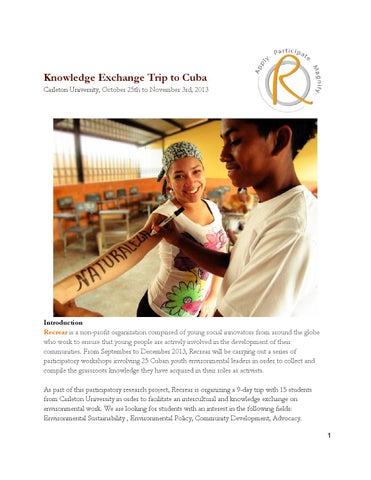
Knowledge Exchange Trip to Cuba Carleton University, October 25th to November 3rd, 2013
Introduction Recrear is a non-profit organization comprised of young social innovators from around the globe who work to ensure that young people are actively involved in the development of their communities. From September to December 2013, Recrear will be carrying out a series of participatory workshops involving 25 Cuban youth environmental leaders in order to collect and compile the grassroots knowledge they have acquired in their roles as activists. As part of this participatory research project, Recrear is organizing a 9-day trip with 15 students from Carleton University in order to facilitate an intercultural and knowledge exchange on environmental work. We are looking for students with an interest in the following fields: Environmental Sustainability , Environmental Policy, Community Development, Advocacy. 1
About Recrear www.recrearinternational.org Recrear’s mission is to ensure that young people are actively involved in the development of their communities, because we see young people as essential catalysts and agents for impactful sustainable development. We provide consulting services to support our partnering organizations with the design, implementation, and monitoring of youth-friendly programs. We use a youth-to-youth approach to collect information on young people’s perspectives through participatory research projects. Through programs that use creative and engaging techniques (photography, sports, development theatre, and many others), we supply space and tools for youth to articulate their needs and build a vision for their community’s development. Based on the information and insight we gather, we then strive to deepen the connection and improve the quality of collaboration between youth and development partners through consulting.
Vision Recrear envisions an intercultural world where young people are connected to their local and global communities by proactively participating with development partners to create inspired dialogue and innovative development projects. 2
How we work As young people ourselves, we naturally create a youth-centric environment that is both intimate and inclusive. We provide this space for uninhibited, uncensored dialogue and ideas to surface by engaging youth in participatory techniques such as theatre, photography, sports, creative writing, community tours, and street art. Our projects are centered around themes such as youth leadership and intercultural communication. We engage groups for a time span of 3 to 6 months; each project is tailored based on the specific needs of our partners and based on the characteristics of the group with whom we are working.
Our work engages young people to: ● openly discuss community dynamics; ● practice how to effectively communicate with their peers and institutions; ● raise youths' confidence on their capacity to learn, teach, exchange with others, and be agents of change; ● promote empathy and intercultural exchange.
Recrear’s work in Cuba The research that Recrear is carrying out in Cuba from September to December 2013 is designed to connect youth environmental leaders in Cuba with each other and with international youth leaders. The initiative aims to allow youth leaders to consolidate, share, and expand the knowledge and experience on climate change adaptation that they have acquired through grassroots work. From September to December, 25 participants will be taking part in workshops to bring together the experience they have gathered in their work as activists. The workshops will present a platform to share best practices and discuss challenges and opportunities to strengthen grassroots work on climate change adaptation. The workshops will also include activities to capacitate the group in three themes: youth leadership, conflict resolution and intercultural communication.
3
Knowledge Exchange Trips As part of the intercultural communication module, 15 Canadian university students will visit Cuba on a Knowledge Exchange Trip. The Exchange will provide a platform for both Cuban and Canadian participants to: ● Exchange ideas in an intercultural context as a way to encourage reflections; ● Learn about Cuba and Canada’s society, environmental policies and best practices on grassroots environmental work; ● Share experiences, anecdotes and viewpoints on youth engagement in community development; ● Explore different cultural interpretations of the relationship between people and the environment through creative activities. We are selecting a group of 10-15 students from Carleton University with an interest in Environmental Sustainability, Environmental Policy, Community Development and Advocacy. Students are not required to speak Spanish, however basic knowledge of the language would be an asset. The total cost of the trip is 1200 CAD per person. The price includes: - Pre departure orientation in Canada - A 4-day course at the University of Havana (FLACSO) on ‘Social Development and the Environment in the Cuban Context’ - Translation services for the course - A visit to the organic farm of Teatro de los Elementos - Visits to local NGOs - Food and accommodation in Cuba for 9 days - Ground transportation in Cuba - Donation in support of the work of the Cuban host organization - Costs for a supervisor to travel with the group to Cuba - Cost of entry Visa + airport exit tax The price does not include the cost of flight and health insurance. 4
Local Partners About FLACSO The Latin American School of Social Sciences (FLACSO) was founded in 1957 by the initiative of UNESCO. FLACSO was created as an international, inter-governmental, regional and autonomous body comprised of the following Latin American and Caribbean countries which adhered to the Agreement: Argentina, Bolivia, Brazil, Costa Rica, Cuba, Chile, Ecuador, Honduras, Guatemala, Mexico, Nicaragua, Panama, Paraguay, Dominican Republic, Suriname and Uruguay. The core objective of FLACSO is establishing postgraduate programs for the purpose of training new Latin American generations in different fields within Social Sciences. More information at: www.flacso.org.ar During the exchange, both the Cuban and the Canadian participants will take a 12-hour course on ‘Social Development and the Environment in the Cuban Context’. In addition, FLACSO will coordinate with partner NGOs to organize field visits to key project sites where environmental work is taking place in the Havana area. About Teatro de Los Elementos Teatro de los Elementos is a Cuban theater company which explores the connection between nature and community development through theatre. Once a fairly nomadic theater troupe, in 1995 they decided to settle down in Cumanayagua where they established a caring and eco-friendly community. The community practices sustainable agriculture and community-based social programs. As part of the exchange, Canadian and Cuban participants will spend 4 days at Teatro de Los Elementos. During the four days, participants will take part in a number of creative workshops designed to bridge cultural differences, share experiences, and explore the relationship between people, nature, and the community around them. 5
Accommodation and Amenities During their stay in Cuba, students will have the opportunity to experience both life in the city as well as in Cuba’s more rural countryside.
Havana In Havana, students will be staying at the Hotel Colina in the center of Havana City. Located in front of the University of Havana, students can easily walk to the university where the FLACSO course will be held.
Furthermore, the hotel is located close to a number of restaurants, parks, and other sights of interest. A clinic can also be found within 5km of the hotel. For access to internet, students can buy internet cards at Hotel Colina or any other major hotel nearby. As mentioned, courses will take place at the University of Havana. The faculty of Law has kindly offered their classrooms to host the 4-day course with Canadian and Cuban students. An interpreter will translate the course from Spanish into English.
6
Cumanayagua Following the initial introductory sessions in Havana City, students will travel by bus to Cumayanagua - a town 6 hours inland from the capital. Here students will be hosted by Teatro de los Elementos in a number of small houses located on the estate. Life on the farm is rustic but all the essential services are available. During the 4 days in Cumayanagua, Cuban and Canadian students will participate in a number of creative exercises to explore their understanding of the environment. In particular, Teatros de los Elementos will employ development theater techniques and other participatory development tools to stimulate individual and group reflections about community practice and environmental work. Furthermore, Recrear will be facilitating discussions (translation included) at the end of each day to gather and document the lessons learned. Although students will be spending most of their time on the estate, the surrounding community of Cumayanagua is within walking distance. The community has a number of basic facilities including clinics in case of medical emergency.
7
Recrear International Youth Organization www.recrearinternational.org Twitter: @ThisIsRecrear Recrear International c/o Wellington St. Post #300-200 Metcalfe St. Ottawa ON K2P 1P7
8