Reconciliation News Stories about Australia’s journey to equality and unity
FROM ACTION TO IMPACT THE NEXT CHAPTER OF THE RECONCILIATION MOVEMENT 56 October 2026
Reconciliation News is published by Reconciliation Australia in May and October each year. Its aim is to inform and inspire readers with stories relevant to the ongoing reconciliation process between Aboriginal and Torres Strait Islander peoples and non-Indigenous Australians. Aboriginal and Torres Strait Islander peoples should be aware that this magazine may include references to and images of deceased persons, as well as historical topics and images that may be confronting. CONTACT US
JOIN THE CONVERSATION
reconciliation.org.au
facebook.com/ReconciliationAus
enquiries@reconciliation.org.au
x.com/RecAustralia @reconciliationaus
Reconciliation Australia
Reconciliation Australia acknowledges the Traditional Owners of Country throughout Australia and recognises their continuing connection to lands, waters and communities. We pay our respects to Aboriginal and Torres Strait Islander cultures, and to Elders past and present.
Reconciliation Australia is an independent, not-for-profit organisation promoting reconciliation by building relationships, respect and trust between the wider Australian community and Aboriginal and Torres Strait Islander peoples. Visit reconciliation.org.au to find out more.
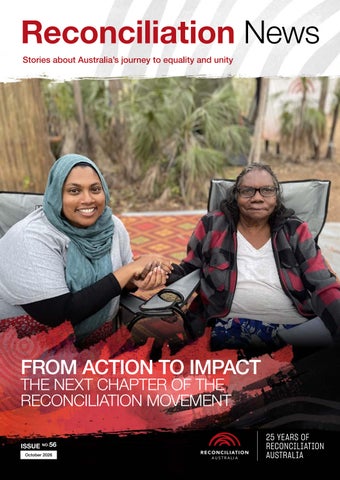
Cover: Uniting across cultures, Reconciliation Australia Board member, Rana Hussain (L) and Gumatj Elder Djapirri Mununggirritj (R) at Garma Festival 2026 in Arnhem Land, NT. Photo: Reconciliation Australia
Issue no. 56 / October 2026
3
CONTENTS FEATURES 8 NRW 2026 Round Up Communities across Australia went All In for reconciliation through events, performances, film screenings, conversations and a renewed commitment to actions for meaningful change. 10 All In: Everyday actions Reconciliation is an ongoing commitment. Explore practical ways to carry the All In theme with you beyond NRW and turn everyday choices, relationships and conversations into action.
10
12 In Conversation: Dale Agius South Australia’s Commissioner for Aboriginal Children and Young People, Dale Agius, discusses self-determination, allyship and the importance of creating pathways for the next generation ahead of his keynote address at the National RAP Conference 2026. 14 20 years of the RAP program From eight organisations to a national movement of over 3000, we look back at 20 years of Reconciliation Action Plans and their role in driving meaningful, practical change across Australia. 16 Celebrating outstanding Indigenous Governance Meet the Indigenous Governance Awards 2026 finalists! These outstanding First Nations organisations and initiatives have been recognised for their extraordinary contributions to communities through their strong governance models.
14 22
18 Comrades in action Sixty years on from the Wave Hill Walk-Off, we look at the long history of solidarity between First Nations movements and Australia trade unions in the fight for rights, justice and equality. 20 10 Truths about RAPs New research shows how Reconciliation Action Plans are contributing to culturally safer workplaces, stronger employment pathways and greater accountability from Australia’s leading organisations. 22 Weaving change together A delegation of women from across the multicultural sector travelled to Garma 2026 and left with a clear direction for the role multicultural communities and the sector as a whole can play in advancing reconciliation. 24 Emma Donovan: Writing for our future Ahead of her Indigenous Governance Awards Gala performance, Emma Donovan reflects on language, storytelling and the importance of connections forged through sharing culture through art.
REGULARS 4
From the CEO
6
Reconciliation recap
5
Calendar
12 In Conversation 26 Look for a book!
Images: (10) A “Reconciliation We're All In” banner created by students at a local public school in Queanbeyan, NSW ahead of National Reconciliation Week. Photo: Reconciliation Australia (14) Over 20 years, the RAP network has grown from just eight organisations to over 3,300. Representatives from these organisation meet regularly through opportunities like RAP learning circles to listen, learn and collaborate. Photo: Reconciliation Australia (22) Reconciliation Australia board member, Rana Hussain and Chief Executive Officer, Karen Mundine on Gumatj Country for the Garma Festival 2026. Photo: Reconciliation Australia
4
Issue no. 56 / October 2026
FROM THE CEO There are moments in our reconciliation journey that are impossible to miss. The big moments: loud declarations on big stages, thousands of people walking across bridges and down streets, marching, speaking up and singing loud. These moments show the strength of our collective commitment to reconciliation and remind us that there are more of us out there than we sometimes think. But it is the quieter moments that equally drive us. The conversations across the dinner table, a new book that opens a door to a different story, a lesson on a cold Tuesday morning or an event in a local park on a scorching day in January. A conversation that changes how someone sees the world, or a relationship that builds a new partnership. I was reminded of this at one of the biggest events on the calendar, the Yothu Yindi Foundation Garma Festival. It was a privilege to return to Gumatj Country and experience Garma and the relationships that blossom there in the quiet moments. I was particularly struck by the connections that were being made and strengthened all around us. I saw corporate partners who have been working through their Reconciliation Action Plans and thinking about what comes next and spoke with people who will soon come together again for the National RAP Conference and Indigenous Governance Awards 2026 in Tartanya/Adelaide, bringing the conversations and ideas from Garma into a different space. For Reconciliation Australia’s group at Garma 2026, we invited our partners from the multicultural sector who are deepening their commitments to reconciliation. For many, it was their first time being on Yolŋu Country. What followed was four days of learning, yarning, dancing, singing and truth‑telling (22). Reconciliation is built on relationships. We’ve always understood this, but events like Garma are a powerful reminder. That spirit runs through the stories in this edition of Reconciliation News. From the hundreds of thousands of people who came together during National Reconciliation Week (8), to the practical actions that can build on the relationships fostered during the week (10); from Cmr Dale Agius on allyship and creating pathways for the next generation (12), to the organisations reflecting on 20 years of Reconciliation Action Plans (14).
CEO Karen Mundine. Photo: Joseph Mayers
These stories and the others in this edition show us what can happen when commitment to action is sustained over time. We’ve seen the impact of that commitment over 25 years of Reconciliation Australia and 20 years of the RAP program – two significant milestones that we’ve spent the year commemorating and reflecting on. With the launch of Reconciliation Australia’s new 10-year strategy and the announcement of her Excellency the Honourable Ms Sam Mostyn AC as our new patron; it’s clear to us that we are entering a new era of our reconciliation journey. The past 25 years have shown what is possible when we are All In for reconciliation. The next decade demands that we go further together. I hope these stories inspire you to find new ways to be All In for reconciliation, not just today or during NRW, but every day.
Karen Mundine Chief Executive Officer
Issue no. 56 / October 2026
5
UPCOMING EVENTS Days of Note
10
December 2026 Human Rights Day
26
January 2027 Survival Day
13
February 2027 Anniversary of the National Apology
18
March 2027 Close the Gap Day
21
March 2027 International Day for the Elimination of Racial Discrimination
National RAP Human Rights Conference and Awards 2026 Indigenous Governance 10 December Awards 2026 The Australian Human 4-6 November Rights Awards recognise Held in Adelaide/Tartanya, the organisations and individuals National RAP Conference and making a difference by Indigenous Governance Awards promoting and protecting 2026 will bring together a human rights across powerful network of more than Australia. The awards are 3,000 organisations reaching held annually on World almost six million Australians Human Rights Day – the daily. This event is a unique international day that opportunity to harness our commemorates the adoption collective influence to drive of the Universal Declaration meaningful reconciliation of Human Rights – and in outcomes across workplaces, 2026, will mark 40 years of communities, and beyond. the Australian Human Rights This year marks 25 years of Commission. The awards Reconciliation Australia and recognise contributions 20 years of RAPs at work. across a range of areas These milestones are more than including social justice, celebration and reflection. They equality and the rights of are a time for a renewed call to Aboriginal and Torres Strait elevate our actions and deepen Islander peoples. The 2026 our commitment to meaningful awards will be a significant change. The Indigenous opportunity to reflect on Governance Awards Gala event four decades of human will be held on the first night of rights work in Australia and the conference and will celebrate recognise those continuing the success of Aboriginal this work today. and Torres Strait Islander For more information communities and organisations on the awards, visit from around Australia. humanrights.gov.au/aboutTo find out more, visit us/what-we-do/humanrapconference.com.au rights-awards-2026
Yabun Festival 26 January 2027 Held each year on 26 January at Victoria Park on Gadigal Land in Sydney, Yabun Festival is one of Australia’s largest community-led celebrations of Aboriginal and Torres Strait Islander peoples’ cultures. Meaning “music to a beat” in Gadigal language, Yabun provides a space for truth‑telling, cultural expression and community connection while celebrating the First Nations peoples’ resilience, strength and ongoing connection to Country. Founded in 2003 as a continuation of the Survival Day events of the 1990s, Yabun remains Aboriginal‑owned and led through Gadigal Information Service. Since then, the festival has grown into a highly anticipated event that draws people from across Australia and beyond with an estimated 65,000 people attending in-person in 2025. For more information, visit yabun.org.au
6
Issue no. 56 / October 2026
RECONCILIATION RECAP Reconciliation Australia staff and CEO Karen Mundine joined the final leg of the walk to Parliament House where Lovett called on the Australian Government to establish a national truth-telling process in genuine partnership with First Nations peoples. The walk culminated in the delivery of an open letter to the Prime Minister backed by over 12,500 signatures. The arrival of the walk in the nation's capital was a powerful start to the week. Moments like this are important demonstrations of Australians standing together for truth, justice and reconciliation, and fully embody the NRW 2026 theme, All In.
National Walk for Truth May National Reconciliation Week (NRW) 2026 kicked off with the arrival of the National Walk for Truth on Ngunnawal and Ngambri Country. Led by Kerrupmara
National Racism Inquiry concludes May-August 2026
and Gunditjmara man Travis Lovett, the 38-day journey brought together more than 6,000 people in a united call for truth-telling and reconciliation.
Staff from across the Australian Reconciliation Network joined Reconciliation Australia staff and CEO Karen Mundine for the final leg of the walk to Parliament House. Photo: Reconciliation Australia
on a peaceful 26 January rally in Boorloo/Perth earlier this year, and a white supremacist attack on Camp Sovereignty in Naarm/Melbourne in 2025.
coverage of the Referendum fed racist narratives and stereotypes.
From May to August 2026, the Joint Standing Committee travelled across every Australian state and territory to gather evidence and testimonies from community leaders, experts, and people with lived experience regarding the prevalence and severe impact of systemic racism.
The Parliamentary inquiry into racism, hate and violence directed towards Aboriginal and Torres Strait Islander peoples concluded public hearings in August and will hand down its final report to Parliament by the end of 2026.
Social and mainstream media was frequently cited for its role in stoking racism and hate towards First Nations peoples who experienced an increase in abuse during and following the 2023 Referendum.
The inquiry was triggered in response to public calls for stronger action in the wake of the alleged terror attack
Whadjuk Noongar journalist, presenter and commentator Narelda Jacobs told the inquiry that news
Mainstream media coverage of the hearings was sparse, while the lack of participation of police and government departments from Queensland and Northern Territory dominated the headlines. Public broadcasters fronted the inquiry while commercial media outlets declined to participate. Giving evidence at the Inquiry, Reconciliation Australia CEO Karen Mundine tabled critical structural recommendations to combat the crisis. To read the Reconciliation Australia submission to the Inquiry, go to reconciliation.org.au/our-work/policyand-research/ Senator Jana Stewart, a Muthi Muthi and Wamba Wamba woman from North-West Victoria, led public hearings as Chair of the Joint Standing Committee on Aboriginal and Torres Strait Islander Affairs. Photo: AAP Image/Jay Kogler
Issue no. 56 / October 2026
7
Her Excellency the Honourable Ms Sam Mostyn AC, Australia’s 28th Governor-General was announced as Patron of Reconciliation Australia at a special event at Admiralty House in Sydney to mark 25 years of the organisation. Ms Mostyn brings a long-standing history with the organisation to the role, having previously served as a director from 2007 to 2010. Her Patronage reflects a deep, enduring commitment to national reconciliation and the ongoing work of building a more just, respectful and united Australia. Her distinguished, diverse career in advocacy and public service was highly decorated in 2024 when she was appointed a Companion of the Order of Australia (AC). In accepting the role, Ms Mostyn recalled how former Governor‑General Sir William Deane shared the inaugural patronage of the organisation alongside sporting icon Evonne Goolagong-Cawley AC MBE. Read more on the Governor-General's patronage via reconciliation.org.au/governor-general-announced-as-patron/
Governor-General announced as patron August 2026
Her Excellency the Honourable Ms Sam Mostyn AC alongside Reconciliation Australia Co-Chairs, Kirstie Parker (right) and Michael Rose (left), at Admiralty House in Sydney, the official residency of the Governor‑General. Photo: Supplied
The 2026 theme, 50 Years of Deadly, honoured the Elders, organisers, artists and communities who built the movement, and have grown NAIDOC to a national celebration, while also keeping it deeply grounded in culture and community. Later in August, the NAIDOC Awards hosted in Mparntwe/Alice Springs shone a spotlight on two giants of Australian public life and Indigenous excellence.
50 YEARS OF DEADLY: NAIDOC 2026 July 2026 NAIDOC Week 2026 marked five decades of the national celebration dedicated to recognising the history, culture and achievements of Aboriginal and Torres Strait Islander peoples.
Aunty Rhoda Roberts AO was posthumously honoured with a Lifetime Achievement Award for her visionary leadership in the Australian arts. A proud Widjabul Wia-bal woman from Bundjalung Country, Aunty Rhoda supported, inspired and built frameworks for First Nations creatives to claim their own storytelling, representation and cultural narratives.
Aunty Pat Turner AO was recognised as Person of the Year and received a standing ovation from the audience. One of Australia’s most respected First Nations leaders, the Arrernte and Gurdanji woman’s extraordinary career spans more than five decades of senior public service and community roles. As CEO of ATSIC, she made history as the first Aboriginal woman to head a Commonwealth department, and in her role as Lead Convenor of the Coalition of Peaks, negotiated the historic Closing the Gap Agreement with all Australian Governments. Find out more about NAIDOC Week and the 2026 finalists via naidoc.org.au Aṉangu artist Kaylene Whiskey, winner of the 2026 National NAIDOC Creative Talent Award, celebrates with Electric Fields singers Sandra Pumani and Zaachariaha Fielding, National NAIDOC Committee Co-Chair, Steven Satour and friends. Photo: National Indigenous Australians Agency
8
Issue no. 56 / October 2026
NRW 2026 ROUND UP This year’s National Reconciliation Week (NRW) theme called on all Australians to be ALL IN for reconciliation every single day. Across the country, hundreds of thousands went All In, in workplaces, schools, early learning services, community halls and homes to listen, learn and act. From talks to performances, film screenings to flag raisings, creative workshops, panels, commemorations and thousands of rugged up supporters walking across bridges, people showed up demonstrating that the work of reconciliation will not happen by itself; it needs all of us.
THE LONG WALK This annual community event in Naarm is inspired by Michael Long’s historic 650km walk to Canberra and aims to keep Aboriginal and Torres Strait Islander voices at the heart of Australia’s national conversation. Reconciliation Australia staff hosted a stall and activation with Reconciliation Victoria at the community event. Attendees dropped by on their way to the Dreamtime at the G to talk, grab stickers and colouring sheets, and write down their commitments to reconciliation. Staff then joined the walk onto the MCG field. Photo: Reconciliation Australia
Record numbers of people joined choirs all across the country to raise their Voices for Reconciliation, singing the Midnight Oil anthem Beds Are Burning. Activity sheets and resources in 13 languages other than English supported more people to engage with the theme and take part in the week. In 2026 we also marked 25 years of Reconciliation Australia. This National Reconciliation Week was a clear reminder of how far the reconciliation movement has come, and the distance we need to travel as a country. Check out some key events this year and get planning for your NRW 2027 event now!
VOICES FOR RECONCILIATION More than 41,000 people across Australia took part in Voices for Reconciliation 2026 with over 700 choirs singing Midnight Oil’s iconic anthem Beds Are Burning. Echoing the National Reconciliation Week theme, All In, the song brought together communities, workplaces and schools in raising their voices for truth-telling, land rights and reconciliation. Watch the full Voices for Reconciliation playlist on YouTube. Photo: Scenic World
Issue no. 56 / October 2026
ACT RECONCILIATION DAY
JUNE OSCAR’S RECONCILIATION MEMOIRS
Thousands of supporters gathered at Reconciliation Place to mark Reconciliation Day in the ACT – the only public holiday in Australia dedicated to reconciliation. Casey Donovan headlined the main stage, and Reconciliation Australia was proud to represent at this important day. Staff met supporters, shared posters, colouring-in and other activity resources in multiple languages, and we heard about the many ways people were being All In throughout the day.
Reconciliation WA continued their annual Reconciliation Memoirs series publishing the memoirs of Indigenous rights advocate and Chair of The Wiyi Yani U Thangani Institute for First Nations Gender Justice, June Oscar AO. The proud Bunuba woman from Fitzroy Crossing reflected on a lifetime of leadership in the pursuit of justice as part of the book launch. Watch the full conversation now on SBS On Demand. Photo: Reconciliation WA
Photo: Reconciliation Australia
QUEANBEYAN RECONCILIATION WALK
NUNGA SCREEN
The annual Queanbeyan Reconciliation Walk was forced indoors due to rain but that didn't dampen spirits! Reconciliation Australia staff joined students from schools across the region, Elders and representatives from Queanbeyan-Palarang Regional Council to mark the event and the launch of the council’s Innovate Reconciliation Action Plan.
Nunga Screen returned for its 15th year, bringing audiences together to experience a vibrant season of documentaries and short films celebrating First Nations cultures, languages and stories. The 2026 program featured stories from emerging and established First Nations filmmakers from across Australia. This touring showcase travelled to multiple destinations across South Australia represented by Country Arts SA.
Photo: Reconciliation Australia
Photo: Sophie Wallace, Country Arts SA
9
10
Issue no. 56 / October 2026
ALL IN: EVERYDAY ACTIONS Achieving a reconciled and more just Australia requires all of us to commit to reconciliation every day of every week not just National Reconciliation Week.
Take All In with you for the rest of this year and keep building on the good work you started in May. Reconciliation is an ongoing commitment, and our everyday actions matter. These actions are a starting point for how we can continue to be All In for reconciliation, all year round.
1 – Know where you stand No matter where you are in Australia, you live, work and play on the lands of First Nations peoples. Knowing whose Country you’re on is a starting point but being All In means going further. Learn about the Traditional Owners of Country, their ongoing connection to land and waters, and histories of dispossession and resistance that have shaped those lands.
All In actions: • Know whose Country you are on – resources like the AIATSIS Map of Indigenous Australia are a useful starting point. • Understand the differences between an Acknowledgement of Country and Welcome to Country, and why they are important. • Educate yourself about the details and history of First Nations Land Rights and Native Title in Australia and support or join land justice efforts and advocacy near you. • Learn more about ongoing Treaty processes. • Support First Nations-led efforts to protect Country and culture.
Ask yourself: What does my connection to this land ask of me?
2 – Learn the truth Australia’s true history is a shared history that has long been hidden from us. Understanding colonisation, dispossession, resistance and the ongoing impacts of racist policies is essential to understanding the Australia we live in today. Ask yourself: Whose version of Australian history did I learn, and whose stories were missing?
All In actions: • Learn more about the history of your local area and the experiences of the First Nations peoples whose land you’re on. • Seek out books, films, podcasts, exhibitions or other sources by First Nations storytellers that share perspectives that may be new to you. • Get involved in truth-telling processes that are happening around the country – from formal state or territory initiatives to events and activities in your community. • Explore Reconciliation Australia’s Community Truth-telling Pathways resources for more information about truth-telling – how to get involved and how to access practical support for community-led activities.
Issue no. 56 / October 2026
3 – Support self-determination Reconciliation demands more than just hearing First Nations voices, it requires acting on them. True change happens only when we respect Aboriginal and Torres Strait Islander peoples' right to determine their priorities, futures and solutions. Ask yourself: Am I listening to what First Nations peoples want, or am I deciding what I think is best?
All In actions: • Look for opportunities to back First Nations leadership in your workplace, community or school. • When working on an issue, policy or lesson plan, consider whether decisions are being made with First Nations peoples or for them. • Learn about the principles of self-determination and the United Nations Declaration on the Rights of Indigenous Peoples. • Understand the strengths in First Nations community control in governing, education and health. • Support and promote community-controlled and Indigenous governed organisations.
4 – Stand up against racism For many Aboriginal and Torres Strait Islander peoples, racism is an everyday reality, and experiences of racism remain consistently and unacceptably high. Not being racist isn’t enough, being All In means being actively anti-racist every day to build positive two-way relationships founded on trust and respect. Ask yourself: If someone at work, school or in my community experienced racism, would they know they would be supported?
All In actions: • Call out racist comments or harmful stereotypes wherever you encounter them. • Educate yourself on how to respond to racism in safe and effective ways. • Ask the hard questions to better understand how racism exists in your life and the world around you. • Support Anti Racism Campaigns and initiatives around you. • Back calls for the full implementation of The National Anti-Racism Framework. • Ensure there are clear steps for reporting experiences of racism at your work or school, and if there aren’t, consider how you could support the creation of these systems.
5 – Make reconciliation everyone’s business Reconciliation is not the responsibility of one person, team or organisation. We all have a role to play and we all have influence in the places we live, work and participate. Being All In means recognising where you can make a difference and using your influence to create meaningful change. Ask yourself: Where do I have influence, and how am I using it?
All In actions: • Consider what conversations could spark further action or what processes you could change. This could be through your relationships with friends, family members, colleagues, social media followers, or even your sporting club teammates. • Learn more about your workplace RAP’s commitments. You could also work at or be connected to a school or early learning service with a RAP; consider how you could contribute to these commitments. If a RAP doesn’t exist, consider starting the process. • Ask leaders in your work, school or community what they are doing to advance reconciliation and First Nations justice. • Get involved in reconciliation activities in and around your community. • Plan for NRW. The week is a great jumping off point to learn more about our shared histories, cultures, and achievements, and to explore how each of us can contribute to achieving reconciliation in Australia. In the lead up to the week, scope out events you’d want to join or plan to host your own.
11
12
Issue no. 56 / October 2026
Ahead of his keynote address at the National RAP Conference 2026 in Tarntanya/Adelaide, Reconciliation News spoke with Dale about self-determination, South Australia’s First Nations Voice, the power of allyship and why the next generation gives him hope.
What led you into First Nations affairs and this work? My journey has been a long journey in government. I started with a traineeship in the Department for Correctional Services and ended up working there for more than 10 years. That gave me an understanding of the intersection between criminal justice, government and the support our mob received. Some of those things were inconsistent, and I wanted to understand how other agencies worked, what the connectors were and where the barriers were.
Photo supplied by the Office of the Commissioner for Aboriginal Children and Young People (SA)
IN CONVERSATION: DALE AGIUS South Australia’s Commissioner for Aboriginal Children and Young People and proud Kaurna, Narungga, Ngadjuri and Ngarrindjeri man Dale Agius has spent much of his career working at the intersection of First Nations affairs, government and community.
I moved into the Aboriginal Affairs and Reconciliation division before managing Metropolitan Aboriginal Youth and Family Services. I later worked in senior roles across government and became South Australia’s inaugural Commissioner for First Nations Voice. What led me into Aboriginal policy and politics was understanding the level of disadvantage Aboriginal communities experience, and seeing well-intended programs designed at the top not necessarily reaching people on the ground. I thought there was probably a role for me to play in those spaces.
Issue no. 56 / October 2026
13
We need leaders across every sector, every role and every conversation, leading and guiding this country towards greater reconciliation.
Why is independence important in your current role as Commissioner for Aboriginal Children and Young People in South Australia?
What role do allies play in voice, truth-telling and treaty progress?
It gives me the ability to critically analyse government policy and how it plays out in practice.
The Voice isn’t a silver bullet. It is a mechanism to be heard. It gives community members who want to speak up a place to speak.
It means holding a moral compass around how Aboriginal culture is represented, truth-telling about our history, current disadvantage and systemic failure, and looking at how we create sustained models of self-determination for this generation and the next.
Our informed and committed allies have an important role because at every table we are outnumbered. When they see us being challenged or discredited, when they see language weaponised against us, or our self-determination and the integrity of our history challenged, they can stand beside us.
It is a privilege to hold an independent office backed by strong legislation. I can engage with government and the service sector and provide an Aboriginal perspective and a balanced view of how things are actually going for our communities.
We shouldn’t underestimate the strength of our allies.
Those perspectives shouldn’t be politicised. Independent commissioners’ recommendations should be understood through the lens of equality and self-determination.
As inaugural Commissioner for the SA First Nations Voice, you led statewide consultations that helped shape the body. What does it represent for you? Our community had been asking for this reform for a long time. The Voice provides representative members with direct channels to Parliament, the Premier, Cabinet and government. That is an awesome achievement for South Australia. One of my proudest moments was the signing on the steps of Parliament. Aboriginal leaders stood with the Premier, and I could move aside as Commissioner and give recognition to our Elders who had fought for this for decades. It showed that Aboriginal leadership and culture can work side by side with government and Parliament when it is done with respect and a common interest. That united approach is a blueprint for how our leadership can work on equal footing with government.
More than 6.2 million Australians stood with us in the referendum. Many still show up when our culture is under attack and when they see direct or indirect racism directed at our young people, communities or Aboriginal employees. The next part of reconciliation is helping allies understand why voice is important, why truth-telling is important and why treaty is important.
How do we ensure the next generation is All In for reconciliation? I have the privilege of speaking with Aboriginal young people every week, in schools, TAFEs, community spaces and through programs run by my office. At our youth summits and public speaking and art competitions, they express what matters to them, their families, their communities and their country. Our leaders keep saying the same thing: we need more leaders. We need leaders across every sector, every role and every conversation, leading and guiding this country towards greater reconciliation. Giving young people safe spaces to speak openly and honestly and knowing their voices will reach the highest levels of government, creates an opportunity for strong reform, accountability and transparency. Most importantly, it creates a pathway for our next generation to lead. To learn more about the SA Commissioner for Aboriginal Children and Young People’s work, head to cacyp.com.au
14
Issue no. 56 / October 2026
20 YEARS OF THE RAP PROGRAM FROM EIGHT ORGANISATIONS TO A NATIONAL MOVEMENT
Representatives from the over 3,000 organisations that make up the RAP network in attendance at the National RAP Conference 2024 in Meanjin/Brisbane. Photo: Lewis James Bin Boraho
In July 2006 Reconciliation Australia launched an ambitious framework to progress reconciliation and First Nations justice. Eight organisations committed to creating long term, measurable action plans to advance reconciliation and the Reconciliation Action Plan (RAP) program was born. The first eight RAP organisations were: Yarnteen Aboriginal and Torres Strait Islander Corporation; ANZ Bank; BHP Billiton; Centrelink; Canberra Investment Corporation; South Australian Department of Administrative and Information Services; Oxfam Australia; and Melbourne City Council. Launching the program, Mick Dodson – a member of Reconciliation Australia’s board of directors at the time – explained the rationale.
‘Generating success is what it’s all about and that means building respectful relationships on which action-oriented, results-focused partnerships are founded,’ he said. Jen Dawson, Manager Strategic Partnering at BHP, worked on developing BHP’s first RAP in 2007. She said the program provided clarity and structure for better First Nations’ outcomes. ‘That first RAP set up the guardrails for how BHP could become an effective partner and ensure that reconciliation became our responsibility not just government’s,’ she said. ‘The key to the RAP program’s success is in its name – it’s about real actions not motherhood statements.’ Jen said the introduction of the four RAP types in the RISE framework in 2013 – Reflect, Innovate, Stretch and Elevate – has allowed BHP to continuously improve their reconciliation commitments.
Issue no. 56 / October 2026
15
The RAP isn’t just a public statement on a shelf, it has been about delivering initiatives for change.
‘The RAP has been the vehicle for change; however, it’s been the voices of our First Nations partners that have largely driven our progress through the RISE structure. ‘We have progressed because we’ve been held accountable. ‘The RAP isn’t just a public statement on a shelf, it has been about delivering initiatives for change.’
Ensuring accountability High-profile examples of RAP accountability are now etched into the program’s long history. Mining giant, Rio Tinto’s Elevate RAP was revoked in June 2020 after the company destroyed ancient Puutu Kunti Kurrama and Pinikura Aboriginal heritage rock shelters in WA’s Pilbara region. ‘Rio Tinto’s actions failed to meet their own aspirations to advance reconciliation and do not meet the standards Reconciliation Australia expects of our RAP partners,’ said Reconciliation Australia at the time. In March 2001, Telstra’s Elevate RAP was a revoked when it was revealed that its stores had engaged in unconscionable sales conduct in remote Indigenous communities. That same year, Reconciliation Australia supported Aboriginal leaders and organisations in their long-term campaign against Woolworths’ proposed Dan Murphy’s store near three dry First Nations communities in Darwin. The subsequent independent investigation and Woolworths’ decision not to proceed highlighted the critical role of the RAP program in helping companies to respond to issues and in providing a platform for community groups to raise concerns.
The 2026 picture: cultural change From its 2006 beginnings, the program is now 3,300 organisations strong. One in five Australians – that’s 5.9 million people – now work or study in an organisation with a RAP. Organisations are required to report on their RAP commitments annually. In 2025, RAP organisations reported employing 62,197 Aboriginal and Torres Strait Islander people and procuring $5.6 billion worth of goods and services from First Nations-owned businesses. 65% of organisations reported changing internal processes or policies to improve relationships with First Nations peoples. The Centre for Indigenous People and Work (CIPW) recently published 10 Truths about Reconciliation Action Plans, drawing on the national Gari Yala 2 (Speak the Truth) study of more than 1,100 Indigenous workers. (see more on p 20). The report compared workplaces with and without RAPs. Four of the “Truths” directly related to reducing racism, hatred and violence. Half of Indigenous workers in RAP organisations rarely or never experience racism at work, compared with 36% elsewhere. RAP organisations also report greater cultural safety and are more than three times as likely to have anti-racism complaints processes and training.
services, has a partnership with the peak First Nations children’s advocacy organisation, SNAICC at the core of its reconciliation progress. ‘We couldn’t have the partnership with SNAICC without our RAP, and we couldn’t have our RAP without our SNAICC partnership,’ CEO Claire Robbs explained. Life Without Barriers were the first notfor-profit organisation to gain an Elevate RAP which was launched in 2023. Its primary commitment is to transition First Nations children in their care over to Aboriginal community-controlled organisations (ACCOs). This action meets a key First Nations demand that their children should only be placed with family or other First Nations peoples. ‘Ultimately, we want to influence the rest of the mainstream sector to do the same as we are and eventually spread that influence into government for real policy reform,’ she said. There are 3,300 stories of RAPs in 2026. Each RAP is unique to the specific circumstances and outcomes of each organisation. ‘While we have a lot to be proud of what a RAP can do, it’s important to remember that RAPs are not the sole solution to 238 years of colonisation,’ General Manager of the RAP Program Kate Delaney said.
There were 24,463 partnerships with Aboriginal and Torres Strait Islander organisations reported in 2025.
‘They are a useful and accessible structure for organisations, and the people within them, to consider and address systemic inequalities and leverage their collective influence for a more just and equitable Australia.’
Elevate RAP partner, Life Without Barriers, a large not-for-profit working in foster care, disability and aged care
To learn more about the RAP program, visit reconciliation.org.au/ reconciliation-action-plans
Relationships, respect and opportunities
16
Issue no. 56 / October 2026
CELEBRATING OUTSTANDING INDIGENOUS GOVERNANCE For millennia, Aboriginal and Torres Strait Islander peoples have had governance systems in place driven by culture and community priorities. Effective Indigenous governance is a prerequisite for ensuring First Nations peoples’ aspirations guide policies and actions that are culturally relevant. These aspirations are also essential to advancing reconciliation. The Indigenous Governance Awards (IGA) share, promote and celebrate contemporary examples of outstanding Indigenous Governance from Aboriginal and Torres Strait Islander communities and organisations around Australia. The awards have been held every two years since 2005 and are proudly presented in partnership by Reconciliation Australia and the Australian Indigenous Governance Institute, with support from the BHP Foundation. Here is an overview of the 2026 finalists and photos captured on the judging panel site visits held from July to September 2026. All photos: Tom Hoy, Wirrim Media
CATEGORY 1: Non-incorporated organisations, initiatives or projects Bindjareb Djilba Kaadadjan Bidi Yarning Circle – WA The Yarning Circle unites Bindjareb Noongar communities to protect and manage the Bindjareb Djilba (Peel-Harvey) Estuary, strengthen Traditional Owner governance, and embed Noongar values in land and water management.
Bindjareb Djilba Kaadadjan Bidi Yarning Circle at one of its regular meetings at Winjan Aboriginal Corporation, Mandurah.
Northern Nunga Network – SA The network connects and promotes collaboration between Aboriginal and Torres Strait Islander health and social service providers, government and non-government organisations so they can better meet the needs of communities across northern Adelaide.
Members of the Northern Nunga Network at their regular monthly meeting.
Wukul Yabang Aboriginal Health Research Community Panel – NSW The panel ensures Aboriginal people hold authority over research that affects their communities and that the research delivers meaningful outcomes for First Nations peoples.
Wukul Yabang Aboriginal Health Research Community Panel members at the Wollotuka Institute, University of Newcastle.
Issue no. 56 / October 2026
17
CATEGORY 2: Small to medium incorporated organisations
CATEGORY 3: Large incorporated organisations
Blak & Bright First Nations Literary Festival – Vic
Dhimurru Aboriginal Corporation – NT
Blak & Bright is a nationally recognised First Nations literary organisation working across multiple cities and communities, deepening industry relationships and creating opportunities for First Nations storytellers and audiences.
Dhimurru manages approximately 550,000 hectares of land and sea Country, delivering large-scale environmental, cultural, and community outcomes under a kinship-based governance system grounded in Yolŋu Gurrutu
Indigenous Governance Awards judges joined Blak & Bright First Nations Literary Festival staff and board at the Wheeler Centre during preparations for the 2026 festival themed, EVERY:WHEN.
Yolŋu man and Dhimurru Aboriginal Corporation Ranger Rrawun Maymuru with members of the Board in the Dhimurru offices in Nhulunbuy.
Ngrragoonda Aboriginal Corporation – Qld
Jabalbina Yalanji Aboriginal Corporation – Qld
Ngrragoonda enables Gudjala People to exercise decisionmaking authority over Country. It works to protect cultural heritage, manage community assets and create pathways towards economic sovereignty and self-determination.
Jabalbina supports Eastern Kuku Yalanji People to exercise their rights and responsibilities for Bubu (Country), including land and sea management, cultural heritage protection, and the implementation of ILUA commitments.
Ngrragoonda Directors at Towers Hill, Gudjala Country. (L-R) Gloria Santo, Nicole Santo, Adam Reid and Nicole Huxley.
Jon Jon Ryan, Tourism Manager at Yalada Tours, a social enterprise of Jabalbina, guides Indigenous Governance Awards judges through the Bamanga Muruku Tourism Hub.
Point Pearce Aboriginal Corporation – SA The organisation serves the Narungga community of Point Pearce through land and asset management, youth programs, ranger initiatives, infrastructure projects and cultural activities that strengthen local self-determination and long-term community resilience.
Wyndham Youth Aboriginal Corporation – WA The organisation supports the health and wellbeing of young people through education, training and employment opportunities, strong partnerships, and capacity building initiatives. Wyndham Youth Aboriginal Corporation was unable to proceed to the site visit stage of the judging process, but they retain their status as finalists.
Winners in each category will be announced at the Indigenous Governance Awards 2026 Gala Dinner on Thursday 5 November in Tarntanya/Adelaide. Point Pearce Aboriginal Corporation Board Member and Elder Lyle Sansbury and General Manager Paul Heck show IGA judges around the community garden.
Visit reconciliation.org.au/indigenous-governance-awards to learn more about the finalists.
18
Issue no. 56 / October 2026
Thousands march at the 50th anniversary Wave Hill Walk-off in Kalkarindji on Friday 19 August 2016. On August 22, 1966, Vincent Lingiari led several hundred Gurindji people off Wave Hill Station in a protest to gain fair wages, which morphed into an almost decade-long battle for land rights. Photo: AAP Image/Neda Vanovac
COMRADES IN ACTION 60 years since the historic Gurindji workers’ strike at Wave Hill Station brought national attention to the exploitation of Aboriginal station workers, Reconciliation News looks back at the history of trade union solidary with First Nations peoples in the struggle for civil rights. Early in 1982, Builders Labourers Federation members packed a mass meeting on a Sydney construction site. They did not gather to discuss job safety or the latest log of claims, instead they listened to Birri Gubba and Gungalu man, Tiga Bayles, talk history and resistance.
Those attending the meeting had heard little of the truths Tiga told that day.
Tiga talked of the oppressive realities of Bjelke-Petersen Government legislation controlling Queensland’s First Peoples' lives; of deep-seated poverty, child theft, mass incarceration and deaths in custody.
Two years after that, the Queensland Government repealed the Qld Aborigines Act 1971.
Incensed, the unionists voted to introduce a $10 weekly worker levy to fund protests at the Brisbane Commonwealth Games later that year.
Tiga and the protesters secured a huge victory and the group of NSW labourers had played a small but proud part in it.
Issue no. 56 / October 2026
19
There was a lot of friendship, solidarity and exchange between the two movements.
A proud history It wasn’t the first time that Australian unionists stood with First Nations resistance. Early trailblazing trade unionists Pearl Gibbs, Jack Ferguson and William Cooper went on to found the Aborigines Progressive Association and the Australian Aborigines’ League – both groundbreaking Aboriginal-led political organisations.
maritime industries struck against discriminatory wages and the heavyhanded control of the Queensland Government Protector. After nine months the strikers won better pay and ended a government-imposed curfew. Crucially, they won the right to elect their own representative councils.
Other prominent leaders including Dexter Daniels, Oodgeroo Noonuccal, Joe McGinness, Fred Maynard, Chicka Dixon and Kevin Cook, all leveraged the power of the labour movement to fight for equal rights.
In 1946, 800 Aboriginal pastoral workers across 25 different sheep stations in Western Australia’s Pilbara region walked off the job. They set up strike camps to protest receiving basic rations in food and clothing instead of fair wages and to highlight oppressive colonial legislation.
Thomas Mayo, Kaurareg, Kalkalgal and Erubamle man and Assistant National Secretary of the Maritime Union of Australia, said these leaders quickly recognised the inherent opportunities to be had from working with trade unions, in a country where exclusion of First Nations peoples was the norm.
During this historic action, known as the longest strike in Australia, the sustained activism of First Nations organisers Clancy McKenna, Dooley Bin Bin, and ally Don McLeod, ensured the strike was finally victorious after the Seaman’s Union threatened to ban the transport of wool from stations with slave conditions.
‘Unions were some of the earliest organisations that started to push against racism and to start including Indigenous people, making sure we got the same rights as everyone else.
The 1946 Pilbara strike laid the groundwork for the 1966 Wave Hill Walk Off and inspired national civil rights changes in the form of equal wages for Aboriginal workers and the Northern Territory Aboriginal Land Rights Act.
‘Our leaders saw the support in union ranks and joined unions.’ Professor Nareen Young of UTS’s Centre for Indigenous People and Work (CIPW) argues that the organised working-class movement from the 1930s depression took a partnership role with the Aboriginal movement and supported them strongly. ‘There was a lot of friendship, solidarity and exchange between the two movements,’ she said.
Strike action for change In 1936, Zenadth Kes/Torres Strait Islander workers in the pearling and
A two-way street – a legacy for the future? Trade union support for First Nations justice continued across communities such as Palm Island and Yarrabah and during high profile campaigns like the 1965 Freedom Ride, the 1967 referendum and the 2023 Voice referendum campaign.
‘Unions were often supportive of the White Australia policy and the exclusion of First Nations people,’ Mayo explains. ‘But under the influence of Indigenous unionists they began to support our fight to end the violence and utter exclusion we were subjected to.’ Professor Young argues that while antiracism may not yet be a priority for all unions there is a growing understanding of the importance of anti-racism education in the workplace. She also points to other First Nations initiatives such as the ACTU’s establishment of the First Nations Workers Alliance which successfully fought against changes to the Community Development Program (CDP). The CDP was described by the First Nations Workers Alliance as a “pool of free labour” for employers, with participants denied basic entitlements such as annual and sick leave Professor Young’s centre works closely with unions, who are taking up issues that the CIPW has prioritised. These include career progression for First Nations peoples into leadership, remuneration for cultural skills, employment equity and the lack of pay parity. She says that achieving pay parity is key. ‘It translates into higher lifetime earnings, stronger superannuation outcomes and greater intergenerational economic security for Aboriginal and Torres Strait Islander people.’
However, that support has fluctuated with the political climate of the day.
The success of the partnership between the movements for First Nations rights and for workers’ rights was built on mutual respect and strong personal relationships forged in industrial and political struggles.
In the early days of Australian unionism, workers organisations were often imbued with colonial attitudes and racism.
It stands as among the significant organised efforts towards reconciliation in Australian history.
20
Issue no. 56 / October 2026
10 TRUTHS ABOUT RAPS New evidence shows that Reconciliation Action Plans (RAPs) are effective, practical tools in tackling workplace racism, backed by the real-world experiences of First Nations employees across Australia. The Centre for Indigenous People and Work’s 10 Truths about Reconciliation Action Plans report draws on findings from the national Gari Yala 2 (Speak the Truth) study, the only national survey of Aboriginal and/or Torres Strait Islander people’s workplace experiences in Australia.
Four of the truths which directly address reducing racism, hatred, and violence, were cited by Reconciliation Australia CEO Karen Mundine when she appeared at a public hearing of the Joint Parliamentary Inquiry into racism, hate and violence directed at Aboriginal and Torres Strait Islander people.
The report distils ten key insights comparing workplaces with and without RAPs and provides a clear evidence base showing that employers can successfully combat structural racism.
‘They’re not a silver bullet, but when done right, RAPs provide a clear framework for embedding anti-racism into policies, practices and organisational culture, which is essential if we are serious about addressing racism in Australia,’ Ms Mundine said, adding that they ‘help organisations move from symbolic recognition to meaningful, accountable action.’
The findings reveal that First Nations workers in RAP organisations enjoy culturally safer environments and are more than three times as likely to have access to both dedicated anti-racism complaints processes and training. RAP organisations are also more likely to strengthen career pathways for Aboriginal and Torres Strait Islander peoples while significantly reducing the burden of unpaid cultural labour.
Arriving at a crucial moment in the national conversation about reconciliation and social cohesion, the data proves that RAPs drive better employment outcomes overall: improving internal policy, transforming everyday staff behaviours and elevating employee safety. Today, of the 5.9 million Australians (one in five) who work or study in an organisation with a RAP, 62,197 are Aboriginal and Torres Strait Islander peoples who stand to benefit from these structurally safer workplaces.
Truth 1
Truth 2
RAPs are linked to more culturally safe workplaces
Employees in RAPs are more likely to share their identity
• Cultural safety means individuals can express, practice, and maintain their cultural identity without fear of ridicule, discrimination, or marginalisation. • 43% of Indigenous employees in organisations with RAPs are more likely to report being in a culturally safe workplace compared to 37% in non‑RAP workplaces.
• 42% of Indigenous employees in RAP organisations strongly agree it is safe to share their identity at work compared to only 34% in non-RAP organisations, and • 62% of Indigenous workers in RAP organisations openly shared their identity at work versus 50% of those in non-RAP organisations.
Issue no. 56 / October 2026
Truth 3
Truth 7
Trust in organisational commitment is higher in RAP organisations
Practical anti-racism supports are more common in RAP organisations
• Indigenous employees in RAP organisations are more likely to believe their employer genuinely supports the inclusive and equitable treatment of Indigenous employees, 74% of Indigenous employees in RAP organisations compared to 64% in non-RAP organisations. • Indigenous workers in these organisations are also: – 5 times more likely to always be satisfied with their job, – 8 times more likely to recommend their workplace to other Indigenous people, and – 2.5 times less likely to intend to leave their employer in the next year.
• 53% of workers in RAP organisations reported having anti-discrimination training that addressed Indigenous-related discrimination and harassment compared to only 23% of those in non-RAP organisations • 68% of workers in RAP organisations reported having cultural awareness training compared to only 34% in non-RAP organisations
Truth 4 RAPs are linked with lower levels of racism • 50% of Indigenous employees in RAP workplaces rarely or never experience racism compared to only 36% in non-RAP workplaces, and • 65% of Indigenous employees in RAP workplaces rarely or never experience racial slurs compared to 56% in non-RAP workplaces.
21
Truth 8 Talent pipelines and career development are stronger in RAP organisations • Nearly half (47%) of Indigenous workers in RAP organisations report the presence of Indigenous recruitment programs, compared to just 23% in non-RAP workplaces • Similarly, 30% report access to career development initiatives, compared to 16% in organisations without RAPs.
Truth 9 Truth 5 Respect is greater across all workplace relationships • 49% of Indigenous workers in RAP organisations reported that their co-workers never reacted negatively to staff accessing cultural leave compared to only 38% in non-RAP organisations.
Economic participation and supplier diversity are higher in RAP organisation • Organisations with RAPs are substantially more likely to engage Indigenous suppliers, with 71% of employees reporting this practice compared to just 33% in non-RAP workplaces.
Truth 10 Truth 6 RAPs are linked to lower identity strain • 49% of Indigenous workers in RAP organisations report their identity is never or only rarely judged as not fully fitting the expectations of their workplace culture, compared to 41% in non-RAP workplaces.
Employees in RAP organisations have lower unpaid workplace demands (cultural/colonial load) • Workers in RAP organisations are more likely to have their cultural work recognised in their job descriptions. • Workers in RAP organisations undertake minimal unpaid cultural work, while workers in non-RAP organisations are more likely to have heavier unpaid cultural workloads.
22
Issue no. 56 / October 2026
Reconciliation Australia's group at Garma 2026 representating organisations across the multicultural sector in Australia. Photo: Reconciliation Australia
WEAVING CHANGE TOGETHER The red dirt of Gulkula on Gumatj Country has long been a place of intercultural dialogue, and the home of the annual Garma Festival. This year’s festival theme “Bukmak” (Everyone), is a Yolŋu Matha expression of unity and a celebration of the diversity of modern Australia. Against this backdrop, a diverse delegation of women leading vital work across the multicultural sector arrived in Northeast Arnhem Land for The Garma Festival 2026. Hosted by Reconciliation Australia alongside Gumatj Elder and former Reconciliation Australia Board Member Djapirri Mununggirritj, the delegation embarked on four days of learning, yarning, dance, song and truth-telling. Their presence signalled a shift in how Australia’s national story is written, turning a historically exclusive dialogue about reconciliation into a shared responsibility.
Changing the Conversation For decades, the formal reconciliation movement operated largely as a bilateral conversation between Anglo-Celtic Australia and First Nations peoples. Reconciliation Australia Board Member Rana Hussain highlighted the necessity of broadening the dialogue to reflect the modern makeup of the nation. ‘Australia is a story of waves of migration after First Peoples’ ownership of the land,’ she told NITV when they visited the delegation. ‘So, I think we really need to come into a place where we have a conversation with all those different people from around the world as to what does it mean to be on this country.’ The shared cultural exchange prompted delegates to reflect on the shared experiences of racism faced by First Nations peoples and multicultural communities in Australia.
Issue no. 56 / October 2026
23
We came away with a commitment to carry on what we learned, to share widely and to be active allies, to strengthen our connections to First Nations and to continue to champion efforts towards reconciliation.
Nesreen Bottriell, CEO of the Australian Muslim Women’s Centre for Human Rights, stressed that any progress for migrant communities depends on dismantling the foundations of racism.
‘And we do that through truth-telling, it’s a journey, we do it through maintaining our culture, and we do it through having a voice and taking control of our lives, and I feel that it’s such a very powerful way to go forward.’
‘Addressing racism and discrimination that impacts Australian Muslim communities will only be achieved by confronting, challenging, and dismantling the structures that perpetuate racism against First Nations peoples,’ Bottriell stated.
A New Standard for Settlement
During the political forums at Garma, Bottriell felt the lessons on self-determination resonated deeply.
The Settlement Council of Australia’s (SCOA) national roadmap, titled All In: A National Commitment to Reconciliation Across the Settlement Sector, introduces a standardised approach to help newly arrived families connect meaningfully with First Nations leadership from their very first day in the country.
‘I heard First Nations Elders and speakers talking about cultural safety and freedom of cultural expression, how systems built for rather than by First Nations communities consistently miss the mark, and conversely, how systems designed and led by community have achieved remarkable progress.’
Truths into Action Thousands of multicultural migrants make Australia home each year, often arriving with little understanding of its colonial legacy. Yet, data reveals that these newer communities are emerging as powerful allies in the reconciliation movement. The 2024 Australian Reconciliation Barometer reveals that the overwhelming majority of multicultural Australians (90 per cent) believe the relationship between First Nations peoples and non-Indigenous Australians is critically important. A further 81 per cent believe in the importance of truth-telling at higher levels than Anglo-Australians, where support sits at just 67 per cent. Migrants are more than twice as likely to have participated in a local truth-telling activity than their AngloCeltic counterparts. To foster this momentum, Reconciliation Australia translates information on National Reconciliation Week in 13 languages other than English to build a stronger connection with these multilingual communities. While migrants often view settlement in Australia as a story of hope and future promise, communities increasingly recognise that for First Nations people, the term chronicles a history of displacement, violence and profound loss. ‘There is pain, of course, of colonisation and dispossession, but there is an absolute sense of a focus to the future, that we will heal,’ Violet Roumeliotis, CEO of Settlement Services International said.
This groundswell of community momentum is transforming policy across the settlement sector.
It acknowledges that the language of ‘settlement’ has obscured the reality of invasion, dispossession and the erasure of First Nations cultures and communities. It declares that confronting this truth is not an act of guilt but one of moral clarity and responsibility and commits to “a future in which settlement does not repeat the harms of colonisation but becomes a practice of reconciliation grounded in truth, sustained by respect and accountable to justice”. SCOA’s inaugural Reconciliation Action Plan embeds these values into the very core of its work as a network of migrant service providers. ‘Garma does not end when we leave Gulkula. The real work begins as we return to our organisations, members and communities,’ SCOA CEO Maria Dimopoulos AM explained. ‘We have a responsibility to embed what we have learned across the settlement sector by strengthening partnerships with First Nations organisations, deepening accountability, and ensuring reconciliation is reflected not only in our words, but in our leadership, advocacy and everyday practice.’ For Bottriell, carrying this invitation back to her community is the enduring legacy of Garma. ‘Our work is only just beginning, and we came away with a commitment to carry on what we learned, to share widely and to be active allies, to strengthen our connections to First Nations and to continue to champion efforts towards reconciliation.’
24
Issue no. 56 / October 2026
Emma Donovan. Photo: Claudia Sangiorgi Dalimore
EMMA DONOVAN: WRITING FOR OUR FUTURE
Ahead of her performance at the Indigenous Governance Awards 2026 Gala, Emma Donovan sat down with Reconciliation News to discuss changes in the music industry (both good and bad), the talent that continues to inspire her and the importance of sharing culture through music. Emma Donovan has been wowing audiences since she was a child and continues to live a musical legacy: one filled with soul, a love of her people and culture, and a desire to share language with all who listen. First Nations storytelling through songwriting is a powerful vehicle for bringing people to the table to understand reconciliation. It is often the first way non-Indigenous people learn of First Nations peoples’ lived experiences.
Issue no. 56 / October 2026
25
When I write in language, I feel like it’s not mine – it’s open to my community. There’s an invitation for non-Indigenous Mob to learn our language. They’ll get to know us a lot more.
When thinking about which song she would love every Australian to sit down and truly absorb, one clear choice comes to mind, Auntie Ruby Hunter’s Welcome to All People.
‘It is such a huge thing because we’re not just telling. We’re not just writing songs for ourselves or for the listener. We’re writing for community.
‘I was thinking of that song the other day, how beautifully generous a person like Ruby Hunter was with her songwriting,’ Emma said.
‘We’re writing for our future, especially when there’s language involved. When I write in language, I feel like it’s not mine – it’s open to my community. There’s an invitation for nonIndigenous Mob to learn our language. They’ll get to know us a lot more.
‘I think that’s just a natural thing that Aboriginal Mob do in our stories and our songs: we are open, we are beyond generous, and we love to share that when we’re proud.’ ‘There is a songbook of Aboriginal songs that we have grown to know and that keep us steady as people. ‘More of the non-Indigenous community are getting familiar with those tunes. They want to own them too. I have faith in that.’ Emma’s cover of Billie Eilish’s Birds of a Feather with Drifting Clouds went viral online during NAIDOC Week 2026, with new and younger fans falling in love with the in-language translation for Triple J’s Like a Version. ‘I’d love her [Eilish] to do a language song. We’re always covering these white songs. We’re doing it to try and make a statement; we’re translating big iconic songs to language to put our stamp on it. ‘What if it was the other way around, that would help too. So, if Billie Eilish wants to record any of my songs, I hope she chooses my language ones.’ But with an ever-changing music landscape, Emma looks to the future with both hope and concern. ‘The biggest thing that I worry for, is what our young people see now; they’re going to follow in our footsteps. ‘They’re also going to have their own strengths and ways that they want to create and do things as well. ‘I also know that there’s younger Mob coming after us that are into more of the I.T world, and they will use those platforms. ‘How do we have these conversations about keeping our integrity, keeping things organic?’ For Emma, First Nations artists staying true to their artform and continuing to share culture and language needs to remain a focus going forward. ‘We’ve got to do the hard work now. For a lot of the Mob that represent Aboriginal and Torres Strait Islander music, there’s integrity.
‘There’s so much music out there. There’s so much Blak music and Blak excellence that we celebrate in the music industry.’ Emma’s performance at the Indigenous Governance Awards 2026 will see music and business meet in a celebration of culture and First Nations excellence. ‘Like any event that commemorates and celebrates specific people in our community, I’m always honoured just to come and perform and play. ‘Aboriginal and Torres Strait Islander businesses are just next level. I’ve seen businesses start and evolve from when I was younger. I think we’ve come a long way and there’s also the support of our own Mob helping. ‘When you get invited to community celebrations, it’s a whole other thing. You know your Mob’s listening.’
Emma Donovan’s current creative influences Emma cites her current creative influences as Bumpy, Kee’ahn, Miss Kaninna and Barkaa with special shout outs to Kaylene Whiskey – ‘I think she’s the future. She’s a true beacon and living proof that we can have these superheroes and dream whatever we want in this world’ – and to South Summit, who she discovered at the National Indigenous Music Awards this year. ‘They’re unreal. They’re awesome live. I love their new album and love what they’re singing about.’ Listen to Emma’s music via emmadonovan.com
26
Issue no. 56 / October 2026
LOOK FOR A BOOK!
Damn Good Television Loki Liddle Magabala Books
‘Plug your brain into these pages and download the whole seven season mini-series directly into your nervous system.’ Damn Good Television is the debut release from proud Jabirr Jabirr poet and musician Loki Liddle. Each section of the book is set within seven seasons, delivered in raw prose devoid of unnecessary platitudes and feels like you’re being sucked into the silver screen yourself. It would be fair to say that not many books of prose could successfully interweave pop culture references from Home & Away and The Matrix to Ziggy Stardust, but Liddle manages to paint a visceral experience for the reader. These modern references are set comfortably alongside much older ones, and stories of his ancestors. He creates an intimacy between the prose and the reader thanks to the gritty openness of his skilful poetry. Just like some of the best television, Liddle’s bingeable poetry keeps you hanging on season after season.
Equality, Reconciliation and Social Cohesion: The Inspiration of Sir William Deane Edited by Frank Brennan SJ Connor Court Publishing
Equality, Reconciliation and Social Cohesion brings together significant speeches and writings by Sir William Deane, barrister and former Governor-General of Australia, exploring the values of equality, justice and compassion that shaped his public life. Edited by Frank Brennan SJ, the collection reflects on Deane’s commitment to reconciliation, alongside his advocacy for cultural and religious diversity. Drawing on his time as a High Court Justice and Australia’s 22nd Governor-General, the book offers readers an opportunity to revisit his vision for a nation grounded in dignity, mutual respect and social inclusion. Deane’s contribution to reconciliation holds particular significance for Reconciliation Australia as he was one of the organisation’s first patrons. The foreword is written by the current Governor-General of Australia and Reconciliation Australia patron, the Hon Sam Mostyn AC. At a time when questions of national identity, social cohesion and mutual respect continue to shape public discussion, this collection provides a timely opportunity to reflect on the values that underpin reconciliation and the role each of us can play in building a fairer Australia.
Issue no. 56 / October 2026
Wolfram (2025) Bunya Productions | Retroflex Lateral | Wolfram Studios Dir. Warwick Thornton
Wolfram is the sequel to director Warwick Thornton’s 2017 revisionist “meat pie” Western Sweet Country, and with this follow up, Thornton proves once more that nobody captures this land quite like he does. Running just under two hours, the film follows two narrative threads. The first picks up on the story of the runaway Philomac, a boy in Sweet Country, a teenager here. The second follows a new mother, played by Deborah Mailman, on a largely wordless outback odyssey in search of her stolen children. Philomac starts the film in the service of a squatter but is spurred into action by the arrival of two youngsters, fleeing a tungsten mine. The mine, where the children are exploited for labour by a cruel and hapless white prospector, offers a nod to the film’s name, wolfram being an archaic term for tungsten. As these two journeys unfold Thornton, in his signature style, never hurries his characters. While they are largely Western genre archetypes, they are given plenty of space to breathe by Thornton's camera and penchant for minimal dialogue. In this space, these familiar shapes gain greater depth, filled in by the land and it's history, the hurt and heart embedded within it.
27
Tiwi Girl Hunters Apikirayiwi Tiwi College Alalinguwi Jarrar Hachette Australia
Written by students from Tiwi College on the Tiwi Islands, with the Indigenous Literacy Foundation's David Lawrence and Shelley Ware, Tiwi Girl Hunters Apikirayiwi follows best friends Lola and Maryanne as they head off camping and hunting with Lola’s mum, Bri, her Nanna Ticky and their dog, Trouble. When the girls are finally given the chance to hunt on their own, things don’t quite go to plan. Created through the Indigenous Literacy Foundation’s Create initiative, the book celebrates the creativity and storytelling of young Tiwi women. Through its lively characters, humour and references to hunting and life on Country, it offers readers a glimpse into Tiwi Community life while sharing a relatable story about friendship, growing confidence and adventure. The book has also been selected for the inaugural IBBYUNESCO Collection of Remarkable Books for Young Readers in Indigenous and Endangered Languages, recognising its contribution to celebrating First Nations storytelling and language. It’s an engaging read for younger audiences and a wonderful opportunity to discover a story created by young First Nations writers.
RECONCILIATION AUSTRALIA’S 10-YEAR STRATEGY
Reconciliation
STRATEGY 2
Australia
025–2035
au
Building on 25 years of progress, Reconciliation Australia’s Strategy 2025–2035 sets out to expand impact, deepen action and build the reconciliation movement from understanding to action, and from action to impact. Find out more at reconciliation.org.au