Ireland without religion
Secularisation Timeline
1967 Free second-level education was introduced in September 1967
1968 The encyclical Humanae Vitae decreed that artificial contraception is not morally permissible.
1971 The Contraceptive Train protest brought condoms from Belfast to Dublin on 22 May 1971
1972 Referendum to remove 'special position' of Catholic Church
1973 Ireland joined the EEC on 1 January
1979 The 'Irish solution to an Irish problem' allowed contraception for 'bona fide' family planning purposes only.
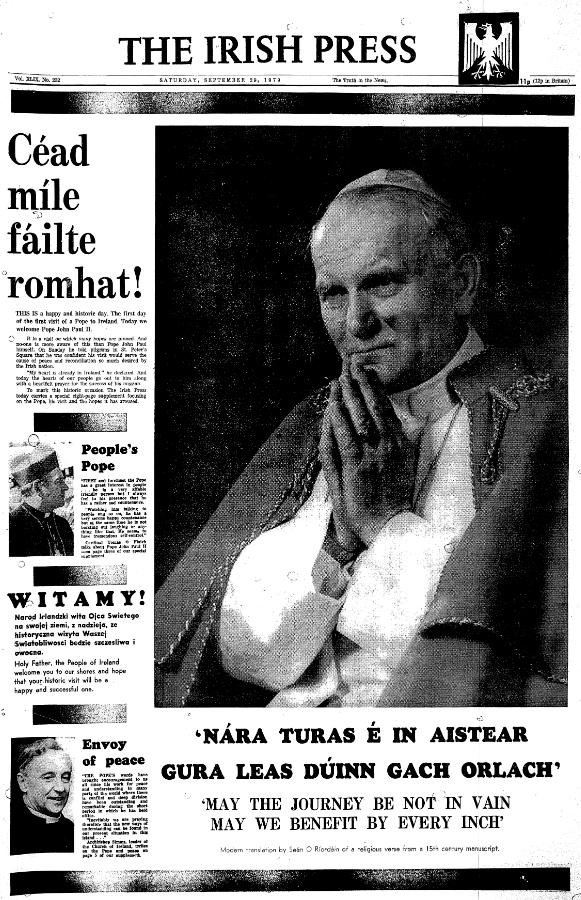
1979 Pope John Paul II visits Ireland
1982 Eileen Flynn case, a single mother in a relationship with a separated man, lost her teaching job
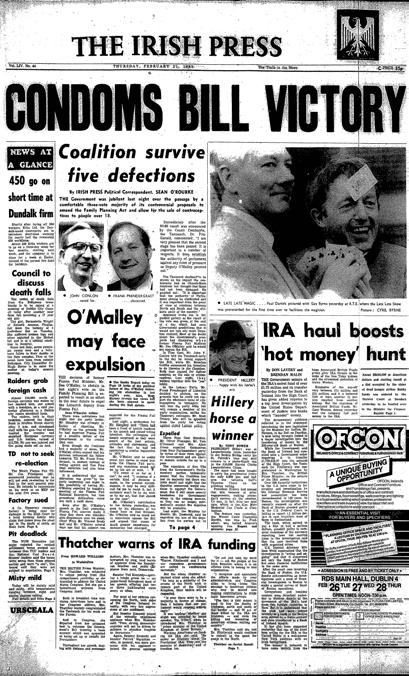
1983 Eighth Amendment referendum with constitutional ban on abortion
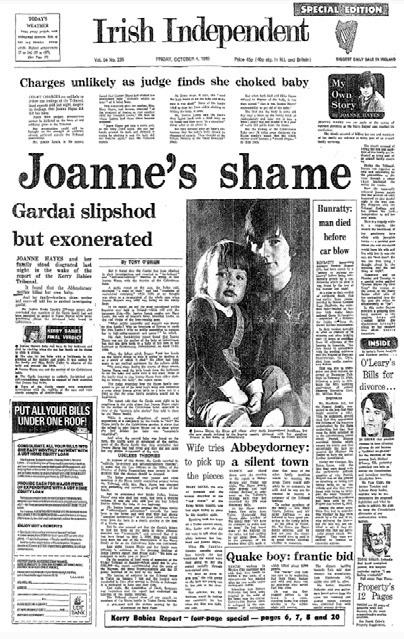
1984 Kerry babies case
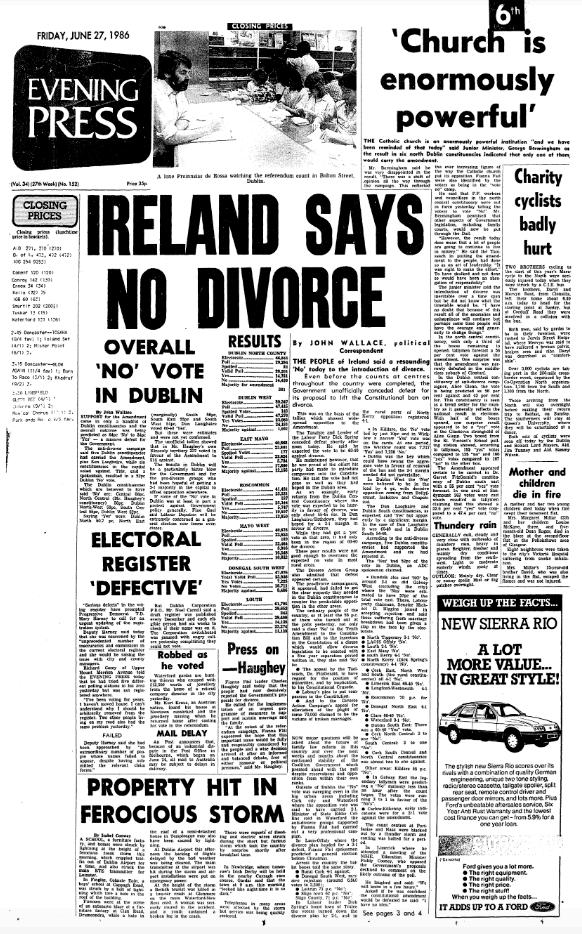
1985 First divorce referendum which was defeated by 2:1
1987 Abolition of the concept of illegitimacy - Status of Children Act in 1987
1990 Mary Robinson elected President
1992 Bishop Casey scandal breaks
1992 Triple abortion referendums.
Two, Right to Travel and Right to Information are passed 2:1, the third outlawing suicide as grounds for abortion is defeated 2:1
1993 Homosexual acts were decriminalised in Ireland
1993 Contraceptives fully legalised
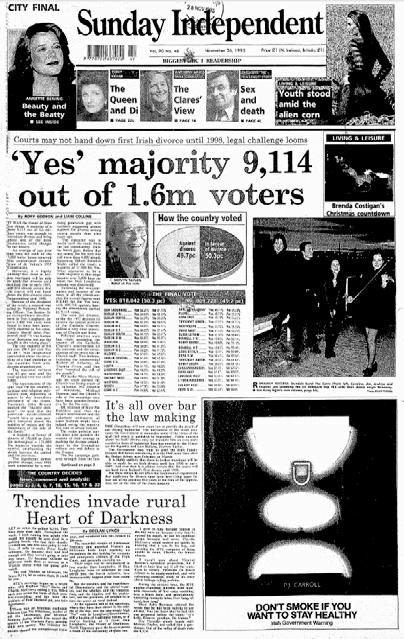
1995 Second Divorce Referendum passes by less than 1 per cent margin
1999 'States of Fear' documentary series produced by Mary Raftery
2002 Second attempt to outlaw suicide as grounds for abortion. Narrowly rejected 50.4:49.6 but with a much smaller turnout than in 1992.
2005 The Ferns Report into clerical sexual abuse in Wexford
2009 Report of the Commission to Inquire into Child Abuse (The Ryan Report)
2011 Civil Partnership introduced for same sex couples
2011 Unprecedented Dáil attack on the Vatican by Taoiseach Enda Kenny
2012 Members of secular bodies allowed to perform legal civil marriages
2013 6th April 2013 - the first Humanist marriage in Ireland
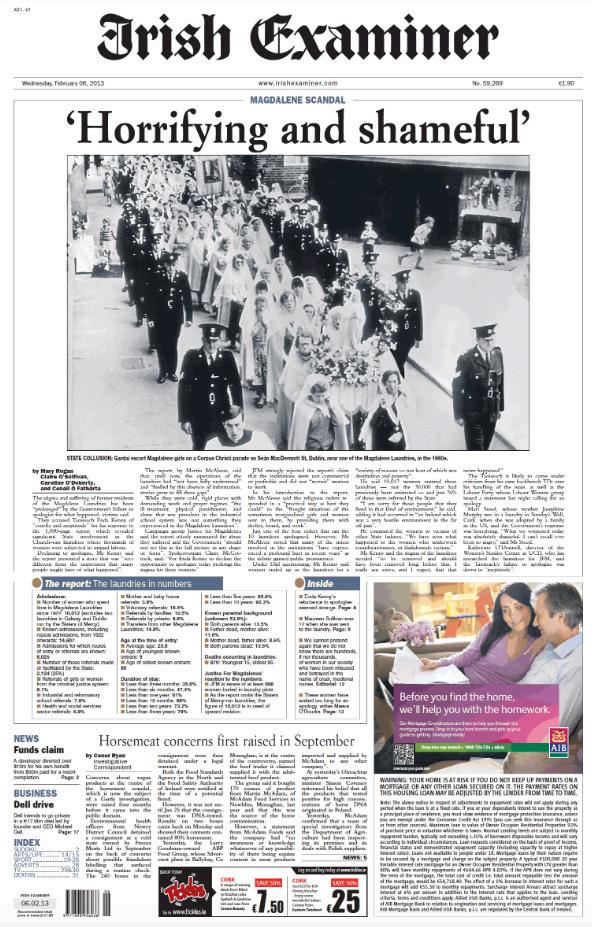
2013 Report of inquiry into the Magdalene Laundries
2015 Transgender Self Identification introduced in the Gender Recognition Act 2015
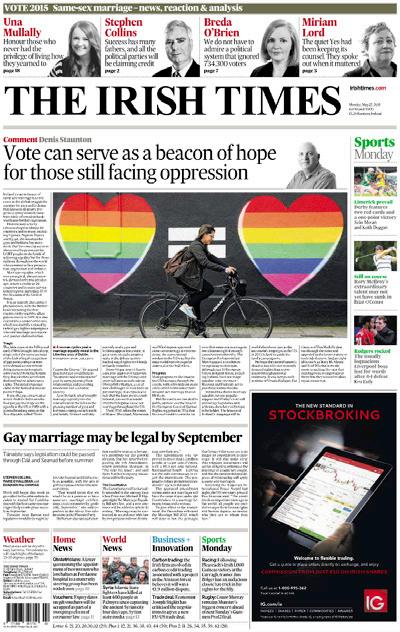
2015 Marriage Equality referendum passes 2:1
2015 Same sex couples can legally adopt children
2018 Pope Francis visits Ireland on 25 and 26 August 2018
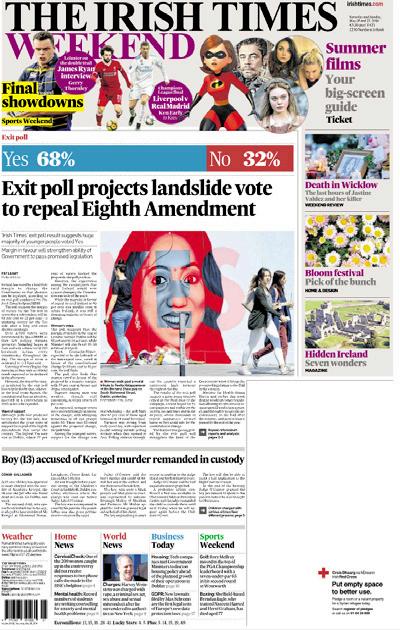
2018 Abortion prohibition removed in referendum 2:1
2018 Blasphemy provision removed from constitution in a referendum 2:1
Note: This is not an exhaustive timeline of all the events relating to secularisation in Ireland but the main events that I came across in researching these features.
Written and designed by
Niall Gormley
Using Adobe InDesign, Photoshop and Acrobat.
Main font: Proxima Nova 9pt on an 11pt grid.
Heads: Proxima Nova
Heading, pull-quote and cross-head colour: C100, M40, Y0, K0 with various tints for tables.
Charts and graphs created with Datawrapper.
Printed by Snap Print, Charlemont Street, Dublin 2.
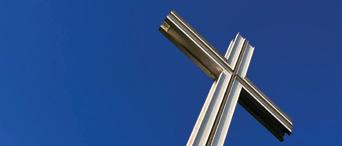
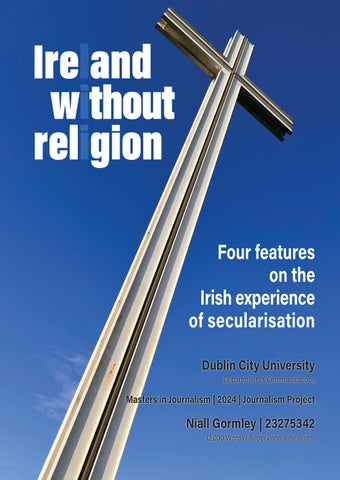
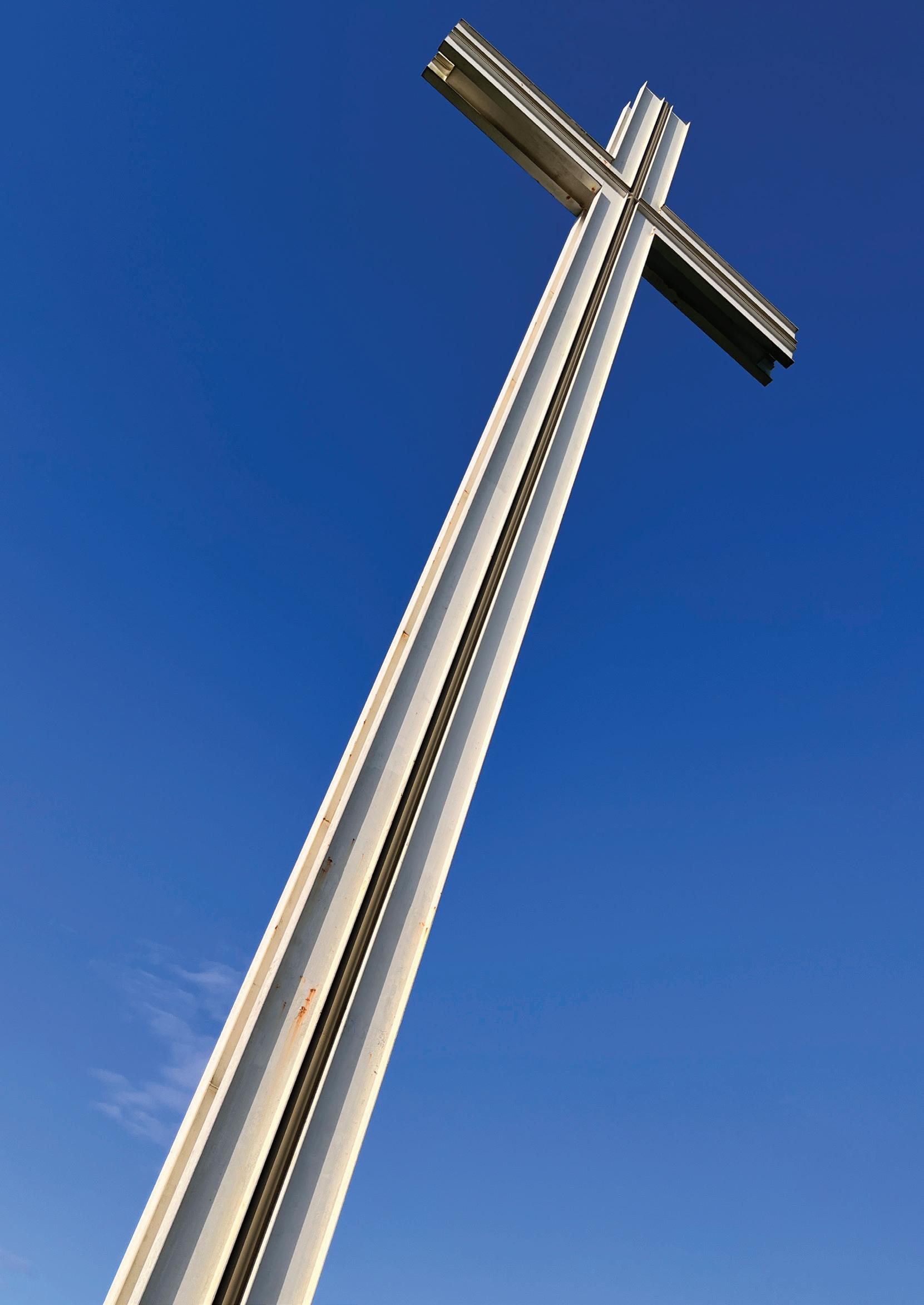
Cover Picture: The Papal Cross in the Phoenix Park in Dublin, designed by architect Ronnie Tallon in 1979 for the visit of Pope John Paul II. It was designed to be a temporary structure. It was manufactured by J and C McGloughlin Ltd across the river in Inchicore.
Photo on 25 July 2024 using an iPhone 13 Mini by Niall Gormley.
Feature 1: Ireland without Religion
Ireland's states and churches
By Niall Gormley
POPE John Paul 2 landed in Dublin on Saturday, 29 September 1979 around lunchtime. He boarded a helicopter which took him to the Phoenix Park where an estimated 1,250,000 people had gathered to see him.
I was 14 years of age at the time and I was there. I made my way to the Papal Cross, or as close as I could get to it, and I climbed up on a fence. I balanced precariously on a wooden fence post and looked out on a sea of people. Tens and hundreds of thousands of people in every direction. I will never forget it.
It was a prodigious statement of belonging in the hearts and minds of Ireland's Catholics and it was authentic. It reflected the power of the church and also the regard, socially and culturally, that the people had for it.
It was the high point of the Catholic Church in Ireland. It marked Ireland out as an outlier, in defiance of modernity, giving the Church a position long relinquished in other European countries.
There have been many detours on the road Ireland has taken since but a good end point is the next Papal visit to the Phoenix Park in August 2018 where Pope Francis said mass in front of a crowd esti-
mated at 132,000, barely one tenth of that 40 years previously.
What happened between these two visits to the Park could be characterised as a foreseeable linear secularisation which got us to where we are and will stretch into the future. But that's not what happened and there is no certainty about where Ireland is going.
Predictions about the end of history haven't worked out well. The current populist crisis betrays the view that the past is a bad place left behind and the future we are arriving to is a happy destination.
In the beginning
How did the Roman Catholic Church in Ireland end up with so much power? It's a story that is very much a relationship of church and state. But at the start of the journey the state in question was not Irish but British.
Catholic power in Ireland was destroyed at the end of the Williamite War in Ireland in 1691 and the Protestant Ascendancy was cemented. The Irish Parliament was run by and for a small landed, AngloIrish elite which then promptly enacted some of the harshest Penal Laws in Europe. Edmund Burke famously wrote that the Penal Laws
A machine of wise and elaborate contrivance, as well fitted for the oppression, impoverishment and degradation of a people, and the debasement in them of human nature itself, as ever proceeded from the perverted ingenuity of man
were: "a machine of wise and elaborate contrivance, as well fitted for the oppression, impoverishment and degradation of a people, and the debasement in them of human nature itself, as ever proceeded from the perverted ingenuity of man". ¹
The 1703 Popery Act included many restrictions and repressions on Catholics but the most notable was that Catholic land inheritance was by 'gavelkind' (equally divided among sons) while Protestant inheritance was by primogeniture (to the eldest son).
Overall power lay in London as laws made by the Irish Parliament had to be approved by the Westminster Parliament. By the late 1700s the position of Catholics slowly improved in the Kingdom of Britain and consequently in the Kingdom of Ireland.
Up to this point, it was illegal to educate priests in Ireland and many seminaries and Irish Colleges were set up across Europe but mainly in France. When the French Revolution broke out in 1789 the Europeeducated clergy became a threat to the authorities in London.
The Irish Catholic Hierarchy took a similar view believing that the Europe-educated young clergy
might become infected with enlightenment values. Equally, they wanted control of an emerging public education system.
Archbishop of Dublin, John Troy argued that British support for a Catholic seminary would be good "for the support of His Majesty’s government and the maintenance of good order, both of which…would be endangered if the Roman Catholic people were deprived of their religious instructors". ²
The Maynooth seminary was established under the Maynooth College Act 1795, voted through by the Protestant Irish Parliament including funding for the new college. In 1798 the rebellion of the United Irishmen led to a bloodbath.
The British government cajoled and bribed the Irish Parliament to vote itself out of existence and in 1801 the United Kingdom of Great Britain and Ireland was born. The Catholic hierarchy in Ireland condemned the 1798 Rebellion and supported the Union.
Hearts and minds
Both the British government and the Catholic Church had engaged in what is now known as Realpolitik. A protestant British state had built a headquarters for a church whose
By 1850 Maynooth had become the largest seminary in the world and over its history has ordained over 11,000 priests
members couldn't even vote. In return the Catholic Church had an avenue into every parish in Ireland.
By 1850 Maynooth had become the largest seminary in the world and over its history has ordained over 11,000 priests, many of whom brought an Irish brand of Catholicism to many parts of the Empire and the world. ³
By the time Catholic Emancipation had arrived in 1829 many of the priests around Ireland had been educated in Maynooth. Politics in Ireland revolved around the need for reform of the land issues and the link with Britain. The radical antisectarianism of the United Irishmen had dissolved into mainly tribal camps.
The radical antisectarianism of the United Irishmen had dissolved into mainly tribal camps
Officially, the state church in Ireland was the Church of Ireland but disestablishment came in 1871 and again the thinking in London was to pacify Ireland. It also earned the British state kudos with the Catholic Church and funding for Maynooth was maintained. ⁴
Nationalist power
The event that cemented the church's power in Ireland was the Parnell split. Charles Stewart Parnell was by far the most influential and powerful politician in Ireland in the
1880s. He built the Irish Parliamentary Party into a political powerhouse, and he made and broke British governments.
Then the scandal of his affair with Katherine O'Shea split the movement. The Catholic Church denounced Parnell, the Irish Party split and the Anti-Parnellites, now hand-in-hand with the clergy, were victorious. The modern Irish News in Belfast was born out of the split. The motto 'Pro Fide et Patria' (For Faith and Country) is still printed on every editorial page the paper publishes. ⁵
I have some family history in the Parnell split. My great grandfather was in the Irish Republican Brotherhood. At the height of crisis in the 1890s there was serious violence and faction-fighting across Ireland. As my great grandfather had sided with Parnell against the church, at one point he had to leave his house for fear of being attacked or having the house burned.
Partition
The point here is to understand that the church or churches, and the state or states, always used each other when their interests required it. But there were various interests to balance.
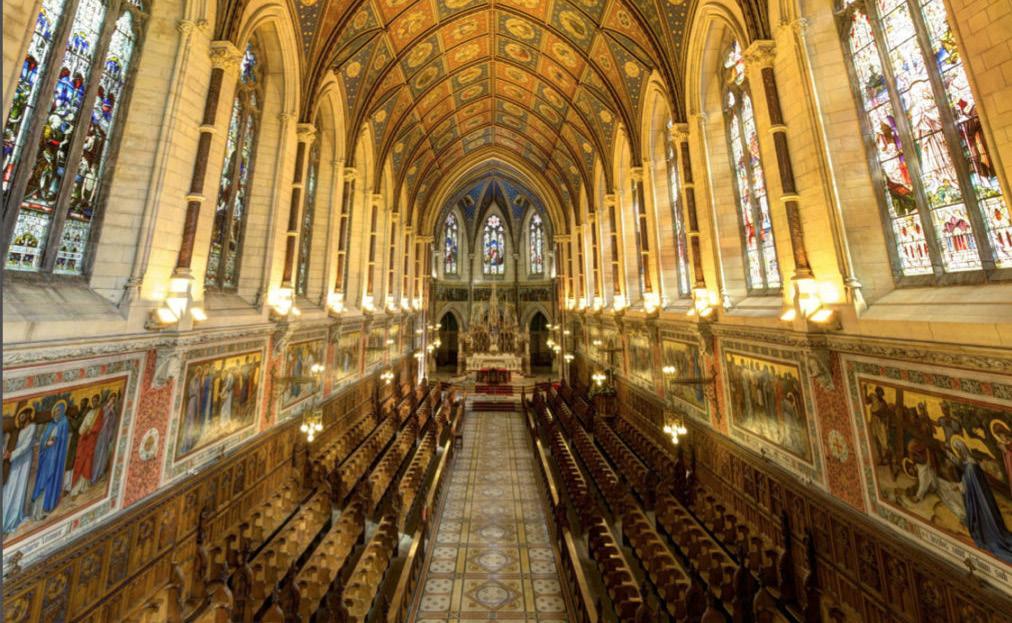
At the heart of Catholic Ireland: the College Chapel at St Patrick’s Pontifical University, Maynooth built between 1875 and 1891 (seminary.maynoothcollege.ie)
2° The State recognises the special position of the Holy Catholic Apostolic and Roman Church as the guardian of the Faith professed by the great majority of the citizens.
3° The State also recognises the Church of Ireland, the Presbyterian Church in Ireland, the Methodist Church in Ireland, the Religious Society of Friends in Ireland, as well as the Jewish Congregations and the other religious denominations existing in Ireland at the date of the coming into operation of this Constitution.
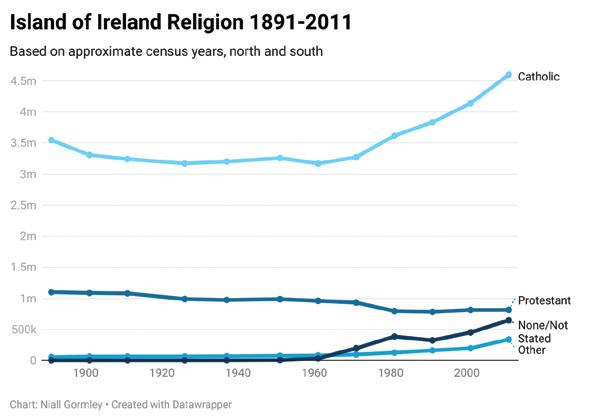
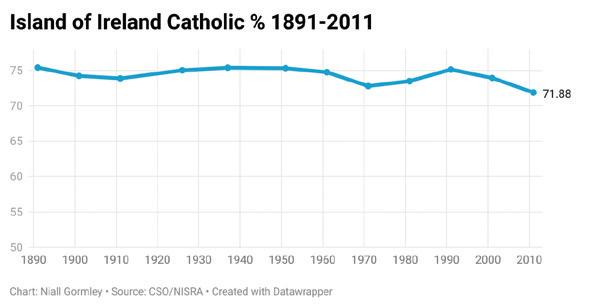
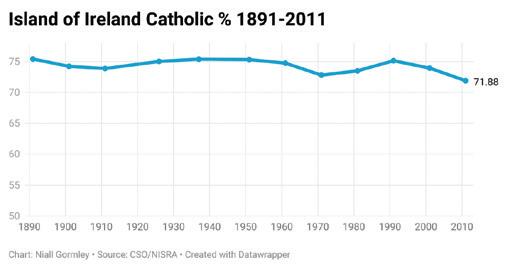
Figures 1 and 2 show the proportion of the population of Ireland who were Catholic since 1891. It has been a remarkably consistent three quarters of the population. Partition changed the landscape for the independent southern state. The CSO records that the Catholic population in the South rose to a peak in 1961 of 94.9 per cent.
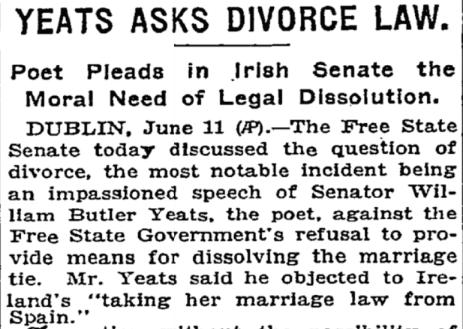
When the new Irish Free State came into being in 1923 the Catholic Church had a free run. An early indication of how things would be in the fledgling state was flagged when the Free State Senate considered what to do about divorce in 1925. It was already very restrictive, people had to petition parliament to get a divorce. After consulting the Catholic hierarchy the government decided to close the loophole.
Ireland's most famous senator William Butler Yeats was furious and he said so in the Senate. He warned about the impact on the minority and on the possibility of a United Ireland.
"If you show that this country, Southern Ireland, is going to be governed by Catholic ideas and by Catholic ideas alone, you will never get the North. You will create an impassable barrier between South and North, and you will pass more and more Catholic laws, while the North will, gradually, assimilate its divorce and other laws to those of England." ⁶
But Yeat's words were not heeded and over the next 50 years the Church's power became entrenched. The 1937 constitution was drafted with Eamon De Valera's close relationship with future Dublin Archbishop John McQuaid, placing many teaching of the Church front and centre.
Which brings us to 1979. The Catholic Church was unassailable and the Pope's visit sealed the deal. But change was already in the air.
An apostle of change
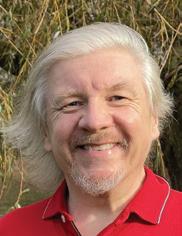
I met Michael Nugent outside a cafe directly across from the gates of the Archbishop's House in Drumcondra, a fact he delighted in drawing my attention to. Michael is the Chair of Atheist Ireland and a veteran campaigner for the separation of church and state.
"I grew up in the 1960s and there was just complete church power over everything, When you had Mods in England, you know, fighting against Rockers on the beaches of Brighton - you had Mods in Ireland queuing up to get their scooters
blessed by the local priest, so that's where we were," he says with a laugh.
Nugent identifies peak Catholic political power in the Pro-Life Amendment referendum in 1983.
"Even feminists back then didn't campaign on the right to abortion. There were obviously feminists who did support the right. But they wouldn't say it, you know, because they felt it was counterproductive. Secularism was very cautious back then."
Decline by referendum
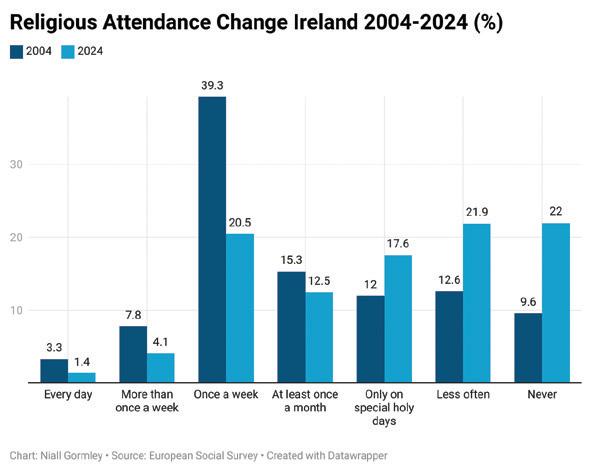
Much of the history of secularisation of the past 40 years can be mapped in referendum campaigns. On the page opposite I've laid out three sets of twin referendums. Those around religion, divorce and abortion.
The 1972 referendum is an outlier but important. In the 1937 constitution the 'special position of the Catholic Church' was recognised. The clause was widely seen as sectarian but actually was a result of De Valera fending off demands to make the Catholic Church a state church, In any case by the early 1970s the Troubles were raging in the North and the subsections made the South look like a theological state notwithstanding the inclusion of other religions. (See panel 'The deleted subsections of Article 44' left).
The main point is that the proposal to delete the 'special position' was passed overwhelmingly, showing a nascent ability of the electorate to park their Catholicism and to see the interests of church and state as separate. ⁷
As Nugent pointed out sentiment against abortion was also overwhelming when Ireland's politicians promised the newly formed Pro-Life Amendment Campaign (PLAC) in the early 1980s that they would introduce the Eight Amendment to the constitution to stop the Supreme Court pulling a 'Roe vs Wade' in Ireland.
The referendum was passed by a 2:1 majority but there had been many criticisms of the move including that it was sectarian, divisive and that it reflected church power.
Nugent thinks that at that point opinion in Ireland was beginning to change and he sees the emergence of the Progressive Democrats as significant.
"It had the potential, and indeed did in the long run, to break the two and a half party system, which was one of the things that was keeping
Figure 1
Figure 2
Figure 3
The deleted subsections of Article 44
everything the way that it was. Des O'Malley, who had been quite a conservative Catholic, had moved on and was supporting the secular agenda when he was kicked out of Fianna Fáil for refusing to vote against condoms."
In the early 1990s the Bishop Eamon Casey scandal broke out. If a cleric having consensual sex with a woman was a big problem for the Church, then the scale of clerical sexual abuse of children that was coming into the public sphere shook the institution to its core.
At this point Nugent lets fly at the Catholic Church. "When you think about it, if any other organisation had spent decades raping children and covering up, they'd be closed down and all their leaders have been jailed. You know, there would be no question of letting them still run schools. It's just scandalous."
Part of a pattern?
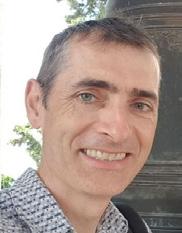
For a more dispassionate take on secular Ireland and secularisation in general I met with Joe Humphreys who writes the philosophy based 'Unthinkable' weekly column for the Irish Times and holds a Masters in Political Philosophy from UCD.
Joe says its irrational to turn away from God simply because some advocates for God do bad things.
"But there's no doubt, I think, a lot of people's faith was heavily dependent on the respect and authority the church had in Ireland. So as that authority waned, people's faith declined in tandem," he says.
He said that some theologians identified that the Irish belief in religion was thin, that there was an expectation that the Church would 'do' religion on their behalf. He instances the tradition that many people learned prayers by rotethey recited the words but they didn't really say them.
This brings two big outstanding issues around secularisation into focus. One is that Catholic parents sub-contract faith formation to the schools and the other is that the Catholic Church controls 90 per cent of primary schools. Joe agrees that there has been very little reform in this area. The bishops are not too pushed and a minority of Catholic parents are vociferously opposed to change.
"The gaping anomaly here is that we still do faith formation in schools. The state is paying to indoctrinate children in religious beliefs that half (of parents) don't believe in. I mean, that's extraordinary. We're paying
teachers salaries to go in and teach kids Catholic education."
"I think the lever here is faith formation. I think the name of the school doesn't matter. At the end of the day, you can call it St Joseph's, St Michael's or whatever. One thing you could do is have an opt-in to faith formation rather than opt-out. And I think that's actually more important this than stripping schools of Catholic identity"
I think there's not necessarily a fall off in a kind of a spiritual belief, or a kind of a searching or questioning. That's often the epitome of what religious belief is, not necessarily having a dogma but thinking beyond the material.
Of the broader question about enduring religious belief I asked Joe whether people turning away from traditional religion meant they were leaving religion behind.
"I think there's not necessarily a fall off in a kind of a spiritual belief, or a kind of a searching or questioning. That's often the epitome of what religious belief is, not necessarily having a dogma but thinking beyond the material.
"I think probably what is lost is the communal element of it. People are doing their own sort of spiritual quests and maybe turning to things like self-improvement and self-help, things like self enhancement almost. So you're a bit more on your own."
Your own internal church
On Reek Sunday thousands still climb Croagh Patrick, the believers and the doubters. No law makes them do it nor does marketing.
People flock to the Camino, to walk the old routes in search of downtime away from the smartphone. Much of what people valued in religion was the ability to have an internal dialogue.
REFERENCES:
The final battle will be over the control of schools and it is well under way. The recent rejection of referendums around family and care might indicate a conservative pushback that may slow change.
Perhaps the solution is for the Catholic Church to move first, to agree to share their schools proportionately and thus to take control of their 50-year decline.
1. Charles Ivar McGrath, 2021 The Penal Laws: Origins, Purpose, Enforcement and Impact. Chapter in Costello, Kevin; Howlin, Niamh (eds.). Law and Religion in Ireland, 1700–1970. https://books.google.ie/books?id=gW1LEAAAQBAJ&pg=PA 12&redir_esc=y#v=onepage&q&f=false
2. Dáire Keogh, Maynooth: a Catholic Seminary in a Protestant state, 1995, History Ireland. www.historyireland.com/ maynooth-a-catholic-seminary-in-a-protestant-state/
3. St Patrick’s Pontifical University, Maynooth https://sppu.ie/about/a-brief-history
4. Kenneth Milne, History Ireland, Disestablishment-in the nick of time https://www.jstor.org/stable/26853156
5. Frank Callanan, 1990, 'Clerical Dictation': Reflections on the Catholic Church and the Parnell Split https://www. jstor.org/stable/25487499
6. WB Yeats, Seanad Éireann debate - Thursday, 11 June 1925; https://www.oireachtas.ie/en/debates/debate/ seanad/1925-06-11/12/
7. Niall Meehan, 2019, History Ireland, Article 44 reconsidered https://www.historyireland.com/article-44-reconsidered-2/
Michael Nugent
Joe Humphreys
Feature 1: Religion without Ireland
Can secularisation work to give religion a future?
IF the movement to separate church and state is successful then it will also mean the separation of state and church.
It sounds obvious but in the case of Ireland the policy assumes campaigning secularists prying the hands of the church away from the civil state. It assumes only downsides for religion.
In fact, many despots, kings and emperors have used religion as a crutch, given its popularity and credibility among the people and ruled with various shades of theocracy. From the pharaohs of Egypt to the emperors of Rome, gods were power. When Henry the Eight broke from Rome, he made himself the head of the church in England. Not a God but not far off, certainly with the power of life or death.
There were two main downsides for religion in getting mixed up with the state. Firstly, the earthly powers wanted to control the church. The House of Borgia came to have two popes from the family. Their rivals, the Medici's, made their money in banking in Florence, and produced four popes.
This political meddling left religion with little room to manoeuvre, open to political intrigue and with nobody looking after its best interests.
The second problem for religion is the reputational damage that inevitably comes with the abuse power. In the Middle Ages, Rome became a byword for corruption.
By Niall Gormley
The sale of indulgences by Pope Leo X (one of the Medici popes) to raise money to build St Peter's Basilica in Rome played a big role in the Reformation in the early 1500s.
The Catholic Church in Ireland is another example. Left in positions of power in education, in health and in the community, it failed to apply morality, one of the foundational tenets of religion, to itself.
Running orphanages has been a reputation killer everywhere (think communist Romania) and while the Irish state deserves some of the blame here, it's the Catholic Church that got, and deserves, most of the blame.
In Hugh Turpin's 2022 entertaining and meticulously researched book, Unholy Catholic Ireland: Religious Hypocrisy, Secular Morality, and Irish Irreligion , the church's hero-to-zero implosion in the space of half a lifetime is laid bare.
Getting back to god
Although separation of church and state in Ireland has long been a goal of secularists, it was conceived in its modern form by Christians in America. Many of these early migrants to the New World fled Europe to escape persecution. These included Puritans who, ironically, wanted to escape control so that they could exercise absolute control of their own errant members. One of these was Roger Williams
In the past priests were ordained and took from that an unchallenged right to run the church and church affairs. That is unsustainable.
who departed Salem in the winter of 1636 accused of preaching dangerous ideas like religious freedom. He made it to Providence where, with some like-minded people, he founded a colony based on the idea of limited government and to let people sort out their own relationship with god.
Later English philosopher John Locke appealed for religious toleration so that those of different faiths could co-exist. Europe had been ravaged by the sectarian wars of the post-Reformation years and tolerance made political as well as religious sense.
In Ireland republicans and nationalists promised that Church power would be kept in check but the realities of partition left the Church in a very influential position, in the state, in society and around the country. Perhaps things could have been worse. Ireland kept its constitutional government which allowed secular forces to compete with the Church for power eventually.
Where is the Church heading?
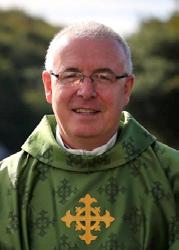
Fr Tim Hazelwood is part of the Association of Catholic Priests (ACP) leadership team and is based in East Cork.
He talks about the many difficulties that the Church faces where there has been a crash in vocations, priests are overwhelmingly elderly and retiring, and still the public want the same services in funerals, wed-
Fr Tim Hazelwood
dings and baptisms. He acknowledges the fall-off in demand for many of these life events but that the Churches resources have fallen even faster.
I asked him what can be done and whether the Church is capable of reforming itself. He identifies a more hopeful future for the Church in the concept of 'synodality'.
"In the past priests were ordained and took from that an unchallenged right to run the church and church affairs. That is unsustainable. Synodality focuses on the sacrament of baptism which locates power in the Church much more widely."
Writing in a piece on the ACP website in May, Fr Brendan Hoban says of synodality:
"Once the clergy – priests, bishops, cardinals – were in charge; now with synodality the baptised and the ordained work together.
"For instance, up to now, the parish priest made decisions for Parish Councils which were merely consultative bodies. Now priests and people will together follow a synodal pathway: together listening attentively to one another; together discussing issues; together discerning what God wants them to do; and together making decisions." ¹
This is radical stuff and a complete turnabout in how the hierarchical church has operated in the past. And, ironically, some of the pressure for this is coming from
Rome where Pope Francis is pushing "the need to dismantle what he calls ‘clericalism’, effectively, an elitist and exclusivist understanding of vocation, as a power to be exercised rather than a service to be given."
Earlier this year, 200 parish priests were called to Rome, two from each country, to share their experiences of the transition to synodality.
Some might say that this is just a reality check where the real anticlerical force is the fact that clerics are disappearing.
Writing in the Catholic Herald Declan McSweeney quotes Fr Paddy Byrne who summarised the statistics in his recent column in the Laois Nationalist:
“The number of priests and members of religious orders in Ireland has dropped by 70 per cent since 1970. In the past three years, more than 25 per cent of priests in Ireland have died. And the average age of priests has risen substantially in that time; it is now well above 70. Add to those, problems of health and morale and you have a serious difficulty with staffing.” ²
McSweeney says that half a century ago, there were 14,000 nuns in Ireland; now the number is around 4,000, the average age being over 80. So if the Church doesn't embrace change that transfers power to the laity it's facing a huge crisis.
I put it Fr Hazelwood that even
Now priests and people will together follow a synodal pathway: together listening attentively to one another; together discussing issues; together discerning what God wants them to do; and together making decisions
given the looming problems many parts of the conservative church are resisting change. He agreed and instanced that this was particularly evident in the role of women in the church.
"In our churches most of the work is done by women. We have been asking for women deacons in the ACP for many years. Equality is an essential part of our humanity, which we haven't acknowledged"
The Church embracing women?
So the Catholic Church is heading into the new secular Ireland in a continuing debate about its own relationship with traditional ideas.
Mary McAleese, former President of Ireland, is also a committed Catholic and a long-time advocate for progressive change in the Church. This is what she had to say about women in the Church on 25 March 1995 at the Jesuit Conference Centre in Dublin before she became President:
"At a time when numbers seeking admission to the priestly Iife are dwindling to a negligible trickle, when convents and monasteries are closing down or seeking a recycled living as conference centres it seems an extraordinary act of ingratitude to say to those of the female gender who would wish to play their role in the future of the Church as pastors, whether deacons or priests, and whose newly released spiritual energy could truly
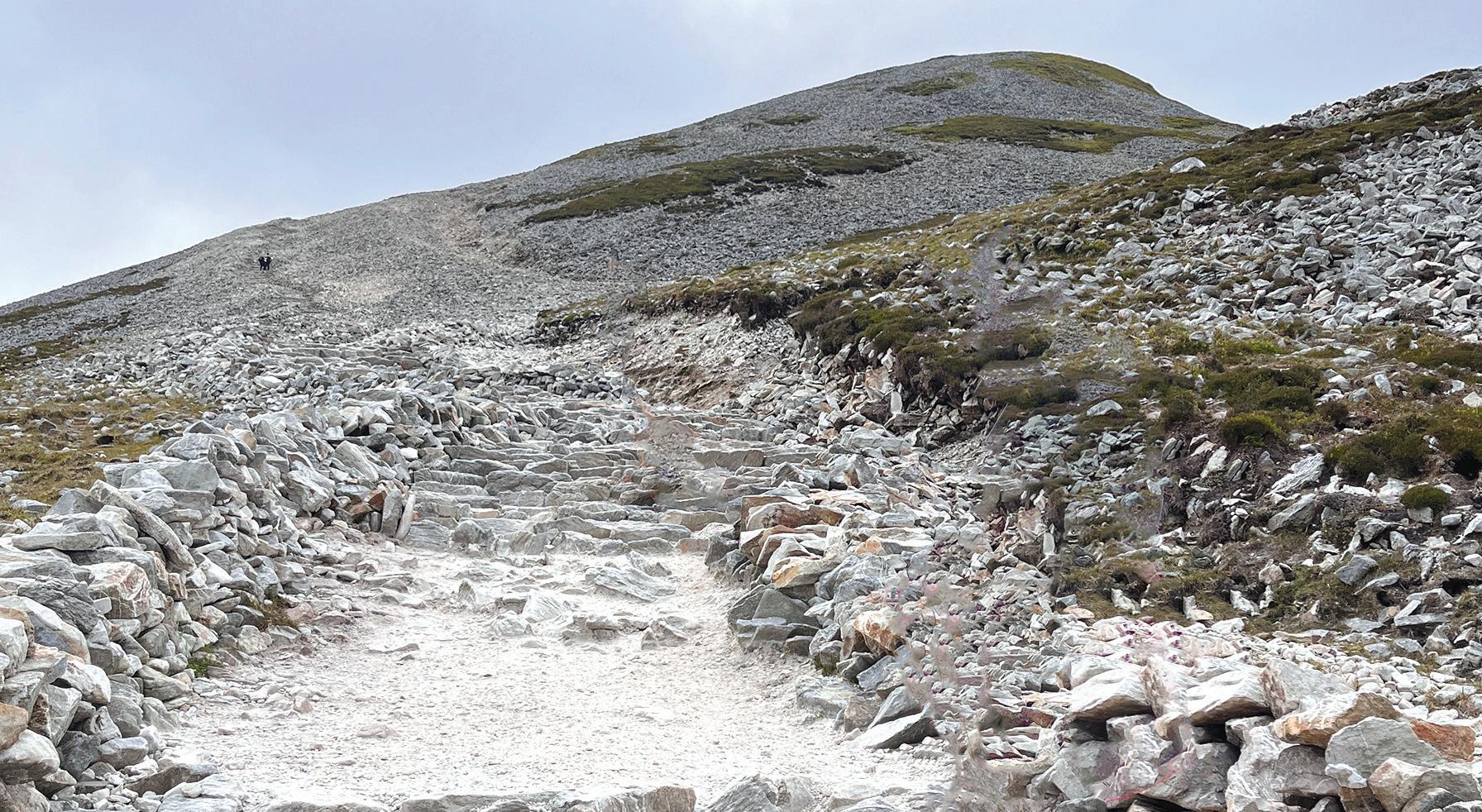
A mountain to climb? Many facets of church and religious life retain their popularity such as the Camino or Croagh Patrick shown here (Pic: Niall Gormley)
renew the face of the earth, that their services are not required.
"How different one wonders is the voice which argues for female circumcision in Africa because that is how tradition always would have it, from the voice once raised in the Far East for the binding of female feet because that is how tradition would always have it and how different is that from the voice which rejects the admission of women to priesthood because that is how tradition would always have it?" ³
In the intervening years how much has changed? Speaking in March 2024 at the 'On Being A Catholic' event at Mary Immaculate College in Limerick President McAleese said:
“I’ve read everything that has been written on theology that excludes women and I’ve read nothing yet that is impressive.
“It’s the kind of theology that is custom raised to meet the Magisterium teaching and to flatter it but not to integrate it, and I think that’s a pity. The important thing about excluding women from priesthood is you also exclude them ipso facto from decision making because all decision making in the church is written through the Magisterium.”
Since Ms McAleese left the presidency, she has devoted more of her
time to Catholic Church affairs and she has tooled up on Canon law. She holds a Doctorate and Licentiate in Canon Law from the Pontifical Gregorian University Rome and a Master’s Degree in Canon Law from the National University of Ireland (Milltown Institute).
She's not impressed with progress so far: “There are a few women in the curial roles and I don’t want to be mean about this but it just strikes me as minimalism.
"It’s just enough to stop people from whinging and complaining and to look like you’re doing something. But what you’re doing is never really addressing the fundamental inequalities and the fundamental waste of talent."
President McAleese also said that she approved of the synodal process and she called for a forum where clergy and laity could meet as equals.
Can the centre hold?
Should churches liberalise to meet the new secular world or should they hold on to old values and meet the challenge head on?
The Anglican churches have made many changes, such a allowing women into the priesthood and embracing gay people. But these moves, and the growth in the
How different one wonders is the voice which argues for female circumcision in Africa because that is how tradition always would have it?
Anglican churches in the more conservative, developing world, have threatened to split the whole Anglican communion.
Same-sex marriages are not allowed and 'blessings' are as far as the Anglican leadership dare to go for fear of causing a schism. But in June a proposal in the Church of England to allow gay couples to have stand-alone services in Anglican churches caused open rebellion from a conservative alliance within the Church.
"If the further departure from the Church’s doctrine ... does go ahead, we will have no choice but rapidly to establish what would in effect be a new de facto 'parallel Province' within the Church of England," the alliance, made up of leaders from different networks backed by over 2,000 clergy, said in a Reuters report. ⁴
The Catholic Church is in a similar bind as conservatives rebel against church liberalisation. ⁵
Mix and match beliefs
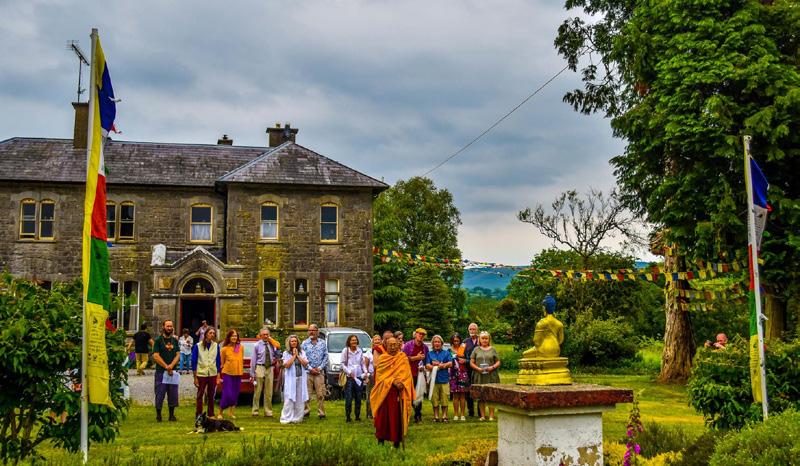
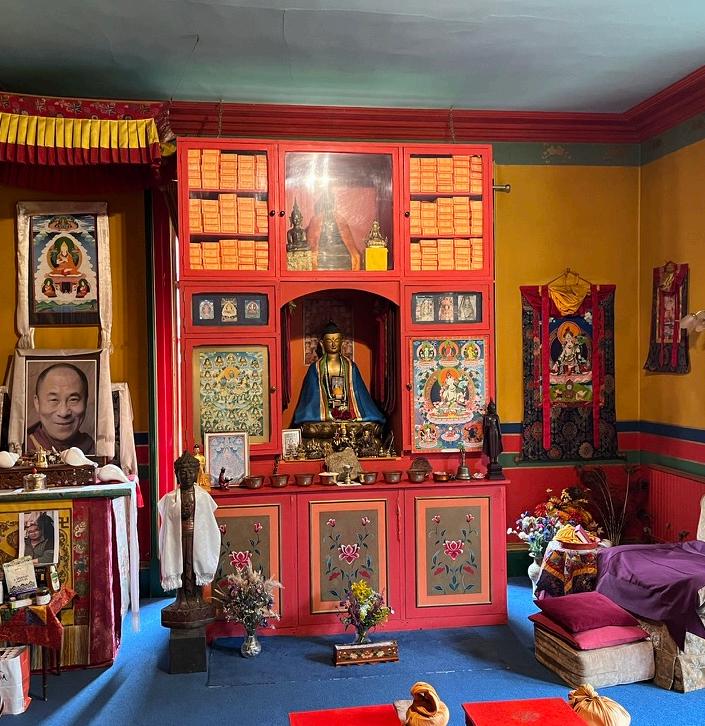
For a different, and perhaps more optimistic, version of the future I headed to the Jampa Ling Buddhist Temple in west Cavan.
On an old estate, out in the woods and lakes, a tired and weary cosmopolitan can put down their
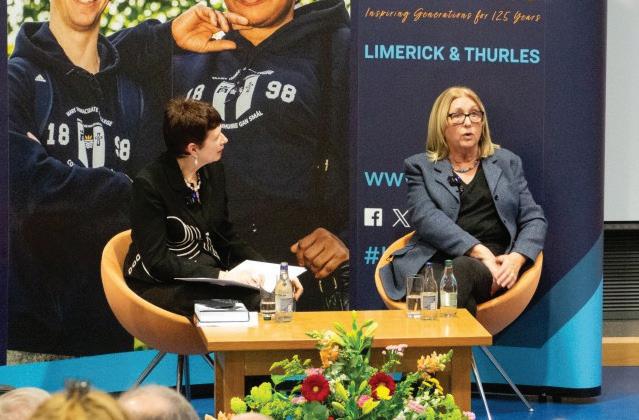
President Mary McAleese with Dr Patricia Kieran, Director of the Irish Institute for Catholic Studies in March 2024 at the 'On Being A Catholic' event at Mary Immaculate College in Limerick (Pic: Mary Immaculate College)
smartphones for a few days and find some peace. Far from competing with the entrenched Christianity of either Cavan or Ireland, the Temple finds lots of Christians willing to mix and match practices and beliefs.
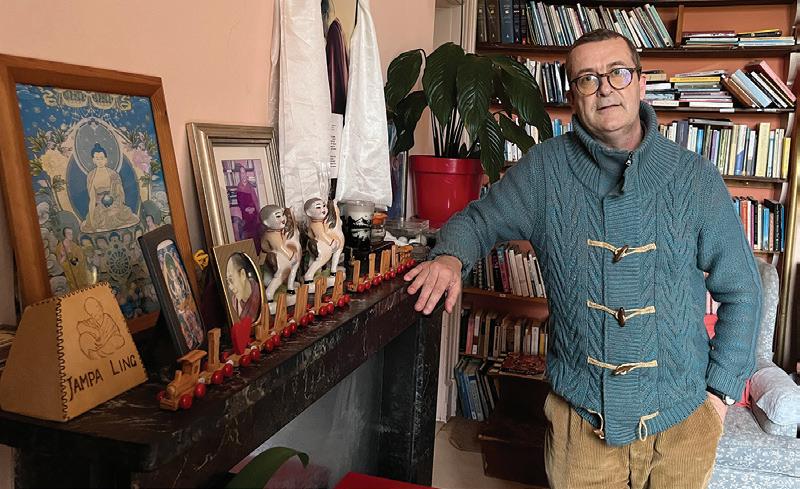
Desmond Geogh (rhymes with cough, he says) is a facilitator at the centre. He agrees that people come for peace of mind.
"I think that would be a common thing. Some people might have a particular thing going on in their lives they want to tease out. This place gives you a time to reflect and contemplate. People come and stay for three or four days. Occasionally people come and stay for a month or two," he says.
The Temple is a retreat centre, a meditation centre and follows the practices of Tibetan Buddhism.
"We have a Tibetan lama living here who is the teacher, the spiritual director, the Venerable Panchen Ötrul Rinpoche. He is a very knowledgeable Tibetan Buddhist scholar, practitioner and meditator," he said.
He says that the purpose of the centre is not to make people into Buddhists.
"There would be a Christian, Catholic, Irish majority of people who come here and they fit it in with their practice. They don't necessarily drop their old practices to come here. They can straddle the two or they're on a journey of self-discovery or whatever," he adds.
"Because in Buddhism, one of the things we say is 'you can't fix the world'. You may not be able to make the world a more peaceful place in your lifetime, but you can make your mind a more peaceful, relaxed, chilled out mind."
Perhaps the a-la-carte Catholic is also an a-la-carte Buddhist and an a-la-carte agnostic. Instead of the leaving religion behind the decline in institutional religion is opening up options for people, while keeping the pressure on the old churches to work on reform.
REFERENCES (Not referenced in text or charts):
Some people might have a particular thing going on in their lives they want to tease out. This place gives you a time to reflect and contemplate
Because in Buddhism, one of the things we say is 'you can't fix the world'...
...you may not be able to make the world a more peaceful place in your lifetime, but you can make your mind a more peaceful, relaxed, chilled out mind
1. Brendan Hoban: Priests must embrace a new era of synodality https://associationofcatholicpriests.ie/brendan-hoban-priests-mustembrace-a-new-era-of-synodality/
2. Ireland’s vocations crisis reflects lack of ‘initiative’ and ‘evasion of issue’ by Church https://catholicherald.co.uk/irelands-vocationscrisis-reflects-lack-of-initiative-and-evasion-of-issue-by-church/ 3. marymcaleese.com https://marymcaleese.com/basic-seminardublin
4. Church of England faces threat of split over stance on gay couples https://www.reuters.com/world/uk/church-england-facesthreat-split-over-stance-gay-couples-2024-06-27/
5. Can Conservative and Liberal Catholics Coexist? https://www. nytimes.com/2024/05/08/opinion/pope-francis-catholic-church. html?searchResultPosition=1
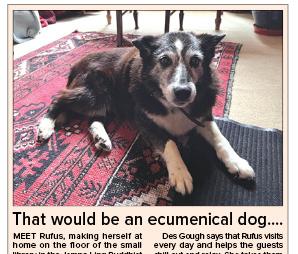
That would be an ecumenical dog....
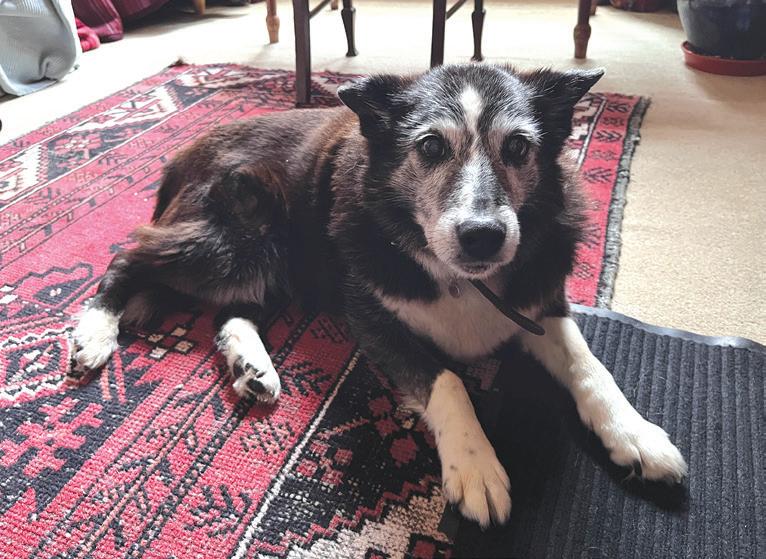
MEET Rufus, making herself at home on the floor of the small library in the Jampa Ling Buddhist Temple in west Cavan.
She's just visiting as she lives next door and belongs to the Smith family. Sean Smith was a veteran Fianna Fáil councillor on Cavan County Council serving for 43 years until his death in January 2023. His daughter Áine topped the poll in this year's local elections in the Cavan-Belturbet constituency.
Des Gough says that Rufus visits every day and helps the guests chill out and relax. She takes them for walks in the woods and Des says she's famous the 'length and breadth' of Ireland with the Temple's visitors who always ask for her.
Des reckons she's a Catholic dog at home and a Buddhist dog when she's at the Temple. She's also a Fianna Fáil dog and a girl call Rufus.
Who says we can't all get along?
Desmond Geogh, a facilitator with the Jampa Ling Buddhist Temple in Bawnboy in west Cavan, is pictured here in the centre's library
The Jampa Ling Buddhist Temple at Summer Solstice celebrations
Feature 3: Northern Protestant Secularisation
Did Protestants secularise before Catholics?
IN September 2023 it was announced that Catholics outnumbered Protestants in Northern Ireland for the first time. The 2021 Census found that Catholics made up 45.7 per cent of the population. Protestants accounted for just 43.5 per cent.
This was the second census in row that a major demographic change had been captured. The previous 2011 census showed that Protestant numbers had fallen below 50 per cent for the first time. At that time the balance was 48 to 45 in favour of Protestants.
A quick search on Google shows that this news was carried around the world from the major wire services to the likes of The New York Times. It was a moment full of meaning: that the state of Northern Ireland, built to house a Protestant majority, had outlived its raison d'etre.
But did it? The numbers in Figure 1 below are stark. They take account not only the people who say they are Catholic or Protestant but also those who no longer consider themselves described by these labels. It asks what community you were
By Niall Gormley
brought up in and the question has only been asked since 2001 in anticipation of the growing number of 'not stated' and 'no religion' replies.
It's the living embodiment of the old joke that you can't be an atheist in Northern Ireland. You have to be a Protestant atheist or a Catholic atheist.
What's going on?
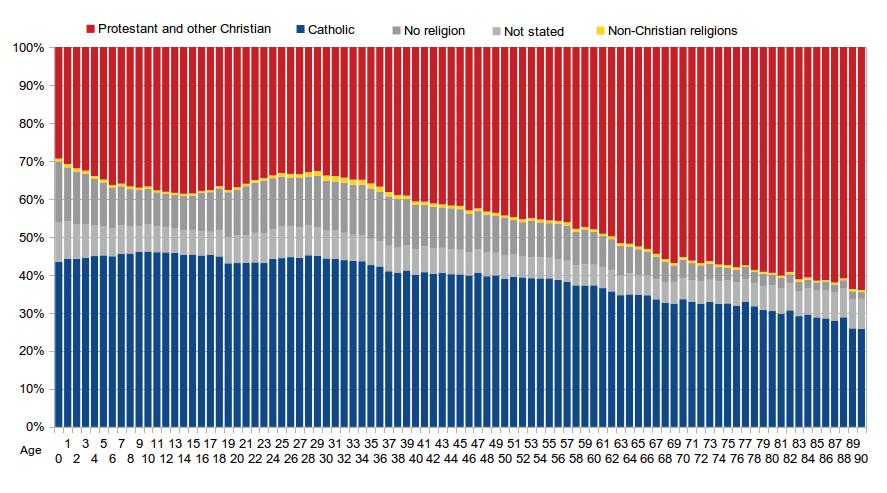
What stands out is the astonishing decline in the number of people describing themselves as 'Protestant'. In both ten year periods the overall numbers of Protestants fell by about 5 per cent. So the number of Protestants has declined by half a percentage point every year for the past 20 years.
However this seems to have been a longer term trend for Protestants in Northern Ireland (See Figure 2). From 1860 to 1960 the number of Presbyterians was around 30-33 per cent. The numbers of Catholics was generally reducing despite high birth rates due to emigration. Presbyterians were also subject to emigration as their socio-economic position was lower than that of Anglicans, whose numbers actually increased to 1940.
As can be seen from Figure 3 the absolute numbers of Protestants stayed fairly constant up to 1970. But starting from around 1950 their proportion of the population started to fall. Why was that?
What stands out is the astonishing decline in the number of people describing themselves as 'Protestant'.
So the number of Protestants has declined by half a percentage point every year for the past 20 years
Firstly, Catholic emigration began to ease off (see Figure 4), large numbers were still leaving Northern Ireland but the absolute numbers of Catholics were increasing.
Also Protestants also emigrated as the figures from Dr Johanne Devlin Trew of Ulster University show, especially in the 1970s.
Over the first sixty years 85,000 more Catholics than Protestants emigrated but by the 1970s the numbers leaving were even. The 'brain drain' movement meant that as more Catholics went to in Northern Ireland, more Protestants went to university in Britain.
Disappearing Protestants
Looking at Figure 2 it looks like a lot of Protestants are not disappearing but instead turning into 'nones'.
Peter McLaughlin in The Fitzwilliam takes up the argument:
"Some of this is being driven by secularisation, which is happening in a lopsided manner in Northern Ireland.
"Of those who said they had no religion in 2011, a majority identified as British, and over two-thirds identified either as British or Northern Irish; only 14% thought of themselves as Irish compared to 28.4% of the general population, which suggests that those from a Protestant background are secularising more quickly than their Catholic counterparts.
"Or at least, secularisation in
Catholic communities had less of an impact on cultural identity and political beliefs." ¹
Meanwhile, the proportion of Catholics seems to have plateaued at around 45 per cent, especially when many immigrants come from Catholic countries like Poland. There were around 25,000 more Catholics than Protestants from European countries in the 2021 census.
Asymmetrical secularisation
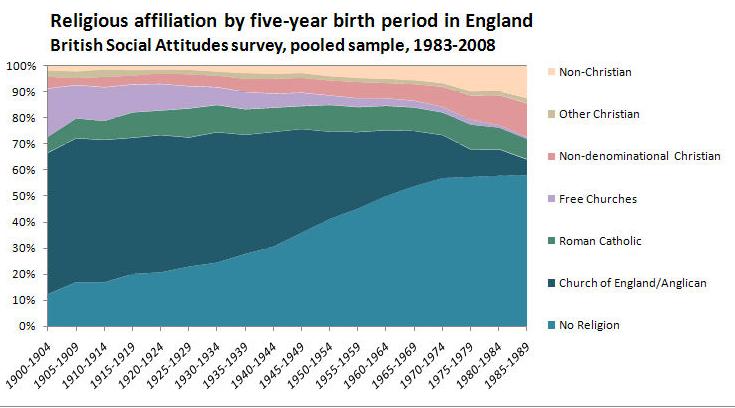
What other evidence can be adduced for earlier Protestant secularisation? Well one strand is that Protestants are what they say they are, which is British. And the situation in England is that identification with religion has been on the decline from the early 1900s, see Figure 5 next page. So it's not inconceivable that those who imbibe and >>>
The situation in England is that identification with religion has been on the decline from the early 1900s
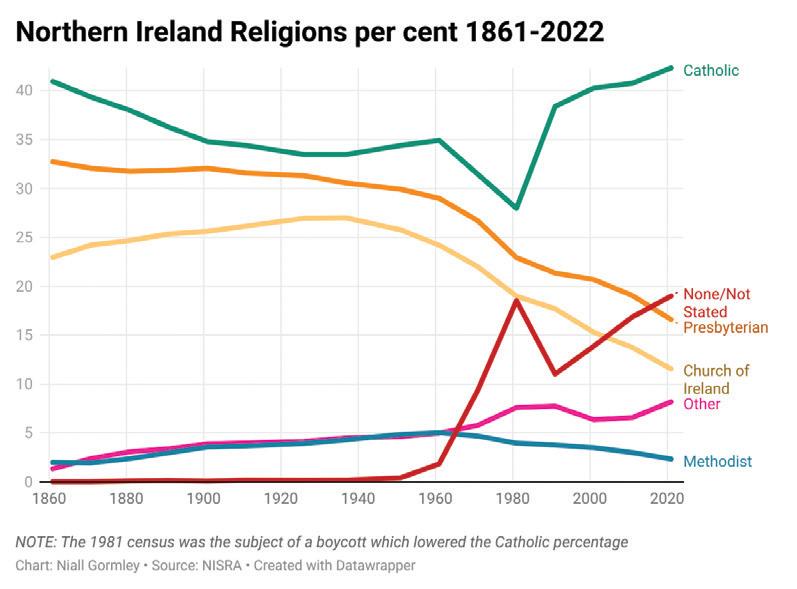
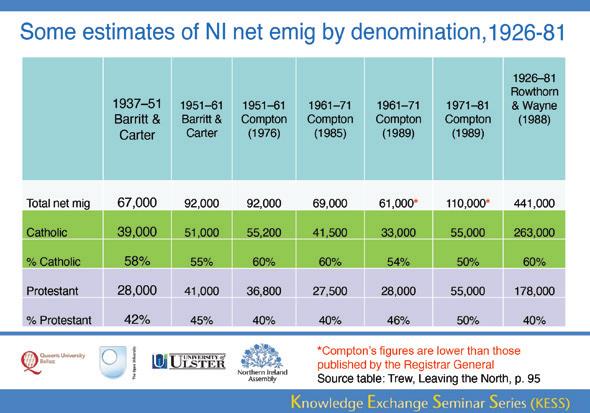
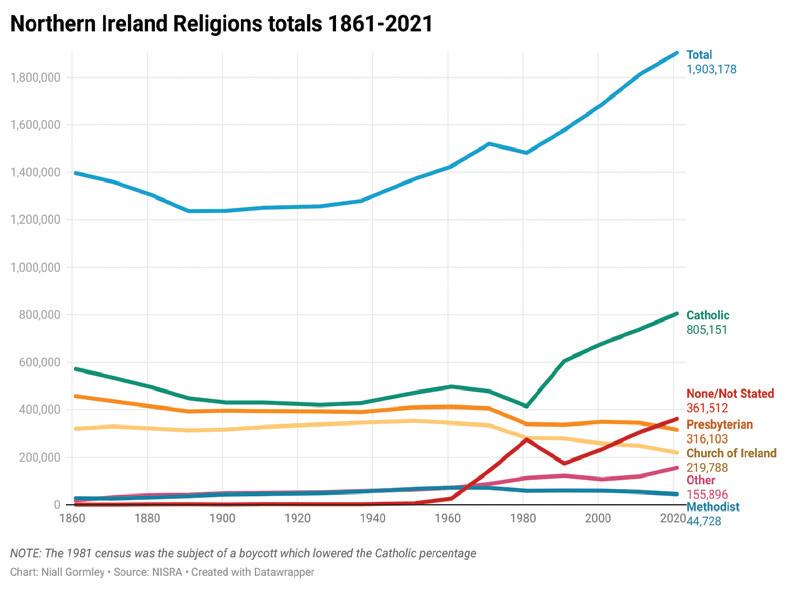
Figure 2
Figure 3
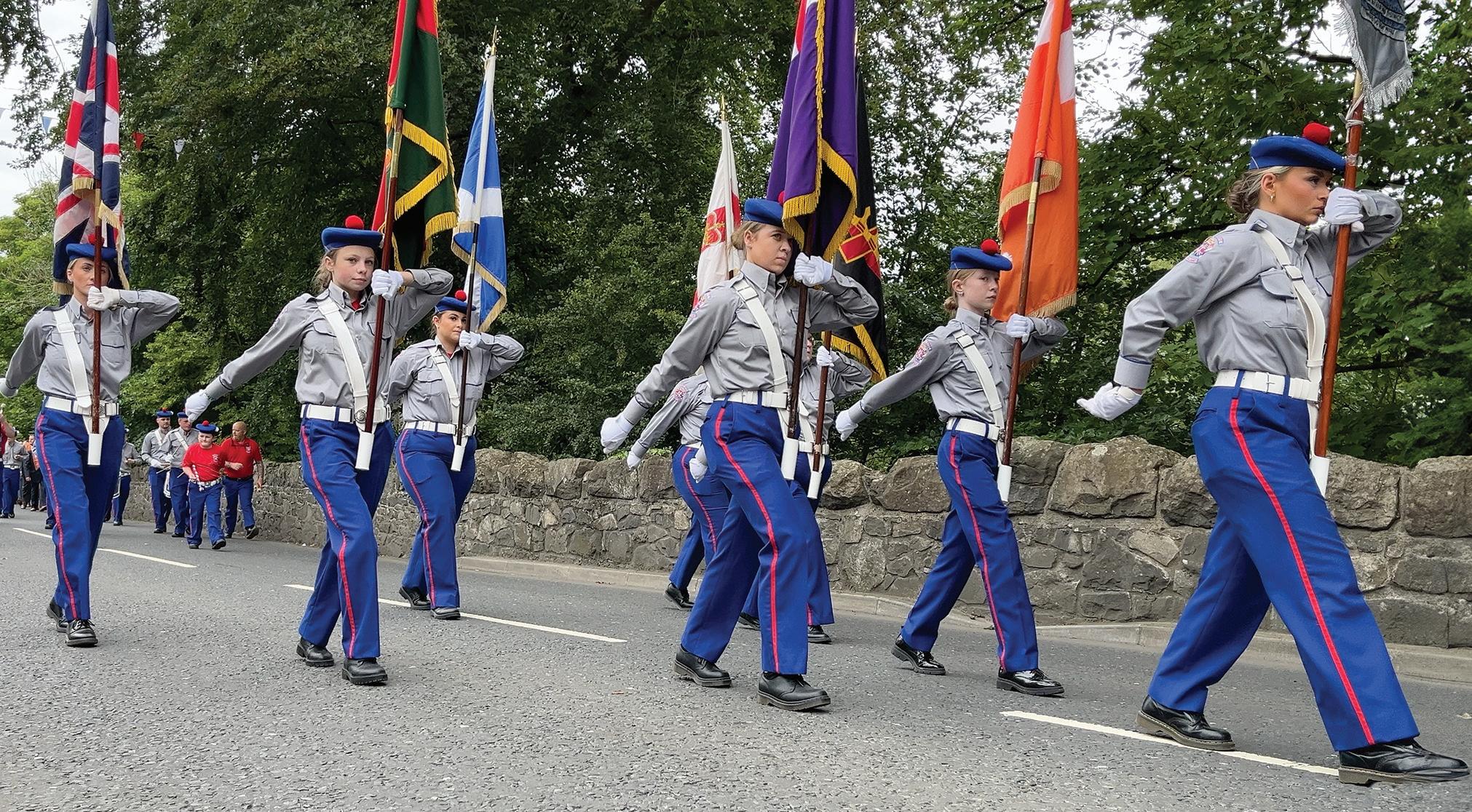
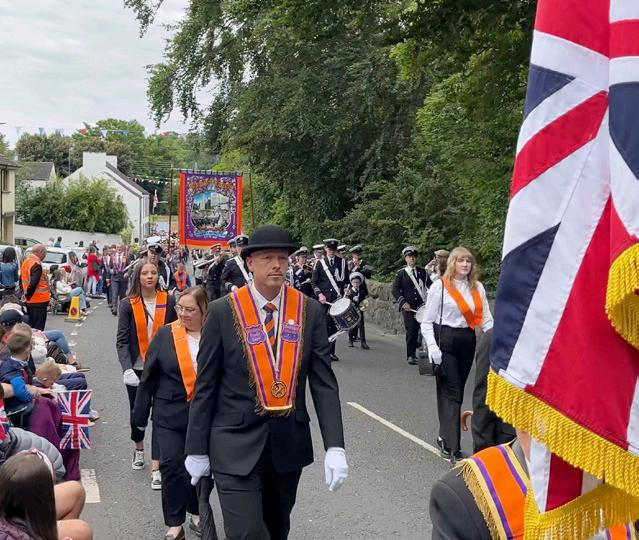
Marching off the stage? Young loyalists taking part in the 12th July 2024 Orange parade in Gilford, Co Down on their way to the field (Pic: Niall Gormley)
Source: Dr Johanne Devlin Trew, ‘Lost generations’? Taking the longer view on Northern Ireland migration; kess.org.uk/
resonate with British culture would also be also influenced by it.
England and Britain in general is also part of the European, developed world mainstream and subject to wider secularisation trends. See panel below: 'Secularisation is predictably but unevenly tied to development'.
Protestant movement
So is it possible that the disappearing Protestant is an illusion, that there's more going on. Reformation values among many Protestants emphasised individual conscience and a rejection of hierarchies.
John Gray is a former Librarian at the renowned Linen Hall Library and from a Protestant background. He was a member of the Ulster Liberal Party in the 1960s and then the more radical People's Democracy in the 1970s. He is now the chair of Reclaim the Enlightenment, a crosscommunity group hoping to recapture some of the democratic, non-sectarian radicalism in Belfast's past.
I asked him about the transition from 'Protestant' to 'None' in the census results. Although agnostic he's not convinced that they've all given up God.
"It means, I think, 'no organised religion'. There are people who were brought up going to church but have stopped going to church. But are they actually saying that they've abandoned religion? It's not clear," he says.
He points to many of the Protestants involved in Reclaim the Enlightenment who embrace rationalism and a civic republicanism.
"What I mean by civic republican-
ism is a rational rejection of monarchy, aristocracy and, a very Protestant thing, a rejection of hierarchy within the churches."
I asked him about the changes in recent years where, in heavily Protestant constituencies in the east of Northern Ireland, that the Alliance Party, adamant that it is not unionist, is gaining a large share of the vote. Alliance has won (and lost) East Belfast and North Down in the past; and won Lagan Valley in the recent 2024 Westminster election.
"I think that it is true, in a political sense, that people are desperately clutching for anything but the old rubrics, because the old rubrics have proved so disastrous and failed.
"This is sometimes condemned as the Protestant middle class retiring to the Gold Coast, along the shores of Belfast Lough, and simply deciding they couldn't care less what the politics are so long as they can continue making money.
"But actually, there's more to it than that. Many areas where the middle classes live are mixed and people are buying into that. It's a more pleasant way to live"
John points out that many of the areas where loyalism is strongest are where people have been excluded from third level education by academic selection. These are also areas hit by recent racist rioting in Belfast.
This might indicate that the Protestant population once characterised, mistakenly, as monolithic, are heading in even more starkly different directions. One, middle class, indifferent to unionist ideology and identifying more with a
Secularisation is predictably but unevenly tied to development
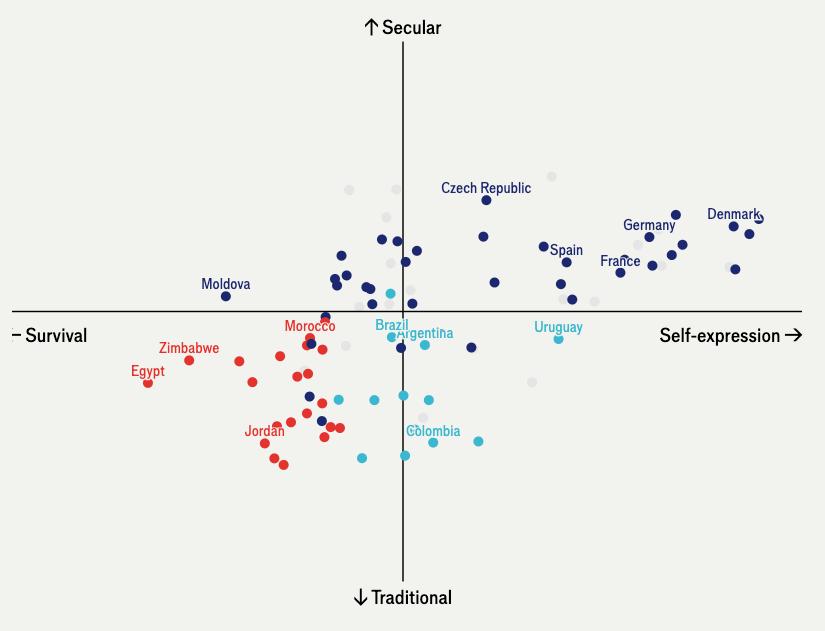
THE Inglehart–Welzel analysis divides values into two axes to measure where populations stand at any given time. The pull of secular vs traditional values is measured against how difficult it is to put bread on the table.
The values plotted here for countries show an unmistakable pattern: as countries and populations get richer, traditional beliefs and family structures wane.
But there are bumps and counter-intuitives on the way. The Eastern Bloc countries of Europe have become more traditional since the fall of the Iron Curtain even as they joined the EU and grew richer. Also, Latin America has seen a fall in Catholic beliefs but also a huge rise in Protestant churches.
The secularism of the west may actually be putting a brake on secularisation elsewhere in that reactionary forces scare their populations with tales about the degeneracy of the developed countries.
John Gray
This is sometimes condemned as the Protestant middle class retiring to the Gold Coast, along the shores of Belfast Lough, and simply deciding they couldn't care less.... ....but actually, there's more to it than that
'Northern Irish' or even 'Irish' identity. The other, poorer, excluded by geography, social class and academic selection, becoming more (British) nationalist and xenophobic - and ultimately self-destructive.
Not all bad news
Ben Lowry is the editor of the Newsletter in Belfast, famously the oldest continuously printed English language newspaper in the world, and possible the most important unionist institution in Northern Ireland.
In the wake of the 2021 census results Ben penned an opinion piece in the Newsletter making the point that part of the reason for the precipitous decline in the Protestant population was asymmetrical secularisation. ²
He instanced the changeover in schools to in the North to 'integrated' status and said that the majority of such schools came from the Protestant community.
He has a point here. Firstly, even though most people say that Northern Ireland's education system is divided by religion, actually the 'Protestant' schools are state schools, while only 'Catholic' schools form a separate sector.
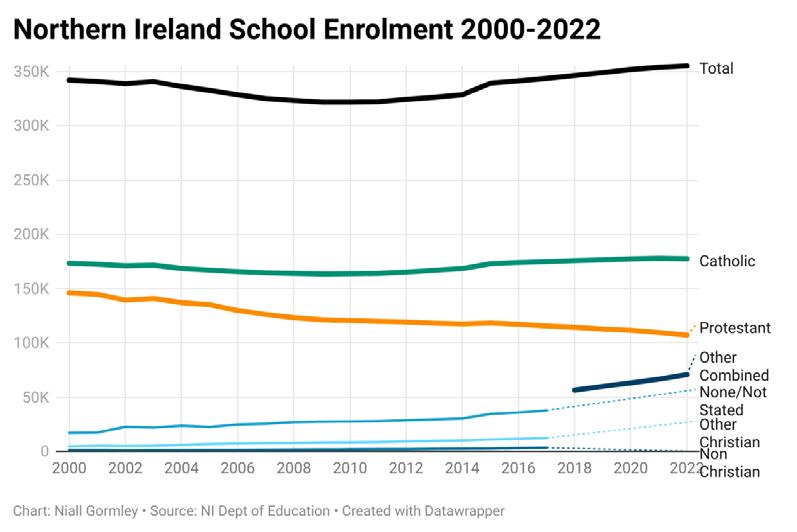
Figure 7 seems to back up this contention. Enrolment from the Protestant community is falling but enrolments from the 'Others' has increased and the Catholic numbers are stable. But it's not true that all the 'Others' originate from the Protestant side as Peter McLaughlin pointed out above.
Ben takes up the argument: "Meanwhile, for many years some schools in greater Belfast have been
Source: https://www.economist.com/interactive/international/2023/08/03/western-values-are-steadily-diverging-from-the-rest-of-the-world
becoming integrated in reality, even if not formally designated as such.
"The most religiously mixed such schools, with intakes of almost 50-50 Protestant-Catholic in a number of cases, tend to be grammars, and they tend to be middle class. They are atypical of wider society, but were the fore-runners in a trend that has been building for more than 50 years.
"When I was at school in the 1980s such mixing was well established but like many pupils, I knew little about it. Why? Because like many people from a cultural Protestant background in greater Belfast I came from a family that rarely attended church and I did not know what Protestant or Catholic meant until I was approaching my teens."
And this touches on the effect of secularisation on the middle classes. National and religious identity matters less and three political trends emerge: not voting unionist, voting for the centre ground; and not voting at all, this last point evidenced by the lower turnout in eastern constituencies in Northern Ireland.
Border poll looming
Politically the statistics indicate change, perhaps even constitutional change. Figure 8 shows a large drop in 'British Only' identity so that the traditional profile of Protestants in Northern Ireland is on the wane.
Both election results and the census data show that unionism is in decline. But that doesn't mean that all these former, Alliance and Green voting Protestants want a United Ireland much less vote for one.
I'm reading Claire Mitchell's book The Ghost Limb where she talks to Protestants who, in the spirit of the United Irishmen, want a new nonsectarian future and a new relationship with the island. But again that doesn't necessarily mean a United Ireland.
It might mean joint sovereignty, a new federal arrangement, and a different cultural and social outlook for a previously Anglophile people who are open to the idea of seeing their future in a shared space.
REFERENCES (Not referenced in text or charts):
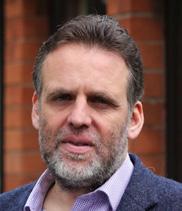
The most religiously mixed such schools, with intakes of almost 50-50 ProtestantCatholic in a number of cases, tend to be grammars, and they tend to be middle class. They are atypical of wider society, but were the fore-runners in a trend that has been building for more than 50 years
Will the move from 'Catholic' to 'Other' mean a move from 'Nationalist' to 'Other'?
1. Peter McLoughlin, The Fitzwilliam, Northern Ireland: Demography as Destiny? https://www.thefitzwilliam.com/p/northernireland-demography-as-destiny
2. Ben Lowry: Protestant population has fallen in Northern Ireland in part because they were early to secularism https://www. newsletter.co.uk/news/opinion/columnists/ben-lowry-protestantpopulation-has-fallen-in-northern-ireland-in-part-because-they-wereearly-to-secularism-3855237
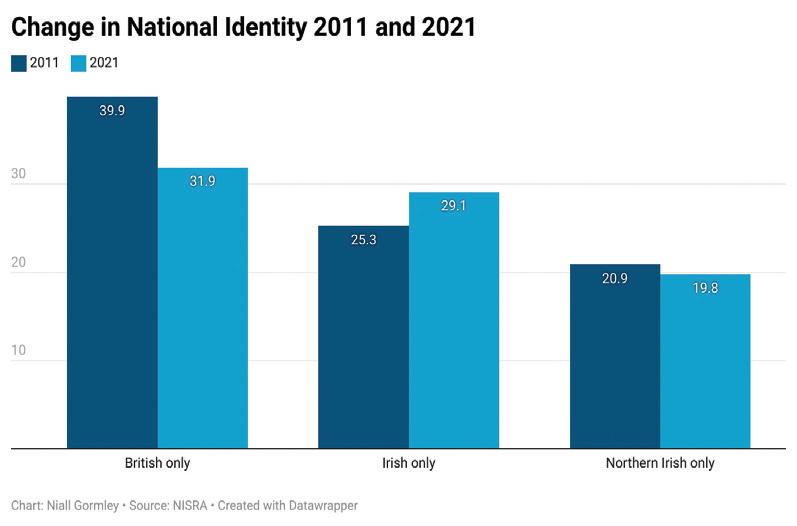
Source: Wikipedia graphic from Northern Ireland Statistics and Research Agency data.
Source: British Religion in Numbers
Ben Lowry
Figure
Feature 4: Life without Religion
Believing in people instead of just believing
EMER DILLON describes her background as traditional Irish. Born in 1960. Educated by nuns. Went through all the stages: baptism, communion, confirmation, marriage. No, not marriage. By the time marriage came round Emer had turned away from the religion of her youth and had embarked on a different set of ethics and understandings about how the world works.
She is a Humanist Celebrant officiating at ceremonies to name babies, bind people in matrimony and mark the end of lives. These are
By Niall Gormley
Interview with Emer Dillon
HUMANIST CELEBRANT and MEMBER OF THE HUMANIST ASSOCIATION OF IRELAND
special events for people and those who love them; occasions that form the way points of life and make lifelong memories.
She is a member of the Humanist Association of Ireland (HAI), a committed humanist, active in campaigning for separation of church and state, and legally enabled to make marriages.
A childhood journey
If her background was as conventional as she says it was, how did the journey in the other direction come about, I ask.
"I suppose I can probably actually pinpoint the first time I questioned whether there was a God or not. I was only ten years of age. My father was in a road traffic accident.
"I was told he was in an accident and I prayed and prayed and prayed and prayed. I promised I would do this and that. I was only ten.
"He died.'
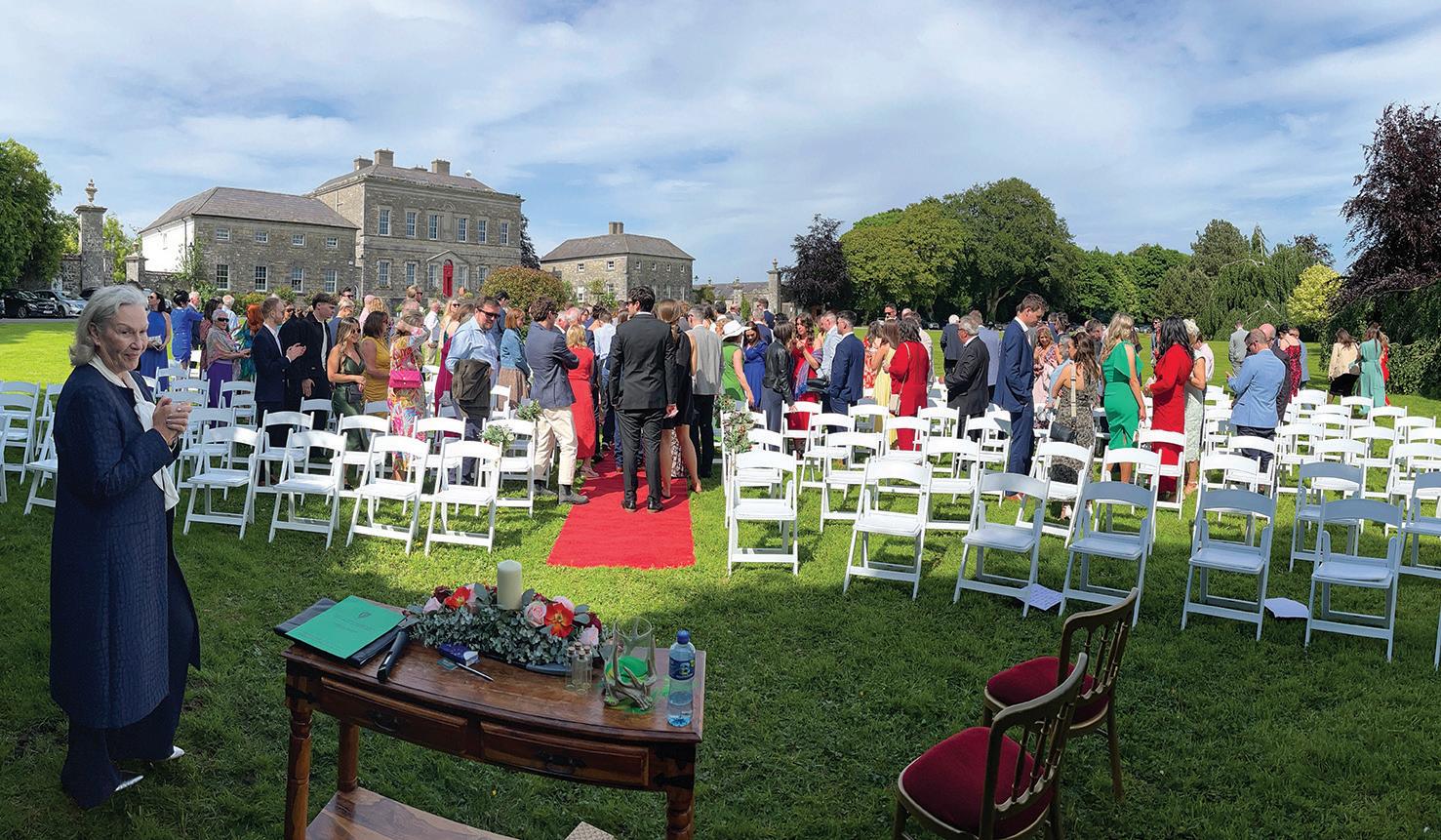
Emer Dillon concludes a Humanist wedding ceremony in Bellinter House in Co Meath in May 2024
Our conversation comes to a dead halt. I wasn't expecting that. To lose your father at 10 years of age must be a life event bigger than the ones she officiates over.
Her mother told her that her father had gone to heaven but that didn't add up for her because God was supposed to be good and kind.
However, her mother's faith was still intact and she expected Emer to go to mass and be religious. As she exited her teenage years she didn't believe in it anymore, she was "skirting religion and not taking part".
"I suppose when it solidified was when I became a mom. Dan was born in 1987 and I decided there and then." Her son's father also agreed that they wouldn't be bringing him up religious.
She says that a lot of her friends at the time wouldn't have been going to mass but when they had children "they fell back into it. They got married in the church and they baptised their children."
So the decision was made not to go for a baptism. But this was 1987 in Ireland. I put it to her that it was fairly radical for the time and I wondered how her mother reacted.
"Well she would say to me 'think about that poor child's soul'. I said to her 'It'll be fine, mom'.
"I also said to her 'under no circumstances do you even think about putting him over the kitchen sink. And don't you dare put any miraculous medals into his cot or his basket because we could fall out quite badly'."
They didn't fall out and they agreed to disagree. Emer says that her mother felt let down by the scandals in the church and in her later years, she lived to 96, described herself as an 'a la carte Catholic'.
But like daughter, like mother. When Emer became a Humanist Celebrant her mother told her: "Don't you dare give me one of those humanist funerals. If you do I'll come back and haunt you".
Minding the kids
Heading into the 1990s and trying to raise kids without religion presented some difficulties. Emer wasn't married and she wanted her son to have his father's surname. She basically refused to register the child herself and got the child's father to do the registration. The other alternative was that the father would have to adopt his own child in order to have the same name.
The Status of Children Act 1987
was passed in December of that year. Up until then children who were born outside marriage were 'illegitimate' and did not have the same inheritance or succession rights as 'legitimate' children. It included the right of unmarried fathers to register a child (See panel on next page).
In Emer's case the Registrar simply assumed they were married and things could have been complicated otherwise.
In order that her children wouldn't have to go through faith formation, communion or confirmation; or sit through all the religious instruction, she chose to send them to a small fee-paying Protestant school.
The Baptism Barrier
The other problem that she avoided by sending her children to a non-Catholic school was having to
(www.instagram.com/emerdillon)
overcome the so-called 'baptism barrier'.
In many urban areas of Ireland there is competition for school places and schools are oversubscribed. As the vast majority of schools are controlled by the Catholic Church, they could and
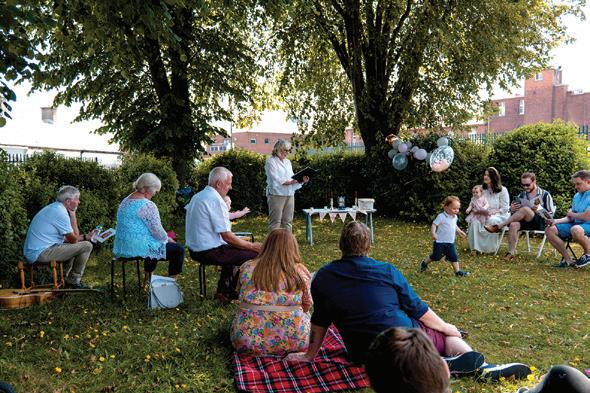
Emer Dillon about to conduct a wedding ceremony at City Hall, Dublin
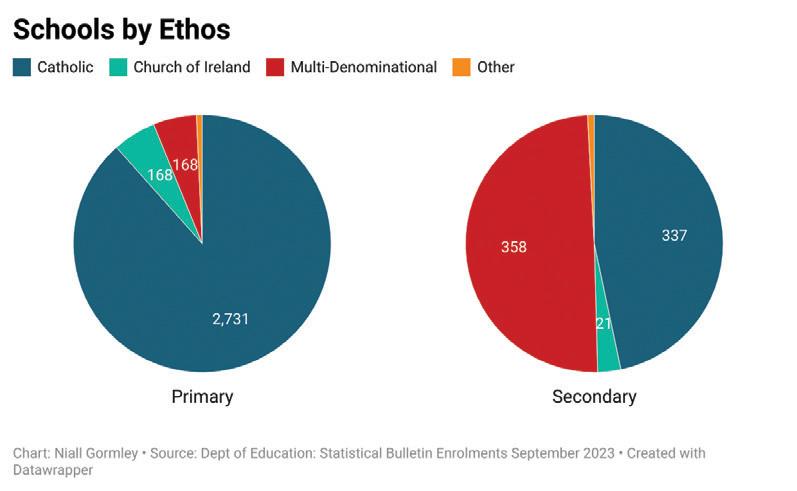
Figure 1
would give preference to Catholic children, or more accurately children who were baptised Catholic.
The speculation was that many parents were opting to get children baptised just in case they needed to qualify for their local Catholic school or a Catholic school of their choice.
In 2018 then Education Minister Richard Bruton introduced legislation to outlaw the 'Baptism Barrier' whereby religious schools were able to choose children of the faith of the school.
The Education (Admission To Schools) Act 2018 came into force despite the opposition of the church. The Journal news site reported that in the year following the ban on the baptism barrier the number of baptisms in the Dublin archdiocese fell by 10 per cent. (See Figure 1). 1
Finding humanism
Although she had gone well out of her way to avoid religion, Emer had not run into many people like herself either. The thought of herself as a bit of an outlier.
Then a good friend's mother died suddenly and with the shock she was at a bit of a loss about what to do because the lady in question wasn't religious. But they discovered that the women had, in fact, left clear instructions that her funeral was not to be held in a church.
Emer remembered she had seen a guy on RTE1 TV that week talking about humanist funerals and that he was now a celebrant.
The guy was Brian Whiteside, a long-term advocate for humanism and campaigner for secular marriages. He conducted the funeral, and it was only his second ever.
Humanist marriage is another case of religious versus secular legitimacy. The Civil Registration Act 2004 recognised religious bodies only as marriage solemnisers. If people wanted a secular wedding, they also had to get a civil registrar to make it legal. Emer refers to these as "symbolic" ceremonies because they didn't have legal force behind them.
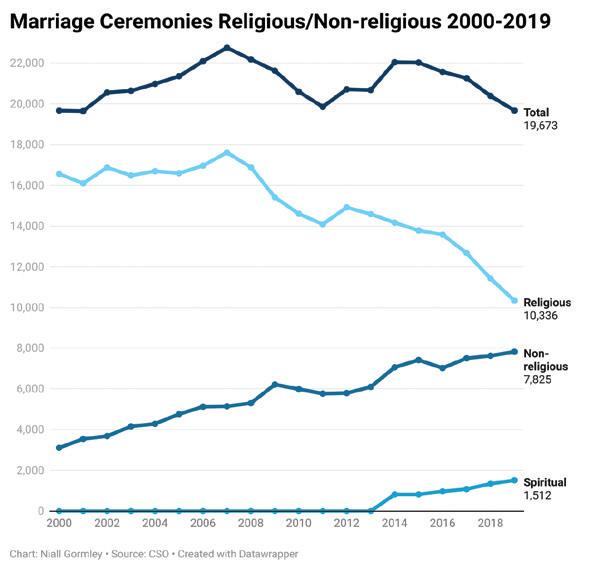
After much campaigning by the HAI the Civil Registration Act 2012 was introduced which added nonreligious organisations to the list of registered solemnisers.
The first Humanist wedding happened on the 6th of April 2023 and since then there have been around 14,000. Humanist weddings are becoming more popular with more than 2,000 per year taking place in 2022.
The change taking place in the type of wedding ceremony chosen by couples is breathtaking. Catholic ceremonies from 62 per cent in 2013 ago to just 35 per cent in 2023. Some of this reduction is due to the increase in other religious options such as spiritualist and 'new age' ceremonies. A larger proportion is due to the increase in non-religious weddings from the Humanists and civil registrations from the state. Figure 2 shows the narrowing gap. 2
And my teenage children were absolutely horrified because as far as they were concerned, they'd been able to live their lives free from any cultism.
And now I was signing them up to a cult!,"
Finding her tribe
For Emer finding out about humanism was like a revelation. She immediately signed up for a family membership.
"And my teenage children were absolutely horrified because as far as they were concerned, they'd been able to live their lives free from any cultism. And now I was signing them up to a cult!," she laughs.
She had already decided to become a humanist celebrant and her training was fast-tracked because another HAI celebrant was terminally ill and had many advanced bookings. She says she was "thrown in at the deep end".
I ask her about her approach to secular weddings, especially as for many people this is new territory as most people, especially older people, would be more comfortable with religious ceremonies.
"First of all, the couple would have made the decision. I'm quite clear. I'm kind of quite down-the-line. Absolutely no religious content whatsoever.
So we actually had time to work back and forth on the draft of the ceremony. What he wanted said. What he didn't want said
"So even if Auntie Mary wants to come up and read a reading that has a prayer that was read at her own wedding or something like that, you know, I might need to edit that. There's plenty of other readings that Auntie Mary could read."
But, I say, that sounds a bit, kinda, sorta.......
....militant?
She's not shocked at the allegation. "I am a bit," she says with a smile. There are other Humanist celebrants who are more flexible.
"I just think it's a mixed message, you know. The Humanist Association of Ireland celebrants are the only secular ones. So there's lots of others.
"First of all, there's the civil servants, which are the celebrants in the HSE when you go to the registry office. They will now come to some venues as well and conduct the legal elements to your ceremony."
Her point about the HSE Registrars is that they are not celebrants and these are thus not secular weddings. There are other celebrants as well such as the Spiritualist Union of Ireland or interfaith celebrants.
Not like for like
Naming ceremonies are not direct replacements for baptisms. Firstly, there is no legal side to baptism, it's simply registering with the religious body involved. The civil registration of birth takes place in the hospital or wherever the birth happens and
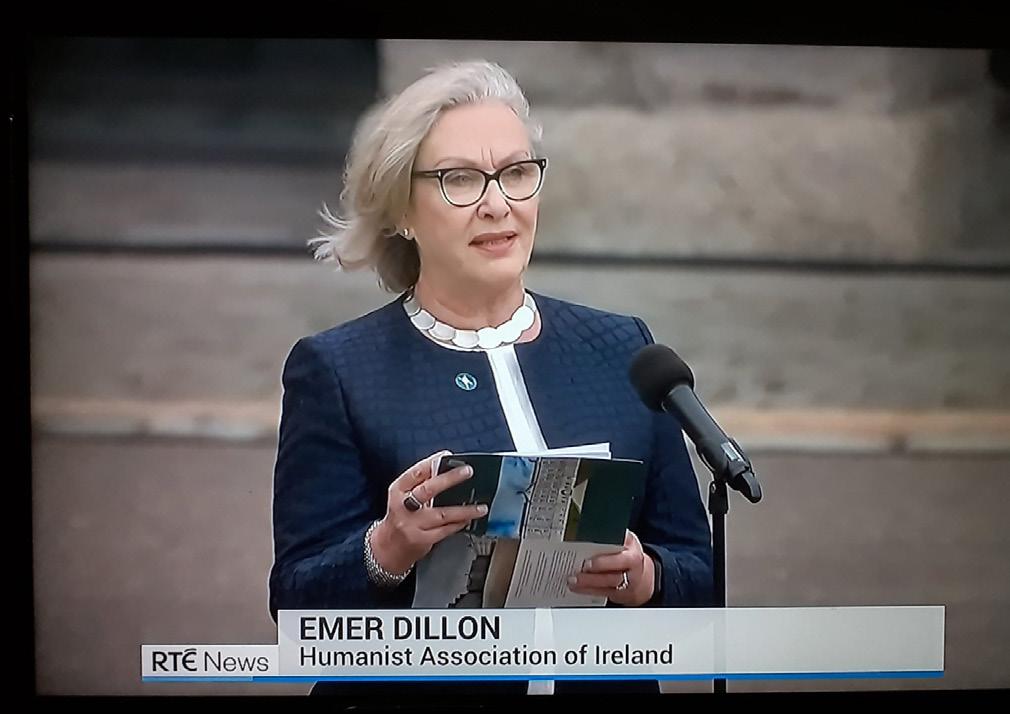
A screen grab of Emer Dillon delivering the National Day of Commemoration Ceremony contribution from the Humanist Association of Ireland at National Museum of Ireland, Collins Barracks in Dublin.
that is where children are legally recognised by the state.
A naming ceremony is a replication of baptism which, in turn, evolved from many birth traditions throughout human history. Because of the traditional beliefs around original sin, many Catholics got babies baptised as soon as possible.
Humanists are not keen on the idea of original sin and so there's no hurry. I ask Emer what the typical time frame is.
"In around about a year or so, usually around the first birthday. Sometimes it can be earlier, depending on the season. There's legal restrictions on where you can conduct a wedding whereas there's nothing on naming ceremonies."
Final
destination
Weddings and naming ceremonies are happy occasions. The other main business of a celebrant is marking death.
"I became a celebrant in order to conduct funerals much more so than weddings. But of course, weddings have taken over most of the work I do," she says.
The reason for this is that weddings are planned and funerals can't be. So Emer may have weddings booked a year in advance but funerals really must be planned within a day in most cases.
While people can't accurately predict the day they will need a celebrant, there are many plans that they can make.
"You have to say what your intentions are, you have to. That's one of the greatest gifts you can give your family," she says.
"I will guide people through the process. I would always meet with the family. I'll drop things, I'll get into my car, I'll drive over to the other side of the city, or down to Kildare or whatever it might be."
What about tragic cases? How does she handle those?
"We do complete a certain amount of training over the years to prepare us for hard cases. So if somebody has died by suicide, that's a tough one. And I haven't done any baby funerals but there's a few Humanist Celebrants that have."
Emer recalls a case where she got a call from a woman whose husband was at the end of his life. He had attended two funerals that Emer had conducted and he said to his wife 'get that woman!'.
"So I said, would he like to have a chat? And she said 'oh, he would love that'. So I took myself into the hospital where he was, three weeks prior to him passing away."
She read the draft to him and he was really happy. "So we actually had time to work back and forth on the draft of the ceremony. What he wanted said. What he didn't want said."
Emer has also conducted some funerals for people that she knew, which she found to be personally difficult.
On the agenda
Finally, I ask her to put her Humanist Association hat on. What does she see as the secularist agenda over the next few years?
She points to the education system where the Catholic Church still has a huge amount of control. (See Figure 3). There has been very little change and she seems to accept that there won't be any wholesale handover of schools. Her approach would be to move the faith formation and sacrament preparation out of schools.
In the meantime, life outside religion is becoming more accessible and acceptable by the year and Emer Dillon intends to keep playing her part in that.
When children weren't 'legitimate'
The Cherish organisation was set up in 1974 with the aim of improving the situation for single mothers and their children. The group is now known as One Family.
On its website the group says that at the first Cherish conference in 1974 “The Unmarried Parent and Child in Irish Society”, Professor William Duncan summarised the main legal discriminations against children born outside wedlock:
• *Regarded as illegitimate and the child of no one (filius nullius) such children had no rights in relation to the estate of the natural father
• Rights to the natural mother’s estate took second place to the rights of her legitimate children
• In order to obtain child support from the father, the mother had to take him to court within six months of the birth of the child
• Her evidence had to be corroborated
• If successful she would receive a maximum of £5 a week under a district court order
• The law reaffirmed an attitude of social disapproval and discrimination against single parents and their children
(Source https://onefamily.ie/status-of-illegitimacy-was-abolished/)
REFERENCES (Not referenced in text or charts):
1 The Journal, 2022, Dublin archdiocese saw 10% decline in christenings in the year after 'baptism barrier' was removed https:// www.thejournal.ie/archdiocese-of-dublin-largest-decline-baptismrates-5673794-Feb2022/
2 Dr Angelo Bottone, Iona Institute, 03 May 2024; The huge rise of ‘New Age’ weddings in Ireland; https://ionainstitute.ie/the-hugerise-of-new-age-weddings-in-ireland/
Figure 2
Emer Dillon at a naming ceremony in Stonybatter in Dublin
Figure 3
I'm interested in the art of telling stories
FEATURE writing is a push-pull experience. In order to conceive a feature the writer must have an idea how it will turn out. There must be a story there to tell as well as a means to tell it.
Then in writing there has to be room for the information gathered to build on top of the idea. It might be that in the process of telling the tale that a new direction is taken or even that a new story emerges.
My background in journalism is mainly editing and design. I worked at the Northside People and Southside People local newspapers in Dublin for many years. For most of that time I was a page designer.
For nearly eight years, between 1999 and 2007, I wrote a weekly opinion column entitled 'Straight Talking'. The newspapers were free distribution and were the biggest local newspapers in Dublin. There were four editions, an east and west version of both papers, and the print run at its height was over 200,000 weekly copies. The opinion column ran in all editions.
There were two other notable features of the column. Firstly, I chose what to write, and covered politics, sport, planning, moral issues like abortion and euthanasia, racism, drugs policy; everything and anything. Secondly, the topics were not necessarily related to the issue of the day but obviously current affairs did intervene occasionally.
So I spent many moments staring at a blank screen waiting for an idea to arrive. When it did, I wrote the headline first and read it to myself. When the headline was good enough to encapsulate the 600 words, I wrote the words.
The issue of secularism
I grew up in Ireland in the 1970s and 1980s. When I left school in 1982 there was widespread unemployment at a time when the baby boom of the 1960s was producing record numbers of young people. We spread to the four corners of the globe. But before we did many of us went to college and the Regional Technical Colleges help transform the experiences of young people in Ireland.
Since that time Ireland has been on the path of social change. New access to media, to international ideas, to experiences abroad, concepts around sexual liberation and gender inequality started to change Ireland forever.
Most of these changes revolved around the relationship of the Catholic Church to the state and to the people of Ireland. Secularisation is one of the biggest stories in Ireland in the past 50 years. Only the North and the economy have been as important.
Why me?
In 2023 two of my lecturers at DCU, Kevin Rafter and Dawn Wheatley, published 'Irish Journalists at Work', a product of research into the world of journalists in Ireland. In relation to religion the research found that 55 per cent of journalists said they had no religion. This compares to 14 per cent of the general population in the 2022 census.
In terms of source material for journalists the authors said: In considering how secular, or not, Irish journalism is, it is worth noting that ‘religious groups and institutions’ are considered the least influential factor/source for Irish journalists, with just 1% saying they are ‘very/extremely influential’, 17% saying ‘slightly/moderately influential’, and 48% saying ‘not influential’.
So why are journalists so irreligious? Well, in some respects the report found that journalists are different from the general public in other ways too. 73 per cent defined themselves as 'middle class'. 85 per cent have a third level educa-
tion as against 53 per cent generally.
You could also observe that journalists tend to be sceptical, of everything, not just religion. Over three quarters of journalists said they saw their role in holding power accountable.
But I'm not just a census 'none' when it comes to religion. I'm an atheist, a word that has to be written on the census form. I come from a Catholic background but I didn't reject Catholicism or god. I didn't have any negative experiences with the church.
I just wasn't that interested. Then I read David Attenborough's Life on Earth, published in 1979 to accompany the series, including the concept of natural selection. That was far more plausible and I've been a atheist all my adult life.
The importance of religion
Religion has fallen out of favour for political and civil discourse, and organised religion seems to be becoming a thing of the past. That doesn't mean that religion is not important. In the 2022 census 69 per cent of people declared themselves Catholic. In 2018, 66 per cent of people voted to repeal the Eighth Amendment and legalise abortion.
Something is not quite right there. People are more complex than labels cater for and so we need to think more carefully about what secularisation means. That's what these features are about.
Venue and format
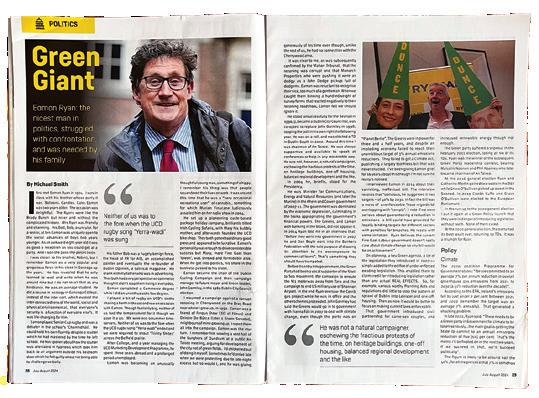
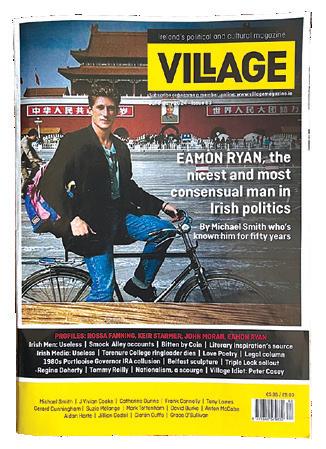
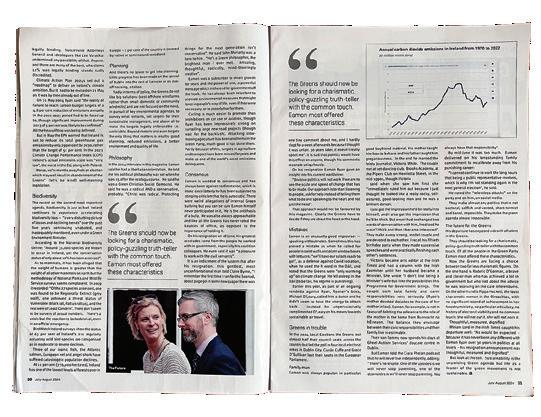
My background is in print and I have conceived these pieces as magazine features for Village magazine. I have included a feature and cover from a recent issue of the magazine top left. Multi-page spreads are typical for the magazine and so my four-page features would fit right in.
I should, of course, mention that I have been involved in Village magazine as a volunteer, helping out with editing and proofing, and generating some ideas. The magazine is a current affairs magazine in the tradition of Magill, founded by Vincent Browne in 1977. Village was also founded by Browne in 2004 and is now owned and run by Michael Smith, whom I know.
The magazine is left-of-centre and its mission statement says: "Village promotes in its columns the fair distribution of resources". It publishes investigations and commentary, and takes a robust view on green matters and the need for action on climate change. These are all good reasons why I would like my features to be published in the magazine.
The importance of design
In our Masters course there is a module called News Design given by Joe Breen, a former designer of the Irish Times. Of the 20 students in the Masters class only four chose News Design.
Those that didn't take up the offer were probably swayed by the fact that it was mainly about newspapers and, as we all know, newspapers are dying. But that would have been making a big mistake because the principles of news design apply everywhere whether on smartphone, tablet or laptop.
What makes news legible? Where should videos and pictures be placed? How do you break down the information so that the user can understand and stay with a story?
You must consider the real estate. Whether you're looking at a tabloid page, a 16:9 screen or the portrait orientation on your smartphone, the layout is crucial. An understanding of layout principles; the golden proportion, the rule of thirds, white space; are universal be it in your supermarket, your new kitchen or how you read the news.
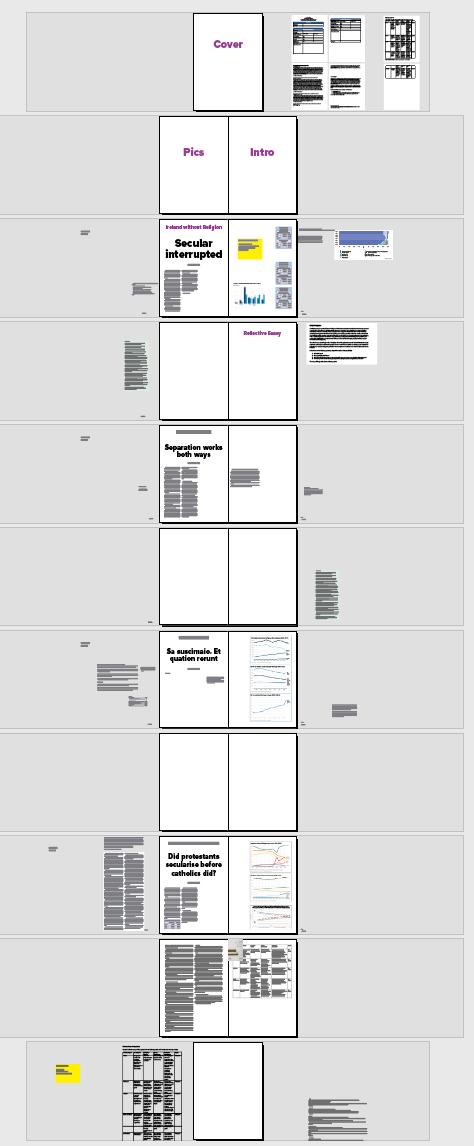
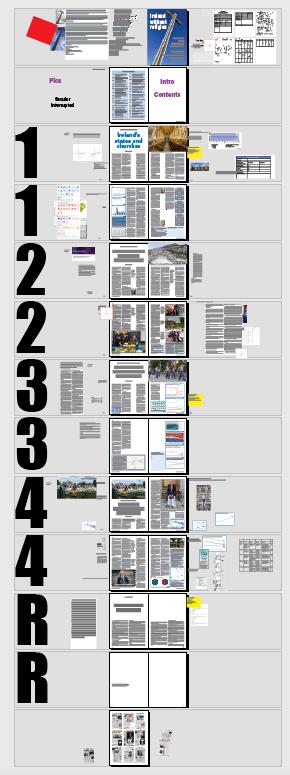
So I write with space in mind and how it's going to be read. On the left you can see this project at two stages of design. These are snapshots of InDesign zoomed out to show all the pages. At the beginning I had a 20-page design in mind, with three page features. But as can be seen below, it evolved into a 24-pager because that would give each feature two spreads and more space for pictures, tables and charts, which would suit Village's readers.
My aim is also to improve Village. I used a 7-column page which gives a more flexible canvas, more asymmetry and white space, based on grid design.
The problem with interviews
Interviews are a big problem for students. Getting people to do interviews can be tricky in real life but for students it's a nightmare. The people you are asking for an interview know it will be of no use to them. Many, many of my emails went unanswered. Ditto for messages left after the tone.
This has been one of the main problems with journalism over this course
and it has hardened me up. I've learned to ask early and to work on an escalation strategy: email, phone call, second phone call, depending on how much you want them.
Doorstepping is a difficult concept but still valuable. It doesn't have to be aggressive. I called to the Jampa Ling Buddhist Centre without an appointment, because I was passing, and they were happy to talk to me.
Sometimes interviews are the wrong option. I thought about interviewing Mary McAleese, which would have been prestigious but I found what I was looking for in her writings and speeches. My interview with Michael Nugent lasted an hour, because he was so interesting, but I've barely needed two minutes of it in the piece.
Finally, on interviews, I should say that I asked Ben Lowry, editor of the Newsletter, for an interview and I needed him. The feature needed his perspective. He agreed and then he ghosted me. We had an over-and-back series of emails, there was no problem and then he disappeared (insert unsavoury expression here). I had to use his opinion piece instead. That will probably toughen me up a bit too.
Data journalism
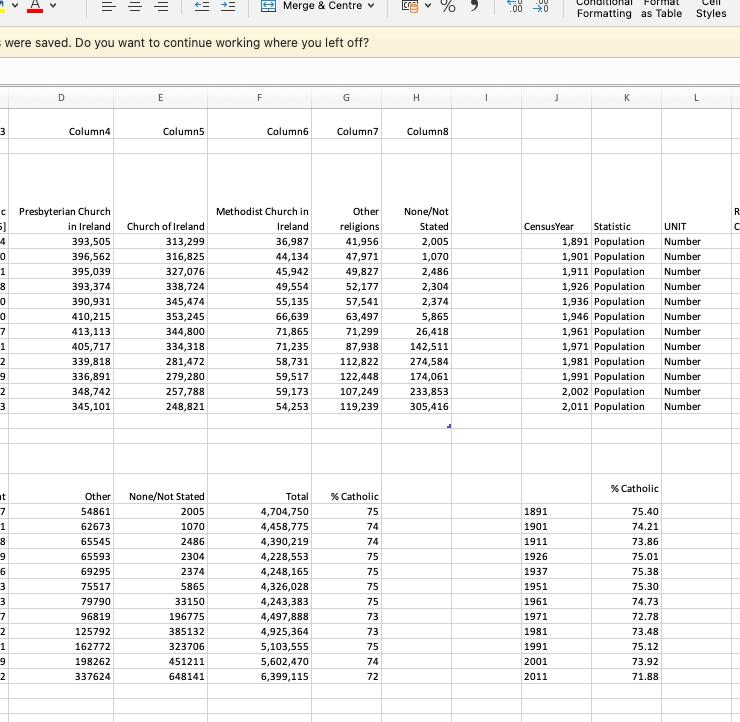
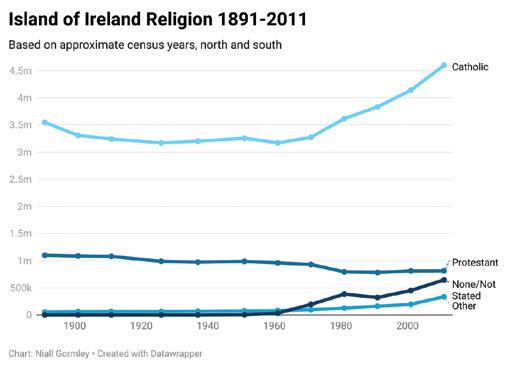
I love charts, graphs and maps and I do actually think they can express what a thousand words can. Dawn Wheatley taught us about Datawrapper and how to use it. On the left here is a spreadsheet with Irish census information and I produced the two charts below from it. It's such a brilliantly useful skill to have. Game changer, really.
On the Orange march
I attended my first Orange March in Gilford, Co Down to get a feeling for the subject of Northern Protestant secularisation. As someone from a republican background I didn't know what to expect. I wanted to talk to people and get a sense of sentiment and morale.
I got some great pictures and video, and I did talk to some people but overall, it felt like 'mission unaccomplished'. I was glad I went and it's really important for people to make an effort to get a broad view, especially journalists.
The lesson I'd take from it is to be better prepared. I would talk to people before hand and arrange to meet some people, who in turn, could guide me and introduce me to others, making the visit more productive.
The big lesson - talk to people
We have computers, smartphones, AI transcription, Photoshop, templates, sub-editors, microphones, USB-C cables, yada, yada. But an awful lot of journalism depends on one ability - talking to people. There are amazing stories out there, fantastic sources, networks, contacts and opportunities all there if you talk to people. Sometimes it's not easy, sometimes you have to play nice, sometimes you have to get over the fear of rejection, of 'no', of imposter syndrome, sometimes you have to play mean, to ask again but mostly you just have to try and talk to people.
And in conclusion
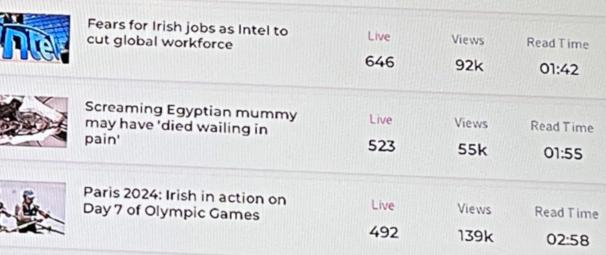
I'm currently on placement in RTE and I have been working on the Continuous New Desk. Recently, I put together a story about an Egyptian mummy from the wires. It was published on their app (which 1.5 million people have on their phones) and four hours later a tracker showed that it had been read by 55,000 people who had spent 1 minute 55 seconds on average reading it.
This, without doubt, is the future and everything that I've done in these features has to fit into this model. I think it does. But remember, RTE is a broadcast company, this model made them move to text, albeit on a screen. They also ad video, audio and pictures.
I have designed these features for print because there's still a market for it. Village magazine still exists and it has a subscription model which people are increasingly willing to pay for. Everything that Village produces goes on their website so my features would go to press and go to screen at the same time.
Long reads are popular, despite our alleged modern short span of attentions, and books are doing well. I want to tell stories and feature journalism is where I want to go. My next step is 'scrollytelling' where you put your feature on a scroll-down web page. On the way down the user reads the text, sees pictures, runs into audio and video and is referred to charts, tables and maps.
Finally, there must be place for levity and I'll leave the last thought with Rufus, who knows how to make her presence felt. She probably doesn't believe in God but she's never fallen out with anyone over it.
Figure 1
Figure 2
Amen: how old churches in Dublin live on
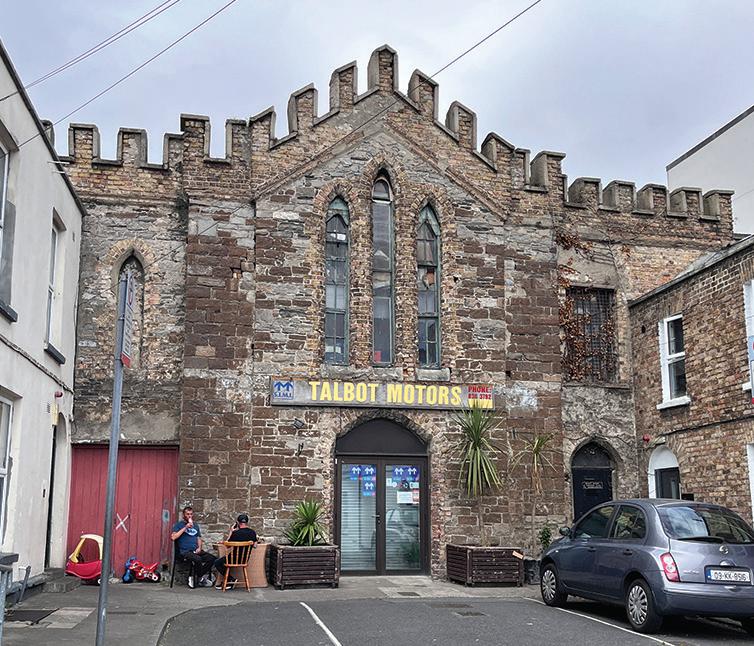
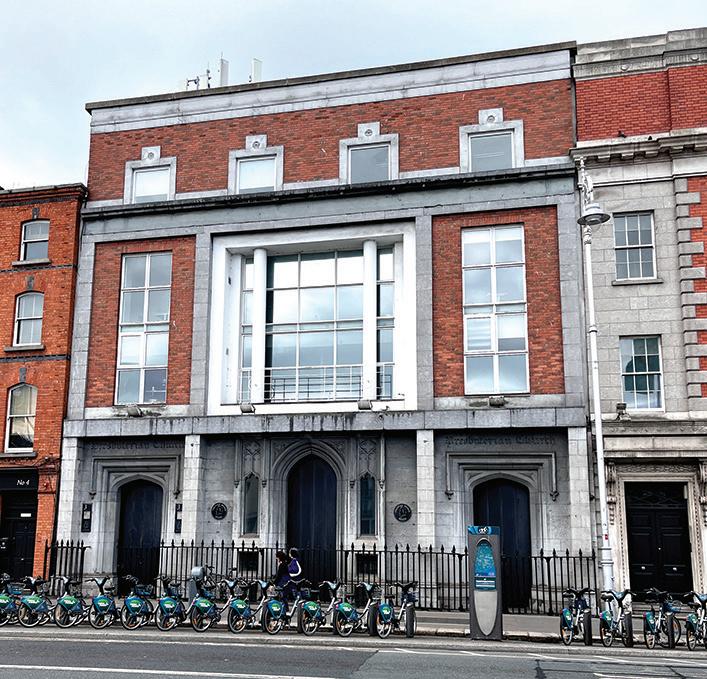
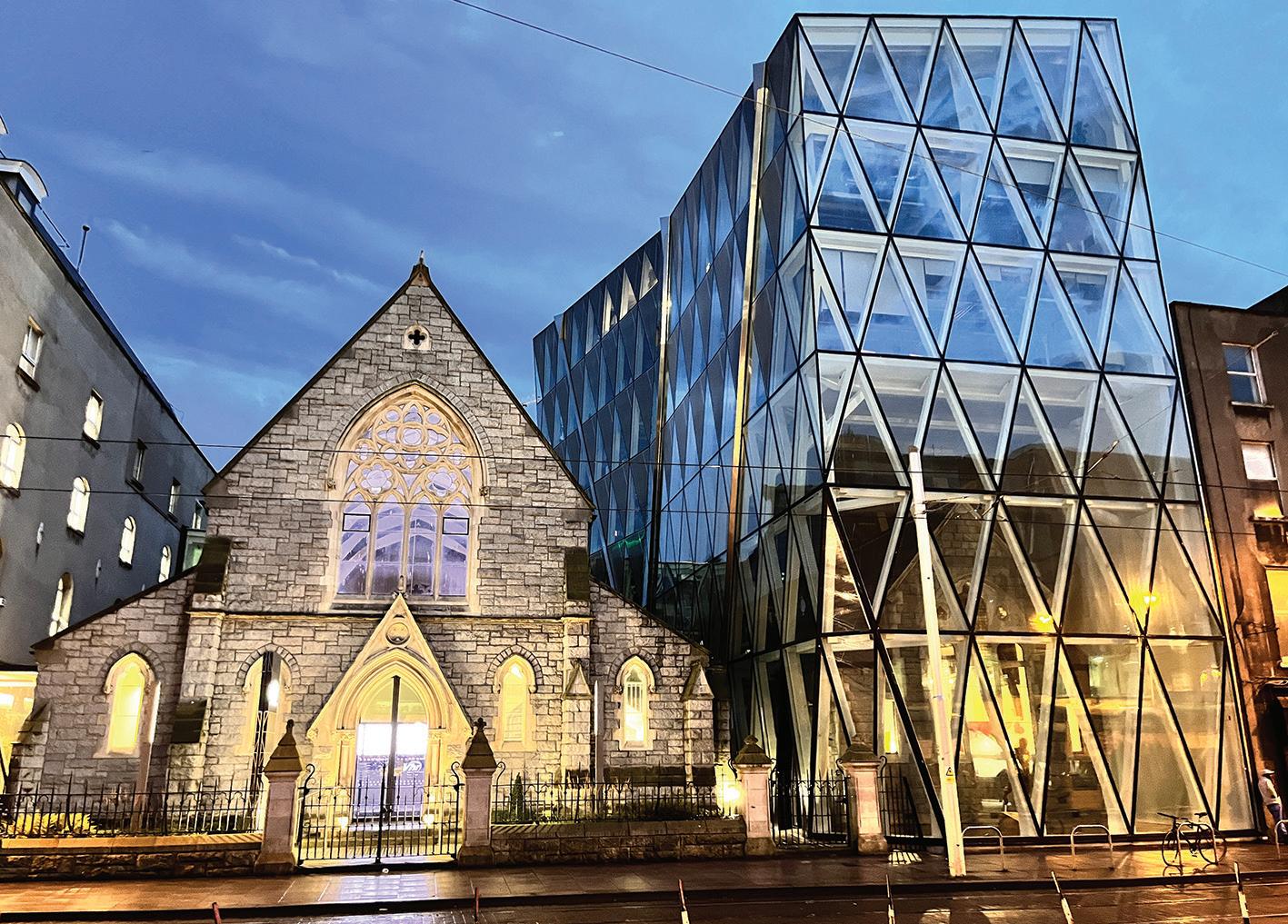
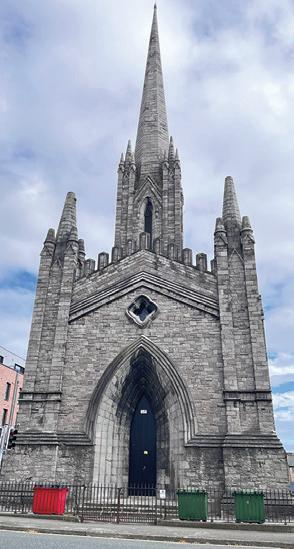
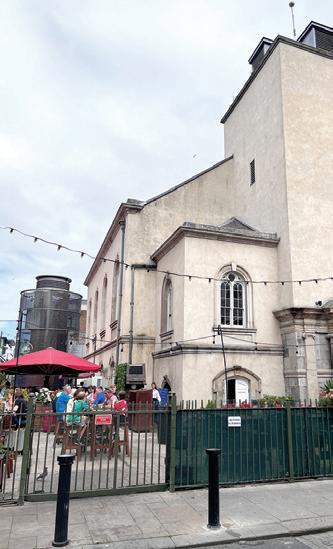
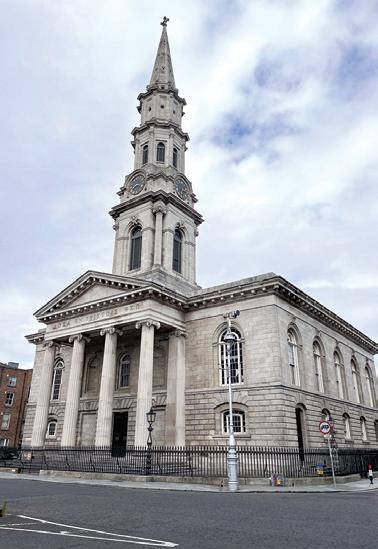
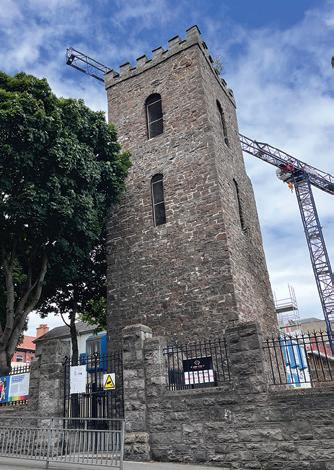
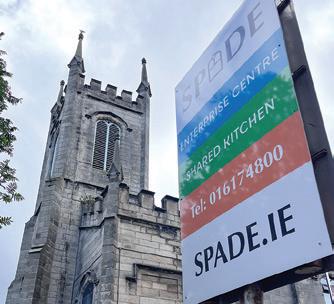
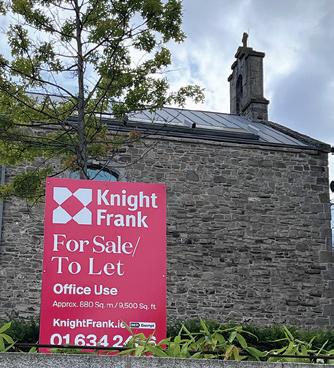
Langrishe Place Methodist Church is now an auto workshop
The Scots Presbyterian Church and its adjacent church hall is now the VHI Headquarters in Abbey Street
The lower facade of Ormond Quay Presbyterian Church was retained
Old Church of St George, Hill Street is a resource centre
St. Paul's Church, North King Street is now the Spade Enterprise Centre
St. Luke's Church in The Coombe in now offices
St George's Church has been better known as the Temple Theatre
St Kevin's Camden Row is now a community park
St Mary's, Mary Street is now The Church Café Bar
St Mary's Chapel of Ease is now offices