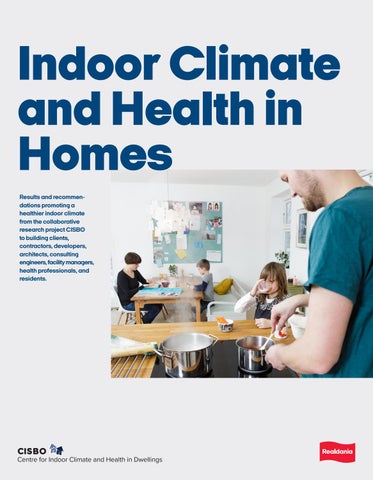
Indoor Climate and Health in Homes Results and recommendations promoting a healthier indoor climate from the collaborative research project CISBO to building clients, contractors, developers, architects, consulting engineers, facility managers, health professionals, and residents.
“
One might hypothesise that indoor particles are not as dangerous as the outdoor ones due to differences in the chemical composition and size distribution of the particles. However, this hypothesis does not seem to be backed by empirical evidence. Professor Steffen Loft, Department of Public Health, University of Copenhagen
Be careful when drying out mould
Indoor Climate and Health in Dwellings is an English translation of the publication “Indeklima og sundhed i boliger,” originally published in Danish in 2016. Year of publication: 2019 Translation (Danish to English): Emilie Koefoed Original text and editing: Maja Skovgaard, Dea Lindegaard, Jesper Kirkeskov, Lise Lotte Beck Raunkjær from the Danish Building Research Institute Design: Rumfang, Frankes Photos: Claus Bjørn Larsen, Colourbox, Greg McQueen, Jørgen True, Lars Gunnarsen, Peter Troest, Aarhus Universitet Print: Dystan & Rosenberg Copies: 500 Published by: Realdania ISBN: 978-87-93360-17-4 www.realdania.org This publication presents results from the research collaboration Centre for Indoor Climate and Health in Dwellings, which is financed by Realdania.
2
20
Residents are themselves primarily responsible for particle pollution in Copenhagen homes
10
H
CH
3
H
O
CH3 O 4-OPA
O H
O 3 CH
O CHO
O
CH3
Contents Preface: Getting wiser about the indoor climate in our homes
4
Poor indoor climate makes us less healthy
6
Sources of indoor air pollution
8
Residents are themselves primarily responsible for particle pollution in Copenhagen homes 10
27 The effect of increased ventilation in homes of children with asthma
18
Indoor particles are also harmful to health
13
Ventilate properly in the home
14
Chemical cocktail effects in indoor climate
16
Phthalates are emitted faster as temperatures rise
17
The anatomy of dust
18
Be careful when drying out mould
20
Easy and cheap method for measuring mould in dwellings
20
The season determines the amount of fungal spores and bacteria in the indoor climate
23
Reduced lung function in students in damp classrooms
24
It is easy to clean indoor air of particles
25
Significance of increased ventilation in homes of children with asthma
27
Place the air purifier in the bedroom
28
Research meets practice
30
H
The anatomy of dust O
CHO
H
O
3
Danes spend on average 80-90% of their lives indoors Source: The Danish Environmental Protection Agency
Preface:
Getting wiser about the indoor climate in our homes About CISBO Realdania has initiated and funded CISBO, which aims to generate and disseminate research-based knowledge on how to create a healthier indoor climate in dwellings. CISBO is a research collaboration between: • t he Department of Public Health, Aarhus University • the Department of Public Health, University of Copenhagen • the Department of Construction and Engineering, Technical University of Denmark • the National Research Centre for the Working Environment • the Danish Building Research Institute, Aalborg University Copenhagen
4
We spend about two thirds of our time in our homes, and the way that we live in our homes has big consequences for our health and well-being. Until a few years ago, however, private homes have been largely ignored in indoor climate research, which has focused more heavily on office environments and workplaces. In light of this, Realdania initiated the Centre for Indoor Climate and Health in Dwellings (CISBO) in 2009. A centre without walls, consisting of researchers from Denmark’s most important research institutions in the indoor climate field. Since then, CISBO has become a unique interdisciplinary collaboration between researchers from the health sector and the technical world. Through collaborative research, we have gained much more knowledge about the indoor climate in our homes – from a better understanding of the sources of indoor pollution, and how the indoor climate affects our health, to a better understanding of the effects of air purification and ventilation. You can read more about some of CISBO’s significant results in this publication. Important contributions to both research and practice The collaboration between the researchers has resulted in many important contributions to the international indoor climate research. But the research has also appealed strongly
to the construction industry and the health sector. In order to strengthen the network between researchers and practitioners, CISBO established three network groups with each its own specific angle on indoor climate: Health, Air Quality, and Low-energy Buildings. The network groups have been a great success with wide support. More than 360 participants from the construction industry and the health sector have been involved in the network and have participated in CISBO’s annual conferences and network meetings. The centre closes – the collaboration and the network continue CISBO completed the final projects, analyses, and scientific reports in 2016. Although the centre is closed, the collaboration between researchers continues. New projects have already been planned, new funding for research has been raised, and collaboration with other initiatives based on CISBO has been established. CISBO has helped to strengthen Realdania’s strategic focus on translating knowledge about indoor climate into practice and new solutions. For the years to come, Realdania has launched three initiatives in relation to indoor climate: radon; energy and indoor climate; and children’s indoor climate in schools and children’s rooms.
CISBO in numbers:
52
More than scientific articles published in more than 30 international publications More than conference contributions worldwide
32
CISBO’s steering committee with the international advisory board. From left: Head of Program Lennie Clausen, Realdania / Professor John D. Spengler, Harvard School of Public Health, USA (advisory board) / Professor Steffen Loft, Department of Public Health, University of Copenhagen / Professor Peder Wolkoff, National Research Centre for the Working Environment / Professor Bert Brunekreef, Utrecht University, The Netherlands (advisory board) / Professor Geo Clausen, Department of Civil Engineering, Technical University of Denmark / Professor William D. Nazaroff, University of California, USA (advisory board) / Professor Lars Gunnarsen, Danish Building Research Institute, Aalborg University Copenhagen / Professor Kjell Andersson, Örebro University Hospital, Sweden (advisory board) / Head of Secretariat Ole Bønnelycke, Danish Building Defects Fund / CISBO’s Head of Centre, Professor Torben Sigsgaard, Department of Public Health, Aarhus University.
CISBO’s network of practitioners will also continue. In a final evaluation, the network participants asked for a platform for the exchange of knowledge, which Realdania is now establishing. Thank you We would like to thank all researchers, technicians, and other contributors in CISBO, who have helped to create important new knowledge across research institutions and research traditions. Thank you to the international advisory board, which has contributed with important input to CISBO’s research and methods. Also, a thank you to the many participants in the network groups. We are proud of the strengthened collaboration and network that CISBO has helped to create across research institutions and professions, and we look forward to seeing the collaboration continue after the end of the CISBO project. Torben Sigsgaard Head of Centre for CISBO. Professor, Department of Public Health, Aarhus University Lennie Clausen Head of Program, Realdania
8 PhD projects More than 46 researchers, technicians, and others have participated in CISBO
23 research
projects More than
360 network
participants
12 network meetings 4 annual conferences See more at cisbo.dk/english
5
Poor indoor climate makes us less healthy A bad indoor climate can cause fatigue, headache, and allergic symptoms, and in the worst case more serious diseases such as pulmonary and cardiovascular diseases and cancer. Particle pollution and moisture are some of the factors that have the most adverse effects on the indoor climate.
FACTS: 7.6% of the adult Danish population state that they have asthma. Source: The National Institute of Public Health, 2010.
6
The average Dane spends 80-90% of his or her time indoors, and 16 hours of that time is spent at home. It is therefore important that our homes have an indoor climate that is healthy and comfortable to live in. Indoor climate is affected by temperature, humidity, noise, and light as well as by the particles and chemical substances that are in the indoor air. However, residents are able to control many of these factors themselves in order to improve the indoor climate in their homes. We pollute the indoor climate in our homes ourselves Most of the indoor air pollution has indoor sources, and we bring most of the sources into our homes ourselves, says Professor of Environmental Medicine Steffen Loft from the Department of Public Health at the University of Copenhagen, who has studied the connection between indoor air quality and residents’ health in his work in CISBO. “It is especially the particle pollution from candles, smoking, cooking, electrical appliances, and wood stoves that pollute the indoor climate but also the emission of chemicals from, for example, building materials, furniture, and detergents,” he explains. Particles from candles are similar to diesel pollution Lit candles are among the biggest sources of indoor particle pollution. When we light a candle, the indoor air has a higher concentration of particles than on a very busy road. And those particles may deposit in our lungs. “In addition, harmful nitrogen dioxide will also always develop when you burn
something – it cannot be avoided. Particles from candles are quite similar to diesel pollution, and we know from outdoor studies of traffic pollution that diesel particles increase the risk of lung and cardiovascular disease,” Steffen Loft explains. Apparently, Danes are unaware of how unhealthy it is. In the population survey Copenhagen Aging and Midlife Biobank (CAMB), which Steffen Loft and his research team have used in their research, about 7,000 Danes around the age of 50 have been asked about their use of candles. Nearly half of them report that during the winter months they light candles at least four times a week. Moisture promotes mould and dust mites In addition to particle pollution and chemicals, moisture also has a negative effect on indoor climate. Moisture is not in itself harmful to people’s health, but if there is moisture in a building, it will promote growth of mould and dust mites, resulting in a poor indoor climate. Dust mites and moulds can cause headaches, tiredness, irritated eyes, and irritated nose and respiratory tract and can aggravate the symptoms in people who already suffer from asthma or allergies. Airing out There are many factors that affect the indoor climate in dwellings such as how the house is built, its location – and the residents’ behaviour. Fortunately, it is possible for residents themselves to do something to improve the indoor climate of the home. A good place to start is to air out thoroughly several times a day and to clean the home weekly.
The people most vulnerable to indoor air pollution
How many people get sick A European expert group has estimated that in the 26 EU countries two million healthy years of life are lost every year due to indoor air pollution. The loss of so-called disabilityadjusted life years includes lost years of life due to death as well as years of life lived with serious illnesses that could have been lived without disease. The expert group estimates that in Denmark, every year approximately 22,000 disability-adjusted life years are lost due to poor indoor climate.
122,169
•P eople who spend a lot of time at home •E lderly people (ageing body) •P eople who have a predisposition to asthma and allergy
• I nfants and young children whose lungs are not yet fully developed.
45,658
122,169
154,880
27,776
173,248
238,159
182,448 1,288,511
1.425,504
224,414 306,181
■ Hjerte-kar-sygdomme ■ Astma og allergi ■ Cardiovascular disease ■ Lungekræft■ Asthma and allergy ■ Infektioner og symptomer ■ Lung canceri øvre og nedre luftveje ■ Akut forgiftning ■ Upper & Lower Respiratory Symptoms ■ Kronisk obstruktiv lungesygdom ■ Acute intoxication (KOL) ■ Chronic Obstructive Pulmonary Disease (COPD)
■ Particles from combustion processes ■ Building dampness ■ Particles from combustion processes ■ Bioaerosols from outdoor air (pollen etc.) ■ Building dampness ■ Radon ■ Bioaerosols from outdoor air (pollen etc.) ■ Carbon monoxide ■ Radon ■ Volatile Organic Compounds (e.g. solvents) ■ Carbon monoxide ■ Volatile Organic Compounds (e.g. solvents)
The estimated annual loss of two million healthy life years in 26 European countries broken down by type of disease. Cardiovascular diseases predominate, accounting for 60 percent of the loss, while respiratory diseases (asthma and allergy, lung cancer, infections and respiratory tract symptoms, and COPD) account for 35 percent of the losses.
Distribution of the estimated annual loss of two million healthy life years in 26 European countries broken down by exposure conditions. Note that particle pollution is responsible for 2/3 of the losses.
Source: Jantunen M., Oliveira Fernandes E., Carrer P., Kephalopoulos S. (2011). Promoting actions for healthy indoor air (IAIAQ). European Commission Directorate General for Health and Consumers. Luxembourg.
7
Sources of indoor air pollution Three of the most important sources of pollution in dwellings:
Candles (particles)
Cooking (particles)
Moisture (mould and dust mites)
8
Particles
Bacteria
Moulds
Moisture
There are many sources of particle pollution in the home. Some particles come from outside and originate from traffic and from burning for heat. But by far the majority of particles in the home originate from cooking, smoking, burning candles, and using wood stoves or electrical appliances.
Most bacteria in the home originate from the residents themselves and their activities. When the residents are at home, more bacteria are present in the air. The concentration of indoor bacteria is highest in early spring and lowest in summer.
Moulds are found both indoors and outdoors. In the home, moulds grow on damp surfaces. The moisture may come from residents and their activities or from the building due to water damage or thermal bridges. The fungi contain allergenic substances (allergens), and some moulds are potentially poisonous. .
Moisture in the home is not in itself harmful to residents’ health. But moulds and dust mites are dependent on moisture, which can therefore have serious consequences for people who are sensitive to the allergenic substances (allergens) originating from moulds or mites.
Impacts on health: Reduced lung function and cardiovascular disease.
Impacts on health: Pathogenic potential for someone who is already weakened. May cause infection in the body, e.g. in a wound. Suspected of causing headaches and allergies as well as respiratory diseases such as asthma, bronchitis, and respiratory tract infections.
Impacts on health: Asthma and allergylike symptoms, e.g., fatigue, shortness of breath, headaches, colds, and itchy eyes. The symptoms are the most severe for people with an allergy to mould.
Impacts on health: Asthma and allergies.
Below, you can read about some of the most important sources of indoor air pollution and their impacts on health. CISBO has examined, among other things, particles, chemicals, mould, moisture, and dust in the indoor climate. There are other sources of indoor pollution such as PCB and radon, and sound and light may also have a significant impact on the indoor climate. These topics, however, are outside of the scope of CISBO’s research.
Allergens
Dust
Chemicals
Many of the allergens (allergenic substances) in the indoor climate, which allergic people react to, originate from mould, dust mites, pets, degassing from building materials and furniture as well as from cosmetic products.
Dust can contribute to a poorer indoor climate in the home. Dust can contain many different components, such as bacteria, chemicals, fungal spores, and faeces from mites.
The indoor climate of the home can be polluted with many different chemicals, which are emitted from building materials and paint, new carpets and furniture, electrical equipment, and cleaning products, among other things. Some chemicals can accumulate in the dust in the home.
Impacts on health: Asthma and allergies.
Impacts on health: People with an allergy to dust mites may experience symptoms like hay fever, asthma, and a worsening of childhood eczema. Dust in the air can bother everyone who has sensitive airways. In addition, some chemicals and substances that accumulate in dust may have a negative impact on health.
Impacts on health: Some chemicals cause allergic reactions, respiratory tract irritation, headache, and dizziness. Other substances, e.g. phthalates, are suspected of promoting allergy and asthma, and formaldehyde can be carcinogenic.
PCB PCB (polychlorinated biphenyl) was previously used in building materials such as caulking, sealants, and double glazing. In the 1970s, PCB was found to be harmful to humans and the environment, and today, all use of PCBs is prohibited, but the substance still exists in building materials in some buildings and can evaporate to the indoor climate. Impacts on health: Influence on the nervous system, endocrine effects, diabetes, and cancer
Radon Radon is a natural but carcinogenic radioactive gas formed in the underground, which can penetrate into a building through cracks and crevices in its foundation. Radon releases radiation and thereby decays into different heavy metals, which can settle in the lungs and subsequently release radiation upon further decay. Impacts on health: Too high radon concentrations in the home increase the risk of lung cancer, especially in smokers and ex-smokers.
FACTS One in five Danes is unhappy with the indoor climate where they live Cold, draught, and bad air quality are among the undesirable top scorers when it comes to discomforts that Danes experience in their homes. Source: Healthy Indoor Climate Council, 2014.
Sources: CISBO, skimmel.dk, Danish Environmental Protection Agency, National Research Centre for the Working Environment, Astma-Allergi Denmark, pcb-guiden.dk
9
Residents are themselves primarily responsible for particle pollution in Copenhagen homes Candles and cooking are the main sources of indoor pollution in non-smoking homes. Only a quarter of the pollution comes from outdoor air, according to a CISBO survey of 56 homes in Copenhagen.
10
In most homes, the air is polluted with harmful particles. Some of them originate from the outdoor air. In Copenhagen and in many other cities, the air is polluted by exhaust gases from cars. But according to a study by CISBO, traffic and other outdoor pollutants only have a small impact on particle pollution inside homes. Rather, the residents’ own behaviour is primarily responsible. Health-hazardous particles Air pollution from small particles lead to several thousand premature deaths in Denmark each year caused by respiratory and cardiovascular diseases. There is a
“
Winter time is particle time. Danes cosy up with candles and good food, and at the same time, we are probably less likely to air out when the cold of winter hits us. But that is exactly the kind of behaviour that can worsen the indoor climate.”
great health potential in the reduction of particle pollution in our homes, where we spend at least half of our day breathing the air. Associate Professor Gabriel Bekö from the Technical University of Denmark has examined the sources of particle pollution in 56 Copenhagen homes and studied to what degree the pollution inside is related to the residents’ activities in the home. Smoking homes were omitted in the study because it is already well known that smoking at home produces very high particle concentrations.
Winter time is particle time Gabriel Bekö’s survey shows that outdoor air pollution only contributes one-fourth of the total particle pollution indoors. Three-quarters of the particle pollution in Copenhagen homes comes from the residents themselves. Notably, this study is only in non-smoking homes. By comparing particle measurements with residents’ behaviour, Gabriel Bekö has highlighted the main causes of indoor particle pollution. Candles come in first place. In homes where people still light candles, the smoke from the candles accounts for more than half of the total particle pollution of the indoor air, includ-
ing the pollution that comes from outside. In second place is cooking and in particular frying, baking, and toasting bread, which produce a lot of particles. In homes where people cook, cooking accounts for just under 30% of the total particle pollution. Incidentally, it is worth noting that cooking by boiling does not produce particles to any significant degree. “Winter time is particle time. Danes cosy up with candles and good food, and at the same time, we are probably less likely to air out when the cold of winter hits us. But that is exactly the kind of behaviour that can worsen the indoor climate,” says Associate Professor Gabriel Bekö.
11
Three important tips Do not smoke indoors
Avoid lighting candles
Air out during cooking, especially when frying, baking, and toasting bread
Study of particle pollution Associate Professor Gabriel Bekö’s study combines advanced particle measurements with recordings of residents’ behaviour in order to see what the deciding factors are for indoor air pollution. The survey has included 56 Copenhagen homes where none of the residents were currently smokers. In each home, over a span of 48 hours, residents recorded when they performed activities relevant to particle pollution. These included cooking, toasting bread, lighting candles, and opening windows, among other things. During the same 48-hour period, the concentration of particles in the air and the particles’ size were measured every 16 seconds. Subsequently, Gabriel Bekö could compare the measured fluctuations in particle pollution and size distribution with the activities that the residents had performed at those times.
76% 76% of particles in the home originate from indoor sources
24% 24% of particles in the home originate from outdoor sources
12
The major part of particle pollution in Copenhagen homes is due to the residents’ own activities such as cooking and using candles, while only a quarter of the particles come from outside.
“ Indoor particles are also harmful to health It is not new that ultrafine particles from traffic and other outdoor sources of pollution are harmful to health. We know that with great certainty, based on numerous studies from around the world.
One might hypothesise that indoor particles are not as dangerous as the outdoor ones due to differences in the chemical composition and size distribution of the particles. However, this hypothesis does not seem to be tenable.
However, sometimes the indoor particle concentration can actually be higher than outdoor particle concentration near heavy traffic. Nevertheless, we have not had a deep understanding of how harmful the indoor particles really are. Until now. A number of CISBO’s research projects have brought us a crucial step closer to knowing the health impacts of ultrafine particles from candles, cooking, and other indoor sources of pollution. “One might hypothesise that indoor particles are not as dangerous as the outdoor ones due to differences in the chemical composition and size distribution of the particles. However, this hypothesis does not seem to be tenable,” says Professor Steffen Loft from the Department of Public Health at the University of Copenhagen. On the contrary, the measurements made by CISBO researchers on test subjects have shown that the indoor particles, just as the outdoor ones, are associated with reduced lung function and other changes in the body, which in the longer term can also lead to cardiovascular diseases.
13
Ventilate properly in the home When we do not ventilate properly in our homes, pollution accumulates indoors. CISBO has investigated how important ventilation actually is for air quality. Three tips on ventilation
1.
Ensure a good basic air change level, e.g. via outdoor air vents or mechanical ventilation, but not through cracks and leaks in the building envelope, which are both insufficient and may lead to moisture problems instead.
2.
Air out several times a day preferably creating strong cross ventilation.
3.
Leave the door of the bedroom open.
14
A simple way to get rid of airborne particle pollution, chemical substances, and moisture in dwellings is to ensure a proper ventilation. However, in many homes, residents fail to air out several times a day as it is recommended. Especially during wintertime, we tend to keep doors and windows closed, according to a CISBO survey in which the air change in five homes was measured four times over a year. “We had expected that there would be variations in air change throughout the year, but it was surprising that the variations were that large and that the air change was almost completely absent in all five homes during the winter,” says Professor Geo Clausen from DTU BYG. Ventilate by creating cross ventilation The basic ventilation most often needs to be supplemented with airing out. However, we must make sure to air out the right way in order to get rid of particles and moisture in the home. In this regard, it is important to ensure cross ventilation through the house. If only one window is opened, only a very small part of the indoor air is changed. A CISBO study of ventilation in a two-room
apartment shows that if you create cross ventilation through the house, the removal of the pollution is tripled compared to the situation where only one window is open. Keep the door to the bedroom open Geo Clausen’s research team has also focused on the distribution of the concentration of pollution in the home. In the bedroom especially is where a lot of CO₂ accumulates. “We were surprised to see how high the CO₂ concentration rose during one night in a bedroom if the doors were closed. Use the volume of the home. Open the doors to distribute the pollution. Especially the door to the bedroom at night,” says Geo Clausen. Effective air change with mechanical ventilation Mechanical ventilation, which automatically sucks out air from the home and blows air into it, plays an increasingly important role in new construction and can be a good way of achieving an even air change in your home. According to Geo Clausen, it is important to choose systems
Two myths about ventilation Professor Geo Clausen, DTU
”
Build tight, ventilate right!
Geo Clausen highlights and comments on two myths about ventilation in the home.
Myth 1: Natural ventilation is healthier than mechanical ventilation. “Natural ventilation is considered by many as the healthiest option. It has a certain symbolic value. It is contained in the word itself, because the opposite of ‘natural ventilation’ must be ‘unnatural ventilation’. But basically, it’s all about getting some molecules out of the home and some fresh ones into it, and they don’t care whether it’s natural or mechanical. However, residents do have to regularly replace any filters and maintain the ventilation systems.”
Myth 2: It is unhealthy to live in an airtight house
FACTS A survey by DTU of 500 homes has shown that almost half of them did not have a sufficient air change to comply with building regulations.
32% 12%
24% 9%
16%
6%
8%
Full control gives more satisfaction Ventilation systems should be easy to operate, and residents should be able to adjust the ventilation themselves: “It is very important that residents have the opportunity to influence their indoor climate. There are many bad examples, especially from office environments where employees are dissatisfied because of noise, draught, etc., and because they do not have the ability to control the ventilation locally,” says Geo Clausen.
A CISBO study of ventilation in a two-room apartment shows that if you create cross ventilation through the house four times a day for 10 minutes, you remove almost three times the amount of pollutants than if you only have one window open the same number of times and number of minutes. Figure: Geo Clausen.
3%
with a high degree of heat recovery, i.e. where the heat from the exhaust air is used to preheat the supply air. “The greatest benefit of mechanical ventilation systems lies in heat recovery. This way, you can achieve a good air change while also meeting energy requirements,” he says.
“One of the myths that abound is that it is unhealthy to live in an airtight house. People imagine that they live in a plastic bag and that the house cannot breathe. But we need to build airtight, so that we can control airflows. At the same time, however, we must ensure sufficient ventilation. The way forward is: Build tight, ventilate right! We have come some way toward reducing energy consumption through insulation. The next step is to reduce heat loss through ventilation.”
1
n One open window n Cross ventilation through the house
2
3
4
Reduced exposure (%)
Source: DTU
15
CH3
CH
3
O
H
CH3
O O
CH
H
O H
3
O C H3
Chemical cocktail effects in indoor climate
When fragrances in detergents and air fresheners, for instance, react with ozone in the indoor air, new chemical compounds may form. Some of these cocktail effects can affect airways and breathing.
Common consumer products release hundreds of chemical substances to the indoor air in our homes. The substances also come from outdoor air, cooking, candles, and fragrances in detergents, while substances such as phthalates are emitted from building materials, furniture, wires, and other consumer products. Most of these organic substances are in themselves harmless, but researchers have suspected that new chemical substances may be formed which may have a detrimental effect when the substances in the consumer products react with the ozone that is present in the air. Fragrances can cause respiratory problems CISBO researchers have looked into one of the most common substances found in dwellings, limonene, which is used in cleaning agents and air fresheners, for example, because of its fresh citrus smell. When the limonene reacts with ozone, a large number of new chemical reactions occur, and new compounds form, including formaldehyde. In addition to formaldehyde, the researchers selected the five most frequently occurring products of these chemical reactions and tested them
16
separately to study whether they have adverse effects on the respiratory tract. Laboratory mice were exposed to different concentrations of the substances, and their breathing patterns were examined along the way. One of the substances in particular, 4-OPA, which is one of the reaction products of limonene and ozone, was found to cause breathing problems due to a narrowing of the respiratory tract when the mice were exposed to the substance. “The results are important because we could use them to define guiding reference values for what is a safe concentration of the substances before it affects the airways,” says Professor Peder Wolkoff of the National Research Centre for the Working Environment (NFA). Reference values for chemicals in consumer products This is the first time that human reference values have been determined for this type of substances, and Peder Wolkoff points out that it may be beneficial to set values for more types of chemicals used in daily life in order to ensure a good indoor climate. “I hope that in the long term, more evidence-based threshold values will be set
for the dosage of chemicals in consumer products. The fragrances are added to give a positive impression of the cleaning or the indoor air. But in many cases, you can use much smaller amounts and reduce the risk of respiratory problems,” says Peder Wolkoff and points out that there is a voluntary Danish labelling scheme, Dansk Indeklima Mærkning (Danish Indoor Climate Labelling), which defines requirements for the emissions from building materials. With the support of CISBO, NFA has also carried out thorough toxicological assessments of formaldehyde, which have been used, for example, in WHO’s first indoor climate guidance in 2010. The researchers hope to study more substances in the future and to move the tests from the laboratory and into homes, offices, and workplaces to further investigate the impacts of chemicals.
Professor Peder Wolkoff, NFA
Phthalates are emitted faster as temperatures rise
“
We had the assumption that an increased temperature would increase the emission of phthalates, but we did not expect that it would increase the emission as much as it did.”
Phthalates Phthalates are a group of substances that are used, among other things, as plasticizers in many consumer products and building materials. The substances can be found in everything from rainwear, shoes, and cosmetics to medical equipment and building materials such as glue, vinyl, electrical wires, etc. From these products, the substances evaporate to the indoor climate and settle in the dust, among other places. A number of phthalates are classified as harmful by the EU’s REACH regulation on chemicals.
One of the types of substances that evaporate to the indoor climate from building materials and consumer products is phthalates. Several studies indicate that some types of phthalates can exacerbate asthma and allergies and have endocrine-disrupting effects. In CISBO, Senior Researcher Per Axel Clausen of the National Research Centre for the Working Environment has investigated how the emission of phthalates happen under different temperature conditions. Emission increased 200-fold The study focused on the emission of one of the most widely used – and EU-classified – phthalates, DEHP, from a PVC floor that is typically used in kitchens or wet
rooms. The result was that a rise in temperature from 20 °C to 60 °C increased emission of DEHP as much as 200 times. “We had the assumption that an increased temperature would increase the emission of phthalates, but we did not expect that it would increase the emission as much as it did,” says Senior Researcher Per Axel Clausen. He points out that particular attention should be paid to the use of phthalate products in areas in the home where temperatures can rise, for example in the kitchen or in rooms where surfaces can be heated by direct sunlight.
Pay attention to the use of phthalate products in areas in the home where temperatures can rise, for example in rooms where surfaces can be heated by sunlight, says Senior Researcher Per Axel Clausen from the NFA.
Concentration (µg/m3) 250
200
150
100
A rise in temperature of 40 °C increased the emission of the phthalate DEHP from a PVC floor as much as 200 times in a CISBO test.
50
0 20
30
40
50 60 Temperature (°C)
Source: Clausen et al. (2012). Environmental Science and Technology 46.
17
The anatomy of dust Dust absorbs and emits many of the particles and chemicals found in the indoor climate. The CISBO researchers have investigated what dust consists of, how it behaves and reacts with other substances in the indoor climate, and what health impacts it may have.
Cleaning is the best weapon against dust Frequent cleaning is the best way to reduce dust and thereby reduce allergy symptoms and harmful effects of the substances and chemicals that accumulate in the dust. Remember to air out during cleaning, and make sure to reduce the use of hazardous chemicals. The rooms in the home should be heated to a minimum of 20 degrees to reduce relative humidity.
The main part of dust consists of skin cells and hair The composition of dust in our homes varies a lot, but typically, the major part of the dust comes from ourselves. Up to 60-70% of the dust consists of skin cells and hair from humans and pets. Besides this, dust consists of everything from grains of sand, soil, plants, and fungus spores that we bring with us from outside to metals or substances and chemicals that evaporate from detergents, furniture, cooking, etc. There are also fibres in the dust from clothes, textiles, paper, and whatever else we surround ourselves with in the home.
Chemical reactions in the dust The dust consists of lots of chemical substances that can react with each other or with gases in the air. For example, the substance squalene, which exists in the skin of humans, is often found in the dust, and according to Per Axel Clausen, it reacts willingly with ozone. This can form new chemical products in the indoor climate, which in some cases may affect the respiratory tract. How the dust behaves with substances in the air, such as ozone, is also dependent on humidity. PhD student from NFA Anni Vibenholt has shown that floor dust reacts most willingly with ozone at 25 percent air humidity and less willingly at 0 percent and 75 percent.
18
Health impacts When we breathe, we also breathe the dust particles that are in the air. The more activity there is in a room, the more the dust swirls up and moves around in the air, and the more dust we breathe. The dust may irritate the airways and aggravate asthma and allergy symptoms. Dust particles can contain harmful chemicals that evaporate from various consumer products such as furniture and cleaning products. The particles are deposited in the lungs and can be absorbed into the body. There are also dust mites and their faeces in the dust, and according to Astma-Allergi Danmark, it is enzymes from their excretions as well as parts of dead dust mites that cause dust mite allergy.
Dust absorbs chemicals Dust absorbs a lot of chemicals and substances that evaporate from, e.g., furniture, building materials, detergents, cooking fumes, and cigarette smoke. ”A lot of substances are accumulated in the dust. All the so-called semivolatile organic compounds (SVOCs) tend to deposit on surfaces. Dust has a nice large surface, and we can see how it almost sucks in the chemicals,” says Senior Researcher Per Axel Clausen from the National Research Centre for the Working Environment (NFA).
In a CISBO study, healthy test subjects were exposed to different combinations of dust and ozone in order to study the health impacts. PhD MSc Grethe Elholm from the Department of Public Health, Aarhus University, has been responsible for the studies, which took place in climate chambers where the composition of the air can be controlled very accurately. The test subjects were exposed to certain combinations of dust and ozone for 5.5 hours. Along the way, they went through a number of health tests of their lung function. The results of the study were published in 2016.
FACTS
Dust is like sweets for dust mites Dust particle under a microscope. Photo: Aarhus University.
Dust contains many small dust mites that live off organic matter such as skin cells and hair from humans and animals. However, it is not the amount of dust that determines how many dust mites exist in your home. According to Astma-Allergi Danmark, dust mites thrive the most at a temperature of 17-32 ° C and when the relative air humidity is between 55 and 75 percent. The dust mites absorb moisture through the skin, which means that they dry out and die if the humidity is kept down, for example by airing out and making sure to heat the home.
A human sheds ½ -1 g of skin cells a day. It is enough to feed several thousand dust mites for a whole year. Source: Astma-Allergi Danmark.
19
Be careful when drying out mould
In case of moisture damage in a home, it is common that the moist area is dried out in order to repair the damage and to remove any moulds. But research from CISBO shows that moulds give off the most spores to the indoor air when the fungi are drying up. The lower the humidity, the more fungal spores are released into the air.
Airborne moulds can be a problem for the indoor climate, as it may affect residents’ health if the particles are inhaled. Therefore, Senior Researcher Anne Mette Madsen and PhD student Mika Frankel of the National Research Centre for the Working Environment (NFA) have studied how various fungal species in indoor climate release spores during the drying-out of plasterboards in connection with water damage. The researchers have investigated the impacts of air humidity on the release of spores and on how large a proportion of the released fungal particles can get into the respiratory tracts. Moulds release the most spores during drying The results of Anne Mette Madsen and Mika Frankel’s research show that moulds form the most spores in high humidity but release the most spores during drying.
20
This was surprising new knowledge for the researchers, and it may have practical implications for how a building with moisture damage should be renovated. Stricter precautions when renovating In addition to the increase in fungal spores during drying, the study also shows that there is a higher exposure to fungal spores if there is activity and movement in the room, as the spores swirl up and move around in the air. Anne Mette Madsen therefore recommends taking precautions when renovating. “Our experiments indicate that people are most exposed to fungal spores during drying out, which means that it is important to move the people who live or work in the moisture-damaged building while drying out. Furthermore, the people who work with renovation must have extra protection. Because the more activity and airflow there is in a room, the more fungal spores are in the air, and the greater the risk is of breathing spores that can have adverse health effects,” says Anne Mette Madsen. Better to remove moist material According to Anne Mette Madsen, it is better to completely remove the moist materials in a moisture-damaged building, and hence the moulds, than it is to try to dry out the materials.
Facts about mould Moulds are tiny fungi that spread through the air by means of spores. The spores are found everywhere in nature and in indoor climate, and if there is moisture in a home, the spores can develop into moulds on damp surfaces. When humans inhale them, moulds can cause tiredness, breathing difficulties, headaches, colds, itchy eyes, and allergies. People with hay fever and asthma are particularly sensitive to moulds. Moulds in themselves are not harmful to buildings. But they can be a sign that the home has been too humid for a long time. This also means that there may be good growth conditions for other types of fungi, such as dry rot and wet rot fungi, which can destroy buildings. There is therefore good reason to remove the moulds and reduce humidity levels as quickly as possible to prevent them from coming back.” Source: Skimmel.dk and Sundhedsstyrelsen.dk
“
Our experiments indicate that people are most exposed to fungal spores during drying, which means that it is important to move the people who live or work in the moisturedamaged building while the drying-out process is ongoing.
Anne Mette Madsen and Mika Frankel of the NFA have studied how different fungal species in indoor climate release spores during drying out. Here, a plasterboard is being dried on special moisture-absorbing gravel in one of NFA’s laboratories. Photo: Greg McQueen.
21
How to avoid mould in the home
Easy and cheap method for measuring mould in dwellings It will be both easier and cheaper to measure the content of fungal spores and bacteria in the home with measuring methods that the residents can put into place themselves. Senior Researcher Anne Mette Madsen and PhD student Mika Frankel from the National Research Centre for the Working Environment have tested five measuring methods for collecting dust in dwellings. By collecting dust and analysing it, you can measure the number of fungal spores, bacteria, and endotoxins, i.e. toxic substances from certain bacteria, in a dwelling. Residents can put measurement methods into place themselves The aim of the study has been to find the method that provides the most reliable results when collecting dust with microbiological components in an ordinary house. Besides providing reliable results, the method must also be easy and cheap to perform. “By comparing the different collection methods, we have found that an easy way to collect dust to be tested for mould exposure is by using an electrostatic cloth. The method is clever because the cloth can be sent to the residents along with instructions on where to put it, and when the collection is over, they can just
22
• Create cross ventilation in the house at least twice a day for 5-10 minutes. Take special care to air out in the bathroom and in the kitchen after showering or cooking. • Use the cooker hood when preparing food. • Hang clothes outside to dry, or use a condenser tumble dryer or a tumble dryer with a vent to the outside. • Keep the temperature equal in all rooms of the home. The temperature should not be lower than 18 degrees. • Keep the fresh air valves in window frames and walls open, and check that the exhaust ducts and vents are functioning and clean. • If water damage occurs, repair the damage as soon as possible.
send it back for analysis,” says Anne Mette Madsen. Measuring method can replace air measurement Besides the fact that the method is cheap and easy to use, the results from the dust collected with the electrostatic cloth are very similar to the results from the measurement of particles in the air. In fact, the two researchers believe that the electrostatic cloth measurement method can replace the costly and much more advanced air measurements and produce equally good results. “We see a close correlation between what we measure with the electrostatic cloths and what we measure with more advanced measures,” says Anne Mette Madsen. According to Anne Mette Madsen, however, it is important to develop a method that can be used as a standard everywhere when collecting dust samples. In this way, researchers will be able to compare measurements from many different studies over time and get an accurate picture of the development.
Source: Skimmel.dk
By using electrostatic cloths, residents can collect dust samples themselves. In the laboratory, the cloths are “washed,” and the dirty water is analysed for fungal spores, bacteria, and toxins, as in one of the NFA’s laboratories pictured above.
The season determines the number of fungal spores and bacteria in the indoor climate Microorganisms can cause inflammation and inflammation-like conditions in the body. If there are many microorganisms in the indoor climate, it can cause headaches, allergies, and respiratory diseases such as asthma, bronchitis, and respiratory tract infections.
summer Fungal spores
The concentrations of each type of microorganism vary with the season:
Bacteria Dust
Fungal spores
Endotoxins
High: Summer
spring
autumn
The concentration of fungal spores in nature is highest in the summer, and they enter the home through open doors and windows. Low: Winter
Bacteria High: Spring People have stayed indoors much of the time throughout winter and early spring, letting human-borne bacteria thrive and multiply. Low: Summer
Dust High: Spring
w i n te r
Low: Winter
Endotoxins Anne Mette Madsen and Mika Frankel of the National Research Centre for the Working Environment (NFA) have found in their study that the number of microorganisms in the indoor climate varies depending on the season. There is a difference in what pollutes the indoor climate the most throughout the year. In summer, the concentration of bacteria in the home decreases if we air out, while the concentration of fungal spores increases.
(toxins formed by bacteria) Quantity does not vary with the season.
23
Reduced lung function in students in damp classrooms
CISBO study points to a connection between moisture and mould in the classroom and reduced lung function in the students.
PhD student Gitte Juel Holst from the Department of Public Health at Aarhus University has studied the link between indoor climate and asthma and allergy in 330 primary school children aged 6-9. The purpose was to investigate whether there is visible moisture and mould in the children’s homes and in their classrooms; which fungi and bacteria are present if there is moisture; and whether there is a connection between the levels of moisture and mould and the health of the students. The study includes measurements both from the classrooms and from the students’ homes. Reduced lung function in classrooms with very visible moisture and mould “We do not see any immediate health impacts of what we have measured of visible mould and moisture in children’s rooms at home. But we can see that a high level of visible mould and moisture in the classrooms is associated with reduced lung function in the children compared to the children who are in classrooms with a low degree of visible moisture and mould,” says Gitte Juel Holst. 21 classrooms in 15 schools were included in the study, and as many as 81 percent of the classrooms showed a moderate to high degree of visible moisture and
24
mould, while only 23 children’s bedrooms showed visible moisture and mould, corresponding to 7 percent. Moisture and mould indicators of poor indoor climate Even though the study points to a strong connection between moisture and mould in the classroom and the children’s lung function, researchers still do not know exactly what causes this effect in the children. Because moisture and mould are only indicators that something is wrong with the indoor climate, Gitte Juel Holst points out. “Moisture and mould are associated with different types of microbes, such as bacteria. We have only measured some of them, however, and they do not appear to be the cause of reduced lung function in the children. Microbes also secrete VOCs, which are volatile organic compounds, and we have previously established that the more visible moisture and moulds we see, the higher are the concentrations of volatile compounds in the air. It may come from fungi, but it can also come from lots of other things, such as from the emission of chemicals from furniture,” Gitte Juel Holst explains. In order to be able to say more about what causes the reduced lung function in the children, we need a lot more measurements from many more schools.
It is easy to clean indoor air of particles Indoor particle pollution can be removed by simply filtering the air.
25
“
The interesting thing is that it has been found to be so easy to clean the air efficiently indoors. Professor Lars Gunnarsen, SBi.
Small particles in the home from cooking, laundering, candles, polluted outdoor air, etc., can increase the risk of respiratory and cardiovascular diseases. The researchers at CISBO set out to investigate whether it is possible to remove particles in dwellings through air purification and whether it has a positive health effect for residents. Simple technology The researchers designed an air purifier that could suck the air through a fine filter and blow it back out in the home. “We have deliberately chosen a very simple design. We have built our own powerful air purifiers based on traditional particle filters, where the air is led through a filter that catches the small particles. We also made the air cleaners very low-noise, because it is of no use to clean the air if the residents then get disturbed by the noise,” explains Professor Lars Gunnarsen of the Danish Building Research Institute (SBi) at Aalborg University Copenhagen. The air cleaners were installed in 27 homes near heavily trafficked roads in Copenhagen. Half of the air purifiers had
26
an effective filter, and the other half got an ineffective filter installed. In this way, researchers could measure the effect on well-being of residents by comparing results from the group of residents who had had the air cleaned, with the control group that had not. Significant improvement of the air The study shows that the particle concentration was significantly reduced in dwellings that were equipped with effective air cleaners compared to the homes without them. “The interesting thing is that it has been found to be so easy to clean the air efficiently indoors. The challenge now is to translate our experimental equipment into some more elegant solutions that can fit into ordinary homes. We have shown that the simple technology works, so now it is up to the manufacturers to undertake the product development,” says Lars Gunnarsen. He expects that in the future, we will experience much more often that the air indoors is filtered to remove particles.
This can be done with new systems with recirculation of air, as in the CISBO researchers’ experiments, but it can also be done by integrating efficient filters into the mechanical ventilation systems that many homes already have. Change the filter every six months Although air purification is good, you should be careful when choosing air cleaner, according to Lars Gunnarsen. Some air cleaners contain, for example, gas filters, electrostatic filters, or ionizing filters that help clean the air. Other air cleaners add ozone to the air because it removes bad odour and can give a sense of freshness. But the ozone can react with other chemicals in the air and form new particles that might even worsen the indoor climate. In the study by CISBO, traditional particle filters were used, where the air is led through a filter. “Our study shows that ordinary particle filters are useful for cleaning the air. You do have to remember to change the filter in your air purifier every six months, however,” Lars Gunnarsen points out.
Significance of increased ventilation in homes of children with asthma CISBO has shown that ventilation and air filtration can improve air quality in dwellings. But do residents also enjoy health advantages from cleaner air? This is one of the things that CISBO examines in the project ‘AstmaVen’ (‘AsthmaFriend’). 8-10% of Danish schoolchildren suffer from asthma, which makes asthma the most common chronic disease among children. The researchers in the AstmaVen project have completed the hitherto largest, randomised controlled intervention study in Denmark to study the the importance of increased ventilation in the home for the health of children with moderate to severe asthma. Mechanical ventilation systems were installed in 43 children’s rooms of children with asthma. The researchers followed the children for a period of nine months. The SBi was responsible for measurements of, among other things, house dust mite allergens, CO₂, air humidity, particles, and temperature. Researchers from Aarhus University, Department of Paediatrics, conducted regular health tests on the children, together with paediatric doctors from The Hans Christian Andersen Children’s Hospital in Odense and other hospitals in Denmark. “We managed to get good exposure measurements, which will now be combined with health evaluations in order to investigate whether there are improvements in the course of the children’s illness,” says Senior Researcher Barbara Kolarik from the Danish Building Research Institute at Aalborg University Copenhagen, who has contributed to the project. The measurements were completed in autumn 2015. The analyses of the data were completed in spring 2016, and the results from the AstmaVen study are expected to be published around late spring 2019.
Professor Lars Gunnarsen from the SBi and his colleagues in CISBO set up specially designed ventilation systems in 43 children’s rooms to investigate the importance of increased ventilation in the home for the health of children with asthma. The results will be published in 2019.
FACTS The children’s room is the room where you can find the highest concentration of harmful substances. Source: the Danish Environmental Protection Agency
27
Place the air purifier in the bedroom Improving the air quality in the bedroom, rather than elsewhere in the home, has the most apparent health effects for elderly people.
Studies from CISBO have shown that using HEPA filters, which clean the air of hazardous particles, can improve air quality in dwellings. Additional CISBO studies indicate that improving the air quality in the bedroom has the most apparent health effects. Typically, we spend at least half a day in our home – elderly people spend over three quarters of their day in their home. Since elderly people also have an increased risk of cardiovascular disease, which can be caused by particles in the air, CISBO researchers have examined whether elderly people may benefit from filtering the air in their homes. PhD Gabriela Karottki of the Department of Public Health and her colleagues from CISBO therefore examined the health effects of air filtration in 48 residents aged 51 to 81, all non-smokers, living in 27 homes near Copenhagen’s main roads. Two highly efficient air purifiers were placed in each home, which filtered the air in the living room and the bedroom, respec-
28
tively. During the experiment, the researchers measured the particle pollution as well as the residents’ health: blood pressure, elasticity of blood vessels, lung function, inflammatory symptoms, and a variety of other factors. Improved vascular function By contrasting the residents’ health with the particle pollution in the bedroom and the living room, the researchers could conclude that the health of the elderly people was clearly improved when the air in their bedrooms was filtered to remove particles. However, it had no detectable effect on the health of the elderly people that the particle pollution in the living room was reduced. “Our study shows that a halving of the particle pollution in the bedroom results in improved vascular function in the residents,” says Gabriela Karottki. The researchers had not beforehand expected to find a health difference between a reduced particle pollution in
the bedroom versus in other rooms of the home. “It makes sense that this difference is there, simply because the bedroom is where many people spend the most hours of the day,” says Professor Steffen Loft of the Department of Public Health at the University of Copenhagen. Consider the choice of air purifier “Based on the study, we recommend that if you have an air purifier or if you intend to acquire one, you should put it in the bedroom to achieve maximum effect,” says Steffen Loft. Steffen Loft adds that there may be a similar effect if you place a filter in the ventilation system of a home. The researchers emphasise that air purifiers vary a lot and that in this study, only air purifiers which filter air through a HEPA filter were used. From other studies we know that some air purifiers with electrostatic filters aggravate the situation and create more particles than they remove.
“
Our study shows that a halving of the particle pollution in the bedroom results in improved vascular function in the residents.
Indoor particle pollution
Air filtration study
Particles in the air, e.g. from cooking, candles, or polluted outdoor air entering the home, can increase the risk of cardiovascular and respiratory diseases. The particles get into the lungs when you breathe and are absorbed into the blood and can influence inflammation of the blood vessels and atherosclerosis, which cause thousands of deaths every year in Denmark. Results from CISBO’s air filtration study show that a halving of the particle pollution in the bedroom resulted in significantly improved vascular function in 48 elderly residents.
CISBO has examined the health effects of air filtration in 48 people aged 51 to 81 years, all non-smokers. The 48 people lived in 27 homes near Copenhagen’s main roads. Two highly efficient air purifiers were placed in each home, which filtered the air in the living room and the bedroom, respectively. Over a period of two weeks, the air purifiers were running with a HEPA filter, and in another period of two weeks, the air cleaners were running without filters. At regular intervals, the researchers measured the particle pollution as well as the residents’ health: blood pressure, elasticity of blood vessels, lung function, inflammatory symptoms, and a variety of other factors. By contrasting residents’ health with particle pollution in the living room and the bedroom respectively, researchers could conclude that there was a clear correlation between residents’ health and particle pollution in the bedroom.
The CISBO researchers built their own air purifiers with high capacity and low noise levels. PhD student from SBi Michal Spilak, pictured above during his research, hopes that manufacturers can develop the experiment equipment further to arrive at more elegant solutions that can fit into ordinary homes.
PhD student Gabriela Karottki studied the health effects of air purification in 48 elderly residents by measuring the elasticity of blood vessels in the test subjects, among other things. In the background one of the specially designed air purifiers, which PhD student from the SBi Michal Spilak (to the right) was in charge of. Photo: Carina Refsing Nissen
29
Research meets practice In 2012, CISBO formed three network groups with each their focus on indoor climate. The goal was to strengthen dialogue between researchers and practitioners. More than 360 people from the construction industry and the health sector have since joined the three networks and participated in a number of network meetings and conferences organised by CISBO. Below, two of the moderators give their perspectives on CISBO and the network meetings.
Thorkil Kjær Managing Director of Astma-Allergi Danmark, moderator of the network group ‘Indoor Climate and Health’
“
We still need seriously to consider health in the indoor climate.
30
What interesting new knowledge from CISBO did you take note of? “Dust mite allergy is one of the major indoor climate related diseases. The interdisciplinarity between doctors, engineers, and other science groups in CISBO has meant that important research advancements have been made in this area, which can provide the basis for more knowledge about how we can improve housing and treatment options. Interdisciplinarity is precisely what is required to get a breakthrough. The doctor can prevent symptoms with treatment and medication; the building expert may provide regulations on ventilation, air change, humidity, etc.; and the resident can make life difficult for the dust mites. In combination, these efforts can ensure better quality of life.” What topics have dominated in the debate in your network group? “One of the recurring discussions in the network has been about the dilemma between a healthy indoor climate and energy consumption. So far, the indoor climate has drawn the short straw. A good indoor
climate with a reasonable air change can cost a little in the CO₂ balance sheet because it requires a little more energy consumption to air out, ventilate, and heat up. There is no doubt that you can find very good houses today, but we still need to think more seriously about health when working with indoor climate.” What is important in the long term if we are to achieve a better indoor climate in our homes? “We have acquired a lot more knowledge about indoor climate. We provide better and better products, which we can rely on. One of the challenges today is that there are many new products, and there may be cocktail effects which we are not yet familiar with, while at the same time, we shut ourselves in with the products in very dense buildings. We have solved many problems, yet we see an increase in allergies. We must maintain and cultivate the focus we have established on indoor climate and health, and I hope that the drive from CISBO will continue. It’s crucial that indoor climate rank higher on the political agenda.”
The network continues CISBO ended in 2016, but the network that was established between researchers and practitioners continues. Realdania is continuing their work to develop a platform for knowledge sharing on indoor climate, focusing on translating knowledge into practice and new solutions.
Christen Galsgaard Director of the association Danish Ventilation, moderator for the network group ‘Air Quality and Air Purification
“
Indoor climate must be taken into consideration in the overall economy.
What interesting new knowledge from CISBO did you take note of? “CISBO has verified much of the knowledge that we have obtained so far through laboratory tests. Now we have knowledge about how ventilation, air purification, and air quality work in practice in the residents’ homes. This has made clear the benefits and costs of ventilation and a healthy indoor climate. One of considerable knock-on effects of CISBO is the forum for collaboration between various researchers and practitioners that has been created. It has increased knowledge sharing and must be maintained.” What topics have dominated in the debates in your network group? “Technology can provide us with a lot, but a healthy indoor climate ultimately depends on the behaviour of the user. There are big differences in how individual users want to live, and many have only sparse knowledge of what a healthy indoor climate is. This emphasises the question of how much the operation should be integrated into the technology, how much
control should be left to the user, and how much should be incorporated into laws, standards, and rules. What is important in the long term if we are to achieve a better indoor climate in our homes? The technology is definitely going to develop. Recommendations from researchers and knowledge centres are largely being implemented in the products. The need for more efforts in the future is in the dialogue with decision makers in the construction industry. Often, the developer and the planning consultant choose technology based on what is the cheapest today. In the longer term, however, this may have huge costs. It increases the risk that a completely new building does not comply with existing legal requirements and standards upon completion. In addition to the impacts on the indoor climate, this can also make the building more difficult to rent out or harder to sell. It is expensive and difficult to change installations. Indoor climate must be taken into consideration in the overall economy.”
31
About the publication The Centre for Indoor Climate and Health in Dwellings (CISBO) was active from 2009-2016 as an interdisciplinary collaboration between researchers from Denmark’s most important research institutions in the indoor climate field. Realdania initiated and funded CISBO in order to provide new knowledge about how we can achieve a healthier indoor climate in our homes. CISBO’s research shows, among other things, that daily activities such as cooking, laundering, and burning candles are some of the most significant contributors to an unhealthy indoor climate. CISBO shows that particles, fungi, and chemical substances in the home can be associated with reduced lung function and other changes in the body that can eventually lead to cardiovascular disease. The researchers also document whether removal of particles in dwellings, for example by means of air filtration and ventilation, can improve the air quality in dwellings and the health of residents. In this English translation of the publication Indeklima og sundhed i boliger (published in Danish in 2016), you can read about selected results from CISBO’s research projects. The publication also summarises the researchers’ advice and recommendations for a healthier indoor climate. The publication is aimed at building clients, contractors, developers, architects, consulting engineers, facility managers, health professionals, and residents. 32