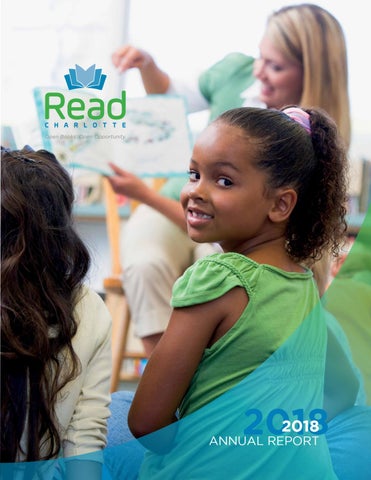
2018 2018
ANNUAL REPORT
Our mission is to increase the 3rd grade reading proficiency rate from 39% in 2015 to 80% by 2025.* The groundwork has been laid. The systems are starting to change.
WILL YOU HELP US FULFILL OUR PROMISE IN THESE NEXT 6 YEARS?
2
*According to the National Assessment of Educational Progress.
Who Are We And Where Are We Headed? By Liz Rothaus Bertrand “We can't find any other community that has successfully done what we are trying to do here in Charlotte," says Read Charlotte Executive Director Dr. Munro Richardson. “We know it’s big.” Read Charlotte was created precisely to rewrite the story, leading with bold solutions to the early literacy crisis. In 2014, the Belk Foundation convened a small group of community leaders to discuss disturbing news: according to the National Assessment of Educational Progress, only 40% of Charlotte’s third graders were reading on grade level. New state legislation also mandated that third graders who could not meet that reading standard would be held back a year—a decision that would profoundly impact the local school system. “The data shocked the community,” says Katie Morris, former Board Chair of the Belk Foundation who now leads Read Charlotte’s Governing Board. “We all knew this would require a different way of thinking.”
DEVELOPING A SOLUTION There were many questions. Would funders invest in such a large program that was still evolving? What would be the specific goals and indicators of success? Would the school system and local non-profits working in early education be open to collaboration? Through a year of debate and education, an early action team determined that a crisis on this scale would require a multi-year solution to confront systems-level issues and established Read Charlotte’s 10year mission to double third grade literacy proficiency rates to 80%. Furthermore, they knew measurable change of this magnitude required an entirely new approach—an evidence-based, targeted effort with carefully aligned programs being implemented around the county. “We’re focused as much on systems change as we are focused on students’ test scores,” says Richardson.
WHERE DO YOU START? In its first two years, Read Charlotte worked to close the gap between research and practice, logging 1,500 hours reading scholarship in the field and finding the best strategies to focus on. Thousands of Charlotteans also participated in workshops, surveys and community conversations to help inform the work. Based on this research, Read Charlotte now focuses on stacking and aligning proven efforts to transform literacy school by school. But these efforts don’t only happen through school personnel. Systems change means transforming how individuals and organizations connect in order to be most effective. Libraries, places of worship, doctors’ offices, technology, non-profits, businesses, donors, and volunteers each play a crucial role moving the needle on literacy. Read Charlotte’s model prioritizes implementation, an area where other programs with big ideas sometimes break down. Its approach is unique since it does not operate its own programs but coordinates initiatives, providing resources and data to support a multi-faceted, communitywide effort. Three years in, Read Charlotte knows what to do and is moving full speed ahead. The biggest challenge now is finding ways to scale the project to reach more kids, support more schools, and connect with more families. “There’s a role for all of us to play and I think Read Charlotte has developed the playbook, but we can’t play the game by ourselves,” says Richardson. “We need the help of the whole community so we can transform literacy and, ultimately, transform the trajectory of our community.”
WHY IS THIRD GRADE SO IMPORTANT? Third grade is a pivotal year in kids’ education, considered the dividing line between learning to read and reading to learn. Beginning in fourth grade, 85% of the school curriculum is readingbased. Research shows:
96% of all children who can read on grade level by third grade will graduate on time. 89% of children from lowincome households who can read on level by third grade will graduate on time. Students who are not proficient readers by third grade are 4X more likely to drop out of school. In order to achieve reading proficiency in third grade, efforts need to start as early as possible. “We now know what needs to happen for a child to learn to read by the time they get to kindergarten,” explains Morris. “It’s a lot easier when you address critical skills earlier; it's a lot more expensive if you wait."
Read Charlotte’s Executive Director, Munro Richardson (left), with Board Chair Katie Morris (right)
3
Solving Barriers To
1. Research-to-
practice gap: aligning the best evidence-based strategies with indicators of early literacy development
We Are Moving Kids Along The Reading Success Pathway We are leveraging research and data to get the right supports to the right kids at the right time.
BIRTH TO FIVE YEARS
KINDERGARTEN
FIRST GRADE
SECOND & THIRD GRADE
• Expressive Language • Language Comprehension • Approaches to Learning • Letter Knowledge • Phonemic Awareness
• Letter Knowledge • Phonemic Awareness • High Frequency Words
• Phonemic Awareness • High Frequency Words • Phonics
• Vocabulary • Fluency • Comprehension
Pre-Literacy Skills
4
3rd Grade Reading Proficiency
Skills to Decode
Skills to Understand
Two Major Improvement
2. Knowing-doing
gap:
turning evidencebased knowledge about how to improve performance into actions that produce measurable results in the real world
Ready4K Texts Since April 2017 2,726 active users and 541,000 texts sent
Home Reading Helper Since September 2018 44,059 pageviews and 11,329 users
Active Reading Workshops & Trainings Since 2017 2,375 participants in 260 programs
Reach Out and Read Since May 2017 Increased from 22,400 to 32,262 children served
Tutor Charlotte Since November 2017 668 students served by volunteer reading mentors
Summer Literacy Infusion Since summer 2017 894 children served
Transformation Network Since August 2018 • 13,644 books distributed • 3,974 children served • 795 parents reached • 12 participating schools • 49 partners
Ready To Read Since fall 2017 • 294 children served • 24 teachers coached • 15 childcare centers
Data Collaborative Since fall 2017 • 2,265 children assessed 6 months to 3rd grade • 144 coaching sessions • 33 staff reached • 10 participating organizations
Strategic Co-Funders Since September 2015 • 107 participants • $5,505,847 in coordinated funding
Online Engagement Network for Continuous Improvement Improving literacy instruction in K-3 classrooms at 6 CMS schools
• • • •
35,079 website users in 2018 4,142 Facebook followers 1,111 Twitter followers 473,700 YouTube video views (825,300 minutes watched)
5
What We’re Focused On Five Levers to Improve Early Literacy • • • • • •
Ready To Read Standards-Based Explicit Instruction Guaranteed Viable Curriculum Network for Continuous Improvement Coaching & Professional Development Data Collaborative
• • • •
Provide high-quality, targeted tutoring
Great teaching
Help children build home libraries
• Book-A-Palooza • Book Swaps • Dolly Parton's Imagination Library • Reach Out and Read • Raising A Reader • Books on Break
6
Active Reading HELPS Augustine Literacy Project Queen City Phonics
Stop summer reading loss
• Summer Literacy Infusion • Summer Reading Campaign • Local Summer Learning Programs • CM Library's Summer Break
Empower families to support literacy at home
• • • •
Reach Out and Read Active Reading Ready4K Home Reading Helper
Read Charlotte Transformation Network Leads Mini Reading Revolution At Ashley Park By Liz Rothaus Bertrand
These days, when Marc Dickmann walks through the halls of Ashley Park PreK-8 School, he notices a new air of positivity and hopefulness. A former outreach pastor, Dickmann has been working to improve quality of life on Charlotte’s west side for over 17 years. Now as the Director of Education and Community for Freedom Communities at Ashley Park, he oversees a flurry of volunteer initiatives and literacy-related activities at the school. He also serves as the site co-lead for the Read Charlotte Transformation Network, a program piloting in 12 CMS schools this year, and says this targeted and collaborative approach to improving literacy is unprecedented. The Transformation Network aligns resources with community partners and uses researchbased practices to dramatically improve third grade reading. This measurable, transformative change is spurred by four strategic objectives: 1. Helping children build home libraries. 2. Empowering families with effective home literacy routines. 3. Providing high-quality, targeted tutoring. 4. Stopping summer reading loss. Historic segregation and discrimination have led to fewer available resources for families in West Charlotte. At Ashley Park, approximately 90% of the students are eligible for free or reduced-price lunch and only 10.3% of third graders achieved reading proficiency (which Read Charlotte defines as a score of 4 or 5) on the NC EOG test in 2017.
Ashley Park is near its goal of 90 reading volunteers working one-to-one weekly with all kindergarteners and with third graders who are struggling with reading fluency. But it’s not only the uptick in volunteers that is significant: it is their training and tools that make a difference. Tutors use proven, research-based methods and chart their scholars’ progress weekly.
“I’m grateful that Read Charlotte doesn’t take a Band-Aid approach to systemic issues,” says Dickmann. “[T]hey have a burning fire in their bellies to work with the school district and community partners to bring about the kind of system change that will bring lasting, hopeful outcomes for our scholars.” "I didn't know what to expect knowing I had to follow this very structured program when working with the kids,” says Alan Barnes, an Ashley Park HELPS volunteer. “But by the second week it was that process that made me feel empowered and encouraged."
Another important aspect of the program is empowering parents and other caretakers with tools to use at home to promote reading and literacy. Ashley Park will host at least one Family Literacy Night per quarter, including Active Reading workshops, so parents and caregivers can learn to read with their scholars rather than to them. By incorporating a few simple, evidence-based steps, they can transform the reading experience to improve children’s language skills, vocabulary and comprehension.
Read Charlotte also works with partners Promising Pages and Scholastic to get books into the hands of kids through Book-APaloozas, where scholars can pick three books to take home, and Book Swaps which keep books in circulation. “We know our scholars at Ashley Park live in neighborhoods that are book deserts,” says Dickmann. “Kids can’t read books at home if there aren’t books to read.”
“I personally am so grateful for the financial generosity of corporations and foundations toward Read Charlotte and the work they are helping to mobilize in our city,” says Dickmann. “To make a significant impact, these efforts must continue and expand. Charlotteans will need to mobilize in ways we have never seen before. It’s our greatest opportunity and our biggest challenge.” 7
Making Strategic Investments To Spark Dramatic Change By Liz Rothaus Bertrand When it comes to problem solving and innovation, Read Charlotte’s unique funding model sounds more like the work of a venture capital firm than a typical community initiative. Through targeted investments, it improves existing programs and identifies crucial gaps that must be filled to transform early childhood literacy in our community. Then it shares its knowledge with other potential funders to increase the impact of investment dollars.
From market analysis to codeveloping a 3-year business plan, securing funding and hiring the project director, Read Charlotte has been integrally involved in this process. It provided 31% of the investment needed to roll out these improvements but it also played a key role in engaging ten other funders to support the remaining 69% cost of the project to date.
MAKING STRONG PROGRAMS EVEN BETTER
Read Charlotte also creates new initiatives to fill existing gaps in the market. Ten community partners have committed to the Data Collaborative, a three-year effort to receive staff training, coaching, and technical assistance from Read Charlotte to make organizational shifts that improve data collection, data use, and literacy instruction.
Take Ready to Read, for example. This partnership between Read Charlotte and Child Care Resources Inc. (CCRI) builds on a successful national program, Raising A Reader, and enhances it with new components. In the traditional Raising A Reader model, kids take home a Red Book Bag filled with books to read with their family and then exchange it for another bag each subsequent week. Read Charlotte saw an opportunity to engage parents and early childhood teachers more effectively. It collaborated with CCRI, the largest affiliate of the Raising A Reader program in North Carolina, to add three additional components: 1. Enrolling parents in the evidencebased Ready4K text messaging program. 2. Offering families workshops in Active Reading to increase the impact of shared reading time at home. 3. Improving targeted professional development for preschool teachers through literacy coaching so they can integrate evidence-based strategies into their practice.
8
LAUNCHING NEW IDEAS
1. Front line leaders assess children’s progress and strengthen instructional practices to build and improve literacy skills. 2. Mid-level leaders charged with data collection receive technical training to better analyze results and make data-based decisions. 3. Senior leaders learn to use data to more effectively allocate resources and more intentionally develop implementation supports.
TWO-PART INVESTMENT APPROACH Forty-five cents of every dollar contributed by lead investors during Read Charlotte’s first five years have gone into the Transformation Fund to spur change in our community. Read Charlotte uses this money ($2.815 million) to seed the most promising new projects and to build capacity of existing organizations already doing great work in early childhood literacy that align with its mission. But the organization also maximizes the power of other investment dollars (over $5.5 million as of Oct. 1, 2018) through strategic co-funding, a practice that is informed by Executive Director Munro Richardson’s experience with syndicated funding in the start-up world.
EXPANDING IMPACT THROUGH STRATEGIC COFUNDING Three times a year, Read Charlotte convenes local funders, educating them on the most promising evidence-based strategies to improve literacy for kids from birth to third grade. This way grant-makers can choose the best interventions and programs in which to invest their dollars earmarked for early childhood education initiatives. Read Charlotte is mobilizing the community to work more strategically than ever before to resolve the literacy crisis. “We do get folks from other communities that reach out to us that are really interested in how we’ve engaged funders.” says Richardson. “People are watching what we're doing in Charlotte-Mecklenburg and recognizing that it’s something special.”
Empowering Families To Improve Literacy By Liz Rothaus Bertrand Something magic happens when Dr. Jonathan Wilson, a family physician, gives a child a new book. “The energy in the room really changes,” says Wilson, who participates in Reach Out and Read (ROR), and cares for many refugees and recent immigrants in his practice at Smith Family Wellness Center in Charlotte. “Suddenly, the kids demonstrate curiosity and community rather than the competitiveness they often exhibit huddled around an electronic device.” Partnering with ROR has been one of Read Charlotte’s most powerful collaborations. Through this remarkable program, physicians use books and reading to connect with families, assess a child’s developmental progress and promote literacy as an essential component of overall well-being. Participating doctors offer a quality, age-appropriate book to a child at each well-child exam. This serves multiple purposes: • The doctor uses the book as a diagnostic tool. Does the child know how to orient the book properly? Can he or she turn the pages or identify colors correctly? • Physicians model reading aloud as an interactive activity. They prescribe daily doses of at least 20 minutes of reading together as a crucial way to promote healthy brain development and strengthen parentchild bonds. • Children keep each new book they receive. The program enables families to build their own home libraries.
“I think the medical community is just waking up and saying ‘Wow! This needs to be as important as eating well, getting vaccinated and exercising’...because we’re realizing that a lot of the social determinants of health hinge on literacy,” says Wilson. And it's working: research shows that preschoolers served nationally by ROR gain three to six months vocabulary compared with nonparticipating peers. With the support of local funders and partnership with Atrium Health and Novant Health, ROR has undergone dramatic growth since 2016. In the last three years, the number of active ROR clinics in Mecklenburg County has grown from 13 to 24 with five additional clinics currently undergoing the applications/training process. “This partnership has significantly elevated our work,” says Reach Out and Read Carolinas Executive Director Callee Boulware, noting how it has facilitated a deeper integration with the two major healthcare systems and ensured the work in medical clinics is better aligned with research and best practices. RORC is now able to start interventions even earlier— at birth, rather than waiting until the traditional model’s six-month appointment. Through Read Charlotte’s strategic support co-developing a three-year business plan, RORC is on track to grow from serving 20,000 to more than 35,000 children in the area over the next 18 months. By focusing on reaching more low-income families, the program has gone from serving about 25 percent of low-income children in Mecklenburg County to about 43 percent to date. The systems and operational-level changes developed through this partnership are also being replicated in other communities RORC serves. “It’s incredible that Read Charlotte and Mecklenburg County are ready to lead in that way,” says Boulware.
TURNING PHONES AND COMPUTERS INTO TOOLS FOR PARENTS Read Charlotte puts quality literacy resources at parents’ fingertips and engages families in learning activities with the help of two free resources. Ready4K, based on strategies developed by Stanford University researchers, sends three texts per week to participants with age-appropriate tips and fun activities shown to boost children’s literacy level by two to three months. HomeReadingHelper.org, developed by Read Charlotte, provides hundreds of easy-to-use resources and literacy strategies including short videos, games and activities. One kindergarten parent at Reedy Creek Elementary School said, “I appreciate this site for filling a void that I struggled with as I taught my child to read. Moving forward, we will most definitely be using Home Reading Helper. It’s so easy to navigate.”
MAKING READ ALOUD TIME MORE POWERFUL Since the 1980s, research has shown that a strategy known as "Dialogic Reading" could be a powerful tool for learning. Read Charlotte broke the research down into simple steps— rebranded as the ABCs of Active Reading—and developed a curriculum that could bridge the research-to-practice gap. Charlotte Mecklenburg Library has taken it from there, acting as a key partner in empowering parents and caretakers with strategies for reading with children. Library staff now offer it in branches and schools. They also train other non-profit organizations to implement it within their own programs.
9
Destination: 2025 We can begin to transform literacy in our schools with just 25 more third graders reading at College and Career Ready (CCR) in targeted schools on the North Carolina End-of-Grade (EOG) reading test.
CHANGE IS WITHIN OUR REACH. 2017 3rd Grade With 25 More Students at CCR at 58 Priority Schools
90%
80%
70%
60%
60%
50%
40%
30%
20%
10%
0% 0%
10%
20%
30%
40%
50%
60%
70%
80%
90%
100%
3rd Grade Collage and Career Ready (2017)
3rd Grade Collage and Career Ready (2017)
2017 3rd Grade College and Career Ready 90%
80%
70%
60%
60%
50%
40%
30%
20%
10%
0% 0%
10%
20%
30%
40%
50%
60%
70%
80%
Percent Free and Reduced Lunch (2013-2014)
Percent Free and Reduced Lunch (2013-2014)
Moving forward, we remain laser focused on our mission to get 80% of third graders in Charlotte-Mecklenburg reading on grade level by 2025. We commit to continuously “get better at getting better” in implementing these evidence-based strategies to create transformative change in our community. 1
Help more families build literacy routines starting at birth through doctors’ offices with Reach Out and Read
2
Provide more professional development and literacy supports to early educators in Charlotte-Mecklenburg
3
4
10
Empower more CharlotteMecklenburg families to support literacy at home with Active Reading, Ready4K and the Home Reading Helper Build a coordinated system of high-quality, targeted tutoring that gets more volunteers working with more children in more schools
5
Expand the Transformation Network to build more powerful school-community partnerships to help targeted schools get 80% of their third graders reading at College and Career Ready
6
Get more books into the homes of children to reduce the book desert in parts of Mecklenburg County
7
Infuse literacy into more summer activities to stop summer reading loss
8
Continue to leverage the power of the Data Collaborative to help nonprofit agencies transform data into insights, actions and impact
90%
100%
How You Can Get Involved We invite you to get involved and help us spread the word, facilitate more partnerships and empower more families!
In My Home • • • • •
Sign up for Ready4K texts Use HomeReadingHelper.org Read with a child at least 3x a week Attend an Active Reading Family Workshop Sign up for free books through Dolly Parton’s Imagination Library
At A School • • • •
Become a HELPS fluency tutor Attend an Active Reading Training (K-3) Become an Augustine Literacy Project tutor Become a Charlotte-Mecklenburg Schools volunteer
At Work • • • •
Recruit employees from my company to be HELPS fluency tutors Host an Active Reading Training at my company Organize a book drive through Promising Pages Promote Ready4K & HomeReadingHelper.org to employees in my company • Sponsor a Book-A-Palooza at a Read Charlotte Transformation Network school
With My Community Group • • • •
Recruit members to become HELPS fluency tutors Organize a book drive through Promising Pages Support a Read Charlotte Transformation Network school Sponsor a Book-A-Palooza at a Read Charlotte Transformation Network school • Promote Ready4K & HomeReadingHelper.org in my community
Learn more at CommitTo80.org 11
Collaboration Makes
12
Our Work Possible
DIGITAL CHARLOTTE
First Ward Child Development Center
FREEDOM COMMUNITIES
Mecklenburg Child Care Association
The West Charlotte Coalition 13
Thank You To Our 2018 Supporters Lead Funders
ÂŽ
Additional Funders Alpha & Omega Foundation Andrea Barkley Ann Dunlap Hendrix Charitable Fund Anonymous Atrium Health Christine Nicodemus Charlotte Hornets Charlotte Mecklenburg Community Foundation Davidson College Hal and Holly Levinson Family Fund Ingersoll Rand
James Family Foundation Jane E. Pounds Jenkins B. Trotter Katherine O. Bagby Kathylee B. Thompson Margaret C. Sockwell Merancas Foundation Novant Health Patricia R. Morton Sally C. Saussy Selwyn Avenue Presbyterian Church Sisters of Mercy of North Carolina Foundation
Smart Start of Mecklenburg County Stephen L. Cornwell Foundation Tamara Holt United Way Cato Endowment for Education and Training Virginia T. Shaw William A. McEachern William D. Funderburg Winer Family Foundation Women’s Impact Fund Yanliang Dong Yates Fund Z. Smith Reynolds Foundation
Supporters Charlotte Mecklenburg Library Charlotte-Mecklenburg Schools
City of Charlotte University of North Carolina at Charlotte
Governing Board Johanna Anderson The Belk Foundation Weston Andress (Vice Chair) The PNC Financial Services Group Dr. Rachel Banks North Park Family Medicine, CHS Charles Bowman Bank of America Brian Collier Foundation For The Carolinas Paul Draovitch Duke Energy Foundation Dena Diorio Mecklenburg County 14
Lane Faison Skeebo Foundation Fannie Flono Community Volunteer Sandra Holub Albemarle Foundation Rhett Mabry The Duke Endowment John Martin Young Black Leadership Alliance Ellen McIntyre University of North Carolina at Charlotte
Katie Morris (Chair) The Belk Foundation Anna Nelson CD Spangler Foundation Crawford Pounds PricewaterhouseCoopers LLP Justin Steinschriber The Leon Levine Foundation Kristi Thomas Wells Fargo Stick Williams Community Volunteer Clayton Wilcox Charlotte-Mecklenburg Schools
We Have The Blueprint To Move The Needle On Early Literacy.
WILL YOU HELP US?
/ReadCLT
@ReadCLT 15
220 N. Tryon Street, Charlotte, NC 28202
www.readcharlotte.org Report produced by