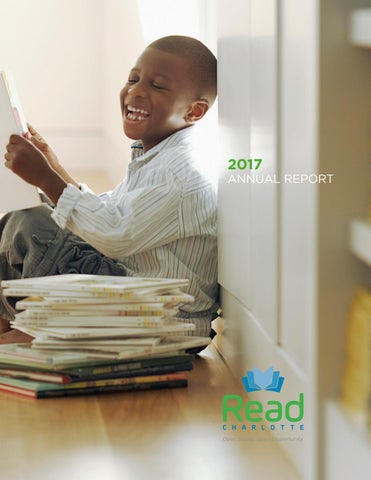
2017 ANNUAL REPORT
Our mission is to double the number of 3rd graders reading proficiently by 2025: from 39% to 80%.
COMMIT TO 80, WITH US.
Dear Friends, Over the past several years, our community rightly has asked itself how to increase economic opportunity in Charlotte-Mecklenburg. Although this is a complex issue, we are confident about part of the answer: literacy. Learning to read is the most important task that children in early elementary school have. We cannot break the cycle of poverty unless our children know how to read. Furthermore, literacy isn’t only an issue for those who are in the lower economic brackets. All children, regardless of income level, need to be reading proficiently by third grade to have access to a life of opportunities. After countless hours of research, Read Charlotte today focuses on four primary goals: (1) empower families to support their children’s language and literacy development; (2) increase the number of children ready to learn to read at the start of school; (3) accelerate reading achievement in grades K-3; and, (4) ensure struggling readers receive timely and effective supplemental supports. We use research and data to help as many children as possible travel the Reading Success Pathway to achieve reading proficiency by third grade. If there is one word that sums up our approach it would be ‘collaboration.’ In 2017, we worked with multiple community organizations to pilot, start or scale up proven or promising programs aligned with the Reading Success Pathway: Charlotte-Mecklenburg Library, Reach Out and Read Carolinas, Child Care Resources Inc., United Way of Central Carolinas and YMCA of Greater Charlotte. Eleven organizations joined us in a new Data Collaborative to increase the use of data to drive action, impact and learning. Multiple funders came on board to support the implementation and scale up of evidence-based interventions. We need even more help – yours. It’s up to all of us – at home, in a school, at work, or with a community group – to do what we can, where we can, to help children learn to read. You can make a difference whether it’s one child or a classroom of children, or whether it’s your own child or someone else’s child. We need your help to get 80% of our third graders reading proficiently by 2025. Read Charlotte is ready to show you how. Are you ready to Commit to 80?
#80by2025 KATIE MORRIS Board Chair 2
MUNRO RICHARDSON Executive Director 3
Why Read Charlotte is Now More Important Than Ever
60%
4X
#1
of 3rd graders in Charlotte are not reading at grade level.
3rd graders reading below grade level are 4X more likely to drop out of high school.
3rd grade reading is the #1 predictor of school success.
In Charlotte, about 13% of our residents live in poverty, including 20% of our children.
The odds of a child in Charlotte moving from the bottom to the top income bracket are 4.4%.
LITERACY IS THE KEY TO GIVE ALL KIDS A FAIR CHANCE. What does this mean for student outcomes and trajectories? 96% of students will graduate high school on time IF they are proficient in reading by third grade. Sources: Annie E. Casey Foundation (2012). Double Jeopardy: How Third Grade Reading Skills and Poverty Influence High School Graduation. The Equality of Opportunity Project by Harvard University/UC Berkeley.
4
National Assessment of Educational Progress
5
Aligning Our Actions With Our Strategies Through strong partnerships, we have chosen to implement a set of evidence-based interventions and capacity-building strategies that support our mission. We are aligning these actions with our Reading Success Pathway, which shows the critical skills and competencies that all kids, regardless of background, need to master to become proficient readers by third grade.
3rd Grade Reading Proficiency
BIRTH TO FIVE YEARS
KINDERGARTEN
FIRST GRADE
SECOND & THIRD GRADE
• Expressive Language • Language Comprehension • Approaches to Learning • Letter Knowledge • Phonemic Awareness
• Letter Knowledge • Phonemic Awareness • High Frequency Words
• Phonemic Awareness • High Frequency Words • Phonics
• Vocabulary • Fluency • Comprehension
FAMILIES: Ready4K, Active Reading, Reach Out and Read PRE-K: Ready to Read K-3: Tutor Charlotte, Summer Learning CAPACITY BUILDING: Data Collaborative 6
7
2017 Accomplishments: A Strong Commitment to Systems Change We define "systems change" as new or modified programs, policies or practices facilitated by Read Charlotte that move more children down the Reading Success Pathway to achieve our 80% goal by 2025.
Over 50 people from 30 agencies served on four Action Learning Teams to develop and test solutions in 100 days in four areas: Active Reading, Family Engagement, Kindergarten Success and Summer Learning.
JANUARY FEBRUARY MARCH
Celebrated and shared the early wins made by Action Learning Teams at the 100 Day Challenge Celebration.
Announced partnership with Reach Out and Read Carolinas. Working with Carolinas HealthCare System, Novant Health, and others to support doctors to encourage reading during well-child visits. Expanding to strategically serve more low-income families. In partnership with Charlotte Mecklenburg Library, launched Active Reading workshops for families across the county, to teach parents and caregivers the power of reading with their children rather than reading to them. In partnership with United Way, piloted Reading Mentors in select elementary schools as part of Tutor Charlotte, an end-to-end solution to provide literacy and math support for children in grades K-3.
Launched Ready4K, a free text messaging program for parents and caregivers of children (age 0-5) to help build language and literacy skills before kindergarten.
APRIL MAY JUNE JULY AUGUST
Launched a community-facing Reading Success Dashboard. This tool, designed with our community, shares our progress to our 2025 goal and all key reading success indicators. Launched the Data Collaborative, a new collective effort with providers to improve the availability, quality and use of data to improve children's literacy, birth through third grade. Held "Train the Trainer" Active Reading sessions with over 100 Charlotte Mecklenburg Library staff members.Â
SEPTEMBER OCTOBER NOVEMBER DECEMBER
8
Piloted Active Reading family workshops with 14 partner organizations.
Held Active Reading trainings for CMS North Star volunteers and Tutor Charlotte Reading Mentors. Dr. James Kim of Harvard University completed a yearlong study of effective K-3 literacy practices in CMS schools. Findings will inform a pilot project with CMS in 2018-2019 school year.
9
Stories from the Field PROMOTE LANGUAGE DEVELOPMENT THROUGH ACTIVE READING Profile: Charlotte Mecklenburg Library Active Reading Workshops Charlotte Mecklenburg Library is offering hundreds of free Active Reading workshops to families across the county, to teach parents and caregivers the power of reading with their children rather than reading to them. Active Reading is a proven way to build kids’ language and vocabulary, preparing them to be lifelong readers who love books. Read Charlotte and Charlotte Mecklenburg Library collaborated to make a real impact with children through their parents. With 85 percent of a child’s brain development occurring before age 5, it is crucial to develop literacy skills during this period. The workshops are developed for families with children ages 2-5, and they learn how to have engaging conversations with their children using words, pictures and ideas found in kids’ picture books.
Our strategic objectives continue to guide us to reach our goal of 80% third-grade reading proficiency. Here are some examples of how these goals have been realized in the community.
EQUIP FAMILIES WITH HIGH-IMPACT HOME STRATEGIES TO SUPPORT LITERACY Profile: Emily Isaacs, mother using Ready4K Read Charlotte is reaching thousands of families in Mecklenburg County three times a week through Ready4K, the free text messaging service that sends age appropriate tips and advice directly to parents and caregivers, giving them the information they need to help build children’s literacy skills by the time they start Kindergarten. “I have a two-year-old and signed up for Ready4K as soon as I heard about it,” said mother of two Emily Isaacs. “I love getting the tips sent directly to my phone throughout the week to aid not only in learning but new ideas for me to try with my son. I really appreciate these texts because they are great reminders to be proactive with my kids in reading and other activities.”
“This workshop was fantastic and has had a huge impact on my family’s reading time,” said Nicole Melton, who attended a workshop at University City Regional Library. “I have changed everything about how I read with my children. I’m taking more time with books and engaging in more child-led conversation. I used to think that would take away from the story we were reading, but now I realize it actually helps them relate to the story and learn even more.”
DETERMINE WHAT WORKS TO IMPROVE LITERACY Profile: Reach Out and Read
SUPPORT LITERACY PROVIDERS TO USE DATA FOR ACTION, LEARNING AND IMPACT Profile: Data Collaborative
Eleven local organizations are participating in the Data Collaborative, a collective effort by birth through third grade literacy providers, funders, and community partners to improve the availability, quality and use of data to improve children’s literacy. Through this partnership, literacy providers will not only receive a comprehensive understanding of children’s language and literacy skills using a valid, reliable common assessment, but also a stronger understanding of areas for growth within the organizations, as it relates to students’ language and literacy development. "I really appreciated being pushed out of my comfort zone to start thinking critically about data and how it impacts our organization.” - Data for Learning Participant
More children in Mecklenburg County will grow up with books, stories, and a love of language, through a partnership between Read Charlotte and Reach Out and Read Carolinas, which supports parents starting at the birth of a child. The proven early literacy intervention, Reach Out and Read, is a unique model. Instead of having families sign-up to take part, it’s integrated into routine well-child visits at participating medical clinics. During the visit, doctors prescribe reading aloud every day by modeling reading a book aloud to the child while educating and supporting the parents in building the knowledge and understanding they need to integrate daily reading and sharing language into their routines at home. “As a family physician, I know how essential early reading is to critical early brain development and to supporting children to be better prepared for school,” says Dr. Rachel Banks, Family Medicine, CMC-NorthPark Family Medicine. “Increasing early literacy skills can help close the kindergarten preparedness gap for children. Participation in Reach Out and Read leads to longer-term education and social benefits for the child, creates value for society, and saves money that would otherwise be spent on remediation.” Nationally, over 90% of children attend at least 1 well-child visit annually. Even 79% of parents who didn’t finish high school take their children to see the doctor at least once a year. This is a remarkable opportunity to reach a significant percentage of the 85,000 children under six years old in Mecklenburg County.
10
11
Thank You To Our Supporters Lead Funders
ÂŽ
DIGITAL CHARLOTTE
First Ward Child Development Center
Additional Funders
Collaboration Makes Our Work POSSIBLE
Alexis Gordon Allen Tate Company, Inc. Anonymous (2) Charles Butt Foundation Charlotte Will Children's Medical Endowment Fund CMCF - Opportunity Fund CMCF - Children & Youth Fund Dottie Martin Children's Endowment Fund
Ellen Rosenfeld Fidelity Charitable Gift Fund First Presbyterian Church - Charlotte Gwen M. Poth Hal and Holly Levinson Family Fund Henry W. Sale Holly Eskridge Hugh and Jane McColl Impact Fund Endowment Fund James Family Foundation
Jane E. Pounds Kathleen W. Shaw Kristina Denta Laura Burkart Lisa Barnaby Stephen L. Cornwell Foundation Whitney D. Arnall Winer Family Foundation WP Pizza Bar - Charlotte Z. Smith Reynolds Foundation
Supporters Mecklenburg Child Care Association
Charlotte Mecklenburg Library Charlotte-Mecklenburg Schools
City of Charlotte University of North Carolina at Charlotte
Governing Board
The West Charlotte Coalition
Johanna Anderson The Belk Foundation Weston Andress (Vice Chair) The PNC Financial Services Group Dr. Rachel Banks North Park Family Medicine, CHS Charles Bowman Bank of America Brian Collier Foundation For The Carolinas Jennifer DeWitt Duke Energy Foundation Dena Diorio Mecklenburg County
Lane Faison Skeebo Foundation Patrick Graham Charlotte Works Marcus Jones City of Charlotte Rhett Mabry The Duke Endowment Ellen McIntyre University of North Carolina at Charlotte Rosie Molinary Circle de Luz
Katie Morris (Chair) The Belk Foundation Anna Nelson CD Spangler Foundation Crawford Pounds PricewaterhouseCoopersLLP Justin Steinschriber The Leon Levine Foundation Kristi Thomas Wells Fargo Stick Williams Community Volunteer Clayton Wilcox Charlotte-Mecklenburg Schools 13
How You Can Commit to 80!
IN MY HOME • Sign up for Ready4K • Read with a child at least 3x a week • Attend an Active Reading Family Workshop • Start a learning routine • Sign up for Dolly Parton's Imagination Library
AT A SCHOOL
AT WORK
WITH MY COMMUNITY GROUP
• Become a Reading Mentor
• Adopt a classroom
• Adopt a classroom through
through Tutor Charlotte • Attend an Active Reading Training Session (K-3) • Become a CharlotteMecklenburg Schools volunteer
through Tutor Charlotte • Host a corporate Active Reading Training session • Organize a corporate book drive
Tutor Charlotte • Organize a community book drive • Infuse literacy into programs
www.readcharlotte.org #80by2025 14
Here’s how you can get involved and help us spread the word, facilitate more partnerships, and empower more families.
/ReadCLT
@ReadCLT 15
220 N. Tryon Street, Charlotte, NC 28202
www.readcharlotte.org Report produced by