
REACT Long COVID Continuing progress
March 2024


REACT Long COVID is jointly funded by the UKRI/Medical Research Council and the National Institute for Health Research (grant reference: MC_PC_20049). We also acknowledge support from the NIHR Imperial Biomedical Research Centre, The Huo Family Foundation and the Department of Health and Social Care
is the REACT Long COVID Study?
Exploring Genetic & Biological Factors
Exploring Social & Environmental Factor s
What is the REACT Long COVID study?
REACT Long COVID (REACT-LC) is a research project that aims to find out more about the reasons why some people experience long-term symptoms and health impacts after COVID-19 (commonly described as Long COVID) while others recover relatively quickly with no apparent ongoing ill health.
We are exploring people’s varied experiences, and, through clinical studies, we are looking for biological and genetic factors that may explain these differences. Such insight will be used to improve the care of patients and hopefully will lead to new and more effective treatments.
REACT-LC is funded by UK Research and Innovation (UKRI) and the National Institute for Health Research (NIHR) and started in February 2021. The three-year project is being led by Imperial College London and builds on work of the REal-time Assessment of Community Transmission (REACT) programme of COVID-19 home testing. REACT-LC is being carried out in partnership with several other research institutions (including Queen Mary University of London, Charite University of Medicine, Berlin and the Universities of Leiden, Birmingham and Newcastle), patient groups and public advisors.

Watch a video introducing the REACT-LC Study here.
Why an update report now?
The 15th March 2024 marks Long Covid Awareness day so we wanted to highlight the work we have been doing over last year to continue to understand this emerging condition.
Since out last report we have carried out a significant amount of data collection and begun our analysis, evidenced by a number of publications and outputs.
You can read an overview of the findings here but there are also links throughout to other sources and references for more information.


Genetic and Biological Factors
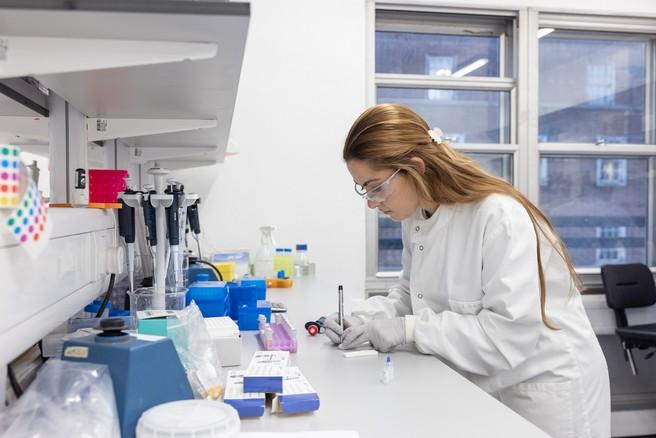
At the start of 2021, those who had taken part in the REACT study who had evidence of a positive test - either Lateral flow or PCR (polymerase chain reaction)- were invited to attend an assessment centre, where we obtained the following samples and measurements:







To date, we have collected the above information and samples from 10,595 participants and over 2,000 people attended a second visit for repeated clinical data collection.
So far, Whole Genome Analysis has been carried out on over 10,000 of these participants samples as well as 4,500 RNA sequences and 2,500 inflammatory marker analyses. Further omic analyses are currently underway.
These analyses will help us better understand the role that the DNA, proteins, and molecules in the body may play in someone developing Long COVID, and how unwell they may become. The blood samples will also be analysed for diabetes, cholesterol and for COVID-19 antibodies.


Social & Environmental Factors
Extending our understanding of experiences of Long COVID
For the strand of the study exploring the social and environmental factors, 800 hundred thousand of the 2.4 million REACT participants who gave consent for recontact were invited to take part in an online survey of health and wellbeing as well as an online cognitive assessment.
The questionnaire explored medical history (including Covid-19 history), current health and wellbeing and any ongoing symptoms. The cognitive assessment used a number of activities to test performance of different aspects of cognition. An interview study was also carried out to capture experiences.
Over 250k responded to the questionnaire and 133,526 people reported at least one episode of test-confirmed SARS-CoV-2 infection. 3275 reported no symptoms, and 130,251 reported symptomatic COVID-19. Of those,
1 in 13 had symptoms for more than 12 weeks
1 in 20 had symptoms for more than a year
Findings from these questionnaires also showed that:

Female Sex

Having more than 1 comorbidity

Being infected when wildtype was dominent
Were associated with higher probability of symptoms lasting more than 2 weeks and longer recovery time in those with persistent symptoms.
·Further analysis has been carried out on employment data from initial REACT studies plus follow-up survey. Early findings show:
• ·Health care workers had 47% higher odds of Long COVID (than people in non-public facing roles)
• ·People in precarious work had a 29% higher risk of Long COVID
• ·People with Long COVID were 4 times more likely to reduce their work hours compared with those who recovered from COVID-19 within 4 weeks
Cognitive Testing
As part of the REACT Long COVID study 140,000 participants took in an online assessment of cognitive function on the Cognitron platform. The results of this showed:
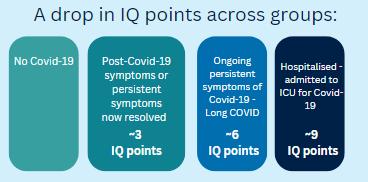
• Memory and executive functions showlargestassociations
• “Brain fog” correlates with measurable deficits in memory andexecutivetaskperformance
• There were smaller deficits in morerecentvariantperiods
The remaining 1.6 million REACT participants who consented to follow up are now being invited to complete the survey and cognitive test alongside those who already took part, to assess the longer-term effects of COVID-19.
Building on the insights into the lived experience of Long Covid from the pilot interview study in 2021 and a further 60 participants took part in an interview between January 2022 and January 2023. Over the last year we have been analysing the interview data and reporting on the findings.
We discussed the potential research question with our public advisors who shaped our focus and analysis. You can read more about their involvement on the following page and in our blog here. The paper of our findings has been sent for publication and a preprint can be viewed here
• Participants described a wide variation in symptoms which were often fluctuating & unpredictable
• Two thirds used the term ‘Long COVID’ about their condition but those that didn’t, reported that they didn’t feel they ‘counted’ as having Long Covid or that the term didn’t apply to their symptoms.
• Most had not accessed clinical care or patient support groups, they did not seek treatment or support because their symptoms were not severe enough, there was a lack of knowledge, and ‘there is nothing anyone can do’. Participants from ethnic minority groups indicated structural barriers to accessing care
• Participants highlighted the ways in which they self-manage their Long Covid both through responding to symptoms and seeking out treatments and support.
• Participants also provided perspectives on what they needed to manage and how they could be better supported by clinical services, employers and those around them such as family and friends.

Because you knew you were going to run out of energy, towards the end, you'd start to feel the fatigue coming…If I still had three things, whatever it was, I wanted to get done that day, I'd be going faster and faster to try to achieve what I wanted to achieve that day.

I definitely think there should be some sort of chatline or something for people that really do struggle with what they think are Long Covid symptoms’

Because everything I’ve come across feels very geared for people who I feel are more poorly than I am. I feel as if there isn’t a sort of, ‘not extreme’ support group. It always feels as if everyone else has very extreme symptoms, and I feel like an imposter in a group.

Data Analysis & Integration
A significant feature of the REACT programme is data linkage. People in the REACT studies have given their permission for us to link their survey data to health data held by NHS England and other NHS bodies. For the 2.7 million adults the REACT study now holds information about their short- and medium-term health, including when they use NHS healthcare, what they are diagnosed with and their prognosis.
Linking the data from the REACT LC study to people’s NHS data will help us understand the short term determinants of susceptibility (who is at risk) and severity (how ill they become) as well as long term health outcomes. The data linkage will help us achieve our aim to better understand the biological, social, and environment risk factors for Long COVID and its longterm health consequences and to inform the provision of healthcare services and support.


Online questionnaires
• COVID-19 history

• Self reported symptoms
• Lifestyle and health
Clinical measurements
• Lung function tests
• Sit-stand &grip strength tests
• Blood pressure & heart rate



Biomarkers


Data analysis and integration


• Genome sequencing
• Molecular measurements
• COVID-19 antibodies

Analyse all data sources & types together using statistical tools and machine learning to identify trends & associations
Qualitative interviews
• 60 in-depth interviews




Follow up
Using linked NHS records to track:
• Health
• Hospitalisations
• GP treatment
• Vaccinations
• Covid-19 infections
• Experience of persistent symptoms
• Impact on quality of life
Note: As part of this activity, participant data will have a study code that will not allow researchers to know who the person is. A small number of people will have access to the code linking to the person but this will be very tightly controlled.
We have established a data access committee for REACT. This is being used by people for access to the survey data, biological and environmental data, and to access the sample for recruitment to studies. For example we are collaborating on a small qualitative study of young people and LC with the London School of Hygiene and Tropical Medicine (NIHR funded)We are also exploring making the REACT data available via a national platform (e.g. Office of National Statistics).

Public Involvement & Engagement
Working with our public advisors
Our public advisors have worked with us since the start of the REACT Long Covid study in 2021. We have met with them via Zoom four times a year. During these meetings the research team provide updates on the study and the advisors are able to provide feedback. We have also come together with some group members for ad hoc meetings related to specific aspects of the study. Activities have included shaping the study questionnaire and interview topic guide, reviewing initial findings, discussing how to communicate our results to the public and helping to shape outputs. Some of our public advisors are authors on our research publications.
Raising awareness of Long Covid symptoms and impacts
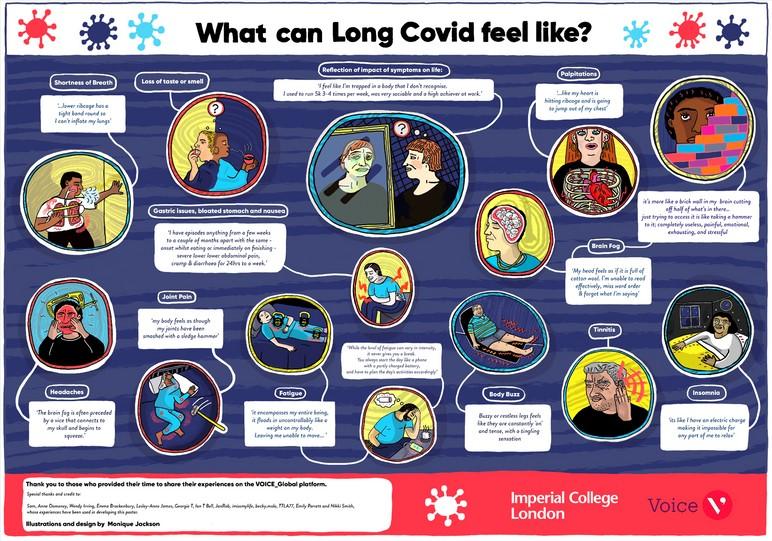
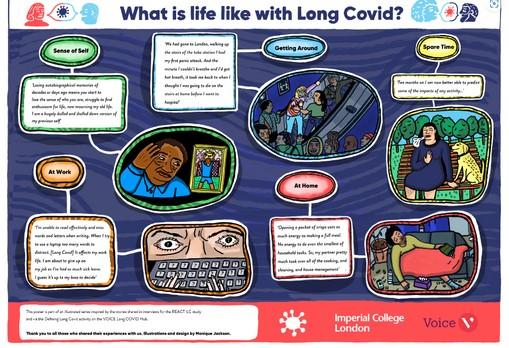
Over the past 3 years, we have been inviting people to share what ongoing symptoms after COVID-19 feel like in their own words as part of our defining Long COVID engagement activity. We received over 100 responses which capture the depth and breadth of symptoms experienced.
We have been working closely with our public advisor and illustrator Monique Jackson to develop illustrations which visually capture the range and impact of Long COVID symptoms. The posters can be viewed on our study website here and the sequences can be found on the Imperial PERC Instagram page
Going forwards
As we approach the end of the first phase of the REACT-LC study we now need to involve more people tp help us think about how to bring all the data from the study together and how to share our overall findings. Over the next few months well will be reaching out to our Long Covid community network mailing list with opportunities to get involved. We will also looking to recruit new public advisors to work across the whole REACT programme.


If you would like to stay up to date with our latest research findings and updates, as well upcoming public involvement and engagement opportunities please join our online REACT: Long COVID-19 Community Network mailing list here


Further information and Outputs
Publications:
• Persistent symptoms following SARS-CoV-2 infection in a random communit y sample of 508,707 people
(pre-print article; 2021)
• Global surveillance, research, and collaboration needed to improve underst anding and management of long COVID (Ward et al. The Lancet 2021.)
• Persistent COVID-19 symptoms in a community study of 606,434 people in England
(Whittaker, M et al. Nature Communications, 2022)
• Understanding and tracking the impact of Long COVID in the United Kingdo m
(O'Mahoney L, et al Nature Medicine, 2022)
• Awareness and perceptions of Long COVID among people in the REACT pro gramme: Early insights from a pilot interview study (Cooper et al, PLOS One 2023)
• Long-term health impacts of COVID-19 among 242,712 adults in England. (Atchison et al, Nat Communications 2023)
• Cognition and Memory after Covid-19 in a Large Community Sample (Hampshire et al, New England Journal of Medicine 2024)
Conferences, webinars & presentations (since last Update Report) :
• Demystifying Long COVID Conference Madrid Dec 2023
⚬ Opening presentation on Identifying the Gaps (Ward 2023)
⚬ Abstract presentation on The Relationship between Self Reported Persistent Symptoms Post -COVID-19 and Employment among adults in England, UK (Wu et al 2023)
⚬ Abstract and poster on Variation on Long Covid Experiences in the population (Cooper et al 2023)
