Westminster Cathedral Magazine
If you can, please make a donation for your copy to cover its production cost. Thank you.

If you can, please make a donation for your copy to cover its production cost. Thank you.
Although we earn income from the advertising which we carry, Oremus relies on donations from readers to cover its production costs.
The Companions of Oremus was established to recognise those who give generously to support us. Open exclusively to individuals, Companions’ names are published in the magazine each month (see page 13). All members are invited to one or more social events during the year and Mass is offered for their intentions from time to time.
If you would like to support us by joining the Companions, please write to Oremus, Cathedral Clergy House, 42 Francis Street, London SW1P 1QW or email oremuscomps@rcdow.org.uk with your contact details, including postcode. Members are asked to give a minimum of £100 annually. Please mention how you would like your name to appear in our membership list and if you are eligible to Gift Aid your donation. Postal subscriptions to Oremus may be purchased by completing and sending to the office the coupon printed in the magazine. Subscriptions to receive Oremus either by email (free) or as hard copy by post (p & p payable) can also be entered by visiting https://westminstercathedral.org.uk/the-cathedral-community/about-oremus/ and completing the form there.
Thank you for your support.
Cathedral Clergy House
42 Francis Street
London SW1P 1QW
T 020 7798 9055

E oremus@westminstercathedral.org.uk
W www.westminstercathedral.org.uk
Oremus, the magazine of Westminster Cathedral, reflects the life of the Cathedral and the lives of those who make it a place of faith in central London. If you think that you would like to contribute an article or an item of news, please contact the Editor.
Patron
The Archbishop of Westminster
Chairman
Fr Sławomir Witon´
Editor
Lorcán Keller
Oremus Team
Tony Banks – Distribution Zoë Goodway – Finance
Anne Marie Micallef – Marketing
Paul Moynihan – Proofreading
Manel Silva – Subscriptions
Design and Art Direction
Julian Game
Registered Charity Number 233699 ISSN 1366-7203
Opinions expressed by contributors do not necessarily represent the views of the Editor or the Oremus Team. Neither are they the official views of Westminster Cathedral. The Editor reserves the right to edit all contributions. Publication of advertisements does not imply any form of recommendation or endorsement. Unless otherwise stated, photographs are published under a creative commons or similar licence. Every effort is made to credit all images. No part of this publication may be reproduced without permission.

© Ashley
Avery-Bennett
Homily: Mass for Matrimony by Archbishop Richard Moth 6 & 7
Help the Cathedral for a historic event by Linda McHugh 8
Tim Whitnall in conversation with Lorcán Keller 9 – 11
Confirmation Bake Sale by Julie Hanssen 18
Cathedral History in Pictures: Blessed Sacrament Chapel Designs, 1956 19 St Damien’s Letter presented to the Damiaanmuseum by St Francis Leprosy Guild 20 & 21
Features:
St Francis: A Beacon of Peace, Reconciliation and Hope by Fr John Luke Gregory OFM 12
Interfaith visit to the Burton Mausoleum by John Woodhouse 13
Carl Maria von Weber, a Bicentenary by Fr Nicholas Schofield 22
Some London Heroines by Joanna Bogle 26
Regulars:
Monthly Album 14 & 15
The Friends 16 & 17
In Retrospect: 100 and 70 years ago 23
Diary and Notices 24 & 25
Crossword and Poem 27

At the end of this month, on the feast of Ss Peter and Paul, Archbishop Richard Moth will receive his pallium from Pope Leo XIV, along with other newly created metropolitan archbishops, in St Peter’s Basilica. The wool used to make these vestments was shorn from two lambs, whom the Pope blessed earlier this year on the feast of St Agnes (21 January). He then entrusted these lambs to the Benedictine nuns at the Basilica of St Cecilia in Trastevere, to raise and shear, and to weave the wool into pallia.
Originally, this was exclusively a papal vestment, symbolising the Good Shepherd carrying the sheep on his shoulders. It was later granted to those representing the Pope in an official capacity and to papal missions, such as St Augustine’s Mission to the Angles. Hence, the Archbishop of Canterbury’s coat of arms and, by extension, those of the Archbishop of Westminster:
‘[…] there should be granted to the celebrated Archdiocese of Westminster as its own arms those which the old Catholic Archbishops of Canterbury used, with the colour of the field changed from blue to red in memory of the Martyrs […]’
The right to wear a pallium was eventually extended to metropolitans, as a symbol of their spiritual and jurisdictional authority, in communion with Rome. According to the 1917 Code of Canon Law, and the pre-existing laws that it codified, a metropolitan archbishop had to petition the Pope for the pallium within three months of his Consecration (Ordination), and was forbidden to exercise his governing authority within his ecclesiastical province until it was received. This was not included in the 1983 Code, but goes some way to explain why Manning was consecrated in June 1865, but was not installed in his procathedral at St Mary Moorfields until he had returned from Rome with the pallium (received 29 September) in November that year.
Looking ahead, Archbishop Moth will celebrate the 12 noon Mass for Corpus Christi on Sunday 7 June. The Most Sacred Heart of Jesus, to whom the Diocese was consecrated in June 1873, falls on Friday 12 June, followed by the Ordinations to the (transitional and permanent) Diaconate on Saturday 13 June, the Immaculate Heart of Mary. As there are no priestly Ordinations this year, just as we were going to print, Archbishop Moth announced a month of prayer for vocations across the Diocese, ending at Pentecost. The Dean has since decided to continue the initiative at exposition of the Blessed Sacrament each Friday, for the foreseeable future. Finally, on Saturday 20 June, Archbishop Moth will celebrate the Mass for New Catholics.
In the meantime, preparations will be well under way for the immersive Luminiscence performances, narrated by Hugh Bonneville. For more information, or to volunteer, see the Cathedral website.
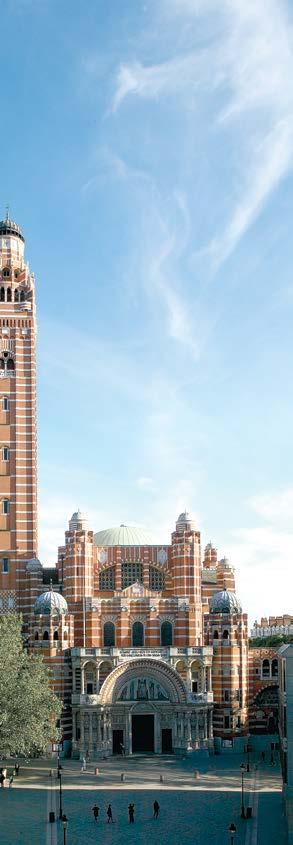
Westminster Cathedral
Cathedral Clergy House
42 Francis Street
London SW1P 1QW
Telephone 020 7798 9055
Email chreception@rcdow.org.uk www.westminstercathedral.org.uk
Cathedral Chaplains
Fr Sławomir Witoń, Dean
Fr Patrick van der Vorst, Precentor
Fr Michael Guthrie
Fr Vincent Mbu’i SVD
Fr Paul Zhao SVD
Fr Hugh MacKenzie
Rev Paul Christian (Cathedral Deacon)
Fr Clement Abobo, Fr Javier Ruiz-Ortiz (priests in residence)
Also in residence
Franciscan Sisters of Our Lady of Victories: Sr Jesuina, Sr Angelina and Sr Mariana
Music Department
Simon Johnson, Master of Music
Peter Stevens Obl. OSB, Assistant Master of Music
Alexander Robson, Organ Scholar
Cathedral Manager
Peter McNulty
Parish Safeguarding Representative
Trevor Koschalka
westcathsg2@safeguardrcdow.org.uk
Cathedral Finance Manager
George Kulasingham
Cathedral Fundraising Manager
Laura Dudhee
Chapel of Ease
Sacred Heart Church
Horseferry Road SW1P 2EF
Archbishop Richard Moth
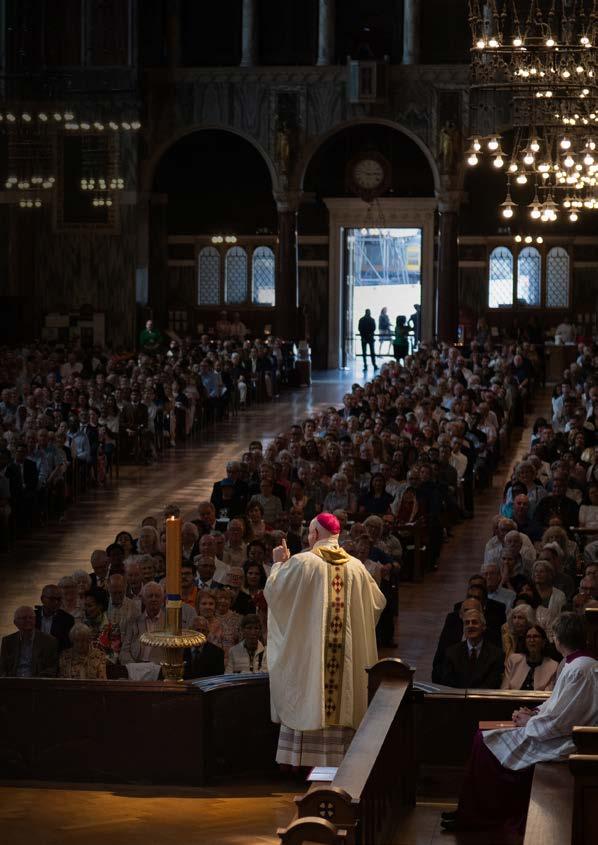
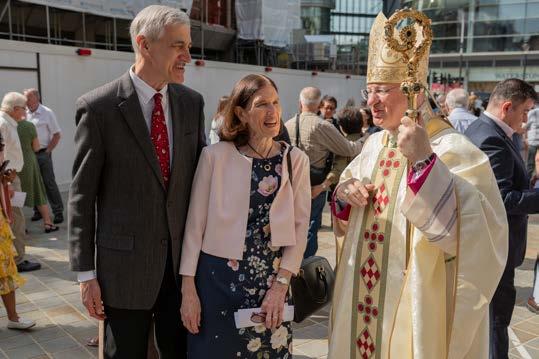
On Saturday 23 May, Archbishop Richard Moth was joined by married couples celebrating five, ten, twenty-five, thirty, forty, fifty and sixty plus years of the Sacrament of Marriage at the annual Mass for Matrimony.
Dear brothers and sisters,
We rejoice today in the response of those who answer the call to the vocation of marriage. A great number (466 couples) are present here today and we pray with and for all those across our Diocese who live this vocation. Amongst those of you celebrating the vocation of marriage here today is no less than 15,501 years of married life. If we were sent back to 13,500 years before the birth of Christ, we would find ourselves at the end of the last major ice age!
This is a day of congratulations for you all, but please forgive me if I mention four couples here with us today in particular: Mary and Thomas Conway, celebrating their 65th Anniversary this year; Shalina and Anthony Monteroi and Sophia and Dominic Roberts, celebrating their Golden Wedding Anniversaries this very day; Kelly and Edward O’Reilly, celebrating their 17th Anniversary today.
Your love for one another reflects the love of which St John speaks in his first letter. In the love you have for one another, you are an example of the love we see in Christ. We see in you people in whose love God abides. This is the essence of the vocation of marriage: a life lived in a love that shows to all around the love that exists in God himself.
Back in the days when I used to instruct couples preparing for marriage, I would always ask them why they wanted to marry. It often took a while before, often in a rather embarrassed way, one would say: ‘We love one another’. It is difficult to describe why this happens. This is understandable, because there is something about love that defies description. It is mystery. This is not surprising, really, since love is of God himself, and God is mystery. It is this love of God that you show to the world; in your love for each other and in the children, who are God’s gift.
The marriage at Cana presents us with many moments of mystery. Why did Jesus tell his Mother that his hour had not yet come? Despite Jesus’ response, why did Mary trust that all
would be well for those celebrating this marriage? Why 600 or so litres – 130 gallons of wine? And the best sort too? A number of commentators, including St Augustine, have considered Jesus’ response a reference to the ‘hour’ of his passion and death. Mary’s trust is certain. She knows her Son will intervene. She does not know when or how, she simply trusts.
Today, Cana is really a suburb of Nazareth, on the northern side of the hill, with Nazareth on the south side. The journey by road today usually involves a traffic jam. In Jesus’ time, it would have been a short walk over the hill from one small town to a small village. Even with the whole town gathered to celebrate the wedding, along with guests from Nazareth, the gift of 130 gallons of the best wine, when the party had already drunk all the wine provided, is beyond description.
The very vocation of marriage is, indeed, one of gift beyond description. The gift of one to another, in a lifetime of fidelity and open to the gift of the children and wonderful beyond description. The lifetime of fidelity speaks to us of the faithfulness of Christ in his life of self-giving without limit. The children with whom God may bless you show to us all the fruitfulness of God’s love. There may be some challenges and struggles along that way. The journey through these and with the support of others, can, we pray, strengthen a relationship and even open the way to new possibilities.
The gift that each of you is to the other is a gift not only to family. It is a gift to friends, to communities, to the Church and to the world. This is because, very simply, your living out of the vocation to which you have been called is an experience of grace, and encounter with the love of God himself for all whom you meet.
May your love for one another be, for us all, an everpresent witness to the love that Jesus himself manifested at Cana: a love that is beyond measure, a love that is nothing less than the love of God himself.
Linda McHugh
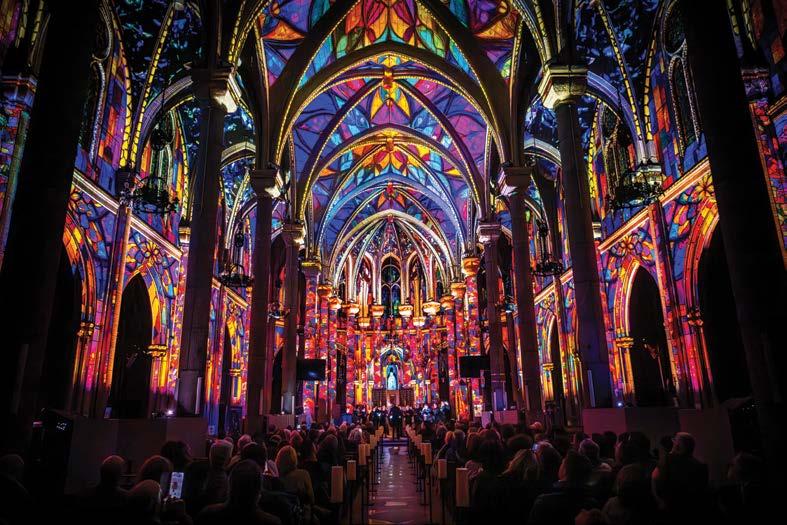
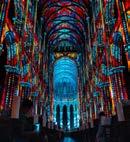
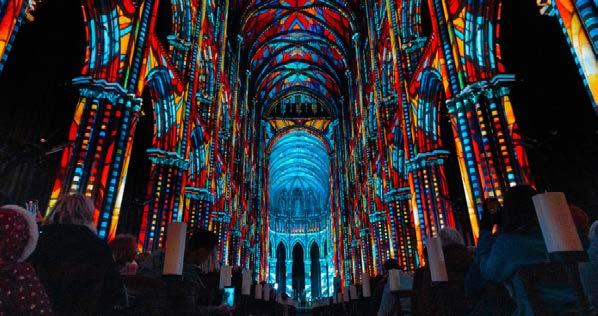
From 1 July this year, to (potentially) late January 2027, Westminster Cathedral will be the setting of a fully immersive world of sound and light, for four nights a week. Luminiscence is a ground-breaking take on the concept of son et lumière; a 360-degree video projection experience, using 24 laser projectors, which will bring the Cathedral to life in breathtaking ways with colour and imagery.
The concept was initially developed in the United States, where it was staged at a number of churches and cathedrals in different locations, such as Minneapolis, Philadelphia and San Francisco. In Europe, Luminiscence was performed in several cities, in churches filled to capacity, such as Barcelona, Munster, and to Paris, where it was witnessed by Fr Patrick van der Vorst, the Precentor of Westminster Cathedral, who instantly saw how well it would suit our unique ambience. The first UK production has recently been staged in Manchester Cathedral, where it has received universally high ratings from those who have seen it.
The season at Westminster Cathedral, however, required an upscaled concept, not least because of the size of the building and our Central London location. Across more than 100 evening performances, visitors will experience a spectacular 40-minute performance telling the story of the Cathedral through light, music, and narration, culminating in a vision of what the Cathedral may one day look like fully covered in mosaics. The experience is accompanied by carefully selected pieces of music, and a poetic scripted narration by acclaimed actor Hugh Bonneville, written especially for Westminster Cathedral by actor and writer Tim Whitnall.
Each week, until mid-September, there will be one performance each night at 9pm, from Wednesday to Saturday. Thereafter, there will be two performances at 7.30pm and 9pm. Additionally, from 19 September, the performance will feature
a live choir and a 14-piece orchestra, raising the audience’s experience to another level entirely. As the founder of LOTCHI, the organisation behind Luminiscence put it:
‘We are convinced that heritage should not only be looked at but felt. Through light, sound and narration we hope to offer everyone a suspended intimate universal moment – a fresh look at monuments charged with history and memory.’
LOTCHI, the organisers, will take charge of all technical aspects of the experience, and will be responsible for marketing, ticket sales, and stewarding at the performances. However, Luminiscence provides an important opportunity for the Cathedral to raise much-needed funds for upkeep, through the sale of programmes and merchandise. As such, we are now putting together a team of volunteers who can help us do this.
You would need to be aged 18 or over, and able to work from 8pm to 10.30pm in the summer months, July to mid-September, and subsequently 6.30pm to 10.30pm. Previous sales experience would be useful, but not essential as full training will be given. You would not have to volunteer every day, but we are looking for people who can work at least two evenings a week during this period.
This is a wonderful opportunity to experience a historic, cultural and spiritual initiative at Westminster Cathedral. In doing so, you will help us to present the Cathedral to new audiences, quite literally in a different light.
To register your interest in becoming part of the team, and to make your mark on the history of the Cathedral, then please fill in the form on the website: westminstercathedral.org.uk/ volunteers-needed. Alternatively, please email wceventvols@ gmail.com with your name and contact details.
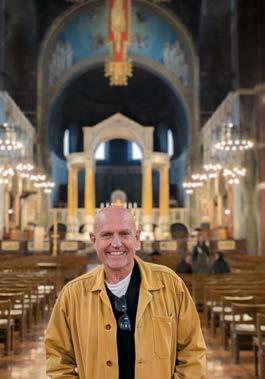
Tim, thank you for offering to share your experience of working with Luminiscence. Readers of Oremus may know you from various acting roles, and I know you are a prolific voice actor, but could you tell us more about yourself and how you got involved in script writing for this project?
I have worked as an actor and vaudevillian for many years across theatre, television, film and radio. I did a lot of West End shows and I have been very lucky to have stayed in gainful employment for most of my career, but I’ve always wanted to write, and to tell stories so, about 20 years ago, I decided to put all my eggs in that basket. I was very lucky; I had written a couple of projects that had been commissioned, including a drama about Kenny Everett the DJ for the BBC, which did very well for me. I have also written a West End play about Eric Morecambe, the comedian. As a life-long performer, I wrote about what I knew, which was the best advice I had ever received.
I managed to cross over from performance to writing, but opportunity was key. I was able, as an actor, to say to producers and directors that I had worked with, ‘may I write you something?’ I then went from writing sketches, comedy, and small bits for children’s television to educational scripts for school radio, which I loved. I ticked along writing these wonderful, colourful things and then, last October, the opportunity arose to work with the Luminiscence team, which was completely new to me. It came via a theatre production company called Evolution, that I have very happily worked with on a number of projects. They had since diversified and one of our lead producers, Emily Wood, whom I have worked with a lot, asked if I would be interested. So, we went out to Bordeaux to see the Luminiscence production there and I was absolutely blown away.
We then set to work on the first UK production in Manchester Cathedral and I quickly realised the most amazing thing; each production is individually built, as every building and congregation is unique. For example, in Manchester, the Stoller organ is in the middle of the cathedral and literally divides the high altar from the nave. But, like any good play, or screenplay, character equals plot and it is the characters, I think, rather than the bricks and mortar, that tell the greatest story of each of the buildings I’ve worked on so far. So, when the opportunity to be a part of Luminiscence at Westminster Cathedral arose, at the beginning of this year, my heart just soared. I was so excited.
And could you say a little about the actors who bring these scripts to life?
In terms of narrators, we were blessed. We had Christopher Eccleston narrating the Manchester production, whom people may remember from Doctor Who and various wonderful dramas. It is important for the team that the narrator is indigenous to the particular venue. In Christopher’s performance, he talks about the materials used in the building of Manchester Cathedral, such as slate and limestone (the backbone of Lancashire), it’s wonderful. It lends credibility and brings my words to life. For Westminster Cathedral, we are delighted to have Hugh Bonneville narrating. Many of your readers will know him from Downton Abbey , but I also
love his Sherlock Holmes. His voice is so beautiful and he will give the script a gravitas and a light comedic touch, imbuing the words with meaning. I am sure he will be incredible.
One thing I think our audiences will appreciate, is just how much is going on in 360 degrees around them. I think because of my theatrical background, I was able to bring a sense of, not so much drama, but a sense of theatricality to the script, it requires a narration which holds it all together. It has to mean something as well. You can’t just sit there and expect to hear a sort of a boiled-down, whistle-stop history of the City of Westminster, or of the Cathedral itself. I wanted to find little moments of colour, and comedy, or humour in it.
Did you have a particular creative process when approaching the script?
Well, the first thing to do is to turn up in the building and let it guide me. I tend to do that with anything. If I write about a historical character, or a biopic, I try to walk in their footsteps. Even before meeting with Fr Patrick van der Vorst, who was instrumental in shaping the narrative of my script, just walking through the doors gave me a great sense of atmosphere and destination. The story is about the building and so it needs to be kept at the centre of the narrative. The second thing is economy. You need to know what to leave out. For example, I would have loved to include Alfred Hitchcock’s Foreign Correspondent and that chilling scene on the Campanile. I had to be very economical about what I could say within the time frame. It whizzes by in a wonderful way, but there is so much happening and so much to take in, that I wanted it to be as concise as possible, but to keep people interested and delighted. There’s a lot of delightful detail in the story of this Cathedral, but unfortunately, we would need another eight shows to be able to tell it all.
The third thing is how I can use the technology available and the beautiful music to tell the story, and that’s very different for me; normally the technology comes to the written word. It’s a very emotionally stirring experience. I left the show in Bordeaux, and certainly in Manchester, feeling quite affected by it. I was also very touched by the number of requests my writing company received, looking for the Manchester script. Most of them said ‘you mentioned something that no one else has done’; ‘my mum and dad met in that café’; ‘thanks for mentioning Ricky Hatton the boxer’. And yet, the only reason I mentioned Ricky Hatton, of course, was because his memorial service was held in that cathedral. Again, it was a case of putting that cathedral as the absolute tent pole, if you like.
I managed to get this script together by the end of March, when I sat down with Fr Patrick again. He and I sat in Clergy House and worked on honing it, so that it excluded nobody and allowed everybody in from a narrative perspective. It was key that he took me on a personal journey around the space from behind the Rood. It was thrilling to stand and look out at the seats from the perspective of the high altar, not just for me but for the whole team. So he and I worked closely on making it slightly more spiritual, slightly more dramatic and engaging. He was really insightful, but also great fun to work with. He understood dramatic convention, construction, and that it had to have a narrative hook.
By July, when we are open, there will be an incredibly eclectic, multicultural, international audience. London comes alive in the tourist season, so I wanted it to be an international story as well, one that not just the Cathedral but London could be proud of. The narration is part of it, but the visuals are bewitching. The music is incredible too, and we’ve got the beautiful choir to bring that to life. The choir and the orchestra also perform live on several occasions. I’ll be front row for the first performance, actually no, I will be back row because that is the best place to see the whole show. It’s going to be incredible; literally son et lumière, sound and lights. So, the marriage of narration, music, these incredible visuals which belong to a new technology called ‘video mapping’, where they can physically light whatever you want to light in the entire building. It will be breath-taking.
Was there anything that surprised you about the history of Westminster Cathedral, or do you have a favourite story from your research?
Yes, the Cathedral is a 19th century necessity built in the most amazing part of London, on what Dickens described as ‘a slum in a swamp’ (the banks of the Thames and the delta of the River Tyburn) which endures into the 21st century. Despite being relatively contemporary, it has survived wars, pandemics and political unrest, and yet it endures. It is still here, still helping people and nurturing them, bringing joy, succour, and relief. I remember being in the area during the Poll Tax protests, terrified as cars were set ablaze. Even more chilling were the pictures and films of the devastation of Victoria Station, and the Houses of Parliament, which they hushed up at the time for public morale, during the Blitz. I didn’t mention this in the script, due to the economy of time, but the photographs of the fully payloaded German Dornier bomber crashing into Victoria Station were phenomenal. He had intended to unload over Buckingham Palace, but an RAF pilot physically rammed his plane into the station, because he had run out of ammunition, before parachuting to safety. My favourite story, however, was the Cathedral’s vegetable crater garden. There was a lovely caretaker here called Mr Hayes who dug for victory and made the most of the massive bomb crater between the Cathedral and Morpeth Terrace, where Winston Churchill lived. It has now returned to being a playground full of laughing kids who have no idea of the devastation that came before.
Being a Catholic church and an active place of worship, how does faith play a role in the script?
It absolutely plays a role, and Fr Patrick was very keen to invoke that in the script as an imperative, which was the right move. One of the adjectives he used to describe the Cathedral was prayerful. The word prayerful is very seldom heard, but this is a prayerful place. I tend to blow in off the street from Victoria, through these doors, and quietly sit with my own private thoughts and my notebook, and physically enjoy being in the atmosphere of this building. Now, when we arrive with our Luminiscence trucks, and projectors, and orchestras, and choirs, and everything else, I think it’s essential to preserve that atmosphere. And in fact, if anything, to enhance it and bring something in that trades off that atmosphere, forming a cohesive whole.
One of my favourite parts of the Cathedral is the Chapel of St Gregory and St Augustine. I’m from Bury St Edmunds, and seeing the mosaic of St Edmund with his arrows, suddenly I’m back on the roundabout with his statue. Also, I went to St Benedict’s School, and my niece went to St Cuthbert’s College in Durham. It’s a silly thing to say but, with all the familiar faces on the walls, it felt like I was home.
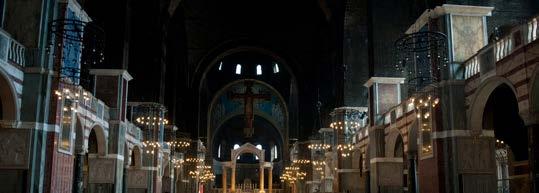
That being said, obviously we will have a very ecumenical audience for a production like this. One of the analogies I loved, which Fr Patrick pointed out to me, is the blue mosaic above the baldacchino and the high altar. Nobody notices them, but each of those blue mosaic tiles forms a human face. Isn’t that wonderful? Each one is unique and integrated, that to me is humanity. It is also important because it puts the building back at the heart of the experience. I watch as people come in and their jaws hit the floor, because of the sheer scale of the building, and the height of those ceilings and, of course, the soot darkened bricks. Darkness to light is obviously a huge Christian metaphor. Then, of course, there is the Great Rood cross, with Christ on the front and Mary on the reverse. It is incredible the way the sword passes through them both, uniting them. I tried to get as many of those marvellous little details in the script as I could.
Westminster Cathedral’s vast black ceiling is quite a blank canvas in comparison to the Gothic arches of Manchester Cathedral. Does this make it easier to utilise, and will we see any foretaste of mosaics to come?
Well, every building is different. The interior of Manchester Cathedral is probably a quarter the size of Westminster, but that’s not an issue for video mapping. The thing that blew me away with the technology, when I first went to Bordeaux, was that they cannot miss a brick, or a tile, or a mosaic. Every millimetre of that church was accounted for. Suddenly a statue will appear on the wall in front of you and you wonder if it was there when you took your seat, and then it disappears. Then, when I saw the show in Manchester, they were projecting something onto some marble pillars, and literally the striation in the marble worked with the projection and the illusion of waves started forming. I did, however, realise early on that you can’t light everything, because the audience will be static. I would love to have illuminated the
Lady Chapel, but you have to understand the economy of what you’ve got, and how to set it.
In many ways, Luminiscence is an amalgam of installation art. It literally combines music, light, sound effects, narration, and creative writing to tell the story of an iconic building, and that is exactly what the creative team is required to do, but it actually happens inside that building, which I think is amazing. Without being too preachy, this is going to be the most exciting 50 minutes, because it will actually dazzle you. The music and the lights are incredible, and the 360-degree projection is jaw dropping.
As for the unfinished ceiling, I am not at liberty to disclose any plot spoilers. However, Fr Patrick has come up with a wonderful idea which will bring the Cathedral to life. I got quite emotional when I wrote about John Francis Bentley. As many of your readers will know, he requested not to be buried in the Cathedral, as Cardinal Vaughan now is. Much like Christopher Wren, he wanted the building itself to stand as his memorial. To complete his vision, Fr Patrick told us that it would cost between 90 and 100 million pounds to finish the mosaics as he had intended them. But looking up at these vast arches and domes, I’m sure it will reach completion. In fact, the beautiful watercolour of the finished Cathedral, alongside the collection box for the fund, was inspirational in that section of the show. There’s a joke in the script, I think it was Spike Milligan who said, ‘I love London but it’ll be nice when it’s finished’ and you only have to go to the top of the Campanile here to look at the amount of industry and work going on in our city.
I look forward to 1 July when I will get to experience the whole Luminiscence production first-hand. And thank you, Tim, for offering such a fascinating peek behind the curtain. Before I let you go, is there one thing you hope that audiences will take away from the performance?
I want people to leave this Cathedral having been educated, informed and entertained. If they are not from London, I want them to leave a proud Londoner. I want them to feel that it’s not defined by its walls, but by its people. And for those who are Londoners, and for those who do know this church, I want them to leave surprised!
Fr John Luke Gregory OFM, Custody of the Holy Land
As we embark on this significant Jubilee Year of St Francis, it is essential to reflect on the profound impact that this beloved saint has had on the Catholic Church and on the world at large. Celebrating the 800th anniversary of the Franciscan Order, this Jubilee provides an opportunity not only to honour St Francis as a man of peace, but also to understand how his teachings continue to inspire and guide us today.
Born in Assisi in 1181, his life was a journey of transformation. St Francis, originally named Giovanni di Pietro di Bernardone, led a privileged life as the son of a wealthy merchant. However, a series of life-altering experiences, including his time as a soldier and subsequent severe illness, prompted a profound transformation in the young Giovanni. In this transformation, he began to seek not the comforts of earthly possessions, but rather a life dedicated to God and to the service of others. His radical embrace of ‘Lady Poverty’, and the renunciation of wealth, became the hallmark of his spiritual journey. St Francis’ encounters with nature and animals reflect his profound connection to God’s creation, our common home, earning him official recognition as the patron saint of ecology. This spirit of kinship with all creatures is most clearly embodied in his famous Canticle of the Sun, which serves to remind us that peace is only possible when we recognise the interconnectedness of life.
Indeed, one of the most significant themes of St Francis’ legacy is his steadfast, unwavering commitment to peace through reconciliation. During a time marked by violent conflict, he
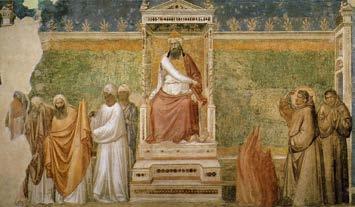
boldly sought to mend the rift between factions. This was exemplified by his historic encounter with Sultan Malik alKamil during the Fifth Crusade. Whilst many sought to wage war, St Francis pursued dialogue, embodying Christ’s call to love one’s enemies and to strive for understanding amidst discord. In this Jubilee Year, as we reflect on the lessons St Francis offers, we are called to engage in acts of reconciliation within our communities. The modern world, fraught with division and strife, yearns for peacemakers who can bridge gaps and foster harmony. As believers, we look to St Francis as a model of faith, inspiring us to foster peace, compassion, and goodwill among all people.
We are all called to live the Spirit of St Francis, and so, as we celebrate this special Jubilee Year, it is vital for each of us to reflect on how we can incorporate the spirit of St Francis into our daily
lives. We might ask, what does it mean to be an instrument of peace in our families, workplaces, or social circles? It may begin with simple acts of kindness, understanding, and compassion. In moments of conflict, whether at home or in societal debates, let us strive to be peacemakers, listening to others with empathy and finding common ground. In our communities, we can find ways to promote justice and support the marginalised. Simultaneously, our spiritual lives can be enriched by aspects of Franciscan spirituality, such as humility, simplicity, and a profound reliance on God.
As we journey through this Jubilee Year, let us dedicate ourselves to prayers inspired by St Francis. My personal favourite is the one that many of us know: ‘Lord, make me an instrument of thy peace!’ Amen, so be it!
John Woodhouse
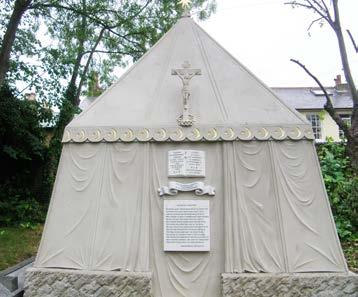
On Wednesday 10 June, the Interfaith Group will return to the Burton Mausoleum in Mortlake for an interior tour with Tharik Hussain, at 12.30pm. Please be aware that we will NOT, therefore, hold our regularly scheduled meeting in the Hinsely Room on Wednesday 17 June.
The Burton Mausoleum is a Grade II* listed monument, and the final resting place of Sir Richard Burton (1821-90), explorer and translator of The Arabian Nights , and Isabel, Lady Burton (1831-96), who designed the tent-shaped structure in Carrara marble and Forest of Dean stone, with Christian and Islamic imagery.
To join the tour, meet at 12.30pm in the churchyard of St Mary Magdalen Roman Catholic Church, 61 N Worple Way, London SW14 8PR. If alighting at Mortlake Station from Clapham Junction, cross the tracks, and follow the railway line back towards Clapham.
We are very grateful for the support of the following:
Leticia Dominguez Abada
Lally Ambatali
Leonila V Bennabe
Keith Best
Dr Stuart Blackie
Anne Veronica Bond
Lolita Botanes
Richard Bremer
Hajnalka Burai
Lorenzo Cabrelli
Mrs Erlinda Chin
Francis George Clark
R & L Collyer-Hamlin
Daniel Crowley
Benedicta Jamogha Dako
Angelita Caronan Duran
Emmanuel Ekeweloem
Cora Emflorgo
Angelita Emperador
Ms Georgina Enang
Fr Joseph Farrell K.H.S.
Ruby & Joseph Farrell in memoriam
Revd James Francis Friedenthal
Fred Gardiner
William Gardner-Hunter
Juanita Grecalda
Connie Gibbes
Zoe & Nick Goodway
Rosalinda Grimaldo
Agnes Haein Kim
Mrs Valerie Hamblen in memoriam
Amanda Hill
Jithro and Ira Nadine Hangad
Bernadette Hau
Mervyn and Barbara Hogg
Mrs Cliona Howell
Alice M Jones & Jacob F Jones
Poppy K
Rosanne Kay
Mary Thérèse Kelly
John Langan
Raymund Livesey
Alan Lloyd in memoriam
Clare and John Lusby
Tony McGee
Linda McHugh
Christiana Thérèse Macarthy-Woods
Ms Ludivina Mangmang
James Maple
Paul Marsden
Mary Maxwell
Dr Denis Moloney
Dr George Morris
Abundia Toledo Munar
Euphrasie Mundele Kilolo
Chris Stewart Munro
Mrs Brigid Murphy
Kate Nealon
Cordelia Onodu
Nigel Parker
Cris Ragonton
Alan Rainer
Ann-Marie Rivers
Clementina Rokosu
Precy Salvador
John Scanlan
Veronica Scrope
Sonja Soper in memoriam
Tessa and Ben Strickland
Yollie Sumayod
Julia Sutherland
Eileen Terry
Robin Michael Tinsley
Lucila Torrefiel
Dr Timothy I Young in memoriam
Teresa in memoriam and Peter Zurenkas and of our anonymous Companions
If you would like to become a Companion of Oremus, see page 2
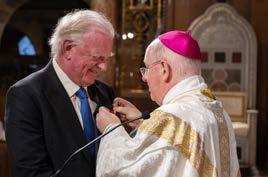
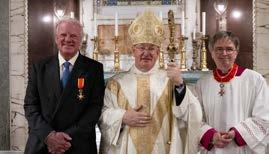
On Tuesday 5 May, Sir Edward Leigh MP, Father of the House of Commons, was invested as a Knight of the Pontifical Equestrian Order of St Gregory at a Mass celebrated by Archbishop Richard Moth, for his service to the Church in public life. With him, Paul Moynihan KSG, the Archbishop’s Master of Ceremonies and proof-reader for this magazine, was elevated to the rank of Knight Commander. We wish them both hearty congratulations.
Caption in here
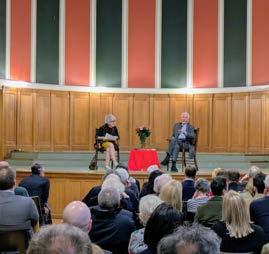
With a Tube strike averted, the Friends of Westminster Cathedral welcomed Lord Butler and Baroness Shephard to share a candid and humorous peek behind the curtain into the inner workings of Westminster and Whitehall. This was preceded by an intimate reception, generously funded by Ms Cliona Howell.
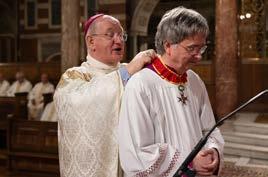
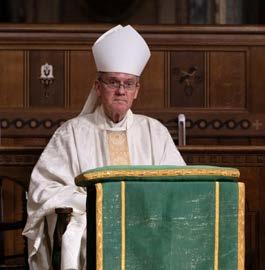
On the feast of the Ascension, we were joined by Catholic communications personnel from around the country at the 5.30pm Mass, celebrated by Archbishop Richard Moth with a homily from Bishop John Arnold, Bishop of Salford and Lead Bishop for Communications.
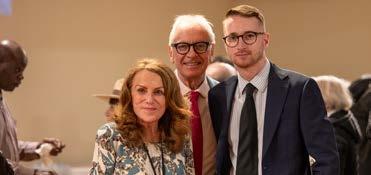
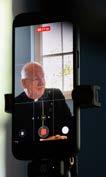
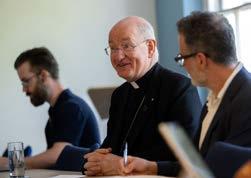
Congratulations to Archbishop Richard Moth, who was elected President of the Catholic Bishops’ Conference of England and Wales at their recent plenary meeting. The photographs were taken at a post-plenary press conference in Eccleston Square.
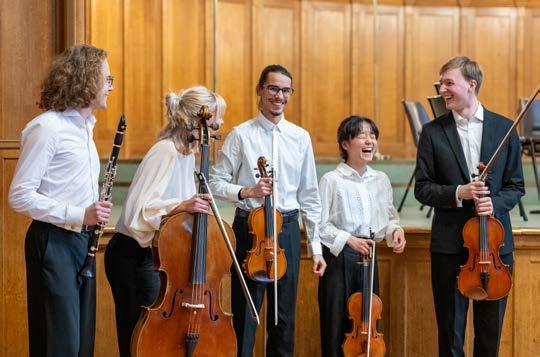
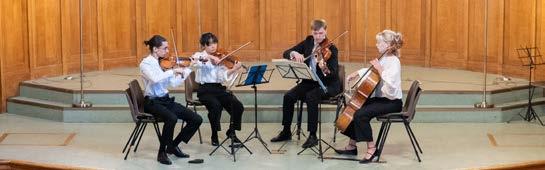
On Thursday 30 April, the Friends of Westminster Cathedral hosted the gifted young members of The Orion Orchestra for an intimate performance of Mozart’s Clarinet Quintet and Schubert’s Quartettsatz, followed by refreshments and rapturous applause.
Andrew Hollingsworth
At the end of this month, we are excited to launch another Big Give campaign. Having raised enough to restore the sanctuary chandeliers, our attention now turns to the urgent and essential upgrades needed for the Cathedral’s sound system. Much of our current equipment, such as the main control and processing components, are now causing serious issues and are officially obsolete. Consequently, repairs have become increasingly difficult due to limited support and availability of parts.
At present, the Cathedral relies on multiple systems of differing ages and technologies. The Lady Chapel is served by an analogue system dating back to the 1980s, while the main body of the Cathedral uses early-generation digital systems. Together, these create inconsistencies in sound quality and reliability across the space.
Our goal is to install a single, modern, fully integrated digital sound system throughout the entire Cathedral. This upgrade will significantly enhance the clarity and reach of sound, ensuring that services, music, and spoken word can be heard with dignity and precision in every corner. Most importantly, it will greatly reduce the risk of system failure, something that could otherwise occur at critical moments, such as major feast days and special services.
We aim to raise £20,000 in online donations during a two-week campaign. Thanks to the Big Give’s matched funding, this could be doubled to £40,000 and, with Gift Aid applied to many donations, we are confident that we can reach the full cost of the project. Further details will be available on our website, in the newsletter, and in the July/August edition of Oremus.

Our grateful thanks go to the young musicians from the Orion Orchestra who performed Mozart’s Clarinet Quintet and Schubert’s Quartettsatz (more photographs on page 15). Since the event, I have only received positive feedback and so, going forward, we hope to host three musical performances with Orion each year, one in each term.
On 19 May, Baroness Gillian Shephard and Baron Robin Butler offered us a rare and humorous insight behind the doors of Whitehall and Westminster, reflecting on decades at the heart of British politics (photograph on page 14). It was interesting to hear a first-hand view of the Brighton hotel bombing, and just how close we came to losing many more members of the then government. There were also much more lighthearted reflections, including the attempt to cut costs by reducing of the Civil Service tea breaks and the, often friendly, cooperation behind the scenes between government and opposition in the 1990s,
I am very grateful to everyone who attended our recent events. It is only through your support and being able to regularly attract 150 to 200 people to events that we can secure the support of external musicians and guest speakers. My thanks also go to Cliona Howell for sponsoring the reception, to Peter Sheppard, Chairman of the Friends’ Events Committee, for making the arrangements, and to all the volunteers who help at the events, particularly with catering. The committee are working hard to finalise the September to Christmas programme, which should be published in the July/August edition of Oremus.
Our popular quiz evenings are always great fun and offer a wonderful opportunity to meet fellow parishioners. Attendance typically averages 40–50 people (7–8 teams), but Cathedral Hall can comfortably accommodate many more. If you can gather a team, perhaps from a parish group, your workplace, or by inviting a neighbouring parish, we would be delighted to welcome you.
Thursday 4 June 2026, 6.30pm
Quizmaster: Fr Patrick van der Vorst
Thursday 9 July 2026, 6.30pm
Quizmaster: Fr Mike Guthrie
Tickets, £20 including a fish and chip supper, are available on the Cathedral website, under ‘News & Events’. Alternatively, email friends@rcdow.org.uk.
Trip
On Saturday 20 June we will visit Farnborough, including St Michael’s Abbey and Farnborough Air Sciences Trust (FAST). Travel will be by minibus, which we expect to be fully booked, but the destination is also easily accessible by train or car. We will depart at 9.30am from Clergy House, 42 Francis Street. Please note the revised time following a more detailed examination of the logistics. For those who do not wish to travel by minibus, please join us at FAST for 11am. We may have some capacity to collect from the station please make contact by email in advance friends@rcdow. org.uk. We will have lunch at FAST, where there is a picnic area for those who wish to bring a packed lunch. There is also a café, where food can be purchased.
Tickets can be purchased on the Cathedral website, under ‘News & Events’, or by scanning the QR code: £25 including minibus travel, £15 without travel, to cover our donations to the Air Sciences Trust and the Abbey.

Tuesday 23 June 2026 at 6.30pm in Westminster Cathedral Hall. All members of the Friends are warmly invited to attend. The formal business will be followed by refreshments. If you wish to attend, please let us know at friends@ rcdow.org.uk, so that we can plan catering.
On Wednesday 1 July 2026 at 9pm, the Friends are invited to join an immersive light, sound, and narration experience in Westminster Cathedral. Admission is free for members of the Friends, but tickets must be reserved in advance.
For more information about any event, or if you are unable to book online, please contact: friends@ rcdow.org.uk
Do also get in touch if you have an idea for a future event or would like to organise one for the Friends.
To join the Friends of Westminster Cathedral, please visit tinyurl.com/ CathedralFriendsMembership.
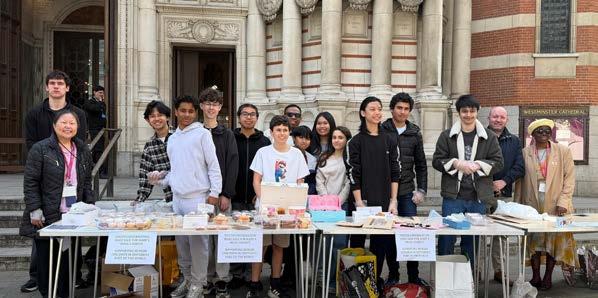
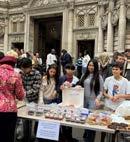
On Sunday 3 May 2026, the parish Youth Confirmation candidates held a bake sale on the Cathedral steps to raise funds for Mary’s Meals, led by Fr Vincent Mbu’i alongside their catechists: Caroline Benker, Donal McKeown and Julie Hanssen.
The Cathedral Confirmation programme encourages the candidates to recognise Christ in others and to act with love and compassion. The young confirmandi demonstrated this in abundance, by putting their faith into action. Although they had committed to raise money for charity, they were also keen to share their cakes with the homeless on the Piazza. These baked goods were largely made by the young people themselves and proved quite popular with the Cathedral congregation and pigeons alike. Thankfully, we were able to keep the pigeons at bay! Under supervision, the young entrepreneurs packed, priced and sold their wares, and even devised clever marketing strategies. Their initiative and resourcefulness were an inspiration to us all.
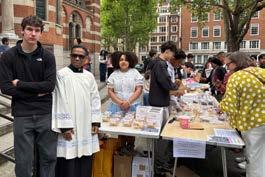
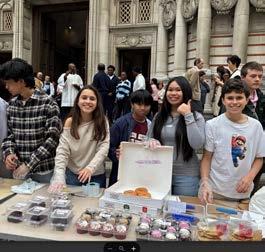
Despite the short sale period, between the end of the 10am and 12 noon Masses, the cakes were quick to sell, raising the princely sum of £591.26. The young entrepreneurs had decided as a group to send the funds to Mary’s Meals, following a discussion on global justice, hunger and the call to serve those in need, in their catechism session. Mary’s Meals provides life-changing school meals to children living in some of the world’s poorest communities, and in war-torn areas.
Thank you to the candidates, their parents, parishioners and visitors for making this bake sale such a success.
Lorcán Keller
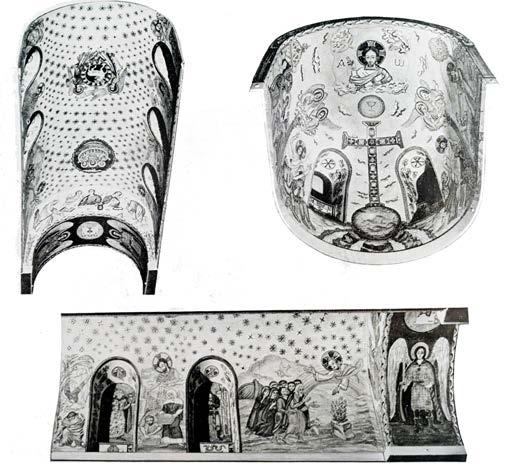
Last month I shared a small photograph from the May 1956 edition of the Westminster Cathedral Chronicle, a precursor of this magazine, showing a model of the proposed Blessed Sacrament Chapel ceiling by Boris Anrep. I have since been asked to share a larger version for people to compare and contrast the finished mosaics, which were unveiled in 1962, with the artistic plans.
From my own perspective, it appears that there are two design elements missing from the original plan; the clouds hovering
above the stars, and the elements above and beneath the crux gemmata in the apse. Here, there appears to be a chalice between the cross and Christ the Pantocrator, which did not make it into the finished work. Also, beneath the cross, evoking the motto of St Bruno (‘Stat crux dum volvitur orbis’ – ‘The Cross stands steady while the world turns’), it appears that the original design did not include a depiction of the New Jerusalem. In the finished design, Temple Mount has become the Universal Church (St Peter’s Basilica) from which the four rivers of Paradise flow, evoking Ezekiel’s vision (47:1).
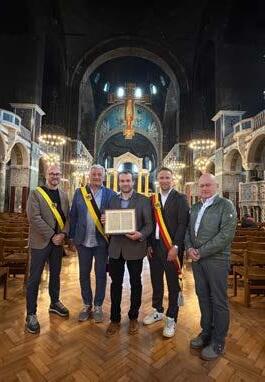
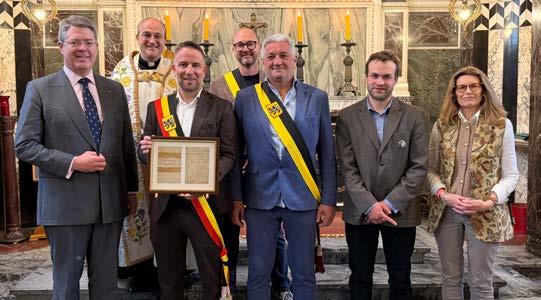
On Tuesday 12 May 2026, Westminster Cathedral hosted a moment of rare historical and spiritual significance: the official handover of a letter written by Fr Damien De Veuster; St Damien of Moloka’i. The ceremony was presided over by the Precentor of Westminster Cathedral, Fr Patrick van der Vorst.
The letter, which had been entrusted for many years to the care of St Francis Leprosy Guild (SFLG), was formally presented to the Director of the Damien Museum (Damiaanmuseum) in Tremelo, Belgium, accompanied by a civic delegation from the town. A special short service, devised specifically for the occasion by Fr Patrick, was held in the Holy Souls Chapel in Westminster Cathedral. It brought together representatives of SFLG and the Damien Museum, and included prayers, scripture readings, and a few words from Fr Patrick, Edward Reed (Chair of Trustees of SFLG) and the Mayor of Tremelo.
Penned during his ministry among leprosy patients on the island of Moloka’i, in the Pacific, the letter offers a direct and intimate connection to one of the Church’s most compelling saints. Damien, a Belgian priest of the Congregation of the Sacred Hearts of Jesus and Mary, famously lived among, and ultimately died of leprosy alongside, the community of people with leprosy exiled to the Kalaupapa Peninsula, between Hawai’i and Maui. The island remained isolated by law until 1969, and some former patients live there to this day. St Damien’s life of radical solidarity has inspired generations of Christians, medical workers, and humanitarians around the world.
The letter, written the year before Fr Damien’s death, is, in large part, a thank you letter to one of his regular London correspondents for funding received, providing a salutary reminder of the eternal challenges of fundraising for a neglected disease affecting mainly the poor and associated with millennia of stigma. Written long before the antibiotic cure for leprosy was identified, it is an inspiration to SFLG’s trustees in the 21st century to continue the fight on behalf of the marginalised and vulnerable patients.
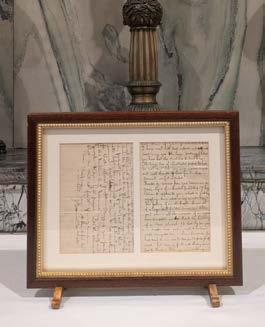
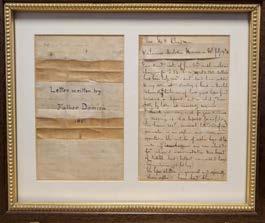
Founded in 1895 by a radical nurse Kate Marsden, who was herself in contact with St Damien, St Francis Leprosy Guild is the UK’s only Catholic charity specifically dedicated to supporting people affected by leprosy and has long safeguarded the letter as the jewel of its historical archive. Katharine Jones, SFLG Director, said:
‘The decision to present the document to the Damien Museum reflects a deepening partnership between SFLG and the custodians of Damien’s legacy – ensuring the letter will be preserved, studied, digitised and shared with pilgrims and scholars from around the world.’
At the handover, Edward Reed, Chair of SFLG delivered a moving speech, in which he said:
‘It is fitting that the letter should be going home; it has been an honour and an inspiration for St Francis Leprosy Guild to have custody of it, but the trustees feel that an artefact of this historical significance in the fight against leprosy should be given greater prominence and accessibility, re-joining in the Museum’s archives other correspondence to the Saint from his then supporters.’
For those still affected by leprosy, the moment served as a reminder that Damien’s mission has not been confined to history. More than 200,000 people are diagnosed with the disease each year, and SFLG continues to fund treatment, rehabilitation, and community support in some of the world’s most vulnerable regions.
For SFLG, the handover was both a moment of thanksgiving and a renewal of purpose. The letter stands as a testament to Damien’s courage, compassion, and unwavering commitment to human dignity. Donating it to the museum dedicated to his life in Tremelo, where he was born, allows his story to be more widely known and supports greater understanding of SFLG’s work.
SFLG was honoured to hold this ceremony in Westminster Cathedral, seat of the Archbishop of Westminster, the Most Reverend Richard Moth, who has recently become the Patron of St Francis Leprosy Guild in succession to Cardinal Nichols.
As the letter was placed into the hands of its new custodians, it symbolised not an ending but a continuation; the ongoing call to serve Christ among the poorest and most forgotten. In the spirit of St Damien, St Francis Leprosy Guild remains committed to that mission.
And for those with the ability to access a QR code, feel free to look at the letter on the Museum’s site and perhaps vote for it to be recognised as the artefact of the year in Belgium!

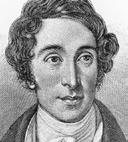
Fr Nicholas Schofield
The Westminster Diocesan Archives houses many of our historic sacramental registers, some going as far back as the 1740s. Many of the names recorded there are now long forgotten, perhaps even known only to the Lord. Flicking through the Burial Register of St Mary Moorfields in 1826, for example, there are plenty of Irish names, as you might expect: 22-year-old Anne McCarthy of Saffron Hill or 2-year-old Mary Ann Grady of Warwick Place. In the midst of them one name stands out: Charles (or more accurately, Carl Maria) von Weber. It will ring a bell for classical music lovers. Still remembered today for his operas and music for piano and clarinet, Weber died during a visit to London 200 years ago this month. His name is more closely connected to Dresden, then in the Kingdom of Saxony, where his body was finally returned after being interred at Moorfields for 18 years.
Acclaimed as a pioneer of German Romantic Opera, in works such as Der Freischütz he incorporated themes from German folklore and helped develop a distinctly ‘national’ style which would develop over the subsequent century. This month marks the bicentenary of his death, yet what is largely forgotten is that this eminent composer not only died during a visit to London but was initially interred in the vault of one of our churches, St Mary Moorfields.
Born in the north German town of Eutin in November 1786, Weber’s family claimed aristocratic lineage, which led his father to adopt the affectation of ‘von’. At an early age the future composer showed every sign of being a musical prodigy like Mozart (whose wife, incidentally, was his cousin). His teachers included Michael Haydn and, after a succession of brief appointments at Breslau, Stuttgart, Prague and Berlin, he moved to the Dresden Opera in 1817, working hard to introduce German productions and winning much acclaim. In 1824 he received an invitation to compose and produce Oberon for the Royal Opera, London. Despite suffering from tuberculosis and ignoring medical
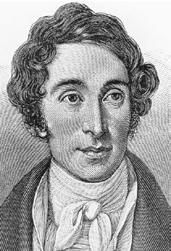
advice, he made the journey together with Anton Fürstenau, a noted flutist in spring 1826. The new opera premiered on 12 April but Weber’s health was obviously failing and he died in his sleep on 5 June, while staying with his friend Sir George Smart at (what is now) 103 Great Portland Street. He was 39 years old.
Weber’s body was embalmed and sealed in a lead coffin and plans were made for his obsequies to be held at St Mary Moorfields. A committee was formed to organise an appropriate tribute, acknowledging both the deceased’s musical talents and his Catholic faith. Mozart’s Requiem seemed the obvious choice and London’s leading musicians offered their assistance. When the Vicar Apostolic (or Catholic bishop) in London, William Poynter, refused permission for admission to Moorfields to be charged for the occasion, it was suggested to relocate to St Paul’s Cathedral. However, this plan never materialised since the Dean and Chapter considered Mozart’s masterpiece too Catholic.
On 21 June 1826 Weber’s hearse, drawn by six black horses, left Great Portland Street for Moorfields and was followed by
sixteen mourning coaches and four private ones. Curious onlookers and musical aficionados lined the streets and the church itself was crowded from an early hour. Many well-known professionals made up the choir and orchestra, including the celebrated soprano Miss Cubitt, which performed Mozart’s final masterpiece. According to a contemporary account, it ‘has been seldom heard with more positive effect.’ At the conclusion of the Mass the body was processed to Vault No. 5 beneath the church, to the strains of Handel’s ‘Dead March’ from Saul, and the burial ceremony was conducted partly in English by Fr Joseph Kimbell.
There the distinguished composer remained until friends and family finally arranged the transfer of his remains back to Dresden in 1844. The documentation can be found in the Death Register, though sadly the name of Richard Wagner, who was one of those involved in the process, is not included. Ferdinand Pickett of the Prussian Consulate in London was appointed by the family to make arrangements with the clergy of ‘Moorfieldskirche’; the coffin landed at Hamburg on 20 October but, owing to the frozen condition of the River Elbe, only reached Dresden on 14 December. Thousands flocked the Old Catholic Cemetery for the composer’s internment in the family vault alongside his younger son, Alexander, who had been buried there only a few weeks before. Gottfried Semper, who had recently designed the city’s opera house, provided a suitable monument, and at the graveside Richard Wagner made a speech which became celebrated: ‘there never lived a more German composer than you.’
Weber is perhaps best known not so much for his compositions, impressive though they may be, but for the influence he exerted on the likes of Berlioz, Liszt, Chopin, Mahler and Wagner. Despite belonging to the German tradition, he should not be forgotten in the city of his death and in the church (now rebuilt and relocated) where his body once rested.
There were so many children and adults to be confirmed on Whit Sunday that a procedure was adopted that has never before been seen in the Cathedral. His Eminence the Cardinal and His Lordship Bishop Craven together administered the Sacrament. To facilitate this administration still further the candidates for Confirmation, instead of approaching the faldstool individually, knelt along the rails as for Holy Communion. For the sake of the many small children present, this innovation proved to be an invaluable saving of time. Sixteen of our own boys from the Choir School were among the candidates.
On Ember Saturday, 26 May, His Eminence the Cardinal ordained ten deacons to the priesthood. Of all the ceremonies of the Church there are few more inspiring than this outpouring of the priesthood from the ordaining minister upon the young candidates who are there, after long years of training, to offer to Christ the total of their lives. It was obvious that His Eminence performed the lengthy ceremony with a special love and care. The long file of priests who circled round imposing their hands on the heads of the candidates was led by Mgr Brown who, that same day, reached the sixty-fourth anniversary of his own Ordination.
The singing of the High Mass on Whit Monday by the combined parish choirs was a very remarkable achievement. The amateur status of those taking part was forgotten, as we found ourselves listening to Palestrina’s difficult ‘Missa sine nomine’ sung with an assured competence, and with a refinement of diction, phrasing and dynamics, which could profitably be imitated by many a professional choir. The standard achieved by this association of choirs said a great deal for the enthusiasm and perseverance of the members; it said even more for the highly skilled teaching and direction which they have received from their conductor, Fr Wilfred Purney.
But quite apart from these technical considerations, one felt that the occasion itself (which was graced by the presence of His Eminence) was a truly memorable one. The participation of laymen from all over London in the solemn liturgy of the metropolitan church was an event of the highest significance. Many developments could stem from it—not least, the setting of a permanent standard of liturgical and musical performance, which (as Fr Purney said in his excellent sermon) is so sorely lacking in most of our parishes.
Cathedral fabric
Admirers of the fine marble and oak organ screen over the narthex of the Cathedral, erected in the spring before last, will be glad to learn that a South African reader has very generously sent a cheque to cover the cost of making the two gilt bronze figures of angels that were required to complete this beautiful piece of work. The estimated cost of these two figures, as our readers may remember, was £800. Models have been made and approved, and the work has now been put in hand.
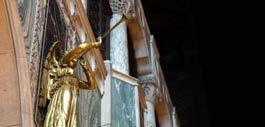
Other work in progress in the Cathedral is the marble lining of the Lady Chapel aisle leading to the Sacristy; new choir desks; and some preparatory construction in connection with the organ, fuller details of which will be given in our next issue.
On Saturday, 1 May, the members of the Archconfraternity of St. Stephen met in Westminster Cathedral for their first Annual Reunion since the War. It will be remembered by our readers that in October last the Rev. E. Sutton, one of the Chaplains of the Archconfraternity, gave an account of the beginning, growth and then partial extinction of this useful Confraternity. Since then plans for reviving it have been in preparation, and the function on 1 May was the first manifest sign of this revival. On this occasion the Cardinal sang Pontifical Vespers and gave an address to the six hundred servers who had assembled. His Eminence impressed upon his hearers the great privilege it was to be allowed to serve in the sanctuary—a work usually assigned by the Church to ministers specially ordained for the purpose—and held the Cathedral up as a model in the matter of the service of the sanctuary. He expressed the hope that throughout his diocese all servers would look to the Cathedral as setting a standard both for correctness and for dignity, in the carrying out of the various ceremonies of the Ecclesiastical Year.
The Holy Father’s Prayer Intention
For the values of sports
Let us pray that sports be an instrument of peace, encounter, and dialogue among cultures and nations, and that they promote values such as respect, solidarity, and personal growth.
Monday 1 June
St Justin, Martyr
Tuesday 2 June Feria
(Ss Marcellinus & Peter, Martyrs)
5.30pm Chapter Mass
Wednesday 3 June
St Charles Lwanga and Companions, Martyrs
1.15pm Lunchtime Concert
Thursday 4 June
Feria
5.30pm Solemn Mass (Archbishop Moth)
Friday 5 June Friday abstinence
St Boniface, Bishop & Martyr
1.15pm Adoration of the Blessed Sacrament for Vocations to the Priesthood (Blessed Sacrament Chapel)
Saturday 6 June
Blessed Virgin Mary on Saturday (St Norbert, Bishop)
Sunday 7 June Ps Week 2
CORPUS ET SANGUIS CHRISTI (THE MOST HOLY BODY AND BLOOD OF CHRIST)
12 noon Solemn Mass (Full Choir)
Tye – Missa Euge bone
Philips – O quam suavis
Messiaen – O sacrum convivium
Organ: Messiaen – Offrande et Alleluia final (Livre du Saint Sacrement)
4pm Solemn Vespers and Benediction (Full Choir)
Incertus – Magnificat quinti toni
Mendelssohn – Lauda Sion (Opening) Organ: de Grigny – Pange lingua
4.30pm Mass for the Deaf Community (Cathedral Hall)
On the first Sunday of each month, a Mass is celebrated for the benefactors of Westminster Cathedral, living and dead. Sunday 7 June 2026, 10am, Sunday 5 July 2026, 8am, Sunday 2 August 2026, 7pm, Sunday 6 September 2026, 5.30pm, Sunday 4 October 2026, 12 noon, Sunday 1 November 2026, 10am, Sunday 6 December 2026, 8am For more information, contact Laura Dudhee, at 020 7798 9058 or email cathedralgiving@rcdow.org.uk
The Cathedral is open from 7.30am and closes in time for 7pm.
Monday to Friday: Morning Prayer 7.35am, Mass 8am, Mass (Latin, unless there is a Funeral) 10.30am, Confessions 11.30-12.30pm, Mass 12.30pm *, Exposition of the Blessed Sacrament 1.15-4.30pm, Benediction 4.30pm, Confessions 4.30-5.30pm, Sung Vespers 5pm (Latin, Choir, except Tuesday, English, Cantor), Solemn Mass 5.30pm (Choir, Tuesday: Boys’ voices, Wednesday: Men’s voices)
Saturday: Mass 8am, Morning Prayer 10am, Mass 10.30am (Latin, Choir,) Confessions 11.30-12.30pm, Mass 12.30pm *, Confessions 5-6pm, Sung Vespers 5.30pm (English, Cantor), Sung Mass 6pm.
Sunday: Mass 8am, Sung Morning Prayer 9.30am, Sung Mass 10am, Confessions 10.30-12.30pm; Solemn Mass (Choir) 12noon *, Solemn Vespers (Choir) and Benediction 4pm, Confessions 5-6.45pm, Sung Mass 5.30pm, Mass 7pm.
For full opening and closure times of the Cathedral and for confession and service times please consult the Cathedral diary on the website.
* Live streamed via the Cathedral website
Monday 8 June Feria
Tuesday 9 June
Feria
(St Ephrem, Deacon & Doctor; St Columba, Abbot)
5.30pm The Friends of the Holy Father attend Mass (Papal Nuncio)
Wednesday 10 June Feria
1.15pm Lunchtime Concert
Thursday 11 June
St Barnabas, Apostle
5pm Solemn First Vespers
5.30pm Vigil Mass of the Most Sacred Heart of Jesus
Friday 12 June No Friday abstinence
THE MOST SACRED HEART OF JESUS
1.15pm Adoration of the Blessed Sacrament for Vocations to the Priesthood (Blessed Sacrament Chapel)
5pm Solemn Second Vespers
5.30pm Solemn Mass (Full Choir) Palestrina – Missa brevis Lassus – Improperium exspectavit Organ: Buxtehude – Toccata in F (BuxWV 157)
Saturday 13 June
The Immaculate Heart of Mary 10.30am Mass of Ordination to the Diaconate (Bishop McAleenan)
6pm Westminster Cathedral Junior Voices sings at Mass
Sunday 14 June Ps Week 3 11th SUNDAY IN ORDINARY TIME
12 noon Solemn Mass (Full Choir) Magnus Williamson – Missa tertia Elgar – The Spirit of the Lord Organ: Elgar – Finale (Sonata in G) 4pm Solemn Vespers and Benediction (Full Choir)
Bevan – Magnificat quarti toni MacMillan – Christus vincit Organ: MacMillan – Gaudeamus in loci pace
Monday 15 June Feria
Tuesday 16 June Feria (St Richard of Chichester, Bishop)
Wednesday 17 June Feria 1.15pm Lunchtime Concert
Thursday 18 June Feria
5.30pm Mass attended by Patrons of the Sick and Retired Priests’ Fund (Cardinal Nichols)
Friday 19 June Friday abstinence Feria (St Romuald, Abbot) 2pm Grenfell School Mass
Saturday 20 June
St Alban, Protomartyr 6pm A visiting choir sings at the Mass for New Catholics (Archbishop Moth)
Sunday 21 June Ps Week 4
12th SUNDAY IN ORDINARY TIME
12 noon Solemn Mass (Full Choir)
Jean-Baptiste Robin – Messe Solennelle (world premiere)
Jean-Baptiste Robin – In spiritu humilitatis
Organ: Dupré – Toccata (Symphonie II)
4pm Solemn Vespers and Benediction (Full Choir)
Bevan – Magnificat primi toni
Wood – Nunc dimittis in A minor
Organ: Franck – Cantabile
Monday 22 June
Ss JOHN FISHER AND THOMAS MORE 8, 10.30am Mass in St George’s Chapel
Tuesday 23 June
Feria
(St Etheldreda, Virgin)
5pm Solemn First Vespers
5.30pm Vigil Mass of the Nativity of St John the Baptist
Wednesday 24 June
THE NATIVITY OF ST JOHN THE BAPTIST
1.15pm Lunchtime Concert
5.30pm Solemn Mass (Full Choir) de Padilla – Missa Ego flos campi
Victoria – Descendit angelus
Victoria – Ne timeas
Organ: J.S. Bach – Christ unser Herr zum Jordan kam (BWV 684)
Thursday 25 June Feria
Friday 26 June Friday abstinence Feria
2pm St John Southworth Catholic Academy Trust Foundation Day Mass
5pm Solemn First Vespers
5.30pm Vigil Mass of St John Southworth
Saturday 27 June
St JOHN SOUTHWORTH, Priest & Martyr
10.30am Solemn Mass (Men’s voices) Byrd – Mass for three voices
Byrd – Iustorum animæ
Tallis – O sacrum convivium
Organ: Byrd – Fantasia in C
5.30pm Solemn First Vespers
6pm Vigil Mass of Ss Peter and Paul
Sunday 28 June Ps Week 1
Ss PETER AND PAUL, Apostles
12 noon Solemn Mass (Full Choir)
Vierne – Messe solennelle
Palestrina – Tu es Petrus
Palestrina – Quodcumque ligaveris
Organ: Vierne – Final (Symphonie III)
4pm Solemn Vespers and Benediction (Full Choir)
Palestrina – Magnificat primi toni
Duruflé – Tu es Petrus
Organ: Franck – Cantabile
Monday 29 June Feria
Tuesday 30 June Feria
(The First Martyrs of the Holy Roman Church)
5pm Solemn First Vespers
5.30pm Vigil Mass of the Dedication of the Cathedral
Wednesday 1 July
DEDICATION OF THE CATHEDRAL (1910)
1.15pm Lunchtime Concert
5pm Solemn Second Vespers, sung by the Metropolitan Chapter
5.30pm Solemn Mass, celebrated by the Metropolitan Chapter (Full Choir)
Palestrina – Missa Papæ Marcelli
Malcolm – Terribilis est locus iste
Organ: Vierne – Carillon de Westminster
9pm Luminescence (ticketed)
Thursday 2 July Feria
9pm Luminescence (ticketed)
Friday 3 July Friday abstinence
St THOMAS, Apostle
5.30pm Celebration of Service Mass attended by Westminster Diocesan Education staff (Archbishop Moth)
9pm Luminescence (ticketed)
Saturday 4 July
Blessed Virgin Mary on Saturday (St Elizabeth of Portugal)
9pm Luminescence (ticketed)
Sunday 5 July
Ps Week 2
14th SUNDAY IN ORDINARY TIME
12 noon Solemn Mass (Full Choir)
Rheinberger – Cantus missæ
Byrd – Laudibus in sanctis
Organ: Vierne – Final (Symphonie VI)
4pm Solemn Vespers and Benediction (Full Choir)
Reid – Magnificat secundi toni
Dupré – Laudate Dominum
Organ: Guillou – Saga VI
4.30pm Mass for the Deaf Community (Cathedral Hall)
Key to the Diary: Saints’ days and holy days written in BOLD CAPITAL LETTERS denote Sundays and Solemnities, CAPITAL LETTERS denote Feasts, and those not in capitals denote Memorials, whether optional or otherwise. Memorials in brackets are not celebrated liturgically.
Catholic Evidence Guild
Clergy House Room 2, Tuesdays 7pm
Catholic Grandparents’ Association Hinsley Room, Second Sundays 12-3.30pm
Charismatic Prayer Group Cathedral Hall, Fridays 6.30-9pm
Divine Mercy Prayer Group
St Patrick’s Chapel, Sundays 1.30-2.30pm
Filipino Club Cathedral Hall, Second Sunday 1-5pm
Guild of the Blessed Sacrament Blessed Sacrament Chapel, Mondays 6.15pm
Guild of St Anthony Lady Chapel, Tuesdays 6.15pm
Interfaith Group Hinsley Room, Third Wednesdays 1.30 -3pm
Legion of Mary Hinsley Room, Monday 1.30-3.30pm
Oblates of Westminster Cathedral Hinsley Room, Fourth Sundays 2.30-4pm
Padre Pio Prayer Group
Sacred Heart Church, First Thursdays 1.30-3.30pm
Rosary Group
Lady Chapel, Saturdays 11.15-12.00noon
Walsingham Prayer Group
St George’s Chapel, First Tuesdays 2.30-4pm
Yoruba Association Hinsley Room, Third Sundays 1.30-3pm
Joanna Bogle
This March marked the 170th anniversary of the end of the Crimean War in 1856. That summer, an exhausted Florence Nightingale returned to England to national acclaim, with a vision of starting a proper system of professional training for nurses. Likewise, a number of religious sisters also sailed back to Britain where they were met with warm support, and even applause. Mother Clare Moore, superior of the first English community of the Sisters of Mercy in Bermondsey, had led a group of Mercy sisters out to the Crimea, and news of their heroic work in the Scutari Hospital had spread, thus softening the attitude of many British people towards religious women.
The Rt Rev Thomas Grant, Bishop of Southwark and the son of a soldier, had contacted the War Office to offer the services of the sisters as nurses, under the direction of Miss Nightingale. Upon receiving an affirmative response, Bishop Grant hurried to tell Sr Clare. The sisters then quickly packed and made ready to travel.
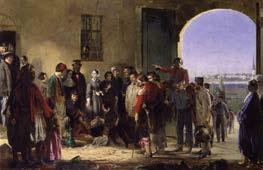
The appalling conditions at Scutari are well known, and the sisters had to contend with rats, fleas and appalling thirst, as clean water was in short supply. As Sr Penny Roker RSM, a historian of the Sisters of Mercy, vividly described in English Catholic Heroines (2009), from contemporary descriptions:
‘After putting ashore at the rickety landing stage they climbed the steep slope. A stench greeted them before they even reached the entrance. […] Blocked sewers under the building contaminated the rooms above and moisture oozed from the walls.’
The Bermondsey sisters were by no means the only nurses to offer their help. A contingent of Anglican ladies would also join the cause. Among them was Frances Taylor, the daughter of a Lincolnshire clergyman. She had briefly joined an Anglican convent in Devonport, where she had received some nursing training. During her time in the Crimea she met with Catholic
chaplains and, through the Jesuit priest Fr Sidney Woollett, she was received into the Catholic Church. She would later go on to found a Catholic religious order, the Poor Servants of the Mother of God, working in the crowded slums of Soho and the neighbourhood of St Giles. This has since been commemorated in St Patrick’s Church, Soho, where a stained-glass window honours her memory. Her cause for canonisation was opened by Cardinal Basil Hume in 1982, and she was declared venerable in 2014.
As the position of women in the Church continues to be debated, we would do well to emulate these courageous 19th century sisters. In no way did they consider themselves to be oppressed by the Church; on the contrary, they were free and encouraged to follow their deep sense of calling to serve God. They were women of integrity and resilience, who grasped the essentials of their calling and who tackled problems and challenges with vigour and faith.
Frances Taylor, who became Mother Mary Magdalen of the Sacred Heart, was a great friend of Lady Georgiana Fullerton, a well-known Catholic author and benefactress to a number of charitable causes. Lady Georgiana led a committee of likeminded Catholic ladies who helped to fund some of the new Catholic parishes that were being established, including what is now the Church of the English Martyrs at Tower Hill. She also worked with Mother Magdalen on projects for poor families.
Another prominent Catholic who played a decisive role in the Crimean War was Lady Herbert, wife of Sir Sidney Herbert, the War Secretary. It was due, in no small part, to her vigorous intervention that Florence Nightingale was able to begin her nursing venture. Indeed, the first recruits for the mission were interviewed and assessed in the Herbert family home in Belgravia.
Approximately one third of the soldiers who fought for the British Army in the Crimea were Roman Catholics. Much like the physical care the nurses gave, it became increasingly obvious that Catholic chaplaincy was also necessary. The matter was raised in Parliament by the Catholic MP Frederick Lucas, founder of The Tablet, and, for the first time, Catholic chaplains were officially deployed. By the end of the war, a total of 16 Catholic chaplains received the Crimea Medal for their service.
The care and heroism of Catholics during this time did a lot to normalise Roman Catholicism in this country, and to foster acceptance. Religious sisters at the service of the poor and the sick, soldiers and chaplains, politicians and women of means, all of whom showed that, then as now, the Church responds to the call of each and every age.
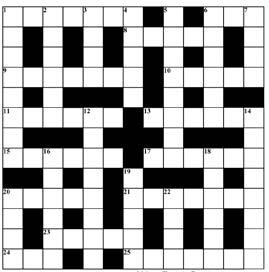
Clues Across
1 HMS -------, WW2 museum warship on the Thames, also Irish city (7)
6 Product of Noah’s salvific boat building (3)
8 Common tree, also known as mountain-ash (5)
9 Saint who founded the Order of Premonstratensians (also named after him) (7)
10 That of Babel a language problem, that of London a sometime prison (5)
11 ‘Pynson ------’, medieval work on the story of Walsingham Shrine (6)
13 Heavenly spirit and heavenly child! (6)
15 Official in charge of maintenance of church buildings and graveyard (6)
17 Occupation of father of former PM Margaret Thatcher (6)
20 Game played for generations in ‘the local’ (5)
21 Town in Northern France and WWI Battle where tanks were first used (7)
23 Piece for piano technique development, such as by Clementi and Chopin (5)
24 Letters on sacramentals, indicating that Jesus is the Saviour of mankind (1.1.1.)
25 First Archbishop of Westminster after re-establishment of the Catholic hierarchy (7)
Clues Down
1 Martyr Saint missionary with St Paul, Feast Day 11 June (8)
2 Plant used for wreath used since Roman times in ‘crowning’ diverse achievers (6)
3 Battle (1291) that brought an end to the Crusades (4)
4 ‘I am the way, the -----, and the life’, nature of Jesus (5)
5 Passionate bird spotter (8)
6 Solution to the question (6)
7 ---- Starmer, UK Prime Minister since 2024 (4)
12 Young Jesuit Saint died treating epidemic victims, Feast Day 21 June (8)
14 Centre of London for performing arts (8)
16 Opera by Handel about Persian King with famous ‘Largo’ (6)
18 One of the Holy Oils (6)
19 Affix with a driver! (5)
20 Surrealist painter of Christ of St John of the Cross based on the Carmelite’s drawing (4)
22 Town in Belgium and WWI battle (4)
Amanda Hill
The Host at the banquet is hidden from sight, As you pass the church door by day or by night. The Host that lies hidden is hostage to man, Where He in the monstrance fulfils His great plan. The Lord of the Hosts as Old Testament tells, Almighty in power, is one who impels.
The Host of the Lord is New Testament’s pledge, In His churches enshrined on altar or ledge. The Lord is the Host, where the Host is the Lord, He welcomes and feeds us, and here is adored.
Each Host of the Lord is the gift that gives most, For hosts are now fed by the heart of the Host.
To submit a poem whether by yourself or another for consideration, please contact the Editor – details on page 3.