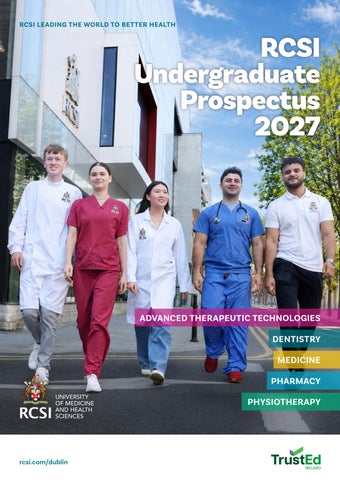
RCSI LEADING THE WORLD TO BETTER HEALTH
RCSI Undergraduate Prospectus 2027
ADVANCED THERAPEUTIC TECHNOLOGIES DENTISTRY MEDICINE PHARMACY PHYSIOTHERAPY
rcsi.com/dublin
Founded by Royal Charter in 1784, RCSI is an innovative, world-leading health sciences university at the forefront of healthcare education, research and practice. We are consistently ranked among the world’s top 300 universities by Times Higher Education (THE). In recent QS World University Rankings, RCSI was placed in the Top 200 QS Subject Ranking for Medicine and the Top 150 QS Subject Ranking for Pharmacy and Pharmacology.
RCSI in Numbers
03
A Message from Our Vice-Chancellor
04
Your University
06
Your Journey
RCSI’s City-Centre Campus Student Opportunities Student Experiences Student Welfare Clubs and Societies Accommodation
14 18 22 26 28 32
Your Future
Career Opportunities Career Supports Global Alumni
36 38 46
Our Programmes
Advanced Therapeutic Technologies Dentistry Graduate Entry Medicine Undergraduate Medicine Pharmacy Physiotherapy
54 60 64 70 76 82
EU (CAO) Application Essentials International (Non-EU)
86 94
Every effort has been made to ensure that the information contained in this prospectus is accurate at the time of printing. RCSI reserves the right to make RCSI Undergraduate Prospectus 2027 rcsi.com/dublin 2 changes to programmes, entry requirements, fees, services and other information as necessary. Please refer to rcsi.com/dublin for the latest information.
RCSI IN NUMBERS 240+ Years Leading the World to Better Health
6,129 Registered Students 3,352 Undergraduates 2,777 Postgraduates Representing
110 Countries
EXCELLENT MATCH RATES
Top 200 Medicine Top 150 Pharmacy and Pharmacology
85% CaRMS (Canadian Resident Matching Service)
~~~
92% NRMP (National
QS World University Rankings by Subject
Resident Matching Program)
Top 300 Times Higher Education World University Rankings
636 Surgical
Advanced Therapeutic Technologies, Dentistry, Graduate Entry Medicine, Medicine, Pharmacy and Physiotherapy
c. €300m invested
6 UNDERGRADUATE PROGRAMMES 100+ Postgraduate Programmes
rcsi.com/dublin
and Emergency Medicine Trainees
200+ Undergraduates partake in summer research projects and skills training annually
€44.8m of External Research Annually in Dublin campus development in the last five years
35,000+ Alumni
in 108 Countries 10,000+ Fellows and Members in 90 countries
85+ Student Clubs and Societies RCSI Undergraduate Prospectus 2027
3
A message from our Vice-Chancellor It is my great pleasure to introduce you to RCSI’s 2027 Undergraduate Prospectus. Here we provide you with a comprehensive overview of our University and the programmes that we offer on our Dublin campus in the disciplines of Advanced Therapeutic Technologies, Dentistry, Medicine, Pharmacy and Physiotherapy.
Begin your healthcare or science journey with leading academics, expert clinicians and pioneering researchers on a world-class campus.
RCSI is an independent, not-for-profit university and our mission is to ‘educate, nurture and discover for the benefit of human health’. Established in 1784, RCSI was founded as the national provider of surgical training in Ireland. In the years since, RCSI has evolved to become one of the world’s leading health sciences universities. With almost 3,500 undergraduate students from 79 different countries studying with us and more than 35,500 alumni from 108 countries around the globe, we are also one of the most international in our outlook. Times Higher Education (THE) ranks RCSI among the world’s top 300 universities and, in three of the past six years, ranked RCSI number one in the world for the significant commitment and contribution of our staff, researchers and students to the United Nations Sustainable Development Goal 3 (SDG) ‘Good Health and Well-being’ (THE Sustainable Impact Ratings). In recent QS World University Rankings, RCSI is ranked in the Top 200 QS Subject Ranking for Medicine and the Top 150 QS Subject Ranking for Pharmacy and Pharmacology. For quite some years, we have graduated students from our Medicine, Pharmacy and Physiotherapy programmes, and it has been very gratifying to see so many of them going on to enjoy very distinguished careers as healthcare professionals. I am delighted to share that this year sees the first of our BSc Advanced Therapeutic Technologies students graduating with a qualification that is at the forefront of science degrees in Ireland.
4
RCSI Undergraduate Prospectus 2027
rcsi.com/dublin
Many of these students have already secured exciting roles in the Biopharma sector, in clinical trials and in related industries including management consultancy. We wish them the very best in their future careers. In another significant development at RCSI, our five-year, full-time Bachelor of Dental Surgery (BDS) programme has now taken on two cohorts of students. Studying in brand new, purpose-built teaching and clinical facilities in RCSI’s Sandyford Dental Education Centre, these students are the first ever to undertake a communitybased undergraduate dentistry programme in Ireland. This approach reflects a major international trend in dentistry and other healthcare professions with clinical training shifting from hospitals to community settings. RCSI’s landmark brand-new Dental Education Centre at Connolly Hospital is on course to be completed to offer students more community based clinical experience from September of this year. This will be followed by one further new Dental Education Centre to meet the progressive learning and training needs of incoming dental students. These students enjoy a unique academic experience, learning from expert practitioners in small groups, and receiving intensive support in choosing and preparing for their own individual career pathways. While RCSI is already home to some of Europe's most modern clinical simulation facilities, we are still working hard to enhance our teaching environment and to ensure that our students enjoy an unrivalled campus experience. This past year also saw another major campus milestone being reached with the completion of a new €95m education, research and engagement building at 118 St Stephen’s Green. The 118 building is already transforming students’ experience of the RCSI Dublin campus and providing modern, flexible small‑group learning spaces and collaborative teaching environments designed to shape career‑ready graduates. These are indeed exciting times at RCSI! Should you decide to begin your journey as a healthcare professional or future-focused scientist at our University, you too will have the opportunity to learn from leading academics, expert clinicians and innovative researchers, with a culturally diverse student body on a state-of-the-art campus. I trust you will find this prospectus informative and I hope to see you at RCSI in the near future.
Professor Cathal Kelly Vice-Chancellor, CEO & Registrar, RCSI
rcsi.com/dublin
RCSI Undergraduate Prospectus 2027
5
RCSI LEADING THE WORLD TO BETTER HEALTH
6
RCSI Undergraduate Prospectus 2027
rcsi.com/dublin
RCSI LEADING THE WORLD TO BETTER HEALTH
Your University RCSI was founded in 1784 and is now a globally-recognised health sciences university. We lead pioneering research and deliver cutting edge academic programmes in state-of-the-art facilities.
YOUR UNIVERSITY
YOUR FUTURE YOUR JOURNEY
rcsi.com/dublin
RCSI Undergraduate Prospectus 2027
7
YOUR UNIVERSITY
What makes RCSI a great place to study? Unique surgical heritage RCSI was founded in 1784 as the professional body for surgical training in Ireland and has evolved since into a global leader in healthcare education and research.
Excellence in healthcare education
State-of-the-art facilities
Our programmes are focused exclusively on the health sciences. Our curricula and approach to teaching are innovative, learner-centred and future-focused.
Home to Europe’s most advanced clinical simulation facility, RCSI’s city centre campus is also steeped in history and offers an exciting and immersive learning experience.
International community
Leading pioneering research
RCSI’s student body is exceptionally diverse and inclusive, and comprised of more than 6,000 students from Ireland and 110 countries across the world.
RCSI is at the forefront of pioneering healthcare research and innovation, addressing the key health and wellness challenges of our time and improving patient outcomes.
Vibrant student life RCSI students enjoy a lively and stimulating social events calendar and are encouraged to get involved in any of our 50 student societies and 35 sports clubs.
8
RCSI Undergraduate Prospectus 2027
rcsi.com/dublin
YOUR UNIVERSITY
Our commitment to quality… RCSI University of Medicine and Health Sciences is Ireland's only specialist health sciences university and traces its origins to 1784, when it was established as the national training body for surgery in Ireland. Today, RCSI is an independent, not-for-profit university dedicated to its mission, ‘to educate, nurture and discover for the benefit of human health’. RCSI delivers undergraduate and postgraduate education across medicine, dentistry, pharmacy, physiotherapy and other health disciplines, while also serving as the national provider of surgical training in Ireland. With campuses and educational partnerships across Ireland, the Middle East and Southeast Asia, RCSI combines healthcare education, research and professional training with a global focus on improving human health outcomes. Our undergraduate degrees are accredited by RCSI through a combination of internal quality assurance procedures and externally accredited by the National University of Ireland. Programmes are aligned with the National Framework of Qualifications and regulated by professional bodies in Ireland such as CORU, the Dental Council of Ireland, the Irish Medical Council and the Pharmaceutical Society of Ireland. RCSI was proud in 2026 to be among the first higher education institutions in Ireland authorised by Quality and Qualifications Ireland (QQI) to use the TrustEd Ireland mark. The TrustEd Ireland mark is a symbol of quality, care and confidence. It is awarded to higher education and English language education providers who have demonstrated their commitment to delivering a quality and consistent learning experience for international students.
rcsi.com/dublin
RCSI Undergraduate Prospectus 2027
9
YOUR UNIVERSITY
13 KEY RCSI
Research Themes
RCSI’s focus on clinical and patient-centred research has led to many impactful discoveries that address key global health challenges. Our research agenda drives scientific breakthroughs, innovations and insights that allow us to understand and respond to the world’s changing healthcare needs.
10
BIOMATERIALS, MEDICAL DEVICES AND PHARMACEUTICAL SCIENCES CANCER NEUROLOGICAL AND PSYCHIATRIC DISORDERS POPULATION HEALTH AND HEALTH SERVICES SURGICAL SCIENCE AND PRACTICE VASCULAR BIOLOGY AND CARDIOLOGY CHEMISTRY NURSING AND MIDWIFERY IMMUNITY, INFECTION AND INFLAMMATION HEALTH PROFESSIONS EDUCATION GYNAECOLOGY, OBSTETRICS AND PERINATAL HEALTH RESPIRATORY AND CRITICAL CARE ENDOCRINOLOGY
RCSI Undergraduate Prospectus 2027
rcsi.com/dublin
YOUR UNIVERSITY
At RCSI, we take pride in our role in COSECSA’s success, helping to significantly expand the surgical workforce across East, Central, and Southern Africa. Our partnership now includes multi-disciplinary training in anaesthesiology, obstetrics, gynaecology, and peri-operative nursing, addressing the needs of vulnerable patients in 20 countries.
Global Impact RCSI has a global footprint which reaches beyond Dublin. We deliver world-class curricula between our Dublin, Bahrain, China and Malaysia campuses. The RCSI Medical University of Bahrain is a constituent university of RCSI and is licensed by the Higher Education Council in the Kingdom of Bahrain as an independent private university. The RCSI-Soochow International College of Pharmaceutical Innovation, China, established in September 2024
delivers BScs in Pharmacy and in Advanced Therapeutic Technologies. The RCSI and UCD Malaysia Campus (RUMC) is Malaysia’s first accredited private medical school, owned and established by the Royal College of Surgeons in Ireland (RCSI) and University College Dublin (UCD). Students taking part in this programme spend the first two years in Dublin and complete the remainder of the degree in Penang. As a leading institution in healthcare, medicine and research, RCSI advances
health and well-being worldwide. We continuously seek ways to further our humanitarian goals and make an impact on a global scale. An example of this is our partnership with the College of Surgeons of East, Central and Southern Africa (COSECSA). RCSI and COSECSA have been working together to increase the number of trained surgeons and to improve the quality of surgical care in sub-Saharan Africa. The aim of the programme is to create a sustainable training institution, which can rapidly increase the number of surgical specialists and improve surgical care in the region.
YOUR UNIVERSITY
YOUR FUTURE YOUR JOURNEY
COSECSA training in Moi Teaching and Referral Hospital, Eldoret, Kenya. Photo taken by Niraj Bachheta.
rcsi.com/dublin
RCSI Undergraduate Prospectus 2027
11
RCSI LEADING THE WORLD TO BETTER HEALTH
12
RCSI Undergraduate Prospectus 2027
rcsi.com/dublin
RCSI LEADING THE WORLD TO BETTER HEALTH
Your Journey RCSI students have the best possible learning experience. Our curricula are innovative, future-focused and integrated. During your educational journey, we work with you to ensure that you achieve your academic potential.
YOUR UNIVERSITY
YOUR FUTURE YOUR JOURNEY
rcsi.com/dublin
RCSI Undergraduate Prospectus 2027
13
YOUR JOURNEY
RCSI, 118 St Stephen’s Green
RCSI Dental Education Facility, Sandyford RCSI, 26 York Street
YOUR CAMPUS… RCSI, Millin House & Mercer Blocks A,B,C
RCSI Education & Research Centre, Connolly Hospital Blanchardstown
RCSI, 123 St Stephen’s Green
RCSI, Mercer Building
RCSI’s main campus is located in the heart of Dublin City. It is home to some of Europe's most modern clinical teaching facilities and offers students an unrivalled campus experience. RCSI, 121 St Stephen’s Green
Perfectly situated to provide you with a balanced life during your studies, the campus is easily accessed by public transport and surrounded by cultural hotspots, shops, cafés and restaurants. There are also RCSI education and research facilities in Beaumont Hospital, Connolly Hospital Blanchardstown and Sandyford, all of which are within easy reach of the city centre.
RCSI, Main Entrance, York Street
14
RCSI Undergraduate Prospectus 2027
RCSI Education & Research Centre, Beaumont Hospital
rcsi.com/dublin
YOUR JOURNEY
YOUR LEARNING AND SOCIAL SPACES… At RCSI Dublin we offer internationally-recognised undergraduate degree programmes in Advanced Therapeutic Technologies, Dentistry, Medicine, Pharmacy and Physiotherapy. All of our students have the best possible learning experience and study in state-of-the-art facilities across the Dublin campus.
It is essential to take time away from the books and there are lots of social spaces around our Dublin campus for you to hang with friends! rcsi.com/dublin
RCSI Undergraduate Prospectus 2027
15
YOUR JOURNEY
Simulation Centres RCSI SIM (Centre for Simulation Education and Research) in 26 York Street enables RCSI's mission by delivering transformative learning experiences and leading impactful research. RCSI SIM uses high-fidelity patient simulators in the fields of emergency medicine, surgery, paediatrics, obstetrics and gynaecology, neurology, anaesthesia, nursing, pharmacy and other clinical specialties. It aims to improve patient safety, education and research through immersive and realistic experiential simulation-based learning techniques and tools. The Education and Research Centre (ERC) at Connolly Hospital Blanchardstown also includes a modern clinical simulation facility with mock clinical environments and skills laboratories for our Graduate Entry Medicine (GEM) students. RCSI's Simulated Dental Learning Environment (SDLE) opened in Sandyford in 2025. It includes dental manikin simulators for early clinical skills training, a dental laboratory, and a 12-chair community clinic where students treat patients under supervision. The centre offers immersive, hands-on learning supported by interdisciplinary collaboration and evidence-based teaching. Through collaboration, learner-centredness, and patient focus, we strive to enable excellent outcomesbased translational education and research. These translational outcomes mean that we value not only learning that occurs in simulation, but also that transfers to clinical workplaces and impacts patients.
Our Mission: To perform world-class simulation-based education and research at RCSI and beyond to meet the needs of our future healthcare professionals and their patients. Our Vision: To design, implement and evaluate highest quality simulation-based education and research to ensure transformative education for the RCSI community and those who benefit from our work, including learners and staff and the patients they serve.
16
RCSI Undergraduate Prospectus 2027
rcsi.com/dublin
YOUR JOURNEY
Library Services RCSI Library provides resources, services and facilities to support the learning, teaching, research and clinical activities at RCSI. Focused on health sciences, the library’s extensive collections include print collections, biomedical databases, online textbooks, clinical summary tools and electronic journals. All e-resources, onsite and online services for RCSI students and staff are described and accessible via the library website and Library Guides. On-site services and facilities at libraries in the city centre campus and Beaumont Hospital have been developed to support different learning styles - quiet and collaborative, individual and group. Throughout your programme, library information retrieval specialists can assist you in finding, evaluating, using, and managing information. These skills are an integral part of your studies and are the basis of evidence-based research, learning and practice. RCSI Library supports development of these skills through curriculum workshops, dedicated customer services teams at on-site and virtual information desks, online guides and one-to-one consultations throughout the year.
HERITAGE COLLECTIONS RCSI Library Heritage Collections reflect the history of RCSI and the advancement of teaching and practice of surgery and medicine in Ireland. You have the opportunity to access and engage with these collections through online and on-site exhibitions, visiting the Heritage Collections Reading Room and undertaking research projects as part of the Research Summer School.
IT Support Students are provided with a personal laptop for academic use and have wifi access across the campus. Students are also provided with a Microsoft Office 365 account, an RCSI email account, cloud storage and Microsoft Office applications. RCSI’s IT helpdesk supports students with issues such as software downloads, RCSI network credentials, access issues and online learning issues. Formal communications are made by email or through the Virtual Learning Environment (VLE).
YOUR UNIVERSITY
YOUR FUTURE YOUR JOURNEY
rcsi.com/dublin
RCSI Undergraduate Prospectus 2027
17
YOUR JOURNEY
Student Opportunities Erasmus The Erasmus+ programme is the European Union's flagship initiative for education, training, youth, and sport.
This programme aims to enhance learning opportunities abroad, foster cultural exchange and promotes collaboration to foster innovation and inclusion across Europe and beyond. RCSI undergraduate students may avail of elective or research opportunities under the Erasmus programme. RCSI has a number of agreements in place, and the Erasmus Team and International Elective and Engagement Teams are constantly seeking to build new partnerships to facilitate mobility.
WHY DO AN ERASMUS? > Cultural Exchange: Immerse yourself in a new experience, learn a new language, and gain a broader perspective on the world and inter-cultural skills. > Academic Opportunities: Enhance your academic experience, broadening your knowledge. > Research Opportunities: Chance to experience a lab in another country/university, chance to work with world-renowned researchers and exposure to new opportunities and techniques. > Clinical Placement Opportunities: Diverse learning environments will provide exposure to different healthcare systems and practices, ability to gain unique experiences and perspectives that will benefit your medical career. > New Skills: Improve your communication, interpersonal and soft skills, which will enhance your CV. > Personal Growth: Develop independence, adaptability, and problem-solving skills by navigating life in a different country. > Networking: Build a global network of friends and professional contacts, which can be invaluable for your future career, a potential future employer or collaborator for new projects. > Travel: Explore new places and experience the beauty and diversity of Europe, making unforgettable memories along the way.
18
RCSI Undergraduate Prospectus 2027
KATE RYAN Pharmacy - Paris, France My Erasmus experience in Paris was nothing short of incredible! At Université Paris-Saclay’s Endocrine Physiology and Pathophysiology Research Lab, I gained invaluable hands-on experience working alongside esteemed specialists and learning from their expertise. Beyond the lab, immersing myself in Parisian culture and exploring everything this vibrant city has to offer has made my time here truly unforgettable!
JAMAL HALILI, CLODAGH GEOGHEGAN and AILBHE COUGHLAN ATT, Research Project - University of Ramon Llul Barcelona Our Erasmus experience in Barcelona has been truly unforgettable. Starting our research projects in a new lab was daunting at first, however, we were welcomed into a supportive and friendly environment in IQS. The research has challenged us to develop new skills but has also allowed us to grow both professionally and personally. Beyond the lab, Barcelona is full of life and it has been rewarding to experience a new culture and to meet new people. We look forward to making the most of our last weeks in the sun!
rcsi.com/dublin
YOUR JOURNEY
GRACE O’CONNELL Pharmacy - Milan, Italy Undertaking research in Milan was a once-in-a-lifetime, transformative experience. I have really come to appreciate the adventure that arises from embracing opportunities presented, like Erasmus, and I would do it all over again if I could. I am so grateful to have had the opportunity to immerse myself in eight weeks of chemistry and gain a deeper appreciation for the subject, particularly applicable to my studies in pharmacy.
HAYA KHAN Medicine - Milan, Italy I had the privilege to join Dr Holger Schünemann’s research team at the Clinical Epidemiology & Research Centre at Humanitas University in Milan, where I conducted dry lab research to develop a novel instrument to assess the trustworthiness, credibility, & methodological rigor of clinical practice guidelines.
rcsi.com/dublin
RCSI Undergraduate Prospectus 2027
19
YOUR JOURNEY
There are a range of opportunities open to you while studying at RCSI and participation can provide clarity around what direction you would like your career to go upon graduation.
20
RCSI Undergraduate Prospectus 2027
RCSI Gold Humanism Honor Society Chapter RCSI is the first institution in Europe to have its own Gold Humanism Honor Society (GHHS) Chapter. This recognises students, residents and faculty who are exemplars of compassionate patient care and who serve as role models, mentors and leaders in medicine. With chapters at more than 150 schools, there are over 27,000 members in training and practice. Members are peer nominated and appointed after a faculty committee reviews the applications. A GHHS identifier is on the Electronic Residency Application Service (ERAS) as this membership is highly valued and looked for in residency applicants. This RCSI Chapter hosts various events throughout the year to support the humanism and compassionate patient care ethos of the society.
rcsi.com/dublin
YOUR JOURNEY
Volunteering The REACH RCSI Programme is a unique community outreach and access programme that promotes recreation, education and community health. Students are encouraged to participate in various initiatives throughout the year including a second-level education homework club, science workshops and sports and health programmes. These initiatives enhance the life chances of young students from socially-disadvantaged areas who are traditionally underrepresented at university-level education. You can help by leading teams, encouraging the children taking part and running a variety of events and sports activities.
rcsi.com/dublin
International Citizenship Programme RCSI is a uniquely international education setting with a multicultural atmosphere. There are currently several activities where students work together on volunteering and citizenship activities, and on celebrating RCSI’s multicultural nature. The International Citizenship Programme encourages you to reflect on and develop the skills, values and attitudes you will need to work effectively in a culturally diverse healthcare environment. This structured self-directed programme empowers you to avail of the rich multicultural opportunities for self-development through enriching extracurricular activities, interacting with others from diverse backgrounds, and formally reflecting on your personal development through these activities, supported by staff mentors. If you successfully demonstrate an ‘International Outlook’ in these areas, the programme leads to an International Citizenship Award.
RCSI Undergraduate Prospectus 2027
21
YOUR JOURNEY
Student Experiences
8-month placement (BScATT) Students studying Advanced Therapeutic Technologies will undertake an 8-month industry or research placement in semester 2 of Year 3 of the programme.
RESEARCH SUMMER SCHOOL During the summer months, more than 170 students who are accepted into the RCSI Research Summer School (RSS), get the opportunity to participate in activities that are designed to develop core skills in scientific writing, presentation, data management, statistics, ethics and research involving patients. Students are also given laboratory practicals that focus on basic research techniques, and other hands-on activities to develop skills in computer modelling and simulation. Participating students undertake a fourweek or an eight-week programme and are supervised by RCSI Principal Investigators who are experts in their chosen fields. These supervised projects can be lab-, desk- or wardbased, but all aim to research important health-related problems and focus on improving future patient care. The summer school aims to immerse participating students in a world-class research experience that will benefit their professional development and enhance their educational experience while studying at RCSI.
FUNDED RESEARCH OPPORTUNITIES Each year, two Anatomy Travel Grants are awarded to RCSI undergraduates working with faculty in the Department of Anatomy & Regenerative Medicine as part of the RSS. They enable the students to present their research at an Anatomical Society meeting in Great Britain or Ireland and pay their society membership subscription for one year.
STUDENT MEDICAL JOURNAL The RCSI Student Medical Journal (RCSIsmj) publishes student research, ranging from basic laboratory science and clinical work to humanities analysis of medicine in society. The goal of the RCSIsmj is to encourage student research, writing and submission for publication. Publication in the journal ensures our students’ research reaches a broad international readership through print and electronic versions (rcsismj.com) and through the RCSI Open Access Repository.
OVERSEAS RESEARCH ELECTIVES Electives are short-term clinical or research placements that offer valuable experience. RCSI has long recognised the importance of exposing our students to research experiences early in their professional journeys.
22
RCSI Undergraduate Prospectus 2027
LUKE DOYLE Advanced Therapeutic Technologies student I carried out my 3rd year work placement in VLE Therapeutics, a spin out company from APC, focusing on Good Manufacturing Practice (GMP)-compliant clinical-grade manufacturing. This placement gave me great insight into two main aspects of the pharmaceutical industry. Firstly, I gained a practical understanding of the activities used in both R&D and manufacturing and the flow of operations required to execute or develop a process. Secondly, I gained an understanding of all the components required to qualify and operate a GMP cleanroom facility and the various workstreams. Everything from the engineering qualification of the systems to the QA and QC processes, the transfer of material/stock, the operational requirements and the regulation which underpins it all. I found that everyone I’ve asked for assistance, an insight or explanation on something has been more than happy to take the time to offer the guidance I required. Furthermore, it is greatly rewarding to complete tasks or experiments which we have worked on as a team and attain a satisfactory result. It’s great to be making a useful contribution to the development and progress of a project or towards the achievement of an organisational goal. The most rewarding part of this experience has undoubtedly been the team I have been involved with and the people in the wider organisation.
rcsi.com/dublin
YOUR JOURNEY
RCSI Research Summer School 2025
RCSI Student Innovation Challenge 2025
EILEEN MAGUIRE
ANDRE SAMIR RAMKARAN
Medicine student I participated in the four-week RSS programme during my second year of medical school, and it proved to be an incredibly valuable experience. Through the programme, I developed key research skills such as data visualisation, scientific writing, and the process of publishing original research. We engaged in several hands-on lab sessions, including work with iPSC-derived neurons as an in vitro cellular model for drug development, and practiced essential lab techniques such as pipetting and performing BCA assays. These practical experiences helped solidify my understanding of experimental research methods. The highlight of the programme for me was the Student Innovation Challenge (SIC). I had the opportunity to collaborate with a team to develop a novel concept for detecting traumatic brain injury in contact sports. Presenting our innovation in the SIC final was a memorable and rewarding experience. RSS is a fantastic platform for students to enhance their CVs, strengthen their research competencies, and connect with other students across all year groups. I now feel more confident in my research abilities, public speaking, and collaborative work—skills that will be invaluable in my future academic and clinical pursuits. I would highly recommend the RSS programme to any student interested in research and innovation.
rcsi.com/dublin
Medicine student My experience during Research Summer School was both challenging and rewarding. Days often began early in the Desmond or O’Flanagan lecture theatres and extended into evenings of reflection and discussion. From developing practical laboratory skills in the York House Labs to exploring research ethics and innovation, the programme deepened my curiosity and appreciation for biomedical research, particularly in areas such as molecular biology, computational modelling, and translational science. A particularly meaningful component was the twoday Mental Health First Aid training, where I gained the skills to respond to mental health crises and became a certified Mental Health First Aider. This experience highlighted the importance of compassion, awareness, and advocacy in supporting others. I also had the opportunity to write my first research abstract and design an academic poster on AI-driven biomarker signatures in Alzheimer’s disease, which strengthened my scientific communication and presentation skills. The programme culminated in the Student Innovation Challenge, where my team developed SalvaGuard, a smart mouthguard designed to detect mild traumatic brain injuries in athletes through saliva biomarker monitoring. Reaching the finals and placing first in our challenge and second overall reinforced my belief in the power of interdisciplinary collaboration to solve real-world problems.
RCSI Undergraduate Prospectus 2027
23
YOUR JOURNEY
Through a network of strategic partnerships with institutions in North America, Europe and Africa, RCSI offers a number of overseas clinical elective places for Final Year medicine students annually. These clinical electives are competitively applied for. Medical Clinical Electives Participation in clinical electives is very beneficial to students entering their final years of Medicine at RCSI. Electives are an enriching experience for students who work with patients in some of the world’s leading hospitals. They offer the potential to gain valuable contacts and crucial ‘letters of reference’ for future career opportunities. Supported by the electives team, students can also secure clinical electives at some of the most prestigious institutions in North America. Clinical electives are managed by RCSI’s dedicated and highly-experienced team who will provide you with advice throughout the process and administrative support with your application. The electives team at RCSI assist students in maximising their efforts to achieve their long-term career goals.
LEARN MORE ABOUT CLINICAL ELECTIVES AT RCSI
24
RCSI Undergraduate Prospectus 2027
Temitayo Olabamiji Medicine
Paediatric Oncology Muhimbili National Hospital, Dar es Salaam, Tanzania My elective in Tanzania was one of the most transformative experiences of my medical training. I spent 4 weeks in the paediatric oncology and haematology unit exposing me to a wide range of clinical conditions, but also to the realities of delivering healthcare in resource-limited settings. The Muhimbili national hospital is home to the largest paediatric hospital in Tanzania, providing care to children across the country. A key part of this service is supported by Tumaini la Maisha, a charity founded by an Irish paediatrician affiliated with Children’s Health Ireland, which provides free cancer treatment to children in need. Witnessing this collaboration between local and international efforts to improve outcomes in paediatric oncology was both inspiring and humbling. Throughout this elective, I was fully immersed in the clinical environment. My days typically began with ward rounds alongside consultants, attending physicians and interns, where I observed and contributed to patient care discussions. In the afternoon, I attended procedural clinics, where I observed lumbar punctures, bone marrow biopsies and chemotherapy preparation and administration. A highlight of my experience was performing my first surprised lumbar puncture, which was incredibly rewarding. Overall, this elective strengthened my clinical confidence and reinforced the importance of adaptability, compassion and cultural awareness in medicine. It is an experience I will carry with me throughout my career and I would recommend to students planning to do their electives abroad.
rcsi.com/dublin
YOUR JOURNEY
Ronan Murphy
Ahad Jassani
Medicine
Medicine
Internal Medicine Pennsylvania Hospital, Philadelphia, USA My elective at Pennsylvania Hospital (‘Pennsy’) was the first time I truly felt like a physician. Completing an Internal Medicine sub-internship through the RCSIUPENN collaboration was not merely an observational experience, it was a rigorous, four-week immersion into the American residency system that redefined my clinical confidence. The schedule was demanding, operating on a "12 on, 2 off" rotation, but the immersion was invaluable. A typical day began at 7:15 AM with overnight handovers, followed by pre-rounding on my primary patients. As a Sub-I, I held primary responsibility for my cohort of patients, conducting pre-round, formulated assessment and management plans, called consults, and presented directly to the Attending during morning rounds. The afternoons were dedicated to finishing tasks, notes and attending "Noon Conferences" or "Chalk Talks," which instilled a habit of daily, evidence-based learning that I will carry into my own residency. What distinguished this elective was the level of autonomy and inclusion. The UPENN staff treated me as an integral member of the team, essentially functioning as a first-year intern. This responsibility fostered a deep sense of ownership. I vividly remember spending my one weekend off wishing I were back in the wards, eager to see the clinical progress of the patients I had been managing. This elective provided the essential bridge between being a student and becoming a doctor, and I cannot recommend it highly enough to any RCSI student seeking true clinical responsibility.
rcsi.com/dublin
Paediatric Genetics and Metabolics McMaster University Children’s Hospital, Ontario, Canada I completed my elective in Paediatric Genetics and Metabolics at McMaster University Children’s Hospital. Although I had always been passionate about paediatrics, this subspecialty initially felt daunting because of its complexity. Throughout the placement, I attended outpatient clinics, assessed patients, developed investigation and management plans, and discussed these with my seniors. I also took independent on-call consultations from the NICU, which strengthened my confidence and clinical reasoning. My supervisors encouraged independent thinking while providing excellent support, creating an environment where I felt comfortable asking questions, learning from mistakes, and taking on meaningful responsibility. Their mentorship made the experience especially rewarding. The elective deepened my understanding of the diverse presentations of genetic and metabolic conditions and the importance of considering these diagnoses, even when they are not immediately obvious. Following patients through the diagnostic process highlighted the value of thorough assessment, multidisciplinary collaboration, and compassionate communication with families. Overall, this experience exceeded my expectations. It strengthened my clinical skills, reinforced my passion for paediatrics, and encouraged me to approach patient care with curiosity, critical thinking, and a holistic perspective. My advice to students is to be proactive, ask questions, seek feedback, and embrace responsibility. The most challenging experiences often provide the greatest opportunities for growth. RCSI Undergraduate Prospectus 2027
25
YOUR JOURNEY
Student Welfare The CoMPPAS (Centre for Mastery: Personal, Professional & Academic Success) Student Welfare team provides confidential one-to-one support and advice for students at RCSI. The service is Social Worker led and aims to empower students to reach their full potential and overcome the challenges they meet in the course of their studies. The Student Welfare team also facilitates workshops and runs events to promote positive health and well-being on campus.
COUNSELLING SERVICE RCSI offers a confidential and independent counselling service which is located off-campus. The service has extensive experience over many years in providing counselling support to RCSI students. On behalf of RCSI, it manages a diverse panel of professionally registered counsellors with a broad range of expertise, located across the city.
STUDENT ASSISTANCE PROGRAMME The CoMPPAS Student Assistance Programme (CSAP) is a confidential and independent counselling and specialist information service available to all RCSI students. It can be accessed 24 hours a day, 365 days a year, from anywhere in the world. This service provides both phone-based support and in-person counselling sessions.
Primary care All students on these programmes are entitled to free General Practice consultations at our on-campus Mercer's Medical Centre. Our Student Services team will also assist you with sourcing the most appropriate health insurance plan for the duration of your time at RCSI.
YOUR UNIVERSITY
YOUR FUTURE YOUR JOURNEY
26
RCSI Undergraduate Prospectus 2027
rcsi.com/dublin
YOUR JOURNEY
Fitness Centre Our two-storey Sports and Fitness Centre provides outstanding facilities designed to help you balance your academic commitments with a healthy, active lifestyle. Equipped with some of the most high quality gym equipment available in Ireland, the centre caters for everyone— from complete beginners to experienced athletes. With extensive opening hours, you can work out whenever it suits you, whether that’s an early morning session to energise your day, a lunchtime workout to boost your focus, or a late evening routine to unwind. If you enjoy exercising with others, you can choose from a wide range of free group fitness classes, including dance, yoga, mobility, kettlebells, circuits and spinning. All undergraduate students have free access to the gym and its services, and our experienced personal trainers are on hand to help you achieve your health and fitness goals. The centre also includes a full intervarsity standard sports hall that accommodates a wide range of indoor sports - ensuring that even on the rainiest days, the action never stops.
rcsi.com/dublin
RCSI Undergraduate Prospectus 2027
27
YOUR JOURNEY
Clubs and Societies At RCSI, there’s so much more to university life than lectures and labs. Alongside our arts and academic societies, we offer a vibrant mix of cultural groups and clubs focused on lifestyle, well-being, and recreation. Whether you're passionate about paediatrics, chess, pharmacy or dance, you’ll find a society to match your interests.
50+ SOCIETIES
If sports are your thing, you can get involved in cycling, equestrian club, gymnastics, surf club and more. We also have plenty of popular team sports, including GAA, soccer, rugby, hockey and basketball.
28
RCSI Undergraduate Prospectus 2027
rcsi.com/dublin
YOUR JOURNEY
Come find your passion and get involved!
30+ CLUBS Our clubs and societies allow you to become immersed in a diverse community of Irish and international students.
rcsi.com/dublin
RCSI Undergraduate Prospectus 2027
29
YOUR JOURNEY
As the academic programmes are demanding, it is essential that you take time away from the books to find a suitable study/life balance.
RCSI believes that university life should offer the perfect balance of academic challenge, new experiences and a vibrant social scene. While your studies will keep you busy, our clubs, societies and packed events calendar ensure there’s always something exciting happening on campus. Some of the most memorable moments at RCSI happen outside the classroom—whether you’re raising vital funds for charity, reaching a new personal best in sport or enjoying some of the most anticipated student social events in town. Throughout the year, students come together to celebrate, connect and unwind. You’ll meet classmates from around the world and discover the clubs and societies that feel like home. Annual highlights include the College Ball, International Food Night, the Chocolate Ball, Pharmacy Ball, Ballad Session and the much loved Teddy Bear Hospital—many of which rank among the most popular events on our student calendar. March brings Cultural Diversity Month, a vibrant, month long celebration of the food, music, dance and traditions that reflect our global community. RCSI also has long-standing sporting traditions. Since 1991, our rugby teams have travelled to Paris every second year to compete against Sorbonne Université—a highlight cherished by generations of students. Meanwhile, RCSI runners have proudly taken part in the Boston Marathon for more than two decades, continuing a tradition that brings together athleticism, camaraderie and global connection. LEARN MORE ABOUT OUR STUDENT EVENTS
30
RCSI Undergraduate Prospectus 2027
For those who love the outdoors, the RCSI Climbing and Mountaineering Club organises trips to some of Ireland’s most impressive peaks, offering adventure and fresh perspectives beyond the lecture halls.
rcsi.com/dublin
YOUR JOURNEY
Life in Dublin While Ireland’s ancient east was home to settlers from as early as 5500 BC, it was the seafaring Vikings who founded the town of Dublin on the banks of the River Liffey in 841 AD. In the near 1200 years since, Dublin has had a colourful history and endured further invasions, rebellion, famine, civil war, and all sorts of other political, social and economic upheaval. However, despite or perhaps because of its tumultuous history, the city has grown to become one of the most interesting and culturally diverse capital cities in the world! Home to famous writers such as WB Yeats, Oscar Wilde and James Joyce and the city that gave us renowned musicians like U2, Fontaines DC, Dermot Kennedy and Sinead O’Connor, as well as stars of the silver screen including Colin Farrell, Brendan Gleeson and Barry Keoghan, Dublin has produced more than its fair share of talented artists!
rcsi.com/dublin
The city scape of Dublin offers a wealth of parks, gardens and public spaces, historic buildings, shops, bars and cafes, art galleries, museums, theatres, cinemas, and lots more besides. Tourist attractions such as Dublin Zoo, the Guinness Storehouse, and the Croke Park Skyline Tour are all within walking distance of the city centre. The environment around RCSI is well serviced with eateries, shops and outdoor amenities. You’ll be able to chill out in St Stephen’s Green Park, eat in or take away from one of the many local cafés and restaurants, or browse the retail outlets of the Grafton Street shopping precinct during your spare time! There are lots of supermarkets and fresh food markets close by, and grocery delivery services are also very readily available. With plenty of ethnic food stores in the area too, the only thing you’ll need to worry about is whether you’re in the mood for Chinese, Mexican, Italian, Thai, Indian, Japanese, Korean, Greek, Vietnamese, Cuban or Middle Eastern cuisine!
RCSI Undergraduate Prospectus 2027
31
YOUR JOURNEY
Accommodation RCSI welcomes students from around the globe and strives to create a “home away from home” for all residents. While managing the practical aspects of independent living, you will also have the wonderful opportunity to make new friendships.
WATCH ACCOMMODATION TOUR AND SEE YOUR OPTIONS
32
RCSI Undergraduate Prospectus 2027
rcsi.com/dublin
YOUR JOURNEY
Living Space When it comes to accommodation, most first year students chose to live either at Mercer Accommodation or Aparto Stephen's Quarter, both of which are exclusively available to RCSI students. Mercer Accommodation is reserved for first year RCSI students only, allowing newly arrived students to live alongside other students who have joined RCSI in the same year. Aparto Stephen's Quarter is home to RCSI students across all years, allowing students to experience life with both new and ongoing students. Aparto Stephen's Quarter is a 5 minute walk and Mercer Accommodation is a 2 minute walk from the main St. Stephen’s Green campus and both offer an easy transition to life away from home by ensuring that you are part of an RCSI student community from your first day at university. RCSI offers its students a dedicated Accommodation Service to assist with finding suitable accommodation during their time as a student at RCSI. The service is available to students who receive an offer of a place on one of RCSI’s undergraduate degree programmes. For more information, you can email accommodation@rcsi.ie
rcsi.com/dublin
RCSI Undergraduate Prospectus 2027
33
RCSI LEADING THE WORLD TO BETTER HEALTH
34
RCSI Undergraduate Prospectus 2027
rcsi.com/dublin
RCSI LEADING THE WORLD TO BETTER HEALTH
Your Future Our number one priority is helping you to realise your potential as a healthcare professional or scientist. We pride ourselves on producing graduates who are knowledgeable in the science of their discipline and highly-skilled practitioners.
YOUR UNIVERSITY
YOUR FUTURE YOUR JOURNEY
rcsi.com/dublin
RCSI Undergraduate Prospectus 2027
35
YOUR FUTURE
Career Opportunities
Dentistry
Advanced Therapeutic Technologies
A wide variety of career options will be available to students graduating from RCSI’s Dentistry programme. They can decide to work in General Dental Practice as a private practitioner or in the salaried public dental service. Unlike medicine, after qualifying there is no mandatory “intern year”.
There are a wide range of future-focused career options open to graduates of RCSI’s BScATT programme. Ireland is a global pharma hub and the world's third largest exporter of pharmaceuticals, with nine of top ten global leaders having substantial operations here. This cutting-edge programme has been developed in collaboration with industry experts to address knowledge and skills gaps in the (bio) pharmaceutical and related industries. On completion of their studies, students are qualified to apply for a range of exciting roles in the (bio) pharmaceutical industry and related sectors in areas such as Clinical Trial Management, Biomanufacturing, Data Analytics, Regulatory Affairs, Quality Assurance & Compliance, Industry, Academia (scientific research) and Connected Health. To support the transition to the world of work on graduation, in semester 2 of Year 3 students undertake an 8-month industry or research placement either in Industry or Research. This allows them to demonstrate, apply and further develop their technical knowledge, power skills and competencies in a real work setting and affords students the opportunity to build their professional network.
36
RCSI Undergraduate Prospectus 2027
RCSI graduates can also choose to continue their education with postgraduate training in the areas of Orthodontics, Oral Surgery, Endodontics, Paediatric Dentistry, Prosthodontics, Periodontology, Dental Public Health and Special Care Dentistry. Graduates receive the award of Bachelor of Dental Surgery, BDS (Hons) from the National University of Ireland (NUI) at RCSI. They will have the scope to work and travel worldwide (although some countries such as the US may require that an examination is passed before a dentist qualified from Ireland may practice). Graduates who are citizens of the European Union (EU) may practice anywhere in the EU.
rcsi.com/dublin
YOUR FUTURE
Medicine
Pharmacy Pharmacists are continuously in high demand driven by an ageing population and increasingly complex medicines.
RCSI medical students are extremely successful in progressing to postgraduate training, both in Ireland and across the world. In the Republic of Ireland, graduates from RCSI are well placed to apply for intern training which is carried out across 50 hospitals and primary care facilities and takes a minimum of 12 months. Many international students from RCSI apply to undertake their equivalent postgraduate clinical training in their home countries or other international healthcare systems. Graduates can then competitively apply for postgraduate training with a view to specialising in an area of practice such as Anaesthesiology, Emergency Medicine, General Practice, Medicine, Obstetrics & Gynaecology, Psychiatry, Occupational Medicine, Ophthalmology, Paediatrics, Pathology, Public Health Medicine, Diagnostic Radiology & Radiation Oncology, Sports & Exercise Medicine or Surgery. On successful completion of Higher Specialty Training, trainees are awarded a Certificate of Completion of Training and enter onto the Irish Medical Council’s Specialist Register. Based on the quality of their postgraduate training, Irish-trained doctors are among the most sought-after medical professionals in the world and for decades RCSI medics have gone on to successfully practice in Europe, Australasia, the Middle East, North America or South East Asia.
rcsi.com/dublin
RCSI's five-year MPharm is a highly prestigious, internationallyrecognised and portable degree. The programme offers a wide range of career options on graduation in areas such as: community pharmacy, hospital pharmacy, the pharmaceutical sector and academia. Our MPharm is clinically-focused from the outset. The patient is at the core of everything that students learn from the first year right through to final year. Students develop their clinical and professional skills through patient case studies and patient consultation labs. Students undertake a two-week community pharmacy placement in Year 2 and a four-month placement in Year 4 which can take place in a variety of settings (community,
hospital, industry, academic). An eight-month patient-facing placement (community or hospital) takes place in Year 5. Students complete their preregistration practical training as part of the programme and sit for their Pharmaceutical Society of Ireland registration exam at the end of the five-year programme. Graduates are awarded a Master of Pharmacy both from the National University of Ireland (NUI) and from RCSI. This professional qualification allows graduating students to apply for registration as a pharmacist nationally, throughout the European Union and internationally.
Physiotherapy Upon completion of this degree programme, graduates will be fully qualified physiotherapists who can register with the regulator in Ireland (CORU), and their professional body, the Irish Society of Chartered Physiotherapists. Graduates are awarded a BSc Physiotherapy (Hons) both from the National University of Ireland (NUI) and from RCSI. They will have the opportunity to work in public hospitals, private clinics, community care, research and education in Ireland. Graduates will be able to specialise in areas such as sports injuries, women's health, intellectual disabilities, respiratory care, neurology and gerontology, rheumatology, paediatrics,
occupational health and ergonomics, oncology, and palliative care. This internationally recognised qualification allows graduates to register as a physiotherapist throughout the European Union (EU) immediately after graduation as well as in Ireland. Graduates can also follow established pathways in order to have their qualifications recognised and go on to practice internationally, in countries such as Australia, Canada, the UK and US.
RCSI Undergraduate Prospectus 2027
37
YOUR FUTURE
Our community is far reaching with a network of over 35,000 RCSI graduates worldwide.
Career Supports CAREER DEVELOPMENT RCSI provides a variety of resources, many of which sit with the CoMPPAS Office (Centre of Mastery: Personal Professional and Academic Success), RCSI's hub for student advancement and growth. Through personalised support and development opportunities, our multidisciplinary team seek to support you in achieving academic and personal success while a student at RCSI.
COMPPAS TEAM The CoMPPAS office is home to a dedicated multi-disciplinary team of specialists working collaboratively to facilitate and empower students to achieve their personal, academic and professional goals. The services provided by CoMPPAS are available to all students, allowing them to maximise their potential and enhance their performance. CareerHub provides the platform for us to work with you individually to develop a bespoke career strategy. Everything is designed around your needs as a student and supports are given to our students wishing to practice overseas, particularly in the US and Canada, where extensive preparation is required. Not only do the CoMPPAS Team at RCSI support you throughout your journey at the university, they also provide support to our graduates for up to three years post-graduation.
38
RCSI Undergraduate Prospectus 2027
rcsi.com/dublin
YOUR FUTURE
The CareerHub The CareerHub services are provided to all students and are designed to facilitate and empower students to achieve their personal, academic and professional goals. It is the hub for all career support which includes all career related events and appointments, career readiness processes including post graduation training guides and licensing exams, eligibility requirements, clinical elective experiences and associated application supports. These supports are delivered in person at our CareerHub Centre or through an online portal that provides access to your personal Career account which houses your career portfolio, tailored resources, events, workshops and consultations. The experience is designed around the student's needs and supports are provided to students wishing to practice anywhere in the world.
YOUR UNIVERSITY
BELONG
BE AWARE
We encourage you to join the RCSI society community, which enables you to assess your current skill set, identify skills gap as well as develop and master new skills through participation in clubs, societies, associations and chapters. To increase a sense of belonging and promote early student success we encourage students to participate in work experience, observerships, summer research and volunteering opportunities, making new contacts among your peers and expanding your network as you progress.
We are passionate about ensuring our graduates are ready to practice as competent healthcare professionals. We will help you to identify the necessary requirements for postgraduation training alongside equipping you with the knowledge and skills essential for success in your career. Practical experience opportunities are identified through clinical electives facilitated through the clinical electives team.
YOUR FUTURE YOUR JOURNEY
rcsi.com/dublin
RCSI Undergraduate Prospectus 2027
39
YOUR FUTURE
BE CURIOUS
BEGIN
Develop your curiosity about your career opportunities by attending the many career workshops on offer. Become an RCSI Peer Led Academic Tutor or Peer Mentor or participate in RCSI International Citizenship Award to help to understand the world and environments your future self will work in. RCSI invests considerable time and resources into building relationships that in turn facilitate work placement and clinical elective opportunities for our students.
In senior years all students are offered a facilitated mock interview, CV support and storytelling opportunities. We guide you as you update your Career ePortfolio, your CV and cover letter and encourage you to engage with individual career consultations. Through these processes you identify remaining gaps in your desired professional profile.
In the final two years of the Medicine programme, the CareerHub team host an annual International Clinical Electives Information Night to inform students of elective opportunities that are available. Participation in clinical electives is an essential part of the programme for many of our medical students, particularly for those pursuing North American pathways, and we work with you to see what is required to help you secure the appropriate elective experience.
BE PART OF
Through personal and professional development you will develop a personalised career plan, build relevant skills and experience as well as identify pathways to Residency.
40
RCSI Undergraduate Prospectus 2027
We understand that for many students, their priority is to secure a good job or to successfully progress into postgraduate training in Ireland or elsewhere around the world. To maximise your success in this regard, RCSI faculty and students work together to ensure that candidates are competitive and career ready when applying for such opportunities.
rcsi.com/dublin
YOUR FUTURE
Career Ready We are passionate about ensuring our graduates are ready to practice as competent healthcare professionals. We will equip you with the knowledge and skills essential for success in your career.
Practical Experience RCSI invests considerable time and resources to building relationships that in turn facilitate work placement and clinical elective opportunities for our students. In the final two years of the Medicine programme, the CoMPPAS Career Development Team host an annual International Clinical Electives Information Night to inform students of elective opportunities that are available. Participation in clinical electives is an essential part of the programme for many of our medical students and we work with you to see what is required to help you secure one. Medicine, Pharmacy, Dentistry and Physiotherapy students take part in a wide range of placements throughout their studies. These placements are interspersed with blocks of learning in the academic setting to facilitate real-time assimilation of new knowledge. Students on our Advanced Therapeutic Technologies programme take part in an 8-month industry or research placement in Year 3 of the programme. This allows students to apply and further develop technical knowledge, power skills and competencies in a real work setting.
rcsi.com/dublin
We currently have an alumni network globally in excess of 35,000, many of whom are working in some of the most prestigious hospitals and healthcare institutions in Ireland and across the world.
RCSI Undergraduate Prospectus 2027
41
YOUR FUTURE
RCSI Career Readiness Programme - Journey Map EARLY - STAGE OBJECTIVE DEVELOP YOUR SELF AWARENESS, PEER CONNECTIONS AND OPPORTUNITIES FOR SELF DEVELOPMENT ADOPT A MINDSET OF CURIOSITY AND EXPLORE FUTURE CAREER PATHS
MID - STAGE OBJECTIVE DEVELOP YOUR CAREER STRATEGY
LATE - STAGE OBJECTIVE REFINE YOUR CAREER STRATEGY AND STAY CONNECTED
ACTIONS
ACTIONS
ACTIONS
> Attend Career orientation session
> Attend Career orientation session
> Attend Career orientation session
> Complete My Career Journey on CareerHub platform to identify skills and self development opportunities
> Update My Career Journey on CareerHub platform > Update CV on CareerHub platform
> Attend one to one appointment or group career session with career consultant
> Attend appointment with Career Consultant
> Complete licensing examinations if applicable
> Develop your post graduation career strategy
> Prepare post graduation application documents
> Understand who in your network can support you in your career journey
> Stay connected to your network, keep them informed on your progress
> Stay connected with peers and RCSI alumni
> Attend career networking event and alumni talks
> Explore RCSI mentor network
> Utilise CareerHub Platform to complete your CV, cover letter and application documents
> Review and draft Early Career CV on CareerHub platform > Attend at least two career events > Join RCSI Societies to develop peer network > Explore opportunities for summer experiences > Research career enhancing programmes within RCSI > Be informed about resources available on CareerHub platform > Consider International Citizenship Award, StEP and other possibilities for personal and professional growth > Identify and embrace opportunities for peer mentorship > Be informed about summer experiences including research > Explore volunteering opportunities
> Develop awareness of RCSI graduates and be informed on pathways > Understand eligibility requirements for post graduation pathways > Begin licensing examination processes > Stay informed about placements and electives > Ask the RCSI CareerHub team for help
> Prepare for interviews via CareerHub platform > Attend mock interview sessions with Career team > Understand the process for transitioning from an RCSI student to an RCSI graduate > Ask the RCSI CareerHub team for help
> Be curious about your future career pathway, begin to understand post graduation career trajectories > Learn to navigate RCSI platforms > Stay informed about placements and electives > Ask the RCSI CareerHub team for help 42
RCSI Undergraduate Prospectus 2027
rcsi.com/dublin
YOUR FUTURE
Our priority is to graduate well-trained, highly-skilled healthcare professionals and scientists. We will work closely with you to help build an exciting career and realise your full potential. rcsi.com/dublin
RCSI Undergraduate Prospectus 2027
43
YOUR FUTURE
A world of opportunity lies ahead...
92% of RCSI’s Class of 2026 who applied through the National Resident Matching Program (NRMP) successfully matched to residency positions in the United States. The clinical specialties secured by RCSI graduates in 2026 included Anesthesiology, Anesthesiology/Critical Care, Diagnostic Radiology, Emergency Medicine, Family Medicine, General Surgery, Internal Medicine, Pediatrics, Psychiatry and Preliminary Surgery. Graduates matched to a wide range of healthcare institutions in the United States, including Bayhealth Medical Center, Central Michigan University College of Medicine, Cleveland Clinic DeTar Healthcare System, Duke University Medical Center, Eastern Maine Medical Center, Franciscan Health Olympia Fields, George Washington University, Good Samaritan University Hospital, Hartford Hospital, HCA Healthcare East Florida Division, HCA Houston Healthcare Medical Center, Jefferson Health Northeast, Johns Hopkins Hospital, Lahey Hospital & Medical Center, Mayo Clinic School of Graduate Medical Education, McLeod Regional Medical Center, MedStar Franklin Square Medical Center, MedStar Georgetown University Hospital, Rutgers Community Medical Center, Sinai Hospital of Baltimore, Stamford Hospital/Columbia University, SUNY Downstate Health Sciences University, TidalHealth Peninsula Regional, University of Michigan Health-Sparrow, University of New Mexico School of Medicine, University of Connecticut School of Medicine, University of Miami/Jackson Health System, University of Minnesota Medical School, University of Texas Medical Branch at Galveston, and University of Utah Health.
44
RCSI Undergraduate Prospectus 2027
JULIA MARTINS, Class of 2026 I am over the moon to have matched in Pediatrics at MedStar Georgetown University Hospital! I am forever grateful to my family, partner, friends and mentors who helped me during my journey. So excited to begin my Pediatrics career in Washington, DC!
rcsi.com/dublin
YOUR FUTURE
85% of RCSI’s Class of 2026 who applied through the Canadian Resident Matching Service (CaRMS) successfully matched to residency positions in Canada. RCSI graduates matched into a diverse range of clinical specialties in 2026, including Anesthesiology, Diagnostic and Molecular Pathology, Diagnostic Radiology, Emergency Medicine, Family Medicine, General Surgery, Internal Medicine, Neurosurgery, Obstetrics and Gynecology, Orthopedic Surgery, Pediatrics, Pediatric Neurology and Psychiatry. Graduates secured residency positions at a wide range of Canadian institutions, including Dalhousie University, McMaster University, Memorial University of Newfoundland, Northern Ontario School of Medicine, Queen’s University, Toronto Metropolitan University, the University of Alberta, the University of British Columbia, the University of Calgary, the University of Manitoba, the University of Ottawa, the University of Saskatchewan, the University of Toronto, and Western University.
SID CHARD, Class of 2026 I am so incredibly excited and grateful to have matched into Orthopedic Surgery at Queen’s University! Going back to my hometown to train is a dream come true, and I could not have done this without the incredible support I received from RCSI, my family, and my friends.
RAMA ALKHALDI, Class of 2026 I am very excited to say that I have matched to Pediatrics at McMaster University! I am very grateful for my friends at RCSI who supported me throughout this journey, and I’m especially happy that some of my peers from RCSI will also be joining me at McMaster! It was very challenging navigating the stress and workload of applying both to Canada and the U.S., however, I am very thankful for RCSI for offering grants, collaborative agreement electives, mentorship, and continued support.
rcsi.com/dublin
RCSI Undergraduate Prospectus 2026 2027
45
YOUR FUTURE
Global Alumni RCSI is proud to have a truly global alumni base, which includes some of the most distinguished and award-winning healthcare professionals in their respective fields.
46
RCSI Undergraduate Prospectus 2027
rcsi.com/dublin
YOUR FUTURE
Stephen Kenny
Aibhe Kelly
Aisling Brennan
BSc in Advanced Therapeutic Technologies, Class of 2026
BSc Advanced Therapeutic Technologies, Class of 2026
Physiotherapy, Class of 2002
Stephen is part of the first class to graduate from RCSI’s new BSc in Advanced Therapeutic Technologies. He wanted to study a degree related to the pharmaceutical industry and when he heard about BScATT it looked like it was exactly what he was looking for. After completing his degree studies, Stephen started a two-year graduate programme in manufacturing with Amgen in September. The Amgen programme consists of three eightmonth-long rotations across different areas of manufacturing.
Aibhe chose BScATT because it was future-focused and more specific than a basic science degree. The course has equipped her with unique skillset having studied subjects like regulatory affairs and project management. Aibhe feels this science degree has given her class the opportunity to develop their creative sides and engage with abstract ideas and problems for which a solution does not already exist.
Stephen found that his eight month work placement in 3rd year was a massive differentiator when it came to securing a role post-graduation. In his interviews, he was able to emphasise the skills he learnt while working in Nuritas, including the problem solving and team working elements of his placement role. Stephen also found the NIBRT (National Institute for Bioprocessing Research and Training) training to be a stand-out element of the BScATT course. Stephen believes the workplace relevant skills he gained during his four years including manufacturing training and data analysis as well as the constant thread of teamwork and problem solving assignments throughout the degree really helped him to secure his new role. It was really rewarding and at times challenging. Stephen found it a very broad degree that opens a lot of doors for ATT students.
rcsi.com/dublin
The course has prepared Aibhe to work well in a team. During her third-year placement Aibhe had the opportunity to work crossfunctionally between two teams in the global biopharmaceutical company, Bristol Myers Squibb. The extremely vast curriculum is something that stands out, especially when she went on placement. Aibhe’s managers truly recognised how vast a skill set she had. Aibhe found the excellent industry guest speakers very motivating. The opportunity to go on placements and site visits kept things interesting. Aibhe found the academic side of things challenging at times but the benefits outweigh the negatives. It was a great cohort of students and she made a wonderful group of friends so it has been an excellent experience.
Aisling completed a BSc in Physiotherapy in RCSI, graduating in 2002. She then worked at Tallaght University Hospital, completing all core rotations before specialising in musculoskeletal. In 2007, she completed an MSc in Neuromuscular Physiotherapy. Aisling currently works as a Clinical Specialist Musculoskeletal Physiotherapist. This role involves working as an Advanced Practice Physiotherapist in Orthopaedic and Rheumatology Clinics. Her advanced practice skills include carrying out injection therapy and real-time ultrasound. Since 2014, Aisling has worked as part of the National Musculoskeletal Steering Group, a collaborative working group between the National Clinical Programme for Trauma and Orthopaedic Surgery and the National Clinical Programme for Rheumatology. This group is responsible for developing musculoskeletal services in Ireland. From 2017 to 2019, Aisling served as the National Planning and Performance Physiotherapist with this group, where she assisted in the development of musculoskeletal clinics nationwide and developed a model of care for the future expansion of these services.
Aibhe would like to work in a quality assurance disposition role in the pharmaceutical industry postgraduation. RCSI Undergraduate Prospectus 2027
47
YOUR FUTURE
Linda Fitzharris
Dr Nawal Herzallah
Andrew Dunne
BSc Pharmacy, 2009; MPharm 2010
Medicine, Class of 2017
Physiotherapy, Class of 2012
Linda spent the start of her pharmacist career working in community pharmacy with Boots, holding a variety of roles including Support Pharmacist, Pharmacist Manager, and Regional Pharmacy and Healthcare Trainer.
Dr Nawal Herzallah is a Class of 2017 medical graduate. From an early age, she was drawn to the idea of making a lasting difference in people’s lives through healthcare. Choosing RCSI was a pivotal decision. The university’s reputation for academic excellence and its truly international and inclusive environment made it a place where she knew that she would thrive. Studying at RCSI was a rigorous yet profoundly rewarding experience.
Andrew graduated with a BSc Physiotherapy from RCSI in 2012. Having played rugby professionally for 11 years and experienced six injuries that required surgery and rehabilitation before the age of 30, he had extensive exposure to sports, exercise, and medicine. This sparked a curiosity about a career in that space, and Professor Arthur Tanner, the Leinster Rugby team doctor at the time, also encouraged him to pursue Physiotherapy as a mature student.
Linda then joined the HSE Primary Care Reimbursement Service (PCRS) as a Senior Pharmacist. She progressed to the roles of Chief II Pharmacist and Chief I Pharmacist before being appointed Head of the Corporate Pharmaceutical Unit and Pharmacy Function within the HSE PCRS. The service supports the delivery of a wide range of primary care services to the public through more than 7,000 primary care contractors, including doctors, dentists, pharmacists and optometrists, across a range of community health schemes. Linda’s unit serves as the interface between the HSE and the pharmaceutical industry in relation to medicine pricing, reimbursement applications, and the operation of national pricing framework agreements. Linda also supports the ongoing development of the HSE's eHealth agenda and digital solutions. While Linda did not anticipate that her career would lead her to where she is today, she has seen the pharmacy profession evolve significantly over the course of her career. She believes there are now many career opportunities available to pharmacists.
48
RCSI Undergraduate Prospectus 2027
Some of her most memorable moments at RCSI revolve around the incredible bond shared with classmates - a diverse group from all corners of the world, and that cultural richness made the experience uniquely special. The skills that Dr Herzallah gained at RCSI have served as a strong foundation throughout her career. Clinical competence, critical thinking, interdisciplinary teamwork, and effective communication were all instilled from day one at RCSI. Since graduating in 2017, Dr Nawal has pursued a career that bridges clinical medicine and public health. She obtained a Master’s degree in Health Policy and is currently undertaking a PhD in Public Health at University College London. Her academic work and research focus on preventive medicine, mental health, occupational health, and the challenges faced by healthcare professionals in clinical settings.
Andrew enjoyed his time at RCSI. He had a great class of colleagues and spent a lot of time on hospital placements and in lecture halls together. The most valuable lesson Andrew took from his studies was the importance of empathy. If people genuinely care for their patients, they won’t go too far wrong. Andrew worked in a hospital setting for a few years after graduation. Then he had a brief return to professional sport as a physiotherapist for various cricket teams, including the Ireland Men’s cricket team at the 2014 Cricket World Cup and St. Lucia in the Caribbean Premier League. He later set up personalhealth.ie and they are still growing their multidisciplinary team slowly. They support patients outside of a medical setting, specialising in Lifestyle Medicine Programmes for conditions such as cardiology, breast cancer, osteoporosis, rheumatology, and many more.
rcsi.com/dublin
YOUR FUTURE
Delphi Morris
Stephen O'Rourke
Dr Andrea Tou Welsh
Pharmacy, Class of 2023
Physiotherapy, Class of 2014
Medicine, Class of 2019
Delphi graduated from RCSI in 2023 with a Master’s degree in Pharmacy, having completed the five-year MPharm programme. She developed an interest in science at school and was drawn to Pharmacy with its combination of clinical knowledge and direct patient interaction.
Stephen trained as an actor at The Samuel Beckett Centre, TCD, before pursuing a career in physiotherapy. He graduated from RCSI’s School of Physiotherapy in 2014. Following graduation, Stephen worked as a rotational Staff Grade Physiotherapist in Beaumont Hospital while also working in vestibular and musculoskeletal private practice.
Before her medical training, Andrea was an internationally competitive figure skater, an experience that shaped her drive to pursue a career in medicine and to embark on this journey abroad from her hometown in Toronto, Canada. Andrea graduated from RCSI in 2019, completed her pediatric residency at Dartmouth Health Children’s, and went on to complete fellowship training in Paediatric Gastroenterology at the Children’s Hospital of Philadelphia / University of Pennsylvania. She is now undergoing a one-year advanced fellowship in Paediatric Nutrition and Obesity Medicine. She plans to stay on as a faculty member at the University of Pennsylvania.
RCSI offers a pharmacy course with a clear focus on patient-centred care in all aspects of the curriculum. Patient case discussions and simulations enable the application of clinical knowledge in realistic, practicebased scenarios, helped develop the confidence and critical thinking skills necessary to manage real-life situations effectively and provide the highest standard of care to patients. After graduating, Delphi was drawn to the pivotal role pharmacists play in communities. She currently works as a pharmacist in a busy community pharmacy, where she provides care to a diverse patient population. This has been an enriching experience that allows her to make a direct and meaningful impact on patients’ lives. Community pharmacy extends far beyond the dispensing of medications—it involves delivering accessible healthcare advice, supporting safe and effective medicine use, and promoting overall health and well-being within the local community.
He pioneered Ireland’s first Healthier Dancer Programme and Injury Screening Programme, supported by Dance Ireland, and conducted research into injury incidence and physical fitness in aerial dance performers in collaboration with RCSI and the Irish Aerial Creation Centre. In 2016, Stephen became Company Physiotherapist for Riverdance before taking up the role of Senior Physiotherapist with Franco Dragone’s The House of Dancing Water Show in Macau, overseeing the care of over 100 elite international performers. Stephen now works as a Clinical Specialist Musculoskeletal Physiotherapist in Dublin’s Mater Misericordiae University Hospital, where he leads the development and implementation of the National Integrated Low Back Pain Pathway. Stephen is also a guest lecturer at RCSI, a health contributor to The Journal, and a recipient of the RCSI Rising Star Alumni Award and a ISCP Innovation Award.
rcsi.com/dublin
At RCSI, the emphasis on early clinical exposure provided Andrea with a strong foundation in medical decision-making, and she immersed herself in the numerous research opportunities throughout the sixyear program, culminating in several conference presentations as a medical student. Andrea has continued to hold several leadership roles since in both institutional and academic societies. Her advice to medical students is to remain open-minded about their career path throughout clinical rotations, to seek academic opportunities early, and to remember to find what brings them joy and maintain balance in an often long but rewarding journey.
RCSI Undergraduate Prospectus 2027
49
YOUR FUTURE
Dr Byung-jo Victor Yoon
Emma Keyes
Dr Roudha Al-Dehneem
Graduate Entry Medicine, Class of 2020
Physiotherapy, Class of 2020
Medicine, Class of 2009
Dr Byung-jo Victor Yoon is a graduate of the RCSI GEM Class of 2020. He has a background in physical medicine and rehabilitation (PM&R), and completed his fellowship training in Musculoskeletal Medicine and Interventional Spine at the University of Kansas Hospital. He began working as a full-time faculty member at Midwest Orthopaedics at Rush in Chicago, USA, in autumn 2025.
Emma graduated from RCSI Physiotherapy in 2020. Previously, she had studied in the USA on a football scholarship and earned a BSc in Sports Science. She decided to pursue a career in Physiotherapy because of her background in Sports Science and her love of sports and physical fitness. She comes from a family of mixed healthcare professionals, so she knew this was always her desired direction.
Dr Roudha Al-Dehneem graduated with the Class of 2009 in Medicine. She has fond memories of her time at RCSI, but can specifically recall her first day in the anatomy room as a profoundly impactful experience. Dr Roudha credits RCSI for instilling a patientcentred mindset into her training from very early on – she feels strongly about patients being treated with empathy, respect, and humanity to this day.
Dr Yoon chose this path in medicine because PM&R is a field that incorporates an even balance of inpatient and outpatient care, as well as procedural work. He also decided to pursue a subspecialty in musculoskeletal medicine because he appreciates the mechanical aspects of the human body. Additionally, he has trained to perform procedural interventions on the peripheral extremities and spine to treat better conditions associated with these systems. The education and training Dr Yoon received as a student of the GEM program and from RCSI as a whole prepared him well for this career path. RCSI places a strong emphasis on anatomy and physical examination teaching, so he was well-prepared, even in the early years of his residency training, to accurately examine, diagnose, and treat patients.
50
RCSI Undergraduate Prospectus 2027
Emma had a great time studying at RCSI as a graduate entry student. She was a member of the ladies' GAA team and loved the overall buzz on campus throughout her time at the university. Emma's most memorable moments from RCSI were the day-to-day things that she took for granted at the time, such as spending time with friends, attending practical classes, and meeting new people. Upon graduation, Emma began working at Tallaght University Hospital, where she remained until 2024. She is currently working as a Senior Physiotherapist in the Older Persons' Rehab department at the Royal Donnybrook Hospital in Donnybrook and also serves as a Clinical Practice Tutor for Trinity College Dublin. She enjoys the variety that her split role working with both older persons and students gives her. Her advice would be that not every career or personal path is linear, so take your time and have patience!
She completed her internship in Qatar and began her career in Internal Medicine, but then pivoted to pursue a Master's in Healthcare Management at RCSI Dubai. She found this experience beneficial as it changed her mindset and gave her a better understanding of what she wanted to specialise in. Dr Al-Dehneem did a residency in Dermatology in Qatar and was boardcertified in 2017. She completed two fellowships at Mount Sinai Hospital in New York, in Advanced Medical and Cosmetic Dermatology, as well as one in Laser and Phototherapy. Dr Roudha also completed a third fellowship in the Women's College Hospital, Toronto, in Inflammatory Skin Disease. Today, Dr Rhouda is practising as a Consultant Dermatologist & Venereologist in Qatar. She has expertise in integrating medical dermatology with the likes of lasers and energy-based devices for her patients.
rcsi.com/dublin
YOUR FUTURE
Muireann Windsor McGlynn
Sean Cunningham
Prof. Philip J. O’Halloran
BSc Pharmacy, 2016; MPharm, 2017
Physiotherapy, Class of 2022
During her internship at Beaumont Hospital, Muireann gained practical experience across all areas of the Pharmacy Department and worked alongside highly experienced clinical pharmacists, that reaffirmed her passion for clinical pharmacy and ward-based patient care. While studying at RCSI, Muireann organised a multidisciplinary study day, introducing her to multidisciplinary team working, an integral aspect of the hospital pharmacist role.
Sean graduated with a Bachelor of Science in Physiotherapy in 2022. He chose to pursue a career in physiotherapy because he was heavily involved in sports growing up and had often seen the work that physiotherapists do. He was fortunate enough to have an opportunity to shadow physiotherapists within the hospital environment while in secondary school, which helped him confirm his desire to pursue a career in this field.
Graduate Entry Medicine, Class of 2008
Muireann has worked at Beaumont Hospital for the past eight years and has specialised in Renal Transplant since 2023. As a Transplant Specialist Pharmacist at Ireland's National Kidney Transplant Centre, she provides a specialist clinical pharmacy service, reviewing all medications prescribed for her patients on a daily basis, ensuring the safety and appropriateness of each medication in terms of dose, frequency, route, and duration. She ensures that all co-prescribed medications are suitable within the context of each patient’s current or evolving clinical condition and carries out medicines reconciliation for newly admitted patient at the point of admission. Muireann ensures a safe transition home for all transplant recipients through clinical review of discharge prescriptions and liaison with Community Pharmacies. Additionally, she provides education to Pharmacy, Nursing, and Medical colleagues which she finds incredibly fulfilling.
rcsi.com/dublin
Sean thoroughly enjoyed his time in RCSI. Winning a senior league title with our RCSI's football team and being part of the very first hurling team were two significant moments which he looks back on with great pride. Integrating with students from other courses offered at RCSI was invaluable, as he has gone on to work together as part of a multidisciplinary team within his career. Since graduating in 2022, Sean has completed numerous rotations as a staff-grade physiotherapist within both St. James Hospital Dublin and Galway University Hospital. He really enjoys the variation that working in rotations has offered him, and he is still deciding what clinical area he would like to specialise in.
Philip graduated with a BSc in Physiology from UCC. He completed his medical degree at RCSI in 2008. While at RCSI, Philip was a keen sportsman and captained both the RCSI rugby team and the winning Beaumont Hospital cup team in 2007. Following his internship year at Beaumont Hospital, Philip ranked 1st in the National Surgical Selection, allowing him to pursue a career in Neurosurgery. In 2017, during his neurosurgical training at RCSI, he was awarded a PhD from RCSI, examining the molecular biology of high-grade brain tumours. During this time, he conducted translational studies at the European Institute of Molecular Imaging in Germany. In 2020, he completed the Neuro-Oncology/ Skull Base Surgical Fellowship at the University of Toronto. Prof. O’Halloran then went on to become a Consultant Neurosurgeon in the Queen Elizabeth Hospital in Birmingham. He was awarded the prestigious Dan Rooney Concussion Fellowship and served as the head of research for the UPMC Concussion Network in Ireland. He became the UK’s first Royal College of Surgeons in England-approved Neurotrauma Fellow at the Royal London Hospital. Prof. O’Halloran is now a Consultant Neurosurgeon at Blackrock Health and Mater Misericordiae Hospital, with special interests in awake craniotomies, intraoperative monitoring, fluorescence-guided surgery, and Laser Interstitial Therapy. RCSI Undergraduate Prospectus 2027
51
52
RCSI Undergraduate Prospectus 2027
rcsi.com/dublin
Our Programmes RCSI offers undergraduate programmes in Advanced Therapeutic Technologies, Dentistry, Graduate Entry Medicine, Medicine, Pharmacy and Physiotherapy. Our students learn in an immersive educational environment from world-class academics, clinicians and scientists.
rcsi.com/dublin
RCSI Undergraduate Prospectus 2027
53
8-Month Placement in Year 3
NFQ: Level 8 Award: BSc Advanced Therapeutic Technologies (Hons) (NUI & RCSI) Awarding Body: National University of Ireland Duration: 4 years
BSc Advanced Therapeutic Technologies This career-ready science degree develops the next generation of scientists capable of developing ground-breaking therapeutic medicines and health technologies from lab to market.
54
RCSI Undergraduate Prospectus 2027
The degree focuses on the latest scientific discoveries, with students gaining a complete endto-end understanding of the pharma ecosystem, creating highly sought after graduates able to apply for a number of exciting roles in the ever-growing (bio)pharma and related industries in Ireland and beyond.
rcsi.com/dublin
ADVANCED THERAPEUTIC TECHNOLOGIES
DO YOU WANT TO BECOME A NEXT GENERATION SCIENTIST AND DEVELOP ADVANCED MEDICINES AND TECHNOLOGIES FROM LAB TO MARKET? Do you love biology and health sciences? Are you interested in technology, and would you like to research and develop the latest medicines, treatments and health technologies from lab to market? As a highly sought Science degree graduate would you like to work in the thriving (bio)pharma industry in Ireland and beyond? If so, this is the course for you.
THREE KEY PILLARS OF THIS SCIENCE DEGREE 1. Gain extensive workplace relevant scientific knowledge in both traditional sciences and the latest advancements in medical therapies and technologies. 2. 'Learn and Do' with significant curricular focus on hands-on practical laboratory skills and data analysis. 3. Focus on developing your power skills: communication, collaboration, project management, leadership and teamwork to make you workplace ready.
WHAT MAKES THIS SCIENCE DEGREE DIFFERENT? > Gain the scientific knowledge and skills to develop the latest medicines, treatments and health technologies from lab to market. > Take a 'big data' approach to interrogate and interpret large genetic and genomic datasets to identify drug targets and develop new drugs. > Complete an eight-month industry or research placement and gain the critical power skills in demand by employers to be career ready on graduation.
The BSc degree not only deep dives into each stage of the drug life cycle, it also layers on cutting-edge advanced therapeutics and technologies. Discovery
Design & Development
Use
Connected Health
Computational Biology
Precision Medicine
AI & Machine Learning
Data Analytics
Stem cell and gene therapies
Formulate
Manufacture
Regulations
9 KEY AREAS COVERED IN THIS SCIENCE DEGREE FUNDAMENTAL SCIENCES: The science of how the body works - Physiology, Biochemistry, Chemistry, and Anatomy. GENETICS & GENOMICS: The role of genes in disease, patterns of inheritance, genetics for diagnosis and drug selection. PHARMACOLOGY: The science of drugs and how they work in the body. COMPUTATIONAL BIOLOGY/DATA ANALYTICS: Statistical analysis and interpretation of big datasets generated from healthcare settings using programming languages such as Python and statistical environments such as R. IMMUNOLOGY: How the immune system works in health and disease. The immune system is an important target of therapeutic intervention. CONNECTED HEALTH: Study wearable devices, Artificial Intelligence (AI) and machine learning in the context of health e.g. blood sugar monitors linked to smartphone apps to maximize effectiveness of diabetes treatments. PHARMACEUTICS: The science of drug delivery – ensuring medicines are delivered effectively to the correct body tissue. PRECISION MEDICINE: Therapies which are tailored to the individual – taking account of an individual’s genes, environment and lifestyle. POWER SKILLS: Develop essential Power Skills in communication, collaboration, innovation, teamwork and leadership to enable Career Readiness.
rcsi.com/dublin
RCSI Undergraduate Prospectus 2027
55
ADVANCED THERAPEUTIC TECHNOLOGIES
JUDE GUIA Advanced Therapeutic Technologies I chose to study Advanced Therapeutics Technologies here in RCSI as I’ve always enjoyed Maths, Chemistry and Biology in secondary school. What separates this course apart from any another Biomedical science course is that it involves learning about the latest therapies and treatments for human health with the use of cuttingedge technologies and data analytics. ~~~~~
I really enjoyed the FMI (Fundamentals of Microbiology & Infection) module, as it offered me a fascinating insight into the diagnosis and treatment of various infectious diseases. ~~~~~ The hands-on practical work in the labs allowed me to apply my knowledge from lectures, deepening my understanding and seeing the direct connection between the health science and real-world applications.
YEAR 1 Year 1 is an introduction to the basic principles in the fundamental sciences and laboratory skills. You will gain a basic understanding of the anatomy, physiology and biochemistry of the human body and explore chemical concepts critical to human life. Statistical and mathematical competencies to interrogate large data sets will also be introduced. You will also recognise and appreciate ethical and legal concepts which apply to professional scientific practice. Students start to develop their power skills which are a key requirement of graduate employers. FIRST SEMESTER
The Cellular Basis of Life Health - Body and Function Fundamentals of Medicinal and Pharmaceutical Chemistry Medicines - Pharmaceutics 1 Foundations of Data Analytics The Scientist: Professional Formation 1 SECOND SEMESTER
Fundamentals of Pharmacology & Immunology Fundamentals of Microbiology and Infection Medicinal and Pharmaceutical Chemistry Medicines – Pharmaceutics 2 Gastrointestinal Health - Medicines and Patient care The Scientist: Professional Formation 2
56
RCSI Undergraduate Prospectus 2027
rcsi.com/dublin
ADVANCED THERAPEUTIC TECHNOLOGIES
YEAR 2 Year 2 will explore disciplines of genomics, pharmacology, immunology and theranostics in both health and disease as well as their application in precision medicine. Students also learn how to programme using R and Python and further develop their skills in data analytics. You will study each stage of the drug life cycle process and learn how to bring a new medicine to market, including the different regulatory frameworks across geographies. Students are also introduced to design, management and analysis of clinical trials.
Your professional power skills will be further developed in the project management module, enabling you to effectively organise, plan and deliver a project. FIRST SEMESTER
SECOND SEMESTER
Biologic & Immuno-therapeutics
Computational Biology: 1
Pharmacology & Theranostics
Regulatory Science
Bioinformatics and Biostatistics
Human Genetics & Genomics
Project Management
Medicines – Drug Life Cycle
rcsi.com/dublin
You will develop an appreciation of immunology and microbiology, along with the key principles of drug delivery.
Overseas placements opportunities Students have the opportunity to participate in Summer Research and ERASMUS opportunities abroad.
RCSI Undergraduate Prospectus 2027
57
ADVANCED THERAPEUTIC TECHNOLOGIES
CIARA MURPHY Advanced Therapeutic Technologies I knew I wanted to do some sort of life science or pharmaceutical degree. I wanted to be able to obtain different skills other than those that are mainly lab-based. ~~~~~
That’s the great thing about this course. You get to ‘dip your toes’ into everything; from fundamental sciences to data analytics to modules that improve your professional power skills. ~~~~~ The industries you could go into after graduation are vast, from regulatory affairs, quality control and project management to data analytics, manufacturing and research & development, the opportunities are endless!
YEAR 3 In Year 3, you will study advanced genetics and cell biology as well as biopharmaceutical manufacturing to gain an appreciation of the complex manufacturing processes required for biological therapeutics such as vaccines. Further power skills will be developed through the Professional Formation and Enterprise & Innovation modules. During your 8-month placement in Industry or Research in Semester 2 in Year 3, you will demonstrate, apply and further develop your technical knowledge, power skills and competencies in a professional setting. FIRST SEMESTER Biopharmaceutical Manufacturing Advanced Genetics & Cell Biology Enterprise & Innovation The Scientist: Professional Formation 3 SECOND SEMESTER 8-month placement either in Industry or Research
During your 8-month placement you will further develop your skills and competencies, which provides experience in an industry or research setting and opportunities to build your professional network.
58
RCSI Undergraduate Prospectus 2027
NIBRT Training In Year 3 all ATT students receive dedicated training in (bio)pharma manufacturing methods at the National Institute for Bioprocessing Research and Training (NIBRT)
rcsi.com/dublin
ADVANCED THERAPEUTIC TECHNOLOGIES
BScATT students can complete their Year 4 research project overseas. In the past, students have traveled to China, Spain, the United States, Germany, and France.
YEAR 4
IRELAND - GLOBAL PHARMA HUB
The first semester focuses on the delivery of a research project, either in Ireland or abroad, and the submission of a mini-thesis and a poster presentation based on your research project. This module equips you with advanced laboratory or data analytic skills to be career-ready for research in academia or industry.
Ireland is the world’s third largest exporter of pharmaceuticals, with nine out of ten of the world’s biggest pharmaceutical companies having substantial operations here. You will gain a clear understanding of the pharma end-to-end ecosystem and be ideally qualified for a number of exciting roles in the ever growing (bio)pharma and related Industries in Ireland and beyond.
In the final semester you will study cutting-edge therapies and technologies in the Frontiers of Therapeutic Technologies and Connected Health modules. You will also learn about the rapidly developing areas of AI and machine learning applications in healthcare.
You will further develop skills in data analytics and programming while developing your management skills and role as a leader. FIRST SEMESTER Scientific Research Skills
Non-EU graduates of the RCSI BScATT programme have a one-year stayback visa option should they wish to work in Ireland.
rcsi.com/dublin
SECOND SEMESTER Frontiers of Therapeutic Technologies Computational Biology: 2 Connected Health Leadership & Management
BECOME A HIGHLY SOUGHT-AFTER GRADUATE
BScATT graduates are well qualified to apply for a range of exciting roles in the pharmaceutical industry and related sectors in areas such as Design and Management of Clinical Trials, Biomanufacturing, Data Analytics, Regulatory Affairs, Quality Assurance & Compliance, Scientific Research in Industry or Academia, Connected Health and Management Consultancy.
RCSI Undergraduate Prospectus 2027
59
NFQ: Level 8 Award: Bachelor of Dental Surgery, BDS (Hons) Awarding Body: National University of Ireland Duration: 5 years
Undergraduate Dentistry RCSI’s BDS programme offers students a very distinctive educational experience with a world-leading health sciences university. Our students enjoy an immersive educational journey with a strong focus on acquiring the clinical and communication skills necessary to effectively practice in complex healthcare environments and to serve the oral health needs of diverse populations and cultures. 60
RCSI Undergraduate Prospectus 2027
The programme ensures that students are fully prepared for a primary care dentistry career and in addition, provides the foundations on which to develop their knowledge and skills. This will also provide the basis for potential future entry into dental specialist and postgraduate training programmes for those who wish to do so.
rcsi.com/dublin
UNDERGRADUATE DENTISTRY
RCSI’s Bachelor of Dental Surgery (BDS) programme is studied over five years, on a full-time basis. It offers a vertically and horizontally integrated spiralled curriculum utilising a blend of teaching and learning methods, which combine clinical skills training with the acquisition of knowledge, skills, acumen and professional attributes. All teaching and learning activities are patient and studentcentred, and are specifically designed for students to experience authentic and contextual learning in dentistry. Early patient contact commencing in Year 1 is one of the most important characteristics of this innovative degree programme. These early patient encounters play an important role in developing students' clinical, communication and teamworking skills, and understanding the ethos of patient-centred care. Additionally, Years 1 and 2 of the programme lay down the scientific and technical foundations upon which the later, more clinically-intensive years of the course are built. By the end of the second year of study, students will have been introduced to the evidence-based core clinical and technical skills required of modern dentistry and will have developed competence in many aspects of dental care. Across Years 2 to 5, students gain extensive clinical experience on a wide range of common and important dental conditions, with continued reference to the science base that underpins clinical dental practice. The later years of the programme support the immersive understanding of the patient journey through primary, secondary and specialist dental care. Final year will provide a thorough grounding for contemporary practice through detailed preparation toward the skills required to practice as an independent primary care dentist immediately after graduation. Students will also be prepared for their working life on qualification through consolidation and strengthening of comprehension, applying information as well as enhancing clinical skills. This year sees students transition from being supervised students to independent practitioners. Small group teaching supports curriculum delivery, and plenaries, practical Science for Dentistry (SfD) sessions and workshops support the programme as appropriate. The RCSI Simulated Dental Learning Environment (SDLE) enables students to develop and consolidate their clinical skills before they start treating patients. It is equipped with a comprehensive and extensive range of models, equipment and state-of-the-art patient simulators, which provides a protected environment to acquire and practice clinical skills. Clinical teaching and learning will be in one or more of RCSI’s Dental Education Centres (DEC). We have a fully operational centre in Sandyford and are currently developing two new centres in North Dublin.
rcsi.com/dublin
These facilities are designed specifically to meet the learning needs of dental students and to allow them to gain experience in clinical dentistry in a primary care community setting. Engagement with local communities throughout the course is one of the keys to dental students developing professionalism and social accountability skills, plus a real understanding of the needs and demands of different groups in the population. Students will spend a considerable proportion of each year working closely with disadvantaged communities and other members of the wider healthcare team in their Interprofessional Engagement modules. How you’ll learn and be assessed: Blend of SDLE skills sign‑off, clinical competency assessments, case presentations, oral assessments and written papers (including MCQs), OSCEs, feedback and mentoring, and interprofessional engagement.
In summary, the programme's aims are as follows: > Provide you with the core skills and knowledge to qualify and register as a dentist with the Dental Council in Ireland. > Provide training and education as approved by the Dental Council in Ireland. > Develop competence in the clinical skills required to deliver primary care dentistry. > Develop your critical and analytical acumens in relation to the practice of dentistry. > Enhance personal and professional skills, and development of a professional identity. > Develop transferable skills for lifelong learning and a career in dentistry. > Provide you with opportunities for integrated multidisciplinary working. > Develop excellent communication and teamworking skills. > Develop capability to underpin a successful future career as a dentist.
RCSI Undergraduate Prospectus 2027
61
UNDERGRADUATE DENTISTRY
YEAR 1
YEAR 2
YEAR 4
Your clinical education will commence at the start of Year 1. Working in small, integrated study groups, you will learn the core scientific foundations of dentistry in a clinical context through an Enquiry Based Learning (EBL) format. You will explore the scientific basis of healthy structure, function and behaviour, with a focus on dental health, prevention of dental disease and the underlying principles of personal and professional development. You will attend the Simulated Dental Learning Environment (SDLE) from your first few weeks, developing essential clinical skills. From Semester 2 of Year 1, you will experience contact with patients in the clinics, where you will be able to develop your clinical and communication skills under close supervision by primary dental care based teachers, bringing to life the skills acquired in SDLE. Towards the end of the year, you will have your first experience in community engagement.
In Year 2, you will build on your foundations with common dental problems, as well as disease mechanisms considered in much greater depth. Learning will continue through EBL and in the SDLE as you develop clinical skills for advanced procedures whilst continuing to care for patients in dental clinics approximately two days per week. You will gain insight into the importance of team work in dentistry as you integrate with other members of the team in the clinical environment, and plan and deliver a social engagement project intervention.
In Year 4, clinical activities will expand to approximately three days per week and you will start to prepare clinical cases for Finals. Clinical dentistry will now embrace all aspects of dental care provision expected of a qualified primary care dentist. You will also be trained in advanced restorative techniques and strengthen your competence in treatment planning. You'll gain first-hand experience of the role and services provided by specialists in primary and secondary care, by attending specialist clinics in the various clinical disciplines, such as Oral Surgery, Orthodontics and Restorative Dentistry.
MODULES Integrated Dental Science 1 Clinical Dental Practice 1 Professional Development 1 Interprofessional Engagement 1
The programme has received full recognition from RCSI and the National University of Ireland. The Dental Council confirmed its support for the launch of the programme in September 2025 and will conduct an accreditation visit in 2029. Full accreditation by the Dental Council is subject to the outcome of this scheduled review.
62
RCSI Undergraduate Prospectus 2027
MODULES Integrated Dental Science 2
MODULES
Clinical Dental Practice 2
Applied Dental Knowledge 4
Professional Development 2
Clinical Dental Practice 4
Interprofessional Engagement 2
Professional Development 4 Interprofessional Engagement 4
YEAR 3 In Year 3, there will be greater emphasis on clinical practice and self-directed learning as you prepare project assignments, including an engagement project with students from another healthcare profession and clinical cases. You will consolidate existing skills and undertake more advanced procedures under close supervision. One of the themes for Years 3 and 4 is to consolidate the learning of medically-related issues for the safe practice of dentistry. You will be given an opportunity to learn about dentally relevant medical issues in patient-based demonstrations.
YEAR 5 The emphasis in Year 5 is on the implementation and consolidation of the skills and acumen you have acquired in previous years and is the final preparation for dental practice. You will become more confident with clinical practice, healthcare teams and the principles of professionalism; and discover advances in dentistry being developed for future practice. MODULES Applied Dental Knowledge 5 Clinical Dental Practice 5 Professional Development 5
MODULES Applied Dental Knowledge 3 Clinical Dental Practice 3 Professional Development 3 Interprofessional Engagement 3
International graduates of the RCSI Dentistry programme have a one-year stayback visa option should they wish to practise in Ireland.
rcsi.com/dublin
UNDERGRADUATE DENTISTRY
CARLA O'BRIEN Dentistry One of the things I’ve really enjoyed about RCSI Dentistry is the time that we spend every week in the state of the art simulation lab, which we started using from the very first week of first year. From semester one, we were already polishing, drilling and charting teeth, which really helped build my confidence from early on. It’s extremely exciting to get that level of hands-on, clinical style experience from year one, and it’s something that I find makes the course feel very practical and engaging from the very beginning.
WHY STUDY DENTISTRY AT RCSI? > Small group teaching: Our approach to small group teaching supports curriculum delivery, and enables you to get to know your lecturers and receive regular feedback in a supportive learning environment. > Early patient contact: Early patient contact is one of the standout characteristics of the programme. Students experience contact with patients from Year 1 onwards, allowing for the early development of clinical and communication skills under close supervision. > State-of-the-art facilities: RCSI’s Simulated Dental Learning Environment (SDLE) enables students to develop and consolidate their clinical skills in a safe and nurturing environment before progressing on to treat actual patients.
NICHOLAS MEARA Dentistry I really enjoy the balance between lectures, smallgroup learning, and hands-on days. In lectures we are taught by educators with strong academic and professional expertise. Small-group learning ensures we understand the material by reinforcing key concepts and allowing us to ask questions. It also gives students real-time feedback, as well as an opportunity to seek individual support. Simulation days offer us the space to apply our knowledge and develop essential technical skills. Overall, RCSI provides students with an ideal blend of academic rigor, individualized support, and hands-on clinical training. rcsi.com/dublin
> Community focus: Students engage closely with local communities throughout the course, which develops professionalism and social accountability skills and gives a deep understanding of the needs and demands of different groups in the population, where your service to the oral health of the community can be informed and focused. > Multidisciplinary environment: Study alongside your future colleagues in Medicine, Pharmacy, Physiotherapy and Advanced Therapeutic Technologies, ensuring that the multidisciplinary nature of patient care is reflected in your education at RCSI. > Career readiness: Students develop transferable skills for lifelong learning and a career in dentistry, and you will also receive intensive support in choosing your own future career path.
RCSI Undergraduate Prospectus 2027
63
NFQ: Level 8 Award: MB, BCh, BAO (NUI & RCSI) LRCPI & LRCSI Awarding Body: National University of Ireland Duration: 4 years
Graduate Entry Medicine RCSI was the first medical school in the Republic of Ireland to introduce a Graduate Entry Medicine (GEM) programme in 2006, enabling students from a range of undergraduate backgrounds to study medicine.
64
RCSI Undergraduate Prospectus 2027
In Year 1 of this programme, our GEM students are taught in a purpose designed building on the St. Stephen’s Green campus. They also spend time in RCSI’s teaching hospitals from Year 1 on. There is a very early emphasis on clinical skills to ensure that, upon graduation, students are career ready.
rcsi.com/dublin
GRADUATE ENTRY MEDICINE
At RCSI, we aim to graduate truly international healthcare professionals. This is why we work to ensure that our curriculum equips students to respond to the future of healthcare in an increasingly global, digital and climate-focused world. With this in mind, RCSI’s Graduate Entry Medicine curriculum is innovative, future-focused and integrated. Our programme is centred around our students and is delivered in our state-of-the-art healthcare education facilities in Dublin. This accelerated programme is designed for students with an undergraduate degree who wish to return to education and pursue a career in medicine. During your time with us you will be taught by RCSI academics, clinicians and researchers primarily in immersive small groups or in an engaging manner when you are in large group settings. Your whole academic journey will be enabled and tracked by a dedicated e-portfolio system. The GEM programme is structured so that the focus is on knowledge and excellent clinical skills development. From day one, we also put intensive focus on the acquisition of clinical and communications skills, as well as understanding the central tenets of Personal and Professional Identity formation: professionalism, resilience and leadership. The programme has three vertical pillars of learning: Knowledge (Head); Skills (Hands), and; Personal & Professional Identity (Heart). This ensures that you will be prepared for a personally and professionally demanding career in tomorrow’s healthcare environment. Case-Based Learning (CBL) is a core teaching and learning approach in Years 1 and 2. You will work in groups of approximately 12 students with a facilitator. You will also have the opportunity to choose from a wide range of tailored and credit-bearing student choice topics. These will allow for experiences that facilitate your personal growth. Each GEM student is assigned a Personal Tutor who will support them through their time in RCSI. The Personal Tutor Programme is intended to: provide students with a safe space for informed reflection on academic, personal & professional performance; assist students by ensuring they have the relevant supports (academic; well-being etc.); provide resource and referral information to enable the student to move towards improvement, and encourage students to establish habits of continuous reflection, goal-setting and lifelong learning.
rcsi.com/dublin
Knowing how students are progressing at any point during the academic year is very important. Personalised Student Feedback will help you to remain on course to achieving your educational objectives. Our curriculum is supported by a new and innovative technology platform that will provide you with feedback on assessments, CBL and other learning activities. The same platform will contribute to and support the Personal Tutor component. Students are evaluated using Programmatic Assessment and the application of a Grade Point Average (GPA) scale. This approach provides multiple opportunities for measurement – coupled with ongoing feedback during the learning process. It reduces emphasis on end-ofsemester/year high-stakes assessment and provides a range of different assessment types which facilitate the measurement of competencies. Programmatic Assessment also places emphasis on the student’s role in taking responsibility for their own learning, and identifying and remediating areas where necessary. There is proportional assessment, based on the number of credits attaching to a module, which avoids duplication and over-assessment. It also permits data from multiple sources, using different standards that can be aggregated (across modules, pillars, years and the overall programme). From your first day at RCSI, you will be assigned to one of our six learning communities which comprise groups who are actively engaged in learning with and from each other. These communities are an integral part of our teaching philosophy in the education of future healthcare professionals. The Learning Communities will allow you to build an academic relationship with your peers and to support each other in your learning. Learning Communities are aligned to academic learning and teaching activities, and will have the capacity to organise extracurricular events that contribute to the educational and social experience at RCSI. You will also be part of a broader interprofessional learning community made up of students from other programmes which facilitates participation in specific interprofessional academic activities. At RCSI, our curriculum is informed by principles of positive education. This combines the science of positive psychology with curriculum development, delivery and assessment. As part of the core curriculum, students are taught skills and behaviours that encourage them to prioritise their own health and well-being thus supporting their capacity to flourish. This approach to learning actively promotes positive growth, resilience and well-being.
RCSI Undergraduate Prospectus 2027
65
GRADUATE ENTRY MEDICINE
ANIL SIVAKUMAR GEM My favourite part of the GEM programme so far was the Medicine and Surgery module that involved developing my history-taking and examination skills through workshops and clinical placements. ~~~~~
While the first year for a graduateentry medic is an information overload with all the physiology, anatomy and pathology we are expected to know, it’s a breath of fresh air to have a clinical module like this to remind us of what we are eventually working towards. ~~~~~ As part of the year-long Medicine and Surgery module, there were clinical skills sessions weekly to develop and fine-tune history-taking and examination skills with patient actors. It was quite daunting at first to be expected to perform these skills in the span of a few months, but was 100% possible with the help of friends and family. I loved how we got to be in hospital so early on compared to other GEM programmes in Ireland!
YEAR 1 Year 1 of the programme is delivered through systemsbased modules, teaching you about how the body works in the healthy state. You will be taught through a mixture of lectures on the biomedical sciences and small group teaching involving weekly cases, facilitated case discussions, data interpretation tutorials, clinical skills training, group projects and anatomy practical labs. Surgical grand rounds, weekly cases and clinical skills training provide clinical context in the first semester. In the second semester, you will spend one half-day per week on clinical sites. Once you complete your exams, you will spend the last month of the academic year completing your clinical attachment at one of the teaching hospitals affiliated to RCSI. FIRST SEMESTER
Fundamentals of Biomedicine Musculoskeletal Biology Blood: Haematology and Immunology Health, Behaviour and Patient Safety Gastrointestinal Biology Medicine and Surgery SECOND SEMESTER
Cardiorespiratory System Renal and Endocrine Biology Nervous System Biology Evidence-Based Health/Public Health and Epidemiology Medicine and Surgery Molecular Medicine
66
RCSI Undergraduate Prospectus 2027
rcsi.com/dublin
GRADUATE ENTRY MEDICINE
YEAR 2 Again in Year 2, the programme is delivered through systems-based modules but during this year you gain an understanding of the basic pathological and microbiological principles underlying human disease, along with detailed teaching on clinical aspects of relevant human conditions within each module. Each module comprises small group tutorials encompassing weekly cases, clinical skills (including relevant history taking and examination) and radiology.
Clinical teaching is also facilitated by simulation scenarios using our state-of-the-art simulators. FIRST SEMESTER
Cardiology Respiratory Gastrointestinal and Hepatology SECOND SEMESTER
Renal, Endocrine, Genitourinary and Breast Central Nervous System and Locomotor Haematolymphoid and Tropical Medicine Clinical Competencies During Year 2, you complete 10 weeks of clinical attachments that provide the opportunity to become an active member of a clinical team within the hospital (including placements at specialised orthopaedic and ophthalmology hospitals), and learn about the multiple aspects of patient management within this setting. In addition, you will complete a teaching programme in medical professionalism and leadership.
rcsi.com/dublin
RCSI Undergraduate Prospectus 2027
67
GRADUATE ENTRY MEDICINE
JUMANA ISHAN GEM I’ve always been drawn to Medicine. My interest deepened the more shadowing I did as I realised how vital physicians are to the health and wellbeing of a community; that sense of purpose and responsibility solidified my decision to pursue Graduate Entry Medicine at RCSI. ~~~~~
Anatomy has been my favourite part of the programme to date. I loved exploring the intricacies of the body and seeing how each organ system fits together. ~~~~~ Learning physiology alongside anatomy feels like piecing together a puzzle of the human body, and it’s very rewarding when everything starts to click.
YEAR 3 Years 3 and 4 of the GEM programme are delivered in RCSI-affiliated clinical facilities located throughout Ireland, providing you with different learning opportunities.
You are attached on a rotational basis for six weeks and participate fully with the clinical teams in both urban and rural settings. You will be fully immersed in the specialties of General Practice (learn alongside a general practitioner in a GP surgery), Paediatrics (you will be placed in one of the Paediatric units throughout the country), Obstetrics and Gynaecology (you will be attached to a Maternity Unit and expected to assist on the labour ward), and Psychiatry (you will attend a supervised psychiatry service). In the Medicine and Surgery rotation, you will also have the opportunity to enhance your prescribing skills and undertake a placement in Otolaryngology. FIRST & SECOND SEMESTER
Rotations: Medicine and Surgery Paediatrics and Neonatology General Practice Psychiatry Obstetrics and Gynaecology
68
RCSI Undergraduate Prospectus 2027
rcsi.com/dublin
GRADUATE ENTRY MEDICINE
YEAR 4 The final year prepares the GEM student for becoming a working clinician. This clinical experience runs in parallel with a teaching programme focused on knowledge and skills acquisition in the areas below.
This year provides you with significant clinical exposure via attachments, electives and the sub-internship, through which you are trained and assessed as you undertake the roles of the near-graduating doctor. GEM students will also take part in a sub-internship programme which offers you the opportunity to function as a member of a clinical team in preparation for internship following graduation. FIRST & SECOND SEMESTER
Rotations: Medicine, Surgery and Anaesthesiology Sub-internship Student Selected Clinical Attachment
rcsi.com/dublin
RCSI Undergraduate Prospectus 2027
69
NFQ: Level 8 Award: MB, BCh, BAO (NUI & RCSI) LRCPI & LRCSI Awarding Body: National University of Ireland Duration: 5 or 6 years
Undergraduate Medicine This internationally recognised degree is delivered by worldrenowned academics, researchers and healthcare professionals. RCSI’s Medicine curriculum is innovative, future-focused and integrated. Our programme is centred around our students and is delivered in our state-of-the-art healthcare education facilities in Dublin.
70
RCSI Undergraduate Prospectus 2027
At RCSI, we aim to graduate truly international healthcare professionals. This is why we work to ensure that our curriculum equips students to respond to the future of healthcare in an increasingly global, digital and climatefocused world.
rcsi.com/dublin
UNDERGRADUATE MEDICINE
During your time with us you will be taught by RCSI academics, clinicians and researchers primarily in immersive small groups or in an engaging manner when you are in large group settings. Your whole academic journey will be enabled and tracked by a dedicated e-portfolio system.
Knowing how students are progressing at any point during the academic year is very important. Personalised Student Feedback will help you to remain on course to achieving your educational objectives. Our curriculum is supported by a new and innovative technology platform that will provide you with feedback on assessments, CBL and other learning activities. The same platform will contribute to and support the Personal Tutor The medicine programme is structured component. so that the focus is on knowledge and Students are evaluated using excellent clinical skills development. Programmatic Assessment and From day one, we also put intensive the application of a Grade Point focus on the acquisition of clinical Average (GPA) scale. This approach and communications skills, as well provides multiple opportunities as understanding the central tenets for measurement – coupled with of Personal and Professional Identity ongoing feedback during the learning Formation: professionalism, resilience process. It reduces emphasis on and leadership. This ensures that you end-of-semester/year high-stakes will be prepared for a personally and assessment and provides a range of professionally demanding career in different assessment types which tomorrow’s healthcare environment. facilitate the measurement of Case-Based Learning (CBL) is a core competencies. teaching and learning approach in Programmatic Assessment also Year 1 and 2. You will work in groups places emphasis on the student’s of approximately 12 students with role in taking responsibility for their a facilitator. You will also have the own learning, and identifying and opportunity to choose from a wide remediating areas where necessary. range of tailored and credit-bearing There is proportional assessment, student choice topics. These will allow based on the number of credits for experiences that facilitate your attaching to a module, which avoids personal growth. duplication and over-assessment. Each medicine student is assigned It also permits data from multiple a Personal Tutor who will support sources, using different standards them through their time in RCSI. The that can be aggregated (across Personal Tutor Programme is intended modules, pillars, years and the overall to: provide students with a safe space programme). for informed reflection on academic, From your first day at RCSI, you personal & professional performance; will be placed in one of six Learning assist students by ensuring they have Communities, which comprises of the relevant supports (academic; groups of students who are actively well-being etc.); provide resource engaged in learning with and from and referral information to enable each other. These communities have the student to move towards a cohort of students from every year improvement, and encourage in your programme and are an integral students to establish habits of part of our teaching philosophy in continuous reflection, goal-setting and the education of future healthcare lifelong learning. professionals.
rcsi.com/dublin
The Learning Communities will allow you to build an academic relationship with your peers and to support each other in your learning. Together you will practise case-based learning, clinical skills, practical skills, anatomy practicals, laboratory practicals and other small group teaching activities such as Clinical Microbiological Cases, Clinical Pathological Cases and Integrated Case-Based Workshops. Learning Communities are aligned to academic learning and teaching activities, and will have the capacity to organise extracurricular events that contribute to the educational and social experience at RCSI. You will also be part of a broader interprofessional learning community made up of students from other programmes which facilitates participation in specific interprofessional academic activities. At RCSI, our curriculum is informed by principles of positive education. This combines the science of positive psychology with curriculum development, delivery and assessment. As part of the core curriculum, students are taught skills and behaviours that encourage them to prioritise their health and wellbeing, thus supporting their capacity to flourish. This approach to learning actively promotes positive growth, resilience and well-being. Please note: RCSI’s undergraduate medicine programme is five years in duration. Depending on the qualifications presented at application, some students are required to complete an additional Foundation Year (six-year track). This is outlined in further detail in the ‘Admissions Essentials’ section. The five-year programme is structured as follows: Foundation of Practice (Y1 & Y2); Integration into Practice (Y3), and Preparation for Practice (Y4 & Y5). The programme has three vertical pillars of learning: Knowledge (Head); Skills (Hands), and; Personal & Professional Identity (Heart).
RCSI Undergraduate Prospectus 2027
71
UNDERGRADUATE MEDICINE
FOUNDATION YEAR Foundation Year (FY) consists of two semesters - delivered from September to May.
FY will provide you with a solid grounding in the biomedical sciences, communication and professionalism, as well as the necessary IT skills to operate efficiently within the University’s virtual learning environment (VLE). MONICA KEOGH Medicine I put RCSI as number one on my CAO as it ticked all my boxes and is definitely the right fit for me. One of the biggest factors was the international community. With a lot of students coming from abroad, the idea of making friends from all over the world really excited me! ~~~~~
At RCSI, there’s such a good variety of assessment on the Medicine programme — MCQs, oral exams, clinical skills assessments, casebased learning — which keeps things interesting and gives you lots of chances to do well. I also love how clinical skills are introduced right from first year. It makes you feel like you’re part of the profession from day one.
The course is delivered as a series of standalone modules taught in a single semester. There are also integrated, systems-based modules, delivered across both semesters. FIRST SEMESTER
Fundamentals of Human Biology Fundamentals of Medicinal & Pharmaceutical Chemistry Medical Applications of Physics Musculoskeletal System, Nervous System, Bioelectricity Biomedical Laboratory Sciences Communication and Professionalism in the Health Science 1 SEMESTER 2
Cardiovascular System, Biological Fluids, Renal Function Respiratory System, Gastrointestinal System Medicinal & Pharmaceutical Chemistry Introduction to Human Disease Thermoregulation, Special Senses, Endocrine System, Reproductive System Communication and Professionalism in the Health Science 2 Biomedical Laboratory Sciences
~~~~~ My favourite subject so far has definitely been Anatomy. I’ve been amazed by how complex and intricate the human body really is. I love learning from the Surgeon Prosectors during our Anatomy Practicals, as they always share interesting stories from their careers along with excellent advice on how to succeed as a surgeon which is my dream career!
72
RCSI Undergraduate Prospectus 2027
rcsi.com/dublin
UNDERGRADUATE MEDICINE
YEAR 1
YEAR 2
In Year 1, you will learn the basic anatomical, molecular and biochemical bases of human life, the principles of pharmacology, microbiology, pathology, and acquire a basic understanding of the epidemiology and mechanisms of disease. You will also learn about musculoskeletal and skin systems, and how to diagnose and manage common and important cardiovascular and respiratory disease.
Through an integrated teaching and learning approach, Year 2 modules are focused on ensuring that you will gain the necessary knowledge and skills to communicate effectively and to work professionally and collaboratively to diagnose and manage common and important Gastrointestinal & Hepatological, Central Nervous System, Endocrine & Breast, Renal and Male & Female GenitoUrinary diseases.
Student Choice modules will facilitate your exposure to various social and environmental experiences that will enable personal growth and the formation of your professional identity.
You will use an evidence-based approach that is grounded in best practice and safe patient care. Student Choice will continue to be integrated and students will have continuing opportunities to explore areas of interest such as innovation in research, education, global health, health systems and translational medicine.
Case-Based Learning (CBL) is a teaching tool used throughout Year 1. This is a learner-centred approach that involves interaction between the participants (up to 12). It focuses on the building of knowledge through group work. CBL encourages the application of basic science knowledge, the linkage of knowledge between the basic and clinical sciences, a deeper understanding of content, and the development of clinical reasoning skills. FIRST SEMESTER
Foundations for Practice 1 The Body: Movement and Function SECOND SEMESTER
Foundations for Practice 2 Cardiovascular System Student Choice Respiratory System
rcsi.com/dublin
The 'Preparation for Clinical Placement' module will teach you how to navigate the hospital environment prior to clinical placements in Year 3. FIRST SEMESTER
Gastrointestinal Student Choice Central Nervous System SECOND SEMESTER
Endocrine & Breast Renal System Student Choice Preparation for Clinical Placement In Year 2 you may have the opportunity to participate in the Student Exchange Programme for a single semester or a full academic year in RCSI Bahrain.
RCSI Undergraduate Prospectus 2027
73
UNDERGRADUATE MEDICINE
AYMAN NASSER ALHASBI Medicine My experience at RCSI has been truly amazing and life-changing. One of the things I love most about RCSI is its diverse international community. It’s a melting pot of cultures and ideas, and I get to meet people from all over the world. Every day, I learn something new about different cultures, perspectives, and ways of thinking, which has helped me grow as a person and appreciate the beauty of diversity.
YEAR 3
~~~~~
Its teaching curriculum goes beyond just lectures, it’s interactive and engaging. I particularly appreciated the emphasis on Case-Based Learning, where we learn through real-life clinical scenarios and teamwork. ~~~~~ It helps me think critically and apply knowledge rather than just memorise it. The cadaveric anatomy sessions also stood out to me; there’s something truly meaningful about learning directly from human donors, and it builds a strong foundation for clinical understanding.
During this year, your class will be split up and you will undertake prescribed modules at different times throughout the year. You will participate in hospital-based clinical placements and will be located in one of the RCSI-affiliated teaching hospitals throughout Ireland. You will build on the knowledge and understanding of normal biology and diseases acquired during Years 1 and 2 and have the opportunity to apply this knowledge to real patients in multidisciplinary clinical settings.
The New Horizons and Simulation module will provide you with a framework to interact and engage with a variety of new technologies that are being translated from research to the clinical domain, including genomics and novel imaging approaches. You will also participate in a Student Selected Component, where you will complete an individual research or audit project. Students will also have options relating to research projects overseas. FIRST & SECOND SEMESTER
New Horizons and Simulation Student Selected Project Clinical Medicine and Surgery Teaching Clinical Attachment Academy (x2)
74
RCSI Undergraduate Prospectus 2027
rcsi.com/dublin
UNDERGRADUATE MEDICINE
YEAR 4 Year 4 modules will provide you with wide-ranging clinical exposure running in parallel with an integrated teaching and learning programme that focuses on knowledge and skills in areas including clinical competence, professionalism, communication, scholarship, leadership and global outlook. You will be anchored full-time within a clinical team at an RCSI Teaching Hospital working in Medicine, Obstetrics and Gynaecology, Psychiatry, Surgery, Paediatrics, Child Health and General Practice. FIRST & SECOND SEMESTER
Obstetrics and Gynaecology Paediatrics Psychiatry General Practice Medicine and Surgery
YEAR 5 Year 5 will represent your final stage of preparation towards becoming a practising clinician. Student Choice Clinical Elective is an 8-week clinical attachment. Four weeks can be completed in any clinical discipline, and four weeks have to be completed in adult in-patient medicine or surgery. There are opportunities to complete all 8 weeks during summer outside RCSI and receive credit. The Advanced Clinical Practice module is an eight-week integrated Medicine and Surgery module. The module combines didactic teaching with practical, clinically focused learning, enabling students to consolidate and apply knowledge from across the medical and surgical curriculum. Through a combination of classroom and clinical teaching, the module supports students in integrating knowledge with effective communication, decision-making and patient-centred care, while developing the competencies required for clinical practice. The Clinical Clerkship is a twelve-week programme, consisting of Medicine (Clinical Clerkship 1) and Surgery (Clinical Clerkship 2) attachments followed by a preparation-for-practice component (Clinical Clerkship 3), incorporating intern shadowing, simulation-based education, workshops and practical skills training. Through supervised clinical experience, students consolidate their learning while strengthening clinical reasoning, communication, teamwork and practical skills in preparation for the transition to internship.
MANYA KUMAR Medicine My time at RCSI has been nothing short of amazing! From the very first day, I felt warmly welcomed into a close-knit, globally diverse community that’s passionate about healthcare. Being part of a university that’s entirely focused on health sciences has made the experience incredibly enriching—everything here is focused to help you grow both academically and personally. One of the things I enjoy most about the Medicine programme is how early and continuous the clinical exposure is. From practicing history-taking skills to attending hands-on workshops and learning directly from experienced clinicians, every step has deepened my understanding of patient care. ~~~~~
The integration of case-based learning with real-life scenarios makes studying medicine at RCSI both challenging and exciting. I’ve also had the chance to explore research opportunities, which has sparked my interest in the role of innovation and technology in healthcare. ~~~~~
FIRST & SECOND SEMESTER
Student Choice Clinical Elective Advanced Clinical Practice Clinical Clerkship
rcsi.com/dublin
RCSI Undergraduate Prospectus 2027
75
NFQ: Level 9 Award: BSc Pharmacy (Hons), MPharm (NUI & RCSI) Awarding Body: National University of Ireland Duration: 4 or 5 years
Pharmacy Pharmacists are the experts in medicines and their safe effective use in patients across the healthcare system. They play a vital role in improving the health of their patients in communities, hospitals and through roles in the pharmaceutical industry.
76
RCSI Undergraduate Prospectus 2027
Become a FutureReady Pharmacist RCSI’s Pharmacy programme is clinically focused, meaning that the patient is at the centre of everything we do. It prepares you for an evolving profession, with prescribing and other advanced practice elements embedded in the curriculum, ensuring RCSI graduates are future-ready for expanded roles in Ireland and beyond.
rcsi.com/dublin
PHARMACY
BE THE MEDICINE EXPERT
As a trusted profession, Pharmacy is about optimising patients’ health and pharmacists are essential members of healthcare teams working in all sectors of healthcare. Pharmacists are integral to patient care, offering a range of services beyond dispensing medications, including personalised medication management, health screenings, vaccinations, and chronic disease management, while also working closely with doctors, nurses, and other healthcare professionals to ensure patients receive the most appropriate and effective treatments. BECOME A FUTURE READY PHARMACIST
It is an exciting time for pharmacy in Ireland, as recent developments recognising pharmacists’ expertise have expanded their role into areas such as prescribing. Pharmacists can now prescribe for a range of common conditions, paving the way for further role expansion. RCSI’s Pharmacy programme has always been future-focused and it prepares our students for these advanced roles with elements of prescribing already incorporated into the curriculum.
WHAT MAKES THIS PHARMACY DEGREE DIFFERENT? PATIENT-FOCUSED
We bring theory to life. Learn clinical skills and how to interact with patients from the first year of the programme and avail of the real-world experience of our patient-facing teacher practitioners who bring real life examples. FUTURE-READY PHARMACY
RCSI’s future-ready Pharmacists will be most prepared for a new and growing pharmacy landscape, as we already incorporate prescribing training into our teaching. HEALTHCARE SPECIALISTS
We are experts in training healthcare professionals. You will study alongside future colleagues in Medicine, Physiotherapy and Dentistry, ensuring the multidisciplinary nature of patient care is reflected in your education.
rcsi.com/dublin
PHARMACISTS ARE THE EXPERTS IN MEDICINES How drugs are discovered/ made
Ability to apply this vast knowledge to improve patient outcomes
Medicine Expert
How these drugs interact with other drugs and other diseases
How drugs are made into tablets, injections, inhalers
How these drugs interact with the body
8 KEY AREAS COVERED IN RCSI PHARMACY PROGRAMME CHEMISTRY
How and why a drug's chemical structure affects how its acts on the body LIFE SCIENCES
Understand pharmacology, immunology, microbiology, anatomy, biochemistry, physiology, all in the context of medicines and health PRESCRIBING
How to safely and effectively prescribe medicines for patients PROFESSIONALISM
What it means to be a professional and how to adopt the appropriate behaviours and attitudes PHARMACEUTICS
The science and art of designing, developing, and optimizing drug dosage forms, which are the final product (e.g., tablet, capsule, or injection) that patients use to receive a drug PHARMACY PRACTICE
The scientific discipline that studies the different aspects of the practice of pharmacy and its impact on health care systems, medicine use, and patient care MENTAL HEALTH/ MENTAL HEALTH FIRST AID
Recognise signs of mental health issues, provide initial assistance and support, and guide the person to appropriate treatments and other supportive help RESEARCH SKILLS
How to interpret scientific literature as well as carry out robust research of your own
RCSI Undergraduate Prospectus 2027
77
PHARMACY
YEAR 1 In Year 1, you will be introduced to the foundation material that will provide you with the fundamental knowledge and skills in the areas of basic science and practice. You will gain a basic understanding of the anatomy, physiology and biochemistry of the human body and explore chemical concepts critical to human life. You will develop an appreciation of immunology and microbiology, along with the key principles of drug delivery. Modules are integrated using case studies and medicines. You will also begin your professional journey, exploring the role of the pharmacist and developing professional skills.
4. PHARMACY PRACTICE How to prescribe, how to counsel patients on usage and managing their condition and expanded services
1. LIFE SCIENCE Learn how the body works and the dieases/conditions that can affect it
RCSI Pharmacy Systems Based Approach
3. PHARMACEUTICS How drugs are transformed from powders to tablets/ injections/ inhalers
2. CHEMISTRY How drugs are discovered and developed to treat diseases and conditions
FIRST SEMESTER
YEAR 2
The Cellular Basis of Life Health - Body and Function Fundamentals of Medicinal and Pharmaceutical Chemistry Medicines – Pharmaceutics 1 Introduction to Research Methods and Data Analysis Pharmacist - Beginning the Professional Journey
The curriculum is integrated around RCSI’s Pharmacy Systems-Based Approach. These systems-based modules have input from four disciplines: life sciences, chemistry, pharmaceutical and pharmacy practice. There are 10 areas covered under this approach across Years 2 & 3: Cardiovascular Health, Respiratory Health, Musculoskeletal and Haematological Health, Central Nervous System Health, Endocrine Health, Sex, Gender and Health, Immunology and Protective Structures, Liver and Kidney Health, Cancer Care and Stages of Life.
SECOND SEMESTER
In Year 2, the actions, interactions and use of medicines and pharmaceutical care are mainly delivered through this integrated, systems-based approach, and there is an emphasis on patient care. The theme of medicines is further developed through modules dedicated to Dosage Formulation and the Drug Life Cycle.
Fundamentals of Pharmacology and Immunology Fundamentals of Microbiology and Infection Medicinal and Pharmaceutical Chemistry Medicines – Pharmaceutics 2 Gastrointestinal Health: Medicines and Patient Care Pharmacist – Professional Skills
In the second semester of Year 2, you will have the opportunity to undertake a two week pharmacy practice placement in a community pharmacy.
FIRST & SECOND SEMESTER
You will also have the opportunity to undertake a module of your choice to explore an area that interests you.
Professional Development 1
FIRST SEMESTER
Cardiovascular Health Respiratory Health Medicines – Dosage Formulation Student Choice SECOND SEMESTER
Musculoskeletal and Haematological Health Central Nervous System Medicines – Drug Life Cycle FIRST & SECOND SEMESTER
Professional Development 2
78
RCSI Undergraduate Prospectus 2027
rcsi.com/dublin
PHARMACY
YEAR 3 Year 3 continues with RCSI’s Pharmacy Systems-Based Approach of teaching introduced in Years 1 & 2. In the second semester, you will learn about advanced therapies, which will integrate with teaching on immunology and cancer.
You will get the opportunity to think about global and public health and medicines optimisation through the stages of life. FIRST SEMESTER
Liver and Kidney Health Endocrine Health Sex, Gender and Health
SALMA ABU DAHAB Pharmacy
FIRST & SECOND SEMESTER
I’m really enjoying the Pharmacy course so far as it's a great mix of science, patient care, and practical skills which helps us prepare for real-world pharmacy practice. Our learning takes place through a variety of teaching methods including lectures, case-based workshops, patient-centered care labs and formulation labs. Each week offers something different, which keeps the course engaging and dynamic.
Professional Development 3
~~~~~
SECOND SEMESTER
Immunology and Protective Structures Medicines – Advanced Therapies Global and Public Health Stages of Life Cancer Care
Overseas placements opportunities Students have the opportunity to participate in overseas electives as well as research and exchange programmes with our partner institutions in China, France, Japan and the United States.
One of my favourite parts of the course are the formulation labs. We get to make things like creams, ointments, and gels. These sessions give us a better understanding of the science behind medicines and how they’re prepared for patients. It's always rewarding to see the final product and know the process behind it. ~~~~~ I also really enjoyed Pharmacology and Immunology during first year. We delved into so many interesting topics and I find it fascinating that our body knows how to protect itself so well!
rcsi.com/dublin
RCSI Undergraduate Prospectus 2027
79
PHARMACY
SEAN DOOLAN Pharmacy I chose to study Pharmacy in RCSI due to its well-structured programme that provides a wide range of educational content, all of which is continually updated and relevant to the modern-day world of pharmacy and pharmaceutics. ~~~~~
Alongside this, RCSI’s exclusive focus on healthcare and scientific disciplines has allowed me to participate in many interprofessional activities of both academic and nonacademic nature and has increased my knowledge about those I will be working alongside in my future career! ~~~~~
Be one of the only pharmacy students in Ireland to become certified in Mental Health First Aid as part of the RCSI programme.
YEAR 4 In Year 4 you will complete a four-month placement from September to December. This can be in any setting, ranging from traditional community or hospital settings to Pharmaceutical industry, or role emerging settings such as education, research and regulation. During the second semester, you will focus on building clinical skills. You will complete ‘Mental Health First Aid’ as part of the Mental Health module. You will also complete a research project as part of the Research Skills module, which is designed to give you a critical understanding of the research process, including research philosophy and governance. FIRST SEMESTER
Professional Practice Placement 1 SECOND SEMESTER
Clinical Pharmacy Mental Health Evidence Based Medicine Research Skills FIRST & SECOND SEMESTER
Professional Development 4
80
RCSI Undergraduate Prospectus 2027
rcsi.com/dublin
PHARMACY
YEAR 5 The MPharm year of the programme concentrates on preparing you for practice. The placements in both Years 4 and 5 provide an opportunity to engage with a range of employers across a spectrum of practice settings. You will be based on campus during the first semester. You will participate in three taught modules during the first semester, while also completing Professional Development 5. The second semester begins in January when you will start an eight-month patient-facing placement, concluding in August of that year. Year 5 concludes with the Professional Registration Examination (PRE). FIRST SEMESTER
Patient Care and Society Decision Making in Complex Care Leadership in Pharmacy: Building the Future SECOND SEMESTER
Professional Practice Placement 2 Practice Improvement Project FIRST & SECOND SEMESTER
Professional Development 5
International graduates of the RCSI Pharmacy programme have a two-year stayback visa option should you wish to practice in Ireland.
BECOME A HIGHLY SOUGHT-AFTER PHARMACIST Pharmacists are continuously in high demand as the population grows and ages, and as medicines become more complex. As part of this five-year integrated MPharm programme, students graduate with both a BSc (Hons) and a Masters qualification, and are fully qualified to practise in Ireland or anywhere in the EU. Graduates are well qualified to apply for a range of exciting roles in > Community pharmacy > Hospital pharmacy > Pharmaceutical industry > Medical research and development > Regulation > Academia
The programme is accredited by the Pharmaceutical Society of Ireland for registration as a pharmacist in Ireland.
rcsi.com/dublin
RCSI Undergraduate Prospectus 2027
81
CAOILFHIONN SHEERIN Physiotherapy NFQ: Level 8 Award: BSc Physiotherapy (Hons) (NUI & RCSI) Awarding Body: National University of Ireland Duration: 3 or 4 years
Physiotherapy RCSI’s internationally recognised Physiotherapy programme is designed to provide you with training, education and experiential learning in a variety of clinical settings. Upon completion of the Physiotherapy programme, you will be a fully-qualified physiotherapist. You will learn these skills through lectures, practicals, simulation (using both manikins and simulated patients), tutorials, seminars and case study presentations.
82
RCSI Undergraduate Prospectus 2027
I chose to study Physiotherapy as I believe it is an incredible privilege to have the knowledge and skills to help someone with something as fundamental as movement and their ability to carry out activities of daily living. Physiotherapy is such a diverse and exciting field, with opportunities to work across a broad range of specialties, from neurology to musculoskeletal to cardiorespiratory. ~~~~~
The RCSI Physio programme puts an emphasis on handson learning from the outset. We regularly spend time in the Physiotherapy Movement Lab, where we practise assessment and treatment techniques in small groups. ~~~~~ Alongside this, the state-of-theart RCSI SIM Centre for Simulation Education gives us the chance to experience high-quality simulation, which bridges the gap between classroom learning and real patient encounters. Having these opportunities early on made me feel much more confident going into clinical placement.
rcsi.com/dublin
PHYSIOTHERAPY
FOUNDATION YEAR
FIRST SEMESTER
SECOND SEMESTER
Foundation Year provides you with a solid grounding in the biomedical sciences and professionalism plus the necessary IT skills to operate effectively within the University’s virtual learning environment (VLE).
Medical Applications of Physics Fundamentals of Medicinal and Pharmaceutical Chemistry Fundamentals of Human Biology Musculoskeletal, Nervous System and Bioelectricity Communication and Professionalism in the Health Sciences I Biomedical Laboratory Sciences
Thermoregulation, Special Senses, Endocrine System, Reproductive System Introduction to Human Disease Respiratory System, Gastrointestinal System Cardiovascular System, Biological Fluids, Renal Function Communication and Professionalism in the Health Sciences II Introduction to Physiotherapy Practice Biomedical Laboratory Sciences
The physiotherapy programme emphasises the development of independent learning, interprofessional learning and professionalism. The course is delivered as a series of stand-alone, 5-credit modules taught in a single semester. The Introduction to Physiotherapy Practice module provides you with an appreciation of the array of clinical specialties and settings in which physiotherapists work. Interprofessional learning opportunities facilitate your growing awareness of the crucial roles that communication, culture, collaboration, critical thinking, medical ethics, information literacy, project management and self-reflection play in the professional practice of physiotherapy. They also provide students with an opportunity to work collectively with students from other programmes.
The BSc Physiotherapy programme provides lots of hands-on practical and clinical training with academic staff and clinical physiotherapists.
rcsi.com/dublin
RCSI Undergraduate Prospectus 2027
83
PHYSIOTHERAPY
JUDE KARROUT Physiotherapy I am from Canada and have really enjoyed my time studying Physiotherapy at RCSI so far! Something I really enjoy about this programme is how hands-on it is. Some days are long and tiring, but every day feels meaningful. Learning anatomy has made me appreciate my body so much more and seeing what we learn come to life in practicals is what makes it all so rewarding. ~~~~~
YEAR 1
MNB (Musculoskeletal system, Nervous system and Bioelectricity) was probably the most challenging yet also the most interesting module I studied during foundation year. I was introduced to surface level anatomy, physiology and bioelectricity which were topics entirely new to me, but also extremely relevant to physiotherapy.
Year 1 provides you with a sound base of scientific knowledge that underpins the practice of physiotherapy. You gain an understanding of the structure, function and inter-relationship of systems in the human body by studying Anatomy and Physiology.
~~~~~ I particularly remember my bone remodelling lecture sparking so much interest in me. The module introduced concepts that I wasn't familiar with such as the embryology of the nervous system, as well as how various radiological imaging distinguish between different types of tissues in the human body.
Year 1 also focuses on acquisition of the knowledge and basic skills required to assess and treat people with common musculoskeletal conditions. FIRST SEMESTER
Anatomy 1 Neuromusculoskeletal 1 Clinical Movement Science Physiology SECOND SEMESTER
Professional Practice 1 Health Psychology Anatomy 2 Neuromusculoskeletal 2
This practical course will provide you with clinical and critical thinking skills to meet the demands of a rapidly changing health sector.
84
RCSI Undergraduate Prospectus 2027
rcsi.com/dublin
PHYSIOTHERAPY
YEAR 2
YEAR 3
Year 2 builds on what you have already studied by further consolidating the knowledge and skills of physiotherapy practice.
Year 3 focuses on the integration of the knowledge you’ve already gained in the programme and understanding an advanced level of practice. Modules in Final Physiotherapy cover more specialised areas of practice, e.g. Women’s, Men’s and Child Health, Sports and Physical Activity for Health, Leadership and Professional Practice and Complex Clinical Case Management, and research evidence for practice.
The focus this year is on the application and analysis of problems and their effects in core clinical areas, e.g. cardiovascular/respiratory, neurology, musculoskeletal as well as care of the elderly. You gain an understanding of the research process and develop an ability to appraise and evaluate research and scientific literature. Blocks of clinical education alternate with academic modules in a variety of clinical settings. You will complete one week of simulated clinical placement prior to your Clinical Placement 1, to practice communication, assessment and management skills in RCSI's simulation facilities. On clinical placement, you apply your knowledge and skills in a real-world physiotherapy environment. FIRST SEMESTER
Advanced Musculoskeletal 1 Respiratory/Cardiovascular 1 Clinical Neurology and Rehabilitation 1 Professional Practice 2 Clinical Placement 1 Mental Health and Wellbeing
Your ability to evaluate and undertake research is developed further by completing a research review. In the clinical setting you encounter a more diverse and complex range of client groups in your final year. FIRST SEMESTER
Clinical Placement 3 Women's, Men's and Child Health Sports & Physical Activity for Health Generating Evidence for Practice SECOND SEMESTER
Clinical Placement 4 Generating Evidence for Practice Complex Clinical Case Management Leadership and Professional Practice (including AED HeartSaver, mock interviews)
International graduates of the RCSI Physiotherapy programme have a one-year stayback visa option should they wish to practice in Ireland.
SECOND SEMESTER
Advanced Musculoskeletal 2 Respiratory/Cardiovascular 2 Clinical Neurology and Rehabilitation 2 Ageing and Health Research Evidence for Practice Clinical Placement 2
rcsi.com/dublin
RCSI Undergraduate Prospectus 2027
85
EU (CAO) APPLICATION ESSENTIALS The primary application channel for school leaver applicants from Ireland and the rest of the EU (which also includes the EEA, Switzerland and the UK for application purposes) is the Central Applications Office (CAO). EU Mature and Graduate Entry applicants (with the exception of GEM and Mature Entry Medicine) apply directly to RCSI via our website.
86
RCSI Undergraduate Prospectus 2027
The following pages provide further details of the application process for EU applicants. For more information and to view our full EU vs. Non EU policy visit rcsi.com/dublin
rcsi.com/dublin
APPLICATION ESSENTIALS - EU
UNDERGRADUATE PROGRAMMES OVERVIEW PROGRAMME
CAO COURSE CODE
NFQ
DEGREE
AWARDING BODY
DURATION
Advanced Therapeutic Technologies
RC006
Level 8
BSc (Hons)
NUI*
4 years
Dentistry
RC007
Level 8
BDS (Hons)
NUI
5 years
Graduate Entry Medicine (GEM)
RC101
Level 8
MB BCh BAO
NUI
4 years
Medicine
RC001
Level 8
MB BCh BAO
NUI
5 or 6 years
Pharmacy
RC005
Level 9
BSc (Hons), MPharm
NUI
5 years
Physiotherapy
RC004
Level 8
BSc (Hons)
NUI
4 years**
*NUI = National University of Ireland ** Graduate entry students join the BSc Physiotherapy in Year 1 (exempt from Foundation Year) and complete the programme in three years.
HOW TO APPLY AS AN EU APPLICANT
APPLICATION TIMELINES CAO and RCSI online applications open on 5 November.
EU school leaver applicants apply The normal closing date for RCSI's online applications is 15 January. Late to RCSI’s undergraduate degree applications may be considered based on the number of applications received, programmes via the CAO (www.cao.ie) but early application is advised as places are limited on each programme. using the course codes listed above. The initial closing date for CAO applications is 1 February. Late application is Those applying for Mature Entry available for most programmes (see exceptions below) and the Change of Mind Medicine (RC001) and Graduate Entry facility closes on 1 July. Medicine (RC101) also apply via the Please note: CAO. - School leaver and Mature applicants to Medicine (RC001) must apply via the Irish and EU students who wish CAO by 1 February and sit the HPAT in the year of admission (i.e. those to be considered for Graduate or applying for entry in 2027 must sit the HPAT in February 2027) Mature Entry to ATT, Pharmacy or - Applicants to GEM (RC101) must apply via the CAO by 1 May and must hold Physiotherapy apply directly to RCSI or expect to hold (by May in the year of admission) a valid GAMSAT score. via the RCSI website (rcsi.com/dublin) and NOT via the CAO. The CAO publish important application dates and timelines on www.cao.ie. Applicants are strongly recommended to review these dates and to be familiar with the CAO timelines. For more information on the application process, please visit the ‘Apply’ sections of each undergraduate degree programme at rcsi.com/dublin.
rcsi.com/dublin
RCSI Undergraduate Prospectus 2027
87
APPLICATION ESSENTIALS - EU
EU APPLICATION PRE-REQUISITES The below table provides a guideline of the application requirements for the CAO and direct entry routes to RCSI’s undergraduate programmes PROGRAMME
APPLY VIA CAO
APPLY DIRECTLY TO RCSI (website)**
Advanced Therapeutic Technologies (School Leaver) CAO Code: RC006
✔
Dentistry* (School Leaver) CAO code: RC007
✔
Medicine (School Leaver) CAO code: RC001
✔
Mature Entry Medicine** CAO code: RC001
✔
Graduate Entry Medicine (GEM) CAO code: RC101
✔
Pharmacy (School Leaver) CAO code: RC005
✔
Physiotherapy (School Leaver) CAO code: RC004
✔
Graduate, Mature Entry to: - ATT - Pharmacy*** - Physiotherapy
SIT HPAT IN YEAR OF ADMISSION
GAMSAT RESULTS
(less than 2 years old)
ADMISSIONS INTERVIEW (for shortlisted applicants only)
✔ ✔
✔
✔ ✔
✔
✔
* At this time, EU Dentistry does not accept graduate applicants and application is available via the CAO RC007 pathway only. **Mature Entry Medicine applicants must apply to RCSI via the CAO using the course code RC001. Applicants indicate on their CAO form that they are applying as a mature applicant and sit the HPAT exam in the year of admission. Once the HPAT results are made available to the university, a percentage of mature entry applicants will be shortlisted based on their HPAT scores and invited to complete a direct application to RCSI. These applications are used to select candidates who will be invited to attend for an interview. Successful mature entry applicants will receive an offer from RCSI and a separate CAO offer in Round A in early July (both offers must be accepted). There are up to 15 places available each year on the undergraduate medicine programme for mature entry applicants. For more information on the application process for mature entry medicine applicants, please refer to the relevant section on the RCSI website, accessible via the QR code below. ***This includes the Pharmacy Technician entry route.
IRISH/EU MATURE ENTRY MEDICINE APPLICATION PROCESS
88
RCSI Undergraduate Prospectus 2027
rcsi.com/dublin
APPLICATION ESSENTIALS - EU
DARE AND HEAR RCSI participates in both the DARE and HEAR schemes, which offers CAO places on reduced points. The DARE scheme is open to Irish and EU school leavers, who, as a result of having a disability, have experienced additional educational challenges in second level education. HEAR is a higher education admissions scheme for Irish Leaving Certificate students (under 23 years of age) whose economic or social background are underrepresented in higher education. Applications to DARE and HEAR form part of the overall CAO application and supporting documentation must be submitted directly to the CAO. Further information on both schemes is available at www.accesscollege.ie The number of HEAR and DARE places available to Irish and EU students joining RCSI’s undergraduate programmes next year are outlined below: PROGRAMME
CAO COURSE CODE
NO. OF DARE PLACES
NO. OF HEAR PLACES
Advanced Therapeutic Technologies
RC006
4
4
Dentistry
RC007
2
2
Medicine
RC001
5
5
Pharmacy
RC005
5
5
Physiotherapy
RC004
4
4
rcsi.com/dublin
RCSI Undergraduate Prospectus 2027
89
APPLICATION ESSENTIALS - EU
ENTRY REQUIREMENTS PROGRAMME
DETIALS
ENTRY REQUIREMENTS
Advanced Therapeutic Technologies
Irish Leaving Certificate: Applicants must present a minimum of six recognised subjects, to include English, Irish*, Mathematics, a third language, one laboratory science (Biology, Chemistry, Physics, Physics/Chemistry or Agricultural Science) and one other recognised subject. Applicants must present a minimum grade of H4 in Mathematics, H5 in one other subject and O6/H7 in the remaining four subjects.
School Leaver
Irish Leaving Certificate: Applicants must present a minimum of six recognised subjects, to include English, Irish*, Mathematics, a third language, Chemistry and either Biology or Physics. Applicants must present minimum grades of H4 in Chemistry and H4 in either Biology or Physics, plus a minimum of O6/H7 in the remaining four subjects.
School Leaver
School leaver entry to Medicine is based on achieving the minimum entry requirements, plus a minimum 480 points in the same sitting of the Irish Leaving Certificate. In addition, applicants must sit the HPAT in the year of expected entry.
School Leaver
Mature
Irish Leaving Certificate: Applicants must present a minimum of six recognised subjects, to include English, Irish*, Mathematics, a third language, one laboratory science (Biology, Chemistry, Physics, Physics/Chemistry or Agricultural Science) and one other recognised subject. Applicants must present a minimum grade of H5 in two subjects, plus O6/H7 in the remaining four subjects.
School Leaver
Graduate and Mature**
Irish Leaving Certificate: Applicants must present a minimum of six recognised subjects, to include English, Irish*, Mathematics, a third language, one laboratory science (Biology, Chemistry, Physics, Physics/Chemistry or Agricultural Science) and one other recognised subject. Applicants must present a minimum grade of H5 in two subjects, plus O6/H7 in the remaining four subjects.
School Leaver
Graduate and Mature
CAO Code: RC006
Dentistry CAO code: RC007
Medicine CAO code: RC001
Graduate and Mature
Minimum entry requirements (6-year Medicine track, including Foundation Year): Applicants must present a minimum of six recognised subjects, to include English, Irish*, Mathematics, a third language, one laboratory science (Biology, Chemistry, Physics, Physics/Chemistry or Agricultural Science) and one other recognised subject. Applicants must present a minimum grade of H5 in two subjects and a minimum of O6/H7 in the remaining four subjects. Minimum entry requirements (5-year Medicine track): Applicants must present a minimum of six recognised subjects, to include English, Irish*, Mathematics, a third language, Chemistry and either Biology or Physics. Applicants must present minimum grades of H4 in Chemistry and H4 in either Biology or Physics, plus a minimum of O6/H7 in the remaining four subjects. Pharmacy CAO code: RC005
Physiotherapy CAO code: RC004
*Unless applicant has a valid NUI exemption **This includes the Pharmacy Technician entry route 90
RCSI Undergraduate Prospectus 2027
rcsi.com/dublin
APPLICATION ESSENTIALS - EU
MINIMUM AGE REQUIREMENT To be eligible to register as a student of the university, EU applicants must be 17 years of age by 15 January following entry to RCSI.
MINIMUM ENGLISH LANGUAGE REQUIREMENTS Teaching in RCSI is through the medium of English. Applicants whose first language is not English must present a minimum overall average IELTS score of 6.5 with no individual band (reading, writing, listening and speaking) lower than 6.0. IELTS certificates must be less than two years old at the time of admission. Equivalent scores in TOEFL are also acceptable. For detailed information on English language requirements for those presenting other EU school-leaving qualifications, please refer to the CAO's booklet 'Entry requirements criteria for EU/EFTA/UK Applicants', which will be available via www.cao.ie for 2027 applicants from early November 2026 (search: 'CAO EU qualifications').
rcsi.com/dublin
RCSI Undergraduate Prospectus 2027
91
APPLICATION ESSENTIALS - EU
FEES, FUNDING AND SCHOLARSHIPS As with the other universities in Ireland, RCSI is part of the Irish Government’s ‘Free Fees Initiative’. Under this initiative, the Higher Education Authority (HEA) pays the tuition fees for qualifying EU students.
EU Students are covered by the Free Fees Initiative for one Level 8 undergraduate degree course only, repeat years must be paid for by the student.
Students who have previously The Free Fees Initiative covers the attended university and availed of the tuition fee cost of the academic Free Fees Initiative are liable for EU course. As with all Irish universities, the tuition fees. student is then liable for the Student Contribution Fee and other university levies, which are outlined below.
Further details on fees including mature and graduate entry fee rates are available on the ‘Fees and funding’ page for each undergraduate programme at rcsi.com/dublin. EU Fees are set by the Higher Education Authority. Fees for the Academic Year 2027/28 are not available at this time. As a guide the fees for Academic Year 2026/27 are shown below.
ATT
DENT4
MED
PHARM
PHYSIO
GEM5
CAO Code
RC006
RC007
RC001
RC005
RC004
RC101
Annual Tuition Fee1
4,892
6,500
6,267
4,892
5,652
15,080
Student Contribution Fee2
2,500
2,500
2,500
2,500
2,500
1,000
IT Fee
475
475
475
475
475
475
Health Screening Fee3
N/A
380
380
380
380
380
NUI Fee3
135
135
135
135
135
135
Total Fees
8,002
9,990
9,757
8,382
9,142
17,070
If you qualify for Free Fees you pay
3,110
3,490
3,490
3,490
3,490
N/A
If you qualify for Free Fees and SUSI you pay
610
990
990
990
990
N/A
All prices above are in Euro (€)
1 Most CAO school leaver applicants qualify for the Free Fees Scheme. For a Free Fees qualifying student, the Tuition Fee is paid by the government through the Higher Education Authority.
a permanent €500 reduction, consumables used over the reducing the Student Contribution duration of their course. The fee can Fee from €3000 to €2500 for be paid as a single payment at eligible students in 2025/26 and the start of Year 2 or in incremental 2026/27. payment of €1,000 due at the 3 The Health Screening Fee and NUI beginning of Years 2 - 5. (National University of Ireland) Fee 2 All EU students are required to pay 5 Graduate Entry Medicine (RC101) are once-off charges. Health a Student Contribution Fee. This is not included in the Free Fees Screening is required for all students fee is set by the Irish government Scheme on the basis that students who will work in the clinical setting. and has normally been €3,000 per have already completed an Students will be screened for blood annum. As part of the government’s undergraduate (NFQ Level 8) borne viruses and vaccinated for ‘Cost of Living Supports’ the fee degree. future protection from same. was reduced for the academic years 2022/23, 2023/24 and 4 Dentistry students are required to 2024/25. Budget 2026 introduced pay a fee of €4,000 for
92
RCSI Undergraduate Prospectus 2027
rcsi.com/dublin
APPLICATION ESSENTIALS - EU
SCHOLARSHIPS In addition to the DARE and HEAR reduced points places, RCSI also provides a number of access scholarships which provide reduced points entry (for CAO school leaver applicants), financial support (generally in the region of €25,000 total over the duration of their studies) and opportunities for students who might otherwise be unable to attend third level education due to social disadvantage or financial constraints. Access Scholarships that are open to applications from HEAReligible students: • Aim High Medicine Scholarship (RC001) • Aim High Physiotherapy Scholarship (RC004) • Kiran Pathak Pharmacy Scholarship (RC005) • Aim High Advanced Therapeutic Technologies Scholarship (RC006) • Aim High Dentistry Scholarship (RC007)
UPCOMING EVENTS AND WEBINARS FOR EU APPLICANTS RCSI hosts a number of in-person and virtual events throughout the year including the annual Undergraduate Open Day and Graduate Entry Medicine (GEM) Open Day in January. RCSI also attends The Irish Times Higher Options and a series of Institute of Guidance Counsellors regional fairs throughout Ireland. Some events RCSI intends to host/ participate in this year are outlined below.
• Traveller and Roma Communities Access Scholarship
EVENTS
• Ireland Healthcare Aim High Graduate Entry Medicine Scholarship (RC101)*
HIGHER OPTIONS, RDS 16-18 September 2026
• Aim High Graduate Entry Pharmacy Scholarship* • Aim High Graduate Entry Physiotherapy Scholarship* Other RCSI Scholarships
BScATT OPEN DAY 28 November 2026
• Consilio Manuque Medicine Scholarship** External RCSI Scholarships
COURSE SPECIFIC WEBINARS October - November 2026
• 1916 Bursary • Uversity Scholarships
HOW TO APPLY FOR RCSI SCHOLARSHIPS Applicants interested in applying for one or more of the above mentioned RCSI scholarships must apply to the relevant undergraduate programme(s) through the CAO and then submit their online scholarship application, available on the RCSI website, before the 1 July deadline date. For detailed information on the value of these scholarships, eligibility criteria and how and when to apply, please visit the scholarships section of the RCSI website using the below QR code. *Applicants to these scholarships must have entered their first undergraduate degree via the HEAR scheme. ** This scholarship is awarded to the school leaver applicant with the highest combined Irish Leaving Certificate (or equivalent school-leaving qualification) and HPAT score, entering the Medicine programme via the CAO (RC001).
rcsi.com/dublin
PHARMACY OPEN DAY 17 October 2026
SCHOLARSHIPS INFORMATION AND APPLICATION FORMS
UNDERGRADUATE OPEN DAY 8 January 2027 GRADUATE ENTRY MEDICINE OPEN DAY 23 January 2027 MINI OPEN DAYS 2 April and 25 June 2027 For more details on events that RCSI intends to host or attend in the coming academic year, please visit www.rcsi.com/dublin/undergraduate/ meet-rcsi or scan the QR code Sign up to our mailing list and be the first to hear about upcoming events and webinars hosted by RCSI in the coming months: RCSI Undergraduate Prospectus 2027
93
APPLICATION ESSENTIALS - INTERNATIONAL
INTERNATIONAL (NON-EU) APPLICATION ESSENTIALS
The following pages provide an overview of some key application information (application routes, timelines, fees) for international (Non-EU) applicants to RCSI's undergraduate programmes. For further details visit rcsi.com/dublin
94
RCSI Undergraduate Prospectus 2027
rcsi.com/dublin
APPLICATION ESSENTIALS - INTERNATIONAL
UNDERGRADUATE PROGRAMMES OVERVIEW PROGRAMME
NFQ
DEGREE
AWARDING BODY
DURATION
Advanced Therapeutic Technologies
Level 8
BSc (Hons)
NUI*
4 years
Dentistry
Level 8
BDS (Hons)
NUI
5 or 6 years**
Graduate Entry Medicine (GEM)
Level 8
MB BCh BAO
NUI
4 years
Medicine
Level 8
MB BCh BAO
NUI
5 or 6 years
Pharmacy
Level 9
BSc (Hons), MPharm
NUI
5 years
Physiotherapy
Level 8
BSc (Hons)
NUI
4 years***
*NUI = National University of Ireland ** RCSI's undergraduate Dentistry programme is five years in duration. Depending on the qualifications presented at application, some students are required to complete an additional Foundation Year (6-year track). Further information on entry requirements is outlined on page 97. *** Graduate entry students join the BSc Physiotherapy in Year 1 (exempt from Foundation Year) and complete the programme in three years.
HOW TO APPLY
APPLICATION TIMELINES
Non-EU applicants, with the exception of those residing in Canada or the USA at the time of application, apply directly to RCSI via the RCSI website rcsi.com/dublin.
Atlantic Bridge online applications OPEN in early August and close on 15 November, with late applications accepted until early January.
Non-EU applicants residing in Canada or the USA at the time of application apply to RCSI via Atlantic Bridge’s online application system. Please refer to atlanticbridge.com for more information on the Atlantic Bridge application process or email admissions@atlanticbridge.com.
Direct Non-EU applications to RCSI OPEN on 1 November and CLOSE on 15 January each year. Late applications for ATT, Pharmacy and Physiotherapy may be accepted on a rolling basis after 15 January until a late application deadline date of 31 May or until places are filled, whichever is earlier. Please note: Early application is always advised as places are limited on all courses.
Please note that all Non-EU applicants to Advanced Therapeutic Technologies apply directly to RCSI via our website rcsi.com/dublin. This includes applicants residing in Canada or the USA at the time of application.
rcsi.com/dublin
RCSI Undergraduate Prospectus 2027
95
APPLICATION ESSENTIALS - INTERNATIONAL
INTERNATIONAL (NON-EU) APPLICATION PRE-REQUISITES The below table provides a guideline of the application requirements for international applicants making an application either directly to RCSI or via Atlantic Bridge: PERSONAL STATEMENT
CONTACT DETAILS OF AN ACADEMIC REFEREE
Advanced Therapeutic Technologies
✔
✔
Dentistry
✔
✔
Graduate Entry Medicine
✔
✔
Medicine
✔
✔
Pharmacy
✔
✔
✔
Physiotherapy
✔
✔
✔
PROGRAMME
(GEM)
GAMSAT OR MCAT
CASPER SITUATIONAL JUDGEMENT TEST*
ADMISSIONS INTERVIEW
(for shortlisted applicants only)
✔ ✔** ✔
✔ ✔
✔
✔
* Casper is an online situational judgement test used to asses applicants' non-academic qualities like communication, empathy and problem-solving. All privately-funded Non-EU applicants to 5 or 6 year Medicine or Dentistry (excluding Graduate Entry applicants) are required to sit Casper. Further information is available at https://acuityinsights.app/casper/ ** Applicants applying to Dentistry who have or will have completed their undergraduate degree by summer 2027 are exempt from sitting Casper.
Education Agents In addition to accepting direct applications, RCSI works with a select group of education agents outside of North America for applications to ATT, Pharmacy and Physiotherapy. An up-to-date listing of these agents and their jurisdictions is available on our website and accessible via the QR code.
96
RCSI Undergraduate Prospectus 2027
rcsi.com/dublin
APPLICATION ESSENTIALS - INTERNATIONAL
ENTRY REQUIREMENTS RCSI welcomes applications from international (NonEU) applicants who are applying with recognised high school qualifications (for school leaver places) and undergraduate degree qualifications (for graduate entry places). RCSI receives applications from those who have studied in many different countries and undertaken a range of school-leaving and university-level qualifications. For detailed information on which qualifications are recognised for entry to RCSI, please scan the relevant QR code(s) below.
Advanced Therapeutic Technologies
Dentistry
MINIMUM ENGLISH LANGUAGE REQUIREMENTS Teaching in RCSI is through the medium of English. Applicants whose first language is not English must present a minimum overall average IELTS score of 6.5 with no individual band (reading, writing, listening and speaking) lower than 6.0. IELTS certificates must be less than two years old at the time of admission. Equivalent scores in TOEFL are also acceptable. Applicants presenting programme qualifications that are delivered entirely through English (e.g. IB Diploma or A Levels) are not required to supply an IELTS certificate as part of their initial application. Please note however that they must meet minimum English language requirements in their academic examinations, instead, e.g. applicants presenting A Levels must hold a minimum GCSE English grade 4/C or above to meet RCSI’s English language requirements.
MINIMUM AGE REQUIREMENT International (Non-EU) applicants must turn 18 years of age by 31 December, following entry to any of RCSI’s undergraduate degree programmes. Medicine
Pharmacy
Physiotherapy
Graduate Entry Medicine (GEM)
rcsi.com/dublin
RCSI Undergraduate Prospectus 2027
97
APPLICATION ESSENTIALS - INTERNATIONAL
FEES, FUNDING AND SCHOLARSHIPS Further details of international (Non-EU) student fees are available on the 'Fees and funding' section of each undergraduate programme page on rcsi.com/dublin A summary table of international (Non-EU) fees for the Academic Year 2027/28 is below:
Non-EU tuition fee NUI fee (once-off fee in year 1)
ATT
DENT
MED
PHARM
PHYSIO
GEM
€25,000
€64,000
€62,000
€25,000
€25,000
€63,500
€135
€135
€135
€135
€135
€135
€380
€380
(€7,000)
(€7,000)
€18,515
€18,515
Health screening fee (once-off fee in year 1) Less RCSI Development Initiative Scholarship*
(€7,000)
Total Annual Non-EU tuition fee (net of applicable scholarships)
€18,135
€64,135
€62,135
€63,635
*RCSI’s Development Initiative Scholarship is awarded to Non-EU students in receipt of an offer to study ATT, Pharmacy or Physiotherapy at RCSI who are self-funded (i.e. not in receipt of government funded scholarships).
SCHOLARSHIPS The International Pharmacy and Biomolecular Sciences Entrance Scholarship and International Consilio Manuque Medicine Scholarship recognise undergraduate students who have an exceptional academic record of accomplishment and demonstrated determination and motivation to study ATT, Pharmacy or Medicine at RCSI. The International Pharmacy and Biomolecular Sciences Entrance Scholarship is offered to gifted Non-EU students who have accepted their offer to study Pharmacy or ATT at RCSI. The scholarship offers an additional reduction of €1,500 to Year 1 tuition fees. Eligible candidates are not required to submit a separate application for the scholarship as their application details will be taken into account in the awarding of the scholarship. The International Consilio Manuque Medicine Scholarship is open to all selffunding international (Non-EU) students who are joining RCSI to study medicine. The scholarship is worth €25,000 in total over the lifetime of the programme, paid in equal instalments at the beginning of each academic year. Students meeting the scholarship eligibility criteria will be invited to apply for the scholarship by the RCSI Admissions Office. An invitation will be issued by email to eligible offer holders in July each year and the application will remain open until early September. For more information on these scholarships, please scan the relevant QR code below. INTERNATIONAL PHARMACY AND BIOMOLECULAR SCIENCES SCHOLARSHIP
98
RCSI Undergraduate Prospectus 2027
INTERNATIONAL CONSILIO MANUQUE MEDICINE SCHOLARSHIP
rcsi.com/dublin
APPLICATION ESSENTIALS - INTERNATIONAL
THIRD LEVEL GRADUATE PROGRAMME IN IRELAND The Irish post-study work visa, known as the Third Level Graduate Programme, allows Non-EU graduates to stay in Ireland to seek employment after completing their studies. It grants them a 12-month visa (extendable to 24 months for Masters or Level 9 graduates), allowing them to work full time while actively seeking employment. The purpose of the programme is to support legally resident, Irish-educated, Non-EU graduates who hold a Level 8 or Level 9 award from a recognised Irish awarding body to remain in Ireland after their studies to seek graduate level employment and be in a position to apply for a general employment permit, a critical skills employment permit or a research hosting agreement.
UPCOMING EVENTS AND WEBINARS FOR NON-EU STUDENTS RCSI hosts a number of in-person and virtual events throughout the year and attends various university fairs and other events in different parts of the world to meet with prospective students, their parents and teachers. For more details on events that RCSI intends to host or attend during the academic year, please visit www.rcsi.com/dublin/undergraduate/ meet-rcsi or scan the QR code below.
UPCOMING RCSI EVENTS AND WEBINARS
rcsi.com/dublin
SIGN UP TO OUR MAILING LIST
RCSI Undergraduate Prospectus 2027
99
RCS I.CO M/D U BLI N
Tel +353 1 402 2228 Email admissions@rcsi.com rcsi.com/dublin
RCSI UNIVERSITY OF MEDICINE AND HEALTH SCIENCES
RCSI University of Medicine and Health Sciences Royal College of Surgeons in Ireland 123 St Stephen’s Green, Dublin 2, D02 YN77, Ireland.