Legacy Advert Print Files.pdf 1 10/04/2025 15:15:30
THE MAGAZINE EXCLUSIVELY FOR RCSI FELLOWS AND MEMBERS NOVEMBER 2026
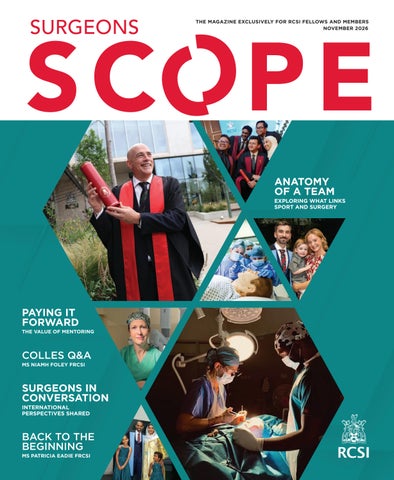
ANATOMY OF A TEAM
EXPLORING WHAT LINKS SPORT AND SURGERY
C
M
Y
CM
MY
CY
CMY
K
˙ ˙ ˙ˏ
0$ 0 3%(( 0. */"+.) (%2!/ * $!(, /$ ,! 0$! "101.! +" )! % %*! * , 0%!*0 .! (! /! (( ˙Ā*! % +*/ȑ %.! 0+. +" !2!(+,)!*0 +* ɌȈȋȈ Ȇ Ȋȅȇ ȋȆȎȏ +. !) %( %*!#% +*/Ȳ. /%Ȑ%!
ˏ˙ ˙ ˙̂ ˙ˏ ˙ ˏ
PAYING IT FORWARD
THE VALUE OF MENTORING
COLLES Q&A MS NIAMH FOLEY FRCSI
SURGEONS IN CONVERSATION INTERNATIONAL PERSPECTIVES SHARED
BACK TO THE BEGINNING MS PATRICIA EADIE FRCSI
On 1 May 1892, we began protecting professionals like you. Since then, we’ve grown to become the largest member-owned medical indemnity organisation, protecting people on the frontline of healthcare across the globe. As a mutual society, we invest our members’ subscriptions responsibly to grow our secure member fund. This gives us the strength to protect you for as long as you need us, while supporting our communities, our planet, and all our futures.
Medical Protection the side of
350,000 healthcare professionals
medicalprotection.org Always there for you
Medical Protection is a trading name of The Medical Protection Society Limited (“MPS”). MPS is a company limited by guarantee in England with company number 00036142 at Level 19, The Shard, 32 London Bridge Street, London, SE1 9SG. Medical Protection serves and supports the medical members of MPS with access to the full range of benefits of membership, which are all discretionary, and set out in MPS’s Memorandum and Articles of Association. MPS is not an insurance company. Medical Protection® is a registered trademark of MPS. For information on MPS’s use of your personal data and your rights, please see our Privacy Notice on the website. 2505236577 04/26
SURGEONS
28 THE MAGAZINE EXCLUSIVELY FOR RCSI FELLOWS AND MEMBERS
23
Contents 02
President’s Letter
18
An update from Professor Michael Kerin
04
05
05
The benefits of mentorship within the RCSI community, and the new programme designed to support the next generation of surgeons
RCSI Council Representatives of RCSI’s governing body
Collaboration is Key
21
Scope News Green theatres, conservation projects, and international expansion: a roundup of RCSI news
09
11 11
Telesurgery takes the next step
23
The trialling of telesurgery at a recent surgical symposium offers a glimpse of a future that is fast approaching
26
Anatomy of a Team
28
26
Better by Design A closer look at the transformative impact of the National Clinical Programme for Trauma and Orthopaedic Surgery
RCSI SURGEONS SCOPE MAGAZINE is published annually by RCSI for surgical Fellows and Members. Issues are available online at www.rcsi.com/portal. Your comments, ideas, updates and letters are welcome. Please contact the Fellows and Members Office, 118 St Stephen’s Green, Dublin 2; telephone: +353 1 402 2116; email: fellows@rcsi.ie. RCSI Surgeons Scope is posted annually to Fellows and Members In Good Standing. To ensure you continue to receive your copy, please update your contact details via www.rcsi.com/portal. RCSI Surgeons Scope is produced by The Irish Times, The Irish Times Building, 24-26 Tara Street, Dublin 2.
Back to the Beginning A fascinating insight into the career and passions of consultant plastic, reconstructive and aesthetic surgeon Ms Patricia Eadie FRCSI
The Colles Q&A Waterford-based general surgeon Ms Niamh Foley on balancing work and life
Where do surgery and team sports find common ground? Danielle Barron takes the score
15
Surgeons in Conversation We listen in as consultant urological surgeon Prof. Rustom Manecksha and urology specialist registrar Dr Kevin Keane compare notes
The story behind a new surgical research network
06
Paying it Forward
Scope Events Social gatherings in Ireland and internationally, including the Millin Networking Breakfast and the Family Fun Day
32
Scope Diary Upcoming events for Fellows and Members
OUR HERITAGE RCSI’s mission is to educate, nurture and discover for the benefit of human health. Founded in 1784 with surgery at our core, we are an independent, not-for-profit, world leading international health sciences education and research institution, with a deep professional responsibility to enhance human health. SURGEONS SCOPE / 1
› Letter
A LETTER FROM THE PRESIDENT, RCSI PROFESSOR MICHAEL KERIN ince its establishment in 1784, RCSI has had a long and proud tradition of excellence in surgical training, research and international surgical development. Over more than two centuries, RCSI has earned a global reputation for advancing surgical care, promoting excellence in surgical practice and providing leadership during periods of challenge and change. As President I look forward to continuing this mission and to working alongside RCSI Council and the wider community to ensure that policymakers, patients and the public continue to place their confidence and trust in our College. Maintaining RCSI’s reputation as a leader, supporter and advocate for the surgical profession, as well as for our patients and colleagues, requires collective effort and reminds me of the Irish proverb – is ar scáth a chéile a mhaireann na daoine. Reflecting this spirit of collaboration, a central theme of this year’s Surgeons Scope is teamwork. I would encourage you all to read Anatomy of a Team (page 11), which explores the parallels between effective team performance in both sporting and surgical settings. Apart from teamwork, this edition of Surgeons Scope touches upon several topics that are key priorities for my Presidency. EDUCATION, TRAINING AND RESEARCH It is hugely important that the College continues to evolve its education and training in a manner that is evidence-based and supported by research. In this regard, I am pleased to share that the Irish Surgical Trials and Research Network (I-STAR) Network will be officially launched at the 2026 Millin Meeting. With a commitment to advancing surgical care through research and innovation, the long-term goal of the network is to establish Ireland as an internationally recognised centre for collaborative surgical research. You can read more about the I-STAR Network on page 5. Another example of RCSI’s commitment to education and training is the continued development of the Robotic Surgery Programme. Most recently, attendees at the 2026 Freyer Meeting had the opportunity to engage in a live telesurgery event (see page 9 for more) while RCSI has also been recognised at international meetings for its foresight in developing a national curriculum to address how surgeons are trained, assessed and supported in a time of new and emerging technologies. SUPPORTING OUR YOUNGER COLLEAGUES Our younger colleagues represent the future of surgery, while also bringing the energy, curiosity and fresh perspectives that are essential to innovation and progress today. Supporting and championing their involvement remains a priority during my Presidency. In recent years great strides have been made in supporting our younger colleagues through the establishment of the Affiliate Membership Programme along with the activities of the Irish Surgical Trainee Group (ISTG) and the Early Career Surgeons Network (ECSN). 2
Professor Michael Kerin, President of RCSI
In addition to these initiatives, I believe mentorship is crucial to the development of skilled, confident, and resilient surgeons. In this regard, I invite you to read Paying it Forward, which provides valuable individual perspectives and also expands on the College’s peer mentoring programme for surgical trainees.
› Letter
Maintaining RCSI’s reputation as a leader, supporter and advocate for the surgical profession, as well as for our patients and colleagues, requires collective effort and reminds me of the Irish proverb – is ar scáth a chéile a mhaireann na daoine. Reflecting this spirit of collaboration, a central theme of this year’s Surgeons Scope is teamwork. Prof. Michael Kerin, President of RCSI presenting Certificates of Fellowship at the Dublin Conferring, July 2026
Prof. Michael Kerin, President of RCSI with President of Ireland, Catherine Connolly on a courtesy visit to Áras an Uachtaráin
Prof. Michael Kerin, President of RCSI with Prof. Premnath at the Penang Conferring, June 2026
ADVOCACY AND LEADERSHIP The surgical profession faces significant challenges. Alongside the opportunities presented by rapidly evolving technologies, we must also respond to a growing climate of misinformation and declining public trust in expertise. Therefore, a key focus of my term as President is to ensure that the College maintains its position as the credible voice of surgery into the future. Central to achieving this is consultation and engagement with patients. It will also require us to advocate for and assist with evidence-based policymaking. I am confident this can be achieved, particularly having regard for the expertise and track record that exists within our profession as reflected in the work of the National Clinical Programme for Trauma and Orthopaedic Surgery: Better by Design (page 15). FOCAIL SCOIR Throughout this edition of Surgeons Scope, you will see many examples of the expertise, dedication and collaboration that continue to strengthen our profession and improve care for patients. These qualities have long defined RCSI and will remain essential as we navigate the opportunities and challenges that lie ahead. As President, I would like to thank our new RCSI Council for the leadership and commitment they bring to advancing the work of the College across areas including surgical training, governance and technology. You can read more about our newly elected Council members in this edition of Surgeons Scope (page 4). I am also deeply grateful for the continued engagement of our community of more than 11,000 Fellows and Members across 95 countries. Despite differences in geography, specialty and career stage, we remain connected by a shared commitment to excellence in surgery, lifelong learning and better outcomes for our patients. I look forward to meeting many more of you in the months ahead and to strengthening the connections that unite our global surgical community. I warmly invite you to join us at the 2027 Charter Meeting, taking place from 9-13 February 2027 in RCSI. Beatha agus sláinte, Professor Michael Kerin President of RCSI SURGEONS SCOPE / 3
› Council Members
RCSI COUNCIL 2026-2028 The governing body of RCSI is its Council, composed of 21 surgeons who are Fellows of the College – and two lay members – all of whom are elected by the College’s Fellows and Members. Council meets regularly during the year and meetings are chaired by the President. Council delegates a number of its main functions to various boards and committees. The significant activities of these boards and committees are reported to Council on a regular basis. At a meeting of the College held on Wednesday, 3 June 2026 the following were elected to office (listed in order of year of Fellowship):
Professor Camilla Carroll
Professor Ronan Cahill
Consultant Otolaryngology Head and Neck Surgeon at the Royal Victoria Eye and Ear Hospital, Dublin.
Consultant General/Colorectal Surgeon at the Mater Misericordiae University Hospital, Dublin.
Professor Micheál Ó Ríordáin
Professor Paul Ridgway
Consultant General/Colorectal Surgeon at Mercy University Hospital, Cork.
Consultant General Surgeon at Tallaght University Hospital and St Vincent’s University Hospital, Dublin.
Mr Paddy Kenny
Consultant Orthopaedic Surgeon at Connolly Hospital Blanchardstown and National Orthopaedic Hospital Cappagh, Dublin.
Professor David Healy
Consultant Cardiothoracic and Transplant Surgeon at St Vincent’s University Hospital and the Mater Misericordiae University Hospital, Dublin.
Professor Kilian Walsh
Consultant Urological Surgeon at University Hospital Galway.
Professor Calvin Coffey
Consultant General/Colorectal Surgeon with the University of Limerick Hospitals Group.
Mr Keith Synnott Professor Michael Kerin, President
President of RCSI and Consultant General/Breast Surgeon at University Hospital Galway. Mr David Moore, Vice President
Vice President of RCSI and Consultant Trauma and Orthopaedic Surgeon at CHI at Crumlin, Tallaght University Hospital and Blackrock Clinic, Dublin. Professor Deborah McNamara, Immediate Past President
Immediate Past President of RCSI and Consultant General/ Colorectal Surgeon at Beaumont Hospital, Dublin.
Trauma and Orthopaedic Surgeon at the Mater Misericordiae University Hospital, Dublin.
Professor May (Susan) Cleary
Mr John Caird
Ms Ann Hanly
Consultant Paediatric Neurosurgeon at Beaumont Hospital and CHI Temple Street and Crumlin, Dublin.
Consultant General/Colorectal Surgeon at St Vincent’s University Hospital, Dublin. Mr Barry O’Sullivan
Consultant Vascular Surgeon at Tallaght University Hospital, Dublin.
Consultant Plastic Surgeon, at Beaumont Hospital and Connolly Hospital Blanchardstown, Dublin.
Professor Sean Johnston
The Hon. Mr Justice Peter Kelly
Consultant General Surgeon at Midland Regional Hospital Tullamore, Offaly.
Former President of the High Court, former Chair of the Commercial Law Centre in University College Dublin and Adjunct Professor of law at Maynooth University.
Ms Bridget Egan
Professor Carmel Malone
Consultant General/Breast Surgeon at University Hospital Galway.
Professor Thomas H. Lynch
Consultant Urological Surgeon at St James’s Hospital and Blackrock Clinic, Dublin.
4
Consultant Orthopaedic Surgeon at University Hospital Waterford.
Professor John Quinlan
Consultant Trauma and Orthopaedic Surgeon at Tallaght University Hospital, Dublin.
Roderick Ryan
Chartered accountant, director of several companies including Glen Dimplex, formerly Managing Partner of Arthur Andersen.
› I - S TA R N e t w o r k
COLLABORATION IS KEY I-STAR Network members will have access to a comprehensive programme of education and training delivered through the NSRSC and accredited by RCSI nnovative surgical research is happening every day across Ireland. A new network aims to raise the bar even higher by facilitating national and international collaboration, while also acting as a platform to showcase the high-quality surgical research and clinical trials taking place at Irish centres north and south of the border. The recently established Irish Surgical Trial and Research (I-STAR) Network will act as a central point of contact for international collaborators, academic partners and industry stakeholders seeking to engage with Ireland’s surgical research community, driving clinical innovation and allowing surgical research to happen at scale. Meaningful and well-coordinated collaboration is key to successful research. Dr Anne-Marie Byrne PhD, is Operations Director at RCSI’s National Surgical Research Support Centre (NSRSC). She explains that the I-STAR Network will provide comprehensive governance, resources, training, and operational support to surgical investigators, collaborative research groups, international partners, and industry. “Together, these initiatives will strengthen Ireland’s surgical research ecosystem, accelerate innovation, and ultimately improve outcomes for patients.” RCSI has been to the fore in creating fertile ground for surgical research, having established the NSRSC in 2022. The Centre acts as a focal point for surgical research, providing comprehensive infrastructural support for surgeons undertaking clinical trials and research studies – from initial concept through to study delivery and completion. “Since its inception, the NSRSC has supported the recruitment of more than 600 patients and engaged 156 surgeons in research activities across 20 major and regional hospitals in Ireland and Europe,” Byrne notes. The I-STAR Network is the next phase of this successful approach, and will be supported by the established infrastructure and expertise of the NSRSC. Professor Shirley Potter FRSCI is a consultant
Professor Shirley Potter, Clinical Director, I-STAR Network and Anne-Marie Byrne, Operations Director, NSRSC.
I-STAR will support the development of a pipeline of studies that include both investigator-led clinical trials and other highquality collaborative surgical research. plastic and reconstructive surgeon at the Mater Misericordiae University Hospital, and also I-STAR’s National Clinical Director. “I-STAR is designed as an all-island, collaborative network, bringing surgeons, trainees, methodologists, trial units and patients together to develop clinically relevant research questions and translate them into high-quality multicentre studies,” she explains. “We are placing particular emphasis on methodological rigour, patient and public involvement, streamlined study development and creating opportunities for surgeons at every career stage to participate in and lead research.”
Importantly, I-STAR will support the development of a pipeline of studies that include both investigatorled clinical trials and other high-quality collaborative surgical research. And with succession a hot topic in research, another crucial objective is to significantly increase opportunities for trainees and early-career surgeons to become involved in trials. “The I-STAR Network will provide regular webinars, training events, and access to a wide range of relevant educational resources to support the development of research skills and capacity across the surgical research community,” says Byrne. The nascent network has considerable longterm ambitions. “Our first year is about building the foundations of a network that surgeons across Ireland see as accessible, useful and genuinely collaborative,” Prof. Potter states. “Success will mean establishing an engaged national membership across surgical specialties and institutions, identifying research priorities and creating a pathway through which an idea can progress from a clinical question to a well-designed multicentre study.” One of the major barriers to clinical trials is recruitment, and surgical trials face their own unique recruitment challenges. According to Prof. Potter, I-STAR will strive to normalise participation in surgical research so that greater numbers of patients can avail of the myriad benefits of being involved in a trial. “We want this to become embedded within routine surgical practice, so that patients throughout Ireland have greater opportunities to participate in high-quality surgical studies irrespective of where they receive their care,” she says. The ultimate endpoint of any trial is a meaningful improvement in patient outcomes. “Our ambition is for I-STAR to establish Ireland as an internationally recognised centre for collaborative surgical research, generating evidence that directly changes surgical practice and improves outcomes for patients,” Prof. Potter concludes. ■ To learn more visit https://msurgery.ie/i-star/ SURGEONS SCOPE / 5
› News
SCOPE NEWS From preserving history to breaking new ground, a roundup of RCSI news
RCSI EXPANDS GLOBAL SURGICAL TRAINING NETWORK Pictured (l-r): Matthew Snell, RCSI Energy Manager; Prof. Camilla Carroll FRCSI, RCSI Council Sustainability Ambassador; Roisín Moore, HSE Climate Action and Sustainability Programme Manager; Kieran Ryan, Managing Director of RCSI Surgical Affairs; Catherine Sullivan, GTAS Programme Manager.
RCSI LAUNCHES GREEN THEATRE ACCREDITATION SCHEME TO SUPPORT MORE SUSTAINABLE SURGICAL CARE RCSI has launched the Green Theatre Accreditation Scheme (GTAS), a new national accreditation programme which will provide hospitals with a structured pathway to reduce the environmental impact of surgery while maintaining the highest standards of patient care. The scheme provides hospitals with a practical, evidence-based framework to reduce emissions, minimise waste, and improve resource efficiency across surgical services. It was developed by RCSI with support from the HSE Climate and Sustainability Programme and the HSE Spark Innovation Programme and is aligned with the HSE Climate Action Strategy 2023-2050. Healthcare is estimated to account for between four and five per cent of global carbon emissions, with surgery among the most resource-intensive areas of care. A typical surgical procedure can generate between 150 and 170 kilograms of carbon dioxide equivalent emissions, highlighting the significant opportunity to improve environmental sustainability within operating theatres. The Green Theatre Accreditation Scheme is built around 10 pillars of sustainable practice covering areas including anaesthetic sustainability, 6
waste reduction and recycling, energy efficiency, sustainable procurement, governance and culture, and performance monitoring. Hospitals can achieve bronze, silver or gold accreditation, recognising progressive achievement in sustainable surgical care, and providing surgical teams with a framework through which they can assess current practice, identify opportunities for improvement and demonstrate progress towards more environmentally sustainable surgical care. Professor Michael Kerin, President of RCSI, said: “Healthcare systems have a responsibility not only to care for patients today but also to contribute to a healthier future for generations to come. The Green Theatre Accreditation Scheme provides hospitals with a practical and achievable route to reduce their environmental impact while maintaining excellent patient outcomes.” Four hospitals have participated in the first GTAS pilot: St James’s Hospital; South Dublin Surgical Hub, Mount Carmel; Royal Victoria Eye and Ear Hospital; and Midland Regional Hospital, Tullamore. The GTAS is now open to hospitals across Ireland. Further information is available by emailing GTAS@rcsi.com.
RCSI has expanded its international surgical education network with the establishment of two new Basic Surgical Skills (BSS) centres in Egypt and India, strengthening access to highquality surgical training across both regions. The new centres, located at Alexandria University in Egypt and Mahatma Gandhi Medical College and Research Institute in Puducherry, India, will provide surgeons and surgical trainees with the opportunity to develop and enhance essential technical skills through RCSI’s internationally recognised Basic Surgical Skills programme. Alexandria University is home to Egypt’s second-largest medical school, admitting approximately 1,000 students annually to its undergraduate medical programme. The new BSS centre will support the development of surgical skills training in the region while also complementing RCSI’s established Membership of the Royal College of Surgeons (MRCS) examination centre in Cairo. In India, the new centre at Mahatma Gandhi Medical College and Research Institute represents an important step in expanding access to postgraduate surgical education and training opportunities for the growing community of RCSI Affiliate Members across the country. The establishment of the two centres reflects RCSI’s continued commitment to advancing surgical education globally.
› News
NEW RCSI REPORT CHARTS COURSE FOR SAFE AND EFFECTIVE USE OF AI IN SURGERY RCSI recently launched a major new report providing a comprehensive framework to guide the safe, ethical and effective integration of artificial intelligence (AI) across surgical practice in Ireland. The report, Artificial Intelligence and Digital Surgery, developed by an RCSI Short Life Working Group appointed by then RCSI President, Professor Deborah McNamara and chaired by Professor Micheál Ó Ríordáin FRSCI, sets out how AI and digital technologies will transform the future of surgical care, training and patient experience. It highlights the significant potential for AI to enhance diagnostic accuracy, improve surgical precision, optimise clinical decision-making and enable more personalised patient care. It also addresses critical challenges, including patient safety, governance, regulation, bias and workforce readiness. The report emphasises the need for robust governance structures and sustained investment in education and training to ensure surgeons are equipped to work effectively in a digitally enabled healthcare environment. It also outlines how AI can support surgeons across the full patient journey, from earlier diagnosis and improved operative planning to enhanced intraoperative guidance, post-operative monitoring and ‘hospital at home’ models of care. It also highlights the growing role of technologies such as robotics, augmented reality and data-driven clinical decision support systems. The report makes a series of key recommendations, including: embedding
Pictured (l-r): Prof. Micheál Ó Ríordáin FRSCI, AI and Digital Surgery SLWG Chair; Prof. Deborah McNamara, then RCSI President; and Mr Kieran Ryan, Managing Director of RCSI Surgical Affairs.
AI and digital medicine as core components of surgical education and training; establishing robust governance and regulatory frameworks across the health system; strengthening data governance, cybersecurity and ethical oversight; supporting surgeons with the skills needed to evaluate and safely adopt new technologies; and positioning RCSI as a central leader in policy development, research and innovation in this rapidly evolving field.
INNOVATIVE NATIONAL OSTEOARTHRITIS PATHWAY WINS CEO CHOICE AWARD AT HSE’S SPARK INNOVATION SUMMIT The Hip and Knee Pathway, an innovation we know reduces the need for surgery. from the RCSI HSE National Clinical By intervening earlier and coordinating Programme for Trauma and Orthopaedic care more effectively, we’re not only Surgery and two pilot sites in Meath and improving quality of life for people Waterford, has been awarded the HSE’s living with osteoarthritis but also easing CEO Choice Award at the Spark Summit pressure on outpatient clinics and making which took place in June. better use of specialist expertise.” Funded through the Department Between April 2023 and June 2025, of Health’s Sláintecare Integration over 2,000 patients were managed through Innovation Fund, the integrated care the pathway. 1,059 (51%) were direct GP pathway was tested between January referrals, from 67 GP practices participating Pictured (l-r): Niamh Keane, Project Manager, Hip and Knee 2023 and June 2025 at Our Lady’s across the two pilot sites. 72% of the Pathway; Ruth Kiely, Programme Manager, Hip and Knee Pathway; Hospital, Navan, University Hospital patients who were cared for through the Mr Tom McCarthy, Joint Clinical Lead for NCPTOS; Anne O’Connor, CEO, HSE; and Mr Alan Walsh, Consultant Orthopaedic Surgeon Waterford and within the Community pathway reported positive changes in terms and clinical advisor to Hip and Knee Pathway. Healthcare Network regions of Carlow, of pain reduction and improved function. Kilkenny and Meath respectively. Mr Alan Walsh, Consultant Evidence based and co-designed with patients, clinicians and the HSE, the Orthopaedic Surgeon at Our Lady’s Hospital, Navan and clinical advisor for pilot pathway focused on improving timely access to conservative management the National Clinical Programme for Trauma and Orthopaedic Surgery said: in the primary care setting for patients presenting with mild to moderate “Sláintecare funding gave us the resources and flexibility to trial a new way symptoms of hip and knee osteoarthritis. This approach is in line with Sláintecare of delivering care, one that puts patients at the centre, reduces pressure on principles, providing the right care in the right place at the right time by the right hospitals, and makes better use of the wider healthcare team.” team. The pathway has been complemented by a patient Self-Management app, Mr Finbarr Condon FRSCI, Joint Clinical Lead for the National Clinical developed by the National Clinical Programme for Trauma and Orthopaedic Programme for Trauma and Orthopaedic Surgery, said: “We set out to think Surgery in collaboration with patients, the HSE, universities (RSCI, University in an entirely new way about how to improve access to the kind of care that of Limerick and Trinity College, Dublin), and clinical experts.
SURGEONS SCOPE / 7
› News
LANDMARK CONSERVATION PROJECT UNDERWAY AT 123 ST STEPHEN’S GREEN
RCSI Vice Chancellor Professor Cathal Kelly and RCSI President Professor Michael Kerin pictured with the historic J. Booth & Son clock face.
HRB FUNDS TWO INTERNATIONAL SURGICAL TRIALS SUPPORTED BY RCSI NATIONAL SURGICAL RESEARCH SUPPORT CENTRE The Health Research Board (HRB) has awarded funding for two international surgical studies through its Investigator-Led Clinical Trials (ILCT) Programme, marking the first time surgical trials have been supported by the HRB. Both awards were secured in collaboration with RCSI’s National Surgical Research Support Centre (NSRSC). Ireland’s national coordinating hub for surgical clinical trials, the NSRSC worked closely with investigators throughout the funding application process, are co-applicants on the award and will oversee the implementation of both studies across participating hospital sites nationwide. Professor Stewart Walsh, Professor of Vascular Surgery, Head of the Discipline of Surgery at University of Galway and former Clinical Lead of the NSRSC, is the national lead for the WARRIORS trial, an international study led by Imperial College London. The trial will investigate whether earlier surgical intervention for women with aortic aneurysms can improve patient outcomes. Working in partnership with the University of Galway, the NSRSC will support the delivery of the study across four Irish hospital sites. A second ILCT award has been secured by Mr Oliver Boughton FRCSI and Mr Rajiv Merchant FRCSI, consultant orthopaedic surgeons at Children’s Health Ireland, who will lead the Irish arm of the Op Non-Stop trial. Led internationally by Alder Hey Children’s NHS Foundation trust and the University of Oxford, the study will examine optimal surgical management strategies for children with Perthes disease. The NSRSC will support the opening of the trial across Irish paediatric orthopaedic centres, to enable participation in a clinical trial for children with this rare disease. Established in 2022, the NSRSC has grown into a national resource supporting surgical research across Ireland, with 14 active multi-site studies currently in development or delivery. Earlier this year, RCSI announced a €1.2 million investment in the Centre to further strengthen this national surgical research infrastructure. The Centre is continuing to expand its national reach through the development of the Irish Surgical Trials and Research (I-STAR) Network and appointed Professor Shirley Potter FRCSI, Consultant Plastic and Reconstructive Surgeon, St James’s Hospital, Clinical Professor at the UCD School of Medicine, National Training Programme Director for Plastic, Reconstructive and Aesthetic Surgery at RCSI as the new Clinical Director, supporting its mission to increase patient access to innovative surgical studies and strengthen Ireland’s position in international clinical research. 8
A MAJOR CONSERVATION and restoration project is underway at RCSI’s historic home at 123 St Stephen’s Green, marking a oncein-a-generation effort to safeguard one of Dublin city centre’s most significant buildings for the future. Specialist conservation teams have been carrying out the careful decanting and protection of historically significant portraits, sculptures and artefacts housed within the building, ahead of restoration works progressing. The controlled decanting process involves detailed inventory tracking, specialist art handlers, and protective wrapping and transport methods to ensure the safe relocation of sensitive heritage items. Among the first visible milestones has been the removal of the iconic clock from the building’s façade which will undergo expert conservation before being reinstated as part of the wider restoration programme. The project will preserve and protect the architectural, cultural and educational legacy of this Dublin city landmark while ensuring the building remains fit for future
“123 St Stephen’s Green is far more than a building, it is a place deeply connected to the history of medicine, education and public life in Ireland.”
generations of students, researchers, clinicians and staff. Established in 1784, RCSI has occupied the St Stephen’s Green site since 1810. Facing onto one of Dublin’s most well-known public parks, the building has played a central role in the civic and cultural life of the city and has witnessed significant moments in Irish history, including the Easter Rising of 1916. The restoration project will involve specialist expertise across every aspect of the building’s historic fabric, from original stonework and period interiors to important collections and decorative features. Key conservation works will include roof slate replacement using traditional like-for-like materials, restoration of historic sash windows, localised stone and façade repairs, and structural conservation interventions. Professor Cathal Kelly, RCSI Vice Chancellor, said: “123 St Stephen’s Green is a place deeply connected to the history of medicine, education and public life in Ireland. For generations, the people that have passed through its doors have gone on to make a profound impact around the world. “Preserving this historic building is about protecting that legacy while ensuring it continues to inspire future generations. This restoration project reflects RCSI’s commitment to honouring our heritage alongside our ambition to continue advancing healthcare education, research and patient care for the future.”
› Te l e s u r g e r y
TELESURGERY TAKES THE NEXT STEP A ground-breaking new National Robotic Surgery Curriculum, the establishment of a dedicated robotic education space and the trialling of telesurgery at a recent surgical symposium all point to one thing: the future is already here obotic surgery is swiftly becoming a core component of modern surgical practice across multiple disciplines, with a consequent increase in demand for high-quality training in this rapidly advancing field. Until recently robotic surgery teaching in Ireland was largely ad hoc, with pioneer surgeons teaching senior trainees advanced robotic techniques in a small number of hospitals. This highlighted the pressing need for a consistent, highquality national approach. The 51st Sir Peter Freyer Surgical Symposium at the University of Galway on Friday, 4 September 2026 provided the perfect opportunity to road-test this approach, offering practical exposure to both a new robotic system and the possibilities of remote robotic surgery and training. The annual symposium is open to all surgical disciplines, both nationally and internationally. This year attendees were able to take part in the first nationwide remote telesurgery training event for conference attendees hosted by RCSI and supported by Cornerstone Robotics UK. Participants booked dedicated telesurgery slots to sit at the robotic console in Galway while remotely controlling the Sentire Surgical System located at RCSI’s Robotic Surgery Training and Research Suite in Dublin. For many participants, this was their first opportunity to experience telesurgery and explore a robotic platform that is new to Ireland. Ms Catherine Dowling FRSCI, a Consultant Urologist at University Hospital Galway, tried out the robotic console at the symposium, using it to transfer small objects and suture a sample material at a lab in RCSI Dublin. “This felt no different to using a robotic system based in the same room,” she says.
The benefits for patients are reduced travel and the ability to have their surgery delivered closer to home.
Ms Catherine Dowling FRSCI CONSULTANT UROLOGIST AT UNIVERSITY HOSPITAL GALWAY
It represents another important step in making advanced surgical education more accessible nationally.
Prof. Barry McGuire FRCSI PROFESSOR OF POSTGRADUATE SURGICAL EDUCATION AND ACADEMIC DEVELOPMENT, RCSI
Ms Dowling says the technology is expanding access to precision surgery and holds particular benefits for patients in remote areas. Mentorship for local teams in the use of telerobotics is “immensely important”, she says. “Ireland is a relatively small country and so we are fortunate that expert urological surgery is accesible to most patients,” she says. “However, telesurgery will still bring benefits to patients such as reduced travel and greater access to specialist care closer to home. For the surgical profession in Ireland, telesurgery has the potential to remove geographical barriers, enabling collaboration and surgical proctoring regardless of location. The implications for surgical training are particularly significant, allowing trainees across the country to benefit from world-class robotic surgery teaching delivered from centres such as RCSI or other hospitals directly into their own institutions. “There are, however, challenges to address,” Ms Dowling says. “Telesurgery depends on high-speed internet connectivity, requires significant investment, and raises important regulatory and governance considerations. It will also change the dynamics of the operating theatre and aspects of the surgeon-patient relationship. For that reason, I believe it is essential that telementorship develops alongside telesurgery, ensuring that local surgical teams are supported and strengthened.” Interest in the workshop was significant, with positive feedback from trainees. “This was a very valuable opportunity to engage with this next-generation surgical technology in a live training environment, connect with experts in the field and expand skillsets in robotic and remote surgery,” says Prof. Barry McGuire FRCSI, Professor of Postgraduate Surgical Education and Academic Development at RCSI, and a Consultant Urological Surgeon at St Vincent’s University Hospital, Dublin. “This could open up further opportunities to deliver robotic training across Ireland, without trainees always having to travel SURGEONS SCOPE / 9
Detail of a Cornerstone Robotics telesurgery robot in RCSI Dublin.
Photogrpah by Conor Capplis
› Te l e s u r g e r y
to Dublin, when they are tired after working long hours in hospitals far from the capital… It represents another important step in making advanced surgical education more accessible nationally.” It also ties in with international advances in robotic surgery being performed using telesurgery, where experts in one centre can log in to perform surgery in another district or country. As the market for robotic surgery platforms continues to A surgeon tries out the expand, capital costs are beginning to reduce and more hospitals Cornerstone Robotics are able to purchase these systems. This comes at a time when telesurgery console. demand for robotic surgery continues to increase, alongside growing pressure for access to these systems for training. Earlier this year RCSI launched Ireland’s first national programme for robotic surgical training. The new National Robotic Surgery Curriculum marks a significant advance in robotic surgery education in Ireland, supporting standardisation by ensuring that trainees develop a shared foundation in robotic safety, technical competence and non-technical skills. “The objective of the curriculum is to provide a structured foundation to trainees thereby ensuring a consistency in basic competencies, clear protocols for managing emergency situations and a common language for closed-loop communications, among other things,” says Prof. McGuire. The curriculum was supported by a €2.3 million institutional investment from RCSI in robotic surgical education, which included the purchase of three robotic platforms and the opening of a new robotic education space at the National Surgical and Clinical Skills Centre at RCSI’s St Stephen’s Green campus. Through the programme, surgical trainees are introduced to the principles of robotic surgery, including system set-up, ergonomics and safe workflow. They then develop core console skills such as camera control, instrument handling, dissection and suturing through advanced simulation and model-based training. “We’re assuming that the individual knows nothing about robotic surgery and subsequently training them from the very start of the journey to the point where they could actually operate a robot. I don’t know of many other institutions globally that have put such an emphasis on the development of a broad foundational knowledge, but at RCSI we believe it is really important,” he says. The next step is to develop a nationally distributed learning model for robotic surgery, with education delivered centrally from RCSI and accessed remotely through consoles located across the country. This approach will allow surgical trainees to learn, practise and be supervised without geographical barriers, supporting equitable access to high-quality training nationwide, Prof. McGuire adds. RCSI’s new robotic surgery curriculum and the associated robotic education suite serve to bridge the gap for surgeons between hands-on demonstrations and active use of the technology. “They can come in and learn in a safe, learner-centred environment, complete all of their simulator hours and master the different skills within their specialty,” says Prof McGuire. He also notes that the RCSI curriculum and robotic surgery system are deliberately vendoragnostic, focusing on transferable skills that allow surgeons to adapt as robotic technologies continue to evolve. While the specialties of urology and gynaecology initially dominated uptake of robotic surgery, its use is now expanding rapidly into other specialties. “Surgeons are naturally innovative and creative,” says Prof. McGuire. “They think, ‘What else can I use the robot for?’ There are things I do now that I never thought were even possible five years ago and this has only become a reality because of robotic surgery. It is a very exciting time in robotic surgery. We are seeing big things coming in general surgery and other specialties now.” ■ 10
INTERNATIONAL
PERSPECTIVES
We hear from two international surgeons with experience of telesurgery
Mr David McAdam FRSCI, Medical Director at Chitokoloki Mission Hospital, Zambia In theory, I specialise in general surgery, but in reality one does almost anything depending on the circumstance. Recently, I used a WhatsApp video call to assist with an operation. A consultant based in Oxford saw exactly what we were doing and advised us on how to proceed. We had excellent connection thanks to Starlink, and the boy did very well and returned to his home in rural Angola. There is plenty of potential for telemedicine. One of our main uses for WhatsApp video calls is in anaesthetics, where we have a Consultant Anaesthetist in Northern Ireland available 24 hours a day. We can show our patients’ respirations and blood gas results, and they advise on ventilator settings. Anaesthetics is less well developed here and that could present a serious challenge for safe robotic surgery. Four billion people in our world do not have access to essential health services, according to the World Health Organization. I would be concerned if funding telemedicine took priority as ultimately, we must ensure that more essential needs are resourced properly. This has been seen with cardiac surgery in the past. I look forward to the day when I can safely retire and leave the job to the robots!
Dr Abdul Haseeb MRCSI, Urologist and Clinical Researcher at the Institute of Kidney Diseases, Pakistan With more than seven years of clinical experience, my clinical interests include endourology, stone disease, minimally invasive urological surgery and urological oncology. My first observation of telesurgery was during the Pakistan Association of Urological Surgeons Urocon in Lahore last year. This was particularly significant because it demonstrated how geographical distance can potentially be overcome through robotic platforms, high-speed connectivity and remote surgical expertise Telesurgery has the potential to significantly improve access to specialist surgical expertise, particularly in resourcelimited and geographically remote settings. It can facilitate remote mentoring, real-time expert guidance, surgical education and collaboration between institutions. In the long term, it may help reduce disparities in access to complex surgical care while strengthening local surgical capacity. Key challenges include reliable high-speed connectivity, technical reliability, availability, cost, cybersecurity, patient data protection and regulatory issues. Patient safety must remain the central consideration and telesurgery should develop alongside appropriate training, governance, infrastructure and regulatory frameworks.
› Feature
ANATOMY OF A TEAM What do medical teams and sporting sides have in common? The highest performing teams share fascinating similarities, writes Danielle Barron
S U R G E O N S S C O P E / 11
› Feature
igh performance is high performance.” And Felipe Contepomi would know. Whether it’s working at a busy hospital or coaching an international rugby team, the pressure is on, although RCSI graduate Contepomi puts it more eloquently. “It’s very important to take into account the high standards you want to achieve and then support people to reach those high standards,” the head coach of the Argentine national rugby team says. “In medicine and rugby it is exactly the same. You don’t compromise those high standards.” From resilience to collaboration, mindset and precision, a winning team must have all these attributes in spades, whether it’s in the operating room or a packed stadium. Ms Grace O’Flanagan FRCSI agrees that high performance rarely comes from one dramatic moment. As a women’s field hockey international player and ENT surgeon, O’Flanagan is well-placed to comment. “It comes from preparation, repetition, teamwork and continually trying to improve the small details. That is probably the mindset from sport that I have carried most strongly into my surgical career.” Contepomi draws parallels between his dual careers of medicine and rugby, and more latterly coaching. Recalling his busy schedule as a medical student and then intern, all while playing rugby with Leinster at the top level, he credits the selfdiscipline he gained from his studies for ensuring he was able to give his all to both. “Waking up at six o’clock in the morning every day, and now, even if I don’t have to, I still do it because it became ingrained as a habit,” Contepomi tells Surgeons Scope. This self-discipline served him well, he says, whether he was doing ward rounds or rucks; “You need to cut your nails because of the infection risk, you need to be shaved and wellpresented… It’s those little things that when you put them together, you learn to be self-disciplined, to be prepared to be at the hospital and then you take that into rugby, because rugby is the same: the only thing you can control is your preparation.” Controlling the controllables is a game plan that worked: Contepomi was nominated for International Rugby Player of the Year in 2007, the same year he graduated from RCSI. “You learn from both environments and you can’t just take one hat off and put another on. You are still the same person.” O’Flanagan echoes Contepomi’s emphasis on self-discipline. “Both medicine and international hockey are very demanding in terms of time, but 12
You learn from both environments and you can’t just take one hat off and put another on. You are still the same person. Dr Felipe Contepomi
The profession of medicine has had a long standing association with the sport of rugby. Felipe Contempomi (pictured above at an Honorary Fellowship conferring ceremony at RCSI in September of this year) is a medical doctor who has enjoyed a stellar international rugby career.
› Feature
Photo by Ramsey Cardy/Sportsfile
Ms Grace O’Flanagan FRCSI receives her certificate of Fellowship in June 2026 from RCSI President, Professor Michael Kerin. Opposite: Grace O’Flanagan during the SoftCo Series international hockey match between Ireland and Great Britain in March 2021 at Queen’s University Sports Grounds in Belfast.
Repetition and precision are probably among the clearest parallels... In sport, you don’t practise something simply until you can do it, you practise until it becomes consistent and reproducible, including when you are under pressure. Ms Grace O’Flanagan FRSCI
doing both made me quite disciplined with the time I did have,” she admits. “If I had training in the evening, I knew I had a defined window to study or get work done, so I learned to be quite efficient.” Dr Angus Lloyd MRCSI is a retired rugby player who enjoyed a fulfilling career with Connacht Rugby and is now halfway through his general surgery higher specialty training. Lloyd believes many of the skills he developed through playing sport are translatable to hospital medicine and surgery, and vice versa. “Teamwork, leadership, developing organisational culture, resilience, perseverance - as well as an element of perfectionism - are all skills or traits that I developed through my experience as a rugby player that I believe have helped me to develop as a surgeon,” he says.
Contepomi is also keen to highlight the importance of precision, which is crucially important in rugby, but potentially life or death in medicine. “The higher the stakes, for example, the more complicated the surgery or if you go from junior rugby to senior to international, the margins are even smaller,” he explains. “The detail becomes very precise and that’s why every action counts.” Surgery can go catastrophically wrong on the basis of one small but incorrect action, he notes solemnly. “That’s why it’s so important to understand that a great or an extraordinary achievement is not done by an extraordinary action, it’s done by a thousand mundane well-done actions that make something extraordinary.” This is again where medicine and rugby overlap; scrutiny of past performance and continuous improvement are a hallmark of diligent
doctors and high-performing athletes alike. “Repetition and precision are probably among the clearest parallels,” O’Flanagan adds. “In sport, you don’t practise something simply until you can do it, you practise until it becomes consistent and reproducible, including when you are under pressure.” This means a lot of time is spent “training the basics”, and surgery, she notes, is no different. “Technical skills are developed through repetition, but particularly through deliberate repetition where you are continually refining small details,” she says. “I think there are interesting parallels with surgery, particularly now that so many procedures can be recorded, and in an era where simulation is a regular part of surgical training. There is a lot to learn from reviewing technique in a structured way, just as an athlete would review performance footage.” O’Flanagan also notes that sport and surgery each require decision-making in pressurised situations. “As a goalkeeper, you’re constantly processing a lot of information and making decisions very quickly,” she says. “You have to assess what is happening, make a decision and commit to it, while also being able to adapt as the situation changes. There is a lot of that in surgery too. You prepare thoroughly and have a clear plan, but you also need to be able to respond calmly to what you find and adapt your approach when necessary.” O’Flanagan says that as a hockey player and as a surgical trainee, she has had to become comfortable performing under pressure. “International sport means competing in situations where the result matters and where your individual performance is very visible,” she says. “Learning to remain focused on the task in front of you rather than S U R G E O N S S C O P E / 13
› Feature
May 2019: Angus Lloyd of Clontarf getting the ball away from the back of a ruck during the All-Ireland League Division 1 Final match between Cork Constitution and Clontarf at the Aviva Stadium in Dublin. Photo by Oliver McVeigh/Sportsfile.
I like to think that the teamwork and leadership skills I developed during my time as a rugby player are put to use everyday in work. Dr Angus Lloyd MRCSI
being distracted by the significance of the occasion has been very transferable to surgery.” Surgery, like rugby, Contepomi says, is fundamentally a team sport. “And I always say, everyone is indispensable, but no one is irreplaceable. The team is bigger than you, but it’s very important that everyone in the team does their job at 100 per cent of their capability and that’s why they’re indispensable because if you don’t do it correctly, the team fails,” he explains. “I tell my teams that we are like a chain, it breaks on the weakest link.” Being a team player also means keeping one’s ego in check; equally as important in the medical field as on the pitch. “When you start thinking that you’re bigger than the team, that’s when you start getting it wrong, because the higher purpose is what you want to achieve together,” Contepomi says. “You might take the credit but if you don’t understand that it’s done by a whole team, the credit is for the team, it won’t be long before you get it badly wrong.” “Team culture and identity were highlighted extensively during my time in elite rugby,” agrees Lloyd. “Obviously a hospital is a much bigger organisation than a rugby team but teamwork amongst medical colleagues as well as interdepartmental collaboration is essential for 14
the delivery of surgical care. I like to think that the teamwork and leadership skills I developed during my time as a rugby player are put to use everyday in work.” High-performing teams tend to have very clear roles, communication and a shared understanding of what they are trying to achieve, O’Flanagan adds. “Success depends on the whole team, and each person brings a valuable perspective.” Communication and meaningful collaboration, she says, is vital. “Good teams work best when people communicate clearly and everybody contributes the information and expertise they have.” The operating theatre is a similar environment. The surgeon may “lead” the operation, but successful surgery is very much a team performance. “You are working with anaesthetists, nursing staff, surgical assistants and many others, all bringing different expertise,” O’Flanagan explains. “When a team knows one another well, communicates effectively and anticipates what is needed next, it can make a complex operation go very smoothly.” According to O’Flanagan, her sporting career has mirrored her medical career, each requiring tenacity and dedication. “High-level sport also makes you very comfortable working towards longterm goals,” she says. “You can spend months or
years training towards a tournament or particular level of performance, and there are obvious parallels with surgical training, where developing expertise is also a very gradual process.” For Lloyd, the highs and lows of his rugby and medical careers have served to build his resilience. “One of the biggest learnings sport gives you is an understanding that no matter how much you train or prepare, sometimes things just won’t go your way for whatever reason,” he says. “You will never win 100 per cent of your matches no matter how good you are.” The same can be said for surgery. “You will have tough cases, complications, difficult patient interactions, and so on, but rugby has taught me that although you can’t always win every match, we must reflect on what went wrong, what we can do better, strive to learn from our mistakes and look to continuously make incremental improvements to how we practice.” Contepomi brings it back to controlling those controllables. “We are talking about something more important than rugby, it’s life or death, so with rugby, you have to put it into perspective. For me resilience is trying to understand that maybe things might not come your way because of an external variable, but you keep doing the right thing and learning to do it better.” ■
› Innovation
BETTER BY DESIGN The National Clinical Programme for Trauma and Orthopaedic Surgery is making good on an ambitious vision, with enhanced patient care at the heart of the story
ince its inception in 2012, under the clinical leadership of Mr David Moore FRCSI and Mr Paddy Kenny FRCSI, the National Clinical Programme for Trauma and Orthopaedic Surgery (NCPTOS) has played a central role in shaping trauma and orthopaedic care across Ireland. Through service redesign, data-driven decision-making and multidisciplinary collaboration, the NCPTOS has improved patient access, enhanced safety and supported the development of innovative models of care that are now embedded across the healthcare system. Current Joint Clinical Leads, Mr Finbarr Condon FRCSI and Mr Tom McCarthy FRCSI, work alongside Programme Manager Ruth Kiely and the wider team to design and test ongoing improvements to benefit patient care.
IMPACT: DESIGNING BETTER WAYS OF DELIVERING CARE
The primary objective of the NCPTOS is simple but ambitious: to design, test and champion better ways of delivering trauma and orthopaedic care. Working closely with healthcare professionals, patients, hospitals and national stakeholders, it identifies challenges within the system, develops innovative Mr Tom McCarthy FRCSI solutions and evaluates their effectiveness by way of piloting CLINICAL LEAD projects, before advocating for national implementation. This approach has produced a series of national initiatives that have significantly improved patient access and strengthened service delivery. One of the Programme’s most significant deliverables has been the development and expansion of Musculoskeletal Triage Services. Introduced in 2012, the physiotherapy-led service ensures that patients referred for orthopaedic assessment are Mr Finbarr Condon FRCSI directed to the most appropriate healthcare professional from CLINICAL LEAD the outset. Rather than automatically joining an orthopaedic ORIGIN: BUILDING A NATIONAL VISION FOR outpatient waiting list, many patients can receive assessment TRAUMA AND ORTHOPAEDIC CARE and treatment from clinical specialist physiotherapists The Programme was established as a collaboration with the with less than 15% converting for a specialist opinion, thus Health Service Executive (HSE) at a time when significant improving both efficiency and patient experience. Over a tenvariation existed in how trauma and orthopaedic services were year period, this service managed almost 300,000 patients delivered across Ireland. Under the leadership of successive from the Outpatient Department waiting list. clinical leads, programme managers and multidisciplinary Another landmark innovation has been the implementation teams, a clear vision emerged: to create a system that enables Ruth Kiely of Virtual Fracture Assessment Clinics (VFAC). While only equitable access to specialist care while improving safety, PROGRAMME MANAGER a small number of sites operated virtual fracture assessment efficiency and outcomes for patients. services prior to the COVID-19 pandemic, the model was rapidly adopted A milestone in that journey was the publication of the Programme’s National nationally during this period and has since become standard practice. Today, Model of Care in 2015, which provided a roadmap for future service development, approximately 70,000 patients are assessed annually through VFAC, reducing identifying where improvements were required and outlining how trauma and unnecessary hospital visits while maintaining high standards of clinical care. orthopaedic services could evolve to meet the growing needs of patients. The The NCPTOS has also been instrumental in establishing the Irish National model continues to guide many of the Programme’s priorities today, with new Orthopaedic Register. The Register tracks orthopaedic implants used in initiatives often emerging directly from the recommendations identified within it. procedures such as hip and knee replacements, providing important data on According to Ruth Kiely, the purpose and focus of the NCPTOS is clinical outcomes, and offering a mechanism to rapidly identify patients if implant design. “It’s improving patient access to care, making sure services are delivered recalls occur. The initiative has strengthened patient safety and contributed to safely, using data to justify why change is required and developing models of the development of a more robust national evidence base. care/care pathways that improve access and equity for everyone.” The Programme’s contribution to trauma care extends further through This commitment to evidence-based redesign has underpinned the initiatives such as the Irish Hip Fracture Database and the broader Hip Fracture Programme’s work from the outset and continues to inform its priorities as Care Trauma Pathway. These developments have improved the management of healthcare delivery evolves. S U R G E O N S S C O P E / 15
› Innovation
hip fracture patients by supporting better clinical pathways, more appropriate referrals and greater collaboration between orthopaedic teams, older persons services and other healthcare disciplines. The result has been improved standards of care and better functional outcomes for some of the most vulnerable patient groups. Collectively, these achievements demonstrate the ability of the NCPTOS to bring innovative ideas from concept to everyday clinical practice, delivering measurable benefits for patients and healthcare providers alike.
This approach has produced a series of national initiatives that have significantly improved patient access and strengthened service delivery.
COLLABORATION: TURNING LOCAL INNOVATION INTO NATIONAL CHANGE
A defining characteristic of the National Clinical Programme in Trauma and Orthopaedic Surgery is its collaborative approach. Successful healthcare innovation rarely happens in isolation. Instead, progress depends on partnerships between clinicians, patients, hospitals, healthcare professionals, policymakers, and service leaders. The NCPTOS facilitates collaboration between these groups, creating opportunities to test new ideas, gather evidence and support wider adoption of successful initiatives. Patients remain central to this process. New models of care are developed through co-design, ensuring that service improvements respond to real patient needs. Clinical advisory groups, consultant bodies, nursing teams, health and social care professionals all contribute expertise at different stages of development. Importantly, many innovations originate at a local level. Healthcare professionals working on the frontline often identify opportunities to improve patient care and develop practical solutions within their own services. The NCPTOS helps transform those local innovations into scalable national initiatives. As Mr Finbarr Condon FRCSI, Joint Clinical Programme Lead, explains: “Sometimes ideas come from the ground. People working in the system know it best. Our role is to connect with the right people, help build the business case, demonstrate the benefits and support wider implementation.” However, scaling successful innovations is rarely straightforward. Funding constraints, resource limitations, competing priorities and organisational change can all delay implementation. The NCPTOS frequently plays an advocacy role, working with healthcare leaders and policymakers to ensure proven innovations receive the support required to become sustainable services. In many ways, the NCPTOS functions as both an innovation catalyst and a national knowledge repository, helping hospitals avoid duplication of effort by sharing successful models, business cases and implementation resources. FUTURE PRIORITIES: WHAT COMES NEXT?
While the Programme has achieved significant progress over the past decade, its focus remains firmly on the future. Three priorities in particular will shape its work over the coming years: PLANNED TRAUMA CARE AND SURGICAL HUBS
The Programme’s foremost priority is the continued development and implementation of planned trauma care models. Traditionally, many patients presenting with fractures or injuries would require admission while awaiting surgery. Planned trauma care offers an alternative approach, enabling many patients to have their injury stabilised initially before returning for scheduled surgery at an appropriate time. 16
This model improves patient experience, reduces unnecessary hospital stays, and supports more efficient use of healthcare resources. Looking ahead, there is significant potential for further integration with Ireland’s developing network of Surgical Hubs, helping free capacity within acute hospitals while ensuring patients receive timely care. E-TRAUMA PATIENT FLOW SYSTEM
Digital transformation is another major priority. The e-Trauma patient flow system provides real-time visibility of trauma patients across the care pathway, helping clinical teams coordinate treatment more effectively while reducing the risk of delays or patients being overlooked within the system. Following successful testing in 2021/2022, the Programme secured funding through the HSE’s Chief Clinical Officer’s Office for the system to be implemented at Cork University Hospital in 2024 and University Hospital Limerick in 2025. The Programme continues to advocate for broader implementation nationally. As healthcare systems become increasingly digital, such tools are expected to play a vital role in improving patient flow, supporting planned trauma care and enhancing service coordination. INTEGRATED CARE PATHWAYS
The third major priority focuses on modernised care pathways. These pathways recognise an important reality, that not every patient referred to orthopaedic services requires a surgical opinion. By directing patients towards the most appropriate healthcare professional, whether a nurse, physiotherapist, occupational therapist, dietitian or another specialist, services can provide earlier intervention while reserving surgical appointments for those who genuinely need them. Pilot projects have already delivered encouraging results across a range of conditions, including hip and knee osteoarthritis, low back pain, shoulder, wrist and hand conditions. One such modernised care pathway recently received national recognition winning the HSE CEO Choice Award (see Scope News). As Mr Tom McCarthy FRCSI, Joint Clinical Programme Lead, notes: “It’s really about providing the right care at the right time with the right person. We know from our projects that only a small proportion of patients ultimately need to see an orthopaedic surgeon. Earlier access to the appropriate professional improves both efficiency and patient outcomes.” BENEFIT TO PATIENTS: RETURNING TO THE ‘WHY’
The work of the NCPTOS is ultimately focused on delivering better outcomes for patients. Through standardised pathways and nationally coordinated services, it seeks to ensure that patients receive consistent, high-quality care regardless of location. National registries, databases and digital systems continue to strengthen patient safety, while innovations in service delivery improve access and reduce delays. These achievements reflect the importance of strong clinical leadership and collaboration across the healthcare system. As healthcare evolves, the NCPTOS will continue to identify opportunities for innovation, ensuring trauma and orthopaedic services remain responsive to changing patient needs. More than a decade after its establishment, its impact can be seen not only in national policies and programmes, but in the thousands of patients who receive safer, faster and more effective care each year. ■ www.rcsi.com/surgery/practice/national-clinical-programmes/trauma-and-orthopaedics
› Heading Head
SURGEONS SCOPE / 1
› Mentoring
PAYING IT FORWARD Mentorship in surgery can play an invaluable role in clinical skill development and career guidance as well as providing professional support, writes Katy McGuinness entorship within the RCSI community has long been important to the career development of surgical trainees; to date this has mainly operated on an informal basis. Last year, the College rolled out a pilot mentoring programme for surgical trainees with the aim of putting the relationship between mentors and mentees on a more formal footing. After the success of this pilot, funded by a National Doctors Training and Planning (NDTP) grant, Mr Dara Kavanagh FRCSI, RCSI’s Head of Surgical Policy and Practice Development, Core Surgical Training Programme and Surgical Research Lead, has confirmed that the mentoring programme will now run annually. “In surgery,” he says, “there has always been a need for junior surgeons to align with those who are more senior, but traditionally these have been informal relationships. The College felt that a more formal structure would be better for 18
both mentors and mentees. Each July we have 100 new trainees who would benefit from the opportunity to avail of mentoring from the outset.” The team in RCSI’s Department of Surgical Affairs used the NDTP grant funding to develop an education programme for mentors outlining how communication with the mentee should operate and the topics it should cover over the course of three meetings spread over the year. Year One and Year Two trainees were invited to apply for mentoring on the pilot programme, while Year Five and Year Six trainees were recruited as mentors. “The rate-limiting factor was the availability of mentors,” explains Kavanagh. “Around 20 applied to be mentors and completed the training course, so we took the first 20 mentees.” The online course takes an hour and defines the framework and boundaries of the mentoring relationship. To protect both mentor and mentee, mentors are instructed to refer mentees to other resources, such as the helpline and wellness programme overseen by Sinéad Dixon, RCSI Health and Well-being Officer.
› Mentoring
“The feedback from the pilot the most of the opportunities available programme has been overwhelmingly and to contribute from the outset.” positive,” says Kavanagh. “Mostly the The mentorship I received was less frequently Prof. Helen Heneghan FRSCI was mentoring has involved advice on career the first consultant bariatric surgeon formal advice-giving so much as consistent progression and guidance regarding appointed in Ireland, tasked with exams. The mentors are happy. While support – people who had already done this, developing a pre-existing service informal mentoring has always gone which had been established by Mr who made themselves available and who on, this formal mentoring rewards the paid attention to the personal development Justin Geoghegan at St Vincent’s mentor in that they get a certificate University Hospital in response to a of all fellows and trainees. from RCSI and it is good for their long waiting list. CV. Unsurprisingly, all participants “Justin is a wonderful mentor,” says observed that the programme works Prof. Heneghan. “He was not formally best when mentors and mentees are trained as a bariatric surgeon, but he matched in their specialties. established a service with very few “We are trying to accommodate this resources and no dedicated funding. where possible,” says Kavanagh. “Also, He’s been part of establishing multiple some mentors felt they had capacity for national programmes. His guidance two mentees, but we decided that was in relation to navigating the people Ms Lauren O’Connell FRCSI too much.” who make decisions and where money RECIPIENT OF THE 2025 RCSI PROGRESS WOMEN IN SURGERY FELLOWSHIP For the second year of the programme, is to be found was invaluable. I soon 30 mentors have been recruited and discovered that, as in most aspects higher surgical trainee Conor Toale MRCSI, has been appointed Mentorship of surgery, doing the operations and managing patients is the easy bit. It’s Champion. getting the access and resources to develop a programme which is much more Ms Lauren O’Connell FRCSI, recipient of the 2025 RCSI PROGRESS Women challenging.” in Surgery Fellowship, recently completed the Advanced Colorectal Cancer When Prof. Heneghan was appointed, she had completed two bariatric Fellowship in Peter MacCallum Cancer Centre, Melbourne, Australia. She credits surgery fellowships, one in the US and one in the UK, under world-renowned the mentorship she received from previous holders of the Advanced Colorectal experts Prof. Philip Schauer and Prof. David Kerrigan. She describes her Cancer Fellowship with ensuring its success. American experience as “the ultimate first world experience”, while the UK “I chose this Fellowship as I felt it had multiple aspects which would was “leaner and more pragmatic” and says both Schauer and Kerrigan were complement and enhance the training I had completed in Ireland – in particular, generous in sharing what they had learned from establishing their programmes. a formalised robotic training programme with a high-volume robotic colorectal “I have had mentors at every stage of my training,” says Prof. Heneghan, practice, and training in both open and minimally invasive approaches to pelvic “including Prof. Michael Kerin when I was a medical student and early in my sidewall dissection and beyond-TME resections. training. Mentorship is important in developing not just your career, but you as “There is also a substantial academic component, with a research programme a person, a manager [and] a leader. You need different mentors for every aspect spanning clinical and translational research, as well as active clinical trials.” of your career.” Ms O’Connell’s decision to pursue this fellowship was guided by mentorship Working with Mr Geoghegan and the support of Prof. Donal O’Shea, it from surgeons Mr Peadar Waters FRSCI and Ms Helen Mohan FRCSI (a prior took Prof. Heneghan seven years to secure funding for the bariatric surgery recipient of the RCSI PROGRESS Women in Surgery Fellowship) who had programme. “It was hard-earned in terms of having to make a case that completed the same Fellowship in the Peter MacCallum Centre before her. developing this service would be not just clinically effective, but also cost“Their advice and support were invaluable effective. Getting the money was one in making the decision and preparing for problem, and using it was another, in terms the interview. They gave me a complete and of trying to recruit people with the skillset The feedback from the pilot holistic assessment of the clinical priorities to deliver a service for which there wasn’t programme has been and operative workload of the unit, the a training programme in Ireland. RCSI overwhelmingly positive. academic focus and opportunities, and have been hugely supportive in identifying practical advice on making the move to a need for training bariatric surgeons, Melbourne.” establishing an SpR training pathway, and Ms Mohan is now a permanentlyproviding training days. appointed consultant in the Peter “I learned along the way that you need MacCallum colorectal surgical unit. multi-sector support to develop any “It was great to see a familiar face and to sustainable programme, particularly for have a point of continuity between my training a chronic disease. It takes great surgical in Ireland and the new environment of Peter leadership as well as motivated, determined Mr Dara Kavanagh FRSCI Mac,” says Ms O’Connell. “Helen guided and and pragmatic people to deliver a service with HEAD OF SURGICAL POLICY AND PRACTICE DEVELOPMENT, CORE SURGICAL TRAINING PROGRAMME AND SURGICAL RESEARCH LEAD AT RCSI assisted me throughout, allowing me to make that get-on-with-it attitude of not waiting until S U R G E O N S S C O P E / 19
› Mentoring
in from everyone delivering patient care, it everything is in place and perfect. Justin is a whole hospital service.” had the institutional and local knowledge Prof. Heneghan’s advice to surgical to point me in the right direction.” I have had mentors at every stage trainees is to attend international, One of the most challenging aspects of my training... Mentorship is specialty-specific meetings to identify key of the job for Prof. Heneghan has been important in developing not just leaders in various fields. working to establish a hub and spoke “The same people keep giving keynote model for the bariatric service, with your career, but you as a person, lectures, chairing sessions and getting surgery now happening in St Michael’s a manager [and] a leader. awards. Through this, I quickly realised Hospital in Dún Laoghaire. Philip Schauer was the person who had one In this, she was guided by Mr David of the most thriving bariatric practices in Monk, one of the bariatric surgeons she the US at the time.” worked with in the UK. Meanwhile, reflecting on her time in “He foresaw some of the bariatricAustralia, Ms O’Connell is grateful not just specific challenges I would have, even to for the mentorship provided by her Irish the point of getting me to take pictures surgical colleagues, but also the outstanding of operating rooms specifically built clinical and operative training from her for bariatric surgery, clinic rooms, Prof. Helen Heneghan FRCSI CONSULTANT BARIATRIC SURGEON, ST VINCENT’S Australian counterparts, as well as backing furniture, weighing scales, mattresses, UNIVERSITY HOSPITAL AND PROFESSOR OF SURGERY for her academic and research projects. and bariatric equipment – things AT UNIVERSITY COLLEGE DUBLIN “The mentorship I received was less that, when you’re training, you don’t frequently formal advice-giving so necessarily notice. I had never thought much as consistent support – people who had already done this, who made about how the instruments necessary to deliver bariatric surgery were on the themselves available and who paid attention to the personal development of table for me, I didn’t realise I had to specifically request them. all fellows and trainees within the unit. This has shaped how I think about my “Every service has unique aspects that the surgeon developing them needs to own responsibility now: as future Irish trainees look toward fellowships like think of. I learned very quickly there are only very specific doors the bariatric this one, I would hope to take on the role of mentor myself and be in a position beds will get through, and areas of the hospital in which patients could be safely to provide similar benefit, advice and insight to those coming after me.” ■ and comfortably managed. Delivering bariatric surgery requires support and buy-
THE KNOWLEDGE EXCHANGE
NOBODY PASSES ALONE: MENTORSHIP AND THE INTERCOLLEGIATE EXAM Prof. May Cleary FRSCI, RCSI Council Member, Consultant Orthopaedic Surgeon at University Hospital Waterford and Professor of Orthopaedic Surgery at University College Cork There is a particular feeling most of us experience about eight months before the FRCS (Tr & Orth). It is the overwhelming realisation that the syllabus has been narrowed to approximately everything: every procedure, every classification and every paper. What does help, more than any textbook, is another human being who has been through it and come out the other side. That is the case for mentorship. The intercollegiate exams are not really a test of knowledge in that most candidates know more than enough by the time they sit it; the MCQ has made sure of that. They are a test of judgement, of how you organise what you know and how you deliver it calmly, to a relative stranger. That is a performance skill, and performance skills are learned from people, not pages. Any examiner will tell you what a pleasure it is to examine a candidate who demonstrates lived experience, rather than regurgitating a textbook or all the papers. It is the display of higher order thinking, and having a system, 20
even in complex situations, which scores high marks. A good mentor does three things. First, they calibrate: trainees are famously poor judges of their own readiness. A mentor who has examined, or been examined recently, can tell you where you actually stand. Second, they translate: the exam has its own dialect – the structured answer, the safe approach, knowing when to stop talking. Take comfort in the fact that this can be taught. Third, they keep you going: preparation is a long and lonely business, and it is much harder to skip a viva session when someone has given up their evening to run it. So how do you find a mentor? My advice is to ask early and widely. Although higher surgical trainees in Trauma and Orthopaedic as well as other speciality training programmes assign you a designated mentor, for exam purposes you may wish to ask others. Approach a consultant you respect and ask.
Most will be flattered, and those who decline are usually just busy. Look beyond consultants too. The registrar who passed last sitting is a goldmine of practical, current advice, and the peers preparing alongside you are the mentors you will see most often. Form a small group, meet regularly, and be ruthless with one another in a friendly way. Use whatever mentorship you receive properly: turn up prepared, take the criticism, and come back having acted on it. A word, finally, to my consultant colleagues. Somebody once sat across a desk and told you, kindly, that your answer on the mangled extremity was a mess. You passed, in part, because of them. That debt is best repaid forward. And to the mentees: remember that nobody passes these exams alone, whatever they tell you afterwards. Find your people early, and when your turn comes, be one of them.
› Discourse
RCSI SURGEONS IN CONVERSATION Our two surgeons work in urology: a unique surgical specialty with oversight of five discrete organ systems: kidney, bladder, prostate, testicular and penile. Based in Ireland and Australia respectively, both have a particular interest in uro-oncology and improving cancer patient outcomes NOTABLE DEVELOPMENTS RM: There have been notable developments in the treatment of prostate, bladder and kidney cancer, which are more common than testicular and penile cancer. The PROTEUS Phase 3 trial shows that neoadjuvant apalutamide, given before and following surgery, significantly improves outcomes in high-risk localised or locally advanced prostate cancer compared with ADT alone. To date, this combination has mostly been used in radiotherapy patients. The trial is particularly relevant in Ireland because prescribing these drugs is restricted to medical oncologists, partly because of cost and the need to manage potential side effects. Is it the same in Australia? KK: In Australia, urologists can prescribe the newer prostate cancer agents, but in practice we often defer to medical oncology because they are more accustomed to managing the side effects and toxicity. As systemic treatment options expand, deciding which treatment is most appropriate for an individual patient is becoming increasingly nuanced. It can be difficult for a urologist to remain up to date with the rapidly evolving evidence while also maintaining a busy surgical practice. The trial is interesting because traditionally localised prostate cancer has been managed with surgery alone, with additional treatment considered afterwards RM: I think it is going to be practice-changing. The patients were high-risk and relatively unfavourable surgical candidates, yet they had better surgical outcomes when these medications were given first. In Ireland, medical oncology may now become involved much earlier in the management of these patients, raising questions around cost and resources. In non-muscle-invasive bladder cancer, are you using alternative agents for BCG-naive or BCG-unresponsive patients in Australia? KK: For BCG-naive patients, no, but for BCG-unresponsive patients, yes. One of the focuses of my PhD is intravesical gemcitabine-docetaxel. For many years there were few developments outside BCG, but over the last decade a range of novel therapies have emerged, particularly in the US, although many remain too expensive for widespread routine use.
PROF. RUSTOM MANECKSHA FRCSI is
a consultant urological surgeon at Tallaght University Hospital, St James’s Hospital and Beacon Hospital. Manecksha completed his basic and higher surgical training in Ireland before embarking on a subspeciality fellowship in Melbourne (2011-2013). He has a special interest in endourology, kidney stone disease and benign prostate enlargement (BPE).
DR KEVIN KEANE MRSCI
is a PhD candidate at University of Western Australia, and a urology research fellow at Fiona Stanley Hospital. He is a committee member of the British Urology Researchers in Surgical Training group (BURST) and Australian and New England Urogenital and Prostate Cancer Trials Group (ANZUP). His research is investigating novel local therapeutic delivery strategies for high-risk non-muscle invasive bladder cancer.
Conventionally, gemcitabine-docetaxel is administered sequentially: gemcitabine is instilled for one to two hours, drained, and followed by docetaxel for another one to two hours. This is given weekly for six weeks, followed by maintenance therapy for up to two years. Although the drugs themselves are inexpensive, the treatment is time- and resource-intensive. We are now combining the drugs in a single instillation given over 90 minutes. We have completed the Phase I G-DISCO trial and shown that this approach is safe and well tolerated. Our Phase II trial is now assessing whether synchronous delivery is as effective as sequential treatment. RM: We have only recently introduced gemcitabinedocetaxel for BCG-unresponsive patients. That is a positive development because otherwise these patients may have faced radical cystectomy and urinary diversion. Having another bladder-preserving option is valuable. There have also been global BCG shortages because it is inexpensive and pharmaceutical companies have limited financial incentives to invest in supply infrastructure. We have had to be creative in managing shortages. The next step may be to develop an indwelling slow-release delivery system, such as the TAR200 device, which could be inserted in an outpatient or ambulatory setting. KK: The field is moving towards more personalised, less invasive, bladder-sparing approaches. Another of my PhD trials involves injecting immunotherapy directly into the bladder. We radiolabel durvalumab with zirconium-89 so that PET imaging can track where the drug goes after administration. The hope is that local delivery will produce high concentrations within the bladder while reducing systemic exposure and potentially limiting immune-related side effects. ROBOTIC SURGERY RM: In Ireland, there has been widespread uptake of robotic-assisted minimally invasive surgery for bladder cancer over the last decade. Is it similar in Western Australia? KK: The standard of clinical urology and surgical skill in Australia is very comparable to Ireland. As in Ireland, S U R G E O N S S C O P E / 21
› Discourse there has been a gradual transition from open to robotic surgery. We now perform the majority of our cystectomies robotically, including intracorporeal ileal conduits and neobladders where appropriate. Patients are often home within a week, sometimes sooner, with advantages including reduced blood loss and excellent visualisation. RM: The average hospital stay for bladder cancer surgery is now around five or six days, compared with closer to two weeks previously. That is a major change for hospital resources and significantly reduces recovery time. RM: Kidney cancer is also evolving rapidly on the medical oncology side, although not all drugs are available in Ireland. There is considerable scope for targeted treatment because of the different kidney cancer subtypes. KK: Every case goes through the multidisciplinary team. Where feasible, the preference is for nephron-sparing, minimally invasive surgery; otherwise, nephrectomy by the most appropriate approach. Patients are then rediscussed once the histology is available. Low-risk patients are generally followed by urology nurses, while those who may benefit from adjuvant systemic therapy are referred to medical oncology. RM: Medical oncologists also try to recruit suitable patients to clinical trials. Ireland has traditionally lagged in trial access, although this is changing. KK: Australia has a well-established clinical trials network and research infrastructure that supports large multicentre studies. Collaboration between ANZUP and Cancer Trials Ireland has been particularly encouraging, including major prostate cancer trials such as ENZAMET and ENZARAD. RM: That is why it is important for fellows and senior trainees to spend time in Australia, New Zealand and the US. They can develop research skills and international networks and bring those collaborations home, allowing us to advance treatment internationally. AUGMENTED REALITY RM: Is AI and augmented reality coming into play? KK: We are using AI in non-muscle-invasive bladder cancer. We have histology from around 500 patients and are using the Computational Histology AI, or CHAI, biomarker to analyse digitised TURBT slides. The aim is to identify histological patterns that predict which tumours may respond to particular treatments or develop resistance. Biomarker-driven approaches are likely to become increasingly important. Another interesting technology is the Histolog Scanner, which uses fluorescence confocal microscopy to scan prostate specimens in real time after removal. This allows surgical margins to be assessed during the operation and, if a positive margin is suspected, potentially guides further resection. 22
RM: Louise McLoughlin, one of my colleagues in St James’s, worked on machine learning for kidney cancers and nephroureteral specimens during her fellowship in Canada. I have also worked on augmented reality for stone surgery. Threedimensional printing may have applications in some procedures, while technologies such as the ILY robot for flexible ureteroscopy are also interesting.
BENIGN UROLOGY RM: At outpatient level, RCSI’s Model of Care for Urology led us to develop advanced nurse practitioner roles for assessing men with lower urinary tract symptoms. These patients previously languished on general urology waiting lists. Their symptoms have a major impact on quality of life, but because the condition is benign, they were often low priority. Specialist ANP-led clinics allow them to be assessed much earlier. Is it similar in Australia? KK: At Fiona Stanley Hospital we have a LUTS nurse, although not an ANP, so they cannot prescribe. They provide dietary and lifestyle advice, but patients requiring cystoscopy or medication still need to see a urologist. RM: We have combined ANP-led outpatient assessment with minimally invasive procedures that can be delivered as day cases or even in ambulatory settings. This means we can discuss surgical options much earlier. Previously, surgery was generally considered only after medical treatment had failed. KK: One challenge in Australia is that the Pharmaceutical Benefits Scheme can be restrictive. I can prescribe dutasteride and tamsulosin as combination therapy through the PBS, but not tamsulosin as monotherapy. Traditionally, I would start with monotherapy, escalate if necessary and then consider surgery. For some patients, however, out-of-pocket medication costs can be prohibitive and may lead them to consider surgery earlier. NEW TECHNIQUES
RM: Minimally invasive treatment has expanded
considerably, and several techniques now compete with TURP. When I was in Australia, GreenLight laser photovaporisation was the main alternative. Has HoLEP largely taken over that space? KK: Not yet in the Western Australian public system. Our centre is beginning to implement HoLEP under proctorship. We also perform Rezūm and UroLift, but TURP remains by far the most common BPH operation. RM: Aisling Nic An Riogh, one of our new consultants in Tallaght University Hospital, has started performing HoLEP. Patients with larger prostates who were unsuitable for TURP previously required considerably more invasive surgery, with greater morbidity. HoLEP changes that. Patients
can spend as little as 24 hours in hospital, and it provides excellent training opportunities for our trainees. Because I have a special interest in BPH surgery, we have tried to expand the range of options available. We are moving towards tailoring treatment according to patients’ needs, expectations, priorities, frailty and fitness for anaesthesia. It is similar to oncology, where treatment is increasingly personalised. KIDNEY STONE SURGERY RM: What is the biggest change you have seen in Western Australia in kidney stone surgery? KK: Stones are very prevalent, partly because of the climate, particularly in northern and rural areas. In terms of treatment, there is not a huge difference. One difference is that in Ireland I was doing more primary ureteroscopy for ureteric stones. Here, we tend to stent patients, send them home and bring them back for ureteroscopy. In Ireland, we were often able to attempt primary ureteroscopy when it was safe. RM: For a patient presenting with an obstructing stone who is otherwise well, there is good evidence supporting safe primary ureteroscopy. When you worked with us in Tallaght, we pioneered the Reeves Day Surgery Centre. Since then, the HSE has opened the South Dublin Surgical Hub at the former Mount Carmel Hospital, with further hubs planned across Dublin, Cork and Galway. Day-surgery hubs allow us to treat patients promptly. The miniaturisation of scopes and availability of modern laser technology have also facilitated this approach. These hubs have been a game changer. CLINICS
RM: Are outpatient clinics in Western Australia staffed
as I remember them in Melbourne, where seven or eight consultants might run a clinic with only one registrar, compared with Ireland, where there might be one consultant and two or three trainees? KK: In my experience, the Australian system is probably more similar to Ireland, although it is very streamlined. Rather than every clinic belonging to a named consultant, there is more of a shared model of care, including for inpatients. Clinics tend to be organised by disease area, such as stone disease, upper tract urothelial cancer or prostate cancer, with a specialist consultant working alongside registrars. Another major difference is the use of telephone and telehealth consultations, largely because of geography. Western Australia is enormous, and many patients live hundreds or thousands of kilometres from Perth. Telehealth provides a practical alternative to patients travelling to the tertiary centre or clinicians travelling to them. ■
› Back to the Beginning
BACK TO THE BEGINNING A graduate of UCC in 1981, Patricia Eadie specialised in Plastic, Reconstructive and Aesthetic Surgery, training in Ireland, UK, USA and Australia. Her areas of special interest are hand surgery and in particular congenital hand surgery, breast surgery and cosmetic surgery. She shares the story behind her career in this special profile
Ms Patricia Eadie FRCSI
Ms Patricia Eadie FRCSI is a Consultant Plastic, Reconstructive and Aesthetic Surgeon with a specific interest in hand surgery, breast surgery and cosmetic surgery. After training in Ireland, the UK, USA and Australia, Patricia has practiced as a consultant since 1994 and has been an active member in the Irish Association of Plastic Surgery as well as the Irish Hand Surgery Society, serving in the role of President of both organisations at various stages. hile I was born in Cork, I was brought up in Kerry and consider myself a Kerrywoman. One of five siblings, I grew up in Beaufort, where my parents ran the family business, Kerry Woollen Mills, started by my great-grandfather. My mother, Anne Eadie (Pearson) trained as an architect and worked as such while we were growing up. I first attended Killarney National School before going to boarding school at Rochelle School, Cork, which subsequently amalgamated with Cork Grammar School and was renamed as Ashton School during my final years as a boarder. Kerry Woollen Mills was an important part of our early lives, and although we all knew how the mill functioned and helped out at busy times, my brother Andrew, who sadly died earlier this year, was the one who really loved it and inherited it. The rest of us were happy for him to take it over. I always wanted to be a doctor. My grandfather on my mother’s side, Prof Charles Yelverton Pearson, who died before I was born, was a Professor of Surgery in University College Cork (UCC), meanwhile my grandmother, Dr May Clemence Ferguson was a doctor. I remember her working into her early 60s. Two of my aunts, one on either side, were doctors and my step-uncles were both doctors. One of them, William, was Professor of Surgery at Trinity. So, there was a lot of medicine in the family. I have a copybook from when I was a child of about nine in which I wrote: ‘When I grow up, I want to be a doctor. I want to give people x-rays.’ I studied Medicine at UCC and am still in touch with a core group of about 30 classmates. I lived with a bunch of musicians who I met through the Choral Society; we are all good friends still. And I still sing in the church choir, which I enjoy even though I am not a very talented singer. The summer after 4th Med, as part of a project led by the UCC Noonan Society, I went on an elective to Eldama Ravine in Kenya. I was given a lot of responsibility there, including administering anaesthesia, and was sent out to do clinics on my own. When I came home my plan was to graduate, do a year each of surgery and then obstetrics and gynaecology, before heading back to Africa. S U R G E O N S S C O P E / 23
› Back to the Beginning
Receiving Intercollegiate Fellowship in Plastic and Reconstructive surgery from Prof Tom Hennessy, RCSI April 1995.
Graduation photo UCC June 1981.
I have a copybook from when I was a child ... in which I wrote: ‘When I grow up, I want to be a doctor. I want to give people x-rays’.
I did my internship in what is now Cork University Hospital (CUH), and I then got a job as a surgical SHO in what is now Waterford University Hospital. I didn’t apply to the surgical training scheme because I was planning to do only a year of surgery before returning to Africa. In Waterford, I met my future (and now ex) husband, transplant surgeon and former Gaelic footballer David Hickey, who thought that I should do the surgical exams before I headed to Africa. And then we got married, which put an end to all of those plans. I decided I didn’t want to go and do obstetrics after all, and that I would try and do the surgical exams and progress through surgery that way. I took jobs in Crumlin, Drogheda, and Portlaoise; there was a lot of moving around. David had come back to Dublin at that stage, and we had bought a house. I spent a further six months in Waterford. David obtained a urology fellowship in Memphis, Tennessee. I took some time out to study for my fellowship exam and went with him to the US. At that stage I had decided that I would do plastic surgery. I had enjoyed a plastic surgery rotation during my internship in Cork, where we mainly dealt with burns and traumatic injuries especially of the hand, and I feel this sparked my interest in it. I didn’t have any qualifications to work clinically in Tennessee, and I hadn’t done any plastic surgery since my intern year, but I was able to spend time in the plastic surgery department in Memphis. I got in touch with the professors there, turned up every day and went to their regular meetings. I wrote some research papers for them, went to the operating theatre and did a lot of reading. It was a good basic introduction to the specialty. I wasn’t paid, but I wasn’t one for sitting at home either. We spent a year in Memphis and when we came back to Dublin in 1986 I got an SHO position in plastic surgery in Crumlin. From there I progressed on to a registrar position in the plastic surgery unit in what was Dr Steeven’s Hospital. I spent a number of years between Crumlin and Dr Steeven’s and got some experience. There were two registrars, me and Ms Mary Fahy, and we were on a one-in-two rota for years. It was busy. 24
Campaigning with Dublin Fire Brigade against illegal fireworks.
The unit in St James’s had three plastic surgeons. While I learnt a lot with them, I wanted to go abroad to get further experience. There were only two training positions in Ireland at the time, and only six plastic surgeons in the whole country. People stayed in their senior registrar positions until they got a consultant job. My husband had gone to Pittsburgh to do a transplant fellowship. I went with him for six months and again I didn’t have a job. I went into the plastic surgery department there, wrote a number of research papers with them, attended the operating theatre regularly and generally increased my knowledge of plastic surgery. From Pittsburgh I moved to a fellowship position in St Vincent’s, Melbourne, where I did a year of microsurgery training. The job was divided 50/50 between clinical practice and research and I loved it. It was an incredible learning experience for me and also a fun place to live. David was finishing up in Pittsburgh and had already secured a position as a consultant in transplantation and urology in Dublin so he was able to be in Melbourne for a few months. But it wasn’t easy, being a long way away from one another. When I came back to Dublin in 1991 there was a registrar job for me in St James’s. A year later I was appointed to a “training registrar” position in Cork. This was very similar to my role in Dublin and I felt that I was not progressing. I interviewed for a senior registrar job in Cork which I didn’t get. However, the external examiner was Phil Sykes from the South Wales Plastic Surgery Unit in Chepstow and word came back that I should apply for a job with him. I worked as senior registrar in Chepstow from October 1992 and spent two amazing years there. It was the first time for years I hadn’t been on a one-intwo rota. South Wales was a big, well-organised unit with five consultants and a broad spectrum of cases. In Ireland, the maximum number of consultants in any unit was three, so there I was learning a lot more. As senior registrar I had my own independent operating list once a week as well as assisting the consultants. It was a step-up. I had completed my fellowship in general surgery in 1986 but in the meantime RCSI had introduced an intercollegiate exam in the specialties and to complete
› Back to the Beginning
one’s surgical training, you had to pass that exam, as well as complete two years at a senior registrar level. I passed my FRCSI(Plast) in 1993 while working in Chepstow. Around that time, a consultant job came up between St James’s and Crumlin and I was appointed proleptically. I was delighted to be coming back to Dublin after years of changing my address and moving house all the time. In our first ten years of marriage, we lived in ten different houses, as well as a number of continents. I think your steepest learning curve in surgery is your first year as a consultant. I found it a bit overwhelming initially, having to make all the decisions myself. Beforehand, I could run things by my boss and seek advice. All of a sudden, I was on my own, but I had great support from my colleagues, and I think they were happy to have an influx of young blood. For years it was really busy. I had to do burns, cleft lip and palate, head and neck reconstruction, trauma cases and so on. I was happy to do them all, and I was trained to do them, but I did feel that as a unit that we should be subspecialising, and I was keen to bring in more colleagues to help with that. It took time. I started in 1994 and in 1997 three new colleagues were appointed. It took that long to get the posts approved by the hospitals and funded by the Department of Health. As more colleagues came on board, I was able to concentrate on what I really wanted to do, which was hand surgery and especially congenital hand cases. I worked full time for many years. It was busy, but we went from a one-in-four rota to a one-in-seven and that made life more varied. I enjoyed having trainees and seeing them develop, progress and become consultants themselves. In 2012 my colleague David Orr and myself put a proposal to management to job-share. He wanted to do an MSc and I wanted to reduce my clinical commitment. Our proposal was approved, and we got in a locum to cover the extra hours. When it came to the end of David’s MSc, the hospital saw that this was working well, our patients were being managed well, and the person doing the locum was very capable. And so we kept it going and that was the way we would work for the rest of our careers on reduced commitments. I retired from the public service in 2020, but continue to do some private work and teaching. One of the factors which prompted my retirement was an unpleasant situation which developed with a former patient. I had performed a cosmetic gynaecological procedure on her in 2015 and she was unhappy with the results. She never sued me but complained me to the Medical Council on approximately 18 occasions. The Medical Council held that her complaints were unfounded and vexatious but it was a very stressful time for me. Even after their finding she kept up her campaign against me. Eventually I went to the Gardaí (Irish Police) and the Director of Public Prosecutions (DPP) instituted proceedings against her for harassment. In 2025 she was convicted and sentenced to three years in jail, with eighteen months suspended. That experience certainly coloured my feelings about some of the encounters you have with patients. You just never know when something like this may happen. As I have always advised my trainees, you will never get sued for not operating on a person. I’m still working. I do private work for myself one day a week, mostly skin surgery under local anaesthetic because the cost of insurance to do hand surgery is prohibitive. I also teach in RCSI as a prosector in anatomy, and I do medico-legal work. Throughout my career I have worked in a volunteer capacity, and in particular with the NGOs Operation Childlife (Vietnam) and Standing Voice (Malawi), and I continue to work with Standing Voice. With Operation Childlife, my role was training surgeons in congenital hand surgery in Ho Chi Minh City. I visited five or six times, spending a week on each trip.
Operating in Malawi with the charity Standing Voice, which advocates and supports people with albinism.
I think your steepest learning curve in surgery is your first year as a consultant. I found it a bit overwhelming initially, having to make all the decisions myself. Standing Voice is an organisation promoting the rights, well-being and inclusion of people with albinism. My role has been in treating skin cancers in these people who are very susceptible due to lack of skin pigment, as well as teaching and training local surgical officers and trainee plastic surgeons. I am still working with this organisation and my last trip was in October 2026. I used to be very into sailing in college and when I lived in Cork, but it all came to a glorious end when I was on a one-in-two rota for years. In 1999 I took six weeks unpaid leave from work and sailed the Hong Kong to Seychelles leg of the Clipper Around the World yacht race and raised €25,000 for the Burns Unit of St James’s. I did have a number of boats over the years, but my partner has no interest in sailing and boats are a lot of hassle and expense so I sold my last boat a few years ago. I am still very much into fitness and health, and train ten to twelve hours a week. I do a number of road races each year, and earlier this year my partner and I went on a cycling trip to the Pyrenees. I play bridge very badly. I’m back learning Irish and went to the Gaeltacht this year. I’m lucky to have a good circle of friends, all of whom are very important to me. What next? I don’t know, but I plan to continue with my semi-retirement. I feel I still have something to offer in the realm of medicine. I do like to live every day to its fullest. We only get one shot at this world so I plan to make the most of it. ■ S U R G E O N S S C O P E / 25
› Q&A
THE COLLES Q&A MS NIAMH FOLEY FRCSI We put the questions to the Waterford-based general and colorectal surgeon, whose personal pursuits include swimming, hiking and finding new travel inspiration
Ms Niamh Foley FRCSI, a West Waterford native, graduated from Trinity College Dublin, and subsequently pursued both basic and higher specialist training through RCSI. She completed a two-year research MD from University College Cork, complemented by an LL.M in Medical Law and Ethics from the University of Edinburgh. Following her specialist training, Niamh advanced her clinical expertise with a fellowship at the Cleveland Clinic, Ohio. Niamh has been based at University Hospital Waterford since 2023 as a general and colorectal surgeon. Outside of her clinical and surgical duties, Niamh is an avid runner having completed her first marathon in Cincinnati in 2023. She loves to hike, and can regularly be spotted swimming in the Guillamene swimming cove on Tuesday mornings with her colleagues. 26
› Q&A
What is your favourite childhood memory? Milking cows and feeding calves on my aunt and uncle’s farm. Their home was like our second home. All of my cousins would descend on the place for the summers and we would spend our time swimming and getting up to all sorts of divilment. Can you describe the moment you knew surgery was the right career for you? The first time I stepped into an operating room as a 4th year medical student. I liked the camaraderie and team-working atmosphere. A few months later I scrubbed in for a laparotomy, which consolidated my decision to become a general surgeon. Had you not decided to become a surgeon, what other career might you have chosen? I would have become a mountain guide. Or perhaps I would have opened a café with a limited food menu. How do you manage stress in the operating theatre? Lots of country music. Chris Stapleton features heavily. I am also lucky to work with some experienced OR nurses and that helps a lot, particularly in emergency situations. And they also really like the playlist (I’ll not mention what some of my other colleagues think of it!). What’s one virtue all surgeons ought to have? Humility. If you could research and write a book on any subject, what would it be? I wrote my legal dissertation on gross negligence manslaughter and some day I would like to write a book on the flawed nature of many of these convictions. While Ireland and England share common law, the principles underlying legal rulings have differed over time. I find a lot of the intersection of law and medicine fascinating. Name your favourite book. Dark Star Safari by the
American author Paul Theroux, a captivating account of his travels overland from Cairo to Cape Town. It made me want to quit my day job and go travelling. When and where are you happiest? In the Guillamene swimming or hiking Coumshingaun in Waterford; hiking any mountain really! While I was moving all over the country as an SpR, it became a great way to explore the many different mountain ranges. One of my all-time favourite hikes in Ireland is the Coumloughra Horseshoe ridge in Co Kerry. What is your greatest fear? Spiders. Who would you invite to your fantasy dinner party – fictional, living or dead? My aunt Maura, who died when I was 17 and was an awesome person, Sir Ranulph Fiennes who has had a fascinating life exploring the world. Chris Stapleton, my favourite country music singer. Paul Theroux, whose books I love and Catherine O’Hara, who was absolutely hilarious in Schitt’s Creek. Who have you learned the most from in your life? My mum. She taught me what quiet strength looks like. What advice would you give to young people considering a career in surgery? Reach out to mentors, peers and senior colleagues. I could not do this without my colleagues, who are always at the end of the phone, available for a cup of tea and sometimes simply appear in the operating room at exactly the right moment. What is the greatest lesson that surgery has taught you? I have spent my career with people whose lives have been upturned in an instant. It has made me more deliberate about my own time. Once you realise you don’t need a perfect window, you can steal moments to spend time with family and friends. ■
Clockwise from left: Catherine O’Hara in Schitt’s Creek; Alternative career as a mountain guide; Chris Stapleton’s music helps Ms Foley manage stress; her favourite book.
I find a lot of the intersection of law and medicine fascinating.
Coumloughra Horseshoe ridge in Co Kerry.
S U R G E O N S S C O P E / 27
› Scope Events
SCOPE EVENTS
GATHERINGS AT HOME AND ABROAD Since our last edition, Fellows and Members have been busy attending a number of social gatherings both nationally and internationally. RCSI’s historic College Hall was the venue for the 2025 Millin Meeting Networking Breakfast as well as a live-from-Chicago screening of Ireland v the All Blacks. Meanwhile, further afield, members of the surgical community caught up in Chicago for ACS 2025, enjoying an informal get-together in the midst of a packed conference programme. In early 2026, Fellows and Members had the opportunity to connect in London and Perth as part of wider events in the regions.
28
› Scope Events
RCSI FAMILY FUN DAY The much-anticipated Family Fun Day for the future Fellows and mini-Members of RCSI took place in early February 2026 as part of the wider Charter Day programme. We were delighted to welcome over 100 children to the campus for fun, face-painting and a special trip to the Operating Theatre at RCSI’s SIM Centre where attendees got to practice gowning, insertion of an NG tube and practice their CPR skills. CONFERRING IN PENANG On Sunday, 6 June we welcomed 26 newly conferred RCSI Members to our community. The excitement of the day didn’t stop there as RCSI President, Prof. Michael Kerin announced the establishment of the Professor Premnath Medal, which will be awarded to the candidate who achieves the highest overall marks in the Malaysian-diet of the RCSI Membership examinations, in any given year.
S U R G E O N S S C O P E / 29
› Scope Events
CONFERRINGS AND PRESIDENT’S RECEPTIONS AT RCSI RCSI welcomed over 420 conferees into its global community of Fellows and Members at winter and summer conferring ceremonies held at its historic St Stephen’s Green campus. In surgery, the awards conferred included Fellowship of RCSI (Ad Eundem, Cardiothoracic, General Surgery, Neurosurgery, Ophthalmology, Otolaryngology, Plastic Surgery, Trauma and Orthopaedic Surgery, Urology and Vascular Surgery), Membership of RCSI (including ENT and Ophthalmology), and Diploma of Otolaryngology - Head and Neck Surgery (DO-HNS). Before both ceremonies, a special reception was held for newly conferred Fellows and their families, to congratulate them on their incredible professional achievement and celebrate their commitment to furthering the field of surgery. In the last 12 months, RCSI welcomed a total of 74 Fellows, representing nine specialties, to the Fellows and Members community. 30
› Scope Events
S U R G E O N S S C O P E / 31
› Diary Dates
SCOPE DIARY Fellows, Members and Affiliate Members of RCSI are warmly invited to mark your calendars for the year ahead and be sure to register for the following events
RCSI Millin Meeting
RCSI Alumni, Fellows and Members Lunchtime Talk Series
Friday 13 November 2026 | RCSI Dublin | Paid event, registration is open.
Thursday 11 March 2027 | RCSI Dublin | Free event for Alumni, Fellows and Members.
Fellows and Members Networking Breakfast, Millin Meeting 2026
RCSI Fellows and Members Conferring Ceremony, Penang
Friday 13 November 2026 | RCSI Dublin | Free to Millin Meeting attendees. RCSI Fellows, Members and Diplomates Conferring Ceremony, Dublin
Monday 7 December 2026 | RCSI Dublin | Free for eligible candidates. RCSI President’s Reception for newly conferred Fellows of RCSI and their guests
Monday 7 December 2026 | RCSI Dublin | Free for eligible candidates.
June 2027 | RUMC Penang | Free for eligible candidates. RCSI Alumni, Fellows and Members Lunchtime Talk Series
Thursday 24 June 2027 | RCSI Dublin | Free event for Alumni, Fellows and Members. RCSI Fellows, Members and Diplomates Conferring Ceremony, Dublin
July 2027 | RCSI Dublin | Free for eligible candidates. RCSI President’s Reception for newly conferred Fellows of RCSI and their guests
July 2027 | RCSI Dublin | Free for eligible candidates.
RCSI Charter Meeting
RCSI Alumni Gathering 2027
Tuesday 9 February – Saturday 13 February 2027 RCSI Dublin | Paid event, registration not yet open.
Thursday 12 – Saturday 14 August 2027 | RCSI Dublin | Paid event for RCSI Alumni, by invitation only.
Fellows and Members Family Fun Day, Charter Meeting
RCSI Alumni, Fellows and Members Lunchtime Talk Series
Saturday 13 February 2027 | RCSI Dublin | Free event for Fellows and Members, registration not yet open.
Thursday 30 September 2027 | RCSI Dublin | Free event for Alumni, Fellows and Members.
RCSI Alumni, Fellows and Members Edinburgh Reception
American College of Surgeons (ACS) Clinical Congress
Friday 5 March 2027 | Venue TBC | Free event for Alumni, Fellows and Members. Sylvester O’Halloran Perioperative Symposium
TBC | CERC Building, University Hospital Limerick and the School of Medicine, University of Limerick | Paid event, registration not yet open.
Saturday 16 October – Tuesday 19 October 2027 | San Diego, USA | Open to RCSI Fellows and Members, cost associated. RCSI Alumni, Fellows and Members Lunchtime Talk Series
Thursday 18 November 2027 | RCSI Dublin | Free event for Alumni, Fellows and Members.
REGISTRATION & QUERIES Registration and queries: RCSI Fellows, Members and Affiliate Members in Good Standing receive discounted attendance rates to RCSI events, or free attendance in some instances as a benefit of Membership. To ensure you are notified by email when registration opens, please ensure your communication preferences are set to ‘Opt-In’ via the Portal. If you have any queries, you can contact fellows@rcsi.ie | Additionally, if you would like to arrange your own on-site meeting in RCSI, Fellows and Members in Good Standing are also entitled to discounted room booking rates. To avail of this, please contact us. To avail of discounted venue hire, or for any further queries, please contact fellows@rcsi.ie. 32
On 1 May 1892, we began protecting professionals like you. Since then, we’ve grown to become the largest member-owned medical indemnity organisation, protecting people on the frontline of healthcare across the globe. As a mutual society, we invest our members’ subscriptions responsibly to grow our secure member fund. This gives us the strength to protect you for as long as you need us, while supporting our communities, our planet, and all our futures.
Medical Protection the side of
350,000 healthcare professionals
medicalprotection.org Always there for you
Medical Protection is a trading name of The Medical Protection Society Limited (“MPS”). MPS is a company limited by guarantee in England with company number 00036142 at Level 19, The Shard, 32 London Bridge Street, London, SE1 9SG. Medical Protection serves and supports the medical members of MPS with access to the full range of benefits of membership, which are all discretionary, and set out in MPS’s Memorandum and Articles of Association. MPS is not an insurance company. Medical Protection® is a registered trademark of MPS. For information on MPS’s use of your personal data and your rights, please see our Privacy Notice on the website. 2505236577 04/26
Legacy Advert Print Files.pdf 1 10/04/2025 15:15:30
THE MAGAZINE EXCLUSIVELY FOR RCSI FELLOWS AND MEMBERS NOVEMBER 2026
ANATOMY OF A TEAM
EXPLORING WHAT LINKS SPORT AND SURGERY
C
M
Y
CM
MY
CY
CMY
K
˙ ˙ ˙ˏ
0$ 0 3%(( 0. */"+.) (%2!/ * $!(, /$ ,! 0$! "101.! +" )! % %*! * , 0%!*0 .! (! /! (( ˙Ā*! % +*/ȑ %.! 0+. +" !2!(+,)!*0 +* ɌȈȋȈ Ȇ Ȋȅȇ ȋȆȎȏ +. !) %( %*!#% +*/Ȳ. /%Ȑ%!
ˏ˙ ˙ ˙̂ ˙ˏ ˙ ˏ
PAYING IT FORWARD
THE VALUE OF MENTORING
COLLES Q&A MS NIAMH FOLEY FRCSI
SURGEONS IN CONVERSATION INTERNATIONAL PERSPECTIVES SHARED
BACK TO THE BEGINNING MS PATRICIA EADIE FRCSI