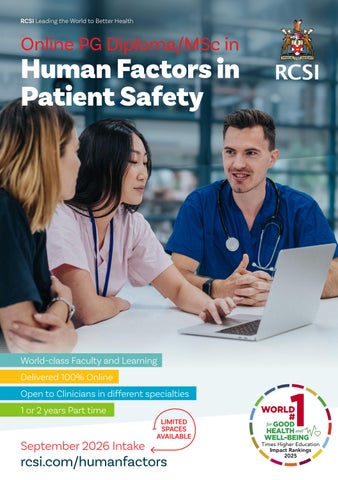
RCSI Leading the World to Better Health
Online PG Diploma/MSc in
Human Factors in Patient Safety
World-class Faculty and Learning Delivered 100% Online Open to Clinicians in different specialties 1 or 2 years Part time
September 2026 Intake
LIMITED SPACES AVAILABLE
rcsi.com/humanfactors
RCSI Leading the World to Better Health
back to CONTENTS LIST
Contents
01.
Welcome
3
What sets this course apart?
5
02. Programme Overview
6
03. Course Structure
Academic Calendar
7 8
Course Structure by Level
9
04. Modules Overview Module 1: Error and Safety in Acute Healthcare
10 12
Module 2: Personal Effectiveness and Non-Technical Skills
14
Module 3: Leadership of Process and Quality Improvement
16
Module 4: P rofessionalism and Advanced Communication
18
Module 5: Research Methods
20
Module 6: Advanced Research Methods and Dissertation
22
05. Entry Requirements
Alumni - Making an impact 06. Application Details
07.
2
23 24
Fees
28 28
Application Details
28
Application Checklist
28
Frequently asked questions
30
Contact Details
32
Online PG Diploma/MSc in Human Factors in Patient Safety
rcsi.com/humanfactors
RCSI Leading the World to Better Health
back to CONTENTS LIST
Welcome On behalf of the Royal College of Surgeons in Ireland (RCSI), I would like to warmly welcome you to the Online Postgraduate Diploma/MSc in Human Factors in Patient Safety. This programme is designed to develop the knowledge, skills, and competencies of healthcare professionals from a wide range of disciplines. Through a focus on evidence, reflection, and collaboration, you will explore the science of error, risk, and safety in complex healthcare systems. You will also build your own expertise in professionalism, leadership, teamwork, and decision-making, all of which are core competencies essential for advancing patient safety. The Human Factors in Patient Safety programme is underpinned by a commitment to: • High standards of patient safety and quality of care • Collaboration and effective teamwork among healthcare professionals • Evidence-based practice • Patient-centred care The programme consists of six modules in total. The five core taught modules make up the Postgraduate Diploma component, while the MSc includes an additional Advanced Research and Dissertation module. A key element of this programme is this research component in Year 2, which supports the development of scholarship skills through the practical application of diverse research methodologies. You will investigate a question relevant to human factors and patient safety, enhancing both your research capability and your professional practice. By strengthening these competencies, the programme aims to improve the performance of healthcare professionals and, ultimately, promote the highest standards of patient care.
rcsi.com/humanfactors
Online PG Diploma/MSc in Human Factors in Patient Safety
3
RCSI Leading the World to Better Health
back to CONTENTS LIST
Delivered entirely online, this programme is ideal for healthcare professionals both within and outside Ireland. Learning takes place through a combination of independent study, participation in online discussion boards, and three days of live online teaching per module—led by recognised national and international experts. Although fully online, the programme fosters a high level of interaction and engagement. Scholars connect with classmates, faculty, and guest speakers through discussion forums, virtual teaching sessions, and group projects. This structure ensures a strong sense of community and shared learning despite geographical distance. Each module is assessed through both an individual and a group assignment, with group work presented online. Our scholars come from a wide variety of professional and disciplinary backgrounds, creating a rich and diverse learning environment. This interprofessional approach reflects the reality of modern healthcare, where collaboration across professions is essential. By learning alongside colleagues from different areas, you will gain valuable insights into alternative perspectives and enhance your ability to apply theory to practice across the healthcare system. By the end of the programme, you will have developed a deep understanding of Human Factors and its application to patient safety. We hope that you can take this learning and apply it directly to your own work, patient care, and clinical teaching. We hope that the competencies you develop throughout this programme will empower you to identify risks, design safer systems, and foster a culture of learning and accountability within your organisation. Graduates of this programme are equipped not only to influence change within their own practice but also to lead initiatives that advance patient safety at local, national, and international levels. We are confident that your time as a scholar on this programme will be both challenging and rewarding, and that the skills and insights you gain will make a lasting impact on your professional development and on the safety of your patients.
Dr Emily O’Dowd Programme lead, Online PG Diploma/MSc. in Human Factors in Patient Safety, RCSI
4
Online PG Diploma/MSc in Human Factors in Patient Safety
VISIT our website to learn more about Dr O’Dowd and RCSI faculty
rcsi.com/humanfactors
RCSI Leading the World to Better Health
back to CONTENTS LIST
01 What sets this course apart? INTERPROFESSIONAL FOCUS:
FLEXIBLE ONLINE DELIVERY:
Unlike many courses that target a single discipline, this programme is designed for all healthcare professionals. This diversity fosters richer collaboration and shared learning.
NON-TECHNICAL SKILLS EMPHASIS: This course highlights non-technical skills such as teamwork, leadership, communication and professionalism. These are often overlooked in traditional medical training but are critical for safer patient care.
5
D MO
UL
It’s a 100% online, part-time programme with interactive workshops one day per month, plus recorded lectures and resources accessible anytime. This makes it globally accessible, even across time zones.
ACCREDITED QUALIFICATION: Awarded as a Level 9 Postgraduate Diploma/ MSc on the Irish National Framework of Qualifications, ensuring international recognition.
ES
Self Directed
Error and Safety in Acute Healthcare
Tutorials/ Workshops
Personal Effectiveness and Non-technical Skills Lectures
Research Methods Professionalism and Advanced Communications
FUTURE CAREERS
rcsi.com/humanfactors
ONLINE PG DIPLOMA/ MSC IN HUMAN FACTORS IN PATIENT SAFETY for Healthcare professionals and Clinicians
Leadership of Process and Quality Improvement
Embedded Human Factors Expert
Clinical Leadership
PHD/ Research
Quality and Patient Safety Manager
Online PG Diploma/MSc in Human Factors in Patient Safety
5
RCSI Leading the World to Better Health
back to CONTENTS LIST
02 Programme Overview The online PG Diploma/MSc. in Human Factors in Patient Safety is an inter-professional programme which is open to all health professionals around the world involved in the care of patients. The online programme, which was launched in 2016, has an interprofessional blend of consultants, senior and mid-level trainee surgeons, anaesthesiologists, emergency medicine physicians, obstetricians, radiologists, pharmacists, along with nurses and quality managers.
Programme Objectives 1.
to develop participants’ knowledge of error, risk and safety in healthcare
2.
to advance participants’ practical skills to drive safety and quality improvement in the acute hospital setting
3.
to develop participants’ interpersonal and non-technical skills to support safe and effective patient care and
4.
t o develop participants’ skills to conduct high quality patient safety research in healthcare.
Participants may choose to sign up for our online PG Diploma and progress onto our MSc. in Human Factors in Patient Safety in year two. The PG Diploma is delivered in year one and involves five modules worth 60 credits. The MSc. is offered in year two (optional for candidates who want to progress) and involves the completion of the research dissertation worth a further 30 credits. This is an online part-time programme, designed to suit the busy schedules of health professionals working full-time. Courses are delivered using online synchronious and asynchronious teaching. There are six modules of study: five taught modules which are delivered by experts in Human Factors in Patient Safety. The sixth module - Advanced Research Methods and Dissertation involves an individual research or quality improvement project written as a submission ready research article.
6
Online PG Diploma/MSc in Human Factors in Patient Safety
rcsi.com/humanfactors
RCSI Leading the World to Better Health
back to CONTENTS LIST
03 Course Structure The PG Diploma Programme The Diploma is obtained following the successful completion of FIVE taught modules worth 60 credits 1.
Error and Safety in Acute Healthcare (15 credits)
2.
Personal Effectiveness and Non-Technical Skills (15 credits)
3.
Leadership of Process and Quality Improvement (5 credits)
4.
Professionalism and Advanced Communication (15 credits)
5.
Research Methods (10 credits)
Modules run from September to June in Year 1.
THE MSc. PROGRAMME: The MSC. Is obtained following the successful completion of the PG Diploma programme plus the 30 credit MSC. Module • Advanced Research Methods and Dissertation (30 Credits) Candidates may be awarded a PG Certificate on completion of modules one and two.
rcsi.com/humanfactors rcsi.com/humanfactors
OnlinePG PGDiploma/MSc Diploma/MScininHuman HumanFactors FactorsininPatient PatientSafety Safety Online
77
RCSI Leading the World to Better Health
back to CONTENTS LIST
Academic Calendar Start August 2026 - June 2027 Online Interactive dates for Year 1 Classes are full day or half days starting at 9.30am (Irish time) *Please note all classes are recorded. Module 1:
Error and safety in Acute Healthcare
11 WEEKS 3 ONLINE INTERACTIVE SESSIONS
Day 1: September 2026 – Introduction to programme and to HF in PS Day 2: October 2026 – Expert day Day 3: October 2026 – Group Project presentations Module 2:
Personal Effectiveness and NTS
11 WEEKS (Holiday - 19 December – 2 January) 3 ONLINE INTERACTIVE SESSIONS
Day 1: November 2026 – Stress Day Day 2: December 2026 – Leadership Day Day 3: January 2027 – Group Project presentations Module 3:
Leadership of process and quality Improvement
5 WEEKS 2 ONLINE INTERACTIVE SESSIONS
Day 1: January 2027 – Quality Improvement Day 2: February 2027 – Group Project presentations Module 4:
Professionalism and Advanced Communication
9 WEEKS (Holiday - 1 April – 8 April) 3 ONLINE INTERACTIVE SESSIONS
Day 1: March 2027 – Professionalism Day 2: March 2027 – Advanced Skills Day 3: April 2027 – Group Project presentations Module 5:
Research Methods Starts
7 WEEKS 2 ONLINE INTERACTIVE SESSIONS
Day 1: May 2027 – Introduction to research Day 2: June 2027 – Applied Research Techniques
8
Online PG Diploma/MSc in Human Factors in Patient Safety
rcsi.com/humanfactors
RCSI Leading the World to Better Health
back to CONTENTS LIST
Course Structure by Level Year: 1 Semester: 1 #Wks: 10 ECTS: 15 Module 1: Error and Safety in Acute Healthcare
3 ONLINE DAYS
• Weekly discussion board • 3-4 mandatory online resources weekly1 • Group project to prepare for duration of module • Individual assignment • Optional additional resources available each week
Assessment:
Discussion Boards: 25% Group Project: 35% Individual Assignment: 40%
Year: 1 Semester:1 #Wks: 10 ECTS: 15 Module 2: Personal Effectiveness and Non-Technical Skills
• Weekly discussion board • 3-4 mandatory online resources weekly1 • Group project for duration of module • Individual assignment • Optional additional resources available each week
3 ONLINE DAYS
• 3-4 mandatory online resources weekly • Group project for duration of module • Optional additional resources available each week
2 ONLINE DAYS Assessment:
Group Project: 100%
Qualification on completion of Modules 1 to 5:
Postgraduate Diploma 3 ONLINE DAYS
Assessment:
TOTAL CREDITS: 60
Discussion Boards: 25% Group Project: 35% Individual Assignment: 40%
Year: 1 Semester:2 #Wks: 6 ECTS: 10 Module 5: Research Methods
2 ONLINE DAYS
• 3-4 mandatory online resources weekly • Written assignment and preparation of presentation • Optional additional resources available each week 1
Assessment:
Written Assignment: 80% Oral Presentation: 20%
Year: 2 Semester: 1 & 2 #Wks: 40 ECTS: 30 Module 6: Research Dissertation
4 ONLINE DAYS
• 1-2 mandatory online resources weekly1 on different research methods • 2 optional online support sessions • Research Protocol to prepare • Individual assignment to prepare research Article/ Dissertation to prepare • Supervisory meetings 1
TOTAL CREDITS: 30
Discussion Boards: 25% Group Project: 35% Individual Assignment: 40%
Year: 1 Semester:2 #Wks: 10 ECTS: 15 Module 4: Professionalism and Advanced Communication
• Weekly discussion board • 3-4 mandatory online resources weekly1 • Group project for duration of module • Individual assignment • Optional additional resources available each week
Postgraduate Certificate
Assessment:
Year: 1 Semester:2 #Wks: 5 ECTS: 5 Module 3: Leadership of Process and Quality Improvement 1
Qualification on completion of Modules 1 and 2:
Assessment:
Research Article/ Dissertation: 60% Individual assignment: 20% Methodology: 20%
Qualification on completion of Modules 1 to 6:
Masters Degree TOTAL CREDITS = 90
(articles, videos, etc.)
rcsi.com/humanfactors
Online PG Diploma/MSc in Human Factors in Patient Safety
9
RCSI Leading the World to Better Health
back to CONTENTS LIST
04 Modules Overview
Taught Modules > Online Interactive days Taught modules in year one have three online interactive days with the exception of Module 3: Leadership of Process and Quality Improvement and Module 5: Research Methods which have two interactive days. Interactive days involve interactive seminars, lectures, workshops, group work and practice. Sessions are facilitated by expert guest facilitators as well as RCSI faculty.
> Online Content In addition to the online interactive days, the ‘core’ course content is delivered online through Moodle - the virtual learning platform at RCSI. Within each module, every week is associated with a specific learning topic. Essential and optional readings are provided for each topic, along with selected online video resources and other online learning resources such as reports and websites.
10
Online PG Diploma/MSc in Human Factors in Patient Safety
rcsi.com/humanfactors
RCSI Leading the World to Better Health
back to CONTENTS LIST
> Weekly discussion boards A weekly discussion board topic is posted each week that is based on the weekly reading and resources. Scholars submit a 300-word post on the set topic for each week. Scholars engage with each other and with faculty over the weekly discussion board.
> Group projects For each taught module scholars will present an inter-professional group project on an assigned topic. Groups work online to develop their project and presentation. Groups present their project on the final online interactive day of the module.
> Individual assignment Scholars will use the resources provided and independently sourced literature to complete their individual assignment.
Advanced Research and Dissertation Module In this module scholars undertake an original research or quality improvement project. Scholars will have undertaken extensive research methods training in Module 5 following which they will have submitted their research protocol for approval by the research faculty. This protocol will be the blueprint for the research dissertation. Throughout the dissertation period there will be regularly scheduled meetings with the supervisory team and there will be milestones for the delivery of various research outputs.
rcsi.com/humanfactors
Online PG Diploma/MSc in Human Factors in Patient Safety
11
RCSI Leading the World to Better Health
back to to CONTENTS CONTENTS LIST LIST back
Module 1: Error and
Safety in Acute Healthcare
CPD credits: 15 Delivery Modes: There will be three days of online interactive teaching and interactive workshops for this module along with 10 weeks of online learning and discussion boards. Assessment: Discussion Board: 25% Group Project: 35% Written Assignment: 40%
12
In this introductory module, we take a systems perspective on the issue of patient safety. We conceptualise healthcare as a system of human, technical, procedural, organisational and cultural factors that interact in complex ways to create risk or reliability. This is a foundation module and the seminal literature is explored in depth.
Online PG Diploma/MSc in Human Factors in Patient Safety
rcsi.com/humanfactors
RCSI Leading the World to Better Health
back to CONTENTS LIST
Module Topics The following topics will be covered in this module: 1. The case for patient safety 2. The nature and scale of error and harm 3. The science of human factors 4. Understanding complex organisations 5. Understanding error 1- theories and models of error 6. Understanding error 2 – violations, migrations, and problems 7. Infection prevention and control 8. Patient safety and invasive procedures 9. Improving medication safety 10. The investigation and analysis of clinical incidents (Systems Analysis) 11. Safety culture 12. Just culture 13. Organisational learning 14. Measuring safety.
Learning outcomes At the end of this module, scholars will be able to: • e xplain the emergence of human factors in healthcare and critique its application to patient safety • explore error and risk in hospitals from a sociotechnical perspective and evaluate risk management strategies • evaluate risk management strategies associated with infection prevention and control, invasive procedures and medication safety • apply knowledge of systems analysis to critically analyse an error or adverse event using evidence-based methodologies and in accordance with national guidelines • examine the notion of safety culture and just culture and their role in creating and maintaining safety • evaluate reporting and learning systems in healthcare • c ritique methods of safety measurement and monitoring ihealthcare.
rcsi.com/humanfactors
Online PG Diploma/MSc in Human Factors in Patient Safety
13
RCSI Leading the World to Better Health
back to CONTENTS LIST
Module 2: Personal effectiveness
and non-technical skills CPD credits: 15 Delivery Modes: There will be 3 days of online interactive teaching and interactive workshops for this module along with 10 weeks of online learning and discussion boards Assessment: Discussion Board: 25% Group Project: 35% Written Assignment: 40%
14
This module will focus on the factors that contribute to improving individual effectiveness and team performance in healthcare. Non-technical skills include: i. personal resource skills such as stress coping strategies, and resilience; ii.
cognitive skills of decision making and situation awareness;
iii.
interpersonal skills of leadership, teamwork, and communication.
Online PG Diploma/MSc in Human Factors in Patient Safety
rcsi.com/humanfactors
RCSI Leading the World to Better Health
back to CONTENTS LIST
Module Topics The following topics will be covered in this module: 1. Stress and burnout in healthcare 2. Stress management in healthcare 3. Personality, resilience and emotional intelligence 4. Non-technical skills and performance 5. Studying teamwork 6. Teamwork and patient safety 7. Team communication 8. Skilled performance: situation awareness and decision making 9. Inter-professional collaboration 10. Team training 11. Team performance assessment 12. Leadership theories and principles 13. Clinical leadership 14. Leadership and culture change.
Learning outcomes At the end of this module, scholars will be able to: • critically evaluate strategies to reduce and manage stress and burnout • discuss the evidence for fatigue in healthcare workers and its effect on performance • evaluate the evidence supporting non-technical skills on error prevention and team performance • discuss common biases in human decision-making which can lead to error • describe theories of decision making and situation awareness • critically evaluate the evidence around team training and team performance assessment • identify facilitators and barriers to inter-professional practice and demonstrate the ability to work efficiently and respectfully in a multi-professional environment • communicate vision and strategy to create a culture of safety and accountability • describe and explain leadership principles, theories, and frameworks • demonstrate skills of effective leadership of inter-professional teams.
rcsi.com/humanfactors
Online PG Diploma/MSc in Human Factors in Patient Safety
15
RCSI Leading the World to Better Health
back to CONTENTS LIST
Module 3: Leadership of process
and quality improvement
CPD credits: 5 Delivery Modes: This module comprises two online interactive days. Assessment: Group quality and process improvement project presentation: 100% Groups will develop a quality improvement project to respond to a need in the healthcare system. Groups will utilise at least two methodologies or quality improvement tools learned on the course and present their implementation plan.
16
The discipline of process and quality improvement is concerned with improving the quality and safety of healthcare services. In this module, the theoretical principles and the practical strategies behind quality improvement will be explored in depth. Scholars will build on the theory, principles and techniques learned in this module to design a quality improvement project tackling a real healthcare problem.
Online PG Diploma/MSc in Human Factors in Patient Safety
rcsi.com/humanfactors
RCSI Leading the World to Better Health
back to CONTENTS LIST
Module Topics The following topics will be covered in this module 1. Process and quality improvement principles 2. Fostering a culture for quality improvement 3. Implementation science 4. Quality improvement techniques and methodologies 5. Measuring improvement 6. Conducting research in process and quality improvement
Learning outcomes At the end of this module, scholars will be able to: • describe and discuss the main theories, principles, and methodologies of process and quality improvement • describe the processes and known frameworks for successful implementation of change in complex organisations • appraise and select implementation strategies for different types of improvement project. • explain how patient safety can benefit from quality improvement methods • explain advancements in improvement measurement • demonstrate the ability to devise and plan a process and quality improvement project • display proficiency in applying the tools, techniques, and methodologies of process and quality improvement to a real healthcare problem.
rcsi.com/humanfactors
Online PG Diploma/MSc in Human Factors in Patient Safety
17
RCSI Leading the World to Better Health
back to CONTENTS LIST
Module 4: Professionalism and
advanced communication CPD credits: 15 Delivery Modes: There will be three days of online interactive teaching and interactive workshops for this module along with 10 weeks of online learning and discussion boards. Assessment: Discussion Board: 25% Group Project: 35% Written Assignment: 40%
18
In this module, we explore the key areas of professionalism: relationships with patients, relationships with society, ethical practice, honesty and integrity, continuity of care, consent, evidence-based medicine, maintaining fitness to practice and scholarship. In addition, this module seeks to introduce scholars to the principles and practice of advanced communication. Scholars will develop the skills to tackle difficult interactions with patients and relatives such as breaking bad news and discussing end of life care. Other advanced skills included shared decisionmaking, obtaining consent, open disclosure.
Online PG Diploma/MSc in Human Factors in Patient Safety
rcsi.com/humanfactors
RCSI Leading the World to Better Health
back to CONTENTS LIST
Module Topics The following topics will be covered in this module 1. Introduction to professionalism - professional conduct and professional regulation 2. Relationships with patients: respect, compassion, empathy, and cultural sensitivity 3. Relationships with patients: communication, shared decision making 4. Consent 5. Specialist communication – breaking bad news/end of life care 6. Open disclosure of error/ medical litigation 7. Relationships with colleagues: interdisciplinary and inter-professional practice 8. Conflict management 9. Medical ethics 10. Continuity of care/handover 11. Confidentiality 12. Evidence-Based Medicine 13. Fitness to practice/ Scholarship 14. Governance.
Learning outcomes At the end of this module, scholars will be able to: • examine the principles of good professional practice in the Irish healthcare context • analyse the key legal and ethical principles applicable in healthcare • explain the principles of consent and demonstrate skills in obtaining consent • demonstrate the ability to communicate risk appropriately to patients • review and assess the principle of continuity of care • review and assess the principles of evidence-based medicine • demonstrate the skills of advanced communication with patients and relatives • critically evaluate different handover tools and methodologies and demonstrate proficiency in structured handover techniques • identify the processes involved in open disclosure of error and demonstrate skills in error disclosure • demonstrate the ability to effectively manage difficult interactions between healthcare professionals. • be familiar with the advanced skills of shared-decision making and end of life care
rcsi.com/humanfactors
Online PG Diploma/MSc in Human Factors in Patient Safety
19
RCSI Leading the World to Better Health
back to CONTENTS LIST
Module 5: Research Methods CPD credits: 10 Delivery Modes: This module will involve two days of live online teaching and workshops. The learning content for this module is presented using blended synchronous and a asynchronous lectures as well as readings and other online resources. The module is ten weeks in duration and will culminate in the presentation of the research protocol which will be marked by an expert panel. Following this students will submit a research protocol with an introduction, full methodology, research design, and data analysis plan. Assessment: Written Assignment : 80% Oral Assignment: 20%
The research methods module is designed to cover all of the major research designs: experimental and quasi-experimental research, quantitative descriptive and observational research, qualitative research, mixed methods research, pragmatic research and research in process and quality improvement. Scholars will emerge with an excellent grounding in research design and methods. Content is covered through interactive workshops and online lectures and resources. At the end of this module, scholars will be proficient in the research design, data collection and analysis techniques associated with the methodologies they may utilise in their dissertation research.
20
Online PG Diploma/MSc in Human Factors in Patient Safety
rcsi.com/humanfactors
RCSI Leading the World to Better Health
back to CONTENTS LIST
In addition, this module will provide scholars with instruction on how to develop a research question and map it to the most appropriate research design. Following this, scholars will write a research protocol, using standardised reporting guidelines. The culmination of the research training phase is the submission of a research protocol which will be implemented in the Advanced Research Methods and Dissertation module.
Module Topics The following topics will be covered in this module 1. Research design 2. Writing a research protocol 3. Experimental methods 4. Quantitative descriptive method 5. Quantitative methods: Questionnaire and survey research 6. Qualitative research and qualitative content analysis 7. Qualitative research: structured Interviews, and critical incident interviews 8. Fundamentals of systematic reviews and meta-analysis 9. Task Analysis: Cognitive Task Analysis (CTA), Hierarchical task Analysis (HTA) 10. Error identification and analysis methods 11. Training needs analysis 12. Introduction to standardised reporting guidelines 13. Writing a research report
Learning outcomes At the end of this module, scholars will be able to: • apply the fundamental principles of research in healthcare towards the identification of an appropriate research question that complies with the FINER criteria • select an appropriate research strategy to answer the research question write a research protocol to the standard of a publishable protocol • demonstrate familiarity with the basic qualitative and quantitative methodologies in human factors research • implement the appropriate research strategy and methodology to answer the research question • connect the research hypothesis to the wider knowledge in the subject area
rcsi.com/humanfactors
Online PG Diploma/MSc in Human Factors in Patient Safety
21
RCSI Leading the World to Better Health
back to CONTENTS LIST
Module 6: Advanced Research
Methods and Dissertation This module contains 4 online interactive days. Scholars will utilize the knowledge, skills and techniques developed over the previous five modules towards the implementation and execution of their own research protocol.
CPD credits: 30 Delivery Modes: This module will commence with a four day research methods workshop followed by independent execution of the research protocol with supervision and support. There will be regularly scheduled meetings with the supervisory team throughout the dissertation period and there will be milestones for the delivery of various research outputs. Assessment: Research Article/Dissertation: 60% Individual assignment: 20% Methodology: 20%
This will include achieving ethical approval, implementing the recruitment, data collection, and data analysis plan, interpreting the findings in the context of the literature and writing the research in the format of a manuscript ready for submission to a peer-reviewed journal.
Learning outcomes At the end of this module, scholars will be able to: • demonstrate an ability to execute an original research investigation • submit a research ethics application if indicated to the appropriate research ethics committee • implement the appropriate research strategy and methodology to answer the research question • connect the research hypothesis to the wider knowledge in the subject area • demonstrate data management and analysis skills for qualitative and quantitative data • interpret the research findings in the context of existing knowledge in the area • synthesise the knowledge in the chosen area into an extended literature review • execute, analyse and report research to the standard of a high-quality research article.
Qualification: Masters Degree
22
Online PG Diploma/MSc in Human Factors in Patient Safety
rcsi.com/humanfactors
RCSI Leading the World to Better Health
back to CONTENTS LIST
05 Entry Requirements Candidates must hold: 1. A Bachelor of Medicine (MB) or a primary degree in a
health and social sciences field with a qualification achieved at the level of 2.2 honours. 2. All candidates must also provide evidence of at least
two years postgraduate healthcare experience. 3. If English is not your first language, you will also need
to supply a copy of an academic IELTS examination, or equivalent, with an overall score of at least 6.5 and no individual band below 6.5*.
rcsi.com/humanfactors
Online PG Diploma/MSc in Human Factors in Patient Safety
23
RCSI Leading the World to Better Health
back to CONTENTS LIST
Alumni – Making an impact in the field Advocating for Patient Safety Developing Research Making a Difference
Career Pathways in Human Factors in Patient Safety The importance of Human Factors in Patient Safety can be seen worldwide across different medical specialties to reduce error and maximise patient outcomes.
At the Royal College of Surgeons in Ireland, we have been at the forefront of educating inter-disciplinary healthcare professionals with core non-technical skills whereby many of our alumni are making a big impacting within their medical specialities and taking unique career pathways within the Human Factors in Patient Safety field.
Watch our video to discover more about career opportunities.
Human Factors in Healthcare can be broken down into various core topics/subject matters such as system-design, risk mitigation, patient care, burnout, inter-disciplinary learning which spotlights an abundance of opportunities for healthcare professionals to make a huge impact. 24
Online PG Diploma/MSc in Human Factors in Patient Safety
rcsi.com/humanfactors
RCSI Leading the World to Better Health
back to CONTENTS LIST
Interviews with our scholars Sue Markey, Ireland Assistant Director of Nursing (ADON) for Sepsis and Deteriorating Patients, Dublin and North East Region I am a member of the National Sepsis Team and work with ADONs representing all regions across the country. There is a strong patient safety focus to the work I do every day linking in with equally passionate people working to improve patient safety in all hospitals in this region. What were some human factors-related challenges you faced/ observed as a Deteriorating Patient Lead? In my role as Deteriorating Patient/Sepsis lead, understanding why staff don’t always escalate deterioration and follow protocol has been a challenge from the beginning. Staff face many challenges in the clinical environment and there are many variables that have an impact on the choices they make. What did you find most valuable or enjoyable about the course? The online programme really suited my hours and it gave me greater accessibility to attend. We had a mix of participants who had very similar experiences from both national and international healthcare settings. The group projects were a great way to challenge each other and collaborate. I really pushed myself to learn as much as possible about the science of Human factors and the impact it can have in the acute healthcare sector. Can you describe any recent changes you have made in your practice that has improved patient safety after completing the diploma/MSc? The MSc programme is changing the way I look at escalation in the clinical area. If staff don’t escalate some of the time, then why do they escalate most of the time and human factors is helping me to change the narrative around this. I carried out research across 2 hospitals with the support from management and the staff to look at the barriers and enablers to escalation. I have presented early findings at 2 conferences: the Irish Human factors and Ergonomics Society and the 4th RCSI Human Factors in Patient Safety Conference and submitted a poster for the Dublin and North East Nursing Research conference. I am planning to present the findings to both hospitals and at regional level.
rcsi.com/humanfactors
Online PG Diploma/MSc in Human Factors in Patient Safety
25
RCSI Leading the World to Better Health
back to CONTENTS LIST
Gabriele Bassi, Italy
Jessica O’Sullivan, Australia
Senior Consultant Intensive Care, General Intensive Care, Regional Burn Unit and Trauma Centre
General Surgery Registrar
What is unique about this course? It’s quite simple nobody at least to my knowledge and at least in my country Italy seriously deals with this topic of Human factors in Healthcare. What was it like to study this course at a distance? It was definitely the best solution for a full time worker and the father of 2 daughters, the use of communication platforms like moodle was the best and a nice solution. It was also a nice opportunity to meet people from all over the world. We have colleagues from all over the world like United States and from Australia. How has this programme enhanced your career? To be honest, I’ve already gotten a job proposal from my risk office thanks to this Masters. What advice would you give someone who is thinking about doing this course? This Master will help you to see your job, weather you are a nurse or a physician from a different perspective. The most important advice from someone who is interested in this topic, it’s not really a question of just job opportunities, it’s really something more.
26
What is unique about this course? I suppose what is unique and the reason I picked this course is that it’s the only course that explores human factors, also what I think is unique is the layout and its also what appealed to me hugely. It’s a mix of individual assignments as well as group projects as well as weekly class discussion boards, that provide a really great method of course delivery at a lot of really interesting and engaging conversations. What was it like to study this course at a distance? It was actually really easy, as this is delivered exclusively online and all lectures are recorded. it makes it easy to catch up and follow along even if you are in a completely different time zone like I am in Australia, everything is accessible internationally. Actually the last 2 assignments I completed while travelling around India for a month, and there was no issue. What advice would you give someone who is thinking about doing this course? I would say that you should definitely just do it, I’ve definitely learned a lot more this course than I actually thought I would and also a lot of things that have definitely benefited me learning early on in my career.
Online PG Diploma/MSc in Human Factors in Patient Safety
rcsi.com/humanfactors
RCSI Leading the World to Better Health
back to CONTENTS LIST
Yvonne Young, Ireland Group Assistant Director of Nursing with UL Hospitals Group I am passionate about ensuring every patient receives the highest standard of care for the best possible outcomes. I have a special interest around the escalation of the deteriorating patient and the facilitators and barriers to early and appropriate escalation. The Msc has given me a completely different lens to how I look at things, to how I approach patient case reviews, QI projects and how I under take audits and the development of clinical decision tools. Undertaking a Msc in human factors gave me a greater appreciation and understanding of systems, the power and importance of culture, human behaviours and how humans interact with each other, psychological safety, situation awareness, the impact of civility and incivility, stress, burnout, team work and much more. I feel the Msc has increased my own self-awareness and it has given me access to a like-minded community and to experts in patient safety from around the world. That connection has been an invaluable support to me. The virtual aspect of the course makes it more accessible and the course facilitators are extremely supportive and very mindful that the majority of participants are working full time in busy and demanding jobs. I feel the Msc in human factors patient safety has been invaluable to me on both a personal and professional level.
rcsi.com/humanfactors
Online PG Diploma/MSc in Human Factors in Patient Safety
27
RCSI Leading the World to Better Health
back to CONTENTS LIST
06 Applications details Fees Places on this programme are limited. Fees for the academic year 2026-2028 are as follows: EU/Non EU Fees: PG Diploma: €6,195 (Year 1) MSc.: €4,000 (Year 2) *The fee includes an annual NUI fee of €45.
Application Date Applications are NOW OPEN for the course starting in September 2026 Interested candidates can apply now at www.rcsi.com/humanfactors
Application Checklist As part of the application process you are required to submit the following supporting documentation: • CV • Copy of passport • Copy of educational transcripts • Proof of sponsorship (where applicable) • A 500 word response to the question “Why is healthcare still not safe”. References are optional and are not included in the wordcount. • Letter from current employer • Evidence of English language qualification* (where applicable)
28
Online PG Diploma/MSc in Human Factors in Patient Safety
rcsi.com/humanfactors
RCSI Leading the World to Better Health
Peer support Stress Teams Burn out
back to CONTENTS LIST
SAFE + SOUND
Good catch
UNCOVERING THE ISSUES AFFECTING HEALTH CARE
Overload
Decision making Bias Civility Huddles Leaders
Speaking up
Situational Awareness
Swiss cheese
Second casualty
Problem solving Relationships Excellence Performance
rcsi.com/humanfactors
Online PG Diploma/MSc in Human Factors in Patient Safety
29
RCSI Leading the World to Better Health
back to CONTENTS LIST
07 Frequently asked questions Who can apply for the online Postgraduate Diploma/MSc in Human Factors in Patient Safety programme? This is an inter-professional online programme which is open to all healthcare professionals involved in the care of patients all around the world. This includes but not limited to: surgeons, emergency medicine physicians, physician associates, anesthesiologists, obstetricians, nurses and midwives, radiologists, pharmacists, physiotherapists, radiographers, social workers, dietitians, occupational therapists, other allied healthcare professionals and quality managers. Is this a full-time or part-time course? The programme is designed to suit the busy schedules of all health professionals and is a parttime online programme of study. The part-time programme is delivered over one year (PG Dip) or two years (MSc) using blended learning modalities. All didactic teaching is offered online, and students can access it from home in their own time. All classes will be delivered online. There will be no face-to-face elements to this programme. What are the entry requirements for the Human Factors in Patient Safety programmes? You must hold a Bachelor of Medicine (MB) or a primary degree in a health or social sciences field with a qualification achieved at the level of 2.2 honours. You must also provide evidence of at least two years’ work experience in healthcare.
30
What is the structure of the programmes? There are five taught modules which are delivered by experts in human factors in patient safety (in year one) plus advanced research methods and a research dissertation (in year two) for those that decide to undertake the Masters (MSc) in Human Factors in Patient Safety. You can exit with a Postgraduate Diploma following the successful completion of 60 credits in year one. Who accredits the programmes and are they recognised by regulatory bodies in Ireland or elsewhere in the world? The Postgraduate Diploma and MSc in Human Factors in Patient Safety are accredited by the National University of Ireland and are Level 9 qualifications on the NFQ (Irish National Framework of Qualification). They are internationallyrecognised on other regional frameworks such as the European Qualifications Framework (EQF) and the Qualifications Framework for the European Higher Education Area (QF-EHEA). Is it possible for someone to acquire a Postgraduate Diploma or Masters in Human Factors in Patient Safety with distant learning? Yes, the programme is fully online. In year one, we have approximately 14 days of online interactive teaching which is delivered via our online learning platform – BlackBoard Collaborate within Moodle and can be accessed in the students own time.
Online PG Diploma/MSc in Human Factors in Patient Safety
rcsi.com/humanfactors
RCSI Leading the World to Better Health
back to CONTENTS LIST
Will the graduation ceremony for this programme be held online or face-to-face? Graduation ceremonies will be held faceto-face on RCSI campus with the possibility to graduate in-absentia and have the parchments sent by post. Is there funding available for this programme? NCHDs working in the HSE full-time: You may be able to combine CPD-SS funding and TSS funding to cover up to €2,740 of the cost of this programme. You can check if you are eligible for this funding by emailing cpdss@rcsi.com. Nurses working in the HSE: You may be entitled to a specialist qualification allowance, payable to nurses employed directly on duties in specialist areas appropriate to the qualifications. Please visit www.inmo.ie for more information. How can I manage payment for this programme? Payment can be made by instalments. Once enrolled in the programme, we can adjust your payment schedule as long as all fees are paid by the end of the term.
Are there any scholarships available for this programme? There are no scholarships currently available, however full or partial funding may be available from your hospital to cover the cost of this programme. Further information is available from your line manager. How will online assessment for this programme work? Assessment for this programme will consist of: • A written assignment that is uploaded to Moodle • Group projects and presentations that are presented during our online interactive days via Blackboard Collaborate • Discussion board posts are uploaded weekly onto the module page.
Any queries regarding the online PG Diploma/MSc. in Human Factors in Patient Safety should be addressed to the following: Email: PostgradSA@rcsi.ie Web: rcsi.com/humanfactors
Is there tax relief on fees paid available? You may qualify for tax relief on fees paid. Visit revenue.ie for more information. SCAN the QR Code to view course website
rcsi.com/humanfactors
Online PG Diploma/MSc in Human Factors in Patient Safety
31
Any queries regarding the online PG Diploma/ MSc. in Human Factors in Patient Safety should be addressed to the following: Email: PostgradSA@rcsi.ie Web: rcsi.com/humanfactors
SCAN the QR Code to view course website
Coláiste Ríoga na Máinleá in Éirinn Royal College of Surgeons in Ireland 123 St Stephen’s Green, Dublin 2, D02 YN77, Ireland.