Fall 2025
RCDSO
CONNECT Newsletter of the Royal College of Dental Surgeons of Ontario
FEATURE ARTICLE:
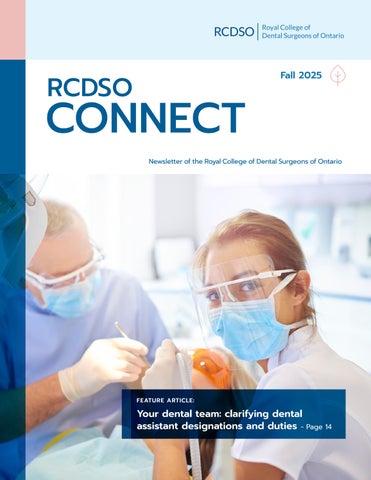
Your dental team: clarifying dental assistant designations and duties - Page 14
MISSION We act in the public interest and are committed to excellence in regulating the dental profession in Ontario.
VISION Everyone in Ontario has access to safe, high-quality oral health care.
PURPOSE The Royal College of Dental Surgeons of Ontario (RCDSO) is one of 26 health regulatory colleges in the province with the responsibility and the legal authority to protect patients. The RCDSO is a leader in health regulation. We believe that regulation must be open, responsive, accessible, equitable and accountable in order to protect the public interest.
RCDSO
CONNECT In this Issue: Message from the President and the Registrar & CEO
3
Current RCDSO council members
5
PLP divestment: what you should know
6
Professionalism and compassion in focus: Fall RCDSO Connect sessions
8
RCDSO Connect: 2025 webinar series recap and 2026 dates
10
Request for assistance
11
Why are requests for assistance so important?
12
Your dental team: clarifying dental assistant designations and duties
14
Foundations of professionalism: new resources available
20
Strategic project update: RCDSO report on corporate dentistry
21
CBCT scan referrals: what needs to be included
22
Meet our staff: Cameron Thompson
24
Mandatory reporting for dentists
26
Information spotlight
28
Think about your online interactions
30
Welcome new registrants
31
FALL 2025 RCDSO CONNECT
2
Message from the President and the Registrar & CEO Dr. Harinder Sandhu, Chair and President
At the College, our commitment is to modern, effective regulation—regulation that upholds the highest standards of patient care while being practical and well-supported in implementation. This is a time of significant change in the profession and we recognize the increasing demands placed on dentists. From the introduction of new standards to the divestment of the Professional Liability Program (PLP), the College has undertaken a number of transformative initiatives this year. Our role is to support you through these changes with clear guidance, helpful resources and a shared commitment to professionalism.
Empowering Professionals in Complex Environments We know that environmental influences on daily practice come from many directions—not only corporate structures, but also technology, patient expectations and financial pressures. These influences can present ethical and/or professional dilemmas. Our responsibility as a regulator is not only to set standards but to equip and empower dentists to navigate these pressures with confidence. That means providing clear guidance, practical tools and education that reinforce professional judgment and ethical care. Emerging risks and evolving practice environments will continue to challenge the profession, but together we can ensure that patient interests remain at the center of every decision.
Daniel Faulkner, Registrar & CEO
There is some research that suggests that timeouts, for example, can provide an opportunity to pause and consider how a decision might impact patients or what risks should be assessed. (DuBois, J. et.al, Academic Medicine, July 2013) One of the ways that the College seeks to empower dentists as they navigate broad social and environmental change is through the recently released document, Foundations of Professionalism. This important resource replaces the College’s Code of Ethics and is designed to help dentists navigate clinical and professional practice. A dedicated working group developed this document, drawing on input from registrants, patients and system partners. We encourage you to read it and integrate it into your practice.
Emerging Forces: AI and Corporatization There are a number of developments that are shaping the future of dentistry in Ontario, though we would like to focus on two of them: the integration of artificial intelligence (AI) and the growth of corporate practice models. AI is already influencing diagnostics, treatment planning and administrative workflows. These tools offer exciting possibilities for efficiency and precision, but they also raise important questions about accountability, transparency and ethics. Council has approved new guidance—Artificial Intelligence in Dentistry—to help registrants navigate
FALL 2025 RCDSO CONNECT
3
these issues responsibly. This guidance emphasizes transparency and disclosure; practitioner oversight; and safeguards against bias, ensuring that technology enhances care without compromising patient trust. The rise of corporate ownership introduces dynamics into dental practice. While these models can improve access and operational efficiency, they also present challenges related to professional autonomy and patient-centered care. One concern we hear is the power imbalance that younger dentists may experience in corporate settings, where business priorities can sometimes overshadow clinical judgment. This imbalance can create pressure to meet production targets or adopt treatment plans that may not align with best practices. The College has recently released a practicemodel agnostic approach to help dentists navigate their role in quality of care. The Summary Report on Practice Models and Corporate Dentistry was released in November and is well worth a read. There is more work to do to support dentists in making the best possible decision in every context. As we move forward with the implementation of the directions from the report, we will seek further input from dentists to understand the environment pressures and then to find solutions that will help professionals navigate complex situations.
Professional Liability Program Transition Amidst these large shifts in the practice environment, the College is divesting its Professional Liability Program (PLP). As of January 1, 2026, the PLP will be owned and operated by Navacord, one of Canada’s largest and fastest growing multiline insurance brokerages. Dentists will continue to receive the same great service from the same dedicated team. Liability coverage will remain at $2 million per year per incident at a rate that is competitive across Canada. The profession will continue to hear regularly from the College about Notification of Claims, a requirement of any change of insurance. We understand that change can be
challenging, and the College remains committed to providing the support needed throughout this transition. Next year will open up opportunities for the profession to build a strong relationship with Navacord, supporting and developing wins for the profession in 2026 and beyond.
Looking Ahead Throughout 2026, we will continue to consult the profession on new standards, as we have in 2025. We need you to participate and to share your perspectives. It will help create more robust and useful guides to practice. Two consultations close on December 16th: a draft standard on implant dentistry and a draft standard on the use of sedation. Feedback on these standards has been material and is being analyzed as we write. There are more draft standard consultations to come in the new year, so please get involved and comment. We want to hear from you. We are also hosting more RCDSO Connect Sessions to keep dentists informed about College news, key developments and new standards. These sessions often qualify as Category 1 courses when attended live. Watch for announcements about upcoming sessions—there are six planned for 2026—the first will be on AI. As we approach the holiday season, we want to take a moment to thank you for your professionalism and dedication throughout this year of change. Your commitment to patient care and ethical practice is what makes this profession strong. We wish you and your loved ones peace and good health during this festive season and into the new year. Harinder Sandhu, Council President Dan Faulkner, CEO & Registrar
FALL 2025 RCDSO CONNECT
4
COUNCIL MEMBERS Executive Committee Dr. Harinder Sandhu, Chair and President Dr. Nalin Bhargava, Vice President Marc Trudell Brian Smith Dr. Erin Walker Elected Representatives District #1 Dr. Nalin Bhargava District #2 Dr. Robyn Somerville District #3 Dr. Peter Delean District #4 Dr. Neil J. Gajjar District #5 Dr. Daniel Fortino District #6 Dr. Harinder Sandhu District #7 Dr. Erin Walker District #8 Dr. Osama Soliman District #9 Dr. Antony Liscio District #10 Dr. Deborah Wilson District #11 Dr. Eilyad Honarparvar District #12 Dr. Anthony Mair Appointed By Lieutenant Governor in Council Patrick Ballantyne Ram Chopra James Colliver Vivian Hu Nizar Ladak Adal Simeone Brian Smith Roderick Stableforth Marc Trudell Judith Welikovitch
Next Council meeting Next council meeting is February 19th, 2026. The meeting will be livestreamed on our YouTube channel.
Questions? Reach out to: Angie Sherban Executive Assistant and Council Liaison phone: 416-934-5627 toll-free: 1-800-565-4591 asherban@rcdso.org
Council Highlights Council Highlights are emailed out to members and posted online on the College’s website after each Council meeting. It covers some of the key highlights of Council business. R ead the Council Highlights from the December 4th Council Meeting
Are you following us on social media?
Academic Appointments Dr. Daniel Haas Dr. Noha Gomaa rcdso_org
rcdso.bsky.social
rcdsovideos
rcdso
Access the RCDSO Connect Newsletter archive for previous issues
FALL 2025 RCDSO CONNECT
5
PLP divestment: what you should know In September, the RCDSO announced that Navacord, one of Canada’s largest and fastest growing multi-line insurance brokerages, will become the owner/operator of the Professional Liability Program (PLP) effective January 1, 2026. Jones DesLauriers, a wholly owned subsidiary of Navacord, will be the broker for the PLP program. As directed by Council in December 2023, this transfer will allow the PLP to continue to operate, under new ownership. Navacord will preserve the existing service excellence of the program, by maintaining PLP staff, and providing full and comprehensive coverage for dentists at a reasonable cost.
Consistency As of January 1, 2026, claims both new and historical will be handled by the existing staff of the PLP, who will become employees of Navacord. This will ensure that dentists will have the same comprehensive claims experience going forward as they always have. Phone numbers and emails will stay the same so a conversation that ends in December of 2025 can continue seamlessly in January 2026.
Coverage In 2026, dentists will continue to receive the same coverage that is currently being offered. This includes $2 million per occurrence and tail coverage for former members who have retired and/or moved out of Ontario. The only difference in coverage is an annual cap at $6 million per dentist (currently, the College’s policy with Victor Canada includes an aggregate limit of $30 million). PLP records indicate that neither of these thresholds have ever been approached by any dentist in a given year.
Consultation Dentists were consulted in 2023 about their priorities for the PLP program. Over 1,600 dentists responded and their advice shaped the procurement process. Dentists wanted to: M aintain minimum coverage of $2M H ave the same fee for all licensed dentists in Ontario M aintain lifetime tail coverage I ntegrate current PLP employees into the new program K eep support services (guidance, education) beyond the claims process O ffer coverage in a group model for all Ontario dentists M aterially accept the current PLP policy wording S hare data with the College to support trend analysis in the profession
Competition RCDSO engaged in a competitive process to find the right home for the Professional Liability Program. The College enlisted PricewaterhouseCoopers (PwC) as procurement advisers to guide and manage the competition. Council established a Procurement Review Group (PRG) consisting of elected and appointed Council members to oversee the process. A significant number of organizations were consulted, many sent letters of intent as formal expressions of interest. Both PwC and the PRG examined and analyzed a long list of qualified contenders before a short list was established. Each organization on the short list interviewed with the PRG and the leadership of PLP. From that short list the proponent who met all of the objectives listed was chosen: Navacord.
FALL 2025 RCDSO CONNECT
6
In addition to meeting the procurement objectives, Jones DesLauriers has been the brokerage on record for the primary PLP policy and the excess insurance coverage since 2017. Navacord is the current broker for liability insurance for dentists in Alberta.
“
For questions: PLP divestment: practiceadvisory@rcdso.org Renewal: registration@rcdso.org Liability coverage: info@plpservices.org
Having served dentists for many decades, PLP and its staff are very proud to be able to continue to help dentists who need assistance to avoid or de-escalate a claim, or who find themselves facing legal action. This transition is a change, and we are working hard to ensure it is seamless for dentists. Navacord is a great group who are dedicated to excellence in the healthcare fields, malpractice service and coverage for dentists, and is committed to ensuring the unique PLP features dentists enjoy today remain in place.” – Alan Lachapelle, Dept. Head, Professional Liability Program.
PLP Claims Reporting Deadline
2026 Excess Malpractice Protection
As part of the transition to Navacord, any known claims (or situation which could possibly lead to a claim) that have not already been reported to PLP must be reported within the current policy period and no later than December 31, 2025 to be covered under the current policy.
Excess Malpractice Protection is now available for 2026 from the College’s broker, Jones DesLauriers Insurance Management Inc. (JDIMI).
CLAIM(S) means: I. a written or oral demand for money or services; or II. a written or oral allegation of breach in the rendering of or failure to render PROFESSIONAL SERVICES; received by the INSURED and resulting from one or more errors, omissions or negligent acts in the performance of or failure to perform PROFESSIONAL SERVICES. If there are any known claims against you, or situations that could possibly lead to a claim and if you have not already done so, you must report these to the PLP immediately by contacting info@plpservices.org or by submitting this information through the PLP website.
If you previously purchased excess limits, JDIMI has forwarded an email to you containing a secure link to renew. Check your “Junk” or “Spam” folder if not received. To purchase excess malpractice limits for the first time through JDIMI, visit this website. Be sure to select JANUARY 1, 2026 as your effective date. If you have any questions, please contact JDIMI at excessprotection@jdimi.com or by telephone at 416-248-7144 or 1-877-301-4979 (RCDSO registrants only).
This is a standard part of the insurer transition process and helps ensure your coverage continues seamlessly. Questions? Email info@plpservices.org or visit our website for more information about the PLP divestment process.
The College is providing certain information to Navacord (JDIMI), the provider of 2026 professional liability insurance coverage, to allow for communication between Navacord (JDIMI) and College registrants. Be sure to update your personal information in the RCDSO Portal to ensure you receive communication from the new provider.
FALL 2025 RCDSO CONNECT
7
Professionalism and compassion in focus: Fall RCDSO Connect sessions This fall we hosted two engaging and timely sessions that examined professionalism, ethical practice, and the role of dentists in helping patients navigate complex health and social issues. Both sessions provided valuable insights, practical examples, and opportunities for reflection.
Date:
October 8 Our extended October session introduced Foundations of Professionalism, the new College document approved by Council at its September 18 meeting. This resource replaces the Code of Ethics and now serves as the foundation for all RCDSO standards, guidelines, and advisories. The 90-minute session featured a dynamic panel moderated by Dr. Erin Walker, RCDSO Council and Executive Committee member and Chair of the Inquiries Complaints and Reports Committee. Panelists included Dr. Nancy Di Santo, Chair of the Quality Assurance Committee, Dr. Keven Hockley, Associate Director of Clinics and Assistant Professor of Clinical Dentistry at the Schulich School of Medicine & Dentistry, Western University, and Dr. Bonnie Yu, Dental Analyst and Consultant in the College’s Professional
Professionalism in Practice
Conduct and Regulatory Affairs Department and clinical lead for the Foundations of Professionalism project. Together the panel examined the four bioethical principles of autonomy, beneficence, non-maleficence, and justice, and how they inform ethical decisionmaking in day-to-day practice. Through open discussion and real-world examples participants reflected on how professionalism fosters clear communication, inclusive care, and trust among denstists and patients. This session will be offered again in 2026. Keep an eye on your inbox for details
Click here to watch FALL 2025 RCDSO CONNECT
8
Date:
October 29
Later in the month the College hosted a powerful and informative session on The Role of Dentists in Addressing Gender-Based and Intimate Partner Violence and Its Impact on Oral Healthcare. Presenters Dr. Beverley Essue, Dr. Tina Meisami, Dr. Sanjukta Mohanta, Celeste Poltak, Margaret Powell, and Isabel Arruda-Caycho shared their expertise and perspectives on trauma, access to care, and oral health outcomes.
Addressing Gender-Based and Intimate Partner Violence
Participants learned how to recognize signs of gender-based and intimate partner violence, understand barriers to disclosure, and apply trauma-informed principles to make their practices safer and more supportive for patients. The discussion highlighted the vital role dentists can play in promoting equity, empathy, and trust within their practices.
Click here to watch
Thank you to everyone who joined us this fall. Your engagement and participation help make these sessions such a valuable space for learning, reflection, and connection across the profession.
Join Us in Ottawa for RCDSO Connect! RCDSO is hosting an in-person RCDSO Connect event on Thursday, March 26, 2026, from 5pm - 8pm at the National Arts Centre in Ottawa. This is your opportunity to connect with colleagues, engage in meaningful discussions, and stay informed about the latest in the profession. Attendees can earn up to 3 Continuing Education (CE) points while enjoying an evening of learning and networking.
Don’t miss this chance to strengthen your professional connections and gain valuable insights that support your practice. Reserve your spot today! Click the registration link to secure your place. We look forward to seeing you in Ottawa! Agenda and more details to come.
Click here to register now
FALL 2025 RCDSO CONNECT
9
RCDSO Connect: 2025 webinar series recap and 2026 dates In 2025, our RCDSO Connect webinar series delivered six Category 1 sessions focused on access to care, professionalism, AI in dentistry, and communication ethics. The sessions featured 25 presenters and drew strong engagement across the profession. A total of 3,896 unique attendees participated, earning 10,747 Category 1 CE points. Just over half attended more than one session, with a notable group joining five or more. These attendees are helping inform future planning through targeted follow-up. Feedback from the October 8 session on professionalism showed strong knowledge translation outcomes.
Among 634 respondents: 93%
said they would recommend the course to a colleague.
94%
found the content relevant to their practice.
97%
indicated they would apply what they learned in their work.
What is happening in 2026? The 2026 RCDSO Connect series will continue to focus on timely, practice-relevant topics. Sessions are scheduled for: January 21 February 25 March 11* April 22 May 20 June 24 November 4 Topics will include updates to standards, information about the RCDSO Reconciliation Action Plan, artificial intelligence, and maintaining professional boundaries. An in-person Category 1 session is also planned for March 26 in Ottawa. We encourage all registrants to save these dates and participate. RCDSO Connect supports continuing education and provides practical insights for everyday practice.
To catch up on past sessions, visit our YouTube channel, where recordings are available for viewing. You earn Category 3 CE points for watching a previous session.
* Our March 11th session is a repeat of our recent session on our new Foundations of Professionalism document.
FALL 2025 RCDSO CONNECT
10
Request for assistance The following are requests for assistance obtaining dental records from various police services and coroner’s offices across Ontario. If you have any information, please reach out to the contact listed in each case. Name: Marc Andre RENAUD
Date of Birth: October 06, 1986
Requested From: Office of the Chief Coroner Contact: Heenal Trivedi
Contact Email: heenal.trivedi@ontario.ca
Name: Huanyu WANG Date of Birth: July 22, 1988 Requested From: Toronto Police Service Contact: Detective UEBERHOLZ Contact Email: missingpersons@torontopolice.on.ca
Name: Cory Marcel GIGAULT Date of Birth: October 15, 1980 Requested From: Ontario Provincial Police Service Contact: Detective Constable Megan Bedini Contact Email: megan.bedini@opp.ca
Name: Cody REMBISH Date of Birth: April 17, 1988 Requested From: Toronto Police Service Contact: Detective Constable WOON-A-TAI Contact Email: missingpersons@torontopolice.on.ca
Name: Dale HALLETT Date of Birth: August 24, 1952 Requested From: Royal Canadian Mounted Police Contact: Sergeant Dayle SIMON Contact Email: dayle.simon@rcmp-grc.gc.ca
Name: Gordon TOMLINSON Date of Birth: August 14, 1947 Requested From: Office of the Chief Coroner Contact: Emily Hing Contact Email: OCC.Hamilton@ontario.ca
Name: Ian PACO Date of Birth: August 17, 1963 Requested From: Toronto Police Service Contact: Detective WARWAR Contact Email: missingpersons@torontopolice.on.ca
Name: Roland SARKOZI Date of Birth: June 16, 1995 Requested From: Toronto Police Service Contact: Detective Constable FERNANDEZ, Contact Email: missingpersons@torontopolice.on.ca
Name: Julius GOULBOURNE JAGDEO Date of Birth: November 14, 2012 Requested From: Toronto Police Service Contact: Detective Constable DOWD Contact Email: missingpersons@torontopolice.on.ca
Name: Aniya GODDEN Date of Birth: May 20, 1976 Requested From: Toronto Police Service Contact: Detective MISIUDA Contact Email: joel.kirsh@ontario.ca
FALL 2025 RCDSO CONNECT
11
Why are requests for assistance so important? Over the past year, you may have noticed an increase in Requests for Assistance emails from the coroners’ offices or police services across Ontario. The College has made significant effort to be a supportive partner in assisting with the search for dental records and charts of deceased individuals. There are approximately 1,200 unidentified cases per year in Ontario, with about 250 of these identified by dental means. Confirming identification provides comfort and closure for the family and loved ones of a deceased person, and is a valuable service offered by dental professionals. If you have dental records that might help to confirm an identification, please contact or respond to the police or the Office of the Chief Coroner (OCC). This is extremely important and very meaningful for the families of missing persons or others who may be the victims of crime. Please respond promptly.
What to do
Requests for Assistance - Police During police investigations, dental records may be requested under the Missing Persons Act to allow for comparison with unidentified human remains. The College forwards police requests for records to registrants by email. If you have relevant records that can assist police, contact the investigator directly. The police will use Form 3 or Form 4 to request patient records. If you receive a request for records using one of these forms, you must provide copies of the records specified. Dentists must also document in the patient record the specifics of the request, including a copy of the form and the type of information that was provided to the police.
What is a dentist’s legal responsibility to release dental records for deceased or missing persons? Ontario’s Personal Health Information Protection Act (PHIPA) permits the disclosure of personal health information about a deceased or missing individual in certain circumstances.
FALL 2025 RCDSO CONNECT
12
Requests for Assistance – Coroner A coroner may request dental records to identify human remains. The Ontario Coroners Act grants coroners legal authority to seize anything they believe is reasonably necessary. It is your legal responsibility to comply and there are penalties for not cooperating. The OCC will request complete original dental records via an Authority to Seize document, available here. The coroner will detail what information to provide. The coroner will provide contact information and coordinate the method of transfer (electronic/ hard copy) depending on location. The form is authenticated electronically, there is no original signature. Records should be transferred to the specified location without any undue delay. Dentists should discuss the method of transfer with the coroner if they have questions. A coroner may delegate their authority to police to complete seizure of dental records. All original dental records and radiographs pertaining to the deceased individual must be released.
Records should NOT be sent directly to the forensic odontologist. Original records will be returned once the forensic odontologist has completed their report.
R equests for records from family members Dentists may also receive requests for deceased patients’ dental records from family members who require the information to apply for insurance benefits or settle estate matters. When a person dies, the estate trustee, executor or the person who has assumed responsibility for the administration of the estate of the deceased becomes the substitute decision-maker (SDM) and may request access to personal health information. You should confirm the status of an estate trustee by asking for: a copy of the will; or a letter from the patient’s or family’s lawyer. If there is no trustee, ask for a lawyer’s letter advising who is responsible for administration of the estate.
FALL 2025 RCDSO CONNECT
13
Feature Article:
Your dental team: clarifying dental assistant designations and duties
The Dental Assistant (DA) is a key member of your care team. Dental assistants provide essential support that can enhance the patient experience and help establish better patient outcomes. While dental assisting is not regulated in Ontario, dentists, who are regulated health professionals, have important responsibilities when employing and assigning tasks to a dental assistant. Dentists are to only assign tasks to a dental assistant as the assistant’s designation, training, and education support, all while keeping within the parameters of the Regulated Health Professions Act, 1991 and College Standards.
The Dentist is accountable for their assisting staff and everything they do, including ensuring that a dental assistant does not perform tasks that are outside of their designation.
SUMMER 2025 RCDSO CONNECT
14
These are the types or categories of dental assistants in Ontario:
Level II Dental Assistant/ Level II Certified Dental Assistant (CDA II)
Preventive Dental Assistant (PDA)/ Certified Preventive Dental Assistant (CPDA)
Level I Dental Assistant/ Level I Certified Dental Assistant (CDA)
Of Note ... The Ontario Dental Assistants Association (ODAA) serves as the membership and certifying body for Dental Assistants in Ontario. Certification, in the context of Level I and II Dental Assistants as well as Preventive Dental Assistants, refers to membership with the ODAA - which is voluntary. If a dental assistant continuously meets the requirements set out by the ODAA, they maintain ODAA membership and may use the designation “Certified”. These requirements include maintaining ODAA membership in good standing, adhering to the ODAA Code of Ethics, and committing to ongoing continuing education.
FALL 2025 RCDSO CONNECT
15
Level I Dental Assistants (Level I DA)/ Level I Certified Dental Assistants (CDA) A Level I Dental Assistant has a level I certificate from an appropriate* Dental Assisting program offered at a post-secondary institution. These individuals are sometimes referred to as Chairside Dental Assistants To obtain the Level I Certified DA credential, Dental Assistants must meet the above description and any additional requirements set forth by the ODAA. A Level I DA/CDA: May be assigned dental radiography duties (with HARP (Healing Arts Radiation Protection) approval from the Ministry of Health). May perform these tasks listed by the ODAA. M ay be put in charge of the dental office’s IPAC (infection prevention and control) program and perform sterilization duties.
*Please check with the ODAA.
Preventive Dental Assistants (PDA)/ Certified Preventive Dental Assistants (CPDA) A PDA is a person who successfully completed a Preventive Dental Assistant program from a College of Applied Arts and Technology in Ontario or other course(s) approved by the Council of the College, and who was listed as a PDA by the College prior to January 1, 2000. To obtain the Certified PDA credential, PDAs must meet the requirements set forth by the ODAA. A PDA/CPDA: May be assigned dental radiography duties (with HARP approval from the Ministry of Health). May perform all tasks permitted for a Level I Dental Assistant (Level I DA or CDA), as well as eight additional tasks listed in the RCDSO STANDARD OF PRACTICE Performance of IntraOral Procedures that are Not Controlled Acts by Preventive Dental Assistants, Level II Dental Assistants and Registered Dental Hygienists. In office dentist supervision is required when a PDA or CPDA is given direction to apply and/or remove rubber dam. May be put in charge of the dental office’s IPAC program and perform sterilization duties.
FALL 2025 RCDSO CONNECT
16
Level II Intra-Oral Dental Assistants (Level II DA)/ Level II Certified Dental Assistants (CDA II) A Level II Dental Assistant is a person who holds the certificate of the National Dental Assisting Examining Board (NDAEB) issued on or before December 31, 2002, or who holds a certificate of the NDAEB issued after December 31, 2002 provided that the certificate was issued based upon successful completion of its examination(s). These individuals are sometimes referred to as Intra-Oral Dental Assistants. To obtain the Level II Certified DA credential, Dental Assistants must meet the above requirement and any additional requirements set forth by the ODAA. A Level II DA/CDA II: May be assigned dental radiography duties (with HARP approval from the Ministry of Health). May perform all tasks permitted for a Level I Dental Assistant (Level I DA or CDA) and PDA/ CPDA, as well as 11 additional tasks listed in the RCDSO STANDARD OF PRACTICE Performance of Intra-Oral Procedures that are Not Controlled Acts by Preventive Dental Assistants, Level II Dental Assistants and Registered Dental Hygienists. Supervision and other clinical specifications exist for several of these tasks. M ay also perform additional Restorative or Orthodontic tasks if they have successfully completed a Supplemental Course that meets the criteria outlined in the above Standard of Practice. Dentists are reminded that controlled acts cannot be delegated to anyone, including dental assistants. A list of controlled acts can be found in the Regulated Health Professions Act, 1991. May be put in charge of the dental office’s IPAC program and perform sterilization duties.
Dentists are reminded that in the absence of an NDAEB certificate, the same dental assistant having graduated from a Level II Dental Assisting program would be limited to Level I Dental Assisting duties only.
FALL 2025 RCDSO CONNECT
17
Limitations on Tasks for Individuals Without Formal Dental Assisting Credentials Dentists should carefully consider that individuals outside of the above categories of dental assistants are limited in the tasks and responsibilities they can undertake. For example: n individual who has no formal dental assisting A training or is not a graduate of an appropriate* Dental Assisting program offered at a postsecondary institution. These individuals may have been trained by the dentist or have “on the job” experience. n internationally-trained dentist who is not A licensed in Ontario and does not hold a dental assisting certificate.** These individuals are not permitted to take radiographs unless they have HARP approval from the Ministry of Health. They may be able to perform some assisting tasks with sufficient and appropriate training (e.g., recordkeeping and administrative tasks, and chairside suction (high volume evacuation)), but they cannot undertake intra-oral tasks. They may also perform specified IPAC duties in the dental office, as assigned by the IPAC lead or manager of the dental office’s IPAC program (e.g., disinfection and operatory set up and tear down), provided they have successfully completed appropriate training in IPAC. They cannot lead or manage the IPAC program for the office.
*Please check with the ODAA. ** These individuals and other internationally-trained oral healthcare workers can check with the ODAA directly for guidance on achieving certification.
FALL 2025 RCDSO CONNECT
18
Self-Auditing Dentists are responsible for verifying qualifications and credentials for the assisting staff they hire and maintain. The College encourages dentists to selfaudit and upon hiring check that: PDAs, Level I and II DAs are successful graduates of an appropriate institution;
* Where dental radiography is referenced in this article, all aspects of the act of taking a radiograph are included. For more information, please see the HARP Act, 1990. Please note: Dental assistants are not permitted to operate CT scanners (Standards of Practice – Dental CT Scanners).
Level II DAs hold an NDAEB certificate; Assisting staff using the designation “certified” are in fact members of the ODAA; and Staff tasked with dental radiography do in fact have HARP approval. This must be verified by the office’s Radiation Protection Officer (who must be a licensed dentist) prior to assigning any radiography tasks.* Additionally: Dental assistants must receive appropriate and ongoing training in IPAC; and Dental assistants who are clinical staff must have the training and ability to perform basic life support (BLS) techniques. This checklist can be a helpful resource for self-auditing your dental assisting staff. Staff
Degree, Certificate, or RCDSO PDA Letter
NDAEB Certificate
ODAA Membership (for “certified” staff)
HARP Approval^
BLS
IPAC
Level I DA or CDA
X
X
X
X
X
PDA or CPDA
X
X
X
X
X
Level II DA or CDA II
X
X
X
X
X
X
X
X
X
Other
(e.g., no formal DA credentials) ^ May be combined with certificate or degree
The College recognizes that the dental team is diverse, with each member fulfilling an important role to ensure that patients receive the safest and best care possible. Please take some time to proactively review what tasks are assigned to whom within your practice, and whether any changes may be contemplated.
Questions? Contact practiceadvisory@rcdso.org Our advisors are here to help.
FALL 2025 RCDSO CONNECT
19
Foundations of Professionalism: new resources available To support the implementation of the College’s Foundations of Professionalism document, two resources have been developed to help dentists and patients understand what professionalism looks like in practice. The first is a checklist for dentists, which outlines key expectations and behaviours aligned with the principles in the Foundations of Professionalism document. It covers areas such as communication, respect, informed consent, boundaries, and ethical decision-making. Dentists can use the checklist as a self-assessment tool to reflect on how professionalism is demonstrated in their day-to-day practice and identify areas for improvement. The second is a patient-facing guide, which explains in plain language what patients should expect from their dentist. It includes clear statements about respectful treatment, transparency in care, and the importance of trust and safety in the dentist-patient relationship. This resource is intended to support
Checklist for dentists
patient understanding and reinforce the shared expectations that underpin professional care. Both resources are available on our website. Dentists are also encouraged to review the Frequently Asked Questions (FAQ) developed to support the new document, which addresses common questions about how the document applies in practice. Topics include professional boundaries, access to care and obligations related to patient records. The FAQ will continue to be updated as new questions arise. To further support practical implementation, the College is developing case scenarios that will illustrate how the principles of professionalism apply in real-world clinical situations. These examples will be published in the coming months. We encourage all registrants to explore these materials and incorporate the principles into their practice.
Patientfacing guide
FALL 2025 RCDSO CONNECT
20
Strategic project update: RCDSO report on corporate dentistry The College has released a new, summary report on Practice Models and Corporate Dentistry – a project under the RCDSO’s 2023-25 Strategic Plan that was designed to: examine the implications of diverse practice models for patient care, and enable effective regulation of dentists in all practice models, including corporate dentistry. The profession is experiencing a shift in the ownership and operational structures of dental practice models, including the rise of corporately owned and direct-to-consumer practice models. While these practice models may offer benefits such as increased access to care and patient choice, they also raise important questions about continuity of care, ethical responsibilities, and how business objectives interact with professional obligations. This new report summarizes options that RCDSO’s Council approved on September 18, 2025, as part of a more fulsome Report on Practice Models and Corporate Dentistry to address challenges and opportunities that related to dental practice models.
Five options were approved for implementation over the next several years: 1. D evelop new guidance to address issues for patients related to the business of dentistry. 2. D evelop new guidance to strengthen accountability for dental clinics and continuity of care for patients. 3. Enhance educational offerings for registrants and Ontario dental students on ethical responsibilities across practice models. 4. D evelop a proposal for an Innovation Advisory Service (IAS) pilot program to support responsible innovation in dental care.1 5. Develop resources for patients and registrants to support informed decision-making and professional judgment, respectively. These options reflect a comprehensive approach to help ensure regulation remains fair and effective regardless of how practices are structured. Read the summary report to learn more about this work.
Access the Summary Report here Access the full report For questions or feedback, please contact: info@rcdso.org
This option requires Council’s approval before it could be implemented.
1
FALL 2025 RCDSO CONNECT
21
CBCT scan referrals: what needs to be included A CBCT scan (Cone Beam Computed Tomography) is a 3D imaging technique used throughout dentistry to produce detailed images of teeth, bones, and surrounding structures. To prescribe, order, take, interpret and report on CBCT scans, the dentists or specialist must be authorized by the RCDSO. There are two main instances where a referral can occur involving CBCT scans: When a dentist refers a patient to a prescribing (CT authorized) dentist to have the CBCT scan acquired. In this instance, the “referring” dentist identifies the potential need for CBCT scan. They refer the patient to a prescribing dentist to acquire the scan. The prescribing dentist is required to determine if the CBCT scan is clinically justified. The referring dentist does not need to have CT authorization because they are not performing any of the restricted acts – prescribing, ordering, taking, interpreting or reporting on the CBCT scan. When a CT authorized dentist prescribes and acquires CBCT scans but then refers the scan to an oral radiologist or another CT authorized dentist for interpretation and reporting. Let’s look more closely at the responsibilities involved in each of the two referrals:
When a dentist refers a patient to a prescribing dentist for a CBCT scan The College’s Standard of Practice- Dental CT Scanners (“Standard of Practice”) states that referrals made by the referring dentist must include sufficient clinical information to enable the prescribing dentist to determine whether a CBCT scan is clinically justified. The Standard also outlines the following details that must be provided by the referring dentist: the patient’s name, address and date of birth; the referring dentist’s name, as well as the names of any other dentists who are to receive copies of the report; the type of dental CT scan requested for the patient, including any special instructions; pertinent clinical information, such as case history, provisional diagnosis and/or proposed treatment; copies or a written report of any recent radiographs and/or other images that have been taken of the patient in the area of clinical interest (when taken). It is the prescribing dentist’s responsibility to ensure they have the appropriate referral information. If a patient is referred without appropriate referral information the Standard of Practice requires the prescribing dentist to contact the referring dentist for clarification. This signifies the importance of a proper referral for patient safety and effective treatment planning.
FALL 2025 RCDSO CONNECT
22
Copies or a written report of any recent radiographs or other relevant images of the patient—specifically in the area of clinical interest— must be included with the referral. For example, additional periapical or panoramic radiograph acquired by the referring dentist can help the prescribing dentist determine the appropriate field of view, accurately position the CBCT scan, correlate findings across images, and assess whether CBCT imaging is clinically necessary.
is sent to an oral radiologist or reporting dentist for interpretation. Typically, only the CBCT volume is provided, without any accompanying 2D imaging. The oral radiologists may advise the treating clinician to “correlate with imaging,” meaning they should review any available previous imaging or obtain new ones if none are recent or accessible when reviewing the CT report.
If these details are not properly communicated to the prescribing dentist, it may result in inappropriate or unnecessary imaging.
If the referring dentist is unsure what to include, either when referring a patient to a CT authorized dentist to acquire a CBCT scan or when referring a CBCT scan to a CT authorized dentist/oral radiologist for interpretation and reporting, best practice is to ask the CT authorized dentist or oral radiologist to confirm what they need. This ensures that all critical clinical details are communicated.
When a dentist refers a CBCT scan to an oral radiologist or a different CT authorized dentist for interpretation and reporting
Key takeaway
Unlike the initial referral to acquire a CBCT scan, the Standard of Practice does not specify what information must accompany a CBCT scan when it
FALL 2025 RCDSO CONNECT
23
Meet our staff: Cameron Thompson
“
We do more than develop Standards. The Policy team supports the RCDSO’s operational, regulatory, and strategic activities. But guiding everything we do is our paramount commitment to protecting patients and advancing the public interest.”
Advancing Professionalism and Protecting the Public: The Work of RCDSO’s Policy Team
activities. But guiding everything we do is our paramount commitment to protecting patients and advancing the public interest.”
The Royal College of Dental Surgeons of Ontario (RCDSO) aims to protect the public and promote excellence in oral healthcare. Important to this goal is the College’s Policy team, which guides the profession through Standards of Practice that outline ethical and professional conduct.
The team’s work impacts many areas of the College. From updating clinical standards to giving guidance on emerging issues such as corporate dentistry and artificial intelligence, the Policy team has a widereaching influence.
Creating guidance is a statutory duty of all health regulatory colleges under the Regulated Health Professions Act and is essential to the RCDSO’s mandate to protect patients and serve the public interest.
Cameron’s role Under Cameron Thompson, the Manager of Standards and Strategy, the Policy team’s work is practical and impactful. “In the simplest terms, our team develops guidance for the profession in the form of Standards of Practice, which describe what ethical and professional conduct looks like in practice,” Cameron explains. “We do more than develop Standards. The Policy team supports the RCDSO’s operational, regulatory, and strategic
“With so many projects underway, there is a lot to be proud of,” Cameron says. “What I’m most proud of is this team’s commitment to excellence and its focus on the public interest.”
Team initiatives Cameron highlights initiatives related to Professionalism, including the new Foundations of Professionalism document and the draft Standards of Practice on Accepting New Patients and Ending the Dentist–Patient Relationship. “I single these examples out because they directly support the College’s mandate and exemplify the RCDSO’s commitment to supporting dental professionalism and protecting the public interest,” he explains.
FALL 2025 RCDSO CONNECT
24
At its core, the Policy team clarifies what ethical and professional conduct looks like in practice. “This helps dentists avoid pitfalls and meet a high standard of professionalism,” he shares. “It serves the public interest by helping to ensure patients receive optimal care.”
Striking a balance Cameron finds the work both engaging and meaningful. “I love the challenge of learning new things, engaging with interesting topics, and thinking critically about complicated issues,” he says. “What keeps me engaged are my amazing colleagues and the shared knowledge that the work we do has a positive impact. We have an opportunity to promote patient safety and support dentists in becoming the best professionals they can be.” The team strikes a balance between the seriousness of its work and creativity and fun. “We take our work seriously, but we are not as serious as we might sometimes seem,” Cameron says. “We have Swifties, painters, farmers, and musicians on our team. Part of how we balance the seriousness of our work is with a lot of fun in the background.”
What’s next? Looking ahead, the Policy team is focused on enhancing the communication of guidance. “We have recently worked with the Communications team to update the Standards landing page on the RCDSO website to be clearer and easier to navigate,” he explains. Cross-team collaboration is also key. “We’re lucky on the Policy team that the breadth of our work results in a lot of collaboration,” Cameron says. “I’ve seen more proactive collaboration over recent years, and this is a great development. We couldn’t do this work without support from people around the College and on Council.” Cameron encourages stakeholders to stay connected. “Don’t hesitate to reach out and talk to us,” he says. “We value input and perspective. If there are questions about an active file or an existing Standard, Guideline, or Practice Advisory, reach out. We would really welcome it.” Through its evidence-based approach, the Policy team ensures that Ontario’s dentists maintain the highest standards of professionalism and patient care. By developing and communicating clear guidance, the team builds public trust and reinforces the College’s dedication to protecting patients and serving the public interest. FALL 2025 RCDSO CONNECT
25
Mandatory reporting for dentists
Dentists and other regulated health professionals in Ontario have a legal and professional duty to report specific concerns about themselves or other healthcare professionals to the appropriate regulatory College. This process—known as mandatory reporting—is essential for protecting the public and maintaining professional standards.
When You Must Report To a Regulatory College:
Federal Minister of Health: Report lost or stolen controlled substances within 10 days. Information and Privacy Commissioner (IPC): Report privacy breaches that meet IPC’s criteria and submit annual breach statistics. Sedation/Anesthesia Providers: Report serious adverse events (Tier I) or other incidents (Tier II) to the RCDSO.
Sexual abuse: If you reasonably believe another dentist or regulated health professional has sexually abused a patient, report to their College within 30 days—or immediately if ongoing risk is suspected.
If you’re unsure whether a situation requires reporting or what details to include, consult legal counsel or contact the Practice Advisory Service (PAS). Reporting timelines vary—some must be made immediately, others as soon as possible, and some within 30 days.
Self-reporting: You must disclose charges, convictions, bail conditions, findings of professional negligence or malpractice, or disciplinary actions by other regulatory bodies.
Take our educational module for more information and examples of oral health care-related reporting scenarios.
Employment actions: If you terminate, suspend, or restrict a regulated health professional’s privileges due to misconduct, incompetence, or incapacity— even if they resign—you must report this within 30 days.
Mandatory reporting is not just a legal obligation. It upholds professional standards, protects patients, and reinforces public trust in the healthcare profession. By understanding what must be reported, when, and how, dentists can fulfill their responsibilities.
To Other Authorities: Children’s Aid Society: Immediately report suspected child abuse or risk of harm. Medical Officer of Health: Report suspected or confirmed communicable diseases promptly. Long-Term Care/Retirement Homes: Report suspected abuse, neglect, or misconduct involving residents immediately to the Retirement Home Regulatory Authority.
For more detailed guidance, please consult the mandatory reporting requirements on our website
FALL 2025 RCDSO CONNECT
26
Frequently Asked Questions: Who do I report to? How do I report? First, determine which regulator has jurisdiction. Each regulator’s webpage will have information on where to direct your mandatory report. For RCDSO, email mandatoryreport@rcdso.org. Staff will acknowledge your report and may request more information or updates from you. The College is required to post certain information on our public register. You must provide timely updates regarding mandatory reports, including any changes to the charges, release conditions, or findings, so that our register remains up to date. What should I include in my report?
Do I have to report if I think someone else may have done so already? Your reporting obligations remain unchanged even if others may have fulfilled their own duty to report. Don’t presume someone else will or has reported. What happens after I report? You may have an ongoing obligation to file reports in some circumstances. C ollege staff may contact you for additional information or updates. If you receive unwelcomed contact because of having filed a mandatory report, seek legal advice, contact PAS, and/or consider updating the College staff who responded to you.
The RHPA specifies what information must be included in mandatory reports. You cannot report on information protected by a publication ban. What if the patient doesn’t want me to report? You may have a duty to report sexual abuse of a patient even if you cannot obtain the patient’s expressed consent to identify them or they refuse it. In some cases, when there is a duty to report, limited disclosure of confidential health information may be permitted by law. For example, when a threat to safety outweighs a right to privacy. You can consult a lawyer for advice. Document, document, document. What if I’m not 100% sure about the issue, event, or circumstances? Seek legal advice. Contact PAS. Reassess your considerations and any advice you received if new information arises. You are responsible for reporting, where required, but you cannot control the outcome of any report. Your report may or may not result in a formal investigation or an Inquiries, Complaints and Reports Committee outcome. FALL 2025 RCDSO CONNECT
27
INFORMATION SPOTLIGHT U NAUTHORIZED DENTAL PRACTITIONERS The RCDSO is committed to safeguarding public health by ensuring that only qualified and registered professionals practice dentistry within the province. In this regard, we publish a publicly accessible list of individuals who have been legally prohibited from practising for various reasons, including lack of credentials, disciplinary actions, or other legal issues. If you are aware of these individuals or anyone else working without being registered with the RCDSO, please contact us at info@rcdso.org Dentists should exercise caution when selling used materials and equipment to non-dentists. They may also wish to review the list of unauthorized practitioners available on our website.
G OVERNANCE AT RCDSO Council has approved a governance modernization framework to strengthen accountability and transparency. The framework focuses on refining Council’s structure, clarifying roles and responsibilities and introducing competency-based appointments. These changes are designed to align with best practices for health regulators and ensure decisionmaking remains effective and responsive to the public interest. Modernization also includes a commitment to continuous improvement and equity as guiding principles. By updating its governance model, RCDSO is positioning itself to meet future challenges while maintaining its core mandate to protect the public and support the dental profession. Learn more about governance initiatives.
Always check the public register Dentists should always verify the credentials of potential employees by consulting the RCDSO public register to ensure they are authorized to practice dentistry in Ontario. Before hiring anyone for your practice, be sure to cross-reference their license status on the public register to maintain compliance and patient trust. Patients are encouraged to check the register as well to confirm their dentist’s authorization to practice and ensure they are receiving care from a qualified professional.
FALL 2025 RCDSO CONNECT
28
P ROFESSIONAL PRACTICE RESOURCES The College has introduced a dedicated section on its website to support dentists in maintaining safe, high quality care in practice. The Professional Practice Resources hub brings together a range of tools and learning opportunities, including access to request courses and resources that strengthen clinical and professional competencies, and the RCDSO Connect webinar series, which offers timely discussions on emerging issues and best practices. These resources are designed to help registrants stay informed, meet regulatory requirements, and enhance patient care through continuous learning. Whether you are seeking guidance on complex practice questions or looking to expand your knowledge through courses or webinars, this section provides practical, relevant support for your professional journey. rcdso.org/professional-practice-resources
Discipline summaries: Royal College of Dental Surgeons of Ontario v Bacchus, 2025 ONRCDSO 4 (CanLII) Heard: May 30, 2025, by videoconference Decision Date: July 16, 2025 Release of Written Endorsement: July 16, 2025 Royal College of Dental Surgeons of Ontario v Kochman, 2025 ONRCDSO 5 (CanLII) Heard: July 24 2025, by videoconference Decision Date: July 24, 2025 Release of Written Reasons: September 9, 2025 2025 ONRCDSO 6 (CanLII) | Royal College of Dental Surgeons of Ontario v Bunt | CanLII Heard: August 18, 2025, by videoconference Decision Date: August 18, 2025 Release of Written Endorsement: November 3, 2025
FALL 2025 RCDSO CONNECT
29
Think about your online interactions
Your professional, ethical and legal obligations extend beyond your clinic or office. Inappropriate professional and personal online activity, whether you are using your title or not, could cause harm to patients and reflect poorly on the profession. The College has created an infographic entitled “Pause. Think. Post.”, to help you navigate online interactions and avoid inappropriate conduct. It offers practical tips to consider before posting on social media, forums or dental practice websites. The infographic covers essential guidelines for maintaining professional boundaries with patients, discussing dentistry online, protecting patient privacy and engaging in online marketing and advertising. This document complements our existing Professional Use of Social Media practice advisory, which outlines key practice parameters and standards for all Ontario dentists to consider.
PAUSE. THINK. POST. BEFORE YOU POST...
Your professional, ethical and legal obligations extend beyond your clinic or office. Inappropriate professional and personal online activity, whether you are using your title or not, could cause harm to patients and reflect poorly on the profession.
Examples of social media platforms
discussion forums, including both general and dentistry-specific forums and dental practice websites.
Avoid posting in haste, anger or frustration. Consider implications. Ask yourself “Is this a controversial topic?” “Would my patients feel comfortable reading this post?” Questions? Contact practiceadvisory@rcdso.org
Be mindful of your language and avoid profanity, slurs, glib statements or sarcasm, as these could be considered disrespectful and inflammatory.
Read our practice advisory on Professional Use of Social Media for more information.
AVOID DISCRIMINATORY CONDUCT
DISCUSSING DENTISTRY
Refrain from posting content likely to seem unprofessional, unethical or cause offense.
Be a responsible disseminator of information. Share accurate content from reliable sources and be respectful to your peers.
Disparaging remarks about individuals or discriminatory behaviour toward people is unacceptable. Read the Ontario Human Rights Code for more information.
You should comment only within your area of expertise and ensure all content meets College standards regarding treatment and patient care.
MAINTAIN BOUNDARIES If dentists interact with patients or persons closely associated with patients online, they must maintain the boundaries of the patient-dentist relationship outlined in the College’s practice advisory on Maintaining a professional patient-dentist relationship. When receiving an online “friend”, “follower” or “connection” request from a patient, it may be best to politely refuse and explain it is beyond the scope of your professional relationship.
PROTECT PRIVACY Dentists must not post patient information online, including pictures or videos, without the patient’s explicit consent. Read the Advice on the Use of Patient Images article for more information. Use a dedicated professional email or web link to follow up with patients.
ONLINE MARKETING AND ADVERTISING All marketing, advertising and communication must comply with the practice advisory on Professional Advertising. Be mindful of the title you use online. Dentists are allowed to advertise and hold themselves out by their registration category only, as described in the College’s Use of qualifications, titles and designations article.
03/24_5552
Visit our Use of Social Media webpage to view the infographic, see examples of inappropriate online conduct and read the current practice advisory.
For more information on how to stay safe on social media and online privacy, visit the Office of the Privacy Commissioner of Canada website.
If you have any questions, please contact our Practice Advisory service at practiceadvisory@rcdso.org.
FALL 2025 RCDSO CONNECT
30
Welcome new registrants Michelle Yuchen Huang Nalia Cecilia Gurgel Juarez Muneetkamal Dhaliwal Pouya Rostamzadeh Ogieorumuah Sabageh Thuraya Bashar Fawzy Matthew Di Giovanni Rishi Sanatkumar Ladani Lily Adibfar Jay Chetan Shah Braedan Robert Joseph Prete Mikaela Kofman Sevil Samadzadeh Rinkal Dhillon Rouzbeh Ostadsharif Memar Duran Stander Eva Israela Volman Taras Klitovchenko Faranak Daliri Kamand Kashefi Ashish Pradipbhai Shah Paria Razzaz Sandeep Kaur Sharnjot Kaur Nibber Veronika Jane Wiesner Christine Hannah Lee Harpreet Kaur Niki Ghomashchi Madelaine Kelsey Jong Jovanna Crystal Wong Sandra Nasrallah Madonna Rofaeel Monika Ayoub Divroop Singh Panfer Mohammad Mahjoorighasrodashti Harkiran Kaur Gandham Rameen Kaur Hans David Harold Choo Chong Karthika Ranganathan
Maria Chabw Kale Brent McMillan Dane Christopher McMillan Maira Knop Henriques Modesto Kelsey Adelia Cale Yan Ning Zang Sadaf Taheri Marah Damdoum Alyson Ruan Renjith Abraham Maysa Jafari Seung Yeon Shin Joel Singh Chahal Lydia Zhenzheng Lin Stephanie Rachelle Woo Nathalie Roman Phatdara Chhun Pranoy Mukherjee Ruba F A Alagha Shailaja Shankar Salian Amina Bouzid Harpreet Singh Bhui Anar Gulamhusen Andani Shadi Akbari Mahmoud Mohammad Harpreet Kaur Sara Anwar Mostafa Mahmoud Ali Shoulkamy Tamim Fattah Kiran Bala Nikta Panahandeh Sukhmine Jakhu Maleknaz Davoodizavareh Justin Zhixuan Lin Mohammad Bagheri Harpal Singh Jakhu Daria Caylen Bonnie Thomas Ines Milagros Marin Betancourt Panayiotis Servinis
Shikha Nayar Ian Solomon Mark Farhad Sobouti Rootu Joshi Maria Alicia Rodrigo Eng Janis Jeyarajah Sumit Kochhar Yi-Hsuan Erin Yeh Sara Shirbegi Brandon Kah-Kit Soh Christopher El Sabawy Rachel Elizabeth Macdonald Ahmed Zafar Javaneh Vejdani Amandeep Kaur Saloni Dharmesh Shah Gursharanjeet Kaur Elizabeth Eunji Bae Maxime Yves Fournier Simran Kaur Sarao Ameer Awad Brittany Erin Chin Xiaolu Ma Maryam Ishtiaq Eva Mavel Jorge Rodriguez Gurjit Singh Gill Adel Al Maaz Eftixia Rizov Hadi Daia Firoozeh Samim Noorelrahman Aladle Jiwon Kim Saeed Nezafati Dishant Dilipbhai Shah Aditya Sharma Bihac Mazigh Ardeshir Fesharakinia Yasha Amani Andabili
FALL 2025 RCDSO CONNECT
31
Happy Holidays College Holiday Hours December 24: 8:30 a.m. - 12:00p.m. December 25 - January 1: CLOSED January 2: Regular hours resume
FALL 2025 RCDSO CONNECT
32