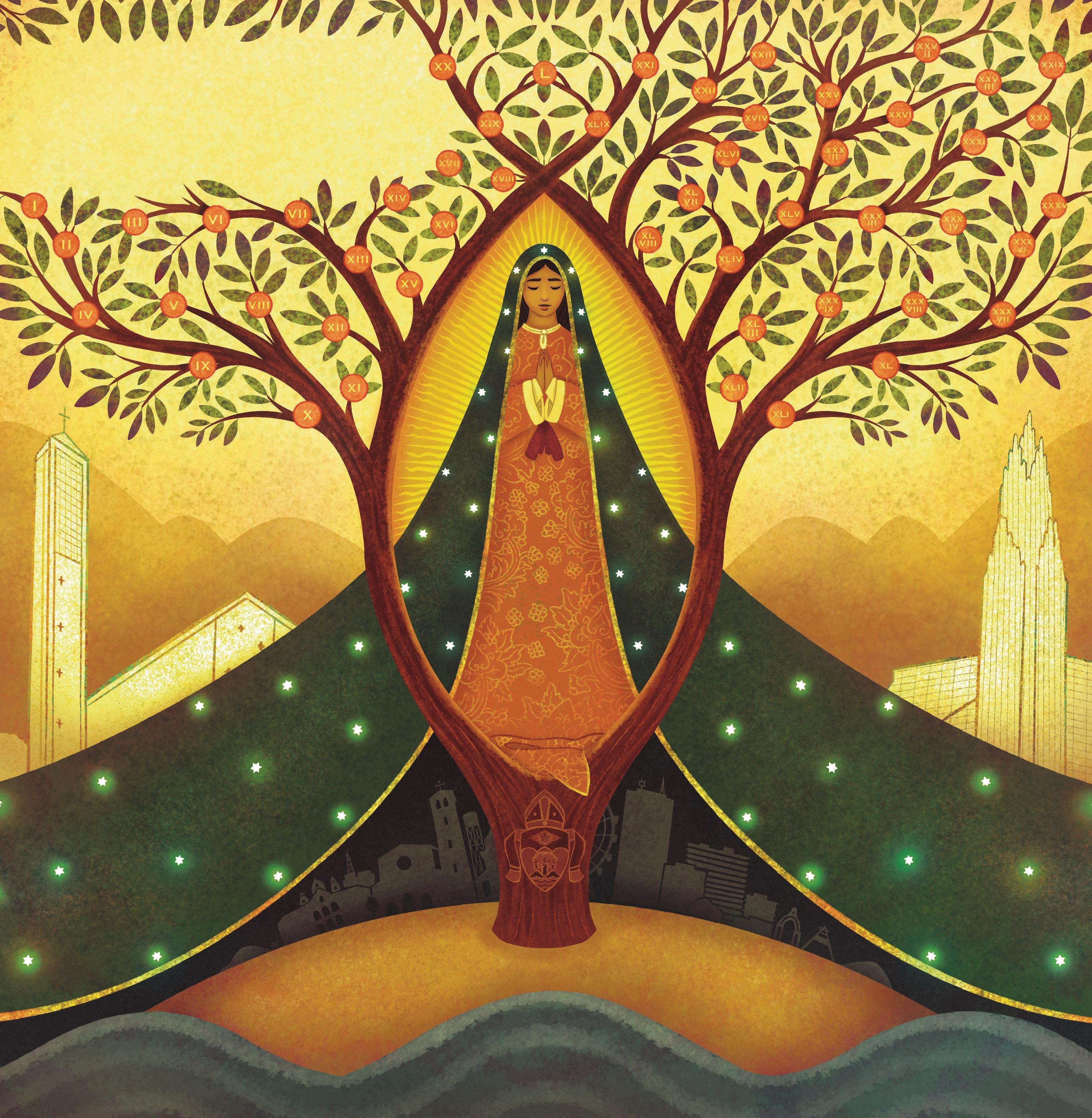
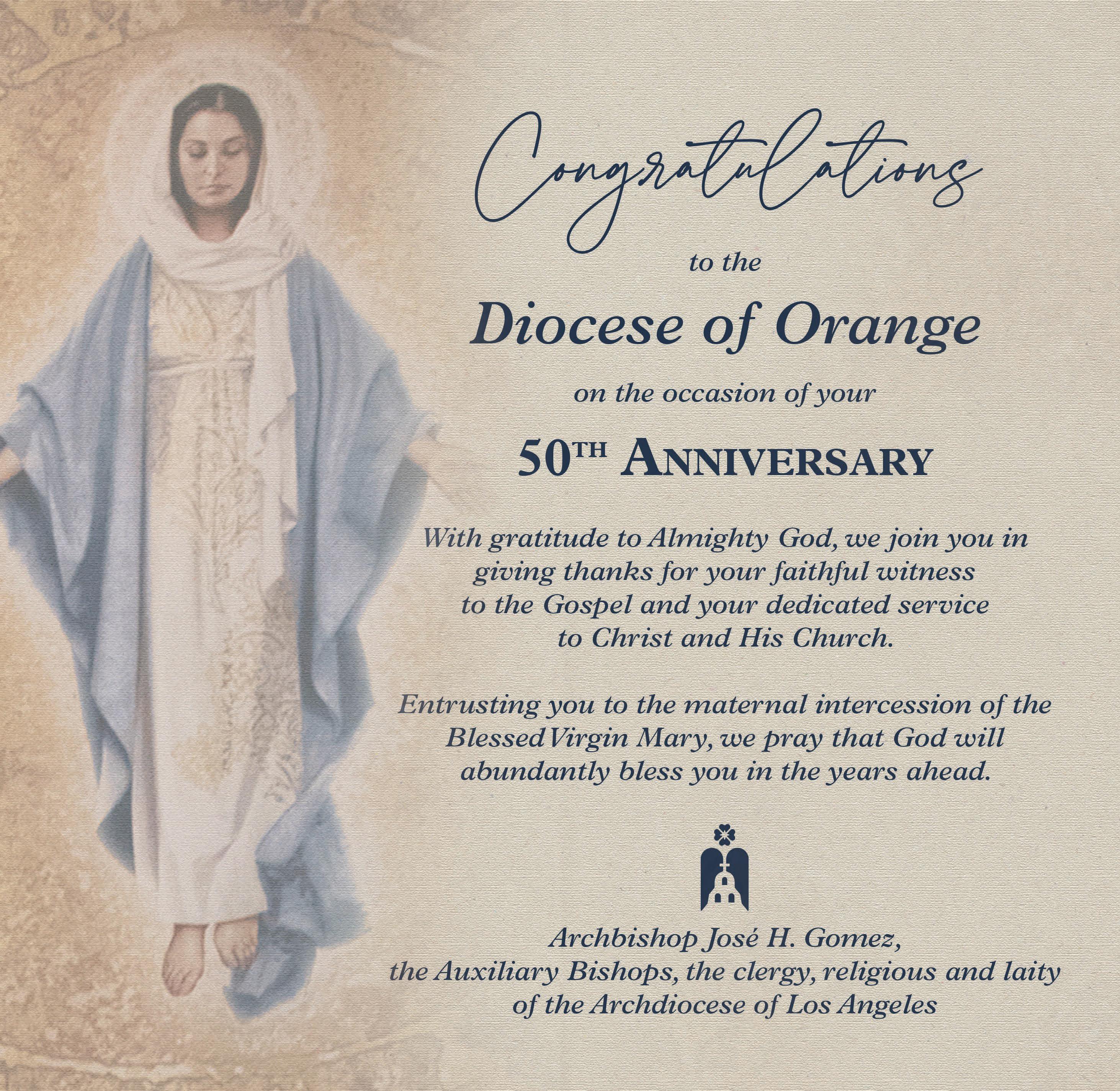
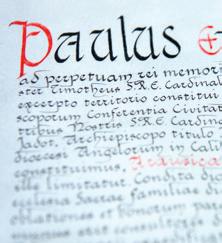
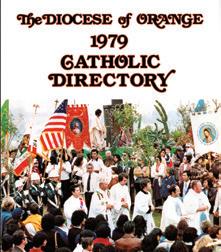
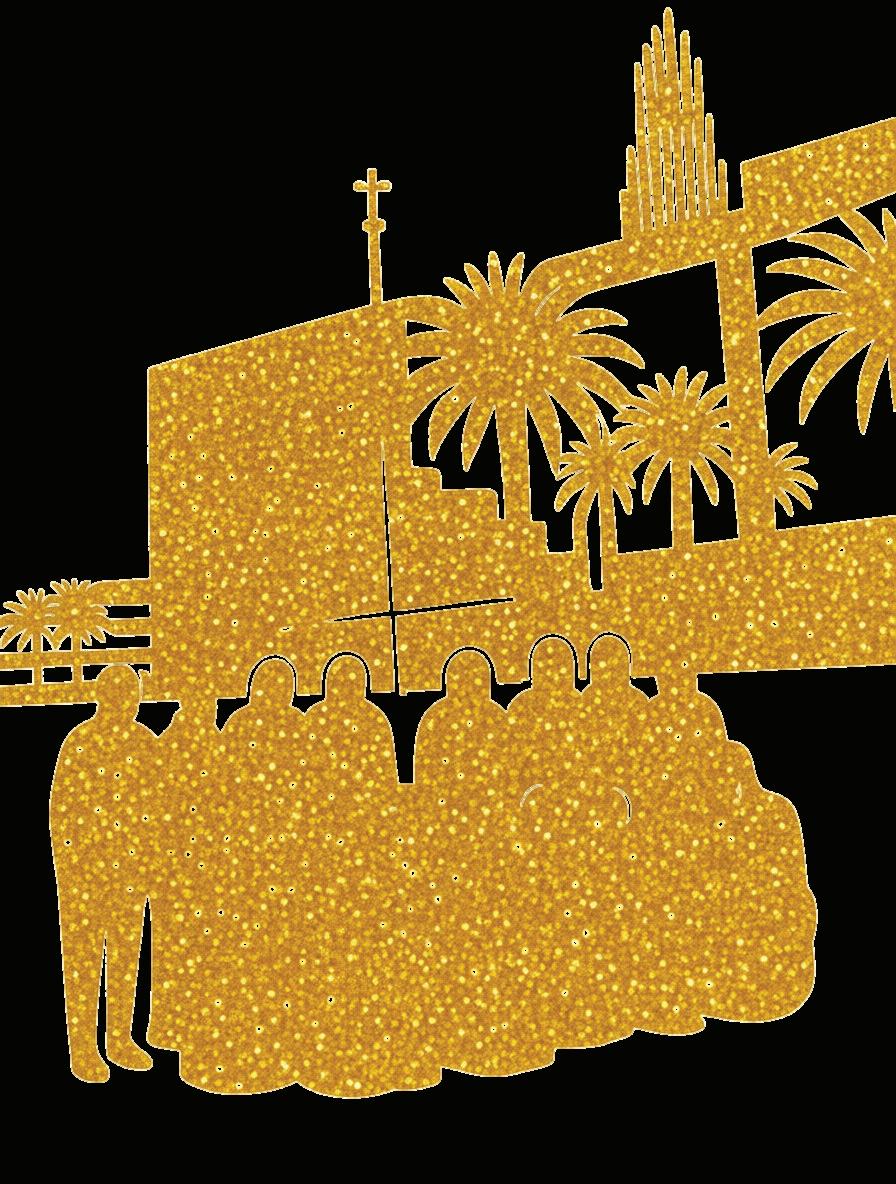
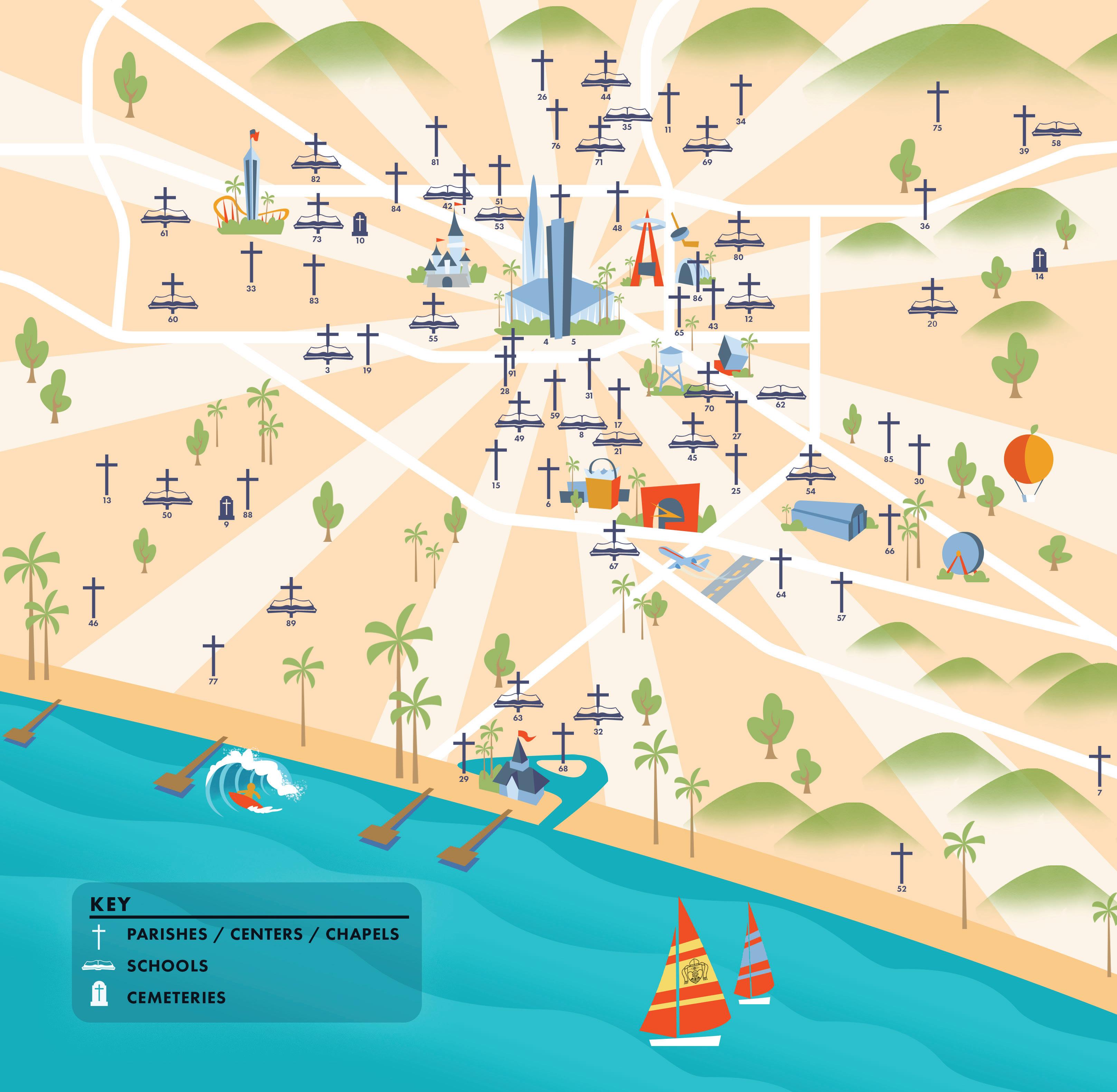
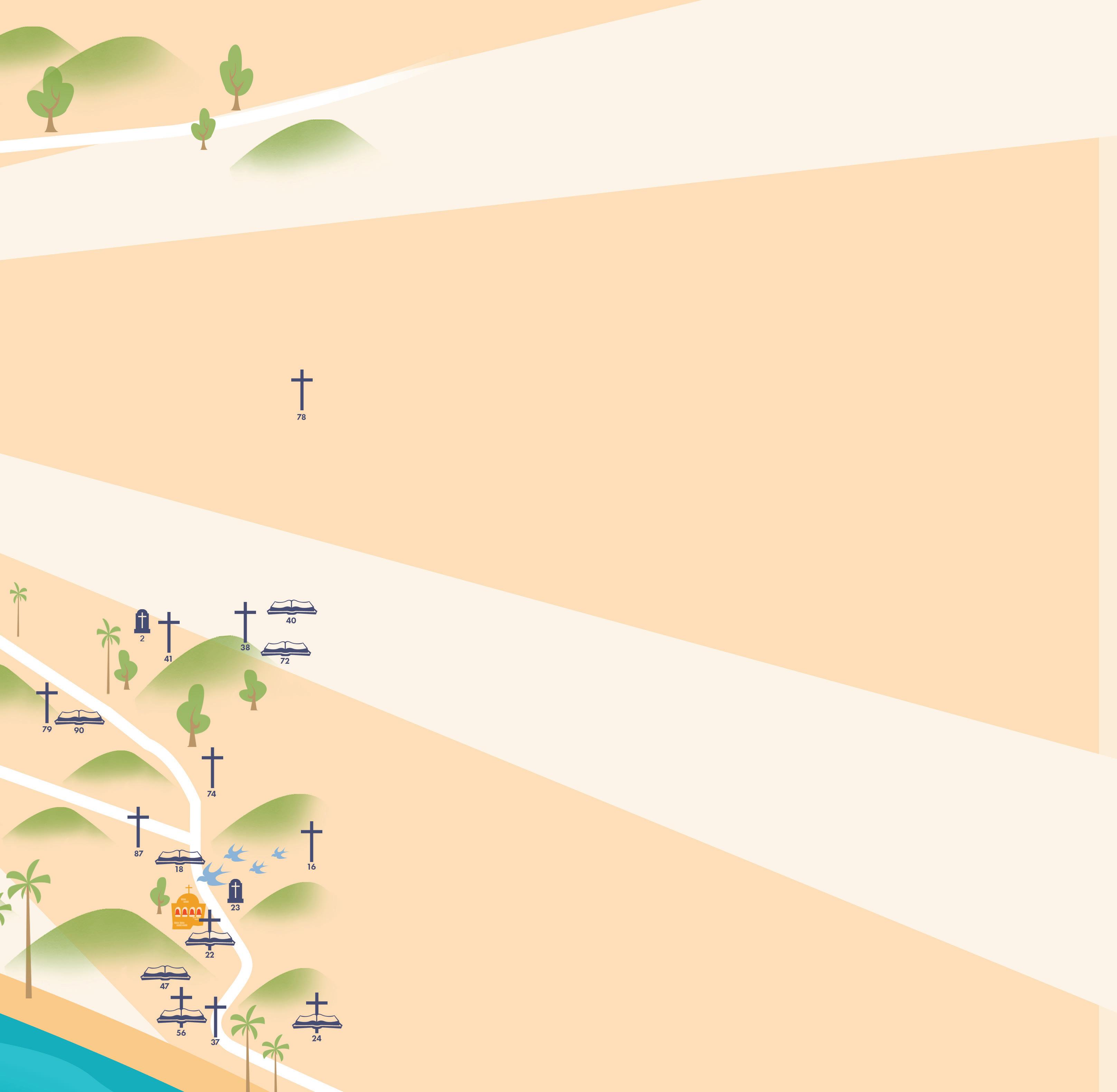
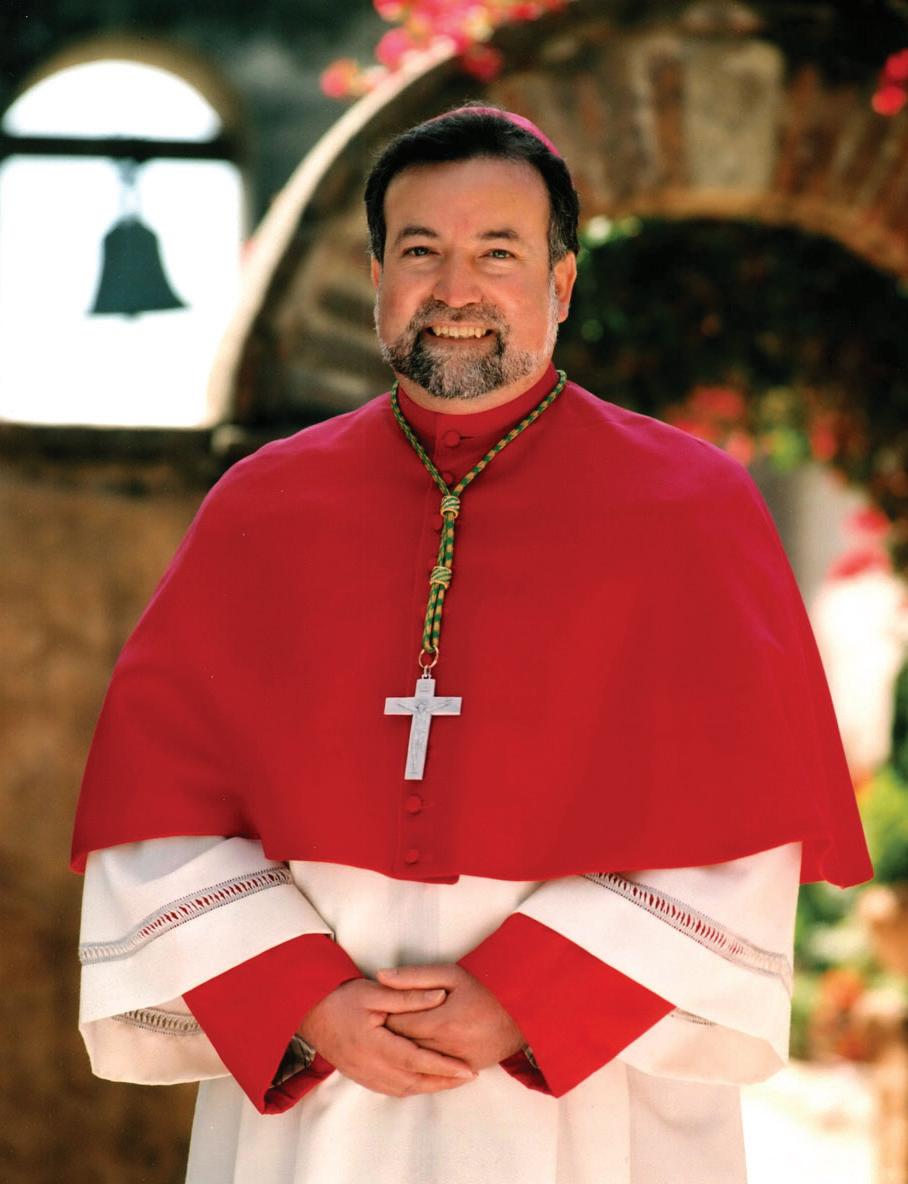
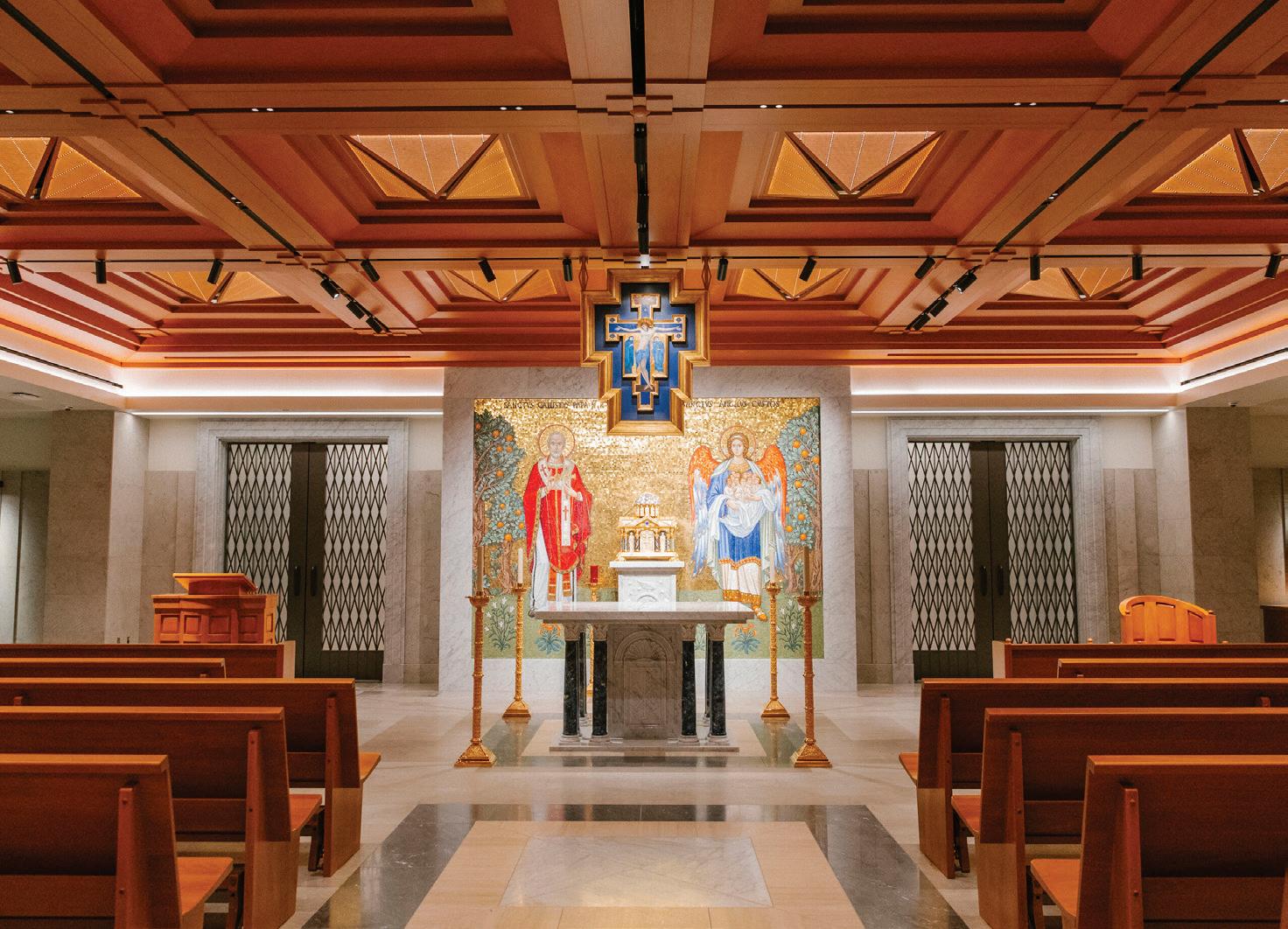
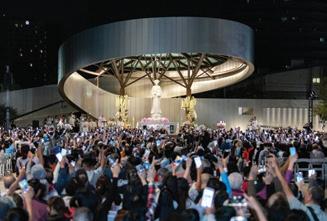
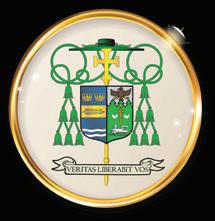
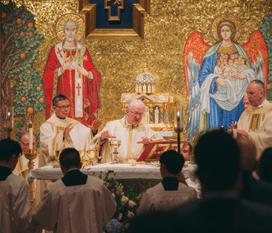
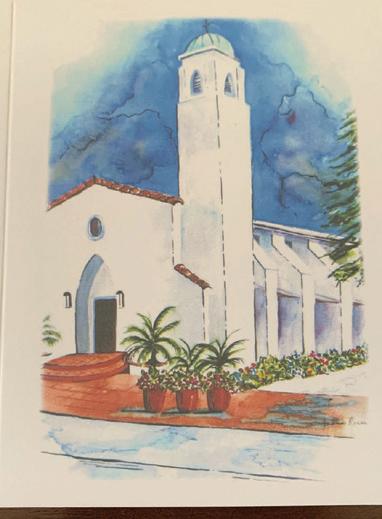
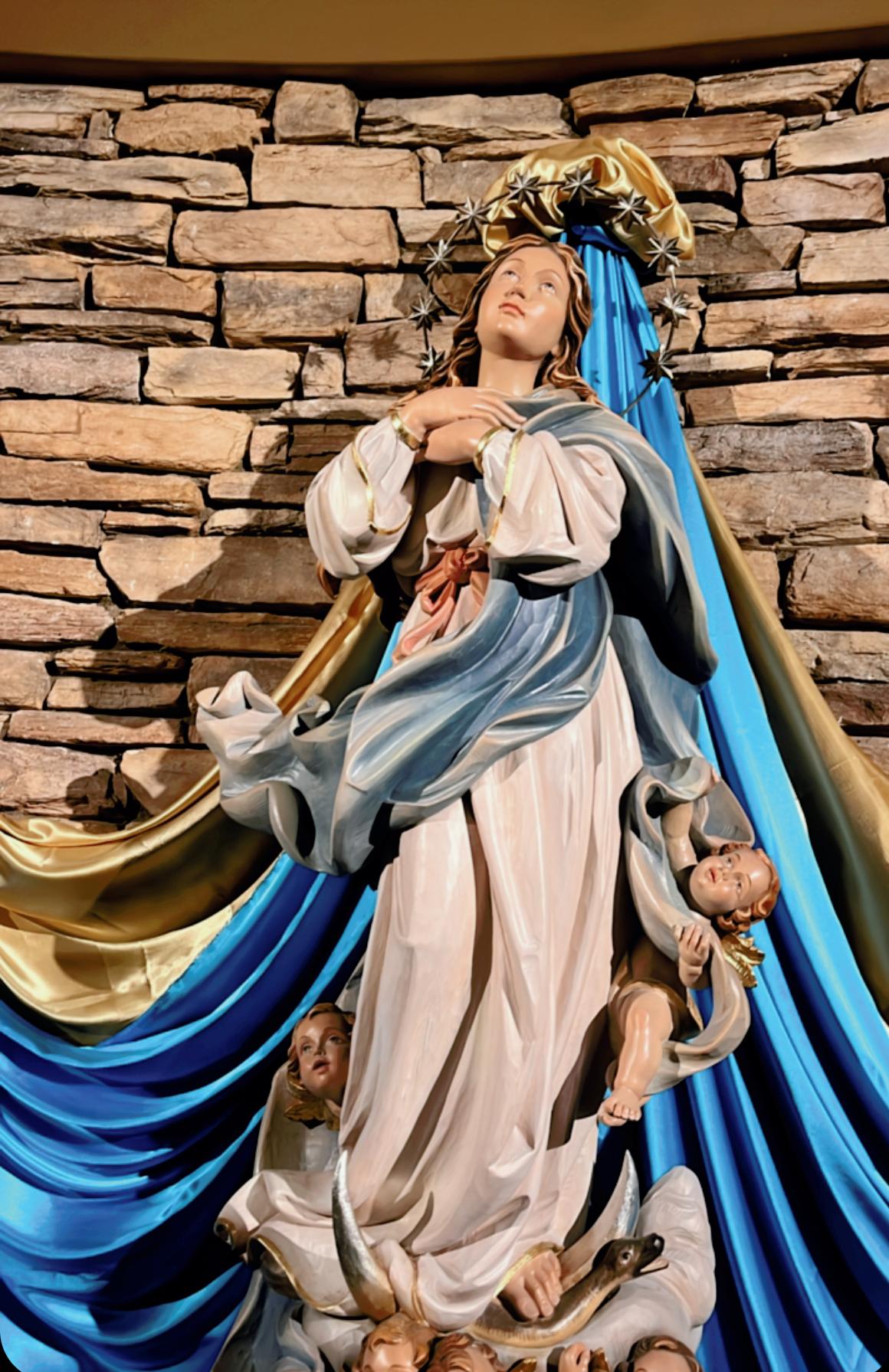
The cover was designed by Fr. Peregrine Fletcher, O.Praem., of St. Michael’s Abbey. Fr. Peregrine employed the same techniques used in traditional painting, but instead of brush and paper, he worked with a stylus and tablet. Every detail, color and design element was rendered entirely by hand.
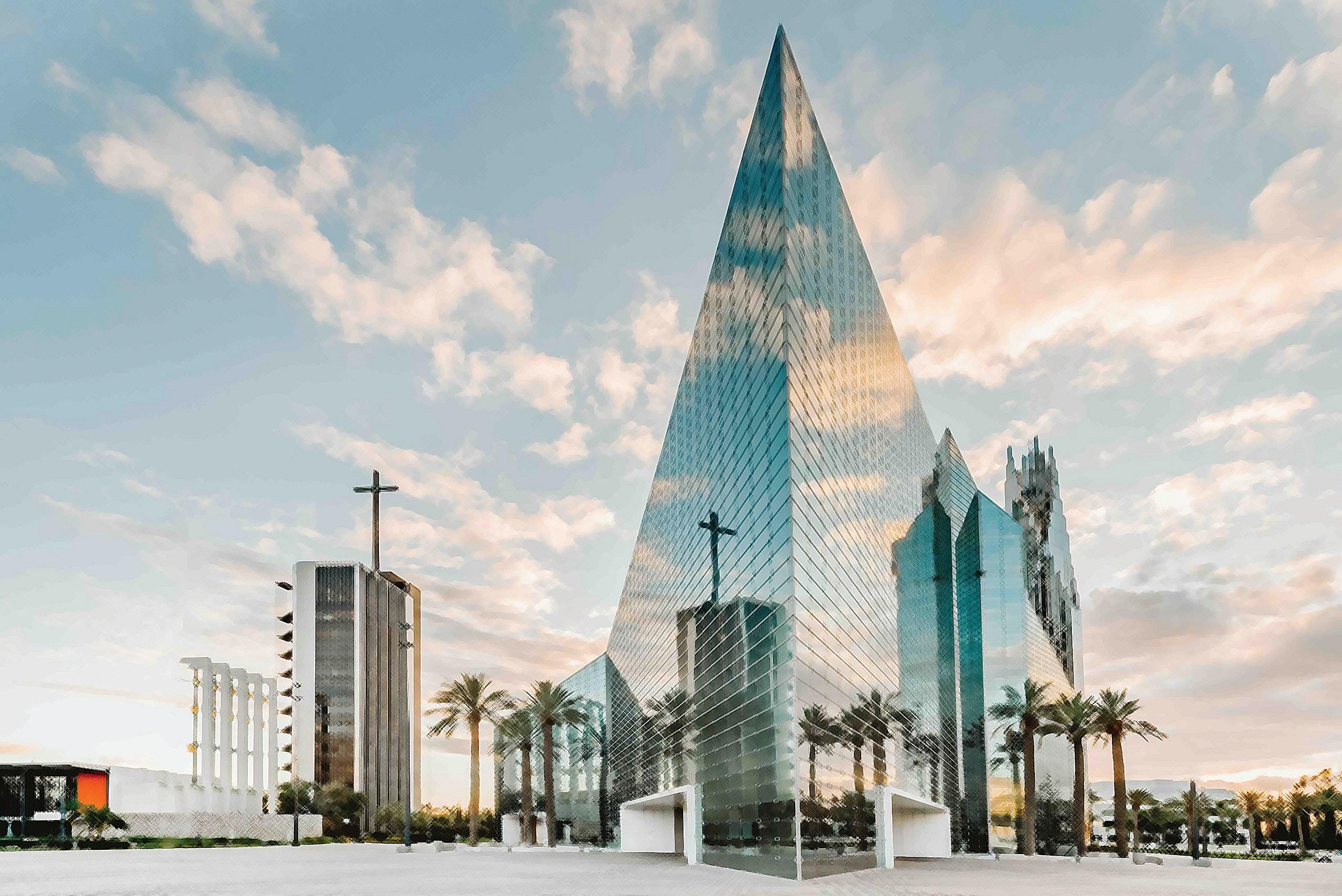
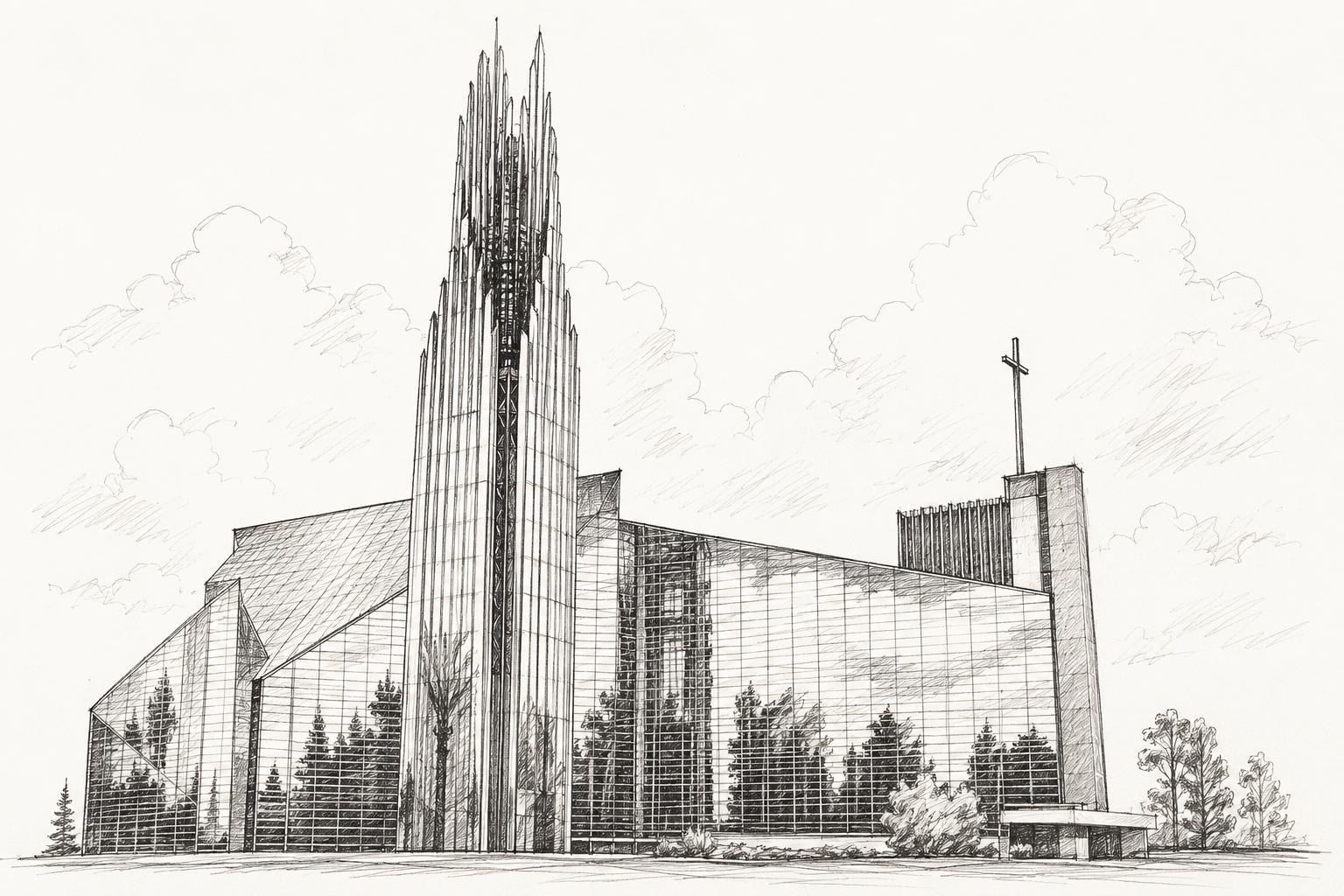
The artwork also contains several intentional symbolic features, including 50 oranges inscribed with sacred Roman numerals and 50 stars. To the left of Our Lady is Holy Family, the diocese’s first cathedral. To her right is Christ Cathedral. Beneath Our Lady’s mantle appears a silhouette of the diocese, with the buildings representing the entirety of the Roman Catholic Diocese of Orange. Together, these elements symbolize Our Lady extending her loving protection and care over the whole diocese.
ORANGE COUNTY CATHOLIC MISSION
STATEMENT
The Orange County Catholic Newspaper seeks to illuminate and animate the journey of faith for Catholics within the Roman Catholic Diocese of Orange – building solidarity among the faithful and inviting a deeper understanding and involvement in the mission of Christ – through the timely sharing of news, commentary and feature content in an engaging, accessible and compelling format.
ORANGE COUNTY CATHOLIC
The Official Newspaper of the Roman Catholic Diocese of Orange Diocese of Orange Pastoral Center, 13280 Chapman Ave., Garden Grove 92840
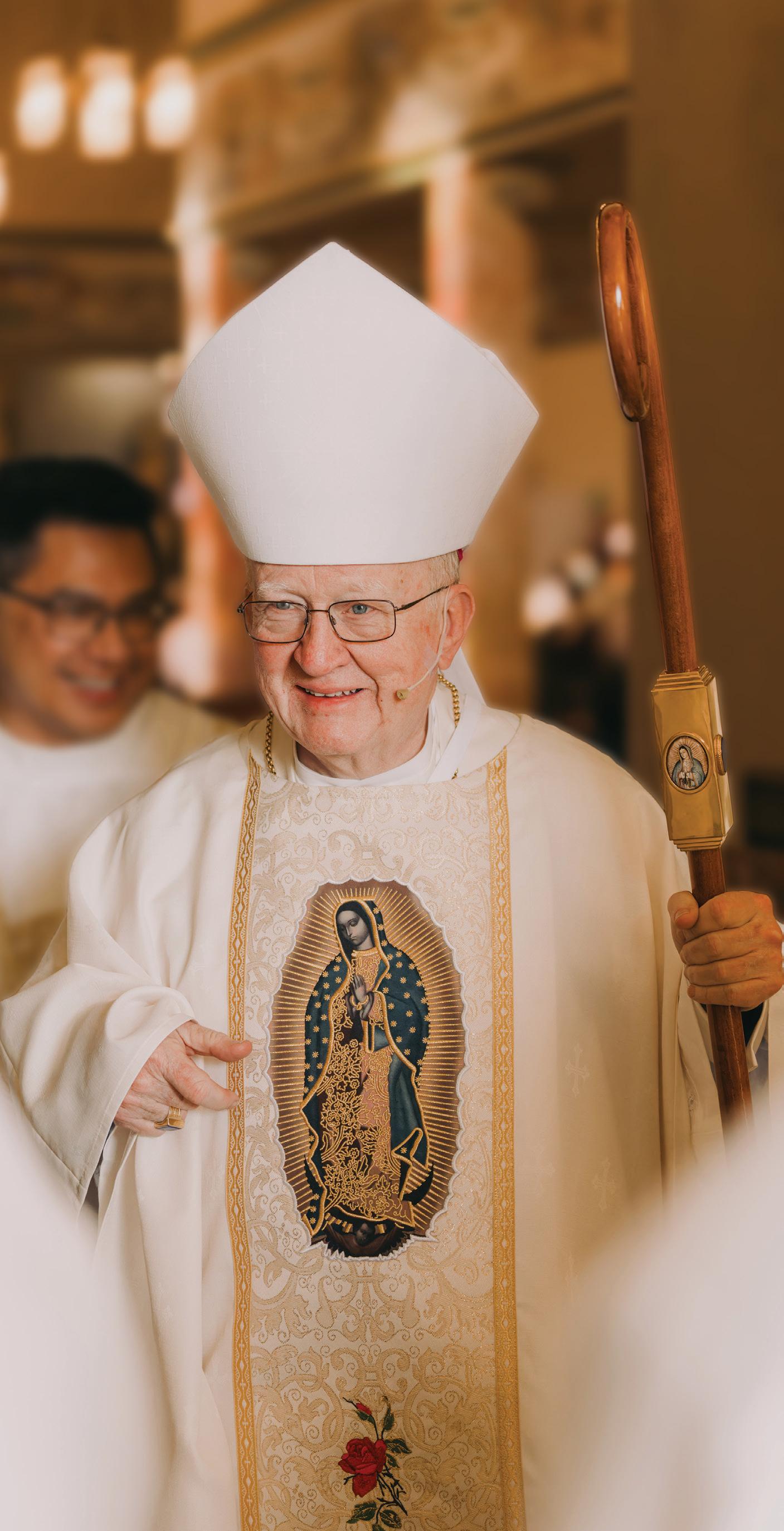
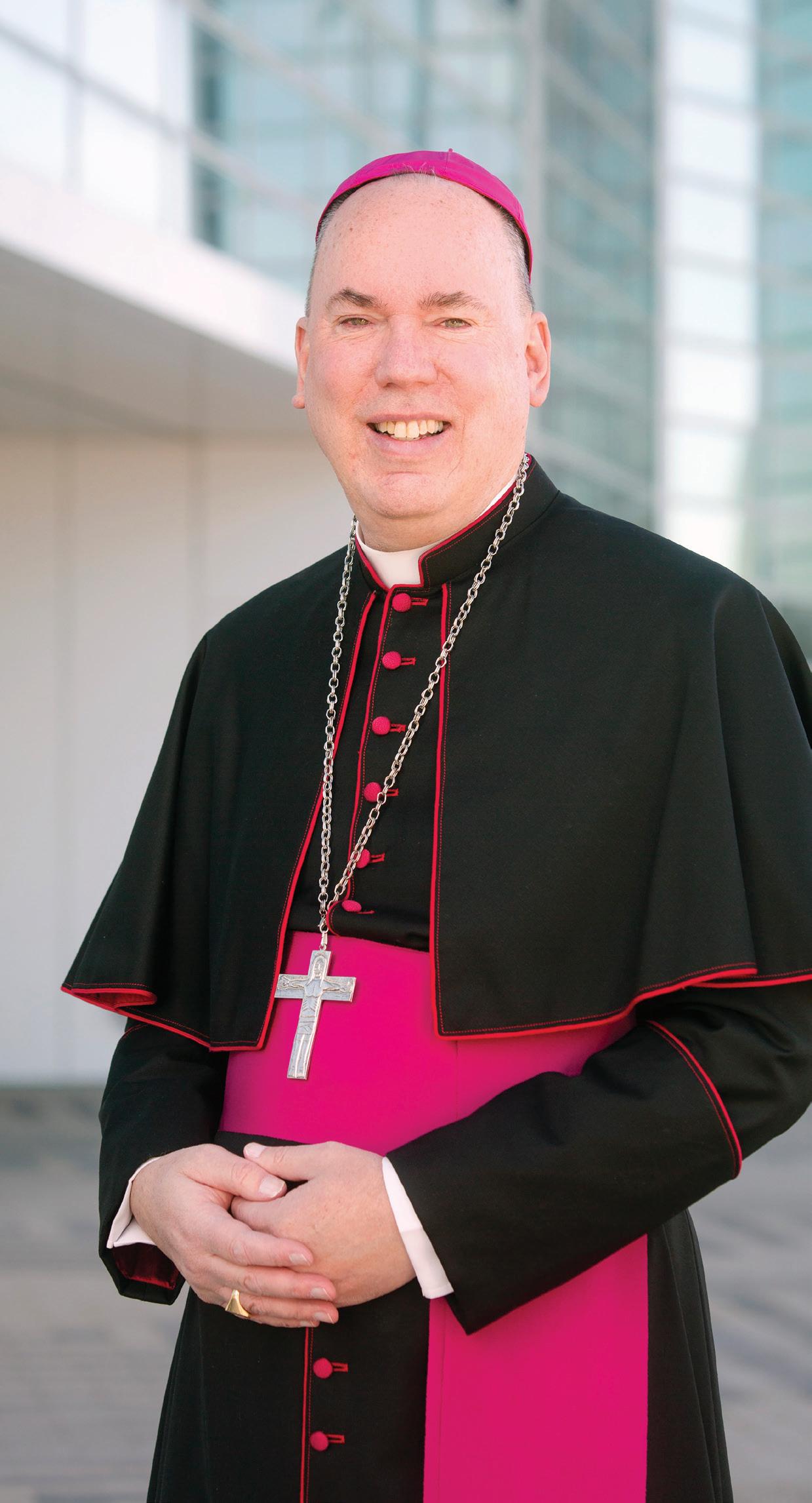
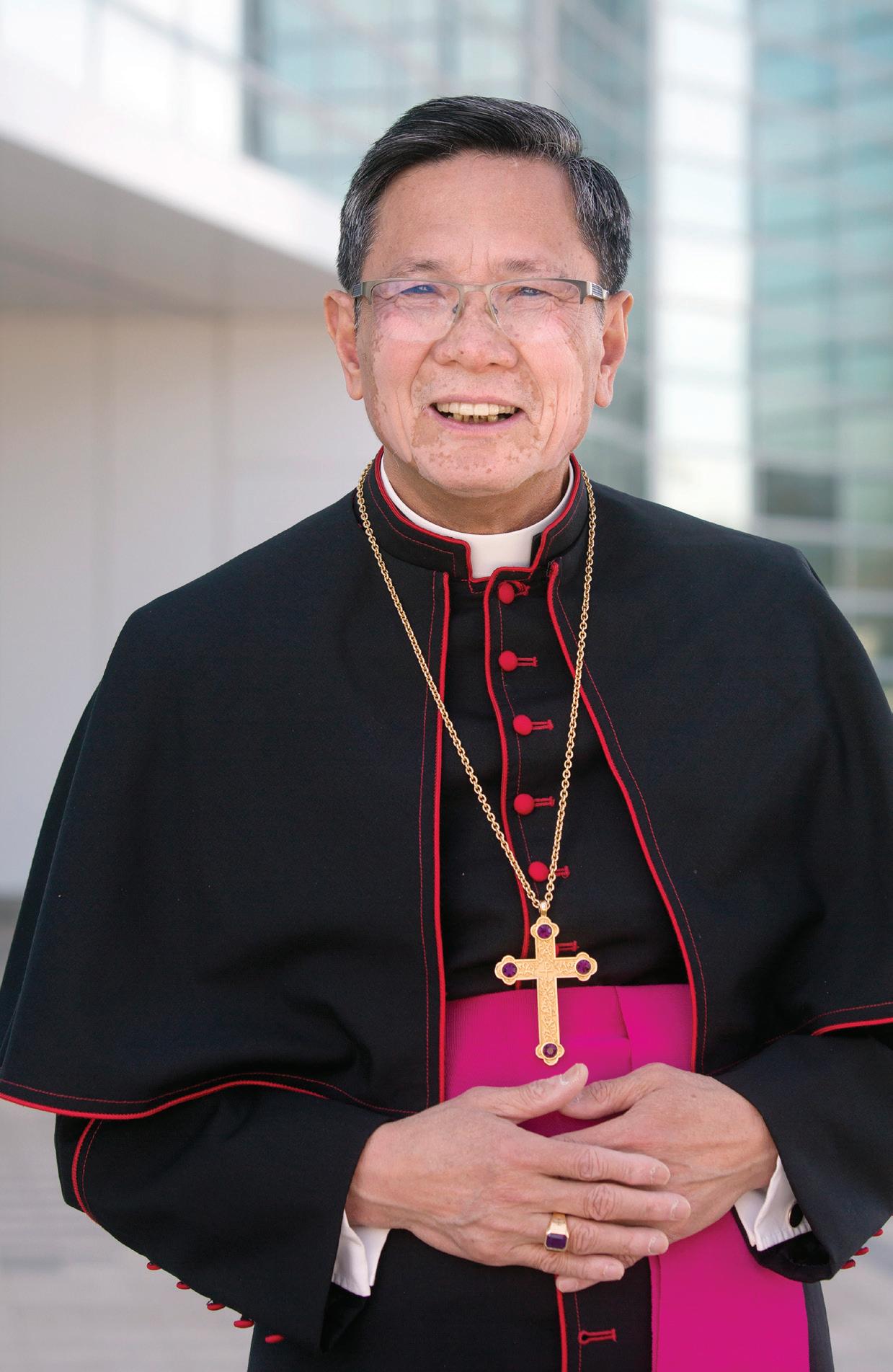
Publisher: The Most Reverend Kevin W. Vann, Bishop of Orange
Director of Custom Content: Caroline Wong, cawong@scng.com
SCNG CUSTOM CONTENT
Managing Editor: Caitlin Adams Art Director: Ken Abbott
Delivered weekly to parishes and homes throughout Orange County, Calif., Orange County Catholic is published by SCNG Custom Content, a division of Southern California News Group that offers content development and design expertise to businesses and nonprofit institutions. The Orange County Catholic editorial staff and editorial council are responsible for the content contained herein. Events and products advertised in Orange County Catholic do not carry the implicit endorsement of the Diocese of Orange or SCNG Custom Content.
OCCatholic.com OCCatholicNews @OCCCatholicNews
SPECIAL ISSUE CONTRIBUTORS
WRITERS: The Most Rev. Kevin W. Vann, Greg Hardesty, Fr. Christopher Heath, Meg Waters, Bradley Zint
ART DIRECTION/LAYOUT: Ken Abbott, Marissa Chamberlain
PHOTOGRAPHERS: Jeff Antenore, Renne Enriquez, Steven Georges, Everett Johnson, Drew Kelly, Joshua Sudock, Ian Tran
SPECIAL THANKS TO: Fr. Christopher Heath and Daniella Mosqueda, and the meticulous, invaluable research of diocesan archivist Fr. Bill Krekelberg (1944–2023).
DEAR BROTHERS AND SISTERS IN CHRIST, AND FRIENDS ALL,
WHEN I WAS A NEWLY ordained priest serving in my home state of Illinois, I first heard news of the newly established Diocese of Orange. The news came from Bishop Joseph McNicholas of the Diocese of Springfield, under whom I was serving at the time. In those days, Orange County felt worlds away from my reality; remembering “Walt Disney’s Wonderful World of Color” that ran on Sunday evenings at 6:30 p.m., which was my knowledge of California when I was at my grandparents’ home.
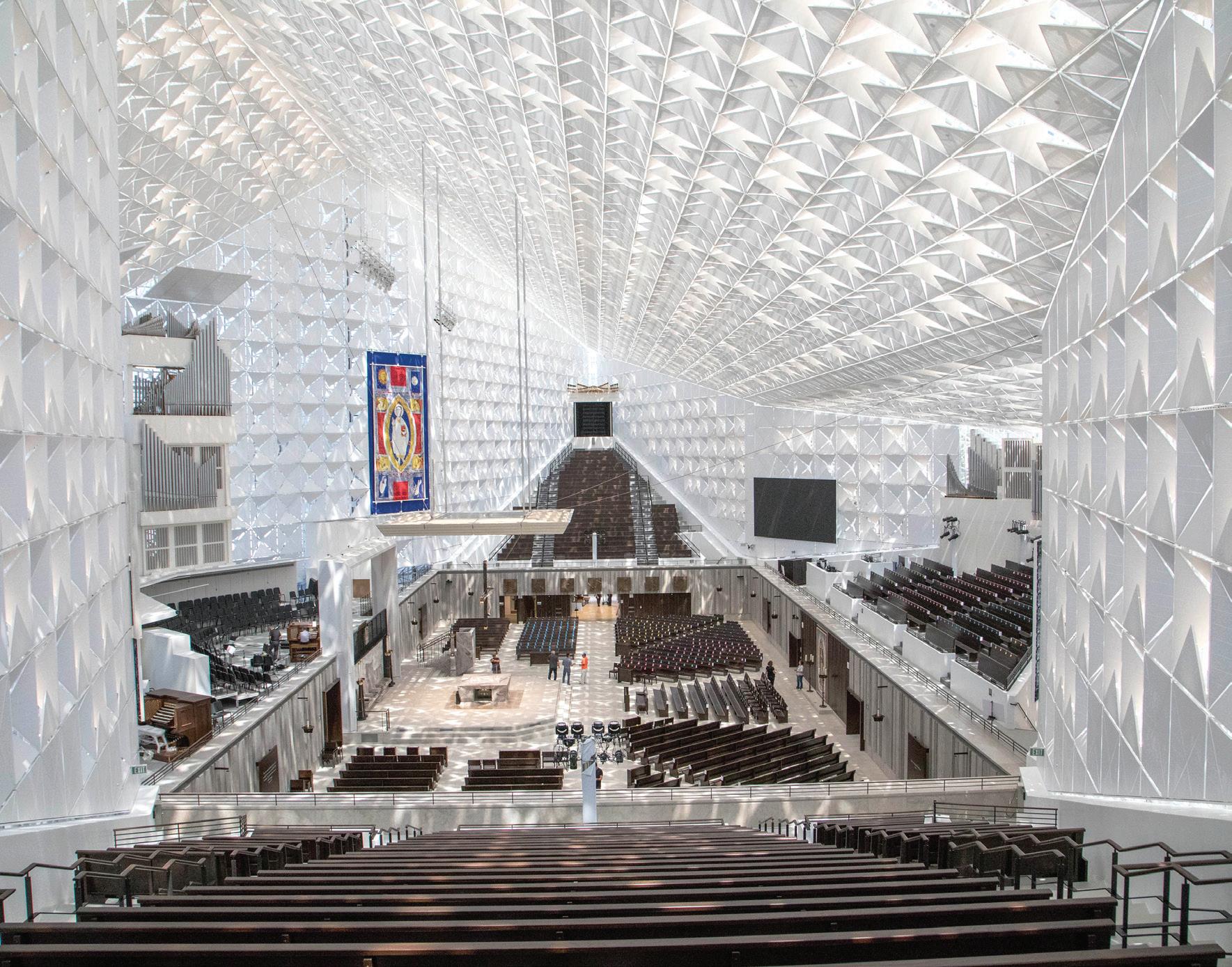
Years later, when I finally arrived in Orange County, I made a point of visiting a landmark I had long heard about: Dr. Robert Schuller’s Crystal Cathedral, recently acquired by the Diocese of Orange for a new and sacred purpose.
I remember standing there and thinking, “What a beautiful place. But this will be a tremendous undertaking for the next bishop.”
Little did I know — though God certainly did — that I would be that next bishop.
When I was installed as the fourth bishop of Orange in 2012, I joined with countless dedicated clergy, staff and faithful in the extraordinary work of transforming the Crystal Cathedral into Christ Cathedral: A Place for Christ Forever. Its completion stands as one of the defining milestones not only of my priesthood, but of the history of our entire Diocese of Orange. For this great blessing, we give thanks to God.
In these pages, you will discover many other important moments in our diocesan history and see how our Catholic community has played an integral role in the lives of the faithful in this corner of the United States. Over these past 50 years, we have grown into one of the most vibrant and multicultural dioceses in our nation, now spanning 57 parishes, six Catholic centers and 36 schools.
It has been my profound honor and privilege to serve as your bishop throughout these years — to walk beside you and among you as fellow pilgrims on this journey of faith.
Today, and especially during this 50th Jubilee Year, we joyfully renew our invitation to all: to live the Gospel with faith, joy, charity and unity.
Yours in Christ,
THE
MOST REV. KEVIN W. VANN, D.D., J.C.D., D.MIN.
FOURTH BISHOP OF ORANGE
BISHOP KEVIN VANN GREETS PARISHIONERS DURING ST. BONIFACE PARISH’S SIMBANG GABI CELEBRATION, WHICH WAS HELD ON DEC. 19, 2023. PHOTO BY IAN TRAN/DIOCESE OF ORANGE
DELIGHTED FOR THE NEW DIOCESE
FOUR
PRIESTS
BY GREG HARDESTY
RECALL
THEIR SURPRISE, PRIDE AND HAPPINESS WHEN THE DIOCESE OF ORANGE WAS FORMED IN 1976
WHY THE DIOCESE OF ORANGE was formed is quite simple.
Rapid population growth in the county was a key reason why Pope Paul VI established the diocese on March 24, 1976, followed by an installation liturgy and formal inauguration on June 18, 1976.
Cardinal Timothy Manning of Los Angeles had recognized the need for local leadership to better serve Orange County’s growing Catholic population, which back then was around 300,000.
News that the Archdiocese of Los Angeles was creating a Diocese of Orange was something else.
The announcement surprised, delighted and changed the lives of the first priests and seminarians who would become part of it.
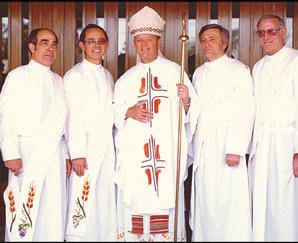
For a few days, they wore orange-colored collars fashioned from construction paper wrapped around the white tabs.
TAKEN BY SURPRISE
Fr. Christopher Smith was in his sixth year of seminary studies when the announcement was made. He and his fellow seminarians had anticipated being assigned to parishes in the sprawling L.A. region – or far beyond.
“It had been speculated for a while that there would be a new diocese,” recalled Fr. Christopher, rector emeritus of Christ Cathedral. “All we knew was they would be dividing the archdiocese of L.A. We didn’t have any idea it was going to be just Orange County.
“In the seminary, I thought: ‘Oh my, what happens if we become part of the Diocese of San
CONTINUED ON PAGE 13
CONTINUED FROM PAGE 9
Bernardino and are sent to Needles or some other outpost?’” the native of Orange said with a laugh. “We were quite relieved when we learned it was just going to be Orange County.”
Msgr. Art Holquin was a two-yearordained priest in his first assignment at Holy Family parish in Orange, having a coffee in a quiet rectory. The pastor, Msgr. Donald Strange, was out of town to attend a funeral.
Then, early on the morning of March 24, 1976, Msgr. Holquin’s phone rang.
“Father, what do you think of the news?” a reporter asked.
Flustered, he responded: “What news?”
“About the new Diocese of Orange.”
For a moment, Msgr. Holquin was speechless. Then he said: “Please repeat that. We’re a new diocese?”
“Yes, Father.”
His second question came immediately: “Where’s the cathedral?”
The answer stopped him cold: “Father — you’re at it.”
After hanging up, Msgr. Holquin rushed to share the news with his brother associate, Fr. Bill Krekelberg. In those days, parish priests were simply called associates — the title parochial vicar came later — and Fr. Bill couldn’t believe it either.
The two enjoyed a celebratory lunch at a favorite restaurant.
Msgr. Holquin found out the new bishop of Orange would be William Johnson, one of the auxiliary bishops of the Archdiocese of Los Angeles. He was pleased since he thought highly of him.
About a week later, Msgr. Holquin
learned he would be on the planning team for the installation liturgy and the formal inauguration.
“I was fortunate, as a very young priest, to be part of that team — with particular responsibility for planning the installation Mass itself,” Msgr. Holquin said.
THE ‘DREAM YEARS’
Not only was the Catholic community in Orange County growing in numbers back in 1976. it also was becoming increasingly diverse, particularly in the Asian and Hispanic communities.
That’s why when the diocese was formed, one of its missions was to support a diverse community.
Today, with 1.3 million Catholics, the diocese is one of the most ethnically diverse in the nation.
CONTINUED ON PAGE 14
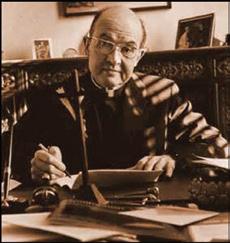
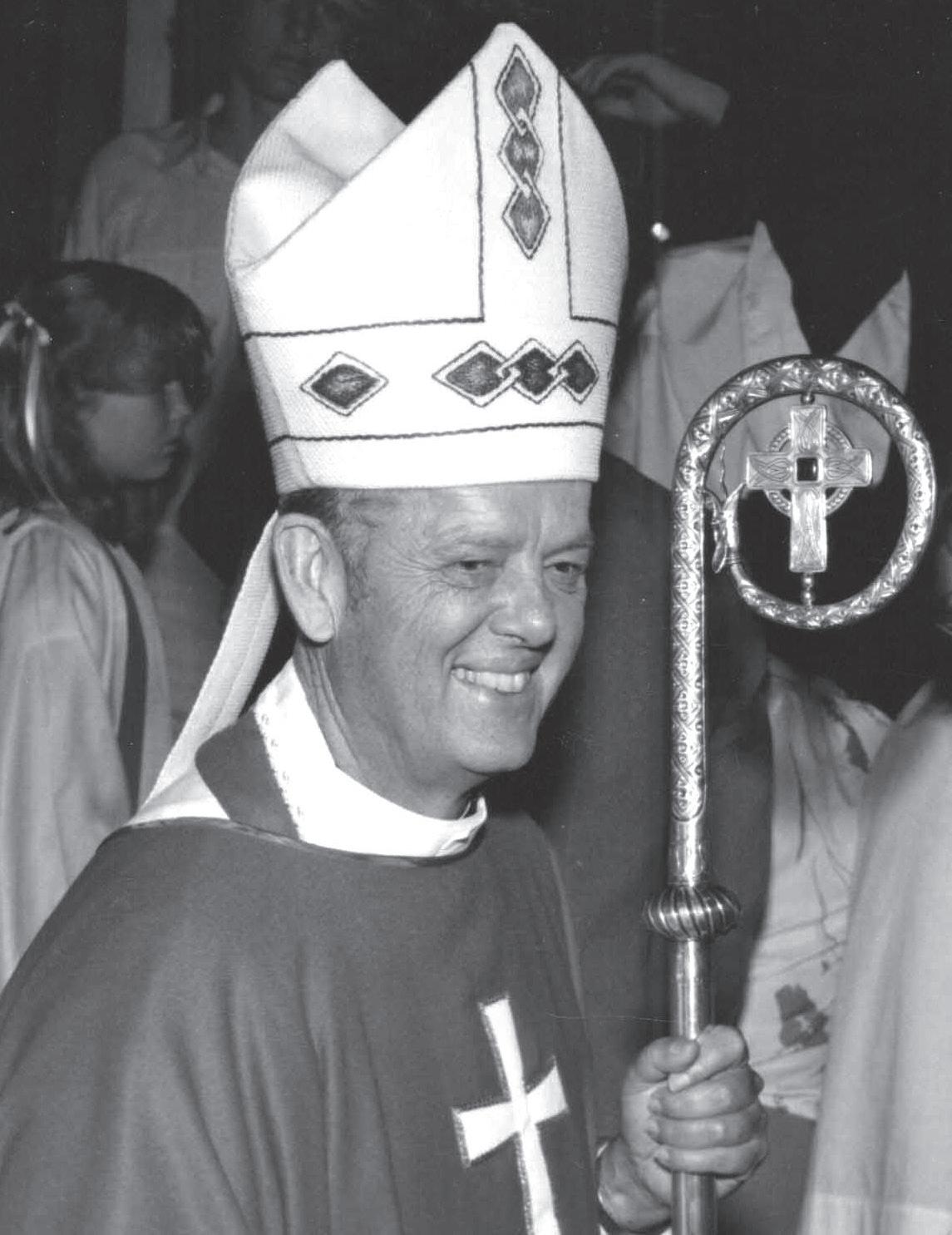
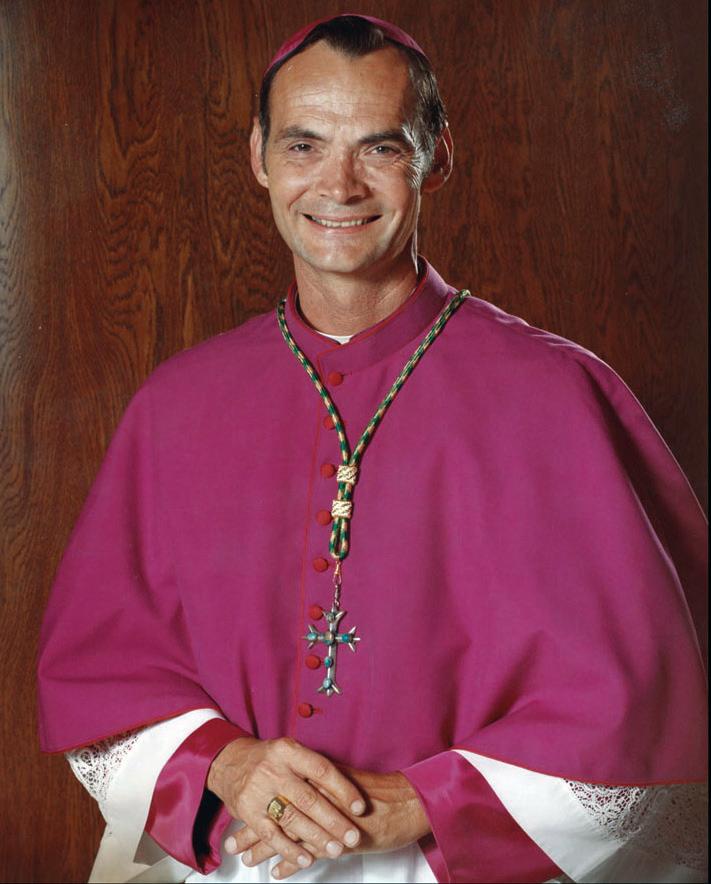
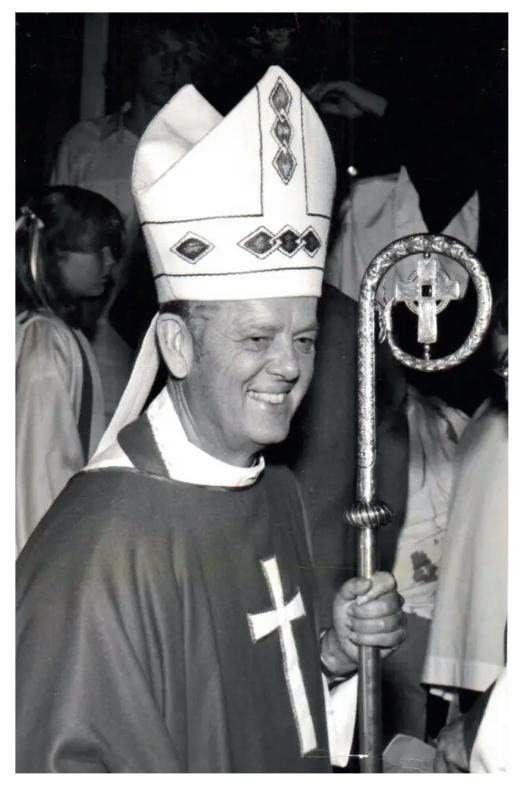
BISHOP WILLIAM JOHNSON ON JUNE 18, 1976, THE DAY THE DIOCESE OF ORANGE WAS ESTABLISHED. PHOTO BY THE DIOCESE OF ORANGE
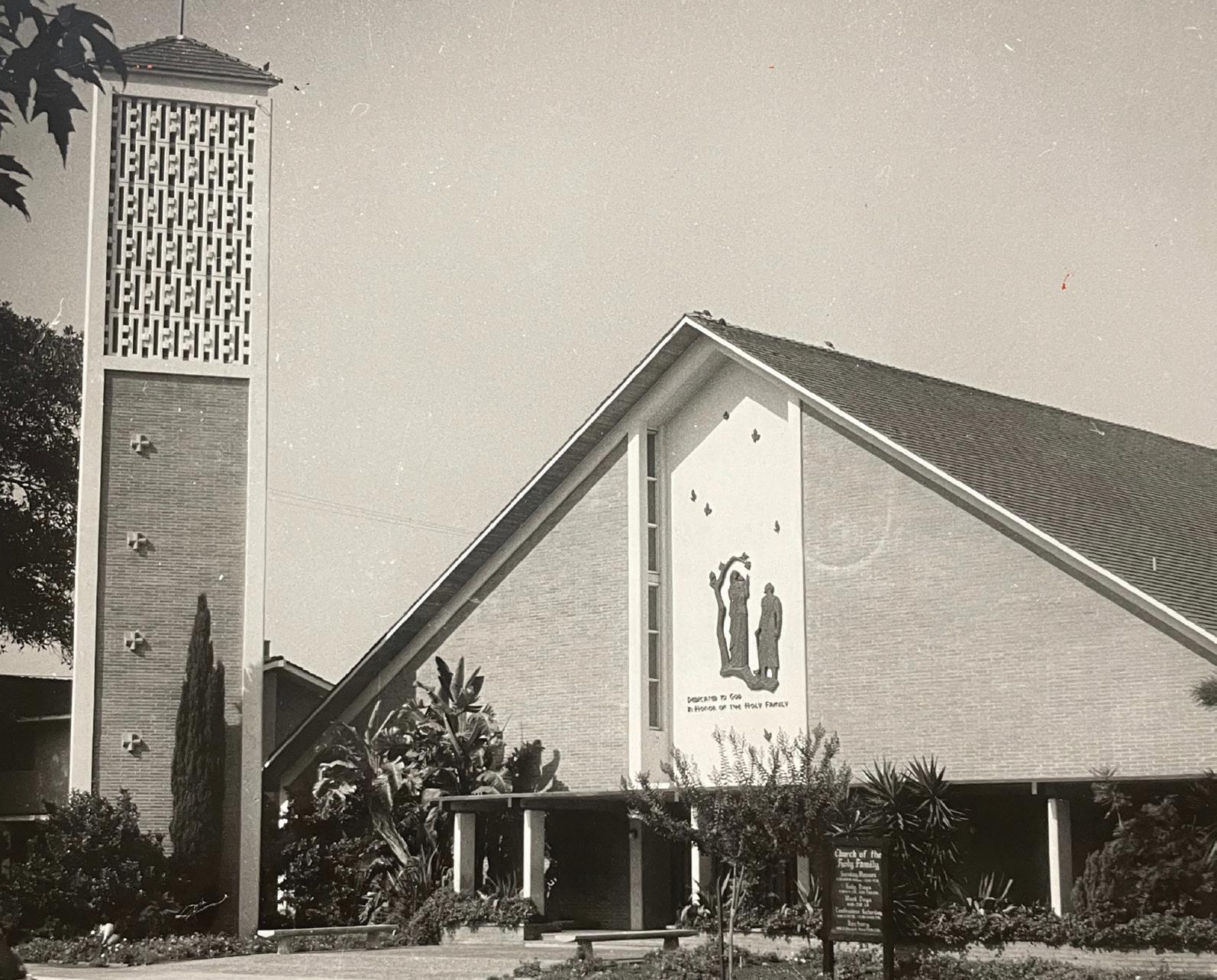
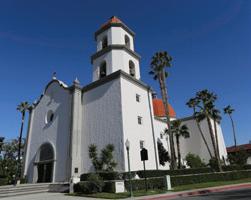
HOLY FAMILY IN ORANGE WAS DESIGNATED AS THE DIOCESE’S FIRST CATHEDRAL WHEN IT WAS OFFICIALLY CREATED IN JUNE 1976. FOUNDED IN 1921, THE CURRENT CHURCH BUILDING WAS COMPLETED IN 1958.
PHOTO BY THE DIOCESE OF ORANGE
CONTINUED FROM PAGE 13
Msgr. John Urell, who with Fr. Christopher was among the first group of seminarians and priests ordained to serve the Diocese of Orange, is astonished at its growth.
He calls 1978 to 1983 the “dream years” of his life as a priest. His first assignment was Holy Family, where he served as associate pastor for five years.
Msgr. Urell was in his second year at St. John’s Seminary in Camarillo when news of the formation of the diocese hit.
“I had no clue what it meant,” he recalled with a laugh.
The native of Tustin was excited to become a priest in Orange County.
“I was honored to be part of it all,” Msgr. Urell said. He served as a fresh-faced altar server at the June 18, 1976, Mass.
“I had never seen anything like that, with half the congregation bishops from around the country,” said Msgr. Urell, who now is retired but helps at the parish of his youth, St. Cecilia in Tustin.
‘EVERYBODY WENT WILD’
Diocesan archivist Fr. Christopher Heath, former pastor of St. Hedwig in Los Alamitos, was attending a high school seminary in San Fernando when the diocese was formed.
He recalled being at Mass at Holy Family, his home parish, when news of the announcement came out.
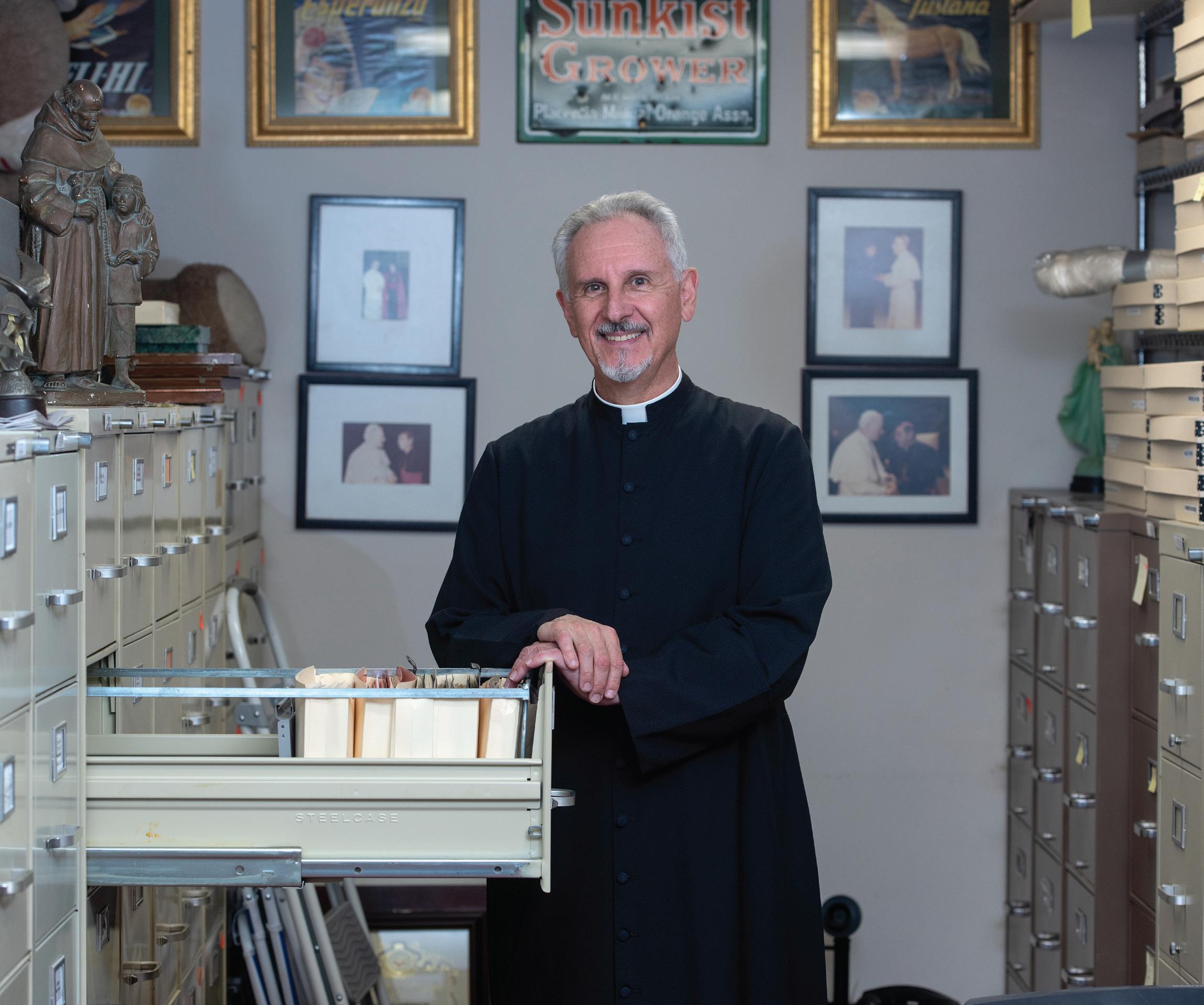
“Everybody went wild,” said Fr. Chris as he recalled the memory while standing beside an old-school file cabinet at diocesan archive offices inside the bell
CONTINUED ON PAGE 15
Honoring 50 Years of Faith, Community, and Renewal
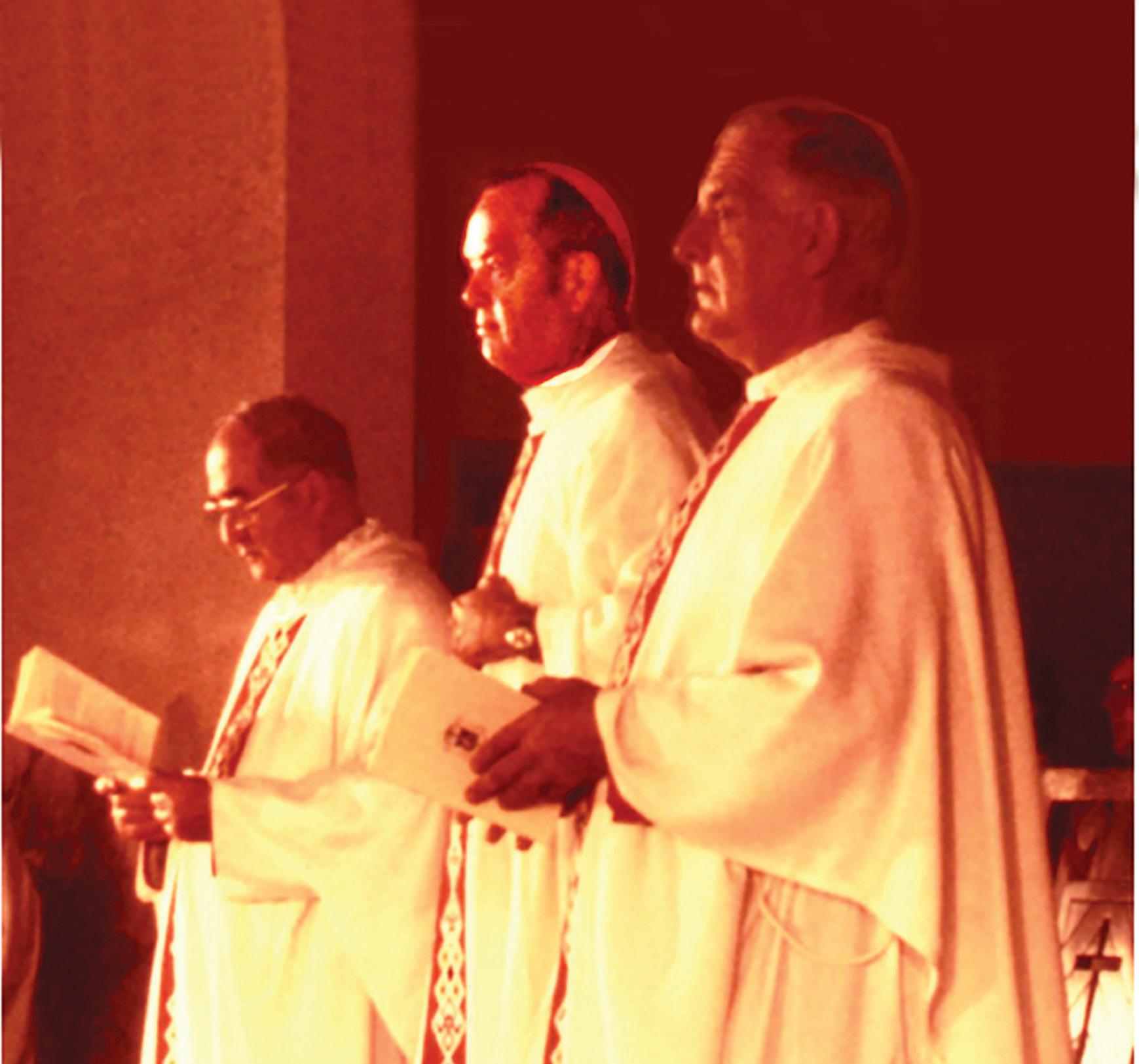
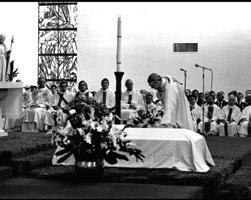
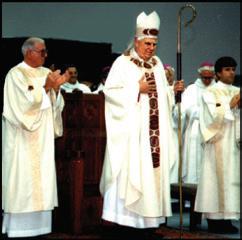
BISHOP WILLIAM JOHNSON IS PICTURED DURING HIS INSTALLATION MASS CELEBRATED ON JUNE 18, 1976, AT HOLY FAMILY CATHEDRAL. ON THIS DAY, BISHOP JOHNSON WAS INSTALLED AS THE FIRST BISHOP OF THE NEWLY FORMED DIOCESE OF ORANGE. PHOTO BY THE DIOCESE OF ORANGE
tower at Mission Basilica in San Juan Capistrano.
The room has the musty smell of old books and newspaper clippings.
“I remember that Msgr. Donald Strange had tears in his eyes,” Fr. Chris said.
In 1963, Msgr. Strange was appointed pastor of Holy Family, where he built the rectory, sisters’ chapel and convent. In 1974, Cardinal Manning named him episcopal vicar for Orange County.
Two years later, he became the first vicar general of the newly established Diocese of Orange. That same year he also was appointed rector of the Holy Family Cathedral.
Fr. Chris opened the file cabinet and pored over papers that included studies conducted by the Archdiocese of Los Angeles into the feasibility of a new diocese in Orange County.
“They had to make sure it would be financially sound, among other things,” said Fr. Chris, with a large magnifying glass on his desk.
Fr. Chris was named archivist five years ago. His mother, Bonnie, worked on the first diocesan directory as a photographer, taking black-and-white pictures of every church and priest. She became the first official photographer for the Diocese of Orange.
Fr. Chris succeeded Fr. William Krekelberg, who served as diocesan archivist from 1997 to 2015 and archivist emeritus and official historian from 2015 until his death in 2023.
Fr. Chris picked up a thumb drive that contains a video of the installation Mass that had to be transferred from U-matic tapes, the now-obsolete analog videocas-
ON
settes introduced by Sony in 1971.
“I knew I wanted to be part of it,” he said of all the activity at Holy Family parish following the creation of the diocese. “It made it that much more special to me when I became a priest.”
Msgr. Holquin has been ordained for nearly 52 years.
Of all the memories he carries from a long priestly life, that quiet morning in March 1976 — the coffee, the phone ringing, the reporter’s question and the astonishing news — remains among his most vivid and most cherished.
“In the words Cardinal Manning spoke the day of the inauguration, words I have never forgotten, ‘It is enough that God be praised and thanked,’” Msgr. Holquin said.
He added: “Indeed, it is.” C
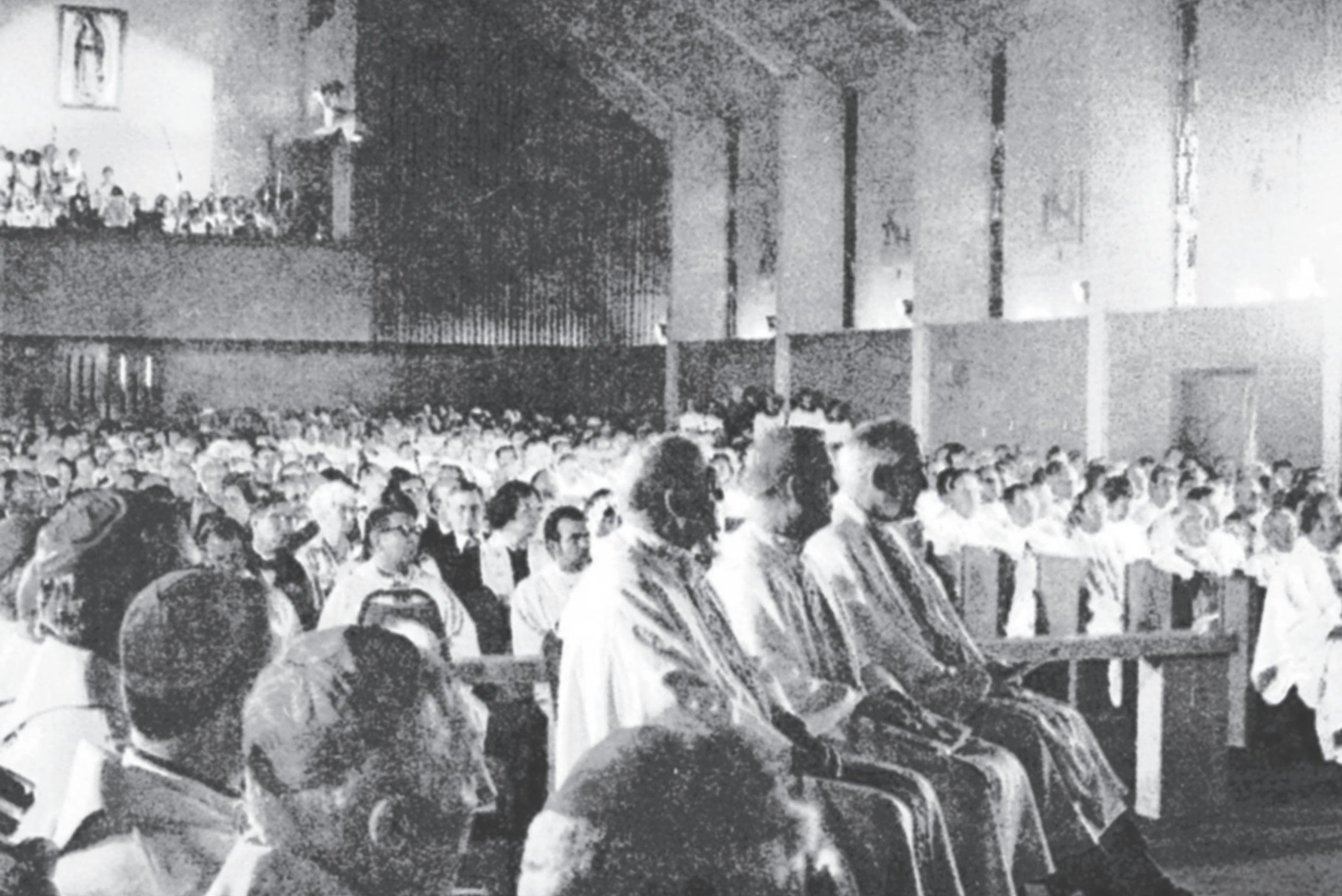
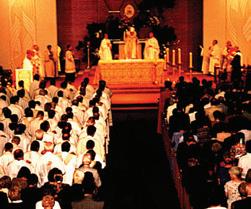
JUNE 18, 1976, CLERGY AND LAY PERSONS LISTEN ATTENTIVELY IN HOLY FAMILY CATHEDRAL TO THE READING OF PAPAL MANDATES ESTABLISHING THE NEW DIOCESE OF ORANGE.
PHOTO BY THE DIOCESE OF ORANGE
Consider this before you sell.
Appreciated real estate often carries significant capital gains tax. Before you list or close, explore whether giving from the asset could benefit both your family and the Church.
√ Reduce capital gains
√ Give appreciated property
√ Support the Church
Big life moments deserve purposeful action. Contact us at (714) 282-3021 or email info@OrangeCatholicFoundation.org
AFTER 50 YEARS, HOPE SPRINGS ETERNAL
CATHOLIC CHARITIES OF ORANGE COUNTY SERVES THE MOST VULNERABLE AMONG US
BY MEG WATERS
AS THE DIOCESE OF ORANGE celebrates its 50th anniversary, Catholic Charities also celebrates 50 years as the heart of the diocese’s Catholic social services.
In 1975, Catholic Community Agencies was one of the leading providers of hope and resettlement to more than 50,000 Vietnamese refugees who entered the United States via MCAS/El Toro after the fall of Saigon. A year later, the newly named Catholic Charities of Orange County (CCOC) came under the mantle of the newly formed Diocese of Orange. In the five decades since, CCOC has continued to serve the most vulnerable among us with compassion, dignity and faith.
CCOC was established in 1976 by Bishop William Johnson, the first bishop of Orange, but had existed locally under the auspices of the the Archdiocese of Los Angeles. It is one of about 169 organizations across the country, all of which are affiliates of Catholic Charities USA. Each diocese directs the organization to serve the priorities of the local bishop, depending on the needs of the community. In Orange County, those needs have been to serve the poor and powerless and have often stepped up with food, clothing and shelter in times of crisis.
Ellen Roy has been at the helm of CCOC since 2020.
“All Catholic Charities look at their diocese and ask: What are our local needs?” said Roy.
“In Orange County, the most consistent need has been our food pantry; it has always
been a foundational ministry. In recent years, the scale of need has intensified. After a surge during the COVID-19 pandemic, demand tapered briefly, then began climbing again.”
Roy said one of the most striking changes has been the increase in the number of seniors seeking help. Rising food prices, the cost of medicine and the county’s high
cost of living have left many older adults struggling to make ends meet.
“Access to free groceries can mean the difference between stability and crisis,” shared Roy.
Another enduring ministry of CCOC is immigration support for individuals and families who have a legal path to citizenship, offering citizenship classes, application assistance and DACA renewal support. The goal is to
help people move forward lawfully and with dignity.
According to Roy, “Our most urgent and ambitious work today is in the area of mental health. There is a growing crisis among children and families.”
CCOC is currently working in numerous Catholic schools across the county with a focus on reaching chil-
CONTINUED ON PAGE 19
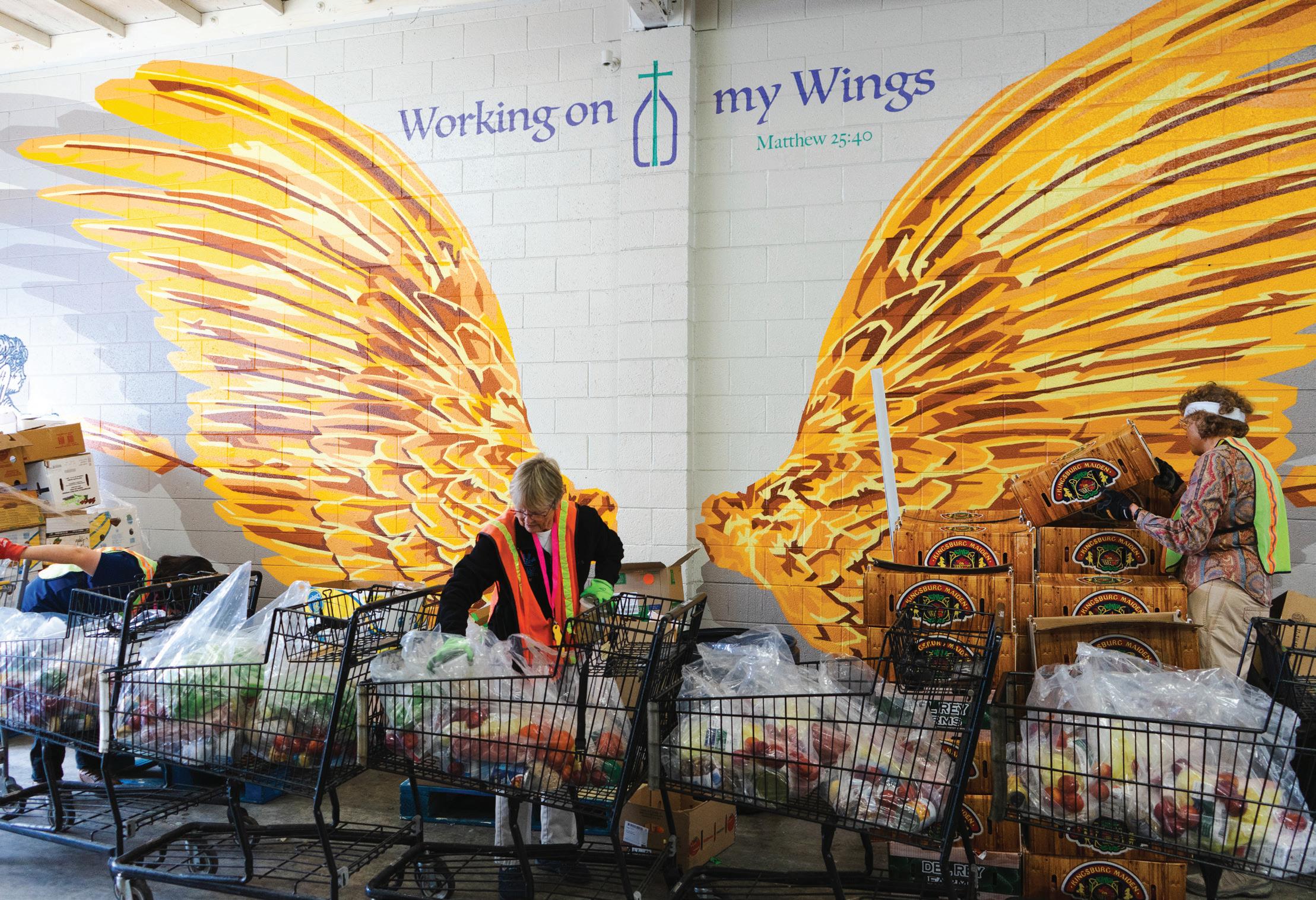
THE CANTLAY FOOD DISTRIBUTION CENTER LOCATED IN SANTA ANA PROVIDES ESSENTIAL FOOD AND OTHER NECESSITIES TO INDIVIDUALS AND FAMILIES IN NEED.
PHOTO COURTESY OF CATHOLIC CHARITIES OF ORANGE COUNTY COMMUNICATIONS
CONTINUED FROM PAGE 18
dren who are already showing signs of distress, trauma or emotional struggle. What makes this effort distinctive is its integration of faith and mental health support. CCOC has developed and incorporated a human dignity curriculum into its counseling program, teaching children that every person possesses inherent dignity as given by God. This strong spiritual foundation can be transformative because it helps young people better understand themselves, respect others and find hope in a culture often marked by bullying, family instability, social media pressure and mental health challenges among children at an ever-decreasing age. CCOC’s goal is to intervene earlier and expand service to help parents and families. At its heart, Catholic Charities of Orange County remains what it has always been for 50 years – a visible expression of the Church’s mission in action. Whether feeding seniors, assisting newcomers on a path to citizenship or helping children discover their God-given worth, CCOC is rooted in the conviction that every person deserves to be seen, served and loved. In a word, Catholic Charities of Orange County offers hope. C
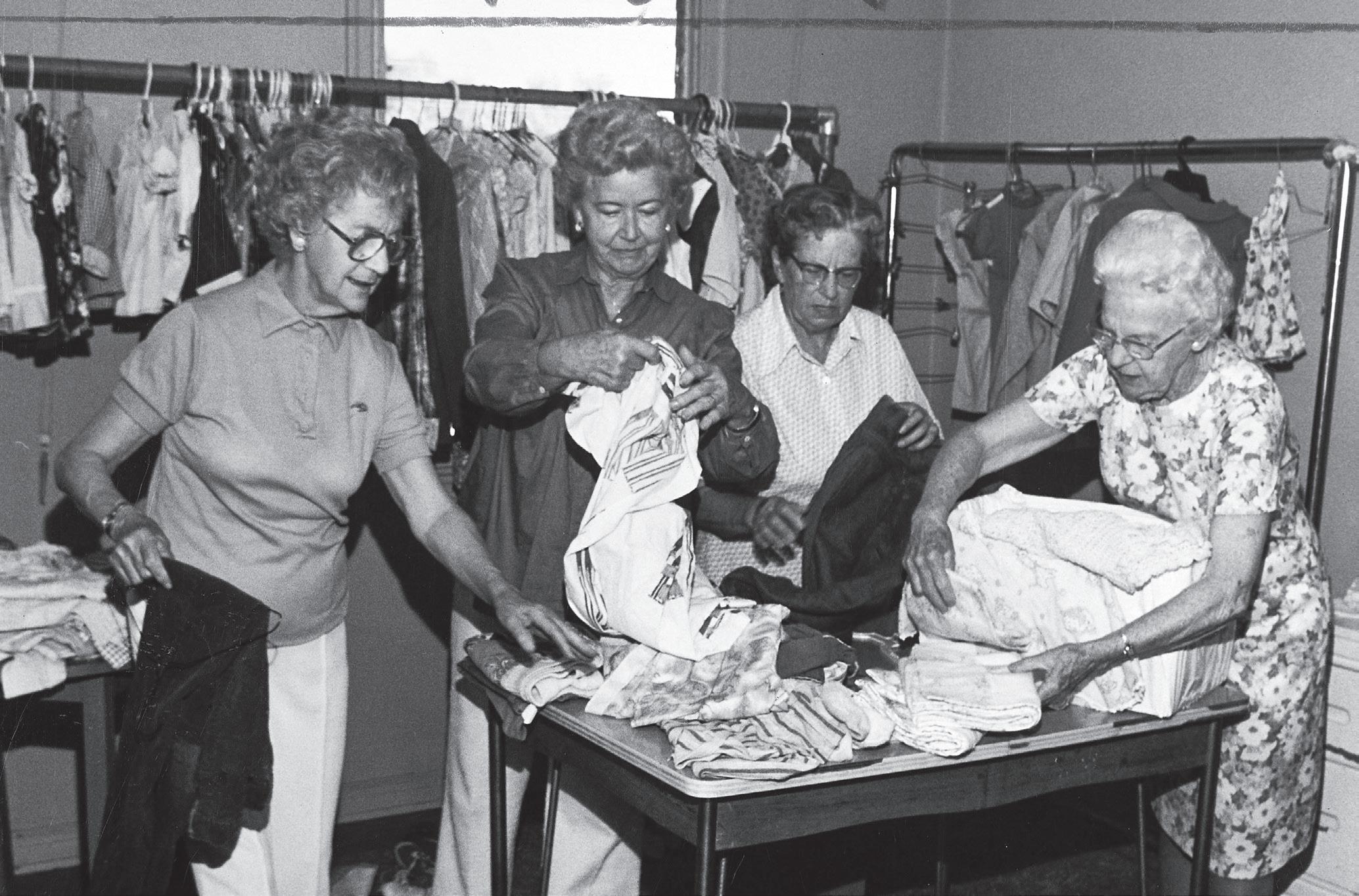
CATHOLIC CHARITIES OF ORANGE COUNTY STRIVES TO MEET THE NEEDS OF UNDERSERVED INDIVIDUALS AND FAMILIES, ESPECIALLY DURING TIMES OF CRISIS, THROUGH PROGRAMS SUCH AS CLOTHING DRIVES, FOOD PANTRIES, EMERGENCY ASSISTANCE AND OTHER COMMUNITY SUPPORT SERVICES.
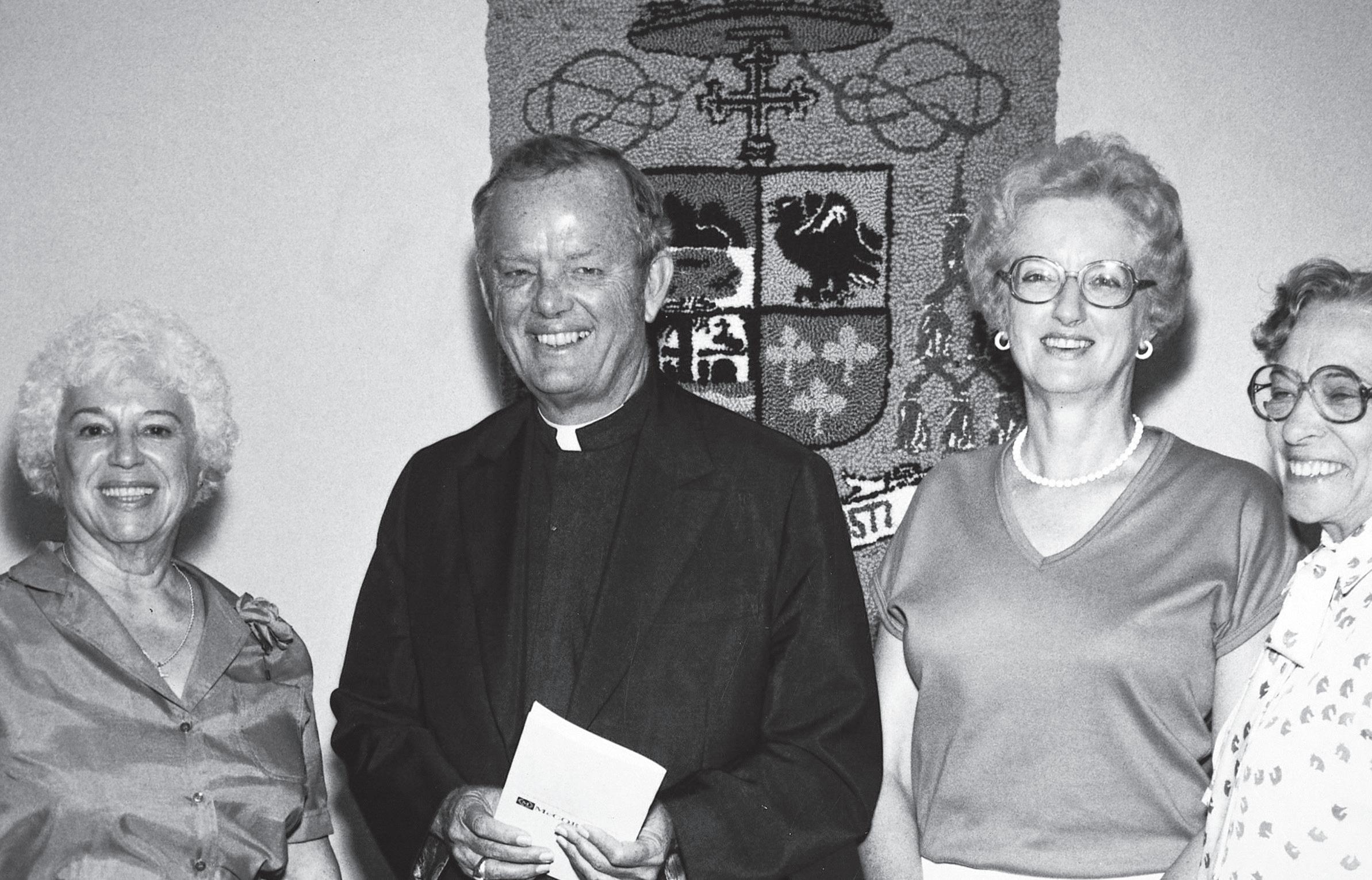
CATHOLIC CHARITIES OF ORANGE COUNTY WAS ESTABLISHED IN 1976 BY THE FIRST BISHOP OF ORANGE, THE MOST REV. WILLIAM JOHNSON. PHOTOS COURTESY OF DIOCESE OF ORANGE ARCHIVES
PRESERVING HISTORY: 50 YEARS OF DIOCESAN ARCHIVES
BY FR. CHRISTOPHER HEATH, DIRECTOR OF DIOCESAN ARCHIVES
OVER DINNER ONE night at Holy Family, the new cathedral of the Diocese of Orange, William Johnson talked about all the work he was doing to establish the new diocese. He said that he needed to establish an archive and was at a loss about how to proceed. Looking across the dinner table at Fr. Bill Krekelberg, then assigned to Holy Family as a parochial vicar, he asked, “Bill, you like history, don’t you?” Fr. Bill replied, “Yes, Bishop, very much so.” Bishop Johnson smiled, pointed at him, and said, “Good. You’re the new archivist!” And with that brief conversation, the archives department of the Diocese of Orange was established.
Fr. Krekelberg told me this story not long after I was named as the second archivist of the diocese in 2021. Sadly, he died before we had time to discuss much else about this extensive collection he curated for over 4o years.
Whenever people celebrate major an-
niversaries it’s natural to look back. We dig out old photo albums, documents and memorabilia of certain events to help give context to our past. Couples, families, civic and corporate organizations — and the Church — all do this.
We celebrate our memories through the “stuff” we hold onto – these preserved materials we handle with care.
Canon Law, the official law of the Catholic Church, requires every diocese to have an archive. Some are better at this than others, just as some families are more intentional about keeping records. “One day, this might be important,” or “Let’s make sure the next generation remembers this”: with this kind of intentionality, we keep correspondence, pictures, keepsakes, documents, artwork, all with the idea that one day someone will be glad we did. Some families have a historian who keeps genealogy and organizes boxes of materials. So, too, does the Church.
Not long after the Diocese of Orange was established, the Archdiocese of Los Angeles sent to Orange all the archival records they held for every Catholic en-
DIOCESE OF ORANGE TIMELINE
C MARCH 24, 1976:
In Rome,
tity in Orange County as the foundation upon which our archives have grown. Our diocese is fortunate that someone like Fr. Krekelberg diligently kept track of our story as it unfolded. Clipping articles from a dozen newspapers and magazines; creating hanging file folders for persons, places and things; and keeping the records of a growing number of parishes and schools and diocesan departments and organizations – he was methodical in his search for information and glad to take charge of any materials given to him by the bishops, curia, priests, religious and institutions within the Diocese of Orange. He researched and wrote many articles, books and monographs on mission history, parish history and diocesan history. He also went to antique dealers and estate sales searching for California, the missions and Orange County history which, even though not related directly to the Diocese of Orange, gave context to our place in the larger history of the state and county in which we reside.
Our collection now comprises over 1,800 cubic feet of materials, including
C MARCH 30, 1976:
Archbishop Jean Jadot, papal representative to the United States, announces that Auxiliary Bishop William R. Johnson will be the first bishop of Orange.
C JUNE 3, 1976:
Catholic Charities of Orange County is formally established.
300 linear feet of paper in dozens of file cabinets, boxes and shelves full of books, other artifacts and memorabilia, and audio-visual media dating back to the 1970s. We have paper records dating from the late 1800s because some of our parishes are well over 100 years old. Plus, Mission San Juan Capistrano, which is celebrating its 250th anniversary, maintains its own archives and museum. Every parish also maintains some form of archival storage, including sacramental records, past bulletins, photographs, church documents and memorabilia that preserve the history of the community.
The archives department regularly receives requests for information. Parishes celebrating milestones and diocesan departments seeking historical records rely on its resources. As we celebrate the 50th anniversary of the Diocese of Orange, we are especially busy identifying materials for exhibits and preparing notes and scripts to describe historic moments in our shared past.
Our ongoing projects include organizing and cataloging our collection, dig-
C JUNE 18, 1976:
At Holy Family in Orange, which was named the cathedral of the Diocese of Orange, Bishop William R. Johnson is installed as the first bishop of Orange. Our Lady of Guadalupe is named the patroness of the diocese, and San Juan Capistrano the secondary patron. At its founding, the Diocese of Orange has 43 parishes, 8 missions, 6 high schools, 35 elementary schools, 108 diocesan priests and an estimated Catholic population of 330,000.
Vatican leadership signs an apostolic constitution establishing the Diocese of Orange. It begins the process of formally separating Orange County from the Archdiocese of Los Angeles so it could have its own localized church governance.
itizing our paper records and AV materials and setting up our new storage area at Christ Cathedral. We hope that one day we will have an archives facility on the cathedral campus that will be open to visitors and researchers. We are ever mindful that everything that happens in our Church today is archival material tomorrow – but only if it is documented and preserved. The archives department serves as a vital link in preserving the story of the Diocese of Orange. C
C JUNE 20, 1976:
C SEPTEMBER 1, 1976:
C NOVEMBER 1, 1976:
AS PART OF THE DIOCESE OF ORANGE 50TH ANNIVERSARY CELEBRATION, THE DIOCESE IS HOSTING ITS FIRST-EVER ARCHIVES EXHIBITION
— coming to a parish near you this summer!
ADMISSION IS FREE
For five decades, the archives department has been gathering items big and small from our parishes, schools and churches, and even memorabilia tied to the history of Orange County. Now, to celebrate its history and heritage, church leadership is displaying a priceless array of items that range from the sacred and historic to the quirky and strange.
The exhibition will be hosted by Holy Family, Orange (June 18 to June 21), Christ Cathedral, Garden Grove (June 24 to June 28) and Santiago de Compostela, Lake Forest (June 30 to July 3, July 5 to 8).
The archives exhibition is being generously co-presented by Mission San Juan Capistrano, St. Michael’s Abbey and “The Shroud of Turin: An Immersive Experience.” Visitors can receive discounted tickets to the Mission and the Shroud Experience (while supplies last).
Visit RCBO.org/archives-exhibition to learn more.
C MAY 21, 1977:
The first class of permanent deacons is
FR. CHRISTOPHER HEATH, THE DIRECTOR OF THE DIOCESAN ARCHIVES, STANDS IN HIS OFFICE IN THE BELL TOWER OF MISSION BASILICA IN SAN JUAN CAPISTRANO.
PHOTO BY JEFF ANTENORE/DIOCESE OF ORANGE
The Orange Diocesan Council of Catholic Women hosts its first event: a reception for laity at the Sisters of St. Joseph convent at the request of Bishop Johnson. Approximately 2,500 people attended.
The first diocesan offices are set up at St. Joseph’s Motherhouse in Orange.
St. Elizabeth Ann Seton is established, becoming the first parish to become so under the new Diocese of Orange.
ordained.
THE BISHOPS OF ORANGE: LEADERS PAST AND PRESENT
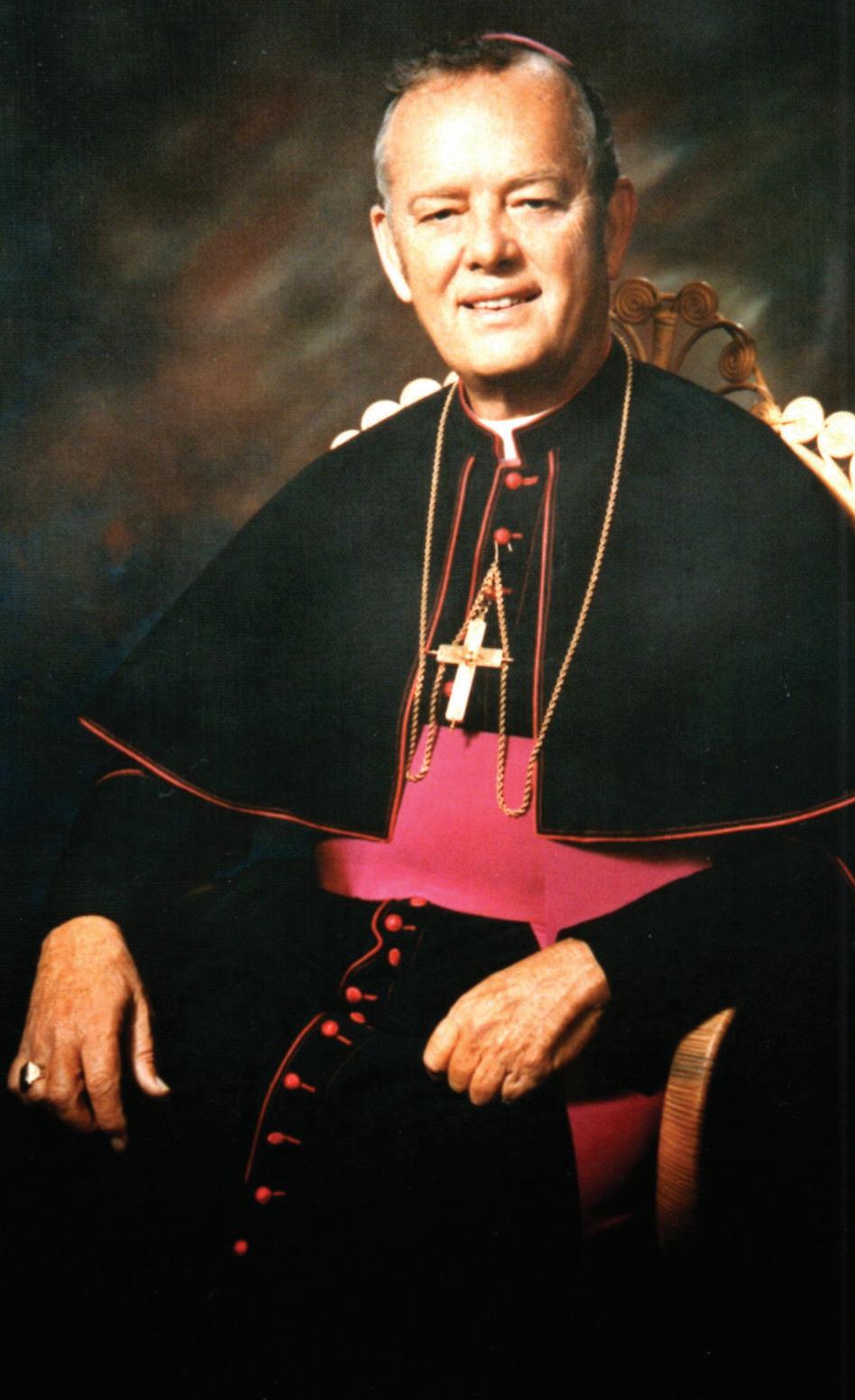
THE MOST REV. WILLIAM ROBERT JOHNSON, A.C.S.W., D.D.
November 19, 1918 – July 28, 1986
Auxiliary Bishop of Los Angeles: 1971 – 1976 | First Bishop of Orange: 1976 – 1986
WILLIAM ROBERT JOHNSON
was born in Tonopah, Nev., on Nov. 19, 1918. The son of a hoist engineer for silver mines, he and his family later moved to Los Angeles in the 1920s seeking a better climate and better living conditions. Johnson’s father died when he was just 8 years old, leaving his mother, Marie, to raise their four children. Johnson grew up in a devout Catholic family, regularly attending St. Ignatius of Loyola parish and its school in Los Angeles’ Highland Park, as well as serving Mass as an altar boy.
Sensing an early call to the priesthood, Johnson studied at the newly established St. John’s Seminary in Camarillo, Calif. Because he had to pay the cost of the seminary himself (he made loan payments on his student loan debt clear through 1961), Johnson worked summer jobs, including as a cleaner on Southern Pacific coach cars.
On May 28, 1944, Johnson, age 25, was ordained to the priesthood by Archbishop John J. Cantwell at the Cathedral of St. Vibiana in downtown Los Angeles. His first assignments were at parishes in Gardena and Los Angeles before he was sent to Washington, D.C., for further study at the
SEPTEMBER 23, 1977:
Catholic University of America to earn a master’s degree in social work.
Upon his return to the Archdiocese of Los Angeles, his assignments through 1976 included serving in the archdiocesan welfare bureau, board president for the National Conference of Catholic Charities, rector of the Cathedral of St. Vibiana, episcopal vicar for charity, episcopal vicar for the Black community and episcopal vicar for Los Angeles County.
In 1971, Pope Paul VI named then-Msgr. Johnson, at 52 years old, an auxiliary bishop for the Archdiocese of Los Angeles and titular bishop of Blera. A major development came in 1973 when he got a firsthand look at missionary life by paying an official visit to the Archdiocesan Lay Mission Helpers in New Guinea, New Ireland and Africa.
On March 24, 1976, Pope Paul VI formally established the Diocese of Orange by papal decree, naming Bishop Johnson as the first bishop of Orange. This decision took effect on June 18, 1976, at the newly renamed Holy Family Cathedral in the city of Orange. He was installed by his longtime friend, Cardinal Timothy Manning, archbishop of Los Angeles, in the presence of the apostolic delegate, Archbishop Jean Jadot.
Bishop Johnson’s founding of a new diocese proved
C MAY 14, 1978:
Fr. Enrique Sera is ordained, becoming the first priest to be ordained for the diocese since its establishment in 1976. Six more priests are ordained the following month.
to be a challenge that he accepted with trademark enthusiasm. Even the formalities of running a chancery office were new for him and his staff, particularly when it came to canonical formalities. What’s more, before his installation and for years afterward, he didn’t have a proper place to do it all.
Bishop Johnson initially ran the diocese from his car, selecting department heads, committees and personal staff. He eventually got moved to a guest room at Holy Family’s rectory and anywhere else he might conveniently meet with people. Another upgrade came when
C DECEMBER 6, 1978:
Bishop Johnson announces the purchase of Marywood High School, which transitions to become the diocesan offices, dubbed the Pastoral Services Center, in 1980.
C FEBRUARY 1979:
C
Three new parishes are established: San Antonio de Padua in Anaheim Hills, St. Mary’s by the Sea in Huntington Beach and St. Vincent de Paul in Huntington Beach.
The Diocese of Orange prints its first Catholic directory.
“The very name, Orange, suggests a golden treasure, and the new diocese is all that in its physical characteristics, its people and its traditions. The area is small enough to be unified as a true community and large enough to encompass a substantial number of generous-hearted people. These, along with the dedicated priests and religious who serve them, are the richest endowment one could hope for.”
Bishop William R. Johnson, 1976 First Bishop of Orange
the diocesan headquarters operated out of the Sisters of St. Joseph campus of Orange. Their big break came after Marywood High School in Orange closed; the diocese bought the property at 2811 E. Villareal Drive and established its first chancery there in 1980.
One of Bishop Johnson’s goals was to form an efficient diocese that was friendly and less intimidating than the larger church authority structures of the past. The chancery at Marywood was named the Pastoral Services Center. The friendly spirit extended to Bishop Johnson’s office, home of Bill the Bear — a giant teddy bear who lived at his desk when he was out of the office. Bill the Bear also had a hidden microphone that, with a church
C NOVEMBER 3, 1983:
official’s help, allowed Bill to “speak” to visiting children.
From the outset, Bishop Johnson began personally visiting each parish, establishing a special needs and awareness workshop and a priests council. Bishop Johnson also formed, early on, a Hispanic ministry and Vietnamese ministry — the latter of which helped many refugees fleeing the chaos of the Vietnam War.
New parishes were also getting established under a new Diocese of Orange within his first two years: St. Elizabeth Ann Seton in Irvine in 1976; and in 1977, San Antonio de Padua in Anaheim Hills and Huntington Beach’s St. Mary’s by the Sea and St. Vincent de Paul.
Having persisted in his work but
C MAY 29, 1984:
suffering a slow decline in health, Bishop Johnson passed away on July 28, 1986, at St. Joseph Hospital in Orange. He was remembered for making people feel welcome in the new Diocese of Orange, providing an initial vision for Orange County’s Catholic community. He was active on issues of the day, including opposing the national arms race. He celebrated Christmas Mass with Orange County jail inmates.
When he started, the Diocese of Orange had 43 parishes and some 333,000 Catholics. When he passed away, it had 52 parishes and nearly half a million of the Catholic faithful. C
C JANUARY 20, 1985:
the
APRIL 18, 1986:
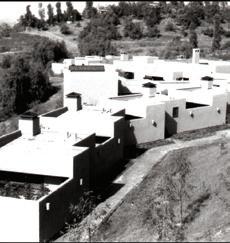
The House of Prayer, a special retreat center for priests, opens on Santiago Canyon Road. It consists of Santa Fe-style casitas, communal space and prayer areas.
Msgr. John Steinbock, whose roles included serving as rector of St. Vibiana Cathedral in downtown Los Angeles, is appointed by Pope John Paul II to become the Diocese of Orange’s first auxiliary bishop.
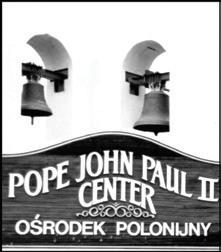
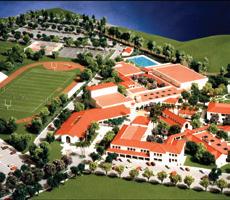
To serve
many Polish immigrants living in Southern California, the Pope John Paul II Polish Center has a groundbreaking ceremony.
C
Groundbreaking happens for Santa Margarita Catholic High School in southern Orange County. It is later dedicated in December 1987.
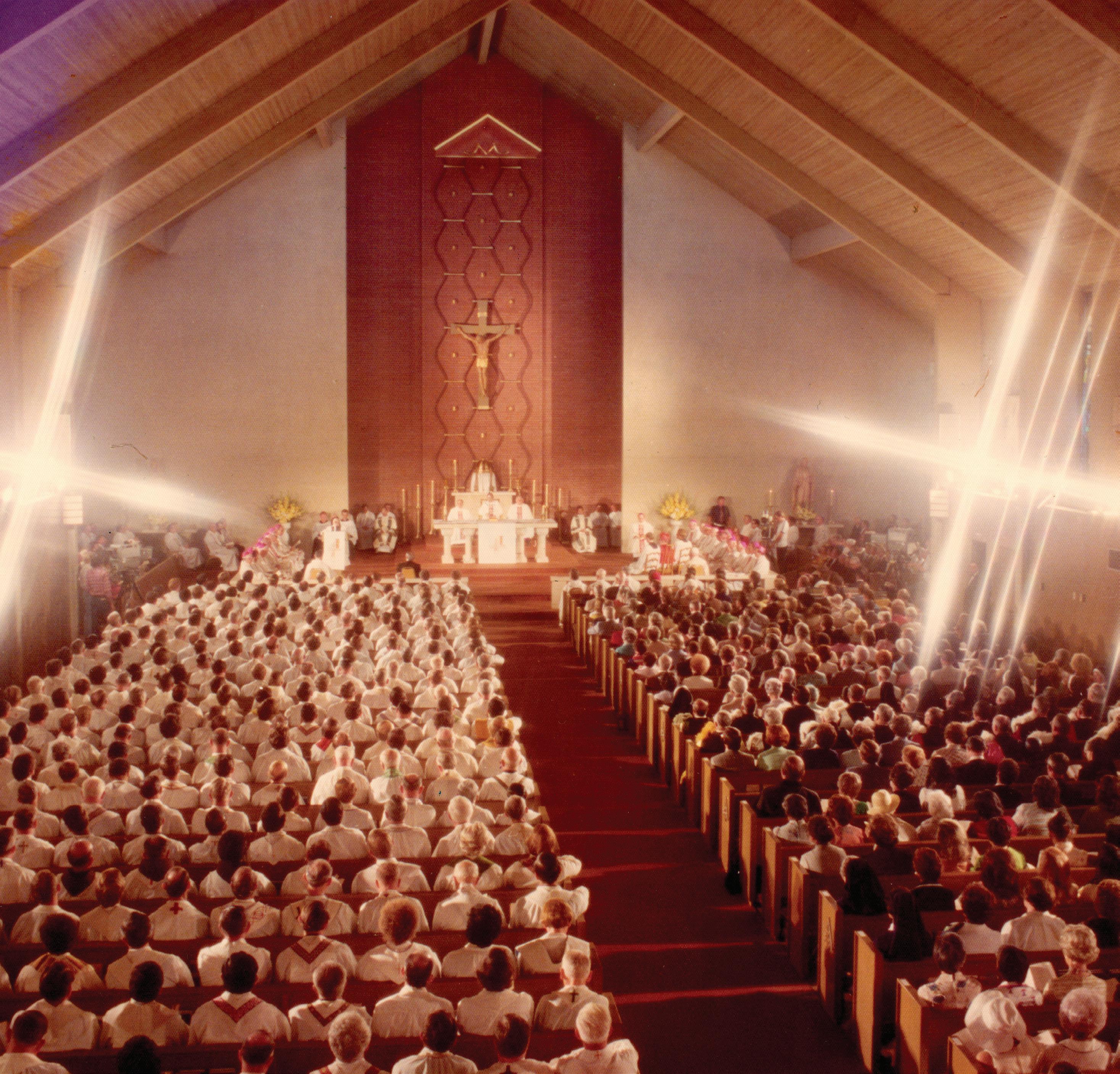
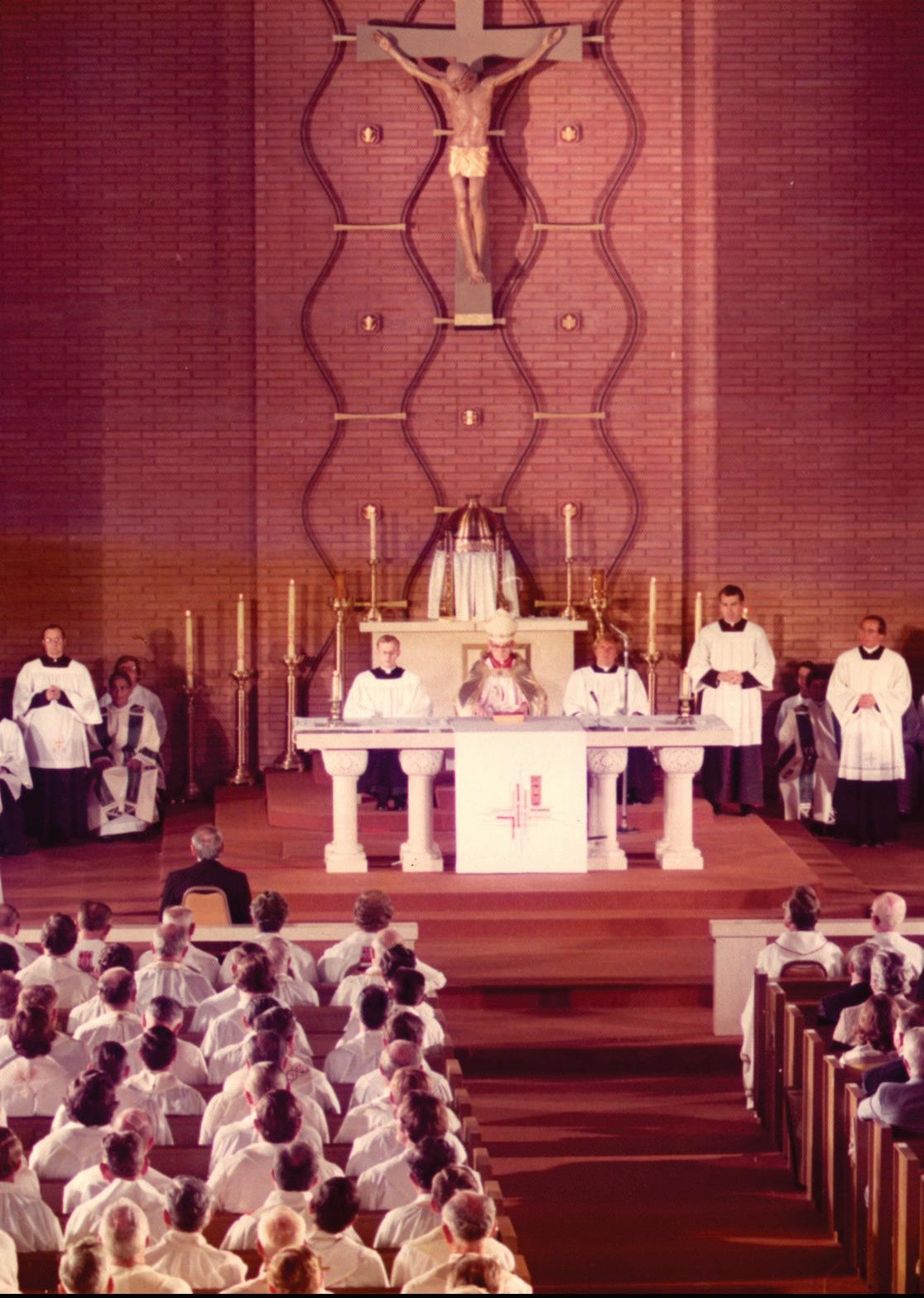
OVER 450 PRIESTS, 30 BISHOPS AND LAY PERSONS GATHERED ON JUNE 18, 1976, AT HOLY FAMILY CATHEDRAL TO WITNESS THE INSTALLATION OF THE MOST REV. WILLIAM JOHNSON AS THE FIRST BISHOP OF THE DIOCESE OF ORANGE. PHOTO BY THE DIOCESE OF ORANGE
A RECAP OF JUNE 18, 1976
ON JUNE 18, 1976, the Diocese of Orange was officially established when Bishop William R. Johnson was installed as the first bishop of Orange at the newly renamed Holy Family Cathedral in the city of Orange. The installation, church leaders said, was not simply an administrative procedure. It was much more: an affirmation of the unity of the people and of the mystery of the Universal Church.
Cardinal Timothy Manning, archbishop of Los Angeles, presided over the Mass. He donned a 200-year-old cope believed to have been worn by St. Junípero Serra himself. The year coincided with the 200th anniversary of the founding of Mission San Juan Capistrano and the United States.
The day had a packed house: 450 priests and 30 bishops from around the country attended. Lay persons from all walks of life helped fill the sanctuary, as well as the overflow seating in the parish hall.
A papal proclamation was read. A member of St. Boniface, Orange County’s oldest parish, gave the first reading. The second reading came from a sister from St. Catherine’s Academy, the county’s oldest Catholic school.
A gift of oranges was exchanged. The choir sang in the balcony over the pipe organ. “The Hallelujah Chorus” echoed throughout the sanctuary. Mariachis blared. The people clapped.
“Today we begin our lives together in a truly joyful way,” Bishop Johnson said in his first homily. “May God our Father bless us with the gift of His Holy Spirit to guide and direct us, to console and encourage us, so that His gift of life may find its fulfillment in the joy and glory of His eternal presence.”
A new history began that day. C
C JULY 28, 1986:
C FEBRUARY 24, 1987:
C SEPTEMBER 26, 1992:
Recognizing a need to serve the immigrant Vietnamese Catholic community, the diocese hosts a groundbreaking for the Vietnamese Catholic Center in Santa Ana. C 1994:
THE MOST REV. WILLIAM JOHNSON WAS INSTALLED AS THE FIRST BISHOP OF ORANGE ON JUNE 18, 1976, BY CARDINAL TIMOTHY MANNING, ARCHBISHOP OF LOS ANGELES. ARCHBISHOP JEAN JADOT, APOSTOLIC DELEGATE IN THE UNITED STATES, REPRESENTED POPE PAUL VI AT THE INSTALLATION MASS. PHOTO BY THE DIOCESE OF ORANGE
Bishop Johnson, Orange County’s first bishop, enters everlasting life after a lengthy struggle with kidney disease.
Bishop Norman McFarland, formerly the bishop of Reno-Las Vegas, is installed as the second bishop of Orange.
Three new churches are dedicated in the same year: St. Elizabeth Ann Seton in Irvine, St. Pius V in Buena Park and St. Edward the Confessor in Dana Point.
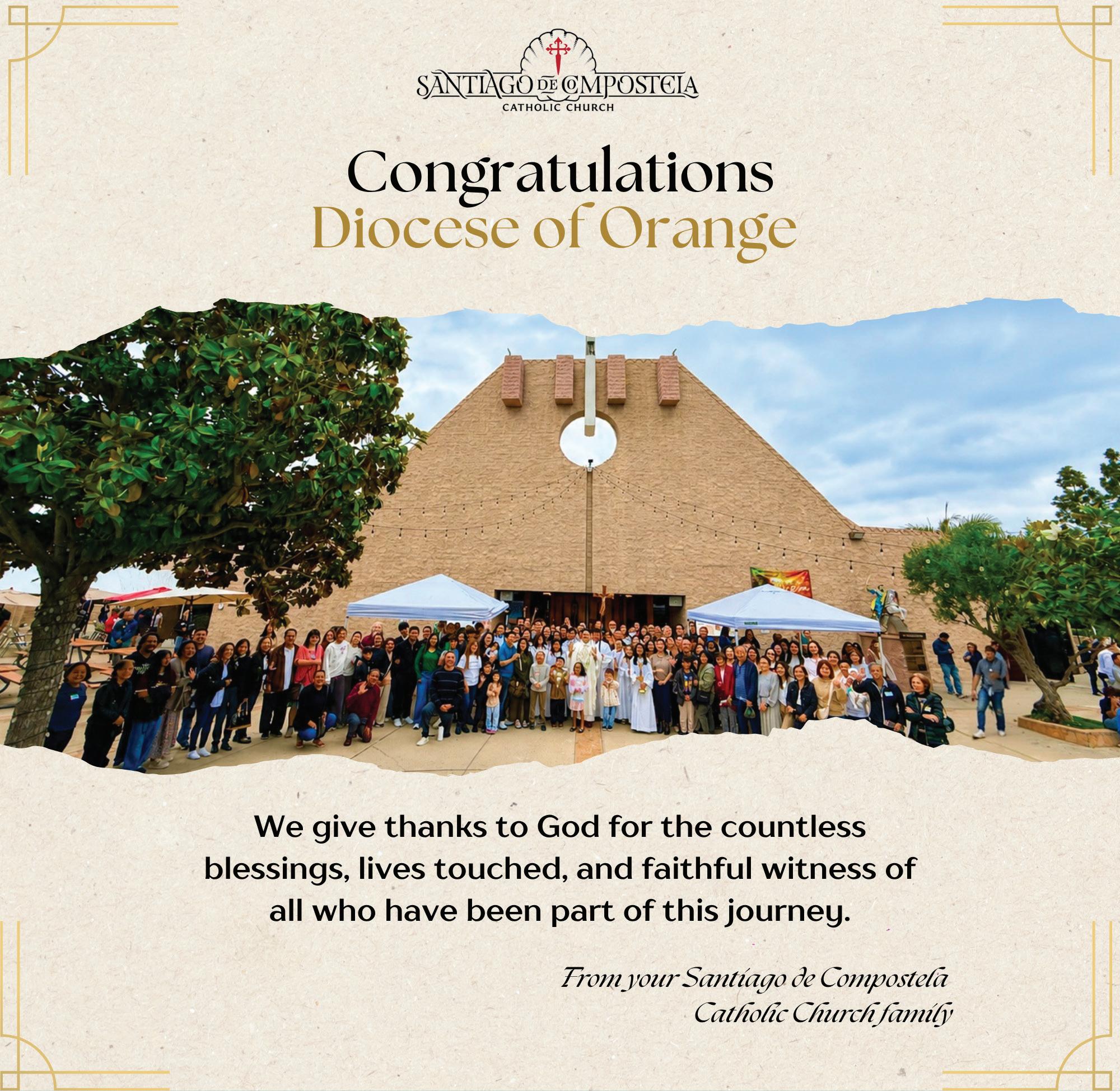
Congratulations to the Diocese of Orange
We give thanks to God for the 50 Jubilee Anniversary th of the Diocese of Orange!
Our community is immensely grateful to Bishop Kevin Vann for welcoming us into this Diocese in 2019.
We are blessed to serve at St. John the Baptist Parish and School.
“Give thanks to the LORD, who is good, whose mercy endures forever.”
Psalm 106:1
proudly celebrate the 50 Anniversary th of the Diocese of Orange brownandstreza.com
THE BISHOPS OF ORANGE: LEADERS PAST AND PRESENT
THE MOST REV. JOHN THOMAS STEINBOCK, D.D.
July 16, 1937 – December 10, 2010
Auxiliary Bishop of Orange: 1984 – 1987
Bishop of Santa Rosa: 1987 – 1991
Bishop of Fresno: 1991 – 2010
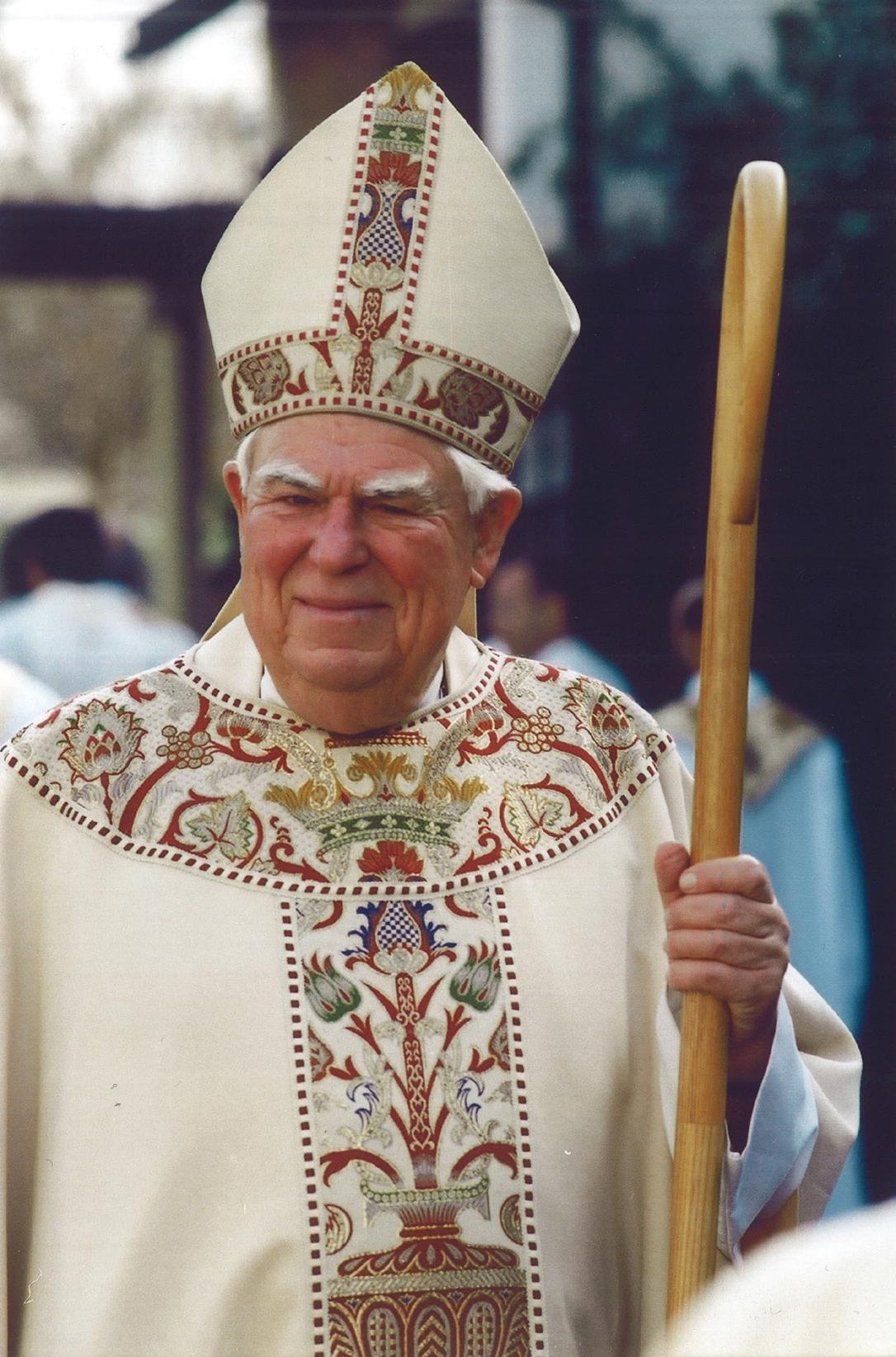
JOHN THOMAS STEINBOCK was born in Los Angeles on July 16, 1937. He graduated from St. John’s Seminary and was ordained to the priesthood at the Cathedral of St. Vibiana in Los Angeles on May 1, 1964.
Fr. Steinbock had a fondness for working with Spanish-speaking parishes, which he did in East Los Angeles for several years. He was also named associate pastor (and later rector) of downtown L.A.’s Cathedral of St. Vibiana — which brought him in close connection with the future bishop of Orange, the Most Rev. William Johnson. He gained a reputation for working with the poorest of the poor on Skid Row.
In 1983, after a few years as the only bishop in Orange County, Bishop Johnson petitioned the Holy See for an auxiliary bishop. The following year, Pope John Paul II appointed then-Msgr. Steinbock to the role. He was ordained an auxiliary bishop at St. Columban in Garden Grove on July 14, 1984. His administrative duties involved helping Bishop Johnson, who had been in declining health at that point.
When Bishop Johnson died, Bishop Steinbock was unanimously elected the diocesan administrator. After serving a few years as the bishop of Santa Rosa, he became the fourth bishop of Fresno in 1991. Bishop Steinbock lived and served in Fresno until passing away in 2010. C
C SEPTEMBER 3, 1998:
Bishop Tod Brown, formerly of the Diocese of Boise (Idaho), is installed as the third bishop of Orange.
C FEBRUARY 14, 2000:
Mission Basilica San Juan Capistrano is granted minor basilica status from the Holy See.
C OCTOBER 2000:
Orange County Catholic begins publication, replacing earlier versions of the paper.
C NOVEMBER 2000:
The Orange Catholic Foundation is established as an independent nonprofit tasked with Catholic philanthropy and the careful stewardship of funds that protect and grow vital ministries.
THE BISHOPS OF ORANGE: LEADERS PAST AND PRESENT
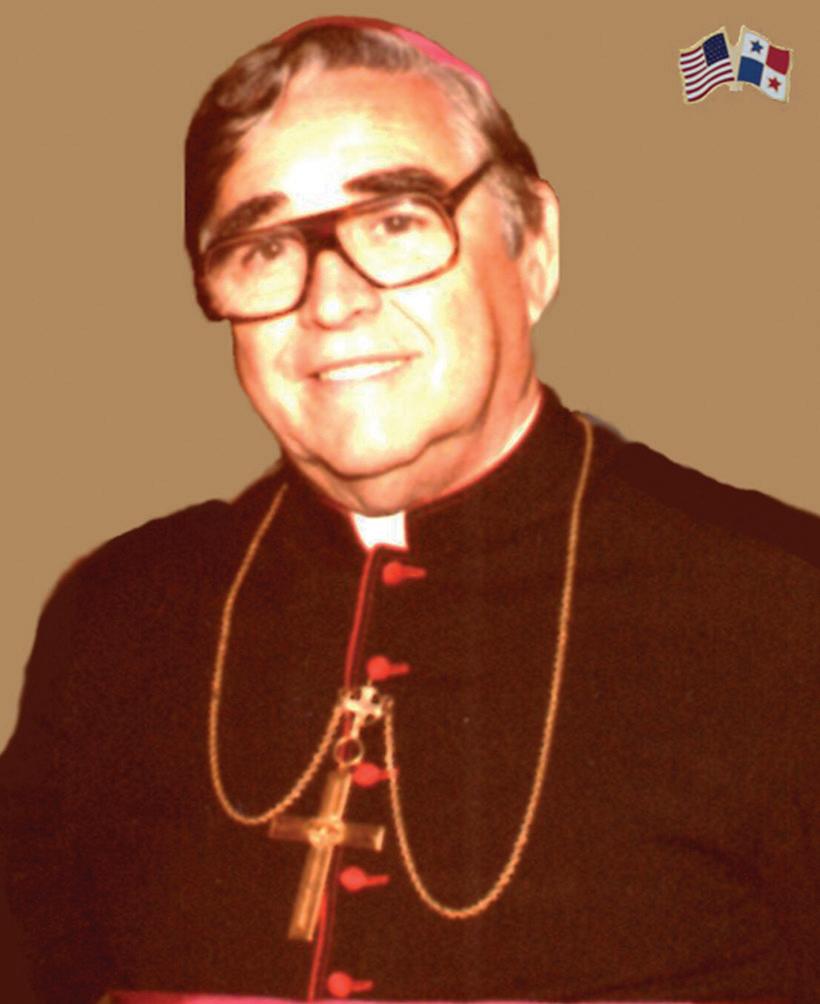
THE MOST REV. TOMÁS ALBERTO CLAVEL MÉNDEZ, D.D.
December 21, 1921 – October 13, 1988
Archbishop-emeritus of Panama
Worked and Resided in Orange County: 1971 – 1988
TOMÁS ALBERTO CLAVEL MÉNDEZ
was born into a middle-class family of 12 on Dec. 21, 1921, in Panama. He studied in several Latin American countries before becoming ordained to the priesthood for the Archdiocese of Panama on Dec. 7, 1947. After further study, including at St. John’s University in Brooklyn, New York, he was named the first bishop of the new Diocese of David in Panama by Pope Pius XII. He was just 33 years old and was the first Panamanian to become a bishop. In 1964, he was promoted to be the archbishop of Panama City, during which time he was an active participant in the influential Second Vatican Council (1962 to 1965).
In 1968, when a military junta seized control of Panama, Archbishop Clavel felt, in good conscience and in the spirit of promotion of social justice, that he could not work with them and resigned from his position. His next position involved, on behalf of the Vatican, ensuring that colonial art and architecture was preserved throughout Latin America.
In 1971, Archbishop Clavel was asked to come to Orange County to minister to the Hispanic commu-
C JUNE 10, 2001:
As the diocese celebrates its 25th anniversary, plans are announced for a new cathedral to replace Holy Family.
nity. For several years, he divided his time between Orange County and Panama. In O.C., he established the Our Lady of Lourdes Mission in Santa Ana. By 1978, Diocese of Orange Bishop William Johnson asked Archbishop Clavel to serve as his episcopal vicar for the Spanish-speaking community. In 1983, he was honored to join Pope John Paul II on a Central American tour.
On October 13, 1988, Archbishop Clavel suffered a heart attack and passed away at St. Joseph Hospital in Orange. He was 66. He was remembered as a man of “gentle voice and strong example,” for traveling extensively throughout the diocese administering confirmation and the sacraments, and for being available for spiritual exercises, retreats and parish celebrations.
The Most Rev. Tomás Alberto Clavel Méndez, the archbishop emeritus of Panama, is buried in the Metropolitan Cathedral of Panama City, remaining among the people he first served with courage. C
C SEPTEMBER 16, 2001:
Following the 9/11 terrorist attacks, an ecumenical and inter-religious prayer service for peace and justice is done.
C FALL 2003:
The newly established JSerra Catholic High School welcomes its first students.
C JANUARY 15, 2004:
As the worldwide Catholic Church is inundated with the child-abuse scandal, Bishop Tod Brown issues the historic Covenant with the Faithful to foster an era of honesty, healing and collaboration.
THE BISHOPS OF ORANGE: LEADERS PAST AND PRESENT
THE MOST REV. NORMAN FRANCIS MCFARLAND, J.C.D., D.D.
February 21, 1922 – April 16, 2010
Auxiliary Bishop of San Francisco: 1970 – 1976
Bishop of Reno-Las Vegas: 1976 – 1986
Second Bishop of Orange: 1986 – 1998
NORMAN FRANCIS MCFARLAND
was born in Martinez, California, on Feb. 21, 1922. He attended St. Joseph’s Seminary in Mountain View, Calif., and St. Patrick’s Major Seminary in Menlo Park, Calif., the latter of which is where he earned his bachelor’s in 1943. He was ordained a priest on June 15, 1946, in the Archdiocese of San Francisco. His first assignment was as an associate pastor at St. Andrew’s in Oakland, Calif. A few years later, he attended the Catholic University of America in Washington, D.C., where he earned a doctorate in canon law.
Upon his return to San Francisco, he worked in San Francisco’s archdiocesan chancery in the matrimonial tribunal, processing marriage cases. In addition to helping at parishes where he resided, he also served as a chaplain for a special Catholic guild of pharmacists.
In 1970, Pope Paul VI appointed then-Msgr. McFarland as an auxiliary bishop of San Francisco. He was installed that June, and served as vicar for finance, vicar for seminaries and pastor of Old Mission Dolores. In 1974, Bishop McFarland was sent to the Diocese of Reno, Nevada, to assist with the financial crisis caused by the previous bishop. Tasked with a seemingly insurmountable goal, Bishop McFarland spent eight days on the phone, calling bishops around the country in a plea for grants or low-interest loans. His calls raised an astounding $4 million needed to avoid bankruptcy.
By 1976, he was named the Bishop of Reno, a position that came with financial challenges that
took around a decade to get the diocese debtfree. Given the population booms in northern and southern Nevada, and during his tenure the diocese was renamed the Diocese of Reno-Las Vegas. He spent considerable time working throughout the vast 110,829-squaremile state, as well as contributing articles to newspapers and delivering radio broadcasts.
Bishop McFarland became widely respected in Nevada for restoring financial stability in the church and pastoral confidence, promoting Catholic values and even increasing Catholic Charities’ budget to $4.5 million. He surmised he would retire and die in Nevada (even going so far as to secure a burial plot) until he was called to become the second bishop of Orange in late December 1986. He was installed on Feb. 24, 1987, just three days after his 65th birthday.
Bishop McFarland, at 6-foot-5 with a “shocking white cloud of hair,” was hard to miss. His nicknames included “Big Mac” and “Stormin’ Norman,” reflecting his physical stature and take-charge attitude. For 11.5 years, he worked in Orange County to strengthen, consolidate and refine a region he dubbed “this favored portion of the Lord’s Vineyard.” He was known as a particularly effective administrator who also provided genuine pastoral care.
Bishop McFarland joked that he was in the sales business, not management, because
the product was the good, free news of the Gospel. He was also credited for his extensive writings that provided food for thought for many of the faithful. His last day as diocesan bishop was June 30, 1998, having celebrated his 76th birthday four months prior. He died in 2010 at age 88. C
THE BISHOPS OF ORANGE: LEADERS PAST AND PRESENT
THE MOST REV. MICHAEL PATRICK DRISCOLL, M.S.W., D.D.
August 8, 1939 – October 24, 2017
Auxiliary Bishop of Orange: 1989 – 1999
Bishop of Boise: 1999 – 2014
MICHAEL PATRICK DRISCOLL was born in Long Beach, Calif., on Aug. 8, 1939. A highlight of his youth was acceptance into the Mitchell Boys Choir, famous for its work in movies, radio and television.
Considering a call to the priesthood even at a young age, Michael entered St. John’s Major Seminary in Camarillo, Calif., and was ordained to the priesthood on May 1, 1965, for the Archdiocese of Los Angeles.
He then spent eight years in parish ministry before attending the University of Southern California for a master’s degree in social work. He took up residence at St. Catherine’s Military School in Anaheim, during which time Bishop William Johnson asked him to be his right-hand man as secretary, chancellor, vocation director, vicar for charities and just about anything else the bishop needed.
After roles as pastor of Our Lady Queen of Angels in Newport Beach and the diocesan vicar general, in December 1989 Pope John Paul II appointed then-Msgr. Driscoll to be auxiliary bishop of Orange. He was ordained a bishop on March 6, 1990.
Bishop Driscoll was sent to become the bishop of Boise, Idaho in 1999, replacing Bishop Tod Brown who became the third bishop of Orange in 1998. When he left Orange County, he had devoted 23 years to the region, nine of them as auxiliary bishop.
Bishop Driscoll served as bishop of Boise until 2014. He died in 2017 at age 78. C
C JANUARY 3, 2005:
The diocese agrees in court to pay $100 million to 90 victims of abuse. Bishop Brown is the first bishop in California to settle abuse claims. He makes personal apologies to the victims and asks them for forgiveness.
C OCTOBER 5, 2008:
The diocese sponsors the first Blessing of the Waves in Huntington Beach, a unique Orange County tradition that is now interreligious.
C NOVEMBER 17, 2011:
A bankruptcy judge’s ruling permits the Diocese of Orange to proceed to acquire the Crystal Cathedral property in Garden Grove. The purchase is finalized the following year, and work begins to transform the Protestant 34-acre campus into a new center for Catholic worship.
C DECEMBER 10, 2012:
Bishop Kevin Vann, formerly of the Diocese of Fort Worth, is installed as the fourth bishop of Orange at the UC Irvine Bren Events Center.
congratulates
50 Years 50 Years 50 Years of service, stewardship, and faithful outreach.
18. JSerra Catholic High School
19. Korean Martyrs Catholic Center 20. La Purísima Catholic Church & School
21. Mater Dei High School
22. Mission Basilica San Juan Capistrano & School
23. Old Mission Historic Cemetery
24. Our Lady of Fatima Catholic Church & Academy
25. Our Lady of Guadalupe Catholic Church (Delhi)
26. Our Lady of Guadalupe Catholic Church, La Habra
27. Our Lady of Guadalupe Catholic Church, Santa Ana
28. Our Lady of La Vang Catholic Church
29. Our Lady of Mt. Carmel Catholic Church
30. Our Lady of Peace Korean Catholic Center
31. Our Lady of the Pillar Catholic Church
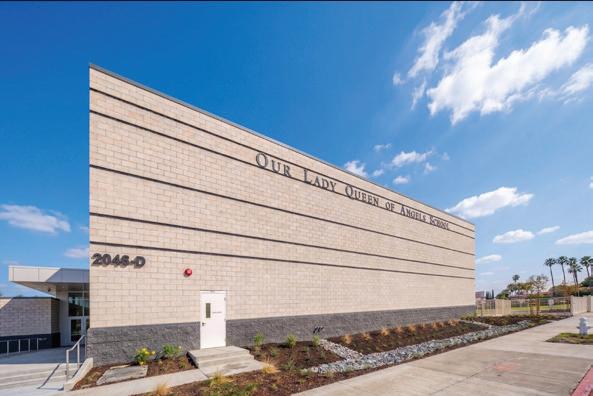
32. Our Lady Queen of Angels Catholic Church & School
33. Poong Jesus Nazareno Filipino Catholic Center
34. Pope John Paul II Polish Center
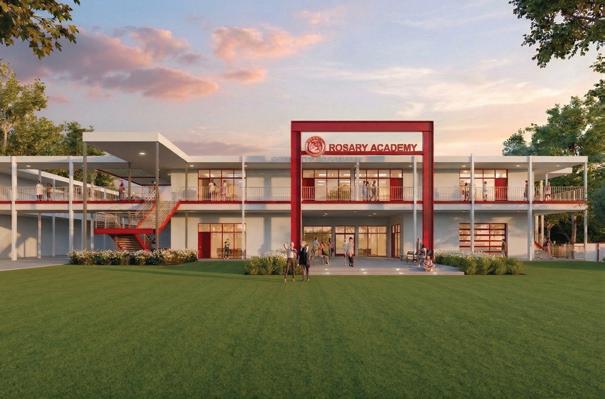
35. Rosary Academy
36. San Antonio de Padua Catholic Church
37. San Felipe de Jesus Chapel
38. San Francisco Solano Catholic Church
39. Santa Clara de Asis Catholic Church
40. Santa Margarita Catholic High School
41. Santiago de Compostela Catholic Church
42. Servite High School
43. Sisters of St. Joseph of Orange Campus
44. St. Angela Merici Catholic Church & School
45. St. Anne Catholic Church & School, Santa Ana
46. St. Anne Catholic Church, Seal Beach
47. St. Anne School, Laguna Niguel
48. St. Anthony Mary Claret Catholic Church
49. St. Barbara Catholic Church & School
50. St. Bonaventure Catholic Church & School
51. St. Boniface Catholic Church
52. St. Catherine of Siena Catholic Church
53. St. Catherine’s Academy
54. St. Cecilia Catholic Church & School
55. St. Columban Catholic Church & School
56. St. Edward the Confessor Catholic Church & School
57. St. Elizabeth Ann Seton Catholic Church
58. St. Francis of Assisi Catholic School
59. St. George Chaldean Catholic Church
60. St. Hedwig Catholic Church & School
61. St. Irenaeus Catholic Church & School
62. St. Jeanne de Lestonnac School
63. St. Joachim Catholic Church & School
64. St. John Henry Newman Catholic Church
65. St. John Maron Maronite Catholic Church
66. St. John Neumann Catholic Church
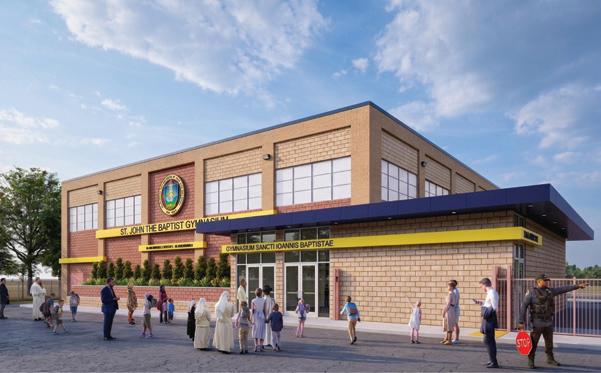
67. St. John the Baptist Catholic Church & School
68. St. John Vianney Chapel
69. St. Joseph Catholic Church & School, Placentia
70. St. Joseph Catholic Church & School, Santa Ana
71. St. Juliana Falconieri Catholic Church & School
72. St. Junipero Serra Catholic School
73. St. Justin Martyr Catholic Church & School
74. St. Kilian Catholic Church
75. St. Martin de Porres Catholic Church
76. St. Mary Catholic Church
77. St. Mary’s by the Sea Catholic Church
78. St. Michael’s Abbey
79. St. Nicholas Catholic Church
80. St. Norbert Catholic Church & School
81. St. Philip Benizi Catholic Church
82. St. Pius V Catholic Church & School
83. St. Polycarp Catholic Church
84. St. Thomas Korean Catholic Center
85. St. Thomas More Catholic Church
86. St. Thomas Syro-Malabar Catholic Forane Church
87. St. Timothy Catholic Church
88. St. Vincent de Paul Catholic Church
89. Sts. Simon and Jude Catholic Church & School
90. The Camino School, Laguna Woods
91. Vietnamese Catholic Center
CONGRATULATIONS
50 Diocese of Orange Jubilee Anniversary th
PAT & JILL ORTIZ
THE BISHOPS OF ORANGE: LEADERS PAST AND PRESENT
THE MOST REV. TOD DAVID BROWN, D.D.
November 15, 1936 – October 15, 2023
Bishop of Boise: 1989 – 1998
Third Bishop of Orange: 1998 – 2012
TOD DAVID BROWN was born in San Francisco on Nov. 15, 1936, the son of an accountant father and social worker mother. Though he considered a future in law or medicine, a gradual calling convinced him to join the priesthood. In 1950, he entered Ryan Preparatory Seminary in Fresno, consisting of four years of high school and two years of college. He continued his studies at St. John’s Seminary in Camarillo and the North American College in Rome.
He was ordained to the priesthood on May 1, 1963, and celebrated his first Mass at his home parish in Santa Cruz. He spent his quarter century of early priesthood working in the Diocese of Monterey, becoming vicar general and an influential priest in the upper echelon of the diocese.
He was named the sixth bishop of Boise, Idaho and installed to the role on April 3, 1989. The job involved overseeing Catholic life for the entire state of Idaho. His contributions included emphasizing retreat ministry for youth and young adults, championing the unborn and working with the sick, imprisoned, poor and homeless. He also worked to address the needs of Native Americans, Basques and growing numbers of Asian immigrants.
Bishop Brown was named the third bishop of Orange in 1998. Notable within Bishop Brown’s tenure was spearheading the purchase in 2012 of the Crystal Cathedral campus in Garden Grove after its ministry fell into bankruptcy. The sprawling 34-acre property, home to the popular “Hour of Power” broadcast, was transformed into Christ
Cathedral following a yearslong transformation that culminated with the cathedral’s solemn dedication on July 17, 2019.
Aiding in the sale was that Bishop Brown had a good relationship with Crystal Cathedral founder Dr. Robert Schuller, who once told a priest that “Bishop Brown is my bishop.” When Dr. Schuller addressed the Catholic priests after the sale, the Protestant televangelist referred to the Catholic Church as “the Mother Church.” He admitted that he wanted his campus to go to the Catholic Church — a historic steward of art and architecture.
During Bishop Brown’s tenure — where he was regarded as a collaborative leader who hired women to key diocesan leadership positions — Orange County parishes saw boosted Mass attendance and an increasingly diverse Catholic population.
With the intent of ensuring that Orange’s leaders reflected their communities, in the late 1990s, Bishop Brown petitioned the pope for a Hispanic auxiliary-bishop. This led to then-Monsignor Jaime Soto, a Stanton native, becoming an auxiliary bishop for Orange in 2000 and one of the nation’s few Hispanic bishops at the time.
Bishop Brown also requested a Vietnamese bishop, which led to the appointment in 2003 of Dominic M. Luong, then serving in New Orleans, to become the first Vietnamese American bishop in the U.S.
Bishop Brown was also regarded for guiding the Diocese of Orange through the sex abuse crisis of the early 2000s. In 2005, he was the first bishop in California to settle sex abuse claims, agreeing to pay $100 million to 90 victims and publicly releasing files on clergy abuse allegations. At the time, it was the largest abuse settlement payout in the U.S. Catholic Church.
Bishop Brown personally apologized to each of the victims. His leadership put in place a series of policies and procedures to ensure parishes and schools remain safe for both children and adults. Many of these policies, now in place in the Diocese of Orange for more than two decades, have been replicated at other organizations and institutions across the U.S.
Bishop Brown turned 75 in 2011, at which time he submitted his resignation, which was accepted on Sept. 21, 2012. He served as bishop emeritus, continuing to work and serve in the Diocese of Orange until passing away on Oct. 15, 2023. He was 86. C
We are deeply grateful to the Diocese of Orange for FIVE DECADES of faithful leadership and support of our shared mission.
CONGRATULATIONS ON 50 YEARS!
THE BISHOPS OF ORANGE: LEADERS PAST AND PRESENT
THE MOST REV. JAIME SOTO, M.DIV., M.S.W., D.D.
Auxiliary Bishop of Orange: 2000 – 2007
Coadjutor Bishop of Sacramento: 2007 – 2008
Bishop of Sacramento: 2008 to Present
JAIME SOTO was born on Dec. 31, 1955, in Inglewood and in raised Stanton. As the oldest of seven children, he grew up attending St. Polycarp parish.
After graduating from Mater Dei High School in 1974, he entered St. John’s Seminary in Camarillo, which coincided with the formation of the Diocese of Orange. Consequently, he became one of the diocese’s first seminarians. He was ordained to the priesthood on June 12, 1982, and celebrated a Mass of Thanksgiving the next day at St. Polycarp.
After initially serving as associate pastor of St. Joseph in Santa Ana, he left for Columbia University to earn a master’s degree in social work. Upon his return, he worked with Catholic Charities and became involved in immigration and citizenship services for the diocese, earning a reputation as a skilled and outspoken advocate for immigrants and the poor. He was promoted to episcopal vicar for the Hispanic community in 1989 and honored by Pope John Paul II as a prelate of honor with the title of monsignor.
With a continuing reputation as a “voice for the voiceless poor,” and serving on many public and church boards, Msgr. Soto was ordained an auxiliary bishop for the Diocese of Orange on May 31, 2000. At the time of his consecration, he was the first priest ordained for the Diocese of Orange to be named a bishop.
In 2007, Pope Benedict XVI named Bishop Soto coadjutor bishop of the Diocese of Sacramento. The next year, he became head of the diocese upon the retirement of the Bishop William K. Weigand. C
C JUNE 29, 2013:
The first Mass on the plaza is celebrated at the former Crystal Cathedral, since renamed Christ Cathedral. The parishioners are from St. Callistus Catholic Church down the street, which was closed as part of the sale agreement.
C SEPTEMBER 2013:
The diocesan offices are relocated from the
C NOVEMBER 5, 2013:
C APRIL 20, 2015:
Marywood campus to Christ Cathedral.
Orange County Catholic becomes a weekly newspaper.
Funeral services at Christ Cathedral are held for Dr. Robert Schuller, founder of the Crystal Cathedral, who championed its sale to the diocese. He was 88.
Honoring 50 Years of Faith, Building for the Future
Congratulations to the Diocese of Orange on its Jubilee, 50th Anniversary. As we celebrate this historic milestone, we are grateful to have been part of this journey as a dedicated partner for the past 15 years—working together to build and preserve sacred spaces that inspire faith, pilgrimage, and community for generations to come.
DOMINIC DINH M. LUONG, also known as Daminh Luong Thanh Mai, was born on Dec. 20, 1940, in a region of northern Vietnam some 50 miles from Hanoi. He was the second-youngest of 11 children in a devout Catholic family. Due to instability in the home region, Dominic’s family moved several times beginning in 1954.
In 1956, at age 16, Dominic was sent to the United States for formation to the priesthood, which kept him away from his family and home country until 1979. His high school studies and priesthood formation were both in seminaries in upstate New York. He was ordained to the priesthood on May 21, 1966, at the Basilica of Our Lady of Victory in Lackawanna, New York, for the Diocese of Da Nang, Vietnam.
After ordination, Fr. Dominic earned a bachelor’s degree in physics and master’s degrees in biology and psychology. He taught biology at a junior seminary in Buffalo and also served as a hospital chaplain.
Fr. Dominic’s training in the U.S. as a Vietnamese priest proved to be providential, as many Vietnam-
C SEPTEMBER 18, 2016:
The diocese celebrates 40 years with 57 parishes, 260 total priests and 1.2 million Catholics.
ese refugees came to America after the fall of South Vietnam. Fr. Dominic was sent to New Orleans, where many refugees settled, and was named director of the Vietnamese Apostolate for the Archdiocese of New Orleans from 1976 to 1983. He was also elevated to a similar role nationally for the U.S. bishops, which had him traveling around the country assistant various Vietnamese immigrant groups. Pope John Paul II recognized the important work and granted him the title of monsignor.
After Bishop Tod Brown petitioned for a Vietnamese bishop to help the Diocese of Orange, Pope John Paul II saw then-Msgr. Dominic as the priest for the job. He was ordained an auxiliary bishop on June 11, 2003, at St. Columban parish in Garden Grove, becoming the first native-born Vietnamese bishop in the United States.
For the Diocese of Orange, Bishop Luong continued advocating for immigrants. He was instrumental in setting up the Vietnamese Catholic Center in Santa Ana. He also
C DECEMBER 7, 2016:
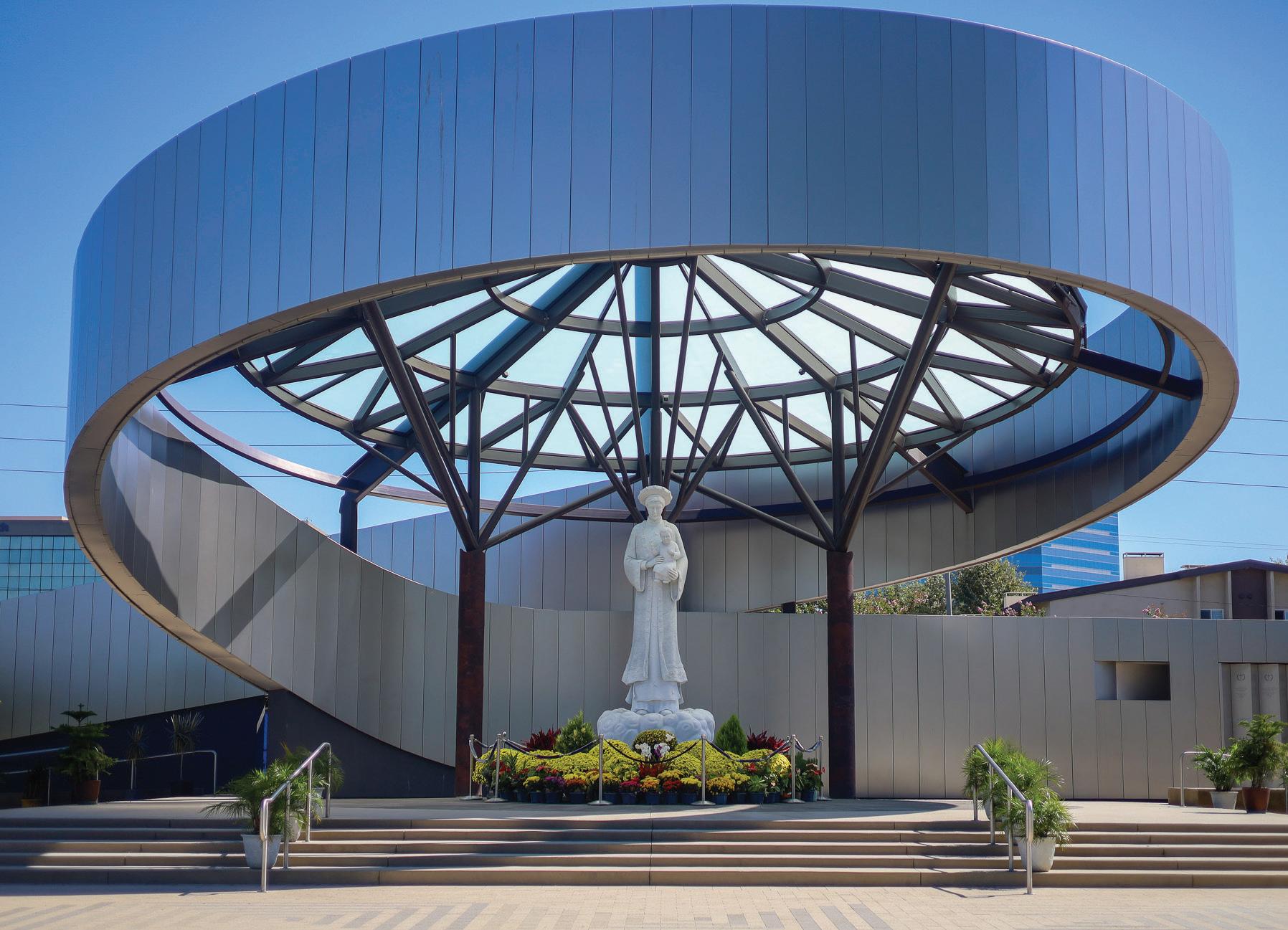
The Our Lady of La Vang Shrine project at Christ Cathedral is publicly announced. It will serve as a testament to the faith and legacy of the Vietnamese Catholic people.
was the catalyst for a dream that became the Our Lady of La Vang Shrine at Christ Cathedral. The shrine, dedicated in 2021, has since become not only a symbol for the resilience and faith of the Vietnamese people, but a multicultural destination and pilgrimage site for many people of faith each year.
Bishop Dominic retired on his 75th birthday in 2015, at which time he became a bishop-emeritus until his death in late 2017, two weeks shy of his 77th birthday. Throughout his life, Bishop Dominic demonstrated that the Universal Church was indeed that, especially for immigrants. C
C FEBRUARY 2017:
The diocese formally kicks off the multimillion renovation campaign to transform Christ Cathedral into a “place for Christ Forever.”
C JUNE 29, 2018:
Bishop Kevin Vann announces a “Holy Year of Preparation” leading up to the dedication of Christ Cathedral.
THE BISHOPS OF ORANGE: LEADERS PAST AND PRESENT
THE MOST REV. CIRILO B. FLORES, M.DIV., J.D., D.D.
June 20, 1948 – September 6, 2014
Auxiliary Bishop of Orange: 2009 – 2012
Coadjutor Bishop of San Diego: 2012 – 2013
Bishop of San Diego: 2013 – 2014
CIRILO FLORES was born in Corona, Calif., on June 20, 1948, the son of a Mexican immigrant and his Arizona-born wife. His first language was Spanish. After attending public schools, a local Knights of Columbus chapter sponsored his tuition to continue his education at a Catholic school, Notre Dame High School, in nearby Riverside.
In 1968, Cirilo was briefly a novitiate of the Society of Jesus, but left to pursue a legal career. He earned his bachelor’s degree from Loyola Marymount University and his J.D. from Stanford University. He practiced law, primarily business litigation, in Southern California for a decade before becoming a “late vocations” man.
He entered St. John’s Seminary in 1986, was ordained to the priesthood in 1991 and served at several Diocese of Orange parishes, including years as pastor of St. Norbert in Orange and St. Anne in Santa Ana. Fr. Flores was ordained an auxiliary bishop on March 19, 2009, at Holy Family.
His other roles for the Diocese of Orange included vicar for charities, a member of the diocesan finance council, the bishop’s Council of Priests, the Priests Personnel Board and the editorial council of the Orange County Catholic diocesan newspaper.
After serving three years as auxiliary bishop of Orange, he was appointed coadjutor bishop of San Diego in 2012. In Sept. 2013, he became the fifth bishop of San Diego (and was its first Hispanic bishop) before passing away on Sept. 4, 2014. He was 66. C
C JULY 17, 2019:
Christ Cathedral is officially dedicated as the new seat of the Diocese of Orange, culminating a years-long transformation.
C MAY 22, 2020:
As the COVID-19 pandemic comes into focus, the diocese announces a phased-in approach with measures in place to safeguard public health.
C MAY 4, 2021:
St. Michael’s Abbey, home of the Norbertine Order, is dedicated in Silverado Canyon.
C JULY 17, 2021:
The Our Lady of La Vang Shrine at Christ Cathedral is unveiled to an estimated 8,500 onlookers.
THE BISHOPS OF ORANGE: LEADERS PAST AND PRESENT
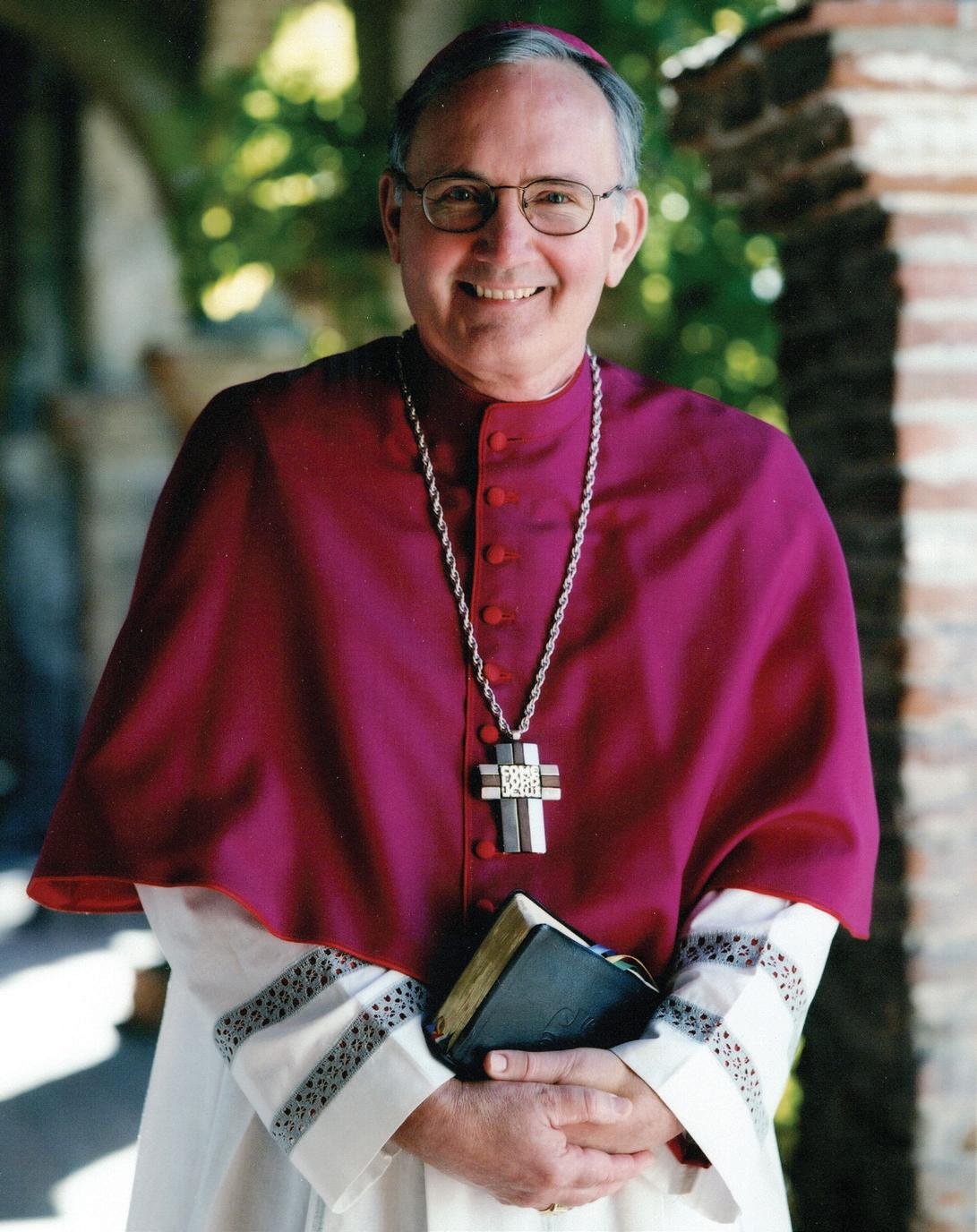
THE MOST REV. KEVIN W. VANN, J.C.D., D.D., D.MIN.
Bishop of Fort Worth: 2005 – 2012 Fourth Bishop of Orange: 2012 – Present
KEVIN W. VANN was born on May 10, 1951, in Springfield, Illinois. He is the oldest of six children born to William M. Vann Jr. and Theresa Jones Vann. He graduated from Griffin High School and earned a bachelor’s degree in medical technology from Millikin University, located in Decatur, Illinois. After working for three years as a medical technologist, he entered the seminary in 1976, spending a year at the Immaculate Conception Diocesan Seminary in Springfield and four years at Kenrick Seminary in St. Louis, Missouri, majoring in theology.
After his ordination on May 30, 1981, he was assigned to graduate studies in canon law at the Angelicum in Rome, with residence at the graduate house of the North American College, the Casa Santa Maria dell’Umiltà.
Upon returning to the Diocese of
C SEPTEMBER 11, 2021:
Christ Our Savior parish, which had been planned to be the new cathedral, is dedicated. The parishioners of southern Santa Ana now have a permanent worship space.
Springfield in Illinois, Fr. Vann was involved in the work of the Diocesan Tribunal and the Tribunal of Second Instance in Chicago. He served as pastor of parishes ranging in size from 35 to 1,300 families, two of which had large schools. He taught canon law at Kenrick Seminary. He was also pastor of Blessed Sacrament parish in Springfield, vicar for priests and the diocesan contact for Hispanic ministry.
Bishop Vann was installed as the third bishop of the Diocese of Fort Worth, Texas, on July 13, 2005, at Texas Christian University’s Daniel–Meyer Coliseum. In Texas, he collaborated closely with other bishops through the Texas Catholic Conference and Region X, which includes dioceses in Texas, Oklahoma and Arkansas. He is the former Texas bishops’ liaison to the Texas Mission Council and Texas Catholic hospitals.
C JUNE 10, 2022:
The Hazel Wright Organ of Christ Cathedral, now fully restored, is blessed by Bishop Kevin Vann. A “Year of Hazel” special concert series begins.
Bishop Vann provided leadership for various initiatives at the national level, including service on an ad hoc committee which assisted the Vatican’s Congregation for the Doctrine of the Faith (CDF) to guide the incorporation of Anglican groups into the Catholic Church of the United States.
In 2012, Pope Benedict XVI appointed Bishop Vann the fourth bishop of Orange. Bishop Vann has led the Diocese of Orange in its multicultural mission to meet the social, economic and spiritual needs of the region’s increasingly diverse Catholic population. He led the historic effort to transform the former Crystal Cathedral from a world-renowned center of Protestant worship into the West Coast’s most visible center of Catholicism. Christ Cathedral was dedicated on July 17, 2019.
Through the California Catholic Conference and the U.S. Conference
C JUNE 18, 2022:
The National Eucharistic Revival kicks off in the diocese on June 18 at Christ Cathedral and continues through 2024, with many parishes participating.
of Catholic Bishops, he works with bishops across the United States as well as globally. Bishop Vann is currently serving or has also served as the ecclesiastical delegate for the Pastoral Provision, on the Pontifical North American College Board, the USCCB Committee on Migration, director of Cross Catholic International and the International Dominican Foundation board of directors.
In 2024, Bishop Vann was awarded a Doctor of Ministry degree, which was the culmination of a three summers-long journey. For his dissertation, he wrote on the history and canonicity of “Anglicanorum Coetibus,” the 2009 apostolic constitution that erected a personal ordinariate for Anglican parishes and their pastors to enter full communion with the Roman Catholic Church while retaining their Anglican heritage. C
C JULY 1, 2022:
The diocese begins hosting the first Marian Days, a festival-like event that attracts more than 15,000 people to the Christ Cathedral campus in its inaugural year.
Bishop Manuel de Jesús Rodríguez and the family of the Diocese of Palm Beach extend our heartfelt prayerful congratulations to the Diocese of Orange on their Fiftieth Anniversary.
Archbishop Gustavo García-Siller, MSpS; Auxiliary Bishop Gary Janak; Auxiliary Bishop Arturo Cepeda, and the faithful of the Archdiocese of San Antonio congratulate Bishop Kevin Vann and the people of the Diocese of Orange on their jubilee anniversary, marking five decades of faith, sacrifice, and community building; establishing a solid foundation for generations to come. Celebrate and look back with gratitude and forward with hope — continuing the journey of faith for many more years, fostering a vibrant and devout Catholic presence in southern California.
THE BISHOPS OF ORANGE: LEADERS PAST AND PRESENT
THE MOST REV. TIMOTHY E. FREYER, D.D.
Auxiliary Bishop of Orange: 2016 – Present
TIMOTHY FREYER was born in Los Angeles on Oct. 13, 1963, and grew up in Huntington Beach. After graduating from Huntington Beach High School, he entered St. John’s Seminary in Camarillo, Calif., where he earned his bachelor’s degree, followed by another four years at St. John’s where, as a graduate student, he studied theology.
Bishop Freyer was ordained a priest on June 10, 1989. His first assignment was as associate pastor of St. Hedwig parish in Los Alamitos within the Diocese of Orange. He served in that role for five years before being assigned to Our Lady of Fatima in San Clemente. Five years later, he moved to St. Catherine of Siena in Laguna Beach, where he remained for two years.
In 2001, Bishop Freyer was appointed pastor of St. Mary’s Catholic Church in Fullerton, and then in 2003 was reassigned as pastor of St. Boniface Catholic Church in Anaheim. He was named episcopal vicar for priests in 2012, with responsibility for the care and ongoing formation of the priests of the Diocese of Orange. Additionally, he was named the first bishop’s liaison to the Jovenes para Cristo (Young Adults for Christ) movement from
C MARCH 23, 2023:
The Swallows Day Parade returns to San Juan Capistrano for its 63rd iteration after pandemic delays.
1998 to 2004, helping them to write their statutes, revise their plan of formation and assist with opening chapters in California, Texas and Oregon.
In November 2016, Pope Francis named then-Fr. Freyer, the episcopal vicar for priests, an auxiliary bishop of Orange. He was ordained an auxiliary bishop on Jan. 17, 2017, at St. Columban parish in Garden Grove.
Bishop Freyer served as one of the founding board members of the Anaheim Family Justice Center (now called the Orange County Family Justice Center) that assists victims of domestic violence. He served two terms as a member of the board of trustees for St. Jude Medical Center in Fullerton and its Community Benefits Committee that oversees the center’s care-for-the-poor programs.
In addition to serving as a police chaplain for the Anaheim Police Department, Bishop Freyer is the vice president of the California Catholic Conference. For the U.S. Conference of Catholic Bishops, he serves on its Committee on Clergy, Consecrated Life and Vocations, as well as the subcommittee for the Catholic Campaign for Human Development C
C JUNE 6, 2023:
A tour helps herald the new Villa St. Joseph, a $37-million affordable-housing complex in the former Motherhouse on the Sisters of St. Joseph of Orange campus.
C AUGUST 14, 2023:
Cristo Rey Orange County High School opens its doors for the first time.
C OCTOBER 20, 2023:
The diocese hosts its first eucharistic congress, titled “I AM.” It brought 6,000 parishioners from around Orange County to the cathedral campus.
C APRIL 29, 2024:
The relic of St. Jude, known as the “Apostle of the Impossible,” starts a tour throughout the diocese, bringing tens of thousands to venerate the relic. It was the first time the relic had left Italy in 1,700 years.
THE BISHOPS OF ORANGE: LEADERS PAST AND PRESENT
THE MOST REV. THANH THAI NGUYEN, D.D.
Auxiliary Bishop of Orange: 2017 – Present
THOMAS THANH THAI NGUYEN was born on April 7, 1953, in Nha Trang, Vietnam. He is the secondeldest of 11 children: eight boys and three girls. He received most of his elementary education in Catholic schools and, in 1966, entered St. Joseph’s Seminary, a diocesan seminary in Vietnam. His formation was interrupted in 1975 when the communist government took control of the country.
Nguyen and his fellow seminarians were forced to discontinue their studies and perform hard labor in the rice fields in order to remain together. In 1979, after enduring religious persecution, Nguyen and members of his extended family fled Vietnam on a small motorboat in search of freedom. During the journey, they were caught in a tropical storm and spent 18 days at sea, several of them without food or water. Each morning and evening, the family prayed the Rosary together. By the grace of God, all 26 members of the group arrived safely in the Philippines.
After 10 months in a refugee camp, the family departed Manila in June 1980 to begin a new life in Beaumont, Texas. Nguyen later worked at Cath-
JULY 1, 2024:
olic Charities in Hartford, Connecticut, before earning a bachelor’s degree from Merrimack College. He began his novitiate in Washington, D.C., and professed his first vows with the La Salette Missionaries in 1987. He completed his theological studies at Weston Jesuit School of Theology in Cambridge, Massachusetts, graduating in May 1990, and was ordained to the priesthood on May 11, 1991.
Fr. Nguyen was incardinated into the Diocese of St. Augustine, Florida, where he established a Vietnamese pastoral center and worked to preserve Vietnamese cultural traditions. He also served at St. Joseph parish — one of the largest in the diocese, with approximately 4,000 families—from 2013 until his appointment as auxiliary bishop of Orange in 2017.
In the Diocese of Orange, Bishop Nguyen has overseen numerous ministries, including the Our Lady of La Vang Shrine Committee; Catholic schools; detention ministry; deaf ministry; life, peace and justice ministry; mission ministry; and Catholic Charities of Orange County. He has established the tradition of celebrating liturgies on Ash Wednesday, Good
C OCTOBER 14, 2024:
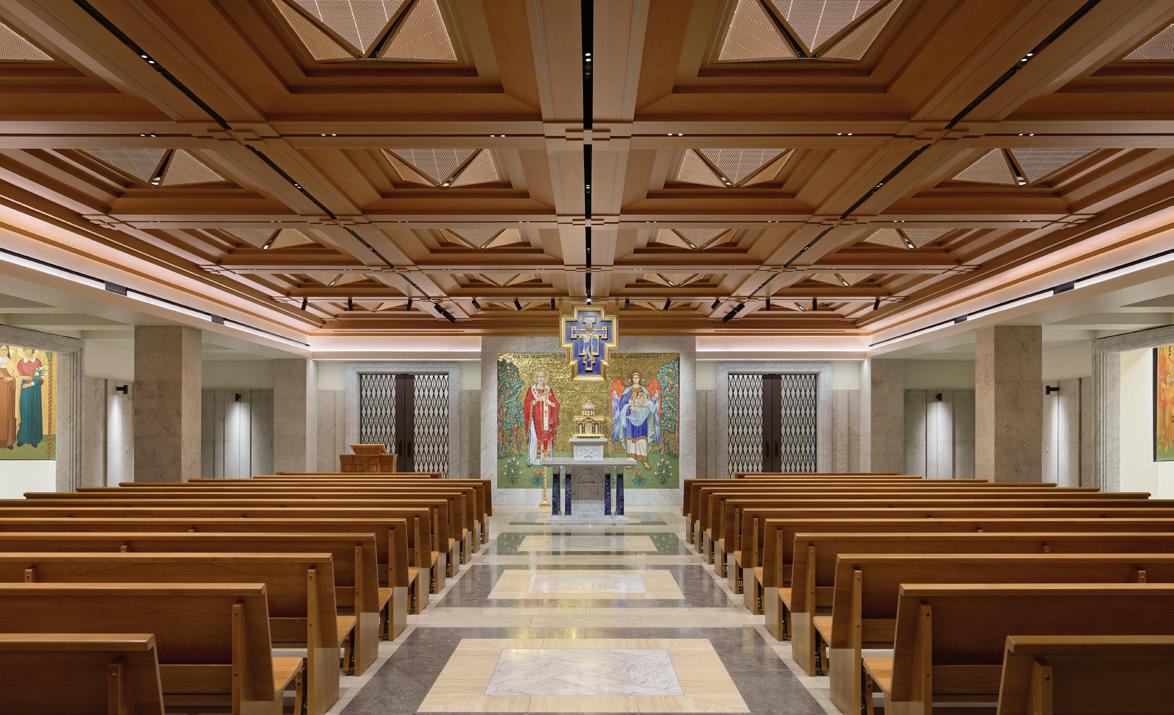
The St. Callistus Chapel and Crypts of Christ Cathedral is dedicated, marking the end of a 12-year transformative journey to transform the cathedral campus.
Friday and Christmas at the Orange County Juvenile Hall through the diocese’s Office of Restorative Justice/Detention Ministry. He also founded the annual Marian Days celebration at Christ Cathedral for the Vietnamese faithful, which draws more than 10,000 participants from near and far and has become one of the largest annual events in the diocese. C
C JUNE 18, 2025:
An estimated 5,000 of the faithful participated in the National Eucharistic Pilgrimage’s “Drexel Route” coming through the diocese.
C JULY 21, 2025:
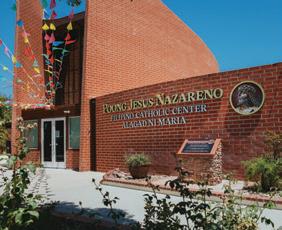
The Poong Jesus Nazareno Filipino Catholic Center, the country’s only such center, is blessed by Bishop Kevin Vann. The small church in Anaheim was the longtime dream of the local Filipino community, which raised $2 million in a few months toward a down payment for the property.
C NOVEMBER 18, 2025:
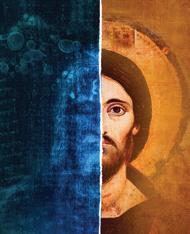
“The Shroud of Turin: An Immersive Experience” officially opens at Christ Cathedral. The privately funded, $5-million museum features 360-degree projection-room theaters, interactive exhibits, Shroud replicas, new sacred art and more.
C
Pax Christi Academies is officially launched. The stand-alone nonprofit was created to support and promote Catholic education for five schools: La Purísima in Orange; St. Justin Martyr in Anaheim; and St. Anne, St. Barbara and St. Joseph in Santa Ana.
ST. SERRA CATHOLIC SCHOOL IS BLESSED TO HAVE BEEN A PART OF THE DIOCESE OF ORANGE FOR 30 YEARS!
Inspiring a deep faith, innovative mind, and caring heart through Christ ... Siempre Adelante!
Preschool - Grade 8 in Rancho Santa Margarita serving Holy Trinity, San Francisco Solano, Santiago de Compostela, and St. Kilian | www.serraschool.org
St. Catherine’s Academy
All-Boys Leadership Academy
Since 1889, St. Catherine’s Academy—founded by the Dominican Sisters of Mission San Jose—has formed boys in faith, character, and excellence from TK–8. In that same spirit, we joyfully send our blessings to the Diocese of Orange on their 50th anniversary of service.
OF FAITH, COMMUNITY, AND SERVICE 50
YEARS
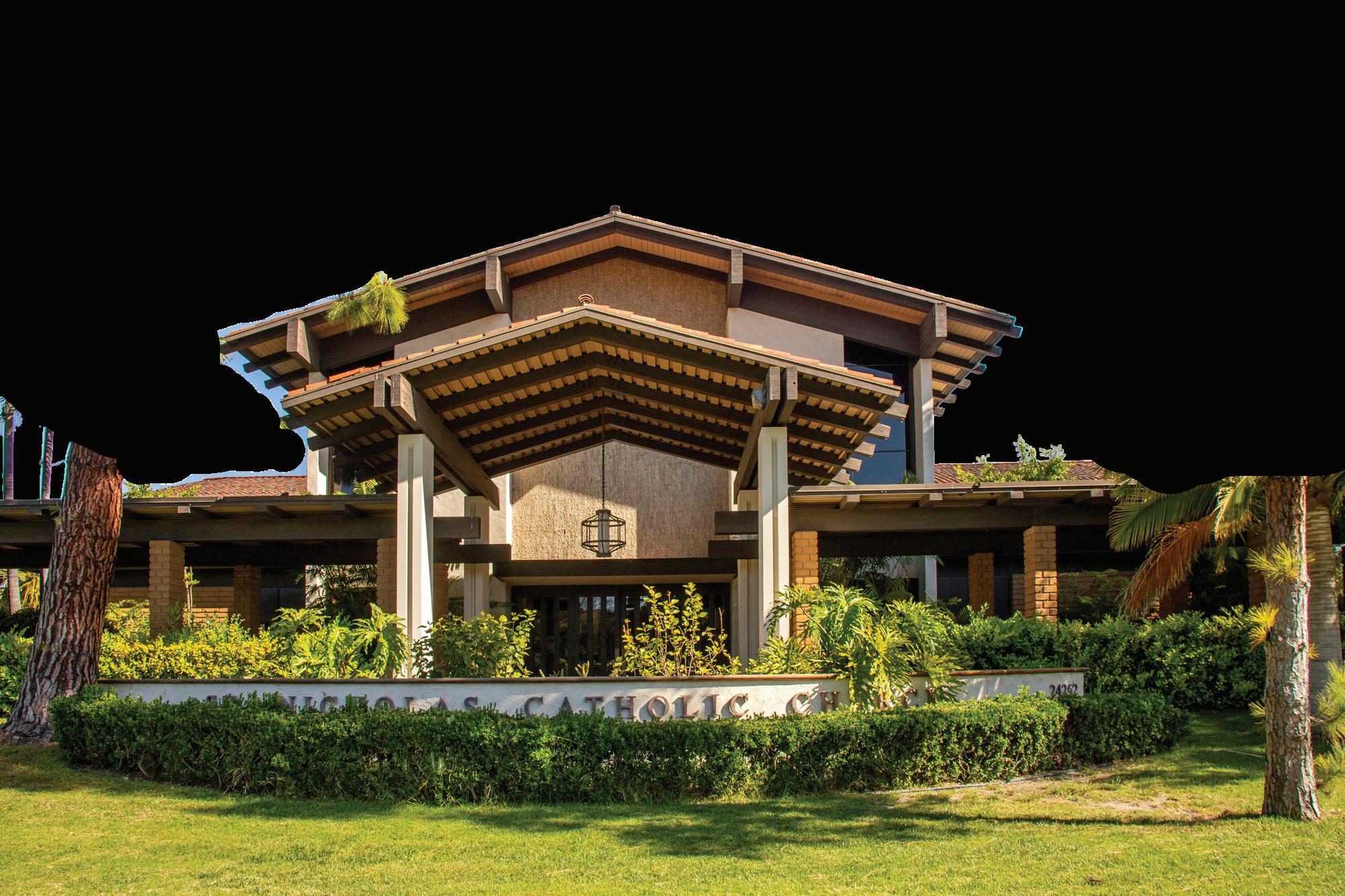
St. Nicholas Church joyfully congratulates the Diocese of Orange on its 50th Anniversary.
We are honored to be part of this growing legacy of faith and service. May God continue to bless the Diocese of Orange abundantly in the years ahead.
With gratitude and prayers, Rev. Martin Bui, Pastor
Rev. Alex Ha
Msgr. Don Romito Deacons and Parish Staff
Congratulations to the Diocese of Orange on 50 years of faithful leadership. Pax Christi Academies is honored to partner in forming the next generation through Catholic education.
FOUNDED IN FAITH, DRIVEN BY EXCELLENCE. 13280
Saint Anne Church Seal Beach
gives thanks to God for 50 years of the Diocese of Orange and recognizes contributions to the Diocese by our priests and parishioners
Msgr. Michael Heher, past Vicar General
Very Rev. Al Baca, Director of Ecumenism and Inter-Religion
Very Rev. John Shimotsu, Vicar for Priests
Shirl Giacomi, past Chancellor
Tom Greeley, member Diocesan Finance Council
Lori Marino, Administrative Assistant to the Vicar for Priests
Teresa McCarthy, Real Estate Project Manager
Donald Miller, past member Diocesan Finance Council
Douglas Stephen, past member Christ Catholic Cathedral Corporation
Andrew Talley, past member Christ Catholic Cathedral Corporation
We look forward to our future, with a parish Campus Plan project that will serve many generations to come in Seal Beach. www.stannesealbeach.org
Congratulations and prayers from the community of St Boniface Church on the 50th Anniversary of our Diocese of Orange in California.
CONGRATULATIONS ON 50 YEARS!
Congratulations! Congratulations !
Named for Saints Simon and Jude, apostles of courage and hope, we give thanks for 50 years of diocesan mission and celebrate our shared call to live as missionary disciples rooted in the Eucharist, faithful in prayer, generous in service, and bold in witness.
Congratulations and thank you, Diocese of Orange!
With grateful hearts, we continue the mission together, aints Simon and Jude Catholic Church & School
Congratulations to the Diocese of Orange on the joyous celebration of its Golden Jubilee.
Most Rev. William D. Byrne & the faithful of the Diocese of Springfield, Massachusetts
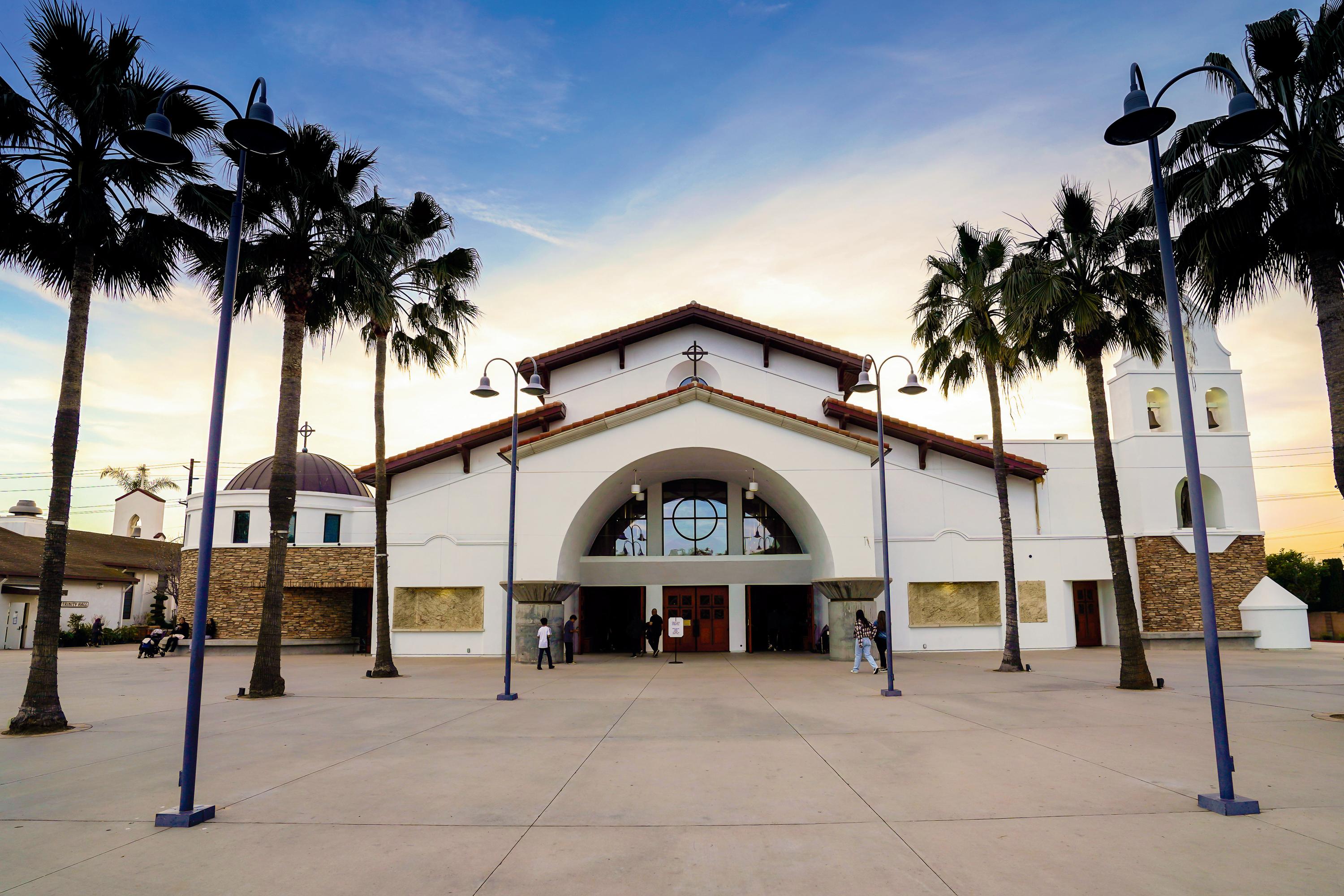
LA PURISIMA CONGRATULATES THE DIOCESE OF ORANGE ON ITS 50 ANNIVERSARY TH
St. John's Seminary Offers Full-Tuition Fellowships for Hispanic Lay Ministers
St John’s Seminary has fully-funded fellowships for Hispanic lay ministers interested in being formed to minister in parishes, Newman centers, Catholic K-12 schools, or campus ministries.
We offer fellowships for our new online M.A. in Pastoral Ministry that allows you to receive your entire education from the comfort of your home.
This program will help lay ministers, increase their knowledge of the Catholic intellectual tradition and improve their ministerial skills for the life of the Church.
Students will be prepared to work in different areas of ministry and make professional and personal connections with others of the same mind and spirit.
A studio with professional video, audio, and lighting equipment has been built to allow our students to have an enjoyable technological experience.
We prepare our program to serve our students with the highest quality of education. For more information, please contact us.
ST. JOHN’S SEMINARY CAMARILLO,CALIFORNIA
Congratulations
to the Diocese of Orange on this golden milestone. With gratitude and partnership, Catholic Charities of Orange County honors your enduring mission to serve.
“Your faithfulness continues through all generations.”
- Psalm 119:90 ccoc.org
Congratulations to the Diocese of Orange on 50 years of building faith, strengthening community and inspiring service.
St. Gregory of Nazianzen Church, Los Angeles
American Martyrs Kateri Hall, Manhattan Beach
St. Kilian Priest Residences Mission Viejo, CA
Church of the Resurrection Escondido, CA
St. Kilian Parish Hall Mission Viejo, CA
St. Peter Chanel Catholic Church Hawaiian Gardens, CA
Rosary Academy High School Fullerton, CA
St. John the Baptist Costa Mesa, CA
Our Lady Queen of Angels Gym & Multipurpose Center Newport Beach, CA
St. Anne Catholic Church Seal Beach, CA
St. Gertrude the Great Elementary School Bell Gardens, CA
St. Bonaventure Catholic Church Huntington Beach, CA
Our Lady Queen of Angels, Organ Project, Newport Beach, CA