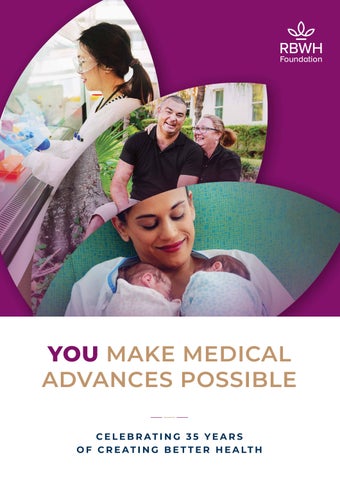
YOU MAKE MEDICAL ADVANCES POSSIBLE CELEBRATING 35 YEARS O F C R E AT I N G B E T T E R H E A LT H
RBWH RESEARCH GROUPS AND DEPARTMENTS As the largest teaching hospital in the Southern Hemisphere, Royal Brisbane and Women’s Hospital (RBWH) plays a vital role in the future of healthcare. The RBWH Foundation is proud of the depth and breadth of hospital services offered, and as the Hospital’s leading philanthropic funding partner is committed to providing critical and strategic funds for world-class research, education and patient care initiatives.
RESEARCH SERVICES
MEDICAL IMAGING – CLINICAL SUPPORT
ALLIED HEALTH
INTERNAL MEDICINE SERVICES
• Aboriginal and Torres Strait Islander Services • Nutrition and Dietetics
• Rehabilitation Engineering, Orthotics and Prosthetics
• Occupational Therapy
• Social Work
• Physiotherapy
• Speech Pathology and Audiology
• Psychology
CANCER CARE SERVICES • Haematology and Bone Marrow Transplant • Cancer Care Nursing Professorial Precinct
• Radiation Oncology • Queensland Haemophilia Centre
• Cardiology
• Nuclear Medicine
• Clinical Immunology and Allergy
• Palliative and Supportive Care
• Dermatology
• Pharmacy
• Endocrinology and Diabetes
• Clinical Pharmacology
• Gastroenterology and Hepatology
• Rheumatology
• Infectious Diseases • Internal Medicine and Aged Care • Neurology
• Kidney Health • Sexual Health and HIV Services • Thoracic Medicine (respiratory and sleep disorders)
SURGICAL AND PERIOPERATIVE SERVICES
• Medical Oncology
CRITICAL CARE AND CLINICAL SUPPORT SERVICES
• Anaesthesia • The Professor Stuart Pegg Adult Burns Centre
• Oral and Maxillofacial Surgery • Orthopaedic Surgery
• Emergency and Trauma Centre
• Intensive Care Services (ICU)
• Ear, Nose and Throat Surgery
• Plastic and Reconstructive Surgery
• Genetic Health Queensland
• The Professor Tess Cramond Multidisciplinary Pain Centre
• General Surgery
• Trauma Service
• Neurosurgery
• Urology
• Ophthalmology
• Vascular Surgery
• Hyperbaric Medicine Centre
• Skin Integrity Service
MENTAL HEALTH SERVICES
• Head and Neck Surgery
WOMEN’ S AND NEWBORN SERVICES
• Adolescent Inpatient Mental Health Service
• Older Persons Mental Health
• Breast Health
• Maternal Fetal Medicine
• Gynaecology
• Hospital Alcohol and Drug Service
• Queensland Eating Disorder Service
• Gynaecological Cancer
• Grantley Stable Neonatal Unit
2 | RBWH Foundation 2020 Donor Impact Report
CONTENTS
You Power Medical Research, Leona Murphy, RBWH Foundation Chair. . . . . . . . . . . . . . . . . . .
. . . . . . .
World-leading Research and Patient
5
. . . . . . . . . . . . . . . . . . . .
6
Our Impact Across Australia and the World . . . . .
7
Acknowledgement of Country. . . . . . . . . . . . . . .
7
Care by the Numbers.
Your Support Helps Create Better Health Globally . . . . . . . . . . . . . . . . . . . . . . . . . .
8
Thank You for Helping RBWH be One of David Rosengren, RBWH Executive Director. . . . .
9
10
You Joined the Race Against Coronavirus. . . . . .
11
Key Funding Priorities. . . . . . . . . . . . . . . . . . . .
12
How Your Support is Helping Fight COVID-19. . .
13
Heroes Come in Every Shape and Size . . . . . . . .
14
Infectious Diseases Initiatives
14
. . . . . . . . . . . . . .
World-First Research Solving Big Health Issues. . . . . . . . . . . . . . . . . . . . . . . . . . .
15
Surviving Burns Thanks to Medical Research . . .
16
You are Helping our Tiniest Patients. . . . . . . . . .
17
18
Remote Health Services. . . . . . . . . . . . . . . . . . .
19
“You Saved Our Boy” - Tony Bonato Story. . . . .
20
Transporting Premature or Critically Ill Babies to Life Saving Treatment. . . . . . . . . . . . . You Help Launch Research Careers and Life Saving Projects. . . . . . . . . . . . . . . . . . Thank You for Empowering Mental Health Researchers. . . . . . . . . . . . . . . . . . . . . A Commitment to Research Continues
the Best, Brightest and Kindest Hospitals,
Life Saving Medical Research. . . . . . . . . . . . . . .
Perinatal Research Centre. . . . . . . . . . . . . . . . . You Support Life Saving Regional and
Thank You for Your Generosity and Compassion, Simone Garske, RBWH Foundation CEO
4
21 22 24
with You . . . . . . . . . . . . . . . . . . . . . . . . . . . . .
25
You Foster Incredible Research Talent . . . . . . .
27
Creating an Even Kinder Hospital. . . . . . . . . . .
28
Thank You for Your Support During International Year of The Nurse and Midwife . . . . . . . . . . . . . . . . . . . . . . . . . .
29
Thank You for Helping Us.
29
. . . . . . . . . . . . . . . .
You Are Helping Save Young Lives Through Education. . . . . . . . . . . . . . . . . . . . .
30
A Legacy With Enduring Impacts. . . . . . . . . . . .
31
You Helped Raise Funds for Better Health, Today, Tomorrow and Always. . . . . . . . . . . . . .
32
Thank You for Being Loyal to The Royal
34
. . . . . .
RBWH Foundation 2020 Donor Impact Report | 3
YOU POWER MEDICAL RESEARCH Take a moment to imagine a world without medical and clinical research… ...there would be no advancement in patient care or treatment, no cure for diseases which plague society, life expectancy would be shorter and our quality of life would be poorer. Fortunately, because of the generosity of donors like you, we do not live in such a world. For just over 150 years, Royal Brisbane and Women’s Hospital (RBWH) has fostered a proud tradition of research and discovery, beginning in 1876 with Dr Joseph Bancroft who, as Visiting Surgeon, discovered the cause of the tropical disease Filariasis.
Since the RBWH Foundation’s establishment in 1985, we have worked tirelessly alongside RBWH to nurture Australia’s brightest medical minds.
Since RBWH Foundation’s establishment in 1985, we have worked tirelessly alongside RBWH to nurture Australia’s brightest medical minds. Over the past 35 years, we have launched incredible careers through our Clinician Research Grants, fostered those careers through Fellowships and Funded Research Positions, and supported patients and visitors through our wonderful network of volunteers. As Chair of RBWH Foundation, I am proud to announce the largest annual distribution in our 35-year history. In the 2020 financial year, the Foundation provided more than $9 million across hospital programs, including our biggest single investment of $5 million for the Herston Biofabrication Institute which is set to open in early 2021. The last twelve months have been among the most impactful in our history. RBWH Foundation Coronavirus Action Fund was embraced by donors and enabled RBWH to add its expertise to the global body of work to fight COVID-19. As the race against the global pandemic is played out in laboratories and hospitals around the world, a proactive and well-funded research environment has never been more crucial. We are proud that almost every area of RBWH has prospered through Foundation funding and support. Our hospital and patient care programs have delivered a range of services f rom newspapers for elderly patients, through to support for young people and Aboriginal and Torres Strait Islander patients facing mental health issues. Thank you for your continued generosity. Your support has made these initiatives possible.
Leona Murphy RBWH Foundation Chair
4 | RBWH Foundation 2020 Donor Impact Report
THANK YOU FOR YOUR GENEROSITY AND COMPASSION It has been an incredible twelve months on so many fronts – the best of days and some of the worst. We have been tested as a community in ways we could not imagine. One recurring theme throughout all RBWH Foundation activities though, can be summed up in one simple word. Hope. Medical research, the latest in equipment and technology, and worldclass patient care all provide hope to patients and their families. And hope starts at RBWH Foundation with you, our donors, so thank you.
Medical research, the latest in equipment and technology, and world-class patient care all provide hope to patients and their families.
This year RBWH Foundation celebrates 35 years of commitment to the incredible Royal Brisbane and Women’s Hospital. As the philanthropy arm of the hospital, RBWH Foundation’s role has always been to actively engage with the community to raise much needed funds to support advancements in healthcare. Research has always been one of RBWH Foundation’s key priorities. We believe the outcomes of research can be far-reaching, benefiting not only the individual patient and their families, but potentially the health system and community at large. We are very proud of the fact that 100% of the donations that we are entrusted with are used for the purpose they were intended – to further medical and clinical research, education and patient care at RBWH. RBWH Foundation is truly grateful for all the support and donations we receive. Every donation makes a difference. Thank you on behalf of everyone who has and will benefit from your generosity. Thank you on behalf of the clinical researchers racing against COVID-19. Thank you also on behalf of the parents watching sleeplessly over their premature babies, families staying strong in the face of adverse diagnosis and critical trauma of their loved ones, and elderly patients facing their health battles with dignity. RBWH works hard to be the best it can be, every day, thanks to your generosity and compassion.
Simone Garske RBWH Foundation CEO
RBWH Foundation 2020 Donor Impact Report | 5
WORLD-LEADING RESEARCH AND PATIENT CARE BY THE NUMBERS RBWH has over 500 clinical researchers...
and partnerships with 14 universities.
Over the past year at the RBWH... Almost 700 research projects were underway
1,000,000 episodes of
Over 220 RBWH clinical research trials were conducted
More than 150,000 cancer care treatments, consultations, and admissions occurred
Almost 82,000 people presented to RBWH Emergency and Trauma
27,000 surgeries were
Close to 900 studies were published by RBWH clinical researchers
1 in 13 Queensland
healthcare were provided
performed
babies were delivered
RBWH Foundation has distributed more than
$50 million over the past 35 years. Your donations have helped RBWH become a world-leading research, healthcare and education hub.
Better health today, tomorrow and always.
6 | RBWH Foundation 2020 Donor Impact Report
RBWH IMPACT ACROSS AUSTRALIA AND THE WORLD
RBWH
QUEENSLAND, NORTHERN NEW SOUTH WALES, NORTHERN TERRITORY, PACIFIC RIM • Breakthrough medical discoveries • World-leading patient care • Provides 1 in 10 Qld patient services • Delivers 1 in 13 Qld babies • Medical retrievals • Telehealth • Regional and remote health worker education and training
NATIONALLY AND INTERNATIONALLY
• Community education
• Health worker education and training
• Disaster response
• Disaster response
• University partnerships
• University partnerships
• Medical and clinical research collaborations
• Medical and clinical research collaborations
• Breakthrough medical discoveries
ACKNOWLEDGMENT OF COUNTRY RBWH Foundation would like to respectfully acknowledge the Traditional Owners of the land on which the Foundation’s work is taking place. We pay our respect to the Elders, past, present and emerging, for they hold the memories, traditions, the culture and hopes of Aboriginal and Torres Strait Islander peoples across the state. RBWH Foundation 2020 Donor Impact Report | 7
YOUR SUPPORT HELPS CREATE BETTER HEALTH GLOBALLY Since it was first established in 1985, RBWH Foundation has advocated and raised funds for better health today, tomorrow and always. Over the past 35 years, more than $50 million dollars has been invested in improving health outcomes thanks to the philanthropic efforts of our committed donors.
LIFE SAVING MEDICAL RESEARCH
It is the Foundation’s privilege to support some of Australia’s and the world’s most brilliant researchers and medical practitioners across a diverse range of healthcare specialities. Their research not only benefits RBWH patient care but also leaves a lasting impact on global human health.
PATIENT CARE
HEALTH WORKER AND COMMUNITY EDUCATION
At the heart of every dollar invested is the Foundation’s mission to invest in patient care, innovative clinical research, staff and community education that saves and improves lives. The Foundation’s efforts would not be possible without the generosity of individuals, businesses, and the community at large.
RBWH FOUNDATION FY2020 DISTRIBUTION $9,312,091
CLINICIAN RESEARCH
MEDICAL EQUIPMENT
EDUCATION AND TRAINING
HOSPITAL PROGRAMS
PATIENT CARE
HERSTON BIOFABRICATION INSTITUTE
RFPB NEORESQ VEHICLE
CORONAVIRUS ACTION FUND
8 | RBWH Foundation 2020 Donor Impact Report
THANK YOU FOR HELPING RBWH BE ONE OF THE BEST, BRIGHTEST AND KINDEST HOSPITALS. It is an enormous privilege to be able to lead such an amazing team that delivers healthcare to all of Queensland and beyond. As one of the Top 100 Hospitals in the world, we have the amazing ability to deliver quality healthcare, education and research, and to make a huge impact on the lives of all the people who depend on us. Over the past 35 years, RBWH Foundation has been a critical contributor to ensure that we are one of the best, brightest and kindest healthcare providers.
RBWH Foundation partners with us to support clinical care, research and investments in new technology – a whole range of initiatives that we could not do on our own.
Across the hospital, we deliver care at every stage of life. RBWH Foundation partners with us in supporting clinical care, education, research and investment in new technology – a whole range of initiatives that we could not do on our own. We are not just a healthcare provider, we educate the future healthcare workforce for Queensland and in some instances, nationally and internationally. We also deliver extraordinary research including first-in-human trials that allow us to push boundaries, find new and better ways to treat diseases and f ind medical cures. Our partnership with RBWH Foundation is absolutely integral to everything that we do. With your support, through RBWH Foundation, we can continue to deliver quality patient care, world-leading research and health worker education. Thank you for your contribution. Please do not underestimate the impact you have, or how valuable your contribution is to the welfare of all Queenslanders, Australians and the world. Thank you.
Dr David Rosengren RBWH Executive Director
RBWH Foundation 2020 Donor Impact Report | 9
LIFE SAVING MEDICAL RESEARCH World-class researchers making global impact RBWH plays a significant role not only for patient care within Queensland, Northern New South Wales, the Northern Territory and Pacific Rim, but also through its strong tradition of research on a national and international scale. Between 2019-2020, RBWH Foundation again invested significant funding across a range of new and existing research programs, distributed through diverse grants programs and salary commitments. As a quaternary and tertiary referral teaching hospital, RBWH prides itself on close teaching and research relationships with more than 14 universities and as the largest teaching hospital in the Southern Hemisphere
the hospital’s role in training the future health workforce is considerable. RBWH Foundation funded research has not only changed health practice internationally, but also enables our patients to be involved in the latest therapies and diagnostics, and provides access to the newest medicines and best models of care, under tight monitoring conditions. Research can take years of commitment and dedication, and RBWH Foundation is proud to foster an environment that has enabled first-time grant recipients to become leaders in their areas of expertise.
Over the past year RBWH Foundation has supported:
10
Fellowships
15
Funded Research Positions
31
Research Projects
‘DID YOU KNOW?’
Tertiary care refers to a level of highly specialised hospital equipment and expertise such as renal or hemodialysis, and some plastic surgeries or neurosurgeries. It also includes severe burn treatments and other very complex treatments or procedures. Quaternary care is even more specialised and because it is so specific, is not available in every hospital. Some types of uncommon diagnostic or surgical procedures are considered quaternary care.
10 | RBWH Foundation 2020 Donor Impact Report
YOU JOINED THE RACE AGAINST CORONAVIRUS In January 2020, all best laid plans for the new year were rewritten with critical urgency. COVID-19 had arrived on Australian shores and had spread around the world. Without any treatment or vaccine available, the only course of action in Australia and in many other countries was a Government enforced shutdown.
YFG Shopping Centres made the first donation to the RBWH Foundation Coronavirus Action Fund.
Knowing that RBWH researchers were perfectly positioned to turn their considerable expertise towards finding and testing COVID-19 treatments, Mr Luca Fu, Foundation Board Member and Managing Director of
Thanks to the generosity of you, our donors - everyday Australians, philanthropic individuals and corporate entities - the Coronavirus Action Fund has raised almost $5.8 million for the race against COVID-19.
It was a donation that, within weeks, would result in the most critical - and overwhelmingly successful fundraising campaign in RBWH Foundation’s 35 year history.
CORONAVIRUS ACTION FUND AMOUNT RAISED
$5,766,807
THANK YOU FOR SUPPORTING COVID-19 RESEARCH As an RBWH Infectious Diseases Physician, I not only treat patients, I spend much of my day conducting research. At the beginning of the COVID-19 pandemic, we knew very little about the disease. We had not identified the full range of physiological effects, the best ways to treat coronavirus or how to prevent it. We now know there are some treatments that will prevent a person dying f rom COVID-19 or that will shorten their hospital stay and while vaccines look promising, it is crucially important to continue research, so we can optimise our therapies for all COVID-19 patients. On behalf of all the other Infectious Diseases physicians here at RBWH, and in fact all of our professional colleagues - whether they be pharmacists, microbiologists or nursing staff - across this hospital and Australia, thank you for the opportunities you have given us to further our research into this deadly infection. Professor David Paterson, RBWH Consultant Infectious Diseases Physician
GRAHAM’S STORY RBWH’s first COVID-19 patient, retired businessman 77-year old Graham Brasch, has spoken about the significant impact the disease has had on his health after spending four months in hospital recovering. Mr Brasch believes he contracted the virus during a trip to New York with his wife Glenda, in March 2020. The virus attacked his lungs, kidneys and bowel, and he’s been left with a heart condition called cardiomyopathy. Despite the setback, Mr Brasch refuses to let the virus damage his sense of humour as this video proves.
SCAN TO WATCH GRAHAM’S STORY
RBWH Foundation 2020 Donor Impact Report | 11
KEY FUNDING PRIORITIES
NATIONAL CLINICAL TRIALS The Australasian COVID-19 Trial (ASCOT) will generate clinical evidence that can be applied during the pandemic to reduce mortality or the need for mechanical ventilation in hospitalised, but not yet critically ill, patients with COVID-19.
SPECIAL COVID-19 RESEARCH PROJECTS The Special COVID-19 grants will analyse unprecedented changes in the delivery of healthcare including the impact of life-support on COVID-19 drugs, long-term COVID-19 side-effects and the impact of telehealth/virtual care on patient care.
INFECTIOUS DISEASES INITIATIVES Planning is underway to improve the outcomes of patients with serious infections, leverage grant and philanthropic funding, and train the next generation of infectious diseases researchers.
12 | RBWH Foundation 2020 Donor Impact Report
MEDICAL EQUIPMENT AND PPE The Coronavirus Action Fund was able to quickly secure personal protective equipment for frontline health workers and researchers.
COVID-19 RESEARCH COORDINATORS COVID-19 research coordinators are assisting in the planning, implementation and maintenance of data collection and analysis systems in support of research protocol.
HEALTH WORKER SUPPORT A significant medical event like the Coronavirus pandemic can add considerable stress to hospital staff. The Coronavirus Action Fund provides RBWH staff additional support through a variety of initiatives.
HOW YOUR SUPPORT IS HELPING FIGHT COVID-19 The Coronavirus Action Fund has supported a number of initiatives, including the national Australasian COVID-19 Trial (ASCOT), which will test COVID-19 treatments such as convalescent plasma. RBWH was also chosen as the pharmacy distribution centre for the ASCOT trials.
Key COVID-19 projects underway: The impact of life-support on COVID-19 drugs Long-term COVID-19 side-effects The impact of telehealth/virtual care on patient care Face time and virtual visiting of patients in ICU
The first round of Special COVID-19 research grants has been distributed, which, among other things, will help with an analysis of the unprecedented changes in the way RBWH delivered healthcare as a result of the pandemic. These outcomes will be shared with health networks globally.
Changes in gestational diabetes testing Impacts on maternity and neonatal health workers
Other potentially life saving medical research projects and preventative projects have been proposed including: • Repurposing a tuberculosis vaccine to boost the immunity of frontline healthcare workers • Developing COVID-19 related superbug treatments • An aged care health worker smartphone App to improve COVID-19 infection control.
Impacts on maternal depression and related disorders A new fast, low-cost COVID-19 test How many hours clinicians can wear personal, protective equipment.
‘WE’VE GOT TO BEAT THE BLOODY VIRUS!’ The Drake family have been humble heroes in the race against COVID-19.
I’m hoping we can find a treatment sooner rather than later which can save lives and help us get back to life as we knew it. Keith Drake
Motivated by their family’s experience with the medical sector, Keith and Glenda Drake initially pledged $100,000 to the Coronavirus Action Fund. The Drake’s eldest son, 57-year old Neville, was born with quadriplegia cerebral palsy and requires around the clock care.
Earlier this year, after talking with RBWH Consultant Infectious Diseases Physician Professor David Paterson about the urgency of the COVID-19 research required, the Drakes increased their pledge to include the family’s former home, a luxury 2-storey Maroochydore penthouse.
The Drakes have a long history of philanthropy, including previously helping to establish three schools on the island of Kitava in Papua New Guinea’s Milne Bay Province.
As the face of RBWH Foundation’s 2020 Tax Appeal, Keith committed to matching all donations up to $100,000. ‘It goes to the virus,’ said Keith, ‘It’s got to beat this bloody virus!’ RBWH Foundation 2020 Donor Impact Report | 13
HEROES COME IN EVERY SHAPE AND SIZE
It is not often that children beg their parents to be allowed back to school, but that’s exactly the motivation behind a suburban car wash. When COVID-19 temporarily closed schools, a group of school children decided to raise funds for RBWH Foundation Coronavirus Action Fund. They wanted the money to help speed up research into a possible treatment. With neighbours, friends and family members remaining in their cars to maintain social distancing, the group hosed and scrubbed their way to well over $110. There was only one problem - due to their height the car roofs were a little hard to clean! We cannot thank these little heroes enough for their incredible support.
INFECTIOUS DISEASES INITIATIVES
Royal Brisbane and Women’s Hospital (RBWH) has a long history of infectious diseases research, influenced by Queensland’s subtropical climate. In the 1800s, the cause of Elephantiasis was discovered at Herston, a world-first led by father and son Doctors Joseph and Thomas Bancroft. The discovery that Elephantiasis was transmitted by mosquitoes led to the birth of the mosquito-control measures that we still use today. In the 1900s, the discovery of an infection called Q Fever also had close links with RBWH and we now face a new infectious disease, COVID-19.
14 | RBWH Foundation 2020 Donor Impact Report
This worldwide pandemic has focused attention on infectious diseases research. Supporters of RBWH Foundation have led the way through support of the Coronavirus Action Fund. While numbers of people with COVID-19 have thankfully remained low in Australia, the success of the Coronavirus Action Fund has created a unique opportunity for RBWH infectious diseases researchers to collaborate on a major initiative to be announced early in 2021. RBWH Foundation thanks you, our donors, for your support of the Coronavirus Action Fund and assisting RBWH to maximise its impact on the infectious diseases research.
WORLD-FIRST RESEARCH SOLVING BIG HEALTH ISSUES Solving Antibiotic Resistance Previous publications have stated that by 2050, antibiotic resistance will kill more people than cancer (1). It is a grim prediction often talked about in medical circles and conf irmed in a United Kingdom Government funded review of antimicrobial resistance. Helping prevent this potential scenario is Professor Jeffrey Lipman AM, RBWH Ambassador for Research and Consultant Intensive Care Services. “The bacteria always seem one step ahead of us. But all that has changed. Indeed, it had to change. If we continued to do what we did before, then bacteria most certainly would have become resistant,” said Professor Lipman.
By 2050 antibiotic resistance will kill more people than cancer (1) (1) O’Neill, J et al. Antimicrobial Resistance: Tackling a crisis for the health and wealth of nations 2016.
Professor Lipman is one of the world’s leading experts in antibiotic dosing in acute situations. His work has changed the way antibiotics are used in Intensive Care Units (ICUs) worldwide. “We have shown over the last 20 years that we have been dosing incorrectly in adults in ICUs,” he said. Professor Lipman’s work is not restricted to Intensive Care. His work has paved the way for individualised antibiotic dosing across almost all wards of the RBWH, including paediatrics. “We believe that paediatric dosing is rudimentary at this stage, but we are going to change all that very soon.” Professor Lipman’s latest research, microsampling, gives doctors the ability to measure antibiotic levels from a finger prick of blood. This means a patient is not required to provide a traditional blood sample. “When we worked out the correct antibiotic dosing in adults, it required us to take a lot of blood samples: up to 10 samples of 5 millilitres over 6 hours. You can’t do that in babies because there’s just not enough blood to take. That’s all the blood they have,” Professor Lipman said. Microsampling will enable doctors to dose far more accurately. Perfecting antibiotic dosing will not only mean better patient outcomes in the short term, but also in the long term. Professor Lipman’s discoveries will prevent antibiotic resistance in newborns, setting them up well for life. Studies on microsampling are currently underway and should be completed within a year or two. This year, Professor Lipman was appointed a Member of the Order of Australia (AM) for his contribution to healthcare. His work on microsampling was also awarded the Discovery and Innovation Research Award at the 2019 Herston State of the Art Healthcare Symposium.
RBWH Foundation 2020 Donor Impact Report | 15
SCAN CODE TO FIND OUT MORE ABOUT DAVE’S STORY
SURVIVING BURNS THANKS TO MEDICAL RESEARCH New Ways to Make New Skin Biofabrication for Better Burns Care is a program that involves using many advanced 3D printing and imaging technologies to improve burns care. “RBWH is fortunate to be able to provide world-class care for burns victims, delivered by a team of health professionals from many different disciplines,” said Dr Jason Brown, Director of the Queensland Skin Culture Centre (QSCC) and RBWH Professor Stuart Pegg Adult Burns Centre. “We are at the same time forging ahead with clinically relevant research which we hope will further advance the care and lives of burns victims treated in Queensland.” The Burns Centre is internationally renowned, treating around 450 badly burned patients every year. It already has one of the lowest mortality rates in the world and the opening of the QSCC in 2017 has further improved
outcomes for traumatically injured burns patients. RBWH develops cultured skin substitutes, which reduce the pain and scarring caused by taking a skin graft from unburnt skin to treat a burn area. This enables patients to significantly reduce their stay in the Intensive Care Unit (ICU) and hospital, and their chance of survival increases. On average, a burns patient gets 20-24 sheets (10 x 10 cm) of skin grown. Larger burns may need two rounds of cultured skin. It takes 15-20 days to produce this skin through a small biopsy the size of a credit card. The Foundation continues to support the QSCC via grants which give staff access to equipment that is used daily to produce life saving Culture Epidermal Autografts (CEA), as well as funding for research on how to improve CEA and the benefits it offers patients.
Your Support Helped Save Captain Crispy Dave Among RBWH staff, North Queensland skipper David Andersen is considered a walking miracle after surviving a 2015 boat explosion which left him with burns to 90 per cent of his body. To his mates back in the Whitsundays, he’s Captain Crispy Dave.
Dave’s body repair and adapt, it was a peer support program called Burnslife which helped ease the psychological pain.
It would take 12 months for Dave to return home after the horrific accident, spending the first three months as an inpatient at the RBWH Professor Stuart Pegg Burns Centre. A further nine months were needed, as an outpatient, for ongoing medical treatments and physiotherapy.
Also critical to Dave’s survival was the use of skin donated to the Queensland Skin and Bone Bank which was used as a temporary biological dressing. The bank is one of only two operating in Australia, with the other in Melbourne.
And while RBWH professionals worked tirelessly to help 16 | RBWH Foundation 2020 Donor Impact Report
Burnslife helps patients as they adjust to life outside hospital. It was a network that Dave came to depend on.
Thanks to donors, the RBWH Burns Unit is now one of the best in the world and it continues to produce breakthrough research.
SCAN CODE TO FIND OUT MORE ABOUT ANNA’S STORY
YOU ARE HELPING OUR TINIEST PATIENTS We are privileged to be involved with some of these families at a time when these babies are extremely vulnerable. Survival has definitely improved over the last 10-20 years and these families, and many of these babies go on to have very meaningful, full lives, although more funding is always needed for further research. Dr Melissa Lai, RBWH Neonatologist and Researcher
Bundaberg mother, Anna Holden, was warned early in her pregnancy it was unlikely she would carry her much anticipated twins to full-term. Nothing, though, prepared her to welcome them eight weeks early. Rushed to RBWH, Anna’s main concern was for her unborn pigeon pair, Bobby and Marylou, but it was Anna who was also at risk. Within two days of arriving at RBWH, her twins were born by emergency caesarean and Anna was in the Intensive Care Unit (ICU) with pre-eclampsia and pulmonary edema. Anna had been transferred from Bundaberg Hospital because its Special Care Nursery is only able to treat premature babies born around 34 weeks. It was a potentially lifesaving decision. Bobby and Marylou both needed treatment in the Neonatal Intensive Care Unit (NICU), with Marylou requiring Continuous Positive Airway Pressure (CPAP), a type of respiratory support which helped conserve her energy so she could put on weight. After eight weeks of care and a few setbacks, including hernia operations, the twins and Anna were able to return home healthy and well.
Supporting Research to Save Tiny Lives Anna Holden’s preterm twins are among 1600 premature and sick babies admitted every year to the RBWH Grantley Stable Neonatal Unit (GSNU) for specialist care and management. Any baby born less than 37 week’s gestation, or which requires diagnosis and care for surgical, genetic or breathing problems, will be cared for by this incredible team. And these tiny fighters are given greater odds than ever, thanks to the RBWH’s Perinatal Research Centre.
Since opening in 1992 as an initiative of RBWH Foundation, the Centre has established itself as Australia’s premier research centre for pre-term births, focusing on improving the survival rate of premature and seriously ill babies, and quality of life for both the baby and mother. Eighty-f ive per cent of babies born twelve weeks premature now survive thanks to the life saving work of Perinatal Research Centre staff and the hospital’s Grantley Stable Neonatal Unit.
RBWH Foundation 2020 Donor Impact Report | 17
PERINATAL RESEARCH CENTRE When hospitals have the funds to create world-class research facilities, they produce world-class research results – and the Perinatal Research Centre is doing just that. In the past year, the Centre has received international acclaim for numerous exciting research findings. These include studies that could revolutionise treatment for newborn babies with intrauterine growth restriction (IUGR), which occurs when a baby fails to grow at the normal rate inside the womb.
The common painkiller reducing newborn brain injury Fetal Growth Restriction (FGR) babies can have a wide range of neurodevelopmental disabilities, ranging from lower academic performance and attention def icit disorders through to cerebral palsy. The exact nature of these serious long-term neurological impairments can be difficult to establish at birth. Currently, there is no treatment to reduce these longterm adverse outcomes, however researchers at the Perinatal Research Centre have recently discovered a potentially revolutionary treatment from a surprisingly simple source: ibuprofen. The researchers on this project first established the presence of inflammation in the FGR newborn brain. There is growing evidence that neuroinflammation plays a critical role in FGR brain injury. Next, the researchers examined how therapeutically targeting inflammation using ibuprofen could not only reduce sustained inflammation, but also reduce neuronal and white matter impairment. 18 | RBWH Foundation 2020 Donor Impact Report
“By administering ibuprofen for three days after birth, we were able to reduce damage to brain cells,” said Postdoctoral Researcher Dr Julie Wixey. Ibuprofen is already given to preterm newborns suffering from heart valve closure and this study demonstrates that it can also be safely used as a neuroprotective treatment. However, further safety studies in this vulnerable population are currently underway This groundbreaking study could herald a change in clinical practice for the 32 million FGR babies born across the world each year.
RBWH Milkbank RBWH opened Queensland’s first hospital-based milk bank in 2012 and has since provided over 3,000 litres of donor human milk to premature babies. Natural breast milk is extremely benef icial to a premature baby as it aids immunologic protection against many organisms, protection for immature tissue, promotion of healing tissue, optimal nutrition and easy digestion. When a premature baby’s mother can’t produce her own milk, having donor breast milk available through the RBWH Milk Bank provides parents with an alternative to formula and the choice to give their baby optimal nutrition. Formula has been shown to be detrimental to preterm infants.
YOU SUPPORT LIFE SAVING REGIONAL AND REMOTE HEALTH SERVICES
Telehealth One of the stars among RBWH services during the COVID-19 lockdown was Telehealth. Telehealth uses secure video conferencing technology to connect healthcare professionals with patients closer to their own homes. For patients quarantined in their own homes, or living in rural and remote areas, Telehealth ensures their RBWH health support network is just a click or a call away. It can also be used to link families with long-stay patients who are in a hospital away from their hometown.
Through the strategic use of new technologies and the latest portable medical equipment, RBWH has been able to extend its reach far beyond our Herston campus. Not only do clinicians treat thousands of Queenslanders each year, but also patients from Northern New South Wales, the Northern Territory and surrounding Pacific Region. The hospital offers all major health specialities and is renowned for its pre-eminent cancer care, maternity, trauma and burns care. RBWH Foundation donors have long assisted RBWH expand its radius of care and in 2019-2020, again committed considerable investment in projects to support that focus.
RBWH has access to one of the largest managed Telehealth networks in Australia. The benef its can be wide-ranging and signif icant and include: • Reduced cost associated with travel to appointments • Less time required off work or other usual activities • Reduced time away from home for travel to appointments • Increased access to care • Improved health worker education and guidance in remote and regional areas.
RBWH Foundation 2020 Donor Impact Report | 19
“YOU SAVED OUR BOY” Before 20-year old Tony Bonato suffered a devastating brain aneurysm in July last year, his family had little experience with the public hospital system. Twelve months later, with Tony again home, the family’s trauma is beginning to fade but their overwhelming gratitude has not.
RBWH doctors and nurses were a step ahead of everything. They were just absolutely brilliant. Teresa De Winter
In July 2019, the Sunshine Coast apprentice mechanic was leading a full life. Tony had spent the day training for his forklift licence before heading to bed with an unrepentant but manageable headache.
Late last year, Grandparents Manuel and Rosemary ‘Jay’ Armesto contacted RBWH Foundation with an incredible gesture, donating $50,000 towards Intensive Care research.
At the time, Tony was living with his grandparents, Manuel and Rosemary ‘Jay’ Armesto. The family name is well-known on the Sunshine Coast, where their road transport company has been based for the past fifty years.
“I’ve never been in a public hospital before for treatment and I was very happily surprised with the care that they gave the patients and especially my grandson,” said Manuel Armesto. “I’d really like to thank all of the people that helped save Tony’s life.”
The next morning, Tony collapsed with a massive brain aneurysm. He would not regain consciousness for another two weeks.
RBWH Foundation CEO, Simone Garske, took that phone call f rom the Armesto family.
“Tony was rushed to Sunshine Coast University Hospital and I remember the social worker coming to me,” recalled Tony’s mother, Teresa De Winter.
“Staff aren’t expecting that sort of recognition through philanthropy and I think it’s a vivid reminder of the deep and life-changing impact of the work they do,” said Simone Garske.
“I said what do I need you for? Then it dawned. I looked at her and said my boy’s in trouble, isn’t he?” Tony was airlifted to Royal Brisbane and Women’s Hospital (RBWH) where surgeons worked until midnight to stabilise his condition. Tony would remain in hospital for almost six months. “Every time I saw him, I’d say, I love you,” said Teresa. “My husband would say, Tony, keep throwing those punches.” 20 | RBWH Foundation 2020 Donor Impact Report
The ‘gentle giant’ of a teenager who entered hospital, is now a 20-year old man. While his speech is currently limited, Tony is fully aware of his medical condition and is taking recovery in his stride. “They say with recovery that you hit a plateau, but Tony hasn’t – he’s still climbing the mountain,” said Teresa. “His goal is to go back to his normal life and I’m not going to let him lose sight of that.”
TRANSPORTING PREMATURE OR CRITICALLY ILL BABIES TO LIFE SAVING TREATMENT
NeoRESQ is the neonatal retrieval service which supports regional centres in Central and South East Queensland and Northern New South Wales. The service transports premature or critically ill babies to life saving treatment. A team of highly skilled doctors and nurses, who specialise in caring for newborn, sick and preterm infants, are deployed from RBWH by road ambulance, helicopter or fixed wing aircraft. Every year, thanks to our generous donors, RBWH Foundation purchases new equipment and technology for the Neonatal Unit, and also funds life-changing medical
research into conditions such as stillbirth, prematurity and birth-related injury. Thanks to a generous donation by Running for Premature Babies, this year RBWH Foundation has delivered the Running for Premature Babies NeoRESQ vehicle, Queensland’s f irst dedicated interhospital transfer service, to transfer babies who are ready to be moved, to a hospital closer to home for ongoing care. RBWH is seeking further donations to cover the running costs of the vehicle.
WAYS TO DONATE VISIT
rbwhfoundation.com.au
EMAIL info@rbwhfoundation.com.au CALL 1300 363 786 SCAN Use mobile to scan QR code RBWH Foundation 2020 Donor Impact Report | 21
YOU HELP LAUNCH RESEARCH CAREERS AND LIFE SAVING PROJECTS The Ideas You Seed Cutting edge research can take years, if not decades, and cost many millions of dollars. All research, however, starts with a question. Through RBWH Foundation Project Grants, junior researchers are provided seed funding to establish a track record in their field and provide preliminary data around a research question. That data can then provide leverage for future research applications.
the remaining sixty percent is available for more experienced researchers. An early career researcher is an individual defined as having completed their research ‘higher degree’ Master of Philosophy (MPhil), Doctor of Philosophy (PhD) within the past five years.
The successful and highly innovative research projects must:
Thanks to you, we have invested in the following areas of research which continue to build on the strength and expertise of our experts.
• directly affect the care provided to RBWH patients • foster collaborations across hospital departments, or between RBWH and other facilities and external partners • support staff development. Forty percent of funds available for research project grants are allocated to early career researchers and
WAYS TO DONATE VISIT
rbwhfoundation.com.au
EMAIL info@rbwhfoundation.com.au CALL 1300 363 786 SCAN Use mobile to scan QR code
22 | RBWH Foundation 2020 Donor Impact Report
RBWH Foundation Funded Research Projects CRITICAL CARE AND CLINICAL SUPPORT Emergency and Trauma Centre Dr Gary Mitchell Assessing novel biomarkers for mild traumatic brain injury.
Emergency and Trauma Centre
ALLIED HEALTH Physiotherapy Dr Peter Window Testing of a screening instrument to select people with knee osteoarthritis most likely to benefit from non-surgical care.
Physiotherapy Dr Shaun O’Leary Investigating sustainable career pathways for clinician-scientists in Australian public health.
Nutrition and Dietetics Dr Helen MacLaughlin Assessing Mediterranean diet as an additional therapy to help treat kidney disease.
Dr Jaimi Greenslade Brain imaging for traumatic brain injuries.
Nursing and Midwifery Centre for Research Vascular Access Team Dr Deanne L August Using a team approach and a Near-infrared (NIR) tool to aid the placement of catheters in newborns.
Maternal Fetal Medicine and Exosome Research Laboratory Dr Greg Duncombe Evaluating a novel test for preeclampsia in the first trimester of pregnancy based on the analysis of extracellular vesicles.
Nursing and Midwifery Centre Dr Nicole Marsh How to determine the right size catheter for a vein to prevent device failure.
Nutrition and Dietetics Sarah Anderson Investigating whether energy expenditure increases during allogeneic stem cell transplantation.
Orthopaedics Dr Ashish Wadhawan Development of an Artificial Intelligence screening tool to identify patients requiring a CT scan following wrist fractures.
Speech Pathology & Audio Department Dr Clare Burns Using virtual reality for individuals with communication disorders.
WOMEN’S AND NEWBORN SERVICES Grantley Stable Neonatal Unit Dr Jany Pienaar Assessing whether Ibuprofen is associated with neuroprotection in Small for Gestational Age (SGA) infants.
Grantley Stable Neonatal Unit Dr Pieter Koorts Establishing an effective treatment of sedation for newborns requiring life saving tracheal intubation.
Division of Neonatology
INTERNAL MEDICINE Neurology Assoc. Prof. Lata Vadlamudi Personalising refractory epilepsy management.
Neurology Dr Shyuan Ngo Investigating the immunometabolic nature of motor neurone disease (MND): a study linking metabolism, inflammation and clinical outcomes in MND patients.
Neurology Assoc. Prof. Andrew Wong Monitoring brain activity, pre-hospital, in patients with stroke.
Nuclear Medicine
Dr Timothy Donovan Investigating whether weight and lean body growth may be related to early brain development in late preterm babies.
Assoc. Prof. Paul Thomas Assessing advanced medical imaging and a blood test for DNA markers to predict outcome following brain injury.
Queensland Centre for Gynaecological Cancer Research
Renal medicine
Prof. Andreas Obermair Assessing sentinel node biopsy in endometrial cancer.
Assoc. Prof. Andrew Mallett Use of a groundbreaking gene technology, Spatial Transcriptomics, to examine kidney disease and facilitate kidney biopsies. RBWH Foundation 2020 Donor Impact Report | 23
GENERAL SURGERY Infectious Diseases Dr Adam Stewart Assessing the effects of new and old antibiotics on the gut flora of hospitalised patients.
Brisbane Colorectal Research Unit Assoc. Prof. David Clark Investigating the preoperative microbiome to reduce potential surgical leaks following ileal pouch construction in patients with Ulcerative Colitis.
Cardiology Assoc. Prof. Sandhir Prasad Advanced echocardiography in healthy pregnancy – a serial evaluation.
Department of Vascular Surgery Dr Jason Jenkins Assessment of a new treatment for Peripheral Artery Disease.
Herston Biofabrication Institute Dr Craig Winter A 3D predictive model looking at brain aneurysm.
Burns, Trauma and Critical Care Research Centre Dr Jayesh Dhanani Decreasing delirium in intensive care patients with the use of clonidine and assessing two alternate delivery methods.
Thank you for your
support during International Year of the Nurse and Midwife Of all healthcare professions, nursing and midwifery is among the most selfless. These amazing carers are beside us when we are born, care for us through every major health event and are by our side until the very end. This is their year to be celebrated. The World Health Organisation (WHO) has designated 2020 as the International Year of the Nurse and Midwife. It is also the 200th birth anniversary of Florence Nightingale.
24 | RBWH Foundation 2020 Donor Impact Report
RBWH Foundation celebrates the 3200 nurses and midwives at RBWH, including Pre-admissions Acting Nurse Unit Manager Kymberley Herbst, who is featured in the video below.
SCAN CODE TO WATCH VIDEO
A COMMITMENT TO RESEARCH CONTINUES WITH YOU In March this year, RBWH was ranked as one of the world’s top 100 hospitals by Newsweek. One of the reasons for this ranking is the quality and passion of RBWH staff. Almost 500 hands-on clinicians are active researchers, and over the past year, close to 900 studies have been published by our clinical researchers and almost 700 research projects were underway. This year, donations to RBWH Foundation will help fund research positions in the following research areas:
Allied Health
Surgical and Perioperative
Women’s and Newborn
Cancer Care
Internal Medicine
Critical Care and Clinical Support
Qld Motion Analysis Centre
SURGICAL AND PERIOPERATIVE
ALLIED HEALTH Mental Health
Anaesthesia and Perioperative Medicine
Associate Professor Ed Heffernan Associate Professor Ed Heffernan is passionate about enhancing the health and human rights of people living with mental illness who intersect with the criminal justice and mental health systems.
A Nurse Researcher will work under Department Director, Associate Professor Kerstin Wyssusek, to study the relationship between iron def iciency, anaemia and chronic pain in patients presenting to the RBWH Chronic Pain Clinic.
Social Work Model of Care
Colorectal
This funding allows RBWH researchers to incorporate telehealth into the Preadmission Social Work Model of Care. Preadmission procedures help identify patients who would benefit from social work support prior to coming into hospital for elective surgery.
Associate Professor David Clark Associate Professor David Clark has a strong interest in inflammatory bowel disease and has presented internationally in the field of IBD and minimally invasive colorectal surgery.
Complex Spinal Dr Steven Yang
WAYS TO DONATE VISIT
rbwhfoundation.com.au
EMAIL info@rbwhfoundation.com.au
Dr Yang specialises in complex spine reconstruction and vertebral tumour surgery, as well as all aspects of adult and paediatric spine, hand and peripheral nerve surgeries. His RBWH research is focused on spinal infection and oncology.
CALL 1300 363 786 SCAN Use mobile to scan QR code RBWH Foundation 2020 Donor Impact Report | 25
WOMEN’S AND NEWBORN SERVICES
INTERNAL MEDICINE
Nurse Researcher
Motor Neurone Disease (MND)
A Nurse Researcher will work under Director of Nursing and Midwifery, Kerri McLeod, to drive the research agenda within the Surgical and Perioperative environment.
RBWH Foundation funding contributes to a range of activities under Dr Robert Henderson. This includes testing a novel drug in ten MND patients, as well as involvement in two international and national trials investigating new therapies for MND.
CANCER CARE Prostate Cancer Professor Frank Gardiner This grant, funded by the RBWH YFG Prostate Cancer Research Fund, in collaboration with Professor John Yaxley is investigating the identification of biomarkers for prostate cancer – the role of ejaculate in prostatic cancer diagnosis and prostate specific antigen, Kallikreins and other related genes as markers of prostate cancer.
CRITICAL CARE AND CLINICAL SUPPORT Antiobiotic Dosing Professor Lipman’s work in microsampling allows doctors to measure antibiotic levels from a finger prick of blood. See antibiotic feature on page 15.
QUEENSLAND MOTION ANALYSIS CENTRE The Queensland Motion Analysis Centre (QMAC) was established in 2014, and uses similar 3D technology to that used in video games and animated movies, to provide assessment, intervention, planning and management of adults with complex gait (walking) disorders. RBWH Foundation funding assisted with the initial laboratory fit-out and continues to support research and clinic services. 26 | RBWH Foundation 2020 Donor Impact Report
MEND-MND As part of a larger body of work into MND by Dr Frederik Steyn and Dr Shyuan Ngo, blood samples provided by study participants have contributed to national and international research efforts identifying new genetic factors linked with MND that are associated with more rapid progression of the disease. This project will investigate these genetic factors. Endocrine Associate Professor Kerry Richard’s area of research is placental handling of thyroid hormone and iodine. RBWH Foundation funds assist Associate Professor Richard’s work through the Conjoint Endocrine Laboratories, a joint venture of Internal Medicine Services and Pathology Queensland. Gut Health Research Group Dr Anton Lord has led a number of successful, published studies which benefit patients and the hospital by enhancing care and understanding of gut health, disease and brain function. Renal Dr Andrew Kassianos has a keen research interest in understanding the signalling mechanisms that drive chronic kidney disease and in particular, how pathogenic dendritic cells cause injury in human kidney disease. RBWH is widely acknowledged as an emerging leader due to the quality of work being undertaken on campus. Cardiology Dr John Atherton and Dr Kris Guppy-Coles will investigate feasibility and diagnostic accuracy of new echocardiographic approaches to allow screening and monitoring for left ventricular systolic dysfunction by novice healthcare staff.
YOU FOSTER INCREDIBLE RESEARCH TALENT
In 2018, RBWH Foundation identified a gap for early career researchers and so established a dedicated post-doctoral Fellowship which would enable them to complete research without competing against more experienced colleagues. The Robert and Janelle Bird Fellowships are open only to RBWH staff who have completed their Doctor of Philosophies (PhDs) within the past three years. This early support Fellowship allows staff to grow their research program over a two-year period and to use funds for consumables or to employ a research assistant.
2019-2021 Robert and Janelle Bird Fellows
Fellowships
1. Dr Angela Byrnes
1. Haem-BMT Fellowship - Dr Heshani Mediwake
Assessing whether it is generally safe for patients to eat early after colorectal surgery.
Developing a Chimeric Antigen Receptor T-cell (CAR-T) program at RBWH, on the back of a successful New Technology Grant obtained by the unit in early 2019. CAR-T cell therapy modifies a patient’s immune cells (T cells) to treat cancer.
2. Dr Teresa Brown A feasibility study to investigate taste changes posttreatment in patients with head and neck cancer, and their association with genes and dietary behaviour. 3. Dr Monica Ng Developing a screening tool for personalising treatment in renal patients.
2018-2020 Robert and Janelle Bird Fellows 4. Associate Professor Victoria Eley
2. Complex Spinal Fellowship - Dr Stephen Yang Undertaking ongoing research in spinal infection and oncology. 3. Neurology Fellowship Feb 2019 - Jan 2020: Dr Matthew Katz Feb 2020 - present: Dr Viral Upadhayay
Improving the accuracy of perioperative blood pressure monitoring in obese patients through the use of the ClearSight™ finger cuff.
This Fellowship is invaluable for assistance with clinical trials and also biomarker investigator-led research. It supports research on motor neurone disease and neuromuscular disorders.
5. Dr Elise Button
4. Scott Sullivan Fellowship - Dr Shyuan Ngo
Identifying people with haematological malignancy who are at risk of deteriorating and dying to provide best-practice care near the end of life.
Understanding the causes and consequences of metabolic dysfunction in MND, identifying which metabolic pathways are disrupted in MND/ALS and how targeting these pathways might correct for defective energy balance and prolong survival.
6. Dr Jill Campbell Address gaps in understanding the burden and predictors of incontinence, hospital-acquired incontinence and incontinence-associated complications within the hospital setting.
WAYS TO DONATE VISIT
rbwhfoundation.com.au
EMAIL info@rbwhfoundation.com.au CALL 1300 363 786 SCAN Use mobile to scan QR code
RBWH Foundation 2020 Donor Impact Report | 27
THANK YOU FOR EMPOWERING MENTAL HEALTH RESEARCHERS Child and Youth Psychiatrist, Professor James Scott, has a bold vision - to unchain young people f rom the burden of severe mental illness, such as psychosis, even if it is just one percent at a time.
We will solve the mystery of schizophrenia, one percent at a time, and this research was supported originally by an RBWH Foundation grant. Professor James Scott
Psychosis, which occurs in illnesses such as bipolar disorder and schizophrenia, is characterised by episodes of seeing, hearing or believing things which are not real. It is not common but for some individuals, it is a life sentence.
autoimmune encephalitis, a condition where antibodies from the patient’s own immune system attack the brain. His team showed patients treated with immunosuppressant therapy, rather than antipsychotic medication, made a full recovery.
Thanks to RBWH Foundation donors who help fund research, Professor Scott and his team have been able to patiently find answers.
“If we had not picked up these people and treated them (for autoimmune psychosis), they would be misdiagnosed with chronic schizophrenia. They would be disabled and not working because they would not have received the personalised treatment they needed.
Since graduating in 2001, Professor Scott has established himself as an authority in his field and practices clinically as a Child and Youth Psychiatrist with the Metro North Mental Health Service, where he is Director of the Early Psychosis Service. Back in 2010 when Professor Scott had just started with the RBWH Early Psychosis Service, international focus was largely on biological risk factors for schizophrenia. James, however, noted many of his patients had experienced severe abuse during childhood. With the assistance of an initial RBWH Foundation grant, Prof. Scott led the first study correlating exposure to child maltreatment with severity of psychosis symptoms. It was a groundbreaking discovery. “You have people with very severe schizophrenia, not responding to medications, and when you do therapeutic work addressing childhood maltreatment and get them to come to terms with what they were exposed to, their illness can improve. “This led to a program of research in public health work. If we want to reduce the prevalence of child-maltreatment in the population, we need to skill up families to better support their kids and make them more aware of their child’s needs.” A second RBWH Foundation grant, in 2012, once again led to world-first research. Professor Scott tested 113 people with first episode psychosis over 18 months and discovered five percent tested positive for
28 | RBWH Foundation 2020 Donor Impact Report
“We will solve the mystery of schizophrenia, one percent at a time, and this research was supported originally by an RBWH Foundation grant.” The power of a research grant, explains Professor Scott, is it provides a clinician researcher with valuable time needed to solve questions they come across almost every day. “Grants bridge the gap between asking an important clinical question and doing the work to answer it. “They enable researchers to employ an extra staff member to collect data, to get the ethics in, to keep everything in order so that you’re complying with research integrity - all those things which if you are a busy clinician you just don’t have time to do.” Research enriches careers, improves the standards of patient care and enhances the reputation of a hospital, says James Scott. “I think the research that is going on in a whole range of different groups at RBWH is remarkable. “It’s really cutting edge, sophisticated life changing research and it’s important to have a healthy grant environment because clinicians can’t undertake research otherwise.”
CREATING AN EVEN KINDER HOSPITAL Over the past 35 years, RBWH Foundation has been a critical contributor to ensure that we are not only one of the best and the brightest, but also the kindest healthcare providers. David Rosengren, RBWH Executive Director
The smallest gestures can often be priceless – such as a newspaper in the ward, taxi vouchers for the elderly or yoga sessions for young people suffering mental health issues. RBWH Foundation places enormous value on programs which enhance the patient and visitor experience. From 2019-2020, six patient lounges were refurbished providing a relaxing, peaceful and quiet place for families to gather, patients to retreat and informal meetings to proceed. Music was another focus, with RBWH Foundation funding stereo equipment for the Hospital foyer, and musicians from the Stairwell Project to provide live music in the foyer and stairwells. Thanks to donors, this year RBWH Foundation provided:
2
simulation mannequins
1
motion analysis system
2
3D mammography units
6
patient lounge refurbishments
5
virtual conference systems
3
3D wound assessment systems
Therapy Dogs
Eat Walk Engage
Animal-assisted therapy is a growing f ield that uses dogs or other animals to help people recover f rom, or better cope with, health problems. Therapy dogs primarily work with patients in the Geriatric and Mental Health wards, successfully providing comfort and distraction, leading to improved feelings of optimism and a reduction in feelings of tiredness and isolation.
The length of time elderly patients stay in hospital is being reduced thanks to the innovative program ‘Eat Walk Engage’. The collaborative care model focuses on early mobilisation, feeding assistance and cognitive stimulation in elderly patients. A trial program, conducted over 18 months, saw the length of stay for older inpatients fall by three days. This has dramatic implications for the health system as around two thirds of patients in hospitals are aged over 65.
RBWH Foundation 2020 Donor Impact Report | 29
THANK YOU FOR HELPING US Our volunteer Compassion Crew help make all the difference. In 2013, a new era began when volunteer management was transitioned to RBWH Foundation. Up until coronavirus restrictions, around 120 members of our Compassion Crew regularly donated their time to assist with hospital activities. On any given day, you would find volunteers conducting bingo with dialysis patients in the Renal Ward or assisting morning and afternoon tea delivery with the Eat Walk Engage Program. Those qualified as Justice of the Peace offered a bedside service for immobile patients requiring witnesses for legal documents such as Enduring Power of Attorneys and Wills.
COVID-19 social distancing restricted these activities, so many RBWH volunteers turned to craft instead. They were kept busy sewing scrub caps for the Neonatal Unit; creating f iddle mats for dementia, stroke and mental health patients; tote bags for various wards; and ‘ISO’ packs for Eat Walk Engage staff to hand out. These handmade tote bags included colouring-in books, cross word puzzles and hand sewn pencil cases. A return date is eagerly awaited by volunteers, staff, patients and their families.
What volunteering gave me University student, Lavinia Arias, is no stranger to RBWH. Her mother, Anusia Thiagendran, works in f inance at the Metro North Hospital and Health Service. So, when Lavinia undertook a school-based Certificate III in Volunteering in Year 11, her first thought was to complete the required thirty hours of active volunteering at RBWH. The decision to volunteer ultimately changed the course of Lavinia’s life. She is now studying a Bachelor of Medical Imaging at QUT. “Volunteering definitely influenced me because I love being in the hospital environment. It made me really want to be part of the health field and I’m loving it.” said Lavinia. Lavinia is now applying for part-time Medical Imaging Assistant positions and a reference from the RBWH Foundation is proudly included in her resume. 30 | RBWH Foundation 2020 Donor Impact Report
I love interacting with people. At the hospital, there is such a diverse age group and it’s really rewarding. When you play bingo in the Renal Wards, you see how much patients enjoy and benefit from it - it’s really great.
YOU ARE HELPING SAVE YOUNG LIVES THROUGH EDUCATION Preventative programs, across a range of medical areas, is a major priority for RBWH patient care. Among the range of initiatives supported is the acclaimed P.A.R.T.Y. program for young people.
The aim is to reduce trauma injuries, disability and death in young people as this age group are grossly overrepresented in injury and trauma statistics. Andrew Mahon Department of Transport and Main Roads
P.A.R.T.Y. is the acronym for the Prevent Alcohol and Risk-related Trauma in Youth, a statewide program run out of RBWH for the past decade thanks to the financial generosity and partnership of AAMI (Suncorp) and The Department of Transport and Main Roads. “The aim is to reduce trauma injuries, disability and death in young people as this age group are grossly over-represented in injury and trauma statistics,” explained Andrew Mahon from the Department of Transport and Main Roads. “By learning about the consequences of risk-taking behaviour the program enables participants to recognise potential injuryproducing situations, make preventionorientated choices and adopt behaviours that minimise unnecessary risk.” The award-winning program was created in Canada in 1986 for high school students aged 15-19 years old. Death from traumatic injury is the leading cause of death for people under the age of 45 in Australia and P.A.R.T.Y. works year-round to help reduce that frightening statistic. More than 18 000 Queensland students have been through the conf ronting program. Last year more than 42 schools participated and the waiting list keeps growing. “A lot of kids think that the worst thing that can happen to you in an accident is that you can die,” said P.A.R.T.Y. Program Support Officer Roisin O’Neill.
“But our program is all about surviving and living with the injuries. That’s when the message really begins to hit home - learning how to live with a ‘new normal’ following spinal injuries or brain injuries, and how it will affect your family and friends.” Before COVID-19, students would spend a full day at RBWH where they were shown the journey of a trauma patient through the hospital’s Emergency Department, Intensive Care Unit, Trauma Ward and Allied Health Services. When social distancing restricted hospital attendance, P.A.R.T.Y. took the program to the schools instead. The students not only meet staff, but also a former patient who has experienced trauma and survived, often with significant disabilities. The survivor speaks to the students about what decisions and actions caused their injuries and what their life is like now. RBWH is the largest multi-site provider of P.A.R.T.Y. internationally and conducts the program at most major regional centres across Queensland. “We do a lot of patient simulations. Our emergency staff get dressed up in moulage and fake blood. They go all out. We tell every student every single time before we begin that it’s just a simulation but many of them forget along the way. It’s very realistic,” said Ms O’Neill.
RBWH Foundation 2020 Donor Impact Report | 31
YOU HELPED RAISE FUNDS FOR BETTER HEALTH, TODAY, TOMORROW AND ALWAYS RBWH Foundation is incredibly proud that 100% of all donations are committed to world-leading clinical research, new and groundbreaking equipment and training, and support for patients and staff.
Inaugural Royal Giving Day In November 2019, RBWH Foundation held its first Royal Giving Day. Spread over 24-hours, RBWH staff, volunteers and a range of Team Royal celebrity fans participated in a range of activities. The final tally of almost $520,000 surpassed all expectations and was largely thanks to the dedication and support of volunteers, corporate partners, community groups, individuals and wonderful RBWH staff. Funds raised will support RBWH patient care and clinical research projects.
WAYS TO DONATE VISIT
rbwhfoundation.com.au
EMAIL info@rbwhfoundation.com.au CALL 1300 363 786 SCAN Use mobile to scan QR code
32 | RBWH Foundation 2020 Donor Impact Report
National Rugby League great Darren Lockyer pictured with RBWH Foundation CEO Simone Garske.
Fundraising Events 2019 JULY 10
Launch of RBWH Foundation Bequest Program The Royal Legacy Club is a wonderfully philanthropic group of individuals who have generously decided to leave a gift in their Will to RBWH Foundation. Membership offers personalised opportunities to engage in the active Hospital community in recognition of their legacy.
JUL
10
JUL
28
AUGUST 11
Walking for Medical Research The Royal Run for Research is a fun, familyfriendly fun run and walk suitable for people of all ages and fitness levels, which raises funds for life saving medical research.
JULY 28
Support for Crucial Motor Neurone Disease (MND) Research The Royal Daytime Do is a special lunch to raise funds for one of the most devastating medical conditions in modern medicine, Motor Neurone Disease (MND), also known as Amyotrophic Lateral Sclerosis (ALS).
AUG
11
AUG
30
AUG UST 30 Stroke Research Support The Master Stroke Business Lunch brings Brisbane’s business community together to raise money for RBWH stroke research.
OCTO BER 18
Life Saving Medical Research The Australasian Tunnelling Society (ATS) is a technical society that aims to advance the knowledge of the tunnelling industry through design, construction and utilisation of underground space. The ATS Annual Charity Golf Day promotes member networking and raises valuable funds for medical research.
OCT
NOVE MB E R 2
NOV
The QSuper Butterfly Ball supports Royal Brisbane and Women’s Hospital, particularly its smallest, yet most precious patients - babies. Money raised helps purchase new equipment and technology for the Neonatal Unit, and also funds life-changing medical research into conditions such as stillbirth, prematurity and birth-related injury.
18
NOVEMBE R 5
Motor Neurone Disease (MND) Hosted by investment and wealth management firm, Shaw and Partners, the Melbourne Cup by the River luncheon raised money for the Motor Neurone Disease Research Future Fund to support the Scott Sullivan Fellowship and other RBWH MND research.
02
Neonatal Unit Equipment and Technology
NOV
05
RBWH Foundation 2020 Donor Impact Report | 33
A LEGACY WITH ENDURING IMPACT “I can imagine the look of pride on Lloyd’s face!”
One of the most powerful ways to support medical research, patient care and health worker education through the RBWH Foundation is by leaving a gift in your Will. Lloyd wanted to repay RBWH with everything he could and his estate was everything he had. It was pretty amazing to be a part of, I feel generous and I didn’t do much! Mitch Clark
Large or small, such gifts may start a brilliant young researcher on their path to a medical breakthrough or assist with the provision of additional equipment, health worker education and training, and other initiatives that enhance RBWH’s world leading patient care. Ipswich fabricator, Lloyd Clark, had two major loves in his life. His beloved wife, Evelyn, and the mighty Brisbane Broncos, NRL team. The couple never had children and life was fairly simple, recalled nephew Mitch Clark, until Lloyd and Evelyn were diagnosed with cancer. Evelyn was treated for ovarian cancer for almost a decade at Royal Brisbane and Women’s Hospital (RBWH). Lloyd was diagnosed with bowel cancer in 2010 and went into remission. Tragically, just six weeks after Evelyn passed away in 2012, Lloyd was again back at Herston, this time with prostate cancer. As Lloyd’s condition deteriorated, he made the decision to bequest his entire estate,
LEARN MORE ABOUT LEAVING
A GIFT IN YOUR WILL 34 | RBWH Foundation 2020 Donor Impact Report
VISIT
including his Broncos memorabilia, to RBWH Foundation. Mitch was appointed Executor. “Lloyd wanted to repay RBWH with everything he could and his estate was everything he had. It was pretty amazing to be a part of, I feel generous and I didn’t do much!” Negotiations finalised shortly before Lloyd’s death in 2018, ensured the collection could be kept on permanent display on the Level 6 walkway between RBWH’s Ned Hanlon and Joyce Tweddell buildings. The remainder of the $360,000 estate was divided between research into ovarian, prostate and bowel cancers. “Lloyd didn’t speak about things much, but I can imagine the look of pride on his face if we told him what got donated. “Who knows, it could end up saving someone’s life one day!” Leaving a gift in your Will can help create a healthier future for generations to come.
rbwhfoundation.com.au
EMAIL legacy@rbwhfoundation.com.au CALL 1300 363 786 SCAN Use mobile to scan QR code
THANK YOU FOR BEING LOYAL TO THE ROYAL
Donations – large and small – are already destined for great things. Here is a sneak preview of what the future holds.
Herston Biofabrication Institute
Prostate cancer therapeutic vaccine
Imagine a future where bone cancer patients would not be at risk of amputation or where skin burns damage could be repaired because replacement tissue was able to be engineered and manufactured through personalised 3D printing. That future is closer because of research soon to commence at the new Herston Biofabrication Insitute.
Prostate cancer is the most common malignancy diagnosed in Australian men. The ImmunoPro research project aims to develop an effective vaccine therapy for all prostate cancer patients. It is an exciting challenge and plans are already well advanced.
To donate to this project and others like it visit rbwhfoundation.com.au
WE AGAIN LOOK FORWARD TO YOUR SUPPORT IN THE COMING MONTHS TO ENSURE WE CAN STAY TRUE TO OUR MISSION. RBWH Foundation 2020 Donor Impact Report | 35
BETTER HEALTH FOR ALL, TODAY, TOMORROW AND ALWAYS
CONTACT DETAILS RBWH Foundation
POST
Phone 07 3646 7588
PO Box 94
Fax
07 3646 1768
Royal Brisbane Hospital
info@rbwhfoundation.com.au
Queensland 4029
rbwhfoundation.com.au
WAYS TO DONATE VISIT
rbwhfoundation.com.au
EMAIL info@rbwhfoundation.com.au CALL 1300 363 786 SCAN Use mobile to scan QR code
LEARN MORE ABOUT LEAVING A
GIFT IN YOUR WILL VISIT
rbwhfoundation.com.au
EMAIL legacy@rbwhfoundation.com.au CALL 1300 363 786 SCAN Use mobile to scan QR code