POSTMASTER: Send address changes to Mailing Systems Technology 708 W Mohawk Trail, DeForest, WI 53532.
PUTTING UP A FIGHT
BY AMANDA ARMENDARIZ
Anyone who attended this year’s National Postal Forum probably appreciated Postmaster General David Steiner’s willingness to discuss the Postal Service’s financial troubles. While no one is happy that these monetary issues exist, it’s clear that Steiner is willing to face these problems head on. He truly believes in the mission of the Postal Service, and he is doing his best to educate the industry and Congress on what needs to happen in order for the USPS to be viable. He didn’t sugarcoat the fact that the USPS is in very real financial trouble, but he also appeared optimistic about the organization getting the Congressional help it needs to remain a part of our American infrastructure. Emphasizing that it was our United States Postal Service, he talked about the nationwide impact this organization has on the economy and employment. It’s clear that he’s willing to put up a fight to ensure the long-term stability of the USPS, so I’m hopeful that we’ll see some change in the coming months and years.
No one can deny that mail volumes are down, but marketers should take this as a sign that the mailbox is the perfect place for a piece to get noticed. And, since we know mail works, the results that mailers are likely to receive from utilizing this communication method should hopefully spur them on to induct even more pieces into the mail stream. In 2027, a new promotion (Direct Mail Discovery) will hopefully convince those who have never mailed before to do so, with a 40% discount for the postage payer and a five percent credit to the submitter. It will be interesting to see how well this works, since as we know, the more pieces in the mail stream, the better. Let’s see if it can entice some first-timers to take part.
I’d love to hear your thoughts on the industry and what mailers can do to ensure it thrives; feel free to reach out at any time. As always, thanks for reading Mailing Systems Technology.
THE VALUE OF APPRECIATION!
BY WES FRIESEN
Every person wants and needs appreciation! After years of research, psychologist William James concluded, “The deepest principle of human nature is the craving to be appreciated.” Steven Covey expressed similar sentiments when he said, “Next to physical survival, the greatest need of a human being is to be understood, to be affirmed, to be validated, to be appreciated.” As leaders, we have the opportunity (and privilege!) to help meet the need for appreciation that our team members and others we work with feel. At its core, appreciation affirms a person’s value. It communicates that their contributions are seen, their efforts matter, and their presence makes a difference.
Practical Benefits of Appreciation
It is well known that appreciation is one of the top motivators for people to work harder and be more committed to their organizations. A study by career site Glassdoor revealed that more than 80% of employees are motivated to work harder when their boss shows appreciation for their work. Other studies have shown the number one reason employees enjoyed their work was, “I feel genuinely appreciated by the company”. On the other hand, 64% of employees who leave their jobs say they do so because they don’t feel appreciated. According to a study conducted by Towers Watson, the single highest driver of engagement is whether workers feel “their managers are genuinely interested in their wellbeing.”
Principles to Excel at Appreciation
Following are 10 principles that can help us do appreciation well.
1. Be Genuine and Sincere. Sincere appreciation will be well accepted, but
insincere appreciation can be worse than no appreciation at all. Sam Walton encouraged us to, “Appreciate everything your associates do for the business. Nothing else can quite substitute for a few well-chosen, well-timed, sincere words of praise. They’re absolutely free and worth a fortune.” We should allow our emotions to show when expressing appreciation. When we show our hearts to our employees, they are drawn to us and feel closer. Remember the famous Maya Angelou quote, “People will forget what you said, people will forget what you did, but people will never forget how you made them feel.”
2. Be Specific and Timely. Generic praise like “good job” has limited impact. Instead, we can highlight exactly what the person did and why it mattered. Example: “Your diligence on that report helped us avoid major errors — thank you.” We should also express appreciation often (not just at annual review time) and as soon as possible after we see something that we want to recognize.
3. Make It Personal. The best approach is to speak a person’s appreciation language. See the section about the Five Appreciation languages.
4. It Doesn’t Have to Be Something Big. Sometimes a simple compliment can be very encouraging. A recent survey found that 85% of employees are pleased with even a simple “thank you.”
Mark Twain was quoted as saying, “I can go two months on one compliment.”
Samuel Taylor Coleridge inspired when he said, “The happiness of life is made up of minute fractions — the little soon forgotten charities of a smile, a kind look, a heartfelt compliment, and the count-
less infinitesimals of pleasurable and genial feeling.”
5. Be Creative. Have Fun Showing Appreciation! There are many ways to express appreciation to individuals or an entire team. Of course, cash rewards and gift cards are always welcomed. But we can organize fun outings, bring in food, give written cards or notes, hand out certificates of appreciation — the list goes on.
6. Surprise People If You Can. One of the highlights of my career involved a surprise act of appreciation for a company Supply Chain specialist (Frieda) who had been helping us with implementing RFPs in my print & mail services department. The department supervisor Eric and I invited Frieda to a meeting with us, where we gave her a dozen longstemmed roses. She will never forget that — and neither will I.
7. Make It Memorable. Look for opportunities to make a lasting memory. Years ago, my billing departments were working hard to try and implement a new Customer Information System. One afternoon to show my appreciation I took the team members out to see a movie and sent them home early with pay. I heard positive feedback about that for years after!
8. Leaders Set the Tone. When we as leaders consistently model appreciation, it becomes part of our team’s DNA. Conversely, when appreciation is absent at the top, it rarely flourishes elsewhere. Leadership expert Ken Blanchard famously put it this way: “Catch people doing something right.” This mindset shifts focus from correcting mistakes to reinforcing a person’s strengths — creating a more empowering and productive environment.
9. Encourage Peer-to-Peer Recognition. Appreciation doesn’t have to come only from leadership. When our team members recognize each other, it strengthens the entire culture. We can help this by organizing a formal program (e.g., have recognition cards that team members can give to each other) and showing appreciation to team members that recognize others.
10. You Will Receive More Than You Give. Pat Boone was right on when he said, “The most attractive people in the world are those who are interested in others — turned outward in cheerfulness,
kindness, appreciation, instead of turned inward to be constantly centered in themselves.” Jesus taught that it is more blessed to give than to receive, and we know from experience that is true.
The Five Languages of Appreciation
Psychologists Gary Chapman and Paul White named five ways to show appreciation at work in their book The 5 Languages of Appreciation in the Workplace. They found that each person has a primary and secondary language of appreciation. Our primary language communicates more deeply with us than others. Although we will accept appreciation in all five languages, we will not feel truly encouraged unless the message is communicated through our primary language.
1. Words of Affirmation. Includes using words to communicate a positive message to another person. Can include praise for accomplishments (“Thank you for completing the report completely and ahead of schedule”), or affirmation of character (“I appreciate the way you patiently help out your co-workers”), or personality traits (“One of the things I admire about you is your optimism in the face of change”).
2. Quality Time. It means giving a person your focused attention and spending more time discussing the topics that are relevant and important to them.
3. Acts of Service. This language involves reaching out to help others — providing practical help and going out of our way to lend a hand.
4. Tangible Gifts. Giving the right gift to a person who appreciates tangible rewards can send a powerful message of thanks, appreciation, and encouragement. The important thing is to give something that is meaningful and relevant to them.
5. Appropriate Physical Touch. Caution is in order, but some team members respond well to appropriate physical touch, like high-fives, fist bumps, and pats on the back. We often see this in the sports world, but it also can translate to the work environment.
How can you discover what your co-workers’ appreciation language is? You could buy copies of the Appreciation book, which includes access to an online assessment survey. Alternatively, you
could explain the five languages and ask employees what they think their primary and secondary appreciation languages are. You can also see a person’s behavior, see what they request of others and listen to their complaints to get clues to their preferred language.
Closing Thought: Appreciation is a gift we can give to anyone we meet. It’s completely our choice. And each time we choose to thank someone for a job well done, we are making the world a better place. Voltaire said it well, “Appreciation is a wonderful thing: it makes what is excellent in others belong to us as well.” Thank you for valuing appreciation and putting it into practice!
Wes Friesen (MBA, EMCM, CMDSM, MCOM, MDC, OSPC, CCE, CBF, CBA, ICP, CMA, CFM, CM, APP, PHR, CTP) is a proven leader and developer of high-performing teams and has extensive experience in both the corporate and non-profit worlds. His book, Your Team Can Soar!, has 42 valuable lessons that will inspire you and give you practical pointers to help you — and your team — soar to new heights of performance. Wes can be contacted at wesmfriesen@gmail.com or at 971.806.0812.
FROM SHOW FLOOR TO SHOP FLOOR: UNLOCKING INTELLIGENT WORKFLOWS AND NEXT-GEN INKJET
BY KAREN KIMERER
Sharing space with people who truly understand your business creates value you can’t replicate elsewhere. Product specs, videos, and webinars certainly have their place, but nothing matches the energy of engaging at a booth, seeing live demos firsthand, and asking the critical questions that matter most to your operation.
That’s the magic of the National Postal Forum (NPF): In just a few days, you can accomplish what would otherwise take months of research, calls, and technology vetting. You can compare solutions side by side, speak directly with USPS experts, and gather feedback from peers who have firsthand experience with the platforms you’re considering. The pace, access, and insights available there are unmatched.
Industry veterans understand the true value that these events deliver. It’s not just about what’s on display; the real magic often happens in the panel discussions and spontaneous conversations that unfold alongside the main program. For newer professionals, industry events are the fastest way to get up to speed, distinguish between hype and reality, and identify which investments are truly worthwhile.
Where Smarter Software Transforms Data into Deliverable Mail
Our industry is experiencing a surge of next-generation equipment, advanced software platforms, and specialized services. At NPF this year, the showcased solutions included automated data management programs, intelligent file preparation, and postal optimization aligned with the USPS’s 2026 promotions.
These aren’t mere incremental updates; they represent a fundamental reimagining that unites previously siloed systems into fully integrated, automated workflows. Each innovation saves time, reduces errors, and boosts efficiency. Providers have swiftly transformed formerly complex, manual processes into seamless, end-to-end solutions that minimize manual intervention and maximize productivity.
This matters because direct mail’s resurgence relies on speed and intelligence. Today’s marketers prioritize mail differently now; they want measurable results, accelerated deliveries, and seamless integration with digital campaigns. To provide this, print and mailing operations must adopt automation that removes manual steps and does more than simply offering faster print technology.
Direct mail’s resurgence isn’t rooted in nostalgia; it’s driven by intelligence. The physical mailbox now stands out as a high-attention, high-conversion alternative to today’s overloaded digital inboxes. To seize this opportunity, though, print operations need a solid solution that moves jobs from concept to completion with less friction and fewer bottlenecks.
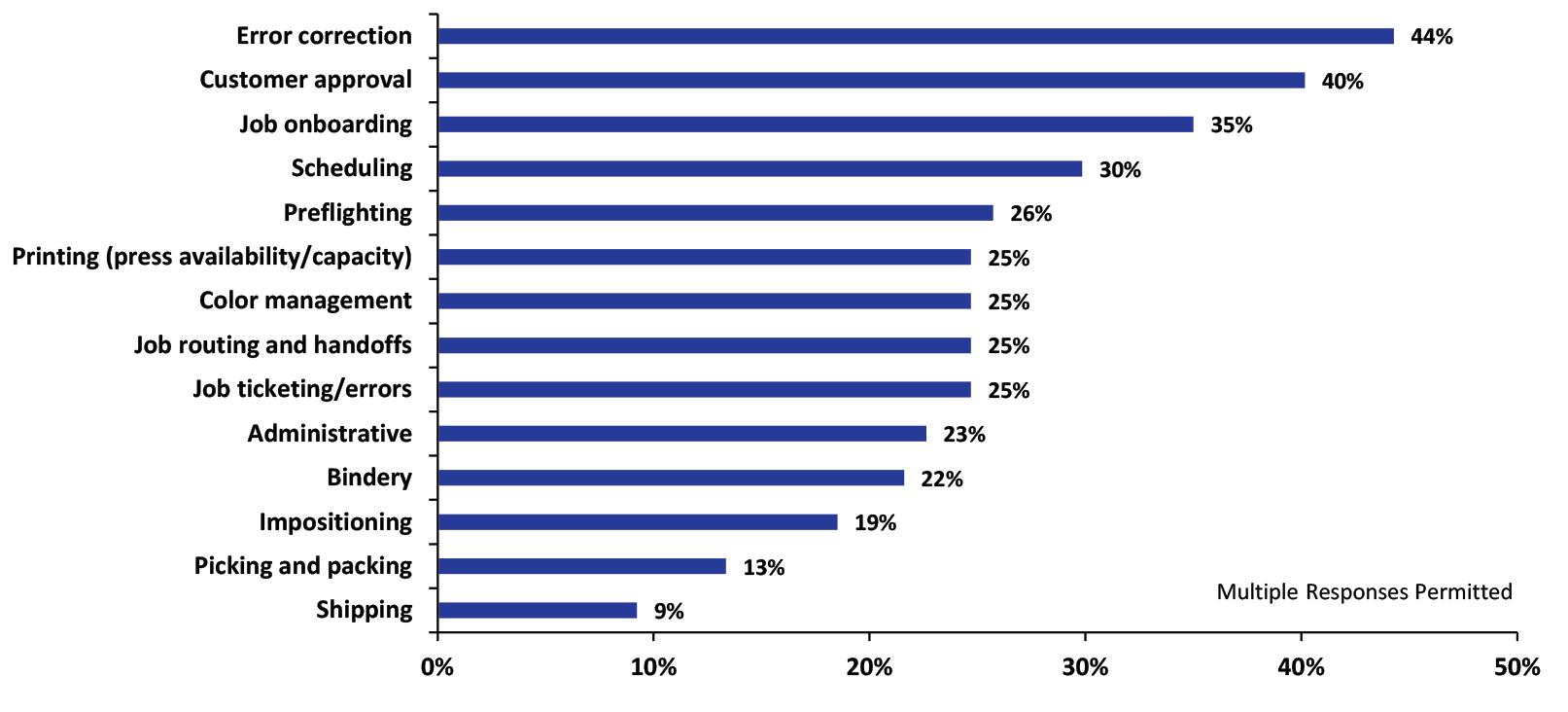
New research from Keypoint Intelligence highlights where work really gets stuck, and the press isn’t the villain. The biggest bottlenecks are error correction, customer approvals, and job onboarding — areas where people, data, and disconnected systems intersect. In comparison, the physical steps of bindery and shipping barely register as obstacles.
Today’s most effective investments are in workflow, automation, and data quality. If you don’t start by addressing front end processes and handoffs, a faster press simply creates jobs that end up waiting longer in the queue. Taking this a step further, the most effective direct mail centers focus on streamlining the processes between systems, because each is a potential source of error or delay.
Modern AI-driven platforms collapse many of those handoffs into orchestrated workflows that can move from customer data through to compliant, optimized postal submission with far less manual intervention than traditional processes. This is critical for production inkjet operations, because the speed advantage of an inkjet press is only realized when the entire process is optimized. A twoday press turnaround paired with a threeday postal preparation simply doesn’t meet today’s market expectations.
Inkjet at Full Speed
As service providers work to eliminate bottlenecks between the press and the post, inkjet technology itself is evolving at a rapid pace. The technology is advancing not just for its speed, but also for its flexibility. Continuous-feed and cutsheet inkjet technologies are advancing rapidly. Speeds, substrate compatibility, and color quality have all made significant gains. Highlights include:
New continuous-feed presses can now produce astounding volumes, supporting hundreds of thousands of duplex impressions per shift.
Newer cut-sheet inkjet platforms are pushing further into traditional offset and high end toner work, delivering better quality, a broader substrate range, and more cost-effective economics.
Ink chemistry upgrades, including recirculating systems and modern water-based polymers, now produce richer, more stable results on a wider range of coated stocks.
Automation and AI are now essential. Built-in predictive maintenance, job tracking, and analytics help shops reduce downtime and maximize every hour on press.
Sustainability has become a core priority. New inkjet lines are reducing energy use, minimizing waste through on-demand printing, and introducing
the cleanest chemistry yet seen in high-speed production.
In short, inkjet technology has reached a new milestone.
We’re also seeing finer control at the imaging level. Thanks to higher native resolutions, smaller drop sizes, and improved temperature control, operators can now push both quality and throughput. Multi-drop firing technology is enabling smoother images without sacrificing speed. This is a big step for high-volume, high-quality environments.
Production inkjet is no longer just competing with offset. In many cases, it’s now surpassing it. For short runs, fast turnarounds, and variable-data jobs, inkjet now leads in both cost and capability. As substrate compatibility expands, the share of “offset-only” jobs will continue to shrink.
Building the Complete System
Today, production success depends on system connectivity. The press is only one component in the journey of getting work out the door.
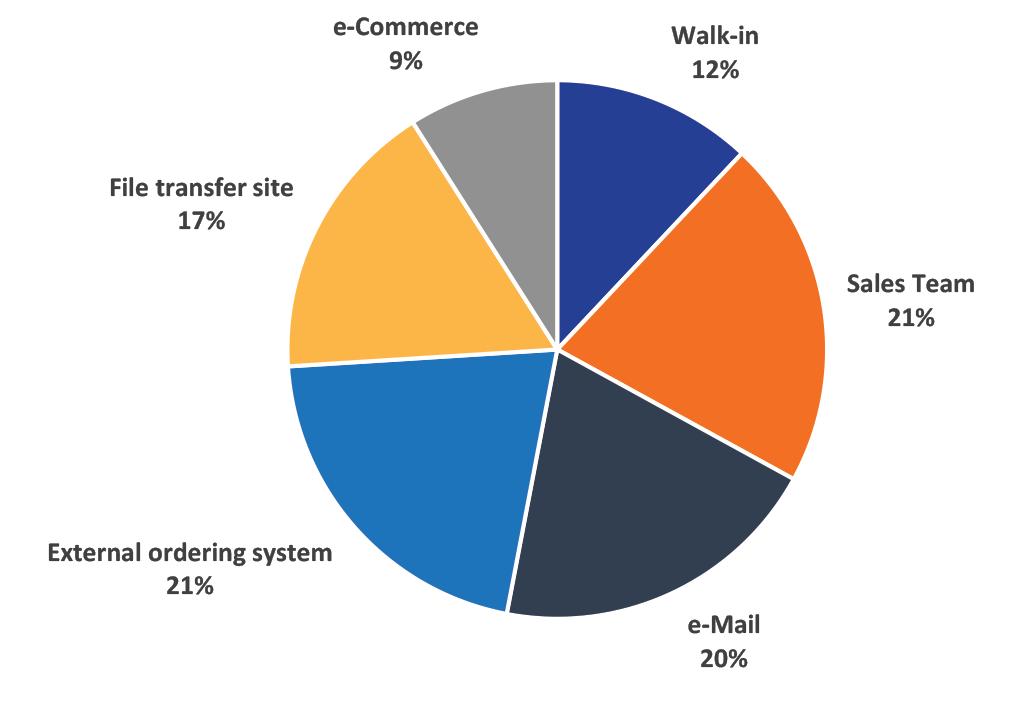
Additional data from Keypoint Intelligence’s 2025 Global Software Investment Outlook paints a clear picture of how jobs are getting to press. More than 50% of today’s print jobs are still transferred manually or via email. The level of system integration now
determines whether your two-day press job truly ships in two days or gets delayed in setup and preparation.
The Bottom Line
For the executives, managers, and operators that are responsible for turning ideas into tangible results, these developments are more than trends, they are practical levers that can be used to strengthen operations.
NPF and events like it offer a unique opportunity to see the tools in action, ask tough questions, and determine which investments will truly move the needle for your organization. As you plan the next phase of your operation, the mandate is clear: Seek solutions that connect your data to your devices, your devices to your postal processes, and your physical mail to your customers’ broader communication journeys.
The shops that embrace this connected, intelligent model will lead the next chapter of print and mail, instead of merely reacting to it.
Karen Kimerer of Keypoint Intelligence has experienced the many challenges of expanding current market opportunities and securing new business. She has developed a systematic approach to these opportunities, addressing the unique requirements of becoming a leader in our changing industry.
SHORT-RUN, ON-DEMAND, AND THE END OF THE WAREHOUSE
BY MIKE PORTER
Print and mail work is changing. Big, repetitive batch runs still exist, but you may notice that clients are interested in small, on-demand jobs driven by data and triggers. A change like this could be a disruptive experience for your print and mail organization if you’re not prepared. Back in my service bureau days, our production workflow focused on how to manage a mix of high-volume jobs. Monthly work for our 40-plus credit union clients, for instance, kept us hopping the first few days of every month. The volume increased dramatically at quarter-end and year-end. Our salespeople hunted for the big jobs we could process and mail month after month because that’s where we made our money.
Frankly, the tiny jobs we had to do were a pain. A lot of work went into tasks like onboarding a new application, moving forms and envelopes around the data center, changing the inserter settings, or logging the work into the production schedule, with not much billable work to show for it.
When you have designed your operation to maximize productivity for jobs
that run for hours at a time (or even days), adapting to an environment featuring lots of smaller jobs from many clients will be challenging. But you have to offer the services that the market desires at a price they will pay for them. The alternative is stubbornly clinging to traditional workflows while the amount of work declines.
Marketing teams want mail that gets delivered to the right person at the right time. This requires a lot of variability that doesn’t lend itself to pre-printed stock. The same trends toward personalization show up in transactional document applications. No one wants to spend their budget dollars on stacks of pre-printed shells and brochures that sit in the warehouse and then get thrown out when they are no longer accurate. At the same time, behavior and lifecycle triggers, like cart abandonment or a policy change, feed steady volumes of one-off or small-batch jobs that must run every day instead of once a quarter.
Changes on the Shop Floor
In the old model, a few large jobs kept printing devices and mail inserters busy,
with limited changeovers and stable setups. All you had to do was swap out the shells and load the inserter with the proper buck slips and window envelopes. You could then start a job and let it run for an entire shift or more. When we were running credit union statements, for example, we’d set up an inserter to fold and process variable-page documents. We’d leave the fold plates or insert feeders untouched for 10 days — even longer during the heavier cycles.
With on-demand work, the plant sees many small runs and mixed volumes from multiple programs and clients. That drives up job changeovers, unless you use white paper workflows, basic standard stocks, and rules-based automation. letting the data and form templates carry the variation. In-plants experience this as they get more “just in time” internal requests; service bureaus feel it as more daily triggered work running alongside traditional large-batch jobs.
Money and Estimating
In the on-demand world, you reduce storage costs and write-offs, but you add complexity to estimates and schedules. You’ll scrap fewer pallets of outdated materials and tie up less cash in inventory, which your clients will like. On the other hand, every quote now has to cover areas like data handling, integrations, trigger logic, and automation, not just page counts. Adding these services to the quotes will make the unit costs look higher. The upside is that triggered and personalized work can carry better margins if you price for performance and results rather than only for volume.
Tools to Make It Work
Digital color presses running white paper give you the flexibility to print short runs and one-off pieces without a warehouse full of shells. Standard window envelopes for all jobs and inserter-mounted outbound envelope printing can allow you to run documents for multiple clients and applications without reconfiguring the inserter. Web-to-print portals or internal storefronts let small orders flow into production with less manual entry, which helps both in-plants and service bureaus.
Workflow automation can connect com position, postal processing, batching, and inserting so operators handle excep tions instead of intervening at every step. Tighter links to client systems, such as CRMs and billing platforms, will feed triggers and keep data current, which is critical when mail content changes based on behavior or regulations.
How Client Work Feels Different
Some client jobs will look less like one‑time projects and more like ongoing programs. Instead of promising “mail dates for 2 mil lion pieces”, you talk about service levels such as “records mailed within 24 hours of trigger” or “daily batches out the door by a set time.” You’ll want to revise your proof ing and approval workflow as well. Clients will review templates, business rules, and content libraries, not just a single sample piece. Data readiness becomes part of
the deal, with clear expectations about address quality, suppression, and who owns the trigger logic.
What to Measure?
Basic counts like “pieces mailed” still matter, but they do not tell the whole story. Operations and clients will pay closer attention to how long it takes to launch a new program and how fast a trigger turns into a mailed piece. Response and revenue per personalized or triggered piece, compared to older static campaigns, help prove that these small, on‑demand jobs pull their weight. When estimating, scheduling, inventory, and reporting align with this approach, smaller and more frequent jobs can replace lost big‑batch volume with a healthier and more flexible business.
Shifting from a comfortable, high volume batch model to short run, trig
gered, and highly personalized work will not feel natural for many print and mail professionals who grew up in the leg acy workflow. I’d include myself in that group. The change touches equipment, people, and long held habits. The pay off is that shops willing to do the work now will keep themselves at the center of their clients’ customer communica tion strategies, instead of watching that work move somewhere else.
Mike Porter at Print/Mail Consultants and PMC Content Services creates content that helps attract and retain customers for companies in the mailing and document industry and he assists companies as they integrate new technology. Learn more about his services at www.pmccontentservices.com. Follow @ PMCmike on X, or send him a connection request on LinkedIn.
START WITH SERVICE
BY LEO RAYMOND
Watching PMG David Steiner testify before the House Subcommittee on Government Operations in mid-March made some impressions, good and bad, and perpetuated concerns over conditions not being addressed.
The hearing was in a large room with the subcommittee leadership sitting on the top row, above many other empty rows, looking at the witnesses some distance below.
The more unusual element was not the layout, however, but the civility between the subcommittee’s leaders and with other members of the panel, and with the witnesses before them. In contrast to former PMG Louis DeJoy, David Steiner was businesslike and courteous, occasionally enjoying a moment of humor with one of the subcommittee members.
What was more concerning was that the content of the PMG’s 23 pages of written testimony, and the basis for some of his answers, reflected a disappointing level of persistent support for his predecessor’s 10-Year Plan — a document that was long on aspiration and short on honest evaluation of its feasibility.
As has been reported before, this further suggests that the echo chamber that is USPS HQ has successfully convinced Steiner that The Plan should be preserved, if not in its tactics, at least in its basic principles, e.g., that regulation of USPS pricing is unnecessary; that the regulator is impeding creative product development; that cost control measures being taken are sufficient; and that the key to financial stability is increased revenue from higher prices.
The attitudes and operational beliefs of Louis DeJoy and his team are evident in what Steiner said, and that isn’t what ratepayers hoped for when he came aboard last year.
Observations
The chances are nil that the management bubble surrounding Steiner allows dissenting views to get much of his attention. Steiner is a smart man — he wouldn’t have reached the heights of his career if he wasn’t — but when he came to the USPS, he was in new territory.
Starting with his conversations with the governors — all supporters of The Plan that they and DeJoy advanced — and later in his initial days at HQ with
the executive leadership team and other senior managers — most of whom were charged with implementing The Plan — it’s unclear how much Steiner ever questioned what he was told, or sought other perspectives. Regardless, his testimony seems to suggest that his inner circle successfully filtered out anything that might cause doubts about what the erstwhile DeJoy team was saying.
Steiner still doesn’t seem to agree that the cost issue isn’t with transportation — DeJoy’s favorite target — but with labor. There are too many people, specifically in operations, not delivery, for the declining volume of mail, and too many of them are career workers to whom the USPS has committed a fixed schedule whether needed or not.
Moving as fast as possible to a lower-cost complement, and one of mostly flexible-schedule workers, should have started years ago. However, as it had done for decades, the agency’s entrenched labor team simply kept up the pattern of wage increases and job security that were adopted in much better times. Steiner was right, however, that his agency, like any business, cannot simply cut its way to survival. It needs to increase revenue. However, as HQ thinking has been for years, simply raising prices is all that needs to be done.
There was little attention paid to the annual public service appropriation to offset the costs caused by the universal service obligation. Just $460,000,000 in 1971, if properly adjusted for inflation, it could be worth about $3.75 billion annually today. Why, since 1982, that money has been left on the table — while the USPS warns of imminent financial disaster — is puzzling. (The accumulated total over 43 years is $19.78 billion!) Regardless, it appeared to not be on Steiner’s radar.
What the PMG did acknowledge during his testimony was that service isn’t where it needs to be. However, unlike in his detailed descriptions of how the regulator has erred and how prices need to be raised, et cetera, he offered no comments about how he plans to make operations more productive — not just “efficient,” which has been a buzzword for cost-cutting — but tangibly, visibly better.
Degradations to true service quality — like chronically relaxed service standards, the insult to customers that is RTO, and the manufactured exceptions to service
performance measurement — never were in the view of the panel members, and never mentioned by the PMG.
Steiner is expecting to break the old rule that doing what you always did won’t get you what you always got. In that regard, the Postal Service — in all of its functions — that was run by DeJoy and company will not change so long as DeJoy’s company, their attitudes, and their beloved Plan remain.
Service
To bring the dots together, and paraphrase James Carville’s slogan in 1992, it’s service, stupid. Now, no one is calling the PMG stupid, only pointing out that financial improvement, driven by new business and increased revenue, must be built around a simple objective: providing genuine service.
David Steiner has said — rightly — that the USPS can do whatever anyone wants, so long as they’ll pay for it. What his agency is doing now is providing poor service yet expecting businesses and other ratepayers to pay whatever prices
As a business executive, Steiner understands value for money, and — unless his court has kept him from seeing reality — he knows that current USPS service isn’t worth the price.
are set. The PRC may regulate prices, but the PMG and his operational executives manage service.
As a business executive, Steiner understands value for money, and —
unless his court has kept him from seeing reality — he knows that current USPS service isn’t worth the price. To fix service, he might start by replacing aspirations with action, buzzwords and performance obfuscation with honest numbers, and evidence that poor performance or self-serving excuses aren’t acceptable at any level.
When ratepayers start experiencing really better service — without the puffery of “precision, “excellence,” and the purpose of Day 0 — they’ll be willing to pay the price for it, and provide the USPS with the income Steiner wants to develop.
Our simple advice — that we know will never reach him — would be to cut costs where they should be cut, get the help that Congress can and should provide, but always, always, start by providing indisputable, authentic, quality service. That’s why the USPS exists.
Leo Raymond is Owner and Managing Director, Mailers Hub. He can be reached at lraymond@mailershub.com.
THE POWER OF THE ENVELOPE: WHY THE FIRST IMPRESSION STILL MATTERS
By Marie Clarke
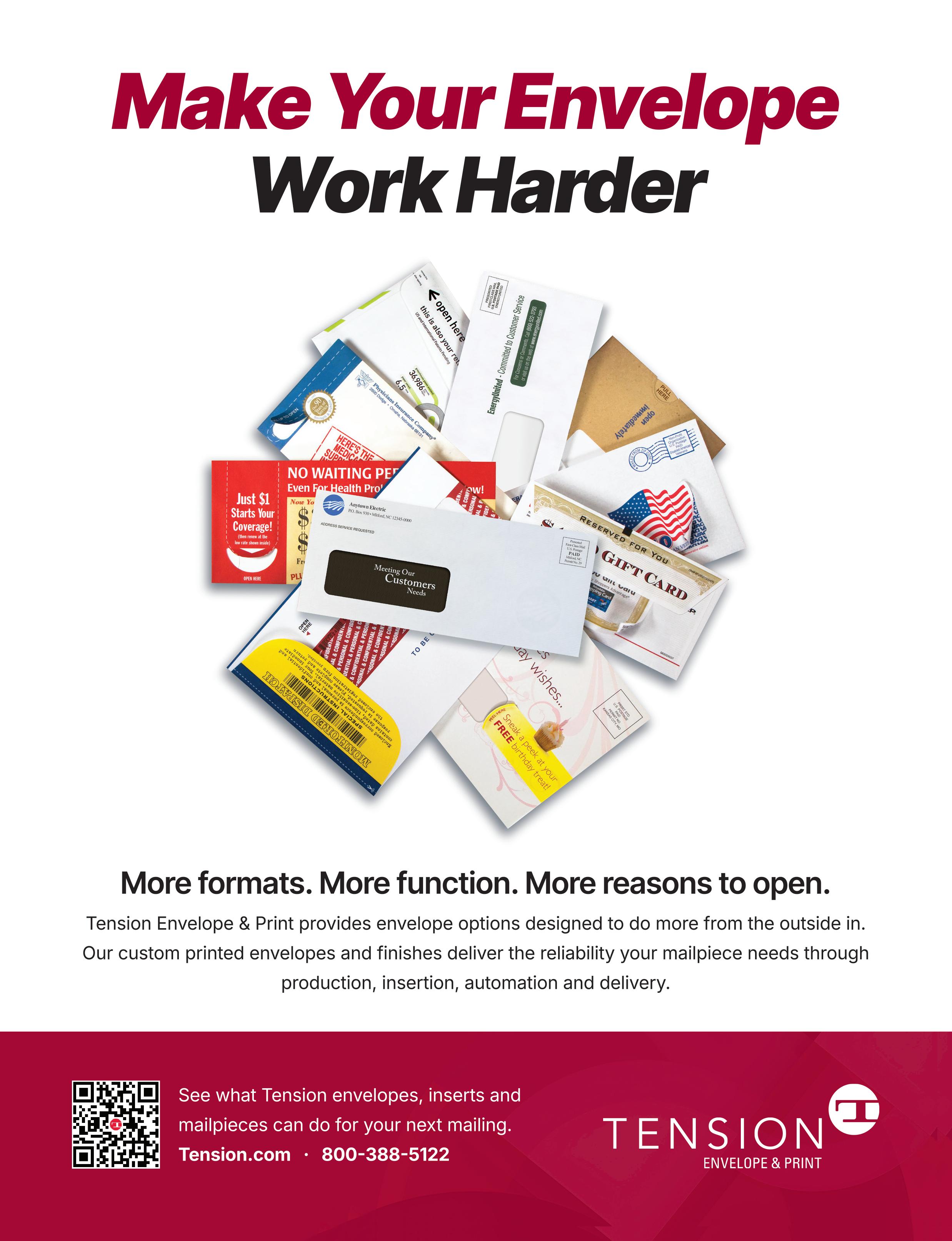
It’s easy to underestimate something as simple as an envelope. This is especially true in a world defined by speed, screens, and constant digital noise. Simplicity is exactly what gives the envelope power!
An envelope is not just packaging. It is the first moment of connection. Before a message is read, before a brand is understood, before a decision is made, the envelope does something digital communication often cannot. It creates a physical, intentional interaction. It asks to be opened. That matters more today, not less.
Consumers are inundated with emails, texts, and notifications that are easy to ignore, delete, or filter out entirely. Physical mail operates differently. It arrives with presence. It is seen, touched, and considered, even if only for a moment. And in that moment, brands and organizations have an opportunity to stand out in a way that digital channels struggle to replicate. This is where the envelope becomes strategic. The envelopes mailers choose
signal importance. Size, texture, weight, color, printing, and design all communicate something before the contents are ever revealed. A well-designed envelope can convey urgency, trust, care, or exclusivity. It can invite curiosity or reinforce credibility. It can turn what might otherwise be overlooked into something that feels worth opening.
“The envelope can be seen as the first handshake your brand offers. Creative choices — from embossing and color to paper quality and size —make it stand out. When we prioritize this intentional first touch, we ensure the mail gets opened and the desired customer outcomes are delivered.”
— Paul Goelzer Jr., President, Goelzer Envelope
That outcome doesn’t happen by accident. Behind every envelope is a process — and people — whose work is often unseen but essential. Envelopes are engineered
for performance, designed for purpose, and manufactured with precision. From paper selection and converting, to printing, finishing, and quality control, each step reflects intention.
This is an industry built on craft, innovation, and reliability. It supports jobs across manufacturing, logistics, forestry, and design. It contributes to a broader mailing ecosystem that reaches millions of businesses and households every day. And it plays a role in a much larger economic engine — one that supports 7.9 million American jobs and drives $1.9 trillion in economic activity.
“We consider the envelope one of the most important considerations, if not the most important, of the mailing. If the envelope does not grab the recipient’s attention, it does not matter what product, service, or offer is inside.”
Steve Bradley, National Sales Director, Kenmore Envelope
At its best, the envelope transforms communication from transactional to meaningful. It creates a sense of anticipation that digital messages rarely achieve. When the content inside aligns with that promise, it strengthens connection, trust, and response. This is especially true for communications that matter — financial documents, healthcare information, personal correspondence, or messages tied to important decisions.
“Emails can be deleted. Texts can be ignored. When your envelope shows up in the mailbox, it makes a statement before a single word is read. Keeping envelopes as part of your multi-channel marketing helps ensure your messages get delivered.”
Karen Loggia, Vice President of Marketing, Tension Corporation
Mail — and the envelopes that carry it — remains one of the most accessible and inclusive communication channels
available. It reaches every address, every household, every business. It does not require broadband access, passwords, or digital literacy. It meets people where they are, ensuring that important information is not just sent, but received. In that way, the envelope does more than deliver a message. It helps ensure connection across communities, generations, and geographies. It plays a quiet but critical role in keeping people informed, included, and engaged.
“Despite the growth of digital communication, envelopes continue to prove their value through trust, security, and measurable marketing performance. Physical mail commands attention in ways digital channels often struggle to achieve.”
Lisa Kline, VP of Sales & Marketing, Double Envelope
The envelope also plays a critical role in security and privacy. Unlike digital chan-
nels, where fraud and data breaches continue to rise, the mail system operates within a well-established framework with clear protections and enforcement. A sealed envelope provides a tangible sense of control and confidentiality that many consumers still value, particularly when sensitive information is involved.
And then there is sustainability — an area where perception often lags behind reality. Envelopes are part of a circular, renewable system. They begin with responsibly managed forests, where trees are continuously grown and replanted. They are manufactured with increasing efficiency, using processes that reduce waste and energy use. And when their job is done, they are widely recyclable — contributing fiber back into the system to become the next paper product. This cycle supports sustainable forest management, strengthens domestic supply chains, and reinforces a model where materials are reused, not discarded. It is a system that is good for the environment, good for the economy, and good for the people who depend on it.
“The envelope remains one of the most powerful and trusted gateways to direct marketing communication. As our industry evolves, the envelope is no longer just a carrier of documents — it is becoming a high-impact direct mail platform that combines data, personalization, web interface, tactile engagement, and brand experience in ways digital channels alone cannot match. The future of the envelope industry will belong to companies that also innovate around the envelope as a measurable, sensory, and highly targeted communications product.”
Andrew Schipke, VP of Sales-US for SupremeX
The envelope may be the first thing someone sees, but it represents something much bigger. It reflects a chain of people, process, and purpose — and a commitment to ensuring that communication reaches, matters, and connects. In a world where attention is fleeting and connection is harder to achieve, that kind of intentional, human connection is not just relevant, it is essential.
Marie Clarke is President, Envelope Manufacturers Association (EMA).
BY NICK LETHERT
MAILING SMARTER WITH THE MAILER SCORECARD
Turning compliance data into operational insight
For many mail preparers and mail owners, the USPS Mailer Scorecard is treated as a compliance checkpoint. It gets reviewed monthly, usually to confirm that error thresholds weren’t exceeded, and no postage adjustments will be triggered. While that’s important, it’s only part of the story.
In practice, the Mailer Scorecard is one of the most underused operational data tools in the mailing ecosystem. Beyond compliance, it offers a structured view into mail quality, process performance, and vendor consistency that can directly impact cost, deliverability, and customer experience.
When it’s used strategically, it stops being a report card and starts becoming a performance management tool.
To fully understand the value of the scorecard, it helps to start with how it works.
The USPS Mailer Scorecard is a monthly reporting system that evaluates mail quality using electronic documentation and Full-Service Intelligent Mail barcode data. It brings together multiple USPS products and metrics into a single view of mailing performance over a calendar month. The result is a consolidated snapshot of how mail is prepared, documented, and inducted into the USPS network.
Key measurement areas include: Full-Service Compliance
This measures how well mailers meet
Intelligent Mail barcode requirements, electronic documentation standards, and submission accuracy. It’s the foundation for automation, visibility, and downstream processing efficiency.
Move Update
The Move Update standard requires mailers to reconcile their mail lists to match Change-of-Address filings with the USPS. This reduces the volume of undeliverable mail and improves delivery accuracy.
eInduction
The electronic induction process evaluates whether shipping containers are properly documented, and that entry data matches the physical mail.
Seamless Acceptance
This measures the accuracy and efficiency of mail induction into USPS facilities. Higher performance reduces manual intervention and speeds up acceptance workflows.
Mail Irregularities
The USPS reports on processing issues relating to physical mail, including items such as poor barcode quality, label issues, and bundle breaks.
Within the Mailer Scorecard, the USPS has established tolerance thresholds for the various quality metrics that are measured. If mail quality errors are made within a calendar month, and the amount of errors exceeds the allowable thresholds, Full-Service and Seamless Mail Preparers may be subject to paying a postage assessment penalty.
Why the scorecard is more than a compliance tool.
The real value shows up in patterns, not just penalties. Focusing only on whether you stayed within threshold limits leaves a lot of insight untapped. The Mailer Scorecard becomes far more valuable when you look at it as a trend dataset rather than a monthly outcome.
Over time, it can highlight operational issues that aren’t obvious in day-to-day production. For example, recurring move update failures often point to gaps in data hygiene processes. Barcode-related issues can signal print production drift or vendor inconsistency. Variability between mailings may indicate process differences across locations or suppliers.
Individually, these may look like minor issues. Together, they often point to systemic inefficiencies. When mailers start using scorecard data this way, the conversation shifts from “did we pass” to “what’s actually driving performance.”
Best Practices for Improving Mailer Scorecard Performance
Getting more value from the Mailer Scorecard doesn’t require new data, but it does require a more consistent approach. To make the most of it and avoid common mistakes, consider utilizing the available scorecard details and implementing the following best practices:
Make training ongoing, not reactive USPS requirements and mailing standards continue to evolve. Keeping teams
and vendor partners aligned helps reduce avoidable errors and improves consistency across all mailings.
Monitor trends throughout the month, not just at month end
Regularly review your Mailer Scorecard metrics to identify trends and areas for improvement. Utilize the drill-down features to research metrics in greater detail. Look into setting up mail quality data feeds from Informed Visibility to automate and better manage Mailer Scorecard reporting. Set performance goals and track your progress over time. Use the insights gained from the scorecard to make data-driven decisions and optimize your mailing strategies.
When it’s used strategically, it stops being a report card and starts becoming a performance management tool.
Strengthen quality control across the full workflow
Implement robust quality control measures at every stage of the mailing process. From address validation to mail piece preparation, ensure that all aspects of your mailing operations meet USPS standards.
Compare vendor performance using consistent metrics
For mail owners working with multiple providers, the scorecard provides a standardized view of quality. It makes it easier to identify inconsistencies and hold vendors to the same performance expectations.
Use available technology to reduce manual variation
Leverage technology to automate and streamline mailing processes. Use advanced mailing software to manage address lists, create eDoc, and track mailings. Automation can significantly reduce the risk of human error and improve overall efficiency.
Stay connected to USPS resources
Take advantage of the resources and support provided by USPS. Attend webinars, participate in training programs, and consult with USPS representatives to stay informed about the latest updates and best practices.
The Bigger Shift: Re-Imagining Mail
USPS is pushing the industry toward datadriven mail strategy. In January 2026, USPS introduced the re-imagining mail initiative, focused on exploring how mail can grow, modernize, and deliver more value to customers and the industry. Key areas under review include product design, pricing models, operational efficiency, and customer experience.
For the mailing industry, this signals a broader shift toward data-driven decision-making. That’s where the Mailer Scorecard becomes even more relevant.
As USPS evaluates new models such as updated pricing structures, new incentives, or operational changes, scorecard data can help ground those decisions in real-world mailing performance.
For marketers and mail service providers, this creates a clear advantage. Organizations that already understand their scorecard trends will be better positioned to adapt as the industry evolves, while also using the same data to improve performance today.
The Mailer Scorecard Isn’t Just a Compliance Tool; It’s a Performance System
At its core, the Mailer Scorecard is more than a monthly requirement. It’s a structured view into how well a mailing operation is performing. Used well, it helps identify inefficiencies, improve vendor accountability, reduce operational waste, and strengthen overall mail quality.
As the industry continues to evolve, the organizations that get the most value from it won’t be the ones simply avoiding penalties. They’ll be the ones using it to make better, faster, and more informed decisions across every stage of the mail process.
The Mailer Scorecard is available on the USPS Business Customer Gateway. If you have questions about using the Mailer Scorecard, reach out to the USPS Business Acceptance Solutions analyst in your area. You can quickly and easily find the contact information for analysts at PostalPro.
Nick Lethert is Postal Affairs Support Manager, IWCO.
BY ADAM LEWENBERG
THE JULY 12, 2026 USPS RATE CHANGE –WHAT YOU NEED TO KNOW
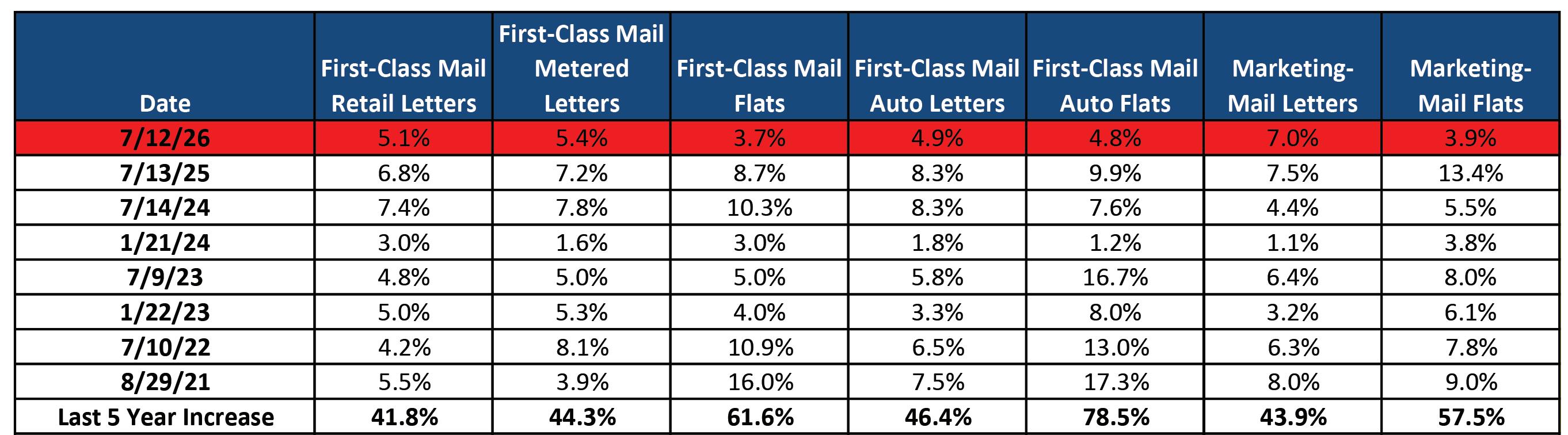
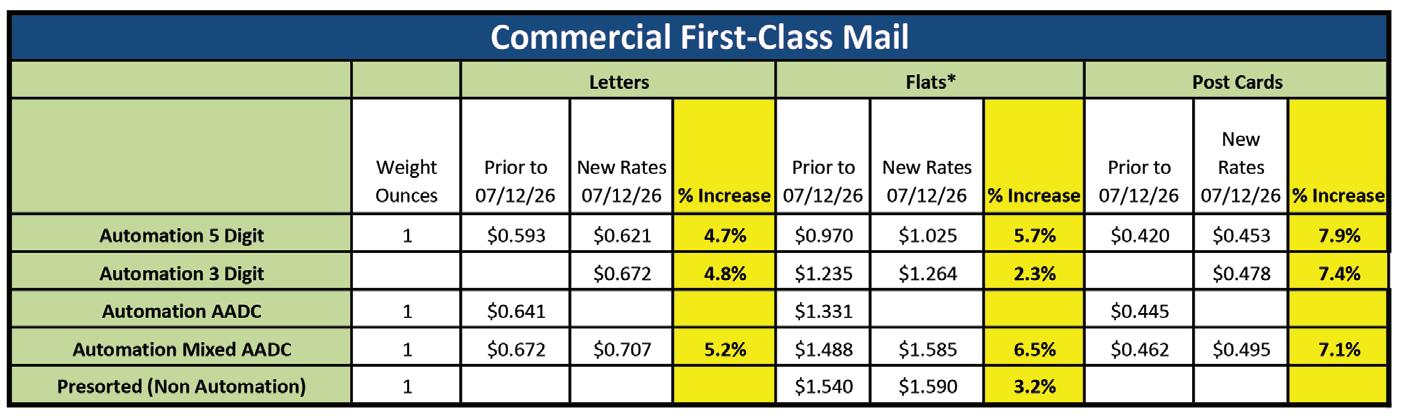
USPS is raising rates on July 12, 2026 for the eighth time in five years, with some of the largest increases in history, and at a significantly higher pace than inflation. Over this five-year period, rates have increased a staggering 42-79%. This is compared to the previous five years, when the rates went up 0-21%.
Postal Advocate has been creating comparison charts that go over the changes in rates to show how it will affect budgets. The reason we do this is to provide a true
comparison versus the overall average percentage increase that the USPS discloses. Based on the type of mail you send, the increase could be higher or lower. Also, when you look at the new rate charts provided by the USPS, they typically will not show the level of detail needed (previous and new rates, side by side) to see these differences.
Hopefully, this will help you budget by seeing the impact of the most common services that you use today. At the bottom
of this article there is a link to an excel tool where you can plug in your mail volumes to see the impact on your organization.
At the time this article was written, these were the rates proposed by the USPS. There are typically minimal changes to the final rates going into effect after they are approved 45 days prior to the actual rate change.
Here is a link (https://postaladvocate.com/ rate-change-tools/) to a simple chart of all the rates below
Figure
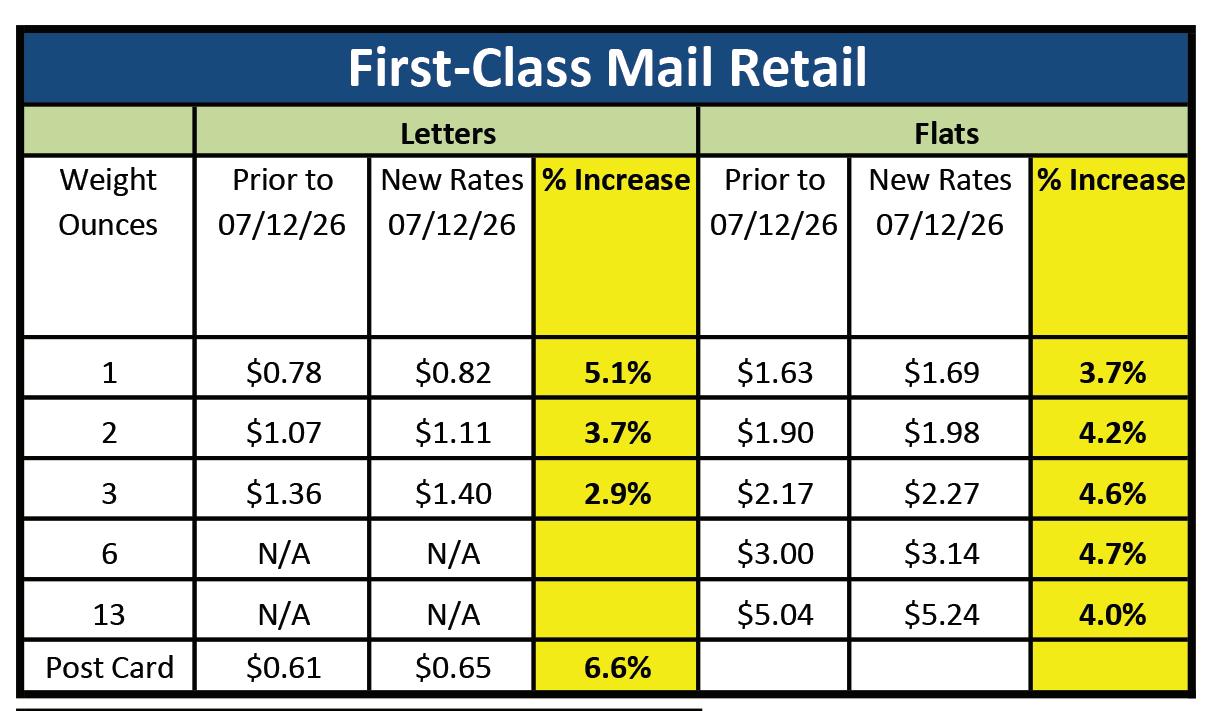
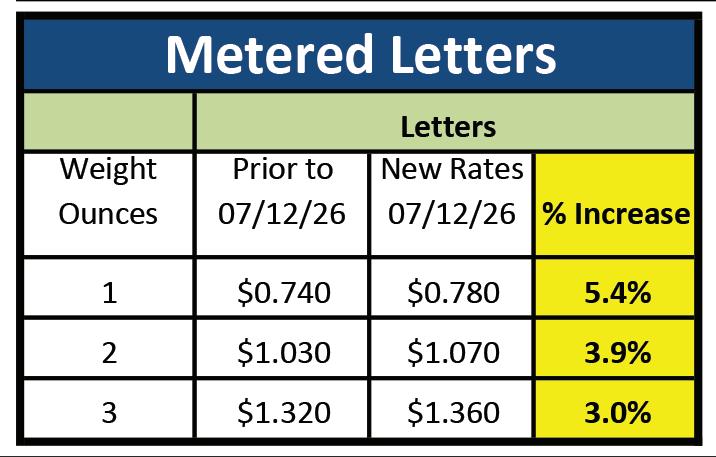
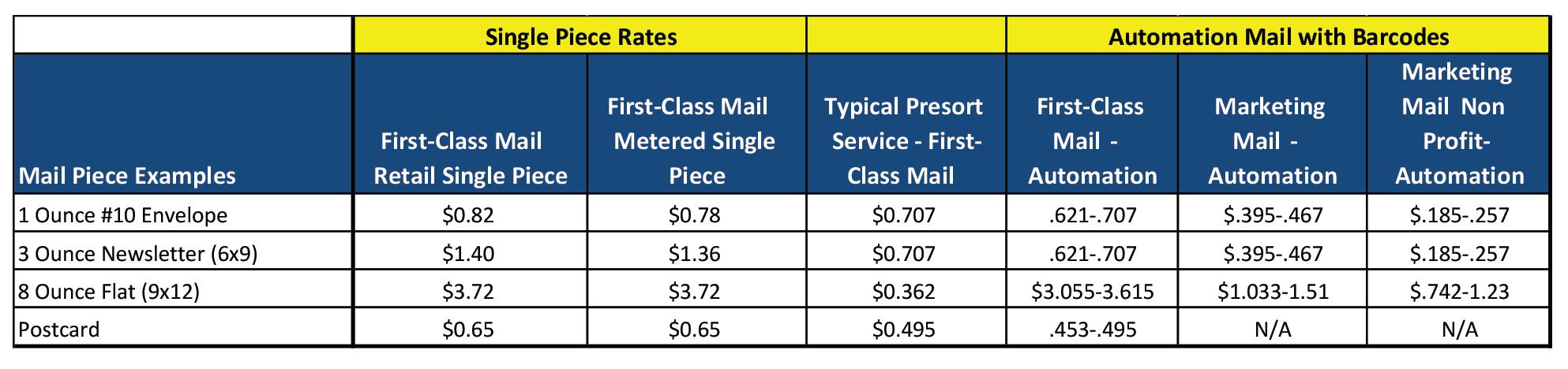
The price of a stamped First-Class Mail Single Piece letter and Metered letter are seeing a $.04 increase to $0.82 and $0.78. (See Figure 2). There is still a $.04 savings for metered mail, making it five percent less than a postage stamp. A single-piece flat is increasing from $1.63 to $1.69. The rate for additional ounces does not change for letters at $.29, but flats see a $0-.02 increase based on the specific weight. The price for postcards rose to the highest levels at seven percent.
Automation letters are going up five percent and Flats by two to seven percent (see Figure 3). There is still the same credit for Seamless Acceptance of $.002 and for Full Service Intelligent Mail at $.005. The Sectional Center Facility (SCF) Pallet Discount went down from $.004 to $.003 for letters but stayed the same for flats at $.002.
With any increase, it becomes more important to look for ways to reduce costs. These are the options available:
Use meters or online postage to save $.04 on letters.
Consider presort services if you run over 500 pieces per day or have onetime mailings over 1,000 pieces.
Automating your mailings in house or through third-party mail services to have drastic postage savings.
Presort and automation levels go up to 3.5 ounces for the same base rate.
Flats and postcards can have the same automation rates as letters.
Consider moving generic content mail from First Class to Marketing Mail.
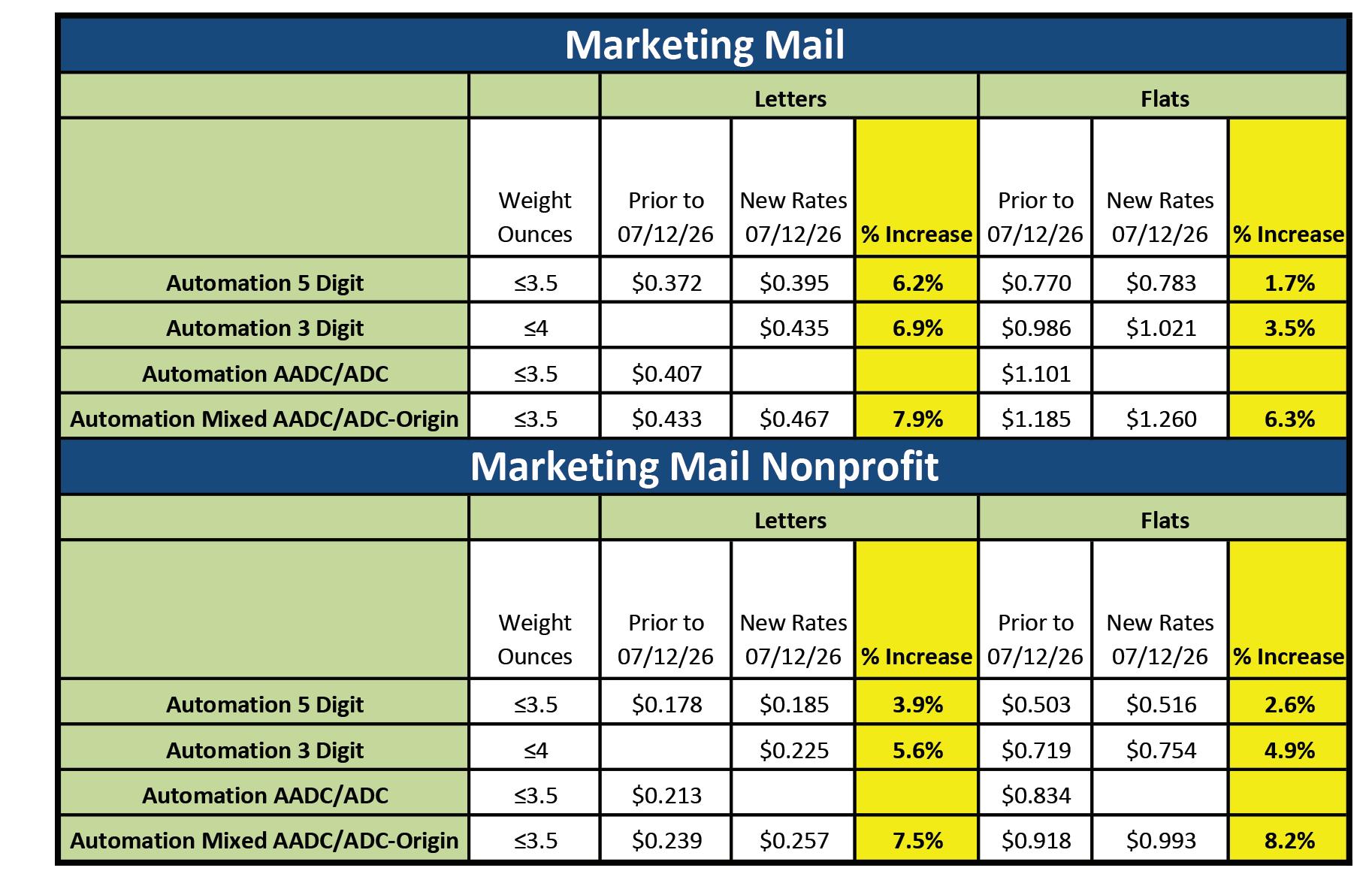
Marketing Mail Letter rates are increasing at approximately six to eight percent while Flats are going up at two to six percent (see Figure 5). Nonprofit is seeing a slightly smaller increase in letters at four to eight percent, but higher with the flats at three to eight percent.
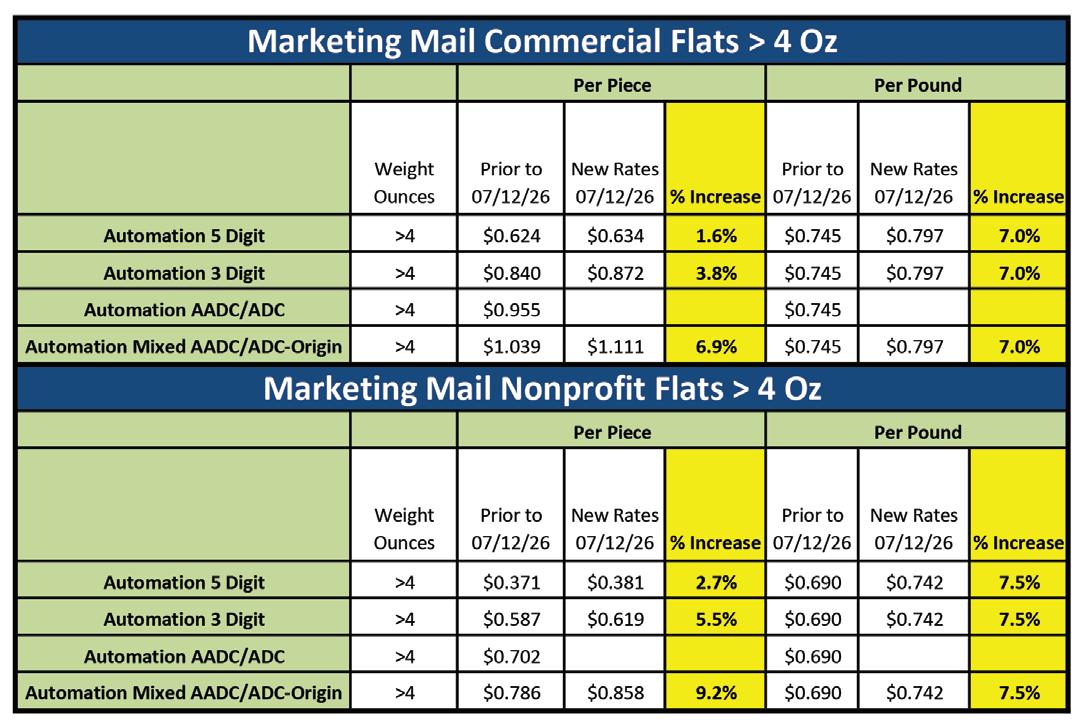
With heavy weight flats over four ounces, there is a per piece and per pound rate needed to calculate the total price. As you can see from Figure 6, the per piece
Figure 2
Figure
Figure
Figure 4
rate is going up two to nine percent and the per pound rate is going up by seven to eight percent. The biggest change is that these flats can now go up to 20 ounces, compared to the current limit of 16 ounces.
The best way to save money on Marketing Mail is to move mail closer to its final location utilizing destination entry level discounts (see Figure 7). This area is seeing the biggest changes. The DSCF (Destination sectional center facility) savings have been increased by eight to 24%. There are still the $.003 SCF (Sectional Center Facility) Pallet, $.005 Full Service Intelligent Mail, and $.002 Seamless Acceptance discounts available.
USPS Competitive Services – 8% Increases
While we are not seeing a rate increase in this segment with the July 12, 2026 rate increase, there is an eight percent temporary fuel surcharge from April 26, 2026 through January 17, 2027. This is a flat increase on Priority Mail, Priority Mail Express, and Ground Advantage.
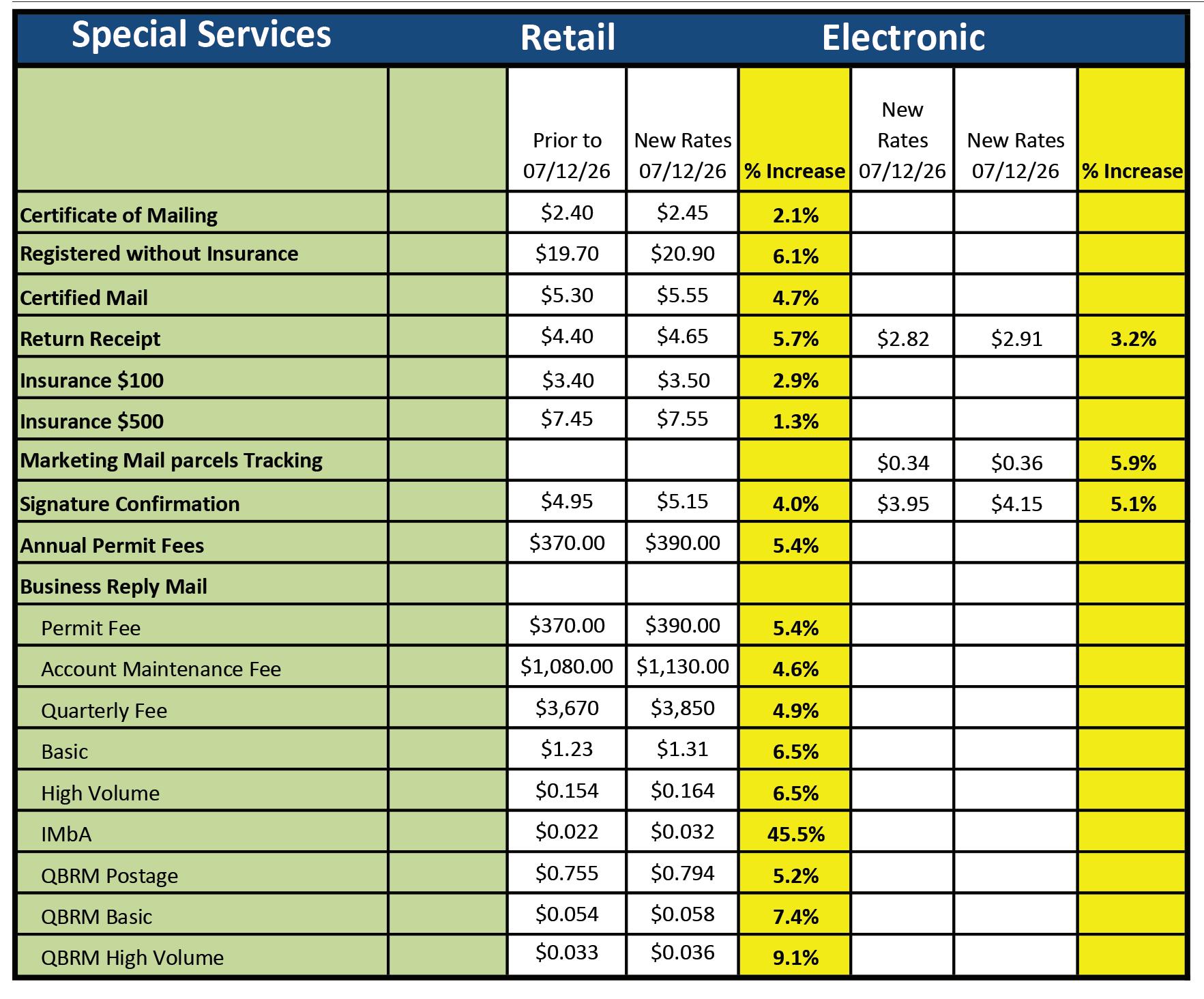
Special Services rates are mostly in line with the five percent overall increase (see Figure 8).
Conclusion
Increases of 42-79% in five years are unheard of and impacting every organization. Mailers are going to need to look for savings strategies to help offset these changes. Our recommendation is to create visibility to all mailings and look for automation and commercial methods where applicable to reduce the cost and streamline production.
To budget for this increase, you need to look at the type of items you are sending, and the weight and zones that are most common, to truly estimate the impact. We have developed a budget calculator that you can download for free (https://postaladvocate.com/ rate-change-tools/) that should help you better plan for this year. Some of the most popular USPS classes are going up at the highest rates but luckily there are ways to help mitigate this through automation and technology.
Adam Lewenberg, CMDSS, MDC, President/CEO of Postal Advocate Inc., runs the largest Mail Audit and Recovery firm in the United States and Canada. They manage the biggest mail software/equipment, postage and mail related services portfolio in the world. Their mission is to help organizations with multi-locations and mail streams reduce expenses, recover lost postage funds, and simplify visibility and oversight. Since 2011, they have helped their clients save an average of 74% and over $112 million on equipment, postage, shipping and outsourced mail service fees. He can be reached at adam.lewenberg@postaladvocate.com.
Figure 8
Figure
Figure 7
CELEBRATING LEADERSHIP AND LEGACY:
Rose Flanagan Honored with the Megan J. Brennan Award of Excellence
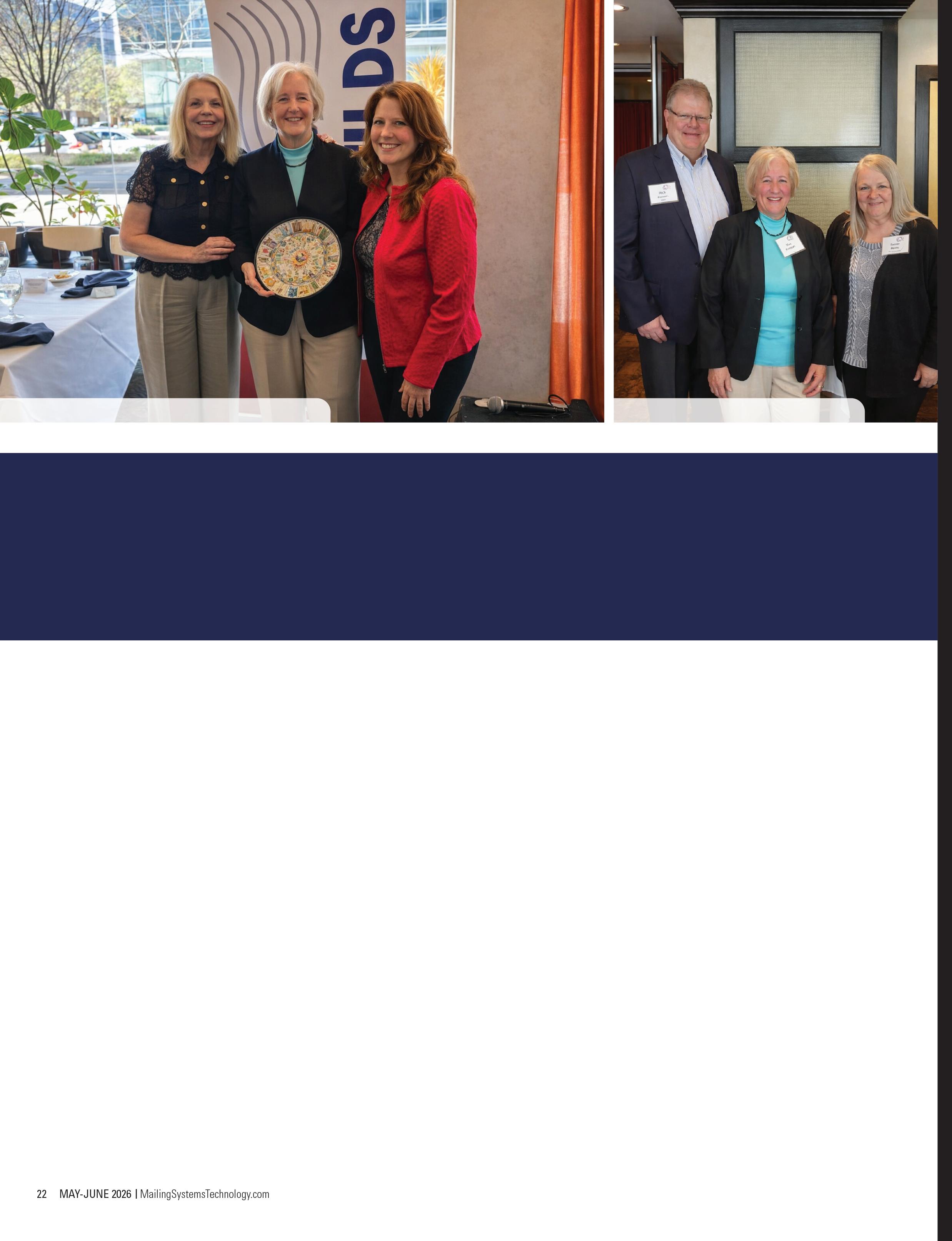
The Women in Logistics and Delivery Services (WILDS) community gathered for an inspiring and well-attended luncheon to celebrate the 2025 recipient of the Megan J. Brennan Award of Excellence, Rose Flanagan. Held at RIS, a James Beard–nominated bistro, the event brought together industry leaders, colleagues, and members of Rose’s family — including her mother — for a meaningful afternoon of recognition and reflection.
The Megan J. Brennan Award of Excellence was established to honor individuals who embody the leadership principles demonstrated by Megan J. Brennan, the 74th Postmaster General and the first — and to date only — woman to hold that role. The award recognizes those who lead with a people-first mindset, collaborate effectively across the industry, and take a holistic approach to solving complex challenges.
Rose Flanagan exemplifies these qualities through her decades of service, leadership, and commitment to advancing the mailing and logistics ecosystem. Her reputation as a trusted advocate, collaborator, and mentor has made a lasting impact across organizations and industry groups alike.
The award was presented by WILDS Chair Shoshana Grove and Vice-Chair Paula Stoskopf, who both reflected on the significance of continuing this important tradition. In her remarks, Rose shared heartfelt reflections on the mentors who shaped her journey, emphasizing the profound influence of her parents. Her comments underscored not only her gratitude, but also the importance of mentorship and support systems in developing strong leaders.
The event was a powerful reminder of the strength of community within the industry. The presence of Rose’s family alongside colleagues and peers highlighted the personal and professional connections that define WILDS and its mission.
The award recognizes those who lead with a people-first mindset, collaborate effectively across the industry, and take a holistic approach to solving complex challenges.
As the organization looks ahead, Paula Stoskopf and Shoshana Grove expressed their enthusiasm for continuing the legacy of the Megan J. Brennan Award in 2026. What began as a recognition of excellence has become a deeply meaningful tradition — one that celebrates leadership, mentorship, and the enduring impact of those who elevate others.
Through events like this, WILDS continues to champion the advancement of women in logistics and delivery services while honoring the individuals who help shape the future of the industry.
Visit www.shedelivers.org for more information.
L-R: Shoshana Grove, Rose Flanagan, and Paula Stoskopf
L-R: Bob Rosser, Flanagan, and Wanda Senne
6 MUST-SEE BOOTHS YOU MIGHT HAVE MISSED
Tired Of DATMAIL Headaches?
If you stopped by Booth 1032 at NPF 2026, you saw why mailers are leaving DATMAIL and Window Book behind. AIMSplus is the modern, browser-based Mail.dat and PostPresort modern platform built for teams who are done waiting on slow desktop software, frustrating support tickets, and licensing surprises. Single install, no version mismatches, no IT bottlenecks; just fast postpresort, transparent pricing, and a US-based team that actually picks up the phone. Pair it with TrackingAnalytics for end-to-end visibility across every mailpiece. Independent and built by commercial mailers, for commercial mailers. Let’s talk. www.assuretyconsulting.com/aims-plus | sales@assuretyconsulting.com | 866.750.4924
BCC Software brought our full bench of postal industry experts to Booth 911 at the National Postal Forum in Phoenix this May. Kate Sanders led the charge on omnichannel strategy and “Priming the Mailbox,” while Adam Koester guided mail prep leaders through the shifts shaping our industry. Shaun Anderson energized the room on people power, and Sean Hoffman sparked rich follow-up dialogue on professional services. Christopher O’Brien connected attendees to our Mailstream Ecosystem partners. From PMG conversations to packed panels, our team showed up ready to move the industry forward. Bccsoftware.com | marketing@bccsoftware.com | 800.337.0442
See What You Missed
Engineering Innovation showcased the future of mail and parcel automation with the unveiling of a new, soon-to-be-released Dimensioner product, live demonstrations of our MiniFigure LightSort Pick-to-Light system, and our Apian Sort kiosk. Attendees also joined our panel session, “Pivot to Parcels: Lessons Learned,” where industry experts shared real-world insights on adapting operations for changing mail and parcel demands. If you missed us at the show, there’s still time to learn more about scalable automation solutions designed to grow with your operation at eii-online.com eii-online.com | sales@eii-online.com | 765.807.0699
Print. Process. Optimize. Deliver.
Missed us at NPF 2026? No worries — but here’s your second chance. Midwest Direct is a family-owned powerhouse with over 42 years of commingle expertise, blasting more than half a billion messages to inboxes and mailboxes every year. Full-service data processing, printing, and commingling all under one roof means maximum postage savings and zero excuses. First Class transactional, marketing, nonprofit — we handle it all, faster and smarter. Stop overpaying for postage and start winning. Connect with Mandy Gebbie Clayton, Executive Vice President, and let’s talk results. We’ll see you in Orlando in 2027! mw-direct.com | mclayton@mw-direct.com
Mail Tracking, Reimagined
If you missed the SnailWorks booth at NPF, you missed the latest innovations in mail tracking, reporting, and USPS visibility tools. From Informed Visibility and PARS reporting to Intelligent Mail barcode analytics and delivery insights, SnailWorks helps mailers gain better control, transparency, and performance from their mail campaigns. Our solutions make it easier to track mail delivery, improve operational efficiency, and turn USPS data into actionable information for smarter decision-making.
At NPF Phoenix, the United Business Mail booth highlighted the future of commingle and logistics. With UBM’s acquisition of Enru Logistics and merger with Mystic Logistics, we’re expanding beyond industry-leading commingle optimization and postage savings to deliver more connected, efficient transportation and logistics solutions from dock to mailbox. www.unitedbusinessmail.com | info@unitedbusinessmail.com | 708.356.5188
BEST PRACTICES for Increasing Your PCC’s Membership
By Rob Hanks
Iam currently the industry vice-chair of the Greater Madison Area Postal Customer Council (GMAPCC), and one item that is discussed at every board meeting is how to increase membership. Postal Customer Councils (PCC) are finding it difficult to keep, much less add, new members to current membership levels. Several reasons contribute to this, including companies downsizing, which requires employees to get more done in less time, budget restrictions, and balancing personal time. Being an active member of a PCC can lead to the need to spend time on activities after work hours.
I am not going to go into Googling printers, mail service providers, paper vendors etc. as all PCCs should already be doing that. You should include any businesses that use mail to correspond with customers such as insurance companies, healthcare providers, local and state government agencies, and universities
and colleges. When recruiting, look for companies that are not currently a part of your PCC. For example, if your PCC needs help with designing marketing pieces, look for a graphic designer who might be able to donate some time.
I have a few best practices that have been developed by the Postal Customer Council Advisory Committee (PCCAC) membership committee that works well for us in Madison. The PCCAC has a Membership Best Practices document, which you can scan the QR code in this article to access. This in-depth document is updated quarterly with current information, so be sure to check it out often.
The first best practice, and one of the most useful, is to have an elevator speech. As I speak to people at events and they ask me about my position as a Senior Postal Affairs Specialist, I have the opportunity to discuss PCCs. I have an elevator speech where I will explain the benefits of joining your local PCC. I discuss educational opportunities and the networking opportunities with both industry and postal professionals. I show them PCCVoice on LinkedIn as a straightforward way to network with people all over the country. Highlight the strengths of your PCC. Is it educational events that you host, or perhaps plant tours or facility tours of industry members? Do not forget to talk about national webinars from the PCCAC Educational and the Strategic Innovation subcommittees, National PCC week, and the National Postal Forum.
Marketing collateral is another best practice we use in Madison. We have a tri-fold Membership Application that we update yearly with important calendar dates for our Industry Insight educational sessions and other events, including our annual meeting and golf outing. We update the pictures of our previous years’ events to keep things fresh. The national PCC statement completes the first side. The inside of the brochure contains our sponsorship levels and the benefits that come with each
level, a history of our PCC of the Year awards, and a membership application that can be sent in. These go out with our membership drive, and we have these at the BMEU desk, and the USPS sales representatives have them to hand out when meeting customers. The board members also have copies to hand out. The other marketing item that you should have is a PCC business card. This can be a generic card with your PCC’s information and an area where you can write information like contact names, phone numbers, and a place to write on a date for a future event you would like to invite a prospective member to attend. Templates can be found on Postal Pro under the Industry Forum tab and select the PCC Templates link, Postal Customer Council® (PCC) | PostalPro.
Scan here for the membership best practices document.
list and mail to those who remain. We have had mixed results but being a member of the chamber then gives you access to all the chamber events and that can lead to new members (have your elevator speech ready).
Track the attendees at your events and add those people to your prospect list. Assign a board member to reach out to the attendee and introduce themselves. Have the board members greet the attendee if your event is an in-person event and again, have the elevator speech ready to go. This will make the attendees feel at ease and give you the opportunity to sell them on joining your PCC.
Dedicated events are another terrific way to introduce your PCC to others. Check out stamp dedications, small business expo events, “Grow Your Business Day” events, and Chamber of Commerce events. Besides setting up a small table with your collateral materials, request a pull up banner for your PCC Headquarters Liaison to draw prospects to your table. These can be shipped to you and there is no cost to the PCC.
Looking for new members can be a daunting task. At our January board meeting, we ask board members to bring five new prospects that we can contact. This works well for us as we start our membership year on March 1st. We also have used LexisNexis to supplement our mailing list. We found that some of the information was outdated, so you need to check the results. The PCCAC Membership Best Practice Guide I mentioned earlier has a full section on using LexisNexis. In Madison, we also joined the Greater Madison Chamber of Commerce and then purchased their membership list. We remove current members from the chamber
Try these best practices to increase your success when looking for new members to join your PCC.
Rob Hanks is the Senior Postal Affairs Specialist at Suttle-Straus and has more than 32 years of experience in direct mail. Rob is a Certified Direct Mail Professional and a Certified Mail Piece Design Professional though the United States Postal Service (USPS) and serves as an Executive Board Member for the Greater Madison Area Postal Customer Council (GMAPCC), and he is a mentor with Leaders Connect. Rob enjoys the challenges of mail piece design within postal regulations and helping clients save on postage costs.
HUMAN TALENT PLUS ARTIFICIAL INTELLIGENCE: A WINNING COMBINATION
By Mark Fallon
“No
passion so effectually robs the mind of all its powers of acting and reasoning as fear.” - Edmund Burke
Depending on how you get news, there has been little positive press about artificial intelligence (AI) and employment. The headlines blare about the jobs that AI will eliminate, the workers that will be displaced, and careers that will become obsolete. My in-box includes emails from managers concerned that AI will reduce their opportunities for advancement.
There is some truth in these statements. Jobs that are built around structured, repetitive work will probably be replaced by an AI tool. Generally, that may include data entry clerks, administrative assistants, call center agents, and junior coders. In the world of print and mail, AI and robotics will displace dispatchers, expediters, inventory workers, and quality control specialists.
For many people, AI is an opportunity to improve performance. Through education
and training, we can begin to understand the potential of AI tools. Then we can add our human talents and insights to AI output to create transformative results.
Education is how we acquire knowledge about a specific topic. In many discussions, “AI” is used as a catchall phrase for tasks being conducted with artificial intelligence. We hear people say “we’re using AI at our company”, without context or explanation. When pushed, the person will explain that they are using ChatGPT or Claude or Copilot. And that’s as far as it goes.
To begin our education, look for articles that explain the history of AI, the terminology, and the different categories. You can even use AI to build you a course. For example, you can submit the following prompt:
Explain the differences between the following 5 categories of AI. Include how each is used in a production environment.
Generative AI
Machine Learning (ML)
Natural Language Processing (NLP)
Computer Vision
Another resource for education are the courses on LinkedIn Learning. Depending on your subscription, the courses are low cost to no cost. There are general courses on defining AI as well as specific courses on topics like governance, or using AI in sales.
Once we become familiar with the tools available, it’s smart to take training on how to use the tools. For example. effectively conducting research using AI means thinking differently about internet searches. This includes thinking about your AI tool as a research assistant and not just a search engine.
Google and Microsoft have built in AI tools for their spreadsheet software. However, using AI to scrutinize data means understanding the structure of the data, what type of analysis is desired, and the format for the results. Knowing the difference between correlation and regression comparisons will prevent confusing results.
Robotic Process Automation (RPA)
Because each AI company has differences, it’s best to get specific application training. Each firm — Anthropic, Google, Microsoft, and OpenAI — offer free training on the basics of their AI products. If you need more job-specific information, there are third parties in almost every industry with training offerings. With education and training completed, we are ready to unleash the power of AI — fueled by human insights. Databases and spreadsheets provide value when there is actionable information gained through structured analysis. Print and mail operations create data — a lot of data. Some data points in the jobs processed include:
Basic information – customer (internal or external) contact, date received, requested delivery date, date completed, number of pieces, and component inventory.
Address information – CASS updates and errors, NCOALink returns, exception processing, and ACS data.
Equipment metrics – mail run data files, pieces processed, operating time, repair time, substrates, and configuration.
Mail metrics – number of envelopes, postage applied, presort qualification rates, date delivered to the USPS, Mail.dat file, address information, return mail volumes, and Informed Visibility feeds.
Campaign performance – payments received, website visits, orders placed, customer service call volumes, and Informed Delivery clicks.
A human needs to bring together the right team to determine what insights all this data can provide — and how to access the data. Each of these categories reside in different systems with different owners. Customer service can share about inquiries on production or in-home dates for mailings. Production may need additional lead time to configure equipment and assign staff. Marketing will be more interested in attribution and customer interactions.
While the AI tools are powerful, any decisions impacting a customer relationship or a person’s employment must be made by a human.
Working together, the team can develop the right prompts for the AI tool. Start with providing AI agent an explanation of the data, including the common data points (e.g., customer number or work order) from the different sources. Then draft the queries that will provide the needed insights. Unique prompts could include:
Create a graph that displays orders by day of the week received, day entered into the USPS, and number of days to deliver.
Create a chart that compares customer service calls to equipment used to process work.
Detect correlation between address quality and customer orders placed.
The data has now become actionable information. Bringing the disparate measurements from different systems provides a holistic view of the operation. Reviewing these analyses, the team can make informed decisions on queueing jobs, staffing hours, and software applications.
While the AI tools are powerful, any decisions impacting a customer relationship or a person’s employment must be made by a human. You may have entered in a lot of data about a customer, but did it include the fact that they stuck with your company during a difficult time? Or an operator’s statistics may not be the best in the shop, but did the AI bot understand that employee provides an emotional uplift to the rest of the team when the pressure is on?
An unappreciated aspect of AI tools is bias. Multiple forms of bias are built into any AI engine, from the programmers that wrote the original code to the data used to train a large language model (LLM). And then there is the unappreciated sycophantic aspects of the commercial models.
The commercial AI platforms want you to feel good about using their specific tool. You may notice that a response includes phrases like, “That’s a good idea”, or “That’s a good question.” The more you use a specific AI platform, the more it conforms to reinforcing the ideas it thinks you want to hear.
This is where your human team surpasses any computer program. People will point out flaws and offer ways to improve an idea. People will work through disagreements to find the best solutions that address a problem holistically. People will understand values.
Artificial intelligence represents one of the largest leaps in providing massive computing power to everyone. When that power is used by a group of talented humans, the results will surpass all expectations.
Mark Fallon is President & CEO of The Berkshire Company.
2026 WRAP-UP
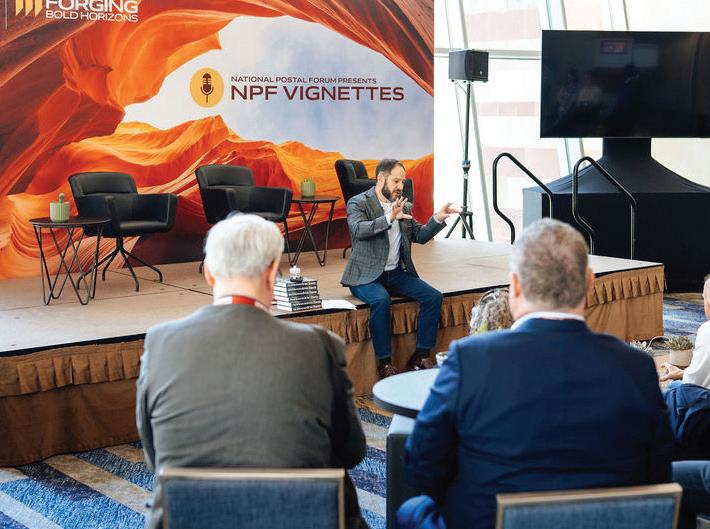
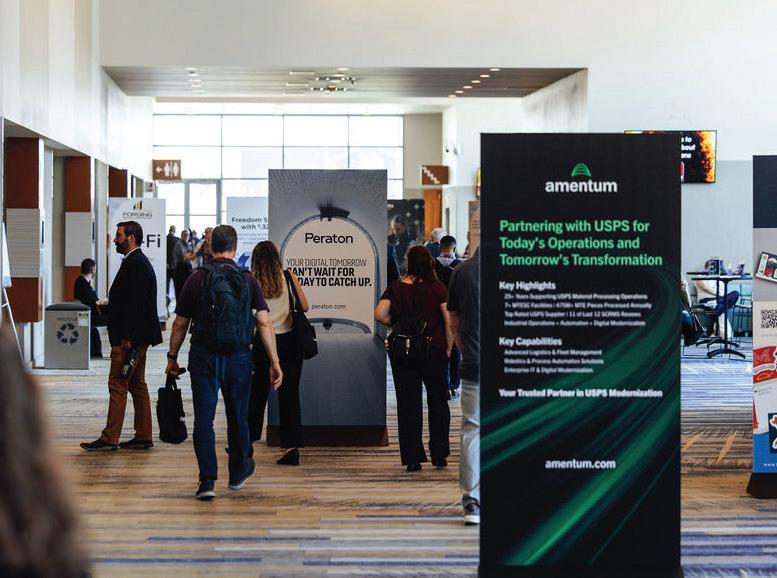
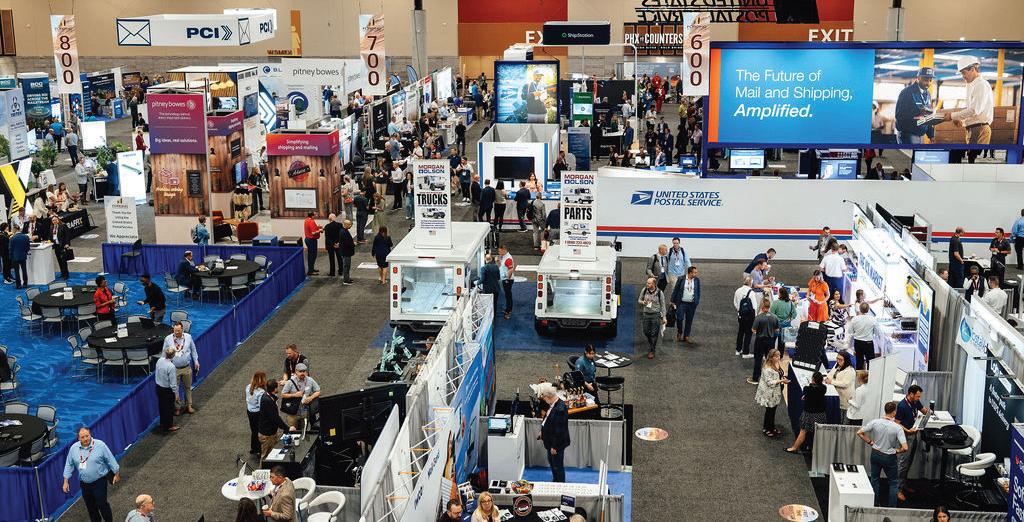
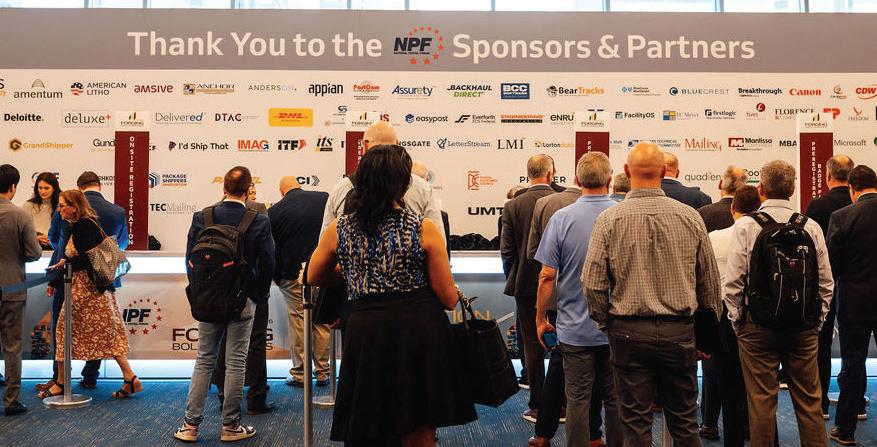
This year’s NPF in Phoenix was phenomenal. I feel like I say this every year, but I am truly blown away by the quality of sessions, speakers, and events at this conference. From direct mail best practices to the latest USPS updates, mailers are able to experience some of the best the industry has to offer. Over 2,700 attendees, 1300+ exhibitor personnel, and close to 1,000 USPS staff converged on Phoenix for four days of non-stop learning and networking.
As someone who has attended NPF for over a decade now, I was especially looking forward to hearing the new PMG, David Steiner, speak, since I was curious how he would differ from his predecessor. I was gratified to hear that this year’s opening keynote presentation was much more optimistic than many of the PMG speeches in recent years.
Steiner focused on how the mailing industry and the Postal Service need to work together to ensure the organization’s success. Steiner emphasized the close link between Postal Service performance and customer success by framing it as Your United States Postal Service. “Our legacy is your legacy. Our performance drives your success. Our network supports your business. When the Postal Service improves, your business improves,” he said.
Steiner went on to highlight the role the Postal Service plays in the economy, pointing to the $1.9 trillion mailing and shipping industry, which supports 7.9 million jobs. “The Postal Service is not just a public institution with a proud history,” Steiner said. “It is also an economic platform — one that has enabled American
By Amanda Armendariz
commerce for generations, and one that still matters deeply to our country’s future.”
A press release sent out by the Postal Service after the event summarized several other plans for the future, as discussed by various USPS leaders. These initiatives include:
Establishing exceptional service performance as the new normal;
Modernizing the postal network through major investments in processing, logistics, and transportation capabilities;
Expanding digital and AI-enabled tools, including predictive arrival times, route optimization, fraud detection, contact center improvements, Smart Lockers, self-service kiosks, Informed Delivery, and the USPS API Marketplace;
Strengthening mail and shipping offerings to better support the customer journey in an increasingly digital and AI-shaped marketplace; and
Building more transparent, market-responsive ways of working with customers and partners to better align its network to their business needs.
I also appreciated Steiner’s candidness during the town hall Q&A on Wednesday. He was refreshingly open about what he was still learning with respect to the USPS; he didn’t try to hide his inexperience with buzzwords. He was also clear that he believes strongly in the USPS’s mission, but admitted that there is a lot of restructuring that needs to be done in order to ensure its viability. “Either
pricing must go up, or volume must,” he said, acknowledging that most mailers wouldn’t be happy with that dichotomy. He also shared his vision for improved service and noted that he wanted to change the culture of the organization so that accountability is prioritized and those who excel at their positions are rewarded. Perhaps most importantly, he answered the questions about the USPS’s dire financial straits, which were likely on everyone’s minds. He was upfront that the USPS as it currently stands is a broken business model. In his view, the previous PMGs didn’t fail; they were put in a position where success was impossible. “We need Congress to understand that we want to be better, but we need money to be better.” The underinvestment in the USPS for so many years is a detriment that the organization will surely struggle to overcome. But overall, he was optimistic. “The USPS has never been a business. It’s about connection and a growing economy.” Surely, the sooner Congress realizes that, the better.
A Connected Learning Environment
The sessions offered at this year’s show are exactly what mailers need in their quest to help the Postal Service not only survive, but thrive, in this new environment. I was thrilled to be able to moderate a panel in which we discussed how physical and digital mail come together to achieve the best results (especially fitting considering Chris Lien, NPF chairman, talked about the “phygital” transformation of mail in his introduction on Monday). The panelists (Paul Bobnak, Payton Nolan, and Mike Porter) gave insightful answers to questions about the best ways to create an omnichannel strategy in which your physical and digital mail can combine to create a piece that truly speaks to the customer. In this increasingly digital age that is seeing mail volumes continuing to decline, the more bang for their buck that mailers can get, the more they’re likely to use physical mail in the future. And, one upside of the lower volume in the mailbox means that a mail piece is sure to get noticed; a win for everybody.
Overall, I thought this was one of the best NPFs I’ve attended. I’m looking forward to seeing what next year holds in Orlando, May 16-19. I hope to see many of you there!
THE ENVELOPE: THE SECRET TO BETTER MAIL
Kenmore Envelope proudly serves the direct mail market with the latest technology and the highest quality envelopes. We are a full-service production facility and an industry leader producing approximately one billion envelopes annually for the non-profit and commercial direct mail markets across the US. Our very responsive sales and account management teams, our high-quality envelopes, and our rapid production cycles are designed to help you succeed. Our envelopes range from simple one-color to full color with foil; papers from 24#ww to 9pt; and single to multiple windows. We are ready to help you with your next envelope project.
kenmore-envelope.com
Experience the Double Envelope Difference. Double Envelope is designed to deliver. From statements to time-sensitive mail, every envelope is handled with dependable, on-time execution and no surprises. In a market where stakes are high, timelines are tight, and mistakes are expensive, we offer the precision and uncompromising quality your operation requires. The right partner should make your job easier. By taking the time to understand your operation and your goals, Double Envelope delivers high-quality envelopes made with consistency and careful attention to detail every time.
double-envelope.com | 540.362.3311
Goelzer Envelope is your high-quality envelope partner, excelling at everything from custom, sheet-fed short-run projects to multi-million web orders. For mail production decision-makers, choosing Goelzer means prioritizing efficiency and reliability. Our patented Inserta-Fast design is a proven game-changer for high-speed inserters, minimizing downtime and significantly lowering your cost-per-piece. We are expanding capacity while maintaining superior quality, responsiveness, and service. For brand consistency, we treat the envelope as a blank canvas, offering complete customization, G7 color matching, and premium materials from the best domestic mills. Choose Goelzer for guaranteed performance, a stable supply chain, and flawless creative execution.
Committed to the Envelope and More SupremeX is a leading North American manufacturer of envelopes, packaging, and specialty paper-based communication solutions. Here’s a quick look at SupremeX as an enterprise: Top 3 envelope manufacturer in North America, 3,000 customers served, 14 manufacturing facilities, 2 distribution centers, and 3 envelope converting plants currently in the US, 900 employees across North America, and the only publicly traded envelope company (TSX: SXP. TO). With a strong foundation in envelopes/mailers and an expanding presence in packaging, SupremeX continues to invest in capabilities and strategic growth — including multiple US acquisitions that reinforce our long-term commitment to the American market. Our new machine-insertable paperboard mailer is another SupremeX first for the industry. Whether your business requires high-volume envelope programs, paper-based packaging, or custom print solutions, SupremeX brings the scale, reliability, and manufacturing strength. www.SupremeX.com | Sales@SupremeX.com
Tension Envelope & Print delivers envelope and print solutions that help organizations communicate with confidence. Backed by nationwide production, sustainable practices, and decades of expertise, we combine precision manufacturing and operational excellence to ensure consistent quality across every printed piece. www.tension.com