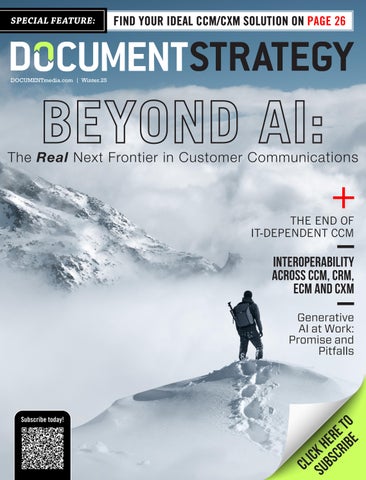
SPECIAL FEATURE:
FIND YOUR IDEAL CCM/CXM SOLUTION ON PAGE 26
DOCUMENTmedia.com | Winter.25
BEYOND AI:
The Real Next Frontier in Customer Communica tions
THE END OF IT-DEPENDENT CCM
INTEROPERABILITY ACROSS CCM, CRM, ECM AND CXM Generative AI at Work: Promise and Pitfalls
Subscribe today!
O T E E R E IB H R K C C I CL SUBS
TABLE OF CONTENTS volume 32 issue 4 | Winter.25 | DOCUMENTmedia.com
FEATURES 10
Automated Document Understanding: The Real Vector for Enterprise AI Intelligent content automation expert Dr. John Bates reflects on new analysis on the explosion in use of the AI-enriched successor to OCR
10
By Dr. John Bates
12
Beyond AI: The Real Next Frontier in Customer Communications
Where is the future headed?
By Mia Papanicolaou & Elizabeth Stephen
14
12
The End of IT-Dependent CCM Until that burden is lifted, business teams will continue to see their time and budgets stretched thin By Patrick Kehoe
16
Interoperability Across CCM, CRM, ECM and CXM The new mandate for customer experience By Bryan Matlock, Sr.
18
Generating AI at Work: Promises and Pitfalls The future will belong to organizations that treat AI as a partner, not a replacement By Eric Riz
22
The Protocol That Changes Everything
16
MCP and the new rules of engagement By Alan Burger
24
Start Small, Dream Big Embracing AI in CCM at your own pace By Gum Fa Ng
DEPARTMENTS 06
Publisher’s Note
28
Think About It
07
Online Exclusives
30
Advisory Board
08
What the Analysts Say
SPONSORED CONTENT 26
4
Finding Your Ideal CCM/CXM Solution
winter.2025 DOCUMENTmedia.com
22 24
www.azuba.com
PUBLISHER’S NOTE:
Navigating the Shift: What’s Next for DOCUMENT STRATEGY By Ken Waddell As we rapidly approach 2026, DOCUMENT STRATEGY is entering a new era — one shaped not only by shifting technology, but by the evolving realities of the professionals who rely on us. Over the past several years, the boundaries that once separated customer communications, content management, compliance oversight and information design have blurred. What used to operate as separate disciplines has steadily merged into a tightly connected landscape influenced by rapid innovation, heightened regulation and rising expectations from both customers and internal stakeholders. And while this industry is more interconnected than ever, the people working within it do not share a single, universal perspective. A banking compliance executive, a healthcare CX strategist, and a manufacturing IT leader each navigate entirely different daily pressures. Their priorities, however, intersect around a common need: information that recognizes the nuances of their role. To meet that need, DOCUMENT STRATEGY will be rolling out more of a rolebased navigation to help readers access content aligned with their responsibilities, challenges and strategic goals. This shift is part of a broader transformation in how we approach coverage. Today’s environment demands practical, grounded insight — not abstract theory. In this issue alone, you’ll see how this direction is taking shape. Dr. John Bates explores Automated Document Understanding, the next leap beyond OCR and one of the most significant vectors for enterprise AI 6
winter.2025 DOCUMENTmedia.com
adoption. Mia Papanicolaou and Elizabeth Stephen examine what lies Beyond AI in customer communications, helping organizations anticipate the next horizon. Patrick Kehoe challenges the long-standing constraints of IT-dependent CCM and what it will take for business teams to finally move with speed. We’re also spotlighting the growing priority of system interoperability in Bryan Matlock’s analysis of CCM, CRM, ECM and CXM — a topic that sits at the heart of modern customer experience. Eric Riz offers a grounded look at generative AI in the workplace, reminding us that organizations will succeed only when they view AI as a partner rather than a shortcut. And Alan Burger introduces the transformative potential of MCP — the protocol that could redefine how tools, teams, and technologies interact. Our goal in the coming year is to deepen this kind of coverage: more applied AI, more real-world business cases, more transparency around funding models, and more conversations that connect strategic ambition with measurable outcomes. But the most important element of this evolution is you. DOCUMENT STRATEGY has always been shaped by its community of practitioners, innovators and experts who contribute their insights. As we open this next chapter, I invite you to help steer the dialogue — whether by sharing ideas, submitting content, or recommending issues we should be tackling. Contributor information is available at www.documentmedia. com, or you can reach Managing Editor Erin Eagan directly at erin@rbpub.com. This is more than a redesign. It’s a renewed commitment to delivering clarity, relevance and a trusted community in a rapidly changing digital world. We’re excited for what’s ahead — and even more excited to experience it with you.
president Chad Griepentrog publisher Ken Waddell managing editor Erin Eagan [ erin@rbpub.com ] contributing editor Amanda Armendariz contributors Dr. John Bates Alan Burger Patrick Kehoe Bryan Matlock Gum Fa Ng Mia Papanicolaou Eric Riz Elizabeth Stephen advertising Ken Waddell [ ken.w@rbpub.com ] 608.235.2212 audience development manager Rachel Chapman [ rachel@rbpub.com ] creative director Kelli Cooke
PO BOX 259098 Madison WI 53725-9098 p: 608-241-8777 f: 608-241-8666 email: customerservice@rbpub.com DOCUMENT Strategy Media (ISSN 1081-4078) is published on a daily basis via its online portal and produces special print editions by Madmen3, PO BOX 259098, Madison, WI 53725-9098. All material in this magazine is copyrighted ©2025 by Madmen3 All rights reserved. Nothing may be reproduced in whole or in part without written permission from the publisher. Any correspondence sent to DOCUMENT Strategy Media, Madmen3, or its staff becomes the property of Madmen3. The articles in this magazine represent the views of the authors and not those of Madmen3 or DOCUMENT Strategy Media. Madmen3 and/or DOCUMENT Strategy Media expressly disclaim any liability for the products or services sold or otherwise endorsed by advertisers or authors included in this magazine. SUBSCRIPTIONS: DOCUMENT Strategy Media is the essential publication for executives, directors, and managers involved in the core areas of Communications, Enterprise Content Management, and Information Management strategies. Free to qualified recipients; subscribe at documentmedia.com/subscribe. REPRINTS: For high quality reprints, please contact Chad Griepentrog, 608-241-8777, chad.g@rbpub.com
ONLINE EXCLUSIVES
Measuring the Invisible Footprint The carbon cost of digital transformation — the invisible emissions behind every click, upload and automation By Angèle Taylor
From Low-Code to No-Limit: The New Shape of Self-Serviceability Organizations that are quick to embrace this shift stand a better chance to succeed By Erwin Buggenhout
Elevate Customer Experiences Across Print & Digital OSG’s JourneyConnect® solution suite transforms communications: send the right message, on the right channel, at the right time. Simplify complex workflows, boost engagement, and deepen loyalty — all within one intuitive solution. Learn more
osgconnect.com/osg-journeyconnect/ © 2025 OSG. All Rights Reserved.
DOCUMENTmedia.com winter.2025
7
WHAT THE ANALYSTS SAY…
Predictions 2026: Customer Experience CX teams face a critical turning point in 2026. After years of stagnant CX performance and mounting pressure on resources, some will break free from legacy practices — especially score obsession — and reposition CX as a driver of business value. Others will cling to outdated approaches and risk deeper irrelevance. This report outlines the key predictions shaping CX in 2026 and provides strategic guidance to help leaders rebuild with advanced analytics, insightful metrics, and pragmatic AI implementation.
Latest Aspire Leaderboard News The CCM-CXM market is buzzing with activity, as new providers join the Aspire Leaderboard and established players roll out major innovations in AI, accessibility, cloud, and global expansion.
8
winter.2025 DOCUMENTmedia.com
SPARK MATRIX™: Content Services Platforms, Q4 2025 QKS Group’s Content Services Platforms market research includes a comprehensive analysis of the global market in terms of emerging technology trends, market trends, and future market outlook. This research offers strategic insights for technology vendors to better understand the current market landscape, supporting their growth strategies; and for users to assess different vendors’ capabilities, competitive differentiation, and market position.The research features a detailed competition analysis and vendor evaluation using QKS Group’s proprietary SPARK Matrix methodology. The SPARK Matrix ranks and positions leading CSP vendors based on their technology capabilities and customer impact, highlighting global leaders, challengers, and aspirants. The SPARK Matrix includes evaluation of vendors such as AODocs, Box, d.velop, DocuWare, Everteam, Fabasoft, Google, GRM, Hyland, IBM, iManage, Iron Mountain, Laserfiche, M-Files, Microsoft, NetDocuments, Newgen Software, Objective Corporation, OpenText, SER Group.
Aspire CCS’s Market Trend Reports Aspire CCS’s Market Trend Reports deliver independent research and strategic guidance to advance your customer communications journey. Our latest reports explore “Modernizing Communications in American Healthcare,” examining the $3.5 billion opportunity and practical strategies for balancing regulatory compliance with experience innovation, and “Advancing from Compliance to Digital Trust,” providing frameworks for transforming regulatory obligations into competitive advantages. Each report combines proprietary research with actionable guidance that will help you implement best practices. Visit our MTR homepage to access these reports, browse our complete library, and check out our publication calendar for upcoming releases covering customer communications and experience management topics.
Gartner Magic Quadrant for Intelligent Document Processing Solutions The intelligent document processing market is expansive, with over 100 vendors, including from adjacent markets, offering full solutions or individual components. Enterprise application leaders should use this research to understand the products offered by the market’s most prominent vendors.
DOCUMENTmedia.com winter.2025
9
AUTOMATED DOCUMENT UNDERSTANDING: THE REAL VECTOR FOR ENTERPRISE AI Intelligent content automation expert Dr. John Bates reflects on new analysis on the explosion in use of the AI-enriched successor to OCR
I
ntelligent document processing (IDP), an AI-powered technology that reads documents and extracts meaning, has quickly become the advanced successor to traditional document extraction tools such as optical character recognition (OCR). Expectations for IDP are high: the global intelligent document processing market was valued at just under $8 billion last year and is projected to reach around $67 billion by 2032, reflecting a robust compound annual growth rate of 30.1%. On the surface, it certainly sounds useful — but an information management specialist might still wonder if it’s truly ready for prime time. The answer is yes: IDP is a highly promising technology, finding new ways to support organizations. Yet, perhaps surprisingly, even in 2025 its rise is occurring alongside a renewed demand for paper. 10
winter.2025 DOCUMENTmedia.com
By Dr. John Bates Analysis of the IDP Category Fresh data from our new research conducted by the Association for Intelligent Information Management (AIIM) allows us to reveal how IDP is being used in practice across multiple major industries. AIIM partnered with Deep Analysis to interview 600 enterprises across the U.S. and Europe. Each organization had over $10 million in revenue, more than 500 employees, and operated in key industries. The study examined how companies are approaching IDP technology, how they leverage AI to unlock new opportunities, and the challenges they face in implementing IDP while achieving measurable ROI. Taken together, the research highlights a larger trend: document extraction is entering a transformative phase, driven by rapid AI adoption, expanding use cases, and evolving
buyer behaviors. The findings offer a detailed look at how organizations are navigating this evolution. Let’s take a closer look at the results. 1. AI-Driven Disruption and Market Growth The study found that a majority of enterprises — 65% — are actively considering or implementing new IDP initiatives, with two-thirds of these projects focused on replacing legacy OCR and document capture systems. This strong demand highlights a market ripe for innovation, driven in large part by the capabilities of GenAI and large language models (LLMs). For the OCR industry, the message is clear: ambitious IDP startups and scale-ups are seizing this momentum, while established vendors struggle under the weight of technical debt and slower adaptation.
SUBSCRIBE FOR FREE!
2. There’s Big IDP Expansion Beyond Traditional Use Cases The research also revealed that IDP is no longer limited to back-office tasks like invoice processing. Front-office applications — such as managing HR files, contracts, licenses and permits, and KYC onboarding — have become the dominant use cases for modern document extraction and information capture, demonstrating AI’s growing ability to handle complex, unstructured content at scale. The rise of external user involvement, reported at 62%, further underscores this shift, made possible by cloud-based DocAI tools. For CIOs, the implication is clear: IDP strategies must evolve to support these broader, customer-facing workflows and unlock the full potential of AI-driven document automation. 3. Significant AI-Related Data Security and Integration Challenges Data security and privacy emerged as the top concern among the 600 respondents, reflecting heightened scrutiny over AI’s access to sensitive information and the potential for LLM hallucinations. As a result, enterprises must prioritize solutions with strong compliance frameworks, including private cloud or on-premises options. The second-largest challenge is integration, underscoring the importance of interoperable standards — such as MCP and APA — and the value of embedded IDP offerings within widely used platforms like Salesforce or Microsoft 365. Addressing these challenges is critical for organizations seeking to scale AI-driven document automation effectively. 4. The Strange Persistence of Paper Despite extensive digital transformation efforts and initiatives like AIIM’s “World Paper Free Day” each November 6, 61% of IDP processes still involve paper. Surprisingly, nearly half of respondents — 48% — expect their paper usage to increase. There are notable regional differences: European participants anticipate
a 50% reduction in paper over the next year, compared with just 30% among U.S. firms. Yet overall, the continued reliance on paper suggests that digitization alone isn’t sufficient. To further reduce paper in core document workflows, organizations must also address cultural and regulatory barriers, such as the ongoing use of fax in global healthcare and certain pockets of finance and government, in order to achieve truly paperless operations.
A majority of enterprises — 65% — are actively considering or implementing new IDP initiatives, with two-thirds of these projects focused on replacing legacy OCR and document capture systems. 5. Best IDP Buyer and Vendor Strategies GenAI-powered research has emerged as the leading method for selecting IDP solutions, surpassing traditional references and analyst reports. To remain visible and relevant, vendors must optimize their digital presence for AI-driven search while maintaining transparency. At the same time, the study confirms that proof-of-concept testing and industry-specific expertise remain essential for buyers. This underscores the importance for IDP solution providers to
continue demonstrating tangible, realworld value in their offerings. 6. Organizational Readiness and Skills Gaps The research also highlights a potential barrier to IDP’s rapid adoption: many enterprises face significant shortages of technical and process redesign skills. Notably, IDP users report that the primary benefit of these initiatives is reduced processing time (50%) rather than headcount reductions (30%), reinforcing the notion that IDP is a productivity enhancer, not a tool for replacing people. To maximize ROI, companies are advised to invest in change management and cross-functional training, ensuring that teams have the skills and processes necessary to fully leverage IDP’s capabilities.
Next Steps for the IDP Revolution While this new wave of IDP is highly useful, truly intelligent content automation is unlikely to arrive as a commodity service via your chosen hyperscaler. Even as major providers — particularly the leading public cloud players — offer infrastructure and native document AI services, these alone do not constitute complete solutions. Business users ultimately need platforms that can orchestrate diverse services, integrate with internal systems, and build workflow-specific pipelines. This creates a valuable new role for specialists who can combine cloud capabilities with proprietary tools to deliver flexible, business-centric IDP solutions. The key takeaway is clear: IDP is no longer just a back-office workhorse. It is moving into the core of critical business processes and demands serious attention. Perhaps surprisingly, it may soon become one of the most widely deployed AI applications across the enterprise.
JOHN BATES is CEO of SER Group, a Germany-headquartered global leader in ECM. The full AIIM Intelligent Document Processing (IDP) Survey 2025 can be accessed here. DOCUMENTmedia.com winter.2025
11
Technology, whether AI or otherwise, is only as good as the experience it supports. The organizations that win in the next chapter will be those who step back and ask: what experience are we actually creating for our customers?
From Transactions to Trust
BEYOND AI:
THE REAL NEXT FRONTIER IN CUSTOMER COMMUNICATIONS Where is the future headed?
A
By Mia Papanicolaou & Elizabeth Stephen
I has dominated headlines for the past few years in the regulated communications space, and in many ways, deservedly so. It can automate processes, personalize at scale and accelerate the production of content in ways we once only imagined. But let’s be clear: AI is not the frontier, it’s a tool that should serve a bigger ambition. The real frontier in customer communications isn’t about the technology itself. It’s about creating experience-led, customer-centric and integration-focused communications that eliminate fractures in the journey and build lasting trust. As we improve our tools, processes and frameworks, the focus of all our communications has to shift to the customer. 12
winter.2025 DOCUMENTmedia.com
When Technology Outpaces Experience We’ve both seen it play out with clients across industries: companies eager to deploy AI for efficiency but overlooking the cracks in the foundation. If your bill is confusing, making it AI-generated doesn’t solve the problem, it just creates confusing content faster. If your portal login is clunky, layering in a chatbot won’t remove the friction, it only redirects it. We’ve seen this with Agentic AI too, which highlights fractures in workflows. If we struggle to complete a task because the process is clunky, AI agents will run into the same walls, only faster. Poorly designed processes won’t just frustrate customers anymore, they’ll break the very AI tools meant to enhance the journey.
In the world of CCM, customer communications have historically been viewed as transactions, which include statements, bills, confirmations, notices. They’re sent because they have to be. But the truth is that these are the very communications that customers read, act on, and remember. The shift ahead is from transactions to trust. That means designing communications to: Reduce effort. Anticipate questions and answer them before customers need to ask. Add clarity. Use plain language, clear visuals, and straightforward next steps. Build confidence. Reinforce that the customer is understood, supported and in control. Save time vs Spend time. Design communications so that customers can save time when they need to and spend time easily if they have to (rather than wading through pages trying to figure out the next step). Every bill, claim notice, or fraud alert is a chance to either cause stress or inspire confidence. Trust is built in these moments that matter for the customer.
Eliminating the Fractures The next frontier is also about integration. Too often, communications come from disconnected systems and business units. Marketing here, servicing there, compliance somewhere else. The result is a fractured journey where customers feel the burden of stitching it all together. We’ve all been there… receiving a promotional email that contradicts a statement, or a fraud alert with no context, or a ‘secure’ message that forces multiple logins and dead ends. These
SUBSCRIBE FOR FREE!
fractures don’t just frustrate customers; they erode loyalty. Future-ready organizations will break down these silos. They’ll orchestrate communications across the enterprise so the customer experience feels seamless, no matter the channel, touchpoint or department.
The Human Layer Matters More Than Ever Ironically, as automation accelerates, the human layer becomes even more important. As customers, we don’t just want faster, we want better. We want communications that feel like they’re designed for us: Empathetic language. Tone matters. If you wouldn’t say it to a friend, don’t put it in a message. Accessible design. Mobile-first, multilingual and designed for disabilities. Accessibility is no longer optional. Choice and control. Customers should be able to decide how, when and where they receive communications.
competitor’s. We’re all customers and we’re comparing these communications to the best digital experiences anywhere. That’s the bar. This is the essence of the experience economy, which is where value is measured not just by the product or service delivered, but by the quality of the experience surrounding it. Customers are willing to pay more for services that save time, reduce friction or simply feel effortless. A rideshare app isn’t just about getting from point A to point B; it’s about real-time updates, seamless payments and a sense of control. Grocery delivery isn’t just about food, it’s about convenience, transparency and communication at every step.
The next frontier in customer communications isn’t about AI can support all of this, but it can’t replace the intent behind it. Experience- generating led design is a human decision. more, it’s about Data as the True Differentiator Let’s not forget the foundation: data. delivering better. AI can only personalize based on what it’s given. If your data is fragmented, outdated or siloed, no algorithm in the world will fix it. The leaders of tomorrow will be those who: Connect data across systems and departments. Govern it for accuracy and compliance. Activate it to drive not just personalization, but relevance and simplicity. When data is trusted and integrated, communications can shift from generic to meaningful. And that’s when customers feel understood and not just targeted.
The Experience Economy Has Raised the Bar We know that customers don’t compare your communications to your
Now translate that mindset into regulated communications. The bill, the claim notice, or the appointment reminder are no longer back-office artifacts. They’re frontline moments in the customer experience. If they’re confusing, you’ll hear about it in your call center. If they’re seamless, you’ll build trust that lasts. In the experience economy, every interaction is a test of the brand promise. Are you making my life easier or harder? Are you saving me time or wasting it? Are you demonstrating that you know me, or are you treating me like an anonymous account number? This is why communications are no longer just compliance tasks. They are
differentiators. They’re opportunities to prove you respect your customer’s time, reduce their stress and deliver clarity in the moments that matter.
Looking Beyond the AI Hype So where does this leave us? AI will continue to play an important role. It can help scale, automate and analyze at speeds we can’t match manually. But the organizations that thrive will see AI as a means, not the end. The true frontier is experience-led, customer-centric and integration-focused communications that build trust in every interaction. When companies design for clarity, coordinate across silos and embed humanity into regulated touchpoints, they won’t just meet the bar, they’ll set it. And in doing so, they’ll transform these communications from a cost of doing business into a competitive advantage.
Last, but Not Least AI may be the shiny tool of the moment. But the real power lies in what organizations choose to do with it. The next frontier in customer communications isn’t about generating more, it’s about delivering better. Clarity. Integration. Trust. Customer Experience. That’s where the future is headed.
MIA PAPANICALOU helps companies go paperless for transactional customer communications and works to improve those touchpoints through customized strategy and advisory services. She is a regular speaker and blogger on digital customer communication, digital maturity and improving the customer experience. ELIZABETH STEPHEN is an expert in CCM and helping clients utilize digital communications to meet their CX goals. As a true specialist in transactional communications, Liz has the ability to help companies make the needed microchanges that will immediately impact the customer experience, while putting the steps in place to make long-term changes.
DOCUMENTmedia.com winter.2025
13
THE END OF IT-DEPENDENT CCM UNTIL THAT BURDEN IS LIFTED, BUSINESS TEAMS WILL CONTINUE TO SEE THEIR TIME AND BUDGETS STRETCHED THIN
BY PATRICK KEHOE
E
nterprise software has aimed to remove friction, reduce reliance on technical resources and put more control in the hands of the teams who understand the task at hand. In the 1980s and 1990s, command-line applications gave way to point-and-click graphical interfaces. The 2000s ushered in web-based systems that connected teams across locations, enabling broader access to tools once limited to IT. More recently, SaaS, cloud platforms and low-/no-code tools have expanded that access even further, giving non-technical teams the ability to configure and adapt enterprise systems to their specific needs. Customer communications management (CCM) has followed this same evolutionary arc, albeit more slowly. Well into the 2010s, and still today in many organizations, CCM remained a highly technical, back-office function dependent on code-heavy legacy
14
winter.2025 DOCUMENTmedia.com
systems. Each change, no matter how small, required logging a ticket and waiting for IT to code, test and deploy the update. For enterprises managing thousands of regulated communications, those cycles consumed staggering amounts of time, money and resources. The Current State of Business User Control in CCM Today, nearly every CCM vendor promises some level of “business user control.” While most represent improvements over their legacy predecessors, many only provide limited controls and require IT intervention. Business users may be able to edit text or swap images, but more complex tasks — data mapping, business rule configuration, sophisticated personalization, managing layouts testing — still require script or code. At the same time, many vendors have struggled to adapt their solutions
to the cloud and, in some cases, the SaaS version offers a limited, partial set of capabilities compared to their on-premise solution. Much of the process still happens behind firewalls, hidden within thick-client systems only technical teams can configure. Many CCM systems also fail to provide a scalable solution to the fragmentation of content across channels. Separate tools for print, email SMS and web delivery perpetuate silos of templates, rules and data connections. The result is a patchwork of disconnected environments that remain difficult to govern and slow to change — and which IT teams still bear the brunt of maintaining. Some enterprises have outsourced the entire function to third-party service providers. For smaller organizations with limited technical resources, this approach can make sense. But outsourcing doesn’t restore control, it simply moves the queue outside the
SUBSCRIBE FOR FREE!
and post-composition processes, enabling non-technical teams to map data sources, adjust template layouts, configure presentation rules and even orchestrate multichannel journeys. Extended control for business users represents a meaningful step toward removing IT from the daily work of CCM, but the core process of managing customer communications is still complex and time-consuming. Until that burden is lifted, business teams will continue to see their time and budgets stretched thin.
The most advanced CCM platforms have moved beyond surface-level business user editing to extend organization while adding cost and control across creating a layer of abstraction between business teams and the communica- the entire tions they own. Ironically, this often results in even less control than before. communications The most advanced CCM platforms have moved beyond surface-level lifecycle. business user editing to extend control across the entire communications lifecycle. In unified, cloud-based environments, content authors can create communications, make updates, manage rules, generate proofs, test and implement changes all from an intuitive interface. The best platforms go further, decoupling content from document-centric formats so content can be shared and reused across channels. These capabilities enable business users to manage print and digital communications in one place, applying changes across channels and communications from a single point of change. Others have extended control into composition
Moving into the Era of AI-Powered CCM AI is already capable of delivering real value in CCM in the areas of content migration, optimization and translation, but how you leverage it matters. Standalone tools like ChatGPT are undeniably powerful, but without the right prompts, they can be disastrous content editors. They can also lead to inefficiency and a lot of rework by requiring users to waste time copying content into and out of these systems, offsetting the productivity gains from rapid rewrites and responses. These limitations can be overcome when AI is integrated directly within
the CCM platform itself. Operating in the same secure environment where content, metadata and business rules already live, AI can be applied with greater context and control. Some CCM technology already incorporates AI’s capabilities for streamlining content migration, rationalization, optimization and translation, but how AI is integrated into the platform matters greatly. Some solutions have embedded conversational interfaces that replicate the experience of a standalone chatbot, leaving the burden of prompting on the user, working with one piece of content at a time. Others have overlooked the need to preserve complex formatting, variable data and logic, forcing users to reapply those elements manually after AI processing. These nuances are worth paying attention to as they reflect a vendor’s understanding of both AI and CCM, and their ability to bring the two together effectively. The best solutions work seamlessly across the entire content library and apply AI in a natural, effortless way that always keeps you informed and in charge of any changes. That distinction will take on new weight as the application of AI spreads across enterprises in a widening variety of use cases by marketers and customer management teams. Generative AI, agentic AI and eventually Artificial General Intelligence (AGI), will transform business processes surrounding customer communications. It’s critical for organizations to choose their CCM solutions and partners carefully to understand their roadmaps and their ability to successfully navigate a changing landscape within the enterprise.
PATRICK KEHOE is Executive Vice President of Product Management, driving product strategy in collaboration with the product development team at Messagepoint, a provider of customer communications management software. Kehoe brings to the company more than 25 years of experience delivering business solutions for document processing, customer communications and content management. For more information, visit www.messagepoint.com. DOCUMENTmedia.com winter.2025
15
INTEROPERABILITY ACROSS CCM, CRM, ECM AND CXM The new mandate for customer experience By Bryan Matlock, Sr.
T
echnology landscapes within large enterprises have always been complex. Over the past two decades, organizations have built out capabilities for Customer Communications Management (CCM), Customer Relationship Management (CRM), Enterprise Content Management (ECM) and Customer Experience Management (CXM). Each discipline matured with its own technology stack, vendor ecosystem and set of champions inside the business. Yet for all the progress, the biggest challenge remains that these systems rarely work together because they weren’t designed to. And as customer expectations for speed, personalization and consistency increase, those silos become more glaring. What was once good enough is now a liability. The future of customer experience will be defined not by any single system, but by the interoperability between them.
Moving Beyond Integration, Toward Synchronization When we talk about interoperability, it’s tempting to reduce it to integration. But plugging systems together is the easy part. What’s truly at stake is 16
winter.2025 DOCUMENTmedia.com
synchronization, which is the ability for data, content and context to flow across technologies in ways that shape dynamic customer communications. CRM captures what we know about our customers, CCM delivers how we communicate with them, ECM governs the information that underpins our operations, and CXM shapes how those elements come together as an experience. When disconnected, they generate friction; however if they’re synchronized, they form the foundation for responsive, intelligent engagement.
Why Now? There are several forces converging to make interoperability a mandate rather than a nice-to-have. These include: Rising Expectations: Customers compare every interaction to the last best experience they had, from banking, to retailing or even a streaming service, so fragmentation is instantly noticeable. Regulatory Pressures: Compliance standards demand consistent, auditable flows of information across systems. Disjointed ecosystems create risk. Economic Efficiency: Redundant processes and duplicate data storage drain
resources. In times of cost scrutiny, interoperability is an efficiency engine. The AI Horizon: Artificial intelligence only delivers value when it can access holistic, accurate and timely data. Without connected systems, AI remains blind. This is why interoperability must move from an IT project to a boardroom agenda item. It’s not about connecting systems for their own sake, but rather about enabling the enterprise to act with clarity and confidence in every customer touchpoint.
The Role of Each Discipline To understand the value of interoperability, it’s important to clarify the distinct but complementary roles of these systems: CRM manages the front lines of relationships by tracking interactions, opportunities and customer histories. ECM provides a framework for managing the lifecycle of unstructured content and digital information. This includes capturing, classifying, storing, securing and delivering documents, records, images and media. Modern ECM systems reduce costs, improve productivity,
SUBSCRIBE FOR FREE! support compliance and allow for better decision-making by consolidating content into a secure, accessible hub that integrates with other business systems. CCM ensures regulated, high-volume communications like statements, bills and notices are produced and delivered accurately and consistently. CXM, which is closely tied to CCM or even marketing systems, makes use of tools to synchronize data and communications along with company goals and customer needs, for better engagement and overall experience within every touchpoint. On their own, each delivers value. Together, when data, content, and processes flow freely, they create the conditions for truly connected customer experiences.
Bridging the Customer Disconnect Let’s use a typical insurance customer as an example. They may engage with an agent using CRM, receive policy documents generated through CCM, have claim forms captured and managed through ECM, and get service reminders such as renewal notices, payment due alerts or a policy review triggered via a CXM platform. If these systems don’t share information, the insurer cannot present a unified experience. The agent may not see that a renewal reminder was just sent or the claims adjuster may not know that supporting documents are already in the ECM system. Worse still, is if the marketing team personalizes an offer that feels tone-deaf given the customer’s current claim status. This gap is not a matter of technology capability. It’s a matter of interoperability design.
Interoperability as Strategic Advantage Interoperability is more than a technical exercise. It is the interconnection that defines competitive advantage in a digital-first era. It’s crucial to understand the impact from each perspective: The customer: It means being known, remembered and respected across every channel.
The enterprise: It means collapsing operational friction, ensuring compliance and unlocking new growth opportunities. The industry: It means moving beyond tool-centric thinking toward ecosystem value creation. When systems exchange intelligence and data in real time, organizations can deliver experiences that are not only seamless, but anticipate customer needs to shape interactions based on context rather than reacting after the fact.
Interoperability is about making technologies talk to each other and about enabling them to listen to the customer together. Building the Fabric of Connection CCM, CRM, ECM and CXM aren’t seen as isolated technologies, but rather as interconnected components of a larger ecosystem, which when aligned delivers a seamless and resilient customer experience. This means there has to be a mindset shift: from “What can this platform do?” to “How do we want the customer to experience us and how can these platforms enable that?” Interoperability is about making technologies talk to each other and about enabling them to listen to the customer together. That shift creates space for innovation where AI can analyze engagement patterns across systems to recommend the next best action or journey touchpoints are created from customer-focused workflows. This is a world where content can be curated once and reused across every channel and compliance becomes embedded, rather than bolted on.
The Coming Era of Connected Intelligence We are entering an era where data without context is meaningless, and context without connection is impossible. Interoperability provides the connective intelligence that ensures every system contributes to the whole. Imagine a healthcare ecosystem where a patient’s CRM record informs CCM-driven care instructions, while ECM ensures documents are captured, secured and accessible throughout the lifecycle, and CXM tracks wellness engagement across devices. The patient perceives one experience, not a disconnect in communication. That is the promise of interoperability. And with AI advancing rapidly, the need for this connected fabric only grows stronger. Algorithms can’t intuit what they can’t see. Interoperability ensures AI has the full picture, enabling personalization that feels human rather than robotic.
From Siloed Systems to Shared Value The great challenge of our time is not acquiring more technology, but aligning what we already have into something greater than the sum of its parts. Interoperability across CCM, CRM, ECM, and CXM isn’t optional any longer. It is the foundation for delivering the seamless and intelligent experiences customers expect. The organizations that succeed will be those that see interoperability as a strategy. They will treat it as a pathway to differentiation, customer trust and sustainable growth. This is where the real transformation happens, as the invisible architecture that turns fragmented tools into connected experiences.
BRYAN MATLOCK is a senior leader with a track record of building and leading high-performing sales and solutions engineering teams in the Commercial & Industrial Printing industry. He specializes in digital transformation strategies, enterprise communications processing, and customer experience management (CCM-CXM). DOCUMENTmedia.com winter.2025
17
GENERATIVE AI AT WORK: PROMISE AND PITFALLS THE FUTURE WILL BELONG TO ORGANIZATIONS THAT TREAT AI AS A PARTNER, NOT A REPLACEMENT By Eric Riz
18
winter.2025 DOCUMENTmedia.com
T
he modern workplace is being redefined by generative AI. Tools such as Microsoft 365 Copilot, ChatGPT, Claude and Perplexity are no longer experimental novelties, they are everyday assistants shaping how professionals think, write and make decisions. Across industries, generative AI promises unprecedented gains in productivity, creativity and insight, but it also introduces serious challenges around ethics, bias and trust. The potential is transformative, but so are the risks.
The Promise: Efficiency, Intelligence, and Scale Generative AI’s appeal begins with efficiency. What once required hours of effort, drafting proposals, summarizing reports, coding scripts or conducting research can now be achieved in minutes. Microsoft 365 Copilot integrates this capability directly into the tools workers already use, helping users compose emails in Outlook, summarize Teams meetings and generate Excel insights instantly. ChatGPT provides conversational problem solving across countless topics, from technical troubleshooting to business strategy. Claude from Anthropic brings long-context reasoning, allowing users to analyze entire policy documents or legal frameworks in a single interaction. Meanwhile, Perplexity delivers real-time answers with citations, functioning as a research assistant that combines conversational fluency with verified sources. The result is an enormous leap in how organizations operate. Meetings become actionable, emails become concise and information retrieval becomes near-instant. These systems not only accelerate execution but also expand the capacity of individuals to think strategically and creatively. For leaders, that means smarter decision-making, faster innovation cycles, and the ability to scale expertise without proportionally increasing headcount. Yet the deeper promise lies not in speed but in intelligence. Generative
SUBSCRIBE FOR FREE!
AI can analyze vast datasets, detect trends and generate insights that help teams anticipate challenges rather than react to them. A financial analyst can ask Copilot for risk projections directly in Excel. A marketer can prompt ChatGPT or Claude to create campaign messaging tailored to specific audiences. A researcher can use Perplexity to validate data and uncover relevant studies in seconds. Together, these tools act as cognitive amplifiers, transforming human knowledge into actionable intelligence.
Despite its promise, generative AI introduces new vulnerabilities that organizations must navigate carefully. Creativity Reimagined Generative AI is reframing creativity itself. Once thought to be uniquely human, creativity is increasingly a shared process between humans and machines. Tools like ChatGPT and Claude can brainstorm hundreds of ideas in seconds, while design platforms enhanced by AI generate multiple visual variations from a single concept. The human provides intention, emotion and context; and the AI provides scale, variation and speed. This partnership represents a new creative model, where ideation becomes a collaborative dialogue. The most successful professionals will not compete with AI, they will direct it. Skills such as prompt engineering, contextual framing and ethical evaluation are becoming as important as traditional creative techniques. In this environment, creativity is no longer limited by the number of hours in a day, it is defined by the quality of the questions we ask.
The Pitfalls: Dependence, Bias, and Trust Despite its promise, generative AI introduces new vulnerabilities that organizations must navigate carefully. Dependence is the first. As AI tools become more embedded in everyday workflows, there is a risk of overreliance. When every report, message or decision is generated by AI, employees may stop exercising their own judgment. Content can become formulaic, voices can lose authenticity and critical thinking can atrophy. Over time, organizations risk producing polished but shallow work that lacks originality and human insight. Bias remains another significant concern. Generative models like ChatGPT and Claude learn from massive datasets that include human bias and misinformation. Without governance, these systems can unintentionally perpetuate stereotypes or produce skewed results. A chatbot might reflect cultural or gender bias in tone, a summarization tool might omit minority perspectives, or a risk model might misinterpret context based on flawed data. Bias does not always appear maliciously, but its effects can be profoundly damaging. Trust is the most complex pitfall. As AI-generated content becomes indistinguishable from human work, questions of authorship and accountability emerge. When a report or decision is influenced by AI, who is responsible for the outcome? How can organizations verify accuracy or prevent the spread of misinformation? Perplexity’s commitment to citation transparency is a step forward, but not all systems provide this level of clarity. In corporate settings, the erosion of trust can damage brand integrity, confuse stakeholders and undermine the credibility of leadership.
Building Responsible AI Practices To realize the promise of generative AI without succumbing to its pitfalls, organizations must approach adoption with intentional governance and cultural readiness. DOCUMENTmedia.com winter.2025
19
1. Redefine Roles and Skills AI should elevate human work, not replace it. Leaders must redesign roles to emphasize empathy, ethics and critical reasoning, the areas where humans excel. Training programs should teach AI literacy, focusing on how to interpret, refine and validate AI outputs. Employees should learn to use Copilot, ChatGPT, Claude and Perplexity as collaborative partners, not unquestioned authorities. 2. Establish AI Governance Every enterprise should adopt a clear AI governance framework. This includes policies defining acceptable use, privacy controls and review processes for AI-generated content. Microsoft 365 Copilot already offers compliance integration through Microsoft Purview, but governance must extend beyond technology to include transparency, documentation and human oversight of AI-influenced decisions. 3. Ensure Transparency and Explainability Transparency fosters trust. Users should know when content has been generated or influenced by AI. Tools that provide explainability, like Perplexity’s citation feature, help build confidence in results. Organizations should prioritize platforms that can justify their reasoning, not just display results. 4. Preserve the Human Voice In an age of automation, authenticity is a competitive advantage. AI can assist in writing, but human review should 20
winter.2025 DOCUMENTmedia.com
guide the message. The voice, tone and emotional depth of an organization must remain unmistakably human. AI should enhance clarity not replace connection.
The Copilot Effect and the Broader Ecosystem Microsoft 365 Copilot represents how deeply generative AI can integrate into the workplace. It combines enterprise security with direct productivity impact, allowing employees to interact with their data in real time. When supported by solid governance and user education, Copilot becomes a trusted digital colleague. But Copilot does not exist in isolation. ChatGPT continues to serve as the foundation of many enterprise AI strategies, Claude is redefining complex document reasoning, and Perplexity is setting new standards for transparent information retrieval. Together, these tools create a powerful ecosystem where intelligence is distributed, collaborative and context-aware. The future workplace will not rely on a single AI, but a network of specialized agents working in concert with humans.
The Future of Work: Balance and Accountability Generative AI is not simply changing how we work, it is changing how we think about work. The organizations that succeed in this new era will be those that balance automation with accountability. They will use AI to enhance decision-making without surrendering judgment, and to increase speed without sacrificing depth.
For professionals, the challenge is to stay human in a machine-accelerated world. The greatest value will come from empathy, creativity and moral reasoning, the traits AI cannot replicate. For leaders, it is about establishing trust through transparency and ethical use. And for society, it is about ensuring that access to these tools remains equitable, empowering people at every level of the economy.
Conclusion: Writing the Next Chapter Together Generative AI is reshaping the workplace faster than any technology in modern history. Microsoft 365 Copilot, ChatGPT, Claude, and Perplexity are not just tools, they are catalysts for a new era of collaboration between humans and machines. The promise lies in productivity, creativity and intelligence at scale. The pitfalls lie in dependence, bias and the erosion of trust. The future will belong to organizations that treat AI as a partner, not a replacement, and to individuals who learn to think with AI, not like it. Generative AI is not writing the story of our future, we are. The question is whether we will write it with wisdom equal to our ambition.
An established leader focused on corporate efficiency, strategy and change, ERIC RIZ founded data analytics firm VERIFIED and Microsoft consulting firm eMark Consulting Ltd. Email eric@ ericriz.com or visit www.ericriz.com for more information on how to govern your data journey.
F
or decades, Customer Communication Management has been the quiet workhorse of enterprise communications. They made sure bills were paid, policies were delivered, and customers were not confused enough to call the contact center every five minutes. But as technology accelerates and customers adopt their own AI assistants, the old model of static, one-way communication is starting to look a lot like sending a fax in the age of TikTok. Enter Model Context Protocol (MCP), a standard designed to let AI agents, and by extension, end users, understand, interact with, and act upon documents. In other words, MCP is what turns a digital piece of paper into a living, breathing participant in the customer journey.
Why MCP Matters Now
THE PROTOCOL THAT CHANGES EVERYTHING MCP and the new rules of engagement By Alan Burger
If you have ever pinched and zoomed your way through a PDF on your phone, you know the pain of outdated communication formats. A typical Fortune 1000 enterprise still spends millions every year on printing and emailing static documents, which are invisible to analytics and clunky on mobile devices. Customers expect more, and AI has raised the bar. Here’s why MCP is arriving right on time: Consumers expect interaction. Studies show that over 70% of customers get frustrated when communications are irrelevant or unhelpful. AI is no longer optional. Customers are experimenting with personal agents, while enterprises deploy copilots and AI assistants to manage growing service loads. Compliance is tightening. Regulations such as GDPR, SEC 17a-4 and ADA make auditability and accessibility non-negotiable. MCP makes documents AI-ready. Instead of leaving them as static blobs, MCP provides structure, semantics and context, so that a customer’s
22
winter.2025 DOCUMENTmedia.com
SUBSCRIBE FOR FREE!
AI agent can summarize, schedule, query or flag issues without guesswork. Think of it this way: PDFs are like locked filing cabinets. MCP documents are like neatly labeled, self-updating filing systems that both humans and machines can actually use.
MCP in Action: What Changes for Enterprises When CCM platforms build MCP into their workflows, the impact touches every part of the lifecycle. 1. AI Agents Gain Context No more guesswork. Instead of “reading” a PDF like a human with poor eyesight, AI agents can directly access the intent and structure of a communication. This means: Insurance agents (human or digital) can instantly highlight renewal dates or coverage gaps. Banking apps can trigger budgeting insights the moment a statement lands. Compliance auditors can confirm regulatory adherence without weeks of manual digging. 2. Customers Take Control Remember when you had to call the bank to get a balance update? Now imagine that same friction still baked into static PDFs. With MCP-enabled documents: Customers can query their own statements through their AI assistant. They can feed data into personal finance apps, tax prep tools or budgeting workflows. They no longer depend on clunky portals or endless call center queues. It’s empowerment at scale, and as a bonus, it takes pressure off service teams. 3. Production and Design Get Smarter MCP isn’t just for the end-user experience. It reshapes how enterprises create and validate communications. Design teams can co-author templates that are both interactive and machine-friendly. Compliance agents
(or compliance AIs) can check every element against policy in real time. The result: faster production cycles, fewer costly errors and peace of mind when regulators come knocking.
Interactivity: MCP’s Perfect Partner Let’s be clear, MCP on its own makes documents smarter, but interactivity makes them delightful. A truly modern communication must do both: serve as a playground for customers and as structured data for machines. Some examples: Hyper-personalized videos. A leading car finance company replaced static end-of-lease letters with personalized renewal videos, cutting calls by 28% and boosting repeat leases by 44 percent. In-document self-service. Policyholders at a wealth and investment provider can adjust contributions directly inside their statement, reducing support tickets by 31%. Accessibility baked in. ADA- and WCAG-compliant documents ensure all customers, including those with disabilities, can engage without barriers. Without interactivity, MCP risks feeling like plumbing. Important, but not visible. Together, they create the kind of communications customers actually want to open, click and act upon.
The Competitive Divide: Who Will Be Left Behind CCM providers face a fork in the road. On one side, platforms that integrate MCP into design, production, compliance and delivery. On the other, platforms that cling to static, non-interoperable outputs. The consequences are predictable: Those who adopt MCP will reduce costs, streamline workflows and deliver experiences customers actually enjoy. They will also futureproof their communications for the AI ecosystem already taking shape. Those who resist will remain stuck with “dead documents,” communications that frustrate customers,
burden service teams and increasingly fail compliance audits. If static PDFs were “screen doors on a submarine,” then non-MCP communications will soon be like sending telegrams in a world of real-time messaging.
Looking Ahead: A Future Built on MCP CCM is no longer about just getting a document from point A to point B. It is about creating living communications that serve customers, partners and regulators simultaneously. MCP is the protocol that makes this possible. In the coming years, expect to see: Agent-to-agent interactions. A customer’s AI negotiating with an enterprise’s AI directly through MCPenabled documents. Embedded compliance. Every communication automatically validated against relevant regulations before it ever leaves the building. Self-optimizing workflows. Design and production processes that learn from usage analytics to continuously improve. For enterprises, the question is not if MCP will be adopted, but when. And for providers, the question is whether they will lead the transition or get left behind. As we learned when the world went mobile-first, the cost of waiting is steep. The same will be true for the AI-first era.
ALAN BURGER is a strategist and thought leader in Customer Communication Management and Customer Experience Management. With decades of expertise in transforming enterprise communications, Alan helps organizations unlock value at the intersection of compliance, personalization, and customer engagement. He has been invited to contribute to DOCUMENT STRATEGY media to share insights on how AI and protocols like MCP are reshaping the future of digital customer interactions.
DOCUMENTmedia.com winter.2025
23
START SMALL, DREAM BIG BY GUM FA NG
T
Embracing AI in CCM at your own pace he customer communications market has evolved over the past three decades. Today’s customers expect instant, personalized and seamless experiences across all channels. Artificial intelligence (AI) is driving this evolution, reshaping how organizations connect with customers, streamline operations and boost efficiency. Organizations in highly regulated industries, such as insurance, utilities, healthcare and financial services, are now exploring the possibilities of AI to balance innovation with compliance.
But AI adoption shouldn’t be overwhelming. Despite the pressure for organizations to “get aboard the AI train,” the process should be treated as a long-term commitment that evolves with your organization and market needs. AI adoption should be phased, and the work required to achieve each step should be proportionate to your organization’s capabilities. Consider the size of your organization, where you are in your AI journey, as well as any barriers you may encounter along the way, such as resources and budgetary constraints. Take things slow and watch your investment value grow.
SUBSCRIBE FOR FREE!
You Don’t Need to Adopt AI All at Once A measured approach, where you can test, learn and iterate, is often the best path forward. 1. Define Your Goals Clarify what success looks like for your organization. How does AI align with your business strategy? Where will it bring the most value? Establishing what you want to achieve early on allows you to set priorities, track progress, and ultimately gain support for future investments in AI. 2. Appoint Subject Matter Experts (SMEs) There’s more to successful AI adoption than new technology. It requires technical expertise and the appointment of a defined team to oversee your AI initiatives. These two steps ensure you maintain brand integrity, regulatory compliance, and smooth implementation. SMEs also become advocates for continuous evolution, communicating benefits and progress to teams cross-functionally. 3. Set Clear Objectives and Target Specific Use Cases Establish measurable, achievable goals that tie into your organization’s strategic vision. Identify where AI can have the greatest impact and focus your initial efforts on those areas to gain momentum and stakeholder support. 4. Don’t Overlook Governance Governance is essential for responsible AI use. Develop strong internal policies to prevent misuse, ensure proper data management and maintain oversight as technology and regulations evolve. By implementing AI frameworks early, organizations avoid costly rework later while benefiting from a foundation that can be applied to future implementations.
5. Be Discerning with Your Data Not all data is valuable. Focus on quality over quantity, and ensure your data supports your most important use cases while remaining accessible and secure. Remove silos and offer secure access to accountable teams. Maintaining accessible, accurate data enables faster execution and enhances the possibilities of your AI technology.
The Secret to Enabling Successful AI Adoption Having a plan that balances compliance with business-critical timelines is the foundation of a successful adoption. It’s your guide through the various stages of transformation, ensuring you take the right steps at the right time. Identify Your Primary Objective: If you had to choose one objective, what would it be? That’s your North Star. Having clarity on the direction of your transformation and the problem it’s intended to solve helps you zero in on the most important initiatives. It shapes your strategy and creates the outline for your performance metrics during the execution phase. Strategy = Transformation: Your strategy is the basis for how your transformation will be measured against objectives, championed by key stakeholders and executed within your compliance framework. Without a strategy, you risk losing momentum in your transformation. Quick Wins Come First: Once your data is primed for use, you can focus on building your use cases. They should align with your strategic goals and offer big returns on investment in a short amount of time. The point is to show business leaders the early gains you’re making, so further investments can be made down the line. Address Silos to Maximize AI: The worst data is the kind you can’t
access. With a plan in place and the support of a CCM partner, you can initiate an audit of your data library to identify any silos that prevent it from being extracted. Data is the driver of AI success. By making it accessible across departments, you’ll be able to create communications that are more personal, relevant and adhere to your customer preferences. Focus on Centralized Communications: Centralizing your communications processes and workflows positions organizations to maintain consistency across customer touchpoints. You can maintain compliance through regulatory changes and deliver a seamless experience that enhances customer engagement.
The Whole Is Greater than the Sum of Its Parts Taking big steps doesn’t necessarily translate into big results. Sustainable transformation is achieved through incremental, thoughtful progress, leading to long-term success. The true value of AI doesn’t come from a single initiative, but in the way each part of the process benefits everyone involved, from your employees to your customers. Start small, build momentum as you go. With patience and clarity, you’ll find that the transformational effect of AI is worth the wait.
As Senior Vice President of Product and Solutions Consulting, GUM FA NG accelerates Doxim’s product strategy by leading roadmap development and execution in alignment with business goals, client feedback, industry trends, and overall market opportunity. She brings deep domain expertise in defining technology-enabled managed services solutions for highly regulated markets. For more information, reach out at www.doxim.com.
DOCUMENTmedia.com winter.2025
25
SPONSORED CONTENT
FINDING THE RIGHT CCM/CXM SOLUTION Discover the right Customer Communication Management (CCM) or Customer Experience Management (CXM) solution tailored to your business needs. Whether you’re enhancing customer interactions or streamlining communication workflows, we’re here to help you explore innovative options to elevate your strategy
Azuba delivers advanced CCM and CXM solutions, blending cutting-edge technology with decades of expertise. Since 1986, Azuba has powered billions of error-free transactions, reaching 260 million Americans in 86 languages. By addressing complex stakeholder journeys across multiple distribution channels like mail, email, portals, mobile apps, chatbots, SMS, and social platforms, Azuba ensures timely, relevant, impactful communication. With highly compliant, personalized capabilities, Azuba bridges the gap between CCM and CXM. Trusted by leaders in healthcare, financial services, and other regulated industries, Azuba delivers secure, innovative solutions that elevate customer experiences and simplify even the most complex customer journeys.
www.azuba.com | Bart.Carlson@Azuba.com | 630.416.4051
26
winter.2025 DOCUMENTmedia.com
At Doxim, we believe in creating customer experiences that make a real impact, offering omnichannel solutions that drive engagement, brand recognition, and loyalty. From physical to digital, our mission is to empower organizations in highly regulated industries, including financial services, utilities, insurance, and healthcare, to modernize and transform how they communicate with their customers. Simply put, we turn everyday communication into moments that matter. And we’ve done it for 25 years. Our software and technology-enabled managed services address key digitization, operational efficiency, and customer experience challenges via a suite of plug-and-play, integrated, SaaS software and technology solutions. Want to learn more? Reach out today!
www.doxim.com | www.doxim.com/contact | 800.755.2440 or (CAD) 866.475.9876
Elixir creates software solutions for customer communications management (CCM), from complex data handling and document creation to personalization, collaboration, and delivery at scale. For more than 40 years, we’ve solved the most pressing problems facing communications teams across industries and the globe. Elixir Cloud, the end-to-end CCM platform, supports effective and efficient comms along the entire customer journey — helping you deliver exceptional experiences where (and when) they matter most. Learn more at elixir.com.
elixir.com | marketing@elixir.com | 805.641.5900
Messagepoint is a game-changing, AI-powered CCM solution that enables our customers to maximize speed and efficiency through intelligent control over their content. Messagepoint is the only CCM solution leveraging a modular approach to content management. This powerful capability enables granular content control and sharing across communications and channels. Our users make a change once and it instantly updates both traditional touchpoints and personalized, dynamic digital experiences via headless APIs. Messagepoint’s latest innovation, adding generative AI to Assisted Authoring, provides unparalleled efficiency in content optimization and translation processes.
www.messagepoint.com | info@messagepoint.com | 800.492.4103
Papyrus is the trusted choice for enterprise-wide digital transformation, proven by our Project of the Year Award for Utmost Life and Pensions. Companies choose the Papyrus platform because it is the only unified solution combining CCM, Adaptive Case Management (ACM), and Content Services on a single, integrated platform. This powerful combination empowers the business — not just IT — to manage and change all processes, documents, and customer portals (like Utmost’s MyUtmost). This no-code business agility drove a 5x Transaction Growth and a 12.5% staff efficiency gain for Utmost, demonstrating that Papyrus delivers superior customer experience while achieving significant financial benefits.
www.isis-papyrus.com
OSG helps organizations elevate every customer interaction with OSG JourneyConnect®, a modern CCM and CXM solution suite that delivers personalized, seamless communications across print and digital channels. By simplifying complex workflows and giving business users greater control through intuitive self-service tools and predefined communication journeys, OSG enables brands to engage customers with clarity, consistency, and relevance. Backed by 50+ years of expertise, we help organizations strengthen loyalty, improve operational efficiency, and create connected experiences that keep customers informed and empowered at every step.
Give your customers what they want in 2026 – Meaningful Experiences!
www.osgconnect.com | sales@osgconnect.com | 630.597.9100
Quadient.com
Start the year by transforming the way you connect with customers and speak with One Voice across all customer communications. Quadient Inspire empowers organizations to elevate customer communications and create meaningful, relevant, compliant experiences across all touchpoints. With advanced AI capabilities and assured delivery for digital and print channels, Inspire ensures your customers receive the right message, at the right time, through the right channel.
DOCUMENTmedia.com winter.2025
27
SUBSCRIBE FOR FREE!
Think About It / AIIM & DEEP ANALYSIS /
/ DR. JOHN BATES /
A MAJORITY OF ENTERPRISES — 65% — ARE ACTIVELY CONSIDERING OR IMPLEMENTING NEW IDP INITIATIVES, WITH TWO-THIRDS OF THESE PROJECTS FOCUSED ON REPLACING LEGACY OCR AND DOCUMENT CAPTURE SYSTEMS.
IDP IS NO LONGER JUST A BACK-OFFICE WORKHORSE. IT IS MOVING INTO THE CORE OF CRITICAL BUSINESS PROCESSES AND DEMANDS SERIOUS ATTENTION
/ MCKINSEY & COMPANY /
/ BRYAN MATLOCK /
Targeted AI adoption could reduce administrative expenses by up to 25%, medical costs by 11% and increase revenue by 12%.
CCM, CRM, ECM and CXM aren’t seen as isolated technologies, but rather as interconnected components of a larger ecosystem, which when aligned delivers a seamless and resilient customer experience.
/ MIA PAPANICOLAOU & ELIZABETH /
If you wouldn’t say it at your kitchen table, don’t put it in a notification. Customers don’t think in “statement IDs” or “service events.” They think in bills, payments, appointments, deliveries.
ADVISORY BOARD Chris Canaday
With over 30 years of experience in print and electronic media, Chris Canaday is a grizzled veteran of the communications revolution. Over the past decade, he has been focused on helping Northwestern Mutual modernize its client communications ecosystem. Currently, Chris serves as the Assistant Director of Strategic Initiatives within the Print and Digital Document Management (PDDM) function at Northwestern Mutual. In this role, he is helping shape the company’s Client Experience vision, expand digital capabilities and modernize legacy processes. Chris has held a variety of technical and business positions, including Information Architect, Senior Engineer, and Director of Transformation. He has also led numerous tech modernization, outsourcing and eDelivery acceleration initiatives, demonstrating his ability to drive innovation and efficiency for the enterprise. Chris previously served as an Advisory Board member for the Document Strategy Forum.
Aaron Horsfield
Aaron Horsfield, MHA, MPH, is an experienced leader in healthcare and insurance. As the Sr. Director of Plan Operations at UPMC Health Plan, he drives operational efficiency initiatives through transformation, change management, and transparency. His background includes health policy, transactional communications, insurance operations, and healthcare strategy. Aaron is a 2022 Pittsburgh Business Times and Leadership Pittsburgh Inc. 30 under 30 honoree, volunteer board meeting with Iowa Hugh O’Brian Youth Leadership, United of Way of Southwestern PA, National Avairy, GOLD Leadership Group with the University of Iowa Center for Advancement, and advisory board member across the CXM industry. Additionally, he served as an Advisory Board Member for the Document Strategy Forum.
Andy Keller
Andy Keller is the Domain Architect at USAA responsible for Operational Messaging at USAA. Andy began his career at USAA in 1984. For 41 years Andy has been involved in USAA Communication technology, starting as a specialist in Printing, but over time expanding into Omnichannel. Andy provides technical direction for communications resulting from business transactions. This includes EMAIL, SMS, Mobile Messaging, Hosted Documents, and Print\Mail. USAA’s goal is to communicate with their members where and when they want. Additionally, he served as an Advisory Board Member for the Document Strategy Forum. Via this forum as well as other industry groups he has forged a level of expertise that the industry finds value. He specializes in eDelivery, Document Accessibility, and print vendor management while also maintaining a reasonable level of understanding of Document Archive and Records Management domains.
Pat McGrew
Pat McGrew helps companies perform better in the print hardware, software and printing services industries. Her experience spans all customer communication channelsand segments including transaction print, data-driven and static marketing, packaging and label print, textiles, and production commercial print using offset, inkjet, and toner. She is certified as a Master Electronic Document Professional by Xplor International, with lifetime status, and as a Color Management Professional by IDEAlliance.
30
winter.2025 DOCUMENTmedia.com
Jennifer Raml
Jennifer Raml, Information Technology Manager at Acuity a Mutual Insurance Company, is a strategic technology leader with over two decades of experience streamlining document workflows and customer communications in banking and P&C insurance industries. She has successfully led enterprise-wide CCM implementations and automation initiatives while building high-performing technical teams. Her expertise spans document strategy, business analysis, and process optimization, with a proven track record in modernizing customer communications.
Will Morgan
Will Morgan is an experienced industry analyst with expertise in the Customer Communications Services market. As Aspire’s Senior Research Analyst, he works alongside the wider team to provide advice, insight and vital intelligence to the company’s expanding customer base on both sides of the Atlantic. Before joining Aspire, Will worked with Keypoint Intelligence-InfoTrends’ Customer Communications and Business Development Advisory Services.
FIND OUT MORE ABOUT
THE 2025-2026 HOT SOLUTION COMPANIES
scan the QR code to see all the HOT COMPANY details
32
winter.2025 DOCUMENTmedia.com