AUSTRALIAN FORESTERS in PAPUA NEW GUINEA 1922-1975
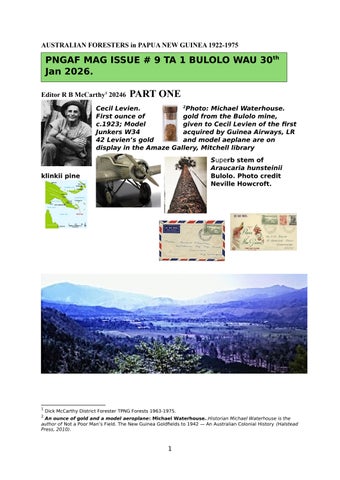
PNGAF MAG ISSUE # 9 TA 1 BULOLO WAU 30th Jan 2026. Editor R B McCarthy1 20246 PART ONE 2 Cecil Levien. Photo: Michael Waterhouse. First ounce of gold from the Bulolo mine, c.1923; Model given to Cecil Levien of the first Junkers W34 acquired by Guinea Airways, LR 42 Levien’s gold and model aeplane are on display in the Amaze Gallery, Mitchell library
Superb stem of Araucaria hunsteinii Bulolo. Photo credit Neville Howcroft.
klinkii pine
1 2
Dick McCarthy District Forester TPNG Forests 1963-1975.
An ounce of gold and a model aeroplane: Michael Waterhouse..Historian Michael Waterhouse is the author of Not a Poor Man’s Field. The New Guinea Goldfields to 1942 — An Australian Colonial History (Halstead Press, 2010).
1
1963. The wide Bulolo Valley looking towards Bulolo township and airstrip in the middle distance. In the foreground are hoop and klinkii plantations with a thinning operation underway in one of the compartments on the right. Photo credit J Davidson
TABLE OF CONTENTS PART ONE BIOGRAPHY Editor R B McCarthy “FORWOOD”
page 6 page 8
PART TWO BULOLO WAU FOREST AREA Vegetation Topography Geology Morobe Goldfields Soils Grassland Metrology Environment Traditional People
page 9 page 12 page 13 page 15 page 15 page 25 page 25 page 25 page 26 page 28
PART THREE ACCESS BULOLO WAU FOREST AREA By Foot Air Transport Road Transport
page 31 page 32 page 36 page 44
PART FOUR TIMELINE OF DEVELOPMENT IN BULOLO WAU FOREST AREA
Influence WW2 and Bulloo Wau TA on staffing of TPNG Forest employees
PART FIVE DEVELOPMENT OF BULOLO TIMBER AGREEEMNTI
Introduction 1923 - 1935 Lane Poole 1945 - 1949 E Ward Minister Transport, Minister External Territories 1946 McAdam’s first announcement of a formal forest policy. 1949 Jock Garden 1949 Report Royal Commission Bulolo Timber Lease 1949 Cyril Chambers 1949 The Papua and New Guinea Act 1949 1949-1951 Percy Spender Minister for External Territories 1951 Legislative Council TPNG established 1951 -1963 Paul Hasluck. Minister Territories 1952 -1966 Donald Cleland Administrator TPNG 1953 Forestry Ordinance 1936-37 of New Guinea applied to Papua 1954 - 1955 Establishment of Bulolo plywood mill 2
page 48 page 60.
page 72 page 73 page 74 Page 74 Page 75 Page 76 Page 77 Page 79 Page 79 Page 79 Page 79 Page 80 Page 80 Page 82 Page 82
1954Bill Gottstein CSIRO 1957 Womersley and McAdam 1957 Forest Policy Statement Hasluck 1971 Passage of Forestry (Private Dealings) Act 1974 Land Groups Incorporation Act and Land Acquisition Act.
page 83 Page 84 Page 84 Page 84 Page 84
PART SIX BULOLO TOWNSHIP History Life in 1960’s-70’s
page 85 page 85 page 86
PART SEVEN BULOLO WAU FOREST MANAGEMENT SYSTEMS Natural forest resource assessments/working plans Araucaria seed collections Natural Forest Harvesting Statistics Plantation Statistics
page 91 page 92 page 93 page 95 page “
PART EIGHT BULOLO WAU FOREST HARVESTING SYSTEMS Roading Felling Snigging Log landing / loading Log transport Thinning plantations
page 97 page 98 page 99 page 101 page 103 page 105 page 107
PART NINE BULOLO WAU SILVICULTURAL SYSTEMS Klinkii Pine Silvicultural techniques Hoop Pine Silvicultural Techniques SPART TEN
page 110 page 111 page 114 page 120 page 121
FOREST PLANTATION MANAGEMENT BULOLO WAU Wau 1938-42 McAdam and Cavanaugh War years 1957-1960 Mike Kazakoff 1960-1963 Des Harries 1963 Ken Fraser 1963-1964Jack Crowe 1964 on - Alan Fraser 1969-71 Rod Holesgrove 1974- 75 William Ao
page 122 page 123 page 123
3
page 125 page 127 page page 130 page page 130 page
Bulolo
page 131 page 134 page 134 page 137 page 137 page 137 page 138 page 139
1946 on Frank Vickery 1954-1957 Don McIntosh 1957-1961 Robin Morwood 1961-1962 Frank Coppock 1963-1964 Elliot Tuckwell 1964-1973 John Godlee 1974-1975 Dick McCarthy
PART ELEVEN BULOLO WAU INDUSTRIAL FOREST INDUSTRY DEVELOPMENT Wau NGG sawmill BDG/CNGT/PNGFP sawmill CNGT/PNGFP Plymill
page 141 page 142 page 144 page 148
PART TWELVE BULOLO WAU FOREST RESEARCH AND DEVELOPMENT 1938-1942 J McAdam MM 1 1955-1961 Dave Dun 1953-1965 Dr Joe Havel 1956-1970 Alan Cameron 1956-1970 John Smith 1957-1977 Kevin White 1958-1975 Leon Clifford 1962-1980 Dr John Davidson 1965-2017 Neville Howcroft 1966-1974 Dr Barry Gray 1967-1974 Dr Ross Wylie 1972-1974 Peter Shanahan 1969-1970 Dr Brenton Peters 1968 First Silvicultural Research Conference 1971-1975 Dr Bob Thistlethwaite 1972-1977 Dr Dave Lamb Bulolo Wau Research Trials
page 159 page 159 page 159 page 159 page 159 page 160 page 160 page 160 page 161 page 161 page 163 page 164 page 164 page 164 page 167 page 168 page 168 page 169
PART THIRTEN BULOLO WAU FOREST TRAINING SYSTEMS Bulolo Forestry College Principals BFC 1961-1965 Dr Joe Havel 1965-1967 Leon Clifford 1965 Opening BFC Barnes 1967-1976 Robin Angus
4
page 172 page 172 page 173 page 173 page 183 page 178 page 181
1976-1980 John Godlee 1980 on Sigi Kulogo then Tommy Nahut then Eko Maigmo
page 183 page 183.
Technical Assistant Training Program 1971-1972 Jim Riley 1973- 1974 Peter Graves
page page 184 page 184
Cartographic Course
page 184
PART FOURTEEN REFERENCES
page 186
ACRONYMS
page 187
ACKNOWLEDGEMENTS
page 189
5
PNGAF Magazine Series Editor R B McCarthy Eminent TPNG Forester 1963-1975 including District Forester Bulolo Wau Timber Area 1974-75. Photo credit Dick McCarthy.
6
BIOGRAPHY Richard (Dick) McCarthy B Sc (For); M Sc (For Man) is a highly experienced operational forester with postgraduate qualifications in forest management. His many years of experience (especially PNG – Dept of Forests; PNG Forest Industries Association and Australia as Operations Manager APM Forests –(AMCOR) in forest management and plantation development in the public and private forestry sectors, in both temperate and tropical forestry is recognized globally. He is the Managing Director and Principal Consultant of McCarthy & Associates (Forestry), a global forest consulting and contracting practice. The PNGAF magazine series (commenced in 2018) describes over several issues, the achievements and stories re those Australian foresters and their team efforts in TPNG/PNG till 1975.:
To record the actual history of bringing scientific management to PNG Forests from the late 1880’s to the commissioning in 1922 of Lane Poole’s assessment of the TPNG forest resources to 1938 with the appointment of the first Chief Forester Jim McAdam. McAdam’s influence on the practice of forestry, proper scientific and utilisation activities were undertaken and at the same time his protection of the traditional rights of the forest owners led to the establishment of what is today the Department of Forests of PNG, PNG’s forest industry and its allied tertiary forestry training institutions. Australian Government policy directives, which in time, produced functional and field activities in forestry. These were the Ward, Spender, Hasluck, Barnes policies. The identification of the resource. The use of the resource in economic development programs. The involvement of the Papua New Guinea people in this economic development, especially in respect of traditional land ownership. By 1975, Australian foresters had undertaken initiatives for the development of Detailed flora inventories of the various forest systems of PNG; Community based forest management interventions including a forest concession system catering for all parties, i.e. landowners, government agencies and developers; Industrial wood processes for the conversion and treatment of PNG woods during this period coupled with development of a structured wood processing and construction industry.; Silvicultural techniques to grow PNG species in plantation format; Technical and tertiary training initiatives. There are many similarities between PNG Forestry and Australian Forestry in terms of forest types and forest produce, forest product markets, forest plantation species, forest industry standards, timber treatment standards and building codes, and forestry training curriculum. Long-term forester and resident of PNG Jim Belford described what could be envisaged as the future scenario for PNG forestry in his keynote address of 2011. “PNG for the next forty years and beyond”. Forests have always been a strategic resource, and a secure way into the future for PNG.
7
FORWOOD The history of PNG Forestry is intrinsically linked to the development of the Morobe Goldfields (Bulolo Wau) and their natural stands of Araucarias. Wau must be accorded some significance in the record of forestry in Papua New Guinea because it was the base for the first foresters appointed in 1938 of Jim McAdam, John d’Espeissis (posted to Rabaul) and Jim Cavanaugh. The discovery of gold at Koranga Creek near Wau by William “Shark eye” Park in 1922 led to the development of the Wau Bulolo Valleys for gold mining with roads, townships, and airstrips enabled a flourishing timber industry to be developed including large scale plantation development which continues to this day. The Bulolo region was at that time one of the largest gold fields in the world. A total of seven dredges of Bulolo Gold Dredging Ltd, scoured the valley floor, dredging thousands of tons of high-grade gold bearing ore 3. Gold produced from the Morobe Goldfields to 1977 totalled 116,392 kg of which 65,720 kg was derived from dredging, 34,309 kg from sluicing and 16,363 kg from lode mining. James Sinclair4 has described in detail the history of the Bulolo Wau goldfields. In 1923/24 Lane Poole - Australian Commonwealth Government Forestry Adviser, estimated the Bulolo Wau stands to hold some five hundred million super feet (1.2 million cubic metres) of timber together with some fifty million super feet (0.96 million cubic metres) of cedar and other tropical hardwoods. Due to the difficult terrain, no road access, and existing adequate supplies of Queensland hoop, he thought exploitation would be uneconomic for many years. As the mining operation scaled down, the Bulolo region, originally land locked and only accessible by foot and air transport, comprised magnificent Araucaria peeler log forests of hoop and klinki, and a complete mining town powered by hydro power. In contrast to the emphasis placed on industry use – values by miners and government officials in the mining office, government forestry officials emphasized the potential for an industry and the wastefulness of the mining community. In his 1935 survey of timber in the Morobe goldfields, Lane Poole5 was concerned with the value of timber and overly critical that the timber was not being used appropriately by mining companies. For example, cedar was used as an all-purpose resource when durability was necessary. He quoted the use of cedar for a water race when the cedar would have been put better to use in the production of fine cabinetry. Evan Shield demonstrated this point with a photograph of a bridge made from red cedar6 over the Bulolo River above the confluence with the Watut River before World War 2
Bulolo Gold Dredging Company (BGD) was formed to mine gold in Bulolo in 1932. Its shareholding included Placer of Canada and Levin etc of Australia. 4 James Sinclair 2019 ISBN 978-1-876561-15-4 “UP THE CREEK - Edie Creek and the Morobe Goldfields” Pictorial Press Corinda Qld. 5 Lane Poole, C.E., 1935. ‘Report on the Forests of the Goldfields of New Guinea: Together with Recommendations Regarding a Forest Policy for the Whole Territory.’ Unpublished TS, 1935. NAA 6 Evan Shield Personal Comm 21/4/2020 “the misuse of timber species referred to by Lane Poole in 1935”. 3
8
Cedar Bridge over Bulolo River above confluence with the Watut River before World War 2. Photo Credit Evan Shield. Following an Australian Royal Commission as to who would have the right to process the timber stands, Commonwealth New Guinea Timbers Ltd constructed the plywood factory and sawmill7 (CNGT – CSlRO & BDG) in 1954. In collaboration with the then Australian government, the Hoop and Klinki Pine plantations were established as part of a large-scale post-mining reforestation program by the TPNG Departments of Forests. PNG Forest Products today8, evolved from CNGT and Bulolo Gold Dredging Limited9 that commenced operations in large scale alluvial mining in 1932. NOTE This magazine comprises a series of individual parts covering the development of PNG Forestry from its home in the Bulolo Wau Valley. R B McCarthy Editor 2026
CNGT – Commonwealth -New Guinea Timbers Limited plywood factory in Bulolo was formed by an agreement between the Commonwealth Government and Bulolo Gold Dredging Limited. The 1,300,000 Australian pound mill opened in 1954 to produce high grade plywood (approx. 30 million square feet annually on a 3/16th inch basis). 8 PNG Forest Products evolved from CNGT. 9 Bulolo Gold Dredging Company was formed to mine gold in Bulolo in 1932. Its shareholding included Placer of Canada and Levin etc of Australia. 7
9