ASTRALIAN FORESTERS in PAPUA NEW GUINEA 1922-1975
PNGAF MAG ISSUE # 9 TA 1 BULOLO WAU 28th Aug 2026. Editor R B McCarthy 2026. PART SEVEN BULOLO WAU FOREST MANAGEMENT SYSTEMS
Commercialisation of A. hunsteinii (klinkii pine)
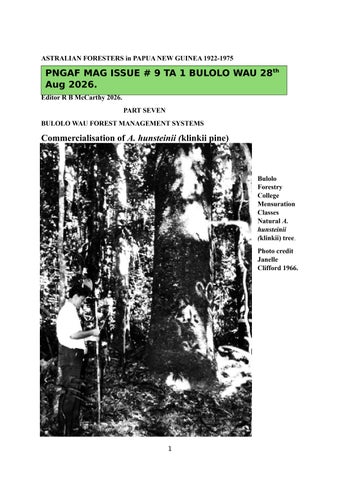
Bulolo Forestry College Mensuration Classes Natural A. hunsteinii (klinkii) tree. Photo credit Janelle Clifford 1966.
1
Natural Range of Klinkii Pine in PNG. Source: Conifer Trees database American Conifer Society.
2
Source: Dr Barry Gray 1973
3
TABLE OF CONTENTS FORWOOD
page 5
INTRODUCTION
page 7
1925 Lane Poole Report Forests Papua and New Guinea 1935 Lane Poole – Morobe Goldfields Forests
page 7 page 7
EARLY STATUS TIMBER INDUSTRY BULOLO WAU
page 7
Hyde 1935 Wau Bulolo Gold Dredging – (BGD Pref-ab Housing) NGG and Golden Pines sawmills
page 7 page 8 page 9
DEVELOPMENT OF COMMONWEALTH NEW GUINEA TIMBERS Forest Type Healy Bulolo Lae Road Chairman Australian Plywood Manufacturers J B McAdam BDG Input New Guinea Timber Agreement 1952 CNGT Plymill Construction 1953 Opening CNGT 1954 Visit Bulolo Duke of Edinburgh 1956 Purchase South Pacific Timbers Ltd (SPT) 1956 Dun 1957 CNGT Plymill Operations
page 11 page page page page page page page page page page page page page
11 11 11 12 12 13 13 14 15 17 18 20 21
NATURAL FOREST RESOURCE ASSESSMENT AND WORKING PLANS page
29
Jim Cavanaugh 1957 Australian Army 1944/1945 Post WW2 Forest Resource Surveys Current Forest Management System
page page page page
29 29 32 35
NATURAL FOREST HARVESTING STATISTICS AFTER WW2
page
36
GENETIC ARAUCARIA SEED SOURCES FOR REFORESTATION
page
38
page page page
40 43 45
Araucaria Seed Collections Early Research Activities re Progeny Testing Nursery Practices Klinkii Pine
4
FORWOOD Part Seven traces the forest management initiatives to commercialisation the natural stands of Araucaria especially the A. hunsteinii (klinkii pine) in Bulolo Wau. For over a century, PNGFP though its predecessors CNGT and BGD have prefabricated timber house lots for the PNG market. The main species has been Araucaria hunsteinii – (Klinkii Pine) from the Bulolo Wau forest stands. Today, all timber sources come from the Bulolo Wau plantations. Klinkii pine on which the Bulolo plywood industry was built in 1954, is endemic to PNG. Early in 1956, CNGT management conceived the idea of replacing the unseen middle core of CNGT ply with a veneer from another timber species. This allowed CNGT to increase production by 50 %. Klinkii veneer had proven so amenable that it was possible to fine down the backs and faces slightly and make a corresponding increase in the thickness of the core. Joe Havel 1in 1957 reported that initially seed collection for hoop and klinkii pine was ground collection following logging operations. Because so little was known of klinkii pine silviculture, hoop pine was the preferred plantation species even though CNGT preferred klinkii pine for plywood production. Seed source for hoop pine was further exasperated by CNGT mainly harvesting Klinkii pine rather than hoop pine. This necessitated the purchase of seed from the Highlands Planting commenced in 1949/50. Initially hoop pine was planted almost exclusively owing to difficulties in raising klinkii pine in the nursery. Initial experimental planting with hoop pine did well but klinkii pine ran to many tap roots and was susceptible to fungus. Work by Havel2 traced the issue to the use of strong alkaline hill water on the seedling beds. When water was reticulated from the river, and sulphur added, the problems disappeared.
Source: TPNG Forests.
Havel J J – 1957 brochure notes for pre-conference tour PNG by members of Seventh British Empire Forestry Conference. 2 Havel J J 1965. Plantation establishment of klinkii pine (Araucaria hunsteinii) in New Guinea. Commonwealth Forestry Review 44, p172-186. 1
5
Source: PNGFP.
6
INTRODUCTION1925 Lane Poole Report Forests Papua and New Guinea Lane Poole 1925 reported to the Australian Government re The Forest Resources of Territories of Papua and New Guinea. https://ia800605.us.archive.org/16/items/mobot31753003450407/mobot31753003450407.pdf Courtesy Braden Jenkin. 1935 Lane Poole – Morobe Goldfields Forests Lane Poole 3stated in 1935 that the only asset that I can see that will replace the wasting product gold, is timber. The region is purely a forest one, and its climate is decidedly a forest climate … In short, it is proven forest country. In contrast to the emphasis placed on industry use-values by miners and government officials in the mining office, government forestry officials emphasised the potential for an industry and the wastefulness of the mining community. In his 1935 survey of timber in the Morobe goldfields, Lane Poole was concerned with the value of trees and highly critical of the fact that the timber was not being used appropriately by mining companies. Cedar, for example, was used as an ‘all purpose’ resource when durability was necessary. Before WW2, it was estimated that the Araucaria stands in Bulolo Wau valley contained approximately 500 million super feet spread over some 40,000 acres. Other commercial species including red cedar, gave an additional 50 million superficial feet. Of this quantity, some 300 million superficial feet of Araucaria was traditionally owned and therefore could not be allocated under the forestry ordinance of the day. EARLY STATUS TIMBER INDUSTRY BULOLO WAU Before 1941, sawmilling operations at Wau and Bulolo were of a relatively minor nature, producing sawn timber for work associated with mining operations. Timber permits were issued under the Forestry Ordinance without competitive tender. Hyde 1935 Wau Timber mills in Wau were started by Roy Hyde in 1935, who arrived with his wife, two sons and a daughter. Timber was floated down the Bulolo river to the coast, which was used for house building in Lae and other resorts along the coast. Natives would guide the rafts to their destinations. The location of these mills in Wau is not known, but one may have been on the site subsequently used for a sawmill by New Guinea Goldfields Pty. Ltd. Machinery would have been flown in as were components of the No. 6 Gold dredge at this time. A suitable rafting site would have been at the site of the subsequent road crossing of the Bulolo River to Crawford’s farm on the northern side of the river. This was adjacent to the eastern extremity of the No. 6 dredging site. Lane Poole, C.E., 1935. ‘Report on the Forests of the Goldfields of New Guinea: Together with Recommendations Regarding a Forest Policy for the Whole Territory.’ Unpublished TS, 1935. NAA, A1 1938/802. 3
7
Bulolo Gold Dredging – (BGD Pre fab Housing It should be noted that BGD (Bulolo Gold Dredging Company) sawmilling operations were managed to produce pre fab houses back then. Immediately after WW2, many pre fab houses were sold to the TPNG Administration in the rebuilding of towns destroyed during the war.
BGD Bulolo sawmill pack of sawn timber for pre-fab housing being dispatched to Bulolo airfield for air transport. Photo period 1930’s. Source: Getty images Fairfax media archives. Felling of the hoop and klinkii pines was dangerous work, even for a skilled tree-faller. The cutting tools available for this work were axes and crosscut saws.
Cross Cut Sawing. Photo credit PNGAA.
8
Foreground BDG sawmill Bulawa via Bulolo 1935-36. Source: Waterhouse p 97. NGG and Golden Pines Sawmills New Guinea Goldfields (NGG) and Golden Pines sawmilling operated on what were termed Emergency Timber Permits i.e. permits issued without competitive tender.
NGG Limited mouth Binatang Creek Sept 1941 Wau. Courtesy Jim Cavanaugh.
9
Bulolo Valley and sawmill 1946. Photo credit White Aviation Collection Alexander Turnbill Library NZ Golden Pines sawmilling which exported battery separator materials to Australia, constructed a new mill in the Watut. Forest resources were drawn from a concession known as TransWatut. This mill had a band mill for sawing and two small peeler units.
Source: Linda Cavanaugh Manning 2021. Timber baulks being flown out of Bulolo Wau. Source: Department of Territories 1959. With the stimulation of gold discoveries, airfields for example were opened in the 1920’s at Salamaua, Wau and later Lae. Aircrafts used ranged from Super Constellations on the external 10
routes and DC3’s on major internal routes to small easily manoeuvrable aircrafts on small strips in rugged countryside. DEVELOPMENT OF COMMONWEALTH NEW GUINEA TIMBERS (CNGT) Forest Type In the period 1940’s-1960’s one of PNG’s most valued forest types under management was the sub-montane rainforest community in the Bulolo Wau area dominated by the conifers Araucaria hunsteinii (klinkii pine) and Araucaria cunninghamii (hoop pine). Healy Healy4 described that on the eastern side of the Bulolo River, 10,000 acres contains about 135 million super feet had been acquired from traditional owners. In 1938, this was advertised by public tender, but the many submissions made on such various diverse bases that it proved impossible to decide. (including no road access). Bulolo Lae Road 1944 The building of the road Bulolo to Labu at the end of WW2 in 1944 removed a major impediment for the development of the Bulolo Wau timber industry.
Healy A M 1967 IA History of the development of the Bulolo Region, New Guinea. New Guinea Research Bulletin #15. 4
11
Source: Dept of Territories 1959 Chairman Australian Plywood Manufacturers Around the same time, the chairman of the Australian Plywood Manufacturers suggested to the Australian Prime Minister that a joint undertaking with Government be undertaken although the Manufacturers wanted the logs to be brought to Australia for conversion into veneer. Eventually the Government rejected this proposal as too cumbersome. J B McAdam MM In October 1947, the Australian Minister adopted J B McAdam’s MM 5 (first Managing Director of TPNG Forests) suggestions that for Bulolo timber industry development:
5
Permits must contain specific provisions for reafforestation and for the establishment of a plywood mill in the Bulolo Valley. The Commonwealth would work with BDG to establish a Plymill.
Ligertwood 1948-49:4,
12
By 1948, McAdam MM, recommended that all existing applications for timber permits be refused (many rival Australian concerns) and future concessions be allotted by private tender. Subsequently, Commonwealth New Guinea Timbers (CNGT) was formed. The Australian Cabinet gave approval to Heads of Agreement for the joint company in December 1950. TPNG Forests Director Jim McAdam MM recommended a maximum annual cut of 10 million super feet for the first ten years of operation. BGD insisted that all of this be made available for milling. This set an upper limit to the economics of the project. BGD Input The technical aspects of investigation for the plywood factory were left mainly to BDG, covering
Harvesting, Selection of factory equipment, Cost and profit analysis, Marketing forest produce in USA and Australia.
In April 1951 BGD, secured the services of Canadian expert – J D Gilmour, to report on harvesting issues. At the same time BDG consulted Paul Savage of Industrial Engineers and Contractors Inc. of Washington, one of the foremost consultants on plywood manufacture. When Gilmour’s report and further tests of logs proved highly favourable, plans for an up-todate sawmill and ply factory were drawn up. Concurrently, the original heads of Agreement with government were revised. By the middle of 1952, BGD was able to advise its shareholders and the Australian Government with precise details of incorporation. New Guinea Timber Agreement 1952 The New Guinea Timber Agreement Act (No 40 of 1952) was passed by the Australian government in June 1952. Source: trove.
The New Guinea Timber Agreement Act (No 40of 1952) passed through the Australian Parliament and was approved in June 1952. This Act:
13
established CNGT as a private company formed to develop the timber resources of the Bulolo Valley, primarily by operating a plywood factory. A fraction over 50 percent of shares were to be held by the Commonwealth and a fraction under 50 percent by BDG. The board of directors was to consist of two Commonwealth and two BDG nominees. The chairman was to be elected from amongst the four directors. The board was to control general policy and to appoint commercial management personnel. In the event of final disagreement between the two sides the board was to act as directed by the Commonwealth. BGD was to provide CNGT with stores, services, power and accommodation. The Commonwealth undertook to keep the Lae road trafficable and to use its best endeavours to complete bridges over the Markham and Mumeng rivers. CNGT was to be allowed to cut at least seven million super feet after two years and then no more than twelve million super feet in any one year. During the first five years additional royalties at four shillings per 100 super feet were to be payable of araucaria and two other species. As CNGT was registered in New Guinea all company meetings must be held at Bulolo.
CNGT Plymill Construction 1953 The Plymill construction began in March 1953. It was completed within ten months. The Plymill was opened on the 26th of January 1954 by the Minister for Territories. The Plymill was shaped like an aircraft hangar, covering more than four acres including areas for administration and storage of cut logs. The entire building depended on beams, joints and struts of local softwood. The Plymill was designed to produce 40 million square feet of ply annually on a 3/16-inch thickness basis. Source PIM.
Opening
CNGT 1954 14
Source: - Trove – February 1954 Pacific Island Monthly.
15
In 1954, CNGT sawmill and Plymill operated on Timber Permit # 47, on an area over 30,000 acres, comprising the major pine stand of the Bulolo Valley. It was estimated to contain 500,000 000 superficial feet of pine log timber. The cut for CNGT was restricted to 100,000,000 superficial feet of pine log timber during the first ten years of operation. At this rate of cut, an average of 800 acres of country was logged annually and plantation work followed closely behind the logging operations. Departmental control of harvesting was limited to spot checking of measurements submitted by the operating company. Logs were required to be measured in the bush and all logs and stumps numbered. Later, a full-time measurer was appointed to supervise the operations of CNGT. CNGT functioned smoothly for a new venture. In the first full year ending June 1955, the throughput of all logs at Bulolo was more than fourteen million super (due to build up of stock over more than one year) and the plywood produced amounted to 27,632,918 square feet on a 3/16-inch basis.
Source: The Western Australian 12th February 1954 p3. 16
Su Su’s natural araucaria stands. Bulolo Forest Station and nursery.
PNGFP sawmill Complex. PNGFP Plymill (formerly CNGT). Photo credit Linda Cavanaugh Manning 2021.
Source United Nations report 1950’s. Visit Bulolo Duke of Edinburgh 1956
17
https://www.facebook.com/pngfp/videos/fabulous-1956-newsreel-footage-of-princephilips-trip-to-new-guinea-includes-his/479536200149272/ Purchase South Pacific Timbers Ltd (SPT) 1956 However, BDG was accustomed to the higher returns from mining (which were falling). They began to seek new ways of extending their timber interests given the allowable annual cut restrictions. The only solution was to find more timber sources outside the Bulolo area. Klinkii pine on which the plywood industry was being built, did not occur elsewhere. Early in 1956, CNGT management conceived the idea of replacing the unseen middle core of CNGT ply with a veneer from another timber species. This allowed CNGT to increase production by 50 %. Klinkii veneer had proven so amenable that it was possible to fine down the backs and faces slightly and make a corresponding increase in the thickness of the core. In 1956, BGD as a separate company negotiated to purchase the assets and forestry licence of South Pacific Lumber Company Ltd based in Lae Its timber concession was in the trans-Busu area. Once negotiations were complete, CNGT was offered an extension. The new company was called South Pacific Timbers Limited. This new timber company purchase allowed BDG/CNGT to obtain veneer resources for inner core production at Bulolo. The purchase allowed back loading to Bulolo of veneer for inner core construction. Some of the principal species from the Lae subsidiary suitable for peeling included Anisoptera and Celtis. Anisoptera was full of sap and extremely wet. It had to be run through a borax bath before being sent to Bulolo for drying, otherwise it arrived covered in fungus. In the early years the sawn timber recovery rate at Lae rose to 54.3 % with veneer production of 45 million square feet, of which 97% was absorbed by CNGT. Source Australia Government Report United Nations re New Guinea 1950’s.
Source: Dept of Territories 1959. Source: Trove August 1957 Pacific Island Monthly. Dun 1957
18
Dave Dun 6reported in 1957 that since 1946, the local sawmilling industry was expanded. There were three major undertakings:
New Guinea Goldfields Limited at Wau Golden Pines Sawmilling Co Ltd (a subsidiary of Amplex Australia Commonwealth New Guinea Timbers limited at Bulolo. (CNGT)
L-R Jim McAdam; Bill Suttie; and Dave Dun Bulolo Plantations. Approximately 1957. Photo credit Linda Cavanaugh Manning
CNGT Plymill Operations Dave Dun Bulolo Regional Forest Officer 1957 editor brochure notes for pre-conference tour PNG by members of Seventh British Empire Forestry Conference. 6
19
Kinoi, one of CNGT’s oldest and most senior and skilled crosscutters, felling a klinki pine. Kinoi was a Sepik elder. Watut – Bulolo Ridge, 1969. Photo credit Ross Lockyer
Transporting klinkii logs to Plymill. Photo credit PNGAA.
20
Unloading Logs Bulolo Ply Mill. Photo credit PNGAA.
Photo credit PNGAA.
21
Log cutting for veneer lathe. Source PNGAA.
Peeling Klinkii log. Photo credit Collis family archives. Peeling logs for Commonwealth New Guinea Timbers Plymill 1960. Photo credit PNGAA.
22
Peeling for veneer, Photo credit PNGAA.
Staking veneer and core sheets. Photo credit Collis Family Archives.
23
S
Source PNGAA.
Plymill Bulolo. Photo credit Collis family archives.
24
Interior view of the Commonwealth-New Guinea Timbers Limited (CNGT) plywood factory at Bulolo. Source :Department of Territories 1959
Ply
production. Source: Australian Information Service 1950’s.
25
Quality control. Photo credit PNGAA.
26
Sawing klinki log. CNGT Bulolo 1970. Source :New Horizons.
BULOLO WAU NATIONAL FOREST RESOURCE ASSESSMENT7 AND WORKING PLANS Jim Cavanaugh 1957 Jim Cavanaugh 8 in 1957, described the history of forest resource assessment in TPNG. In the 1920’s the species, structure and volume per acre of forests in Papua and the Territory of New Guinea were virtually unknown. The Administration of both Territories found the need to evaluate the forests so that a local timber industry could be encouraged. Lane Poole was commissioned in 1922 to investigate the forest resources and report on the economic possibilities of creating a local timber industry. His report of 1925 indicated that he had not located any large commercially valuable timber stands economically accessible for utilisation on a large scale. The report was sufficient to deter any further government investigation until forest officers – McAdam, De Esperies and Cavanaugh were appointed in 1938 to initiate a forest service in the Territory of New Guinea. Then, detailed resource investigations recommenced. The resource and management survey of the Bulolo Araucaria forests commenced during 1938 when Jim McAdam MM arrived in Wau. He was faced with problem of forest management without any basic data. Areas of approximately 3,500acres and 1,600 acres were PNGAF Mag Issue 9B-5A of 8/6/21 =History of assessment PNG forest resources till 1975. P 56-70. 8 Jim Cavanaugh 1957 in Dave Dun Bulolo Regional Forest Officer 1957 editor brochure notes for pre-conference tour PNG by members of Seventh British Empire Forestry Conference 7
27
surveyed near Wau and Bulolo respectively. Both areas were covered by existing permits at that time. Australian Army 1944/1945 In 1944, the Australian Army formed a unit under the command of Lt. Colonel Jim McAdam MM. The task was to locate, control and record Army requirements of forest products in Papua and New Guinea. Two forest survey companies were attached to do the field work and a photo interpretation unit initially located in Melbourne and later to Lae interpreted the areas into vegetation and topographic classes form aerial photography. Army resources surveys investigated an area of some 56,441 sq. miles around the coast lines of Papua, New Guinea, Admiralty, New Britain and Bougainville. The overall accessible volume for all species was 37,131,000 superficial feet. Bulolo – Block one eastern side Army Forest survey Bulolo River unit
1945
In 1945, an Army Forest Survey Unit carried out a detailed management forest survey of Block 1, covering an area of 11,250 acres situated on the eastern side of the Bulolo River. Estimates indicated approximately 135 million superficial feet of clear pine available. In 1945, an Army Forest Survey Unit assessed Block One – eastern side of the Bulolo River. Volume estimate was approximately 135 million super feet of clear pine (araucaria) available.
28
Bulolo Valley approx. June 1933 taken by Harry Downing Assistant District Officer from a Junker G34. Courtesy Phil Franklin 9
This Army survey unit was described by Graham McKenzie-Smith10 who advised that the 2/2 Forestry Survey Company undertook assessment work in the Bulolo Valley in 1945. The company commenced operations at Yalu on 18 May 1944 with Maj Bert Head as OC. Over the next few weeks, he was joined by Lt Bert Jones (2ic), Lt Jim Cavanaugh (For) and Lt Adam Mullholland (Surveyor), while Lt John Talbots (Surveyor) joined later. Through the life of the unit, they never exceeded four officers and 40 other ranks, around 60% of their establishment. The first month was spent establishing the unit and camp and training before a detailed survey was done in the harvest area for the 2/3 For Coy sawmill at Busu. They then assessed the forest around Nadzab for poles and piles and started assessing the forest in the Atzera Range, based at a survey camp at Busu Falls. In September a party moved to the Aitura Agricultural Station to survey the area and assess the forest. With 2 Aust Corps relieving the XIV US Corps on Bougainville, 1 Pl moved to Torokina in November 1944 to assess the forest available for 2/2 For Coy when they took over a US sawmill. Another party moved to Aitape where 6 Inf Div was relieving XI US Corps and 2/2 Photo courtesy Phil Franklin 6/3/36. Photo taken by Harry Downing Assistant District Officer 1933 from a Junker G34. Phil Franklin received the photo from Col Bayliss Gold Miner in May 1989. 10 Graham McKenzie Smith war historian and forester personal communication March 2026 “article -AIF Forestry Units in New Guinea 9
29
For Coy was taking over a sawmill. The company also sent a party to survey the Garagos River forest and assess a sawmill site at Zenag from a survey camp established on the Wau Road. In February 1945 a party moved to Buna for a specific assessment and the main body of the company moved to Milne Bay. As the 2 Aust Corps units on Bougainville advanced out of the Torokina base they were followed by the 2/2 For Svy Coy parties assessing the forests, although some areas were found to be so affected by shrapnel from previous bombing attacks that the good timber could not be used. The Aitape detachment moved to Manus Island in March, and the Buna detachment joined Coy HQ at Milne Bay. Parties from the unit at Milne Bay worked their way around the bay assessing the coastal forests and along the south coast as far as Mullens Harbour, as well as assessing the offshore islands. The Manus Island detachment moved to the newly captured Wewak in May 1945, while the Bougainville detachment moved to Wau to start on a major project of mapping and assessing the Hoop Pine resource. Having completed the Milne Bay assessment CoyHQ moved to Wau in June, and they were joined by the Wewak detachment in July. By then the Lae to Bulolo road had been surveyed, triangulation had been completed and maps produced. Work at Wau was constrained by shortage of native labour and WO2 Jim O’Brien accompanied an ANGAU patrol in August to recruit labour in the Upper Waria area. By the end of August 30 miles of strip survey had been completed and field work in Block 1 was complete by the end of September. As the technical personnel left for discharge field work ceased and on 23 November 1945 the reduced company joined 2/1 CRE NG Forests at Lae and their war diary ceases. Lae 9/11/1944 Warrant Officer 2 W Spencer using stereoscope on aerial photographs 1 Forest Survey Coy. Photo credit Australian War Memorial
Lae 9/11/1944; Lt J S Talbot surveyor; WO 2 W Spencer draughtsman and Sgt H M Crossley outside drawing office of 1 Forest Survey Coy 1944. Photo credit Australian War Memorial
30
Post WW2 Forest Resource Surveys. Jim Cavanaugh advised that post war resource surveys commenced in 1950. They covered areas being opened that were not covered by aerial photography and maps. The major areas dealt with covered the Central Highlands of some 5,500 square miles, Northern Division of Papua 6,000 squ miles and part of the Sepik 10,800 square miles. During this period, Jim Cavanaugh was the only forest officer available for this type of work. It was not until the end of 1951, that Jim Cavanaugh received any resource staff. It was decided to use Bulolo as headquarters for the resource survey unit as facilities were available and much detailed work was required in the Bulolo area. Training included tropical forest assessment methods, species identification, resources and road surveys, land use classification and forest management surveys. Early in 1952, the survey of the remaining Araucaria stands in the Bulolo valley was commenced. Due to the shortage of staff, the project proceeded intermittently. By 1957, 12,830 acres had been assessed with an estimated standing volume of Aurcaria pine of some 160 million super feet. Jim Cavanaugh emphasised that as ownership of the land and timber is vested in the native community, before any timber can be harvested land and/or timber rights must be purchased from the landowners. This involved boundaries being surveyed, owners located and if the owners were willing to sell timber rights etc, a price must be agreed and then the purchase made. 90-6-5
Development of Bulolo Valley
Gilmour
1951
Assessment Bulolo remaining araucaria stands
Cavanaugh et al
1952
Munro
1960
departmental
1966
Grattidge
1967
90-6-6
Timber potential Bulolo Wau
90-6-9
Bulolo-Wau Working Plan Hammermaster/Shield 1964 Bulolo-Wau Working Plan Mcintosh
1966
Bulolo Wau Resource Assessment Report on forests of New Guinea Goldfields
Lane Poole
31
1935
90-6-7 Bulolo
Latep
Ross
1956
Middle Creek
Ross
1956
Crooked Creek
Cavanaugh
1956
Rifle Range
Ross
1956
Taun
Coppock
1956
Long Island
Ross/Ridgewell
1956
Nawi-Banda
Ross/Ridgewell
1956
Nawta-Bania
Ross/Ridgewell
1956
Bulolo Wau
Granger
1967
Bulolo
Brightwell
1970
90-6-7
Bulolo Assessment
Done/Whyte
1971
90-6-7
Reassessment of Bulolo plantations for thinnings
Connell
1972
90-6-44 Wau
Wau resource
Army Survey Corps
1939-45
Army Survey Corps
1945
Izzy Dizzy LA + extn
Kazakoff/McVeagh
1955/59
Beenleigh LA + extn
Kazakoff/McVeagh
1955/59
Drone LA
Kazakoff
1955
Bamboo LA
Kazakoff
1955
90-6-7
Wau extn
Shield with Granger
1967
90-6--18
Upper Watut Resources
Hughes
1952
Upper Watut Resources
Cavanaugh
1952
Upper Watut Resources
Read
1964
Upper Watut Resources
Evan Shield/ Botany
1967
Upper Watut Resources
Div Botany
1970
90-6-8 Wau Wau resource Block 1V
32
Bulolo Natural forest stands. Photo credit Robin Smith 1968. Bulolo-Wau (14 January to 3 February 1967) Ken Granger reported that this survey was to assess the forests around Bulolo and to the south and east of Wau. Evan Shield survey leader 11
Bob Lyons and Ross Lockyer camped out in the jungle somewhere north of Bulolo in 1969 for about a week wandering about through miles of bush surveying for klinkii pine and other hardwood resources. He was Forestry Dept from Lae. I was Bush Boss at CNGT. He was a bloody good bloke. 12
Source: Ross Lockyer..
11 12
Ken Granger personal communication Ross Lockyer personal communication 6 May 2020
33
Current Forest Management System The Bulolo operations are regulated under the Forestry Act where the company submits Annual Working Plans.
34
NATURAL FOREST HARVESTING STATISTICS BULOLO WAU AFTER WW2 (cubic metres) Year
BGD/CNGT New Guinea Goldfields
Golden Pine
Sandy Ck Gold Sluice
% PNG Cut
1948/49
10660
3132
1401
32
NA
1949/50
10026
7540
1182
71
NA
1950/51
11626
12200
847
13
NA
1951/52
12002
8664
2738
0
49%
1952/53
13559
10222
6079
0
58%
1953/54
27081
9116
8405
0
59%
1954/55
62365
9427
5678
0
56%
1955/56
52301
14780
10314
0
58%
1956/57
51139
11307
6821
0
56
In the period 1951/52 to 1956/57 Bulolo Wau Timber area harvested 322006 m3 of the total PNG cut of 546074 m3 or 59 % Breakup of species cut 1/7/48 to 30/6/57 Year
BGD/CNGT
Golden Pines
Araucaria
195411
32452
Araucaria tops
64151
9613
Cedar
3028
635
Podocarpus
83
Na
Silkwood
603
Na
Walnut
61
13
hardwoods
12270
456
Forests resource file number
Title
Author
date
McAdam/Cavanaugh
19 38 & 1941/42
Bulolo Wau Development Plan 90-6-2
Bulolo-Wau Araucaria
35
Bulolo Forestry College Mensuration Classes lower montane forest. Photo credit Janelle Clifford 1966.
36
TREE GENETICS - ARAUCARIA SEED SOURCES FOR REFORESTATION ACTIVITIES BULOLO TPNG Forests Bulolo policy was of direct conversion of the harvested sites to plantations of the two araucaria species on an estimated rotation of forty to fifty years. TPNG Forests was responsible for clearing and burning the residues ready for replanting, and maintenance of the established plantations. Joe Havel 13in 1957 reported that initially seed collection for hoop and klinkii pine was ground collection following logging operations. Because so little was known of klinkii pine silviculture, hoop pine was the preferred plantation species even though CNGT preferred klinkii pine. Given few issues with the establishment of hoop pine (based on Queensland forest research over several decades), seed source for hoop pine was further exasperated by CNGT mainly harvesting Klinkii pine rather than hoop pine. This necessitated the purchase of seed from the Highlands. By 1957, following experiments on cold storage of hoop pine (already practised in Queensland and New South Wales) it would become possible to store surplus hoop pine seed in peak seed years in following years. By 1957, climbers had been trained in Bulolo and the Highlands to collect seed. Up till then seed collection in the Highlands had been ground collection following seed fall. Alan Cameron commented that Hoop and Klinkii pine seed collection was interesting, as people from Buka Island were incredible climbers. At a height of about 200 feet one climber jumped from one tree to one nearby so he did not have to climb the next one. The seed collection procedure in 1955/56 was:
Field check cone ripening, Seed collection crews follow harvesting crews combing through the head of each felled tree as all cones are carried in the top three to four whorls- generally September. Only large two-year-old cones are collected. They are bagged and carried to bush shelters. They remain there until transported to the forest station seed shed (within two days). The station seed shed has shelves of wire netting and hessian. The shed is aerated using louvers. After a week of storage ripe cones begin to disintegrate. Any cones failing to disintegrate within ten days considered immature and discarded. The seed remains on the shelves until completely dry – generally 2-3 weeks. Seed is then bagged in batches according to collection locality. At this stage it is now ready for sowing or cold storage. Note hoop pine seed deteriorates at a slower rate than klinkii pine seed.
Havel J J – 1957 brochure notes for pre-conference tour PNG by members of Seventh British Empire Forestry Conference. 13
37
Climber going up a small tree before crossing to klinkii. Photo credit Chris Borough. 1963. 38
Araucaria Seed Collections14 1955-1964. 1955
TPNG Forests
Wau, Bulolo
hoop pine 3060 lb dry seed Klinkii pine 794 lb dry seed Hoop pine 4423 lb dry seed Klinkii pine 490 lb dry seed hoop pine 2000 lb dry seed Klinkii pine 70 lb dry seed 16,800 lb green weight
1955
TPNG Forests
Bulolo
1956
TPNG Forests
Wau Bulolo
1956
TPNG Forests
Bulolo
1956
TPNG Forests
1956
TPNG Forests
1960
Shield
Highlands ground collection Bulolo Ground collection Nawata Banda, Crooked & Middle ck
1961
Lake
Su Su Mountain, Crooked Ck, Block 1B
18000 lb green weight
1962
Currie
Burkes Water race lower end, Block 1 A
25000 lb green weight
1963
Borough
Crooked and middle Creek
27000 lb green weight
1964
Thompson
Manki, Burkes, Su Su
50000 lb green weight
In 1957, for planting 1000 acres of hoop pine, some 3,500 lbs of dried seed was required. By 1957, Havel reported that for Klinkii pine, research work had found
Timing is critical for seed collection Seed collection must be made at the right time i.e. between the time of full embryo development and seed dispersal
Planting commenced in 1949/50. Initially hoop pine was planted almost exclusively owing to difficulties in raising klinkii pine in the nursery. Initial experimental planting with hoop pine did well but klinkii pine ran to many tap roots and was susceptible to fungus. Work by Havel15 traced the issue to the use of strong alkaline hill water on the seedling beds. When water was reticulated from the river, and sulphur added, the problems disappeared.
HOOP PLANTINGS (ha)
KLINKII PLANTINGS (ha)
Silvicultural Techniques in Papua New Guinea Forest Plantations. Bulleting # 1Dept of Forests POM White K and Cameron A. page 9 15 Havel J J 1965. Plantation establishment of klinkii pine (Araucaria hunsteinii) in New Guinea. Commonwealth Forestry Review 44, p172-186. 14
39
1950-55
BULOLO
WAU
BULOLO
WAU
695.2
3.5
15.5
0
Note several Pinus spp. trialled in grassland sites not suitable for Araucarias (hoop and klinkii). Several eucalypts also trialled. Howcroft 16 Seed Collection Araucaria cunninghamii Localit y 11 12 15 16
Seed source
Date collection
Proposals for use
Aug 1975 Aug 1974 Dec 1975 Sept/Oct 1975
Block planting Provenance trials Provenance trials Provenance trials
17
Garaina Elaro Suwaira OkapaOsaka Bumbu
Provenance trials
23 24 25
Chauve Erave Pimaga
Sept/Oct/Nov 1975 Nov 1975 Aug 1975 Oct 1974
Provenance trials Provenance trials Provenance trials
Distribution of Hoop Pine Araucaria cunninghamii in PNG. Source Conifer Trees database American Conifer Society. NB. Also refer to Gray 1973.
Howcroft N 1977 A review of Araucaria cunninghamii in Papua New Guinea and Irian Jaya. IUFRO Brisbane. 16
40
Special seed collections from remote areas. Collecting klinkii cones and seed from Jimi Valley. Photo credit Neville Howcroft.
Cleaning and processing seed at Bulolo. Photo credit Neville Howcroft. 41
Early Research Activities re Progeny testing.
Photo of Geshes Klinkii seed orchard next to and south of Road 51, Geshes experimental area in 1974. (The E. deglupta seed orchard is to the left of it, only 11 trees remain!). Little new work was undertaken after John Davidson and Neville Howcroft left Bulolo in the late 1970’s Photo credit John Davidson.
Geshes Hoop pine clonal orchard section at age 40 years. Photo credit N Howcroft. 42
There are three Garaina clones here in the Bulolo clonal orchard Grey klinkii Cone and male flowers. Male flowers or catkins with ear ripe cone and blue grey leaves stock and hat for scale. Catkins can be longer. Photo credit Neville Howcroft.
First cone and seed crops of Garaina klinkii grafts? Ron Woessner from Jari Amazon R Brazil with first collection. Most of this collection went to Jari but some made it to Porto Rico. Photo credit Neville Howcroft. 43
Nursery Practices Bulolo Klinkii Pine Standing out tubed Klinkii Pine seedlings. Source. DOF 1968 Bulletin # 3. Notes of Wau-Bulolo Forest Activities.
High shade Bulolo nursey tubed Klinkii Pine seedlings. Source DOF 1971 Bulletin # 3. Notes of WauBulolo Forest Activities and New Horizons 1971. Forest Station Offices /storerooms and nursery stand out beds. Photo credit Barry Gray. Klinkii nursery stand out beds Bulolo. Source PNGAA.
Klinkii Pine Plantation age 15 years. Source. DOF 1968 Bulletin # 3. Notes of Wau-Bulolo Forest Activities.
44
45