w w
T H E SEPTEMBER
P R E S E N T
T E N S E 2026
P R O U D LY P R E S E N T I N G N E W Z E A L A N D P R O P E R T Y M A R K E T I N S I G H T S I N R E A L T I M E
Ray White Epsom Now Epsom Limited Licensed (REAA 2008)
Richard Thode +64 21 336 002 richard.thode@raywhite.com
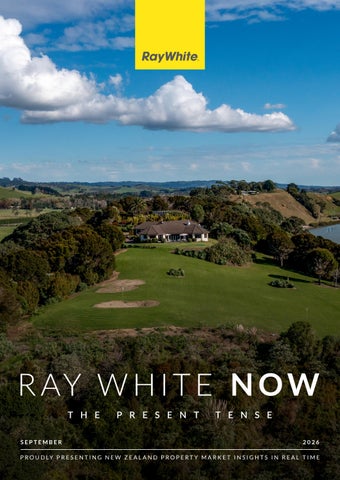
916 Clevedon-Kawakawa Road, Clevedon
F E AT U R E D P R O P E R T Y
w wrt
Contents
10
A message from our Chief Executive
5
Why sell now
6
Economics: New Zealand’s Next Million-Dollar Suburbs
10
14
18 Executive Message: A Market Rewarding Preparation
14
Auctions: Reading the Room
16
Property Management: The Operating Case
18
w
20
About Ray White
24
Featured Property: 916 Clevedon-Kawakawa Road, Clevedon
26
w
Feature Editorial: Looking Back, to Look Ahead
w
20
RAY W H I T E N O W N E W ZEALAND | 4
Message from our chief executive Dear Property Owner, Property decisions have always required a degree of uncertainty. What is changing now is how much buyers and sellers value resolving it. Interest rates are no longer moving predictably lower. Property prices are not rising quickly enough to make delay an obvious strategy. With a general election approaching, questions about housing policy and taxation are giving investors yet another reason to weigh decisions carefully. Global events add another layer of complexity, influencing energy costs, inflation, and the outlook for borrowing. Yet, uncertainty does not bring the property market to a standstill. More often, it changes what people require before they act. Buyers are taking time, comparing more closely and distinguishing between properties that are merely available and those that genuinely meet their needs. Location, condition, liveability and enduring value have become more influential as purchasers resist paying for compromises they believe can be avoided elsewhere. This is a selective, genuine market. That distinction matters for sellers. Average national sales volumes have softened, but prices have remained comparatively stable, suggesting buyers have not disappeared so much as raised the threshold a property must meet. Homes that are well presented, appropriately priced and supported by a clear campaign with agents who clearly represent their upside are focusing attention and generating competition. For those selling to purchase again, today’s conditions offer another advantage. A relatively flat market can make the changeover between properties easier to assess. Owners may not
be selling into rapid price growth, but they’re also not necessarily chasing a home that is accelerating beyond reach. The difference between the two transactions often matters more than either price in isolation. Across the country, regional performance is becoming more pronounced. Parts of the South Island continue to record firm sales results, while in Auckland and Wellington, market activity is rising slowly and steadily. Increasingly, however, national averages tell only part of the story; local supply, affordability, and the differing qualities of each property are shaping purchasing behaviour. This challenges the assumption that waiting to buy or sell will automatically deliver cheaper finance, stronger prices or greater clarity after November’s election. Buyers cannot rely on economic conditions to change, nor can sellers guarantee rapid house price inflation. A well-executed transaction today converts certainty into a known result. That idea – Present Tense – runs through this edition, examining why preparation, clear advice and decisive execution are the defining advantages in today’s residential property market. Thanks for reading. Please enjoy our 94th edition of Ray White Now.
Regards,
DANIEL COULSON CHIEF EXECUTIVE R AY W H I T E N E W Z E A L A N D
R A Y WH ITE N OW N EW ZEAL AND | 5
WHY SELL NOW? DANIEL COULSON CHIEF EXECUTIVE R AY W H I T E N E W Z E A L A N D
For the past 18 months, waiting has become the default position in New Zealand’s residential property market. Buyers have waited for mortgage rates to fall. Sellers have waited for prices to rise. Investors have waited for greater clarity around policy. But waiting is not neutral, says Ray White New Zealand Chief Executive, Daniel Coulson. “Conditions continue to change while some Kiwis stand still. The relevant question is not whether every indicator will improve, but whether postponing a decision is likely to produce a materially better outcome.” The evidence provides no simple promise. FINANCE HAS REACHED A TURNING POINT The Official Cash Rate (OCR) has risen to 2.50 per cent, with economists from across the country forecasting the OCR to reach 3.00 per cent by the end of 2026 and remain there throughout 2027. Mortgage lending rates have already begun to reposition. In July, the median advertised special one-year rate across New Zealand’s five largest banks was 4.79 per cent, with economists from ANZ (New Zealand’s largest bank) projecting the equivalent rate to reach circa 5.10 per cent by December. RAY W H I T E N O W N E W ZEALAND | 6
Longer fixed terms have become comparatively more attractive, allowing some borrowers to exchange a slightly higher rate for greater repayment predictability. However, the broader message is clear: buyers cannot assume delaying a purchase will make the same property cheaper to finance.
“The prospect of continually falling mortgage lending rates has been removed from the decision. Buyers are now assessing what they can afford under conditions they can see, rather than those they hope might emerge.” Daniel Coulson, Ray White New Zealand, Chief Executive A SELECTIVE MARKET IS STILL AN ACTIVE MARKET Despite kicking off with the warmest June on record, New Zealand’s winter saw softening housing market activity, as shown by the median selling period extending to about 47 days in July. Prices, however, have been much more stable. The Real Estate Institute of New Zealand (REINZ) House Price Index (HPI) was unchanged in July and only 0.4 per cent lower than a year earlier.
The REINZ House Price Index shows national house prices have remained broadly stable following the post-2021 correction
“Homes do not compete against a national average,” Coulson says. “They compete against the alternatives available to the same buyer at the same time. That makes accurate pricing, strong presentation and a clear representation of a property’s advantages more – not less – important.” NOVEMBER WON’T ANSWER EVERY QUESTION Coulson says the approaching general election is influencing sales activity, particularly among investors assessing possible changes to property taxation and housing policy. Political clarity may remove one unknown after November’s election, but it will not determine interest rates, global energy prices, employment conditions or the supply of competing homes. Nor will the result necessarily improve an individual owner’s changeover position, he says.
That gap between turnover and values suggests buyers have become more selective rather than simply abandoning their market plans. Purchasers are comparing competing homes carefully and placing greater weight on qualities that remain useful beyond the present cycle; key considerations include: • • • • •
Proximity to employment, schools and amenities Adaptable space and long-term liveability Condition and anticipated maintenance costs Energy efficiency and operating expenses Land, outlook or architecture that cannot be readily reproduced
“Waiting until after the election may feel prudent, but it remains a market decision. By then, buyers may face different lending costs, sellers may encounter more competing listings and the property they hoped to purchase may no longer be available.” Global uncertainty adds to the equation. Geopolitical disruption has influenced fuel costs, tradable inflation and wholesale interest rates, demonstrating how quickly offshore events can alter domestic borrowing conditions.
R A Y WH ITE N OW N EW ZEAL AND | 7
HOUSING DECISIONS REMAIN PERSONAL Macroeconomic conditions shape affordability, but they don’t drive every transaction. Households continue to move because: • • • • • •
Families need more – or less – space Employment changes require relocation Separations or estates necessitate sales Older owners want a more manageable home Investors rebalance debt, yield and risk Developers redirect capital towards viable projects
For owners selling and buying in the same market, a relatively flat price environment can make that transition easier to assess. The sale price is only half the equation; the difference between the home sold and the one purchased often determines the real outcome. Other owner-occupiers remain the dominant borrowing group, while first home buyers have established a larger share of the market than a decade ago and investor activity has softened.
Source: RBNZ, Macrobond, ANZ Research
“This is not an argument that everyone should sell,” Coulson says. “It’s advice against assuming time will resolve every risk in your favour.” Today’s market conditions offer known, stable prices, identifiable buyers and observable financing costs – the landscape following November may not be so transparent. For owners with a genuine reason to move, a carefully prepared transaction can turn those conditions into a result, without depending on a forecast becoming fact.
RAY W H I T E N O W N E W ZEALAND | 8
R A Y WH ITE N OW N EW ZEAL AND | 9
New Zealand’s next million dollar suburbs ATO M G O T I A N E C O N O M I S T, R AY W H I T E G R O U P
A decade ago, “million-dollar suburb” was really an ‘Auckland’ phrase, says Ray White Group Economist, Atom Go Tian.
Auckland’s eased from 183 to 135. Meanwhile, Christchurch grew to 12 by 2022 and kept climbing to 15.
In 2016, New Zealand had 79 suburbs with a median house price above $1 million, and 76 of them were in Auckland. The only other three elsewhere were Kennedys Bush in Christchurch, Opito Bay on the Coromandel Peninsula, and Kelvin Heights in Queenstown.
It’s the same story across many smaller markets, which gained million-dollar suburbs during the pandemic and held or grew them through the downturn.
Everywhere else, the million-dollar suburb simply did not exist, yet. Following the pandemic boom, million-dollar suburbs appeared almost everywhere, only to be pulled back unevenly by the downturn that followed. Wellington’s tally of million-dollar suburbs fell from 37 to 11.
Source:REINZ, Ray White Economics
RAY W H I T E N O W N E W ZEALAND | 10
That durability is what matters: it suggests the spread of the million-dollar suburb into Canterbury, Central Otago and the Bay of Plenty is a lasting change in the country’s geography of wealth, not a passing artefact of the boom. Auckland remains far and away the country’s largest concentration of million-dollar suburbs, but its count has slipped from its peak, and the growth has moved elsewhere.
The suburbs closest to crossing $1 million next sit almost entirely outside Auckland, and they cluster in exactly the regions that held their ground through the downturn. If their recent pace holds, Cromwell in Central Otago, Aidanfield in Christchurch and Matua in Tauranga, all currently $980,000 to $990,000, would cross in the next six months.
A second group is one to two years behind on the same path: Strandon in New Plymouth, Hospital Hill in Napier, and Frimley in Hastings. Further out again, within two to three years, come Waikanae Beach on the Kapiti Coast and Burnside in Christchurch, provincial and suburban names that rarely feature in a conversation about million-dollar housing at all. Auckland and Wellington are absent.
Ilam and Marshland back in Christchurch, at a median of $960,000 and $972,000 respectively, would follow within the year.
At current trends, neither has a suburb approaching $1 million from below. In both cities prices have drifted since the boom rather than climbed, and their existing milliondollar suburbs have thinned rather than multiplied, so the line is retreating in the very places that once defined it.
Source:REINZ, Ray White Economics
R A Y WH ITE N OW N EW Z EAL AND | 1 1
None of this means Auckland is losing its status; it still holds more million-dollar suburbs than the rest of the country combined. But the phrase that once belonged to it is no longer Auckland’s alone. The million-dollar suburb has become a national feature, turning up in Cromwell, in Napier, on the Kapiti Coast, and the next wave will keep appearing in the places that were, until recently, comfortably affordable. Whether the line keeps rising to meet those places depends on the same forces that carried it there: steady demand, limited supply, and prices with room left to climb. If they hold, the map of New Zealand’s most expensive suburbs will keep spreading out from the two big cities that used to define it. Methodology The analysis uses REINZ median sale prices at suburb level, measured over rolling twelve-month periods to June each year. We included only suburbs with at least 30 sales in the past year, since a median built on a few transactions can swing on a single sale. To count as approaching $1 million, a suburb’s current median had to sit above its 2021 level. This matters: several suburbs, particularly in Wellington, are rising fast off the post-boom trough but remain below their 2021 prices. They are recovering lost ground, not breaking new ground, and counting them would overstate how far the million-dollar line has spread. The “months to $1 million” figure projects each suburb’s threeyear growth rate forward to the mark. It assumes the recent pace continues, so it is best read as how close a suburb sits to the line, not a date it will cross. Finally, we measured growth over three years, recent enough to reflect current conditions without the 2021 peak distorting the result.
RAY W H I T E N O W N E W ZEALAND | 12
R A Y WH ITE N OW N EW Z EAL AND | 1 3
A market rewarding preparation TREENA DRINNAN CHIEF AGENCY OFFICER R AY W H I T E N E W Z E A L A N D
The market is giving buyers and sellers plenty to think about, but it also offers something useful: time to make a considered decision, says Ray White New Zealand, Chief Agency Officer, Treena Drinnan. Prices remain relatively steady, buyers have choice and well-prepared properties are still attracting genuine attention. What has changed is the level of scrutiny applied before action. Across Ray White New Zealand, 6,093 new listings came to market, an increase of 18.71 per cent compared with the same period last year.
# Listings OTM / 28 days Average
That growth shows owners are continuing to make plans and move forward, even when the wider economic conversation is less certain.
9,000 8,000 7,000 6,000 5,000 4,000 3,000 2,000 1,000 Jan
Feb
Mar
Apr
May
Jun 2024
Jul
Aug
2025
2026
Sep
Source: Ray White New Zealand
The national data reflects a similar picture. Real Estate Institute of New Zealand (REINZ) data shows that prices remained broadly steady in July, while properties took a median of 50 days to sell. Realestate.co.nz also recorded higher stock levels with asking prices largely unchanged. This is not a market without activity; it is a market where buyers are comparing carefully, and sellers must meet the market to complete a successful transaction. Within our Ray White network, live listings increased slightly by 1.61 per cent to 1,515 properties. While buyers have more choice, activity continues to vary between regions and properties. The homes receiving the strongest response are generally those where the presentation, pricing, and marketing work together to give buyers confidence in the opportunity.
RAY W H I T E N O W N E W ZEALAND | 14
# Live Listings / 28 days
3,500 3,000 2,500 2,000 1,500 1,000 500 Jan
Feb
Mar
Apr
May
Jun 2024
Source: Ray White New Zealand
Jul
Aug
2025
2026
Sep
Buyers are doing more of their work before making contact. They check recent sales, compare competing properties, calculate repayments, and consider the compromises they are prepared to make. By the time they speak with an agent, many are well informed and ready for a meaningful conversation. That level of interest is visible online. More than 5.57 million people engaged with Ray White during the past 28 days, up 13.29 per cent year on year.
# Online Users / 28 days
14M 12M 10M 8M 6M 4M 2M Jan
Feb
Mar
Source: Ray White New Zealand
Apr
May
Jun 2024
Jul
Aug
2025
2026
Sep
At the same time, annual inflation reached 4.10 per cent in the June quarter, and the Official Cash Rate (OCR) is now 2.50 per cent. With the major banks expecting further upward pressure, buyers are increasingly assessing affordability against lending conditions and household budgets as they understand them today. Net migration also remains positive, with a gain of 17,600 people in the year to June. While that is well below the levels seen earlier in the cycle, it continues to support household formation and housing demand. July metrics from property portal Trade Me reinforce how varied conditions are across the country, with stronger price performance in parts of the South Island and a more measured picture elsewhere. This is a timely reminder that national headlines offer only high-level insight. The relevant market is the one around your home: the competing listings, active buyers, recent sales, and local factors shaping demand. Good advice connects that information with the owner’s circumstances and gives them a realistic basis for deciding what to do next. For sellers, preparation remains the advantage they can control. Understanding the local market, setting realistic expectations, and presenting the property at its best all help buyers recognise its value. Conditions may be more measured, but owners who approach the market with a clear strategy remain well placed to achieve a strong result.
R A Y WH ITE N OW N EW Z EAL AND | 1 5
Reading the room SAM STEELE HEAD AUCTIONEER R AY W H I T E N E W Z E A L A N D
Property markets are typically measured by where prices are heading. Auctions, however, offer a different lens, one that captures buyer confidence through participation and competition in real time, says Ray White New Zealand, Head Auctioneer, Sam Steele. “The auction room can provide an early indication of sentiment, often well before broader market statistics are released; this winter those signals have become increasingly encouraging,” he says. “A reduction in new stock has not equated to a lack of buyer interest. Instead, it has encouraged purchasers to be more selective, with quality properties attracting attention and buyers prepared to move quickly when the right home comes to market.” Ray White’s auction rooms provided some of the clearest evidence of this renewed decisiveness over the past month. In the last 4 weeks (27 July to 23 August), Ray White conducted 332 auctions with a 50 per cent clearance rate. Both only slightly down on last year. Average bidder registrations sat at nearly 2.50/ auction, with participation considerably strong across a number of campaigns, and close to 20 properties drawing double-digit registration numbers. “This level of engagement highlights the competitive environment emerging around well-presented and appropriately positioned homes,” Steele says. The strength of the market is also evident in the range of properties achieving successful sales. “Auction results spanned $28,000 for a leasehold apartment, to legacy, family homes selling for $5.55 million - demonstrating that competitive demand is being seen across all asset classes.” First-home buyers, families, lifestyle purchasers and prestige buyers are all contributing to this activity. Alongside investors, whose appetite for risk has
RAY W H I T E N O W N E W ZEALAND | 16
increased alongside the Official Cash Rate (OCR), creating a market that is broader and more diverse than one driven by a single category of purchaser. That breadth is an encouraging sign. “A healthy market is not defined solely by rising prices, but by the willingness of a diverse pool of buyers to engage, compete and transact. Alongside competition, auctions continue to offer vendors another important advantage: speed and certainty,” Steele says.
“Across the Ray White network, properties sold by auction are averaging just 33 days on market, compared with approximately 60 days for properties sold by other methods.” Ray White New Zealand, Head Auctioneer, Sam Steele For sellers purchasing elsewhere, relocating for work, or balancing family and school commitments, shortening the sales timeframe by nearly four weeks can provide significant practical value. While market conditions remain fluid, the latest auction results suggest buyers are becoming increasingly willing to engage when quality opportunities arise. Auctions provide a unique measure of this behaviour because they capture action rather than intention. They show what buyers are genuinely prepared to compete for, and ultimately, what they are willing to pay. As we move through the second half of the year, that distinction is becoming increasingly relevant. “The message from the auction floor is encouraging: buyers are cautiously active, but when the right property presents itself, they are increasingly prepared to make their move.”
R A Y WH ITE N OW N EW Z EAL AND | 1 7
Property Management ZAC SNELLING GROUP HEAD OF PROPERTY MANAGEMENT R AY W H I T E G R O U P
THE OPERATING CASE
THE HOLDING PERIOD MATTERS
For residential investors, headline figures have become less forgiving; national house prices have moved broadly sideways for three years; rents have recorded little growth over the year, and borrowing costs are again edging higher.
Property analytics firm Cotality’s latest Pain & Gain report found a little over 13 per cent of residential properties resold during the second quarter of 2026 changed hands for less than their previous purchase price – the highest proportion since 2012.
New Zealand’s biggest bank – ANZ – expects the Official Cash Rate (OCR) to increase from 2.50 per cent to 3.00 per cent by the end of 2026.
Investors were slightly more exposed, with 13.50 per cent recording a nominal resale loss, compared with 12.20 per cent of owner-occupiers.
Against that backdrop, property performance is increasingly determined after the purchase, says Ray White Group Head of Property Management, Zac Snelling.
The clearest dividing line was time; properties sold at a loss had been owned for a median of 4.30 years, while those sold for a gain had been held for 14 years.
“When rapid capital growth and rising rents are absent, the operating quality of an investment becomes much easier to see,’ he says.
“Those figures reinforce that residential investment is rarely a short-term proposition,” Snelling says.
Ray White Group, Head of Property Management, Zac Snelling “Occupancy, tenant retention, maintenance, compliance and evidence-based rent setting are no longer background administration. Collectively, they determine how effectively an asset produces and protects income.”
RAY W H I T E N O W N E W ZEALAND | 18
“A longer hold period places greater importance on what happens between acquisition and sale. Preserving the property, maintaining reliable income and making welltimed improvements can influence the eventual result as much as the original purchase decision.”
A shorter ownership period was strongly associated with resale losses during the second quarter of 2026
However, Snelling says political clarity will not remove the need for operating discipline. EVIDENCE AS IMPORTANT AS ACTION Elsewhere this month, the Tenancy Tribunal has issued new guidance following concerns about inaccurate, repetitive and excessively long artificial intelligence (AI)generated submissions. Applicants remain responsible for everything filed in their name, and misleading or poorly verified material may result in claims being dismissed or costs awarded.
CREDIT AWARDS INCOME DISCIPLINE
For landlords, the development highlights a broader change: disputes may be easier to generate, but unsupported claims are no substitute for evidence.
The Reserve Bank of New Zealand (RBNZ) recently announced that it has retained its current lending restrictions, saying housing risks remain contained while national prices are broadly flat and mortgage lending growth modest.
“Good management is built on records created before they’re needed,” Snelling says. “That means through entry and exit reports, consistent inspection notes, dated photographs, clear maintenance histories, and properly documented communication.”
No more than 10 per cent of new investor lending can have a loan-to-value ratio (LVR) above 70 per cent. Debt-to-income (DTI) restrictions also limit banks to allocating 20 per cent of investor lending to borrowers with debt exceeding seven times gross income.
“If a dispute arises, a concise chronology supported by contemporaneous evidence is far more useful than hundreds of pages of assertion.”
Source: Cotality Pain & Gain report 2026
This means equity remains important, but so does demonstrable income. “Investors need reliable information about achievable rent, likely vacancy, maintenance obligations and operating costs before adding debt,” Snelling says. “Our property managers across the Ray White network work with owners at the decision stage, providing local rental evidence and practical insight into tenant demand. That allows the investment case to be tested against current conditions rather than an optimistic advertised return.” The approaching general election adds further considerations around housing taxation and tenancy policy. Economists note that investors’ share of new mortgage commitments has already softened during 2026, suggesting some are delaying decisions until after policy direction becomes clearer.
Across Ray White’s property management network, dedicated systems support rent reviews, inspections, arrears management, maintenance coordination and compliance, with local teams applying judgement to the circumstances of each property and tenancy. “Technology can organise information, but it cannot replace accountability,” Snelling says. “In today’s market, the property manager’s role is not simply to administer a tenancy. It is to support sound, well-informed decisions throughout the relationship – helping owners to protect their investment while ensuring tenants live in a well-maintained home, communication remains clear, and the obligations of both parties are properly documented and understood.” For more information about Ray White’s Property Management offering, visit pm.raywhite.com
R A Y WH ITE N OW N EW Z EAL AND | 1 9
Looking back, to look ahead
What decades of demographic, economic and housing data reveal about the forces shaping New Zealand’s next property chapter.
Statistics New Zealand (SNZ) projections cited in the report suggest the population will likely pass six million before 2040.
Buyers and sellers are accustomed to watching monthly movements: the latest interest rate vdecision, auction clearance rate, median price or migration figure.
Graph showing New Zealand’s rising home ownership rate
New Zealand by Numbers – 2026 Edition, published by public policy think-tank New Zealand Initiative, examined more than 100 indicators, many extending back to 1970. For homeowners, its value comes from showing how population, household formation, productivity and housing supply have reshaped the market over generations – and what these long-term shifts may signal about its future direction. POPULATION GROWTH The report demonstrates that housing demand is shaped by much more than population growth alone. New Zealand’s estimated resident population reached 5.36 million in March of this year, having grown by 43,500 people – or 0.80 per cent – in 2025.
RAY W H I T E N O W N E W ZEALAND | 20
% of household owning their homes
Yet, the forces that influence the residential property sector rarely operate on a neat, monthly timetable.
80
74.0
73.8
70
65.0
64.5
66.0
2013
2018
2023
60 50 40 30 20 10 0
1986
1991
Source: Statistics New Zealand, New Zealand Initiative, Census data
However, the number of people requiring accommodation is only part of the equation. One hundred years ago, the average household contained five or six residents, but by 2001, that had fallen to almost three, where it has broadly remained. Smaller households multiply housing demand and shape housing structure. A separated couple may require two homes instead of one. An older person remaining independently at home occupies a dwelling that may once have supported several generations. Nearly one in four New Zealand households now contains only one person.
For homeowners, investors and those in the residential construction industry, this suggests future demand will be defined increasingly by household composition, not simply population totals. Future housing demand will be defined increasingly by household composition, not simply population totals. An ageing population may require fewer large family homes per capita, but more accessible, lowmaintenance homes located near services, transport and established communities. By 2024, little over 17 per cent of New Zealanders were aged 65 or older, almost level with the 18.10 per cent aged under 15. SNZ expects the over-65 population to reach one million by 2029 and represent around one-fifth of the country by the middle of the next decade. Graph showing New Zealand’s ageing population and age distribution
That is not merely a demographic observation. It has implications for renovation, subdivision, retirement housing and the movement of existing homes between generations. A market can remain active without rapid population growth when the type and location of housing required keep changing.
A market can remain active without rapid population growth when the type and location of housing required keep changing. AFFORDABILITY The report records the Real Estate Institute of New Zealand (REINZ) national median price falling from $925,000 in November 2021 to $753,106 in January 2026 – almost one-fifth below its peak. That correction has contributed to modest improvements in home ownership. The 2023 Census found 66 per cent of households owned their own home or held it in a family trust (up from 64.50 per cent in 2018), marking the first recorded increase since 1991, when ownership stood at roughly 74 per cent. Lower prices have improved affordability, but housing remains expensive relative to incomes.
Source: World Bank, Statistics New Zealand, New Zealand Initiative
R A Y WH ITE N OW N EW Z EAL AND | 2 1
Auckland’s median-priced home cost around 7.70 times the median annual household income in late 2024, down from 11.20 in 2021. While that represents a substantial improvement, it remained above the 5.10 level that international research organisation Demographia classifies as severely unaffordable. This disparity – between falling values and household incomes - explains why buyers, particularly those across New Zealand’s main centres, remain price sensitive, even as mortgage lending improved the equation. SUPPLY The clearest evidence of a more balanced market appeared in rents. Ministry for Business Innovation and Employment (MBIE) bond data cited in the report shows the national median rent for newly tenanted properties remained at $600/week in each quarter from 2024 to 2026. That occurred despite a record 48,645 bonds being lodged during the March 2026 quarter – 10 per cent higher than a year earlier. This suggests additional supply has given tenants more choice, while limiting landlords’ ability to raise rents. For investors, this suggests asset selection and management increasingly drive performance. Vacancy, maintenance, tenant retention and the suitability of a home for its local renter pool become more influential when market-wide growth is subdued. EMPLOYMENT AND INCOME The constraint beneath all others; housing outcomes ultimately remain tied to incomes. The Organisation for Economic Co-operation and Development (OECD) estimates New Zealand’s labour productivity is circa 40 per cent below the top half of its member countries, compared with a 34 per cent gap in 1996. The report also notes household debt reached approximately 165 per cent of disposable income in 2024, almost three times its 1990 level. This places a practical ceiling on what households can sustainably pay for everything from groceries and council rates to rent, mortgage repayments and moving house. It also influences the type of housing people can afford and will ultimately choose. New Zealand still requires more homes, but not simply more of ‘ the same. The properties best positioned for the next decade will be those aligned with changing household size, an ageing population, constrained incomes and increasingly selective buyers and tenants.
RAY W H I T E N O W N E W ZEALAND | 22
R A Y WH ITE N OW N EW Z EAL AND | 2 3
About Ray White Ray White is a fourth-generation family-owned and led business. Established in 1902 in the small country town of Crows Nest, Queensland, we are proud to have grown into Australasia’s most successful real estate business, with over 1,000 franchised offices across New Zealand, Australia, Indonesia, and Hong Kong. Ray White today spans residential, commercial, and rural property, marine and other specialist businesses. Now more than ever, the depth of experience and the breadth of Australasia’s largest real estate group bring unrivalled value to our customers. A group that has thrived through many periods of volatility and one that will provide the strongest level of support to enable its customers to make the best real estate decisions.
RAY W H I T E N O W N E W ZEALAND | 24
R A Y WH ITE N OW N EW Z EAL AND | 2 5
RAY W H I T E N O W N E W ZEALAND | 26
raywhite.co.nz
raywhitecommercialnz.com
loanmarket.co.nz
© Ray White (Real Estate) Limited Licensed (REAA 2008) Version 94 – August 2026 R A Y WH ITE N OW N EW Z EAL AND | 2 7
OFFICIAL NEW ZEALAND REAL ESTATE PARTNER
raywhite.co.nz Ray White (Real Estate) Limited Licensed (REAA 2008)