The Filipino E-Magazine in Europe
Quarter 3 / 2026 Volume 15 Issue 3
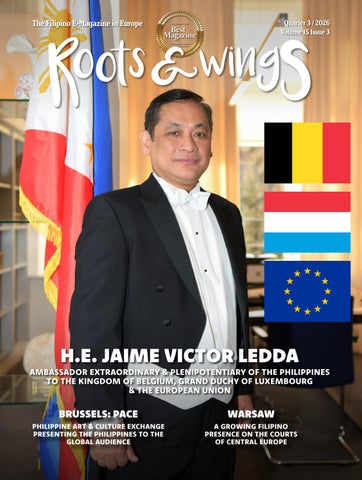
H.E. JAIME VICTOR LEDDA
AMBASSADOR EXTRAORDINARY & PLENIPOTENTIARY OF THE PHILIPPINES TO THE KINGDOM OF BELGIUM, GRAND DUCHY OF LUXEMBOURG & THE EUROPEAN UNION
BRUSSELS: PACE
WARSAW
PHILIPPINE ART & CULTURE EXCHANGE PRESENTING THE PHILIPPINES TO THE GLOBAL AUDIENCE
A GROWING FILIPINO PRESENCE ON THE COURTS OF CENTRAL EUROPE
Roots&Wings
From the Editor-in-Chief
A Harvest of Stories "OUR WORK IS OUR REWARD" On our cover this issue, His Excellency Jaime Victor Ledda, Philippine Ambassador to the Kingdom of Belgium, Grand Duchy of Luxembourg and the European Union, nearing the bend of a diplomatic career of more than thirty-five years, shares his message to RawMags readers: “Our work is our reward.” Welcome to our third-quarter edition, arriving as autumn starts across Europe, the season of gathering and letting go. In these pages, we gather a summer of stories, as Roots&Wings marks 17 years since inception. The Philippines and Belgium celebrate 80 years of diplomatic relations, and Brussels has done it in style. The beloved Manneken Pis received a handwoven Ifugao costume. Designer Maxime Edward, adopted from Quezon City as a baby, stood teary-eyed through a standing ovation as his Philippine textiles walked a Brussels runway. And Diwata ng Karagatan, a Filipino film from 1936, was found in Belgium’s Royal Film Archive after being lost for decades. As our Poland Country Editor, Aieshah Balmori, writes, “Filipinos in Poland are no longer invisible.” Independence Day carried on through a downpour, because Filipinos know rain. And the OWWA Cup and the Silesian Cup turned sports halls into meeting places for Filipinos across Central Europe. Since the Philippine Embassy in Ireland reopened, Ambassador Daniel R. Espiritu and his staff have made sure the community feels the warmth of the Embassy, opening the chancery for celebrations like ASEAN Day and Alay-Musika Para sa Pilipino, and turning up to support Filipino talent. From Dublin Independent Fashion Week to the first anniversary of the Southeast Asian Network Ireland. And on the airwaves, Tayo Na sa Ireland now connects Ireland and the Philippines live every first Saturday of the month. In Prague, some 2,000 people filled a sports hall for Barrio Fiesta. In the UK, Aaron Gonzales went from singing for his supper to Starbucks billboards,
2
chef Rex De Guzman brings Filipino food to British tables with his cookbook KAMAYAN, and North Wales marks 25 years since the first Filipino nurses arrived. In Stevenage, young leaders now run the fiesta they once danced in as children. From Northern Ireland, nurse Carolina Steele shares a journey that began in Listowel in 2002 and led her to Belfast, where she is now a Deputy Sister in interventional radiology. You will also meet a Vienna dancer who rebuilt his life's work, an Ironman-finishing nurse who has guided over a thousand nurses towards registration, a doctor whose paintings carry Mindanao to Sweden, and a filmmaker who points his camera at those too often overlooked. A Rizalian family's service in Switzerland was honoured in Manila. In the Philippines, a music festival has brought communities together for 32 years, and a knife-maker lets his craft speak for itself. The Commission on Filipinos Overseas ties it all together: global Filipinos, local connections, shared progress. To our founder and publisher, who planted these roots: thank you for believing in our stories. To our Editorial Board, Country Editors and Contributors: thank you for being the voice of your communities. To our layout artist: thank you for making every page a joy to turn. And to you, our readers and supporters: from the bottom of our hearts, thank you. You are not on the edge of these stories. You are at the centre of them. We are still growing, and we are looking for Country Editors and Contributors across 17 countries. If your community has a story waiting, we would love to welcome you into the Roots & Wings family. So turn the page, pour something warm, and settle in. Your next favourite story is waiting. MARAMING SALAMAT, AND MABUHAY!
Luz LG Bergersen E D I TO R- I N - C H I E F E M A I L : LG B 1312@ G M A I L .C O M T E L : 0 0 47 9 0 130 87 1
rawmags.online
CLICK TITLE TO OPEN PAGE
Contents MEET THE TEAM P4 A M B A S S A D O R J A I M E V I C TO R L E D D A P 6 PA C E : A N E W V I S I O N F O R C U LT U R A L E XC H A N G E I N E U R O P E P 12 9 0-Y E A R A N N I V E R S A R Y O F A C L A S S I C F I L I P I N O F I L M P 17 B E LG I A N FA S H I O N D E S I G N E R R E C O N N E C TS W I T H F I L I P I N O R O OTS P 20 M A N N E K E N P I S R E C E I V E S A N I F U G A O C O ST U M E P 2 4 H A L I N A ' T D U M AYO S A P O L A N D ! P 26 B U I L D I N G A L I F E T H R O U G H D A N C E P 28 F ÊT E D E L A M U S I Q U E 2026 P 33 A D O C TO R ’ S C A N VA S O F H U M A N I T Y P 36 AWA R D -W I N N I N G F I L M M A K E R A N D H U M A N R I G H TS A D V O C AT E P 40 T H E H E A R T O F E N D U R A N C E P 43 A T R I P L E R I Z A L I A N M I L E STO N E P 47 A A R O N G O N Z A L E S P 51 A N U R S E ’ S J O U R N E Y P 53 N O R T H WA L E S C E L E B R AT E S A S I LV E R J U B I L E E P 54 A S E A S O N O F F I L I P I N O P R I D E , P U R P O S E , A N D P O S S I B I L I T Y P 58 K A M AYA N : F I N D I N G H O M E , O N E B I T E AT A T I M E P 64 I H AWA N S A K A N TO P 66 A K N I F E T H AT S P E A K S F O R I TS E L F P 6 9 F I L I P Í N S K Á B A R R I O F I E STA 2026 P 72 ST E V E N A G E B A R R I O F I E STA 2026 P 74 I N D E P E N D E N C E D AY S H A R E D FA R F R O M H O M E P 76 A G R O W I N G F I L I P I N O P R E S E N C E O N T H E C O U R TS P 79 SILESIAN CUP P84 COMMISSION ON FILIPINOS OVERSEAS P86
www.rawmags.online 3
Roots&Wings
MEET THE TEAM
Luz Bergersen
Rachel Hansen
Atty. Aimee Alado -Blake
editor-in-chief, country editor, norway member advisory council
publisher/founder, sweden member advisory council
legal counsel, uk member advisory council
Myla Arceno
Jenny Hansen
Hilda Arenas
Feds Murray
country editor, uk member advisory council
art director/layout, philippines
associate editor & country editor, the republic of ireland
associate editor & country editor, northern ireland, uk
Rebecca Urbančík Garcia
Ralph Anthony Chan
Anton Miguel D. De Vera
Louise Baterna
head of social media, country editor, czech republic
country editor, austria
contributor, austria
country editor, belgium
Roots&Wings roots & wings filipino magazine in europe published by rachel publishing co. stockholm, sweden 2009-2025
4
R AW M AG S T E A M
rawmags.online
MEET THE TEAM
Antonina Eraida Tafalla
Dennis Manaay
Maria Josephine Renker
country editor, finland
country editor, france
country editor, germany
Cipriano “Zip” De Guzman
Jennifer Fergesen
Donna Patricia Lopez Manio
Aieshah Balmori
country editor, luxembourg
country editor, norway (svalbard)
lifestyle & country editor, philippines
country editor, poland
Hanna Stenbacka Köhler country editor, sweden
FOLLOW US ON SOCIAL MEDIA
instagram: @raw.mags twitter: @rawmags facebook: @rawmags
youtube: @rawmags linkedin/rawmags
Mildred Manuel- Vidarsson country editor, iceland
Jonathan Pico
Junart Kim Nieva
country editor, wales, uk
assistant country editor, london, uk
FEEDBACK PAGE
What do you think of our magazine? Email lgb1312@gmail.com
R AW M AG S T E A M
5
Roots&Wings
6
rawmags.online
BELGIUM
Ambassador Jaime Victor Ledda’s Enduring Mission of Service “Reflections on diplomacy, partnerships and his continuing commitment to Filipinos in Europe” By Louise Baterna, Country Editor, Belgium
A
s he approaches the final bend of his diplomatic career, Ambassador Jaime Victor Ledda is far from thinking of retirement. His office at the Philippine-owned property in the heart of Brussels is in constant motion. His agenda is full, hopping from board meetings and official visits to community gatherings. Ambassador Extraordinary and Plenipotentiary of the Republic of the Philippines to the Kingdom of Belgium, the Grand Duchy of Luxembourg, and the European Union (EU), Ambassador Ledda is very busy indeed. A CAREER SHAPED ACROSS CONTINENTS Time flies, he said. Juggling these three major assignments is both a challenge and a rewarding experience, especially amid an ever-changing geopolitical, economic, and migration landscape. His perspective is shaped by his previous foreign postings in Milan, Beijing, Macao SAR, as well as an earlier assignment in Brussels 25 years ago. From November 2013 to August 2020, he was the Philippine Ambassador to the Kingdom of the Netherlands and the Permanent Representative for the Prohibition of Chemical Weapons and other international organizations in The Hague. On all three fronts, things have opened up for stronger and more sustainable partnerships. Stakeholders have also diversified: community, academe, social and private citizens, trade partners, and bilateral relations.
STRENGTHENING PHILIPPINES-EU TIES “For the European Union, our representation and visibility enabled us to avail of the GSP Plus privileges, the Partnership and Cooperation agreements signed and implemented for the creation of a formal bilateral mechanism for consultation and engagement,” he explained. Last June, Ambassador Ledda organized a policy dialogue on the future of Philippines-EU economic cooperation with members of the diplomatic community, the business sector and academia. Held at the Brussels Press Club with Trade Undersecretary Allan B. Gepty as keynote speaker, this policy dialogue highlighted the “more comprehensive and vibrant economic linkages between the two partners,” especially in light of the ongoing free trade negotiations. Recently, the Philippines and the EU announced their “Enhanced Partnership,” expanding political, security, and economic cooperation, including a landmark support package of €15 million to strengthen the Philippine Navy’s ability to monitor the country’s maritime zones, enhance early warning, and support better coordination and response by naval and maritime security forces. Foreign Affairs Secretary Ma. Theresa P. Lazaro commented that expanding cooperation and heightened engagement reflect the growing partnership between the Philippines and the EU and signal that the time is ripe to elevate relations. In a statement released by the European External Action 7
Roots&Wings
Service, the upgraded partnership “will expand cooperation on foreign affairs and security, good governance, the rule of law, human rights, climate change, the green transition, digital projects under the EU’s Global Gateway strategy and people-topeople exchanges.” The Embassy played an active role in the whole-ofgovernment effort to delist the Philippines from the EU’s Grey List, which monitors third-country efforts against money laundering and terrorist financing. “First Secretary Revillas and I met with senior officials in Brussels and Luxembourg, as well as Members of the European Parliament in Strasbourg, to inform them of the initiatives taken by the Philippine government to be more credible and transparent in our financial transactions and more compliant with the FATF standards. This helped pave the way for the country’s removal from the EU grey list.” CREATING MOMENTUM WITH LUXEMBOURG This breakthrough was instrumental in enticing Luxembourg’s interest in doing business with the Philippines. More Luxembourg companies are investing in the Philippines, particularly in logistics, satellite services, financial services, and even healthcare. “We are keen to continue building this momentum, and with the successive visits this year of H.E. Xavier Bettel, Luxembourg’s Foreign Affairs
8
and Foreign Trade Minister, we will further explore collaborations between the two countries.” Over the last twenty years, the Filipino community in Luxembourg has also grown, now estimated at over a thousand, most of them employed in the finance sector as well as other sectors like information technology and healthcare. The Filipino community has gained recognition for their professionalism and work ethic. A GROWING COMMUNITY IN BELGIUM The same is true of the Filipino community in Belgium. Official numbers indicate approximately 18,000 Filipinos live in Belgium, with a majority in the Flanders and Brussels regions. Many are employed in the hospitality sector, but more Filipinos are being hired in geriatric facilities and factories. Truck drivers were hired directly from the Philippines or from third countries, while many professionals work in national companies, and some hold positions in government agencies. Through the Belgian government's scholarship programs, many Filipino students have the chance to study at universities in Antwerp, Ghent, and Leuven. Ambassador Ledda pointed out that the University of Namur (UNamur) currently offers a Philippine Studies Program aimed at promoting a deeper understanding of the Philippines among Filipino and international students. The Ambassador and UNamur
rawmags.online
Rector Prof. Annick Casteaux signed a Philippine grant to implement the academic collaboration. MARKING 80 YEARS OF PHILIPPINES-BELGIUM COLLABORATION Such collaborations are grounded in commonalities and the long history linking the two countries. This year, 2026, marks the 80th anniversary of PhilippinesBelgium diplomatic relations. During his recent visit to the Philippines, Belgian Deputy Prime Minister and Minister of Foreign Affairs Maxime Prévot met with Foreign Affairs Secretary Lazaro to explore ways to strengthen Philippines-Belgium cooperation further. Ambassador Ledda shared that they also “reviewed progress under the Joint Plan of Action (JPoA) 2023– 2027 and discussed ongoing negotiations on bilateral agreements, as well as opportunities to expand cooperation in areas of mutual interest.” CHAMPION FOR FILIPINO SEAFARERS The Belgian Foreign Minister also met with officials from the Maritime Industry Authority (MARINA) to advance shared priorities in maritime cooperation. This mutual interest is made evident by the adoption of the “Seafarer’s Human Rights, Safety and Wellbeing” declaration, collaboration with the Antwerp Maritime Academy for continuing education and training of Filipino seafarers, a partnership with Stella Maris Antwerp to support the well-being of seafarers, and exchanges between the Philippine Ports Authority and the Port of Antwerp-Brugge International. The welfare of seafarers working aboard ships and tankers dropping anchor in Antwerp and other Belgian port cities is a key focus of the Embassy’s outreach program. With the help of Honorary Consul General Ronny de Blaere and the Filipino communities in Antwerp and Ghent, the Philippine Embassy has intervened and assisted Filipino seafarers facing cases ranging from possession of illicit substances to employment disputes.
It is for this reason that the Philippine Embassy has been conducting post-arrival seminars that provide new arrivals with basic information on their rights, community activities where they can find help in case of emergencies, how to find work, and how to better integrate into Belgian society. PEOPLE-TO-PEOPLE DIPLOMACY Indeed, “people-to-people” exchanges are one of the pillars of bilateral relations, said Ambassador Ledda. During the Philippine Independence Day celebration at the Embassy last June, the Filipino community warmly welcomed adoptees from the Philippines, who had reached out and expressed their desire to reconnect with their roots. A significant part of the Embassy’s work involves providing consular services and assistance to nationals, participating in Filipino community activities and cultural projects, and identifying labor mobility opportunities for Filipino nationals.
PROTECTING THE VULNERABLE The Philippine Embassy also addresses issues involving human trafficking and domestic violence. “Many of our ‘kababayans’ are lured into taking risks for the promise of a ‘better life.’ But some fall prey to financial and physical-social traps that leave them vulnerable to abuse. We also have cases of violence against women in intercultural marriages — Filipinas who marry without knowing much about their future partners or the country where they are moving.”
9
Roots&Wings
“We have been working for the recognition of the credentials of healthcare professionals and various occupations,” he said. He recalled that fifty years ago, Belgian hospitals recruited Filipino nurses. BRIDGING SKILLS AND OPPORTUNITIES “Today,” he said, “there is a higher demand due to shortages of healthcare professionals, both in hospitals and geriatric care homes. Of course, regulations and requirements remain before we can fully meet these demands. Still, this is being addressed through diploma accreditation, language training, and strengthening partnerships with healthcare institutions.” Nevertheless, Ambassador Ledda has emphasized to Belgian companies that it would be more advantageous to set up in the Philippines, where they can more readily access a wide pool of Filipino professionals and skilled workers. A COMMUNITY THAT INTEGRATES AND INCLUDES The Ambassador said with pride that Filipinos have shown that they integrate easily, are cooperative, and are mindful of our place and role. “I remember the time when I met the mayor of Antwerp, who is now 10
the Prime Minister; he claimed that he never had problems with the Filipino community. We are highly regarded as hard-working and conscientious. Our host governments have always expressed appreciation for our contributions to the local economy.” Furthermore, the Ambassador explained that the Filipino sense of community is inclusive, meaning we don’t gather only among ourselves. We welcome others to partake of our culture, be it culinary, musical, socio-civic, among others. “We have become a bigger, visible and more active community.” Over the years, the Filipino community has played a special role in cultural diplomacy, and the Embassy supports these initiatives. With these community events alongside consular services, representations and negotiations, Ambassador Ledda certainly has little time to rest. But he is grateful for his reliable and efficient Team Brussels PE, with each member entrusted with specific roles and responsibilities and understanding the importance of communication, whether through traditional channels or the wider reach of social media. THE REWARD OF SERVICE When asked what the biggest reward in his diplomatic career has been, he quickly answered, “Our work is
rawmags.online
our reward. It is such an honor and privilege to be in service to our ‘kababayans’ and our nation.” HONORS AND DISTINGUISHED CAREER Too modest to mention it himself, Ambassador Ledda was conferred the distinct Knight Grand Cross of the Order of Orange-Nassau during his tenure as Ambassador to the Netherlands. He also received the Gawad Mabini, with the rank of Dakilang Kamanong, for his distinguished service in consular affairs. His more than thirty-five years of government service also includes important portfolios. He was Assistant Secretary for Consular Affairs from April 2010 to November 2013. For three years (from the end of 2020 to early 2023), he was Assistant Secretary for European Affairs. He was designated as the Philippine representative to the ASEAN Inter-governmental Commission on Human Rights (AICHR) and the Philippine ASEM SOM Leader in a concurrent capacity. A career diplomat and a lawyer, Ambassador Ledda, who earned both diplomas from the University of the Philippines, embraces his profession with fondness and calls upon the young to consider foreign
service. “Diplomacy is an open profession, but one has to prepare for it… read, study, be curious, and keep up with current events. One can even develop a love for the arts or sports—subjects that can help break the ice in meetings or outside the boardroom.” LOOKING BEYOND THE FINAL BEND Never too late to learn the piano, he said in jest, but he is seriously considering life after the Department of Foreign Affairs. Family will definitely be the priority. Ambassador Ledda is married to Dr. Gina Macatangay, who holds a PhD in economics from Erasmus University in the Netherlands. “My wife Gina and son have, each time, adjusted to the changes and movements in my career, and it is time I devote my attention to them, as they so deserve.” Through continuing education, he looks forward to engaging in private practice and consultancy. He’s currently pursuing a master’s degree in civil aviation and space law. Combining this with his extensive experience in Europe and an expanding network of contacts, life beyond that final bend of foreign service promises to be just as dynamic for Ambassador Ledda.
11
Roots&Wings
BELGIUM
PACE: A New Vision for Cultural Exchange in Europe Submitted by Maria Antonia Bosa Van Espen-Boonen, Belgium 12
rawmags.online
How a volunteer-driven organization is bringing Philippine arts and culture to the mainstream—one collaboration at a time.
F
or Louise Baterna, preserving Philippine culture is not simply about remembering the past — it is about building bridges for the future. She believes Filipinos in Europe can share their heritage while becoming active participants in the communities they now call home. In a multicultural city like Brussels, where communities from around the world converge, cultural organizations play an important role in fostering understanding across borders. That belief inspired her to establish the Philippine Art and Culture Exchange (PACE) asbl, a Brussels-based non-profit organization that has quickly positioned itself as a dynamic platform for presenting the Philippines to global audiences. PACE was founded in 2024 by a diverse group of Filipinos and Belgians led by a long-time Filipino community leader, Louise Baterna. It was created with a vision to showcase the Philippines to the wider cultural landscape of Europe. Rather than organizing events exclusively for Filipinos, PACE develops projects that cultivate dialogue and encourages collaboration between cultures. A PASSION THAT BRINGS PEOPLE TOGETHER Unlike many organizations that rely on formal membership requirements, PACE operates differently. There are no rigid commitments—only a shared passion for celebrating Philippine heritage. Baterna says: “Leadership is practised by example. There should be a common passion for promoting Philippine art and culture.” This philosophy has shaped the organization’s culture from the very beginning. By removing barriers to participation, PACE encourages people from different backgrounds to become involved according to their own strengths and availability. FILLING A MISSING PIECE The idea for PACE grew from a simple observation. “There was something missing in the community,” Baterna recalls. While Filipinos in Belgium have long celebrated their traditions, there was an opportunity to reach beyond the community itself. That vision inspired the name Philippine Art and Culture Exchange. The emphasis is not only on arts and culture, but on a dialogue where learning flows in both directions. PACE believes that cultural promotion should
encourage conversation rather than simply present performances or exhibitions. CULTURE BEYOND THE FILIPINO COMMUNITY Equally important is collaboration. “We should not work in a bubble. We all contribute to cultural diplomacy.”, the founder explains. That spirit has allowed PACE to build partnerships with the Philippine Embassy, government agencies, artists, community organizations, and cultural groups across Europe. These partnerships extend far beyond the Filipino diaspora while placing Philippine culture within broader European conversations that resonate with diverse audiences. Perhaps no project illustrates PACE’s philosophy more clearly than its annual Philippine Food Festival. The event gives Filipino entrepreneurs an opportunity to introduce their businesses while inviting visitors to discover the country’s diverse regional cuisine. Beyond tasting unfamiliar dishes, guests leave with a deeper appreciation of the stories and traditions behind them. Now celebrating its sixth edition, the festival has grown from a modest community gathering into one of the largest Filipino cultural events in Belgium, welcoming approximately 3,000 Filipino and nonFilipino visitors each year. Supported by the City of Woluwe-Saint-Pierre, the festival has become much more than a celebration of Filipino cuisine. It also serves as an incubator for aspiring entrepreneurs. Before each festival, participating food vendors attend workshops on food hygiene, business regulations, and entrepreneurship, equipping them with practical knowledge about establishing and operating legitimate food businesses in Belgium. The festival therefore functions not only as a showcase for Philippine gastronomy but also as a platform that supports economic empowerment within the Filipino community. The event reflects PACE’s belief that culture can create opportunities—not only for appreciation but also for professional growth and community development. ARTS THAT CREATE CONVERSATIONS Another memorable initiative was Roots and Weaves, a fashion and textile showcase featuring the work of Belgian designer Maxime Edward, who was born in the Philippines before being adopted by a Belgian family. His collection became more than a fashion presentation—it was a celebration of identity, heritage, and belonging, demonstrating how cultural roots can continue to inspire creativity regardless 13
Roots&Wings
of where life leads. This is a notable project that explored how indigenous textiles can be reinterpreted through a contemporary European design perspective rather than being confined to the classic Filipiniana silhouette. A collaborative project, Freeze Frame, was presented during PACE’s residency at the Elsenhof Community Centre. The photographic exhibition invited returning Filipinos and international visitors to share the single image that remained most vivid from their visit to the Philippines. The results challenged many long-held stereotypes. Rather than focusing on poverty or familiar tourist imagery, participants overwhelmingly remembered family life, festivals, local cuisine, neighborhood communities, landscapes, and even street dogs. The exhibition became a thoughtful reflection on how authentic personal experiences can reshape perceptions of an entire nation. These projects embody PACE’s belief that culture becomes most meaningful when people are invited to experience it, rather than simply observe it.
“
further expanding the association’s commitment to promoting Philippine literature internationally. These literary initiatives reflect PACE’s conviction that culture extends beyond visual arts and performances. Stories, poetry, essays, and books provide equally powerful ways of expanding awareness of the Philippines through cross-cultural conversations. MUSEUMS, UNIVERSITIES, AND CULTURAL INSTITUTIONS PACE has also distinguished itself through collaborations with some of Belgium’s leading academic and cultural institutions. One of the organization’s most exceptional projects came in 2025 when PACE was invited by the Brussels Museum of Migration to curate a six-week multimedia exhibition dedicated to the Philippine diaspora. The exhibition marked a significant milestone, making the Philippines one of the Asian countries to receive such extensive representation in the museum. Drawing on an impressive collection of historical and contemporary materials that were presented, the exhibition combined visual arts, documentary films, podcasts, video interviews, photographs, and archival pieces to tell the story of Filipinos in Belgium. Conferences, concerts, film screenings, afternoon gatherings, and community events transformed the museum into a vibrant cultural space that offered visitors an in-depth introduction to Philippine history, migration, creativity, and community life. Together with the Université Libre de Bruxelles (ULB), the association also organizes public conferences exploring subjects such as migration, human rights, environmental sustainability, and intercultural dialogue. These discussions demonstrate that Philippine perspectives can contribute meaningfully to broader international issues while encouraging exchanges between scholars, students, artists, and the public. PACE also serves as a platform for emerging Filipino artists. It has organized visual exhibitions featuring both Belgium-based and Philippine-based artists as part of the latter’s European exhibition tours.
WE ARE PARTICIPATORY MEMBERS OF OUR ADOPTED COUNTRIES, AND OUR CONTRIBUTION GOES FAR BEYOND ECONOMICS.
LITERATURE AS CULTURAL DIPLOMACY Literature occupies an equally significant place within PACE’s cultural programming. Recognizing the growing presence of Filipino voices in international literature, the association has steadily expanded opportunities for Filipino writers to engage with people across Europe. In 2024, PACE sponsored Filipina author Jacqueline Chio Lauri as one of the featured speakers at the Writers Festival of Belgium, introducing readers to contemporary Philippine literature and the experiences of the Filipino diaspora. Building on that success, PACE launched the first Asian Literary Festival in Belgium in 2025, creating a platform that brought together writers, readers, publishers, and academics. Later this year, PACE will publish an anthology exploring the theme of mothering, featuring contributions from Filipino writers in the diaspora. The book’s launch will coincide with a mini Philippine Book Fair in Brussels, 14
rawmags.online
These projects illustrated one of PACE’s defining strengths: its ability to bring together artists, historians, academics, institutions, and community members in a single collaborative undertaking that presents the Philippines in all its richness and diversity. INSPIRING THE NEXT GENERATION PACE believes that cultural exchange should begin early, introducing the young audiences to Philippine traditions through engaging and interactive experiences. This commitment was evident in 2025 when PACE was invited to organize a month-long Philippine cultural program for Artistes du Monde for Kids in Brussels. Tailored for children, the programme featured storytelling, music, traditional crafts, culinary discovery, and an exhibition showcasing the works of two young Filipino visual artists. Rather than presenting culture as something to be observed from a distance, the activities encouraged children to participate, create, ask questions, and experience the Philippines through play and creativity. CINEMA AS A CULTURAL BRIDGE One of PACE’s most exciting upcoming initiatives is the Philippine Film Festival at the Cinematek Brussels, scheduled for 2027. The festival represents
another important milestone in bringing Philippine cinema into one of Belgium’s premier film institutions while introducing European audiences to both classic and contemporary Filipino filmmaking. The timing is particularly significant following the rediscovery of Diwata ng Karagatan, a nearly 90-year-old Filipino film preserved at the Royal Film Archive of Belgium. Long considered lost, the film has become an important symbol of the historical links between Belgium and the Philippines. PACE played an important role in facilitating cooperation between the Belgian archive and the Filipino film historian and director Nick Deocampo, helping support research and renewed international interest in this remarkable cinematic treasure. For PACE, the festival represents far more than a series of screenings. It is another opportunity to present Philippine history, artistic achievement, and cultural heritage to wider audiences while creating new partnerships within Europe’s cultural sector. OVERCOMING CHALLENGES TOGETHER Organizing cultural events is rarely simple. Budget constraints, venue availability, scheduling artists, finding collaborators, and avoiding conflicts with other community events all require careful planning. Yet instead of viewing these challenges as obstacles, PACE sees them as opportunities to strengthen partnerships.
15
Roots&Wings
Planning also plays a crucial role. PACE invests considerable time in developing long-term partnerships and carefully curated projects because major European cultural institutions often schedule events eighteen months or even several years in advance. LOOKING TOWARD THE FUTURE PACE has no intention of slowing down. Several major initiatives are already in development, including book fairs, film festivals, expanded food festivals, and other cultural programs designed to showcase the richness of Philippine history, literature, cinema, and artistic traditions. The organization also has even bigger aspirations. Among its long-term goals are establishing a Philippine cultural resource center, creating a repository of experts and educational materials, promoting research on Philippine arts and culture, and one day helping establish a Maison des Philippines in Belgium—a dedicated cultural center that would house a Philippine library while serving as a venue for exhibitions, workshops, conferences, performances, and culinary events. It is an ambitious dream, but one firmly rooted in the belief that culture deserves a permanent home. Such a centre would not only preserve Philippine heritage but also provide future generations a permanent venue where culture continues to evolve through dialogue and collaboration. For its 2027-2028 events, PACE is already working on potential partnerships with several museums, as well as a film festival mentioned earlier, a choral concert, and a Philippine Day celebration in one of the tourist cities in the Wallonia region. A CHANGING NARRATIVE PACE’s work comes at a time when international perceptions of the Philippines are changing. For many years, Filipinos abroad were often recognized primarily for their economic contributions
or their role in the global workforce. Today, however, Philippine artists, writers, filmmakers, designers, musicians, and creative professionals are gaining increasing international recognition. The association believes this presents a unique opportunity to showcase the country’s remarkable cultural wealth. As Louis Baterna observes: “Social media has helped dispel many of the stereotypes Filipinos faced over the past two decades. Globally, we are increasingly recognized as a people with a rich culture and a country teeming with talent. This is the right moment to build on that momentum and bring Philippine culture beyond our borders. We have an abundance of creatives, both in the Philippines and throughout the diaspora, whose work deserves global attention.” “We need to move beyond the idea that we should remain on the fringes of society simply because we were not born here. We are not simply migrants. We are participatory members of our adopted countries, and our contribution goes far beyond economics.” That message encapsulates the spirit of PACE. Every performance shared, every artwork exhibited, every recipe passed on, and every story told becomes another opportunity to challenge stereotypes, celebrate creativity, and strengthen relationships between communities. For Louise Baterna, the success of PACE will not simply be measured by the number of events it organizes or the audiences it reaches. It will be reflected in the confidence of Filipinos who choose to share their heritage and the understanding built between communities. Despite its current small membership, PACE continues to grow. Its dedication and unwavering commitment as a non-profit organization remain steadfast, and its message is clear: Philippine arts and culture are not only meant to be preserved—they are meant to be shared and celebrated across cultures.
ABOUT THE AUTHOR Maria Antonia Bosa Van Espen-Boonen is a retired Philippine foreign service staff officer and diplomat based in Brussels, Belgium. Her writing draws on both personal and professional experiences, spanning more than two decades of government service and diplomatic assignments in the United States and in Europe. She is a recipient of the Department of Foreign Affairs 2014 Outstanding Employee Award.
16
rawmags.online
BELGIUM
"IT WAS LOST AND HAS BEEN FOUND" Marking the 90-year Anniversary of a Classic Filipino Film Found in Belgium Submitted by A.D. Capili, Belgium
17
Roots&Wings
N
early a year ago today, a long-lost Filipino film was rediscovered in Brussels, Belgium. The 1936 film entitled Diwata ng Karagatan (Goddess of the Sea) was found in the Cinémathèque royale de Belgique (Royal Film Archive of Belgium; also called CINEMATEK) last October 2025. The authenticity of the 35mm print was confirmed by filmmaker and historian Nick Deocampo, who flew at that time from Germany to Belgium to examine the movie. Deocampo has called Diwata ng Karagatan a “national film treasure” as it is now known to be the oldest existing Filipino movie produced prior to the outbreak of the Second World War. Before the rediscovery of the 1936 movie, that title belonged to the 1937 film, Zamboanga, which features Fernando Poe Sr., and which was also discovered by Deocampo in the US Library of Congress in 2004. WHY WAS IT LOST? Before World War II, Manila was among the three film capitals of Asia, along with Shanghai and Kyoto. Until the early 1940s, the Philippines had been producing about 60 films per year. Fighting in and the bombing of Manila during the war destroyed the hundreds of Filipino movies made until that point. Even in the post-war era, many old films were lost to mold and degradation because of poor or non-existent storage facilities in the country.
of Diwata ng Karagatan. Citing multiple possible titles of the missing film in French, Baterna-Hubert then inquired with the Royal Film Archive, which responded that it might indeed have a copy of the movie. Both Baterna-Hubert and Deocampo were thereafter given the chance to view it at CINEMATEK in Brussels and to determine if it was indeed the longlost work. WHY WAS IT NOT DISCOVERED UNTIL NOW? Deocampo has explained that one reason why it has been difficult to find classic Filipino films in archives outside of the country is film piracy; a practice that was rife and unchecked in the earlier days of cinema. For a long time, Diwata was miscategorized as a French production. A copy of it was edited, reduced to a runtime of about 52 minutes, and released in Francophone markets. With reordered scenes and an added French voice-over, it was promoted as a documentary of “some exotic South-sea natives” – leaving the Philippines unmentioned. The closing credits, which would have listed the actors, as well as the names of all the other Filipinos involved in its production, were also cut out from the French editions.
HOW DID IT SURVIVE? Diwata ng Karagatan, which stars Rogelio de la Rosa and Mari Velez, was directed by Carlos Vander Tolosa and produced by Jose Nepomuceno – the father of Philippine Cinema in 1936. Later in that decade, it was brought to and successfully screened in France, as well as in neighboring Belgium, and in some parts of South America. The movie proved popular in France and was re-released throughout the 1930s and 1940s multiple times, in different editions, and under different titles, such as Ligaya, fille des îles (Ligaya, Girl of the Islands) and Wong, le tyran (Wong, the Tyrant). A nitrate copy of the film eventually ended up in the possession of the now-defunct Belgian film laboratory CineLabor, which handed over the movie to CINEMATEK in 2016. HOW WAS IT FOUND? In October 2025, while he was at the Frankfurt Book Fair, Nick Deocampo reached out to Louise BaternaHubert, the head of the Brussels-based organization PACE (Philippine Art and Culture Exchange), about the possibility that Belgium’s film archive had a copy 18
rawmags.online
WHAT HAS HAPPENED TO THE REDISCOVERED FILM IN THE MEANTIME? A copy of Diwata was given by the Royal Film Archive of Belgium to the Film Development Council of the Philippines in June 2026 and is currently in the process of restoration. To celebrate its 90th anniversary, the movie will be previewed in Manila before the end of the year. Baterna-Hubert’s PACE also plans to feature Diwata at a Filipino film festival it will organize in the summer of 2027 in Brussels, alongside other classic movies and contemporary works made by emerging Filipino directors. THE WORK THAT STILL NEEDS TO BE DONE There have been other success stories of classic Filipino movies brought back to the Philippines from Europe. For instance, as with Diwata, BaternaHubert was also instrumental in the restoration of a pioneering film co-directed and co-produced by her novelist-journalist father Quirino “Quin” Baterna. She had kept in her home in Belgium a copy of Quin Baterna’s 1977 film, Ginauhaw Ako, Ginagutom Ako (I am Thirsty, I am Hungry), which is the firstever full-length movie in Hiligaynon. After the then National Film Archives of the Philippines determined its historical value, it was sent to the Centre national du cinéma et de l'image animée (CNC) in Paris for restoration.
In the last few decades, there has been a growing awareness of the need to collect, preserve, and restore classic Filipino films. The Philippine Film Archive, which was established in 2011, has the mandate to preserve the country’s cinematic heritage. Including Diwata ng Karagatan, there are now six pre-World War II Filipino movies that have been recovered and preserved. Much more work remains to be done; however, in the fields of Filipino film research and heritage preservation. With over 200 pre-war movies believed to be stored in foreign archives, Deocampo has spoken of the need for a government-funded and systematic effort to locate, retrieve, restore, and study classic Filipino films.
ABOUT THE AUTHOR A.D. Capili is a Filipino poet and fictionist who came to Belgium to pursue graduate studies in philosophy and literature. He now teaches at a European School in Brussels. His poems have appeared in publications like Tint, Paris Lit Up, and Big City Lit. His stories can be found in The Quiet Reader, Between the Lines, and The Brussels Review. He co-wrote Philo Lite for Life and It Bites and Other Inhuman Poems with Anastasia Balasi.
19
Roots&Wings
BELGIUM
Belgian Fashion Designer Reconnects with Filipino Roots through Philippine Indigenous Fabrics By Louise Baterna, Belgium, Country Editor
B
russels — Belgian fashion designer Maxime Edward stood teary-eyed before a full house of friends, family, guests from the fashion and art circles, and members of the Filipino community, who rewarded him with a standing ovation that lasted several minutes, and called him back for multiple encores during the fashion show 20
Roots and Weaves, held on June 6 at the heritage site La Bellone in Brussels. For Maxime, the event marked a full-circle moment. Thirty-four years after being adopted and raised by Belgian parents, he had reconnected with his Filipino roots, using fashion as a vehicle to renew ties with his country of birth.
rawmags.online
The fashion show, a project of the Brussels-based non-profit organization Philippine Art and Culture Exchange (PACE) in collaboration with the Philippine Embassy in Brussels, was the culmination of two years of work. It included Maxime’s emotional journey back to the Philippines, where he met artisans in the weaving villages and ateliers of Kalinga and Western Visayas. “I was not looking for trends. I wanted a lasting connection with the artisans,” Maxime said of his sentimental journey. “What touched me the most was the welcome and the feeling that a missing part of me had finally found its home.” Beyond the discovery of new materials and inspiration for a collection, Maxime said the trip helped him better understand himself. Born in a charity hospital in Quezon City, he arrived in Belgium
at the age of nine months. Although his appearance and skin color never caused him difficulties growing up; he was always aware that he was different and that part of his identity remained connected to the Philippines. More than just a fashion event, Roots and Weaves gave Maxime the opportunity to reconnect with the Philippines, according to Louise Baterna, president of PACE. “The work of PACE is not only about promoting Philippine art and culture in Belgium and beyond, but also fostering connections, networks, sustainable relationships, and inclusivity,” Baterna said. “Maxime’s background made him the perfect partner for this project. His participation in Tokyo Fashion Week and Vancouver Fashion Week generated considerable attention and demonstrated his growing influence in 21
Roots&Wings
the international fashion scene. We wanted someone with a European perspective to showcase Philippine indigenous textiles on a Belgian runway.” She added that collaborating with a local designer who is well-integrated into Belgium’s fashion community helps ensure the continuity of initiatives promoting Philippine textiles long after the show has ended. On the runway of La Bellone, one of Brussels’ ‘hidden’ architectural and cultural gems, 17 models of diverse ethnic and cultural backgrounds showcased Maxime’s innovative use of Philippine textiles. Rather than attempting to replicate traditional Filipiniana—a heritage he did not grow up with—he remained true to his signature aesthetic, creating pieces that highlighted his mastery of structure, construction, and texture. Drawing from a rich palette of indigenous fabrics, including handwoven cotton textiles from the Mabilong Weavers Village in Kalinga, inabel from Ilocos, abaca and piña fabrics from Antique and Aklan, and hablon from Miag-ao, Iloilo, Maxime crafted garments that were both contemporary and wearable. The collection demonstrated how handwoven Philippine textiles can transcend cultural and ceremonial contexts, finding a
22
place in modern wardrobes and adapting to different occasions, seasons, and climates. Maxime managed to weave subtle references to his Filipino roots into the collection. Butterfly sleeves, for instance, were cleverly reinterpreted as sculptural elements positioned on the hips, while the sun motif of the Philippine flag appeared in the final look, crafted from turmeric-dyed abaca. Jeepney sounds and Sinulog rhythms were also beautifully woveninto the catwalk music. Emotions ran high throughout the evening, and the enthusiastic public response came as a surprise to the designer. Tickets were sold out. Many younger guests described the show as a fascinating introduction to the Philippines, while others were moved by Maxime’s personal story and came to support him in what many described as an unusual homecoming. Philippine Ambassador Jaime Victor Ledda said that Roots and Weaves was a fitting demonstration of the Philippine-Belgian connection – spotlighting a Belgian designer with Filipino roots and one who created an entire collection from Philippine textiles and presented it to an international audience. Ambassador Ledda also highlighted ongoing government efforts to preserve traditional Philippine
rawmags.online
weaving by supporting artisans and encouraging younger generations to learn the craft. He cited the continuing work of the Philippine Fiber Industry Development Authority (PhilFIDA) and the Philippine Textile Research Institute (PTRI) in advancing sustainability, innovation, and the development of the country’s textile sector. The fashion event, which also included a VIP seven course dinner and a mini concert by Filipino baritone Cipriano de Guzman, was part of the 80th anniversary celebrations of the Philippine-Belgian diplomatic relations. It was supported by the Philippine Department of Agriculture, PhilFIDA, PTRI, Lakat Sustainables, Fashion Revolution Belgium, Champagne Florence Duchêne and Thinking Threads Slow Fashion Advocate.
23
Roots&Wings
BELGIUM
Brussels’ Manneken Pis Receives an Ifugao Costume By Louise Baterna, Belgium, Country Editor Photo credits: Friends of the Manneken Pis 24
rawmags.online
D
uring a sunny Tuesday in early July in Brussels, the Manneken Pis (the little man who pees) received a new outfit, a stunning traditional Ifugao costume made of handwoven deep red, black and white Ifugao cloth, complemented by a headdress of cock feathers and a woodcarving of a chicken head. The Philippine costume donation was part of the 80th anniversary celebrations of the PhilippineBelgium diplomatic relations. Ambassador Jaime Victor Ledda, welcomed by the Friends of the Manneken Pis at the Brussels City Hall, led the “procession” with a large number of Filipinos, to where the Manneken Pis stands at the corner of rue de l’Étuve and rue du Chêne in central Brussels. Belgium-based fashion designer Amy Balbawang, who has her roots in the Cordillera, created this piece, a veritable Ifugao costume, tailor-made to the 55.5 cm height of the statue, one of Brussels’ most important tourist attractions. Manneken Pis has in fact two Filipino costumes, a camiso de chino that the Order of the Friends of Manneken Pis puts on every Philippine Independence Day. This will probably be replaced by the new Cordillera outfit from now on, a decision best left to his official dresser. The costume stayed on display for a day but 24 hours is enough to stir curiosity among flocks of tourists because your visit in Brussels is not complete without a pilgrimage to this statue, which reflects very much the Belgian cheeky spirit.
The Ifugao costume will join the over a thousand costumes and outfits kept in great care in his wardrobeturned-museum. And yet, he is naked most of the time, come rain or shine, in heatwaves or freezing winters. Legend tells the story of a little boy separated from his father during a fair and he was eventually found peeing in this corner, not far from the Grand Place. A heroic act is also attributed to him. He saved Brussels from the enemy who wanted to explode the thick walls of the city. Needing to pee urgently, he passed in front of the cannon and unknowingly doused the flaming fuse. But what is true is that this little boy has become an important landmark of Brussels, very much like the Little Mermaid of Copenhagen or the Chizhik-Pyzhik miniature bronze bird in Saint Petersburg. Perhaps not many know but Manneken Pis has a "sister,"Jeanneke Pis (little Jeanne who pees) in the Alley of Fidelity. Unlike the little boy, who "never grew up" despite his 400 years, Jeanneke is only 39 years old. She symbolizes fidelity and equality for women, though prison bars in front of her may lead to confused interpretations. Manneken Pis has an open entire street corner reserved for him and this has not prevented attempts at kidnapping. Rumors say it is not the original one on the pedestal...who knows? And if you fancy having one in your living room or in your garden, get one at a tourist shop two steps away where replicas painted in black, yellow, red, orange or violet stand in line, holding their P but not ready to pee.
25
Roots&Wings
POLAND
Halina't Dumayo sa Poland! The Growing Filipino Community Coming Together By Aieshah Balmori, Poland Country Editor
F
ilipinos from across Poland and Europe gathered in Warsaw to share their stories, strengthen dialogue, and reflect on a community becoming increasingly visible. Warsaw, Poland – On 23 May 2026, Filipino migrants in Poland, some settled for over a decade, others newly arrived, joined researchers, legal experts, church leaders, migration scholars, and Filipino diaspora representatives from across Europe for a day of connection and learning. The event, Tayo sa Poland!, was organised by the European Network of Filipino Diaspora (ENFiD) Poland, in partnership with the Humanitarian Organisation of Pinoys in Europe (HOPE) Foundation and support from the Polish Migration Forum Foundation. Held at the Multicultural Centre in Warsaw, it marked ENFiD’s 18th Diaspora to Dialogue initiative, covering migration, community, wellbeing, rights, and belonging. The day opened with a prayer from Fr. Tirso Alcover Jr of the Anthonian Institute and the national anthems of the Philippines and Poland. HOPE Foundation Vice President Clarisse Biglain spoke 26
on the initiative’s role in fostering dialogue and community empowerment, while ENFiD Chairperson Marison Rodriguez introduced the organisation’s work connecting Filipino communities across Europe. Delegates from Austria, the Czech Republic, France, Germany, Italy, Switzerland, and the UK then shared brief updates on their own communities – each shaped differently, but united by shared goals of cultural preservation and creating support systems for future generations. Polish Migration Forum Foundation President Agnieszka Kosowicz welcomed participants to the Multicultural Centre and introduced the Foundation's work with migrant communities across Poland, describing it as a space where migrants can find support, meet others, and take part in community activities THE PAST AND PRESENT OF THE FILIPINO DIASPORA IN POLAND Dr. Helena Patzer and Dr. Olga Wanicka of the University of Warsaw traced the Filipino community’s growth in Poland, from early migration through employment, education, and family reunification,
rawmags.online
including past recruitment abuses, to today’s presence across cities and professions such as manufacturing, education, hospitality, and research. Notably, Filipino nurses remain a small presence in Poland compared to countries like the UK and Austria, prompting discussion among delegates. Beyond migration figures and employment trends, the speakers also discussed the organizations, churches, sports leagues, businesses, and online communities that have helped Filipinos connect with one another over the years. These networks continue to play an important role in helping newcomers settle in Poland and find a sense of belonging. Taisiia Chernyshova of Burman Robinson also spoke on immigration and legal support available to the community. She encouraged migrants to seek reliable information and professional guidance when dealing with residency and legal matters. LIFE IN POLAND THROUGH FILIPINO EYES F. Tirso Alcover Jr. reflected on ministering to Filipinos in Poland: “The faith of Filipinos in Poland does not need to be shaped. It is shaped already…. What Filipinos need is… to keep the faith alive even in moments of struggle.” Yuri De Joya spoke about finding his place in Poland through volunteer work and community activities, encouraging Filipinos to stay engaged and support one another. Growing up in Poland shaped Anthony Certeza’s experience of balancing different cultural influences alongside his studies and business interests. Recalling her early years as a migrant worker, Mary Huerta shared the challenges that eventually led her to open Mary's Pinoy Restaurant in Warsaw. Family life and raising children in Poland formed the heart of Stephanie Sioson’s story, especially the everyday experience of bringing two cultures together at home. Education took center stage in Jeraine Micah Baran’s contribution, where she discussed her work with young people and the challenges children face when adjusting to a new environment. A journey from factory work to the hospitality industry defined Rizam Lacap’s experience, with years of hard work leading to his current role as a banquet supervisor. Academic life closed the discussion through Dr. Anjo Lapitan Jr., who spoke about teaching, research, and higher education while highlighting the presence of Filipinos in Poland’s universities. Although each speaker arrived in Poland under different circumstances, their stories shared common experiences of building a life, staying connected to family and culture, and finding support along the way.
INFORMATION THAT MATTERS Atty. Marlena Kaczmarek of the Migrant Workers Office spoke on employment rights and workplace protections, while Janina Owczarek of the International Organisation for Migration (IOM) Poland outlines available migrant services and integration support. Cybersecurity expert Jeffrey Morales discussed fake job offers, online fraud, and other schemes that frequently target migrants and overseas workers: “In cybersecurity, the weakest link is often not technology, it is human trust… Awareness is our strongest defense.” He ended with practical examples that helped participants recognize common tactics used by scammers and the importance of verifying information before sharing personal details online A COMMUNITY MOVING FORWARD This spirit of solidarity carried into the community oath-taking ceremony, where participants pledged to uphold unity, respect, kindness, and integrity within the Filipino community, to support and uplift fellow Filipinos, and to promote compassion, cooperation, and a positive image of Filipinos in Poland and beyond. In my closing remarks, I reflected on the significance of the gathering: “Filipinos in Poland are no longer invisible. Our community is growing, contributing, and becoming more visible. What matters now is awareness, connection, and feeling empowered to make use of these opportunities and support systems.” ENFiD-Poland, together with HOPE Foundation, invites Filipinos across the country to join its community, participate in future events, and help strengthen the connections that continue to bring Filipinos together in Poland.
J O I N O U R G R O W I N G C O M M U N I T Y: ENFID-POLAND EMAIL
ENFID.POLAND@GMAIL.COM
E N F I D - P O L A N D FA C E B O O K PA G E
FACEBOOK.COM/ENFIDPOLAND
E N F I D - P O L A N D FA C E B O O K G R O U P
FACEBOOK.COM/GROUPS/1359607946060170
E N F I D - P O L A N D I N STA G R A M PA G E
INSTAGRAM.COM/ENFIDPOLAND
E N F I D - P O L A N D L I N K E D I N PA G E
LINKEDIN.COM/COMPANY/ENFID-POLAND
H O P E F O U N D AT I O N FA C E B O O K PA G E
FACEBOOK.COM/HOPEPINOYCARES
H O P E F O U N D AT I O N I N STA G R A M PA G E
INSTAGRAM.COM/HOPE.POLSKA 27
Roots&Wings
AUSTRIA
NEVER GIVE UP Building a Life Through Dance By Ralph Chan, Austria, Country Editor 28
rawmags.online
R
AW Mags visited John Patrick Olegario, the CEO of The Unity Dance at his dance studio in Vienna, Austria. After two unsuccessful dance studios, which he was forced to close, the dancer and entrepreneur has achieved success in the world of dance, where not his dance moves, performances but also entrepreneurial skills have attracted admirers. His story traces a path marked in equal measure by setbacks and creative breakthroughs. Thank you, John Patrick Olegario, for a conversation about success, failure, entrepreneurship and his life as an artist. FAILURE AS A STEPPING STONE The conversation began with a reflection on his personal and professional journey, including the successes he had achieved and the challenges he had faced over the years. For John Patrick, this is already his third dance studio, although this path was shaped more by circumstance than by choice. His first studio, located in the heart of Vienna, operated between 2013 and 2014. Together with his business partners, he invested considerable time and resources in renovating the dance studio. However, the venture came to an abrupt end when a neighbour objected to the studio’s presence and reported it, ultimately forcing them to close. Faced with the loss of their location, they began searching for an alternative. During this period, his partners decided to leave the business, leaving John Patrick to continue on his own. Determined to pursue his vision, he found a new location at Millennium City. Once again, he invested his own money, hired an architect, and built the studio from the ground up. From 2015 onwards, he successfully operated the studio for eight years, creating not only a thriving business but also a strong community around it. The COVID-19 pandemic marked another major turning point. According to him, the consequences of the pandemic led to restructuring measures at Millennium City, ultimately resulting in the loss of the studio. He described this as one of the most difficult experiences of his career. Having invested not only substantial financial resources but also immense personal dedication and passion, he felt that he had lost everything he had worked so hard to build. Reflecting on that period, he recalled questioning whether it was worth continuing at all. “I asked myself whether I should carry on,” he said. “But you can’t simply leave the business to fend for itself.” After a two-year search, he eventually found a new property. The studio he operates today holds particular significance for him because he renovated it entirely from scratch. More than just a workplace, it
represents resilience, perseverance, and a fresh start after years of setbacks and rebuilding. CAN YOU MAKE A LIVING FROM ART AND CULTURE? John Patrick emphasised that working in the arts and cultural sector is rarely about making large profits. While it is possible to earn a living by running a dance studio, financial success is generally limited. A studio can grow and become well established, but it is unlikely to make its owner wealthy. Instead, he views it as a project that enriches people’s lives through dance, entertainment, and a sense of community. The rewards are often social and personal rather than financial. According to John Patrick, sustaining such a venture requires a great deal of passion and commitment. From a purely entrepreneurial perspective, significant financial gains would require a very different approach, such as franchising the business. However, this is not the path he has chosen. Looking ahead, he hopes to invest in employees again, which would allow him greater freedom to pursue other interests and projects beyond dance while continuing to expand the studio’s programme and activities. He stresses the importance of economic reality. “At the end of the day, we have to pay the bills. This involves managing staff and facilities. It’s a business
29
Roots&Wings
providing a service.” In his view, there are always two sides to the enterprise: the artistic and cultural mission on the one hand, and the practical demands of operating a business on the other. Although dance, music, and entertainment are sources of personal fulfilment, they are inseparable from the work required to sustain them. He notes that even holidays are shaped by the needs of the business. During the summer break, for example, he may have only a short period away from work, and even then, he often remains involved in studio activities. Consequently, the artistic side of his identity can only flourish once the business itself is secure and functioning smoothly. Only then can he fully devote time to dancing, teaching, attending classes, and engaging with the wider community. His reflections reveal the constant balance required between artistic passion and entrepreneurial responsibility. As he puts it, there is little room for romanticising the situation: running a cultural business requires dedication, resilience, and a continual awareness of the practical challenges involved.
30
MORE THAN A DANCE STUDIO When asked how he had built his brand, John Patrick emphasised that the studio is fundamentally community-driven. He described it as a place where personal relationships are at the heart of the business. As the CEO, he knows most of the people who attend the studio personally, and many of them, including parents of younger dancers, are on a firstname basis with him. For him, the studio is a tangible reflection of the vision and community he has worked hard to create. “I’m there for the community, also as the CEO,” he explained. “I’m present on-site and actively involved.” He described the studio’s concept as being built around three interconnected pillars. The first is training, which focuses on regular dance classes and skill development. The second consists of events that bring people together and strengthen social connections within the community. The third is the lifestyle dimension, which includes clothing, merchandise, and other activities that extend beyond dance itself. In his words, the studio’s identity can be summarised through the themes of community,
rawmags.online
lifestyle, and events. When asked about the presence of Filipinos at the studio, John Patrick noted that many Filipinos have a strong affinity for dance. What he particularly admires about Filipino culture is that dancing is often a natural part of everyday life rather than an activity confined to a formal dance school. He believes that a love of entertainment, music, and social gatherings is deeply embedded in Filipino culture. As a result, Filipinos regularly attend classes and events at the studio, although they do not constitute the majority of participants because the studio caters to a highly international clientele. For him, the studio serves not only as a place for dance but also as a space where people from diverse cultural backgrounds can connect, build relationships, and become part of a wider community. This strong sense of community is closely connected to the studio’s broader mission. While The Unity Dance studio welcomes everyone, from complete beginners to experienced performers, its broader mission is to develop skilled and athletic dancers. The programme is designed to support progression at all levels, enabling participants to advance from introductory classes to competitive and professional opportunities. For some, this journey may ultimately lead to participation in national and international championships, stage productions, or professional dance careers. John Patrick noted that several dancers associated with the studio have already achieved notable success, performing in major national and international productions and working alongside well-known artists. Such achievements are a source of pride for the studio. While he himself was once active as a performer, he explained that his entrepreneurial responsibilities increasingly shifted his focus towards managing and developing the business. THE ARTIST BEHIND THE ENTREPRENEUR John Patrick’s passion for dance began at a young age. At the age of eleven, he started dancing alongside his cousin, now singer Vincent Bueno. Inspired by Michael Jackson’s performances on TV and the popular Filipino variety show ASAP, the two spent hours imitating dance groups such as the Street Boys, who were highly influential at the time. As his interest and skills developed, dance became more than just a hobby. Through friends and acquaintances, he became increasingly involved in the local dance scene and eventually took on a leadership role in a dance group. Dance also opened doors far beyond Austria. By the age of fifteen or sixteen, he had already travelled extensively across Europe through dance
competitions and performances. Looking back, he described this period as an unforgettable chapter of his life. When discussing his approach to developing performances and choreographies, John Patrick described himself as both a passionate dancer and a creative choreographer. For him, every choreography begins with visualisation. He first imagines movement patterns in relation to the music, carefully considering not only the technical aspects of the piece but also its emotional and artistic message. Questions such as what the choreography should express, which core elements it should contain, and what story it should tell all play a central role in his creative process. He explained that he likes to immerse himself completely in the music, allowing the sounds and emotions of a song to guide his movements. In situations where he is not constrained by a particular style or detailed instructions, he strives to create movements that feel authentic and naturally reflect his own emotions. “I like to really listen to the music, lose myself in it, and dance my way into it,” he noted. In these moments, choreography becomes a highly personal form of expression. Asked whether he follows any rituals before going on stage or creating a new choreography, John Patrick identified visualisation as the most important one. He also believes that understanding and responding to the audience is essential to any successful performance. He further highlighted gratitude as an important and consistent part of his daily life. He explained that he always takes a moment to thank God for the opportunities and blessings he has received. For him, this sense of appreciation is less a stage ritual than a guiding principle that shapes both his personal life and his career. DANCING AGAINST EXPECTATIONS Talking about his family and how they reacted to his decision to build a business around dance, John Patrick explained that the response was initially mixed. His father, in particular, was rather sceptical. While he strongly supported sports and other activities, he viewed dance from a practical perspective and questioned its viability as a career because, in his opinion, it was not bringing food to the table. John Patrick understands this perspective and does not hold it against him. In many ways, he felt that he had to pursue his passion largely on his own. Despite performing frequently throughout his childhood, he did not always experience strong support or attention from his wider family network. Looking back, he recalled that there were periods when dancing brought little financial reward, joking 31
Roots&Wings
that it was often a case of “dance for food.” Over time, however, his father’s perspective gradually changed. As he witnessed the dedication, financial investments, and determination to transform dance into a sustainable business, he became increasingly interested in and supportive of the venture. According to John Patrick, the turning point was when his father recognised that dance was no longer simply a hobby but a serious professional job. Today, he believes his father is pleased to see that he has found a path that brings him fulfilment while also allowing him to support himself financially. As long as he can see that his son is happy and able to make a living from his work, he is supportive of his choices. At the same time, John Patrick acknowledges that his career path remains unconventional, particularly when compared with more traditional professions often associated with stability and security. “It’s very atypical,” he reflected. Rather than pursuing a conventional career like many other Filipinos in the healthcare sector, he chose to build a livelihood around dance, creativity, and entrepreneurship. DANCE, DISCIPLINE, AND DETERMINATION Reflecting on contemporary dance culture, John Patrick pointed to the global popularity of K-pop as an example of how powerful choreography can captivate large audiences. While local dance communities may not yet attract the same scale of attention, he noted that platforms such as TikTok have transformed the visibility of dance and helped bring it to a much broader audience. For John Patrick, dance is not defined by formal training or professional status. Rather, he believes it often begins in the most ordinary settings. “Dancing starts somewhere at home in front of the mirror,” he remarked. He therefore takes an inclusive and relaxed view of dance. His philosophy is “feeling first”, because the essence of dance lies in emotional expression and the joy of movement. Looking back on his own experiences, he feels that what initially drew him to dance was not technical perfection but the emotional connection and excitement it created. From this perspective, he views platforms such as TikTok positively. While some critics dismiss viral dance content as superficial, he considers it an accessible gateway into dance. Any activity that encourages movement, coordination, and physical engagement can have value, particularly for young people. In his view, dance offers not only creative expression but also a healthy outlet for releasing energy and managing stress. The conversation also touched on broader societal changes, particularly the influence of technology on 32
younger generations. Having grown up before the widespread use of smartphones, John Patrick has witnessed the rapid digitalisation of everyday life. While he recognises the opportunities technology provides, he is concerned about the growing amount of time young people spend in front of screens. For this reason, he sees places such as dance studios as increasingly important social spaces that offer opportunities for physical activity, face-to-face interaction, and personal development. He believes that greater attention should be given to hobbies, sports, and cultural activities that support both physical and mental well-being. For him, dance studios should be supported more as they contribute far more than entertainment alone. They create environments that foster social connection, physical fitness, creativity, and mental resilience. J O H N PAT R I C K O L E G A R I O I N STA G R A M
JPO_UNTDNC
T H E U N I T Y D A N C E I N STA G R A M
THEUNITYDANCE
rawmags.online
PHILIPPINES
WHERE THE WORLD MEETS IN MUSIC Fête de la Musique 2026 Celebrates the Sound of Community By Donna Patricia Manio, Lifestyle & Country Editor, Philippines
T
here are some cultural traditions that endure because they refuse to stay still. For 32 years, Fête de la Musique Philippines has continued to evolve with the people who make, listen to, and live with music. What began as a celebration inspired by a French tradition has grown into something distinctly Filipino—a nationwide gathering where different genres, generations, and communities find space alongside one another. There is something particularly meaningful about that exchange. For Filipinos living abroad, music can be a way of staying connected to home. For Europeans and international audiences, it can be an invitation into another culture. And for artists everywhere,
it offers the possibility of being heard beyond the boundaries of where they began. This year's Fête de la Musique carried that spirit through its theme, “For the People, By the People.” Organized by Alliance Française de Manille with the support of the Embassy of France to the Philippines, the 2026 edition expanded to 34 locations across the country, with 123 events bringing music into communities nationwide. The work of Alliance Française de Manille has always extended beyond music. Through its cultural programs and partnerships, it has created opportunities for artistic exchange between France and the Philippines, helping make culture a space 33
Roots&Wings
for dialogue, discovery, and connection. Fête de la Musique is perhaps one of its most visible expressions of that mission. And at the Main Stage on June 20, that diversity came alive through artists whose sounds and stories could hardly be contained within a single genre. Fitterkarma represented the energy of a younger Filipino music scene finding its own language. Making their Fête debut, the band brought an emotionally charged alternative sound shaped by vulnerability and intensity. More than simply joining a large festival lineup, their participation reflected the importance of creating spaces where emerging artists can encounter established acts, find new audiences, and encourage one another to keep making work. Morobeats brought a distinctly regional voice to the national stage. Hailing from Mindanao, the hiphop collective has built its identity around music, community, and stories connected to Moro culture and lived experience. Their presence was a reminder that Filipino music cannot be reduced to a single sound or geography. There are many Philippines, and each carries its own rhythm. From France, Meule introduced another kind of musical conversation. The trio from Tours is known for its experimental krautrock sound and unusual combination of two drummers and a modular synthesizer. Their performance offered Manila audiences an encounter with a sound shaped by a different cultural landscape, while also demonstrating how easily music can cross borders without needing translation.
34
Lola Amour, meanwhile, brought the familiarity of contemporary OPM. Their music has become deeply woven into the lives of Filipino listeners, with songs that have found their way into road trips, celebrations, relationships, and everyday moments. Their Fête appearance turned the Main Stage into a shared space of recognition, with audiences singing along to music that already felt like part of their own stories. Then came Radioactive Sago Project, whose place in Philippine alternative music has been defined by experimentation, spoken word, jazz, and social commentary. Their enduring presence speaks to another important aspect of cultural life: that relevance does not always come from following what is new. Sometimes, it comes from remaining curious, fearless, and willing to challenge the audience. Taken together, these artists offered something larger than a concert lineup. They represented different generations, sounds, regions, and cultural experiences meeting in one place. Perhaps that is why Fête de la Musique continues to matter after 32 years. Its greatest achievement may not be the number of stages or performances, but its ability to create a place where people can encounter something familiar and something new at the same time. For Filipinos far from home, there is a piece of home in the music. For those discovering the Philippines from elsewhere, there is a new story to listen to. And somewhere between the two is where culture has always been at its most alive: not behind borders, but in the spaces where people meet.
rawmags.online
35
Roots&Wings
SWEDEN
From Mindanao to Sweden A DOCTOR’S CANVAS OF HUMANITY An interview with artist and physician Ophelia Casel Persson Interview by Aya Askert
36
rawmags.online
O
phelia Casel Persson’s journey traces a path shaped by contrast and quiet resilience— from a childhood in Mindanao marked by uncertainty to a life in Sweden balancing medicine, motherhood, and art. In the midst of it all, creativity has remained a steady, grounding force: first as a refuge, and later as a way of understanding both herself and others. Today, her work carries the weight of lived experience and the tenderness of observation. As a doctor, she witnesses humanity in its most vulnerable moments; as an artist, she translates those encounters into forms that invite reflection and connection. Her paintings move gently between personal memory, cultural identity, and shared emotion—offering not just images, but spaces to feel, pause, and recognize something quietly familiar.
As a child, I didn’t have the words to explain it, but I felt it deeply. In that space, creativity came into my life. Art became something to look forward to—a way to find inspiration and calm amid chaos. Looking back, I see that creativity wasn’t just a coping tool. It gave me control, helped me process what I couldn’t express, and allowed me to rebuild a sense of peace within myself.
Q
Q
YOU GREW UP IN MINDANAO DURING A TIME WHEN PARTS OF THE REGION WERE MARKED BY CONFLICT AND UNCERTAINTY. AS A YOUNG GIRL LIVING IN THAT ENVIRONMENT, WHAT ROLE DID ART PLAY IN YOUR LIFE DURING THOSE YEARS?
DURING THE YEARS WHEN YOU WERE RAISING TWO CHILDREN, WORKING AT A CLINIC, AND STUDYING FOR YOUR MEDICAL LICENSE IN SWEDEN, HOW DID YOU FIND THE SPACE AND ENERGY TO CONTINUE NURTURING YOUR ART?
Growing up amid tension and instability shaped how I understood the world. From an early age, I realized that life could be unpredictable, and fear was everywhere.
Life is busy, and finding time for art wasn’t always easy, but it remained important. I learned to use small pockets of time—late nights after the children slept, quiet weekends, or brief breaks from studying and work.
37
Roots&Wings
Over time, art became less about long hours and more about staying connected to creativity whenever possible. It gave me energy, helped me rest my mind, and allowed me to unwind and reconnect with myself.
Q YOUR WORK AS A DOCTOR EXPOSES YOU TO MANY HUMAN STORIES AND EMOTIONS. IN WHAT WAYS HAS THAT SHAPED HOW YOU OBSERVE AND EXPRESS HUMANITY IN YOUR ARTWORK?
or a story I want to express. I may sketch a few loose ideas to guide the composition. At other times, I allow the painting to develop naturally as I work. This often happens when I use unpredictable pouring techniques or when my children join me in the process. The colors, textures, and shapes can lead the work in unexpected directions, and I enjoy that sense of discovery.
Working as a doctor has given me a raw, unfiltered, and intimate view of humanity, especially in moments of vulnerability. It has deepened my empathy and sharpened how I observe subtle emotions. In my art, I focus on expressing those unseen feelings and personal stories with care. I aim to reflect the complexity of human experience and create work that invites connection and reflection.
Q YOU USE YOUR ART TO RAISE AWARENESS ABOUT INDIGENOUS GROUPS IN THE PHILIPPINES. WHAT INSPIRED YOU TO FOCUS ON THIS SUBJECT?
Q
WHAT DOES A TYPICAL PAINTING SESSION LOOK LIKE FOR YOU? DO YOU USUALLY BEGIN WITH A CLEAR CONCEPT, OR DO YOU ALLOW THE PAINTING TO EVOLVE NATURALLY AS YOU WORK? I usually begin with a general idea or feeling rather than a strict plan. Sometimes I start with a concept, especially when the subject relates to culture, identity, 38
My inspiration came from being part of a research project tracing the origins of the Filipino people, which involved collecting saliva samples from 110 Indigenous and linguistic groups across the Philippines over four to five years. Through this work, I met communities often unseen because of their isolation or the difficulty and risk involved in reaching them. This experience showed me how many Indigenous groups remain misunderstood despite their deep knowledge, traditions, and connection to the land. My art seeks to honor their presence, highlight stories often missing from mainstream narratives, and encourage reflection on cultural heritage and
rawmags.online
identity. I aim to foster respect and appreciation for the Philippines’ rich diversity rather than speak for these communities. The subject also mirrors my own search for identity and belonging, using art to honor my roots while engaging in a broader dialogue on history, culture, and representation.
Q LOOKING BACK AT YOUR YOUNGER YEARS GROWING UP IN MINDANAO, WHAT WOULD YOU TELL YOUR YOUNGER SELF TODAY ABOUT CREATIVITY, LIFE, OR FOLLOWING DIFFERENT PASSIONS? I would tell my younger self to keep creating and not be afraid to follow different passions. Life doesn’t always move in a straight line, and every experience adds something meaningful to who you become. I would also remind myself to be patient and trust the journey. Creativity grows over time. Most of all: stay curious, be kind to yourself, and keep making space for the things that bring you joy.
piece exploring human presence, quiet emotions, and cultural identity. The medium would depend on where I am and what I have: at home, I’d work on a large canvas with oils, acrylics, or mixed media; while traveling with some supplies, I’d use watercolors, pastels, or ink; and while traveling light, I’d create digital paintings on my iPad. In all cases, the process is as important as the final piece. This focused time would let me fully engage with my creativity, experiment freely, and create work that reflects both my thoughts and the stories I want to share. RESEARCH THAT INFLUENCED THE WORK Explore more of the research connected to the featured artist’s scientific work and creative exploration of Filipino origins, identity, and Indigenous communities: • • •
Multiple migrations to the Philippines during the last 50,000 years Report: Filipino Genetic Origins Press release: DNA study reveals evidence for Islander Denisovans in the Philippines
ORIGINAL SOURCE This interview was conducted by Aya Askert. The original article can be found in the artist feature published on the website of The Filipino Artists Association of Sweden: filartswe.se.
Q IF YOU HAD A WHOLE WEEK WITH NO RESPONSIBILITIES—NO CLINIC, NO SCHEDULES—WHAT KIND OF PAINTING WOULD YOU MOST LOVE TO CREATE? Most of my life is filled with work and family, so uninterrupted time would be a rare chance to fully focus on painting. I’d use it to create a larger, reflective 39
Roots&Wings
SWEDEN
Rhadem Musawah Award Winning Filmmaker and Human Rights Advocate By Hanna Stenbacka Köhler, Country Editor, Sweden 40
rawmags.online
A CHILDHOOD OF CONTRASTS Rhadem Musawah was raised in Mindanao during some of the most turbulent decades of armed conflict in the southern Philippines. It was a childhood marked by instability, bombings and shootings. While his family held political power and public position, outside those gates, friends and neighbors were not always so fortunate — with some affected by poverty, and others who did not survive. "I've seen friends who died," he recalls. The juxtaposition between comfort and crisis planted a conviction in him. Privilege is not something to be enjoyed quietly; but demands to be spent for the benefit of others. Rhadem began organizing acts of services including feeding programs, support for pregnant mothers in poverty, and school repair projects in barangays that had been overlooked for years. ADVOCACY FOR THE VULNERABLE It was in this spirit that Rhadem became an open advocate for Lesbian, Gay, Bisexual, Transgender, Intersex, Queer, Asexual (LGBTIQA+) rights – a decision made complicated by his background in a conservative Muslim community. He is candid that coming from a privileged, prominent family in Mindanao afforded him a level of protection that most LGBTIQA+ individuals in the region simply do not have. That commitment carried him into defining human rights work – including involvement in the peace process that led to the Bangsamoro Organic Law, a formal peace agreement that ended the decades— -long conflict between the government and the indigenous Moro population on the island of Mindanao. He has gone on to found and support three nonprofit initiatives, each built around communities he identifies as among the most vulnerable in the region:
women in prison, stateless children, and children in orphanages – many of whom come from families torn apart by violence. He supports the vulnerable populations that are pushed to the margins, for whatever reason, and who deserve someone willing to stand between them and the systems that failed them. Rhadem's path toward full-time advocacy was not a straight line – it wound through heartbreak and career changes. STAYING GROUNDED He has seen the risks of a life spent in advocacy. He has watched brilliant, principled humanitarian and human rights colleagues be slowly absorbed by the very systems they set out to challenge – clouded over time by proximity to power. It is a fate he actively guards against in himself. TURNING THE CAMERA TOWARDS THE FORGOTTEN Documentary filmmaking became Rhadem's chosen instrument for this work starting in 2010 – a departure from photography and from the fictionfilmmaking path most of his film school classmates pursued. His films have documented the Sama Bajau sea – dwelling communities, climate-affected children, women and children in conflict zones, and cultural artifacts stripped of their original meaning by commercialization. His documentary on the bulul rice guardian figures contributed to institutional research changes at the museums that had once mislabeled them. His
41
Roots&Wings
work on the Sama Bajau in Tawi-Tawi helped push government action toward securing birth certificates – official recognition of Filipino citizenship – for a community long left undocumented. But Rhadem is careful not to overstate what a film alone can do. "Knowledge doesn't mean behavioral or cultural change," he reflects. "It takes a generation, or a lot of advocates, to really change a community." What a film can do, he believes, is put knowledge into the world and leave people with the option to act on it. A MESSAGE TO THE DIASPORA — EXERCISING YOUR RIGHTS In August 2026 in Stockholm, Sweden, Rhadem showcased his latest documentary “Honorablé” which follows the political campaign of two transgender women in the Philippines. This is his eighth time visiting Sweden. Rhadem has found a warm and curious Filipino community abroad. His message to the diaspora is that distance does not dissolve responsibility. He urges marginalized communities and allies to rally behind those who will genuinely serve their interests. Electing the right people, he insists, is only the beginning; it is also a responsibility to hold them accountable afterward, to pull them back to their principles and to never mistake a won election for a finished fight. As he puts it: "Silence is not neutrality. Silence is choosing a side. Exercising your suffrage is not a privilege – it's a responsibility, even from far away."
42
AWARDS AND RECOGNITION •
For the film Honorablé, Rhadem won Best Documentary at the 2026 Manila South East Academy International Film Festival (SEAIFF), the Berlin Indie Film Festival, and the Global CineVerse Film Festival, and premiered at Amsterdam WorldPride and CinemAsia.
•
He received the 2021 Philippine Film Ambassador Award from the Film Development Council of the Philippines, Office of the President which recognizes filmmakers who made an international mark.
•
He was listed as one of the top 12 Sexual Orientation and Gender Identity (SOGI) Rights Defenders globally by the UN Office of the High Commissioner for Human Rights (UNOHCHR) in 2022, and recipient of the Social Justice Award at the 2023 APCOM Hero Award in Thailand
I N STA G R A M
@RHADEMMUSAWAH FA C E B O O K
RHADEM MUSAWAH
WEBSITE
FILMFREEWAY.COM/RHADEMMUSAWAH
rawmags.online
IRELAND
THE HEART OF ENDURANCE – Kelvin Bruce Basquial A Conversation with Kelvin Bruce Basquial – Healthcare Leader, Educator, Musician, and Endurance Athlete By Hilda Arenas, Country Editor, Republic of Ireland and Associate Editor, Editorial Board
43
Roots&Wings
“There’s a kind of stamina that never shows up on a race clock,” Kelvin Bruce Basquial says early in our conversation – and it’s clear he’s not just about triathlons, For nearly two decades, that stamina has shown up in hospital wards, nursing homes, and people’s own homes through community care; in classrooms; and in disaster response zones. Today it shows up in his role as Person in Charge across several residential and day services facilities for people with disabilities, guiding individuals through some of the most uncertain transitions in their lives towards safe, dignified, long-term care. It’s a demanding vocation, and only one thread in a life that also holds teaching, music, and Ironman triathlons – often in the same season. Sitting down with Kelvin, I found myself less interested in how he manages all of it than in why. YOU’RE HOLDING SPACE FOR SOMEONE DURING A GENUINELY UNCERTAIN CHAPTER. On his current role: “I’m the Person in Charge across a number of residential and day services facilities supporting people with disabilities. In practical terms,
44
that means, I hold overall responsibility for how each of those services run day to day, the quality of care, the safety of the environment, staffing and rostering, and making sure everything we do meets the regulatory standards required of us here in Ireland, consistently, across every site. Many of the individuals we support come to us through referral, often during an emergency or a transitional period in their lives, so a large part of my role is coordinating with the wider team – care staff, allied healthcare professionals, families, and the referring services – to make sure that move into short- or long-term, temporary or permanent care is handled safely and with dignity, no matter which facility they’ve come into. It’s intense work, genuinely, and managing it across multiple locations means a lot of moving between sites while holding the same standard everywhere. But it’s also some of the most meaningful work I’ve ever done, because you’re not just managing services – you’re holding space for people during a genuinely uncertain chapter of their lives. Getting that right depends on every team, at every site, pulling in the same direction.” REGULATION ISN’T RED TAPE, IT’S A PROMISE TO THE PEOPLE IN YOUR CARE. On working within Ireland’s healthcare and disability standards: “Ireland has a fairly robust legal and regulatory framework for residential and disability services. Every service I’m responsible for undergoes its own inspection and monitoring to ensure it meets national standards for safety, dignity, and quality of care. Being the Person in Charge means the accountability sits with me, across every facility,
rawmags.online
not just one. You’re making sure documentation is accurate, that staff are properly trained and supported, and that safeguarding procedures are actually lived day to day in each home – not just written down in a policy folder somewhere.I know regulation can sound like paperwork from the outside, but I don’t expect it that way. Those standards exist because the people in our care are often at their most vulnerable, and they depend on us getting it right, consistently, whether or not anyone’s inspecting us that day. For me, that’s not bureaucracy – it’s a promise you make to the people you’re supporting, and to their families, in every service you’re responsible for.” EVERY ONE OF THOSE TAUGHT ME THE SAME LESSON. On the path that got him here: “Before this, I was an Assistant Director of Nursing at a nursing home in Limerick, helping lead the nursing team, supporting staff training, and making sure we met national carequality standards. Before that, I was a staff nurse in Dundalk, doing hands-on, individualised care for older adults alongside a wider multidisciplinary team – and earlier still, I worked across hospital wards and in community care, supporting people in their own homes. Those are two different worlds. A hospital ward moves fast, and the acuity is high. Community care is slower and quieter, and it happens on someone else’s terms – you’re a guest in their home, supporting their independence and dignity in the space that’s
actually theirs. Moving between those settings taught me to adapt without losing sight of the person in front of me. Every one of those roles taught me the same lesson, really – meet people exactly where they are. That’s the foundation everything else is built on.” PAYING IT FORWARD: KELVIN’S WAY OF GIVING BACK TO THE PROFESSION THAT GAVE HIM EVERYTHING. On mentoring nurses from abroad: “For the last five years, alongside my day job, I’ve been coaching internationally trained nurses through the licensing exam they need to work in Ireland. It’s a stressful process for a lot of people, especially when you’ve moved to a new country and everything feels unfamiliar, and you’re trying to prove yourself all over again in a system you don’t fully know yet. I remember what that felt like myself, starting out. So this has never felt like extra work to me – it’s my way of giving back to the profession that gave me everything. I’ve supported over a thousand nurses through it now. Watching someone go from anxious to confident, and then hearing they’ve passed and registered – that never gets old.” WHERE THE INSTINCT TO SERVE BEGAN. On his teaching roots in Oman and the Philippines: “Dublin wasn’t the beginning. I spent years as a Senior Nurse Instructor at Oman College of Health Sciences, under the Ministry of Health, teaching adult health 45
Roots&Wings
nursing, first aid, mental health, pharmacology, and the local healthcare system – and supervising students through placements in emergency care, intensive care, surgery, coronary care, burns, and outpatient services. But if you go back further, it really started in the Philippines, at Benguet State University, where I taught medical-surgical and psychiatric nursing and later trained graduate nurses preparing for their licensure exams. Before even that, I worked as a Community Health Nurse and Emergency Responder with the Philippine Red Cross-Benguet Chapter, bringing basic healthcare, first aid, and emergency training directly to remote communities. That's really where the instinct to serve comes from – long before it became a job title.” “IT DOESN’T MEAN MUCH IF IT JUST SITS IN A JOURNAL.” On research and academic work: “I hold a Bachelor of Science in Nursing from Benguet State University; a Master of Arts in Nursing from Baguio Central University, and more recently a Postgraduate Certificate in Wound Management and Tissue Viability from the Royal College of Surgeons in Ireland. I’ve also published research – on disability care, care for older adults, wound management, exam preparation for nurses, medication safety, autism support, and how workplaces can better support adults with intellectual disabilities. But research doesn’t mean much to me if
46
it just sits in a journal somewhere. I want it to actually change how people are cared for.” “I DIDN’T MAKE IT FOR THE CHARTS. I MADE IT FOR THE PEOPLE I’VE SERVED.” On composing music: “Last year I wrote and produced an album called We Are Triathlon – it’s about hope, discipline, and my own experience as an endurance athlete. I also released a blues project called Fragile Mind, which came out of years spent caring for older adults. It’s meant as a gentle, honest message for families and caregivers dealing with dementia. I didn’t make it for the charts. I made it for the people I’ve spent my career serving.” Kelvin later submitted both songs to Alay Musika Para sa Pilipino, a music showcase held through the Philippine Embassy in Ireland, where they were warmly received and awarded a Certificate of Commendation – a proud moment for a project that started as something deeply personal. THE DISCIPLINE BENEATH IT ALL – “IT’S RARELY THE PHYSICAL PART THAT BREAKS YOU.” On endurance racing: “I’ve done Ironman Barcelona, the Ironman Cork Middle Distance Triathlon, and a handful of marathons and long-distance swims around Ireland – Galway Bay, Dublin City, Cork City, the Limerick Marathon, and the Limerick Island Swim. Anyone who’s trained for something like that will tell you it’s rarely the physical part that breaks you. It’s the discipline to keep showing up when nobody’s watching. Honestly, that’s the same discipline my whole career has been built on. I’ve just usually been doing it for someone else”. I asked him how he balances healthcare, teaching, music, and enduring racing… Kelvin pushes back gently on the question. He doesn’t experience it as balance – it feels, to him, like a single thread running through everything. ”Whether I’m in a classroom, at someone’s bedside, on a racecourse, or writing a song, it’s the same purpose underneath it, " he says. Show up. Do the work. Care for people, fully. It's a fitting note to end on, because Kelvin Bruce Basquial’s story was never really about any one title – nurse, educator, Person in Charge, Ironman finisher, songwriter. It’s about a man who keeps finding new rooms to walk into, and new ways to be useful once he’s there.If his story moves you the way it moved us, his music is where you can carry a piece of it with you –We Are Triathlon and Fragile Mind are both streaming now on Spotify. They’re not just songs – they’re the sound of everything you’ve just read.
rawmags.online
SWITZERLAND
A Triple Rizalian Milestone – Service and Leadership By Michelle Ngo Salangsang, Switzerland, Contributor
S
ome years pass quietly; others become defining chapters. For the Salangsang Family, 2026 is such a year—marked by leadership, recognition, and a renewed commitment to the enduring ideals of Dr. José P. Rizal. From July 27 to 29, 2026, the family joined Rizalians from around the world at the historic Manila Hotel for the 75th Anniversary of the Chartering of the Knights of Rizal. More than a commemoration of history, the gathering reaffirmed the Order’s mission to foster patriotism, moral leadership, and selfless
service. For the Salangsang Family, the occasion also marked three meaningful Rizalian milestones. THREE MILESTONES, ONE FAMILY. The first came on July 26, 2026, when Lady Michelle Ngo Salangsang was formally inducted at the International Headquarters of the Knights of Rizal in Manila as Foundress and President of the Ladies of Rizal Switzerland. In the same ceremony, the organization's Honorary Members, Lady Jewel Bulos and Lady Lenie Pantoja, were also inducted 47
Roots&Wings
— deepening the growing international fellowship of Rizalian women devoted to service and nationbuilding. The rites were officiated by Supreme Commander Sir Emmanuel Calairo KGCR, joined by Sir Alexander Onia KGOR, Sir Joel Tuplano KGCR, Sir Yenz Salangsang KCR, Sir Noubikko Ulanday KGOR, and Sir Dante Ulanday KGOR. The second milestone belonged to Sir Yenz Salangsang, KCR — Chapter Commander of the Knights of Rizal Lucerne and Deputy Area Commander of Switzerland — who received the Distinguished Service Award from the Supreme Council of the Knights of Rizal in Manila. It is an honor reserved for members who have shown exemplary leadership, unwavering dedication, and exceptional service to the Order, and it speaks to Sir Yenz's steadfast commitment to advancing Rizalian ideals and inspiring Filipino communities across Switzerland and beyond. Yet for the family, this recognition carries a meaning that reaches even further: the influence and inspiration it will bring to their dearest son, Jaden Jens — a living reminder that the values behind the medal are ones meant to be carried forward, generation to generation. The third milestone was, perhaps, the most meaningful of all: the chance to turn Rizal's teachings into concrete acts of compassion. During their visit to the Philippines, the Salangsang Family and the Ladies
48
of Rizal Switzerland carried out feeding programs, community outreach, and visits to the elderly across Batangas, Rizal, Antipolo, Marikina, and La Union — humanitarian efforts that embody the very essence of Rizalism: serving others with humility, dignity, and love for humanity. THE MAN BEHIND THE MEDAL. Awards recognize achievement, but they rarely tell the whole story of the person who earns them. Sir Yenz Salangsang's is worth telling in full. Born and raised in Wuppertal, Germany, Yenz carries a rare blend of identities — German discipline, Philippine values, and a global outlook forged through life and work across Asia and Europe. It is a combination that shows up in how he leads: adaptable, resilient, and deeply committed to both personal growth and professional excellence. He studied Computer Science at Philippine Christian University in Manila, where basketball became as much a part of his formation as the classroom. As a member of the NCAA Season 80 championship team, he learned lessons that no lecture hall could teach — teamwork, focus, and a competitive spirit that still defines how he approaches life and work today. From Manila, his path led him further outward. Professional roles in Malaysia and Singapore
rawmags.online
sharpened his ability to thrive across diverse environments and fast-moving business settings, broadening his perspective and preparing him for the demands of an increasingly connected world. Today, Yenz calls Luzern, Switzerland home, where he has built a career in cybersecurity — a field that rewards exactly the traits his journey has given him: technical precision, international fluency, and a disciplined mindset applied to protecting digital systems and enabling secure operations. It is this same discipline and sense of purpose that he now brings to his role as Chapter Commander of the Knights of Rizal Lucerne and Deputy Area Commander of Switzerland — leading with the same focus he once brought to the basketball court, and the same care he now brings to his professional field. And perhaps most of all, it is the same purpose he now hopes to pass on closer to home — to his son, Jaden Jens, for whom this Distinguished Service Medal stands not just as recognition of the past, but as inspiration for the future. He firmly believes that this achievement is not the work of one individual, but the result of the collective dedication of every member who supports and lives by the teachings of Dr. José Rizal. For him, this recognition is not an endpoint, but the beginning of an even greater journey of service.
ONE LIFE, MANY THREADS — ONE NATION INSPIRED At the heart of it all lies the timeless Rizalian principle: "Unus Instar Omnium" — One Like All. More than a motto, it is a philosophy of life — a reminder that one person of integrity, guided by wisdom, courage, and compassion, can inspire countless others to become instruments of positive change. Dr. José Rizal proved that a single life dedicated to truth and patriotism could awaken the conscience of an entire nation. His legacy reminds us, still, that leadership begins with personal example — a truth mirrored in Sir Yenz's own journey from a basketball court in Manila to a cybersecurity career in Switzerland to a Distinguished Service Award among his fellow Knights. Equally enduring are Rizal's own words: "Ang kabataan ang pag-asa ng bayan." — The youth are the hope of the nation. This declaration calls on every Rizalian to invest in the next generation — not only through education, but by nurturing character, patriotism, compassion, and responsible citizenship. Every outreach activity, every scholarship, every act of mentorship, and every opportunity extended to young people becomes a seed that shapes the nation's future. By empowering today's youth, Rizalians safeguard Rizal's vision for tomorrow. 49
Roots&Wings
These Triple Rizalian Milestones are not merely occasions for celebration. They are solemn reminders that every honor carries with it a greater responsibility to serve. WITH GRATITUDE. The Salangsang Family extends heartfelt appreciation to the Supreme Council of the Knights of Rizal (Manila IHQ and EU Regional Council in Belgium): Sir Virgilio Esguerra KGCR, past Supreme Commander and Pro-Patria Awardee, Member of the Council of Elders; Sir Felino Wy Paras KGCR, former Chairman of the EU Council, Member of the Council of Elders and Pro-Patria Awardee; and Sir Stephan Breu, Area Commander of Switzerland. Gratitude also goes to the Knights of Rizal Lucerne Chapter, the Ladies of Rizal Switzerland Chapter, Elf For Health, Mildred's Delight, Mr. Alfred Kunz, and all the Rizalians, supporters, and friends whose encouragement continues to strengthen this shared mission. May these milestones inspire more men, women, and especially the youth to embrace the ideals of Dr. José Rizal — living lives marked by integrity, excellence, patriotism, and compassionate service. For indeed, one individual can inspire many. One family can build a community. One generation can shape a nation. NON OMNIS MORIAR!
50
rawmags.online
NORTHERN IRELAND
British-Filipino Aaron Gonzales Starbucks’ Ambassador, Musician, Influencer, and Artist By Feds Murray, Country Editor, Northern Ireland and Associate Editor, RaWMags Editorial Board
L
ondon, England – From tracing his roots back in the Philippines where he was born and moving to London when he was a child to working hard, exploring, creating while growing up, learning, and adulting; little did Aaron Gonzales know that he had all it takes to conquer the world with his faith, self-confidence, incredible talents and abilities, personality, and work ethic. He performed with a boyband and took to the stage of The X Factor (a British reality television music competition) in 2015. Gonzales had a recall from The X Factor and got hired as a paid backing vocalist for a whole season before The X factor stopped airing. However, he never stopped making music; he carried on gigging,
performing every weekend, and released his own original music during the Covid pandemic. According to the musician: “I I kept singing where they gave me a microphone, may be a free drink; I sang for my supper. Somewhere along the chaos, I found painting too.” While he took up painting, he created contents to grow his social media platforms, and started working in Starbucks. With his natural creative abilities and charismatic personality, Gonzales has captured thousands of followers and fans. A defining achievement for the content creator: a “silly” video he created as a Starbucks barista, which went viral and amassed 3 million views across Facebook, Instagram, and 51
Roots&Wings
TikTok . This special milestone for Gonzales launched him onto becoming Starbucks’ commercial campaign ambassador. Even if he couldn’t believe it himself, he quickly exploded in popularity with his face seen all over billboards in the capital city of England and the UK with endless discovery and vibrant energy: London; as well as other cities and towns in the UK. It is a surreal experience for Gonzales, he is deeply grateful to all his supporters and fans. He humbly acknowledges the people who have believed in him from the very beginning. He has realised that he has more passion in him to create and reach his full potential than he thought, which immensely inspires him keep on creating and see, with thrill and excitement, what the future holds for him. He is certainly unstoppable. An emerging international artist with a contemporary style and an authentic story, Aaron Gonzales has been painting stunning art pieces with modern style and sophistication; embedded with personal expressions of his magical imagination. The sensational content creator’s positive outlook in life, matched with his endless creative talents and a passion for excellence, deeply inspire and influence his audience around the globe.
52
rawmags.online
NORTHERN IRELAND
A NURSE’S JOURNEY By Feds Murray, Country Editor, Northern Ireland and Associate Editor, RaWMags Editorial Board
C
AROLINA STEELE, a happy, compassionate and an excellent nurse from Northern Ireland, shares her fulfilling journey to RawMags: “Little did I know that when I arrived in Republic of Ireland in 2002 that it would expose me to a much wider taste of life in the British Isles. After spending a year in a nursing home in Listowel, Co. Limerick, I moved beyond its frontiers to embrace a different culture in a town called Godalming, which is about 30 miles south of London. My sojourn was not to end here, it was about to take a decisive turn. Orientating north and west across the Irish Sea, where my final calling was to unfold. I applied for a post in the infectious disease ward 7 south in the Belfast City Hospital. I couldn’t have quite envisaged just how that appointment brought me closer to my destiny. I met and married a Belfast man, born and bred, and we have three illustrious sons. Time to move horizontally into Fracture Theatre. I spent 11 years gaining profound experience
in clinical practice – scrubbing for complex surgical procedures and experiencing anaesthetics. By then, I had become assimilated into the unique traditions and culture of Ulster. It was time to embrace an innovative alternative to traditional surgery as an Interventional Radiology Specialist Nurse. This medical specialty with high precision, minimally invasive modality of using “pin hole” surgery, and the use of advanced imaging proved to be a demanding but rewarding department that has improved my clinical expertise and knowledge. At the same time, I was able to maintain hands-on interaction with a wide variety of patients with a variety of complex conditions. I was then promoted in 2022, to the post of Deputy Sister. Although my preceding theatre experience served as a bedrock for this new adventure, there were new and exacting demands involved in combining managerial responsibilities and ensuring a highly efficient service in a fast-paced and sometimes unpredictable scenarios.” 53
Roots&Wings
WALES
25 YEARS OF FILIPINO PRIDE, SERVICE AND COMMUNITY North Wales celebrates a Silver Jubilee By Jon Pico, Wales, UK, Country Editor
N
ORTH WALES — 2026. The Filipino community across North Wales is celebrating a major milestone this year: 25 years of Filipino service, culture and community-building in the region. What began in the early 2000s with the arrival of Filipino nurses to support the NHS has grown into a vibrant, established and deeply 54
valued part of North Wales’ social and cultural fabric. This year’s commemorations honour not only professional contributions but also the personal journeys, sacrifices and achievements of a growing Filipino community who now call Wales home. This summer’s recordbreaking heat — the warmest since many Filipinos first
arrived in 2001 — has coincided with a season of reflection and celebration for a community that has spent a quarter of a century caring, contributing and creating connections. BCUHB CELEBRATES 25 YEARS OF FILIPINO NURSES The anniversary celebrations began on 24 April 2026, when the
rawmags.online
Equality Team of Betsi Cadwaladr University Health Board (BCUHB) and the Philippine Nurses Association UK – Wales Chapter (PNA UK Wales) hosted the 25th Anniversary Celebration of Filipino Nurses in the NHS at the Grosvenor Pulford Hotel & Spa in Chester, UK. Filipino nurses and healthcare professionals from Ysbyty Glan Clwyd, Wrexham Maelor Hospital, and Ysbyty Gwynedd joined current and past senior BCUHB leaders, PNA Wales core members led by its chair Regina Reyes and community representatives for an evening recognising the profound impact Filipino nurses have had on the region’s healthcare system, from clinical excellence to leadership, education and community engagement. Speakers highlighted the personal sacrifices behind the
statistics: leaving families in the Philippines, adapting to a new culture, and navigating a different healthcare system while continuing to deliver compassionate care. BCUHB Chair Dyfed Edwards, senior nursing leaders and PNA UK National President and the first Filipino Chief Nursing Officer, Oliver Soriano, attended the celebration, underscoring the health board’s recognition of Filipino nurses as an essential part of its workforce. COMMUNITY MILESTONE: WREXHAM FILIPINO SOCIETY MARKS ITS SILVER JUBILEE Beyond the hospitals, 2026 is also a landmark year for Filipino community life in Wrexham, North Wales. The Wrexham Filipino Society– UK (WFS UK) is celebrating 25 years since the arrival of Filipinos
in the community, culminating in Homecoming 2026 Cultural Gala, a Silver Jubilee celebration set for 5 September 2026 at Wrexham Memorial Hall. The event honours the pioneers who established the society, the volunteers who sustained it, and the younger generations who continue to shape its future. Homecoming 2026 Cultural Gala will bring together Filipinos and friends from across Wrexham, North Wales and beyond for an evening of Filipino food, music, dance and cultural celebration. In the months leading up to the Jubilee, WFS UK has organised community-led events showcasing Filipino resilience, unity and cultural pride. On 23 May 2026, WFS UK Chair Arlene Elano led members on a climb up Moel Famau— the highest summit in the Clwydian Range in
55
Roots&Wings
North Wales— several wearing Filipiniana and Barong Tagalog while carrying the Philippine flag to the summit. The striking scene — traditional attire against the Welsh landscape — symbolised pride in heritage and the strength of community. Their fundraising continued 13 June 2026 at St Mary’s Cathedral, Wrexham, where Philippine Independence Day was celebrated under the theme “Celebrating Freedom with Unity and Purpose.” The event featured Filipino food, Zumba, games, bingo, raffles and cultural performances. These activities highlighted the Filipino spirit of bayanihan, where people come together to help one another and work toward a shared goal.
also showcased traditional Filipino dances and cultural performances, highlighting the richness of Filipino heritage and the community’s enduring pride. Gill German, MP for Clwyd North, sent a video message honouring the friendship between the UK and the Philippines and recognising the contributions of Filipinos in North Wales. The community also received a message from Philippine Vice President Sara Z. Duterte, who praised overseas Filipinos for preserving their cultural identity: “Ang Independence Day ang buhay na patunay na ang
kalayaan at soberanya ay hindi lamang kasaysayan kundi isang banal na pamanang dapat natin ipaglaban araw-araw.” Her message added significance to a year already defined by pride, unity and reflection. A COMMUNITY ROOTED IN SERVICE — AND GROWING IN STRENGTH Over the past 25 years, Filipinos in North Wales have become nurses, carers, healthcare professionals, business owners, volunteers, community leaders and advocates. They have raised families, built
KALAYAAN 2026: HONOURING HERITAGE AND IDENTITY The year’s celebrations also aligned with KALAYAAN 2026, marking the 128th Anniversary of Philippine Independence. Following the historic raising of the Philippine flag for the first time in Rhyl in 2025, the Filipino community once again gathered to celebrate its heritage. The event, jointly organised by PNA UK Wales and BCUHB, took place on 12 June 2026 at Rhyl Town Hall. The programme featured a parade of Philippine flags, messages of support delivered by Joan Butterfield, Mayor of Rhyl; Dyfed Edwards, Chair of BCUHB; Craig Sparrow, Chair of the Our Rhyl regeneration programme; Ceri Harris, Head of Equality at BCUHB; Chris Ruane, former MP and now Well Being Champion; Eden Grace Cuenta, Surgical Care Practitioner; Bro Jun Hendive of Jesus Is Lord – Rhyl North Wales; and leaders from the Filipino Voice Choir North Wales and the Rhyl Basketball Club. The celebration 56
rawmags.online
organisations, supported one another and shared their culture with Welsh neighbours. In doing so, they have become an integral part of North Wales’ story. As the community marks its Silver Jubilee, it looks back with pride — and forward with optimism. Twenty-five years is not an ending. It is a foundation. From hospitals to community halls, from the Philippine flag flying in Rhyl to Filipinos in traditional attire atop Moel Famau, the message resonates: 25 YEARS OF SERVICE. 25 YEARS OF COMMUNITY. 25 YEARS OF FILIPINO PRIDE. From the Philippines to North Wales, the community has spent 25 years building bridges, serving others and creating a legacy that will endure for generations. AND THE JOURNEY CONTINUES.
57
Roots&Wings
IRELAND
THE REPUBLIC OF IRELAND A Season of Filipino Pride, Purpose, and Possibility By Hilda Arenas, Country Editor, Republic of Ireland, Associate Editor, Editorial Board Credits: Designer — @lunasa.irl | Photos — @guilhermertds 58
rawmags.online
S
ome seasons quietly pass. Others announce themselves — on runways, in embassy halls, over live radio waves, and on dance floors full of people who've found a second home. This has been one of those seasons for the Filipino community across the Republic of Ireland: weeks that saw our people take the stage, take the microphone, and take their rightful place — not on the sidelines, but at the centre of the story. Five moments. One thread running through all of them: the Filipino community here isn't waiting for a seat at the table. We're building the table, setting it, and inviting everyone to pull up a chair. WHEN MUSIC CAME HOME: AN AFTERNOON OF SONG, PRIDE, AND BELONGING There's a particular kind of quiet that falls over a room right before someone steps up to sing for the first time in front of strangers. That quiet settled over the Philippine Embassy's chancery on the afternoon of 14 August, for the culminating celebration of "AlayMusika Para sa Pilipino," the Embassy's tribute to Linggo ng Musikang Pilipino. Over three weeks that July, eight original compositions had arrived from
seven Filipino musicians across Ireland — each one a small act of vulnerability turned into art. Ambassador Espiritu opened the afternoon commending the musicians for their courage, calling music one of the most powerful threads connecting Filipinos abroad to home. What followed was a showcase of honesty set to melody: Donking Rongavilla's "I Am a Filipino," written for every OFW who has ever felt unseen; Kelvin Bruce Basquial's two pieces, "Fragile Mind" — born from years caring for the elderly — and "We Are Triathlon," honouring his fellow endurance athletes; Crisron Rudolf Lucas of the band Cinderheim with "Tulad Natin," a song of struggle and hope; Mae Dela Cruz Barrett's joyful "Mae Ang Pinay Cuzinera ng Ireland," blending music and food; seventeen-year-old Ace Nathan Formentera's selfwritten "Next Ace"; Cherry Leay Sumugat and her son Charles's tender mother-son project "Proud Pinoy, Wherever We Go," tracing their family's journey from Manila to the Middle East to Europe; and Jessmer Abing's "New Day," closing with the quiet truth that no matter how far we wander, our sense of belonging remains anchored in the Philippines. Every participant received a Certificate of Commendation, and the afternoon closed with more music, dancing, and a merienda of traditional delicacies — the kind of spread that turns strangers into kabarkada. "Alay-Musika Para sa Pilipino" proved, song by song, that Filipino identity abroad doesn't fade — it composes. MANY FLAVOURS, ONE REGION: SEANI MARKS A YEAR OF CONNECTION, CELEBRATION, AND CULTURE There are anniversaries marked with a cake and a toast. And then there are anniversaries marked with seven cuisines, seven cultures, a fashion show, a full house, and a room full of people dancing the poco poco together as one. On 8 August 2026 — fittingly, ASEAN Day itself — the Southeast Asian Network Ireland (SEANI) chose the latter, celebrating its first year with an event that lived up to its title in every sense: "Many Flavours, One Region." Held at Studio Dlr Lexicon in Dún Laoghaire, the celebration drew a full house of over 140 guests — a striking turnout for an organisation not yet two years young. Founded and led by Hilda Arenas, SEANI holds a distinction worth pausing on: it is the first organisation of its kind anywhere in the world, a volunteer, community-led platform bringing together nationals of all ASEAN member states — Brunei, Cambodia, Indonesia, Laos, Malaysia, Myanmar, the Philippines, Singapore, Thailand, Timor-Leste, 59
Roots&Wings
and Vietnam — under one roof, in one country of residence. Its work rests on three pillars: Connect, Celebrate, and Contribute. SEANI's chapters representing Cambodia, Indonesia, Malaysia, Myanmar, the Philippines, Thailand, and Vietnam each brought their own cuisine and cultural artefacts to the afternoon alongside a fashion show of traditional costumes. Guests of honour included the local Cathaoirleach, a Senator, several Dún Laoghaire-Rathdown County Council members, and representatives from the resident ASEAN embassies in Dublin — Philippine Ambassador Daniel R. Espiritu and Malaysian Ambassador Sharon Ho. Indonesian Ambassador Desra Percaya, who travelled specially from London to attend in person, also took to the floor, while the Ambassadors of Thailand and Cambodia sent video messages of support. One by one, each speaker rose to affirm their warm and wholehearted support for SEANI and its mission — a room where diplomacy met community, official recognition standing shoulder to shoulder with the warmth of a shared meal, building to a joyful group performance of the poco poco that turned the room into one moving, laughing crowd.
60
PHILIPPINE EMBASSY LEADS 59TH ASEAN DAY CELEBRATION IN DUBLIN With the Philippines holding the ASEAN Chairship in 2026, this year's ASEAN Day carried added significance for the Philippine Embassy in Ireland, which hosted the Dublin commemoration of the 59th Anniversary of the Association of Southeast Asian Nations (ASEAN) at the Embassy Chancery on 7 August 2026. Held under the theme "Navigating Our Future, Together," the Philippines' year-long Chairship places the country at the forefront of ASEAN's regional agenda at a time of shifting geopolitical and economic realities. Its priorities centre on peace and security, shared prosperity and people empowerment, and strengthening cooperation and a shared sense of community among ASEAN's eleven member states. Against this backdrop, the Dublin celebration brought together representatives of ASEAN countries, the Irish Government, and Southeast Asian communities in Ireland. Joining the Philippine Embassy were officers and staff of the Malaysian and Vietnamese Embassies in Dublin, led respectively by Malaysian Ambassador to Ireland H.E. Sharon Ho
rawmags.online
Swee Peng and Vietnamese Deputy Head of Mission Nguyen Cong Huan. Ms Hana Efendic of Ireland's Department of Foreign Affairs and Trade was also in attendance, together with officers and members of the Southeast Asian Network Ireland. The programme opened with the ASEAN Anthem, followed by remarks from Philippine Ambassador to Ireland H.E. Daniel R. Espiritu, who reflected on ASEAN's journey from its beginnings as a five-member regional organisation to the elevenmember community it is today. His remarks placed the Philippines' 2026 Chairship at the heart of the occasion, highlighting ASEAN's continuing role in promoting regional peace, economic progress, and a shared Southeast Asian identity, as well as its growing relevance amid an increasingly complex geopolitical and geoeconomic landscape. The formal programme gave way to a buffet of traditional Philippine, Malaysian, and Vietnamese dishes — an opportunity for guests to connect over another defining expression of Southeast Asian identity: its food and hospitality. Fittingly, the Embassy's celebration fell in the same week that SEANI marked its own first anniversary — a coincidence that only underscored the growing visibility and engagement of Southeast Asian communities across Ireland. ASEAN was established on 8 August 1967 in Bangkok, with the signing of the Bangkok Declaration by its five founding members — Indonesia, Malaysia, the Philippines, Singapore, and Thailand. From those
five founding nations, it has grown into the elevenmember regional community it is today. Nearly six decades on, the 59th ASEAN Day celebration in Dublin carried particular meaning for the Philippines — not only as one of ASEAN's founding members, but as the nation entrusted with steering the regional community through its 2026 Chairship, under the call to "Navigate Our Future, Together." THREADING CULTURE INTO COUTURE: FILIPINO CREATIVES MAKE THEIR MARK AT DUBLIN INDEPENDENT FASHION WEEK Fashion weeks are built on spectacle — but the real story is always stitched somewhere deeper. This season, that story wore a Filipino signature, as homegrown talents stepped onto one of Ireland's boldest independent fashion stages, proving heritage isn't just something you wear. It's something you design with. Dublin Independent Fashion Week (DIFW) returned this year opening with POSTMARKED, a live fashion exhibition inside Dublin's historic General Post Office. In true DIFW fashion — by local talent, for local talent — Filipino creatives left their mark on the programme this year, on both sides of the runway. That pride was unmistakable at the opening of Common Thread at the Chocolate Factory, where Ambassador Espiritu himself turned out in support, 61
Roots&Wings
joined by a number of Filipino friends who came out to cheer their own on. THE ALCHEMIST BACKSTAGE: ALEAH ESPANTA Long before the lights hit the catwalk, the real magic is already happening — steady hands, split-second decisions, a room thrumming with quiet intensity. This year, that energy carried a Filipino pulse, thanks to Aleah Espanta. Melbourne-raised, Dublin-based since 2024, Aleah spent this season embedded in DIFW's hair team — a fresh face in Ireland's fast-rising independent fashion world, but far from a newcomer to the craft. She's clocked serious backstage hours at fashion weeks in Melbourne and Sydney, sharpening an eye that's unmistakably global. But her real education came somewhere else entirely: in her own hair. As founder of Blonde By Aleah, she built more than a business — she built a missing space. Growing up navigating naturally dark, Asian-textured hair, Aleah knew the frustration of sitting in a chair with a stylist who could handle the technique but couldn't be bothered to listen. So she flipped the script. Blonde By Aleah isn't just a salon — it's a standing invitation to feel seen, heard, and completely at ease in the chair. Her specialty runs deep in Asian hair and dark bases, but her doors? Wide open to anyone who walks through them.
62
On stepping into DIFW's spotlight — quite literally — for the Opening Ceremony at the GPO, Aleah didn't hold back her pride: "I'm so honoured to be part of the hair team, especially for the Opening Ceremony at the GPO building. Dublin Independent Fashion Week is Ireland's independent platform for fashion talent — now in its fourth year of sold-out, city-wide programming. By local talent, for local talent." Beyond DIFW, Aleah's chair is open for fashion, editorial and bridal bookings — bringing her signature blend of skill and empathy to every client who sits down. THE DESIGNER REWRITING THE RULES: LANCE SANTILLAN If Aleah is the quiet force behind the scenes, Lance Santillan is the one asking the loud questions — the kind that reshape what fashion is allowed to be. Santillan is finishing his final year in Fashion Design at NCAD, having started at Cavan Institute and now teaching for Project Fashion alongside his studies — an experience he credits with shaping him as much as his students. His interest in fashion began early, sparked by an uncle designing in Dubai and later by the elaborate costumes of Irish dance, which first suggested he might one day design something of his own. Born and raised in Ireland, Santillan's work is shaped by a question familiar to many in the diaspora: where does he truly belong? That tension shows most clearly in a shirt that reworks a signature detail from traditional Filipino womenswear, flipped and multiplied into a piece that resists easy categorisation as either menswear or womenswear — less an act of subversion than of questioning, driven by his belief that clothing need not be gendered and that his designs should empower the people who wear them. That conviction extends beyond his own portfolio. Santillan is challenging the assumption that Filipinos abroad can't thrive in creative industries, reinterpreting tradition through a contemporary lens. He sees Ireland's fashion scene as increasingly open, though with room to grow — and views platforms like DIFW as proof of what's possible when underrepresented communities are given space to be seen. Making his DIFW debut at Common Thread: Runway Show, Santillan made his mark with confidence and authenticity. Together with Franz of Kawayan Indigo, his fellow emerging young Filipino leader from PAMANA, he brought to life an event that went far beyond the runway. It brought together creative workshops, stalls, and intimate showcases
rawmags.online
culminating in a vibrant fashion presentation where Filipino designers, models, and singers shared the spotlight with their counterparts. More than fashion, Common Thread became a celebration of creativity, culture, and collaboration — bringing communities together on one shared creative stage. His takeaway is one worth framing: "The greatest lesson I learnt was that both I, and Filipinos, are more than deserving to take up space in the fashion scene. Our talent and our artistry received such a positive review, and all it took was giving my chosen designers a platform to showcase that. We have what it takes to be praised and recognised — all that we needed was an opportunity to do so." Two features, one platform — but far from the whole story. From Aleah's hands shaping every strand with intention, to Santillan's designs quietly interrogating what fashion is even for, to the other designers and collaborators standing alongside them — this is what it looks like when heritage stops sitting on the sidelines and starts leading the show. And this is only the beginning — designers, models, photographers, and stylists are next in line to be told. Watch this space. TAYO NA SA IRELAND: CONNECTING FILIPINOS ACROSS BORDERS There's something quietly powerful about hearing your own language, your own stories, your own laughter come through a radio speaker thousands of miles from home. This season, that same spirit of connection found a new frequency, as Tayo Na sa Ireland hit the airwaves for the very first time — a pilot radio programme produced by Radyo Pilipinas World Service (RPWS) in the Philippines and broadcast live to Ireland via Zoom. Created primarily for the Filipino diaspora in Ireland while reaching Filipino listeners around the world, the programme is built around two segments: Kumustahan, sharing conversations and stories from Filipinos across Ireland, and Tatak Pinoy, celebrating Filipino talent, culture, achievements, and community life. Tayo Na sa Ireland airs live every first Saturday of the month at 9:00 AM Irish time and 4:00 PM Philippine time, creating a real-time connection between Ireland, the Philippines, and Filipinos tuning in from different parts of the world. Hosted from the Philippines by Rey Sampang, Station Manager of RPWS, alongside Hilda Arenas in Ireland, the programme provides a platform for conversations that highlight the experiences, contributions, and stories of Filipinos who have made Ireland their
home, while sharing these stories with a wider global audience. Now on its second broadcast this month, the pilot programme has already been warmly received, with a growing line-up of guests scheduled for the coming months — an encouraging start for a programme connecting communities across borders. While Tayo Na sa Ireland is broadcast live, audiences in Ireland, the Philippines, and around the world can also catch the replay through the Radyo Pilipinas World Service Facebook page and YouTube channel. From Kumustahan to Tatak Pinoy, Tayo Na sa Ireland is about staying connected, sharing our stories, and celebrating Filipino identity, talent, and community — from Ireland to the Philippines and across the globe. THE THREAD THAT CONNECTS US An embassy hall filled with original songs. A diplomatic milestone marked in style. A community organisation marking a global first. A fashion runway carrying Filipino identity into new territory. A radio frequency now connecting two countries in real time. Five moments, one season — and one unmistakable truth: from the Embassy chancery to Dún Laoghaire, from the airwaves to the GPO, this is what it looks like when a community shows up, fully, for itself and for each other. Connect. Celebrate. Contribute. And if this season is any indication, there's a great deal more still to come.
63
Roots&Wings
ENGLAND
KAMAYAN
FINDING HOME, ONE BITE AT A TIME By Junart Kim S. Nieva, London, UK, Country Editor
W
hat does it mean to find your way back to a culture you have always known, but perhaps never fully felt you belonged to? For Chef Rex De Guzman, the answer has been found in food. BETWEEN TWO CULTURES Born and raised in the UK to Filipino parents, De Guzman grew up between two cultures. Today, he is using his experience as a chef
to bring Filipino food to British diners and share a part of his heritage with people far beyond the Filipino community. As someone who loves food, enjoys cooking and is passionate about celebrating Filipino culture, I have always found De Guzman’s journey particularly meaningful. It is a story about food, certainly, but also about identity, belonging and what happens when something familiar from childhood becomes a way of connecting with your roots.
A NEW CHAPTER: KAMAYAN That story now has a new chapter with the publication of his first cookbook, KAMAYAN The Filipino Cookbook. Published in the UK this year, the book brings together seventy-plus recipes and takes Filipino food from De Guzman’s professional kitchen into homes across Britain and beyond. De Guzman describes KAMAYAN not as a definitive guide to Filipino cuisine, but as a personal curation shaped by the food he has cooked, the places he has travelled, the people he has learned from and, most importantly, the people he has fed. In that sense, the book is about much more than what goes into a recipe. It is about what food can carry with it: memory, family, hospitality, and a sense of home. RECONNECTING THROUGH FOOD Like many Filipinos raised abroad, De Guzman has had to find his own way of understanding what being Filipino means to him. He has spoken about feeling less Filipino because he was not fluent in Tagalog, an experience familiar to many children of immigrants. You can know the food, recognise family traditions, and feel completely at home at a Filipino gathering, yet still find yourself smiling politely when a ‘tita’ or ‘tito’ launches into a rapid conversation in Tagalog. For De Guzman, food became one of the ways he could reconnect
64
rawmags.online
with that part of himself. His culinary career took him through professional kitchens, including the Gordon Ramsay Group and work under Michelin-starred chef Simon Hulstone. He hosted his first pop-up in 2014 and later travelled to the Philippines on a culinary research expedition, exploring the food and culture of the country his parents came from. FROM POP-UP TO TURO TURO That journey led to TURO TURO, his Filipino street food concept in London. The name needs little explanation to a Filipino. Turoturo, meaning “point point”, describes the familiar experience of pointing to the dishes you want in a traditional carinderia. Simple, informal and wonderfully Filipino, it brought an everyday food experience to London diners. TURO TURO went on to become Southern Champion at the 2019 British Street Food Awards and later won Best Vegetarian Dish at the UK National Finals (that’s for Ensaladang Talong!). De Guzman also reached the grand final of UK Channel 4’s “The Great Cookbook Challenge with Jamie Oliver”, giving Filipino cuisine another opportunity to reach a wider British audience. Now it is a full-pledged restaurant in Tooting, Southwest London. FEEDING PEOPLE For all the recognition, something much simpler sits at the heart of De Guzman’s work: feeding people. That instinct is deeply familiar in Filipino culture, where food is rarely just about eating. It is how guests are welcomed, occasions are celebrated and affection is shown. Someone is always asking whether you have eaten, putting more food on your plate or sending you home with something for later. “Kumain ka na?” is more than a
question: it is often an expression of care. That spirit is captured in KAMAYAN, a title referring to eating with one’s hands. It speaks to the warmth and informality of Filipino meals, where food is shared and the table becomes a place for conversation, laughter and connection. A PERSONAL PERSPECTIVE, NOT THE WHOLE STORY De Guzman is not trying to tell the entire story of Filipino cuisine. The Philippines has an enormous and deeply regional food culture, so no single cookbook could possibly contain it all. Instead, the cookbook offers his personal selection and perspective, shaped by his life in London and his continuing relationship with Filipino food. For Filipinos living in Britain and elsewhere in Europe, the book may speak to different generations in different ways. Someone who grew up in the Philippines may find familiar memories in its pages, while younger Filipinos raised abroad may discover dishes and traditions that were always part of their heritage but never made it into their own kitchens. For international readers, the cookbook offers an accessible introduction to Filipino cuisine and the culture surrounding it. This is where food becomes a form of cultural exchange. A recipe can travel from one generation to another, carry memories across borders and encourage someone unfamiliar with a culture to sit down and taste something new. A FITTING MOMENT FOR THE BOOK The timing of KAMAYAN also feels significant. This year marks the 80th anniversary of diplomatic relations between
the Philippines and the United Kingdom, formally established in 1946. Thousands of Filipinos live and work in the UK, making the community an increasingly visible part of British life. While official celebrations will mark the anniversary, meaningful relationships are also built through ordinary moments, in workplaces, friendships, communities and family gatherings. Often, they happen around the dining table. That is why De Guzman’s cookbook feels like a fitting contribution. He is doing his own kind of bridge building, using something as welcoming and universal as food to introduce Filipino culture to people who may be encountering it for the first time. PASSING IT FORWARD Alongside his culinary career, De Guzman is now raising a family of his own, giving his story another dimension. He is not only sharing the heritage he grew up with, but also thinking about what can be carried forward to the next generation. I see KAMAYAN as more than a collection of recipes. It is part of a continuing story about Filipino identity, heritage, and the way culture travels with its people. FINDING HOME AT THE TABLE Perhaps that is what makes Rex De Guzman’s journey so compelling. Finding home does not always mean returning to a particular place. Sometimes it means discovering a part of yourself in something as familiar as food, then opening the door and inviting someone else to the table. And once they are there, of course, the Filipino instinct is simple: make sure they have eaten, and offer them a little more. 65
Roots&Wings
POLAND
IHAWAN SA KANTO A Summer Day That Felt Like Home By Aieshah Balmori
O
n a warm Sunday in Warsaw, the smell of food on the grill began to fill the Anthonian Institute long before lunchtime. Music played, families arrived, friends called out to one another across the grounds, and tables slowly filled with familiar faces. For one summer day, a corner of Poland carried the sounds, flavors, humor, and easygoing energy of a Filipino neighborhood gathering. On 19 July 2026, Stroma 30 in Warsaw became the setting for Ihawan sa Kanto: Summer Grill Party, a full-day Filipino community gathering. Its invitation summed up the mood in three words: “Tambay! Ihawan! Tawanan!” At the heart of the gathering was Fr. Tirso, whose presence has long been tied to the Filipino Catholic community in Warsaw. For him, Ihawan sa Kanto carried something deeper than a summer celebration. 66
“This activity is not simply the Anthonian Institute but a Family of Filipinos where every I and You belongs.” He described the day as “not just a gathering of Filipino migrants but a bond of friendship that takes root in our identity as Filipinos.” That sense of belonging stayed present throughout the event, in the conversations, shared meals, laughter, and the ease with which people welcomed one another. Fr. Tirso captured the spirit of the celebration in one final thought: “This is not just Ihawan sa Kanto but an enjoyment of food and festivities that is uniquely found in the streets of Luzon, Visayas and Mindanao.” And that was exactly what the day became, a gathering shaped by familiar flavors, traditions, and the joy of being together. The day opened with movement and music as Zumba groups took turns performing for the crowd. Each group brought its own routine and energy,
rawmags.online
drawing cheers from friends and families watching from the side. After the performances, the floor opened to everyone. Individuals were invited to join in, follow the music, and compete in a lighthearted Zumba challenge of their own. Soon, people who had started the morning as spectators were dancing alongside one another, encouraged by a crowd that seemed ready to cheer for anyone willing to join. The competition mattered less than the fun of seeing people step forward, dance, laugh, and give the morning their best moves. From the energy of Zumba, the community moved into a quieter moment with the celebration of Holy Mass. Families, friends, organizers, volunteers, and guests gathered together in prayer. For many Filipinos abroad, faith continues to occupy an important place in community life. A summer party and a Mass might seem like two different occasions, yet for many families they fit naturally beside each other. Celebration begins with gratitude. Friendship grows around shared values. A community comes together around more than entertainment. After Mass, the smell of grilled food began pulling everyone toward the tables. People ate together in
long conversations, moving between groups and calling friends over to join them. Plates filled with Filipino favorites. Someone was always offering food to another person. Others were deciding what to try next. Nobody needed much convincing to return for another serving. The shared meal became one of the easiest ways for people to connect. Around the tables were families who had lived in Poland for years, newcomers still getting to know the community, children growing up between Filipino and Polish cultures, friends catching up after months apart, and people meeting each other through mutual friends. Around the venue, Filipino vendors kept the community spirit going through food and locally made products. Tables displayed Filipino snacks, homemade dishes, and goods prepared or sold by Filipinos living in Poland. Some brought back familiar flavors from home. Others introduced products they had started creating locally, giving guests a chance to support small Filipino businesses growing within the community. For Filipino entrepreneurs in Poland, an event like this offered more than a place to sell. Friends stopped to ask about their products. New customers learned who was behind the food they were eating. People
67
Roots&Wings
recommended stalls to one another. Small businesses became part of the gathering itself. Then came the games. One of the crowd favorites was a quiz bee filled with Filipino facts and trivia. The questions tested how well participants knew the Philippines, including everyday details people often assume they remember until someone puts them on the spot. Laughter followed whenever the correct answer turned out to be something they felt they should have known all along. The energy picked up even more with “The Boat Is Sinking,” a game familiar to many Filipinos. As the calls became faster and the required groupings changed, people scrambled to find partners, pulled friends into circles, and rushed to avoid being left out. The raffles kept everyone listening for their numbers throughout the day. Every announcement brought another round of people searching pockets, checking tickets, calling out numbers, and hoping the next prize belonged to them. The last game of the day was a classic Filipino game of bingo. Suddenly, everyone had cards of their own, some with more than one at a time. Everyone became quiet and serious as people followed each number closely. Someone was always waiting for one last number. Another person was already claiming they were unlucky. Every “Bingo!” drew a mix of applause, laughter, and the playful disappointment of everyone who had been one square away. As afternoon turned toward evening, attention moved toward one of the day’s biggest attractions, the BINI-Stroma Beauty Pageant 2026. The contestants stepped forward for a pageant filled with humor, confidence, personality, and plenty of cheering from the audience. The first category was the National Daster Costume, where contestants gave the familiar Filipino house dress their own playful twist. Each look turned an everyday piece of clothing into something made for the stage, drawing laughter and cheers from the crowd. Next came the National Kanto Sports Wear category. The looks played with the familiar character of Filipino street life. Contestants walked in outfits inspired by the everyday kanto, giving the audience plenty to react to as each one brought their own personality to the stage. The mood shifted once more for the Evening Gown Attire category. The playful kanto characters disappeared for a moment as contestants returned dressed for the evening. The audience saw another side of each participant, giving the pageant its more 68
polished final round before the judges reached their decision. By the time the winner of BINI-Stroma Beauty Pageant 2026 was announced, the crowd had already chosen favorites, cheered through every category, and enjoyed the contestants who had been willing to step forward and entertain everyone. The crown went to Luna Arroyo, closing the competition to cheers from the community. By the end of the day, people were still sitting together. Friends were finishing conversations before heading home. Vendors had packed food for customers to take with them. Photos had been taken to keep the memories. New friendships had started and old ones had been given another Sunday together. For a summer Sunday in Warsaw, there was Filipino food on the tables, music in the room, prayer shared among families, bingo cards in people’s hands, laughter around the games, and a community happy to be together. People left smiling, tired from a full day, and already carrying stories they would bring up again. Ihawan sa Kanto promised three simple things: Tambay. Ihawan. Tawanan. By the end of the day, everyone had done plenty of all three.
J O I N O U R G R O W I N G C O M M U N I T Y: E N F I D - P O L A N D FA C E B O O K PA G E
FACEBOOK.COM/ENFIDPOLAND
E N F I D - P O L A N D FA C E B O O K G R O U P
FACEBOOK.COM/GROUPS/1359607946060170
E N F I D - P O L A N D I N STA G R A M PA G E
INSTAGRAM.COM/ENFIDPOLAND
E N F I D - P O L A N D L I N K E D I N PA G E
LINKEDIN.COM/COMPANY/ENFID-POLAND
rawmags.online
PHILIPPINES
A Culinary Knife that Speaks for Itself How Ryan and Karen David turned an obsession with materials and craftsmanship into one of the Philippines’ most distinctive knife brands. By Isabella Libunao With Donna Patricia Manio, Country Editor, Philippines 69
Roots&Wings
R
yan lines up a handful of culinary knives on the table, nearly identical at a glance, and asks Karen to pick the Nacionale one. No hints. No explanation. “There’s a feel to this,” she says. “There’s a balance that you would know.” She’s usually right. For Ryan and Karen David, who have been building Nacionale Bladeworks since 2018, that small ritual says almost everything about how they think about the objects they make. A well-made knife, they believe, should communicate without being explained. The balance should make sense in the hand, and the details should reveal their purpose on their own. Ryan came to knives sideways, the way most obsessions arrive. Twenty years ago, he worked as a chef, and the knives from that period never really left him. Around nine years ago, that old affection sharpened into something closer to a discipline, aimed specifically at knives. Karen, watching from outside the kitchen, recognized the shape of it immediately, because she'd seen it before. Ryan is a collector—guitars, vintage cast-iron pans—and always in the same particular way. "It was never just 'this is a nice guitar,'" she says. "It was the wood, the era, why a certain design got popular at a certain time." He wanted to know the reasoning behind an object before he could enjoy it. The steel and the handle wood turned out to be no different. Neither was the shape of a blade, which is part of why Nacionale never settled on one signature look. If the material had a good reason behind it, that was reason enough to use it. Chasing that reasoning took him into the top tier of artisan knife-making, where a single blade can cost as much as a car. He'd been following a maker online whose knives ran about $1,000 each. He saved for one. When the money was finally ready, the knife wasn't something you could buy: it was allocated through a lottery. That frustration is what pushed Ryan to stop chasing someone else's knife and start making his own. It's also part of why the knives he makes now don't come wrapped in mystique. He knows what it feels like to be shut out of a beautiful object, so he’d rather make one that works. Ask him where a new knife begins, and he doesn't reach for anything poetic: it starts with the shape. From there, they take suggestions from chefs and customers and brainstorm what the knife actually has to do. Then they work out the weight and material against whatever's feasible to build. Karen describes the rest of it the way you'd describe a songwriter's process, since there’s not really a fixed order. 70
Sometimes a lyric comes first or a chord. Similarly, Ryan is just as likely to get pulled toward a material he found somewhere with nothing to do with cooking. Their recent apparel line came out of exactly that kind of thought process. Chef uniforms needed to function like performance sportswear, because, as Karen puts it, "Chefs are like athletes. They're on their feet all day in a hot kitchen, and they still have to look crisp." It’s not an easy brief, and not one you'd expect from a knife company. But Nacionale doesn’t really see these as separate categories. The clearest evidence of that instinct predates the knives entirely. Ryan used to build skateboards, which Karen credits as one of the biggest influences on what Nacionale eventually became. It's evident in the skateboard-handle knives and street-inspired designs in the lineup, as well as in the way Ryan approaches materials. He looks beyond the obvious and borrows from one hobby to improve another. Skate bearings, specialty glide wheels, and carbon steel each comes from a different world. However, the underlying question stays the same: what can make something more durable without sacrificing its beauty?
rawmags.online
That question has a hard ceiling, though, and Ryan is specific about where it sits. Balance, weight, and sharpness are the whole standard. "We can't have a material that's beautiful but heavy to handle," he says. "It's not possible." A knife that looks right but sits wrong in the hand hasn't just missed a mark; in Ryan's accounting, it's failed at the one job it had. Beauty is allowed to be secondary. Function isn't negotiable. It's worth noticing what kind of person insists on that standard while also refusing to explain it. By Karen's account, "He doesn't like to market. But he likes talking to people. He doesn't like selling things." That's an unusual trait for someone running a brand, and it puts real weight on the objects themselves. If Ryan won't caption his own work, the knife has to carry that job alone. For instance, Chef Alvin Cailan handled a finished Nacionale piece, pointed to a specific detail, and described exactly what it was for, unprompted. He just picked it up and understood, the same way Karen does at the table with a row of near-identical prototypes in front of her. It's less a marketing win than confirmation of what Ryan believes: that a knife that is honestly built doesn't need a pitch.
That belief gets tested in less flattering ways, too, and to their credit, it's not a part of the story they gloss over. Ryan wanted a handle that genuinely looked like a piece of a skateboard deck, so they built one from that same layered wood. It looked right, until customers in humid or coastal climates started reporting a problem: the material was porous enough that, with regular use, the layers began to delaminate. The fix was to treat the wood with resin, which solved the durability issue but introduced a new one. Resin makes the surface shiny, and shiny wasn't the point. The whole appeal had been that raw, matte, unmistakably-skate-deck look. "It's always a balance of how the functionality affects the look," Karen says. They're still chasing a version that keeps the original look intact without the material falling apart, and customer feedback is part of how they're solving it. Even a knife that reads clearly to a stranger, in other words, occasionally mumbles. The difference is that seem willing to say so. There was real doubt early on, Karen says, about whether a Filipino brand could build a name in kitchen knives at all. That's shifted as more people cook seriously and pay attention to Philippine dining generally. More competition, in her view, is just proof that the category is growing. They're honest about not studying other makers much. Most of what they learn about where things are headed comes secondhand, through the chefs they already design for. Even their read on the industry comes through people, not research. That growth hasn’t stayed local either. Karen describes their international following as faintly unbelievable: chefs they admired from a distance eventually followed the brand back, and Ryan would react from the couch like he couldn't quite process it. Asked directly, Ryan keeps it is just as plain: "Until now, it's still surreal. Every time." That same reluctance to over-explain also governs how they talk about what's next. There's a collaboration coming with the first international chef to publicly post about the brand, an expansion into kitchen tools beyond knives, and new merchandise — plus, in Karen's words, "a few secrets" Ryan hasn't told anyone yet. It tracks, for someone who'd rather let a finished object makes its case than describe one in advance. Which brings it back to the table, and the row of near-identical knives, and Karen picking one out with no explanation offered. She's the person who knows Ryan better than anyone, and she still has to guess. That she usually gets it right isn't proof that the test is easy. It's proof that the knife was actually saying something. 71
Roots&Wings
CZECH REPUBLIC
FILIPÍNSKÁ BARRIO FIESTA 2026 Brings the Filipino Spirit to Prague Article submitted by: Filipínská Barrio Fiesta National Organizing Committee (NOC) Photo credits: Mr. Valeriano Conde Onia Jr. and Mr. Richard Catorce
P
RAGUE, Czech Republic — Laughter, music, colorful traditions, and the aroma of Filipino food filled Sportovní hala Královka on July 4, 2026, as around 2,000 Filipinos and friends of the Filipino community gathered for Filipínská Barrio Fiesta 2026—a joyful celebration of culture, friendship, and the enduring spirit of bayanihan. The annual fiesta brought together Filipinos from across the Czech Republic, along with visitors from Vienna, Austria, proving once again that no matter how far Filipinos are from home, they can always find 72
ways to celebrate their heritage and strengthen their community. One of the biggest highlights of the day was Magpasikat sa Czechia, where 20 talented contestants wowed the audience with impressive performances in music, dance, and entertainment. After a closely contested competition, Imelda Baluyut was named the Magpasikat sa Czechia 2026 Champion, earning loud cheers and well-deserved applause from the crowd. Helping select this year's winner was an esteemed panel of judges that included Bunny Liwanag, lead
rawmags.online
vocalist of the iconic Filipino reggae band Tropical Depression, and Cipriano De Guzman Jr., known as The Filipino Baritone, who traveled from Luxembourg especially to be part of the celebration. Their presence made the competition even more memorable for both the contestants and the audience. Another crowd favorite was the Parade of Filipino Communities, where organizations from different parts of the Czech Republic proudly showcased their identities, creativity, and pride in Filipino culture. The participation of guests from Vienna added to the festive atmosphere and reflected the strong bonds shared by Filipino communities across Central Europe. Of course, no Filipino fiesta is complete without food. Guests enjoyed a variety of authentic Filipino dishes, while spending the day with family and friends watching cultural performances, listening to live music, and taking part in games and activities that kept smiles on faces of the young and old. The excitement continued during the raffle draw; generous sponsors gave away a variety of prizes throughout the day. The grand prize—a round-trip ticket between Prague and Manila—was one of the most anticipated moments of the event and drew enthusiastic cheers from the audience.
Beyond the festivities, the fiesta also provided important services to the Filipino community. Representatives from the Migrant Workers Office (MWO) and the Overseas Workers Welfare Administration (OWWA) were on hand to assist overseas Filipino workers, while the Philippine Embassy in Prague conducted Overseas Filipino Voter Registration, giving eligible Filipinos the opportunity to register for future Philippine elections. This year's Filipínská Barrio Fiesta was organized by the National Organizing Committee (NOC) with the support of the Philippine Embassy in Prague. The celebration was made possible through the generosity of its sponsors, led by the Gold Sponsors—Turkish Airlines, Eye-Com Travel, GTS Cargo Services, Migrant Workers Office–Prague, Orienta Czech Republic s.r.o., and Pinoy Bistro. Additional support came from Silver Sponsors—Hofmann Personal, Eden's Garden Massage Spa, and Makro—as well as Bronze Sponsors Lipperton, SOT Invent Logistics, Premier Global Recruitment, Mama Sita's Europe, Therapeutic Massage by A, Hilton Prague Old Town Hotel, Makeup by Mitch, and Ge Carmona Makeup. The organizers also expressed their heartfelt gratitude to the many volunteers who generously shared not only their time, but also their talents, skills, and resources to make the event a success. Their dedication behind the scenes embodied the true meaning of bayanihan and reminded everyone that the strength of the Filipino community lies in people who willingly come together to help one another. As the celebration came to a close, it was clear that Filipínská Barrio Fiesta 2026 was more than just a festival. It was a gathering that celebrated Filipino identity, strengthened friendships, reunited families, and created lasting memories. It served as a reminder that wherever Filipinos may be in the world, the warmth of home, the richness of our culture, and the spirit of community continue to bring us together.
73
Roots&Wings
ENGLAND
Community Leaders in the Making of STEVENAGE BARRIO FIESTA 2026 By Myla Arceno, MCSP / UK Bureau Editor
T
he Barrio Fiesta is our way of celebrating our community and sharing our beautiful culture wherever you are in the UK. Kababayans travelled from afar to meet up with friends and family, and to gather as a community to enjoy the foods and be in an ambiance that feels home. In Stevenage, we raised the bar in making this event the celebration of our beautiful diversity, encouraging camaraderie and enhancing the connections in our community. This marks our 7th Barrio Fiesta since 2014. It was more special as we have the young leaders, the second generation of the Filipino-British community in Stevenage leading the event this year. 74
And impressively, they stepped up to the challenge and made this year’s Barrio Fiesta one of the best! The preparation took months of organising, planning and communicating with the key people. In between university lessons, graduations, work commitments and family responsibilities, the young leaders made it happen! Most of them are the original members of the Stevenage Filipino Dancers when they were in Primary School years on our first Barrio Fiesta in 2014. They were all inspired and understood the importance of cultural events such as Barrio Fiesta in continuing our traditions and ensuring future generations don’t lose this experience.
rawmags.online
Hats off to the Co leaders: Janine Bandola and Geraldynn Espanola, Stall Committee Lead: Kyanna Delfin, Media and promotions: Channelle De Peralta, Finance: Chelsea Villas, Parade Committee Lead: Franchesca Manela, Stage Production: Acer Conaty and Nico Velasquez, Video and photography: Angelo Conaty and Nathan Susi, and all the committee members and volunteers: Jedi Ramos, Jylann Delfin, Gian Pacis, Joshua De Peralta, Eren Antoni, Denise Petalino, Shan Ashley Rimando, Sam Victoria, Elijah Camacho and many more with the guidance of our young Filipino-British community Chairperson Abygail Fraydon. Looking at all the young people in action in the last few months until the day of the event, made me so proud of them all. Personally, for me, I feel that we have done our work in laying the foundation for our young people to take the lead in keeping our community united through Barrio Fiesta. As what Dr Jose Rizal said, “The youth is the hope of our future.” Well done to all the parents who brought up our young leaders with passion and dedication to serve voluntarily to our community. Thank you Tita Liza Delfin, Tita Thess De Peralta, Tita Suzette Sun, Tita Myrte Adoro, Tita Donna Fraydon and all the Titas and Titos with the constant support of our young leaders. The day started with a community parade in town centre attended by various communities in Stevenage
– Stevenage World Forum, Irish Network, African Community, Bengali, Indian, Romanian, Polish, Sri Lankan and many more with the Garden City Samba Band and the Barrio Fiesta drummers – Tony Bourne and Kenneth Villas; the Santacruzan, the carnival and drag queens, the cultural dancers and performers. Dignitaries in attendance included Vice Lord Lieutenant Sally Burton representing the King; Sir Raphael Hermoso of the Philippine Embassy; The High Sheriff of Hertfordshire, Anne Rankin; Stevenage Mayor Cllr Lloyd Briscoe; Chief Inspector Sarah Gilbertson, and Fr Michael Doherty. Baroness Sharon Taylor of Stevenage and elected Councillors came too during the programme. The day was fully packed with cultural performances, Zumba, singing, dancing and sharing of talents hosted by Rafael Girona, Mark Vargas of the Philippine Theatre UK, Jhermy of Jhermination and Unicorns. There was lots of audience participation that kept everyone happily entertained. As always, we have the support of our loyal stall vendors and sponsors to keep us going every year. Many Congratulations to all the young people who made the success of this year’s Stevenage Barrio Fiesta possible! MABUHAY KAYONG LAHAT!
75
Roots&Wings
POLAND
Independence Day Shared Far From Home By Aieshah Balmori, Poland, Country Editor
T
here are few things more Filipino than preparing for a celebration and watching the rain suddenly pour. On June 13, even the weather seemed to bring a little piece of the Philippines to the Anthonian Institute. Rain fell throughout the day, familiar to anyone who had grown up with tropical downpours back home, yet it did little to change the mood. Filipinos arrived, umbrellas came down, conversations started, and the celebration of Independence Day went on. Far from the country whose freedom they were honoring, families, friends, community leaders, and guests filled the venue with familiar voices, food, laughter, prayer, and the colors of home. The celebration carried a meaning familiar to Filipinos living abroad. Independence Day speaks of 76
the nation’s history, but for those who have built lives thousands of kilometers away, the day also carries something personal. Philippine identity continues through the traditions people keep, the language they speak, the food they prepare, and the community they choose to build around one another. By morning, preparations were already underway at the Anthonian Institute. Volunteers moved around the venue getting everything ready before guests began arriving for registration. Tables were prepared, vendors arranged their products, and people greeted familiar faces across the room. Some came with their families. Others arrived with friends. Many found themselves stopping along the way to talk to someone they had not seen for some time. The opening brought everyone back to the reason they had gathered. Voices joined for the Philippine
rawmags.online
National Anthem, followed by the Panatang Makabayan (Patriotic Oath). For a few minutes, the busy room stood together under one flag. The words learned years ago in Philippine classrooms found their way into a community now living far away. The rain also found its way into Ambassador Alan Deniega’s message. Having spent only a few months in Poland, he was still getting acquainted with the country, its people, and its famously unpredictable weather. Standing before the Filipino community, he introduced himself through some of those first impressions and experiences. Perhaps the rain made the introduction easier. Filipinos, after all, know rain. His message soon turned toward the community he had come to serve. He spoke with encouragement to Filipinos building lives in Poland, many of whom had faced their own adjustments after leaving the Philippines. His first months in the country were still a beginning, and in many ways, his relationship with the Filipino community in Poland was beginning with them too. There was no need for a grand speech to make the point. He was there, learning about the community, meeting its people, and beginning his own chapter in Poland alongside them. Soon after, the leaders and organizers of the Anthonian Institute gathered for a ribbon-cutting ceremony to officially open the day’s activities. For Fr. Tirso Alcover Jr. from the Anthonian Institute, the celebration was also a chance to
return to something deeper than the program itself. Independence Day was a moment to recognize the identity Filipinos continue to carry wherever they go. “We cannot just let the year pass without celebrating and thanking the Lord for the gift of our being Filipino,” he reminded the community. “Tanyag tayo sa buong mundo dahil sabi nga nila, ‘Paano na ang isang bansa na walang Pilipino?’ For some reasons: Filipino is hospitable, respectful, hardworking, they smile and laugh a lot, at madasalin.” His words brought the celebration back to the people behind the flag and the history. “This celebration of independence is a reminder to us of who we are and what we are capable of and what we can share as a Filipino. Saan ka pa!” From there, the gathering moved naturally into the rest of the day with the familiar warmth of a Filipino community celebrating together far from home. Filipino vendors opened their tables as lunch began, bringing familiar tastes and products into the venue. Food, snacks, homemade specialties, and other goods prepared or sold by members of the Filipino community gave guests another reason to move around, meet one another, and support Filipinos who have started their own small businesses and projects abroad. For many, seeing Filipino food lined up across the venue brought its own kind of nostalgia. Some stopped because they missed a particular Filipino dish. Others called friends over after spotting something worth trying. Conversations formed around the venue as
77
Roots&Wings
people ate, browsed, bought from local Filipino sellers, and caught up with one another. The afternoon shifted into games. The room became louder as participants joined activities designed less around competition and more around getting people involved. Children, adults, friends, and families found reasons to cheer from the sidelines or step forward themselves. People who had arrived expecting to watch soon found themselves participating. The games offered a different kind of Independence Day celebration. There were no long speeches needed to explain the sense of community taking shape in the room. People laughed together. They encouraged teammates and teased friends after missed answers or failed attempts. For a community spread across different cities, workplaces, and routines, the afternoon offered several uninterrupted hours simply to enjoy being together. The community later gathered for Mass, bringing the celebration into a quieter moment. Prayer has long found its place within Filipino gatherings, and Independence Day was no exception. People stood together in thanksgiving for the lives they had built, for the families beside them, and for those they continued to carry in their thoughts back home. 78
Then came one of the most familiar sights of the day: BOODLEFIGHT! Food covered the tables as people gathered around, reaching for rice and dishes and making room for whoever joined next. There was little formality left by then. People ate beside old friends and new ones. Someone called another person over. Someone squeezed into an open space. Filipinos had come to Poland through different paths. Some had lived in the country for years. Others were still finding their footing. Their lives rarely looked the same. Yet on Independence Day, they found themselves around the same table. Outside, the rain continued to feel strangely familiar. For anyone who grew up in the Philippines, perhaps there was something comforting about it. Even thousands of kilometers away, the sound of heavy rain against the roof belonged to memories of home. And inside the Anthonian Institute, so did everything else. For all the history carried by Independence Day, these ordinary moments gave the celebration much of its warmth. People bring pieces of home with them and find new ways to share them. Filipino identity was everywhere without needing to be announced.
rawmags.online
POLAND
A Growing Filipino Presence on the Courts of Central Europe By Aieshah Balmori, Poland, Country Editor
WARSAW OPENS THE CELEBRATION On a bright and sunny 27th of June in Warsaw, Filipino families moved through the bleachers looking for familiar faces. Players gathered around teammates in matching jerseys. Friends called across the hall. Volunteers checked banners, guided guests, and prepared the court. Then came the drums, the Philippine and Polish national anthems, the team presentation, and the ceremonial opening. For two days, a sports hall became one of the loudest expressions of Filipino community life in Poland.
A COMMUNITY THAT CHEERED AS ONE Once the ball went up, allegiance depended on who was playing, but support rarely stopped with one team. A strong basketball play drew cheers from different corners of the hall. A long volleyball rally had spectators leaning forward together. Friends shouted names from the bleachers. Players waiting for their own matches watched the teams before them. Children followed the noise toward the court. Somewhere in every section, someone seemed to know someone playing. 79
Roots&Wings
WARSAW CROWNED ITS CHAMPIONS The championships gave Warsaw its final burst of celebration. In men’s basketball, Maharlika Polska emerged as the OWWA Cup 2026 champion, while Mars Project took the title in women’s volleyball. As the winning teams stepped forward for recognition, the applause carried beyond the players on court, reaching the supporters, families, and volunteers who had followed them through the weekend. Edwin Pedreza Lolong of the Polish-Pilipino Sports Alliance Foundation, one of the head organizers behind the Warsaw Cup, saw the same thing beyond the scores. “The success of the OWWA Cup 2026 in Warsaw Poland was not measured only by the games played or the teams that participated, but by the unity and sense of belonging it created among our fellow Filipinos in Poland.” That sense of belonging mattered as Filipinos had travelled from different places, worked different jobs, and built separate circles across Poland. Inside the hall, those circles crossed. A teammate became someone else’s new friend. A family who came to support one player stayed to watch another game. People who had previously known each other through names, organizations, churches, or social media finally found themselves in the same room. “It showed that sports can be a powerful platform to connect OFWs, strengthen our community, and
80
proudly represent the Filipino spirit in Europe,” Lolong continued. “This is the kind of legacy we hope to continue building for the next generation.” THE CELEBRATION MOVES TO THE CZECH REPUBLIC And Warsaw was only the first court. The celebration moved toward the Czech Republic, where Barrio Fiesta on the 3rd of July brought another part of the Filipino community together before the OWWA Cup continued in Prague on the 4th and 5th of July. If Warsaw showed how large the community had become in Poland, Prague offered another view of Filipinos becoming increasingly present, organized, and visible in Central Europe. Before the competition in Prague, more than 300 players assembled behind the scenes for basketball, volleyball, and billiards. Teams prepared banners. Muses waited with their delegations. Volunteers moved between the court and backstage. Then the lights went down. AN OPENING CEREMONY TO REMEMBER At center court stood the budyong. Its call opened the program before the choir entered with “Tagumpay Nating Lahat.” Government representatives followed, then came the teams, their captains, banners, muses, and players. Party poppers marked the entrances as
rawmags.online
delegation after delegation walked onto the court. The Philippine and Czech flags later took their place for the national anthems. There was a moment when the hall went dark again and the players raised their phone flashlights together. Hundreds of small lights filled the court before the venue lights returned and team captains hung their banners around the hall. The competition had not even reached its first full game, yet the opening already carried its message. Filipinos were there in numbers, in teams, in organizations, and in full view. Sir Eugene Perez, co-chairman of the OWWA Cup Prague, found meaning in watching people enjoy the gathering they had spent so much time preparing. “OWWA Cup Prague was really about bringing our Filipino community together. Seeing everyone enjoying, supporting each other, and simply having a good time made all the preparation and hard work worth it.” BILLIARDS SETS THE CUP IN MOTION The billiards competition had already set the OWWA Cup in motion in Prague while the Warsaw tournament was unfolding hundreds of kilometres away. Across two capitals, Filipino athletes were competing under the same banner at the same time, giving the Cup a wider presence across Central Europe. Jules Pasco closed Prague’s first competition as the OWWA Cup 2026 billiards champion. Basketball, Volleyball, and Everything Between When the main Prague gathering followed, basketball drew spectators toward one court, while volleyball gathered another crowd in the other hall. There were cheerdances, live music, raffles, and audience activities that filled the spaces between games. The second day brought free-throw challenges and rounds of Pinoy Henyo before the finalists prepared for their entrance. PRAGUE CROWNS ITS CHAMPIONS The championships gave each crowd its own reason to erupt. In men’s basketball, Pinoy Hoopers claimed the OWWA Cup title after defeating Kadan, 75–65. Men’s volleyball pushed the tension even further, with FSCC surviving a five-set battle against FCU Prima, 3–2, before finally taking the championship. In the women’s division, Bataan ni Machakit secured the crown over FCU Fortuna, 3–1. By the end of the tournament, Jules Pasco stood as the OWWA Cup 2026 billiards champion. The final results belonged to four champions, but every match had drawn people behind them.
Supporters celebrated the winners, applauded the teams that had pushed them to the finish, and stayed for the awarding as medals and trophies marked the end of days spent competing together. The packed courts around them showed how much Filipino sport had grown into a gathering point for the wider community. CREDITING THE PEOPLE BEHIND THE EVENT Sir Eugene Perez returned the credit to the people who carried the event from preparation to the final games. “What made the event successful was the teamwork and effort of everyone,” he said, recognizing the organizers, volunteers, players, and kababayans who filled the venue with support. The audience later had its own chance to give a verdict. Karl Michael Hila, another co-chairman of the event, pointed to the post-event evaluation: “93% of our OWWA CUP 2026 participants rated the event as Excellent or Good. Maraming salamat sa inyong tiwala at suporta!” For Hila, the numbers showed how much work had gone into the celebration. “Ang tagumpay na ito ay bunga ng sama-samang pagtutulungan, pagkakaisa, at pagmamahal sa ating komunidad.” He also recognized OWWA, the Philippine Embassy in the Czech Republic, MWO-Prague, OWWA Cup CoChairman Eugene Perez, the committee and subteam heads, and the 180 volunteers who helped carry the event. By the end of the event, Perez found a sense of satisfaction in seeing the result of months of preparation and teamwork. “I’m just happy and grateful to have been part of it, and hopefully, this is something we can continue and make even better in the coming years.” The feedback suggested many participants were thinking the same way. Several hoped to see more sports added in a future edition, giving organizers an early sign of appetite for an even broader OWWA Cup in the years ahead. A COMMUNITY VISIBLE ACROSS CENTRAL EUROPE Across Warsaw and Prague, around 1,000 people took part in each OWWA Cup event. The scale was visible long before the numbers were counted. Filipino communities in Poland and the Czech Republic were filling sports halls, fielding hundreds of players, bringing families into the stands, and creating public spaces where their presence in Central Europe was impossible to miss.
81
Roots&Wings
The final whistles did not end the story for the people who worked behind the Cup. After the events were completed, organizers and Filipino community volunteers came together again for a thanksgiving party. This time, there were no games waiting to start and no crowd to direct. The gathering gave the volunteers a chance to enjoy each other’s company after the long preparation, recognize what they had accomplished together, and rebuild morale after days spent serving their Filipino community. BEYOND THE COURTS: THE SERBISYO CARAVAN That same spirit of service had been present throughout the entire OWWA Cup, including in the work happening beyond the courts. Alongside the games, the OWWA Membership, Health and Wellness Serbisyo Caravan brought government services directly to Overseas Filipino Workers (OFWs). The caravan began alongside the Warsaw Cup on June 27 and 28, travelled to Poznań on June 30 and Kraków on July 1, then continued in Prague on July 3 and 4. The Poznań and Kraków visits extended the service beyond the capital, reaching OFWs who otherwise faced longer trips for assistance. At the service areas, Filipinos processed OWWA membership registration and renewal, received e-Cards, sought welfare consultations, and learned more about OWWA programs and benefits. MWOPrague provided Balik Manggagawa Contract Verification during the Warsaw and Prague legs. In
82
Prague, the Philippine Embassy also established Overseas Voter Registration during the outreach. By the end of the caravan, 855 OFW beneficiaries had received OWWA services across the four locations. Feedback from beneficiaries was strongly positive, with many appreciating the convenience of having government services brought closer to their communities and the support they received throughout the process. THE VOLUNTEERS BEHIND THE NUMBERS Behind those numbers were volunteers helping people fill out forms, directing queues, checking where someone needed to go next, and stepping in wherever another pair of hands was needed. In Warsaw, Neva Lyn Gendek spent much of the event assisting with OWWA information and e-Card services. Amid the steady flow of beneficiaries, one detail stayed with her. “One thing that deeply touched me was seeing how carefully our kababayans kept their passports,” she said — a small gesture that reminded her of the opportunities and sacrifices carried by Filipinos living and working abroad. The experience also changed how she saw the value of volunteering. “This experience reminded me that even small acts of service can make a meaningful impact in the lives of our fellow Filipinos.” That same sense of service carried into Kraków, where Michael De Leon joined the volunteers supporting the caravan. “Even though everything
rawmags.online
happened on short notice, OWWA did its best to provide the necessary services and address the concerns of OFWs during the caravan.” As a volunteer and a migrant, De Leon also understood why making these services more accessible mattered. “Having caravans like this definitely helped and was convenient for me to get in touch with the government, its services, and connect with fellow Filipinos who are surviving and striving to make a good life outside our hometowns.” GRATITUDE FROM THE OFFICIALS Labor Attaché Atty. Llewelyn D. Perez of MWO-Prague knew how much the government services relied on people who were willing to step in wherever help was needed. “Despite the last-minute arrangements and the busy schedule, you answered the call with dedication, flexibility, and a genuine desire to serve.” Her appreciation reached everyone who assisted OFWs throughout the whole event. “Your commitment was instrumental in the successful delivery of our government services.” For Perez, the success belonged to the people who gave their time without hesitation. “The success of these outreach services was made possible because of people like you who willingly stepped forward to serve others.”
Welfare Officer Janette P. Bamba of OWWA-OWO Prague carried the same gratitude after watching volunteers move between the games and government service counters throughout the events. “With very little preparation time and so many challenges along the way, you still showed up, stepped forward, and gave your very best.” The volunteers had given their time, energy, and skills wherever they were needed. Some worked with players and guests. Others spent long hours assisting OFWs through government transactions. “This Was Your Event as Much as It WAS OWWAs” WelOff Bamba placed the achievement back in their hands. “This was your event as much as it was OWWA’s. Your dedication, teamwork, and bayanihan spirit turned a difficult journey into a beautiful celebration for our Overseas Filipino Workers and the Filipino community.” After Warsaw, Prague, four caravan stops, around 1,000 participants in each OWWA Cup, 855 service beneficiaries, and hundreds of volunteers and players, her final words captured what the numbers alone never fully would. “This success belongs to all of us. Maraming salamat po, and congratulations once again!”
83
Roots&Wings
POLAND
SILESIAN CUP One Court, One Filipino Community By Aieshah Balmori, Poland, Country Editor
O
n April 26, 2026, ten basketball teams gathered in Kraków for the Silesian Cup 2.0, bringing together Filipinos from across Poland, the Czech Republic, Austria, and Slovakia. Some travelled from Warsaw, Radomsko, southern Poland, and neighbouring countries. For many of the players, the tournament began with hours on the road 84
before they even stepped onto the court. Organized by a group of Filipinos from the Kraków and Silesia community, the tournament grew from a shared desire to bring people together through basketball. “The purpose of this event was to bring together Filipinos from across Silesia, all over Poland, and even neighbouring countries to strengthen unity, foster
friendship, and build a more connected Filipino community,” the organizers shared. “Basketball was the platform, but the goal was to celebrate our shared heritage, reconnect with old friends, create new bonds, and remind every Filipino that no matter how far we are from home, we remain one community.” Most of the players shared a similar life outside basketball. They
rawmags.online
were overseas Filipino workers building their lives in different parts of Europe, often separated by work schedules, distance, and different cities. “We are all OFWs in Poland,” one participant shared. The tournament gave them a reason to make the trip, meet other Filipinos, and spend a day surrounded by people who understood the same experience of living far from home. That sense of community became clear around the court. Players who had not seen each other for months found former coworkers and old friends among the teams and spectators. “Yes, we saw our old friends there and our co-workers,” one spectator said happily, waving to the players as they entered the court.. Some had moved to different cities or changed workplaces, leaving few chances to meet again. A basketball tournament in Kraków brought many of those familiar faces back into the same room. The players also returned because they enjoyed the league itself. As one of the players put it: “Napakaganda ng sistema ng liga at napaka-hospitable ng mga committee. Masaya ang liga.” That warmth carried through the day, with teams staying around to watch other matches, supporters filling the sidelines, and conversations continuing between games. More than 600 participants and supporters filled the venue throughout the day, turning the tournament into one of those gatherings where basketball became the reason for an entire community to meet. Ten teams competed, with raffle prize games between rounds and supporters following every match from the sidelines. Jessel Mae Matuszczyk, representing Bohol, Philippines, received the Best Muse award.
The Mythical Five recognized Dame Labendia of Austro Ballers Austria, Eugene Realin of Southern Poland, Patrick Cabral of Golden Mary, Ro Huerta of Golden Mary, and Ivoj Teodosio of Southern Poland. Patrick Cabral also earned the tournament’s Most Valuable Player award, giving Golden Mary another major recognition on top of its second-place finish. By the final rounds, Team Southern Poland had fought its way to the championship. Golden Mary from Warsaw finished second, followed by Team Austro Ballers from Austria in third. Their podium finishes showed how far the gathering had reached, with teams from different parts of Poland and across Central Europe meeting on the same court. Still, the strongest part of the day was visible beyond the final rankings. Players from different cities had formed teams together. Filipinos from neighbouring countries had crossed borders to join. Former coworkers met again and old friends stood on the same sidelines. People whose lives had taken them in different directions found another reason to reconnect
through a game many of them had grown up playing. For Filipinos living across Central Europe, basketball offered something familiar. The setting was Kraków; the players now lived and worked abroad, and some had travelled for hours to compete. Yet the sound of teammates calling from the bench, friends cheering from the sidelines, and people gathering around the court carried the same sense of community many remembered from home. On April 26, basketball gave them a place to meet again. Ten teams arrived from different parts of Central Europe, but for one day in Kraków, they shared the same court, the same crowd, and the same Filipino community. This tournament marked the second leg of the Silesian Cup, following its first edition on December 28, 2025. The next leg is already set for August 15, carrying the same spirit forward. For the hundreds who filled the Kraków venue, the tournament has grown into more than a single day on the court. It has become a regular meeting point for a Filipino community spread across Central Europe.
85
Roots&Wings
Commission on Filipinos Overseas (CFO) Compiled by Hilda Arenas, Associate Editor, Editorial Board
FROM FILM TO SPACE SCIENCE: HOW THE PHILIPPINES IS TURNING ITS GLOBAL FAMILY INTO A FORCE FOR PROGRESS A round-up of the Commission on Filipinos Overseas’ press releases from June to August 2026, showing how it is building bridges between Filipinos abroad and the country they call home. Filipinos live in nearly every corner of the world: nurses and engineers, artists and entrepreneurs, students and grandparents. Behind many of their ties to the homeland is a government agency that few outside the community have heard of. Its press releases from June to August show work that touches culture, media, science, business and education. MEET THE COMMISSION ON FILIPINOS OVERSEAS The Commission on Filipinos Overseas (CFO) is an agency under the Office of the President of the Philippines. Established under Batas Pambansa 79, it is dedicated to the welfare and empowerment of Filipinos who have made their permanent home abroad. That includes migrants, dual citizens, spouses and partners of foreign nationals, and Filipino descendants overseas. It is separate from the Department of Migrant Workers, which serves temporary overseas workers. Its mission is to strengthen the political, economic and cultural ties between global Fili[inos and their country of origin. Here are the highlights of its recent announcements. CFO CONNECTS GLOBAL FILIPINOS THROUGH RADIO Connecting Filipinos Across the Airwaves: The CFO continues to strengthen its connection with
86
Non-Resident Filipinos Worldwide through two programmes broadcast on Radyo Pilipinas World Service: Serbisyong CFO sa Bagong Pilipinas and Bridges on Air. From migration information and public services to financial literacy and inspiring diaspora stories, the programmes bring valuable information closer to Filipinos wherever they may be. Across borders, one connection to home. CFO AND FDCP: CONNECTING FILIPINOS THROUGH FILM Connecting Filipinos Through the Power of Cinema: The CFO has teamed up with the Film Development Council of the Philippines (FDCP) to use Filipino cinema as a bridge to Non-Resident Filipinos and younger generations, connecting them with their heritage, identity and stories from home. Through film screenings, cultural programmes and diasporafocused storytelling, the partnership celebrates the Filipino experience across borders and generations. The message is simple: stories connect us, and culture keeps us rooted. BALINKBAYAN REACHES MIMAROPA A New Bridge Between the Diaspora and Home: The CFO has brought its BaLinkBayan Project to San Jose, Occidental Mindoro, the first local government unit in the MIMAROPA region to implement the diaspora engagement platform. The initiative gives NonResident Filipinos stronger pathways to reconnect with their hometowns and contribute through investment, expertise and community development. FILIPINO ONE-ON-ONE LANGUAGE SERIES Learning the Language. Reconnecting with Our Roots: For many second-and third-generation Filipinos, the
rawmags.online
language of their grandparents can feel out of reach. The CFO’s new “Filipino One-on-One” tutorial series, part of its Virtual Sentro Rizal programme, is changing that. It covers Tagalog, Cebuano, Ilocano, Hiligaynon, Kapampangan, Waray and more, bringing Philippine languages and culture closer to Filipinos wherever they are in the world. CFO AND PHILSA PARTNERSHIP Global Filipino Talent Reaching New Frontiers: The CFO and the Philippine Space Agency (PhilSA) have joined forces to connect overseas Filipino scientists, engineers and researchers with the country’s growing space science, technology and innovation sector. Through mentorship, knowledge exchange, research collaboration and youth engagement, the partnership aims to turn global Filipino expertise into opportunities that contribute to national development. APL.DE.AP FOUNDATION AND PHILIPPINE EV SECTOR Turning Diaspora Connections into Opportunities at Home: The Apl.de.Ap Foundation International (APLFI) is looking to strengthen the Philippines’ growing electric vehicle sector through specialised skills training and workforce development, an initiative supported by the CFO. The foundation was founded by Filipino-American artist and Presidential Awardee Apl.de.Ap best known internationally as a member of the Black Eyed Peas. It is also exploring initiatives that connect Philippine coffee farmers with international markets. RECORD PAFIOO NOMINATIONS A Record Year for the Presidential Awards: The CFO received a historic 159 nominations from 36 countries and territories for the 2026 Presidential Awards for Filipino Individuals and Organisations Overseas (PAFIOO). It is the highest number since the awards began in 1991, and it reflects the reach, service and contributions of Filipinos and partner organisations around the world. CFO AND AFFINITY CAPITAL PARTNERSHIP Building Financial Wellness, Strengthening Public Service: The CFO has partnered with Affinity Asset
Management Inc. (Affinity Capital) to strengthen financial literacy and wellness among CFO employees through practical education, financial consultations and responsible investment guidance. The partnership also opens the door to future initiatives supporting non-resident Filipinos and their families, including financial education and investment-focused programmes. CFO CHAIR RECEIVES PNAA RECOGNITION Recognising Leadership in Global Filipino Partnerships: CFO Chairperson Secretary Dante “Klink” Ang II received the Presidential Commendation Award from the Philippine Nurses Association of America (PNAA) at its 47th National Convention. The recognition highlights the importance of building stronger partnerships with Filipinos overseas and harnessing their expertise, leadership and service towards national development. More than a homeland connection – Taken together, the CFO’s June to August announcements show a diaspora that is not only preserving its culture but actively contributing its skills, stories and investment to communities on both sides of the world. For neighbours, colleagues and friends of Filipino heritage, the spirit behind it is bayanihan, communal effort in action: global Filipinos, local connections, shared progress. FIND OUT MORE: This article is a compilation of press releases issued by the Commission on Filipinos Overseas (CFO) from June to August 2026. To read the full releases, visit: WEBSITE
WWW.CFO.GOV.PH/HOME FA C E B O O K
CFOGOVPH I N STA G R A M
CFOGOVPH
87
Roots&Wings
JOIN THE ROOTS & WINGS FAMILY! Roots & Wings — the Filipino E-Magazine in Europe — is growing, and we are looking for passionate and talented Country Editors and Contributors to join our team! Are you based in any of these countries? Bulgaria • Croatia • Denmark • Estonia • Greece • Hungary • Italy (Rome & Milan) • Latvia • Lithuania • Malta • The Netherlands • Portugal • Romania • Slovakia • Slovenia • Spain • Switzerland If you have a story to tell, a community to represent, and a passion for celebrating the Filipino and Euro-Pinoy experience — we want to hear from you! Reach out to us and be part of something truly meaningful. Luz Bergersen: lgb1312@gmail.com Hilda Arenas: hildaarenas007@gmail.com Feds Infante Murray: nursefeds@yahoo.com Together, let us keep telling our stories — one country at a time.
88
Photo by cottonbro studio via Pexels
rawmags.online