NUMBER 124
2023
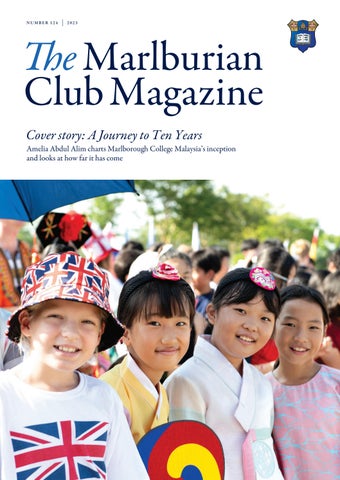
The Marlburian Club Magazine Cover story: A Journey to Ten Years
Amelia Abdul Alim charts Marlborough College Malaysia’s inception and looks at how far it has come
Contents Features 08
My House Peter Everington talks about ex-College house, Priory
09
I’ll Never Forget Rear Admiral Mike Gregory writes about his lucrative sidelines and carefree days at Marlborough
10
Totally Inspirational Antonia Bullard tells the story of Richard Pollock
12
25
28
43
Supporting Mental Health This sensitive subject is and will continue to be at the forefront of our lives. Victoria Hornby talks about today’s world and the impact it is having on our youth
45
The Most Generous Benefactor Ex-member of Common Room Herbert Leaf was the most extraordinary donator to the town and College. Philip Cayford writes about this philanthropic beak
48
A Little Goes a Long Way The case of Vašek Jelinek ended up on John Dancy’s desk. As a result of the then Master’s willingness to help and the kindness of a benefactor, Vašek’s life took a turn that has impacted many
OM Entrepreneurs Harriet and Hera, Kate Guinness Design, ODD, Wàzi Socks OM of the Year Award Lara Cowan pays tribute to this year’s winner, Mayoor Patel Titanic Survivor College Archivist Gráinne Lenehan recounts the amazing story of Hugh Woolner who survived this tragedy
32
Wild, Wilful and Found in Wiltshire Lucy Morgan interviews Zak Frost about his transition from musician to truffle entrepreneur
35
A Journey to Ten Years Amelia Abdul Alim charts Marlborough College Malaysia’s inception and looks at how far it has come
38
Fine Edge Rosie Pemberton was a shining light in changing the face of girls’ cricket at Marlborough. Mike Bush looks at her cricketing successes and how she has used her skills to teach others
40
Rare Book Collection: An Introduction The first in a series looking at the College’s extraordinary literary treasure chest. This year Molly Fisher talks to the Keeper of Rare Books, Simon McKeown, about the work of two pioneering women
51
A House Acrostic John Hext submits an acrostic from 1952 and invites OMs to solve it
52
Everest: The Return Extreme explorer Jake Meyer once more climbs Mount Everest on the 70th anniversary of the first confirmed ascent of Everest, an expedition led by OM John Hunt
55
OM Lodge James Gross and Tim Knoops explain what our lodge is about and how to get involved
52
45 Regulars 04 05 06 07 11 14 56 62 63 72 84 86 87 88 90 92 96 97 102 103 109 110
Upfront Contributors This Year From the Chair Visiting Marlborough College OM News Letters to the Editor Deaths Obituaries Events Development 1843 Society Thank You from the Club Master’s Review Malaysia Review Valete Academic Results and Admissions Sports Financial Help for OMs On the Shelves MC Connect Club Day
The Marlburian Club, Marlborough College, Wiltshire SN8 1PA Telephone +44 (0)1672 892 384 marlburianclub@marlboroughcollege.org www.marlboroughcollege.org X: @OldMarlburians facebook.com/TheMarlburianClub Editorial and advertising enquiries: +44 (0)1672 892 477 Editor: Catherine Brumwell (née Redpath NC 1991-96) catherine@theommagazine.co.uk
The College and the Club are committed to helping the environment The Marlburian Club Magazine supports this by printing using environmentally friendly process-free plates and no chemicals. Inks are vegetable based and fully recyclable. The paper is from sustainably managed forests and controlled sources. The wrapper uses a carbon-neutral poly-wrap made from sugar-cane waste. The magazine text is fully recyclable. The printer holds ISO14001 environmental accreditation.
Editorial Board: Kate Goodwin (Alumni Engagement Manager) Philip Cayford (PR 1965-70) Olivia Timbs (C1 1970-72) Michelle Jana Chan (TU 1990-92) Kate Gaffka (Development Communications Manager) Design: Andy Rawlings ©The Marlburian Club 2023
The Marlburian Club Magazine
5363 MCMag23_3-13_[4].indd 3
3
07/12/2023 18:25
Upfront Office, our archivist, and even members of the Marlborough town community have given up valuable time to assist in what is widely said to be one of the best alumni magazines. My part is truly small in the whole process, and I cannot thank you enough for what you have contributed to making the magazine a success.
‘...an echo of the connection that started in the courtyard between B1 and New Court in the 1990s.’
Photograph Otto Brumwell
There are two people I would like to single out for their amazing support from the beginning of my time up to now. The first is Kate Goodwin, who has been my ally since I started. Whether it is to ask who can write about a niche subject or to ensure I have everything I need, I know she will be there. She is professional, sweet, supportive and dedicated to the Club. The other, unsurprisingly, is Andy Rawlings, our designer. His vision and natural design ability are what makes the magazine what it is. Cool-headed and charming, the magazine would be nothing without him. Thank you both from the bottom of my heart.
M
engineering components; it is standing strong in the face of adversity and knowing that, as a Marlburian, you have a vision and resilience that is the envy of many.
The Marlborough legacy can be big or small: it can be OMs establishing lifechanging charities or simply giving their time to help others; it can be changing the world medically or making small but integral
As I come to the end of my time as Editor, I reflect on the stories I have covered over the past eight years and, with that, the number of people I have spoken to since replacing the wonderful Susannah Helgeson (née Spicer SU 1979-81), who did such an exceptional job of redesigning the magazine during her tenure. Without exception, everyone I have dealt with has supported and helped me. While I regularly receive nice comments about the magazine, it would be nothing if it were not for you. Beaks past and present, OMs young and old, the Club, the Development
arlborough links run strong and extend far and wide. This hit me in a bitter-sweet moment when we dropped our youngest child off to his new prep school. Amazingly, in the bunk below his was none other than the son of Alex Salkeld (B1 1993-95). Alex’s passing two years ago left a great hole in the lives of his family and friends, but, in the shadow of such sadness, are two little boys who hit it off; an echo of the connection that started in the courtyard between B1 and New Court in the 1990s.
4
And now as I move on to other things, a full-time job in London and anther posting abroad on the horizon, I know I can rest happy having received the best compliment ever last year. Chris Pouncey (B3 1965-70) wrote, ‘I read every article with great interest. Meanwhile other reading, such as Farmers Weekly, has had to wait.’ I feel I have achieved all I need to! Jane Green (B3 1982-84) will take over from me. Jane has Marlborough in her blood. Her father, David (CR 1962-95), taught at the school and, in fact, was the tutor to Vašek Jelinek (CO 1968-69), whose story we cover in this year’s magazine; her two daughters have studied here; and she has worked for the Club for 13 years. I can think of no better person to be the new Editor, to continue highlighting the excellence, entrepreneurial spirit and charitable works of OMs. I have one last thing to add: Marlburians who are no longer with us, we thank you for the difference your life and achievements continue to make. For Marlburians, young and old, go get ‘em – you will make a difference.
Catherine Brumwell (née Redpath NC 1991-96) Editor, The Marlburian Club Magazine catherine@theommagazine.co.uk
The Marlburian Club Magazine
5363 MCMag23_3-13_[4].indd 4
07/12/2023 18:25
Contributors Lara Cowan
Gráinne Lenehan
Lucy Morgan
(MO 1992-97)
(College Archivist)
(PR 1988-90)
Lara studied French at Bristol before starting a property business in the Caribbean. She moved back to the UK and became an independent London property buyer. She gained an RHS Diploma in Horticulture from Capel Manor College and studied the Five Mindfulness Trainings at Plum Village before setting up the Botanic Shed School of Nature.
Gráinne studied English and Philosophy at University College Dublin and completed a postgraduate diploma in Archives and Records Management. She has written for various publications and contributed chapters to Early Public School Football Codes: Puddings, Bullies and Squashes and Bright the Vision.
Lucy studied Classics at Magdalene College, Cambridge, and the University of Leeds, before starting work translating cookery books from French and German. She spent several years living in Germany, China and North Africa with her family, returning to the UK 10 years ago. She is a freelance food, wine and travel writer and is currently writing a spy novel.
Amelia Abdul Alim
Philip Cayford
Vašek Jelinek
(Gaia House 2018-23)
(PR 1966-70)
(CO 1968-69)
Amelia will pursue her longstanding academic interest in Politics and International Studies by commencing a BA at the University of Melbourne in February 2024. She is cherishing her final few months in Malaysia and is engaging in an internship with a member of parliament. Beyond academia, she enjoys volunteering and thrifting clothing items.
Philip is a practising KC, documentary film-maker and occasional journalist. After university, he was called to the Bar, where he combined a common and family law practice with an emerging passion for environmental and conservation filming, looking mainly at the illegal wildlife trade and endangered species of flora and fauna.
After school, Vašek was sponsored by Bata Shoe Organisation to study Management and then completed his MBA at Cranfield. At the age of 34 he became the youngest CEO of Bata in Europe. During his career, he held top management positions at Clarks and other international companies and led a management buyout of Jones Bootmaker.
Mike Bush
Victoria Hornby
Jake Meyer
(TU 1993-98 CR 2011-)
(B3 1984-86)
(C3 1997-2002)
Mike has deep roots in Marlborough, having grown up locally. Following a History degree at Manchester and a PGCE at Oxford, he taught at Alleyn’s School before returning to Marlborough in 2011. He is a keen cricketer who has been secretary of the Marlborough Blues since 2006. As well as teaching History, he is Master in Charge of cricket and rackets.
Victoria is CEO for Mental Health Innovations, which runs the Shout mental health text service. She has worked in the charitable sector for 25 years, including for the Sainsbury Family Charitable Trusts and The Royal Foundation of The Prince and Princess of Wales. She is Chair of the Bridges Impact Foundation and a trustee of the Westminster Foundation.
Jake Meyer BEM VR FRGS is a mountaineer, army officer and leadership consultant. His passion for the mountains was embedded while at Marlborough under the inspiring tutorage of Nick Parks and Rupert Rosedale. He was awarded a British Empire Medal for services to mountaineering, charity and young people in 2020.
Stay in touch with the latest news and events Please update your contact details by using our online form www.marlburianclub.org/ update-contact-details. Alternatively, you can give us a call on 01672 892 385 or email marlburianclub@marlboroughcollege.org
The Marlburian Club Magazine
5363 MCMag23_3-13_[4].indd 5
5
07/12/2023 18:25
This Year ‘Notwithstanding the challenging times we are all facing, it is right and proper that we do everything we can to give back. The College’s efforts to raise £75m to provide 100 free places at Marlborough is commendable.’
H
aving served for six years as Club Chairman, it is a great pleasure to be back supporting the Marlburian Club, this time as President. It is an honour and a privilege to be part of an enthusiastic Club Committee dedicating their valuable spare time to the Club. I would like to make a point of thanking the
committee members and the Development Office for all their hard work and dedication. Anyone who has been to Marlborough College will know OMs who span many generations. My parents were not educated at the College, but they made many lifelong friends within the Marlborough community,
many of whom they met on the touchline at sports fixtures. My sister and both my nephews are OMs and my godson is currently in Remove. Marlborough throws off a web that connects us, personally and professionally. Shame on us if we choose not to capitalise on that structure. I have always thought that there is so much potential and opportunity among the OM community and it is up to the Club to find ways to enable connectivity and unlock those opportunities. The Club does not have a plentiful budget to achieve this, instead relying on the creativity of the committee and the goodwill of OMs to participate and contribute. The principal initiatives are MC Connect, which offers volunteering and mentoring opportunities; the Professional Networks, which are more targeted to specific industries, but many of the thematic events extend across multiple groups; year group reunions; and social occasions, such as the Summer Drinks and the Triennial Dinner. This structure allows the Marlborough community to stay in touch and, better still, help each other in a personal or professional capacity. Notwithstanding the challenging times we are all facing, it is right and proper that we do everything we can to give back. The College’s efforts to raise £75m to provide 100 free places at Marlborough is commendable. We have already seen some great examples of extremely gifted pupils who have benefitted from bursaries, setting themselves on a great path for the future and enhancing the College’s reputation further. Marlborough College Malaysia is also going from strength to strength, and we look forward to exploring how we can work more closely with our collegues there in the future. To close, I wish you the best of luck for the coming year and very much hope that you embrace the Club’s offerings and events, extracting as much value as you can.
Chris Carpmael (C1 1980-84) President of the Marlburian Club 6
The Marlburian Club Magazine
5363 MCMag23_3-13_[4].indd 6
07/12/2023 18:25
From the Chair with the Club to maintain our momentum by delivering further topical events, as well as charitable events, informal TEDx-style talks and skills-building opportunities. Marlburians, both OMs and pupils, have had a fantastic sporting year. Throughout the year, OM teams have represented Marlborough and have had, what looks to be, tremendous fun. Further details of OM successes can be seen on page 97. Meanwhile, current pupils have also had many sporting accomplishments, which the Master shares with us on page 88. These have included the formation of the first all-girls football team and some staggering individual successes across many different sports. I hope that these current pupils will continue to represent Marlborough as OMs in our healthy calendar of annual sporting activities. The updated MC Connect platform has much improved functionality for mentoring and connecting to others for professional networking and business connections or to offer or look for work experience. Do take a look at this invaluable resource and sign up.
‘The Club has continued to host an impressive array of in-person and virtual events, allowing a broader range of OMs to engage with the Club.’
I
would like to start by extending the Club’s heartfelt thanks to Catherine Brumwell (née Redpath NC 1991-96) for her time as Editor of The Marlburian Club Magazine. Your feedback tells us that the magazine is the Club’s most valued asset and Catherine has always strived to ensure there is an eclectic mix of informative articles, with something of interest to everyone. Her insight and dedication will be missed, and we wish Catherine all the very best for her new venture. I know that the magazine will be in safe hands with the new Editor, Jane Green (B3 1982-84), and the support of the Development Office. The Club has continued to host an impressive array of in-person and virtual
events, allowing a broader range of OMs to engage with the Club. The ever-popular Carol Service was packed to the rafters. Likewise, the Summer Drinks, kindly hosted by last year’s Club President, Harriett Baldwin MP, sold out within hours. The Professional Networks also responded to your feedback by delivering topical events that included Diversity of Thought and Communication and The Future of Sustainable Development. You can read more about this year’s events on page 72. Over this coming year, the Club Committee will review the learnings from our market research to help us ensure that our communication and events are relevant and engaging. I look forward to working
I am so proud of the generosity and character demonstrated by the Marlburian community during the unprecedented success of the launch of the Marlborough Difference Campaign for life-changing bursaries. In just 36 hours, over 1,000 parents, OMs, staff, pupils and friends raised over £1.3m – a record-breaking amount, not just for Marlborough but for any independent school in the UK. I would also like to thank the President, the Club Committee, Professional and Sporting Group Heads, and the Development Office for their hard work and support this past year. Please contact Kate Goodwin on marlburianclub@ marlboroughcollege.org if you have any feedback for the Club or if you would like to get involved in any Club initiatives, such as giving a talk for Marlburian Mondays or acting as a Professional Group or Sporting Group Head. Together we are stronger!
Karen Hill (B2/MM 1988-90) Club Chairman The Marlburian Club Magazine
5363 MCMag23_3-13_[4].indd 7
7
07/12/2023 18:25
My House Priory
‘It was awesome to be among 700 boys belting out For All the Saints in Chapel or cheering our heroic 1st XV from the touchline of Level Broadleaze.’
I
n 1948, for those of us in junior out-houses, Upper School was the reputed centre of in-College rowdiness. Though we had to walk a distance daily in all weathers to morning chapel, we felt privileged by the gentility of our surroundings. Priory was about halfway along the south side of the High Street, tucked behind the Polly Tea Rooms. Lawn and flower beds sloped down to trees by the Kennet. The building was put up in the early 19th century, with stone and flint and some arched windows, on the site of a priory founded in 1208, and during the year I was there it was listed as Grade II.
house with controlled fury. He explained bullying. Even if you only watched, you were as guilty as the people who did it. Such admonition, backed with house prayers and daily resonance of the King James Bible, gave us a fair chance to become gentlemen. While rationing was not fully lifted until 1952, and other vestiges of war were apparent, there was also a residual esprit de corps. It was awesome to be among 700 boys belting out For All the Saints in Chapel or cheering our heroic 1st XV from the touchline of Level Broadleaze.
Among the beaks we found shrewd kindliness and encouragement. A few doors along from Priory lived my teacher of German, Ivo Payne (CR 1942-76) and his wife. I was welcome to drop in, take a seat by their fire, and read their books. Nearby, in the other direction, lived my elderly piano teacher, Mrs Ivimey, wife of a previous Director of Music, Dr John Ivimey (CR 1919-33). I was struck by the sparseness of their home. How far did friendship among us boys last beyond our year at Priory? Not far for me, with one exception. Once after lights out, Patrick Horder (PR 1948-53) asserted that God can speak to us about how he wants us to live, a thought which stuck. Patrick went his way to Preshute and then to medical studies at Bart’s, and I to Cotton and National Service in Hong Kong. Coming home to university, perplexed about the world situation and personal failings, I bumped into the fellowship Patrick belonged to. He and I became good friends. For me a cleansing of the heart, and the habit of an early morning quiet hour, led to fulfilment as a teacher in independent Africa. Hamlet was the School Certificate set play for our 1948 intake. I guess many of us still alive at 89 can echo Horatio: ‘There is a divinity that shapes our ends, Rough-hew them how we will.’ The Priory still exists but these days is used as a retirement home and offers many social activities. I recommend to walk past the next time you are in Marlborough. Peter Everington (Priory 1948 CO 1949-52)
Priory was comfortable and warm, with ample food. This was a pleasing contrast for some who had known four winters of short commons in chilly prep schools. Alan Cornwall (CR 1925-58) was the affable Housemaster, one of the long-serving bachelor beaks too old for service in the Second World War. He had a relaxed attitude to us new boys, even lending us his shotgun to deal with the squirrels. Yet he was vigilant. We, too, had a capacity for rowdiness. One day a small boy was crammed into a laundry basket, while the rest of us stood by with a blend of glee, horror and fascination. That evening, Mr Cornwall spoke to the whole 8
The Marlburian Club Magazine
5363 MCMag23_3-13_[4].indd 8
07/12/2023 18:25
I’ll Never Forget... My Lucrative Sidelines
‘This was a grand arrangement until one of his guests at a dinner party declared that what he was eating was not goose and I was hauled in to explain myself.’
Unexpectedly, the interview was short and friendly, and I was told that I would not be punished if I kept quiet about the whole affair. However, I was asked to refrain from repeating the process.
I
My third and most lucrative scheme, courtesy of my older brother, was to sell 33rpm gramophone records entitled Bawdy Songs and Backroom Ballads. Some friends may remember me selling some other, even less wholesome records, but, I am afraid, those stories will have to stay stored in the memory banks.
While at Marlborough, I was secretary of the fishing society, which, at the time, had a long waiting list. One boy persuaded his father, the then Chairman of the Hong Kong and Shanghai Bank, to stock the river one holiday with a good number of fair-sized brown trout in exchange for promotion on the list. Both were accomplished and I duly went back to school a week early, caught many of the fish with flies tied to look like fish pellets, and sold them to the fishmonger on the High Street.
As I say, life was incredibly carefree in those days. As a member of the .303 shooting eight, we would pick up our rifles from the armoury and grid through the High Street to the butts beyond the playing fields with them simply slung over our shoulders. We also had a very enlightened shooting master who, at Bisley competitions, insisted we drank a pint of beer before going on point. It was not surprising that the sport was so popular.
n the carefree days of my time at Marlborough, there was plenty of free time to go off and explore, pursue hobbies or, in my case, find fun ways of making a bit of money.
I kept a shotgun, legally I would like to add, with my Housemaster. I used it to shoot on a farm owned by friends of my parents, and also to shoot pigeons on the Master’s shoot that he held at Mildenhall. As a lucrative
sideline, it came in handy for shooting whooper swans, which, sadly, at the time were not protected. I would then pluck them and sell them to my Housemaster as geese. This was a grand arrangement until one of his guests at a dinner party declared that what he was eating was not goose and I was hauled in to explain myself.
I sincerely hope that in years to come I hear of younger OMs also finding some inventive ways to earn money: wholesome or not! Rear Admiral Mike Gregory CVO OBE (B2 1959-64) The Marlburian Club Magazine
5363 MCMag23_3-13_[4].indd 9
9
07/12/2023 18:25
Totally Inspirational Richard Pollock (CR 1959-64)
After five years at Marlborough, Richard decided to become a university lecturer, holding posts at Salford and Bradford Universities, eventually serving as Professor of Russian at Manchester from 1988 to 1992. Throughout his teaching career, he emphasised the importance of spoken language skills and openness to other cultures.
Richard, centre with glasses
‘I cannot speak too highly of the contribution of his expertise in all aspects of Soviet life...’
R
ichard Pollock’s funeral in Sale, Lancashire, coincided with the 33rd anniversary of the fall of the Berlin Wall and opened with the Russian Kontakion of the Departed (Kiev Melody). This was apt for a man with a deep understanding of Russia and the Russian language and who appeared on the front cover of TIME magazine, standing between Mikhail Gorbachev and Margaret Thatcher. Born the son of a Baptist minister in West Bridgford, Nottingham, Richard may have inherited his linguistic ability from his maternal grandfather, a Quaker missionary to China. After reading Classics at Peterhouse College, Cambridge, Richard did National Service in the Royal Navy, which selected him for the Joint Services School for Linguists (JSSL). The ‘Stakhanovite’ regime, focus on oral work, and exposure to émigré teachers grounded Richard solidly in the Russian language. He may also have been one of the linguists who confounded London publicans with their animated talk in a strange tongue. ‘Bloody Welshmen,’ one barman muttered. After a year at Merton College, Oxford, where he received a diploma in the History
10
was President of the Russian Club and encouraged an interest in the USSR and all things Russian. While at Marlborough, Richard also had his first opportunity to visit Russia, travelling with a group of British teachers. On the train journey to Leningrad, he offered a cigarette to a Scottish teacher, Catherine Janette Miller. This simple moment led to them getting married in 1961. Janette went on to develop the Russian department at Manchester High School for Girls and joined her husband as a cruise lecturer on the Black Sea.
This focus lay behind Richard’s value as an interpreter. William Whitelaw, whom he accompanied to the USSR in 1984, wrote, ‘I cannot speak too highly of the contribution of his expertise in all aspects of Soviet life as well as his remarkable mastery of the language to the success of our visit.’ On Whitelaw’s recommendation, Margaret Thatcher took Richard on her first official visit to Moscow in April 1987. TIME’s cover, headlined ‘Maggie in Moscow: I would implicitly accept his word,’ showed Richard standing between the two smiling leaders. Mrs Thatcher later praised him for listening ‘very carefully, not only to what I was saying, but to the intonation of my voice, and so he would follow … the precise intonation which I had used. That was marvellous!’ Richard himself bemoaned how much subtlety was lost when Soviet interpreters delivered ‘five minutes of varying emotion’ slowly and ‘without the same register of moods.’ Other interpreting clients included HM The Queen and Tony Blair. Richard’s library covered at least 40 languages and cultures, and he was studying Turkish and Finnish into his 70s.
and Practice of Education, Richard was engaged to teach Russian at Marlborough. The College had become one of the first UK schools to offer the language. He always remembered the value of the Russian conversations he enjoyed at Marlborough with Peter, the College’s Crimean refugee caretaker. Richard
Antonia Bullard (C1 1970-72)
Neither the author nor the Archivist has been able to ascertain whether Richard was engaged to teach just Russian or another subject with Russian coming later. The Editor hopes that an OM from that era will enlighten us. Email clubmagazine@ marlboroughcollege.org if you know more.
The Marlburian Club Magazine
5363 MCMag23_3-13_[4].indd 10
07/12/2023 18:25
Visitors to the College Whether it has been a few years or several decades, revisiting Marlborough can transport you back in time and evoke a flood of emotions. Stepping through those familiar hallways, standing in Chapel, and walking across Court are moments that can bring a sense of joy and reflection. You are most welcome to visit Marlborough throughout the year. As an Old Marlburian, visiting your old school is an opportunity to witness first-hand how Marlborough has evolved over time, adapted to new technologies, and continued to provide enriching experiences for pupils. When visiting, please remember that the College has a duty to avoid disruption to education and to safeguard its current pupils. By understanding and adhering to these expectations, we can make your visit a positive and meaningful experience while upholding the College’s commitment to education and pupil welfare. To help us comply with statutory guidance and our pupil safeguarding policy, please be aware of the following considerations: •
•
All visitors need to be escorted around College, so please arrange an appointment before you arrive by contacting the office via marlburianclub@marlboroughcollege.org On arrival, please visit reception to sign in, for which you will need to produce a form of identification. You will be issued with a lanyard and a member of staff will guide you through
5363 MCMag23_3-13_[4].indd 11
the College. Just let us know if there are particular buildings you would like to see. •
You are welcome to watch a sporting fixture or attend Chapel or most large events without needing to sign in, but please get in touch for confirmation.
The College’s Access, Security and Visitors Policy is in accordance with the Department for Education document Keeping Children Safe in Education 2023, which gives statutory guidance for all schools and colleges in England. The policy can be found online at: www.marlboroughcollege.org/contact/policy-reports If you witness anything while you are on College grounds that concerns you, please ask to speak to me or a member of the Management Team. Thank you for your cooperation and understanding. We look forward to welcoming you back to Marlborough very soon. Christine Kane Director of Safeguarding
07/12/2023 18:25
OM Entrepreneurs ODD The Owner: Minnie Brown (MO 2006-11) The Business: A luxury garden furniture and fabrics company, celebrating the Great British summer. The Beginning: The dilemma of who would inherit the family’s treasured upholstered swinging garden sofa led the original owners of ODD to set up the business. Saddened to find there were no
present-day manufacturers, they set out with local makers to construct a swinging sofa of the highest quality, staying true to the original designs while incorporating modern materials. The Eureka Moment: As the world emerged from the Covid lockdown, Minnie was presented with the opportunity to take over ODD, a business she had admired from childhood, having whiled away many summer days on her parents’ Old Rocker swing seat.
The Dough: Self-funded. The Keys to Success: Creating the highest quality products and supporting British craftsmanship. The Present: ODD is building its collection of fabrics, garden furniture and accessories, with the belief that our gardens should be places of great comfort and beauty. The Future: A focus on slow growth and nurturing a great British brand, creating furniture that lasts and championing people to enjoy more time outdoors. The Nitty-Gritty: www.oddlimited.com @odd_limited minnie@oddlimited.com
Wàzi Socks The Founders: Donald Corbett (TU 2017-22) and Monty Pretor-Pinney (B1 2017-22) The Business: A funky and formal bamboo sock company. The Beginning: In their Lower Sixth year of Marlborough, while stuck at home during lockdown, Donald and Monty combined their shared passion for wearing funky socks with their suits at school to create a business for like-minded individuals. The Eureka Moment: Realising the best bamboo socks were plain and the best funky socks were cotton, so naturally combining the two would be the best of both worlds.
12
The Dough: Self-funded.
exciting sustainability projects are also in the pipeline.
The Keys to Success: Perseverance and lots of trial and error.
The Future: Become a leading brand in the funky sock world.
The Present: Currently they are looking to expand their business by selling through independent retail stores across the country along with their own online store. New and
The Nitty-Gritty: @waziuk info@waziuk.com www.waziuk.com
The Marlburian Club Magazine
5363 MCMag23_3-13_[4].indd 12
07/12/2023 18:25
Harriet and Hera The Founder: Harriet Hedges (MO 2007-12) The Business: Fine jewellery and engagement ring specialist, connecting clients with independent designers, based on their brief and budget.
Kate Guinness Design The Founder: Kate Guinness (NC 1998-2003) The Business: An interior design studio. The Beginning: Kate started her working life as a set and costume designer in theatre and opera, but she came to realise she wanted to create real spaces for real people. The Eureka Moment: The excitement of celebrating with a meal at the first café she designed. The Dough: Self-funded. The Key to Success: Being passionate and enjoying what you do. The Present: Kate’s previous career has undoubtedly influenced her style – where once she thrived on interpreting text and music, she now enjoys interpreting the personalities and the day-to-day needs of her clients. Her studio has been listed in House & Garden’s Top 100 interior designers and architects for five years running, and their projects span from
London, Wiltshire and Wales to San Francisco and include some exciting collaborations. The Future: Continuing to enjoy exciting projects in a variety of locations. Now they have an office in Wiltshire, where Kate is based, they would love to design more country homes. They would also like to take on more small commercial work and eventually to open a shop in Marlborough. The Nitty-Gritty: www.kateguinness.co.uk info@kateguinness.co.uk
The Beginning: Harriet used to spend her pocket money on beads and jewellerymaking classes. In 2018, she qualified as a gemmologist and has since worked with over 150 designers globally, developing a keen eye for design and high-quality craftsmanship. The Eureka Moment: A friend asking Harriet where to find an engagement ring for his now wife and realising there is no ‘how to’ guide. The Dough: Self-funded. The Keys to Success: Define your purpose and give it a go. There will never be a right time to start, but time is a gift: one day you will ask yourself if you spent yours doing what mattered to you most. The Present: Sharing knowledge, advice and industry secrets to support an extended network of friends and family who would like to design that perfect ring or transform a sentimental piece of jewellery into a wearable, modern-day heirloom. The Future: To redefine the bespoke jewellery-buying process for both clients and brands: encouraging ease and enjoyment while championing UK craftsmanship and sustainability. The Nitty-Gritty: @harrietandhera harrietandhera@gmail.com The Marlburian Club Magazine
5363 MCMag23_3-13_[4].indd 13
13
07/12/2023 18:25
OM News New Editor of the Club Magazine Jane Green (B3 1982-84) Following a successful career in the world of educational publishing, Jane returned to the College in 2010 and has worked in various marketing roles for the Club, the Foundation and the College since then. She is currently Marketing Communications Manager for the College and produces a variety of printed and digital publications, including the school magazine. She has been a tutor in Summerfield House since 2001 and her two daughters are recent OMs from Mill Mead. Her connection with the College is life-long: her father, David (CR 1962-95), taught History and was Master in Charge of cricket for many years before becoming Director of the Summer School (1981-93). Her brother, Richard, was in C1 (1980-85). She will become Editor of the Club Magazine in December 2023.
Michael Richards (B3 1956-60) is a third generation OM. Since leaving Marlborough, he has worked in a number of countries, including three years in the Middle East, building and running a factory on the edge of the desert. His last 10 years of work were spent as a small-business adviser. Now he lives in the United States in a small city near St Louis, with his wife and three cats. He says, ‘I attribute much of what I have been able to achieve to my education at Marlborough; not only was I able to learn and play sports of all sorts, but there was a feeling that all the staff were looking out for our good.’
Each year, crews up to 85 years of age come from around the UK and from 12 overseas countries to compete in the Henley Masters Regatta, which takes place a week after Henley Royal Regatta. At this year’s regatta, Graham Bagnall (C2 1960-64) and his crew won in the final of the quadruple sculls in the 75–80 years division. Graham is the stroke and sets the rate of strokes per minute and dictates the rhythm.
A touch of Last of the Summer Wine: Austin Thorp, Robin Garrett and John Powell
Brigadier John Powell (B3 1960-64) has shared a photo that was taken on the banks of the River Lochy in Scotland of himself and two other ex-Army friends, Brigadier Austin Thorp (B3 1958-63) and Colonel Robin Garrett (B3 1959-63). 14
Graham Bagnall in the aft of the boat
The Marlburian Club Magazine
5363 MCMag23_14-26_[4].indd 14
07/12/2023 20:18
Aubrey Waddy with his teammates
Aubrey Waddy (B1 1960-65) captained the England Men’s Over 75 Squash Team to victory over Wales, Ireland and Scotland in the annual home internationals played in Edinburgh in May. Aubrey and his team, who immediately started training for the next season, came fourth in the 2022 Over 75 World Masters Squash Championships in Wroclaw, Poland.
David Beamish retired in 2017 after 42 years as a House of Lords clerk
Tony Eagles (C2 1965-69) was featured on this year’s New Year Honours list after being awarded an MBE for services to Aviation Safety. Anthony retired in 2022 after a distinguished career in aviation spanning more than 50 years. In 1978, Anthony was awarded the Air Force Cross for the rescue of 12 of the 33 crew from the oil rig Orion that ran aground on Guernsey in severe storm-force winds.
Robert Shaw (PR 1961-65) and Jeremy Cross (TU 1975-80) have been elected as directors on the committee of the Polish Hearth Club in South Kensington. Robert was delegated to lay the wreath at the Katyn Memorial this April. This memorial commemorates the series of mass executions of nearly 22,000 Polish military officers and intelligentsia prisoners of war carried out by the Soviet Union, specifically the NKVD, in April and May 1940. In 2022, Nicholas Woodeson (B2 1963-67) featured in The Two Popes, a gripping and entertaining new play from Anthony McCarten. The play has also been adapted into a multi-award winning film, nominated for Best Adapted Screenplay at the Academy, Golden Globe and BAFTA awards. The Two Popes is a story that gives a glimpse into one of the world’s most secretive institutions. At its heart lies a timeless question: in moments of crisis, should we follow the rules or our conscience?
About ten years ago, Chris Bailward (C3 1962-66) started cycling again after 20 years of inactivity. Since then, Chris has travelled over 35,000 miles on a bike, including cycling from Land’s End to John O’Groats in June 2014. That journey took him over 1,100 miles in about 15 days and gave him a thirst for a new challenge. Watch this space to find out what it will be.
David Beamish (B3 1965-69) retired in 2017 after 42 years as a House of Lords clerk. Since then he has been keeping busy through a range of voluntary activities, most recently becoming Chair of the Southwark Diocesan Board of Finance. He is also an Honorary Steward at Westminster Abbey, a trustee of the Hansard Society and the Dulwich Society, a volunteer at Dulwich Picture Gallery, and convenor of a u3a walking group and, from 2022 to 2023, Chair of Dulwich and District u3a. He also reads with Year 2 children at Dulwich Village Church of England Infants’ School.
Since 1971, Roger Forster (B1 1966-70) has done a variety of dives both in the UK and abroad. He has dived under ice in a clay pit at Peterborough and dived in Lac Tignes when on a skiing holiday, but his favourite locations include Plymouth, the Isles of Scilly and St Kilda. Roger took up underwater photography in 1976 using a Nikonos II underwater camera. Magical experiences have included close encounters with sharks, having guillemots swimming past him, and much more. He is The Marlburian Club Magazine
5363 MCMag23_14-26_[4].indd 15
15
07/12/2023 20:18
generations and empowering them to chase their dreams. The foundation has built 183 primary schools in rural China where, in the early 1990s, educational opportunities fell way short of those available in the cities. The foundation has made multiple generous donations to universities and vocational training institutes in Hong Kong in the form of bursaries and scholarships. The foundation has also made notable donations to the Hong Kong College of Paediatricians, the School of Medicine at Stanford University in the US, as well as the China Centre for Economic Research at Peking University.
Roger Forster is a member of the Historical Diving Society
a member of the Historical Diving Society and acts as a volunteer guide at the Diving Museum at Stokes Bay in Gosport. In 2003, he joined the Nautical Archaeology Society and he has supported the Marine Conservation Society since its inception. Roger’s motto is, ‘If you do something today and you like it, you can do it again tomorrow.’
Richard Brown (C1 1966-71) was appointed a Chevalier of the French Légion d’honneur in 2019 in recognition of his work in supporting preparations for COP21 in Paris and leading Eurostar’s turnround.
Nick McKinnel (SU 1968-71) retired as Bishop of Plymouth and Bishop of Crediton in August 2022. He said, ‘After 42 years of ordained ministry, now seems a good 16
time to hand over my responsibilities and to have more time for the family and other interests.’ Earlier this year, Nick was appointed as the High Sheriff of Devon for 2023/24.
Edward Lui (CO 1968-72) was conferred an Honorary Fellowship by the Baptist University of Hong Kong in 2022. He was one of three Honorary University Fellowship recipients who were all acknowledged as well-respected and renowned leaders in society and have led extraordinary lives and had decorated careers with common roots in Hong Kong. As Chairman and Director of Providence Foundation Limited, Edward has not only been extending his late father’s legacy for more than 30 years, but has also devoted himself to contributing to the betterment of people’s livelihoods in Hong Kong and mainland China. Mr Lui is fully committed to his vision of providing educational opportunities to younger
Simon McBurney (LI 1971-75) saw his new play Drive Your Plough over the Bones of the Dead reach the stage this year. Simon conceived and directed the play, based on Olga Tokarczuk’s novel of the same name.
Robert Drewett (C3/BH 1972-77) has been appointed as the High Sheriff of Somerset for 2023/24.
Lewis Borg-Cardona’s (BH 1973-77) documentary Tito Puente: Mambo Man, celebrating the centenary of the great percussionist, songwriter and bandleader’s birth, received its first airing in March this year, on the BBC World Service. The show, presented by Strictly Come Dancing star and one time World Mambo Champion Karen Hauer, is available on BBC Sounds. Lewis researched, wrote and produced the programme, as well as doing all the interviews. Having been a concert percussionist while at Marlborough, it is something he says is dear to his heart. He was taught by Paul Chalklin, who was a freelance percussion teacher at the College and a
The Marlburian Club Magazine
5363 MCMag23_14-26_[4].indd 16
07/12/2023 20:18
Lewis Borg-Cardona with Karen Hauer
good friend of Bob Peel (CR 1960-91). The programme was a radio Pick of the Day in The Sunday Times, one of Today’s Choices in the Radio Times, and one of Stephanie Billen’s radio Picks of the Week in The Observer. It was then featured on Radio 4’s Pick of the Week programme.
After running a large first-opinion and referral veterinary practice and starting the largest multi-cardiologist service in Europe, Mark Patteson (C2 1974-79) is now a freelance veterinary cardiologist.
the globe. She creates large-scale sculptural pieces in outside settings, using different natural materials, often using photography alongside the process. Her exhibition What is it That Will Last? opened at Abbot Hall, Kendal, and runs until 30th December this year. The exhibition is a multimedia experience spanning three decades of Julie’s work in the UK, Japan and Africa.
The training takes 10 years, which she undertook before starting a family. Kristen is in management consultancy, which is refreshingly different from Julia’s work. Animals, horses in particular, have been Julia’s mental health saviour, with a timetabled riding morning once a week and more riding at the weekend providing a refreshing work-life balance, along with gardening and travel. With continuing boundless energy and enthusiasm for life, she is not planning to retire any time soon.
Nicholas Lees (C1 1980-85) had his work shown at an exhibition of abstract ceramics. Nicholas has work in the
Kristen Busch Hansen (C2 1975-79) and Julia Busch Hansen (C2 1977-79) celebrated their 35th wedding anniversary in 2022. This year, their daughter got married, with the wedding reception at the family home in Beaulieu. In the interim years, Julia has been working as a chartered educational psychologist, first for county councils and then for 20 years in private practice, across the south of England and overseas (in the UAE and Kenya). Her work covers all school-age children in both state and private schools.
The change means he is no longer managing the daily trials that come with running clinics and is instead spending more time fishing and walking. He also umpires hockey, watches rugby and cricket, occasionally turns out for the village cricket team, goes skiing (badly), and plays golf (very badly). He lives in rural Gloucestershire with his wife, Jo, and has three children who are now in their 20s.
A major exhibition of work by Julie Brook (LI 1977-79) opened in Cumbria in May this year. For more than three decades Julie has roamed, lived and sculpted in a succession of uninhabited and remote landscapes in the British Isles and around
Julia Brook’s exhibition of work opened in Cumbria in May this year The Marlburian Club Magazine
5363 MCMag23_14-26_[4].indd 17
17
07/12/2023 20:18
permanent collection of the Fitzwilliam Museum in Cambridge. He has also won an Award of Honour at the ICAA Blanc de Chine exhibition at the Musée des Confluences in Lyon, France.
exact 80th anniversary, 16 th May 2023. Two OMs were Dambusters: John ‘Hoppy’ Hopgood (C1 1935-39), the second to make the bombing run and who was killed over the Möhne dam, and David Maltby (B3 1934-36), who dropped the bomb that breached the dam. On the ride from Lincolnshire to Germany the group also visited Arnhem and the grave of another OM, Lionel Queripel (B3 1934-38), who was awarded the Victoria Cross during that battle.
Henley Halebrown, the architecture firm of Simon Henley (CO 1981-85), was shortlisted for the prestigious RIBA Stirling Prize for the second time in 2022 (previously 2018) and won the RIBA Neave Brown Award for Housing. Coincidently, MacDuff, our loving but rather useless gun dog, will have to remain in Scotland.’
Alex Wildman (C2 1984-89) won the Harold Rose Bowl Trophy in a competitive final of high-quality squash against Mark Skull (C1 1974-79) at the 2022 Festival of Sport.
Tiffany Sadler (B3 1987-89) was appointed Her Majesty’s Ambassador to the Republic of Slovenia in September 2020. Previously she was Director of the Tech Overhaul programme in (what was then called) the FCO (Foreign and Commonwealth Office) and was Deputy Head of Mission, Tbilisi, from 2016 to 2018.
Over the New Year, Saiful Kassim (B1 1986-91), Adzam Noone (B2 1988-91), Andy Cheah (B3 1986-91) and Dennis Ng (B3 1986-91) caught up over coffee near Kuala Lumpur City Centre in Kuala Lumpur, Malaysia.
Neave Brown (C1 1945-48), recipient of the RIBA Royal Gold Medal in 2018, was also at Marlborough College.
Jules Irens (C1 1982-86) told us that it has taken him 21 years in the FCDO (Foreign, Commonwealth and Development Office) to get the posting of his dreams, to Kathmandu in Nepal, a favourite corner of the world. In June this year, Jules was posted to the British Embassy as the Regional Political Officer, so, as well as rediscovering Nepal, Jules will be dipping his toes in much of south Asia. He said, ‘My love of Nepal stems from studies at SOAS as well as having served as an officer in the Royal Gurkha Rifles for nine years, following a brief stint as a soldier in the French Colonial Parachute Regiment. In August, I will be joined by Caroline, my partner, and our seven children will be trickling through Kathmandu during school and university holidays. Unfortunately, 18
Charlie Bladon (C1 1984-89) and Green Jersey Cycling Tours organised a unique cycle ride to commemorate Operation Chastise, also known as the Dambusters Raid, to arrive at the Möhnesee on the
Möhne Dam, the objective of Operation Chastise, also known as the Dambusters Raid
The Marlburian Club Magazine
5363 MCMag23_14-26_[4].indd 18
07/12/2023 20:18
Chris Hamilton (CO 1987-92), the former Head of Digital Communications at 10 Downing Street and expert in communications and media, returned to the College to speak to the Upper Sixth about his career, joining the world of work and life after Marlborough. Four Seasons Hotel Tokyo, new restaurant, Sézanne
Curious PR, founded by Hannah Kapff (EL 1991-93) in 2013, was shortlisted in the Best Campaign category in both the UK Agency Awards and Third Sector Awards for 2022. Since 2019, Curious PR has been raising awareness about a small, independent charity, SongBird Survival, which works to change the future of songbirds by funding research into the causes of their decline and creating solutions. Titled Cats and Cat Owners, the campaign has three waves to attract coverage and collect data, with waves two and three securing a combined audience of almost two billion. In September 2020, Curious PR issued the finding of new research from the University of Exeter, commissioned by the charity. It identified five main types of cat owners in terms of their attitude to their cat’s hunting. The resulting media and social-media campaign resulted in a media reach of over 673 milion, thanks to articles and broadcast interviews in the likes of CNN, Mail Online, The Telegraph, The Independent, ITV News, Newsweek and BBC Radio.
Over the summer of 2022, Charles Fisher (SU 1989-94) wound up his time in Tokyo having spent three years as the General Manager of the Four Seasons Hotel Tokyo at Marunouchi. He said, ‘In 2021, we created a new restaurant, Sézanne, which achieved two Michelin star status within two years and has just made the World’s 50 Best Restaurants list as well as ranking number two in Asia’s 50 Best Restaurants. My next step will take me to Cairo, where I will manage the Four Seasons Hotel Cairo at The First Residence, the first Four Seasons in the Middle East and North Africa, with nine restaurants and just under 300 rooms. During my career with the FS, I have been lucky enough to travel the world, working in London, New York, the Caribbean, Singapore, Thailand, Hawaii, Florida, Japan and now to Egypt.’
Laurella is passionate about using embodied movement as a tool for vibrant living and creative fulfilment while creating a place where you feel empowered, nourished and deeply connected. She teaches Prana Vinyasa yoga and the Radiance Practice, a blend of yoga, shaking, free dance, breath work and relaxation.
Kristy Castleton (CO 1994-96) and her partner have announced the birth of their son, Harley.
Hannah Gauntlett (MO 1992-97) was invited to exhibit at St John’s College Oxford for the month of July. The event, opened by the newly appointed mayor, was part of the Oxford and Padova Link initiative. Hannah has lived in Padua since graduating from the University of East Anglia, Norwich, and continues to teach Art and English and work as a professional artist. Hannah also taught at Summer School this year.
Laurella Wood-Walker (née Fox-Pitt EL/ SU 1991-96) had her celestial inspired flow published in Soul & Spirit Magazine.
Mike Bush (TU 1993-98 CR 2011-) ran the Hampton Court Half Marathon in support of the Leo Bush Brighter Future Fund. The Marlburian Club Magazine
5363 MCMag23_14-26_[4].indd 19
19
07/12/2023 20:18
Virtual Internships, the company co-founded by Edward Holroyd Pearce (LI 1995-2000) in 2018, won the award in the Innovation category of the EdTechX Awards 2023.
All three Nicholson siblings who started at Marlborough in the 1990s have followed their parents into the property world. The oldest, James (SU 1993-98), is based in Putney with his family and works at CBRE as an Executive Director. Sarah (NC 1995-2000) moved to Singapore 11 years ago and works for Property Vision, advising high-net-worth individuals, returning to the UK each summer with her family. Ed (SU 1997-2002) and his family moved to East Sheen, where he finds himself in good company among several other OMs. He also recently moved jobs to Weybourne, becoming Head of Asset Management. All three enjoy return trips to Marlborough – where their father, Phillip, is still based – especially when the Mop Fair is on.
Anthony Willis composed the soundtrack for the sci-fi film M3GAN
Lizzie Selzer (NC 1999-2004) and her husband, Charlie, welcomed the birth of a daughter, Sophia, on 29th March 2023.
Greg Caterer (CO 2000-06) has started a new position as COO at Juno, a global platform giving employees flexible access to meaningful benefits.
William Fremlin-Key (C2 1998-2003) has been appointed Global Head of Mining and Metals at insurance broker Willis Towers Watson.
Charlie Kendrick (C1 1998-2003) and his wife, Rosanna, announced the birth of their daughter Lucia Olive Walton Kendrick, born on 9th April 2023. A sister to Ava and Sophia. 20
Anthony Willis (B1 2000-05) composed the soundtrack for the sci-fi film M3GAN. The film follows a lifelike doll that is programmed to be a child’s greatest companion and parent’s greatest ally, however, this leads to unimaginable consequences. The film features original music by Anthony, who is also known for his work on the soundtrack for Promising Young Woman and How to Train Your Dragon: Homecoming, and is becoming one of the most highly sought-after new voices in Hollywood. Since M3GAN took over cinemas earlier this year, Waxwork Records has put up for preorder a vinyl release of the music from the film. The release sees the Anthony Willis score spread across two 180-gram swirl-colored discs and features artwork from Susi Vilchez.
David Mahoney (C3 2001-06) aims to produce entertainment of the highest quality while challenging existing models and engaging audiences, which is exactly what his shows have been doing this year. Having over 10 years’ experience of producing large scale concerts, tours and awards, as well as working with leading
The Marlburian Club Magazine
5363 MCMag23_14-26_[4].indd 20
07/12/2023 20:18
artists including Sam Smith, Julie Andrews and Andrew Lloyd-Webber, David is one of the world’s leading conductors of film with live orchestra. Notable work this year includes a trip to Taiwan to conduct the Asia premiere of Black Panther at the Taipei National Concert Hall. This was followed by a busy run of shows conducting The London Concert Orchestra at Ministry of Sound Classical events with superstar guest DJs and vocalists. Working with the Novello Orchestra, David also conducted the UK Tour of Disney’s Encanto and various outdoor proms shows over the summer.
Edward Oakden (TU 2001-06) married Alexandra Natalina Wilson in 2022.
Owen Farr (CO 2005-10) and Diana Perez del Rio got married this year. Owen also started a new position as Personal Wine Advisor and would love to be able to help OMs, their families and anyone in the Marlburian community with their wine buying, whether that be for day-to-day personal consumption, gifts or investments.
Max Turner (C1 2005-10) walked 1,100 miles from Land’s End to John O’Groats to raise money for Prostate Cancer UK and the Against Malaria Foundation. The walk
Fred Gibson performed in front of 210,000 people at Glastonbury
took 80 days, with Max walking 15 miles a day exposed to the Great British weather and camping along the way.
Fred Again, otherwise known as Fred Gibson (B1 2006-11), has been a prominent figure in the music industry, with one of his most recent successes being to close Coachella alongside Skrillex and Four Set. Fred’s involvement with the music industry began at the age of 16, when he was introduced to Brian Eno, who mentored him and focused on his production skills. This resulted in Fred working over the following years on albums with Charlie XCX and Ellie Goulding. By 2018, he had produced songs for Little Mix, Shawn Mendes and Burna Boy, as well as George Ezra’s Shotgun. Alongside performing to 100,000 people at Coachella, he has also performed in front of 210,000 people at Glastonbury.
William Haxby (BH 2007-12) and Harriet Hedges (MO 2007-12) got engaged in February this year.
The teams that Alexander Walters (SU 2007-12) and Rob Guppy (C3 2002-07) play in came first and third respectively in Division 1 of the Arthurian League.
Emma Marlow (MM 2008-13) married Joseph Molyneux on 24th June this year, with OMs Hattie Freer-Smith (NC 2008-13) and Claudia Cox (MM 2008-13) as bridesmaids.
The Marlburian Club Magazine
5363 MCMag23_14-26_[4].indd 21
21
07/12/2023 20:18
Dominic, who has several caps for Kenya’s senior rugby team, put in the miles to train for the event. Speaking ahead of the event, Dominic said, ‘I wish there were more of a story behind my choice for the charity other than believing that, although no one deserves to go through the pain and suffering brought on by cancer and its treatment, children, in particular, do not deserve this.’ Tad Mather ran the Marathon des Sables across the Sahara Desert
Tad Mather (C2 2008-13) ran this year’s Marathon des Sables, a 250 kilometre race across the Sahara Desert, in order to raise funds for Malaria No More UK. Being a keen sportsman and runner, he had always wanted to take on a memorable sporting challenge. The seven-day ultramarathon is approximately the distance of six regular marathons.
Squadron Second in Command with the regiment in Catterick.
Alice Hook (MM 2010-15) was announced as the new Foreign Liaison Officer for the US Department of Defense’s Chief Digital and Artificial Intelligence Office.
Alexander Aldridge (CO 2009-14) was commissioned in 2019 into The Royal Lancers, which is an armoured cavalry regiment. He spent nearly two years as a Troop Leader and took part in a number of exercises in the UK, Germany and Texas. Alexander ran a Covid testing site in Bolton for a month in 2021 before starting training for and deploying to Kosovo on a NATO operation from October 2021 to April 2022. He is currently working as a
In July and August this year, Nicholas Rusinov (SU 2014-19) and Robbie Milne (C2 2015-20) undertook the Mongol Rally to raise money for the Charlie Waller Foundation and Cool Earth. This involved crossing Europe and Asia in a fragile Peugeot 205, covering a distance of 10,000 miles.
Imogen Brook (MM 2014-19) rode San Solo at Bramham International Horse Trials.
Giles Skrine (C1 2009-14) and Lucy Touche (MM 2010-15) got engaged earlier this year.
Dominic Coulson (C1 2013-18) ran the Edinburgh Half Marathon in May, in aid of Children with Cancer UK, the leading national children’s charity dedicated to the fight against all childhood cancers. 22
The Marlburian Club Magazine
5363 MCMag23_14-26_[4].indd 22
07/12/2023 20:18
Upon joining Bath Rugby, Archie Griffin (C3 2014-19) was challenged by fellow teammate Tom Dunn to keep his mullet until his first team debut. After persevering both mentally and physically through multiple injuries and other challenges, it took Archie nearly three and a half years to make that all important appearance. In November 2022, Archie made his debut and it was time to cut his mullet. Due to the length of time, his hair had become long enough to be donated to the Little Princess Trust, who used Archie’s locks to create wigs for children who have lost their hair. The money raised from the fundraiser was split between the Little Princess Trust and LooseHeadz, reflecting the physical and mental journey he had been on.
Archie Griffin – Bath Rugby
Brothers Ollie England (CO 2018-20) and Rory England (TU 2020-22) led Durham University Men’s Football 1st XI to their first national championship in 67 years, beating Stirling University 2-1 in the BUCS Finals held in Nottingham. England Sr played more minutes for the 1st XI than any other player over the season, contributing two assists in a dramatic five-goal
Military Academy Sandhurst, he spent a year with the 1st Battalion Coldstream Guards as a Platoon Commander.
Having founded Oracui, a global peer mentoring platform, with five other Marlborough College Malaysia leavers, Shyam Bhuller (MH 2013-20) spoke at Parliament House in Australia about Oracui’s work. Over the past three years, Oracui has been working to democratise mentorship on a global scale to change the way students engage in education and employment. This is an issue Shyam can relate to personally, having had the opportunity to study overseas as a student. Shyam was invited to speak by the founder of VicWISE, a platform that advocates for international students across Australia, and described Oracui’s efforts to solve the state of international student employability.
After leaving Marlborough in 2020, Henry Bagshaw (B1 2015-20) won a place on a British Army Gap Year Commission. After completing the course at the Royal
Ben Spink (SU 2015-20) made his Durham University first team debut against Birmingham in the BUCS (British Universities and Colleges Sport) quarter final in February.
Ben Spink The Marlburian Club Magazine
5363 MCMag23_14-26_[4].indd 23
23
07/12/2023 20:18
thriller against Loughborough in the semis. England Jr was instrumental in the team’s first foray into non-league football, playing against men’s teams across the North-East. Next season, Rory will be stepping up to the role of Vice President as the team aims to defend their title.
Willa Rowan Hamilton (MO 2016-21), Oliver Munn (LI 2016-21), Grace Pilkington (LI 2020-22) and Lucy Thornton (PR 2019-21) ran this year’s Edinburgh half marathon for Mind, in memory of Honor Edwards (LI 2019-21).
Henry Dukes
followed in the family’s footsteps as a huge lover of cricket and sport in general.
Henry Dukes (BH 2017-22) appeared on BBC Radio 4’s Money Box, talking about how an up-and-coming musician finances themself.
Team Bath BUCS (British Universities and Colleges Sport) Super Rugby player Joshua Dingley (C1 2016-21) has been named in the 32-strong England Men’s U20 Elite Player Squad for 2023. Joshua, who plays both second row and back row, represented England at U19 level last summer and made his premiership debut for Bath Rugby at Saracens in February 2022. A sports performance student, he has returned from injury and his first BUCS Super Rugby appearance came in the last match before Christmas 2022 when Team Bath beat Leeds Beckett 35-22.
Freddie Kottler – Cambridge Blue
Bea Middleton (IH 2016-21) took time out to visit the Modern Languages Department at Marlborough in June this year. She met with pupils to share her experience of Chinese Studies at the University of Edinburgh.
Cameron Heyring (C1 2016-21) ran the London Marathon.
Louis Dessalles (B1 2016-21) and Jamie Porter (TU 2016-21) were crowned Tennis and Rackets Association U21 Doubles Champions at Queen’s, winning the Leonard Cup.
OM and 2021 1st XI cricket captain, Freddie Kottler (C2 2016-21) was selected to represent Cambridge University against Oxford in the T20 Varsity Match at Lord’s. He was the 1,000th Cambridge player to win a Blue, as his cap shows. 24
Rhys Lamplugh (BH 2017-22) headed off to Gqeberha (formerly Port Elizabeth), South Africa, to volunteer as a coach in a township and play club cricket.
Izzy Thompson (MM 2018-22) completed a sponsored parachute jump to raise awareness of men’s mental health in memory of her father, who sadly lost his battle with his mental health issues in 2019. Izzy has worked as a campaigner and fundraiser for male mental health and armed services support charities since then.
Willa Gibb (PR 2020-22) has followed Charlotte Longden’s (NC 2017-21) path into GB winter sports. In the 2022/23 season, she represented her age group GB bobsleigh team in Lillehammer, Norway, and Innsbruck, Austria.
Just weeks after landing in Australia, Sam Martin-Jenkins (LI 2017-22) found himself facing some of the world’s best cricketers. Sam jetted off to Adelaide in October 2022 to spend the winter at the Darren Lehmann Academy and play for Northern Districts CC (The Jets). He had the fantastic opportunity of net bowling to India’s KL Rahul at the Adelaide Oval, as England’s opponents prepared for their ICC Men’s T20 World Cup semi-final. Sam, the nephew of the late Test Match Special commentator and cricket journalist Christopher (B3 1958-63), has
The Marlburian Club Magazine
5363 MCMag23_14-26_[4].indd 24
07/12/2023 20:18
OM of the Year Award Last year the Club introduced the OM of the Year Award to recognise the impact that Old Marlburians have on society and to shine a light on how OMs live Marlburian values long after their time at school. Lara Cowan (MO 1992-97) interviews this year’s winner Mayoor Patel (PR 1973-77).
U
gandan born Mayoor Patel (PR 1973-77), co-founder of the charity Polio and Children in Need, is the winner of this year’s OM of the Year Award due to his dedication to the financial and educational empowerment of poor and disadvantaged children. This recognition is not Mayoor’s first award for meritorious conduct. In 2015, he was awarded the Points of Light by then Prime Minister David Cameron and, in 2016, he won the British Citizen Award (BCAo) for international achievement. Mayoor is a highly disciplined man with an unwavering philanthropic and humble approach to life. A finance executive by trade, Mayoor is knowledgeable on how to
create an empowerment fund for yourself. It is not unusual for Mayoor to rise at 3am to tend to his garden and he routinely swims and meditates. I remember the first time I came into contact with him. We were at an OM event. I could immediately sense a boundless, compassionate energy and, at that point,
I could only see the back of him offering his hand to others. I offered my time to help his causes but, at our first meeting, Mayoor turned the table and became a mentor, so I could strengthen my spirit. Not long after, that we were arranging to send books to the Sunshine School in Bequia, an island close to my heart.
‘As such, he once told me that he would give us something no one can take from us. This something, he said, he would put between our ears and one day we should give it to somebody in need without charge.’
Mayoor Patel – right
The Marlburian Club Magazine
5363 MCMag23_14-26_[4].indd 25
25
07/12/2023 20:18
‘We were taught that work and philanthropy go hand in hand and must be done simultaneously’. From there the reach of the Caribbean book project has so far extended to seven islands benefiting over 20,000 children. Mayoor’s focus on education and marginalised children was born directly from early life experiences. He came to the UK as a young boy in 1972, in the exodus from Idi Amin’s rule that was characterised by abuse and gross economic mismanagement.
properties, the gift his father put between his ears indeed became the education and financial support that Mayoor and his family have given back to the world. ‘We were taught that work and philanthropy go hand in hand and must be done simultaneously. There are 24 hours in a day, eight for work, eight for play and eight for rest. Part of eight hours for play can be for philanthropy, as one cannot play for eight hours!’
‘When Idi Amin expelled us from Uganda, my father felt let down and betrayed that one could lose everything accumulated over a lifetime. As such, he once told me that he would give us something no one can take from us. This something, he said, he would put between our ears and one day we should give it to somebody in need without charge.’
Mayoor is a Gujarati of unwavering philanthropic tendencies. In his culture, they are taught not to show off. ‘I am not interested in the credit, I am interested in whether the children are able to get an education.’
After many years of hard graft in financial services, consulting and advising on business development from retail to
Despite that, with good deeds must come good news, so here we are celebrating and introducing some of Mayoor’s work to you:
•
Polio Children. Founding trustee. Formation in 2002/03. Impacted over 38,000 children, and rising, in 16 countries.
•
Little Drops. Consultant for the charity’s Shravana project. Since 2007, over 150,000 children screened for hearing, 1,464 hearing aids supplied, 152 integrated into mainstream schools, with 13 now at university.
•
Old Kampala Alumni Scholarship Fund. Founding trustee since its inception in 2014.
•
Various book projects. Currently 46 scholarships awarded and over 19,000 benefiting from book donations.
•
Milapfest Trust. Trustee of the charity that runs the national orchestras for Asian music.
•
Dr Shirish Patel Scholarship Fund. Chair. Currently funding and mentoring 12 university scholars in four countries.
I am among many OMs who have already supported Mayoor’s work. The others are Angus Ross-Thomson (PR 1973-77), Bertie Hubbard (C1 2003-08), Ed Robinson (PR 1987-92), Emily Brett (LI 1994-96), James Spender (C2 1987-92), Kay Hudson (LI 2006-08), Mark Tidmarsh (B3 1983-87), Roger Bolton (PR 1976-81), Rosie Richards (EL 2010-15), Toby Beazley (PR 1977-82) and William Hare (C3 1986-88). I encourage anyone interested in supporting Mayoor’s charitable work or learning how he achieves what he does to get in touch via the Marlburian Club.
Mayoor Patel – left
26
The Marlburian Club Magazine
5363 MCMag23_14-26_[4].indd 26
07/12/2023 20:18
War Stories Marlborough College and the Great War in 100 Stories was produced as part of the College’s WWI centenary commemoration. It tells some of the stories of the place and its people during those traumatic five years. It is a limited-edition publication: 749 copies, one for each of the pupils and staff who gave their life in that conflict. It is, in the words of one father of three Old Marlburians and grandfather of two current Marlburians, ‘the book that every Marlburian family should have.’
£40
a counter-attack on a German position at Hooge, for which he was awarded the Victoria Cross. In his tribute the Master said of him, ‘A finer and more manly gentleman Marlborough has not bred, and his name will shine in letters of gold on her roll of fame.’
Edward Bradbury Edward Bradbury’s headstone can be found at Néry, northern France, where he died aged 33 in an artillery battle against the German advance following the retreat from Mons. ‘For gallantry and ability in organising his battery against heavy odds’, Bradbury and two non-commissioned officers who fought with him were each awarded the Victoria Cross for their actions.
Charles Prangley On hearing of Charles Prangley’s death on the opening day of the Battle of Morval in September 1916, the Master wrote, ‘In appearance he was little more than a child, but he had a man’s soul and did a man’s deeds.’ In his memory, his father commissioned an exquisitely illuminated missal, which rests in St George’s Church in Ypres.
T
he accompanying photos give a taste of three of those stories. Another Marlburian parent wrote generously of the team that put this book together. ‘You have really brought the stories of the courageous 749 to life and it is inspiring another generation. The legacy of the phrase ‘We will remember them’ is more secure because of amazing historians and patriots like yourselves who dedicate so much of your time and heart into keeping their stories alive. Thank you will never be enough.’ Copies of the book are available for £40 via this link marlborough-college -foundation.sumupstore.com and every penny of sales goes towards the Marlborough Difference Campaign. David Du Croz (CR 1996-2007)
Sidney Woodroffe Eighteen months after this photo was taken 19-year-old Second Lieutenant Sidney Woodroffe was killed leading his men in
Sidney Woodroffe
Edward Bradbury
Charles Prangley
The Marlburian Club Magazine
5363 MCMag23_27-34_[3].indd 27
27
07/12/2023 18:36
Titanic Survivor On 12th April 1912, RMS Titanic set sail on her maiden voyage from Southampton to New York. Marlburian businessman Hugh Woolner (B3 1878-85) was among the passengers in first class. This account, superbly compiled by the College’s Archivist, Gráinne Lenehan, of Hugh’s experience is based primarily upon notes he wrote onboard the rescue ship, RMS Carpathia; on testimony given by him on 29th April 1912 to the US Senate’s Inquiry into the sinking of the Titanic; and to an article in Omaha (Nebraska) newspaper The Bee, following an interview given while visiting the city on 15th May 1912.
B
orn in London in 1866, Hugh Woolner was the son of sculptor and Pre-Raphaelite, Thomas Woolner RA. At Marlborough, Hugh was studious, sporty (XV 1883-4) and a Prefect. He graduated from Trinity College, Cambridge, in 1888, having represented the university in hammer-throwing. Following election to the London Stock Exchange in 1892, he
5363 MCMag23_27-34_[3].indd 28
established Woolner & Co Stockbrokers in 1895. A seasoned traveller, Hugh had contracted influenza on a previous trip, so was advised by his doctor to sail on the RMS Titanic, which was ‘new, clean and dry, with plenty of light.’ He had a stateroom on Deck C and his ticket cost £35.10s. Hugh fell in with a group of fellow passengers, including American author and feminist Helen Churchill Candee, who had joined the ship at Cherbourg and been ‘recommended to his care by letter from friends in England’; and Mauritz Håkan Björnström-Steffansson, a Swedish chemical engineering scholar studying in Washington. He was relaxed, and apparently enjoying the opulent comfort of the Ritzinspired interior of the world’s largest ocean liner. With an estimated top speed of 24 knots, Hugh took an interest in her progress, noting her speed increasing from day to day, and had been up to the boat deck to look around and see the lifeboats. 14th April 1912, Titanic collides with an iceberg 370 nautical miles south-east of Newfoundland at 11.40pm in calm waters under a moonless sky.
07/12/2023 18:36
Top from left: Radio operators room and under construction. Above: Woolner in the lifeboat leaning over the bow. The 1883 MC Rugby XV, Woolner (left)
‘…on Sunday night, I noticed that everyone was drinking hot drinks. On the previous night iced drinks had been the favourites, but on Sunday night everyone seemed to be drinking grog. It had suddenly become deadly cold in the lounge and restaurant and the lady of our party [Mrs Candee] had gone to her room.’ Hugh retired to the Smoking Room up on the Promenade Deck (A) with some other men. Minutes later, ‘there came a heavy grinding sort of shock beginning far ahead of us in the bows and rapidly passing along the ship and away under our feet. Everyone sprang up and ran out through the swing doors astern.’ Amid the confusion on deck, a man called out that he had seen ‘an iceberg towering fifty feet above the deck … and passing away astern.’ In fact, the Titanic’s radio operators had received six messages that day from nearby ships warning of drifting icebergs, growlers and field ice, the first being received at 9am. On the basis of a subsequent message [received 1.42pm], at 5.50pm Captain Smith ordered that the ship’s course be altered to take a more southerly route. Further messages, received between 1.45pm and 10.55pm, were not
‘Minutes later, ‘there came a heavy grinding sort of shock beginning far ahead of us in the bows and rapidly passing along the ship and away under our feet’ relayed to Captain Smith by radio operator Jack Phillips who, as an employee of Marconi’s Wireless Telegraph Company, was preoccupied processing messages for passengers. The ocean was calm and, although aware of the threat of ice, the crew steamed ahead at 22 knots. Filling the lifeboats Upon hearing of the collision, Hugh’s thoughts turned to Mrs Candee. Finding her outside her stateroom, he and Steffansson brought her calmly to the boat deck shortly after midnight, where passengers were mustering. By now the engine had stopped, distress signals were being transmitted, and Captain Smith had issued orders to prepare the lifeboats. The ship’s officers reassured passengers of their safety, explaining that evacuation of women and children was precautionary. Following an order for life jackets, they returned below to
retrieve theirs, Hugh helping Mrs Candee into hers. At 12.40am the first lifeboat – Lifeboat 5 – was lowered. Hugh appears to have remained with Mrs Candee until he was able to ‘put her safely with a rug’ into Lifeboat 6, bidding her a cheery goodbye as the boat was lowered away at 12.55am with 24 people onboard. Working against time as the Titanic became inundated, Hugh and Steffansson helped load several more lifeboats. Speaking ‘with strong authority … people simply stood aside’ as they set about ‘bundling in the women and children.’ Hugh found it distressing to see the men parting from their wives, observing that while many men stood calmly watching, an instinct for survival overwhelmed some who crept into the boats, later ‘giving fatuous explanations as to how they came to do so.’ He was moved by the calm courage of passengers, The Marlburian Club Magazine
5363 MCMag23_27-34_[3].indd 29
29
07/12/2023 18:36
including women refusing to leave without their husbands. Hugh described how, at their husbands’ behest, he and Steffansson had ‘bodily chucked them into the boats.’ Once the portside boats were filled and the collapsible boats were being assembled, the two men passed over to the starboard side. Finding three women looking lost, they ‘rushed’ them towards a boat shouting, ‘Make way for ladies!’ They hoisted the women up between them and, ‘giving them a final heave, in they had to go, head over heels.’ Hugh testified that, as far as he could see, all the women and children (who had made it up to the boat deck) had boarded the lifeboats, ‘with the exception of Mrs Strauss’ who ‘refused altogether’ to leave Mr Strauss. Bavarian-born Isidor Strauss had been a US Representative and co-owned, with his brother, New York’s famous Macy & Co. Hugh urged that ‘nobody would object to an old gentleman like you getting in.’ Steadfast to the end, Strauss replied, ‘I will not go before the other men.’ The Strausses later perished along with over 1,500 others when the Titanic finally foundered. While watching Collapsible D being filled, the sound of ‘a sort of scramble’ drew Hugh and Steffansson to the starboard side, where Collapsible C was being boarded ‘mostly with steerage and children.’ There followed flashes of a pistol fired into the air, apparently by First Officer Murdoch. A crowd of men had pushed their way onto the boat, leaving women on deck. They rushed to help pull the men out ‘by their legs and anything we could get hold of … we pulled out several, each … I should think five or six’ before lifting the women – Italians, he thought – into the boat, before it swung out at 2am and began its descent. Last-minute escape At this point, the two men went down to Deck A again, which they found to be ‘perfectly empty the whole length,’ its electric light reduced to a red glow. By now, the steamer was listing badly and water was rising at their feet. They ‘hopped up onto the gunwale and, preparing to jump’ into the ocean, they spotted Collapsible D – the last boat, lowered at 2.05am – on its descent, hanging about nine feet away. Seeing that there was room at the bow, Hugh shouted, ‘Let’s make a jump for it!’ Steffansson tumbled in squarely, but Hugh’s chest hit its gunwale and he slipped off. Desperately holding on by his fingers, his legs submerging in the sea, he managed to haul himself up enough to hook a heel over the gunwale, enabling Steffansson to lever him aboard. The boat reached the water safely, but it was still bumping up against the side of the Titanic, which was going down fast. 30
The Marlburian Club Magazine
5363 MCMag23_27-34_[3].indd 30
07/12/2023 18:36
the lifeboat, but he later perished in the water, with a loaded revolver in his pocket. Hugh recalled that a small child with ‘light brownish curly hair,’ apparently dressed in only a nightgown and scarf, had awoken crying. He had kept him warm under his fur coat and tried to calm him. ‘The child kept crying for his parents until I found some crackers … every time he started to cry, I’d give him a cracker, but I had a deuced time keeping that child quiet.’ The two boys subsequently became an international sensation in the press as authorities searched for the mother of the ‘Titanic orphans’. The French police had begun a search for the boys once it became clear that they were missing with their father. However, it was their mother, Marcella Caretto, who recognised them in a newspaper report. They were reunited in New York on 12th May.
‘They rushed to help pull them out ‘by their legs and anything we could get hold of … we pulled out several, each … I should think five or six’ before lifting the women into the boat...’ Hugh and Steffansson realised there was another man in the sea beside the boat, whom they pulled in quickly, before climbing over passengers to get to the oars. There were six men on board, including Quartermaster Arthur Bright and a steward. With three oars, they pushed off from the side of the ship and adjusted their course. Bright used another oar to steer at the stern, while Steffansson, Hugh and the steward had the mighty job of rowing away from the sinking liner. Titanic sinks at 2.20am, 15th April 1912 ‘… we began to pull like the deuce to get clear of the ship, which I knew was doomed; but I was anxious to get away from the suction when the big ship went under. I never pulled harder in my life. About thirty women and children were in the boat, with only three oars to pull. However, we got away from her and got clear, but only about 150 yards, when I saw the monster take a huge tilt forward and her stern came clean out of the water at least eighty feet … Lights were still burning and she settled forward still further, then stopped for about thirty seconds. Suddenly, with a terrific roar, like thousands of tons of rocks rumbling down a metal shute, she plunged down, head first. Every light went out and the roaring went on for about a minute. Then arose the most fearful and bloodcurdling
wail. It was awful. One thousand seven hundred men in the dark, going down amid that ghastly turmoil! I can never forget it.’ It became evident immediately that hundreds had slipped forcefully into the icy water as the Titanic’s stern tilted sharply upwards before finally plunging below. Desperate cries were heard for about 20 minutes before hypothermia overwhelmed. Fearful of becoming overloaded and capsizing, only two of the 18 lifeboats returned to rescue survivors; 11 people were saved from the water after the Titanic had sunk. Awaiting rescue Fifth Officer Lowe approached under sail in Lifeboat 14, instructing several boats to tie to each other head-to-tail ‘so as to make a more conspicuous mark,’ after which they just drifted and waited. There were no provisions aboard Collapsible D apart from some biscuits. Among those in the boat were two young unaccompanied children – three-year-old Michel and his younger brother Edmond. They had boarded at Southampton with their father, Marcel Navratil, who had kidnapped them from his estranged wife in Nice. With a stolen passport, he was travelling to New York as Louis Hoffman, with his sons Lolo and Momon. Marcel had put them into
With the onset of dawn, Hugh was able to make out his surroundings. ‘Looking around, I saw about twenty icebergs that looked like photographs of the Antarctic expedition. The whole horizon was snow – the edge of a floe, which turned out to be at least forty miles long and yet our lookout on the Titanic had seen nothing and we had been going full speed ahead all through the night.’ At about 3.30am, a rocket burst was seen in the distance, followed shortly by the lights of the Carpathia as she picked her way through the ice to come to their rescue. From 4.10am to 8.30am the boats were towed, one by one, through choppy water to the steamer and survivors taken aboard. Some were hoisted; the able-bodied, including Hugh, climbed up a rope ladder. The crew had worked through the night to prepare for their arrival. Hugh recalled that ‘everything possible had been done on board to make us comfortable, and nothing could exceed the kindness the passengers of the Carpathia showed to the shivering people who came up out of the sea.’ Hugh was married twice and had six children, including Christopher (CO 1907-11) and Alexander (B1 1928-32). He died of pneumonia on 13th February 1915 in Budapest.
The Marlburian Club Magazine
5363 MCMag23_27-34_[3].indd 31
31
07/12/2023 18:36
Wild, Wilful and Found in Wiltshire Many wonderful things spring from the fertile soil around Marlborough. A surprising recent find was a crop of wild black truffles on some local farmland. These fragrant fungi lured Marlburian Zak Frost (LI 1988-89) from an international music career to help resurrect the dormant English truffle industry. As Lucy Morgan (PR 1988-90) finds out, Wiltshire Truffles now supplies some of the world’s best restaurants.
I
never planned to start a truffle company,’ says truffle hunter and importer Zak Frost of Wiltshire Truffles. ‘I spent most of my life working in the music industry as a DJ, flying around the world. I moved back to Marlborough to start a family and heard that some black truffles had been found nearby. Like most people, I had always thought of them as coming from France and Italy.’
Until the early 20th century, England had a thriving truffle industry, with a network of hunters and dogs foraging for the fungus in a number of counties, including Wiltshire. Although pigs are sometimes used to find truffles in continental Europe, they love the taste so much they can be reluctant to hand their finds over. The dog’s excellent nose, gentle mouth and restraint towards eating truffles makes it a superior hunting animal.
‘It’s a bit like piano playing.... We were feeling with our fingers under the leaves, you find these protuberances, then dig them out carefully.’
5363 MCMag23_27-34_[3].indd 32
Wiltshire was always a popular location for truffle hunting, its beech forests and chalky soil creating the perfect environment for the fungus to thrive. War, deforestation and a harsh tax on working dogs conspired to make the industry unviable and little was heard about English truffles until relatively recently. ‘It was actually a person who found the Wiltshire truffles, not a dog,’ explains Zak. ‘A farmer’s wife was walking through some of their woodland and discovered a number of black fungi lying on the ground, which she thought might be truffles. She took them home, then sent them to Kew Gardens to be identified. Kew came back and confirmed that they were black truffles.’
07/12/2023 18:36
Fascinated by this unpredictable fungus, Zak met up with the farmer who owned the land where the truffles were found. As Zak had contacts in the restaurant industry, he offered to help sell them. It was important to keep the location a secret, to protect the supply from poachers. Zak and his friend hunted truffles together, using their hands to locate the fungi (which, contrary to the common belief that they are entirely subterranean, can often be found poking through the surface of the ground). ‘It’s a bit like piano playing,’ says Zak. ‘We were feeling with our fingers under the leaves, you find these protuberances, then dig them out carefully.’
‘The truffle is surrounded in mystery. It is an incredible fungus that grows underground. Even now people don’t fully understand how and why they grow. You can try to cultivate them, but they are still their own boss.’
At the time, Zak had a six-year-old Labrador, a bright dog, who had always been a quick learner. He accompanied Zak on truffle-hunting expeditions, watching and listening as the friends collected their finds. ‘I always thought truffle dogs had to be trained from birth,’ says Zak. ‘Have truffle oil rubbed on their mothers’ teats to teach them about the scent, that sort of thing. This story about my dog sounds like I made it up, but I promise it is true. It’s the most extraordinary thing.’ One day, out hunting, Zak said to his dog, in fun, ‘Why don’t you find me a truffle?’ Ten minutes later he spoke to his dog again, asking, ‘Have you found a truffle yet?’ The dog opened his mouth and carefully released a truffle onto the ground. ‘So, then we said, “go and find another one”. He took us to one that was underground and we dug it out. After that, we stopped hunting on our hands and knees. We had a truffle dog.’
Zak Frost
There are two types of black truffle that grow in Wiltshire, known as summer and autumn truffles. They look similar but are found at different times of year. The summer season runs through spring and summer – these truffles have a pale interior and a light, delicate flavour and scent. Autumn truffles can be found from September to January – their interior is darker in colour and their aroma and taste are intense and fragrant. These are the two breeds of native truffle. Black winter truffles and white truffles have not been found in the UK. ‘I introduced Wiltshire truffles to a few chef friends and word spread like wildfire,’ explains Zak. These English truffles lend themselves not only to elevated British cooking, like that at The Fat Duck in Bray, but also appear at top London restaurants serving international cuisine. Zak’s truffles can be found on the dim sum menu at A Wong, the Omakase menu at Endo at the Rotunda, as well as at Mexican restaurant Kol – all awarded stars in the Michelin Guide. The Marlburian Club Magazine
5363 MCMag23_27-34_[3].indd 33
33
07/12/2023 18:36
The truffle’s scent must permeate the topsoil in order to lure beetles, mice, badgers and deer to unearth them. As the truffles ripen, their aroma intensifies, revealing their location to hungry creatures. When the truffles are at their peak, the air in the forest can become heavy with their seductive smell. Unlike many other high-end ingredients (foie gras, for example), truffles are both healthy to eat and good for the environment. They grow with no need for fertiliser or chemical interventions and are collected without the use of any machinery. As they can only exist in a symbiotic relationship with the feeder roots of a tree, during their lifetime truffles are of as much benefit to their host as the tree is to them. The small fungus has a network of slender filaments that can reach areas of soil inaccessible to the tree’s burly roots, providing the tree with water and nutrients. In return, the tree’s position above the ground can offer the truffle the products of photosynthesis, bringing light into their darkness. This makes truffles a useful source of vitamin D, the ‘sunshine vitamin,’ as well as other beneficial minerals and nutrients. Although truffles tend to be consumed in small quantities, their nutritional content is disproportionately high.
‘It sounds like a rather grand but ultimately noble allotment scheme – growing truffle trees will be good for the environment, good for producing local food and good for business.’ ‘The truffle is surrounded in mystery,’ says Zak. ‘It is an incredible fungus that grows underground. Even now people don’t fully understand how and why they grow. You can try to cultivate them, but they are still their own boss.’ It is not just scarcity that makes the truffle a desirable ingredient, it has a powerful and distinctive fragrance and a flavour that brings umami, depth and complexity to dishes. Winter truffles have the strongest scent and taste; white the most delicate and graceful. Of the English varieties, the summer has the lighter aroma, with a faint touch of allium and chestnut. Autumn truffles have a richness, which means less is required in dishes. ‘I cannot describe their flavour, they just taste of truffle,’ says Zak. ‘For me, caviar is the essence of the sea 34
and truffles are the essence of the earth. They taste earthy and of the forest floor.’ The truffle’s distinctive, alluring scent has a more important purpose than simply enticing cooks, it is essential for the survival of the species. While the truffle’s underground habitat offers it a level of protection from the elements, it does have disadvantages when it comes to reproduction. Mushrooms grow above ground, so their spores are discharged directly into the air, to alight near plants and trees where they can flourish. In contrast, a truffle’s spores are contained within a strong outer membrane, so cannot disperse in this way. Truffles therefore need help to reproduce, namely from the insects and other animals that eat them, passing the spores in their dung.
What had started as a hobby for Zak soon burgeoned into a career, so he decided to leave the music industry to concentrate on his truffle business. By this stage, he had started importing more varieties of truffles from around the world, to keep up with demand from his customers. He found partners in Australia, then Italy and Spain, and before long his company was the largest in the UK, supplying over 650 restaurants worldwide. He has recently diversified into selling trees inoculated with truffle spores, in a bid to increase the numbers of truffles growing in the UK. ‘The idea is that people plant the trees on their land, and hopefully in a few years, truffles will start to grow. If the trees produce truffles, we will buy them back.’ It sounds like a rather grand but ultimately noble allotment scheme – growing truffle trees will be good for the environment, good for producing local food and good for business. ‘It was all a total accident and never meant to happen,’ says Zak. ‘And I think that is part of our success. I believe if we had a masterplan to take over an industry, people would sense that ambition. I never had that, it was all done organically and grew naturally – rather like a truffle.’
The Marlburian Club Magazine
5363 MCMag23_27-34_[3].indd 34
07/12/2023 18:36
A Journey to Ten Years A decade might not feel like a great length of time, but for some of our pupils at Marlborough College Malaysia, it is the length of their whole Marlborough education. As the sun rises on MCM’s 10th anniversary year, Amelia Abdul Alim (Gaia House 2018-23) looks back and recognises quite how far MCM has come. From a site peppered with palm trees not 12 years ago, it is now a lush green campus that over 800 pupils call their educational home.
T
he phrase ‘College expansion’ is not one to be uttered by the fainthearted, as became evident in 2005 when the first whispers of expansion began. To truly understand this aspiration, one must return to 2007, when vision started to become reality. The driving aspiration behind Marlborough’s expansion was to provide better opportunities for our pupils and to enable them to have different experiences and perspectives on the world.
Bob Pick
As Bob Pick (CR 1980-2012, Master 2012-17), the first Master of Marlborough College Malaysia (MCM), writes in his reflective book From Vision to Reality, ‘The Master [Nick Sampson (Master 2004-12)] believed Marlborough had become too monocultural and Anglocentric and required changes to be made to prepare young people for global citizenship.’ As a Founding MCM Council Member,
Richard Fleck (B3 1962-67) concurs, ‘We saw this as an opportunity for the fortunate few to become familiar with, and have experience of, a different culture at an early stage in their life that they would then carry forward into the future.’ Driven by the aim of creating global citizens, the original idea of expansion was born and plans were drawn up for a suitable location. ‘Malaysia became the obvious choice. It provided the best opportunity for Marlborough to deliver a school that was in keeping with the school in Wiltshire,’ reflects Bob Pick. Malaysia provided suitable infrastructure, site and support for the ambitions of Marlborough College. Only a 10 minute journey to the Singapore border, encouraging pupils from both countries to experience a Marlborough education, Iskandar Puteri was decided upon as the ideal site for a sister school. The Marlburian Club Magazine
5363 MCMag23_35-44_[3].indd 27
35
07/12/2023 20:23
‘We saw this as an opportunity for the fortunate few to become familiar with, and have experience of, a different culture at an early stage in their life that they would then carry forward into the future.’ As with any project of this scale, there were many challenges to be faced, from the annual Malaysian monsoon rains to bureaucracy at the highest levels. However, the team that helped create MCM faced these challenges head on, working for years to see it a success. As Bob observes, ‘We had many trials and tribulations along the way, but maintaining a sense of perspective, a sense of humour and realising that, provided you had done your best at the end of the day, there was little else you could do.’
Although the first day at a new school is incredibly daunting, many pupils and beaks saw it as a brilliant opportunity to evolve and learn. ‘It was exciting to be able to be a part of something new, something built from scratch, and to work with a team that had the same direction,’ says the Founding IT Manager, Paul Lee.
The values that are instilled in the pupils at MCM are reflected in the OM names given to the very buildings in which they learn. Teamwork, determination, commitment and a small amount of ‘dreaming big’ were required to create the site and facilities and to bring in the first cohort of pupils in 2012.
As the sun rose on that first day, MCM looked starkly different than it does today. The cricket pitch and Prep School did not exist, the greenery left much to be desired and the pupil numbers have since tripled, providing a vibrant ‘buzz’ around the site. As one of our founding pupils observed, ‘Moving up from the Pre-Prep 10 years ago, to the Prep School and now Senior School, I have definitely been able to notice the positive changes happening around me each year.’
After five years of planning, designing, building and, inevitably, frustration, 36 beaks and several support staff stood at the gates on a wet day on 26th August 2012 to welcome the very first Marlborough College Malaysia pupils. ‘It was a wonderful and very proud day when we were able to welcome all the pupils and parents on the first day of operation,’ Bob reflects. ‘The first day was a little chaotic, to say the least, however, seeing the pupils come to school for the first time and being part of the historic whole-school photograph are memories everyone involved will always treasure.’
Harry Harkins, who has been Director of Estates since MCM opened its doors, details that ‘there has been a constant evolution, some of it almost imperceptible, as the campus continues to evolve year on year.’ From that first day in August 2012 to the time of writing, over 10 years on, the College has seen the addition of Barton Farm, an initiative aimed at broadening the learning experience of our pupils and which now supplies our own food to the College kitchens. We have seen the lake become accessible to be used for water sports such as kayaking and paddleboarding,
36
helping pupils train for their International Award expeditions. The Prep School has been built, which features an Art Café that enables pupils to showcase their creative potential, and a Senior Theatre added, in which IGCSE and IB pupils perform to the community. The development of the College defied perhaps all expectations 10 years ago. As founding and current governor Richard Fleck states, ‘I am sure the people who founded Marlborough in 1843 would be astonished, thrilled and hugely proud to see Marlborough College now.’
The Marlburian Club Magazine
5363 MCMag23_35-44_[3].indd 28
07/12/2023 20:23
The College has not only grown in terms of facilities and landscape. In 2017, Alan Stevens (Master 2017-23), an experienced headmaster from a British boarding and day school, was recruited to take MCM to the next level. He reformed the senior management team, adding more very experienced members from the UK, and took MCM into membership, in its own right, of the Headmasters’ Conference, the association of the world’s leading schools. Underpinning this was a great deal of community support and ambitious planning at all levels in the College to promote MCM as a centre of pedagogical excellence and a hub for digital learning, with a focus on curricular breadth, outstanding boarding, sport, pupil leadership and exceptional pastoral care. From the very first whispers of College expansion, the aim was always to provide an education to pupils that would give them better opportunities and different experiences and perspectives on the world. MCM has certainly achieved this sense of
‘MCM’s academic excellence continues to grow year-on-year, as do the opportunities for its pupils, preparing them to join their peers as they begin their higher education and professional lives...’ astounding achievement due to a series of Hundred exchanges with Wiltshire and, in this anniversary academic year, a first Lent Term Shell exchange, complete with beaks. In 2012, Mr Pick wrote, ‘I consider myself very fortunate and honoured to serve what I firmly believe will quickly become a beacon of educational excellence in South East Asia.’ Ten years on, that is precisely what MCM has become; and it was actually awarded global Beacon School status in 2021, the very rare and highest accolade of the Council of British International Schools, recognising exceptional and innovative practice. At the same time, Tatler Singapore referred to MCM as offering ‘the only authentic British boarding experience in Asia.’ As the MCM community celebrates its 10th anniversary, it does so having bounced back from the long pandemic in Malaysia, which closed schools for 55 weeks in 2020 and 2021. Having focused on quality during those uncertain days, it looks to the future with a host of recent international accolades under its belt and having again consolidated its place as one of the Spear’s Index’s 100 top schools globally. It has
5363 MCMag23_35-44_[3].indd 29
recently hosted an international conference on Wellbeing in Schools, with speakers from MCM, Wiltshire and leading schools worldwide. MCM’s academic excellence continues to grow year-on-year, as do the opportunities for its pupils, preparing them to join their peers as they begin their higher education and professional lives all over the world as truly global citizens, backed by the Marlburian Club network. Alan Stevens reflects on the College’s growth and future, ‘Amid the proliferation of familiar British school names in Asia and elsewhere, what Marlborough College Malaysia has achieved in 10 years is truly remarkable, unique and authentic. It is thanks to the vision of Nick Sampson, the hard work of Bob Pick, a decade of continuous ambition by MCM staff, the support of an exceptionally loyal parent community, and pupils who simply make me proud every day. MCM is in the process of setting a new standard for British education in Asia, and in the symbiotic relationship with Marlborough in Wiltshire lies the key to its future and the enrichment of another generation of children.’
07/12/2023 20:23
Fine Edge Rosie Pembroke (EL 2015-20) has been pursuing her love of cricket during her year abroad while studying Spanish and Arabic at Durham University. A shining light of girls’ cricket in her successful school career, she has taken this further in an interesting, creative and enterprising way. Mike Bush (TU 1993-98 CR 2011-) tells us more.
B
efore studying at a language school in Cairo, Rosie spent the first half of the year working for Cricket Argentina. This involved playing for Buenos Aires in the women’s national league, coaching children from a range of backgrounds and helping coach the national women’s side, known as The Flamingos. While Argentina is not known for its cricketing prowess, in some areas there is a strong passion for the game. Rosie’s role included importing the game, which she felt went well. ‘I absolutely loved the experience,’ she said. While in Argentina, the men’s national football side won the World Cup, and Rosie was amazed to witness the hugely passionate Argentine support. During her first two years at university, Rosie immersed herself in the Durham cricket set-up. She played in the women’s 1st XI and committed to 10 hours of cricket per week, including specialist strength and conditioning coaching. Durham won the BUCS (British Universities and Colleges Sport) competition, the first university other than Loughborough to do so, in 2022. Rosie was vice-captain and took a five-wicket haul in the semi-final. With no fewer than 35 OM contemporaries in her cohort at Durham, she found that cricket has allowed her to ‘branch out and make important friendships beyond the natural school set,’ including many from different backgrounds brought together by a common enjoyment of the game. Although she was preceded by Charlotte Bawden (MM 2010-15), who was the first and so far the only girl to win a cap for the
boys’ XI, Rosie was very much a pioneer of Marlborough girls cricket. She played for her boys’ age group 1st XI up to and including U16 (Colts) level, with a top score of 88. Rosie captained the College’s first ever girls’ fixture against Bradfield in 2016 when she was only in the Shell. Her school career coincided with rapid growth of the girls’ game. She led Marlborough to victory in the first girls’ match against Rugby School in 2018 and against Shrewsbury School on Prize Day in 2019, scoring an unbeaten half century to win in dramatic fashion with a ball to spare. Her school career culminated in the first mixed cricket tour to South Africa in February 2020, before the Covid lockdown robbed her of her final season. She remarks that the tour was her favourite school memory as she felt girls’ cricket ‘was really on the same level as the boys’ cricket.’ Naturally modest and not one to steal the limelight, she is quick to pay tribute to her teammates who helped her establish the girls’ game as a recognised sport at Marlborough. She includes Rosie Sykes (EL 2016-20), Charlotte Stafford (MM 2016-21), Emma Sharp (IH 2016-21), Poppy Bell (IH 2016-21) and Rose Curtis (MO 2017-22) among them. Rosie made her full Wiltshire debut as a 14-year-old and remains the highest run scorer in Wiltshire junior age group history. She led the county on the U18 tour of Sri Lanka in 2018. It was no surprise that her achievements attracted the attention of the Southern Vipers (a women’s cricket team that represent the South of England). At only 15 she was selected for their academy,
‘During her first two years at University, Rosie immersed herself in the Durham cricket set-up. She played in the women’s 1st XI and committed to 10 hours of cricket per week, including specialist strength & conditioning coaching.’ 38
The Marlburian Club Magazine
5363 MCMag23_35-44_[3].indd 30
07/12/2023 20:23
alongside current England internationals Lauren Bell and Charlie Dean. When asked if she has any regrets for not persevering further, she concedes she does ‘look back on it with mixed feelings,’ but it was ‘a highly pressurised environment’ and ‘perhaps it was a bit too much, too young.’ Although the prospect of playing professionally was appealing, she says ‘she felt it was incompatible’ with the career she wants to pursue. She has played several matches for the MCC, including the Women’s Day at Lord’s and on a tour to Northern Ireland. So, what of the women’s game and its future, particularly in light of the recent ECB report highlighting inequalities within the sport? Rosie was a spectator in the pavilion for the first day of the Lord’s Ashes Test, where she noticed only two other female members during the day. Despite this, she felt welcomed, and found the MCC members courteous. Though, she had heard differing reports from older generations of female members. She says that cricket is ‘still very much steeped in predominantly male history and there is inequality.’ However, she emphasises that this is inevitable, and that current progress is very encouraging. At Marlborough she played several matches on the XI and the Durham women’s side now play on the Racecourse Ground; both would have been unheard of a decade ago. Cricket has replaced rounders in many schools, and in the professional game the Hundred Double Headers are continuing the advancement. The recent equal pay announcement by the ECB for international match fees is also a significant step forwards. As she returns for her final year at Durham, I ask what the future holds and what her ambitions are. She concedes that she does not think she is prepared to sacrifice what is required for specific performance pathways, but still wants to play regularly for the MCC and establish a Marlborough Blues women’s side. She seeks a breadth of opportunity as she remains both academically and professionally ambitious. She is keen to use her degree, especially Arabic, and is interested in Middle Eastern politics. An exciting future beckons, both on and off the field, and most importantly it is pleasing to see a young OM with a broad range of interests, but in whom such zest for cricket, and the women’s game in particular, remains so strong.
Top L to R: Rosie having batted for the Norte Mujeres team. Bowling for Buenos Aires Cricket and Rugby Club. Batting for Norte Mujeres. Captaining Wiltshire Women on their tour of Sri Lanka in 2018. Playing for MCC Women against Middlesex Women The Marlburian Club Magazine
5363 MCMag23_35-44_[3].indd 31
39
07/12/2023 20:23
Rare Book Collection: An Introduction Marlborough College is one of only a handful of schools in the country to have a library of rare books. Here Molly Fisher (EL 2013-18) sits down with her former History of Art beak Dr Simon McKeown (CR 2009-present) to talk about the collection and his role as the College’s Keeper of Rare Books. In the first in a series of conversations, Molly and Simon consider the work of two pioneering women with a shared interest in the botanical sciences. Molly: May I begin by asking you to introduce to the readers just what the College’s Rare Book Collection consists of? Simon: Of course. The Rare Books Collection is a subsidiary element of the Memorial Library, although housed under a different roof. It is stored in two rooms underneath B1 adjacent to the College Archives. In terms of size, it is pretty substantial, with some 3,000 volumes on the shelves; although with many of the books being multi-volume works, that equates to around 2,000 individual titles. Molly: So, what is the collection’s character and make-up? Simon: It is diverse. The earliest material we have is medieval, an illuminated manuscript from late 15th-century France with beautifully limned vellum pages. It is a velvet-bound Book of Hours that once belonged to a nobleman from Picardy. The newest item is the latest volume of the Wisden Cricketers’ Almanac, not in itself rare at all, but something we purchase every year to maintain our run of Wisdens going back to 1866! Within those parameters, the collection includes many books from the 1500s to the 1800s, and some hand-press books from the 1900s. In general, our particular strengths lie in historic bibles and material about the English Civil War. In fact, I would say the Bible collection at Marlborough is nationally significant. As for Civil War literature, it ranges from controversial pamphlets to grand narratives written by veterans setting down their versions of events. Aside from these, we have books on a dizzying number of topics – Latin poetry, steam engines, cider-making, chimney sweeps, early manned flight, 17th-century atlases, even a Georgian book on tennis. 40
The Marlburian Club Magazine
5363 MCMag23_35-44_[3].indd 32
07/12/2023 20:23
‘Let me just mention a copy of the 1713 edition of Newton’s Principia Mathematica from the Physics Library or a 17th-century alchemical recipe book by Elias Ashmole from the Chemistry Department!’ Molly: How did the collection come into being? Has it been at the College from the very beginning? Simon: There are certainly a few books from the 1840s with the ex libris bookplate of Marlborough School, our name before the Royal Charter was granted in 1845. But, yes, the older books first stood in the College’s original library in the Adderley. From there, they moved to the rear rooms of the Memorial Library, and then in the 1990s to B1. In fact, the 1990s was when the collection took on its present form through the efforts of the librarian at the time, Trisha Rae (CR 1992-2006). She moved the rare books to temperaturecontrolled and light-sensitive conditions and catalogued them separately. Trisha also made a systematic sweep of the outlying book collections around the College, whether departmental libraries, boarding-house libraries, and so forth, and augmented the central collection with some extraordinary finds. Molly: Such as? Simon: Let me just mention a copy of the 1713 edition of Newton’s Principia Mathematica from the Physics Library or
a 17th-century alchemical recipe book by Elias Ashmole from the Chemistry Department!
Molly: How conscious are current pupils of the College’s rare books? Simon: All pupils coming into Shell are allocated a session in a small group, where I give them the chance to see a few volumes up close, and even handle something like a Tudor folio. Older pupils engaged in research are also able to make use of the collection as a source of primary material. It is important that it is understood as a working collection.
Molly: I see! Is there still anything else out there around campus, do you think?
Molly: You have something from the Rare Books Collection to share today. What is it?
Simon: I suspect most things have been accounted for, but, in my time curating the collection, I have unearthed a 1678 copy of René Descartes’ Meditationes and a 1945 first edition of Orwell’s Animal Farm, so you never know!
Simon: Many Old Marlburians will be acquainted with the tragic story of Allen Wedgwood (CO 1907-11), who entered the College as a Junior Scholar in 1907 and left in 1911, bound for Cambridge. When the Great War broke out in 1914,
Molly: That leads me to ask how you became involved with the Rare Books Collection: we know you as the head of History of Art and an English teacher. Simon: Well, it extends back to the start of my time at Marlborough when the then Master, Nicholas Sampson (Master 2004-12), approached me to do it. He was conscious that I had experience of handling Elizabethan books from my doctoral studies, and my subsequent work in research libraries and manuscript depositories gave me a good overview of early modern publishing, not just in Britain, but around Europe, too.
Allen Wedgwood The Marlburian Club Magazine
5363 MCMag23_35-44_[3].indd 33
41
07/12/2023 20:23
Molly: So, is the work you wish to highlight The Wedgwood Herbarium itself? Simon: No, what I wanted to share is the manuscript catalogue for the Herbarium. To be clear, there is a printed catalogue that Mrs Wedgwood published in 1945, but the manuscript is more intimate and, of course, unique. It is a small early 1930s’ illuminated manuscript, not unlike our 15th-century Book of Hours with limning onto 87 leaves of vellum with quills, and ample use of gold lettering, crimson, viridian, sepia and other inks. The volume is not much larger than a mobile, yet is abundantly illustrated with scientifically exact representations of flowers and plants executed with fastidious care. Molly: Do we know anything about the artist responsible for the work? Simon: Yes, the manuscript bears a colophon that reads, ‘Written for Mrs Wedgwood by Ethel Sandell at Hillside in the Parish of Potterne in the County of Wilts.’ Ethel May Sandell, who was born in 1878 and died in 1945, is sometimes known by her maiden name, Offer. Molly: Was Ethel Sandell, or Offer, a well-known figure?
he joined the Northumberland Fusiliers and was lost at Gallipoli less than a year later, aged only 22. His name lives on because of the playing field with the standing stone that bears his name on the upper north side of campus. Both field and stone were the gift of his mother, Mary Louisa Wedgwood, a Scottish lady who had married Charles Darwin’s nephew, Ernest Wedgwood. Taking after his great-uncle, Allen was a keen botanist and began seriously collecting plant specimens and was joined by his mother on expeditions around the south of England, which helps to explain why Mrs Wedgwood, after the news of Allen’s death, embarked on an extraordinary project of collecting a specimen of every plant listed in The London Catalogue of British Plants. She travelled the length and breadth of the British Isles in a chauffeur-driven car on a kind of tragic pilgrimage, in some sense keeping alive a link to her lost boy. She presented the finished work, The Wedgwood Herbarium, replete with nearly 2,000 specimens, to the College in 1936. 42
Simon: Not perhaps in national terms. She came from a family of corn merchants from Potterne, a village outside Devizes. She attended the Bristol School of Practical Art at Clifton in the early 1890s before moving to London. There she became swept up in the Arts and Crafts movement, and was the protegé of Emery Walker, former assistant to OM William Morris (1848-51), who encouraged her to take up calligraphy and illumination. More widely, Ethel was involved in founding the Women’s Guild of Arts in 1907, which, although long defunct, was in its time important. Molly: Was the Women’s Guild of Arts anything to do with contemporary campaigns for women’s suffrage? Simon: In a broad sense, yes, since it was formed in reaction against the Art Workers’ Guild, which barred membership to women. Some of its members had links with Marlborough, most obviously its President, May Morris, William’s daughter, but also Evelyn de Morgan, whose uncle, John Roddam Spencer Stanhope, painted the panels for our Chapel. Many of the figures formed an artistic community in Hammersmith, and Ethel was very much part of that scene. Among other commissions, she was one of the artists who collaborated with Sir Edwin Lutyens on the astonishing dolls’ house at Windsor made for Queen Mary.
Molly: Quite an honour. So, what are the highlights of the catalogue? Simon: It is hard to choose among the many exquisite little paintings that run through the volume; I particularly like the tiny insect drawings! But the catalogue opens with Mrs Wedgwood’s brief account of Allen’s life. What sends a shiver down the spine is how when describing his last hours, despite endeavouring to show emotional restraint, she cannot hide her contempt for the officers’ code of honour. She writes, ‘General Sitwell chose the “Fighting Fifth” to make a solitary attack on a trench … known to be impregnable. The C.O. of the Battalion & the C.O. of the Dorsets in the same Brigade begged General Sitwell to reconsider his order. He replied he had given his word to Sir Ian Hamilton that “something” should be done that night! The “something” was done – the sacrifice was made.’ Molly: That feels very raw. Do you think Mary Wedgwood found comfort in Ethel’s treatment of the material? Simon: I think she did. Already in 1907, she had commissioned a manuscript of Edward Fitzgerald’s Rubaiyat of Omar Khayyam from none other than Edward Johnston, who designed the typeface for London Underground. He was one of the Hammersmith set and undoubtedly the greatest calligrapher of the 20th century. The manuscript, held with our rare books, was given to Allen after his first term at Marlborough. I see a connection between that commission and the later memorial catalogue, both special books produced for Allen. For me, the catalogue is more than a document of a plant collection; it is a kind of wreath made from the flowers Allen had loved during his short life. Molly: It is interesting to observe two women collaborating on this project. Simon: Yes, that stands out, does it not? In an age when the scientific community was overwhelmingly male, Mary Wedgwood cut a path for other women to follow. I am glad she received recognition in her own lifetime. Her work on the Herbarium was well known, and she was appointed to the council of The Botanical Society of the British Isles as a result of it. She also had a briar named after her! It is pleasing to think, too, of Mary encouraging Ethel to rise to the challenge of the catalogue. Her childhood sketchbooks in the Wiltshire Museum in Devizes show she had long enjoyed painting plants, but the catalogue gave her the opportunity to fulfil her talent for botanical illustration. Certainly, the combined efforts of both women led to something enduring, and, almost a century on, we still catch a sense of the emotions that inspired them.
The Marlburian Club Magazine
5363 MCMag23_35-44_[3].indd 34
07/12/2023 20:23
Supporting Mental Health In light of the mental health tragedies incurred by Marlburians over the last few years, the Club has asked Victoria Hornby (B3 1984-86) to give her views on today’s world, the impact it is having on young people’s mental health, and, most importantly, what we can do to help our children. Victoria is the Chief Executive of Mental Health Innovations, a charity that runs Shout 85258, the UK’s only 24/7 text-based mental health support service. Shout 85258 supports 1,500 young people every day.
T
he decline in young people’s mental health has been accelerating in recent years. NHS data on probable mental disorders in children and young people is stark. For children aged 7 to 16, the rate of probable mental disorder rose from 1 in 9 (12.1%) in 2017 to 1 in 6 (16.7%) in 2020. For young people aged 17 to 19, the rate rose from 1 in 10 (10.1%) in 2017 to 1 in 6 (17.7%) in 2020. Rates were stable between 2020 and 2021, but then increased from 1 in 6 (17.4%) in 2021 to 1 in 4 (25.7%) in 2022. The number of young women taking their own lives has increased from 1 in 100,000 to more than 3 in 100,000 in less than a decade. There are many possible and probable contributing factors, ranging from the pressures associated with social media to the pandemic and the rising cost of living, but, as yet, there are no evidenced answers or identified causes for the decline in wellbeing. However, adolescence has always been a difficult time for young people and the challenges associated with the rapid physical and neurological changes are well evidenced. Navigating adolescence can be hard for young people, as well as their parents and carers. It is a period of great change – physically, emotionally, socially and cognitively. Many adolescents generally cope well with any problems they come up against when passing through this stage of development, but others struggle, needing additional support and intervention. Knowing and understanding the impacts these changes have and helping young people to be prepared for them are key. The Marlburian Club Magazine
5363 MCMag23_35-44_[3].indd 35
43
07/12/2023 20:23
This is the period when young people are ‘finding their tribe’ and establishing their friendship groups – the connections that are so critical to everyone’s wellbeing, no matter their age. This is the time they are moving away from attachment to their home and family and starting to step out into independence. This is not the time to go into details about the impact of Covid, but it is not hard to see that the related restrictions across 2020-22 have particularly impacted on the wellbeing of young people. It interrupted a critical time in their lives, when they build friendships, experiment in relationships, and discover new things about themselves. We know that young people are aware of, and worry about, wider global issues, such as climate change, war and unrest, the cost of living, and, given all these challenges, how their future will unfold. Their 24/7 connection to their digital devices can keep them in a state of anxiety, impacting on their sleep, relationships, physical activity and wellbeing. The interplay of these and many other factors, including personality, family circumstances, the school environment and their mental health, can leave them vulnerable to excessive worrying and anxiety, potentially leading them to try to manage their thoughts and emotions through self-harm, alcohol and drugs, disordered eating, and other risk-taking behaviours. In turn, these behaviours can lead young people to feel ashamed and to isolate themselves from those around them. This self-isolation and lack of connection is arguably more concerning than the behaviours themselves. Feelings of shame can encourage young people to believe that they are a burden to others, and that their situation has become hopeless. It is critical that young people can identify the people (personal and professional) or organisations that make up their support structure and that they feel able to reach out for support whenever they need it. Preparing young people for these challenges – by letting them know that they may experience these feelings, but that seeking help will always be welcome – is important. It is inevitable that young people will be confronted with poor mental health, either in themselves or among their friends and family. Making sure that they know where to turn and how to get help is vital. Mental health can feel like a difficult topic to navigate, but starting and keeping the conversation open is important. Here are some useful points and suggestions for parents: •
Create opportunities to have regular focused, technology-free conversations with your children. Ask them about their day: what was the highlight, what was difficult?
44
The Marlburian Club Magazine
5363 MCMag23_35-44_[3].indd 36
‘It is critical that young people can identify the people or organisations that make up their support structure and that they feel able to reach out for support whenever they need it.’ •
Give examples of how you deal with challenges in your life by telling your children about some you have faced and how you coped with them.
It can be helpful to conduct conversations in the car (captive audience) or while out walking (getting out into nature is acknowledged as particularly good for our wellbeing). Alternatively, suggest you go and have a coffee together at a local café. Your child might not respond initially, but if you persevere gently, they may well start to engage.
overwhelming evidence that both have a detrimental impact on sleep and wellbeing. Make sure you and your children are aware of the support that is available to them at school. Most schools now have a range of options for their students. The support available at Marlborough includes: •
house pastoral teams (HM, Resident Tutor, Dame, Tutor)
•
a free counselling service
•
a school psychologist (paid service)
•
a Director of Safeguarding (a dedicated, non-teaching role)
•
a team of Wellbeing Ambassadors (40 pupils selected and trained to support their peers)
•
a comprehensive and age appropriate PSHEE (Personal, Social, Health and Economic Education) curriculum, delivered in timetabled lessons
•
Seek professional support where necessary: from your GP, specialist mental health services or charities. Speak to your friends. If you are concerned about your child, reach out, connect and communicate.
CPOMS (Child Protection Online Management System) for recording pastoral concerns (a piece of software that shares concerns with the relevant colleagues and allows the College to identify and track patterns in pupils’ mental health).
Think about setting up a family agreement on the use of digital devices. If possible, get everyone to agree that devices will not be used at mealtimes and will be kept out of bedrooms at night. Everyone needs a break from social media, the news and work communications, and sleep is absolutely essential for mental health. It can be incredibly difficult to be separated from phones and social media, but there is
Finally, there are a number of charities able to provide help and support online, including: my charity, SHOUT 85258, a free, confidential, 24/7 text messaging support service; The Mix; Young Minds; and Place 2 Be. As with all that has been mentioned here, make sure to discuss these with your children so they know where they can find help anonymously if they need to.
Notice any changes in your child’s mood and behaviour (withdrawal or increasingly externalising behaviour), and in their sleep patterns, eating and socialising. Talk to them as calmly as possible. Don’t be afraid to ask them about whether they are selfharming or if they are having thoughts of suicide. Asking them is not going to make things worse; in fact, they may well be relieved to have someone articulate what they may be thinking.
07/12/2023 20:23
The Most Generous Benefactor Herbert Leaf (CR 1877-1907, 1917-19) bequeathed funds to build the Leaf Block, helped fund the Memorial Hall, the Music School and the beautiful Rose Garden to the side of the chapel steps, purchased many of the school’s playing fields, and, in 1922, singlehandedly funded the introduction of electricity into both the school and the entire length of Marlborough High Street. It is little wonder that George Turner’s (Master 1926-39, CR 1919-39) appreciation, appearing in The Marlburian magazine following Herbert’s death in 1936, began, ‘The name of Mr Herbert Leaf will always be honoured at Marlborough College, for he was the School’s most generous benefactor and he had the longest continuous close personal contact – of nearly 60 years – of all masters in the history of the School.’ Philip Cayford (PR 1968-73) tells us more. The Marlburian Club Magazine
5363 MCMag23_45-55_[4].indd 45
45
07/12/2023 18:45
F
ew know much about Herbert Leaf, the gentle, modest intellectual, whose calm and kind influence inspired hundreds of Marlburians over six decades and whose most generous philanthropy over the same period has left a lasting legacy to the College that remains as relevant today as it was then.
Previous page: Herbert Leaf, Mayor of Marlborough. Top L to bottom R: Introduction of electricity into the school. The beautiful Rose Garden. Leaf Block and the Memorial Hall
46
Herbert Leaf, born in Norwood in 1854 into a wealthy family of long-established silk merchants, was educated at Harrow and Trinity College, Cambridge. Herbert was the younger of two sons who followed the same academic path. His brother, Walter, was regarded as one of Cambridge’s most distinguished classicists and went on to a glittering public career in both banking (becoming Chairman of a predecessor to NatWest) and academic classics, about which he wrote extensively. Herbert was evidently the quieter of the two and possibly in awe of his brilliant brother. He was nevertheless a classics scholar in his own right, as well as being a brave and distinguished sportsman. He was a first-class cricketer, despite eschewing the use of pads, and played cricket and tennis for Harrow and Cambridge. He excelled at many other sports, including figure skating and fives, which he played with bare hands. ‘It hurts less at the end of term,’ he was known to say. Having missed his first-class degree by a couple of marks, he was ineligible for a teaching post at his initial choice, Harrow. Happily, for Marlborough, he was welcomed to the school by Canon George Bell (Master 1876-1903) and appointed an assistant
master, aged 23, in 1877. He was to remain a beak at the school for the next 30 years, and, thereafter, a benefactor of the town and College over the following three decades. Accounts of Herbert’s time in the Common Room speak of a kind, gentle and sympathetic man with a wide range of interests. Despite his classics scholarship, he was a generalist, teaching mainly in the middle school and being reluctant to display his exceptional knowledge save where absolutely necessary. He often travelled abroad, learning to speak a number of foreign languages, none of which was he inclined to use in his classroom for fear of being considered a show-off. But ‘his form was always a happy society, for wide contacts by social connection and travel gave his teaching mellowness and varied interest, while his quick wit had no sting,’ as George Turner wrote. His life-long interest in sport generated many friendships among Marlburians. His annual Sunday tea party for the cricket XI ‘was one of the pleasures of the season’ and ‘no one was keener than he at Lord’s to feel the momentary triumphs and anxieties of the Rugby School match.’ In the winter, he would take to the ice, rushing parties of boys out to the Savernake canal or a pond in the forest, enthusiastically coaching any boy who showed an interest in figure skating. It was not only in the classroom and on the playing fields that Herbert’s knowledge and enthusiasm inspired generations of
The Marlburian Club Magazine
5363 MCMag23_45-55_[4].indd 46
07/12/2023 18:45
‘Herbert made a ‘magnificent donation’ to the school, namely a power station by which electric light was installed into all the College buildings...’ schoolboys. He was a keen naturalist and lover of music – he was Master in Charge of the choir for many years, although he typically disowned any personal musical ability. He was, but only briefly, a Housemaster of C3 and, following his marriage in 1887, he set up home with his new wife, Rose, at number 1, The Green, Marlborough, where he remained for the rest of his life. Evidently their home, beautifully decorated with understated taste, was seen as a warm and civilised oasis among the otherwise monastic architecture and harsh discipline of the College’s in-houses. Some speculated that the early loss of the Leafs’ only child may have intensified the exceptional hospitality that they continued to show to friends and strangers alike. Herbert’s association with Marlborough, town and gown, remained from his retirement as a beak in 1907 until his death aged 82 in 1936. He had become the town’s mayor in 1906 and thereafter gave his time to public service in and around Marlborough. In 1911, he became a Member of the Council of the College, and his advice and encouragement were freely given to a succession of the school’s Masters. He was politically Liberal,
associating himself with the less fortunate in society and becoming passionately involved with the problems of rural housing in Wiltshire. He helped organise lectures and discussions in the town in association with the Workers’ Educational Association, particularly in his later years, and would often invite OMs to stay with him to attend the meetings, encouraging each to contribute from the perspective of one who had benefitted from a good public-school education. In 1922, his beloved Rose suddenly became ill and died. Herbert’s friends and colleagues worried that his zest for life may become dented by the intense sorrow he felt, but the sadness seems rather to have stiffened his will to carry on and he remained, alone, in the cultured home that his wife had helped him create. Whether or not provoked by his sadness at the death of his wife, it was at this time that Herbert embarked on his most generous burst of philanthropy. Although his colleagues had known that he was financially comfortable, none were prepared for the extent of his munificence. In addition to the generosity he had already shown (a funded scholarship, substantial contributions
towards some of the new playing fields and many more donations and personal gifts, quietly given), Herbert made a ‘magnificent donation’ to the school, namely a power station by which electric light was installed into all the College buildings, saying it was for ‘the great advantage of Marlborough boys, who had long suffered successively under flickering fish-tail gas jets and the rather fitful glare of incandescent burners.’ As well as benefitting the school, Herbert dictated that his power supply be shared with the town, thus bringing light and power to the Marlborough community for the first time. The balance of the 1922 gift provided additional funds, applied towards the new Memorial Hall, which was built to commemorate the 749 Marlburians killed during the First World War, and its gardens, the Music School and the Rose Garden, all in memoriam to the much-loved and much-missed Mrs Leaf. Herbert’s generosity continued after his death. Under his will sufficient funds were left to build a new classroom block close to the school’s main building, C House. Named Leaf Block after its construction, the reference to its benefactor was only proper. And so it is that many thousands of young Marlburians during the past 100 years have received some part of their Marlborough education as beneficiaries of the generous philanthropy of the brilliant but modest schoolmaster from Norwood, Herbert Leaf.
The Marlburian Club Magazine
5363 MCMag23_45-55_[4].indd 47
47
07/12/2023 18:45
A Little Goes a Long Way In 1968, Vašek Jelinek (CO 1968-69) left Czechoslovakia for a trip to England. However, while here, the Soviets invaded his homeland and Vašek could not return. After much pleading with the British authorities, his case ended up in the hands of John Dancy (Master 1961-72). The Master gave Vašek a chance and, funded by a bursary, Vašek attained two A levels and went to university. A successful career meant that he could send his three children to Marlborough, too.
I
n 2016, Vašek Jelinek had a reunion with Rod Hawnt (CO 1965-69), Olof Olsson (Olle) (CO 1968-69) and Ian Crowlesmith (CO 1964-69). They recorded their conversation about Vašek’s life, which has been transcribed for you here.
farmer came and said, ‘I’m very sorry to tell you but your country was invaded by the Soviets.’ The Czech girls who were picking with us started to cry. It was all quite terrifying and at the same time unreal. What would we do?
Rod:
We learned that the borders were closed, so we decided to go to London and throw a few eggs at the Soviet embassy. During this time the British people were extremely helpful, very much pro-Czech; if you had a Czech flag, people would stop and say, ‘You’re Czech students, we’d love to help you.’
Vašek, we are here for our 47th reunion at your home in the Czech Republic, and you are going to remind us how you ended up arriving at Marlborough in October 1968. Vašek: During the spring of 1968, when I was 18 years old, for the first time the Czechs were free to travel abroad. However, there were thousands of us wanting to go abroad and the authorities could not cope with it. For instance, we slept in front of the Belgian Embassy for three days to get a visa to travel to England. I bought $30 on the black market (paying about 300% premium), which in those days was about £7, and I left. At the time I could confidently say, ‘Good evening’, ‘Good morning’ and ‘Please can you speak slowly’. When I finally saw the White Cliffs of Dover, I thought – and I remember this feeling so vividly – well, in three weeks’ time I’ll be returning. How wrong I was! At the time, I had an English penfriend who had invited me to come and stay, but, because he wasn’t at home, I went fruit-picking in Norfolk instead. On the farm, my Czech friends and I made some English friends, so my English improved a little. Then suddenly, on the 21st August, the Soviets invaded Czechoslovakia. I remember being in the fields and the 48
We were told that we should go to the International Student House as the Student Union would help us. Once we had registered, they asked us what we wanted to study. At the time, I was already accepted to read Civil Engineering at Prague, so I said I would love to do that. As a result, they sent me for an interview at Salford University, which had the largest Civil Engineering department in the country. Unfortunately, because my English was still extremely poor, they didn’t offer me a place. However, they did offer me one for the following year, if I managed to learn English by then. Just before I went for the interview, there was a party at the Czech embassy. The communists were trying to say to all of us don’t stay here because you will end up like the Hungarians after the Hungarian revolution in 1956: on the streets, without any help or jobs. They were trying to encourage us to go back. And I thought, no, I am not going back and I am not going to end up on the streets.
The Marlburian Club Magazine
5363 MCMag23_45-55_[4].indd 48
07/12/2023 18:45
I went back to the Student Union and they tried to explain to me where I could study English but I didn’t understand. They told me that my name was with UCCA, the university clearing agency, so I went there and managed to speak to a gentleman, who also told me the terrible word, ‘No!’ and again something about learning English. I went back again the next day and was essentially told the same story. After returning again and again, in the end he just couldn’t bear it anymore. He picked up the phone and rang a few schools and one of them happened to be Marlborough. He managed to speak directly to the Master, John Dancy (Master 1961-72), who apparently said, ‘Yes, we will have a look at this boy.’ I was told to go to Marlborough by bus from Victoria Coach Station and that someone would be waiting for me when I got there. It was Dancy’s secretary and she took me straight to see the Master. He spoke to me for a while and said, ‘I would like to help you very much, but what about your parents? Wouldn’t they be really sad that you are not coming back?’
‘I had no illusions about the communists, and even fewer about the Russians. I knew that the Prague Spring was finished. We had double standards in Czechoslovakia.’
For me, that had been quite a dilemma. How would I tell my parents that I hadn’t contemplated going back? But as it happened, just a couple of weeks before, my father had sent me a letter. He wrote, ‘I can’t tell you what to do, it’s your life, but, if it were me, I would stay away because life here will be pretty awful.’ That had been such fantastic moral support for me, but it was also a compelling answer for Mr Dancy: I just showed him the letter and said my father told me to stay away. He then called the Maths and Physics masters to come speak to me. After a few intense minutes, Dancy extended his hand and said, ‘Welcome to Marlborough!’ Olle: You were so absolutely adamant you didn’t want to go back. Why did you think it was going to be so terrible? Vašek: I had no illusions about the communists, and even fewer about the Soviets. I knew that the Prague Spring was finished. We had double standards in Czechoslovakia. At home, my parents would say, ‘Don’t ever repeat at school anything that we say at home.’ At school, you had to say, ‘Yes comrades.’ It was a double life almost. Underneath, everybody hated the communists. Top L to bottom R: Soviet Union tank on the street of Prague, August 1968. The White Cliffs of Dover. Czech border guards keeping watch from the east to the west. Family photos The Marlburian Club Magazine
5363 MCMag23_45-55_[4].indd 49
49
07/12/2023 18:45
Olle: When the Prague Spring didn’t work you realised you were going to go back to the same system? Vašek: Exactly, the Prague Spring gave us hope. We believed we could have socialism with a human face, but the invasion put an end to that. The Soviets were putting a lot of pressure on us. They didn’t like what was going on. Our party leaders were saying to them, ‘Don’t worry, this is all under control,’ but it wasn’t. They hadn’t expected the movement to develop so spontaneously and quickly. Ian: How did the authorities react to your staying in England? Vašek: That was interesting as well. For a year, there was chaos in the Czech system, because there were many thousands of Czechs and Slovaks outside Czechoslovakia, mainly young people. After about a year, they started to catch up and work out who had come back. I was in the system, and, of course, so were my family. The local party committee wrote to me and said, ‘Your stay abroad for the purpose of private education is against the interest of the socialist state. We request that you come back.’ That was 1969. Having left Marlborough in the July, I was already at Salford. The letter continued, ‘You can appeal against our decision. You have 30 days to respond.’ I wrote a long letter saying I had a chance to get a free education in a top class university. I would be saving the state money, and my stay for the purpose of gaining a university education cannot be against its interests. They should be bloody grateful! I never got a response. A year later, I received a letter saying that I had been sentenced to six months in prison. That’s right, I’d become a criminal. It was just before Christmas and suddenly this letter drops through my letter box. I opened it up and I knew at that moment that I would never go back, and I would never see my parents again. It really hit me. Olle: Did they threaten your parents or your relatives? Vašek: My father lost his job, but that was because he refused to sign a proclamation that he agreed with the fraternal help from our Soviet and Warsaw Pact comrades to save us from the evil of descending capitalism. When my brother wanted to 50
go to university, he had to answer some questions. One was, ‘Have you got a close relative abroad?’ My father said, ‘If you lie and say no, you have a 95% chance they will find out and they will kick you out. But, if you say yes, you have a 100% chance that they will never accept you.’ So, he took the 5% chance and they never found out. He had to go through the local party committee. There were some good people there and they closed their eyes. So my brother got accepted to university because the local committee didn’t reveal that he had a brother who was abroad. Rod: You missed out a chunk though, Vašek. When we first met you in late September 1968, you hardly spoke any English. How did you get the A levels to get to Salford?
Crowds during the Velvet Revolution 1989
Vašek: I managed to get two. I got an E for Maths and an allowable pass in Physics. Salford said they would accept my Czech matriculation. The main precondition was to learn English, but I found A levels very difficult as they were very different from the Czech system. Olle: I just wonder, if you had gone back, what would have happened? Vašek: I would have gone to prison. I would then have spent two years in the army, in a hard labour unit because I would have been classed as unreliable. I would not have been able to study at university and would have been made to find some manual job. I certainly would not have had the life that I have had. Ian: You were 18 and you had to make a choice. To be in a country where you did not understand the language and to go through a completely different school system – that must have been devastating. Vašek: Yes, but you are looking at it from an adult’s point of view. At the age of 18 you are an adventurer. It was an opportunity for me and I never thought of the consequences. The implications hit me later, when I got the letter, and then it was too late. My friends who travelled with me did not return either. Ian: They pardoned you later, correct? Vašek: Yes, but only 12 years later. I started to get messages from my parents that things
were getting easier. The Czechoslovak government realised they could use some money, so they told us we could be pardoned if we paid for the education that we received, so I had to pay. In 1982, I was told that the President had pardoned me and my mother was allowed to come to visit me. That was amazing. Olle: How much did you trust the official pardon and how long after that did you actually go back? Vašek: It was 1982, 14 years after I had left. I did not hesitate! I wanted to see my family so much. I was a bit afraid, but I put my faith in the pardon. The communist regime lasted another seven years after that and the Velvet Revolution of 1989 put it on the rubbish heap of history. Rod: And what of your life since? Vašek: I became director, COO and CEO of several companies, and there is no doubt that my Marlborough experience gave me a confident start to a new life in a foreign land. I was extremely lucky and privileged to be given this chance and, later on in life, I wanted my children, Joe (CO 1990-95), Emilie (MO 1994-96) and Tom (CO 1998-03), to experience Marlborough as well. Being an OM helped a lot, as we could benefit from lower fees, while my youngest son, Tom, also gained an academic scholarship. The bursary I was given in 1969 by the College, on the recommendation of the Master, greatly affected not only me but my future family. A kindly soul and a wonderful gift can go a long way.
The Marlburian Club Magazine
5363 MCMag23_45-55_[4].indd 50
07/12/2023 18:45
A House Acrostic When turning out some papers in early 2023, John Hext (A1 1952-53, C2 1953-56) came across an old copy of the A House Magazine. Magazine. It prompted him to offer the following piece to the magazine.
R
eaders may enjoy solving this acrostic from the A House Magazine of late 1952. As you can see, it was set by Thomas Garnett (Master 1952-61), who offered prizes of 5/- and 2/6 for the first two correct solutions from boys in the Junior Houses. It is a double acrostic formed from the solutions to the six clues. Their first and last letters display the solution to the main clue. The clues themselves suggest a lively, creative mind that was well versed in crossword puzzles. We were impressed that Mr Garnett, in his first term as headmaster, should contribute to our humble magazine in this original way. As many might still agree, it was a tough puzzle. Indeed, it was several days before one of the boys claimed first prize. A note in my copy of the magazine indicates that his name was ‘Blanco’. I cannot
recall who Blanco was, but maybe his real name was White. I was a member of A1 and had hoped to win the prize myself. However, I was defeated by clue number 1. Under much pleading, Blanco kindly gave me a helpful hint and so, to my shame, I claimed the 2/6. Since that first clue involved some contemporary details, maybe I should provide a helpful hint to others: the ford, the duchy and sheep were three of the beaks. By way of penance, I am offering my 1951 Festival of Britain crown for the first correct solution. Of note, when Mr Garnett retired from the College in 1961, he moved to Australia. I mention this because I moved there a few years later and, as a member of Birdlife Australia, am delighted to see his son Stephen featured from time to time in their publications. He is the Professor of Conservation and Sustainable Livelihoods at Charles Darwin University and leads their work for protecting threatened species. His father would be very proud! Please email the Club Magazine Editor with your answers: clubmagazine@ marlboroughcollege.org
The 1951 Festival of Britain crown remains incredibly sought-after as it is one of only two crowns struck during King George VI’s entire 16-year reign (the first was for his coronation in 1937) – and the only one to be issued in cupronickel. It features Benedetto Pistrucci’s image of St George slaying the dragon on the reverse and a portrait of George VI on the obverse The Marlburian Club Magazine
5363 MCMag23_45-55_[4].indd 51
51
07/12/2023 18:45
Everest: The Return The magazine works hard to give a balanced view of OMs and not to laud just the highflyers. However, there are moments when we absolutely must. There is no doubt that Jake Meyer BEM VR FRGS (C3 1997-2002) is one of our most astounding OMs. In Hundred, he summitted Kilimanjaro, and by the age of 21, when he summitted Everest, he had successfully climbed the highest mountain on each continent. On the 70th anniversary of the first confirmed ascent of Everest, an expedition led by John Hunt (C2 1924-28), Jake climbed it again. Ironically, it was done with no pomp but just a simple understanding of the strength that we all require to push ourselves no matter what the challenge is.
5363 MCMag23_45-55_[4].indd 52
07/12/2023 18:45
S
ean Connery’s wife famously quipped ‘Never say never again’ when he pledged that he would ‘never’ play the part of James Bond again, after finishing the filming of Diamonds Are Forever in 1971 – and, of course, this became the title of his one-off return to the role in 1983. While I cannot claim the acting or worldsaving credits of the late great Connery or his fictional alter ego, I can certainly sympathise with his about-turn. Despite having caught the climbing bug at my prep school, it was my time at Marlborough, under Nick Parks (non-CR) and, latterly, the late Rupert Rosedale (CR 1999-2009) that cemented my passion for the outdoors. An early fixation on the Seven Summits took me from Kilimanjaro in Hundred and an attempt on Aconcagua in Lower Sixth to the highest mountain on each continent, and to finishing on the summit of Everest in 2005 while I was a 21-year-old student at Bristol University. For years afterwards, whenever I was questioned about whether I would ever want to return to Everest, I’d reply, ‘Don’t be ridiculous. Been there, done that.’ There were so many more mountains around the world to explore, why would I go back to something that I’d already done? I suppose that is the thing about brash statements we make in our youth… they often have a habit of coming back to haunt us. Fast forward nearly 18 years, and I found myself planning a trip to the mountains
‘I suppose that is the thing about brash statements we make in our youth… they often have a habit of coming back to haunt us.’ of Nepal. Initially the target was to be Kanchenjunga, which, at 8,586 metres, is the third highest peak in the world. Recognising that with the ties of family and career, not to mention the cost of these types of expeditions, I thought I might as well make the most of my time in Nepal and potentially add a second or even third mountain to my list of targets. Having last been above 8,000 metres when I’d summited K2 in 2018, I was also fascinated to see whether I might be able to combine multiple peaks to increase the challenge of the project. Recognising that 2023 also represented the 70th anniversary of the first (confirmed) ascent of Everest in 1953, the opportunity of a return to Everest started to become a reality that I had never seriously considered. Marlborough’s connection to Everest is a significant one – many will be aware that the Everest Half Holiday held in the Summer Term (on or around 29th May) is to celebrate the fact that the 1953 expedition was expertly led by Colonel John Hunt. The expedition also included two other Marlburians, Charles Wylie (B3 1933-37) and expedition doctor Mike Ward (B2 1938-43). In one of Hunt’s dispatches from the mountain, he reported that an
Left: Celebrating the coronation. Top L to bottom R: Crevasse crossing on Everest. Jake and Fursang Sherpa on the Summit of Everest. Preparing the oxygen equipment at Camp 4 The Marlburian Club Magazine
5363 MCMag23_45-55_[4].indd 53
53
07/12/2023 18:45
OM dinner was held – however, owing to a blizzard, the diners ate separately in their own tents! Having spent six weeks on Kanchenjunga and reaching a high point of 8,350 metres (only 200 metres below the summit), before having to retreat for safety reasons, I was well prepared and acclimatised for my return to Everest. In 2005, I had climbed via the North Ridge from Tibet, whereas this time I climbed via the South Col route from Nepal. Comparing the two experiences, they could not have been more different. In 2005, I was young, naive and full of bravado. We spent over 60 days on the mountain itself. This season, owing to my prior acclimatisation, it took me less than 60 hours from arrival in Base Camp to summit and back. Despite my preparation, the climb was inevitably still brutal. Fursang Sherpa, my partner, and I skipped camps, moving straight from base camp (5,200 metres) through the notorious Khumbu Icefall to Camp 2 (6,400 metres) and then direct to Camp 4 (7,900 metres) at the South Col. After only five hours’ rest, we set off for the top at 8.00pm, climbing slowly and steadily through the dark, and reached the top (8,849 metres) at 8.00am the following morning. It was extremely cold and windy during our ascent – conditions that forced a number of other teams to abandon their attempts. As a result, we were the only
‘I suspect that the biggest symptom of that difference was not the mountain itself but me and how I have changed from the footloose and fancy-free youth of all those years ago.’ climbers on the final summit ridge and, given the infamous photos of the queues on Everest, we felt blessed and privileged to have had it to ourselves. Despite having dreamt about the multitude of activities I would do on the summit (the photos, flag waving, media frivolity etc.), the conditions were so cold that, after snapping a couple of pictures on my phone, we immediately turned back, conscious of the significant risk of frostbite or worse. Sixty hours of climbing for five minutes of shivering, but it was with the most spectacular view. Thankfully, Fursang and I managed to get back down safely, initially down to Camp 2 and then the next morning back to the relative security of base camp. Many others were not so fortunate – 17 climbers have died on the mountain in 2023 and many others have suffered significant and lifechanging injuries. It was of course a huge effort, and the most incredible sense of comradeship and achievement, yet so very different from my previous visit. Not better. Not worse.
54
Just different. And for that, I am hugely appreciative. I suspect that the biggest symptom of that difference was not the mountain itself but me, and how I have changed from the footloose and fancy-free youth of all those years ago. It was Sir Edmund Hillary who said, ‘It is not the mountain we conquer, but ourselves.’ In over a quarter of a century of climbing and mountaineering, this is something that rings true with me to this day. From those first visits to the Marlborough College Outdoor Adventure Centre in Capel Curig, and excursions on Snowdon, Tryfan and the Glyders, Nick and Rupert instilled in us an attitude of physical and mental fortitude, and that the aim was to overcome a personal challenge, rather than to compete against the mountain. I strongly believe that this attitude is relevant in nearly all aspects of life, not just in physical endeavours in the great outdoors.
Top to bottom: Climbers on Kanchenjunga moving up to Camp 4. A line of climbers moving up towards Camp 4. Climbing a steep ice headwall
The Marlburian Club Magazine
5363 MCMag23_45-55_[4].indd 54
07/12/2023 18:45
The OM Lodge James Gross (B1 1983-88) and Tim Knoops (C2 1974-78) tell us about the Old Marlburian Lodge.
T
he OM Lodge is made up of ex-pupils and beaks from the College. Founded in 1911, we meet three times a year in London, currently at Freemasons’ Hall in Covent Garden, an impressive art deco building that is used for masonic gatherings, film shoots – including Spooks, James Bond, Sherlock and Doctor Strange – and charitable and public events. It is the headquarters of freemasonry worldwide, and is also home to the Museum of Freemasonry, where anyone can find out (almost) everything about the organisation. The OM Lodge is an active member of the Public Schools Lodges Council, a group of 32 public school lodges. This group has an annual festival, held at Stowe School this year and due to be held at Lancing College in 2024. We last hosted it at Marlborough in 2007, when freemasons, their families and non-masonic friends from all over the world convened. Members of any one lodge regularly visit other lodges within the group, promoting active social interchange between people from many public schools. We also meet regularly with City of London livery companies, some of whose origins can be traced back to the 12th century.
have supported OMs who have worked in Zambia, India, Morocco, Costa Rica, Nepal and South Africa. This is an ongoing fund to which any OM leaver can apply. One of the principal aims of freemasonry is to raise money for charity (www.mcf.org. uk). Our Lodge divides its charitable giving between causes linked to Marlborough College, freemasonry in general, and other public charities. We have also recently provided high-rise firefighting ladders and two helicopter air ambulances in London. Freemasonry has become a lot more open than it used to be and there is extensive information available on the Grand Lodge website (www.ugle.org.uk). At the top of
the organisation, HRH The Duke of Kent has presided over English masonry for 56 years. The OM Lodge has a broad age range and welcomes new members. It is a great way of keeping in touch with others within and outside your own year group and a valued space where you can share your experiences. If you would like to find out more, which usually involves meeting one or more of us over a drink one evening, please contact the Secretary at: omlodge3533@gmail.com. Membership of the OM Lodge is restricted to men only, but there is The Order of Women Freemasons, which works along the lines of regular male freemasonry. The Order was constituted as the Grand Lodge of the Honourable Order of Ancient Masonry in 1908 and adopted its current title in 1958. Contact can be made at: www.owf.org.uk/contact-us.
The Lodge supports OMs who are taking a gap year before university, if they choose to do so, and we value reports from the recipients. In recent years, we
The Marlburian Club Magazine
5363 MCMag23_45-55_[4].indd 55
55
07/12/2023 18:45
Letters to the Editor John Dancy The death of John Dancy has elicited many tributes to his life and time as Master of Marlborough. I had been at Marlborough for a year when he arrived as Master in 1961 and I spent four more years observing the initiatives he began to undertake. I cannot pretend that all of the cultural change he tried to instil was to my liking, as a boy for whom sport and tradition still occupied pre-eminent places in my Marlborough life, but I recognise now the importance of what he was trying to achieve, not least from the perspective of a lifetime teaching in a similar school. His obituary in The Times summed this up neatly. ‘Dancy saw that the pre-war pattern of public-school life had become inappropriate to the modern age and he did more than any head to change it.’
push to admit girls to Marlborough, with the latter proving to be the start of a co-educational revolution that has now spread to most independent schools. He may not have had the same success in widening the class intake in the 1960s and 1970s, but the emphasis in today’s independent schools on raising bursary funds and seeking out potential pupils from all social backgrounds seeks the same ends. That, along with co-education, is no mean legacy for John Dancy to have passed on to Marlborough and the wider educational system. David Walsh (C1 1960-65)
The Garnett’s Toaster I was so interested to see a letter from Penelope Garnett (wife of Thomas Garnett (Master 1952-61)) in last year’s magazine. I recall having breakfast at the Master’s Lodge my first Sunday at Marlborough, where she and the Master had a fiendish toaster. I had arrived at the Lodge somewhat nervous, having been told the night before that I would be going, but, to my relief, found three others had also been invited. I had had a somewhat fitful night’s sleep as I could not think what I could have done wrong so early in my career that demanded that I should be summoned by the Master.
John Dancy
This historical perspective, and my growing admiration of John, became even more clear when I was researching my book Public Schools and the Second World War, for which I managed to have a telephone conversation with him. In his own 1963 book The Public Schools and the Future, John took as his model the shared social faith and unified national spirit that had embraced the country during the war and the 1945 Labour government’s promise of equal opportunities. His wish for greater integration with the state system was matched by his desire to change school culture and tradition in a more progressive way. It is difficult to appreciate today the boldness of his Swindon scheme and his 56
However, I need not have feared. Both Penelope and her husband were nothing if not welcoming and warm in their hospitality. But there was the matter of the toaster, which was put in our charge. There were no pop-up toasters back then, so it was a challenge not to produce burnt offerings.
As I progressed through the school I was invited back on another occasion – maybe they thought I needed more training. Happy days! Thank you, Penelope, for your warmth and hospitality – not that I would have dared address you in that way in those days! Nigel Ring (C3 1956-61)
Reply: Thank you very much for forwarding this letter. I am afraid it was something of an ordeal for a lot of boys, and, I must admit, I did not always look forward to Sunday mornings. My husband used to walk across Court very often and invite a boy to breakfast the next morning and to ‘bring three friends’ so at least they knew each other. Tommy would first go to the Communion Service at 8am, so breakfast was 9am and, when it was over, it was almost time for us both to go to Chapel. This was always Matins in those days. Then usually the visiting preacher stayed for lunch. That was really why we needed both a nanny and a cook. One boy, I remember, wrote to thank us afterwards saying, ‘it is interesting to see how the other half lives.‘ And another, ‘thank you for having us when you need not have had anyone,’ but they did not often write, nor were they expected to. The ‘fiendish toaster’ started life at Magdalen College, Cambridge, in 1933. It went with us to Australia in 1961 and worked hard at Geelong Grammar for 12 years. It has moved house with us several times, and now sits in a cupboard as a family heirloom. It still works – if you are careful. Penelope Garnett wife of Thomas Garnett (Master 1952-61)
Marlborough College Register In his interesting article Died with Custer, Francis Chamberlain (C2 1973-77) reveals that the origins of his article lay in ‘his joy in thumbing through the pages of the Marlborough College Register.’ He is not alone in enjoying the printed register. It is enjoyable, but also very useful. The 1843-52 edition and its 1996 successor are both on my bookshelf. A fortnight ago I was able to provide some details on three generations of my widowed
The Marlburian Club Magazine
5363 MCMag23_56-62_[4].indd 56
07/12/2023 19:03
one whose product (what I learned, retained and used) was without parallel. Richard Brown MRCVS (C1 1970-74)
I was very pleased to read Bill Gundy’s obituary for Jeremy Woodhouse. I began skimming the piece without recognising the name (nor, it has to be said, the photo) until I was brought up short by Jeremy’s imaginative writing request ‘How I murdered my form master.’ Oh, THAT Mr Woodhouse!
College Register 1843-52 edition
lunch hostess’s relatives by marriage, and, at a Grand National lunch, I informed myself about a distinguished neighbour. The Register is not perfect of course, it can only be as good as the material submitted for publication. One wonders how many other OMs would actively support the production of a new edition, and whether such an initiative has ever come under high level consideration since 1996.
I was set the same essay when I was in Hundred. I seem to remember him saying that I had left too many clues, which rather disappointed me. After the number of Agatha Christie books I had read, this should have been a gift for me. I remember reading with him The Catcher in the Rye (I was rather immature and was shocked by it!), Evelyn Waugh, Murder in the Cathedral, Anouilh’s Becket, Curtmantle, various
European plays in translation (Brecht and Sartre come to mind) and the Penguin Book of Narrative Verse. Several of those are still on my shelves today! What snippet of English language did I learn with him that I have never forgotten? Well, for one thing, that the abbreviation for an Oxford Doctorate of Philosophy is a DPhil – our textbook referred to a PhD (Oxon), and I remember him telling us firmly that that was wrong! And the seemingly endless practice we had at doing précis must have been useful over the years. I do not think I liked him very much that year – he had, I think, had harsh things to say about pieces of my work that I thought quite well of! But, two years later, we met again when he taught me for A level English and we got on much better – I was rather dreading Chaucer, but he made him quite manageable. I never had him for History, but I do remember Mr Woodhouse in Hundred explaining various things about 19thcentury France and the United States as background to what we were reading that would otherwise have passed us by. Thank you for reawakening some interesting old memories! Christopher Wain (B1 1966-70)
Campbell Gordon (PR 1956-60)
Milford and Maples Jeremy Woodhouse I would like to compliment and underline the very good analysis of Jeremy Woodhouse (CR 1966-94) by Bill Grundy (C1 1969-73). Mr Woodhouse, as I knew him, was quite simply a class act. He was clear when you were in error, but with no malice. And he made allowances for those less talented. I was definitely science stream, in the top Maths and Science sets. But for O level I had to find an additional arts subject. So, I chose History (probably a year after Bill) and it was a lucky choice for me. Yes, we went through George III and the Hanoverians in detail, but I recollect also being taught History as a discipline: marshalling facts, opinions and sources. Although I have no talent at all for the subject, I passed O level and I have a very good concept of what is history and Britain’s place in it. The classroom was just as Bill described it. Lessons were a mixture of detailed lectures, occasionally as dry as Aristotle or as lively as Plato but always intense, and discussions that resembled gigantic tutorials. We hankered for the latter. I was lucky to have many good beaks, but he was
Jeremy Woodhouse
David Walsh (C1 1960-65), in his article Milford and Maples: Reflections on Marlborough Hockey in the last magazine, charted some of the many changes that took place over the last century. He mentions David Whitaker’s (CR 1971-85) contribution to coaching, but he is not
Milford and Maples The Marlburian Club Magazine
5363 MCMag23_56-62_[4].indd 57
57
07/12/2023 19:03
Letters to the Editor entirely accurate when he says that ‘he was followed as hockey coach by Jon Copp (CR 1981-2019).’ In fact, I took over from David and Jon followed me. This is by the by. A large element of my contribution to the development of hockey at Marlborough was in the change from shale to artificial grass and, as Master in Charge, I worked with the Bursar and the contractors in the selection and specifications of the new pitches. As an anecdote, I offer the following. Bernhards from Rugby (the contractors) had the idea of arranging a trip to view the factory where the plastic grass was manufactured. This would have been expected, but their manufacturer was overseas, so we were whisked off to London and the short-haul, turboprop flight had us in Belgium in no time. Having seen the factory and discussed the product, we were back in Marlborough by the same evening. I always thought this day trip was a neat way of impressing potential clients and was certainly not the norm for schoolmasters in the ‘80s! The green plastic of Maples has now been superseded by a blue carpet, but Milford is very much as I remember it from when it was in its earliest stages. Simon Barefoot (CR 1979-90)
Cycling Pilgrimage
coffee before they set off. We caught up on our two careers and exchanged a few fishing stories, as well as fond memories of Marlborough. My wife and I managed to pay a very pleasant visit to Marlborough in June 2021. We came to watch our granddaughter play cricket for Oxfordshire under 18s against Wiltshire on the top cricket pitch. This was the first time I had been back since leaving in 1950. What a lot of changes since then! Tim Woods Ballard (PR 1946-50)
Brasser
Selby Martin
Selby Martin I recently read the 2022 Club Magazine with great interest, and in particular the article by Selby Martin (LI 1946-50), in which he mentioned his fishing trips on the River Kennet. Subsequent to this, I got in touch with Selby and he was able to make a small diversion to our home after receiving his MBE from the King at Windsor on 1st February. He was with his two sons, and we all enjoyed a good chat and a cup of
I read Jonathan Peel’s (B1 1976-81) article with great interest as I was a member of Brasser, on the alto sax, from 1969 to 1971. I was never in the Corps Band and never played at Penny Reading as I was more interested in the stage (I may have set a record by appearing in four Penny Readings, but that’s another story). I remember the Corps Band going to the Royal Tournament and being issued with new green hats for the occasion. I am sure Jonathan and the College archive have enough material on Brasser, but, if not, I enclose copies of the sleeve notes for the LP issued in 1971 and several photos that have already appeared on the Marlburian Club website.
I really do appreciate that you put in a second article about our bike pilgrimage, which, in the end, raised £85,000 in addition to all the prayer now directed for those persecuted for their faith. Every blessing. Robert de Berry (B2 1956-60)
Brasser sleeve notes 1971 58
The Marlburian Club Magazine
5363 MCMag23_56-62_[4].indd 58
07/12/2023 19:03
Charles Backhouse was a good friend of mine and, in his years after leaving Marlborough, he maintained his love of practical joking. This was shared with his three Marlborough sons. I recall on a skiing holiday in Courcheval that, among other fun moments, they tested the patience and goodwill of a good friend of ours by covering the loo seat with cling film! The mention of Cogs (Frederick Coggin (CR 1926-62)) brought back happy memories. After I had finished in the Summer Term of 1954, I had some spare time and so took private Russian lessons with Cogs, who was then the Housemaster of Summerfield. He had apparently worked in our Moscow Embassy for some while before teaching. Later on, there was a lovely story about Cogs that I have never had confirmed. Apparently, he drove up to London and his last activity there was to visit Harrods. He left the car outside with the engine running to make a quick purchase. After his shopping visit, he completely forgot that he had driven up and went back by train. The story goes that the Met Police phoned him that evening and said, ‘Mr Coggin, is this your car still running outside Harrods?’
Brasser 1969
Brasser 1970
By the way, Robert Ferry (CR 1938-49) was Director of Music in 1966, when I arrived, and was succeeded by Graham Smallbone (CR 1967-71). RBF would stride up and down the Chapel aisle, his gown flapping, at our Saturday congregational practice, which ceased when Chapel was no longer compulsory. Tom Stevenson (LI 1966-71)
Also, a poignant note. I had begun to play the trombone at this time, and, in the 1969 picture, a small trombonist with spectacles in the front is, I think, Tom Brodhurst (LI 1967-72), who died tragically young while at school. His parents gave me his trombone as my first instrument. I recall my father and mother being rocked to the core by Tom’s death. The generosity of his parents was quite remarkable. Jonathan Peel (B1 1976-81)
Reply: These are amazing pictures, and then there were girls! Brasser members were regular visitors to our home, and this is really the first iteration of Brasser that I recall. I think also that Martin Spafford (B3 1967-72), whose letter the magazine printed following my father’s death, is seen in the pictures too.
Memories John Anderson’s (C3 1942-52) letter in the 2022 magazine, in which he recalls his times with Charles Backhouse (B2 1948-52), stirs other memories.
Another memory that I have is of one of our Biology beaks, John Halliday (CR 1946-74). He was a great character with a lovely warm enthusiastic North Country accent and a huge sense of fun. He was teaching us about various diseases and majored on a disease called trichinosis, which is caused, inter alia, by eating uncooked meat. In addition, this can produce an infection of roundworms, which affects the muscles. To stress his point, he asked us if we knew why Americans from Texas and the South speak with a drawl. The answer, he said, was because their vocal muscles are infected by roundworms! I hope that future articles and letters provoke more memories. Adrian Platt (Upcot/C2 1949-54)
I have fond memories of beaks at Marlborough, and of nicknames used with affection. Dr GW Murray (mentioned in the last issue) gave me confidence and encouragement in boxing, resulting in a light heavyweight win 1951. One exercise he used to repair bad backs was ‘plutosnif’, which involved rubbing one’s nose close to the ground while stretching out. I owe a lot to Edwin ‘Eddy’ Kempson (CR 1925-67). After I had a bad two-year academic start, he got me working and eventually helped me through the Mechanical Sciences Tripos qualifying exam. Allan Ramsay (CR 1939-56), head The Marlburian Club Magazine
5363 MCMag23_56-62_[4].indd 59
59
07/12/2023 19:03
Letters to the Editor of Maths, grew his own tobacco. Thomas ‘Tubby’ Middleton (CR 1936-63) taught analytical geometry. His ambition was that when his time came to drop dead, he would do so sprinting across the rugger field. Arthur Dee (CR 1929-53), from Australia and Housemaster of B3, coached me to a Latin credit. The mention of ‘convict’ within earshot risked six of the best, so we used to creep into his study and, using his cane from the umbrella stand, toughen up – just in case. Frederick Coggin (CR 1926-62) used to rev up his Austin 7 to maximum speed when approaching the unmarked crossroads to minimise time on them and reduce risk. Ernest ‘Bushy’ Brent (CR 1927-66) taught the invaluable skill of carpentry, but gave me a severe reproach when I used his precious stock of oak-backed plywood without permission for lining a chest of drawers. The head Music master would raise a terrific sound from the congregation in Psalm 150 at the end-of-term service by pumping the organ at full volume from every stop.
Bisley in 1954
Bisley Photo
Doug Thornton (B3 1946-51)
Thank you for including my photo of the Shooting VIII in 1954 in last year’s magazine. It will be interesting to see if you have received any replies naming those in the picture. I fear some of them will no longer be alive. Incidentally, I am the boy fourth from the left in the back row. I think the beak on the left is Mr Godfrey and the Captain, in the centre, is Frank Tennant (CO 1949-54).
Bill Nicholas I loved my time at Marlborough and the magazine is a welcome reminder of it. I read that Bill Nicholas (CR 1998-2022) is leaving the College and I wanted to pen a message to say a significant thank you for all that he did for me as a pupil.
David Fletcher (CO 1951-57)
I well understand that he will have had thousands of kids through his classrooms and rugby pitches so please do not give it
Replies: I believe I have recognised some of those in the picture and have done what I can to remember their names. a second thought if you cannot remember me! Our main interactions were via the CCF and rugby sevens, which I loved! I went on to do seven years in the Army, which were truly formative and set the foundations for the remainder of my professional career. You were/are someone that we all looked up to and I think that Marlborough was extraordinarily fortunate to have you as one of its beaks and Second Master. Your next adventure in Canada sounds utterly awesome. Thanks again for all that you did for me. George Aitken (BH 1995-2000)
60
Reading from left to right: Back row: third myself; fourth David Fletcher (CO 1951-57); seventh Shaw (Ed. We have a few Shaws at the school at this time, so I cannot be sure which one it is). Middle row: second Roger Brittain (CO 1950-55); third Frank Tennant (CO 1949-54); fourth Bateman (Ed. Again we have a few Batemans); fifth Alexander (Ed. Ditto!). Roland Everington (CO 1951-55)
I’m getting in touch having just received the latest magazine. It’s wonderful to read the
The Marlburian Club Magazine
5363 MCMag23_56-62_[4].indd 60
07/12/2023 19:03
stories of such an eclectic range of OMs. In the shooting photo, on page 61, the lad in the back row second from left is definitely my father, Peter Hill (C3 1953-57), which clashes with David Fletcher’s letter. My father ended up as captain of the England schoolboys’ shooting team, the Athelings, and then the champion shot of London district when he was in the Army. I was in the shooting team too, for three years, and cadet pair at Bisley. Tom Hill (C1 1984-88)
Observatory I was delighted to read the story of the College’s observatory following the renovation of the Barclay Equatorial telescope. It is heartening to see that the observatory is now in active use by pupils. When I was a boy at the College, I took what was regarded then as an eccentric and unusual interest in the observatory – unusual in the sense that I was one of the very few boys who ever entered the observatory or used the telescope. There was no beak who was given special responsibility for it or who was at all
interested in teaching us how to use the precious equipment it contained. In fact, it proved quite hard to gain access at all. Often, I would trudge up to the observatory in the dark on a weekend, mostly alone but sometimes with a friend if I could persuade them to join me, to look at the surface of the moon or to search the skies for any planets that might be found. I remember seeing Jupiter, Mars, Venus and, on one lucky occasion, Saturn with its rings. We tried to use the spectroscope, but without success. In truth, without guidance we had little idea what we were doing or how to handle
the fine telescope properly. No doubt we were responsible for some of the damage that was done to the telescope that is noted in Tom Cayford’s (LI 2011-16) intriguing article. As part of my interest in astronomy, I tried to start an astronomical society. We had a few successful meetings, but then the whole initiative petered out for want of support. I am very happy to see that today this fine resource is being properly valued. The College is very lucky to have such wonderful asset. Peter Landell-Mills (C2 1952-57)
Photographers and writers The Magazine would like to help any potential writers and photographers. If you would like to get your name onto the pages of this magazine (going out to over 10,500 subscribers), please contact the Editor, on clubmagazine@marlboroughcollege.org
The Marlburian Club Magazine
5363 MCMag23_56-62_[4].indd 61
61
07/12/2023 19:03
Deaths Robert Wilson Stephens (LI 1947-51)
William Upcott (C3 1957-62)
Robert Angell (CO 1935-38)
Adam Pyke (LI 1948-51)
Tom Halliwell (CO 1958-63)
David Durst (C1 1936-41)
David Yerburgh (C3 1948-52)
Bernard Cooke (SU 1959-63)
Ian Bremner (C1 1937-41)
Peter Brooke (LI 1947-52)
Mike Dana (B3 1959-63)
Anthony Monk (C1 1938-42)
Robert Hope (B1 1947-52)
Timothy Osborn Jones (B1 1959-63)
Reginald Fair (B1 1938-43)
Christopher Sansbury (B2 1947-52)
Rodney Vigne (CO 1959-63)
Eric Hinds (PR 1939-43)
Peter Ratcliffe (CO 1950-52)
Richard Pollock (CR 1959-64)
David Jenkins (B1 1939-43)
John Rose (C1 1947-53)
Piers Rogers (B2 1961-64)
Robin de Beaumont (LI 1940-44)
Hugh Davies (C2 1948-53)
Richard Benham (PR 1960-65)
John Rudd (LI 1940-44)
Francis Gamman (LI 1948-53)
Anthony Mackenzie (B1 1960-65)
Francis Bedwell (C3 1941-45)
Graham Brown (B3 1949-53)
John Matthews (SU 1960-65)
Nicholas Godlee (LI 1941-46)
Anthony Robinson (CO 1949-53)
Angus Low (C3 1961-65)
Osman Azis (CO 1942-46)
Peter Copeland (SU 1949-54)
Martin Gostelow (CR 1967-68)
David Watts (PR 1942-46)
Frank Tennant (CO 1949-54)
Robin Brodhurst (PR 1965-70)
David Belben (C2 1942-47)
Nicholas Willink (CO 1949-54)
Ray Stanley (CR 1969-70)
Anthony McMurtrie (C2 1942-47)
Peter Cropper (B2 1950-54)
Gordon Robertson (PR 1966-71)
Jock Goodall (B3 1943-47)
David Herring (C3 1951-55)
Andrew Hindle (TU 1968-72)
Anthony Shipton (CO 1943-47)
Richard Pavitt (B3 1951-55)
Kok-Tee Khaw (B1 1971-73)
Charles Bagot (PR 1943-48)
Robert Stopford (B3 1951-55)
Mary O’Hagan (SU 1971-73)
Richard Russell (B1 1943-48)
Christopher Ive (B3 1952-55)
Peter Yarrow (CO 1973-78)
Geoffrey Field (B1 1944-48)
Anthony Noel (LI 1952-56)
Edward Davies (CR 1970-81)
Anthony Mattock (CO 1944-48)
Peter Davies (C3 1953-56)
Matthew Cooke (B1 1977-82)
Charles Peploe (C2 1944-48)
Anthony Main (C2 1953-56)
Nigel Kiamtia (TU 1981-85)
Graham Elcombe (PR 1944-49)
Peter Hill (C3 1953-57)
Sasha Savage (B3 1983-85)
Desmond Graves (B1 1944-49)
Kit Jackson (C2 1953-57)
Roger Ellis (Master 1972-86)
Garry Beazley (PR 1945-49)
Tony Goodfellow (SU 1953-58)
Charles Lucas (BH 1982-87)
James Hill (C2 1945-49)
Peter Cazalet (B2 1954-58)
Kate Herbert (PR 1987-89)
Richard Hartley (C2 1945-50)
Peter Durbin (B3 1955-58)
John Isaacson (CR 1955-91)
Peter Yerburgh (C3 1945-50)
John Clapham (C2 1954-59)
Brian Wallis (CR 1969-97)
Brian McElney (B1 1946-50)
Teddy Sykes (B3 1955-59)
Alice Sykes (MM 1992-97)
James Cramsie (B1 1947-51)
Peter Bradford (CO 1955-60)
David Whiting (CR 1970-2005)
Simon Delves Broughton (B2 1947-51)
Christopher Aarvold (LI 1957-61)
Harry Fraser (CO 2003-08)
John Garrett (B3 1947-51)
Christopher Evans (SU 1957-61)
Honor Edwards (LI 2019-21)
John Metcalfe (C3 1947-51)
David Fletcher (B1 1958-61)
Bob Ratcliffe (CR 1988-2023)
Edgar Aveling (B3 1931-35)
62
The Marlburian Club Magazine
5363 MCMag23_56-62_[4].indd 62
07/12/2023 19:03
Obituaries Roger Ellis CBE The last assembly of the school year has a certain atmosphere, febrile with the anticipation of freedom and the possibility of pranks. In the Summer Term of 1975, the Common Room found their door nameplates had been carefully unscrewed and placed onto crosses erected on Court, turning it into a First World War cemetery, complete with tolling Chapel bell. As the whole school packed into the Memorial Hall, hundreds of eyes waited for the Master to appear. ‘Good morning, everyone,’ said Roger Ellis, my father. ‘Here I am: proof of the Resurrection.’
As well as quadrupling the number of girls in the first half of his 14 years as Master, Dad laid the groundwork for full co-education. To his frustration, the money that the boarding houses needed for this was not then available, but it began three years after he left. Dad also managed to fulfil his brief to improve the school’s largely run-down buildings and facilities, including turning Victorian dormitories into bedsits, building new classrooms in Heywood Block, and adding a Design and Technology building to the science labs. As for the Common Room, ‘he was universally respected by his staff who liked him and knew that he cared for them,’ says Terry Rogers (CR 1964-14). ‘He ran a happy ship.’
The ability to calm a crisis, often with humour and a well-timed conversation, was one of his qualities. ‘Write good things, talk through difficult ones,’ was one of his mottos. Dad succeeded John Dancy (Master 1961-72), an educational reformer who had transformed the school’s academic reputation and brought girls into the Sixth Form of a traditional male public school.
I think Dad’s belief in education was influenced by the positive role that school played in his own childhood. He was born in 1929, the son of a solicitor. It was his prep school headmaster who told him, at the age of 11, of his father’s death of cancer, wartime petrol rationing having kept his mother in London. The kindness and camaraderie he encountered both there and subsequently at Winchester College,
(Master 1972-86)
combined with singing in school choirs, playing games, and a relish of good History teaching, were formative and fortifying. After 19 months on the lower decks of two different aircraft carriers for his National Service, an important broadening experience, he went to Trinity College, Oxford, where he read History on an open scholarship and continued his approach to life as an all-rounder. When Dad told his mother that he wanted to be a History teacher rather than going into the family firm as a solicitor, she revealed that his father had always wished he had been a teacher himself. Dad went straight from finals to teaching a Sixth Form at Harrow School. He is remembered by many as an inspiring teacher. If being Master of Marlborough was the pinnacle of his career, his love of teaching was central to who he was. After two years as a housemaster at Harrow, Dad married my mother, Margaret Stevenson. It is impossible to think about Dad without Mum; as constant and as interested in people as he was, she gave
Portrait of Roger Ellis by Mark Wickham The Marlburian Club Magazine
5363 MCMag23_63-71_[3].indd 63
63
07/12/2023 19:05
Obituaries considered and discrete counsel with a steadiness and sense of perspective. They were a side-by-side team for all of their 58 years together, and Mum ran the selection and oversaw the pastoral care of girls at Marlborough College. One of the first things my parents did when they came to the Master’s Lodge was to make the entrance hall into a suitably welcoming place. The original Victorian tiles were uncovered and cleaned and some warm rush-matting was put down. A round table in the centre had puzzles and games to occupy those waiting. Communication was important to Dad. The feeling of being listened to is important in any community. He wrote to parents who were anxious or upset; he wrote to heads of department; he wrote to congratulate a beak who had put on a play, made a musical event, pushed forward a project. Many of the letters of condolence that Mum has received specifically mention Dad’s letters. All these pieces of paper symbolise something solid, good and lasting. It was not easy to be Master of Marlborough. As the headmaster of a boarding school, you are to some degree in loco parentis and I remember Dad saying once, long after leaving Marlborough and almost as an aside, that he had rarely slept through the night during term-time. There was always something to work through that mattered, it was a serious responsibility. Dad had a great sense of fun, a zest for life. He and Mum, warmly hospitable, liked to gather people around a table – more talking, this time over good food cooked by Sarah Bernays. As well as parties that made full use of the garden at the Lodge, Sundays centred on lunch for visiting preachers and speakers.
Roger with Hattie, Alex and Katherine
Breadth as well as depth continued to run through Dad’s approach to education. I will give a few examples that are close to me; others will have thoughts on different fields, not least sporting ones.
Music was always very important to him, and he encouraged an exceptional music department with top-quality choirs, a range of orchestras, including Brasser, and the revival of the House Shout.
At Marlborough there were house plays, school plays, Shell plays. Everyone should be able to have a go and learn. In the Art School, around a third of the Sixth Form, many with little previous experience and taking it as a fourth A level, got strong visual training. Robin Child (CR 1971-92), the Head of Art, told me the subject had not initially been a priority for Dad, but he listened and came around to supporting what was widely acknowledged to be a ground-breaking department.
A sense of Dad’s teaching skills, of storytelling, analysis and the apt phrase, can be seen in the books he wrote in retirement, Who’s Who in Victorian Britain and, as a co-author, Britain’s Prime Ministers. He and Mum kept up with many Marlborough friends; their loyalty and pleasure in company made life richly companionable. I remember a full minibus arriving for his 80th birthday party in Ealing, organised by Xxxxx Xxxxx (CR 0000-0000), of course. Dad’s form of choral worship continued at the Temple Church in London. He went to plays, opera and the Wigmore Hall, watched cricket at Lord’s, played golf, and read widely. He was a wonderful grandfather, including to two OMs, James Green (CO 2010-15) and Mimi Green (SU 2015-17). As his children, my sister Katherine (PR 1981-83), my twin brother and myself, there was never any pressure on us to achieve, but unstated encouragement to live our lives to the full. It strikes me now that many of the qualities of a good teacher, particularly leading by example, are those of a good parent. Hattie Ellis (CO 1983-85)
64
The Marlburian Club Magazine
5363 MCMag23_63-71_[3].indd 64
07/12/2023 19:05
John Bryan-Brown (B3 1933-37) John was born in Clifton, Bristol, in 1919, the son, grandson and great-grandson of Church of England clergymen. He attended Hill Brow prep school in Eastbourne, followed by Marlborough. In 1938, he went up to Queens’ College, Cambridge, to read French and German. He greatly enjoyed his membership of the Officers’ Training Corps and represented Queens’ at cross-country running and hockey. In autumn 1940, after his first two academic years at Queens’, the war required his service and he attended an Officer Cadet Training Unit at Droitwich, after which he was commissioned Second Lieutenant into the Middlesex Regiment. In the latter part of the war, he worked at the Inter-Services Topographical Department, based at Harris Manchester College, Oxford. After the war, he joined the Central Office of Information (COI), the successor to the wartime Ministry of Information and the department responsible for all government publicity and information services. He spent his whole career there, working in different parts of the organisation, including the Films Division and Reference Division.
It was at COI that he met his wife, Betty, with whom he had one daughter, Jennifer. From a very early age, his great love was of nature, most of all birds, fostered by having grown up in fine country rectories with large gardens and easy access to surrounding countryside. His fondest memories of Hill Brow were of nature-watching walks on the downs, and at Marlborough of walks and bike rides in Savernake Forest and on the downs, and birdwatching by the River Kennet. Later, he also became a keen gardener. John was a devoted husband and father, kind, gentle, patient and loving. Those qualities, and his courtesy, meant that many who knew him described him as a ‘perfect English gentleman.’
Jack Thomas (C2 1942-47) Jack Thomas, grandson of the bursar and great-grandson of Frederick William Farrar (Master 1871-76), died aged 93 on 13th October 2021 following a short illness. Jack was a choral scholar at Peterhouse, Cambridge, and, following his two years’
National Service with the Army Education Corps in Hamburg, he became a beak at Haileybury College. He was full of energy and enthusiasm and, as well as teaching English, threw himself into a wide variety of activities. He played the trombone in the school orchestra, and he coached and played a wide number of games, his passion being real tennis, which he introduced to the school. He edited The Haileyburian for 25 years, bringing its format and style into the 20th century, including introducing extensive photos, and was Housemaster of Allenby for 18 years. Most of all, his love was for theatre. He acted in and directed a great stream of plays, from big American musicals to intimate Beckett pieces and pastimes at Christmas. He left as a legacy to Haileybury the Ayckbourn Theatre, which he was instrumental in creating. His passion for theatre is still recalled in the Matthews Thomas Drama Award that was established in 1988.
Charles Peploe (C2 1944-48) Charles was the youngest of three children born to Captain Charles Reid Peploe and Catherine Mary MacFie, and he grew up alongside his brother, David (CO 1935-38), who sadly was killed in the Second World War, and his sister, Mary Theodosia. Their father was in the Royal Navy and died young, leaving Catherine to bring up the children alone.
John Bryan-Brown
Charles began his schooling first at Ardvreck and later at Marlborough College, where he excelled at sport, especially swimming and diving. Having completed his National Service, Charles discovered that a planned career in accountancy was not his cup of tea. Leaving Napier College behind The Marlburian Club Magazine
5363 MCMag23_63-71_[3].indd 65
65
07/12/2023 19:05
Obituaries Peter Brooke (LI 1947-52)
him, Charles pursued his desire to become a wine merchant with placements at Grant’s of St. James’s in Glasgow, Howgate Wines in Edinburgh, and, latterly, at Peter Green. Over time, Charles accumulated a vast knowledge of wines, attending many tastings and events, and became well-known in the trade.
of books written by and about Marlborough and donated his collection of first editions to the College Library.
Former Secretary of State for Northern Ireland Peter Brooke died aged 89. He was a Conservative MP from 1977 until 2001, having previously worked as a management consultant in New York and Brussels. Appointed chair of the Conservative Party by Margaret Thatcher in 1987, he was Northern Ireland Secretary from 1989 until 1992 and National Heritage Secretary from 1992 until 1994.
An accomplished speaker (as one would expect of a politician), Peter’s speeches were always entertaining. He had an amazing memory for quotations and a seemingly inexhaustible supply of anecdotes and jokes, with which he interspersed his speeches, often with only marginal relevance to his theme!
Peter’s commitment to Marlborough College was maintained throughout his life. He was a regular supporter of events, President of the Marlburian Club in 1993, and a Trustee of the Marlburian Club Charitable Funds for many years, together with Sir Nicholas Goodison (C3 1979-83), John Manser (PR 1953-58) and Robert Cottam (B2 1948-52). He was a collector
John Russell Metcalfe (C3 1947-52) Following in their father’s footsteps, John and his younger brother, Peter (C3 1950-55), both attended Marlborough. John revelled in all aspects of college life: teaching, sport, access to the Marlborough
Charles met Carolyn Lucile, Comtesse Czernin von und zu Chudenitz, when she was a chalet maid in Verbier, and married her in 1966. They moved first to Gullane and later to Liberton in Edinburgh, celebrating the arrival of their two sons, Crispin in 1969 and Fergus in 1970. When Carolyn suffered a serious head injury in 1974, Charles stepped into the breach and not only visited her twice a day in hospital, but also took an active and hands-on role in the upbringing of his sons. The summer holidays involved a long but enjoyable drive to Devon to stay with Charles’ sister. Charles liked driving and loved cars, and the journey was always completed in one go. Charles was delighted to see his sons grow up settled and happy, and became a grandfather, fondly known as Grumpy Grandpa. Charles suffered from vascular dementia in the last years of his life, but he never allowed this to stop him from doing the things he loved, such as going to the theatre to indulge his lifelong love of Gilbert and Sullivan operettas, his enjoyment of gin and tonics and spending time with his beloved family. He was in Muirfield Nursing Home for only 10 days, having given himself permission to move on. 66
Peter Brooke
The Marlburian Club Magazine
5363 MCMag23_63-71_[3].indd 66
07/12/2023 19:05
Downs, and making lifelong friends, including David Chandler (C3 1947-52) and Michael Sackett (C3 1947-53). After Marlborough, John went to Downing College, Cambridge, to read Natural Sciences. During his time there, he developed his interest in entomology, as well as furthering his outdoor interests – hockey, sailing, hillwalking, and even rowing, in a modest way. John then took the Diploma of Imperial College, and the Diploma in Tropical Agriculture from the Imperial College of Tropical Agriculture in Trinidad, the training ground for the Colonial Agricultural Service. His first posting was as Government Entomologist in Barbados, where he also played hockey for Barbados, sang in the cathedral choir, and took part in amateur dramatics. Next, in Jamaica, he worked as a sugar industry entomologist, specialising in biological control of sugar-cane pests. Returning to the UK with his first wife, Denise, and their son, Paul, John taught ecology at Bangor University in North Wales. He then joined the Commonwealth Agricultural Bureaux, at the Institute of Entomology at the Natural History Museum in London. John oversaw the computerisation of many scientific abstract journals and, in 1993, John became Managing Director of the International Food Information Service (IFIS), finally retiring in 1998. John travelled all over the world and served on many international committees. He revelled in the outdoors, introducing his children (Paul, Michael, Timothy and Natalie) to a love of nature. After his retirement, his adventures took him and his second wife, Margot, whom he had married in 1988, to Nepal, Bhutan, Mexico, Galapagos and Egypt. Dorchester Abbey offered new challenges, as Secretary to the Parochial Church Council, and as volunteer project manager for an ambitious 10-year £4m restoration
Mike Dana
project. John’s pride and joy was the Cloister Gallery, displaying stones from the pre-Reformation Abbey and longlisted for the Gulbenkian arts prize in 2006. John also chaired Dorchester Abbey Museum, during which time the museum achieved accreditation, and worked with Oxford University and Oxford Archaeology on a 10-year excavation of the village allotments. He was appointed MBE for services to Dorchester Abbey.
Anthony Main (C2 1953-56) Anthony died on 6th August 2022, at the age of 83, surrounded by his family. After Marlborough, he went on to do National Service in the Royal Navy. He later qualified as a Chartered Accountant in London and worked in the West Midlands for many years. In semi-retirement, the family moved to Pembrokeshire and lived there for 28 years. In 2016, he was diagnosed with Parkinson’s and bore it without complaint. He loved sailing, swimming and walking, particularly by the sea.
His friends and colleagues at Marlborough will also remember his musical gifts, not only with the choir but also with the great Chapel organ. He passed away on 14th October 2022, after a courageous struggle with complications following a stroke, and is survived by his wife, Rosalind, and his children in the UK and Australia.
Mike Dana John Wilkinson (LI 1954-59) After Marlborough, John went on to read chemistry at Oxford and from there to a brilliant career with Guinness and later with other beverage groups.
(B3 1959-63) Mike Dana’s time at Marlborough was one of great happiness – he looked back on it with huge fondness – and he was involved for many years on the committee for the Marlburian Club. It was at Marlborough that Mike first developed his lifelong interest in The Marlburian Club Magazine
5363 MCMag23_63-71_[3].indd 67
67
07/12/2023 19:05
Obituaries printing – experimenting with the school’s printing presses – and he took huge pride in publishing this very magazine for many years. After leaving Marlborough, he trained at the London College of Printing, then worked for a number of printing businesses in London before setting up his own, which he ran for over 40 years – right up until his death. Mike was very committed to his business. He worked every hour available to help his customers. And he was always eternally positive – despite the rollercoaster of entrepreneurship. There were a few things that drove him, but above all he absolutely loved what he did. The art of printing was his lifelong passion. There are a few other things that really made Mike tick. He loved the water and swam every day, either in the pool or the sea, and, slightly less regularly, across the Solent to his beloved Isle of Wight. He was also a passionate believer in God, having been brought up in various rectories around the country. He was for many years the chair of Urban Hope, a Christian youth work charity in Islington, a role he still held when he died. Wherever he went Mike would find the church he liked – he loved meeting new people and chatting about spirituality.
Robin Brodhurst (PR 1965-70) Robin Brodhurst, brother of Tom Brodhurst (LI 1967-71), died on 16th January 2023, aged 70, suddenly but peacefully. He was a schoolmaster, military and naval historian, knowledgeable jazz enthusiast, Marlburian Club cricket player and cricket historian. Robin’s childhood was spent at Winchester College, where his father, Podge Brodhurst, and his grandfather, Harry Altham, were College masters. Robin attended Cheam Prep School before moving on to Marlborough. After officer training at Sandhurst, Robin joined the Royal Green Jackets in 1973. He had two tours in Northern Ireland during the Troubles and later served abroad. After six years, he decided to follow in his father’s and grandfather’s footsteps into school mastering. Robin studied at Goldsmiths College, University of London, and later Selwyn College, Cambridge (1982-83), before embarking on his successful 30-year 68
Robin Brodhurst
career as a schoolmaster in 1981. In 1990, he moved to Pangbourne College and within a couple of years he was promoted to Head of the History Department, a role he held for the next 20 years. He was a traditional but inspiring teacher, caring passionately about his subject and imparting knowledge to pupils. Over the years, he attracted increasing respect in the military and naval history circles. He wrote a book on Dudley Pound, Churchill’s Anchor, a wartime admiral to one of Robin’s great heroes, Winston Churchill. He later edited the papers of Field Marshal Lord Brammall.
Kok-Tee Khaw (B1 1971-73) Kok-Tee was born in Singapore, the third child of Khaw Kai-boh and Tan Chwee Geok. She came to the UK for secondary school, initially at Westonbirt and then at Marlborough College. She followed her sister Chay-Tee (B2 1967-71) to study medicine at Girton College, Cambridge, with her clinical studies at Westminster Medical School.
Robin also served on several committees: the Navy Records Society, the Army Records Society, the Society for Nautical Research, and the British Modern Military History Committee. He was a stalwart, committed and vocal participant in the annual battlefield tour. As a longstanding member of the MCC, Robin attended many matches and enjoyed the cricketing camaraderie on and off the field. In 2021, he published correspondence between his grandfather and Don Bradman, the eminent Australian cricketer, from the late 1950s, about the ‘throwing’ controversy.
The Marlburian Club Magazine
5363 MCMag23_63-71_[3].indd 68
07/12/2023 19:05
She qualified from Cambridge in 1979 and became a consultant radiologist at Ealing Hospital, moving after two years to St George’s Hospital, Tooting. She specialised in breast screening and ultrasound. She was a popular member of the department and became an educational supervisor for the radiology trainees. In 2005, while organising the scientific programme of the British Medical Ultrasound Society in Manchester, she suffered an acute subarachnoid haemorrhage. As a result, she suffered devastating paralysis of her right side and loss of speech. After three months of rehabilitation, she eventually made a remarkable recovery and after a year she began to work in the Prints and Drawings Room at Tate Britain, which she continued up until the Covid pandemic.
he remained fully involved in the Marlborough community: at various times Chairman of Crosby and Lawrence, Chairman of the Marlborough Theatre Club, and supporting the Marlborough and District Housing Association. John never married. He travelled widely during his holidays. A very keen photographer, he had an enormous collection of slides, all labelled. From the balcony of his house in Marlborough, he enjoyed views over the College and surrounding
Kok-tee suffered a catastrophic spinal cord injury after an accidental fall down stairs in unfamiliar surroundings while visiting relatives and died at the Royal London Hospital on the 15th November 2022. She will be remembered for her generosity and kindness to others, as well as her loud laugh, a wicked sense of humour and her smile, which always lit up the room.
hills. He entertained colleagues, friends and family there. The tribute from Michael Dain (CR 1951-88), a former colleague, describing him as ‘a man of outstanding integrity’, sums him up perfectly.
Brian Wallis (CR 1969-97) Born in Leeds in 1939, Brian was brought up above a bicycle shop run by his mother. Passing the 11+ exam, he went to Batley Grammar, from where he won a State Scholarship to go on to university. He failed to pass an O level in a foreign language (he was later diagnosed with dyslexia), which limited entry to only two universities in the country, and Hull, being in Yorkshire, was the more attractive option! Brian read Chemistry and, after graduation, continued at Hull to complete a Diploma in Education. Unsure about a commitment to the classroom, he was advised to consider research at Cambridge and Brian was accepted for a doctorate. While studying for his Diploma, Brian met Gill, also working for a Diploma, and they
John Isaacson (CR 1955-94) Born in South London, John was educated at Eltham College during the Second World War. At school, he was good at science, which led to him to experiment with chemicals at home, including learning to develop and print his own photographs. He entered the Royal Army Educational Corps for National Service. Not until he was demobbed could he study Natural Sciences at Emmanuel College, Cambridge. On leaving Cambridge in 1954, he was appointed to teach at Marlborough College. He became House Tutor to Cotton House and then Housemaster first of A2 then C2 House. John was totally committed to the College, and his reputation as a science teacher was outstanding. As one former pupil wrote, ‘I remember JHI as a fount of knowledge on all things Chemistry. A man with a passion for his subject, which he did his best to pass on to us. He showed great patience towards those less gifted in his field.’ On Wednesday afternoons, he refereed rugby and was in charge of outdoor events, which included planting a large number of saplings now known as Isaacson’s Copse. He committed 40 years to teaching at the College and retired in 1994. Thereafter,
Brian Wallis The Marlburian Club Magazine
5363 MCMag23_63-71_[3].indd 69
69
07/12/2023 19:05
Obituaries got married in 1962. After being awarded his doctorate, Brian was appointed as a Chemistry teacher at Norwich School. A desire to travel later led to a move to the United States, with a teaching post at Culver Military Academy and holiday road trips across the continent. When they decided to return to the UK, the Wallises came to Marlborough in September 1969. It was clear from the outset that Brian was both a talented chemist and a gifted teacher and the reasons for the latter could not be clearer: he was fascinated by his subject and had an infectious desire to communicate his enthusiasm to others. It is not surprising that Brian is remembered affectionately by many of his former pupils. Whether he was teaching a top or bottom set, he could bring out the best in nearly everyone, and some of his achievements were spectacular. Outside the classroom, he was a man for all seasons, an able athlete, a bowler, a soccer player for Common Room, and an energetic CCF assistant. Later, he turned his full attention to badminton, a sport for which his deliberately underplayed athleticism, alloyed with a wicked sense of humour and great cunning, made him admirably suited — as many generations of boys, girls, beaks and staff will testify to their cost! John Dancy (Master 1961-72) gave Brian responsibility for managing the academic teaching timetable, and Roger Ellis (Master 1972-86) later extended Brian’s role by making him the first Director of Studies. With this huge job came invitations to serve on committees, including those to advise on the introduction of full co-education and the restructuring of the working week.
ingenious ‘spoofs’ he perpetrated. As to ties? Well, his collection is rumoured to have exceeded 400! Upon retirement, Brian indulged his woodworking passion, returning to education for a course in antique furniture restoration and honing his woodturning skills. He trawled auctions for restoration projects and produced exquisitely worked pieces for family and friends and to sell for charity. He was also an active member of the St Peter’s Church committee, dedicated to preserving the deconsecrated church, and using his practical skills to maintain its fabric. He delighted in the arrival of six grandchildren and spent much time providing suitable challenges and entertainment for them all. Always one to offer a helping hand to others, it was a blessing that he remained fit, active and fun-filled until the end.
Nikki McAllister (Dame 2016-23) Barton Hill said farewell to the most beloved Dame, Nikki, at the end of the Lent Term, following her brave and inspiring battle with cancer. Nikki arrived at Barton Hill in 2016, having previously worked in the Estates
Department at the Porters’ Lodge. A whirlwind of energy, passion and enthusiasm, Nikki immediately established herself as ‘Mummy’ of the House, and stamped her unique blend of warmth, care and joie de vivre on the House. Words cannot do justice to the impact Nikki had on the Barton Hill boys. They doted on her, and every afternoon her tiny office overflowed with boys, who sought Nikki’s wisdom, comfort and encouragement, or just a cuddle with Phoebe the House spaniel! Nikki had life experience in abundance, having travelled the world during her incredibly rich and diverse early career. A little bit of Nikki’s heart always remained in her beloved Austria, and she loved regaling the boys with tales of her time looking after Olympic athletes in the Alps. Nikki dealt effortlessly with the challenges of looking after 60 wildly differing and eccentric teenage boys. Her wicked sense of humour was always to the fore, as was her inexhaustible capacity for love and compassion. She simply adored the boys, and they adored her. The inscription on the beautiful bench gifted to the House by the 2023 leavers captures perfectly what she meant to the place, ‘The heart of Barton Hill, who has changed the lives of so many boys, and will never be forgotten.’
There were those who wondered why he never turned his talents to housemastering. He was invited to become a Housemaster but declined on the grounds that he did not wish to submit his family to the pressures involved. As it was, over the years, A2, B1, Summerfield and Barton Hill had reason to be grateful to him for much staunch house tutoring. By 1980, he had moved on to become Head of Chemistry and then Director of Science, guiding the science department through curricular changes as well as the refurbishment of the building. Most people would have found these tasks enough to satisfy their energies, but the Common Room voted him in as President in 1991. Brian loved practical jokes and he had a mania for exotic ties! Space does not allow details of the many varied and highly 70
The Marlburian Club Magazine
5363 MCMag23_63-71_[3].indd 70
07/12/2023 19:05
A N N I V E R S A RY C O L L E C T I O N To mark its 10th anniversary, Marlborough College Malaysia has commissioned special anniversary bookends from Royal Selangor and a limited edition print by Alex Ebdon.
Scan the code to visit our online shop
The Marlburian Club Magazine
5363 MCMag23_63-71_[3].indd 71
71
07/12/2023 19:05
Club Events Marlburian Club events bring the entire Marlborough community together, spanning generations, geography and backgrounds, and we are engaging with more OMs, parents, beaks and pupils than ever before. We kicked-off with the 2022 Festival of Sport, where OMs returned to College to play rugby, football, rackets, fives and squash with current pupils and rival school teams. OMs won in both football and rugby and Alex Wildman (C2 1984-89) won the Harold Rose Bowl Trophy.
Networks, OMs and parents gave up their time to return to the College to provide professional advice to current pupils at the Careers Speed Dating Event for the Hundreds and at the Career Fair with the Lower Sixth. This year’s in-person events programme was neatly brought to a close by the Club President, Harriett Baldwin MP (née Eggleston LI 1975-77), who hosted the Summer Drinks in the House of Commons, which quickly become a record-breaking event. Not only did tickets sell out within 12 hours, but the waiting list was full a few days later. The event lived up to the expectations and was filled with a vibrant atmosphere of OMs across generations making connections in a spectacular setting.
Introduced by Olivia Timbs (C1 1970-72) in 2015, the OM Christmas Carol Service has quickly become the most popular event of the year and this was no different in 2022. Just two weeks before Christmas, over 250 OMs and friends sang carols in Chelsea Old Church. Thank you to the OM Choir, for keeping everyone in tune, and in particular to Mark Williams (C3 1976-80) and Lis Priday (B2 1972-74), the moving forces behind the music and choir. The OM Professional Networks organised four events this year: three in London and one online. Mayoor Patel (PR 1973-77) facilitated an interactive online event for the Not-for-Profit Network, which encouraged attendees to pitch their organisation to the group. The Communications Group gathered a panel that included Charlie Cannon (C2 1990-95), Jeremy Cohen (BH 1986-90), Jo Iddon (SU 1987-89) and Helena Territt (MM 1993-95), who discussed the diversity of thought and communication. After a few years of absence, the Property Networking Group gathered to listen to guest speaker Rob Perrins (SU 1978-83), CEO of the Berkeley Group, speak about the future of sustainable development. Finally, at an event for the Digital, Science, Technology and Engineering group, Mark Tidmarsh (B3 1983-87) spoke about using our sun as a clean and efficient energy source. Alongside our active Professional 72
Our events are not just in person, we also host Marlburian Mondays, a series of online talks delivered by OMs on a variety of fascinating topics. All Marlburian Mondays are recorded and over 20 are now available on the Club website, offering a real treasure trove of fascinating talks. This year, we welcomed to the virtual stage: Lebby Eyres (C2 1987-89), who discussed her Oar-Some Adventure: Rowing Across the Atlantic; and the Women’s Network,
including Club President Harriett Baldwin MP, Club Chairman Karen Hill (B2/MM 1988-90), Olivia Timbs (C1 1970-72), Pippa Blunden (PR 2010-12) and Naomi Kerbel (NC 1993-98), who discussed how Marlborough shaped them into the individuals they are today.
At the Marlburian Club’s virtual AGM, Rosie Richards (EL 2010-15) (pictured above) was announced as the first winner of the OM of the Year Award due to her outstanding contribution to the non-profit scene, both nationally and internationally. Imogen Bath’s (EL 2010-15) nomination said that Rosie’s ‘unwavering commitment to effect change makes her the perfect candidate for this award.’ Following the AGM, Rosie spoke about her work with a number of charitable organisations. This is available to watch on the Club website. Our events programme would not be complete without our year group reunions. In London, we hosted events for 5-, 30and 45-year reunions, and in Marlborough, we hosted the 25- and 50-year reunions. These events are designed to help you catch up with old friends and beaks, and it is certainly intriguing to learn what your former classmates have gone on to do. We already have many events planned for the coming year, including the return of the triennial Club Day on 23 June 2024. Please visit www.marlburianclub.org/events for the latest list of events and information.
The Marlburian Club Magazine
5363 MCMag23_72-83_[3].indd 72
07/12/2023 19:06
Club Events 5 Year Reunion 20th September 2022 – Sama Bankside, London The Marlburian Club Magazine
5363 MCMag23_72-83_[3].indd 73
73
07/12/2023 19:06
Club Events Festival of Sport and Prize Day 8th October 2022 – Marlborough College 74
The Marlburian Club Magazine
5363 MCMag23_72-83_[3].indd 74
07/12/2023 19:06
Development Events Robin Child Event 4th November 2022 – Mount House, Marlborough College The Marlburian Club Magazine
5363 MCMag23_72-83_[3].indd 75
75
07/12/2023 19:06
Development Events 749 Lecture 24th November 2022 – Marlborough College 76
The Marlburian Club Magazine
5363 MCMag23_72-83_[3].indd 76
07/12/2023 19:06
Club Events OM Carols 7th December 2022 – Chelsea Old Church, London The Marlburian Club Magazine
5363 MCMag23_72-83_[3].indd 77
77
07/12/2023 19:06
Club Events 50 Year Reunion Lunch 25th February 2023 – Marlborough College 78
The Marlburian Club Magazine
5363 MCMag23_72-83_[3].indd 78
07/12/2023 19:06
Professional Events
Professional Networking: Future of Sustainability
30th March 2023 – Broadgate Events Centre, London
07/12/2023 19:06
5363 MCMag23_72-83_[3].indd 79
79
The Marlburian Club Magazine
Professional Events Professional Networking: Women’s Network 27th April 2023 – SEC Newgate, London 80
The Marlburian Club Magazine
5363 MCMag23_72-83_[3].indd 80
07/12/2023 19:06
Development Events 1843 Society Lunch 20th May 2023 – Marlborough College The Marlburian Club Magazine
5363 MCMag23_72-83_[3].indd 81
81
07/12/2023 19:06
Club Events Summer Drinks 24th May 2023 – House of Commons, London 82
The Marlburian Club Magazine
5363 MCMag23_72-83_[3].indd 82
07/12/2023 19:07
Club Events Leavers Ball 1st July 2023 – Marlborough College The Marlburian Club Magazine
5363 MCMag23_72-83_[3].indd 83
83
07/12/2023 19:07
Development
The Marlborough Difference Launch Day volunteers for). In Court, waves of pupils attempted the inflatable assault course, while up field the starting gun was fired for the Shell to start their colourful run: the whole year group dressed in different colours and with amazing face paints. It felt like the whole Marlborough community had come together for this one moment.
L
emon, pear, apple. As each pupil from C1 held out their fruit in front of me it became clear that I was not destined to be a winner on the human fruit machine this time. I was standing at one of the sixteen ingenious fundraising stalls that had individually been set up by each House as part of the Marlborough Difference Launch Day. Behind me, Court was a riot of colour and noise. Music from the College swing band merged with the cheers from the staff and pupils watching the tug-of-war. Meanwhile, the smell of doughnuts from the Morris stall (unsurprisingly they raised the most money) combined with the cakes from the Bake Off competition being judged by some staff (a job that we had a lot of
84
At the same time, hundreds of OMs, parents, staff, pupils and friends were donating online. The House leader board, measuring the number of donors per House, proved popular, with the eventual winner being B1/B2 with 91 donors. Within 36 hours, over 1,000 donors had donated a staggering £1.3m – a record for a UK school. More importantly, the money raised will be enough to endow a free place in perpetuity, meaning generations of young people will benefit from the generosity of these donors for years to come. We were overwhelmed and can never thank everyone enough. I am particularly grateful to those who contributed to the challenges. Whether you challenged your House to reach a certain number of donors or you rewarded the winner of the Bake Off, you helped us keep the momentum going. In particular, thanks must go to Tim Martin-Jenkins (B3 1961-65), who matched every single donation toward Launch Day, and to current parents Matthew and Jodie Moskey, who agreed to join him in the final two hours, tripling all your donations. In both cases their passion for, and commitment to, bursaries has been a driving force behind the Marlborough Difference Campaign.
Of course, this is just the start of the campaign, which is aiming to raise £75m by 2033, meaning we will reach 100 free places in the College (10% of our pupils). The campaign will provide lifechanging opportunities for motivated and talented young people from disadvantaged backgrounds while creating a more diverse community where every pupil will benefit from broader perspectives. We have already raised £27m and, in the academic year 2023/24, there were 44 pupils on free places at the College. Why was it so successful? I think there are many reasons: the generous spirit of Marlburians, the compelling cause, our bursary pupil ambassadors and staff campaign champions, the game-changing matching from Tim Martin-Jenkins and the Moskeys, the support from the Master and Members of Council, and the hard work of the Development team to name but a few. In the end though, sadly unlike my fruit, it was about all the stars simply aligning on the day. Thank you to all those who made it possible.
Simon Lerwill Director of Development
The Marlburian Club Magazine
5363 MCMag23_84-91_[3].indd 84
07/12/2023 19:08
The Marlburian Club Magazine
5363 MCMag23_84-91_[3].indd 85
85
07/12/2023 19:08
1843 Society Legacy gifts have always played an important role at Marlborough. These are deeply personal donations and have provided bursaries, restored historic buildings, and funded sports and the arts. A gift to Marlborough in your will plays a significant role in shaping your school.
F
amily and loved ones understandably come first, but making charitable donations in your will can reduce your family’s inheritance tax bill. Under current law, if your estate is worth more than £325,000, your beneficiaries will have to pay 40% of the part of it that is over the threshold to HMRC. By leaving at least 10% of the net value of your estate to charity, you can cut the inheritance tax rate on your estate from 40% to 36%. In short, the gift to charity reduces the net value of the estate. Please speak to your solicitor, who will be able to provide you with advice specific to your circumstances. The 1843 Society was created to recognise those who have pledged a legacy gift to Marlborough. Every year, members are invited to special events at the College, hosted by the Master and the 1843 Society President, Rupert Mullins (CO 1967-70). To become a member of the 1843 Society, please let us know that you are leaving a gift in your will. You are also very welcome to attend an event, without commitment, to find out more about how your gift, no matter what the size, could really make a positive difference to the future of your school. We look forward to welcoming you as a member of the 1843 Society and joining us at the next event. A legacy gift is a unique type of donation. It costs nothing in one’s lifetime, but its impact will be felt by many at Marlborough long into the future.
Tax advantage of making a bequest On a £1 million estate the beneficiaries receive only £16,200 less when a £67,500 gift is left to charity than if no charitable gift was made. £0
Whether you have decided to leave a gift in your will or would like more information about legacy giving, we would love to hear from you. Please contact Jan Perrins by email at jperrins@marlboroughcollege.org or call 01672 892 439.
86
£1 million
A Non-taxable estate
£325,000
B Remaining taxable estate
£675,000
C 10% gift to charity
£67,500
D 36% tax on £607,500
£218,700
E Remaining estate for beneficiaries
£713,800 (A) £325,000 + (B)-(C)-(D) £386,800
The Marlburian Club Magazine
5363 MCMag23_84-91_[3].indd 86
07/12/2023 19:08
Thank you The College and Club would like to thank members of the Marlburian community who have volunteered their time to help current pupils, Old Marlburians, the Club and the College as a whole. Particular thanks go to Ivan Anderson Edward Andrews Tom Archer Joe Arkwright Simon Arnold Constantin Atnas Toby Baines Harriett Baldwin Andrew Barnes Nick Baum Charlie Bawden John Beauchamp Thomas Bennett Michael Birkin Steven Bishop George Blakey Pippa Blunden Pip Brignall Dominic Brown Catherine Brumwell Caesar Bryan Jack Bunn Louise Burn Michael Bush Ollie Cameron Finn Campbell Charlie Cannon Tom Cannon Bob Carrick Greg Caterer Philip Cayford Tom Cayley Michelle Chan Charlie Channing-Williams David Chase Jonathan Cheng Hock Chua Fraser Clarke Siena Clarke James Cochrane Jeremy Cohen Alexander Combe William Cook Jay Cooke Nick Cooke-Priest Andrew Corbett Donald Corbett Rupert Corfield Malcolm Cornish Cameron Coulson Teresa Cross Jim Crossland Ivo Darnley
Archie Del Mar Jessamy Dibben Piers Dibben Tony Downer Robert Drewett Rupert Edgedale Will Eversfield Lebby Eyres Toby Finley Richard Fleck James Ford Miriam Foster Philip French India Gaul Benjamin Gibson James Gillett Jake Glasmacher David Good Cameron Gordon Lucy Gordon Dan Gore Edward Gregg Mike Griffith Rob Guppy Andrew Halliwell Chris Hamilton Niall Hamilton Henry Hanscomb Owen Hargrove Jeremy Hebblethwaite Hugo Hentenaar Oliver Hickling Karen Hill James Hopper Victoria Hornby Mason Hunt Jo Iddon Robin Inglis Zhivka Ivanova Nicholas Jackson Billy James Emma James Hannah Kapff Sebastian Katkhuda Charlie Kendrick Naomi Kerbel Edward Kilbee Andrew Knatchbull Max Koe Freddie Kottler Henry Langdon Sara Langridge Huan Yeong Lau Charles Laughton
Peter Lee Tom Leslie C J Lim Miranda Lindsay-Fynn John Macdonald-Brown Charles Macfadyen John Manser Tim Martin-Jenkins Samuel Matanle Joe Mellor James Meredith Rita Mitchell Hugo Mitford-Slade Matt Mockridge Tom Montagu-Pollock Hylton Moore Neil Moore Seamus Moorhead Simon Mordant Ali Muhriz Rupert Mullins Rupert Naylor Alasdair Niven David Niven Alex Northcott Alistair Oates Michael Orange Tessa Packard Stephen Parry Charlie Pascoe Mayoor Patel Bob Percival Rob Perrins Christopher Philipsborn Charles Pollard Tori Porter Henry Price Lis Priday Alex Quinan Polly Rathbone Bill Richards Rosie Richards Kate Richdale Mark Shaw Alex Shearn Ben Slee James Spender Ben Spink Ed Stancliffe Catherine Stewart Nicholas Stockwell Stuart Swift Gavin Tan Chris Tanner
Alex Tart Imran Tayabali Helena Territt Bernie Thomson Richard Threlfall Mark Tidmarsh Olivia Timbs Susannah Tresilian Tim Triptree Terry Ventre Ally Vey Richard Villar Will von Behr Luise von Sturmfeder Jane Vyvyan Alisdair Wade Pippa Walker Finn Walsh Benedict Walters Greg Wang Chris Ward Will Wells Simon Wheatley Thomas Whelan Alex Wildman Kit Williams Mark Williams Ben Wilson Current parents and Members of Council Lindsay Adam James Bruce-Gardyne Penny Cameron Watt Dermot Coleman Piers Coleman Peter Denton Tania Freeman Elizabeth Goodyear Stephen Gray Gilad Hayeem Giles Henderson Kirsty Jones Ros King Greg Lock Matthew Moskey Rahul Munjal Sabina Reeves James Sellar Andrea Tien Bishop of Salisbury
The Marlburian Club Magazine
5363 MCMag23_84-91_[3].indd 87
87
07/12/2023 19:08
Master’s Review Taken from the Master’s speech at Prize Day in May 2023.
I
will be bold here and say that I think one of the two strands of Marlborough’s strategic vision has been achieved far more quickly than any of us could have imagined – that of academic ambition, which now sits alongside the ambition that has always been apparent at Marlborough in sports, music, drama, art and beyond. Marlborough no longer has to look to the past to be proud of its academic credentials.
It is happening now, and the typical Marlburian, if such a person exists, can be proud that this full boarding school is as strong academically as it is on the cocurricular front. We have achieved the perfect balance. And while very little, if any, of this is about exam grades, you might be interested to hear that, at A level, the average Marlburian grade profile in 2022 was 3As, and, at GCSE, two of our pupils came in the top 13 candidates in the country.
‘Those of you who joined in the Shell joined at the same time as I became Master and it has been a delight to watch you, step by step, become the worthy leaders of this incredible school.’
88
The second of the two strands of our strategy is that of access and diversity, and I am sure that none of you will have missed the spectacular success of the launch of the Marlborough Difference Campaign that will, over time, create 100 free places for talented young people from financially disadvantaged backgrounds. In the space of 36 hours, the Marlborough community raised over £1.3m with in excess of 1,000 of you choosing to support our efforts. The amount raised and the number of donors contributing was not only a record for Marlborough but it was a record for any school in the UK, and I thank you from the bottom of my heart for all you have done to launch our ambitious campaign in a way that we could only have dreamed of. This year we have created the title Fellow of Marlborough College to recognise those who have made an exceptional contribution to our fundraising efforts.
The Marlburian Club Magazine
5363 MCMag23_84-91_[3].indd 88
07/12/2023 19:08
It will come as no surprise to you to know that we have several such donors to whom we are incredibly grateful. This year, I am delighted to recognise Paul Orchard-Lisle (SU 1952-56) and Tim Martin-Jenkins (B3 1961-65) for their tremendous support. The Music Department has once again offered us an incredible programme of exciting and high quality performances and initiatives. The Choral Society and Chapel Choir’s performance of Verdi’s Requiem created a sound and atmosphere in the Chapel beyond that that I have ever heard. Drama has offered us some stunning productions this year, not least Godspell, Elektra and I Wonder About The Trees. Such is the quality of the work of this department, we have become accustomed to outstanding plays and musicals, and this year was no exception. If any of you worry that, with our increased focus on the academic, sports will suffer, I want to share the following success with you: •
In hockey, the girls’ 1st XI were fourth in the regional National Tier 1 competition, and the U16A girls and Colts boys reached the semi-finals of the National Tier 2 competition.
•
In rugby, the XV reached the quarterfinals of the Schools Cup, were Team
of the Tournament in the St Joseph’s Schools Festival, and Plate Runners Up in the Seaford 10s. •
In football, the boys’ 1st XI reached the County Cup semi-final and were CISL Runners Up. The 16As were CISL Champions and the 15As reached the ISFA Cup quarter-finals.
•
Girls’ football was created this term, an initiative led by the girls themselves. Reaching the quarter-finals of the Bradfield Tournament in their first term of existence was a fantastic achievement.
•
In cricket, Joe Farndale scored 1,000 runs and is only the third Marlburian to have achieved this since the Second World War.
•
The swimming team won the Tri-Schools Competition.
•
In fencing, five pupils came first, second or third in the Southern Region foil and épée competitions.
•
In clay shooting, Sophie Herrmann won gold in the Skeet Junior Women’s Competition at the World Championships and won a second gold in the Mixed Pairs Competition, making her and her partner European and World Junior Mixed Pair Champions.
•
In lacrosse, Kitty Marvin continues to represent England.
And finally, to the Class of 2023, our newest Old Marlburians: as you move on to universities, colleges and gap years, I hope you will look back on the camaraderie you shared here at a most special time in your lives. Those of you who joined in the Shell joined at the same time as I became Master and it has been a delight to watch you, step by step, become the worthy leaders of this incredible school. Your work ethic in all areas of school life, your determination, the way in which you look after each other and the way in which you look beyond this community to help others through charitable initiatives is extraordinary. We hope that you will treasure the friendships you have made here, and we wish each one of you every possible happiness and success for the future.
Louise Moelwyn-Hughes (Master 2018-) The Marlburian Club Magazine
5363 MCMag23_84-91_[3].indd 89
89
07/12/2023 19:08
Malaysia Review A great deal was said about the ‘new normal’ during the pandemic, and we were constantly told that our expectations of society must change and that nothing would ever be quite the same as Marlborough College Malaysia (MCM) approached its first uninterrupted academic year since 2019 and its 10th anniversary.’
W
hether because of the human character’s stubbornness, resilience or indomitability, we seem to have rejected the new normal in a race to return to what we value. Our 3 Cs say it all: compassion, companionship and conversation. This social hunger has been well-served by the timely year-long celebration of Marlborough College Malaysia’s 10th anniversary, kicking off with the OM reunion at the Master’s Lodge at MCM in August 2022 with more MCM reunions to follow in Edinburgh in October and in Melbourne in April 2023.
90
The anniversary year has been punctuated by regular OM guest lectures, ably hosted by our prefects and offering rich inspiration for all tastes from art collecting to travel and diplomacy, usually laced with fond reminiscences of Wiltshire. We are grateful to all of our OM speakers and especially to Catherine Stewart (LI 1974-76) whose assistance with the project was invaluable. In August 2022, we welcomed Tunku Ali (BH 1990-95), September Simon Mordant (B1 1973-77), and then Diana Fox Carney (SU 1981-83), Alex Price (LI 2006-11), Terence Tan (PR 1985-89), Michelle
Jana Chan (TU 1990-92), Catherine Stewart (with a cameo from Harriett Baldwin (LI 1975-77)) and Richard Villar (PR 1966-71) in the consecutive months. Our final speakers were our current Senior Prefects who, as our youngest Old Marlburians, on Prize Day shared their personal reflections: Wafie Arizal (Honan 2018 -23), Oliver Wright (Sheppard 2014-23), Kaitlyn Strika (Butler 2015-23) and Sora Hokonahara (Munawir Hill 2018-23). As tradition dictates, a time capsule was planted on Court, complete with a range of items that speak to the zeitgeist, including a mask or two and, thanks to one boys’ house, a tin of beans. The whole community collaborated to produce a four metre long traditional Malaysian Anniversary batik that now hangs above the stage in the Wykeham Hall and which was admired by Her Majesty Raja Zarith Sofia, Permaisuri of Johor, who honoured the College with a visit in February to unveil an anniversary
The Marlburian Club Magazine
5363 MCMag23_84-91_[3].indd 90
07/12/2023 19:08
plaque. With almost perfect symmetry, this mirrored her visit in 2013 to officially open the College, although the recent ceremony took place in a building that did not exist 10 years previously. Among the audience that witnessed this little piece of history were pupils from the UK on the anniversary Shell exchange, an idea that Covid had delayed from 2020, but had not dampened. In March, we enjoyed a Spring Festival that was a relaxed evening dedicated to celebrating the arts. The 600 guests, including current and former pupils and parents, enjoying picnics on court amid a choice of venues that showcased art exhibitions, live painting, music and drama by our talented pupils. However, possibly the highlight of the year for many parents was the Anniversary Gala Ball that saw eager dancers on the floor before even the first course was finished. MCM’s award-winning approach to wellbeing garnered support from some of the world’s leading authorities, including the Council of British International Schools, for the anniversary year’s final major event, a Wellbeing Conference. This outstanding event in May attracted speakers and delegates from far and wide as well as from
‘We are, above all, consistently proud of the young men and women who leave MCM with integrity, idealism and a sense of service; surely that, above all else, is what education is for.’ MCM and MCUK and it culminated with a keynote address by Professor Mushtak Al-Atab, the Provost of Heriot-Watt University in Malaysia. As the anniversary year comes to a close, so does my term at Marlborough College Malaysia. Heather and I have been privileged to be part of a vibrant, collegiate community for the last six years. We are delighted by how a skilful team of colleagues have developed it in almost every conceivable way to improve audaciously and provide unparalleled opportunities for our pupils. We are, above all, consistently proud of the young men and women who leave MCM with integrity, idealism and a sense of service; surely that, above all else, is what education is for.
strength and well-placed confidence for its second decade under my successor, Simon Burbury, who will join the College from Dollar Academy where he has been the Deputy Rector. We wish him every happiness and success in Malaysia.
Alan Stevens (Master 2017-23)
The pandemic provided a remarkable experience, from which Marlborough College Malaysia’s community has emerged thoughtfully, joyfully, with gratitude,
The Marlburian Club Magazine
5363 MCMag23_84-91_[3].indd 91
91
07/12/2023 19:08
Valete ‘Rob is a kind man who cared about pupils, always wanting to help and support them.’ Following a career spanning six Masters, we say farewell and happy retirement. Rob, thank you so much for the dedication you have given Marlborough and to rackets in particular. Mike Bush (TU 1993-98, CR 2011-)
Peter and Andrea Keighley (B2 1972-78, CR 1995-2023) and (CR 2011-22)
Rob Wakely
When asked to compose 500 words on the Keighleys, two thoughts sprang immediately to mind. First, it is a mean total indeed to do them justice. Second, how apt that the piece is about Pete and Andrea together, for as Marlborough beaks and parents, they were perfectly united.
In the Keighleys’ sitting room is a moving print of The Return of the Prodigal Son, and while it would be wrong to accuse Pete himself of such prodigality, his return to the fold was welcome. The son of HJP Keighley (CR 1957-90), Pete excelled at fencing, and was Head of House and a Prefect. Following his BEng he joined Cadbury’s. Marketing tea followed, but teaching, not Typhoo, was in his veins. After a stint in Essex, he was called back to Wiltshire. His multi-coloured projector slides were renowned, and he developed one of the first Busies CD-Rom, and, as a beak and Head of Department for 17 years, he had a wonderful rapport with the pupils. Known affectionally as Chap, he loved the College. As Master in Charge of fencing, Pete presided over years of outstanding successes, happily finishing with the best two seasons ever, and he delighted in running the Christian Union for several years. More delightful still was a chance meeting on the High Street in 2003. In those days The Sun was very much our social hub of an evening. It was to that pub that
(CR 1978-2023) As a fresh-faced 20-year-old, Rob arrived at Marlborough as Rackets Professional in 1978. As a Queen’s champion, having won the Renny Cup in 1976, and gifted at tennis and squash too, he contributed much in these disciplines. Rob delivered technically outstanding coaching sessions to generations. Dominic Coulson (C1 2013-18), one of Marlborough’s finest all-round sportsmen of recent times, described Rob’s coaching as ‘second to none.’ He will be remembered for his distinctive style of marking, perched on his stool, loud, eagle eyed, banging his role of tape in appreciation of good play. Rob is a kind man who cared about pupils, always wanting to help and support them. The fact that so many OMs have returned to play and help the next generation is testament to this. During his final year, his service was recognised by several opposing schools. On finals day of his last Queen’s, he was presented with a portrait and spoke of how rackets still gave him goosebumps 51 years after he first stepped onto a court. He thanked his pupils over the years for their hard work, and his fellow professionals for their support and camaraderie. There was a thunderous applause around Queen’s. 92
The Marlburian Club Magazine
5363 MCMag23_92-96_[4].indd 92
07/12/2023 19:09
‘He guided at least 4,000 Marlburians to universities in the UK and beyond, having developed an effective university application and careers education programme...’ a Biology beak invited her friend and former colleague, Andrea, for a blind date with another member of CR. When Pete swooped in, the intended match never stood a chance. Andrea and Pete were married soon after and were blessed with Hannah and Mimi. It came as no surprise that Andrea was a natural parent, ‘intimidatingly good’ in the words of one awestruck fellow mother. She joined the College as a tutor in Mill Mead, but it was only a matter of time before someone noticed that her talents extended beyond getting the Remove to bed on time, and she was appointed to the Modern Languages Department in 2010. She had studied French and Russian at university, but also kept up her German, and while on maternity leave she found time to learn Italian. Asked to assess her ability as a linguist, one colleague said, ‘Just a bit irritating, really. It doesn’t matter who walks in, she chats to them as if she’s a native.’ Pupils adored her for her expertise, professionalism, compassion and unshakeable good humour. She was the ideal choice to become the first Housemistress of Ivy when it opened in 2012, creating a thriving, loving community. This was very much a family house, with Pete revelling in his role as Saturday night chef. Ivy grew and gained its unique identity under her care. Of Andrea, one beak said, ‘You want to be a better person around her.’ She and Pete have made Marlborough better, too. The Keighleys will be sorely missed, but we thank them profoundly and rejoice that they and their daughters will remain part of our lives. Richard Sandall (CR 2003-) Since the writing of this article, Andrea passed away on 23rd October 2023 after a period of prolonged illness. We send our deepest condolences to her family and remember a caring and inspirational teacher who meant so much to the College.
Guy Nobes (CR 1995-2023) Guy was a mainstay of the College as an English teacher, B1 Resident House Tutor and, most significantly, Head of Higher Education and Careers. He guided at least 4,000 Marlburians to universities in the UK and beyond, having developed an effective
Catherine Walsh (CR 1996-2023)
university application and careers education programme that gives careful advice to pupils and always puts their interests first. Guy has a significant influence within the professional network beyond Marlborough. A valued member of the Eton Group, UCAS expert and published author, Guy has offered high-level expertise and advice to so many. Guy joined the College as an English teacher and brought dependability and enormous wit. His subject knowledge is profound and highly discerning; even so-called ‘canonical’ texts and authors would be readily dismissed if they did not appeal to Guy. His classroom in North Block was always a place of laughter, in which pupils were challenged intellectually but also cared for and supported. Similarly, in Department meetings, Guy’s opinions were always highly valued and in typical fashion he would make it very clear if he approved or disapproved of ideas and initiatives. He is a perceptive judge of texts and theatrical productions. Once, when a show in Dublin failed to impress him, he enjoyed the second half in the pub across the road, leaving beaks and pupils to endure the rest of the performance without him! Loyalty has always been a hallmark of Guy’s commitment to the College. He has been much loved by pupils and colleagues alike for his easy charm and his dedication to achieving the best outcomes for pupils. Alys Langdale (CR 2006-) and Nick Gordon (CR 2007-)
Cathy arrived at Marlborough from Switzerland, in September 1996. Her time there had helped her develop the skills needed at Marlborough, while the alpine location allowed her to indulge in walking and mountaineering. Cathy would go on to give 26 years of service to the College as Chemistry beak, Head of Department (not once, but twice), and Housemistress. Cathy’s appointment as C2 Housemistress ushered the chemists into a new era, with a freshness and a streamlined academic focus. Cathy led from the front, a role model to all of us from the outset. During her first, six-year, stint as Head of Chemistry, Cathy negotiated changes in syllabus and assessment and navigated the choppy waters of policy. She could deftly drill down to the crux of a matter. She argued her points with efficacy and was uncompromising when it came to doing what she felt was right. Her hallmarks were uncompromising quality, impeccable administration, exemplary hard work and a complete devotion to her pupils and her colleagues. In 2003, Cathy was deservedly selected to run New Court. As a Housemistress, Cathy was characteristically unflappable, compassionate and highly respected. Having run a large academic department and a boarding house back-to-back for some years, Cathy answered the call to be Head of Chemistry for a second time in 2014. Not content to simply continue from where she had left off, she instead devised new approaches and ways of working, keeping the department up to date. Teacher, leader, manager, colleague and friend: so many have benefitted from Cathy’s time at the College. Dr Garry Doyle (CR 2006-) The Marlburian Club Magazine
5363 MCMag23_92-96_[4].indd 93
93
07/12/2023 19:09
Valete lessons led to generations of sixth formers retaining a very great affection for him. Julian Lloyd (CR 1991-)
Will Finlay (CR 2005-23) Will’s first role on arrival was as a School Staff Instructor of the CCF. In this role, Will, along with Major Neil Cleminson (CR 1989-2012), developed a tremendous esprit de corps, with cadets really feeling that they belonged to something. Will’s army background was in the Royal Tank Regiment. By his own admission he was not too skilled in the ceremonial aspects of the CCF, but one of his greatest triumphs was the preparation of an honour guard for Field Marshals Lord Stanier and Lord Inge on the day that the plaques in the Memorial Hall were unveiled, perhaps the last parade ever to be inspected by two Field Marshals.
‘Matt supported the efforts of pupils and colleagues magnificently and his legacy is a large and flourishing department.’
Matt Gow (CR 1997–2023)
Congress in Washington, and the complexities of post-civil war Bosnia in Sarajevo.
Matt Gow (MAG), who leaves the College for Headington School after 26 years, became Head of Politics by a circuitous route. After a degree in Politics with History at Queen Mary he trained as an EFL teacher. He initially endured death threats from pupils in the Arabian peninsular before arriving at Marlborough in 1997, to provide language support to international pupils. As EFL faded away and opportunities arose in the Politics department, he combined SEN with Politics teaching, and became Head of Politics in 2011.
Although educated at Rugby School and with no prior experience of association football, he become master in charge of football in 2006. There followed a happy partnership for 13 years with the Swindon Town coaches Clive Maguire and Jon Holloway which saw Marlborough rise to the heights of Mercian League champions and gain the respect of the more traditional soccer playing schools. Under Matt’s management, they also travelled widely to tournaments in Sweden, Budapest, Prague and the Far East.
Matt supported the efforts of pupils and colleagues magnificently and his legacy is a large and flourishing department. He organised an outstanding array of visiting speakers and over 30 trips, not only to see the workings of our own Parliament, but also the EU in Brussels and Strasbourg,
In a school where the mantra is to foster intellectual curiosity and take pupils outside their comfort zone, Matt led by his example. Not all of us, I fancy, would choose to enlist as a US Marine for three years, and miss being called up to the First Gulf War by the narrowest of margins. Matt’s inspiring
94
Will soon became a tutor in Barton Hill and the boys on ‘The Hill’ were quick to embrace his common sense and dry Scottish humour. Will’s role began to change as Bob Pick (CR 1980-2012) started to spend more time out at Marlborough College Malaysia. Blue and pink chits and Norwood Hall supervision were taken on with relish. Other responsibilities included Saturday nights in town, where his excellent rapport with the pupils enabled him to communicate how to behave in a hostelry. He became good friends with the various landlords along the High Street.
The Marlburian Club Magazine
5363 MCMag23_92-96_[4].indd 94
07/12/2023 19:09
Will’s skills at event management also came to the fore and he took on the organisation of numerous Prize Days, whole school walks and other school events. He also took on the role of looking after the College Prefects and worked hard to mould them into a functional team each year. Through his role in the College and, more importantly, his genial character, Will made a large impact on most of the pupils who passed through the College.
in this community and was consequently well respected. In his final term he was asked at very short notice to provide the sermon in Chapel for Remembrance Sunday. Those of us in Chapel that Sunday were left spellbound by the poignancy of his words. We wish Sean and Liz all the best as they start the next chapter of their lives down in their beloved Kernow. Neil Moore (CR 1996-)
Neil Moore (CR 1996-)
Jennifer and James Lane Sean Bate (CR 2012-23)
(CR 2012-23) Jennifer and James are quite phenomenal in terms of what they achieved in their 11 years at Marlborough. Jennifer, a Physics teacher, was Resident House Tutor in Ivy and Dancy, helped with hockey, netball, tennis, outdoor activites, swimming, horse riding, CCF, engineering and guidance, and took school trips to the US and China. As a member of the Physics Department, Jennifer was very well liked and respected by the pupils, always on the lookout for extra ways to enrich their education.
As a House Tutor in Dancy, she had a remarkable ‘touch’ with the girls. Her quirky humour was appreciated by all, but especially the Remove, who knew that they would always get a fair hearing. Her dancing is legendary, and the girls often tried to get her to ‘boogie on down’ with them. As for James, how many talents does that man have? He has been hockey coach, civi-assistant in the CCF, casual fleet driver, swimming pool supervisor and lifeguard, Master in Charge of swimming and water polo, course manager at Summer School, and science technician in Biology, as well as taking a Swimtrek to Turkey. James is famed for his endless and unbelievable sense of calm. He faces every challenge without any hint of anxiety; unsurprisingly, he has already been asked to take on a wide variety of duties at their new school, King’s College, Canterbury. There is nobody on the planet who I have laughed or cried with more. We have spent many hours together, over the years, sitting, chatting and putting the world to rights. Clare Toomer (CR 1991-)
‘As a member of the Physics Department, Jennifer was very well liked and respected by the pupils, always on the lookout for extra ways to enrich their education. ’ Sean was appointed as School Staff Instructor to the CCF, but he contributed to many others areas of College life. The CCF cadets were enormously lucky to be led by someone so passionate about ensuring that the cadet experience at Marlborough was of the highest order. The highlight of the CCF experience is the three-day exercise at Senneybridge for the Lower Sixth each summer. Watching our cadets plan and execute an echelon attack on the final morning is always hugely impressive. Another excellent initiative of his was the biennial trip to San Diego. It did not take long for the College to spot Sean’s many other skills. He coached sport across all three terms – football, netball and tennis – and his charges had enormous respect for the standards that he insisted upon. It is also important to acknowledge the valuable input that Liz provided in Cotton over eight years: Sean and Liz both have an extremely strong pastoral instinct and I know that generations of Cottonians are very grateful for their input. Sean showed all the qualities of a great leader: he took time to develop a working rapport with everyone The Marlburian Club Magazine
5363 MCMag23_92-96_[4].indd 95
95
07/12/2023 19:09
Academic Results and College Admissions 2023 is only a few days old, but already the new Lower Sixth have shown a willingness to commit to ambitious and challenging A level programmes.
Dan Clark (CR 2016-) Deputy Head (Academic)
College Admissions Academic Results Last year’s Upper Sixth have recorded outstanding results, which are the College’s best under exam conditions since the reforms to A levels in 2015. At A level, 21% of grades were at A*, 61% were at A*A and 87% were at A*B, all considerably stronger than 2019, which had been much discussed in the national press as the key comparison this year. This means that the average Marlburian left the College with grades equivalent to AAA. This has been a particularly strong year for US admissions, with pupils off to Stanford University, the University of Chicago, Brown University and a range of other top-flight US destinations. The same is true for medicine, with nine Marlburians matriculating at medical schools across the UK in the next few months. Meanwhile, close to 90% of Marlburians have been able to go to their first-choice university, amidst an increasingly challenging landscape for university entry for 18-year-olds. The GCSE cohort recorded similarly record results, far outstripping the 2019 performance, with 20% of all grades at grade 9, 46% at 9 or 8, and 71% at 9-7. Notably one of our pupils was among fewer than 20 pupils nationally to score 12 grade 9s. We celebrate the results of each Marlburian as a testament to their hard work and we are thrilled to have them back with us in the Sixth Form. At the time of writing, the term 96
For Shell entry, the College uses an assessment system that seeks to select children with academic, sporting and artistic appetites and abilities that suggest they will make the most of their time at Marlborough. The process uses a combination of academic assessment, a head’s reference from the applicant’s current school, and an interview at the College. The main admissions process takes place when a child is in Year 6, so we would recommend visiting the College when they are in Year 5. If you are interested, please contact the Admissions Registrar, Elizabeth Headlam, on admissions@marlboroughcollege.org indicating that you are an OM so that this can be added to your child’s record.
Bursaries Means-tested bursaries are available to all those who apply to the College. They are not linked to scholarships. If you would like to apply for bursarial assistance, please contact the Admissions Department on admissions@marlboroughcollege.org in advance of your application. Details are also available on the website www.marlboroughcollege.org/ bursarial-support
Scholarships A wide variety of scholarships are available to all children (whether offspring of an OM or not) at 13+ and 16+ entry.
Scholarships are not linked to a reduction in fees but instead allow pupils to access an enhanced programme of mentoring and enrichment once they join the College. Only children who have been awarded a place at the College can apply for a scholarship. Details of all such awards, dates, qualifications and examination procedures will be sent to all those holding a confirmed place at the College in the summer a year before a child starts at the College. The Scholarship Booklet may also be viewed online at www.marlboroughcollege.org
Charitable Funds The Marlburian Club Charitable Fund provides support for various purposes but commonly assists OMs, with a child at the College, who experience unexpected hardship. It also gives grants to College leavers pursuing gap year projects that involve an element of service to others. To apply, please contact marlburianclub@ marlboroughcollege.org
Clergy Fund The Marlborough Children of Clergy Fund, in accordance with the intentions of the College’s founders, assists ordained members of the Church of England (whether OMs or not) to send their children to the College. All awards are means tested and if you would like to apply for assistance, please contact the Admissions Department on admissions@marlboroughcollege.org prior to enrolling your child.
Can you offer a work placement or internship? We are keen to support Sixth Formers and young OMs taking their first steps towards a career. If you think you or your organisation may be able to offer work experience or internships, please contact Kate Goodwin, Alumni Engagement Manager, kgoodwin@marlboroughcollege.org
The Marlburian Club Magazine
5363 MCMag23_92-96_[4].indd 96
07/12/2023 19:09
Sports Cricket results Played 10 Won 4 Lost 5 Abandoned 1 v Hurlingham (A) 14th May – Lost by 9 runs. Hurlingham 266-7 dec (Finn Campbell (C1 2010-15) 2-36) Blues 257 all out (Max Read (TU 2012-17) 108, Tom Phillips (PR 2001-06) 42*, Ed Kilbee (C2 2001-06) 39) v School (H) (Prize Day T20) 27th May – Lost by 5 runs. School 149-7 off 20 (Dom Brown (C1 2007-12) 2-14) Blues 144-8 off 20 (Sam Martin-Jenkins (LI 2017-22) 72*, Stuart Swift (C2 2007-12) 31) v Old Cheltonians (A) (Cricketer Cup 1st Round) 11th June – Lost by 3 wkts. Blues 312 all out off 50 (Billy Mead (C1 2012-17) 100, Max Read 63, Elijah Samuel (LI 2012-17) 38) Old Cheltonians 313-7 off 49.5 (Ben Higton (SU 2019-21) 2-44) v Dilettantes (H) 25th June – Won by 9 wkts. Dilettantes 172 all out. Blues 174-1 (Ali Robinson (PR 1983-88) 106*) v School (H) 1st July – Lost by 52 runs. School 228 all out (Archie Del Mar (B1 2016-21) 4-47) Blues 176 all out (Ali Wade (TU 1989-94) 42, Freddie Kottler (C2 2016-21) 30) The sides take the field on Prize Day
Marlborough Blues Cricket Season 2023 It was a season of exciting matches. The first half saw a string of narrow losses: to Hurlingham, in two brilliantly contested games against the College XI, and in an agonising exit from the Cricketer Cup. A victory over the Dilettantes lifted spirits before luck turned and the second half of the campaign witnessed excellent wins at the Hampshire Hogs, Radley and Eton, before a loss to the Flashmen in the final game of the summer. Despite a thrilling contest at Cheltenham, the Cricketer Cup campaign was short-lived, with the home side winning an exciting first-round tie with a ball to spare. Billy Mead’s (C1 2012-17) scintillating century off only 57 balls helped build a competitive total. However, a lack
of penetration in the bowling on a flat wicket enabled the Old Cheltonians to get over the line by three wickets in the final over. The game was played in excellent spirit. Elsewhere, highlights saw the Blues retain the CMJ Trophy in convincing fashion at Radley. Centuries were scored by Max Read (TU 2012-17) against Hurlingham and Ali Robinson (PR 1983-88) against the Dilettantes. There were also fifties from Sam Martin-Jenkins (LI 2017-22), Freddie Kottler (C2 2016-21) and Will Eversfield (C3 2007-12). Will Hammersley (PR 2016-21) registered a special seven wicket haul in the Flashmen match and other spinners Will Von Behr (B1 2007-12), Dom Brown (C1 2007-12), Archie Del Mar (B1 2016-21) and Ben Higton (SU 2019-21) also topped the bowling performances.
v Hampshire Hogs (A) 8th July – Won by 5 wkts. Hampshire Hogs 209 all out (Magnus McGrigor (C2 2007-12) 2-23, Will Eversfield (C3 2007-12) 2-27, Dom Brown 2-34, Freddie Kottler 2-40) Blues 211-5 (Freddie Kottler 94, Will Eversfield 37*) v Radley Rangers (A) 23rd July – Won by 138 runs. Blues 211 all out (Will Fremlin-Key (C2 1998-2003) 46, Freddie Kottler 45) Radley Rangers 73 all out (Ben Higton 3-9, Rory Stewart-Richardson (TU 2002-07) 2-19, Will Freeman (BH 2017-22) 2-22) v HAC (A) 30th July – Match abandoned due to rain. Blues 153 all out (Will Eversfield 65, Will Von Behr (B1 2007-12) 40*) HAC 76-4 (Will Eversfield 2-9) v Eton Ramblers (A) 13th August – Won by 2 wkts. Ramblers 84 all out (Will Von Behr 3-1, Dom Brown 3-13, Ben Higton 2-7) Blues 86-8 (Will Von Behr 36*) v Flashmen (A) 3rd September – Lost by 57 runs. Flashmen 146 all out (Will Hammersley (PR 2016-21) 7-26, John Hony (C2 2003-08) 2-42) Blues 89 all out The Marlburian Club Magazine
5363 MCMag23_97-102_[3].indd 97
97
07/12/2023 19:10
Sports Cycling The Old Marlburian Cycling Club met on a very busy weekend and, despite the competing demands of weddings, baptisms and end-of-school parties, 16 elite cyclists joined the peloton for a great weekend of Wiltshire cycling. As always, our group comprised both young and old, with a special appearance from Marlburian royalty Guy Nobes (CR 1995-2023) on his retirement tour. On the Saturday, le grand départ was from the College. We rode part of the old railway path into and through Swindon, completing a loop back past Lyneham. The cycle route and bike path network that has opened up around the UK has taken a leap forward over the past 10 years, and you can navigate large tracts of land near the College on tracks and back roads. After a good night in The Marlborough (formerly The Sun), we reconvened near Malmesbury on the Sunday morning and completed a rolling route into the Cotswolds. New OM cyclists – although not so new to cycling – Chris Baillard (C2 1962-66) and Mike Case (B1 1975-80) joined the group, and we wound our way via a stop in Tetbury back to base. Lunch on healthy burgers and chips to do some calorie deficit offsetting and an energetic and fulfilling weekend was complete. It is always a pleasure to see new faces and hear new ideas for cycling plans. We hope you can join us in the 2023/24 season! Piers Dibben (B2 1981-85) piers@dibben.co.uk
Golf – Men The Old Marlburian Golfing Society (OMGS) is the largest and most active OM society. We have over 350 members, and our to-die-for fixture list of 45 matches, meetings and tournaments is the most extensive of any of the public school golf societies. As well as being involved in elite tournament golf, the society provides the opportunity for amateurs, like me, to play some of the finest courses in the country. There is a wide variety of fixtures, both midweek and weekend, providing the opportunity to socialise, network and generally have a great time with OMs in competitive, yet friendly matches against clubs and other old school golfing societies. While many of the matches are fiercely competitive, the enjoyment of taking part often exceeds the importance of the result. We are delighted with the number of younger OMs joining the OMGS, and to encourage more to sign up we have special College Leaver rates and subsidies for all under 35s playing in our matches and meetings. To join the OMGS and sign up for matches, please visit www.omgs.org.uk. The highlight of the golfing season was undoubtedly the Centenary Dinner at the RAC celebrating 100 years of Marlborough golf. The evening was expertly organised by James Hopper (C1 1957-62) along with Robin Swan (B3 1962-66), Bob Percival (C1 1962-67) and Bernie Thomson (B2 1967-71). They produced a finely honed plan that worked to perfection, with 145 attending the dinner, including the Master and guests from the many clubs and societies we play against.
98
Excellently compered by past captain Bob Percival, we were treated to speeches from the Master, James Hopper (President), Bernie Thomson (Captain) and Jamie Warman (President of the Public Schools Golfing Society). Bob Carrick (B2 1963-67) curated a wonderful array of OM golfing memorabilia and delivered an excellent speech celebrating the first century of Marlburian golf. The spoils at this year’s spring meeting at Royal Worlington and Newmarket were taken by multiple trophy winners Matt Mockridge (C1 1972-76) and Charles Terry (B3 1970-75) (with special thanks, Charles, for many years arranging the spring meeting), along with trophies for Douglas Harmer (C1 1988-93), Michael Birkin (B3 1971-76), Tim Martin-Jenkins (B3 1961-65) and Malcom Cornish (C2 1966-70). At the AGM Bob Carrick was elected President, taking over from the wonderfully wise James Hopper, and Alastair Niven (C3 1966-70) was elected Captain and David Dickson (C3 1967-72), Vice-Captain. On a stunning day at Woking, Jonathan Hickling (CO 1964-68) was star of the show at the summer meeting, winning in both the morning (Penruddock Trophy) and afternoon (Robinson Trophies), while other victors included Bob Carrick (Catchpole Scratch Trophy), Tim MartinJenkins (Van Gelder Veterans) and David Dickson (Robinson Trophies). A strong turnout of 26 saw the everpopular mixed meeting in June at West Sussex continue to flourish. Thanks to the leadership of Tim Martin-Jenkins, who took over as meeting manager from Katie Naylor (CO 1974-76), and the wonderful support of the Hampel family and friends. The winners were David (C1 1969-74) and Tina Yates.
The Marlburian Club Magazine
5363 MCMag23_97-102_[3].indd 98
07/12/2023 19:10
The autumn meeting took place at Deal in September. Conditions were difficult, with players buffeted by winds of up to 50mph throughout the day. The Foursomes took place in the morning, with Matt Mockridge and David Yates coming out on top. In the afternoon, the Secretary came out top of the field in the Singles Stableford with a steadfast show of golf. The field of 12 enjoyed the day very much, with Jeremy Yates (TU 2002-07) being the overall player of the day. After a stellar year in 2022, when Marlborough won three trophies, Matt Mockridge kindly summarises the results from the elite tournament golfers: ‘A really gritty 3-2 win against Repton in the first round of the Halford Hewitt shows that we are learning to win crucial matches. However, Edinburgh Academy were too strong, but only just, for us in Round 2. We have one or two young guns coming through, but would still welcome singlefigure players to strengthen our ranks. ‘In the Alba Trophy, David Niven and Matt Mockridge had too many mishaps in Round 1 before recovering well in Round 2, but they were left too far adrift of the leaders to make an impression.
‘Despite fielding a good side for the Brent Knoll Bowl, we were beaten in the first rounds of the competition proper and the plate. ‘At the Grafton Morrish back in October 2022, we could not live up to the heights of 2021 and failed to make it through the first round. ‘There was an admirable attempt to repeat our success at the Public Schools Putting Competition, which we won in 2022, however we came second equal with Kings Taunton to Millfield on finals night, with 31 pts. Millfield (whom we beat in the initial phase) had 36 pts and were the clear winners on the night, but it was another great effort by Marlborough. ‘On a more positive note, although losing in the first round of the Bernard Darwin Trophy, our team of six managed to win the Bernard Darwin Goblet in the plate competition.’ Finally, we must show our appreciation to the late Alan Catchpole (C2 1946-50) for his legacy to the society. I would ask others to consider repeating this generosity. William Wells (C2 1984-89) Honorary Secretary wellswr@gmail.com
Golf – Ladies In May, Marlborough entered a team for the Silver Tassie, a ladies’ golf competition for alumnae of independent schools. It was held at the Berkshire Golf Club and expertly organised by Charlotte Hampel (PR 1979-81). The OM team was expertly captained by Katie Naylor (CO 1974-76) and included Kate O’Kelly (B1 1980-82), Rita Mitchell (SU 1995-96) and Pippa Lark (BH 1975-77). Still chasing a win, the team finished in the middle of the field and it was a great day of camaraderie and women’s golf. We are very keen to enter a second team of four for this fabulous event next year, so please reach out to Katie Naylor or the OMGS, through the Marlburian Club, if you would like to play for Marlborough. Rita Mitchell (SU 1995-96)
Shooting After a series of interrupted years – first Covid, and then fires last year – the Old Marlburian Rifle Club (OMRC) finally had a year that could be classified as a return to normality, and quite a year it has been! After 10 years, Patrick Pelly (B3 1968-72) retired as the Club captain in July 2021, handing over to Ed Dickson (SU 2005-07). I am sure that Ed could not have dreamed of having such a successful year so early on in his tenure, with the OMRC winning the prestigious Belgian Trophy and coming second in two other concurrent matches in the Imperial Meeting. Participation in our matches against the school during the year has rather mirrored the current strength of the school team itself, with an excellent turnout for the smallbore matches, but rather fewer participating in the full-bore matches. The Club has typically struggled to encourage school leavers to continue shooting, particularly when they have left university. We are hoping to make it easier for OMs to join the Club, with a number of initiatives that we hope to announce later this year or early next. Three members of the OMRC, Bill Richards (C1 1977-79), Charles Brooks (PR 1969-74) and Sandy Gill (BH 1996-2000), started the year early, touring South Africa with the Great Britain, GB Veterans and Army teams respectively. Several Club members will be returning there next spring for the World Championships, with Bill Richards appointed main coach of the Great Britain team, and Charles Brooks captain of the Great Britain Veterans team, with David Richards (B3 1972-76) his vice-captain. As a result, 2024 has the potential to be an even more exciting year for the OMRC. Bill Richards (C1 1977-79) OMRC President The Marlburian Club Magazine
5363 MCMag23_97-102_[3].indd 99
99
07/12/2023 19:10
Sports Rugby There has been plenty of change over the past two years for the Malones. After the period of uncertainty through Covid, the Malones completed an undefeated season in 2022, with four wins out of four, including against Radley, St Edward’s and Sherborne, some with rather large scorelines. Leadership also traded hands, with Charlie Pascoe (C2 2012-17) hanging up his boots after a tenure as Captain and Finn Walsh (C1 2012-17) stepping into the extremely large void. We wish Charlie the best of luck with his property career and look forward to seeing him on the sidelines as a Malones ultra. The Malones have welcomed a large roster of new players, which has included recent leavers. Stand-out performances in 2022 came from Zak Chukwuemeka (SU 2016-21) and Kamdi Dozie-Ajaegbu (C1 2016-21), who entered the squad ready to show what they had to offer as the youngest Malones ever to take the pitch.
With renewed energy, the Malones found their clinical edge and, having been camped in the Serpents’ 22 for some time, finally put the game to bed with another score. Unlike the 2022 fixture, Radley’s leadership did not request the game to be cut short and thus the game ended at the full 80 minutes with yet another Malones victory.
The 2023 campaign began in January, with a trip to Rosslyn Park RFC, where the Sherborne Pilgrims were aiming to avenge their heavy defeat to the Malones in 2022. The Malones suffered some last-minute squad withdrawals, meaning the match began with only one substitute. The next 80 minutes can only be described as a blistering entanglement of two rugby teams determined to be the victor. With an ever-raucous Sherborne-supporting fanbase urging their team forward, the neutral fan was in for quite the spectacle. However, the depleted Malones team weathered the storm and showed plenty of attacking prowess in response. The score finished 42-5 to the Malones, the Sherborne Pilgrims beaten by quite a convincing margin. There was a man-ofthe-match performance from Zak Chukwuemeka and the usual strong performances from Henry Martin (PR 2011-16) and brothers Cameron (C1 2010-15) and Dom Coulson (C1 2013-18), and a longawaited reappearance from Elliott HerrodTaylor (C1 2012-14). So the Malones were one from one, continuing on from the brilliant 2022 campaign. The next game was in April, against an eager Radley Serpents squad, who were ready to put an end to the positive start made by the Malones. The battlefield was set at Chiswick RFC under Friday Night Lights, with another large sideline arriving to watch the spectacle.
The Malones team boasted another key duo in the form of Will (SU 2014-19) and Ollie Cook (SU 2016-21) and welcomed debutant Christian Freeman (SU 2015-20), who was kindly taking a break from his Exeter University studies. Spirits were high, but the again depleted Malones squad approached the game with a wariness of the opponent. Radley, as per usual, produced an incredibly fit and well-organised squad and started the game in a quick and aggressive fashion, taking the lead. However, with some tactical artistry, player-manager Finn Walsh encouraged more flare and joué, with the young squad stepping up to the challenge. The Malones took back control and proceeded to take the lead through two quick scores. Even while suffering multiple injuries, including to resident heavy-hitter Lucas Cloves (SU 2014-19), the Malones continued their dominance well into the second half, building the score and maintaining pressure on the Radley line.
Revenge had been accomplished for many a Malone who had suffered a loss to the hands of a typically enormous Radley team in years gone by, including the squad who ruined the College 1st XV’s perfect season in 2013 (a small shout-out to current England front-rower Will Stuart). The Malones marched on two from two! The summer has been quiet for the Malones, but by the time you read this they will have been in action again. As we prepare to go to press, the last match of the season is set to be played against the Martyrs (St Edward’s Old Boys) at the infamous Festival of Sport, held at the College each October. We hope that the Malones have been able to end the 2023 season in style, with a two-year unbeaten streak, but with both sides set for another tough contest, and on leaving their mark at the College, it will be a close-run thing. You will be able to check the results on the Marlburian Club website. We look forward to welcoming the 2023 leavers into our future match-day squads and encourage anyone to come and join us – it is never too late! Finn Walsh (C1 2012-17) finn.walsh@mirakl.com
100 The Marlburian Club Magazine
5363 MCMag23_97-102_[3].indd 100
07/12/2023 19:10
Sailing 2022 Arrow Trophy: Marlborough wins the Bobby Reynolds Tankard. The 2022 Arrow Trophy permitted the return of pre-Covid normality after a couple of years of disruption – gone were the mandatory lateral flows, stifling of coughs and imminent threat of losing a member of crew to a positive test. As is now the status quo for the Old Marlburian Sailing Association (OMSA), for 2022’s regatta we gathered a strong crew made up entirely of OMs, which is testament to the popularity of the club and the depth of quality that it harbours. The racing team members covered a wide spectrum of age and experience: Hugo Hentenaar (C2 2012-17), Alex Quinan (C1 2004-09), Charlie Kendrick (C1 1998-2003), Philip French (SU 1989-94), Mike Orange (PR 1986-91), Karen Hill (B2/MM 1988-90), Edward Gregg (C2 1988-93) and Andrew Knatchbull (B1 1983-88). In addition to the crew members, it was great to welcome Mike Dana (B3 1959-63), a stalwart of the OMSA over many years, whose passing this year leaves a huge gap, Piers Dibben (B2 1981-85) and Catherine Brumwell (née Redpath NC 1991-96) to join us for the annual OMSA crew meal on the Friday night. An unlucky set of results in 2021 influenced by a damaged spinnaker pole meant that Marlborough would be competing in the second-tier competition of the regatta, vying for promotion back into the main Arrow Trophy Sunsail fleet. As such, the crew were required to congregate the day before racing further down the south coast than usual, at Port Hamble
Marina, where we were allocated Carte Blanche, one of 12 boats in the Fairview fleet of Beneteau 36s – a smaller and more nimble cruiser than its Sunsail cousin! Due to damp and inclement weather conditions a tactical decision was made to jettison the Friday training session (usually featuring a series of spinnaker hoists, tacks and gybes) in favour of crew nutrition. A fantastic evening of crew bonding was had at Number 3 restaurant on Cowes High Street, ahead of a mingle with the competition at the Dark ‘n’ Stormy Hour hosted by the race committee at the Royal London Yacht Club. The team finally retired to the crew house only after some of the local musical talents had been enjoyed at the famous Vectis Tavern, with skipper Mike (Jaffa) Orange leading the charge on the dance floor. Race instructions were issued early the next morning, and with a strong breeze filling into the Solent, the order was given for mandatory ‘two main reefs, life jackets and no kites’ further validating our skilled tactical decision to skip training the day before. With four races scheduled for the day, the race committee promptly got proceedings underway. The team signalled intent during the first race of the day, sailing well as a unit to hold onto a third place finish, despite a minor misread of the course and a late challenge from Downside. Races 2, 3 and 4 saw the team achieve astonishing focus, reaching new heights thanks to some fantastic starts, to achieve three first place finishes in a row, ahead of closest rivals Shrewsbury and St Swithun’s. The crew showcased fantastic teamwork, consistency and spirit throughout the day, from bow to stern. A special mention should go to Mike Orange at the helm for his faultless
concentration in tough conditions, Andrew Knatchbull for his excellent trimming of the main sail, and Phil French who used his local knowledge to great effect to make some shrewd tactical calls on wind shifts and tide changes. Marlborough concluded the first day’s racing in first place within the Fairview fleet. On cloud nine after a fantastic day, the team donned a variety of OM ties and trooped off for a celebratory drink at The Anchor before the annual Arrow Trophy regatta dinner at Cowes Yacht Haven. Following an excellent dinner there were the usual good-humoured exchanges with the 21 other schools represented, before a few quieter drinks back at The Anchor as the team reflected on a brilliant day on the water. Sunday morning saw not only another early start but also the loss of the wind! After two hours of drifting on the tide towards Ryde, the race committee cancelled the day’s racing. Although a shame to finish without any further racing, it cannot be denied that this was a great advantage to the Marlborough crew. This meant we were able to secure promotion back into the main Arrow Trophy Sunsail fleet for 2023, based on our brilliant Saturday racing results alone. The OMSA crew secured their first place positioning across the Fairview fleet of 12 boats convincingly and won the Bobby Reynolds Tankard. We all look forward to continuing the College’s strong performance at 2023’s regatta. A special thank you to all who worked behind the scenes and to the Marlburian Club for their ongoing support. Alex Quinan (C1 2004-09) OMSA Secretary alex.quinan@hotmail.co.uk
The Marlburian Club Magazine 101
5363 MCMag23_97-102_[3].indd 101
07/12/2023 19:10
Financial Help for OMs The Marlburian Club’s Charitable Funds exist to assist OMs in various circumstances, as outlined below.
Assistance with College fees Assistance may be made available to ensure that when OMs with children at Marlborough encounter some unexpected severe hardship (sudden redundancy, severe illness or death) their children can complete their education at the College.
Assistance with professional training expenses Nowadays, more students are studying for postgraduate qualifications that often involve periods of study abroad. The Trustees have assisted various OMs training to be doctors by helping towards the costs of overseas medical elective studies; a talented music graduate – who had shown great initiative and determination in his fundraising – was given a grant
to enable him to undertake specialist training abroad; and a former student was given a grant to take up a United Nations internship.
Assistance with gap year plans Gap year pupils are invited to apply for grants to undertake schemes that involve an element of service to those less privileged than themselves. About £5,000 is made available each year for this purpose, with typical grants averaging about £400. Funds come from an endowment made by Judge Edwin Konstam (LI 1884-87).
Beyond the categories of personal grants listed above, the Club – as a charity – has been able to give considerable financial help to the College making it possible to undertake capital improvements, which would otherwise have been beyond its means. The funds have paid for the building of the Sixth Form Social Centre, the Marlburian Club, and mobile shelving in the College Archives, and they have contributed to the refurbishment of the Memorial Hall.
Constructive emergency assistance
To apply for assistance from the Charitable Funds, please either send an email to the Trustees at marlburianclub@ marlboroughcollege.org or write to them at:
Help is occasionally given to OMs who fall on hard times and are in need of short-term help in order to get them back on their feet. Such assistance is usually given in the form of a one-off ex-gratia payment for a very specific purpose.
The Marlburian Club Marlborough College Bath Road Marlborough Wiltshire SN8 IPA
102 The Marlburian Club Magazine
5363 MCMag23_97-102_[3].indd 102
07/12/2023 19:10
On the Shelves Watch Your Step, Khawaja: A British Teacher in Sudan 1958-1966 by Peter Everington (CO 1948-52) Free from www.foranewworld.org In October 1964, a series of strikes and demonstrations compelled the military government of President Ibrahim Abboud to resign. In Khartoum, crowds of people poured out into the streets and made their way to the large open space in front of the
Republican Palace. From his flat nearby, Peter Everington walked to observe this outpouring of Sudanese pride and joy, a lone foreigner. In his path stood a man holding a bicycle, with a young boy sitting on the crossbar, and as he approached, the boy called out, ‘Ya khawaja, a’mal hisabak – Hey you white European, watch your step!’ This book records some of what Peter saw and learned during eight years with the Sudan Ministry of Education between 1958 and 1966. For five years he taught English in Port Sudan and Khartoum Boys Secondary Schools, with short spells of duty in Wad Medani, El Obeid, Aroma and Wau. Peter was then appointed Lecturer in English at the new Higher Teacher Training Institute in Omdurman. During school and college short holidays, he visited other parts of Sudan, often by invitation of friends, and explored neighbouring countries. Peter writes with candour and affection, and with awareness that the khawaja must still watch his step. The book comes with warm wishes to the families of both Sudans, as they face today’s challenges and opportunities.
If it encourages young khawajas in their desire to relate helpfully to the Arab and African world, so much the better.
The Gargery Trilogy: Marriage and the Gargerys (Volume I) by Hugh Sockett (C1 1951-55) £14.03 Marriage and the Gargerys continues the saga from The Estella Trilogy and is the first volume of The Gargery Trilogy. It follows on from The Estella Trilogy, in which the fortunes of Pip and Estella, their lives, loves, friendships and families, were explored from 1840 to 1878 as a sequel to Dickens’ Great Expectations. The Gargery family of 1894 are the direct descendants of the blacksmith Joe and his wife, Biddy, and comprise Pip and his adult children, Malcolm and Hannah. Pip’s first wife, Susanna, died of yellow fever and he later marries his earlier love, Harriet, The Marlburian Club Magazine 103
5363 MCMag23_103-110_[3].indd 103
07/12/2023 19:10
On the Shelves and his body is washed up at Le Touquet after a suicidal leap from the Boulogne ferry.
but this second marriage is received with truculent hostility by Hannah, though is accepted by Malcolm. Marriage brings such tribulations and blessings, and as an estate designed ‘for the procreation of children,’ the physical burden rests on women. Indeed, Hannah experiences difficulties in pregnancy that terrify Pip, as he lost his eldest son to diphtheria and he cannot countenance the loss of another child. The Jaggers Trust grapples with the intractable complexity of owning an estate in Ulster, where there is arson and profound cultural hatred. The new judge is outspoken on infanticide and poverty, homosexuals and human nature, but also on the power of government and the press. Readers of the earlier Trilogy will mourn the death of Nellie, who encounters dementia as she grows old, which she treats with her usual good humor before her demise at Estella’s home, Numquam House. Malcolm is sent to South Africa just before the Second Boer War, a story line to be taken up in Volume II.
The Gargery Trilogy: Conscience and the Gargerys (Volume II)
Captain Malcolm Gargery is in a liaison role at Port Elizabeth, South Africa, as the Boer War gets under way. He shadows Emily Hobhouse in her famous enquiries into conditions in the concentration camps established for women and children. He sees Kitchener’s army as having no conscience and he cannot be a part of it. Mr Justice Macdonald (Hamish) also struggles with conflicts between law and justice, on the execution of a mentally disturbed man, a case of bigamy, and police methods of enquiry.
Isle of Man TT Races, was always aware that these experts had a pivotal role in the racing game. Many of the 40 tuners outlined in this book were famous riders at Brooklands and the Isle of Man. This collection of illustrated biographies seeks to raise funds for the TT Riders Association (TTRA), a charity that was formed in 1951 to help injured TT riders and their dependants and which sponsors Nobles Hospital in Douglas and the rescue helicopter used during the races. Sadly, the TT Mountain Course remains one of the most dangerous in the world. Happily, all but two of the engineers in the book survived to an old age.
Tragedies leave parents with pangs of conscience, even where they deserve no blame; the Numquam House elm tree is uprooted, killing two of the Fletchers’ children. Pip’s religious fervour is stimulated by this and the extensive history of the house as a centre of tragedy. However, the status of women continues to be controversial in the upbringing of children, sexuality and suffrage. In 1899, suffragism was a regular conversation at dinner parties, but for women the question of militancy in the face of male intransigence raises complex questions of conscience.
Running Commentaries: Rhymes for our Times by Martin Winbolt-Lewis (B2 1960-65) £4.61
Queen Victoria’s death in January 1901 might prove to be a turning point.
by Hugh Sockett (C1 1951-55) £14.33 Conscience of the Gargerys continues The Gargery Trilogy. In 1896, Pip and members of the Jaggers Trust struggle with their collective conscience over their ownership and conduct of the Clumber estate in County Londonderry against the background of Home Rule and the cultural hatreds. Albert Pirrip becomes a man without conscience, seeing the world only through contracts and manipulations. His marriage flounders, he contracts syphilis,
The Tuners of a Golden Age of Motorcycling by Bill Southcombe (LI 1956-60) £20 In the context of motorcycle racing, the tuner is an engineer who can blueprint the vehicle to its maker’s original specifications; the great tuners will then improve on this. Bill Southcombe, a veteran of the
An eclectic collection of poems written over 60 years of observation and life experiences, with all its twists and turns, with a few wacky verses thrown in. Topics include: Earth Songs, Heart Beats, Young at Heart, Alternative Humour, Random Rhymes, Autumn Years, Mad World and Beyond Ourselves.
104 The Marlburian Club Magazine
5363 MCMag23_103-110_[3].indd 104
07/12/2023 19:11
One Life, Two Worlds by Philip Nourse (B3 1963-66) £10.01 This story spans Philip Nourse’s life up until he reached the grand age of threescore years and ten. Born in Wells, Somerset, he was educated at St George’s School, Windsor Castle, and Marlborough College before reading Psychology at Brunel University. After qualifying as a chartered surveyor, Philip worked in London and Hong Kong, where he lived with his second wife, Diane, for 33 years.
orchestras, Katherine Jenkins OBE and Cunard Line, ensures he is still as busy as ever. This autobiography is full of stories and anecdotes from his life and, as Matthew Scrivener, a well-respected orchestra concert master, who read an advance copy said, there are many laughout-loud moments.
How to Overcome Trauma and Find Yourself Again: Seven Steps to Grow from Pain by Jessamy Hibberd (EL 1993-98) £9.67 In this book, Dr Jessamy Hibberd unriddles the effects of trauma. Using a combination of psychology, neuroscience and her own experiences as a chartered psychologist treating people with trauma, Dr Hibberd unpacks a tough subject and opens up the
space for self-healing. This book centres on the concept of ‘post-traumatic growth,’ a term used to describe the remarkable way that painful experiences can lead to a valuable reassessment of life and a newfound discovery of meaning. Through her seven-step programme, readers will learn how to process past events and move forward with a deeper level of self-awareness, a greater sense of purpose, and a renewed self-acceptance. Grounded in research and brought to life with real stories, How to Overcome Trauma and Find Yourself Again will give you the tools to move beyond the hurt and lead a more fulfilling, joyful life.
Love Spells and Lost Treasure: Service Magic in England from the Later Middle Ages to the Early Modern Era by Tabitha Stanmore (LI 2007-09) £69.63
In 2005, Philip began a new career in publishing and also set up his own business, offering editorial, design and photography services. They returned to live in London in 2017, although they keep a pied-à-terre in Hong Kong to escape the English winters.
This book by Tabitha Stanmore, a postdoctoral research fellow at the University of Exeter, is the first to concentrate concertedly on ‘service’ magic in medieval and early modern English society. Magic is ubiquitous across the world and throughout history. Yet if witchcraft is acknowledged as a persistent presence in the medieval and early modern eras,
Sit Down, Stop Waving Your Arms About! by Anthony Inglis (C3 1966-69) £14.45 Anthony Inglis is a conductor of international repute and has conducted all over the world in many genres, from the rock band The Scorpions to Bizet’s opera Carmen. His 33-year tenure at Phantom of the Opera in London, and his Musical Directorship of two orchestras plus his continuing leadership with one of those
Dr Jessamy Hibberd
The Marlburian Club Magazine 105
5363 MCMag23_103-110_[3].indd 105
07/12/2023 19:11
On the Shelves the English countryside. News of the heroic deaths of their friends only makes it more exciting.
practical magic by contrast – performed to a useful end for payment, and actually more common than malign spellcasting – has been overlooked. Exploring many hundred instances of daily magical usage, and setting these alongside a range of imaginative and didactic literatures, Tabitha demonstrates the entrenched nature of ‘service’ magic in premodern English society. This, she shows, was a type of spellcraft for needs that nothing else could address: one well established by the time of the infamous witch trials. The book explores perceptions of magical practitioners by clients and neighbours, and the way such magic was utilised by everyone: from lowliest labourer to highest lord. Tabitha reveals that – even if technically illicit – magic was for most people an accepted, even welcome, aspect of everyday life.
Gaunt, who is half German, is fighting his own private battle – an all-consuming infatuation with his best friend, the glamorous, charming Ellwood – without a clue that Ellwood is pining for him in return. When Gaunt’s family asks him to enlist, to forestall the anti-German sentiment they face, Gaunt does so immediately, relieved to escape his overwhelming feelings for Ellwood. To Gaunt’s horror, Ellwood rushes to join him at the front, and the rest of their classmates soon follow. Now death surrounds them in all its grim reality, often inches away, and no one knows who will be next.
Eastern Europe Misadventures by Alex Wright (B1 1989-94) £12.99 (free to download)
An epic tale of both the devastating tragedies of war and the forbidden romance that blooms in its grip, In Memoriam is a breathtaking debut.
President Garfield: From Radical to Unifier by Charles Goodyear (B1 2007-12) £25.99
In Memoriam by Alice Winn (PR 2009-11) £8.79 It is 1914, and the violence of the war feels far away to Henry Gaunt, Sidney Ellwood and the rest of their classmates, safely ensconced in their idyllic boarding school in
Presidency; a progressive statesman, trying to raise a more righteous, peaceful Republic out of the ashes of civil war; the tragically imperfect course of that reformation; and the man himself, a martyr-President, whose death succeeded in nudging the country back to cleaner, calmer politics.
Eastern Europe Misadventures is a collection of short stories recounting the author’s travels throughout the region. From almost being abducted by a group of Russian farm workers in Latvia, and trying to cross the border to Moldova in the boot of a fixer’s car, to almost coming a cropper on Macedonia’s high mountain passes, Alex Wright has packed this book with funny and interesting anecdotes gathered from more than 25 years of travel, most of it off the beaten track.
Nick Drake: The Life In this biography, Charlie Goodyear charts the life and times of one of the most remarkable Americans to win the Presidency. Over nearly two decades in Congress during a polarised era – Reconstruction and the Gilded Age – Garfield served as a peacemaker in a Republican Party and America defined by divisions. He was elected President to overcome them. He was killed while trying to do so. President Garfield is American history at its finest. It is about an impoverished boy working his way from the frontier to the
by Richard Morton Jack £9.99 The full life of one of the greatest singersongwriters of the 20th century, with a foreword by his sister, Gabrielle Drake. In 1968 Nick Drake (C1 1962-66) had everything to live for. The product of a loving, creative family and a privileged background, he was not only a handsome and popular Cambridge undergraduate, but also a new signing to the UK’s hippest record label, Island.
106 The Marlburian Club Magazine
5363 MCMag23_103-110_[3].indd 106
07/12/2023 19:11
Nick Drake: The Life is the only biography of Nick to be written with the blessing and involvement of his sister and estate. Drawing on copious original research and new interviews with his family, friends and musical collaborators, as well as deeply personal archive material unavailable to previous writers – including his father’s diaries, his essays and private correspondence – this is the most comprehensive and authoritative account possible of Nick’s short and enigmatic life. Three years later, however – having made three well-reviewed but low-selling albums – Nick had been overwhelmed by a mysterious mental illness. He returned to live in his family home in rural Warwickshire in 1971, and died in obscurity in 1974, aged just 26. In the decades since, Nick has become the subject of ever-growing fascination and speculation. Combined sales of his records now stand in the millions, his songs are frequently heard on TV and in films, and he has become one of the most widely known and admired singer-songwriters of his generation.
5363 MCMag23_103-110_[3].indd 107
Random Walk
his own publishing company, becomes a journalist on the Financial Times and then an executive at a fledgling merchant bank which he leaves, before it goes bust, to join Rothschild’s. Here he prospers while encountering brilliant colleagues and a fascinating banking dynasty before health issues force an abrupt career switch to academia. Winning a Rockefeller fellowship in the US he becomes a financial guru in Washington, returning to the UK as Professor of International Banking at Southampton University, where he disputes the view that financial markets are rational
By Richard Dale (SU 1957-61) £12.99 Growing up in early post-war Pimlico, fleeing with his mother and siblings from the family home, walking out of boarding school and finding renewed purpose on a kibbutz, Richard Dale goes on to describe his wandering career path after studying Economics at the London School of Economics and Law at Lincoln’s Inn. Following a spell enjoying the high life at the Moscow Narodny Bank, he launches
07/12/2023 19:11
and warns, through published research, that banking deregulation could lead to a 1929-style financial crash – as indeed occurred in 2008. In retirement, Professor Dale shifts his focus from law and economics to history, solves an infamous 500-year-old murder mystery and is rewarded, through his writings, with Fellowship of the Royal Historical Society. Meanwhile, he and his wife, Niki, indulge their passion for long-distance walking in the Sierra Nevada, the Atlas Mountains, the Pyrenees, the Peloponnese, the Eastern Cape and, above all, the Chemin and Camino to Santiago.
around the world, as well as focusing on helping churches internationally in their endeavours to uplift and give dignity to the poor. This latter role took Nigel on repeated visits to several African countries, India, Mexico and other nations. These are just a few of the highlights included in this illustrated book.
Just Before the Dawn by John Roberts (CR 1963-74) £13.99
Hurt and betrayed, she’s determined to fight for herself and her daughter – but can she do it without enlisting the help of her beloved, deeply eccentric but estranged family?
80 Not Out by Nigel Ring (C3 1956-61) £8.99 80 Not Out was written by Nigel Ring for his family, to celebrate his 80th birthday. It includes reflections on his life, trying to anticipate what his family would say when he was no longer around: ‘I wish we had asked dad…’ But many others have enjoyed the book, too.
Nigel remembers Marlborough with great happiness, where he built a dinghy ‘on the side,’ when not playing cricket or working sufficiently hard academically to satisfy the beaks. He then enjoyed Cambridge, where he captained the University Rifle Team (and beat Oxford!) alongside taking a degree in Mechanical Engineering, followed by an MSc in Bioengineering. These were followed by 15 years leading a research team in a paediatric hospital, designing prostheses for thalidomide-damaged children and pursuing research related to other physical disabilities. In his late 30s, Nigel changed career and had over 30 years in full-time Christian ministry, as an administrator within the Newfrontiers family of churches. This included organising some major events and facilitating planting new churches
mafia, infiltrate the world of high finance, and make backstreet deals with the shadiest members of the art world.
Sharp escapist fiction, High Time is a novel about high stakes and high jinx set in the world of high art and high finance.
Just Before the Dawn is a snapshot of four former African colonies as they approached independence at the end of the 1950s. It is also a travel book based on the author’s experience and adventures while living and working at that time in Tanganyika, Zanzibar, Ruanda-Urundi (as they were then called) and Kenya. The book touches on those countries’ differing histories, both ancient and recent. It also offers the reminiscences of an elderly man pondering his first experiences of the worlds of work and of love. The book’s leitmotif is dawn, along with its challenges: the coming dawn of change in those four countries, and in the author’s personal life. Additionally, John describes the magnificent dawn he experienced while climbing Mount Kilimanjaro, as seen on the cover.
Medusa by Jessie Burton £13.49 Medusa is a dazzling and stunningly illustrated feminist retelling of Greek myth from the internationally bestselling author of The Miniaturist. Exiled to a far-flung island by the whims of the gods, Medusa has little company except the snakes that adorn her head instead of hair. But when a charmed, beautiful boy called Perseus arrives on the island, her lonely existence is disrupted with the force of a supernova, unleashing desire, love and betrayal…
High Time by Hannah Rothschild (SU 1978-80) £13.60 When the stakes are high, how low will you go? Ayesha Scott has a perfect life. Home is an art-filled Cornish castle with her stratospherically wealthy, titled husband and their beloved daughter. But behind every realised dream lurks an unexploded nightmare and, in the course of one day, Ayesha discovers that she will be penniless, homeless and powerless unless she can outwit the international
Filled with glorious full-colour illustrations by award-winning Olivia Lomenech Gill (MM 1990-92), this astonishing work is perfect for readers of Circe and The Silence of the Girls. Illuminating the girl behind the legend, it brings alive Medusa for a new generation.
108 The Marlburian Club Magazine
5363 MCMag23_103-110_[3].indd 108
07/12/2023 19:11
MC Connect MC Connect is our new engagement platform for the Marlburian Community Communicating with the Marlburian Community is easy with MC Connect. Career Connections: Share and benefit from the knowledge and experience within our community on careers, work experiences and university destinations. Groups: Join professional networking, sporting, regional and interest groups and communicate with others in these groups via the platform. Jobs and Volunteer Opportunities: Search for and share jobs and volunteer opportunities.
Join the Marlburian Community today www.mcconnect.aluminate.net
Online Directory: Search for those you know in the Marlburian Community. Advice Hub: Pose a question to the Marlburian Community.
Advertising T
he Marlburian Club Magazine is circulated to over 10,000 alumni of Marlborough College as well as to all parents and guardians of over 900 current pupils.
Advertising options
Research indicates the magazine is read by between two and five AB1 readers per copy, and that it is kept for the whole year. With alumni and parents living in all corners of the globe, its reach is international.
Half page vertical
For that reason, the magazine has always attracted very high-quality advertisers. If your business would like to target the same demographic and you would like the opportunity to advertise in next year’s edition, please register your interest today by emailing:
Inside back cover
marlburianclub@ marlboroughcollege.org
Full page
DISCOUNTS FOR OM OWNED & LOCAL BUSINESSES
Half page horizontal
Quarter page Outside back cover Inside front cover
Classified
Advertising Sales The Marlburian Club Marlborough College Wiltshire SN8 1PA Tel: +44 (0)1672 892 477 The Marlburian Club Magazine 109
5363 MCMag23_103-110_[3].indd 109
07/12/2023 19:11
Club Day 2024 23 June 2024
Gather your friends and return to Marlborough for a day of food, drinks, music, sports and much more. E AT D E AY 4 2 T H B D 20 VE LU NE S A C JU 23
110 The Marlburian Club Magazine