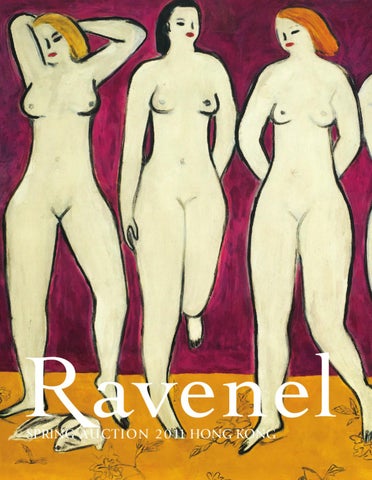
SPRING AUCTION 2011 HONG KONG
MODERN
1
&
CONTEMPORARY
ART
RAVENEL SPRING AUCTION 2011 HONG KONG Modern and Contemporary Art
羅芙奧香港 2011 春季拍賣會 現代與當代藝術
AUCTION
拍賣日期/地點
Monday, May 30, 2011, 11:30am – 1:00pm
2011年5月30日(一) 上午 11:30 至下午 1:00
Grand Hyatt Hong Kong – Grand Ballroom
香港君悅酒店(宴會大禮堂)
1 Harbour Road, Wanchai, Hong Kong
香港灣仔港灣道1號
PREVIEWS
預展日期/地點
Taipei
台北
Sunday, May 1 – Monday, May 2, 2011, 10:00am – 7:00pm
2011年5月1日(日)至5月2日(一)上午 10:00 至下午 7:00
Fubon National Conference Center
富邦人壽大樓國際會議中心
B2, No. 108, Section 1, Tun-Hwa South Road, Taipei, Taiwan
台北市敦化南路一段108號B2
Taichung
台中
Saturday, May 7 – Sunday, May 8, 2011, 1:00pm – 7:00pm
2011年5月7日(六)至5月8日(日)下午 1:00 至 7:00
GSR Gallery
由鉅藝術中心(月光流域大樓)
1F, No. 83, Gong Zheng Road, Taichung, Taiwan
台中市公正路83號1樓
Beijing
Saturday, May 21 – Sunday, May 22, 2011, 10:00am – 7:00pm
北京 2011年5月21日(六)至5月22日(日)上午 10:00 至下午 7:00
Grand Hyatt Beijing – The Residence
北京君悅酒店(君府廳)
1 East Chang An Avenue, Beijing
北京市東長安街1號
Hong Kong
香港
Saturday, May 28 – Sunday, May 29, 2011, 10:00am – 7:00pm
2011年5月28日(六)至5月29日(日)上午 10:00 至下午 7:00
Grand Hyatt Hong Kong – Tiffin Lounge
香港君悅酒店(M樓茶園)
1 Harbour Road, Wanchai, Hong Kong
香港灣仔港灣道1號
MODERN
&
CONTEMPORARY
ART
As requested by the Buyer, we are delighted to offer the condition reports of all the auction items, provided, however, such items will be sold “as is”. In addition, the Buyer is requested to take note of the transaction agreement and the explanations of the provisions regarding the notice of no-guarantee. This auction catalogue: HK$ 300 per copy
2
RAVENEL STAFF AND SERVICES FOR THIS SALE
ART CONSULTANTS Vice President Flora Fu Tel: +886 2 2708 9868 ext. 888 Email: florafu@ravenel.com
Vice President Odile Chen Tel: +886 2 2708 9868 ext. 889 Email: odilechen@ravenel.com
Remarks: If you are unable to attend the auction in person, you may tender the bid by phone or you may use the absentee bid forms attached at the back of the auction catalogue to tender your bid. In view of the limited phone line services at the auction, please inform us 24 hours prior to the auction for arrangements. Particularly for those of you who need foreign language assistance of the bidding.
Executive Director, Hong Kong Elaine Holt Tel: +852 2889 0859 Email: elaineholt@ravenel.com
Senior Manager Maggie Lin Tel: +886 2 2708 9868 ext. 886 Email: maggielin@ravenel.com
Manager China Dina Zhang Tel: +86 10 5820 6151/52 Email: dinazhang@ravenel.com
PHONE BIDS AND WRITTEN BIDS Taiwan Maggie Lin Tel: +886 2 2708 9868 ext. 886 Email: maggielin@ravenel.com
Hong Kong Elaine Holt Tel: +852 2889 0859 Mobile: +852 9381 1886 Email: elaineholt@ravenel.com
China Dina Zhang Tel: +86 10 5820 6151/52 Email: dinazhang@ravenel.com
International Odile Chen Tel: +886 2 2708 9868 ext. 889 Email: odilechen@ravenel.com
CATALOGUE SUBSCRIPTION Taiwan Natsuki Wang Tel: +886 2 2708 9868 ext. 881 Email: natsukiwang@ravenel.com
Hong Kong Miyuki Wai Tel: +852 2889 0859 Email: miyukiwai@ravenel.com
China Judy Xie Tel: +86 10 5820 6151/52 Email: judyxie@ravenel.com
International Kate Lin Tel: +886 2 2708 9868 ext. 182 Email: katelin@ravenel.com The catalogues are available for subscription. For details of subscription, please refer to the explanations of the catalogue or contact the above persons.
PAYMENT Tracy Hsu Tel: +886 2 2708 9868 ext. 686 Email: tracyhsu@ravenel.com Payment details are described at the back of the catalogue. Please contact the above person if you need any further information.
3
COLLECTION AND SHIPPING Taiwan Tommy Wu Tel: +886 2 2708 9868 ext. 885 Email: tommywu@ravenel.com
Hong Kong Jackal Yiu Tel: +852 2889 0859 Email: jackalyiu@ravenel.com
China Judy Xie Tel: +86 10 5820 6151/52 Email: judyxie@ravenel.com
International Stella Huang Tel: +886 2 2708 9868 ext. 883 Email: stellahuang@ravenel.com Remarks: All the items auctioned may be collected upon receipt of payments. The Buyers are requested to arrange for collection as soon as possible to facilitate warehouse inventory circulation and centralize management. We accept personal and corporate checks, however collection may be made only when such checks are honored. We apologize for no acceptance of credit cards and traveler’s checks. Other items may be collected at the Ravenel Ltd. The business hours are 9:30 am to 6:30 pm, Monday to Friday. Our professional administration department may make recommendations of arrangement or the most appropriate transportation for you. Ravenel is glad to provide you with the condition report of any of the items at the auction, however, the buyers must note that all the items at the auction are sold “as is”. Please refer to the Transaction Agreement at the back of the catalogue. Please refer to the “Transaction Agreement to the Buyers”.
羅芙奧香港 2011 春季拍賣會服務部門及連絡人
藝術品諮詢專家 副總經理 傅斐郡 電話:+886 2 2708 9868 轉 888 電子信箱:florafu@ravenel.com
副總經理
註一:如您無法親臨拍賣現場,可以電話投 標方式競標;亦可利用附在此目錄後面之委 託競投表格。 註二:鑑於拍賣現場電話有限,欲以電話投 標方式競標的投標者,請於拍賣前24小時通 知我們為您安排,尤其對需用外國語言服務 之投標者。
取貨及運輸事宜 台灣 吳博峯 電話:+886 2 2708 9868 轉 885 電子信箱:tommywu@ravenel.com
香港
陳惠黛 電話:+886 2 2708 9868 轉 889 電子信箱:odilechen@ravenel.com
目錄訂閱
姚天樂 電話:+852 2889 0859 電子信箱:jackalyiu@ravenel.com
香港總監
台灣
中國
何杏淇 電話:+852 2889 0859 電子信箱:elaineholt@ravenel.com
王靖雅 電話:+886 2 2708 9868 轉 881 電子信箱:natsukiwang@ravenel.com
謝冷玉 電話:+86 10 5820 6151/52 電子信箱:judyxie@ravenel.com
業務協理
香港
其它地區
林慧菁 電話:+886 2 2708 9868 轉 886 電子信箱:maggielin@ravenel.com
韋櫻子 電話:+852 2889 0859 電子信箱:miyukiwai@ravenel.com
黃詩涵 電話:+886 2 2708 9868 轉 883 電子信箱:stellahuang@ravenel.com
業務經理
中國
張丹丹 電話:+86 10 5820 6151/52 電子信箱:dinazhang@ravenel.com
謝冷玉 電話:+86 10 5820 6151/52 電子信箱:judyxie@ravenel.com
註一:所有拍品在貨款結清後,即可取貨; 買家請儘早通知安排取貨事宜,以利倉庫存 貨流通和集中安排辦理,本公司接受個人及 公司支票付款,惟需在兌現後始能提貨。恕 不接受信用卡和旅行支票付款。其他各項貨 品可在羅芙奧辦公室提領,上班時間為週一 至週五上午9:30至下午6:30。
其它地區
台灣
林依潔 電話:+886 2 2708 9868 轉 182 電子信箱:katelin@ravenel.com
林慧菁 電話:+886 2 2708 9868 轉 886 電子信箱:maggielin@ravenel.com
本目錄開放各界訂閱,詳細訂閱辦法,請參 照目錄之說明或請洽上述聯絡人。
電話書面競標聯絡人
香港 何杏淇 電話:+852 2889 0859 手機:+852 9381 1886 電子信箱:elaineholt@ravenel.com
中國 張丹丹 電話:+86 10 5820 6151/52 電子信箱:dinazhang@ravenel.com
付款事宜 徐翠霙 電話:+886 2 2708 9868 轉 686 電子信箱:tracyhsu@ravenel.com 有關付款詳細事宜,說明於本目錄後,如您 需要更進一步的諮詢,請洽上述聯絡人。
其它地區 陳惠黛 電話:+886 2 2708 9868 轉 889 電子信箱:odilechen@ravenel.com
4
註二:我們的專業行政部門可為您建議或安 排最適當的運輸方式。 羅芙奧樂意提供您本次拍賣當中任何一項拍 品的狀況報告書,惟準買家需注意拍品均是 以「當時認定」之狀況賣出,相關細項請參 照目錄後之業務規則。請參照買家需注意事 項。
目次 / Contents 2
藝術家索引 / Index
羅芙奧春季拍賣會
A
Sale Information 3
Minako ABE Yoshitaka AMANO Carrie CHAU CHEN Yu CHIU Ya-tsai CHU Teh-chun
藝術家索引
鄒蘊盈 陳餘 邱亞才 朱德群
078 074 008 012, 015
方力鈞 傅慶豊
040 079
高瑀 郭晉
062 070
何森 洪磊 謝德慶 許唐瑋 華慶 黃鋼 黃岩 黃銘哲
030 061 059 005 004 001 063, 064 006
詹金水 季大純 吉磊 蔣朔 朱銘
007 037 066 055 021, 052, 053
郭維國
011
李支鉉 李真 李新平 連建興 劉韡 劉小東
060 020, 051 033 009 042 043
馬六明 毛同強 松浦浩之
038 067 077
奈良美智
080
潘德海
073
祁志龍
075
任小林
024
常玉 盛奇 史怡然
019 022, 026 065
F
Index 7
035 076
C
羅芙奧之服務
Ravenel Services 5
阿部未奈子 天野喜孝
FANG Lijun Alixe FU
G
現代與當代藝術
GAO Yu GUO Jin
Modern and Contemporary Art
H 140
HE Sen HONG Lei HSIEH Tehching HSU Tang-wei HUA Qing HUANG Gang HUANG Yan Michell HWANG
藝術家簡歷
Artist Biographies 161
委託競投表格
Absentee Bid Form 163
J
業務規則
JAN Chin-shui JI Dachun JI Lei JIANG Shuo JU Ming
Transaction Agreement
K KUO Wei-kuo
L LEE Ji-Hyun LI Chen LI Xinping LIEN Chien-hsing LIU Wei LIU Xiaodong
M MA Liuming MAO Tongqiang Hiroyuki MATSUURA
N Yoshitomo NARA
P PAN Dehai
Q QI Zhilong
R REN Xiaolin
S SANYU SHENG Qi SHI Yiran
5
S SU Wang-shen
蘇旺伸
010
丁雄泉
013, 014
王廣義 王勁松 王克平 王天德 王子衛 吳冠中 吳昊
002 028, 032 057 023, 025 031, 041 017 029
熊莉鈞 許仲敏 薛松
068, 069 056 027, 034
余本 尹朝陽 岳敏君
036 044 050
趙無極 曾梵志 張大力 張念 張曉剛 鄭德龍 周春芽
018 047 039, 071 058 046, 048 072 003, 016, 045, 049, 054
T Walasse TING
W WANG Guangyi WANG Jinsong WANG Keping WANG Tiande WANG Ziwei WU Guanzhong WU Hao
X XIONG Lijun XU Zhongmin XUE Song
Y YEE Bon YIN Zhaoyang YUE Minjun
Z ZAO Wou-ki ZENG Fanzhi ZHANG Dali ZHANG Nian ZHANG Xiaogang ZHENG Delong ZHOU Chunya
6
001
HUANG Gang (Chinese, b. 1961)
Mao's 2007 Mixed media on board 122 x 87 cm Signed lower right Huang Gang in English and Chinese, dated 2007
HK$ 150,000-220,000 NT$ 570,000-840,000 US$ 19,700-28,900
黃鋼 毛澤東 2007 綜合媒材 木板 122 x 87 cm 簽名右下:Huang Gang 黃鋼 2007
002
WANG Guangyi (Chinese, b. 1957)
Great Criticism Series - Pierre Cardin 2002 Oil on canvas 50 x 40 cm Signed on the reverse Wang Guangyi in English and Chinese, dated 2002
HK$ 190,000-280,000 NT$ 720,000-1,060,000 US$ 25,000-36,800
王廣義 大批判系列─皮爾.卡登 2002 油彩 畫布 50 x 40 cm 簽名畫背:2002 Wang Guangyi 王廣義
王廣義的大批判系列已公認為當代中國文藝 運動中最具爭議的代表性作品。融合1975年 前舊共產主義與1960年代紐約波普運動的藝 術形式,王廣義的作品在當代中國藝術中佔 據不可或缺的中心地位。從1990年代初,他 剛一推出「大批判」系列作品,旋即在全球 獲得成功。王廣義的作品現居於當代中國頂 尖藝術收藏品之列。 此幅《大批判系列─皮爾.卡登》作品是該 系列的標誌性代表。作品以平面風格繪製波 普藝術,包含政治波普的所有元素,是王廣 義引發了這場中國當代藝術運動。在作品畫 面中心,是個巨大、堅定的無產階級工人形 象,這一形象直接來源於文化大革命期間的 工農兵。這是個面帶微笑、威武有力的形 象,他身體每一處中都透露著精神。他似乎 是邀請我們去明白些什麼或參與些什麼。 隨即,使我們驚訝的事實是,工人並非揮舞 他本行業的工具。與拿著木槌或錘子相反, 他一手舉著抄寫筆,另一隻手拿著一本不小 的紅皮書。這一形象通過它緋紅色的背景得 到加強,啞光黃和啞光綠的使用凸顯它做舊 的質感。這幅作品蓋滿重複的如監獄犯人一 般的身份編號。在畫面的底部,印著皮爾. 卡登,這一標誌性的西方品牌,在2002年中 國剛開放時這一品牌就深入人心,而這一 年,這幅作品也剛完成。 《大批判系列─皮爾.卡登》徹底地體現了 王廣義的諷刺。每幅圖畫及細節上顯而易見 的荒誕處理,凸顯了王廣義對當今中國根本 上的諷刺性觀點,荒謬的革命宣傳將被西方 消費主義所替代。
The works from Wang Guangyi’s “Great Criticism” series have become some of the most evocative and instantly recognized standard-bearers of the Chinese Contemporary Art Movement. Melding the art forms of the old communist world pre-1975, with the Popart movement of 1960s New York, Wang’s
8
works have an integral and central place in the foundation of contemporary Chinese art. From its launch in the early 1990’s the “Great Criticism” series found instant and immediate success worldwide, and Wang’s works now hang in all the great collections of contemporary Chinese art. The present work “Great Criticism – Pierre Cardin” is an iconic representative of the series. Painted in the flat style of Pop-art, the work contains all the elements of Wang’s Political-Pop art, a movement he founded for contemporary Chinese art. In the centre is a massive, stalwart figure of a classic proletarian worker taken straight from the images of Cultural Revolution propaganda posters. The smiling figure is strong and powerful, with energy flowing through every facet of his body. He seems to be inviting us to understand something or to partake in something. Immediately, we are struck by the fact that the worker is not wielding tools of his trade. Instead of mallets or hammers, he is holding the pen of a scribe in one hand and a not so little red book in the other. The image is intensified through its framing in a crimson red background, and the use of matt yellows and greens which lend it an archaic quality. The work is stamped all over with repetitive numbers reminiscent of a prisoner’s jailhouse identity. Across the bottom is emblazoned “Pierre Cardin” an iconic Western brand readily identifiable in the newly opened China of 2002, the year the work was created. “Great Criticism – Pierre Cardin” magnificently embodies Wang’s irony. The apparent absurdity of every image and detail serves to highlight Wang’s fundamental ironic view of present day China, the absurdity of revolutionary p r o p a g a n d a b e i n g r e p l a c e d b y We s t e r n consumerism.
003
ZHOU Chunya (Chinese, b. 1955)
The Rose in the Fog 1996 Oil on canvas 73 x 60 cm Signed lower right Zhou Chunya in Chinese and dated 1996 ILLUSTRATED: Zhou Chunya, Timezone 8, Hong Kong, May 2010, color illustrated, p. 273
HK$ 420,000-650,000 NT$ 1,600,000-2,470,000 US$ 55,300-85,500
周春芽 霧裡玫瑰 1996 油彩 畫布 73 x 60 cm 簽名右下:1996 周春芽 圖錄: 《周春芽》,東八時區,香港,2010年5月, 彩色圖版,頁273
10
004
HUA Qing
華慶
(Chinese, b. 1962)
遠眺 2008 油彩 畫布 180 x 160 cm 簽名右下:華慶 2008
Looking Far Off 2008 Oil on canvas 180 x 160 cm Signed lower right Hua Qing in Chinese and dated 2008
HK$ 95,000-150,000 NT$ 360,000-570,000 US$ 12,500-19,700
12
EXHIBITED: Magic of Thinking – 2009 Hua Qing Solo Exhibition, Asian Art Center, Beijing, May 30 June 28, 2009
展覽: 「思維的魔力─華慶 2009」,亞洲藝術中 心,北京,展期自2009年5月30日至6月28日
ILLUSTRATED: Magic of Thinking – 2009 Hua Qing, Asian Art Center, Beijing, 2009, color illustrated, cover
圖錄: 《思維的魔力─華慶 2009》,亞洲藝術中 心,北京,2009,彩色圖版,封面
005
HSU Tang-wei
許唐瑋
(Taiwanese, b. 1980)
遠眺的不知名(6)(7)(8)
Look Far Into the Not Knowing (6) (7) (8) 2008 Acrylic on canvas 45.5 x 38 cm (x3) Signed on the reverse HSU TANG-WEI in Chinese and English, titled Look Far Into the Not Knowing (6), dated 2008 Signed on the reverse HSU TANG-WEI in Chinese and English, titled Look Far Into the Not Knowing (7), dated 2008 Signed on the reverse HSU TANG-WEI in Chinese and English, titled Look Far Into the Not Knowing (8), dated 2008
EXHIBITED: Evolutionism - Hsu Tang-wei, J. Chen Gallery, Taipei, December 13, 2008 – January 10, 2009 This painting is to be sold with a certificate of authenticity signed by the artist.
HK$ 30,000-50,000 NT$ 110,000-190,000 US$ 3,900-6,600
2008 壓克力 畫布 45.5 x 38 cm (x3) 簽名畫背:遠眺的不知名(6)許唐瑋 H S U TANG-WEI 2008 簽名畫背:遠眺的不知名(7)許唐瑋 H S U TANG-WEI 2008 簽名畫背:遠眺的不知名(8)許唐瑋 H S U TANG-WEI 2008 展覽: 「進化論─許唐瑋」,J. Chen畫廊,台北, 展期自2008年12月13日至2009年1月10日 附藝術家親筆簽名之原作保證書
006
Michell HWANG (Taiwanese, b. 1948)
Woman of Eastern District 1993 Oil on canvas 90 x 72 cm Signed lower left Che in Chinese and dated 1993
HK$ 60,000-90,000 NT$ 230,000-340,000 US$ 7,900-11,800
14
黃銘哲 東區的女人 1993 油彩 畫布 90 x 72 cm 簽名左下:哲 1993
007
JAN Chin-shui (Taiwanese, b. 1953)
Winter Forest 2006 Mixed media on canvas 130 x 162 cm Signed lower right Chin-shui in Chinese and dated 2006 Signed on the reverse Jan Chin-shui, titled Winter Forest in Chinese, inscribed 100F and dated 2006
HK$ 75,000-100,000 NT$ 290,000-380,000 US$ 9,900-13,200
詹金水 冬林 2006 綜合媒材 畫布 130 x 162 cm 簽名右下:金水 2006 簽名畫背:詹金水 2006年 100F 冬林
008
CHIU Ya-tsai
(Taiwanese, b. 1949)
Profile of a Young Man Oil on canvas 130 x 97 cm Signed lower right Chiu Ya-tsai in Chinese
HK$ 150,000-220,000 NT$ 570,000-840,000 US$ 19,700-28,900
邱亞才 青年畫像 油彩 畫布 130 x 97 cm 簽名右下:邱亞才
16
009
LIEN Chien-hsing (Taiwanese, b. 1962)
Navigation with Romance 2004 Oil on canvas 80 x 116 cm Signed lower right Lien Chien-hsing in Chinese and dated 2004 Signed on the reverse Lien Chien-hsing, titled Navigation with Romance in Chinese, inscribed 50P and dated 2004 ILLUSTRATED: Lien Chine Hsing, Keelung Municipal Culture Center, Keelung, 2004, color illustrated, p. 62 Lien Chine Hsing, Eslite Gallery, Taipei, 2004, color illustrated, p. 13
HK$ 160,000-250,0000 NT$ 610,000-950,000 US$ 21,100-32,900
場、坑道,斑駁的建築鐵架,還以看似荒廢 角落中的石塊、牆面、木架、水源、動植物 等入畫,把荒廢的風景變形為一個幻想空 間,藉由俯視、廣角的空間呈現,使風景、 廢墟、動物交織成一片虛虛實實的幻景,來 象徵虛幻的現實世界並暗示生命的渺小與無 常。 《浪漫航行》創作於2004年,作品漫布著神 秘、靜謐、含蓄悲憫的氣息,隱隱自然滲透 出鄉愁,反射出畫家所歸屬的地緣情感。 Taiwan painter Lien Chien-hsing famous for “magic realism” has won the acknowledgment of art community with his unique creative style in recent years. Through the severe test of such creative forms as photo-realism and new expressionism and through decades of hard work, the magic realistic style Lien Chien-hsing has brewed and developed, which boasts calm and humanist consideration features has been deeply rooted in the people's hearts.
連建興 浪漫航行 2004 油彩 畫布 80 x 116 cm 簽名右下:2004 連建興 簽名畫背:浪漫航行 2004 連建興 50P 圖錄: 《抽象與現實的對話─魔幻寫實.連建興作 品展》,基隆市立文化中心,基隆,2004, 彩色圖版,頁62 《連建興》,誠品畫廊,台北,2004,彩色 圖版,頁13
以「魔幻寫實主義」著稱的台灣畫家連建 興,近年來以其獨樹一幟的創作風格贏得了 藝術界的肯定。曾歷經照相寫實主義及新表 現主義的創作形式的洗禮,經過數十年的辛 苦耕耘,連建興醞釀發展出具有沈靜內斂的 人文省思的魔幻寫實風格,已愈發深植人心。 進入1990年代,連建興的作品呈現真實與魔 幻的對比,大量呈現廢墟,除已成廢墟的礦
18
Entering into the 1990s, the works of Lien Chien-hsing revealed the contrast between reality and delusion and largely presented ruins. Apart from the ruined mines, saps, mottled architectural hobs, in his paintings, he transformed the ruined sceneries into imaginary space by adopting blocks, walls, wooden racks, water sources, animals and vegetations located at the seemingly ruined corner. By the space presentation from top view and vast view, the sceneries, ruins and animals were interwined into partially realistic and partially virtual illusion to symbolize the visional real world and suggest the insignificance and uncertainty of life. Created in 2004, the work “Navigation with Romance” reveals natural and virgin sceneries combined by our familiar green hills and clear water, spreading out the mysterious, tranquil, implicit and sad flavor, indistinctly and naturally infiltrating nostalgia and reflecting the geographical attachment towards the place the painter belongs to.
010
SU Wong-shen (Taiwanese, b. 1956)
Building Bridge 2005 Oil on canvas 80 x 116.5 cm Signed on the reverse Su Wong-shen in Chinese and dated 2005 ILLUSTRATED: Between the Clouds - Su Wong-shen, Eslite Gallery, Taipei, color illustrated, no. 299, p. 209 & p. 239
HK$ 250,000-400,000 NT$ 950,000-1,520,000 US$ 32,900-52,600
蘇旺伸 搭橋 2005 油彩 畫布 80 x 116.5 cm 簽名畫背:蘇旺伸 2005 圖錄: 《雲與雲之間-蘇旺伸》,誠品畫廊,台 北,2008,彩色圖版,編號299,頁209與頁 239
20
011
KUO Wei-kuo (Taiwanese, b. 1960)
Riding a Rocking Horse 2004-2005 Oil on canvas 150 x 180 cm Signed lower right Kuo's in English and dated 2004-5 Signed on the reverse Kuo Wei-kuo in Chinese, titled Riding a Rocking Horse in Chinese, inscribed 150 x 180 cm and dated 2004-2005. ILLUSTRATED: Diagram of Commotion and Desire-Towards a Bright Start From the Deep Forest, Lin & Keng Gallery, Taipei, 2005, color illustrated, p. 18 View Digestion Scene Creation View Digestion, Lin & Keng Gallery, Taipei, 2005, color illustrated, p. 102
HK$ 320,000-550,000 NT$ 1,220,000-2,090,000 US$ 42,100-72,400
郭維國 騎木馬 2004-2005 油彩 畫布 150 x 180 cm 簽名右下:Kuo's 2004-5 簽名畫背:騎木馬 二OO四∼二OO五 150 x 180 cm 郭維國 圖錄: 《暴喜圖—柳暗花明》,大未來畫廊,台 北,2005,彩色圖版,頁18 《造境照鏡》,大未來畫廊,台北,2009, 彩色圖版,頁102 「暴喜圖」系列作品為郭維國在歷經創作 及生活的困頓、停滯之後,回歸到自我, 以「畫自己」重新出發,成為個人的成熟創 作。因為不斷自問「我是誰?」,郭維國開 始以自己為主角,不斷在畫作中反覆登場。 雖以「人」的形貌出現,但卻披上了各種道 具、獸皮,有時是長了長耳朵、長鼻子或翅 膀的天使,這些看似怪異荒誕的畫面,卻像 極了目前時下年輕人喜愛的角色扮演遊戲。
22
此次拍品《騎木馬》的畫面中,木馬是兒時 歡樂的追憶,而畫中的自己,帶有些許惡意 又有詼諧,有時荒蕪蒼涼有時卑鄙下作,有 時華麗高貴又獸性壞胚。畫中的郭維國,雖 以近半裸及令人發噱的扮相登場,但可能是 畫家本身,對這個世界的角度及人跟人之間 的角度的另一種解釋;也可以說這也許是畫 家心中最真實的態度,一種藏在內心深處, 不會在一般世俗中呈現出來的真實、慾望及 想像。
The “Diagram of Commotion and Desire” series of paintings represents Kuo Wei-kuo’s return to the “self” after a period of stasis and difficulties in his career and in his personal life. In his self portrait Kuo has made a fresh start, and this series is characterized by a new maturity. By constantly asking the question “Who am I?”, Kuo has begun to make himself the “main character” in his paintings; images of Kuo himself now appear repeatedly in his work. Although he appears in these pictures in human form, he is often shown wearing some kind of “prop”, such as an animal skin, and sometimes he portrays himself with exaggeratedly long ears, a long nose, or angel-like wings. These seemingly fantastical paintings display considerable similarities with the role-playing games so popular among young people today. In this particular work, “Riding a Rocking Horse”, the rocking horse represents a memory of childhood happiness, while the self portrayed in the painting has elements of malice and mockery, sometimes radiating desolation, sometimes underhand cunning, sometimes refinement and elegance, sometimes bestial evil. The depiction of Kuo Wei-kuo in this painting, half-naked and comically attired, seems to be a reflection of the artist’s attitude towards the world and towards inter-personal relationships. What is shown here may be the artist’s real attitude, which is normally secreted away in the depths of the heart; it is the reality, desire and imagination that are usually hidden from the world.
012
CHU Teh-chun
(Chinese-French, b. 1920)
Bru 05 No. 07 1999 Ink on paper 34 x 46 cm Signed lower right CHU TEH-CHUN in Chinese and English, dated 99
HK$ 110,000-170,000 NT$ 420,000-650,000 US$ 14,500-22,400
24
朱德群 Bru 05 No. 07 1999 水墨 紙本 34 x 46 cm 簽名右下:朱德群 CHU TEH-CHUN 99
013
Walasse TING
(Chinese-American, 1929-2010)
Wet Summer 1978 Acrylic on canvas 61 x 81 cm Signed on the reverse ting, titled Wet Summer in English and dated 78
HK$ 180,000-280,000 NT$ 680,000-1,060,000 US$ 23,700-36,800
丁雄泉 夏日狂想曲 1978 壓克力 畫布 61 x 81 cm 簽名畫背:Wet Summer ting 78
014
Walasse TING
(Chinese-American, 1929-2010)
We Waiting for You to Go to Restaurant 1985 Acrylic on canvas 100 x 126 cm Signed on the reverse Ting in English, titled We Waiting for you to Go to Restaurant in English and dated 1985
HK$ 500,000-800,000 NT$ 1,900,000-3,040,000 US$ 65,800-105,300
丁雄泉 我們等你一道上餐館 1985 壓克力 畫布 100 x 126 cm 簽名畫背:We Wa i t i n g f o r y o u t o g o t o Restaurant Ting 1985
清新、活力和明亮的色彩,是丁雄泉創作以 婦女、花鳥、動物為主題油畫時的鮮明特 點,這種創作非常具有個人風格和感染力。 丁雄泉也被業界稱為「採花大盜」,一生都 在探索女性裸體所呈現的美。在終生堅持 自己的創作風格,堅持真實自我的同時,他 還在不斷追求一種新的繪畫語言表達方式。 每個女人都有自己獨特的美,正如鸚鵡與鮮 花,各自呈現的美既鮮明且獨特一樣。丁雄 泉說:「畫之前,我是男人,畫成後,我就 變成了女人。」 他用自己男性的陽剛來描 繪女性的陰柔;他拋卻世俗的束縛,來表達 事業蓬勃時的真實自我。 《我們等你一道上餐館》這幅油畫創作於 1985年,畫中兩名婦女左右兩側對稱,一 大瓶繁茂的鮮花佔據畫面前位。整幅畫洋溢 著熱烈的色彩。丁雄泉用自己與生俱來的天 賦,去創作大量豐富且鮮明的油畫形象。這 些主題反映了他創作的感性和用筆的大膽, 生動的顏色搭配就是他創作時精力充沛、酣 暢淋漓的有力證明。 這位藝術家曾經說過:「無論我看到漂亮的 女人,還是鮮花。他們都會讓我感到空靈和 敏感。他們讓我充滿活力,讓我有別樣的感 覺,讓我像新生一樣。我使用很多色彩,讓
26
我身上的能量和愛在畫布上爆發。我終生從 事油畫事業,已經50年了。我想要表達的就 是清新。從美到愛再到清新。就像一個新生 的春天。」丁雄泉的畫作不僅體現了他的個 性,也反映他的人生哲理。那就是清新、激 情、 美麗、永恆、活力,愛和情感。 Freshness, vitality and brilliant color characterize Walasse Ting's depictions of women, flowers, birds and animals executed in a powerful and highly individualistic style. Ting, also known as “The Flower Pirate”, spent his whole life exploring the beauty expressed in the nudity of women. He was constantly in a pursuit for a new language for expression, while insisting on the same theme throughout his life, at the same time requiring to be real to himself. Every woman shows a beauty of her own, and under the contrast of the parrots and the flowers presents distinct bright layers of beauty. Ting said, “Before I paint I am a man, after I paint I am a woman.” Ting used his male strength to depict female softness; he abandoned secular binding, and revealed the true self in the blossom. “We Waiting for You to Go to Restaurant” was painted in 1985. Two women are symmetrically painted on the left and right sides of the canvas with a big pot of flourishing flowers dominating the front. The painting is flowed with tropical color schemes. Ting is gifted with an unacquirable instinct to create abundantly rich and bright images. The subject matter reflects his sensuality and the bold brush strokes and the vivid palette is a testament to his abundant energy and joie de vivre. The artist once said, “It doesn’t matter that I see beautiful women and fresh flowers. They both make me empty and sensitive. They make me fresh, make me different, make me new born. I use many, many colors. Make my energy and love explode on the canvas. I have painted pictures all my life, for 50 years. I only want to express freshness. From beauty to love to fresh. Like a newborn spring.” Ting’s paintings are reflection of his personality as well as his philosophy of life. It is fresh, passionate, beautiful, timeless, vibrant, and full of love and affection.
015
CHU Teh-Chun
(Chinese-French, b. 1920)
No. 167 1964 oil on canvas 65.6 x 80.6 cm Signed lower right CHU TEH-CHUN in Chinese and English Signed on the reverse CHU TEH-CHUN in English and Chinese, titled No. 167 and dated 1964 PROVENANCE: Madame Legendre, Boulogne-Billancourt, France
HK$ 800,000 - 1,100,000 NT$ 3,040,000-4,180,000 US$ 105,300-144,700
朱德群 構圖 No. 167 1964 油彩 畫布 65.6 x 80.6 cm 簽名右下:朱德群 CHU TEH-CHUN 簽名畫背:CHU TEH-CHUN 朱德群 1964 No. 167 來源: 勒讓特夫人舊藏,布洛尼-比揚古市,法國
1960年時朱德群在巴黎已經確立了地位,代 表遠東藝術家參加巴黎夏邦提耶畫廊的國際 性畫展「巴黎畫派」,才華深受肯定。1950 年後期畫作,結合書法線條,紅、綠、藍、 黑,構成的色塊,結實有力,可以看出抽象 畫家史塔耶爾的深刻影響。1960年代,朱德 群的油畫以寬橫幅構圖居多,描繪多以單一 色為背景,畫面上有雲山煙樹之感,詩情畫 意與中國山水畫可謂一脈相承。多位藝評家 指出朱德群的畫是詩與畫的結合,詩人作家 兼藝術評論家夏布朗在1960年的《快訊週 刊》中就曾以「二十世紀的宋朝畫家」形容 朱德群。 1964年創作的《構圖No. 167》是朱德群第 167號抽象畫作品,抽象畫家通常不為作品 命題,避免給觀者先入為主的影響,因此常 採取編號或創作日期代替畫題。1958-59年 起,朱德群除了取法文畫題之外,也為油畫 作品編號,後來連題目都省去,直接以編號 取代。不過大約到了1970年前後,因編號排 序太多,自己也不易記得,他開始為畫作再 取一個極富詩意的題目,畢竟詩詞文字也是 抽象的,他認為應該不會妨礙觀者的自由解 讀,反而更能親近畫家所欲營造的空間。 1962年之後,因為代理畫廊風格轉向,朱德 群進入幾年的沈潛,為畫家在巴黎生活最刻 骨銘心的時期,儘管收入不豐,生活困頓, 但卻是畫家內心最清明、藝術最純粹的階 段,1960年代的作品量稀有,但多屬難得的 精品。
28
By 1960, Chu Teh-chun had established his reputation in Paris. As a representative of the Far East artists, he entered the international art exhibition of "Ecole de Paris" held by Galerie Charpentier, and his talent was fully recognized in that exhibition. His paintings late in 1950 were full of strength and were painted with calligraphic lines and color patches of red, green, blue and black. The paintings reflect the profound impact on Chu of the abstract painter de Staël. In the 1960s, Chu Teh-chun's oil paintings were mostly landscapes of singlecolor background with clouds surrounding mountains and mist around trees. This poetic and artistic scenery conception derives from Chinese mountain-water paintings. Several art critics pointed out that Chu Teh-chun's paintings were the combination of poetry and scenery. Jean-François Chabrun, the poet, writer and art critic, praised Chu Teh-chun as a “Peintre Song du XXe siècle (20th Century Song Painter)” in "L'Express" in 1960. The painting "No. 167" painted in 1964 was Chu Teh-chun's 167th abstract painting. Abstract painters usually leave their works without a title to avoid preconceived understandings of their art. They give their compositions numbers or dates of creation. From 1958-59, Chu Teh-chun gave his oil paintings numbers and French names. Then later, he simply omitted titles and replaced them entirely with numbers. Around 1970 he found himself puzzled by so many numbers, so he started to use poetic titles since, after all, poetic verses were also abstract. He believed poetic names wouldn't obstruct viewers' freedom of understanding. On the contrary, a good title may help viewers to get closer to the atmosphere which he as a painter had tried to create. A change in style of the gallery agency in 1962 brought about a low point for Chu Teh-chun for some years. This is a forgettable period for Chu in Paris. A difficult life and low income, however, never influenced his work as a purehearted and clear-minded painter. His paintings in the 1960s were less in quantity, but greatly superior in quality.
016
ZHOU Chunya (Chinese, b. 1955)
Heigen Standing on Platform 1996 Oil on canvas 200 x 150 cm Signed on the reverse Zhou Chunya ,titled Heigen Standing on Platform in Chinese and inscribed 200 x 150 cm ILLUSTRATED: Zhou Chunya, Timezone 8, Hong Kong, May 2010, color illustrated, pp. 238-239
HK$ 2,600,000-4,000,000 NT$ 9,880,000-15,200,000 US$ 342,100-526,300
周春芽 平垣上站著的黑根 1996 油彩 畫布 200 x 150 cm 簽名畫背:《平垣上站著的黑根 》 200 x 150 cm 周春芽 圖錄: 《周春芽》,東八時區,香港,2010年5月, 彩色圖版,頁238-239
30
1993年,從德國返國的周春芽在忘年交岑學 恭(著名國畫家、三峽畫派創始人)那裡看 到了岑老養的大黑貝,一隻德國牧羊犬。周 春芽被這隻狗展現的「型」所深深地吸引 了,一身「鐵包金」的毛,走在陽光下反射 出金屬般的光澤。在岑老的介紹下,周春芽 從真正的狗主人家抱回了一隻小狗仔,起名 「黑根」。從此,藝術家不但跟狗結下不解 之緣,更是因此獲得了藝術上的高峰。 黑根是德國名字,算是紀念早年的留學時 光。周春芽留學德國時在卡塞爾學習藝術, 還有另外一個因緣是,當年的成都岷山飯店 附近有家名氣響亮的黑根啤酒館,他跟朋友 經常去那裡喝兩杯,有種熟悉的親近感。在 遇到黑根之前,周春芽並不太喜歡狗,而黑 根之後,他迷上了所有狗,在他看來,狗是 世界上最忠誠和最可愛的動物。 黑根是一隻精力旺盛,又非常調皮的狗,共 同生活的六年中,更像是家人,而非寵物。 經常在家裡跟人玩耍嬉戲。當時還在和前妻 一起生活的周春芽,習慣性地把「黑根」喚 成他們的兒子。和黑根相處時,他開始研究 中國的文人畫,曾經畫了一批文人畫式的油 畫風景,黑根自然成了周春芽筆下最好的模 特兒。而那些歡樂的時光在每一幅以黑根為 主題的畫面中都能看到線索。《黑根一家男 主人和女主人》、《平頂上玩耍的黑根》、 《跑動的黑根》、《站立的黑根》,以及這 幅《平垣上站著的黑根》,皆是最佳的例 證。 周春芽常常以寥寥數筆勾勒出一條生機盎然 的狗,甚至對狗的寵愛展露無遺。用黑色描 繪的黑根,承接了周春芽1990年代在山石與
32
花卉題材的探索,也更像是書寫畫家的一篇 生活日記。散開的筆鋒皴擦、拖曳,交替著 順筆、逆鋒、側鋒,使整幅畫面生機勃勃, 呈現出藝術家心境上的輕鬆愉快。「黑根很 聰明,那時我開的是老北京吉普,發動機聲 音很大,牠從幾條街之外就可以辨認出我車 的聲音,知道我要回來了就興奮地在家中狂 吠。」即使過去了那麼多年,每次回想起黑 根,周春芽仍掩飾不住對牠的思念和鍾愛。 雖然真正的相處只有五六年的時間,但是在 周春芽的藝術歷程中,黑根已經成為一個永 恆的象徵。 1999年黑根病死了,給周春芽帶來的悲痛僅 次於父親去世的打擊,甚至有一年多的時間 使他一度無法提筆作畫。「黑根從一月大的 時候抱回家就和我睡在一起,隨後到牠死都 是死在我的床上,那種感受實在是太難受 了。」周春芽說,黑根去世那麼久了,他到 現在都不敢去牧馬山看黑根的墓,因為一去 就會傷心。一直到2001年,黑根開始重新出 現在畫布上。而此時的黑根已經不僅僅是為 了呈現對傳統的理解和筆墨 的應用,它開始 解放成為更加自由的靈魂,此後,藝術家更 富盛名的「綠狗」系列應運而生。
In 1993, Zhou Chunya, recently returned from Germany, saw a German shepherd dog at the house of his old friend, Cen Xuegong (famous Chinese ink painter and founder of the Three Gorges School). Zhou was drawn in by this dog’s strong sense of form, with its black and gold fur that glowed in the sunlight. Cen introduced him to the dog’s owner, where Zhou picked up a puppy, which he named Heigen.
This encounter solidified Zhou’s relationship with dogs, and set him on the path to dizzying artistic heights. Heigen is a German name, a nod to the artist’s days studying abroad. Zhou studied art at Kassel. There’s another reason for the name: there was a famous bar in Chengdu in those days, near the Minshan Hotel, called Heigen Tavern. Zhou would often go there for a drink with his friends. It was a familiar and close setting. Before meeting Heigen, Zhou Chunya didn’t really like dogs. But afterwards, Zhou fell in love with all dogs. In his eyes, dogs are the most faithful and lovable animals in the world. Heigen was a spirited and mischievous dog. Throughout his six year life, he was like a member of the family, rather than a pet. He often pouncesdaround the house, engaging people at play. When he still lived with his former wife, Zhou often referred to Heigen as their son. While he was with Heigen, Zhou began studying literati painting, often creating oil landscapes in the literati style, and Heigen naturally became his best model. We can see the traces of those happy times in every one of Zhou’s Heigen-themed paintings, such as “Heigen with Family”, “Heigen Playing on the Roof”, “Heigen Running” and this lot, “Heigen Standing on Platform”. Zhou Chunya would often evoke the vivaciousness of this dog, and his doting love for it, with a few scant brushstrokes. His black paintings of Heigen were a continuation of his 1990s explorations of
the stone and flower themes, and were more like a living diary of a painter. The chapped, rugged strokes of the brush tip are interspersed with smooth strokes, creating a sense of vitality and evoking the artist’s relaxed and happy demeanor. “Heigen was very smart. At the time, I was driving an old Beijing Jeep, and the engine was really loud. Heigen could pick out the sound of my car from several blocks away, and he would bark in excited anticipation.” After all these years, when he thinks of Heigen, Zhou Chunya can’t conceal his fondness for his old companion. Though they were only together for about six years, Heigen has become an eternal symbol of Zhou’s artistic progression. Heigen passed away in 1999, dealing a blow to the artist second only to the passing of his father. It was over a year before he could bring himself to lift his brush again. “Heigen slept by my side since I’d first carried him home when he was a month old. When he died, he died on my bed. It was so sad.” Zhou said that even after all these years, he cannot bear to visit Heigen’s grave at Muma Mountain, because the pain would be too great. In 2001, Heigen began to reemerge on Zhou’s canvas. This time, Heigen was no longer there just to present the artist’s understanding of traditions and his skills with the brush. He had been released to become a freer spirit. This was when the artist’s more famous “Green Dog” series came into being.
017
WU Guanzhong
中對「政治第一、藝術第二」開火,整個 會場鴉雀無聲,無人敢接回應。他的每一 次筆墨都無異於是一次現代藝術的觀念革 新,從某種程度上說,他是中國現代藝術的 啟蒙者。盛名之後,他仍然止不住對藝術現 實的批判。「畫家走到藝術家的很少,大部 分是畫匠,可以發表作品,為了名利,忙於 生存,已經不做學問了,像大家那樣下苦工 夫的人越來越少。」「整個社會都浮躁,刊 物、報紙、書籍,打開看看,面目皆是浮 躁;畫廊濟濟,展覽密集,與其說這是文化 繁榮,不如說是為爭飯碗而標新立異,嘩眾 唬人,與有感而發的藝術創作之樸素心靈不 可同日而語。」
(Chinese, 1919-2010)
Spring to the North 1996 Oil on canvas 93 x 61 cm Signed lower left Tu in Chinese and dated 96 in Chinese Signed on the reverse Wu Guanzhong in Chinese, titled Spring to the North White Birch in Chinese and dated 1996 ILLUSTRATED: The Complete Works of Wu Guanzhong Vol. IV, Hunan Fine Arts Publishing House, Changsha, 2007, color illustrated, p. 144
HK$ 9,000,000-15,000,000 NT$ 34,200,000-57,000,000 US$ 1,184,200-1,973,700
吳冠中 北國春 1996 油彩 畫布 93 x 61 cm 簽名左下:荼九六 簽名畫背:北國春(白樺) 吳冠中1996 圖錄: 《吳冠中全集4》,湖南美術社,長沙, 2007,彩色圖版,頁144
吳冠中: 斯人已去,情意永存 每一年總要發生或者感受一些事情是跟他有 關的,無論是畫還是文。畫裡有夢有喜有 情;文裡有思有憂有言。但是2011年,再也 無法更新這個人的動態,剩下的只有舊聞 和不斷更改的數字:原本就屬高價的拍賣成 績,如今只可能越來越高。他就是2010年去 世的吳冠中,二十世紀中國現代繪畫的代表 畫家之一。 吳冠中生於江南水鄉,下筆優美、抒情, 洋溢著生機和活力,即使是在他年輕時最 困頓的時刻,也從未更改此種畫風。正如評 論家蘇利文所寫到的:「他輕鬆自由地與自 然和諧共存。」他對江南的記憶,甚至在北 京已經居住了六十年,鄉音仍然未改。很多 時候,他會在聊天的過程中停下來問一句: 「我說的話能聽懂嗎?」 這位從解放後就不斷被「改造」的藝術家, 始終保持著他的執著,他說:「我絕不向庸 俗的藝術觀低頭,我絕對無法畫虛假的工農 兵模式。」1979年,在中國美術館舉辦了個 人畫展的吳冠中,在當年的文代會上當選為 中國美協常務理事。第一次理事會上,吳冠
34
在《我負丹青》的書籍中,他坦承下輩子不 當畫家:「越到晚年我越覺得繪畫技術並不 重要,內涵最重要。繪畫藝術具有平面侷限 性,許多感情都無法表現出來,不能像文學 那樣具有社會性。在我看來,一百個齊白石 也抵不上一個魯迅的社會功能,多個少個齊 白石無所謂,但少了一個魯迅,中國人的脊 樑就少半截。我不該學丹青,我該學文學, 成為魯迅那樣的文學家。從這個角度來說, 是丹青負我。」 他堅持批判的文化品格和美學主張—對意境 和其清新、明朗自然風格的藝術追求,有種 相馳又相應的協調。吳冠中一直在研究中、 西繪畫異同的基礎上尋找兩者的結合點,他 將傳統水墨的寫意和西方現代表現性繪畫融 會貫通,這種東西交融的技法使得他的作品 具有明快,單純的現代性,同時又不失中國 式寧靜、抒情的詩意。 在其一生的創作題材中也無不體現著他對 中國式寧靜、抒情詩意畫面的美學追求, 其作品多集中在江南、北國、水鄉、動物 等題材。 其目前名列前十名的拍賣紀錄皆是此類作 品。2010年的《長江萬里圖》成交紀錄人 民 幣5712萬,2009年《鸚鵡天堂》人民幣
3025萬,《北國風光》人民幣3024萬。 此幅創作於1996年的《北國春》同樣屬於 此類代表風格。以簡單的構圖,淡墨的筆 法,素雅的配色,將北國春天中素雅而又 爛漫初現的特點躍然紙上。
溫暖北國 出生於江南的吳冠中,對北國有著不同的情 感。北國多用來代指北方的景色。吳冠中在 作品中反覆表達對北國風景的眷戀。 所有的風景無不盡顯詩意。這種詩意 和情感和他在北國的經歷形成了強烈 的反差,他從未因其經歷過的苦難而 在畫面中形成過任何慘澹的畫面,總 是一如既往的淡然、溫婉。像他的 人,更像他畫中的樹木,即使是一株 株的小樹,也自有它筆直的身姿,融 於自然,同時又超越了周邊風景。 1970年,吳冠中被下放河北農村,受 盡苦難,包括畫畫的權利也被剝奪。 即使在幾年後偶爾可以畫點畫,仍然 無法獲得材料。他在70年代創作了一 批幾十釐米見方的小作品,都是他買 了一塊多錢一個的簡易黑板,刷上 膠,直接在上面畫油畫的創作;畫 架乾脆借來房東的糞筐代替。這是後 來吳冠中一度被大家戲稱為「糞筐畫 家」的來由。 除了不能畫畫,更痛苦的是,吳冠中夫婦 和三個孩子,一家五口分離在五個地方, 老大在內蒙,老二在山西農村,老三在建築 工地,經常變動地址。吳冠中夫妻倆分別在 兩個農場,很難見面。在此過程中吳冠中飽
36
受肝炎折磨,還罹患其他惡疾。在這種殘酷 的生活境遇中,吳冠中只有拼命地畫,在畫 畫中忘卻或者乾脆在繪畫中死去,反倒是一 種美好的宿命。匪夷所思的是,他的肝炎在 瘋狂的繪畫中不藥而癒了。正是因為這段經 歷,吳冠中的筆下常常充斥著高粱、玉米、 冬瓜、石榴、樺樹、石頭、野花等自然田野 之光。吳冠中如此評價自己的選材,「我有 兩個觀眾,一是西方的大師,二是中國老百 姓。二者之間差距太大了,如何適應?是人 情的關聯。我的畫一是求美感,二是求意
人品、藝品 吳冠中生前便對社會給予了慷慨的捐贈,無 論是數量還是作品的精彩程度,價值都非常 之高。從二十世紀至今,只有他和徐悲鴻做 到了這一點。據不完全統計,徐悲鴻直接義 賣捐出去的錢款高達數億元,死後更是將所 有作品捐贈給了國家;吳冠中年近九十歲, 眼見自己的作品在拍賣市場行情越來越高, 自己一輩子居住在幾十平方米小屋內,生活 簡樸,選擇了向社會捐贈了數百幅價 值連城的名作的方式完成自己對家、 國、藝、品這人生幾大主題的抒寫。 正是因其人品的難得,藝品的高超, 即使在金融危機之時,其作品價格依 然如前,不斷創造新的紀錄。所謂大 家和畫匠的區別,有時候就在文化品 格和人品的差異上顯出不同和高下。 而這種差異最終又會作用到畫面上, 形成作品核心價值的不同。對於收藏 者來說,有時候買下的不僅僅是一幅 畫面,一件作品,更是一種人心,一 段佳話,一次共鳴。
吳冠中《百花山》 羅芙奧香港2008年秋季拍賣會 編號134,646萬港幣成交 WU Guanzhong, The Blooming Mountain, 1996, oil on canvas, 60 x 93 cm Ravenel Autumn Auction 2008 Hong Kong, lot 134, US$ 833,548 sold
境,有了這二者我才動筆畫。我不在乎像和 漂亮,那時在農村,我有時畫一天,高粱、 玉米、野花等等,房東大嫂說很像,但我覺 得感情不表達,認為沒畫好,是欺騙了她。 我看過的畫多矣,不能打動我的感情,我就 不喜歡。」
Wu G u a n z h o n g: T h o u g h t h e man is gone, his affection will last forever. Every year, there were things that happened or were perceived that were linked to him, be they paintings or writings. His paintings contain dreams, joy and emotion; his writings contain thoughts, grievances and powerful words. But beginning in 2011, there would be no more
news about this man, only old information and changing numbers; his already outstanding auction results will only improve in the future. This man is Wu Guanzhong, who passed away in 2010, one of the leading representatives of 20th century modern Chinese painting. Wu Guanzhong was born in a riverside town in the south of China. His brushwork was graceful, sweeping and full of vitality. Even in his direst straits as a youth, he never changed this signature style. As critic Michael Sullivan writes, “He freely and effortlessly lives in harmony with nature.” Even living in Beijing for 60 years did nothing to diminish his memories and nostalgia for his southern home. He would often interrupt conversations to ask his interlocutors, “Could you understand my southern accent?” This artist, who underwent constant ‘revisions’ since the founding of the republic, always maintained his stubborn demeanor. He said, “I will never bow my head to the vulgar artistic view. I could never paint those empty workerpeasant-soldier models.” Wu Guanzhong held a solo exhibition at the National Art Museum of China in 1979, and was elected director of the China Fine Artists Association board of advisors at that year’s Art Workers Conference. At the first board meeting, Wu fired shots at the maxim of “politics first, art second.” The room fell silent – no one dared to respond. Every time he lifted the brush, it ushered in a new chapter in modern artistic conceptions. In a certain sense, he was China’s modern art mentor. Even
after ascending to fame, he never stopped his criticisms of art and reality. “Few painters ever become artists. Most are just artisans. They can publish their works, but they mainly chase after fame and subsistence. They don’t bother with the academic side. These days there are fewer and fewer who really make an effort.” Another: “Society has become completely impetuous. Look at the magazines, the newspapers, the books, nothing but impetuousness. The
(左起)郭倩如、吳冠中、夫人朱碧琴、王懷慶 合影於吳老北京家中 Clara Kuo, Wu Guanzhong, Zhu Biqin, Wang Huaiqing (from left), at Wu Guanzhong's home, Beijng
galleries are all crowded together, with all their exhibitions side by side. This isn’t a blossom of culture, this is people making a scene to get their hands on the rice bowl, making noise to scam the people. It can’t be mentioned in the same sentence with the innocent minds behind inspired art.” In his autobiography, entitled I Betrayed Painting, he admits that he wouldn’t want to be an artist in his next life: “As I grow older,
I’ve increasingly come to think that painting technique doesn’t matter; it’s the content that matters. The art of painting is limited by the flat plane, and many emotions just simply cannot be expressed within. It just lacks that social aspect that literature has. As I see it, one hundred Qi Baishis can’t compare with a single Lu Xun in terms of social function. We could do with or without Qi Baishi, but without Lu Xun, the spine of the Chinese people would have snapped in half. I shouldn’t have studied painting. I should have studied literature instead, becoming a man of letters like Lu Xun. In this sense, it was painting that betrayed me.” His persistently critical cultural character and artistic values had a kind of mutually reinforcing relationship with his artistic pursuit of the fresh, bright and natural. In his research of the differences between Chinese and western painting, Wu constantly sought out a point of confluence between the two. He formed a fusion between the freehand style of traditional Chinese ink painting and western expressionist painting. This fusion technique imbued his art with a clear and simple modernity that managed to maintain a typically Chinese poetic sense of tranquility and emotional expression. Throughout his life, his creative themes consistently embodied his aesthetic pursuit of that Chinese poetic sense of tranquility and emotion. Most of his works centered on the themes of southern China, the northern country, riverside towns and animals.
To date, his top 10 ranking works at auction fell into these categories. In 2010, his “Landscape” sold for 57.12 million RMB; in 2009, his “Parrot Paradise” sold for 30.25 million RMB; and his “Scenes of the North Country” sold for 30.24 million RMB. This work created in 1996 and entitled “North Country Spring”, also represents this style. With a simple structure, light ink brushstrokes and sparse, elegant colors, he brings the simple, brilliant elegance of spring in the north country to life on the paper.
Warmth of the North Country Having been born in the south, Wu has a unique set of emotions towards the north country. The term north country is mainly used to talk of the landscapes and scenery of northern China. Wu Guanzhong frequently used his art to express his infatuation with the northern landscape. His landscape paintings are full of poeticism. This poeticism and emotion form a marked contrast to his experiences upon first coming to the north. His harrowing experiences never cast a shadow over his artworks. Instead, his images were full of warmth, just like the artist, and just like the trees in his paintings. Even the smallest shrubs are given an elegant bearing, blending into nature while transcending the surrounding landscape. Wu Guanzhong was sent to a village in Hebei Province in 1970, where he suffered greatly. Even his right to paint was stripped away from him. Several years later, when he was finally allowed to paint every once and a while, he was unable to obtain painting materials. He made a series of small square works in the seventies,
38
each of which was made on small, simple blackboards he purchased for one Yuan a piece and covered in epoxy before painting on them in oil. For an easel, he borrowed his landlord’s manure basket. This is the origin of the “manure basket painter” nickname that people later used for him.
sometimes spend an entire day painting. The old landlady would look at the sorghum, the corn, the wildflowers, and say that they looked like the real thing. But I felt that the emotional expression wasn’t there, so it was no good; I had tricked her. I’ve seen many paintings. If it doesn’t move me, then I don’t like it.”
Even worse than not being able to paint, his family was split apart, with his wife and each of his three children living in different places. His eldest child was in Inner Mongolia, his second child in a village in Shanxi Province, and his youngest working at construction sites, moving often. Wu and his wife were at separate farms, and rarely saw each other. During this time, Wu caught a bad case of hepatitis, and suffered from increasingly severe hemorrhoids. He nearly died. Under these harsh conditions, all that Wu could do was to paint with all of his might, trying to forget everything in his art. Even dying at the easel would have been an agreeable fate. Astonishingly, in his fever craze of painting, he got over his hepatitis without treatment. It is because of this experience that we often see sorghum, corn, winter melons, pomegranates, birches, stones, wildflowers and other hallmarks of the northern landscape in his art.
Quality of Character, a Work of Art
Wu once explained his choice of subjects thusly: “I have two audiences; one comprises the masters of the West, the other, the Chinese common folk. With such a gap between the two, how do I satisfy them both? With the emotional connection. My paintings pursue aesthetics and inspiring imagery. Without those, I will not lift my brush. I don’t care about resemblance or prettiness. When I was in the countryside, I’d
In life, Wu Guanzhong donated much to society. Whether in terms of quantity or the quality of his art, this contribution was highly valuable. Since the beginning of the 20th century, only he and Xu Beihong reached this level of achievement. According to rough estimates, Xu Beihong raised 100 million Yuan through donations of artworks to charity sales. In death, he donated all of his artworks to the state. By the age of 90, Wu Guanzhong’s art was fetching high prices at auction, but he spent his life in a small apartment, leading a simple life. He donated hundreds of highly valuable paintings to society in a touching expression of his devotion to the state, art and life. It is because of his outstanding character and his achievements in art that even during the global financial crisis, his artworks continued to fetch high prices, setting new records. The so called difference between the artisan and the artist can often be seen in a person’s character. This character affects the artwork, forming a core difference in the value of a work of art. For the collector, sometimes a purchase is more than just a painting. Sometimes it is a mind, a worthy deed, an interaction.
018
ZAO Wou-ki
(Chinese-French, b. 1921)
29.2.80 1980 Oil on canvas 60 x 73 cm Signed lower right Wou-ki in Chinese, ZAO in French Signed on the reverse ZAO WOU-KI in French and titled 29.2.80 ILLUSTRATED: Jean Leymarie, Zao Wou-ki, Editions Cercle d'Art, Paris, 1986, black-and-white illustrated, no. 533, p. 350 Gérard de Cortanze, Yves Bonnefy, Zao Wouki, La Difference / Enrico Navarra, Paris, 1998, color illustrated, p. 194
HK$ 4,500,000~6,500,000 NT$ 17,100,000-24,700,000 US$ 592,100-855,300
趙無極 29.2.80 1980 油彩 畫布 60 x 73 cm 簽名右下:無極 ZAO 簽名畫背:ZAO WOU-KI 29.2.80 圖錄: 尚.雷馬利,《趙無極》,藝術圈出版社, 巴黎,1986,黑白圖版,編號 533,頁350 傑哈.德.康坦茲與伊夫.波納菲合著, 《趙無極》,拉迪佛羅斯/安利哥.納瓦 哈,巴黎,1998,彩色圖版,頁194
歷經1970年代的生命波瀾,重新回歸中國水 墨的內斂平靜,趙無極的油畫融入水墨畫濃 淡有致、寫意、瀟灑的特色,自此的風格呈 現顯著的變化,他漸漸地進入1980年代的蛻 變階段。畫面的格局轉「聚」為「散」,由 「外」向「內」,自在適性,時虛時實,隨 心所欲。捨棄追求力重如山的筆觸,動勢不 再激昂高亢,此時有別於過往細膩精緻的技 法,畫筆在布面空間留下滾轉揉擦形成斑駁 的痕跡。1980年前後的作品風貌略顯粗獷、 澹然,畫面有如浩瀚蒼茫宇宙,帶有迷濛空 靈的詩意感,可說此時趙無極的創作進入一 種凌虛御風的自由境界。 台灣詩人兼藝術家楚戈曾評論趙無極帶水墨 韻致的油畫:「他的每一幅作品色彩上都有 主調,每一作品主要的調子絕無原色,而以 相近的色彩烘托層次,雖是油彩但塗抹之間 多富渲染的趣味,把油彩錘鍊成水墨一般的 中間性的調子,是西方畫家所難以企及的一 項成就,其色彩的含蓄處深得東方水墨哲理 之三昧,但色感的豐富又是真正的水墨所不 能夢想的。」 (參閱楚戈,〈自然之真相〉一文,收 錄於袁德星編《趙無極畫冊》,版畫家畫廊展覽目錄, 源 成出版有限公司, 台北,1980)
40
entrance the soul of the viewer. In these works, Zao Wou-ki entered a new world of freedom in which his creativity could soar untrammeled.
若非傳統水墨藝術之助,難以成就趙無極 後期空靈高妙的油彩創作,他的繪畫藝術 傳達中國人觀照內在宇宙的方式,一種冥想 的精神。此時的轉變攫取了紐約知名畫商皮 耶.馬蒂斯的目光,大為驚艷。皮耶.馬蒂 斯是二十世紀重要畫家亨利.馬蒂斯之子。 皮耶.馬蒂斯1931年在紐約開設自己的畫廊 之後,曾成功地將歐洲藝術家如米羅、夏卡 爾、傑克梅第、杜布菲等人藝術推廣至美洲 大陸。1980年起德高望重的皮耶.馬蒂斯開 始與趙無極合作,三度為他在紐約畫廊個人 畫展。而創作已臻成熟的趙無極,1981年獲 得法國官方的青睞,在巴黎大皇宮舉辦回顧 展,並巡迴各地展出,個人繪畫生涯備受肯 定。 美國知名美術史學家喬迅,讚美趙無極的 1980年代繪畫達到一種「優雅狀態」。而趙 無極本人亦力求畫面簡約,能夠多一點空間 的感覺,他一直在尋覓空間的感覺。在畫布 之間尋覓心靈視界,成熟階段的趙無極完成 了一幅幅迷人又富詩情的作品。 趙無極1980年春天完成的抒情佳作 《29.2.80》,即是一幅難得的例子。畫中展 現出藝術家豐富多變的色感,隱含著中國山 水畫的意象。雖說是一幅抽象畫,但趙無極 以精湛高妙的筆法,溫潤多情的筆調,彷若 帶領觀者進入一片朦朧的山林,浸淫在幻化 無窮的山嵐煙雲裡。其實,趙無極擅長玩味 抽象、具象的遊戲,東西方雙重文化的特 質,使他得以自由遊走其間,虛實相生,既 是寫實也是抽象,既是中畫也是西畫。整幅 作品探索著內觀的空間,洋溢情感的藝術創 作,卻不論玄說理,趙無極在此藉由光與色 的經營,追求中國文人畫家天地合一的和諧 理想。 After the tumultuous events of the 1970s, Zao Wou-ki returned to the inner reflection and tranquility of Chinese ink brush painting. His oil paintings began to take on some of the characteristics of ink brush painting: carefully
42
The Taiwanese poet and artist Chu Ko gave the following appraisal of Zao Wou-ki's oil paintings with their ink brush painting-like style: "Each of his works has a principal shade and the principal shade of each piece is never a primary color. Instead, similar colors are set off by contrast in different arrangements. Though the works are oil paintings, they are smeared with rich and interesting colors. Oil paints are tempered to form the neutral tone of watercolors – a feat which western artists find difficult to achieve. The implication of the colors reflects the three popular notions of Oriental watercolor philosophy; nevertheless, the rich tones cannot be attained by real watercolors". (Chu Ko, "Truth 趙無極《1.12.68 (13.2.77)》 羅芙奧台北2008春季拍賣會,編號063,7340萬台幣成交 ZAO Wou-ki, 1.12.68-13.02.77, 1968-1977, Oil on canvas, 162 x 114 cm Ravenel Spring Auction 2008 Taipei, lot 063, US$ 2,414,077 sold
controlled variation between light and dark tones, expressive evocation of particular moods, and refined elegance. What was first a gradual transformation of Zao's style had by the 1980s become a complete transformation. The structure of his paintings became less focused and more dispersed, less outward-oriented and more inward-looking. His paintings now had a sense of freedom, alternating between the ethereal and the down-to-earth at the artist's whim. Zao abandoned the heavy, powerful brushstrokes he had used in the past and the lofty, intense sense of movement; instead of the finely detailed technique of earlier paintings, his new work was characterized by soft, flowing traces. Around 1980, Zao's art took on an aspect that was at the same time wild and calm. These paintings seemed to embody a boundless, aweinspiring universe, with a poetic power to
of Nature", in Yuan Dexing (ed.), Album of Zao Wou-ki, Prinkmaker Gallery exhibition catalogue, Taipei: Yuancheng Publishing Co., 1980)
Without the inspiration provided by traditional Chinese ink brush painting techniques, Zao Wou-ki could never have produced the inspired, exalted oil paintings of his later years. His paintings embody the Chinese way of exploring the inner universe – a meditative, contemplative approach to art. The transformation in Zao's work attracted the attention of the noted New York art dealer Pierre Matisse (1900 – 1989), the son of the artist Henri Matisse. After establishing his own gallery in New York in 1931, Pierre Matisse successfully promoted the art of European artists such as Joan Miró, Marc Chagall, Alberto Giacometti and Jean Dubuffet in North America. Matisse began collaborating with Zao Wou-ki in 1980, and over the years arranged three solo exhibitions for Zao in New York. In 1981, Zao also received official recognition from the French government, with the holding of an exhibition of his paintings
at the Grand Palais, followed by a touring exhibition; Zao Wou-ki's artistic career had been comprehensively validated. In his praise for Zao Wou-ki's work from the 1980s, leading U.S. art historian Jonathan Hay has suggested that Zao seemed almost to have entered a kind of "state of grace." Zao strove to make his paintings as spare and streamlined as possible, seeking to create a greater sense of space. This feeling of space was something that Zao was constantly working to achieve; he aimed to find the spiritual vision concealed within the canvas. In his mature period, Zao Wou-ki created a whole series of entrancing, poetic works. "29.2.80", this expressive masterpiece that Zao Wou-ki completed in the spring of 1980, is an outstanding example of his later work. The painting demonstrates the artist's sensitivity to – and master of – color, while at the same time embodying the essence of traditional Chinese landscape painting. Although it is an abstract work, Zao Wou-ki has used his skillful brushwork and warm tones to lead the viewer deep into the misty, forested mountains, where we stand entranced by the endless variation in the pattern of the mist and clouds. Zao excelled at the playful integration of abstract and realist, and this, together with his mastery of both Western and Eastern styles, enables him to move freely between abstract and realist, creating synergy between them; his paintings are simultaneously realist and abstract, Chinese and Western. This entire work constitutes an exploration of the inner vision; it is a painting rich in emotional force, but is not mystical in the negative sense. In this picture, through his effective control of light and color, Zao Wouki strives to achieve the sense of harmony between heaven and earth that was the goal of the Chinese literati painters of the past.
o
019
SANYU
(Chinese-French, 1901-1966)
Five Nudes 1950s Oil on masonite 120 x 175 cm Signed lower right Yu in Chinese and SANYU in French ESTIMATE ON REQUEST PROVENANCE: Hôtel Drouot, Paris, 1966 Y. Bideau, Paris Eric Edwards, Paris Jean-Claude Riedel, Paris Sotheby’s sale, Taipei, October 17, 1993, cover and lot 18 Former Collection of Yageo Foundation, Taipei EXHIBITED: China-Paris, Seven Chinese Painters Who Studied in France, 1918-1960, Taipei Fine Arts Museum, Taipei, March 26 - June 26, 1988 Sanyu, Tamshui Center of Arts and Culture, Taipei, August 18 – September 4, 1994 Madonna Meets Mao, Staatliche Kunstsammlungen Dresden, Dresden, October 31, 2008 - January 11, 2009 Treasures of the Century - Masters of 20th Century Chinese Art, Hong Kong Convention Centre, Hong Kong, October 2-7, 2010 ILLUSTRATED: China-Paris, Seven Chinese Painters Who Studied in France, 1918-1960, Taipei Fine Arts Museum, Taipei, 1988, color illustrated, p. 107 China-Paris, A Study on the Chinese Painters Who Studied in France, in the Early Twentieth Century, Taipei Fine Arts Museum, Taipei, 1989, color illustrated, pp. 108-109; black-andwhite illustrated, p. 159 Sanyu, Tamshui Center of Arts and Culture, Taipei, 1994, color illustrated, p. 17
44
Antoine Chen (Chen Yen-fon), Overseas Chinese Fine Arts Series- Sanyu, Artist Publishing Company, Taipei, 1995, color illustrated, no. 82, cover and back cover, pp. 140-141 Liu Tai-nai, The China Art Market, Crown Publishing Co., Taipei, 1996 Masters of Chinese Painting - Sanyu, Chin Hsiu Publishing Company, Taipei, 1997, color illustrated, p. 24 Rita Wong ed., Sanyu Catalogue Raisonné Oil Paintings, Yageo Foundation, Lin & Keng Art Publications, Taipei, 2001, color illustrated, pp. 146-147 Gu Yao ed., A Complete Collection of World Famous Paintings - Sanyu, Hebei Education Press, Shijiazhuang, November 2007, color illustrated, pp. 138-139 Madonna Meets Mao, Staatliche Kunstsammlungen Dresden, Dresden, 2008, color illustrated, p. 54 Treasures of the Century- Masters of 20th Century Chinese Art, Sotheby’s, Hong Kong, 2010, color illustrated, pp. 46-47
常玉 五裸女 1950年代 油彩 纖維板 120 x 175 cm 簽名右下:玉 SANYU 估價待詢 來源: 德福奧拍賣,巴黎,1966 易.畢朵收藏,巴黎 尚-克勞德.希耶戴,巴黎 艾立克.愛德華,巴黎 蘇富比台北拍賣,1993年10月17日,封面拍 品,編號18 國巨基金會舊藏,台北
展覽: 「中國-巴黎:早期旅法中國畫家回顧 展」,台北市立美術館,台北,展期自1988 年3月26日至6月26日 「常玉」,淡水藝文中心,台北,展期自 1994年8月18日至9月4日 「瑪丹娜遇見毛澤東」,德勒斯登國立美 術館,德勒斯登,展期自2008年10月31日至 2009年1月11日 「世紀藏臻:二十世紀中國藝術大師作品 展」,香港會議展覽中心,香港,展期自 2010年10月2日至7日 圖錄: 《中國-巴黎:早期旅法中國畫家回顧展專 輯》,台北市立美術館,台北,1988,彩色 圖版,頁107 《美術論叢15:中國-巴黎:早期旅法中 國畫家研究》,台北市立美術館,台北, 1989,彩色圖版,圖版159,頁108-109;黑 白圖版,頁159 《常玉》,淡水藝文中心,台北,1994,彩 色圖版,頁17 陳炎峰著,《華裔美術選集I-常玉》,藝 術家出版社,台北,1995,彩色圖版,圖版 82,封面與封底、頁140-141 劉太乃著,《中國藝術市場》,皇冠出版 社,台北,1996 《中國巨匠美術周刊-常玉》,錦繡出版 社,台北,1997,彩色圖版,頁24 衣淑凡,《常玉油畫全集》,國巨基金會 與大未來藝術出版社,台北,2001,彩色圖 版,頁24 顧躍編著,《世界名畫家全集-常玉》,河 北教育出版社,石家莊,2007年11月出版, 彩色圖版,頁138-139 《瑪丹娜遇見毛澤東》,德勒斯登國立美術 館,德勒斯登,2008,彩色圖版,頁54 《世紀藏臻:二十世紀中國藝術大師作品 展》,蘇富比,香港, 2010,彩色圖版,頁 46-47
常玉從1920年代在巴黎大茅屋工作室學畫, 接觸到對中國人既陌生又充滿禁忌的裸體素 描世界。雖然,裸女的繪畫形式早已屬於歐 洲傳統美學體系,但對於中國人而言,這類 圖畫幾乎只能無法被視為藝術,僅能隱諱地 淪為春宮圖片。常玉出國前幾年,劉海粟在 上海引進人體模特兒寫生,引起社會的軒然 大波,展開十年的模特兒與裸體畫鬥爭,這 些事件和劉海粟結識的常玉必有所悉。從 此,常玉對於創作充滿異國情調的裸女圖畫 十分著迷,一直延續到1950年代。 創作於1950年代的《五裸女》油畫,為目前 所見最大的一幅常玉裸女油畫。《五裸女》 中描繪的裸女數量亦最多,皆採取站姿,而 非常見的臥姿或坐姿。根據衣淑凡編著的 《常玉油畫全集》,目前已知的常玉裸女油 畫一共有五十一幅,而其中僅僅七幅採用站 姿,其中四幅為完成於1920至1930年代,皆 為雙裸女並立;第五幅則為創作於1940年代 的《裸女與小狗》,原為羅勃.法蘭克的收 藏;最後的兩幅則是創作於1950年代之後, 也就是台北的國立歷史博物館收藏的《鏡前 裸女》,以及此幅最華麗壯觀的《五裸女》 鉅作。
運用三種簡單的顏色,描繪出一個既有律動 感又和諧的繪畫世界。上述二位都是二十世 紀兩位最偉大的藝術家,而此二幅作品也是 現代繪畫的經典代表。 在巴黎生活數十年的常玉,少不了接觸到這 些經典的西方裸女畫,必然也期許自己可創 作出一幅傳世的鉅作,來自中國常玉的裸女 畫和西方大師的裸女畫還是有顯著的不同。 曾任《法國晚報》的記者艾爾貝.達昂是常 玉晚年的好友,交情近二十年,他曾為常玉 冠上「中國的馬蒂斯」的稱號。他讚賞常玉 裸女畫的黑色線條都是一筆完成的,線條功 力不俗。常玉和馬蒂斯都偏愛裸女的題材, 而且在繪畫中運用大量的裝飾性圖案,但就 氣質與風格而論,卻是各有千秋。 馬蒂斯的藝術有近東風情,帶有地中海式 的華麗裝飾風格。而常玉的裸女圖則是非 常個人語彙的,絕非模仿而來,他有獨樹 一幟的風格 。他以其自幼擅長的書法性線
西方古典繪畫大師偏好臥姿或趴臥式的橫向 裸女構圖,如文藝復興時期的提香所畫的藝 妓、吉奧喬尼的維納斯、布雪的洛可可華麗 裸女、印象派的馬內筆下的《奧林匹亞》、 巴黎畫派的藝術家莫迪里亞尼,甚至到了 二十世紀西方大師如畢卡索、馬蒂斯等等, 都是擅長描繪臥姿裸女畫的名家。 西方美術史中也有描繪站姿的經典裸女畫, 例如十九世紀新古典主義法國畫家安格爾的 《泉》(1856)即是站姿裸女畫的完美範 例。而文藝復興義大利大師波提且利的《維 納斯的誕生》自然也是經典代表。裸女立像 在十九世紀中葉後時頗為盛行,大多採取沐 浴的場景,例如塞尚、雷諾瓦的「大浴女」 系列,應是接受近東文化土耳其後宮沐浴的 影響所致。
畢卡索《亞威農的少女》1907 油彩 畫布 紐約現代美術館收藏 Pablo Ruiz Picasso, Les Demoiselles d'Avignon, 1907, oil on canvas, 244 x 234 cm, collection MoMA, New York
到了二十世紀初,畢卡索受非洲木雕原始 之美感召,而描繪五個裸女形象的《亞威 農的少女》(1907),成為現代繪畫第一幅 立體派的作品,畢卡索提供觀看世界的另一 種角度,也許抽象變形但離真實更近。而同 樣也飾描繪五位裸女的馬蒂斯的《舞蹈》 (1910)作品,則是在古典雕塑的啟發下,
條勾勒,山水圖畫的留白概念,簡約的構 圖,這種特色非具有中國傳統書藝的訓練 不可,而常玉特有的東方人的幽默感,也 常運用在他的繪畫之中。家中經營絲綢生 意,對於民間圖案紋飾的熟稔,或是上海 時期受月份牌通俗文化、平面化造型等影 響,甚至是晚年為仿古傢俱廠描繪漆器裝
46
飾,在在都融入其裸女圖畫中。 在《五裸女》作品中,常玉描繪風姿曼妙的 五位西方裸女,身形是常玉最偏愛的高頭大 馬,誇大下身比例,具有雕塑感,充滿女性 的力量。相較於其他的裸女畫,《五裸女》 的人物比例雖然巨大,幾乎填滿畫面,但其 所欲表現的情感仍是較為優雅的,帶有東方 的含蓄特質。手腳的部份採用了1925年開始 出現的梳齒狀符號式畫法。根據藝評家陳炎 鋒的研究,馬蒂斯有一幅簽署1946年的婦人 像,手指頭的處理竟然與常玉早年就慣用的 符號相吻合。同樣生活在法國的藝術圈內, 馬蒂斯未必認識常玉,但或許英雄所見略 同,或許有其因緣際會馬蒂斯看到常玉的畫 作,我們不得而知。但是,常玉的藝術天分 和西方大師相較毫不遜色。 《五裸女》背景的華麗用色,在西方的繪畫 並不多見,那是屬於中國民間偏愛的色彩, 帶有節慶與富貴的象徵,這類色彩也可在其 晚期的瓶花題材中找到。畫面下方有黑色線 條勾畫的圖案,類似的做法亦常見於常玉各 時期油畫作品,此處勾勒的是牡丹花紋飾, 這類傳統圖案多作為瓷瓶、傢具或服裝上的 裝飾。目前已知常玉最早的一件作品就是描 繪牡丹花的《彩墨牡丹》,牡丹象徵富貴, 為中國的花中之王,暗喻了常玉的富貴出身 以及對美好過去的遙想。 陳炎鋒在《華裔美術選集I:常玉》畫集中 對於《五裸女》油畫有詳實的介紹:「二次 大戰後的裸女畫數量稀少,海內外總共不 超過十餘張。《五裸女》為1955年左右的 巨作,深紅與亮黃的背景強烈地襯出潔白的 人體,擺著各種姿勢的『女主角』,既無三 ○年代的誇張比例,也不具有寫實風格。黑 色生澀的線條充分勾出晚期特有的古拙韻 味。它創作的靈感可能源自一張 早年的《四 裸女》鉛筆素描,然而表現的手法和效果卻 截然不同。最左邊的三位裸女都是與《四裸 女》般地具備『單眼』。當年有位北非的畫 家朋友就曾問他其中的原因?常玉不按牌理 出牌地回答:『我畫的雖是一隻眼睛的女 人,但我更愛實際上完完美美的女性』。眨 眼對歐美人而言,乃是一種表示親密及默 契的肢體語言,所以能夠增加想像空間的 單眼人物繪畫盛行的二○年代的巴黎,而 一九四五年前後常玉本人也曾在海邊留下一 張眨眼的照片。《五裸女》的金、黑、白、 棕為歐陸人的主要髮色,藤田嗣治年輕時即
展。現在,隨著《五裸女》巨作的即將現 身,我們拭目以待看它再創常玉的新價值。
《華裔美術選集Ⅰ:常玉》以《五裸女》為封面 "Five Nudes" featured on cover of "Overseas Chinese Fine Arts Series - Sanyu"
畫過五種髮色的女孩們,不料到了常玉筆 下,卻蛻變成五位成熟動人的美女。遠離青 春和財富的四川才子,彷彿退化為玩具似 的北京狗或小花貓,情願任裸女們擺佈; 至於黃地毯上的牡丹圖案,也許是大戶人家 『三妻四妾』的『富貴』表徵,也許是屬於 『席德進式』的詮釋:『牡丹花下死作鬼也 風流』。史博館的典藏《四裸女像》,乃採 由上向下視的角度繪製;畫面幾乎被頭腳交 錯的橙黃色裸女占滿,而同色福祿壽圖案的 床單以及邊緣的漆紅橫塗裝飾就顯得微不足 道。四具女體的胸腿排列相稱,形式某種規 則的律動感,至於兩側手腳互異的擺放正可 避免構圖的過分單調。如果說《五裸女》的 表達方式較委婉、間接,那麼《四裸女》則 是隨著畫家年齡的增長,而更有暴露、直 接之訴求。」 (參閱陳炎鋒著《華裔美術選集I:常 玉》,藝術家出版社,台北,1995,頁51-52)
2011年5月華人拍賣市場將出現難得一見的 《五裸女》油畫,創作時間亦同為1950年 代。這幅最大尺幅的常玉裸女油畫曾經參加 1988年台北市立美術館的「中國-巴黎:早 期旅法中國畫家回顧展」,在1995年藝評 家陳炎鋒著作的《華裔美術選集I-常玉》 中,《五裸女》圖片被選印在畫集的封面與 封底,顯示其重要性。2010年香港會議展覽 中心的「世紀藏臻:二十世紀中國藝術大師 作品展」中,《五裸女》以常玉代表作參
The first time Sanyu encountered the exotic and strange world of nude sketching was in the 1920s at the Académie de la Grande Chaumière. For the average Chinese person at that time, it must have been hard to accept that depictions of naked woman should be anything but a form of glorified pornography, even though in the West there was a long tradition of nude art. Back in China, in the years before Sanyu left for Europe, prominent painter and art educator Liu Haisu had introduced the practice of sketching from nude models to Shanghai, a move that sent major ripples through Chinese society and triggered a heated ten-year dispute over naked models and nudity in art. Sanyu, who was personally acquainted with Liu, must have been aware of those goings-on, and he would remain fascinated with the glamorous subject of nude painting right up to the 1950s.
The great masters of classical and modern Western painting usually liked to depict nudes in reclining or horizontal positions, such as lying on their side, their back, or flat on their belly. Examples include Titian’s courtesans, Giorgione’s “Sleeping Venus”, François Boucher’s “Nude on a Sofa (aka Reclining Girl)” and Manet’s “Olympia”, as well as nudes by 20th-century artists such as Modigliani, Picasso and Matisse. Of course there are exceptions: French Neoclassicist painter Jean-August Dominique Ingres’ “The Source”(1856) is a typical example of a standing nude. However, the first painting coming to mind in this context is probably Italian Early Renaissance painter Sandro Botticelli’s “The Birth of Venus”. After the mid-19th century, standing nudes suddenly gained in popularity, mostly depicted in bathing scenes (likely reflecting the influence of Turkish bathing culture). Examples are found in Paul Cézanne’s and Auguste Renoir’s work, especially the latter’s “Baigneuses” paintings.
The 1950s were also the time in which “Five During the early 20th century, Picasso was Nudes” was completed, the largest currently impressed by the aesthetic qualities of African known female nude oil painting by the artist, wooden masks, an influence that clearly shows and also the one depicting the biggest number in his “Les Demoiselles d’Avignon” (1907), of nude women in one single opus. It is also which features five nudes, four of them in noteworthy that in contrast with the customary sitt i n g o r re c l i n i n g p o s i t i o n s , these women are all standing up. According to Rita Wong’s Sanyu: Catalogue Raisonné Oil Paintings, of the artist’s known extant 51 female nude oil paintings, only seven feature standing postures, and four of these belong to the period between 1920 and 1930, all of them showing a nude pair. The fifth is “Nude with Puppy” from the 1940s, originally part of Robert Frank’s collection, and the last two, both from the 1950s, are “Nude in Front of a Mirror”, which currently belongs to the collection of the National Museum 常玉《金毯上的四裸女》1950年代 油彩 木板 of History in Taipei, and this lot, 台北國立歷史博物館收藏 the magnificently sensuous “Five SANYU, Four Nudes Sleeping on a Gold Tapestry, 1950s Nudes”. Oil on board, 123 x 141.5 cm Collection National Museum of History, Taipei
decorative patterns or geometrical shapes, yet the resultant style and mood is very distinct from the French painter’s.
常玉與朱海倫,巴黎,1955年 Sanyu and Helen Gee, Paris, 1955
a standing posture. This piece is generally considered to be one of the seminal works in the development of Cubism, and with its radical departure from conventional nude representations, and its abstracted, disjointed body shapes, it offers the viewer a fresh perspective on reality. Another painting, Matisse’s “La Danse” from 1910, also shows five nudes, but they are dancing in a circle, holding each other by the hands, and their shape and style is reminiscent of classical Greek and Roman sculpture. The coloring is kept deliberately simple: just intense warm hues of red, blue and green. Both the Picasso and the Matisse painting are among the classics of modern art. Naturally, Sanyu, who practically spent more than four decades of his life in Paris, would have seen or known most of the nude masterpieces described above, and it may well have inspired the wish to create a monumental work like that himself. Of course, with his background in Chinese painting and calligraphy, Sanyu painted nudes that still display some marked differences when put in the context of the Western tradition. Albert Dahan, a former reporter with France Soir and one of the artist’s friends in his later years, perfectly captured the hybrid nature of Sanyu’s work when he described him as the “Matisse Chinois,” a moniker that gained some currency at the time. Dahan praised Sanyu’s nudes for the fluidity and sensitivity of the black lines delineating the body shapes, always drawn with quick and sure single strokes. Like Matisse, Sanyu was very fond of painting female nudes, and liked to enhance his compositions with
48
Make no mistake, Matisse’s work—at least to European eyes—did have something of an Oriental flair, Middle Eastern maybe, mixed with a Mediterranean predilection for ornate embellishments. Sanyu’s nudes, on the other hand, are rendered in an artistic language that is intensely individual and idiosyncratic, and cannot be readily compared to any particular model or prototype. Employing the calligraphic lines he had excelled at since his early youth, Sanyu imported the liubai (roughly: “leaving blank spaces”) concept of Chinese landscape painting into his tightly composed oil paintings, thereby creating an alluring amalgam of Western-style overt expressiveness and subtly humorous Oriental understatement. Other elements effortlessly incorporated into his nudes include patterns and palettes from Chinese folk art and handicrafts—as we saw earlier, Sanyu had an intimate knowledge of these from his experiences in his family’s silk business, as well as later in Shanghai, were he was exposed to the budding art of advertising design in the form of billboards, calendars and other popular media, or even in his later years in Paris, when he had to work in an imitation a n t i q u e s f a c t o r y, decorating screens and lacquerware to earn a living.
the prevailing atmosphere is one of peculiar restraint and elegance, redolent of a very Eastern penchant for implying rather than revealing one’s inner world. The women’s hands and feet are done in the emblematic “comb-style” first found in his paintings from around 1925. According to art critic Antoine Chen’s research, there is a Matisse portrait of a lady, with the artist’s signature showing it to be from 1946, in which the lady’s fingers are represented very much in the same “teeth-of-a-comb” fashion that is typical for much of Sanyu’s work. Now it is far from certain whether Matisse ever met Sanyu, although it is quite possible that he had seen some of the Chinese artist’s work, seeing as they moved in similar circles and were both part of the vibrant Parisian art scene. Whether or not there was any influence, however indirect or obscure, or if we are simply dealing with a “great minds think alike” scenario, is something we will probably never know for sure, but there is no doubt at all that in terms of talent and skill, Sanyu bears comparison with even the greatest among European painters. The opulent tones of yellow and red that make up the background of “Five Nudes” are rarely found in Western-style painting, but are staple colors in Chinese folk art, handicrafts and
In “Five Nudes” we find exactly the type of women Sanyu was so partial to: big, tall, voluptuous, and sure of their charms, but at the same time tantalizingly casual and nonchalant. As usual, they have 莫迪里亞尼《雙臂展開橫臥的裸女》1917-1918 油彩 畫布,米蘭,馬蒂奧利收藏 a sculpted feel about Amedeo Clemente Modigliani, Sleeping Nude with Arms Open, 1917-1918, oil on canvas, 60 x 92 cm them, and their shapes Collection Gianni Mattioli, Milan are slightly distorted to accentuate the lower halves of their bodies, everyday life, where they symbolize prosperity making them ooze with feminine sexuality. and good fortune, or help to generate a festive For all that, and in spite of the fact that the five atmosphere. Very similar hues are also seen nudes in this lot fill up almost the entire picture, in Sanyu’s late flower stills. In the foreground
of the painting we can discern little flowery designs that are drawn in comparatively fine black lines. These can be observed in oil paintings from every period of the artist’s career, and a closer look reveals them to be peonyshaped designs, the kind that were traditionally applied as decorative patterns to ceramic vases, furniture or garments. As we have mentioned, Sanyu’s earliest known painting is “Peonies”—a recurring motif, then, that possibly reflects his longing for a better past when life was easier. After all, in China the peony is considered to be the “king of flowers” and frequently serves as a symbol for affluence and nobility. In his book Overseas Chinese Fine Arts Series—Sanyu, Antoine Chen gives a detailed introduction to “Five Nudes”: “After WWII, Sanyu painted considerably fewer nudes. There are now only about a dozen from that period to be found on the global market. “Five Nudes” is a monumental work dating from 1955, in which dark red and bright yellow serve to set off the white figures of the nudes, each of them striking a distinct pose. There is significantly less distortion of their shapes when compared with the artist’s 1930s nudes, yet neither is the style realistic. The somewhat choppily outlined black contours create the brand of almost classical simplicity typical of some of Sanyu’s late work. Some of his inspiration for this piece may have been derived from a pencil sketch from his early years titled “Four Nudes”, although the dissimilarities in technique and effect are actually more striking than the parallels. One thing the two works have in common is that in each the three women to the left have just one eye, even though at least part of the other “should” be visible, even with their heads slightly cocked to the side. When a friend from North Africa asked him about this, Sanyu gave an unexpected and rather cryptic answer, ‘I may be painting women with only one eye, but in reality I love nothing more than women who are absolutely perfect.’ Maybe he had a twinkle in his eye when he said this, and maybe a possible interpretation of the “missing” eyes is that these women are winking at the observer: an intimate gesture that can be flirtatious or indicate tacit understanding, and in any case leaves some room for the imagination—something quite in
常玉《雙裸女》1929 油彩 畫布 羅芙奧台北2010春季拍賣會,台幣7552萬成交 SANYU, Two Pink Nudes, 1929, oil on canvas, 81 x 55 cm Ravenel Spring Auction 2010 Taipei, US$ 2,340,254 sold
sync with Paris in the 1930s, where nothing seemed certain and everything possible. There is a photo of Sanyu by the seaside from around 1945, showing him winking at the camera. In “Five Nudes”, the main hair colors found in Europe are all represented: blond, black, brunette and red, putting one in mind of young Leonard Tsuguharu Foujita’s picture of five young girls with different hair colors. Under the brush of the mature Sanyu, we get five full-grown women in beautiful, confident postures. As for the artist himself, at this point in his life he has come a long way from the wealthy young dandy from Sichuan. The carefree man of the world, while having matured as an artist, yet seems to have been cut down to the size of a Pekingese lapdog or cute little kitten, more than happy to put himself at the mercy of larger-than-life nude women. The peony patterns scattered across the yellow carpet in the painting’s foreground can probably be read as a metaphor for the life as a member of a rich and influential family in the “old” China, where wealthy men could have several wives and concubines. Or in the words of the painter Shiy De-jinn, “Once a ladies”man,
always a ladies’ man.” There is another nude painting by Sanyu to be considered in this context, Four Reclining Nudes (1963), currently in the collection of the National Museum of History in Taipei. Here the artist employs a bird’s-eye view to show four women lying close to each other on their backs, head and feet alternating. Taking up nearly the entire canvas, their orange-yellow bodies quite literally push the similar colored bed sheet—embroidered with the decorative Chinese characters for happiness, wealth and longevity—to the fringes of the picture, marked at the top and bottom by narrow red margins. The composition swings with a kind of undulating rhythm, generated mainly by the smoothly interlocking bodies and the curves of the closely adjoining breasts and legs. Monotony is avoided by arranging the hands and feet in a variety of positions. If we compare the earlier “Five Nudes” with this painting, we find that as he grew older, Sanyu expressed himself in an increasingly direct and revealing fashion—it seems that in “Four Reclining Nudes” the last vestiges of constraint and cool understatement have been brushed aside in favor of a much more blunt expressiveness.” (Antoine Chen [Chen Yen-fon], Overseas Chinese Fine Arts Series—Sanyu, Artist Publishing Company, Taipei, 1995, pp. 51-52)
Now, this coming May, a very attractive lot will be offered for sale at auction: the oil painting “Five Nudes”, also from 1950. It is the largest of Sanyu’s nudes and was previously shown at the 1988 exhibition “China – Paris, Seven Chinese Painters Who Studied in France, 1918-1960” at the Taipei Fine Arts Museum. It also graced the front and back cover of art critic Antoine Chen’s 1995 book Overseas Chinese Fine Arts SeriesSanyu, a further indication of the painting’s important position in the artist’s oeuvre. “Five Nudes” was also the work that represented the artist at the 2010 exhibition “Treasures of the Century—Masters of 20th Century Chinese Art” held at the Hong Kong Convention and Exhibition Center. Now this monumental lot is up for sale, and there is much expectation that it will set a new price record for a Sanyu painting.
020
LI Chen
(Taiwanese, b. 1963)
Dragon-Riding Bodhisattva 2001 Bronze, edition of 8 93.5(L) x 77(W) x 112.5(H) cm Engraved Li Chen in Chinese and English, dated 2001 EXHIBITED: Li Chen – In Search of Spiritual Space, National Museum of China, Beijing, April 29 – May 11, 2008 Li Chen: Mind, Body, Spirit, Singapore Art Museum, Singapore, September 17 – December 9, 2009 (larger version) ILLUSTRATED: Li Chen 1992-2002 Sculpture, Asia Art Center, Taipei, 2004, color illustrated, pp. 82-83 Li Chen in Venice 52nd Venice Biennale Energy of Emptiness, Asia Art Center, Taipei, 2007, color illustrated, pp. 118-129 Li Chen in Beijing - In Search of Spiritual Space, Asia Art Center, Taipei, 2008, color illustrated, pp. 50-57 Li Chen: Mind, Body, Spirit, Singapore Art Museum, Singapore, 2010, color illustrated, pp. 94-103
HK$ 950,000-1,700,000 NT$ 3,610,000-6,460,000 US$ 125,000-223,700
李真 大士騎龍 2001 銅雕 (限量八件) 93.5(長) x 77(寬) x 112.5(高) cm 簽名雕刻:李真 Li Chen 2001
50
展覽: 「李真:尋找精神的空間」,中國美術館, 北京,展期自2008年4月29日至5月11日 「李真:精神、身體、靈魂」,新加坡美術 館,新加坡,展期自2009年9月17日至12月9 日(較大版本) 圖錄: 《1992-2002李真雕塑》,亞洲藝術中心, 台北,2004,彩色圖版,頁82-83 《第52屆威尼斯雙年展──李真:虛空的能 量》,亞洲藝術中心,台北,2007,彩色圖 版,頁118-129 《李真:中國美術館個展—尋找精神的空 間》,亞洲藝術中心,台北,2008,彩色圖 版,頁50-57 《李真:精神、身體、靈魂》,新加坡美術 館,新加坡,2010,彩色圖版,頁94-103
李真,一位為中國雕塑帶來全新格局的當代 雕塑家,生於1963年,至今已於紐約、芝加 哥、邁阿密、休士頓、巴黎、倫敦、日內 瓦、威尼斯、上海、北京、新加坡、首爾、 雅加達、台北等多個城市展出,私人及公共 收藏遍佈全世界,為當代極重要的國際級藝 術家。 李真涉獵佛道學等經典、物外尋真,在藝術 作品的追求上,是以雕塑來傳達東方文化的 精神與內涵。李真以「虛空」為其重要的創 作美學概念,「空」與「虛」是中國文化中 佛學及道學的重要思想,佛學中的「空」並 不是代表沒有,而是代表一個巨大寂靜的生 滅智慧境界,在道家思想有兩句話:「虛空 粉碎,大地平沉」,是描述一個破與靜的極 點狀態,在「易」之中求道。 李真的雕塑是在探討虛空的能量,但他所表 現出的雕塑實體,卻是空於外,道氣入內而 充塞,一點也不空,原因是李真再現能量是 以一種精神的形式,用誇張、通體漆黑的實 體來表現懾人的物質精神,但雕塑所傳達確 是甜美、浪漫、喜悅與滿足的精神概念,正 因如此,即便他的部分作品巨大無比,但卻
不顯壓迫笨重,似飄浮於空中,令人有一種 「既重又輕」的感覺,這正是精神能量與物 質能量完美的結合所致。
Li Chen, a contemporary sculptor born in 1963, continues to instill brand new concepts into the creation of Chinese sculptures. So far, he has held exhibitions in New York, Chicago, Miami, Houston, Paris, London, Geneva, Venice, Shanghai, Beijing, Singapore, Seoul, Jakarta, and Taipei. His work has been housed by individuals and by museums in many different countries. Li Chen is one of the most important international artists at the present time. In Li’s expansive studies of Buddhist and Taoist scriptures he seeks truth beyond the material world. He uses sculpture to convey the spirit and allusions of Eastern culture, taking the idea of “Emptiness” or “Void” as his central creative aesthetic concept. These are important concepts in Chinese Buddhi stand Taoist cultures. But “Emptiness” in Buddhism does not mean “Nothing”. Instead it connotes a vast and calm understanding of one’s existence in the world. In the same vein, there is a Taoist saying that goes: “When emptiness is broken, the earth loses its balance”; it describes an extreme state of disturbing the balance of things as pursued though the idea of interconnectivity. Li Chen's sculptures investigate the energy of such emptiness, and his sculptural forms are not empty, but instead are full of a vital energy. He achieves this through an energetic and spiritual style that uses exaggerated shapes and dark black lacquer to create a spiritual matter that people can absorb. But the sculptures also convey emotions that are sweet, romantic, happy and satisfied. For this reason, though some of his works may be massive, they don't appear oppressive and heavy. Instead they seem to be floating in the air, exhibiting an alluring ambiguity between lightness and heaviness.
021
JU Ming
(Taiwanese, b. 1938)
Taichi Series - Archer 1991 Bronze, edition no. 12/20 38(L) x 30(W) x 61(H) cm Engraved Ju Ming in Chinese, numbered 12/20 and dated 91 This sculpture is to be sold with a certificate of authenticity issued by Ever Harrest Art Gallery, Taipei.
HK$ 750,000-1,000,000 NT$ 2,850,000-3,800,000 US$ 98,700-131,600
朱銘 太極系列─弓箭手 1991 銅雕 12/20 38(長) x 30(寬) x 61(高) cm 簽名雕刻:朱銘 12/20 91 附日升月鴻畫廊開立之原作保證書
52
022
SHENG Qi
(Chinese, b. 1965)
Cleaning 2006 Acrylic on canvas 60 x 80 cm Signed on the reverse Sheng Qi in Chinese and English, dated 2006
HK$ 25,000-40,000 NT$ 100,000-150,000 US$ 3,300-5,300
54
盛奇 清潔 2006 壓克力 畫布 60 x 80 cm 簽名畫背:盛奇 Sheng Qi 2006
023
WANG Tiande (Chinese, b. 1960)
Digital Series No. 12 2003 Chinese ink on paper, burn marks 133 x 56 cm Signed lower left Wang Tiande in Chinese and English, dated 2003
HK$ 45,000-65,000 NT$ 170,000-250,000 US$ 5,900-8,600
王天德 數碼風景系列之12 2003 水墨 焰痕 宣紙 133 x 56 cm 簽名左下:2003 王天德 Wang Tiande
024
REN Xiaolin (Chinese, b. 1963)
Memory 2007 Oil on canvas 80 x 60 cm Signed lower right Ren Xiaolin in Chinese and dated 2007 EXHIBITED: Somniloquy: Works by Ren Xiaolin, 19862008, He Xiang Ning Art Museum, Shenzhen, November 11 - December 21, 2008
HK$ 50,000-80,000 NT$ 190,000-300,000 US$ 6,600-10,500
56
任小林 美女 2007 油彩 畫布 80 x 60 cm 簽名右下:任小林 2007 展覽: 「撒囈怔—任小林作品1986-2008」,何香 凝美術館,深圳,展期自008年11月29日至 12月21日
025
WANG Tiande (Chinese, b. 1960)
Digital Series No. 07-SA03-03, 03c, 04, 04c 2006-2007 Chinese ink on paper, burn marks 45.5 x 52.4 cm (x4) With two seals on the left, two seals on the right (03) With four seals on the left, one seal on the right (04)
王天德 PROVENANCE: Alisan Fine Art Gallery, Hong Kong, 2007
HK$ 65,000-95,000 NT$ 250,000-360,000 US$ 8,600-12,500
數碼風景系列之07-SA03-03, 03c, 04, 04c 2006-2007 水墨 焰痕 宣紙 45.5 x 52.4 cm x4 鈐印四個(03) 鈐印五個(04) 來源:藝倡畫廊,香港,2007
026
SHENG Qi
(Chinese, b. 1965)
Red Guards 2006 Acrylic on canvas 80 x 100 cm Signed on the reverse Sheng Qi in Chinese and English, dated 2006
58
盛奇 PROVENANCE: 798 Avant Gallery, New York
HK$ 45,000-65,000 NT$ 170,000-250,000 US$ 5,900-8,600
紅衛兵 2006 壓克力 畫布 80 x 100 cm 簽名畫背:盛奇 Sheng Qi 2006 來源:798 先鋒畫廊,紐約
027
XUE Song
(Chinese, b. 1965)
Star - Beauty 2006 Mixed media on canvas, collage 60 x 60 cm Signed lower right Xue Song in Chinese Signed on the reverse Xue Song in Chinese and English, titled Star - Beauty in Chinese, inscribed 60 cm x 60 cm and dated 2006
HK$ 60,000-90,000 NT$ 230,000-340,000 US$ 7,900-11,800
薛松 老上海美人圖 2006 綜合媒材 畫布 拼貼 60 x 60 cm 簽名右下:薛松 簽名畫背:《老上海美人圖》60 cm x 60 cm 薛松 Xue Song 2006
028
WANG Jinsong (Chinese, b. 1963)
Song of Peace 1998 Acrylic & gouache on rice paper 82 x 48.5 cm Signed center left Wang Jinsong in Chinese and dated 1998 ILLUSTRATED: Chinse Artists from Today: Wang Jinsong Watching from the Sidelines, Sichuan Fine Arts Publishing House, Chengdu, 2007, color illustrated, p. 138
HK$ 80,000-120,000 NT$ 300,000-460,000 US$ 10,500-15,800
王勁松 和平之歌 1998 壓克力 水粉 宣紙 82 x 48.5 cm 簽名左方:王勁松 1998 圖錄: 《今日中國當代藝術家-王勁松:旁觀的 呈現》,四川美術出版社,成都,2007, 彩色圖版,頁138
60
029
WU Hao
(Chinese, b. 1973)
Untitled 2005 Oil on canvas 130 x 97 cm Initialed lower right W Signed on the the reverse WU HAO, titled No title in English, inscribed 130 x 97 cm and dated 2005 ILLUSTRATED: Wu Hao: Painted Words, The Peak Suite, Hong Kong, 2010, color illustrated, pp. 1819
HK$ 75,000-110,000 NT$ 290,000-420,000 US$ 9,900-14,500
吳昊 無題 2005 油彩 畫布 130 x 97 cm 簽名右下:W 簽名畫背:No title 130 x 97 WU HAO 2005 圖錄: 《吳昊:彩繪文字》,The Peak Suite, 香港,2010,彩色圖版,頁18-19
030
HE Sen
(Chinese, b. 1968)
Plum Blossom 2005 Oil on canvas 100 x 150 cm Signed on the reverse He Sen, titled Li Shan: Plum Blossom in Chinese, inscribed 100 x 150 cm and dated 2005
HK$ 95,000-140,000 NT$ 360,000-530,000 US$ 12,500-18,400
62
何森 李鱓:梅花 2005 油彩 畫布 100 x 150 cm 簽名畫背:"李鱓:梅花" 何森,100 x 150 cm, 2005
031
WANG Ziwei (Chinese, b. 1963)
Mao with Moustache 2010 Oil on canvas 51 x 40.5 cm Signed upper left Ziwei in Chinese, titled Mao with Moustache in Chinese
王子衛 Signed on the reverse Ziwei WANG, titled Mao with Moustache, inscribed oil on canvas and 40.5 x 51 cm, dated 2010
HK$ 80,000-120,000 NT$ 300,000-460,000 US$ 10,500-15,800
長鬚的毛澤東 2010 油彩 畫布 51 x 40.5 cm 簽名左上:子衛 長鬚的毛澤東 簽 名 畫 背 : Z i w e i WA N G , M a o w i t h Moustache, oil on canvas, 40.5 x 51 cm, 2010
王勁松 標準家庭系列之二十三
032
WANG Jinsong (Chinese, b. 1963)
One Child Policy Series No. 23 1996 Oil on canvas 38 x 50 cm Signed upper left WANG JINSONG in English and dated 1996 PROVENANCE: Schoeni Art Gallery, Hong Kong
64
ILLUSTRATED: Chinse Artists from Today: Wang Jinsong, Watching from the Sidelines, Sichuan Fine Arts Publishing House, Chengdu, 2007, color illustrated, p. 114 8+8-1: Selected Paintings by 15 Contemporary Artists, Schoeni Art Gallery Ltd., Hong Kong, 1997, illustrated, pp. 14-16
HK$ 90,000-150,000 NT$ 340,000-570,000 US$ 11,800-19,700
1996 油彩 畫布 38 x 50 cm 簽名左上:WANG JINSONG 1996 來源: 少勵畫廊,香港 圖錄: 《今日中國當代藝術家-王勁松:旁觀的呈 現》,四川美術出版社,成都,2007,彩色 圖版,頁114 《8+8-1:15位中國當代藝術家》,少勵畫 廊,香港,1997,圖版,頁14-16
033
LI Xinping
(Chinese, b. 1973)
Cuckoo 2009 Oil on canvas 110 x 93 cm
HK$ 100,000-150,000 NT$ 380,000-570,000 US$ 13,200-19,700
李新平 杜鵑 2009 油彩 畫布 110 x 93 cm
034
XUE Song
(Chinese, b. 1965)
Coca Cola 2006 Mixed media on canvas 60 x 50 cm (x3) Signed lower right Xue Song in Chinese Signed on the reverse Xue Song in Chinese and English, titled Coca Cola in Chinese, inscribed 60 cm x50 cm and dated 2006 (all pieces)
HK$ 100,000-150,000 NT$ 380,000-570,000 US$ 13,200-19,700
66
薛松 可口可樂 2006 綜合媒材 畫布 60 x 50 cm (x3) 簽名右下: 薛松 簽名畫背: 可口可樂,60 cm x 50 cm,薛松 Xue Song,2006 (三件均有)
035
Minako ABE (Japanese, b. 1974)
Scene No. 14 2008 Acrylic on canvas 130 x 194 cm Signed on the reverse Minako Abe in English and dated 2008
HK$ 110,000-170,000 NT$ 420,000-650,000 US$ 14,500-22,400
阿部 未奈子 風景 14 2008 壓克力 畫布 130 x 194 cm 簽名畫背:2008 Minako Abe
036
YEE Bon
(Chinese, 1905-1995)
Fruit 1938 Oil on masonite 51 x 61 cm Signed lower right YEE BON in English and Chinese
HK$ 120,000-180,000 NT$ 460,000-680,000 US$ 15,800-23,700
68
余本 水果 1938 油彩 纖維板 51 x 61 cm 簽名右下:YEE BON 余本
037
JI Dachun
(Chinese, b. 1968)
Consciousness 2001 Oil on canvas 150 x 110 cm Signed upper center Dachun and dated 2001 in Chinese ILLUSTRATED: I've Seen It All:Jidachun, Aura Gallery, Shanghai, 2002, color illustrated, p. 28
HK$ 200,000-280,000 NT$ 760,000-1,060,000 US$ 26,300-36,800
季大純 知覺 2001 油彩 畫布 150 x 110 cm 簽名中上:大純辛已 圖錄: 《我全都看見了:季大純》,亦安畫廊,上 海,2002,彩色圖版,頁28
038
MA Liuming (Chinese, b. 1969)
Baby No. 5 2004 Oil on canvas 200 x 150 cm Signed on the reverse Ma Liuming in Chinese, titled BABY NO.5 in English, inscribed 200 x 150 cm and dated 2004 EXHIBITED: Cina Rinascita Contemporanea, Palazzo Reale, Milan, December 11, 2009 – February 7, 2010
ILLUSTRATED: Eleonora Battisto, Ma Liuming : Permonances, Paintings, Sculptures, Daminani Editore, Bologna, 2007, illustrated, p. 163 Cina Rinascita Contemporanea, 24 Ore Motta Cultura & Palazzo Reale, Milan, 2009, illustrated, p. 62
HK$ 180,000-250,000 NT$ 680,000-950,000 US$ 23,700-32,900
馬六明 嬰兒第五號 油彩 畫布 200 x 150 cm 簽名畫背:2004 BABY NO.5 200 x 150 cm 馬六明 展覽: 「中國當代文藝復興」,王宮,米蘭,展期 自2009年12月11日至2010年2月7日 圖錄: 葉蘭,《馬六明:行為、繪畫、雕塑》,達 米亞尼出版社,波隆那,2007,圖版,頁163 《中國當代文藝復興》,24小時摩塔文化、 王宮,米蘭,2009,圖版,頁62
70
039
張大力
(Chinese, b. 1963)
2007 壓克力 乙烯布 102 x 82 cm 簽名畫背:A K-47(150), 2007.3, 張大力 Zhang Dali
AK-47 (150) — 毛澤東
ZHANG Dali AK-47 (150) — Chairman Mao 2007 Acrylic on vinyl 102 x 82 cm AK-47(150) in English and dated 2007.3 Signed on the reverse Zhang Dali in Chinese and English, titled AK-47(150) in English and dated 2007.3 PROVENANCE: Redstar Gallery, Beijing Private collection, USA
EXHIBITED: ArtDC Modern and Contemporary Art Fair, Washington DC, May 2007 This painting is to be sold with a certificate of authenticity signed by the artist.
HK$ 140,000-220,000 NT$ 530,000-840,000 US$ 18,400-28,900
來源: 紅星畫廊,北京 私人收藏,美國 展覽: 華盛頓特區現代與當代藝術博覽會,華盛頓 特區,2007年5月 附藝術家開立之原作保證書
040
FANG Lijun (Chinese, b. 1963)
1997.1.15
方力鈞 1997.1.15
1997 Color woodblock print, edition AP 244 x 122cm Signed bottom Fang Lijun in Chinese, numbered AP, titled and dated 1997.1.15 EXHIBITED: Clue - Fang Lijun, Wang Yin, Yang Maoyuan, Xiao Yu Group Show, White Space, Beijing, September 20 - November 20, 2005 Fang Lijun - Woodcuttings and Drawings, Kupferstichkabinett, Berlin, January 26 - April 17, 2006 Fang Lijun Print Exhibition, dARTex/The Danish Art Exchange, Beijing, October 20 November 11, 2007 Fang Lijun - Gigantiske farvetræsnit, The Kastrupgaard Collection, Kastrup, Denmark, January 11 - March 24, 2008; The Art Gallery of the Faroe Island, Island, Denmark, April 11 - June 1, 2008; The Art Gallery of Vendsyssel. Vendsyssel, Denmark, June 20 - September 14, 2008 Endlessness of Life: 25 Years Retrospect of Fang Lijun; 1993-2008 Archival Documentation of Fang Lijun, Taipei Fine Arts Museum, Taipei, April 18 - July 5, 2009
1997 彩色木刻版畫 AP 244 x 122cm 簽名下方:方力鈞 1997.1.15 AP
ILLUSTRATED: Shu Kewen ed., Clue - Fang Lijun, Wang Yin, Yang Maoyuan, Xiao Yu, White Space, Beijing, September 2005, illustrated, p. 137 Fang Lijun - Woodcuttings and Drawings, Kupferstichkabinett, Berlin, 2006, illustrated, p. 13 Fang Lijun - Gigantiske farvetræsnit, 2008, illustrated, p. 55 Lo Yinhua (ed.), Live Like a Wild Dog: 19932008 Archival Documentation of Fang Lijun, Taipei Fine Arts Museum & She Jie Yi Shu Chu Ban She, Taipei, Taiwan, 2009, illustrated, p. 264
HK$ 250,000-400,000 NT$ 950,000-1,520,000 US$ 32,900-52,600
72
展覽: 「線索:方力鈞、王音、楊茂源、蕭昱藝術 展」,空白空間,北京,展期自2005年9月 20日至11月20日 「方力鈞,版畫與素描」,柏林國家美術館 銅版畫陳列館,柏林,展期自2006年1月26 日至2006年4月17日 「方力鈞版畫展」,丹麥藝術中心,北京, 展期自2007年10月20日至11月11日 「方力鈞版畫巡迴展」,凱斯特勒普庭園 美術館,凱斯特勒普,丹麥,展期自2008 年1月11日至3月24日;法羅群島美術館,丹 麥,展期自2008年4月11日至6月1日;文德 斯爾美術館,文德斯爾市,丹麥,2008年6 月20日至9月14日 「生命之渺:方力鈞創作25年展;19632008 方力鈞文獻檔案展」,台北市立美術 館,台北,展期自2009年4月18日至7月5日 圖錄: 舒可文主編,《線索:方力鈞、王音、楊 茂源、蕭昱》,空白空間,北京,2005年9 月,圖版,頁137 《方力鈞,版畫與素描》,柏林國家美術館 銅版畫陳列館,柏林,圖版,頁13 「方力鈞版畫目錄」,2008,圖版,頁55 盧迎華主編,《像野狗一樣生活 1963— 2008方力鈞文獻檔案展》,視界藝術出版 社,台北, 2009年4月第1版,圖版,頁264
041
WANG Ziwei (Chinese, b. 1963)
Hopeless 2009 Acrylic on canvas 210 x 180 cm Signed lower left ziwei and dated 09 Signed on the reverse Ziwei Wang in English, titled HOPELESS in English, inscribed acrylic on canvas, 180 x 210 cm and dated 2009
HK$ 220,000-320,000 NT$ 840,000-1,220,000 US$ 28,900-42,100
王子衛 無望 2009 壓克力 畫布 210 x 180 cm 簽名左下:ziwei 09 簽名畫背:Ziwei Wang, HOPELESS, acrylic on canvas, 180 x 210 cm, 2009
74
042
LIU Wei
(Chinese, b. 1972)
Pixilation 2003 Oil on canvas 150 x 200 cm Signed on the reverse Liu Wei in Chinese and English, dated 2003
HK$ 300,000-500,000 NT$ 1,140,000-1,900,000 US$ 39,500-65,800
劉韡 實體動畫 2003 油彩 畫布 150 x 200 cm 簽名畫背:劉韡 Liu Wei 2003
「中國當代藝術獎」(簡稱CCAA),為世 界知名的藝術獎賞,由瑞士知名收藏家烏 利.希克於1997年發起的非營利組織,每兩 年舉辦一次,表彰有傑出成就的中國當代藝 術家,並求提升中國當代藝術的國內與國際 地位。 2008年來自北京的藝術家劉韡獲得「中國當 代藝術獎」中的「最佳藝術家」獎項,獲獎 理由為「不斷挑戰經驗的極限與國際當代藝 術語言的邏輯標準,他的裝置和觀念作品在 國際舞台上極其成功地展示了中國的當代藝 術。」同年其他兩位獲獎人有艾未未的「終 身成就獎」以及曾御欽的「最佳年輕藝術家 獎」。 劉韡與另外四位藝術家被選派代表中國參加 2005年國際威尼斯雙年展,該年中國首度有 國家館形式的展出。而英國的薩奇畫廊於 2006年喬遷新址,開幕展起名為「革命在繼 續:中國新藝術」展覽,而劉韡、張洹、曾 梵志、張曉剛、岳敏君等共24位藝術家共同 展出。劉韡已在國際藝壇享有知名度,上海 的民生現代美術館於2011年3月至5月為他舉 辦個人展覽,更肯定其在藝壇的影響力。 劉韡的油畫《實體動畫》作於2003年,同系 列僅創作有兩幅,非常稀有。作品中藝術家 掌握現代城市的氣氛,極具視覺張力,捕捉 定格的瞬間動作,模糊光影宛如電腦數碼符 號的組成,是一幅具有未來感的繪畫創作, 也預告了後期創作的都市風景畫。 The Chinese Contemporary Art Awards (CCAA) were founded by Uli Sigg in 1997 as a nonprofit entity to honor talented contemporary Chinese artists and enhance the position of Chinese
76
contemporary art both domestically and internationally. In 2008, the artist from Beijing Liu Wei, recognized for the Best Artist award, challenged the limitations of experience and the standard of discourse implied by the language of international contemporary art. His installation and conceptual work has achieved great success in terms of representing China in the international art scene. The other two winning artists are Ai Weiwei, with the Lifetime Achievement Award and Tseng Yu-chin, with the Best Young Artist award. Liu Wei was one of the five Chinese artists representing the PRC at the Venice Biennale in 2005, the first year China participated in its own pavilion. The inaugural exhibition of London’s Saatchi Gallery, entitled “The Revolution Continues: New Art From China” , features 24 of the country's leading artists including Liu Wei, Zhang Huan, Zeng Fanzhi, Zhan Wang, Zhang Xiaogang and Yue Minjun. Mingsheng Art Museum in Shanghai held a solo exhibition for this renowned artist from March to May 2011 that confirmed his influence in the art circle. Created in 2003, Liu Wei’s painting “Pixilation” was one of two paintings only executed in this style. The rare piece approaches ideas of contemporary urban development and catches freeze-frame moment. Composed by many blurred lights dots, the painting shows future feeling and foresees his latter series of stylized skyscraper cityscapes.
043
LIU Xiaodong (Chinese, b. 1963)
Boys in the Bathhouse No. 5 2000 Acrylic on paper mounted on canvas 137 x 137 cm Signed lower right Xiaodong in Chinese and dated 00
HK$ 400,000-600,000 NT$ 1,520,000-2,280,000 US$ 52,600-78,900
劉小東 浴室系列之五 2000 壓克力 紙本 裱於畫布 137 x 137 cm 簽名右下:小東 00 作為新寫實畫派的代表,劉小東在上世紀 90年代初期之前一直畫身邊的朋友,至少 是熟悉的人。中期之後,市場的因素,使他 開始轉變創作的焦點。行走中的盲人,火車 上的牌局,睡覺的民工,一切百無聊賴的小 人物。也曾經想畫新富階級,不過沒多久他 就放棄了:「有錢人不太好理解,不太好接 觸。他們受人保護、不願意示人的東西,我 還是喜歡到常民人群中作畫。」在所有的創 作中,常民人物始終是他的著眼點。 澡堂裡洗澡、搓澡的畫面對於生活在大陸的 人來說,稀鬆平常,時至今日,在中國的大 部分地區,儘管家家戶戶都有熱水器,去公 共澡堂泡澡仍不失為一種習慣。澡堂不僅是 一個洗浴的地方,它代表了一種生活方式, 一種共同的記憶,甚至是有些人的社交場合。
78
劉小東擅長描繪日常生活,在他的筆下,尋 常的瞬間都被賦予了長久保留的魔力。那是 點石成金的藝術傳奇。
Liu Xiaodong is a representative figure of neorealist painting. In the early 1990s, Liu mainly painted his friends, or at least acquaintances. By the mid-nineties, market factors led him to shift his creative focus: blind people walking the streets, card players on trains, sleeping migrant workers, all manner of boring, everyday people. He had considered painting the newly wealthy, but he gave up rather quickly. “Rich people are hard to understand, and hard to come into contact with. They are protected by a lot of people, and not very amenable to exposing themselves. I’d rather paint among the common folk.” All of his works focus on the common man. This scene of bathing and back-scraping in a public bathhouse is exceedingly common for mainland Chinese. To this day, though most people now have hot water heaters in their homes, many people across China still make a habit of frequenting public baths. The bathhouse is not just a place for bathing. It represents a way of life, a kind of public memory, even a place for social interaction. Liu Xiaodong excels at the visual depiction of everyday life. Under his brush, the most mundane scenes take on the charm of permanence. That is the magical power of art.
044
YIN Zhaoyang (Chinese, b. 1970)
Dizzy Mao
尹朝陽所有作品中最常見透過神話般的筆觸 呈現出的天安門廣場和毛澤東相關畫像。他 2007 出生於1970年,1989年天安門事件的那幾 Oil on canvas 年,他在北京藝術學院求學。尹試圖重新定 200 x 200 cm 義政治事件交迭的標誌性人物。他個人化的 表達方式,就是運用模糊影像傳達他的經 PROVENANCE: 歷。這一風格受到德國畫家格哈特.李希特 Aura Gallery, Hong Kong 一些影響,運用圖案風格來表現攝影圖像。 尹在與魏星的訪談中提到:「李希特『照亮 EXHIBITED: 了他內心』,法蘭西斯.培根給予他表達藝 Yin Zhaoyang, Recent Works, Aura Gallery, 術語言的另一可能性。」 Hong Kong, April 6 - May 4, 2007 This painting is to be sold with a certificate of authenticity signed by Aura Gallery, Hong Kong.
HK$ 1,000,000-1,500,000 NT$ 3,800,000-5,700,000 US$ 131,600-197,400
尹朝陽 眩—毛澤東 2007 油彩 畫布 200 x 200 cm 來源: 亦安畫廊,香港 展覽: 「尹朝陽近作展」,亦安畫廊,香港,展期 自2007年4月6日至5月4日 附亦安畫廊之原作保證書
尹朝陽的毛澤東畫像,並非為迎合市場需求 而生。那時,他翻遍所有與毛澤東相關的書 籍,只為他想以一種新方式表現,就是以生 活在21世紀的普通中國人的眼光看待毛澤 東。他 想要表現出一種差距,毛澤東時代 與當下社會之間的差距。尹朝陽描繪的毛澤 東大致可以分為三個不同的時間段。第一階 段,延安時期,真正成為一個在政治舞臺上 強大角色的毛澤東。第二階段,1950年代和 1960年代,革命勝利後,在理想社會與現實 世界的毛澤東。1970年代,第三階段,垂暮 之年的毛澤東,大家都向他鞠躬行禮。每一 時期都帶著迥然不同的情感價值。 對毛澤東中後期的肖像描寫,尹朝陽從一個 藝術家獨特的視角繪製。該系列採用虛構寓 言般的繪圖語言。當下大部分尹朝陽所描繪 的毛澤東肖像是最引人入勝及帶有超現實主 義的第三階段部分。它通過眩目的同心圓波 紋表現標誌性的權力。這個圖案和背景基本 上呈現兩大色調:紅色和藍色。紅色是代表 與共產主義政治立場一致狀態的符號。在傳 統的中華文化,它也有積極的聯想:財富、 生育、幸福和成功;而藍色代表著一個光明 的未來,象徵著一個新時代。與此同時,這 兩種基礎色的使用能激發起如馬克.羅斯科 般對純淨顏色的探索,賦予所繪肖像比寫實 手法更深的情感共鳴。 Yin Zhaoyang’s oeuvre is most commonly a s s o c i a t e d w i t h i m a g e s o f Ti a n a n m e n Square and Mao rendered through the lens of mythology. Born in 1970 and educated at the Beijing Academy of Art in the years just after the 1989 Tiananmen Square uprising, Yin attempts to redefine the iconic figure with shifting political agendas. He insinuates his
80
own experience by blurring his images, an assertion of personal expression. The style that is partially influenced by the German painter Gerhard Richter who turns photographic images into pictorial expression. In his interview with Wei Xing, Yin mentioned that, “Richter illuminated him in mind and Francis Bacon gives him another possibility in art language.” Yin’s paintings of Mao are not catered for the market demand. At a time, he has gone through all the books related to Mao, therefore, he just want to draw him in a new way, a way in which Yin could see Mao in a normal Chinese’s eyes who lives in the 21th century. He wants to represent a distance, a distance between Mao’s time and nowadays. Yin’s depiction of Mao can generally be divided into three different time periods. First, the Yan’an period, Mao really became a powerful player in the political scene. Second, the 50’s and 60’s, after the revolution had triumphed when Mao was caught between his vision of the ideal society and the reality around him. The third stage of the 70’s, it was Mao’s twilight years when everyone bowed obediently to him. Each time period carries very different emotional valence. The middle and late period of Mao portraits depict by Yin are drawn in a unique perspective of the artist. This series employs imaginary, fable-like images. The current lot is one of the most fascinating and surreal of Yin’s Mao portrait of the third stage. It depicts the iconic power through a mesmerizing ripple of concentric circles. The figure and the background are basically rendered in two major tones: red and blue. Red is a code for maintaining a politically correct status in the communist context. In traditional Chinese culture, it also has positive associations to fortune, fertility, happiness, and success; while the blue represents a bright future, symbolizing a new era. At the same time, the primary colors used evoke the pure color field explorations of Mark Rothko, giving the portrait deeper emotional resonance than a straightforward realistic depiction.
045
ZHOU Chunya (Chinese, b. 1956)
Green Dog No. 2 2005 Oil on canvas 100 x 80 cm Signed lower right Zhou Chunya in Chinese and English, dated 2005
HK$ 1,300,000-1,900,000 NT$ 4,940,000-7,220,000 US$ 171,100-250,000
周春芽 綠狗 No. 2 2005 油彩 畫布 100 x 80 cm 簽名右下:2005 周春芽 Zhou Chunya
82
046
ZHANG Xiaogang (Chinese, b. 1958)
Bloodline Series - Big Family
代出生的人熟悉的『革命幹部』,這類家庭 不同程度地保留著早年革命與建設的舊照 片。這些照片完全不同於更早之前的那些可 以看到長袍馬褂的舊影像—過分的古老與久 遠,相反,從四十年代開始保留直至七十年 代初期之間的老照片與活著的中國人—父母 與子女—有著直接的情感與歷史淵源,他們 甚至共同度過了那些重要的歷史時期。」
2006 Oil on canvas 160 x 200 cm Signed lower right Zhang Xiaogang in Chinese and dated 2006
HK$ 7,200,000-11,000,000 NT$ 27,360,000-41,800,000 US$ 947,400-1,447,400
(參閱《張曉剛:失憶與記憶》,阿特塞帝畫廊,首爾, 頁34)
張曉剛 血緣系列─大家庭 2006 油彩 畫布 160 x 200 cm 簽名右下:張曉剛 2006
1994年《血緣:大家庭》出現在「第二十二 屆聖保羅雙年展」上,畫家展示了他心目中 的精神的血緣和歷史的家庭。這個被詩人歐 陽江河譽為美術史上第一次明確出現「中國 人的臉,中國人的家庭,中國人的歷史」的 作品,給張曉剛本人以及中國當代藝術步入 國際藝林獲得了無數榮譽。在那以後,之後 的若干展覽中,張曉剛獲得了普遍的認可。 此幅創作於2006年的《血緣:大家庭》是此 類作品的典型。 關於這個作品的來源,張曉剛1995年在〈自 述〉一文中大所闡釋:「構成近期作品的因 素,除了歷史和現實所賦予我們的複雜心理 外,直接的靈感來源出自私人家藏的舊照 片,以及中國大街上隨處可見的『炭精素描 畫像』。我無法說清楚那些經過精心修飾後 的舊照片究竟觸動了自己心靈深處的哪一根 神經,它們使我浮想聯翩,愛不釋手。也許 正因為處在今天的時代中這些舊照片已不僅 僅給人某種懷舊心理的滿足感,也許它們所 呈現出的某種單純直接而又充滿了某種虛幻 的視覺語言方式,驗證了我對高深莫測的樣 式主義以及虛誇的浪漫主義的厭棄心理?同 時,舊照片和炭精像一類的圖式語言,體現 出我非常熟悉而又曾經不屑一顧的東西,其 中也包含著中國普通人長期以來所特有的某 種審美追求,比如模糊個性而強調共性,含 蓄,中性而又充滿詩意的審美特性等等。」 在呂澎看來,「張曉剛的家庭背景是五十年
84
整齊和標準的姿勢以及模型化的表情被認為 受過去時代的特徵。但是藝術家並不僅僅滿 足於此,張曉剛希望呈現的是各種各樣的血 緣關係,親情的、社會的、文化的。從張曉 剛「大家庭」的理念可以看出一種時代的集 體特徵,也是讓這系列的畫作能夠名揚國際 的原因,但是張曉剛曾經自嘲的說,他這個 畫大家庭的人,自己的家庭卻是一塌糊塗。 關於家庭和血緣,張曉剛有過一個經典的總 結:「血緣牢不可破,家庭不堪一擊」。跟 前任妻子離婚後,他從四川搬到北京,因為 太過思念女兒,成為創作「大家庭」之後的 系列作品「失憶與記憶」的緣起。他對女兒 的愛,就像現在的妻子佳佳所說的:「我覺 得他女兒是他身體的一部份,他自己也說他 女兒就是他身上的一根肋骨。我經常也跟他 說,他女兒就是他自己,兩人在一起不像兩 個人,像一個人。」 心靈的敏感和觀察的深刻,使得他每一次都 能緊密地將個人的生活印記同時代的共同體 會結合起來,這種能力越發提升了他的成 功。如今,張曉剛不但是一位完全成功的藝 術家,甚至已經成功到不能失敗的程度。四 川美院的教授,批評家王林說:「我希望他 有更大的成就和成功,而且期待他在世界美 術史上佔有重要地位,讓我們曾經一起奮鬥 過的歷史,也成為世界藝術的歷史。」 但是這種成功似乎並沒能緩解他心靈深處的 孤獨。「我永遠不可能畫出陽光開朗、其樂 融融的作品,我的畫永遠都是陰性的、憂鬱 的,這與我的人生經歷有關,我與家庭的關 係讓我始終看到的都是生活的側面,甚至是 背面,而不是它的正面。」
In 1994, Zhang Xiaogang's series “Bloodline: Big Family” made its appearance in the “22nd Sao Paulo Biennial”. It is a series which presents the spiritual bloodline and historical family in the eyes of the artist. It is the very series which shows for the first time in the history of fine arts the “Chinese face, Chinese family and Chinese history” as commented by the poet Ouyang Jianghe that brought Zhang Xiaogang and Chinese contemporary art as a whole an abundance of honors and applause. Since then Zhang won general acknowledgement for several of his exhibitions. And the “Bloodline: Big Family” of 2006 is the representative of its kind.
individuality and emphosize commonness, and that are implicit and neutral but illed with poetic meaning at the same time.” In the eyes of Lu Peng, “Zhang Xiaogang was born in a family of revolutionary cadre, a kind of family familiar to those in the 50s.
The “big family” concept of Zhang Xiaogang relects a common characteristic of the time and wins name and fame for his series works in the international artistic world. However, Zhang Xiaogang once mocked himself saying it was the same successful big family painter that went bankrupt with his own family. Thus the artist concludes: “bloodline is unbreakable while family is vulnerable”. After divorcing, he moved from Sichuan to Beijing and it was his affection and compassion for his daughter that gave birth to the series “Amnesia and Memory” following “Big Family”. Just as his second wife said, “I think, his daughter is just a part of him. He also said himself that his daughter was a rib from his body. I often say to him his daughter is himself. They are not two persons but one.”
As to the origin of the works, Zhang Xiaogang explained in his selfnarrative in 1995 “Recently, I get direct inspirations for my works The sensitiveness and ability of from personally kept photos or profound observation grants the artist charcoal drawings which can be the gift to connect his personal life seen anywhere on the streets of closely with the time and society, China, as well as the complex mental which raises him to the heights 張曉剛《血緣系列-大家庭》羅芙奧台北2010秋季拍賣會,編號187,3856萬台幣成交 state which history and reality has Bloodline Series - Big Family 1998, oil on canvas, 80 x 100 cm of art. Now, Zhang Xiaogang is a Ravenel Autumn Auction 2010 Taipei, lot 187, US$ 1,271,348 sold given us. l can't really say which universally acknowledged successful part of the carefully decorated artist, an artist whose success is old photograph touched a nerve deep inside far beyond failure. Wang Lin, art critic and a And it is the custom of such families to keep my soul. However, they let endless thoughts professor in the Sichuan Academy of Fine Arts old photos about revolution and construction spring out of me, and make it impossible to said: “I wish to see more achievements and in early days. Different from the earlier and get it off my hands. Perhaps these old photos bigger success with him and am expecting him older pictures of Chinese-style long robe, these do more than just satisfy people's certain to get a sound footing in the world history of pictures, from the 40s to early 70s, carry a retrospection. The simple, candid, dreamy fine arts. The history of our joint efforts will direct emotional and historical relatedness with vision and linguistic methods it bears are so become part of the history of world art.” parents and their children and with the living profound that it somehow proves my hatred Chinese as a whole. They even witnessed the for the incomprehensible Formalism and However, the sensational success seems still historic moments shoulder by shoulder.” (Zhang exaggerated Romanticism. To me, old photos unable to eliminate the feeling of loneliness Xiaogang: Amnesia and Memory, Artside Gallery, Seoul, p. 34) and charcoal drawings are quite familiar like deeply rooted within him. He said: “I can never a schematic language, and at the same time, expect to make any sunny and happy paintings. Uniform gestures and standardized expression they are presenting things that I did not find My paintings are all cloudy and melancholic. are the features of the old time, as generally valuable then. Among them was a unique Maybe it is because of my experience for the considered, however, Zhang Xiaogang, far less aesthetic appreciation which ordinary Chinese relationship between my family and I always satisfied with this, has greater expectations, people had been pursuing for a long time, such display the negative side or dark back of life, that is, to exhibit various blood lines, social or as aesthetic characteristics which suppress never the positive face”. cultural.
86
047
ZENG Fanzhi (Chinese, b. 1964)
Andy Warhol is Shooting Picture
與異化。他所創作的每幅畫都是獨一無二的 鏡像,反映了其正在思考的現實問題。借助 旋轉的畫風,曾 梵志將其內在的精神和能量 傾注在畫布上,瞬間構建起與觀者溝通的橋 樑。這與沃荷作品的可塑性形成鮮明的對 比。曾梵志的作品顯露出原始的親密感,能 馬上與觀者產生心理上的交流,彷彿我們是 在親密地分享另一個人的原始激情和感受。 沃荷卻永遠無法實現這種親密感,他的作品 僅限於表面深度,難以激發觀者的共鳴。
2004 Oil on canvas 165 x 250 cm Signed lower right Zeng Fanzhi in Chinese and English, dated 2004 EXHIBITED: Scapes - Zeng Fanzhi Works from 1990-2004, He Xiangning Art Museum, Shenzhen, China, 2004 ILLUSTRATED: Scapes - the Paintings of Zeng Fanzhi 19892004, He Xiangning Art Museum, Shenzhen, ShangART, Shanghai, 2004, illustrated, pp. 2829
HK$ 5,000,000-8,000,000 NT$ 19,000,000-30,400,000 US$ 657,900-1,052,600
曾梵志 安迪.沃荷拍照 2004 油彩 畫布 165 x 250 cm 簽名右下:曾梵志 2004 Zeng Fanzhi 展覽: 「曾梵志1990-2004」,何香凝美術館,深 圳 ,2004 圖錄: 《看景:曾梵志的繪畫1989-2004》, 何 香凝美術館,深圳與香格納畫廊,上海, 2004,圖版,頁28-29
在2004年,正值創作《安迪.沃荷拍照》之 時,曾梵志已經享譽國際藝壇。在評論界和 收藏界,他都被認為是中國當代藝術的領軍 人物之一。曾梵志的近作《安迪.沃荷拍 照》是對一個真實的藝術家角色的戲謔性思 考,深刻反映了其關於東西方文化對話的理 解以及其對自己在中國藝術界地位的評價。 作為二十世紀1960年代和1970年代紐約流 行藝術市場的領軍人物之一,安迪.沃荷 代表了藝術世界最高的商業化價值。與其他 藝術家相比,沃荷既不將自己當做探尋深層 問題的個體,也不將自己當做嘗試表現手法 並發展和完善藝術形式的藝術家,而是將自 身及其作品當做最終商品。對曾梵志而言, 沃荷是商品化藝術家的最高代表,癡迷於創 造自己的財富、名譽和聲望。沃荷將毛澤東 和瑪麗蓮.夢露等世界風雲偶像當做自己作 品的主要人物形象,不是把他們當做個體進 行刻畫,而是大眾認同和理解的程式化偶像 形象。因其作品取得了巨大的商業成功,沃 荷開始創作自畫像,對其而言其中很大部分 為他贏得了作為公認的全球知名人士和流行 偶像的最終榮譽。沃荷為公眾消費而進行創 作,沒有體現任何內心深處的感受,其作品 通常帶有絹印版畫等大規模生產技術的烙 印。他的作品缺少親密感和個性,被剝奪了 粗獷和野性。 對曾梵志而言,安迪.沃荷的精神和手法與 自己截然相反。曾梵志是一個非常個性化的 藝術家,他受內心驅使,探索自己的感情和 思想,著力於在畫布上展現靈魂深處的焦慮
88
在《安迪.沃荷拍照》中,安迪.沃荷在許 多方面都是反藝術家的象徵。2004年,曾梵 志以及所有中國當代的藝術家們都面臨一個 嚴峻的問題,即應該堅持真實的藝術自我, 還是應該跳進商業海洋中尋求成功。這幅近 作則非常明確地表達了曾梵志在這個問題上 的立場。整幅畫的構成很引人注目,畫中的 主人公正在擺弄姿勢讓沃荷為其拍照。當我 們痛苦地發現偉大的沃荷在畫布上被描繪得 如此之小,以至於還不及他的拍照物件時, 我們所有的期望隨即破滅。沃荷被置於畫作 的背景區位,臉轉過去了四分之三,背向 觀者。沃荷拍照的對象則被置於最前方,正 面朝向觀者,而且 圖像比例比沃荷大得多。 很顯然,在曾梵志的世界裡,藝術家是從屬 的,地位低於作品本身。對曾梵志而言,藝 術家應該是眾所周知的局外人,在另一個世 界上凝視生活。當藝術家在尋求根本真相和 事實時,應該否定自己,埋藏自我。 畫作中的主要人物,沃荷拍照的對象,是一 個典型的曾梵志式的人物,真實地反映了其 個體內核的親密風格。他看上去冷淡,疏 遠,遙不可及。他僵硬地擺著姿勢,直坐在 椅子上,靜靜地抽著香煙,其想法似乎令人 費解,而本人卻又不動聲色。這可能是曾梵 志作為一個真正的藝術家、一個思考者、一 個觀者、一個學習者以及一個冥想者的自我 畫像。畫作的視角相當奇怪,沃荷看上去與 構成主體分開了,顯得十分孤立。事實上, 主體似乎是凝視沃荷的人而非沃荷本身。 白色背景進一步突出了畫作的構成主體,安 迪.沃荷的身影卻因融入到灰色和紅色的背 景中而顯得更微不足道。在畫布上大片留白 的這一技巧借用自傳統的中國水墨畫,能迫 使注意力集中在兩個人物身上 ,從而凸顯出 他們的重要性。作者用一種強烈、誇張的畫 法表現主人公,使他擁有巨大的血色雙手和 引人注目的輪廓分明的臉。相比之下,除了
醒目易辨的白色假髮,沃荷被畫得毫無特 點。曾梵志要傳達的資訊十分明確,即藝術 家永遠不能佔據主導地位。 對曾梵志而言,商業上的成功無法掩蓋其藝 術核心。這幅畫清楚地表明,他不會因財 富、名譽和聲望的誘惑而放棄其作為藝術家 的事業,儘管這些東西他早在2004年就已唾 手可得。他不接受個人崇拜,將繼續做一個 敢於質疑的藝術家,觀察其周圍的世界,獲 取根本真相並在畫布上予以表達。 曾梵志1964年生於湖北省武漢市。童年時, 他性格內向,深受當時社會混亂和不合理的 影響。所見所聞讓他的心靈深受傷害,藝術 成為其迷亂內心的唯一出路。進入湖北美術 學院學習後他馬上被德國表現主義所吸引, 在這裡的學習對他的作品和繪畫技巧造成了 終生的影響。野性的畫風、帶血的色彩和沉 思的表情成為他的標誌,讓其在世界末日的 意象和顏色中表達著焦慮和異化。然而,這 樣的反思和表現主義傾向在他的故鄉武漢得 不到認同,於是曾梵志在1994年搬到了北 京。在那兒,他深受異化和分離帶來的心靈 創傷。 曾梵志的作品是對其人生各個階段心理狀態 的一種細緻表現。大多數同時代的藝術家樂 於在藝術作品中套用已有的成功模式,而曾 梵志與他們不同,他堅持推出新的系列作 品,並開拓藝術風格,不斷創造新的和引人 注意的內心表現方式。在武漢時,他創作了 最早的兩個作品系列「醫院」和「肉」,兩 個系列都受到早年駭人的直接影響,這些經 歷來自其內向的青少年時期。在二十世紀60 年代,大多數中國家庭沒有浴室,年幼的曾 梵志只得去附近醫院借用。每天在醫院目睹 的混亂場景使其敏感的內心蒙受傷害。他由 此創作的「醫院」系列獨特地刻畫了漠不關 心的醫生和充滿恐懼的病人。「肉」是他的 第二個系列作品,取材於他每天往返學校途 中經過的屠宰場。在炎熱的夏季,屠宰場的 工人們躺在冷凍的肉製品上降溫,肉上的血 沾得他們滿身都是。對於十分敏感的曾梵志 來說,這令他非常困擾。
90
為尋求對自己藝術的認同和理解,曾梵志從 武漢移居北京。然而他發現自己與 主流藝術 格格不入。面對孤獨、分離和異化,他創作 了成名作「面具」系列。畫中每個主人公的 臉都藏在一個扁平的面具下,使所有的表情 和感情得到昇華。衣著光鮮、投身職場的年 輕都市人將真實的內在自我偽裝起來,壓制 其內心情感,直至否定自己的生命。「面 具」系列之後,曾梵志開始轉向更加抽象的 藝術形式。2000年,他開始創作不戴面具的 人物畫像。這些人物眼神空洞呆滯,甚至比 他所創作的面具人物更加頹廢,刻畫了令人 難忘的個體孤獨和寂寞。在曾梵志的所有作 品中,其描繪的人物都有異常巨大的雙手以 及強壯的身姿,似乎在強調儘管人們可以將 內心的情感小心翼翼地隱藏在毫無表情的面 容背後,但不安的雙手會暴露內心的掙扎。 曾梵志在「肖像」系列中運用了更多傳統的 中國畫技巧。表現主義與傳統的中國水墨畫 的抽象性相結合,畫作中的人物常常浮現於 空白背景中,而細節處著筆甚少,這種處理 有助於曾梵志強調人物性格上的孤立和隔 離。這種強大的表現力直接來自傳統 的中國 畫。曾梵志的畫法同樣深受傳統的中國水墨 畫畫法的影響。粗筆劃出的大線條營造出一 種抽象的感覺,而細筆則用來描繪有力、強 烈的線條,讓人聯想起中國書法。 2004年曾梵志開始創作風景畫,在他的畫中 人物獨立於風景之外。與肖像畫繼續表現其 隔離、孤立和異化的主題不同,這些風景畫 似乎顯現出某種救贖的意味。他用野性、雜 亂的筆觸描繪強壯而充滿生機的野草,它們 長滿山崗,在風中自由地擺動。這似乎表 明,曾梵志終於開始接受其內心強烈的衝突 和掙扎,認為這是自然的天性的一部分,人 們不必害怕,是無論多麼可怕都必須釋放出 來的感受,它不受約束並終將被暴露。 曾梵志是真正的表現主義大師,他關注社 會,從中追尋根本真相和事實,然後將自己 的結論在畫布上表現出來。《安迪.沃荷拍 照》是關於角色特別是藝術家社會地位的哲
學思考。該作品創作於曾梵志藝術道路發展 的關鍵時期,它明確表達了曾梵志要忠於自 我的堅定信念,他不會讓自己為了追求成功 而迷失,也不會讓自身及其作品淪為沃荷和 美國商業化影響下的單純商品。作為一個藝 術家,他將繼續成長和發展,不斷發出自己 的聲音,改進繪畫方法和技巧,理性地思考 新鮮而有趣的問題。《安迪.沃荷拍照》是 一個非凡的藝術家創作的真正非凡的作品, 在曾梵志的藝術發展道路上具有十分重要的 意義。 By 2004, the year this painting was executed, Zeng Fanzhi was enjoying great success in the art world, both critically and financially, and was recognized as one of the leading lights in the contemporary Chinese art world. Our present work “Andy Warhol is Shooting Picture” is a playful meditation on the true role of an artist, while offering a deep reflection on Zeng’s view of the cultural dialogue between East and West, as well as a commentary on his position in the Chinese art world. Andy Warhol epitomizes the supremacy of commercialization in the art world as one of the leading figures in the Pop-art market of 1960s and 1970s New York. Warhol, more than any other artist, presented himself not as an individual, exploring and asking deep questions, nor as an artist, experimenting with modes of expression, developing and maturing his art form, but instead he presented himself and his works as the ultimate commodities. For Zeng, Warhol, the artist, is the ultimate symbol of the commoditized artist, obsessed with creating his own wealth, fame and celebrity. Warhol adopted global pop icons such as Mao and Marilyn Monroe as mainstay images of his works, portraying them not as individuals but as stylized iconic images easily recognized and digested by a mass audience. As his works achieved huge commercial success, Warhol began producing self-portraits, some of monumental proportion, giving himself,
what for him, was the ultimate accolade of being a recognized global celebrity and pop icon. Warhol produced his works for public consumption, without any inner depth, often the works bear hallmarks of mass production techniques such as with his silk screens. His works lack intimacy or personal qualities, and are stripped of any roughness or ferocity. For Zeng Fanzhi, Warhol’s ethos and modus operandi could not be more diametrically opposed than to his own. Zeng is a deeply personal artist, driven from within to explore his feelings and thoughts, giving expression to his inner turmoil and perturbations on canvas. Each painting he produces is a unique take on an existential question whirling around in his mind. Zeng’s inner energies are poured forth onto his canvases in strong swirling brushstrokes that immediately set up a dialogue with the viewer. The contrast with the plasticity of Warhol’s works could not be stronger. Zeng’s works bare a raw intimacy, which immediately connects psychologically with the viewer, as if we are intimately engaged with the raw emotions and
feelings of another human being. Warhol could never reach this level of intimacy, his works are
surface deep, invoking little engagement from the viewer. In “Andy Warhol is Shooting Picture” Andy Warhol is in many ways the symbol of the antiartist. In 2004, Zeng Fanzhi, and indeed all contemporary Chinese artists were faced with the question of staying true to their artistic selves or jumping ship and joining a juggernaut of commercial success. Zeng’s position on this question is very clearly expressed in the present painting. The entire composition is very striking as the subject poses for the artist Warhol to photograph him. Our expectations are immediately shattered as we realize that the monumentalized, over-sized Warhol, is painfully brought down to size as he is portrayed diminutively on the canvas and indeed takes second place to the subject of his photo shoot. Warhol is placed in the background, three quarters turned away from the viewer, and facing away. Warhol’s subject is placed in the forefront, facing out with his face in full view and is much larger in scale. It is clear that in Zeng Fanzhi’s world, the artist is subsidiary, secondary to his work. For Zeng, the artist should be the proverbial outsider, peering in on another world. The artist should negate himself, burying his ego, as he searches for fundamental truths and realities. The main figure in the painting, Warhol’s photographic subject, is a typical Zeng character and true to his intimate style of expressing the core of the individual. He seems aloof, distant, and remote. Stiffly posed, sitting upright on a chair, calmly smoking a cigarette as his thoughts seem impenetrable, as he seems imperturbable. Perhaps he is a self-mage of Zeng the true artist, a contemplator, a viewer, an absorber, a meditator. The perspective in the picture is quiet strange with Warhol seemingly isolated and separated from the posing subject. In fact
92
it seems that the posing subject is the one contemplating Warhol rather than the other way around. The posing subject is given further emphasis with the white background while Andy Warhol is made more insignificant as his figure blends into the grey and reddish background
曾梵志《天空系列》羅芙奧香港2010秋季拍賣會, 編號061,1003.2萬港幣成交 Zeng Fanzhi, Sky Series, 2005,Oil on canvas, 250 x 170 cm Ravenel Autumn Auction 2010 Hong Kong, lot 61, US$ 1,292,784 sold
at his back. The generally empty canvas, a technique borrowed from traditional Chinese ink and brush paintings, forces attention onto the depiction of the two men and heightens their significance. The poser is drawn with strong, dramatic brushwork, large fleshy hands, and a dramatic chiseled face. Warhol in contrast is depicted pretty much featureless, his white wig being the one clearly recognizable feature. Zeng’s message could not be more clear, an artist can never dominate.
For Zeng, his commercial success cannot overwhelm his artistic core. The painting is a clear indication that he will not abdicate his calling as an artist for the trappings of wealth, fame and celebrity, a world that was wide open to him in 2004. He will not embrace the cult of personality, and he will continue to be a questioning artist, observing the world around him, absorbing fundamental truths and give expression to them on canvas. Zeng Fanzhi was born in Wuhan in Hubei Province in 1964. As a child, he was introverted and was deeply affected by the chaos and irrationality in the society of his youth. His psyche was deeply traumatized by what it observed and art was the only outlet for his inner turmoil. He was immediately attracted to German Expressionism at the Hubei Academy of Fine Arts, and his studies were to have a life-long influence on his works and techniques. Wild strokes, fleshy colors and brooding expressions were to become part of his hallmarks and were to allow him to express his angst and alienation in apocalyptic imagery and colors. However, such introspection and expressionistic tendencies found little acceptance in his native Wuhan and so in 1994 Zeng moved to Beijing. Here, he suffered the full trauma of alienation and disconnection. Zeng’s body of work is a detailed expression of his psychological state at each period in his life. Unlike most of his contemporaries who are happy to stick with winning formulas in their artwork, Zeng has consistently introduced new series of works, and pushed the boundaries of his artistic style to constantly create new and arresting expressions of his inner-state. While still in Wuhan, he produced his first two series of works “Hospital” and “Meat” both of which were directly influenced by horrifying early experiences for the young introvert. In
the 1960’s most homes in China didn’t have a bathroom. The young Zeng had to use the one in the local hospital. His sensitivities were traumatized by the chaotic scenes he witnessed there on a daily basis. His resulting “Hospital” series typically depicts uncaring doctors and terrified patients. “Meat”, his second series, results from his experience of passing by his local butchers on his way to and from school everyday. In the heat of summer, the only way for the workers to cool down was to lie on the frozen carcasses which resulted in them being covered in blood. For the highly sensitive Zeng, this was deeply disturbing.
that although we can hide our inner most feelings most carefully behind an expressionless face our agitated hands will always betray our true inner turmoil. The “Portrait” series also marks a deeper connection for Zeng with traditional Chinese painting techniques. Combining expressionism with the abstractness of traditional Chinese water and ink painting, The figures often float suspended in an empty background while any details are portrayed in a very minimalist way, allowing Zeng to emphasize the isolation and detachment of his character. This very forceful effect is taken directly from traditional Chinese paintings. Zeng’s brush strokes are also strongly influenced by traditional Chinese water and ink brush strokes. Large single strokes with wide brushes create an abstract feeling while narrow
mountains and blowing freely in the wind. It’s as if Zeng is finally beginning to accept that his deep emotional inner turmoil and perturbations are something natural and part of nature, something not to be afraid of, something to be let loose and freed no matter how frightening, to be unconstrained and ultimately to be unmasked.
Zeng is truly a master of expressionism, e n g a g i n g w i t h s o c i e t y, s e a r c h i n g f o r fundamental truths and realities, and pouring forth his conclusions on canvas. “Andy Warhol is Shooting Picture” is a philosophical mediation on the role and more importantly the position of an artist in society. Painted at a critical period in Zeng’s development as an artist, it provides On moving to Beijing, Zeng was hoping to find a clear indication that Zeng fully intends to stay acceptance and understanding of his art. Instead true to himself and will not allow himself to be he found himself isolated and cut off from the distracted by success, nor allow himself and his mainstream. Faced with loneliness, detachment works to become mere and alienation, he commodities in the vein produced his “Mask” of Warhol and American series for which he has commercialization. He become most famous. will continue to grow The face of each of and develop as an artist, his protagonists is constantly honing his hidden by a flat mask voice, and adjusting which sublimates his methodology and all expression and techniques as he matures feeling. Well-dressed, and considers new and professional, young interesting questions. urbanites mask their true 曾梵志《風景》羅芙奧香港2010年春季拍賣會,編號038,288萬港幣成交 ZENG Fanzhi, Landscape2006, oil on canvas, 70 x 200 cm, Ravenel Spring Auction 2010 Hong Kong, lot 038, US$ 369,705 sold “ A n d y Wa r h o l i s inner selves subjugating Shooting Picture” is their feelings and brush strokes are used to create strong, emphatic truly a remarkable statement by a remarkable emotions, and negating their lives. After the lines reminiscent of Chinese calligraphy. artist, and is hugely important in the light of “Mask” series, Zeng started to move to more Zeng’s development as an artist. abstract forms. In 2000, he began to depict In 2004, Zeng began to produce landscapes, figures without masks. These figures may have and figures isolated in landscapes. While the regressed even more than his masked characters paintings with figures continue his theme of as their vacant and expressionless eyes are detachment, loneliness and alienation, the empty and hauntingly portray the loneliness landscape pictures seem to offer some sort of and isolation of the individual. As in all Zeng’s redemption. Wild and chaotic strokes depict works the depicted persons have very large strong and vibrant grasses growing around hands in strong poses seemingly emphasizing
048
ZHANG Xiaogang (Chinese, b. 1958)
Amnesia and Memory 2001 Oil on paper 54.5 x 39 cm Signed lower right Zhang Xiaogang in Chinese and English, dated 2001 EXHIBITED: Zhang Xiaogang: Amnesia and Memory, Gallery Artside, Seoul, Korea, November 1-20, 2006 ILLUSTRATED: Zhang Xiaogang: Amnesia and Memory, Gallery Artside, Seoul, Korea, 2006, illustrated p. 37
HK$ 1,000,000-1,700,000 NT$ 3,800,000-6,460,000 US$ 131,600-223,700
張曉剛 失憶與記憶 2001 油彩 紙本 54.5 x 39 cm 簽名右下:張曉剛 2001 Zhang Xiaogang 展覽: 「張曉剛:失憶與記憶」,阿特塞帝畫廊, 首爾,韓國,展期自2006年11月1日至20日 圖錄: 《張曉剛:失憶與記憶》,阿特塞帝畫廊, 首爾,韓國,2006,圖版,頁37
94
張曉剛成為中國當代藝術的代表人物已經多 年,提及中國當代藝術,就不能不想到他, 想到他的「血緣大家庭」系列。這些作品不 但成了藝術史上的標杆,更成為表達歲月的 情懷,共同記憶的抒發。他的每一次轉型, 每一次展覽,甚至身體的不殃,都會激起眾 多的聲音:「廉頗老矣,尚能飯否?」2011 年初,他以今日美術館的大型展覽回答了這 些問題。 關於「大家庭」的重要性,已經被各路評論 家和批評家以不同方式反覆證明著。評論家 呂彭在編寫《20世紀中國藝術史》時,選擇 了張曉剛「大家庭」系列作品作為封面,對 於他來說,除了這個系列,似乎沒有更適合 的選擇,以一個圖示代表二十世紀中國藝術 史。 批評家程美信更是認為:「中國當代美術沒 有人像張曉剛那樣富有敏銳思性的藝術語 言,他早期的『大家庭』系列繪畫充滿深刻 的文化批判洞察力,切開了一個民族的精神 病史,那種呆滯與愚忠的臉譜—從本質上刻 畫出整個民族的集體命運以及幾千年封建的 文化血緣。儘管這一時期 的先鋒派藝術,在 語言上受到了外來影響,但它們置於本土語 境仍是極為生效的,給中國美術注入了一種 鮮明的文化立場。」 「歷史」與「記憶」一直是張曉剛最關注的 創作主題。著名藝術評論家栗憲庭認為,張 曉剛的繪畫關注人的歷史性問題,他用灰階 雕像般的老照片將一個時代濃縮在畫布之 上。2001年,44歲的張曉剛開始探索關於 「失憶與記憶」的問題,他給一些藝術圈的 朋友寫信,論述關於「失憶與記憶」的基本 想法。第二年,他開始創作「失憶與記憶」 系列作品,它們延續了「大家庭」、「血 緣」的脈絡,探討新舊時代交替下人們面對 過去與未來所產生的種種矛盾。在中國的藝 術家中,張曉剛的敏感使他完全不同於其他 人的藝術表現方式,他的性格與更著力於向 內挖掘的氣質,決定了他的繪畫語言更具有 深度性的藝術表現力,或者說是他的天性中 缺少抵消痛苦的能力。 相較於「血緣」、「大家庭」系列在最初不 太被認可的境遇,「失憶與記憶」系列從誕 生之初即受到各方好評。2003年,它們分別
96
被帶去參加了韓國首爾和法國巴黎的重要個 展。同時,其中一幅作品還參加了在法國巴 黎非洲博物館舉辦的「東方既白─中國繪畫 一百年」展覽。 近年來,張曉剛開始嘗試用不同的材質創 作,包括雕塑以及今年年初在今日美術館個 展上所使用的新材料。對他來說,「用不同 的媒材來做作品不是我的目的,只是一個手 段,我要表達我自己的想法的時候,如果我 覺得用另外一種材料來表達更合適我可能就 會用這種材料,我不是一個搞語言學的人, 不是一個在材料上太用心、太下工夫的人, 我主要還是想講故事,講自己的人生故事, 所以對我來講運用什麼材料,今天用了明 天是不是接著用,我覺得都不是特別重要, 主要還是怎麼樣把我想說的故事表達的更完 整。」
張曉剛《血緣系列:同志No. 17》 羅芙奧台北2006秋季拍賣會,編號119,3381萬新台幣成交 ZHANG Xiaogang, Bloodline Series - Comrade No. 17 1998, oil on canvas, 190 x 150 cm Ravenel Autumn Auction 2006 Taipei, lot 119, US$ 1,046,101 sold
Zhang Xiaogang has been the standardbearer for Chinese contemporary art for many years now. One cannot mention Chinese contemporary art without thinking of him and his “Bloodline – Big Family” series. These works have not only become a milestone in art history, they have also become a cathartic
release of sentiments about the past and shared memory. Each transformation, each exhibition, even each health issue he faces, raises a call from the masses: “Are you all right?” His large scale exhibition at the Today Art Museum in early 2011 put these questions to rest.
His personality and his inward-facing character lent his artistic language the expressive power that comes with deeper mindfulness. That is to say, he naturally lacked the ability to burn off his pain.
The importance of his “Big Family” series has been affirmed by countless critics and theorists. When art theorist Lu Peng compiled his History of 20th Century Chinese Art, he selected one of Zhang’s “Bloodline” paintings for the cover. As he saw it, there was no artwork better suited for the cover, better suited to represent 20th century Chinese art history. Critic Cheng Meixin believes that “there is no artist in China with more incisive and mindful artistic language. His early Big Family series of paintings is imbued with profound culturally critical insight, cutting into the mental history of a people. Those dull, complacent faces are essentially a depiction of the cultural bloodlines of a people’s collective destiny and thousands of years of feudalism. Though the avant-garde art of the period was under foreign linguistic influence, these works were rooted in the native context, to powerful effect, breathing a fresh cultural viewpoint into Chinese art.” “History” and “Memory” have been persistent creative themes in Zhang’s art. Famous art theorist Li Xianting believes that Zhang Xiaogang’s paintings focus on man’s historical problems. He uses old photographs, like grayscale sculptures, to condense an era onto the canvas. In 2001, the 44-year-old Zhang Xiaogang began exploring the issues of “Amnesia and Memory”. He wrote to friends in art circles, laying out his ideas regarding memory and amnesia. The next year, he began work on the “Amnesia and Memory” series. They followed the thread of “Big Family” and “Bloodlines”, exploring the conflicts and contradictions that arose when a people in the midst of change faced the past and the future. Among Chinese artists, Zhang’s sensitivity gave him an artistic expressive method that was wholly different from that of any other artist.
張曉剛《女孩》 羅芙奧台北2006秋季拍賣會,編號120,2037萬台幣成交 Zhang Xiaogang, Girl, 2005, Oil on canvas, 110 x 130 cm Ravenel Autumn Auction 2006 Taipei, lot 120, US$ 630,260 sold
Unlike “Bloodline” and “Big Family”, which were not widely accepted at first, the “Amnesia and Memory” series was well received from the very beginning. In 2003, works from the series were featured in important solo exhibitions in Seoul and Paris. Also, one of the paintings was featured in an exhibition at the Museum of Africa in France, entitled “Eastern Daybreak – One Hundred Years of Chinese Painting” In recent years, Zhang Xiaogang has been experimenting in different mediums, including sculpture, as well as the new materials that appeared in his solo exhibition at the Today Art Museum. According to him, his goal “wasn’t to create works in different mediums; that was just a means. When I want to express my ideas, if I think that another material is better suited to this expression, then I will use that material. I am not a linguist, and I’m not one to put too much thought or effort into materials. I mostly want to tell stories, stories about my life. So for me, the question of what material I’m using, or whether or not I will use it tomorrow, is not all that important. What matters is how best to express the story I wish to tell.”
049
ZHOU Chunya (Chinese, b. 1955)
Mountain Rock Series
的「綠狗」、「桃花」系列找到了豐富的表 現形式。
1995 Oil on canvas 100 x 80 cm Signed lower right Zhou Chunya in Chinese and dated 1995
HK$ 700,000-1,000,000 NT$ 2,660,000-3,800,000 US$ 92,100-131,600
周春芽 山石系列 1995 油彩 畫布 100 x 80 cm 簽名右下:1995 周春芽
1988年赴德國深造帶給周春芽巨大的藝術財 富。在中國美術館八九大展推動中國當代藝 術發展的大背景下,周春芽開始嘗試「山石 系列」。當時玩世現實主義和政治波普都已 找到了自己的歸宿。但周春芽一直探尋著適 合自己的表現語言。「我並沒有像國畫家那 樣在材質屬性和圖形程式上去理解,而是 按照我的表現意圖去尋找那些令我覺得陌 生又能帶來驚喜的東西,我在肌理和質感上 花費了很大的工夫,近似於強迫症似的去捕 捉和玩味那些潛藏在石頭自然屬性中的視覺 因素。」 (〈周春芽訪談:我把自己扮演的角色分開 B〉,上海證券報)
此作品「山石系列」創作於1995年,正是早 期山石系列的代表作。作品汲取了中國傳統 繪畫的佈局以及注重意境的表現手法,又融 入了表現主義的色彩;典雅的畫面構圖以及 和諧的色彩過渡,配合油畫的特殊肌理,呈 現了畫中有畫的豐富性。而「山石系列」作 品也奠定了藝術家繪畫語言的基礎,為之後
98
Zhou Chunya reaped great artistic rewards from his advanced studies in Germany in 1988. Zhou began experimenting with his Rock series in 1989 as the China Avant-Garde Exhibition at the National Art Museum of China was catalyzing the development of contemporary Chinese art. At the time, cynical realism and political pop had found their bearings, but Zhou Chunya was still searching for an expressive language that suited him. "I did not seek to understand it from the angle of the materials' properties and patterns of imagery like a Chinese painter; instead, I followed my expressive intent to find things that felt unfamiliar and might bring surprises. I exerted a lot of energy on surfaces and texture, obsessively capturing and ruminating on the natural properties and visual elements of the rocks." (“Zhou Chunya interview: I separate the roles I play”, Shanghai Securities News)
This work “Mountain Rock Series” was created in 1995, and is a representative early work from Zhou's Rock Series. The work draws from the traditional layouts and creative expressive methods of Chinese painting, while adding expressionist colors. The elegant image structure and harmonious color transitions play off the unique texture of oil painting, adding rich depth to the overall picture. The Rock Series set the foundation for the artist's painting language, finding a rich expressive form for the "Green Dog" and "Peach Blossom" series that would follow.
050
YUE Minjun (Chinese, b. 1962)
Contemporary Terracotta Warriors Series No. 8 2006 Bronze, edition no. 9/25 57(L) x 47(W) x 184(H) cm Signed yue minjun in English, titled NO 8, numbered 9/25 and dated 2006 EXHIBITED: Cina Rinascita Contemporanea, Palazzo Reale, Milan, December 11, 2009 - February 7, 2010 ILLUSTRATED: Cina Rinascita Contemporanea, Palazzo Reale Milano, Il sole 24 Ore Motta Cultura, 2009, pp. 45-47
HK$ 700,000-900,000 NT$ 2,660,000-3,420,000 US$ 92,100-118,400
岳敏君 現代兵馬俑系列之八 2006 銅雕 9/25 57(長) x 47(寬) x 184(高) cm 簽名雕刻底座:NO 8 9/25 yue minjun 2006 展覽: 「中國當代文藝復興」,王宮,米蘭,義大 利,展期自2009年12月11日至2010年2月7日 圖錄: 《中國當代文藝復興》,24小時摩塔文化, 王宮,米蘭,2009,圖版,頁45-47
岳敏君被認為是1990年代初玩世現實主義運 動中最具影響力的藝術家之一。在繪畫和雕 塑作品中他多次使用自己的形像。2000 年 他開始創作「現代兵馬俑」雕塑系列。這些 雕塑作品表達了藝術家對7000尊強壯的秦代 陶俑(西元前221-206年)的視覺感應,秦 兵馬俑於1974年在西安被發現,是中國的世 界著名文化景點之一。 現代兵馬俑雕塑系列由青銅製作,造型比真 人大,個個方正直立,面視觀眾,儀態純 樸。岳敏君正是比照那些埋藏在中國第一個 惡名昭彰的暴君、秦始皇陵的兵馬俑形象, 來創作自己的作品。他們個個巨面寬顏,眼 睛緊閉,齜牙咧嘴,密齒細牙,肢體誇張, 這些都是岳敏君雕塑作品的強烈符號性特 徵,表明中國藝術語言在當代社會的尷尬地 位。岳敏君總是用幽默的方式,傳遞出一種 諷刺力量,表明當代中國正處在動盪時期。 美術理論家栗憲庭認為「突出一種膚淺、幽 默和百無聊賴的氛圍,表達出當今空虛無聊 的精神世界。」 此套現代兵馬俑系列由25件相同的人形塑像 組成,以保齡球樽式或圓形陣勢排列。岳敏 君說過:「當一個形象被不斷複製時,數量 的後續力將會產生巨大的能量。一旦形象變 成了偶像,我就能夠反覆利用這個形象。偶 像有生命力;它通常影響我們的生活,並把 自身作為一個典範來約束我們的行為。當代 社會是一個偶像化的社會;因此其文化也就 變成了偶像化的文化。」 (《愚者的智慧》戴安 娜.葉)。岳敏君以其獨特的語言批評中國當 代面臨二十一世紀持續發生的諸多矛盾。
The Contemporary Terracotta Warriors are in set of 25 figures in pete and repeat, displaying in an apex or circle formation. Yue quoted: “When an image is duplicated continuously, the subsequent strength in numbers produces an immense force. Once the image transforms into an idol, I am able to manipulate and utilise the image repeatedly. An idol has a life force; it often influences our lives and regulates our conduct by setting itself as an example. A contemporary society is an idolised society; hence its culture becomes an idolised culture.”(Diana Yeh, The Wisdom of Fools). Yue Minjun is using his unique language to criticize the many contradictions that contemporary China faces as it continues to develop in the twentyfirst century.
Yue Minjun is regarded as one of the most influential artists in the Cynical Realist movement that emerged in the early 1990s. Using his own image repeatedly in paintings and sculptures. He started to create the "Contemporary Terracotta Warriors" sculpture series in the year 2000. They represent the artist visual response to over 7,000 robust Qin dynasty terracotta warriors (221-206 BC), one of China's world famous cultural attractions that were discovered in Xian in 1974. M a d e o u t o f b ro n z e , t h e C o n t e mp o ra ry Terracotta Warriors are done in larger than life-size, the figures stand squarely upright, looking outwards straight at the viewer with an honest undeniable presence and demeanor. Yue is making a visual parallel with the
100
terracotta warriors buried in the tombs of China’s notoriously tyrannical first emperor, Qin Shihuang. While the disproportional large face with closed eyes, the huge mocking grin and dense row of tiny teeth as well as the exaggerated limbs are all symbolic features of Yue’s work, suggesting the awkward status of the Chinese language in contemporary society. Yue always uses humor to convey a sense of irony and to express a turbulent period in modern China. Yue’s self-portraits have been described by theorist Li Xianting as “a selfironic response to the spiritual vacuum and folly of modern-day China”.
岳敏君《現代兵馬俑系列之六》 羅芙奧台北2009春季拍賣會,編號096,354萬台幣成交 Yue Minjun, Contemporary Terracotta Warriors Series No. 6, 2005, Bronze, edition no. 18/25 Ravenel Spring Auction 2009 Taipei, lot 096, US$ 108,257 sold
051
LI Chen
(Taiwanese, b. 1963)
Wisdom Bodhisattva & Fulfillment Bodhisattva 2001 Bronze, edition no. 2/8 45.5(L) x 64(W) x 65(H) cm (left) 40(L) x 56.5(W) x 65(H) cm (right) Engraved Li Chen in Chinese and English, numbered 2/8 (both) and dated 2001 ILLUSTRATED: Li Chen Sculpture 1992-2002, Asia Art Center, Taipei, 2004, color illustrated, pp. 80-81 Li Chen in 52nd Venice Biennale - Energy of Emptiness, Asia Art Center, Taipei, 2007, color illustrated, pp. 110-115; black-and-white illustrated, pp. 218-219 (similar version) Li Chen in Beijing - In Search of Spiritual Space, Asia Art Center, Taipei, 2008, color illustrated, pp. 40-49; black-and-white illustrated, pp. 196-197 (similar version) This sculpture is to be sold with a certificate of authenticity issued by Asia Center Co. Ltd. Taipei.
HK$ 600,000-900,000 NT$ 2,280,000-3,420,000 US$ 78,900-118,400
102
李真 文殊與普賢(2件1組) 2001 銅雕 2/8 45.5(長) x 64(寬) x 65(高) cm (左) 40(長) x 56.5(寬) x 65(高) cm (右) 簽名雕刻:2001 李真 Li Chen 2/8(左) 簽名雕刻:Li Chen 2/8 李真 2001(右) 圖錄: 《李真雕塑1992-2002》,亞洲藝術中心, 台北,2004,彩色圖版,頁80-81 《李真第52展威尼斯雙年展─虛空中的能 量》,亞洲藝術中心,台北,2007,彩色圖 版,頁110-115;黑白圖版,頁218-219(另 一尺寸版本) 《李真中國美術館個展─尋找精神的空 間》,亞洲藝術中心,台北,2008,彩色圖 版,頁40-49;黑白圖版,頁196-197(另一 尺寸版本) 附亞洲藝術中心開立之保證書
052
JU Ming
(Taiwanese, b. 1938)
Taichi Series - Shadow Boxing 1994 Bronze, edition no. 9/20 23(L) x 16(W) x 30(H) cm (left) 32(L) x 13(W) x 24(H) cm (right) 60(L) x 21.5(W) x 6(H) cm (base) Engraved JU Ming in Chinese, numbered 9/20 and dated '94 (both) This sculpture is to be sold with certificate of authenticity issued by Ever Harvest Art Gallery Taipei.
HK$ 480,000-650,000 NT$ 1,820,000-2,470,000 US$ 63,200-85,500
朱銘 太極系列─對招 1994 銅雕 9/20 23(長) x 16(寬) x 30(高) cm(左) 32(長) x 13(寬) x 24(高) cm(右) 60(長) x 21.5(寬) x 6(高) cm(底座) 簽名雕刻:朱銘 9/20 '94(兩件) 附日升月鴻畫廊開立之原作保證書
朱銘的「太極系列」雕刻名聞遐邇,以刀斧 劈鑿巨木的表現,將太極拳法的意象予以形 體化、藝術化,幾近完美地呈現中國哲人的 自然觀,成為國際間受人敬重的雕刻大師。 朱銘的「太極系列」分為個體與對招,這件 《太極對招》即是屬於後者,表現二位拳者 的對應關係。 在《太極系列-對招》這件作品中,其中一 人向前傾,採攻勢,另一人採守勢,不動, 但伺機而動。一攻一防、一前一後的姿態具 體展現陰陽循環,朱銘的創作完全捕捉了太 極的本質根基。著名的藝術史家麥克.蘇立 文說:「在朱銘的太極系列中,這種衝突的
104
力量相當鮮明,兩邊個體互為推與退、給與 受,彼此產生了動態關係,兩者之間似乎有 一股無形的電流。」 朱銘掌握了太極的精神與形式的概念,他的 創作愈益自信洗鍊,達到「隨意雕琢」忘我 的境界。簡單的劈、削、砍,律動感與重量 感於焉而生。在這件作品中,太極對招表現 了兩種武打形式,兼具冷靜與力度。
Ju Ming's famous sculptures, “Taichi Series”, have made him an esteemed carving master worldwide. As he performed with knife and ax chopping and chiseling giant pieces of wood, he creates a visualized and artistic of Taichi which embodies a chinese philosophiced outlook on life. these pieces belong to the later stage of Ju Ming's “Taichi Series” of single and double figures. In this work, “Taichi Series - Shadow Boxing”, one figure is poised in a forward lunge, making an attack, while the other poses in a defensive position that is still, yet suggests motion. The continuity of Yin and Yang is embodied in these postures of attack and defense, forward and backward motion. In his creations, Ju Ming has fully captured the underlying essence of Taichi. As the renowned art historian Michael Sullivan said: “In his Taichi Series, this conflict of forces is explicit, in the dualism of the figures who thrust and retreat, give and take, in a dynamic relationship with one another. An invisible electric current seems to flow between them.” Mastering the spirit of Taichi and the concept of forms, Ju Ming's creations grew increasingly confident and refined, reaching a realm where he “carves at will”, oblivious of himself. With a few clean marks of chopping, peeling and splitting, the sense of movement and weight is expressed. In this lot, the Taichi sparring represents two fighting forms possessing both calmness and dynamism.
053
JU Ming
(Taiwanese, b. 1938)
Living World Series - The Story of the Skirts 2006 Bronze, edition no. AP 3/4 62.5(L) x 46.7(W) x 45.3(H) cm Signed on the reverse JU Ming in Chinese, numbered AP 3/4 and dated 2006 ILLUSTRATED: Ju Ming - The Story of the Skirts, Jun Youn Sculpture Gallery, Taipei, 2006, color illustrated, pp. 32-33 & pp. 52-53 (invitation card cover) This sculpture is to be sold with a certificate of authenticity issued by Jun Youn Sculpture Gallery
HK$ 400,000-600,000 NT$ 1,520,000-2,280,000 US$ 52,600-78,900
106
朱銘 人間系列—裙的故事 2006 銅雕 上色 自3/4 62.5(長) x 46.7(寬) x 45.3(高) cm 簽名背面:朱銘 自 3/4 2006 圖錄: 《朱銘:裙的故事》,雋永雕塑畫廊與種子 藝術有限公司,台北,2006,彩色圖版,頁 32-33與頁52-53 (邀請卡封面) 附雋永雕塑畫廊開立之原作保證書
054
ZHOU Chunya (Chinese, b. 1955)
Back to Back 2008 Stainless Steel, edition no. 8/8 156(L) x 45(W)x 116(H) cm EXHIBITED: Academic and Un-academic II, Shanghai Yibo Gallery, Shanghai, China, May 15 - June 15, 2008 53rd Venice Biennale Collateral Event: Exhibition A Gift to Marco Polo, Venice International University, Venice, 2009 (larger version ) ILLUSTRATED: Zhou Chunya, Timezone 8, Hong Kong, May 2010, color illustrated, pp. 410-411
HK$ 450,000-650,000 NT$ 1,710,000-2,470,000 US$ 59,200-85,500
周春芽 背對背(一公一母) 2008 不鏽鋼 8/8 烤漆 156(長) x 45(寬) x 116(高) cm 展覽: 《學院與非學院II》,藝博畫廊,上海,展 期自2008年5月15日至6月15日 第53屆威尼斯國際藝術雙年展邀請展:「給 馬可波羅的禮物」聯展,威尼斯,2009(較 大版本) 圖錄: 《周春芽》,東八時區,香港,2010年5 月,彩色圖版,頁410-411
108
055
JIANG Shuo (Chinese, b. 1958)
Relaxation II 2006 Bronze, unique piece 149(L) x 65(W) x 58(H) cm Engraved lower right Shuo in Chinese and Jiang in English
HK$ 350,000-550,000 NT$ 1,330,000-2,090,000 US$ 46,100-72,400
蔣朔 休閒(二) 2006 青銅(單一件) 149(長) x 65(寬) x 58(高) cm 簽名雕刻:朔 Jiang
110
056
XU Zhongmin
許仲敏
(Chinese, b. 1961)
麻將盒 2004 綜合媒材 A/P 70(長) x 70(寬) x 70(高) cm (雕塑) 72(長) x 72(寬) x 63(高) cm (底座) 簽名雕刻底座:Xu Zhongmin 2004 A/P
Cube Mah-jong 2004 Mixed media, A/P 70(L) x 70(W) x 70(H) cm (sculpture) 72(L) x 72(W) x 63(H) cm (base) Engraved on the stand Xu Zhongmin in English, number A/P and dated 2004 EXHIBITED: The Outsiders, Primo Marella Gallery, Milan, October 1-20, 2009 Cina Rinascita Contemporanea, Palazzo Reale, Milan, December 11, 2009 - February 7, 2010
112
ILLUSTRATED: Cina Rinascita Contemporanea, Palazzo Reale Milano, Il sole 24 Ore Motta Cultura, 2009, pp. 116-117
展覽: 「邊緣者」,瑪蕊樂畫廊,米蘭,展期自 2009年10月1日至20日 「中國當代文藝復興」,王宮,米蘭,展期 自2009年12月11日至2010年2月7日
HK$ 180,000-280,000 NT$ 680,000-1,060,000 US$ 23,700-36,800
圖錄: 《中國當代文藝復興》,24小時摩塔文化, 王宮,米蘭,2009,頁116-117
057
WANG Keping (Chinese, b. 1949)
Couple 2007 Bronze with black patina, edition no. 5/8 36(L) x 30(W) x 40(H) cm Engraved on the back Wang in Chinese, initialed K and numbered 5/8 Inscribed with the foundry mark: Italy Fondeur
HK$ 200,000-300,000 NT$ 760,000-1,140,000 US$ 26,300-39,500
王克平 情侶� 2007 銅雕 5/8 36(長) x 30(寬) x 40(高) cm 簽名雕刻:王 K 5/8 義大利鑄造師鈐印
058
CHANG Nian (Chinese, b. 1964)
Untitled 1999 Digital print on photographic paper, edition no. 4/20 45 x 30 cm
HK$ 9,000-15,000 NT$ 30,000-60,000 US$ 1,200-2,000
114
張念 無題 1999 數位輸出 相紙 4/20 45 x 30 cm
059
Teching HSIEH (Taiwanese, b. 1950)
One Year Performance 1978-79 (Cage Piece) Created in 1980 (print in 1993) Print, statement and poster, edition no. 88/365 Signed lower right Sam Hsieh Tehching in English and dated 1993 Numbered lower left 88/365 126 x 95 cm (print) 26.5 x 20 cm (statement) 43 x 27 cm (poster) EXHIBITED: Performance 1: Tehching Hsieh, Museum of Modern Art, New York, January 21–May 18, 2009 ILLUSTRATED: Adrian Heathfield & Tehching Hsieh, Out of Now: The Lifeworks of Tehching Hsieh, Live Art Development Agency, London; MIT Press, Cambridge, USA, 2009
HK$ 25,000-40,000 NT$ 100,000-150,000 US$ 3,300-5,300
謝德慶 一年行為表演1978-79(籠子) 創作於1980(版畫製作於1993) 版畫 聲明 海報 126x95cm (版畫)88/365 簽名右下:Sam Hsieh 1980 Tehching 1993 (版畫) 版次左下:88/365 126 x 95 cm(版畫) 26.5 x 20 cm(聲明) 43 x 27 cm (海報) 展覽: 「行為藝術之一:謝德慶」,紐約現代美術 館,紐約,展期自2009年1月21日至5月18日 圖錄: 亞德里安.希斯菲爾德與謝德慶,《遠離現 在:謝德慶的生命作品》,即場藝術推廣協 會,倫敦;麻省理工學院出版,美國劍橋, 2009
2009年,紐約現代美術館史無前例推出當代 藝術中最大變數形式的「行為表演」展覽單 元,第一檔展覽名為「行為藝術之一:謝德 慶」,主推台灣出生、旅居紐約的行為藝術 大師謝德慶,展出其三十年前的代表作「一 年行為」系列作品《籠子》(1978-79)的 記錄與物件。 這件表演行為在謝德慶的紐約工作室,期間 從1978年9月30日到1979年9月29日為止, 整整一年時間將自己鎖在一座木籠子內,裡 頭只有一個洗手台、燈、馬桶和一張單人 床。期間不與外界交談、不閱讀、不書寫, 也不收聽廣播或看電視,一位朋友每天來照 料食物、衣服並處理穢物,且拍照紀錄。全 程由律師公證,確認絕無離開木籠。每天可 開放參觀,時間自早上11點到下午5點。一 年過去,他在牆上留下366條計算日期的符 號,以及「SAM HSIEH 93078-92979」的刻 痕。 當年,謝德慶將時間的藝術和身體的剝奪兩 種元素推至新的極限。紐約現代美術館謝德 慶個展的策展人珍妮 .施林卡茲曾說過: 「謝德慶作品的傑出之處,在於它們需要極 長的時間持續性與極大的身體損耗。以嚴峻 的訓練和耐力,藝術家創作出生命和藝術同 步的狀態。在他的作品中,藝術時間與生命 時間之間的世俗區分已經不具意義。」
In 2009, MoMA launched a pioneering new series focused on contemporary art’s most volatile form. The first exhibition, Performance 1: Tehching Hsieh, introduced the Taiwanborn, New York City-based performance art master Tehching Hsieh through the records and remnants of his seminal “Cage Piece” (1978-79).
In this performance, which lasted from September 30, 1978 through September 29, 1979, Tehching Hsieh locked himself in a wooden cage, furnished only with a wash basin, lights, a pail, and a single bed. During the year, he was not allowed to talk, to read, to write, or to listen to radio and TV. A lawyer notarized the entire process and made sure the artist never left the cage during that one year. A friend came daily to deliver food, remove the artist's waste, and take a single photograph to document the project. In addition, this performance was open to be viewed daily from 11am to 5pm. After one full year passed, he have left the signs which he marked on the walls to count the days. The artist took both time-based art and personal deprivation to new extremes. The curator of Hsieh’s solo show at MoMA, Jenny Schlenzka stated: “Hsieh's works stand out for their enormous duration and the great physical strain they demand. With rigorous discipline and endurance, the artist created situations in which life and art became simultaneous. In his work, the conventional distinction between artistic time and lived time becomes meaningless.”
060
LEE Ji-Hyun (Korean, b. 1965)
Dreaming Book - Monroe and Elizabeth Taylor (double sided) 2008 Old paper with special treatment 41(L) x 42(W) x 10(D) cm Signed on the reverse Lee Ji-Hyun in English , titild 008SE1205 dreaming book - monroe
HK$ 22,000-38,000 NT$ 80,000-140,000 US$ 2,900-5,000
李支鉉 夢想書─夢露、伊莉莎白泰勒(雙面畫) 2008 舊紙再加工 41(長) x 42(寬) x 10(厚) cm 簽名畫背:008S E1205 d r e a m i n g b o o kmonroe, LEE Ji-Hyun
116
洪磊 我夢見徽宗時代的池塘秋晚
061
HONG Lei
(Chinese, b. 1965)
I Dreamed of the Autumn Colors on the Shore at the Time of Emperor Huizong 2000 Digital print on photographic paper, edition no. 9/10 33.5 x 119 cm (photo paper) 13.5 x 100 cm (image) Signed lower left Hong Lei in Chinese, titled I dreamed of the Autumn Colors on the Shore at the Time of Emperor Huixzong in Chinese and numbered 9/10 With one seal of the artist EXHIBITED: Always to the Front—China Contemporary Art, Kuandu Museum of Fine Arts, Taipei, 2005 April Not Here: Hong Lei’s Photography Exhibition, Zhu Qizhan Art Museum, Shanghai, 2006 Southeast China: Group Exhibition of Hong Lei, Tang Guo and Xu Lei, TS1 Contemporary Art Center, Beijing, 2006 April
ILLUSTRATED: Beautiful & Tragic: Photograph Works of Honglei, 1996-2000, Room with a View Gallery, Shanghai, illustrated, pp. 32-33 Chinese Avant-Garde Photography since 1990, Hunan Publication, Hunan, 2004 August, illustrated, pp. 180-181 Always to the Front—China Contemporary Art, Kuandu Museum of Fine Arts, Taipei, 2005 April, illustrated, p. 60 Hong Lei, Hebei Education Press, Hebei, 2006 January, illustrated, pp. 12-13 Not Here: Hong Lei’s Photography Exhibition, Timezone 8 Ltd., 2006 July, illustrated, pp. 8889 Hong Lei : The Red Should Languish and Green Must Grow, Sichuan Fine Arts Publishing House, Sichuan, 2006, illustrated, pp. 88-89 Out of the Red - The New Emerging Generation of Chinese Photographers, Damiani Editore Bologna, Italy, 2004, illustrated, p. 54
HK$ 40,000-60,000 NT$ 150,000-230,000 US$ 5,300-7,900
2000 數位輸出 相紙 9/10 33.5 x 119 cm (相紙) 13.5 x100 cm (影像) 簽名左下:9/10 我夢見徽宗時代的池塘秋晚 洪磊 鋼印:HONG LEI 展覽: 「明日,不回眸.中國當代藝術」,關渡美 術館,台北,2005年4月 「不在這—洪磊攝影展」,朱屺瞻藝術館, 上海,2006年 「江南—洪磊、湯國、徐累作品展」, TS1 當代藝術中心,北京,2006年4月 圖錄: 《淒豔:洪磊攝影作品1996 - 2000》,上海 頂層畫廊,上海,2001年,圖版,頁32-33 《1990年以來的中國先鋒攝影》,湖南美術 出版社,湖南,2004年8月,圖版,頁180 -181 《明日,不會眸.中國當代藝術家》,關渡 美術館,台北,2005年4月,圖版,頁60頁 《洪磊》,河北教育出版社,河北,2006年 1月,圖版,頁12-13 《不在這—洪磊攝影》,東8時區,香港, 2006年7月,圖版,頁40-41 《應是綠肥瘦紅》,四川美術出版社,四 川,2006年,圖版,頁88-89 《走出紅色:新一代中國攝影家》,達米亞尼 出版社,波隆那,義大利,2004,圖版,頁54
062
GAO Yu
高瑀 月之暗面
(Chinese, b. 1981)
Shade of the Moon 2009 Pencil on paper 50 x 50 cm Signed on the reverse Gao Yu, titled Shade of the Moon in Chinese and dated 2009
118
EXHIBITED: Gao Yu, Singing Star, Primo Marella Gallery, Milan, April - 23 May 2009
2009 素描 紙本 50 x 50 cm 簽名畫背:《月之暗面》高瑀 2009
HK$ 35,000-55,000 NT$ 130,000-210,000 US$ 4,600-7,200
展覽: 「高瑀:會唱歌的星星」,瑪蕊樂畫廊,米 蘭,展期自2009年4月4日至5月23日
063
HUANG Yan (Chinese, b. 1966)
黃岩
One Line Shan-Shui (Blue)
2007 油彩 畫布 50 x 160 cm 簽名右方:Huang Yan 2007 鈐印右方:黃巖
2007 Oil on canvas 50 x 160 cm Signed on the right Huang Yan in English and dated 2007 With one seal of the artist EXHIBITED: Huang Yan, Marella Gallery, Milan, 2007 Cina Rinascita Contemporanea, Palazzo Reale, Milan, December 11, 2009 – February 7, 2010
一線山水(藍色)
ILLUSTRATED: Cina Rinascita Contemporanea, Palazzo Reale Milano, Il sole 24 Ore Motta Cultura, Milan, 2009, p. 55
HK$ 45,000-70,000 NT$ 170,000-270,000 US$ 5,900-9,200
展覽: 「黃岩個展」,瑪蕊樂畫廊,米蘭,2007 「中國當代文藝復興」,王宮,米蘭,展期 自2009年12月11日至2010年2月7日 圖錄: 《中國當代文藝復興》,24小時摩塔文化, 王宮,米蘭,2009,頁55
064
HUANG Yan
黃岩
(Chinese, b. 1966)
一線山水(黑色) 2007 油彩 畫布 50 x 160 cm 簽名右方:Huang Yan 2007 鈐印右方:黃巖
One Line Shan-Shui (Black) 2007 Oil on canvas 50 x 160 cm Signed on the right Huang Yan in English and dated 2007 With one seal of the artist EXHIBITED: Huang Yan, Marella Gallery, Milan, 2007 Cina Rinascita Contemporanea, Palazzo Reale, Milan, December 11, 2009 – February 7, 2010
ILLUSTRATED: Cina Rinascita Contemporanea, Palazzo Reale Milano, Il sole 24 Ore Motta Cultura, Milan, 2009, p. 55
展覽: 「黃岩個展」,瑪蕊樂畫廊,米蘭,2007 「中國當代文藝復興」,王宮,米蘭,展期 自2009年12月11日至2010年2月7日
HK$ 45,000-70,000 NT$ 170,000-270,000 US$ 5,900-9,200
圖錄: 《中國當代文藝復興》,24小時摩塔文化, 王宮,米蘭,2009,頁55
史怡然 天使愛美麗-5:樓頂 065
SHI Yiran
(Chinese, b. 1983)
Amelie – 5 : The Top of the Building 2006 Oil on canvas 140 x 160 cm Signed lower right Yiran in Chinese and dated 2006.7. Signed on the reverse Shi Yiran, titled Amelie 5, inscribed China Academy of Art in Chinese, 160 x 140 cm PROVENANCE: Luo Zhongli Scholarship Contest Grand Prize Award, 2006
120
EXHIBITED: Luo Zhongli Scholarship Awarded Art Work Exhibition, Chongqing Museum, Chongqing, 2006 Play – Five Artists from China Academy of Art, Direction Art Center, Hangzhou, May 18 – June 30, 2007
2006 油彩 畫布 140 x 160 cm 簽名右下:怡然 2006.7. 簽名畫背:《天使愛美麗》- 5, 160 x 140 cm,史怡然,中國美術學院 來源: 羅中立獎學金大獎作品,2006
ILLUSTRATED: Luo Zhongli Scholarship Awarded Art Work Exhibition, Chongqing Museum, Chongqing, 2006, color illustrated
展覽: 「羅中立獎學金」,重慶美術館,重慶, 2006年 「玩唄.中國美院五人藝術聯展」,杭州方 向藝術中心,杭州,展期自2007年5月18日 至6月30日
HK$ 50,000-80,000 NT$ 190,000-300,000 US$ 6,600-10,500
圖錄: 「羅中立獎學金展覽」,重慶美術館,重 慶,2006,彩色圖版
吉磊 傳說—紅色的石頭 No. 2
066
JI Lei
(Chinese, b. 1972)
Legend - Red Stone No. 2 2006 Oil on canvas 150 x 190 cm Signed lower right Jilei in English and dated 2006 Signed on the reverse Jilei, titled Legend - Red Stone NO.2, Chengdu, China all in Chinese and English, inscribed 150 x 190 cm, Oil on canvas
EXHIBITED: Nuclear Transformation, Maraella Gallery, Milan, Feb. 22 - Mar. 20, 2007 Cina Rinascita Contemporanea, Palazzo Reale, Milan, Dec. 11, 2009 - Feb. 7, 2010
HK$ 55,000-85,000 NT$ 210,000-320,000 US$ 7,200-11,200
2006 油彩 畫布 150 x 190 cm 簽名右下:Jilei 2006 簽名畫背:《傳說—紅色的石頭 N O.2》 Legend - Red stone NO.2,吉磊 2006 中國 成 都,Jilei 2006 Chengdu China,150 x 190 cm, Oil on canvas 展覽: 「核變現象」,瑪蕊樂畫廊,米蘭,展期自 2007年2月22日至3月20日 「中國當代文藝復興」,王宮,米蘭,展期 自2009年12月11日至2010年2月7日
067
MAO Tongqiang (Chinese, b. 1960)
Logo - Coca Cola v.s. China 2004 Oil on canvas 140 x 180 cm Signed on the reverse Mao Tongqiang in Chinese and Mao. T.Q in English, dated 2004
HK$ 70,000-110,000 NT$ 270,000-420,000 US$ 9,200-14,500
122
毛同強 鐮刀和錘子-可口可樂與中國 2004 油彩 畫布 140 x 180 cm 簽名畫背:毛同強 2004 Mao. T.Q
068
XIONG Lijun (Chinese, b. 1975)
A Void Stage 2008 Oil and acrylic on canvas 200 x 160 cm Signed lower left Xiong Lijun in Chinese and English, dated 2008.3. Signed on the reverse Xiong Lijun, titled A Void
熊莉鈞 Stage in Chinese and English, inscribed Oil and Acrylic on Canvas, 200 x 160 cm in Chinese and English, dated 2008.3.
HK$ 80,000-120,000 NT$ 300,000-460,000 US$ 10,500-15,800
空曠的舞台 2008 油彩 壓克力 畫布 200 x 160 cm 簽名左下:熊莉鈞 Xiong Lijun 2008.3. 簽名畫背:《空曠的舞台》A Vo i d S t a g e 布面油畫、丙烯 Oil and Acrylic on Canvas 200 x 160 cm 熊莉鈞 Xiong Lijun 2008.3.
069
XIONG Lijun (Chinese, b. 1975)
Street Corner 2008 Oil and acrylic on canvas 160 x 200 cm Signed lower right Xiong Lijun in Chinese and English, dated 2008.7 Signed on the reverse Xiong Lijun , titled Street Corner in Chinese and English, inscribed 160 x 200 cm, oil & acrylic on canvas in Chinese and English, dated 2008.7
HK$ 80,000-120,000 NT$ 300,000-460,000 US$ 10,500-15,800
124
熊莉鈞 街頭 2008 油彩 壓克力 畫布 160 x 200 cm 簽名右下:熊莉鈞 Xiong Lijun 2008.7 簽名畫背:《街頭》Street Corner 160 x 200 cm 布面油畫、丙烯 oil & acrylic on canvas 熊莉鈞 Xiong Lijun 2008.7
070
GUO Jin
(Chinese, b. 1964)
Dun Dun No. 1 2007 Oil on canvas 129 x 99 cm Signed lower right guo jin in English and dated 2007 ILLUSTRATED: Guo Jin, Kwai Fung Art Publishing House, Hong Kong, 2007
HK$ 100,000-150,000 NT$ 380,000-570,000 US$ 13,200-19,700
郭晉 敦敦(一) 2007 油彩 畫布 129 x 99 cm 簽名右下:guo jin 2007 圖錄: 《郭晉》,季豐美術出版社,香港, 2007
張大力 071
AK-47 (148) — 農村女孩
ZHANG Dali (Chinese, b. 1963)
AK-47 (148) — Peasant Girl 2007 Acrylic on vinyl 152 x 122 cm Signed on the reverse Zhang Dali in Chinese and English, titled AK-47 (148), dated February 2007 in Chinese
EXHIBITED: ArtDC Modern and Contemporary Art Fair, Washington DC, May 2007
PROVENANCE: Redstar Gallery, Beijing Private collection, USA
HK$ 120,000-180,000 NT$ 460,000-680,000 US$ 15,800-23,700
126
This painting is to be sold with an authentic certificate signed by the artist.
2007 壓克力 乙烯布 152 x 122 cm 簽名畫背:AK-47 (148),2007年2月,張大力 Zhang Dali 來源: 紅星畫廊,北京 私人收藏,美國 展覽: 華盛頓特區現代與當代藝術博覽會,華盛頓 特區,2007年5月 附藝術家開立之原作保證書
072
ZHENG Delong (Chinese, b. 1976)
05.45 2005 Oil on canvas 120 x 150 cm Signed on the reverse zheng de long in Chinese and English, titled 05.45, inscribed 120 x 150 cm, oil on canvas in Chinese, Chengdu, China in Chinese and English
HK$ 120,000-180,000 NT$ 460,000-680,000 US$ 15,800-23,700
鄭德龍 05.45 2005 油彩 畫布 120 x 150 cm 簽名畫背:《05.45》120 x 150 cm 布面油 畫 中國.成都 Chengdu China 鄭德龍 zheng delong
073
PAN Dehai
(Chinese, b. 1956)
Mother and Child 2006 Oil on canvas 120 x 100 cm Signed lower right Pan Dehai in Chinese and dated 2006
HK$ 150,000-220,000 NT$ 570,000-840,000 US$ 19,700-28,900
潘德海 母子 2006 油彩 畫布 120 x 100 cm 簽名右下:潘德海 2006
128
074
CHEN Yu
(Chinese, b. 1969)
Untitled 2006 Oil on canvas 90 x 120 cm Signed upper left Chen Yu in Chinese and dated 2006
HK$ 160,000-250,000 NT$ 610,000-950,000 US$ 21,100-32,900
陳餘 無題 2006 油彩 畫布 90 x 120 cm 簽名左上:陳餘 2006
075
QI Zhilong
(Chinese, b. 1962)
Chinese Girl Series No. 1 Oil on canvas 46 x 38 cm Signed lower left Qi Zhilong in Chinese and dated 2001 Signed on the reverse Qi Zhilong in Chinese and English, titled No. 1
HK$ 180,000-250,000 NT$ 680,000-950,000 US$ 23,700-32,900
祁志龍 中國少女系列 No. 1 2001 油彩 畫布 46 x 38 cm 簽名左下:祁志龍 2001 簽名畫背:祁志龍 QI ZHILONG No. 1
130
076
Yoshitaka AMANO (Japanese, b. 1952)
Gatchaman - June the Swan Automotive paint on aluminum panel 50(L) x 50(W) x 10(D) cm Signed on side Y. Amano in English
HK$ 130,000-190,000 NT$ 490,000-720,000 US$ 17,100-25,000
天野喜孝 科學小飛俠─珍珍 汽車漆 鋁板 50(長) x 50(寬) x 10(厚) cm 簽名側面:Y. Amano
132
077
Hiroyuki MATSUURA (Japanese, b. 1964)
Flip Flap Jerry Bean 2009 Acrylic on canvas 92 x 92 cm Signed on the reverse Hiroyuki Matsuura in English and dated 2009.4.2 EXHIBITED: Animamix Biennial 2009-2010, MoCA Shanghai, Shanghai, December 12, 2009 January 31, 2010
HK$ 220,000-380,000 NT$ 840,000-1,440,000 US$ 28,900-50,000
松浦浩之 風兔 2009 壓克力 畫布 92 x 92 cm 簽名畫背:Hiroyuki Matsuura 2009.4.2 展覽: 「2009動漫美學雙年展」,上海當代藝術 館,上海,展期自2009年12月12日至2010年 1月31日
134
078
Carrie CHAU (Wun-Ying CHAU) (Hong Kong, b. 1979)
5.12 2009 Acrylic on canvas 122 x 122 cm Signed lower right chau c. in English Inscribed grow up strong, my children! in Chinese and dated 09 EXHIBITION: 5.12 Carrie Chau@times square, Times Square, Hong Kong, May 1 - May 31, 2009
HK$ 300,000-500,000 NT$ 1,140,000-1,900,000 US$ 39,500-65,800
鄒蘊盈 5.12 2009 壓克力 畫布 122 x 122 cm 簽名右下:chau c. 09 題識右下:娃娃們,您們都要快高長大啊! 展覽: 「5.12 娃娃,您們都要快高長大啊!」,時代 廣場,香港,展期自2009年5月1日至5月31日
136
079
Alixe FU
(Taiwanese, b. 1961)
Figure Sitting on Round Stool 1990 Bronze, edition no. 4/8 21(L) x 12(W) x 28(H) cm Engraved Fu in English, numbered 4/8 and dated 90
HK$ 40,000-60,000 NT$ 150,000-230,000 US$ 5,300-7,900
138
傅慶豊 坐圓板凳的人 1990 銅雕 4/8 21(長) x 12(寬) x 28(高) cm 簽名雕刻:Fu 90 4/8
080
Yoshitomo NARA (Japanese, b. 1959)
Sleepless Night Sitting 2007 Fiberglass, edition no. 213/300 36(L) x 26(W) x 24(H) cm (box) 15(L) x 19(W) x 28(H) cm (sculpture) This sculpture is to be sold with a certificate of authenticity and a wooden box.
HK$ 80,000-120,000 NT$ 300,000-460,000 US$ 10,500-15,800
奈良美智 失眠夜坐著 2007 玻璃纖維 213/300 36(長) x 26(寬) x 24(高) cm(箱子) 15(長) x 19(寬) x 28(高) cm(人物) 附原作保證書與木盒
139
Lot 001
Lot 002
Lots 003, 016, 045, 049, 054
HUANG Gang (Chinese, b. 1961)
WANG Guangyi (Chinese, b. 1957)
ZHOU Chunya (Chinese, b. 1955)
Born in Beijing in 1961, Huang graduated from the Central Industrial Art Institute. During the 80's, paintings with a Tibet theme were extremely popular; people loved the pureness, the mystery, and the nature of Tibet, which is not yet polluted by civilization. Huang Gang became interested in the culture, religion, and art of Tibet, and started his own Tibet classical drawing artware collection, studies society, religion, philosophy background which this kind of art produced. He created the Tibet writing series work afterwards, but he is a different artist, he used an unprecedented artistic way to carry on the creation. Huang Gang’s works were exhibited internationally. Solo exhibitions were held in Germany, France, Switzerland, the US and Hong Kong, and had enormous success. He obtained different cultural contextual views from different countries and high praise.
Born in 1957, Wang Guangyi graduated from the Zhejiang Academy of Fine Arts in 1984. He is currently a full-time artist in Beijing and his works were shown at “The 1st Biennale Art Exhibition” (Guangzhou, 1992), “China’s New Art Post-1989” (Hong Kong, 1993), “Passaggio a Oriente - The 45th Venice Biennial” (1993), “22nd International Biennial of Sao Paulo” (Brazil, 1994) “New Asian Art” (Tokyo and Fukuoka, 1995), “China!” (Bonn, 1996), “The Asia-Pacific Contemporary Art Triennial” (Queensland, 1996), “Inside Out” (New York and San Francisco, 1998-99), “20th Century Chinese Oil Painting Exhibition” (Beijing, 2000) and “New Images: 20 Years of Chinese Contemporary Art” (Beijing and Shanghai, 2000-01). His paintings have been collected by the Kunst Museum, Ludwig, Germany and the Asia & Paci+ic Art Museum, U.S.A.
Born in 1955 in Chengdu, Sichuan Province. Zhou Chunya graduated from the Department of Oil Painting of the Sichuan Fine Arts Institute in 1982. Zhou also graduated from the Fine Arts College of German Kassel University. He currently works as an artist at the Chengdu Academy of Painting in Sichuan. Zhou’s works have been shown at “The Documentary Exhibition of Chinese Contemporary Art” (Beijing, 1991), “China Experience” (Chengdu, 1993), “China’s New Art - Post ‘89” (Hong Kong, 1993), “The Annual Exhibition of Art Critics Nomination” (Beijing, 1994), “China!” (Bonn, 1996) and “The Shanghai Biennial” (Shanghai, 1996). His works can be found in the public collection of the Austria Linz Art Museum. In June 2010, he held his first retrospective in Shanghai Art Museum and also founded his new studio (incorporating a research institute and residential studios for visiting artists) in Shanghai. In the same year, he was named one of “Martell’s 2010 Artists of the Year”.
黃鋼 (中國,1961年生)
王廣義 (中國,1957年生)
周春芽 (中國,1955年生)
1961年出生中國北京,畢業於中央工藝美術學院。1980 年代在中國內地以西藏題材創作藝術作品十分流行,人 們大都熱衷於表現這裡神奇而未被現代文明污染的壯美 的自然環境、獨特的風土人情,黃鋼於那時開始對西藏 文化、宗教、藝術產生濃厚興趣,開始了西藏古典繪畫 藝術品的收藏,研究這種藝術產生的社會、宗教、哲學 背景。之後創作了西藏文字系列作品,但他是以一種不 同於其他藝術家,前所未有的藝術方式進行創作。黃鋼 的藝術作品在世界各地多次展覽。在德國、法國、瑞 士、美國等國家及香港舉辦過個人展覽,並獲得極大成 功。得到了不同國家不同文化背景的關注、認同和高度 評價。
中國哈爾濱人,是中國波普藝術最早的實驗者之一。 1984年畢業於浙江美術學院(今中國美術學院)油畫 系,現居北京,職業畫家。作品曾展出於 1992年廣州 第一屆雙年展、1993年香港「後八九中國前衛藝術」、 1993年第四十五屆威尼斯雙年展、1994年巴西聖保羅國 際雙年展、1995年日本福岡亞洲新藝術展、1996年伯恩 藝術館「中國展」、1996 年澳洲亞太當代藝術三年展、 1998-99年紐約亞洲文化中心與舊金山現代美術館「蛻 變突破:中國新藝術」巡迴展、2000年北京「20世紀中 國油畫展」及「新形象:當代繪畫20年」巡迴展等。主 要作品收藏機構有美國加州亞太藝術博物館、德國路德 維美術館、馬德里蒂森美術館、成都上河美術館、舊金 山現代美術館、瀋陽東寧美術館等。
四川成都人。1982年畢業於四川美術學院油畫系。1988 年畢業於德國卡塞爾綜合大學美術學院自由藝術系。現 在為成都畫院專職畫家。1980年作品入選第二屆全國青 年美展獲二等獎。1982年參加紐約中國當代油畫展, 1984年參加香港四川油畫展,同年參加前進中的中國青 年畫展。1987年舉辦個人畫展於德國杜塞道夫,1988年 於奧地利林茨舉辦個人畫展,同年參加德國比勒費爾德 國際五人作品展。1992年入選「廣州九十年代藝術雙年 展」獲學術獎。1993年參加香港「後八九中國新藝術 展」,同年與葉永青、張曉剛等舉辦中國新經驗展。 1996年應邀參加第一屆上海雙年展。作品為奧地利林茨 美術館典藏。2010年6月在上海美術館舉辦個人首次回 顧展,並於上海成立「周春芽藝術研究院」獲至成功與 好評。同年,在中國獲得「2010馬爹利非凡藝術人物」 的榮譽。
140
Lot 005
Lot 006
Lot 004
Michell HWANG (HWANG Ming-che) (Taiwanese, b. 1948)
HUA Qing (Chinese, b. 1962)
HSU Tang-wei (Taiwanese, b. 1980)
Born in Anhui, China, graduated from Anhui College of Art and Central Academy of Arts and Design in 1981 and 1986 respectively. Over the years, he had resided in many different places with diverse culture, such as Vienna, Yugoslavia, Slovakia, Taiwan, and China. The artist has experienced the vast difference between Western and Eastern culture. Solo Exhibitions: 2010 “I Think, Therefore I Am” – 2010 Exhibition of Recent Works by Hua Qing, Taipei; 2009 “Magic of Thinking”, Beijing; “Hua Qing Solo Exhibition”, Hong Kong; 2008 “The Upanishad of Human Beings”, Beijing ; 2007 Art Space of Life Science Library Academia Sinca. Important group exhibitions: 2010 “Art Beijing”, Beijing; 2009 “ART HK 09”, Hong Kong; 2008 “Art Taipei 2008”, Taipei; “Art Singapore 2008”, Singapore; “Bridge Art Fair”, New York, U.S.A; “Blue Dot Asia” Art Fair, Seoul Art Center, Seoul, Korea; “China Now Now 2”, Amsterdam, Holland; 2007 “The Power of The Universe-An Exhibition of the Frontier of Contemporary “Chinese Art”, Beijing; “Wild Beast”, Beijing; 2006 “The Moving Socialism”, Beijing.
HSU Tang-wei graduated from Institute of Plastic Arts, Tainan National University of the Arts, now living and working in Taipei. Selected solo exhibitions include: Evolutionism - Hsu Tangwei” (2008, Gallery J. Chen), “Dredging Up the Drift” (2006, IT Park Gallery, Taipei), “Follower” (2004, Sly Art, Taipei). Selected group exhibitions include “Searching for the Ma-WeiDu” (2008, Mot Arts Home Deluxe, Taipei), “Art is Now-2008 Busan Biennale Side Show” (2008, Busan, Korea).
華慶 (中國,1962年生)
許唐瑋 (台灣,1980年生)
黃銘哲 (台灣,1948年生)
1962年出生於安徽,於1981年及1986年取得安徽省藝術 學校與中央工藝美術學院學位,後入駐圓明園,從事前 衛藝術活動。他曾旅居過維也納、南斯拉夫、斯洛伐 克、台灣、中國等地,對東西方文化有個著非常深刻 的體驗。個展:2010年「我思故我在—2010華慶新作 展」,台北;2009年「思維的魔力—華慶2009」,北 京;「華慶個展」,香港;2008年「人的奧義書」,北 京; 2007年中央研究院生命科學所美學空間,台北; 「華慶—人的寓言」,新加坡;重要群展:2010年「藝 術北京博覽會」,北京;2009年「香港國際藝術展」 香港;2008年「台北國際藝術博覽會」,台北;「新 加坡藝術博覽會」,新加坡;「橋藝術博覽會」,紐 約;「亞洲藍點」,首爾藝術中心,首爾;「中國當代 藝術 2」,阿姆斯特丹;「天行健—中國當代藝術前沿 展」,北京;「動物兇猛」,北京;2006年「移動的社 會主義」,北京。
畢業於實踐空間設計系、台南藝術學院造形藝術研究 所,現工作生活於台北。主要個展有:「進化論—許 唐瑋」(2008,J.C h e n畫廊,台北)、「返式歷程」 (2 006,伊 通公園藝術空間 ,台北)、 「 召喚 獸 」 (2004,新樂園藝術空間個展,台北)。主要聯展有 「尋找馬緯度—圓轉中的相對靜止」(2008,M O T ART/弘第,台北)、「藝術是現在」(2008,釜山雙年 展外圍展,釜山)。
1948年生於台灣,1976年至1980年首度油畫個展於台灣 省立博物館,同年遊學於歐美。1992年應邀於國立美術 館舉行個展—「國王的夢」,並典藏作品。1995年台北 市立美術館個展—「夢魘」,並典藏作品《尊嚴的符 號》。1996年成立「黃銘哲立體作品工作室」。1998年 高雄市立美術館「創作論壇」—「從結構、解構、再結 構的黃銘哲」個展,並典藏立體作品。2001年上海美術 館新館,「上海—台北風華再現」個展,並典藏作品 《東區的一群女人》;台北市立美術館,「信仰的打 造」黃銘哲立體作品個展。2004年「立異—九○年代台 灣美術發展」台北市立美術館。2006年本位.面對,第 一接觸在北京,李錫奇 VS 黃銘哲;「超驗的中國」阿 拉里奧開幕聯展,阿拉里奧北京藝術空間。2007 年北京 中國美術館個展;北京798亞洲藝術中心個展。2008年 黃銘哲個展《花與鐵鎚》台北大趨勢畫廊;為福斯汽車 旗艦車款Phaeton廣告代言;並為福斯汽車打造藝術品作 為其交車禮。
141
Born in Taiwan. First solo exhibition, Taiwan Provincial Museum; pursue advance study in Europe and the United States of America, 1976 to 1980. Solo exhibition The King’s Dream, National Taiwan Museum of Fine Arts, Taipei; Work was collected by the Museum, 1992. Solo exhibition Nightmare, Taipei Fine Arts Museum, Taipei, Digniied Symbol was collected by the Museum, 1995. Established Huang Ming-Che 3-D Art Workshop, 1996. From Construction to Deconstruction and Back to Construction: Huang Ming-Che Solo Exhibition , Forum of Creativity in Art held by Kaoshiung Museum of Fine Arts, 1998. Huang’s 3-D artwork was collected by the Museum. Solo Exhibition Shanghai-Taipei, Shanghai Fine Arts Museum, Shanghai, A Group of Women in East Taipei was collected by the Museum, 2001. Construction of Belief Solo 3-D Artwork Exhibition, Taipei Fine Arts Museum, Taipei, 2001. The Multiform Nineties: Taiwan’s Art Branches Out, Taipei Fine Arts Museum, Taipei, 2004. Arario Beijing, 2006. Solo Exhibition in Beijing, National Art Museum of China, Beijing; 798 Beijing Art Center, Beijing, 2007. Solo Exhibition Flower and Hammer, Main Trend Gallery, Taipei; Commercial spokesperson of Volkswagen Phaeton Series, design gifts for VW’s new car owners.
Lot 009 Lot 007 Lot 008
JAN Chin-shui (Taiwanese, b. 1953)
CHIU Ya-tsai (Taiwanese, b. 1949)
LIEN Chien-hsing (Taiwanese, b. 1962)
Born in Miao-li, Taiwan. Jan Chin-shui graduated from the Fine Arts Department of National Taiwan Academy of Arts. He was awarded the first prize in the 11th National Fine Arts Exhibition in 1987 and the Golden Literature & Art Prize from the Ministry of Education in 1989. Jan participated in an important exhibition of Chinese contemporary art in Shanghai in 1997. He has published four exhibition catalogues and his works can be found in the public collection of the Taipei National Taiwan University of the Arts (today’s Taipei University of the Arts).
Chiu was born in 1949 in Yi-lan on the east coast of Taiwan. A loner and an underachiever in school, he began his mandatory military service and at the same time began to read. Beginning with Chinese history and progressing to the classics of Western literature in translation for example the masterpieces of Shakespeare and Dostevsky, he was inspired by tales of heroes and began to write and paint. Chiu’s portraits of Taiwan’s modern-day literati are greatly influenced by the figure painting of the Tang dynasty (618-906 AD) seen in the hooked noses and almond-shaped eyes. Elegant androgynous-looking men and women with elongated, oval faces are shown seated or standing in partial profile. The subjects appear to be lonely, even melancholic, but controlled and self-possessed. In 1980s, Chiu perseveres with his literary and artistic works in a well-known cultural salon “ Wisteria “ in Taipei. His paintings have been widely exhibited in Spring Gallery (Taipei), National Museum of History and Taiwan Museum of Art.
Born in 1962 in Keelung, Taiwan. He graduated from the Western Painting Section of the Art Department of the Chinese Culture University, Taiwan. In 1984, he was selected for the first annual Republic of China Modern Painting Outlook Exhibition. In 1987, he joined the group exhibition of the award-winners of the Shiy De-jinn Award. In 1989, he joined a largescale exhibition of the Taipei Painting Association organized by the Taipei Fine Arts Museum. In 1992, he became the representative artist of Cherng Pin Gallery (Eslite Gallery). Lien Chien-hsing first came to prominence in the 80s with his superb Realistic technique. In the 90s, using different pictures, he has created Realistic works recalling images from his childhood, heavy with personal coloring. His works subtly reveal a feeling of pessimism, combined with a subconscious, mysterious shadow to become a unique kind of “magical realism”.
詹金水 (台灣,1953年生生)
邱亞才 (台灣,1949年生)
連建興 (台灣,1962年生)
台灣苗栗人。專業畫家,擅長油畫。1986年國立藝專美 術科畢業。1987年曾獲第十一屆全國油畫展金牌獎, 1989年獲教育部文藝創作獎油畫金牌獎。1997年參加上 海舉辦之中國當代藝術大展。出版有三本個人畫集。作 品收藏機構有國立藝術學院(今國立台北藝術大學)。
1949年生於宜蘭縣,非學院派畫家,自幼對正規學業不 感興趣,退伍後才開展對文字藝術的追求,以及對人性 的深刻觀察。中國歷史、莎士比亞、杜斯妥也夫斯基等 大師巨著的閱讀經驗,豐富其往後繪畫中的人物深度。 邱亞才筆下的台灣現代文人肖像,受唐代繪畫的影響頗 深,如人物的鉤狀鼻、杏眼,鵝蛋臉,身材頎長纖瘦, 雌雄莫辯,主題上傾向於孤寂、憂鬱、內斂而沈靜。 1980年代他經常於台北知名文化沙龍「紫藤廬」一隅創 作,以成無數畫作及小說。作品曾於台北春之藝廊、歷 史博物館及省立美術館等處展出。以肖像畫著稱,藉由 畫筆直嘆身埋人類理性面具下的卑微、傲慢、頹廢與脆 弱,細膩優雅中洋溢著文人感懷落寞的頹靡氛圍。
台灣基隆人。中國文化大學美術系西畫組畢業。1984年 獲得第一屆中華民國現代繪畫新展望入選。1987年席德 進繪畫大獎得獎畫家聯展。1989年參加台北市立美術館 舉辦之台北畫派大展。1992年起為誠品畫廊代理畫家。 連建興在1980年代以超寫實技巧嶄露頭角,1990年代藉 不同的既成圖像,並置合成出屬於他個人童年生活記憶 幻景的寫實作品,個人色彩濃厚。他的作品畫面中隱隱 自然滲出的思愁,融合著潛意識的神秘陰影,反省轉化 成獨具一格的「魔幻寫實主義」 。
142
Lot 010 Lots 012, 015 Lot 011
SU Wong-shen (Taiwanese, b. 1956)
KUO Wei-kuo (Taiwanese, b. 1960)
CHU Teh-chun (Chinese-French, b. 1920)
Born in Chiayi, Taiwan. Su Wong-shen currently works and lives in Kaohsiung. He graduated from the Fine Arts Department of Chinese Culture University. Su’s first solo exhibition was held in the American Culture Center in Taipei. He held another solo exhibition in the Taipei Fine Arts Museum in 1988 and continued to exhibit extensively thereafter in both solo and group exhibitions. Su’s early work in 1980s was abstract and it was only in the 1990s that he moved to more realistic work. Most of his recent works use dogs as a metaphor for social criticism. His work is found in the public collections of the Taipei Fine Arts Museum and the National Taiwan Museum of Fine Arts.
Born in Taipei, Taiwan. Kuo was the winner of the Lion Arts Rookie Prize in 1983, the 8th “Modern Painting Prize of Li Zhong-Sheng Foundation” in 2003, and the “Liao Chi-chun Oil Painting Award” in 2005, and has organized eight solo exhibitions since 1993. Starting with the “Diagram of Commotion and Desire” in 1998, Kuo has explored his dark dreams in his four chronological exhibitions, “From the Deep Forest 1997-1999, Faint Dawn 2000-2002, Enlightenment 2003-2005”, and “Towards a Bright Start 2006”, by digging out the soul from the depths to re-discover the light of hope. These four chronological series touch audiences when their eyes meet the author’s.
Born in 1920 in Jiangsu, China. In 1935, Chu passed the examination for Hangzhou National College of Art, which at the time had Lin Fengmian as its director. In 1949, he came to Taiwan. In 1951, he taught at the Taiwan Normal University. In 1954, he held his first solo exhibition at the Taipei Chung Shan Hall. In 1955, he went to France to further his studies. In 1957, he won the Silver Award at the Paris Salon du Printemps. In 1969, he entered the Tenth Sao Paolo Biennial International Exhibition in Brazil. In 1982, he held a solo exhibition at the André Moreau Contemporary Art Studio in le Havre in France. In 1987, the National Museum of History held a solo exhibition of his works, his first one in Taiwan since leaving thirty-two years ago. In 1997, he was inducted into the prestigious L'Institute de France, as a member of the Beaux-Arts.
蘇旺伸 (台灣,1956年生)
郭維國 (台灣,1960年生)
朱德群 (華裔法籍,1920年生)
台灣嘉義人,目前居住於高雄。1979年畢業於文化大學 美術系。1985年首次個展於美國文化中心,1988年台北 市立美術館個展,歷年舉辦多次個展及聯展。其作品從 早期切割畫面的構成,至近期以「狗」為隱喻手法,表 現當今社會現象。收藏機構:台北市立美術館、國立台 灣美術館等。
生於台灣台北。1983年獲雄獅美術新人獎優選。 2003 年為第八屆「李仲生基金會現代繪畫獎」得主。2005年 獲廖繼春油畫創作獎。1993年起至今已舉辦8次個展。 郭維國自1998年起發表了「暴喜圖」之後,展開「柳 暗1997-1999」、「熹微 2000-2002」、「豁然 20032005」及「花明 2006」四個階段,傾向於在灰暗如夢 的場域探索,不吝地掏盡躲在深處的自我,漸漸進入到 心底對下一個光亮晨曦的嚮往心境。透過精采的脈絡串 連,提供觀者與作者眼神交會時瞬間觸動的滿足感。
生於江蘇省,1935年考入國立杭州藝專,當時林風眠任 校長。1949年來台。1951年任教於台灣師範學院。1954 年於台北中山堂舉辦首次個展。1955年赴法國深造。 1957年獲巴黎春季沙龍銀獎。1969年參加巴西聖保羅第 十屆雙年展。1982年於法國勒哈佛之昂特馬侯現代美術 館舉辦個展。1987年國立歷史博物館舉辦個展,亦為他 離台三十二年後第一次畫展。1997年當選法蘭西學院藝 術院士。他的繪畫充滿詩意的氣質,用色兼容沈穩奔 放,線條飛騰有如狂草,具有東方藝術的細膩與西方繪 畫濃厚而重的色彩,極具中國水墨山水與書法的逸趣。 他的抽象繪畫是一種自然的流露,顫動的、熱情的,是 一種抒情的奉獻,低聲傾訴生命的奧祕。
143
Lots 013, 014
Lot 018 Lot 017
Walasse TING (Chinese-American, 1929-2010)
WU Guanzhong (Chinese, 1919-2010)
ZAO Wou-ki (Chinese-French, b. 1921)
Born in Wuxi, Jiangsu, China, raised in Shanghai, where he started as a street painter. Ting had been enrolled in Shanghai Fine Arts School. He moved to Hong Kong in 1946. Then he moved to Paris in 1952 where he developed close relationships with the members of the CoBrA group. In 1960, he immigrated to New York, where he became involved with Pop artists. Ting published a book of his poems entitled “One Cent Life” illustrated with original lithographs by numerous American and European artists. He became American citizen in 1974. In 1977, he was awarded a fellowship from the John Simon Guggenheim Foundation and published “Red Mouth”, a book of erotic drawings and paintings. Since 2001, he has resided in Amsterdam. His colorful paintings have been collected by many museums, including Metropolitan Museum in New York, MoMA and Guggenheim Museum of Arts.
Born in Yixing, Jiangsu. Wu Guanzhong's training in Western art began at the Hangzhou National College of Art in 1936 under Lin Fengmian (1900-1991). After his graduation in 1942, he obtained a teaching position at the National Chung-ching University. He then traveled to France where he spent the next four years studying oil painting under Professor Jean Souverbie (1891-1981) at the Ecole Nationale Sup rieure des Beaux Arts and the ateliers of Andr Lhote (1885-1962) and Othon Frieze (1879-1949). He has painted in oil since 1950, even during the Cultural Revolution. His international fame is evident in two recent exhibitions of his traditional oil paintings at the Chinese Culture Foundation of San Francisco (1989-90) and the British Museum in London (1993). Hong Kong Museum of Art and National Museum of History in Taipei held solo exhibitions of Wu's work in 1995 and in 1997 respectively.
Born in Beijing, Zao studied at the Hangzhou National College of Art under the direction of Lin Fengmian (1900-1991) and Wu Dayu (1903-1988). After his graduation in 1941, he remained at the College to teach. He held his first solo exhibition in Chung Ching at the same year. He migrated to Paris in 1948. Zao holds a solo show every year at Kootz Gallery, N.Y. since 1959 to 1965. He was included in the French pavillion at Venice Biennial in 1960 and has also taken part in the Tokyo International Biennial. Taipei Fine Arts Museum and Kaohsiung Museum of Fine Arts organized an exhibition of his works in 1993 to 1995 respectively. In 1994, Zao was awarded the Premium Imperial Award of Painting, Japan. A more recent retrospective show which took place in 1998, toured three major museums: Shanghai Museum of Art and Beijing’s China Art Gallery. Zao’s compelling abstract paintings have won him international fame and his paintings are much sought after. His work is found in major public collections such as the Musée d’art moderne in Paris.
丁雄泉 (華裔美籍,1929-2010)
吳冠中 (中國,1919-2010)
趙無極 (華裔法籍,1921年生)
江蘇無錫人。成長背景在上海,自食其力,在街頭作 畫。曾入上海美術專科學校學習,1946年遷居香港。 1952年前往巴黎期間,和眼鏡蛇畫派成員結為好友。 1960年移居紐約,發展出新畫風,成為美國普普藝術家 一員。出版一本名為《一分人生》的詩集,內容並包括 了多位美國及歐洲藝術家的版畫原作。1977年獲得古根 漢紀念基金會的獎助學金,並出版了一本以女性為題材 的情色素描與繪畫書籍,名為《紅唇》。丁雄泉的展覽 遍及世界各地,同時亦出版許多著作與畫冊。2001年起 定居於荷蘭阿姆斯特丹。其色彩鮮豔之作品為各大博物 館收藏,包括美國大都會美術館,紐約現代美術館及古 根漢美術館等。
生於江蘇。1936年進入國立杭州藝專,在林風眠的指導 下開始研習繪畫。1942年畢業後,在國立重慶大學執 教。1946年獲教育部獎學金赴法國留學。在法國四年期 間,曾就讀於巴黎的國立高等美術學校,師從蘇弗爾比 (1891-1981)教授學習油畫,並入洛特(1885-1962) 和佛里茲(1879-1949)畫室進修。同時在羅浮宮研習 美術史。1950年回到中國後,先後在中央美術學院,清 華大學及北京藝術學院任教。吳氏數十年間持續進行油 畫創作,即使在文化革命中亦未曾中斷。1989年三藩市 中華文化基金會舉辦個展及1992年在倫敦大英博物館舉 辦個展,其作品受到世界的重視,1995年香港藝術館以 及1997年台北國立歷史博物館亦為其舉辦講座及個展。
生於北京,趙無極在國立杭州藝專師承林風眠(19001991)與吳大羽(1903-1988),於1941年畢業於杭州 藝專,同年在重慶舉行首次畫展,並留校任助教。1948 年往巴黎深造,並結交不少歐洲藝術界人士。從1959至 1965年曾在紐約庫茲畫廊舉行每年一次的個展,1970年 代時趙無極成為巴黎最傑出的中國畫家。於1993和1995 年應邀在台北及高雄市立美術館展覽。1994年獲得日本 天皇美術獎。1998年更經由法國文化部策劃其回到中國 上海博物館、北京中國美術館、廣東美術館舉辦回顧 展;2003年法國巴黎網球場國家畫廊亦舉辦回顧展。在 中國現代藝術家中首推趙無極在西方的藝術成就最高, 而其作品更廣為世界著名的博物館,如法國國家現代美 術館、舊金山現代美術館等美術館及私人企業機構所珍 藏。
144
Lot 019
Lots 020, 051
Lots 021, 052, 053
SANYU (Chinese-French, 1901-1966)
LI Chen (Taiwanese, b. 1963)
JU Ming (Taiwanese, b. 1938)
Born in 1901, Sichuan. Sanyu attended Art College in Shanghai and went to Japan in 1919. In 1920, he went to France as part of the first wave of Chinese artists to study there. Unlike most of his contemporaries, Sanyu decided to remain in Paris. Since 1925, Sanyu exhibited his work regularly at the Paris salons and in local galleries. Before World War II, Sanyu returned to China briefly and then moved on to New York where he lived for two years. In 1948, the Museum of Modern Art in New York held an exhibition of his work. Since Sanyu's death in Paris in 1966, the National Museum of History in Taipei has held three retrospective exhibitions of his works. To celebrate the 100th anniversary of Sanyu, the National Museum of History held a grand exhibition of over 129 oil paintings. In 2004, the Musée National des Arts Asiatiques-Guimet held a restrospective show of Sanyu's 60 works.
Li Chen was born in 1963. He has extraordinary performance in molding the traditional Buddhist sculptures. Later he infused emotion of the heart into the works and studied a variety of Confucian, Buddhist, Taoist scriptures, and even instills new contemporary thoughts, which provided a new creativity to Li Chen's sculptures. Exhibitions: 2009 “Li Chen: Mind Body Spirit” Singapore Art Museum; 2008 “In Search of Spiritual Space” The National Art Museum of China in Beijing; 2007 “52nd International Art Exhibition – La Biennale di Venezia”, Venice, Italy; 2006 “Li Chen Sculpture” Taipei Art Fair, Taiwan.
Born in Miaoli, Taiwan. Ju Ming studied with Yuyu Yang (1926-1997), a master sculptor, from 1968 to 1976. Ju was chosen as one of the Ten Outstanding Young Persons in Taiwan in 1976, a recognition given each year to ten young men and women in any field of endeavor. He was presented with a National Cultural Award in recognition of his artistic accomplishments. His most famous Series are the “Nativist”, the “Taichi” and the “Living World”. In December 1997, his works were exhibited in Place Vendome, Paris. The Juming Museum was established in Chin-shan, Taipei County in 1999. Ju Ming's work can be found in major public collections at the Taipei Fine Arts Museum, National Taiwan Museum of Fine Arts, Kaohsiung Museum of Fine Arts and Juming Museum.
常玉 (華裔法籍,1901-1966)
李真 (台灣,1963年生)
朱銘 (台灣,1938年生)
生於四川,少年時就讀上海美術學校,1919年至日本 留學,1920年轉赴法國留學,成為中國最早期的留法 學生之一,之後留居巴黎。1925年起,其作品屢見於巴 黎的沙龍美展及各大畫廊。二次大戰前曾回到中國,後 轉至紐約生活兩年。1948年,紐約現代美術館替他舉辦 個展。在其1966年於巴黎逝世後,台北國立歷史博物館 曾分別於1978、1984、1990年共舉辦三次他的回顧展, 2001年常玉百歲冥誕時,歷史博物館又展出常玉百歲紀 念大展,2004年6月巴黎國立居美東方美術館舉辦常玉 回顧展,展出60餘件作品。足見其作為海外華人藝術家 在中國畫壇的重要性。主要收藏機構有:台北國立歷史 博物館、中國美術館等。
雕塑家李真,1963年出生,早期製作傳統佛像就有特殊 表現。其後李真融入自我攝心之情感,涉略佛學、道家 等經典,更結合當代思維使其雕塑作品上有著創新的突 破,呈現既古典又現代的面貌。展覽:2009年新加坡國 家美術館戶外雕塑大展「李真:精神.身體.靈魂」 2008年北京中國美術館「尋找精神的空間」;2007年 「第52屆威尼斯雙年展─虛空中的能量」;2006年台北 國際藝術博覽會 「李真雕塑展」。
出生於台灣苗栗。1953-1957年從李金川學習木刻, 1968-1976年從楊英風(1926-1997)學習現代雕塑,以 純樸的天性、卓越的才華,將過去賴以維生的木雕工 藝,逐次提升為富有生命意味的藝術創作。作品廣泛而 深切地感動了國人,已漸受西方社會矚目。曾獲選十大 傑出青年,獲頒國家文藝獎章。著名的作品有鄉土系 列、太極雕刻、人間雕刻等。曾在1997年12月至巴黎梵 登廣場盛大展出其著名的太極系列。1999年於朱銘美術 館成立於台北縣金山鄉。主要收藏機構:台北市立美術 館、國立台灣美術館、高雄市立美術館、朱銘美術館 等。
145
Lots 022, 026 Lots 023, 025 Lot 024
SHENG Qi (Chinese, b. 1965)
WANG Tiande (Chinese, b. 1960)
REN Xiaolin (Chinese, b. 1963)
Sheng Qi was born in Hefei, China and graduated from the Central Academy of Art and Design, Beijing, in 1988. From 1989 to 1992, he was lived and worked in Italy. In 1998, he received MFA from Central Saint Martin's College of Art and Design London. He currently lives and works as a professional artist in Beijing. Solo Exhibitions: “Are You Willing to Shake My Hand?” (Tokyo, 1998); “Melbourne Fringe Festiva”, (Melbourne, 2000); “Madness and Appropriation”, (Beijing, 2004); “Confidential”, (Beijing, 2006); “Zhu Yi!”, (Spain, 2007).
Born in Shanghai, 1988 graduated from the Chinese Painting Department of Zhejiang Academy of Fine Arts (now China Academy of Fine Arts). He is the dean of Communication Design Institute, Shanghai College of Visual Art, Fudan University as well as the director and professor of the Department of Art and Design, Fudan University, and the PhD of Calligraphy Department, China Academy of Arts. Important Solo Exhibitions: 2007 “Tiande Re-creation”, New York; 2005 “Incense”, Vancouver; 2004 “Wang Tiande Solo Exhibition”, Germany; 2003 “Wang Tiande – Twenty-first Century Ink Form”, Hong Kong. Important Joint Exhibitions: 2007 “Opening FUN – Taipei International Calligraphy Biennale”, Taipei; 2006 “Ink: Chinese Art of Writing”, New York; 2005 “Toronto International Art Fair”, Canada; 2004 “Dragon Dream: Chinese Contemporary Art Exhibition”, Ireland; 2003 “East Dawning: China Twentieth Century Painting” , Paris. Important collections include: New York Metropolitan Museum of Art, Boston Museum of Fine Arts, Hong Kong Museum of Art, Shanghai Art Museum, Guangdong Art Museum, Shenzhen Art Museum and JP Morgan Bank.
Born in Beijing, Ren was graduated from the department of oil painting in Sichuan Fine Arts Institute, went to the department of fresco in Central Academy of Fine Arts to pursue advanced studies in 1991. In 1989, He participated in the “China Contemporary Art Exhibition” held in the National Museum of Fine Arts; his works had also won the bronze award in the 7th “National Art Exhibition”. In 1993, he participated the “China Contemporary Art Exhibition” held by Fung Ping Shan Museum in Hong Kong, Participated in the 2nd “China Oil Painting Exhibition” and the 8th “National Art Exhibition” held by the National Museum of Fine Arts, Ren had won excellent prizes in both exhibitions. In 2000, he participated in the “20th Century China Oil Painting Exhibition” held by the National Museum of Fine Arts. He currently teaches in the department of fine art in Guizhou Normal University.
盛奇 (中國,1965年生)
王天德(中國,1960年生)
任小林 (中國,1963年生)
出生於合肥,1988年畢業於中央工藝美術學院,1989至 1992年工作於義大利,1998年畢業於英國倫敦聖馬丁藝 術設計學院,獲藝術碩士學位,目前在北京生活工作。 重要個展: 1998年「您願意與我握手嗎?」,東京; 2000年「墨爾本國際邊緣藝術節」,墨爾本;2004年 「瘋狂的竊取—盛奇作品展」,北京; 2006年「機密 檔案」,北京;2007年「注意!」,西班牙。
1960年生於上海。1988年畢業於浙江美術學院(現中 國美術學院)中國畫系,現任復旦大學上海視覺藝術 學院傳達設計學院院長及復旦大學藝術設計系主任, 並任中國美術學院書法系及博士研究生教授。重要個 展: 2007年「天德再製造」,紐約;2005年「香火」, 溫哥華;2004年「王天德個展」,德國;2003年「王天 德—二十一世紀水墨形態」,香港。重要聯展:2007年 「開FUN—台北國際書法雙年展」,台北;2006年「水 墨:中國的書寫藝術」,紐約;2005年「多倫多國際藝 術博覽會」,加拿大;2004年「龍之夢:中國當代藝術 展」,愛爾蘭; 2003年「東方既白:中國二十世紀繪 畫展」,巴黎。收藏:紐約大都會博物館、波士頓美術 館、香港藝術館、上海美術館、廣東美術館、深圳美術 館、摩根銀行等。
生於北京。1986年畢業於四川美術學院油畫專業。1991 年於中央美術學院壁畫系進修。1989年參加在中國美術 館舉辦「中國現代藝術大展」,作品獲「第七屆全國美 展」銅獎。1993年參加在香港馮平山美術館舉辦「中國 現代藝術展」並先後於國際藝苑美術館、中央美術學院 畫廊、台灣高雄炎黃藝術館舉辦個展。1994年參加在中 國美術館舉辦「第二屆中國油畫展」及「第八屆全國美 展」,均獲優秀作品獎。2000年參加在中國美術館舉辦 「20世紀中國油畫展」。2002年參加在四川成都現代美 術館舉辦「成都雙年展」。2003年參加在廣州藝術博物 院舉辦「中國藝術三年展」。2004年參加在北京中國美 術館舉辦「第三屆中國油畫展」。 2005年參加在成都國 際會議中心舉辦「世紀天堂─成都雙年展」、中國美術 館舉辦「大河上下─新時期中國油畫回顧展」。作品為 中國美術館、台灣山美術館、香港馮平山美術館及深圳 美術館等收藏。現任教於貴州師範大學藝術系。
146
Lots 027, 034
Lots 028, 032
Lot 029
XUE Song (Chinese, b. 1965)
WANG Jinsong (Chinese, b. 1963)
WU Hao (Chinese, b. 1973)
Born in Anhui Province. In 1988, Xue graduated from the Shanghai Drama Institute. He now lives and works in Shanghai. His solo exhibitions include the British Embassy in Beijing in 1992, the Shanghai Art Museum in Shanghai in 1966, “Standing on the Shoulder of Giants”, Shangh Art, Shanghai in 2000, “Xue Song Solo Show” at the Chinese Contemporary Art Gallery in London in 2001; “Ver Da Ga-Xue Song Fashion Series” at Shanghai Art in 2002; Xue Song solo shows at the Walsh Gallery in Chicago, Gallery du Monde in HK and Shanghai Art Gallery in Shanghai. Shanghai in 2003, Group exhibitions included “Shanghai 2000” at Walsh Gallery in Chicago; Shanghai Art Fair in Shanghai, “Transcending Boundaries” at MSU Art Gallery at Montclair State University, “Future Chinese Contemporary Art” in Macau in 2000; “Metaphysics 2001” at the Shanghai Art Museum, “As Long As They Catch Mice”, Munkeruphus Gallery in Denmark, “Crossing Over” at Walsh Gallery in Chicago; “Initial Image” at Yibo Gallery in Shanghai; “Ost + West at Ausstellung zeitgenoesischer kunst aus China” in Vienna, Austria; “Metaphysics 2002” at the Shanghai Art Museum in 2002 and “Paris-Beijing” at Espace Cardin in Paris in 2002.
Born in Heilongjiang Province, China, Wang is perhaps best known as an oil painter of Cynical Realist style and later as photographer. Graduated from the Hangzhou Academy of Fine Arts, Chinese Painting Department in 1987, he currently teaches in the Fine Arts Department of the Beijing Institute of Education. Important exhibitions over recent years: 2010 “Riddles – 2010 Wang Jinsong Solo Exhibition”, Shanghai; 2009 “Leaving Some Room for Imagination – Dual exhibition of Li Jikai and Wang Jinsong”, Beijing; 2008 “55 Days in Valencia: Chinese Art Meeting Instituto Valenciano de Arte Moderno, IVAM”, Spain; 2007 “The Paintings of Wang Jinsong”, Seoul; 2006 “First Chinese Contemporary Art Exhibition”, Beijing; 2005 “Chinese Concept Photography Exhibition”, Israel National Museum and “International Biennale of Contemporary Art”, Prague.
Born in Beijing, 1973. Currently working and living in France. He graduated from Central Academy of Art and Design of China, Beijing in 1996; Master in Plastic Arts at “ École nationale supérieure des Beaux-Arts” in 2001; PHD in Chinese philosophy at Peking University in 2007. Major solo exhibitions: 2010 “Painted Words”, Hong Kong; 2009 “Wu Hao – Solo Exhibition”, Tokyo; 2008 “Wu Hao – Solo Exhibition”, Paris; 2004 “Wu Hao – Solo Exhibition”, Guangzhou. Award: 2004 “1st prize of EMAAR international art symposium – Dubai”. Wu Hao’s Square shapes give the impression of a strong interaction with Color Field painting. However in Wu’s Square shapes, the gesture and the usage of paint-texture brushstrokes are in contrast with Color Field paintings.
薛松 (中國,1965年生)
王勁松 (中國,1963年生)
吳昊(中國,1973年生)
出生於安徽省,1988年畢業於上海戲劇學院舞台美術 系,現居於上海。曾多次舉辦個展,當中有1992年北京 英國大使館「薛松畫展」、1996年上海美術館「薛松個 人展」、2002年,上海香格納畫廊「站在巨人的肩膀 上」、2001年,英國倫敦中國當代畫廊「薛松個展」、 2002年,上海香格納畫廊「不搭界」、2003年於多國舉 行個展。而他多次參加國際聯展,當中有1996年,德國 波恩現代藝術博物館「覺醒的中國」、1997年,維也 納、哥本哈根等地巡迴展出「中國!」現代藝術展、 2002年,法國巴黎皮爾.卡登空間「巴黎-北京」;澳 門「未來-中國當代藝術展」等。
生於中國黑龍江,是一位中國畫家和攝影師。1987年畢 業於浙江美術學院中國畫系,現就職於北京教育學院美 術系。最近幾年重要展覽:2010年「天問—2010王勁松 個展」,上海;2009年「留一點想像空間—李繼開、王 勁松雙個展」,北京;2008年「在瓦倫西亞55天—中國 當代藝術展」,西班牙;2007年「王勁松作品展」,首 爾;2006年「首屆中國當代藝術年鑒展」,北京;2005 年「中國概念藝術攝影展」以色列國家博物館;「布拉 格國際當代雙年展」,捷克國家美術館。其許多作品被 多位收藏家和美術中心收藏。
1973 年生於北京,現時在巴黎工作及居住。1996年畢 業於中央工藝美術學院裝飾藝術系設計系,並獲學士學 位。2001年於法國巴黎國立高等美術學院獲得法蘭西造 型藝術學最高等學位DNSAP。同年在法國巴黎左翼畫 廊舉辦個展。重要個展: 2010年「彩繪文字」,香港; 2009年「吳昊個展」,東京;2008年「吳昊個展」,巴 黎;2004年「吳昊個展」,廣州。獎狀:2004年獲阿拉 伯聯合酋長國杜拜(EMAAR)國際藝術邀請展油畫類 一等獎。吳昊的畫作中的方形形狀予人跟色塊繪畫互動 的印象。吳昊的方形,其筆法及其姿態都跟色塊繪畫形 成對比。
147
Lot 030
Lot 033
Lots 031, 041
HE Sen (Chinese, b. 1968)
WANG Ziwei (Chinese, b. 1963)
LI Xinping (Chinese, b. 1959)
Born in 1968 in Yunnan, China, He Sen graduated from Sichuan Academy of Fine Arts in 1989. He now lives and works in Chengdu, China. His works were shown in many international exhibitions, including solo exhibitions held by the Piltzer Gallery (2002, Paris); by Marella Contermporary Art (2003, Milan); “Shadow” (2004, Beijing). He also participated in group shows such as “New York Asia International Art Fair”(2002); “China Avant Garde”(2004, Jakarta, Indonesia); “New Perspectives in Chinese Painting”(2004, Milan); “Beijing, Chongqing, Shanghai - Painting and Photography” (2004, Munich).
Born in Shanghai in 1963, Wang graduated from the Shanghai Art and Design Academy and worked for advertising agency until 1992 when he became a full time painter. Noted for his “political pop” paintings as featured in China’s New Art Post-1989 exhibition (Hong-Kong, 1993), he began to paint the Mao series of portraits. His works have been exhibited in: “46th Biennale di Venezia Italy ” (Italy, 1993), “Des del Pais de Centre, Chinese Avant-Garde Artists” (Spain, 1995), “Faces and Bodies of the Middle Kingdom (Gallerie Rudolfinum and National Gallery Prague, Czech Republic), “Mao and New China: Art from the Era of Mao and the 90s” (Hanart TZ Gallery Hong Kong, 1997), “Asian Avant-Garde” (Christie's London, 1998), “From Icon to Irony” (Victoria & Albert Museum London, 1999).
Born in Beijing, 1959. He pursued a degree in Fine Arts at Henan University and graduated in 1982 with top honors. Li took up post graduate studies in 1985 at the Central Academy of Fine Arts in Beijing. In 1993, he attended St. Petersburg Art Academy in Russia for further post graduate studies. Li has been a member of the China Artists Assocication in Beijing since 1994. Li's painterly style has always carried a unique stand within Chinese contemporary art today as it encompasses the perimeters of decorative art and various mythological and philosophical discourses concerning the ancient history and culture of China. Solo exhibitions: 2010 “Li Xinping”, Hong Kong; “Li Xinping: A Symbolic Logic”, Shanghai; 2008 “Li Xinping: Trans + Fusion”, Shanghai; 2007 “Li Xingping: Chinese Synthesism”, Hong Kong; “Li Xinping: Beijing Studio Exhibition”, Beijing. Group exhibition: 2008 “Invitation Exhibition of Contemporary Art in Shenzhen”, Shenzhen; 2007 “Resetting, Suo Jia Village Modern Art Exhibition”, Beijing; 2006 “SUSI: Key to Chinese Art Today – Exploration & Discovery”, National Museum, Manila.
何森 (中國,1968年生)
王子衛 (中國,1963年出生)
李新平 (中國,1959年生)
1968年生於中國雲南,1989年畢業自四川美術學院師範 系,現定居與工作於成都。其作品曾於海內外個展展 出,如皮爾策畫廊舉辦的「何森個人作品展」(2002, 巴黎)、米蘭瑪蕊樂畫廊個展 (2003)、「如影隨形」 (2004,北京)。另外,其參加過的聯展有紐約國際亞 洲藝術博覽會(2002)、「中國前衛藝術展」(2004,印 尼雅加達)、「中國繪畫新景觀」(2004,米蘭)、 「北京、重慶、上海—繪畫與攝影」(2004,德國慕尼 黑)等展覽。
1963年出生上海,畢業於上海工藝美術學校。1992年成 為全職藝術家,在此之前曾任職於廣告公司,而後在 「後八九中國新藝術展」(香港,1993)開啟「政治波 普」風格的創作生涯,從事一系列毛澤東肖像創作。他 曾參與過的展覽包括:1993年,「義大利46屆威尼斯雙 年展」(義大利);1995年「來自中心的國家-1995年 以來的中國前衛藝術展」(西班牙);1997年「來自中 國的臉和軀體-中國九十年代藝術」(魯道夫美術館, 布拉格國家博物館,捷克共和國);「毛澤東與新中 國:毛澤東時期與90年代」(漢雅軒,香港,中國); 1998年「亞洲前衛藝術家」(佳士得,倫敦,英國); 1999年「從圖象到諷刺」(維多利亞與亞伯特博物館; 倫敦,英國)。
1959年生於北京。1982 年於河南大學美術系高院畢業。 1985年於中央美術學院進修,並於1993年到俄羅斯聖彼 德堡美術學院再度深造。自1994年起為中國美術家協會 北京會員。李氏的繪畫風格在中國當代藝術中一直佔著 一種獨特的位置;它被歸納為裝飾藝術的同時也包含著 對中國古代歷史和文化中不同哲學和神話的理解。李氏 的繪畫以西方符號學和理想主義中常見的元素來探索和 審視東西方美學兩者之間的無限可能性。個展:2010年 「李新平個展」,香港;「符號邏輯—李新平個展」, 上海;2008年「『導+化』李新平油畫展」,上海; 2007年「中國構成」,香港;「李新平:北京工作室 展」,北京;群展:2008年「深圳當代藝術邀請展」, 深圳;2007年「『重啟.索家村』國際藝術營展」,北 京;2006年「匙—開創當今中國藝術之門」,馬尼拉國 家博物館,菲律賓。曾於2004年和1994年代表北京入選 全國美展。
148
Lot 035 Lot 036 Lot 037
Minako Abe (Japanese, b. 1974)
YEE Bon (Chinese, 1905-1995)
JI Dachun (Chinese, b. 1968)
Born in Chiba, Japan, graduated from the Painting Department of Tokyo Zokei University in 2000. In 2004, Minako gained her master degree from the Tokyo National University of Fine Arts and Music, now living and working in Tokyo, Japan. There is no doubt that artist Minako Abe’s painting of vast mountain-scapes and soft rolling fields are attracted to the Tokyoite’ eyes, but it is her use of colors that ultimately reach out to absorb the viewers. She imports images of landscape into a computer, then twists and skews those images when she transfers them onto a canvas. She does not use a brush, but a roller. Exhibitions participated include: 2010 “Minako Abe Solo Exhibition”, Tokyo; 2008 “Minako Abe Solo Exhibition”; 2007 “Landschaft”, To k y o ; “ Yo u n g J a p a n e s e L a n d s c a p e ” , Vi e n n a ; 2006 “Minako Abe Solo Exhibition”, Tokyo; 2004 “The Graduation Works Exhibition”, Tokyo. Public collections include: MOYA – Museum of Young Art, Vienna, Austria and The West Collections, Oaks, PA, USA.
Yee Bon was born in Guandong Tai Shan Shen, he was the directorate of China Artist Association, art counselor, and the vice president of the Guandong Painting School. He went to Canada to study and live charily in 1918, in 1931, he studied art in Ontario School of Art and received great honor. His works had been selected by Canada’s national exhibition of art as well as worldwide expos. Yee returned to his homeland in 1956, he devoted himself completely into art creations; he painted large oil paintings for the Guandong, Heilongjiang halls of the Great Hall of the People in Beijing. His works has been collected for over 10 pieces by National Art Museum of China, Guandong art academy, Hong Kong Museum of Art; In July 1995, he held a grand solo oil paintings exhibitions, there were over 300 pieces exhibited, next year, he participated the “Yee Bon Exhibition” held by Hong Kong Art Center, where exhibited 80 pieces that received appreciative criticisms.
Born in Jiangsu, China, 1968. In 1993, Ji Dachun graduated from the Central Academy of Fine Arts with a B.A. (Oil Painting). He was invited to participate in “the First Oil Painting Biennial of China” and later took part in Chinese Contemporary Union Show in 1998, Shanghai. At the same time, his instinctive style engaged the attention of overseas market. In 1997, he attended "Exceptional Realism" Show in the House of World Cultures, Berlin, Germany. In 1999, BASE gallery in Tokyo held his first solo exhibition. Among young Chinese artists, he has an obviously unique style. Not withstanding the multiplicity of art world, Ji Dachun's work combines an intuitive understanding of human nature with a strong technique.
阿部 未奈子 (日本,1974年生)
余本 (中國,1905-1995)
季大純 (中國,1968年生)
出生於日本千葉縣,2000年畢業於東京造形大學繪畫 系,2004年畢業於東京國立大學美術和音樂,碩士課 程。現居於日本生活和工作。藝術家阿部未奈子筆下廣 闊的山脈和柔軟的大地深深地吸引著東京人的眼睛,但 是,她所用的顏色才是最吸引我們之處。她先把景觀 照片放入電腦,然後利用電腦效果把這些圖像扭曲和 傾斜,再投影到她的畫布繪畫,而她的畫筆就是一個 滾輪。畫展:2010年「阿部未奈子展」,東京;2008 年「阿部未奈子展」,東京;2007年「年輕的日本山 水」,維也納;「風景」,東京;2004年「畢業作品 展」,東京。收藏:莫亞—青年藝術博物館,維也納, 奧地利;西方收藏館,奧克斯,美國。
生於廣東台山縣。曾任中國美術家協會理事、藝術顧 問、廣東畫院副院長等職。1918年赴加拿大勤工儉學, 1931年在加拿大多倫多安大略省立藝術學院學習美術並 獲特別優異文憑。其作品曾入選加拿大全國性展覽及在 世界博覽會展出。1938年至1956年在香港從事職業畫家 及授徒,每年均舉辦個人展覽。1956年歸國,專心從事 藝術創作,曾為北京人民大會堂廣東廳及黑龍江廳繪畫 大型油畫作品。作品數十幅被中國美術館,廣州美術學 院,香港文化中心藝術館收藏。出版余本畫冊三本。作 品先後在北京、南京、上海、廣州、香港及菲律賓等地 展出。1995年7月在廣州舉辦盛大余本油畫展。作品300 餘幅,1996年12月由香港藝術中心主辦「余本作品展」 展出油畫80幅深受好評。
生於江蘇南通,1993年畢業於中央美術學院油畫系四畫 室,現在為職業畫家。畫如其人,季大純的作品使困頓 於審美和意義解讀中的你窺見一些久違了的率真、頑 皮,甚至是有一些「不正經」的歡娛。他的作品在內地 市場,乃至台灣和香港為代表的國際市場,都有較大的 購藏群體,是一位優秀的中生代藝術家。
149
Lot 038
Lots 039, 071
Lot 040
MA Liuming (Chinese, b. 1969)
ZHANG Dali (Chinese, b. 1963)
FANG Lijun (Chinese, b. 1963)
Ma was born in Hubei Province, China, in 1969. He graduated from the Oil Painting Department of the Hubei Academy of Fine Arts in 1991. Ma is considered a conceptual performance artist, and has performed solo shows including “Untitled II” at the 7th International Istanbul Biennale in 2001; “Any Day” (2003, Japan); and other solo exhibitions in Beijing, China (2004); Seoul, South Korea (2006); Madrid, Spain (2007). He has also participated in numerous group performances and exhibitions, including the Traveling Exhibition: “Translated Acts” at the Queens Museum of Art (2001), and “Peripheries Become the Center” at the 2003 Prague Biennale.
Born in Harbin, Heilongjiang Province. he graduated from the China Central Arts & Crafts Institute in 1987. From 1987 to 1989, he lived and worked as all professional artist in the artists community in Yuan Ming Yuan Royal Garden. In the July of 1989, he moved to Bologna, Italy. He was back to Beijing in 1995, and set up his art studio. He held solo exhibition in CAFA Gallery (1989, Beijing), La Rupe Gallery (1990, Italy), Rocca Municipale Gallery (1991, Italy), Galleria d'arte dei Tribunali (1992, Italy), Studio5 Gallery (1993, Italy), Peter Dunsch Gallery (1994, Germany), Chinese Contemporary Gallery(1999, UK). And he also attended several group exhibitions in China, Italy, UK, USA, Holland and Japan.
Born in Handan, Hebei Province, he graduated from the Print Department of the Central Institute of Fine Arts in 1989, Current: Lives and Works in Beijing. Group Exhibitions: 1989 "China Avant-Garde Art Exhibition, National Art Museum", China; 1993 "China Avant-garde", Germany; 1994 "The 22nd International Biennale of San Paulo", Brazil; 1995 "The 1st Kwangju Biennale", Korea; 1999, "Open Boundary: the 48th Venice Biennale", Italy; 2002 "The Power of Image", China. Solo Exhibitions: 1995, "Fang Lijun", France; 1998 "Fang Lijun", the Netherlands; "Fang Lijun", USA; 2000 "Fang Lijun", Singapore; 2001 "Fang Lijun, Asian Fine Arts", Germany; 2004 "Fang Lijun", Germany.
馬六明 (中國,1969年生)
張大力 (中國,1963年生)
方力鈞 (中國,1963年生)
1969年出生於中國湖北省。1991年畢業於湖北美術院油 畫系。馬六明被視為一位行為觀念藝術家,個人演出包 括在第七屆伊斯坦布爾國際雙年展的「無題系列二」 (2001)、日本富岡亞洲美術館的「某天」(2003)、 「馬六明展覽」(2004,北京)、首爾個展(2006)、西 班牙馬德里「馬六明個展」(2007)。他也曾參加過無數 團體演出和展覽,包括2002年皇后美術館「轉譯的行 為」巡迴展,和2003年布拉格雙年展「邊緣成中心」。
1963年1月生於黑龍江省哈爾濱市。1983年考入中央工 藝美術學院書藉裝幀藝術系。1987年至1989年居住在北 京圓明園擔任職業畫家。1989年7月離開北京移居義大 利北部城市波隆那。1995年從義大利回北京定居,成立 了自己的工作室。曾於1989年在中國的央美術學院畫 廊、1990年在義大利的拉盧地畫廊、1991年在義大利的 羅卡市立畫廊、1992年在義大利的德里布納畫廊、1993 年在義大利波隆那的第五工作室畫廊、1994年在德國的 彼得丹許畫廊、1999年在英國的中國當代藝術畫廊等舉 辦過個人展覽。其作品參加過多次聯展,在中國、義大 利、英國、美國、荷蘭、日本等重要城市均有展出。
生於河北邯鄲,1989年畢業於中央美術學院,現居於北 京。其作品多次參加國內外重要展覽:1989年「中國現 代藝術大展」,北京;1993 年「中國前衛藝術展」, 柏林;1994年「聖保羅雙年展」,巴西;1995年「光州 雙年展」,韓國; 1999年「開放的邊界第48屆威尼斯 雙年展」,義大利;2002年「圖像就是力量展」,何香 凝美術館,深圳。並曾在法國巴黎、荷蘭阿姆斯特丹、 美國紐約、日本東京等地舉辦了多次個人展: 1995年 「方力鈞作品展」,巴黎;1998年「方力鈞作品展」, 荷蘭;「方力鈞作品展」,美國; 2000 年「方力鈞作 品展」,新加坡;2001年 「方力鈞亞洲當代藝術」,德 國;2004年「方力鈞」,德國。
150
Lot 042
Lot 043
Lot 044
LIU Wei (Chinese, b. 1972)
LIU Xiaodong (Chinese, b. 1963)
YIN Zhaoyang (Chinese, b. 1970)
Born in Beijing, China, graduated from Hangzhou Academy of Arts in 1966. He is now living and working in Beijing. Solo Exhibitions held: 2011 “TrilogyLiu Wei Solo Show” Minsheng Art Musem, Shanghai; 2009 “The Forgotten Experience” Paris, France; 2007 “The Outcast”, Beijing; “Love It, and Bite It”, Beijing; 2006 “Proprietary of Liu Wei” Beijing; “Purple Air” Zurich, Switzerland; 2005 “Battlefield”, Beijing. Joint Exhibitions include: 2010 “Dreamlands” Centre Pompidou, Paris; 2009 “Breaking Forecast – 8 Key Figures of China’s New Generation Artists, Beijing; 2007 “Lyon Biennale”, France; 2006 “Look the Same – Japan and South Korea Contemporary Art Exhibition”, Italy; 2005 “Mahjong – Chinese Contemporary Art Collection Exhibition”, Switzerland; 2004 “Reviving”, the United States; 2003 “Opening the Sky”, Shanghai; 2002 “First Guangzhou Triennial Exhibition”, Guangzhou.
Born in Liaoning Province. Liu graduated from fine arts in the Oil Painting Department, China Central Academy of Fine Arts(CAFA) in 1988. In 1995, he received master degree in fine arts in oil Painting of CAFA. He has been teaching in CAFA. Primary exhibitions: “Towards a New Image-1981-2001 Twenty Years of Contemporary Chinese Painting” , Beijing, Shanghai, Guangzhou, Chengdu, 2001; “Liu Xiao Dong” , Art Center of Donghai University, Taiwan, 2002; “Alors, La Chine?”, Centre Pompidou, Paris,2003; “Dreaming of the Dragon’s Nation-Contemporary Art Exhibition from China”, Irish, 2004; “Wang Guangle, Yin Chaoyang, Men Xinxi, Xia Xiaowan, Liu Xiaodong Art Show”, Beijing, 2005; “The Three Gorges Project-Painting by Liu Xiaodong”, San Francisco, 2006.
Born in Henan, China, graduated from the Central Institute of Fine Arts in Beijing, Department of The Printmaking, now resides in Beijing. Yin is an artist who selects the pulse of an era as his subject. His solo exhibitions include “Myth” (2001, Beijing Art Museum) and “Utopia” (2004, Beijing Central Art Museum). Group exhibition he had participated includes “Cruelty of Youth Painting” (2002, Shanghai DDM Warehouse and Beijing Yan Huang Art Museum), “Image about Images Exhibition” (2003, Shenzhen Art Museum), and “The Power of Personality - a travelling exhibition of progressive art”.
劉韡 (中國,1972年生)
劉小東 (中國,1963年生)
尹朝陽 (中國,1970年生)
生於北京。1996年畢業於中國杭州中國美術學院,現生 活和工作於中國北京。主要個展:2011年「三部曲:劉 韡個展」,民生現代美術館,上海; 2009年「被遺忘的 經驗」,巴黎,法國;2007年「徘徊者」,北京;「愛 它咬它」,北京;2006年「劉韡專有」,北京;「紫 氣」,瑞士;2005年「戰場」,北京。主要聯展:2010 年「夢幻島」,巴黎,法國;2009年「中堅:新世紀中 國藝術的八個關鍵形象」,北京; 2007年「里昂雙年 展」,法國;2006年「看上去都一樣—中日韓當代藝術 展」,義大利;2005年「麻將—希客中國當代藝術收藏 展」,瑞士;2004年 「重生」,美國;2003年「打開天 空」,上海;2002年「首屆廣州三年展」,廣州。
生於遼寧省,1988年畢業於中央美術學院油畫系,1995 年獲中央美術學院油畫系碩士學位。現任教於中央美術 學院油畫系。重要展覽: 2001年「新形象 1981-2001中 國當代藝術20年巡迴展」, 北京、上海、成都;2002年 「劉小東在東海」,台灣;2003年「中國怎麼樣?」, 龐畢度中心,巴黎;2004年「龍族之夢—中國當代藝術 展」,愛爾蘭;2005年「王光樂、尹朝陽、門欣熙、夏 小萬、劉小東藝術展」,北京;2006年「三峽專案—劉 小東作品」,舊金山。
生於河南,畢業於北京中央美術學院版畫系,現居北 京。尹朝陽是一位以時代脈動為題材的畫家。曾發表的 個展有2001年「神話」(北京藝術博物館)和2004年 「烏托邦」(北京中央美術館)。曾參加的群展有: 2001年成都雙年展、2002年上海東大名藝術創庫和北京 炎黃藝術館的「青春殘酷繪畫」、2003年深圳美術館的 「圖像的圖像展」及「個性力量-新銳藝術巡迴展」 等。
151
Lot 047
Lots 046, 048
Lot 050
ZHANG Xiaogang (Chinese, b. 1958)
ZENG Fanzhi (Chinese, b. 1964)
YUE Minjun (Chinese, b. 1962)
Born in Kunming, he graduated from the Sichuan Art Institute, of Oil Painting. After Zhang attended the “China Contemporary Art Exhibition” in Beijing China Art Museum in 1989, he has continually participated in many international major exhibitions, including: “The 22nd Sao Paulo Biennale” in 1994 where he won 3rd place. The next year he was invited to participate in “The 46th Venice Biennale” as well as the “15 Years of Avant-Garde Art In China’’ held by the Barcelona Contemporary Art Museum in Spain. In 1996 he attended the “China Contemporary Art Exhibition” in the Kunst Museum, Bonn. He collaborated with four other contemporary artists from China and had a group exhibition in Galerie de France. In 1997, he was proclaimed by the Coutts International Contemporary Art Foundation in England as the “Contemporary Art Best New Act”. His works are also collected by many major museums, including the Guggenheim Museum in the United States, and the Fukuoka Art Museum in Japan.
Born in 1964 in Wuhan, Hubei, Zeng Fanzhi graduated from the Oil Painting Department of the Hubei Fine Arts Institute in 1991. Presently lives in Beijing as a painter. He conducted many important exhibitions, including the “Zeng Fanzhi Art Exhibition” held in Hubei Fine Arts Museum in 1990, the “80's China Fine Arts (oil paintings) Biannual Exhibition” held in Guangzhou in 1992, “Post-'89 China New Art Exhibition” held in Hong Kong in 1993, “Walk Away from National Ideology - China New Art” held in Hamburg international avant-grade cultural center in Germany in 1995, “Zeng Fanzhi: False Face” held in the Barcelona Contemporary Art Museum in Spain and Hanart T Z Gallery in Hong Kong, “The Future” held in the Macao Contemporary Art Center in 2000, “Behind the Mask” held in Shanghai Shangrila Gallery in 2001, “ParisBeijing” held in the Pierre Cardin Center in France and “The 1st Session Guangzhou 3 Years Exhibition” in the Guangdong Art Museum in 2002, and “I, We” held in the Shanghai Art Museum.
Yue Minjun was born in Heilongjiang Province. Studied in Fine Art Department of Hebei Normal University in 1985, joined “S Plastic Art Exhibition” in Hebei Provincial Exhibition Hall; “Summer Palace Painters Exhibition” in 1992, “China Oil Painting Exhibition-From Realism to Post-Realism” in Belgium, 1995; “China” in Germany and “Basel Art Fair” in Swiss, 1996; “5000+10 Chinese Art” in Spain, London, Berlin, 1998; “48th Venice Biennial” and “Fourteen Chinese Artists Exhibition” in France, 1999; “Red Ocean” Sponsored by China Modem Art Gallery in London, Britain, 2000.
張曉剛(中國,1958年生)
曾梵志 (中國,1964年生)
岳敏君 (中國,1962年生)
生於昆明,畢業於四川美術學院油畫系。1989年起於北 京中國美術館參加中國現代藝術大展後,陸續參加許多 國際重要大展,如1994年參加「第22屆巴西聖保羅雙年 展」,並獲銅牌,次年應邀參加「第46屆威尼斯雙年 展」以及西班牙巴塞隆納現代藝術博物館舉辦的「中國 前衛藝術15年」。於1996年參加了德國波恩美術館舉辦 的「中國當代畫展」及巴黎法蘭西畫廊舉行的來自中國 四位當代藝術家聯展,1997年榮獲由英國庫茨國際當代 藝術基金會頒發的當代藝術新人獎。作品亦被許多重要 美術館收藏,如美國古根漢美術館、日本福岡美術館 等。
1964年生於湖北武漢,1991年畢業於湖北美術學院油 畫系。現居北京,職業畫家。舉辦的重要展覽包括, 1990年湖北美術院美術館「曾梵志作品展」1992年廣州 「九十年代中國美術(油畫)雙年展」,1993年香港藝 術中心「後89’中國新藝術展」,1995年德國漢堡國際 前衛文化中心「從國家意識形態出走-中國新藝術」, 西班牙巴賽隆納現代藝術博物館,以及香港漢雅軒畫 廊「曾梵志:假面」,2000年澳門當代藝術中心「未 來」,2001年上海香格納畫廊「面具之後」,2002年法 國皮爾.卡登中心「巴黎-北京」,廣東美術館「首屆 廣州三年展」,2003年上海美術館「我、我們」等。
1962年生於黑龍江。1985年就讀於河北師範大學美 術系,1987年參加河北省展覽館舉辦的「S造型藝術 展」;1992年參與「圓明園畫家作品展」;1995年參加 在比利時舉辦的「中國油畫展-從現實主義到後現實主 義」;1996年參與在德國舉辦的「中國」展及參加瑞士 舉行的「巴塞爾藝術博覽會」;1998年參與在西班牙、 倫敦、柏林舉辦的「5000+10中國藝術」展;1999年參 加「48屆威尼斯雙年展」及參加在法國舉辦的「十四位 中國藝術家展」;2000年參加英國倫敦中國當代藝術畫 廊所舉辦的「紅色的海洋」展覽。
152
Lot 055
Lot 057 Lot 056
JIANG Shuo (Chinese, b. 1958)
XU Zhongmin (Chinese, b. 1961)
WANG Keping (Chinese, b. 1949)
From Beijing, graduated from the Department of Decorative Sculpting, Central Academy of Fine Arts in 1982, graduated with an MA in Sculpting from the Central Academy of Fine Arts in 1985, and stayed behind as a lecturer. From 1982 to 1987, she designed trophies for a series of National Film Awards such as “Best Drama”. Her works were displayed in “the National Art Exhibition” in China Museum of Art many times. She moved to Austria in 1989 where she became a professional artist. Her works are often on display in Austria, Germany, Canada and Hong Kong, and widely collected by overseas collectors.
Born in Sichuan, graduated from the Printmaking Department, Sichuan Fine Arts Institute in 1987. Recent important exhibitions include: 2011 “Xu Zhongmin Solo Exhibition”, Beijing; 2009 “Spectacle – To Each His Own”, Taipei; 2008 “Seville Biennale”, Spain; “Poznan Biennale”, Poland; “Accelerate: Chinese Contemporary Art”, Singapore; “Asia Art Week”, USA; 2007 “Floating – New Generation of Arts in China”, Korea; “Model-a Real Fable”, Germany; 2006 “Free Travel”, Hong Kong; “China Action”, London; 2005 “Settlement of Longitude 116° and Latitude 40° international Contemporary Art Exhibition”, Beijing; 2004 “What Art Exhibition, Xi’an Museum of Fine Arts”, Xi’an; 2003 “Japanese International Modern Art Festival”, Tokyo; 2002 “Dream CitySolo Exhibition”, Japan; 2001 “Dream – 2001 Chinese Contemporary Art Exhibition”, London.
Born in Beijing in 1949, he is one of the founders of the first non-conformist artist's group "The Stars" (Xing Xing) which was formed in 1979 during the poetcultural revolution "Beijing Spring". He has been living in Paris since 1984. Wang's creative language is plain and simple, he uses woods as materials, adapts their natural shapes to present the natural forms of human, however he also wanted it to be unnatural, therefore he pour his expressions into his works along with natural materials, and the result is amazing as if it came part of the natural world, the work itself explains all. His works are collected by Villes de Paris, Paris, France; The Olympic Sculpture Park, Seoul, Korea; Modern Art Museum, Taipei, Taiwan; and Aidekman Art Center, Boston. Solo exhibitions he held in New York, Paris, and London reflect his more serious and modest attitude. After his moving to Paris, he continues to have conversations with art traditions originated from different places, and he's full of confidence and strength.
蔣朔(中國,1958年生)
許仲敏 (中國,1961年生)
王克平 (中國,1949年生)
北京人。1982年畢業於中央工藝美院裝飾雕塑系。1985 年中央工藝美院雕塑研究生,畢業並獲碩士學位。後留 任講師。1982年至1987年間,為中國文化部設計創作 《最佳故事片》等一系列國家電影獎獎碑。作品曾多次 在中國美術館參加「全國美展」。1989年定居奧地利成 為職業藝術家。作品常在奧地利、德國、加拿大、香港 等地展出,並廣為海外收藏家收藏。
出生於四川綿陽。1987年畢業於四川美術學院版畫系 學士學位。近十年重要藝術展覽:2011年「許仲敏個 展」,北京;2009年「歧觀當代—各搞各的」,台北; 2008年「賽維亞國際當代藝術雙年展」,西班牙;「波 茲南雙年展」,波蘭;「向上—中國當代藝術展」,新 加坡;2007年「浮游—中國藝術新一代」,韓國;「模 型—真實的寓言」,德國;2006年「自由行」,香港; 「中國行動」,倫敦;2005年「東經116°與北緯40° 的聚落—國際當代藝術展」,北京;2004年「什麼藝術 展」,西安;2003年「日本國際現代藝術節」,東京; 2002年「夢幻城市 個人作品展」,日本;2001年「夢— 2001當代中國藝術展」,倫敦。
生於中國北京,1979年加入由北京藝術工作者成立的 「星星畫會 」,成為活躍成員。1984年定居於法國至 今。王克平的創作語言是簡單自然,以木頭為材料,以 其自然形式表現人的自然形態,既是用自然又要打破自 然,把自己的表達加進去,最後作品處理又渾然天成, 讓作品解釋作品。巴黎市政府、首爾奧林匹克公園、台 灣省立美術館、波士頓Aidekman藝術中心,都有收藏他 的作品,前後於紐約、巴黎、倫敦等各地畫廊的個展, 更反映出移居法國讓王克平以一種更嚴謹和內斂的態 度,繼續與源自他方的藝術傳統對話,充滿著自信和力 量。
153
Lot 059
Lot 058
ZHANG Nian (Chinese, b. 1964)
Lot 060
Tehching HSIEH (Sam HSIEH) (Taiwanese, b. 1950)
LEE Ji-Hyun (Korean, b. 1965)
Born in Sichuan in 1964, graduated from the Central Academy of Arts and Design, he was invited to give lecture at Cheung Kong School of Arts and Design, Shantou University. He now lives and works in Beijing. In fact, it is through a feeling of waiting that Zhang Nian expresses the undividable relationships between individuals and groups, democracy and nations. Some of his major exhibitions include: 2009 “In the 1980s - Wen Pulin Archive of Chinese Avant-garde Art Exhibition”, Shanghai; “Implosion or Fusion: the Special Moment of International Art Talk”, Beijing; 2008 “Nest”, Shanghai; “Waiting”, Beijing; 2007 “The Power of Universe – The Frontier of Contemporary Chinese Art”, Beijing; “SEVEN SINS: The Seven Performances in China Avand - Garde Exhibition”, Beijing; 2006 “Moving Memories”, Shanghai; “Mobile Socialism – Contemporary Art Exhibition”, Beijing; 2005 “Allusion and Photography”, Beijing; “Relations”, Taipei Fine Arts Museum, Kaohsiung Museum of Fine Arts, Taiwan; 2002 “Dialogue – Contemporary Chinese Art,” Italy; “New Art from China,” Tokyo, Japan.
Born in Ping-Tung, Taiwan. Hsieh dropped out from high school in 1967 and took up painting. Hsieh had his first solo show at the gallery of the American News Bureau in Taiwan. He made a performance action “Jump Piece” in which he broke both of his ankles. Starting from 1978 to 1986, Hsieh made five One Year Performances. He spent one year locked inside a cage, one year punching a time clock every hour, one year completely outdoors, one year tied to another person, and, lastly, one year without making, viewing, discussing, reading about, or in any other way participating in art. “Thirteen Years Plan” was completed in 1999. Since the Millennium, he released from the restriction of not showing his works during the thirteen-year period and showing the work “I kept myself alive”. 2010 “Kwangju Art Biennial”, Korea; 2009 “Guggenheim in HsinchuArt Museum@The Art Park Grand Opening Exhibition”, Taiwan; 2009 “Performance 1: Tehching Hsieh”, New York.
Born in Yecheon, Korea in 1965, graduated from BFA in Painting from Chung Ang University, Anseong, Korea, in 1990, and MFA in Painting from Graduated School of Chung Ang University, Seoul, Korea in 1994. He is currently teaching at Chung Ang University, Anseong, Korea. He has participated in various international exhibitions such as 2009; “Sh Contemporary 09”, Shanghai, China; “Hong Kong International Art Fair , Hong Kong; 2008 “KIAF-Korea International Art Fair”, Seoul; “Asien Aktubell Asia Currently-Art from China, Japan and Korea”, Deutschland; “Contemporary Korean Artfrom National Museum of Contemporary Art Korea”, London, UK; 2007 “Book, Muse of Artist”, Korea. Solo exhibition “Dream of China-Korean Artist Lee JiHyun Solo Exhibition” was held in Beijing last year. Award: 2007 Grand Prize, “The 1st Insa Art Festival, Insa-dong”, Seoul, Korea; 2001 Selected, “The Program of Remarkable a new young Artist”, Seoul, Korea. Lee Ji-Hyun is called “The writer of tear the book”. He is famous in tearing the book into pieces of debris and then re-assembled it. The works of LEE Ji-Hyun is no longer books, but in artistic form.
張念 (中國,1964)
謝德慶 (台灣,1950年生)
李支鉉 (韓國,1965年出生)
1964年出生於四川。1988年畢業於中央工藝美術學院, 1988年任教於廣東汕頭大學藝術學院,現生活工作於北 京。張念用他那個世代的藝術家所具有的等待心境,表 現個人與群體甚至是民主與民族兩者不容分割的概念。 主要展覽有:2009年「1980年代—溫普林中國前衛藝術 檔案展」,上海;「內爆或聚變:國際藝術對話的非常 瞬間」,北京;2008年「巢」,上海;「等待」,北 京;2007年「天行健—中國當代藝術前沿展」,北京; 「七宗罪:中國現代藝術大展上的七個行為藝術」,北 京;2006年「移動的記憶」,上海;「移動的社會主 義—當代藝術展」,北京;2005年「喻體與鏡象」,北 京;「關係」台北市立美術館、高雄市立美術館,台 灣; 2002年「對話—中國現代藝術展」,義大利;2000 年「中國新藝術展」,東京,日本。
出生於屏東。1967年高中肄業後開始繪畫。謝德慶曾在 臺灣的美國新聞處畫廊舉辦個人畫展。隨後開始了一系 列行為作品,包括《跳》,在其中他折斷雙腳腳踝。從 1978至1986年起完成五件「一年行為表演」系列作品, 依序是《籠子》、《打卡》、《戶外》、《繩子》和 《禁止談論藝術》。「十三年計劃」完成於1999年,在 1986-1999這13年他完全不發表自己的作品,直到2000 年發表了一個《我存活了》的作品。展覽:2010年「韓 國光州雙年展」,韓國;2009年「古根漢在新竹─新竹 國家藝術園區美術館開館首展」,台灣:2009年「行為 藝術之一:謝德慶」,紐約。
生於韓國,1990年畢業於韓國首爾中央大學,獲繪畫學 士學位;1994獲韓國首爾中央大學繪畫碩士學位。現任 教於中央大學,是韓國首爾高陽國立畫廊居留藝術家。 曾參與過多次國際展覽,包括2009年「上海國際藝術博 覽會」,上海;「香港國際藝術博覽會」,香港;2008 年「韓國國際藝術博覽會KIAF」,韓國;「亞洲的最 近—從中國、日本、韓國的藝術」,德國;「當代韓國 藝術」,英國;2007年「書,藝術家的謬思」,韓國。 更於去年在北京舉辦了個展「夢之中國」。分別於2007 年及2001年獲得「第一屆仁寺美術節仁寺美術大家獎」 和「朴榮德畫廊新作家招募冠軍獎」,韓國。李支鉉在 韓國美術界被稱為「撕書的作家」。他將書撕裂或肢解 成一片片的碎片後再重新加以拼裝。李支鉉的作品不再 是傳遞信息的書籍,而是以藝術的形式存在。
154
Lot 061 Lots 063, 064
Lot 062
HONG Lei (Chinese, b. 1960)
GAO Yu (Chinese, b. 1981)
HUANG Yan (Chinese, b. 1966)
Born in Changzhou city, Jiangsu province, China, Hong Lei graduated from the Nanjing Academy of Arts in 1987 and pursued further studies in to engraving at the Central Academy of Fine Arts in 1993. His photographs were selected in many exhibitions in China and abroad such as the first Guangzhou Biennale, 1992; Alors, la china, Pompidou Center, Paris 2003; Between Past and Future: New Photography and Video from China, University of Chicago and International Center of Photography in New York, 2004. He held his first solo exhibition in America: “An Alternative Beauty” in New York in 2003.
Born in Guizhou, Gao Yu graduated from the Sichuan Fine Arts Institute in 2003 with a bachelor’s degree. He held two the solo exhibitions “Five Elements Mountain” & “Specimen” in Beijing in 2006 and 2007 respectirely.He attended the exhibition known as “Ideal of A New Generation–the Chinese New Generation” in He Xiangning Art Museum, Shenzhen in 2004; in 2005 he took part in “The Self- Made Generation — A Retrospective of New Chinese Painting” exhibition in Zendai Moma, Shanghai, “Post 70s “The Generation Changed By the Market” exhibition co-organized by Shanghai Mingyuan Art Center and Beijing Today Art Museum and“ Next Station, Cartoon?” exhibition co-organized by Star Gallery and Shenzhen He angning Art Museun; In 2006 he participated in “Beyond Experience: New China” and “ Naughty Kids” which were held by Beijing Arario Gallery and Star Gallery’s respectively; he also participated in Nokia’s art works creation known as “ Fashion! The Top One is Prism!” .
Born in Jilin City, Jilin Province. Start learning traditional Chinese landscape painting in 1978 and graduated from Changchun Normal College in 1987. Huang Yan is one of the contemporary representatives of avant-garde artists in China. From 1994, he has started using oil painting and camera to record his concepts and performances. His creative works are diversified. He always put the traditional painting and behavioral factors into his photography and put the contemporary factors into painting. Since 1997, his solo exhibitions have been held in different countries over the world including: 2006 “Zen painting”, Beijing, China; 2005 “Huang Yan Solo Exhibition”, London, UK; 2003 “History of Landscape”, Beijing, China; 1997 “Postal Art of Huang Yan”, Beijing, China. , New Contemporary Chinese art Revolution”, Cuba; 2006 “Boundless Pause”, Beijing, China; 2005 “Sigg Collection of Contemporary Chinese Art”, Switzerland; 2004 “Between Past and Future, New Photography and Video from China, USA; New Perspectives in Chinese Painting, Milan, Italy; 2001 “Biennale de Chengdu”, Chengdu, China. His artworks are collected by important museums all over the world.
洪磊 (中國,1960年生)
高瑀 (中國,1981年生)
黃岩 (中國,1966年生)
出生於江蘇省常州市。1987年畢業於南京藝術學院, 1993年入中央美術學院學習雕刻。曾參加的國際藝術展 其中有:1992年廣州現代藝術雙年展、 2003年巴黎龐畢 度藝術中心舉辦的「中國當代藝術展」,2004年紐約國 際攝影中心和芝加哥當代美術館等舉辦的「過去和將來 之間—中國新攝影與錄像藝術展」等。2003年第一次在 美國紐約舉行「洪磊的江南敘述」個展,獲致國際的矚 目。
生於貴州。2003年畢業於四川美術學院,獲學士學位。 2006年在北京舉辦個展「標本」,2007年在北京舉辦個 展「五行山」。2004年參加深圳何香凝美術館舉辦的 「少年心氣—中國新銳繪畫」展; 2005年參加上海證 大現代藝術館舉辦的「自我造局—中國當代繪畫」展、 上海明園藝術中心聯合北京今日美術館舉辦的「70後藝 術:市場改變中國之後的一代」畫展、北京星空間聯合 深圳何香凝美術館舉辦的「下一站,卡通嗎?」畫展; 2006年參加北京阿拉里奧畫廊舉辦的「超驗的中國」畫 展、北京星空間舉辦的「壞孩子的天空」畫展;2007參 加諾基亞「時尚,角度至上」主題創作。
1966年生於吉林省吉林市。1978年開始學習傳統中國山 水畫,1987 年畢業於長春師範學院。黃岩是中國當代 最具代表性的先鋒藝術家之一,1994年起用油畫和攝影 記錄自己的觀念與行為,他的創作形式多元化,常在攝 影裡注入傳統繪畫和行為因素、在繪畫裡注入當代的因 素。自1997年至今曾在北京、香港、上海、倫敦、柏 林、紐約、巴黎、阿姆斯丹及米蘭等地舉辦個展,包 括:2006年「禪畫—黃岩個展」,北京; 2005年「黃 岩個展」,倫敦,英國;2003年「個展—山水故事」, 北京; 1997年「黃岩1997郵件藝術個展」,北京。群 展: 2009年「北京—哈瓦那:新中國當代藝術革命」, 古巴; 2006年「無邊界的停頓」雕塑展,北京; 2005 年「希克收藏展」,瑞士;2004年「過去與未來之間— 來自中國的新攝影及影片」,美國;「中國藝術現在 代」,米蘭,義大利;2001年「成都雙年展」,成都, 中國。他的作品還被世界各地很多重要的美術館收藏。
155
Lot 067
Lot 066 Lot 065
SHI Yiran (Chinese, b. 1983)
JI Lei (Chinese, b. 1972)
MAO Tongqiang (Chinese, b. 1960)
Born in Inner Mongolia, graduated from the affiliated school of the China Academy of Arts in 2002 and received a bachelor degree with an oil painting major in the China Academy of Arts in 2006. She then pursuit further studies for the master course at the Third Studio, Oil Painting Department, China Academy of Arts. Exhibitions participated include: 2007 “Academy Exhibition Series – China Academy of Arts”, Beijing; 2006 “National Senior Art Academy Teachers & Students Works Exhibition”, Shenzhen; “FIRST EYES – The 3rd National Art Academy Graduate’s Painting Exhibition”, Shenzhen; “Joint Exhibition of Graduate Students from Sichuan Arts Institute & China Academy of Arts”, Hangzhou; “Luo Zhongli Scholarship Awarded Art Work Exhibition”, Chongqing; 2005 “Shape.Color”, Zhejiang.
Born in Chengdu, Sichuan Province, graduated from the Fine Arts Institute of the Southwest Normal University with a master degree. He currently teaches in the Art College of Sichuan University. Main Exhibitions include: 2010 “Trailer”, Beijing; 2009 “Touch” Chengdu; 2008 “True Colours-Chinese Painting Today, Shanghai; 2007 “Animamix: From Modernity to Eternity” Shanghai; 2005 “18 Contemporary Artists Living in Chengdu”, Singapore; 2004 “New Experience Image Exhibition”, Shanghai; 2003 “Third Chinese Oil Painting Exhibition”, Beijing; 2002 “Sichuan Youth Art Exhibition”, Chengdu; 2001 “Unusual Happiness Exhibition”, Chengdu; 2000 “Watch, Emotion – Five People Easel Painting Exhibition”, Chengdu; 1999 “Ninth National Art Exhibition”, Chongqing.
Born in Yinchuan, China, graduated in fine arts from Ningxia University and completed advanced studies in China Academy of Art. He currently lives in Ningxia. Mao Tongqiang had held different solo exhibitions in France, Singapore, Beijing and Shanghai. His early works based on Death Profile and Fashion Wig, two series of thinking that correspond to each other, daring to get rid of tradition to reveal the pain, the disquiet and the cruelty that had been concealed. He had been through so much sufferance, lived and witnessed pain and impermanence. He’s almost destined to create tragic works rather than comedic ones. He had explored innovative painting styles, and is quite treasured by international market and collectors. He’s also very internationally profiled, and indeed contains capability as a modern artist.
史怡然 (中國,1983年生)
吉磊 (中國,1972年生)
毛同強 (中國,1960年生)
出生於中國內蒙古。2002年畢業於中國美術學院附中, 後於2006年畢業於中國美術學院油畫系,並考入中國美 術學院油畫系第三工作室攻讀碩士研究。展覽:2007年 「學院聯展」,北京;2006年「全國高等美術院校師生 優秀作品展」,深圳;「新視覺—第三屆全國美術院校 油畫專業優秀畢業生作品展」,深圳;「傳承與創新— 中國美術學院與四川美術學院研究生聯展」,杭州; 「羅中立獎學金獲獎作品展」,重慶;2005年「形形色 色」,浙江。
出生於四川成都。2001年畢業於西南師範大學美術學 院,獲碩士學位,現任教於四川大學藝術學院繪畫系。 主要展覽:2010年「北京群展」,北京;2009年「痕 跡」,成都;2008年「 給你點顏色─當代新繪畫展」, 上海;2007年「動漫美學雙年展:從現在性到永恆」, 上海;2005年「18當代藝術家居住在成都」,新加坡; 2004年「新經驗圖像展」,上海;2003年「第三屆中國 油畫展」,北京;2002年「四川省青年美展」,成都; 2001年「另類幸福展」,成都;2000年「守望、情感 ─五人架上作品展」,成都;1999年「第九屆全國美 展」,重慶。
生於大陸銀川,畢業於寧夏大學美術系,結業于中國美 術學院油畫系進修班,現居寧夏;毛同強於法國、新加 坡、北京、上海都有其個展,在他的畫風裡前期作品是 「死亡檔案」正與「時尚假髮」兩個系列相對應的思 維,勇於突破傳統呈現出被掩蓋的痛苦,不安和殘酷, 毛同強生活中有過太多的磨難,經歷和目睹了太多的痛 苦和無常,毛同強注定要創作悲劇而不是喜劇式的作 品,嘗試新的畫風,受國際市場及收藏家所喜愛,是一 位國際關注,且頗具潛力的藝術家。
156
Lot 072 Lots 068, 069
Lot 070
XIONG Lijun (Chinese, b. 1975)
GUO Jin (Chinese, b. 1964)
ZHENG Delong (Chinese, b. 1976)
Born in Chongqing, graduated with a master degree from the Oil Painting Department at the Sichuan Fine Arts Institute in 2002, she now lives and works in Chongqing. Her dynamic and cartoon-like works are combined of brilliant colors with vibrant content and energetic subjects to declare her belief in a bright and cheerful future. Xiong has been participated in different solo exhibitions including 2006 “Xiong Lijun by Xiong Lijun”, Shanghai; 2004 “Don't Look Back”, Los Angeles. Group Exhibitions: 2006 “Women in Bisexual Society”, Thailand; 2005 “Contemporary Art Exhibition”, Beijing; 2004 “Contemporary Art Exhibition”, France; 2003 “New Art Exhibition”, the United States; 2002 “China and Korea International Exchange Exhibition”, Chongqing; 2001 “Watch Emotion Five People Easel Painting Exhibition”, Chengdu; 2000 “Chongqing Body Art Exhibition”, Chongqing; 1999 “I See Future Art Exhibition”, Beijing.
Born in Chengdu, Sichuan, graduated from the Sichuan Fine Arts Institute in 1990 and stayed on as a teacher after his graduation. His works are exhibited internationally. Solo exhibitions include: 2008 “Guo Jin – Solo Exhibition”, Shanghai; “Appearance: Guo Jin Solo Exhibition”, Museum Nasional, Jakarta, Indoesia; 2007 “Things That Change, Things That Don’t”, Hong Kong; 2006 “Action and Imagination”, Amsterdam, Netherlands; 2005 Chinese Contemporary Art Gallery, London, UK; LIMN Art Gallery, San Francisco, USA. Important group exhibitions: 2011 “Prints From Contemporary Masterpieces”, Chengdu; 2010 “The Asia Pacific Contemporary Art Fair”, Shanghai; 2008 “Face and Faces” Madrid, Spain; 2007 “China Art Now!” Singapore Art Museum, Singapore; “Guo Wei & Guo Jin: Figurative Possibilities, N.Y., USA; 2005 “4+1: Chinese Contemporary Paintings” Taipei, Taiwan; 2004 “Contemporary Chinese Art Exhibition”, Italy; “Chinart” Ludwing Museum, Hungary; 2003 “China Art”, Dulsburg, Germany.
Born in Chengdu, Sichuan Province, China. Exhibition: 2003,“The Art Scene in China”- Shanghai Art City, Shanghai, China, 2003. 2004, “Sichuan Art Exhibition of Oil Paintings”- Chengdu, Sichuan Province, China. Solo exhibition-Magazine Gallery, Shanghai, China. 2005,“New things” Exhibition of Chinese contemporary oil painting-Shanghai Magazine Gallery. “Rapid”Singapore, Soo Bin Art Int' l, 2006. “Collision”, Vanessa Gallery, Jakarta, 2007.
熊莉鈞 (中國,1975年生)
郭晉 (中國,1964年生)
鄭德龍 (中國,1976年生)
出生於重慶。1997年畢業於四川美術學院油畫系,獲學 士學位。2002年畢業於四川美術學院油畫系,獲碩士學 位。現生活和工作於重慶。熊莉鈞充分把社會現實關係 圖像化,色彩的鮮豔宣洩了某種情緒飽和度,作品以一 貫亮麗鮮明的構圖與色彩緊緊抓住觀眾的眼光,成為中 國當代藝術認同的重要視覺經驗。個展:2006年「熊莉 鈞by熊莉鈞」,上海;2004年「切莫回頭」,洛杉磯。 聯展:2006年「雙性社會中的女性」,泰國;2005年 「當代藝術作品展—你好陽光」,北京;2004年「當代 藝術作品展—彼此」,法國;2003年「新銳藝術展— 幸福與自由的追求」,美國;2002年「中韓國際交流 展」,重慶;2001年「守望情感五人架上作品展」,成 都;2000年「重慶市人體藝術展」,重慶;1999年「我 看未來美術作品展」,北京。
生於四川成都。 1990年畢業於四川美術學院油畫系,並 留校任教。 他的作品曾於世界各地展出。個展: 2008 年「郭晉個展」,上海;「浮現:郭晉的回歸」,印 尼國家博物館,印尼;2007年「從未變與正在變」, 香港;2006年「動態和想像」,阿姆斯特丹, 荷蘭; 2005年「郭晉個展」,中國當代畫廊,倫敦, 英國; LIMN畫廊, 三藩市,美國; 重要群展:2011年「當代 名家版畫展」,成都;2010年「上海藝術博覽會國際當 代藝術展」,上海;2008年「臉與臉」,馬德里, 西班 牙;2007年「中國當代藝術」,新加坡美術館, 新加 坡;「郭偉和郭晉:貝象的可能」,紐約,美國;2005 年「4+1當代中國油畫展」, 亞洲藝術中心,台北; 2004年「中國當代藝術展」,羅馬當代藝術博物館, 羅 馬,義大利;「中國當代藝術展」,路德維格博物館, 匈牙利;2003年「中國當代藝術展」,杜伊斯堡,德 國。
生於成都。展覽:2003年「四川暨成都油畫展」—中國 成都;2003年多元視點—上海;2004年「上海春季藝術 沙龍」—上海;2005年「鄭德龍個人作品展」—上海; 2006年「湍」鄭德龍個人作品展—新加坡斯民國際藝 苑;2007年「湱」個展,華藝莎畫廊,雅加達。
157
Lot 074
Lot 075
Lot 073
PAN Dehai (Chinese, b. 1956)
CHEN Yu (Chinese, b. 1969)
QI Zhilong (Chinese, b. 1962)
Born in Jilin City, Liaoning Province, he graduated from the Fine Art Department, Northeast Normal University. In 1989, Pan won an award in the 7th National Art Exhibition. From 2002, he has worked for the Fine Arts College, Yunnan Arts University as a lecturer. His important exhibitions include “China Contemporary Art Exhibition” (1988, Chengdu); “From Mao to Pop Art” (1993, Melbourne); “Reality, Today, and Tomorrow” (1996, Beijing); “Asian Contemporary Art Exhibition”,2000,London); “International Art Exposition” (2006, Beijing); “Pan Dehai Solo Exhibition”(2007, Beijing).
Born in 1969 in Guizhou Province, China. Chen graduated from Engraving Department of Central Academy of Fine Arts, Beijing, China. Chen was awarded “30 Top Finalists, The Sovereign Art Foundation” in 2005, and held two solo exhibitions: “One Eye Opened and One Eye Closed" ( Schoeni Art Gallery, Hong Kong, 2001 ) , “An Eye for An Eye” (Schoeni Art Gallery, Hong Kong, 2005). He also attended many important group exhibitions: “Sharp Eye: Associated Exhibition for Artists Born in the 70's” ( International Palace Art Gallery, Beijing and He Xiangning Art Museum, Shenzhen) and “Second Round Exhibition of Five Artists” (Contemporary Art Gallery, Beijing, 1999), “ChinArt” (Museum Kueppersmuehle Sammlung Grothe, Duisburg, Germany) , “ChinArt” (Museo Arte Contemporanea di Roma, Rome, Italy) and “ChinArt” (Ludwig Museum, Budapest, Hungary, 2002), “The Chen Family Exhibition, paintings by Yu Chen, Chen Yu and Chen Li” (Schoeni Art Gallery, Hong Kong, 2006), and “The Chen Family” (Today Art Museum Gallery, Beijing, China, 2008).
Born in Hohhot, Inner Mongolia in 1962, Qi graduated from the Central Academy of Fine Arts in Beijing in 1987. His works have been shown in prestigious exhibitions at home and abroad, selected shows include Art Asia “95 at the Convention and Exhibition Center” in Hong Kong (1995); “The Masses Model” at Beijing Art Museum in Beijing (1996); “the Shanghai International Art Fair” in Shanghai (2000); the Chicago Art Fair 2002 in the United States (2002) and “Le Printemps de Chine” at CRAC Alsac Altkirch, France (2004). Recently, Qi has held solo exhibitions in international locations including Hong Kong, Switzerland and Australia.
潘德海 (中國,1956年生)
陳餘 (中國,1969年出生)
祁志龍 (中國,1962年生)
1956年2月生於吉林省四平市。1982年7月畢業於東 北師範大學美術系油畫專業。1989年,曾獲得「第七 屆全國美展」的獎項。2002年調入雲南藝術學院美術 學院任教,現任雲南藝術學院美術學院講師。重要展 覽包括「88年中國現代藝術展」(1988,成都); 「走向波普」(1993,墨爾本);「現實、今天和明 天」(1996,北京);「亞洲當代藝術展」(2000,倫 敦);「國際藝術博覽會」(2006,北京);「潘德海 個人畫展」(2007,北京)。
1969年出生於中國貴州,畢業於北京中央美術學院。陳 餘曾獲得2005年「三十大傑出亞洲藝術獎」,舉辦過兩 場個展:2001年「單眼閉上,單眼張開」(香港少勵畫 廊)及 2005年「以眼還眼」(香港少勵畫廊);他也曾 參與過許多重要聯展,包括:1999年何香凝美術館與北 京國際藝苑美術館合辦的「銳眼—70年代藝術家」、北 京當代藝術館舉辦的「五位藝術家二次聯展」;2002年 「中國當代」世界巡迴展(庫柏斯現代美術館,杜伊斯 堡,德國;羅馬當代藝術博物館,羅馬,義大利;路德 維希博物館,布達佩斯,匈牙利巡迴舉辦);2006年香 港少勵畫廊舉辦的「我們仨-余陳、陳餘和陳李三人聯 展」;2008年北京今日美術館舉辦的「陳氏家族展」。
1962年出生於內蒙古呼和浩特,1987年畢業於北京中央 美術學院。他曾參與海內外許多知名展覽,包括「1995 亞洲藝術展」(香港國際會議展覽中心,1995年)、 「大眾樣板」(北京藝術博物館1996年)、「上海藝術 博覽會」(上海,2000年)、「芝加哥藝術博覽會」 (美國,2002年),以及「中國的春天」(法國阿爾奇 斯萊因當代藝術中心,2004年)。祁志龍最近也分別在 香港、瑞士及澳洲等地舉辦個展。
158
Lot 076
Lot 077
Lot 078
Yoshitaka AMANO (Japanese, b. 1952)
Hiroyuki MATSUURA (Japanese, b. 1964)
Carrie CHAU (Wun-Ying CHAU) (Hong Kong, b. 1979)
Born in 1952 in Shizuoka, Japan, he joined the early Japanese animation movement in 1967, working on character design for a number of Japanese TV programs, including the series “Time Bokan” , “Tekkaman”, “Gatchaman” and “Honey Bee”. Amano has won several prestigious awards including the Seiun Award in 1983-1986 and the Dragon Con Award and the Eisner Award in 2000. Amano has exhibited his art in prestigious museums and galleries worldwide since 1989, including the Orlean Museum of Art in France, Tokyo’s Uenonomori Museum, The Angel Orensanz Foundation in New York, and the Barbican Centre in London.
Born in Tokyo, Japan. He started to work as a graphic designer: advertising, packaging, binding and logo design in 1984. And the artist started to produce “Poster+Package+Skateboard” designs using “Character Illustration” themes. Exhibitions: 2007, “Ani Manga”, VIA07 Festival International, France. 2007, “Ultra New Visions”: Hiroyuki Matsuura Solo Exhibition, Eslite Gallery, Taipei, Taiwan. 2006, “Super Acrylic Skin, Mirai Projects” solo exhibition, Stockholm, Sweden. 2006, “Japanimation!”, Beijing Tokyo Art Projects, Beijing, China. 2005, “Super Acrylic Skin”, Hiroyuki Matsuura Solo Exhibition, Tokyo Gallery, Tokyo, Japan.
Born in Hong Kong, Chau credits her university life to the Polytechnic University of Hong Kong and UK's Kent Institute of Art & Design where she studied Design. She had finally realized her childhood dream of becoming a painter as her professional in 2003. Her first exhibition “Blind Fly” was hold in 2004. In 2007, her fourth exhibition “Black Sheep” was well received by the public. Besides creating her own works, she had co-operated with different brands such as Nokia, Fendi, Google, Levis, Media Asia, Nike, Samsung, etc. in these few years. In 2007, her “Wun Ying Collection Gallery” was opened providing a platform for her to showcase her masterpieces to the public. Now, her dream is to paint more artworks that can really touch the people, not because of the fame of the painter or the colors of the artwork itself. She wants to show the inner beauty of the world.
天野喜孝 (日本,1952年生)
松浦浩之 (日本,1964年生)
鄒蘊盈(香港,1979年生)
1952年出生於日本靜岡縣。1967年開始從事日本早期的 動畫製作,為日本的電視節目設計角色,包括《救難小 英雄》及《宇宙騎士》、《科學小飛俠》及《小蜜蜂》 等。其優異表現也讓他得到了許多知名的獎項:2000年 的惡龍多媒體大會獎及艾斯納獎,及1983到1986年連續 四屆的星雲賞。1989年起,多次在國際藝術機構舉辦個 展,例如:法國奧荷朗美術館、東京上野之森美術館、 紐約安琪.奧倫桑基金會、倫敦巴比肯中心。
出生於日本東京,松浦浩之自1984年開始從事平面設計 師的工作,設計廣告、出版、包裝、裝訂等事項,從 1999年起,開始創作以「角色圖案」為題材的「海報 +包裝+滑板」設計。展覽:2007年「動漫展」,VIA 07 國際影城,法國;2007年,「新異術」,松浦浩之 個展,誠品畫廊,台北,台灣;2006年,「超級丙烯外 衣」個展,「未來計畫」個展,斯德哥爾摩,瑞典; 2006年,「日本動漫!」,北京東京藝術工程,北京, 中國;「超級丙烯外衣」,松浦浩之個展,東京畫廊, 東京,日本。
生於香港,早年於香港理工大學及英國肯特設計學院修 讀視覺藝術。2003年達成小時候成為畫家的夢想;2004 年,首開第一個畫展「盲頭烏蠅」;2007年,在生平第 四個個人畫展「黑羊」嶄露頭角。除了個人創作外,她 在數年間與許多不同知名品牌異業合作,如諾基亞、芬 迪、谷歌、李維斯、互動傳媒亞洲、耐克、三星⋯等。 2007年,在香港正式開設「蘊盈創作個人畫廊」,提供 與大眾直接交流的空間,同時展示她心愛的原作。現 在,她最希望達成的願望,便是畫出能觸動人心的作 品,她認為感人的作品,不是來自作者的名氣有多大、 畫工有多細膩、顏色有多明媚,而是可以透過畫作,讓 觀者看見世間的真、善、美。
159
Lot 079
Lot 080
Alixe FU (Taiwanese, b. 1961)
Yoshitomo NARA (Japanese, b. 1959)
Born in Taiwan in 1961, he graduated from the Academy of Fine-Arts of Taipei in Taiwan. Since his first individual exhibition in 1983 in Taipei, he has had many individual shows in Taiwan, France, Japan and New York. He has been living and working in France since 1987. In 1991, he was given a studio in Auverssur- Oise by the French Ministry of Culture. Solo exhibitions include: 2002, “Vegetable Man, Animal Man I”, Miyabi Gallery, Nagoya (Japan); 2003.“XVI Nagoya Contemporary Art Fair”, Gallery Miyabi, Nagoya, Japan; 2004, “Vegetable Man, Animal Man III” in Blois Chateau and Museum, Blois, France.
Born in Hirosaki City, Aomori, Japan, Yoshitomo now lives in Tokyo. Having most of his early works in illustrations, Yoshitomo developed in the late 1980s portraits of seemingly innocuous children, which have now become his main art style. The artist is infatuated with subjects with big heads and big eyes; he is wellknown in depicting the variety of emotions showing through the character’s eyes, especially his famous squint look (as some see it as a demonstration of anger, and some think of it as the representation of evil). In the late 1990s, Yoshitomo also began to create threedimensional works, and implemented different media into his artworks. Today, his works are in collections of the Museum of Modern Art in New York and Museum of Contemporary Art in Los Angeles among many other well-known museums in the world.
傅慶豊 (台灣,1961年生)
奈良美智 (日本,1959年生)
1961年出生台灣,畢業於中國文化大學美術系。 1983 年在台北首次個人畫展,隨後在巴黎、紐約、北京、法 國、日本、台灣等地個展。1987年以藝術家身份旅居法 國,1991年獲法國巴黎西北郊三十公里梵谷村國家永久 畫室。傅慶豊曾舉辦過的個人展覽包括:2002年「植 物人、動物人I」,美雅畫廊,名古屋,日本;2003年 「X V I屆名古屋當代藝術博覽會個展」美雅畫廊,日 本; 2004年「植物人、動物人III」布洛斯古堡美術館, 布洛斯市,法國。
生於日本青森縣弘前市,現居住於東京。早期的作品以 插畫性質為多,但在1980年代後期即發展出他以小人頭 像為主的風格;奈良美智對於大頭和大眼型的小人相當 著迷,他的特色在於塑造各種帶有情感的眼神,其中最 知名的是斜視的眼神(有人說是代表憤怒、有人則說是 代表了邪惡)。在1990年代後期,他也開始創作立體作 品,並採用不同媒材拼組的方式。今日他的作品已被許 多博物館收藏,如紐約現代藝術博物館和洛杉磯當代藝 術博物館等。
160
ABSENTEE BID FORM The absentee bid forms must be delivered to the Customer Service Department at least 24 hours before the auction begins. The bid forms may be faxed to: Customer Service Department Tel: +852 2889 0859 Fax: +852 2889 0850
Auction Date
RAVENEL SPRING AUCTION 2011 HONG KONG Modern and Contemporary Art Monday 30 May 2011, 11:30am-1:00pm
Location
Grand Hyatt Hong Kong – Grand Ballroom
Address
1 Harbour Road, Wanchai, Hong Kong
Bidder’s Details Name ID number Address Post code Tel: (Daytime)
(Evening)
Fax Signature (We must have your signature to execute this bid.) It is requested hereby that Ravenel tenders the bid on my behalf for the following auction items within the bidding range described hereunder. I understand that Ravenel provides such bid services for the convenience of customers and Ravenel shall not be held liable for any failure to execute a bid. If Ravenel receives more than one commission of the same bid price with regard to a particular auction item, priority will be given to the person whose bid is first received. I understand that if my bid is successful, I shall pay the final hammer price together with the service fee and any applicable sales tax. The service fee shall be calculated as 20% of the final hammer price (not applicable to wines). For detail please refer to Articles 4a, c and d of the Transaction Agreement to the Buyer. (4a. The service fee of each lot payable by the Buyer: (1) The Buyer should pay the hammer price and, in addition, the service fee to the Company. For hammer price below HK$ 8,000,000 (inclusive), the service fee should be calculated at 20% of the hammer price; (2) For hammer price higher than HK$ 8,000,000, the first HK$ 8,000,000 should be calculated at 20% and the rest of the amount should be 12%.) The bid shall be subject to the Transaction Agreement prescribed in the catalogue. Please note especially the limited guarantee and exclusive warrantees that may be provided for certain items.
PLEASE PRINT LEGIBLY Auction item number (in numerical order)
Bid price (HK$) (excluding service fee)
Title
Interested buyers should provide Ravenel with their current bank and/or other relevant material to ensure all bids will be accepted and the delivery of the auction item will not be delayed, and authorize us to verity the provided informations with the bank. Kindly provide this information for processing in advance of the auction date.
Bank Reference Approval Name of the bank Address of the bank MODERN
Name of the account Account number Contact of the bank Tel. No.
&
CONTEMPORARY
ART
Ravenel Fine Arts Limited 17/F Wheelock House, 20 Pedder Street, Central, Hong Kong Tel: +852 2889 0859 Fax: +852 2889 0850 www.ravenel.com
委託競投表格 委託競投表格須於拍賣24小時前送抵客戶服務部。競投表格可傳真
拍 賣 名 稱:羅芙奧香港2011春季拍賣會 現代與當代藝術
至: 客戶服務部:
香港拍賣日期:
電話:+852 2889 0859
2011年5月30日(星期一) 上午11:30至下午1:00
傳真:+852 2889 0850
香港君悅酒店(宴會大禮堂) 香港灣仔港灣道1號
投標者資料 客戶編號 (如有) 姓名 身份證號碼 地址 郵碼 電話 (住宅) (辦公室) 傳真 簽名 (本公司在取得閣下之簽名後方才接受競標) 茲請求羅芙奧就下列拍賣品於下列競投價範圍內投標。 本人亦明白,羅芙奧為方便顧客而提供代為投標的服務,羅芙奧不因怠於投標而負任何責任。倘羅芙奧就同一項拍賣品收到相同競價之委託, 以最先收到者優先辦理。 本人知悉如投標成功,本人應付之購買價款為最後之落槌價加上服務費,(連同該最後落槌價及服務費之營業稅)服務費依最後落槌價乘以服 務費率得之。詳見業務原則規定第4條a,c,d之規定。(4a.買家支付每件拍品之服務費率:(1)買家除支付落槌價外,另須支付服務費予本公 司,落槌價於港幣捌佰萬元以下者含捌佰萬元以20%計算;(2)落槌價於港幣捌佰萬元以上者分為二級,其中港幣捌佰萬元以20%計算,超過 港幣捌佰萬元之部份以12%計算。) 本競投,本人同意並遵守本目錄所載所有業務規則(特別是有限保證、不負其他瑕疵擔保等規定)。
請用正楷填寫清楚 拍賣品編號 (按數字順序)
名
競投價(港元) (服務費不計在內)
稱
為確保所有投標均得以接受及拍賣品之送交不延誤,有意買家應向羅芙奧提供往來銀行或其他適當之參考資料,並予以授權羅芙奧得向銀行查 證。該等資料應及時提供,以便在拍賣前著手處理。
銀行證明 銀行名稱 銀行地址 MODERN
銀行帳戶名稱 銀行帳號 銀行聯絡者 銀行電話
&
CONTEMPORARY
ART
睿芙奧股份有限公司 香港中環畢打街20號會德豐大廈17樓 17/F Wheelock House, 20 Pedder Street, Central, Hong Kong Tel: +852 2889 0859 Fax: +852 2889 0850 www.ravenel.com
Transaction Agreement
The following provisions are entered into by and between the Company, as the auctioneer, and the Seller (hereinafter the "Seller"). This Agreement is also entered into by and between the Company as the agent of the Seller and the Buyer (hereinafter the "Buyer"). Both the Buyer and the Seller must carefully review all provisions hereunder. The Buyer should pay special attention to Article 5 which provides limitations as to the legal responsibilities of the Company. I. The Buyer 1. Ravenel as the Agent The Company, as the auctioning party, shall act as the agent of the Seller. Except otherwise provided, items successfully sold in the auction held by the Company shall be bound by the agreement made by and between the Seller, through the agency of the Company, and the Buyer. 2. Prior to the auction a. Authentication We strongly recommend that the prospective buyers conduct their own authentication for the items they are interested in bidding prior to the auction. We provide no guarantees to the buyer (with the exception of the guarantee with regard to counterfeits as defined in Section III of the Transaction Agreement). b. Important Notice Attention, prospective buyers: As far as possible, the descriptions of auction items will mention obvious defects of the items; however, they do not necessarily include all flaws, defects, or incomplete aspects. The Company regrets that it is unable to guarantee that the wristwatches on auction are in good working condition and the descriptions in the catalogue must not be construed as implying such. The description of the auction items also do not imply that the items have not gone through readjustment or repair or allude anything about the current state or storage conditions of the items. Any omission in the catalogue description regarding the current condition or the appraisal of defects in the items by no means represent that those items are in good condition, function normally, or that there will be any free repair or replacement of parts. We strongly recommend prospective buyers to personally view the items for which they plan to bid before the auction itself. If a prospective buyer is unable to view an item for whatever reason, then in our role as a service provider, we would be more than happy to offer our opinion of an item's special characteristics and current condition. However, the Company is not a professional restorer of wristwatches; therefore, any description in the catalogue is purely the Company's subjective opinion and not a statement of fact. Please note: The outer shells of many of the water-resistant watches have been opened in order to investigate their working condition and their type; therefore, it must not be assumed that they are currently water-resistant. We recommend buyers to have such watches checked by a competent watchmaker before use. Please note: The restoration of the items on auction may have resulted in original parts being replaced; therefore, we are unable to guarantee that any given watch's parts are from the original set of parts. All of the items on auction are being sold in "as is" condition.the Company does not provide any representation or guarantee as to the condition of any of the items. Unless otherwise stated, the Company does not provide any warranty with the items. c. Symbol Key The following key explains the symbol you may see inside this catalogue. ď˝?Guaranteed Property The Seller of the Lots with this symbol next to the Lot number has been guaranteed a minimum price from one auction or a series of auctions. This guarantee may be provided by the Company, by a third party or jointly by the Company and a third party. A guarantee may be in the form of an irrevocable bid provided by a third party. Third parties providing or participating in a guarantee may benefit financially if a guaranteed Lot is sold successfully and may incur a loss if the sale is not successful. If third parties providing or participating in a guarantee is the successful bidder for the guaranteed Lot, they should be required to pay the full service fee. d. Catalogue Explanations Any statement of the author, history, date, year, size, material, ownership, authenticity, origin, condition of preservation or estimated selling price of any of the Lots shown in the catalogue or the authentication opinion made by the Company, or any other verbal or written statements made separately shall be solely statements of opinions and shall not be deemed the basis for the statements of actual fact. The photographs shown in the catalogue shall serve as reference only and shall not be deemed as the basis for determining the color or tone of any Lots or disclosure of the defects of such item. The estimates of the auction price shall not be deemed the price at which such item will be successfully sold or the statement of the value of the item for other purposes. Many auction items fail to maintain their perfect condition because of time and other environmental factors. Some of the explanations in the catalogue or the authentication opinions will state defects and/or the repair background of the Lots. Such information is meant for reference only. Missing information in the statements does not mean the Lot has no defects or has not been repaired. Any statement of one particular defect does not mean there is no any other defect.
163
e. Responsibility of the Buyer The Buyer is responsible for clarifying and satisfying himself about the condition of the items and any related matters stated in the catalogue descriptions. 3. In the auction a. Refusal of admission The auction is held at the premises of the Company or any location where the Company has control of for the auction. The Company has full discretion to exercise the right to refuse entry to the premises for the auction or to prevent participation in the auction. b. Registration prior to the bidding Prospective buyers must fill in and sign the registration forms prior to the bidding and provide personal identification. Prospective buyers should also note that the Company may be requested to conduct credit checks against buyers. c. The bidder is the Buyer Unless a written agreement has been made upon registration that the bidder will be the agent who acts on behalf of a third person and such third person is accepted by the Company, the bidder will be deemed as the Buyer who will bear individual legal responsibilities. d. Commission bids The Company will make every effort to bid for the prospective buyers who instruct us to bid on their behalf by using the forms attached to the explanations of the catalogue; provided, however, bid commission instructions are delivered to the Company prior to the auction. If the Company receives several commission bids for one particular item, with all bid prices being equal and of the highest bid price at the auction, priority shall be given to the Buyer whose bid commission is delivered to the Company first. Commission bids are subject to auction conditions. The situation at the auction may prevent the Company from making the bid as commissioned. This is a free service provided by the Company to the prospective buyers pursuant to the provisions prescribed.The Company will not be held legally liable if it fails to make the bid as commissioned. Prospective Buyers should attend the auction in person if they wish to ensure a successful bid. e. Bid by phone The Company will make proper effort to contact the bidder so he can participate in the auction by phone if the prospective buyer make arrangements with the Company prior to the auction. However, the Company will bear no responsibilities to the Seller or any prospective buyer if no contact is made under any circumstances. f. Exchange rate conversion board There will be an exchange rate conversion board operating at some auctions. The exchange rate is calculated at the exchange rate of the one-month future goods reported to the Company from the bank when starting business on the day of the auction. Nonetheless, the auction will still be conducted in HK dollars. The exchange rate conversion board is not absolutely reliable. The accuracy of either the Lot numbering shown on the board or the equivalent of the bid price in any foreign currency is not within the control of the Company. The Company will not be responsible for any losses caused by the reliance of the Buyer on the exchange rate conversion board. g. Recorded images There is image projection in some auctions; however, errors may occur during the operation. The Company is not liable for the color accuracy of the reproduced image and whether the projected image corresponds to the item being auctioned. h. Determining power of the auctioneer The auctioneer has the absolute power to reject any bid, push for bids at his discretion, withdraw any auction items, separate or combine two or more auction items, and if there is any error or dispute, re-auction the items. i. Successful bids Under the discretion of the auctioneer, the fall of the hammer indicates the acceptance of the highest bid price, i.e., the Seller and the Buyer enter into a successful auction agreement. 4. Following the auction a. The service fee of each lot payable by the Buyer (1) The Buyer should pay the hammer price and, in addition, the service fee to the Company. For hammer price below HK$ 8,000,000 (inclusive), the service fee should be calculated at 20% of the hammer price. (2) For hammer price higher than HK$ 8,000,000, the first HK$ 8,000,000 should be calculated at 20% and the rest of the amount should be 12%. b. Taxes All the payments payable by the Buyer to the Company do not include any
government tax, any commodity or service taxes or any other value added taxes. The Buyer should be responsible for paying any applicable taxes as required by the law. c. Payment The Buyer should provide his name and permanent address to the Company upon the successful bid. Relevant bank information should also be provided upon request. All payments due (including the hammer price, service fee and any applicable taxes) should be paid within 7 days following the auction date. The aforesaid provision also applies if the Buyer intends to export the Lot and (may) need the export permit. If the Buyer fails to pay to the Company all the payments due, the Buyer will not acquire the ownership of the Lot even if the Company has delivered such item to the Buyer. If the payment to Ravenel are made in any currency other than HK dollars, the Company will collect from the Buyer any foreign exchange expense incurred therefrom, including bank charges and foreign exchange service fees. The exchange rate of the payments to the Company in any currency other than HK dollars should be the exchange rate reported by the Hongkong and Shanghai Banking Corporation (HSBC) to the Company on the auction date and should be based on the certificates issued by the Company according to such exchange rate. d. Collection of the Lot sold Unless otherwise agreed by the Company, the Company will hold temporarily the successfuly sold Lots until all payments to the Company are made in full. The Lot will be covered by the insurance of the Company from the auction date for 7 days during the temporary holding period. The insurance coverage will terminate upon collection of such item. The Buyer should be responsible for all risks following expiration of the said 7-day period or the collection (whichever is the earlier). e. Packaging and transportation The Buyer is requested to note that he should bear all the risks upon expiration of the said 7 days period or from collection of such items. f. Referral of packaging or transportation companies The shipping department of the Company may act as the agent of the Buyer to arrange for delivery. Although we can refer freight forwarders upon special request, the Company will not be held liable for any legal responsibilities in this regard. g. Remedies for non-payment or non-collection of items sold The Company is entitled to exercise one or more of the following rights or remedies if the Buyer fails to make payment within 7 days: (1) An interest at the annual rate of no higher than 10% plus the base interest rate of Hongkong and Shanghai Banking Corporation (HSBC) will be imposed on all of the payment due if payment is not made within 7 days following the auction date. Besides, we have the right of charging also 1% selling price (including of hammer price and the commission) multiplied by the number of delayed days as fine for the default. The payment to be made by the Buyer should offset any payment owed by the Company or its subsidiaries to the Buyer for any other transactions. (2) To exercise lien of any items owned by the Buyer and held by the Company for any purpose. The Company may arrange to sell such items after serving a 14-day notice to the Buyer about his non-payment. The proceeds shall make up for the payment due. (3) If the Buyer owes the Company several payments as a result of different transactions, the payments will setoff any payments due in any particular transaction, regardless of whether the Buyer specifies to setoff such payments. (4) Refuse the Buyer to make, or to make on behalf of others, bids in any future auctions and/or to require a security deposit from the Buyer before accepting any future bids from him. If the Buyer fails to make payment within 35 days, the Company is entitled to exercise the following rights in addition to the aforementioned: (5) To bring legal proceedings against the Buyer on behalf of the Seller to claim the entire payment due and the legal fees resulting from such proceeding based on a total claim. (6) Cancel the transaction of Lots bid by the Buyer or any other auction items sold to the Buyer at the same or any other auctions. (7) To arrange a public or private re-sale of the Lot. If the re-selling price is lower, the difference will be claimed against the Buyer together with any cost incurred as a result of the non-payment by the Buyer.
sibility to make the payments in 7 days; nor does it affect the Company's right to impose interest on delayed payments. If the Buyer requests that the Company applies for the export permit on his behalf, the Company is entitled to collect monies made in connection with such an application and any miscellaneous expenses together with any relevant value added taxes. If the Buyer makes the payment regardless of the fact that an export permit is needed, the Company is not responsible for returning to the Buyer any interest or other expenses incurred therefrom. 5. The legal responsibility of the Company The Company is responsible for returning payment to the Buyer pursuant to Article 6. Otherwise, whether the Buyer, the Company, any employees or agents of the Company will not be held liable for any statements of the author, history, date, year, ownership, authenticity or origin of any auction item or any errors with respect to any explanations and any flaws or defects of any auction item. The Buyer, the Company, the employees or the agents of the Company make no guarantee with respect to any auction items. Any warrantee of any kind shall not be included herein. 6. Return of payments for counterfeits The transaction will be cancelled and payments made will be returned to the Buyer if the Lot of the Company is confirmed to be a counterfeit. However, if: a. The catalogue explanations or the notice at the auction distributed on the auction day corresponds to the opinions generally accepted by the academic or professional fields; b. The method used to prove that the Lot is a counterfeit is a scientific procedure not generally accepted for use before the publication of the catalogue or a procedure unreasonably expensive on the day of the auction, or impractical, or may cause damage to the Lot; the Company is not liable for the return of any payment under any circumstances. In addition, the Buyer’s payment can only be refunded when the following terms are met: (1) The Buyer must notify the Company in writing within 10 days following the auction day that he considers the relevant auction item a counterfeit. (2) The Buyer must return the Lot to the Company within the following 14 days and the condition of the item must be the same as on the auction day. (3) Upon returning the Lot, the Buyer must present evidence as soon as possible to convince the Company that the Lot is a counterfeit. The Buyer may also assign the good ownership of the Lot to the Company, which shall not concern any third party claim. Under no circumstances is it necessary for the Company to pay the Buyer an amount more than what the Buyer pays in connection with the Lot and the Buyer can not claim interests. The interests of the warrantee cannot be assigned and belong solely to the Buyer who receives the original invoice from the Company when the Lot is sold. Such Buyers shall remain the owner of the auction Lot and cannot assign any interest of the Lot to any other person. The Company is entitled to ascertain that the Lot is not a counterfeit based on a scientific procedure or any other procedure, regardless of whether such procedure is being used on the day of the auction. The aforementioned does not apply to coins, medals, jewelry and paintings. II. Terms applicable to both the Buyer and the Seller 1. Copyright The copyright of all the images, photographs and written material in connection with the Lot shall maintain and belong to the Company at any time. The Buyer or any person may not use such items without obtaining prior written consent from the Company. 2. Notices All the notices distributed according to the Transaction Agreement herein shall be made in writing. Any notice shall be deemed served to the recipient on the second day following delivery if sent by mail. If the recipient is abroad, the notice shall be deemed served on the fifth working day following delivery by mail. 3. Severability If any part of the Transaction Agreement is deemed invalid, illegal or unenforceable by any court, such part can be ignored and the rest of the Transaction Agreement continues to be valid and enforceable to the maximum extent permitted by the law.
h. No collection of the Lot sold The Company will arrange for the storage of the Lot if such item sold is not collected within 7 days of the successful auction, regardless of payment. Such storage cost will be borne by the Buyer. Only when the storage, shipping, insurance cost and any other expenses together with any other payments due to the Company are paid can the sold Lot be collected.
4. Jurisdiction The Transaction Agreement are governed under the Hong Kong laws and the interpretation and effect of the Rules shall be subject to the laws of Hong Kong. The Buyer and Seller shall submit themselves to the exclusive jurisdiction of the Hong Kong courts for the interests of the Company.
i. Export permit Except where otherwise agreed in writing by the Company, the fact that the Buyer's wishes to apply for an export permit does not affect the Buyer's respon-
Please refer to our website for seller’s Transaction Agreement. http://www.ravenel.com
164
業務規則
下述規則,為本公司作為拍賣公司與賣家訂立合約,亦作為賣家之代理 人與買家訂立合約之條款。買家及賣家務須細讀各項規則。買家請特別 留意第5條,其對本公司之法律責任作了限定。 Ⅰ.買家 1. 羅芙奧(以下稱本公司)作為代理人 作為拍賣人,本公司以作為賣方代理人之身分行事。除另行協定外,在 本公司之拍賣中成功拍賣之物品,即產生賣家通過本公司之代理與買家 達成之合約。 2. 拍賣前 a. 鑑定物品 本公司鄭重建議,準買家應於拍賣進行之前親自鑑定其有興趣競投之物 品。本公司除就膺品(如本業務規則第Ⅲ項所界定者)作出之證明外, 不對買家作任何保證。 b. 拍品狀況之重要注意事項 請準買家注意,在可能的範圍內,目錄中對於拍賣品特性上之描述,皆 已提及顯著的損壞,惟不包括所有的缺陷、瑕疪與不完整。羅芙奧恕無 保證任何拍賣腕錶處於良好運作狀態,同時目錄中任何拍賣品之描述皆 不應視為如此。對任何拍賣品之描述亦不應視作表示其無經過重整或修 理, 亦不應視作對拍賣品狀態或保存情況的陳述。在目錄中若有狀態陳 述的缺乏或損害鑑定的缺乏,並不代表拍賣品是為良好狀態、運作正常 或可享有免費修復或更換機件。 本公司鄭重建議,準買家在拍賣進行之前,對於有興趣競投之拍賣品狀 況應經由親自檢閱,如果準買家無法對拍品進行檢閱,本公司基於服務 至上的原則,將非常樂於應客戶之要求提供拍品特性與狀況之意見,惟 本公司並不是專業鐘錶修復者,因此任何在目錄中所列出的陳述是為純 粹本公司的主觀意見。 務請注意,多數防水錶的錶殼已被開啟並檢查其運轉狀態及類型,因此 不應假定其仍為防水狀態。建議買家應在使用前安排經由具資格的鐘錶 匠檢查該等手錶。 務請注意,拍買品早前的修復工作或許已經導致原廠零件的更換,因此 我們不保證任何拍賣品的單一組成零件之確實性。所有的拍品一致以 「現狀」售出。本公司對於任何拍出之狀態不作代表或保證,除非另有 註明,否則將不提供保單。 c. 符號表示 以下為本目錄所載符號之 說明 o保證項目 拍賣品編號旁註有 o 符號者,表示賣家已取得本公司保證,可在一次或 一連串拍賣中得到最低出售價格。此保證可由本公司、第三方或由本公 司與第三方共同提供。保證可為由第三方提供之不可撤銷競投之形式做 出。若保證拍賣品成功售出,提供或參與提供保證之第三方可能會取得 財務利益;惟銷售不成功時,則可能會產生虧損。若提供或參與保證之 第三方成功競投保證拍賣品時,他們仍需支付全額的買家服務費。 d. 目錄說明 本公司於目錄或鑑定意見書內對任何拍賣品之作者、來歷、日期、年 代、尺寸、材質、歸屬、真實性、出處、保存狀況或估計售價之陳述, 或另行對此等方面之口頭或書面陳述,均僅屬意見之陳述,不應依據為 確實事實之陳述。目錄圖示亦僅作為指引而已,不應作為任何拍賣項目 之依據,藉以決定其顏色或色調,或揭示其缺陷。拍賣價格之估計,不 應依據為拍賣品會成功拍賣之價格或拍賣品作其他用途之價值陳述。 許多拍賣品基於其年代或性質,使其未能 有完美之狀況,目錄內有些說 明或鑑定意見書會提述拍賣品之損壞及 ™或修整資料。此等資料僅作為 指引而已,如未有提述此等資料,亦不表示拍賣品並無缺陷或修整,如 已提述特定缺陷,亦不表示並無其他缺陷。 e. 買家之責任 有關物品之狀況以及目錄說明所提述之事項,買家有責任弄清楚並確使 自己感到滿意。
165
3. 拍賣時 a. 拒絕入場 拍賣於本公司之場地進行,或於本公司為拍賣而具有控制權之場地進 行,本公司具有完全之決定權,可行使權利拒絕任何人進入拍賣場地或 參與拍賣。 b. 競投之前作出登記 每一準買家在作出競投之前,必須填妥及簽署登記表格,並提供身分證 明。準買家應注意,本公司通常會要求對買家作出信用核查。 c. 競投者為買家 除非登記時已書面協定,競投者將為代第三人行事之代理人,而該第三 人為本公司所接受者,否則競投者將被視為買家而須承擔個人法律責 任。 d. 委託競投 如準買家使用印於目錄說明之後之表格指示本公司代其競投,本公司將 盡 適當努力代其競投,但代為競投指示須於拍賣前送抵本公司。如本公 司就某一拍賣品而收到多個委託競投之相等競投價,而在拍賣時此等競 投價乃該拍賣品之最高競投價,則該拍賣品會歸其委託競投最先送抵本 公司之人。委託競投之承擔受拍賣時之其他承諾所限,而拍賣進行之情 況可能使本公司無法代為競投。由於此項承擔乃本公司為準買家按所述 條款提供之免費服務,如未能按委託作出競投,本公司將不負任何法律 責任。準買家如希望確保競投成功,應親自出席競投。 e. 電話競投 如準買家於拍賣前與本公司作好安排,本公司將盡適當努力聯絡競投 者,使其能以電話參與競投,但在任何情況下,如未能聯絡,本公司對 賣家或任何準買家均不負任何責任。 f. 匯率轉換顯示板 在有些拍賣中,會有一具匯率轉換顯示板操作。匯率按拍賣日當天銀行 開市時向本公司報出之一個月期貨匯率計算。然而競投仍會以港幣進 行。匯率轉換顯示板並非時常可靠,不論是顯示板所示之拍賣品編號或 是港幣競投 價之相等外匯,其準確程度均可能會出現非本公司所能控制 之誤差。買家因依賴匯率轉換顯示板(而非因以港幣競投)所導致而蒙 受之任何損失,本公司概不負責。 g. 錄映影像 在有些拍賣中會有影像投射,但其操作或會出現錯誤。不論影像是否與 成功拍賣之拍賣品相配合,或是翻版影像之質素,本公司對買家均不負 任何責任。 h. 拍賣官之決定權 拍賣官具有絕對決定權,有權拒絕任何競投、以其決定之方式推動出 價、將任何拍賣品撤回或分批、將任何兩件或多件拍賣品合併,以及如 遇有誤差或爭議,將拍賣品重新拍賣。 i. 成功競投 在拍賣官之決定權下,下槌即顯示對最高競投價之接受,亦即為賣家與 買家之成功拍賣合約之訂立。 4. 拍賣後 a. 買家支付每件拍品之服務費率 (1)買家除支付落槌價外,另須支付服務費予本公司,落槌價於港幣捌 佰萬元以下者含港幣捌佰萬元以20%計算。 (2)落槌價於港幣捌佰萬元以上者分為二級,其中港幣捌佰萬元以20% 計算,超過港幣捌佰萬元之部份以12%計算。 b. 稅項 買家應付予本公司之所有款項均不包括任何國家或地區稅賦、 貨物或服務稅或其他增值稅。如有任何此等稅項適用,買家須負責按有 關法律所規定之稅率及時間繳付此稅款。
c. 付款 成功拍賣後,買家須向本公司提供其姓名及永久地址。如遇要求,亦須 提供付款銀行之詳情。然後於拍賣日期後七天內悉數支付所欠款項(包 含落槌價、拍賣支付之酬金,以及任何適用之增值稅)。即使買家希望 將拍賣品出口並需要(或可能需要)出口許可證,此一付款條件亦適 用。 買家如未向本公司支付所欠之全部款項,則不能取得拍賣品之所有權, 即使本公司已將拍賣品交付予買家亦然。如支付予本公司之款項為港幣 以外之貨幣,本公司將向買家收取所引致之任何外匯費用。這包括銀行 收費與兌換貨幣之規費及匯差。以港幣以外之貨幣付款予本公司之匯 率,依拍賣日現場公佈之匯率(香港匯豐銀行),並以本公司就此兌換 率而發出之憑證為準。 d. 領取已購拍賣品 除非本公司另有特別相反協定,否則本公司將暫時保留已成功拍賣之拍 賣項目,直至欠本公司之款項已悉數支付為正。拍賣品在暫時保留期 間,由成功拍賣日期起為期七天將受保於本公司之保險,如屆時拍賣品 已被領取 ,則受保至領取時為止。七天期滿後或自領取時起(以較早者 為準),拍賣品之風險全由買家承擔。 e. 包裝及搬運 本公司謹請買家注意,七天期滿後或自領取時起,拍賣品之風險全由買 家承擔。 f. 介紹裝運及運輸公司 本公司之貨運部門可作為買家之代理人,代為安排付運。雖然在特別要 求下本公司可介紹承運人,但本公司在此方面不負任何法律責任。 g. 不付款或未有領取已購拍賣品之補救辦法 如買家未有在七天內付款,本公司即有權行使下述一項或多項權利或補 救辦法: (1)在拍賣日期後超過七天仍未付款,則按不超過香港匯豐銀行基本利 率加10%之年利率收取整筆欠款之利息。此外本公司可同時按日收取依賣 價(含佣金)1%計算之違約金。將買家未付之款項,用以抵銷本公司或 其他附屬公司在任何其他交易中欠下買家之款項。 (2)對任何屬於買家所有而因任何目的而由本公司管有之物品行使留置 權,並在給予買家有關其未付之欠繳之14天通知後,安排將該物品出售 並將收益用以清償該未付之欠款。 (3)如買家因多項不同之交易而欠下本公司數筆款項,將所付之款項用 以清償就任何特定交易而欠下之任何款項,而不論買家是否指示用以清 償該筆款項。 (4)在將來的任何拍賣中,拒絕買家作出或由他人代其作出之競投,或 在接受其任何競投之前先收取買家一筆保證金。如買家未有在三十五天 內付款,本公司除上述者外,另有權: (5)代賣家針對買家進行法律程序,以追討整筆欠款,連同此項以悉數 賠償為基準之法律程序之訴訟費。 (6)取消同一次或任何其他拍賣中買家競投得之拍賣品或任何其他售予 買家之拍賣品之交易。 (7)安排將拍賣品公開或私下重售,如重售所得價格較低,就差額連同 因買家未有付款而引致之任何費用一併向買家索償。 h. 未有領取已購拍賣品 如已購得之拍賣品未有在成功拍賣後七天內領取,則不論是否已付款, 本公司將安排貯存事宜,費用由買家承擔。而只在所引起之貯存、搬 運、保險及任何其他費用,連同欠本公司之所有 其他款項付清後,方可 領取已購拍賣項目。 i. 出口許可證 除本公司另有書面同意外,買家希望申請出口許可證之事實,並不影響 買家在七天內付款之責任,亦不影響本公司對延遲付款收取利息之權 利。 如買家要求本公司代為申請出口許可證,本公司有權向其收回與此項申 請有關之付出款項及零碎開支連同任何有關之增值稅。
如買家不管需要有出口許可證之事實而作出付款,本公司並無責任退還 買家因此而引致之任何利息或其他開支。 5. 本公司之法律責任 本公司有責任在第6條所列之情況下退還款項予買家。除此之外,不論 賣家或本公司,或本公司任何僱員或代理人,對任何拍賣品之作者、 來歷、日期、年代、歸屬、真實性或出處之陳述,或任何其他說明之 誤差,任何拍賣品之任何毛病或缺陷,均不負有任何責任。買家、本公 司、本公司之僱員或代理人,均無就任何拍賣品作出任何保證。任何種 類之任何擔保,均不包含在本條之內。 6. 膺品之退款 如經本公司拍賣之拍賣品證實為膺品, 則交易將取消,已付之款項則退 還予買家。但如:a.在拍賣日發出之目錄說明或拍賣場通告符合當時學者 或專家普遍接納之意見,或清楚表明意見有抵通告符合當時學者或專家 普遍接納之意見,或清楚表明意見有牴觸之處,或b.證明拍賣品為膺品之 方法,只是一種在目錄出版前仍未普遍獲接納使用之科學程序,或是一 種在拍賣日仍屬昂貴得不合理或並不實際或很可能會對拍賣品造成損壞 之程序,則本公司無論如何並無責任退還任何款項。此外,買家只在滿 足下述條件下方可獲得退款: (1)買家必須在拍賣日起十日內以書面通知本公司,說明買家認為有關 拍賣品乃膺品; (2)買家隨後必須在十四天內將拍賣品送還本公司,而其狀況與拍賣當 日相同;及 (3)送還拍賣品後,買家須盡快出示證據,足以使本公司確信拍賣品乃 膺品,買家並可將拍賣品之良好所有權轉讓予本公司,而與任何第三人 之索償無涉。在任何情況下,本公司均毋須向買家支付多於買家就有關 拍賣品而支付之款項,而買家 亦不能索取利息。 本擔保之利益不能轉讓,完全屬於拍賣品成功拍賣時獲本公司發給正 本發票之買家所有,該名買家並須自拍賣後一直保持拍賣品擁有人之身 分,而且並無將拍賣品之任何利益讓予任何第三人。本公司有權依據任 何科學程序或其他程序確定拍賣品並非膺品,不論該程序在拍賣當日是 否已使用或已在使用。 本條件不適用於硬幣、獎牌、珠寶及畫。 II.買家與賣家均適用之條件 1. 版權 與拍賣品有關之一切影像、圖示與書面材料之版權,於任何時候均屬於 本公司之財產。未得本公司事先書面同意,買家或任何人均不得使用。 2. 通知 根據本業務規則發出之通知,均須以書面發出。如採用郵遞發出,則在 付郵後第二個工作天即當作已由收件人收妥;如收件人在海外,則為付 郵後第五個工作天。 3. 可分割性 如本業務規則有任何部份遭任何法院認定為無效、不合法或不可強制執 行,則該部分可不予理會,而本業務規則之其他部份在法律許可之最大 範圍內須繼續有效及可強制執 行。 4. 法律及管轄權 本業務規則受香港法律規限,本業務規則之解釋與效力均適用香港法 律。為本公司之利益而言,賣家與買家須服從香港法院之排他性管轄 權。
賣方業務規則請參閱羅芙奧網站 http://www.ravenel.com
166
MODERN
&
CONTEMPORARY
ART