The Designer Jewellry Hub
Top 8 Characteristics of Prehnite Gemstone
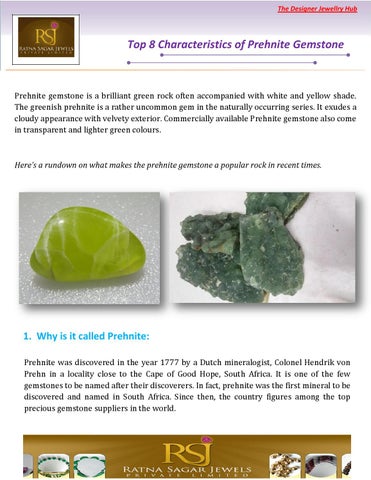
Prehnite gemstone is a brilliant green rock often accompanied with white and yellow shade. The greenish prehnite is a rather uncommon gem in the naturally occurring series. It exudes a cloudy appearance with velvety exterior. Commercially available Prehnite gemstone also come in transparent and lighter green colours.
Here’s a rundown on what makes the prehnite gemstone a popular rock in recent times.
1. Why is it called Prehnite: Prehnite was discovered in the year 1777 by a Dutch mineralogist, Colonel Hendrik von Prehn in a locality close to the Cape of Good Hope, South Africa. It is one of the few gemstones to be named after their discoverers. In fact, prehnite was the first mineral to be discovered and named in South Africa. Since then, the country figures among the top precious gemstone suppliers in the world.
2. Heat sensitive but physically tough: Prehnite is a very tough gemstone. It can be easily cut with heat treatment. It was a rare gemstone just a decade ago, but now large deposits have been made available from African and Oceania continents. Smaller beads of Prehnite gemstone are far more popular than the large cuts, just because they are hard to cut once they exceed 3 carat weight.
3. Variety of colours available: Prehnite gemstone beads naturally come in yellow and green colours. In recent times, orange prehnite have also been extracted from African mines of Kalahari Desert. Dark green shades are common while the pink-orange colour is just as rare as the transparent ones. These gemstones are mostly translucent in nature while the transparent clear gemstones are very rare and retain higher price in the market.
4. Colour shade depends on impurities: Prehnite is a silicate mineral containing calcium, aluminium and iron in its crystalline structure. Depending in the concentration of iron and other minor impurities, the colour of the gemstone also varies significantly. Clear, transparent gemstone has absolutely no impurity in its structure.
5. Common occurrence: Prehnite beads are found as a conglomerate mineral along with calcite, apophyllite, stilbite, granite, gneisses and datolite. Since the gemstone belongs to the family of metamorphic origins, it is often found under the basalt layers in earth’s crust. Major suppliers of the gemstone are South Africa, USA, Canada,China, Australia and Scotland.
6. Common cuts: Prehnite gemstone is available in the cuts resembling Cat’s Eye. It is usually cut into carved stones or cabochons. The multi-faceted gemstones are used in jewellery and fashion accessories. Larger rocks are also available weighting more than 80 carats.
7. Price: Prehnite is a relatively cheap gemstone. This cost-effective is often passed off as a semi-precious stone owing to its enticing appearance and compatibility with other precious stones. It is compatible with Amethyst, citrine and onyx.
8. Metaphysical healing: Though there is no significant healing relevance associated with the gemstone, prehnite is often used in meditation beads and amulets. It is used to encourage spirituality and is rated as a cheap gemstone to seek penance and forgiveness during tough circumstances in life.
Contact US: Ratna Sagar Jewels 415, A-10 Alankar Plaza Central Spine Vidyadhar Nagar, Jaipur, Rajasthan - INDIA Phone: 91-9414064424 Fax: 91-141-2230414 Email: ratansagarjewels@gmail.com For more Detail Visit our Website:
http://www.ratnasagarjewels.com/prehnite-gemstone-beads.html