NBA Live Today PH Guide to Philippine Tip-Off Times and Schedule Changes 2026–27 NBA season | Philippine Time (PHT) | Independent sports-information editorial A date on a basketball schedule seems straightforward until a Tuesday evening game in the United States appears on a Wednesday morning calendar in Manila. For readers of NBA Live Today PH, the real task is not memorizing another time-zone abbreviation. It is building a repeatable way to identify the matchup, convert its start time, and check whether the listing changed before tip-off.
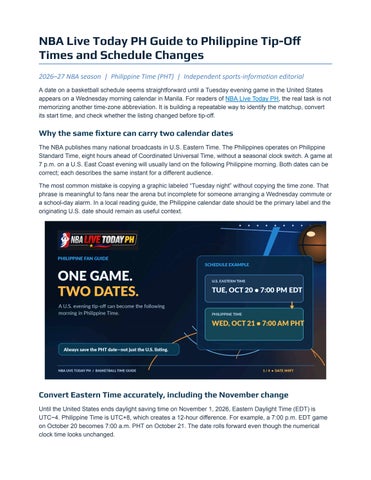
Why the same fixture can carry two calendar dates The NBA publishes many national broadcasts in U.S. Eastern Time. The Philippines operates on Philippine Standard Time, eight hours ahead of Coordinated Universal Time, without a seasonal clock switch. A game at 7 p.m. on a U.S. East Coast evening will usually land on the following Philippine morning. Both dates can be correct; each describes the same instant for a different audience. The most common mistake is copying a graphic labeled “Tuesday night” without copying the time zone. That phrase is meaningful to fans near the arena but incomplete for someone arranging a Wednesday commute or a school-day alarm. In a local reading guide, the Philippine calendar date should be the primary label and the originating U.S. date should remain as useful context.
Convert Eastern Time accurately, including the November change Until the United States ends daylight saving time on November 1, 2026, Eastern Daylight Time (EDT) is UTC−4. Philippine Time is UTC+8, which creates a 12-hour difference. For example, a 7:00 p.m. EDT game on October 20 becomes 7:00 a.m. PHT on October 21. The date rolls forward even though the numerical clock time looks unchanged.
After the Eastern U.S. returns to Eastern Standard Time (EST), it moves to UTC−5 and the difference becomes 13 hours. A 7:00 p.m. EST start in December maps to 8:00 a.m. PHT the following day. That extra hour catches people who saved a fixed “add 12” rule at the start of the season and kept using it through winter. Use a timezone-aware calendar app rather than manually applying one fixed offset across the season. If the source already supplies an explicit PHT time, do not convert it again. If a graphic says only “ET,” confirm the full date before deciding whether daylight or standard time applies.
Opening week makes the date shift easy to see The NBA’s August 2026 schedule announcement lists a three-game opening slate on Tuesday, October 20, U.S. Eastern Time: Boston at Detroit at 3:00 p.m., Philadelphia at New York at 7:00 p.m., and Oklahoma City at San Antonio at 9:30 p.m. Those times are on Eastern Daylight Time because the daylight-saving period continues until November. For fans in the Philippines, the corresponding tip-offs are Wednesday, October 21, at 3:00 a.m., 7:00 a.m., and 9:30 a.m. PHT respectively. The example is useful precisely because the morning slots span different routines: very early viewing, breakfast, and the start of a workday. Fans should choose the exact matchup rather than searching for a loosely worded “opening night” recap. The NBA has also said that some December regular-season fixtures remain to be determined by Emirates NBA Cup results. That is a different kind of uncertainty: the missing opponent or date is an official scheduling dependency, not a time-zone error. A fan calendar needs both accurate conversion and a way to accommodate genuine updates.
Check the schedule again before relying on a screenshot A good schedule workflow uses a source hierarchy. Start with the NBA’s published schedule for the official date and competition. Compare it with a local schedule page that presents tip-offs in Philippine Time. Then check the game status on the day itself. In many cases a schedule listing is stable, but delays, broadcaster changes, or a revised competition arrangement can make an old shared graphic misleading. The locally organized basketball calendar on NBA Live Today PH schedule is intended to help readers browse matchups and start times in Philippine Time. Treat it as a convenience layer, not as evidence that a score feed has already refreshed or that a viewing entitlement has been confirmed. The site has a separate live and scores workflow; its availability messages and any third-party viewing links are distinct from the official NBA fixture record. Write the full day, date, and time in anything you share: “Wednesday, October 21, 7:00 a.m. PHT,” for example, is more useful than “tomorrow at 7.” Add the matchup and the time-source label. If the listing is a screenshot, include when it was checked. Avoid presenting a provisional slate or an unrefreshed widget as a final official update.
A five-minute game-day planning routine First, identify the competition and exact teams. Next, read the source time-zone abbreviation instead of guessing from the publisher’s country. Third, save the date and time in PHT with a calendar alert that updates for the underlying time zone. Fourth, compare that saved entry with the official league fixture on the day before the game. Finally, check the active status shortly before your planned start. This routine matters most when you follow several teams, depend on morning notifications, or pass details to family and friends. It also makes reporting stronger: a local article can explain what happened without silently mixing an American Tuesday event date with a Philippine Wednesday schedule slot.
Frequently asked questions Does every NBA evening game move to the following day in the Philippines? No. The result depends on the source time, source zone, and date. U.S. Eastern evening starts often land the next Philippine morning, while some early afternoon U.S. games can fall on the same local date. Convert the specific tip-off, not the general event label.
Why does my recurring alert move by one hour in November? Most of the United States changes from daylight time to standard time on November 1, 2026. The Philippines does not make a matching change. The correct conversion therefore shifts by one hour for Eastern Time listings. A zone-aware alert is safer than a fixed offset.
What should I check when two schedule sites disagree? Compare the teams and matchup ID, then check whether one source uses a U.S. date and the other uses PHT. If those align, compare the listed update time and the official NBA schedule. Do not assume the newer-looking page is correct merely because it has a live-style interface.
The useful takeaway Reliable game-day planning is about context, not just conversion. Keep the team, source time zone, Philippine date, and current status together. A reader who follows those four labels is less likely to miss an opening tip, publish the wrong calendar date, or mistake an old schedule card for a live update.
Sources and editorial references ● ● ● ● ●
NBA Communications — official 2026–27 regular-season schedule NBA — 2026–27 key dates NIST — U.S. daylight-saving time rules PAGASA — Philippine Standard Time NBA — schedule by date