BYBET • SPORTS TECHNOLOGY & DATA LITERACY • ISSUU
Why Live Sports Data Is Never Truly Instant A practical look at the human decisions, data feeds, servers, networks, caches and screens between a real-world play and the “live” number on your phone.
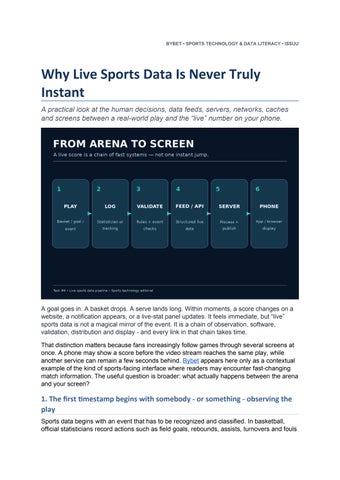
A goal goes in. A basket drops. A serve lands long. Within moments, a score changes on a website, a notification appears, or a live-stat panel updates. It feels immediate, but “live” sports data is not a magical mirror of the event. It is a chain of observation, software, validation, distribution and display - and every link in that chain takes time. That distinction matters because fans increasingly follow games through several screens at once. A phone may show a score before the video stream reaches the same play, while another service can remain a few seconds behind. Bybet appears here only as a contextual example of the kind of sports-facing interface where readers may encounter fast-changing match information. The useful question is broader: what actually happens between the arena and your screen?
1. The first timestamp begins with somebody - or something - observing the play Sports data begins with an event that has to be recognized and classified. In basketball, official statisticians record actions such as field goals, rebounds, assists, turnovers and fouls