How Live-Dealer Streaming Works: Cameras, Latency and Interface Design Why a convincing real-time table experience depends on more than simply pointing a camera at a dealer Publication date: August 14, 2026 • Platform: Issuu • Sports / gaming technology editorial
Editorial note: This article explains live-streaming technology and interface design. It does not provide wagering strategy, betting instructions, deposit guidance or predictions.
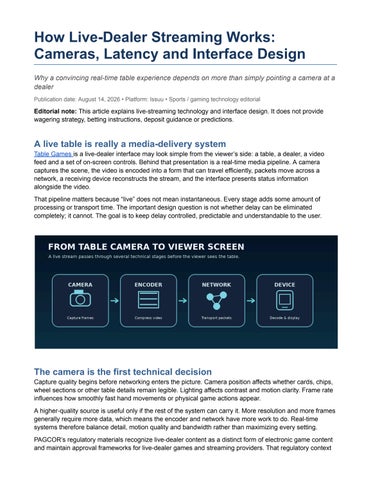
A live table is really a media-delivery system Table Games is a live-dealer interface may look simple from the viewer’s side: a table, a dealer, a video feed and a set of on-screen controls. Behind that presentation is a real-time media pipeline. A camera captures the scene, the video is encoded into a form that can travel efficiently, packets move across a network, a receiving device reconstructs the stream, and the interface presents status information alongside the video. That pipeline matters because “live” does not mean instantaneous. Every stage adds some amount of processing or transport time. The important design question is not whether delay can be eliminated completely; it cannot. The goal is to keep delay controlled, predictable and understandable to the user.
The camera is the first technical decision Capture quality begins before networking enters the picture. Camera position affects whether cards, chips, wheel sections or other table details remain legible. Lighting affects contrast and motion clarity. Frame rate influences how smoothly fast hand movements or physical game actions appear. A higher-quality source is useful only if the rest of the system can carry it. More resolution and more frames generally require more data, which means the encoder and network have more work to do. Real-time systems therefore balance detail, motion quality and bandwidth rather than maximizing every setting. PAGCOR’s regulatory materials recognize live-dealer content as a distinct form of electronic game content and maintain approval frameworks for live-dealer games and streaming providers. That regulatory context
is separate from the engineering problem, but it reinforces that the video feed is part of the controlled game presentation rather than a decorative background.
Encoding turns camera output into network traffic Raw video is far too large for ordinary internet delivery, so an encoder compresses it. Compression reduces bandwidth by removing redundancy across frames, but encoding also takes time. The receiver must later decode the same media before displaying it. Real-time protocols are built around that trade-off. WebRTC, for example, is a W3C standard for sending and receiving real-time media between browsers or devices. RTP, the Real-time Transport Protocol standardized by the IETF, provides timing and delivery information used by many real-time media systems. This does not mean a particular live-dealer platform necessarily uses WebRTC or RTP in a specific configuration. The broader point is that low-latency video depends on protocols and media pipelines designed for time-sensitive delivery.
Latency accumulates across the entire chain Viewers often describe latency as though it were one number caused by the internet connection. In practice, end-to-end delay is the sum of several smaller delays: camera capture, encoding, server processing, routing, buffering, decoding and screen rendering. A fast local connection cannot remove time already spent earlier in the chain. Likewise, an efficient video encoder cannot prevent delay introduced by a congested network farther downstream. That is why two viewers may see the same table at slightly different moments. Their devices, network routes and buffering conditions may not be identical. A well-designed interface should tolerate those differences instead of pretending every screen is perfectly synchronized.
Jitter is different from ordinary delay Latency describes how long information takes to travel. Jitter describes variation in that timing. If packets arrive at uneven intervals, video can stutter even when the average connection speed looks acceptable. RFC 3550 defines interarrival jitter as a short-term measure related to changing packet transit times. A receiver can compensate by buffering a small amount of media before playback. The buffer gives late packets time to arrive and can make the stream appear smoother.
The trade-off is important: a larger buffer can improve stability but adds delay. A smaller buffer reduces delay but leaves less room for network variation. Real-time interface design is therefore partly an exercise in choosing where stability matters more than immediacy.
The video is only half of the live-dealer interface A user does not experience the stream in isolation. The page may also show table state, connection indicators, countdowns, result history, control availability and other information. These elements have to agree with the video. If the interface announces a new state before the viewer sees the corresponding physical action, the page feels out of sync. If controls remain active after a deadline visible in the video, the system creates uncertainty. If the video pauses while timers continue moving, users may not know which information is authoritative. Clear interfaces expose state instead of hiding it. A “live” indicator, last-update time, reconnecting state or temporary control lock can explain what is happening when the network is unstable.
Synchronization should be visible, not assumed Real-time media systems use timestamps because ordering alone is not enough. RTP timestamps relate media packets to the sampling time of the source, giving receivers information needed for playback timing. Similar timing concepts are essential whenever video and application data must remain aligned. For the viewer, however, raw timestamps are rarely useful. The interface should translate timing into understandable signals: whether the feed is connected, whether the displayed state is current, whether an update is pending and whether the user should wait before acting. That is where editorial resources such as TableGames PH can be useful: they can explain the difference between the physical table, the video stream and the surrounding interface without implying that every provider uses the same technical architecture.
Mobile devices add another performance layer A phone has to decode video, render interface elements, process touch input and maintain a network connection at the same time. Battery state, thermal limits, background processes and hardware decoding support can affect performance. Responsive layout matters as much as raw speed. A live video that occupies the entire display may leave too little room for status information. A tiny stream surrounded by controls can make physical game details hard to see. The interface should prioritize the information needed to understand the current state rather than simply fitting as many panels as possible onto the screen. Accessibility also matters. Status should not rely only on color, text should remain readable over moving video, and important controls should have adequate target size and spacing.
Good live interfaces are honest about imperfect networks No consumer network is perfectly stable. Wi-Fi interference, cellular handoffs, routing changes and congestion can all affect a real-time stream. Good design therefore includes failure states as part of the normal experience. Instead of freezing silently, the interface can show that the connection is being restored. Instead of letting stale controls remain active, it can temporarily disable actions whose state is uncertain. Instead of presenting an old frame as current, it can make delayed or reconnecting status visible. That approach builds more trust than pretending the stream is always instantaneous. In real-time systems, honest feedback is a feature.
Final thoughts Live-dealer streaming combines camera engineering, video compression, network transport, buffering, device performance and interface design. The viewer may see only one screen, but that screen is the final point in a chain of technical decisions. The most effective systems do not merely minimize latency. They keep the physical table, the video feed and the on-screen state understandable even when small delays occur. They make connection problems visible, synchronize interface changes carefully and preserve enough visual clarity for the user to follow what is happening.
That is the better definition of a strong live experience: not “zero delay,” but clear communication across a system where some delay is unavoidable.
Responsible-use note Gaming is for persons 21 years old and above in the Philippines. Gambling involves financial risk and should be treated as entertainment, not income. PAGCOR's Responsible Gaming Code includes age restrictions, exclusion procedures and harm-minimization requirements.
Sources & References IETF / RFC Editor — RFC 3550: RTP: A Transport Protocol for Real-Time Applications. W3C — WebRTC: Real-Time Communication in Browsers, 2025 Recommendation. PAGCOR — Guidelines on Live Dealer Game Contents. PAGCOR — List of EGLD-Approved Electronic Games: live-dealer table games. PAGCOR — Responsible Gaming Code of Practice, Version 6.0. TableGames.ph — About Us and Disclaimer pages.