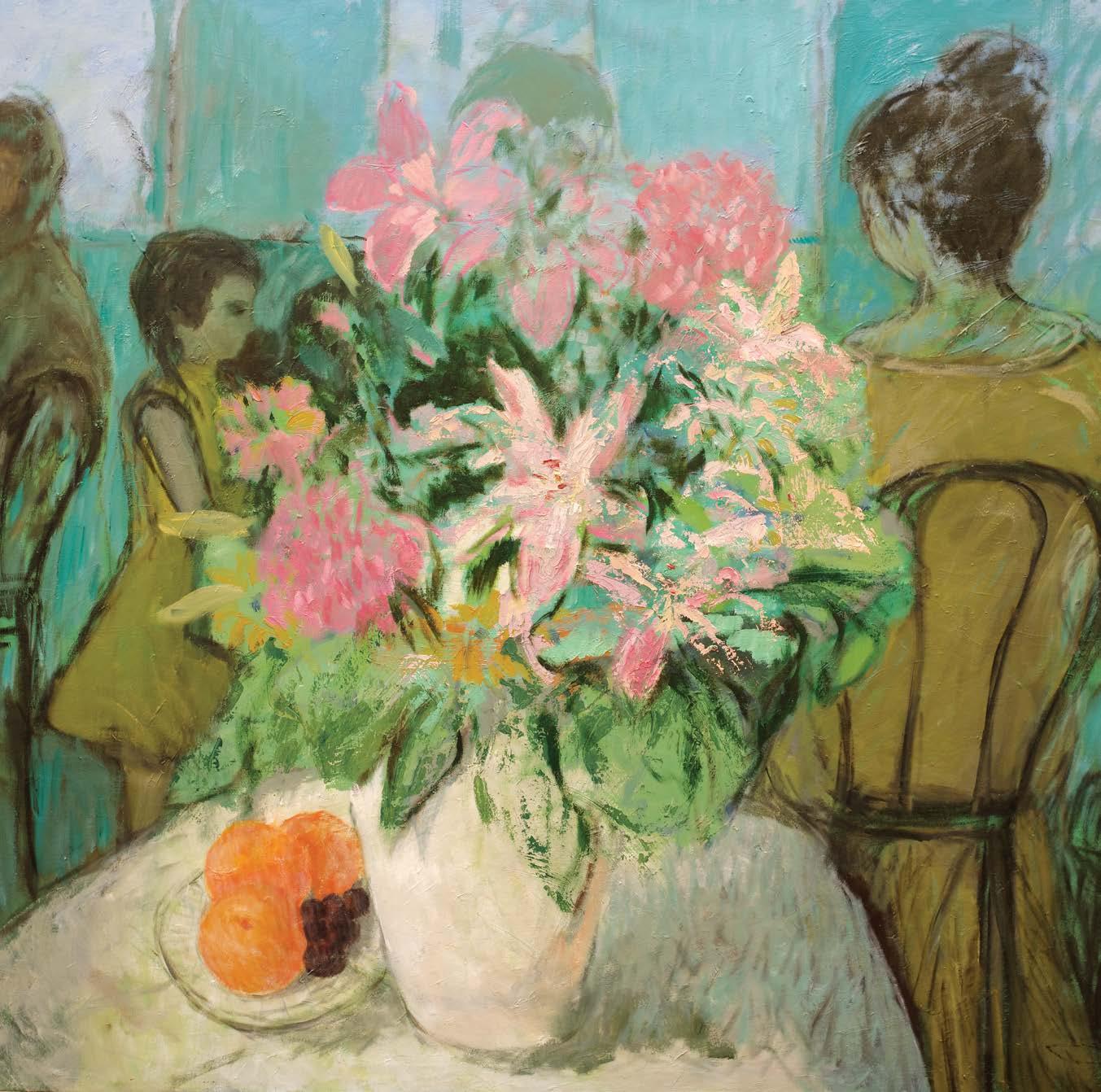
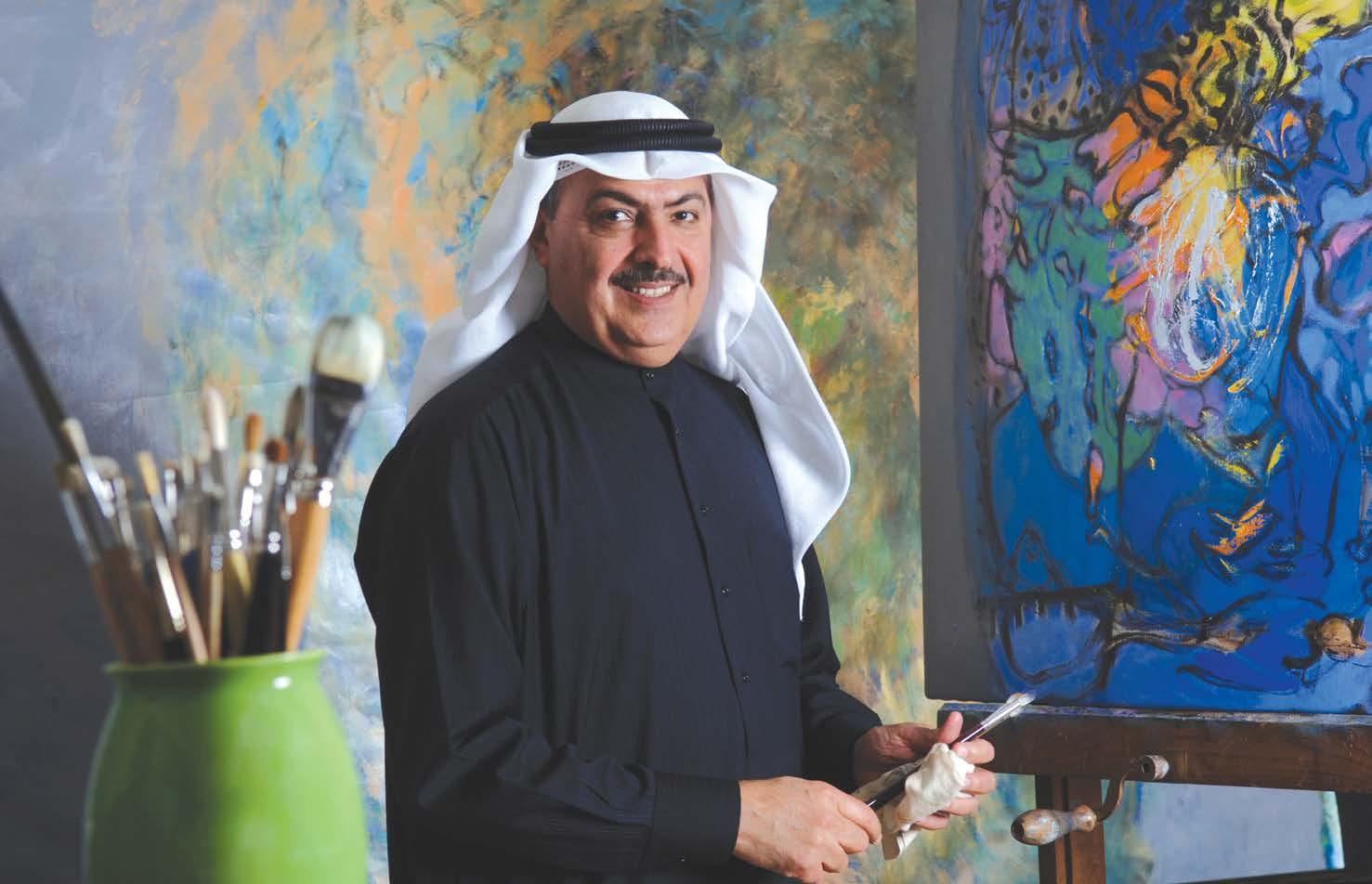
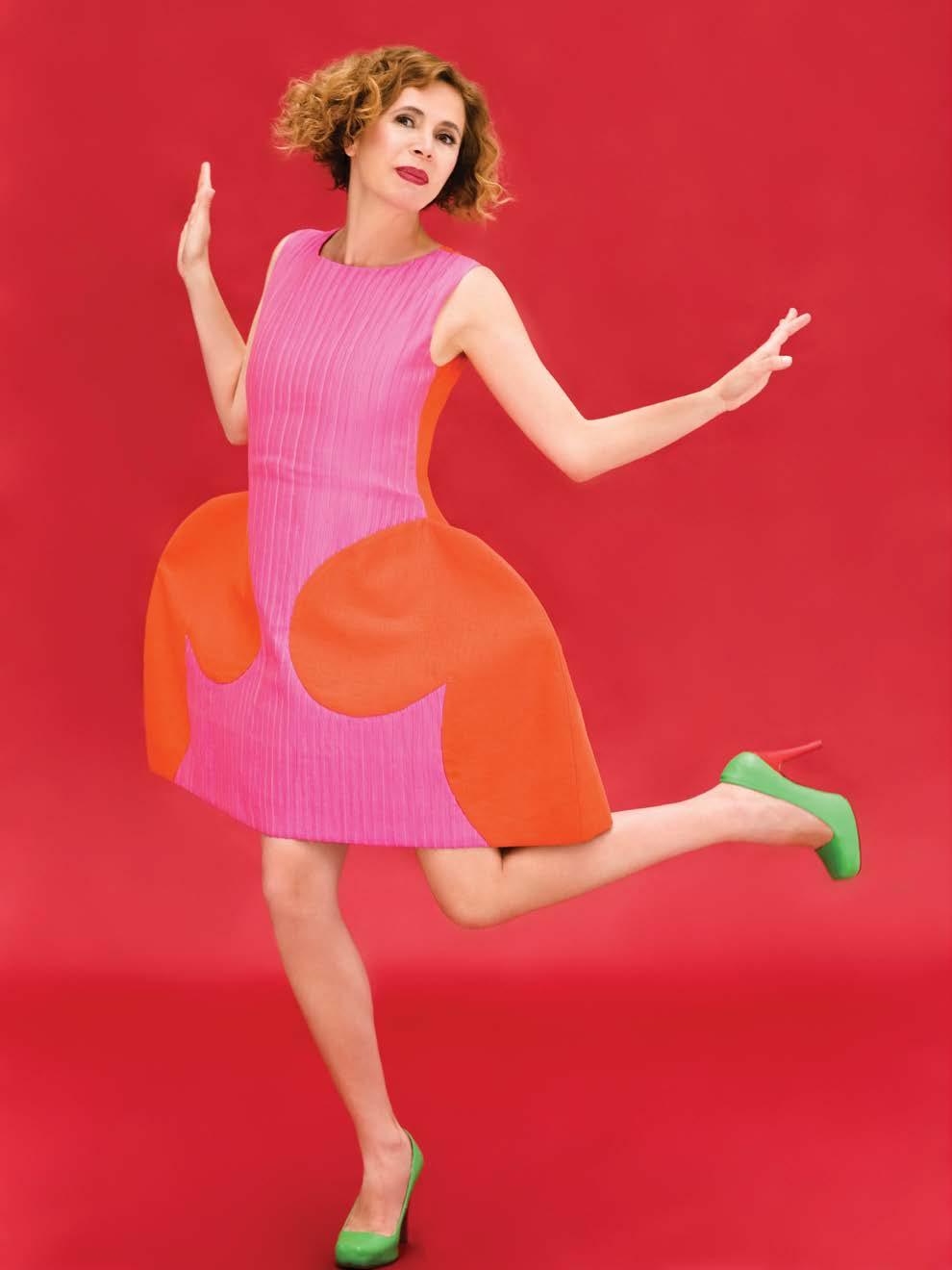
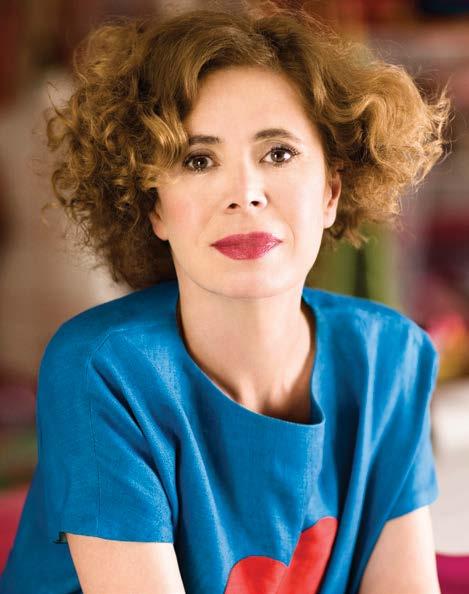
No part of this book may be reproduced in any form by electronic or mechanical means, including photocopying, recording, or information storage retrieval without permission in writing from the publisher
Organiser’s Acknowledgements
My deepest gratitude belongs to Christie’s for making this exhibition possible, the International Humanitarian City, World Food Programme, The Ritz Carlton DIFC, Tanagra, DHL and Rolls Royce.
We want to acknowledge the writers who have contributed text for this book: Valérie Didier Hess, Matthew Dennison, Lydia Hansell, Carole Musson and Clementine Perrins
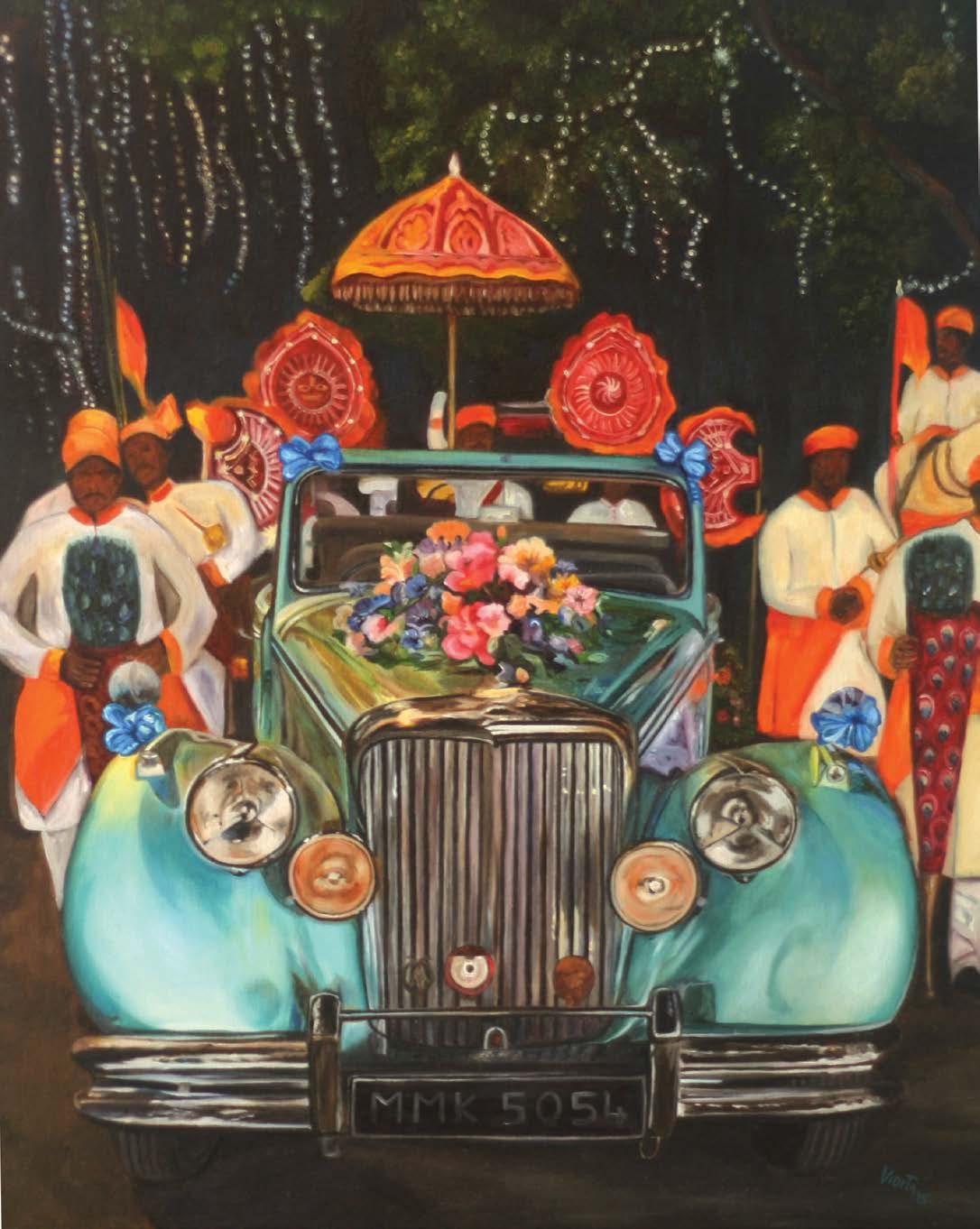
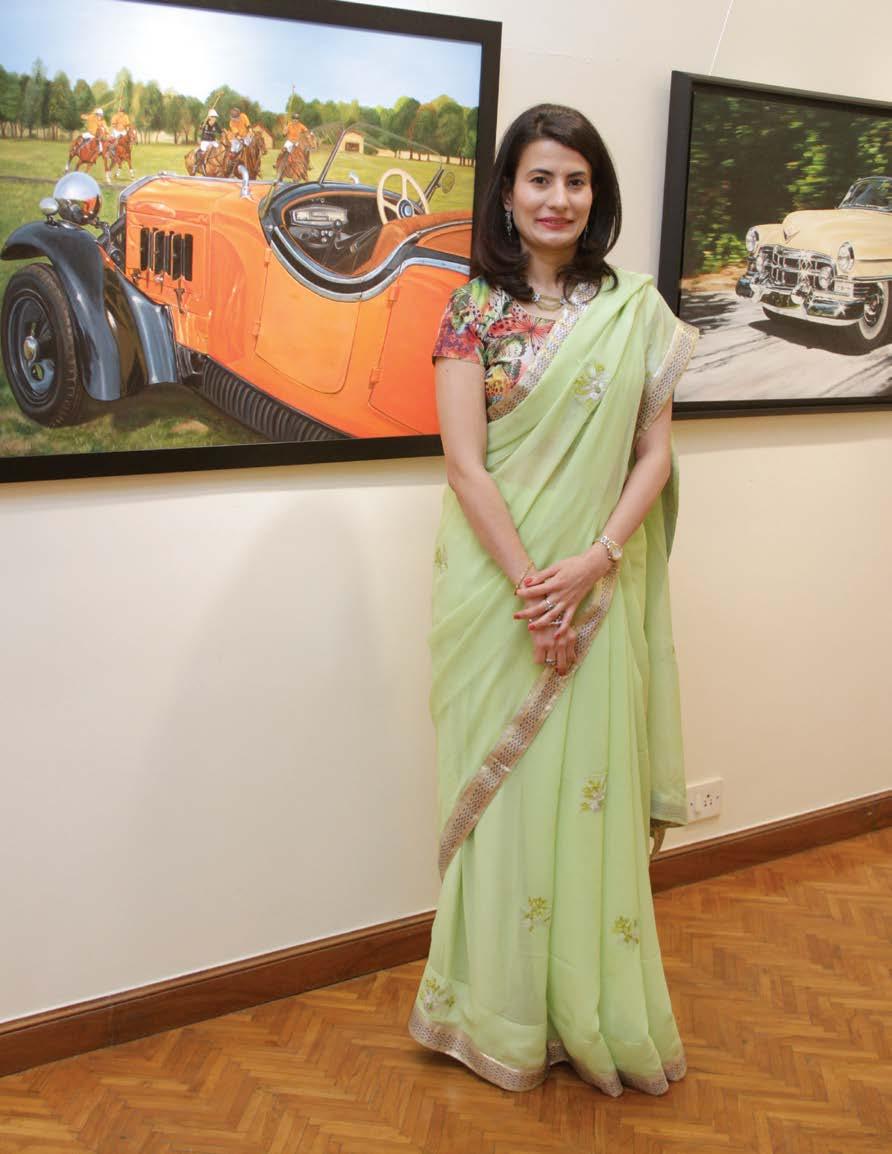
We also would like to thank all participating artists HRH Princess Reem Al Faisal Al Saud, HE Shaikh Dr Hassan bin Mohammed bin Ali Al Thani, HIlH Count Bertram zu Castell-Rüdenhausen, HRH Princess Lelli de Orleans e Bragança, HRH Princess Sibylle of Prussia, HRH Princess Sophie of Romania, HRH Prince Rostislav Rostislavovich Romanov, HSH Princess Ede Sapieha-Różańska, Maharajkumari Vidita Singh of Barwani, HRH Duchess Diane of Württemberg HE Doña Ágatha Ruíz de la Prada y Sentmenat and HRH The Dowager Princess of Tirnovo, Miriam de Ungría
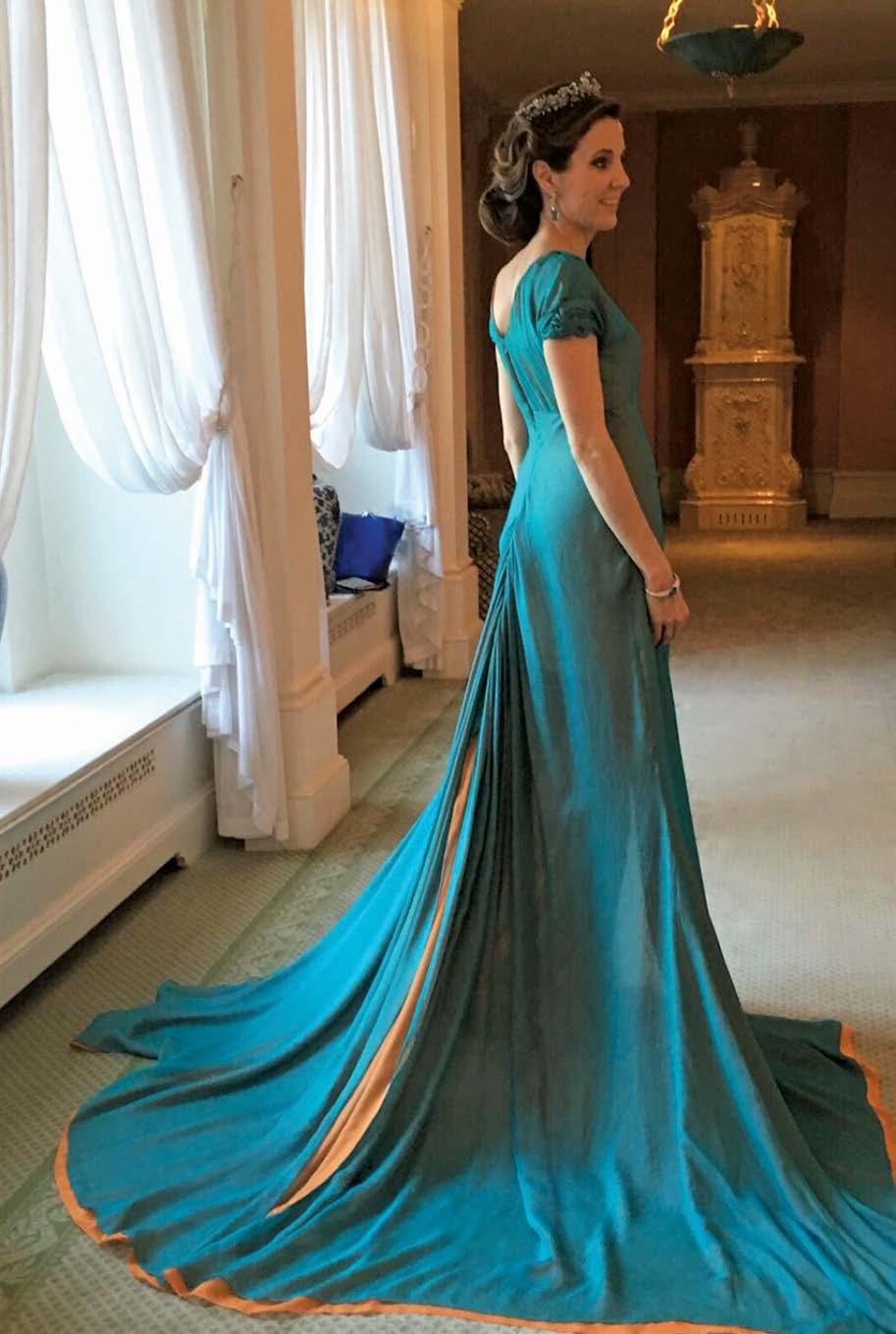
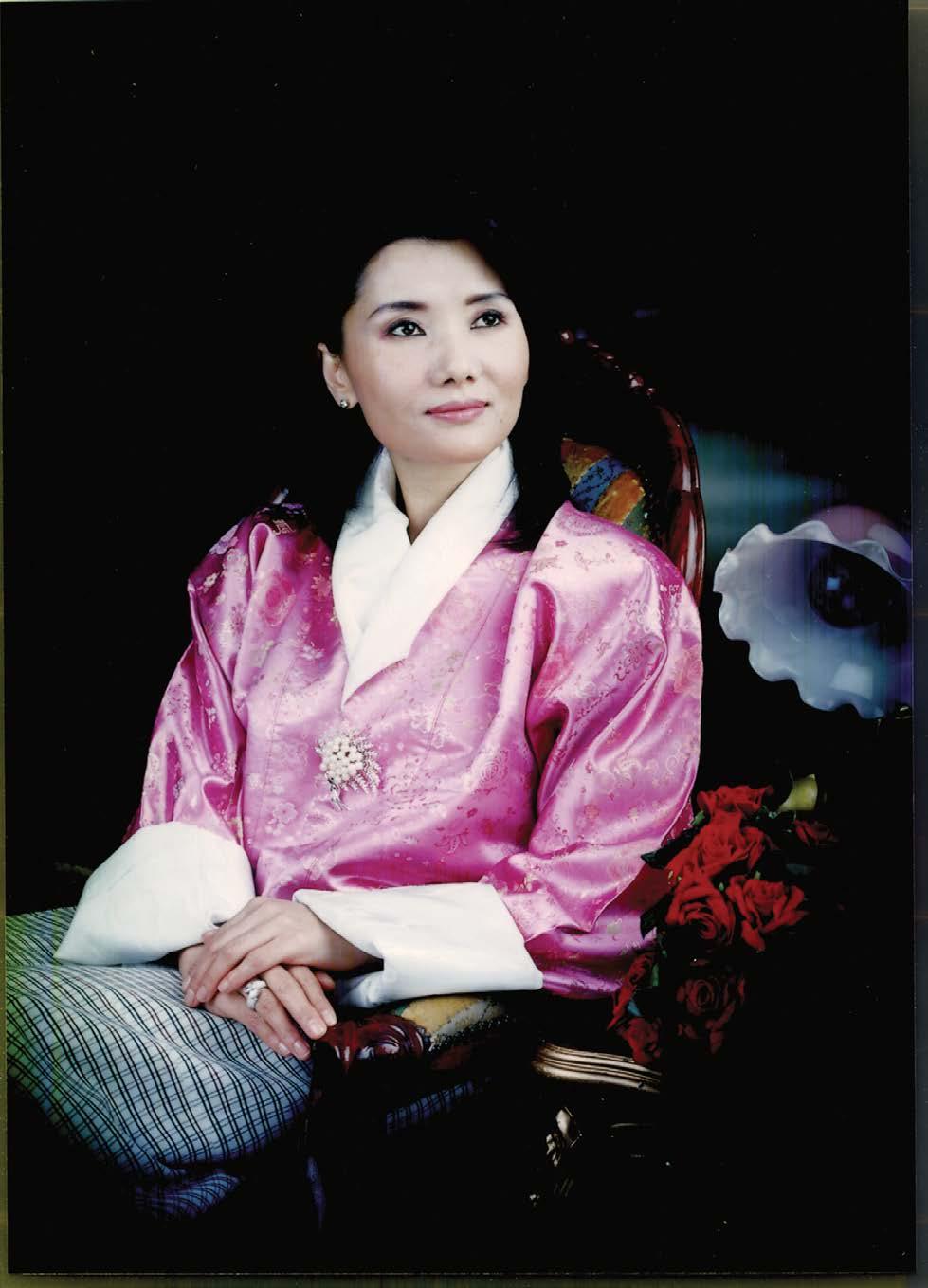
With thanks to the Patrons of Performing Arts HRH Preah Ang Machas Sisowath (High Prince) Tesso of Cambodia, HRH Princess Esther Kamatari of Burundi and HRH Samdech Krom Khun (Great Prince) Norodom Sirivudh of Cambodia for contributing entertainment to the Gala Dinner. Also to HE the Honorary Grand Mistress of the Dutch Royal Household, Mevrouw Martine van Loon-Labouchere, HRH Princess Tatiana of Greece and Denmark, HRH Princess Tessy of Luxembourg and Nassau for the display of ceremonial court dresses. And finally to the Sovereign Guests HM Gyalyum (Dragon Queen Mother) Ashi Sangay Choden Wangchuck of Bhutan and HRH Ashi Eeuphelma Choden Wangchuck of Bhutan, for the display of Bhutan’s royal textile and Tanagra for the objet d’ arts.
and everybody else who has helped to make this a beautiful event especially Henri Estramant, Hala Khayat, Valérie Didier Hess, Christina Sang, Danielle Francisco, Ibrahim Asran and Omar Donia
29 - 30 NOVEMBER 2016
The Ritz Carlton
Dubai International Financial Centre
City of Dubai
United Arab Emirates
FOREWORD
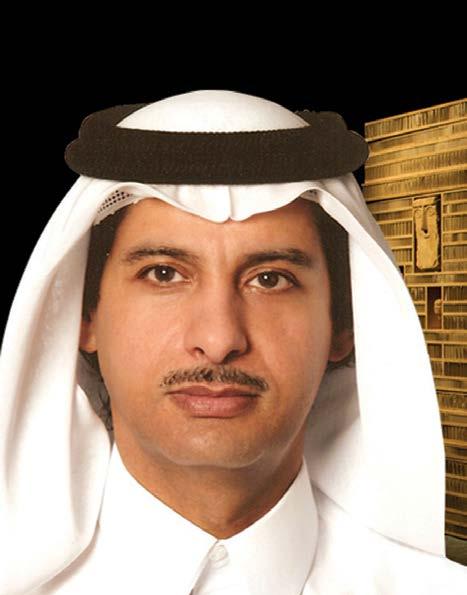
Rashid Al Khalifa
PREFACE
Valérie Didier Hess
INTRODUCTION
Henri Estramant
CHAPTER ONE POWER AND PATRONAGE
L ydia Hansell
CHAPTER TWO QUEEN VICTORIA
Matthew Dennison
CHAPTER THREE CATHERINE THE GREAT
Carole Musson
CHAPTER FOUR THE ROLE OF THE ART FOUNDATION
Clementine Perrins
CHAPTER FIVE ROYAL BRIDGES
CHAPTER SIX SOVEREIGN GUESTS
FOREWORD
“Art is not what you see but what you make others see” Edward Degas
Degas’ belief that the artist could create a conversation between himself and the viewer has been a guiding force for many artists through the years, not dependent on heritage, nationality or medium and we see in this exhibition that all of the artists have this guiding force. From music to sculpture, design to painting, they all have the true sense and understanding of the artisan.
It was always my intention to create a group of artists that in my mind were under represented, a group that was globally recognised. In particular a group that brought together different ideas and techniques. The concept of Royal Bridges was born, an artistic forum that challenges the role typically assigned to royalty globally – but as artists themselves – and not as patrons of the arts. Royal Bridges is comprised of leading artists from imperial, royal, princely and noble houses from around the globe, who are at the forefront of contemporary art, design, fashion and musical performances. Throughout history, art in its various forms has been a pursuit – not merely an avocation for monarchs, princes and princesses – yet their artistic contributions are more often than not, overshadowed by their own lineages.
I felt that by looking historically at Royal families it placed the current artists within a lineage of art history that can be over looked. All of the great Royal Families of the world have been patrons of the arts and artists in their own rights, Royal Bridges is a formalization of these ideas that have been present for so many years. The Royal Bridges art movement steps in, to fill in the gap and contend the stereotype of royal patronage with the dearth of artistic talent, which is often associated with ruling houses. This movement brings a new beginning, change and new possibilities for royal artists. It is a revelation of creative tendencies and communicative forms of expression that can contribute to the culture scene, art foundations, galleries and museums.
In this book, we look at the patronage of one of the oldest European families The Princes of Liechtenstein as described in Lydia Hansell’s essay. Dating back to the Holy Roman Empire in 962AD, their rise and position in Austria has allowed them to be an almost unrivalled force in patronage of the visual and plastic arts. From there we see paintings by Queen Victoria as discussed in Matthew Dennison’s essay ‘Queen Victoria as Amateur Artist’. He describes her desire to learn through her instructors Richard Westall and later Edward Lear. In Carole Musson’s essay ‘The Gardening Madness of Catherine the Great’ we see that the Empress of Russia was a keen gardener, taking her inspiration from the gardens of England and recreating them in Russia. The love of nature and the rhythm of the seasons was ingrained in the Russian soul and the natural landscape style must have resonated with a people who spent many months in the dark and cold. This is followed by the creation of the art foundation by Royalty from the Victoria and Albert Museum to Mathaf, Clementine Perrins looks at the influence of these spaces on the art they support and the collections that they have built over the past 160 years.
We also get a glimpse at the participants in the first edition of Convergence exhibition alongside examples of their work. The artist’s statements reveal the creative senses and provides insight into the inspirations, influences, and motives of the artists for the reader to have a deeper understanding of the nexus between royalty, culture and human subjectivity. Featured artists include HIIH Count Bertram zu Castell-Rüdenhaussen, Maharajkumari Vidita Singh of Barwani, Prince Rostislav Rostislavovich Romanov of Russia, HRH Princess Lelli de Orleans e Bragança, HSH Princess Ede Sapieha-Różańska, and HRH Princess Sibylle of Prussia, HE Shaikh Dr Hassan bin Monhammed bin Ali Al Thani and HRH Duchess Diane of Württemberg; Photographers HRH Princess Sophie of Romania and HRH Princess Reem bint Mohammed Al Faisal Al Saud; Designers HE Doña Ágatha Ruiz de la Prada y Sentmenat, 12th Marchioness of Castelldosríus, Grandee of Spain, 19th Baroness of Santa Pau, and HRH The Dowager Princess of Tirnovo, Princess Miriam of Bulgaria, Duchess of Saxony. Finally we look at the passions of the Sovereign Guests, patrons of performing arts, royal arts & crafts and the fashion world. Featuring HRH Princess Esther Kamatari of Burundi, Preah Ang Machas Sisowath Tesso of Cambodia and HRH Samdech Norodom Sirivudh, HE the Honorary Grand Mistress of the Dutch Royal Household, Mevrouw Martine van Loon-Labouchere, HRH Princess Tessy of Luxembourg and Nassau, HRH Princess Tatiana of Greece and Denmark, HM Gyalyum (Dragon Queen Mother) Ashi Sangay Choden Wangchuck of Bhutan and HRH Ashi Eeuphelma Choden Wangchuck of Bhutan.
Hopefully, Royal Bridges: Convergence exhibition and this book fulfils its mission of introducing some of the world’s professional royal artists to a wider audience.
Rashid Al Khalifa, 2016 Manama, Kingdom of Bahrain
PREFACE
Sir Peter-Paul Rubens (1577-1640) and Sir Joshua Reynolds (1723-1792) were well-established artists prior to being knighted by both Philip IV of Spain (1624) and Charles I of England (1630) for the former, and by George III of England (1769) for the latter. Queen Victoria of England (1819-1901) and Queen Farida of Egypt (1921-1988) are known as ‘Their Royal Majesties’ who participated to shaping 19th and 20th century world history, yet their contribution as artists to art history has been neglected, overshadowed by their celebrity as royal personas. In other words, Rubens and Reynolds were artists before becoming nobles, whilst Queen Victoria and Queen Farida were royals before becoming artists.
His Royal Highness The Prince of Wales is known as the heir to the throne of England, although recording nature through exquisite watercolours is one of his passions and many skills, in the same way that the artists donating their works for this inaugural charity auction are known by their ‘royal’ titles, that often take the attention away from their artistic and creative talents. The ground breaking visions of both His Excellency Sheikh Rashid bin Khalifa Al Khalifa and Baron Henri Estramant in creating a platform for these imperial, royal, princely and noble artists fill that gap and shed light on these people’s artistic gene.
The British documentary movie entitled Royal Paintbox directed by Margy Kinmonth in 20131, revealed for the first time, with the participation of Prince Charles, the forgotten and hidden talents of dozens of members from the royal English family tree. From Mary Queen of Scots (1542-1587), who excelled in the art of embroidery influenced by Catherine de Medici’s needlework skills, to Prince Rupert of the Rhine (1619-1682) who pioneered mezzotint techniques, to George III’s (1738-1820) architectural illustrations and to Queen Victoria’s sketches of her children, a wide range of masterpieces, spanning over five centuries and created by members of the English monarchy were unveiled. Once again, their creators’ titles of nobility had scarred history but their names were not remembered as artists within the context of art history, but rather as art patrons. Not only had lineage taken over artistic creativity, but these ‘royal’ productions remained predominantly in royal collections, hence restricting access and exposure.
Traditionally, in royal courts, emperors and empresses, kings and queens, princes and princesses, advocated their roles as patrons of art and employed reputable artists to put forward an ideal representation of wealth and power of themselves as royal rulers. For example 18th century French portraitist Louise Élisabeth Vigée Le Brun (1755-1842) was hired by Queen Marie-Antoinette (1755-1793) at the Versailles court to improve the queen’s highly criticized image through her charming paintings. Although practicing the arts, from embroidery to painting, was part of their conventional education, royal figures were expected to use this discipline as a means towards an end, and not as an end in itself of becoming an artist. From that perspective, every child raised in a royal court mastered a form of art within their educational curriculum echoing Pablo Picasso’s quote: ‘every child is an artist. The problem is how to remain an artist once we grow up’. Since the Middle Ages in Europe, with Queen Mathilde of Flanders (c.1031-1083; William the Conqueror’s wife) thought to be the main author of the most impressive embroidery of that time, the Bayeux Tapestry (c. 1070s), or in the Far East with Emperor Huizong (1082-1135), the most famous emperor of the Song Dynasty of China, who was a true artist in his skills as a painter, poet, calligrapher and musician, there are many examples of ‘royal’ children ‘who remained artists as they grew up’.
The more recent case of Queen Farida of Egypt (Safinaz Zulficar) proves how a royal icon became an artist in her own right, not only because it was a means of income after being exiled but also because it was a way for her to reminisce on her lost past and to express memories of her beloved country. In her own words, she explained ‘I start my paintings with a few brushstrokes of different colours and shades. Soon thereafter, the painting takes its own life and I would be just filling in from my soul. The rest of the painting suddenly comes out to life as if I were in a dream’ 2. When she was living in France, she exhibited for the first time in 1968 (7-28 November 1968), in a prime location of the bustling Parisian art scene, at the Galerie Hervé, 18 avenue Matignon. The year before, that same gallery exhibited a selection of Neo-Impressionist masterpieces (23 May – 27 June 1967) whilst the year after Queen Farida’s solo show, an exhibition entitled ‘The Conquest of Space, from Rubens to Giacometti’ (1969) was held in the same location. Farouk Hashem, former consul at the
2 F.Hashem & Dr M.Abou Sabe’, Farida, the Queen of Egypt: A Memoir of Love and Governance, Cairo, 2014, p. 216.
Egyptian Embassy in London who helped to organise the 1976 festival for the arts and civilization of the Islamic World in London, met Queen Farida on that occasion as she had specifically travelled to London for that event, being fascinated with Islamic art. Hashem published a book on Queen Farida first in Arabic in 1993, and later in English with the help of Dr Morad Abou Sabe’ in 20143 . He wrote ‘how art, for her [Farida], was an important part of her life even though it was difficult to do, especially if one wanted to be a professional artist’ 4. In October 1986, Hashem was invited with Queen Farida to Bahrain by His Royal Highness Prince Eissa Ibn Salman Al Khalifa (1933-1999) to organise an exhibition of Queen Farida’s artworks. The exhibition was very successful, yet despite all this recognition of her artistic talent, she remains the former queen of Egypt before being remembered for her paintings. Although she participated in gallery shows, her oeuvre is still widely unknown to the public and a considerable number of her paintings have stayed in the family. ARTnet records show that only one of her works was publicly offered for sale, in a small local auction house in California5.
Lack of exposure and the absence of a platform the likes of ‘Royal Bridges’ have hindered Queen Farida’s recognition as a successful artist, just as all these other hidden talents of the Windsors’ ancestors. These imperial, royal, princely and noble figures have been well documented as historical characters but further research and publications are yet to surface in view of documenting them for their art historical role as artists rather than art patrons. Just as the first Emir of Bahrain had understood Queen Farida’s artistic talent exactly thirty years ago, His Excellency Sheikh Rashid bin Khalifa Al Khalifa broadens this vision today by bridging the gap between the history and art history of ‘royal’ artists. The following eclectic and exciting selection of artworks, whether designer clothes, jewellery, paintings, sculptures, photographs, paper cuttings or performance art, has been produced by different ‘royals’, whether Baroness, Count, Duchess, Marchioness, Prince, Princess or Sheikh, from Spain to Bahrain, from India to Bulgaria, from Germany to Hungary, from Russia to former Prussia, from France to Brazil, and from Rumania to Saudi Arabia. Yet a powerful common thread runs through these royals’ rich cultural and stylistic diversity: they are passionate artists above all. Forget who they are for a moment, look at their works, enjoy their colours, textures and details, and dive into their complex and magical realms of emotions and expressions, that will forever resist the passing of time. Prince Charles specifically pointed out to that ephemeral quality of artworks to filmmaker Margy Kinmonth: ‘you know, we walk away and shuffle off our mortal coil but these things live on. That’s what’s so riveting about looking at other members of my family in the past. It’s that feeling that there they were sitting, doing the painting and then that stays behind. It’s still you. It’s a part of you that’s still there. The rest of you is gone’ 6 .
Valérie Didier Hess, 2016 Dubai, United Arab Emirates
3 Hashem & Abou Sabe’, ibid.
4 Hashem & Abou Sabe’, ibid., p. 221.
5 www.artnet.com: ‘Queen Farida of Egypt, Abstraction, oil on metal, 12.1 x 15.2cm., circa 1950’ offered by Heritage Auctions California, 2011 March Beverly Hills Signature Decorative Art Auction, Sunday 20 March 2011, lot 66023.
6 Interview with Spencer Bright for Mail Online: http://www.dailymail.co.uk/tvshowbiz/article-2307787/Prince-Charles-My-paintings-quite-good--100-yards -away.html?ITO=1490&ns_mchannel=rss&ns_campaign=1490
INTRODUCTION
Royal Bridges is a very extraordinary artistic project, not simply because it brings together the creative talent, inspirational brilliance and more importantly the tangible as well as intangible heritage linked to imperial, royal, princely and noble houses worldwide into one single art forum, indeed into an movement for all expressions of the beaux arts as associated to the individual contributions by aristocrats or their houses at large; blending boundaries, languages, religions or cultures.
It is well-known that throughout history, art in its various forms, has been inspired or in fact produced to honour persons placed in regal or hereditary échelons of various societies. From poetry to picturesque depictions of great monarchs going back to chieftains to powerful Assyrian rulers, pharaohs, Aztec tlatoanis up-to-present day much more “relaxed” portraits or photographs of monarchs. Notwithstanding the actual artistic contributions of individual sovereigns, or princes are more often than not, overshadowed by their grand lineages. Royal Bridges disproves the ubiquitous stereotype of mere royal patronage yet dearth of artistic talent, which is often associated with ruling houses.
Whereas “royal patronage” in itself is a cornerstone in any country with a monarchical regime or even in republics wherein some royal and princely houses play an official or semi-official role, it is of utmost importance to highlight the endemic creative talent hailing from the aristocrats themselves as often it might be intertwined with generations of often “inherited” talents, if one could dare speak of an “artistic gene”. I call to our attention the House d’Orléans (France). As one example: Convergence, Royal Bridges’ very first exhibition spotlights The Duchess of Württemberg, Princess Diane d’Orléans, a sculptor and painter yet her eldest brother and two of her sisters are likewise talented painters, and generations of Orléans before them.
The Commonwealth’s Prince Charles, the incumbent Prince of Wales, is the world’s most recognisable heir apparent nonetheless his dexterity as a painter is barely a matter of public knowledge. Royal Bridges hopes to address such gaps in the domain of the fine arts.
Beyond the individual artistic talents that Royal Bridges desires to bring to a larger audience, we are eager to support the palpable and intangible artistic heritages from several princely courts globally. Lamentably the bulk of heritages left by civilizations past have been obliterated by succeeding cultures and societies, or are in the verge of falling into oblivion due to new political regimes. Kingdoms such as Cambodia the “Royal Cambodian Court Ballet” (likewise listed as UNESCO world heritage) suffers from visibility due to a lack of funding from a court lacking political power.
Convergence displays an eclectic and robust selection of contemporary artworks from more traditional mediums of painting and sculpture to interpretive forms of expression including jewellery design and musical performances. All these objets d’art are curated in order to encourage the viewers’ understanding of modern-day royalty as prolific minds and hands in their own right in the universe of artistry.
Guests from reigning courts hailing from The Netherlands, Luxembourg, Bhutan, Cambodia, Greece and Denmark complement Convergence by gathering items related to their respective courts and demonstrating how artistic expression is vibrantly alive at princely courts around the globe.
I am humbled to be part of Royal Bridges, a movement born out of the vision and artistic driving force of Shaikh Rashid bin Khalifa Al Khalifa, Bahrain’s most prominent contemporary artist.
Henri Estramant, 2016 Brussels, Kingdom of Belgium
CHAPTER ONE
POWER AND PATRONAGE
The Birth of the Lichtenstein Collection
… to be and remain art lovers as befits their princely status, so that they become famous for owning things that not everyone has …
Prince Karl Eusebius von Liechtenstein, Book on Architecture
Power and Patronage:
The Birth of the Lichtenstein Collection
The Collection
The princely house of Liechtenstein is one of Europe’s oldest families, whose origins and heritage date back to the formation of the Holy Roman Empire in 962 AD. Their rise to power and prominence in the heartlands of the then Hapsburg empire - Austria, Bohemia and Moravia - allowed these respective capital cities, Vienna, Prague and Brüun to enjoy the Liechtensteins’ tireless and almost unrivalled patronage of the visual and plastic arts from the late sixteenth century to the present day.
The family retain one of the most important private art collections in Europe to have survived both world wars, and other disruptions, relatively intact thanks in large part to their systematic and concerted acquisitions policy. The current prince, Hans Adam II, the beneficiary of his father’s economic stewardship of the principality following World War II - which precluded Franz Joseph II from collecting in the manner of his forebears - continues to add to the collection with ‘good piece[s] of art from the fifteenth to the nineteenth centuries, whoever the artist’, in the spirit of the greatest of his Baroque ancestors.
Hans-Adam II is also uniquely placed to buy back pieces that were originally in his family’s collection and later sold; he has recently reacquired two such paintings sold in the 1950s, a Jan van Huysum Bouquet of Flowers in a Niche (bought back in 2002) and Bernadino Zaganelli
da Cotignola’s Portrait of a Lady in a Red Dress (bought back in 2003). Where it has not been possible to reunite paintings or objects with the rest of the Liechtenstein holdings, the Prince’s policy has been to purchase new pieces to fill the gaps (from either a similar school or artist) so as to allow the collection to remain as faithful as possible to its original conception, and to the tastes and interests of his ancestors.
The collection now contains a dizzying 1,700 paintings as well as countless objects in other media – tapestry, metalwork, firearms, engravings and sculpture to name a few. Since 1977, Prince Hans-Adam has enriched the collection with a further 777 pieces. Where other notable collections have been scattered across the world, like the Rothschild, Esterházy and Schönborn, the Liechtenstein collection has been painstakingly preserved or reassembled and crucially, available to the public, all in keeping with the practice of earlier princes.
To understand the traditions of collecting and patronage of the House of Liechtenstein, the following essay will focus on the two founders of the family’s collection, Prince Karl I (1569-1627) and his son, Prince Karl Eusebius (1611-1684).
The First Patrons: Father and Son
The seeds of the Liechtenstein’s great collection were sown by Hartmann II von Liechtenstein (1544-1585), although he was known primarily as a book collector.
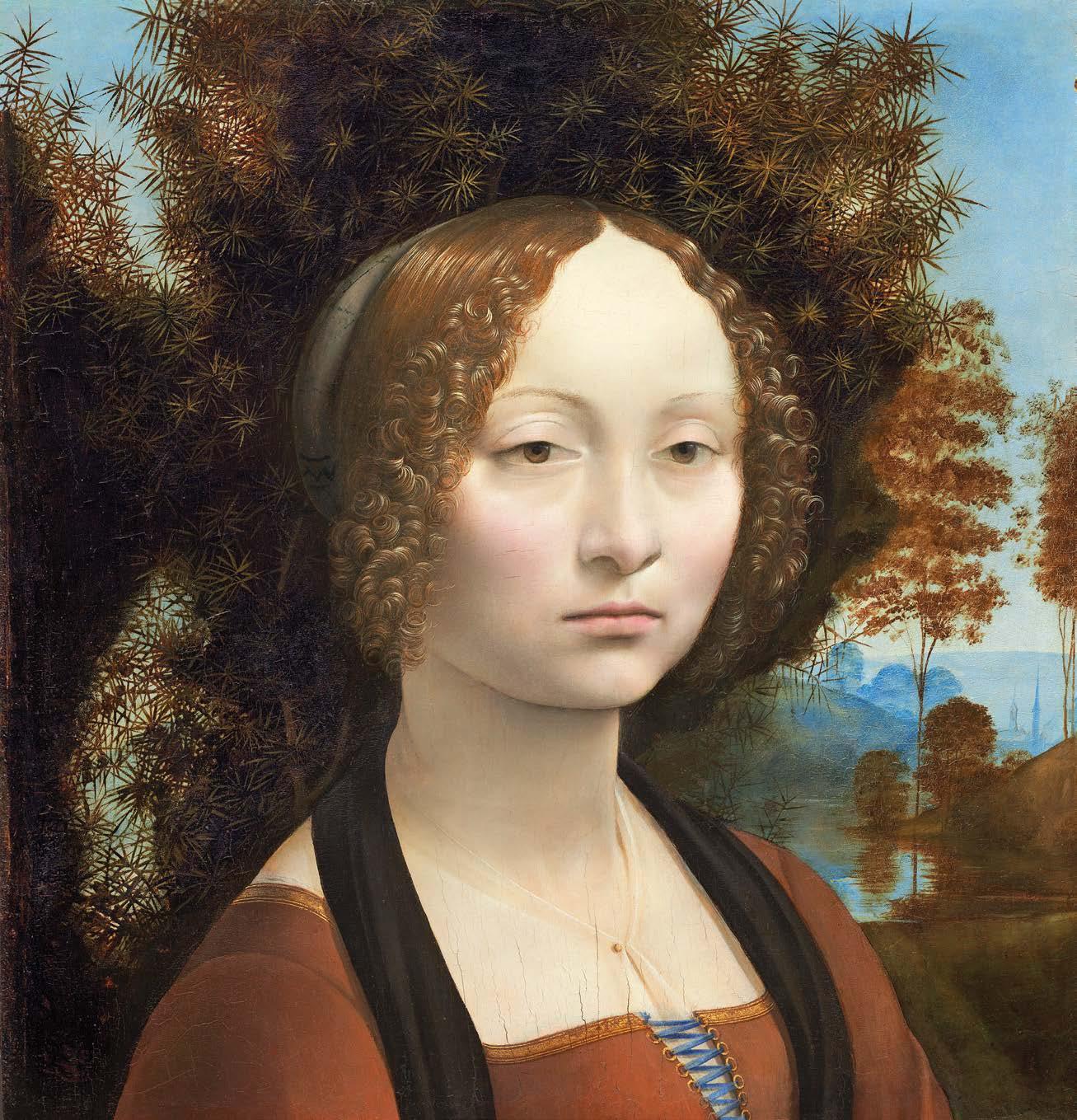
Ginevra de’ Benci, c. 1474- 78 (oil on panel), Vinci, Leonardo da (1452-1519) / National Gallery of Art, Washington DC, USA / Bridgeman Images
However, it was his son, Karl I who was the first to patronise the arts on an unprecedented and lavish scale: Karl I served as Master of the Household (Oberhofmeister) at the court of Rudolf II, Holy Roman Emperor (d. 1612) and was elevated to the rank of Prince of Liechtenstein in 1608. Rudolf II was a wellknown connoisseur and collector of the arts; indeed, his Kunstkammer was considered a marvel in the emperor’s own lifetime and called, not entire facetiously by Cardinal d’Este, ‘the eighth wonder of the world’ (opera non piii statofatta al mondo).
Undoubtedly, Karl was influenced by the emperor and his collecting tastes; so much so that Rudolf wished to swap some parts of his own collection with his Oberhofmeister in Prague, writing in September 1597, “… apparently you have some outstanding and rare artworks and paintings...”. In his prominent position at court, Karl I came into close contact with Prague’s greatest court artists, including Guiseppe Arcimboldo (1530-1593), Batholomäus Spränger (1546-1611) and Hans von Aachen (1552-1615); as well as the imperial sculptor Adriaen der Vries (1556-1626) from whom he commissioned an exquisite Saint Sebastian sculpture in imitation of a sculpture of Christ in Distress (1608) which the emperor had commissioned; both are still in the princely collections today. He began to collect works of art for his palaces at Feldsberg (Valtice, Czech Republic) and Eisgrub (Lednice, Czech Republic). Karl’s own accounts and inventories, the names of these artists recur frequently, and in a 1613 inventory, a painting by Spranger is mentioned.
Karl I began to house his art collection in a purpose built gallery so that it would ‘be safe from fire’. His own Kunstkammer, probably modelled on that of Rudolf II was replaced by a separate gallery for his paintings at Feldsberg Castle. When an inventory of his Prague residence was taken of after his death in 1633, 83 pictures, including Quinten Massys’ The Tax Collectors, were recorded (Figure 2). The silver vault alone contained over 900 different objects.
Karl Eusebius
Whilst the collection of other objects started earlier under his father, the heart of the princely collection of paintings was amassed in the sixteenth century by the second Prince, Karl Eusebius. Succeeding his father at the
tender age of sixteen, the young prince spent three years conducting his own Grand Tour of Europe, becoming passionately interested in Italian art: his inventory of 1658 lists an extraordinary number of bronzes after Giambologna, mainly by Gian Francesco Susini; and his acquisition of works by Guido Reni and Luca Giordano. In his Treatise on Architecture, he explicitly did away with the decoration of his palaces with tapestries, preferring paintings instead. He was particularly keen to display his treasures in a purpose built gallery, no doubt influenced by his Italian contemporaries, just as his father had done. His principal residence was Schloss Vlatice/Feldsberg (now in Czechoslovakia) and it was here that Karl Eusebius eventually housed his collection in a long gallery that was specially vaulted for that purpose in 1654.
The ethos underpinning his collecting habits can be gleaned from the opening quotation in which art and princely identity were inextricably bound together. Interestingly, his treatise on architecture entitled Werk von der Architektur (c. 1675) was never intended for publication and instead was conceived of as a practical handbook for Karl’s heirs. He was the first Prince of the House of Liechtenstein to employ a team of architects, plasterers and decorators on a grand scale as well as exploiting a network of dealers all over Europe to enlarge his art collection. In the devastating wake of the Thirty Years’ War (1618-1648), he was responsible for reorganising the princely finances. Arguably, however, his ulterior motive for such astuteness was his belief that money was there to enable him to ‘leave behind beautiful monuments as an eternal and immortal memorial’.
Karl Eusebius was doubtless following in the footsteps of the royal court and Rudolf II’s acquisition philosophy: Cardinal Ippolito d’Este wrote that on his visit to Prague, Rudolf revealed “his most recondite and valuable things (tesoro degno di chi ii possede), and particularly his paintings, marvellous for their quantity and quality. Besides them, vases of precious stones of various kinds, statues, and clocks ... a treasure worthy of him who possesses it.”
That Karl Eusebius, like his father, was also influenced by Rudolf II’s Kunstkammer, is evident in the extraordinary array of objects he commissioned. It is particularly clear in the pietra dure tabletop one of the few items to survive from Karl Eusebius’ time in emulation of Rudolf II’s. Identified as patron by monogram of intertwined C’s
and coronet, his coat of arms is also inlaid in intarsia. The table was described in the 1658 Guardaroba inventory as, ‘item, a fine square stone table, inlaid with different colours, set with many garnets, together with a coarse wooden base.’
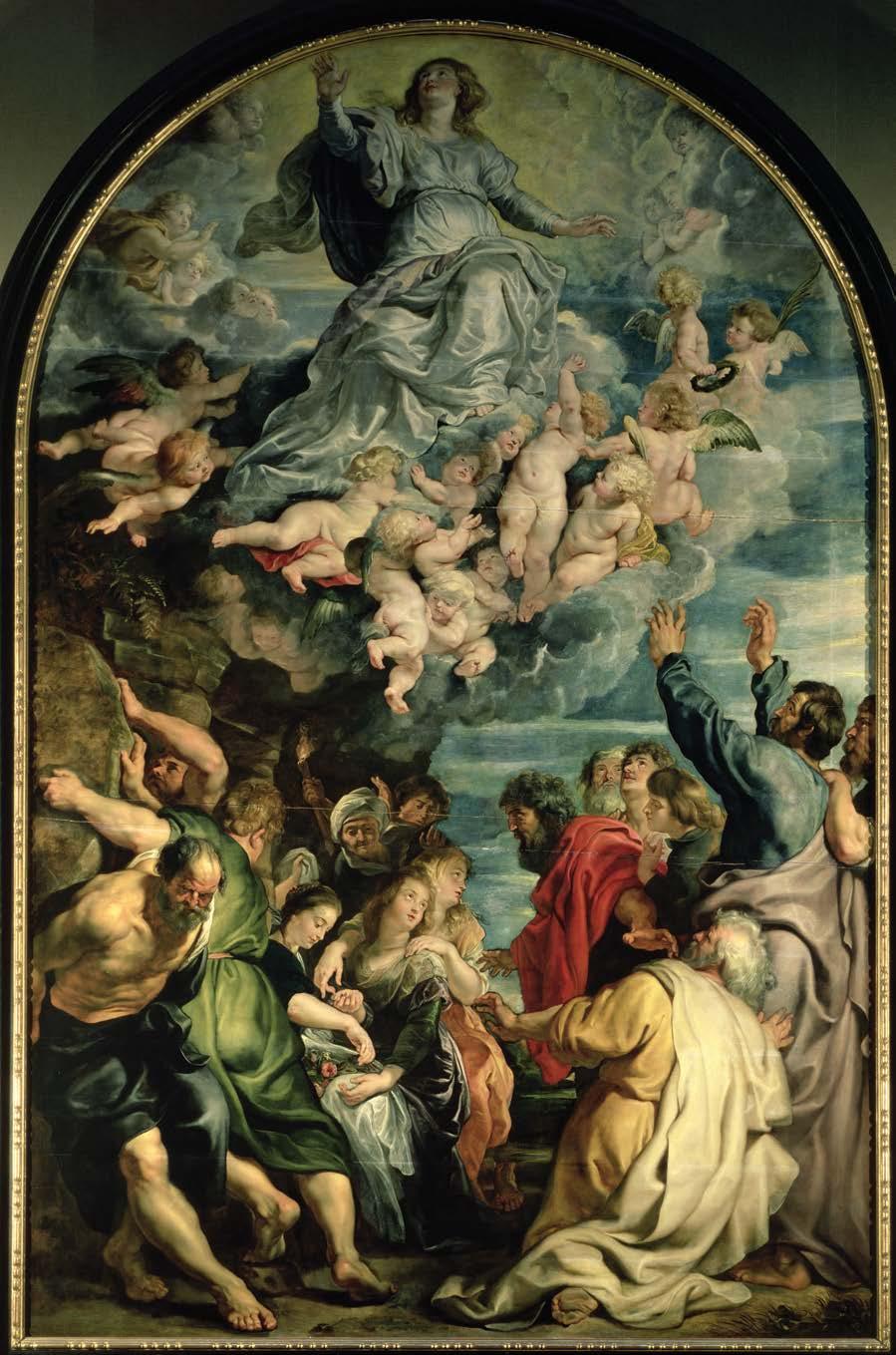
But Karl Eusebius also pursued his own passions, the most notable of which was the work of Peter Paul Rubens (1577-1640). He bought Rubens’ last monumental altarpiece, Assumption of the Virgin in 1637, only a few years after it had been completed now in the Kunsthistorisches Museum, Vienna (mentioned in a Lichtenstein inventory in 1643) (Figure 3). It was the first painting by the great Flemish master to enter the collection before the baton was taken up by Karl Eusebius’ son, Prince Johan Adam Andreas I (1662-1712). Karl Eusebius was also responsible for commissioning a remarkable series of twelve philosophers from the Spanish painter, Jusepe de Ribera (1591-1652). Recently discovered documentation, published by E. Nappi in Ricerche sul ‘600 napoletano conclusively proves their artistic attribution to this remarkable Spanish painter (Figure 4). Until then, the early history of these paintings was not known. Nappi’s discovery of a document in the archives of the Banco dello Spirito Santo in Naples establishes that the paintings were commissioned from Ribera in 1636, directly by Prince Karl Eusebius through his agents. The archival notation reads: A.S.B.N., Banco dello Spirito Santo, giornale del 1636, matr. 270, partita di ducati 100, estinta il 7 maggio. A Lorenzo Cambi e Simone Verzone D. 100. E per lui a Gioseppe de Ribera, dite se li pagano per ordine del conte Carlo Felesbergh et esserno in conto di D. 500 per il valore di dodici quadri d’altezza e di palmi cinque e palmi quattro di larghezza in ognuno dei quali ci ha da essere dipinto unfilosofo di sua propria mano che ha pigliato a fare per servito di don Carlo Felisbergh et quelli han da consegnare a lorofra sei mesi et mancando de consignare debbia restituire tutto il denaro ad ogni loro piacere.
One of the family’s most celebrated pieces, Leonardo da Vinci’s Portrait of Ginevra de Benci is now in the collection of the National Gallery, Washington, USA and is thought to have been acquired by either Karl Eusebius or his son, Johann Adam (Figure 5). Either of them could have become familiar with it on their travels to Florence. Leonardo’s authorship, in any case, came to be forgotten, as the panel was attributed to Lucas Cranach in the Liechtenstein Catalogue of 1780. During
World War II the picture was transferred, with the rest of the collection, from the Garden Palace in Vienna to the Liechtenstein castle at Vaduz.
In addition to paintings, Karl Eusebius showed a keen interest in objets d’arts made from rock crustal. In 1638, he purchased the 18 kg heavy smoky quartz crystal in at a cost of 800 talers. An unusually detailed contract dated from 10 September 1638, between him and Dionyso Miseroni, the sculptor, survives. Karl Eusebius had requested that the sculptor transform the quartz crystal into ‘crockery in the form of a Mayenkrug (a vase for May flowers) as big as the stone permits’. He also stipulated that the coat of arms of the House of Liechtenstein be incorporated into the design. It was completed in 1639 (37 cm high, 30 cm wide over the handles) with a hexagonal base and was later embellished with gold, but unfortunately lost during the ravages of the Napoleonic Wars.
Just as his father had done, and his son would continue to do so, Karl Eusebius assembled an extraordinary holding of objects, both decorative and practical. His interests spanned firearms, horse breeding, architecture as well as art; and this incredibly learned man brought an unparalleled aesthetic and historical appreciation to the works he acquired for his collection. Everything he collected served only to elevate his family’s princely status and reputation as the leading art of their day.
Karl Eusebius’ son, Johann Adam Andreas I, would go on to acquire many more works by Rubens as well as Antony van Dyck, and amassed a greater number of works that included painting, sculpture and architecture. Successors to the house of Liechtenstein continued to elicit praise for their connoisseurship with Gottfried Wilhelm Leibniz addressing Prince Anton Florian I, Karl Eusebius’ grandson, as “…Your Serene Highness and great connoisseur of the fine arts…”, in a letter from 1714. Today, the reputation of the Liechtenstein as one of the most important collections in Europe only continues to go from strength to strength.
2016 London, United Kingdom
Lydia Hansell,
The Assumption of the Virgin Altarpiece, 1611/14 (panel), Rubens, Peter Paul (1577-1640) / Kunsthistorisches Museum, Vienna, Austria / Bridgeman Images
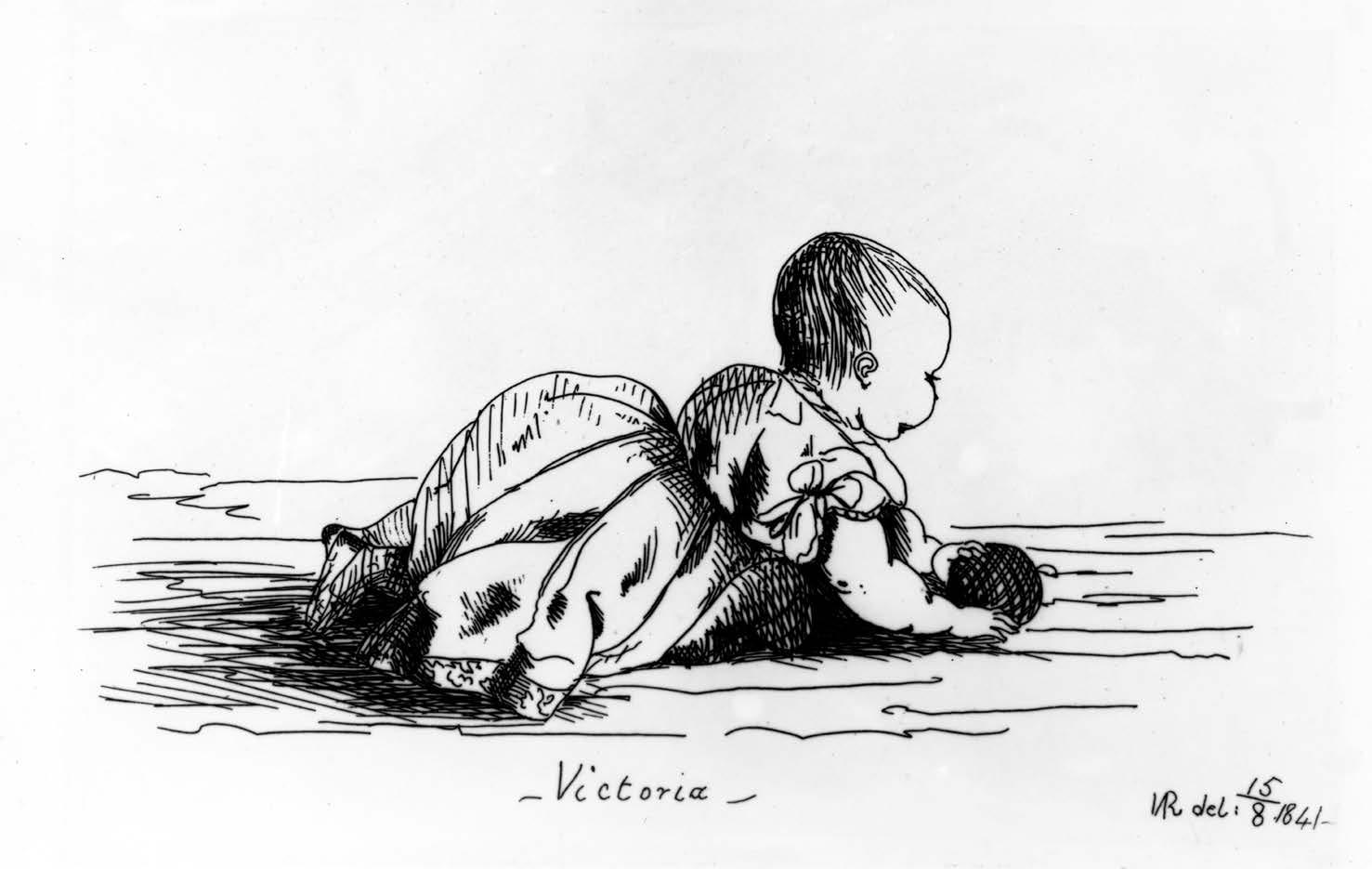
Victoria, The Princess Royal, 1841 (litho) Queen Victoria (1819-1901) / Private Collection / Bridgeman Images
QUEEN VICTORIA as amateur artist
It was 9.30 on a Tuesday morning, in December 1827, when Princess Victoria of Kent sat down to her first drawing lesson. Her instructor was Richard Westall, in his early sixties an avuncular figure in the eyes of the eightyear-old heiress presumptive. Westall’s contemporaries admired his picturesque landscapes and history paintings, including a series of scenes from the life of Lord Nelson; his illustrations to Shakespeare and Milton were well known and, in time, Victoria would enjoy the images –by turns swashbuckling and sentimental – that Westall had produced to accompany Walter Scott’s narrative poem, The Lady of the Lake. Westall began by teaching his charge drawing. Later their lessons encompassed watercolour sketches of figure and genre subjects and, to a lesser extent, landscape views. Despite significant financial problems, the artist consistently refused to accept payment for his services.
Richard Westall taught Victoria for eight years, visiting Kensington Palace twice weekly for hour-long sessions, until his death in 1836. Tutor and pupil quickly forged a bond and Victoria would describe him as ‘a very indulgent, patient, agreeable master, and a very worthy man’. She repaid his patient indulgence with consistent diligence – in marked contrast to her attitude, for example, to her piano lessons. She was helped by a degree of innate ability, inherited from her recent forebears. As a young woman at her childhood home in Coburg, Victoria’s mother, Victoire, Duchess of Kent, had painted trompel’oeil decorations for a conservatory; a talent for drawing was passed by George III to several of his children.
Among Victoria’s uncles and aunts, Charlotte, Princess Royal was an accomplished flower painter and amateur etcher; Princess Elizabeth produced designs for painted furniture and a tea and coffee service manufactured by the Royal Porcelain Factory in Berlin in 1810, as well as mastering the fashionable technique of cut-paper silhouettes; at the age of seven and three-quarters, Prince Augustus produced a handsome view in bodycolour of St Leonard’s Hill, near Windsor.
That the position of Victoria’s drawing master was a prestigious one is indicated by evidence of competition. Before Westall’s appointment was made public, an opportunistic watercolourist called John Clark had dedicated a sumptuously produced painting manual to her mother. Clark entitled his book A Series of Practical Instructions in Landscape painting in Water colours; Containing directions for sketching from nature and the application of perspective – progressive lessons in drawing from the tinted sketch to the finished subject – and examples of the introduction of figures, architectural subjects, particular effects, etc, as connected with landscape scenery. In his dedication, more than the book’s cumbrous title, Clark betrayed something of his motive. ‘Permit me, Madam,’ he wrote, ‘to hope that the Progressive lessons on Landscape Painting, may afford amusement if not instruction, to your illustrious Daughters.’ The twice-married Duchess of Kent had a daughter from both of her marriages, Victoria and her older half-sister, Feodora of Leiningen. In directing the Duchess’s attention to the princesses, Clark was probably
making his case for consideration as royal instructor. It was not to be.
Westall’s contemporaries regarded him as an accomplished practitioner, with a fine sensibility, demonstrated, for example, in the highly sentimental genre painting, A Peasant Boy, which he submitted to the Royal Academy on his appointment as an academician in 1794. His art lacked innovation or radicalism and his teaching would demonstrate a similar conservatism. Throughout their association, Victoria learned by copying Westall’s own work, beginning with drawings of hands, eyes and horses. The year of his appointment, Westall painted a portrait in watercolours of the Duchess of Kent’s horse, Shrewsbury. Three years later, Victoria hazarded her own copy and gave it to her mother as a present. What Westall lacked in experimentalism, he made up for in his use of telling detail. The princess learned from the outset that key to successful drawing and painting was careful observation. In copying Westall’s portrait of the Duchess’s horse, she was forced to unravel skeins of bridle and rein and accurately reproduce the folds and flaps of the horse’s saddle. Many of the sketches she subsequently made demonstrate assiduous attention to details of clothing or accoutrements.
In 1830, Westall painted Victoria’s portrait for her mother. He depicted the eleven-year-old princess in a picturesque landscape setting with her dog Fanny. She is holding a sketchbook and staring fixedly at the view she is engaged in drawing. Given the restrictions of Victoria’s childhood – there are no recorded instances of Victoria escaping her mother’s vigilance to paint alone outdoors – Westall’s image is a piece of charming fantasy. It celebrates for the viewer the place of drawing in the young Victoria’s life, a place it would never forfeit.
Westall encouraged Victoria to draw figure studies. The Royal Collection includes A young girl filling a pitcher from a spring, a sketch in pencil, watercolour, pen and ink, probably finished in 1831, alongside Victoria’s copy of the same image. While Westall’s sketch is more certain in its draughtsmanship and nuanced in its colouring, Victoria’s version demonstrates the extent of her confidence with mixed media, after four years of lessons, as well as precocious abilities as a copyist on the part of the twelve-year-old artist. In the sketches Victoria undertook at this stage without Westall’s guidance, the contrast is marked: like amateur artists before and since, the princess struggled to draw supple, lively figures
and found hands in particular a challenge. Throughout her life some of her best images would be copied from existing paintings. As late as 1888, Victoria finished a copy of a portrait by Rudolph Swoboda of an Indian servant and hung it in her dressing room at Balmoral. Shortly afterwards failing eyesight forced her to give up painting and sketching for good.
Victoria’s sketchbooks during the period of Westall’s tuition demonstrate the centrality of art among her pastimes. Victoria was a star-struck teenager: she loved theatre, opera, ballet. In 1833, the Royal Coburg Theatre was renamed the Royal Victoria Theatre in the princess’s honour. Victoria’s attendance was regular and enthusiastic. Invariably she recorded afterwards her version of key scenes or her favourite artistes. In 1833, the Royal Victoria Theatre staged Daniel Auber’s new opera, Gustavus III or The Masked Ball. From the opera’s ballet interlude, Victoria sketched the ballerina Mademoiselle Rosier. Victoria was partisan in her tastes. She admired the actress and musician Elizabeth Vestris, the Milanese soprano Giulia Grisi and the dancer Pauline Duvernay. Among sketches in the Royal Collection is Victoria’s portrait of Duvernay in the frilled Spanish-style dress she wore as Florinda in the first act of Jean Coralli’s ballet of 1836 The Lame Devil. Victoria annotated her sketch ‘from recollection’. Nevertheless her version of the dancer’s flowered headdress and lace-flounced pink dress bears a close resemblance to the coloured lithograph published on behalf of the theatre company the following spring.
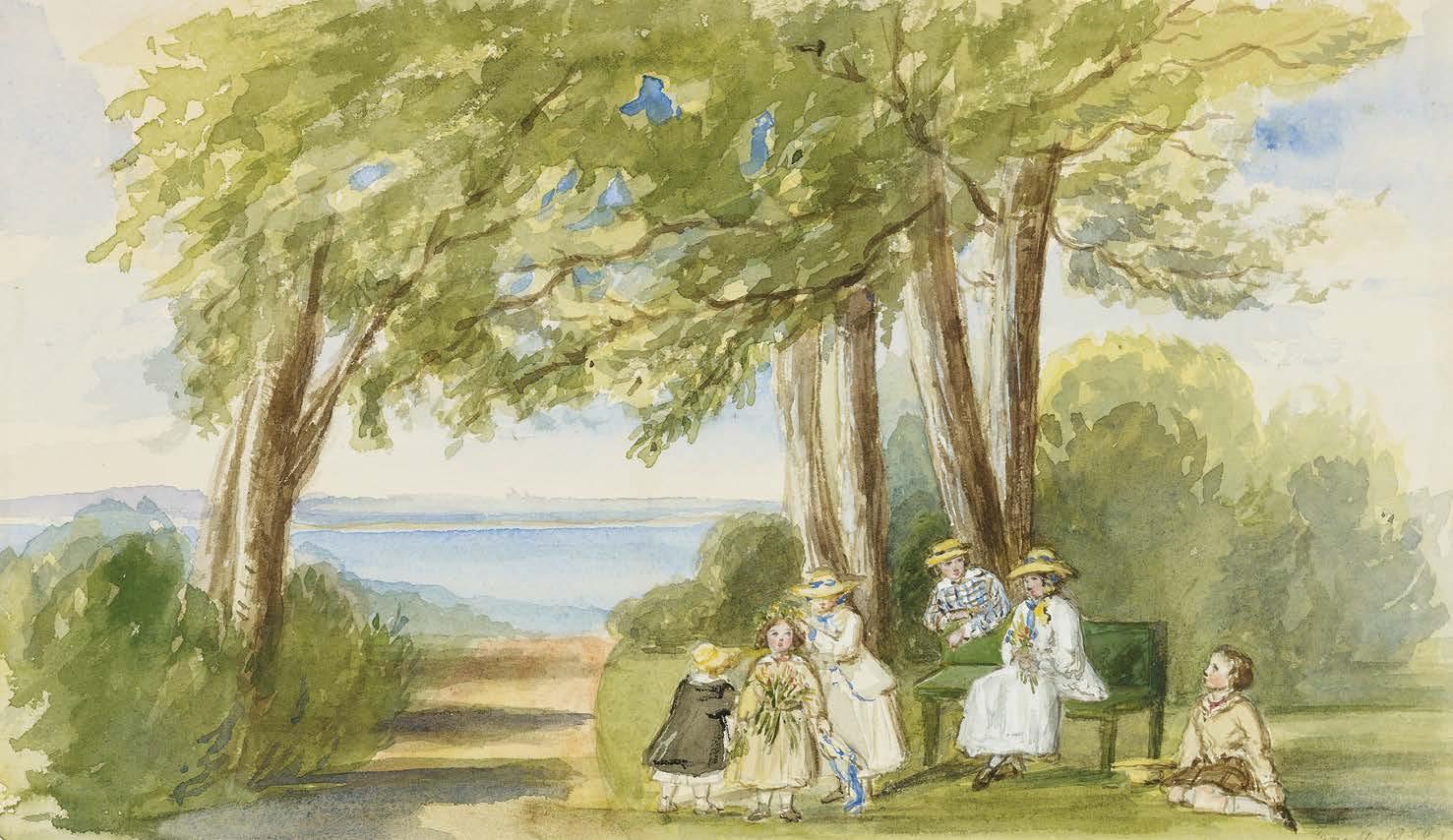
Westall’s teaching imbued Victoria with a sense of the importance of line. A linear quality would always dominate her drawing and painting. In her best, uncoloured sketches of ballet dancers, a sureness of line adds to a sense of movement; many of the 223 sketches of her children she painted between 1841 and 1859 capture the same liveliness. In the markedly successful self-portrait she dated 19 May 1845, the sureness of line reinforces the sense of strength of will that is the dominant impression of the unfinished black-andwhite sketch.
This focus on line was emphasized further in the early 1840s, when Victoria learned to etch, taking lessons, alongside Prince Albert, from Edwin and Thomas Landseer. The engravings she produced of her own sketches, for circulation among family and friends, have a graphic simplicity. Victoria worked mostly without
shading or cross-hatching, and the pictures’ impact consistently arises from crisp, bold outlines.
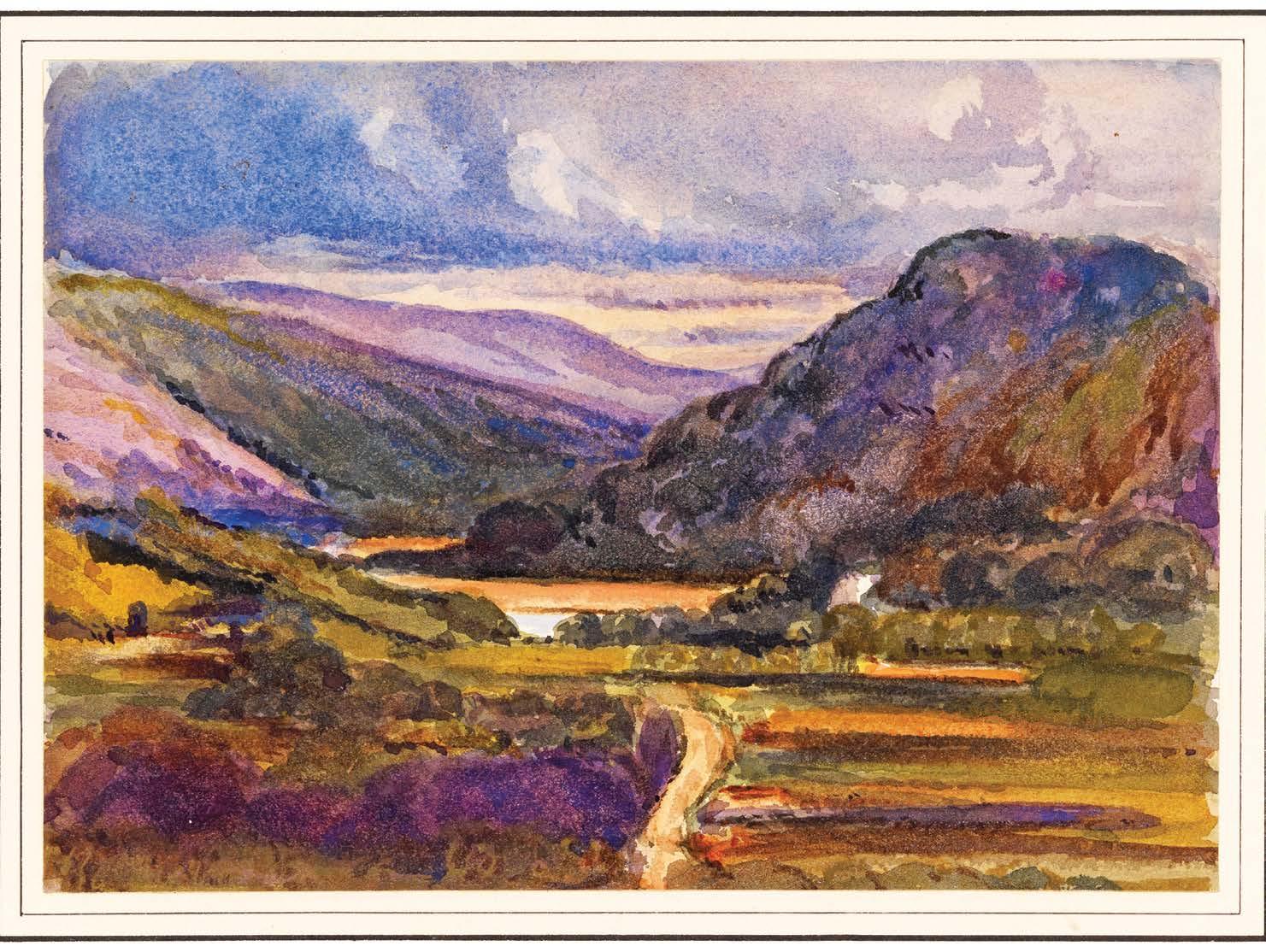
Victoria never lost the fondness for painting in watercolour that Westall was the first to encourage. Her paint box, supplied by Ackermann & Co of London probably in the early 1840s, was handsomely fitted out with everything necessary for the watercolourist: rows of colours, a pair of cut-glass water jars, a china bowl and six mixing palettes. Externally the box was veneered in rosewood, with inlaid patterns of mother of pearl. It travelled in Victoria’s luggage on her holidays to the Highlands and the seaside retreat of Osborne House.
On 15 July 1846, Victoria had her first lesson in watercolours with Edward Lear, who visited the Queen twelve times over the course of three weeks, at Buckingham Palace and Osborne; in her Journal, she commented ‘[he] sketched before me & teaches remarkably well’. In September of the same year, on the joint recommendation of the most accomplished amateur artist among her ladies-in-waiting, Charlotte, Viscountess Canning, and her Mistress of the Robes, the Duchess of Sutherland, Victoria embarked on a course of tuition with Glasgow-born watercolourist William Leighton Leitch that would continue for two decades.
Both men directed the Queen’s focus away from figure and genre studies to landscape views, which would become her principal artistic focus from now on. If Lear was the more renowned practitioner, Leitch excelled as a teacher. Victoria shortly dubbed him ‘good old Leitch’ and, in time, he would also offer lessons to her younger daughters. From the outset he did his best to convey to his pupil the potential of her preferred medium. ‘I showed how light, that is, brilliancy, was produced by yellow ochre, pink madder and cobalt blue, and darkness, deeper than black, by sepia, purple lake, and indigo… Using these two classes of colours with their compounds, I then did skies, distance, middle-ground, foreground, white clouds and their shadows, no whiter than a lady’s satin dress; and then with the same colours, a black dress full of colour and shadow, but with no black in it; and then a great many varieties of green colours. After attending to this part of the lesson with great earnestness… the Queen turned to Lady Canning and said, “This is very wonderful…”’ Leitch provided Victoria with demonstration sheets, showing her all of these effects and how to create them. As in her lessons with Westall, she learned by copying.
With age, Victoria’s subjects changed. In place of the ballet dancers and actresses of her teenage years, she painted vignettes from her family life or scenes from her travels with Prince Albert. From memory, Victoria painted her eldest daughter, Vicky, Princess Royal, praying at the altar of the Chapel Royal, St James’s Palace, during her marriage service in January 1858 – an insight into the moment of the service that moved Victoria most. She painted a rustic fete close to Osborne House, with white tents decked with bunting, she painted market day in the German town of Coburg and the sun setting over a Swiss mountain; she painted a Dachshund in the kennels at Balmoral; she painted tenantry and colonial troops, and she sketched her fellow sovereigns, including Napoleon III of France and the Empress Eugenie. Early in their acquaintance she sketched the young women who would become her daughters-in-law. Her sketchbooks suggest an insatiable visual curiosity about people and places.
From 1832 until shortly before her death in 1901, Victoria kept a voluminous Journal that details the myriad impressions of her extraordinary life. Her sketching occupied a shorter span, beginning with Westall’s lessons in 1827 and ending in 1890. But Victoria’s numerous sketchbooks, bequeathed ‘as heirlooms of the crown’, are a journal of a different sort, often illustrating the impressions of a quieter, gentler, more contemplative queen. If her Journal is at intervals vehement to the point of stridency, her sketchbooks –though testament to the sureness of her touch and her confidence in her own vision – show us a different side of Victoria. Throughout her life she collected paintings and sculpture. Her patronage touched many artists, both British and Continental, even if her insistence on realism in the works she commissioned excluded from her collection many of those nineteenth-century artists preferred by posterity. Yet as a painter herself, she was guided by her pleasure in her surroundings and those she loved most – and, as in her journal and so much of her life, her need to catch the fleeting moment and capture forever precious memories.
Matthew Dennison, 2016
London, United Kingdom
CHAPTER THREE
CATHERINE THE GREAT
Patron of the garden
The gardening madness of CATHERINE THE GREAT
In 1772 the Empress Catherine II of Russia had written to Voltaire, the French Enlightenment philosopher, with whom she frequently corresponded, ‘J’aime a la folie les jardins anglaise’ and went on to list some of the features which entranced her the most; curving lines, gentle slopes and extensive stretches of water. She concluded her letter with the observation, ‘l’anglomanie domine ma plantomanie.’
Catherine’s enthusiasm for all things English and especially for the English Landscape style was intense but she had never visited Great Britain and her passion for this ‘modern’style was furthered second hand. Therefore it was from books, plans and prints and the letters she received from correspondents all over Europe that helped to develop Catherine’s concept of an ideal English garden or jardin anglais, the term used in Russia for a landscape park.
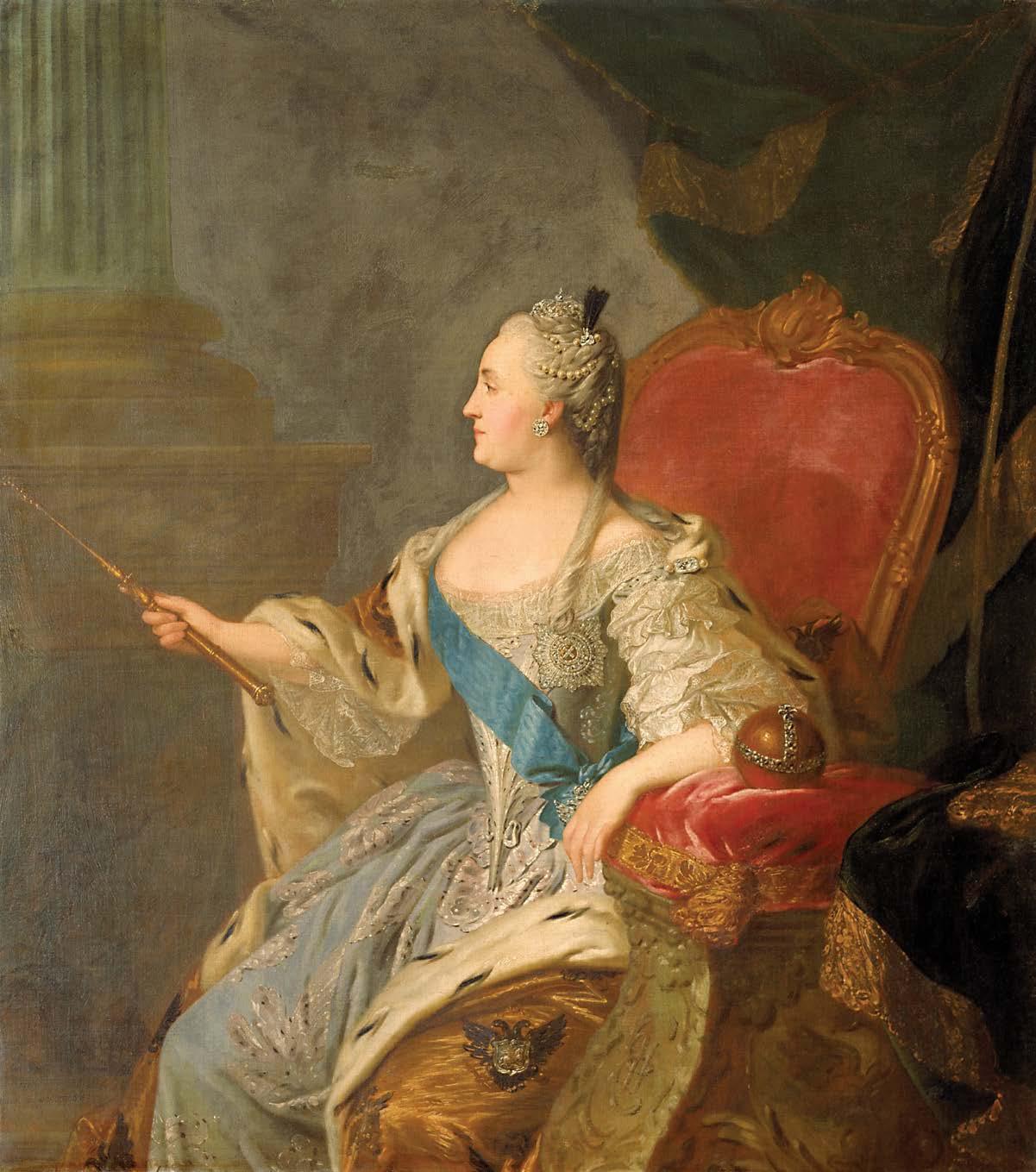
Catherine was born Sophia von Zerbst-Anhalt in 1729, the daughter of one of the lesser German princes but her fortunes changed dramatically in 1744 when the Empress Elizabeth I of Russia selected her as a suitable wife for her nephew and heir, Karl-PeterUlrich, Duke of Holstein. In 1745, renamed Ekaterina Alexevna, she married the Grand-Duke Peter whom she rapidly came to loathe. On the death of his aunt in 1761, the Grand-Duke Peter became the Emperor Peter III. Six months later following his brutal murder Catherine became the Empress Catherine II, absolute ruler of the Russian Empire.
From the early years of the 18th century fashions in garden style moved away from the complex parterres and tortuously clipped trees of the previous decades to a freer more natural style. In part the inspiration for this change owed something to the landscape paintings and drawings of 17th century artists such as Claude Lorrain and Salvator Rosa whose works were brought back to England by travellers on the Grand Tour.
Garden architects such as William Kent and Lancelot ‘Capability ‘ Brown developed the English Landscape garden with its woods and gently winding rivers, its serpentine paths and undulating land forms, so accurately constructed that the result could have been mistaken for the natural lie of the land. However many of those rivers had been diverted from their natural course to create a lake and clumps of trees were planted on gentle hills created by the hard work of labourers moving many tons of earth. The picturesque ruin on the skyline had been built to the direction of the garden architect and the small classical temple by the lake probably served as a fishing pavilion or banqueting house.
From the 1760s, Russians were able to travel freely in Europe. Ivan Shuvalov, who came to England in 1764 was enthused by the Natural Style of gardening and returned to Russia with firsthand knowledge. The Russian Imperial Architect Vasily Neyelov and his son Peter were sent to England in 1771 by Catherine ‘to visit all the notable gardens and lay out similar ones here.’ Even the imperial gardener, Andrei Ekleben, was sent to
England in 1769 to learn how to lay out English gardens. The vast royal estate ofTsarskoe Selo lay twenty-two miles from St. Petersburg and in 1718 a stone palace had been constructed there for Peter the Great’s wife Catherine. Tsarskoe Selo was to become Catherine II’s favourite residence and was used by her principally as a summer palace.
In 1755, as her interest in all things English was expanding, she formed a close acquaintanceship with Sir Charles Hanbury Williams, the English envoy at the imperial court. He was accompanied by his secretary Stanislas Poniatowski, who later became King of Poland.
The twenty-three year old Pole, who was a cultured and idealistic man, fell passionately in love with the unhappily married Catherine and she with him. In 1754 Poniatowski had travelled in England and in his memoirs, recalls visits to Bath, Stowe and Wilton House in Wiltshire, the home of the Earls of Pembroke. One may only guess that in the course of their affair, at least some time was spent in conversation and that he may have described to her the gardens at Stowe.
The layout of Stowe in Buckinghamshire,the estate of Viscount Cobham, was to become a major influence on Catherine when planning her gardens, especially those at Tsarskoe Selo and it is likely that Poniatowski would have returned from his travels with copies of the guidebooks to Stowe written by Benton Seeley and published in 1744 and 1750.
ROYAL BRIDGES: Convergence
Catherine the Great, 1763 (oil on canvas), Rokotov, Fedor Stepanovich (c.1735-1808) / Tretyakov Gallery, Moscow, Russia / Bridgeman Images
Catherine’s interest in the English Landscape Style had become a passion and her desire for information grew. In 1766 she asked her ambassador in London, Count Aleksei Musia-Pushkin to request from the Duke of Newcastle a plan of his garden at Claremont and in 1772 she had money sent to Musia-Pushkin so that a model of the pagoda at Kew might be constructed for her. Kew was a royal garden and the inspiration of Frederick, Prince of Wales, and the Princess Augusta. In 1770 she requested a book of plans and drawings of the gardens and buildings at Kew. Catherine also built up a very considerable collection of prints and engravings of important houses and gardens in Great Britain.
The book which we know excited Catherine the most was Thomas Whately’s Observations on Modern Gardening which was first published in 1770 at a time when Catherine was seriously engaged in realising her ambition to join the rest of Western Europe in emulating the English garden style. In his introduction Whately states that the English landscape style ‘...in the perfection to which it has been lately brought in England, is entitled to a place .....among the liberal arts.’ Once it had been translated into French which made it accessible to Catherine, she found that it provided an eloquent exposition of the garden style which so entranced her. His analytic interpretation of what he saw must have both inspired and impressed a woman of the intelligence of Catherine the Great. The Empress planned a translation into Russian but the work was never published. The work was dedicated ‘To the owners of estates bordering the sea and lying along the Peterhof road...’ She did not want English landscape gardens just for herself, she wanted the whole St. Petersburg area to abound with them.
Catherine the Great tried to educate the gardeners at Tsarskoe Selo in the basic elements of the English style but she was unequal to the task. Conversations with members of her court who shared her taste may have convinced her that she would do better if she employed British gardeners. James Meader, who had previously been employed as a gardener for the Duke of Northumberland at Syon Park, travelled to St.Petersburg in 1779, to work for Catherine at the Peterhof Palace. His letters home give a fascinating insight into the creation of the English gardens which Catherine desired. In one he wrote complaining of the abysmal ignorance of Russian gardeners.
Considerable status was accorded to skilled head gardeners. They were well paid and lived in some style. The Sparrow brothers, Charles and James, who arrived in Russia in 1769 were sent to work at Gatchina, the estate presented by Catherine in 1765 to her lover Grigorii Orlov. No formal gardens existed there at the time so the Sparrows were able to create an English garden from scratch and it was Catherine who kept a close eye on work there.
Two years later John Bush [born Johann Busch in Hanover c.1730] arrived in St. Petersburg with his large family. Apart from his horticultural skills, his fluency in German must have endeared him to the Empress. He seems to have worked at Tsarskoe Selo with a great deal of success setting out the English garden in collaboration with Vasily Neyelov. James Meader’s first letter home recounts a chance meeting with the Empress who questioned him in an agreeable manner when John Bush was showing him the grounds at Tsarskoe Selo. The encounter suggests that Catherine was closely involved with what went on in her gardens. Meader mentions the beauty of the garden and the variety of plants grown at Tsarskoe Selo considering the severity of the climate in the winter. He also notes the variety of ‘curious buildings’ and observes that there were far too many of them for his taste. At Peterhof he had a force of three hundred men to work under him and no shortage of money. However he was constantly frustrated in his work to create the grotto she desired by the difficulty of obtaining materials of the right quality.
Of all the British gardeners who came to Russia the career of William Gould was undoubtedly the most adventurous. He was engaged as head gardener in the service of Prince Grigory Potemkin. Potemkin became her lover in 1773. Though other favourites came and went Potemkin remained of paramount importance to Catherine as he tightened Russia’s grip on the Crimea and other southern provinces. Unsurprisingly he shared her admiration for all things English including the English garden. Gould followed his master through southern Russia and he became famous for his ability to create instant gardens wherever Potemkin rested on his relentless journeys. A great troop of workers brought with them stocks of trees and shrubs (presumably in pots), sacks of gravel, seats, statues and all that was required for a pop-up garden in the English style.
However Gould’s masterpiece was the Winter Garden of the Taurida Palace, Potemkin’s principal residence near St. Petersburg, where Potemkin was to lavishly entertain Catherine and the imperial family a few months before his death in 1791. Beyond this glittering structure Gould had created an English garden, one that was not loaded onto carts and trundled away across the Russian steppe.
Catherine had followed much of Europe in developing a passion for exotic architectural features in her gardens. Details such as upswept eaves and zigzag fretwork were largely derived from pattern books produced in England in the 1750s. No garden seems to have been exclusively Chinese. Buildings in the Gothic style, such as ruined castles were used together with Chinese style bridges alongside buildings in the classical style. The revival of interest in the Gothic style recalled England’s past and imparted a sense of history, encouraging the English to embrace a mythical golden age of Old England.
Catherine’s enthusiasm for the Gothic style was clearly demonstrated when she ordered an extensive service of tableware from Wedgwood and Bentley’s pottery works in 1773. Each piece of what was known as the Green Frog Service was to depict a different monochrome view of a building or landscape in the British Isles and should contain ‘all that could be of Gothic Remains, of Natural Views, and of Improved Scenes and Ornaments in Parks and Gardens.’
Wedgwood feared that they would be unable to find enough different views to satisfy their imperial client. However by plundering books of engravings and sets of prints, their own artists did not have to provide too much original work. The service was destined for the Chesme Palace built between 1774-1777 in Gothic style, its triangular structure closely resembling Longford Castle in Wiltshire which features on a dish cover in the service. The green frog which decorates every piece recalls the site of the new palace adjacent to marshy ground which had the onomatopoeic Finnish name, Kekerekeksinen meaning the place of frogs. A few of the pieces depict Chinese buildings including the pagoda at Shugborough, the estate of the Anson family and a Chinese style bridge at Kew. The creation of this extensive service celebrated her admiration for British style and workmanship and underlined her appreciation of the special relationship between Russia and Great Britain.
The tangible results of Catherine’s obsession with the English landscape garden are demonstrated strikingly in her own parks. However she was not alone in her gardening madness, the English garden style was adopted all over Russia, first of all by the aristocracy and then by minor landowners. The love of nature and the rhythm of the seasons was ingrained in the Russian soul and the natural landscape style must have resonated with a people who spent many months in the dark and cold.
All Catherine’s palaces had an English garden but it was at Tsarskoe Selo that Catherine refined her ideas and put them into practice. Here she was able to give expression to those elements she had most admired as she devoured the wide variety of information about English gardens which reached her in St. Petersburg.
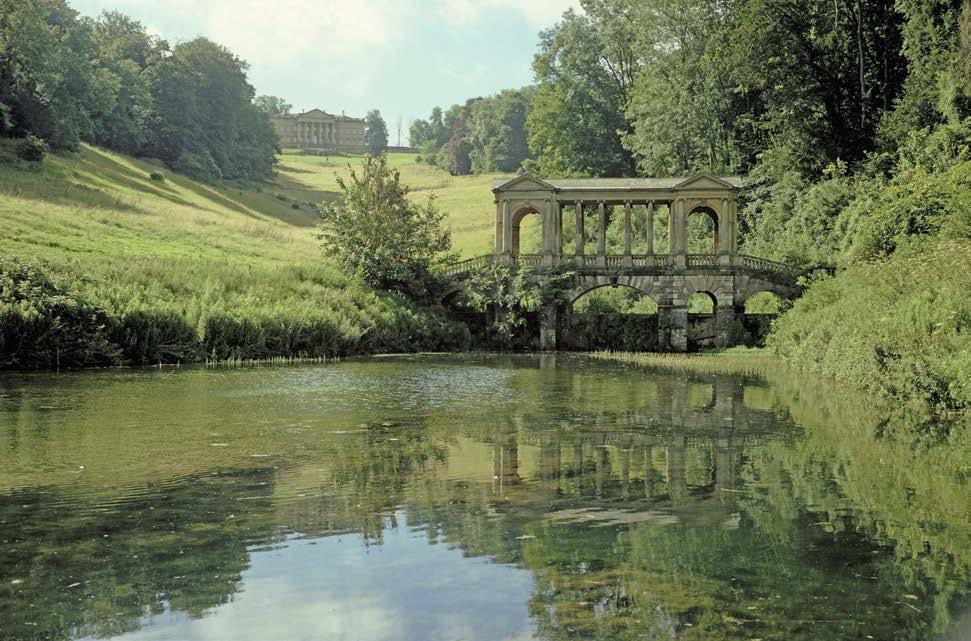
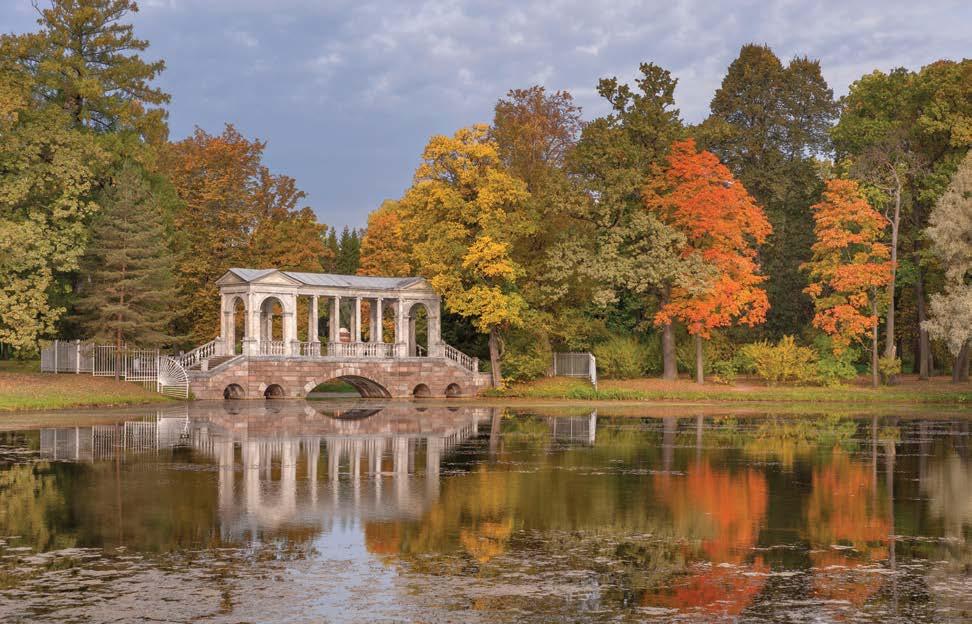
The gardens at Stowe seem to have been the main inspiration for the landscape park at Tsarskoe Selo. The garden layout at Tsarskoe Selo includes a Palladian bridge, known as the Siberian Bridge which appears identical to the one at Stowe. Stowe’s Palladian Bridge was most likely modelled on the one at Wilton House designed in 1737 by Roger Morris. Other features from Stowe are certainly present. Both gardens celebrate victories, each having a Triumphal Arch and a Rostral Column.Those at Tsarskoe Selo are by Antonio Rinaldi and celebrate Russia’s defeat over the Turkish fleet at Chesme in 1770. Several different architects designed the large number of built pieces placed in the park, including the Scottish architect Charles Cameron, who designed the Temple of Memory and another Triumphal Arch thus strengthening the classical element in the garden which was entirely consistent with the English paradigm.
Carole Musson, 2016 London, United Kingdom
Top left: View of the Palladian Bridge and Mansion, from the North (photo) (see also 13780-81) / Prior Park, Avon, UK / Bridgeman Images
Left: Marble Bridge at Catherine Park, Tsarkoye Selo, St. Petersburg (photo) / Bridgeman Images
CHAPTER FOUR
THE ROLE OF THE ART FOUNDATION
From the V&A to Mathaf: Visionaries of their own time
From the V&A to Mathaf: Visionaries of their own time
“Ceremonial displays of accumulated treasures go back to the most ancient of times”, Carol Duncan describes the concept of the collector going back to Roman times in her book Civilizing Rituals. Collections of objects on view for all to see were created a spaces of pomp and grandeur, in many the revered nature of the objects were reminiscent of the religious spaces in Europe, be it family chapel or or public altar. This abundance of the plastic arts was similarly foundin the formal rooms of the Burgher’s houses in seventeenth century Holland. However, it is the Royal families of Europe who understood the full realm of collecting fine art and patronising artists, and architects.
The Princely families of Europe had the main treasure trove of objects, paintings and sculptures. During the sixteenth, seventeenth and eighteenth century these collections grew enormously with state rooms being adorned with fine objects. These collections are the backbone to the modern institution, mainly seen now as National Galleries. Most Princely collections were to be seen in reception rooms, providing sumptuous settings for ceremonial events. As described by Carol Duncan the secondary purpose of the grand collections was to “overwhelm both foreign visitors and local dignitaries with the magnificence, luxury, and might of the sovereign, and… the rightness or legitimacy of his rule”
One of the most famous collections to be transformed from Princely collection to public art museum was the Louvre. This was a politically charged change, it
was nationalised in 1793 by the French Revolutionary Government. Transforming the palace to the recognized “museum of the people”. With this transformed space came a new understanding of how to curate, they were rationalised by art history. All of the works were organised historically, by country, style and era.
With the Louvre as the founding father of the national museum others soon followed – mainly under Napoleon’s Occupying Armies - Madrid, Naples, Milan and Amsterdam all followed suit and converted the Princely collection to a museum. By 1825 nearly every Western capital had a museum. This fashion went further afield than Europe; New York, Boston and Chicago created museums and foundations based on the theories laid out in France. The great civilizations were displayed in buildings that represented the Greco Roman architecture favoured in Europe. These spaces were designed to impress and impose a sense of hierarchy and knowledge, internally the grey floors and white walls symbolised the Renaissance churches of Italy, a general sense of peace and a need to revere art was created.
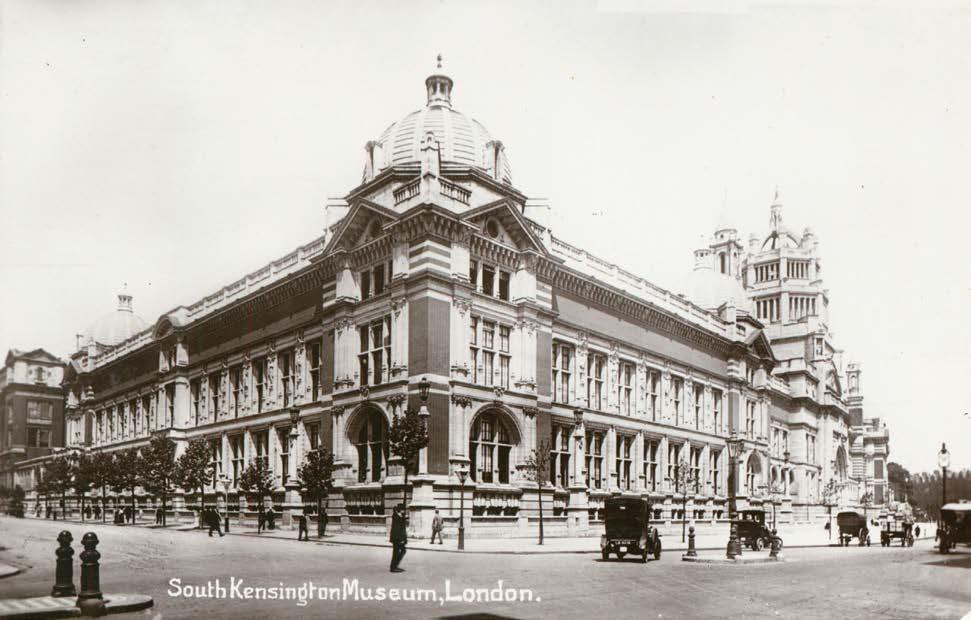
Moving away from the Louvre we look to England and the purpose built museum. Reflecting the desires of Prince Albert; the husband of Queen Victoria who saw a need to create a space that reflected the skills of the artisan. Prince Albert’s rationale was to create “outstanding displays of textiles, ceramics, ironwork, glass, and the like, objects thought to improve skills or artisans, raise the quality of manufactured goods, create higher standards of taste, and
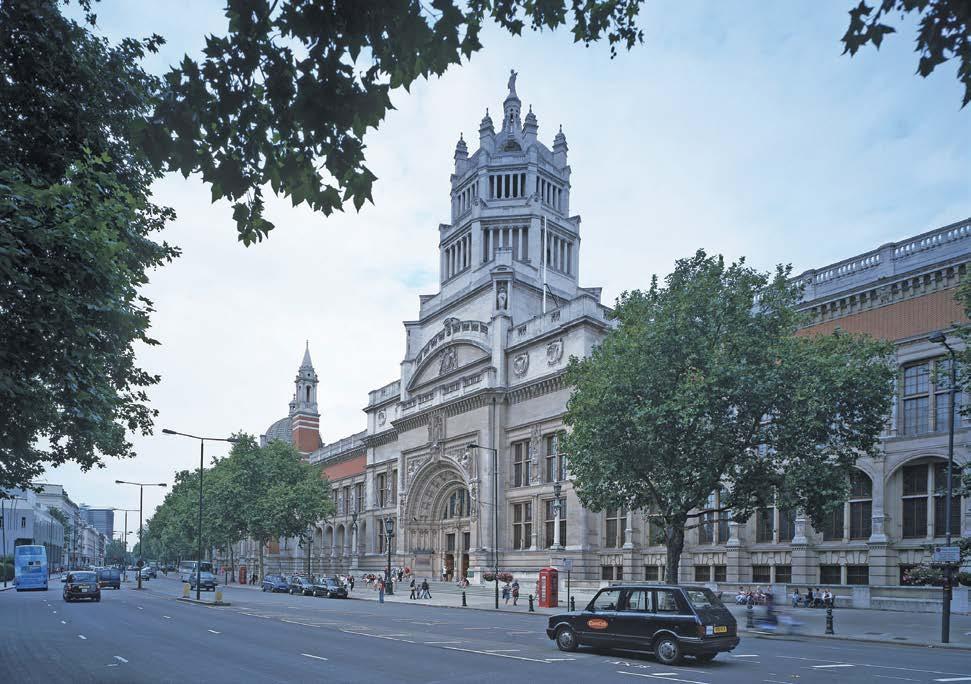
enhance modern life.” The establishment of the Victoria and Albert Museum happened in 1852 following the enormous success of the Great Exhibition of 1851. The founding principle was to make art available to all, to educate working people and to inspire British designers and manufacturers. The land in South Kensington was bought with the proceeds of the Great Exhibition and was set out to create a space that celebrated the applied arts and scientific education.
An avid patron of the arts Prince Albert also looked to buying and expanding the Royal Collection. He visited artists’ studios where he bought works like Augustus Egg ‘L’Amente’ which hung in his dressing room at Windsor and George Cruikshank’s ‘Disturbing the Congregation’ of 1850. He also looked to buy older works, such as Lucas Cranach’s ‘Apollo and Diana’ which he did so in 1846. This was in addition to the architecture which he designed, the original layout for the South Kensington Galleries was by him, the architect Gottfred Semper took his drawings and turned them into what we now know as the Victoria and Albert Museum. He was also known to remark on artists work in their studios, a passionate man who understood the techniques of painting, sculpture and architecture.
As with its patron the Victoria and Albert Museum expanded their collection rapidly, purchasing the Sheepshanks Collection in 1857, 233 works by contemporary artists such as Landseer and Collins. This was followed by two bequeathed collections one from a
Mr. Vernon and the other the J.M.W. Turner Collection. As described by the Victoria and Albert Museum “Generous funding and a less competitive art market than today’s meant that the young Museum was able to make many very important acquisitions. The Museum itself also grew, with new buildings being added as and when needed. Many of these buildings, with their iron frames and glass roofs, were intended to be semi-permanent exhibition halls, but they have all survived and are one of the finest groups of Victorian buildings in Britain.”
Henry Cole, the Victoria and Albert’s first director declared that the museum should be a “schoolroom for everyone”. With this Prince Albert’s desire to have a learning space for all was formed, the concept of an art foundation was not taken forward until the twentieth century. The proliferation of institutions, foundations, art museums and galleries, in both the public and private sectors, dedicated to the analysis and cataloguing of works of art as well as exhibitions aimed at a mainstream audience has been global. However it is the birth of the Middle Eastern art investor that is key to the continuation of the beliefs set out in the eighteenth and nineteenth century by European Royals.
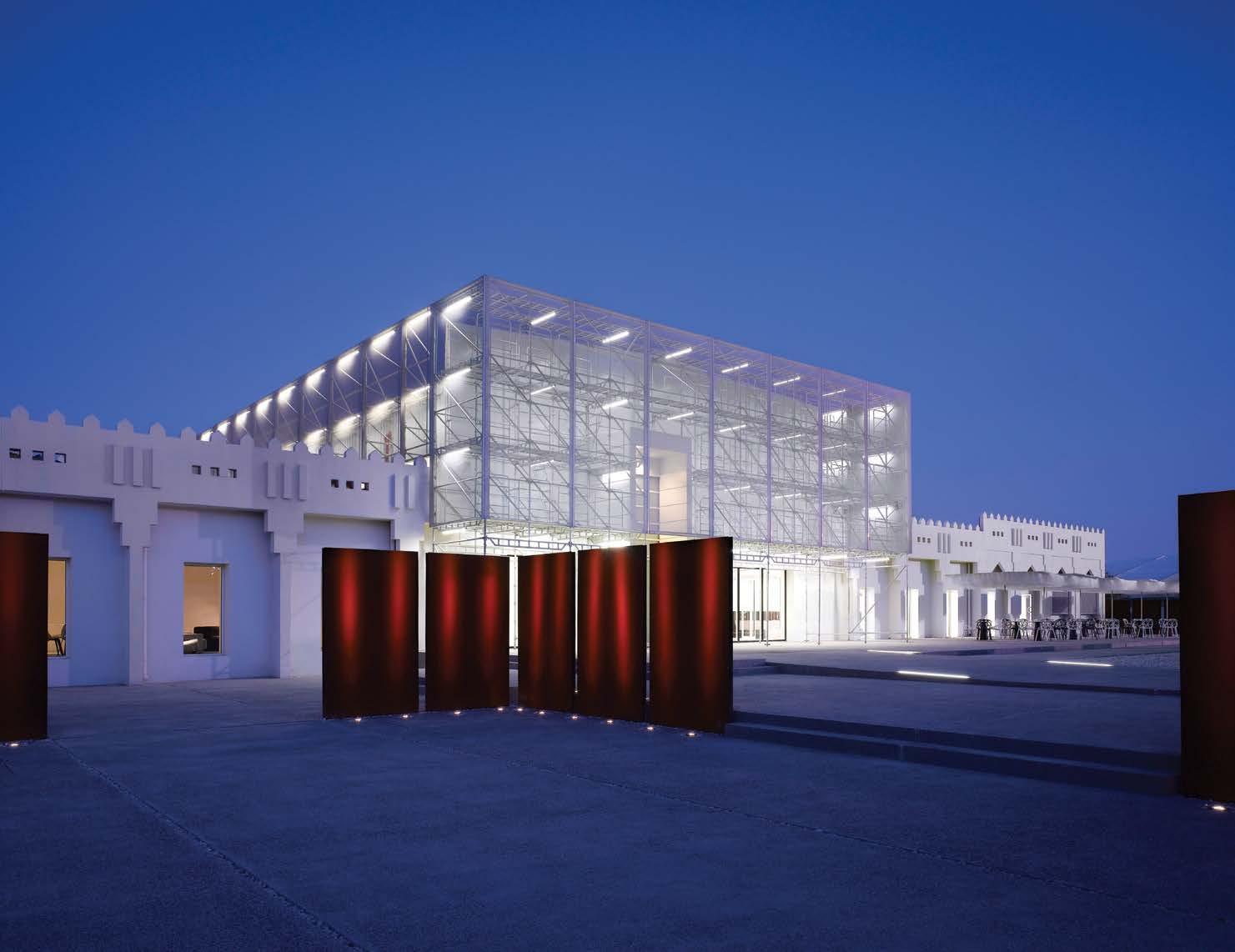
The theory that the Museum should overwhelm both foreign visitors and local dignitaries with magnificence and luxury is the antithesis of the art space now, post the creation of the Victoria and Albert Museum there has been a shift in designing public art spaces. The irreverent has been abolished for the need to allow the public in, to educate and to engage in community learning. We look to Mathaf: Arab Museum of Modern Art, Qatar. It was originally housed in two villas in Madinat Khalifa in Doha. Born from the idea of what an Arab Museum of Modern Art might look like, a place for showcasing the massive production of art in the region architect Jean-François Bodin created the space that now houses the enormous collection of the Al Thani family. As with Prince Albert’s initial ideas 160 years early H.E. Sheikh Hassan bin Mohammed bin Ali Al Thani saw a need to demonstrate what was happening in his country in the creative industries. The collection now holds over 9,000 works, making it the world’s largest specialised collection of its kind. The initial group of works gathered by Sheikh Hassan Al Thani amounts to ten percent of the collection. In the early 1990s Sheikh Hassan Al Thani started building a collection of modern and contemporary art, mainly focusing on the region and its historical and
cultural connection from North Africa to Asia and from Turkey and Iran. He explains how the development of his collection was aimed at filling a void in modern Arab art in Qatar, “Since the collection had increased its representation of periods and styles, I began planning to make it part of a specific project. At the time, I did not know of any museum of Arab art from the 19th century to today. As a painter and photographer — simply put, as an artist — I was passionate about modern and contemporary art and artistic movements in the Arab world. But only in Egypt could you find quality museums devoted to the history of Arab art and its different forms of expression. Otherwise there was almost nothing anywhere. So instead of continuing in the darkness, I decided to light a light”.
The development of the museum continued as an inspiring space for dialogue and scholarship about modern and contemporary art with artists in residency in Doha, and also as a place for art production and display. Aiming to reimagine the Art Musuem for the twenty first century we see that Mathaf set out very similar desires to those of Prince Albert “a centre for dialogue, research, and a resource for fostering creativity.” These concepts show that the Al Thani family believe in the enlightenment ideology set out in the nineteenth century, wanting the Royal collection to be the start of Mathaf and for it to be a “resource for its visitors both physical and virtual, local and global, to learn about modern Arab art”.
The Collection represents major trends and sites of production through paintings, sculptures, works on paper, installation and video works, produced since the mid-19th century until the present day. The collection includes key artworks by pioneer Arab artists such as Jewad Selim’s Baghdadiat , and Mahmoud Moukhtar’s The Nile. Opening in 2010 with the exhibition Sajjil “act of recording” it featured a cross section of Arabic art from the past one hundred years. Mathaf offers an Arab perspective on modern and contemporary art and supports creativity, promotes dialogue and inspires new ideas.
As Described by Barbara Pollack the role of the AlThani family within the art world; “While Abu Dhabi is making a name for itself by building dramatic local satellites of the Louvres, the Guggenheim and the British Museum, Qatar’s scheme of cultural nation building is much more homegrown, establishing its own museums rooted in the collections of its own royal family”. It is the collecting
habits of the Al Thani family that have given rise to them being described as “modern day equivalents of the Medicis” by William Lawrie.
For more than thirty years, the Al-Thani family has been accumulating a large collection of art works, from traditional Islamic artifacts to famous pieces of modern and contemporary art. The AL Thani family also collects outside of Arabic art, with interests as far reaching as Roman and Egyptian artefacts, to Paul Cezanne and Mark Rothko. But it is the Emir’s daughter Al-Mayassa bint Hamad bin Khalifa Al-Thani who now embodies the involvement of Qatar’s ruling family in art. As head of the Qatar Museums Authority (QMA), she is “arguably the most powerful woman in the art world today”.
From these two men, Prince Albert and Shaikh Hassan Al Thani, we learn that their desire to create museums for learning encapsulates their desires as patrons of the arts. The spaces that they have created have given rise to some of the most important artists from William Morris and his work with the English Arts and Crafts movement to ‘Inspired by’ which is an art competition and exhibition supported by the Rootstein Hopkins Foundation and NIACE for people in adult education, showcasing new works inspired by exhibits in the Victoria and Albert collections. For the Victoria and Albert Museum supporting contemporary artists, designers and makers has always been at the heart of the V&A’s mission. The Residency Programme enables creative practitioners to gain unique access to the Museum’s collections, archives and curatorial expertise, providing them with a studio on-site, a bursary and a production budget to experiment, create a new body of work and engage with the public. Mathaf has honed the skills of some of the most important Middle Eastern artists of our generation with Yousef Ahmed, Dia Azzawi, Farid Belkahia, Ahmed Nawar, Ibrahim el-Salahi and Hassan Sharif as part of this group.
Opening channels for people to meet with artists, to learn in the space and to examine what there is in the collection. These two spaces have continued to develop and to stand for what their founders set out to achieve.
To build collections and spaces which help young artisans to learn, discover and create.
Clementine Perrins, 2016 London, United Kingdom
CHAPTER FIVE
ROYAL BRIDGES
ROYAL BRIDGES: Convergence
An exhibition that brings together for the first time in the history of art, an exceptional mix of royal and princely artists from around the world celebrating contemporary art in the City of Dubai.
Featuring a plethora of paintings, sculptures, jewellery designs and musical performances, Convergence considers global interchange in modern and contemporary art by providing a first hand view at the work of twentyfirst century royal and princely artists’ across disciplines who have proven professional record and international recognition.
This exceptional exhibition brings together artists whose own histories are deeply intertwined with rich stories are the product of their unique personalities and circumstances, serving as examples of the magic that befalls when individuals put their passions and ideals into practice. It shall demonstrate how their work is the product of multi-directional global dialogues between their cosmopolitan cultural heritages as well as their colloquy with major art movements of their time and countries of origin.
Convergence demonstrates the passion and vision that continuously illuminates the possibilities that these artists have to offer not simply as patrons of the arts but as actors themselves: thereby enhancing the viewer’s understanding of modern-day royalty, in exhibition form – a topic that has been underrepresented in the artistic historical discourse.
Rashid Al Khalifa, 2016 Kingdom of Bahrain
VISUAL ARTISTS
HRH Princess Reem Al Faisal Al Saud
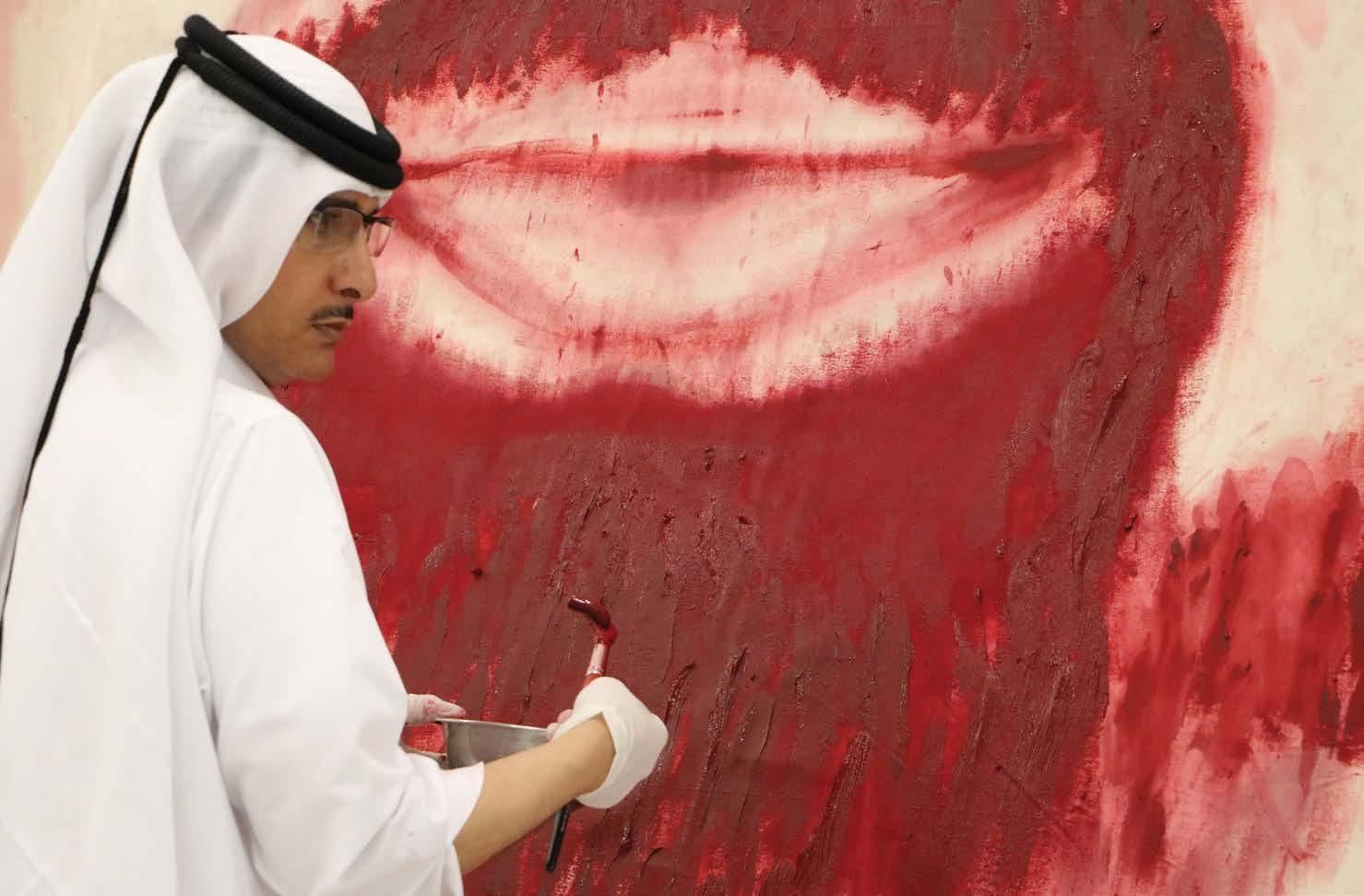
HE Shaikh Dr Hassan bin Mohammed bin Ali Al Thani
HIlH Count Bertram zu Castell-Rüdenhausen
HRH Princess Lelli de Orleans e Bragança
HRH Princess Sibylle of Prussia
HRH Princess Sophie of Romania
HRH Prince Rostislav Rostislavovich Romanov
HSH Princess Ede Sapieha-Różańska
Maharajkumari Princess Vidita Singh of Barwani
HRH Duchess Diane of Württemberg
HE Shaikh Rashid bin Khalifa Al Khalifa
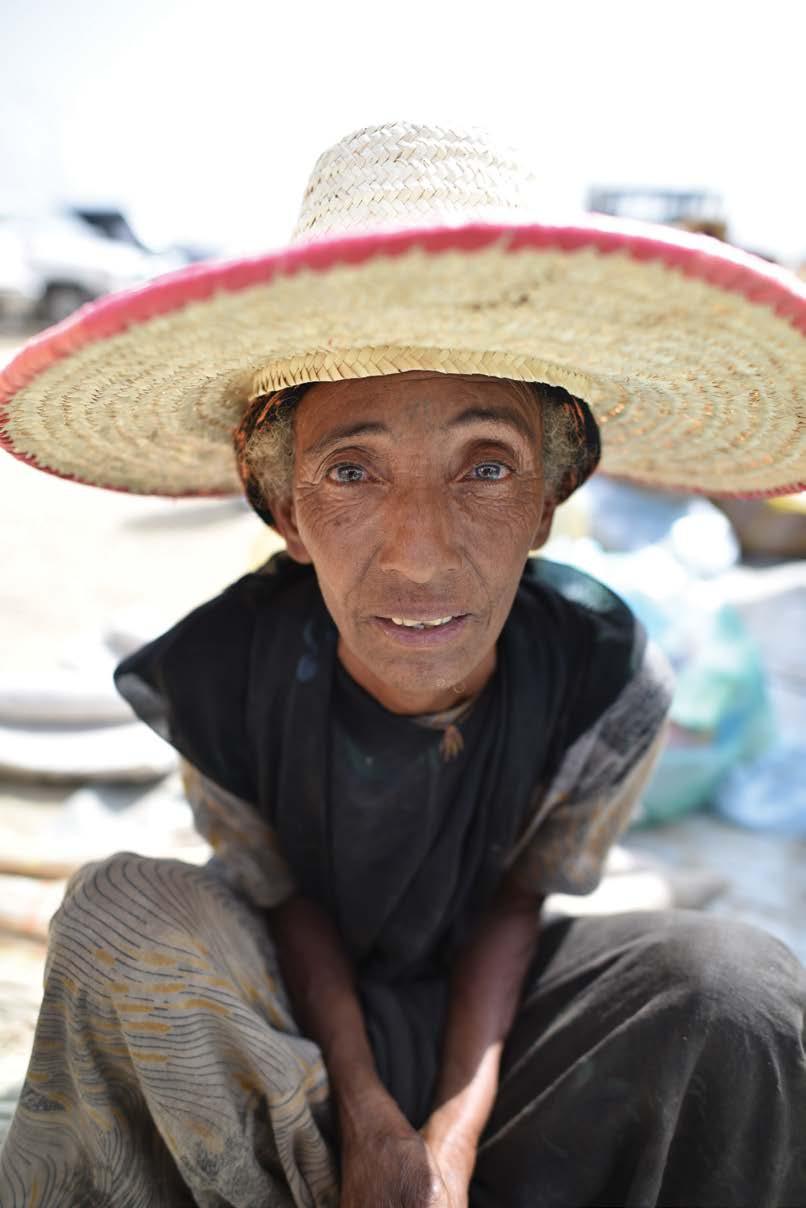
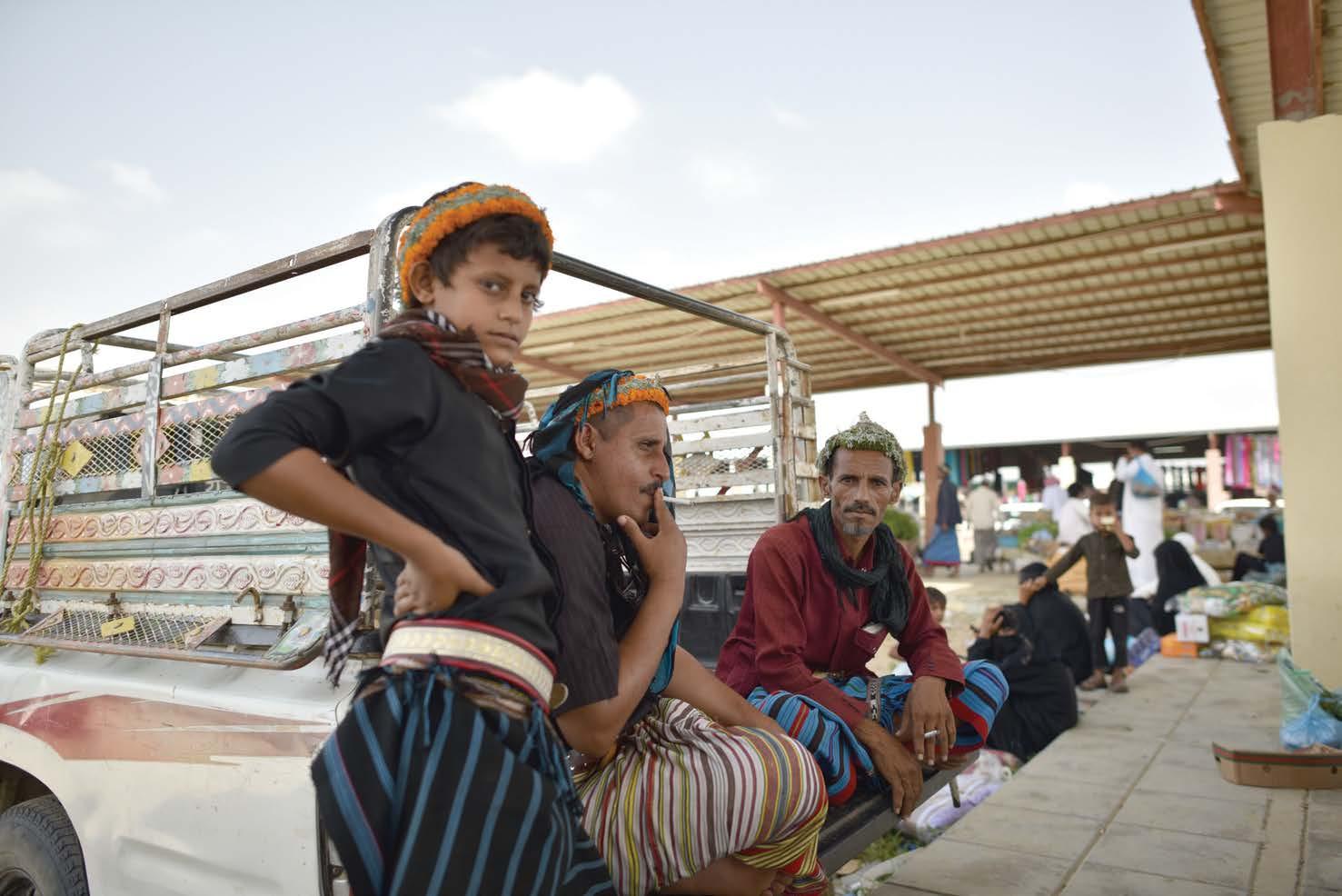
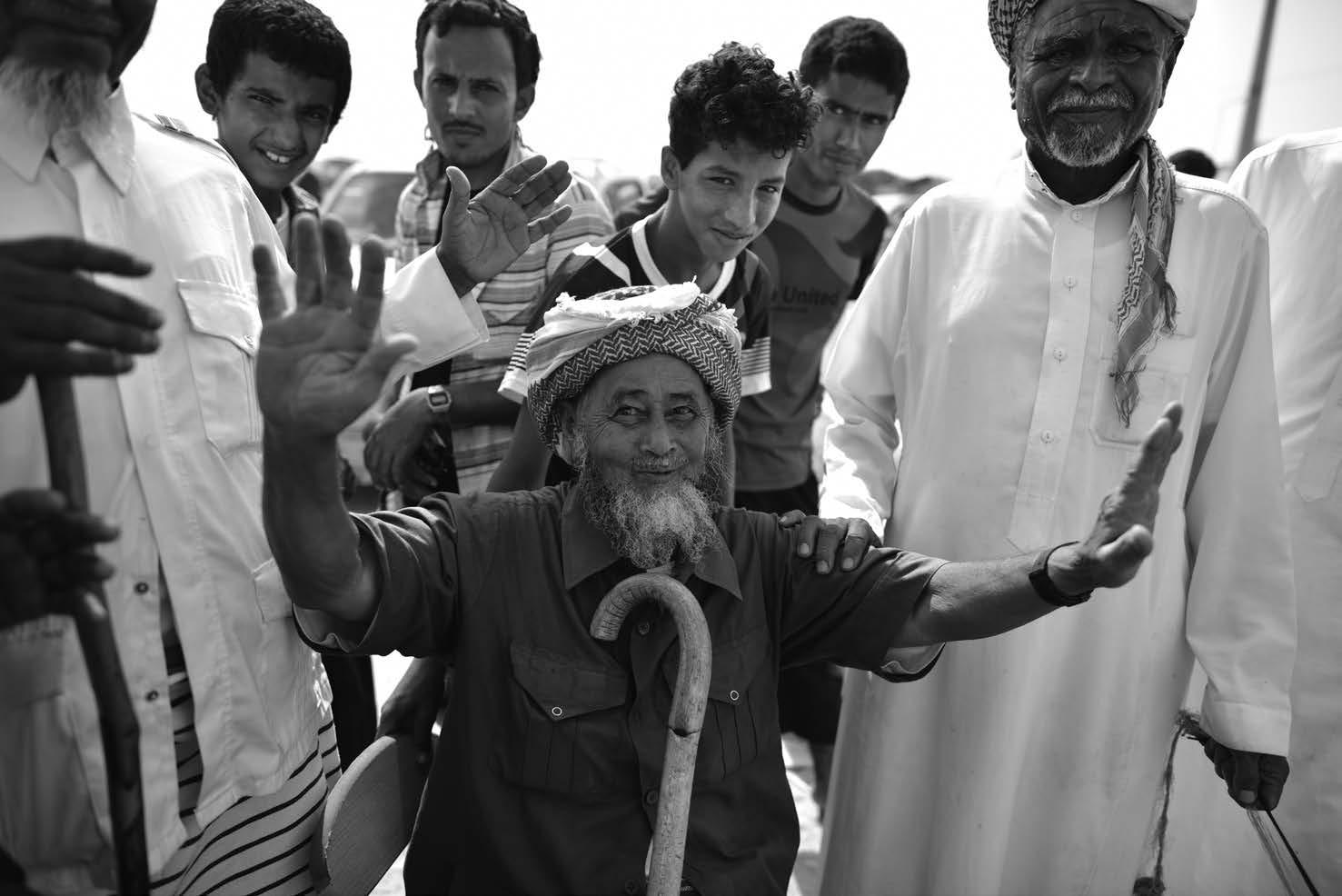
Reem Al Faisal Al Saud
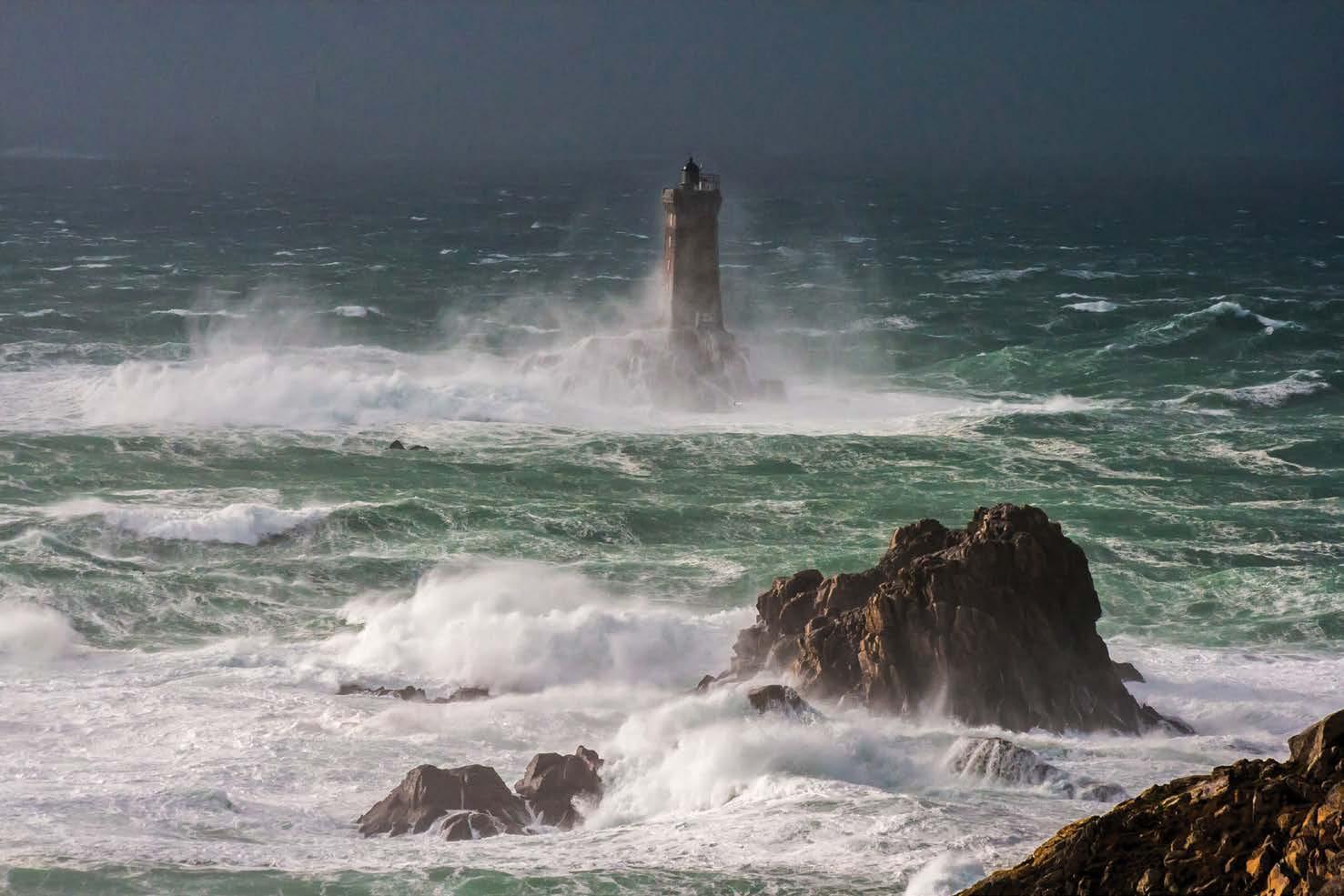
Souk Ahrid, 2016
Photograph
I am a Fine art and social- documentary photographer, political journalist, gallery owner in Dubai, and I will be opening soon a new art & photography Museum in Jeddah, Saudi Arabia where I was born. I have always enjoyed photography, and with my parents support I left my studies in Arabic literature at King Abdul Aziz University Jeddah, to attend Spéos a photography school in Paris.
I am the granddaughter of the late King Faisal Bin Abdul Aziz Al Saud, he also travelled to many places around the world to take pictures from a “stranger’s perspective”. Photography was a hobby and I was always taking pictures but never looked at the issue as something important in my life. Now, it is the most important thing in my life. My attachment to the camera goes back to 1992, when I held my first exhibition in Paris about Jeddah, the Saudi city in which I was raised. In a touring exhibition between 1996 and 1999, this series of black and white photographs of the Port of Jeddah was exhibited in France, China, Saudi Arabia, and Egypt. Unique as it was, this set of photographs set me apart from my generation of female photographers. Looking deeply into the architectural forms of the port and the people it challenged many people’s perspective of Saudi Arabia and female artists.
I was commissioned by my aunt, Princess Haifa, wife of then Saudi Ambassador to the US, Prince Bandar Bin Sultan, to take pictures of Saudi Arabia for a calendar. I went to Jeddah Port and became not only the first photographer to enter the port, but also the first woman. The project was so successful that the calendar became a collector’s item.
I took a courageous decision to take pictures of Haj — the annual ritual by Muslims from around the world in Makkah. It took me three years to complete the project; before, after and during Haj seasons during the years 1999 and 2003. Haj is a world of its own. Even if you have some 100,000 photographers, who could take 1,000 years to take pictures, each one of them would come out with something different. Previous pictures of Haj were more limited and traditional. I tried to show the artistic side of Haj, and let it speak for itself as a human motion and not just an Islamic one.
These photographs of Haj are the platform to what I hold most dear, and it was during Haj pebbles were thrown at me by some people at a time pilgrims were heading from Mount Arafat to Muzdalifah and who actually told me that photography is haram (sinful). Thank God they were small stones, I have faced people who cursed me and I have faced people who wanted to hit me. I have been taking pictures in Saudi Arabia for nearly 10 years so I know how to take care of myself. I always have an escort, who would at least block people and give me a chance to run away. I have kept my palette to black and white as I feel it is the highest level of photography, and it gives you depth and symbolism that don’t exist with colour pictures. Also, I keep reminding people, it is not black and white. It is different degrees of grey. It has a deeper philosophy which is that life itself has degrees of grey.
I like to define myself as a Muslim artist, sprung from my native Saudi culture and history. In my art I am seeking to show signs of the Divine in nature and in Man. For me, light is one of the many manifestations of God. Which He casts in our path through life to remind us of His constant presence in ourselves and in every place. Every photograph is a pattern of light and shade. For me, my photography is a way to praise God’s glory in the universe.
I reconcile my identity and traditions with modernity in a new vision. In our modern culture, we have been trained to focus upon the physical we see through our mind, will and emotions, but there’s a spiritual dimension which is expressed through beauty and creativity and this is what I try to achieve myself and to show through my work I’m not a planned-career kind of person, I’m simply an art lover in general and photography in particular.
Reem Al Faisal Al Saud, 2016 Kingdom of Saudi Arabia
BRIDGES: Convergence
Reem Al Faisal Al Saud
Souk Ahrid, 2016
Photograph
Reem Al Faisal Al Saud
Souk Ahrid, 2016
Photograph
Photography was a hobby and she was always taking pictures but never looked at the issues surrounding her hobby as something that would constrain her ability. Now, photography is the most important thing in her life. Her attachment to the camera goes back to 1992, when she held her first exhibition in Paris about Jeddah, the Saudi city in which she was raised. In a touring exhibition between 1996 and 1999, this series of black and white photographs of the Port of Jeddah was exhibited in France, China, Saudi Arabia, and Egypt. Unique as it was, this set of photographs set her apart from her generation of female photographers. Looking deeply into the architectural forms of the port and the people it challenged many people’s perspective of Saudi Arabia and female artists.
Reem Al Faisal Al Saud
House of Saud b. Jeddah, Saudi Arabia
EDUCATION
King Abdul Aziz University, Jeddah, SA Speos Schoo, Paris, France
2013 Opening of the Cube Arts Gallery in Dubai, UAE
2012 Reem Al Faisal is Chairperson of the NAAM Foundation (NGO)
2008 Opening of the gallery The Empty Quarter in Dubai, UAE
EXHIBITIONS
2014 FotoFest, Contemporary Arab Photography, Houston, Texas, USA
The Middle East Revealed: A Female Perspective, Howard Greenberg Gallery, New York, USA
2012 Reem Al Faisal Photography, Le Violon Bleu, Tunis, Tunisia
2008 The Shape of Light, Sony Gallery, Le Caire, Égypte
Edge of Arabia, the Brunel Gallery, Londres, Royaume Uni Together, Jordan National Gallery, Amman
Nour/Lumière, Galerie Montcalm, Gatineau, Canada
2007 Images from the Arab World, National Museum of Singapore
2006
La Présence Divine, DIFC Center, Dubai, Émirats Arabes Unis
Regards des photographes arabes contemporains,
Centro Andaluz De Arte Contemporaneo, Séville, Espagne
Nazar, IFA Gallery, Stuttgart, Allemagne
Hajj and People, King Andul Azize University, Jeddah, Arabie Saoudite
2005-2006
Regards des photographes arabes contemporains,
Institut du Monde Arabe, Paris, France
2005 Palais des Congrés, Madrid, Espagne: Couleurs d’Arabie Saoudite
Galerie Agathe Gaillard, Paris, France: Hajj
2004 Women by Women, Fotografie Forum International, Frankfurt, Allemagne
Reflets d’ici ET d’ailleurs, Lille, France
Nazar, Noorderlicht Photo Festival, Groningen, Pays-Bas
2003 Exposition au Festival d’Avignon, France
Galerie Agathe Gaillard, Paris, France: La Présence Divine
2002 Centre Culturel Sakakini de Ram Allah, Palestine: Diwan Al Noor
The Peace Centre Bethlehem, Palestine: Diwan Al Noor
(Expostion suspendue)
Rejoint la 2ème Biennale Internationale Media Art à Séoul, Corée
2001 The Art Centre Manama, Bahrain, Royaume de Bahrain: Diwan Al Noor
1999 Mystic Lights, Loccum, Allemagne
Institut du Monde Arabe, Paris, France: Port de Jeddah
Rencontre de Trois Continents, Nantes, France: Port de Jeddah
1998 Université d’Art et de Design, Pékin, Chine: Port of Jeddah
1996 Saudi Art Centre Jeddah, Arabie Saoudite: Port de Jeddah
Sheraton Hotel Medina, Arabie Saoudite: Port de Jeddah
Opéra du Caire, Égypte: Port de Jeddah
1994 Art Vision Gallery, Jeddah, Arabie Saoudite: Paris Literature
2007 Departures Magazine
2006 Dummy Magazine N° 11
2000 L’insensé Magazine N° 1
1999 La Photo Pro
1996 Calendrier de l’ambassade d’Arabie Saoudite aux USA
His Exellency Shaikh Dr Hassan bin Mohammed bin Ali Al Thani
I have always looked upon art – and still do – as the finest expression of human creativity, for it represents the pinnacle of human civilisations. This is why it always gives me a state of continuous vigour, passion and interest, yet it stopped on my part at being just a hobby.
At the time, my family’s opinion - that was within the Qatari traditions of those days - did not welcome that their children take to art, such as performing, singing, playing music…etc. I would practice painting as an expression of distinct subjective emotions, which surfaced later on during my school years, when we studied the art of drawing.
I was encouraged by my art teachers during my school years and got high grades in drawing classes; however, drawing as an educational requirement was enough for me, while art with its diversity remained buried within me due to my family’s reservations.
When I joined the university in the 1980s to study history, I registered in some elective classes, among which were “History of Art in the 20th Century” and “Basics of Painting” taught by artist Youssef Ahmed. This academic course led me later on to a wide realm of arts.
1994 was my real beginning in painting, when I established “The Arab Museum for Modern Arts”. I practiced painting every now and then and I also visited artist Youssef Ahmed in his atelier, where he – out of encouragement –would invite me to sit by his side to paint. I gladly seized the opportunity. He was amazed by the results I’d achieved and he’d say to me ‘How bold you are’.
With the development of the work in the museum, we were joined by the great artist Dia Al-Azzawi, who also motivated me. When we established the “Resident Artist” project, as part of the museum initiatives, we were joined by the great Iraqi artist Ismail Fattah, who taught me sculpture and he gave me important directions and valuable pieces of advice.
I was friends with the great Sudanese artist Ibrahim Al-Salhi, to whom – when he saw my works of art – I disclosed my wish to learn painting. He advised me not to learn – not to limit myself – but to set out as I am to be myself.
Hence, since 1994 up till now, after the passage of 25 years of art, I was lucky enough to have learned and studied at the hands of senior Arab artists. Yet, in spite of being part of artistic life, I’d always be an amateur painter. My experience will always remain – from my point of view, a personal one, although the community sees more to it. In all cases, art – in my view – is a study, practice and a whole life.
Hassan
Bin Mohmmed Al Thani, 2016
BRIDGES: Convergence
Al Thani
Motherland, 2015
Polished steel
125x88 cm
Over the past 20 years, Al Thani produced a rich body of work combining conventional traditional objects with unconventional mediums (feathers, granite, steel). He works with elements of Qatari tradition while applying modern techniques and materials. Al Thani’s Motherland is invested in evoking emotional and cognitive engagement with the viewer by posing the conceptual dualities of dark/light, hard/soft, and literal/abstract.
In Motherland, an active object/viewer relationship is what completes this work. The polished steel creates duplicity that when coming into close proximity of the work gives a distorted, morphed reflection alongside the smooth curves. Stepping back, a full view of Motherland recalls a sense of nostalgia. The idiosyncrasy is created through the exaggeration of both material and scale, as though suspended in time.
The fold in the batoola is also a reference to when women lift their batoola’s up to drink tea, and conveys the softness of the fabric.
The batoola holds a particular significance to the artist, as its associated with the mother figure common to his childhood and who only took off her decorative headpiece before bed. Becoming part of tradition, it was also common for married women to wear the batoola in order to shield from the sun, or to whiten the face. The whitening is due to the indigo grinded into the fabric, giving its peacock like shine. The three dashes of colour in Motherland are a reference to the colours of the batoola. The integration of traditional Qatari objects with strong female nuances in three-dimensional artworks has become unique to Al Thani’s oeuvre.
I work with elements of Qatari traditional objects whilst applying modern techniques and materials. “Motherland” the sculpture I am showing for this exhibition is a “batoola,” a decorative headpiece commonly worn by married women as sun protection or to whiten the face.
Made from polished steel and exaggerated in size, “Motherland” is invested in evoking emotional and cognitive engagement with the viewer by posing the conceptual dualities of dark/light, hard/soft, and literal/abstract. It creates duplicity that when coming into close proximity of the work gives a distorted, morphed reflection alongside the smooth curves.
The fold in the batoola is also a reference to when women lift their batoola’s up to drink tea, and conveys the softness of the fabric whist the three dashes of colours are a reference to the colours of the batoola. - Maryam Al-Thani
Hassan bin Mohammed bin Ali
His Exellency Shaikh Dr Hassan bin Mohammed bin Ali Al Thani
Tête-à-tête: HE Shaikh Dr Hassan bin Mohammed bin Ali Al Thani
Describe your atelier.
The current studio is actually my third in my journey with Art (painting and sculpting), And its not a private place in fact I made sure it has the versatility to share with my fellow artists and friends, which ensures a continuous dialogue. It caters for diverse forms of art and I ensured that it has a high ceiling, storage, relaxation area, dining, and a garden as the color green is important to the artist eyes to relax.
What would be the ideal sculptor’s atelier?
The idea determines the execution and therefore the tools required to execute, with my new work I am using granite, and that’s why I work sometime in Egypt due to the availability of the material, as for bronze casting I commission through international foundries.
What elements were important to you in designing the atelier?
Positive energy is an important element in designing a studio, as it provides the artist with a relaxed environment, also lightening is essential in a studio. And climate that is suited for the artwork.
How does living in Doha influence your work?
The simplicity of the architecture of the coastal city of Doha was essential source of inspiration in my work. It had major influence on my abstract work.
How does the surrounding environment influence your work?
The Qatari Peninsula (desert and sea), share a common greyness in its landscape, and that is visible in many of paintings.
Did your upbringing influence your work?
Despite being raised in an environment that had an appreciation to art, as children we were not encouraged to practice it, however growing up with paintings and sculptures in my house played an important role in my appreciation and understanding of the art.
When did you make your first sculpture?
2000.
What style of art would you classify your work?
I am diverse, I do find myself closed to abstract, and expressionism.
What other forms of creativity do you like, other than sculpture?
I am drawn to all forms of art, painting and photography. The initial idea always determine the form of art that is best to deliver my ideas.
What accomplishments are you most proud of in your fine-art career?
Probably Modern Arab Art Museum “ Mathaf” which is now part of Qatar Foundation, it was my dream to put all forms of Arab modern art under one roof. And to inspire public to appreciate Arab Global contribution to Art.
Where do you take people when they come to visit you?
My Studio (Qatar Art Centre)
What is coming next for you?
In the Art world: very hard to know what is next, it is not a field that you can plan ahead for, however right now I am working on large granite sculptures.
Throughout his artistic career Hassan Al Thani has worked with a variety of mediums, not constricted to a particular style. Encouraged by fellow artist friends, Yousef Ahmed and Dia Azzawi, Al Thani started painting without a formal art education. His primary experimentation with painting started in 1994, then quickly progressing to creating his own style and character. His studio inadvertently turned into artist in residence in 1995, which lead to greater artistic involvement and collaborations with artists. This created a space of artistic exchange that was nonexistent in Qatar at the time. Works produced in the mid to late 90s became part of a series later known as the black period. Al Thani painted essentially in an abstract impressionist style textured by multiple layers of paint, which were all painted on a black background. New York I and II is typical of these paintings. Depending on the desired roughness he would paint on wood panels, as well as raw canvas.
Hassan bin MoHaMMed bin ali al THani
House of Thani
b. 1960, Doha, Qatar
EDUCATION
Ain Shams University, Cairo, Egypt
Qatar University, Doha, Qatar
FOUNDER OF:
1996 Modern Arab Art Museum (Mat’haf), Qatar
Oriental Artist Museum, Qatar
1993 Weaponry Museum, Qatar
1989 Arab and Islamic Heritage Library
Qatar Art Centre
Hassan bin Mohammed Centre for Historical Studies
Advisor of Cultural Affairs
Qatar Foundation For Education, Science and Community Development
OTHER DESIGNATIONS
2015 to Current Board Member for Qatar National Library
Location: Qatar Foundation
1988 to Current
Historical Researcher at the Department of Documents and Research at the Amiri Office
Location: Diwan Amiri
ACTIVE MEMBER OF THE FOLLOWING GROUPS
Honorary Chairman for GGC Artist Group
Member of the Gulf Historian Committee
Honorary Chairman for Qatari Photographers Group
Honorary Chairperson Friends of Environment
ORGANISED AND SUPERVISED ART EVENTS
2006 Exhibition: A Vision of Yemen, Paris Photographs of Yemen by Hassan Al-Thani, Book published by SKIRA
2006 Exhibition on March 2006 in Paris, France
2004 Exhibition: Oriental Painters, Doha Lecture on “the Museums of Qatar at Louver museum” in Paris to be delivered on the occasion of the “Islamic Art
2004 Exhibition: Arab & Islamic Art at the Museum of Applied Arts, Frankfurt, Germany
2003 Exhibition: Arabesque’s Art, Doha
2000 Exhibition: One Hundred Year of Arab Modern Art, Al Sharjah Lecture on “the History of Arabian Art”
PUBLIC ART PROJECT
2015 Yemen Cube 2015. Art Installation, Mat’haf Arab Museum of Modern Art, Qatar
2008 Malwiya 2008. 12 metre Bronze Sculpture – Carnegie Melon University School of Business Studies, Qatar
OTHER ACHIEVEMENTS
Carried out research for a number of years on Modern Arab art in various countries
Produced ten volumes of Photographic collections consisting of various Arab and African countries
Publish extensive collection of literature and photographic publications on Yemen Historical and architectural sites
Produced an additional collection on the manifestation of Yemeni Social Life
PUBLICATIONS
Introduction: Catalogue for the “Arab Museum of Modern Art” (5 volumes), relating the history of the Arab Art by retracing the roots and inspirations that lead to the actual Arabic Modern Art
Compilation and Reprint: Richard Temple’s views from the Gulf (British Naval officer who took important drawings during their campaign to combat the piracy in the Arabian Gulf Sea in 19th century. The book is the pictorial narration of their mission from Bombay to the Arabian Gulf)
Reprint: 17th century Ottoman historical map of the Gulf
Compilation and Reprint: “Majmua’ al-Fadhail fiy fan al-nasab wa tarikh al-qaba’il”, by Rashid bin Fadhil al-bin-Ali, 2000 (The Arab Gulf Genealogy – Al-bin-ali, Sulaim, and al-Maadhid tribes)
Compilation and Reprint: “Sabaiq al-asjad”, by Othman bin Sanad, 2006 (The history of Ahmed bin Rizq)
ROYAL BRIDGES: Convergence
Bertram Castell untitled, 2015
100x100 cm
Tempera on Canvas
Exhibiting since the late 1960’s, I have developed my technique, looking more towards Abstract Expressionism and Art Informell rather than Austrian post-war avant-garde and Viennese Action art. The youngest generation, not burdened with historical context, expressed traditional subject matter by new modern means and media. My work has a fluidity to its brush strokes, a sense of the craftsmanship, which I gained through wood carving. Born in 1932 in Coburg, Germany, I grew up in a feudal, Protestant family. After sporadically attending school, I was educated as a wood-carver, building fitter, and grain merchant. For four years, I served as a Federal Border Guard (Bundesgrenzschutzbeamter), followed by work as a salesman for beauty care and hygiene products, as an ice cream vendor, and a bookseller.
However, it was in the early 1960’s that I moved to Vienna, Austria, and enrolled at the Academy of Fine Arts (Akademie der Bildenden Künste) to study painting in Herbert Boeckl’s master class. Herbert Boeckl was a great inspiration to me, as his colleague Fritz Wotruba discussed in 1964, “[He] was distinguished amongst many others by a talent that triumphed over a huge body in which there beat a very timorous heart. In no other painter have I found the solemn, gloomy freedom which marks the pictures painted in his youth. Here are strong, violent emotions that have tempted, distressed and tormented Herbert Boeckl throughout his life. His ready willingness to accept suffering and mental anguish enabled him to paint with great sensitivity. If this man and painter, who is one of utmost emotional sensibility, can get through a life full of work and overly full of disappointments, then there must be secret powers that keep him going.” Boeckl lifted Austrian painting out of the stagnation of Expressionism and with his late work liberated it from the provinciality imposed upon it by the Corporate State (Ständestaat) of the 30´s and National Socialism.
For me the basic possibility of pictorial interaction with landscape is the key to interpreting my drawings and paintings. Landscapes are dealt with by means of graphic structures, rhythms, and tension-filled gestures of the informal in a spontaneous, generous process and a highly individual interpretation of experiencing nature. It is parallel impressions of nature obeying their own laws. This process of absorbing nature takes place in the studio, not in nature itself. Undergoing many efforts, struggles, and reflections the result is my own claim to an individual rendition of nature. “Without painting I am nothing“.
Since 1965 I have been working as a freelance artist, graphic designer, art director, creative director, and occasionally as a bartender and decorator. I am a member of several artists groups, including Künstlergruppe Parz, Salzburger Kunstverein, Oberösterreichischer Kunstverein, and Kunstverein Coburg. I still remember the first exhibitions I saw after World War II; they were full of expressionist and abstract works which made me realise that I wanted to be a painter. I continue to work to keep my passion alive and to keep creating new and diverse works that challenge me. As Boeckl said, “The painter has the good fortune of practising a silent art - an art without ostentation. There is quite enough ostentation already.” I continue to live and work in Vienna and Lower Austria.
Graf Castell, 2016 Vienna Austria
His Illustrious Highness Count Bertram zu Castell-Rüdenhausen
Bertram Castell
Untitled, 2015
100x100 cm
Tempera on Canvas
Abstractions of colour develop across the canvas with strong brushstrokes Count Bertram zu Castell-Rüdenhaussen creates a descriptive language which draws the viewer into the painting. As with many artists, the effect of World War II was great, it created a disruption in the work of artists, an imbalance which they had not felt before and a need to express the anger which they felt. In particular in Austria the movement of Action Art was great, but for Bertram zu Castell-Rüdenhaussen he looked towards Abstract Expressionism and Art Informell. You can see that he is not burdened with historical context, expressing form and movement in the painting with a strength that is very provocative. However we have to remember that this post war group of artists had witnessed the destruction of the old artistic order wherein art movements represented a clear concept of form or content and were supported by an ideology. As described by Andre Malraux the “twilight of the absolute” gave way for other artists to come forward, to express their ideas and bring a new ideology a new set of rules to the forefront. Within this work we see these two worlds colliding, the knowledge that Bertram learnt during his wood working and as a Bundesgrenzschutzbeamter (border guard), control and form combine with light and colour, an explosion on the canvas that is fascinating to watch.
ROYAL BRIDGES: Convergence
His Illustrious Highness Count Bertram zu Castell-Rüdenhausen
Tête-à-tête: HIIH Count Bertram zu Castell-Rudenhausen
What does painting mean to you?
Departing from matter and objects by itself into the realm of shapes and forms.
Which artists do you admire and why?
Group Cobra, Pierre Alechinsky, Karel Appel, Jackson Pollock, Willem de Kooning, Daniel Richter, Hermann Nitsch, Arnulf Rainer. All of them abstract and modernist artists just like me.
What are the main inspirations and influences regarding your art work?
Nature and my history as a person, that is, my place in society and nature as a whole.
What was your career path?
For me it was a path from the formal, the representational into a more information development of my artistic will.
Describe your atelier.
My atelier is an old cowhouse made out of granite stones, some columns and the barn itself. There is natural but also artificial lighting. The atelier lies beside the wooden house in the middle of the forest which I inhabit together with my wife. There I find peace.
Describe the environment surrounding your atelier.
Solitude and peace, truly in the midst of wilderness. It is the forest that provide my surroundings with music and colours.
What draws you to paint landscapes?
Inspiration began through a great-aunt who herself was an impressionist landscape painter.
My mother was Princess Caroline Mathilde of Saxe-Coburg and Gotha; during my childhood we spent a lot of time in the Fortress of Coburg (Veste) which was inhabited by grand-father, the last reigning Duke of Saxe-Coburg and Gotha, Carl Eduard. Colossal portraits hung on the large fortress walls. Those were my first observations in painting, drawing; particularly door motifs, portrayals of landscapes, castles, knights, horses, and so forth.
Does the environment influence your work?
Of course it does, it is this interaction with the outside world that gives my work its meaning. The substance of my work comes from my perceptions of what is around me. Experiencing nature and bringing those feelings to life on canvas.
How do you describe the style of your work?
My work is mainly informal and abstract.
What is your proudest accomplishment as an artist?
My artistic prowess and perceptions. These two elements show that I have been a true artist to myself.
Finally, what are your future goals?
To step in my grave holding a brush in my hands.
Exhibiting since the late 1960’s HIIH Count Bertram zu Castell-Rüdenhausen developed his technique, looking more towards Abstract Expressionism and Art Informell rather than Austrian post-war avant-garde and Viennese Action art. The youngest generation, not burdened with historical context, expressed traditional subject matter by new modern means and media. His work has a fluidity to its brush strokes, a sense of the craftsmanship, which he gained through wood carving. Born in 1932 in Coburg, Germany, he grew up in a feudal, Protestant family. After sporadically attending school, he was educated as a wood-carver, building fitter, and grain merchant. For four years he served as a Federal Border Guard, finally dedicating his life to art.
Bertram Castell
House of Castell b. 1932, Coburg, Germany
EDUCATION
Academy of Fine Arts (Akademie der Bildenden Künste)
SOLO EXHIBITIONS
2014 Tracing, Weinberger Waldschloss Vienna Allium, NE
1981 Austrian Donau Festival, Greinburg, NE International Textile, Performance and Actions, Schloss Parz
1980 Contacts 80, Plot The District Museum, Vienna
1979 Ambient Temperaments, Plot
1978 The Circle Kulturzentrum Mattersburg and Castle Potzneusiedl, Stubenbastei Vienna, Contacts 78, Plot
1977 Plot, Gallery ORF Linz
1976 Plot, Künstlerhaus Graz Plot, Dortmund 30 Years Circle
1975 Colour and Volume, Plot
1974 The Circle, Künstlerhaus Wien Contacts 74, Plot gallery
Porcia, Spittal Contemporary Art in Austria
1973 The Circle Künstlerhaus Vienna upper Austrian Art Association, Neue Galerie Linz
1972 Parzer Contacts, Plot upper Austria Reischer Kunstverein Castle Museum
1971 Gallery Passages Vienna Austrian Art Centre
Mahlerstrasse, Vienna Steirischer Herbst, Graz
The Circle, Künstlerhaus Wien
1970 Guilders Gallery , Wels Forum Stadtpark, Graz Kammerhofgalerie, Gmunden
1969 Parzer Accents, Gallery Stubenbastei, Wien The circle, Künstlerhaus Wien
PUBLIC ACQUISITIONS
Grafische Sammlung Albertina; Österreichische Nationalbank; Oberösterreichische Landesregierung; Neue Galerie Linz; Lentos; Joanneum Graz; Bundesministerium für Unterricht und Kunst, Wien; Niederösterreichisches Landesmuseum
House Castell: www.castell.de
Wikipedia: Castell-Rüdenhausen
Lelli de Orleans e Bragança
rAin ForeSt, 2015
100x120 cm
Acrylic on Canvas
A serene view of the bay of Rio de Janeiro, barely touched by man, an exuberant tropical forest in countless shades of green, at once detailed and misty, the touch of a butterfly... always. These are the details that catch the eye in my paintings. My paintings are windows to the natural beauty of the tropics, observed through my unique perspective. I always strive to reveal perfectionism in my art. A timeless style, tending more towards Impressionism than Realism. The views are mostly of pristine natural settings, where exotic birds and butterflies are the main animal subjects, man rarely disturbs the peace. A daily need for peace and beauty is the driving force behind my aesthetic quest. When I’m painting, my aim is to create a haven of peace and tranquillity. While that is my main goal, my landscapes don’t reveal everything at first glance, one has to let the eye wander and explore in order to find the hidden details. Some expanses of my canvases verge on the abstract, sublime pale hues in multiple layers, but I am a figurative painter at heart.
Delicate brushstrokes of paint bring lush and often mysterious scenery to life on canvas, one can almost feel the sea breeze rustling in the palm trees, the soft mist enveloping the forest. Magical openings to the infinite worlds of nature, wide angles that can lead the eye to infinite horizons, or bring it into the infinitely tiny leafy microcosm inhabited by colourful tropical insects. Her birds are outstanding, flying through the forest or across a sunlit bay, perched on tree limbs or on balconies, they practically burst out of the canvas in their rich, luxuriant plumage, eyeing the view attentively. Needless to say, I am a firm believer in protecting the environment and wildlife. A nature lover by birth, my ancestor, the Empress Leopoldina, a Hapsburg princess married to Pedro I of Brazil, was fascinated by natural history and brought a biology professor with her entourage when she came to live in Rio de Janeiro. The family passion for horse riding also runs in my blood and has taken me on trails far and wide, from Machu Picchu in the highlands of Peru, to the hills of Tuscany. I have also covered long stretches of my country’s interior, an endless source of inspiration for my work. Scuba diving is another sport that has taken me across the globe, from Bora Bora to the Caribbean, though I particularly love to explore the aquamarine waters of Angra dos Reis and visit the whale sanctuary of Atol das Rocas in my native land.
My father’s side of the family descends from the kings of France while my mother was a Bavarian princess. I have eleven brothers and sisters, the four eldest were born in France, I am the youngest of the seven born in Brazil. I spent my early childhood at the family estate in Jundiaí do Sul, in the state of Paraná. It was in the bucolic climate of these southern farmlands that my parents, Prince Pedro Henrique de Orleans e Bragança and Princess Maria da Baviera de Orleans e Bragança, first introduced me to paints and brushes, and where I developed my artistic skills under the watchful eye of my father, a gifted water-colourist. My mother preferred to paint on porcelain, her minute detailed renderings of XIXth century scenes of Botafogo bay in sepia are exquisite, and a cherished influence in her daughter’s work. I am also influenced by other artists such as Albert Eckhout (c. 1610-1650) who was one of the first painters to the New World, having been taken there by John Maurice Prince of Nassau-Siegen. His paintings are an anthropological experience into Dutch Brazil. On the same voyage was Franz Post (1612-1680) his paintings of the Brazilian landscape start off being very true and then one his return to the Netherlands he introduces more exotic elements and an increased number of people, however these representations are of slaves in groups. Alongside these to seventeenth century artists were two traveling artists who came to Brazil with the Portuguese court in 1808, Debret, Rugendas and Faccineti.
After graduating in design in Brazil, I went on to finish my studies at the renowned Van der Kelen art school in Belgium. There I perfected my style and learned the “trompe l’oeil” technique, acquiring detailed knowledge of perspective and the depiction of marble, stone and wood on canvas. I continued to paint in Europe for many years before returning to Rio de Janeiro and starting to paint its scenery in 1995. My work has been very well received and the success took it abroad to exhibitions in Portugal, France, Belgium and Germany. I am an artist whose talent is devoted to showing the enchanted, exotic tropical scenery of Brazil all over the world.
Brazil
BRIDGES: Convergence
Lelli de Orleans e Bragança, 2016
Her Royal Highness Princess Lelli de Orleans e Bragança
Lelli de Orleans e Bragança
SMall river, 2015
120x100 cm
Acrylic on Canvas
A serene view of a small river meandering through the rain forest, blue Morpho Peleides butterflies flutter in the foreground and in the distance you can see the red of the Tupi birds flying up the river. Amazonian plants, Acai Palm, Orchids, Copernicia prunifera, and Heliconia, are painted with a strong understanding of botany; we see the epiphytes hanging from the established trees allowing Princess Lelli de Orleans e Bragança to bring in a fluid line of lighter foliage. These complex layers of greenery have been formed to create a trompe l’oiel, however there is a magical quality to the painting, an almost unearthly mysticism which does not allow us to preserve it as photographic. It has the delicate touch of a painter.
The general style of the painting is based on Impressionism, rather than Realism, it benefits from the complex use of green shades and evergreen forms. From the first artists brought to Brazil in the seventeenth century by Prince John Maurice of Nassau-Siegen, we can see their influence in Lelli de Orleans e Bragança’s work, in particular the detail of the fauna and flora. There is a true botanist’s viewpoint that she has taken to create these delicate scenes which transcend multiple techniques and centuries.
ROYAL BRIDGES: Convergence
ROYAL BRIDGES: Convergence
Her Royal Highness
Princess Lelli de Orleans e Bragança
Tête-à-tête:
HRH Princess Lelli de Orleans e Bragança
What do you love about the process of painting and drawing?
Drawing is a challenge. Painting is a pleasure. I love painting. I feel nature, feel the hand of God, and feel peace. I feel good whilst I paint.
Which artists do you admire and why?
I admire the century seventeenth and eighteenth century artists, mainly the painters who came to Brasil, like Debret, Fachinetti, Frans Post, Eckout…and specially Rugendas, who felt nature like I believe I feel now.
Describe your atelier.
My atelier is at home, what makes my life easier. It is well ventilated, very clear and light, with white walls and white floor.
Describe the environment surrounding your atelier.
My atelier has a garden with orchids and palm trees. I can hear and watch birds which I feed. I have a parrot called Zé, he is always around me speaking and watching everything: makes me happy!
Does the environment influence your work?
I’m very influenced by the environment, especially the landscapes of my trips to Mata Atlantica where I frequently go and it is dear to my heart.
Can you tell us a bit why trompe l’oeil interests you?
I get fascinated by the effects of the volume and depth given by the light and the shadow, the white and the black.
What is your approach when you begin work on a new painting or series?
I believe there is a special shine, coming from a special light, given by a natural mist, showing me how to begin a new painting.
What do you want your audience to experience when they see your work?
With my painting I want to invite the audience to come inside the paintings, to feel nature itself.
What is your proudest accomplishment as an artist?
Each work I finish makes me so happy and fulfilled. It is the moment when I realise I have completed the painting to the standard that I want that gives me a true sense of accomplishment.
Finally, what’s next for you?
Keep going and painting.
A serene view of the bay of Rio de Janeiro, barely touched by man, an exuberant tropical forest in countless shades of green, at once detailed and misty, the touch of a butterfly... always. These are the details that catch the eye in her paintings, they are windows to the natural beauty of the tropics, observed through her unique perspective. The views are mostly of pristine natural settings, where exotic birds and butterflies are the main animal subjects, man rarely disturbs the peace. A daily need for peace and beauty is the driving force behind her aesthetic quest. When she is painting, her aim is to create a haven of peace and tranquillity. While that is the main goal, her landscapes don’t reveal everything at first glance, one has to let the eye wander and explore in order to find the hidden details. Some expanses of the canvases verge on the abstract, sublime pale hues in multiple layers.
Lelli de Orleans e Bragança
Imperial House of Brazil b. 1957, Rio de Janeiro, Brazil
EDUCATION
1984/85 Van des Kellen Art Institute (Gold Medal Prize), Brussels. 1978/82 Catholic University, BA in Visual Communication, Rio de Janeiro - Brazil
EXHIBITIONS
2016 ARTEFATO Brasil
2015 ARTHUS GALLERY, Brussels, Belgium
2011 ARTHUS GALLERY, Brussels, Belgium
2010 URS von UNGER Gallery, Gstaad, Suiça
2007 ARTHUS GALLERY Brussels, Belgium
2005 Bait Muzna Gallery, Muscat, Sultanate of Oman
2000 Galerie der Erwin-von- Kreibig-Stiftung, Scholss Nympenburg, Germany
2000 Galeria A Janela Verde, Lisbon, Portugal
1996 Casa Cor, Rio de Janeiro, Brazil
1995 Mairie du 7ème, Paris, France
1994 Galeria A Janela Verde, Lisbon, Portugal
1994 Camon, France
COMMISSIONED ART
Decorative Wallpaintings
Park Pavillion, Beloeil Castle, Belgium
São Fernando Plantation, Vassouras, RJ, Brazil
Castelo Plantion, Jaguariuna, SP, Brazil Regensburg Castle, Germany
Aguas Claras Plantation, São José do Rio Preto, RJ, Brazil Quinta Estate, Colares, Sintra, Portugal
Private Residences
Vittorio Veneto and Capri, Italy
New York and Philadelphia, USA Munich and Strarnbergersee, Germany London, England
Paintings in Private Collections
Belgium, Luxemburg, Portugal, Italy, France, England, Spain Brazil, USA and Morocco
Website: www.lelliobraganca.com
ROYAL BRIDGES: Convergence
Sibylle von Preussen monbijou, 2015/2016
122 x86 cm
Papercut with textile on paper
Her Royal Highness Princess Sibylle of Prussia
It was a beautiful summer day, when the ceiling of my studio in the Barockhaus at Checkpoint Charlie in BerlinFriedrichstraße collapsed due to never ending remodelling works in the centuries-old building. This terrible event destroyed nearly all my paintings from the pure minimalist colourfield (“colorscapes”) - series that I had developed during my three-year stay in New York that was highly respected and led to international solo-exhibitions and to grants.
In the middle of an intense period of mourning and bitterness I decided to destroy the rest of the canvasses totally not to see them anymore. But instead of disposing I suddenly and unexpectedly started to cut out a new series of works of the various canvas remains: huge and small hares accompanied by foxes, parrots or horses all framed and adorned by a latticed fabric of laurels, of flowers, trees or filigree vines in a Rococo style. In summer 2008 the paper- or canvas-cut was born as my new technique to paint with scissors - as Henri Matisse already said.
This development was surprising. And I realized I drew the inspiration for the imaginative motifs from the ornamentation and murals of Sanssouci Palace. Immediately after I called my husband, Friedrich Wilhelm Prinz von Preußen, who was an important part of this historical knowledge that led to my new art. Due to our detailed studies of Frederick the Great’s history to which Prinz Friedrich Wilhelm as historian and me as artist had published several books (for example: “Die Liebe des Königs/The love of a king” Siedler Verlag/Random House, München, 3rd. Edition 2012), I was very familiar with the formal vocabulary of ornaments and murals in Fredericks summer castle in Potsdam; particularly I was impressed by the fact, that the art and the ornaments in the palace expressed his enlightened attitude towards nature.
The Prussian King Frederick II. (1712 - 1786) - deeply inspired by Voltaire and Isaac Newton - was one of the first greats of Europe who rejected the mechanistic animal view espoused by the French philosopher René Descartes. Descartes developed one of the clearest denials of animal consciousness. He postulated that only humans as “crown of creation” have the capacity to feel and animals are nothing but insensitive automata. For Frederick the Great, however, animals were sensitive beings. As a young Crown prince he introduced the postulate, that our environment, all people, and especially animals, who are often mercilessly delivered, deserve our respect.
Because of its self-conscious representation of animals, the philosophical movement of Enlightenment and the artistic style of Rococo and Late Baroque became a key theme of my work as an artist. As in the past - so in summer 2008 when the ceiling of my studio collapsed - all my works included the idea of dignity inherent in all creation as a poetic dimension. This poetic dimension of openness and hope in my visual work is also made possible by using the Rococo style, which allows a more playful and florid approach to the theme. In particular the Prussian Rococo is ornate and tender and uses light colours and gold and silver; the design is asymmetrical and graceful. In this way playful narrative silhouettes attend to an ethical discourse that reaches beyond the aesthetics. It is, to quote and expand the idea of the art historian Alexandra von Stosch, a sometimes even humorous, enlightened position that in the middle of the adversities or absurdities of life is always aware of the chances of hope.
My work intends an inspiring dialogue between tradition - in my actual work mainly of the 18th century - and 21st century modernity, between carefully composed opulence and pure space, between delicate ornament and minimalism. It combines material, composition and content, ideas of repetition and rhythm, with references to values that have often been disregarded.
Sibylle Prinzessin von Preußen, 2016 Berlin, Germany
BRIDGES: Convergence
Sibylle von Preussen
PUrSUit of haPPineSS, 2015 180x190 cm
Papercut with textile on canvas
Mixed media on paper is often an over looked technique but it has been a prevalent form of art since 1912 and Cubism. The technique was used frequently by Pablo Picasso and Georges Braques but it is with Matisse that we see the use of paper and scissors as his main medium. Princess Sibylle of Prussia has combined this technique with Rococo detailing from the Sanssouci Palace. Conceived by Frederick the Great the palace was based on a concept of harmony between man and nature, this is reflected in the works of Sibylle of Prussia. Rococo motifs focused on the carefree aristocratic life, light-hearted romance, rather than on heroic battles and religious figures. There is also a prevalence towards scenes set in nature, this again suited Frederick’s ideal of nature and design being in complete harmony. Rococo artists used a more jocular, florid, and graceful approach to the Baroque. Their style was ornate and used light colours, asymmetrical designs, curves, and gold.
The selected work is of a hunting group resting under trees with hares jumping in the distance. The use of different coloured papers creates a play on light and shadow. Delicate golden shadows are reflected below the scene as if they sit by water. We also see Frederick the Great’s concept of nature and design in harmony, Sibylle of Prussia has executed these two ideals perfectly in this work, technique and subject matter combine to create a contemporary view of Rococo ideas.
ROYAL BRIDGES: Convergence
ROYAL BRIDGES: Convergence
Her Royal Highness
Princess Sibylle of Prussia
Tête-à-tête: Princess Sibylle of Prussia
How did you start painting, and what got you started with your art?
In my early childhood I formed little figures of clay or I drew animals and plants that surrounded me. Then, as I got older I used a wider range of expressive possibilities and media from dance and playing guitar to oil painting, photography and video. From the ‘80s till the early ‘90s I had the chance to develop and direct an innovative and highly successful video-curriculum at the Berlin University of the Arts. My work is about beauty and its potential in a deep poetical sense, an unexplainable and sensitive part of life and creation.
Which artist do you admire and why?
It could be a carpet of the 15th century or a drawing by a Renaissance artist like Leonardo da Vinci, a composition by Pergolesi or Arvo Pärt, a painting by Jan Vermeer or Antoine Watteau, or by Mark Rothko, Cy Twombly or Gerhard Richter; it could be architecture by Tadao Ando, Herzog & de Meuron or John Pawson that touched me in special periods of my life. It is apparent that my attachment to other artists´ works has always been connected to the theme of sensitivity and beauty in an existential and essential sense.
Describe your atelier.
For the past three years I have lived and worked in a flat that is located in one half of the old top floor of a spacious residential building. The inventor and first aircraft manufacturer, Edmund Rumpler, lived there until 1940.
Describe the environment surrounding your atelier.
The building is situated right beside the lake Lietzensee. The lake is located in Charlottenburg in the middle of the German capital of Berlin. Although in the middle of the old West Berlin, the south side of Lietzensee where my studio is located is a pure and quiet neighborhood with surprising achievements.
Does the environment influence your work?
I appreciate living in the Lietzensee area, where great creative and innovative ideas once were born and still are today. Together with its surrounding parkland, it is a neighborhood for all types of residents but with a relatively high concentration of actors, writers, artists and all kinds of creative people. From my studio I enjoy the view over the lake, the tree crowns in heaven, birds of many kinds twittering, herons, ducklings and swans, the stars at night. Mainly this view creates a feeling of openness, a sense of infinity and gratitude, which is inspiring for my life and my art.
How do you describe your subject matter and style?
Because of its self-conscious representation of animals and nature, the philosophical movement of the Enlightenment and the artistic style of Rococo and Late Baroque became key themes of my work as an artist. As in the past - even in the summer of 2008 when the ceiling of my studio collapsed and I started to do my first cut-outs - all my works have included the idea of dignity inherent in all creation as a poetic dimension. In particular, the Prussian Rococo, ornate and tender it uses light colors, gold and silver, the design is asymmetrical and graceful. My work combines material, composition and content, ideas of repetition and rhythm, with references to essential values of sensitivity and beauty of existence that have often been disregarded.
Your works are immaculately and intricately composed. What is your process?
Naturally, at the beginning of a cutout or any other creative project I don´t know the concrete result of my work. At the beginning there is an idea, a strong idea, that wants to be expressed in an adequate form with artistic means. While working the material, however, it develops its very own rules. Sometimes as an artist you lose control and then, when you don´t give up, when you continue, unexpectedly - by voluntary or intuitive choice and chance - it suddenly works again even in a surprising way you would not have expected before.
What ideas or issues do you feel are currently influencing your work?
My husband died last autumn after years of suffering. It´s a new state of my own existence, of love, which is located now in heaven. This probably will influence my art somehow. But there is deep faith and an intense feeling of being protected - and there is my art. It is just now that I am once again thankful to be an artist.
What has been your most satisfying and creative achievement thus far?
Beside seeing my work in private collections I was commissioned to create a large silkscreen printed on glass objects for an entrance hall to honor Karl Ferdinand Braun, who received the Nobel Prize in Physics in 1909. I really enjoyed the creative process of those commissions, especially when my ideas became physical reality.
Finally, what is the most rewarding thing about being an artist?
To have the chance not only to express but to realize creative ideas that touch the existence and sensitivity of ourselves and our environment.
It was a beautiful summer day, when the ceiling of her studio in the Barockhaus at Checkpoint Charlie in Berlin-Friedrichstraße collapsed due to never ending remodelling works in the centuriesold building. This terrible event destroyed nearly all of her paintings from the pure minimalist colourfield (“colorscapes”) - series that she had developed during her three-year stay in New York that was highly respected and led to international solo-exhibitions and to grants. In the middle of an intense period of mourning and bitterness she decided to destroy the rest of the canvasses, but instead of disposing she suddenly and unexpectedly started to cut out a new series of works of the various canvas remains: huge and small hares accompanied by foxes, parrots or horses all framed and adorned by a latticed fabric of laurels, of flowers, trees or filigree vines in a Rococo style.
Sibylle von Preussen
House of Prussia (Hohenzollern) b. 1952, Berlin, Germany
2012 Scope Basel (with Max Wechsler) KunstBüroBerlin
Museum Mühlenhaupt, Germany
Edition LUMAS
2010 Luise with Julia Theek, Moritz Götze, Galerie Kunstkontor Potsdam
2009 Geschöpfe-creatures with Marta Klonowska lorch+seidel galerie Berlin
The Royal Rabbit with Tomi Ungerer Haus am Lützowplatz Berlin
2000
The Institute for Advanced Study Berlin
1997 Investitionsbank Berlin
1996 Boukamel Gallery London
Raab Galerie Berlin
Ratner Gallery Chicago
1995
The Institute for Advanced Study Berlin
1993 Raab-Boukamel Gallery London, GB
1991 Stadtmuseum Weimar, Germany
1984 Pietra Santa Fine Arts, New York
SELECTED GROUP EXHIBITIONS
2015 PHOEBUS Rotterdam Gallery, NL
2013 PHOEBUS Rotterdam Gallery, NL
2012 Palais Lichtenau, Potsdam, Germany
2009 Austrian Embassy Berlin
2007 Minerva Kutschstall, Haus der Brandenburgisch-Preußischen Geschichte Potsdam
2005 Art Miami
2004 Chicago Contemporary & Classic, lorch+ seidel galerie
2004 – 1999 Absolut Secret”, The Royal College of Art, London
1999 Contemporary Arts Forum, Santa Barbara, USA
1996 Kulturforum Berlin
1995 Neuer Berliner Kunstverein
1991 Stadtmuseum Weimar, Germany
1990 Kunstszene Berlin, Berlinische Galerie
1990 Latvian artists assoc., Riga, Moskau, Tiflis
1987 Abs Haus, Deutsche Bank Hamburg, Germany
1985 Dallas Museum Benefit Show.
She was presented in several solo and group exhibitions or collections at important institutions, such as:
Abs-Haus Hamburg/ Austrian Embassy Berlin/ Bass, New York-USA/ Berlinische Galerie Berlin/ Berliner Bank/ Commerzbank/ Contemporary Arts Forum Santa Barbara, CAUSA/ Deutsche Bank/ De Winter, Rotterdam-NL/ Dexia Hypothekenbank/ Henning Pharma AG/ Investitionsbank Berlin/ Kulturforum Berlin/ Leibniz-Institut Adlershof/ Edition Lumas/ MBS Potsdam/ Royal Academy of Arts, London-GB/ Siemens AG/ Museum Haus am Checkpoint Charlie/ Neuer Berliner Kunstverein/ Prinz Medien Holding/ Ratner Chicago-USA/ E. B. Rodenstock/ Stiftung Stadtmuseum Berlin/ Stadtmuseum Weimar/ Verein Berliner Kaufleute und Industrieller Berlin/ VKU Verband Kommunaler Unternehmen/ Villa-von-der-Heydt, President - Prussian Cultural Heritage Foundation/ “Welcome to Berlin” diplomatic club in Berlin affiliated with the Federal Foreign Office/ Wissenschaftskolleg - Institute for Advanced Study Berlin.
She is also known known for her writings together with her late husband, Dr. Friedrich Wilhelm Prinz von Preußen (1939 - 2015), and she has been rewarded for her art and outstanding projects.
ROYAL BRIDGES: Convergence
Sophie of Romania
tempeSt in the iroiSe SeA, 2016
Photograph
Her Royal Highness Princess Sophie of Romania
I grew up around cameras, my father was a talented amateur photographer in his younger days, and his personal work, which he developed himself in a makeshift darkroom, inspired me to bring forth the emotions I felt while looking at his own photographs, slides and short films taken in Romania, as well as many other places around the world. My very first exhibitions were in the late 1970s, in St. Tropez and Monte Carlo, where I showed some drawings in pencil and ink.
But it wasn’t until I was in my mid-twenties that I was able to pursue higher education. I started out studying Fine Arts at the University of North Carolina, Asheville. Part of the curriculum involved photography classes, and I discovered a whole new world in the university darkroom. I was compelled to interrupt my studies so I travelled to Acadia National Park in Maine, where I prepared a series of paintings of the North Atlantic seacoast. I showed these works on both American coasts, including Nantucket, Palm Beach, and Los Angeles.
It was only later that I was able to continue my studies, and I chose the Corcoran College of Art and Design in Washington DC, which offered a bachelor’s in Graphic Design, with plans to get my Masters’ in Photography, degrees that UNCA didn’t provide. However, the fall of Communism in Romania in December 1989 changed my life dramatically. I joined my father to support our family’s work in assisting the Romanian people in their struggle to recover their identity after decades of tyranny. This became my priority for the next several years.
Creativity was never very far away, and I had my first book, a collection of children’s stories published in Bucharest in 1995. The proceeds benefited the Foundation’s work for sick and disadvantaged children. It wasn’t until 2000 that I picked up my camera again. My first trip to Brittany, France, amazed me with its photographic possibilities. This area, on the European side of the North Atlantic, became my photographic playground, and by 2007, my daughter and I were living there permanently.
The guidance of mentor Terence O’Donnell, a British artist and retired professional photographer, specializing in war reportage, who settled in France helped me immensely. He encouraged me to make photography my profession after teaching me the fundamental aspects of digital photography techniques and editing. I have never looked back, and I have since won recognition as a photographic artist both locally and internationally. My primary area of work remains the region of Brittany, which offers me a rich variety of landscapes and seascapes, which are my specialization. It provides the perfect environment to emphasize the beauty of nature as a whole, which is so important to me, as well as its relationship to man-made structures. Through my work, I hope to bring the viewer images that can bring nature’s beauty to the forefront again.
As an artist, I use my camera as a way to express myself and as a means to translate and convey the emotions I feel from any given scene. Before taking a photograph, I have a vision of what I wish to convey, a feeling I wish to translate. There are so many factors determining the creation of my photographs – from the amount of light, to the choice of lens, exposure, format, colour range, position, and framing. It is finding just the right combination and balance of these elements that creates an interpretation of landscape or seascape.
Photography is such an integral part of my life today, it fills a compelling need to be out there doing what I love, meeting the challenge of the situation, the landscape, the light, the elements, to make it all come together in an image. When this happens, I feel the magic. It’s actually a physical feeling. I feel a tingling in my fingers, as I work my camera, always striving for the perfect shot, the one that will make a difference.
Sophie of Romania, 2016 Brittany, France
BRIDGES: Convergence
Sophie of Romania dawn Magic, 2015
Photograph
To capture this beautiful scene Princess Sophie of Romania must have set up well before dawn, the mist is lifting as the sun is breaking through the clouds. The feathery grass in the foreground is set amongst a backdrop of vertical stones. These groups of stones are repeated in the background to give the viewer an ability to look deep into the photograph. The shadowy forms carry you through and you are transported into Princess Sophie of Romania’s world. The photograph is reminiscent of David Muench’s work, that desire to bring nature to us at moments in time which we may not glimpse. The rarest of seconds which can only be captured by the speed of a camera.
After the fall of Communism in Romania in December Sophie of Romania joined her father to support the family’s work in assisting the Romanian people in their struggle to recover their identity after decades of tyranny. This clear focus to create identity can be seen in this work, a need to show the landscape in its true form, just as the sun rises before all the colours of the grass can illuminate it, and the world is seen here in its bareness, frank and unforgiving its identity is unmasked by the click of the camera.
There are so many factors determining the creation of her photographs – from the amount of light, to the choice of lens, exposure, format, colour range, position, and framing and it is finding just the right combination and balance of these elements that creates an interpretation of landscape or seascape.
Her Royal Highness Princess Sophie of Romania
Tête-à-tête: Princess Sophie of Romania
What does photography mean to you?
Photography is like an anchor in my life that keeps me balanced. My work is simply what I do, and who I am. It is such an integral part of my life today, that if I had to stop I don’t know if I would be able to function properly. If I go for long periods of time without getting out with my camera, I feel somehow “unfinished,” or “incomplete”.
Which artists and photographer do you admire and why?
There are a lot of very talented and brilliant photographers out there, but Ansel Adams is the first major photographer who comes to mind. He is a monument of the trade, a visionary in the world of photography and a pioneer in photographic technique. He was a great artist and environmentalist, and his work greatly influenced the way I perceived photography in the early years. His life’s work continues to be a constant inspiration for me to this day.
When did you decide that photography was what you wanted to do professionally?
I was lucky enough to have had a mentor, a British artist and retired professional photographer, specializing in war reportage. He taught me the fundamental aspects of digital photography techniques and editing. He taught me how to look “outside the box” and pushed me to experiment beyond my comfort zone.
What was your career path? How did you get from being an aspiring photographer to actually doing it full time?
When I attended my university studies in Fine Art, I took three photography courses, and I was totally smitten with the whole idea and concept of pushing photography much further than just taking snapshots like we all do. Later, I hoped to get a bachelor’s degree in Graphic Design followed by a masters’ degree in photography. However, life took me down another path. It wasn’t until several years later that I picked up my camera again, this time permanently. It just seemed like the natural step at the time and I have never looked back.
What motivates you to continue taking pictures? What are your subjects?
I am always chasing the perfect shot. My motivation is about “getting the shot”, and how what I see speaks to me, and how my emotions react to that. It’s also about the taming of my surroundings and the challenge of translating the emotion as it speaks to me, and actually visualizing the end product. But it is also to show the beauty of our world, the simplicity and the perfection of this beauty, without major interference, and to bring awareness to how precious our planet is.
My body of work is landscape and seascape photography, and I sometimes like to demonstrate nature interacting with man made structures such as lighthouses, religious monuments, or megaliths to site but a few examples, and how these structures fit into the landscape or seascape. However, generally speaking my subject is just nature itself as a whole.
Looking at your website, landscapes dominate your oeuvre. Were your subjects photographed spontaneously?
If an opportunity arises, my camera is ever ready, but generally speaking, I plan my shoots ahead of time. A lot of photographers always carry their equipment with them. This is not necessarily the case for me.
Locations and weather conditions are crucial aspects of your pictures. How do you handle these unpredictable factors?
As a landscape and seascape photographer, the weather forecast is one of my best friends. I am constantly looking at the weather, and information pertaining to that as well as the tides, and the moon. For instance, winter storms on the coast are always planned, depending on the wind factor and the incoming tides. Each season has it particularities that can offer amazing photographic opportunities, and I take advantage of each one, in a careful and systematic way.
What technology/software/camera gear do you work with?
I work with very basic equipment today. I have two Canon bodies, a 400D and a 550D. And I have two lenses a 15-85mm and a 70-300mm. Aside from these I have the indispensible tripod with remote shutter trigger, as well as a set of Lee filters and polarizing filters.
If you could travel in time, what year in the past or future would you travel to with your camera?
I don’t have a specific year in mind, but I would have loved to photograph the renaissance period. It was an amazing time, one of such importance and impact in more ways than one. I would have loved to record it photographically.
Finally, what are your future goals?
My goals are to continue growing artistically thought my work, to continue having high quality international exhibitions. I wish for my work to continue through these exhibitions to being useful, promoting and raising awareness for the world that surrounds us and have a visual impact on the general public. I also hope very much to be able to acquire full frame camera equipment
The fourth daughter of King Michael of Romania and Queen Anne (of Bourbon-Parma), HRH The Princess Sophie of Romania is an internationally known artist and photographer. She continues the tradition of her author and artist great-grandmother, Queen Marie of Romania, she inherited her love of photography from her father. She recalls that he took a camera wherever he went on his travels, and that he had developed his own, beautiful, black and white photographs of the Carpathian Mountains, shot before the Communist takeover in 1947. From a very young age, Princess Sophie had her own camera and she vowed to become as sensitive a photographer as he. Princess Sophie’s first exhibitions were in the late 1970s, in St. Tropez and Monte Carlo.
Sophie of Romania
House of Romania (Hohenzollern-Sigmaringen) b. 1957, Switzerland
EDUCATION
University of North Carolina at Asheville, Asheville
Projected degree: Bachelor of Arts in Fine Art 1983 - 1985
Corcoran College of Art And Design – Washington DC
Projected degrees: Bachelor of Arts in Graphic Design, Masters in Photography 1986 - 1989
SOLO EXHIBITIONS
2016 Château de Péré, Poitou- Charentes, France
Karben, Germany
2015 Mediatheque, Paule, France
“Chez Max” , Quimper, France
Manoir de Keranguevel, Paule, France
2014 “Chez Max” , Quimper, France
Mediatheque, Gourin, France
Château de Bogar, Quessoy, France
2013 “Chez Gilles”, Gourin, France
Institut de Locarn, Locarn, France
Office du Tourisme, Carhaix, France
GROUP EXHIBITIONS
2016 Château de Tronjoly, Gourin, France 2015 Pont-Croix, France
La Galerie 29, Audierne, France
“Chez Arzel”, Pospoder, France
Château de Tronjoly, Gourin, France
2012 Château de Tronjoly, Gourin, France
2011 Château de Tronjoly, Gourin, France
Website: www.sophiederoumanie.com
Rostislav Rostislavovich Romanov
Autumn time For the Groove oF dAnCinG breeCh treeS, 2016
Oil on Canvas
His Royal Highness Prince Rostislav Rostislavovich Romanov
I am a descendant of the former ruling Russian Imperial dynasty, the House of Romanov. Shortly after my birth, my father moved the family from Chicago to London where I spent the first seven years of my life, we then moved to the village of Rye in East Sussex, it sits on the high sandstone above the coastline looking out towards France. The windswept coastline has been written about by Daniel Deffoe in the late eighteenth century through to Malcolm Saville’s children’s book set in the 1970’s.
I spent much of my childhood in rural England and enjoyed the quiet walks through the Sussex countryside, there is a true abundance of picturesque natural scenery surrounding me and it is this that first engaged my artistic sensibility. But, despite having a typically English exterior, the 18th Century house where I grew up possessed a Russian feel, with artefacts, paintings and photographs of the Romanov family adorning the walls.
My father fell ill soon after the family returned to the UK from Russia and passed away in January 1999. I was, 13 at the time, and completely devastated by his death, but in the darkness there was light – and a gift. I was encouraged to channel my grief into painting and it was here, with the help of the influential weaver, potter, printmaker and designer John Hinchcliffe that my love affair with the arts really began in earnest. John Hinchcliffe “liked to work in the moment. He remarked upon the need for artists to “move on”, and not to repeat the successes of the past; what was important to him was his love of colour and the precise application of print, which gave his work its distinctive energy.” 1 I still maintain contact with John Hinchcliffe’s wife and artist Wendy Barber. My love of the arts continued to develop and I eventually went on to study Fine Art at Falmouth University. Inspired by Russian culture and architecture, much of my art continues to draw from the influence of the Great Russian master painters such as Wassily Kandinsky (1866-1944) and in particular the landscape paintings of Isaac Levitan (1860-1900), for example the Birch Forest painted in the mid 1880’s and Arkhip Kuindzhi (1842-1910) clarity of the water in his painting The Lagoda Lake of 1873.
With these great artists as my backdrop to my creativity they act as a reassuring presence in my desire to expand my knowledge and skill, I do not feel restricted by tradition in the way I paint, and I strive towards modernity and new ways of interpretation. The development of colour schemes and landscape are inherent in my work, a strong horizon brings the viewer closer to my own experience. I try to transcend the barrier between the viewer and the sea, to the point where they can feel the wind sweeping across the coastline.
In 2010, I was invited to be Advisor to the Creative Department of the famous Raketa Watch Factory in St. Petersburg, founded by my ancestor Peter the Great. He holds a prominent role in aiding the design of the watches and in 2013 designed a special watch to commemorate the 400th Anniversary of the House of Romanov.
I now divide my time between the UK and Russia with my first solo exhibition in Moscow ‘The Cupolas’, in which I painted a series of Russian churches. I have also held exhibitions in Kazakhstan and the UK. My latest exhibition, entitled ‘Hastings and Beyond’, will be a peek into my interpretation of Hastings and Rye from adolescence to the present day. With a display of thick and meaningful brush strokes with intense greens and rust colours from the leaves and wilderness of the South East.
I am also working on an illustration commission of a Russian fairy-tale, the story of Prince Ivan the Fire Bird and the Grey Wolf. Famously illustrated by Bilbin in the Art Nouveau style I will be collaborating with another artist, Daria Fursey. The commission is on behalf of Rare Book from Saint Petersburg Publishing House.
Rostislav Rostislavovich Romanov the waterfall of green treeS, 2016 101.5x86.5 cm Oil on canvas
The canvas is brought together by using different plains of colour, the flattened landscape has tonal shifts which allow the viewer a deep inspection into the painting. The use of heavily textured or impasto paint allow for the oil to reflect light, deepening the expressive nature of the image. The development of colour schemes and landscape are inherent in the work, a strong horizon brings the viewer closer to the artists own experience. A transcendence between the viewer and the sea, to the point where they can feel the wind sweeping across the coastline. This deep understanding of how to engage with the viewer has come from Prince Rostislav Romanov of Russia’s connection with his landscape, a translation of the flora of the hillside into sweeping green gestures.
It is only in the seventeenth century that we see landscape painting as an artistic field in its own right, prior to this is was the backdrop to portrait painting, it was not the main subject matter. It was the nineteenth century that brought this genre to the forefront of collector’s minds, the work of Claude Monet epitomises this new understanding of landscape painting.
You see the influence he has gained from the Russian Masters such as Isaac Levitan, it is his understanding of colour that Rostislav Romanov has embedded into his work, a softness of tone with the contemporary vibrancy he gives with the bright yellow in the sky.
ROYAL BRIDGES: Convergence
His Royal Highness
Prince Rostislav
Rostislavovich Romanov
Tête-à-tête: HRH Prince Rostislav Rostislavovich Romanov
What does art mean to you?
This question is an interesting question for me as my art has me so much. It saved me from my illness and showed me a beautiful world of colour and life. Also, I see my art like a zen garden, it keeps me grounded and in the moment of today instead of worrying about the past or trying to control the future.
Which artists do you admire and why?
There are so many artists that I admire, but my top three are; firstly Kandinsky because his art showed me how to use my emotions to paint after my after my father passed away. Secondly, Frank Auerbach, without his exhibition at the Tate Britain in 2016 my style would be so different, his work released me and allowed me to find my true style. Thirdly, Golubev, the passion of his painting and the honesty that comes through is unique and rare. I try to bring this into my own art.
When did you decide that painting was what you wanted to professionally?
It was in my final year at school and my mentor John Hinchcliffe told me that I could go to art school and become a professional artist. His words and trust in me still guide me today. I have remained close friends with his family since he passed.
Describe your Atelier.
My studio is long and thin as it is at the top of my home, there is some old furniture and the white washed floors are splashed with paint. I have a blackboard above the fireplace where I plan my work, sticking sketches that I have painted en plein air. This space will change as I am moving.
Describe the environment surrounding your atelier?
Again I am moving but I can say that the environment surrounding my studio is perfect the energy and the views from my studio have made me do a whole project from studio window, the other thing is that my entire home is a part of my studio I do work all over my home so the energy of my workspace or shall I say my temple is not confined to one space in my home but instead is my home. I do not want to look at my art as work a day job or any other nasty words like that as it is my obsession my passion my life.
What inspires you to paint a scene?
I asked Oscar DelaRenta this question what inspires you (when I was 17) he leant down to me and opened his eyes wide and said ‘everything’. It is true, I open my eyes and everything around me fills me with inspiration.
Does the environment influence my art?
Simply, yes. I am a landscape painter I have to let my surroundings affect me.
How do you describe the style of your work?
This is hard; I let other people do that as it is too much hard work and also I do not want to get pigeon holed. However I am seen as a colourist, fauvism.
What is your proudest moment as an artist?
I can say hands down, my year in Monaco, I was asked to be part of an art fair in Monaco by Maison D‘Art gallery which was amazing by itself but what made it special was when I saw who I was exhibiting with, no other than Ledger, Renoir, Chagall, and Dali these are some of the best artists the world has ever seen and there I was with my art hanging beside them.
Finally, what are your future goals?
Naturally to grow as an artist to continue to create more art and one day to pass on what I have learnt to other people.
A descendant of the former ruling Russian Imperial dynasty, the House of Romanov. The family moved from Chicago to London where he spent the first seven years of his life, he then moved to the village of Rye in East Sussex, it sits on the high sandstone above the coastline looking out towards France. He spent much of his childhood in rural England and enjoyed the quiet walks through the Sussex countryside, there is a true abundance of picturesque natural scenery surrounding him and it is this that first engaged his artistic sensibility. Despite the English exterior, the 18th Century house where he grew up possessed a Russian feel, with artefacts, paintings and photographs of the Romanov family adorning the walls.
RosTislav RosTislavovicH RoManov
House of Romanov b. 1985, Lake Forest, Il, USA
EDUCATION
Canterbury UK, Kent Institute of Art & Design: BTEC Foundation Diploma in Art & Design > Merit. Falmouth UK, University College of Falmouth: BA (HONS) Fine Art.
SOLO EXHIBITIONS
2016 Hastings and Beyond, private house, London UK
2014 Baker Mamanova Gallery, St Leonards UK
2011 Fabrica Gallery, Coupla, Moscow Russia,
GROUP EXHIBITIONS
2016 Rye Festival, McCrane Gallery, Rye UK
2014 A. Kasteev Art Museum, Almaty Kazakhstan
2012 A. Kasteev Art Museum, Almaty Kazakhstan
2012 Duo show with Michael B White, Rye East Sussex, UK
www.rostislavromanov.com
ROYAL BRIDGES: Convergence
Ede Sapieha-Różańska
lukASz, 2015
100x80 cm
Acrylic on canvas
Portraiture has always played an important role in my life. Many of my ancestors had their portraits painted, including a beautiful work by Franz Xaver Winterhalter who painted my ancestor Countess Maria Branicka de Bialacerkiew in 1865. The soft pinks of the lace dress contrast to the rusty red velvet of the chair. The painting now hangs in the Philadelphia Museum of Art, USA. I have always been drawn to these portraits and feel a connection to them, not only through lineage but through technique. My knowledge of portrait structure, colour contrast and head positioning have developed from my interaction with these paintings.
Admission to the School of Fine Arts at the “Fundação Armando Alvares Penteado – São Paulo – Brazil”, was a natural step. It nurtured my interest in design and forms of artistic expression, one of which, was to make micro sculptures in wax to be cast into jewellery, this quickly produced an interest in large format sculpture. With the move from São Paulo to Rio de Janeiro, I transferred to an Art Studies course at the “Faculdade da Cidade” of Visual Communication and Industrial Design in Rio de Janeiro – Brazil.
At this time, I started working and became more interested in the fashion world. After I completed my course, I decided to start a Styling course at “Industry Technology Center of Chemical and Textile – SENAI”, however I never stopped drawing and composing sculptural pieces. I began to have sculpture classes with the master Claudio Aun1 and we organized a workshop on clay at Eco 92 that happened in 1992 by the United Nations. As Claudio states “I enjoy making use of my intuition and above all, my imagination. I tend to explore the limits of my creativity.” He was a true guiding influence on how I created my work. I continued as a stylist and organizing fashion shows in Rio de Janeiro, but in 1993, I made an exhibition of my sculptures. I had been moving away from the classical techniques of casting bronze and found a new interest in aluminum, polyester resin and automotive paint, and used a more contemporary style. In the mid 90’s I combined fashion with my new sculptural techniques, I started working paint into my fashion collections, also painted leather for shoes and bags. This creative work was used in costumes design for theater, cinema and TV. Bringing together these elements was a channeling of my artistic processes with a broader audience.
I started to organize my move to Warsaw – Poland, in 2000. During this time of transition, I made a series of collage works using painting, daguerreotypes and old photos. This series was exhibited at “Zurawno Club” in a polo championship sponsored by the Embassy of Brazil in Warsaw, where I had recently started to work. These collage works allowed my portraiture to expand, to develop out from my initial style to a place where I felt more confident. The face was becoming the central part to the work with all the other elements grounding that central image. From 2007 to 2009 I made various instillation pieces “100 paintings in 50 pillows” at Miedzy Nami Cafe, and I exhibited my collage work at the “Jola Czajka Gallery” both in Warsaw, Poland. These consecutive works were a progression on my style, a chance to work through my interpretations of form and colour and come to a natural place where I felt my work was cohesive.
By 2010 I decided that my work as an artist had to take priority over everything else, and I have now dedicated my life to creating portraits that bring together all of the skills that I have learnt. Within my work the figure is sometimes suspended in front landscape or buildings, these figures take on a specific form, crossing between history and space. In my work ‘Freedom’ the historical past that is part of the man’s life is seen in the background of the work, keeping to a more basic colour palette allows for the history to be told; the man’s story is relevant. This is where I see my work going, where I become part of the painting, along with the history that connects the sitter to the present moment.
Ede Sapieha-Różańska, 2016 Warsaw, Poland
www.novica.com/artistdetail/?faid=4928
Her Serene Highness Princess Ede Sapieha-Różańska
1 Claudio Aun from
Ede Sapieha-Różańska freedoM, 2016 100x80 cm
Acrylic on Canvas
In the early 1900’s a photographer in America set out to photograph the Native Indian tribesmen of America, it took 20 years but Edward S Curtis accomplished his task and came back with over 10,000 photographs of men, women and children who made up the 80 tribes. The same frankness is captured here in the portrait of an American Indian by Princess Ede Sapieha-Różańska . The technique that she has used of quite dry paint and obvious brush strokes, gives it a rawness that is very interesting. The composition of classical formation with a pyramid set up where the head sits in the central vertical plane and the weight of the head is convincingly supported by the wider base of the body has worked well to give solidity to the portrait. The scene behind the man depicts men at work, pulling one another in a circle, maybe representing the cyclical nature of life. The man stands beneath a broken parasol giving cause for his sad expression, but there is hope in the breaking blue sky.
Within this work we can see Ede Sapieha-Różańska love of sculpture, in particular Claudio Aun’s influence, the desire to represent not only the sitter but also the artist, to create an intuitive dialogue between the two. The skin tone is reminiscent of marble sculptures that she would have produced whilst working with Claudio Aun in the early 1990’s. Sculpture obviously forms a very important role within the artist’s life and this painting reflects that.
ROYAL BRIDGES: Convergence
ROYAL BRIDGES: Convergence
Her Serene Highness
Princess Ede Sapieha-Różańska
Tête-à-tête: Princess Ede Sapieha-Różańska
What art form do you enjoy doing the most often?
This question reminds me of my first day at the University. Before this day everything was so simple. Art in my view involves creation, freedom and pleasure. I enjoy the simplicity of form, color and texture. I feel happy when I like the product of my creation, it could be a painting, a sculpture or a dress. But it is the feeling of completion that I am chasing in my work, a need to see the work in its final moment. I enjoy creating...doesn‘t matter what!
Which artists do you admire and why?
My first strong feeling about art started when I was a child, by looking at pictures in books. I enjoy all kinds of art expression, from the early XIV century, Italian Masters, to the French Impressionists and Surrealists. Some names caught my attention like Vermeer, Klimt, Maxfield Parrish. Contemporary art also has an effect on me, the craziness resonates with me. In particular the humor and irreverence on the graffiti artists.
Describe your atelier.
For the last year I have been working in a very pleasant space which I created, it is big and old. Having this space dedicated to my art leaves me far more satisfied, I used to share spaces that had other functions and this distracted me from my work. I adapted the spaces for my needs, I was always very flexible about it, but that also meant a lot of time spent setting up and then taking it down.
Describe the environment surrounding your atelier.
I need to be alone, have music, light and daylight! To me time runs in a very strange way, sometimes it goes unnoticed, other times it doesn‘t seem to move at all. I converse with myself, I sit on the floor and let my imagination and creativity find their own space in my mind, almost like a meditation. Sometimes I talk on the phone and paint at the same time, trying to distract my mind and not pay attention to anything specifically, creating art without thinking!
Does the environment influence your work?
Yes, I need to be alone! And I like to surround myself with beauty. It is a magical moment that nobody can feel, only me! I need to have a wow moment, I call somebody to discuss my work and in the end I feel this means nothing, my own critical eye always wins the battle.
Does art empower or transform you? How and why?
Maybe it would, but I am too critical about myself to allow my soul to enjoy this power. It is very rare to be 100% sure about my results as an artist. It took me some time to really jump in to this world completely.
What draws you to figurative work?
The human being is so fascinating, we are all so different. It is interesting to see the differences, the expressions, and movement.
How do you describe your style of work?
I feel I am chasing something. In my mind I have the images which I saw as a child, the reproductions of Vemeer, Reubens and Titian. Their masterly use of colour and composition is what I would like to be able to reproduce in my work. With this the need to bring my personality into the painting, I do not want the work to be photographic on its completion, I want the emotions of the sitter to be present and to have my own in there as well.
What is your proudest accomplishment as an artist?
Seeing my enthusiasm as an artist come to life on the canvas. This raw energy from within is only expressed on the canvas, and it is these moments that I feel a true sense of accomplishment.
Finally, what’s next for you?
I decided to jump body and soul into my art two years ago, it was always so natural that I never really forced myself to produce, it was more of a hobby. I was always in the creative field whether that was fashion, jewellery or design, but now is my moment to concentrate on my work and have it has my only focus.
Her own skills were realized early on, during school, she was always successful in matters that required creativity and imagination. She attended a course in Direction, Production and Editing on super-8 movies called GRIFE, in Brazil. Admission to the School of Fine Arts at the “Fundação Armando Alvares Penteado – São Paulo – Brazil”, was a natural step. It nurtured her interest in design and forms of artistic expression, one of which, was to make micro sculptures in wax to be cast into jewellery, this quickly produced an interest in large format sculpture. With the move from São Paulo to Rio de Janeiro, she transferred to an Art Studies course at the “Faculdade da Cidade” of Visual Communication and Industrial Design in Rio de Janeiro – Brazil.
Ede Sapieha-Różańska
House of Sapieha b. 1960, São Paulo, Brazil
EDUCATION
Fundação Armando Alvares Penteado, São Paulo, Brazil. Faculdade da Cidade of Visual Communication and Industrial Design, Rio de Janeiro, Brazil
EXHIBITIONS
2015 ExAnimo Foundation Fundraising Gala Ball “Argentinian Evening” (Wieczór Argentyński). Exhibition and donation of The Mandarin
2009 New Year’s Art Exposition, Studio Marmalada, Warsaw, Poland
2009 Galeria Jola Czajka, Warsaw, Poland
2008 ExAnimo Foundation Fundraising Gala Ball “Andrew’s Evening” (Wieczór Andrzejkowy). Exhibition and donation of Lady at Zbawiciela
2007 Exhibition of the canvas The Kenyan Boy at Restauracja Kilimanjaro, Warsaw, Poland
2006 ExAnimo Foundation Gala Ball “British Evening” (Wieczór Brytyjski) Exhibition and donation of Ulica Bednarska
2006 Individual exhibition, Zurawno Polo Club, Brazilian Embassy, Warsaw, Poland
2005 ExAnimo Foundation Gala Ball “Swiss Evening” (Wieczor Szwajcarski). Exhibition and donation of Church Plac Zbawieciela
2004 Silk Painting Group Exhibition, Nicole Radzwill Studio, Warsaw, Poland
1995 Exhibition of Trophies, Sociedade Hipica Brasileira
1994 Rio Cult 95 Group Exhibition with Claudio Aun and Rodrigo Saramago, Rio Centro, Rio de Janeiro, Brazil
1993 Individual Exhibition of Sculptures, Galeria Modelus, Rio de Janeiro, Brazil. Organized by Marzio Fiorini
1992 ECO 92, United Nations, Professor Claudio Aun’s Sculpture Group Exhibition
1968 Prize at Children Drawing Competition organized by the State of São Paulo Government, representing Colégio Dino Bueno, São Paulo
Vidita Singh plYmouth with roSeS
Oil on Canvas
76x60 cm
Maharajkumari Princess
Vidita Singh of Barwani
As a member of the royal family of Barwani, an erstwhile royal kingdom in Madhya Pradesh, picturesquely situated between the Narmada River & the Satpura ranges, I am one of the first automotive artists in India. I was exposed to unique and beautiful cars as well as the stories attached to them from a very early age. This has helped me to bring to life these stylish cars in elements that are uniquely India and to portray this beautiful country with its rich automotive history.
A passion for automobiles has been passed down for generations, from my great grandfather onwards; it is an honour to continue the legacy. My great grandfather was the Maharaja for the state of Barwani in Central India and was one of the first people to bring the steam locomotive into Central India and encourage the building of roads; he also imported many cars into India. It is my father and my uncles who have been striving to preserve Indian automotive history. My father H.H. Rana Manvendra Singh is a renowned figure in the Indian automobile industry. A pioneer in the field of automotive restoration and he is the curator for the Cartier Concours d’Elegance in India. He is also a published historian and written the book ‘The Automobiles of the Maharajas’.
I have always been fond of art and only started painting seriously from the age of 17. At school I did my Bachelors in History and also have a Master’s degree in History of Art, this allowed me to absorb myself in the various arts in India and the world, to understand the differences, adding to my artistic drive. Having been commissioned to illustrate one of my father’s articles on Fiat Corsa, I enjoyed it and decided to become an automotive artist. I managed to portray automobiles and the special relation automobiles have with India in a manner that has earned me national acclaim. Alluding to the novelty automobiles were in the bygone era, and the artistic and mechanical masterpieces they are today, my paintings are my passion. There is quite a bit of nostalgia attached with my paintings. I started out documenting historical aspects of Indian motor history. I wanted to bring out the beauty of the country and the cars as they would have been in their hay day. I therefore set cars in an Indian background, where they would have been parked in palaces, driving up a dusty road, up a mountain or going up the Indian Himalayas. I later diversified into painting very exotic cars especially designed for the Maharaja’s.
This idea also affected my style, I approached these cars with an Art Deco eye and I do that more in water colours than in oils. But I guess it just depends upon my mood and the car and what suits the car. I link the style of the car with the style of the painting, making me feel less restrained, and helps in bringing out realistic backgrounds. The reflections in the chrome enamours me the most and I try to give it photorealistic detailing in my paintings. For me automobiles have a soul and I try my best to bring that out in my artwork. The lines and curves of the cars are the core to the painting and they help mould the surroundings they are represented in, I don’t always know beforehand what the end result will be, it happens while I am painting and I just keep adding elements.
My automotive paintings, have brought me national attention with my work featuring on T.V. shows like BBC’s “Wheels”, NDTV India’s “Raftaar” and has also been featured in National Newspapers, Automotive and lifestyle magazines such as Hello Magazine India, BBC Top Gear, Auto India, Femina India, Motoring, Overdrive, Auto Motor & Sport amongst others. I was commissioned to make a painting for Ford Motor’s Centenary Celebrations in India, which now hangs in the office of the Managing Director of the Ford Motor Company, India. And I have also made paintings for Hyundai Motor Company, India which grace their corporate office.
The desire that keeps driving me forward is to paint every car which represents Indian history and bring out the beauty and character in each of them as a tribute to Indian automotive history and the work of my family. I am still learning and experimenting with a lot of styles and have a lot of ideas to bring forth.
Vidita Singh, 2016 Barwani, India
BRIDGES: Convergence
A silvery blue Jaguar is the central focus of this painting, adorned with tropical flowers and set in a procession of traditionally dressed Indian staff. There is a general seated in the car with a large Indian umbrella and surrounded by fans. Some of the men carry peacock feathers or mor pankh, the national bird of India, it is believed that the peacock was created from one feather of the Garuda, a mythical bird in Hindu mythology, and represents the cycle of time. There are other references to Indian heritage, the men all wear traditional nineteenth century clothing, orange turbans, and Nehru collard jackets. It is this bright orange or saffron that represents the colour of fire in Hinduism, fire burns away the darkness and brings in the light. It also appears in the Indian flag, signifying courage and selflessness. Automotive art is always seen as a very male dominated arena, with the masters in the field always creating simple but perfect renditions of gleaming metal. It is the collection of elements that Vidita Singh of Barwani has brought together that make the work so spectacular. She has deftly interpreted the historical context which her family heritage has with importing cars into India and the colour and celebration which most are honoured with only on their wedding day. The car is the key figure in this Rajput Baarat or wedding procession, bringing it to life in the wedding setting has lifted it out of the ordinary and placed it in the noblest of settings.
Vidita Singh
JagUar in the wedding ProceSSion
76x53 cm Oil on Canvas
ROYAL BRIDGES: Convergence
ROYAL BRIDGES: Convergence
Maharajkumari Princess Vidita Singh of Barwani
Tête-à-tête: Maharajkumari Vidita Singh of Barwani
Why did you choose cars as theme?
My interest in cars started at an early age and was inherent. My first gift as a child was a car and not doll or teddy bear. I was exposed to some fabulous cars growing up in a family of automotive enthusiasts. The stories and instances about these fascinating cars were narrated to me by my father and has shaped my choices as an automotive artist. I draw inspiration from the vast collection of material on vintage and classic cars that my family has. My father is a celebrated automotive historian and written the book - The Automobiles of the Maharaja’s.
Which artists do you admire and why?
Among the Automotive artists, I admire most are the works of W. A Motta who makes effortlessly realistic and poignant art, the same is with Peter Helck. I admire the works of Nicole Woods because of her feminine approach to automotive art, Alain Levesque and Tom Hale for their unique perspective and colour combinations. Amongst Indian artists I love the works of Raja Ravi Verma as well as Hemen Majumdar and in contemporary Indian art that of Sanjay Bhattacharya.
Describe your atelier.
My studio is a bright airy room opening out to a large terrace. I usually have only the painting I am working on in the room and the rest are stored. Some old paintings and photographs hang on the walls and I have an old dining table to work upon.
Describe the environment surrounding your atelier.
The view from the studio is of large trees that surround my house. It relaxes my eyes whenever I feel strained. If I look down from my window I can see my family’s garage, where some fabulous cars are being tuned or restored and a few parked in the drive way, which is a treat to watch.
Does the environment influence your work?
Yes, I am surrounded by cars and car talk at most times in my house. There are shelves in just about every room filled with car models and books on cars. We have a fifteen car garage with lovely cars that are carefully cleaned and started every Sunday.
Did your interest in cars develop concurrent with your interest in art-making? Or, did one come before the other?
The urge to take up art seriously was due to my passion for cars. I was always interested in cars mostly vintage and classic cars since childhood. I have honed my skills as an artist to match the passion I have to depict the beauty of these cars.
Do you work on one painting at a time?
Yes, I usually work on one painting at a time. But as ideas pop up I begin preparing for another painting by sketching or looking for references of the car along with working on a current painting.
How do you know when you are finished working on a piece?
This is always the difficult part in realistic or detailed based paintings. You can keep on adding details to a painting. But when I step back and the painting looks like it is nearly done, I add a few more details and stop at that. Mostly, it is a gut feeling that lets me know that the painting is done.
What were some of your favorite projects to work on? What was the most challenging project you ever worked on?
It is difficult to say which of my art projects is my favourite. As all projects require, that I am truly passionate about it and it’s only then that the artwork comes to life. But I can let you know of one of the most challenging projects was a painting of a car with its reflection in the water. And the project I am working on presently is also turning out to be quite challenging!
Finally, beyond furthering your car art, do you have any projects or exhibitions plans that are outside of your current method of working?
Recently, my concentration has purely been on furthering my automotive art. But I do deviate from painting to channel my creative side in designing clothing accessories like pocket squares, cravats and scarves with automotive prints, I have put them up for sale in past exhibitions. I have an exhibition lined up in Feburary 2017 in Hyderabad, India where I hope to showcase my accessories line along with my art.
Maharajkumari Vidita Singh of Barwani’s passion for automobiles has been passed down for generations, from her great grandfather onwards. Her great grandfather was the Maharaja for the state of Barwani in Central India and was one of the first people to bring the steam locomotive into Central India and encourage the building of roads; he also imported many cars into India. It was her father and uncles who have been striving to preserve Indian automotive history. Her father H.H. Rana Manvendra Singh is a renowned figure in the Indian automobile industry. A pioneer in the field of automotive restoration and he is the curator for the Cartier Concours d’Elegance in India. He is also a published historian and written the book ‘The Automobiles of the Maharajas’.
Vidita Singh
House of Barwani
b. 1980, New Delhi, India
EDUCATION
National Museum, New Delhi, India
EXHIBITIONS
2016 Solo Exhibition - India Fine Art Gallery, Mumbai, India
2014 Royal Fables Exhibition, Imperial Hotel, New Delhi, India
Royal Fables Exhibition, St. Regis Hotel, Mumbai, India
2013 Royal Fables Exhibition, New Delhi, India
2012 Royal Fables Exhibition, Imperial Hotel, New Delhi, India
2011 Cartier Concours d’Elegance, New Delhi, India
2008 Automotive Exposition, New Delhi, India
2007 Haig Vintage Car Rally, New Delhi, India
2006 Solo Exhibition - ABN-AMRO Hauz Khas Art Gallery, New Delhi, India
2005 Featured artist at Autorama
The Annual Vintage Car Exhibition, Titus & Co. Automotive Museum, New Delhi, India
Diane of Wurttemburg
QuAntum enerGY, 1998
Bronze Sculpture
135x110x50 cm
Her Royal Highness Duchess
Diane of Württemberg
Princess d’Orléans
I was born Diane Françoise Maria da Gloria d’Orléans was born in Petrópolis (Brazil) on 24 March 1940. My parents – Prince Henri d’Orléans, Count of Paris (1908 to 1999), and Princess Isabelle d’Orléans-Braganza (1911 to 2003) – were living in exile since, the family returned to France in 1953 and took up residence in Louveciennes, not far from Versailles.
I began painting during my early teenage years and was particularly interested in silk painting, I went on to study at the Académie Julian in Paris, here I broadened my experience with other artistic techniques such as silk screen printing, oil painting, stuccowork, and glass and wood painting. I have used the signature DDiane on my works since that time. The letter D placed before Diane signifies “Dimanche de Pâques” (Easter Sunday), the day of my birth.
After my marriage to Carl, Duke of Württemberg in 1960, I initially took up residence at Friedrichshafen Castle on Lake Constance. In the following years our children Friedrich, Mathilde, Eberhard, Philipp and Michael were born. My husband Carl, Duke of Württemberg immediately recognised and acknowledged my strong creative drive and has always supported my artistic work.
It was not until 1971 that I resumed my artistic work, after a long illness caused by the lead paint. However the following year exhibited in the Sculpture’s Galery of Paris. In 1975, the family moved to Altshausen Castle, and in 1977, our sixth child, a daughter Fleur, came into the world.
The 1980’s saw a new focus in my work, sculpture. Starting with my favourite material, metal, initially I cast in bronze. I later learnt welding from the Kienzle brothers in Altshausen, enabling me to form sculptures from various pieces of metal. My creative energy is particularly evident in monumental works portraying angels, created in 2001 & 2015 and made of welded perforated plate.
With the development of my metal work I looked further afield exploring a diverse scope of artistic techniques, from glass painting to the creation of buckles, ceramic works, porcelain painting, patchwork creations, all the way through to the making of rag dolls. This lead on to an additional key focus, haute couture, designs which have given me an unmistakable profile as a fashion designer.
Passion and Expressive Energy are two phrases that have characterised my attempt to explore the human condition and to reflect it in my art. It is therefore hardly surprising to find central themes such as “lovers” and “affection” recurrently appearing in ever varied form throughout my work. Enormous expressive energy is especially evident in my sculptures, particularly those portraying the phenomenon of metamorphosis, for example the changeover from human form to animals, plants, and even stones. It is here that my great passion, expressiveness, and ability to express surprising ideas in an easily understood way comes most to the fore. My motifs are frequently born from the subconscious and are therefore sometimes seen as having a touch of surrealism about them. My sense of humour and simultaneous seriousness are characteristic the search for perfect forms of expression.
In 1979, I established the foundation “Diane Herzogin von Württemberg, Prinzessin von Frankreich-Stiftung” in 2010 we saw the establishment of the “Fundación Princesa Diana Duquesa de Wurtemberg” in Paraguay.
Diane of Wurttemburg, 2016
Baden-Württemberg
Diane of Wurttemburg
DON’T LEAVE ME, 2007
Bronze Sculpture
20x13x9 cm
Contorting herself out from the path of danger the woman pulls away from a falling man. The man shows no resistence and seems to be slipping, maybe dying at her feet. The artist Duchess Diane of Württemberg descirbes this moment as a pull towards God and into eternity. The figurines depicted destiny is to the sky to where she also wants to lead the man; she encourages him not to be afraid because once arrived they will be happy and never again separated.
Similar in pose to the classic sculpture of Apollo and Daphne, these intwined figures seem changed in their desire to be apart. As with the tale of Apollo and Daphne the female is wanting to go and to leave the man behind, but here we see the man being limply pulled, not stopping the event of departure but not helping it either. The male figure has taken the pose of Christ fallen from the Cross, his arms bent as in Rogier Van Den Weyden’s “The Descent from the Cross” of 1435 (Museo Del Prado). These religious references seem to be pivital in the Duchess’ work, even her signiature carries a religious meaning, the letter D placed before Diane signifies “Dimanche de Pâques” (Easter Sunday), the day of her birth.
ROYAL BRIDGES: Convergence
Her Royal Highness Duchess Diane of Württemberg, Princess d’Orléans
Tête-à-tête: The Duchess Diane of Württemberg
Sculpture, painting, which art form do you like most? Why?
I like to do all forms of art, I do everything with love. When I am inspired I start to make the new “work of art” in my head. It just depends on the moment and on my feelings which art form I will make.
Which artists do you admire and why?
I do not admire other artists; I look to my surroundings, and my own knowledge.
Describe your atelier.
Two years ago we had some building alterations, in this course I got a new atelier. The architecture is a mix between modern and classic but the studio is totally modern, but I do have a lot of classical furniture. For me the most important things are large windows, I have to see the sky and I need a really bright workplace. Most of the time it is a “Creative chaos” in my atelier, but for me it’s no problem, I understand my chaos!
Describe the environment surrounding your atelier.
Around my atelier there is a lot of nature, a big garden and a lot of trees. When I look out of my window I see birds, flowers,…. only nature!
Does the environment influence your work?
Yes, I do get all of my inspiration from the environment. Food, people, different landscapes, journeys… That’s where I get my inspiration from. After my journeys my head is full with new ideas and the most time I start immediately to work.
What do you love most about sculpting?
The silence, usually I’m alone in my atelier, so I can work with all my passion. Sometimes I start early in the morning and work until the middle of the night. The only “noise” I like during work is music… Sometimes classic, sometimes rock/pop, it just depends on the moment and on the mood.
Is there anything in particular you prefer to sculpt?
Yes! I really like to make persons or bodies. It’s so variegated. You can work filigree or rough, you can make a big sculpture or just a small miniature. Altogether for me it is really variegated and inspired, like how I am!
What material do you like working with?
I don’t have a special material I like working with. If it is leather or bronze, designing clothes or painting with oil and acrylic, all aspects of the creative field bring me joy.
What kind of research and planning did you do in preparation for a piece?
When I get inspired by something, I have an exact plan in my head. That’s all I need to make a new artwork.
Finally, what are you working on presently, and what are your plans for the future?
At the moment I am sculpting an angel. It will have a height of about seven meters and it is constructed from panels of perforated metal.
Born Diane Françoise Maria da Gloria d’Orléans in Petrópolis (Brazil) on 24 March 1940. Her parents – Prince Henri d’Orléans, Count of Paris (1908 to 1999), and Princess Isabelle d’OrléansBraganza (1911 to 2003) – were living in exile since. The family returned to France in 1953 and took up residence in Louveciennes, not far from Versailles. She began painting during her teenage years and was particularly interested in silk painting, she went on to study at the Académie Julian in Paris, and here she broadened her experience with other artistic techniques such as screen printing, oil painting, stuccowork, glass and wood painting. She has used the signature DDiane since that time. The letter D placed before Diane signifies “Dimanche de Pâques” (Easter Sunday), the day of her birth.
Diane of Wurttemburg
House of Württemberg-Orléans b. 1940, Brazil
EDUCATION
Académie Julian, Paris, France
EXHIBITIONS
2014 BW Bank Stuttgart, Stuttgart
2013 Klinik Diakonissen, Salzburg, Austria
2012 Schloss Altshausen, Altshausen, Barnes, Paris, France
Museum of the Castle of the Dukes of Württemberg, Montbéliard, France
2009 Mercedes Benz Center, Moscow, Russia
State Museum of City Sculpture, St. Petersburg, Russia
2008 Local Authority of Neuhausen auf den Fildern and FANUC Robotics, Neuhausen auf den Fildern
Sparkasse Pforzheim Calw, Calw
2007 Staatliche Majolika Manufaktur, Karlsruhe
EnBW Energie Baden-Württemberg AG, Karlsruhe
Wetzdorf Castle, Heldenberg, Austria, with Ernst Fuchs
Sparkasse Pforzheim Calw and Schmuckwelten, Pforzheim
Hotel Bristol, Paris, France
Land Mission (Landesvertretung) of Baden-Württemberg, Berlin
2006 Monrepos Castle Hotel, Ludwigsburg
Kloster Lorch im Remstal Town Gallery of Pfullendorf
WR-Galerie Stuttgart
2005 Land Mission (Landesvertretung) of Baden-Württemberg, Brussels, Belgium
Galerieverein Leonberg
2004 Espace d’expression artistique, Carré des Coignards, Nogent-sur-Marne, France
Kreissparkasse Calw
2003 Breuningerland, Sindelfingen
Madrid, Spain
Galerie Chacaregu, Palma de Mallorca, Spain
Espace culturel Chapelle Sainte Anne, La Baule, France
2002 Regional Horticultural Show (Landesgartenschau), Ostfildern / Scharnhausen
Horbourg-Wihr Town Hall, Alsace, France
Urwelt-Museum Hauff, Holzmaden / Teck
Cabinete Literario, Las Palmas, Spain / Canary Islands
Atrium DaimlerChrysler, Berlin and Potsdam
Ambassade du Tourisme, Saint-Tropez, France
2001 Golfclub Domäne Niederreutin, Bondorf
Modehaus Bredl, Ravensburg
Volksbank Albstadt-Ebingen
2000 Galerie Apart, Pforzheim
Espace Pierre Cardin, Paris, France
1999 Landesbank Baden-Württemberg, Stuttgart
1998 Horbourg-Wihr Town Hall, Alsace, France
Palma de Mallorca, Spain
1997 La Citadelle, Villefranche-sur-Mer, France
1990 Monrepos Castle, Ludwigsburg
1981 Land Mission (Landesvertretung) of Baden-Württemberg, Bonn
1980 Kreissparkasse Ravensburg
1978 An-Hyp Bank, Brussels, Belgium
1976 Württembergische Bank, Stuttgart
1975 Cairo, Egypt
Abu Dhabi, United Arab Emirates
1973 Monrepos Castle, Ludwigsburg
Kreissparkasse Friedrichshafen
1972 Sculpture’s Gallery, Paris, France
HONOURS AND TRIBUTES AT HOME AND ABROAD
2010 Recipient of a French knighthood from the Chevalier de la Légion d’Honneur. Bestowal of an honorary doctorate by St. Petersburg State University
2006 The Duchess was appointed Chairwoman of the Board of Trustees of the “Kinderland” foundation by the Minister-President of Baden-Württemberg, Mr Oettinger
2005 Conferment of Montblanc de la Culture Arts Patronage Award, Munich
2003 “DODO” Prize Award for Women
2000 Bestowal of the Pro Merito Melitensi
1999 Conferment of the Prix Européen de la Culture, Paris
Wikipedia: House of Wurttemberg, Royal House d’Orleans (House of France) www.hofkammer.de
ROYAL BRIDGES: Convergence
Rashid Al Khalifa
roAd to rumAithA,1995
120x180 cm
Oil on canvas
I have been painting all my life. I believe that art is an ever evolving process and an artist needs to re-define how their art would fit into the global contemporary art conversation. That is why my work continues to adapt and mutate. Over the last 40 years I have developed my work by moving steadily back through the history of painting to reach the contemporary.
In the late 1990s I stumbled upon a formula that is subtle, a step towards the deconstruction of the picture plane. A canvas stretched by approximately 25 degrees resulting in a convex-shaped canvas, a structure that enabled my paintings to be seen in a different “light.” With the use of paint (oil, acrylic or enamel), and texture (fabric and glue, high-gloss or matte lacquer finish and mirror-like chrome) – the convex-shaped service (wood, aluminium and stainless steel) offered me a spontaneous and uninhibited form of expression. This departure from conventional compositional devices and manipulation of the canvas allowed me to use the elements of design in a process where the service, paint and the material are all equally important to make up the composition of the painting.
Through the use of geometry, my paintings are created from fragments of my natural surroundings such as landscape, light and the environment, rendered on surfaces that are reflective. I try to emphasise a duality between the real space perceived through or between the material and the reflected image. It can mean ‘to reflect’ or contemplate but also the literal reflection as in a mirror. In this kind of duality, there can be two very different visual realms in one work, first the image or shape you are looking at, and second, the reflection, demanding a different way of seeing.
Facing the artwork, it is as if we are looking at ourselves in the mirror, but we see our image in reverse and that is not how the world sees us because we don’t see ourselves as others see us. To further add to the sense of disorientation, our transitory presence reflects back the myriad colours it captures in that moment.
Whether it be through how we reconstruct and interpret what we see or how our minds parse the information that will enable us to explain and understand what we are seeing, my artwork is a form of communication and sensorial engagement for self-exploration, for myself and the viewer.
Rashid Al Khalifa, 2015 Manama, Kingdom of Bahrain
His Excellency Shaikh
Rashid bin Khalifa Al Khalifa
Rashid Al Khalifa together, 2016
100x100 cm Oil on Canvas
This summer I am taking a break from my convex hybrids. Instead, I am working on a series of oil on canvas paintings. I love the tradition of the language of painting and want to keep that practice alive. For me, painting is a gentle way of looking, developing a vision and caring.
“Together,” the painting I am showing in this exhibition is about friendship, gathering and celebration.
In the centre of the painting are three oranges, a vase of vibrant yet peaceful flowers whilst in the background is a scenario of uncodified irregular gesture and position of the figures that are moving about and creating a dialogue giving it an immediate visual take of emotion. The psychological play between the figures can be variously interpreted that “Together” is cheerful, exciting, enjoyable, merry…
My painting is not about style, it is driven by intuition. It’s about the vision I see when every part and element are aware of each other. It’s the dance between these elements rather than the balance within the plane that orchestrates my paintings. They speak to one another and weaves within themselves a narrative which gives some sort of significance and movement that is spirited and alive.
Rashid Al Khalifa, 2016
ROYAL BRIDGES: Convergence
His Excellency Shaikh Rashid Bin Khalifa Al Khalifa
Tête-à-tête: Shaikh Rashid bin Khalifa Al Khalifa
Describe your atelier.
My studio is located near the sea and surrounded by lush greenery. It has a skylight for natural light to flow. It is the place where I do my oil painting. Next to my studio is a workshop where I work on my convex-shaped aluminium hybrids.
What kinds of things do you keep in your atelier?
There are a number of finished paintings I have in my atelier that I like to have around me.
What elements were important to you in designing the studio?
Light and space. Fundamentally I need to have room to move in, and enough space for me to work on a number of projects at a time.
How does living in Bahrain influence your work?
On my return to Bahrain from England I was preoccupied with painting desert landscapes that exemplified the beautiful luminosity and mysterious spatial effects. I feel very relaxed in Bahrain, the vivid landscapes, history and people inspire me.
How does the surrounding environment influence your work?
I am always looking for inspiration, when I travel I take lots of photographs of things that interest me, whether it is colour, design, architecture, or the plastic arts in general. Everything has a beauty and that is reflected in the work I produce.
What makes a good subject for you? Are you inclined toward certain subjects more than others? If so, why?
Every subject is a good subject. I work on series of subjects. It could be landscapes, figurative, still life or abstract. The selection depends on whether which one of them is best suited to express my thoughts.
You focus on one medium for extended periods of time and you regularly switch between them. How does each serve your practice?
My artistic journey was all about experimentation up until I reached the convex hybrid and I am still expanding my oeurve to new dimensions. However, as my love for oil painting hasn’t changed, I still paint on occassions. It gives me a chance to recharge and come up with new ideas.
What accomplishments are you most proud of in your fine-art career?
My solo exhibition at the Bahrain National Museum in 2010 and the two-man show during the 56th la Biennale di Venezia in 2015 were exeptional shows. But I am also happy of all my exhibitions, both solo and group. It is where I am able to see the final outcome of my work and how affects the space. And in the case of group shows, how my work dialogues with the works of other artists.
Where do you take people when they come to visit you?
I often take them to the studio, but I have opened another space that is dear to me. The house that I grew up in in Riffa. I designed a specific space for me to display works that I have collected and painted.
What is coming next for you?
More experimentation with form.
He believes that art is an ever evolving process and an artist needs to re-define how their art fits into the global art conversation. He works with traditional techniques and materials in capturing the various effects of his environment and translating that into painting.Informed by such diverse influences as impressionism, abstract expressionism, minimalism, and pop art - his works are all imbued with rich metaphoric and emotional undertones stirred by reflections of his inner psyche.
Rashid Al Khalifa
House of Khalifa b. 1962, Manama, Bahrain
EDUCATION
Hastings College of Arts, Brighton, England
SOLO EXHIBITIONS
2012 Reflection, BFH Fine Arts Gallery - Kingdom of Bahrain
2010 Convex: A New Perspective, Bahrain National Museum - Kingdom of Bahrain
1997 Art Department, Shuman Arts Organization - Amman, Jordan
1996 De Caliet Gallery - Milan, Italy
1996 El Kato Kayyel Gallery - Milan, Italy
1982 Middle East Institute - Washington, D.C., USA
1982 Sheraton Hotel - Kingdom of Bahrain
1970 Dilmun Hotel - Kingdom of Bahrain
BIENNIALS
2015 Arab Delegation, TRIO Bienial - Rio Brazil
2015 In the Eye of the Thunderstorm, Collateral Events
56th La Bienale di Venezia - Venice, Italy
GROUP EXHIBITIONS
2015 NOMI - Two-man show in context with the 56th La Bienale di Venezia - Venice, Italy
2013 In Dialogue - The Waterline Gallery - Kingdom of Bahrain
ART FAIRS
2014 WWALA - Solo Exhibition - Los Angeles, California, USA
2014 Art Dubai - Two-man show - Dubai, UAE
2013 Zurich Art Fair - Two-man show - Zurich, Switzerland
2013 Abu Dhabi Art - Abu Dhabi, UAE
2013 Art Dubai - Dubai, UAE
2012 Abu Dhabi Art - Abu Dhabi, UAE
2012 Beirut Art Fair - Solo Exhibition - Beirut, Lebanon
EXHIBITIONS ALONGSIDE THE BAHRAIN ARTS SOCIETY
2016 VIEWS - Ritz Carlton - Kingdom of Bahrain
2014 Bahrain - Asilah Arts & Culture Forum, Morocco
2013 Bahrain Contemporary Art, Russian Academy - Moscow, Russia
2007 Bahrain Contemporary Art, Unesco - Paris, France
2005 Modern Art Exhibition, Royal Ireland College of Surgeons - Dublin, Ireland
2004 Two-man show - Berlin, Germany
Annual Art Exhibition 32- Bahrain National Museum - Kingdom of Bahrain
2002 Bahraini Culture Week - Amman, Jordan
1999
Bahraini Culture Week - Peking, China
Taipei Art Exhibition - Taipei, Taiwan
Sharjah Biennial - Sharjah, UAE
Delmun Exhibition - Paris, France
1998 Bahrain Arts Society Exhibition, Gallery Alexander - Ladoux, France
1997 Art Expo Singapore - Singapore
Art America Exhibition - Miami, USA
Europe Art Festival - Geneva, Switzerland
Bahrain Arts Society Exhibition - Cannes, France
1996
Europe Art Festival - Geneva, Switzerland
Bahrain Artists Exhibition - Rome, Italy
Sharjah Biennial - Sharjah, UAE
1995 Two-man show, Hotel Du Rond - Geneva, Switzerland and at the UN Center - Lusanne, Switzerland
1989 Bahrain Art Society Exhibition - Cairo, Egypt
1988 Festival of Asian Artists - Malaysia
New Art Center - Baghdad, Iraq
1986 First GCC Art Exhibition - Japan
1985 Cairo Biennial - Cairo, Egypt
Alia Center - Amman, Jordan
1984 Bahraini Artists, Leighton House - London, England
1981
1978
Salon des Artists Francises, Grand Palais - Paris, France
Raffles Hotel Singapore - Singapore
Hilton Hotel - Kingdom of Bahrain
1975 Gulf Hotel - Kingdom of Bahrain
1973
1972
Periodic GCC Youth Exhibition - Kingdom of Bahrain
College of Arts Exhibition - Brighton, England
1969 First Art Exhibition, Gulf Hotel - Kingdom of Bahrain
rashidalkhalifa.me
Wikipedia: Rashid bin Khalifa Al Khalifa
DESIGNERS
HE Doña Ágatha Ruíz de la Prada y Sentmenat
HRH The Dowager Princess of Tirnovo, Miriam de Ungría
ROYAL BRIDGES: Convergence
Her Excellency Doña
Ágatha Ruíz de la Prada y Sentmenat
My ambition in life has always been to change the world, to mould it into a happier world, a more colourful world. Stars, hearts, flowers, moons, rainbows, ladybugs, all manner of joyful symbols have accompanied me on this quest for happiness. To see playfulness and fantasy in everyday objects, to have the most mundane things brought to life through a simple touch of design, this has been my daily sport. The Agatha Ruiz de la Prada universe has evolved through a random and happy coincidence of events, yet at its core there has always been this simple and essential plight for joy. After years of creating and growing, I am certain of one thing: colour-therapy really works, and surrounding yourself with beautiful, happy objects will make you happy.
It may seem naive, it may seem simple, but applying this aesthetic logic to my life and work has reaped wondrous results over the years. All manner of people have felt a primal connection and understanding of my colourist crusade, they have experienced its benefits first hand, without any need for lofty rationalisation nor rhapsodising. The simple power of my designs has moved them in a way that I never could in a personal statement; it has made them happy. Inexplicable as this may seem, the infectious quality of my work has led me to success in a plethora of fields beyond my wildest imaginings.
I am not merely a fashion designer of clothes in the traditional sense, I have designed women’s clothes, men’s clothes, children’s clothes, pet clothes, ski clothes, stationary, handbags, sunglasses, umbrellas, plates, crockery, bathroom tiles, bed linen, lamps, sofas, suitcases, motorcycle helmets, washing machines, snowboards, outdoor playing grounds, barbecue sets, bullet-proof security doors… you name it, I’ve put my mark on it.
Growing up in a highly creative environment I aspired to be an artist, nevertheless, as the limited reality of my plastic talents emerged, I decided to become a designer. Through design, through the world of fashion design, I realised that I would have access to a medium for expression and real, tangible impact on the world the likes of which the hermetic world of art could never give me. For me, fashion meant reaching people directly, entering their homes and daily routines, becoming part of their cultural conversation and instilling some of my world view into their lives in a very evident way. This is why I have often sought to make my products and my fashion democratic, accessible to as many people as possible. There is no greater satisfaction than to see my designs worn on the streets, getting their message out there, a message of optimism and possibility. Fashion for me has never been about exclusivity or the caprices of an elitist minority, it has been about shaping the norms of society at large, attempting to make happiness a universal human goal.
The dresses that shall be exhibited are highly representative of my general aesthetic and sartorial style. Unapologetically bold and colourful, none of these garments are designed to pass by unnoticed. A michelin tiered skirt in the shape of a giant wedding cake in blue dégradé; an orange and fuchsia millefeuille that folds into a cocktail dress; a molten cutout evening dress made to mimic the dripping of paint into little hearts; and a loose, flowing gown in shocking orange dappled in large pink spots. All of these evening dresses are made in organza, silk and hand-painted raw silk, my favourite material to work with since the beginnings of my career. The magic and strength of each dress is only fully appreciated when worn in their natural habitat of a bustling party where they enrapture and astound, they part the crowds and leave very few indifferent. Wearing one of my dresses is like becoming a performance piece oneself, making a colourful statement, being irreverent with style, daring to be different.
My design is above all conceptual. Creating a dress is not a question of burying it under a mountain of zippers, frills and buttons, but of seeking out its essence as an object. Once one goes about eliminating all that is superfluous in clothes, one realizes that fashion must be comfortable and simple in its aspirations. If it contributes in some way towards making you a happier, freer person, that is enough for me.
Agatha Ruiz de la Prada, 2016 Madrid, Spain
Her Excellency Doña
Ágatha Ruíz de la Prada y Sentmenat
Ágatha Ruiz de la Prada
aU tUMn winter 14/15 rUnway collection
Fabric: Satin
Size: 38 EU
Geometric circular pattern
3/4 length sleeve
Bateau neckline
Colour in design is very subjective, Ágatha Ruiz de la Prada has always used it to create a dynamism between designer and consumer. Creating this conversation between colour and owner has allowed Ágatha Ruiz de la Prada to formulate a new conceptual dialogue. You can see that she still looks back to La Movida Madrileña “The Madrilenian scene” which was a countercultural movement that took place mainly in Madrid during the Spanish transition after Francisco Franco’s death in 1975. It represented the resurrection of the economy in Spain and the emergence of a new Spanish identity. Graphic artists like Ceesepe, El Hortelano and Nazario Luque, and photographers like Ouka Leele, Agust, Miguel Trillo, Pablo Pérez Mínguez “PPM” or Alberto García-Alix founded together one of the first art collectives, called “Cascorro Factory”, where many of the seminal ideas for the “Movida” took place. Also, photographer Gorka de Duo accompanied artist Andy Warhol and had an exhibition with Robert Mapplethorpe in the Fernando Vijande gallery.
ROYAL BRIDGES: Convergence
ROYAL BRIDGES: Convergence
Her Excellency Doña
Ágatha Ruíz de la Prada y Sentmenat
Tête-à-tête: Ágatha Ruiz de la Prada y Sentmenat
What does fashion mean to you?
Fashion has been a very powerful medium of expression throughout my life. It has been a path to happiness, and a way of making those around me happy.
What sparked your interest in fashion?
Throughout my youth I had always wanted to be an artist, nevertheless, I soon realized that becoming a designer could truly make me happy.
Which artists or designer do you admire and why?
Picasso for me has always been the ultimate master, the universal artist.
How did you come to start your own line?
I had my very first fashion show at the age of 20. It was right at the cusp of the 1980s in Spain –the country newly liberated from the repression of the Francoist regime - and it seemed like a time of endless possibility, of wild rebellion and artistic catharsis.
What’s it like being in the fashion industry?
If you are able to surround yourself with valuable people, it is the funnest job on the planet. It is very much a collaborative exploit, particularly joyful if driven by a shared vision of the world; but you are nothing without a good team to create the magic out of thin air.
How does it feel to see a stranger wearing your collection?
It is the best feeling in the world. Nothing in my lift has matched the joy of having people wear my creations.
What do you consider as a ‘successful’ project?
Something that has made you infinitely happy and proud, it may not necessarily be financial success that counts in such cases, in fact it rarely is.
Finally, are there any particular events you’re personally looking forward to?
All of my upcoming fashion shows in Honduras, New York, Mexico, Nicaragua, Madrid and Poland! Of course Royal Bridges in Dubai!
Her ambition in life has always been to change the world, to mold it into a happier world, a more colourful world. Stars, hearts, flowers, moons, rainbows, ladybugs, all manner of joyful symbols have accompanied her on this quest for happiness. To see playfulness and fantasy in everyday objects, to have the most mundane things brought to life through a simple touch of design, this has been my daily sport. The Agatha Ruiz de la Prada universe has evolved through a random and happy coincidence of events, yet at its core there has always been this simple and essential plight for joy. After years of creating and growing, she is certain of one thing: colour-therapy really works, and surrounding yourself with beautiful, happy objects will make you happy.
Ágatha Ruiz de la Prada
House of Sentmenat
b. 1960, Madrid, Spain
EDUCATION
Escuela de Artes y Técnicas de la Moda, Barcelona, Spain
THE COLLECTIONS FROM STAND OUT FASHION SHOWS
2014 Retrospective of prints and patterns. MBFW, Madrid
2013 Retrospective Las autochicas, MBFW, Madrid
2012-2013 Retrospective Agatha vs. Agatha. Madrid & Equador & Gambia
2009 Tribute to Surrealism, Milan Fashion Week
2008 Tribute the Meninas of Velázquez, Milan Fashion Week
2003 International Women’s Day, Hôtel de Ville, Paris
1998 The Canary Islands, a paradise of flowers, Carrousel du Louvre, Paris
1996-1998 ABSOLUT Ruiz de la Prada. Madrid, Stockholm, Miami and Punta del Este
1996 Tribute to Chillida, The Reina Sofia Museum
1994 Museum of Modern Art, Paris
1992 Fashion Cantata: Lady from Spain. Kyoto, Japan
1990 Expo ’90. Tribute to Sean Scully. Osaka, Japan
1989 Unfinished dresses. Berlin and Madrid
1987 Tribute to Cristóbal Balenciaga. Museo San Telmo, San Sebastián
Corazon Award for Professional Trajectory. Gala Starlite. Marbella
2013
Diálogo Award of the Association of Hispanic-French Relations with Jean Paul Gaultier
Dedal de Oro Award for Best Designer. Madrid
ACOTEX awards 2013. Best Designer. Madrid
AET Award for Commitment Towards HIV. Madrid
2011 Lorenzo El Magnífico award. Florence Biennale. Italy
2010 Expomoda Award for International trajectory. Miami, U.S.A
Women Together Award in recognition of her professional trajectory linked to women’s rights. New York, USA
Dedication to Fashion Award. Seville
CECOMA Award for Business Innovation. Madrid
2009 Award for the Best International Designer Miami Fashion Week
Ambassador of Fashion, Sevilla
Gold Medal of Merit in the Fine Arts. Santander, Spain
Golden Thread of Honour Award. Designer of the Year. Lodz, Poland
Distinguished Guest of the City of Santiago of Chile
Guest of honour in the city of Buenos Aires
2008 Perséfone.Award. Club de los Medios. Gala Aniversario
Gold Delantal, Award for the Arts. Madrid Fusión
Award for business excellence. Government of Aragón. Zaragoza
Max Leones Award for Scenery Arts. Best Designer. Madrid
Antena de Oro Award for her trajectory in the fashion world
Kapital Award 2008. Best Designer
2007 Award Colombia is Passion, Colombia
New Yorker of the Year. Spain US Chamber of Commerce. New York
V Award Top Glamour for Best Spanish Designer of the year
Prix of Fashion of the magazine Marie Claire for the Best Professional Trajectory
2006
2005
2004
2003
1998
FIFI Award for Best Communication for the Perfume IMAGINA
Special Award T de Telva for her trajectory in the world of fashion
2 FIFI Awards for the Male Fragrance LIO: Best Packaging and Best Advertising Campaign
Keys of the City of Cartagena de Indias, Colombia
La Kore, Oscar of Fashion. International Stylist
3 FIFI Awards for the Female Fragrance AGUA: Best Fragrance, Best Packaging and Best Communication
Laurel de Oro Award for the Trajectory and Presence in the fashion sector, Spain
1997 International Award of Ecology Delta D’Oro. Ferrara, Italy
1996 GSM of Alcatel Award for the most Audacious Communication
18k pink gold brooch representing an unfinished heart and three roses with 17 brilliant cut diamonds, 14 around the heart sjhape and 3 in the middle of each rose, and a total weight of 0.23cts approximately. Maximum measurements: 70x61 mm
Miriam de Ungria
heArt & roSeS ColleCtion: Silhouette brooCh
Her Royal Highness
The Dowager Princess of Tirnovo, Miriam de Ungría
I have always had the need to be surrounded by beautiful things. I initially spent five years at the Complutense University of Madrid, where I earned my degree in geography and history, with a concentration in art history. A year after the completion of my degree, my lifelong fascination with the world of jewellery led me to the European Centre of Gemmology and Jewellery at the University of Oviedo where I studied gemmology, jewellery manufacturing, wax moulding, gemstone setting and jewellery design, I later perfected these skills in Italy.
The ensuing courses in diamonds, coloured stones and pearls, as well as those of jewellery appraisal, would give me the credentials to pursue my career as a jewellery designer and appraiser. I launched my first jewellery collection in 1991, introducing myself to a clientele that immediately vested their trust in me, not only for my designs but also for the appraisal of their most personal pieces of jewellery. Hence, I successfully brought together my two passions: design and gemmology. My jewellery designs incorporate organic and sculptural elements simply wearable using materials such as 925mm silver, 18K gold, diamonds and other natural gemstones.
Every piece has a touch, a seven ellipse tiara which is incorporated into the design and adds a subtle element that uniquely identifies the piece as a Miriam de Ungría design. I design and handcraft all my pieces in my studio in Madrid, Spain, using the ancient lost wax technique, creating wearable jewellery pieces which are both modern and refined. Wax technique is slow and requires focus and patience. This creative process where everything is carefully designed, cut, soldered, set and polished allows me to infuse a part of myself into each finished piece. My jewellery melts together old techniques with new aesthetics, resulting in elegant, unique and wearable works of art. I believe that jewellery has not only an aesthetic allure, but an emotional one as well. This is the most important value when creating my pieces because “no one needs a piece of jewellery” but we all definitely need emotions. Jewellery is very personal and has the power to keep unforgettable moments, jewellery has the power to make you feel confident, loved and strong. My design interests are global, reflecting the city where I live and work, my trips, my reads, the breath taking nature, fashion trends, arts…
Inspiration is a word I do not feel comfortable with. I believe in work, I believe in time to reflect and to understand what I feel, what I want to say and how I am going to say it. It is about absorbing the everyday world details, about filling up our brain with experiences, with details, with sensations...it is about making untouchable things become real.
Miriam de Ungría, 2016 Madrid, Spain
Miriam de Ungria
HEART & ROSES COLLECTION: SILHOUETTE OF A DOUBLE HEART RING
18k yellow gold ring drawing the silhouette of a double heart and a rose on top. The heart has 6 brilliant cut diamonds with an approximate total weight of 0.06cts plus one in the center of the rose of 0.02cts.
Jewellery has always been a form of artistic display, an enrichment of the owner. The work of Princess Miriam of Bulgaria, shows a depth of understanding in regards to form and style. Creating a legacy in any art form can be difficult but we can see clearly here with Miriam of Bulgaria’s work that her knowledge of lasting beauty is well trained. This may be due to her family history in the ownership of gems or it may be the knowledge that she gained during her training, but she has developed a keen understanding for the use of shape and how the gem’s glow against the skin. The use of the heart motif is significant in jewellery, even in the Middle Ages it represented deep and enduring love, gaining popularity in the fifteenth and sixteenth centuries. The famous Cartier heart charm was given by Edward VII to Wallis Simpson, with the inscription “The heart has its reasons”. The curved bottom of a heart originally indicated that it was a witch’s heart, or a love that was bewitched. This original form was found in an amulet dating back to the Roman period, seen as a symbol to protect against the evil eye and from witches who might harm a new baby or love. In Scottish culture it is called a Luckenbooth and in the eighteenth century it implied that the giver was bewitched by love. Here we see this Luckenbooth heart entwined with a rose and diamonds, a much lighter and more elegant version of its historical past.
ROYAL BRIDGES: Convergence
Her Royal Highness
The Dowager Princess of Tirnovo
Miriam de Ungría
Tête-à-tête: The Dowager Princess of Tirnovo, Miriam of Bulgaria
How has your heritage influenced you as a designer and the aesthetic of your jewellery?
I was lucky to grow up surrounded by art. My parents created an aesthetical environment of art and culture, which lead me to focus my studies on History of Art at the University as a first degree. Later on, my passion for jewels and gems guided me to my studies of Gemology and the jewellery design.
Which designer do you admire and why?
I would not like to name just one, as I am sure I would feel guilty to leave other great designers out. I admire any artist capable to create anything we can learn from, not only in jewelry but any other artistic area.
What was the first piece of jewelry you ever made? How have your designs evolved?
My first piece of jewelry was a little cage for a pearl my father brought in Japan. He brought some oyster shells and I had to find the pearl. Once I found it, he asked me to design something myself. I did a small cage to protect it and I wore it as a pendant for a long time.
My designs evolve as time goes by. We cannot leave out or avoid whatever is around us. We design from what we have learnt but also from what we see, from what we smell, from what we feel. We need to make a good mix of our knowledge and what is needed at a precise moment. We must keep our eyes opened to create and offer something other people are missing even if they have not yet realised.
Tell us about your design style and what makes your collections unique?
My designs are a combination of knowledge and perception. I would say in jewelry, as in other areas, everything is already created. What gives novelty to a piece of jewellery is the interpretation of a standard idea. We can design roses or hearts, as in one of my collections, there is nothing new about it, it has been done thousands of times. But what makes that piece unique is your own interpretation of these shapes and materials.
Where do you draw your inspiration from? What materials and techniques do you favor?
I do not believe in inspiration. I believe in knowledge and work. Regarding the techniques, I use technology along with traditional jewellery tools. It depends on the design I am working in, but definitely technology is here to help.
What were some of your favorite projects to work on? What was the most challenging project you ever worked on? What is your career highlight thus far?
My most challenging project so far has been my collaboration with Carrera y Carrera. We were repositioning the internationally renowned Spanish brand. I joined the group in 2001 and it has been one of my favourite and most challenging roles. A really exciting moment in my career. With my own work it is the collection “Garden of roses” which has proved to be one of the top sellers for the brand.
What kind of person wears your jewellery?
My pieces are basically designed for an elegant woman, a woman sure of herself who does not like to show off but using jewels and other accessories to enhance her beauty and look. A practical woman who can offer different looks just by changing her earrings, the length of her necklace or adding a bracelet. A woman who knows that, having some pieces of my collections in her bag, can have different looks from morning to evening.
Finally, what are some new pieces you are working on and what are your plans for the coming future?
I am now working on my new collections to be launched by the end of the year and the new designs for the two Foundations I collaborate with. At the same time, I also collaborate with other jewellery brands both as a designer and as a consultant.
She has always had the need to be surrounded by beautiful things, initially spending five years at the Complutense University of Madrid, where she earned her degree in geography and history, with a concentration in art history. A year after the completion of her degree, her lifelong fascination with the world of jewellery led her to the European Centre of Gemmology and Jewellery at the University of Oviedo where she studied gemmology, jewellery manufacturing, wax moulding, gemstone setting and jewellery design, she later perfected these skills in Italy. She launched her first jewellery collection in 1991, introducing herself to a clientele that immediately vested their trust in her, not only as a designer but also as an appraiser.
MIRIAM de UNGRÍA
House of Saxe-Coburg and Gotha (Koháry) b. 1963, Madrid, Spain
EDUCATION
1987 Degree in History of Art, Complutense University of Madrid (Spain)
1989 Degree in Gemology and Certificate of specialization in Diamonds, European Centre of Gemology and Jewellery of Oviedo (Spain)
1992 Specialization Courses in diamonds and coloured diamonds ( HRD Antwerp, Belgium), coloured stones, pearls, jade, ivory and jewellery appraisal
1992 Spanish Jewellery Appraisers´ Association (A.E.T.A.) Founder and president.
SOLO EXHIBITIONS
2016 Chris & Cris Showroom, Barcelona
2015 Hotel ünico, Madrid
2015 Ormolú Gallery, Pamplona
2015 Speed & Bacon Gallery, Madrid
2014 Vilaseco Gallery, A Coruña
2014 A Quinta da Auga Hotel, Santiago de Compostela
2014 Orfila Hotel, Madrid
GROUP EXHIBITIONS
2016 Palace of Atocha, CasaDecor, Madrid
2016 Palace of Duarte Pinto Coelho, Madrid
2015 “I DO” fashion show, Bodabook, Madrid
www.mdeu.es
SOVEREIGN GUESTS
HRH Princess Esther Kamatari of Burundi
Preah Ang Machas Sisowath Tesso of Cambodia
HRH Samdech Norodom Sirivudh
HE the Honorary Grand Mistress of the Dutch Royal Household, Mevrouw Martine van Loon-Labouchere
HRH Princess Tessy of Luxembourg and Nassau
HRH Princess Tatiana of Greece and Denmark
HM Gyalyum (Dragon Queen Mother) Ashi Sangay Choden Wangchuck of Bhutan
HRH Ashi Eeuphelma Choden Wangchuck of Bhutan
Her Royal Highness Princess Esther Kamatari of Burundi
House of Kamatari
Head of Mission, Royal Drummers of Burundi - UNESCO’s Intangible Cultural Heritage
Born in Burundi at Bujumbura, 1951, I am the daughter of the late Prince Ignace Kamatari, Chief of Mugamba-North, and thus a niece to the penultimate Burundian monarch, Mwambutsa IV and cousin to the last, King Ntare V Ndizeye.
My natural elegance has allowed me to pursue a career as a top model, and I have catwalked for the grandest fashion labels such as Lanvin, Paco Rabanne, Pucci, Jean-Paul Gaultier, Anne-Marie Beretta, etc. In fact, I was one of the very first models of African extraction to be featured on Parisian catwalks. I believe in the transmission of elegance in my duty, and I am very mindful that today’s youth fixated society needs a strong voice, sharing her wisdom through beauty.
In 2015, I became a “Brand Ambassador” for Maison Guerlain. The partnership with Guerlain was a meeting of minds. My knowledge and passion for beauty is deeper than vanity — it’s a philosophy. As the face of Guerlain, I symbolize qualities that are lacking in the narrative around women’s beauty today. The embodiment of my philosophy is seen not only by my physical beauty but also in my commitment to making diversity in age, background and culture, the rule and not the exception.
As a woman with a great heart and strong conviction, I am particularly committed to the rights of women and children, as well as promoting Burundian heritage worldwide. In collaboration with the former Mayor of Montfermeil - Xavier Lemoine, and LVMH, I host an annual cultural creativity show aimed at creating inclusion and cohesion in the Paris suburb which contains forty different nationalities. I train the models for the fashion shows of “Cultures & Création”, wherein I radiate my own creativity, a drive for diversity and multiculturalism.
I am passionate about Burundi and in particular the intangible heritage of the Royal Drummers, I therefore spend much time leading events to promote the Royal Drummers of Burundi, performers that enjoyed their apogee during the existence of the Kingdom of Burundi (1680-1966). Nonetheless, they have been named intangible world heritage by UNESCO. As sacred objects, the drums were much more than simple musical instruments. They were used in rituals, such as the umuganuro, or for special circumstances. Major regal events such as coronations, funerals, weddings, arrival of dignitaries to the Royal Court, etc., were announced through the drums. The beating of the drums also signalled certain rites, such as when the mwami (King) rose in the morning or retired in the evening.
The drums (Karyenda) were the main symbol of Burundi, and its mwami (king) up to 1966 when the country became a republic; they granted the monarch a semidivine status. As a matter of fact, the mwami was said to interpret the beatings of the karyenda into rules for the kingdom.
The drums are made from hollowed tree trunks covered with animal skins. In addition to the central drum, called Inkiranya, there are Amashako drums which provide a continuous beat, and Ibishikiso drums, which follow the rhythm established by the Inkiranya
The performance of the Royal Drummers has been the same for centuries, and their techniques and traditions are passed down from father to son. The members of the ensemble take turns playing the Inkiranya, dancing, resting, and playing the other drums, rotating throughout the show without interruptions. At the start of their performance, the drummers enter balancing the heavy drums on their heads and singing and playing.
Beginning in the 1960s, the Drummers have toured the world. They have recorded three albums - Batimbo (Musiques Et Chants) in 1991, The Drummers of Burundi (1992, recorded 1987) Real World (retitled Live at Real World in 1993) and The Master Drummers of Burundi (1981 lp, 1994 cd). They have also appeared on Joni Mitchell’s The Hissing of Summer Lawns (1975), on Zimbo, the B-side of the Echo & the Bunnymen 12” single of The Cutter (1983), and the Def Leppard single “Rocket”. They have influenced artists such as Adam and the Ants and Bow Wow Wow, and inspired Thomas Brooman to organize the WOMAD festival in 1982, which shaped the burgeoning world music genre.
ROYAL BRIDGES: Convergence
Her Royal Highness
Princess Esther Kamatari of Burundi
Preah Ang Machas Sisowath Tesso of Cambodia
House of Sisowath
Dancer and Director, Royal Cambodian Court Ballet - UNESCO’s Intangible Cultural Heritage
His Royal Highness Prince Sisowath Tesso, dancer and director of the Royal Cambodian Court Ballet, was born in August 10, 1963 in Phnom Penh, Cambodia to HRH Prince Sisowath Essaro , 1920-2004 and HRH Princess Norodom Wathanary 1922-2008.
In 1967 the Prince Essaro was appointed Director of “La Maison du Cambodge” in the University city of Paris, and Permanent Ambassador of the Kingdom of Cambodia in UNESCO. Prince Essaro is a Commander of the Legion of Honor medal, posthumously.
Prince Tesso studied in Paris and works at the headquaters of the French multinational ‘Spie Batignolles’ in Cergy-Pontoise.
In 2004, Prince Tesso returned to Cambodia to bring back his father’s ashes. In 2006, he decided to move back to his homeland where he will exercise the function of Adviser to the President of the National Assembly and in 2007 he held the position of State Secretary of the Ministry of Tourism.
His Majesty King Norodom Sihamoni, appointed him Advisor to his cabinet, with the rank of Secretary of State. Prince Tesso is also Private Secretary to HRH Princess Norodom Buppha Devi, Former Minister of Culture and Fine Arts and currently Director of the Royal Ballet of Cambodia.
Prince Tesso organizes and actively participates in cultural events in his country: Celebrating Royal’s birthdays, Concerts of classical music, Film festivals related to his country’s heritage, and alongside HRH Princess Norodom Buppha Devi, he promotes Khmer art, organizing performances of the Royal Ballet abroad such as the International Festival of Sacred Music in Fez Morocco, Spring Arts festival in Monaco and recently at the Brooklyn Academy of Music in New York.
His Majesty King Norodom Sihamoni decorated Prince Tesso with the medal of Commander of the Royal Order of Monissaraphoan – Arts & Letters.
Preah Ang Machas Sisowath Tesso of Cambodia
His Royal Highness Samdech Norodom Sirivudh
House of Suramarit
Musician and Pianist
His Royal Highness Norodom Sirivudh is a member of the Constitutional Council, Supreme Privy Counselor to His Majesty the King, Founder and Chairman of Board of Director of Cambodian Institute for Cooperation and Peace.
HRH is the son of His Majesty the King Norodom Suramarit and Khun Kim An Yeap. Since his childhood, he was brought up in artistic environment. His father was a great musician and composer and his mother was a well-known accordionist.
As a teenager was was fond of rock and jazz music, his favourite band is the Beatles. In adulthood, he has started playing piano and guitar, and at the same time composed music for the National Radio of Cambodia.
Before His Majesty the King Norodom Sihanouk passed away, he was the chief of the Royal Palace Orchestra. Moreover, he was in charge of the arrangement of gala events for the meeting between His Majesty the King Norodom Sihanouk and head of state or representation from international community.
In 2014, in loving memoriam of his brother, His Majesty the King Norodom Sihanouk, HRH Norodom Sirivudh, for the first time, collected and rearranged the admirable music composed by His Majesty the King Norodom Sihanouk.
His passion for music has been passed onto the next generation, one of his daughters is a professional musician.
ROYAL BRIDGES: Convergence
His Royal Highness Samdech Norodom Sirivudh
THE SIGNIFICANCE OF COURT DRESS
From the sixteenth century to present day
Sixteenth century Spain seems to have been the trend setter for court style in Europe. All courtiers, state officials, and those attending court had to wear a uniform, prescribed by the Royal Family and Court officials with a doublet (snug fitting jacket) and close-fitting knee breeches. Titian’s (Titziano Vacellio) paintings of The Spanish Royal Family show in detail the elaborate nature of the clothing, in particular those of Charles V in armor and Philip II in his court dress, the deep velvets, brocading and fur are clearly of great importance to the wearer and artist. The Spanish Court Dress was seen as highly influential and was adopted throughout the Spanish Empire, its influences reached across Europe.
However it was the court of Louis XIV in the seventeenth century that showed how powerful court dress could be. With his concept of absolutism he was concerned with promoting himself, the prestige of the French court, French fashion, and culture. In 1661 he devised a system whereby fifty of his closest friends and supporters were allocated by special warrant a specific court dress. It was composed of a blue coat called a justaucorps a brevet lined with red and trimmed with gold and silver. With the help of his brother Phillippe duc d’Orleans, Louis XIV established the robe de cour as a court dress for women. One of the main aims was for women to showcase their shoulders, a particular par of the body that the King delighted in. The dress was cut to enhance the figure of the wearer, a stiff-boned bodice with a low, round neckline trimmed with tiers of ruffles called engageantes. The skirt was cut full, and pulled back to reveal the petticoat worn beneath. French court dress was adopted with small variations as court dress throughout Europe and in particular Great Britain.
In England the robe de cour was worn by members of the royal family and their immediate circle for royal weddings and coronations. However, by about 1700, the mantua was the customary dress worn by ladies attending court. It had an unboned bodice and full skirt. The elbow-length sleeves were finished with tiers of ruffles and the dress was supported by hoops, creating enormous and heavy skirts.
The French Revolution of 1789 saw the end to these encumbered dresses of the seventeenth and eighteenth centuries so by the nineteenth century a new official dress had been devised by Jean-Baptiste Isabey for French government officials, as well as Napoleon, his family, and inner circle. As in the paintings of Jacques-Louis David, the clothes are triumphant in their “undress” and “informal” style. As Katherine Aalestad indicates post revolution fashion embodies ‘new social values, [fashion] emergerd as a key site of confrontation between tradition and change’.
It was not until 1820, over thirty years later, George IV suggested that the mantua should be abandoned and the elegant silhouette of the early nineteenth century appeared. After this date court trains were worn over fashionable evening dress, with ostrich feather headdresses and lace lappets. The men wore a similar version to the French army; blue coat, embroidered with gold, worn with white knee breeches, silk stockings, flat pumps, a chapeau bras and a court sword. As the century progressed, more uniforms were added as new classes of officials were drawn into the system. Typically a uniform would be fashionable at the date of its introduction, but was rarely updated as the years passed. The embroidery would include motifs associated with the nation concerned or those, such as laurel or oak, traditionally associated with valor and steadfastness.
In 1912 the dress regulations noted that there should be three feathers worn after the manner of the Prince of Wales’s crest toward the left side of the head. In 1922 the lord chamberlain ordained that the court train was restricted to eighteen inches from the heels of the wearer. The color of ladies’ court dress was not prescribed, but it became the convention that the dresses were of a pale hue, particularly for those being presented to the monarch for the first time.
The pale hue’s that were popular in the early twentieth century remain so now and we see here with the dresses of both HE The Honorary Grand Mistress of the Dutch Royal Household, Mervrouw Martine Van Loon-Labouchere and HRH Princess Tessy of Luxembourg and Nassau that the softer tones work well within the court setting. In particular for Mrs Van LoonLebouchere the dress carried the many medals which she was presented with, including a decoration from Queen Beatrix, the Croix d’Honneur de l’Ordre de la Maison d’Orange the sash and the Grand Cross Civil and Military Order of Merit of Adolf of Nassau as well as the grand crosses of Brazil, and of Denmark. The sash and Grand Cross of the Swedish Order of the Polar Star, only granted to non-Swedes and members of the Swedish Royal House. The duck egg blue silk damask paisley pattern throughout, the fig shape or tear drop is of Persian origin but became popular in the seventeenth century. The dress has a simple structure and outline, allowing for the display of the medals and sashes.
As with Mrs Van Loon-Labouchere’s dress HRH Princess Tessy of Luxembourg and Nassau had to think about the dress as a backdrop to her jewellery for the occasion of the Final Gala of the Luxembourgish National Day and in celebration of her 10th wedding anniversary. The gown was selected from one of her favourite designers Marcin Lobacz. Made from the colours of Nassau, turquoise and orange, the sophisticated elegance of the evening dress with decorative seam lines and a dramatic flowing train was constructed using both “straight grain-cut” and “bias-cut” technique.
It has a very contemporary feel, both flattering and dynamic. The two layers of sheer silk chiffon, play with the light in an almost painterly fashion. All of these elements allowed for the jewellery to stand out, the Diamond Vine Leaves Tiara, aquamarine earrings and a bracelet. Exquisite family jewellery was personally chosen by H.R.H. The Grand Duchess of Luxembourg to match Marcin Lobacz design and in accordance with H.R.H. Princess Tessy of Luxembourg’s wish to put emphasis on the clean minimalist line of the dress´s silhouette by juxtaposing it with a more elaborate Art Nouveau tiara as well as Art Deco earrings and bracelet encrusted with precious stones, thus reflecting the overall colour palette.
With both of these women we can see that they have led the design of their court dresses. Previous generations were forced to stay within a very strict set of rules, but we see here that contemporary members of the Royal Courts of Europe have their own set of rules that they are willing to bend. To create a platform for honour and heritage. -Clementine Perrins
ROYAL BRIDGES: Convergence
Erwin Olaf, H.E. Mrs. M.L.A van Loon – Labouchere, 2014 Collection Museum Van Loon
Her Royal Highness Princess Tessy of Luxembourg and Nassau
House of Lëtzebuerg-Nassau
Princess Tessy of Luxembourg was born Tessy Antony on 28 October 1985 and is the wife of Prince Louis of Luxembourg. The daughter of François Antony and his wife Régine Anne, after attending a technical high school in Pétange, Tessy and her twin Ronny joined the Luxembourg Army at the age of 18, eventually rising to the NCO rank of Corporal Drivers Permis B.
Princess Tessy graduated from Richmond, The American International University in London in 2014 with a bachelor’s degree in International Relations. She wrote her thesis on the rise of nationalism in Europe using the example of the Greek Golden Dawn (political party). Additionally, from 2005 to 2009 Princess Tessy attended several trainings and lectures relating to the topics of “Education and psychology.” Princess Tessy plans to continue her academic career by pursuing a master’s degree in diplomatic studies at a university in London.
As described recently in The Telegraph newspaper on October 1 2016, “I have never before written about my experiences as a UN peacekeeper, but I wanted to support the United Nations Association – UK in raising awareness about peacekeeping. …My UN deployment is a memory that I will cherish forever. It taught me how to stay strong in difficult situations…But the core of my job was different. As a woman – one of very few female peacekeepers – I found that I was able to provide a service for women and girls, who suffer terribly in conflict zones. While doing night watches or searches, I was able to support them, listen to them and defend them.
There were times when I, like they, wanted to escape the harsh, male-dominated environment. I also experienced a degree of attempted abuse. Luckily, I had the tools and training to defend myself. However, hundreds of thousands of women all over the world are not as fortunate. I want to speak up for them. Throughout my deployment I wanted to be strong; strong for all women who were suffering in conflict and post-conflict zones, and strong for my female military colleagues from all over the world. I felt I was part of a very important mission that only women could carry out.
Female UN peacekeepers can defend, support and encourage all women to speak up and fight for each other in a world where violence is unfortunately a reality. Although my experience was bittersweet at times, I know that a female peacekeeper is a good addition to any deployment.
Women are just as strong, hard-working and qualified as men, but they also create a different atmosphere. They are crucial to providing security in environments where women are generally the prime victims.”
ROYAL BRIDGES: Convergence
Her Royal Highness
Princess Tessy of Luxembourg and Nassau
Her Royal Highness Princess Tatiana of Greece and Denmark
House of Glücksburg
HRH Princess Tatiana of Greece and Denmark was born in Caracas, Venezuela. After graduating from Aiglon College in Switzerland, she received her BA in Sociology from Georgetown University (2003).
In 2006 she joined Diane von Furstenberg’s fashion house as public relations consultant and event organizer. Before that, Tatiana had held similar positions in London.
In 2010 she married her husband HRH Prince Nikolaos of Greece and Denmark on the island of Spetses, Greece. Since then and especially after moving to Athens in 2013, Tatiana has actively pursued her passion for natural and healthy living through her philanthropic and entrepreneurial work. She co-founded ELPIDA Youth, a branch of ELPIDA Association of Friends of Children with Cancer that aims to raise awareness about and support the psychological wellbeing of sick children. She has also teamed up with BOROUME, a non-profit organization that runs an extensive meals donation program, on a special cookbook project.
Tatiana recently co-founded TRIA ETC, which collaborates with local artisans and artistic minds to create products of unique-quality craftsmanship that are as much part of the past as they are of the future, celebrating Greece’s heritage and new talent. Her co-founders are Christina Filiagkouridou and Elina Sbokou.
Tatiana has worked with numerous charities, including the Red Cross (Royal Patron, 2011); Vital Voices, in support of emerging women leaders around the world; and the JuanFe Foundation, which aims to improve the quality of life of impoverished children and teenage mothers in the city of Cartagena, Colombia. She is a board member of the Walkabout Foundation and a Young Patron of the Museum of Cycladic Art in Athens, Greece.
ROYAL BRIDGES: Convergence
Her Royal Highness Princess Tatiana of Greece and Denmark
Her Majesty Gyalyum Sangay Choden Wangchuck of Bhutan
House of Wangchuck
Dragon Queen Mother
Her Majesty the Queen Mother Gyalyum Sangay Choden Wangchuck was born in Thimphu on the 11th of May 1963. She received her primary education in India and later graduated from the United States of America.
Her Majesty’s compassion and interest in the welfare of women, youth and children of the nation leads her to travel extensively throughout the nation interacting actively with all segments of the Bhutanese population. Over the years Her Majesty has been actively involved in promoting social causes, with an emphasis in the areas of health and education in the country.
Her Majesty has a comprehensive understanding of the constraints and the opportunities in the social sector of the country. Her Majesty recognizes the importance to ensure that health issues are recognized as an integral part of the overall social and economic development process. She believes in the importance of ensuring physical, mental and social well being at the family, community and the national level.
In January 1999, Her Majesty graciously consented to become the United Nations Population Fund (UNFPA) Goodwill Ambassador in Bhutan. In this capacity Her Majesty has been instrumental in accelerating the advocacy campaigns for health services. From remote hamlets to numerous schools that dot the valleys of Bhutan, Her Majesty has spoken to countless Bhutanese citizens on issues ranging from safe motherhood to sexually transmitted diseases and HIV/AIDS. Her Majesty is recognized as an advocate for the prevention of HIV/AIDS both nationally and internationally.
Demonstrating tremendous professionalism about her work Her Majesty provides a positive female role model increasing the empowerment of women nationwide. Her compassion and commitment to help the disadvantaged women and adolescents of the society is exemplary. This vision is now being realized through Her Majesty’s initiative, RENEW (Respect, educate, Nurture, and Empower Women) which was established under royal patronage in 2004.
Her Majesty the Queen Mother is particularly interested in promoting the arts in Bhutan and preserving the country’s rich cultural heritage. Her Majesty is the patron of the Textile Museum which was established in 2001; the museum is mandated to collect, preserve, document and exhibit Bhutanese textiles and serve as an educational outreach centre to both local and international audiences. The Royal Textile Academy was inaugurated under Her Majesty’s patronage in 2013 as an educational center for training individuals in the traditional Art of Weaving, thereby preserving and conserving the culture of Bhutanese textiles. Her Majesty’s personal interest in Bhutanese textiles has been instrumental in boosting Bhutan’s textile art spurring both national and international interests. This has not only provided due recognition to the nation’s textiles but has also created a platform at a national and international level for the weavers of the kingdom.
ROYAL BRIDGES: Convergence
Her Majesty Gyalyum Sangay Choden Wangchuck of Bhutan
CONTRIBUTORS
MATTHEW DENNISON is the author of five critically acclaimed works of nonfiction, including, most recently, ‘Behind the Mask: The Life of Vita SackvilleWest’, a book of the year in The Times, Observer, Independent and Spectator. A former Douglas Jerrold Scholar at Christ Church, Oxford, he has written and broadcast extensively on nineteenth-century royalty, including biographies of Queen Victoria and her youngest daughter Princess Beatrice. His biography of Beatrix Potter is published by Head of Zeus in October 2016 and he is currently writing a life of Caroline of Ansbach, wife of George II, for William Collins.
VALÉRIE DIDIER HESS, is an art history graduate from Cambridge University and from the Courtauld Institute of Art, London, Valerie joined the Impressionist & Modern Art Department at Christie’s King Street in 2006. Prior to this, Valerie was involved in several projects with major institutions, including the Louvre in Paris and the Liechtenstein Museum in Vienna. Since 2008, Valérie has been working as Client Liaison & Sale Manager of the Christie’s Middle-East office in Dubai, in charge of the bi-annual sales of Modern and Contemporary Arab, Iranian & Turkish Art. She is presently Director, Business Development in the Middle East. She is also finalising the catalogue raisonné of Mahmoud Saïd’s oeuvre, due to be published end of 2016, and is a contributing editor to ArtBahrain magazine, as independent academic projects.
LYDIA HANSELL is in the final year of an AHRC fully funded PhD, supervised by Professor Susie Nash, at the Courtauld Institute of Art in London. Her research focuses on the artistic patronage of the Burgundian prelate, Cardinal Jean Rolin (1408-1483) and his collecting habits. In 2012, she received her MA, also from the Courtauld, in which she gained a distinction for a thesis which analysed mural paintings commissioned by Rolin in the Chapelle Saint-Léger, a lateral chapel in the collegiate church of Notre-Dame, Beaune. Prior to this, Lydia completed an honours degree in Classics at Corpus Christi College, University of Oxford (20042008) and has worked at Bonhams, Christie’s and Credit Suisse. She has presented research papers at Oxford, Cambridge and at the Renaissance Society of America.
CAROLE MUSSON studied Philosophy and Economics at the London School of Economics. More recently she completed an MA in Garden History and her paper on Modern Sculpture in the English Landscape was published in Fantasy, Form and Function, a collection of research papers. Carole is an enthusiastic gardener and lives in Buckinghamshire, England.
CLEMENTINE PERRINS has a degree in Art History form University College London, her dissertation ‘Representing the Ordinary: Folk Themes in Russian Art 1905-1917’ awarding her a B.A. Her career has focused predominantly on marketing and sponsorship within the arts world, working in fine arts and antiques and launching a Russian Art gallery in London. With the last 5 years dedicated to fine art research in the Middle East she has spent time cataloguing and curating a private collection in Bahrain. She has also written for Art Bahrain ‘The Art Collection of Rashid Al Khalifa’.
ACKNOWLEDGEMENT
We are privileged for the opportunity to collaborate with the World Food Programme (WFP) at a time when hunger in the wider region is becoming a pressing issue. In our first year of presenting Royal Bridges, we have the opportunity to host artists participating from across the globe. It was extremely important for us to contribute and share a common vision and address a challenge we face regionally and across the globe today. We are united in our humanity and the need to provide creative solutions to longstanding so-cial challenges.
We are highly indebted to Christie’s for their guidance and supervision as well as for providing necessary information and support in completing this project.
To all our partners we are grateful for your support and kind co-operation.