To my family, for giving me purpose; to my friends, for offering their continued encouragement and support; and to my country, for providing me with a solid foundation… on which I am able to explore this landscape, expressing my vision of its light, to discover myself.
No part of this publication may be reproduced, stored in a retrieval system, or transmitted in any form or by any means, including electronic, mechanical, photocopying, recording, or otherwise, without the prior consent of the publishers.
ISO 9001
Mondadori Electa S.p.A. is certified for the Quality Management System by Bureau Veritas Italia S.p.A., in compliance with UNI EN ISO 9001.
This book respects the environment
The paper used was produced using wood from forests managed to strict environmental standards; the companies involved guarantee sustainable production certified environmentally.
Printed in Italy
Foreword
Sheila Canby
Preface
Rosa Maria Falvo
Rosa Maria Falvo & Rashid Al Khalifa
Rashid Al Khalifa
Foreword Sheila Canby
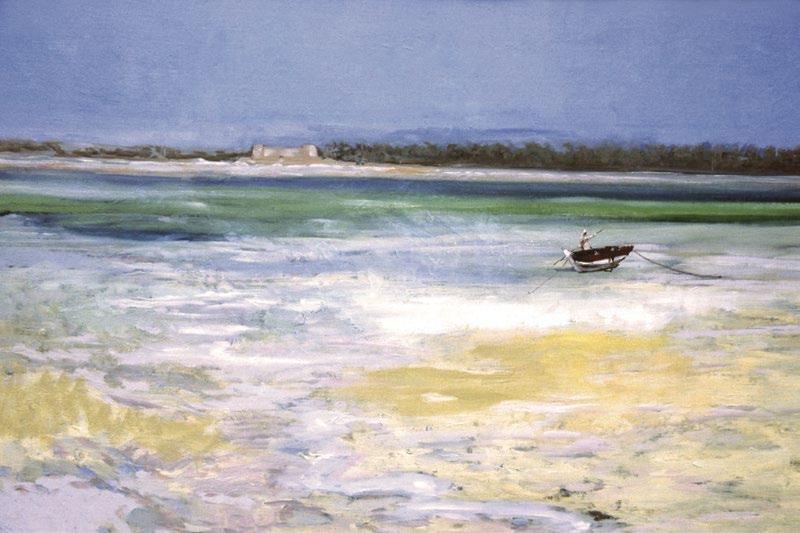
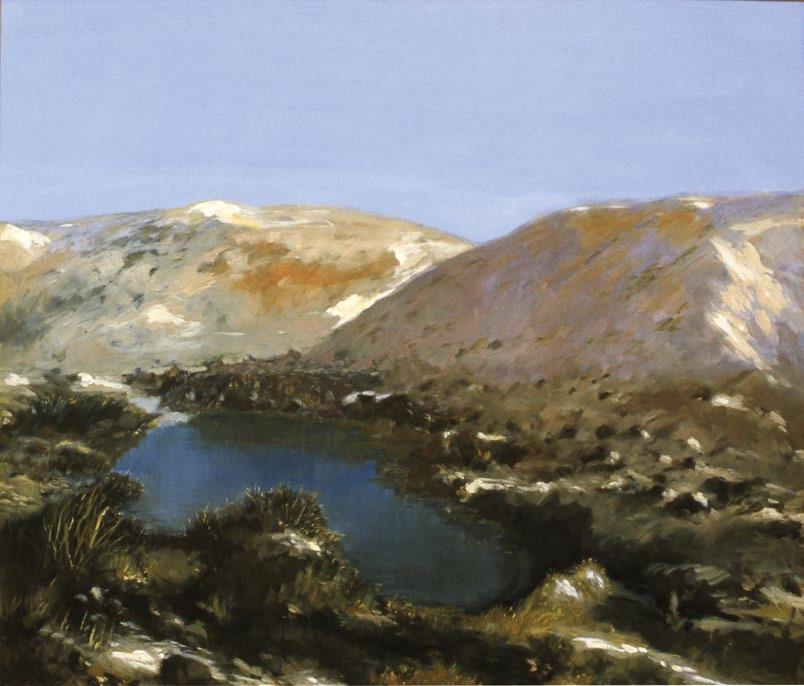
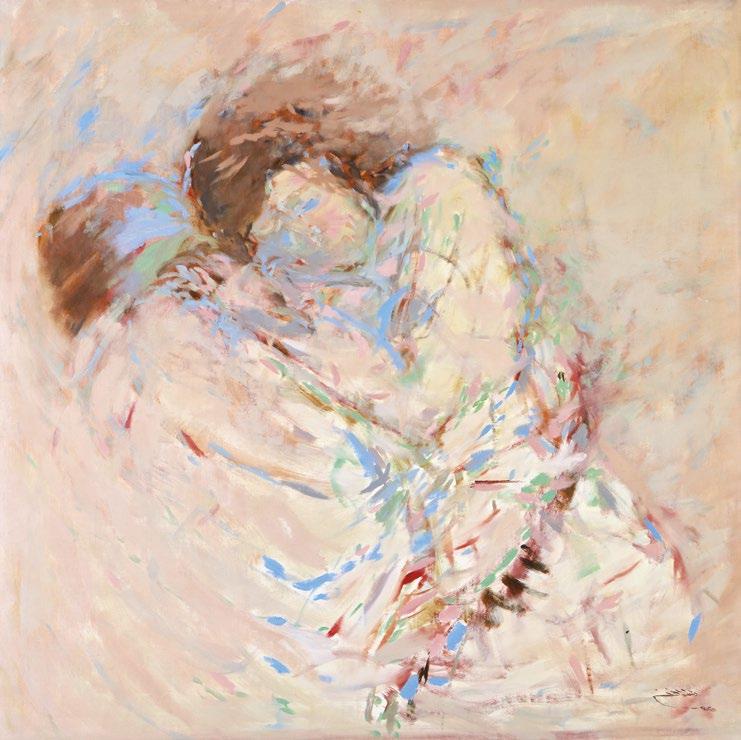
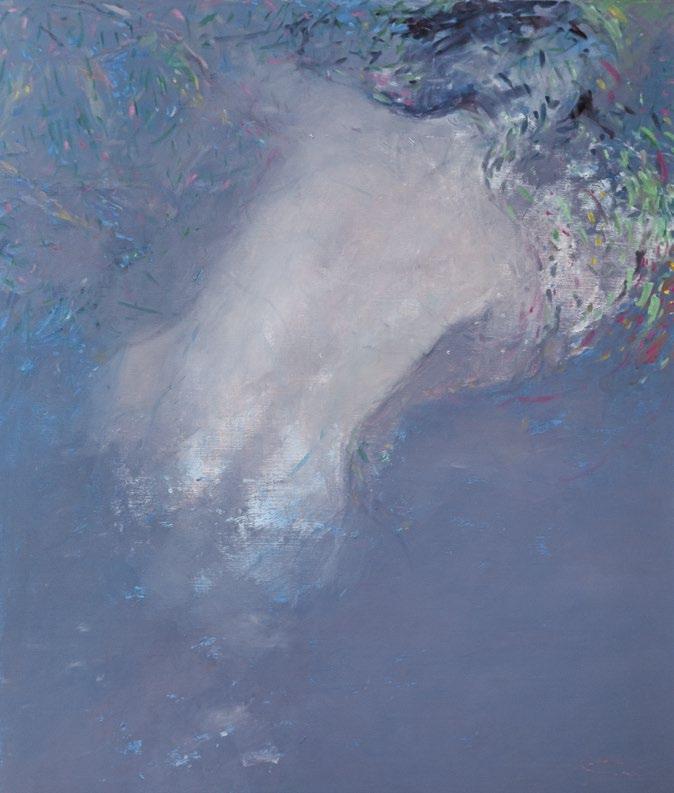
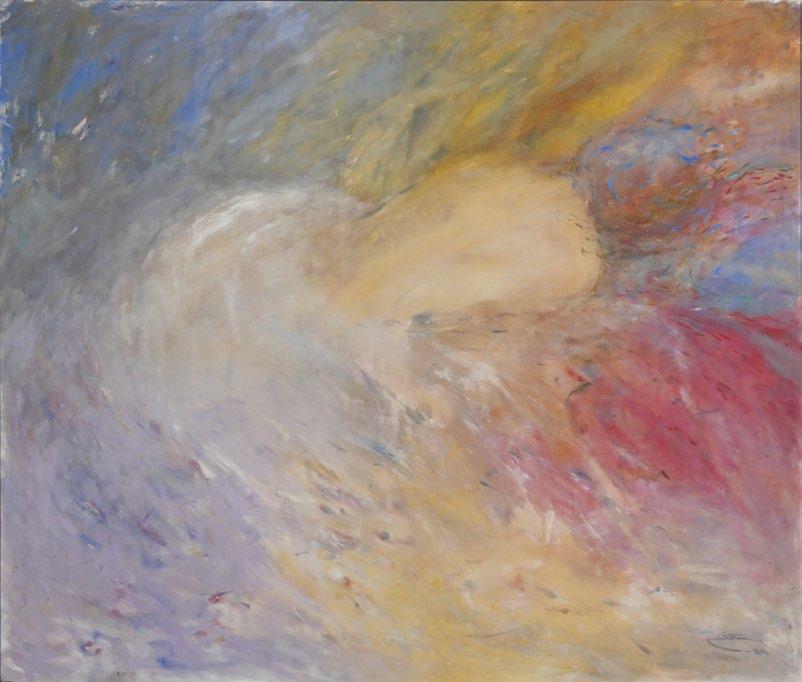
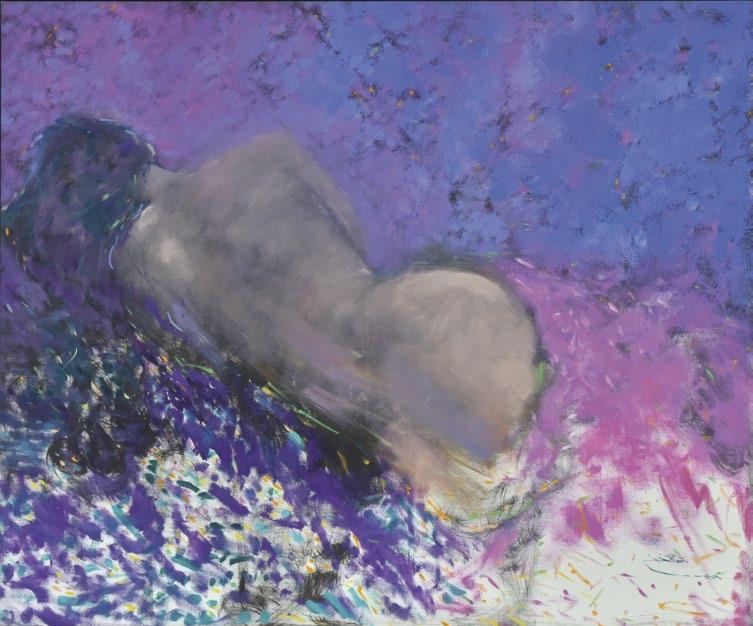
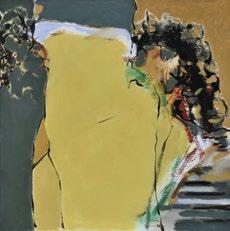
The arc of the long career of Rashid Al Khalifa, prominent Bahraini artist and the protagonist of this book, suggests a restless mind, always seeking a better form through which to express his ideas. From his early works in the 1970s and ‘80s, Al Khalifa’s interest in light and conveying the colours of Bahrain's landscapes are evident. His canvases capture the country’s moody skies in winter when it rains and pools and wadis appear in the desert or the intense turquoise of the sea, the traditional mainstay of the Bahraini economy. While he has acknowledged the influence of schools of painting such as Impressionism and Post-Impressionism, these styles appear to have been a means to an end, providing a way to evoke the dematerialisation of surfaces in sandy wind or bright sunlight. His figural works, painted more or less concurrently with these landscapes, remove the viewer from the Bahraini space. Here gesture and motion come to the fore, achieved through his subtle layering of paint and sweeping brushstrokes.
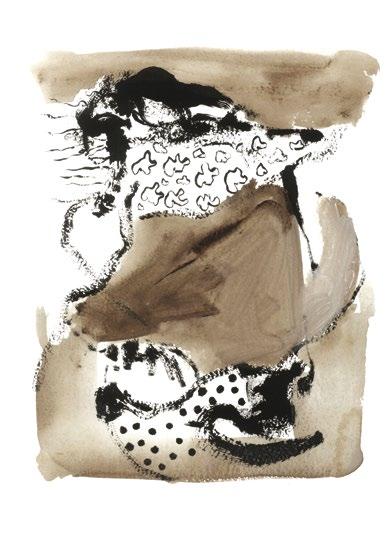
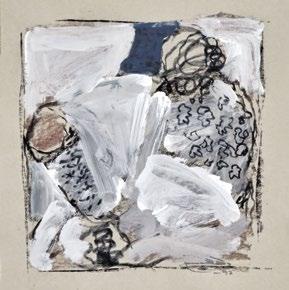
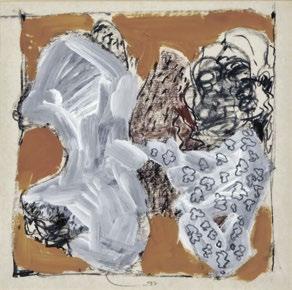
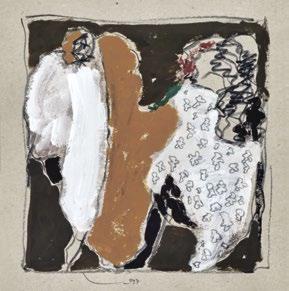
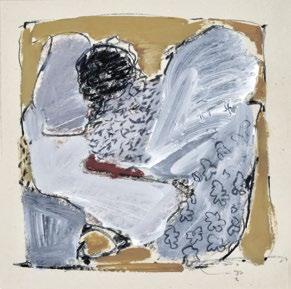
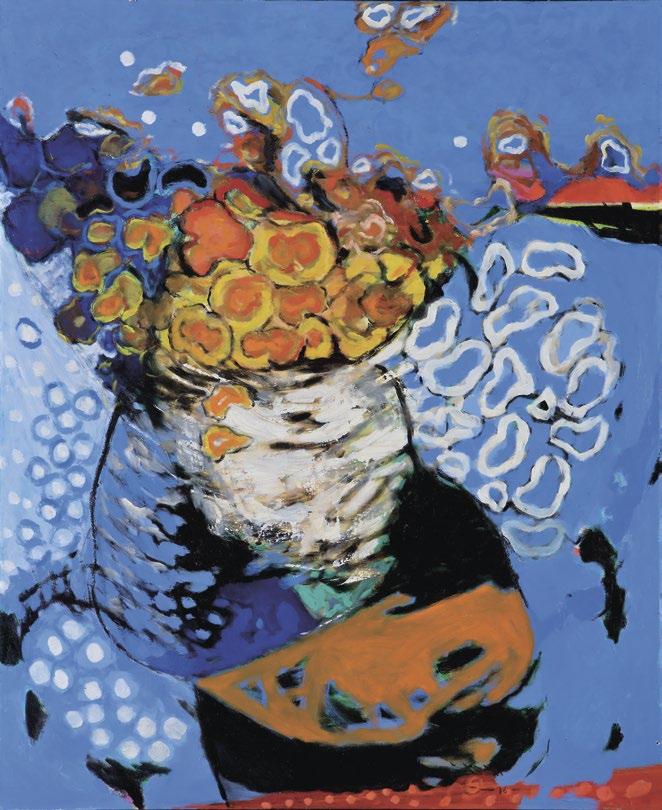
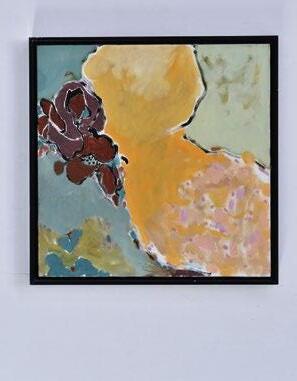
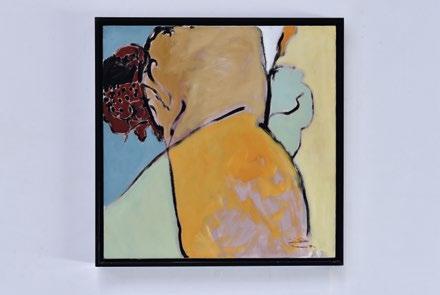
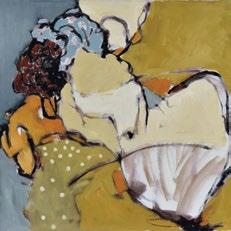
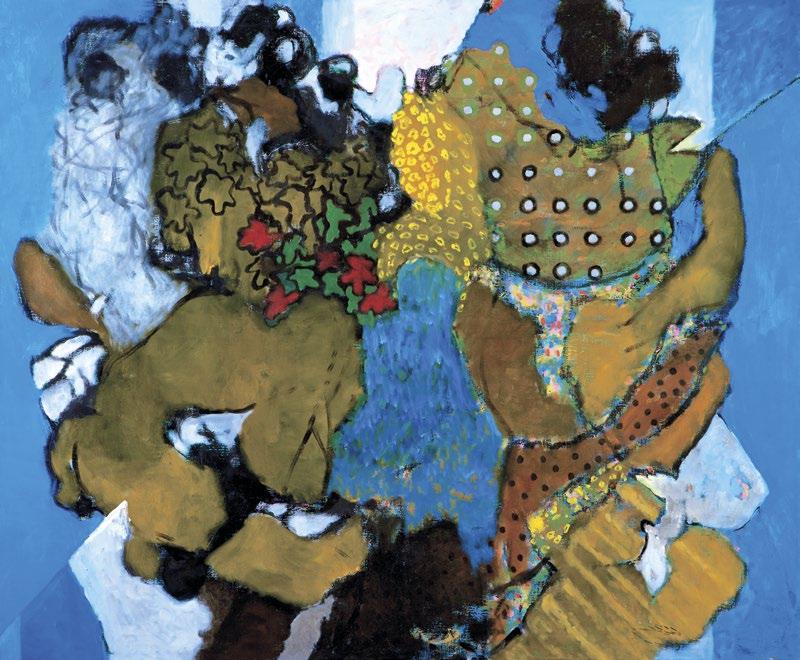
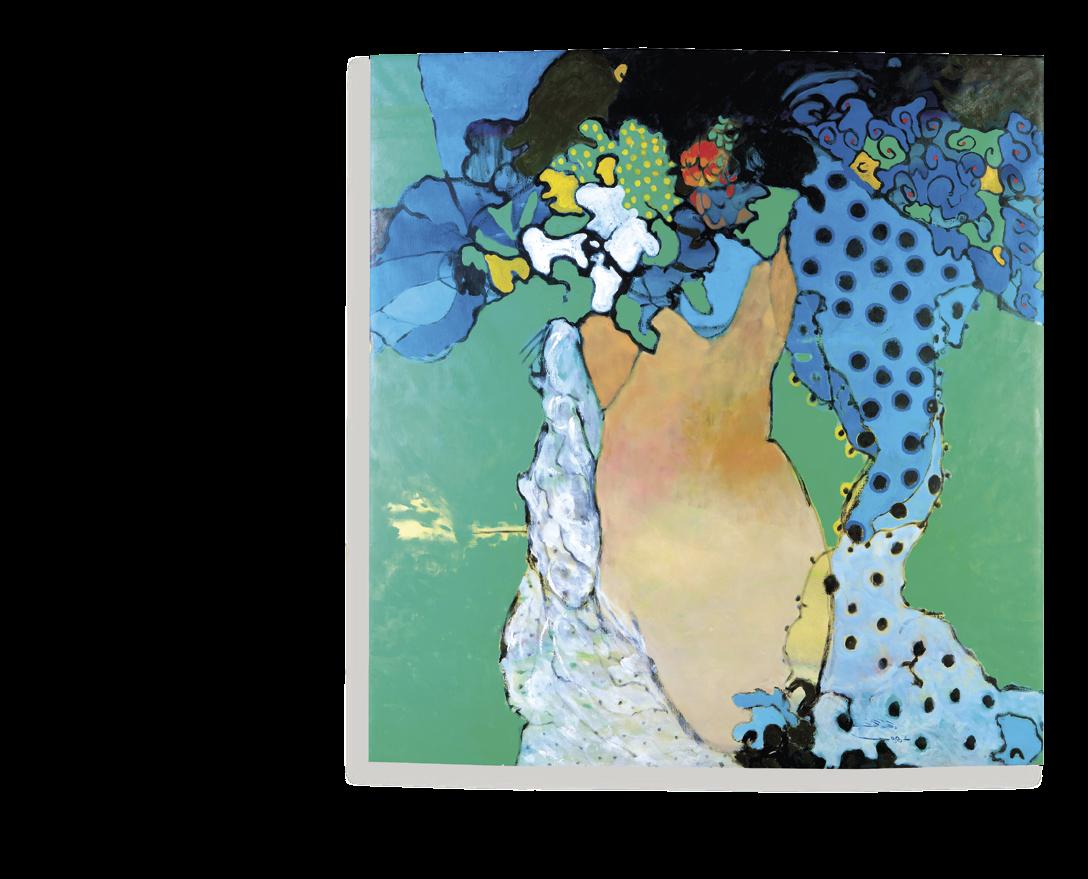
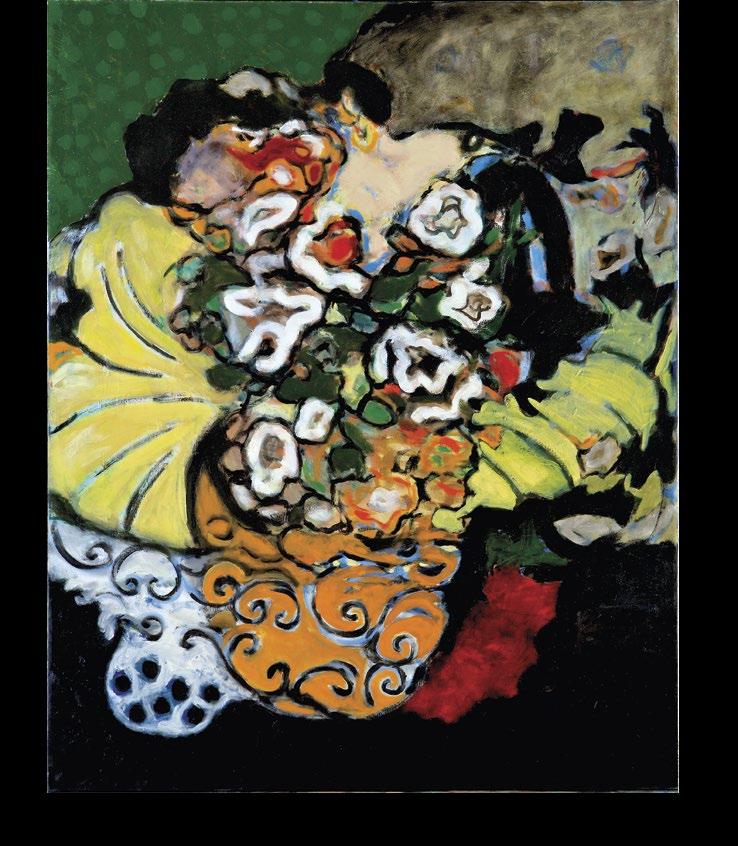
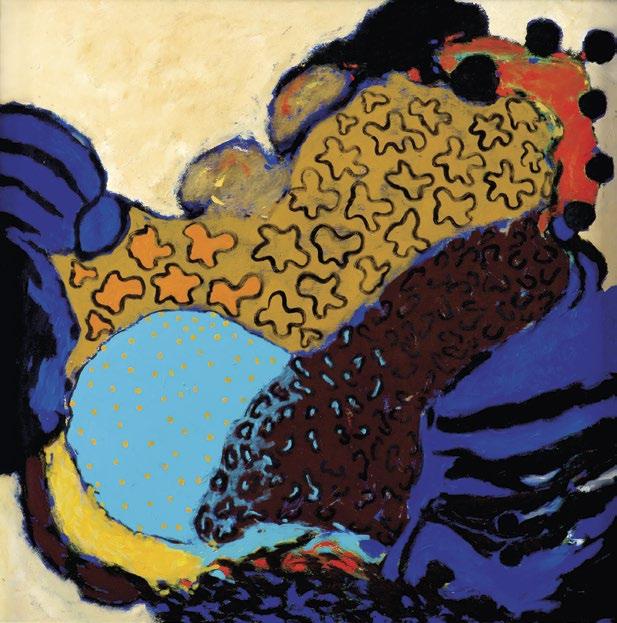
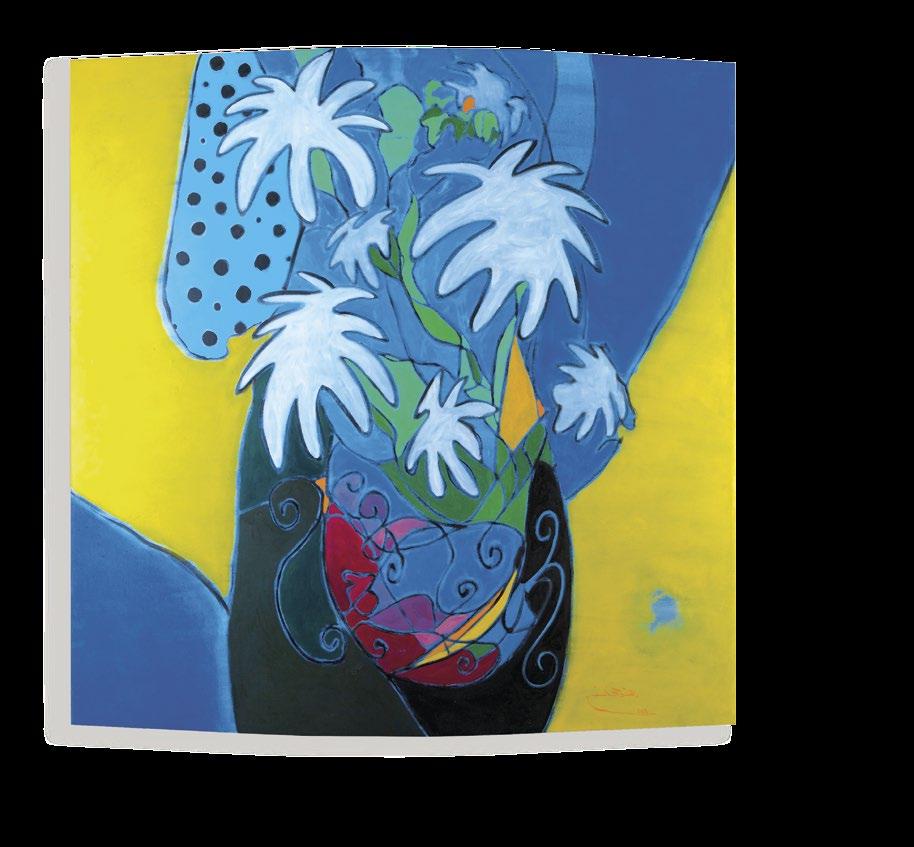
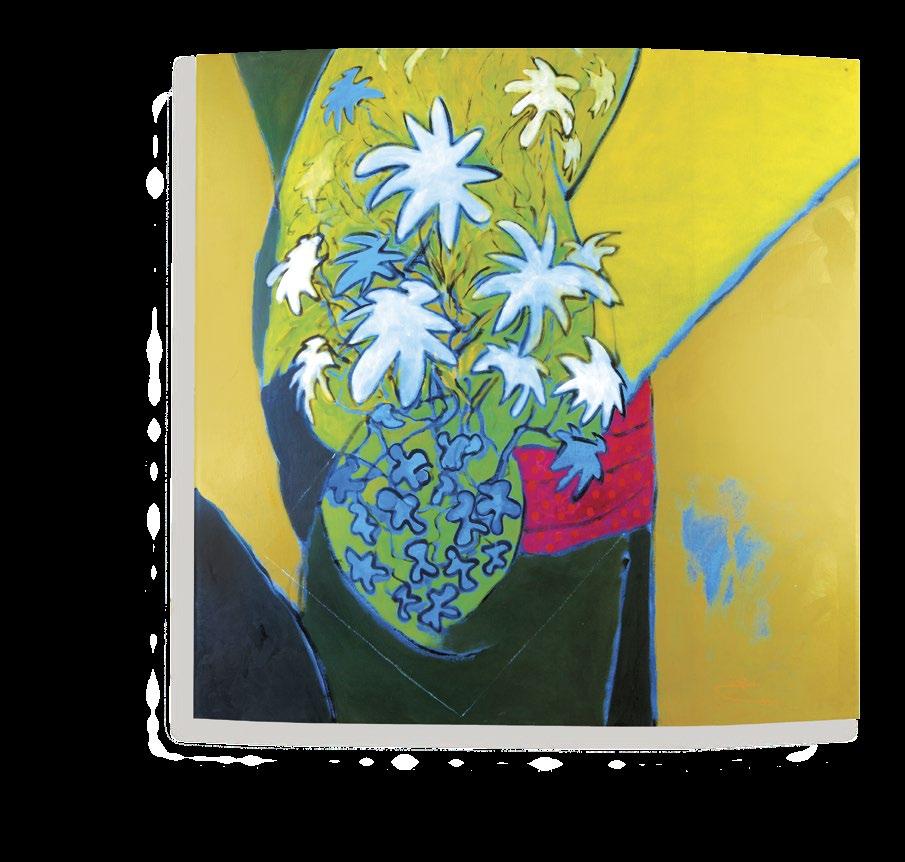
Without eschewing the human form entirely, in the 1990s Al Khalifa painted a series of Abstractions. With their blocks of saturated colour and juxtapositions of decorative patterns, these works recall Gaugin and Les Fauves and yet their forms only imply human bodies and the odd vase of flowers. In contrast to his figurative images from the same period, the emphasis on line is forceful, such as what one might encounter in a 15th century Arab or Persian manuscript illustration. As the titles of several works in this group suggest, Al Khalifa’s style was undergoing a metamorphosis. With the advantage of knowing what came next, one can now view his Abstractions as a necessary step toward a fusion of the painterly technique of the figural works with his move away from representation. The next step was his leap into the third dimension with works on canvas stretched across a convex frame.
Metropolitan Museum of Art’s curator emerita of Islamic art, and former curator of Islamic art and antiquities at the British Museum
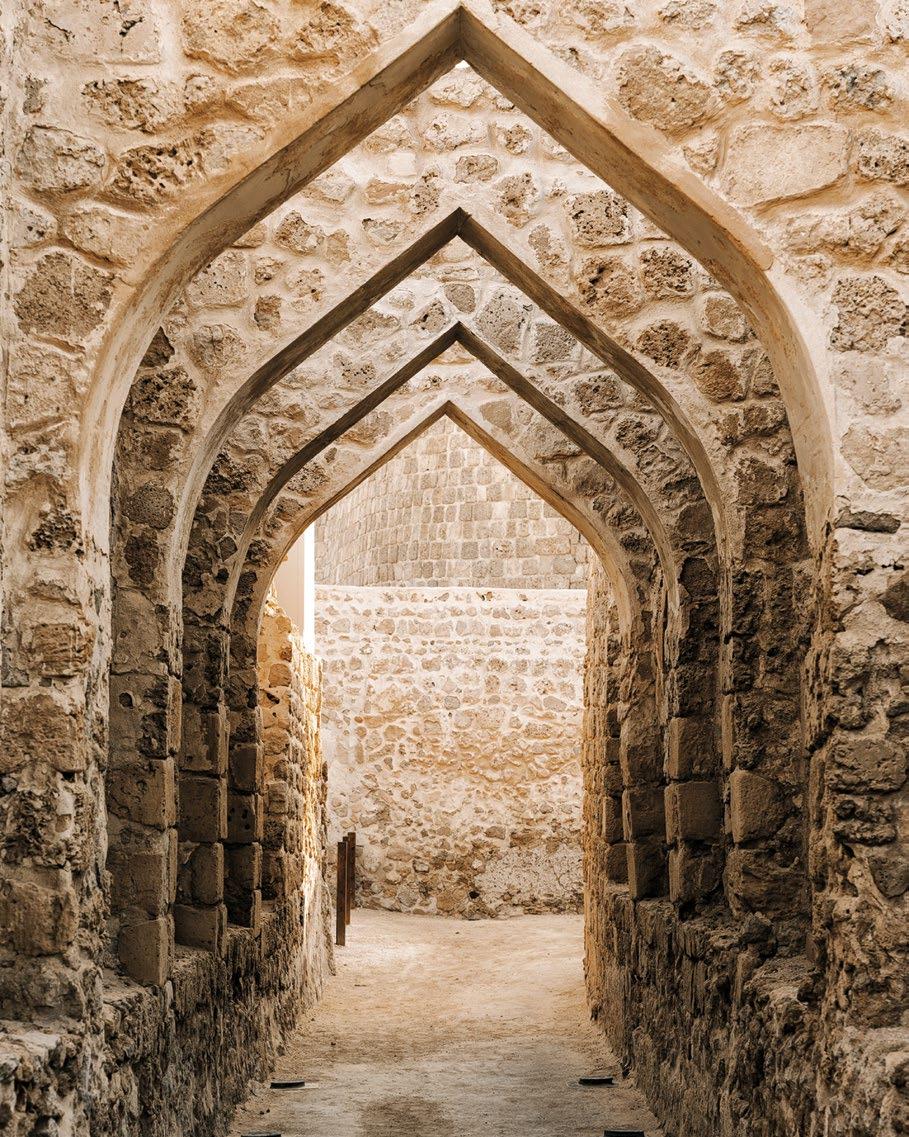
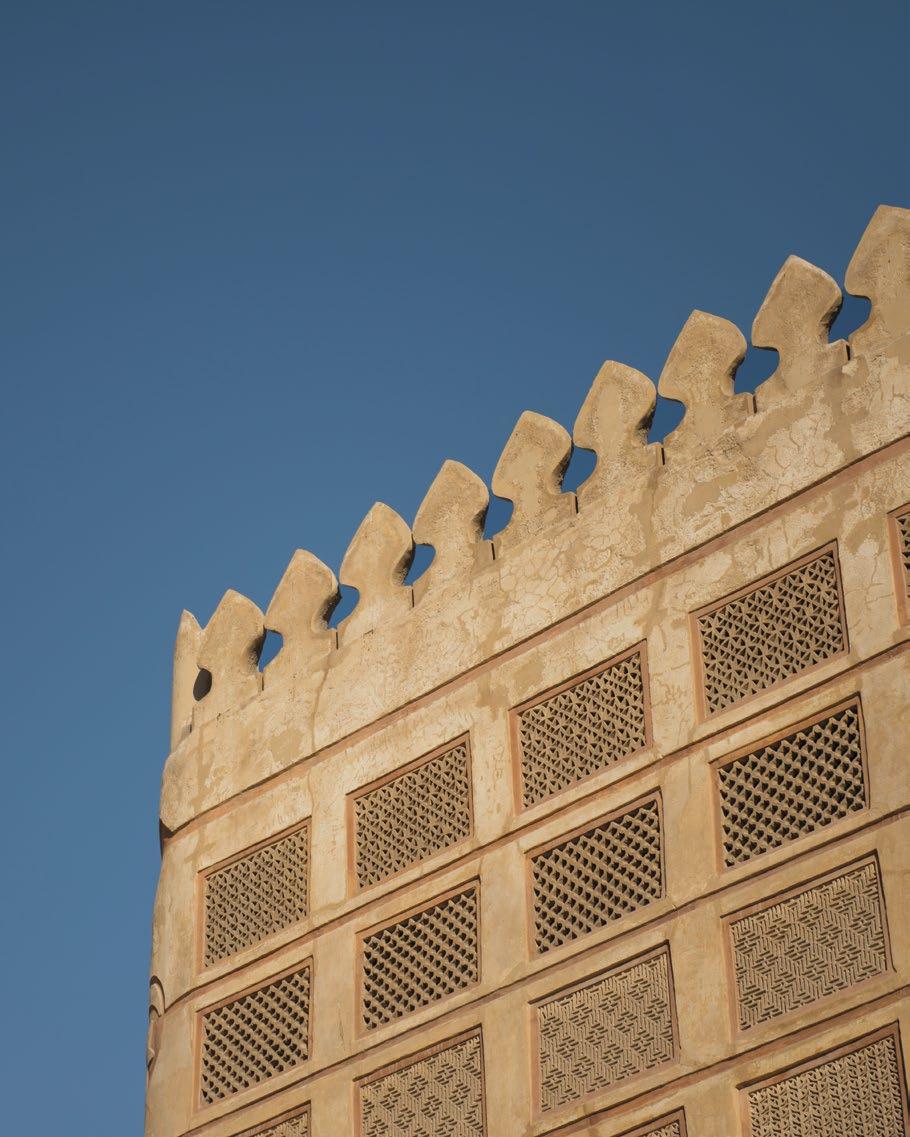
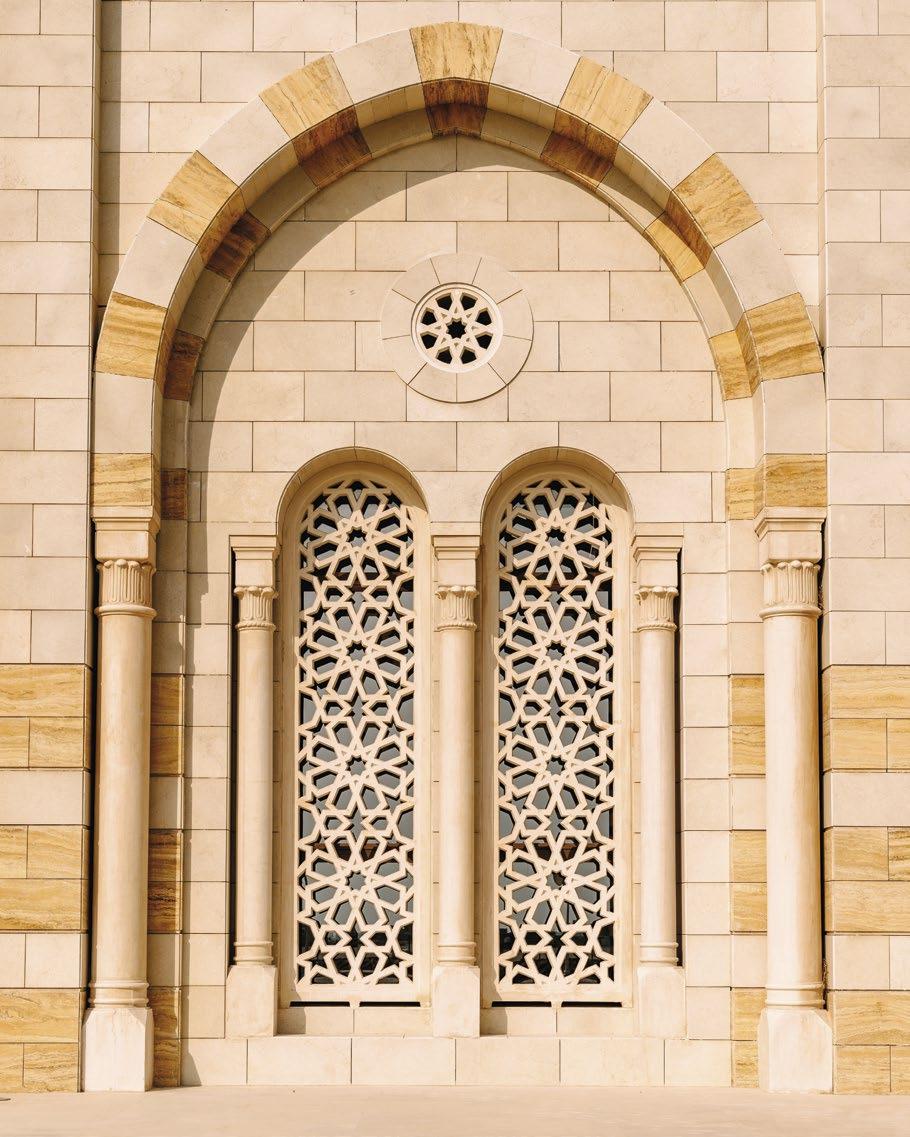
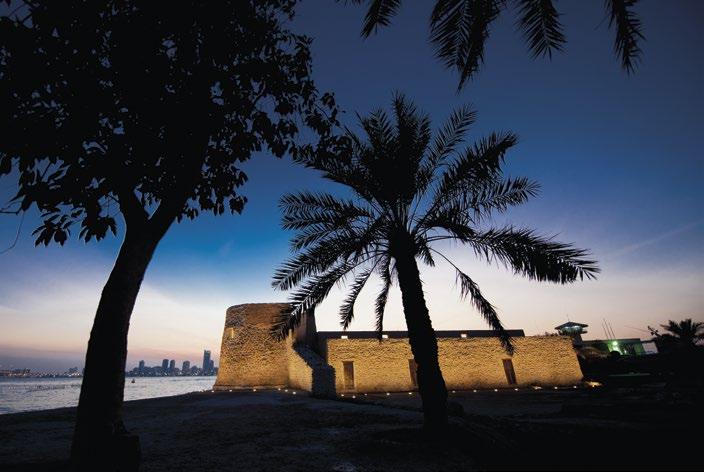
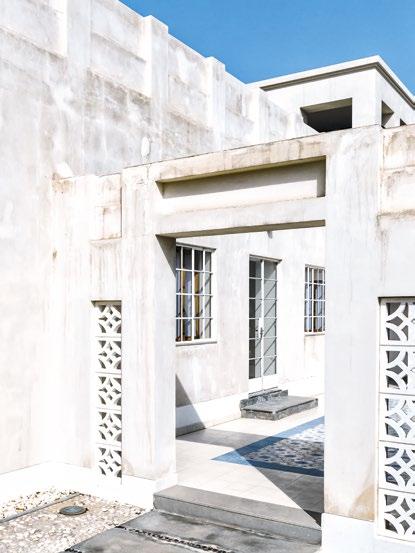
Archway, Qal’at al-Bahrain, 2019
Karbabad, Kingdom of Bahrain
Photo by Marine Terlizzi
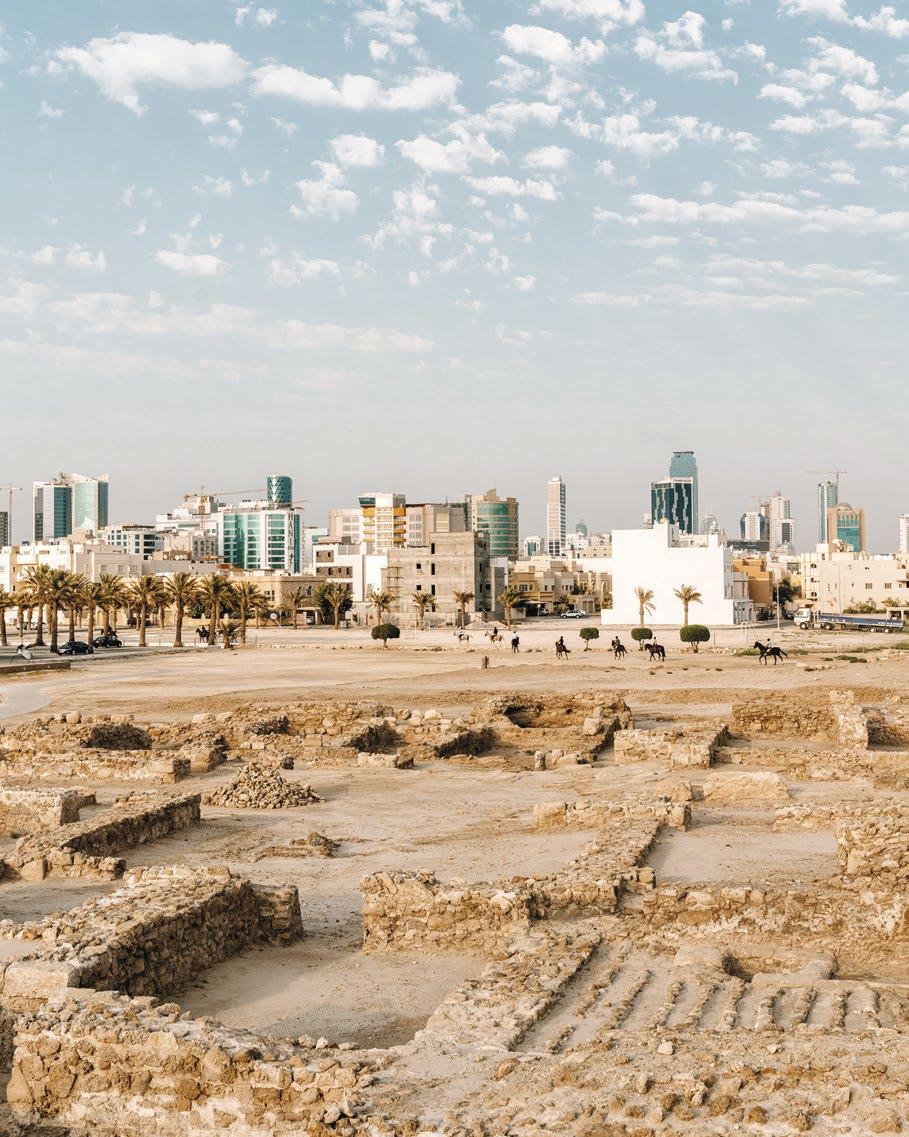
Page 7: View of site, Qal’at al-Bahrain, 2019
Karbabad, Kingdom of Bahrain
Photo by Marine Terlizzi
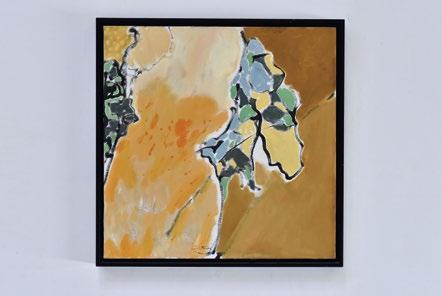
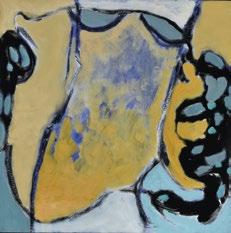
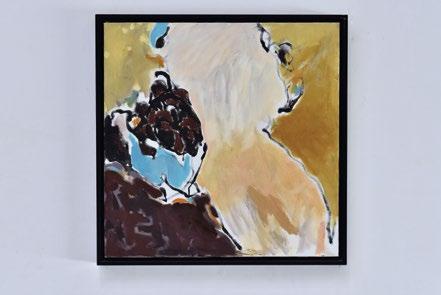
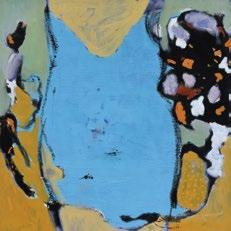
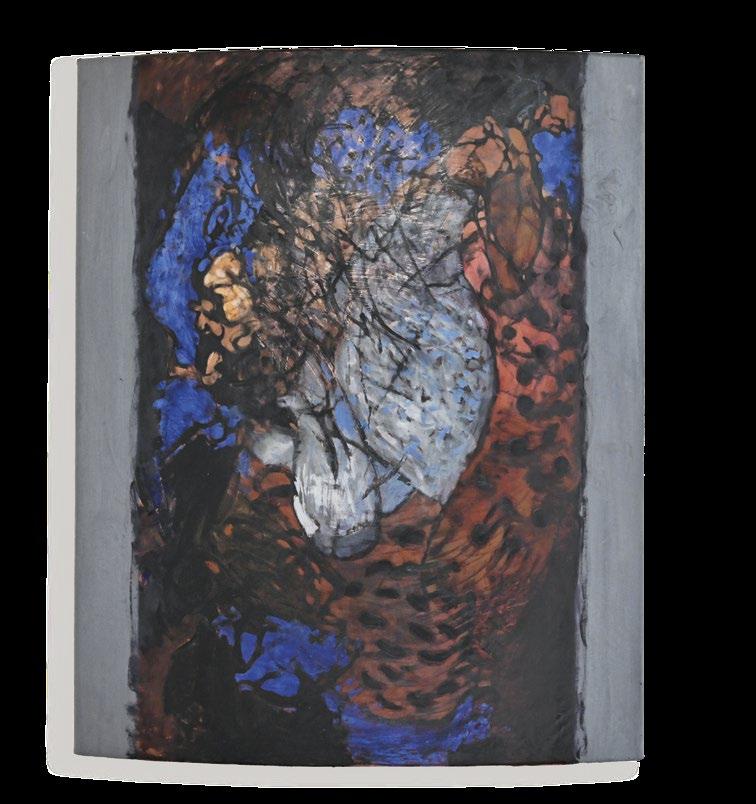
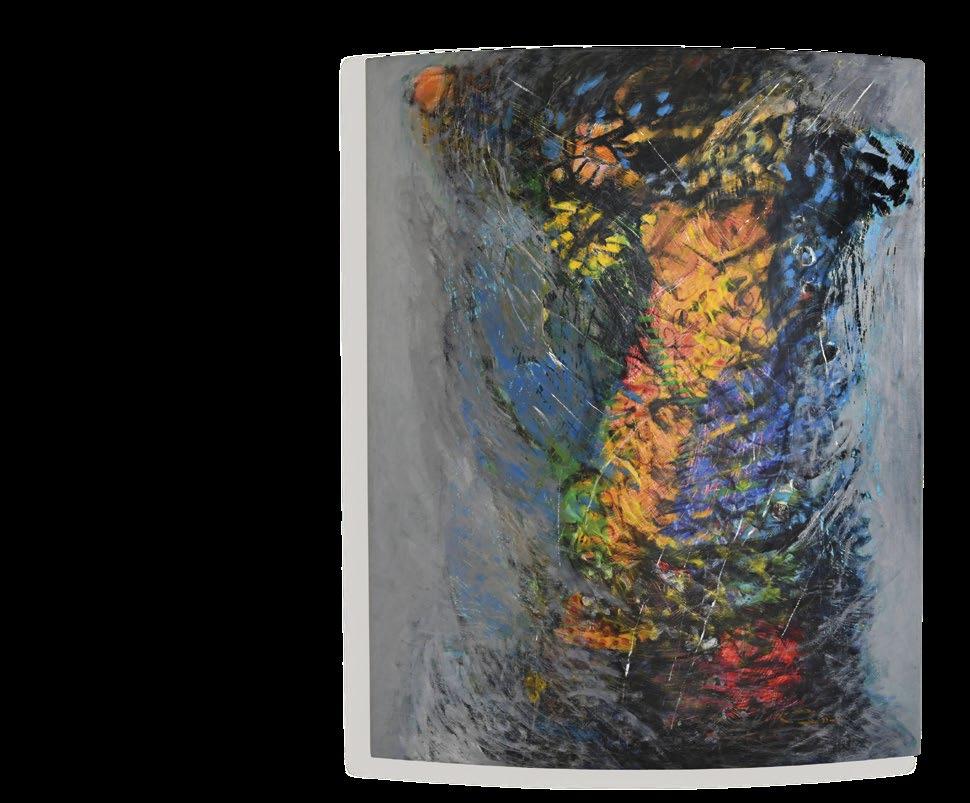
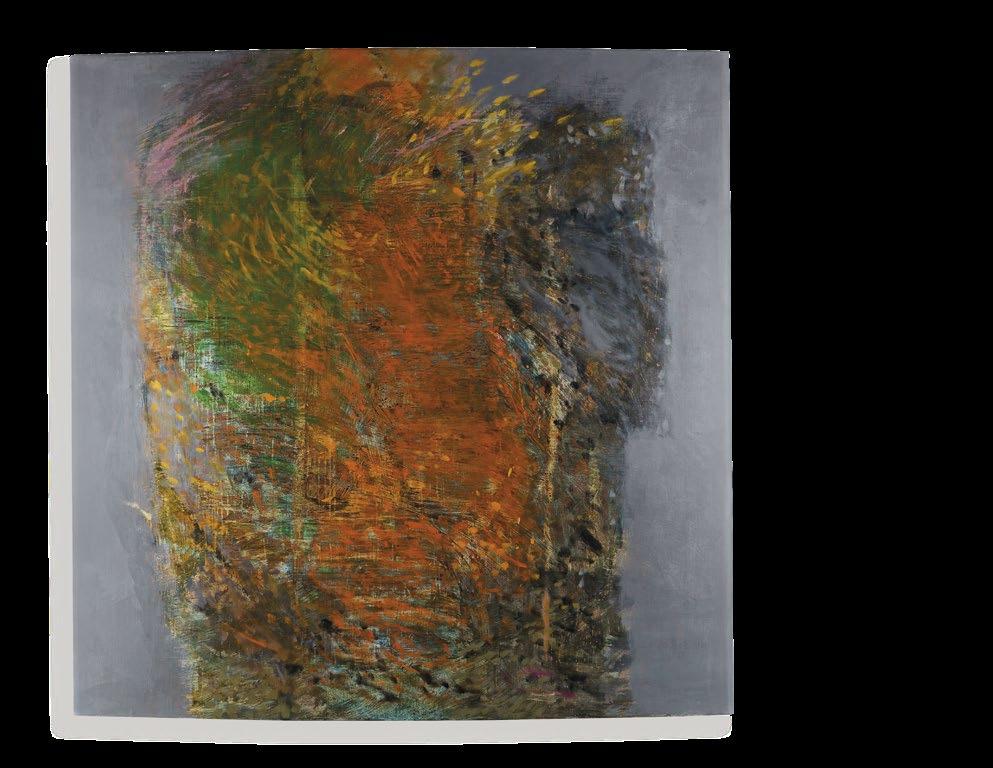
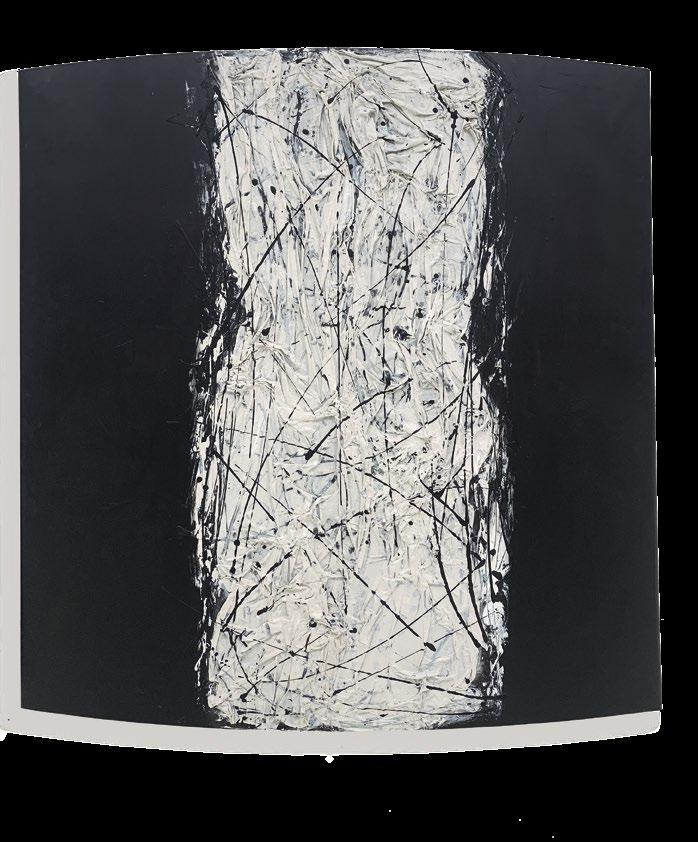
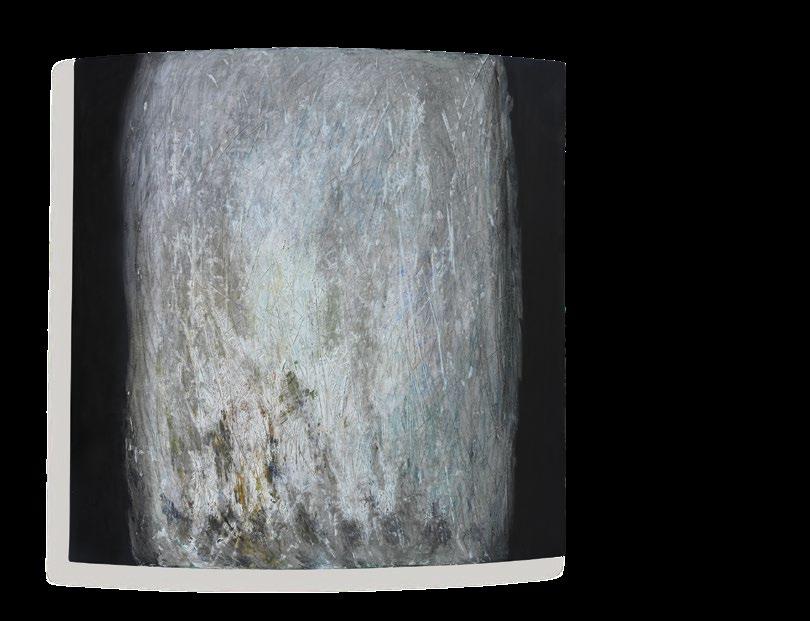
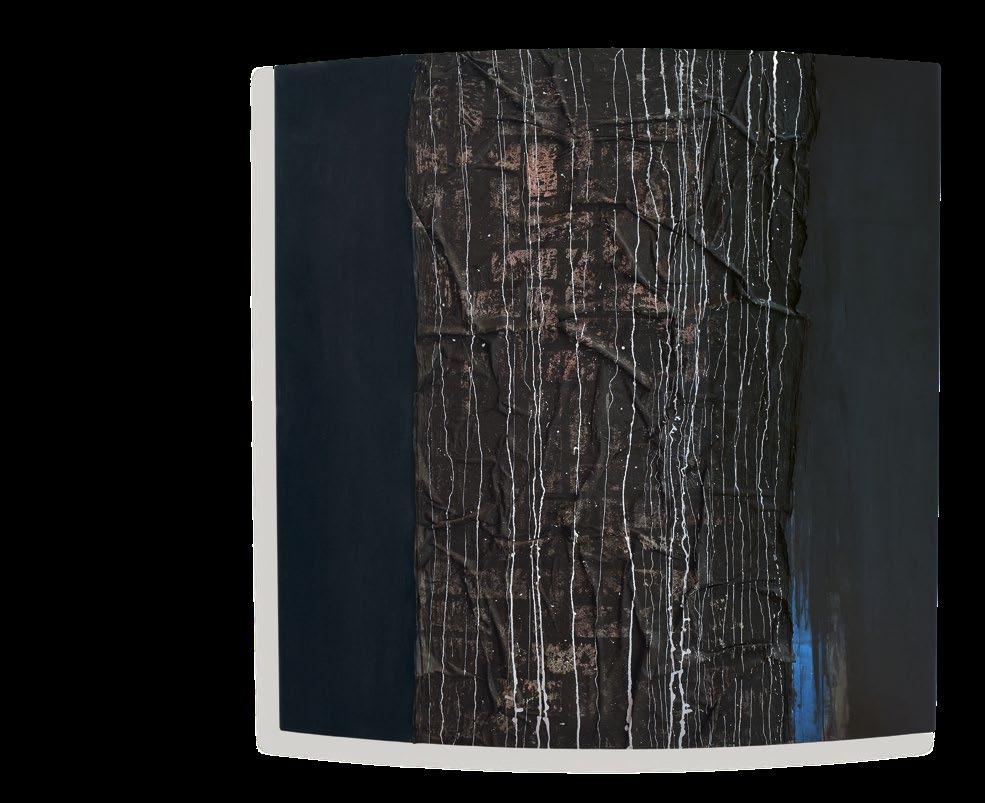
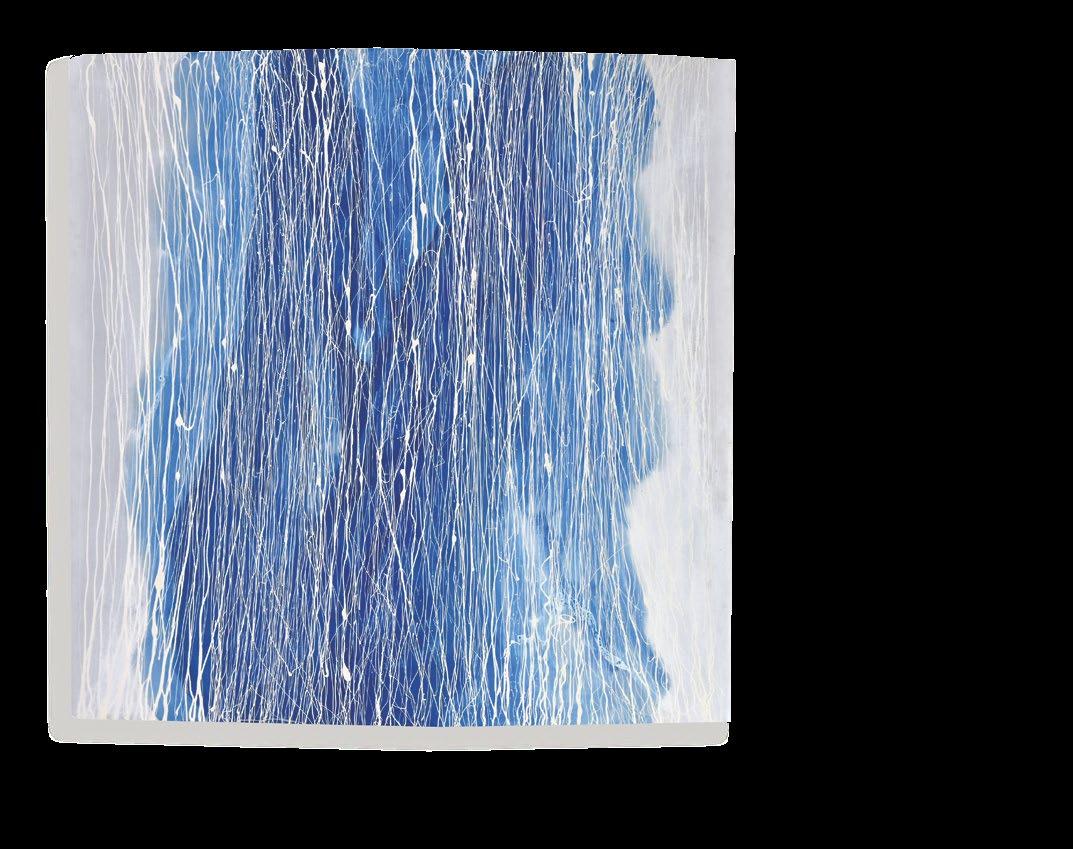
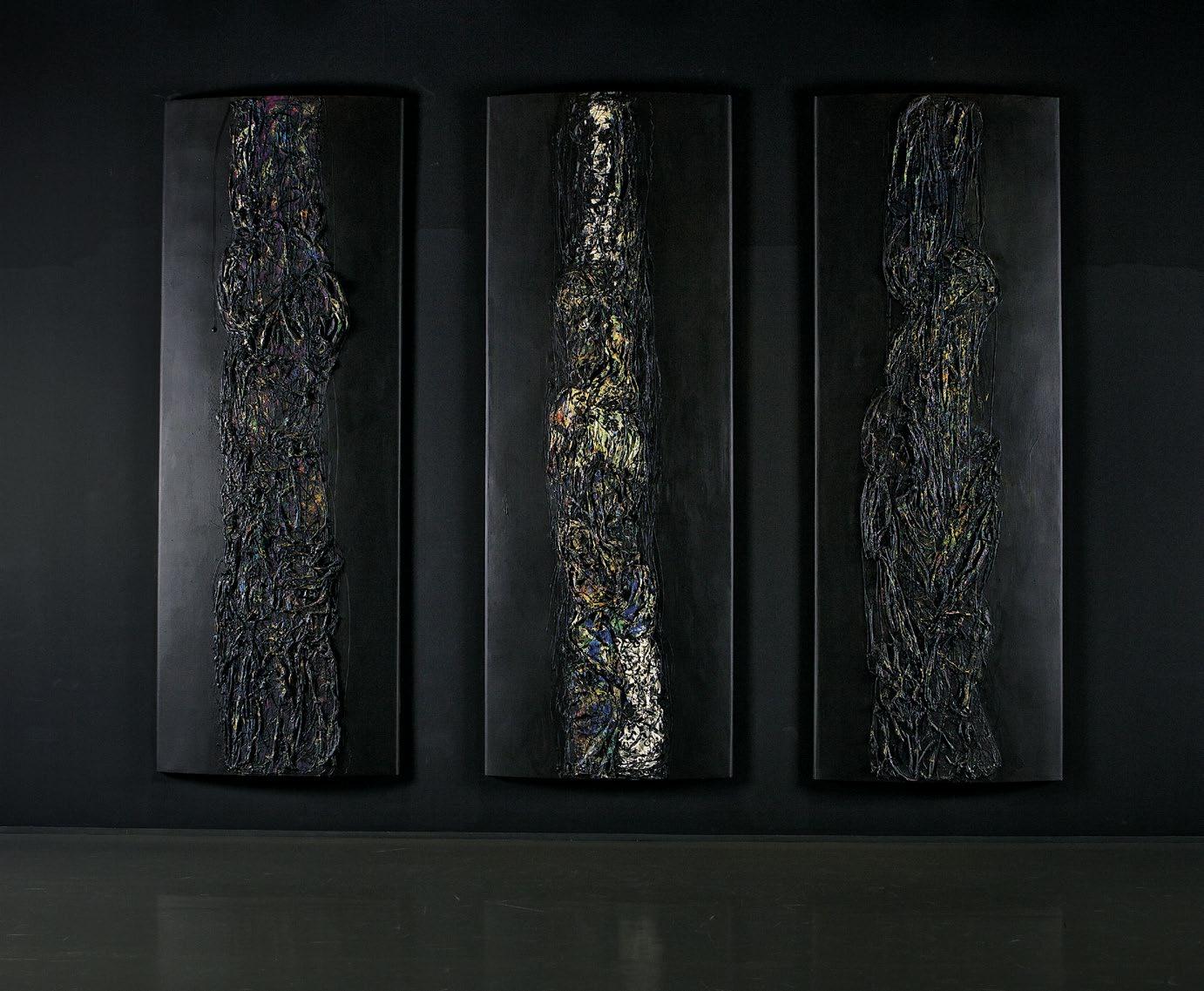
The extensive series of convex paintings, mostly abstract, invites contemplation, thanks to the layering of colour and shapes with indistinct edges. At times the paintings conjure the sea, sky, or the land they border. Yet, rather than encouraging the viewer to imagine a specific place or time, these works create a mood. People familiar with Bahrain might associate some of the paintings with its land, but others could see the works as a meditation on form and colour. Integral to that form is the convexity of the support, breaking the picture plane and entering the viewer’s space. Is it sculpture or is it painting? In the end, such distinctions do not matter as long as the work elicits the emotional and intellectual responses which the artist is seeking.
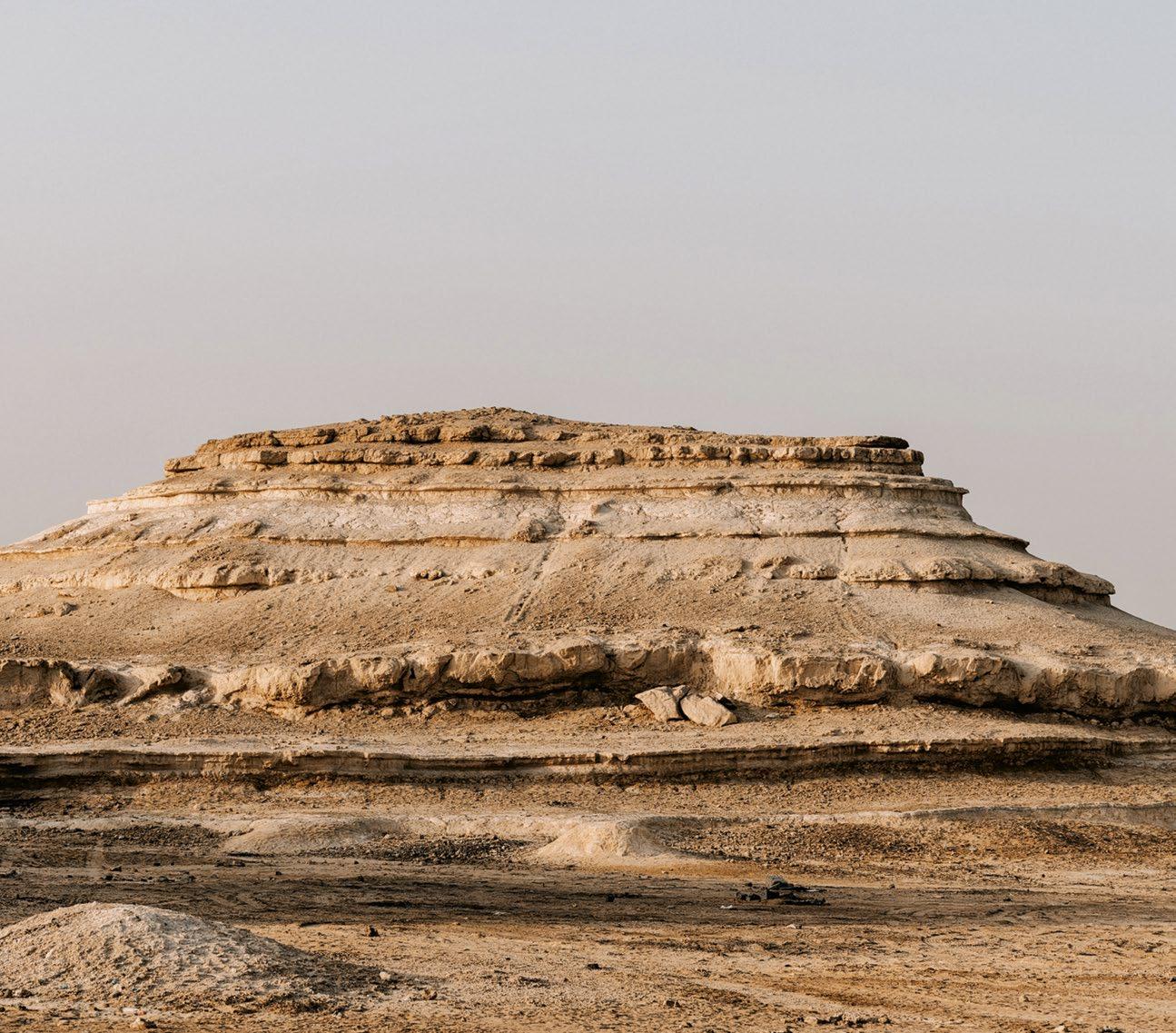
Sakhir Desert, 2019
Sakhir, Kingdom of Bahrain
Photo by Marine Terlizzi
Bayt Siyadi, 2018
Muharraq, Kingdom of Bahrain
Courtesy of Bahrain National Museum
Page 12:
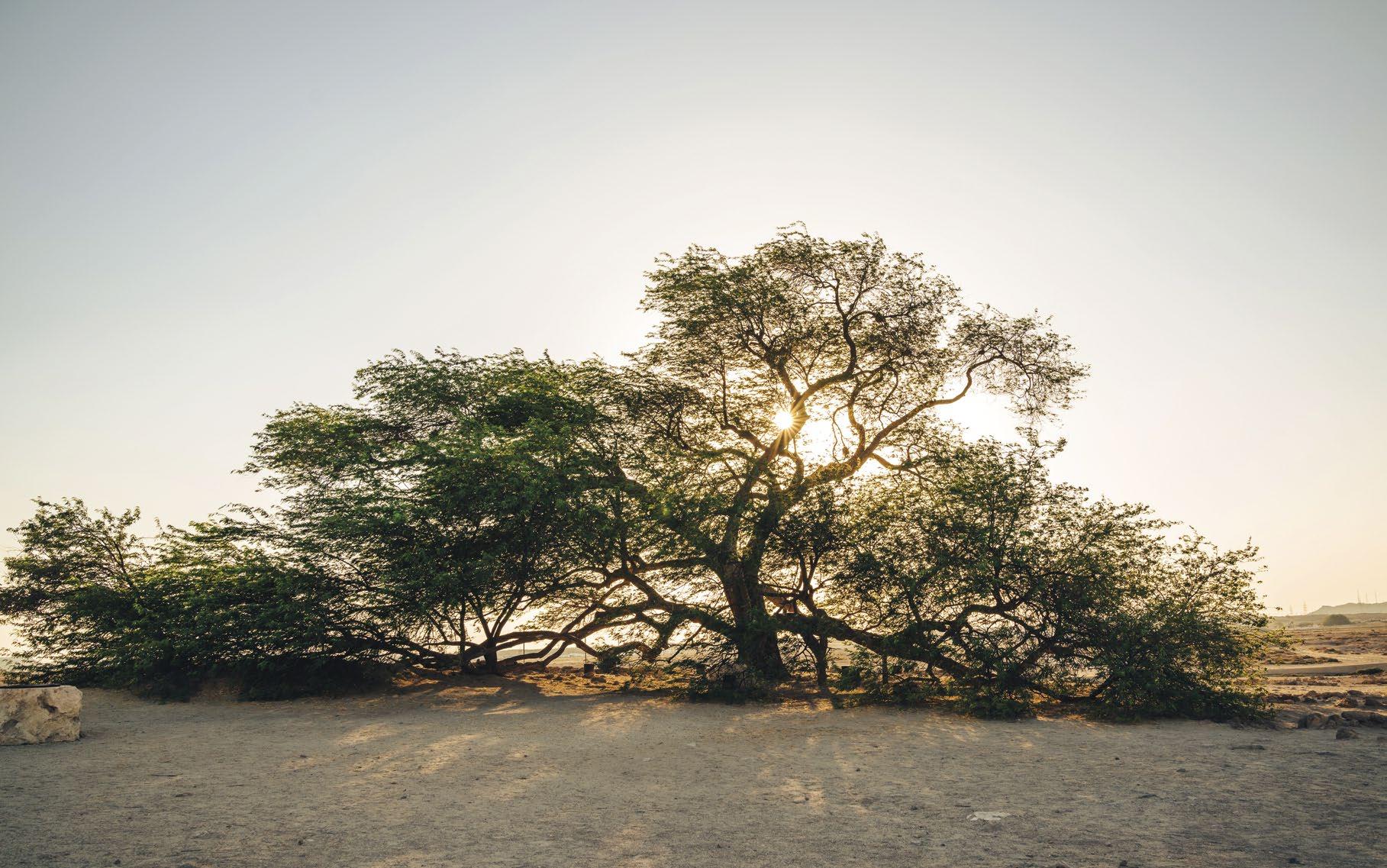
Tree of Life, 2019
Sakhir, Kingdom of Bahrain
Photo by Marine Terlizzi
Page 16:
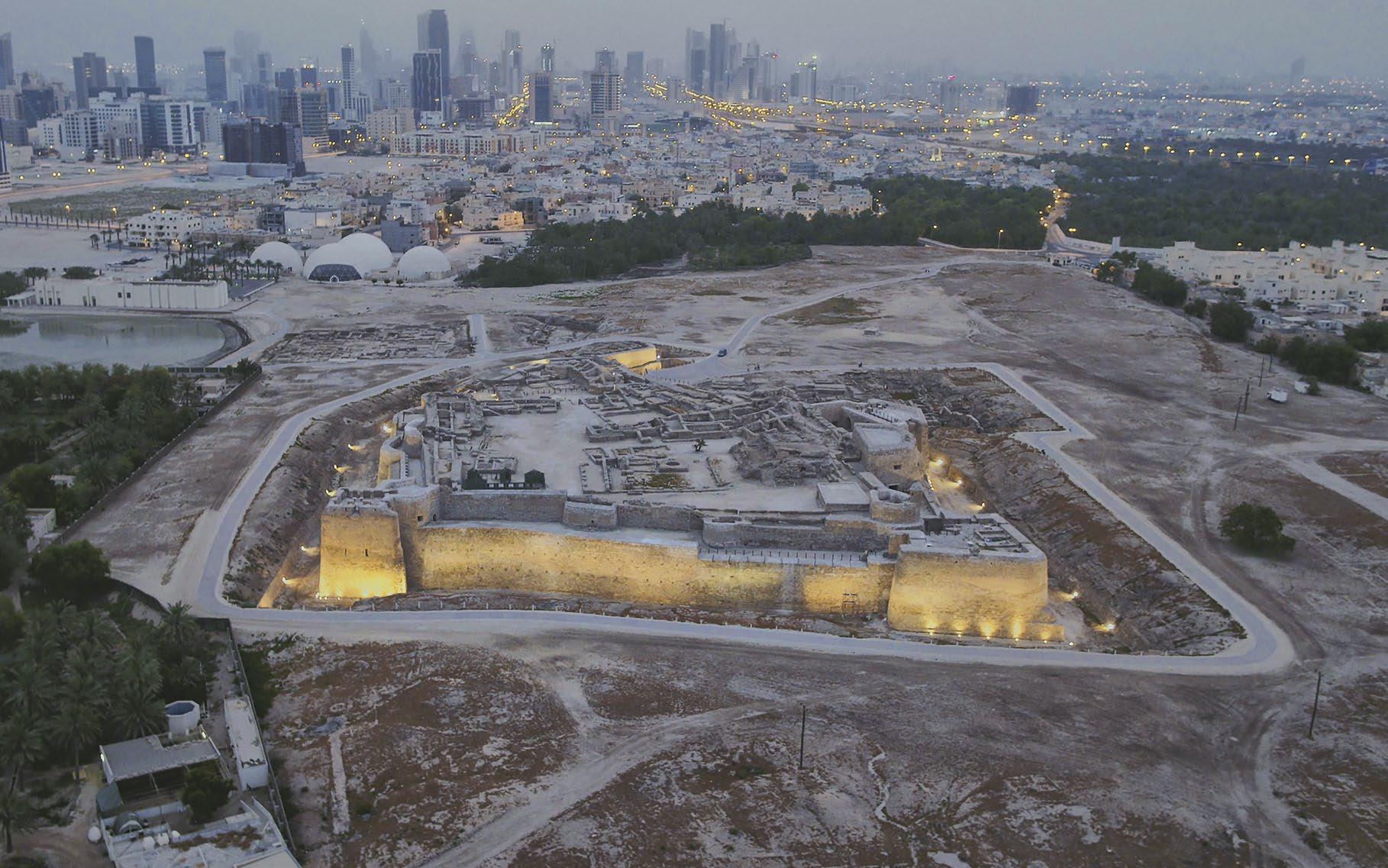
Aerial view, Qal’at al-Bahrain, 2018
Karbabad, Kingdom of Bahrain
Courtesy of Bahrain Drone Studios
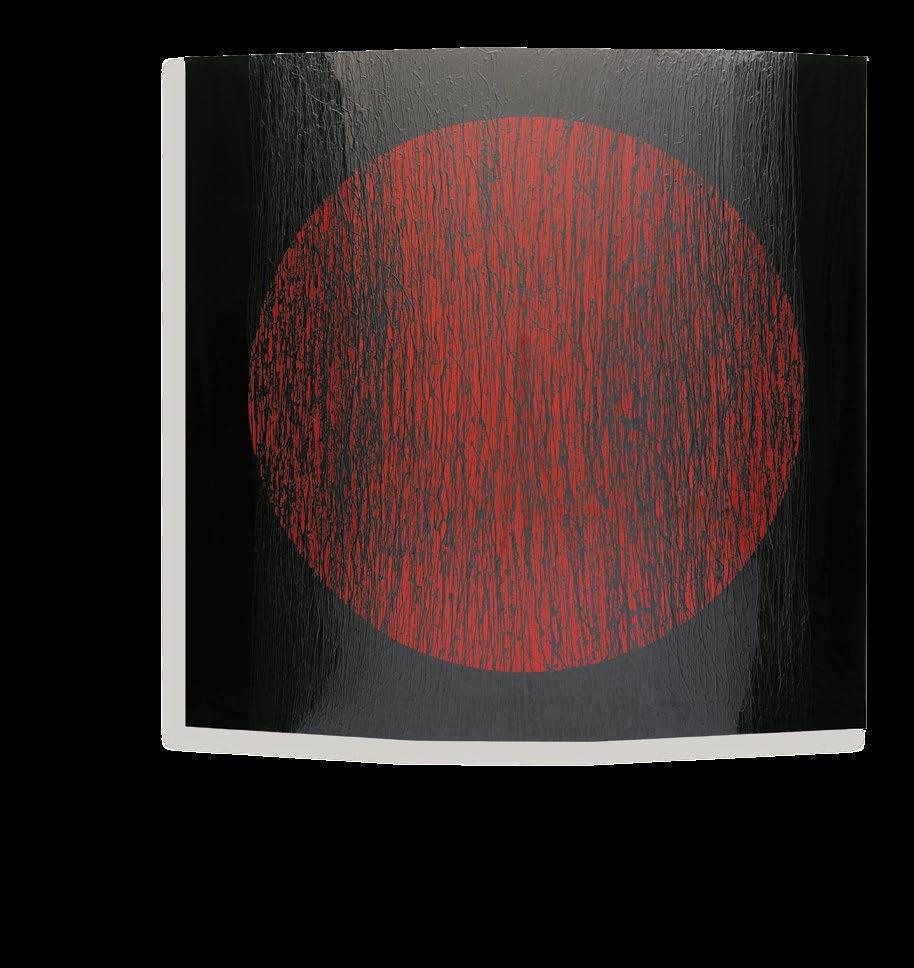
My own introduction to Rashid Al Khalifa’s work came in 2010 at an exhibition entitled Convex: A New Perspective, held at the Bahrain National Museum. Although I had lived in Manama, the capital, in the late 1980s, the National Museum was under construction and most art exhibitions were held in hotels. The boom in the Middle Eastern contemporary art market was a long way off and the art scene in Bahrain, shepherded by the Bahrain Arts Society, founded by Rashid Al Khalifa in 1983, was just beginning to gain traction. Thus, when I returned to Bahrain after twenty years, I was duly impressed not only by the range of work produced by Bahraini artists but especially by Al Khalifa’s elegant Black and Red with Circle (2010), a work in lacquer and enamel on aluminium. Its composition combines many elements of his earlier paintings, the convex shape, the abstract application of black pigment on a contrasting red ground with the strong geometrical shape of the circle, set in a black square. Yet, by using metal rather than canvas, he achieved a sharpness of line and directness of statement in keeping with the geometry of the support.
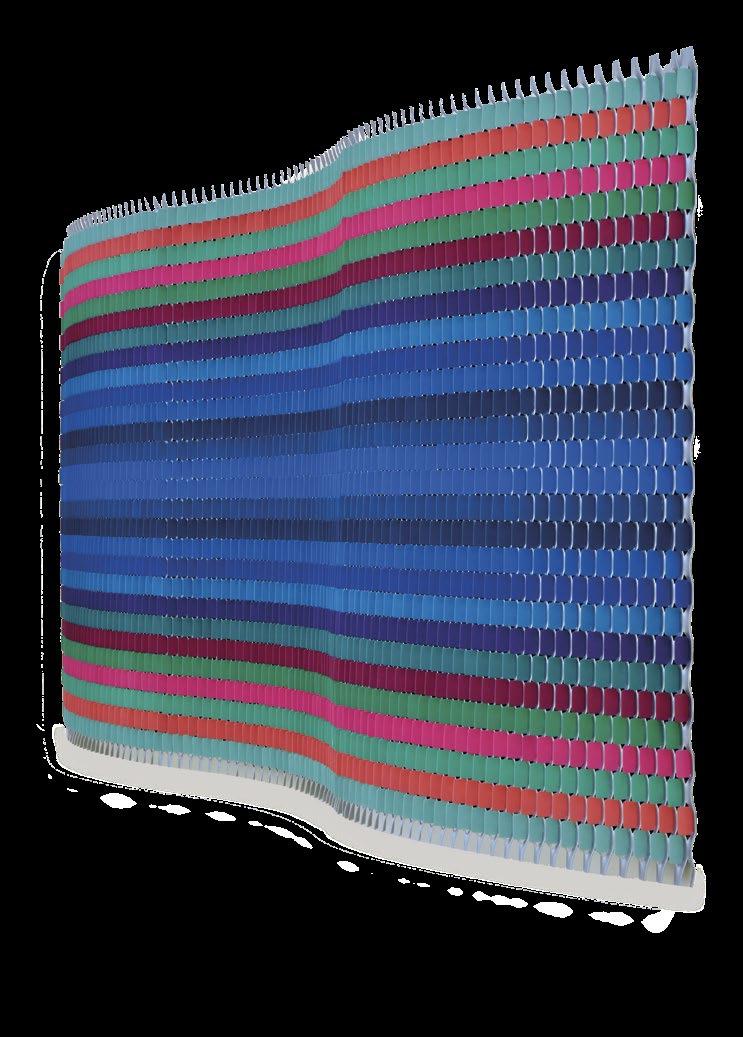
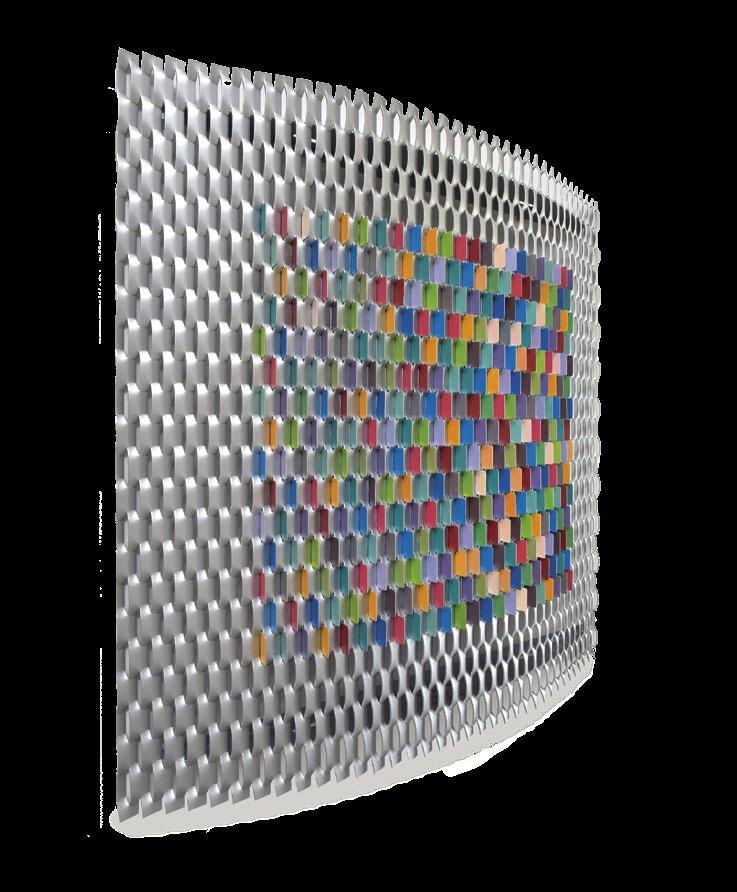
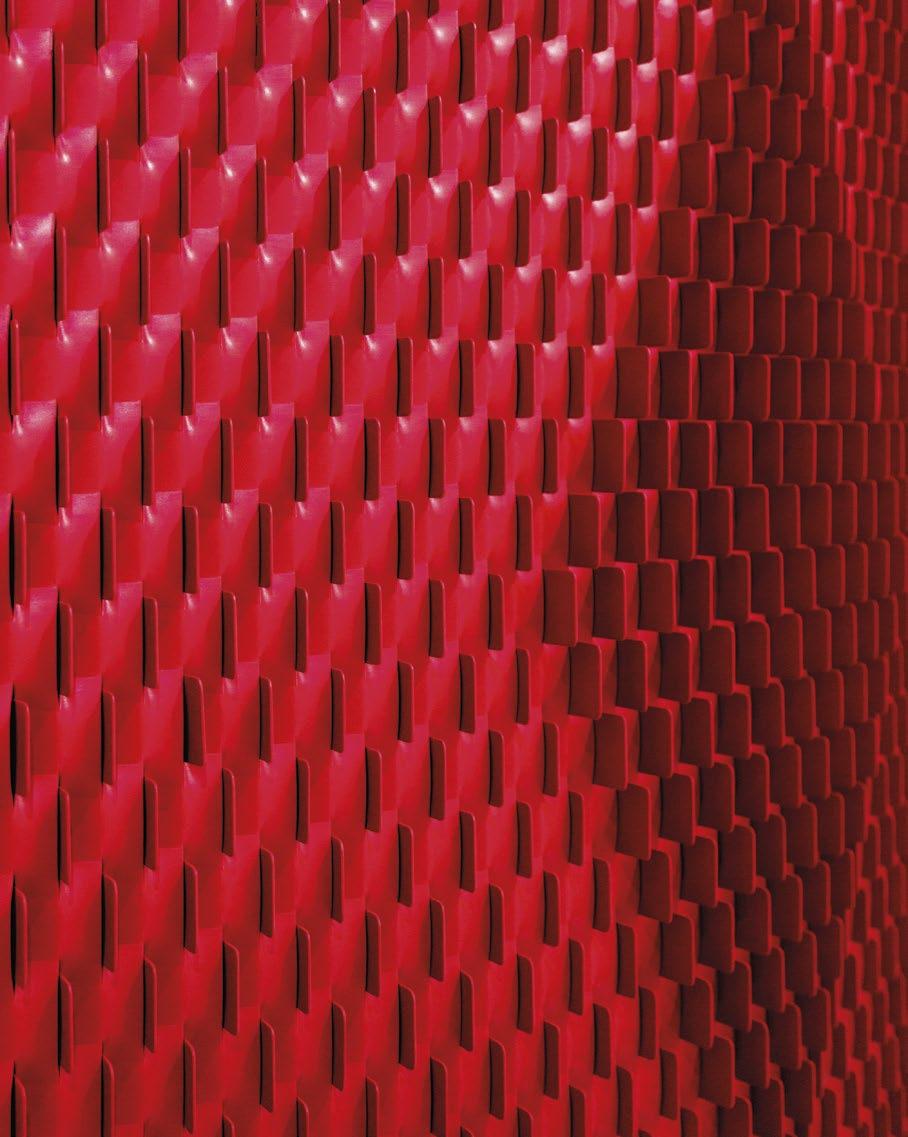
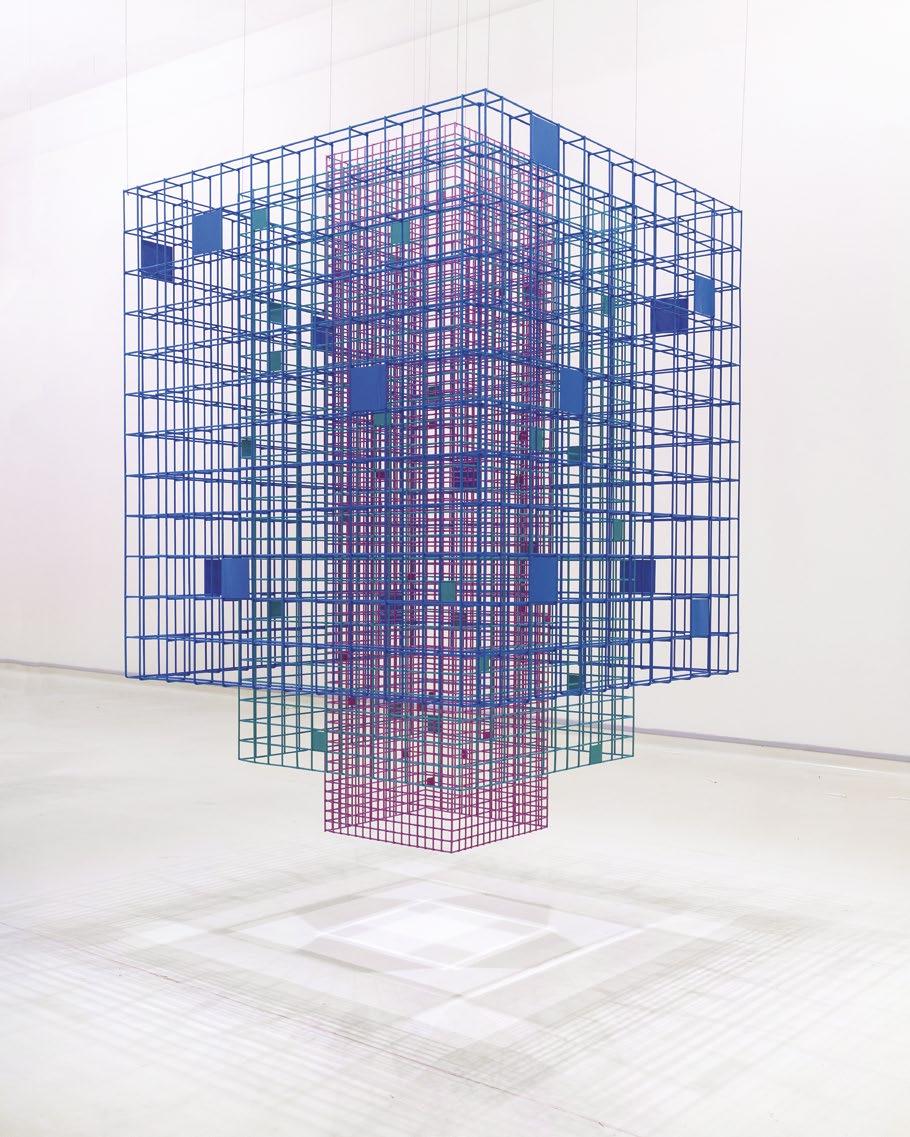
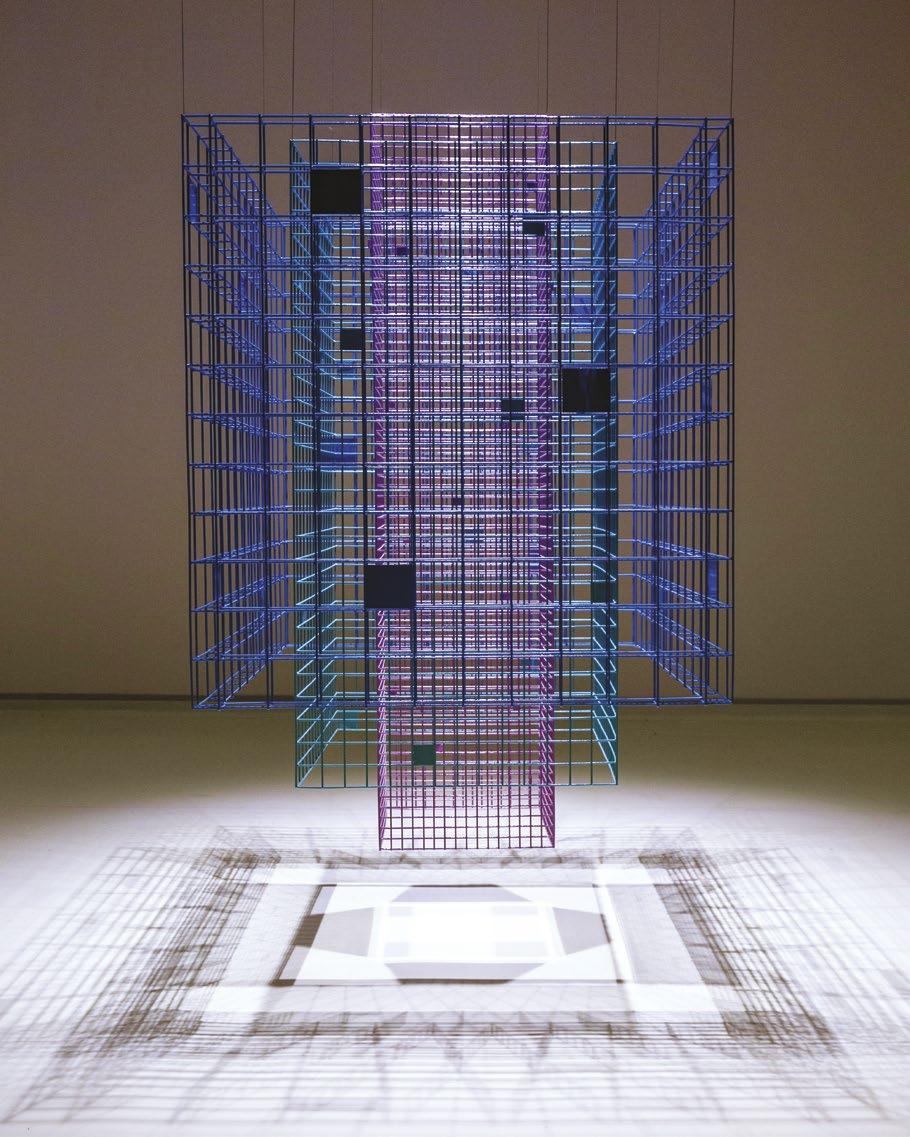
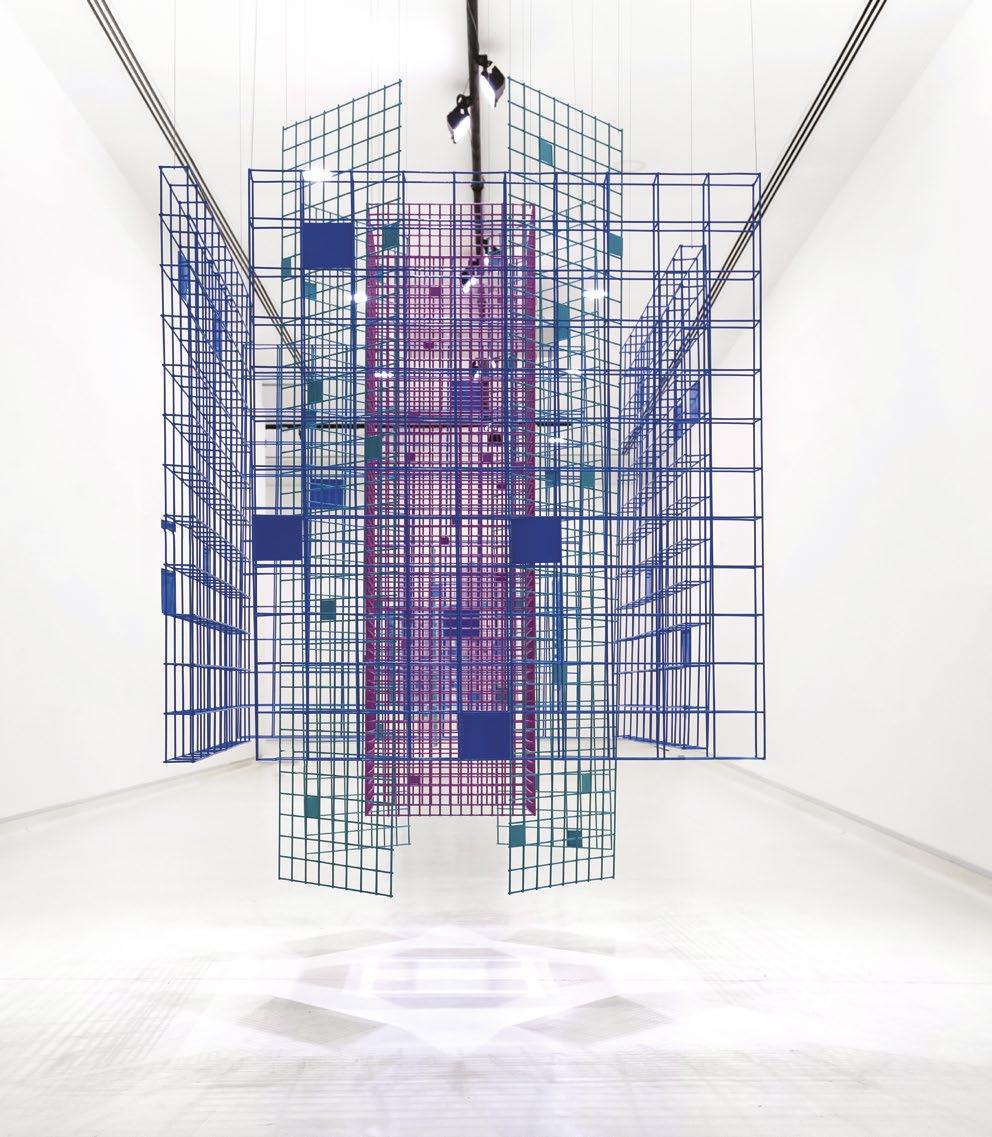
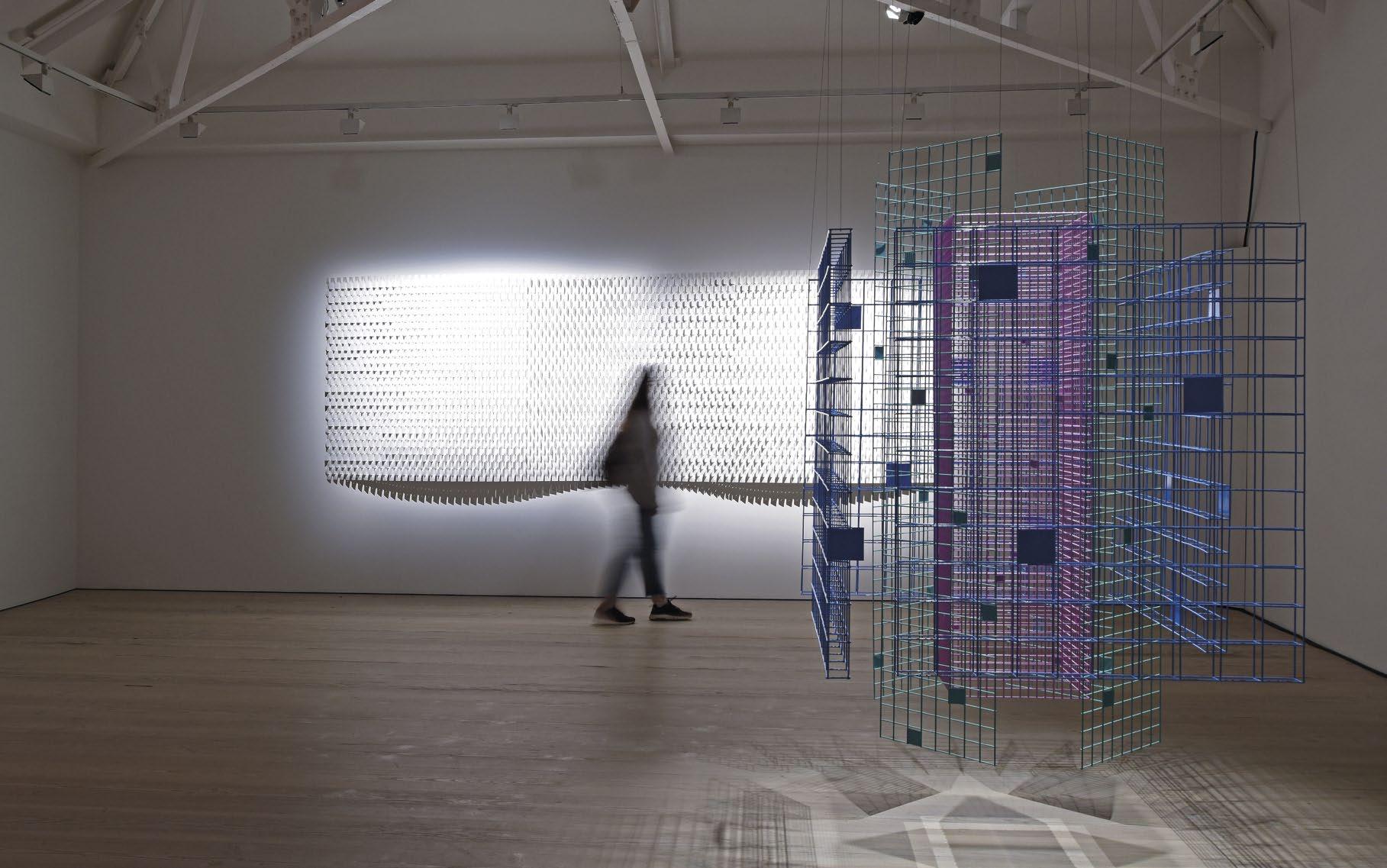
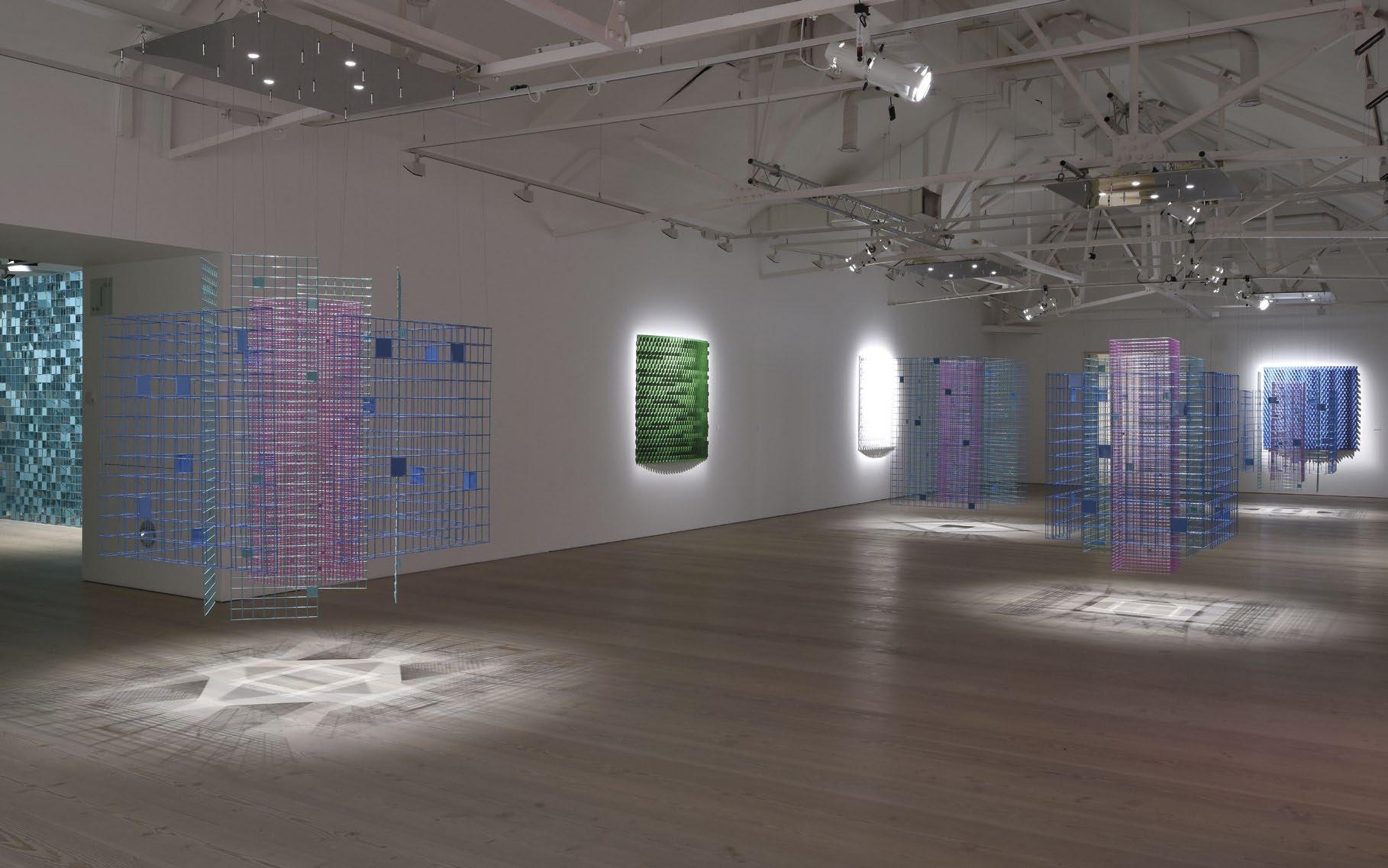
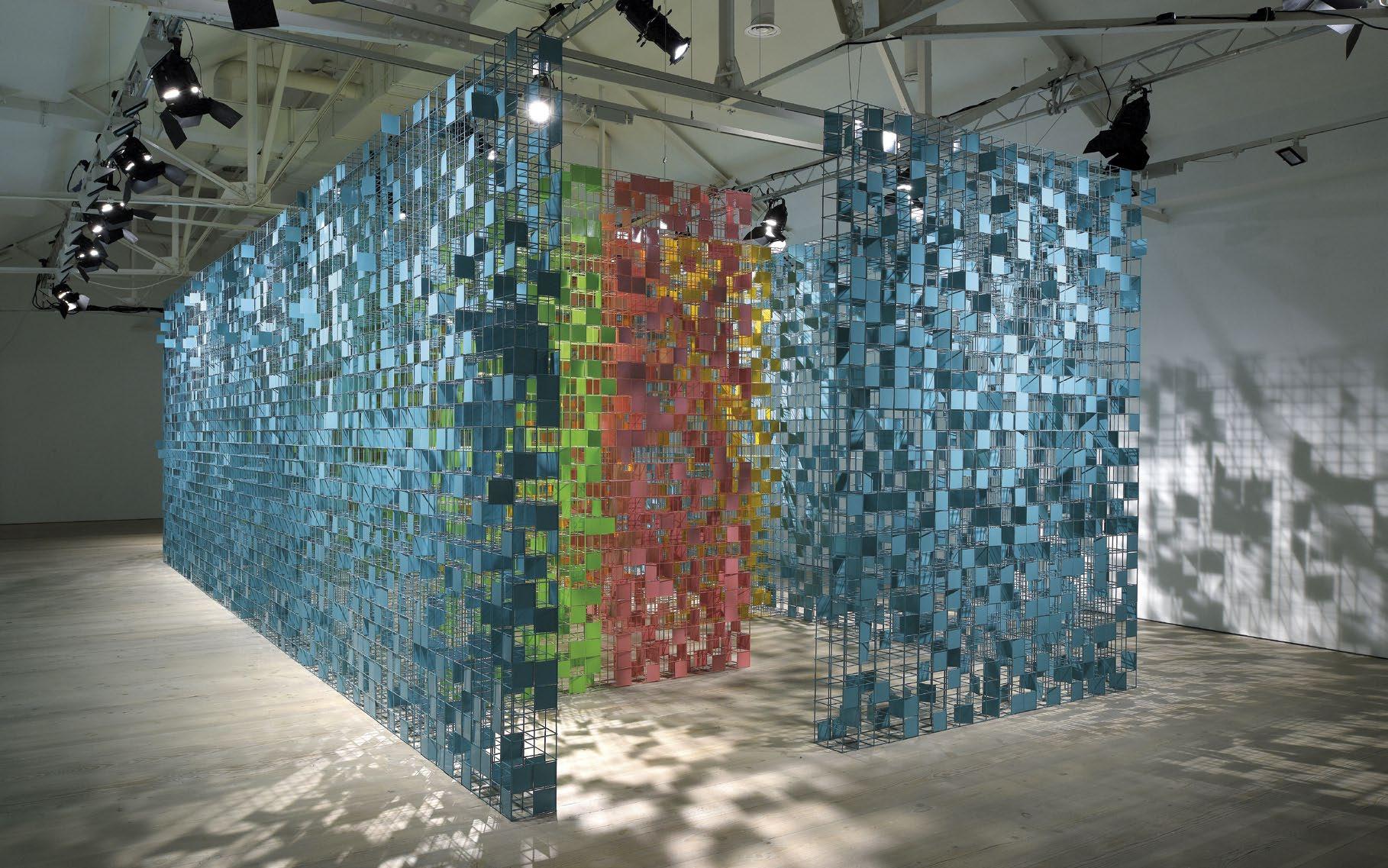
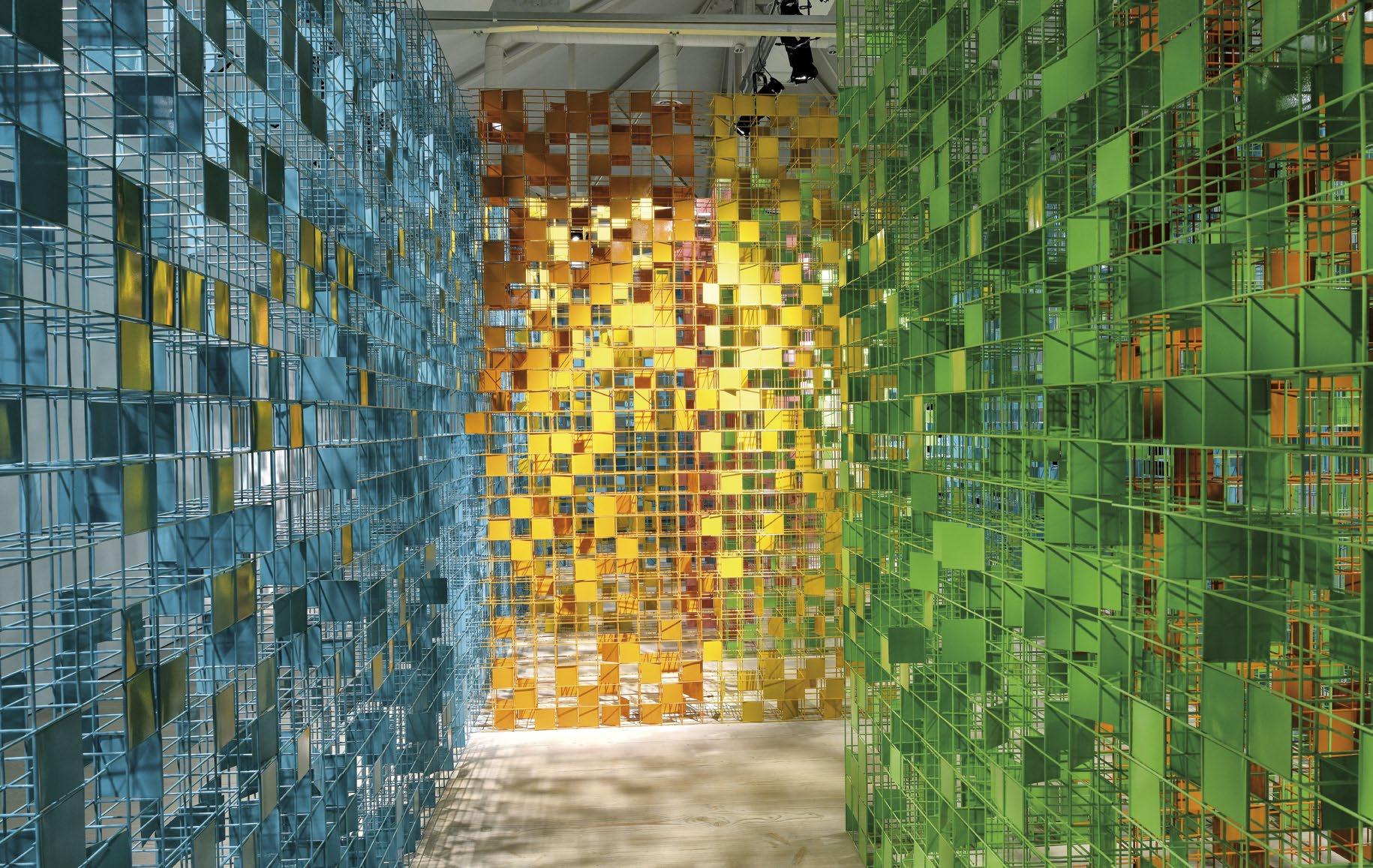
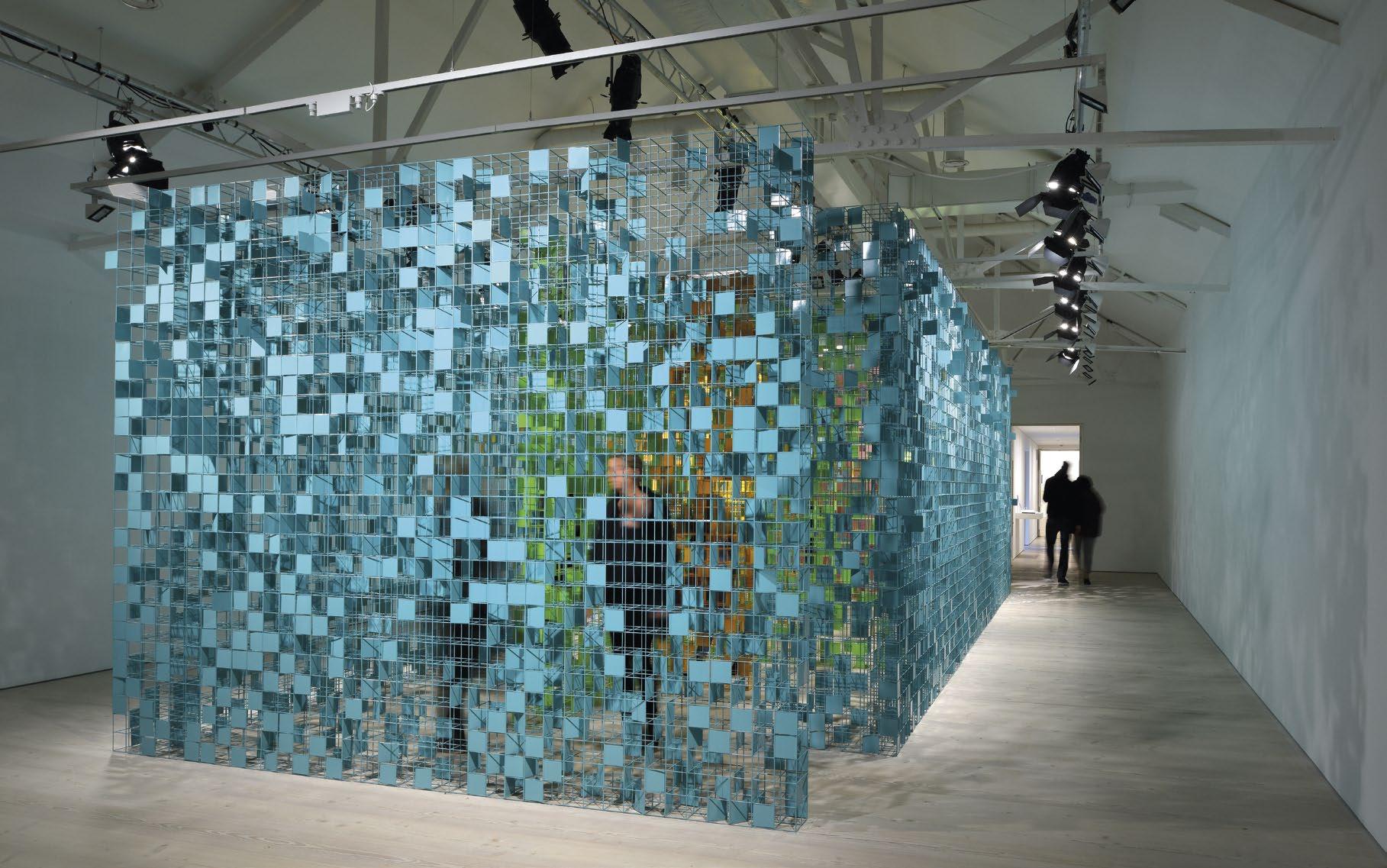
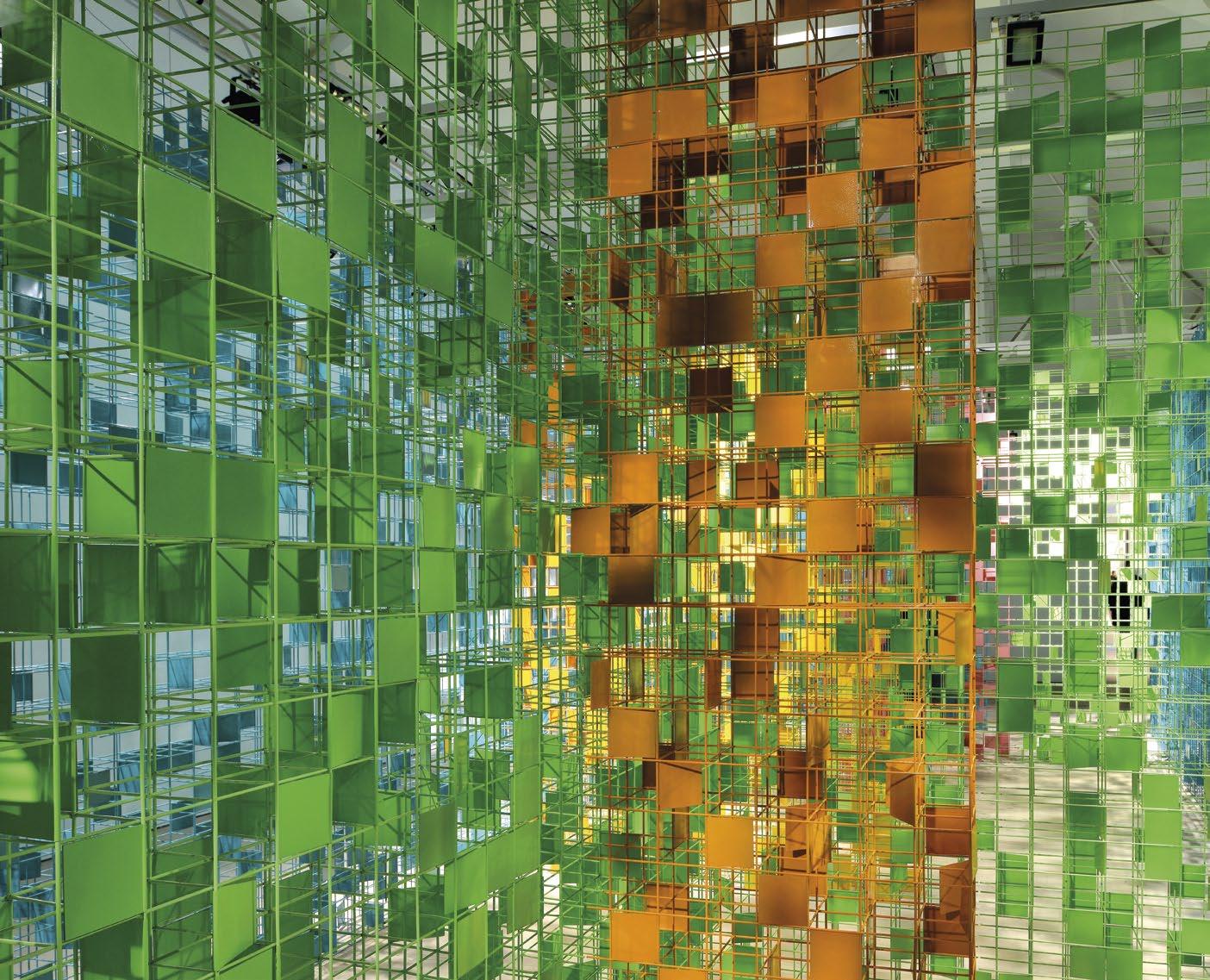
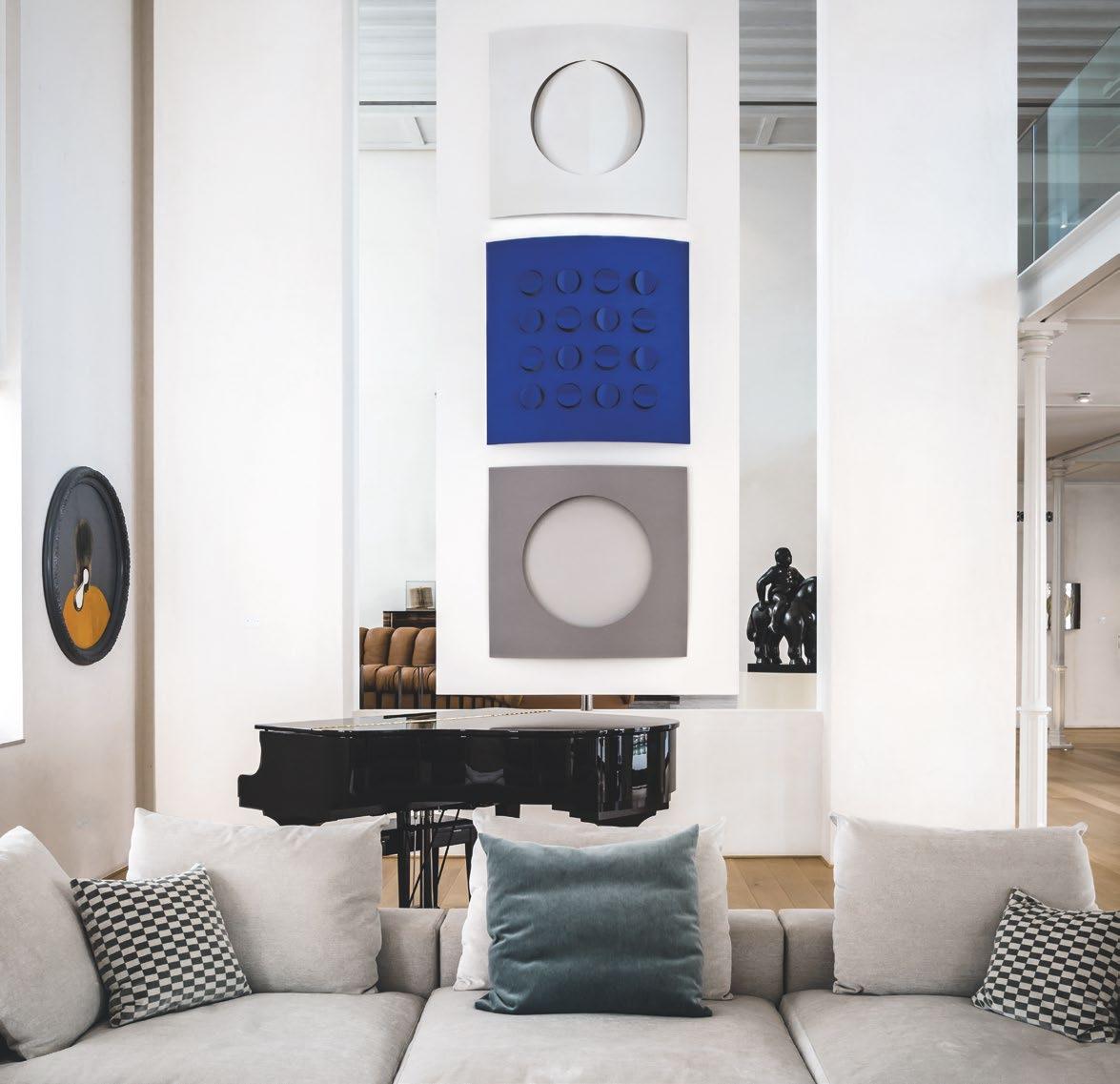
Al Khalifa’s departure from canvas in favour of metal has defined his work in the past decade. Continuing with the use of a central circle set in a square, the artist has varied his palette so that black circles become solar eclipses, in some cases surrounded by what appear to be tree trunks in hues suggesting the weird penumbra we experience during an eclipse. Eventually the circles are cut out and mounted in the metal surround so they can swivel, offering the possibility of a different play of light and form. This development led to compositions with smaller, folded circles and, it seems, the possibility of modular constructions. Although still producing works to be hung on walls, Al Khalifa’s latest works are larger ‘parametrics’, that undulate along a vertical surface or freestanding sculptures composed of steel frames in a grid of coloured metal squares and voids. The form of his expression may have changed, but his preoccupations with colour, the effects of light, and the underlying power of nature have remained constant.
While a monograph such as this is a very welcome document of the artistic achievements of Rashid Al Khalifa, we must hope that it is far from the last word. His openness to new forms of expression underlies the many phases of his oeuvre, as if he travelled down one road, only to reach another and yet another in his approach to realizing his artistic goals. For now, we can celebrate the life and work of Rashid Al Khalifa while looking forward to many more chapters in his artistic odyssey.
Preface
Rosa Maria Falvo
The work of Rashid Al Khalifa is perhaps more than most inextricably linked to his country. As a pioneering artist and a member of the Royal family of Bahrain, from his earliest ideas to his most recent innovations, his work reflects the cultural life and aesthetics of his motherland, as well as the wider region. This makes him a particularly interesting and unique art figure. At the forefront of the development of contemporary art in Bahrain, Al Khalifa’s experimentations, social and political influence, and patronage of artists in general, have made him a protagonist on the Middle Eastern art scene.
Indeed, Bahrain is home to a flourishing cultural context which is finally being recognized by the international art world. The country’s artistic history predates its establishment as a modern state; it was the first in the Gulf to introduce painting classes in 1919 and to open an official cinema in 1937. In the middle of the 20th century the first generation of painters started to emerge, and by the early 1980s, at a time when there were few role models for artists, Rashid and his contemporaries led the way with relentless curiosity to explore various formal languages, media and methods.
Through the evolution of his work, Al Khalifa seems to invite us to feel rather than to think and explain. His art practice is quite a private affair, leaving the work to speak for itself. When I first met him, I was pleasantly struck by his modest and quietly spoken manner. Making art as pure expression, in his Riffa home and atelier, he enjoys a deeply personal connection with his environment. As if wanting to compress nature into a symbolic or dynamic form, he aims to create an 'essential' experience of the atmosphere defined in each of his artworks; one that is elusive and continu-
Writer and Editor
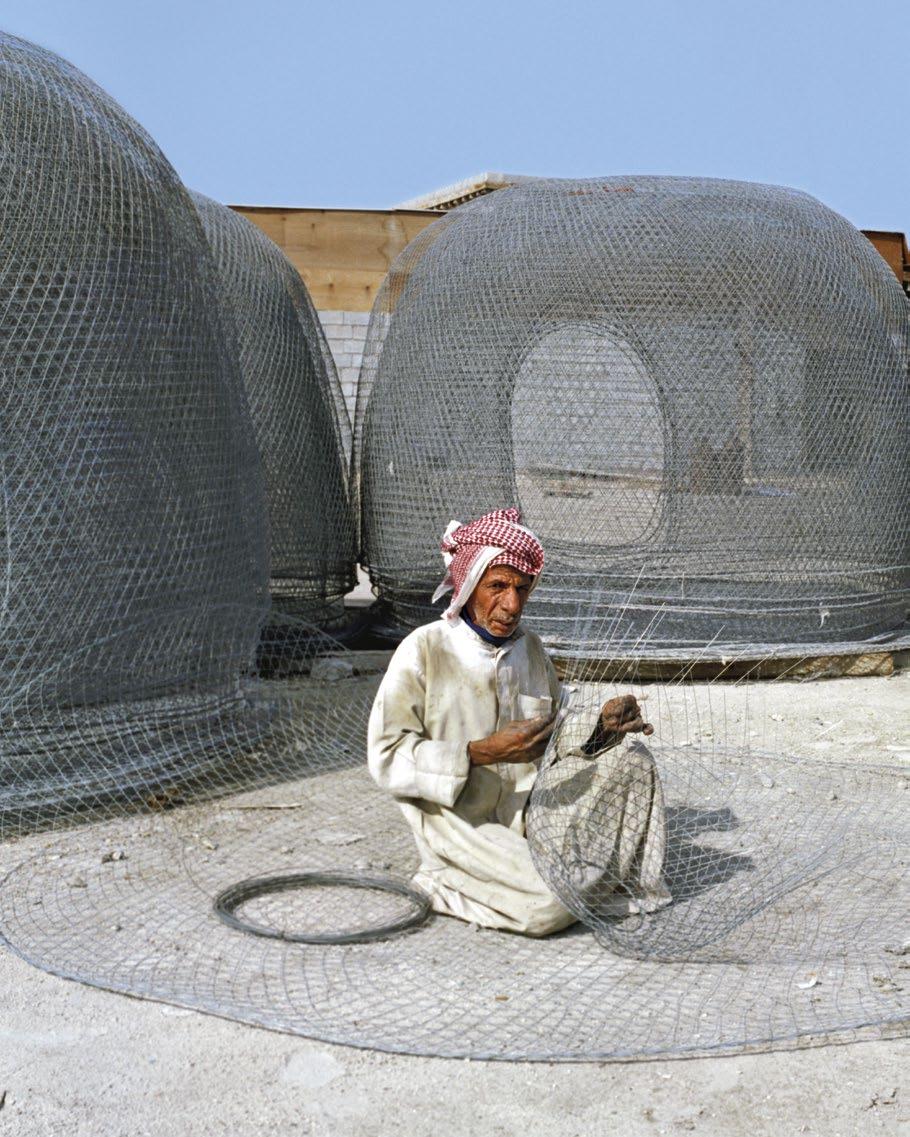
Making a fish trap, 1983 Kingdom of Bahrain Courtesy of Bahrain House of Photography
ously shifting. His skies, sands, wind, waves, moons, and so forth, whether literal or emblematic, present a succession of fleeting sensations. From quasi-abstract to purely poetic motifs, these elemental forms seem to emerge from a carefully choreographed, multisensory interpretation of reality. A single part or constituent of that whole in isolation appears to hold little interest for the artist. It is the visual appeal of its totality that he seeks to achieve. And he is not advancing any particular aesthetic theory but is rather content to impart his feelings of equanimity to the viewer.
Perhaps it is the compulsion of any true painter to add extra dimensions to the appearance of objects and the physical world. Sometimes a cloudy sky stares back with a flash of sunlight or the midday sun casts a shadow making the vegetation far greener, and then turns it deep violet at dusk. Theories cannot make art, but they grow out of an individual artist’s search for distinctive self-expression. Characteristically, Al Khalifa lends his audience a sense of tranquillity, purity and spiritual solace, mostly inspired by the lights and sounds of the desert landscape that surrounds him. It is the artist's genuine relationship with nature that correlates with his demeanour and artistic drive, both of which are greatly energized by the natural world - its cycles, textures, colours, and most importantly, its mysteries, endurance, and liberation.
Farmlands, 2002 Budaiya, Kingdom of Bahrain
Courtesy of Bahrain House of Photography
Left: Amwaj Island, 2002 Kingdom of Bahrain Courtesy of Bahrain House of Photography
As an irrepressible force, nature's myriad forms, have held great creative significance for this Bahraini artist across his lifetime. Not simply imitating landscapes, Al Khalifa engages with them on a sensorial basis and the variety of his work looks like a series of metabolized responses to the mutable nature of human emotions and to nature itself; however abstract or conceptual, we find recurring allusions to the patterns, shapes, and colours found in Bahrain's marine and desert environments, alongside its cultural artefacts and architecture - visual traces of fishing nets, sea creatures, sunsets, and topography, for instance, are everywhere to be found in his work, as if to emphasize the fertility of the deserts and coastlines. With a reverence for nature's ultimate power and wonder, Al Khalifa seems to offer its universal beauty, shadowing its parallel existence in all of us, and discovering himself in the process.
At least on a philosophical level, he alludes to the idea that we each see the world in our own way; that our perception is determinative; and that it ultimately animates not only our personal lives but also our collective experience, which is forever oscillating between harmony and dissonance, light and shadow. Subtly exploiting the expressive potential of colour, his figure and ground are occasionally one, and the visual field often transcends the edges or dimensionality of his canvas and even transforms it into monumental installations. Sometimes the outcomes are self-consciously celebratory, such as in Metamorphosis (1996) and Harmony II (2006), sometimes they are metaphorical, as in Fabric of Society (2011) and Diffraction (2015), and at other times they are positively metaphysical, like in Seeing (2014) and Transverse Wave (2019.
Reaching a point where we have been before, is both a return and a wholly new experience, since we are all invariably altered by our travels through space and time; we develop, mature, and achieve a different, hopefully healthier, perspective. And the point we are returning to has also changed, not completely, but noticeably; perhaps like a variation on a theme. In this context, observing the evolution of Rashid's practice is both exciting and aesthetically satisfying. The essence of his earliest paintings, full of subtleties and colour, is still evident in his newest creations dominating a gallery space. His next cycle is possibly made easier and more rewarding by all the individual ones preceding it. Artists and designers are always thinking of the future with a mindfulness for the past. And Al Khalifa is drawn to invention and change but also appears grateful to tradition. Perhaps this very balance between gratitude and desire is one of the saving graces for our time.
This book proudly showcases the extraordinary talent of Rashid Al Khalifa for the first time to an international audience and opens a window onto his world. It also aims to inspire his fellow artists, especially young and emerging ones, who might take courage from his leadership and support. These artists have inherited a multifaceted legacy, and inevitably they are exposed to the tendencies of both East and West. This cultural exchange has produced a synthesized quality to their work. Rashid's story is unique, in that his creative awareness straddles two very different but strangely complementary realms. It is no wonder that his enigmatic visual metaphors engage us directly, demonstrating both dynamism and elegance at the same time.
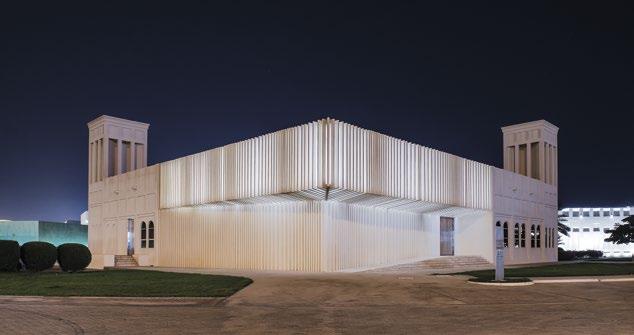
Sheikh Isa bin Salman Al Khalifa Grand Mosque, 2019 Muharraq, Kingdom of Bahrain
Photo by Marine Terlizzi
Introduction Khalifa Al Khalifa
Bahrain’s History & Archaeology
Traces of the Kingdom’s ancient archaeological artefacts date as far back as the 5th millennium BCE. The earliest known human settlement was discovered at the site of Qal’at al-Bahrain (Bahrain Fort), an ancient harbour capital and unique example of relatively continuous occupation from about 2300 BCE, when the Dilmun civilization established its centre on the northern coast of the main island of Bahrain. Although traces of earlier occupations during the Stone Age or Early Bronze Age are much less evident, flint tool fragments discovered near Jabal ad Dukhan, the country’s highest point, affirm the layers of human activity from the Stone Age (c. 5000 – 4000 BCE).
Bahrain’s archipelago served as the capital of the Dilmun Empire, which was marked by the importance of its distinctively fertile lands, abundant natural resources, and exceptional geopolitical location within the region. This combination of advantages enabled the Dilmunites, essentially a maritime people, to manage trade throughout the entire Arabian Gulf. Sites such as Qal’at al-Bahrain, the Dilmun burial mounds, Barbar Temple, Diraz Temple, and Ain Umm al Sujur (Diraz Well) are the most prominent manifestations of this ancient Semitic-speaking population and unprecedented archaeological breakthroughs.
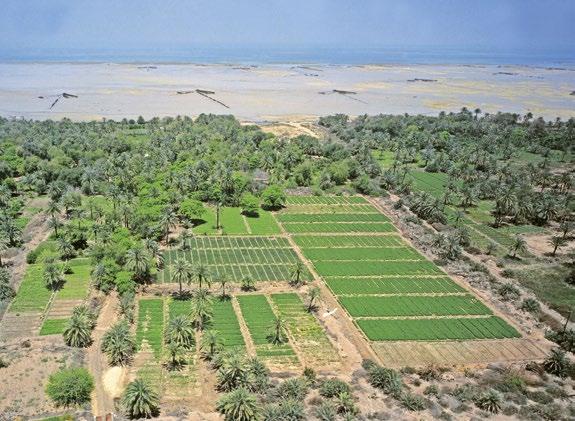
Qal’at al-Bahrain, recognized as a UNESCO World Heritage Site in 2005, bears testimony to successive layers of human activity for over 4000 years, with its exceptional monumental and defensive architecture. The Dilmunites thrived on their commercial knowledge and political presence, linking agriculture (represented by date
palm-groves and gardens still existing around the site) with maritime trade between the Indus Valley, Mesopotamia, China and the Mediterranean. The earliest layer of evidence unearthed – City I – lies eight metres below the soil’s surface and consists of simple dwellings and a network of roads with alleyways belonging to the Early Dilmun (c. 2300 – 1800 BCE). Six layers of occupation from this period until the 17th century Islamic Era can be seen at the central excavation area. The dominant landmark, Hormuzi-Portuguese Fortress, which also gives the site its name today, was built at the beginning of the 15th century. This remarkable archaeological tell is enclosed by the ancient lands pertaining to their traditional farming practices, vegetation, and irrigation systems. Such a well-preserved site demonstrates the melange of languages, cultures, and beliefs enriching this entire area, and continues to attract many researchers who are keen to exhume further confirmation of the lifestyle and land uses of these ancient peoples.
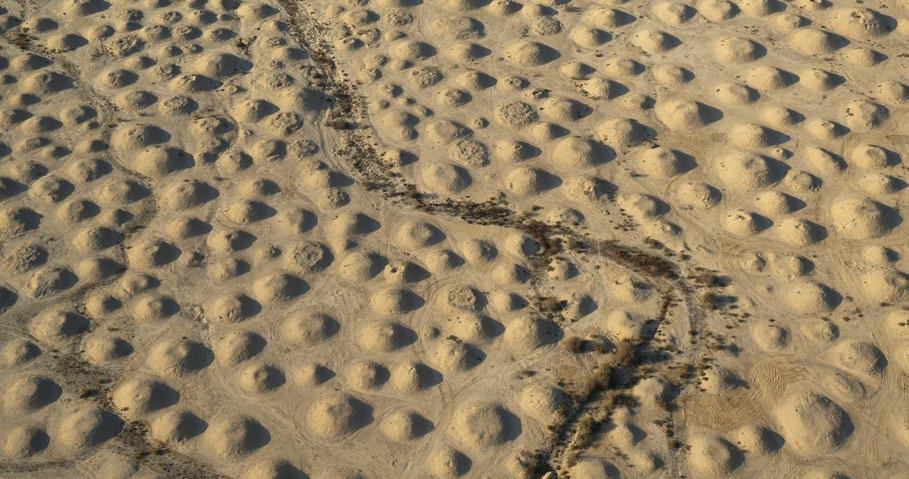
The Dilmun Burial Mounds, built between 2050 and 1750 BCE, span over 21 archaeological sites in the western part of Bahrain and are also inscribed on UNESCO’s World Heritage list. Testifying to the early, middle, and late Dilmun eras, these extraordinary mounds are considered a phenomenon among the scientific and cultural communities. Once counted to around 75,000, today there are just over 20,000 mounds still intact from the Dilmun period, stretching from north to south of the main island. Their density intensifies in the centre of the country, especially
Dilmun burial mounds, 2108 A’ali, Kingdom of Bahrain
Photo by Khalifa Al Khalifa
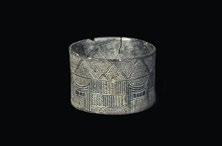
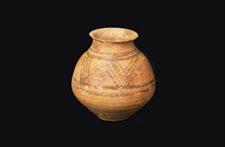
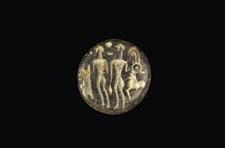
Dilmun artefacts: 1. Soft stone vessel, chlorite, Saar necropolis, early Dilmun,
2300-1800
2. Painted jar in the Omani tradition, pottery, Saar necropolis, early Dilmun,
3. Dilmun stamp seal, chlorite, Saar settlement, early Dilmun,
in Hamad Town and A’ali, where these fascinating and elaborate necropolises not only shed light on the funerary practices of the Dilmunites, but also provide notable information about their diet, household utensils, cultural artefacts and customs, social and political hierarchy, after-life beliefs, farming strategies, and their architectural knowhow across a period of some 450 years. Dating to the early 2nd millennium BCE, about seventeen Royal Mounds, constructed as two-storeyed sepulchral towers, are still intertwined within the urban fabric of the settlement in A’ali. Their design and architectural details offer key insights into the deities and social values of Dilmunite royalty, as well as their close connections with the ancient Near-East.
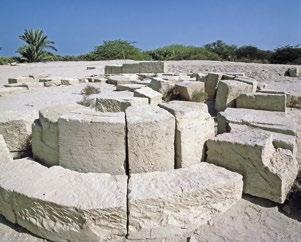
The Dilmun Period in Bahrain is highlighted by several temples built to worship the generous god of Enki. The Barbar Temples and Ain Umm al-Sujur, for instance, are both located in the north-west and share vital connections to water sources. The Barbar Temple site actually consists of three successive temples built in five stages, the earliest of which dates back to the 3rd century BCE. They are contemporary with the Royal Mounds at A’ali and the earliest walled city at Qal’at al-Bahrain. Ain Umm al-Sujur is a natural spring located to the east of Diraz, which was one of Bahrain’s most important artesian water supplies and its name literally translates to ‘mother of the spring of overflowing waters’. To the west of Barbar, Diraz Temple, also built towards the end of the 3rd century BCE, differs in its construction features not only from those of the religious buildings of Mesopotamia but also from those of the nearby Barbar temples, and comprises enormous limestone columns and alters.
The archaeological site of Saar evidences another historic settlement of the early Dilmun, founded around 2300 BCE and reaching its peak at the beginning of 1900 BCE. Enduring another 200 years before perishing, this site differs from Qal’at al-Bahrain in terms of its physical planning, culinary customs, burial practices and influential trade networks. In addition to its dwellings and roads, it showcases so-called ‘honeycomb’ burial structures that are distinctive. More than a thousand agglomerated graves in beehive-style arrangement are unprecedented in the region. The Tylos civilization, marking the Hellenistic period in Bahrain, also left behind numerous burial mounds on the northern and western part of the island. This long history of occupation across Bahrain’s small but precious landscape clearly relied on its abundance of freshwater springs, once most plentiful in the north, which sustained the early settlers for over five millennia.
Towards the south of the main island, the ‘Tree of Life’, identified as a mesquite tree from the Prosopis genus, has stood autonomously for the last 400 years according to a ring study conducted in 1986. This special tree is surrounded by archaeological remains that were identified as a military settlement from the Islamic Era, most likely abandoned around the 16th or 17th centuries. The tree and the settlement are sustained thanks to freshwater available some thirty metres below the ground, with the whole southern region further accommodating pre-Islamic remains.
Bahrain’s Islamic era is no less extraordinary than its earliest archaeological narratives. Al Khamis Mosque, located in Bilad Al Qadeem, is one of the oldest mosques in the Arab world and the most significant archaeological site showing the construction and architectural capabilities in the early years of Islam. The structures standing today are the result of several phases of rebuilding, with columns and arches added in the 10th century and a second minaret in the 14th, of which Qibla niche is the best-preserved element from the earliest phase. Muharraq Island and the main island of Bahrain accommodate several other Islamic period settlements, artesian wells and water distribution systems (qanat), which are witnesses to the country’s more recent history.
The year 1783 marked the beginning of the rule of the Al Khalifa family over the Kingdom of Bahrain. This defined the country’s modern history, particularly during the reign of HH Sheikh Isa bin Ali Al Khalifa (1869 – 1932), when education was formalized, and government authorities were initiated; most notably with the establishment of municipalities and the introduction of electricity in Manama and Muharraq. The discovery of oil during the reign of HH Sheikh Hamad bin Isa Al Khalifa (1932 – 1942) propelled the country into modernity through the development and reinforcement of its city planning and infrastructure, thereby improving the general living standards. During the mid-20th century, the reign of HH Sheikh Salman bin Hamad Al Khalifa (1942 – 1961) witnessed major progress in connecting Bahrain to the rest of the world, with the construction of Mina Salman Port and the Bahrain International Airport which strategically positioned the country’s business and tourism initiatives globally. The country’s independence, declared in 1971 during the reign of HH Sheikh Isa bin Salman Al Khalifa, saw the beginning of a new state under a new constitution and the formation of a cabinet under which HH Sheikh Khalifa bin Salman Al Khalifa was appointed as Prime Minister. During this period, the country underwent major transformations in its commerce and industry sectors, including oil, gas, aluminium, and steel production, to name a few. New urban centres were also built to meet its growing population and subsequent housing requirements. The current reign of HM King Hamad bin Isa Al Khalifa (1999 – present) continues Bahrain’s trajectory into a technologically advanced future by introducing reforms that impact all aspects of society, alongside fundamental commitments to preserve its historical legacies.
Natural & Cultural Heritage
Bahrain’s beautiful desert landscape surrounded by sea dominates its natural environments. Perhaps the most distinctive feature in this bountiful section of the Arabian Desert is the wadi, a dry water course that can flash flood during the winter season. During this period these desert areas are covered in vegetation, mostly with flowering plants, which adds surprising colours to the local scenery. Towards the south of the island, desert broom bush provides year-round coverage and is dominated by the perennial Leptadenia pyrotechnica shrub that can reach two metres in height and provides vital shelter for wildlife ranging from invertebrates to native mammals, including gazelles and hares.
The passionate relationship between the desert and many Bahrainis is perhaps best reflected in its equestrian traditions. Horses are viewed not only as a means of transport but more particularly as an element of great loyalty and honour. The Arabian horse is prized for its beauty, grace and stamina, and revered as a symbol of national pride. With its refined head and high tail carriage, this special breed is renowned for its blend of physical and mental attributes, combining courage and intelligence. This handsome animal is believed to descend from five superlative strains, Keheilan, Seglawi, Abeyan, Hamdani and Hadban, each with its own superior endurance and capabilities. By virtue of its insularity, Bahrain has managed to maintain its own Arabian horses and over several generations the ruling Al Khalifa family has given
Barbar Temple, 1998 Barbar, Kingdom of Bahrain
Courtesy of Bahrain House of Photography
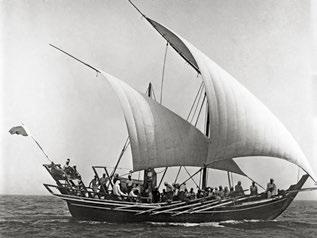
Pearl divers on a traditional dhow, 1967 Kingdom of Bahrain Courtesy of Bahrain House of Photography
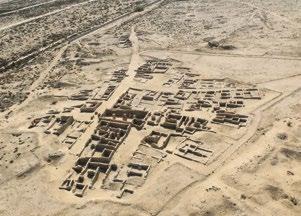
Dilmun settlement, 2018 Saar, Kingdom of Bahrain
Photo by Khalifa Al Khalifa
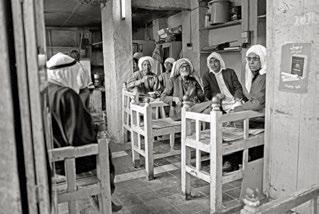
Traditional coffee shop, 1975 Muharraq, Kingdom of Bahrain Courtesy of Bahrain House of Photography
particular attention to these thoroughbreds, nurturing them in the Royal Stud with sophisticated breeding techniques. In 1983, HM King Hamad bin Isa Al Khalifa relocated the stud to its present location at Rawtha’t Al Ghar to ensure its protection and the careful supervision of its breeding program. This Royal Arabian Stud continues the family tradition to selectively maintain these bloodlines, which has resulted in a total of twenty-one derivative strains. Today, Bahrain owns one of the largest communities of these horses in the world and is among the forerunners of those entrusted with advancing the precious genealogy of the original Al Khamsa strain from the deserts of the Arabian Peninsula.
Fundamental to Bahrain’s heritage and future is its marine ecosystems. As an archipelago of thirty-three low-lying islands, with its name literally meaning ‘two seas’, it provides critical habitats for a variety of flora and fauna. Its Hawar Islands, for instance, lying off the west coast of Qatar in the Gulf of Bahrain, constitute one of the last remaining wilderness areas in the country and sustain extraordinary biodiversity. In particular, this area is now home to the largest breeding colony of the Socotra cormorant (Phalacrocorax nigrogularis) in the world. With populations some 100,000 strong, these birds regularly nest in the intense desert heat, where the only nutrition to be had comes from the wind blowing in from the ocean. Paradoxically, its shallow coastline cyclically becomes a rich fishing ground and with no land-based predators these animals have built remarkably dense neighbourhoods of nests across the local landscape. Other marine environments towards the south of Bahrain are also known for their extensive seagrass beds, which are an essential habitat for marine turtles and dugongs. Coral reefs located further north and to the east continue to support local fisheries despite numerous bleaching events and anthropogenic impacts such as dredging and land reclamation. It is believed that coral communities in Bahrain and the Arabian Gulf in general have evolved to withstand fluctuations in water temperature and high salinity, making them an important asset in studying coral adaptations to climate change. In some areas the loss of natural territories has been partially compensated by artificial reefs to ensure basic conditions for fisheries. Shorelines and intertidal areas are also vital to the region’s other migratory birds. Of international importance, according to the Ramsar Convention which recognises the fundamental ecological functions of wetlands and their economic, cultural, scientific, and recreational value, Arad Bay and Tubli Bay maintain coastal mangrove reserves that are now protected to support birdlife communities. Many coastal villages in Bahrain also have specific associations with intertidal ecologies and it is common to see contemporary versions of the hadra (fish trap) dotting the coast which once sheltered only rural villages. This ancient fishing practice still expresses the strong bonds Bahrainis have with the sea.
Oyster beds throughout the country’s waterbodies have been a source of pearls since Neolithic times and were the major driver of its economy from the 18th to the early 20th centuries, due to the global demand for high quality pearls. Archival records and recent studies single out Bahrain’s pearls and its oyster beds as the finest and densest pearl to oyster ratio in the Arabian Gulf. Divers today still frequent these oyster beds to extract pearls and the industry is expected to satisfy an increase in the demand for natural pearls. The government has enforced strict regulations to protect the reputation of this natural bounty and the farming and trading of cultured pearls is still an offence. The recent establishment of the Bahrain Institute for Pearls and Gemstones has secured the nation’s commitment to strict certification methods and extraction platforms to ensure the authenticity and integrity of its pearls.
Regulations are also in place to allow some tourists to extract pearls, with an ecological management plan to protect the sustainability of the oyster beds. This ageold economy fuelled the development of Bahrain’s city centres, mainly the original pearling towns of Muharraq and Manama, which bear witness to this illustrious era despite the urbanization.
The World Heritage listed “Pearling: testimony of an island economy” site in Muharraq consists of three oyster beds – Hayr Bu Amamah, Hayr Bulthama and Hayr Shtayyah, which are all still frequented by pearl divers – a segment of the coast and the seafront Bu Maher Fort in the south, as well as seventeen restored historical buildings connected by a 3.5 km visitor’s pathway. This revitalization project recently won an Aga Khan triennial award for its new public spaces, which rebalance the city’s demographic makeup and have “reawakened a local sense of pride while infusing new cultural life in a deteriorated urban area.” The houses were restored with coral stones from the shoreline and their traditional courtyards are covered in fine white shells. Daily wind cycles have also played a role in the planning and architecture of this town, which is oriented to maximise the sea breeze and reutilize its traditional wind towers for effective ventilation. Across Bahrain, many of these clever architectural features from its past have disappeared due to the economic boom of the mid 20th century
Bu Maher Fort, 2014 Halat Bu Maher, Muharraq, Kingdom of Bahrain
Photo by Loredana Mantello
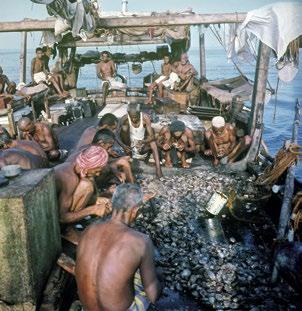
Pearl divers, 1972 Kingdom of Bahrain Courtesy of Bahrain House of Photography
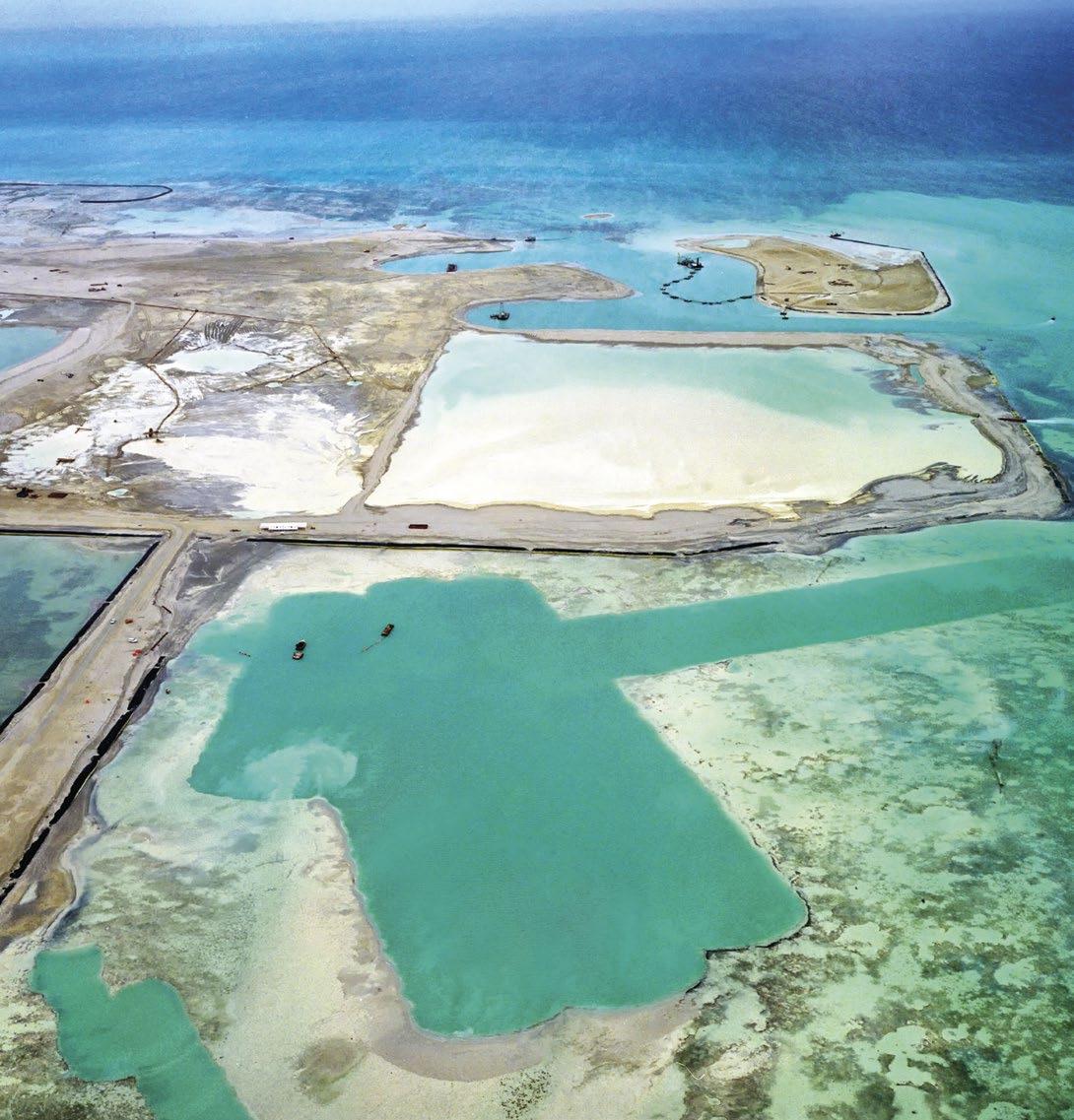
and the widespread use of new construction materials and design concepts. This period also witnessed policies for reclaiming coastal areas for development. Muharraq Island is almost entirely made up of artificial coastline and the country’s capital of Manama continues to extend seaward, starting with the Diplomatic Area in the 1980s and more recent projects, such as the Financial Harbour and Bahrain Bay which offer mixed-use zones catering to an ever-increasing demand for inner city real estate. Despite providing much needed economic and social opportunities, such rapid urban expansion inevitably impacts the country’s natural resources and heritage. Dense palm groves, which covered the northern and western parts of the main island, have been fragmented and even lost in some areas. These plantations and date palms in particular are an integral part of Bahraini identity and society, having always been a major industry and the exclusive livelihood for some farmers. A series of madbasa, or date presses used to extract syrup, from the Dilmun era was discovered in archaeological remains in Qal’at al-Bahrain and this original method, applied well into the 20th century, demonstrates the importance of inherited knowledge. Date harvesting and syrup extraction processes continue to this day, although they are achieved mechanically in a far more efficient way. Indeed, Bahrain’s freshwater springs have enabled the country to flourish for centuries. These springs and associated qanats, old systems of underground channels for transporting water from an aquifer or water well to the surface for irrigation and drinking, are fundamental to the nation’s agrarian traditions. Initiatives are currently in place to restore and safeguard these remaining date palm groves and traces of freshwater springs, alongside the intangible cultural heritage of their surrounding topography. Such springs were also present in submarine environments and did in fact support the thriving pearling industry through the easy access to freshwater during the diving season.
Art Scene
Bahrain’s dynamic, innovative and forward-thinking society has driven cultural expression in all forms, including the visual arts. The modern art movement in Bahrain can be traced back to the mid-20th century when exhibitions began showcasing the works of Bahrain’s modernist artists, such as Abdulla Al Muharraqi, Yousef Qassim, Nasser Alyousif, and Hussain Al Sunni, to name a few. The first Bahraini artists to seek art education abroad, ventured to Egypt, Syria and Iraq in the 1960s and later to Europe and the USA. Based on the work of these pioneers, a growing number of contemporary artists has emerged, seeking to express themselves in new media.
The Annual Fine Art Exhibition is a juried show that has been running for 47 years under the patronage of HRH Prince Khalifa bin Salman Al Khalifa, the Prime Minister of Bahrain. It was the country’s first major art event and is distinguished as one of the longest standing award programmes in the Arabian Gulf region. Organized annually in the Bahrain National Museum by the Bahrain Authority for Culture and Antiquities (BACA), this generous initiative is an open call to artists in Bahrain to submit their latest works and the programme has been developing in content and quality
over the past decades. Recent exhibitions witnessed a higher proportion of different art mediums compared to earlier editions, particularity with its introduction of photography and mixed media installations within the selection process. Throughout the year, the Bahrain National Museum and its Art Centre continue to offer workshops, master classes, and exhibitions by local artists to further cultivate its community outreach projects and provide appropriate platforms for artists to interact with each other and with the general public. On an international level, the Bahrain Authority for Culture and Antiquities also engages with prestigious institutions across the world to showcase the work of Bahraini artists. Some international initiatives include the first Bahrain Pavilion at the 55th International Art Exhibition of the 2013 Venice Biennale, entitled In a World of Your Own, curated by Melissa Enders-Bhatia and presenting works by Mariam Haji, Waheeda Mallulah and Camille Zakaria. In 2019, BACA exhibited modern art from Bahrain at the Albertina Arts Academy in Turin, Italy, demonstrating Bahrain’s commitment to art as a universal language and its potential for intercultural dialogue and education.
In addition to efforts organized by government initiatives and projects, the private and business sectors have always played important roles in shaping and supporting the artistic scene in Bahrain. In 1983, the Bahrain Arts Society was formed by an association of artists under the patronage and honorary presidency of Sheikh Rashid bin Khalifa Al Khalifa, the protagonist of this well-deserved monograph. The group actively promotes and offers opportunities for established and emerging artists to present their works on a regular basis to various local and international audiences. Such collectives have provided a vital touchstone for a generation of Bahraini artists who studied aboard and then returned to the country with new visions and ambitions; no doubt influenced by their time spent in various Arab and European cities, while remaining rooted to the rich creative heritage of their homeland. They became important mentors for the next generation of contemporary artists, most notably from this period are Rashid Al Khalifa, Balqees Fakhro, Ahmed Baqer, and Ebrahim Bu Saad.
Photography as a medium of artistic expression has also become popular in Bahrain in recent years and is now well integrated into the cultural scene as whole. Photographers Camille Zakaria, Ghada Khunji and Mai Al Moataz are cases in point, who all demonstrate individualistic styles and have successfully exhibited internationally. To promote this medium and others, the Sheikh Ebrahim bin Mohammed Al Khalifa Center for Culture and Research has developed one of the most comprehensive programs of exhibitions and workshops in the Gulf, fostering local talent and introducing international artists and speakers to the public in Bahrain. Since its inception in 2002 by H.E. Sheikha Mai bint Mohammed Al Khalifa, the Center has been an important forum for dialogue between people in the fields of philosophy, literature, poetry, culture and the arts. It regularly showcases innovative presentations and exhibitions in addition to documenting and publishing catalogues and books which contribute to the history and promotion of the arts and cultural studies in Bahrain.
Established in 1998, Al Riwaq is another non-profit organization supporting the contemporary art practice of emerging and established artists, both locally and aboard, and has worked to revitalize cultural life in the neighbourhood of Adliya. Commercial galleries and art spaces are also playing a positive role in developing Bahrain’s art scene. Albareh Art Gallery, for instance, in the same neighbourhood, has been instrumental in representing a number of local artists and exhibiting their work throughout the year, as well as in regional and international art fairs.
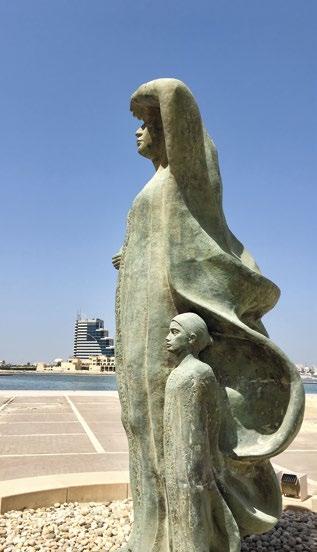
Sculpture by Iraqi artist Mohammed Ghani Hikmat, Bahrain National Museum, 2019, Manama, Kingdom of Bahrain
Photo by Rosa Maria Falvo
Economy & Industry
In 1931, the Bahrain Petroleum Company (Bapco), a subsidiary of the Standard Oil Company of California, discovered oil at Jabal al-Dukhan and production began the following year. Bahrain was the first country in the Gulf Cooperation Council to find oil which completely transformed its economic outlook and facilitated unprecedented job creation, investments in education, healthcare and other core infrastructure. Offering greater and steadier revenue, many of the local date palm cultivators and pearl divers began steering away from their traditional trades and transitioned into careers within the oil industry, both locally and abroad. By the 1960s increasing industrialization and urbanization caused many of the long-standing date palm plantations around Manama to shrink, as they were replaced with new residential areas, agricultural gardens, and business and industrial parks. This process continued into the 1970s, when Bahrain became the first country in the region to invest in satellite communication, connecting it to vital international telecommunications networks. These strategic investments led to the transformation of its economy into a regional hub for banking and financial services. At the same time, Bahrain continued to diversify into other sectors such as manufacturing and information technologies.
In 2008, His Majesty King Hamad bin Isa Al Khalifa launched the country’s ‘Economic Vision 2030’. Announced in October of that year, this comprehensive plan aims for the Kingdom of Bahrain to convert itself from a regional pioneer to a global business contender, thereby defining clear objectives towards improving the living standards of all Bahraini citizens. The government’s plan focuses on crystallizing an integrated socioeconomic strategy based on three basic principles: competitiveness, integration and sustainability. Today, Bahrain remains one of the region’s most open economies and has become a decisive gateway between East and West. Bahrain continues to actively diversify its economy with forward-thinking regulations, world class infrastructure, and a thriving business environment. The country is ideally positioned to access the 1.5 trillion USD Gulf Cooperation Council market and continues to keep its name as a dynamic trade hub.
Another boost to economic development came in 2018 with the discovery of the country’s largest oilfield in its history, located off the west coast of the Kingdom. Indeed, this new tight oil and deep gas resource is expected to contain many times the amount of oil produced by Bahrain’s existing oilfields, as well as large amounts of gas, which naturally brings the potential to significantly upgrade the Kingdom’s position in the region, from a currently marginal to a major oil producer. This newest resource is expected to provide significant and long-term positive benefits to its economy, but Bahrain’s economy wisely continues to foster its non-oil dependent sectors and is considerably the most diversified in the region. Quite familiarly known as ‘business friendly Bahrain’, this pro-business environment promotes no free-zone restrictions and lower operating costs than its neighbours, which makes for highly competitive offerings that attract many major international corporations which have selected Bahrain as their operational base in the region. Direct foreign investment is also growing, supported by full foreign ownership across most sectors. This streamlining of processes also promotes opportunities for start-up success stories, especially with investments in training and education that develop its young, tech-savvy population. In fact, nearly more than half of Bahrainis are now under 30 years of age, which represents a huge opportunity for its workforce and skills acquisition in the technology and information services. Modern economies are also slated to adapt to a fourth industrial era that many believe will engage deeper aspects of human creativity and penetrate how people actually think and work best. Bahrain’s youth are also
offered tailored programs with technical and financial incentives that aim to support the next wave in our digital age.
The country has also welcomed regulatory innovation and adopted advanced cryptocurrency exchanges and open banking. Long known for its pioneering financial capabilities and projects, its 2018 introduction of the ‘Cloud First’ policy has encouraged businesses and government entities to use cloud computing to reduce costs and increase security and productivity. Bahrain ranks first in Islamic finance regulations within the Global Islamic Finance Report for its high standards in banking and crowdfunding skills. More recently, the Kingdom’s central bank issued new regulations around data protection, open banking, crypto-assets, and robot-advisory products. Such innovative efforts have contributed to its mention as an ideal place to start a business globally. Manama has also been granted a special mention for having the largest share of female start-up founders, compared to other cities across the world. With a history of renovation at its core, other promising regional technology sectors include renewable and clean energies, travel and transport infrastructures, smart mobility, educational technology, agricultural advances and improved healthcare systems.
While Bahrain has a strong banking sector, second to oil, it has not disregarded its ‘soft power’ credentials in the tourism and arts and culture sectors. ‘Boutique’ is certainly the buzz word defining its tourism industry today. Indeed, the Kingdom itself could be classified as ‘exclusive’, with 33 islands scattered over less than 800 square kilometres. A compact destination, rich in heritage and lifestyle offerings and hosting modern business and entertainment events, Bahrain recorded some 12 million visitors in 2018 and the direct contribution of tourism, as a non-oil related sector, in GDP terms has increased from 4.6 to 6.5 percent. Due to the importance of this market and its influence on the overall efficiency of Bahrain’s economy, the reformation project of the labour market has seen the light under the patronage of HRH Crown Prince Salman bin Hamad Al Khalifa. This national plan represents four areas of the administration of the labour market, chiefly: working conditions, employment and training policies, labour relations, and research and information. In other words, the plan creatively integrates the country’s past experiences and promises strategies for its future direction.
In 2016, the United Nations Industrial Development Organization (UNIDO), celebrating its 50th anniversary, awarded Bahrain and King Hamad bin Isa Al Khalifa for their global role in delivering economic empowerment for youth and women through the Bahrain Model for Economic Empowerment. Two decades of strategic relations with UNIDO have produced a highly successful programme, implemented through the Arab International Centre for Entrepreneurship and Investment in the Kingdom of Bahrain, which is being replicated in 48 countries across Asia, the Middle East, Africa and Latin America. Such recognition is representative of the diligent efforts being made over the years to nurture the country’s newest entrepreneurs.
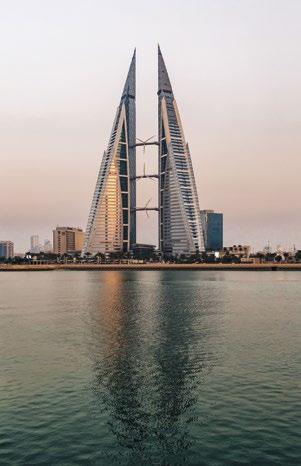
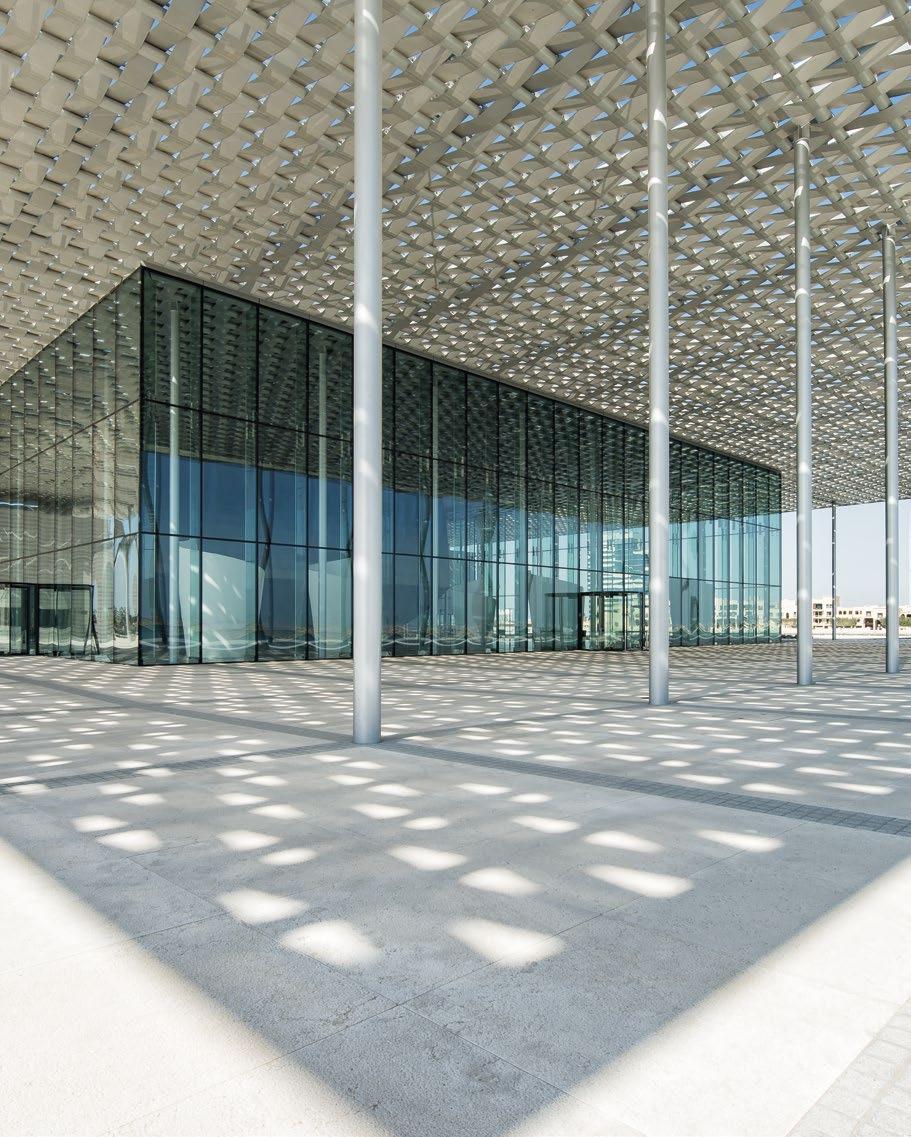
World Trade Centre, 2019 Manama, Kingdom of Bahrain
Photo by Marine Terlizzi
Bahrain Today
A stimulating juxtaposition of cultural sustainability and tech-focused economic diversification, notably powered by women and young people, represents an important face of Bahrain today. The nation’s forward-thinking approach is no exception when it comes to the social benefits of women’s development. Since the inception of mandatory education for girls at the beginning of the 20th century, to the inauguration of its first private international university dedicated to the educational advancement of Bahraini women in 2005, some strong foundations have supported women as key players in governmental, economic, and other sectors. In 2001, the government established the Supreme Council for Women, an organization devised to oversee all women’s affairs and their work-related rights in Bahrain through a national plan for their advancement. Women were subsequently actively encouraged to run for public office in the 2002 parliamentary and municipal elections, in keeping with the momentum of economic empowerment, when Bahrain welcomed the Middle East’s first all-women business incubator platform. Leading the way in the region, these women are making significant strides in developing economic initiatives as key industry contributors. More than ever they are a vital and explicit part of government’s social diversification efforts. Bahraini women have typically been publicly active, holding positions as ministers, ambassadors, diplomats, judges and so forth. In fact, the country tops the Middle East in terms of women’s educational opportunities and rates of business ownership and workforce participation. With a prominent and stable presence across
various fields, women here have seen a significant increase in income in the past decade, closing some of the wage gap and indicating the country’s efforts towards social progress.
Aside from economic diversification and urban planning initiatives, Bahrain’s rich traditions continue to power cultural events which aim to positively engage its younger generations. With rapid urbanization, countries featuring valuable heritage often struggle to keep the pace of modernization while protecting their unique identities at the same time. However, increasing trends favouring conservation and the reintegration of heritage spaces and culturally sensitive development is especially evident in Bahrain. Young people seem to be well aware of their patrimony as an invaluable asset. This rebalancing of heritage protection with acceptable degrees of change is boosting the revitalisation of abandoned historic buildings as modern dining and shopping experiences and destinations, setting the stage for a content-seeking society amidst a social-media driven era.
Bahrain’s investments in promoting the energies and capabilities of its youth are therefore leading its achievements and reaping the best yields for sustainable development and future well-being. As such, inventive skill-building training and experience-based exchanges and initiatives are national priorities for young people to contribute to the welfare of their communities while maximizing their own employment opportunities. Bahrain’s keenness in this field is further exemplified with the establishment of the King Hamad Award for Youth Empowerment Award, first launched during the United Nations Economic and Social Council (ECOSOC) Youth Forum in 2017. The first of its kind, this award recognizes young people’s efforts to become effective citizens, as well as institutions that improve the enabling environment and infrastructure for youth to make such an impact in all United Nations Member States. This commitment comes as an expression of the firm belief of His Majesty King Hamad bin Isa Al Khalifa in the next generation’s potential to lead their countries and the world towards a better and shared future of peace and prosperity for all people on a healthy and renewable planet; as envisioned by the world’s most ambitious plan to date, the 2030 Agenda for Sustainable Development and its 17 Sustainable Development Goals. Bahrain’s history as an ancient commercial crossroads has left a legacy of diversity and acceptance that defines contemporary life in the Kingdom. This small island nation is home to diverse cultures and faiths, with people neighbouring each
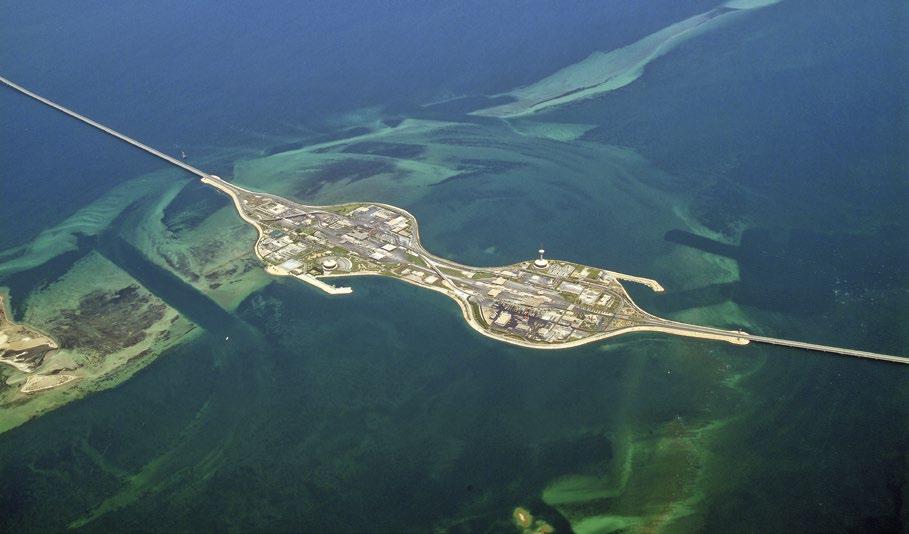
King Fahad Causeway connecting the Kingdom of Bahrain to the Kingdom of Saudi Arabia, 2005
Courtesy of Bahrain House of Photography
Arab Regional Centre for World Heritage, 2014 Manama, Kingdom of Bahrain
Photo by Loredana Mantello
other as friends and workmates. Ongoing for centuries, Muslims, Christians, Jews, Hindus, Sikhs, Baha’is and others continue to enjoy peaceful coexistence, which has been a crucial part of Bahrain’s treasured social identity. Initially emerging from the cosmopolitan outlook cultivated by trader’s, the essential traits of familiarity with different ways of life and beliefs were the key to its booming business success. It is also a principle the ruling family has upheld for many years. Two centuries ago, the oldest Hindu temple in the Arabian Gulf was founded in Manama and in the 1930s its first synagogue was established. Bahrain today is home to churches and temples for Sikhs, Hindus and Buddhists as well as hundreds of Sunni and Shiite mosques.
It is under such policies of tolerance that trade, commerce, science and education flourished during the foundation of modern Bahrain in the 18th century, with principles of acceptance that continue to develop to this day. In 2018, construction began on the Roman Catholic Cathedral of Our Lady of Arabia which is due to become the largest church in the Arabian Peninsula. The same year also witnessed the Kingdom of Bahrain Declaration, promoting religious freedom and peaceful coexistence in an environment of mutual respect and cooperation. In 2019, following a number of interfaith dialogue events, His Majesty announced the establishment of the progressive King Hamad Global Centre for Peaceful Coexistence, which offers a meeting place for conferences and events relating to interfaith exchange as a means to combatting terrorism, violence and social hatred. To further aid academic research into these issues, His Majesty endowed the King Hamad Chair of Interfaith Dialogue and Peaceful Co-Existence at Rome’s Sapienza University, one of Europe’s most prestigious universities, with a history dating back to the 14th century.
At the core of cultural synchronicity and religious accord in the region, Bahrain will continue to act as a beacon of respect and peace as it has done across the centuries. Friendliness is an often-noted national characteristic. Bahrainis are generally welcoming, and the atmosphere here is relatively relaxed, up-to-the-minute and liberal, which is particularly inviting for tourists. Bahrain has been diversifying its economy and specialising in tourism for quite some time, and despite its recent oil boom it adheres to its commitments and improvements of its lifestyle offerings and recreational infrastructures. The country’s archaeological and historical treasures, which include three UNESCO World Heritage sites, stand alongside its contemporary spaces and drive for artistic, culinary, and entertainment experiences within a culture of excellence.
Bahrain National Theatre, 2014
Manama, Kingdom of Bahrain
Photo by Loredana Mantello
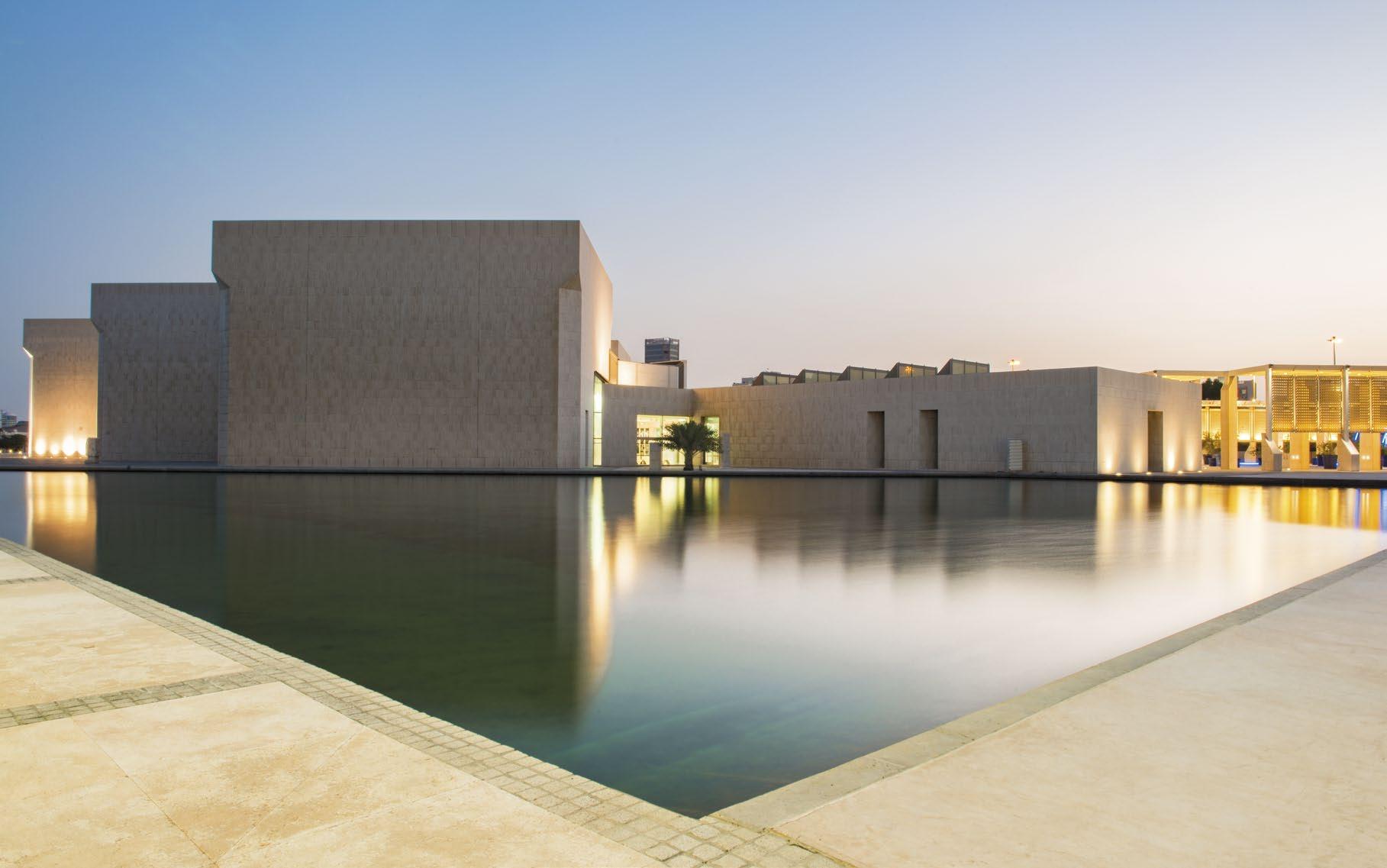
Page 38: Bahrain National Museum, 2014 Manama, Kingdom of Bahrain
Photo by Loredana Mantello
Rashid Al Khalifa: Changing Landscapes Yasmin Sharabi
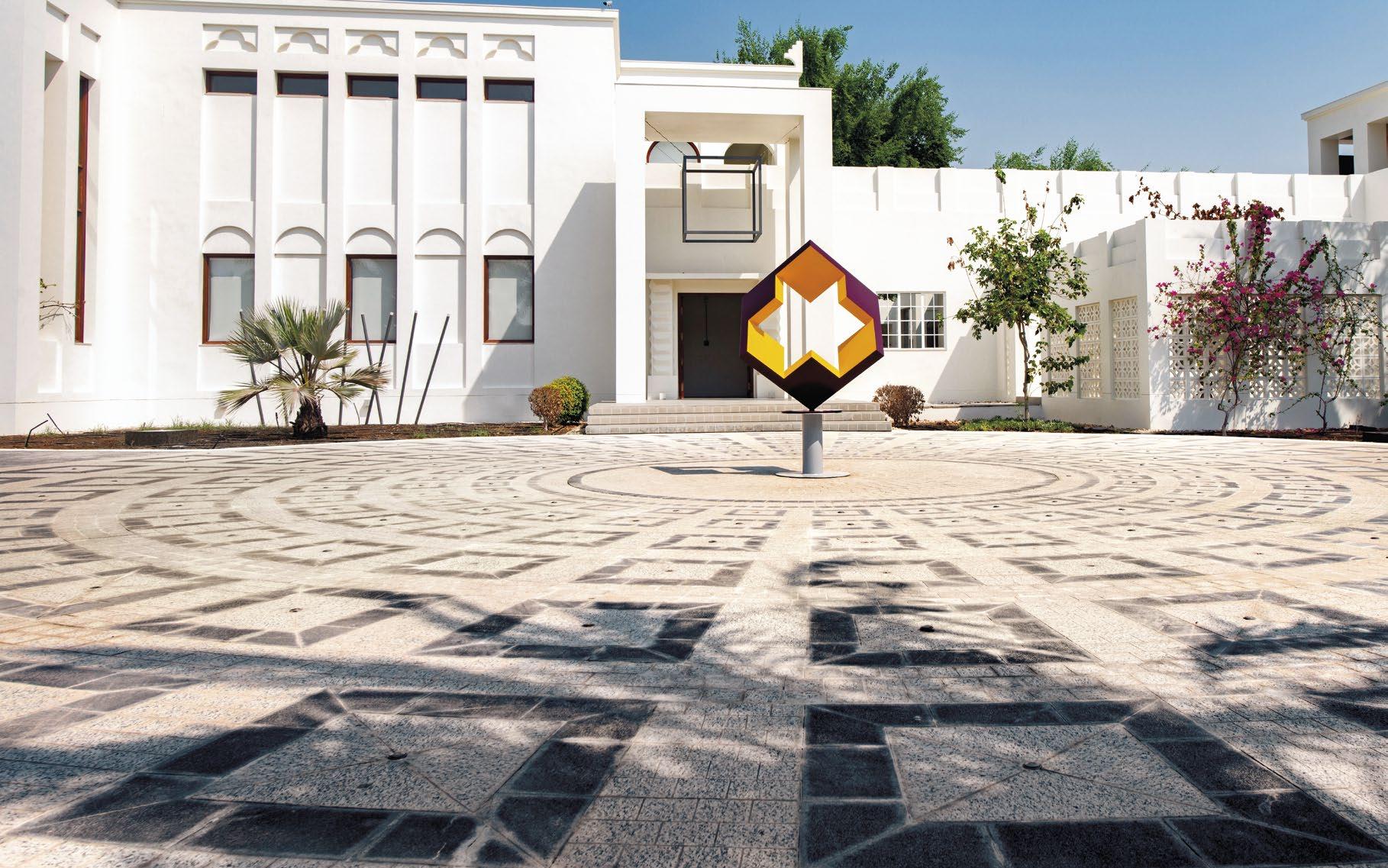
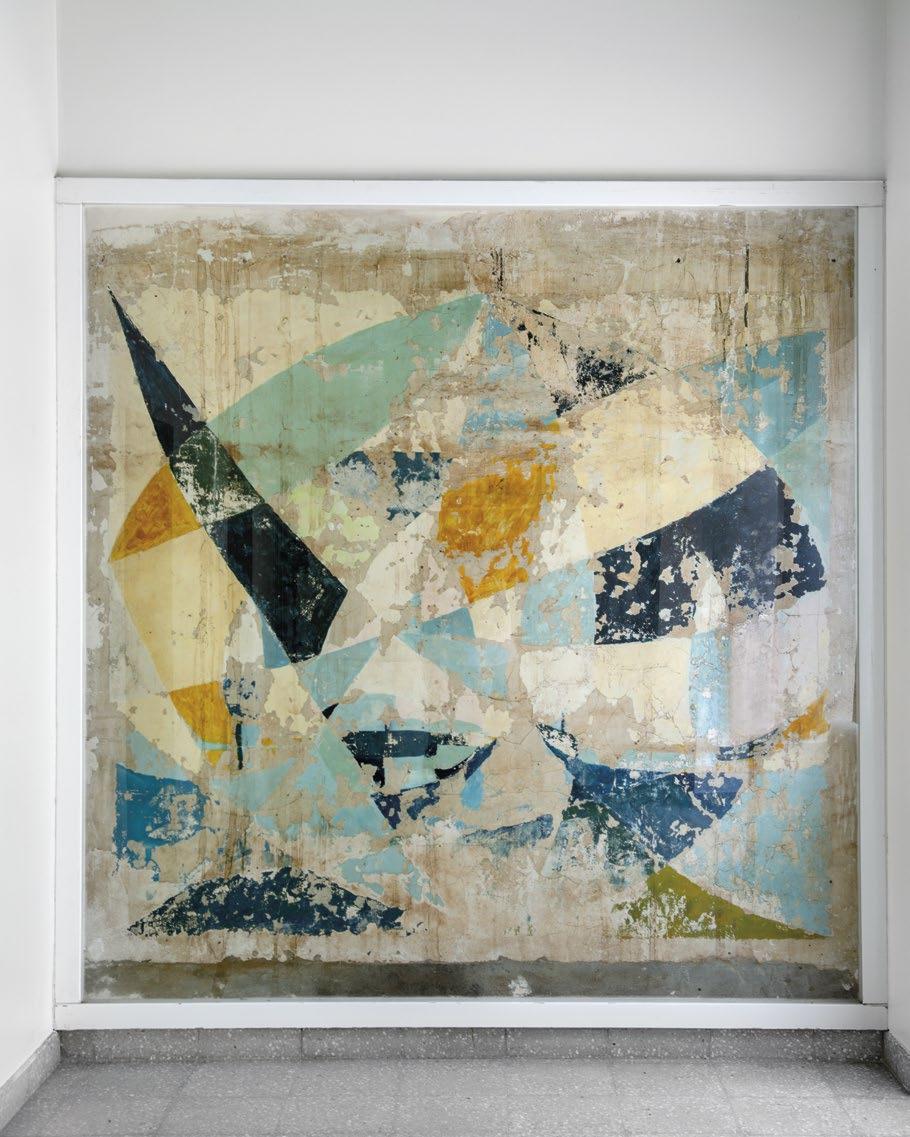
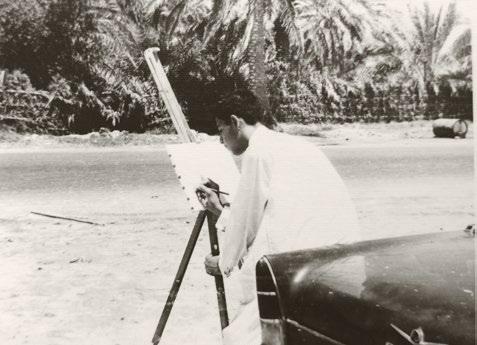
On a typically hot day in 1968, an energetic sixteen-year-old boy felt driven to paint a large and colourful mural on the side of his family’s home in Riffa in the Kingdom of Bahrain. Bold and confident outlines encasing visual planes of soft blues, white and yellows reflected the vibrancy of that Bahraini sky. The spontaneous and generous curvature in these early intuitions mimicked the dhows (traditional Bahraini sailing boats) that frequently traversed his visual landscape. Over fifty years later, these auspicious markings remain, albeit worn like an ancient fresco, flanking the original supporting wall of Rashid Al Khalifa’s house; still adjacent to his original bedroom which once safeguarded his divergent ideas and irrepressible creativity.
Mostly inspired by nature, his brother’s drawings, and his mother’s encouraging and unrelenting love, Al Khalifa was quickly aware of the unique patrimony of Bahrain and its capacity to animate and propel his own artistic expression. Creativity in many forms has been embraced on this small desert island since time immemorial, as a consequence of the country’s accessible and inviting geography which has fostered thousands of years of cultural exchange and trading. Throughout its history, Bahrain’s social openness and natural bounties have lured travellers and merchants alike in search of opportunities for collaboration within a tolerant society in a tranquil setting. Local arts and crafts were undoubtedly shaped by this cosmopolitan melange which in turn has permeated its contemporary creativity and aesthetics.
Al Khalifa was quickly aware of the unique patrimony of Bahrain and its capacity to animate and propel his own artistic expression.
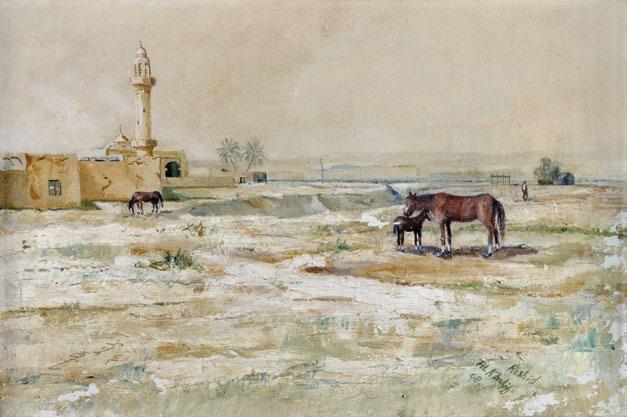
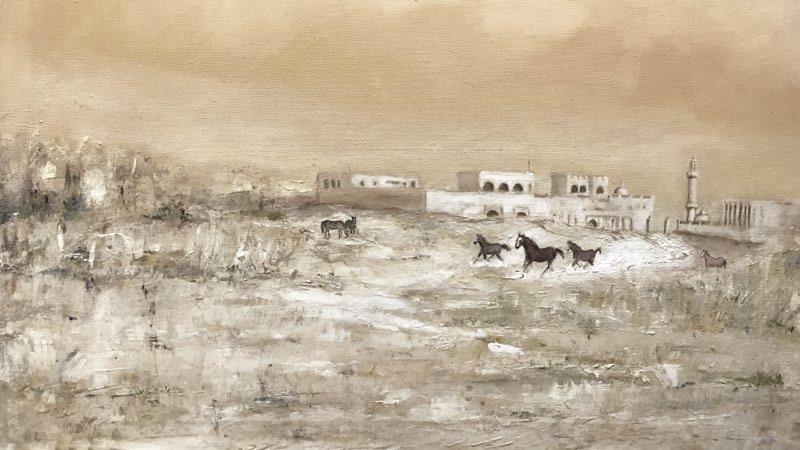
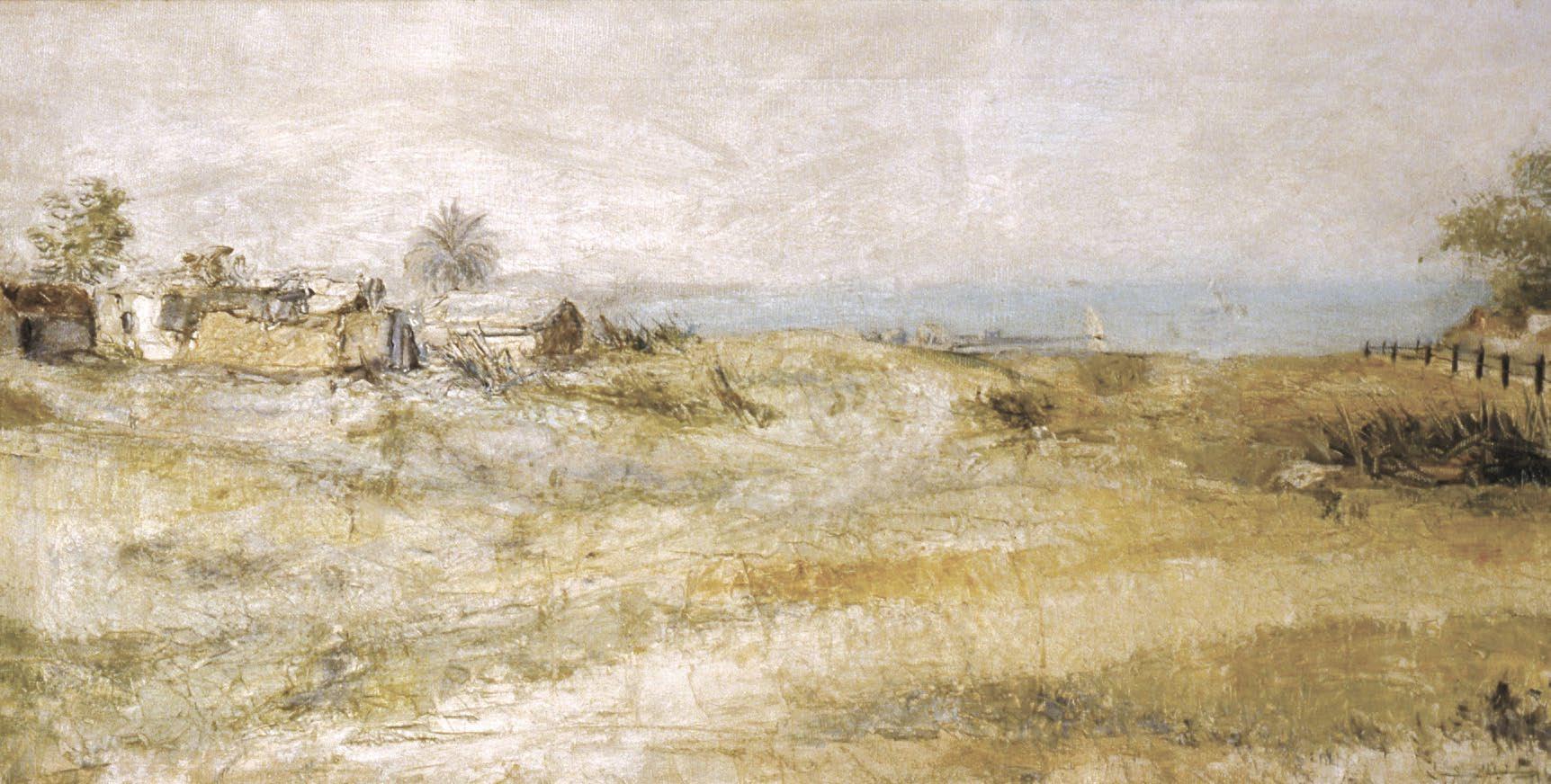
Proudly completing what was destined to be the first of hundreds of paintings, the artist could not have foreseen his lifelong dedication to art or the rapid transformation of his country. Both sensitive and perceptive, he was already conscious of the distinctive context his homeland offered and his own desire to recount its environment. What he produced on those first stretches of canvas were his observations of its muted desert scenes. Horses at Sakhir Mosque (1968), Horses at Sakhir Palace (1969) and Barastis by Bahrain Fort (1969), are all emotive interpretations of Bahraini life in the 1960s and ‘70s, which today convey a true sense of nostalgia. Imbedded in local history, ethereal and subdued, these early works marked the beginning of a number of impressionistic landscapes that resonate with the colours of Bahrain.
Secretly mindful of his talent, Al Khalifa’s decision to continue his art and design studies at Brighton and Hastings College (Sussex, UK) was accepted with reservation by some members of his family who thought he was neglecting his official obligations to his country. And yet, the young artist managed to quietly and pragmatically continue his art passion abroad. In 1972, encouraged by his British tutors, he began exploring and documenting his impressions of the natural world surrounding him. Grazing at the English Countryside (1977) is a rather sombre portrayal of his initial feelings of disconnection and isolation in a foreign land. With its repetitive swathes of black and grey, it is far from the tender fluidity of his earlier desert landscapes. Indeed, his longing for the intensity of the desert sun and his discomfort in the bitter chill of England’s winters compelled an important inner journey for the artist. By strengthening his grasp on the possibilities of colour and light, Al Khalifa began expressing his otherwise latent feelings through his studies of the figurative form.
Into the Distance
In the years following his return to Bahrain, the artist was filled with an even greater appreciation for his homeland and yet he also felt a bewildering sense of yearning. During this period, he completed a series of landscapes that were inspired by his immediate surroundings, many of which marked key transitional moments in his life. His sketches and drawings materialized into enchanting oil paintings depicting both real and imagined worlds. Dawn at Sakhir (1983), for instance, illuminates his canvas like an epiphany, striking hues of dusty pinks and beiges scattering overland as the light diffuses through the atmosphere. Reminiscent of that aurorean moment when the colours of the sky and the earth appear as one, this dawning also signifies the artist’s premonition of a new chapter in his creative experience. That same year, along with thirty-four of his peers, he founded the Bahrain Arts Society (BAS) in Manama. Their objective was to create a non-profit cultural organization that would contribute to and promote the development of fine arts in the country, as well as take its local artists into a new future around the world. It began hosting exhibitions and offering courses and workshops in painting, sculpture, photography, pottery, Arabic calligraphy, and interior design. At the time, Bahrain was in the midst of definitive economic developments, having established itself as the banking capital of the Middle East. Its booming economy signified a newfound sense of collective drive and vitality which
He completed a series of landscapes that were inspired by his immediate surroundings, many of which marked key transitional moments in his life. His sketches and drawings materialized into enchanting oil paintings depicting both real and imagined worlds.
many young artists, recently returned from their studies abroad, were eager to capitalize on. They wanted to distinguish themselves and push their creative boundaries to generate opportunities for themselves internationally. Official support for the BAS came from H.R.H. Sheikh Khalifa bin Salman Al Khalifa, the Prime Minister of Bahrain, who inaugurated its new gallery premises in December 1983.
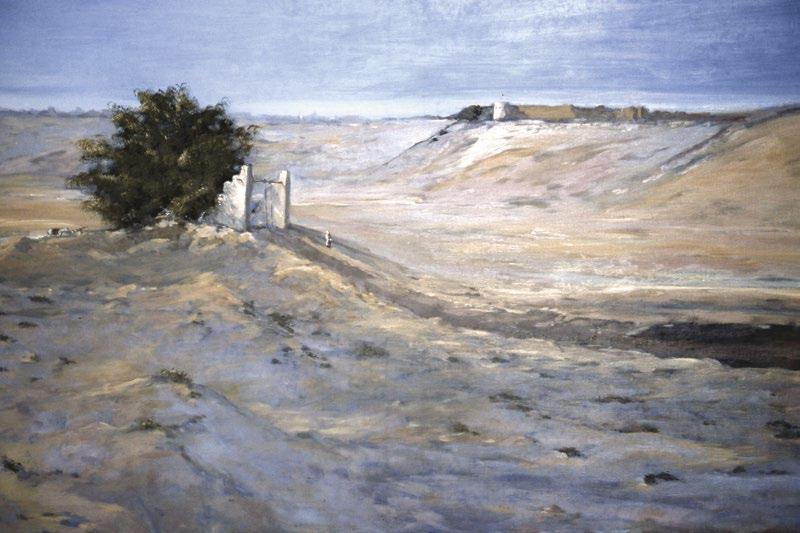
In 1984, at only 31 years of age, Rashid Al Khalifa accepted his formal role within the Ministry of Information and Tourism, along with the considerable responsibilities of his position. The artist’s increasing obligations and broadening international experience clearly influenced his practice, as did the birth of his daughter Noor in 1985. Al Khalifa’s vast expanses of sun-drenched dunes, soothing seaside panoramas and romantic renderings of the desert, conveyed the pride and determination of a father in his prime. Attentive yet dreamy, dignified yet elusive, Hunainiyah (1987), is a contemplative example of the surrounding area of Riffa, the second largest city in Bahrain, where the artist was raised. Here we begin to see his precise attention to architectural and natural details. A water-well stands atop a mound beside a flourishing ‘Ghaf’ tree. Nourished by the well, this tree (Prosopis Cineraria) is the same species as Bahrain’s legendary ‘Tree of Life’, which is believed to be around four centuries old and survives to this day with no obvious water supply. Locals assert this whole region was once the site of the biblical Garden of Eden and that the tree is therefore mystically powerful; symbolizing nature’s resilience, munificence and capacity to sustain life even in the most arid conditions. Offering life-saving protection from the overwhelming heat, this species of tree is our reference point alongside a human figure gazing into the distance over the Hunainiyah Valley, towards Qal’at ar-Rifa’ (Riffa Fort). Historically significant, this important stronghold was built between the late 18th to early 19th century and its architectural features and wall carvings still provide vital insights into Royal life during that period.
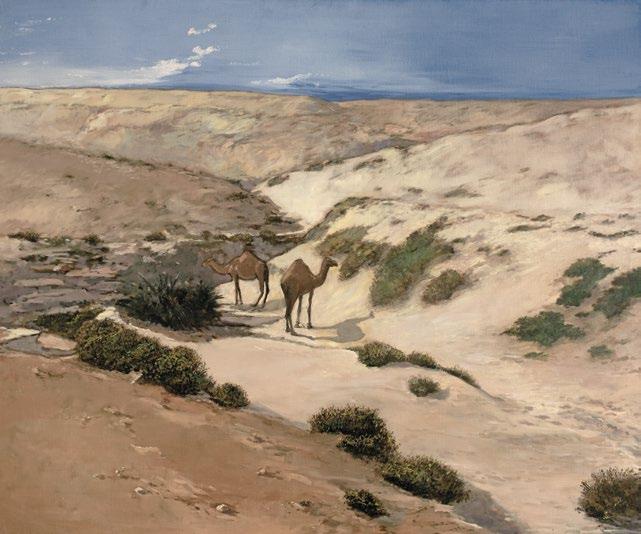
Ruins at Sakhir (1987) is another example of the quintessential Bahraini setting which the artist metabolized in those early years, conveying a rather pensive rendering of the rolling shadows and shrubs occupying the open terrain. For a country with a relatively low desert plain, the Sakhir Desert preserves its highest point, the Jabal ad Dukhan (Mountain of Smoke), at a modest 134 metres. Like an apparition, an ageold structure, long devoid of human presence, sits on a mound. These early explorative paintings speak of a bygone era and also of a young man’s anticipation of his own future. Camels at Rumaitha Wadi (1989), depicting two camels grazing in a small valley, also suggests a sense of ambivalence or an uncertain destination in the distance. These subtle symbols of perseverance reaffirm Al Khalifa’s intuitions of impending change and growing personal responsibilities. Today thousands of people annually put up tents in the Sakhir Desert, about 30 kilometres south of the capital Manama –some of them camping for weeks in the cooler months to escape the confinement of high-rise urban living and to reconnect with nature and their local traditions.
Rashid Al Khalifa: Changing Landscapes
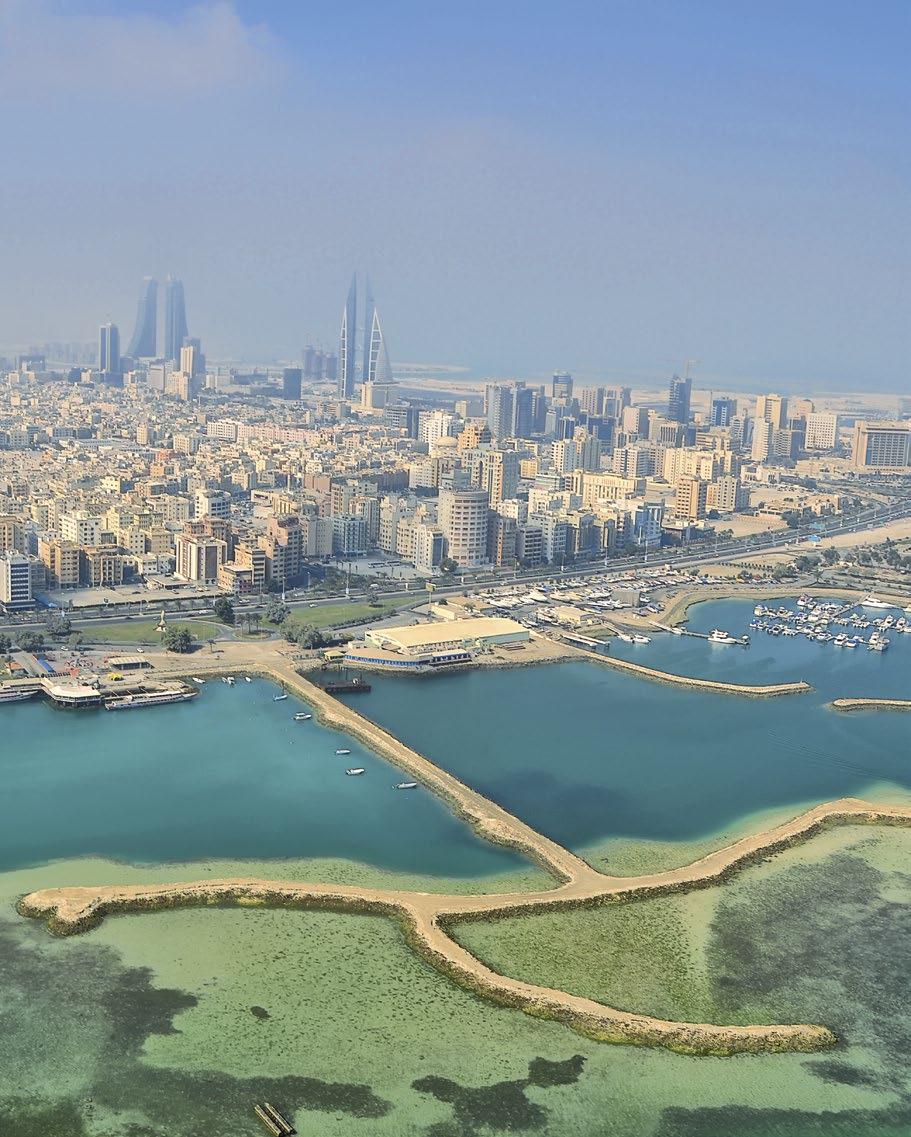
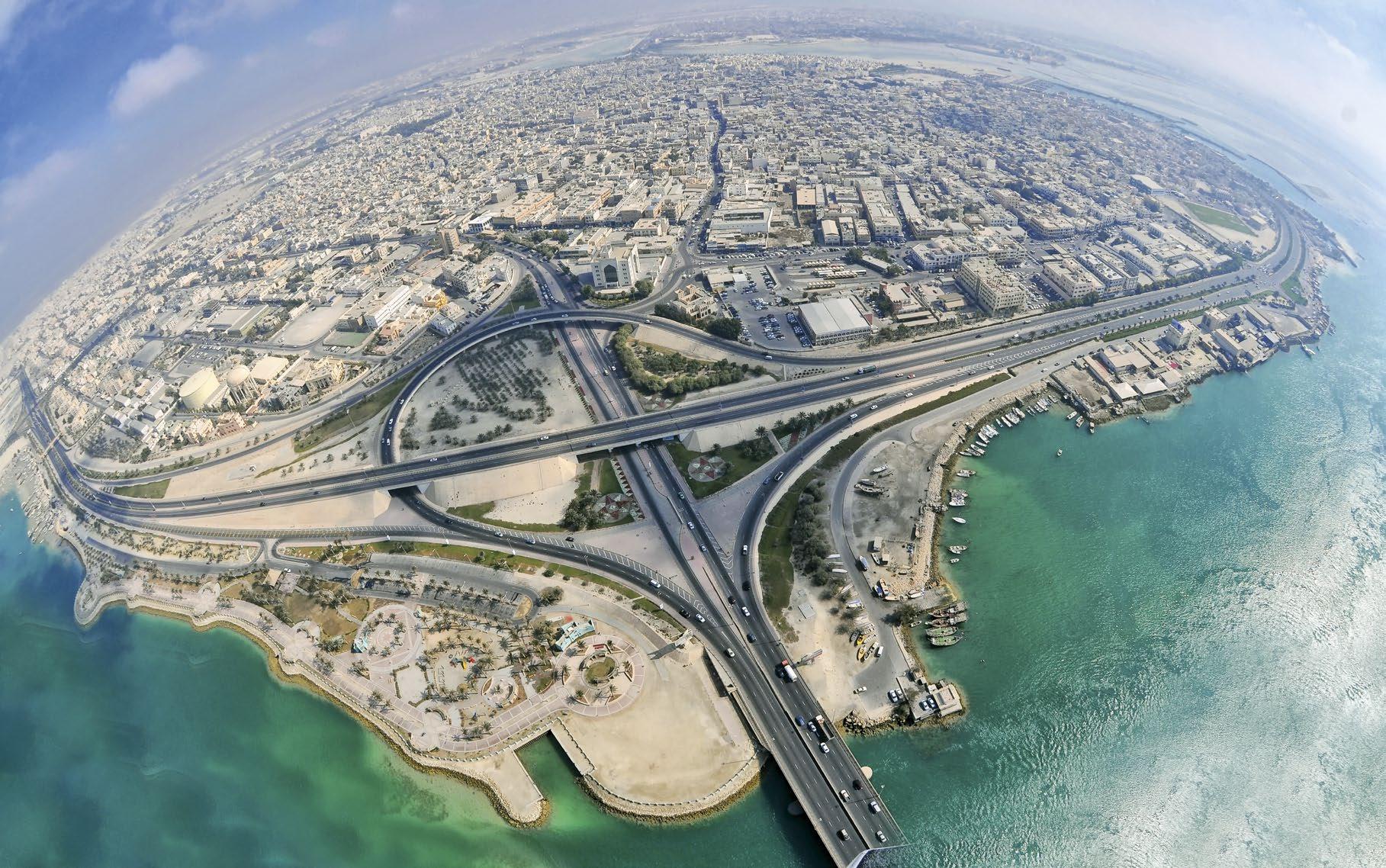
Aerial view of Manama, 2009 Kingdom of Bahrain
Photo by Loredana Mantello
Rites of Passage
The artist continued to utilize the skills he had gained abroad, incorporating the stimulus and insights gleaned from the Bahrain Arts Society. His growing reputation as a talented landscape painter gave him the confidence to begin experimenting with a variety of methods. Although his initial investigations with portraiture transpired long before his studies in England, the technicalities of figure drawing were unfamiliar to the aspiring artist until he was introduced to them at university. Bahrain lacked in opportunities to pursue formal arts education and there were few, if any, certified courses offering arts training or theoretical knowledge. In terms of further education at the time, many were unaware of the benefits offered by art history and the various forms of artistic practice. Generally, an aptitude for realism and landscape painting was highly respected, and impressionism was an acceptable and natural progression. Depicting human figures, and particularly the feminine form, would have been perceived with a more discerning and uninformed eye. The body was and continues to be viewed here as a sacred, holy vessel, which no man can truly express upon. Historically, various Islamic influences adopted this view, deeming the human form as ‘forbidden fruit’ in need of concealment and protection. But it was in this very context that Al Khalifa began to explore the figure as a means to express his longing for a more private aesthetic space and experience. The figurative landscapes which followed provided an opportunity for him to reflect on his emotional and spiritual connection to his homeland and simultaneously communicate his new responsibility as a husband.
It is clear that even early on Al Khalifa intuited that every aspect of our personal selves, mindbodyspirit, correlates to and is energetically connected to a part of the natural world.
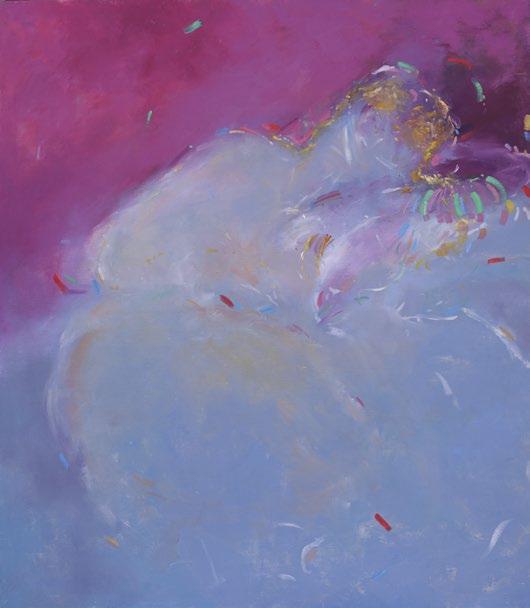
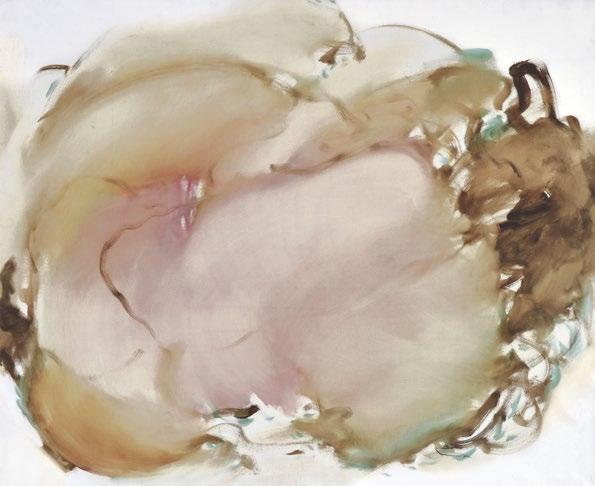
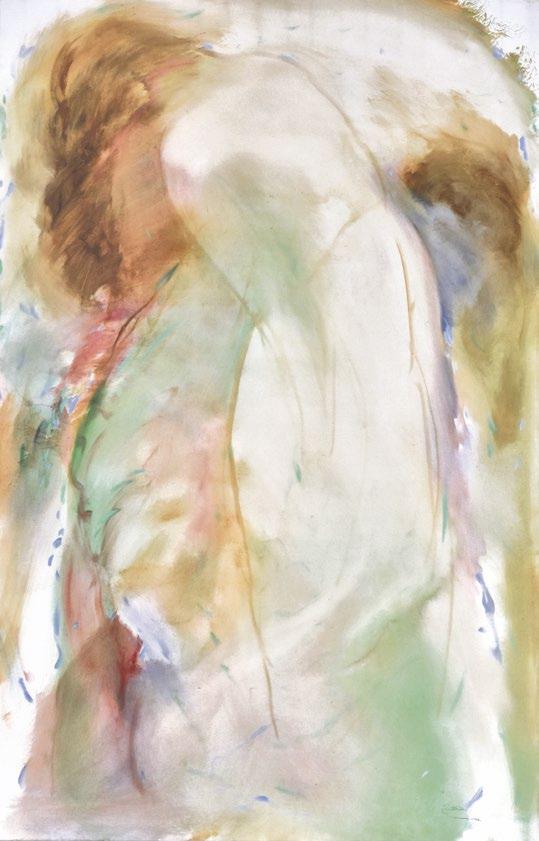
In Fascination (1988) we see a female figure floating in the centre of the painting. Deep purple and blue hues surround her, while flecks of colour envelop the subtlety of her form. Equating her body with nature itself, these tones evoke the memorable gamut of colours found in Bahrain’s twilight skies. Reclining Figure V (1989) also appears like a magnified detail of an earlier landscape. With no specific or recognizable physical features, the atmospheric light emitted here also suggests the cirrus clouds in orange, pink and purple of the setting sun. With this fresh perspective, Abstract Figurative II (1989) depicts the artist’s vision from above, where, like an island at high tide, indistinct forms succumb to the turquoise churning of the sea; foretelling the rise and fall of promise and hope. In a series of fourteen paintings from 1992, thick washes of fleshy tones and undulating colours trace voluptuous contours and crevices recalling the valleys between the local desert dunes. Sensual and suggestive, these works are aptly titled Desert – Paysage Humain, intimating Al Khalifa’s awareness of the ephemerality of nature, the transitional phases in his own life, and the journey of love and learning that lay ahead of him.
Nature, the Earth, our environments and our realities: every traditional culture considers these to be but mirrors of what we contain within. Our bodies appear to constitute microcosms and also reveal the inner landscapes of our consciousness. It is clear that even early on, Al Khalifa intuited that every aspect of our personal selves, mind-body-spirit, correlates to and is energetically connected to a part of the natural world. This reflects a common Taoist precept that everything is interconnected and part of another whole, no matter how large or small, and that in some ways we are also the stars, the Sun, the Moon and the boundless ocean. With this kind of mindfulness, the artist recognized that there is much more than it seems in this three-dimensional reality, with many layers of subtext which, once uncovered, can expand our understanding and responsiveness to both our inner and the outer worlds.
Water in the Desert
It followed in 1993 that Rashid Al Khalifa’s life would take another significant and determinative turn, as he assumed his new appointment at the Interior Ministry, as the Undersecretary of Passports, Nationality and Residence Affairs; a position he still holds to this day. Such a significant and influential role came with enormous obligations and an intricate understanding of governmental policy and procedures. This marked the beginning of a new era for the artist and in that same year he was designated President of the Bahrain Arts Society. Such disparate roles were only two of the many he was required to maintain; all of which demonstrate his unique ability to calibrate completely divergent interests and dynamics in the different domains he must experience on a daily basis.
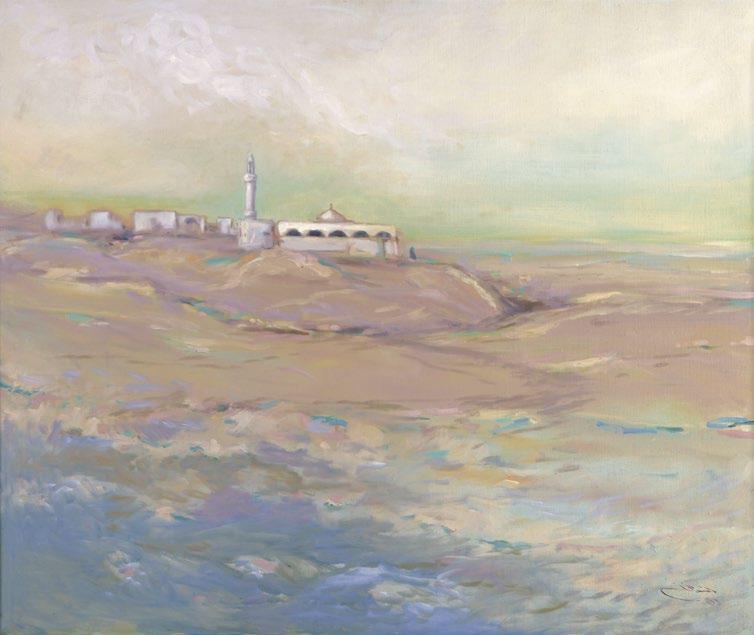
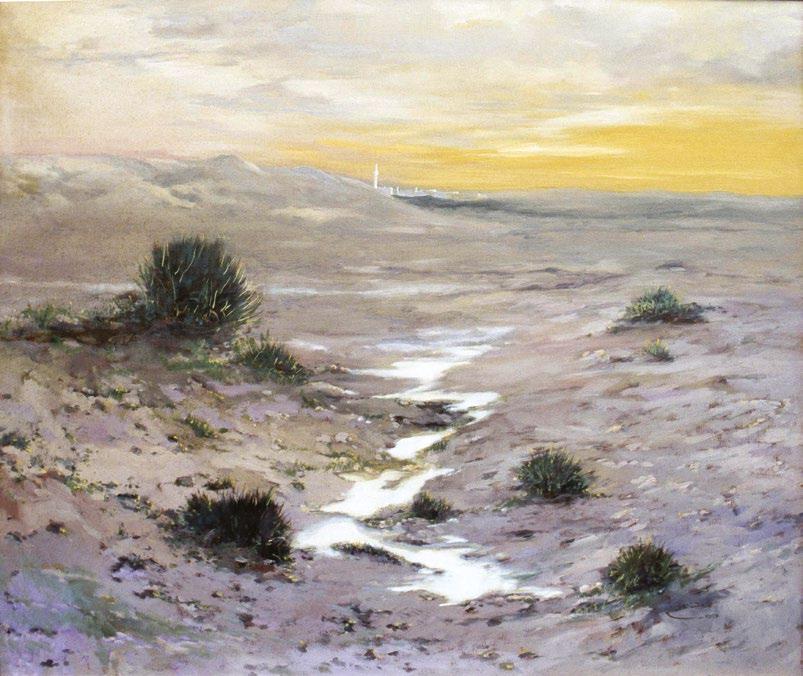
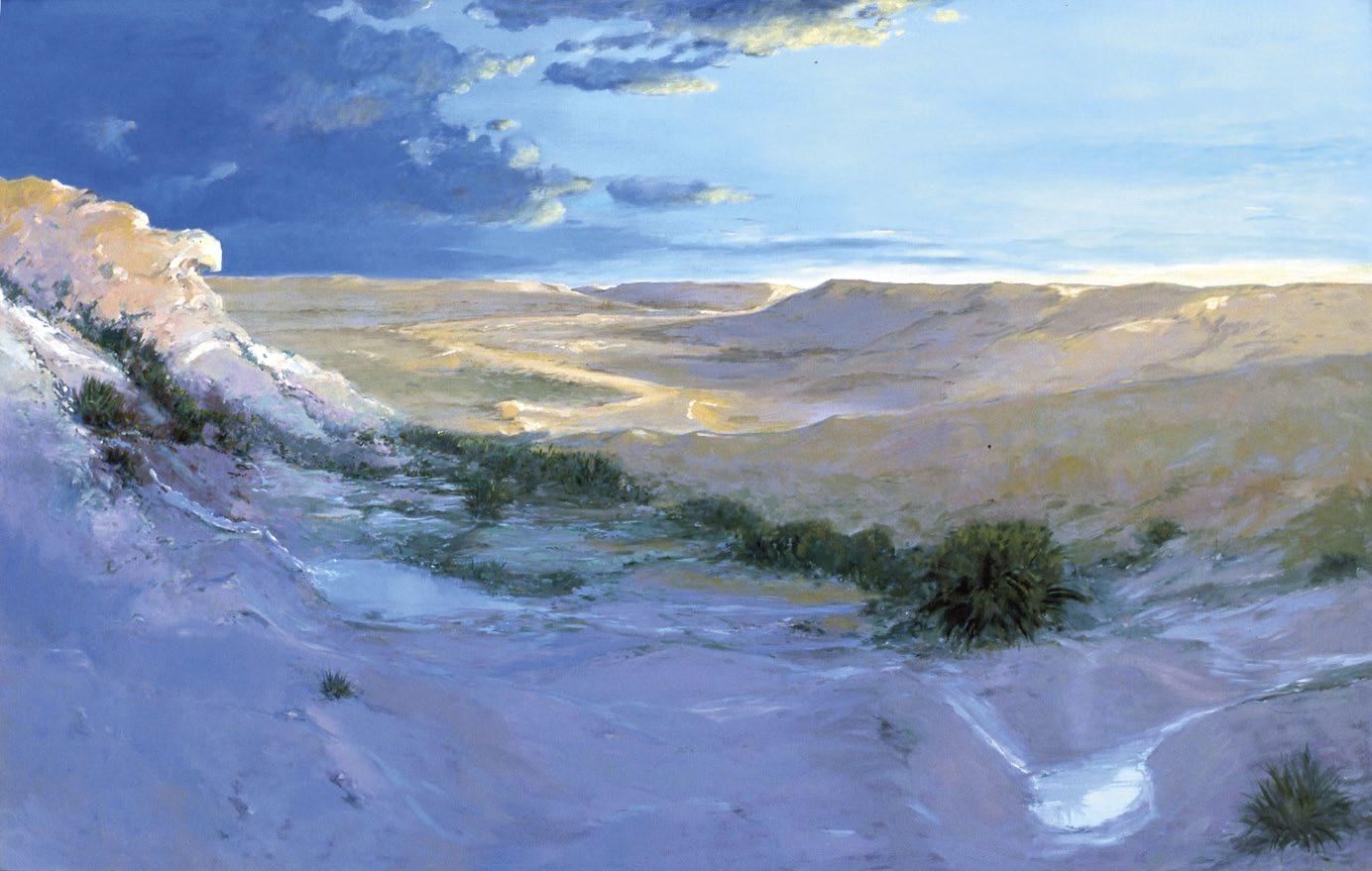
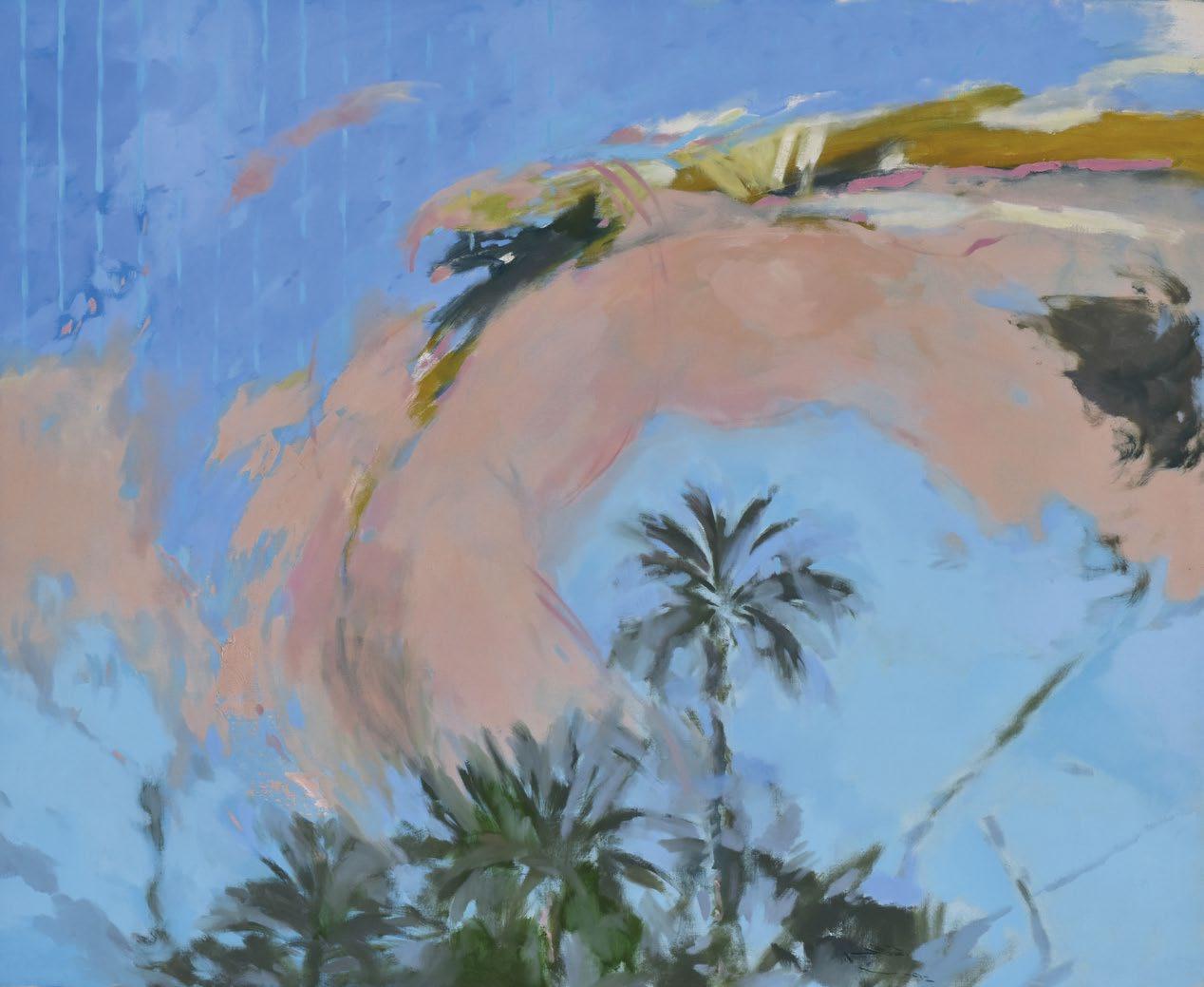
Notions of fluidity and impermanence continued to dominate his artistic output in the 1990s. The recurring motif in many of his landscapes from this period was the desert wadis. Traditionally referring to a valley in Arabic, a wadi is a typically dry riverbed that only retains water during episodes of rainfall. Receptive to this precious offering from nature, it becomes a vessel of life for human habitation, biodiversity and healthy ecosystems. In Rumaitha Wadi (1995) the water’s reflection of the morning sky signifies the transformative power of nature and the inevitable interconnectedness of the elements. Similar to his earlier landscapes, the fort here appears like an apparition in the distance, suggesting some kind of longing or foresight. But unlike his earlier works, the seasonal occurrence of desert rain indicates cleansing and renewal. In Wadi in Sakhir (1995), a mosque appears on the horizon, with its barely visible minaret in contrast to the warm mustard sky. The whiteness of the mosque is replicated in the sinuous stream of water centralizing the painting, like a reflection on faith and spirituality. Expressions of light and hope could not be any more apparent than in Road to Rumaitha (1995), which conveys the sacredness of dawn and the imminent radiance of a new day. We see magnificent hues of violet and azure, with rich green shrubs sprouting from the earth and wadis reflecting a vivid blue sky. As the spectacle of daylight casts over the scene, a meandering road appears and leads us onwards.
The focus on life-giving water in these paintings is significant. Bahrain receives little precipitation that is usually confined to the winter months. No permanent rivers or streams exist on any of the islands. And the rain tends to fall in brief, torrential downpours, flooding the shallow wadis that are dry the rest of the year. Not much rainwater is saved for irrigation or drinking, but there are numerous natural springs in the north of country and on adjacent islands. Underground freshwater deposits also extend beneath the Arabian Gulf and since ancient times, they attracted settlers to the archipelago. From the early 1980s, local desalination plants render seawater suitable for domestic and industrial use, providing about 60% of daily water consumption in the country. Nevertheless, the artist seems to have relished the importance and fortunate occurrence of water in the desert.
Continuing with this bold use of colour, Inspired by Jasra Coast (1998) employs a slightly different approach, depicting a fertile farming village on the western coast of the island. Bahrain’s diverse topographical and cultural landscape was and still is, characteristic of the country. Jasra is also noted for its handcrafts like basket making, woodwork, pottery and weaving. These rich creative traditions would continue to inspire the artist into the next decade.
View from Above
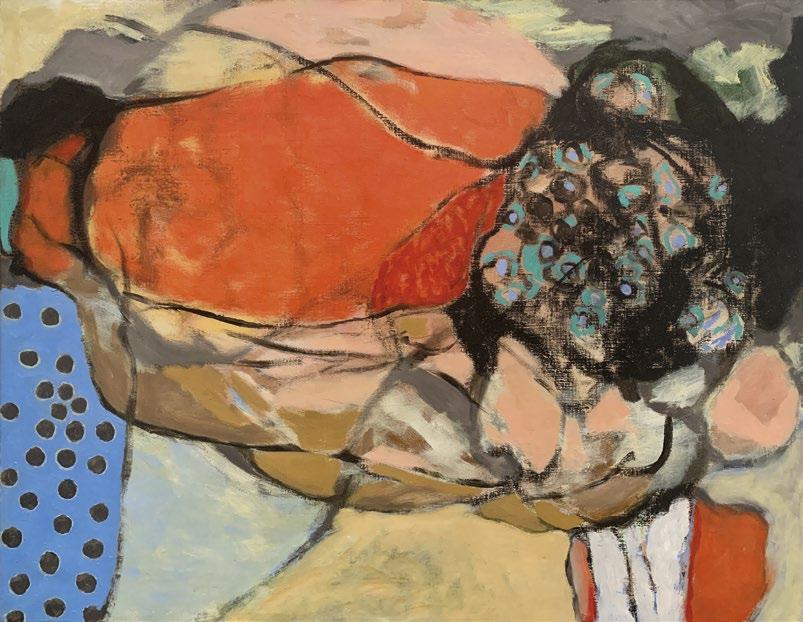
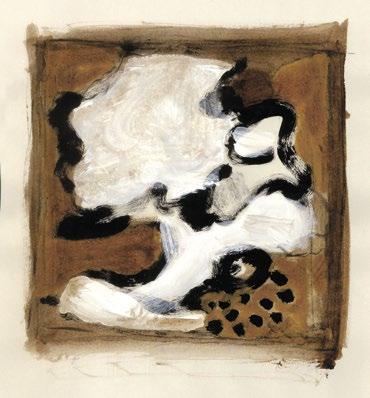
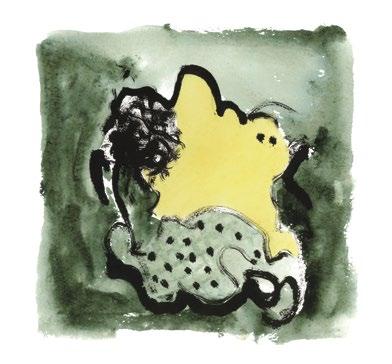
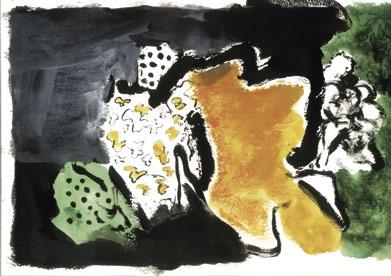
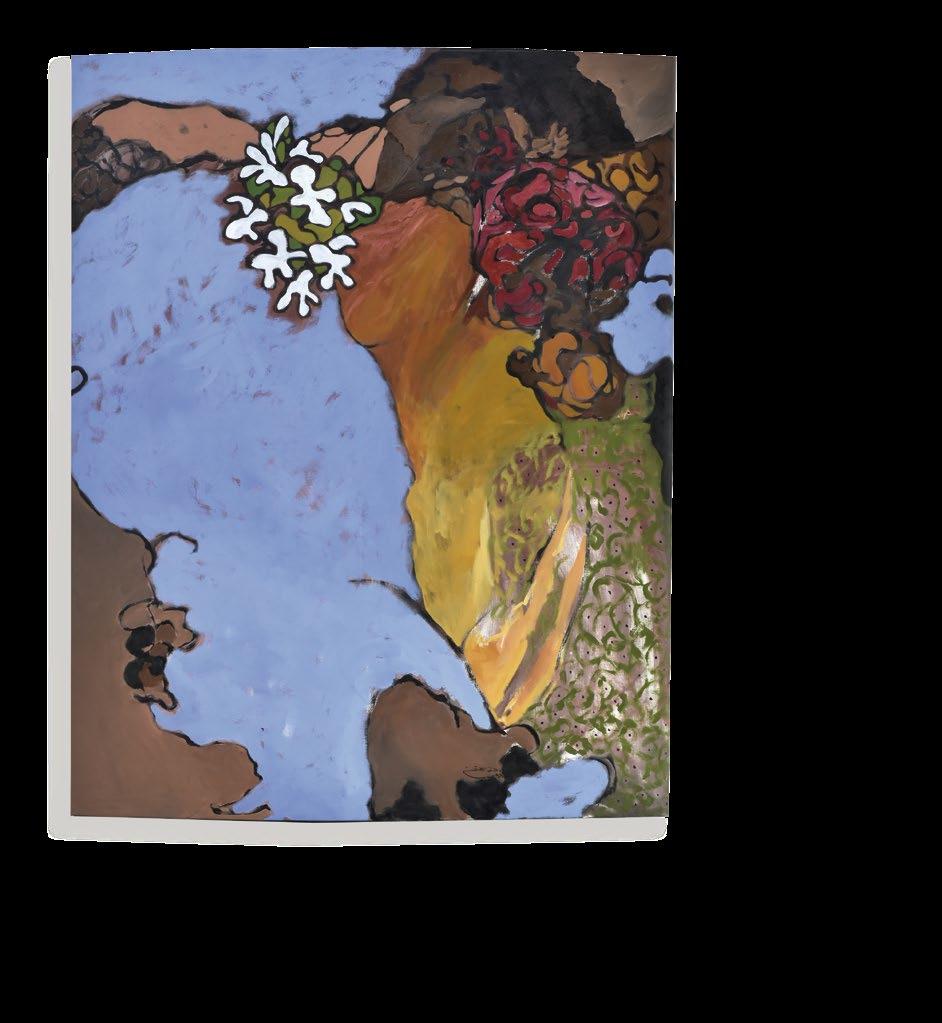
The absence of educational opportunities in the arts in Bahrain at this time, naturally meant that resources, including art supplies, were not readily available and artists had to improvise, since style was often dependent on the tools at hand. Largely inspired by his travels abroad with the Arts Society and encouraged by the work he saw emerging across the Middle East, Al Khalifa began to experiment with oil sticks diluted with turpentine. This novel experiment led to a distinct style which we see evolving in his Biomorphic Sketches (1997). Although these compositions were consequences of his earlier work, the abstraction of detail gives way to broad surfaces of colour delineated by lines of charcoal. Despite the obvious stylistic progression from his landscapes, the artist maintained a similar tonality, initially employing shades of sepia, white and black as his experimentation progressed. In Figurative Landscape IV, a series from 1997, sinuous lines flank and shape warm tones of terracotta and orange. Interestingly, it is through this compartmentalization of form that these works provide a sweeping aerial perspective, where segments of land meet islands of colour, resulting in forms and patterns that are distinctly feminine. With this kind of stylistic dissection, we see cellular forms arise, creating imagery with a certain biological appearance, much like a magnification from within. By integrating elements of his figurative and landscape works, the artist offers both an overriding, comprehensive perspective and a concentrated, detailed examination.
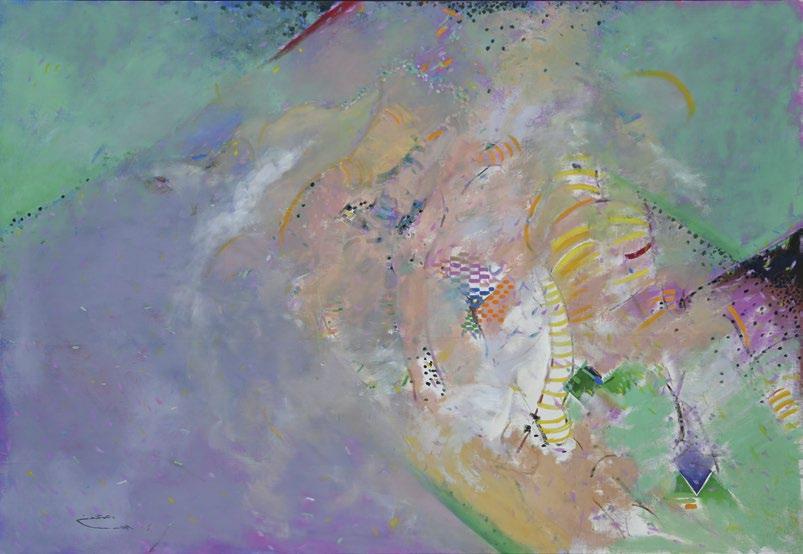
Metamorphosis (1996) is one of a number of works from this period that characterizes Al Khalifa’s creative perspective at the time. Apparently organic shapes arise from the fluidity of movement with ambiguous cell-like formations amassing to create larger, colourful shapes. At first glance, there is a sense of familiarity in this imagery; like the animated patterns in fabric designs or floral still lifes. But despite their appeal, the viewer’s focus can never quite settle, as the entirety of the image thwarts any definition or even clear recognition. Metamorphosis IV (1997) could be an assemblage of limbs with winding lines delineating boundaries and then coiling into segments of dark black hair or distinctive flower-like patterns taking shape and fringed by dotted segments. With no differentiation between foreground and background, the notion of constant mutation, devoid of time and space, is effectively executed. Figurative Landscape III (1998) sees the development of a romantic palette, with bright white flowers budding amid pastel blue waters. Golden swirls of filigree shimmering beneath a red floral arrangement, evoke an amorous aura. In Figurative Landscape II (1998), an ocean of turquoise envelops what looks like aquatic, anthropomorphic forms. Colours and shapes metamorphose into sea-like formations and their repetition resemble shells, fish scales, coral and algae rising up onto the surface, subsuming one another. Culminating this biomorphic period is Fragmented Abstraction II (1999), one of a series of three oil paintings, which materializes as an amalgamation of attributes in earlier works from this period but with a more definitive design. Its organic curvature calls to mind a shapely vessel, contained between shades of bright yellow and daring blues. There seems to be a whimsical celebration of the patterns of traditional Bahraini crafts and wares; a local culture that has long been rooted in its connection to the ocean.
Art of Detachment
This process of reconfiguration was surprisingly liberating and became a means by which he could practice the art of detachment. Revisiting former compositions was like recalling a memory of the temperament, time and atmosphere in which the artwork was originally created.
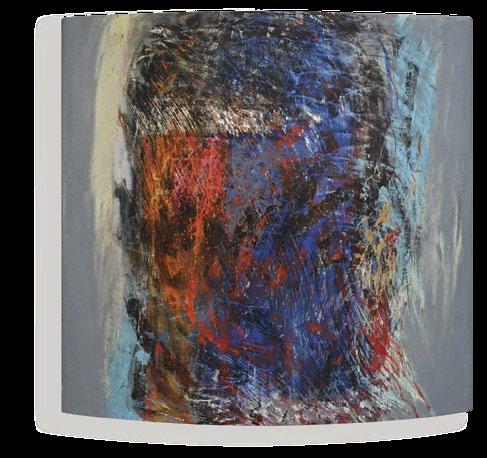
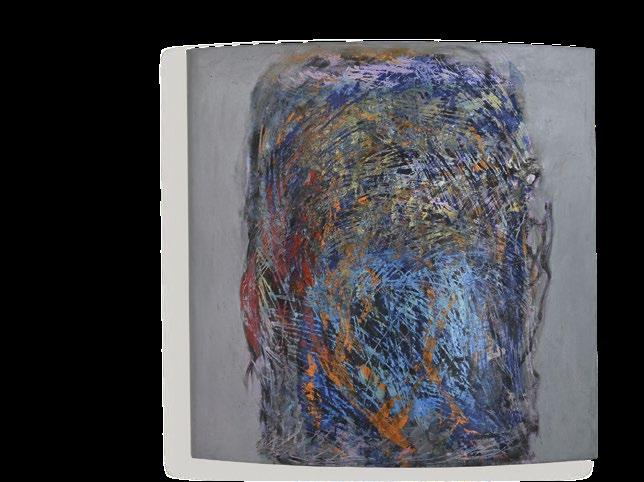
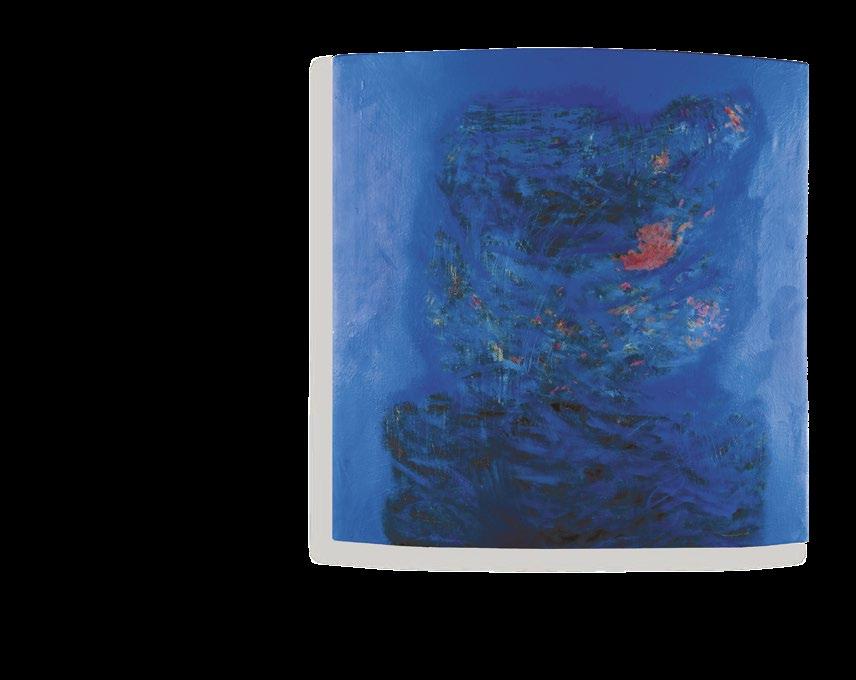
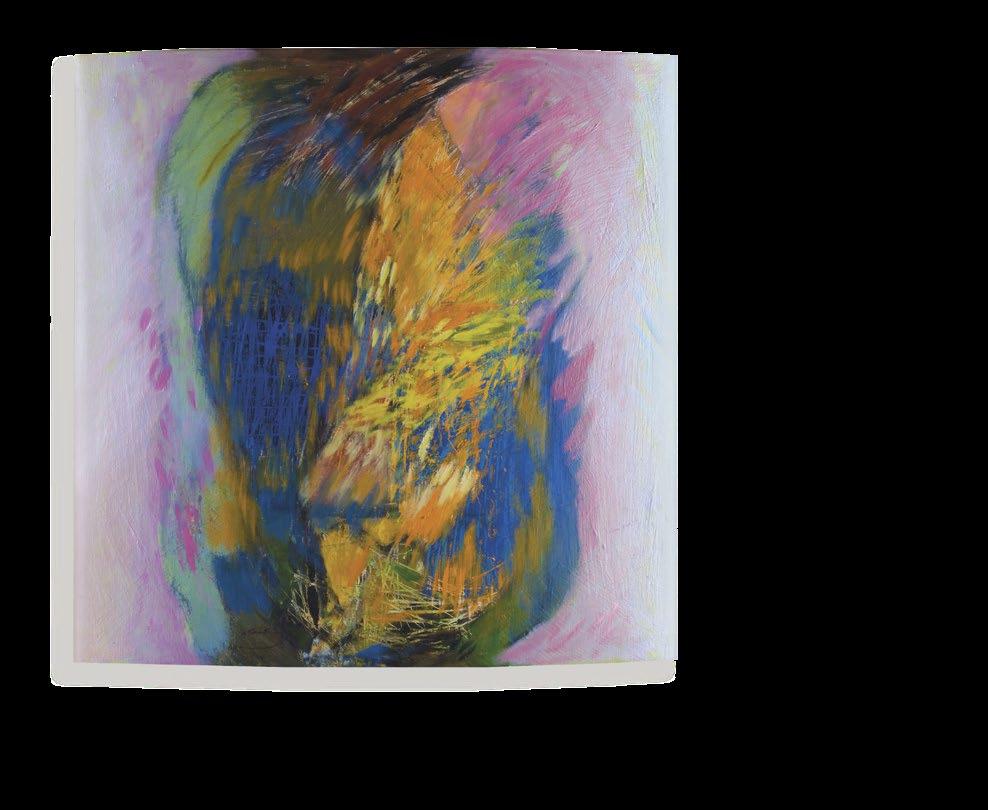
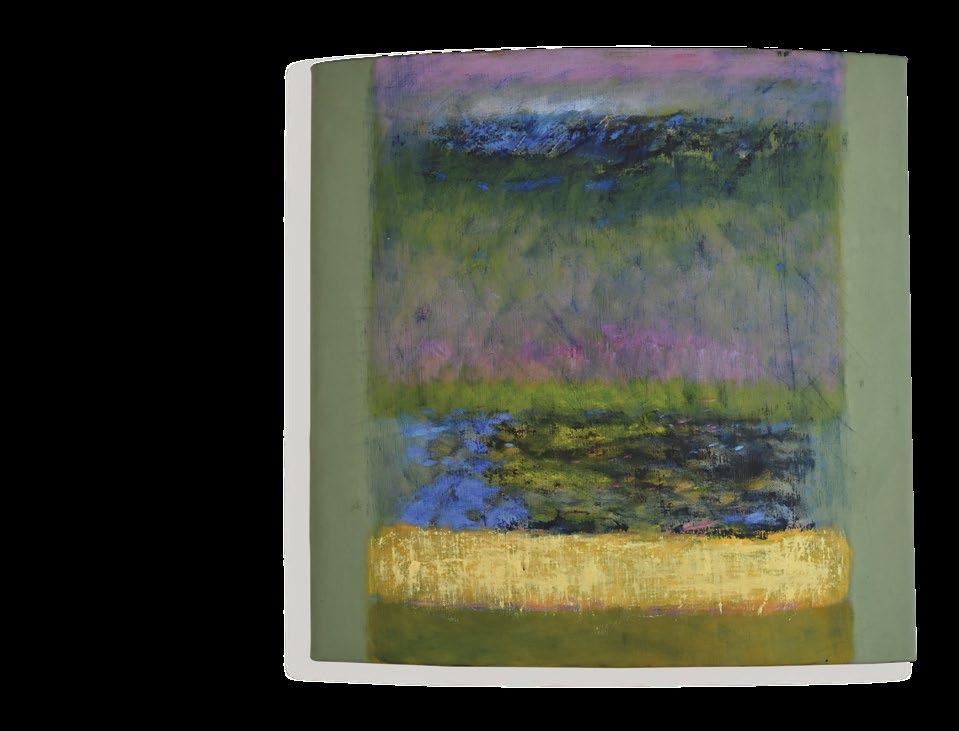
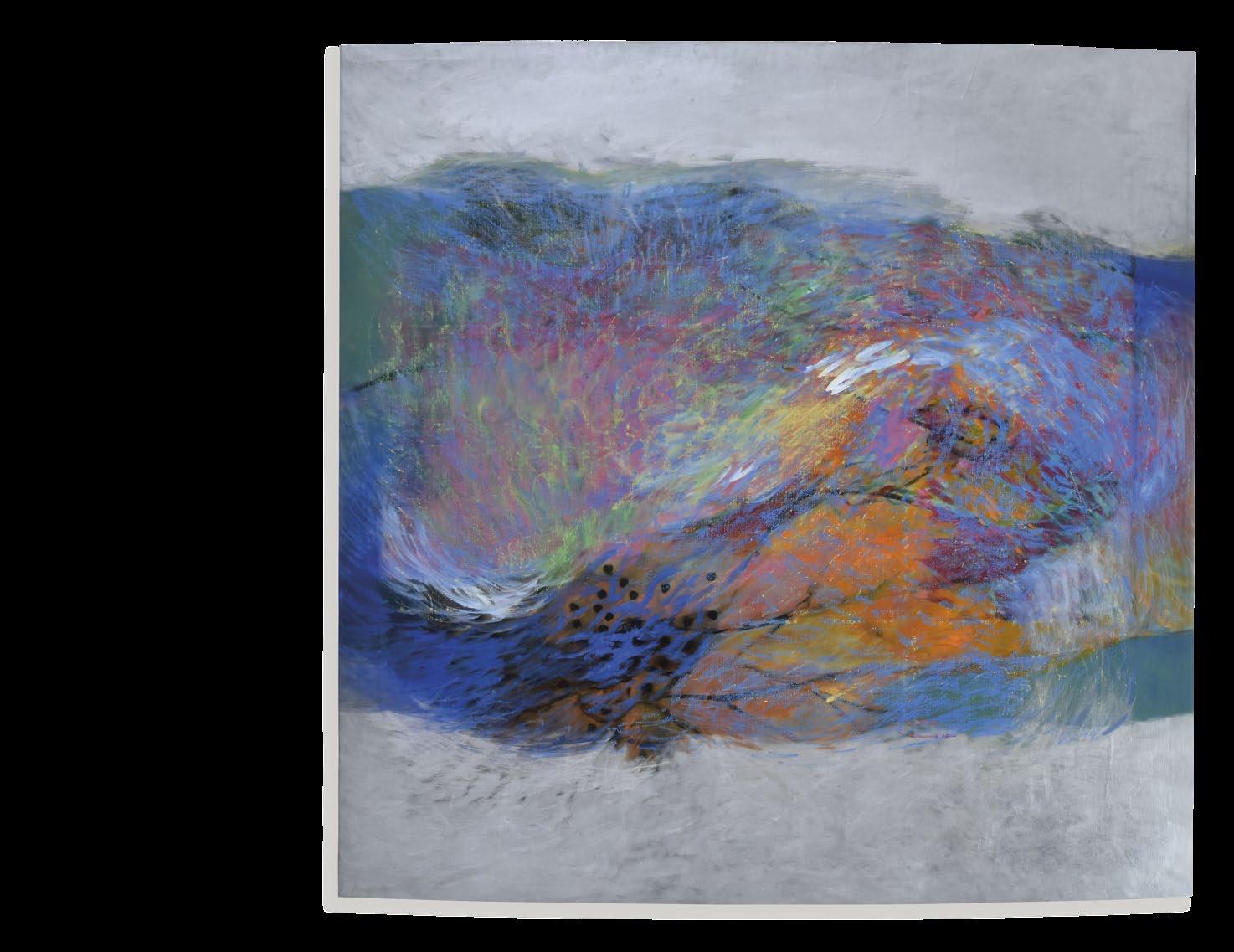
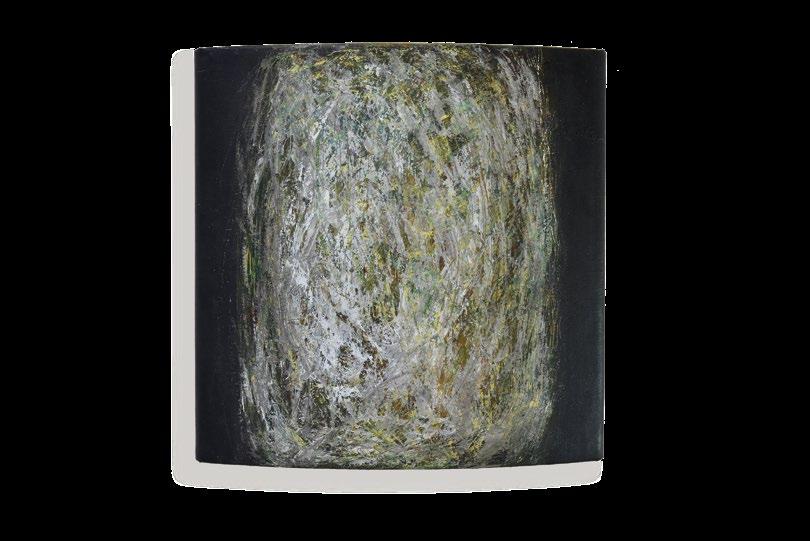
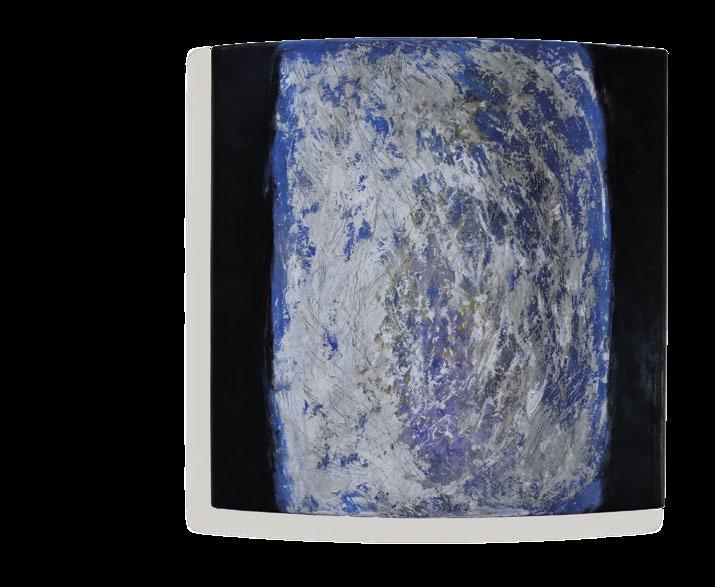
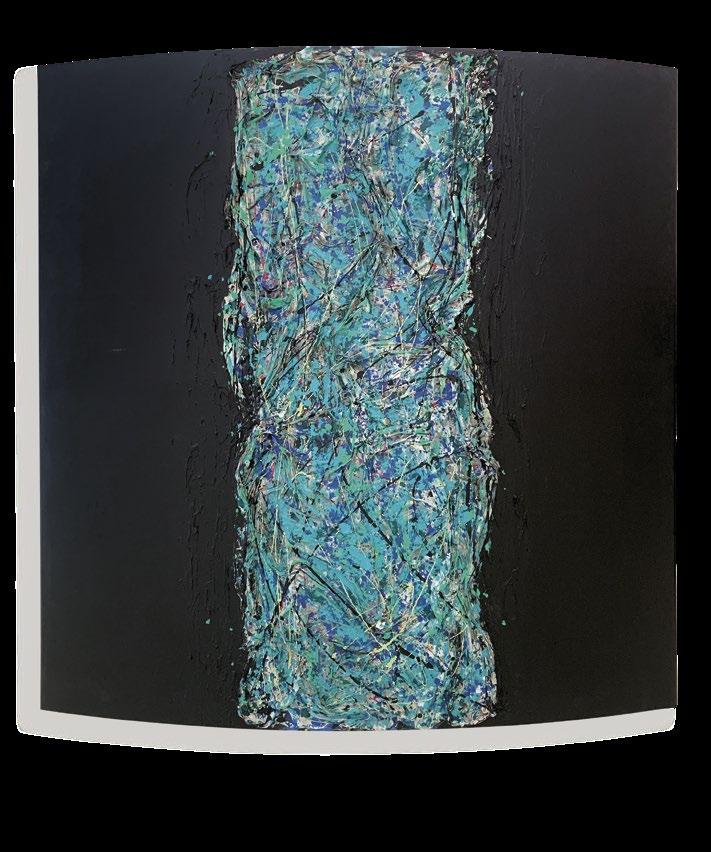
What occurred in subsequent years was a move away from this distinctive segmentation of colour and form. Once bold, dark lines began to look like indentations and scrapes, and smooth colours became blended and erased. Rashid Al Khalifa has long considered his artistic output as an ongoing process and journey with no particular destination. It was during this period of trial and experimentation, that he revisited his older works and started revaluating, repainting and reworking them. Eager to develop his style, he incorporated his newfound appreciation for a shapelier surface – a convex canvas stretched at approximately 25 degrees, which become characteristic of his work over the next few decades.
This change in technique occurred for no apparent reason and he was admittedly unmoved by any particular artistic trend or personal experience. He was simply continuing his mission to produce work that could extend his expression of a certain atmospheric sensibility. He wanted to more effectively capture sentiments, fleeting moments, sudden realisations or just a specific time of day. To achieve this, he began removing and erasing details and specific surface features in his works. This method of elimination and re-creation became as vital as the final outcome, and the history and former marks which lay beneath the surface were an essential element to the realization of such works.
This process of reconfiguration was surprisingly liberating and became a means by which he could practice the art of detachment. Revisiting former compositions was like recalling a memory of the temperament, time and atmosphere in which the artwork was originally created. By returning to and reconsidering his figurative work, he could reinvent his landscapes and restretch his old canvases. The artist was presented with a challenge and an opportunity: to surrender to his past and to begin a new process of innovation, which would finally allow him to express a very intimate response to his immediate surroundings.
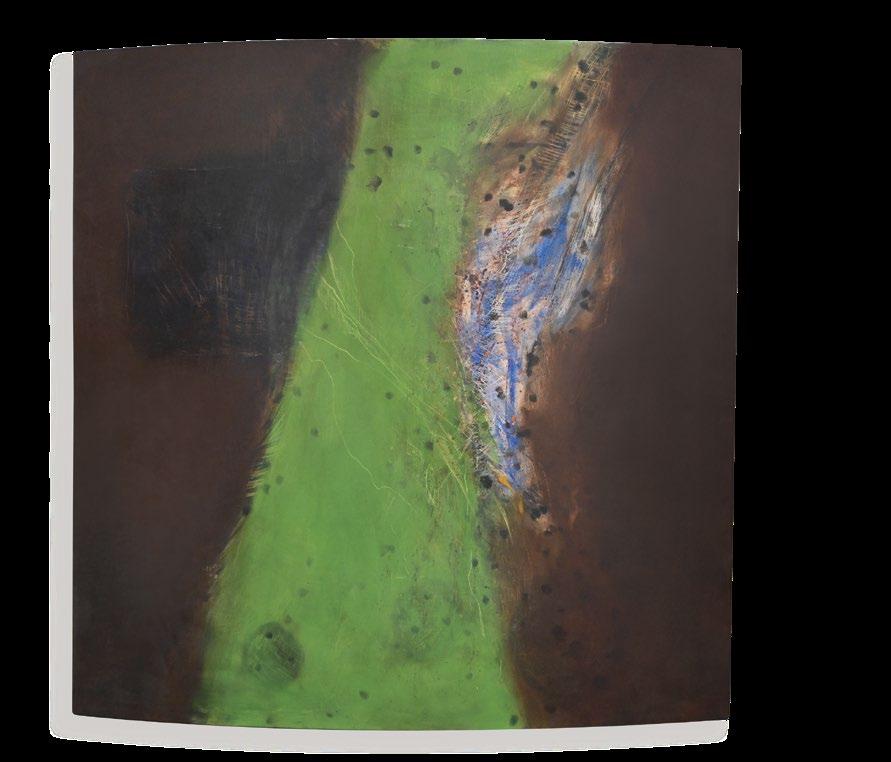
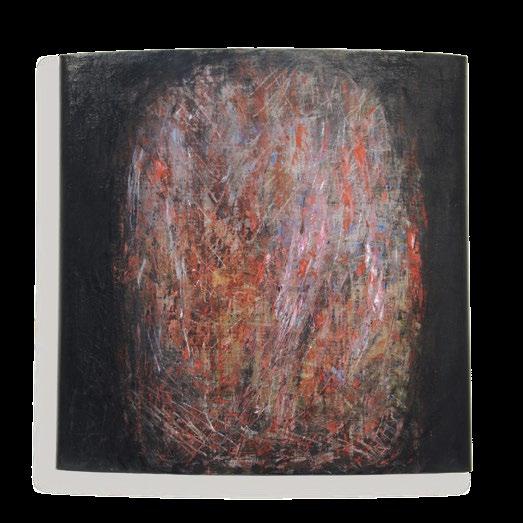
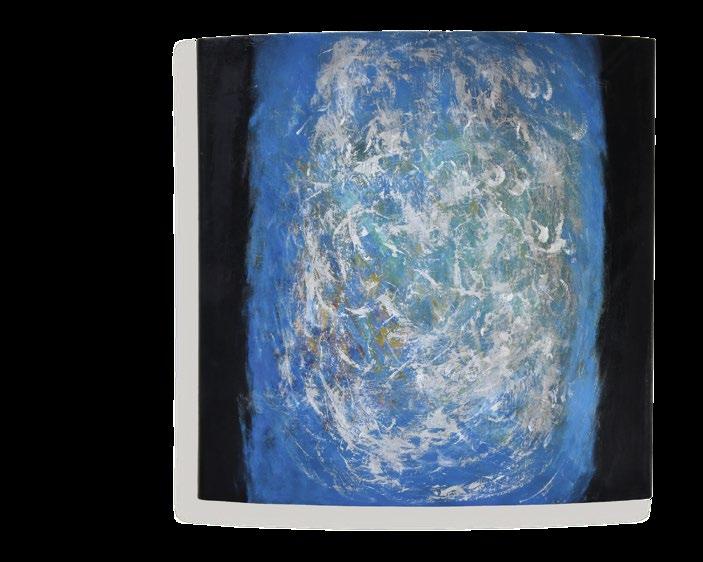
Metamorphosis (1998) shows clear references to the works from the 1990s, whereby the curvature of the central forms – with rich blues and dotted markings –echo the artist’s earlier biomorphic forms. Representative of a sudden transformation, a storm begins to unfurl around the figure with streaks of white showering overhead. Lines sweep and swirl over the foreground, as if a whirlwind was about to unfold. In Pulse I (2000) fervent markings are scratched with a palette knife and overpainted with swift brushstrokes. Their totality is purposely contained and combined within a vortex of orange. This central concentration of form and colour is characteristic of Al Khalifa’s work from this period and is also a natural response to the proportionality offered by his convex canvas. Green and Umber (2001) also demonstrates this responsiveness, where traces of pattern drift beneath the haziness of the rich green figure that dominates the central imagery.
Apparent allusions to the artist’s previous landscapes which arose during the same period are seen in these deeply atmospheric works. He resumed his representative style time and time again, as it proved to be a vital tool for documentation and the basis for further inspiration, whereas his convex works were a means to elicit an overall effect. Alternating between these differing approaches paralleled his own life; one that often required assuming various personas depending on the task and audience at hand. By studying his environment and using this documentation (the colours, light and symbolism) for more experimental work, he finally found the creative freedom he craved and simultaneously managed to corroborate his creative decisions.
Shadowed Light
This ongoing interchange proved a necessary and productive relationship and one that has continued throughout his practice.
Akin to the moments immediately before a storm, Inspired by Hafeera Plain (2006) is charged with electrifying energy that pulsates through dynamic brushstrokes diffusing overland. Commanding like an old sea captain’s vision, Al Khalifa’s rich turquoise hues heave and swirl like ocean waves and faraway, beyond the tumult, a majlis beckons the viewer. An Arabic word for ‘council’, derived from the verb ‘to sit’, the majlis is the traditional meeting room or front parlour used to entertain guests or groups gathering for a common interest in private homes or public spaces throughout the Arab world. This particular structure, one of three remaining in Bahrain, stands as a beacon beneath a tempestuous sky as the sun sets. An ensuing pink light permeates the clouds, with an almost insistent luminescence across the landscape. In Harmony II (2006), painted in the same year, the artist captures a similar spirit through a deliberate separation of colours and tones such as in the previous painting. Through horizontal planes of colour blended over the central curved area of the canvas, the work depicts an abstract landscape that is devoid of detail but inherently melancholic; as if the artist aimed to capture the same sentiment in a more concentrated or contained space.
Al Khalifa’s efforts to eliminate figurative detail in his works from this period was ongoing and matched by his desire to incorporate and centralize his mark making on each of his convex canvases. Whether consciously or not, this was attributable and often inspired by compositions in his earlier landscapes, where the focal point, a panoramic terrain, was portrayed between a vast sky and inviting foreground. The soft, sinuous and rippling strokes that materialize as rolling hills in Um Jader Scene (2006), also echo the supple, velvety warmth of Desert Scene (2008). Both works bear some resemblance to the movement and colour of his Fusion of Hues II (2006), which is one of a number of larger scale paintings he produced in the mid-2000s. Here, the marks are adapted, transposed and distorted, with swirling colours intertwining and contained between a light grey background. The variability within the central shape is explicit and appears organic and fluid, evoking an energetic shift or the onset of a change in atmosphere. By revisiting, adapting and manipulating similar colours and movements in his older landscapes, the artist was able to compile different formations to parallel the overriding mood in his message. Sweeping blades of grass over a fertile terrain, with etched layers of green and blue in works like Pulse VIII (2006) reveal the depth of colour lying beneath the surface. Pillars of light grey border the sides of this lush formation and the convexity of the canvas further centralizes the prominence and promise of verdant green vegetation. Such individual concentration of light and colour fostered a greater appreciation for contrast and a growing move towards imagery that offered a more definitive focal point.
This fresh investigation of light, or more precisely, it’s absence, meant the artist was free to study not only surface formations but also the nature of the surface itself.
Works such as Untitled I (2009) and Above the Ocean II (2009) reference a shift towards a much darker colour scheme, where softer tones are replaced with charcoals and blacks. This quite radical change stemmed from the artist’s growing desire to distinguish foreground from background, making the most of the curvature of the canvas and expressing feelings that were vastly different to his preceding work. From within these profoundly dark and shadowy spaces, tempests of colour meld into aerial visualizations of storms and flickering apparitions. This kind of rising perspective is like a view from the stratosphere, whereby the relative obscurity represents Al Khalifa’s move towards a far more enigmatic and Minimalistic style.
While his earlier practice focused on conveying light through a multitude of colours and shapes, this new work emphasized the manner in which light can be generated through the absence of colour. Coal (2010) demonstrates this shift, where the entire painted surface is black and indicates the volatility of the residue of slick brush strokes navigating its surface underneath. The only signs of light are the traces of white canvas beneath the multitude of palette knife scratches. Dripping Black (2010) features the artist’s experimentations with fabric and glue, which he pasted and plastered into folds and creases. Despite the darkness of the palette, these additional materials afforded an added dimension through the shadows cast, like a sculptural relief overlaid with dripping white paint. Such formations signalled the beginning of Al Khalifa’s explorations with opposing elements in their most rudimentary state, and it was through this research that his understanding of the visible spectrum developed. What emerged were ambiguous configurations, dripping and oozing, looking forlorn and worn out. His new endeavours revealed light from darkness, like aged formations featuring murky debris and forgotten remains that are strewn and washed ashore. This fresh investigation of light, or more precisely, its absence, meant the artist was free to study not only surface formations but also the nature of the surface itself. He grew eager to work with far more robust materials and so began to consider the durability and ductile qualities of aluminium. Its light weight and reflective properties were also appealing in terms of the physicality of his work. Enamel paint proved to be the most effective and satisfying option for the artist, given its ability to adhere to aluminum and its surface receptivity. So Al Khalifa began to literally transform his work in terms of scale and sensibility. What was once fabric and glue overlaid onto a dark, matte canvas, became a lacquering technique, purposely and carefully dripped over a glossy and pristine aluminium exterior. This abundant working material propelled the artist into a new direction. Bahrain is one of the largest aluminium producers in the world and this easily recyclable material’s unique properties afford endless possibilities for tailoring shapes and forms, all of which once again unlocked the artist’s creativity.
Black and Black (2010), demonstrates the artist’s continued fascination with light and shadow, through the depth and lustre provided by the black lacquer applied. Impeccable in execution, the surface is covered with a coat of glossy enamel and overlaid with carefully considered drips onto the central part of the curvature, intentionally contained in a vertical formation. Not a scratch or scrape blemishes this facade and it is simply through the texture of the drops and the reflective surface that the viewer can notice traces of light. Such purity is also expressed in Black with Red Circle (2010), a work which was also inspired by his growing interest in some of the ancient ideals of Japanese aesthetics, such as wabi (transient and stark beauty), sabi
(natural patina and aging), and yūgen (profound grace and subtlety). Central to this work is a red circle, with a depth of tone that is akin to the immensity of Bahrain’s setting sun. Delicate trickles of black paint float like a veil over the perfect red formation; engineered in their placement and indistinguishable as far as where these traces begin and end. Such application of paint was a meditative process and one that required the artist to accept potential imprecision or imperfections. This conscious arrangement of composition reflected Al Khalifa’s desire to establish new order but also to complement this with nonconformity on the same picture plane. He considered this duality a means to achieve a renewed state of equilibrium. Moreover, through their darkness, these works epitomize a time in which the artist withdrew entirely into his creative process and was able to pause and freely explore. It is through their relative obscurity that we are reminded of what night-time might represent: the mystique of a city; the secrecy of a veiled face and a cloaked body; or the shadowed edges of a new moon. Such considerations remind us of the amorphous nature of darkness and what emerges from its depths.
Going Alone (2011) is another work that seems to reveal an awakening of sorts or at least a differing but complementary response to the works preceding it. Duality is expressed in another kind of metaphor with a subtle but determined change of tone, as opposed to the artist’s other black imagery, in glossy white lacquer flawlessly coating the surface. Trickling over the foreground, delicate and steady streaks of black gather in a cluster at the bottom of the composition. Extending as they reach the uppermost part of the work, the totality of these lines creates a reversed triangular formation. As its title suggests, this collection of lines emerging from one source represents Al Khalifa’s awareness of the power of collective consciousness in the creation of a solid foundation. Yet as they disperse, their separation denotes that he is also mindful of the necessity of individuality and sway of nonconformity. It was at this time, that such finer details were regularly employed for more than aesthetic purposes and rather signified the development of his artistic autonomy and his growing self-awareness.
Self - Reflection
Al Khalifa’s ongoing desire to experiment with a variety of surfaces was largely attributed to his continuing contemplation on his role as an artist and his growing responsibilities in society. The glossy consistency of lacquer and its resultant ability to absorb light and distort an image, encouraged him to test other materials that could also interact with and be affected by the immediate environment. For this reason, he employed a mirrored surface for the first time, which offered a means of reflection, both physically and metaphorically. By applying his marks onto chrome, he was in fact impressing his individuality upon a pristine and dynamic substrate, which in turn replicated the impermanence of the setting in which it was placed. Given that its principle source of power is light, the place and time in which such works are seen and whoever stands in their presence influences the nature of the work itself.
Networks (2011) incorporates streaks of black and white lacquer over a perfect chrome surface. The entirety of the lines materializes as a network or mesh covering most of the convex facade and yet, these markings are still contained within a horizontal space. Similarly, in Can you See? (2011), a veil of white seeps down the work over a few vertical stripes that are central to the imagery. These create further distortion in the reflection of the curved chrome surface, disguising the viewer standing in front of it. This particular work is one of a number of pieces from a series that examines the artist’s own social ‘network’, including his connection to society and to the local and global current affairs to which he is privy.
In a sense, these works invite the viewer to contemplate what they actually perceive when their vision is obscured or contorted by some unexpected and additional material or phenomena. Simultaneously reflecting and skewing their surrounding environment, these works in chrome plated steel implore the spectator to consider the possibility of outside influences on their perception. The convexity of their form draws the viewer’s interest but also creates further distortion as the mirroring becomes a tool for re-examining the imagery they are presented with. Works such as A Different View (2011) employ various qualities that are characteristic of the artist’s practice up to this point. Three columns each with four coloured circles are painted over the reflective chrome surface with thin slivers of black enamel. Such painterly marks act as a barrier between the viewer and their reflection, as the artist becomes an intermediary. Almost like traffic signals, these shapes are bold reminders of that brief moment when we are required to wait, despite the constantly shifting and changing world around us. It is in those moments of rest and reflection, that we are given the opportunity to reconsider the overwhelming stimuli pervading our external environment. Rather than simply carrying on doing things as they have always been done, the artist seems to be making a case for quiet self-reflection. Perhaps he is urging us to question, in a positive way, what we are actually doing with ourselves and to decide whether there is a better, or more efficient, way of doing it in future.
Both Sides of the Moon
Symmetry is a quality and theme that has long characterized Al Khalifa’s oeuvre, whether in his oil paintings, convex compositions, lavishly lacquered mixed-media pieces, or his sculptural works with a dominant circle. With his diverse roles in officialdom and an increasingly demanding lifestyle, the pursuit of symmetry in his art practice has offered some emotional equilibrium and clarity; a much-desired space for solace and inner focus, where he has found himself again and again. No shape could more perfectly satisfy this need than the simplicity of a circle; a quintessential symbol of timelessness and purity. As a metaphor for life’s cyclical realities, from this period onwards the circular form became a central feature in his work and the continued exploration of its potential has provided the artist with an effective means of meditation.
Simultaneously representative of the Sun, the Moon and the cosmos itself, works like Both Sides of the Moon (2012), draw on universal connotations of equanimity, mysticism, power, and guidance. The bright side in question here is always turned towards the Earth, whereas its dark aspect remains obscured, much like our own subconscious mind. The challenge lies in bringing both these elements into our consciousness at the same time. By incorporating them into one image, the artist seems to suggest that finding one’s own stability and vigour lies in an acceptance of the fundamental dichotomies overseeing our very existence, especially in a fast-paced and shifting world.
As the title of a subsequent series of works suggests, Total Eclipse I (2013) captures that rare moment when the new Moon shrouds the entire surface of the Sun while a section of the Earth is immersed in the shadow it casts. Such an occurrence symbolizes the complementary nature of opposite forces that give rise to another form of energy if they work in synchronicity. In this sense, an eclipse may signify a moment of uncertainty when the comfort of daily light is enveloped in darkness and what we have taken for granted disappears, even if only for a brief moment. The artist may be suggesting a sense of vulnerability, but could also concurrently be welcoming the resurgence of an insight or a change.
Works like Turquoise (2014) and Seeing (2014) are primary examples of the artist’s ‘hybrids’ concept, with their key common feature being the incorporation of a second structural layer. Here the circle is cut from the convex layer of reflective chrome, and the remaining form, the explicit space, is then positioned over a second painterly surface. The silky fluidity of the dripping paint within the circle is also suggestive of the mutability in Al Khalifa’s earlier landscapes; hues of turquoise and blue call to mind the distinctive nature of Bahrain’s marine environments and the proportion of the enfolding chrome mirror further imply the reflections of its archipelago. Such works are examples of his new artistic direction, which included further dimensionality and dictated more emphasis on light and shadow effects in his work from then on.
Negative Space
In many ways, it was the soothing nature of the circle and Rashid Al Khalifa’s growing inclination to depict flawlessness and precision which impelled him to delve further into Minimalism. In doing so, he resisted employing painterly features, gestural marks or any shapes he considered excessive or superfluous. Instead, he focused on simplifying his work and welcomed the challenge to create forms that were stripped of detail, whereby the whole image would elicit a sense of peace and satisfaction.
In the artist’s move towards Minimalism, a reflective surface was no longer an option since it was necessarily always at the mercy of its external environment. He began to focus on employing a medium that would absorb rather than reflect light and still genuinely communicate the richness of the colours, so that neither one nor the other overpowered the work’s overall energy field. He also realized that he would have to revisit his use of a material he had previously worked. Robust and strong,
He focused on simplifying his work and welcomed the challenge to create forms that were stripped of detail, whereby the whole image would elicit a sense of peace and satisfaction.
aluminium provided him with a perfectly unscathed surface on which to apply his matt enamel paints. What resulted were smooth and pristine forms; their dynamism and quiet authority, owing to their modest simplicity. By excluding the pictorial and fictive aspect of his narrative in favour of literal and sculptural concerns, Al Khalifa became a creator of objects, searching for that balance between positive (or non-white space) and the use of negative spaces in his aesthetic composition. Hence, his concretized, distilled, and philosophically charged geometries. The artist began to produce specific and identifiable structures inhabiting a space not easily classifiable as either painting or sculpture, thereby avoiding easy associations with traditional conventions. Not a scratch or scrape is seen on the velvety, matte facade of Black and Orange (2014) which further illustrates his pursuit of absolute precision. And yet, its connection to his works preceding it is apparent: the depth of black surrounding the central form here is like the mysterious and cosmic imagery he was creating in the late 2000s. It seems the artist was re-examining a time when he wanted to articulate a deeper and impassioned sensation, using the least information. Indeed, the penetrating contrast of his bright orange centre, with a rich black backdrop, brings to mind the intensity of Bahrain’s setting sun and alludes to the country’s unique geographical features.
Robust and strong, aluminium provided him with a perfectly unscathed surface on which to apply his matt enamel paints. What resulted were smooth and pristine forms; their dynamism and quiet authority, owing to their modest simplicity.
Grey on Grey (2015) further accentuates the elimination of detail, concentrating on a single, neutral colour that embodies and reconciles polarity; a perfect blend of black and white. It was this austerity that enabled the artist to investigate, to an even greater extent, the manner in which the subtle relationship between two layers of aluminium could significantly affect the resulting work. These experiments were interdependent of any surrounding light reflecting onto and from the work itself. Devoid of any colourful, visual distraction, the purity and simplicity of the form casts a subtle shadow, depending on the transiting light across its surface and the angle at which it is perceived. In reality, we are reminded that when our world is liberated from excessive detail and movement, our vision and decision making is cleared, our awareness broadened, and our connection to our own ‘life source’ deepens. Perhaps this series of work was Al Khalifa’s personal response to the brashness and chaos of urban living and the many formalities and expectations of his own Royal position, both locally and internationally.
Rather than completely removing the circle, the works that followed explored circularity itself. In Diffraction (2015) the curvature is only partially excised from the white convex layer of aluminium and folded inwards at the centre. The negative space seen within the carved slits, looks like two crescent moons mirroring one another. Also resembling gently folded paper, the aperture seems to occur effortlessly, despite the impervious reality of the material used. Again, the artist applies the ‘less is more’ principle to convey sentiments and ideas by organizing basic elements such as lines and planes. In this case, he may have been inspired by the English mathematician and astronomer, George Biddell Airy (1801 – 1892) who described the best focused spot of light a circular aperture can make. This insight into the diffraction pattern from a uniformly illuminated, circular aperture with a bright central focus and concentric rings, is important to physics, optics, and astronomy alike.
In continuation of this style, Green Folds (2015) sees the onset of patterning through the repetition of the circular form over the surface. Here, four circles are presented on his convex facade each folded inward or outwards. This uncomplicated interaction, playful choice of colour and apparent fragility of the folds, alludes to the transient nature of Bahrain’s manmade environment. Around this time the artist began
considering ways in which he could express the physicality of modern architecture, with its ever-changing designs, in synchronized relationship to the natural landscape. Rather than improving design by further removing elements, he became interested in further considerations for ‘essences’ like material, space, place, and the human condition. Like Minimalist architects contemplating the physical qualities of the building and being drawn to the ‘spiritual’ dimension and the invisible details that reveal abstract qualities but also the visible realities of natural light, sky, earth, sea and air, in open dialogue with the surrounding environment. The artist strips away distractions and uses only one colour in this instance to convey meaning which then becomes self-evident.
Elemental Forms
Rapid urban and architectural development in the Gulf Region have undoubtedly influenced Al Khalifa’s latest work, as is evident in his appreciation of refined, structural forms. The technical and political processes concerned with the design of land use and built environments has undergone major transformations and Bahrain’s panorama reveals this radical change with its myriad of construction ventures. Al Khalifa has played a pivotal and formal role in the completion of certain projects, whereby he was assigned, with complete authority, to envisage, spearhead and oversee key architectural developments to their completion. Such responsibility requires extraordinary patience, perseverance, innovation and resourcefulness, which in turn, has greatly encouraged and shaped his artistic practice.
Whether consciously or not, his desire to balance such weighty obligations has resulted in imagery that is not only inspired by contemporary architecture but is also reflective of those sensibilities to the natural landscape he has long held dear. His preoccupation with simplicity and symmetry also allowed him to produce work that balanced the contrasts and contradictions of his daily life. The peace and serenity he craved was suddenly observable in his creations. The smooth and serene curvature of Tectonics I (2016) and Tectonics II (2016), reminds us of the soft topography of desert dunes alongside bold blue seas, but also of the bends and rotund nature of certain formations in contemporary Gulf architecture.
For over a century, Bahrain has offered a real platform for contemporary design and architecture and yet much of the country’s rich, ancient history continues to be seen through remnants of its early structures and traditional buildings. Traders, seafarers, pearl merchants and travellers have long traversed and dwelled on this desert island and their homes, villages and traditional ways of life are a constant reminder of their presence. Moreover, the country’s social and cultural backdrop, as well as the natural beauty of its surrounds, have widely influenced the functional design of the island’s living spaces. Typically organized around an open central courtyard, traditional Bahraini homes were connected and assembled with thoughtful consideration of their positioning within the landscape; the direction of the rising and setting sun, the cool draft of the morning breeze, and the arrangement of the family living space all played fundamental roles in determining the design of each household.
Much of this has inspired Rashid Al Khalifa’s most recent work, as he considers innovative ways to express these heritage elements and explore their functionality within contemporary Bahraini society.
Despite the rapid explosion of modern buildings and urban planning, Islamic patterns as design elements have prevailed throughout contemporary culture in Bahrain. Their rhythmic, linear, and foliage arabesques, employed to represent the spiritual attributes of the natural environment, were often incorporated in the mashrabiya, a distinguishing feature of Middle Eastern architecture. Typically a projecting oriel window enclosed with carved wooden latticework on the second or higher story of a building, its original purpose was to ensure privacy so the occupants could see out but not be seen from outside, whilst also providing shade and protection from searing heat and allowing a breeze to pass through. This balancing function and its metaphoric potential inspired the artist to recreate the experience in what he has defined as his Parametrics series, from 2018 onwards. These works are built on contrasts and ostensibly opposing yet complementary forces – positive and negative, light and dark, interior and exterior – representing the artist’s research of order and symmetry. We also see his expressions of spiritual intuitions alongside the work’s physical features, which are both suggestive of the transcendent and ephemeral nature of light and shadow.
Rhythmic Nature
This work’s whimsical nature is appealing to children and adults alike, who quickly sense their participatory roles and its labyrinthic invitation to explore.
Inspired by the narrow alleyways of old Bahrain, Maze (2018) stands confidently in luminous homage to the vast network of hidden streets connecting traditional homes and villages across the island. The grid-like framework of partitions which constitute this entire structure, integrate colourful folds that are randomly positioned over specific sections of the trellis. Walking through this interactive structure, onlookers are both within and beyond its interior and exterior. This work’s whimsical nature is appealing to children and adults alike, who quickly sense their participatory roles and its labyrinthic invitation to explore; creating its own aura through the synchronicity of the sounds, colours, movement and soft shadows emanating from the experience. Much like computer-generated architectural models, Al Khalifa’s ‘mobile columns’ series looks like sculptural blueprints hovering in space and floating in time. Works such as Mobile Column I (2018) are also suggestive of the interconnectedness of urban spaces. His mathematically planned assemblage of basic architectural elements results in a remarkable composition whereby internal and external spaces and perspectives interconnect, enclose and support one another. Similarly, the artist’s parametric wall works apply coiled and interwoven aluminium to create a mesh pattern. The rhythmic nature of this kind of repetition alludes to his desire to simultaneously express order and symmetry whilst also creating imagery that shifts and transforms with its surroundings. Using this design paradigm, he is able to both manipulate and inform complex geometries and structures to simulate nature and animate forms. With its pure white surface, White Parametric (2018) flows like a graceful lattice veil. Precisely repetitive white furrows are organized into components within a
Walking through this interactive structure, onlookers are both within and beyond its interior and exterior.
larger mesh, allowing the artist to consciously generate variable shadows across a mashrabiya that is multidimensional. Transverse Wave (2019) employs a similar technique: corrugations cast smaller shadows and their depth systematically alternates over its entire surface, creating an impressive illusion of movement and corporeality. Despite its stillness, this work appears to mechanistically undulate while other forms emerge across its rhythmic surface. And a sudden change of viewpoint creates the other illusory effects. As we fixate on one particular layer of these colourful gridlocked matrixes, the image and colour momentarily leave an after-image on our retinas. Small, involuntary eye movements cause this ‘ghost’ image to overlap resulting in a ‘moiré effect’, whereby similar repetitive patterns merge together at different angles to create a ripple.
The intricacy of the shadows that are cast by these ‘parametric’ works is the result of the meticulousness of the formation of the structure itself. If the structure is indicative of a physical foundation, then shadow that is cast is a reflection of its physicality. We typically understand shadow as consequential; darkness after light. Here, the parametric and modular nature of these works (whereby the units come together to form the larger composition) is definitive. Therefore, the shadow is in no way simply a consequence, but is an equally important and necessary element of the work: each composition needs its shadow to exist. In turn, the manner in which the resulting work is perceived, is dependent on the position of the viewer, the environment in which it is placed, and the time that it is seen. This subsequently determines the amount of light that it absorbs or reflects and the intensity of the shadow that is cast. In this way, these works materialize as testaments to both tradition and modernity; synchronized representations of the past, the present, and the future.
Bahrain has seen great transformations since Rashid Al Khalifa first painted his colourful mural on the side of his family home. He became a father, a businessman, a Royal official, a visionary, and a leading artist. His intimate connection to his homeland and the people in his community has prevailed, along with his desire to experience equilibrium and purity through his artistic expression. Despite the new physicality and monumentalism of his work, which has transitioned with the landscape that has long inspired him, if we are to truly understand the essence of his oeuvre, we find that the artist has undergone a very conscious journey. He has always aimed to express the fundamentality of life, through the contrasts he has regularly observed in his immediate environment, as well as the colours and light reflected in a land that he treasures. Throughout his unique quest, Al Khalifa has stripped away superfluous details and gifted us with discerning representations of an artist’s soul and the spirit of work that is universally and unanimously relatable.
Selected
Horses at Sakhir Mosque, 1968
Oil on canvas, 30.5 × 46 cm
Horses at Sakhir Palace, 1969
Oil on canvas, 50 × 80 cm
Barastis by Bahrain Fort, 1969
Oil on canvas, 40 × 70 cm
Dawn at Sakhir, 1983
Oil on canvas, 76 × 91 cm
Seaside at Arad Fort, 1987
Oil on canvas, 65 × 95 cm
Hunaiyniya, 1987
Oil on canvas, 102 × 132 cm
Camels at Rumaitha Wadi, 1989
Oil on canvas, 100 × 120 cm
Rumaitha Wadi II, 1995
Oil on canvas, 90 × 115 cm
Wadi in Sakhir, 1995 Oil on canvas, 90 × 115 cm
Road to Rumaitha, 1995
Oil on canvas, 120 × 180 cm
Three Landscapes in One, 1982
Oil on canvas, 92 × 137 cm
Waves, 1982
Oil on canvas, 108.5 × 108 cm
Reclining Figure, 1983
Oil on canvas, 56 × 46 cm
Figurative Sketches (1-3), 1985 Ink on paper, 20 × 15 cm each
Figurative Gesture, 1986 Oil on canvas, 102 × 102 cm
Fascination, 1988 Oil on canvas, 111 × 96 cm
Reclining Figure V, 1989
Oil on canvas, 176 × 204 cm
Reclining Nude, 1989 Oil on canvas, 160 × 193 cm
Reclining Figure IV, 1988
Oil on canvas, 110× 95 cm
Abstract Figurative, 1989
Oil on canvas, 160 × 196 cm
Abstract Figurative IV, 1990 Oil on canvas, 160 × 205 cm
Abstract Figurative II, 1989
Oil on canvas, 172 × 193 cm
Abstract Figurative III, 1989 Oil on canvas, 135 × 196 cm
Untitled, 1992 Oil on canvas, 95 × 115 cm
Desert – Paysage Humain (8), 1992
Oil on canvas, 90 × 110 cm
Desert – Paysage Humain (21), 1992 Oil on canvas, 158 × 104 cm
1996
Biomorphic,
Oil on canvas, 70 × 90 cm
Biomorphic Studies (V, VIII, II, III), 1997
Acrylic on paper, 25 × 25 cm each
Biomorphic Studies (I-IV), 1997
Mixed media on paper, 25 × 25 cm each
Metamorphosis, 1996 Oil on canvas, 115 × 95 cm
Figurative Landscape IV (I-VIII), 1997 Oil on canvas, 48 × 48 cm each
Metamorphosis IV, 1997 Oil on canvas, 100 × 120 cm
Figurative Landscape II, 1998 Oil on canvas, 137 × 131 cm
Metamorophisis VI, 1998
Oil on canvas, 120 × 95 cm
Metamorophisis V, 1998
Oil on canvas, 96 × 90 cm
Fragmented Abstraction (II), 1999 Oil on canvas, 168 × 168 cm
Fragmented Abstraction (III), 1999 Oil on canvas, 168 × 168 cm
Metamorphosis VII, 1998
Oil on canvas, 145 × 118 cm
Untitled, 1999 Oil on canvas, 125 × 92 cm
2000 –2009
Selected Works
Pulse I, 2000
Oil on canvas, 168× 168 cm
Pulse II, 2003
Pulse III, 2006
Oil on canvas, 90 × 90 cm each
Green and Umber, 2001
Oil on canvas, 168 × 168 cm
Harmony I, 2006
Oil on canvas, 90 × 90 cm
Fusion of Hues I, 2006
Oil on canvas, 55 × 55 cm
Harmony II, 2006 Oil on canvas, 55 × 55 cm
Fusion of Hues II, 2006 Oil on canvas, 195 × 193 cm
Untitled (I, II), 2009 Oil on canvas, 55 × 55 cm each
Above the Ocean (I, II), Oil on canvas, 90
Selected Works 2010 – 2019
Black and Palm, 2010
Mixed media on canvas, 168 × 168 cm
Black and Sand, 2010
Mixed media on canvas, 168 × 168 cm
Into Thin Air, 2010 Oil on canvas, 90 × 90 cm
Dripping Black, 2010 Mixed media on canvas, 190 × 190 cm
Sea Breeze, 2010
Oil on canvas, 150 × 150 cm
Royal Blue, 2010
Oil on canvas, 90 × 90 cm
Black and Black, 2010
Lacquer on aluminium, 190 × 190 cm
Black and White I, 2010 Lacquer on aluminium, 190 × 190 cm
Black with Red Circle, 2010 Lacquer on aluminium, 190 × 190 cm
Fabric of Society, 2011
Lacquer on aluminium, 150 × 150 cm
Black Sector, 2013 Lacquer on aluminium, 150 × 150 cm
Going Alone, 2011
Lacquer on aluminium, 150 × 150 cm
Homage to California, 2011
Lacquer on aluminium, 190 × 190 cm
Both Sides of the Moon I, 2011
Enamel on chrome plated steel, 90 × 90 cm
Can You See?, 2011
Enamel on chrome plated steel, 90 × 90 cm
A Different View, 2011
Enamel on chrome plated steel, 90 × 90 cm
Both Sides of the Moon II, 2012
Enamel on chrome plated steel, 90 × 90 cm
Revelation, 2013
Enamel on chrome plated steel, 120 cm
Total Eclipse I, 2013
Enamel on chrome plated steel, 60 × 60 cm
Seeing, 2014
Enamel on chrome plated steel, 120 × 120 cm
Blue and Grey, 2014
Enamel on chrome plated steel, 120 × 120 cm
Turquoise, 2014
Enamel on chrome plated steel, 120 × 120 cm
Yellow and Blue, 2014
Enamel on aluminium, 120 × 120 cm
Red and Blue, 2014
Enamel on aluminium, 120 × 120 cm
Black and White II, 2014
Enamel on aluminium, 120 × 120 cm
Black and Orange, 2014
Enamel on aluminium, 120 × 120 cm
Grey on Grey, 2015
Enamel on aluminium, 120 × 120 cm
White on White, 2015
Enamel on aluminium, 120 × 120 cm
Diffraction, 2015
Enamel on aluminium, 120 × 120 cm
Green Folds, 2015
Enamel on aluminium, 120 × 120 cm
Blue Folds, 2015
Enamel on aluminium, 120 × 120 cm
Altered States, 2015
Enamel on aluminium, 120 × 120 cm
Tectonics I, 2016
Enamel on aluminium, 120 × 120 cm
Tectonics II, 2016
Enamel on aluminium, 120 × 120 cm
Blue Parametric, 2018
Enamel on aluminium, 150 × 150 cm
Green Parametric, 2018
Enamel on aluminium, 150 × 150 cm
White Parametric I, 2018
Enamel on aluminium, 150 × 150 cm
Multicoloured Parametric, Enamel on aluminium, 150
Parametric I, 2018
Enamel on aluminium, 120 × 120 cm
Red Parametric, 2018
Enamel on aluminium, 150 × 150 cm
Mobile Column I, III, 2018
Enamel on stainless steel, 150 × 150 × 150 cm
Penumbra: Textured Shadow, Coloured Light, 2018 Exhibition at Saatchi Gallery, London, UK
Maze, 2018
Enamel on stainless steel, 400 × 300 × 1200 cm
Penumbra: Textured Shadow, Coloured Light, 2018
Exhibition at Saatchi Gallery, London, UK
Maze (detail), 2018
Enamel on stainless steel, 400 × 300 × 1200 cm
Material Existence, 2010
Triptych, mixed media on canvas, each 315 × 113 cm
Convex: A New Perspective, 2010
Bahrain National Museum, Manama Kingdom of Bahrain
Conversation: Rosa Maria Falvo & Rashid Al Khalifa
Rashid Al Khalifa I have always thought of myself as a maker and I have been painting all of my life. For me, art is an ever evolving and deeply personal process. And I think an artist needs to continually redefine how their practice fits into the global art conversation. That’s why my work is adaptive and mutating; it doesn’t rest with one medium or one particular approach. Over the last four decades or so I have steadily traced back through the history of painting to reach a contemporary awareness of what matters to me and my world.
Rosa Maria Falvo What are some of the themes that have been circulating within your practice?
Rashid Al Khalifa It seems to me that one is about the perspectives that develop around all of us and how they define or shape or colour our lives. The other is a more playful one about the shifting perceptions that enable us to escape those perspectives, at least for a while. Art provides an intriguing vehicle for me to leave behind a busy schedule, with its tightly packed succession of official and business functions. It’s a way to reflect on the external world, but at the same time it helps me uncover something authentic about what I’m experiencing within. The spontaneity of art making and the quiet contemplation it offers allows me to rediscover what holds significance in my life. Sometimes, initially, the blank, white canvas is very intimidating but then as the ideas flow it all comes together into something that truly excites me. I guess it’s a way of thinking and feeling, with my eyes and with my hands. Fortunately, I didn’t have to choose between duty and personal happiness. Making art comes naturally to me, and my will to paint has always been stronger than any hurdles I’ve had to overcome. So I persevered and many inspirations still drive me.
Rosa Maria Falvo Do you think art and nature have sustained you? And would you say that it’s mostly your emotional responses fuelling your practice?
Yes, definitely, and my bid to be taken seriously as an artist began early. Although others actually realized my calling before I was awake to it. As a young boy, I was encouraged by my uncle the late Emir of Bahrain, Sheikh Isa bin Salman Al Khalifa (1931-1999). And then in the early 1980s, as founding member of the Bahrain Art Society, I started promoting art here and we organized many exhibitions for local artists. I wanted people to find out about Bahrain and other Arab artists with the same consistent enthusiasm as our Western counterparts. These efforts were time-consuming but also fruitful and ultimately, they also gave me more space and support for my own practice. So I played the long game, focusing on my own interests and slowly establishing a place for myself among my international peers. What I consider important is that I’m able to continue my work. I welcome change and I’m always searching for an aesthetic that harnesses my emotions at any given moment; taking great pleasure in my periodic reinventions. Sometimes I find myself working for a stretch of time, even a couple of years or more, on a concept and then it develops into something else, so I go with that. As you’ve seen, there have been key transitions in my work, and I expect more to come. It’s what propels me forward. I want to keep discovering, and nature and its colours are a big part of this process. They mesmerize me and I let these influences take their course. I don’t force any fixed ideas and I always revisit work. You noticed that I’m attracted to the circularity of experience and the fact that new ideas quite literally emerge from earlier ones. Or perhaps it’s my intuition that keeps catching up with itself, again and again.
Rosa Maria Falvo I think when we emphasize meticulous process over immediate results, we increase our chances of mastery and self-awareness, and this newfound confidence leads to more risk taking and opportunities for new narratives. Then we’re more likely to find affinities with other kinds of artists and thinkers at the same time. I do believe our earliest intuitions are very powerful. Edgar Allan Poe wrote in his Tamerlane and other Poems (1827) that “childhood knows the human heart”. What was yours like?
Al Khalifa I was one of eight children, and my mother was a very passionate and loving person. She gave us lots of freedom. Sometimes too much, since we didn’t have set routines to follow. Our father was often away, so later on my eldest brother became the authority figure. We felt close to our local community. In fact, they were our extended family, with real bonding and social connections. We would band together and play football and break windows, much to my mother’s dismay. She used to shout at us as we tried to fix them. The original family home you saw in Riffa had many small windows and they were always broken...
I had a happy and carefree childhood, but when I was eight I broke my leg in a rather violent manner. It was Eid and we had just returned to our house after celebrating in the festivities. I was immaculately dressed in white and running in the courtyard you visited, racing against my brother. As I flung through the doorway you came in from the other day, a car was coming towards the house at that very moment - I can still see the whole scene now - and it hit me right then and there. I fell on the bonnet and as I thumped to the ground my thigh was shattered. So I was in hospital, in traction for about five weeks, with my leg up in the air like those funny cartoons. But despite my escapades with my brothers, I was not very mischievous or mysterious. On the
contrary, I was like an open book. One of my art teachers in the UK once directed a female student to sit next to me, saying it was the safest place in the room. I didn’t get into trouble of my own initiative, but I tended to be influenced by others. I have always loved music and poetry too; considering them to be painting with sounds and words. I still remember reading some local poetic descriptions about the date palm trees swaying in the wind, elegantly flexing like the feminine figures in my paintings. My teachers really encouraged me, which fired my imagination from the beginning. My brother and his friend were also often sketching portraits for fun and it quickly interested me. We scarcely had any materials to practice with or to try any other kind of creative activity. We did everything at school and then carried on with it as best we could at home. My family just wanted me to focus academically. They saw my drawing as a hobby or youthful passion, and my mother didn’t appreciate the mess I made of my room and clothes. When I painted the wall, the one you saw on the side of our house, she didn’t like that at all initially. We had tried some mural work at school in the Cubist style, so that night I decided to do the same kind of thing on our house. I met many children from smaller towns and villages. As was typical in the Gulf region, there were no real social barriers; we all gathered together, and this closeness created true bonds. I hope this continues, as it’s a key feature of society here. Quite literally, the relationships you make at school here see you through life. Perhaps your classmate becomes a minister or even the Prime Minister, and you happen to be childhood friends. Naturally, every hierarchical system has its pros and cons, but as members of the Royal family here we are required to be close to our communities. If there are marriages or other celebrations or personal losses, we have to be present. It’s what keeps this society together, no one is left alone or abandoned.
Rosa Maria Falvo You have such an international life. How important to you and your work is this outer world and the natural environment?
Rashid Al Khalifa I find beauty and relaxation in nature, and certainly my main inspiration comes from the natural world - the sea, and anything related to the land, the trees, the wadis, and the different times of day. I go out as much as I can, especially into the desert and also if it rains. I take in nature’s authenticity, because out there everything is real and it moves me from within; it’s not only pleasing, it’s convincing. I believe in nature; it touches me deeply. Of course, civilization is stimulating, necessary, and comforting, having birthed essential and life-changing ideas and opportunities, but perhaps these aspects of human life are not destined to last very long. Nobody can compete with the eternal sand dunes, for instance. Their apparent simplicity belies their infinite complexities and mysteries. And how can we surpass the mighty Sun, as it casts long shadows across any surface? I watch nature all the time and its splendour blows my mind. Buildings and human worlds are very interesting, but the palpable radiance of extended light that arrives to paint its shadows on your wall or across vast stretches of land is unparalleled and beyond any human poetry. I’m a very visual thinker, what I see feeds me and my appetite for it grows, which in turn generates new ideas. I also love viewing things from different angles - like zooming in and out with a camera lensand observing the resultant variations. The afternoons here, and the setting sun, when the temperature cools and people sit watching their shadows, are simply spectacular. I also like to see an aerial perspective - the big picture first - and I’m quite responsive, since I don’t like to reject anything from the outset. I prefer to see everything first and then decide. And I like to try something out beforehand, not to be discriminating
Rashid Al Khalifa
Rashid
at the start. So you could say I’m very experimental, sometimes perhaps too much so. For instance, I aim for my shapes to provide some degree of visual comfort and for their three-dimensionality to be directly related to the situation or the concept at hand. The surface determines what’s possible. I’m always returning to painting and drawing in some way, and what governs my process is the idea itself. Technically, you have to be very careful to produce something beautiful and worthwhile at the same time. But art is everywhere, around us and within us, and I do believe art education improves thinking. Like reading and writing, it’s an instrumental kind of knowledge which is fundamental for implementing thought in daily life. Art makes you go further, and it translates into design, architecture, food, philosophy, science and so forth; all of which improve and develop our sophistication and our social standards. Simply put, art is a manifestation of our inner lives; our psychology.
Your depictions of the desert, in one way or another, have also been there from the start. Instead of barren and unforgiving, some people find the desert inherently spiritual, embodying opportunities for self-refection.
Yes, the stillness and openness of the desert are filled with wisdom. It’s a place of unique beauty and danger. You can be utterly alone and yet at the same time you’re totally surrounded and exposed. So in this context, you’re no longer the protagonist, you’re an ordinary bystander in a landscape that has flourished without you in the same way for thousands of years. The best you can do is surrender to the fleeting moments it offers you. Its silence brings relief, especially from city living, but it’s also quick to reveal your struggles and fears. You just have to observe its movements and try to be fully present.
I still go out there at every opportunity. The colours fascinate me. I produced many paintings, especially in the beginning, about this kind of landscape, and I’ve always been mesmerized by the mutability of the desert and its interminable dust. I suppose everyone has their obsessions; sort of like their hidden gene that includes their sensibilities, intelligence, education, and family background. However, I don’t think any of these factors actually determine whether you become an artist. The key is to bring your exceptional self to the art world. When you add something new or try to adjust some of your own blind spots or defects, so to speak, no matter how small your contribution might be, your work becomes meaningful, at least to yourself. I still occasionally question my ideas, but a few years back I realized that doubts arise because of the innovative aspects of the work I’m doing. If you haven’t tried something before, naturally you will have questions and worries about it. On the contrary, if there’s nothing inventive in your work and you’re only using forms that have been proven successful in the past, you won’t have doubts, but at the same time this type of work is quite futile. I think the arc of the change apparent in your work reflects who you are.
Behind your explorations of form and colour, textures and landscapes, you are also working, and somewhat invisibly, with visual metaphors. How would you describe your artistic process?
Rashid Al Khalifa I think you have got it in one. It’s not so apparent, but I’m actually responding to the environment, besides attempting to depict or imitate it in some way. My Hybrids series, for instance, mimics the repetitions in natural designs but also those in Bahraini architecture - circles are neat, clean, simple, and beguiling at the same time.
I did a solo show here in Bahrain in 2012 called Reflections, where I utilized chrome plated steel convex surfaces, a material that allowed me to physically and theoretically reflect on the environment.
Rosa Maria Falvo So how did you make the radical move from painting to sculpture? Can we even call it that? It seems that your use of the convex shape (reaching outwards) was a milestone in your artistic journey.
Rashid Al Khalifa While experimenting in the late 1990s, I stumbled on a subtle method of deconstructing the picture plane. I stretched a canvas by about 25 degrees to achieve a convex-shaped surface and this structure enabled my painting to be seen in a different light, from a variety of angles. I have enjoyed this multipronged perspective ever since. I use oil, acrylic or enamel paints and provide texture with fabrics and glue, high-gloss or matte lacquer finishes and mirror-like chrome so the curvature itself, which is created by the wood, aluminium or stainless steel, offers a spontaneous and uninhibited expression. This departure from conventional compositional devices and direct manipulation of the canvas has allowed me to use the elements and principles of design in a process where surface, paints, and materials are all equally essential to the composition of each painting. Through geometry, these works aim to simulate fragments of our natural world, especially land and sea, and I render these on reflective surfaces to emphasize the duality between real space, which is perceived through or between the material, and the image itself. Sometimes it feels like contemplation, but it’s also a literal reflection, like in a mirror. This dichotomy offers two very different visual realms in the one work: the image or form you’re actually looking at and its individual representation, which demands a different way of seeing. So for me, facing an artwork is like looking into a mirror - you see your image in reverse - and it’s not how the world views us. We don’t see ourselves as others do, and this is a running theme in my life and in my creativity, also because of my official role. Moreover, our transitory presence reflects back the myriad colours being captured in that particular moment in time. So I hope my artworks communicate in terms of self-exploration, for myself, as well as for the viewer.
I think my Convex: A New Perspective exhibition in 2010 was a turning point, which presented the progression of my practice since the 1960s. I had come from painting landscapes and figures, to abstractions, and then to convex surfaces, which was a long and challenging journey but a satisfying one. My convex idea has embodied my essential paradigm shift, while gesturing my new vision of the future.
Rosa Maria Falvo This reminds me of G. H. Lewes’s psychological magnum opus, Problems of Life and Mind (1874–79), which famously utilizes this very metaphor to describe the relationship between the mind and the brain: “every mental phenomenon has its corresponding neural phenomenon (the two being as convex and concave surfaces of the same sphere, distinguishable yet identical”. Even though we see two separate entities or realities, they’re as linked as the two surfaces of a bending plane; like a curved line is not separable from itself since it necessarily has interdependent surfaces coming together. I mean it can tease and speculate about boundaries, like those of mind and matter, landscape and society, and so forth, as to whether they’re one and the same. Metaphors about things that are usually kept apart are endless: different species, cultures, religions, languages, and territories, to name a few.
In a context where there’s no tradition of breaking with tradition, do you think individual artists here have a responsibility to search for innovation and self-questioning?
Rosa Maria Falvo
Rashid Al Khalifa
Rosa Maria Falvo
Rashid Al Khalifa Well, Bahrain actually has a vibrant scene. Artists here are quite aware of their cultural origins, but there’s a balance which is unique in other Gulf contexts. I think there are many opportunities for Arab artists, and so much to gain inspiration from here - whether from history, landscapes, contemporary life, etc., - so they just need guidance and the tools to reach out into the wider world and really express themselves. Education is always the key. While we certainly need more arts education infrastructure, young people here are also using technology to overtake some of the previous obstacles.
Rosa
Your very existence as an artist and collector has empowered the development of other Bahraini artists to explore. Billions of dollars are spent on construction efforts and massive acquisition programs in order to expand the cultural sector in this region. Bahrain’s own Information Ministry has been a major patron of local arts, with a permanent collection in the Bahrain National Museum, and organizing solo and group exhibitions as well as a prominent annual group show. Paradoxically, your art practice offered you, at least at the start, some anonymity of sorts. What’s it like to be a member of the Royal family, with official responsibilities, and an artist at the same time? With all your various engagements, you must be catapulted into different worlds and social dimensions on a regular basis. It reminds me of your mashrabiya metaphor.
Rashid Al Khalifa You know, it’s not easy to wear such completely different hats. But my official role obviously helps me access opportunities, which also allow me to be more open minded and receptive to new ideas and to see things in a more positive light. I have the liberty to experience my art through trial and error, and the freedom to experiment and change direction until I feel like I’ve got it right, at least for myself. So I’m less inclined to get stuck and my broader perspective on the various social ‘dimensions’ really stimulates my thinking. Of course, I have boundaries within which I must navigate, in terms of policies and regulations, but I can spontaneously invent and express myself at will. That’s very liberating for an artist. Although my daily duties may seem to contradict my creative life, in many ways it’s this privileged ability to slip from one world into another, often through entirely incongruous experiences, which influences the development of my practice. My experiences in the world outside my studio essentially run parallel to my art. There are many consultative and administrative meetings, but everything indirectly feeds into my creativity.
Rosa Maria Falvo I remember flying over Manama and thinking how compact it is, like a mini world, and how different it feels from other Gulf cities - emerging from the desert, surrounded by sea - it’s quite captivating.
Rashid Al Khalifa Bahrain is ostensibly insular, with that archetypal island feel which sets it apart from other more chaotic countries and even its neighbours, but I believe many artists here maintain a specific and influential sense of their local audience. I enjoy creating in context and then presenting on an entirely independent global scene. And I think we have a collective responsibility to promote educational and cultural dialogue through the arts; also encouraging the private sector to invest in Bahrain’s infrastructure and setting our country firmly on the international cultural map, alongside its achievements in business and finance. His Majesty King Hamad bin Isa Al Khalifa has been very supportive in this regard over the years. As a nation we identified the importance of cultural development and tourism early on, specifically celebrating our
history, the arts and crafts, architecture, and village traditions which have shaped our way of life. Clearly, cultural institutions contribute to both the communities and the economies they serve. Locals and visitors need to experience the art scenes of different parts of the world as well, so I’d like to see more exhibitions from the outside coming here. Bahrain has historically always been open to the world. The Ancient Bahrain: The Power of Trade (2nd Millennium BC – 3rd Century AD) exhibition, for instance, which took place in 2014 was a ground-breaking and proud collaboration between the Sharjah Archaeology Museum and the Bahrain National Museum. Besides solo exhibitions, I think you have to include research-based and historically engaging work to continue making a difference, both locally and internationally.
Rosa Maria Falvo The presence of Sharjah Biennial, Art Dubai, Louvre Abu Dhabi, Art Jameel, and other major initiatives have obviously done much to connect the Gulf to the global art scene and other markets. One of the things I have found interesting about Bahrain is that it seems to retain its sense of tradition, despite our contemporary tendency to flattened out geographic differences.
Rashid Al Khalifa I think many artists here mostly work with the general intention of Bahrain as their project and audience. For some, this is limiting, but others enjoy working in and with a local consciousness. Sometimes I put myself in their shoes. Every effort has some kind of substance and merit to it and I believe you have to try to understand why someone has done something in a particular way. You can guide them or debate about it if you want, but outright criticism with little encouragement is destructive in the long run. For those who enjoy milieu, Bahrain offers diversity and character, so it’s a good working base for many in this region. And it boasts an historical palimpsest that you can feel in many ways. There’s been human organization here since the beginning of recorded history, which I find energizing. I love to work with the light here; its incredible brightness creates very stark shadows and I try to recreate this phenomenon in my work. I think artists, architects and designers can completely rethink or redo something without being bound to history. Tradition doesn’t have to be restrictive. You aptly named this book ‘Full Circle’. My journey has actually been a series of developments that have led me back to my first creative impulses. Instead of a linear trajectory, it’s been like finding myself in previously familiar contexts. In fact, with all the transformations Bahrain has gone through and is still experiencing - from a small and relatively secluded economy, based on nature’s bounties, to an interdependent global player - it seems that the country itself has also come full circle, so to speak. Paradoxically, it’s those original bonds with its natural environment and ancient heritage that are, yet again, rendering its potential in our current circumstances. Like the cormorants here, relying on shamals to seasonally blow sand in from the sea, the results benefit all of us.
Maria Falvo What’s your particular experience of time in terms of your practice?
Rashid Al Khalifa That’s a question I have often contemplated. I think time is visually expressed through rhythmic, circular motion, in a pictorial construction based on a dynamic symmetry of planes to express a third dimension of space. I once did a Shape of Time series to reveal this circular concept with a poetic cadence – from dawn to dusk to midnight; from winter to spring, as well as the tidal cycles and the Moon itself. Circles are quite marvellous with their correlation between mathematical certainties and our
Maria Falvo
Rosa
own lives; coming from a point of purity or inexperience and then radiating in many different directions that equate to the same place. It’s also nature’s way of arranging things - beautifully mathematical.
Sometimes I sense that my work is activating others and bringing people together, either in a physical or psychological space, which they would otherwise not experience. This kind of cross-pollination of communities interests me, and it’s also an enjoyable way of cutting across social groups to dismantle stereotypes about this country and the region itself. I think the creative disciplines should actually feed off each other and include local interpretations to test out their ideas with the public. I guess I’ve always been curious, and I like to start conversations about art in a speculative way; welcoming people into my creative space is a big part of that satisfaction. I didn’t grow up talking much about my feelings, so the paintbrush and the pencil became my confidants. Like talking to myself and talking through my emotions in an artistic form. My public life and the travel I must do stimulates my imagination in this regard. You can think from anywhere, so I’m constantly exercising my awareness of the dynamics I see before me or how the world looks like it’s moving. Innovation is exciting and it makes me feel alive to be part of it; helping to shape new arenas, where you have the opportunity to challenge yourself and to create something different. My work allows me to field such ideas all day long.
Rosa Maria Falvo When I visited your Penumbra: Textured Shadow, Coloured Light exhibition at the Saatchi Gallery, I was delighted to see such architecturally engaging work. Did you ever spend time with the craftspeople here when you were growing up?
Rashid Al Khalifa Not really, we had little contact with the artisans, and as a young man I wanted to see more. I wanted to get out of this environment and explore the world as soon as I had the opportunity. I received a scholarship to study abroad and living in the UK was a real eye-opener for me at that stage. It was the early ‘70s, and I was billeting with my friend in a family homestay arrangement, where we were luckily spoilt in terms of good food and friendliness. We visited all the museums and galleries, and had lots of fun at openings, meeting people from the Middle East and London. Despite the initial language barrier, we never experienced anything negative. I would draw and sketch, mainly portraits, but I wasn’t inspired to paint much there. The cold winds coming off the seafront chilled me to the bone. When I finally returned home, the first thing I wanted to do was paint the sea and the landscapes here. I had an overwhelming urge to memorialize my familiar environment; as if I was remarking my own territory. I don’t really know why, but it felt like something had shifted inside me. Of course, I adore all the Romantic and Impressionist masterpieces we saw in Europe. Their mastery of nature, human imagination, and emotions over rationality, and their emphasis on light and bright colours, were closer to me in terms of subjects, application, and their engagement with the outdoors. Turner was especially important to me then. My friends would laughingly point out that I painted the dust in Bahrain like Turner painted the fog in the UK. For me, it was and still is about a sensorial and emotive approach to light that’s not able to be defined, even when I’m doing design which is actually precise. I have always wanted to channel Bahraini architecture and aesthetics, and everyday life here, not Western realities. I still feel like I’m continuously getting reacquainted with my roots. I love to capture movement in one way or another, and to present contrasting information that can be followed from multiple directions. So the elemental repetition of shapes and colours becomes a kind of ritual for me.
Rosa Maria Falvo Your ‘parametric’ structures are intriguing. I’m left wondering what you’re actually saying about boundaries or particular defining systems. What motivated you to make this work and what are these parameters about?
Rashid Al Khalifa As you know, I was trained as a painter, but I also consider myself a designer. I really enjoy working with different materials and achieving three-dimensionality, especially applying the strength, lustre, and resilience of chrome or the adaptability, weightlessness, and resistance of aluminium. These surfaces are perfect for creating clean, essential work, and they offer an interesting surface for enamel paint whenever I choose to use it. I feel very close to sculptors and architects, and I sit and learn from the very good ones if I get the opportunity. Even one word from someone can start something that can go a long way in my private reflections, and I certainly appreciate considered, individual craftsmanship. It’s like an impersonal language, expressing neutrality and silence; it holds the same appeal to me as the zero and the void, and I believe it’s the exclusive domain of true art. Navigating rich traditions that sit alongside futuristic innovations has always fascinated me; those high-level techniques which have taken generations to achieve can be successfully combined with modernity. So ancient architectural features are interwoven in my Parametrics series, which are references that are also implied in my paintings.
Rosa Maria Falvo I learnt that the first aluminium smelter in the Gulf region was inaugurated in 1968 in Bahrain and today it’s the fourth largest single-site smelter in the world. What made you decide to use this metal as a surface?
Rashid Al Khalifa There’s a history of metal trade here that finds its roots in the third millennium BCE when Bahrain was at the crossroads of the regional trade route for copper and tin. Aluminium cladding in high-rises and towers, and even some older facades, is ubiquitous in contemporary architecture here. I firstly investigated its production processes then attempted to extract a different potential from its ordinary life. Its modest aesthetic qualities and texture, and its malleability attracted me. It also neatly bridges art and architecture, so I enjoy seeing how an industrial material can turn into a work of art and how it yields to larger structures when you’re inviting lots of shadows and spaces into a semi-abstract form. It creates an interesting ambiance for me. I also chose chrome to complement my convex idea and the possibilities it affords in terms of reflective light and its mirroring effects.
Rosa Maria Falvo Your experimentations with materiality and light seem to go hand in hand.
Rashid Al Khalifa Yes, and I think you must experiment with and experience the external world, using the tools you have available; not so much to be influenced by them, but I believe that it’s through testing things and also going with the flow, so to speak, that the loose threads of what you’re trying to do and say eventually come together. This intuition or voice, call it what you like, often speaks from the unconscious part of ourselves. But I think experiencing nature helps us to hear it more clearly. Obviously, I’m still working on this - in the true spirit of exploration – but what I hope to offer is the possibility that art can shed some light, just like a memory flashback. Some art illuminates the unconscious, and some tries to disguise it.
Rosa Maria Falvo This seems to have profoundly shaped your inner world and gives your practice its distinctive emotional quality. It appears you have been liberated through making art.
Rashid Al Khalifa
Yes, it really is about individuality. When my self-awareness comes to the fore, I try to manifest it and create the sensations or an idea I’ve had while travelling, for instance, through a street here or even somewhere on the other side of the world. I sometimes draw on the subtlest of inspirations and hints, and other times I rely on my reading of actual events. My intention might be one thing, but perhaps the outcome ends up being a surprise for me as well. Many creative decisions happen before I begin a project - what kind of character it’s going to have, how it will manifest - and then it liberates the artwork from having to express these literally. I’m also constantly looking at my three-dimensional work from a design perspective, using my architectural imagination. And I’m highly involved in conceiving, refining and supervising its construction.
Rosa Maria Falvo In Bahrain, and throughout the Gulf, new and ambitious buildings sprout up regularly. You now spend a significant amount of your working time with designers and architects. How do you feel about what’s going on?
Rashid Al Khalifa
Well, I’m enjoying that. I feel very close to the world of architecture. I’ve said it before, but I think the potential for creativity here is unique in the region. There are many talented students, who up to about the age of 12 or 13 win prizes abroad, which indicates there are good grounds for development here, but most abandon their creative interests and do something else that’s more financially secure. They really should have better care and education here, but it’s not yet available to all. I’m very lucky to be able to continue to do what I love most and to serve my country with pride at the same time, which is an honour for me.
While I was studying art in the UK, I also wanted to jump across into the architectural school there, but I didn’t end up doing it. Of course, genuine architectural work is ageless, and the best architects are artists in their own right. I’ve met a few masters in the world and I like to spend some moments learning from them. Sometimes their perspective lights a spark. There are definitely possibilities to rethink cities here, especially while respecting nature, and I believe in developing new buildings that are essentially rooted in the culture of the place. For instance, my lattice work is based on the idea of enclosed gardens which are historically significant in the Middle East and also in Bahrain. I didn’t try to reproduce it, but I wanted to reinterpret this cultural element while maintaining most of its original qualities.
Actually, it all started in the late 1940s and early ‘50s when the education system here started to introduce art and architecture as a legitimate subject, and from then on some artists and designers really began to come onto the scene. Some have just relied on their schooling or they’ve had to develop themselves professionally overseas, which is disappointing for me to see, as I feel Bahrain deserves more homegrown and nurtured talent. There are no formal university courses for art here yet, so those who are serious go elsewhere first. You know, I have almost been beating my head against a wall to find a solution, but I know one day it will be standard practice here too.
I really like the design stage of my own work and in my position I’m involved in overseeing huge building projects, so I give the architects my conceptual input from the outset. I think we need to look at these initiatives with a larger historical lens, as too much has already been lost in this regard given the very fast pace of urbanization that’s happened from the 1950s onwards in the Gulf and Bahrain in particular. Technological innovations like air conditioning, for instance, have rendered traditional cooling methods such as the beautiful bagdirs (traditional wind towers for ventilation) quite
irrelevant. But other aspects related to urban planning, such as the organic growth of cities, the scale of streetscapes, and the density of buildings, could be reapplied to find solutions for the expansion. The more common approach across the region has been to start anew with the infrastructure instead of making it more in tune with the current needs and lifestyle.
Rosa Maria Falvo Your installations inconspicuously explore the impact of this globalization on Middle Eastern identity. They’re like compressed ideas - non-representative, geometric compositions from afar, but up close we experience them through colour and form - so we’re actually part of this interplay between semblance and reality.
Rashid Al Khalifa Yes, and I believe you experienced this at my London show last year. Those metal structures - which I call parametrics and grid column mobiles - were inspired by the winding narrow alleys of old Bahrain, which you also saw in Muharraq. I wanted the audience to appreciate my aluminium maze as a conceptual entity - like a spiritual journey with no fixed destination - where you actually open up and just feel the possibilities of social intimacy within these spaces. I chose the mashrabiya, which is so typically Arabic, because I was looking at how one can see out while others cannot really see in. There’s privacy and safety, to some extent, but it’s also a limitation unless you move around. So I tried to recreate that sentiment through the metallic mesh. What came of this exploration of shadows was in many ways also about tracing the psychological landscapes embedded in our traditions, which are facing unprecedented technological advancements and challenges. I often return to certain subjects in my life even though my way of expressing them might be quite different. Ultimately, I’m fascinated in how my works react differently depending on the environment in which they are placed, which I think reflects many aspects of the human condition.
Manama, 2019
Textile weaving, 2019 Jasra, Kingdom of Bahrain
Photo by Marine Terlizzi
Biography Rashid Al Khalifa
Born in 1952 in the Kingdom of Bahrain, Rashid Al Khalifa held his first solo exhibition at the Dilmun Hotel, Bahrain, in 1970 when he was just 18 years old, and then moved to the UK in 1972 to study at the Hastings College of Arts and Technology in Sussex. After returning to Bahrain in 1978, inspired by Europe’s greatest Impressionist masters, he began his own renditions of his country’s landscapes, producing a series of atmos-pheric paintings of the desert, sea, and historical sites. These works were first pre-sented at the Middle East Institute, Washington, D.C., USA, and at the Sheraton Hotel, Bahrain, in 1982. Rashid developed his painting by responding to certain movements and styles such as geometric abstraction, hard-edge painting and colour field work.
The artist’s vital decision to merge elements of his figurative and landscape works in the late 1980s was an entirely conscious one. He was driven by a greater sense of individuality, which emulated the ambiance and aura of his own surround-ings. His female figures became barely decipherable, as hints of fabric, suggestions of limbs and movement, and cascades of hair all dispersed into the melding colours of the land
Rashid Al Khalifa, 1973 Hastings, East Sussex, England Courtesy of Rashid Al Khalifa
Right: Riffa Majlis central courtyard, 2018 Riffa, Kingdom of Bahrain
Photo by Marine Terlizzi
Page 200: Riffa Majlis entrance, 2019 Riffa, Kingdom of Bahrain
Photo by Loredana Mantello
Rashid’s further transformation of his work in the early 1990s denotes his desire to contain and redirect his previously gestural and fleeting mark making. Gradually becoming more controlled, his imagery began incorporating more decorative elements. This series of works were first presented in solo exhibitions at the De Caliet Gallery and the El Kato Kayyel Gallery, Milan, Italy, in 1996, as well as at the Khalid Shoman Foundation in Jordan in 1997.
During this time, Rashid also experimented with a shapelier backdrop, forming a triangular prism with three canvases. And while he appreciated its three-dimensionality, which allowed the work to stand unsupported so viewers could look from all angles, he was unsatisfied with the result. Further investigations and an unintentional discovery resulted in his characteristically ‘convex canvas’ which emerged towards the end of the 1990s.
Beginning in 2000, this new canvas became the mainstay on which the artist merged all his imagery – landscape, figurative and abstract expressionism – into his own colour field language. From 2006 onwards, along with his continued application of bright and vivid colour schemes, his practice adopted a conceptual framework. Organic shapes and unusual patterns swirled together, allowing for the emergence of animate and abstract imagery.
By 2009, his work underwent a definitive change, where the formerly bold lines and distinct forms of the late ‘90s became a synthesis of colour and gesture. Broad sweeps met with blended paint and thick impasto which was then scratched and scraped to reveal the remnant hues and imagery beneath the surface.
Original foundations of Riffa Majlis, Riffa, 2018 Kingdom of Bahrain
Photo by Marine Terlizzi
Left:
First wall painting by Rashid Al Khalifa, Riffa Majlis, 2019, Riffa, Kingdom of Bahrain
Photo by Loredana Mantello
Employing the convex surface for over a decade, Rashid methodically and continually developed his style with a far more Minimalistic approach. In 2010, an important solo exhibition at the Bahrain National Museum entitled Convex: A New Perspective, showcased a decade of his work, presenting his journey with this newfound form and its influential role on his style and practice. Along with his earlier painterly works, he introduced a new series of lacquer paint, fabric and glue complementing the curvature of the canvas. Rashid manipulated these materials to open up opportunities for light to fall differently on each surface, thereby emphasizing his multilayered relief technique. The scale of his canvas became grander and the imagery itself, darker and more intense in nature, imparted far greater dramatic effects. In essence, this ‘new perspective’ intimated the changes in the physicality of Rashid’s work and ran parallel to his personal growth. His ongoing experimentation signified his need and openness for innovation and renewal.
Private collection of Rashid Al Khalifa, Riffa Majlis, 2018, Riffa, Kingdom of Bahrain Photo by Marine Terlizzi
Page 206: Riffa Majlis outdoor passageway, 2018 Riffa, Kingdom of Bahrain
Photo by Marine Terlizzi
In this phase, Rashid began to consider and equate, to an even greater extent, the susceptibility, mechanics and geometric processes involved in certain aspects of the designs and architecture he visualized in Bahrain’s ever-changing landscapes. He quickly began to incorporate these findings into his practice. The incandescent, smooth lacquer surfaces seen in much of his 2010 – 2011 work demonstrates his affinity for symmetry and balance in form and purpose. By late 2011, Rashid took this further by experimenting with chrome which allowed him to paint over, manipulate and warp reflections of his environment. This body of work was showcased in solo exhibitions the following year at the Bahrain Financial Harbour, Manama (2012), Beirut Art Fair, Lebanon (2012) and Abu Dhabi Art, UAE (2012).
In May 2015 the artist officially participated in the 56th Venice Biennale, in both the Nomi / Names joint exhibition and a collateral event, The Eye of the Thunderstorm: Effervescent Practices from the Arab World, commissioned by the Contemporary Practices Journal. This was followed with his participation in an Arab delegation of artists to Brazil for the TRIO Biennial dedicated to three-dimensional art. Around this time Rashid’s convex surfaces took on textured layers of aluminium, which he manipulated or excised to reveal layering underneath. In doing so, he abandoned the painterly style of previous years to allow for a pristine and symmetrical facade. These structural features, as well as his move towards Minimalism, directed his new focus on elemental forms of design and their receptiveness to light and consequent shadows. In 2018, the artist presented a solo show at Ayyam Gallery in Dubai, UAE, entitled Hybrids, which showcased this transition with a selection of works created between 2015 – 2017. In the same year, this fresh and innovative approach defined his Parametrics series of large-scale installations that premiered, to international acclaim, in a major solo exhibition entitled Penumbra: Textured Shadow, Coloured Light at the Saatchi Gallery in London.
Rashid Al Khalifa’s latest work continues to explore the myriad dynamics of light and colours that are characteristic to Bahrain’s geographical and cultural diversity. His current interests lie in the interaction of these properties to further inform his bold interpretations of his cultural heritage. Through splendidly commanding structures, comprising meticulous forms and complex designs, Rashid’s art practice stands as a contemporary tribute to traditional Middle Eastern design and architecture.
Rashid Al Khalifa, 1968 Zallaq, Kingdom of Bahrain Courtesy of Rashid Al Khalifa
Right:
Rashid Al Khalifa, 2016 Riffa Majlis, Riffa, Kingdom of Bahrain
Photo by Manfred Erber
In Parallel, Bait Muzna Gallery, Muscat, Oman
Penumbra: Textured Shadow, Coloured Light, Saatchi Gallery, London, UK
Out of Place, 3rd Mediterranean Biennale, Sakhnin Valley, Israel
Arab Delegation, TRIO Biennial, Rio de Janeiro, Brazil
Nomi / Names, Official Exhibition, 56th Venice Biennale, Italy
The Eye of the Thunderstorm: Effervescent Practices from the Arab World, Official Collateral Event, 56th Venice Biennale, Italy
Transverse Wave, me Collectors Room Berlin / Olbricht Foundation, Berlin, Germany
Convergence: Royal Bridges, Ritz Carlton, Dubai, UAE
In Dialogue, Waterline Gallery, Financial Harbour, Kingdom of Bahrain
Contemporary Istanbul, Turkey
WWALA, Los Angeles, USA
Art Dubai, UAE
Zurich Art Fair, Switzerland
Abu Dhabi Art, UAE
Art Dubai, UAE
Abu Dhabi Art, UAE
Beirut Art Fair, Lebanon
Bahrain Arts Society Participation
15 / 15, Sheikh Ebrahim bin Mohammed Al Khalifa Center for Culture and Heritage, Muharraq, Kingdom of Bahrain
Views, Ritz Carlton, Kingdom of Bahrain
Bahrain, Asilah Arts Festival, Morocco
Bahrain Contemporary Art, Russian Academy, Moscow, Russia
Bahrain Contemporary Art, UNESCO, Paris, France
Modern Art Exhibition, Royal College of Surgeons, Dublin, Ireland
32nd Annual Art Exhibition, Bahrain National Museum, Kingdom of Bahrain
Bahrain Culture Week, Amman, Jordan
Bahrain Culture Week, Peking, China
Taipei Art Exhibition, Taipei, Taiwan
Sharjah Biennial, Sharjah, UAE
Dilmun Exhibition, Paris, France
Bahrain Arts Society Exhibition, Gallery Alexander, Ladoux, France
Art Expo Singapore, Singapore
Art America Exhibition, Miami, USA
Europe Art Festival, Geneva, Switzerland
Bahrain Arts Society Exhibition, Cannes, France
Europe Art Festival, Geneva, Switzerland
Bahrain Artists Exhibition, Rome, Italy
Sharjah Biennial, UAE
Hotel Du Rond, Geneva, Switzerland
World Trade Center, Lausanne, Switzerland
Bahrain Arts Society Exhibition, Cairo, Egypt
Festival of Asian Artists, Malaysia
New Art Center, Baghdad, Iraq
First GCC Art Exhibition, Tokyo, Japan
Cairo Biennial, Egypt
Alia Center, Amman, Jordan
Bahraini Artists, Leighton House, London, England
Salon des Artistes Français, Grand Palais, Paris, France
I would like to express my heartfelt gratitude to everyone who kindly assisted in turning this vision into a reality. It is your insight, intuition, and dedication that has transformed my story into a wonderful book.
My special thanks go to Rosa Maria Falvo, writer and editor, and the team at Rizzoli International, who appreciate my art and conversation, seeing within them a universal message which honours the landscapes and cultural richness of my country. It is your mindfulness and expertise that sparked the whole concept of this book, of which I am extremely proud.
To Yasmin Sharabi who handled this project with care and efficiency, taking the time to understand my work in depth and bringing its underlying narrative to life.
To Khalifa Al Khalifa, director of the Bahrain National Museum, for his commitment to culture; thank you for your knowledge and awareness.
To Sheila Canby for her generous and kind words, I am honoured to see them grace these pages.
To the photographers, whose contributions illustrate this story, Loredana Mantello, Marine Terlizzi, Rosa Maria Falvo, Manfred Erber, Khalifa Al Khalifa, as well as the Bahrain House of Photography, I am grateful.
And to the team at Eps51 Studio for designing the layout, which gives precedence to the artworks and respects the colours, light, and fluidity that are characteristics of my practice.
Page 214: Helicopter view, 2019 Manama, Kingdom of Bahrain