RAK - PUBLIC ART - SPATIAL POETICS MONOGRAPH VOL.2
Introduction
If the works in Volume I revealed geometry as a self-sustaining spatial intelligence, the works gathered in Volume II mark the moment that intelligence enters the world as environment. Geometry no longer resides within the limits of surface, object, or autonomous form. It expands outward, establishing conditions through which space itself becomes structured, activated, and experienced.
This transition does not represent a departure from Rashid Al Khalifa’s earlier investigations, but their necessary expansion. The kinetic works had already demonstrated that geometry could behave. The parametric structures stabilised that behaviour within material systems. Chromatic geometries internalised spatial experience within perception. The cosmotechnical forms reconnected geometry to broader models of continuity and order. Having achieved this internal coherence, geometry becomes capable of operating at architectural and environmental scale.
In these later works, geometry assumes a new responsibility. It no longer organises the object alone, but the space surrounding it. Structures unfold as permeable membranes, layered thresholds, and inhabitable fields. Perforation regulates light and airflow. Curvature directs movement. Repetition establishes rhythm across architectural dimensions. The work does not occupy space passively; it produces spatial conditions that shape how the viewer moves, sees, and dwells. >
This shift transforms the role of the viewer. No longer positioned as an external observer, the viewer becomes a participant within the geometric field. Perception unfolds through bodily navigation rather than optical engagement alone. Light changes with time of day. Air moves through structural apertures. Shadows migrate across surfaces. Geometry becomes inseparable from environmental duration. Material continuity remains central to this expansion. Aluminium, enamel, and perforated structure continue to function as Rashid Al Khalifa’s primary mediums, allowing precision and permeability to coexist. These materials enable geometry to maintain structural clarity while remaining open to environmental variation. The works operate simultaneously as form and interface—mediating between body, atmosphere, and built space.
Within this environmental context, geometry reveals its deepest capacity: not simply to describe or model space, but to generate it. Structure becomes inseparable from experience. Geometry becomes lived.
These works situate Rashid’s practice within a broader architectural and cosmotechnical lineage, in which mathematical order functions not as abstraction but as a means of aligning human experience with environmental and cosmic rhythms. Geometry becomes a bridge between perception and world, structure and atmosphere, individual presence and universal continuity.
Volume II presents geometry not as object, but as condition. The works gathered here do not represent space; they establish it. Through them, Rashid extends his lifelong inquiry beyond the surface and into the shared environment, allowing geometry to operate at the scale of lived reality
Rashid Al Khalifa
Rashid Al Khalifa’s practice extends beyond the autonomy of the object into the conditions of lived space. If earlier works established a language grounded in perception, structure, and repetition, this language finds its full articulation in the public realm, where form enters into direct relation with environment, architecture, and movement.
In these works, geometry is no longer contained. It expands, scales, and adapts to site. Surfaces respond to light, structures unfold through the movement of the body, and perception becomes inseparable from spatial experience. The work is not encountered from a fixed position, but through passage — approached, crossed, circled, and revisited. Meaning emerges through duration.
Public space introduces new constraints and new possibilities. The work must negotiate context: urban fabric, cultural memory, climate, and the rhythms of everyday life. Rather than imposing form onto site, Rashid’s installations operate through alignment and sensitivity. They register their surroundings while subtly reorganizing them, creating moments of pause, reflection, and perceptual shift within the flow of the city.
Material plays a decisive role in this transition. Industrial processes and modular systems allow for precision and scalability, while retaining the perceptual nuances developed in earlier works. Light, shadow, and reflection remain active elements, extending the work beyond its physical boundaries. What appears stable is continuously transformed through changing conditions. >
In this context, the viewer is no longer an observer but a participant. The work unfolds through movement, not only around it but within it. Perception becomes spatialized, distributed across body, time, and environment. The boundaries between object, architecture, and landscape begin to dissolve.
This volume brings together a selection of Rashid’s public and site-responsive works, tracing the expansion of his practice into the social and spatial fabric. What was once internal — a language of perception and structure — is here made external, inhabitable, and shared
Public Art as Social Infrastructure
Public art is often understood as monumental symbolism — a sculptural object inserted into a plaza, roundabout, or civic site to assert identity, authority, or collective memory. In such contexts, form functions as marker: fixed, commemorative, and visually declarative.
Rashid Al Khalifa’s early sculptural works, however, approached public presence from a fundamentally different position. Rather than conceiving sculpture as ornament or landmark, he treated it as a spatial framework for encounter — even when presented within galleries, museums, or institutional environments.
From the outset, Rashid’s installations were never passive objects. Whether situated indoors or outdoors, they demonstrated a consistent spatial intelligence. They did not merely occupy space; they reorganised it. Viewers were compelled to negotiate geometry, circulation, transparency, light, and environmental conditions — even when the “public” was a museum rather than a civic square.
In this sense, Rashid’s sculptures do not depend on site designation to perform a public function. Their social dimension is not granted by location but generated internally, through structure and behaviour. The works establish conditions in which viewers become aware of their own movement in relation to form. Sociality emerges through proximity, circulation, pause, and shared orientation. It is embedded in how bodies move around the work, how they approach and withdraw, how they adjust their pace in response to spatial cues.
These installations invite layered forms of engagement. Viewers circulate along edges, encounter thresholds, enter perforated or semi-enclosed zones, and experience varying degrees of transparency and enclosure. Transitions between compression and release, exposure and intimacy, produce spatial awareness that is collectively experienced. Rather than directing attention toward a singular focal point, the works distribute perception across a field, encouraging navigation rather than observation. >
Even within institutional contexts, Rashid’s sculptural language remains inherently public — not because of scale alone, but because of relational behaviour. The works do not isolate the viewer in private contemplation. Instead, they create shared environments in which multiple bodies simultaneously inhabit and negotiate the same spatial system. Meaning arises through coexistence rather than symbolism.
Geometry plays a decisive role in this transformation. In Rashid’s practice, geometry becomes a social instrument — not commemorative, but relational. Modular repetition, calibrated curvature, and controlled variation generate forms that guide movement without prescribing it. These structures do not impose narrative; they establish conditions. The viewer responds intuitively, adjusting position in relation to form and to others within the space.
Through this approach, public art is redefined. It is no longer a static object placed within a civic frame, but a spatial condition capable of organising collective awareness wherever it is situated. Permanence is secondary to responsiveness. What defines the work as public is not its placement, but its capacity to structure encounter.
In this expanded understanding, public art operates as social infrastructure: a geometric framework that shapes movement, heightens spatial consciousness, and integrates aesthetic experience into the shared dynamics of human interaction
Over time, Rashid Al Khalifa’s understanding of public art evolved from perceptual engagement into environmental agency. What begins as a sculptural encounter gradually expands into a responsive system — one that interacts with climate, light, sound, and bodily presence. His outdoor works are not objects placed within space; they are structures embedded within it, reshaping the conditions they inhabit. These works operate through environmental behaviour rather than symbolic presence. Shading and layered surfaces modulate heat and light. Perforated geometries regulate airflow, allowing atmosphere to pass through rather than deflect around the structure. Gridded frameworks alter acoustic resonance, subtly changing how sound disperses across a site. Reflective materials redirect luminance and shadow, extending the work’s visual field beyond its physical boundaries. Spatial porosity invites occupation, pause, and informal gathering, transforming sculpture into a site of lived interaction.
In this sense, Rashid’s public works function as micro-architectures. They behave like buildings without becoming buildings. They do not rely on enclosure, roof, or programmatic designation. Instead, they establish environmental conditions — zones of shade, thresholds of permeability, moments of compression and expansion — that support human presence without prescribing its form. Public art is redefined not by visibility alone, but by its capacity to perform environmental work.
This places Rashid’s practice within a productive territory between architecture, sculpture, landscape, and installation. His works borrow architecture’s spatial intelligence, sculpture’s material discipline, landscape design’s environmental awareness, and installation’s experiential emphasis. Yet they remain firmly artistic in intention. Function is absorbed into form without reducing the work to utility. >
CHAPTER
Crucially, the environment is not treated as backdrop but as collaborator. Light operates as material. Airflow becomes structural. Sound enters the composition. The work changes with time of day, seasonal variation, and patterns of human movement. Meaning does not reside in fixed form; it emerges through dynamic interaction.
This transformation marks a decisive shift in Rashid’s practice. The viewer is no longer merely negotiating geometry through sight and movement; they inhabit a responsive spatial system. Perception becomes multisensory. Vision is joined by temperature, sound, texture, and bodily orientation. The artwork unfolds over duration rather than revealing itself instantaneously.
Within this expanded framework, public art operates as infrastructure. It supports experience rather than dominating it. It integrates into daily circulation rather than demanding spectacle. Its presence is measured not by monumentality, but by its capacity to organise atmosphere and human encounter with subtle precision. From this point forward, Rashid’s inquiry extends beyond form toward environmental mediation. Art becomes a system that negotiates between body and climate, structure and airflow, presence and passage.
Geometry no longer shapes perception alone; it shapes the conditions of lived space
Sculpture expands beyond perception, operating as a responsive system embedded within climate, light, and atmosphere.
Material Translation CHAPTER
As Rashid Al Khalifa’s practice expanded from perceptual engagement toward environmental systems, materiality emerged as a decisive site of inquiry. Material Translation marks the phase in which spatial ideas are no longer conceived abstractly, but tested, negotiated, and transformed through substance. Geometry, perception, and environmental behaviour are no longer drawn or imagined; they are enacted through weight, density, reflectivity, and resistance.
In this stage, material ceases to function as neutral support. It becomes an active participant in spatial performance. Aluminium bends under curvature; steel resists compression; enamel absorbs and reflects light with calibrated precision. Perforation alters not only visual permeability but airflow, shadow, and acoustic resonance. Each material introduces variables that reshape how geometry behaves in space. Form is no longer imposed upon matter; it is discovered through negotiation with it.
This translation process is investigative rather than decorative. Constraints are productive. Every shift in thickness, finish, or scale recalibrates perception. A surface that appears light may carry structural weight; a perforated plane that appears transparent may regulate climate. Through iterative experimentation, Rashid refines how abstract spatial intention acquires physical consequence. Geometry becomes accountable to gravity, tension, and environmental exposure.
Material Translation also introduces durability and temporality as design conditions. As works move into outdoor contexts and larger scales, material choices must withstand climate, light intensity, and prolonged occupation. Surfaces are calibrated to endure without losing perceptual sensitivity. The work must remain structurally resilient while retaining responsiveness to subtle variations in illumination and atmosphere. Matter becomes the mediator between concept and context. >
At this point in his practice, Rashid’s sculptures acquire heightened physical authority. Edges sharpen. Surfaces thicken. Structural logic becomes legible. The viewer senses weight, rigidity, and resistance before contact. The body adjusts instinctively, navigating proximity and distance in response to material cues. The work’s presence is no longer purely visual; it is spatially embodied.
Crucially, material translation strengthens rather than dilutes conceptual clarity. Geometry gains credibility through construction. What might exist as proposition becomes verifiable through fabrication. The material tests the idea, revealing its limits and possibilities. This dialogue between concept and substance becomes central to Rashid’s methodology. >
Over time, a consistent material vocabulary emerges — aluminium, enamel, perforation, modular assembly — each carrying accumulated memory across works. Yet this vocabulary remains adaptive. Repetition produces continuity; variation introduces evolution. Translation is not a resolved stage but an ongoing discipline.
Material Translation marks the moment at which Rashid fully commits to the physical consequences of his ideas. Perception and environment are no longer separate from substance; they are disciplined by it. Geometry gains structural credibility through matter, and matter gains conceptual direction through geometry.
From this point forward, material does more than support form — it mediates climate, movement, and occupation. Structure becomes capable of regulating light, airflow, temperature, and human circulation simultaneously. Geometry leaves the realm of object and begins to operate as inhabitable system
Spatial ideas are tested through substance, where geometry acquires weight, resistance, and physical consequence.
Entering the Work
With Entering the Work, Rashid Al Khalifa’s geometry crosses a decisive threshold. Material no longer mediates perception from a distance; it constructs environments that must be physically negotiated. The viewer is no longer positioned around the work but within its spatial logic. Geometry becomes inhabitable.
If earlier chapters established structure as social framework and environmental mediator, this chapter marks the moment that framework acquires depth. Planes rise into corridors. Lines assemble into volume. Repetition becomes pathway. Space is not described; it is entered.
These works explore three distinct modalities of inhabitation. The Maze introduces labyrinthine movement, where navigation unfolds through compression and release. The Fish Trap refines enclosure into skeletal threshold, suggesting interiority without closure. Open Field articulates volume through orthogonal transparency, constructing a spatial scaffold that is both architectural and provisional.
Across these projects, geometry shifts from surface articulation to spatial framework. The body becomes structurally implicated. Circulation is choreographed without prescription. Openness replaces monumentality. Containment becomes porous.
What unites these works is not form but condition: each proposes an architecture without walls, a structure without opacity, a space defined by rhythm rather than mass. Geometry ceases to be image and becomes environment.
In Entering the Work, Rashid’s practice reaches a new scale of responsibility. Structure no longer frames perception alone; it organizes experience. Geometry is no longer something we look at. It is something we move through
Structure becomes inhabitable, transforming geometry from object into navigable environment.
Maze
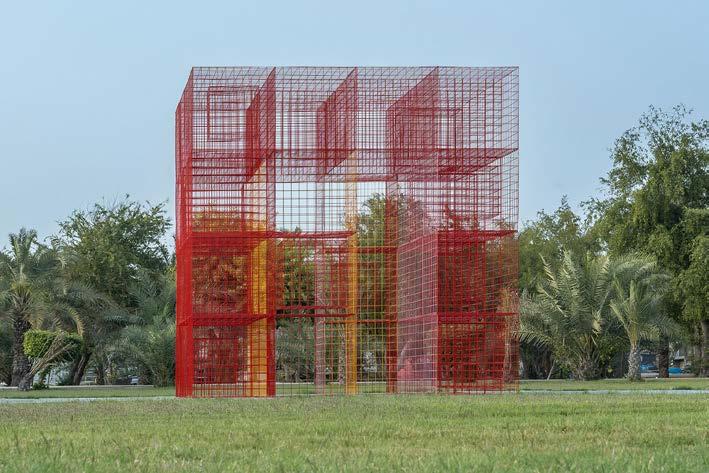
Maze marks a decisive turning point in Rashid Al Khalifa’s practice: his first fully walkthrough installation, and the moment geometry becomes inhabitable. Until this work, his investigations—kinetic, parametric, chromatic—were encountered from the outside. They activated perception, structured movement around them, and shaped spatial awareness. Maze dissolves that distance. Geometry is no longer observed; it is entered.
Inspired by the spatial intelligence of mashrabiya architecture, the installation does not replicate historic lattice forms but abstracts their operative logic. The mashrabiya traditionally mediates between interior and exterior, light and privacy, exposure and concealment. Rashid isolates this mediating function and translates it into a contemporary environmental system. The result is not quotation, but transformation.
In the Maze, geometry becomes experiential. Perforated planes rise into layered corridors that the body must navigate. Circulation is not linear but exploratory. Dense lattices compress movement, while open intervals release it. As the viewer turns and reorients, the structure appears to dissolve and reassemble through shifting sightlines. The kinetic intelligence once embedded in surface now unfolds at architectural scale.
The work’s power lies in its spatial ambiguity. It resists clear designation as interior or exterior. Instead, it operates within a threshold condition—simultaneously open and enclosed. Light filters through perforated surfaces, casting patterned shadows that migrate across the ground. These shadows form a secondary architecture, ephemeral yet inseparable from the structure itself. The installation is continuously rewritten by atmosphere, time of day, and bodily movement. >
What distinguishes the Maze from Rashid’s earlier works is the immediacy of physical participation. The viewer becomes structurally implicated. Movement is no longer optional but necessary. The body traces geometric sequences once negotiated only by the eye.
Repetition becomes rhythm underfoot. Variation becomes directional cue. The installation choreographs navigation while preserving freedom of choice.
The mashrabiya reference deepens this experience as spatial philosophy rather than ornament. Historically, the lattice regulates visibility—permitting sight in one direction while obscuring it in another. Within the Maze, perception is similarly conditional. One is alternately revealed and concealed, observer and participant. Silhouettes merge with pattern; bodies momentarily become extensions of the geometry itself.
Maze also signals an expansion of scale and ambition. It is the first work in which Rashid treats space as primary material. Geometry no longer shapes surface alone; it shapes environment. The parametric logic remains present, but its effect is humanised through occupation. Structure and movement become inseparable.
In this installation, Rashid crosses a threshold in his own practice. Geometry ceases to frame experience from without and begins to organise it from within. The Maze is not simply traversed; it is inhabited. It reveals how structure can choreograph movement, how light can redraw space, and how inherited spatial intelligence can be rearticulated through contemporary form.
With the Maze, geometry enters the world as lived environment
A labyrinthine threshold where movement completes the work.
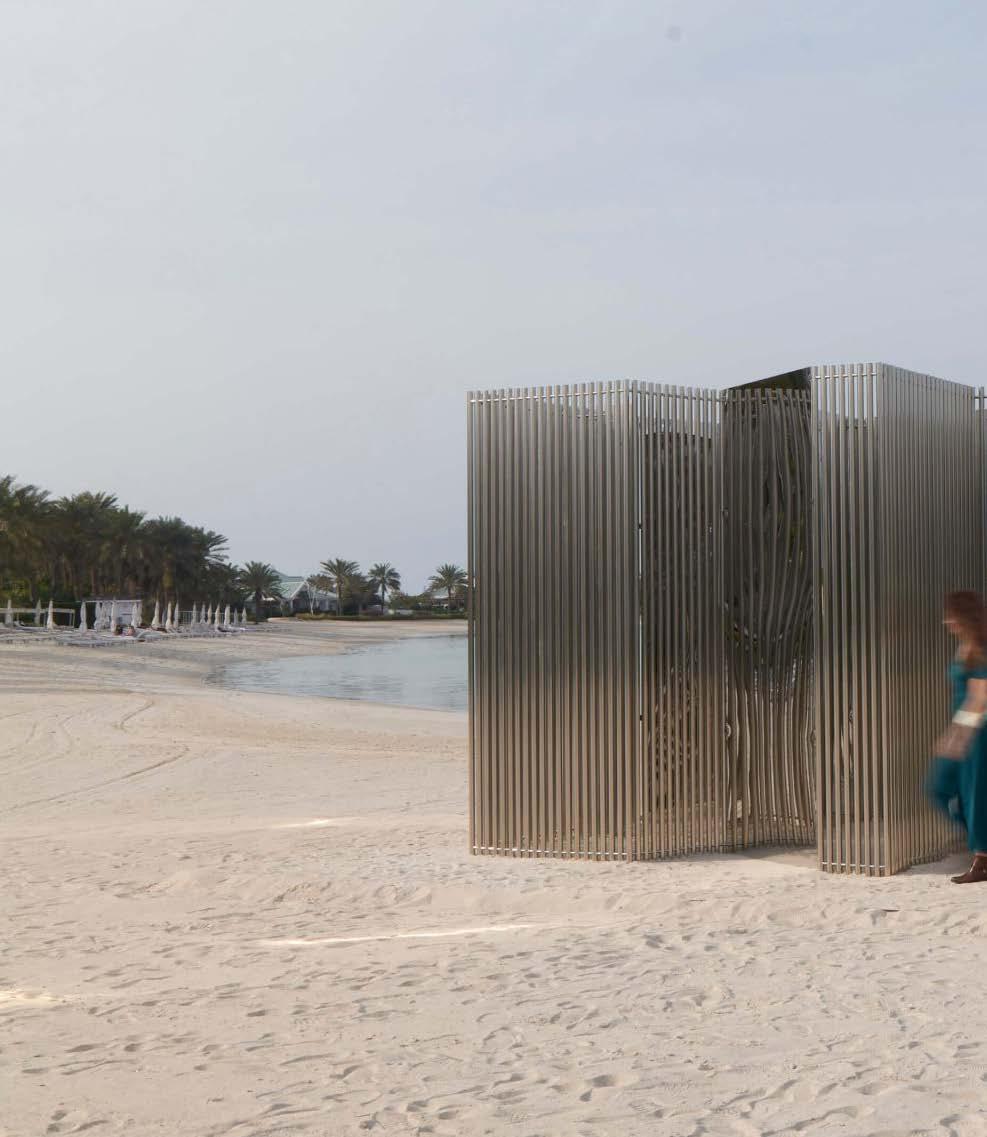
Fish Trap emerges within Rashid Al Khalifa’s practice as a meditation on permeability, structure, and the quiet intelligence of material. While its form recalls a vernacular device, the work does not operate through reference or narrative. Instead, it abstracts the logic of containment into a study of spatial sensitivity, where geometry is articulated through interval rather than mass.
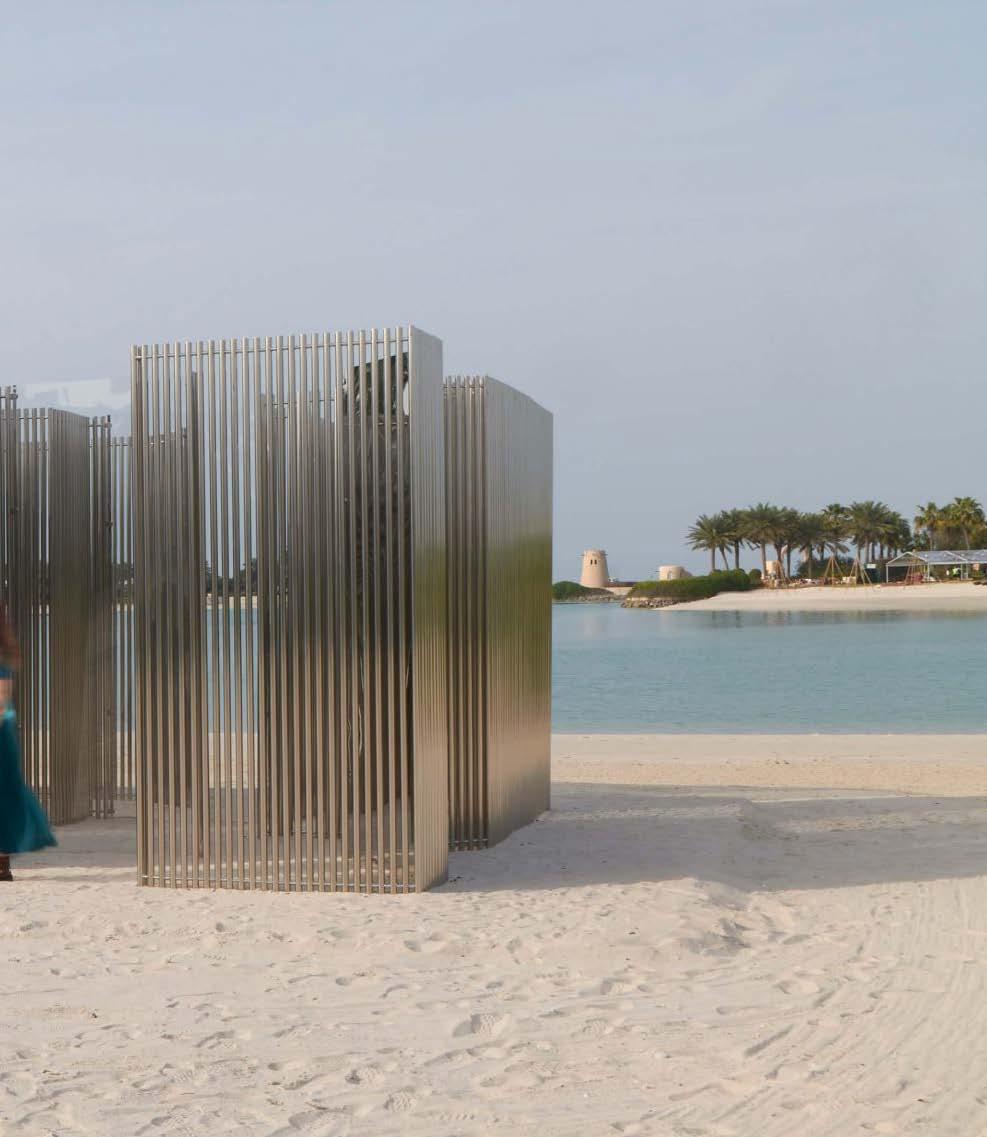
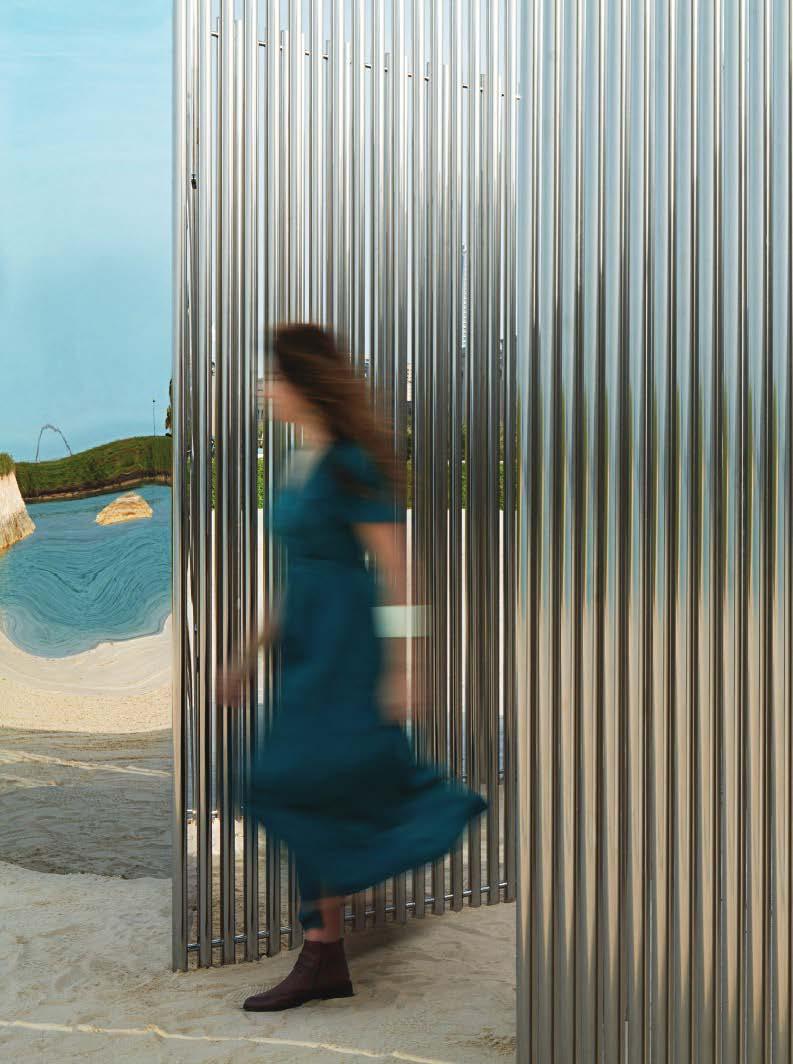
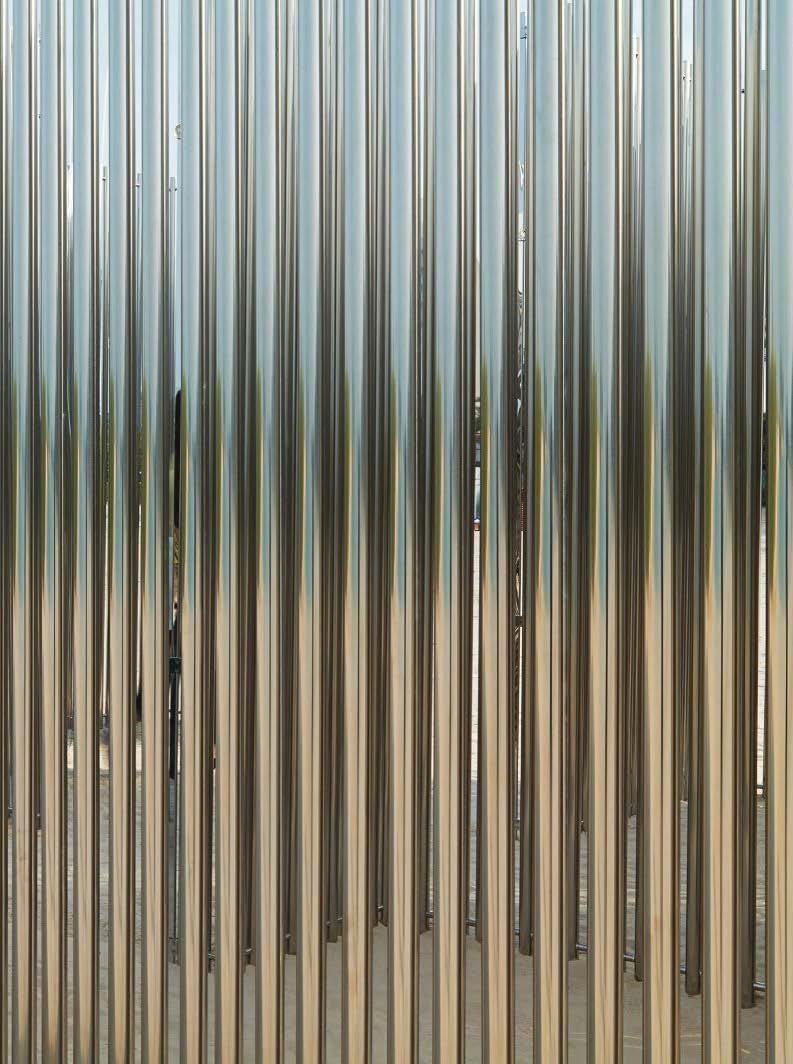
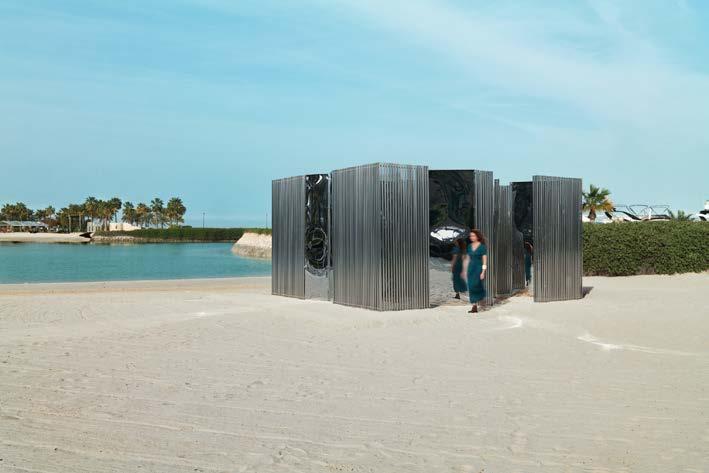
Composed of repeated vertical stainless steel members, the structure gathers into an open cylindrical volume that suggests enclosure without completing it. Lines accumulate into form, yet the volume remains provisional. Light and air pass freely through its surface. What initially appears as a simple construction gradually reveals itself as a calibrated threshold— neither sculpture nor architecture, but a spatial condition suspended between the two.
Here, material translation reaches a mature clarity. Curvature is not imposed but negotiated. The arc of the structure emerges through incremental adjustment, allowing material behaviour to guide geometric formation. Stainless steel surfaces register subtle shifts in reflectivity, capturing surrounding light and extending the work’s presence beyond its physical perimeter. Shadows elongate and dissolve across the ground, expanding the enclosure into atmosphere.
Unlike the more immersive spatial systems of the Maze or the porous membranes of the Atmospheric Mesh Volumes, Fish Trap engages the body through implied inhabitation. The viewer circles the structure, tracing its skeletal rhythm and sensing an interior defined as much by absence as by presence. Entry is neither required nor denied. The work hovers at the threshold between participation and observation. >
Within the trajectory of Volume II, Fish Trap gathers long-standing concerns into distilled form: repetition as structural order, permeability as breath, and geometry as living system. The vernacular reference is transformed into operational logic. What once served as a device for capture becomes an architecture of openness. Containment is reimagined as release.
Light activates the structure continuously. As illumination shifts, the vertical members alternate between visibility and near disappearance, producing a subtle vibration that suggests movement without mechanism. Geometry responds rather than asserts. The enclosure remains temporary, contingent on atmosphere and duration.
In this work, Rashid demonstrates that material need not dominate space to define it. Through minimal means, he constructs a volume that is simultaneously intimate and expansive. Geometry collaborates with environment rather than imposing upon it, allowing perception, structure, and context to converge in quiet equilibrium.
The Fish Trap stands as a refined articulation of material intelligence— an architecture reduced to rhythm, breath, and interval
Vernacular logic distilled into permeable structure.
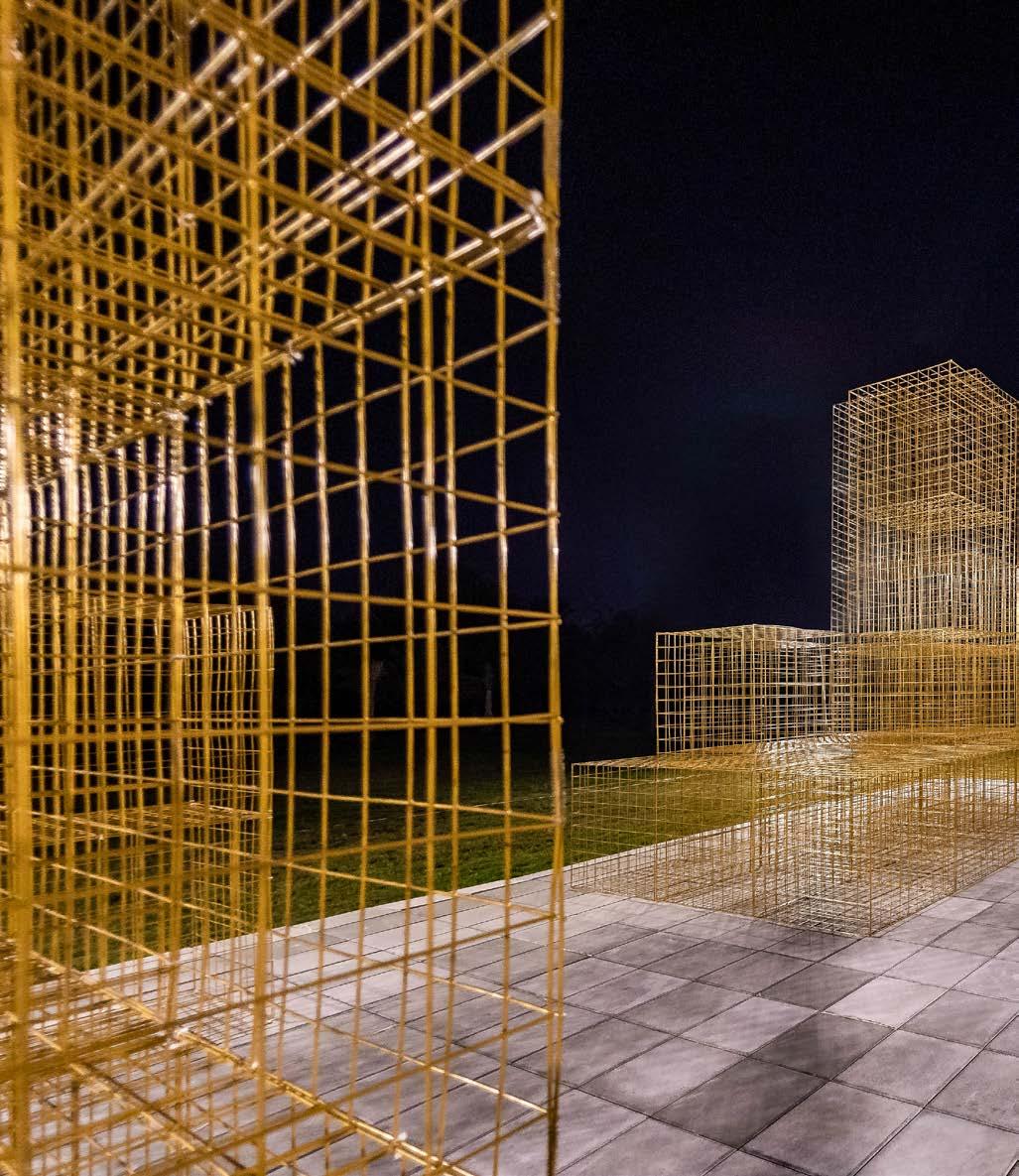
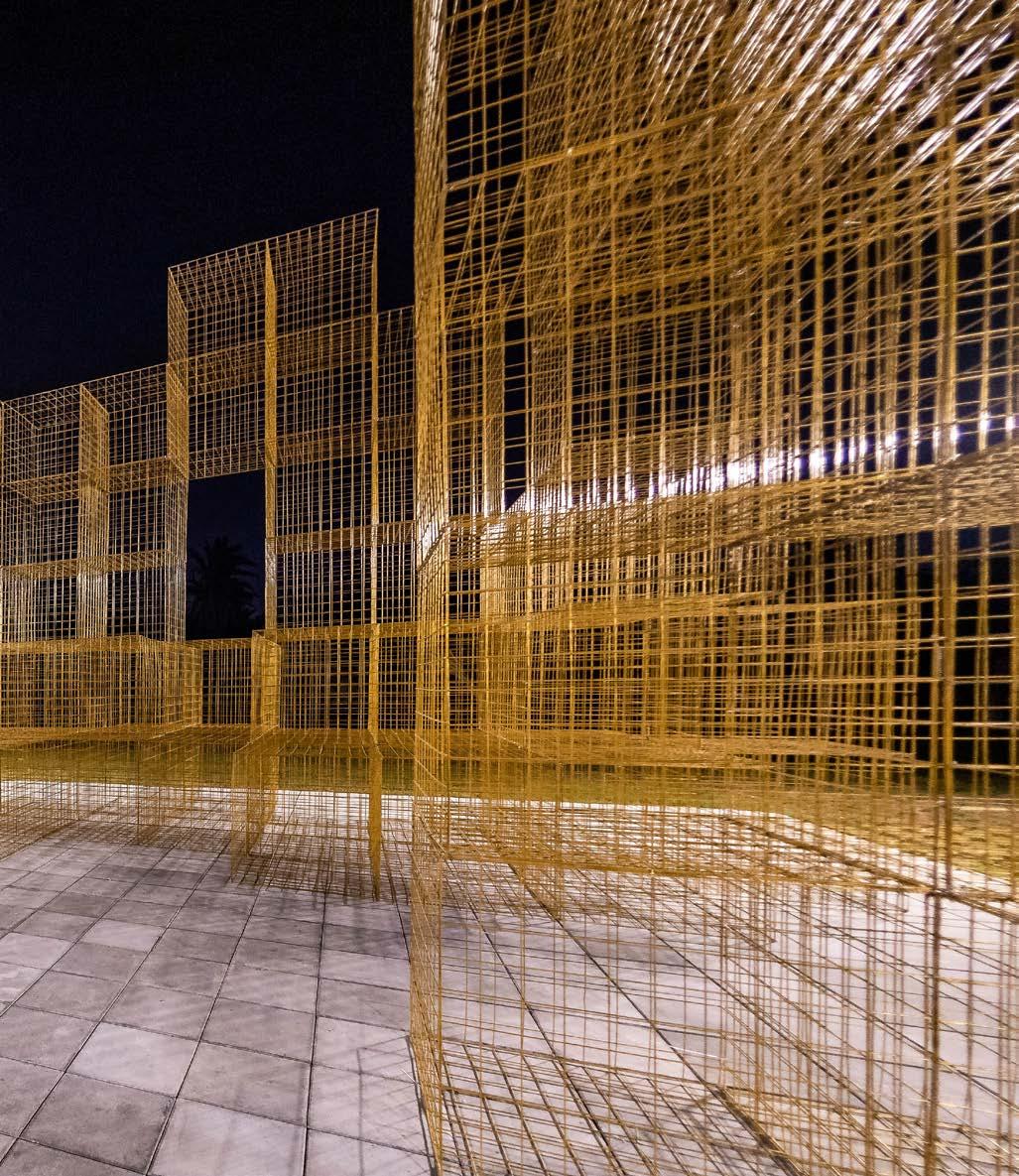
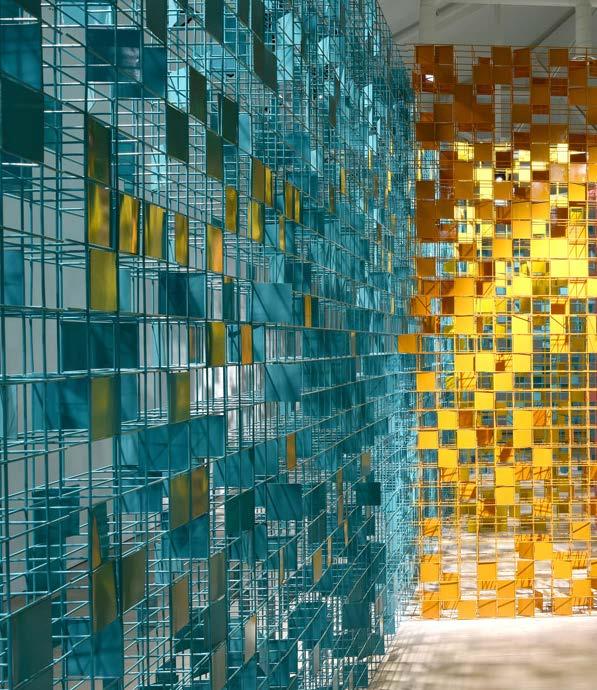
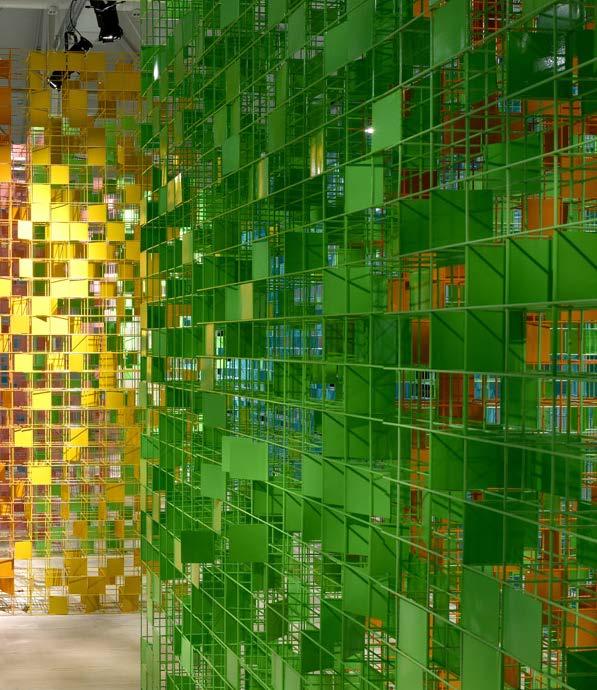
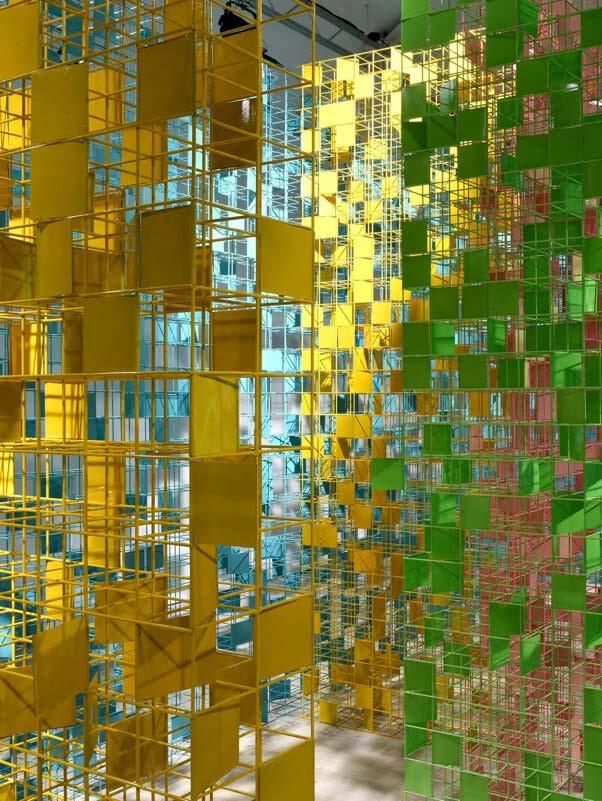
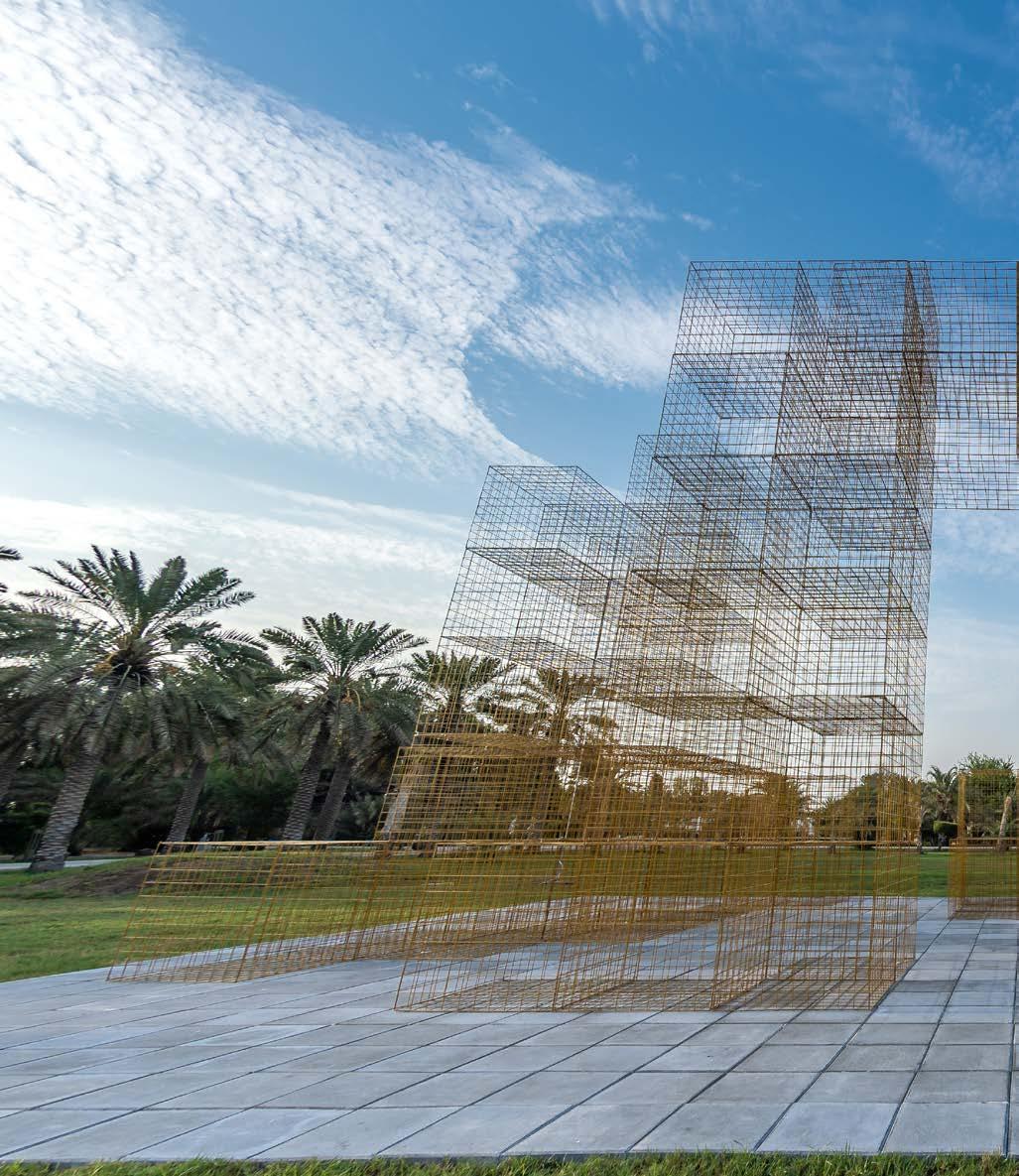
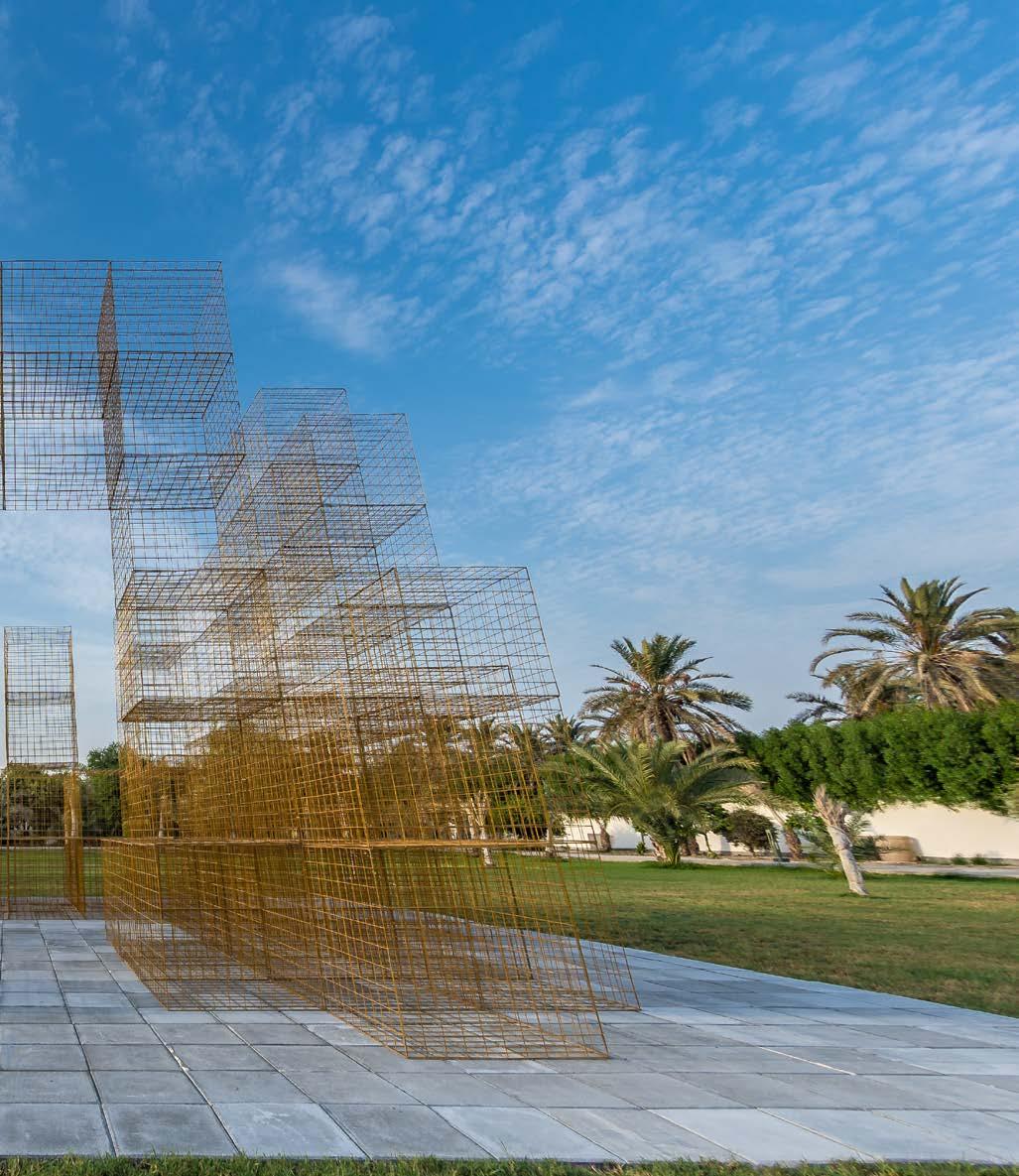
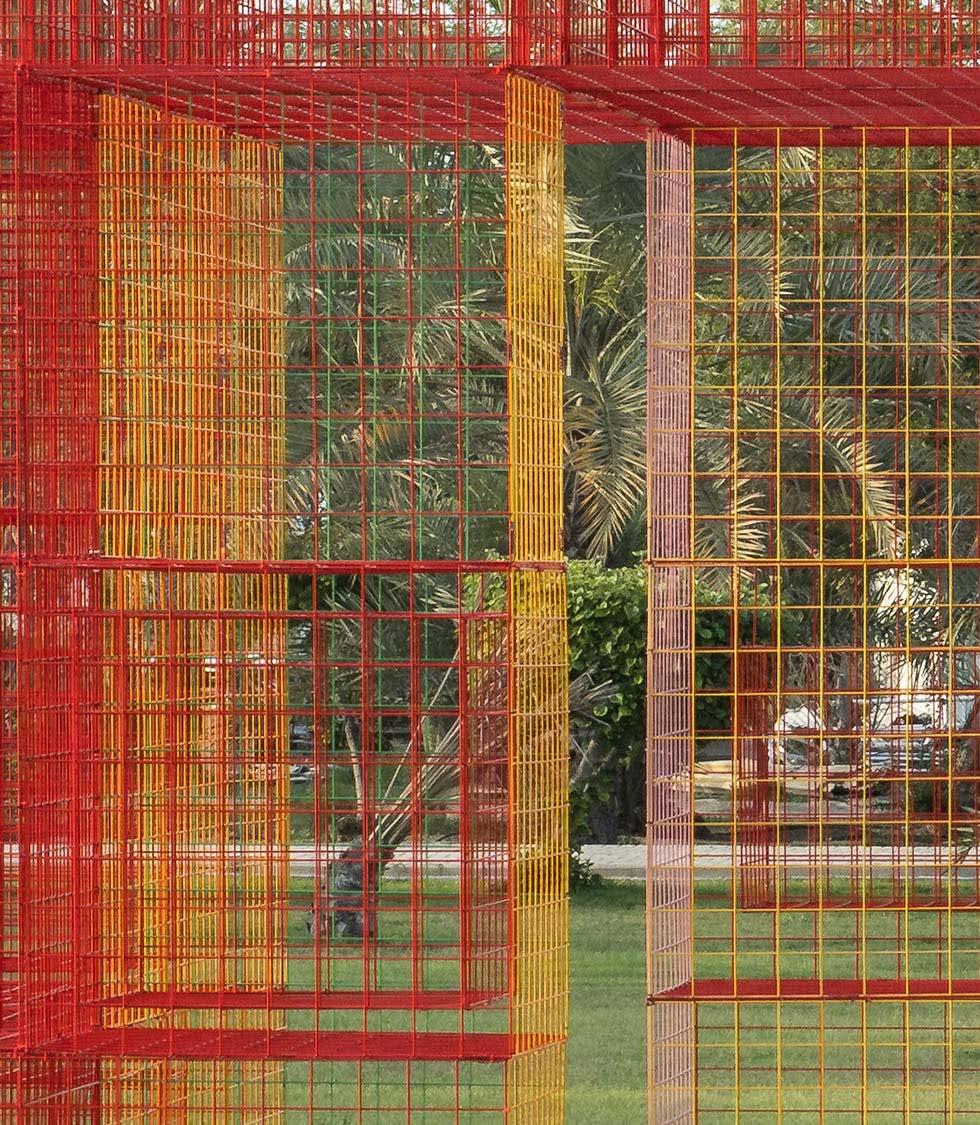
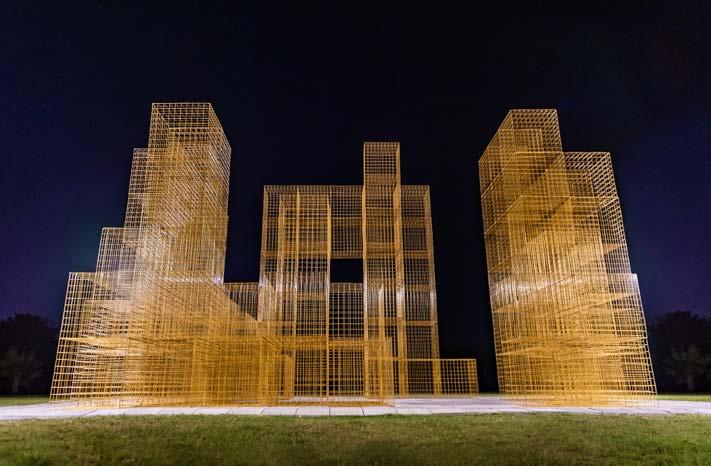
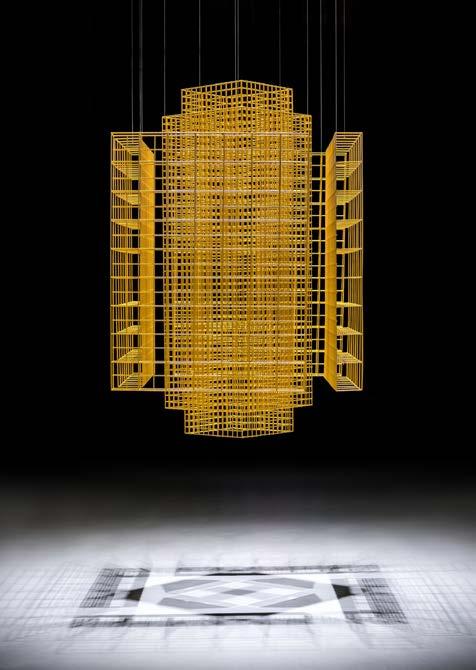
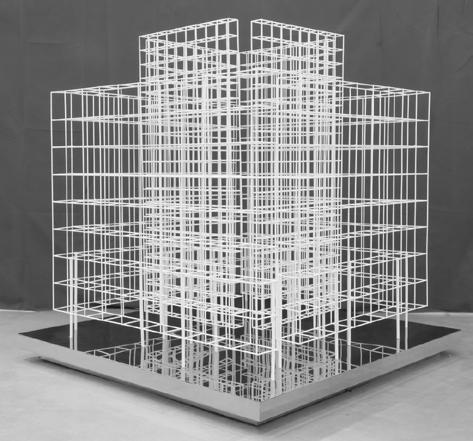
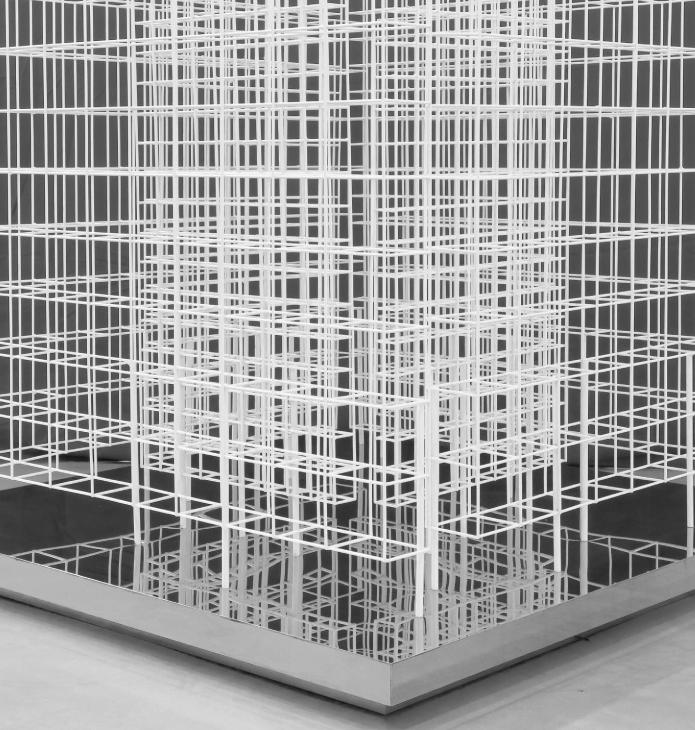
In Open Field, Rashid distills architecture to its skeletal essence. Composed of modular steel lattice units assembled into an orthogonal framework, the structure defines space without enclosing it. Walls are implied through repetition; rooms are suggested through alignment; boundaries exist without opacity.
Unlike the radial logic of the Fish Trap or the patterned corridors of the Maze, Open Field operates through Cartesian clarity. Vertical and horizontal members intersect with disciplined regularity, generating volumetric compartments that remain visually permeable. The work reads simultaneously as construction and drawing—architecture rendered as line in space.
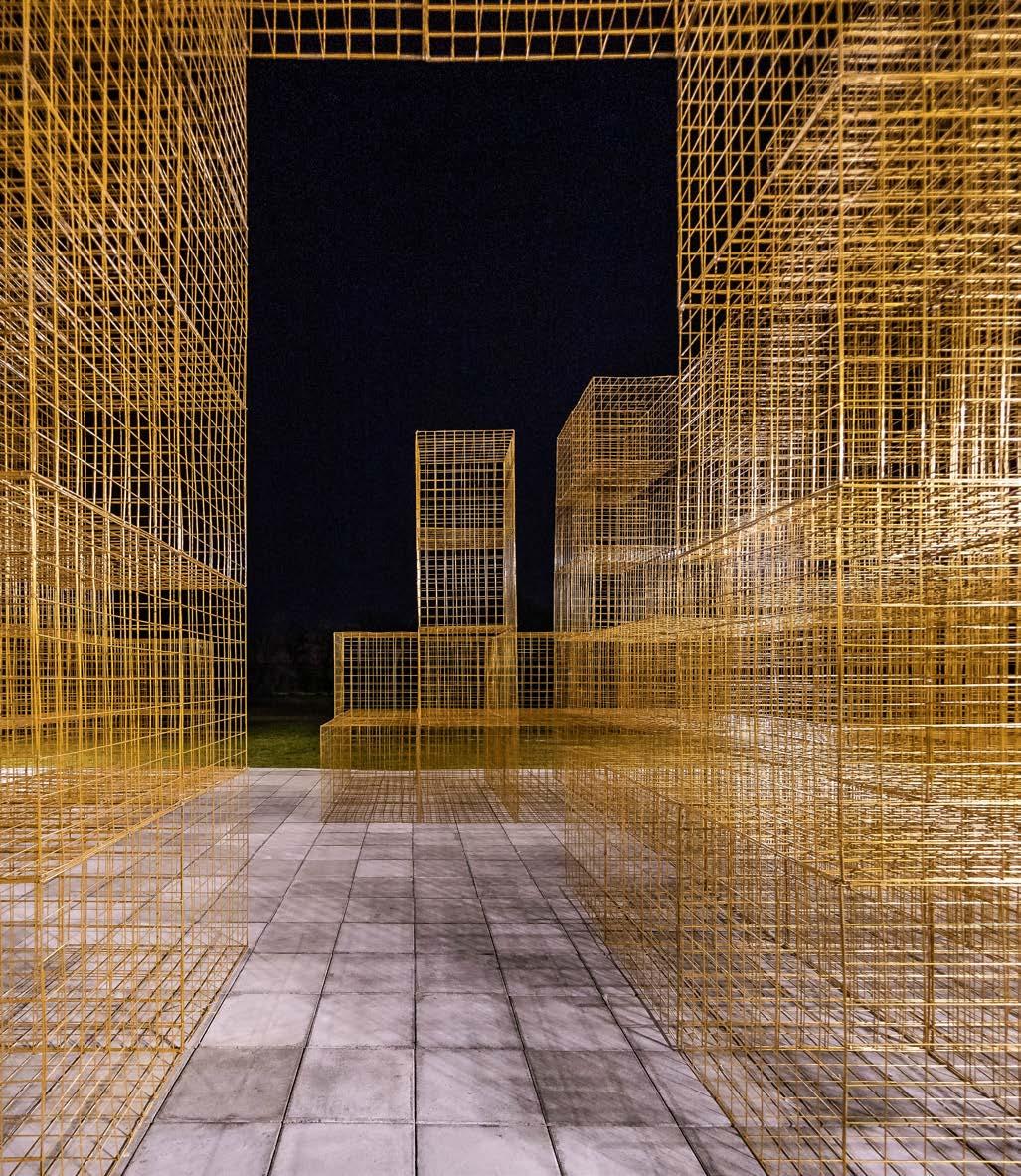
What appears at first as rigid geometry reveals a nuanced spatial choreography. As visitors move through the structure, density shifts. Certain zones compress perception through layered grids; others open outward, framing sky and landscape through transparent planes. The body becomes aware of its own scale in relation to modular proportion.
The grid, historically associated with order and control, is here reinterpreted as invitation. It does not confine; it scaffolds occupation. The absence of solid surface allows light to penetrate from every direction, dissolving hierarchy between interior and exterior. Shadow overlays structure with secondary geometries that shift with time of day.
Material restraint intensifies spatial effect. The thin metallic members produce a volume that feels both monumental and weightless. The structure asserts presence without mass. It is architecture reduced to rhythm. >
Within the trajectory of Volume II, Open Field occupies a crucial position. It clarifies how geometry can produce inhabitable depth through minimal means. It bridges the labyrinthine intimacy of the Maze and the atmospheric permeability of the Atmospheric Mesh Volumes that follow. Here, structure is neither enclosure nor membrane, but framework—an open system capable of receiving light, air, and human movement without resistance.
Open Field proposes a radical simplicity: space can be constructed through line alone CHAPTER
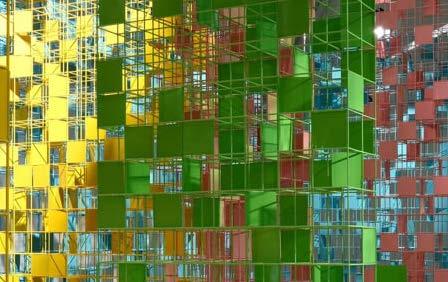
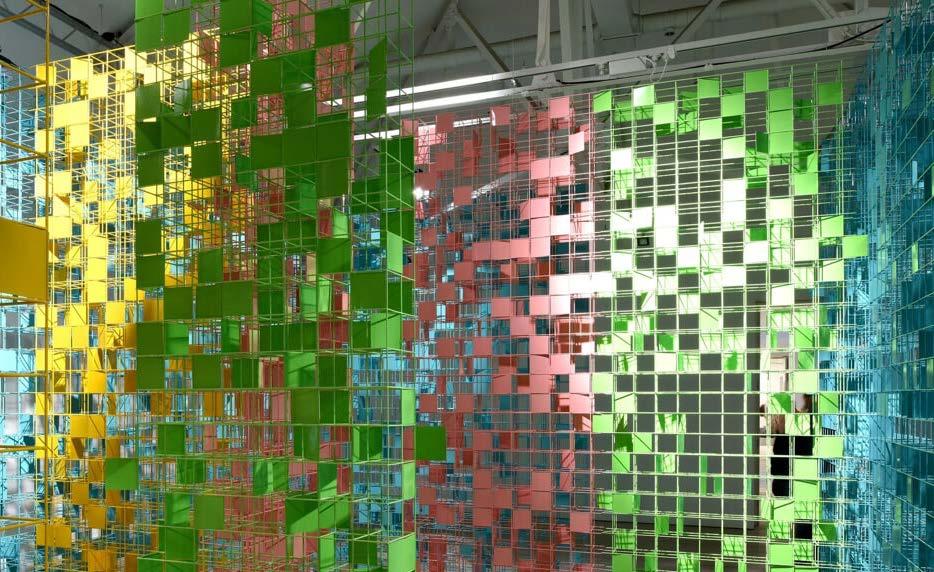
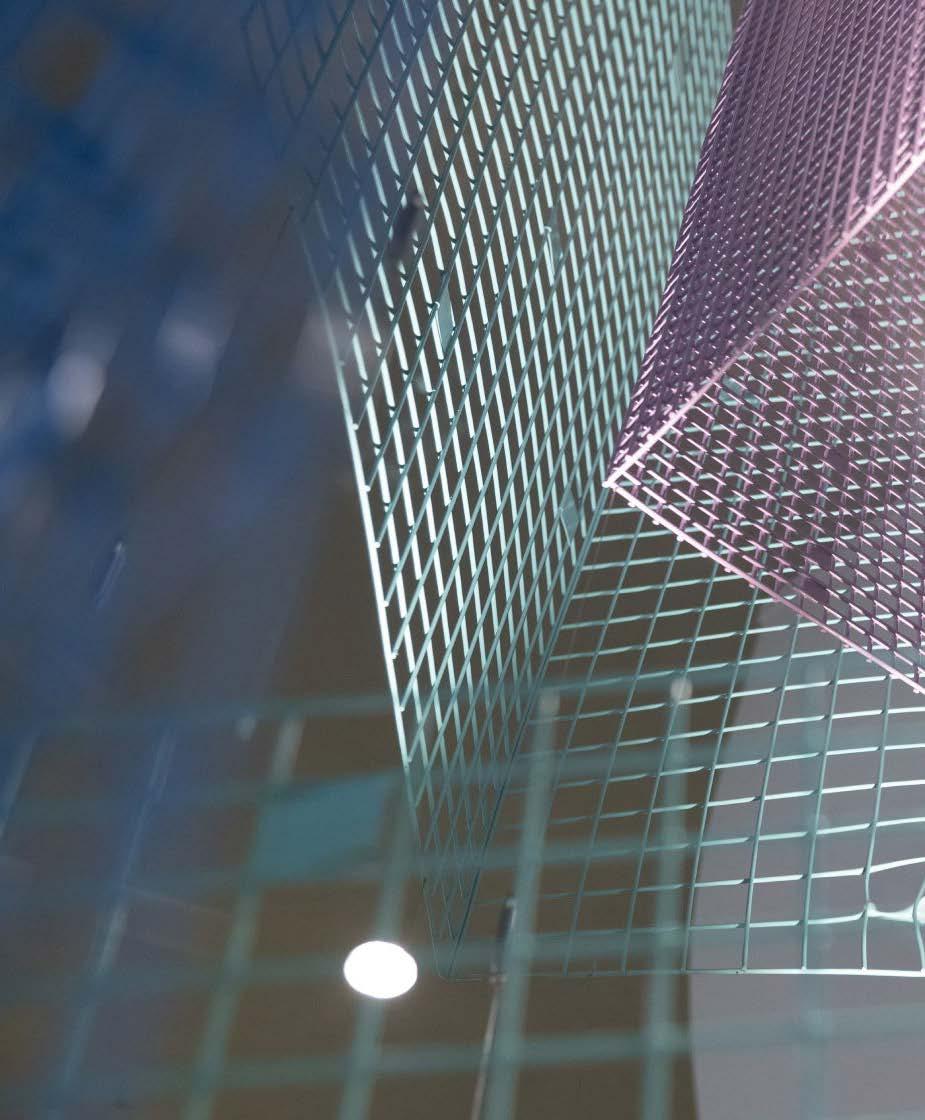
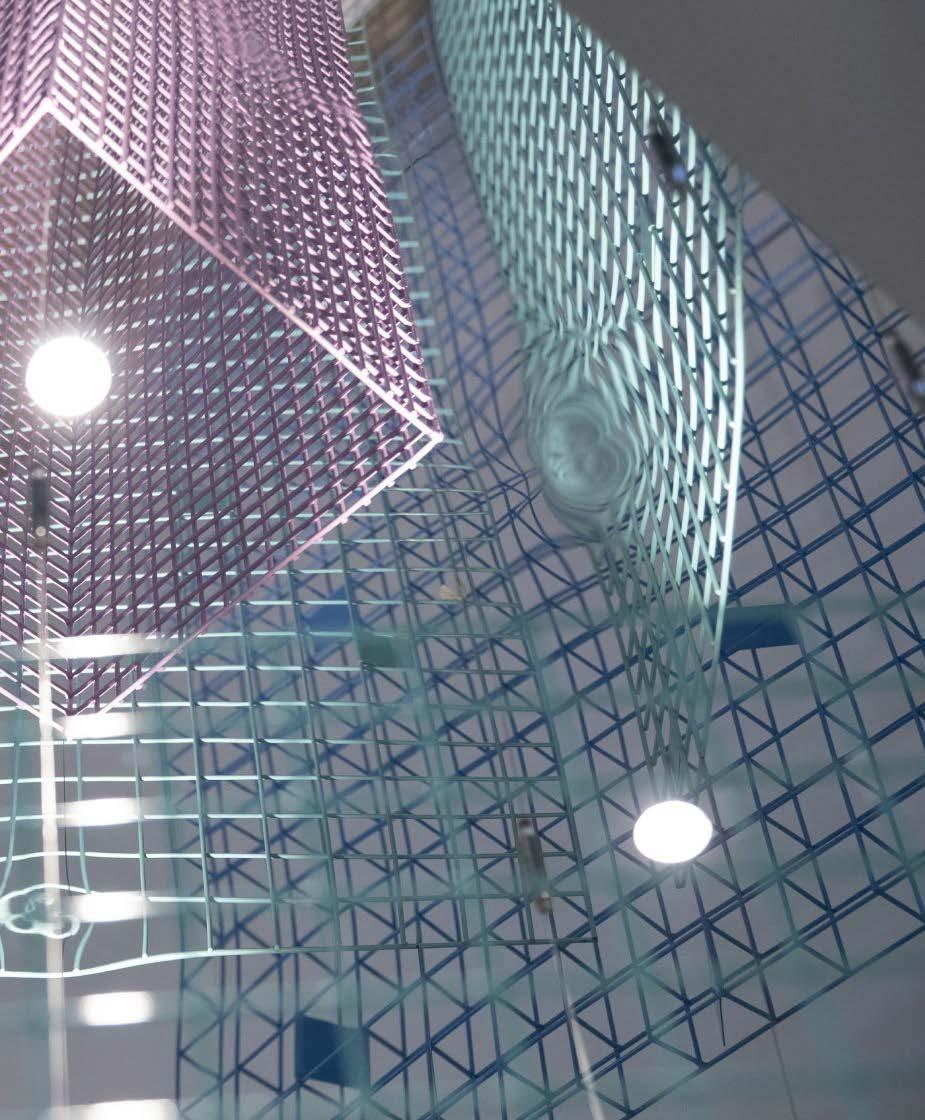
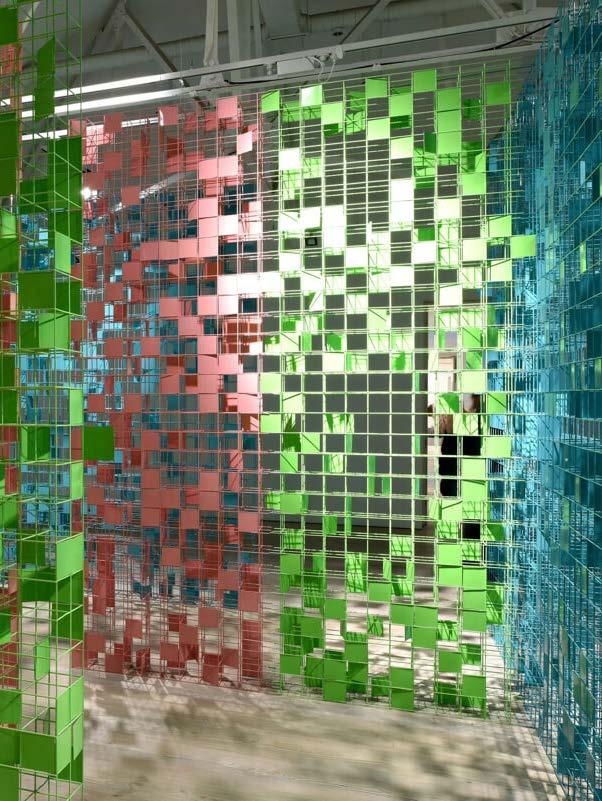
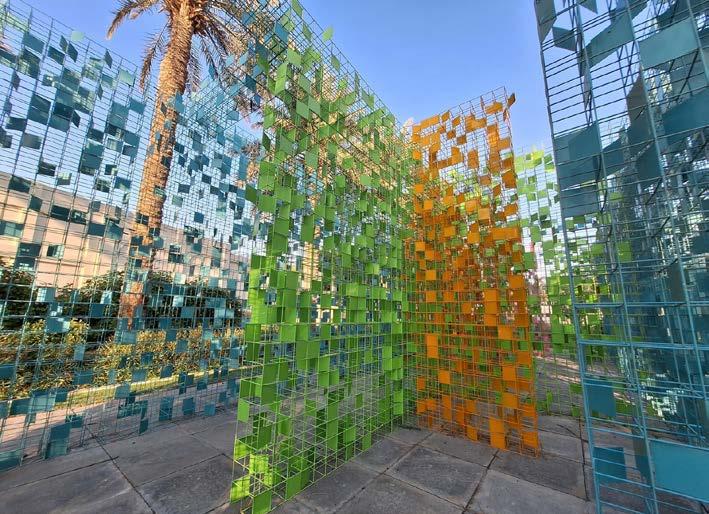
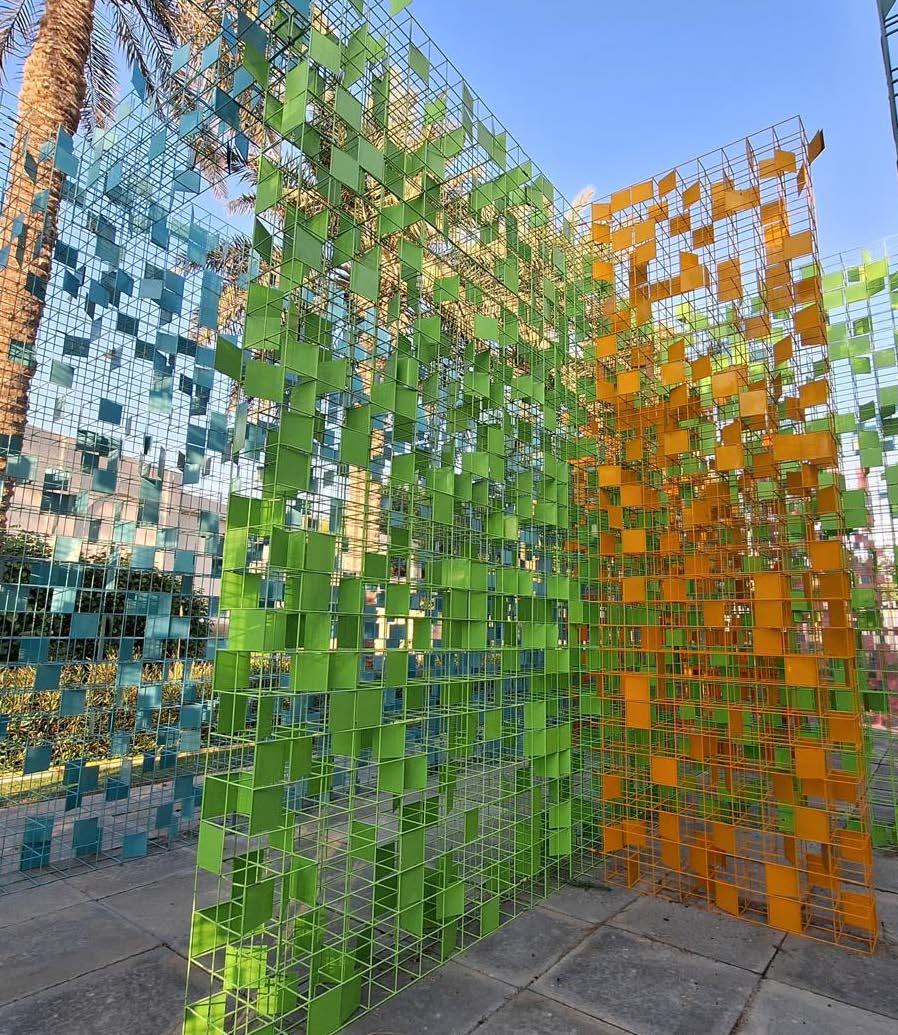
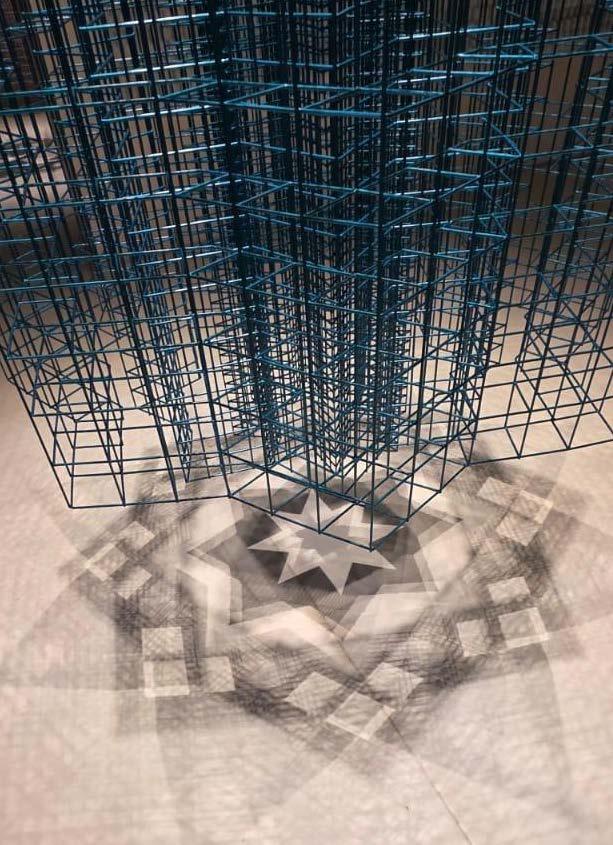
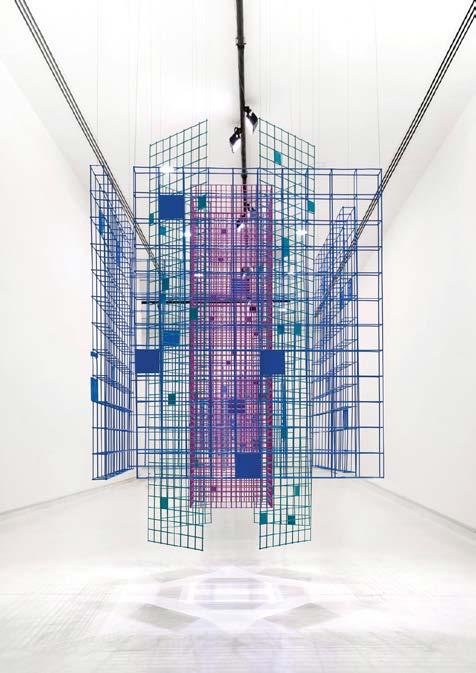
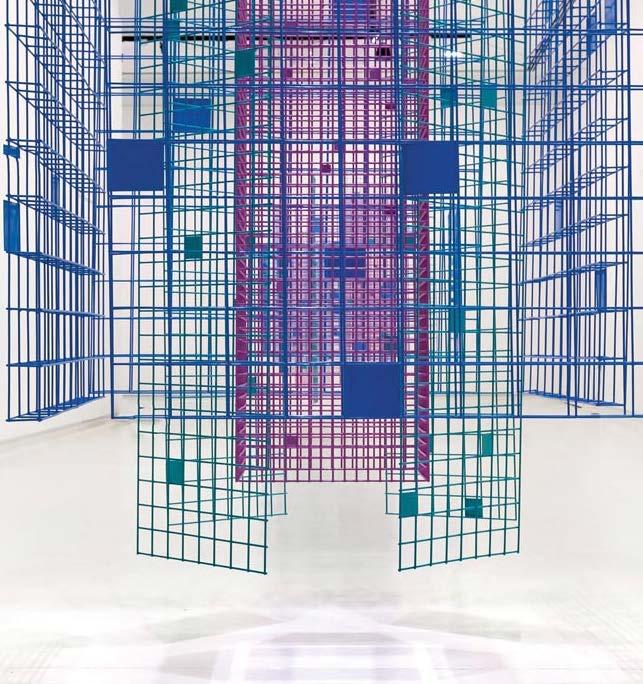
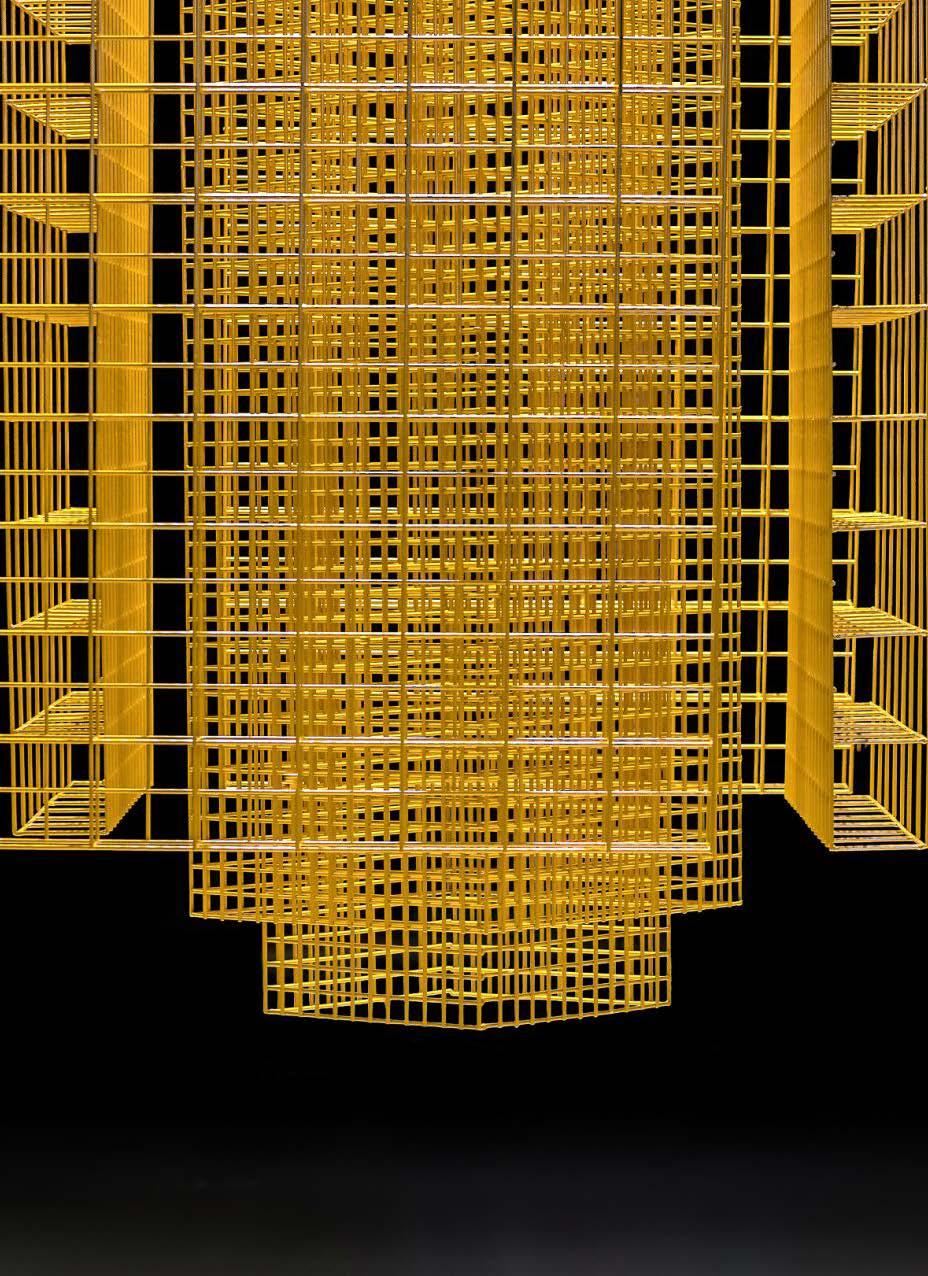
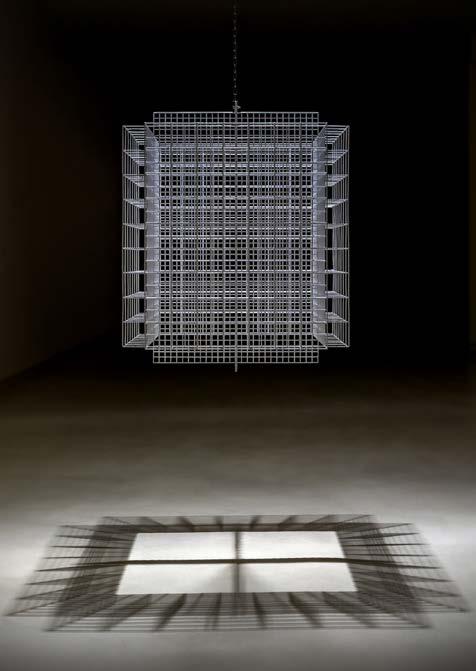
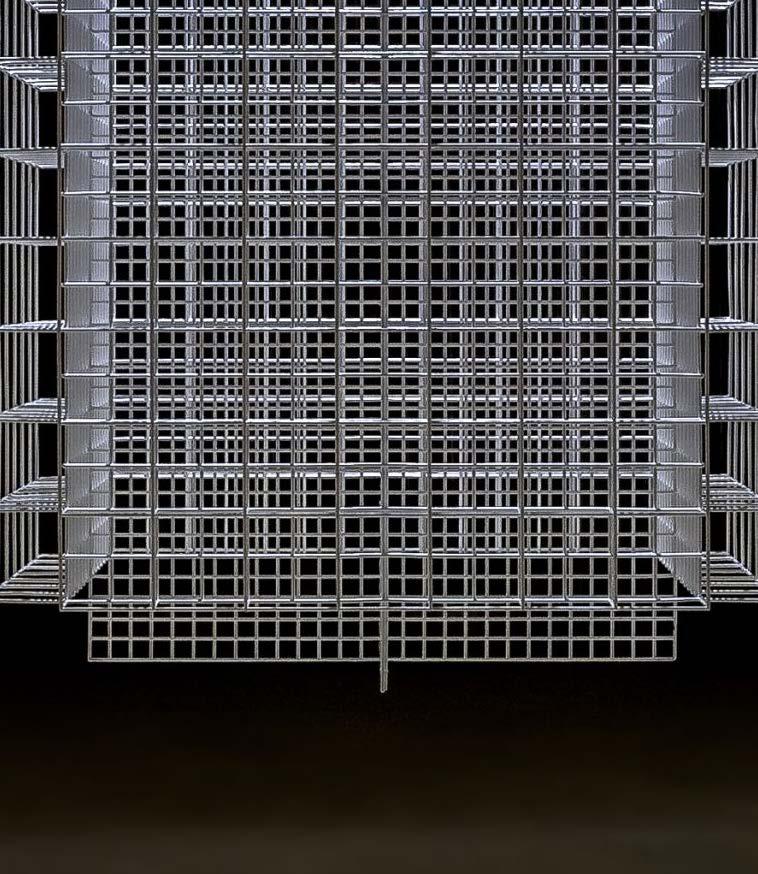
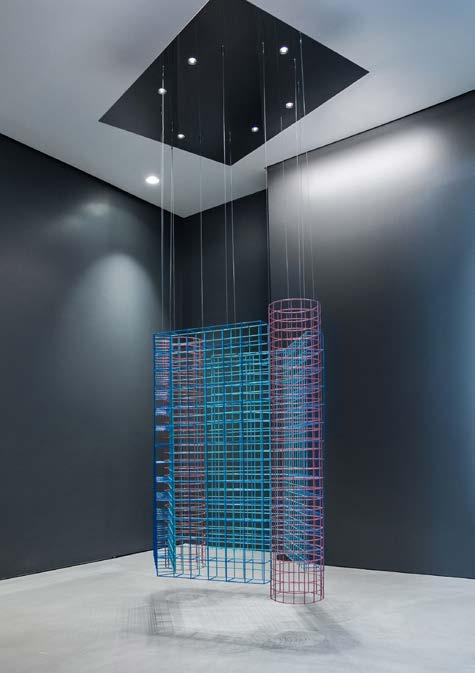
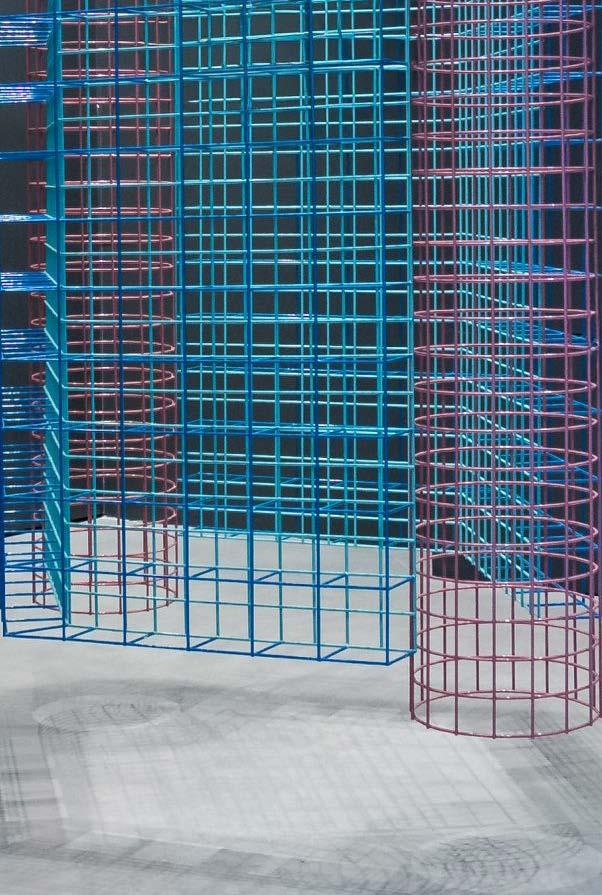
Working with perforated metallic mesh—an industrial and utilitarian medium—Rashid Al Khalifa transforms material associated with fencing and containment into a system of environmental architecture. Circular and radial configurations rise not as sculptural objects alone, but as atmospheric structures capable of generating shade, airflow, enclosure, and collective presence. What emerges is an architecture of lightness: breathable, luminous, and socially permeable.
Where the Maze established geometry as inhabitable threshold, the mesh works refine this condition into calibrated porosity. Space is defined not through opacity or mass, but through controlled openness. Perforation becomes an active spatial instrument. Light filters through metallic membranes; air circulates across curved surfaces; shadows dissolve and reform with time of day. The mesh does not assert enclosure as boundary, but as condition—an experience shaped by modulation rather than division.
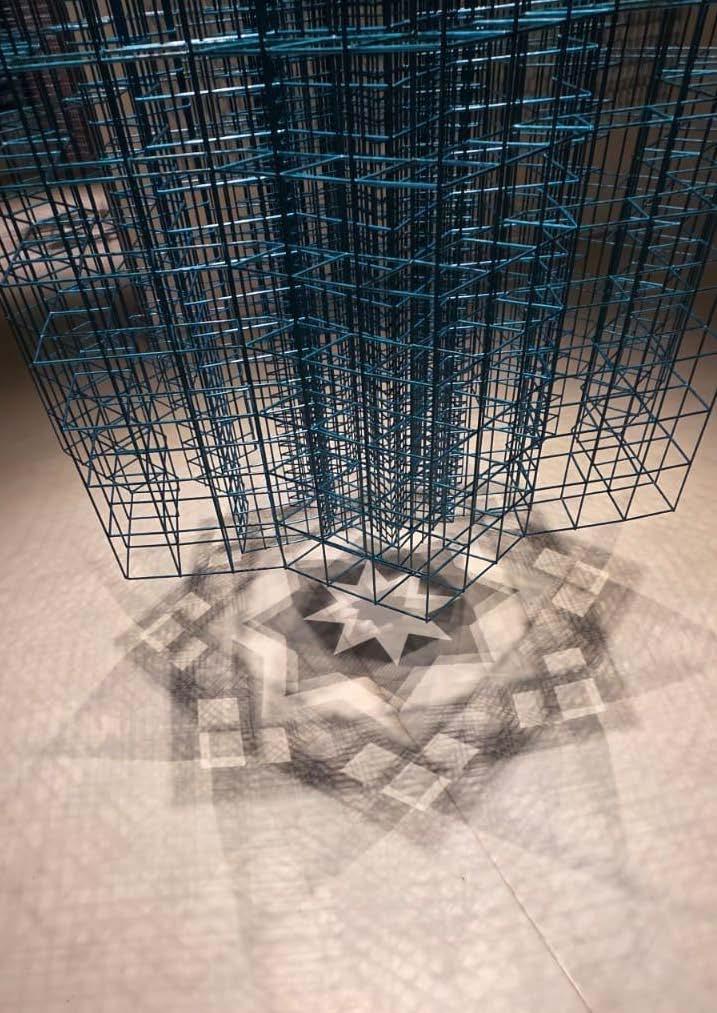
Among these works, the Eight-Point Star Installation occupies a pivotal role. While materially aligned with the broader series, its geometry introduces a cosmological dimension rooted in Islamic spatial thought. The eight-point star—historically associated with equilibrium and infinite extension—operates here not as ornament but as structural principle. Radial symmetry organises circulation and orientation, while perforated surfaces transform light into rhythmic pattern. The installation functions simultaneously as shading system and spatial diagram. > CHAPTER
Cultural memory, in this context, is neither illustrated nor quoted. It is embedded within proportion, repetition, and orientation. The mesh becomes an architectural mandala— quietly organising space while remaining materially restrained. Visitors inhabit the structure through movement and duration; geometry reveals itself progressively as light shifts and bodies circulate. Meaning emerges through experience rather than representation.
Across the series, Rashid redefines the role of mesh within urban space. It becomes shading rather than fencing, atmospheric envelope rather than barrier, enclosure without containment. The material sheds its industrial associations and assumes a new identity as parametric urban skin. Circular geometries, often linked to utilitarian precedents, are recalibrated as social frameworks—gathering bodies, modulating climate, and fostering collective interaction.
This transformation represents one of Rashid’s most significant architectural gestures. Through proportion, rhythm, and precise placement, he elevates a modest material into a spatial ethic. Here, luxury is not defined by weight or monumentality, but by responsiveness—to light, to air, to cultural resonance. The Atmospheric Mesh Volumes propose an alternative model of public structure: one in which lightness replaces solidity, porosity replaces enclosure, and geometry operates as environmental intelligence
Perforated structure becomes membrane, mediating light, air, and collective presence.
Rashid Al Khalifa’s practice has consistently moved from the tangible to the perceptual, from measurable structure to experiential condition. Yet across its many phases, a single conviction persists: reality is not linear. It unfolds as continuum—layered, permeable, and simultaneous. His works do not belong exclusively to the present. They hold memory and anticipation within the same geometric order.
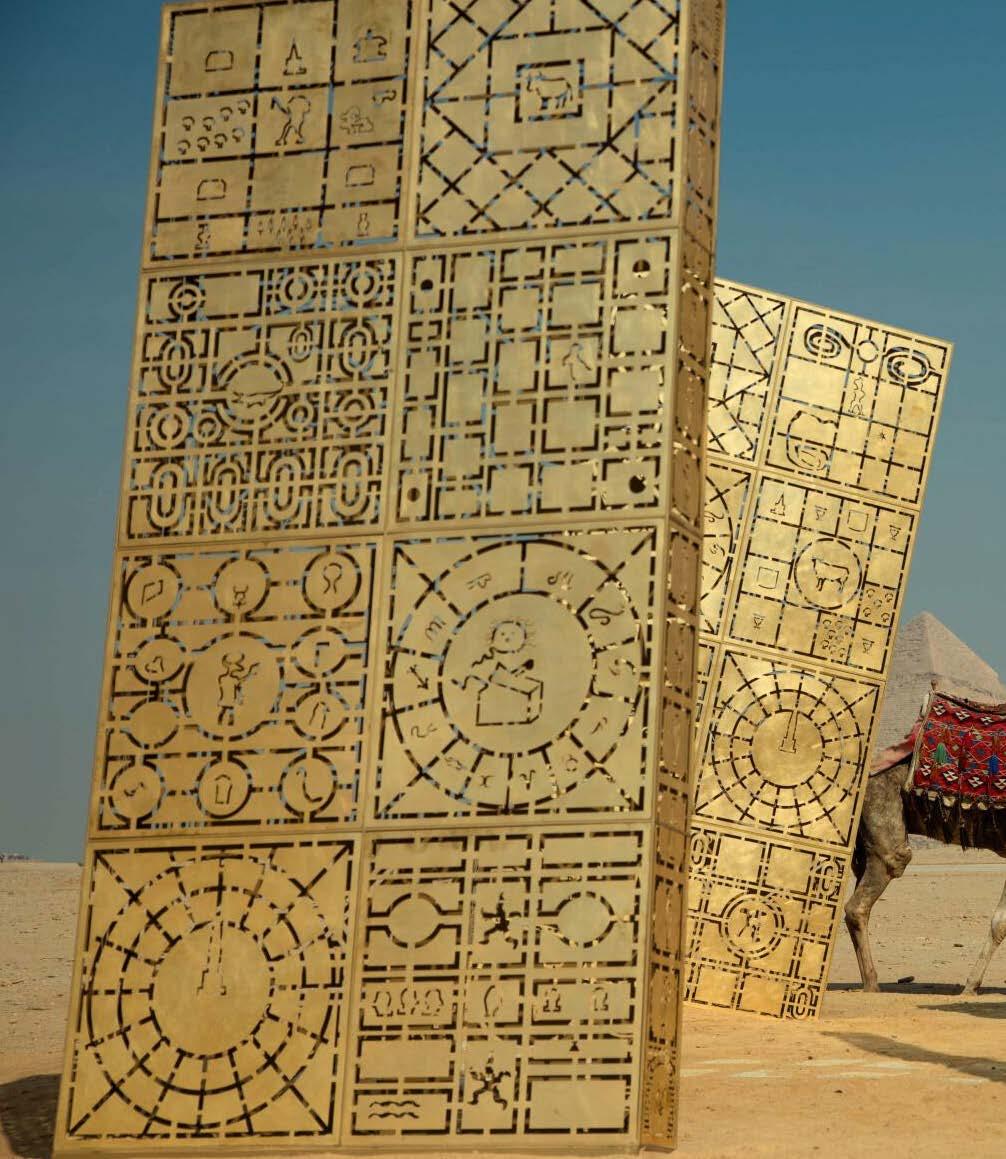
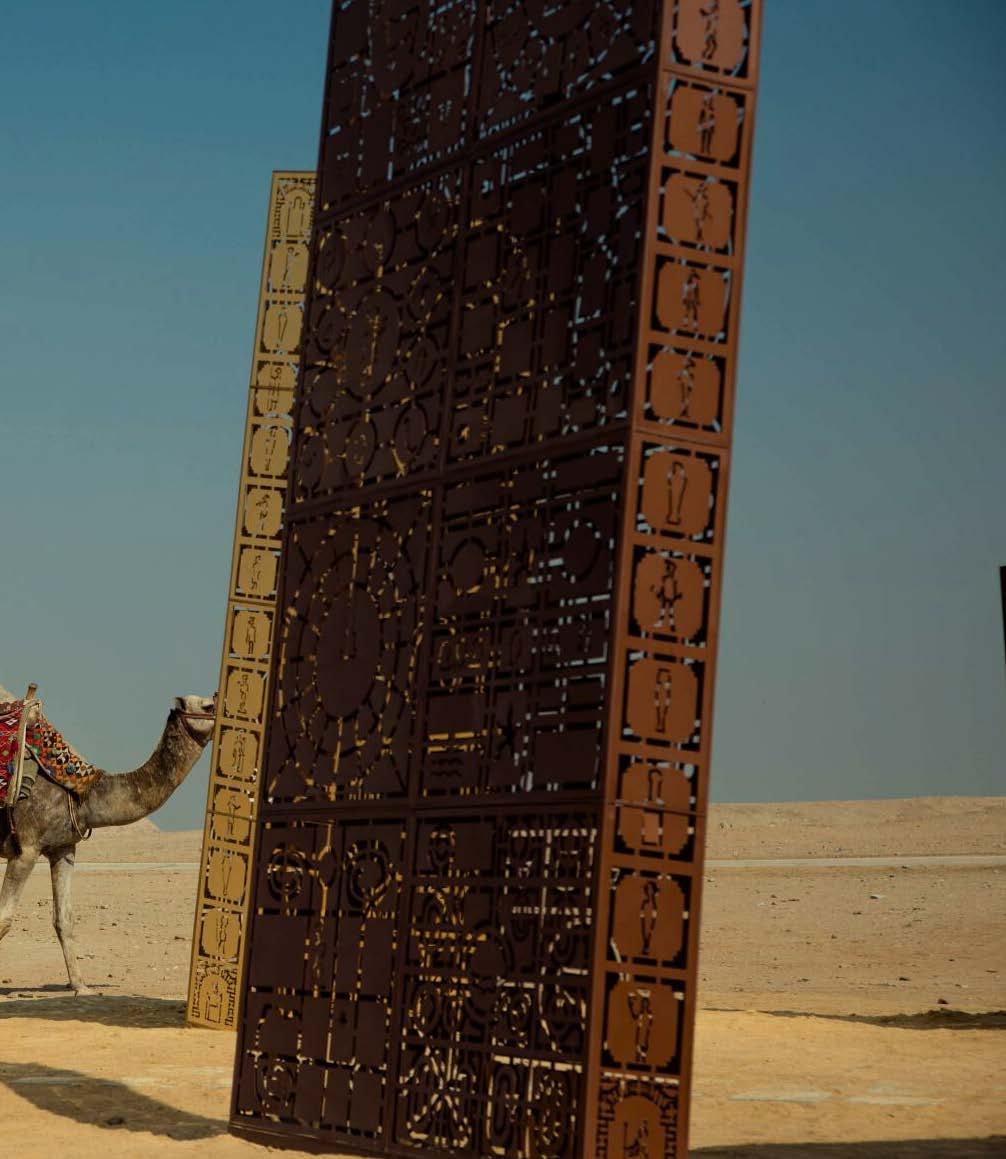
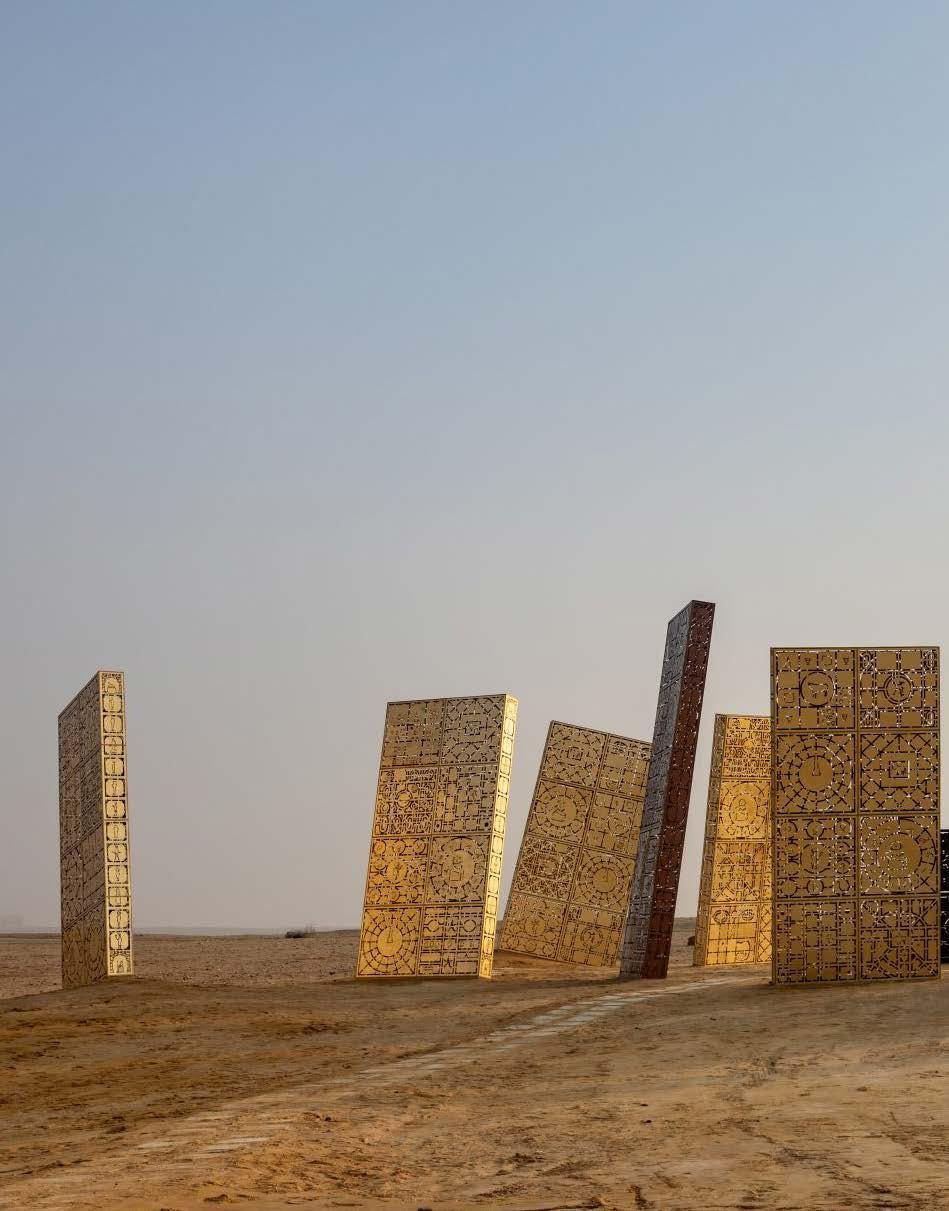
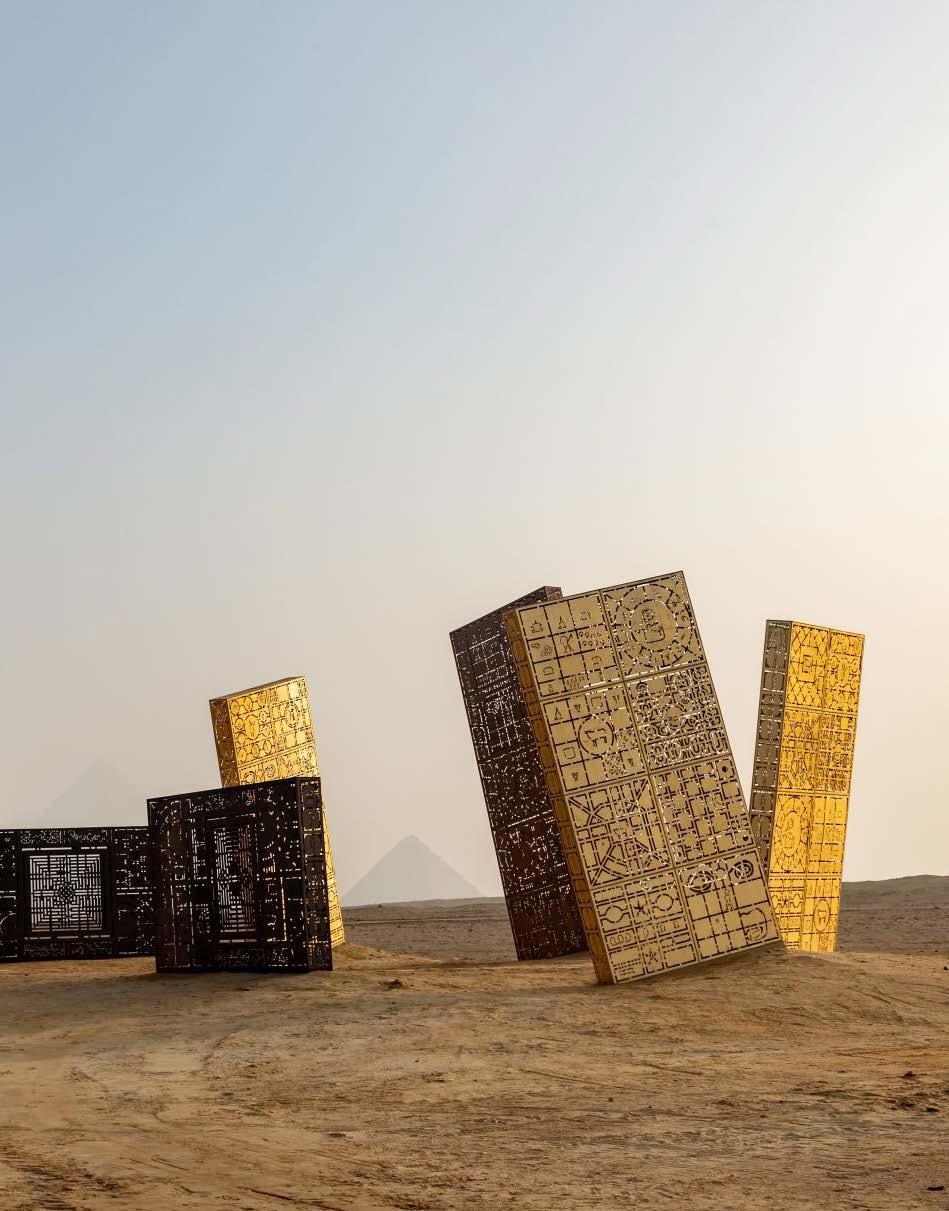
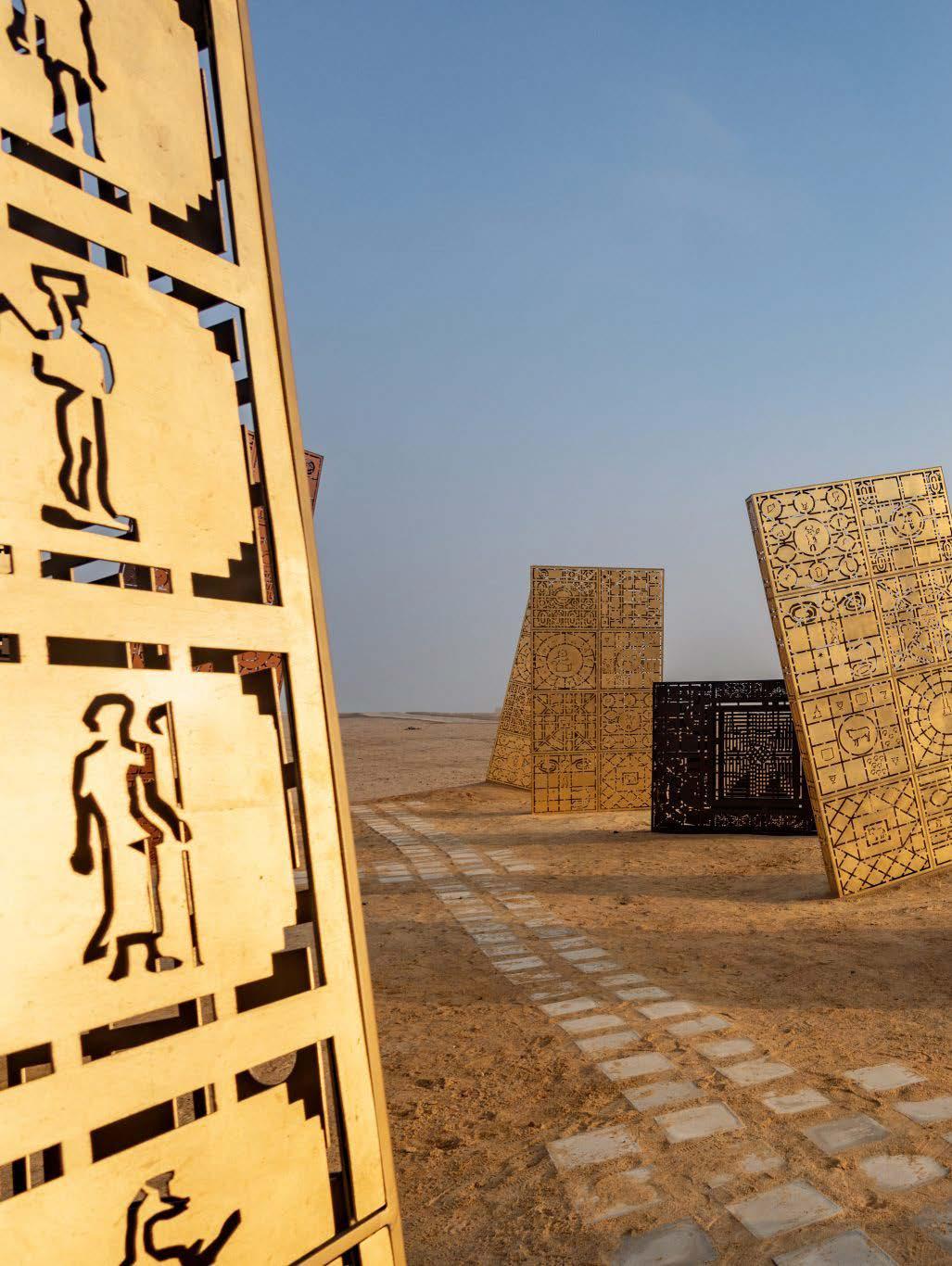
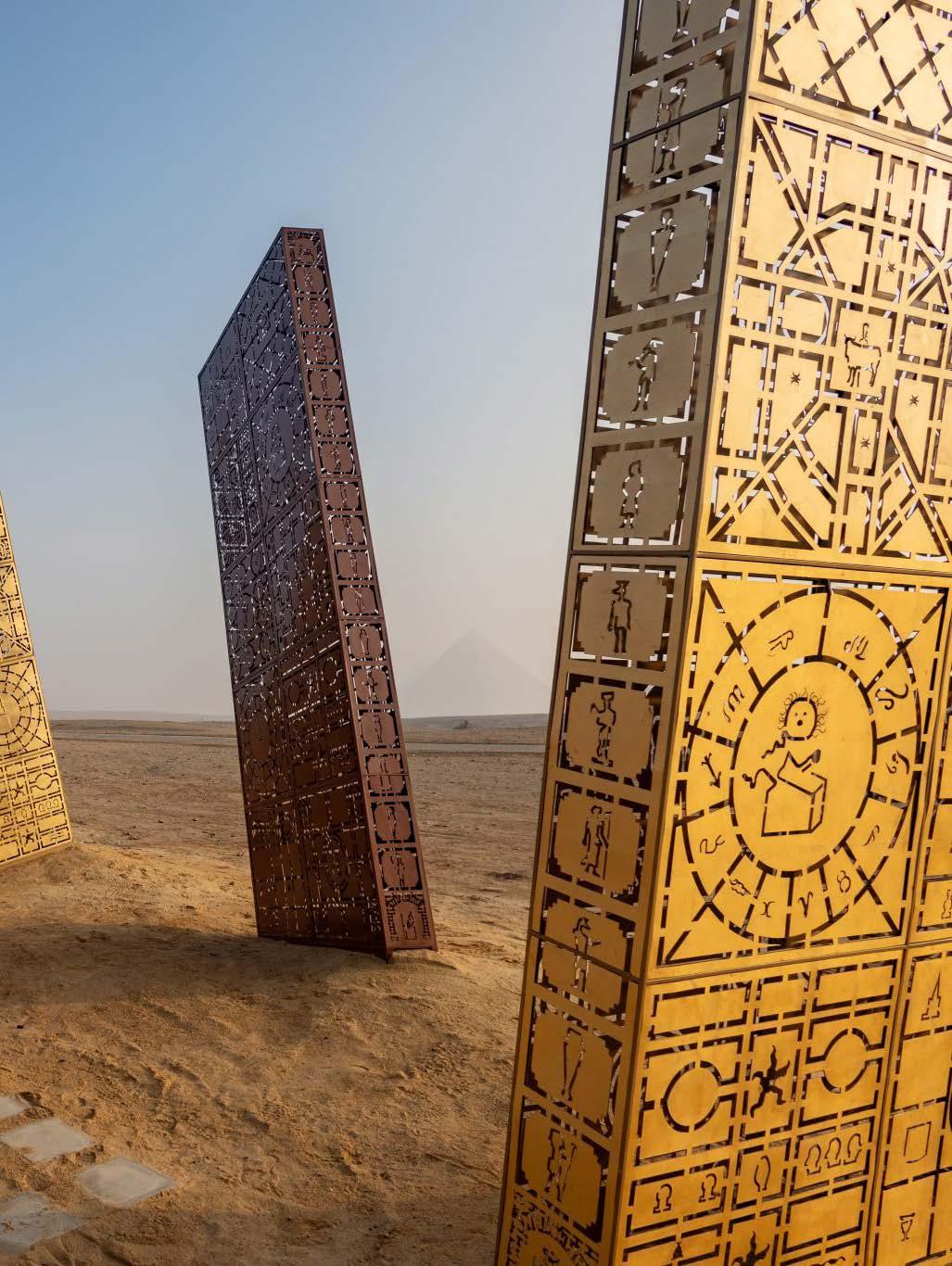
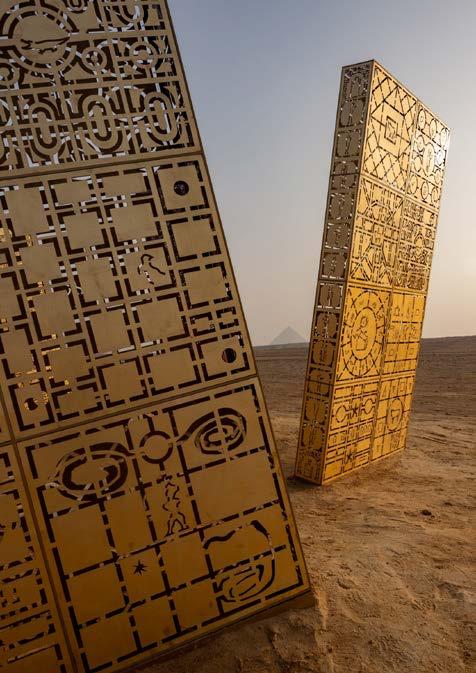
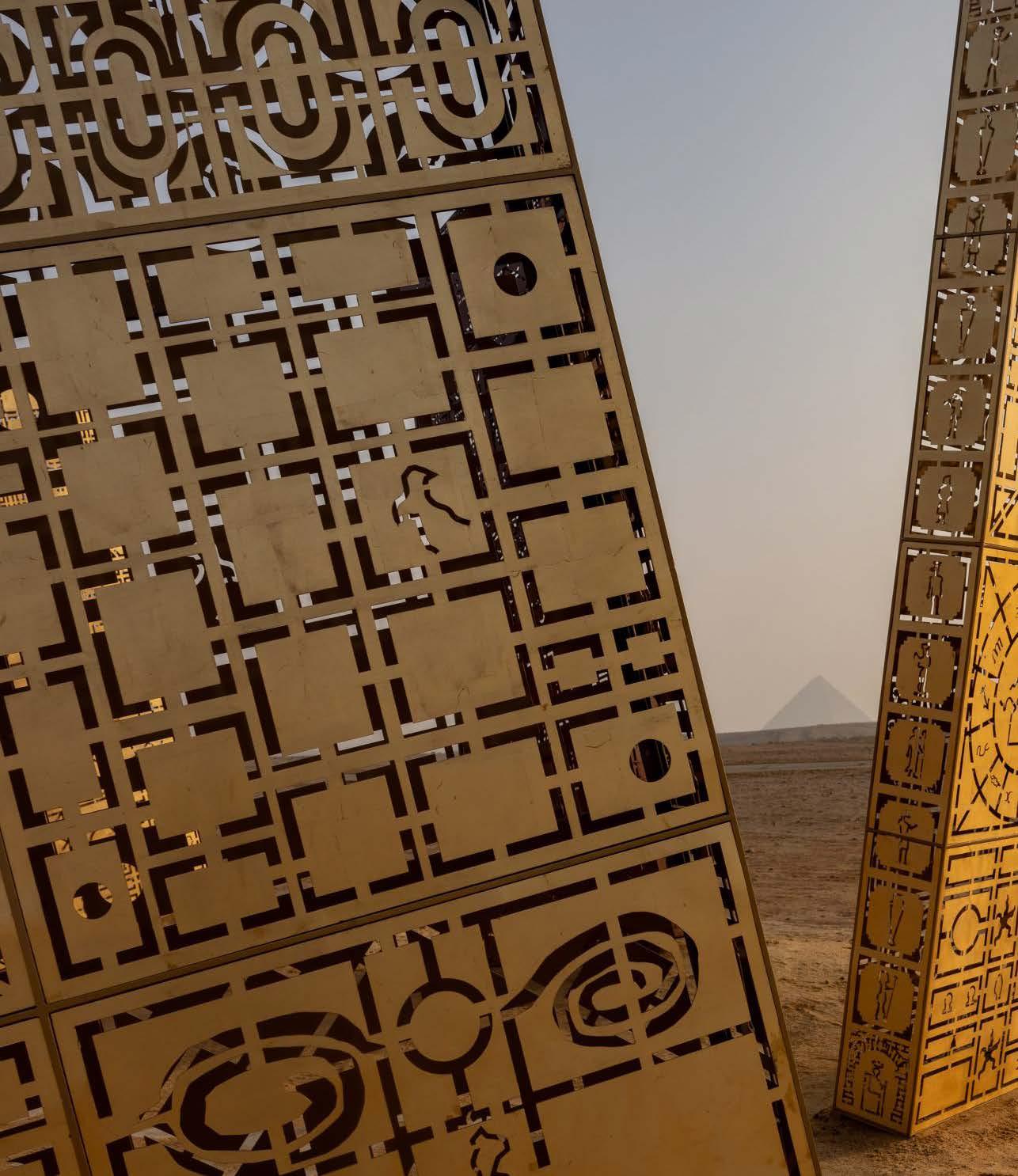
This conviction becomes fully legible in the context of his monumental installation at the Giza Plateau. To position contemporary parametric sculptures in dialogue with the Pyramids—structures that have endured for millennia—is not to stage contrast, but to test continuity. At Giza, time is visibly stratified. Ancient stone anchors geological duration, while Rashid’s precision-engineered forms articulate a present that remains open and becoming. The encounter reveals that timelessness is not the suspension of time, but the coexistence of multiple temporalities.
Against the primal mass of limestone, Rashid’s disciplined geometries appear at once distinct and aligned. The pyramids embody permanence; the parametric sculptures articulate modulation and variation. Yet both operate through order, proportion, and orientation. What emerges is not a collision of eras, but a shared spatial intelligence. Ancient and contemporary forms coexist within a single perceptual field.
At Giza, the sculptures behave differently than in controlled exhibition environments. Desert light sharpens edges in the morning, flattens surfaces at midday, and softens contours at dusk. Geometry becomes atmospheric instrument. Shadows elongate across sand; reflective surfaces absorb and release luminance. The works enter successive visual states without losing structural clarity. No singular moment defines them. They unfold through duration. >
This temporal elasticity is central to Rashid’s conception of reality. His geometries do not depict timelessness; they generate it. Curves, repetitions, and calibrated gradations function as perceptual devices, slowing the viewer’s sense of time. The experience resists immediacy. Meaning emerges gradually, through sustained attention and bodily orientation within landscape.
In the desert context, the sensation intensifies. The horizon extends without interruption. Wind and light shift continuously. The sculptures hover between presence and memory, neither overpowering the site nor dissolving into it. They assert a contemporary voice while acknowledging an ancient ground. Reality becomes layered rather than sequential.
The installation at Giza clarifies the philosophical arc of Rashid’s work. From kinetic surface to parametric structure, from atmospheric membrane to environmental system, geometry has steadily expanded its domain. At Giza, it confronts geological time directly. The works do not compete with the pyramids; they converse with them.
To encounter these sculptures is to enter a different temporal register. The viewer becomes aware not only of spatial proportion, but of duration itself—how light moves, how shadow migrates, how perception recalibrates. The experience resists spectacle. It invites contemplation.
“Reality is Timeless” is therefore not metaphor but proposition. Reality is not confined to a single era or moment of encounter. It is a field shaped by memory, presence, and anticipation. Through disciplined geometry, Rashid renders this field perceptible. At Giza, this becomes unmistakable: timelessness is not the absence of time. It is its expansion
Geometry enters geological time, conversing with history through light and duration.
Across the works gathered in this volume, geometry leaves the domain of surface and enters lived space. What began in earlier phases as perceptual inquiry becomes environmental system, architectural threshold, and atmospheric framework. The evolution traced here is not a stylistic shift, but an enlargement of responsibility. Geometry no longer frames experience; it organizes it.
In Public Art as Social Infrastructure, form establishes relational conditions between bodies. In From Perception to Environment, structure begins to regulate light, airflow, and spatial orientation. Material Translation grounds abstraction in substance, disciplining idea through weight, tension, and durability. With Entering the Work, geometry becomes inhabitable— corridor, grid, threshold. The Atmospheric Mesh Volumes refine enclosure into porosity, transforming industrial material into climate mediator. Finally, at Reality is Timeless, Giza, geometry confronts geological time itself.
This progression reveals a consistent conviction: space is not neutral. It is shaped by structure, by material, by proportion, and by the movement of bodies through it. Rashid’s practice demonstrates that public art can operate as environmental intelligence—quietly reorganizing how space is felt, shared, and remembered.
What distinguishes these works is their refusal of monumentality in its traditional sense. Even at large scale, they do not dominate through mass. Instead, they operate through calibration—of interval, of light, of permeability. They do not impose narrative; they construct conditions. The viewer is not positioned before them as spectator, but within them as participant. >
In this expanded field, geometry becomes infrastructural. It shades, filters, gathers, and orients. It mediates between climate and body, between heritage and contemporary fabrication, between presence and duration. Architecture and sculpture converge without collapsing into one another. The works retain artistic autonomy while assuming environmental function.
The installation at Giza clarifies the larger arc. When placed beside structures that have endured millennia, Rashid’s parametric forms reveal their deepest quality: continuity.
They do not compete with history; they converse with it. Geometry proves capable of existing across temporal registers—responsive to atmosphere in the present while resonant with inherited spatial intelligence.
Volume II therefore presents geometry not as object, but as condition. These works propose an alternative model of public form—one that privileges permeability over opacity, participation over spectacle, responsiveness over permanence. They demonstrate that contemporary art can engage climate, culture, and time without surrendering formal rigor.
If Volume I established geometry as living intelligence, Volume II shows that intelligence inhabiting the world.
What remains is not a conclusion, but an opening. Geometry continues to unfold—through new materials, new climates, new contexts. The field remains porous.
Space is never finished. It is continually constructed through attention
This volume does not close the inquiry.
Rashid continues to work across installation, relief, architectural intervention, and emerging spatial experiments. His trajectory is neither linear nor predictable.
Each new project repositions geometry within a different set of conditions—material, environmental, or cultural.
What remains constant is not form, but intelligence. The work evolves; the investigation endures.
ACKNOWLEDGEMENTS
Special thanks to Rashid Al Khalifa for his continued support, participation, and contribution of archival material, images, and project updates throughout the development of this publication.
Additional appreciation to the Rashid Al Khalifa Art Foundation for their support of this project.
The information presented in this publication was current at the time of publishing. As exhibitions, projects, and related activities continue to evolve, certain details may be updated over time.
Produced and published by Art Bahrain in collaboration with the Rashid Al Khalifa Art Foundation