All rights reserved No part of this book may be reproduced in any form by electronic or mechanical means, including photocopying, recording, or information storage retrieval without permission in writing from the publisher
We want to acknowledge the art critics, historians, writers and publishers who gave us permission to reprint their essays, critiques and reviews for this book: Franco Avicolli, Omar Donia, Hala, Khalaf, May Muzaffar, Richard Noyce and Maria Vivero
Artist’s Statement
Bridges
57th La Biennale di Venezia - Grenada Pavilion
2017 Group Show - Venice, Italy
Memory of Manama
2016 Installation - Kingdom of Bahrain
Waves
2016 Group Show - Kingdom of Bahrain
Shape of Time
2016 Group Show - Kingdom of Bahrain
2015 Group Show
Trio Biennial 2015 - Rio de Janeiro, Brazil
In the Eye of the Thunderstorm: Effervescent Practices
from the Arab World & South Asia
56th La Biennale di Venezia - Official Collateral Event
2015 Group Show - Venice, Italy
Nomi
2015 Two-man Show - Venice, Italy
Elemental: 2014 Series of works
In Dialogue
2013 Group Show - Kingdom of Bahrain
Contemporary Bahraini Art Exhibition: New Horizons
2013 Group Show - Moscow, Russia
Reflection
2012 Solo Show - Kingdom of Bahrain
Convex: A new perspective
2010 Solo Show - Kingdom of Bahrain
Biography
Curriculum Vitae
Timeline
I have been painting all my life. I believe that art is an ever evolving process and an artist needs to re-define how their art would fit into the global contemporary art conversation. That is why my work continues to adapt and mutate. Over the last 40 years I have developed my work by moving steadily back through the history of painting to reach the contemporary.
In the late 1990s I stumbled upon a formula that is subtle, a step towards the deconstruction of the picture plane. A canvas stretched by approximately 25 degrees resulting in a convex-shaped canvas, a structure that enabled my paintings to be seen in a different “light.” With the use of paint (oil, acrylic or enamel), and texture (fabric and glue, high-gloss or matte lacquer finish and mirror-like chrome) – the convex-shaped service (wood, aluminium and stainless steel) offered me a spontaneous and uninhibited form of expression. This departure from conventional compositional devices and manipulation of the canvas allowed me to use the elements of design in a process where the service, paint and the material are all equally important to make up the composition of the painting.
Through the use of geometry, my paintings are created from fragments of my natural surroundings such as landscape, light and the environment, rendered on surfaces that are reflective. I try to emphasise a duality between the real space perceived through or between the material and the reflected image. It can mean ‘to reflect’ or contemplate but also the literal reflection as in a mirror. In this kind of duality, there can be two very different visual realms in one work, first the image or shape you are looking at, and second, the reflection, demanding a different way of seeing.
Facing the artwork, it is as if we are looking at ourselves in the mirror, but we see our image in reverse and that is not how the world sees us because we don’t see ourselves as others see us. To further add to the sense of disorientation, our transitory presence reflects back the myriad colours it captures in that moment.
Whether it be through how we reconstruct and interpret what we see or how our minds parse the information that will enable us to explain and understand what we are seeing, my artwork is a form of communication and sensorial engagement for self-exploration, for myself and the viewer.
Rashid Al Khalifa, 2015 Kingdom of Bahrain
57th La Biennale di Venezia Grenada Pavilion
Exhibition installation
Dorsoduro - Venice, Italy
57th La Biennale di Venezia
Bridges
BIENNALE ARTE 2017
VIVA ARTE VIVA
Grenada Pavilion
2017 Group Show
Dorsoduro, 417 (Zattere)
Venice, Italy
13 May - 26 November 2017
Commissioner: Susan Mains, Grenada Ministry of Culture
Curator: Omar Donia
Matte enamel on aluminium
cm
Architecture of Forms
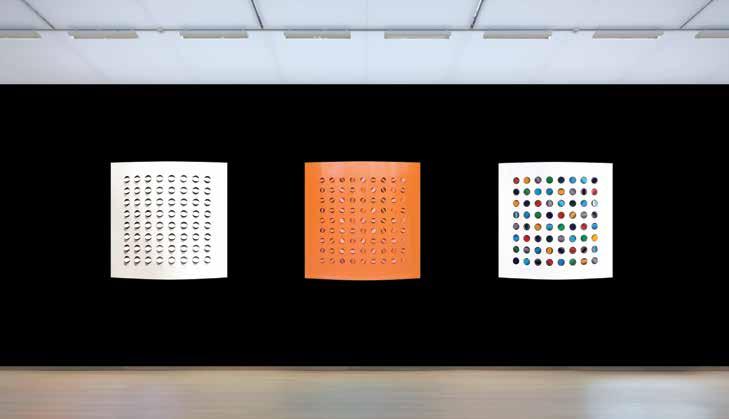
This collection of artwork for the Grenada Pavilion’s participation at the 57. La Biennale di Venezia is architecture of forms that emphasize geometry – lines, circles, cubes and patterns – compositional building blocks for each artwork and the vocabulary I use to affect it.
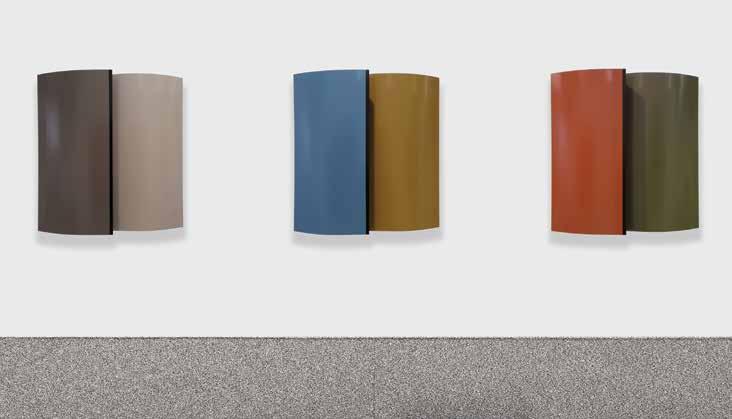
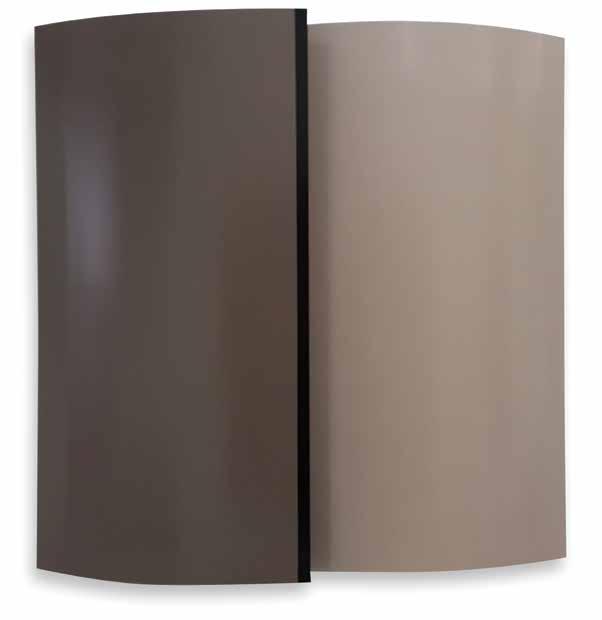
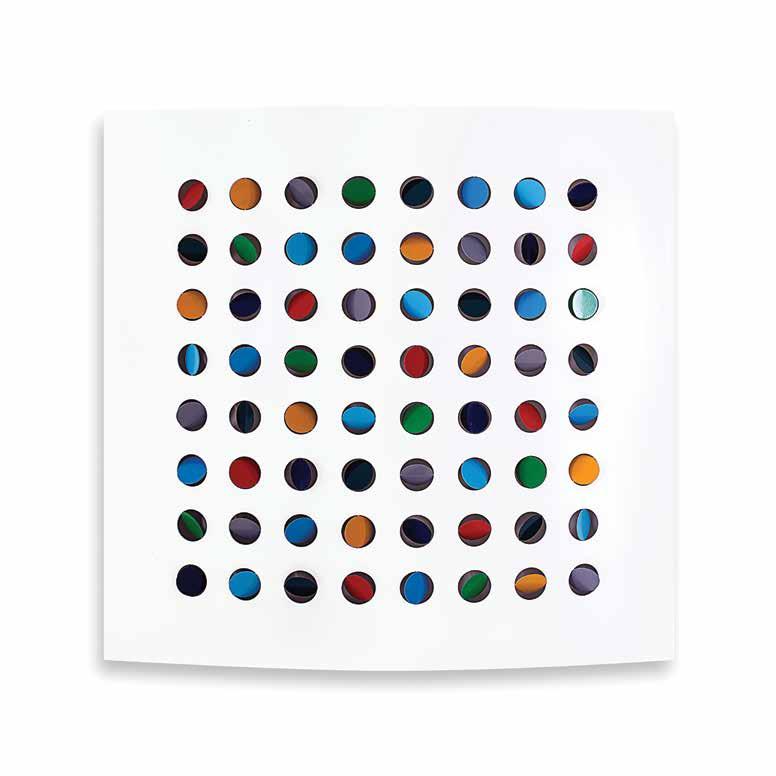
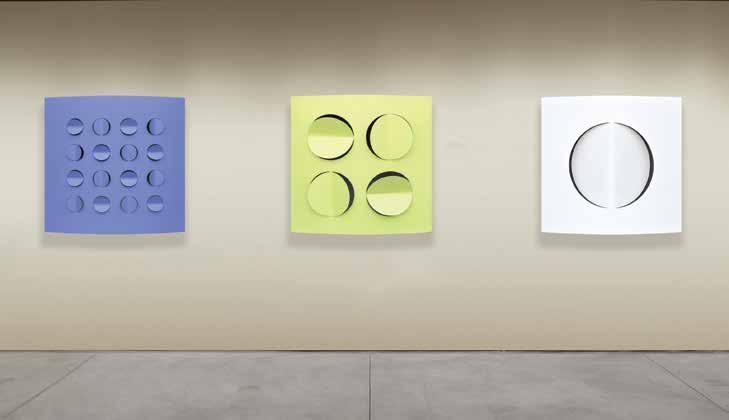
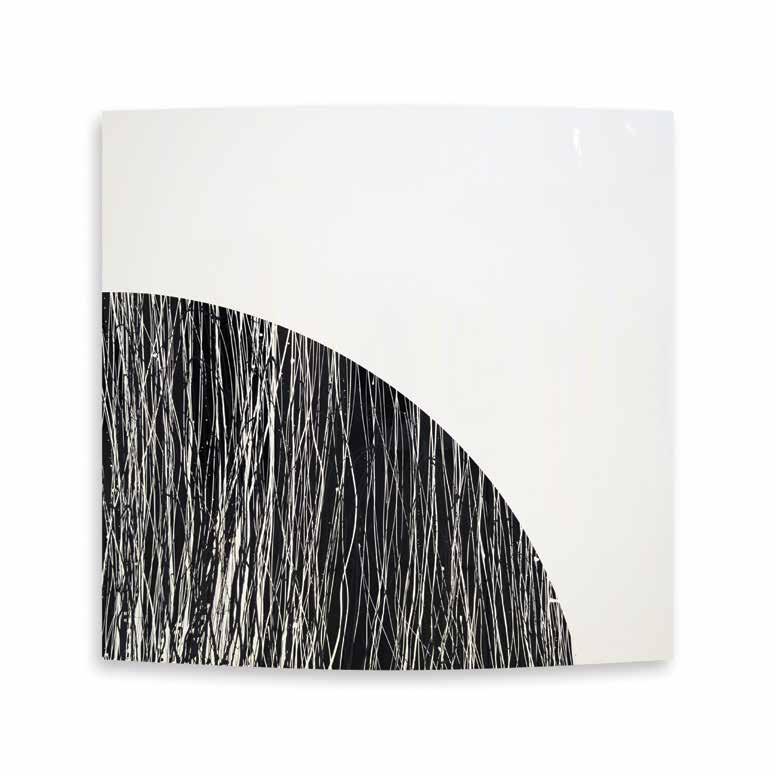
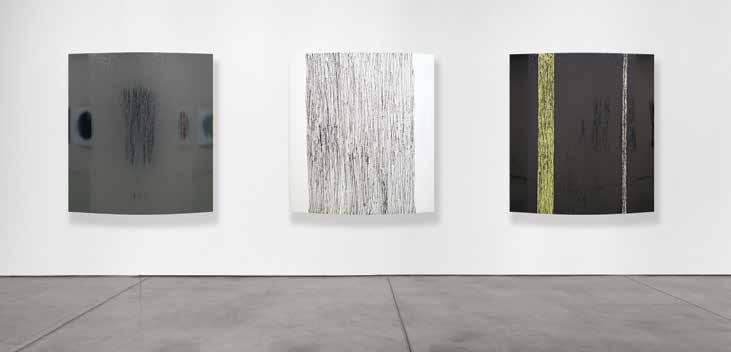
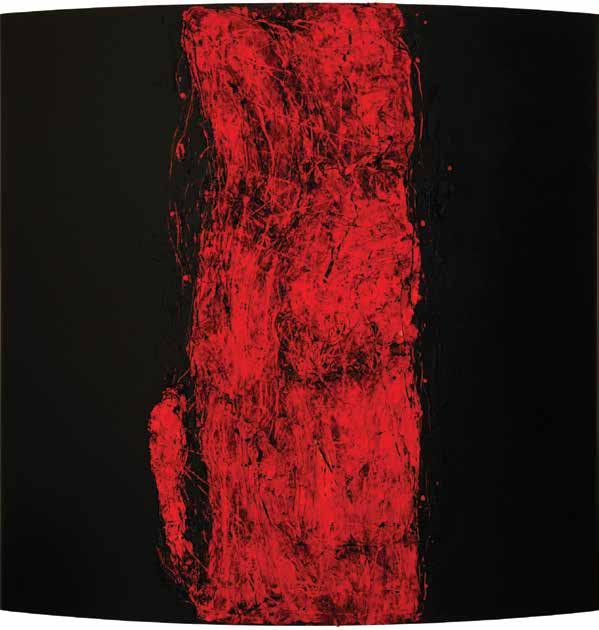
I conceptualise my paintings as objects, using the physical structure of the service as a compositional tool to integrate with the surrounding environment. I purposely chose the three works from the “Shape of Time” series, alongside with my latest work, “Untitled,” 2017, to illustrate the architectural aspect of my vision and the way my hybrid paintings begin with a three-dimensional concept.
I start with geometry to define the three-dimensional space around and within a given shape. The structure and colour are placed in dialogue with one another highlighted by ambient light and shadow effects; colour moves, they advance and recede, giving rise to contrasts, tone, density and direction, a perfect platform to demonstrate the power of light in art. Together this amalgamation explores how painting can grant an image the architectural thought process that vibrates with gentle energy and stillness.
Rashid Al Khalifa
January
2017
Kingdom of Bahrain
Exhibition Review
Rashid Al Khalifa
at the 57. la Biennale di Venezia
Taken from ab10 Fall/Winter 2017-18 print edition
By Hala Khayat.
Published October 2017
Reprinted by permission of Art Bahrain
A few years ago, I came across the name of the artist Rashid Al Khalifa in conversation about Bahraini art, who also happens to be one of the very few pioneers in shaping the contemporary art scene over there. I looked for images of his works and thought to myself, ‘this work is by a talented artist, yet he seems to be a man of many responsibilities and duties to his country, as well as his commitment to his business endeavours yet he clearly has an art vocation.’ I recall the few images I saw were still lives of classical nature; however, they still had a sense of free spirit that one can trace through the strong lines, the large brush strokes and vibrant colours. Depicted from an elegant perspective, the works offered a pleasant outcome.
Then, over the years to come I was lucky to come across the work of Rashid Al Khalifa on a few special occasions, but the event where his work caught my eye the most was at the Venice Biennale in 2015. It was when I visited the only collateral event that summer focusing on Arab art, that the works of this artist really grasped my attention. This event was beautifully curated under the name of In the Eye of the Thunderstorm: Effervescent Practices from the Arab World. The works of Al Khalifa occupied the inner hall of this show; there stood a few strong metallic panels which stood out as extremely edgy and contemporary pieces. It was fascinating to see this modern vibe juxtaposed against the traditional space in Zaterre; Fondamenta Zaterre El Spirito Santo, 417 Dorsoduro. The theme of this Pavillion was that of under water, emphasized by the work of each participating artist.
Here I saw the artist stray away from his traditional compositions of a structured painter and his move
towards a new vocabulary; a more conceptual work. At this point, he was showing pieces of his convex project, which he had initiated in the early 2000’s, and which he had developed tremendously since then. He began the idea for this project with simple convex canvases that he painted with different subject matters. However, since that point, the project progressed into a much more contemporary outlook. The works presented at the Biennale were executed in metallic sheets based on playing with depth and attempting to give the works around them another dimension. He began investigating what the western eye would consider OP Art and dripping car paint and experimenting with different enamel techniques, evoking what could be interpreted as sometimes a Pollock style. But the reality, it was a technique true to his experimentations and his background as an architect. I began seeing a lot of similarity to the gulf region. And soon after I was convinced that Al Khalifa was even more connected to his Bahraini roots in the simplicity of the outcome. I was truly happy to discover his new concept, which was different than what a lot of other Middle Eastern artists were representing at the Biennale. Then In November 2016, I had the personal pleasure and honour of working alongside the team of Art Bahrain, an extended body of one of the many initiatives of Rashid Al Khalifa, to host a non-profit event titled Royal Bridges: Convergence, with Christie’s held in the city of Dubai at the Ritz Carlton Hotel. Rashid Al Khalifa’s aim from this affair was to gather artists like him, who were born into royalty with a huge responsibility of name and duty. This name and duty deprives the public of seeing these artists in the naked
eye, and instead he wanted the public to look at them as any other artist who is gifted and whose main interest in life is art.
This was the first project of its kind in the world and it featured a variety of different works such as paintings, sculptures, and even jewellery designs, which were generously donated by each artist. It revolved around demonstrating a ‘…vision, that continuously illuminates the possibilities that these artists have to offer not simply as patrons of the arts, but as actors themselves…’ (Rashid Al Khalifa, 2016). This event consisted of a public exhibition as well as a press conference, and a very successful gala dinner, which included auctioning off all the pieces. All the proceeds from this event were donated to the benefit of the World Food Program, an art platform in the UN whose mission is to feed the poor who have been displaced and living in refugee camps in the Middle East.
Lately in the spring of 2017, Al Khalifa’s work was presented for the second time at the 57th Venice Biennale at the Grenada Pavilion. This time around, the artist presented an architecture of forms that emphasized on pure geometry. Using lines, circles, cubes and patterns in compositional way.
I was very pleased with the minimalism and subtle hints of purity and Zen of the works on display in the centre of Pavilion; however upon visiting Bahrain later that year, I realized that the artist was in fact channelling the minimalism of Bahraini architecture and aesthetics, not that of Western art. I was content to see the artist getting reacquainted with his roots. His work still took an architectural form, which celebrates lines, circles, and repetitiveness in patterns creating a unique composition
in each work. The way he treated the surface of the metal, allowing the light to penetrate it gave each work another dimension, it allowed the work to change with light, depending on the source, an unlimited number of options came out in terms of shadow; giving each work a sense of outer-worldliness.
This work may not be considered within the geometric realm, but the fact that it uses geometrical materials truly proves just how in touch with this aspect of geometry it actually is. The supports, the ribs, and the substructures created within this small space of a work of art accurately resonate orderly blocks of buildings. The colours are bold, yet with many openings for light, the colours progress and retreat to create a higher density and an even stronger contrast. This contrast can be traced back to the light in the Gulf and namely in Bahrain. Under the strong sun, shadows are created beautifully under the trees, allowing the smallest amount of light to create patterns on a wall or on the land beneath.
Each work offers the viewer contrasting information that can be read in multiple directions, horizontal, vertical, diagonal. The viewer is forced to move around each one of the works, to get close and to move away back and forth, and through this movement, discovery takes place, the surface of the work performs its magic; it expands, contracts, it ripples.
Al Khalifa has exhibited over the years in solo shows as well as his extensive participation in many group shows to name only a few: at the UNESCO headquarters, as well as at the Royal College of Surgeons in Dublin, Ireland. He was also exhibited at the Leighton House, London U.K, in addition to participation at the Salon des
Artistes Francais at the Grand Palais. To top that off, he even partook in an exposition at the Middle East Institute in Washington, D.C. In 2013, he had the opportunity to send his work to a big show in Moscow, at the Russian Academy of Arts.
He was also selected to participate in a carefully curated show of Arab Modernists at CAP Kuwait (Contemporary Arts Platform). Additionally he contributed to the Zurich Art Fair in October of 2013, where he exhibited in concurrence with Italian artist, Ernesto Liccardo. In addition to the works that hang in different public areas, such as hotels and restaurants at the sprawling Ritz Carlton, Bahrain, Al Khalifa was appointed a project by the Four Seasons Hotel on Park Lane in London. He was also chosen to represent the Gulf region in another commissioned project that was auctioned for charity in concert with the recent auction of the contents of the historical Hotel Bristol in Paris.
Very much a charming, passionate person, whose art in and of itself shows this zeal, Rashid Al Khalifa is very much committed to enriching the young art scene in Bahrain, but also in the Arab world, which appreciates the hard work, commitment, and efforts he has shown, and also from the committed passion he never seizes to present.
Hala Khayat, 2017 Dubai, UAE
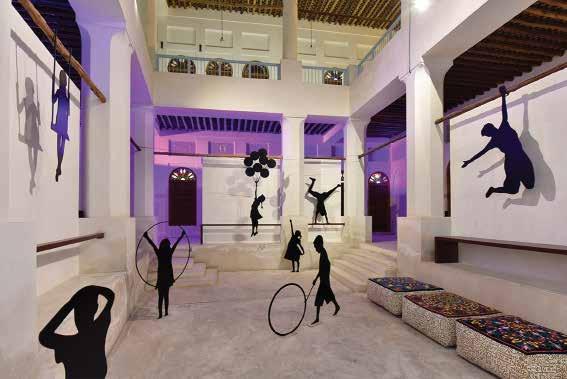
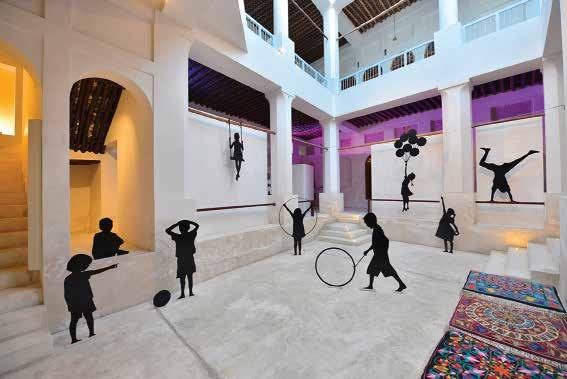
Memory of Manama
2016
Installation
Shaikh Ebrahim bin Mohammed Al Khalifa Center for Culture and Heritage
Kingdom of Bahrain
15 December 2016 - 15 March 2017
Convergence, 2016 10 Lifesize figure installtion
Convergence, 2016 10 Lifesize figure installtion
Views 2016 Exhibition installation
The Ritz Carlton Bahrain Spa & Hotel Kingdom of Bahrain
Waves
2016 Group Show
VIEWS
The Ritz Carlton Spa & Hotel Bahrain
9 March - 24 March 2016
Rashid Al Khalifa: WAVES
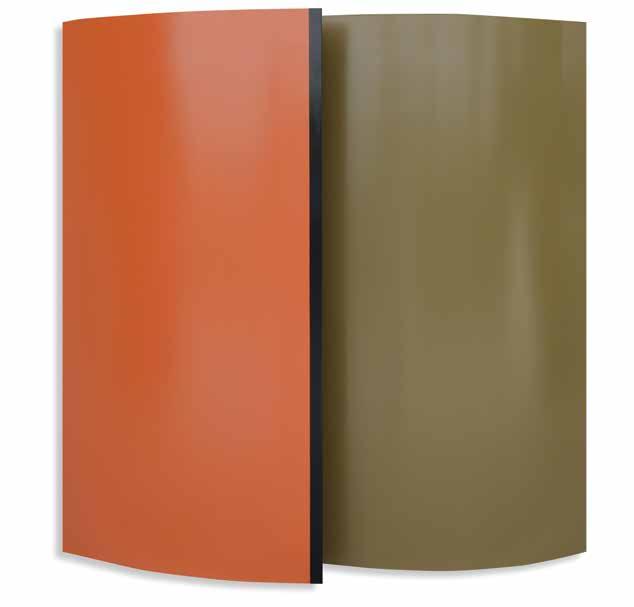
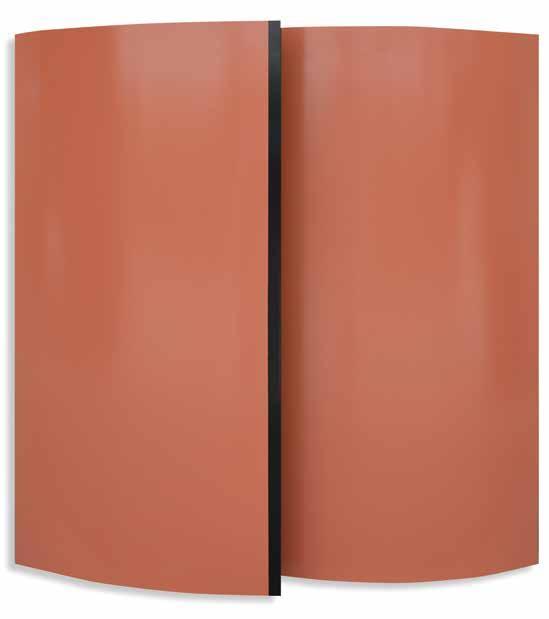
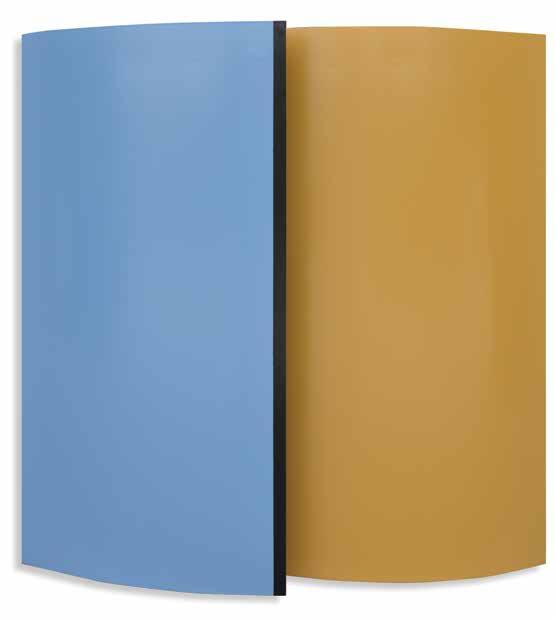
At first sight of “Waves,” Rashid Al Khalifa’s new series of works, the pure structure of vertical rectangles with a centrefold could be interpreted, as opposed to the chromatic element, as individual shapes that give expression to a subjective dimension. However, the intervention of colour in the conceptualisation of the content establishes an order of priority between the idea or the theme.
Each side shows autonomy defined by the two sections or areas of colour. And because Al Khalifa imbues colour with the power to act on its own behalf, it reminds us that it is colour that we look at first and last in all artworks.
In the centre of the artwork is the fold, the place where the two sides intersect. It acts as a separating edge and gives a wave-like motion creating a play between positive and negative on the shaped-aluminium convex service – a continuity of the artist’s exploration of threedimensional space. Mounted on the wall and extending out into the space around it, they are neither painting nor sculpture, but hybrids.
“Waves,” is a continuation of Al Khalifa’s previous “Shape of time” series. It is an analytical attempt to understand the division of time and the situation of the earth in the space created. “Shape of time” as the separation of light and dark, the first act of divine creation, and “Waves” as the separation of water and land – provided Al Khalifa with an ideal source for conceptual possibilities. Contemplating on his own personal thoughts, “Waves,” is the ocean, sand, sunset, and the beach, divided to replicate the dual movement of creation/destruction of nature that comes together and falls apart.
As Rashid Al Khalifa’s work evolves from its own procedural and material moment, its history keeps the prospect of painting an open question, answerable only through the production of new paintings. In his experiential art production, painting has become ineffable and his work is a testimony of the intricate interrelationship between contemporary and past practices that is found today in the material fabric of contemporary art.
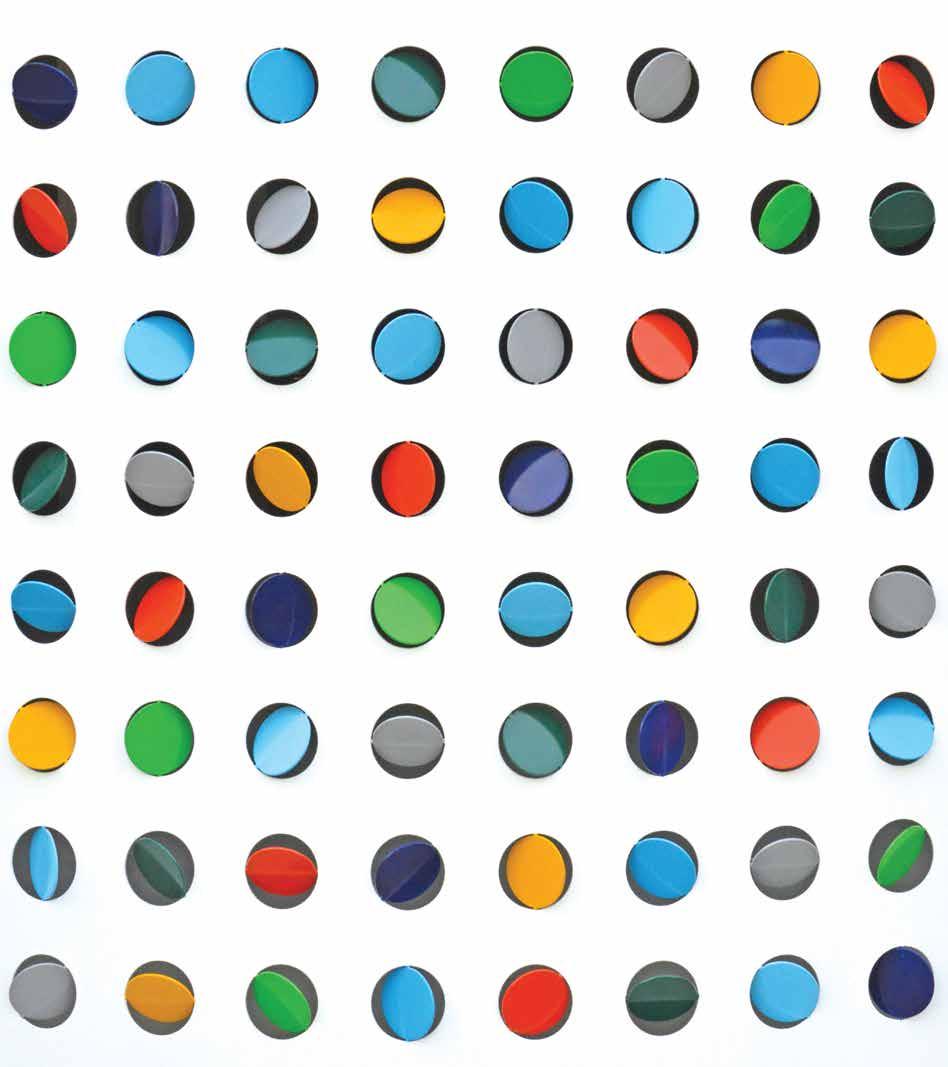
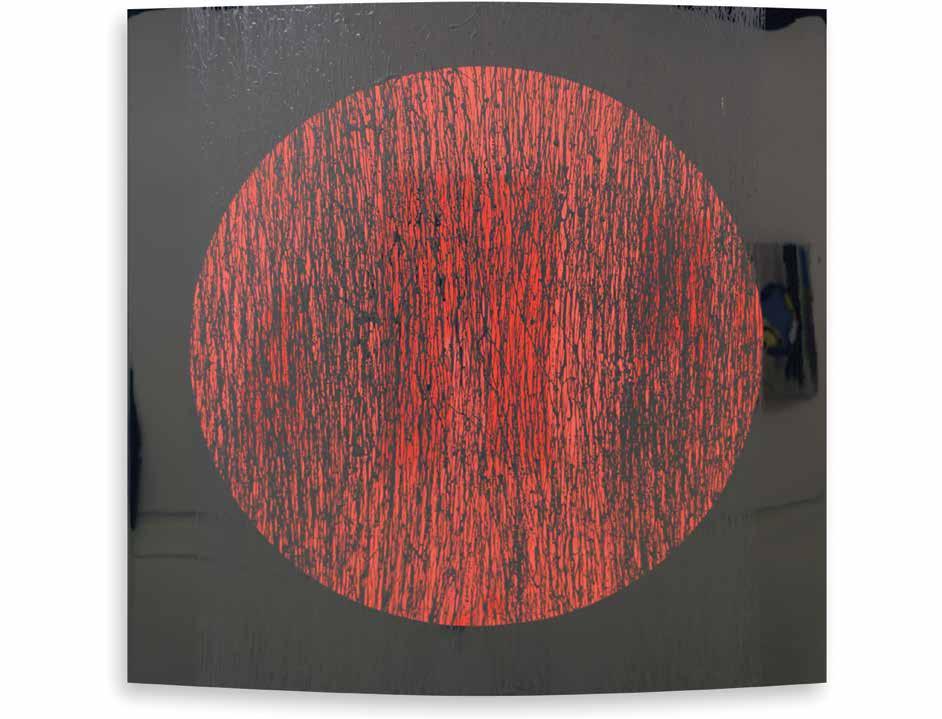
The recent work by Rashid Al Khalifa dated 2015, consists of a central circle cut-out or circle cutouts folded in the vertices that are linked to the square convex service. Colour and graphic precision combined with the pictorial theories which he articulates, express the third dimension of space in a quasi-kinetic circular movement of the cut-out/s representing “time” unfolding through motion – the fourth dimension. The rotation of the circle cut-out/s in various sizes and number symbolizes “time’s” circular movement – sunrise, sunset, midnight, the four seasons and the cycle of tides and the moon.
Before considering the origin of the recent work by Rashid Al Khalifa, it is important to examine the changes made to it by the artist. Over the last fortyfive years his artwork has evolved substantially as he has originally planned. Beginning with representational to non-objective art, convex-shape canvas to kinetic art.
REPRESENTATIONAL TO GEOMETRIC ABSTRACTION
Rashid’s early painting was influenced by the traditional representational renditions of the physical world with the Fauvist emphasis on colour that gradually moved towards representational abstract to non-objective art.
Clearly his work is profoundly influenced by the British style of drawing that emphasized the flattening of natural forms based on geometric convention and landscapes – a starting point for the development of his geometric abstraction. Because of his modernist’s foundation, his interest in what is referred to as the
constructive approach to art is evident in his pictorial construction, further simplified and appears to be a completely abstract minimalist composition. The simple geometric composition of plain circle within a square and the flat treatment of paint recall the hard-edge abstraction of the late 60s and 70s and that the square convex service, painted in matte or high gloss enamel on aluminium suggests an entirely new conception for the service panel by the artist dating from 2010–present.
THE FIRST EXPERIMENT
In the early 1980s, as Rashid was honing his artschool techniques, he was also responding to the trends of Geometric Abstraction, Hard-Edge and Colour Field painting. He pushed his work into a new and experimental direction. In 1982 he created his first Kinetic painting which was shown at the Middle East Institute, Washington, D.C. USA, his first international solo exhibition. When standing in the middle of this artwork which he titled “Three landscapes in one,” all the parts come together and fit like puzzle pieces while two separate images became fully apparent as the viewer changed position.
BACK TO THE FUTURE
After 33 years from the creation of “Three landscapes in one,” he forged ahead into uncharted territory to explore of the fourth dimension of time. Rashid returns to the art form, this time with his autographic touch of geometric abstraction, minimalist palette and his signature convex service.
In these recent work, “Unity” is the aesthetic principle. He integrates the elements into an infrastructure of visual organisation, where the methodical assemblage of the elements is controlled by balanced pictorial elements.
He uses “Light” as an optical material. He treats it with a painter’s eye in three dimensions that actually mold, form and animate the elements. He approaches light and shadow in terms of the space it creates in front and behind it. The effects – shadows, reflections, refraction, symmetry, and motion – shifts and changes by virtue depending on how the light affects the piece.
The organisational variations that emerge when viewing each of these work effectively underscore his persistent desire to link “Colour” to a distinct materiality since they offer no illusion of depth, just an optical retreat and planes of pure colour.
For the last decade, Rashid Al Khalifa established an unquestionable achievement over the traditional frame with his convex service and his experimentation with colour as a discrete structural unit. Now he added another dimension through kinetic art. This three-pronged dialectic simultaneously bring flashes of the avant-garde yet brings it forward to today’s universal art. This is the general practice in the new art today; and it is also one of the attributes that makes his work absolutely contemporary.
Matte enamel on aluminium
cm
Matte enamel on aluminium
cm
Matte enamel on aluminium
cm
2015 tRIO Bienal Exhibition installation
Memorial Vargas, Rio de Janeiro, Brazil
Shape of Time
2015 Group Show
Trio Biennial 2015
Memorial Vargas, Rio de Janeiro, Brazil
4 September - 15 December 2015
Matte enamel on aluminium
cm
Matte enamel on aluminium
120x120 cm
Matte enamel on aluminium
cm
56th La Biennale di Venezia Collateral Events
Exhibition installation
Dorsoduro - Venice, Italy
56th La Biennale di Venezia
Official Collateral
Event
In the Eye of the Thunderstorm: Effervescent Practices from the Arab
World & South Asia
2015 Collateral Events - Group Show
Dorsoduro, 417 (Zattere)
Venice, Italy
6 May – 15 November 2015
Commissioner: Omar Donia
Curated by Martina Corgnati
Organisation: ArsCulture in collaboration with Contemporary Practices Art Journal
Essay
Through the soul’s corners of an artist
Taken
from the book
“In the Eye of the Thunderstorm: Effervescent Practices from the Arab World.”
Bahrain painter and conceptual artist Rashid Al Khalifa draws heavily on postmodern art forms to create his own visual art language. His restless unconventional creativity and capacity for experimentation lends his art a unique breadth of vision. Today, he is considered one of the most eminent artist of the Kingdom of Bahrain.
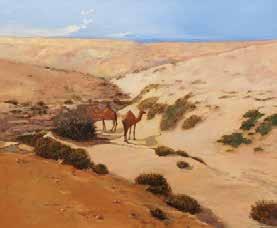
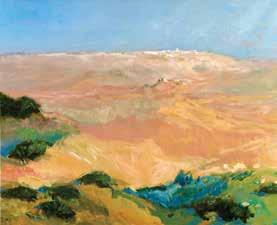
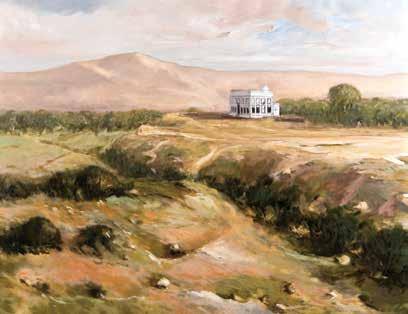
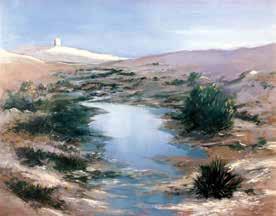
Rashid Al Khalifa was born in 1952 into Bahrain’s royal family where his artistic talent became evident at a very young age. Since his boyhood, he has sketched and painted desert landscapes depicting the environs of Bahrain with confident execution.
Encouraged by the late Amir of Bahrain, Shaikh Isa Bin Salman Al Khalifa, and driven by a desire for selfdiscovery, he left for England to study Art and Design at Brighton Hastings Art College. The absence of rugged desert sands and blazing sunset did not preclude his creative aspirations. He was a dedicated and highly motivated student, determined to explore as many art forms as possible in order to discover his own style.
Back to his homeland in 1978, he took his cue from European Impressionist masters, the precursors of lyrical abstraction, and in particular of the abstract landscape. Shifting his subjects from pastoral landscapes to desert scenes, he has expanded the scope of his reference from simply theoretical to the geographical. In the desert kingdom, he observed these local landscapes directly, he saw how the sun reveals a changing panorama as it moves. He searched for ways to convey the feelings it inspired him rather than depict its appearances. With the eye of Realist and the heart of a Romantic, he conjured through his artschooled techniques the luminous and mysterious spatial effects of the desert.
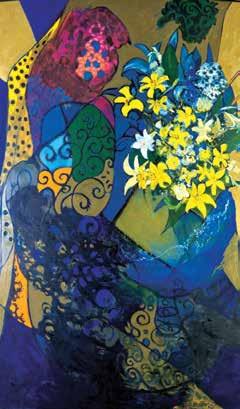
Realism, impressionism and abstractionism all have a hand in Al Khalifa’s early works. There can be no doubt that the paintings captured what he experienced in England. But is also certain that he took liberties when producing such paintings. Although based on nature, the elements were selected, emphasized and re-organized so that the natural scene is transformed into aesthetic unity, a poetic transfiguration of reality. He had an innate instinct for giving his paintings just enough of narrative look while keeping the forms and composition spare. The instantaneous impact of his work is the magnificent use of color combined with an abstract vision on a predominantly realist landscape resulting in an energized, vibrant painting that is equally comfortable in traditional or modern environment. A Colorist by heart, Al Khalifa does not really have a signature palette. Any and all color is meaningful to him. And his highly intuitive combinations strike a wide range of chords which allows nature to speak for itself. In his paintings, he took solace in constancy of the desert sky. The endless expanse of the desert and its oases to connote an overall spirit – lonesome and wild, bare yet vivid. He strove to create “absolute painting” which could move viewers aesthetically. His virtuosic techniques and close understanding of the pleasures, the powers and problems of painting, enabled him to draw fresh ideas from his creative reservoir.
Despite the glowing surfaces and sumptuous materials, al Khalifa’s works manages to avoid a sense of preciousness or pretension - beckoning the beholder to view the suspended pictorial space as something that can be accessed - the prelude to the directions
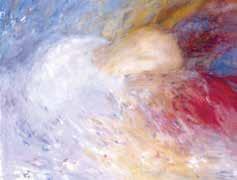
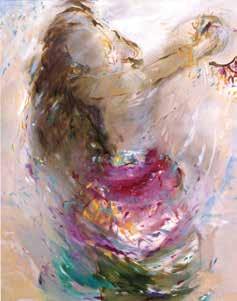
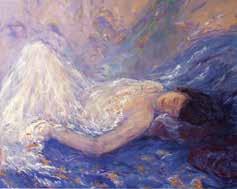
which his work would progress in the future. While such transitional works signal the emergence of his progressive style, they also remind us that an abstract conception of form and the visceral pleasures of colorand-oil-paint manipulation have always informed his pictures. After spending some time with his early works, one has to realize that it is not only the tradition of painting being re-examined but that of representation itself, the transformation of object into image by the artist. The set of rules he learned from school adhered only in part. These early works reflects his admirable realistic persona. He was a visionary wielding rigorous intellectual and technical control. Intended as a compendium of styles and techniques, the very diversity of his work shows that he was leaving the realm where his hand would follow what his mind had laid out. And like the colors and contours of his landscapes, Al Khalifa is intertwined with his subject – he is part of the desert, and the desert is part of him. He is also passionate about the human form; he paints portraits of people dear to him with visible pleasure and joy. However, the old adage that art gives the viewer a tour of an artist’s inmate psyche does not seem to apply in his figurative paintings. His shift of emphasis from landscape to the figure involved yet another consideration since although the desert will normally sit still, people will not. As a consequence, he had disguised the inherent artificiality of his paintings by creating allegorical model to a reduction on the study of figure to a mere function of genre art.
Although Al Khalifa actively takes photographs and tempers his observations of nature with a keen awareness of the qualities of light inherent in the photographic
image, he almost never works from photographs. He based his paintings on a close study of anatomy with an eye attuned to the conventions of representations, attention to detail and the dramatic possibilities of lighting that helped him create self-contained fragments with a narrative eloquence that garners strength from the confirming circumstances of his subjects’ lives hemmed in, often literally, by sheets, curtains and dresses. He has given his features and expressive contentment that makes facial views unnecessary. These paintings are all a product of his imagination but feed on the most acute observation of the repercussions of light.
As he progressed towards figurative abstraction, he arrived at a kind of painting in which the immediate effects of a brilliant color and decorative unity overwhelm anecdote. The subject ceased to be an end in itself. Instead it became a device for grounding and deepening the tensions of surface and space, color and shape, of what might easily have become entirely abstract. In most of his figurative paintings there is tension between representation and abstraction. The two styles rest in a gentle equilibrium in which brush-strokes and color harmonics simultaneously serve to describe and to assert their independent existences. His repertoire of poetic images cannot help but appeal to those fascinated with the celebration of the human sentiment, honestly and unabashedly expressed exhibiting characteristics peculiar to Romanticism, Abstract Expressionism, and Impressionism, which over time developed into a more gestural style. His interest in the play of representation and abstraction never overruled his search for visual pleasure. He opens the door to his mind and gives the
viewer a glimpse of an unedited mind that is about perceiving and making, not feeling and expressing. In the 1990s, he continued innovating, this time he decided to merge elements of his figurative and landscape work. He was impelled to create work that conveyed a greater sense of self-expression – another break from traditional painting into fractured modernism – an assimilation of different pictorial linguistics that frees him to float and be expressive without being meaner, sentimental, or succumbing illusionism.
Decorative patterns, drawn from a vast range of Oriental works, textile, ceramics, and ivories may have given rise to his paintings evoking a feeling of tension between old and new. The labor-intensive, densely patterned aspect of Rashid’s work shows techniques that he employed, detailed and sublimely observed. Textile designs were essential to the development of Rashid’s individualistic paintings. They function as a kind of multipurpose emblem of the artificial nature of painting, a workable, convenient picture plane that could be used to off-close real space while intimating abstraction, thus representing a dialectical struggle from Impressionism and Fauvism, through Pop and Graphic design, and arriving, finally, in a formula of his own. The beauty of the painting lies in how the figure and the surrounding landscape becomes transitive in his art, the relationship of figure to landscape remains unresolved. The rhythmic purity and eccentric orchestration of forms in certain pieces with edges, outlines and freehand brushstrokes are constrained abstractions that poetically explore space and color. Ultimately, this period is less about art than about the
artistic process, the way he scours his environment and accumulates ideas and inspiration; a small, creative victory that obviously originates in a visual intelligence linked at once to art and to everyday experience.
MATURE WORKS AND SHAPED CANVASES
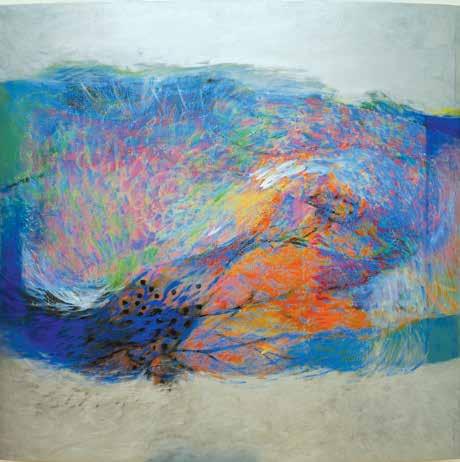
Behind the pleasures of Al Khalifa’s abstract paintings is an impassioned mind, never satisfied with the outcome of his work and carrying out well-reasoned experiments. He is not a revolutionary. He does not reject tradition and his paintings align with those pioneering leaders much like a composer does with variations on a theme. After months of careful research and experimentation to deviate from the traditional-shaped canvas, he added a new dimension to his paintings, the convex-shaped canvas. Casting aside the illusionist space from the physicality of the flat surface, the convex service granted him the flexibility to create an increasingly textured, dynamic and vivid Abstract Expressionist and Color Field series from late 2000-2009. This talent influence, along with his interest in the origins, loose ends, and disconnects of formalist thinking, merged and detonated into an expanding universe of pictorial propositions to form-works that mirror the mysteriously paradoxical yet fundamentally human experience of having a finite body and an infinite mind. Painted on convex-shaped canvas is a screen of ordinary perception that seems to disclose hidden realities, especially about the entwinement of the subject and the object of perception. His love of color is unmistakable. His paintings are packed with layers of multicolored explosions, his images rely on the tension between the spontaneous and the considered,
the accidental and the consciously executed, to create a work with striking vitality. As he has always favored an intense color palette and expressionistic figures, the connection between visual and corporal pleasure are embodied in this series of works. Bright colors remain, but this collection of paintings demonstrates a fresh approach and conceptual framework.
Brush-stroke intensifications appear between colored forms producing an overriding optical effect with a painterly language that uplifts and gives pleasure to both artists and viewer. His penchant for loading up his pictures to the bursting point is an assertion of creative freedom and a sign that his art was not an instance but an expression of its maker’s ideas. These paintings may seem spontaneous but they can take several years to complete. And though his gestures appear impetuous, his compositions are carefully constructed, with emphatic horizontals and verticals often creating a feeling of confined compression. Simply composed yet built with countless strokes and flecks of paint, these works give a meditative effect –a slight disorienting immersion into a deep, infinite space of twinkling stars and radiant galaxies or a verdant landscape.
The labor-intensive technique is on accretion and abrasion, to which he then applies multiple coats of paint with brushes or palette knives, sanding scraping through the dry surface to reveal countless passages of underlying, contrasting colors. He slathers some more paint on the canvas in a shameless impasto. Proceeding to much finer brushes, he carefully delineates the exposed patches to create remarkably dense and
intricate abstractions. His color chords and sensitive tonal modulations glow beneath feather-like strokes that form complex layered surfaces. The first impression one gets from his work is of the artist’s absolute pleasure in the act of painting. The shifting, transitory and luxuriant, though at time almost lurid, color and the mottled, buzzing surface texture disperse the image even as they form it. The rich surface texture and insistent physicality of the paint argue as much for a luxurious earthy world as for transcendence. Out of that lively interplay emerges an enchanting vision in which we never lose sight of competing, yet complimentary, relationship of all things. Nevertheless, this colorful composite propose not a drama of anxiety and finale, but a celebration of life and endless possibility.
GOING BEYOND PAINT
After almost a decade of his Abstract Expressionist and Color Field series on the convex-shaped canvas, Al Khalifa did not stop exploring the limits of his artistic ability. In 2010 he moved ahead with his series of convex painting, where “convex” no longer functions as service, but as the physical structure in the composition – the soul of the painting. As he imposes personality and soul on the convex service, we are confronted with its painterly procedure instead of its processes. Visually minimal but powerfully spatial, these works reveal how different it is to think about his relationship to tradition in relationship to his contemporary moment and his personal development. In these new works, he imported the sensibility and techniques associated with design which are just as complex and developed as his old
work. In a dramatic shift through minimalism embrace of “object hood”, Al Khalifa’s incandescent lacquer finished enamel “convex” service and the relative simplicity of its indented form, encapsulates a new realm in his artistic development reflecting an affinity of structure, balance, and visual order. They inhabit a space that is not easily that is not easily classified as their painting or sculpture but which is intrinsically enduringly direct relation to the contemporary world.
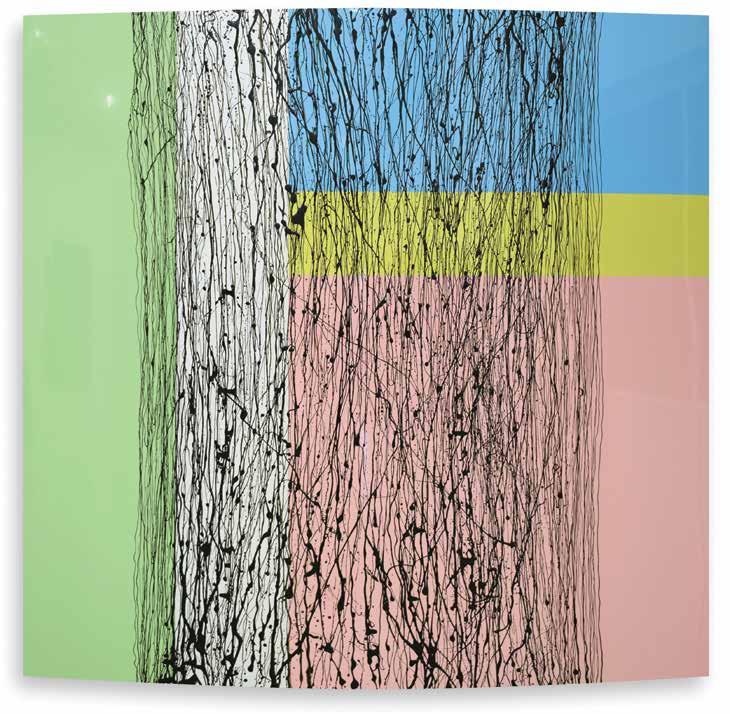
His art has evolved a variety of carries from offsetting geometry with free-flowing paint or gestural and rhythmic linear patterns to calculated nuances of color alternating matte on the reflective surface in near-monochrome. He drips enamel in a fast motion that is slightly fluctuates and spins, and is stacked, aligned, cantilevered, or centered, in strict geometric arrangements that would create an optical effect of moving patterns. The high polish reflections render the components unstable, disseminating their svelte surfaces and divesting them, although intermittently, not only for mass and weight but even of shape and surface. The artwork comes alive as the parts wage a struggle for dominance. Together with the lacquer sprayed aluminum convex paintings are the canvas-covered convex series in mixed media – soaked canvas, impasto and oil paint that increasingly evoke the third dimension with one side flattened and reanimated in the two and a half dimensions – scrambling viewers’ abilities to reconcile pictorial and sculptural stimuli. This remarkable detour constitutes the linguistics of painting and its coloration onto sculpture. It is certain that the artist explored the relationship between three dimensional form and color contrast illusions, and
geometric composition, creating tactile sculptural effects that “vaults” from the wall. As he continued to challenge the conventions of paintings, he became bolder, more colorful and more complex. The “Reflection” series in 2012, incorporated three prominent tendencies in contemporary art – a hybrid of Minimalist aesthetics, post-pop and participatory art – a non-verbal process of communication, between the artwork, the artist and the viewer – in rapid-fire visual compendium of “reflection” in mirror-like Chrome-plated convex. The integral aspect of this series is its self-reflective dimension as it explores the neurobiology of imagination in an environment of a dialogue that depicts the intermingling of the artist, the art and the viewer – of sight and insight. As the artist fuses memories of the past and the present, both from his private sphere and artistic realm, he contains his paint work in Color-field and looping lines on geometric simplicities of Minimalist lineage to powerful effect, producing alternate readings of his inner world and touches of synchronicity that resonate with the dissonance of our times. Yet, he also underlines the perpetual inscrutability of Reflection and places viewers in a position to give meaning to looking. It becomes an avenue for looking at the past that imposes subjective excavations, burrowing into matters with difference in real-time and the artistic realm – artwork that unfolds visual relations and its own social significance.
CONTEMPORARY HYBRID
To date, Rashid Al Khalifa continues to push further towards contemporary by exploring the sculptural potential of painting. His experimental and conceptual
concerns drives his art and he works at the border that divides object hood from painting, de-constructing and pushing beyond the boundary to enter the viewer’s space. However, his objective has been the integration and understanding of his sources, not their dissident conquest. His concerns are not so much about the final product but the conceptual effort entailed in pushing painting out of its frame. He merged aspects of methodical practice with a distinctly subjective mode of complex layering and thus the coherent sense of systematic structure remains obscured beneath the layers of paint. His diverse output in convex included everything from canvas to high-polished lacquered mirror-like chrome plated aluminum in modes of structure and expression, geometry and gesture, modernism and post-modernism, which is in itself a testament to the fragmentation of our age and the ever-shifting world of contemporary practices. Visionary as his art may be, Rashid Al Khalifa is also widely recognized in the community as an arts advocate, collector and patron. He thrived in kinship of fellow artists, co-founded Bahrain Arts Society in 1938, was named its first president and continues as its honorary president with more than 300 members. His focus on Bahraini art and its integration with the world inspired him to initiate the creation of artbahrain.org in 2010, a tool of disseminating and understanding global contemporary art today and tomorrow. He continues to provide significant leadership for the advancement of contemporary arts by championing, developing and investing in artistic experiences that enrich people’s lives.
Enamel on chrome-plated stainless steel 150x150 cm 2014
Matte enamel on aluminium
cm
Enamel on chrome-plated stainless steel 120x120 cm 2014
It is evident from reviewing the work of Rashid Al Khalifa that his career as an artist is a steady progression of approaches to the problems of firstly depicting, and later implying, the presence of space within a painting. Fully aware that a finished work is a conveyor of impressions and meaning from the artist to the viewer, for Rashid it has long been the result of inner reflection, of thinking deeply about his perception of the world and the function of painting in a changing world. The intention of offering viewers the possibility of entering into a contemplative relationship with the work, while not being unique to this artist, is somewhat unusual among contemporary artists, and the decisions that Rashid has made have been considered, each work developing logically from the preceding ones, and have led to a dynamic evolution in his approach to the making of art.
INTO A DIFFERENT DIMENSION
The origins of this artist’s work featured in this catalogue can be traced back to his first work with canvases that were stretched over convex frames that protruded from the wall to create a form that reached into the space of the gallery, and towards to the viewer. These works, some with a matt surface, others that incorporated the glossier surface of lacquer, modulated the light falling on to them in ways that a more conventional flat surface could not. The fact that the convex surfaces protruded from the flatness of the gallery wall also permitted an engagement with the paintings across a wider arc of viewing. At the same time the content of the paintings demonstrated bold developments in his approach to abstraction, with less in the way of figurative references,
relying more on the interactions of colour and texture to create bold effects.
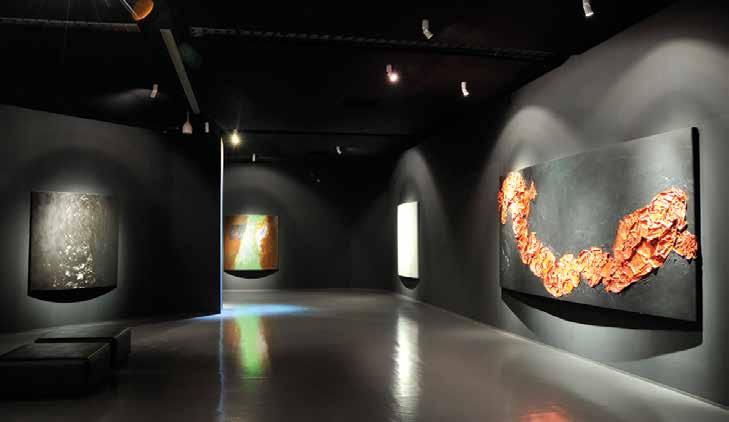
A major exhibition at the Bahrain National Museum in 2010, with the title, ‘Convex: a New Perspective’, presented these works in a dramatic installation, where the paintings, many at a large scale, were spot lit against the dark grey walls of the large gallery spaces. Isolated individually, yet unified by their structure and surface modulations, these paintings marked a clear and important departure for Rashid. No longer confined by flatness, these works moved out from the wall and into the environment of the viewer, creating a greater sense of engagement, a more direct relationship that shifted as viewers walked around the gallery.
The curved thickness of the works allowed viewing not only full on but also from the sides. At the same time Rashid showed developments in the nature of his use of abstract mark making and colour fields, moving from the exuberant colours of the paintings of the first decade of the 21st century, and into a quieter, more restricted and sombre palette. In addition, his use of lacquer as the background surface allowed the introduction of a further element, that of providing a surface from which the light reflected more emphatically than from a matt canvas surface. Even the partial reflection that lacquer provides, introduces a new element into the relationship between the viewer and the work, a closer sense of complicity. This development introduced a new characteristic that was to be developed further in the works that followed this major exhibition.
In the two years between the ‘Convex’ exhibition and his next major exhibition, he took further important
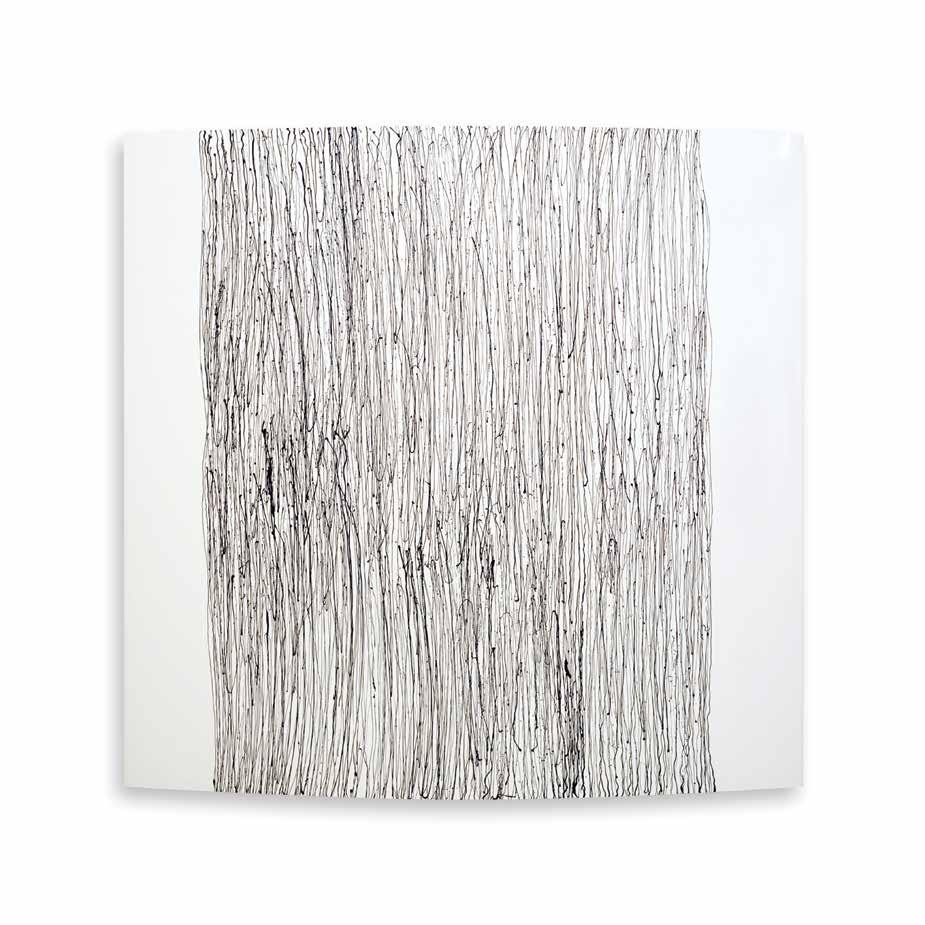
steps to refine and extend his explorations of the potentialities of paint. ‘Reflection’ at the Fine Arts Gallery of the Bahrain Financial Harbour showed a completely new dimension. Being made from chrome-plated metal, by its very nature, gave the paintings an entirely new identity, challenging for the viewer. While some of the works incorporated geometric shapes painted in bright colours, all of them featured a densely overlaid network of lines of enamel, interlaced or gathered together to further define the interior space of the paintings. As a further level of significance the lines are not applied with a brush but are dripped on the surface, a more immediate method of application that allows for a combination of chance and control. The artist refers to these new works in his artist’s statement:
“I express my feelings in the colours I use on forms and shapes based on my recollection on the seasons in life that has passed; times of laughter and embrace, mourning and sorrow, success and failure. The spontaneous paint work on the chrome surface, inspired by women’s veils, laces and ‘mashrabia,’ partly conceals the loci of society or life where we see fractions of ourselvesbroken, buried, whole, empty, blurred and full – are reminiscent of the paths we traveled to reach where we currently stand. Once the viewer is face to face with the artwork, it breaks down the barriers; it becomes a journeying encounter like a freeflowing sense of interaction - a glance of the real, a starting point, waiting to be followed through, allowing the viewer to do the completing, the reflection of self.”
(Rashid Al Khalifa, January 2012)
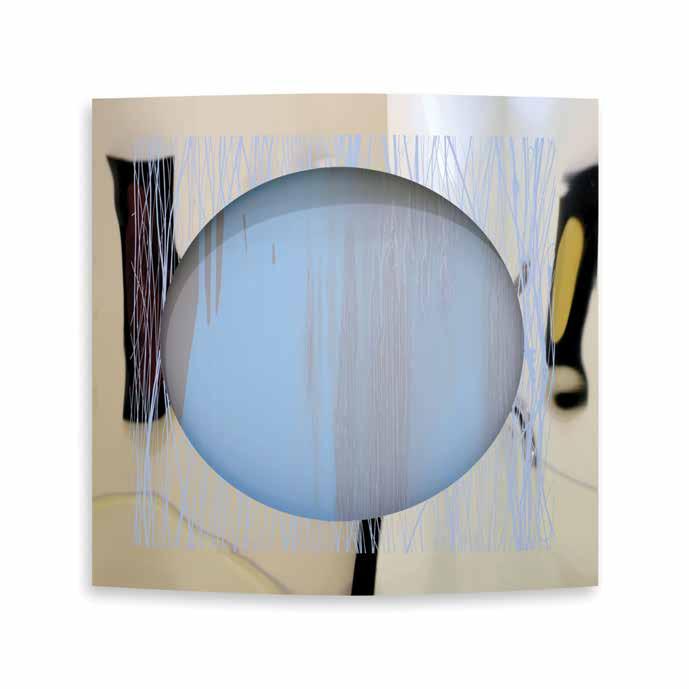
This quotation provides an important point of access to this new body of work, setting up the painting as the intermediary between his life and the lives of those who encounter the work. This is further enhanced by the use of a chrome-plated metal surface that, literally, incorporates a somewhat distorted (by virtue of its convexity) image of the viewer and others, as well as the space in which the painting is displayed. The viewer, and the environment of which the viewer is part, become, in a very literal way, a temporary part of the work, entirely complicit with it and the viewer’s experience of it.
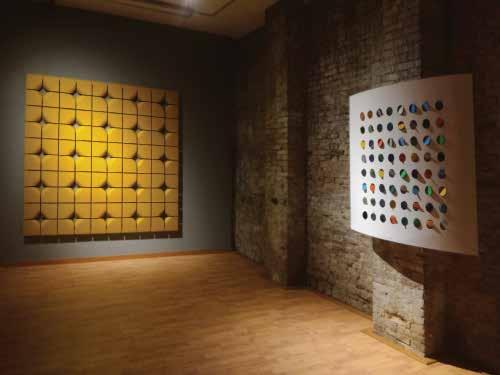
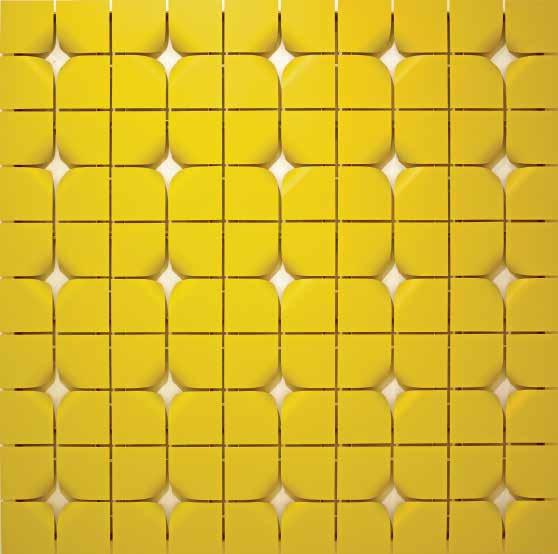
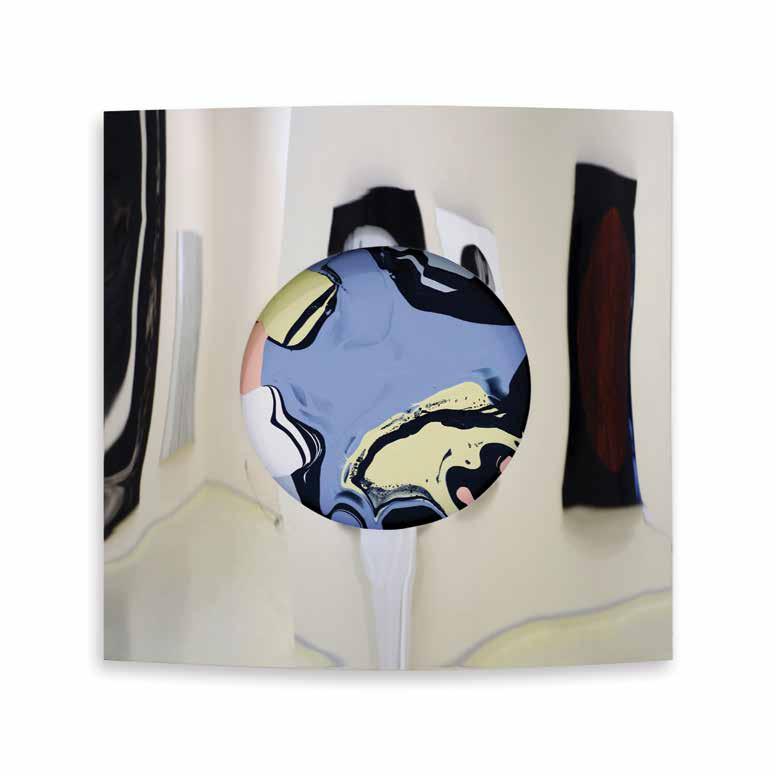
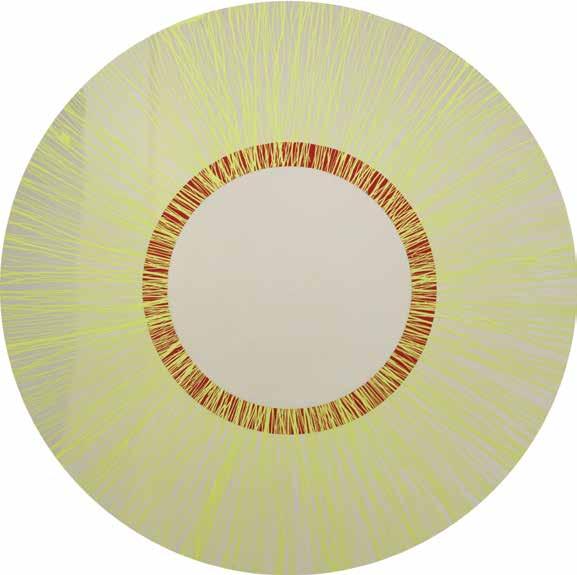
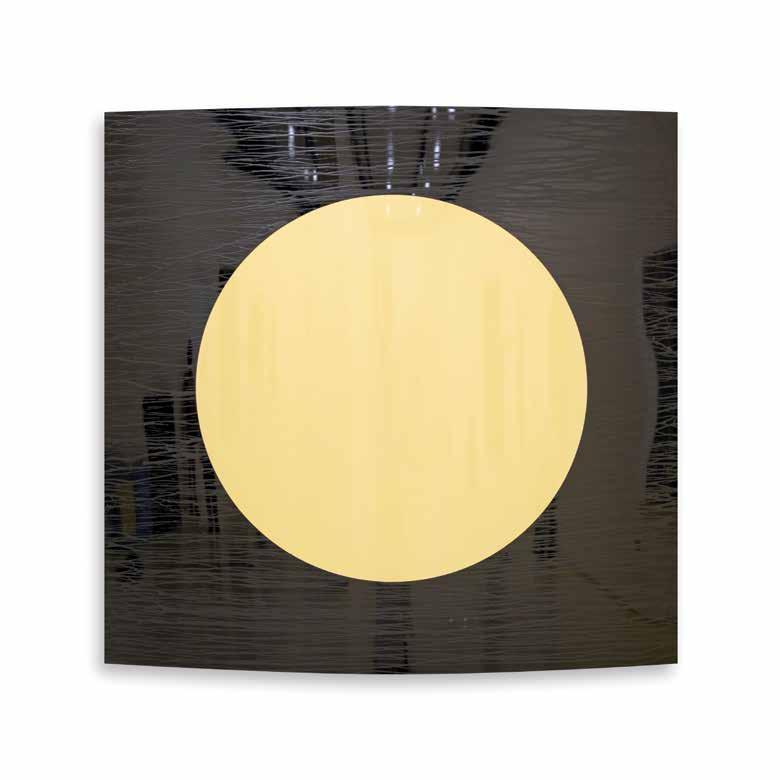
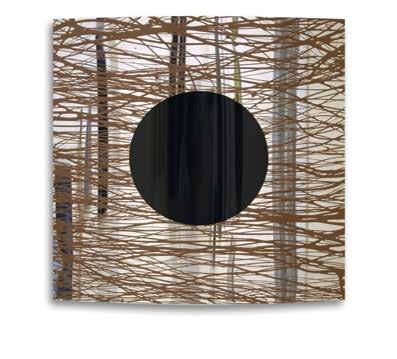
The paintings made in 2013 incorporate a large circle in the middle of the square of the supporting surface. This basic geometrical relationship has been part of art and architectural history for a very long time. It has an elemental potency that can be interpreted by artists and viewers in many ways, and is open to differing philosophical considerations. In some paintings the circle is black, denoting perhaps nothingness or the void, or perhaps the eternal unknowable essence of existence, it is both substance and absence and creates a tension with the other elements of the paintings in which it appears. The circle is yellow in some paintings, a symbol generally connected with the sun, the source and sustenance of all life on earth. It is a colour of hope and vitality, and in circular form offers a warm and positive element that contrasts greatly with the more serious and sombre nature of the black circle. The subtlety of interpretation of this motif also depends on the nature and colour of the surrounding space and the dripped and painted trails of colour of each work. In addition, the layers of colour and form vary from painting to painting
so that different spatial effects are created, adding further visual depth and possibilities of meaning.
THE NEW PAINTINGS
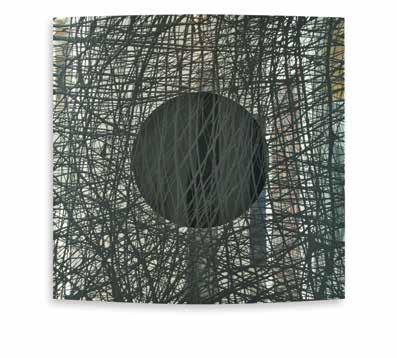
At the beginning of 2014 the artist made a series of paintings on a unified theme, to celebrate the 30th anniversary of his marriage. Each painting, 60cm square, intended for display as a grid of 5 x 6 elements, was made on a convex chrome surface and comprised a heart shape in a range of pastel colours with an interlaced set of dripped lines in enamel that are of necessity made swiftly, and which can be seen to refer to the fabric of society and relationships: as the artist says, ‘Lines are endless, they can go into infinity and create an endless story.’ This work, that has deep personal connotations for the artist, played an interesting interim part in his work of that year, and led on to a further set of paintings on convex chrome, lacquered in a range of greys, once again featuring the motif of the circle in the square. Devoid of colour, and perhaps more sharply because of this, these paintings offer a quietly meditative proposition to the viewer.
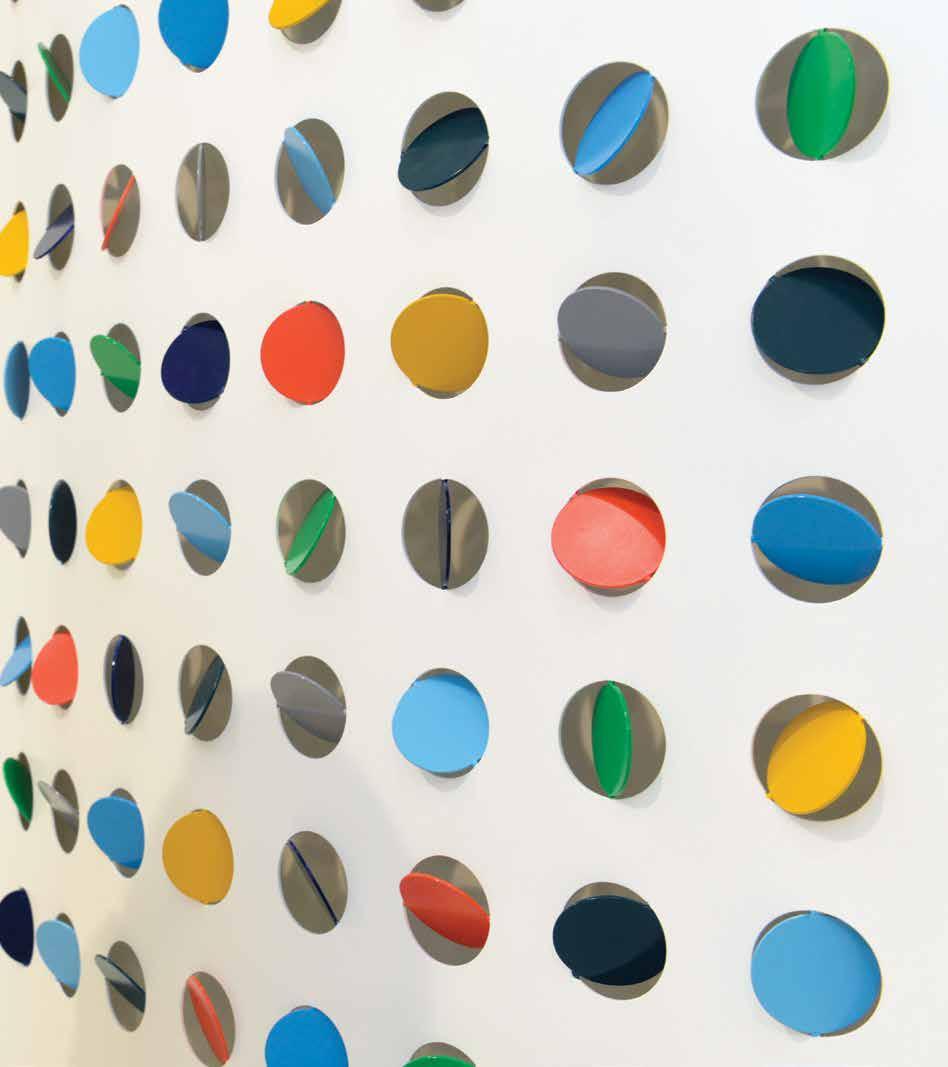
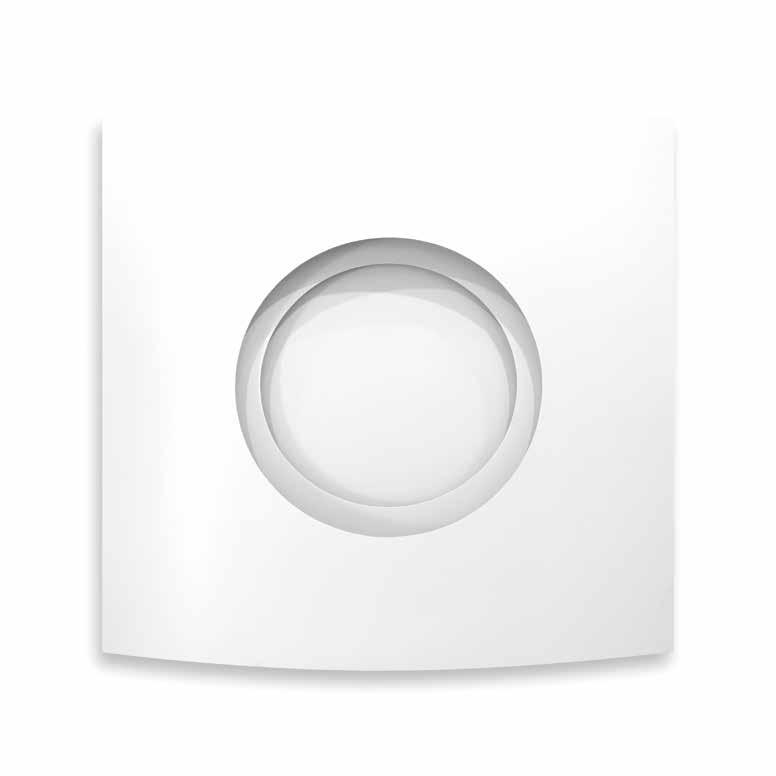
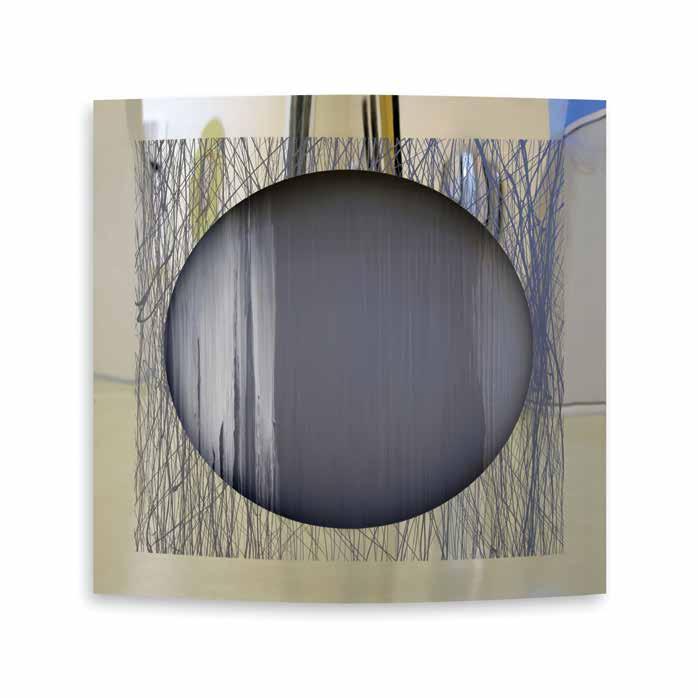
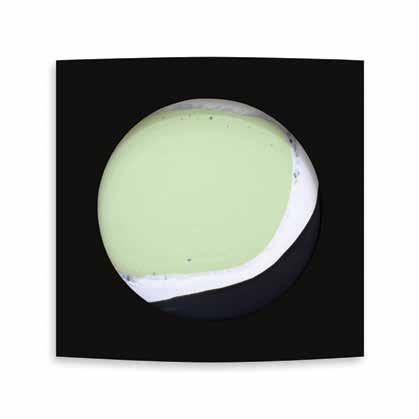
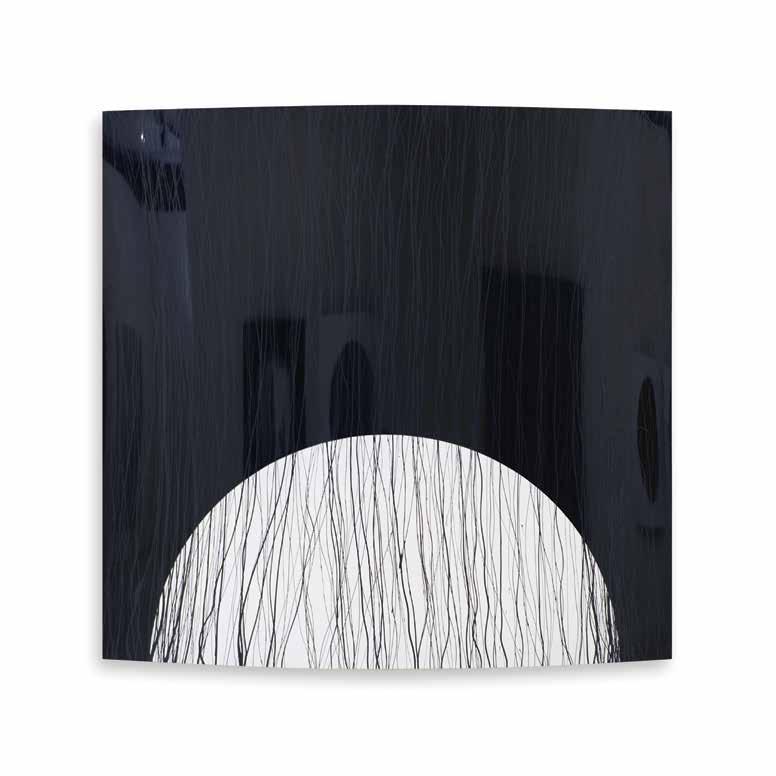
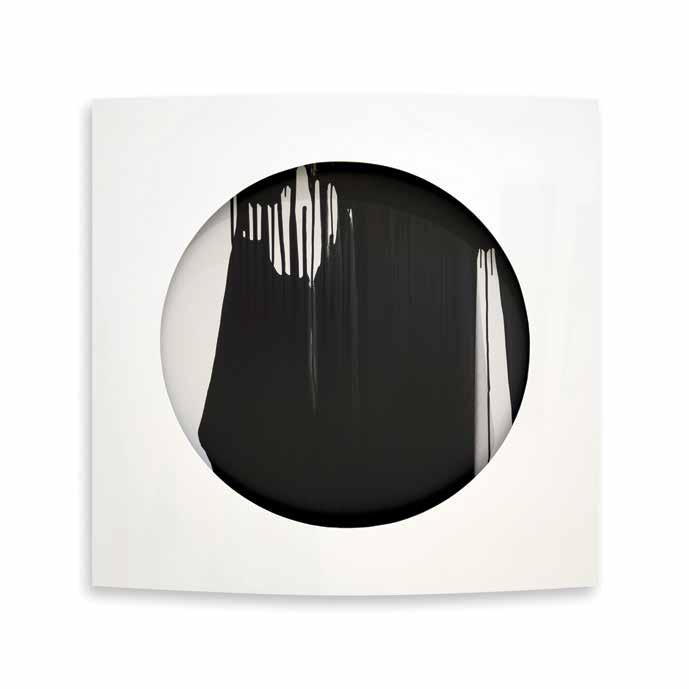
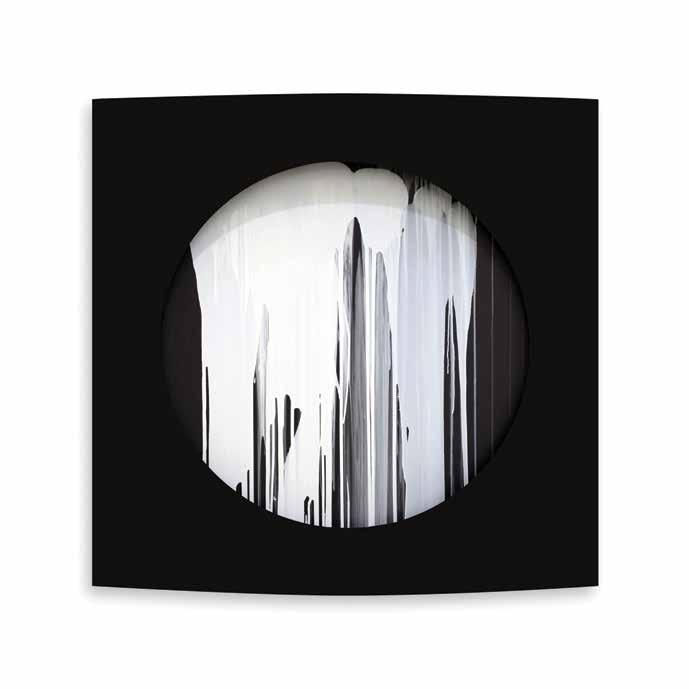
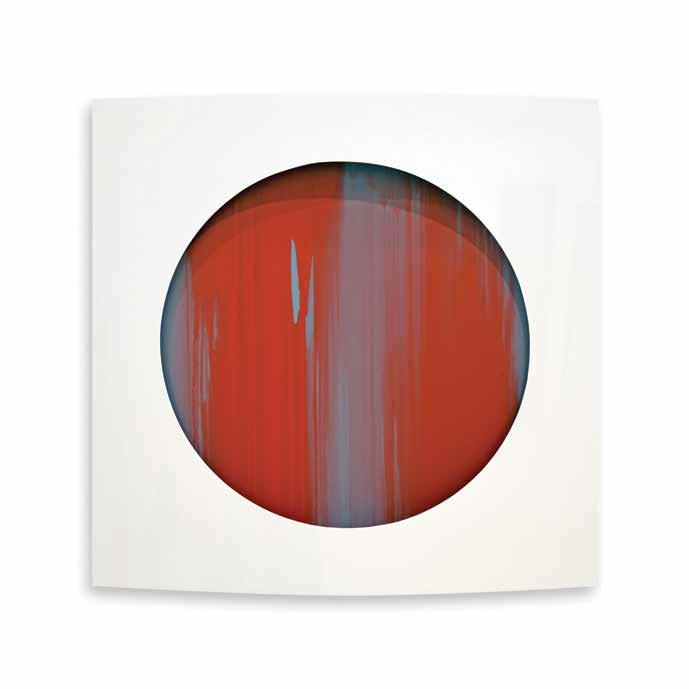
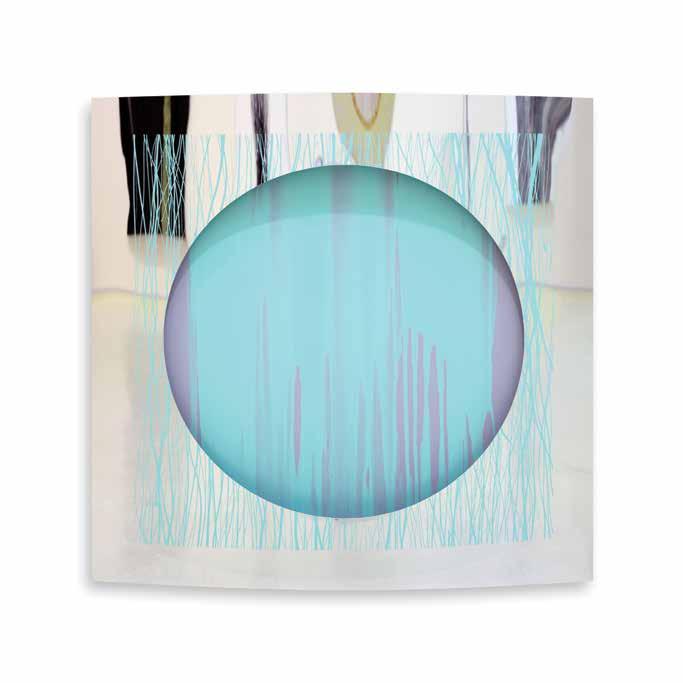
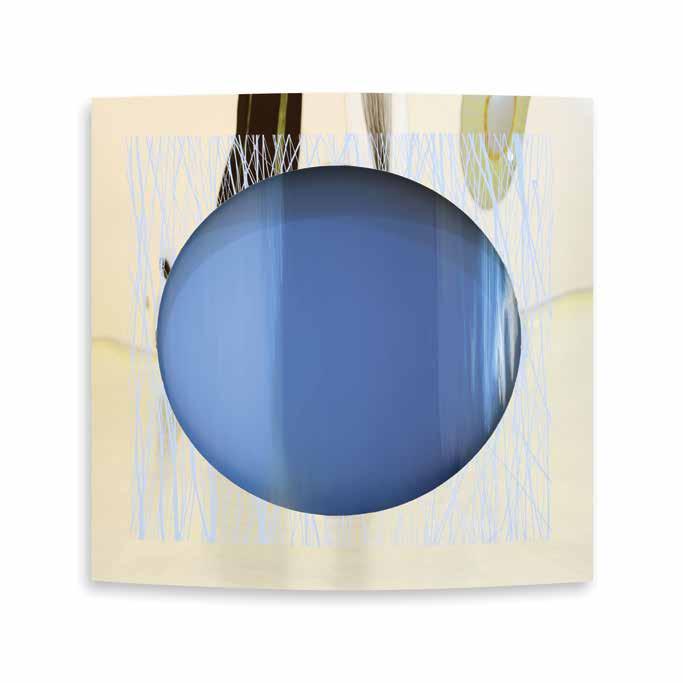
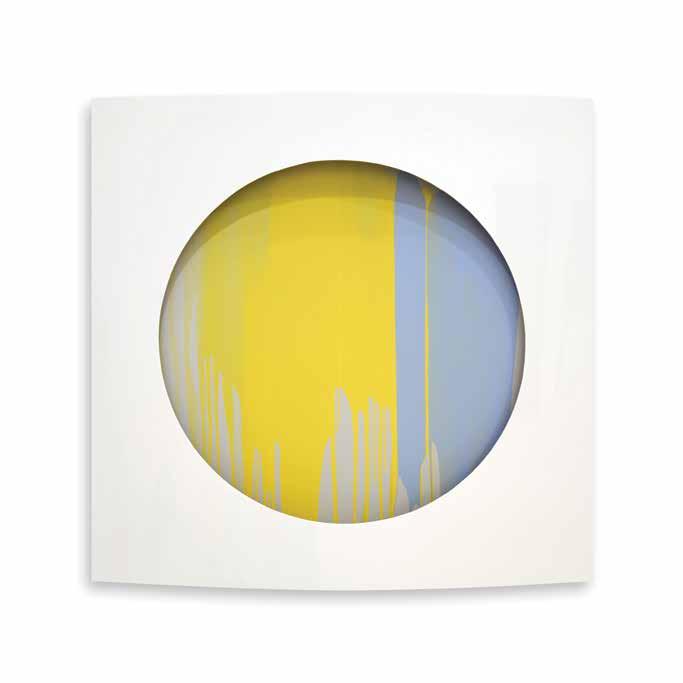
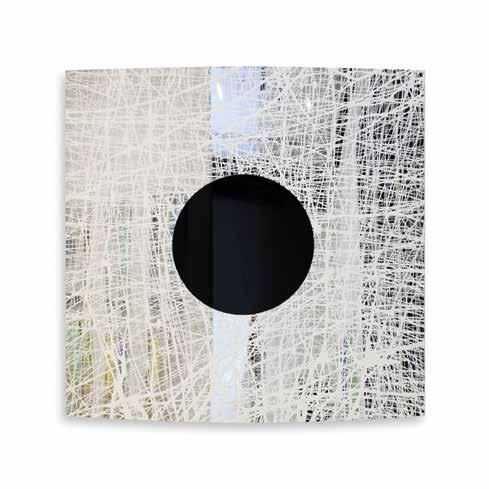
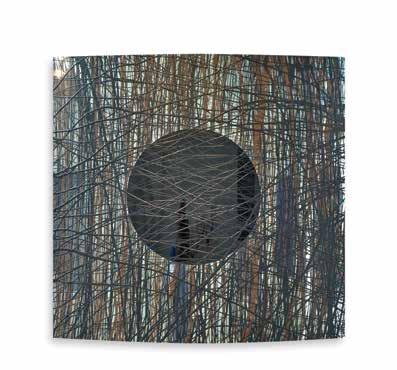
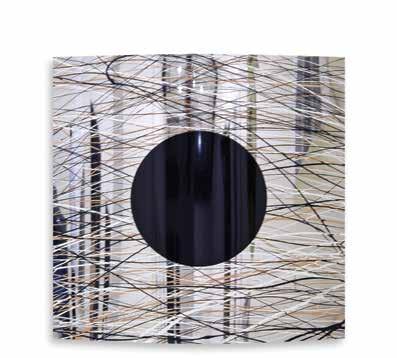
Towards the end of 2014, Rashid’s painting entered a new phase, one that followed on logically from the preceding stages but that also presented him with new challenges, and which offers the viewers of his work with a fresh insight into his creative power. The painted circle has become a circular hole in the curved metallic surface. It is an emphatic presence and yet is a negative space, it is both there and not there, a striking and powerful philosophical conundrum.
The face of the curved surfaces has also changed: some are reflective metal, while others are lacquered
in black, white or grey. Beyond the edges of the circles and behind the convex form lies another flat surface, with dripped paint providing a rich surface upon which the subtle interplay of colours from a clear and restricted palette creates a painting within a painting. The relationship between the two surfaces also creates the shadow of the circle cut in the convex front surface of the metal that falls on the flat back surface, dependent on the direction and intensity of the light with which it is lit.
The variations that are possible between the colour and reflectivity of the convex surface, and the colours and textures of the flat surface revealed through the cut out circle, present a scope of possibilities that create the potential for a range of emotional, philosophical and intellectual responses from those who encounter these works, allowing each viewer to experience the paintings in their own way. A brief glance, caught in passing, will reveal little, whereas a more considered exploration, an observation from a point of stillness in front of each work, will allow each viewer to consider the personal impact that the painting has on them. The cut out circle is both there and not there – it represents the presence of absence, while at the same time allowing the viewer to see through to the surface that lies behind and the relation to each other of both surfaces and the colours they carry, and then onwards to a consideration of the work as a whole. While standing in front of these paintings there is also the nature of the chrome front surface that will reflect, with a degree of distortion due to the curve, the environment in which it is placed, the viewer, and others within the space. That which might at
first glance appear simplistic is in fact far from that when considered quietly over a longer period of time.
The strength of Rashid Al Khalifa’s work lies in its simple and yet complex initial appearance that on deeper consideration reveals a powerful evocation of abstract form and colour, which reaches out from the walls of the places in which it is seen and into the experience of those who encounter it. Such directness of expression and communication, with such a diversity of potential personal interpretation, is to be welcomed. This is work with a truly international relevance that offers much to consider, slowly and with open eyes, in an art world that, like so much else, is sometimes prone to rapid changes of taste and fashion. By contrast, the work of this artist has a strong quality that has the power to withstand the passage of time, remaining thought-provoking and relevant, offering stillness and strength that transcends all boundaries.
The triptych of the Battle of San Romano by Paolo Uccello recreates the atmosphere of the bloody clash and its cruelties resorting to the laws of perspective as if the author wanted to give it shape and body. Doing so the author has highlighted the role that the artifice plays in the artwork and I think that for this reason it is a good reference to enter into the world of Rashid Al Khalifa. He builds the artistic discourse as if he wants to give body substance to the subject-matter dealt according to its properties and in accordance with the meanings of consciousness.
To achieve this goal he relies on a morphology dominated by the curved line, perhaps because it doesn’t offer resistance and has the soothing quality suitable for banishing emptiness and fear. With this proposal, it seems that the artist is willing to accompany the viewer and lead him into a vast space and for some inspired reason he insistently returns there. The purpose brings with itself the echo of the circle and the sphere which in turn refers to the totality of finite categories - including or excluding, perfection and wholeness, harmony and a principle of life - that is open beyond the shape. The immediate reading stops at morphologies encouraging the viewer who feels like establishing a relationship with the work digging into their own experiences and their knowledge. The freshness of the colours and the balance of the shapes, simple and clear, has an inviting tone that leads to a second level of interpretation which is only apparent as the complexity of the work gradually reveals itself into three-dimension informed by a balanced and thoughtful allocation of colours overlaid with intelligible lines that moves in various directions.
The first interpretation of these works suggests levity - of transparency and light that have a confrontation with complication. The balanced dialogue between the forms - the many symbols that evoke the sphere and the circle – lead to a clarity that wins over confusion. Therefore, it seems that the artist wants to transmit a message of peace that seems to win every will to conflict and mitigate potential dispute. It seems that these values belong to the essence of the matter that insinuates the gap between the evident object and the possibilities of the matter it is made of.
This indication makes us think instinctively about the concreteness of the work and this thought leads to the artist’s research and to its structure. It is a metal convex surface with which painting comes in complete symbiosis, revealing that its function as a simple support is only apparent because the artist has transformed it into the body of the matter that he treats. It is a sense that the artist makes even more evident when he paints the circular shapes on the inside, as they were a vital point of observation, or its third pictorial dimension, invisible dimension, the other side of the coin, the soul of the matter itself.
As the viewer gradually realises that the work reflects the image of the artist - which he is in a sense one of the morphologies inviting him to participate in his realisation - he automatically seeks a dialogue with the artist in spirit.
“My works are an instinctive self-reflection in a certain situation.” writes the artist. “They are an immediate and spontaneous product, but they can also be the result of a creation with a longer gestation. The colors are the language of the mood of the moment.”
I wish to draw attention to a component that I think is relevant to the understanding of the artist of Bahrain and that concerns his presence in the work precisely with the use of a symbolism which refers to a circular shape. In this specific case it brings back to the eye of the viewer.
History tells us of early masters who have included their presence in their painting as an invitation to the viewer to enter the scene. This is a theme touched by the Dutch painter Jan Vermeer with The allegory of painting. Full of symbols and references to history or glory, Vermeer shows his back and allows the viewer to observe him working. Another is the Spanish painter Diego Velasquez with Las Meninas. The artist appears before the picture where he is painting a scene with characters of the court of Philip IV. The two works refer to the world of painting and to the invitation that the artist addresses the viewer because he becomes part of it.
For this reason, these works abound in references, symbols and artifacts as if the artist wanted to reveal to the observer some secrets. These are considerations that accompany the suggestions produced by the work of Rashid Al Khalifa that stimulate the quest for an imaginary to which he draws and for which he searched and seeks an appropriate language to express it, so it can be a way of life or life itself as entity.
When, where and how did Rashid Al Khalifa’s creativity developed? His vision is an open dialogue and the first works by this Bahraini artist suggests that his creativity was formed in the everyday life of the open landscape and urban dimension. The language he
chose aims at chromatic interpenetration where more defined morphologies are imposed. They bring to mind Minimalists and in part, Abstract Expressionism; however he detaches from it, precisely because of the structural recourse to the convex surface. Those forms are extremely simple and essential with a refined deletion of elements that on the contrary, enhances the picture of what appears to the eyes. This is all sublimated by an oriented choice of colour. His work echoes American painting of the second half of the last century, to which he looked for some elucidate comparison to find the language capable of giving life to the matter and releasing the meanings and symbolisms that belong to its essence.
However, the recurrent convex element and the repetitiveness return to the theme of the circular shape in its possibilities, is not only recurrent in the work of Rashid Al Khalifa, but it is also structure and body. It sounds like rhythm and a rite, and it is an indication, a suggestion of a path that would lead to an origin of wisdom in which are contained the answers to the many questions of life. Here resides a perfection to which it is only possible to aspire, but it is unreachable.
The frequency of the circular shape that characterises the work of Rashid Al Khalifa is also accompanied by the variation that strengthens the idea of his creation. The variation is passionate love and obsession, and in its rhythmic insistence, it is above all the search for an inevitable path towards an impossible knowledge that feeds the desire as a condition of existence and pulse of men’s original nature to go beyond the limit which is always circumstantial. Each change is thus an
endeavour, an approximation, so that the different levels of interpretation of the artwork by the Bahraini artist, offer a path of the object itself that is transformed in its possibilities and its iteration confirms its status as an object searching for truth.
The artistic bodies of Rashid Al Khalifa have a vital polyvalence that represents them as thing, in the sense of a matter that reveals and hides its multiple possibilities; their proposition is like a way of narrating life itself. Art without collective intelligible morphologies is as real as the one that mentions the value resorting to an object of common understanding. The medieval and renaissance art are full of symbolic references such as, a simple gesture of a flower or a fruit, a musical instrument or a laurel wreath recall to the fear, the glory, the fame, the concord, the holiness, love and many other values because they tell the meaning of what is…
Similar to modern and contemporary painting the idea coincides almost always with the representation that is used to express it. In most cases, the task is given to the colour, to the point and to the line that draws morphologies, volumes, relationships, assonances and dissonances. But it also happens that an object predisposed on purpose participates to the construction of meanings as well.
As Rashid Al Khalifa manages to create a relationship between the constituent parts of his work by setting in advance a fire of observation with the impacting shape - the sphere - this central dominant element reveals his search for equilibriums that belong to things…to the world. It is here, in this precise point where his eyes are placed as if he wanted to meet the viewer on the
convex surface to involve him in the truth that he has found and that he feels in his art.
Avicolli December 2014 Venice, Italy
chromatic
Franco
Matte enamel on aluminium
120x120 cm
Matte enamel on aluminium
60x60 cm
Lacquered enamel on aluminium 150x150 cm
Lacquered enamel on aluminium
190x190 cm 2011
Enamel on chrome-plated stainless steel 120x120 diameter
Lacquered enamel on aluminium 150x150 cm
So, does
the 2015 International Art Exhibition succeed? The 56th La Biennale di Venezia
[ A leading Bahraini artist is showing his work in two exhibition spaces on either side of the city. One is in the Arsenal district, in a quiet neighbourhood beside a canal, where Rashid Al Khalifa’s work is shown in conjunction with work by Ernesto Liccardo in ‘NOMI’, an exhibition curated by Franco Avicolli. This concise exhibition within a black painted space is the setting for the work of two artists seen together for the first time. Both artists create three dimensional painted forms, using different materials that draw the observer into a closer relationship with the work than is possible with more conventional flat paintings. The dialogue that is created between the work and the viewer is extended by a further dialogue between the works of the two artists. Rashid Al Khalifa’s use of reflective surfaces adds an intriguing element in which the viewer and the surroundings can be seen...
The second exhibition is, ‘In the Eye of the Thunderstorm’, in a building on the waterfront of the Guidecca canal, including a number of artists from the Arab World whose approaches to the making of art are very different. Organised by ArsCulture in collaboration with Contemporary Practices Art Journal, the intention is to, ‘reflect the variety of artistic research currently taking place in Bahrain and Egypt, Kuwait and Iraq’, tackling thorny issues in a world and culture that is changing fast.
Rashid Al Khalifa’s work provides a dignified pause within this exhibition, which also includes video and installation works dealing with historical and political themes...the work of Rashid Al Khalifa, is an intriguing contribution to a diverse and fascinating exhibition. ]
Essay Elemental: 2014 Series of works
By Richard Noyce
There has been a process of gradual reduction of imagery and elements in the work of Rashid Al Khalifa in his career of more than four decades. During this time the position of Bahrain, and the Middle East in general, has changed and grown, in the world in general and the international art world in particular; both worlds have themselves developed far beyond the point that would have seemed possible thirty years ago. Equally, from this position 15 years into a new century, it is impossible to predict the degree to which those worlds will change in another thirty years. Such is the nature of the technology-dependent and connected world in which we live and in which artists must work.
Set against the complexity of the world and its glittering commercial city centres, the work of Rashid Al Khalifa presents an inherent sense of calm and simplicity that invites the attentive viewer to enter into meditative complicity with it. The work has a positive presence, achieved partly from its scale (neither too big nor too small) and partly from his use of restrained colour. It is neither strident, nor does it clamour for attention through a cacophony of forms and colours. While some of his contemporaries may choose to use titles that perplex and seek to be clever, this artist uses instead titles that serve simply to distinguish one work from another. In such ways the viewer comes face to face with works that are undemanding, they are simply there, to be looked at and thought about if the viewer chooses. This quietness may not satisfy those for whom a contemporary visual art object has to offer a challenge, or visual confusion. It does not require the addition of the loud soundtracks and low lighting demanded by the video and sculptural installations that seem to be fashionable in some parts of the world of exhibitions and biennials. While it may be argued that such noise and confusion is a valid representation of and response to certain aspects of the world in which we live, these experiences are not sought by all those interested in or committed to exploring the ways in which contemporary artists are responding to being alive and aware of the complexities of what it means to be human.
Geometry has been a central constituent of Islamic art for many centuries. Some of the finest treasures of world art contain examples of simple geometric relationships developed in intricate and subtle ways to create the incised decorations on the walls and furnishings in mosques and major buildings. While these forms are highly evolved they can nonetheless be analysed to show their derivation from basic relationships between the circle, the square and other more complex geometrical forms. Some are flat, others three- dimensional, some purely geometrical, others combined with arabesque and calligraphic forms. This visual language has
in its turn been highly influential on design and pattern making in other cultural traditions. Rashid Al Khalifa is clearly aware of the essence and importance of geometry within Arabic culture. At the same time, through his formative education in Bahrain and the United Kingdom, he has a clear understanding of Modernism in Western Art, both from his studies of Fauvist painting, from which he gained an appreciation of colour and representational composition, and Constructivist abstraction leading into Minimalism, which has formed part of the inspiration for his more recent work. The way in which he has combined the traditional elements and inspiration of his Bahraini culture with elements from the Western tradition gives his work not only a clear individual identity but also an insight into the ways in which a synergy has been created between the disparate roots of his work.
The formal compositional theme of a circle within a square is not uncommon in abstract art, but this artist has taken it in a new direction through his use of a convex outer layer in which a circular hole is cut, and a flat inner layer. Taking this process further his use of reflective surfaces added another spatial dimension to his work. In particular, and with additional relevance, such surfaces draw observers into a more intimate relationship with the work through the incorporation of their reflections. There is a potency in the use of the square and the circle, since these have been recurrent forms in world art across a span of millennia. Further, they are geometric forms that obey distinct mathematical rules. Together with the triangle and more complex combinations of the three forms, they have also been used in religious and esoteric art and philosophy as indices of the relationship of the human being to the natural world, aiding a deeper understanding of the nature of life and eternity. As a result of this complexity emerging from simplicity there comes an intuitive understanding of the subtleties of these forms – they are elemental, occupying a crucial place in the human psyche.
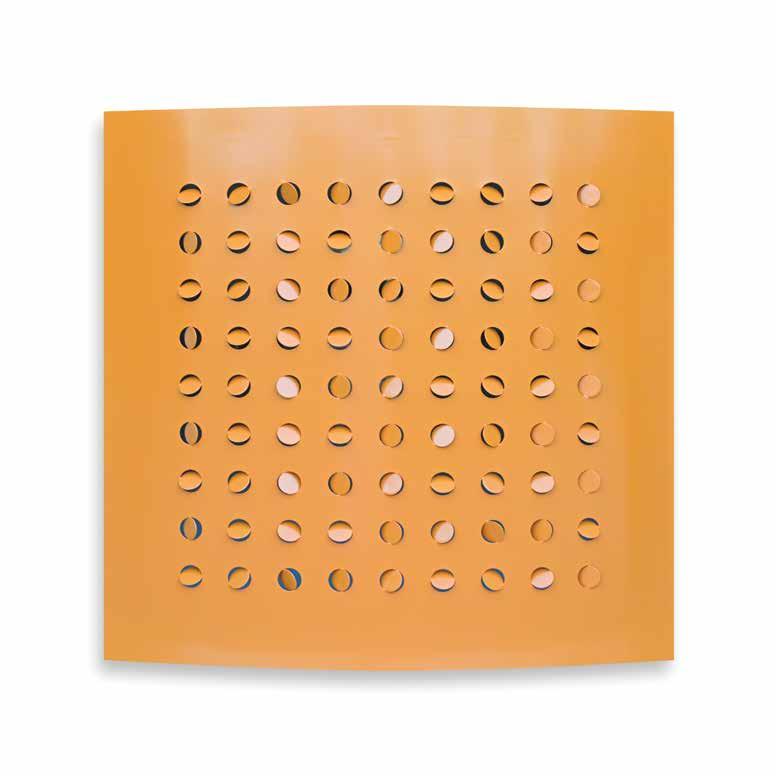
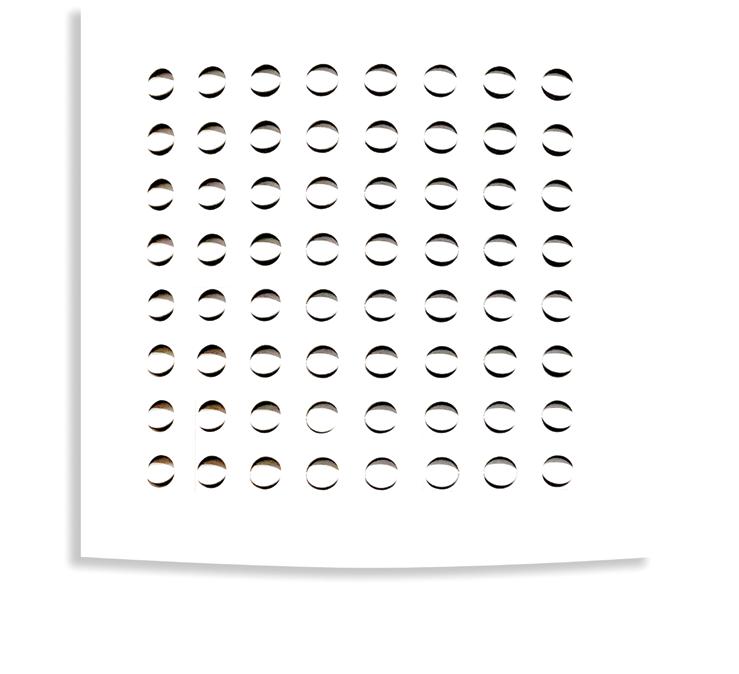
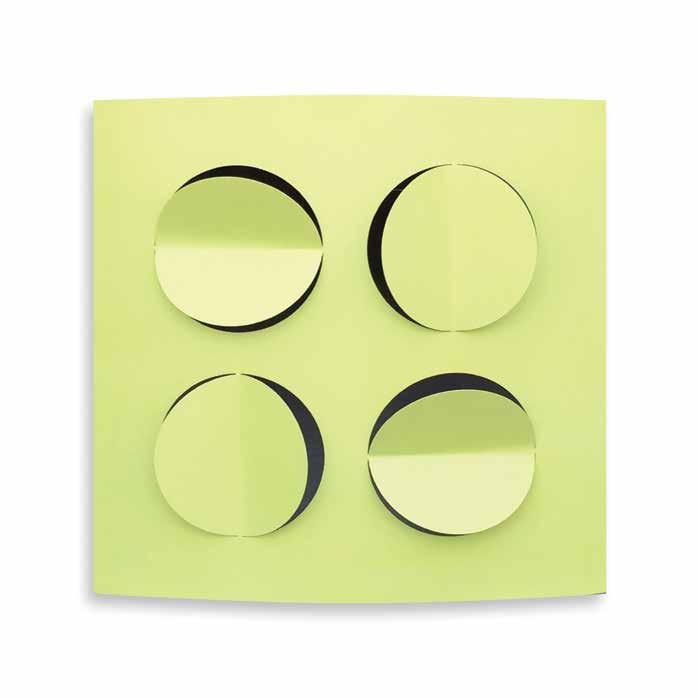
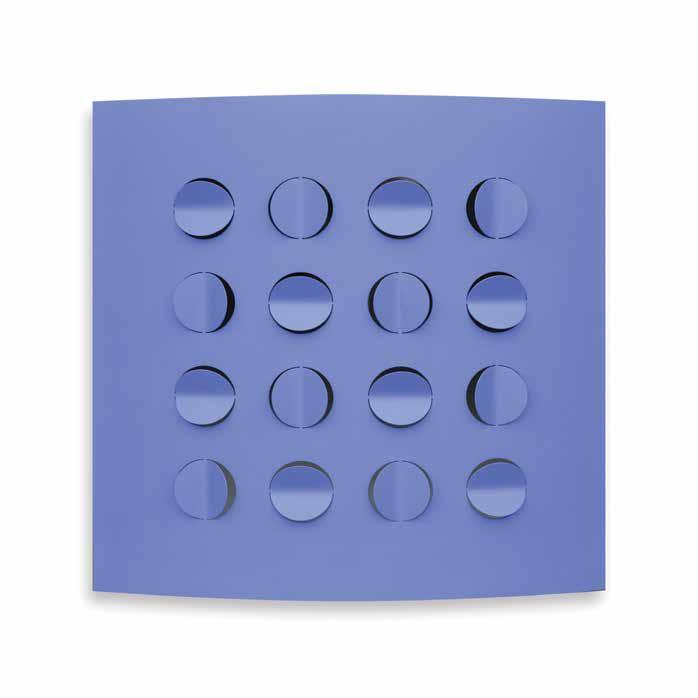
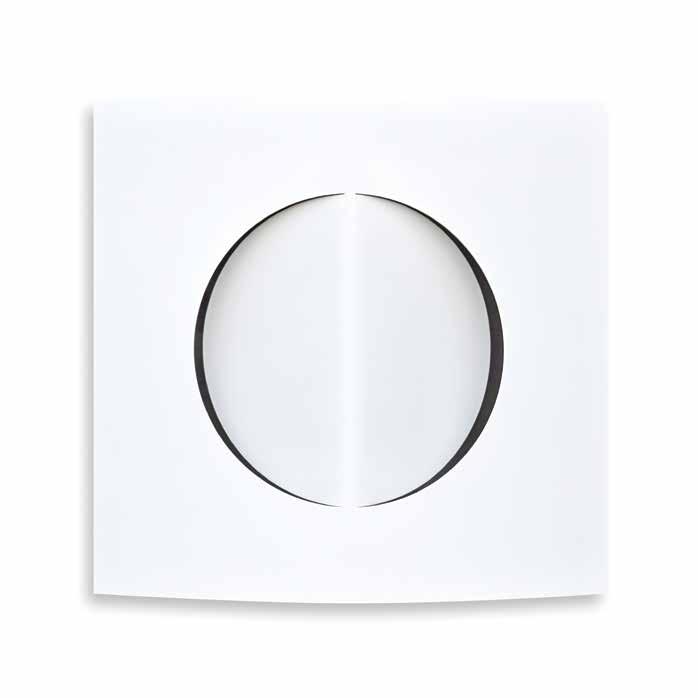
In his recent work Rashid Al Khalifa has added another intriguing technique. While continuing his orchestration of variations on the circle and square, and instead of cutting out the circles completely, he has created a crisp fold into the all but detached circles. The lines thus created result not only in fragile connections between the circles and the square surface from which they are cut, but also subtle shadows from the fold line that combine to suggest squares. Thus far in this new series of the works the surface material is matte aluminium, each work being finished in monochromatic enamel. The subtlety of this artist’s work deepens, with the created forms and the relationships between them dependent on light and varying according to its intensity. They present the viewer with a challenge that is increasingly rare in the world of contemporary art that of entering into a relationship with each piece through quiet meditation, deepening an understanding of the quiet authority of these unique works.
Richard Noyce August 2015
Wales, UK
Matte enamel on aluminium
120x120 cm
Matte enamel on aluminium
120x120 cm
Enamel on chrome-plated stainless steel 120x120 cm 2014
Matte enamel on aluminium
120x120 cm
Enamel on chrome-plated stainless steel 120x120 cm 2014
Enamel on chrome-plated stainless steel 120x120 cm 2014
Matte enamel on aluminium 120x120 cm
In Dialogue 2013 Exhibition installation
The Waterline Gallery
Kingdom of Bahrain
In Dialogue
2013 Group Show
The Waterline Gallery
Bahrain Financial Harbour
Kingdom of Bahrain
25 November 2013 – 25 January 2014
“In Dialogue” investigates the influence of social change on the work of Rashid Al Khalifa, Abdulrahim Sharif, Modhir Ahmed and Walid Siti, each of who explore the effect of critical social issues in a manner that challenges the politically sensitive art that is prevalent today. With their newfound manipulation of their materials, they have in turn responded to the ongoing changes occurring within their external environment and through a process of self- exploration, their resulting work reflects the effect of sociopolitical change on the artist’s psyche.
‘In Dialogue’ presents Rashid Al Khalifa and Walid Siti’s recent work- where they each employ ‘line’ as the basic element of expression. The interplay and delicacy of these linear forms echo the artists desire to break from traditional painting, as well as their consideration of the surface on which materials are used. Their resulting work appears to invite the viewer to question the interplay between background and foreground, where simple strokes and fine lines are just as relevant as the weighty surface and that carries them. Furthermore, we are presented with the gestural and emotionally charged work of Modhir Ahmed and Abdulrahim Sharif; where the often indistinguishable formations resonate the ambiguity of various contemporary social and religious issues that are prevalent today.
November 2013 Kingdom of Bahrain
Lacquered enamel on aluminium 150x150 cm
Enamel on chrome-plated stainless steel 90x90 cm 2013
Enamel on chrome-plated stainless steel 60x60 cm (each) 2013
Enamel on chrome-plated stainless steel 60x60 cm (each) 2013
[ Rashid Al Khalifa’s works suggests the artist’s pace towards a deconstruction of the Modernist obsession with the picture plane. His experimentation made on materials was similar to the strategies of the post-minimalist for departing from conventional compositional devices and manipulate a canonically artistic material like the canvas.
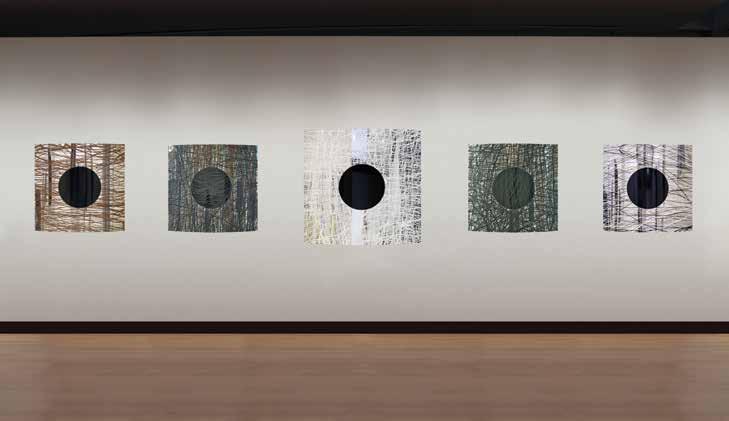
Al Khalifa’s work explains how ‘painting’ continues to adapt and mutate. His Total Eclipse series of five chrome plated convex in rhythmic earth tone lines is manipulated by the momentary presence of the viewer as it beautifully reflects back the many colours it captures in that instant.
The artist’s act of creating the lines may be perceived as something temporal and dynamic — a concept in which the line integrates a process that is forever adjusting, always dynamic, in motion. However, they are not an appropriated or intentional form but instead, a manifestation of Al Khalifa’s internal rhythm; the marks he makes correspond to the liberation of the body into the form of lines while the convex service creates a new kind of space – somewhere inbetween pictorial illusion and literal space.
The applicable context of Al Khalifa’s work is Modern art with increased conceptuality, a Post-modern hybrid that succeeds within its own boundaries. ]
Horizon: Contemporary Bahraini Art Exhibition 2013 Exhibition installation
Tsereteli Art Gallery
Moscow, Russia
Contemporary Bahraini Art Exhibition: New Horizons
2013 Group Show
Tsereteli Art Gallery
Moscow, Russia
17 September – 13 October 2013
The exhibition displays the vertical cross section of artistic production in Bahrain and brings together recent contemporary pieces and historical work – in painting, drawing, and sculpture. The collection is a glimpse into how these individual artists see and interpret the world with their personal vocabulary of cross-pollinated styles.
The five artists in the exhibition come from one generation of Bahrainis who left the kingdom in the late sixties and early seventies to study in different art schools in Europe and the USA. Upon their return to Bahrain, they commenced their careers and have inhabited different positions, enjoying varying degrees of renown.
Organized by the Bahrain Ministry of Culture, the show includes the work of Rashid Al Khalifa, Abdulrahim Sharif, Balqees Fakhro, Khalil Al Hashimi and Ahmed Baqer.
September 2013
Kingdom of Bahrain
Lacquered enamel on aluminium 190x190 cm
Lacquered enamel on aluminium 90x90 cm
Exhibition Review
New Horizons: Bahraini artists exhibition at the Russian Art Academy
[...One of the significant artists included is Rashid Al Khalifa, perhaps the most influential and inspirational to others in finding their own path. Over the last 40 years he has developed his work by moving steadily back through the history of Western painting to reach the contemporary. He is one of the earliest Bahraini experimentalists who made his own research formulating a progressive aesthetics that took off in hybrid directions. With his groundbreaking “convex” service, he pushed a conceptual style to the forefront of his work and began to create on the “convex” – in canvas, chrome and lacquer – painterly modes in monochrome, color field driven abstraction and geometric work, bringing a certain renewed sense of dialogue with painting’s past, the near and distant future. ]
Reflection 2012
Exhibition installation
Bahrain Financial Harbour Gallery
Kingdom of Bahrain
Reflection
2012 Solo Show
Bahrain Financial Harbour
Fine Arts Gallery
Kingdom of Bahrain
31 January - 30 March 2012
“I express my feelings in the colours I use on forms and shapes based on my recollection on the seasons in life that has passed; times of laughter and embrace, mourning and sorrow, success and failure. The spontaneous paint work on the chrome surface, inspired by women veils, laces and ‘mashrabia,’ partly conceals the loci of society or life where we see fractions of ourselves - broken, buried, whole, empty, blurred and full – are reminiscent of the paths we traveled to reach where we currently stand. Once the viewer is face to face with the artwork, it breaks down the barriers; it becomes a journeying encounter like a free-flowing sense of interaction - a glance of the real, a starting point, waiting to be followed through, allowing the viewer to do the completing, the reflection of self.”
It was by mere accident that I found myself encountered with a new collection of Bahraini artist Rashid Al Khalifa exhibited in Art Beirut 2012, a solo exhibition representing Art Bahrain. The collection, entitled “Reflections” appeared to me rather different compared to his previous art works that I had been familiar with during the late 1990s and early 2000s; the present art works, media wise at least, seemed to be a leap, or some new transitional step towards post modern means of expression. Facing those convex shapes presented in coloured chrome, I stood somehow bewildered.
The Beirut 2012 exhibits “Reflections”, took me back immediately to one of the artist’s early statements commenting on “Resting”, a series of paintings (1982), which had marked a major transition in his style during the 1980s.
He says:
“My paintings are a self reflection – on instinct – to a situation. At times works are spontaneous, yet they can appear as being premeditated. The colours used show the mood of the painting – in fact the mood of the moment.”
As such, I believe that Rashid Al Khalifa, intrinsically, has not departed from his previous approach to art. The chromatic convexes seemed to be just another experimental shift in material.
Bahrain is socially distinguished, and therefore culturally, among other Gulf States. Art in Bahrain had been part of cultural life since its early attempts in the second half of the 20th century. Rashid Al Khalifa, the master of landscape paintings and figures, belongs to
the second generation of contemporary Bahraini art movement; an avant-guard of its modernity. He cannot be considered as simply significant among Bahraini and Gulf States artists, but among Arab artists in general. His earliest attempt as a gifted painter revealed itself when he was 16. He later moved to England to study Art and Design at Brighton and Hasting Art College (1972-1976). Back to Bahrain, Rashid Al Khalifa has been persistent ever since to lead both a professional artistic life and enhance the art movement in Bahrain as a patron and collector. His career life as an artist has been constantly ongoing, producing and experimenting, despite the heavy obligations of his official duties.
Rashid’s paintings, oil on canvas performed in powerful brush strokes, stem from deep emotions and thorough contemplations. The spontaneity he refers to in his above statement can be clearly detected in all his works even those executed in the very recent years. Yet, the high sense of design and control are quite present in his compositions. Following up the continuity of this creative stages can clearly manifest the link between the artist’s early and late transitions.
During my residence in Bahrain (1997-2003), I used to see Rashid’s expressive paintings (oil on canvas) displayed among the annual exhibition of Bahrain Art Society. Being the founder and president of the Society, he usually take part in their group exhibitions showing his recent art works of colourful abstract compositions, mainly inspired by the rich Bahraini surroundings.
His paintings, during the first two decades after his return to Bahrain, reveal a strong passion for depicting different aspects of an oriental society that maintains
specific aesthetic qualities. This was clearly manifested in richness of colour, mainly derived from charming interiors of common Bahraini lodgings. With a potent tendency to adopt an impressionist/expressionist style, Rashid Al Khalifa created a collection of paintings inspired mainly by local sceneries and daily particulars: landscapes, architecture and figures in different poses or movements are performed in an extremely subtle way. His early works, before academic schooling, reflect aspects of Bedouins life, mainly horse racing, camels, mud houses with some Bedouins around, rendered with soft earthly colours and sensitive lines. This may ascertain his early affinity with Bahraini ambiances that persistently accompanied him along his career life. Back from England, perhaps influenced by the spectacular sceneries surrounding him during the period of his studies in Brighton and Hastings, he mainly devoted his art to render Bahraini landscapes. The outcome had been a series of delicate impressionist paintings portraying different areas of Bahrain in various seasons, where colour and mood harmoniously change accordingly. Rashid Al Khalifa remained fascinated with natural scenes even in later phases of his career. Blue canvas (1984), for instance, in which a cosmic night scene of deep blue is conceived in pure abstract style, may stand as one of his accomplished masterpieces.
In later years, Rashid Al Khalifa’s painterly approach became more intense while focusing on human figures and conditions. These series had been characterized by a powerful sense of movement and richness of colour, especially exposed in the Flamenco “Dancers”. The artist, in rendering these blazing images,
thrives to get hold of the passion contained in the dynamism of colour and movement.
Thus, in another series entitled “Resting”, the artist attempts to portray the human figure in various moods and positions. At a first glance, one may get the impression of a relaxing recline of the body. Yet, deep entanglement with the painting may leave the spectator with a completely different cognition. In a sense that the lying figure seems essentially in unrest; the images are overwhelmed with discretion, anxiety, abashment and anguish. In these series Rashid Al Khalifa tends more to obtain an abstract expressionist style, where figure can hardly be recognized amid the whirlpool of colourful strokes. The colours, a figurative language in itself, seem charged with power and revolt. At the same time, the figures performed with painterly competence, largely females, are rendered with delicate lines of high poetic sensitivity.
In another interesting shift of the artist, and before arriving to his present stage of chromatic convexes, Rashid Al Khalifa presented during mid and late 1990 a new series entitled “Metamorphosis”. Highly creative in form and sense, Rashid seemed to have adhered completely to abstraction while reflecting an image of a flowery settings intervened with vases, furniture and some decorative elements (one-man-show, Darat al Funoun, Amman 1997). Reminiscent sometimes of Matisse’s, these compositions maintain highly aesthetic qualities as much as discreetly address the spectator with a hidden message: beauty can be wild, bruising and defiant. The patent fabrics that appear within the foreground, sometimes in the background, discretely
reveal tiny and ambiguous female faces. These faces may evoke his previous series “Resting” though rendered in different vision and style.
It was after this marvelous phase that Rashid moved to his recent stage of Convexes, which in fact seems to be a new way of conceiving his most popular theme: “Reflections”. He well explains his motives in the following statement:
“..The spontaneous paint work on the chrome surface, inspired by women veils, laces and ‘mashrabia,’ partly conceals the loci of society or life where we see fractions of ourselvesbroken, buried, whole, empty, blurred and full - are reminiscent of the paths we travelled to reach where we currently stand. Once the viewer is face to face with the artwork, it breaks down the barriers; it becomes a journeying encounter like a freeflowing sense of interaction - a glance of the real, a starting point, waiting to be followed through, allowing the viewer to do the completing – the reflection of self.
Rashid Al Kalifa’s art works along the four decades of his art career have been a remarkable journey through his own personal life as a genuine Bahraini, and the offspring of a society that maintains inherent conventions and traditions. He modestly keeps a low profile both as a man of powerful position and a highly gifted artist. His art draw on his own recollections; an emotional manifestation of spoken and unspoken thoughts and desires. The last stage of his experience, up to this moment, has only been another step forward to catch up with his own reminiscences of past and present memories though in different media. The chromatic
convexes on which he applied his compositions, allow him to perform a dual function of act and react. The previous art works, oil on canvas, invite the spectator to get involved into a visual search for the meaningful aesthetic symbols subtly disseminate through colour and form.
Chrome, as a mirror-like metal simply add another aspect to such interaction while his/her personal image becomes reflective on the surface of the art work. Thus, the spectator becomes a direct participant in the art work. Is that what the artist really seeks?
I shall only allow myself, at the end, to express my own personal feelings as a spectator. Rashid Al Khalifa is a serious and defiant artist, this metallic language of art, detached and poetry lacking as it is, truly corresponds to a regretful mood presently prevailing every where in the world. Therefore, his involvement with this experience seems to be just another attempt to subject a hard surface and make it pliant to meet the artist’s own expressive needs. It is just another stage in his ongoing art process.
May Muzaffar February 2013 Amman, Jordan
Enamel on chrome-plated stainless steel 90x90 cm 2012
Enamel on chrome-plated stainless steel 120x120 cm 2012
Enamel on chrome-plated stainless steel 90x90 cm 2011
Enamel on chrome-plated stainless steel 90x90 cm 2011
Enamel on chrome-plated stainless steel 90x90 cm 2011
REFLECTION a solo exhibition by Bahraini artist Rashid Al Khalifa opened on the 30th of January at the Bahrain Financial Harbour Fine Arts Gallery with scores of collectors, VIPs, diplomats, artists and friends who turned out to view his latest works - a continuity of the everexpanding convex series, this time, on high-gloss chrome.
Recognising the chrome paintings’ ability to reflect the environment and perform alongside the social surface, Rashid, who has a reputation for creating exciting exhibition space, kept the spectacular atrium gallery simple to give his works more space to encourage free association and a poetic sense of chance.
Showcasing 15 new works, the exhibition wall text and brochure provided indications to what lay behind the surface.
REFLECTION is a window to Rashid’s soul and this spirit of openness initiated collaboration. As an effect of this manifesto of transparency, the gallery was filled with people busy decoding, understanding and appreciating the artist’s work while at the same time trying to make their own interpretations on how they view their reflection on the chrome-plated convex, and finally concluding their participation with their favourite painting - the work that have touched their heart and soul.
One of the big hits of the night was the work “Do you see anything?” 90 x 90 cm, all-white enamel paint work on top of two black vertical strips and as the title suggest in all simplicity and directness, produced a quasi-magic embrace and communion with its audiences.
Perched in the centre of the room is perhaps the epitome of reflection: “Going alone.” The 150 x 150 cm, white lacquer-
convex with path-like black enamel paint work that seems like a vortex that gradually spreads out as it rises to the top - triggers mental wandering of watching and responds to the process of collective memory where narratives often emerge.
Equally compelling is “Fragmented” 90 x 90 cm, the first work in the series has a four-hue, four-section geometric construction in intervals of alternately yielding and resisting fields of colour that represent the complex part of a social field. His intensive colours are as always performatives in their own right. While this series is based on the reflection from the convex service, the effect of his colours deliver analogous intensities and so both reinforce and expand the painting itself.
And Rashid opens the floodgates of colour in “Fabric of society” 150 x 150 cm. The artist’s power of beholding through colour connects modernism’s fixation with colour and the use of chrome reveals his insouciant embrace of any kind of material that can suggest the persona that his artwork is meant to evoke.
As REFLECTION on the mirror-like chrome service inspired the artist to embrace elusive ‘transformational moments’ that broke down the barriers between artwork and audience, it could be said that Rashid Al Khalifa has reached a level of generative specifics in painting that could be described as a kind of gift, a present to the viewer, and this reason constitutes a powerful action beyond painting’s circumscribed boundaries - the kind of art that asks us to involve ourselves and so we wander in the real and imagined - one that lives both in the moment and beyond it.
Convex: A new prespective 2010 Exhibition installation
Bahrain National Museum
Kingdom of Bahrain
Convex: A new perspective
2010 Solo Show
Bahrain National Museum
Kingdom of Bahrain
10 April - 10 November 2010
It gives me great pleasure to welcome you to ‘Convex: A New Perspective’, an exhibition showcasing the progression of my work since the beginning of my career in the late 1960s. From painting landscapes and figures, to abstraction, to the creation of the convex canvas, this has been a long and challenging, but equally rewarding journey.
You will witness the increasing necessity of the convex canvas in the development of my style of work, since its conception in the late 1990s.
I sincerely hope that you will appreciate the underlying sentiment that is present throughout this collection, a sentiment that best reflects my current perception, as well as my vision for the future.
Rashid Al Khalifa, 2010 Kingdom of Bahrain
CONVEX
a precursor for globalization
Taken from Contemporary Art Practices, Volume VIII
Reprinted by permission of Contemporary Art Practices
An art student in the UK during the 70s, Bahraini artist Rashid Al Khalifa’s eyes opened to a new world of theories amid the vibrant London art scene – the period that was marked with experimentation of styles and movements breaking away from Abstract Expressionism. As a student, he adhered to traditional representational renditions of the physical world. However, responding to the trend – Geometric Abstraction, Hard-Edge painting and Colour Field – he was pushing his work to abstraction. Very much a product of his time, experimentation – was and is – up until this time – the life force of his art. Painting for over 40 years and disconnected from the contemporary art scene, he proceeded in a self-enclosed manner within the various ‘isms’ and methodically developed his style, and finally found a distinctive voice with his ‘convex’ painting.
This paper proposes to examine Rashid’s art from 2000 to the present and trace the developing theory and primacy of audience situations in contemporary art.
SHAPED-CANVAS AND MINIMALISM
The roots of modern shaped-canvas painting lie in the prewar Modernist and this development can be dated to the early 60s. American painters were driven by the logic of their own development to differentiate Minimalism from its European origins – the Bauhaus and the Russian Constructivist. This propelled Minimalism and broke traditional notions of art making by redefining the form, material, and production of the ‘object’ and its relationship to physical and temporal space and the viewer– a movement away from painting and toward sculptural concerns.
One has to think about the typology of Minimalist productions – the connection between painting and sculpture, the application of the grid or the use of industrial material, shaped-canvas, anti-expressionism, the mindset towards mass culture and the lure of dematerialization – all seemed to approach the condition of ‘objects’ rather than paintings. Artists specifically associated with Minimalism who managed to produced high art were Frank Stella, Robert Smithson, Richard Serra, Donald Judd and Barnett Newman to name a few.
In the 70s Minimalism was believed to be lucid but it was still vague and as the constructions of the 80s evolved, problems of illusionism and of literal space, space in and around marks and colours had been moved from two to three dimensions.
The shaped-canvas, forms and ideas of minimal art continue to resonate powerfully in art produced to this day but with subtle emphasis on Conceptual, Minimalist, and Constructivist as practiced by Rashid Al Khalifa, who was pulled into the spotlight after his deployment of his never-before-used ‘convex’ shaped-canvas. After four decades of modular amalgamations by the Minimalists’, Rashid’s simple but fluid ‘convex’ exploits illusion in three dimensions.
PAINTING ON CONVEX
In the beginning of 2000, the ‘convex’ shapedcanvas was the primary structure that Rashid used for the merging of Landscape, Figurative and Abstract Expressionism – in a Colour-Field language that was scrapped, slashed etc. In these works colour was used metaphorically for content.
The metaphoric imagery that filled the pictorial spaces bore a precise formal and conceptual nature of space especially when the metaphors conflict. Paramount to his work, Landscape, suggests the impression of immense depth and the figurative metaphor evokes another realm. Furthermore, the metaphors were partly drawn from certain pictorial continuities that exist between his early and late work. Definitively, in contrast to his mid-90s two-dimensional work, it is not as much of an image as a device – creating expressive values of space and colour while permitting them to remain in the realm of Abstract Colour Field. His attention to structure and detail, combined with elements of randomness and serendipity have only emotion read into his paintings. Each painting consists of thousands of brushstrokes, painted in oil on the shaped structure. He trowelled the paint on, built it up in layers or films or dripped and stroked varying thickness of paint evenly or more densely. Then he would scratch or scrape it with the palette knife so that the paint surface would breathe and give an ambiguous illusion of space in a centrifugal or centripetal organisation – extremely vivid without being claustrophobic.
COLOUR
Colour is the element Rashid is most independent and original. He pushes his palette into constituencies of chromatic thresholds it has never before penetrated and when the colours begin to breathe and its edges dissolve, then painting comes altogether showing how conflicts of pure colour can by themselves establish
a pictorial order as strong as any that depends on conspicuousness of contour and value contrast.
Nonetheless his reliance on the autonomous powers of colour, he declares that “colour, when its resources are adequately put to use, can spur the most inertly enhancing form into a pictorial entity – a picture of a fully prismatic art.”
These luxuriant and luminous paintings are spectacular immersions into saturation and Shaikh Rashid intended them to be seen up close so that the viewer can be enveloped by their colourful aura –wrapped in mystery, concealed meanings and expressive philosophical depths.
CONVEX: A NEW PERSPECTIVE
Even with the success of his Abstract Colour-Field ‘convex’ shaped paintings; Rashid did not stop exploring the limits of his artistic ability. As he was preparing for his 2010 solo exhibition, his work took a spin that virtually comes at the tail end of modernism – visually minimal but powerfully spatial.
Reflecting on the achievements of the avant-garde and using their thought processes to find clear formulations for his own thoughts in the light of contemporary conditions – ‘convex’ was no longer just the service – it became the soul of the painting.
The 2010 works reveal how different it is to think about Rashid’s relationship to tradition in relation to his contemporary moment and his personal development. In these new works, he imported the sensibility and techniques associated with design and are just as complex and developed as his old work.
The incandescent lacquer finished enamel ‘convex’ service is a new realm of artistic development reflecting an affinity for structure, balance, and visual order. Mostly in large scale, his artworks pivot on the invisible line of gravity that holds them to the ground. They inhabit a space that is not easily classified as either painting or sculpture but they are intrinsically powerful and precise.
NEW COLOURS, NEW MATERIALS
The geometric measures, reduced palette and suppressed autographic touch that had been typical of Rashid’s painting since 2000 – Convex: a new perspective – bear a superficial resemblance to Minimalism. However, the purposeful vacillations and precarious shifts in balance set off by the different weight of colour is far greater than those found in his earlier paintings of the decade and still embodies a subjective indeterminacy.
As ‘convex’ is the soul of his artworks, colour is its primary material.
Beginning with the ‘convex’ service that is sprayed with enamel paint to achieve a lacquer finish, he creates form with carefully calculated nuances of colour alternating matte on the reflective surface that keeps them in constant motion. And the new weight and lambency of his colours is an attempt to explore its effect on the soul.
In Near-monochrome, he drips enamel in a fast motion that slightly fluctuates and spins, and are stacked, aligned, cantilevered, or centered, in strict geometric arrangements that would create an optical effect of moving patterns.
The high polish reflections render the components unstable, disseminating their svelte surfaces and divesting them, although intermittently, not only of mass and weight but even of shape and surface wage a struggle for dominance. Also, his use of mixed-media materials – soaked canvas, impasto and enamel paint on canvas covered ‘convex’ – increasingly evoke the third dimension, creating tactile, sculptural effects vaulting from the wall while retaining a sense of static balance.
Judging by these deceptively minimal artwork, it could be said that Rashid has discovered a new method of introspection and the complexity beneath the surface gives these paintings a brooding grandeur – an allusion of something further than the canvas that is all the more formidable for being indescribable.
SEPARATING LIGHT AND DARK
Black on Black 2010, on the canonical ‘convex’ service at first glance gives the feeling of non-objectivity severing Modern from Contemporary – simultaneously emphasized and crossed.
Undeniably, Rashid’s choice of materials is absolutely unforgiving: The enamel paint, dripped upon an unyielding, nonabsorbent lacquered surface, seems to present itself for inspection. It is obvious that stakes are set high in order to emphasize his uncompromising commitment to craft making his labour, part of the subject of his work.
The application of dripped enamel shows the differences in texture and shade of blackness as the layers of high-key black lines suggest a raised surface on the black ground that vibrates – illuminating darkness
and dealing with the challenge of separating light and dark something more like haptic disturbance – assaulting the eyes so unremittingly, that the experience of viewing the shades define a dynamic form which simultaneously exists across all scales.
ILLUSION AND 3-D REALITY
Rashid’s impulse to experiment shown in ‘Fabric, Glue and oil on canvas, 2010, reveals signs of life and movement as he has reimagined the rectangular ‘convex’ format as a large horizontal cinemascopic field with an image of embossed fabric pressed into the artwork’s expansive visual plane that pops out of their flat surface like sculpture. This is partly because the limited colour enhances the illusion of three-dimensionality – that is at once subdued and radiant – giving this work a mysteriously burnished tone. It is also because of the placidly winding, branching form, which manages to suggest topographical structures without resembling anything in particular.
But most significant is the mode of perception the painting embodies that slowly unfolds and demands a continuous shift between concentration and relaxation. This simulation of natural perception leads to the discovery of the artifice that has gone into its making. The transparency of the painted shadows, for example, is an illusion. The viewer has to trace the form with his eyes, following several distinct passages across the surface of the canvas and shifts effortlessly between illusion and 3-D reality. And as these paths overlap, they establish provisional layers, that one is immersed into the painting like looking at a landscape, not as a
panorama, but as a surrounding environment – to find your way out, or maybe further in.
POWER AND CONTROL
His attempt to reconstruct the specific context within which he developed ‘convex,’ yields a glowing pleasure in the beauty of colour, and the endless possibilities he finds within his tightly conceived artistic system that are anything but limited.
Continuing his exploration of the possibilities of ‘convex,’ Black on Red and White, 2011, Rashid’s newest painting, evoke a magisterial atmosphere of power and control – a methodical piece of jostling geometric expectations in which any minor slip-up would attract the eye immediately and ruin the overall impression.
This artwork requires the viewer to rethink the very act of viewing. The black field of enamel drips on high gloss red lacquered ground shines eerily and creates an optical illusion that changes when viewed from a different angle. In short, this virtuosity challenges yet another facet of Rashid that has emerged for reconsideration –overlapping boundaries of Conceptual, Minimalist and Constructivist –a clever, historicising move.
THE ART OF PRODUCTION
A vast majority of contemporary art produced today employs the hands and machines of others. Out-sourced labour and specialised fabricators with a new kind of interdisciplinary workshop provides artists access to the resources and tools to produce ambitious and bespoke projects. But that is not the case with Rashid who enjoys running the grinder on the aluminium ‘convex’
before covering it with lacquer spray paint or canvas. He would draw the shapes with measured exactitude before painting or applying the glue-soaked material then execute brushy paint handling that is rapid and perfunctory with random enamel drips within the grid. It is important to note that the process of creation is as important to him as the finished product. And his willingness to explore the many different ways and experiment with various materials has allowed him to create amazing works of art.
FINALLY
While ‘convex’ in the last decade has evolved from mere shaped-canvas to the soul of his art, Rashid Al Khalifa has, over time, offered a tantalising demonstration of how his work – chronologically and stylistically through incessant experimentation – sustained engagement with the principles of modern and the contemporary combined with his idiosyncratic sensibility have resulted in a productive work of timelessness that is neither from the West or the Middle East. Thus making ‘convex’ a precursor for globalization.
We live in an art-historical moment in which the creative canon has been expanded to infinity, comprising of anything and everything, to let every comer in. We live in a period especially here in the Gulf where the exercise of aesthetic judgment has been ruled a thing of the past or a matter of weak personal taste without any common cultural and educational basis.
However a thought-provoking solo exhibition by one of the most innovative and influential artists of the Kingdom of Bahrain, Rashid Al Khalifa brings to life an extraordinary atmosphere and lasting significance of fine arts created by a Bahraini. Entitled ‘Convex: A New Perspective’ at the Bahrain National Museum surveys the artist’s exceptional ensemble of works from 2002-2010. Over 50 works hang against black walls with dramatic lighting, designed by the artist himself, begins with an opening room that showcase a juxtaposition of his most recent work of incandescently lacquer finished enamel service, moves backward to Abstract Colour Field and then proceeds to the second floor that goes back in time to its chronological antecedents.
The relationship and complexity of the first-round of works (2002-2009) to the sophisticated Minimalist (2010) reductions and knowingness is a dualist picture of modern art emerged - where the modern and the contemporary meaningfully address each other.
This series’ narrative on his progression shows all the elements of his artistic arsenal and how he has recapitulated the history of his works; from landscapes to figurative, to two-dimensional fragmented modernism. Paintings created in 2002-2008 sustain the conceptual duality of the Abstract Colour Field and Ab Ex, liberating
unpredictable forms from layers of oil paint. They have a refined style and a language of colour out of the impulses of modern abstraction. His fascination and desire for firm horizontal and vertical flicks of the brush create an experience of seeing even while you sense its proximate, looming presence. They exhibit a labour-intensive technique of accretion and abrasion on multiple coats of paint with brushes or palette knives, sanding and scraping through the dry surface to reveal countless passages of underlying, contrasting colour.
At his best, Rashid developed a visual vocabulary that is more intuitive than read. His art is a hermetic playground of glowing colours. They dazzle visually as a flicker in yellow that seems to hover in a field of blue that deepens from turquoise to intense ultramarine; the transparent yet deep violet brushstrokes on top remain, changing perceptually in response to the underlying colour. The field of colours in a translucent mix of orange, blue, red and purple at irregular intervals creates traces of poignant gesture amid the sensuous forms. The delicate lines, the flashes of pure, saturated colour and the careful balance of form and void is a metaphor for the elusive nature of perception and the quest for underlying unity in the chaos of existence.
Works painted in 2009 clearly demonstrate his process as much as his controls. Sweeps and sluices of eye-candy colour with blends of flecked, blazing paint applied with an expressionist touch gives a more painterly surface. Flamingo pinks, sunshine yellows, perverse lavenders, emerald to pastelish greens engender an undeniably physical grip on otherwise neutral ideas and intangible
suspicions. The effect is one of intimacy with spontaneous creativity - Shaikh Rashid’s symbiosis with the medium. The lushness of these paintings is the allure which seems to have a lot to do with its potential to gratify.
Rashid undoubtedly stemmed in part from his earlier works’ eclecticism - a ready evidence of his non-stop creativity. During the last quarter of 2009 (completed in early 2010), he created a series of incandescently lacquer finished enamel service in near-monochrome paintings that are among the most majestic, haunting, voluptuous and vulnerable of his career.
On a black background (either lacquered aluminium or canvas) the paintings puts the viewer in the realm of the unknown, of double vision and oddity. Liquid lines like syrup are dripped enamel in a fast motion that slightly fluctuates, spins and being sucked to itself. The illusionism is embodied in the formal arrangements of colour and line like exoskeletal creatures of folded space.
These paintings embody complexities and contradictions but its brilliant natural effects resolve themselves in colour planes of black which occupy deep pictorial space that shows an imagination that works in non-imaginative ways.
The zones of colour - in black, red and white - each distinct unto itself, flow in incipient and sympathetic coordination with each other which makes the malleability of space palpable. Soaked canvas in red or white pigment and black impasto spread across the work’s surface is the alchemical ingredient that fuse painting and sculpture at an area of black shiny enamel.
The smeared and carefully dribbled enamel form images that appear to congeal before the viewer’s eyes
demands concentration and exudes enigma, and seem made to elicit a very different response. They allow us to see an artist creating works of physical power that defines his very artistic identity born equally of coolness and distance as of devotion and intimacy.
The exhibition also demonstrates how the size and the convex-shape identify his search for intimacy with the canvas - visually intense, physical and materially alive - they create their individual conceptual orbits which enables the viewer to participate in an individual painter-beholder experience.
Visionary as his art proved to be, Rashid is also widely recognised in the community as an arts advocate, collector and patron. This exhibition is a major celebration heralding his vision on the future of Bahraini arts and its connection to the contemporary art scene in the GCC region where the proliferation of art galleries, museums and art fairs has become the norm. His aim is to acknowledge the increasing significance of private patronage and convey its role to the public as well as give new impetus to the promotion of contemporary art.
Rashid has been exploring life through paint for more than 40 years in a non-dialectical relationship from Landscapes to Figurative, Realism, Two-dimensional to Abstract Colour Field. He had solo exhibitions in Bahrain, France, Switzerland, the US (Miami and Washington), Italy and Jordan.
Biography
Rashid Al Khalifa was born in Bahrain in 1952. He began painting at the age of 16 and had his first solo exhibition at the Dilmun Hotel, Bahrain (1970). He traveled to the UK in 1972 where he attended the Brighton and Hastings Art College in Sussex and trained in Arts and Design. Back in Bahrain in 1978, he took his cues from European impressionist masters. He was preoccupied with painting desert landscapes that exemplify the beautiful luminosity and mysterious spatial effects that he was able to conjure through his art-schooled technique. He showcased his magnificent landscapes at the Middle East Institute, Washington, D.C., USA and the Sheraton Hotel, Bahrain (1982).
However, whilst doing painterly works he was also responding to the trend – Geometric Abstraction, HardEdge painting and Color Field – he was pushing his work to abstraction. Rashid’s decision to merge elements of his figurative and landscape work in the late 1980s was an entirely conscious one; he was impelled to create work that conveyed a greater sense of self-expression, and that was inherent of the same energy that nature imparts on its viewers, while standing in its midst. Once noticeable figures become barely decipherable – hints of fabric, suggestions of limbs and cascades of hair, disperse and blend into a landscape of color.
Rashid’s continued progression towards abstraction in the early 1990s was the result of his desire to restrain his gestural and fleeting marks. His imagery gradually became more controlled, imparting a greater sense of tranquility. Suggestions of landscapes and traces of bodily forms appear to merge with hints of fabric, weavings, and botany, resulting in bold, biomorphic shapes. These works were
exhibited in a solo exhibitions in De Caliet Gallery, Milan, Italy and El Kato Kayyel Gallery, Milan, Italy (1996), and Art Department, Shuman Arts Organization, Jordan (1997).
During the same period, he was also experimenting on the shaped canvas with three canvases joined together on both sides to form a triangle-shaped service. Although he appreciated the way in which its three-dimensionality allowed the work to stand unsupported on the floor allowing the viewer to appreciate it from all angles, he was unsatisfied with the final result. After further experimentation and an unintentional discovery, the convex canvas came into being towards the end of 1990s.
In the beginning of 2000, the ‘convex’ shapedcanvas was the primary structure that Rashid used for the merging of Landscape, Figurative and Abstract Expressionism in a Color-Field language that was scrapped, slashed etc. In these works, color was used metaphorically for content.
In 2006, bright colors remain, but these paintings demonstrate a fresh approach and conceptual framework. Brushstroke intensifications appear between colored forms producing an overriding optical effect with a painterly language. By 2009, his works clearly showed the transition from the formerly divisive lines to perfect synthesis of Color Field painting and gestural abstraction. Sweeps and sluices of eye-candy color with blends of flecked, blazing paint in thick impasto and loose brush strokes are applied with an expressionist touch. Working on the convex service for a decade, Rashid methodically developed his style, and finally found a distinctive voice with his ‘convex’ painting.
A solo exhibition at the Bahrain National Museum entitled, Convex: A New Perspective (2010) showcased a decade’s work in convex. To add to the collection was a series in a new media, such as lacquer paint, fabric and glue were introduced to compliment the canvas’ curvature. Rashid manipulates these materials in order to allow light to fall differently on the surface, thereby emphasizing the thick relief that he has created.
The scale of the canvas has become grander and the imagery itself, darker and more profound in nature, imparting a far more dramatic effect. The interaction with the viewer is not simply engaging, it is overwhelming. The ‘new perspective’ we were initially offered has became an inescapable present. These works reveal how different it is to think about Rashid’s relationship to tradition in relation to his contemporary moment and his personal development. In these new works, he imported the sensibility and techniques associated with design and are just as complex and developed as his old work. The incandescent lacquer finished ‘convex’ service is a new realm of artistic development reflecting an affinity for structure, balance, and visual order.
In 2011, Rashid has taken a further step in perfecting the expressiveness of his contemporary oeuvre through the mirror-like chrome plated convex service. His impulse to work from intuitive and improvised composition transformed the chrome service into a radical creative language and a definite formal contrast to the restrained Minimalist inspired “convex” 2010 series. This body of work would be celebrated in solo exhibitions the following year.
Enter Reflection, a new wave of painted abstraction that revisits Rashid’s color-field exploits in confined fields in which he knits enamel lines into a singular surface. The visual tension produced by the geometric passages of solid colors demonstrate a collision between flowing manual gestures of complex ``woven`` surfaces that deliberately form facets that intersect one another, acting in concert with flows of paint which compete for attention within the declared centre. Reflection, a solo exhibition of new works by Rashid Al Khalifa at the Bahrain Financial Harbour Fine Arts Gallery and the Beirut Art Fair, Beirut International Exhibition & Leisure Center, Lebanon and a selection at Abu Dhabi Art, UAE (2012).
These mirror-like chrome and high-gloss lacquer artworks has been trailblazing over the past years. From Art Dubai - Dubai, UAE; Bahrain Contemporary Art; Russian Academy, Moscow; Art International Zurich, Switzerland to the Waterline Gallery, Bahrain. A solo exhibition at Beirut Art Fair, Lebanon and the Los Angeles Convention Hall, California, USA.
In May 2015, Rashid’s work reached Venice. In two separate exhibitions, the first being NOMI, a twoman exhibition in context with the biennale and for his participation at the 56th La Biennale di Venezia’s collateral events with seven Arab artists, Rashid unveiled the first of his three dimensional painting on aluminum. This painting landed him a spot at the Trio Biennial in Rio, Brazil where his three dimensional works evolved into Kinetic Art.
Rashid Al Khalifa’s work continuous to demonstrate how a ‘painting’ can transform and how his ideas and formal innovations ripple through contemporary practice.
Rashid Al Khalifa
Born 1952, Manama, Kingdom of Bahrain
Hastings College of Arts, Brighton, England
Solo ExhibitionS
2012 Reflection, BFH Fine Arts Gallery - Kingdom of Bahrain
2010 Convex: A New Perspective, Bahrain National Museum - Kingdom of Bahrain
1997 Art Department, Shuman Arts Organization - Amman, Jordan
1996 De Caliet Gallery - Milan, Italy
1996 El Kato Kayyel Gallery - Milan, Italy
1982 Middle East Institute - Washington, D.C., USA
1982 Sheraton Hotel - Kingdom of Bahrain
1970 Dilmun Hotel - Kingdom of Bahrain
biEnnialS
2017 Bridges, Grenada Pavilion, 57. la Biennale di Venezia - Venice, Italy
2017 3rd Mediterranean Biennale: OUT OF PLACE - Sakhnin Valley, Israel
2015 Arab Delegation, TRIO Bienial - Rio Brazil
2015 In the Eye of the Thunderstorm, Collateral Events, 56th La Bienale di Venezia - Venice, Italy
Group ExhibitionS
2015 NOMI - Two-man show in context with the 56th La Bienale di Venezia - Venice, Italy
2013 In Dialogue - The Waterline Gallery - Kingdom of Bahrain
art FairS
2014 WWALA - Solo Exhibition - Los Angeles, California, USA
2014 Art Dubai - Two-man show - Dubai, UAE
2013 Zurich Art Fair - Two-man show - Zurich, Switzerland
2013 Abu Dhabi Art - Abu Dhabi, UAE
2013 Art Dubai - Dubai, UAE
2012 Abu Dhabi Art - Abu Dhabi, UAE
2012 Beirut Art Fair - Solo Exhibition - Beirut, Lebanon
ExhibitionS alonGSidE thE bahrain artS SociEty
2016 15/15. Shaikh Ebrahim bin Mohammed Al Khalifa Center for Culture and Heritage - Kingdom of Bahrain
2016 VIEWS - Ritz Carlton - Kingdom of Bahrain
2014 Bahrain - Asilah Arts & Culture Forum, Morocco
2013 Bahrain Contemporary Art, Russian Academy - Moscow, Russia
2007 Bahrain Contemporary Art, Unesco - Paris, France
2005 Modern Art Exhibition, Royal Ireland College of Surgeons - Dublin, Ireland
2004 Two-man show - Berlin, Germany
Annual Art Exhibition 32- Bahrain National Museum - Kingdom of Bahrain
2002 Bahraini Culture Week - Amman, Jordan
Bahraini Culture Week - Peking, China
1999 Taipei Art Exhibition - Taipei, Taiwan
Sharjah Biennial - Sharjah, UAE
Delmun Exhibition - Paris, France
1998 Bahrain Arts Society Exhibition, Gallery Alexander - Ladoux, France
1997 Art Expo Singapore - Singapore
Art America Exhibition - Miami, USA
Europe Art Festival - Geneva, Switzerland
Bahrain Arts Society Exhibition - Cannes, France
1996 Europe Art Festival - Geneva, Switzerland
Bahrain Artists Exhibition - Rome, Italy
Sharjah Biennial - Sharjah, UAE
1995 Two-man show, Hotel Du Rond - Geneva, Switzerland and at the UN Center - Lusanne, Switzerland
1989 Bahrain Art Society Exhibition - Cairo, Egypt
1988 Festival of Asian Artists - Malaysia
New Art Center - Baghdad, Iraq
1986 First GCC Art Exhibition - Japan
1985 Cairo Biennial - Cairo, Egypt
Alia Center - Amman, Jordan
1984 Bahraini Artists, Leighton House - London, England
Salon des Artists Francises, Grand Palais - Paris, France
1981 Raffles Hotel Singapore - Singapore
1978 Hilton Hotel - Kingdom of Bahrain
1975 Gulf Hotel - Kingdom of Bahrain
1973 Periodic GCC Youth Exhibition - Kingdom of Bahrain
1972 College of Arts Exhibition - Brighton, England
1969 First Art Exhibition, Gulf Hotel - Kingdom of Bahrain
Rashid Al Khalifa
Four Decades of Painting
1968 - 2010
IN THE BEGINNING: Landscapes
Inspired by the atmospheric work of the Impressionists, from an early age, Rashid Al Khalifa was preoccupied with painting landscapes. In particular, he endeavoured to capture the contrasting beauty of two very different environments – the beauty of the barren desert landscape, and the charming European countryside.
As his work developed, Rashid became more inclined to capture the atmosphere that a landscape imparts rather than to illustrate in detail, any of its specific features.
PURELY FIGURATIVE
With the atmospheric sensibility of his landscapes still firmly in mind, Rashid leaned towards more figurative work in the 1980s.
The development from rendering decipherable figures to a more gestural kind was the outcome of the artist’s desire to capture a mood and an aura – rather than to portray any recognizable individual.
MERGING FIGURES AND LANDSCAPES
Rashid’s decision to merge elements of his figurative and landscape work in the late 1980s was an entirely conscious one; he was impelled to create work that conveyed a greater sense of self-expression, and that was inherent of the same energy that nature imparts on its viewers, while standing in its midst.
Once noticeable figures become barely decipherable – hints of fabric, suggestions of limbs and cascades of hair, disperse and blend into a landscape of colour.
CREATING ABSTRACT FORMS
Rashid’s continued progression towards abstraction in the early 1990s was the result of his desire to restrain his gestural and fleeting marks. His imagery gradually became more controlled, imparting a greater sense of tranquillity.
Suggestions of landscapes and traces of bodily forms appear to merge with hints of fabric, weavings, and botany, resulting in bold, biomorphic shapes.
FRAGMENTING ABSTRACT FORMS
It is in his work from the late 1990s – during the time the convex canvas was created –that previously defined shapes were fragmented with a sense of urgency.
Rashid willingly allowed once contained colour, to intersperse. His marks are swifter, sharper and more aggressive in nature.
FURTHER ABSTRACTION
From the year 2000 onwards, Rashid’s forms continue to disintegrate as he scores and scrapes at the surface of his convex canvas more intensely. Any sense of composure has long departed. Although the progression from his previous style is apparent, his imagery appears increasingly reminiscent of his earlier landscape work.
THE BIRTH OF CONVEX
During the 1990s, Rashid experimented with painting on a prism formation, made of canvas and wood. Although he appreciated the way in which its three-dimensionality allowed the work to stand unsupported on the floor, allowing the viewer to appreciate it from all angles, he was unsatisfied with the final result.
And so, after further experimentation and an unintentional discovery, the convex canvas came into being in the late 1990s. Its subtle curvature appealed to the artist in many ways. First and foremost, he felt that it allowed for a more tangible and compelling means of self-expression. To Rashid, it was also the most effective way.
CONVEX EVOLVED
It is here that the convex canvas truly takes centre stage. As Rashid Al Khalifa became increasingly comfortable with his convex canvas, he also became increasingly comfortable eliminating all traces of his previous style. Rather than simply being utilised as a tool to compliment his abstract marks and gestures, the convex canvas became a necessary component for self-expression. Its functionality is as much a part of his art, as are the materials that rest on its surface.
Recently, new media, such as lacquer paint, fabric and glue were introduced to compliment the canvas’ curvature. Rashid manipulates these materials in order to allow light to fall differently on the surface, thereby emphasizing the thick relief that he has created. The scale of the canvas has become grander and the imagery itself, darker and more profound in nature, imparting a far more dramatic effect. The interaction with the viewer is not simply engaging, it is overwhelming.
The ‘new perspective’ we were initially offered, is now inescapably present.