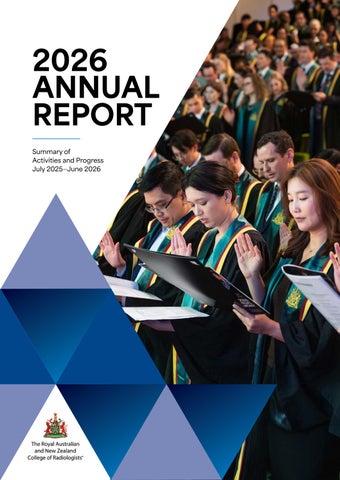
2026 ANNUAL REPORT Summary of Activities and Progress July 2025—June 2026
THE COLLEGE
THE ROYAL AUSTRALIAN AND NEW ZEALAND COLLEGE OF RADIOLOGISTS (RANZCR)
OUR PURPOSE
OUR VALUES
Excellence in diagnostic, interventional, cancer care, and radiation medicine. We deliver against our purpose through: Members We meet (or exceed) member expectations, supporting them into, through, and beyond their career journey. Our People We employ, develop, and encourage our people to align with our “member-centric” culture, to deliver outstanding solutions for our members. Education We set the standard for, and deliver world-class training, education and lifelong learning and development for members, to drive clinical excellence. Policy and Advocacy We are the leading voice of our sector and through rigorous research and standards, shape the policy agenda with government, regulators, members and external stakeholders.
RESPECT We treat each other, our members, and our stakeholders with the same dignity and respect that we would expect for ourselves. We hold each other to this standard. ACCOUNTABILITY We take ownership and responsibility for our actions, behaviour, performance, and commitments. INNOVATION We encourage our people to imagine ‘what could be’; to be curious and brave. We recognise and celebrate new initiatives and advances in how we deliver our purpose. INCLUSIVITY We foster an inclusive and safe workplace where our diverse people and members are all welcome. INTEGRITY We maintain the confidence and trust of our stakeholders through our honesty, transparency, and authenticity.
BOARD OF DIRECTORS
Dr Rajiv Rattan President
Prof Catherine Jones Elected Fellow
2
Ms Maryjane Crabtree Independent Chair
Dr Kate O’Connor Elected Fellow
Dr Barry Soans Dean, Faculty of Clinical Radiology
A/Prof Nicholas Brown Elected Fellow
A/Prof Dion Forstner Elected Fellow
Dr Tuan Ha Dean, Faculty of Radiation Oncology
Ms Yvonne Warner Treasurer
PRESIDENT’S MESSAGE
Dr Rajiv Rattan
I
t is my pleasure to report on the achievements of the College over the past 12 months, a year in which we have taken long strides advancing the interests of our professions and enhancing RANZCR's reputation and relevance as a pre-eminent international authority in clinical radiology and radiation oncology. This year we crossed the 5,000 mark in terms of membership across Australia, New Zealand and Singapore. The number of trainees in radiology and radiation oncology crossed 1,000 this year as well. We now have 267 training sites, and more than 700 members volunteer their services with RANZCR. RANZCR’s 2025-2040 strategic plan is well underway and we have made strong progress in the most vital aspects of its mission: member engagement, advocacy, training and standards. In member engagement, we have improved how we communicate with the membership through regular Board communiques, an improved website, a more customisable email preference system and the launch of our first podcast series. In addition, in response to surveys of members'
experience, RANZCR has commenced a program to aid its staff to better understand member needs and improve the quality of responses to their requests for information and support. In our advocacy work, the College has continued to provide policy advice to governments, regulators and stakeholders in both Australia and New Zealand, including discussions with the major political parties ahead of the forthcoming NZ national elections. In fact, we achieved a record number of formal government and regulatory consultations. Among the highlights was a key report we delivered to government on digital health to further efforts to improve access to prior medical imaging and thereby reduce inefficiency, delay and duplication. Topping our list of achievements has been the first year of the National Lung Cancer Screening Program (NLCSP), a $264m national initiative launched by the Australian Federal Goverment last year to tackle our most common cause of death by cancer. RANZCR's Australian and New Zealand Society of Thoracic Radiology special interest group has contributed a suite of educational resources, including webinars, workshops and training modules to assist radiologists to report in line with NLCSP requirements. The value of this work is hard to overstate. The screening program, which is based on low-dose CT, seeks to reduce lung cancer deaths by 500 a year through early diagnosis and treatment in highrisk patients without symptoms. Under the auspices of this landmark initiative, over 100,000 scans have already been reported and more
than 260 diagnoses of lung cancer recorded. Interventional radiologists (IR) and neuroradiologists (INR) have also received training assistance from the College in the form of handbooks, curricula and policies to support the IR/INR pathways, as well as an IR/INR accreditation framework for training sites. In addition, RANZCR has released a guideline on sedation to aid these practitioners to treat their patients in utmost safety. The development of practice standards remains a perennial and constant activity of the College. In 2025-26, we updated the important position statement on whole-body MRI in low-risk patients, a matter of wide public interest. Our Standards team also revised our foundational set of practice standards for clinical radiology and the College has begun a review of its guidance on iodinated contrast media. The updated guidance is expected to be completed soon. I cannot conclude without mention of our ASM in Melbourne last year. It was a crowning achievement in every sense: our biggest and most innovative to date, and a stunning example of the health of our profession and the intense scientific and technological development underway in this field of medicine. I look forward to seeing all of you in Christchurch for the 2026 ASM in October. The much awaited AI conference, Intelligence26, was also a huge success with over 340 attendees. I must thank my fellow Board members and College Fellows for their counsel and support, as well as staff for their tireless dedication. This is your annual report and I trust you will feel heartened by it.
3
TREASURER’S REPORT
T
Ms Yvonne Warner
“The College will continue to allocate funding to support operational resilience, research, education and the 2025-2040 Strategic Plan.”
4
he Financial Statements for the year ending 30 June 2026 along with the Auditor’s Report are presented in this document. A detailed version of the Financial Statements will be available on the College website www.ranzcr.com. Financial Year 2026 (FY 2026) marked another successful period, further solidifying the College’s financial position. The College generated an operating surplus of $3.7 million, exceeding budgetary expectations. This healthy surplus position was driven by increased revenue across key areas and effective expense management resulting in cost savings. Operational revenues totaled $31.1 million, an increase on FY 2025 with revenues of $29.9 million. Membership subscription revenues are the primary revenue resource, contributing $14.5 million (46 per cent of total revenue). This revenue also grew in FY 2026 by $0.6 million. Revenue continues having a stable trend compared with previous years. Total expenses were $29.8 million, an increase on FY 2025 expenses of $26.2 million. Expenses were below budget across most operating areas. The College maintains a robust balance sheet position. Total current assets stand at $57.3 million, offset by total current liabilities of $23.6 million. This results in a healthy liquidity ratio of 2.4 times. Cash and external investments collectively total $51.9 million. In alignment with the 2025-2040 Strategic Plan, the College is developing a comprehensive framework to prioritise investment allocation for
the medium-to-long term. RANZCR medical initiatives supporting College performance through FY 2026 are highlighted below.
2025-2040 Strategic Plan
In FY 2026, the College organised a member survey to collect feedback on member experience. We sincerely thank all members who responded to the survey and shared valuable feedback with RANZCR. Based on the survey, the College identified the areas for improvement to provide better service to our members. There are two projects—Member Service Re-Design and Learning Ecosystem Uplift—that the College is investing in for the purpose of strengthening the value RANZCR provides to members by creating a more connected and consistent member experience, supporting lifelong learning and CPD, enabling a modern workplace and providing a scalable foundation for the College’s future growth. The investment on these two projects is aligning with the strategic priorities of Member Fulfilment, Excellence in Lifelong Learning, and Workplace of the Future. In preparing the FY 2027 budget, funds and resources have been allocated to these two projects to ensure their successful execution.
Policy, Advocacy and Standards
In FY 2026, the College actively represented its position to governments, regulatory bodies and other stakeholders at both federal and state levels across Australia and New Zealand. This
program focuses on advocating to advance excellence in diagnostic, interventional and cancer care medicine, to optimise health outcomes for our patients and society. In addition, an Advocacy Charter was approved by the Board to publicise on the College’s website. This charter defines the College’s vision and strategy for maintaining and expanding our voice and ability to achieve positive changes from government. This charter provides clarity both on what the College will advocate for and what we will not advocate for and establishes principles for defining advocacy priorities.
Program Funding
In FY 2026, the College successfully filled all 52 Specialist Training Program (STP) positions, six Integrated Rural Training Pipeline (IRTP) positions, 2.5 Tasmanian Project (TAS) positions, and six Regional and Rural Training Pathway (RRTP) positions. The College remains committed to advocating for the continuation of funding and the further expansion of the RRTP beyond 2026.
Indigenous Members' Support In FY 2026, the College has successfully secured additional funding under the Flexible Approach to Training in Expanded Settings (FATES) initiative. This funding provided 12 scholarships to support existing and prospective clinical supervisors, Directors of Training, and College committee members in developing their expertise in medical education. Focus will be given to regional and rural clinical supervisors, First Nations Fellows, members of RANZCR education and training committees, and newly graduated student members. The College received a generous donation from the Flinders Radiology Education Association Incorporated (FREAI). The College
will use this donation to support Indigenous trainees who are in the RANZCR training program. We would like to express our heartfelt thanks to FREAI for this donation.
International Medical Graduates
In FY 2025, the College launched a defined scope pathway for assessment of international medical graduates. The defined scope outcome is restricted to Interventional Radiology, Interventional Neuroradiology and Paediatric Radiology. An international medical graduate assessed under a defined scope pathway will not be eligible for Fellowship of the College. In FY 2026, the College dedicated time to the preparation of launching a limited scope pathway for assessment of international medical graduates.
Memberships and Events
Training and education sessions led by the American College of Radiology (ACR) were hosted in August 2025, with 101 attendees joining. This was followed by the Melbourne ASM in October 2025 which had 2,017 attendees, 100 seminar sessions and 100 industry partner representations. The ASM offered a range of educational opportunities for members to attain their CPD hours. Member volunteers maintain a high level of engagement with the College, with over 700 members generously contributing their time and efforts in a variety of areas.
Technology and Infrastructure In FY 2026, the College continued developing and improving our infrastructure and systems to provide members with better user experience, streamline processes and minimise manual handling. The major achievements include: Automation of application processes, including CTCA/
Recertification, CR Exam Phase 1 and five major accreditation processes, resulting in reduction of manual invoicing by 79 per cent and saving hours across site assessments. The College adopted the AI tool Copilot, leading to increased staff productivity. Member portal and website upgrades now provide a better digital experience for members. A direct debit function was introduced to provide all members with more payment options. Cyber security practices were improved, mitigating the risk of cyber attacks and delivering a more secure website and member portal.
Financial Outlook FY 2027
FY 2027 is forecast to show continued resilience in the College’s financial position, with an anticipated surplus of $0.7 million. This is lower than FY 2026 for several reasons. First, additional investment and resources are being allocated to strategic projects. Second, the College will continue to develop ongoing programs relating to accreditation, trainee development and member support. Third, market volatility, softening macro-economic conditions and geopolitical uncertainty are expected to affect external investments and interest income. Continued price increases for resources and purchases are also anticipated. The College is marginally increasing fees by three per cent—less than projected CPI. As part of the investment framework, the College will continue to allocate funding to support operational resilience, research, education and the 2025–2040 Strategic Plan. The College’s balance sheet, cash position and investment portfolio values are also expected to remain healthy through FY 2027.
5
CEO’S MESSAGE
Duane Findley, CEO
I
n last year’s Annual Report, I spoke about the approval of our 2025-2040 Strategic Plan. This plan was never meant to sit on a shelf and gather dust and nor has it. This year has seen the College change the way we engage with our members, how we position ourselves externally, and how we transform ourselves to meet the challenges of the future, before those changes emerge in the ecosystem. A critical enabler for the College was being brave enough to ask the difficult questions of our members and be prepared to openly accept the feedback and to commit to make changes based on this feedback. Working with a professional group that specialises in uncovering and shaping members needs, we asked the hard questions though a deep and extensive survey, tested the results through a series of follow-up interviews, and conducted group workshops to test assumptions and potential solutions.
From this process, RANZCR developed a series of psychographic member profiles that more accurately reflect member segmentation and is now rebuilding its technological foundation systems to better meet member needs. We have invested in providing more resources to our SIGs, Branches and volunteers to better support their objectives. Threading through all of this, we are changing our culture to embed a ‘member first and central’ philosophy. We are still not perfect, and we don’t always get it right, but members are telling me that they have noticed the change and even on the rare occasions when we don’t get it right, that we listen, accept this and quickly move to create a resolution. One area of increasing change and uncertainty facing RANZCR and all the colleges, is that of increasing government regulation. Too often government sees the answer to any problem as ‘more regulation’ and this is certainly true in the health sector. The increasing complexity and breadth of regulation, and the increasing numbers and scope of health regulators, impedes RANZCR from delivering its core business and diverts our staff to delivering the needs of government over the needs of our members. The CPD framework is a good example of this, where the regulators continually add complexity to the program, then expect the College to resource against that complexity and
to deliver the changes to our members. RANZCR continues to advocate strongly on the issue of unnecessary government regulation, as part of a broader platform of change. At our last ASM, the College put forward three resolutions for member consideration and endorsement. Two of those changes, the creation of formal post-nominals for our IR/INR Fellows and a change to the branch network processes, were narrowly defeated. The College has taken on the lessons learned from these failed resolutions and will consider how best to address the issue raised, before we bring these back to the members for consideration at a future AGM. The vote on changing our articles to allow a non-Fellow to take on the role of Treasurer did pass and the Board has appointed our independent director Yvonne Warner as RANZCR’s first non-Fellow Treasurer. Yvonne’s strong background in accounting, finance, regulatory experience and governance are perfectly aligned with the requirements needed to be a successful Treasurer. The past year has been fastpaced and at times, very complex. Our continued success is a credit to the Board, Faculty Councils, volunteers, and members who contribute so much towards making the College the success it is; and to our RANZCR staff who do so much to deliver against our purpose and for the benefit of our members. Thank you all.
7
RANZCR AT A GLANCE MEMBER DEMOGRAPHICS
870 SPECIALTY
MEMBER TYPE
974 4,472
Life
Students
Educational Affiliates
Honorary
Radiation Oncologists
New Educational Affiliates
1,373
ACT
941
378
95
QLD
SA
TAS
1,200
485
934
VIC
WA
NZ
3,865
NSW
Male
1,900 Female
1 Other
RETIRED MEMBERS 583 NEW IMGs 46 TOTAL IMGs 697
240 OVERSEAS (NOT NZ) NON-MEMBER CPD PARTICIPANTS RANZCR Specialist Associates
19
New Trainees
NT
8
164
Clinical Radiologists
GENDER
6
191
Fellows
LOCATION 114
4,898
NEW MEMBERS
189 20 111
282
RANZCR Medical Associates
2
292
RANZCR Nursing and Allied Health Associates
Total
New Fellows
EVENTS ATTENDANCE 2,017
451
ASM
NZ Branch ASM
73
43
ACR Courses
Smart Workshops
437
951
Webinars
Branch Events
52
Radiation Oncology Radiotherapy Club Meetings
129 American Institute of Radiologic Pathology (AIRP) Course
MEMBER ENGAGEMENT SNAPSHOT 42
Members on the Board and/or Faculty Councils
6
Working Groups
17
Reference Group Panels
14
Special Interest Groups 8
105 Executive Members In
Special Interest Groups
JMIRO 1.5 JMIRO Impact Factor
2 Deputy Editors
1 Editor in Chief
32 Associate
237 Reviewers
Editors
THE COLLEGE ONLINE
COLLEGE SOCIAL MEDIA
RANZCR RESEARCH GRANTS AWARDED
TARGETING CANCER
4,712
5,263
5,900
3,300
12,151
1,896
X Followers
$95,036 Clinical Radiology
X Followers
Facebook Followers
$100,000 Radiation Oncology
Facebook Followers
LinkedIn Followers
CREDENTIALING
LinkedIn Followers
CT COLONOGRAPHY (CTC) RANZCR WEBSITE
269,000 Users
487,535
TARGETING CANCER WEBSITE
Sessions
50,000 Users
64,032
330 registered specialists (radiologists only)
Sessions
881,638
86,690
Page Views
Page Views
CARDIAC MRI 221 registered specialists (includes radiologists and cardiologists)
OTHER MEDIA AND ADVOCACY 78
Total Consultations
14
56,367,057
Media Releases
Total Media Reach
CT CORONARY ANGIOGRAPHY (CTCA) 992
registered specialists
TRAINING TRAINEES (JULY 2026) Clinical Radiology
AU 640 NZ 159 SING 2
Radiation Oncology
AU 124 NZ 48 SING 5
TRAINING PROGRAM SUPPORTERS 18
Network Training Directors, Clinical Radiology
7
27
IMG Assessors Clinical Radiology
6
IMG Assessors Radiation Oncology
Network Training Directors, Radiation Oncology
IMG ASSESSMENT APPLICATIONS
170
AU 117 NZ 42
Directors of Training, Clinical Radiology
73
Directors of Training, Radiation Oncology
Level A CTCA: 647 Level B CTCA: 345 (includes radiologists, cardiologists and nuclear medicine specialists)
Clinical Radiology
AU 5 NZ 2 Radiation Oncology
MEMBERS WHO MADE A FINANCIAL DONATION: 70
9
KEY ACHIEVEMENTS
Annual Scientific Meeting (ASM)
The 2025 ASM, held at the Melbourne Convention and Exhibition Centre, was the College’s most successful ASM to date. The meeting attracted a record 2,017 delegates, including representatives from Australia, New Zealand and 160 international participants. The meeting showcased several innovations, including the first-ever Radiology CloudBased Workshops delivered via the Collective Minds platform, attracting 164 participants across seven sessions. Additional handson workshops responded directly to member demand for practical learning formats. The ASM also achieved significant visibility and reach, with Croakey Health Media providing independent multimedia coverage, resulting in four feature articles, six video interviews and more than 120 social posts.
Continuing Professional Development (CPD) Program
RANZCR has continued to maintain high overall compliance of 95.5 per cent for CPD for the 2025 annual cycle. To further support members in meeting CPD requirements, the College now records CPD for College events, including attendance at committee meetings, and member volunteering activities, such as examining or participating as an IMG or accreditation assessor. In addition, the College continues to make enhancements to the CPD ePortfolio and is working towards implementing a new CPD platform.
10
Digital Experience Uplift
During 2025–2026, RANZCR’s Member Fulfilment Unit (MFU) delivered several major digital improvements that strengthened the College’s member-facing experience. The new RANZCR website launched in late 2025 with modern navigation, clearer content pathways and improved accessibility, forming the foundation for future personalisation and self-service. MFU also launched the College’s first podcast series, The Scan, expanding communication channels and increasing member engagement across Australia and New Zealand. Through the Digital Experience Strategy, RANZCR completed foundational improvements including the modernisation of the email preference centre. This work simplifies communication pathways, reduces unwanted email volume and supports more targeted, relevant engagement with members.
Digital Health: National Image Access Strategy
RANZCR continued its advocacy for improved access to prior imaging, working with government, industry and clinical stakeholder groups to develop a national roadmap for image sharing. The resulting Image Access Strategy and Consultation Report provides practical recommendations to support secure and interoperable access to imaging, helping reduce
duplicate examinations, improve clinical decision-making and enhance patient care. The report is expected to inform future national implementation efforts and digital health initiatives, laying the groundwork for more connected healthcare and seamless access to imaging across Australia.
Government Engagement
During 2025–2026, RANZCR continued to play an active role in shaping public policy across Australia and New Zealand through targeted engagement with government, regulators and sector stakeholders. A key part of this work was the College’s formal consultation program, which responded to 78 government and regulatory consultations across the financial year, supported by expert member input. The volume of consultations has increased year on year, reaching a record high in this period.
Interventional Radiology and Interventional Neuroradiology
RANZCR made significant progress in building a comprehensive professional pathway for Interventional Radiology (IR) and Interventional Neuroradiology (INR) practitioners. Together with members, the College developed handbooks, curricula, and supporting policies required for the new IR and INR Training Programs, while implementing an accreditation framework for training settings. The College has also established the IR and INR Grandparenting
Pathway, recognising the expertise of practitioners already working in these fields. Complementing these workforce initiatives, RANZCR released Sedation Guidelines for Radiologists to support safe, high-quality patient care. Together, these achievements strengthen training, recognition and professional standards for IR and INR across Australia and New Zealand.
Standards
During 2025–2026, the Standards team delivered several significant achievements that reinforced the College’s commitment to quality, safety and evidence-based practice. In July 2025, the Whole Body MRI Screening in Low-Risk Patients position statement was reviewed and republished, reaffirming that whole-body MRI screening is not recommended for asymptomatic patients without a diagnosed malignancy or cancer predisposition syndrome, based on the current evidence of benefit and potential risks. The position statement generated widespread media and public interest. Another major milestone was the release of the Standards of Practice for Clinical Radiology v12.0, the first major update since 2020. The revised standards provide a modern and practical framework to support consistent, high-quality and safe radiology practice across a range of settings.
Building on this momentum, the College commenced a review of the Iodinated Contrast Media Guidelines in 2026. This revision of another important standard reflects the team’s ongoing commitment to providing members with current, evidencebased guidance.
already contributed to the identification of 269 primary lung cancer diagnoses, reinforcing the potential of organised lung cancer screening to improve early detection and save lives through earlier intervention and treatment.
National Lung Cancer Screening Program (NLCSP)
Ahead of the New Zealand Government election on 7 November 2026, the College spent the past financial year advocating for the following priorities: 1. Safe and effective AI regulation 2. Connected digital infrastructure 3. Sustainable maternity ultrasound 4. Cancer treatment and imaging infrastructure As part of this work, the College met with political parties to seek commitment to these priorities.
The NLCSP, which commenced on 1 July 2025, completed its first year of operation with strong national participation and significant progress towards improving the early detection of lung cancer in Australia. Over the program’s first year, 103,963 Australians enrolled in the National Cancer Screening Register (NCSR), with an average of 285 new participants enrolling each day. More than 102,500 low-dose CT (LDCT) scans were completed across over 900 participating radiology practices, demonstrating strong uptake and broad access to screening services across the country. The RANZCR/ANZSTR developed NLCSP Structured Clinical Radiology Report and comprehensive education program have been central to building radiologist capability and supporting consistent, high-quality screening outcomes. Educational resources, including webinars, workshops and online learning modules developed by ANZSTR experts, remain available through the College’s NLCSP webpage. Importantly, the Program has
New Zealand Election Advocacy
Service Excellence Program
The College is progressing the Service Excellence Program, a multi-year initiative created in response to the 2024–2025 Member Experience Research. Led by MFU, the program is designing a new service model that will make it easier for members to get help, easier for staff to deliver support, and easier for the College to understand and respond to member needs. These changes aim to create a more reliable, personalised and seamless service experience that directly addresses member pain points and supports a more modern, connected College.
11
EXAMINATION RESULTS RADIATION ONCOLOGY Phase 1 Phase 1 Series 2 2025 Subject
Total No. sitting
No. passed
% passed
Anatomy
10
7
70%
Radiation Oncology Physics
11
10
90.0%
Radiation and Cancer Biology
7
7
100%
Phase 1 Phase 1 Series 1 2026 Subject
No. sitting
No. passed
% passed
Anatomy
35
28
80.0%
Radiation Oncology Physics
34
33
97.1%
Radiation and Cancer Biology
32
29
90.6%
Phase 2 Phase 2 Series 2 2025 Subject
No. sitting
No. passed
% passed
Radiation Oncology Written
15
13
86.7%
Planning Viva
15
13
86.7%
Clinical Cases Viva
15
12
80.0%
Phase 2 Phase 2 Series 1 2026 Subject
No. sitting
No. passed
% passed
Radiation Oncology Written
16
13
81.3%
Planning Viva
16
16
100%
Clinical Cases Viva
16
16
100%
2025 SITTING 2 CLINICAL RADIOLOGY EXAM PERFORMANCE Phase 1 Written Examinations Assessment
No. Candidates
No. passed
% passed
Anatomy
45
41
91%
AIT
60
50
83%
Phase 2 Written Examinations
12
Assessment
No. Candidates
No. passed
% passed
Case Reporting
121
59
49%
Radiology MCQ
119
85
71%
Pathology
144
105
73%
Phase 2 OSCER Assessment
No. Candidates
No. Full Sitters
No. passed Overrall Cut Score
% passed
OSCER
136
74
65
88%
OSCER Stations Station
No. Candidates
No. passed
% passed
Abdominal
88
80
91%
Neuro/Head&Neck
100
70
70%
Thoracic/Cardio
85
72
85%
Breast
86
71
83%
O&G
78
57
73%
MSK
90
75
83%
Paediatrics
86
69
80%
2026 SITTING 1 CLINICAL RADIOLOGY EXAM PERFORMANCE Phase 1 Written Examinations Assessment
No. Candidates
No. passed
% passed
Anatomy
136
118
87%
AIT
129
107
83%
Phase 2 Written Examinations Assessment
No. Candidates
No. passed
% passed
Case Reporting
161
90
56%
Radiology MCQ
136
106
77%
Pathology
135
112
83%
Phase 2 OSCER Assessment
No. Candidates
No. Full Sitters
No. passed Overrall Cut Score
% passed
OSCER S.1
141
86
67
78%
OSCER Stations Station
No. Candidates
No. Passed
% passed
Abdominal
91
81
89%
Neuro/Head&Neck
107
79
74%
Thoracic/Cardio
94
71
75%
Breast
99
81
82%
O&G
103
64
62%
MSK
96
74
77%
Paediatrics
99
82
83%
13
AUDITOR’S REPORT
14
FINANCIALS The Royal Australian and New Zealand College of Radiologists Statement of profit or loss For the year ended 30 June 2026 Consolidated Note
2026 $
2025 $
Revenue
4
31,129,368
29,977,526
Other income
5
2,435,608
2,481,969
(15,853,303)
(13,991,291)
Depreciation and amortisation expense
(675,704)
(538,819)
Council and committee costs
(3,117,453)
(2,947,041)
Annual Scientific Meeting costs
(2,228,564)
(1,554,245)
Printing, publicity and public relations
(290,998)
(354,258)
Professional, consulting and legal fees
(3,755,640)
(3,111,228)
(209,366)
(212,905)
Accounting and audit fees
(41,157)
(64,865)
Communication expense
(17,157)
(17,530)
(198,661)
(212,887)
Other administration expenses
(2,793,524)
(2,532,127)
Finance costs and banking charges
(666,655)
(633,297)
Surplus for the year
3,716,794
6,289,002
Expenses Employee benefits expense
Journal production and postage
Occupancy
The above statement of financial position should be read in conjunction with the accompanying notes, available via www.ranzcr.com
15
FINANCIALS The Royal Australian and New Zealand College of Radiologists Statement of other comprehensive income For the year ended 30 June 2026 Consolidated 2026 $
2025 $
3,716,794
6,289,002
Gain or loss revaluation of equity instruments at fair value through other comprehensive income
-
950,184
(Loss)/gain on the revaluation of equity instruments at fair value through other comprehensive income
(212,692)
573,809
Foreign currency translation
(541,840)
75,348
Other comprehensive income/(loss) for the year
(754,532)
1,599,341
Total comprehensive income/(loss) for the year
2,962,262
7,888,343
Note Surplus for the year Other comprehensive income Items that will not be reclassified subsequently to profit or loss
The above statement of financial position should be read in conjunction with the accompanying notes, available via www.ranzcr.com
16
The Royal Australian and New Zealand College of Radiologists Statement of financial position As at 30 June 2026 Consolidated Note
2026 $
2025 $
Assets Current assets Cash and cash equivalents
7
27,807,991
28,771,322
Trade and other receivables
8
2,347,681
2,282,899
Financial assets
9
24,096,018
22,838,669
Other assets
10
2,999,041
2,186,769
57,250,731
56,079,659
Total current assets Non-current assets Property, plant and equipment
11
14,359,237
14,371,573
Right of use assets
12
632,251
248,169
Intangibles
13
22,323
23,818
15,013,811
14,643,560
72,264,542
70,723,219
Total non-current assets Total assets Liabilities Current liabilities Trade and other payables
14
4,256,058
4,360,808
Contract liabilities
15
17,309,595
19,439,296
Lease liabilities
16
196,173
146,259
Employee benefits provisions
17
1,854,802
1,472,269
23,616,628
25,418,632
Total current liabilities Non-current liabilities Lease liabilities
18
510,429
119,147
Employee benefits provisions
19
310,416
281,664
820,845
400,811
Total liabilities
24,437,473
25,819,443
Net assets
47,827,069
44,903,776
Total non-current liabilities
Funds Fair value reserve
20
12,912,666
13,125,358
Reserves
21
2,298,263
2,576,093
Accumulated funds
32,616,140
29,202,325
Total funds
47,827,069
44,903,776
The above statement of financial position should be read in conjunction with the accompanying notes, available via www.ranzcr.com
17
FINANCIALS The Royal Australian and New Zealand College of Radiologists Statement of changes in equity For the year ended 30 June 2026 Accumulated Funds $
Reserves $
Total funds $
Consolidated Balance at 1 July 2024
13,846,618
23,111,103
36,957,721
Surplus for the year
-
6,289,002
6,289,002
Other comprehensive income/(loss) for the year
1,599,341
-
1,599,341
Total comprehensive income/(loss) for the year
665,817
5,865,937
6,531,754
Transactions with members in their capacity as members: Transfers from reserves to accumulated funds
1,599,341
6,289,002
7,888,343
Balance at 30 June 2025
15,701,451
29,202,325
44,903,776
Accumulated Funds $
Reserves $
Total funds $
Consolidated Balance at 1 July 2025
15,701,451
29,202,325
44,903,776
-
3,716,794
3,716,794
Other comprehensive income/(loss) for the year
(754,532)
-
(754,532)
Total comprehensive income/(loss) for the year
(754,532)
3,716,794
2,962,262
264,010
(302,979)
(38,969)
15,210,929
32,616,140
47,827,069
Surplus for the year
Transactions with members in their capacity as members: Transfers from reserves to accumulated funds Balance at 30 June 2026
The above statement of financial position should be read in conjunction with the accompanying notes, available via www.ranzcr.com
18
The Royal Australian and New Zealand College of Radiologists Statement of cash flows For the year ended 30 June 2026 Consolidated 2026 $
2025 $
Receipts from grants, managed government programs funding
11,712,434
13,783,717
Receipts from members
13,738,664
16,402,968
Receipts from exam, training and education, courses, and other service revenue
13,660,300
11,923,424
1,537,677
1,839,028
(40,550,292)
(39,750,487)
98,783
4,198,650
(666,655)
(633,297)
(567,872)
3,565,353
(487,156)
(1,433,812)
Net purchase of financial assets
(1,903,694)
157,530
Interest and investment income
2,220,739
1,888,435
(170,111)
612,153
Interest and principal payments for lease liabilities
(225,348)
(2,486)
Net cash from financing activities
(225,348)
(2,486)
Net increase in cash and cash equivalents
4,175,020
7,320,769
Net (decrease)/increase in cash and cash equivalents
(963,331)
4,175,020
Cash and cash equivalents at the beginning of the financial year
28,771,322
24,596,302
27,807,991
28,771,322
Note Cash flows from operating activities
Other receipts Payments to suppliers and employees Interest paid
Net cash from operating activities Cash flows from investing activities Purchase of property, plant and equipment
Net cash from/(used in) investing activities Cash flows from financing activities
Cash and cash equivalents at the end of the financial year
7
The above statement of financial position should be read in conjunction with the accompanying notes, available via www.ranzcr.com
19
20
21
NEW FELLOWS ACT Jiawen Ma Mike van Alphen
NSW Adrian Law Alexandra Powell Alvin Tan Audrey Lim Carmen Swanton Charles Osborne Daniel Gao Danny Hyun Dominic Ku Felix Zibold Hawraa AlNaqshabandi
Vincent Tran
Daisy Atwell
William Riddell
Daniel MacManus
Youngeun Koo
Philippa Johnstone
David Chang
Amy Chan
David Hiller
Amy Clucas
S Maryam Shekarforoush
Duncan Lyons
Arpit Talwar
Esther Odera
Brigitte Russell
Aaron Vergeer
Hatem Mawi
Callum Umstad
Benjamin Rusius
Henry Smith
Christina Giudice
Chirag Udhani
Igor Fomin
Cillian McNamara
Ethan Ling
James Lee
Holly Egan
Jarrad Koppen
Jessica Kusel
Jeffrey Alexis
Katherine Tse
Kavitha Dandu
Kavindu Weerasekera
Kylie Lopes Floro
Dumindu Herath Mudiyanselage
Liana Franciscatto Wagner
Faranak Mohammadi Filip Ruppeldt
Mohamed Elsayed
Harry Yip
NZ Aamenah Al-Ani
Liam McRedmond Michael Sunderland Michelle Marais
Damian Flanders Dhanusha Kankanam Gamage
Michelle Rajaretnam
Mohamed Anwar
Jason Gan
Ian Teng Weng Yew
Samuel Reeves
Mohamed Abdelhady
Jasbon Andrade
Jasjit Walia
Sophie Robinson
Oakley Dew
Jenny Chan
Joanna Kao
Tae Gon Yoo
Pereshin Moodaley
Jessica Lee
Kajal Shah
Thomas Manning
Permesh Dhillon
Joshua Wei Liang Yip
Karen Huang
Tian Weng Leong
Rachele Quested
Lincoln Dinh
Yizhou Wang
Rebecca Liong
Meisam Izadi Meydene Ong Navtej Chhibber Neel Gore Nicole Khor Nigel McGregor Parvathy Suresh Kochath Peter Brien Renee Duvenage Riche Mohan
Rhys Judd
Overseas Caryn Wujanto
Sarah Li Shanalie Dias
Harry Alexander
Shona Edwards
Jesse Ende
Thokozani Sibanda
Luke Hilliar
Tse Yan Becky Chan
Nadun Vithanage Nin-Yuan Pan Raphael Girardet Teri Ying Yuan-Hong Lin
Wei Shyan Soon Zubair Syed
SA Suzan Bahadir
QLD
Tayyuba Saqib
Sheng Teh
Amila Siriwardhana
Simon Ahmadpour
Annika Cruickshank
TAS
Siobhan Lee
Charles Beames
Sanjay Hettige
Shanuka Samaranayake Aidin Khaghani
Edward Chmiel
Tarek Eid
Samuel Lutalo Chi Lap Nicholas Tsang Bossa
Thompson Ly
Christopher Burley
Tony Bose
Samuel Cooke Samuel Pearce Seamus O'Flaherty Tracy Liu Yamuna Kodikara
Coralie Simoni
Hugo Reynolds
Mark Bishay
Nathan Hearn
Amit Verma
Luke Kissane
22
VIC
Kevin Armstrong Lorenztino Admojo Louisa Thong Mahboubeh Abedi
WA Anisa Ahmed Ashik Amlani Daren Tan James Waldron Jayant Vishal Jemma Ford Kamal Dabas Kaspar Yaxley Kristopher Pataky Kumar Ramavathu Nathan Jenko Nihar Jha Peter Xiao Rathnayake Rathnayake
Michael Phan
Roger Smyth
Michelle Foo
Ryan Pereira
Mithun Nambiar
Vincent Tiong
Namit Mathur
Zebadiah Melvin
COLLEGE GRANTS, AWARDS AND PRIZES College Honours Roentgen Medal
Bourne and Langlands Prize
Best Proffered Paper: MSK & AI
Dr Chia Ching Lee
Dr Mike van Alphen
Roentgen Medal
ASM Prize Recipients
Honorary Fellowship
Branch of Origin Prize (SA/NT)
Prof Bryan Burmeister Prof Ken Miles
Prof Elizabeth Dick
Dr Minh-So To
RANZCR Community Services Award
VIRQ Best IR Presentation
Ms Lee Hunt
Research Awards and Grants RANZCR Research Grant - Clinical Radiology Dr Subhashaan Sreedharan, Dr Aaron Wong, Dr Tahleesa Cuda, Dr Minh-Son To
RANZCR Research Grant - Radiation Oncology
Dr Joseph Chan, Dr Shanuka Samaranayake, Dr Anna Lawless, Dr Lucinda Burke, Dr Therese Kang
Withers and Peters Grant
Dr Lucinda Burke
Radiation Oncology Large Research Grant Dr Alison Salkeld
Faculty of Clinical Radiology Indigenous Health Prize Prof Warren Clements
Clinical Radiology Early Career Researchers Prize Dr Rueben Schmidt
Quality Improvement Project Prize A/Prof Wee Loon Ong
Dr Alannah Paparo
IRSA Trainee Prize Dr Alannah Paparo
Varian Prize Dr Gina Franklin
Wiley Best Exhibit Award Dr Annah Lane
Chris Atkinson Award
United Imaging Best Proffered Paper for Neuro/Head & Neck Dr Yuze Zhai
United Imaging Prize – Best Proffered Paper: Abdomina Dr Chandan J Das
United Imaging Prize –Best Proffered Paper: Breast & Cardiothoracics Dr Ashreya Duvuru
United Imaging Prize Education & Research Indigenous Health and Quality & Safety ASM 2025 Dr Charles Li
Dr Jarad Martin
EVIQ Prize RO Oral Presentation
Elekta Award
Dr Youngeun Koo
Muhammad Ali
United Imaging Prize – Best Proffered Paper for Obstetrics, Gynaecology & Paediatric
FROGG Award
Dr Mario Guerrieri
NZRET RO Research Award Dr Sri Wuppuluri
Monash Health Imaging – Best Poster
Dr Shohreh Sadrarhami
Wiley Best Exhibit Award A/Prof Yvonne Zissiadis
Dr Azri Johari
Branch of Origin Prize (National) Dr Minh-Son To
Monash Health Imaging – Best Oral Presentation Dr Qi Rui Soh
United Imaging Prize – Best Proffered Paper for Emergency Radiology & Professional Issues Dr Nihar Jha
United Imaging Prize –
Educational Fellowships Bill Hare Fellowship Dr Verity Wood
Thomas Baker Fellowship Dr Vineet Gorolay
Exam Prizes 2025 CE Eddy Prize for Clinical Radiology Dr Andrew Ni
2025 CE Eddy Prize for Radiation Oncology Dr Rebecca Holland
2025 HR Sear Prize Dr Arun Ahluwalia
2025 MGF Donnan Prize Dr Alexander Chua
2025 Uhr Clarke Bursary Award Dr Casey Filce
Branch Awards NZ Radiology Education Trust Proffered Paper Prize Dr Jane Peart
NZ Radiology Education Trust Proffered Paper Prize Dr Dorothy Lombe
NZ Radiology Education Trust Poster Prize Dr Ciléin Kearns
Obex Medical Registrar Research Award Dr Ciléin Kearns
Faculty of Radiation Oncology Training Network New Zealand Prize Dr Dushiyanthi Rasanathan
23
SPONSORS We acknowledge the valuable support provided by the following sponsors throughout the year:
Eisai Australia
1Medical
EIZO APAC
4DMedical
Elekta
Adecco Australia
EPIC-X
Adva Health Solutions AGFA HealthCare Australia Aidoc Alpha XRT Annalise ai Arkturus Astra Zeneca AtecSpine
Everlight Radiology EverX eviQ - Cancer Institute NSW Evoke Projects FUJIFILM Gamma Gurus
Garran Medical Imaging Australian Clinical Dosimetry Service Australian Digital Health Agency Bayer BD Becton Dickinson Boehringer BOQ Specialist Boston Scientific Brainlab Australia Brilliant Medical & Auralis Health Canon Medical Systems ANZ Canopy Imaging Carestream Dental CARPL.ai Inc Comrad Medical Systems Cook Medical Core Schedule Crowd It Diagnostic & Medical Eagleheart Health Spaces
GCG Global Healthcare
GE HealthCare Australia GenesisCare Gleamer GRC Surgical Guerbet Australia Harrison.ai Healthinc Hospital Staff Solutions HosPortal ICON Cancer Centre I-Med Inari Medical Australia INLINE Systems Integral Diagnostics (IDX) Intelerad Interfuse Technologies Interite Healthcare Interiors Ipsen I-TeleRad Kailo Medical Kestral
Legacy Risk Advice LG Electronics Australia
SeeTreat
Life Healthcare Lumus Imaging
Sieverts Radiation
Lungscreen Australia
Soliton IT
Matrix Medical Imaging Medality MedCurrent Corporation
Siemens Healthineers Protection Consultancy Solventum Sonic Healthcare Australia Radiology
Stryker Medical Indemnity Protection Society (MIPS) The Ohio State University Medrecruit Medtronic Australasia
Thynk Health
Medi Financial
Varian
Merit Medical MFAS Mundipharma National Lung Cancer Screening Program ParagonCare Perth Radiological Clinic Philips PIXXGEN Corporation
United Imaging Healthcare Vengage AI Vision Radiology Volpara Voyager Imaging VSI Co Western Radiology Wollongong Diagnostics
Precise Radiology PREH Prenuvo Australia Professional Radiology Outcomes Qscan Services Quantum Medscan Radformation RapidAI RaySearch Australia RHCNZ Riverain Technologies Sectra
DECEASED MEMBERS It is with regret that we record the deaths of the following members during the year under review: Dr Roger Burgess, Dr David Clowes, Dr Clive Donohoo, Dr Peter Hunter, Dr Roger Livsey, A/Prof Nina Sacharias, Dr Samuel William
24
Level 9, 51 Druitt Street, Sydney NSW 2000, Australia. ABN 37 000 029 863 T +61 2 9268 9777 E ranzcr@ranzcr.edu.au
Level 3, 139 The Terrace, Wellington,
New Zealand T +64 4 472 6470 E nzbranch@ranzcr.org.nz
www.ranzcr.com Copyright for this publication rests with The Royal Australian and New Zealand College of Radiologists® RANZCR acknowledges the Traditional Owners of Country throughout Australia. We recognise the continuing connection of Aboriginal and Torres Straight Islander people to the sky, lands, waters and culture and we pay our respect to their Elders past, present and emerging. RANZCR acknowledges Māori as Tangata Whenua and Treaty of Waitangi partners in Aotearoa New Zealand.