“Simple Pleasures” Issue – Spring 2026 published by Randolph Community College. Uwharrie Dreams Magazine and Randolph Community College maintain the copyright for this publication and its contents. Copyright for featured works in this issue reverts back to the writers immediately after publication. Reproduction or alternative use of stated material cannot be made without the consent of Uwharrie Dreams Magazine or RCC. For further information concerning reproductions, please contact Victoria Davis (vldavis@ randolph.edu). Written works include student and faculty/staff winners from the Uwharrie Dreams Creative Writing Contest of Spring 2026. Congratulations to you all!
Uwharrie Dreams supports and advances RCC student endeavors in all genres of creative writing and the visual arts. We encourage creative exploration, self-expression, teamwork, and the development of skills in current and emerging media.
Uwharrie Dreams is a club for students interested in creative writing, operating under the auspices of the Student Government Association. It began in 2003 as part of the fine arts activities for Randolph Community College students. This group helps students prepare submissions to RCC’s Writers Contests, sponsored by the SGA.
For more information about the Uwharrie Dreams club, contact its faculty advisors: Victoria Davis (vldavis@randolph.edu) and Chrystal Rich (cdrich@randolph.edu).
Having The Last Laugh: A Simple Pleasure
ARIEL ISOLDE, TRANSLATED FROM THE ICELANDIC
BY DR. G. WARLOCK VANCE
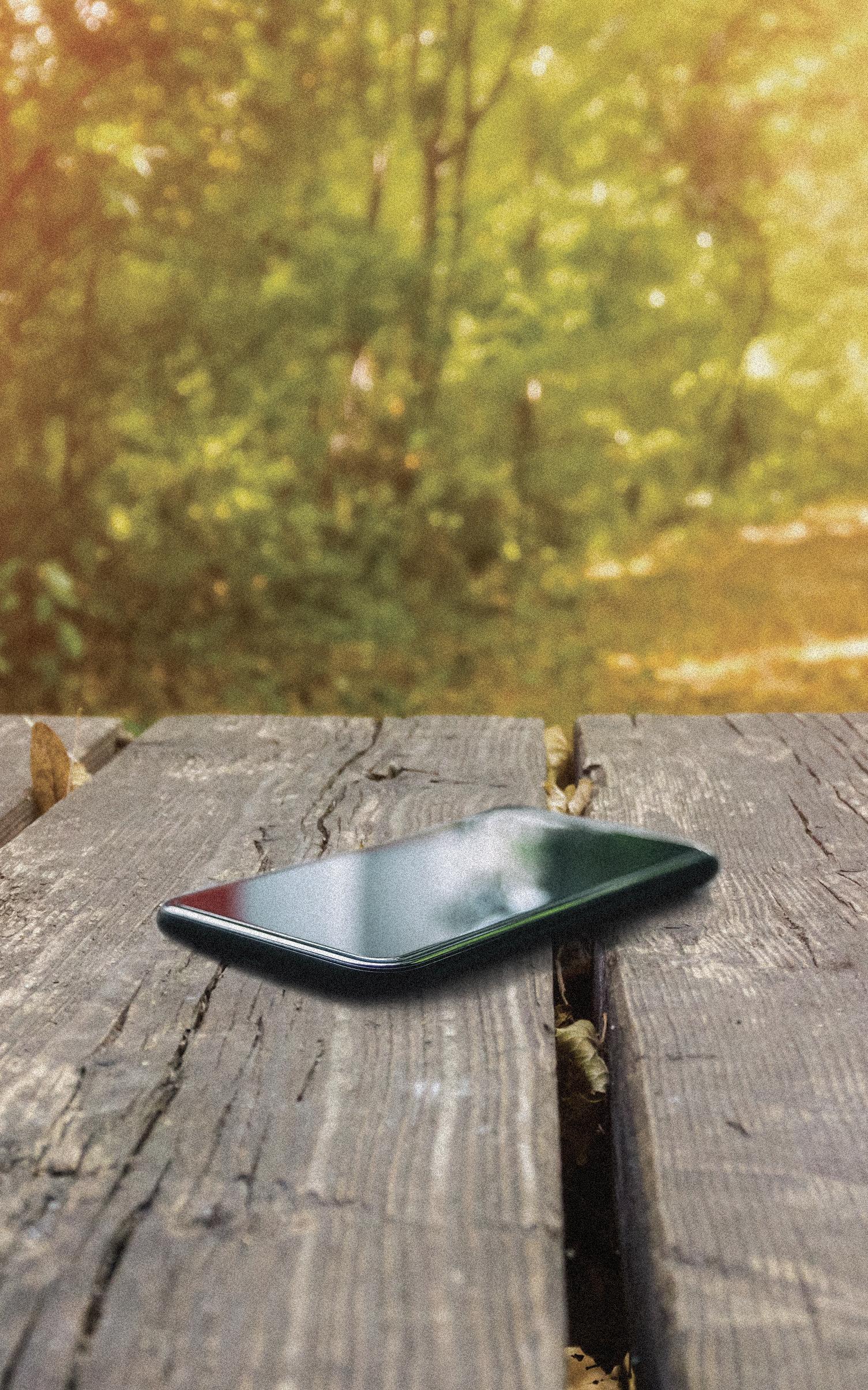
Before I died, I used to carry my cellphone everywhere. I don’t mean the way people slip the thing into their pocket as they head out the door, I’m talking room to room, into the john, to the kitchen for a can of soda, even stepping out to grab the mail. It didn’t matter what I was doing, the device was always there, tucked into a shirt or trouser pocket, as if physically attached, an electronic (and slightly radioactive) part of me.
Unlike those addicted to constantly scrolling through social media, catching up on their daily dose of banality, I hardly ever looked at mine. I despised texting, had less than a dozen friends on Facebook, and spent as little time as possible talking on it. For some, their phones provided a wealth of entertainment—simple pleasures to get them through their days. Not me. I’d rather read a book, watch a movie, or create something out of nothing by placing words on a page.
Although I didn’t use my phone the way others employed them, my obsession (more like paranoia) with carrying it was no less profound. This impulse was largely based on a sense of security—although perhaps insecurity might better describe what I felt. I assumed that if I had the phone I was prepared for anything. Engine trouble on the highway? Call for a tow. Involved in an accident? EMS and police are apprised of the situation with three short taps. In this fashion, the phone represented a kind of insurance, my protective shield against all manner of calamity—act of God, or otherwise.
When I think back upon my life and realize all of the hazards I’d survived, I cannot help but marvel that my demise did not come sooner.
Born feet first, the umbilical cord wrapped so tightly around my neck I turned blue, I resembled a shriveled and lifeless Smurf instead of an adorable newborn. Some quick thinking on the part of a young intern named Dr. Gregory got my heart going. My mother thanked this fine gentleman by giving me his name.
Falling off of a horse at the age of 5, I landed smack on the top of my head. If I’d hit a rock, I might have dashed my brains out, but after a good cry, I was sore, yet considerably wiser.
Five years later, my best friend and I decided it would be a good idea to sword fight with slats of wood atop the garage. Our overactive imaginations transformed this structure into a majestic palace. The roof’s meager pitch made it easy to maintain our footing.
We’d scrambled to the peak to peer over the parapet of our keep. Then, grabbing our makeshift weapons, we feinted and parried, back and forth across the tarry shingles. Having forced me to the edge, my buddy lunged, poking me in the stomach. I lost my balance and, in a desperate attempt to save myself, grabbed hold of his shirt. Both of us plunged earthward. I ended the descent on my back and my pal fell on me. I broke his fall; he broke my arm.
The very next year I smashed my bike into a fence requiring stitches to my left knee. Thereafter, apart from the usual scrapes, cuts, bruises, and near misses, myriad incidents occurred. Like the time I was concussed by a line drive
baseball, cracked several ribs when I bellyflopped from a skateboard, sprained an ankle during my only attempt at rock climbing, barely survived a particularly virulent case of strep throat which also took much of my hearing, walked away unscathed when my car was struck by lightning, and made it through a heart catheterization without the usual anesthesia.
All of that happened long before the advent of cellular devices. Thinking about that still gives me pause. Stuff went down in that pre-phone era, but even without a way to instantly communicate, we managed to get on with our lives.
What finally laid me low seems embarrassing compared to the rest I’ve just described. I mean, I survived a bolt of lightning hotter than the surface of the sun passing through my vehicle while I’m driving, only to crap out one afternoon while helping a neighbor clear out his garage.
We were tossing bits of junk and old tools into a heap, intending to scoop them up and toss them into the bed of his pickup and haul them to the dump. I was carrying a handful of rusty rasps and screwdrivers when he made some comment. As my hearing was bad, I turned, asking him to repeat what he’d said. Doing so, I tripped, falling forward. I landed hard, the business end of a Phillips screwdriver fitting neatly between the costal cartilage and straight into my heart.
I had just enough time to clasp my hand to my pocket, and felt my cellphone, fully charged, ready for any emergency. It rested a mere three inches from the shaft of steel that had forced my soul to leave. An instant of white-hot pain, a twitch of my right arm, and a final exhalation no louder than an exasperated sigh. Only a second or two, but time enough to muse over the simple pleasure of breathing—air in, air out—a nearly unconscious reflex upon which so much else in our too-short lives desperately depends.
If that screwdriver hadn’t killed me, the sheer stupidity of how I’d died would have done so.
My neighbor rolled me over to see if he could help, saw my limp and lifeless form, and fished the phone from my pocket. The last thing I heard in this world was the three taps as he dialed 9-1-1. The irony of the situation was not lost upon me. Despite the grim outcome, the absurdity of it all allowed me a final moment of humor with the realization that, at the very least, I’d had the last laugh. FINIS
Simple Pleasures
DARLA RICHARDSON
Dipping toes in the creek in summertime
Listening to the tinkle of the wind chime
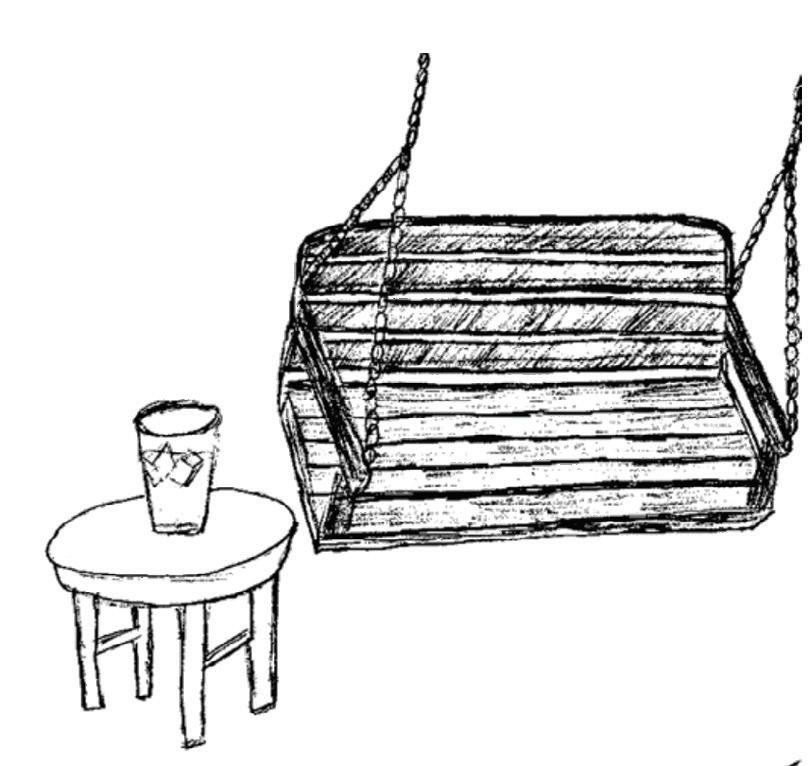
Sitting on the front porch with a glass of tea
Talking about the times that used to be.
Dog by your side on the way to the pond
Something about that canine bond
Kitties meow and sit on your lap
Watch out, now, you fell in the trap!
Fresh cut grass and a front porch swing
Working hard and not doing a thing
Chasing bees and butterflies
Talking about how times gets by.
Precious moments gone too soon
Following the changes in the moon
Crickets screaming and hoot owl sounds
Darkness and shadows all around
Births and deaths seem to come together
And everyone likes to complain about weather
It’s hard and it’s fun and all sorts of things
Oh, the simple pleasures this life can bring.
- Where Are You Now? -
DECKER J. MARTIN
Your only goal was coffee.
Monday morning missed notifications gradually pushed the arrow on the speedometer further to the right until it reached the equivalent number of emails you needed to read before noon.
The highway ended and rush-hour began, lasting far more than the hour English had allotted it. The arrow on the speedometer frequently reached the amount of patience you had left--zero.
As you pulled into the parking lot of your well-paying prison, your pocket vibrated again.
But something was different.
Best Friend.
First text in what felt like centuries.
Was that title even accurate anymore?
“Hey. It’s been three years.
Where are you now?”
Where are you now?
You’re situating your soul between white lines painted on the tarmac, avoiding invisible walls so you don’t collide with somebody else’s life.
But someone’s life collided with yours.
“I’m good,” type your fingers of their own volition. Are you, though?
“I didn’t expect your text today.”
“I hope I’m not bothering you,” she responds.
“I know you have a life too. I was just reminiscing about the good times, when the only thing that made us rush was the twinkle of Fur Elise trickling down the lane as the ice cream truck drew near.”
Your eyes glaze over as you type again, and two hours pass in the space of seconds.
The simple pleasure loses its simplicity, but the unexpected text will always bring a pleasant joy to brighten any day made dark by the gloominess of monotony.
The Candle Asked Nothing
BRADLEY BRITT
Maggie walked into the room. A candle sat centered on the table, unlit and patient, as if it had been waiting on her return. One chair rested beneath the table, cold in a way that felt intentional; she drew it out slowly, the legs whispering against the floor. She sat and reached for the lighter. Her thumb rasped the wheel; the sound landed sharply, and the walls seemed to shiver as though they heard it. The spark called, the wick answered, and an orange hue crept into the emptiness that had been listening. The books along the shelf caught the first edge of light and shimmered, then settled into stillness. Maggie became fixed on the flame.
The flame narrowed the world. Corners softened into shadow. The clock above the doorway continued its patient turning, but the sound did not reach her. Candlelight made honest shapes out of ordinary objects and then betrayed them, stretching a shadow, erasing a line, until the room felt less like a room and more like a single held breath. In that breath, her thoughts began to circle. Not rushing. Not crashing. Returning again and again, like something that had learned this path by heart.
The patterns arrived first. She watched the flame lean, correct itself, and steady. She recognized the motion in her own life: the way she began with clean certainty and then, just as quietly, moved the finish line further away. Tomorrow became next week. Next week became when things were calmer. When things were calmer became when she felt like it. Feeling like it sounded harmless, even gentle, but it became a rule she never named. She could call it patience, timing, or being realistic. The candle did not accept. It only held its light and waited.
Avoidance followed behind the patterns, always changing costume but keeping the same face. In daylight it hid under being busy, tired, practical, and sensible. In candlelight it had nowhere to stand. No audience, no applause, no excuse dressed as reason. Candlelight did not care what she meant to do, only what she did. Maggie stared into the flame until her eyes watered, from the insistence of looking. The sting felt clean. Honest. Unforgiving in a quiet way.
She saw how easily she could catalog her flaws with the precision of a stranger. She could name, trace, explain their origin, and connect them to the past like threads pulled tight between her fingers. She could do it calmly, elegantly, as if analysis itself were evidence of progress. Understanding had become another room she could sit in. She had grown good at sitting. Good at watching. Good at letting insight pass through her like wind through an open window.
The truth, when it came, never arrived as a sentence. It arrived as a sensation, clear and irritatingly simple. Tonight, it settled in the space between her ribs, where breath turned into thought. The flame did not grow larger. It did not flare. It kept burning, steady as a held gaze, and in that steadiness, Maggie understood something she refused to dress up: she liked this version of herself. Not the part that suffered, not the part that struggled, but the part that could see everything and remain untouched. The candle gave her a place to be honest without consequence. It let her confess privately and then return to the
world unchanged, like someone rinsing their hands in warm water and calling it clean. That was the pleasure. Not the light. Not the scent. Not the quiet. The relief of knowing and not having to do.
Time did its quiet work. The wick curved, darkened at its tip, and the flame shortened without announcing itself, drawing smaller and smaller breaths. Light thinned across the table, slipped from the books, and failed to reach the corners it had ruled minutes ago. Maggie remained seated, hands still, eyes steady, watching the room regain its weight. The candle guttered once, then went out on its own. A thin ribbon of smoke lifted where the flame had been and vanished into the ceiling.
The darkness returned, complete and ordinary. Maggie waited for it to feel like punishment. She waited for the ceiling to press lower, for the walls to lean in with quiet judgment. Nothing happened. The house stayed where it was. The books held their silence. Her breathing continued, steady as ever, as though the moment did not deserve a reaction. In the dark she understood something she had almost mistaken for hope: the candle had never been a door. It had only been a border she loved to stand behind. It let her watch without crossing.
Habit reached for the lighter anyway. Her thumb rolled the wheel. A small blue flare snapped into existence and died. She tried again. The rasp sounded louder than it should have in a room this empty. Another spark, another brief bloom of heat, the wick, defeated, falling inward as if it were tired of pretending. She held the flame a second longer, as though patience could persuade it, and then she set the lighter down. The motion was small, almost careless, but it landed in the silence like a decision.
Maggie waited for disappointment to arrive. It did not. What came instead was relief, cold, clear and impersonal. The refusal did not feel cruel. It felt factual. There was something almost forgiving in that fact: the world did not demand that she improve simply because she had finally understood. Understanding did not rearrange her. It never had. Her eyes adjusted out of instinct, searching for leftover light. They found nothing. No hidden outline. No secret shape waiting behind the absence. Only blackness, whole and indifferent. Maggie stayed seated. Not because she could not change, not because she refused to, but because she did not. The room did not argue with her. The night asked nothing, and in that, there was a peace so cold it could almost be mistaken for mercy.
The Silence In Between DESIRAE RICH
When the chaos of the day finally ends, and all the motions have been cycled through tenfold, heart feeling too heavy to hold and body weary, I walk to my car to head home. Not just to the four walls and a roof, but to my other half.
Her. The way her eyes light up when she tells me about the adventures of her day from an ecstatic point of view. Or the way she makes me laugh until I cry with as little effort as a swat at a fly. I see myself in her, which all makes sense because she’s the younger version of me after all.
Oftentimes, I feel like I take this feeling for granted, the happiness I feel while talking with her. We do almost everything together, from shopping till we drop to trying new foods or starting a new show together. However, there is one thing that I have come to appreciate more than anything else as I get older. Our silence.
I could argue that it is just as important as our loudest moments. The inbetween. The time we spend side by side, tanning at the beach or napping in the living room after a nice day out at the pool. It’s the times that she’s sat there with no judgment after I spill my heart out with the heaviest feelings that burden my soul.
It’s the silence in our lives that we should appreciate more. Because while most take silence for resentment and judgment, it can just as easily mean the opposite: love, patience, understanding, and comfort. Many feelings that are so rare to find with people in today’s world, consumed with screens and the rapid void of crumbling pure human connections.
Sometimes it is nice to simply just be — to sit with someone you love most. A person who understands you even if no words are spoken. A simple pleasure that all should strive to revive.