V
t
OS'I$
-ON
S86I
JUIJ
TWiWOT 71O/J/7O/
TABLE OF CONTENTS 1. 2. 3.
EDITORIAL DISTURBING THEIR PEACE
2
THE NEXT WAVE Thoughts on Revolutionary Feminism
4
AZANIA: THE FIRE THIS TIME By the New Afrikan People's Organization
15
DE PIE Y EN GUERRA Interview with Puerto Rican POW Oscar Lopez Rivera
23
5.
DON JUAN ANTONIO CORRETJER (1908-1985)
25
6.
THE NEW RIGHT: WITH GOD ON THEIR SIDE
35
7.
FROM THE CLANDESTINE MOVEMENT Red Guerrilla Resistance Bombs NY Patrolmen's Benevolent Association
45
CAN'T KILL THE SPIRIT: Statements From Revolutionary Prisoners New York 8 The Ohio Five Susan Rosenberg and Tim Blunk
47 48 50
WRITE TO THE PRISONERS.
51
4.
8.
9.
To Puerto Rican Patriots Don Juan Antonio Corretjer (1908—1985) and Dona Consuelo Lee Tapia de Corretjer we dedicate this issue. For your unceasing commitment to revolution, your unshakeable belief in the human spirit and its ability to vanquish even the mightiest of enemies. You have shown us with your lives what it means to be true communists. That nowhere can our humanity be better realized than in the fight for independence and freedom.
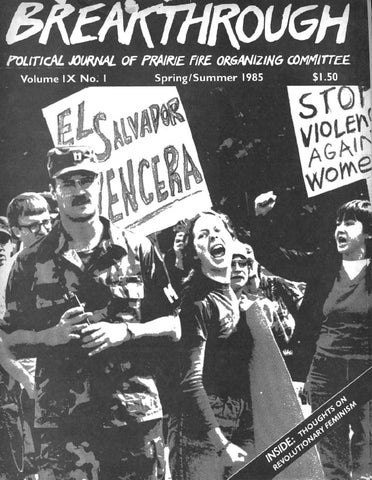
Breakthrough, the political journal of Prairie Fire Organizing Committee, is published by the John Brown Book Club, P.O. Box 14422, San Francisco, CA 94114. This is Volume IX, No.l, whole number 12. We encourage our readers to-write us with comments and criticisms. You can contact Prairie Fire Organizing Committee by writing: San Francisco: P.O. Box 14422, San Francisco, CA 94114 Los Angeles: P.O. Box 60542, Los Angeles, CA 90060 Chicago: Box 253, 2520 N. Lincoln, Chicago, IL 60614 Subscriptions are available from the SF address: $6/4 issues, regular; $15/yr institutions. Back issues and bulk orders are also available. Make checks payable to John Brown Book Club. Prisoners' correspondence and subscriptions should be sent to the LA address.
J
TWO, THREE, MANY VIETNAMS! Along with people everywhere, we celebrate the 10th anniversary of the Vietnamese people's Great Spring Victory.
Our mountains, our rivers, our people will always be; The American invaders defeated. We will rebuild our land ten times more beautiful* —Ho Chi Minn
EDITORIAL
DISTURBING THEIR PEACE The Reagan plan is a gun pointed to our head by the great American superpdwer...,T is no peace proposal at all. It is like a declaration of war. • . ::« ; >!.K;V; : Miguel D'Escbto Nicaraguan Foreign Minister
Coldly and with brutal calculation, the U.S. has issued what amounts to a declaration of war against oppressed peoples. From its open support of the racist i regime in Pretoria, to its sponsorship of Israel's "Iron Fist" in Lebanon, to its own escalating war against the people of Central America, the U.S. has signalled that it is prepared to discard even the pretense of respect for human rights and international law. In Central America, the sordid campaign to glorify and refinance the contras is the tip of the iceberg. Reagan's phony "peace" ploy masks the fact that more than 7,000 Nicaraguans have already been killed and over $1 billion worth of the Nicaraguan economy destroyed in the CIA's "secret war." With Duarte's recent electoral victory in El Salvador, the path has been cleared not for peace but for massive escalation. How many people realize that under Duarte the deadly air strikes over El Salvador have been stepped up, with scarcely a protest from the halls of Congress. In 1984 there were 338 bombing attacks against FMLN zones of control, causing thousands of civilian casualties. These attacks were carried out by U.S.-supplied C-47's,
UH-18,Huey..IteJiS>|iter.§«nships developed for Wetnanj. Once agaio, &e &§» & attempting to bomb opposil|QQ eMsts'-;to;;I3:;S.''.ptJlteJes in Central America. Solidarity is buildiag for both the Sandinista government in Nicaragua and for the FMLN/FDR in El Salvador. The Sanctuary movement has grown in the face of repression. Thousands have signed the Pledge of Resistance, committing themselves to civil disobedience in the face of U.S. war moves. Yet thjs has not been nearly enough to stop the steady march of U.S. intervention. How do we change this?
Under Duarte the deadly air strikes over El Salvador have been stepped up, with scarcely a protest from the halls of Congress. _ We need to turn up the heat on the homefront. It's a trap to wait for the U.S. invasion when a U.S.-orchestrated invasion is already underway— complete with surrogate troops, air power and high-tech weaponry. It's a trap to rely on a Congress which just voted in the MX and which is marching to the right. What is needed is a movement willing to act in a more decisive fashion, willing to block and disrupt the smooth functionings of the war machine.
In this context, the development of militancy over the last year is of great importance. There are many examples: in Kansas City, four Plowshares people destroyed an ICBM missile with a jackhammer; in N.Y.C., 1000 women flooded through Midtown Manhattan in the "Not in Our Name" action—over 100 were arrested at the Stock Market the next day; in San Francisco, over 600 were arrested during protests at the Democratic Convention; outside Chicago, the Great Lakes Naval Base was blockaded by a demonstration of about 200 people, 22 of whom were arrested. Across the country over 2000 people have been arrested at South African consulates in coordinated acts of civil disobedience. Far from isolating the movement, these advances have been a source of growth. Successful direct action is based on solid organizing and political education. In turn, it creates conditions for more effective mass work. Last year's blockade of the Rock Island Arsenal in Illinois is a case in point. The Arsenal is one of the two major weapons-producing and storage facilities of the U.S. military. Howitzers produced there are used in El Salvador and the Phillipines. It's a center for chemical warfare production and houses computers that detail the whereabouts of all U.S. armaments. The Arsenal sits on a small island in the Mississippi River. It sat there quite anonymously until antiwar activists in the Mid west declared openly and loudly their intentions to shut it down by blockading the bridges and preventing Arsenal personnel from getting to work. The action built on years of work by local activists. Church and community meetings were held, people on cheese lines and unemployment lines were talked with. What made everyone take notice was the declared intention not just to picket but to shut down the arsenal. Working together, some people used traditional forms of noaviolent civil disobedience while many others used mobile tactics aad avoided arrest. People felt their own power and refused to let the police or military define the terms. Thousands of people were educated about the Arsenal and hundreds succeeded in disrupting the work ot this death factory. Why is all this significant? Because it shows a determination to make the government pay a higher price for its dirty wars. It explodes the myth that militancy is opposed to day-to-day organizing or that legal protest is the only way to bring in broad numbers of people. And it shows the potential to create a dynamic and insurgent pole of resistance much stronger than what we now have.
There will be consequences. We have to face the fact that the job of the police is to protect the warmakers. Sometimes they act cooperative, other times they act brutally. But their goal is always the same: to contain, divide and disperse the movement. Last year in San Francisco, the police launched a series of violent assaults on anti-intervention demonstrations. This had two main
Direct action shows a determination to make the government pay a higher price for its dirty war. consequences: first, it helped push the movement out of the streets; second, it created a sense among many that it's futile and self-defeating to be militant. Some left groups seized the opportunity to denounce any activity outside of rigid acceptance of police guidelines as "provocation." The issue isn't action for its own sake. The real issue is what kind of movement will be able to stop U.S. intervention. What will it take to build resistance in the face of intensifying imperialist war and greater repression at home? We need to develop our consciousness of the State, our organizational capacities and our creativity to face these conditions. But if we allow the State to determine the limits of our protest, we'll end up on the sidewalks forever, unable to challenge Reagan's escalations. There are things worth breaking the law for; We live in a country where it's legal for U.S. planes to drop napalm over Salyadoran villages. It's legal for the Klan to march through the streets and for N.Y.C. police to kill Eleanor Bumpurs, a Black grandmother who they were evicting in the dead of winter. But it's illegal to give sanctuary to Central American refugees fleeing the death squads. And it's illegal to destroy the instruments of war. What then does U.S. legality have to do with principle or morality? And why should we be bound by it? Resistance encompasses many forms: from militant street protest to mass legal pickets; from civil disobedience to armed attacks on war corporations and government targets; from education to action. If we act with clarity and courage in the critical months ahead, our movement can make a difference. •
\W\-6W i, ATTACK
International Women's Day is a day of celebration, coming together and political struggle. In Ireland women and men came to the gates of the notorious prison, Armagh—from both the North and South of Ireland and from all over Europe—to demand freedom for the political prisoners and an end to strip searches. In Chile hundreds of women collecting food for earthquake victims were tear-gassed as they demonstrated against the Junta. Here at home in the U.S., thousands of women joined with their sisters around the world in denouncing U.S. war policies and calling for women's liberation. Seven hundred marched in San Francisco, two hundred in Chicago, and there were countless other conferences, demonstrations and activities. We write this article in the spirit of International Women's Day. We write as white women, lesbians and straight, who
are members of an organization of both women and men. We write in the spirit of building a combative anti-imperialist women's movement. We hope this article will help people to think, talk and act. Cyndi Lauper is the new liberated woman on the cover of Newsweek. Geraldine Ferraro's now doing Diet Pepsi commercials. These are the results of the struggle for women's liberation? It's true that many women might respond to "Girls Just Want to Have Fun" and agree with the sentiments expressed in Tina Turner's "What's Love Got To Do With It?" But surely these are no more symbols of women's liberation than are the pictures of young yuppie professionals going to work in running shoes and suits. On one level women, especially white women, have changed their relationship to the society. We're urged to be all that we can be. We can join the army, be in business
I
THOUGHTS ON REVOLUTIONARY FEMINISM or in politics. More white women are entering law school and medical school than ever before. It seems almost absurd that as little as 15 years ago it was routine to talk of women as inferior to men—to chart a woman's success by that of her husband. Women entering the workforce in greater numbers and the consciousness this has produced has meant that real changes have come about in women's lives. We are not in the same position as we once were. Yet the changes are deceptive. While on the one hand Geraldine Ferraro made history, she was routinely derided and taunted as a bitch, a witch or as part of "tits and Fritz." For many, the nomination of Ferraro pointed out how far women have come. Her nomination, on what some call a feminist program, may well have been a by-product of the struggle for women's liberation. But it was, in fact, a nomination for women to join the system. A nomination
to build the Democratic Party—a party which supports and carries out the domestic and foreign policy of America. The so-called gender gap proved illusory as women by and large voted their politics based on nationality and class position. The women's movement is at a crossroads. The decadelong march into the electoral arena has not produced real results for Third World or white working class women. Women's rights and women's position are everywhere under attack. Women still make 59 cents to the man's dollar. For Third World women it's 51 cents. Childcare is inadequate and expensive. Sexual objectification is rampant and violence against women is multiplying. Although the polls still show that most people approve of abortion, it has become a major target for the right wing. In 1984, 24 abortion clinics were firebombed. Pro-lifers go through garbage cans outside
"Free Our Sisters! Free Ourselves!" women's demonstration to free Black Panther women in New Haven, Connecticut, 1969 women's clinics looking for the addresses of women who have had abortions. The KKK is calling for the death penalty for lesbians and gay men. The ERA, a bill which would guarantee women's rights by law, has been defeated. In a time when 50% of all Black children and 40% of all Latino children are living below the poverty level and the overall economic condition of Black people is worse than it was 20 years ago, the Reagan administration and the Republican. Party are courting white women. Many are responding to the right wing patriotic appeal. This is the context in which we must rebuild. Although there has been a radical women's movement, today it is a mere shell of its former self. We have settled for crumbs and have become deeply cynical. We look at the revolutions taking place in Central America and see that for them women's liberation is both integral to and necessary in the revolutionary process. We see it, we're inspired by it, yet we don't believe that such a process could happen here at home. The women's movement no longer concerns itself with revolution. We want to rebuild a vibrant women's movement. A women's movement which is committed to overthrowing the system of imperialism and which fights for women's liberation. A movement which understands the particular role of women within society but also sees that, if we don't confront the whole system, we'll end up with nothing. To see our way forward, it's important to understand our history.
SISTERHOOD WAS POWERFUL The power of the women's movement of the 60s and early 70s was the sense that the old could be challenged. We knew that to create a new kind of family, new kinds of values, to bring about full women's participation we had to change the nature of the society itself. The women's movement tried to talk about the interconnectedness of it alL.we were inspired by Black people organizing and rebelling against white America. We were confronted with our own racism and the deep history of white supremacy in the U.S. The examples of Black people at home and of the Vietnamese fighting for self-determination and freedom pushed us to examine imperialism itself. We began to look at our own situation and the nature of women's oppression. We knew that our own liberation was tied to the overthrowing of the system as a whole. Look at any of the books, magazines, or newspapers in that period known as the Second Wave (the first being from the 1800s through the Suffragists) and the range of topics being discussed is amazing. From women in the military to the care of children. From the hidden history of the witches to the development of alternative health care facilities. There were women's bail funds and women's marches for Black political prisoners. The women's community mobilized against the FBI and grand jury
repression. Thousands participated in women's actions against the war. Women sat in at sexist corporations and involved themselves, in a myriad of ways, in exposing the nature of the male supremacist society. Women who had been organized during the civil rights movement, women who were politicized by the Vietnamese and women who had become political through the women's liberation movement came together to fight for a new reality. It was during this period that the women's movement won the right to abortion on demand. Safe abortions replaced years of butchery in back alley abortion factories. Black and Latino women insisted that the women's movement must oppose forced sterilization as we affirmed women's right to choose.
THE ROAD NOT TAKEN In 1970, Robin Morgan wrote: On certain Mondays and Thursdays I fear for the women's movement falling into precisely the same trap as did our foremothers the suffragists; creating a bourgeois feminist movement that never quite dared enough, never questioned enough, never really reached out beyond its own class and race...because of this type of failure they would end up having to settle for the vote. We now see what that got us. The only hope of a new feminist movement is some kind of only now barely emerging politics of revolutionary feminism.*
Consciousness-raising groups, which began with activist women, soon spread into a mass phenomenon. More women understood that we were whole people, not just wives and daughters, and that the friendships between women were as important, if not more important, than those with men. We nurtured each other and gradually came to see that many of our fears, insecurities and inadequacies were shared and could be overcome. We discovered that some of what we'd thought were weaknesses turned out to be strengths, like being called pushy when we were assertive. We knew that men could no longer control us and demanded that their attitudes and their practice change. We were very angry and our anger gave us enormous strength. Lesbians were involved in the movement from the beginning. As we threw off male standards of womanhood and our stakes in getting male approval, lesbianism pushed all women to consider who and what they lived for: our own well-being and self respect or the approval of men. Lesbians challenged limits on what jobs women could hold, paving the way for women to find employment in previously all-male fields. The demonstration that women could be emotionally and sexually fulfilled without men posed a threat to individual men and the institution of the white nuclear family. We were baited and harassed as a movement of dykes and man haters and some within the movement even questioned the participation of lesbians. Others struggled to defend ourselves and our sisters, to say that sisterhood and solidarity was of utmost importance. In fact, the reality was and still is that lesbians are among the most active participants in both the anti-imperialist and women's movements. Women realized that in order to build women's abilities and leadership, autonomous women's organizations had to be established. Much energy went into alternative institutions for women. Health care cooperatives, childcare facilities and women's centers were established. Culture produced and directed towards women began to grow.
Gay Freedom Day, New York City, 1974.
Robin Morgan probably wouldn't agree with this statement now, yet it's still an accurate assessment of what happened. As the 1970s progressed, the U.S. contained and crushed the Black liberation movement, the troops came home and the Vietnamese won the war. It became apparent that revolution was neither easy nor just around the corner. Like the rest of the left, the predominantly-white women's movement drifted and assimilated. For white people, it was no longer necessary or attractive to rebel. For white women, this meant concrete things. The bourgeois women's movement had achieved some of its goals. Some attitudes had changed and more opportunities began to open up. From Sisterhood is Powerful edited by Robin Morgan.
NOW and other women's organizations grew. Women formed the National Political Women's Caucus and joined the Democratic Party. There were women's banks, women's credit unions and multitudes of self-help workshops. For many, the challenges of a career replaced those of political activism. Feminism came to be redefined as the struggle of middle class women to become the same as middle class men. Bourgeois feminism refused to challenge the qualitative differences between white and Third World women or differentiate between women of different classes. Examples abound. For instance, last year MS magazine conferred its "Ms Hero" award on Equitable Life Insurance Chairwoman Coy Eekland, just as Equitable women workers were negotiating a contract and calling for a boycott of the company. For those who were still committed to talking about women's issues in the context of internationalism, it was hard going. Many of the bookstores, centers and newspapers were unable to sustain themselves. Much of the movement became internalized. Alternative institutions became a safe niche, rather than a base of opposition to the structures they were originally designed to replace. Hours spent analyzing relationships became a substitute for political work. Some women asserted that because patriarchy is inherent
in all men and all societies there could be no alternative but separatism. "If we struggle, we just get another systemsocialism or whatever—that will be just as bad as what we've got now. The bosses may change, but women's lot will remain the same." It's true that patriarchy—the oppression of women and the supremacy of men—is as old as recorded history. Yet it's become transformed and molded under imperialism into its most virulent form. Although the forms are different between the colonizer and the colonized, imperialism uses male supremacy to control and distort even further the relations between men and women. Women's liberation is neither guaranteed nor is it straightforward. The relationship between men and women based on biology and property, rooted in tradition, and strengthened and used by imperialism, will take many years to completely change. Full of twists and turns, it's a long process. In the f struggle for socialism, a system not based on human exploitation, the possibilities for change are there. We only have to look at the revolutionary societies of Vietnam and Nicaragua; at El Salvador, Eritrea and Palestine to see women changing their lives and men beginning to participate in this process. What does this mean for us North American women here at home? We are not part of national liberation struggles. The mere fact that survival is not daily at stake for most
La Nueva Mujer
q I | r w
What is taking place in Nicaragua and in the FMLN zones of control in El Salvador teaches us about the possibility of revolutionary transformation and lessons about how to take that road. During the revolution against Somoza, women made up one-third of the combatants in Nicaragua. Their participation in the armed struggle led to reassessment and national debate about the nature of women's roles in the society as a whole. One of the first laws passed by the ruling junta of the FSLN was to ban the use of women's bodies in advertising. Under the Somoza regime, women were 80% illiterate. Now that number has been reduced to 13%. Women make up 70% of the militia and 80% of the community self-defense units. The women's organization of Nicaragua, AMNLAE
of us, that technology allows us to get out of the home and be socialized in the work force, that many can go to school and be educated, has afforded us certain advantages. Because of this women in the advanced industrial societies have been able to play a critical role in the development of feminist ideology. Yet living here traps our consciousness; we mistake reforming imperialism for liberation itself. We fall into the trap Robin Morgan speaks of. Falling into the trap isn't a given. We too can participate in the fight against the U.S. empire. In doing so we find our political bearings in the context of revolutionary change. Our deep commitment to the fight against women's oppression is allied with the fight for self-determination and freedom of colonized nations outside and inside U.S. borders. We know that in this country this means fighting against white supremacy in all its forms. As revolutionary feminists we also understand that there are class divisions in this country and that just being in the women's movement doesn't erase these differences. BREAKING WITH RACISM To build a feminist movement that can really change society we need to address our relationship to the liberation of New Afrikan (Black), Mexican, Puerto Rican and Native
(Luisa Amanda Espinoza Nicaraguan Women's Association—named for the first woman FSLN member to die in the struggle), is one of the most vital mass organizations in the country. It has over 30,000 members and has organized approximately 700 local committees in work places, urban neighborhoods and rural communities. AMNLAE is officially responsible for overseeing and guaranteeing increased women's participation. Women in Nicaragua are confronting the old male-dominated traditions of their society. Under Somoza, it was common for men to abandon their wives and children. Men are now responsible for their children by law. Women are being encouraged to attend meetings and participate in the defense of the country. In an overwhelmingly Catholic country, AMNLAE has also taken on the task of educating women about their bodies and general healthcare. Yet it's important not to idealize
American peoples inside the U.S. For over 100 years the women's movement has grappled with this question. As early as 1830, abolitionists like Lucy Stone and Angelina and Sarah Grimke began to link the struggle for women's rights with that of freedom for Black slaves. During the Civil War many women's movement activists actively campaigned for the passage of the Thirteenth Amendment, which outlawed slavery. Early women's rights conferences were attended by both Black and white women. The heroism of Black women like Harriet Tubman and Sojourner Truth pushed white women to see that the system could be overcome. The determination of Black women to keep their culture, families and resistance alive during slavery is a strength which stays with Black people to this day. As white women began to channel their energies into getting the vote, they pitted themselves and were pitted by others against Black men. Many in the suffrage movement appealed for the vote on the grounds that they were more qualified than Black men. As immigrants flooded the U.S., the women's movement campaigned against immigrant men getting the vote while they could not. While Black women such as Ida Wells Barnett fought against the rise of the Klan and led the struggle against lynchings, the white women's movement limited itself to fighting for a place
this struggle, to understand that progress is uneven. Male supremacy is not a force easily dislodged in any society. U.S. intervention, which forces scarce resources away from health and childcare facilities and into defense, is also a major factor holding back this process. In El Salvador, women head most households. Twice as many women as men are illiterate. Fifty percent of their children die before the age of five and there are no childcare facilities. Every family has been struck by the terror and violence of the death squads, including large numbers of women who have been raped as well as tortured and assassinated. The Committee of Mothers of the Disappeared has provided essential material support for political prisoners and openly pressures the government for the release of prisoners. The struggle for women's liberation is an integral part of the overall
liberation movement. An unprecedented 40% of the combatants and 40% of the commanders in the FMLN are women. In military zones, women who are not combatants participate in communications between areas, hide combatants, care for the wounded, reinforce barricades, provide food for the fighters and participate in selfdefense. There are six women's organizations in El Salvador, which are now in the process of unifying. One of them, AMES—the Association of Salvadoran Women—has over 10,000 members from all sectors: peasants, students, professionals, laborers, market women and refugees. The women's associations focus on political education for women, literacy campaigns, self-defense and childcare. It is in the day-to-day struggle to build and strengthen a new society that the women of Nicaragua and El Salvador are creating the new woman.
10
APRIL 20
Movement theorists like Barbara Ehrenreich and others analyze this to say that poverty is now based on sex. But this is a distortion of the real facts. Families headed by women are more likely to be poor than families headed by men. But the percentage of these families living below the poverty line is twice as high for households headed by Black, Native American, Puerto Rican and Mexican women as it is for white female-headed households. A State of California study issued in February 1985 reported that in California "seven out of ten non-white children living in single-parent households are now growing up in poverty." The gains of the women's movement, which have placed more middle class white women in positions of power, have not been matched by the Black movement. The unemployment rate of Black and Latina women is twice that of white males. White women have lower unemployment than white men. Why is this theory being put forward? It's very insidious because it takes real facts and twists them, claiming that sex is the root of poverty in this country. This theory pushes the idea of the integrated melting pot at a time when the quality of life for Black people is at an all time low. By making women a class unto themselves, the issues of white supremacy are downplayed, obscured and ultimately ignored. Many white women feel the urgency to build alliances with Third World women and movements. We think this can only happen when we support self-determination and independence for colonized nations within this country. We can't separate Third World women from their people as a whole, supporting only the women political prisoners or the women's organizations. The worsening conditions for Third World people, combined with the zealous organizing of white women by the New Right, make our solidarity even more important. ONCE EVERY THREE MINUTES
within the existing political structures. Such a movement could not and did not respond to the real needs of Third World women. For the last 15 years, in women's conferences and publications, Third World women have provided leadership around a whole range of issues facing the women's movement. They have criticized the overwhelming emphasis on white women's problems and situations and the racist blinders which render Third World women and their conditions invisible. A good example is the recent theory of the "feminization of poverty." Under Reagan more and more women and women-headed households are being forced into poverty.
Although violence against women has always existed, today it is at an all-time high. The women's liberation movement has been blamed for upsetting men to such an extent that they feel they have to rape to regain some of their lost power. Male fantasies are encouraged in slash and kill movies, MTV, commercials and ads showing women in chains. Pornography is available at every corner store. The news media details the exploits of mass murderers of women. All this has a double effect. One, it makes us afraid; two, it makes the violence more acceptable. A woman is raped every three minutes in the U.S. One out of four women will be raped by the time she's 21. Wife beating and incest are now considered a normal part of life—more widespread than previously dreamed of. Violence against women is very popular here.
11 But violence against women doesn't rest with the physical violence associated with rape and beatings. The way our bodies are used for advertising is a daily assault. The values inculcated in ourselves and our children stress appearance and "sexiness" as ways to please and be successful. The courts steal children from lesbian mothers and often we lose our job if our gayness is found out. When women don't adjust, they are drugged and hospitalized. Mental hospitals become the other prisons for thousands of women. We know that a strong women's movement can be effective against this. In the early 1970s we relied on ourselves and the concern that masses of women felt for these issues to build shelters for battered women and crisis centers to support women who had been raped. We need such a movement today. But we have to take on the violence not just of individual men but of the U.S. state itself. Many of us remember the stories from Vietnam veterans of how Vietnamese women were forcibly raped. Today there are reports from El Salvador of U.S.-trained troops putting grenades up the vaginas of Salvadoran women. Rape and violence against women are a standard method of repression against colonized people. When the contras rape Nicaraguan women, they terrorize and humiliate the entire population, the women in particular. In this country, the rape of Black women slaves by their white masters was an accepted practice. The lynching of Black men charged with the rape of white women was
the other side of the coin. Colonized women have always fought against this sexual violence. The cases of JoAnne Little, Dessie Woods, Yvonne Wanrow and Inez Garcia in the 70s mobilized large numbers of women to defend Third World women prosecuted by the government for defending themselves and their children against attack. The women's anti-violence movement began as a dynamic, women-controlled movement to challenge male supremacy and build resistance. But our efforts were often channeled into directions that were non-threatening to the system. The Law Enforcement Assistance Agency (LEAA), for example, achieved a great measure of success in deflecting the movement. LEAA offered money to women's projects only if they would adhere to government guidelines. Later, the programs could be finally de-funded and destroyed. Similarly, "Take Back the Night" was originally conceived as a way for women to assert our collective strength. In many areas, however, "Take Back the Night" ended up as a lobby for better police-community relations and more "law 'n' order." But the police can't be our answer. Although some have learned to be nicer to rape victims, their function is to protect the status quo. As an arm of the government, how can they be interested in women's liberation? Individual cops who may be sympathetic will be doing their jobs—arresting Black youth while protecting major drug pushers, arresting us when we take direct action. They are not our answer. In a real way, they are our enemy.
12 OUR BODIES, OUR SELVES It is amazing how in four short years the anti-abortion movement has gained the initiative. Methods that are used to attack clinics, from pickets to bombings, are given front page coverage and debate time on editorial pages from Newsweek to "Nightline." Although the news media say they are being neutral, right wing bombers are painted as troubled souls acting on their conscience while those who
call themselves "pro-choice" are depicted as people who are for baby killing. We may have different personal feelings about abortion for ourselves. But the emotionalism that surrounds this issue is being- used to organize a reactionary crusade that goes far beyond the question of birth control. In the name of the sanctity of life, women themselves are being mobilized to support the New Right and its general attack on changes in women's roles and sexuality. The Right is exploiting the
YOU HAVE STRUCK A ROCK On the very same day that Geraldine Ferraro was nominated for vice-president, Alejandrina Torres, a Puerto Rican Prisoner of War, was forcibly strip searched and assaulted by guards for the second time in the Federal Correctional Facility in Chicago. Alejandrina has been accused, along with three other Puerto Rican patriots, of seditious conspiracy against the U.S. government—something they have declared to be an impossible crime for a Puerto Rican to commit. Although many people aren't aware of it, there are dozens of political prisoners and POWs in the prisons of the U.S. Their real crime in the eyes of the government is that they are fighters for the independence of their nations and for resistance to this vicious system. Many of these prisoners are women from the Puerto Rican, New Afrikan (Black), Mexican and Native American liberation struggles. In recent years growing numbers of white North American women like Judy Clark, Kathy Boudin, Silvia Baraldini and Susan Rosenberg have been imprisoned for organizing and fighting against the empire. Alejandrina Torres is being singled out as a Puerto Rican woman POW She was housed in a male section of the prison for months. She had no privacy and was forced to watch other male prisoners expose themselves to her. Twice she was assaulted by guards. In one incident she was thrown to the ground and had her head forced between the legs of a male guard while she was cavity searched. In other words she was raped—just as women political prisoners are raped all over the world. Like all women prisoners, women POWs have no rights concerning the fate of their children. Judy Clark, an anti-imperialist freedom fighter and lesbian mother, had her child stolen from her by her own parents. They took the child away from the friends Judy had designated to bring her up. The children of Barbara Curzi and Jaan Laaman, and of Pat Gros and Ray
Levasseur, were taken from them upon their arrest in Cleveland in November, 1984. The six children were thrown into juvenile hall (prison), isolated from each other, harassed and intimidated. The authorities are threatening the children with grand jury subpoenas in order to pressure the parents into cooperating. Like the Irish women in Armagh prison and the Palestinian women in Israeli jails, these women POWs and political prisoners have shown what it means to remain strong and determined in the face of total assault on their humanity. The women's movement has celebrated the courage of women like Assata Shakur of the Black Liberation Army and Puerto Rican Nationalist Lolita Lebron. Over the years thousands of women have come to recognize them as Freedom Fighters, not terrorists.
Judy Clark
13
anger of white working class women who aren't "making it" by portraying abortion as the choice only of bourgeois women. Mythology and religious values of a patriotic America are used to justify a patriarchal family and attacks on lesbians and gay men. We have to resolve this debate in favor of the defense of women's absolute right to control our own bodies and futures. We have to build a movement based on freedom for reproductive rights, countering both the anti-abortion forces and those who don't deal with sterilization as a form of genocide against Third World people. Women will continue to seek abortions no matter how unsafe it is. Rich women have always been able to get abortions but, before abortions were legalized, 10,000 women died each year from unsafe illegal abortions. Countless others suffered the effects of ill health for years. The current drive to cut off government funded abortions means a forced push towards sterilization. Today more than one-third of Puerto Rican women, 25% of Black women, up to 42% of Native American and 22% of Mexican women have been sterilized. For Third World people this is a form of genocide. Sterilization is now the "preferred" method of birth control for white working class women as well. If we don't defend the abortion clinics, we're going to lose them. If we don't rebuild a powerful movement, we'll soon return to the days of the back alley. WOMEN VS. WAR We live in a time of war when the U.S. is projecting its military power in order to exert its control in the world. We need to respond now—when the U.S.-controlled air war is mounting 30 bombing raids a day in El Salvador and the CIA-led contras are sabotaging the coffee harvest in Nicaragua—and not wait until U.S. ground troops actually hit the beaches. During the Vietnam war, the image of thousands of Vietnamese women carrying the banner "Defend the Right to Live" moved many women here to involve themselves in the anti-war movement. The Vietnamese women, whether in the armies of the North or as members of the National Liberation Front in the South, showed us that there was a different way for women to be than what we had always been taught. Now we see the pictures of women in Latin America. We see their faces...in uniform, in the classroom, in their homes. They urge us to defend the changes taking place in Nicaragua, in the liberated zones of El Salvador, on the battle fields of Guatemala. Among the anti-war and anti-intervention movements, women are participating in large numbers. From the antinuclear confrontations at Greenham Commons and elsewhere in Europe to the Peace Camp at Seneca Falls, we can truly say that women are in the forefront of the
fight against U.S. militarism. In New York last fall, a wave of a thousand women flooded Wall Street to resist "corporate exploitation, militarism, violence against women and racism and sexism," during the "Not in Our Name" mobilization. At the Great Lakes Naval Base in North Chicago in November 1984, women covered the area with slogans in solidarity with the people of El Salvador and Nicaragua, and dropped large dummies representing mass murder in Central America, disrupting traffic to the base. Women participate in the Sanctuary movement and in actions aimed at sabotaging nuclear missiles. On International Women's Day, 1985, 700 women marched in downtown San Francisco. They burned a giant coat hanger on the steps of Eli Lilly & Co., the makers of DES and Darvon, to protest attacks on abortion. Later, they threw blood on the CIA building as they chanted, "We know what this place is for, murder in El Salvador." Anti-militarism is intrinsic to who we want to be in this society. By taking illegal actions, by saying we don't respect the legitimacy of those who war on the world's people, we separate ourselves from a bourgeois view of women's liberation. As white women we say we're not going to play the role of patriot, wife, and mother to generations who want to defend the United States. We say no to the corporations getting rich on imperialist wars. We don't want to take advantage of their profits or advance in their hierarchies. Being more militant and taking risks changes how women think about ourselves. For many it means breaking out of acceptable modes of behavior. Not being polite and obedient. It means taking more power into their own hands. Collectivity, rather than individualism, begins to gain ascendancy. Some women active in the anti-war movement equate feminism and pacifism and decry all violence as macho. We think this way of thinking holds our movement back. We are dealing with the most violent and oppressive system on the face of the earth. One which thinks nothing of raining down tons of bombs to destroy whole countries and which is perfectly content to let continents starve to death to preserve free enterprise. A system which has been defeated and will be overthrown only through fierce, collective and violent struggle. We live in a country where the media, the newspapers and TV constantly advocate non-violence. Non-violence for us, not them. All this talk and the real disgust we feel for the violence in American life disarms us and weakens us. When we equate revolutionaries with macho power trips or decry militancy in the name of "feminism," we're falling into their trap. When we denounce armed struggle we deprive the oppressed of their greatest weapon. We're not
14
dealing with "boys" on a power trip, we're dealing with a whole system determined to take what it wants. "DID YOU EVER FEEL LIKE YOU WERE INVISIBLE?" Women are to a large extent the heart/soul/head and of course the typists/mailers/etc, of mixed political organizations. And yet we sometimes feel that we are in a time warp—that the women's movement never happened or was just a nice dream. At meetings and demonstrations, men are pontificating, dominating and competing, leaving most women (all but the exceptional few) feeling alienated and left out. In one Berkeley left conference, a man coordinated the workshop on women. The left organizations that don't condemn lesbians and gay men as products of bourgeois decadence for the most part end up ignoring them. We hear arguments that women's actions are divisive and take away from the "real deal." There are male activists who go in and out of personal relationships with first this woman and then that, who divide us one from the other. Personal relationships are once again seen as a private domain, leaving women to struggle against male supremacy alone. We don't think men are the enemy, yet they do hold women and the movement back. We need to make men accountable for their actions and the way they operate— to light a volcano under the male-dominated left. Faced with male chauvinist and arrogant leadership, the response of "feminist process" is to say since all leadership is oppressive our solution should be to get rid of it altogether. We end up throwing out the baby with the bathwater. Either leadership just develops informally (and then it for sure is male-dominated) or we end up ineffective, incapable of decisive action and of resolving issues. We need to learn how to build collective leadership that is accountable and is conscious of developing new people and new skills. Political power is not just a "male ego trip." How we use power, how we build organization, is what will determine how effective we are and whether we will move forward. To really transform society, more developed levels of revolutionary organization and leadership are necessary. Women's organization, caucuses and leadership must be integral to this process. Revolutions and revolutionary societies are made up of both women and men. We are not separatists. We believe that men can and do change. Yet, from our experience in
this country, we believe that the only way for men to change is if there is an active women's movement fighting for women's liberation. The development of anti-imperialist women's organizations has been and will be a material force that will push the struggle forward the way no amount of articles or discussions can. THE CHILDREN ARE THE FUTURE We want a different kind of world and we're willing to fight for it. We, like other mothers, want something different for our children. We want a women's movement that takes on collective responsibility for raising our children, both to insure that they'll have different values and because we know we can't organize if we don't help each other with our kids. We want a movement that helps lesbians have kids and defends them when they're threatened with losing their children. We want our daughters to be proud and confident of themselves and our sons to understand that they can grow up gentle and caring, that they don't have to be macho boys. All our children should be able to determine their own sexual identities and to live free of oppressive sex roles. We want our children to develop respect for other peoples and a hatred of white supremacy. Our children don't have to fight for their very survival as do nine-year-olds in El Salvador or Azania. Yet how will we insure that they will want to fight for freedom in their own lives? As for ourselves, we want a different quality of life as well. Yet this can't happen in a world at the mercy of U.S. imperialism. Our own difficulties, our lack of confidence, our problems in sometimes getting along and remaining committed can be challenged within a political context. It will take some time and we'll make millions of mistakes. The anti-imperialist women's movement didn't disappear. It's right here in our minds and in our hearts. Let's put our futures with those of women, men and children around the world. Let's demand the most from ourselves and our movement. If we do that we can fight for liberation, for a socialist world, fight for an end to imperialism itself. We want revolutionary feminism. We know we can't have revolution without full women's participation. Let's build a movement that will insure that both will come true.
RZRNIR:
15
-fa by THE NEW RFRIKRN PEOPLE'S ORCRNIZRTION
Revolutionary Black nationalists have led in building solidarity in the U.S. with African liberation, drawing on the deep historic connection between the Black Liberation struggle here and on the African continent. Breakthrough is pleased to bring to its readers an analysis of the current situation in Azania and the responsibilities of anti-imperialists in the anti-apartheid movement, written by the New Afrikan People's Organization (NAPO). NAPO grows out of the historic struggle of Black people inside the U.S. for human rights and self-determination. Founded on the birthday of Malcolm X in 1984, it has become a leading part of the New Afrikan Independence Movement. NAPO developed from local mobilizations against racist terror and from campaigns in support of political prisoners and Prisoners of War. It has deep roots in the struggles for Black community control of education and for the equality and full participation of New Afrikan women in the Black Liberation Movement. Along with other forces in the New Afrikan Independence Movement, NAPO is working to build a national liberation struggle to free the colonized Black nation. In the tradition of revolutionary nationalists like Malcolm X—who called
for the the establishment of an independent nation as the only guarantee of freedom—NAPO is committed to establishing a sovereign socialist Republic of New Afrika in the South. The lands of the Black Belt—the states of Louisiana, Mississippi, Alabama, Georgia and South Carolina—are the national territory of the Black nation. It was here that slaves from many different African tribes came together in the struggle to survive and resist, giving birth to a New Afrikan nation inside the borders of the U.S. Black people worked this land for centuries as slaves and share-croppers and received none of the fruits of their labor. And today, despite KKK terror and economic repression, over 53% of all Black people still live on this land and in border areas (Tennessee, Florida, North Carolina, Virginia, East Texas and Arkansas). NAPO is organizing the combative mass resistance of the Black nation—both in the national territory and in the cities of the North—to oppose white supremacy and fight for its complete liberation. It is also building support for New Afrikan Freedom Fighters who carry on the struggle from clandestinity.
16 In recent months the liberation movement in Azania (South Africa)* has gained increased attention in the u.s. press. The awarding of the Nobel Peace Prize to Azanian Bishop Desmond Tutu, the growing numbers of arrests in the united states as a result of the Free South Africa Movement, and the trip of liberal u.s. senator Edward Kennedy along with the proposed trip of Reverend Jesse Jackson to South Africa have all made headlines in the u.s. press. This media attention, coupled with the verbal assaults by liberal Democrats and conservative Republicans, would seem to be a major victory for anti-racist and antiimperialist forces. For those of us who have struggled for years in support of and in solidarity with the struggle for self-determination and national liberation in Southern Africa, serious questions must be asked. First, what does all of this new attention to South Africa mean and where does it come from? Second, how does it effect the strength of the liberation of the African masses in South Africa and weaken imperialism in the region? What should be the role of revolutionaries and anti-imperialists and how can we take advantage of the situation? This article is a brief attempt to answer these questions. A BRIEF HISTORICAL ANALYSIS In 1652 the first Dutch settler landed in South Africa. The Dutch, utilizing guns and genocidal warfare, were able to disperse and exterminate the San and Khoikhoi peoples who lived on the South African cape. Utilizing a genocidal war of attrition the Dutch established a white settler colony on the cape. Imperialist competition between the Dutch and the British, who occupied the Dutch settlement in 1795, caused the Dutch settlers (Boers) to steal more land to maintain the privilege and resources they had attained in South Africa. Wherever the Dutch moved they met African resistance. Tshaka, Dingane, Moshoeshoe are all heroes today due to the military steadfastness they displayed, but eventually the technological military superiority of the European succeeded in defeating the Africans. Significant African armed resistance would continue until 1906 when Zulu warriors under the leadership of Bambata were defeated. Some 4,000 Africans were killed in the Bambata Zulu Rebellion. Bambata declared the African land was lost on the battlefield, and only on the battlefield would it be regained.
* In the tradition of cultural decolonization, many African activists and Freedom Fighters in South Africa have adopted Azania as the name of their African nation. Some forces have rejected "Azania" as the name of the nation, saying the name will be chosen after apartheid-colonialism is destroyed. The Pan Africanist Congress and much of the Black Consciousness Movement accepts Azania as a symbol of self-determination.
Despite Boer maneuvers, British imperialism was able to establish hegemony in South Africa by 1902. In 1910 the British Empire granted the British and Dutch settlers internal self-government creating the Union of South Africa. The Union of South Africa represented a compromise between warring factions of European settlers to maintain power over and exploit the labor and natural resources of the colonized African population. The Dutch settlers organized the Afrikaaner Nationalist Party with designs of regaining complete hegemony over the settler colony. In 1961 the Boers would establish a Republic and end its symbolic bonds to the British empire. The European settler regime established a system such that the vast majority of land was utilized for the benefit of the white settlers while the Africans—78% of the population—were forced to live in reserves comprising 12% of the country. Not only were the Africans made prisoners in their own homeland, but they were forced to work the harvest and the most risky and unhealthy jobs in the South African mines. The Azanian workers, along with their Brothers from Mozambique, Malawi, Lesotho, Swaziland and Botswana, who came in as migrant workers, labored for low wages with no rights or benefits. With the victory of the Afrikaaner (white) Nationalist Party in 1948 the apartheid system was instituted. The Apartheid system is a segregationist system which proclaims a separate "development" for the white settlers from the Africans while settler privilege and wealth is based on the continued exploitation of African labor. Political repression, pass laws, and African bantustans (reservations) on barren, eroded land are all elements of apartheid-colonialism. The South African Republic granted mock independence to bantustans in Transkei (1976), Bophutatswana (1979), Venda (1979) and Ciskei (1981) in an attempt to divert the African national liberation struggle, divide the African people, and to attempt to give legitimacy to the apartheid system. White supremacist settler colonialism has met continued resistance as African people have carried on the tradition of Tshaka and Bambata. In 1912 the South African Native National Congress, which was later to be named the African National Congress (ANC), was formed. The goal of the Congress was to unite Africans around their right for land, political equality and justice. This early embryonic nationalist movement concentrated its efforts on the use of nonviolent tactics (petitions, peaceful demonstrations, and strikes) to challenge white settler colonialism. After World War II, consistent with other anti-colonial movements, the ANC began to organize around the ideological position of African Nationalism. The ANC Youth League, composed of such great African patriots as Nelson Mandela, Robert Sobukwe, Walter Sisulu, Oliver Tambo, Nyati Pokela, Robert Mugabe and Anton Lembede, is historically credited for radicalizing the ANC in this period.
17 Ideological struggle within the ANC resulted in the formation of another national liberation organization, the Pan Africanist Congress (PAC) in 1959. The PAC and the ANC were banned in 1960 after the Sharpeville massacre where 69 unarmed Africans were killed and 180 wounded by South African police repressing a PAC-led anti-pass campaign. Both movements began to organize clandestine networks within the South African Republic while developing training for its military cadres outside the country. The settler-colonial regime has captured Freedom Fighters from the ANC and PAC, charging them with conspiracy to overthrow the South African government. The 1970s saw the emergence of the Black Consciousness Movement (BCM). The BCM was initiated by Black university students who carried on the African Nationalist tradition of their parents. These students were inspired by the Black Power movement in the u.s. and the victories of African liberation movements in Mozambique, Guinea Bissau and Angola against Portugese colonialism. The South African Students Organization, under the leadership of Steve Biko, gave birth to other Black Consciousness organizations. The Black People's Convention and the South African Student Movement (composed of high school students) were two Black Consciousness organizations which revived mass resistance in the 1970s. In the summer of 1976, African school students, organized by the South Africa Student Movement, began a protest in the township of Soweto due to the introduction of Afrikaans (the white settler language) as the language of instruction in Black schools. The white settler regime, fearing any form of resistance, countered with military force. The courageous students fought back with stones and sticks against guns and billy clubs. The Soweto uprising of 1976 and the youth of Soweto are an inspiration to all fighting oppression. They were joined in struggle with the colonized Azanian working class, 90 percent of whom went on strike in solidarity with their sons and daughters and against apartheid-colonialism.2 Even though over 1,000 Africans were killed in the Soweto uprising, the will and courage of the youth of Soweto has served to reignite the national liberation struggle. Many of these youth have gone into exile with their parents and older brothers and sisters to be trained by PAC or ANC. The armed struggle has heightened inside the country since 1976. The ANC has claimed numerous acts of armed sabotage on the railways, state buildings, police stations and factories of the apartheid-colonial system. In June of 1984 Azanian Freedom Fighters bombed the courthouse where PAC Freedom Fighter Zeph Mothopeng and other PAC members were convicted in June of 1979 by the settlercolonialist regime in the Bethal 18 conspiracy trial. The Azanian working class has gained strength and
N.Y. demonstrators protest brutality in South Africa.
18
inspiration from the youth. Azanian workers have begun to organize and resist as never before. The Azanian trade unions and working class are becoming a leading and viable force in the national liberation struggle. Much of the success of the Black workers' struggle is the result of years of clandestine work by Azanian patriots and revolutionaries.
rejuvenation of ANC and PAC, and the victory of ZANU in Zimbabwe has created a new situation inside South Africa.
Even though SASO, BPC and SASM and other Black consciousness organizations were banned, new Black consciousness organizations continued the struggle. The Azanian People's Organization (AZAPO), a Black Consciousness organization, formed in May 1978. AZAPO has become one of the largest mass organizations in Azania, growing from 60 delegates in its initial meeting in 1978 to 1,500 delegates with 89 branches throughout South Africa at its 1984 Congress. AZAPO is a leading force in organizing Azanian workers and in opposing international cultural and athletic exchange with the settler-colonial regime. The president of AZAPO has stated, "We shall wage our struggle until our land is repossessed and a new order of a socialist worker Republic of Azania is established."
The new possibilities for national liberation for the Azanian people were also recognized by imperialism. The events in South Africa, coupled with the victory of FRELIMO in Mozambique and MPLA in Angola and ZANU gaining momentum and eventually taking state power in Zimbabwe, threatened the continued imperialist rip-off of the region. u.s. imperialism and its capitalist allies in Western Europe and Japan see it as necessary to maintain the regions of Southern and Central Africa in their sphere of hegemony and influence. The industrial economies of the Western capitalist nations and Japan are dependent on the mineral resources of the African nations of Zaire, Zambia, Zimbabwe, Namibia and Azania. These nations produce minerals critical for industrial production—chromium, manganese, cobalt, platinum. South Africa is one of the three top producers of uranium, diamonds and asbestos, while including over 50 percent of the world's gold and platinum. Due to its geographical location, South Africa is militarily strategic in maintaining imperialist dominance in the South Atlantic
AZAPO, the National Forum, the United Democratic Front and other mass organizations are helping to build a more militant consciousness and resistance movement in South Africa. This mass resistance, coupled with the rise of militancy and organization of Azanian workers, the
IMPERIALIST STRATEGY FOR SOUTH AFRICA: REFORM AND REPRESSION
Confrontation at Crossroads: Squatter community fights forced relocation.
19
|j
as well as maintaining contention with the Soviet Union in the Indian Ocean. Recognizing the success of armed movements for national liberation in achieving state power through the strategy of People's War, imperialism seeks to eliminate the necessary conditions for victory for national liberation. Summing up their experiences in fighting people's movements in Africa, Asia and Latin America, new and more sophisticated methods of maintaining imperialist rule in South Africa have been developed. Some in the imperialist camp, seeing Southern Africa primarily as a part of the u.s./Soviet "chess game," put emphasis on destabilizing African socialist states and other Frontline states who support armed national liberation movements in the region. This campaign is combined with building strengthened economic relationships and military support for South Africa. The same strategy is operating today also in Central America, where the American empire backs "contras" to destabilize Nicaragua while it also aids reactionaries in power in El Salvador, Guatemala and Honduras to isolate "communism" in Central America. Ronald Reagan and his program of "constructive engagement" sees South Africa's settler-colonial rulers as a valuable ally of u.s. imperialism. Many of the sanctions (many of which were circumvented anyway) under previous administrations have been eliminated under Reagan in the interest of strengthening the "unholy" alliance of the American Empire and the Boer settler regime. The American Empire, South Africa's second largest trade partner, has under Reagan's foreign policy provided the apartheidcolonial system with technology necessary for the enhancement of not only their industrial economy but their military (including nuclear) capability. This enhancement of the South African apartheid-colonial system has helped it strengthen itself internally while enabling it to increase its destabihVation of neighboring progressive states. Another emphasis of the imperialist forces has been a call for reforms in the apartheid-colonial system. The best way to maintain and expand profits for imperialist capital and the white settlers is to loosen some of the most blatant manifestations of apartheid-colonialism while maintaining an exploitive relationship to Azanian labor and land. By reforming apartheid, the "liberal" imperialists argue, the international anti-apartheid movement can be co-opted while the "middle" class of the Azanian population is bought off by being drawn into the system. This "enlightened" approach to African oppression calls for a "moderate" alternative to Azanian national liberation. The attempt to diffuse a national liberation movement through "reform" is nothing new for imperialism. Reform was used in the late 1950s and throughout the 1960s to harness the revolutionary potential of the New Afrikan nation
in North America. Many of the "jim crow" (apartheid, american style) segregation laws were eliminated, elements of the Black "middle class" were co-opted and bought off while the revolutionary movement was repressed. Today, while there are Black mayors in Chicago, Detroit, Birmingham, Los Angeles, Atlanta and New Orleans, among others, the masses of the colonized New Afrikan Nation in North America remain in a state of powerlessness. Over one-third of the New Afrikan population lives below the poverty line, our unemployment rate is over twice that of white americans, and our income is less than half. The New Afrikan masses are still victims of the brutality of racist police and civilian white supremacist terrorists (Ku Klux Klan, Nazis, etc.). We fill the prisons of North America, while our communities are still segregated into reservations called ghettos (similar to bantustans in South Africa). The so-called reform in South Africa and in the American Empire is part of what Malcolm X called "a giant political con game." In this context the New Afrikan People's Organization sees the attention given the struggle in Azania by elements of u.s. imperialism as part of the same "con game" used to maintain hegemony of our colonized Nation. Many in the "progressive" sector were encouraged by the anti-apartheid tone at the Democratic Convention. Walter Mondale, Geraldine Ferraro, Tom Bradley (who gave the keys of the City of Los Angeles t<^ the South African Consulate officials in Southern California) and other Democratic leaders at the 1984 Democratic Convention criticized the apartheid system. Recently even some conservative Republicans have jumped on the bandwagon, asking Reagan to reconsider his "constructive engagement" policy and support calls for reform of apartheid. The shining prince of american liberal Democrats, Teddy Kennedy, visited South Africa on a fact finding mission. All of this activity is aimed at maintaining imperialist interests in South Africa and in seizing the hour from the Azanian revolution. The protest of Kennedy's South Africa visit by hundreds of Azanian patriots shows that Azanian people and the antiimperialist movement in general are becoming more aware of the maneuvers of imperialism. One Azanian patriot stated: We reject giving red-carpet treatment to any member of the American political establishment. The American political system is a two-faced beast. The welfare face is represented by the Democratic Party and the military face is represented by the Republican Party. Both continue to serve the interest of imperialism.3
These same forces held a critical posture to the proposed visit of Reverend Jesse Jackson to Azania: If he comes here on a fact-finding mission we won't mind. But if he comes here as a political messiah, then we'll demonstrate against him, too.4
20
Chairman John Nyati Pokela (left) of the Pan Africanist Congress of Azania and Ahmed Obafemi of the New Afrikan People's Organization.
The recognition of imperialism as the enemy of the Azanian people and national liberation as the solution must be struggled for in the international anti-apartheid movement. If this position is not struggled for, the international antiapartheid movement is in danger of becoming an ally in the further exploitation of the labor, land and natural resources of the Azanian people. THE ROLE OF ANTI-IMPERIALISTS IN THE ANTI-APARTHEID MOVEMENT Now more than ever solidarity with African liberation forces is necessary. In a solidarity event in Los Angeles given by Artists and Athletes Against Apartheid in 1984, the African National Congress was denied a platform for fear that they were '"too political." Many solidarity efforts with the Azanian struggle attempt to characterize the struggle in terms of "civil rights" and do not even recognize the growing armed resistance to apartheid-colonialism. The broadness of the international anti-apartheid movement is a positive development. It is important, though, that the anti-imperialist movement transforms the base of the international anti-apartheid movement into the allies of African liberation rather than the allies of meaningless liberal reform in the context of imperialist subjugation. The effort to build solidarity with the revolutionary national liberation movements is important now more than ever. It is important that anti-imperialist forces continue
to bring the message of Azanian national liberation to the masses of workers, youth, women, and students inside the American Empire. Films, literature, artists and speakers from the Azanian national liberation movement should be circulated throughout schools, churches, house meetings, civic and labor organizations. It is important that the growing base of support in the fight against apartheid be politically educated about the role of u.s. imperialism in Southern Africa. This same type of struggle in the 60s around the struggle in Vietnam raised the anti-imperialist consciousness of many. Waging political struggle around -the role of imperialism in southern Africa and elsewhere in the Third World can also raise progressive anti-racist and antiimperialist consciousness like that which developed from the Vietnam experience in the 60s. The cultural and athletic boycotts, the divestment movements, and the struggles to close South African consulates have been concrete actions that the international anti-apartheid movement has taken on. Anti-imperialists must recognize patriotic Azanian fighting forces in these activities and see themselves as struggling in solidarity with these forces. Apartheid should never peacefully be allowed to speak, play, and maintain diplomatic and economic relationships internationally. Material aid for the Azanian liberation forces and for Azanian refugees must be undertaken to support the national liberation effort. Apartheid-colonialism's destabilization of Frontline states has weakened the position of Azanian
21 Freedom Fighters. Anti-imperialist material aid can play a role in strengthening the Freedom Fighter's morale and material ability to organize and fight in the field. One area of concern of many anti-imperialists worldwide is, "How do we build solidarity with the Azanian liberation struggle with competing national liberation forces?" NAPO supports the call for unity of all patriotic forces in Azania waging struggle against apartheid-colonialism. We have seen in the past few years in Zimbabwe with the Patriotic Front of ZANU and ZAPU, and in El Salvador with the FMLN, how a combative unity can advance the liberation struggle. We have also seen in Grenada how sectarianism and divisiveness will be taken advantage of by imperialism. Ultimately the people of Azania will decide who is the vanguard of their struggle for national liberation and socialism. The international anti-apartheid movement cannot decide who is the "sole and authentic representative" of the Azanian people. The people of Azania reserve that right. We have the right to develop closer relations with one liberation force who we may have more ideological consistency with. With this right in mind, we must also see that any attempt to sabotage or block the efforts of legitimate liberation forces (because we support another) is a crime to the people of Azania. Finally, the relationship of the national liberation movement of Azania is historically linked with the struggle to liberate the New Afrikan nation in North America. The similarity of the historical struggle of Black people colonized in South Africa with those colonized in North America has provided a sense of solidarity in our common struggle. We have been inspired and enlightened by each other. The heroes of the Azanian liberation struggle have become heroes of the New Afrikan nationalist movement in North America. Tshaka, the Zulu king-warrior, is often revered by conscious New Afrikans for his resistance to European aggression and conquest. The music of Hugh Masekela, Letta Mbulu, Dollar Brand, Miriam Makeba and other Azanians has been embraced by us, while New Afrikan artists like Gil ScottHeron, Max Roach and Abbey Lincoln have dedicated songs to the Azanian struggle. The boot dance of the Azanian mine workers has also become popular in New Afrikan cultural activities. It is also important to note that the Soweto youth who revolted in 1976 were inspired by reading The
Autobiography of Malcolm X. One PAC leader's acknowledging the role of writings of New Afrikan Freedom Fighter Robert Williams in the development of the military strategy of the Azanian Peoples' Liberation Army is a sign of our political unity.5 The New Afrikan Nation is the most reliable ally the Azanian national liberation movement has in the American Empire. Not only because of our historical relationship to the struggle and our historical leadership in the movement against apartheid inside the American Empire, but the possibility of the development of the New Afrikan national liberation movement would objectively limit the ability of u.s. imperialism to concentrate its efforts on the national liberation movement in Azania. The development of the Black Power Movement inside the American Empire during the Vietnam war served to weaken the imperialist aggression against the Vietnamese People. Our Movement will play that role again窶馬ot only for Azania but for all who struggle against imperialism.
Footnotes: 1. "Azania Update," Azania Today, May-August 1981, p.29. 2. The Struggle for Africa, Mai Palmberg, ed, Zed Press, p.271. 3. "Kennedy Bared in Soweto," Revolutionary Worker, January 18, 1985, p.2. 4. "Black Radicals in South Africa Reject Visits by 'Capitalist' Americans," The Atlanta Journal and Constitution, January 27, 1985, p.20-A. 5. African Liberation Movements, University Press, 1972, p. 100.
Gibson Richard, Oxford
The New Afrikan People's Organization can be contacted at any of these addresses: Box 04252 PO Box 2348 Detroit, MI 48204 New York, NY 10027 PO Box 56298 Los Angeles, CA 90056
PO Box 11464 Atlanta, GA 30310-0464
22
ZA -THE
15
OURS!
it is us, it is us the children of soweto langa, kagiso, alexandra, gugulethu and nyanga us a people with a Ions history of resistance us who dare the mighty for it is freedom, only freedom which can quench our thirstwe did learn from terror that it is us who will seize history our freedom.... _ from ÂŤNoMore strangersÂť by Monganc Serote.
23
INTERVIEW WTFH PU
RICAN ROW OSCAR LOPEZ RIVERA
BREAKTHROUGH is honored to publish the following interview with Puerto Rican Prisoner of War Oscar Lopez. In May 1981, Oscar was captured by police in Glenview, Illinois, a Chicago suburb. He was accused of being a leading member of the FALN (Fuerzas Armadas de Liberacion Nacional), a clandestine Puerto Rican independence organization that since 1974 has carried out more than a hundred armed attacks in the United States. The federal government filed a long list of charges against Oscar, including seditious conspiracy, for which he was convicted and sentenced to 75 years in prison. He is presently incarcerated in Leavenworth Federal Penitentiary in Kansas. Since his capture, Oscar has carried on the struggle for Puerto Rican independence from behind prison walls. At his trial in July 1981, he confounded federal authorities by turning the tables on the judicial process. Seizing the courtroom as a forum, Oscar presented a powerful and graphic account of the U.S. crimes of colonialism against his homeland. He reiterated the position taken by Puerto Rican Prisoners of War captured before him that the U.S. government, which is illegally and forcibly occupying Puerto Rico, has no moral or legal authority to sit in judgment of Puerto Rican freedom fighters. In the courtroom, Oscar asserted that his capture and that of the other POWs "had not even dented" the determination of the Puerto Rican people in arms to win their liberation. The truth of these words has been borne out many times since, notably by the powerful FALN actions in New York City in 1982 and 1983, and by the development of the Macheteros and other armed organizations in Puerto Rico.
BREAKTHROUGH: A major thrust of U.S. strategy is their anti-terrorist campaign. The Puerto Rican independence movement is often used as a prime example. How do you view the question of terrorism and the government's campaign? OSCAR LOPEZ: We do not practice or condone terrorism. For us it's something abominable that is practiced by deranged elements on the fringes of society, by police agencies like the f.b.i. and by right wing death squads like those operating in El Salvador whose main objective is to strike fear in the hearts of the people. Those neo-fascist groups that go around bombing abortion clinics, killing Blacks and preaching hatred with the tacit support of the police are excellent examples of practitioners of terrorism. The nature of our cause, the history of our struggle and our adherence to the rules of the United Nations attest to the fact that we can not be terrorists. Only the u.s. government, which has distinguished itself for its terroristic and criminal acts and for its association and support of the most degenerate and anti-human governments that mankind has known, would dare to label us as terrorists. To us such labels are inconsequential. What concerns us is what is behind its (u.s. government) alleged anti-terrrorist campaign. The anti-terrorist campaign is nothing more than a shroud to cover its own nefarious plans and designs. By accusing the Puerto Rican movement of being terroristic, it can implement a terror campaign to annihilate or neutralize the revolutionary organizations. By mystifying reality and by criminalizing freedom fighters and activists, the u.s.
24 government can wage a relentless campaign using all the arms in its arsenal without losing the support of the American people. Since its alleged aim is to combat terrorism, it will be able to get away with just about anything. To see how effectively the anti-terrorist campaign works, one only needs to look at Grenada. The u.s. government started its campaign by declaring that Prime Minister Maurice Bishop had instituted a terroristic government in Grenada. Once it had established this myth as a truth, it started to take more aggressive measures against Grenada. The nefarious plan was put into action and all arms in the arsenal were set in motion. These included destabilization, economic sanctions, generating animosity with neighboring countries, c.i.a. plots, infiltration of provocateurs and a massive propaganda campaign portraying the Bishop administration as anti-democratic and totalitarian, and Grenada as a satellite of the Soviet Union and Cuba. When the invasion was finally undertaken, there was ample support within this country as well as in the Caribbean region for it. It's after the invasion that the imperialist beast shows its teeth, and the true designs of its plan can be seen. Grenada today is a militarily occupied country. There the selfdetermination of Washington and not the one of Grenadian people is exercised. The elections that were celebrated recently were a replica of the ones celebrated in Puerto Rico after the military invasion of 1898. What is ironic is that all the destruction that has occurred and the suffering that awaits that jewel in the Caribbean, has been done in the name of combating terrorism. Although in the case of our movement the campaign is not as intense as it was in the case of Grenada, the imperialist goal is the same—to neutralize or annihilate that sector that represents a formidable opposition, and its support base, in order to continue exercising control. The u.s. government has been successful with some of its terrorist campaigns. In Nicaragua, El Salvador, Grenada and even within its borders against the Black movement its terroristic activities have paid off. Consequently, we can't expect any respite from this government. On the contrary, what we must expect is an intensification of its terroristic acts. The only way to reduce the effectiveness of u.s. terrorism is to fight it. Work has to be done to reduce the effectiveness of the propaganda machine. There's a need to demystify the rhetoric made truth by the imperialists. The American public, once it realizes that an injustice has been committed, will withdraw its support of the government. This is what has happened with the Vietnam war, El Salvador and Nicaragua. Fundamentally, what the independence movement as well as all anti-imperialists must do is not to remain with arms crossed. To wait is equivalent to giving the enemy the initiative without checking him. The option
is either to fight to destroy terrorism or the terrorists will destroy us. BT: It is now about six years since the POW stance was taken. Can you explain the stance and talk about the impact it has had? LOPEZ: It was comrade William Morales who first assumed the POW stance after his capture in 1978. Soon after his position was made public, Rafael Cancel Miranda1 (then a prisoner in Marion) applauded it, and called it the only legitimate stance for a Puerto Rican revolutionary to assume. The second person who assumed the same stance was Angel Rodriguez Cristobal,2 and he paid with his life for it. This stance is based on the structural relationship that exists between u.s. imperialism and the colony of Puerto Rico dating back to the military invasion of 1898. By invading Puerto Rico the u.s. committed an unprovoked and criminal act of war. That act of war prevails until this day. And as long as that relationship exists, as long as Puerto Rico is occupied militarily, the Puerto Rican people are at war with the government of the u.s.a. It could be argued that no act of war was committed against the Puerto Rican people. The u.s. government can claim that the invasion of 1898 was part of the Spanish/ American war. But in order to do this, it would be absolutely necessary for the u.s. to negate the historical reasons and motivations that it had for taking over the Island. The united states was well aware of Puerto Rico's struggle for independence, and that Puerto Rico was not Spain. The primary reason for the invasion was to fulfill the expansionist aspirations of Yanki imperialism. No one can play oblivious to the fact that the u.s. had its eyes set on Puerto Rico even before Monroe dictated his doctrine. It wanted Puerto Rico so badly that in 1894, four years before the invasion, it offered Spain $30 million for the Island lock, stock and barrel. It could also be argued that the military presence in Puerto Rico (which comprises about 13% of the national territory) is to defend us from external enemies. Who's our enemy? Grenada, Nicaragua, El Salvador or the Dominican Republic? The invasion of Grenada was rehearsed and carried out from Puerto Rico. But Grenada is not an enemy of Puerto Rico. We can make the same comparison with the marines who landed in the Dominican Republic in 1965. To the Puerto Rican people the Dominican Republic is a sister nation and not an enemy. Since we don't have any external enemies, then the u.s. military in Puerto Rico must be serving a different interest. That interest is the capitalist investment in the region. That interest is the hegemony that is exercised by u.s. imperialism over the nations of the Caribbean and Latin America. continued on p.29
25
I908-1981
In the last few years, I have frequently been asked if I believe I would see the independence of my country. Systematically, I answer that I have already seen it. Whoever fights with all he has for the independence of Puerto Rico, lives independence, is free, is sovereign, is independent as all our people will be on the day of victory. —Juan Antonio Corretjer The Puerto Rican people have not only lost a revolutionary, the Nicaraguan people have also lost a Sandinista. —Samuel Santos Lopez Nicaraguan Minister of Reconstruction The lines stretched into the street. For two days hundreds of people came to pay their last respects to Juan Antonio Corretjer. From the worker in jeans to the child in shorts to the intellectuals in their suits, he represented the spirit of the people, of nationalism, of Puerto Rican independence. With the death of Don Juan Antonio Corretjer on January 19, 1985, the world lost one of the great internationalists and revolutionaries of the twentieth century. Don Juan represented the coming together of the poet and the revolutionary, the ideologue and the armed guerrilla.
Don Juan and Dona Consuelo Lee Tapia de Corretjer.
He was the voice of the armed clandestine movement, the champion of the Prisoners of War and political prisoners. He endured many hardships, including exile and imprisonment. Yet he always retained his relentless optimism that Latin America would be free and that Puerto Rico would be independent and socialist. He never wavered in his conviction that uncompromising anti-imperialist politics and armed struggle were indispensable in achieving these goals. On March 3, 1908, Don Juan was born in the small Puerto Rican town of Ciales. Less than ten years earlier, when U.S. soldiers invaded Puerto Rico, they met an insurrection in Ciales of more than 600 campesinos who declared an independent republic. Don Juan's grandfather and uncle participated in the rebellion, which deeply influenced his early political development. Don Juan wrote his first poem, "Canto a Ciales," at age 12, beginning a life-long practice of transforming his thoughts and feelings for life, politics and patriotism into verse. His poetry eventually became internationally recognized, and he was awarded the distinction of National Poet of Puerto Rico by the Institute of Puerto Rican Culture. In the late 1920s the young nationalist traveled to New York City where he met Latin American political exiles, poets and Marxists. As a member of the Anti-Imperialist
League of the Americas, he took part in protests against U.S. intervention in Nicaragua and Haiti. Working with Socrates Sandino, brother of Augusto Cesar Sandino, he helped raise money and arms for the antiimperialist movement in Nicaragua. For this, he was incarcerated for the first of many times. Returning to Puerto Rico in 1930, Don Juan joined the Nationalist Party, which was then growing under the militant antiimperialist leadership of Don Pedro Albizu Campos. Don Juan became an important spokesperson and organizer for the party and was named its Secretary-General. Along with Don Pedro, he played a major role in leading the island-wide sugar cane workers' strike in 1934. The following year Don Juan went to Cuba during an anti-imperialist revolt against the U.S.-imposed Machado dictatorship. On the radio, he urged Cubans to fight with arms in hand to repel a threatened U.S. invasion. For this inciteful act he was jailed for several months. In 1935, U.S. colonial authorities assassinated two young Nationalist Party militants at the University of Puerto Rico, initiating several years of intense conflict. As SecretaryGeneral, Don Juan was subpoenaed to turn over all the party's records to a grand jury. He refused and in 1936 was jailed for one year, becoming the first Puerto Rican grand jury resister. The following year, Don Pedro, Don Juan and other Nationalist leaders were charged with seditious conspiracy—conspiring to overthrow the U.S. government in Puerto Rico. A jury of Puerto Ricans found them innocent. But U.S. authorities, ignoring
the law against double jeopardy, formed a new jury comprised mostly of North Americans and tried them again. They were found guilty and sentenced to ten years in federal prison. Don Pedro, Don Juan and the others were exiled to Atlanta Penitentiary. After serving five years, Don Juan was paroled in June, 1942. For the next five years he lived primarily in New York and Cuba, writing poetry and creating the newspaper Pueblos Hispanos. He traveled throughout Latin America and became involved in political movements in Ecuador, Mexico and Venezuela.
It was during this period that In formed his life-long marriage will fellow revolutionary and poet Consuelcl Lee Tapia. Dona Consuelo was r founding member of the Puerto Rica: I Communist Party, and together the; helped develop a political strategy for their nation that combined the stre<aÂŤfe of Marxism and revolutionary Puenc Rican nationalism. Returning to Puerto Rico at the en! of the 1940s, Don Juan openly argued for anti-imperialist politics in a pericc of intensifying anti-Communist reprs sion. During the Nationalists' Jayira
Rebellion in 1950, he was arrested on charges of inciting to riot and spent six months in jail. When released, he spent much of the 1950s engaged in political study and discussion. His poetry books rallied the patriotic sentiments of nany Puerto Ricans in that dark period. He continued his international work, paricularly mobilizing solidarity with the Cuban evolution against the Batista dictatorship. In 1959 the Cuban government sent a plane to iring him to Cuba to celebrate the victory; here he formed a close friendship with Che juevara. From Cuba, Don Juan traveled hroughout Latin America, rallying support for lie cause of Puerto Rican independence. At hat time he had already developed long-term riendships with many of the continent's irogressive leaders and intellectuals, including Salvador Allende. In 1960 Don Juan supported the creation f a new independence formation, the Moviliento Pro-Independencia (MPI). But he withdrew his support when the MPI refused ) prohibit its membership from participating i colonial elections. Upholding the revolutionry tradition of Puerto Rican patriots Betances nd Albizu, Don Juan maintained that electoral anticipation conceded the legitimacy of the alonial state and that the electoral boycott was n inviolate principle of Puerto Rican ationalism. In 1962, Don Juan, along with Dona 'onsuelo and other comrades, formed the Liga ocialista Puertorriquena (LSP). The LSP is public communist pro-independence organiition, and from its formation until his death ton Juan served as Secretary-General. During e 1960s the LSP organized campaigns against
Above: More than 10,000 attend Don Juan's funeral in the town of Ciales, January 22, 1985. Left: Nationalist Party leaders (from left) Don Pedro Albizu Campos, Don Juan and Clemente Soto Velez en route to Atlanta Federal prison in 1937. Below: Don Juan and Dona Consuelo. Behind them, Rafael Cancel Miranda.
28 Today the situation in Puerto Rico has changed considerably. Five armed clandestine independence organizations on the island and in the U.S. have begun to practice the strategy called for by Don Juan and the LSP. The clandestine groups have won an influential and respected place within the independence movement. Through such forums as his weekly column in the prostatehood newspaper El Nuevp Dia he awakened thousands of Puerto Ricans to the reality that the clandestine fighters are patriots of the highest order and not the "terrorists" claimed by the U.S. For his pivotal leadership in the struggle and for his contributions to the science of people's war, the Macheteros and other clandestine organizations honored Don Juan with the title of Comandante of the Puerto Rican revolution. The Macheteros sent their flag to his funeral, where it adorned his casket along with the Puerto Rican flag. Don Juan had a special relationship to the Puerto Rican Prisoners of War, whom he held in the highest esteem. Despite his aversion to traveling to the United States, he visited each of the prisoners and frequently spoke at activities supporting and honoring them. When POW William Morales was captured in Mexico in 1983, Don Juan made several trips there, which helped force the FBI and Mexican government to stop torturing him. Don Juan's presence also rallied political support for William in Mexico which pressured the Two Poets, One Struggle: Don Juan and Ernesto Cardenal, Nicaragua's Minister of Culture, government not to extradite him to the read poetry before 4000 people in San Juan, June 1984. U.S.
the U.S. military draft in Puerto Rico, the use of Culebra and Vieques for war exercises, and against the fraudulent colonial plebiscite of 1967. In his book, Problems of People's War in Puerto Rico, Don Juan outlined the political theses that he and the LSP had been developing over the previous decade. He argued that all peaceful avenues to independence had been tried and failed and that the insurrectionist strategy of the Nationalists could not succeed in the face of repression. He decried electoralism and reformism as the most corrosive factors in the independence struggle and attributed them
to the dominance of the movement by the petty bourgeoisie. Don Juan applied the analytical tools of Marxism-Leninism to the concrete reality of Puerto Rico. He concluded that the power of the U.S. empire and the small size of the island made it imperative that the movement develop the capability to strike at the enemy and be protected from retaliation. He called for the formation of armed clandestine organizations to lead the struggle for independence. When the LSP emerged with this position in the 1960s and early 70s, they drew a chilly reception from most of the movement and a new round of repression from the state. The FBI's infamous COINTELPRO proeram reached beyond U.S. borders to attack Don Juan ana" the LSP. In 1968 and 1969, Don Juan, Dona Consuelo and others were charged with conspiracy. In 1970, as they were leaving their home, Don Juan and Dona Consuelo were the'targets of an unseen assassin whose shots fortunately missed the mark. Following the failure of this attack, they were jailed for conspiracy in 1971.
Don Juan's lasting contribution to anti-imperialism was his confidence that the U.S. empire is vulnerable from within. Before the victories in Vietnam, Angola, Zimbabwe and Nicaragua, and before the Irish Republican Army re-emerged in the late 1960s, he saw that popular guerrilla warfare could be effectively waged in the urban climate of Puerto Rico and the United States. The legacy of this vision is that the Puerto Rican nation is again on its feet and that independence activity on all levels is on the upsurge. What was it about this man that moved so many? What was it that brought more than 10,000 people to crowd the square in Ciales for his funeral? Anyone who had ever been touched by him would understand. We will always remember him. Standing before us, tall, calm, dignified. A man who embodied revolutionary character, courage and determination. We echo the words of thousands when we say: Comandante Juan Antonio Corretjer— iPRESENTE!
29
continued from p.24 Back in 1898, Puerto Rico did not invite the u.s. government to come to the Island and assist it against the Spanish colonizer. Puerto Rico did not ask the u.s. to set its bases on Puerto Rican soil. One thing is for certain about the invasion, like in the case of Grenada, the imperialist ogre went in, set up a military machine, celebrated a farcical election with their guns pointed at the heads of the Puerto Rican masses, and finally found some lackeys who would do and say precisely what Washington dictated to them. That was a demonstration of democracy a la Tonkin.3 For us, as long as there is a u.s. military presence on our national soil, and for as long as Puerto Rico remains a colony, a state of war exists between the u.s. government and the Puerto Rican people. This is the basis for the POW stance. I can't say that it's a popular stance. But it has made a modest dent since it was formulated some years back. In a recent article, [Puerto Rican Socialist Party leader] Juan Mari Bras stated that the only enemy that he recognized was the u.s. government because a State of War existed between the Puerto Rican nation and the u.s. imperialists. This assertion is of transcendental significance because this was the same person who had stated a few years earlier that we were wrong for assuming a POW position. It is important for people to understand that assuming a POW stance is part of our revolutionary responsibility. When we called for the formation of a popular army to wage struggle against yanki imperialism, inherent in that call is our obligation to assume responsibility for every action that we take. As freedom fighters, when captured, our responsibility is to declare ourselves prisoners of war. As freedom fighters we can't recognize the jurisdiction of our enemy over us. Only as POWs can we do this. BT: The Puerto Rican POWs have been powerful examples of actually standing up to state repression with an enormous strength of character. What role has the struggle for character/morality played in this ability to resist? LOPEZ: The strength of character/morality depends on the nature of the struggle and the cause. I believe that we are struggling for a just and noble cause. Our struggle is for the inalienable right of every nation and every person to be free. It's a struggle that seeks to end exploitation and oppression in all its manifestations and forms. It's a struggle that seeks to bring harmony between human beings and nature. It's a proletarian struggle. And the only way to have a proletarian struggle is to have revolutionary morality and discipline. These things are indispensable to and inseparable from the struggle. Without revolutionary morality and discipline, without revolutionary principles, there is no proletarian revolutionary movement.
One of the greatest legacies of Don Pedro Albizu Campos4 was the type of morality and character that he introduced and generated in the Nationalist movement. He lived by the law of every word that he preached. He preached love and the ability to love never escaped him. He preached kindness and respect and he was very kind and respectful. He preached sacrifice and he sacrificed everything for our struggle. He preached courage and he was a very courageous man. To him a word was not to be uttered unless the person was willing to assume the full responsibility for whatever she or he said. Within an anti-colonial struggle, such ingredients as love, kindness, respect, courage and praxis generate the tvpe of conscience necessary for victory. We hope and aspire to assimilate the great lessons and examples of Albizu and of all revolutionaries who have contributed to national liberation and proletarian struggles. We hope to be able to pass to future generations good examples—those examples that show the perfectability of human beings as well as our ability to strive for perfection. In order for us to defeat imperialism, in order not to submit to the whims of our enemy, we have to be as upright as possible with our morality and principles. What we are today carries over to what we will be tomorrow. Therefore we can't suspend for a later day the responsibilities that fall on our shoulders today. A proletarian morality is not something that is going to be practiced only after we defeat the enemy. That morality must begin the day we assume the responsibility to enjoin the struggle. We must defeat the external enemy, but we must also defeat the enemy within us. We must struggle to abolish all corrupt practices that we have assimilated as a result of our formation in a capitalist, racist, sexist society. We must come to the realization that a revolutionary process is also a cleansing process. It's probably in prison where we can best appreciate the importance of character/morality. Maybe it's because we have more time to reflect on our mistakes and practice. A minute mistake, due to lack of morality, can jeopardize the lives of other comrades or contribute to their capture. It was the weakness of morality of Alfredo Mendez5 that made him a traitor. Had he been strong in character, he wouldn't have succumbed so easily to the pressures of the enemy. Alfredo, like many young Puerto Ricans of his generation and formation, saw the movement with fantastic eyes. For as long as the fantasy did not demand much of him, he was willing to go along. He regurgitated the words that he thought were important for others to hear, and acted the role of a revolutionary. But underneath that cloak there was a very insecure young man. He lacked the ingredients that I pointed out before. Once the fantasy was shattered, once he realized that he may have to spend the rest of
30
employed during a campaign of intense repression, I would say that one would be to make the clandestine infrastructure as fluid and as elastic as possible without rendering it inactive or ineffective. At the same time the public organizations must launch massive campaigns to prepare the masses and raise their level of consciousness, to prevent the enemy from making any inroads in gaining public support, and to consolidate the movement's sphere of influence. The history of our movement is a history of survival. This could be observed by looking at the development of the clandestine movement during the past fifteen years. From CAL to the Macheteros6 in Puerto Rico, we can see not only the ability to survive repression, but also a qualitative leap in organizational development. And in the rearguard, we can see a modest transformation in quality from MIRA7 to the FALN.
Oscar Lopez Rivera
his life behind bars, he decided to join the ranks of the enemy. He lost faith because he had not internalized a revolutionary morality and ideology. By his actions, he clearly demonstrated his weaknesses and his insecurity. From the Alfredo Mendez case we can deduce that without morality, discipline and principles, in the long run it's the enemy who has the upper hand. Mendez is not an exceptional case. Like him there are many who left the movement, and even became fascists. Without a strong formation, the ability to resist is minimal at best. In the final analysis, morality and principles are essential to the movement. BT: In the midst of heavy state repression against tne revolutionary sector of the Puerto Rican independence movement, what is a strategy to survive and advance in this period? LOPEZ: It would be incorrect of me to talk about a strategy to survive and advance during a period of intense repression. I can only point out that our strategy has been and will be one of protracted peoples' war, which advocates the creation of a popular army with a politico/military clandestine infrastructure. If we are talking about tactical moves that could be
We must accept the fact that if the movement shows signs of growth and permanency the government is going to intensify its repression. Today we are able to appreciate the intensity of the repression by the number of Puerto Ricans and supporters of the independence movement who are in jail. Thus far what we have experienced is only the tip of the iceberg of the terror campaign. The u.s. government will not entertain any respite as long as an independence movement exists. The u.s. government terrorism campaign has suffered its setbacks too. The massacre of Arnaldo and Kiko in Cerro Maravilla8 did not bear the fruits that the imperialists and their lackeys had expected. To us the loss of two freedom fighters is a great one. But we can say with pride that their dignity and their sacrifice lives in the hearts and minds of the Puerto Rican people. The case of Cerro Maravilla serves as a clear example of government terrorism. It also serves to show the intolerance of freedom loving people to such barbarism. The government knows very well that it needs to escalate its terroristic campaign in order to achieve its goals. Campaigns will be launched to assassinate leaders and key people in the movement, to infiltrate organizations and disrupt them, to place provocateurs in influential positions in the movement, to incarcerate a substantial number of people in order to strike fear and panic in our people. Can there be corrective measures to undo this or to prevent it from happening? Maybe. The historical lesson that we can draw from many movements, including the Tupamaros, Montoneros and MIR9, is that unless the movement has developed a viable revolutionary infrastructure with an effective revolutionary program and is inserted in the masses, the possibilities for survival are very small. In order to survive it is crucial to know the enemy well. In order to anticipate what it will do when it's challenged and to draw contingency plans accordingly, one must know its strengths and weaknesses.
31 BT: The economic crisis has hit Puerto Rico hard. What are the ramifications? How is the independence movement dealing with it? LOPEZ: One of the most observable facts about the economic crisis is that it clearly demonstrates that imperialism is incapable of resolving the structural problems of the colony. Every economic report, every governmental study and every newspaper and magazine article about Puerto Rico paints a bleak picture about the Island's present and future economic situation. The only solution that Washington has come up with is to intensify the militarization of the Island, more depopulation using forced emigration and other population control mechanisms, and more welfare programs. These are the same solutions that have failed so many times in the past. For the independence movement the economic crisis and
the panaceas prescribed by Washington represent a formidable challenge. It's very difficult to organize workers when over 40% of the work force is unemployed. It's very hard to organize communities when the people are in a constant state of transition. But in spite of this reality, we must look at crises as potential rallying points. The fact that the colonial structure can't provide any solution and that Washington's panaceas have become highly ineffective are forcing people to look elsewhere for alternatives. Thus the tension that the economic crisis is creating may lead to a polarization of forces and intensification of the revolutionary process. Can imperialism present solutions to the economic crisis? If it could (and we can be certain that that's not the case) Puerto Rico would not be suffering such destructive and stagnating effects. While the economic crisis has been put
Epiphany, the Twelfth Day of Christmas—January 5, 1985.... Disguised as the Three Kings, members of the Macheteros, a clandestine Puerto Rican independence organization, distribute hundreds of free gifts to Puerto Rican children in Hartford, Connecticut. Other Macheteros duplicated the act in two San Juan neighborhoods. A Macheteros spokesperson asserted that the expensive toys had been purchased with part of the $7 million expropriated from a Wells Fargo armored car in September of 1983.
32 in check in the u.s.a., the opposite has happened on the Island. One of the reasons that could be used to explain this phenomenon is the role that u.s. imperialism has assigned to Puerto Rico. Puerto Rico serves only as a link in the whole production cycle. This means that Puerto Rico partially elaborates the commodity while the rest of the production circuit (including further elaboration and exchange cycles) is completed in the matrix of the transnational in the u.s.a. Since Puerto Rico's production process is not linked structurally to Puerto Rico's economy (because its primary function is to serve as a link) the economic activity (especially jobs in the service area) generated by the completion of the production circuit flies away to the u.s.a. with the partially elaborated commodity. Another important factor that helps to explain this phenomenon is that the transnational corporations use Puerto Rico for laundering production in order to take advantage of the tax benefits, to circumvent tariffs and to repatriate capital. Transnational corporations transfer to their satellites in Puerto Rico (in paper only) production of commodities that were produced somewhere else. While this production shows up in Puerto Rico's Gross National Product, not a penny of it goes to the Island's coffers. Thus far, I don't think that the independence movement has been able to grasp the revolutionary potential of the economic crisis. We are still looking for easy solutions to complicated problems. In 1984, the biggest issue of the independence movement was the elections. There is an urgent need to address the economic issue. In the rearguard we should be making preparations to incorporate into the movement those Puerto Ricans who are being forced to emigrate. Looking at this reality, a coordinated plan must be worked out between the independence movement in Puerto Rico and the rearguard if we are considering how to successfully confront the economic crisis issue. BT: What is the relationship between mass resistance against the military and against U.S. intervention and the independence movement, here and on the island? LOPEZ: The militarization of the Caribbean and the Central American region is part and parcel of the u.s. policy of using the "military option" of the Reagan Administration. The military option is just a euphemism for military intervention, invasions and occupations. What the u.s. did in Grenada and what it's doing in El Salvador and Nicaragua is a demonstration of the military option policy. What makes this policy more dangerous is that the government has been able to win public support for it domestically. It has also been able to win some support and legitimacy in those countries where the military installations are being built.
If the Grenada invasion can be used as a yardstick to measure the support for such military ventures, we may not be incorrect in assuming that there is a strong support base for militarism within the American public. By militarizing the region, the u.s. not only counts on bases from which to launch its military operations, but also on some support from the nations where the military installations are located. The u.s. seeks to create mercenary armies (that would be on the payroll of the Defense Department and the CIA) to fight for this country. This type of militarization is stronger and more sophisticated than the one used in Vietnam. Consequently, it's important to involve all the sectors affected if a viable opposition is sought. This opposition must come from the progressive sectors in the u.s., from Central America and the Caribbean. The bulk of the work must be done in this country. Because without public support, the u.s. can't wage a successful military campaign. In 1984 we saw a good mobilization against u.s. militarism in Puerto Rico. It expanded to all sectors of Puerto Rican society and across ideological lines. Even within the autonomous wing of the Partido Popular Democratico (PPD)10, anti-militarism sentiments have been expressed. One legislator is drawing a bill prohibiting Puerto Rican National Guard members from participating in any military operation or maneuver in Central America or the Caribbean region. If there was one single issue that united Puerto Ricans in 1984, it was the militarization issue. At the present moment, the proponents of militarism have the lead in this country. There is an upheaval of false patriotism, the anti-draft issue has not taken root, military recruitment has been extremely successful, the invasion of Grenada was applauded as a victory, the anti-Sandinista terrorists are receiving more money and arms, and the u.s. involvement in El Salvador is increasing. Such reality demands that we devote more time and effort to combat militarism. Without a doubt, it's incumbent on the progressive sectors in this country to take the lead in organizing a viable anti-militarization campaign. BT: What do you think of the results of the elections in Puerto Rico? LOPEZ: Our position is that colonial elections are not going to create any structural changes. If elections would create structural changes and serve the interest of the Puerto Rican people, then the u.s. government would not allow us to celebrate them. If in the past 86 years of electoral politics there is not a shred of evidence to support the notion that elections could be used to advance the struggle against colonialism, to continue voting is the equivalent of indulging in futility.
33
For many independentistas, the victory of Rafael Hernandez Colon and the PPD was a consequential event. They allege that this victory will retard the assimilation and annexation process. This position is narrow and selfserving. Hernandez Colon and the PPD can't change the structure or stop the annexation process. They can't create jobs to alleviate the economic crisis. They can only make the situation worse because they are part of the problem. And because they can't tell Washington what to do. The sad part about independentistas advancing such a position is that they are obligated to obviate the history of Hernandez Colon and the PPD. During his Administration (1972-76) he distinguished himself as being the most antilabor governor since the depression. He went so far as mobilizing the National Guard in order to break the general strike in 1973. He blocked every effort to unionize public workers. It was Hernandez Colon who pushed many workers to the ranks of the pro-statehood New Progressive Party and to lose faith in organized labor.
The history of the PPD is one of accelerating the assimilation and annexation process. It was the PPD that betrayed the aspirations of the Puerto Rican people. It was
the PPD that collaborated with u.s. imperialism to destroy the Nationalist Party, especially Don Pedro Albizu Campos. How a party with such an anti-Puerto Rican history is expected to stop the annexation process is beyond my imagination. The members of the PIP [Puerto Rican Independence Party] and those who voted for the PIP's candidates see the elections as a victory for independentismo because Ruben Berrios and David Noriega got close to 250,000 votes each. We could say thf>.t the number of votes they received was very impressive and a good reason for independentistas to rejoice. But at the same time we have to recognize the fact that historically whenever Puerto Rico has suffered major crises, the Puerto Rican masses have put their faith in independentista leaders. Because independentistas are perceived to be incorruptible and defenders of the interest of the nation. Since Puerto Rico faces a major economic crisis and corruption is rampant, the Puerto Rican voters again placed their faith in independentismo. It is very incorrect to add to the result of the elections more than what the evidence can support. Such a practice would be tantamount to fraud. The goals set by the PIP
Industrialization in Puerto Rico: profits...pollution...poverty.
34
before the elections did not come close as shown by the results after the elections. The PIP sought to get 100,000 integral votes. It received less than half of that amount. But Berrios got close to 250,000 votes, much of it as a result of the mixed ballots. Many elements within the movement said that to vote for the PIP would be a symbol or expression of unity. After the elections, there's more bickering than before. If the goals set were not met, then to see victory after the elections may be a fantasy of the colonized. I believe that many organizations and individuals will continue to attribute many positive things to the celebration of colonial elections as long as their interests and ideologies are served by them. In 1988 we'll be showered by a litany of rationalizations and excuses by the same organizations in the movement in another attempt to validate participation in colonial elections. What they will not be able to show is that the 1984 elections resulted in any structural changes. And our struggle is precisely for the purpose of changing the structure. BT: What do you think is the significance of the Reagan victory and the rise of the right? LOPEZ: Close to a decade ago the Trilateral Commission had as one of its goals to have a candidate like Reagan in the White House in the 80s. I see the Reagan victory as a victory of the Trilateral Commission/the transnational corporations. At that time the Trilateralists sought to establish harmonious governmental structures in the most developed capitalist countries to correspond with the economic reality of interdependence. Today it is not a coincidence that there are conservative and ultra-conservative governments in Japan, Canada, Britain, Germany and the united states. These
Footnotes: 1. Rafael Cancel Miranda. Puerto Rican Nationalist who spent 25 years in prison for an armed attack on Congress in 1954. 2. Angel Rodriguez Cristobal Militant of the Puerto Rican Socialist League (LSP) who was assassinated in 1979 by U.S. government agents in a federal prison in Florida. 3. Tonkin. In 1964 the Pentagon claimed North Vietnamese forces attacked U.S. warships in the Gulf of Tonkin. The attack never happened, but the deception convinced Congress to write a blank check for the war in Vietnam. 4. Pedro Albizu Campos. One of the greatest patriots in Puerto Rican history, who led the Nationalist Party from 1930 until his death in 1965. 5. Alfredo Mendez. A traitor to his nation. Captured in 1980 along with the Puerto Rican Prisoners of War, he betrayed his comrades by turning state's witness. 6. CAL. An armed clandestine organization that attacked dozens of U.S. military and corporate targets in Puerto Rico between 1968 and 1972. Macheteros. An armed clandestine
governments are setting the trend for the other capitalist countries to follow. The Reagan victory, as well as the victories of conservatives like Nakasone, Kohl, Thatcher, et al, is not something accidental. The Trilateral Commission did a lot of research and planning to pave the way for a Reagan victory. This becomes more obvious when we look at the ascendency of the right. Larry MacDonald, Jack Kemp, Phil Gramm, Sam Nunn, Paul Laxalt were making political gains in the late 70s. Image makers like Richard Viguerie, Kevin Phillips, William Buckley, George Will and Jack Kilpatrick were hard at work creating the conservative political environment. And think tanks like the Rand Corporation and the Heritage Foundation were working at making conservative politics into a science. Reagan, besides projecting the image of the man that represents everything that the u.s.a. stands for, also projects the many advances made by the Trilateral Commission. In it we can see a new order and the elasticity of capitalism. This new order has reduced the tensions of competition among the Trilateral nations. At the same time, these nations have increased their ability to exploit Third World countries, have reduced the strength of organized labor domestically, and forced the working class to endure many losses of its hard earned economic gains. We must not look at these developments as part of a conspiracy, but rather as a strategy of capitalism. For aspiring Marxists and revolutionaries, the accomplishments of the Trilateralists, especially the Reagan victory and the ascendency of the right, represent a tremendous challenge— an opportunity to get a better appreciation of capitalism. Hopefully this reality helps us to design a revolutionary agenda to deal with this new order.
independence organization that has carried out many actions in Puerto Rico since 1978, including the 1981 destruction of nine U.S. warplanes headed for El Salvador. 7. MIRA. A clandestine independence organization that firebombed numerous U.S. corporations in New York City and Puerto Rico in 1969 and 1970. 8. Cerro Maravilla. Refers to the incident in 1978 when two young independence activists were led to a mountain top by an undercover police agent to supposedly plant a bomb at a communications tower. It was a trap and, after surrendering to the police, the two were gunned down in cold blood. These murders and the government's conspiracy to cover them up have recently become the biggest political scandal of the decade in Puerto Rico. 9. Tupamaros, Montoneros- and MIR. Revolutionary organizations from Uruguay (Tupamaros), Argentina (Montoneros) and Chile (MIR) that were severely weakened by government repression in the 1970s. 10. Popular Democratic Party (PPD). The colonial political party in Puerto Rico that supports commonwealth status.
35
VWth
On
From the Right: Max Hugel, former deputy director of the CIA; Richard Viguerie, direct mail fundraiser and propagandist; Howard Phillips, head of the Conservative Caucus; and Paul Weyrich, leader of the Committee for the Survival of a Free Congress— at last summer's Republican National Convention. The landslide re-election of Ronald Reagan is a stark signal that the power of the right wing is on the ascendancy in the United States. Working together, the conservatives in the Republican Party and their New Right allies have done far more than turn back the slightly-more-moderate Democratic challenger, Walter Mondale. After twenty-five years of skillful and patient organizing, they have created a mass following among white people which looks their way for inspiration and leadership. The daily news underscores just how deeply America is shifting towards reaction: • The right wing is playing an aggressive role in building the U.S. war machine. Behind the banner of fighting communism, New Right organizations are currently raising tens of millions of dollars to supply the contra armies invading Nicaragua. The January 3, 1985 issue of the
LA. Times quoted this country's top military man, Chairman of the Joint Chiefs of Staff General John Vessey, Jr., urging audiences around the country to "enlist in God's Army," i.e. the U.S. Army. Bombs damaged or destroyed 24 abortion centers in the last year as the campaign to deny women control over their own bodies turned to terror tactics. With the FBI refusing to call the bombings terrorism and Reagan actively courting the anti-abortion movement, the mass mobilizations and support for violence will undoubtedly increase. New York City. Bernhard Goetz, a 34-year-old white man, shot four Black teenagers in cold blood because, he says, they demanded he give them $5.00 to play video games. America celebrated this homicidal assault, and a New
36
York grand jury initially refused to indict Goetz for anything but minor weapons charges. Racists have transformed Goetz into a national folk hero: the subway vigilante, our modern day avenging angel.
The notion that the right wing is a marginal force, supported by only a handful of rich conservatives and the crackpots of the John Birch Society, has begun to break down. Today, with Reagan in the role of godfather, flanked by Jerry Falwell, Jesse Helms and Jeanne Kirkpatrick, the hearts of millions are being won to support an increasingly authoritarian state guided by a vision of a resurgent America. Seemingly overnight, a vast web of religious, political and media groups known as the New Right has surfaced. But the New Right is no Johnny-come-lately to the political landscape. Its bold goal of leading the U.S. back onto the path of patriotic glory and white supremacy grows out of the strategic needs of a weakened imperialism. In the years since the defeat in Vietnam, the often bitterly divided ruling elite has turned increasingly to the radical policies and activism of the New Right for solutions to its crisis. In this article we're going to explore how the New Right has been catapulted to prominence precisely because it has built a solid relationship to the centers of real power. The New Right's success is not a policy aberration by a twoterm president whose conservative excesses must be curbed until the opposing ruling class Democrat comes along. We are witnessing the most significant restructuring of our society since the New Deal of the 1930s. This political transformation is all the more dangerous because it reflects the needs and desires not only of the ruling class but of a massive popular base as well. FROM THE SHADOWS OF THE 1960'S
Many of the leading figures of the New Right began their careers during the early 1960s, when sharp breaks occurred in the American traditions of racism, militarism and anti-communism. The age of liberalism, symbolized by Kennedy, proved unable to deliver on its promise of financing the massive war in Indochina while simultaneously ending poverty and racism at home. Lyndon Johnson's "Great Society" dragged the economy into a spiral of inflation, stagnation, and debt from which there seemed no escape. By the end of the 1960s, with Black rebellions in over a hundred cities, campuses on strike and the Army heading for defeat in Vietnam, the stability of the U.S. was crumbling. Ruling class conservatives were confronted with the task of countering the global and domestic assaults on the system and developing a long range plan of regaining the offensive. One of their focal projects was to capture control of the Republican Party and transform it into a
force representing the "new conservative majority." In this cauldron of crisis, the New Right was born. With the end of the Eisenhower era, and the defeat of Nixon in 1960, the party faced a serious lack of leadership. To fill this vacuum came the Goldwater movement of 1964, where old guard conservatives fused with new groups like the Young Americans for Freedom (founded in 1960 at the estate of the conservative Buckley clan) to take over the party organization. YAF was a key training ground for cadres of today's New Right. Ambitious young reactionaries like Richard Viguerie started to build the structures, like the direct mail campaigns, which give the movement much of its present clout. Ruling class money began to create right wing think tanks like the American Enterprise Institute in Washington, D.C. and to strengthen older anti-communist bastions like the Hoover Institute in Palo Alto, California. Dedicated ostensibly to countering the "liberal domination of the media and intellectual establishment," these organizations have served the rulers by recruiting scholars and politicians to implement the right wing agenda. "EXTREMISM IN THE DEFENSE OF LIBERTY IS NO VICE" Goldwater's resounding defeat by Johnson in 1964 sparked a series of debates and splits within the Republican Party, conservative institutions and the ruling class. While Nixon and Rockefeller, representing the "moderate" and "liberal" wings of the Republicans, fought over who would run in 1968, the right wing refused to accept defeat. Instead, with the backing of some forces within the ruling financial groups, they accelerated the building of the New Right machine inside and outside of the Republican Party. Reagan, Goldwater's heir apparent, won the governorship of California in 1966. By 1968, with the country in turmoil over Vietnam and the Black revolution, he was only narrowly defeated by Nixon for the party's presidential nomination. Nixon represented the dominant ruling class interests of the time, a class moving away from the policies and image of liberalism. Groomed for the presidency under Eisenhower, he had established his anti-communist credentials during the McCarthy witchhunts of the 1950s. Reagan and the conservatives, who became the New Right, opposed Nixon for his policies of detente with the Soviet Union and China. Nevertheless, he adopted many of their positions. The war in Southeast Asia grew more genocidal as B-52's carpet bombed Vietnamese cities. The liberal pledge to wage a war on poverty was turned around into an FBI war on the Black and other anti-imperialist movements. Faced with growing domestic resistance, Nixon and Agnew appealed to the (white) "silent majority" to stand up and fight back.
37
Foreshadowing the militant right wing movements of today, through the Carter presidency, many experiments in policy "hardhats" attacked anti-war demonstrations and patriotism were undertaken as the rulers passed through twists and turns in the attempt to regain their bearings. We can see was glorified. During this period a small but dynamic group of this in the transition from Ford's caretaker administration reactionaries and ex-Goldwater backers broke from the to Carter's bold "human rights" initiative, designed to change establishment machine. Rejecting the premise that the road America's image in the world from war-maker to defender to power lay within the Republican Party, some of these of the oppressed. This policy was unable to prevent the people opted to build up organisations of the far right, like strategic setbacks to U.S. domination marked by the the John Birch Society and Willis Carlo's Liberty Lobby. overthrow of the Shah in Iran and the Sandinista triumph Still others, like Robert Depugh, founder of the para-military in Nicaragua. Identified on the homefront by soaring inflation Minutemen, grew discontented with the lack of action in and unemployment, and internationally by the Iranian the Birchers and began to hostage crisis, Carter's adminconstruct an underground istration proved a disaster for SiCREt armed alternative. Many of the elite. Responding to the • :;. Cfeerfttie these forces came back in from continuing system-wide crisis M tie moveaaestt to bufld tfe ^&/'. lUght is the cold to unite temporarily and growing pressure from the IMifr^^ ifte, with "softer" New Rightists right, the rulers moved to financial Cte>«f?.' 'Ti» jiuap" :«iat«l!§ '«• :«iipife.: behind the 1968 third party hammer out a new blueprint consisting of Gulf -Oil, •Martin',- Marietta V€<)tf)»i,: presidential campaign of racist for the future. Although it is (manufacturer pf tte Pershiag Q audear tussle), George Wallace (who garby no means a completely Mete National 'jpb«k>-;-;jPjWIHps"l%trpl^»ta, nered ten million votes). resolved "master plan," its :: ALCXMj €dt: - K t » r p s ; ' main elements are reflected in ir<3ea^ Motoirs, Out of this decade-long the Reagan program: Ifegaco, Eee&weD, Anaeo. ' aad NatMSial /Steel, ;flie' process of unity and division to&l aap&i 'sates, of . Ae.;Mel!pit; The U.S. society and on the right emerged two Juately . He assets. economy must be reoriented distinct camps. The minority are $30 Mloi, Scaaie towards war. We are now took the road of extra-legal 19ft).' terror and open fascism. Today undergoing the most aggresi^&a^!0 if sive "peace-time" war buildgroups like the Posse Comifftrpst • twenty ^years, ' tlii'-matt ittci \s up in history. Over $ 1.6 trillion tatus, networks of Christian have donated a««di»^l;$!50jM^ will be spent in the next few Survivalists and a new sophisyears to create a military ticated alliance of the Ku Klux :A«aIe3n§.fer Klan and neo-nazi organizamachine which will be used • fiidi;:: the;;::;Ci§t»g§|lwii;'. fc* Strategic aad the world over. Only through tions form the backbone of this 'litteriafioiiai. Stores. war can the empire stave off movement. The majority con(JoldwaJer anc! 'fri«dvfcoiH"aii:;'ieariy I,: solidated as the New Right. its mounting losses, revitalize . Scxjver, has' iim to tfee ill A With considerable support saturated markets and bring a from the super-rich, they qualitative increase in cheap labor and resources necessary to raise the imperialist profit began to turn the established political and religious institutions into weapons for the transformation of America margin. To complete this global power shift, the socialist into a thoroughly reactionary society. While agreeing with nations and revolutionary movements of the world must the extremist right that a mass movement of white people be attacked in a new anti- communist/anti-terrorist crusade. was a prerequisite for any lasting change, they explicitly A successful war build-up depends on a successful austerity program. The U.S. will continue its 15-year trend rejected the idea that this could be built around an overt appeal to racism, anti-semitism and para-military violence. of no longer trying to meet the demands of millions of colonized Third World people inside this country. This time the attacks on living standards are intensified with no FORGING A NEW ORDER pretenses or apologies. Cut-backs are raised to the level of ideology. Additionally, the already subservient trade union Within the chambers of the established ruling financial/ movement must be further brought to heel and prevented corporate groups, and in their power centers of the Council from mounting any serious opposition. on Foreign Relations, the Committee on Economic The power of the state and its repressive institutions Development and the Trilateral Commission, pressures for must be strengthened. The government must be prepared a new consensus were building. In the years from 1968
38
to control and restrict dissent, while preserving the image of democratic rights for its supporters. In the name of the fight against terrorism, state restraints on the FBI and CIA have been lifted. New legislation is making many forms of political repression "legal." A mass movement must be built based on the belief that the "American way of life" is worth fighting and dying for. A new national consensus among white people is envisaged which will welcome war, austerity and repression as the necessary price for the improvement of their lives. The New Right began to grow beyond a constellation of pressure groups following the wave of popular revulsion which crested during the Watergate scandals of 1974. The ideology and program of this movement appeared ideally suited to the needs of a capitalist controlled and managed national realignment. With many of its institutions situated outside of the discredited upper echelons of government, its time to serve the ruling class had come. The New Right emerged upon the scene as the brainchild of some of the most influential members of the empire's elite. PLOTTING THE RIGHT WING MAZE A useful, though simplified way of looking at the labyrinthian structure of the New Right is to see it as a three-tiered pyramid commanded from the top. At its peak is a coalition of ruling class financial and corporate chiefs who have masterminded and bankrolled its creation over the past twenty years. This group has gone to great lengths to disguise its role, but many key figures, like Richard Mellon Scaife of the Mellon fortune, are coming to light (see box). The political power of this group within the ruling class has been qualitatively strengthened through its ability to mobilize millions of people via the organizations of the New Right and through its clout within the Republican Party and Reagan administration. The middle level of the New Right pyramid is larger and is composed of foundations, think tanks and individuals that formulate strategy for the entire movement. Leading a new political machine which has one foot in and one foot out of the two-party system, this group is directly tied to the ruling class. When Reagan won the presidency in 1980, he relied on advisors from the Heritage Foundation and Hoover Institute to draft many of his policies. Personnel for the executive, congressional and Pentagon/CIA branches of government flow in increasing numbers from this level. At the base of this structure are hundreds of single-issue organizations, political action committees, politicians, Republican functionaries, media personalities and evangelical churches. Well known personages are Jerry Falwell, head of the Moral Majority; Terry Dolan of the National
Conservative Political Action Committee; media commentator Pat Buchanan (now Chief of Communications for the White House); and politicians like Jack Kemp, Jeremiah Denton and Newt Gingrich. Wielding evergrowing influence on the grass-roots level, these organizations give the New Right its dynamism and strength. From this base of reactionary "popular power," pressure is exerted on the government for more reactionary solutions to the problems facing the U.S. BIBLES, BOMBS AND BABIES: THE NEW RIGHT AGENDA When Jerry Falwell climbed the podium to deliver the benediction at the Republican National Convention in Dallas last summer, he was cashing in on the great debt owed by the ruling class to the religious right. Religion plays a special role within the New Right machine. By sanctifying militarism, racism, male supremacy and anti-gayness in the name of God and American traditions, the religious right has infused the movement with all of the fervor of a holy crusade. The fundamentalist movement is estimated to number at least 50 million "born again" Christians (mostly Protestant) plus 20-30 million "morally conservative" Roman Catholics and a few million Mormons. With activist organizations like the Moral Majority at its vanguard, it is a reservoir of New Right power. To reach out to and mobilize this mass base, the evangelical Christians operate one out of every seven radio stations in the country and a growing network of TV stations. The combined income of the "electronic church" is about $500 million per year, not even counting the support given by wealthy reactionaries. A consortium of far-right business leaders led by Nelson Hunt (of the Hunt oil fortune and a power behind the John Birch Society) has raised over $30 million for their project to "evangelize every man, woman, and child on earth in preparation for the second coming of Christ." The sheer size of this movement and its growing influence indicates that it will play a central role in the battle for America's future. Apocalypse Now. With its prophesy of an inevitable Armageddon pitting the U.S. against the godless Soviet world"—the New Right is at the forefront of building support for nuclear arms. As of this writing New Right organizations also constitute the single largest source of reported funding for the CIA-led contra war against Nicaragua. While Congress balks at supplying funds to enlarge the covert war, groups like the Christian Broadcast Network, World Medical Relief and Friends of the Americas (headed by Louisiana State Representative Woody Jenkins) are sending over one million dollars a month to the contras.
39
Anti-abortion demonstrators in New York City.
In 1984, reports of a classified seminar on military strategy in El Salvador and Nicaragua leaked out. One panel of eight advisors from the right wing and mercenary movements included General John Singlaub, former commander of U.S. forces in South Korea and now head of the World AntiCommunist League, and Brigadier General Heine Aderholt of Soldier of Fortune. In a press release issued after the meetings, the Defense Department admitted that about one half of the recommendations offered by the right were accepted. These included the increased use of A-37 dragonfly aircraft to drop 200-750 pound bombs on guerrilla base areas (liberated zones) in El Salvador. Supply-Side Nightmare. Closely related to the war footing of the right is their economic philosophy, supply-side economics. Credited with bringing on the economic recovery and calming mass anxiety over declining prosperity, its key tenets are: • Maximizing "free enterprise" by removing government restraints on the activities of big business. • Ending all affirmative action and heightening attacks on labor. • Lowering taxes on the rich, and raising taxes on middle and lower income families—the "flat tax." • Eliminating the minimum wage—especially for Third World youth—under the guise of providing more jobs.
• Increasing productivity by replacing welfare with workfare: no work = no food.
By portraying the unions as a> special interest group, the right has won wide support for attacks by government and business on labor. Even more stridently, the right has hammered home to white working and middle class people that unemployment, inflation and higher taxes are caused by a government bureaucracy which hands out billions of dollars to Third World people who are too lazy to go out and find work. The alienation felt by millions of whites at the general decline in the quality of their lives is being consolidated into a taxpayers' revolt against the social programs which enable millions of colonized people to eat, find housing and attend school. With Liberty and Justice for All? The racist character of the law and order movement has been exposed for many years. But today the "war on crime" approaches a level of mass hysteria. We are living in a society where electrocutions, gas chambers, and lethal injections of prisoners are applauded. The right wing has worked long and hard to militarize the police and FBI, construct new prisons and legitimize political repression. Associates of Richard Viguerie started the group, Friends of the FBI, in 1971 to build support for the political police after their COINTELPRO dirty work was exposed by the left. Now politicians like Senator Jeremiah Denton are leading new repressive legislation through the halls of Congress under continued on p.42
THE RIGHT STUFF Committees \Foundation
Hoover Institute
U.S. mercenaries from Civilian Military A s s i s t a n c e shot down over Nicaragua. Go back 4 spaces.
Anti-racist boycott slashes Coors beer sales. Go back 2 spaces.
Put Vietnam syndrome to rest. Fly an American flag on home and car.
Fascist White Brotherhood robs banks to finance race war. Consult with FBI before next move.
Racist killer Goetz becomes national hero. Get out of jail free and shoot again.
Jessie Helms takes over CBS. Stay tuned for the 6:00 NEWSPEAK.
THE
PLAYERS
THE POWER BROKERS
Casper Weinberger launches Star Wars, a New Right brainchild. Faces street riots at public appearances. Run back to War Room.
RiCHARD MELLON SCAIFE Heads Mellon financial group. Has given over $150 million to build the New Right. His Martin Marietta Corp. produces the first-strike Pershing II nuclear missiles. JOSEPH COORS Sportsman, arch racist, homophobe and union buster. Funds Heritage Foundation and the Committee for Survival of a Free Congress. BECHTEL World's largest privately owned corporation, ft I nuke plant builder. Reagan's cabinet-maker (Schultz and Weinberger). Has contributed 4 CIA directors. Funds Heritage Foundation and the American Enterprise Institute.
'ou are Born Again, jive your life savngs to Jerry Falwell. jo ahead 2 spaces.
MOVERS AND SHAKERS
erita t ~e Founda;n issues "Blueint for America." odfather Scaife omises millions ore. Go forward 2 aces.
SEN. JESSE "SCHOOL PRAYER" HELMS Congressional kingpin of the New Right. Good buddy of D'Aubuisson and his death squads in El Salvador. Fanatic foe of abortion rights. RICHARD VIGUERIE King of computers and fundraising. Plays an indispensible role for dozens of major New Right groups. Strategist and organizer, he publishes Cqnservative Digest. Reagan hails antia b o r t i o n movement. Clinics bombed from coast to coast by Army of God. A s c e n d 2 steps towards heaven.
Gay rights initiative defeated in Houston. Lock another closet door.
PHYLLIS SCHLAFLY First Lady of the New Right. Led campaign to defeat the ERA and to keep women in their pjace. Says nukes are "God's gift to the U.S."
JERRY FALWELL Bigger and badder than Billy Graham. Brought God, Mom and Apple Pie into the video age. Fast becoming an institution.
TERROR CARDS
KLAN & NAZIS
MERCENARIES
ABORTION BOMBERS
COPS& FBI Š John Brown Book Club
42 the banner of the campaign against "terrorism." The degree of convergence between the New Right and ruling class programs is seen every Monday in the decisions of the U.S. Supreme Court. From the relatively liberal force it was during the 1960s when it upheld and broadened civil rights, the highest court in the land has become a vehicle for legitimizing the movement towards the right. The restriction of formerly constitutionally protected rights and the making of new hard-line laws will accelerate as aging justices retire and are replaced by Reagan appointees. Women's Place. Richard Viguerie, kingpin of many New Right organizations, has said: The abortion issue is the door through which many people come into conservative politics, but they don't stop there. Their convictions against abortions are like the first in a series of dominoes. Then we lead them to concern about sexual ethics and standards among young people. This leads to opposition to secular humanism, [which is] the godfather and the royal road to socialism and communism. Nowhere has the New Right better demonstrated its ability to mobilize and organize than with the anti-abortion movement. Built on an appeal to emotions and a fundamentalist morality, and with the willing assistance of the mass media, this issue has helped legitimize the entire New Right program in the eyes of millions. It has also successfully pushed policy debates onto a higher plane, rejecting the ultimate authority of the judicial and legislative process. In an ominous development, right wing violence and terror, currently focused on abortion clinics, has suddenly become a legitimate means of carrying out "God's law." The anti-abortion movement is on the offensive. Polls indicate that a clear majority of people continue to favor abortion, yet Reagan promises that he will appoint no one to the Supreme or Federal courts who believes abortion is a woman's right. State funds for abortions are cut, driving women back into dangerous back-alley abortion mills. As a consequence of state moves to cut the birthrate for colonized women, more and more Third World women are being channeled into sterilization as the alternative to safe abortions. Spearheaded by Phyllis Schlafly and the Eagle Forum, every right wing organization worked overtime to defeat the Equal Rights Amendment. In the face of a rising tide of divorce, violence against women and pornography, the New Right crusades for a return to the biblical values of the patriarchal (white) nuclear family. By re-enshrining male supremacy, particularly for the tens of millions of religious white working class Americans, the New Right supports the traditional subjugation of women to men in both the family and society. Denouncing lesbian and gay liberation as a crime against God and a threat to youth, they are creating an atmosphere where anti-gay violence is flourishing.
New Right preachers, leading the attack on homosexuality, have characterized the killer disease AIDS as God's punishment of sinners. Is it any wonder that the Ku Klux Klan is now emboldened to call for the extermination of gay people? Yet the New Right's very success in attacking the movement of women for liberation also exposes contradictions between its strategy and the real economic and political necessities of the ruling class. While rightists proclaim that women's place is in the home, the long run restructuring of the U.S. economy and society must rest on women's permanent participation in the labor force. With women's wages at about 60% of those received by men in comparable jobs, it is highly unlikely that the rulers will sacrifice their real profits from the exploitation of women's labor on the altar of Christian fundamentalism. More than economics is at stake however. It is clear that millions of women will never go back to defining themselves solely as wives and mothers or give up the struggle to end male supremacy. Nevertheless, in the counterattack on women's liberation, the social and economic rights and cultural expressions of women's strength are under assault from all sides. ARMIES OF THE RIGHT Driven by crisis to create a mass movement committed to war, white supremacy and repression, the ruling class has brought violent and dangerous forces into being. While the ruling class controls the New Right from the top, it will not easily contain the host of reactionary dynamics that this movement is unleashing. In a society already dominated by white supremacy, the right is expanding the breeding ground for fascist ideas. Although overt racist attacks are publicly rejected by New Rightists, fascist groups like the Klan recruit from within conservative-run movements against busing, abortion and crime. As the Black Nation and other colonized peoples inside this country rise up against the empire's plan to slowly destroy and re-enslave them, a fascist response will spring from the reactionary base now under construction by the New Right. The Ku Klux Klan, with over a century of history under its belt and a tradition rooted in American slavery and military conquest, remains very active in America today. Organizations like the Anti-Defamation League and Klanwatch estimate the current strength in cadres of the white supremacist movement at between 6,000 and 10,000 hardcore members with 300,000 active supporters and millions of sympathizers. The majority of the fascist movement can be found in over a dozen Klan organizations, Nazi groups, the National States Rights Party, Christian
43
Patriots Defense League, National Alliance, Aryan Nations, Liberty Lobby, Posse Comitatus and White American Resistance. These formations are united by a common vision of a white peoples' revolution and by a commitment to genocide against Black and other colonized people, communists, Jews, gays, and "all traitors to the white race." In December 1984, the FBI climaxed a year-long investigation into a series of armed robberies which netted over $4 million. In a shoot-out near Seattle, SWAT teams killed the reputed leader of the White American Bastion (also called the Silent Brotherhood and The Order), a fascist group which carried out military-style expropriations and the assassination of Jewish radio talk-show host Alan Berg in Denver. The money has not yet been recovered. Groups like the White American Bastion, which is linked to the Aryan Nations network, represent a direction that the far right is now taking. Those who are creating underground fascist organizations are planning new assaults against all who oppose their vision of a white supremacist America— including people within the government. Yet the relationship of armed terror groups to the government is very fluid and complex. While the fascists proclaim their hatred of the "Jewish/communist, race-mixing liberal state in America," the Klan has a long history of working with the FBI and
police to attack the Black freedom struggle. This was true time and time again during the Civil Rights movement o? the 1960s. While the government will punish the armed right if they step too far out of line from official policy, as did the White American Bastion, the state also needs and cultivates the fascist movement for its own purposes. The fascists can be used by the state to carry out attacks on colonized people and the left. In 1979, agents of the Federal Bureau of Alcohol, Tobacco and Firearms, together with local police informants, created the KKK/Nazi United Racist Front in Greensboro, North Carolina. A government agent, Ed Dawson, led the Klan/Nazi motorcade to the spot where five revolutionary, anti-racist activists were murdered. Despite videotape evidence at their trials, the Greensboro killers were set free. More recently, last year in Miami the Central American solidarity movement experienced a reign of terror by armed Cuban reactionaries who threatened activists and fired shots over demonstrations. Nowhere is the unity of purpose between the New Right, domestic fascists and the government clearer than in the U.S. covert war in Central America. In the fall of 1984, two American mercenaries from an Alabama based organization called the Civilian Military Assistance were
! Death Squads U.S.A.? KKK, neo-nazis and mercenaries form a nationwide terrorist alliance.
44
killed while fighting in Nicaragua. The mercenary magazine/ organization, Soldier of Fortune, has admitted sending teams of advisors to train and fight with the contras in Nicaragua and to help the Salvadoran army battle the freedom fighters of the FMLN. Alexander McColl, Soldier of Fortune's Special Projects Instructor, said when interviewed in El Salvador, "What we're doing here has been briefed to senior officials in Washington. They are aware of what we're doing and they approve." Soldier of Fortune publishes recruiting ads for groups like the Christian Patriots Defense League, who are linked to the neo-nazi National Alliance and the Ku Klux Klan. In early 1985, Don Black, a leader of the Ku Klux Klan, announced the formation of a new organization called the Nathan Bedford Forrest Brigade (named for the founder of the Klan in 1865). This brigade will be based in Honduras and will carry out the Klan's commitment to fight "communism" throughout the Americas. These developments reveal that there is a growing overlap between the government, New Right organizations which are funding counter-revolution in Central America, and the Klan/mercenary networks of killers homegrown inside the U.S. The state embrace of domestic fascists working in Central America is a gauge of the willingness of the rulers to bring right wing terrorists into their new consensus. As the escalation of the war in Central America meets growing resistance from anti-war and anti-imperialist movements here, these forces will become more—not less—important to empire. This is already happening now, not in some far off speculative future. CAN IT HAPPEN HERE? How far and how fast will the New Right "revolution" advance? This will be determined by the degree to which it furthers the overall goals of the ruling class in the years to come. Contradictions between the ideological program of the New Right and pragmatic constraints of day-to-day political and economic realities will continue to arise. At any given point, the demands of the right on government will likely go beyond what the rulers can agree to implement. This creates inevitable tensions which reflect themselves in struggles for power. Even though the New Right does not presently speak for a majority of the ruling class, its ideas and influence are pushing mainstream politics to the right. Who would have predicted that George Schultz, the advocate of pre-emptive strikes against "terrorists" in populated areas, would end up being attacked as a moderate! This is in no way confined to the Republican Party. In the wake of Mondale's defeat, the Democrats are trying to jettison their
liberal image as a party of "minorities, feminists and labor," and are desperately seeking a new place on the right side of the political bandwagon. Much of the appeal of the New Right comes from its populism—its ability to address the needs and concerns of the white working class. Issues of taxes, crime, social decay and immigration speak to immediate self-interest and attract the attention of the usually apolitical grass roots. Reagan's praise of small town life and the return to "Christian values" evokes an image of town meeting democracy in a better and simpler time. Through its campaigns, the New Right empowers its followers to challenge "big government which has lost touch with the common people." We began to see this in the nationwide effort against school busing which mobilized thousands of people specifically to confront federal and local authority. Under the guise of such positive values as "community control" and preserving neighborhoods, the continued segregation of the public schools was assured. The New Right's continuing attacks on the "elitists in government" has, ironically, become a brilliant means of winning people to support an even more authoritarian and repressive state. Today, the ability of the New Rightists to dress blatant appeals to racism, male supremacy and war in the garb of spirituality, the family and community is key to the success of Reagan's proclaimed "Second American Revolution." These developments raise the question, "Are we witnessing the birth of fascism in the U.S.?" World war and fascism have historically been the responses of the imperialist system to severe crisis. In Germany, the Nazis instituted a genocidal dictatorship as the motor to launch a world war to recreate empire. Backed by significant sectors of the elite, fascism in Germany came to power at the head of a racist mass movement. The Nazis created a new form of state power which shattered the institutions and culture of bourgeois democracy. Can it happen here? As U.S. imperialism sinks deeper into crisis over the next years, no one can predict the ultimate shape of its inevitible move to the right. This society has been perfectly willing to exterminate Native Americans, enslave and colonize Black, Puerto Rican and Mexicano people, and commit genocide against the people of Indochina. At this stage the crisis does not yet demand a fascist solution, and the New Right isn't the Nazis. But the ruling class and the New Right are succeeding in using the structures and principles of constitutional democracy to lay the foundation for a mass based totalitarian state. This is why the New Right is such a formidable enemy. And why we will befightingthem for decades to come. •
FROM THE CLANDESTINE MO
RED GUERRILLA RESISTANCE REMEMBER MALCOLM X FEBRUARY 21, 1965 February 1985 Tonight we attacked the Patrolman's Benevolent Association to support the demand of Black communities across the country to STOP KILLER COPS. Right now in New York City, we are experiencing a white supremacist offensive. Bernhard Goetz shoots four Black youths, becomes a white folk hero, lauded by Koch, and exonerated by D.A. Morgenthau. 10,000 armed racists demonstrated their support for the killer of a 66-year-old Black grandmother and tried to intimidate those who have fought to bring him to justice. Phil Caruso is right when he says that Steven Sullivan was just doing his job. His job—their job—is to control oppressed peoples, using violence or the threat of violence. Malcolm X, the Black Panther Party, the Black Liberation Army, named and fought the police for what they are: imperialism's occupying army in the Black community. Why do the cops kill? Why do heavily armed, shotguncarrying, bulletproof-vested men shoot down 10-year-old Clifford Glover or 66-year-old Eleanor Bumpurs? Because they're racist and put no value on Third World People's lives. Because some of them are outfront fascists, and love the sense of power and know they will get away with it. Because they're afraid. Not fear of Eleanor Bumpurs' knife or Clifford Glover's Afro pick, but the kind of fear that the slaveholders and their overseers had of a slave rebellion. The fear that the oppressor has of the righteous anger of the oppressed. The fear that some day they will be brought to justice. The cops are the frontline enforcers of a system of colonization of Black, Puerto Rican, Mexican/Chicano and Native American peoples. They are backed by that system. The PBA is the organizational and ideological leadership within the NYPD. They provide the funds and the legal defense for killer cops; they work hand in hand with Koch to mobilize racist hysteria and consolidate a base of support among white people. Overwhelmingly they are protected by the DAs and the courts and have been indicted on minor
45
charges only when the pressure by Third World communities is intense and unceasing. The evidence against them is distorted and destroyed by Medical Examiner Elliot Gross who was originally brought in by Koch to cover up Arthur Miller's murder. Police power is part of imperialist violence—violence against Third World people—which will continue to rise as imperialism's crisis deepens. What can we expect from u.s. imperialism in Central America but more violence, when Reagan calls the contras "freedom fighters" and his "brothers"? The months and years of protest by Black people against the South African consulates in the u.s. wouldn't be necessary if the u.s. didn't fully back the violent white colonialist South African government. Within the borders of the u.s., Black people—on whose labor u.s. imperialism was built—have been completely written off. There is no longer even the pretense that the system will offer Black youth a chance to grow up to an education, a job, even a home. The programs of pacification have ended. In 1985, the u.s. government's main program of "social welfare" is to cut back the minimum wage for Black teenagers. To the imperialist state, Black people's lives are expendable. The struggle against killer cops and police terror is a struggle against the naked brutality and inhumanity of a system that deprives Third World people of the most basic, fundamental human rights. When "democratic america" systematically denies human rights to Black people, they have the right to fight for human rights, as Malcolm X said, "by any means necessary." When the police, the courts, the politicians don't protect but instead attack Black people, then Black people have the right to organize their communities for self-defense. Black communities organized for self-defense is the only way white supremacist violence like that of the klan and the cops has ever been held in check. The struggle against killer cops is not a struggle against the exesses of this system, but against its fundamental nature. It's a struggle against colonialist domination and national oppression, against imperialism and white supremacy. The only way that will end is through a struggle for power: the struggle of oppressed nations for self-determination and national liberation. Black people have led the struggle for
46 human righll for years—in the courts, in the schools, and in the streets. They have also led by developing the struggle of the New Afrikan/Afro-American Nation for land and independence—the only way that killer cops will really be brought to justice, police terror against Black people ended, and the right to survive grow and prosper as a nation be won. Every struggle for human rights and self-determination by New Afrikan/Afro-American, Native American, Puerto Rican, Mexicano/Chicano peoples—every confrontation with u.s. imperialism—has meant dealing with the police as the frontline of reaction. Before the army, before the National Guard was called out, the cops were there with dogs and cattle prods in Birmingham. Their purpose was to stop the march of Black people for freedom. When the Black Panther Party organized people to defend their homes and their children and to begin waging a struggle for power, police SWAT teams were formed and opened fire on Panther headquarters throughout the u.s. The imperialist strategy is to terrorize the masses through police brutality and killer cops, to threaten those who protest with imprisonment or physical attack, and to imprison or assassinate the conscious leadership of the national liberation struggle. This is why Martin Luther King, Malcolm X, and Fred Hampton were assassinated. This is why hundreds of Black/New Afrikan Prisoners of War and Political Prisoners—40 combatants of the Black Liberation Army alone—remain imprisoned in u.s. jails. This is why 500 police agents of the NYPD/ FBI Joint Terrorist Task Force arrested eight New Afrikan revolutionaries in October 1984. The New York 8 Against Fascist Terrorism are a part of the development of a full revolutionary strategy for self-determination and socialism. Progressive white people have to face the fact that, overwhelmingly, the masses of white people have gladly played their role in this strategy. How else can we explain the massive outpouring of support for Bernhard Goetz— even among supposedly liberal white people? Instead of supporting the Black community's demand to STOP KILLER COPS, and of recognizing the police as our enemy as well, our movements have too often turned to the police for protection—against rape, against the klan, for security at demonstrations and picket lines. We in the oppressor nation have a decision to make about whether to continue to rely on the police, or whether to join with Third World people in fighting the police as our enemy. The struggle against killer cops is one of the main ways that masses of Third World people are fighting and challenging the very nature of the system. When white people take up this struggle, it is a real step towards changing our relationship to the system and becoming a part of the fight for power. Fighting white supremacy is the only basis on which an alliance can be built with the national liberation struggles which are leading and advancing the struggle against imperialism. Supporting the just demands for human rights, self-defense and self-determination and making these
demands our own is the way that we can challenge the degradation and brutality of the system. If our movement will take on this struggle, we can begin to build effective revolutionary resistance. Fifteen years ago, our movement fought the cops to stop imperialism's war against the Vietnamese people and in support of the Civil Rights and Black Power movements. Today we are going to have to do the same if we want to help stop imperialism—whether it's in Central America, South Africa, Lebanon, or within its own borders. If we are not willing to fight the police, then we'll be letting the state define what is an acceptable level of protest for our movement. As revolutionaries in the oppressor nation, we choose to struggle for power rather than beg for change. We hope our action tonight will aid the. struggle that is being waged in the Black community against killer cops. We have learned much from this struggle, about who the enemy is and what it will take to defeat it. We are glad to be able to do some damage to the white supremacist pigs in the PBA, and we hope our action helps to build an anti-imperialist resistance movement that fights in support of national liberation struggles, upholds the right of self-determination, and organizes itself as an effective force to help to STOP KILLER COPS. With this action against the PBA, we send a message of solidarity and support to those heroic enemies of all u.s. police forces, the POWs and Political Prisoners of the New Afrikan/Afro-American National Liberation Struggle, of the Puerto Rican Independence Movement, of the Native American and Mexicano/Chicano Liberation Struggles, and of the North American revolutionary anti-imperialist movement. FIGHT WHITE SUPREMACY—STOP KILLER COPS! HUMAN RIGHTS, SELF-DEFENSE AND SELF-DETERMINATION FOR THE NEW AFRIKAN/AFRO-AMERICAN NATION! FOR THE LIBERATION OF ALL OPPRESSED NATIONS! FREE ALL POLITICAL PRISONERS AND PRISONERS OF WAR! DEFEAT U.S. IMPERIALISM! BUILD A REVOLUTIONARY RESISTANCE MOVEMENT! We dedicate this action to Don Juan Antonio Corretjer, great Puerto Rican patriot, whose revolutionary character, commitment and clarity inspire us. He lives wherever oppressed and exploited people fight for freedom against u.s. imperialism, i DON JUAN ANTONIO CORRETJER ESTA PRESENTS!
47
CANT KILL THE SPIRIT
Statements from Revolutionary Prisoners On March 25, as the Ohio 5 attempted to read a statement in court, they were beaten, thrown to the ground and shot with electric stunguns. Eyewitnesses said the scene was reminiscent of a fascist courtroom in Chile or South Africa. Yet the treatment of the five is not that atypical for the U.S. government In the past year Alejandrina Torres has been sexually assaulted twice by guards; Lucy Rodriguez and Haydee Torres have been kept in harsh isolated conditions in Alderson Federal Prison. Many political prisoners are threatened, thrown into isolation, moved continuously to keep them far from their families and supporters. The U.S. portrays them as criminals and terrorists. Yet, like captured combatants and political prisoners everywhere, the truth about them is far different. These are people who have dedicated their lives to the fight for liberation. People who have taken great risks to begin the necessary development of armed clandestine organization. People who, in the case of the New York 8, have been targeted for building Black revolutionary organization. In the media, they are shown in shackles and chains. They are allowed few visits and no opportunity to even speak out in court. The chains must be broken and their words must be heard. Their health, their security, their very lives must be guaranteed. These comrades are part of our resistance, pan of our movement, part of us.
THE NEW YORK EIGHT The New York 8 are Black revolutionary women and men who were arrested on October 18, 1984 and charged with conspiracy to free New Afrikan/Black prisoner of war Kuwesi Balagoon and planning to expropriate funds from an armored car. All of them have long histories of work in the Black liberation movement and in their communities. To this date, thirteen Black people have been imprisoned for refusing to testify before the Federal Grand Jury investigating this case. The following is a statement from the New York 8 Committee Against Fascist Terrorism Defense Committee, 2415 Coney Island Ave., Brooklyn, NY 11223.
48 The Kidnap Midnight, October 17, 1984. In an operation much more efficient than the invasion of Grenada, the U.S. government sent out 500 heavily-armed members of the FBI/NYPD Joint Terrorist Task Force into the Black community of N.Y.C. to arrest eight unarmed Black revolutionaries. As part of this operation six residences were raided, their occupants, including infants, held at gunpoint and their friends and neighbors terrorized by these "law enforcement" agents and their awesome display of firepower. The Charges: "Thought Crimes" Conspiracy to rob armored cars and to engineer a jailbreak. Despite 22 months of FBI surveillance, using up to 100 agents a day, no crimes were ever committed. We have been charged with conspiracy only: an alleged THOUGHT, an alleged PLAN, an alleged AGREEMENT. As 1984 comes to an end, it is only fitting that we were charged with a "THOUGHT-CRIME." Who Are the New York Eight Against Fascist Terrorism? We, Omowale Clay, Viola Plummer, Colette Pean, Roger Wareham, Robert Taylor, Yvette Kelly, Coltrane Chimu-
renga and Lateefa Carter are eight Black revolutionaries sprung from the depths of our people's historical struggle for freedom. Our entire adult lives have been spent working in all areas of the Black Liberation Movement—political education, housing, health care, civil rights education, voter registration, anti-war, police brutality, anti-KKK/Nazi work, the Urban League, SNCC, African People's Socialist Party, Congress of African People, African Liberation Support Committee, etc. We are average people with families and jobs who understand that our struggle, like the daily struggle of our people to survive, can only be solved by fighting against the system that is destroying us. We believe, as it was once said that, "our duty is to change the world, not observe it." Which Way Forward? In 1985, the question facing the Black Liberation Movement is—WHICH WAY FORWARD? The NY Eight's answer to that question ensured Black folk's liberation and thus was seen by the U.S. government as a threat. We were arrested and are being prosecuted for our political beliefs and practice—for our commitment, consistency, and our refusal to be "bought off with anything short of our people's unconditional freedom—"by any means necessary." In short we dared to seek self-determination and self-defense for the Black Nation.
THE OHIO FIVE Barbara Curzi, Patricia Gros, Jaan Laaman, Raymond Levasseur and Richard Williams were arrested last November in Ohio. On March 25 they were arraigned in New York City on charges of carrying out 10 bombings in solidarity with the people of Azania (South Africa) and Central America. As they attempted to read a political statement in a courtroom packed with supporters, they were attacked by over 20 police, guards and FBI agents. The three men were repeatedly shot with high voltage stun-guns, beaten and threatened with death. Directly after the arraignment, two prison personnel tortured Ray Levasseur by tightening two sets of handcuffs into a wrist-break position, using pressure points to force him onto the floor in pain. Ray was then put into an islolation cell. Separated and imprisoned in New York, Maine, New Jersey, Massachusetts and Ohio, their lives continue to be in danger. The following is the statement they attempted to read in court. Contact the Ohio 5 Defense Committee at Box 23, Dixmont, Maine 04932. March 25, 1985 There is no justice for oppressed people in Amerika. Not when killer cops murder with impunity. There is no justice as long as an occupation army of police terrorists attacks Third World communities. There is no justice in the murders of Clifford Glover, Michael Stewart and Eleanor Bumpurs by terrorists wearing the uniform of the N.Y.C. police department. There has been no justice for revolutionaries and activists shot dead and murdered by police agents: Mtyari Shabaka Sundiata, Angel Rodriguez Cristobal, L.D. Barkely, Sam
Melville, Joe Stuntz, Anna Mae Aquash, Twyman Myers, Fred Hampton, George Jackson and Zayd Malik Shakur, to name but a few of those who have made the supreme sacrifice in fighting against the ravages of national oppression and U.S. imperialism. Oppressed people and nations not only have a right to organize with arms and defend themselves, they have a right to wage war on a government that is guilty of national oppression and trampling on human rights. There have been many attacks on U.S. imperialism here
49 in the U.S. Armed clandestine organizations have attacked the U.S. capitol, the south african consulate and airways, IBM, union carbide, general electric, israeli aircraft industry, the war college, military facilities, the N. Y. police department and the FBI, as well as many others. We support these actions because they are a direct and clear attack against U.S. imperialism and because they advance the necessity to support National Liberation Struggles and self-determination as part of a revolutionary anti-imperialist resistance movement, and because they offer a measure of support to the struggles being waged against killer cops. We support these actions because we believe it is absolutely necessary to build armed clandestine organizations as part of a developing strategy and building a revolutionary antiimperialist resistance movement. If we do not develop the determination and the means to wage armed struggle, we are merely creating a support movement for a revolution others will make, but not a revolutionary movement itself. The armed clandestine organizations give concrete significance to a revolutionary strategy that can defeat U.S. imperialism. There must be development and movement of forces at all levels, public and clandestine, to challenge U.S. imperialism in crisis. Since the initial massacres of Native Americans, the institution of slavery and racism and executions of revolutionary workers, there has been a clandestine consciousness of one form or another. The government calls it conspiracy. We call it resistance. We are revolutionary anti-imperialists. We are not terrorists or criminals and have committed NO crimes. For up to 10 years the government, using extensive counterinsurgency methods and operations—including the targeting of children—has hunted us and continues its operations against other comrades and organizations. However, during that decade, a clear example has been set of how political fugitives extensively sought, could and still, not only survive, but grow and develop, raise children, and continue and further develop revolutionary work. We have been charged by the U.S. government with enough conspiracy counts to put us in prison kamps for 115 years each. They are trying to sentence us to a slow death in the isolation units of amerika's federal prison system. They are trying to railroad and criminalize us with their fabricated evidence and propaganda. Since our capture on November 4, 1985 in Ohio, we have upheld the principle
of non-collaboration. We will continue to do so and urge others not to collaborate. We do not look to the courts for justice because there is none there. Our defense against these government attacks is to put the real terrorists on trial: those who order the indiscriminate bombing of innocent civilians in El Salvador; who organize the contras to carry out their atrocities against the people of Nicaragua; who support the South African fascists; whose corporate profits are extracted from imperialist war, exploitation of the working class, and whose power is built on the backs of starving and oppressed millions of Third World people. We also want to protest our punitive treatment at the hands of government agents and functionaries which began in Cleveland with the abuse of our children, with our being locked down in isolation cells, being chained and shackled in court, the use of the stun gun—not to extract a physical exemplar but to punish political prisoners—physical attacks in open court—and the continued lockdown in solitary confinement of the five of us—a policy that has continued to this day. Upon our arrival at MCC on Wednesday, we were locked up in disciplinary cells. We want to extend our support and solidarity to the NY 8 Against Fascist Terrorism. The use of counterinsurgency operations, grand jury subpoenas and other acts of repression against these Black revolutionaries is a direct attack against the Black Liberation Struggle that must be resisted and opposed by all who support national liberation and socialism. The NY 8 must be supported by all who value freedom. We consider it a priority that progressive/ revolutionary organizations and the people commit themselves to the defense of the NY 8 and "the long march for freedom and independence." We also support and extend our solidarity to antiimperialist resistance fighters Susan Rosenberg and Tim Blunk, who were railroaded through a mock trial in which they were denied the right to defend themselves and to expose who the real criminals are. We urge people to increase support for them and attend their upcoming sentencing. Our defense is a continuing attack against U.S. imperialism. Build a revolutionary anti-imperialist resistance movement! Free all political prisoners and POWs! Victory to National Liberation struggles! We extend our support and solidarity to all those who have refused to collaborate with the grand juries and to our comrades in the field!
•
50
Susan Rosenberg and Tim Blunk Susan Rosenberg and Tim Blunk are two white anti-imperialist freedom fighters who have been active in the movement for many years. Captured on November 29, 1984 in New Jersey, they were railroaded through trial and convicted on March 16 of this year on charges of possessing weapons, explosives and false identification. Contact the Committee to Fight Repression, Box 254, Stuyvesant Station, NY 10009. Revolutionary Greetings. We send solidarity to the national liberation movements, the revolutionary organizations and to the POWs and political prisoners. We are two revolutionary anti-imperialist resistance fighters captured in Cherry Hill, N.J. on November 29, 1984, and accused of transporting combat materiel. We come from the armed clandestine movement developing within the North American oppressor nation. After years of work as public organizers or leaders of mass and communist formations within the revolutionary anti-imperialist movement, we chose to sever our membership with these public forms and go underground. Based upon our own experiences, the leading examples of the national liberation movements around the world, and particularly the BLA and FALN within the U.S., we understood the need for a communist combat organization from the oppressor nation that could organize resistance to imperialism and wage armed struggle. We have dedicated ourselves to building politicalmilitary organization that has as its goals the liberation of the oppressed nations and socialism, that upholds the right to self-determination, struggles for the liberation of women and combats white supremacy. We saw the possibility of becoming part of the strategy of two, three, many Vietnams and with our comrades began the difficult process of becoming communist guerrillas. We deeply regret our capture which comes at a time when many blows have been sustained by our movements, but we draw strength from our belief that in these few short years we've been able to make a contribution to the anti-imperialist and communist movement that carries on with our comrades in the field. The armed clandestine organizations have begun to bring some of the revolutionary power of national liberation wars in Central America, Lebanon and Azania/South Africa into focused attacks upon the common enemy in its very center. These actions fall within the context of increasing numbers of people who defy the state in order to build the refugee sanctuary movement, who have pledged to engage in civil disobedience in the event of a U.S. invasion in Central America, and who are arrested daily at South African consulates. The armed clandestine organizations hold the key to developing a strong, unified resistance movement that can strike real blows and defend its growth. We extend our solidarity to all progressive and revolutionary organizations fighting
imperialism and we ask for your support as part of defending a legitimate and important force of resistance. In moving to the level of struggle of the communist guerrilla and building revolutionary organization, we've begun to understand what our beloved Comandante Juan Antonio Corretjer meant when he said he had seen the liberation of his nation, Puerto Rico, in each day he fought for its independence. We become free and revolutionary human beings when we nourish the seeds of the struggle that will see the liberation of all oppressed nations and a socialist world. With this commitment, we face our imprisonment with a determination to resist that grows day by day. M.C.C.—February 1985 LAND OF THE FREE? In dealing with revolutionaries, the U.S. government has discarded the "right to free speech" in favor of the 1984 concept of "crimespeak. "In the trial of Susan Rosenberg and Tim Blunk, federal attorneys filed a motion—denied by the court—to ban the use of the following words: Terrorist or terrorism ... Revolution, revolutionaries or revolutionary ... Guerrillas, revolutionary defendants, revolutionary organizations, revolutionary movements and revolutionary alternatives ... U.S. Imperialism and resistance thereto ... Anti-imperialist and anti-imperialist resistance fighters ... A political case, trial, defendants or detention ... Anarchist or anarchy ... Special forces ... South African Regime, apartheid ... Combatants, armed combatants .. .Armed clandestine movement, or clandestine forces ...Socialism or socialist societies ... Fascism, fascist government... Reference to El Salvador or Nicaragua ... Prisoners of War ... Black nation, Puerto Rican freedom movement ... New Afrikan independence movement ... Black Liberation Army (BLA)... Native American resistance movement ... Resistance comrades ... Moral Decadance of the United States Government ... Joint Terrorist Task Force ... Counterinsurgency operations ... New York 8 ... FBI-led grand jury ... "Pigs" when used to refer to police officers ... Ray Levasseur ... Urban guerrillas ... Communist Worker's Party ... May 19 Communist Organization, including Malcolm X and Ho Chi Minh ... Reagan's repressive legislative package ... Public activists, liberation movements or organizations....
I
Write Through the Walls The U.S. government says that there are no political prisoners or POWs in this country. Yet the partial list below shows this claim is a complete lie. We urge you to write them and to send literature. These women and men represent the best of the movement. Make their struggle your struggle. "The Real Dragon" sponsors a continuing book drive to political prisoners and POWs. For more information or to send contributions write: 3543-18th Street, Box 14, San Francisco, CA 94110.
Puerto Rican Prisoners of War Edwin Cortes #92153-024 Alberto Rodriguez #92150-024 Alejandrina Torres #92152-024 MCC 71 Van Buren Chicago, IL 60605 Elizam Escobar #88969-024 FCI Box 1000 Oxford, WI53952 Ricardo Jimenez #88967-024 FCI, Unit 3B PO Box 1000 Otisville, NY 10963 Oscar Lopez Rivera #87651-024 Federal Prison PO Box 1000 Leavenworth, KS 66048 Adolfo Matos #88968-024 PO Box 1000 Lompoc, CA 93438 William Guillermo Morales FNAD Desp. 404 Eje Central Lazaro Cardenas Edificio Guilatao Entrada B/509 Tlateloco, Mexico DF Dylcia Pagan #88971-024 WFCIBoxA Alderson, WV 24910 Alicia Rodriguez M07157 PO Box C Dwight, IL 60420 Lucy Rodriguez #88973-024 MCC 808 Union St. San Diego, CA 92101 Luis Rosa #N02743 Box 112 Joliet, IL 60434 Carlos Alberto Torres #88976-024 FCI 922 Renfroe Talladega, AL 35160
Haydee Tones #88462-024 Carmen Valentin #88974-024 FCI Pleasanton 5701 8th St. Camp Parks Dublin, CA 94568
Puerto Rican Political Prisoners Federico Cintron-Fiallo #16900-053 5G Pembroke Station Danbury, CT 06811 Nydia Cuevas Rivera #00868-024 WFCI POBoxA Alderson, WV24910 Steven Guerra #1588-053 FCI La Tuna Anthony, NM 88021 Pablo Marcano Garcia #10037-158 FCI Unit 2B Box 1000 Otisville, NY 10963
New Afrikan/Black Prisoners of War and Political Prisoners Ashanti s/n Michael Alston #28403 PO Box 100 Somers, CT 06071 Kalima Aswad s/n Robert Duren #824120 Duett Correctional Facility PO Box 600 Tracy, CA 95376 Kuwesi Balagoon #83-A-6216 Albert Nuh Washington #77-A-1528 Attica Corr. Facility PO Box 149 Attica, NY 14011 Herman Bell #79C262 Jalil Abdul Muntaqin s/n Anthony Bottom #77-A4283 PO Box 618 135 State St. Auburn, NY 13024-9000
Carlos Noya-Muratti #16799-053 PMB 1000 FCI Tallahassee, FL 32301
Henry Shasha Brown Cecilia Chui Ferguson FCI, PO Box 1000 Lewisburg, PA 17837
Felix Rosa #N11373 Logan Correctional Center RR #2 Box 1000 Lincoln, IL 62656
Coltrane Chimurenga MCC New York 50 Park Row New York, NY 10007
Andres Rosado #19794-053 PO Box 1000 Allenwood Prison Montgomery, PA 17752
Mark Cook #20025-148K 3901 Klein Boulevard Lompoc, CA 93438
Julio Rosado #19793-053 FCI PO Box 900 Raybrook, NY 12977 Julio Veras y Delgadillo 800799-069-E3 FCI Petersburg, VA 23803
Larry Guy Jackson State Prison POBoxE Jackson, MI 49204 Basheer Hameed s/n James York #82A-6313 Great Meadows Corr. Facility Box 51 Comstock, NY 12821
.
.
Haki Hodari s/n Michael Green ttC-56123 Ruchell Cinque Magee #A92051 Hugo Pinell #A88401 Awali Stone #B98168 Folsom Prison Represa, CA 95671 Abdul Majid s/n Anthony Laborde tt83A-483 Richard Dhoruba Moore Greenhaven Prison Drawer B Stormville, NY 12582 Sundiata Acoli s/n Clark Squire #39794-066 Sekou Odinga s/n Nathaniel Burns #05228-054 Richard Thompson-El PO Box 1000 Marion, IL 62959 Geronimo Pratt ffB-40319 Charles Scott ffC-19320 San Quentin Prison Tamal, CA 94976
Mexican Political Prisoners Maria Cueto ff 15884-053 FCI Pleasanton 5701 8th St. Camp Parks Dublin, CA 94568 Ricardo Romero ff 16208-053 PO Box 1000 Safford, AZ 85546
Native American Prisoners of War and Political Prisoners Dennis Banks #22103 SCR PO Box 369 Crawford Hall 2HE Springfield, SD 57062 Dino Butler Gary Butler c/o Lincoln County Jail 225 W. Olive Street Newport, OR 97365 Dick Marshall PO Box 55 Sioux Falls, SD 57655 Rita Silk Nauru Box 11492 Mable Basset Corr. Inst. Oklahoma City, OK 73136
Leonard Peltier ff89637-132 Standing Deer ff 01499-164 Springfield Medical Facility Box 4000 Springfield, MO 65802
Richard Williams #79372-SH Trenton State Prison 3rd and Federal Trenton, NJ 08625
North American Political Prisoners
Jackie Allen #01265-052 Clare Grady #01264-052 Liz McAlister #01263-052 Sr. Anne Montgomery #03827-018 Kathleen Rumpf #01262-052 Christin Schmidt #03826-018 WFCIBoxA Alderson, WV 24910
Silvia Baraldini #05125-024 Rita Brown FCI Pleasanton 5701 8th St. Camp Parks Dublin, CA 94568 Kathy Boudin Judith Clark #83-G-313 247 Harris Road Bedford Hills, NY 10507 Tim Blunk Raymond Levasseur Susan Rosenberg MCC New York 50 Park Row New York, NY 10007 Steven Burke #00830-000 Andrew Magers L.E.C. Box 1000 Lewisburg, PA 17837 David Gilbert #83-A-6158 Auburn Corr. Facility Auburn, NY 13021 Barbara Curzi Pat Gros Cuyahoga County Jail Box 5600 Cleveland, OH 44101 Jaan Laaman Worcester County Jail 5 Hospital Road West Boylston, MA 01583 Shelley Miller ff 16205-053 WFCIBoxA Alderson, WV 24910 Richard Picariello #05812 Box 1000 Lompoc, CA 93438 Julie Nalibov #00833-000 Christine Rico #00831-000 Sandra Roland #00832-000 Lexington FCI Women's Unit Box 2000 Lexington, KY 40511
Plowshares Prisoners
Dean Hammer #01267-052 Pat Herngren #03824-018. Todd Kaplan #03828-018 Jim Perkins #03825-018 Vern Rossman #01266-052 Pembroke Station Danbury, CT 06810 Fr. Paul Rabat Fr. Carl Rabat Larry Cloud Morgan Helen Woodson c/o Gaudete Center 634 Spruce St. Madison, WI53715 Tim Lietzke #03830-018 FCI Petersburg, VA 23804 PaulMagno #03829-018 Karl Smith #01268-052 Allenwood Prison Box 1000 Montgomery, PA 17752 Patrick O'Neill #03831-018 FPC Box 150160 Lakewood Station Atlanta, GA 30315 Vancouver 5 Julie Behnas Ann Hansen Prison for Women Box 515 Kingston, ONT, CANADA Gerry Hannah Matsqui Medium Institution Box 4000 Abbotsford, BC, CANADA Doug Stewart Archambault Penitentiary 242 Montee Gagnon Ste-Anne des Plaines, PQ CANADA Brent Taylor Millhaven Maximum Institution Box 280 Bath, ONT, CANADA KOHIGO
Surrounded by a sea of popular resistance in southern Lebanon, the Israeli army has unleashed a war of terror they call "Iron Fist." Armored columns raid Moslem villages murdering inhabitants, destroying homes, food supplies and livestock. Hundreds have been imprisoned and brutalized in Israeli detention centers. As the Israeli army completes its hasty retreat, its generals are threatening to turn southern Lebanon into a ["no man's land." For all of its military power, these assaults have only deepened the determination of the people to resist occupation and to drive the aggressors out. Victory to the Lebanese and Palestinian Resistance!
AZANIA WILL BE FREE!
I s