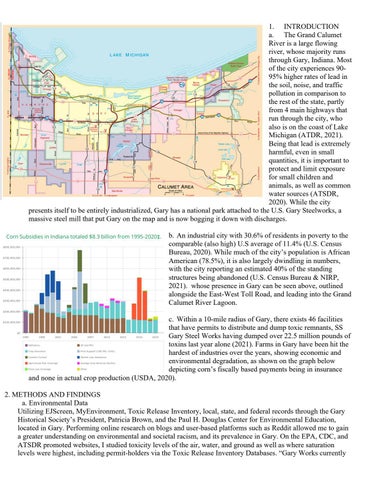
1. INTRODUCTION a. The Grand Calumet River is a large flowing river, whose majority runs through Gary, Indiana. Most of the city experiences 9095% higher rates of lead in the soil, noise, and traffic pollution in comparison to the rest of the state, partly from 4 main highways that run through the city, who also is on the coast of Lake Michigan (ATDR, 2021). Being that lead is extremely harmful, even in small quantities, it is important to protect and limit exposure for small children and animals, as well as common water sources (ATSDR, 2020). While the city presents itself to be entirely industrialized, Gary has a national park attached to the U.S. Gary Steelworks, a massive steel mill that put Gary on the map and is now bogging it down with discharges. b. An industrial city with 30.6% of residents in poverty to the comparable (also high) U.S average of 11.4% (U.S. Census Bureau, 2020). While much of the city’s population is African American (78.5%), it is also largely dwindling in numbers, with the city reporting an estimated 40% of the standing structures being abandoned (U.S. Census Bureau & NIRP, 2021). whose presence in Gary can be seen above, outlined alongside the East-West Toll Road, and leading into the Grand Calumet River Lagoon. c. Within a 10-mile radius of Gary, there exists 46 facilities that have permits to distribute and dump toxic remnants, SS Gary Steel Works having dumped over 22.5 million pounds of toxins last year alone (2021). Farms in Gary have been hit the hardest of industries over the years, showing economic and environmental degradation, as shown on the graph below depicting corn’s fiscally based payments being in insurance and none in actual crop production (USDA, 2020). 2. METHODS AND FINDINGS a. Environmental Data Utilizing EJScreen, MyEnvironment, Toxic Release Inventory, local, state, and federal records through the Gary Historical Society’s President, Patricia Brown, and the Paul H. Douglas Center for Environmental Education, located in Gary. Performing online research on blogs and user-based platforms such as Reddit allowed me to gain a greater understanding on environmental and societal racism, and its prevalence in Gary. On the EPA, CDC, and ATSDR promoted websites, I studied toxicity levels of the air, water, and ground as well as where saturation levels were highest, including permit-holders via the Toxic Release Inventory Databases. “Gary Works currently
releases 2,800 pounds of oil and grease into the river everyday… working under expired permits extended by state officials since the year 1994,” (Earth5R, 2020). Included below is a “retro” photo from one of the conferences discussing RCRA amounts and U.S. Gary Steelworks’ short-lived dredging proposition— highlighting the areas of the river intersecting with which pollutants. Overall, the photo depicts that the same issues are reoccurring and that discharges are only increasing with short-sighted allocation of funds prevents
clean-ups (and prevention) (U.S. Gary Steelworks, 2002). b. Visualizing reports of toxins and direct water discharges show their effects on the river from MyEnvironment show that as it sits and stews, almost entirely running along one of the many interstate roads in Gary. Fish have been observed to have physical deformities, with hundreds turning up dead at a time due to several instances due to impairments (ATSDR, 2021).
Health Data c. The health data in Indiana, provided by Methodist Hospital’s community needs assessment shows that both Indiana and Lake County’s levels are comparably higher than U.S. averages, and future national goals (2019). The health outcomes category alone showed disproportionately higher child and infant mortality rates as well as flu immunizations in both LC and Indiana's black community (2021). In the health behavior and social/economic categories, I observed teen birth rate, injury deaths and preventable hospital stays as other variable contributors to poor health outcomes and further disparities. The number of those physical inactive (27% in compared to 19% on average) can both be compared to the county’s obesity rates which are 12% higher than the national average at 38%. (2017). Learning more about the population statistically pushed me to draw further questioning to the number of available safe and available sidewalks in LC, as well as the factors dependent upon the extremely high access to exercise opportunities (92% at the county level due to Indiana Dunes National Park (2017).
d. Contaminant Name Manganese Compounds
Associated Health Effects
Very closely associated with lead poisoning; mental and cognitive disability, mental delays, and pregnancy complications in expecting parents (Lee, et. al, 2018) Hydrochloric If inhaled, even in small amounts, hydrogen chloride can cause acid severe shortness of breath, internal bleeding and irritation, and death (CDC, 2014) Mercury Usually caused by eating an excess of an accidental ingestion of *My fact bacteria, mercury is highly toxic and can cause tumors, sheet* blindness, seizures, and kidney damage (ATSR, 1999). Zinc Mostly seen in steel workers and known as ‘metal fume fever’, Compounds the pulmonary disease causes severe shortness of breath, kidney damage, and in some cases ocular damage (ATSDR, 2005). Lead Lead primarily causes anemia, which can impact the Compounds development of children greatly. Exposure to high levels of lead *My fact has been linked to developmental delays, miscarriages, and sheet* death (ATSDR, 2020). *(EPA, 2020)
Where is this contaminant typically found? (In Gary) Usually dumped onto soil and absorbed into the ground (land pollutant) *
Used in acid aerosols, including outputs of metal production such as vapors (air and water pollutant) * Dumped in excess after oil remnants cannot be discharged- U.S. Gary Steel does not have a disposal method for mercury (water pollutant) * 6,216,620 lbs released by U.S. Gary Steelworks (land/air/water pollutant due to dust and actual metal discharges )* Lead was a factor discussed earlier and is emitted by U.S. Gary Steelworks 280,01 lbs into the environment and 68,556 lbs recycled. (land/water pollutant) *
Environmental Justice e.
As introduced in the las t point, children are a vulnerable population in Gary whose risk is not only in the poor air, land, and water quality, but also in the physical environment of the city. While exploring Gary, I ran into several open-air hazards such as U.S. Gary Steel mill’s old dump site, an unfenced plateaued hill at the edge of a dead end. Unfenced and across the street from the city’s only little league stadium, it felt wrong to read, and re-read that PCB’s existed right on sight. Most of Gary shares this rough texture, with the hills of Miller Park beautifying its corner and Gary’s abandoned Brownfields—though architecturally beautiful, in a vastly different space.
f. I have included a visual, above, of the National Air Toxins Assessment as well as Gary’s state and federal parks using EJScreen (2021). The importance of an onsite visit, in this case, showed to be useful in that I could see the lack of territory boundaries and the Grand Calumet River, the poor fencing that separated Gary Steelworks and the public area, and proximity to people’s homes (less than half a mile). This is also discouraging for residents who may look to their outdoor environment for health and wellness.
The next two maps, shown on the previous page, compare the rates between Gary’s water discharges to the United States’ as well as income rates. The rates are shown to be extremely high in comparison to their peers as well as the national average (2021). Several environmental and equity issues arise, as many community members in Gary may not realize their chronically degrading land or ‘allergies’ may be attributed to the environment they were not a part of creating.
RSEI hazards, or Risk-Screening Environmental Indicators rating is shown on the map above. Lead rates, being they are taken into account in this score, several of the points are able to be explained. Lead rates are high in Gary, Indiana, in comparison to both the national and state average (EPA, 2020). U.S. Gary Steelworks, having direct lead and other BUI’s on site explain the several points on the coast. East Chicago, Indiana, a city that neighbors Gary recently had several of its public housing facilities evacuated, with specific linkages to high lead levels (Jan, 2021). This, in combination with another graphic showing the lead levels and active schools in Gary’s relative area focus on a vulnerable population that exists plentifully: children (U.S. Census Bureau, 2019). CONCLUSIONS AND RECOMMENDATIONS: a. Through the research and qualitative analysis performed, a direct confirmation that The Grand Calumet River has been ill affected by both the direct industrial outputs by companies in the area is present. Both Gary’s abundant Brownfields structures and four heavy duty (as classified by the Indiana Department of Transportation) highways, running through it. This occurring in a condensed area, with direct discharges into water and natural habitats has degraded the environment. Being that The Grand Calumet River leads directly into Lake Michigan, a water source for over 10 million people (2021). b. Being that the EPA regulates public drinking water systems for 90 percent of Americans (aside from private drinking wells), it is important to note that the ground water that they ingest is easily affected by the toxins discharged (Landrigan, et al., 2018). In 2020, The Indiana General Assembly confirmed Title 13, outlawing business and residential dumping, or burning (IGA, 2020). This process is regulated by the Indiana Department of Environmental Management. c. My next steps include creating a plan to apply for grants and execute this plan, with the consultation and advising of my available community partners, academic resources, and field research. Industry put Gary
on the map in the 60’s but, over the last 50 years, harmful discharges and chemical pollutants have been allowed to pile up by organizations and degrading buildings, absorbed both into our soil and atmosphere. Understanding both the history and context of the research is important in providing feasible recommendations to the many residents who take part in the few bustling industries remain. Transportation, steelwork, and fast-food workers predominantly make up the area, and they must be a part of choosing how to cope with their changing environment.
References: Agency for Toxic Substances and Disease Registry (ATSDR). (1999). Mercury - toxfaqs™. CDC. Retrieved December 18, 2021, from https://www.atsdr.cdc.gov/toxfaqs/tfacts46.pdf Agency for Toxic Substances and Disease Registry (ATSDR). (2005). Toxicological profile for zinc - agency for toxic ... Toxicology Profile for Zinc Compounds. Retrieved December 18, 2021, from https://www.atsdr.cdc.gov/toxprofiles/tp60.pdf Agency for Toxic Substances and Disease Registry (ATSDR). (2020). Toxicological profile for lead - agency for toxic ... Toxicology Profile for Lead. Retrieved December 18, 2021, from https://www.atsdr.cdc.gov/toxprofiles/tp13.pdf Agency for Toxic Substances and Disease Registry (ATSDR). (2021, D). Toxicology Profiles. Atsdr.cdc.gov. https://www.atsdr.cdc.gov/toxprofiledocs/index.html Agency for Toxic Substances and Disease Registry. (2020, August 7). Lead. Centers for Disease Control and Prevention. Retrieved December 11, 2021, from https://wwwn.cdc.gov/TSP/ToxProfiles/ToxProfiles.aspx?id=96&tid=22. Centers for Disease Control and Prevention. (2014, October 21). Hydrogen chloride. Centers for Disease Control and Prevention. Retrieved December 18, 2021, from https://wwwn.cdc.gov/TSP/MMG/MMGDetails.aspx?mmgid=758&toxid=147 Distribution & e-commerce. Northeast Indiana Regional Partnership (NIRP). (2021). Retrieved December 3, 2021, from https://neindiana.com/business-made-better/target-industries/logistics. Environmental Protection Agency. (2020). Production Related Waste Management for Selected Chemica. EPA. Retrieved December 18, 2021, from https://enviro.epa.gov/enviro/p2_ef_query.p2_report?FacilityId=46402SSGRYONENO&ChemicalId=N4 20&ReportingYear=2020 Environmental Protection Agency (EPA). (2021, November 24). Toxics Release Inventory (TRI). Epa.gov. https://www.epa.gov/toxics-release-inventory-tri-program Grand Calumet River: One of America's most polluted rivers. Earth5R. (2020, July 8). Retrieved December 18, 2021, from https://earth5r.org/11408-2/ Jan, T. (2021, February 17). Internal report cites Hud for lead poisoning in East Chicago, Ind., children. more could be at risk. The Washington Post. Retrieved December 18, 2021, from https://www.washingtonpost.com/business/2021/02/17/hud-toxic-superfund/ Jane J Lee, Linda Valeri, Kush Kapur, Md Omar Sharif Ibne Hasan, Quazi Quamruzzaman, Robert O Wright, David C Bellinger, David C Christiani, Maitreyi Mazumdar, Growth parameters at birth mediate the relationship between prenatal manganese exposure and cognitive test scores among a cohort of 2- to 3year-old Bangladeshi children, International Journal of Epidemiology, Volume 47, Issue 4, August 2018, Pages 1169–1179, https://doi.org/10.1093/ije/dyy069
Landrigan, P. J., Fuller, R., Hu, H., Caravanos, J., Cropper, M. L., Hanrahan, D., Sandilya, K., Chiles, T. C., Kumar, P., & Suk, W. A. (2018). Pollution and Global Health – an agenda for prevention. Environmental Health Perspectives, 126(8). https://doi.org/10.1289/ehp3141. Lake Michigan. Illinois.gov. (2021). Retrieved December 4, 2021, from https://www2.illinois.gov/epa/topics/water-quality/monitoring/Pages/lake-michigan.aspx. Methodist Hospital. (2019). 2019 - Methodist Hospitals. Methodist Hospital Northwest Community Needs Assessment. Retrieved December 18, 2021, from https://methodisthospitals.org/wpcontent/uploads/2021/03/2019-CHNA-Methodist-Web.pdf Towns in Profile: Gary City, Indiana. U.S. Census Bureau via StatsAmerica- Gary, Indiana. (2019). Retrieved December 18, 2021, from https://www.statsamerica.org/town/ United States Census Bureau. (2020). U.S. Census Bureau quickfacts: Gary City, Indiana. Gary, Indiana Census Facts 2020. Retrieved December 16, 2021, from https://www.census.gov/quickfacts/fact/table/garycityindiana/POP010220 USDA. (2020). EWG's farm subsidy database. EWG Farm Subsidy Database || Farm subsidies in Indiana. Retrieved December 17, 2021, from https://farm.ewg.org/progdetail.php?fips=18000&progcode=corn U.S. Gary Steelworks. (2002). Gary Works RCRA - SWMA map.pdf. Facility Navigation. Retrieved December 17, 2021, from https://www.ussteel.com/facilityinvestigation?p_p_id=com_liferay_portal_search_web_portlet_SearchPortlet&p_p_lifecycle=0&p_p_stat e=maximized&p_p_mode=view&_com_liferay_portal_search_web_portlet_SearchPortlet_mvcPath=%2F view_content.jsp&_com_liferay_portal_search_web_portlet_SearchPortlet_assetEntryId=72321&_com_li feray_portal_search_web_portlet_SearchPortlet_type=document&p_l_back_url=https%3A%2F%2Fwww .ussteel.com%3A443%2Ffacilityinvestigation%3Fp_p_id%3Dcom_liferay_portal_search_web_portlet_SearchPortlet%26p_p_lifecycle%3 D0%26p_p_state%3Dmaximized%26p_p_mode%3Dview%26_com_liferay_portal_search_web_portlet_ SearchPortlet_cur%3D1%26_com_liferay_portal_search_web_portlet_SearchPortlet_mvcPath%3D%252 Fsearch.jsp%26_com_liferay_portal_search_web_portlet_SearchPortlet_keywords%3Dgrand%2Bcalumet %2Briver%2Bmap%2B%2522dredging%2522%26_com_liferay_portal_search_web_portlet_SearchPortl et_formDate%3D1639787377774%26_com_liferay_portal_search_web_portlet_SearchPortlet_searchPri maryKeys%3D%26_com_liferay_portal_search_web_portlet_SearchPortlet_scope%3Dthissite%26_com_liferay_portal_search_web_portlet_SearchPortlet_groupId%3D40705%26_com_liferay_po rtal_search_web_portlet_SearchPortlet_format%3D%26_com_liferay_portal_search_web_portlet_Search Portlet_useAdvancedSearchSyntax%3Dfalse