ISSUE XLI
TRANSITIONS
THE NEXT LEADERS
THEIR VICTORIES START WITH YOUR ASSIST YOUR SUPPORT CREATES EXCEPTIONAL EXPERIENCES FOR TAR HEEL STUDENT-ATHLETES. P.O. BOX 2446 | CHAPEL HILL, NC 27515 | (919) 843-2000 | RAMSCLUB.COM @THERAMSCLUB
LETTER FROM THE EDITOR Change can be hard. Change can be good. It feels like the entire story of the current era of college sports can be found in those two seemingly opposite truisms. It’s not easy watching important parts of the college athletics experience fundamentally change over the last couple of years. In certain sports, recruiting is now as much about a check as a relationship. It’s difficult to develop an attachment to players who might depart after just one season, or sometimes even partway through a season. Ticket prices and the cost of being a fan continue to rise. But there’s also more focus than ever on the product being provided to fans. After decades of deeming it an impossibility, Polk Place on football Saturdays has become a central hub of activity. At the same time conference affiliations have frayed, marquee nonconference matchups have become a regular feature of every schedule—the football Tar Heels will play a once in a lifetime game in Dublin, Kansas is visiting Chapel Hill in men’s basketball, and there’s a prime slot Thanksgiving day battle against Michigan State on this year’s schedule. And while Carolina is trying to balance challenging realities with optimistic possibilities, the school and athletic department have undergone some dramatic changes. Chancellor Lee Roberts wrote in last issue’s back page column about positioning UNC for excellence in every way. In this issue, you’ll find out more about the people entrusted to make that move. That includes new Rams Club Executive Director Seth Reeves, who becomes just the fourth person to hold that role in the history of the organization as he moves into the role held by John Montgomery for nearly the last quarter century (sorry, John). He’ll be working closely with Steve Newmark, who is spending this year transitioning to the athletic director post while collaborating with Bubba Cunningham. There are Q&A’s with all four of those individuals in this issue. This amount of change—and the issues those involved will
confront—would have been jarring even five years ago. Now it’s just the new normal in college sports. But there are already textbook examples within the department of how to move smoothly into a new era. We tried to highlight a few of those programs as a reminder that change doesn’t mean Carolina will be any less competitive. When we published the first issue of Born & Bred, there’s no way we anticipated a future issue with talk of general managers, contracts, and payrolls. But we also didn’t anticipate a 9:45 a.m. Ludacris concert in Chapel Hill before a Tar Heel football game or a Tar Heel basketball player owning an ice cream shop on Franklin Street. And what comes next? This issue is about being prepared for whatever that unexpected reality might be.
Adam Lucas Editor in Chief
PRODUCED BY THE RAMS CLUB // EDITOR IN CHIEF ADAM LUCAS // CONTRIBUTING WRITERS LEE PACE & ANDREW STILWELL // PHOTOGRAPHY JOE BRAY, AINSLEY E. FAUTH, JOSH REAVIS, MAGGIE HOBSON, OLIVIA DAIL, TANNER YEAGER, & UNC ATHLETICS// DESIGN JUJUBE SPORTS PUBLISHING
ramsclub.com
3
14
26
“When I heard Carolina was hiring a general manager, I couldn’t imagine a better opportunity. I love this place, I went here, both my kids went here, and it gives me a tremendous sense of purpose.” — MEN’S BASKETBALL GENERAL MANAGER JIM TANNER
the
TRANSITIONS edition
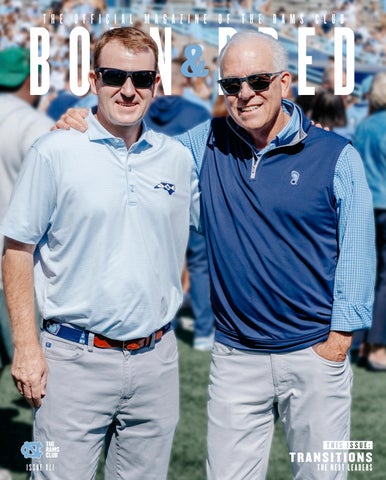
ON THE COVER: Seth Reeves and John Montgomery are two of the four individuals to direct The Rams Club in the organization’s 87-year history. COVER PHOTO: OLIVIA DAIL TOC PHOTOS: AINSLEY E. FAUTH, MAGGIE HOBSON, ANTHONY SORBELLINI & UNC ATHLETICS
4
BORN & BRED
30
As The Rams Club makes a leadership transition, an exclusive conversation with John Montgomery and Seth Reeves
TRANSITIONS
20 A Leadership Partnership
Bubba Cunningham and Steve Newmark discuss the athletic director succession plan in this exclusive Q&A BY ADAM LUCAS
TRANSITIONS
Power of Positivity 26 The In a tumultuous time for college sports, Scott Forbes has helped the Diamond Heels not just weather the change, but thrive BY ADAM LUCAS
CAROLINA EVERYWEAR p. 10
TAR HEEL TICKER p. 6
14 Excellence & Evolution BY ADAM LUCAS
38
&
EDITOR’S LETTER p. 3
TRANSITIONS
34
TRANSITIONS
30 Modern Family
Carolina’s 2026 squad might be the most reflective yet of the new generation of college basketball BY ADAM LUCAS
34 The Next 80 Minutes TRANSITIONS
The women’s basketball program is replacing some key pieces but remains committed to constant improvement BY ANDREW STILWELL
FIRST PERSON
38 Raising The Standard
Danna Durante coaches Tar Heel gymnasts to train for and expect excellence—and it shows BY DANNA DURANTE
ramsclub.com
5
TA R H E E LT I C K E R G A M E D AY
CHAPEL THRILL
The new pregame celebration in Polk Place offers festivities for fans of all ages, including the Chapel Thrill Concert series, which has featured musical guests like former Tar Heel football student-athlete Chase Rice and three-time Grammy Award-winning rapper Ludacris. Photos by UNC Athletics (Aerial), Olivia Dail (Ludacris) and Tanner Yeager (Chase Rice)
6
BORN & BRED
ramsclub.com
7
TA R H E E LT I C K E R
8
BORN & BRED
ramsclub.com
9
1
2
3
4 5
C A R O L I N A E V E R YWE A R Rams Club members like to wear their Carolina Blue, and they’ll wear it all over the US and the world. If you have a photo of you in your Carolina gear in front of notable landmarks in the US and abroad, send them our way to be a part of Carolina EveryWear!
6
10 B O R N & B R E D
7 8 9
10
11
12
To have your photo included: -Send your photo digitally to bornandbred@ramsclub.com. -Identify everyone in your photo and the location of the photo. Here are the “Rules”: -At least one person in the photo has to be a Rams Club member -You must be wearing Carolina gear -You must be in front of a notable landmark (sorry, as cool as Kenan Stadium and the Smith Center are, they don’t qualify).
14
SHOW US YOUR COLORS!
13
15
16
17
18
19
20 21
22
23
24 25
1) John Casey, Dustin Gross, Owen Gross, Evan Gwyn & Paul Casey at the Grenadines Islands; 2) Chuck & Susie Wakild of Raleigh at Delicate Arch in Arches National Park, UT; 3) Lynn & James Fell of Pittsboro with grandchildren Emma, Graham, Jake & Luca at Yellowstone National Park, WY; 4) Greg, Hunter, Jen & Harper Williams of Ridgewood, NJ, at Cape May, NJ; 5) Adam, Ethan, Sharon & Michael Leinwand of Wilmington, NC, at the Jungfraujoch, Switzerland; 6) Chancy & Keith Kapp of Raleigh at Chautauqua Institution, NY; 7) Jill & Greg Blake of Troy, NC, at Mont Blanc, Chamonix; 8) Dale, Carol, Lauryl & Sydney Odom of Lexington, NC, at Mount Rushmore, SD; 9) Henry Fleishman of Charlotte at Royal Port in Northern Ireland; 10) Frederick Holding of Durham at the Burren in Ireland; 11) Sara, Luke & Scott Laws of Arden, NC, at Haleakala National Park in Maui, HI; 12) Doug Dibbert & Jamison Dibbert of Chapel Hill at the London Bridge; 13) David & Charise Lowery Gantt of Fletcher, NC, at Big Ben in London; 14) David & Jan Rockwell of Wilmington, NC, on Orkney Islands in Scotland; 15) Chloe Shelton with Sherry & Steve McGowan of Yanceyville, NC, in Boca Chica, Panama; 16) Mary & Nikole Nickerson of Mebane, NC, at Umbrella Alley in Quebec City, Canada; 17) Rachel, Ed, Deuce & Kendall Geer of Chapel Hill with UNC WBB alumna Petra Holešínská in Prague, Czech Republic; 18) Britton Cone, Sami Cone & Kariss Cone of Brentwood, TN, in London; 19) Ann Brown & Chip Campbell of Winston-Salem on the Big Island of Hawaii; 20) Kenji Leonard, Lu Leonard & Benjamin Leonard of Raleigh at Disneyland Paris; 21) Gay Hampton & Linda Bryant-Hampton of Durham at the Crazy Horse Memorial in Crazy Horse, SD; 22) Sally, Sarah & Gary Swanson of Charlotte at the Blarney Castle in Cork, Ireland; 23) Sherry Smith, Karen Smith & Tom Smith of Charlotte at Sydney Harbour Bridge and Sydney Opera House in Australia; 24) Doug & Betsy Blackburn of Lewisville, NC, at Buckingham Palace in London; 25) Tom Taylor of Graham, NC, at Cozumel, Mexico
ramsclub.com 11
12
BORN & BRED
You’ve created lasting memories through your support of Carolina student-athletes. You’ve cheered their victories, celebrated their accomplishments, and invested in their future. Now, you can help carry that legacy forward. A planned gift benefiting The Rams Club helps ensure that Carolina’s student-athletes succeed — not just in competition, but in the classroom and in their communities. Whether you want to support a specific team, invest in mental health and wellness, or provide broad support, there are giving options that align with your values. Planned giving offers strategic ways to support Carolina — through gifts today or tomorrow — that integrate your philanthropy with your financial, estate, and tax planning. Let us help you find the right fit to achieve your goals.
Scan the QR code or visit ramsclub.com/planned-giving/ to learn more, or contact Beth MacKethan at 919.843.6448 or beth@ramsclub.com.
ramsclub.com 13
TRANSITIONS
BORN & BRED
EXCLUSIVE Q&A
EXCELLENCE & EVOLUTION
AS THE RAMS CLUB MAKES A LEADERSHIP TRANSITION, AN EXCLUSIVE CONVERSATION WITH JOHN MONTGOMERY AND SETH REEVES BY ADAM LUCAS // PHOTOS BY OLIVIA DAIL
14
BORN & BRED
EXCELLENCE AND EVOLUTION
ON SEPTEMBER 1, SETH REEVES BECAME THE FOURTH EXECUTIVE DIRECTOR IN THE 87-YEAR HISTORY OF THE RAMS CLUB. WITH JOHN MONTGOMERY’S RETIREMENT APPROACHING ON DECEMBER 31, WE SAT DOWN WITH BOTH OF THEM TO FIND OUT—IN A TIME OF EXTREME CHANGE—WHERE THE ORGANIZATION HAS BEEN AND WHERE IT IS GOING. ADAM LUCAS: WHY WAS THIS THE RIGHT TIME AND THE RIGHT PEOPLE TO MAKE THIS MOVE? JOHN MONTGOMERY: This was put in place almost four years
ago. When the capital campaign ended in 2022, Don Williams was the chair of the Board. He came to me representing the board and asked if I would continue working until January 1, 2026. I enjoy my job and love being here and part of the team, so I had no problem doing that. That set the timeline for this transition. We knew it was coming, and it’s been nice to have a defined runway during a transition. In terms of planning, I don’t think it could have been much better.
LUCAS: SETH, WHY DO YOU WANT THIS VERY DIFFICULT JOB? SETH REEVES: Part of the answer is the fact that I am rooted here.
I told the committee throughout the process that I only wanted this job and I only wanted it here. I don’t have any interest in being anywhere else. I’ve kind of grown up here, and I love this place. I’ve been here for 22 years now. A big part of it is that I love our team. I worked on the Learfield side for a long time, and I had a great experience there. I loved working with Gary Sobba and Jones and Woody and Eric, and working with our partners. That allowed me the opportunity to blend my consulting background with college athletics, and I really enjoyed that. When I transitioned over to development, I learned that I love working with John and Ken (Mack) and Karlton (Creech) before that. I love working with our donors who care so much about this place. I think that’s why I wanted it so badly. I want us to continue to be as successful as we were in the past but also learn how to navigate this new world. That’s really exciting to me. We have opportunities to leverage the competitive advantages already in place. That makes me excited about what the future could be.
LUCAS: WHAT ARE SOME QUALITIES YOU’VE OBSERVED IN JOHN THAT YOU THINK WILL HELP YOU DO THIS JOB? REEVES: I’ve been really fortunate. I’ve had very good bosses and mentors throughout my entire career. I worked with really smart professionals when I was in consulting, and I still think about
some of the lessons I learned there. Working with Learfield and with Gary for so long, he was a great mentor and boss. Working with John, I’ve learned a ton. There are some things I can’t emulate. John is the most patient person in the world. I know I’m not going to be as patient as John; he’s the best. What sticks out to me is the way John has invested in our team and the culture of The Rams Club. This is a special place to work. He’s built a team of folks who care so desperately about Carolina athletics and our supporters, but also each other. That’s intentional. That doesn’t just happen. That’s through John’s leadership and it is something that is consistent and intentional. I had the opportunity to work with Eric Montross. He made a tremendous impact on this place. He’ll continue to be a part of our culture through the Montross Day of Service and the culture he helped establish here. All of those things are woven through the culture that John has established in his nearly 25 years here.
LUCAS: JOHN, WHAT HAVE YOU OBSERVED FROM SETH IN HIS NEARLY TEN YEARS HERE THAT MAKES HIM THE RIGHT PERSON TO CONTINUE THAT CULTURE? MONTGOMERY: Seth talked about how he came up through
consulting and Learfield and being a major part of our team for the last ten years. That’s what you need right now to lead in college athletics. You have to be able to understand so many different angles. His work with Learfield helps him understand the revenue generation side and the way Learfield generates revenue from corporate sponsorships and selling game inventory. That’s never been more critical at North Carolina, in my opinion. Philanthropy is always going to be a huge part of our business. But he can also speak the language in a way that I can’t because I do not have that background. He can step right in and immediately understand the current landscape of college athletics. I was tasked by the Board over the last four years to really get even more involved in fundraising. While I was doing that, I leaned heavily on colleagues, because I was traveling a lot. Because of his background, Seth was a logical candidate to be the chief revenue officer and then chief operating officer. That was good for our organization. It gave people like Diane Aldridge
ramsclub.com 15
TRANSITIONS and Matt Terrell and Ken Mack more responsibility and enabled them to learn how to work together as a leadership team. It tells you a lot when you watch how our staff responds to Seth’s leadership style. It gave us an opportunity to look in and watch the maturation process, not only for Seth but for a lot of our staff. That’s been very galvanizing to me and to our organization. When I got to Carolina from SMU, I didn’t know much. I knew we had a great foundation. Ernie Williamson and Moyer Smith had built an incredible organization. Moyer built a great team. Then you had Dawn and Sue and Neil and John Cherry, others who knew the business and made it easy for me to grow our organization. I remember that I got great advice from Eddie Smith. He said, “Just go to work. You’ve got a great staff and great donors. Take a year and get your legs under you and evaluate the team and the process.” That’s what Seth is referring to. Our Board is unbelievable and so good at being forwardthinking. They run their own businesses and understand revenue generation. As our fundraising goals have increased and we’ve added staff, we’ve added great people. The University of North Carolina enables you to hire great people because people want to work here and represent this place. When you get great people and they are inspired and you trust them, you can build a great culture. That’s always been our focus.
LUCAS: THERE WAS A TIME WHEN I THINK EVERYONE WOULD HAVE ASSUMED THE NEXT PERSON IN THIS ROLE WOULD COME FROM WITHIN. BUT THIS IS A TIME WHEN WE’VE SEEN SOME OUTSIDE HIRES IN IMPORTANT POSITIONS. WHY WAS THIS THE RIGHT PLACE TO HAVE SOMEONE WHO HAD A BACKGROUND AT CAROLINA? MONTGOMERY: We’ve had a lot of change at the University. I
was not on the search committee, but I did speak with them. And change can be a great thing, but continuity is important as well. Our staff knows so many people, and this is a people business. People give to people. If you are achieving at a high level, it’s a really positive thing to keep the relationships in place.
REEVES: When you look at college athletics and how The Rams
Club is different from some of our peers, we’re a development organization that is rooted in philanthropy. Many of our peers have other ways they can raise money. We have to be really rooted in philanthropy to raise the kind of money we need to raise. We truly do work in the relationship business. Especially at Carolina, we work really hard to invest in our staff and our culture, and that continuity is important. Long-term, genuine, authentic relationships with our supporters are paramount to what we do.
16
BORN & BRED
EXCELLENCE AND EVOLUTION LUCAS: WHERE DOES THE RAMS CLUB STAND RIGHT NOW AND WHERE DO YOU WANT IT TO GO? REEVES: We’re in a really good place and we have tremendous
support. One of the rare things about Carolina is that athletics is part of the central thread of the student experience here. Almost everyone who has spent time in Chapel Hill would tell you athletics was part of their experience. It’s not like that everywhere else, and we’re very fortunate because of that. And it’s not just football or men’s basketball. It’s also lacrosse and women’s soccer and baseball. Our membership cares about athletics. In this world of change and uncertainty in our industry, the interest in supporting Carolina athletics is very high. We’re at an all-time high with annual giving and an all-time high with membership. And with all that said, we’re still going to have to evolve and change. Look at what we’ve done recently with the Excellence Funds, which is a pivot to a more unrestricted giving model and gives us flexibility in this uncertain world. Our donors have responded to that need and we’re going to have to continue to be creative with how we navigate the changes in college athletics. Our mission for what we do has not changed. We’ve been committed for 87 years to providing opportunities for kids across 28 sports at Carolina to compete at the highest level on the court, in the classroom and in the community. That’s still the mission, even with all this change around us. How we go about achieving that mission will continue to evolve.
LUCAS: OTHER SCHOOLS HAVE VISIBLY DECIDED THEY WANT TO BE VERY GOOD AT A COUPLE THINGS AND AREN’T AS WORRIED ABOUT THE REST. WHY IS CAROLINA A PLACE WHERE IT’S POSSIBLE TO TRY AND BE GOOD AT EVERYTHING? MONTGOMERY: Last year, we had a really great fundraising year. Of
our three biggest gifts, two of them were for the golf programs and one was for an endowment in which the earnings are unrestricted. That shows you how much our fan base is interested in excellence across the board. Everyone has always been very proud of our broad-based program, and we focused on that during the Carolina First campaign. That was two campaigns ago, but it’s really paid dividends over time. Dick Baddour believed that endowing the Olympic sport programs was important, and that was great vision on his part, because it gave those former athletes and parents somewhere to invest in their own sport. As Seth said, our mantra has been to meet today’s needs and secure the future of our program. That doesn’t just mean in two or three sports. That means all the sports, and our fan base responds to that. And most of our donors give to different parts of campus. There’s an overarching theme of excellence across the board. We’re
always going to allow our donors to drive us with their support, and their support for our Olympic sports programs, specifically, was off the charts. It’s something our donors continue to be very interested in and we’re going to continue to enable them to do those things. Our coaches are great partners. They’ve seen how investments over time with endowments are now generating real money. It takes a little time, but it has a real impact on individual sports. They invest their time and help us with fundraising. We also have made an intentional shift in terms of philanthropy. It’s easy to get caught up in tickets and parking, and that’s important, but that’s a part of the transactional world. I think we have done a really good job of introducing the philanthropic world to our donor base. That has helped take us to the next level with fundraising. We can’t get where we need to go being exclusively transactional, where every donation is in return for a specific benefit. Their support drives real impact for student-athletes.
LUCAS: SETH, WITH YOUR REVENUE BACKGROUND, SOME OF THE THINGS WE’RE TALKING ABOUT MAY NOT NECESSARILY HAVE A BENEFIT TO THE BOTTOM LINE. HOW DO YOU FIGURE OUT THE RIGHT BALANCE BETWEEN REVENUE PRODUCING AND THE RIGHT APPROACH FOR CAROLINA’S STANDARDS? REEVES: That’s one of the things I’ve learned from John. We invest all
the time in things we believe will provide a long-term benefit. And the long-term approach taken by The Rams Club has enabled us to pivot to short-term needs. Having a healthy and robust scholarship endowment allows us to do some things today we might not be able to do otherwise. Having robust operating endowments for our Olympic sports allows us to pivot and do things in, for example, a pandemic year, or doing it right now with all the other factors of NIL and other new demands. If we hadn’t had the leadership we had for 87 years, and if they didn’t have the foresight at a time when it probably wasn’t very popular to commit to investing a huge effort into our scholarship endowment, we wouldn’t be as competitive as we are today. So we are going to continue to have a long-term focus. In a time of change when it can be very easy to get caught up in what we need right now, we cannot take our eye off the long term sustainability of this program and all 28 of our sports. Our donors support and believe in that and they have been showing that for a long time.
LUCAS: CHANGE TENDS TO MAKE PEOPLE NERVOUS. WHAT ARE THE ABSOLUTES OF WHAT THE RAMS CLUB IS ALWAYS GOING TO BE MOVING FORWARD, AND WHY DOES THE RAMS CLUB MEMBER CONTINUE TO MATTER IN THIS ERA OF COLLEGE SPORTS? REEVES: We’re in an era of college sports where our needs
ramsclub.com 17
TRANSITIONS
A TA R HEEL FOR LIFE
It doesn’t seem possible now, but John Montgomery arrived at Carolina as an outsider. Montgomery was hired as The Rams Club’s third executive director in history in 2001. At that time, he had spent no significant time in Chapel Hill. Nearly 25 years later, he will depart as a true Tar Heel—and as one of the most impactful figures in the history of Carolina athletics administration. While drawing almost no attention to himself, Montgomery has been responsible for a host of achievements during his tenure: Carolina has the largest scholarship endowment in the country, every sport has an operating endowment of at least $1 million, Rams Club membership is at an all-time high, and the athletic department has built more than $1 billion in facilities. Most importantly, they’ve done it in a way that reflects Montgomery’s leadership. At a time when change is constant in college athletics, he has been a steadying hand, enabling The Rams Club to adapt and thrive with every new development. With those changes has come an expanding staff, but he’s overseen that expansion while preserving the values at the core of the organization.
18
BORN & BRED
continue to rise. What’s needed to compete at the highest level continues to grow. We need help from all our supporters, and that’s those who give us $1 per year to those who give us a lot more. We have to grow in all areas. We’re very fortunate to have so many who care about athletics. You will see us continue to invest in our membership based organization, because it’s critical to give all Tar Heels everywhere the chance to be part of the team that allows Carolina athletics to be successful. We want to create opportunities for people to be on our team. As for our absolutes, we are an organization that is philanthropically rooted and relationship driven. That will not change. We are committed to being a customer service based organization that invests in our relationships with all our supporters. We want to have deep, genuine, authentic relationships with everyone who supports Carolina athletics. That’s our staff’s responsibility. We’re also going to continue to be creative and adaptable and flexible to be ready for whatever happens in the uncertain future of college athletics. We want to be ready to constantly meet the needs of our programs and coaches and athletic leadership and provide the resources they need to be successful. That’s why we exist. Our mission hasn’t changed. How we go about it may continue to evolve, and that’s a good thing.
MONTGOMERY: We do have a lot of things coming at us at warp
speed. There are so many changes. But one thing that hasn’t changed is the opportunities we offer the student-athlete. It’s a great opportunity to come to this world class institution and get a world class degree. A big part of the opportunity is being on this campus and representing this elite institution. It’s gratifying for our supporters to know they’re part of that experience and they’re impacting the lives of young people. That’s a very compelling opportunity.
REEVES: It’s true that there are a lot of changes. But there are also
a lot of things that haven’t changed. Sometimes it’s helpful to take a step back and think about all the things that haven’t changed in the last five years. I was in a meeting recently and we were talking about what we are raising money for. There are some things that have been consistent: scholarships, operating endowments, capital projects and annual giving. Those have historically covered most of what we needed athletically. Today, it’s a much longer list. It’s things like mental health and financial literacy programs and leadership development. So our mission hasn’t changed. But the experience of being a college student-athlete has changed. And we’re going to continue to provide the best experience in college athletics, even as what that experience might be continues to evolve.
© 2021 Pinehurst, LLC
Gil Hanse thought of every angle. Now it’s your turn. Play Pinehurst No. 4.
It’s time to test your mettle on this rugged masterpiece. Renowned course architect Gil Hanse transformed what Donald Ross first carved out of the sand a century ago into 18 dramatic holes you’ll want to play again and again. Village of Pinehurst, North Carolina | 888.206.8912 | Visit pinehurst.com ramsclub.com 19
TRANSITIONS
BORN & BRED
EXCLUSIVE Q&A
A LEADERSHIP PARTNERSHIP
BUBBA CUNNINGHAM AND STEVE NEWMARK DISCUSS THE ATHLETIC DIRECTOR SUCCESSION PLAN IN THIS EXCLUSIVE Q&A BY ADAM LUCAS // PHOTOS BY OLIVIA DAIL
20 B O R N & B R E D
A LEADERSHIP PARTNERSHIP
BUBBA CUNNINGHAM HAS OVERSEEN NEARLY 15 YEARS OF CHANGE IN HIS TENURE AS CAROLINA’S ATHLETIC DIRECTOR. Now he’s part of another evolution, as the athletic department announced on July 1 that Cunningham will remain as athletic director until the summer of 2026, when he transitions into an advisory role that will allow him to focus on transformational University projects. At the same time, Carolina hired RFK Racing President Steve Newmark, a Chapel Hill native, to serve as executive associate athletic director. In that position, Newmark is spending the next year working closely with Cunningham before assuming the role of athletic director next summer. It’s a transition unlike any that Carolina athletics has seen before, so we sat down with both men for a joint interview to explain how the process will work.
ADAM LUCAS: HOW IS THIS WORKING? BUBBA CUNNINGHAM: Personally, I think it’s been great. It’s
worked out well. We’ve been talking for over a year now. Then the idea of working together came up, and I think everything that we had talked about philosophically, now we’re doing it practically. I’ve found it to be very, very helpful and very collaborative.
STEVE NEWMARK: I’m thrilled with how it’s played out. As
Bubba mentioned, we’ve had dialogue for a long time. Through the course of that conversation, it appeared that we were very aligned in our approach and outlook. But you don’t really know that until you get in the trenches. And I think that our first couple of months have validated that we’re in the right place and that this is the right approach for Carolina. I’m not sure every athletic department or institution could do it this way, but it really works well for Carolina and is consistent with how we ideally prefer to handle transitions.
LUCAS: BUBBA, SO MUCH OF WHAT HE’S TALKING ABOUT IS RELATIONSHIPS. HOW DO YOU TEACH SOMEONE A BUSINESS THAT YOU’VE BEEN CULTIVATING FOR DECADES? CUNNINGHAM: You do that over time. There’s not any quick fix to it.
One thing I’ve learned is how deep into the Chapel Hill and Carolina communities Steve is. I didn’t realize the breadth and depth of that connection, which I think is a real advantage. And then, as it relates to conference and national issues, it’s a matter of going to the meetings and meeting people. As I’ve said from the beginning, I’m happy to open up any of my contacts to Steve and to Lee (Roberts). Anyone I’ve met over the years, I’m happy to introduce them and explain that the handoff is coming and it’s important to get to know these people.
NEWMARK: Bubba’s been great about thinking through each of his daily interactions with folks on a national level and trying to connect me where it makes sense. That’s helped make it seamless so far.
LUCAS: STEVE, YOU OBVIOUSLY KNOW CAROLINA. WHAT DID YOU HAVE ON YOUR LIST OF THINGS THAT YOU NEEDED TO LEARN?
LUCAS: THIS IS A BIT OF AN UNCOMMON ARRANGEMENT. WHY WAS THIS THE RIGHT TIME AND PLACE TO DO IT THIS WAY?
NEWMARK: I’m not presumptuous enough to say that I even
CUNNINGHAM: It made sense now because of everyone involved. We
knew the entire list, but there’s clearly an awareness that my background in the last 15 years has been in professional sports. Prior to that, I had college exposure, but never at the level of the academics and compliance component. And so that was high on my list to learn from Bubba and try to understand the inner workings of UNC and the NCAA and how that impacts our daily activities. But, not surprisingly, what I found is, once you’re here, there’s a whole list of things that you need exposure to in order to understand. You have to grasp the mechanics of this very large institution and often large bureaucracy.
all felt there was an alignment between myself, Lee, Steve, and really the entire University as a whole. I don’t want to say it fell into place, but as we thoughtfully considered it, we got to this position. If you just take somebody who is not in a university environment and parachute them in, the learning curve is really challenging. Working together allows Steve to be really good at what he’s really good at while also accelerating what we’re doing. At the same time, he’s learning some of the inner workings of how a college campus works, how a conference works, and I can continue to help him with some of the details there. It’s not that we were lucky. But I do think we’ve been fortunate to have the right people thinking about it and implementing it.
ramsclub.com 21
22
BORN & BRED
A LEADERSHIP PARTNERSHIP
“I GREW UP HERE, AND I’VE ALWAYS HAD AN ALL-ENCOMPASSING PASSION FOR CAROLINA SPORTS, AND LOVE FOR CHAPEL HILL AND THIS UNIVERSITY.” -STEVE NEWMARK NEWMARK: When this was announced, I had some very smart
business people express reservations that this would actually work. They told me, “You can’t have four hands on the steering wheel.” I do think that may be true in most situations, but the problem arises when there is either resistance on the part of the incumbent or the new person coming in. Both Bubba and I approached this as the right thing for the University and the right thing for each of us in order to best serve the University. It has worked very well in that respect.
LUCAS: STEVE, YOU HAD A GOOD JOB. WHY DID YOU WANT THIS JOB? NEWMARK: If you had talked to me a year ago, I was content with
been professionalized and that it’s essentially now the same as professional sports. When I came here, it quickly became obvious that everyone here operates with a primary focus on serving the student-athlete, not only on the playing field, but in the classroom. I’ve watched how much time and effort people spend on ensuring these student-athletes have the right transition when moving away from home, they have the right classroom schedule, or get the right academic support—to me, that is both refreshing and is something that’s lost in the coverage of college athletics today. College sports fans get a lot of coverage of the revenue sharing or NIL. That’s not the sole focus here, at least from what I’ve seen from folks within the athletic department, and that’s been led by Bubba.
where I was as part of the Fenway Group and Roush Industries, and leading a professional sports team, and would have told you that I was going to retire in Charlotte within those organizations. But I grew up here, and I’ve always had an all-encompassing passion for Carolina sports, and love for Chapel Hill and this University. I had the opportunity to assist Bubba and the athletic department in some smaller projects. That evolved into a discussion where Bubba came down to Charlotte to talk about how we might be able to work together going forward. It just really clicked that this would be an opportunity for me to give back to something about which I’m extremely passionate. Carolina athletics is something that has always been important to, and served as a common bond, with my family and friends, and obviously has served the same for our fanbase and the entire state. It just became the right time, and I’m fortunate that the opportunity came about as Bubba’s long term plan matched up and he was looking to transition into a different role after a very long tenure as an athletic director.
CUNNINGHAM: I’ve enjoyed watching the business acumen. That
LUCAS: SINCE THIS ARRANGEMENT STARTED, HAS THERE BEEN ANYTHING THAT YOU’VE REALIZED YOU’RE LOOKING AT DIFFERENTLY BECAUSE OF YOUR WORK WITH THE OTHER PERSON?
NEWMARK: We’re going to see Bubba’s fingerprints for a long
NEWMARK: What has really crystallized for me since I’ve been
here is that we are still in the world of collegiate athletics, where the focus is on the educational mission of the overall institution. We read a lot of headlines about how collegiate athletics have
includes relationships with sponsors, donors, or The Rams Club— really anyone within the sphere of influence—and explaining how we’re going to be successful financially moving forward to make this entire enterprise work. I have found his insight and ability to see down the road has been very enlightening.
LUCAS: BUBBA, WHY IS STEVE GOING TO BE GOOD AT THIS? CUNNINGHAM: It’s a people business. And whether it’s recruits,
players, coaches, donors, the campus community, or the Chapel Hill community, he is a relationship-driven guy who has a great background that will tie all of those groups together in a very positive way for the community.
LUCAS: AND STEVE, LOOKING BEYOND NEXT SUMMER, WHERE ARE WE GOING TO SEE BUBBA’S FINGERPRINTS ON CAROLINA ATHLETICS? time, and I hope he will continue to make new ones beyond next summer. He’s put his blood, sweat and tears into making this athletic department an integral part of the overall institution and the institution’s mission. He has an unbelievable perspective, not just from his years here, but from being in collegiate athletics at different stops. He has shaped this organization and set the vision for where we need to go in the future.
ramsclub.com 23
TRANSITIONS
LUCAS: WHAT’S THE BIGGEST CHALLENGE THE TWO OF YOU DISCUSS FREQUENTLY OR THAT IS CONSISTENTLY AT THE TOP OF YOUR MIND? NEWMARK: It’s not surprising that the challenges are how we
maintain our identity and everything that makes Carolina special in an evolving landscape that has an increased focus on dollars and revenue. The reality is that with the House settlement and payments to some of our student-athletes, it has shifted the focus. In order to be competitive and be elite, which is where we want to be, and to maintain the breadth of sports that we want—and 28 sports is part of our DNA—we have to figure out how to maintain the balance between generating the right amount of revenue and still staying true to our ideals and principles.
CUNNINGHAM: I agree. The hardest thing for any leader is allocation of resources, whether that’s financial resources, physical resources, or personnel. We all want to provide more services to more people so they can be successful. There is never enough, and that’s a constant challenge.
LUCAS: WE WENT THROUGH A STRANGE COUPLE OF YEARS WHERE I THINK IT WAS SOMETIMES DIFFICULT FOR FANS AND RAMS CLUB MEMBERS TO UNDERSTAND WHERE THEIR MONEY WAS BEST SPENT WHEN THEY HAD MONEY TO GIVE. IT FEELS LIKE THAT HAS STABILIZED NOW. WHAT SHOULD RAMS CLUB MEMBERS KNOW ABOUT THE BEST USE OF THEIR DONATIONS IN THIS ENVIRONMENT? CUNNINGHAM: Rams Club members are incredibly generous.
We’ve asked a lot of them in a lot of different ways, and they have continued to give in all those ways. We know we are asking them to buy tickets, give to endowments, give to scholarships, and give to NIL. We have an insatiable appetite for resources, but our obligation is to make sure we’re asking for the things we need to be successful and the things that will make donors feel like they’re a part of our program. It’s a difficult time for everyone, because it’s changing and evolving. We’re trying to make it a little bit easier by providing more clarity on our top priorities, because we know it has been difficult for donors to sort through all the possibilities.
LUCAS: WHAT’S THE CLOSEST PARALLEL TO RAMS CLUB MEMBERS IN THE WORLD WHERE YOU COME FROM? NEWMARK: The closest might be sponsors, just because you do
develop relationships with many of those brands and try to make them feel like part of the family. The difference here with donors is the altruism that goes into their support of our programs. There’s a love for the University, whether it’s because they attended the school or someone in their family did. And everyone has the
24 B O R N & B R E D
same objective, which is to see the student-athletes excel and our programs perform at the highest level. The donor base is something that makes collegiate athletics unique. And with the way The Rams Club has developed, they’re the best in class in the entire country for what they do. UNC athletics isn’t where it is without the comprehensive and unequivocal support of Rams Club members. Growing up here, I saw firsthand the impact of The Rams Club, whether that’s supporting student-athletes, ensuring we have state of the art facilities, or providing the level of scholarship support we have received. It’s critical not only for where we are now, but where we want to go. And as Bubba mentioned, there are challenges. It will not be an easy path because it’s very different than the past, and we’re all probably going to have to be a little bit uncomfortable in how we approach things. It won’t be the same as it was before. But I’m confident that we’ll be able to adapt and that the University, the athletic department and The Rams Club will be aligned going forward to get where we need to be.
LUCAS: IF WE’RE SITTING HERE IN AUGUST, WHAT WILL BE THE CRITERIA FOR WHETHER THIS WORKED SUCCESSFULLY? CUNNINGHAM: The theme of this transition is how we make Carolina Athletics better. We’re both trying to do it. We’re both trying to prepare Carolina for a new direction, even though it’s not always possible to know what that direction might be. The financial underpinnings of college sports is changing, and we need to be ready for it. That’s what we will do.
LUCAS: BUBBA, YOU’VE SEEN A LOT OF TRANSITIONS HERE. SOME HAVE GONE GREAT AND SOME NOT AS GREAT. WHEN YOU THINK ABOUT THE GREAT ONES, IS THERE ANY COMMON THREAD THERE OR ANYTHING YOU’VE FILED AWAY THAT YOU THINK WILL BE HELPFUL HERE? CUNNINGHAM: It’s very much about the right person at the right
time at the right place. Coach Smith came here and did not have success early, but then had great success and helped shape the culture of the program. Anson started out coaching the men’s team and transitioned to coaching both the men and the women, and then just the women, and he had incredible success. They both had passion for this place, passion for what they did, great intellect, and incredible drive. That’s true across the board, whether it’s Karen Shelton or Jenny Levy or any of the very successful long-term coaches we’ve had. There is something special about elite coaches, and our job as an athletic director is to figure out that factor that makes them elite. This place has had an abundance of them, and I do feel very fortunate to be able to work with them and learn from them.
ramsclub.com 25
TRANSITIONS
BY ADAM LUCAS // PHOTOS BY AINSLEY E. FAUTH & JOE BRAY
THE POWER OF
POSITIVITY In a tumultuous time for college sports, Scott Forbes has helped the Diamond Heels not just weather the change, but thrive
I
t might have been the least noticed seismic resignation in Carolina athletics history. In August of 2020, Mike Fox resigned as Carolina’s head baseball coach. After coming to Chapel Hill as a walk-on in 1974, he eventually played for the Tar Heels and spent 22 seasons as the Tar Heel head coach (37 as a head coach overall), as his teams made seven College World Series trips, won three Atlantic Coast Conference titles, and earned him the recognition as Carolina’s winningest head coach of all-time. How integral was he to the program? At the time of his retirement, the Diamond Heels had never won a College World Series game without Fox either on the field or in the dugout. At any other time in history, his departure would have been cause for a massive celebration and endless tributes from fans and former players. And the program, along with his friends and Diamond Heels alumni, did celebrate him. But they did it quietly, the way Fox always preferred to receive individual recognition. That’s because August 2020 was a tumultuous time in college sports. Less than two weeks earlier, amid the uncertainties of the coronavirus
26 B O R N & B R E D
pandemic, the Carolina athletic department announced there would be no season tickets for Tar Heel football in the fall of 2020. The Heels would eventually open the football season against Syracuse on Sept. 12 in front of a virtually empty Kenan Stadium. That summer, fans were busy ordering cardboard cutouts of themselves and their loved ones to be placed inside Carolina venues. The 2020 college baseball season had been limited to a total of 19 games, with Fox winning what eventually proved to be his final game as a head coach, a 9-2 victory over VMI, on March 11. No one was certain there would be college baseball in 2021, or if there was, what it might look like. It was in that environment that Fox announced his retirement and athletic director Bubba Cunningham confirmed that Scott Forbes would be the program’s fifth head coach since 1931. Fox and Forbes had a long history dating back to when Forbes played for his mentor at North Carolina Wesleyan, and it had long been generally accepted around the program that he would be the next head coach. But these were vastly unpredictable times. Forbes wasn’t just going to have to coach the team. He was going to have to guide a program through an
THE POWER OF POSITIVITY unprecedented era of uncertainty. But Fox never wavered in his belief of the best way to help his program transition to the next generation of success. “Scott Forbes made it easy for me,” Fox said. “I coached him and I watched him as a player and then he helped me coach at Wesleyan and at Carolina. I knew his background and knew his family. The work ethic was there. The former players who go through adversity and cared about winning and would get on their teammates and uphold those standards, those are the guys you want to stay around, because they pass along those traits they had as winners to the next group. I was very lucky in that regard to be around a lot of guys like that, including Scott.” Forbes might have made it easy for Fox. But the transition itself was not as easy. Carolina went an uncharacteristic 28-27 in his first year as head coach, narrowly earning an NCAA Tournament berth but going 1-2 in the Lubbock Regional. Forbes has an uncanny knack for getting along with people. It’s almost impossible to find anyone in Chapel Hill who has anything bad to say about him, and he cites his mother giving him a copy of “The Power of Positive Thinking” as one of the most important events of his coaching career. He lives that approach every day. But his friendly nature masks the fact that he works very, very hard. And part of that study had been a relentless research project on what made successful head coaches work. “I started talking to a lot of different coaches, everyone from Roy Williams to other baseball coaches,” he says. “And the best advice I got was that you still have to be who you are. Coach Fox put in place the blueprint, and that works for the program at the University of North Carolina. I played for him and I knew that worked. But I’m a different person. Not in a good way or a bad way. But I still had to be myself.” “A lot of the core components that Coach Fox believed in, Coach Forbes believes in,” says Carter Hicks, who started as a student manager under Fox and now serves as the program’s general manager. “Coach Forbes carries out those things, like work ethic and accountability and discipline, on a daily basis. Their personalities are different. But their core beliefs are the same. Coach Forbes has taken what made the program so successful under Coach Fox and put his fingerprints on everything outside of those core aspects. And so when former players come back, it feels the same, because the core components are the same.” At the same time, Forbes and his staff were redirecting their recruiting into the type of formidable machine that had collected the talent that created all those trips to Omaha. As the pandemic waned and face to face contact resumed, the Tar Heel staff prioritized researching not just the on-field talents of their recruits, but also the off-field fit of their targets and their families. That inherently made their recruiting more difficult. It’s fairly easy to identify the top players in the country and then go out and sign them. It’s much more challenging to identify the top players in the country who also fit the team goals created by those core components. Emphasizing intangibles instantly trimmed the available player pool. It’s not unheard of for Forbes to bring in a player on a recruiting visit and decide before he
SCHEDULE YOUR GIFT Schedule your Annual Fund gift and you’ll receive five priority points each membership year – that’s equivalent to a $500 gift! Login to ramsclub.com/give to set up payments.
leaves—based on first-hand evaluation and feedback from current players—that he’s not a fit and Carolina won’t be pursuing him. “We try to not just meet the kid but meet the family,” Forbes says. “There are some red flag questions that families sometimes ask us. How will you develop my son? How will you get him drafted? We want it all about the team. Your culture is your culture, and you don’t bend it. Guys figure that out quickly. You can be the best player on the team but if you don’t work and aren’t on time and don’t do what you’re supposed to do off the field, you won’t make it here. And hopefully that word gets around in recruiting. We don’t want kids who don’t want to win for the team.” That’s an easier stance to take after a College World Series appearance in 2024 and a near-miss in 2025. It was much tougher back in the summer of 2021, when a brand new coach directed the Tar Heels to one game over .500 and the program had been to Omaha just one time in the last seven seasons in which the event was contested, a long drought by Chapel Hill standards. But buoyed by an injection of talent, the Heels hosted a regional in 2022 and eliminated Georgia in a heart-pounding win. The next season included an ACC Championship semifinal appearance but also a pair of frustrating losses to Iowa in the NCAA Tournament. At the same time, college sports was undergoing a dramatic transformation. Fox had long succeeded by playing strictly within the NCAA rules. Now those same rules were being changed on a daily basis. The transfer portal was constantly open. Name, image and likeness opportunities meant players were being paid. Many coaches at many schools in many sports have struggled with that transition. But Forbes might have done the best job of any coach on campus of mixing the right transfers with the best young talent, all while refusing to bend the standards of his team’s culture. Transfer third baseman Parks Harber was an integral part of a College World Series appearance in 2024, blending with standout freshmen like Luke Stevenson, Jason DeCaro and Gavin Gallaher to get the program back to Omaha and defeat Virginia in the team’s CWS opener, marking the first UNC victory ever without Fox as a player or coach. And while bigname transfers get most of the attention, Forbes has also shown a knack for identifying talent at lower levels that will translate to productivity at the ACC level. Players like Anthony Donofrio, Alex Madera and Jake Knapp have thrived as Tar Heels. Kane Kepley arrived from Liberty and took just one season to develop into a second-round draft pick.
ramsclub.com 27
TRANSITIONS
Kepley’s intangibles were verified by Scott Jackson, who came back to Carolina during the same offseason as the center fielder. The former successful head coach at Liberty and a long time trusted friend of Forbes, Jackson came back to a place where he served as an assistant coach for eight seasons under Fox. He’s part of a staff that Forbes has expanded without taking any shortcuts. He knows and trusts assistants Bryant Gaines, Jesse Wierzbicki and Jason Howell implicitly. Hicks has been given more responsibility. That combination enables Forbes to be a head coach. “Surrounding myself with an unbelievable staff was the most important thing I did,” he says. “I wanted guys who work their tails off and I trust and we all have the same goal—to win. The relationship side matters. To get the most out of a player as a head coach, I have to get to know that player individually. That’s what is so awesome about having a great staff. When I go out on the practice field, I remind myself that Scott Jackson and Jesse Wierzbicki and Bryant Gaines are really good. So it might be best when we are doing fundamental drills for me to go out to left field and just check in with a player.” The Tar Heels were one game from a repeat Omaha appearance in 2025 and reloaded in the offseason. They’ve again assembled a talented roster, and On3 ranked the Heels’ portal class the eighth-best in the country and second-best in the ACC. Baseball America has Carolina among the top 15 teams in the country for 2026, putting them firmly in contention to challenge to earn more June baseball at Boshamer Stadium and another College World Series trip. As the program has ascended again, it’s also been bolstered by the return of a very familiar face. Mike Fox consciously tried to keep his distance through the first couple years of his retirement, still fervently
28 B O R N & B R E D
rooting on the Tar Heels while wanting Forbes to find his own footing. But in the fall of 2023, as Fox puts it, “I got the itch again.” He began to occasionally stop by practice, relishing the chance to be around a team again but then being able to drive home and leave the everyday problems of a head coach behind. He was a regular attendee at games throughout 2024 and 2025, welcoming back numerous former players during the postseason of both seasons. In 2024, he even got the opportunity to watch a game with former standout Dustin Ackley from the stands at the College World Series, two key program figures coming back together to support a team that still bore a strong resemblance to the ones they guided to Omaha. There have been two dramatic transformations in the last 25 years of Carolina baseball. The first came when Chad Flack launched a home run into the Tuscaloosa night and sent Fox and the Tar Heels to Omaha in 2006. That dramatic play kick-started the Boshamer Stadium renovation project and brought the program into the 21st century. The other might be happening now, under Forbes. Postseason tickets have become a hot commodity in Chapel Hill. The First Pitch Dinner had its highest attendance in history in 2025, and the program set a season ticket sales record that same year. At a time when some fans are hungry for a team that feels like college sports, baseball is a great option, with players Forbes and his staff have brought in who value the opportunity to be a Tar Heel. And it doesn’t hurt that on the field, the program is back among the national title contenders. That doesn’t mean it’s time to get comfortable, though. “The number one think you have to understand about coaching is that you never really figure it out,” Forbes says. “You always have to be ready to adapt.”
ramsclub.com 29
modern
family
BY ADAM LUCAS // PHOTOS BY MAGGIE HOBSON & JOSH REAVIS
30 B O R N & B R E D
MODERN FAMILY
Carolina’s 2026 squad might be the most reflective yet of the new generation of college basketball
T
he story of college sports in the year 2025 is written in the way season preparing for the possibility that hundreds of players might Carolina basketball general manager Jim Tanner responds to one elect to switch schools, and readying to make quick moves if needed. simple question. “Number one is identifying players who will be the most successful The query: What percentage of the financial information that in Coach Davis’ system,” Tanner says. “We want to have time to reaches the general public about player payroll is accurate? evaluate everyone and make an assessment of who we like and what His response: Long, loud laughter. “There’s a lot of inaccuracy,” he their market value might be. We want to have time to prepare for it so says. it’s not just a month or two of transfer portal work, but preparing over And in that answer, you find exactly the reason why Tanner’s the course of the year…When it’s appropriate to have conversations presence is such an important part of head coach Hubert Davis’ program with them and their agents, we’re prepared for it.” structure. Coaching and player development remains paramount. It’s not just the “when” of how those conversations happen. It’s Ensuring players have a positive college also the “where.” The Tar Heels added experience as a student-athlete is still three players with international roots to important. Winning at the highest level this year’s team: Arizona transfer Henri remains a Tar Heel essential. Veesaar (Tallinn, Estonia), High Point But the way teams assemble those transfer Ivan Matlekovic (Sisak, Croatia) players to get those victories has and a key late addition, Luka Bogovac completely changed even from the day (Mojkovac, Montenegro). Davis took the job in the spring of 2021. With significant contributions In beginning to adapt his staff over from assistant coach Brad Frederick, the last ten months, Davis has overseen international scouting had already been perhaps the most significant Carolina an important part of Carolina’s roster basketball staff adjustment—adding building. Under the current rules, it’s -JIM TANNER Tanner as GM, a position the Heels had likely to become even more critical. never filled before—in program history. “In many ways, I think (international “Part of my job is for me to take as much off Coach Davis’ plate as recruiting) is a big part of the future of college sports,” Tanner said. possible,” Tanner said during a fall interview on the Carolina Insider “There will be quite a bit of talent that comes here. It presents options podcast. “I’ve been amazed at the pace of college basketball. It’s much for international players they wouldn’t otherwise have to make more more intense than the pro landscape. Everything falls on him and he money and build their brands more than they would be able to do in has to be ‘on’ all the time. One of my objectives is to take as much Europe. It’s an expanded pool of really talented players we have to as possible off his plate so he can focus on things like coaching and evaluate.” player development.” In order to properly perform that evaluation, it requires connections It’s notable that Davis didn’t just fill the GM role. He identified and (NCAA rules do not currently permit Tanner to recruit in person since hired someone uniquely qualified to perform the responsibilities of he is not a countable off-campus coach per their existing guidelines). a modern college general manager. The pool of available players in And that’s where Tanner’s three decades in the agent business are the modern transfer portal era is essentially unlimited. In theory, any valuable. player with remaining eligibility might swap schools when the season In addition to contacts he made while representing players, he has ends. access to a European network created when he merged his company, With the portal recruiting window significantly more compressed Tandem Sports and Entertainment, with Madrid-based You First than the traditional high school recruiting timeframe, it’s very Sports in January of 2020. One of the most frequent ways schools difficult to sift through the available prospects and make immediate become aware of international players looking to make the move to judgements on which players might be the right fit. college basketball is when the player’s agent alerts a school of his That’s why a modern general manager spends much of the current availability. You First has a web of over two dozen agents throughout
“
“Part of my job is for me to take as much off Coach Davis’ plate as possible. I’ve been amazed at the pace of college basketball. It’s much more intense than the pro landscape.”
ramsclub.com 31
TRANSITIONS
32 B O R N & B R E D
MODERN FAMILY
Europe and Africa, which positions the Tar Heels well to scour every possible option. “This is someone who has been an agent and he’s a lawyer,” Davis says of Tanner. “He has connections to a number of different agencies and to the NBA, and he’s someone who can write and read and understand contracts. Those are things that are a skillset that is a huge benefit for us.” Even in a new world where agents play a key role in roster management, there’s still some old fashioned team building required. Davis has modernized the front office foundation, but he’s also utilized a fairly old-school approach to create chemistry. Realizing rosters will often be made of players who don’t have four years of history with each other, the Tar Heels have made a weekend beach trip a regular part of the preseason. There is no formal basketball requirement. Instead, it’s just grilling out, getting in the pool, and maybe even exposing a few players to the North Carolina coast who might have never seen the beach before. “The trip to the beach was super fun,” says guard Kyan Evans. “Imagine going on a two or three day vacation with all your friends and you’re all staying in one big house together.” As Carolina basketball modernizes while still trying to retain the
pieces that make it special, it’s those personal touches that will be important. There are plenty of places to play college basketball. Davis and his staff want to make sure being a Tar Heel still means being part of a family that extends beyond the playing tenure in Chapel Hill. It’s not impossible to maintain that family even in the portal era. Labor Day weekend saw several alums return for impromptu pickup games; two of the most notable names on hand were Cormac Ryan and Harrison Ingram, players who spent just one season at Carolina but developed an attachment even in those 12 months. We may look back on this year’s team as the first Carolina squad completely making the transition to the modern era of college basketball. There’s a four-year Tar Heel, Seth Trimble, as the cornerstone. There’s an improved front office structure. The roster has an injection of international talent plus multiple transfer portal additions expected to play big roles. And a super-talented freshman, Caleb Wilson, who could have played anywhere in the country, provides some superstar appeal. “I’m excited about this team from the basketball perspective but also from the character perspective,” Tanner says. “The chemistry is off the charts in terms of how they have gotten along with each other. And we’re hoping that will translate to wins as we go forward.”
ramsclub.com 33
TRANSITIONS
80 MINUTES The women’s basketball program is replacing some key pieces but remains committed to constant improvement
34 B O R N & B R E D
STORY BY
ANDREW STILWELL PHOTOS BY
UNC ATHLETICS
THE NEXT 80 MINUTES
THE TERM “ERA” IS HAVING A BIT OF A RESURGENCE IN POPULAR CULTURE THESE DAYS, BUT AT ITS SIMPLEST FORM, IT MEANS “A LONG AND DISTINCT PERIOD OF HISTORY WITH A PARTICULAR FEATURE OR CHARACTERISTIC.” As Courtney Banghart enters her seventh season at the helm of the women’s basketball program, she finds herself in the middle of multiple eras that have started during her tenure at Carolina: The COVID era. The NIL era. The transfer portal era, and soon, the revenue sharing era. However, ahead of the 2025-2026 season, Banghart’s goals remain the same as they were the day she was hired in 2019. “In the last six years, a lot has changed in our world,” Banghart said. “Honestly, I’ve been adaptable, but I’ve also been solely focused on the same thing I came here to do, and that was to get the very best players I could that fit who we are. Kids that can get better so our culture can be one of improvement and development. There’s just so many ways to do it.” Banghart’s adaptability, coupled with a healthy ongoing dose of persistence from the coaching staff and student athletes, has carried the Tar Heels through what can best be described as “era” shifts—one of the most recent being the end of a five-year journey that can perhaps be best referred to as “The Ustby Era.”
As part of Banghart’s first “true” recruiting class in Chapel Hill, Alyssa Ustby came to Chapel Hill as three-star recruit from Minnesota. Five years later, she left as one of the most decorated players in Tar Heel history. “I remember when I was recruiting her to Princeton, and she told me no,” Banghart recalled with a laugh. “She wanted a chance to play at a much higher level. When I got the job at Carolina, my evaluation of her didn’t change. You could talk about all the things she had to learn, or you could look at her intangibles and know how many games she was going to help you win.” Ustby’s career at Carolina—where she was a four-time All-ACC selection (twice on the first team), holds the program record for career rebounds, and is the only player in Carolina women’s basketball history to record a triple double—is a story of perseverance and personal development. “Alyssa came in anxious to be good but hadn’t necessarily bought into the process of being good,” Banghart said. “Every time she didn’t perform as well as she thought, she felt like that was a deterrent. We had to help her learn that this was going to take time. Her game was built layer-by-layer, and every year, she bought into that next layer, and her statistical categories went up each year because of that. “There was a definite relentlessness that Alyssa brought in that allowed for the kids that came in behind her to recognize that there was a standard of competition and effort that you’re going to bring every day,” she continued. “Alyssa raised that standard and as we head into this new season, that standard has stuck.”
ramsclub.com 35
TRANSITIONS
After having a player of Ustby’s caliber on the roster for five of her six seasons, the question for Banghart is a simple, yet extremely complex, one given the current state of college athletics. What comes next? It’s a pivotal time for the program. The Tar Heels are coming off their fifth consecutive NCAA Tournament appearance for the first time since the 2011 season. The transfer portal, NIL, and revenue sharing are making the landscape of college basketball a completely different world than when Banghart first arrived in Chapel Hill, but a challenge she’s eager to take on. “As coaches, we push our kids out of their comfort zone all the time. For them to grow and develop, they have to be uncomfortable.” she said. “Navigating this ‘new world’ that we’re living in with college athletics gives us our biggest significant professional challenge, but I see it as an opportunity for personal growth and time for me to practice what I preach.” A key component of the “new world” has been the transfer portal, which for Banghart and her staff, has been less about replacing players and more about enhancing the pieces that they already have. “Our first year we got Petra [Holesinska] and got Steph Watts to come back,” Banghart said. “Those two immediately started for us and helped us make the NCAA Tournament. Then we brought in Carly Littlefield from
DOWNLOAD YOUR DIGITAL MEMBERSHIP CARD
THE RAMS CLUB
2024-25 MEMBERSHIP CARD Scan here to login to your Rams Club account and download your membership card to your digital wallet!
36 B O R N & B R E D
Princeton, who helped us make the Sweet 16. Eva Hodgson became our unapologetic ‘sixth man,’ who would be whatever we needed her to be. More recently, Lexi [Donarski], Maria [Gakdeng], Indya Nivar, and this year with E [Elina Aarnisalo] and Nyla [Harris], these are all huge parts of our team. “When the portal happened, I said that it would be irresponsible for us to not have our ears and eyes in the portal, and our ears and bodies into international and high school recruiting,” Banghart continued. “Now that we’ve got a little bit of all that on our team, it allows us to open our eyes a bit but also be a little bit picky in terms of character.”
While roster construction was certainly part of Banghart’s initial road map for coaching success, a new wrinkle has entered the coach’s busy schedule that she might not have been expecting when she first took the job—fundraising. “I probably spend about 30 to 40 percent of every day fundraising,” Banghart said. “I feel like my job has shifted, but my obligation to the team is to still give them my best, which meant I needed to become a fundraiser as well as a coach.” There were, and still are supporters of the program who have been hesitant to adapt to the “new world.” But a teacher to her core, Banghart sought to educate stakeholders in order to help the greater team achieve their goals. “We had a lot of people who really bought into this program, and I did a lot of educating,” Banghart said. “We would hold Zoom meetings with our biggest stakeholders, who would say ‘I don’t believe in NIL,’ and it would become our goal to teach them what it was and what it meant. We took a lot of time in educating, and that led to support.” The Bench Seat Program, a supporters’ organization and fund originally started by Banghart in 2020 and modeled after a similar one created by Eric Montross during his fundraising work for men’s basketball, has become a strong community of stakeholders who contribute not only financially, but on a personal level as well. “Everyone loves a winner, but not everyone loves to build,” Banghart said. “Fortunately, I’ve found a very loyal group of people who were willing to build with me. Sometimes that was financial. Other times it was simply buying extra tickets to get new fans in the stands. That support has looked like a lot of different things.” While Banghart is grateful for the support, it’s clear that the feeling is mutual from those who provide support for the program. “When Courtney first started, Eric Montross suggested I have lunch with her,” said Carol Grizzard, a longtime supporter of Carolina athletics. “We had a two-hour lunch, and after those two hours, I was hooked, even though I’d never attended a women’s basketball game of any kind before. It was obvious that she was here to develop a program that the students and donors and university would be proud of, and she has truly allowed her supporters to see how valuable their donations and support really are.” “When you have somebody like Coach Banghart who puts her heart
THE NEXT 80 MINUTES and soul and everything that she’s got into the program, then you really have to stand behind them and give them the tools to be successful,” added Catherine Morris, who played basketball for Carolina from 1972-1973. “I truthfully have never met anyone so committed, so deserving, and such a great leader for our program—a person who shapes and molds young women in such a positive way. It just felt like that if there was ever going to be a time to support the program, that this was the time.”
The program is about to enter a new era, an era that Banghart is “committed to figuring out,” because that’s become a trademark of her teams in recent years—just figuring it out. “We haven’t always won the same way,” Banghart laughed. “But we’ve won. I think for this upcoming year, it’s going to be the same idea. We’re going to figure it out” The stat sheet might tell you that approximately half of the scoring, minutes, and rebounds from last year’s team are no longer on the roster. But on the court, the Tar Heels return a core of familiar faces like Reniya Kelly, Indya Nivar, and Lanie Grant, along with a strong freshman recruiting class and a pair of transfers who have significant post-season experience. For Banghart, it’s a recipe for potential. “It’s a turning of the guard because of how many minutes have left us, but this group is much more competitive than I might have unfairly thought before practice started,” Banghart said following a few weeks of off-season training. “The returners are just competing with so much more urgency than they did a year ago, and the freshmen are coming in and matching that energy.” As the building blocks continue to stack on the foundation that has been laid over the past six years, Banghart is ready for that next “era” of Carolina women’s basketball—an era that involves playing a few extra games in the NCAA Tournament. “We’ve got a lot of players who came here because they wanted to play in Sweet 16s, and now for some that have played in a Sweet 16, that’s no longer enough for them,” she said. “We’re right there. We’re just 80 minutes from a Final Four. We’re going to figure out how to get those 80 minutes.”
ramsclub.com 37
FIRST PERSON
Raising The Standard
W
When I accepted the opportunity to lead Carolina Gymnastics in June 2021, I knew this program carried history, passion, and potential. My goal was to bring a clear vision and belief system that would elevate athletic accomplishments to the level of UNC’s national title-winning women’s programs while preserving the academic excellence that defines Carolina Gymnastics. Four seasons later, that vision is becoming reality. Our team is setting records, upholding Carolina’s academic tradition, and— most importantly—transforming how our athletes think, train, and carry themselves as Tar Heels. From the beginning, our staff raised the standard in training, understanding that consistency in preparation leads to consistency in performance. In 2022 and 2023, we captured regular-season EAGL titles and earned NCAA regional berths. In 2024, the ACC began sponsoring women’s gymnastics, reshaping the competitive landscape and challenging us to rise higher. The 2025 season marked a turning point. We spent 11 straight weeks ranked in the Top 25, finishing at No. 24—our highest national ranking since 2006. Picked to finish fifth in the ACC, we placed third at the championship, defeating rival NC State with a 197.225, the third-highest score in program history. That performance also secured automatic qualification to Round 2 of the NCAA Regional Championships. Just as meaningfully, our athletes have continued to excel academically. Over the past four years, Carolina has consistently ranked among the nation’s leaders in classroom achievement. In 2025, a dozen athletes earned All-ACC Academic honors—the most in the conference—and were also recognized as WCGA Academic All-Americans, a distinction
DANNA DURANTE
SEE THEM IN ACTION
Gymnastics Head Coach
2026 Home Meets
Illustration by Jason McCorkle
Jan. 18
3:45
Stanford
Military Appreciation Day (TV: ACCN)
Jan. 23
6:45
Pitt
Alumni Night
Feb. 13
6:45
NC State
Blue Out
Mar. 6
6:45
Minnesota
Flip for a Cause
Mar. 13
6:45
Quad Meet
Senior Night
38 B O R N & B R E D
requiring a minimum 3.5 GPA. This balance reflects what it truly means to be a Tar Heel: striving for excellence in every arena. On the competitive side, we’ve also celebrated remarkable individual success. In 2025, Lali Dekanoidze and Gwen Fink won ACC event titles, with Lali named ACC Specialist of the Year and freshman JoJo Valahovic earning ACC Newcomer of the Year. Lali closed her career as Carolina’s fifth All-American, honored for her performances on uneven bars in 2023 and 2025. That same season, Kaya Forbes qualified for the NCAA National Championships on vault—the first Tar Heel to do so since 2018. Yet the greatest transformation has been cultural. From day one, I challenged our athletes to change the language they used about themselves. Confidence is not arrogance—it is truth in action. Saying, “I’ve earned the right to be confident,” sets a higher standard for yourself and your teammates. Today, that mindset is evident in the way our team trains, the goals they pursue, the accountability they share, and the resilience they bring to competition. We are building this program on core values: selflessness, trustworthiness, humility, positivity, and respect. Four years in, we’ve broken records, raised GPAs, and earned national recognition. The path forward remains the same—gratitude, ambitious goals, and disciplined work. When we continue to find joy in the journey, I have no doubt Carolina Gymnastics will keep reaching new heights.
PRESENTED BY
L I S T E N
O N ramsclub.com 39
RAMSCLUB.COM P.O. BOX 2446 CHAPEL HILL, NC 27515 PH: 919.843.2000 RAMSCLUB@RAMSCLUB.COM THE RAMS CLUB
@THERAMSCLUB
THERAMSCLUB