T H E
ISSUE XII
O F F I C I A L
M A G A Z I N E
O F
T H E
R A M S
C L U B
SCHOLARSHIPS
MAKING CHAMPIONSHIPS POSSIBLE
YOU PROVIDE THE OPPORTUNITY RAMS CLUB MEMBERS LIKE YOU GIVE THE GIFT OF OPPORTUNITY – for the best student-athletes to attend the best university, to compete in the best facilities, and to play for the best coaches at the highest level of competition in all 28 of our varsity sports.
FOR MORE INFORMATION ON THE RAMS CLUB, VISIT RAMSCLUB.COM P.O. BOX 2446 | CHAPEL HILL, NC 27515 | (919) 843-2000 |
RAMSCLUB.COM |
THERAMSCLUB |
@THERAMSCLUB
WELCOME
Letter from the Editor
I
If you care enough to join The Rams Club, you’ve probably already heard plenty about scholarships, and you already understand their vital importance to running a successful athletic department. But our scholarships edition turned out to be about much more than just dollar signs. It started when the field hockey team captured the athletic department’s 44th NCAA championship, yet another reminder of the depth of success across Carolina athletics. It continued when talking to Tom Kearns about why, sixty years after he last played for the Tar Heels, he wanted to make a gamechanging commitment to the scholarship program. It was listening to Mack Brown describe why he wanted to return to Chapel Hill. It was hearing coaches describe how seriously they take the
PRODUCED BY THE RAMS CLUB EDITOR IN CHIEF ADAM LUCAS CONTRIBUTING WRITERS LEE PACE, SPEED HALLMAN, ANDREW STILWELL & PAT JAMES PHOTOGRAPHY JEFFREY CAMARATI, MAGGIE HOBSON & J.D. LYON, JR. DESIGN JUJUBE SPORTS PUBLISHING
responsibility of offering a scholarship, and what that means both to them and to the families who receive that offer. And that was a reminder it’s easy to forget if you don’t have college-age children. A scholarship offer doesn’t just impact the student-athlete. It also has a profound effect on their families, the people who have driven them to and from practice and committed every weekend to games and bought their equipment for the last decade. Receiving a scholarship isn’t just handing out free money. It’s an acknowledgement of how hard a student-athlete has worked to get to the very top in the sport they love. Carolina, as you know, supports 28 sports, and it’s impossible to become a college athlete without devoting significant hours to improving at that sport—and in all likelihood, to making the choice to spend time on that sport when your friends might be doing something a little more fun. A scholarship is a reward for making that choice. But it’s also a window into a very exclusive club. Enrolling at Carolina, for most scholarship recipients, is the first time they have been wrapped into an entire peer group that is as passionate as they are about being the very best at what they’re doing. And although college students are very young in some ways, they’re almost always mature enough to realize the opportunity they’ve been given to be surrounded by excellence. “We have 28 teams here and the majority of them are not just good, but ranked nationally,” said football tailback Michael Carter. “It’s almost like the athletes here are a village. They inspire me. It helps me strive to be someone that others look up to, because when you’re around so many people who are doing such a good job, it makes you want to live up to what they are doing.”
ADAM LUCAS Editor in Chief ramsclub.com
3
10
“
& 14
“If they want to build a life in this state, go to the University of North Carolina, get a degree from one of the best academic institutions in the country, where the faculty is unbelievable.” —MACK BROWN
THE
SCHOLARSHIP
EDITION
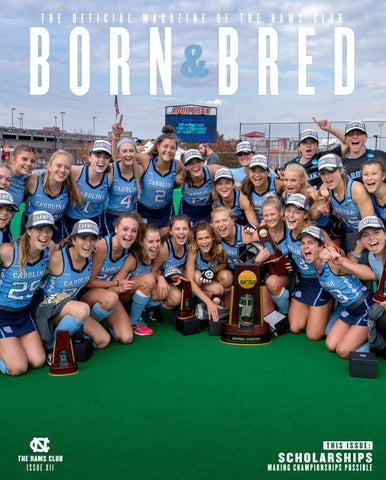
ON THE COVER: The Carolina field hockey team captured the program’s seventh NCAA championship this fall.
COVER BY JEFFREY CAMARATI PAGES 4 AND 5 BY JEFFREY CAMARATI & MAGGIE HOBSON
22
28
EDITOR’S LETTER p. 3
34
TAR HEEL TICKER p. 6
SCHOLARSHIPS
10 Life on Scholarship The realities of being on scholarship sometimes differ from the common perception BY ANDREW STILWELL
CAROLINA EVERYWEAR p. 18
SCHOLARSHIPS
28 Ahead Of Its Time
The Scholarship Endowment Trust, celebrating its 50th anniversary, was a gamechanger for Tar Heel athletics BY SPEED HALLMAN
SCHOLARSHIPS
SCHOLARSHIPS
14 Making the Offer
Carolina coaches relish the opportunity to change lives by extending a scholarship offer BY LEE PACE
34 Making His Point
A life-changing experience playing for the Tar Heels prompted Tom Kearns to create a first-of-its-kind endowment BY ADAM LUCAS
FIRST PERSON
SCHOLARSHIPS
22 Seize the Day
A scholarship to North Carolina changed A.J. Blue’s life BY ADAM LUCAS
38 ‘A life-changing choice’
A Tar Heel legend explains the doors opened to him by his scholarship BY DRE’ BLY
ramsclub.com
5
TA R H E E LT I C K E R SCHOLARSHIPS
INCREASING COST OF A SCHOLARSHIP Tuition and fees of former student-athletes referenced in this issue
TOM KEARNS
$500 NON-RESIDENT TUITION + $92 MANDATORY FEES
DON MCCAULEY
$700 NON-RESIDENT TUITION + $162 MANDATORY FEES
(1956-57)
(1968-69)
SUE WALSH (1979-80)
ERIC MONTROSS (1990-91)
NASSIR LITTLE (2018-19)
6
BORN & BRED
$5,000 TUITION, ROOM & BOARD
$9,700 TUITION, ROOM & BOARD
COMPLETE CAROLINA PROGRAM
S
even former Tar Heel student-athletes are currently part of the Complete Carolina program, which offers returning student-athletes the chance to receive financial support proportional to the athletic scholarship aid they received as a student-athlete. Those seven current Tar Heels are following the path of former program participants like Chaz Frank, a Lexington native who helped propel the Diamond Heels to the College World Series in 2011 and 2013. Frank returned to Chapel Hill and received his degree in 2016. Since the program began with the 2015-16 academic year, more than a dozen Tar Heels have earned their degrees using the Complete Carolina program. -PHOTO BY JEFFREY CAMARATI
$52,440.50 TUITION & FEES
ramsclub.com
7
TA R H E E LT I C K E R SCHOLARSHIPS
WHERE DOES A SCHOLARSHIP GO? $ IN-STATE
$
OUT OF STATE
$25,385.50
$52,440.50
Tuition
$7,000
Tuition
$33,000
Room
$6,600
Room
$6,600
Board
$4,600
Board
$4,600
$ Fees
$ Fees
$2,000
Books
$800
Books
Cost of Attendance $4,400
24%
student-athletes on scholarship in 2018-19 from N.C.
8
BORN & BRED
$2,000 $800
Cost of Attendance $5,300
521
total student- athletes on scholarship
76%
student-athletes on scholarship in 2018-19 from out of state
TA R H E E LT I C K E R
SCHOLARSHIP GIVING LEVELS
WAYS TO RECRUIT A NEW RAMS CLUB MEMBER: 1 IDENTIFY AVID TAR HEELS. 2
$3,000,000 TO NAME A SPECIFIC POSITION IN MEN’S BASKETBALL
BRING FRIENDS TO A GAME AND ASK THEM TO JOIN. 3
$2,000,000 TO NAME A SPECIFIC POSITION IN FOOTBALL
$1,000,000
TO NAME A SPECIFIC POSITION IN AN OLYMPIC SPORT
$1,000,000
FULL IN MEN’S BASKETBALL
$750,000
FULL IN FOOTBALL
$500,000
FULL IN AN OLYMPIC SPORT
REFER A FRIEND: SEND THEIR CONTACT INFORMATION TO THE RAMS CLUB. WHEN THEY JOIN, YOU EARN POINTS! 4 GIFT A MEMBERSHIP FOR A GRADUATION, BIRTHDAY, CHRISTMAS OR ANY HOLIDAY. 5 CONTINUE TO SPREAD THE MESSAGE OF PROVIDING OPPORTUNITIES FOR STUDENT-ATHLETES.
$250,000 HALF
$100,000 PARTIAL
ramsclub.com
9
SCHOLARSHIPS
Life
on scholarship The realities of being on scholarship sometimes differ from the common perception BY ANDREW STILWELL
O
n the surface, it seems simple: A studentathlete is deemed “good enough” athletically to be on scholarship, and their education is paid for, for up to four years, until that student-athlete “goes pro” in their respective sport or graduates. In reality, it’s much more complicated than that. “Each scholarship agreement is unique for each student-athlete,” said Sue Walsh, Associate Executive Director of Scholarship & Legacy Gifts for The Rams Club. “For example, while football players might be on full scholarships, for a sport like swimming, student-athletes might only be on a partial scholarship that just covers books, or just covers tuition, or just covers room and board. Each student-athlete has their own individual scholarship agreement that outlines what they are offered.” “That number includes student-athletes who are actively participating in one of our 28 sports,” Walsh said. “But it also includes student-athletes who might have suffered a career-ending injury and are medically ineligible. It also includes people that are still pursuing their degree but have finished their athletic eligibility. They typically have just a few classes left to finish up.” Currently, there are more than 500 student-athletes on some type
10
BORN & BRED
of athletic scholarship at Carolina. Of the 28 varsity athletic programs at Carolina, 26 are at the maximum number of scholarships allowed by the NCAA. Also included are several athletes who have left the University in good standing before they graduated, often to pursue professional careers in their respective sports. They come back to finish their degree through the “Complete Carolina” program. Managed by the Department of Athletics, “Complete Carolina” provides financial support to returning student-athletes proportional to a student’s athletics aid during initial enrollment as a studentathlete, including tuition, fees, room, board and books. Since its inception in the 2015-16 academic year, and as of January 2018, more than a dozen Tar Heels have earned their degrees using this new program – with many more currently taking classes with degrees as their goal. “I think the Complete Carolina initiative is important,” Walsh explained. “We want to provide our student-athletes with an education whether it takes four years, five years, or whether they want to come back later in life when they have a family and really want to get that degree, which is wonderful. We certainly want everyone to put that Carolina diploma on the wall and be proud of it.” For many years, it was fairly straightforward to be “on scholarship.” But what does that really mean today? “Previously if you received tuition, fees, room, board and books, you
SCHOLARSHIP ENDOWMENT
IN STATE
$25,385.50
60%
ANNUAL GIFTS
FULL RIDE IN 2018-19
OUT OF STATE
$52,440.50
521 STUDENT-ATHLETES ramsclub.com 11
SCHOLARSHIPS
were considered a ‘full’ scholarship athlete,” said Marielle vanGelder, Associate Director of Athletics for Compliance and Senior Woman’s Administrator for Carolina Athletics. In 2015, the NCAA passed legislation that allowed full scholarships to include expenses that were deemed as part of the overall “cost of attendance to the University.” At Carolina, a “full ride” scholarship costs approximately $25,400 for in-state student-athletes and $52,400 for out-of-state student-athletes per year. Because the individual scholarship agreements for each studentathlete are unique, there is not a “set” scholarship agreement, and the agreements can be either multi-year agreements or single-year agreements that are renewed every summer. “You have the ability to write a multi-year agreement now,” vanGelder said. “They used to typically be one-year annual awards that were renewable every year. Now we have the opportunity to write multiyear agreements that have aid in every academic year that the student will be in attendance. We still have the single year awards, but when they come up for renewal in the summer, there are very limited reasons why you could not renew that scholarship.” Each agreement serves as a “contract” that must be upheld for a student-athlete to remain on scholarship. “When we send out aid agreements to the incoming students, they’ll see what we’re guaranteeing them for the next four years – whether it’s an annual award and we’ll evaluate next summer, or we’re going to guarantee you four years of ‘x, y and z,’ whatever that looks like,” vanGelder said. “All the terms of their scholarship agreement – what they need to do to remain eligible – is laid out so it’s clear what the standards are by which they have to live in order to continue to receive the aid.” When asked if there were any misconceptions about how scholarships “work,” Walsh had two points of note. “One thing I think there is a lot of confusion over – I think a lot of people are under the incorrect assumption that the University doesn’t actually charge us or bill us for scholarships – that it’s more of a wash,” she said. “But we actually receive an invoice several times per year, and we actually write them a check to pay for the scholarships. It’s a legitimate expense that I think some people don’t realize.” “The second thing people don’t think about are the costs in there for some additional meals that the athletic department provides,” she continued. “You might have a student-athlete that has practice in the morning, then they go to class, and then have to go to weights. How do you feed them in between all of those things? When football has a
game that ends at 10:30 p.m., the student-athletes can’t get over to the dining hall, so we’ve got to provide opportunities for them to fuel their bodies no matter what time that might be. If we want them to perform at their best, we need to provide them with the necessary resources to do so. Excellence is expensive.” For Walsh, a 1984 Carolina graduate and former scholarship recipient herself in swimming, she noted the financial relief of a scholarship as a major benefit for student-athletes. “As a student-athlete, it’s very difficult. You’re a ‘regular’ student, and then you add on top of that your need to train and compete for an additional 20 hours every week,” she said. “You really don’t have much time left to have a part-time job if you need one, or participate in other activities.” “Having all, or at least a portion of your education paid for, is an amazing opportunity. From my perspective and from those studentathletes with whom I have spoken, it really reduces the overall anxiety level of, ‘How am I going to pay for this?’ or, ‘What sort of student loans am I going to be facing when I graduate?’ if I didn’t have this scholarship.” The overall cost of University attendance has more than doubled over the last ten years, and as such, the overall dollar amount needed for scholarships has gone up as well. “When I was at UNC, my full scholarship was valued at approximately $5,000 a year,” she continued. “When you multiply that by four years to $20,000, it currently costs us $5,000 more to educate an in-state student-athlete for one year than it did to educate me, an out-of-state student-athlete, for four years.” Rams Club members support more than 99 percent of all of the athletic scholarships at Carolina. “The total scholarship budget this year is $17.7 million,” Walsh said. “The scholarship endowment produces a distribution that covers about 60% of that, and the rest comes from the annual gifts of our members.” Walsh noted how important the support of Rams Club members is to making the Carolina experience possible for Tar Heel student-athletes. “When you’re operating at this level with 28 sports – and I love the broad-based program because of the number of opportunities that we’re providing – the costs are significant,” she said. “We’re very thankful for all Rams Club donors, especially the donors who have endowed scholarships, some of whom have funded multiple endowments, as well as those who have added to their original scholarship commitments. As we close out the 50th anniversary of the Scholarship Endowment Trust and begin the second half of the Campaign for Carolina Athletics, we’re looking for many more people to do the same.”
“
“When I was at UNC, my full scholarship was valued at approximately $5,000 a year. When you multiply that by four years to $20,000, it currently costs us $5,000 more to educate an in-state student-athlete for one year than it did to educate me, an out-of-state studentathlete, for four years.”
12
BORN & BRED
ramsclub.com 13
SCHOLARSHIPS
MAKING
THE OFFER CAROLINA COACHES RELISH THE OPPORTUNITY TO CHANGE LIVES BY EXTENDING A SCHOLARSHIP OFFER
W BY LEE PACE PHOTOS BY J.D. LYON, JR. AND JEFFREY CAMARATI
14
BORN & BRED
hen Tommy Thigpen was a senior at Potomac High in Dumfries, Va., in 1988, he received a simple typewritten letter from Coach Mack Brown delivered by the U.S. Postal Service offering him a scholarship to the University of North Carolina. The talented linebacker eventually said yes to Brown and the Tar Heels, played four years and, after a short stint in the NFL, went into college coaching. Today the high school prospects Thigpen is recruiting for the Tar Heels received a seven-piece printed package from the Carolina football office on Aug. 1 of their senior year with their official “offer letter.” One highlight of the package was a fold-out depicting a uniformed player viewed from the rear walking out of the tunnel at Kenan Stadium, the prospect’s last name and favorite uniform number digitally edited onto the back of the jersey. There was also a QR code the player could scan with his phone, taking him to a YouTube video with former Tar Heels like Gio Bernard, Mitch Trubisky, James Hurst and others congratulating him on his offer and welcoming him—hopefully—to the Tar Heel family. “It’s all about the bells and whistles today,” Thigpen says. “Now it’s a letter inside of a letter with music coming out of it. It’s flashy and fun and kids can put it on social media. You’ve got to come up with things that catch the eye of an 18-year-old. It’s a long ways from my days as a kid. But you have to evolve. As a coach, you have to evolve.” Two early prospects—and in fact, players who made verbal commitments to Carolina for the 2019 signing class—were shown soon after receiving their offers in videos they posted on Twitter. Each recruit opened the package like a six-year-old would a Christmas stocking and took the individual pieces out, the components carefully designed and printed and die-cut to fit together and adorned with color photos, the Air Jordan logo, images of Kenan Stadium and campus and stats extolling the virtues of a Carolina education. One of the recruits in his video wore a No. 23 basketball jersey and mimicked
ramsclub.com 15
SCHOLARSHIPS
ripping his shirt open like Superman and said, “I can’t wait to get to Chapel Hill. Go Heels!” Extending and receiving the offer isn’t quite as dramatic in other sports on the Carolina campus, though coach Roy Williams enjoys telling the story of offering Luke Maye a full ride in the spring of 2015. Maye, a 6-7 forward from Hough High in Cornelius, had attended the Carolina Basketball Camp and Williams liked his game and told Maye he could at least be a walk-on player at Carolina, perhaps going on scholarship after his freshman year. “I was holding a scholarship for someone else, maybe it was more than one guy,” Williams says of the 2014-15 recruiting season. “They didn’t come, so I had a scholarship to give.” Williams called Maye and told him to go to his parents and tell them to give Maye a thousand dollars he could take to Myrtle Beach and blow over the weekend. Maye was taken aback. Williams laughed. “They’ll look at you like you’re crazy,” Williams said. “Then you say, ‘Coach Williams just called me and offered me the scholarship, and for an in-state student that’s worth $25,000 (a year).’ So the least they can do is give you a thousand. You’re saving them $24,000.” Some coaches like Tar Heel volleyball coach Joe Sagula extend all their scholarship offers in person and a majority of the time when the prospect is visiting campus—either an exploratory visit at their own expense before their senior years or during an official visit during their final year of high school. “That personal touch is important to me,” says Sagula, who has won seven ACC titles. “I want it to be a special situation, something beyond me sending an email out. I want to sit down and look them in the eye, hopefully with their parents there, and make sure they understand this is a significant moment, that we think they are special and important and we want them to come to Carolina.” Sagula says it’s not often he gets an immediate “yes,” but one prospect from Charlotte visiting in the fall of 2018 called half an hour after leaving Chapel Hill with her father to say she was accepting the offer. “I said, ‘Are you sure?’” Sagula remembers. “I told her, ’I do not want you to make an emotional decision. I want you to make a solid decision that is right for you.’ She answered that she had already spoken to her club coach, her high school coach, her mom, and she and her dad had talked in the car. She said, ‘This where I want to be.’ That was meaningful, that was a solid, family decision.” There are actually two kinds of sports and the scholarships they offer in Division I athletics. There are “headcount” sports, where the number of players on scholarship is limited and each player receives a full scholarship. Those sports include football, men’s and women’s basketball and women only in volleyball, track and tennis. Football, for example, has 85 scholarships and only 85 players can be on scholarship. Volleyball has 12, women’s track and field 18 and women’s tennis eight. Others are “equivalency sports”—the program can use the equivalency of,
for example, 12 scholarships in men’s lacrosse and six in women’s golf, and split the monetary value up and spread the scholarships out at the coach’s discretion. Women’s soccer coach Anson Dorrance has 14 scholarships that he generally divides among 20 to 22 players on a 30-player roster. Many players also get financial aid that, combined with the athletic scholarship assistance, can essentially equal the value of a full scholarship. Coaches in headcount sports have it easy in the sense that a player is either on scholarship or not. Coaches in equivalency sports have a much more complicated accounting and management process—who gets scholarship support and how much, and how does that ebb and flow over the student-athlete’s career at Carolina? “I swear I stare at that spreadsheet probably two or three times a day,” says Andrew DiBitetto, now in his second year as men’s golf coach. “Because you’re just always trying to project out and you’re looking at the rankings and you’re recruiting kids and you’re evaluating kids. Basically you’ve got this puzzle and you’re trying to find a way to kind of put the pieces altogether.” DiBitetto has 4.5 scholarships for men’s golf and coach Joe Breschi has 12.6 scholarships in men’s lacrosse (both the NCAA maximum), and each say they use the carrot of scholarship aid as motivation for players to improve athletically and academically. Austin Pifani was a four-year starter for the Tar Heel lacrosse team from 2014-17, earned All-America honors and is regarded as one of the best defensemen in Tar Heel history. He was on partial scholarship for two years and then upgraded to full scholarship his last two years. “A full scholarship in our sport is rare,” Breschi says. “But with what he was accomplishing on the field and in the classroom and as a leader on our team, I just said, ‘Look, you deserve it.’” DiBitetto cites the “real world” and the fact that someone in business who performs well or exceeds expectations can expect a bonus. “We try to save a percentage so if a guy, for example, like Preyer Fountain improves 1.94 shots per round last year, we have something tangible we can reward him with,” he says. “It’s more than a pat on the back. It’s saying we recognize and respect the commitment and hard work. Here’s a little reward for you and your family.” The golf program has also seen the interesting development of a player’s family being well established enough financially that the parents could forego scholarship money and tell DiBitetto to use it on someone else to help make the program stronger—not unlike New England QB Tom Brady sacrificing some salary to allow the Patriots to sign some better players around him. “Those parents said, ‘Go get some other players of high caliber quality and help us win a national championship,’” DiBitetto says. “So that has been very helpful, and I honestly believe you kind of need some stuff like that to happen in order to win in men’s golf. Because the reality of the situation is, there’s just not enough for everybody.”
“
“I WANT TO SIT DOWN AND LOOK THEM IN THE EYE, HOPEFULLY WITH THEIR PARENTS THERE, AND MAKE SURE THEY UNDERSTAND THIS IS A SIGNIFICANT MOMENT, THAT WE THINK THEY ARE SPECIAL AND IMPORTANT AND WE WANT THEM TO COME TO CAROLINA.”
16
BORN & BRED
“
AT CAROLINA, THERE’S AN EXPECTATION FOR EXCELLENCE.
YOU SEE IT ACROSS CAMPUS; YOU SEE IT IN THE WAY OUR ALUMNI APPROACH THEIR CAREERS AND COMMUNITIES; AND YOU SEE IT IN OUR STUDENT-ATHLETES. WE LOOK FOR THE KIDS WHO WANT TO ACHIEVE AT THE HIGHEST LEVEL. THAT’S A HALLMARK OF CAROLINA ATHLETICS – WE EXPECT TO DO WHAT IT TAKES TO WIN CHAMPIONSHIPS. -KAREN SHELTON
2 0 1 8
N A T I O N A L
C H A M P I O N S
ramsclub.com 17
1
2
3 4
C A R O L I N A E V E R YWE A R Rams Club members like to wear their Carolina Blue, and they’ll wear it all over the US and the world. If you have a photo of you in your Carolina gear in front of notable landmarks in the US and abroad, send them our way to be a part of Carolina EveryWear!
5
6 7
8 10
18
BORN & BRED
9
To have your photo included: -Send your photo digitally to bornandbred@ramsclub.com. -Identify everyone in your photo and the location of the photo. Here are the “Rules”: -At least one person in the photo has to be a Rams Club member -You must be wearing Carolina gear -You must be in front of a notable landmark (sorry, as cool as Kenan Stadium and the Smith Center are, they don’t qualify). SHOW US YOUR COLORS!
11
12
1) Holly & Jay Anderson of Chapel Hill at the British Open at Carnoustie, Scotland; 2) R. Woody Harrison & Reggie Harrison of Wilson, NC, in St. Petersburg, Russia at the 2018 World Cup; 3) Renee Mikles Hoffman of Black Mountain, NC, at the NaPali Coast on the island of Kauai, HI; 4) Allie & Tripp Gordon of Cary, NC, at Kirkjufell Mountain in Iceland 5) Bo Howes, Betsy Howes-Bean, Mary Howes & Anne Howes Anderson on a Rhine River cruise; 6) Chris & Christopher Languell of Charlotte, NC, at the top of Pilatus in Switzerland; 7) Demsie Grimes, William Grimes, Isaac Grimes, Jimmy Ownley, Lucas Angell & Tony Angell at Wanchese Harbor, NC.; 8) Sarah Swanson and her dad, Gary Swanson, both of Charlotte, NC, on the Klondike Highway in Alaska; 9) Toni & Rufus Langley of Apex, NC, in the Badlands of South Dakota; 10) Steve Evans of Nags Head, NC, and Ronny Bennett of Kitty Hawk, NC, at Black River Fishing Club in Quebec; 11) Betsy Gentry of Cleveland, TN, at the Four Corners Monument for Arizona, Colorado, New Mexico & Utah; 12) Caroline Rakar & Danny Mullis of Mount Pleasant, SC, at Old Faithful in Yellowstone National Park; 13) Leon & Bonnie Woodruff of Raleigh, NC, in Newfoundland; 14) Blanche, Pell, Elizabeth & Julian Williamson of Raleigh, NC, at Lake Louise in Alberta; 15) Gaynelle & Richard Rabb of Simpsonville, SC, at the Statue of Liberty; 16) Jay Gould of New York with Ava Kerr at Lake Placid, NY; 17) Glenda & Steve Brown of State Road, NC, and Lorre Brown Coone of York, SC, overlooking the Matterhorn in Switzerland; 18) Carly Collette & Perry Collette of Chapel Hill at Neuschwanstein in Bavaria, Germany
15
13
14 18
16
17
ramsclub.com 19
19 20 19) Christy, Carolina, Caleb & Chris Holland of Clayton, NC, at the United Center in Chicago in front of the Michael Jordan statue; 20) Raye & Joe Lyndon, Charlie & Pam Boatright, and Suzi & Lowry Caudill at California Memorial Stadium in Berkeley, CA; 21) Lou, Robin & Alicia Sari and Bev Barclay of Bellevue, NE, at Epcot; 22) Brady & Shirley Way of Beaufort, NC, rafting the Arno River in Florence, Italy; 23) Bonnie & Harold Tharrington of Raleigh, NC, in Hong Kong; 24) Georjeanne & Dave Kelly of Durham, NC, at the Old Bridge in Heidelberg, Germany; 25) Sharon & Michael Leinwand of Leland, NC, with Adam & Ethan at Kilkenny Castle in Ireland; 26) Alex Scull of Austin, TX, at Balanced Rock in Hot Springs National Park; 27) Nancy & Jay Thorndike of Hendersonville NC, at Catherine’s Palace in Pushkin, Russia; 28) John Dawkins of Chapel Hill on top of the Rock of Gibraltar; 29) Sara Davis of Greensboro, NC, and Peter and Eliza Davis of Richmond, VA, as part of the Rose Parade in Pasadena, CA; 30) Tommy & Jill Earnhardt of China Grove, NC, at Montego Bay, Jamaica; 31) John Nicholson of Chapel Hill, NC, with Warren, Cole & Henry Nicholson at a Maasai village in Arusha, Tanzania; 32) Andy West of Cherryville, NC, with Arnold Brackett at the Swilcan Bridge in St. Andrews, Scotland; 33) Chancy & Keith Kapp of Raleigh, NC, at Mont Saint-Michel in Normandy, France; 34) Kay & Marty Sowers of Charlotte, NC, at Machu Picchu in Peru; 35) E.A. & Jeff Neelon of Winston-Salem, NC, at the finish line of the Auckland Marathon races; 36) Wesley & Kaye Beddard of Angier, NC, at the southernmost point in Key West, FL; 37) Dawn Cooper of Atlanta, GA, at the Grand Canyon
25 26
28
20
BORN & BRED
21
22
24 27
23
29
30 31
C A R O L I N A E V E R YWE A R 32 33 34
35
36
37
ramsclub.com 21
22
BORN & BRED
SEIZE THE DAY A SCHOLARSHIP TO NORTH CAROLINA CHANGED A.J. BLUE’S LIFE BY ADAM LUCAS PHOTOS BY MAGGIE HOBSON
It’s a Monday afternoon in Dallas, North Carolina. Two middle-aged men sit on a front porch on East Carpenter Street, smoking and warily eyeing a passerby. The passerby waves. They do not wave back. Across the street from the house where A.J. Blue THE RATE FOR DALLAS WAS A VIOLENT grew up, a boxer’s heavy bag stands in the front yard next to a nearly-new patio umbrella that carries the CRIME FOR EVERY 157 RESIDENTS. Starbucks Coffee name and logo. A stark black and white sign issues a warning: “Surveillance cameras in THE RATE FOR CHAPEL HILL WAS A VIOLENT use.” CRIME FOR EVERY 673 RESIDENTS. Six houses down, a home very similar to the one where A.J. Blue grew up is for sale. A toilet sits in the front yard. The asking price is $44,400. The most recent complete state crime statistics and analysis are mostly from the year 2016. Gaston County, where Dallas is tucked just north of Gastonia, reported 25 killings that year. In 2016, the county’s violent crime rate per 100,000 people was 473.5. The same rate for Orange County was 172.8; Wake County was 244.0. In 2012, Gastonia—placed among the nation’s most dangerous cities by multiple polls—reported a violent crime for every 162 residents. The rate for Dallas was a violent crime for every 157 residents. To put that in perspective, the rate for Chapel Hill in 2012 was a violent crime for every 673 residents. “It was worse when I was growing up than it is now,” Blue says frankly. Just around the corner from his childhood home was the neighborhood store. It’s closed now, after changing hands multiple times in recent years, but everyone from the neighborhood remembers it. Ownership changed so frequently that locals didn’t call it by a specific name. “We just called it, ‘The Store,’” says Roger Brown, who has known Blue since he was eight years old. “It was like a gas station without the gas. The guys who hung around that store, we grew up
ramsclub.com 23
SEIZE THE DAY IT WAS THE ACTUAL LIFE OF A CHILD GROWING UP IN NORTH CAROLINA. WHERE IS FOOD COMING FROM TODAY? MAYBE IT’S IN THE FRIDGE. OR MAYBE IT ISN’T, AND MAYBE THE GUYS ON THE CORNER WILL TREAT THE NEIGHBORHOOD TO THE ICE CREAM TRUCK. IT WASN’T AN ISOLATED, ONEDAY PHENOMENON. IT WAS DAILY LIFE. IT WAS A.J. BLUE’S DAILY LIFE. in a different lifestyle. Shootings and drugs were a daily thing in our neighborhood. As a kid, A.J. saw all of that.” The store was one of the centerpieces of the area’s thriving drug trade. It wasn’t unusual to drive by on a weekday and spot multiple school-age kids outside the store. “I’ve coached for 40 years,” says Bruce Clark, Blue’s high school football coach at North Gaston High. “I don’t know that I’ve ever coached in a community that had that rough of a place. I’m going to be honest with you. You had to be known, or you basically didn’t go down there.” The store was approximately a first down from Blue’s backyard. He usually knew everyone who congregated outside the store. Everyone did. They were the neighborhood’s superstars. “I looked up to those guys,” he says. “At one point, I wanted to be those guys.” He knows you will raise your eyebrows at this. A.J. Blue wanted to be the derelicts on the street corner? That doesn’t make sense. It doesn’t make sense—to you, because you’ve never lived there. But now imagine you’ve grown up in Dallas and you’re a kid who sometimes has to sleep in your car because there’s nowhere to stay. You’ve gone to friends’ houses to eat dinner not because you want to hang out, but because there is nothing—nothing—to eat at your house. Now consider how you’d look at those teenagers on the street corner. “The ice cream truck would come around, and someone would pull out a wad of money and feed the whole neighborhood from the ice cream truck,” Blue says. “There could be 60 people standing there, and they’d buy ice cream for everyone.” The origin of the money wasn’t important. The results of it were what mattered. It fed people. That’s it. For one moment of one day, it fed people. “So they were role models,” Blue says simply. It only sounds unusual in hindsight, that an impressionable kid saw these neighbors with questionable wads of cash as role models. At the time, it wasn’t a story that he told. It was the actual life of a child growing up in North Carolina. Where is food coming from today? Maybe it’s in the fridge. Or maybe it isn’t, and maybe the guys on the corner will treat the neighborhood to the ice cream truck. It wasn’t an isolated, oneday phenomenon. It was daily life. It was A.J. Blue’s daily life. A football scholarship to the University of North Carolina
24
BORN & BRED
SEIZE THE DAY allowed Blue to play in 40 career games. He scored 12 career touchdowns, after every single one of which the Kenan Stadium crowd chanted, “Bluuuueeeeeeeeee.” He caught 29 passes and ran the ball 207 times and threw it five times. He was a part of five Tar Heel teams that won a combined 38 games. But it is likely that none of those are the most important byproducts of his scholarship. No, the most long-lasting result of his achievement is that it’s a Monday afternoon in Dallas, and A.J. Blue is 159 miles away. ***
Bruce Clark spent the moments before one of the most important high school games he ever coached going through an escape plan with area police. On Nov. 10, 2006, A.J. Blue quarterbacked North Gaston to the program’s first-ever state playoff victory, a 55-30 win at West Iredell. Six days later, Clark was at school, where he worked as a history teacher in addition to serving as the head football coach. He was well-known in the roughest neighborhoods of Gaston County. Many of his players didn’t have transportation to practice or summer workouts, so he’d drive his pickup truck through the streets, picking up players to take them to the field. When he dropped them back off after practice, it wasn’t unusual for him to give them a little extra food. So it wasn’t surprising that Clark would be one of the first to know about violence in Dallas. Demarreo Beard was Blue’s older brother and football mentor. He liked to ride dirt bikes, and he was friends with more than a few of those guys at the store, and Blue acknowledges his brother could sometimes be “reckless.” Still, the younger boy idolized his brother. On the morning of Nov. 16, 2006, Beard was simply sitting on the porch of a house in Dallas. Just sitting there, a normal day. Multiple men drove up to the house, shot Beard several times, and drove away. He was dead before they left the scene. The reason for the murder remains murky. Minutes later, Clark got a call in his office with the details of the crime. Clark immediately got A.J. out of class. It fell to the football coach to break the news of the tragedy to Blue, Blue’s younger brother, and the boys’ mother, Theresa Adams. “I will never forget it,” Clark says. “It was one of the hardest things I’ve ever done in my life.” North Gaston’s next playoff game was the very next night at crosstown rival Hunter Huss. Rumors were flying and tensions were high. Gastonia remains a small town, and the two schools are just eight miles apart. The rumors virtually eliminated the
time for grieving. “The word was out,” Clark says, “that if A.J. showed up at the game, he was going to be shot at.” Friday was gameday. Before lunch, Clark had already held meetings with the Gaston County police, the City of Gastonia police, and the town of Dallas police. The decision was made to take the North Gaston players out of class at noon. They were escorted to the game by police cars. The head coach had a very frank conversation with Blue’s family. “Your family needs to talk about this,” he told them. “I will support any decision you come up with.” “I’m going to play,” A.J. said. “You need to think about it,” Clark told him. “I will never be disappointed in you.” Blue played. He addressed the team before the game, and his younger brother was in the locker room and on the sideline with the team, where Clark could keep an eye on him. The coaching staff reviewed an escape plan that had been prepared by police in case shots were fired at the game. When the Wildcats took the field, they received a standing ovation. “I will never forget walking out on that field,” Clark says. “I was sobbing.” North Gaston won the game, 26-21. “A.J. was a rock that night,” Clark says. “That wasn’t a team of North Gaston. That was a team of A.J. Blue and his followers. When it was over, we got back to the locker room, and he lost it. I’ve never seen a young man weep like he wept that night.” Here is the crossroads. The game was over and now Blue actually had time to think about what had happened, about his brother who had been murdered. At the store, on the corner, in the neighborhood, he knew people who could avenge the crime. But he didn’t, because he believed there might be more to life than the code he’d been taught on Carpenter Avenue. “Here’s what people don’t know about neighborhoods like mine,” Blue says. “Guys wanted to do better. Guys didn’t want me standing on the corner with them, or fighting, or making sales. They protected me like I was gold. They didn’t want me to get in trouble.”
“HERE’S WHAT PEOPLE DON’T KNOW ABOUT NEIGHBORHOODS LIKE MINE,” BLUE SAYS. “GUYS WANTED TO DO BETTER. GUYS DIDN’T WANT ME STANDING ON THE CORNER WITH THEM, OR FIGHTING, OR MAKING SALES. THEY PROTECTED ME LIKE I WAS GOLD. THEY DIDN’T WANT ME TO GET IN TROUBLE.”
ramsclub.com 25
SEIZE THE DAY Demarreo was killed in November. Three months later, A.J.’s son was born. He assumed he’d follow the normal path: drop out of school, find a way to provide for his baby. His mother quickly told him otherwise. “You’re staying in school,” she told him. “You’re going to play football, and you’re going to graduate, and you’re going to college.” And so he did. He was a highly sought-after recruit, a do-everything quarterback. When coaches called Blue, he’d take the phone out on the porch and put it on speakerphone. Dozens of college coaches have no idea that they weren’t just talking to A.J. Blue. They were talking to the entire neighborhood. “Guys were always standing around outside my house, so whenever I got a call from a college coach, I would go outside,” he says. “Those guys had never experienced that, and I knew they were living life through me. Every time I talked to a coach, as soon as I hung up, they’d say, ‘You have to commit!’” That’s how powerful the draw was to have a life outside of that corner of Gaston County. No matter the depth chart, no matter the location of the school, no matter the coaching philosophy—commit. Right now. Get out. But it was Butch Davis who connected “WHEN I GOT TO CAROLINA, MY PERSPECTIVE WASN’T BIG ENOUGH,” best with Blue and his family, and Blue HE SAYS. “MY SCHOLARSHIP TURNED MY LIFE AROUND. I STARTED pledged to be a Tar Heel. Coming to HANGING OUT WITH GUYS WHO WEREN’T FROM WHERE I WAS FROM. I Chapel Hill required spending a year at Hargrave Military Academy, and multiple HAD TO GET OUT OF THAT BUBBLE. SOME OF THE GUYS I HUNG OUT WITH other schools told him he’d never make WOULD COME OUT TO KENAN AT MIDNIGHT AND GO THROUGH SCHEMES it. Come here, they told him, and you don’t AND ROUTES. I HAD NEVER DONE THAT. EVERYTHING WAS NEW TO ME.” have to go to Hargrave. You can play right away, make the easy choice. Blue wouldn’t do it. He met lifelong friends at Hargrave, earned the academic credentials necessary to become a Tar Heel, and enrolled at Chapel Hill. That’s where his life changed. For the first time, he was exposed to teammates who came from a completely different background than him. “When I got to Carolina, my perspective wasn’t big enough,” he says. “My scholarship turned my life around. I started hanging out with guys who weren’t from where I was from. I had to get out of that bubble. Some of the guys I hung out with would come out to Kenan at midnight and go through schemes and routes. I had never done that. Everything was new to me.” Blue played his final two seasons for Larry Fedora, and the two immediately bonded. The coach described Blue as “the best leader we have in our locker room” during Blue’s senior season. “A.J. was one of the most unique teammates I’ve ever had because of the level of respect he had from every single person in our locker room,” says Matt Merletti, who was a
26
BORN & BRED
SEIZE THE DAY Carolina teammate for three years. “He set the tone and culture for the team. Everyone tried to match his intensity in workouts and listened when he spoke because of the purpose he played and lived with.” Even as a college student, Blue was a doting father. His son, Amareon, lives in Gastonia. But he spent virtually every summer when Blue was a student living in Chapel Hill with his dad. There was no need for a babysitter; Amareon would attend summer school classes each day, and if he couldn’t go with A.J., he’d go to class with Tre Boston, or Erik Highsmith, or one of dozens of other teammates. During the regular school year—and to this day—A.J. and Amareon talk every day on the phone. A.J.’s father has never been involved in his life, so he has a very simple parenting philosophy for Amareon: “I tell
him I love him every single day,” A.J. says. This being the A.J. Blue story, of course, his Carolina football career wasn’t without adversity. After switching from quarterback to running back as a freshman in 2009, he suffered a horrendous knee injury in his first game at the new position that forced him to miss the entire 2010 campaign. He worked his way back and scored ten touchdowns as a junior while backing up Giovani Bernard. A back injury limited him during his senior season, sending him on an NFL free agent odyssey that included going to camp with the Washington Redskins, before an injury again intervened. The football career, it appeared, was finished. Now what? Go back to Dallas and join the rest of the neighborhood in front of the store? Blue wasn’t willing to do that. He had a degree in communications from the University of North Carolina. He worked for a NASCAR crew before injuries again got in the way, then had a job at a glass factory. In the summer of 2015, he was on the way to a job interview at a uniform company. His cell phone battery had died, so he stopped at a Subway to grab a sandwich and plug in his phone. Almost as soon as the screen flickered to life, the phone rang. It was Fedora, offering him a job. He just finished his third season with the team, where you are most likely to see him bouncing around on the sideline during games.
HIS LIFE HAS CHANGED. HIS SON’S LIFE HAS CHANGED. SOMEWHERE IN GASTON COUNTY, THERE’S A KID WHO WANTS TO BE THE NEXT A.J. BLUE INSTEAD OF THE NEXT GUY STANDING OUTSIDE THE STORE WITH A WAD OF BILLS. THAT’S A POWERFUL REPUDIATION OF THE NORMAL CYCLE.
“There is nothing I would rather be doing than being at Carolina with these guys, bringing crazy energy and creating some perspective for them,” Blue says. That perspective is a complex one. Blue knows his life changed when he left Dallas. But he also knows Dallas was home. He knows good people there who work hard to try and overcome their circumstances, but never received the opportunity he was given. So many of his friends, who stood on that porch listening to the college coaches on the speakerphone, never made it out. He did. Why? He’s not sure, but he knows he wants to take advantage of it. His life has changed. His son’s life has changed. Somewhere in Gaston County, there’s a kid who wants to be the next A.J. Blue instead of the next guy standing outside the store with a wad of bills. That’s a powerful repudiation of the normal cycle. Every day, Blue tries to remind a Tar Heel how lucky they are to be in this particular place. “Nobody from my community or in my family ever went to college,” Blue says. “I still can’t believe that I got the opportunity to showcase my talent in front of thousands of people every Saturday. That’s what I want to tell these guys. The whole opportunity we have here is so rare. Seize this moment and make the most of it. Being here, at North Carolina, is the opportunity of a lifetime.”
ramsclub.com 27
SCHOLARSHIPS
The scholarship endowment trust, celebrating its 50th anniversary, was a game-changer for Tar Heel athletics
A
BY SPEED HALLMAN PHOTOS BY UNC ATHLETIC COMMUNICATIONS & JEFFREY CAMARATI
An Educational Foundation publication once noted Ernie Williamson’s ability to move people. He moved them as a tackle for the Tar Heels and the Redskins; as a football, wrestling and track coach at the University of the South; and as UNC’s chief athletics fundraiser for three decades. Moyer Smith, who succeeded Williamson as head of the Educational Foundation, observed that Williamson could walk into a meeting carrying a $5 UNC ashtray and walk out with a $5,000 check. Times have changed. Williamson passed away in 2002. The Rams Club no longer gives out ashtrays, and five grand doesn’t go as far as it used to. But thanks to his knack for connecting with donors and his vision for a new way to fund scholarships, The Rams Club is celebrating the 50th anniversary of an Ernie Williamson initiative that broke new ground at UNC and across the nation.
28
BORN & BRED
In 1968 Williamson, working alongside key players such as Bill Cherry, Maurice Koury and John Pope, launched The Educational Foundation’s Scholarship Endowment Trust. Their idea was that income from the endowment would fund athletic scholarships while the principal remained untouched. The fund would grow over time through the generosity of donors and thoughtful investing. Williamson, the Foundation’s public face, believed in the endowment and evangelized for it wherever he could congregate a group of Tar Heel faithful to hear the message. “Ernie was unbelievable,” said Bob Eubanks, a longtime board member and past president of The Educational Foundation. “He was a former football player at Carolina, and played for the Redskins. A huge guy, 6-8 or 6-9, he had the memory of Dean Smith. He never forgot a name, which is a tremendous asset when you’re dealing with the public. He was a wonderful guy. Everybody loved him. He bled Carolina blue.” Moyer Smith believes, and documents from the period back him up, that the endowment was originally conceived as something of a rainy day fund. “Our athletic program was starting to grow, and initially I think the idea was to set up a separate bank account as a savings account to take care of the needs of the athletic scholarship program when we didn’t raise as much money, but we still had the heavy expenses,” he said. “I think the idea of endowment funds came out of the fact that if we raised enough money to take care of business and we had some extra, what were we going to do with it?” The idea forever changed the game for Tar Heel athletics, and it continues to pay dividends. The initial goal was to cover UNC’s athletic scholarship budget – $135,000 at that time – with endowment income. Assuming a 5 percent payout, UNC would need a $2.7 million endowment fund. Ernie and his cohorts were thinking big, but they knew they had to start somewhere. And like the adroit tackle he once was, Williamson, aided by Educational Foundation Treasurer Bill Cherry, fended off every attempt to raid the scholarship endowment for current athletic department needs. Smith joined the department in 1977 and he remembers a discussion of an urgent facility need early in his tenure. “Somebody said, ‘We’ll just take it out of the endowment money and put it back later,’” Smith recalled. “You’d have thought it was Bill Cherry’s money that they were going to take,” he said. “Bill said, ‘You can’t take it out of the
endowment,’ and Ernie spoke up, and I think Koury and Pope were there, and they all said no, we’re not going to do it.” The issue came up again during the Smith Center campaign. “There was even some talk that if we didn’t make it (the fundraising goal), we could take it out of endowment,” Smith said, adding that Cherry once again responded, “We’ll find the money and we won’t be using the endowment.” The Smith Center campaign concluded successfully with $35.5 million raised. Smith said the campaign’s success demonstrated to donors and staff that Carolina Athletics was capable of raising major gifts, and could raise money for facilities as well as scholarships. “There was never any mention after that time of raiding the endowment,” he said. Smith succeeded Williamson as executive vice president of The Educational Foundation in 1987. “When I took over for Ernie, he said, ‘You need to build up this endowment fund. That’s the key to our success.’ And I totally agreed with him. I placed a lot of emphasis on it during my time, and when I left (in 2002) it was over $100 million. I really believed in it. Ernie convinced me.” With the development team’s steady focus on building the endowment, generous support from donors and outstanding fund management, the endowment has grown to $240 million. In 2018-19, endowment income is covering $11.1 million, nearly 63 percent, of the Foundation’s $17.7 million scholarship bill. The best number of all, and one that Williamson would delight in sharing with the Tar Heel faithful, is there are 528 student athletes who are studying at the University of North Carolina right now with support from the endowment. It doesn’t seem like rocket science today, but in 1968 no one else in collegiate athletics had created a general scholarship endowment, at least not at a public university. Over time, endowment support became crucial in helping coaches add top student-athletes to their rosters. It also had two unforeseen and exceptionally fortuitous consequences: helping Carolina build and refurbish athletic facilities, and positioning the University for the sea of changes brought to college athletics with the passage of Title IX in 1972. Because Title IX bars any form of discrimination within institutions receiving federal funds, campuses must offer an equal number of opportunities in men’s and women’s sports. Many colleges and universities achieved parity by cutting some of their men’s sports, but UNC, with support from the endowment and donors, was able
“
“Ernie was unbelievable. He was a former football player at Carolina, and played for the Redskins. A huge guy, 6-8 or 6-9, he had the memory of Dean Smith. He never forgot a name, which is a tremendous asset when you’re dealing with the public. He was a wonderful guy. Everybody loved him. He bled Carolina blue.”
ramsclub.com 29
SCHOLARSHIPS
Ernie Williamson played football at Carolina in 1946 and headed the Educational Foundation from 1957-1986.
to add women’s sports. Today Carolina fields 28 varsity sports, a feat matched by very few universities. This comprehensive array of competitive opportunities ensures that Tar Heel men and women have equal opportunities to participate in intercollegiate athletics. “Without the endowment fund there wouldn’t be a 28-sport program,” Smith said. “We became a pioneer in women’s programs. We had women’s programs before a lot of people did. And we had a more complete women’s program.” With 28 sports come a vast array of facility needs, with line items in the budget for repairs, refurbishments and replacements. The scholarship endowment supports ongoing brick and mortar needs by acting as a backstop, paying well over half of the annual scholarship bill and taking
pressure off of the budget. “The endowment was always our strength,” Smith said. “We always had that to back us up. It gave us the confidence and the wherewithal to do other things. Our main obligation was to the scholarship program, and with the endowment we had that covered. You can give the endowment credit for all the facility improvements we were able to make in the ’90’s as a result because the distribution from the endowment was taking care of most of the scholarship expenses.” Not only that, the facility boom, beginning with the Smith Center, helped build the endowment. “I know that building the Smith Center was a huge boost to the scholarship endowment, because a lot of
“
“Without the endowment fund there wouldn’t be a 28-sport program.We became a pioneer in women’s programs. We had women’s programs before a lot of people did. And we had a more complete women’s program.”
30
BORN & BRED
people gave to the scholarship endowment to get their seats in the building,” Eubanks said. Dick Baddour, athletic director from 1997 to 2012, said his counterparts around the country took notice of Carolina’s successes and strong financial support. “I can’t tell you how many ADs have called me over time and said ‘Tell me about The Rams Club. How did you do that? How did it get established?’” The answer, he said, is “We’ve got an endowment, and most of them do it (scholarship support) with annual dollars. They’re not able to do it at our level.” The endowment, he said, is a “rock-solid base” for everything athletics does. Eubanks agrees. “Scholarships have been fundamental to our mission. Are they still fundamental as we’re pressed to build better facilities? Are scholarships still at the forefront? I don’t think there’s any question about that.” He offered a vivid example of the endowment’s impact. “When the ACC had its 50th anniversary, it identified the top 50 athletes in every sport,” he said. “Across the board, UNC dominated. Just take
those names and think about those kids not being here. Because that’s the impact. It has always been a mission, a primary function, a core value of a broad-based program at UNC.” “If the endowment fund did not exist,” Smith said, “our athletic program today would not be what it is. By a long shot.” The scholarship endowment has been a presence at every Carolina game over the last 50 years. It’s linked to names Tar Heel fans will never forget and to names they never knew, to the superstars and to those who competed, graduated and used their Carolina educations to practice their professions and serve their communities. Williamson would likely deflect any credit for his initiative. He’d sidestep to put the donors in the spotlight. Eubanks, a 50-year board member, speaks from experience and in Williamson’s stead. “The members of the Foundation are not going to let Carolina down. They’ll step up when you need support – it’s just a matter of communicating with them. And like Ernie Williamson, they love our athletics program.”
A host of Tar Heel luminaries were on hand for the Smith Center groundbreaking, including several figures instrumental in the scholarship endowment. Ernie Williamson is second from left, Moyer Smith is just over Williamson’s left shoulder, John Swofford is front row beneath the New Site sign, Maurice Koury is front row to Swofford’s left, Roy Williams is far right, and Dean Smith and Bill Guthridge are side by side just to Williams’ right.
ramsclub.com 31
32
BORN & BRED
“I JUST WANT TO THANK ALL OF THE DONORS WHO HAVE HELPED MAKE MY CAROLINA EXPERIENCE SPECIAL AND SOMETHING I’LL NEVER FORGET. MY TEAMMATES AND I CAN’T THANK YOU ENOUGH. WE’VE GROWN TOGETHER AND GROWN SO MUCH OVER THESE PAST COUPLE OF YEARS, AND I’VE MADE FRIENDS FOR LIFE.” -LUKE MAYE
THANK YOU RAMS CLUB MEMBERS FOR PROVIDING OPPORTUNITIES!
TO LEARN MORE ABOUT HOW TO MAKE A LIFE-CHANGING IMPACT ON CAROLINA STUDENT-ATHLETES, VISIT RAMSCLUB.COM/CAMPAIGN
ramsclub.com 33
MAKING
HIS
POINT
A LIFE-CHANGING EXPERIENCE PLAYING FOR THE TAR HEELS PROMPTED TOM KEARNS TO CREATE A FIRST-OF-ITS-KIND ENDOWMENT
BY ADAM LUCAS
34
PHOTO: 1958 ACC Tournament; UNC vs. NC State basketball, in the Hugh Morton Photographs and Films #P0081, copyright 1958, North Carolina Collection, University of North Carolina at Chapel Hill Library
BORN & BRED
W
hen Tommy Kearns committed to the University of North Carolina in the spring of 1954, he’d never been farther south than Washington, D.C. Kearns grew up in the Bronx, the capital of the basketball world in the 1950s. He’d never seen a North Carolina game on television. He knew nothing about the campus. The priests at his prep school, St. Ann’s Academy—which would eventually become the basketball powerhouse Archbishop Malloy—wouldn’t even send his transcripts to Carolina. But Kearns knew Frank McGuire. The popular St. John’s coach was leaving New York and was considering taking the head coaching job either at Carolina or at Alabama. McGuire was an attractive coaching candidate, because his relationships with New York City recruits meant he would arrive on campus with a solid recruiting class—Kearns, Joe Quigg, Bob Cunningham and Pete Brennan were the likely members—already arranged. “If he had gone to Alabama,” Kearns said, “we’d all have probably gone to Alabama. Thank goodness he made the wise choice.” Thank goodness for Kearns and his teammates—and for the University of North Carolina. Sixty-one years after Kearns was the starting point guard on the 1957 UNC team, the first Tar Heel team to win an NCAA championship, he and his family are part of another first—they’ve committed to the first position-specific endowment for men’s basketball. The Tommy Kearns Point Guard Endowment will specifically fund the point guard position for the Tar Heel basketball program. Along with his wife, Jane, and daughter and two sons, Kearns felt it was important to make a unique commitment to the program that helped change his life. He’d considered transferring as a sophomore, when he averaged just six points per game. McGuire helped Kearns understand the importance of playing as part of a team rather than an individual. The coach used to needle his point guard that the Tar Heels actually needed two basketballs—one for Kearns and one for the other four players on the court. “Frank McGuire changed my life,” Kearns said. “If I had not gone to Chapel Hill, I wouldn’t have received the kind of instruction that I got from him. He took a kid who was probably a little carried away with himself and helped me put myself in perspective with
the program and with my teammates.” Of course, McGuire also changed Kearns’ life by providing him with one of its indelible moments: being part of the 1957 national champions. That team finished 32-0 and won back-to-back tripleovertime games on back-to-back days in the national semifinal and national championship game. Kearns played all 55 minutes in the semifinal win over Michigan State. He wasn’t pleased with his performance, and he knew his team would face a formidable Kansas squad in the title game. The Jayhawks featured Wilt Chamberlain, the dominating center who would be playing in front of a largely pro-KU town in Kansas City. But Kearns had a feeling about the Tar Heels. “I know we’re underdogs,” he said the morning of the 1957 title game (he was right—Kansas was almost a 10-point favorite). “But we’ve come too far. We’ve won too many games that we should have lost. We beat South Carolina early on, we beat Maryland, we beat Duke at home. Even last night, I had a horrible game and we still won. It can’t end with a loss. It just can’t. It’s not going to happen. We’re going to win the game tonight.” And, of course, he was right. McGuire, always looking to challenge his players, cornered Kearns at the pregame meal. “Are you afraid of Chamberlain?” McGuire asked Kearns. “No, sir,” his point guard replied. “Good,” the head coach said. “Then you’re jumping center against him.” Kearns was 5-foot-11. Chamberlain was seven feet tall. As McGuire expected, the sight of Kearns lining up in the jump circle against Chamberlain caused a ripple to go through the Kansas City crowd. And perhaps it put just the slightest bit of doubt into Chamberlain’s mind. On a night that was decided by the smallest of margins—the Tar Heels won a 54-53 decision in triple overtime— McGuire knew he needed every possible advantage. Kearns remains proud that the first three of Carolina’s national title teams were run by a point guard from the New York area. Jimmy Black helmed the 1982 squad, and Derrick Phelps was the lead guard on the 1993 team. And now, with the Tommy Kearns Point Guard Endowment, he’ll have a critical connection to the next national championship point guard, too.
“
“Everyone is so proud of the fact that they played at Carolina and were part of that program. It’s embedded in you when you play for Carolina. That’s why Jane and I wanted to make a financial commitment to basketball.”
ramsclub.com 35
SCHOLARSHIPS
“Coach Smith is responsible for so much of how the players feel about the Carolina basketball program,” Kearns said. “And Roy Williams has been able to continue that and even take it on to the next level. Everyone is so proud of the fact that they played at Carolina and were part of that program. It’s embedded in you when you play for Carolina. That’s why Jane and I wanted to make a financial commitment to basketball.” Having former players involved in such a financially substantial way is a relatively new phenomenon for Tar Heel basketball. Taking a leadership role in that process was important to the Kearns family. “We wanted to do something special,” Kearns said. “We especially liked it because it’s the first of its kind, and we hope it will prompt others to do something similar.” Williams knows that while the gift is important for men’s basketball, it has a tangible impact on every sport in the Carolina athletic department. “The fact that our former players feel this way about Carolina
36
BORN & BRED
basketball is something I love,” Williams said. “I’m so appreciative of that. I’m also appreciative that anything someone does for us makes it easier for other sports. If someone endows a scholarship for men’s basketball, that helps our budget and I don’t have to worry about hurting another sport if I do something for men’s basketball. So a gift like this shows Tommy’s love for the basketball program, but it also shows his love for the entire University of North Carolina.” The Rams Club plans to honor Kearns and his family at an upcoming home game, where most fans will recognize him for his on-court exploits. It’s possible that his off-court contributions might last even longer. “My scholarship in the 1950’s was a pittance compared to what it costs now,” he said. “We want Coach Williams to be able to run this program the way he wants. It was one of the great privileges of my life to be able to come to the University of North Carolina. I’m so happy that I’m able to give something back to those who gave so much to me.”
$ 5 2 , 6 9 5 D O N AT E D
$75,000 GOAL
$15 CHAPEL HILL SPORTSWEAR IS DONATING 100% OF THE PURCHASE PRICE FOR FIRST 5,000 TEES SOLD DONATIONS TO THE WOODY DURHAM APHASIA FUND BENEFIT APHASIA RESEARCH AND PROGRAMS IN NORTH CAROLINA
GO WHERE YOU GO BENEFITING THE WOODY DURHAM APHASIA FUND WWW.CHAPELHILLSPORTSWEAR.COM 1.800.585.0086 ramsclub.com 37
FIRST PERSON
I
‘A life-changing choice’
I always knew that Carolina was the school for me since the deep, and look past win-loss records or what’s on the surface, and first day I visited the campus. When Coach Ken Browning and you try to understand what it means to be a Tar Heel, there are no Head Coach Mack Brown offered me a scholarship, that meant the other choices that come close. world to me and it was an amazing feeling. My childhood dream There’s not another school in this country that can go pound for came true. pound with North Carolina on the impact a school has on your life. Attending the University of North Carolina changed my life in a Some of the most powerful people in Charlotte, where I live now, lot of ways and it first starts with the people. are proud to be Tar Heels. Some of the most Everything you do at Carolina means you’re powerful people in North Carolina are proud interacting with amazing people. The to be Tar Heels. Some of the most powerful environment is one of a kind and I know no people in the world are proud to be Tar Heels. “The impact that Carolina has on What this school provides academically, other university can provide that. I came to Chapel Hill from Virginia, so I was kind of this country is breathtaking. If your socially, athletically, and career-wise can’t an outsider. What I learned when I got to name is associated with Carolina, be matched. It’s a no-brainer. Carolina was that it didn’t matter where you A scholarship to North Carolina doesn’t came from or who you were before you got it holds a lot of weight. You can be just give you a great four years. It gives you to campus. Once you enrolled at Carolina, on the other side of the country, a lifetime of happiness and success which you were considered a Tar Heel, which will change your life! and being a Tar Heel means comes with a standard, and that was all that something. The impact Carolina mattered. I learned lessons from Mack Brown and has isn’t just statewide, the Carolina Football program that have it’s worldwide.” played a major role every day in my life since I first enrolled back in 1995. I learned accountability and responsibility at a very early age which is very important. Mack Brown was one of the most positive men I’ve ever been around, and that was critical to me because of how I was raised. My parents were educators and always taught me to be positive and to have Faith. No matter how cloudy it was outside, there was always a way. Coach Brown was the same way and always remained optimistic through any adversity we experienced, and that’s something I still live by today. Mad Dog (Jeff Madden), my strength coach, was the other significant factor of my experiences. Under his leadership and training, we felt we couldn’t be defeated. He wanted us to feel that no matter how fast the guy was across the line of scrimmage or how hard the task at hand was, we would win. When you’re positive believing in yourself and feeling superior, that’s a great combination. The impact that Carolina has on this country is breathtaking. If your name is associated with Carolina, it holds a lot of weight. You can be on the other side of the country, and being a Tar Heel means something. The impact Carolina has isn’t just statewide, it’s worldwide. The kids who are considering accepting a scholarship to Carolina right now—no matter what sport it’s in—are extremely lucky. They won’t understand until 20 years from now, when they’re long gone from the school, what DRE’ BLY it will mean to their life to be a Tar Heel. If you really dig Carolina Football, 1996 - 1998 Illustration by Jason McCorkle
38
BORN & BRED
“
CAROLINA INSIDER PODCAST HOSTED BY JONES ANGELL AND ADAM LUCAS
POWERED BY
ramsclub.com 39
40
BORN & BRED