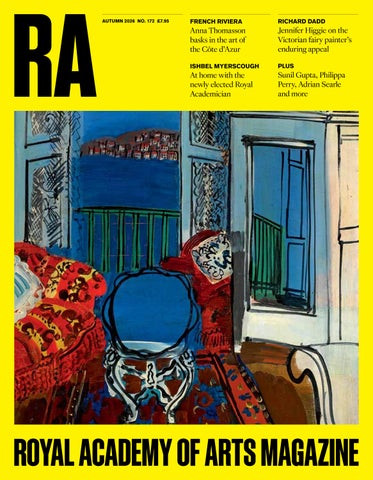
AUTUMN 2026 NO. 172 £7.95
FRENCH RIVIERA
RICHARD DADD
Anna Thomasson basks in the art of the Côte d’Azur
Jennifer Higgie on the Victorian fairy painter’s enduring appeal
ISHBEL MYERSCOUGH
PLUS
At home with the newly elected Royal Academician
Sunil Gupta, Philippa Perry, Adrian Searle and more
CONTENTS
RA Magazine Autumn 2026 In this issue
54 70 Painting the French Riviera As a blockbuster show arrives at the RA, Anna Thomasson explores the allure of the Côte d’Azur to modern artists including Cézanne, Dufy, Matisse, Monet and Picasso
The afterlives of Richard Dadd From Freddie Mercury to Angela Carter, many cultural icons have been inspired by the Victorian painter’s life and fantastical art, discovers Jennifer Higgie
On the cover, and left Open Window, Nice, 1928, by Raoul Dufy
Preview 11 Shopping The pick of the season’s gifts from the RA Shop 13 Showcase Ten must-see art events 18 Exhibitions diary RA shows this autumn 21 RA Exhibitions 2027 A look ahead to next year
29 Object lessons Hettie Judah finds that the RA Schools is a home for ambitious sculpture 34 Perspective Adrian Searle muses on the art of Sophie Calle 37 When art meets fashion Rosalind Jana looks back at the hedonism and decay of 90s culture
Features
40 Opinion Sophie Leighton asks: how much personal information should artists share?
25 Profile Izabella Scott meets photographer Sunil Gupta
43 Portrait of an artist Dale Berning Sawa visits Rosa Klerkx at her studio
4
ROYALACADEMY.ORG.UK
47 Artist in residence Daisy Dawnay drops in on Ishbel Myerscough RA
Shows 64 Poems in blue RA curator Ann Dumas selects three works that capture the colour of the Côte d’Azur 67 Cagnes-sur-Mer Imani Perry explores the Black history of blue in the work of William H Johnson
80 RA News A roundup of RAs’ projects 83 Schools graduates Former RA students on show this season 84 Events Courses and talks at the RA 89 In memoriam Tributes to Academicians David Hockney, Tess Jaray, Peter Freeth and Kenneth Draper
Agenda
96 Listings A guide for gallery lovers
79 Coming to the Courtyard Nicole Eisenman’s sculpture arrives at the RA
98 Life study Philippa Perry on a life spent with art
M ITC H E LL AN D C H R I STI N E C LAR F I E LD. P H OTO: S OTH E BY’S
6 Introducing the issue
WELCOME
Dive in to autumn
Contributors
Hoping the blue skies will never end? Reader, you have come to right place. This season, the RA’s exhibition ‘Painting the French Riviera’ brings sun, sea and sky to the Academy, and in these pages we explore the explosion of creativity the Côte d’Azur inspired among modern artists. ‘It was a place of exile, a playground, an Eden, a dreamscape’, Anna Thomasson writes, taking the plunge into the region’s allure and the freedoms it offered to artists (page 54). This, after all, was the region that made Claude Monet feel as if he was ‘swimming in blue air’, where André Derain imagined his paint tubes as ‘sticks of dynamite’. Yves Klein was so enamoured by the colour of the sky that he even tried to own it, patenting his own brand of ultramarine paint. Fantasy abounds at the RA this autumn. As our critically acclaimed exhibition of Richard Dadd continues, Jennifer Higgie uncovers how the work of the Victorian fairy painter has influenced figures from Freddie Mercury to the feminist author Angela Carter (page 70). ‘A large part of Dadd’s appeal is the possibility of escape his pictures offer from the travails of everyday life,’ Higgie finds. Elsewhere in this issue there is much to get lost in. Daisy Dawnay drops by the north London home of Ishbel Myerscough RA to talk Venetian-green beds, the artist’s love of Arsenal FC and why she finds painting sleeping people ‘irresistible’ (page 47). Adrian Searle explores desire and entrapment in the work of the legendary French artist Sophie Calle (page 34), and Philippa Perry answers our questions on the role art plays in her life (page 98). Come on in, the water’s lovely… The RA Magazine team
Some of our writers on a cultural gem that sums up the spirit of the season...
Editor Rosanna McLaughlin Deputy Editor Imogen Greenhalgh Designer & Production Manager Catherine Cartwright Sub-Editor Gill Crabbe
RA curator Ann Dumas, who gives an expert guide to the colour blue (p64). ‘Les Alyscamps, by Gauguin, painted during his time in Arles. It captures the golden glow of trees offset by a flash of orange, colours that he would develop so brilliantly on later trips to Tahiti.’
Editorial Advisers Eliza Bonham Carter, Michael Landy RA, Goshka Macuga RA, Fiona Mahon, Níall McLaughlin RA, Kira Milmo, Nikita Sena Quarshie, Charlie Porter, John Shevlin, Simon Wallis RA Magazine Digital Georgiana Ashworth, Tom Hutton, Charlie Murray, Cristina Ricci. RA Magazine Digital is supported by Paulo and Caroline Pereira SUBSCRIBE TO RA MAGAZINE Visit roy.ac/shop or contact the RA Shop
ADVERTISING ENQUIRIES Advertising & Partnerships Manager Tamsin Luck tamsin.luck@royalacademy.org.uk
Scholar Imani Perry, who explores the life of William H Johnson (p67). ‘Barkley L Hendricks’ portrait painting Blood (Donald Formey). It has that red-orange warm palette, yet the subject is so cool.’
Colour reproduction by Dawkins Colour. Printed by Walstead. Published 4 September 2026 © 2026 Royal Academy of Arts. ISSN 0956-9332 EU Authorised Representative: Easy Access System Europe – Mustamäe tee 50, 10621 Tallinn, Estonia, gpsr.requests@easproject.com CONTACT THE ROYAL ACADEMY Burlington House, Piccadilly, London W1J 0BD 020 7300 8090 friends@royalacademy.org.uk tickets@royalacademy.org.uk
RA SHOP 020 7300 8090 (select option 2). Visit roy.ac/shop or email raonlineshop@royalacademy.org.uk
ROYALACADEMY.ORG.UK
LU C I N DA R O G E R S
Author Izabella Scott, who visited Sunil Gupta in his studio (p25). ‘James Baldwin’s novel Giovanni’s Room: a tale of melancholy, forbidden love and loss; its beauty feels like rotting leaves underfoot.’
JOIN AND SUPPORT THE RA Membership starts from £72. Find out more at roy.ac/join
All reasonable attempts have been made to clear copyright before publication. Registered charity number 1125383 RA Magazine is the quarterly publication of London’s Royal Academy of Arts. Established in 1983, it is one of the most widely read art magazines in the UK, with a circulation of around 80,000 copies. RA Magazine is published in March, May, September and November, and mailed to Friends and members of the Royal Academy of Arts as part of their membership. It is also mailed to patrons and other supporters of the RA, and can be purchased from the RA Shop, newsstands and on subscription. The opinions in this publication do not necessarily reflect the views of the RA. Paper used in RA Magazine is sourced from responsibly managed forests and other controlled sources.
6
Greco A Journey to Greece
EDITORIAL ENQUIRIES ramagazine@royalacademy.org.uk
147 Sloane Street London
Preview What to see, buy and know this season 11
Shopping the French Riviera Côte d’Azur inspired picks from the RA Shop
13
Showcase Ten art stories to keep you informed this season
18
RA Exhibitions Diary Essential dates for your autumn calendar
21
RA Exhibitions 2027 A look ahead to next year’s programme at the Academy
PREVIEW
SHOP THE FRENCH RIVIERA Bring the Côte d’Azur home with our picks from the RA Shop
Brushed Cottons
1. Blue parasols ceramic jug A lovely addition to any table setting, made in France by Beth Holgate Pottery (£50)
1
2
2. Matisse poster Matisse’s 1947 poster is on show at the RA in ‘Painting the French Riviera’, making this the perfect souvenir (£25). Want to own an original? Buy it framed for £2,650 (inc VAT) 3. Crab keyring Brighten up your keys with this hand-beaded charm (£22) 4. Cézanne tote bag This colourful tote, featuring Cézanne’s painting L’Estaque, is made from heavy cotton and has inside and side pockets for smaller items (£25) 5. Eat up, plenty to go around plate Get the conversation going at the dining table with this playful stoneware side plate (£18)
3
6. Gold Mistral earrings Made in France by Gas Bijoux in gold-plated metal, with cabochon stone details (£160) 7. Lemon glass jug This lightweight, hand-crafted glass jug is the perfect lemonade pitcher (£55)
4
5
7
6
112 Jermyn Street www.emmettlondon.com
RA MAGAZINE AUTUMN 2026
11
PREVIEW
SHOWCASE Ten stories to keep you in the know this season
INTRODUCING
B R I N G T H E C O A S T TO YO U R K I TC H E N
UNCOVER THE COLLECTION AT w w w.lecreuset .co.uk
C O LLE CTI O N O F TH E BALTI M O R E M U S E U M O F ART, BALTI M O R E MARYLAN D. © SALMAN TO O R; C O U RTE SY O F TH E ARTI ST, LU H R I N G AU G U STI N E, N EW YO R K, AN D TH O MAS DAN E GALLE RY. P H OTO: FAR ZAD OWRAN G. © E LLE N LE S P E RAN C E C O U RTE SY TH E ARTI ST AN D H O LLYB U S H GAR D E N S, LO N D O N. P I N K FO OTE D B OWL, C.1980 P H OTO G RAP H BY SYLVAI N D E LE U © E STATE O F TH E ARTI ST/TH E LU C I E R I E AN D HAN S C O P E R FO U N DATI O N
2
1
Salman Toor’s arrival in London
The painter of queer and immigrant lives comes to the Courtauld for his first major UK show The Courtauld plays host to 19 paintings made by New York-based artist Salman Toor, whose mesmerising and intimate works draw from his experiences as a queer man of Pakistani heritage. Toor’s subject matter may be contemporary, but his paintings are steeped in art history. On his canvases are echoed the bar scenes of Edouard Manet, the absinthe greens of Henri de Toulouse-Lautrec, the cartoon-like absurdism of Philip Guston and more. Toor’s deep knowledge of painting past is the result of hours spent in museums, studying how artworks were made and then attempting to
recreate them. The works on show at the Courtauld, all produced since 2019, combine art-historical references with those from his own life and the communities to which he belongs. A man with long braided hair tending a bar echoes Manet’s famous barmaid; a group of seated men are posed to reflect an Orientalist painting by Eugène Delacroix (The Inheritors, 2022; above). The resulting works are cultural hybrids, freighted with reflections on belonging and exclusion and the often multi-faceted nature of identity. In the process, Toor has begun writing himself into the history books.
3
A CELEBRATION OF WOMEN’S ART Murray Edwards College, Cambridge, marks 40 years since The Women’s Art Collection bought its first work with a show of contemporary feminist art (Ellen Lesperance, I Oppose Thatcher’s Britain Power Corrupts (for Juley Howard), 2024; below) (23 Sep to 28 Feb 2027).
Explore more than 200 works by friends, collaborators and storied modern ceramicists Lucie Rie (below) and Hans Coper, reunited at London’s Offer Waterman (18 Sep to 30 Oct).
RA MAGAZINE AUTUMN 2026
13
B I LL JACK LI N R . A .
SHOWCASE
4
AT P O R T L A N D G A L L E RY
3 B EN N E T S T R EE T | LO N D O N S W1A 1R P | T EL : + 4 4 (0)20 7493 18 8 8
5
For more information on Bill Jacklin’s work, please contact Jamie Anderson: jamie@portlandgallery.com www.portlandgallery.com
C O U RTE SY O F CANAD IAN C E NTR E FO R AR C H ITE CTU R E, G I FT O F TH E E STATE O F G O R D O N MATTA-C LAR K ©E STATE O F G O R D O N MATTA-C LAR K/S O D RAC. © 2026. R O B E RT RYMAN / DAC S, LO N D O N. P H OTO: B I LL JAC O B S O N STU D I O, © TH E G R E E NW I C H C O LLE CTI O N, N EW YO R K. C O U RTE SY TH E E STATE O F P O P E.L AN D M O D E R N ART. © TH E E STATE O F P O P E.L
How Gordon Matta-Clark carved up the city
Portland Gallery work directly with Bill Jacklin and carry an extensive inventory of his paintings, monotypes and prints. Our gallery, situated 250 metres from the Royal Academy, always holds a significant number of works for collectors to view.
PORTLA ND GALLERY
Concrete and chainsaws
During the 1970s, Gordon Matta-Clark cut through buildings across the US and Europe, making art out of abandoned property (Conical Intersect, 1975, below; a spiral carved into derelict buildings opposite the Pompidou Centre in Paris). A show at De La Warr Pavilion in East Sussex brings together Matta-Clark’s
notebooks, drawings, letters, photographs and films from the era. Together, they tell the story of how he made some of the most extraordinary sculptural interventions of the 20th century, treating the city not as final and untouchable but as a raw material to be used (10 Oct to 4 Jan 2027).
6
From experiments with brushstrokes (Untitled, c. 1962, below) to the total erasure of images, Robert Ryman became a master of white paint. Enjoy 60 works from his abstract oeuvre at the Barbican (8 Oct to 28 Feb 2027).
NEW YORK’S POPE COMES TO TOWN Five decades of work by painter and performance artist Pope.L – famed for crawling through the streets to highlight inequality – are celebrated at Modern Art, London, with a spotlight on his painting practice (Gold People Shit In Their Valet, 2014; below) (13 Oct to 14 Nov).
RA MAGAZINE AUTUMN 2026
15
SHOWCASE
Renoir’s art of love
Between the 1860s and the 1880s, the highly prolific French Impressionist painter Pierre-Auguste Renoir produced many scenes of romance, family and friendship. Using his brushes to evoke the lives and loves of
8
Frieze Art Fair
Join the international artworld as it descends on Regent’s Park this October for Frieze London, the capital’s premier contemporary art fair. Come for the art, stay for the people-watching. If you get lucky, you may even get a glass of complimentary champagne from an obliging gallerist. Now in its 23rd year, the fair is focused on championing younger generations of artists. Make sure to stop by the open-air Frieze Sculpture (free and open to all), where a honeycomb work by Conrad Shawcross RA goes on display (detail of Eye of the Needle (Time Pebble (E30ALC13)), 2026; right). If modern and historical masterpieces are more your vibe than spotting the latest artworld trends, then head across the park to Frieze Masters, where works by the likes of Anish Kapoor RA rub shoulders with ancient artefacts and historical heavyweights (14 to 18 Oct). 16
ROYALACADEMY.ORG.UK
9
Parisians, he set about depicting the shared joys and intimate worlds of the modern denizens of the 19th-century French capital. A show at the National Gallery, ‘Renoir and Love’, brings together paintings from this era, celebrating Renoir’s approach to love and flirtation, as well as the scope and development of his subject matter – from street and café scenes to courtship parties and visits to beauty spots on the outskirts of Paris, as well as tender portrayals of family life (3 Oct to 31 Jan 2027). In The Swing (1876; left), a woman in a long white dress replete with blue bows steps on to a wooden swing beneath the shade of a tree, her hands playfully resting on the ropes. The blush of her cheeks and the smile dancing on her lips capture a moment of carefree fun with her male companion, the bright, fleeting nature of their interaction reflected in the feather-like brushwork and colourful dappled light.
Paraguayan artist Julia Isídrez learned to work with clay from her mother. Her menagerie of fantastical creatures goes on show at Nottingham Contemporary, where tradition and vivid imagination collide (9 Oct to 10 Jan 2027).
348 10
... miles is the distance the Bayeux Tapestry travelled from Normandy to London’s British Museum, where the famed embroidery of the 1066 conquest goes on display almost a thousand years after its creation (10 Sep to 11 July 2027).
© M U S É E D’O R SAY, PAR I S, B E Q U E ST O F G U STAVE CAI LLE B OTTE, 1896, R F 2738. J U LIA I S Í D R E Z - TU NA (2021). P H OTO: C HAR LI E R U B I N (C O U RTE SY O F G O M I D E & C O). C O U RTE SY C O N RAD S HAWC R O S S
7
Feel more with English National Ballet ballet.org.uk Principal Building Partner of English National Ballet
Dancers: Jakob Wheway Hughes and Emma Hawes. Image by Drew Forsyth. Creative Direction: EDIT Brand Studio.
Reg charity 214005
EXHIBITIONS DIARY
THIS SEASON AT THE RA Modernism on the French Riviera, plus the wondrous worlds of Richard Dadd
Richard Dadd: Beyond Bedlam Until 25 Oct
From top Morning in Antibes, 1888, by Claude Monet; Contradiction. Oberon and Titania (detail), 1854–58, by Richard Dadd
The Jillian and Arthur M Sackler Wing of Galleries Supported by the Tavolozza Foundation and Cockayne – Grants for the Arts. With additional support from the late Miss Rosemary Lomax-Simpson, Colin McCorquodale, and The Dr Lee MacCormick Edwards Charitable Foundation
Coming soon Peggy Guggenheim in London 21 Nov to 14 March 2027 The Jillian and Arthur M Sackler Wing of Galleries Lead Philanthropic Supporter Kenneth C. Griffin and Griffin Catalyst. Supported by Bottega Veneta, Riverstone Living, The Reuben Foundation and Kathryn Uhde Opening Hours The RA is closed on Mondays. The rest of the week, it is open 10am to 6pm, and until 9pm on Fridays
18
ROYALACADEMY.ORG.UK
JASON WASON AT 80 RETROSPECTIVE 12th September - 14th November
BRONZE STERLING SILVER CERAMIC Exhibition catalogue with introduction by Michael Bird Photography by Steve Russell Studios
Main Galleries Friends Previews: 29 Sep, 10am to 9pm; 30 Sep, 10am to 6pm and 1 Oct, 10am to 6pm Supported by Kenneth C. Griffin and Griffin Catalyst, The Idan & Batia Ofer Family Foundation, the Huo Family Foundation, CMA CGM, Christie’s, Miraval, and David and Molly Lowell Borthwick. With additional support from Ömer Koç, the International Music and Art Foundation and The Risman Foundation
P H I LAD E LP H IA M U S E U M O F ART: B E Q U E ST O F C HAR LOTTE D O R RAN C E WR I G HT, I NV. 1978-1-22. P R IVATE C O LLE CTI O N / P H OTO © DAVI D PAR M ITE R
Painting the French Riviera 2 Oct to 31 Jan 2027
GALLERY PANGOLIN
9 Chalford Ind. Estate Chalford, Glos GL6 8NT 01453 889765 www.gallery-pangolin.com Silent Witness, 2011 165 x 24 x 24 cm
PREVIEW
2027 SHOWS
MODERN ART ON THE CÔTE D’AZUR
In small groups, discover rich collections with masterpieces by Renoir, Bonnard, Braque, Léger, Miró, Giacometti, Cocteau, Chagall, Matisse and Picasso.
Book now at martinrandall.com Or call us on 020 8742 3355 99% of travellers rate us excellent or good in over 1,100 reviews. ATOL 3622 | ABTOT 5468 | AITO 5085
We stay in Nice throughout, within easy reach of galleries both storied and surprising.
Image: Chapelle Saint-Pierre in Villefranche-sur-Mer, France, as seen on ‘Modern Art on the Côte d’Azur’.
PAR I S M U S É E S / P ETIT PALAI S, M U S É E D E S B EAU X-ARTS D E LA VI LLE D E PAR I S. C O U RTE SY TH E ARTI ST AN D MATTH EW MAR KS GALLE RY. © S I M O N E LE I G H. P H OTO: TI M OTHY S C H E N C K. P H OTO: © STI FTU N G P R E U S S I S C H E R K U LTU R B E S ITZ, M U S E U M B E R G G R U E N, N E U E NATI O NALGALE R I E / J E N S Z I E H E. © S U C C E S S I O N P I CAS S O / DAC S, LO N D O N 2026. E X H I B ITI O N O R GAN I S E D BY TH E R OYAL ACAD E MY O F ARTS I N C O LLAB O RATI O N W ITH TH E M U S E U M B E R G G R U E N, N E U E NATI O NALGALE R I E – STI FTU N G P R E U S S I S C H E R K U LTU R B E S ITZ
See Europe’s greatest concentration of classic modern art in the idyllic Mediterranean setting where it was created, explored in the company of leading experts.
A look ahead to a blockbuster year of exhibitions, as Rembrandt comes to the Academy Rembrandt: Radical Printmaker 9 April to 19 Sep 2027 The Jillian and Arthur M. Sackler Wing of Galleries Next spring, more than 100 of Rembrandt’s works – rarely seen together – will go on display at the RA, revealing one of the world’s most famous artists in an entirely new light. With his spirited, expressive approach to printmaking, Rembrandt expanded the possibilities of the medium, depicting scenes from everyday life, self-portraits, biblical subjects and mesmerising landscapes with extraordinary energy. More than 350 years on from the Dutch Master’s death, ‘Rembrandt: Radical Printmaker’ is a celebration of the freedom and pioneering attitude he brought to his work. During the 17th century, when printmaking was an art that demanded repeatable precision, Rembrandt embraced risk-taking to develop a uniquely expressive oeuvre, rewriting the rules of working in this medium forever. Our wider 2027 programme proceeds in the same groundbreaking spirit. The arrival of world-renowned sculptor Simone Leigh in the Main Galleries will be a landmark exhibition of the American artist’s monumental sculpture. ‘Matisse, Picasso, Klee: Masterpieces from the Museum Berggruen’ offers a rare opportunity for British audiences to see those artists’ most exemplary works. And the 259th edition of the Summer Exhibition will show the most exciting and essential art in Britain right now. Clockwise, from top Self-portrait with Wild Eyes, 1630, by Rembrandt; Okwui, 2024, by Simone Leigh; Seated Harlequin, 1905, by Pablo Picasso
RA MAGAZINE AUTUMN 2026
21
Features
SHANI RHYS JAMES MBE The Afternoon House 10 SEPTEMBER – 2 OCTOBER 2026
People, places and opinions
Skipping Rope, 2025 Oil on linen, 60 x 60 in, 152.5 x 152.5 cm
2 AL BEMAR LE ST RE E T, LO ND O N W1S 4 H D TEL +44 2074080362 art@connaughtbrown.co.uk www.connaughtbrown.co.uk
25
Profile Sunil Gupta discusses a life spent documenting queer communities
29
Object lessons How the RA Schools has become a home for contemporary sculpture
34
Perspective Adrian Searle on a work by the legendary French artist Sophie Calle
37
When art meets… fashion Hedonism and decay combine in 1990s art and style
40 Opinion Sophie Leighton argues that artists’ biographies must be handled with care 43
Portrait of an artist Dale Berning Sawa visits the studio of Rosa Klerkx
47
Artist in residence Daisy Dawnay drops in on Ishbel Myerscough RA at her north London home
Chr is Beetles Galler y
FEATURES
AN T HON Y GR EEN RA (1939-2023) A Taste of the Studio Archive A new exhibition from the Estate of the much missed superstar of the Royal Academy.
15 September – 3 October 2026 A complimentary illustrated invitation brochure is available to RA readers on direct contact with the gallery. All works are available to purchase and can be viewed on our website www.chrisbeetles.com
‘WE WERE A RADICAL GENERATION’
8 & 10 Ryder Street St James’s London SW1Y 6QB • 020 7839 7551 • gallery@chrisbeetles.com • Monday – Saturday • 10am – 5.30pm
C R E D IT XXXX
Mar
y Co
zens -Wa lker
’s Le gacy
, oil
on b oard
, 99
x 73
inch
es
Izabella Scott visits the London studio of groundbreaking photographer Sunil Gupta, to discuss a life spent documenting queer love and resistance
Sunil Gupta’s studio is at the top of a Camberwell warehouse, a sun-struck room rimmed with windows and crowded with photographs. We sit at the kitchen table on a hot June afternoon, a rainbow-knitted tea cosy resting on a nearby counter. Now in his seventies, and belatedly regarded as an eminent photographer of queer life, Gupta lives and works with his partner and collaborator Charan Singh, and their photographs of queer lives and migrant communities hang side by side on the walls. For his survey show, ‘Life with a Camera, 1970–Now’, at Kettle’s Yard in Cambridge he has returned to work from the past five decades, revisiting photographs made in Delhi, Montreal, New York and London that chart the fight for queer rights and the everyday textures of LGBTQ+ life. Gupta’s story begins in New Delhi, where he was born in 1953, and moves across continents. In 1969, his family emigrated to Montreal, where as a teenager he taught himself photography using the family camera. It was there as a student that he encountered the gay liberation movement and came out, finding in politics and local bars a sense of community he had never seen represented in images. ‘My hobby suddenly had a purpose,’ he recalls. He photographed friends, lovers, marches and façades of gay bars – what would become ‘Friends and Lovers’, a series of portraits made across the decade of his extended gay family. These pictures first appeared in Gay-Zette, a student newspaper and part of a DIY gay visual culture that Gupta helped to invent. In the mid 1970s Gupta left Canada for New York, where he found his ‘tribe’ on Christopher Street. A gathering place for queer people, the street was home to the Stonewall Inn, a venue that became a landmark of the gay rights movement in › RA MAGAZINE AUTUMN 2026
25
FEATURES
‘Christopher Street shows men striding past the camera in aviator sunglasses, cigarettes dangling below handlebar moustaches’
This page, right #22 from the series ‘Christopher Street’, 1976, by Gupta
› 1969, after a police raid sparked days of protest that helped launch the modern gay liberation movement. Here, Gupta cruised with his camera through a scene that was exuberant in the period before the devastation of AIDS. The resulting black-and-white series, ‘Christopher Street’ (1976), shows men striding past the camera in aviator sunglasses, fists bulging in jean pockets, cigarettes dangling below handlebar moustaches. The images are flirty and unguarded: men sauntering with confidence and ease, eyes skimming the crowd as Gupta catches them mid-glance. ‘Everybody seemed to be gay,’ Gupta recalls joyfully. ‘This was almost the era of songs like “It’s Raining Men”, and it felt like that: hundreds of handsome men streaming by.’ If Montreal and New York had felt expansive to Gupta, when he moved to London in the late 1970s he was in for a shock: ‘Nobody talked about homosexuality. It was very repressed,’ he says. The gap between his experience as a gay man and the silence of British art institutions sharpened his sense of mission. ‘I realised I needed to make these images of homosexuality and place them into art history so they couldn’t be ignored.’ In London, Gupta worked through another political crisis: Section 28, the 1988 legislation that banned ‘promoting’ homosexuality in schools, arrived in tandem with the AIDS epidemic and a wave of moral panic. He photographed protests from within the crowd, producing ‘“Pretended” Family Relationships’ (1988), a series that splices images of marches with staged portraits of gay couples and texts written by his then partner Stephen Dodd. In this period, Gupta stopped courting recognition from galleries on Cork Street, choosing instead to show work in town halls and community centres. ‘We were a radical generation – we turned our backs on galleries’, he explains. ‘We were postcolonial, postmodern, post everything. I didn’t stop to think about who paid the rent.’ When Gupta received a diagnosis of HIV in 1995, he shifted 26
ROYALACADEMY.ORG.UK
the camera onto his own body. In ‘From Here to Eternity’ (1999), the artist pairs self-portraits with images of gay nightclubs. ‘I photographed myself naked in the mirror. It was the first time my body was a subject and I was quite anxious about it. But it became a way to finally discuss my diagnosis in a more objective way, out there in pictures – and that was a revelation.’ Recognition, he says, only arrived in the past decade, as attitudes began to shift: ‘There was a resistance to “gay” being my lifelong subject. A lot of curators used to say, “When are you going to grow out of it?”, as if it was a kind of arrested development.’ Moving to the Camberwell studio in 2017 allowed him to consolidate a scattered archive, gathering negatives left in ex-boyfriends’ flats and storage boxes across cities. Here, Gupta began rediscovering work he had not seen since shooting it, such as the Christopher Street images and ‘Exiles’ (1986-87), photographs of gay men at cruising sites in Delhi taken during the 1980s, against the backdrop of India’s colonialera sodomy laws. Soon after, he uploaded the photographs to a DIY website, where the publisher Stanley/Barker stumbled upon his work, called him, and proposed a book. That publication, Christopher Street, 1976, marked a turning point: gallery representation and exhibitions followed, the survey at Kettle’s Yard the most comprehensive yet. In June, Gupta was awarded an MBE for Services to Art and to the LGBTQ+ Communities – a state honour that recognises, somewhat incongruously, decades of work made in defiance of state sanctioned homophobia. What matters to him is that his images are widely seen. ‘I just made things in the 80s and 90s,’ he says, ‘but nobody really wanted them. Now they’ve found their place.’ Izabella Scott is the author of The Bed Trick (Atlantic Books) Sunil Gupta: Life with a Camera, 1970 – Now Kettle’s Yard, Cambridge, 19 Sep to 31 Jan 2027
P R EVI O U S PAG E: © C HARAN S I N G H, ALL R I G HTS R E S E RVE D, DAC S 2026. TH I S PAG E: I MAG E S C O U RTE SY TH E ARTI STS AN D HALE S GALLE RY, MATE R IÀ GALLE RY, S E P IAEYE, STE P H E N B U LG E R GALLE RY AN D VAD E H RA ART GALLE RY. © S U N I L G U PTA AN D C HARAN S I N G H. ALL R I G HTS R E S E RVE D, DAC S 2025
Previous page Sunil Gupta, photographed by his partner and collaborator Charan Singh
FEATURES
OBJECT LESSONS
As two RA Schools graduates are nominated for this year’s Turner Prize, Hettie Judah discovers how the Academy’s art school is bucking trends as a home for ambitious sculpture
C R E D IT XXXX
AT THE RA SCHOOLS RA MAGAZINE AUTUMN 2026 sarabandefoundation.org
29
FEATURES
We live in a visual culture where art is largely encountered through screen-flattened images rather than in the stimulating environment of the everyday. Where commercial galleries riding out a turbulent market overwhelmingly favour painting over objects and new media work. It’s not an easy time for sculptors. But when has it ever been? For both artists and collectors, much of what makes sculpture vital and dynamic also makes it challenging, whether that’s the space it demands, its site-responsiveness or the unstable materials used in its construction. Artists – the decent ones, at least – tend towards the contrary. So, of course there are pockets of resistance. Brian Griffiths RA, a sculptor and third-year tutor at the RA Schools, sees the Academy’s art school as one such arena. Over the past decade, the Schools ‘has produced an extraordinary number
CONTEMPORARY SCULPTURE
of ambitious, curious and inventive artists working through sculpture and object-based installation,’ he says. ‘This year’s graduation show was no exception: some of the most expansive and intellectually adventurous presentations are sculptural in nature.’ Griffiths’ observation is supported by the shortlist for this year’s Turner Prize, on display this autumn at MIMA in Middlesbrough. Two of the four nominees – Tanoa Sasraku and Kira Freije (featured in RA Magazine Winter Issue 2025) – graduated from the RA Schools in the past decade, and both work sculpturally. Sculpture can engage with issues of space and the body, but for an artist one of the greatest problems can be making space for their own body in a studio filling up with work. I spoke to Cathie Pilkington RA as she was stashing objects newly
returned to her from exhibitions in Denmark and at the Royal Scottish Academy. Pilkington, who was Professor of Sculpture at the Schools from 2015-19 and, until this summer, its Keeper, reminds me that when Louise Bourgeois was asked what was the most important thing for a sculptor, she replied: ‘storage’. Like Bourgeois, Pilkington engages materially with the stuff of storage in her site-responsive installations: ‘real life experience has turned into a sculptural strategy,’ she says. In her recent exhibition ‘Housekeeper’ at London’s Freud Museum, she pondered the role of Paula Fichtl, the family’s maid, who was charged with packing the psychoanalyst’s collection of figurines when he moved from Vienna to London in the 1930s. Pilkington arranged her own sculptures within layers of special blankets used in transportation, known as
moving blankets, inside a glass vitrine like embedded memories, building them up to present a cross-section of strata ready for psychoanalytic excavation. Transport and safe storage is also threaded through Tanoa Sasraku’s work Tropical Hardware, exhibited in June as part of the Glasgow International Festival. Wooden crates were painted in the colours of tropical prints and military camouflage – hot pink and peach, gunmetal and lime, burgundy and sunshine yellow – and filled with flak-jacket forms made from newsprint clipped together in thick wads. It’s a show that speaks to the dual nature of things. The large crates recall protective boxes for transporting weapons, yet their forms also resemble coffins. Newsprint has become a mainstay in Sasraku’s work, using techniques she developed at the RA Schools. The tutors ›
Previous page Sparks fly in the metal workshop at the RA Schools Left Former RA Schools student and 2026 Turner Prize nominee Tanoa Sasraku stands beside work made from newsprint and natural pigment, a technique honed at the Schools
30
ROYALACADEMY.ORG.UK
C R E D IT XXXX C O U RTE SY O F CATH I E P I LK I N GTO N AN D TH E F R E U D M U S E U M LO N D O N. P H OTO G RAP HY: P E R O U
P R EVI O U S PAG E: DAVI D PAR RY. TH I S PAG E: TAN OA SAS RAK U P O RTRAIT © B E LI N DA LAWLEY
Opposite Installation view of ‘Housekeeper’, Cathie Pilkington RA’s 2025-26 exhibition at the Freud Museum, London
‘For both artists and collectors, much of what makes sculpture vital and dynamic also makes it challenging’
RA MAGAZINE AUTUMN 2026
31
Private dining, just between Friends
FEATURES
Enjoy private dining in our intimate Reading Room at the Keeper’s House by José Pizarro, exclusive to Friends and members of the RA. Set menus, featuring tapas classics from acclaimed Spanish chef José Pizarro, are available for groups of 6 to 20 guests – making it the perfect spot for your next special occasion.
Make a reservation roy.ac/keepershouse
› ‘transformed my practice with me and allowed me to be very ambitious. It really felt like they were invested.’ The ‘fantasy space’ of the Schools’ large studios gave Sasraku the confidence to move to Glasgow to find a working space to match. While she has received plenty of institutional exhibiting opportunities – including the show that earned her the Turner-Prize nomination, ‘Morale Patch’ at London’s ICA – Sasraku admits that ‘market-wise, it’s tough’ as a sculptor. As well as the space and technical expertise available to students, Pilkington considers the three-year duration of the Schools’ course pivotal. ‘There’s time to experiment. You can fail and take risks.’ She often sees a critical change take place during a student’s second year as they become increasingly emboldened. It’s an embrace of technical ambition and
risk-taking in which failure, awkwardness and doubt are seen as positive phenomena to learn from and work with. That students continue to reinvent the formal possibilities of sculpture, ‘despite the increasing costs and practical difficulties’, is ‘remarkable’, says Griffiths. Engaging directly with the materials, concerns and visual language of their time, their work ‘no longer fits neat definitions. It moves between objects, installations, social situations, moving image, performance, architecture and research. Yet it remains recognisably sculptural because that’s what it is.’ Hettie Judah is a writer and curator. Her latest book, How to Enter the Art World… (Hoxton Mini Press), is out now Turner Prize 2026 MIMA, Middlesbrough, 26 September to 29 March 2027
P O RTRAIT O F K I RA F R E IJ E. P H OTO © R O B I N B E R N STE I N
Above Turner Prize 2026 nominee Kira Freije developed her cage-like figures, seen here in her Greenwich studio, while studying at the RA Schools
Photo © Royal Academy of Arts, London / Behrman Media.
32
ROYALACADEMY.ORG.UK
PERSPECTIVE
FEATURES
SOPHIE CALLE’S PREY DRIVE
Opposite Honorable (Some Fortune) (1895-1905), 2017-2025, from the series ‘On the Hunt’, by Sophie Calle
34
ROYALACADEMY.ORG.UK
These days, in enlightened circles, catch and release is the thing. ‘Show me a beautiful brunette, simple and rustic tastes, who likes hunting, homemaker, orphan, with dowry’… ‘28 years old, shy, automotive mechanical engineer. I avoid amazons and proud bachelorettes. I am looking for a Frenchwoman with great education and the style of a provincial bourgeoise’… ‘21-year-old cook in well-to-do home, looking for man working as farrier, wheelwright, carpenter, harness-maker’… ‘Disgusted by the masculine gender. In fact I don’t know what I’m doing here. I am not funny, I don’t like food or music. Nothing serious, nothing not serious, I am looking for nothing, I am trying to understand human nature before I die’… ‘Misogynist deceitful killjoy egocentric scrooge alcoholic and depressed young man is looking for lunatic brainless annoying venal pretentious young woman with no sense of humour for boredom platitudes domestic rows and more if we get along’… Taken from over a century’s worth of matrimonial small ads published in Le Chasseur français between 1895 and 2010, and from more recent platforms and dating apps, Sophie Calle has trawled through the vagaries of heterosexual desire in ‘On the Hunt’ (Honorable (Some Fortune) (1895-2025); detail opposite), which she originally made for the Musée de la Chasse et de la Nature à Paris, where she found copies of the magazine in the museum’s archive. Excerpting pages filled with lonely hearts and social climbers, the fickle and the innocent, the keen and the avaricious, the left-behind, the venal and the horny, Calle paired groups of the adverts with double-sided framed photographs: one side showing a hunting stand – a raised platform, placed in a likely spot, or a jetty leading through the reeds to open water – and on the other side of the frame a nighttime image of an animal captured by an infrared camera. A blurry white flurry which might be an owl, a deer, an anaemic looking fox. What we don’t see are the hunters. Perhaps that’s part of the point. I have always liked the way Calle snares the viewer in the same way that she entangles her subjects in her projects; the man whom she met at a party and followed all the way to Venice, the guy whose address book she found on the street, and who she profiled by calling up the people in the book and asking them about him. There’s always some double or even triple game going on, a game of dares and truths, entanglements, fictions and fabrications. Things are always on the brink of spiralling out of control. In the game of pick-ups and liaisons the hunter and the hunted are both colluding in the exploration of possibilities, via the mirage of beguiling stories, and seeing how far things might go. Calle’s art is like that too. Adrian Searle is an art critic Something Missing? Turner Contemporary, Margate, 3 Oct to 24 Jan 2027
© S O P H I E CALLE / DAC S, LO N D O N, 2026/ C O U RTE SY TH E ARTI ST AN D P E R R OTI N
are hunters and there are trappers, and then there is the Adrian Searle explores desire There prey. But which is which and who is who? What are you after? and ensnarement in a work Game for the pot is it, or that one special trophy you want to Something from a bucket-list of endangered species? Get from the French artist’s series bag? it while you can, that’s my motto. Some like to give their quarry a ‘On the Hunt’, ahead of her sporting chance though from the prey’s viewpoint sport doesn’t come into it. Both the dog and the squirrel know their role. The Turner Contemporary show wager is life or death and not much in between except the chase.
RA MAGAZINE AUTUMN 2026
35
FEATURES
WHEN ART MEETS FASHION
As Tate Britain opens its paean to 1990s culture, Rosalind Jana explores a decade marked by grimy glamour, hedonism and decay Like all interesting relationships, the one between art and fashion has been riven with tensions, passions and begrudging mutual respect. At times they have been enemies: the eternal positioned against the mercurial. At others, they have grown so close that it becomes hard to tell them apart. In the 1990s, the two industries enjoyed a period of intense cross-fertilisation, both sensitised to the simultaneous dynamism and dread of a decade rapidly hurtling towards the future. This autumn, Tate Britain’s show ‘The 90s: Art and Fashion’, curated by British Vogue’s former Editor-in-Chief Edward Enninful, takes a look at ‘a new dawn of optimism, freedom and rebellion’, which led to ‘an audacious renewal of British spirit’ during the last gasp of the millennium. Teasing out the connections between photographers including Elaine Constantine, Wolfgang Tillmans RA and Juergen Teller; artists Sarah Lucas, Yinka Shonibare RA and Chris Ofili; and designers such as Vivienne Westwood, John Galliano and Alexander McQueen, it offers a look at the post-recession, nascent Cool › RA MAGAZINE AUTUMN 2026
37
COOL BRITANNIA
‘The raves were free, the creativity scrappy and the attitude was nonchalant (or at least feigning to be)’
Previous page Flesh at The Haçienda, 1996, by Jon Shard
This page, right Chicken Knickers, 1997, by Sarah Lucas
This page, above Sarah Lucas and Tracey Emin RA outside The Shop, near Brick Lane
Opposite page England’s Dreaming, The Face, 1993, by Corinne Day
38
ROYALACADEMY.ORG.UK
C O R I N N E DAY E STATE
› Britannia buoyancy of a country where the raves were free, the creativity scrappy and the attitude nonchalant (or at least feigning to be). It is a decade that has become heavily mythologised: shorthand for a Britain that felt, briefly, unselfconscious and spontaneous, before New Labour professionalised cultural output and the 2008 crash retroactively painted the whole era with a nostalgic sheen. It was also a decade riddled with contradiction. Whereas today the 90s often appears in designers’ mood boards for its grimy, lo-fi approach to ‘the real’ – as seen in the work of Corinne Day (England’s Dreaming, 1993; right), and the Haçienda clubgoers captured by Jon Shard (Flesh at The Haçienda, 1996; page 37) – it also offered a fresh spin on the world of personal branding. The YBAs mastered the art of self-promotion, often with tongue firmly in cheek, as with Sarah Lucas and Tracey Emin RA’s The Shop (left), a retail-slash-studio-slash-party space they opened in a disused building near Brick Lane in 1993, where they sold sex toys, sculptures and T-shirts. The same area hosted many of the era’s most fêted designers and artists. Alexander McQueen’s studio was in a basement off Hoxton Square, a stone’s throw from both The Shop and the Blue Note, where Goldie’s Metalheadz nights drew clubbers east every Sunday. Over in Bow, Rachel Whiteread had just cast the interior of a condemned building: concrete poured into the shell of a Tower Hamlets terraced house, empty space solidified, the piece less a tombstone than a ghostly imprint until it was torn down by the council several months later. Everyone drank at the Bricklayers Arms in Shoreditch: McQueen and Emin, but also Damien Hirst, designers Katie Hillier and Luella Bartley, and stylist Katie Grand. Creative worlds are always communal worlds too, and at that point there were still pockets of London where property was cheap and studio space plentiful, and ideas were pollinated at parties and on magazine pages.
P R EVI O U S PAG E: C O U RTE SY O F B R ITI S H C U LTU R E AR C H IVE © J O N S HAR D, B R ITI S H C U LTU R E AR C H IVE. TH I S PAG E: © DAM E TRAC EY E M I N / ALL R I G HTS R E S E RVE D/ DAC S I MAG E S. © SARAH LU CAS/ C O U RTE SY TH E ARTI ST AN D SAD I E C O LE S H Q, LO N D O N, TATE
FEATURES
However, it wasn’t all hedonistic euphoria. Growth cannot exist without decay, and the decade’s shadow side was responsible for producing some of the most stunning – and unsettling – works that bridged these adjacent worlds. The 90s was also a profoundly anxious decade, opening with the ongoing AIDS crisis, absorbing the collapse of the Soviet Union and closing with rapid expansions in technology and communication that promised to reshape every aspect of life, both external (socialising, shopping, work) and internal (one’s very sense of identity), on an unprecedented scale. Tate’s show alludes to this darker register with the inclusion of pieces by Helen Chadwick, who worked with materials including latex, urine, meat and rotting vegetables, and Cathy de Monchaux, best known for her unsettling, otherworldly sculptures in which human forms fuse with trees or grow exoskeletons. Hussein Chalayan also makes an appearance: a designer whose work was often indistinguishable from conceptual art. The same year that Lucas and Emin set up shop, Chalayan’s graduate show ‘The Tangent Flows’ featured a series of silk dresses buried in his garden for months and then exhumed, the results resembling something preserved in a bog for centuries. Fashion’s ephemerality, gross glamour and the fragility of the body were key concerns for a generation of artists who chose
clothes as both subject and material. Sarah Lucas placed a raw chicken on a woman’s pants for Chicken Knickers (1997; opposite). Beyond Tate’s walls, Canadian artist Jana Sterbak’s ‘Vanitas: Flesh Dress for an Albino Anorectic’ (1987), a dress constructed from 50 pounds of raw steak, set the tone for what followed – and was famously referenced by Lady Gaga at the 2010 MTV Awards. Emily Bates wove garments from human hair, Cornelia Parker RA presented suits riddled with holes from pearl ‘bullets’, Annette Messager placed gowns in coffin-like cases, and Lun*na Menoh suspended spectral dresses from the ceiling. To put it another way, it was a decade in which art and fashion weren’t merely in conversation with one another but resourced by the same wellspring of fear, hope and fantasy. When we contemplate the 90s now, part of its continued allure lies in the sense of an atmospheric totality which has since been lost. In that sphere of visual, social and political intensity, the borders between industries and ways of working were more indeterminate – and the result was a decade far richer and stranger than standard 90s nostalgia tends to allow for. Rosalind Jana is a writer on art, culture and fashion The 90s: Art and Fashion Tate Britain, London, 8 Oct to 14 Feb 2027 RA MAGAZINE AUTUMN 2026
39
OPINION
FEATURES
A light blue double bed sits in the centre of the gallery space. It is covered by a white bedspread sprinkled with woollen daisies. A text on the wall explains that the artwork is by Corinne, an artist who is confined to bed, which they once considered ‘a place of entrapment’. Inspired by the example of Frida Kahlo, Corinne has since reframed their bed as their studio, referring to it as their collaborator, subject matter and whole world: ‘A place where my gender-fluid identity, sexual orientation and disabilities are embraced rather than discriminated against.’ As they explain, ‘my life and art have become inextricably entwined’. Through their art practice they ensure the world comes to them, while at the same time sharing insights into complex experiences of confinement. When we look at an artwork, how does our knowledge of the artist’s life impact how we view their work? And, from the perspective of the artist, to what extent is it psychologically or intellectually helpful to address personal experiences through an art practice? These questions cut straight to the very purpose of art. Corinne is an artist we work with at Bethlem Gallery – a gallery and studio space in south-east London, on the site of Bethlem Royal Hospital – whose work raises these questions very clearly. They explain that, for them, making art is both therapeutic and activist. As one of the artist’s aims in showing 40
ROYALACADEMY.ORG.UK
their work publicly is raising visibility about their experiences, viewers need to know certain details about their life. But, as is the case with all art, we don’t need to know every detail to garner meaning: every biography shared with audiences must be constructed with care. Often the confessional mode in art – using personal biography – is critiqued as the artworld’s equivalent of clickbait, a sensationalist way of commodifying the artist as a brand. Yet sometimes the inclusion of heavy personal context enables an artist to make serious broader points about society and marginalised experiences. Bethlem Gallery is situated in one of the oldest psychiatric hospitals in the world, previously known as Bedlam. Being associated with such a famous hospital means that there is always a predefined frame of reference. At Bethlem Gallery, we find that situating the artwork in a strong, historical, institutional context – visitors to the gallery have to walk through the huge hospital gates – foregrounds the structural roots of many personal experiences. It also supports a feminist interpretation that anything personal is political; that a personal experience of illness or trauma often can also be an instance of structural injustice. In spite of its positive uses, the confessional mode needs to be approached with caution. Because another impact of making and showing work in the context of a mental health hospital is that it often prompts visitors to think about the artist before the art. They might be interested in a diagnosis rather than the stories and experience of the artwork itself. We walk a very fine line in balancing the biography of an artist alongside the art: while we need to honour the artist’s life story, we also want to tell the story of an artwork, rather than pathologise the person who made it. An artist’s experiences, wellbeing and future are the priority, and our processes of framing art in collaboration with them are also about a duty of care. Sometimes, that might mean an artist’s biography isn’t mentioned at all. In writing about art, we want to open up different experiences and representations of the world for discussion and understanding, but if we put too much emphasis on a diagnosis, the artwork – and the artist – are reduced to a single lens (and often a stereotype or stigma) of illness. Viewers might appreciate personal information to help understand a work. It might be vital in order for the artist to fulfil their vision and hopes for their art. Art and lived experience are important partners, even inseparable, but the extent to which either should be foregrounded depends on many factors, and should be decided in careful collaboration between artist and curator. Art – and biography – must always be framed with care. Sophie Leighton is the Director of Bethlem Gallery
I LLU STRATI O N: J OÃO FA Z E N DA
HOW MUCH SHOULD ARTISTS SHARE?
As the RA celebrates the art of former Bedlam patient Richard Dadd, Sophie Leighton asks how much an artist’s biography matters to understanding their work
RA MAGAZINE AUTUMN 2026
41
FEATURES
‘SOMETIMES YOU DON’T FULLY UNDERSTAND
and enjoy the finest olive oil all year from your own tree
Save 15%
RA15
P H OTO: B E NJAM I N M C MAH O N
off first pack
POMORA.COM/RA
Above Rosa Klerkx in her London studio, photographed by Benjamin McMahon
Rosa Klerkx, RA Schools graduate and winner of the prestigious Claridge’s Royal Academy Schools Art Prize, talks to Dale Berning Sawa about the importance of attention, emptiness and taking her time
THE WORK YOU'RE MAKING’ When Dutch artist Rosa Klerkx was little, her family used to holiday on Schiermonnikoog, the smallest inhabited island in the northern Netherlands. She hadn’t been back there in years, but in her mind’s eye, the sea retreated so far back at low tide that she couldn’t see it at all. Sand stretched into the sky, endless and empty. In a work titled Interior Life in her 2025 Royal Academy Schools degree show, Klerkx paired footage of her mother dancing in dark trousers on that boundless beach, with footage of her father doing the same dance in a flat green field, the horizon interrupted by trees and wind turbines, like musical dots on a stave. The choreography is Klerkx’s own, a characteristically pared-back sequence of gestures that feel commonplace yet strange, too, because abstracted from daily life. ‘I like to think about places that just exist all the time without necessarily being seen or acknowledged,’ she says. ‘Placing someone in one, doing a very specific thing, suddenly highlights the location and the person.’ In September 2025, a jury panel comprising Royal Academicians Roger Hiorns, Chantal Joffe and Claudette Johnson chose Klerkx as the winner of the Claridge’s Royal Academy Schools Art Prize. Eliza Bonham Carter, Director of the RA Schools, described her work as weaving sound, movement and film into compositions ‘both intimate and vast’ that explore human connection. › RA MAGAZINE AUTUMN 2026
43
FEATURES
Left 216, from the ‘Blueprint’ series, 2026, by Rosa Klerkx Below A video still from 216, 2026, by Klerkx
‘I definitely believe that sometimes you don’t fully understand the work you’re making.’ At other times, it is the feeling of a place that provides inspiration. During her BA in sculpture at Glasgow School of Art, from which she graduated in 2018, Klerkx found a blocked off basement space beneath the studios containing random office chairs and other bits of abandoned furniture. One room at the back was pitch black. She was intrigued. She brought down lights and started improvising and filming in there at night, after everyone else had left. Bit by bit, a new work was born. › The award, made to a new graduate from the school, includes £30,000 to cover living and production costs, plus a central London space for an exhibition. Klerkx, who for her degree show was just hoping to resolve the work she’d embarked on while at the RA, was stunned. For someone starting out amid the financial constraints of life in London, the prize is transformative. ‘It has given me the opportunity to commit completely to making.’ Her new body of work is titled ‘216’. For the exhibition at Claridge’s, which shares the same title, Klerkx will show a new film, a composition for a euphonium ensemble and a series of cyanotype prints. Her studio walls are covered in blueprint experiments, in which she is overlaying her drawings of coloured-in grids onto photographs of the undisclosed film location. The number of the title is not random but Klerkx wants to keep it a mystery. ‘I arrived at this number months ago and decided this would be the score or framework for the show. I don’t think it’s relevant to explain how I arrived at it. But it is relevant to know that there is something underpinning the work,’ she says. It has an internal logic that she hopes viewers will sense. People often tell Klerkx her work has ‘a bleak aesthetic to it’, she says, but that’s not her intention: ‘I just like a certain feeling of emptiness’. The geographies are at once recognisable and non-specific, denoting the generic urban periphery of western Europe’s northern reaches. But Klerkx isn’t aiming to provide social commentary. Rather, her focus is existential. ‘I think it’s all about people. I am trying to understand other people, trying to understand how they relate to the world.’ Klerkx’s work is driven by ideas she has for movement, which she describes as a material, not an artform. She makes films that combine photography, location scouting and music making with experimental notational systems, using numbers and grids, for describing or instructing someone on how to move. Sometimes her choreographies are triggered by a word. For Interior Life, she says, ‘I was thinking about confidence’. There is something grounding about her filming in a place she says she remembered perfectly. With this new work, however, she decided to make it in a place and with people unknown to her.
Five Oceans
Twenty-One Rivers
Klerkx is someone who works slow. Being at the RA among highly prolific fellow students was a good thing, she says. She knew she wouldn’t end up with as much work as they would, but that only challenged her ‘to be more confident’, to trust her own, patient process. Winning the Claridge’s Royal Academy Schools Art Prize, as well as the RA Schools’ Keeper’s Prize, is proof that she was on to something. ‘I always have this feeling that I don’t actually need to make anything new, I just need to find things that are already there,’ she says. ‘With the photos I take, with the music I make, it’s about combining elements that already exist in the world. I sometimes feel that rather than trying to have a good idea, the real work is in committing to one idea, and then really, really resolving it.’ Dale Berning Sawa is an arts writer 216 Perrotin London, 1 to 26 September Rosa Klerkx is the recipient of the third Claridge’s Royal Academy Schools Art Prize, a three-year partnership between the RA Schools and Claridge’s that supports emerging artists through a £30,000 award covering prize money and exhibition production. One of the UK’s most renowned luxury hotels, Claridge’s has a longstanding commitment to the arts and is helping to provide a vital platform for the next generation of creative talent
Visit Viking.com or call 020 8780 8711 3124
44
ROYALACADEMY.ORG.UK
Seven Continents
FEATURES
Royal Society of Marine Artists Annual Exhibition 2026
AT HOME WITH
The Mall, London SW1 mallgalleries.org.uk | artsales@mallgalleries.com | 020 7968 0966
Image: Colin Allbrook VPRSMA, Evening gold
1 6 to 2 6 S ep temb e r
MODERN &
CONTEMPORARY ART
Enquiries: pictures@dreweatts.com 01635 553 553
ISHBEL MYERSCOUGH
MARY FEDDEN (BRITISH 1915-2012) ICELAND POPPIES IN A VASE (detail) Est. £8,000-12,000 (+ fees) C R E D IT XXXX
AUCTION | 21 OCTOBER
The newly elected Academician has lived in her Islington house for more than two decades, from where she paints her loved ones. Daisy Dawnay drops by to talk friendship, family and using a kitchen table for a studio RA MAGAZINE AUTUMN 2026
260904 - Royal Academy - M&C - 117h x 178w.indd 1
09/07/2026 09:38
47
ARTIST IN RESIDENCE
FEATURES
Ishbel Myerscough sleeps in a vast Venetian-green bed. Bought on the Portobello Road and re-painted when she was 25, it has followed her from tiny flats to the tall, dark Islington house where she now lives with her husband, Cormac and two of their three grown-up children, Herbie, Fraser and Bella. As with much of the house, the bedroom is filled with pictures. Her own paintings of her children crowd around a mirror on her husband’s side, along with her Valentine’s Day gifts of matchboxes decorated with breasts and kisses (opposite page). On her side are birthday cards made by her mother and her great friend Chantal Joffe RA, a toddler’s felt-tip drawing and an Arsenal rosette (page 50). Five generations of Myerscoughs have lived in Islington, so Arsenal’s victory parade this summer was a highlight. ‘Everyone was mixed in, everyone was so happy,’ she says. With dark hair piled in a messy bun, Myerscough is 57 and has an open, makeup-free face that’s softer than it seems in her selfportraits. Growing up in nearby Holloway, she planned to get further than a quiet street tucked behind the Angel. ‘I always thought I’d run off with a surrealist and live in South America,’ she says. ‘And I tried.’ Studying at Glasgow School of Art in the late 1980s and early 1990s was the stepping stone that gave Myerscough the freedom to discover how she wanted to paint. She has been selling her work professionally since that time, initially finding acclaim for her highly-observed portraits. Subjects will sit for her, she’ll draw them and photograph them, but the final works are not entirely based on reality. ‘I make up elements’, she says. ‘I like that thing of them being real and not real at all.’ As a student at Glasgow School of Art she met British artist Chantal Joffe who became a lifelong friend. Joffe’s studio is up the road; they often paint together and feature as a pair in
Previous page Ishbel Myerscough RA sitting in the kitchen of her Islington house, a room that doubles up as her studio This page, left A collection of masks adorns the hallway
48
ROYALACADEMY.ORG.UK
This page, above Self-portrait with Ishbel, 2015, by Chantal Joffe RA, hangs on the wall above Myerscough’s great-grandmother’s sofa
ALL P H OTO S BY TH O M ATK I N S O N
‘In the bedroom her great-grandmother’s horsehair sofa has folders of drawings stashed underneath it’
each other’s pictures. They paint their children, or paint the same subject, in order to make what Myerscough calls ‘secret twins’. Joffe’s work is all over the house but it’s a friendship of the everyday as well as the profound; as we speak, Joffe texts asking if she wants a coffee. This year Myerscough was elected an RA; being Academicians is another thing they have in common. During the autumn, the pair will exhibit together at Millenium Gallery in Sheffield. As a child Myerscough would draw all day, finding herself still in her nightie at the dinner table. She retains that urge and sometimes paints for days without going outside. Today, she works at the kitchen table. She used to have a studio on the top floor of her parents’ house in Holloway, but since they died she has worked from her own home, even closer to the small circle of people that she paints again and again and again. The sense of connection that has made her a great artist comes from absorbing details – a note on the wall reads ‘the more specific you are the more universal’. On an easel is a work-inprogress – her daughter, Bella reading a book. ‘I really like the weirdness of eating my dinner with the person I’m painting, sitting in front of the picture that I’m painting of them. I’m looking at them all the time.’ Having lived in the house for over 20 years, family life jostles with creative overspill. In the hallway teenagers’ trainers and ›
Top Myerscough’s hand-painted Venetian-green bed, which she has had since the age of 25
Above A Valentine’s Day present given by Myerscough to her husband
RA MAGAZINE AUTUMN 2026
49
FEATURES
‘“There’s this sort of mystery about sleep that’s almost uncatchable, which I find irresistible,” says Myerscough’
5 & 10 week Autumn courses including: • • • •
1&2 hour live online drawing sessions from £9.50
Right An Arsenal Football Club rosette on the bedroom wall
›
› tennis balls sit alongside artworks by her mother, the textile artist Betty Fraser Myerscough, and a charred piece of Glasgow art school’s library from its first fire. In the bedroom her greatgrandmother’s horsehair sofa has folders of drawings stashed underneath it. Two of her three children are also creatives, and after the intensity of Covid they all decided to swap bedrooms. ‘You live in a house and you change, and you change and you change,’ she says. Myerscough tells stories in a steady stream. Lining the stairs are portraits and photos of the family; there’s the great-grandfather who left the St Pancras workhouse to join the circus; there’s her father, the viola player Henry Myerscough who was part of the Fidelio Quartet and a session musician, recording with Barry White, Bob Marley and The Beatles to name a few; there’s her eldest son, the only one who rebelled against being painted but later acted ‘like a little cat’, moving in circles until she realised what he wanted – for her to paint a picture of him. A marker of his graduation, the portrait shows a handsome face with thick dark hair, eyebrows and exaggerated lashes. Painting hair and fabric has become ‘a sort of compulsion’, says Myerscough. ‘It’s a very extreme thing, I need it in the painting, but the actual doing of it drives me insane because it’s so detailed, and it takes so long.’ A painting could take anywhere from a few months to a few years to finish. Myerscough suffered from glandular fever when she was in her teens and then myalgic encephalomyelitis (ME), often falling asleep at school or in the studio. She received little sympathy and had to fight to get better. It is interesting, then, that many of her subjects are painted sleeping or lying down. ‘There’s this sort of mystery about sleep that’s almost uncatchable, which I find irresistible,’ she reflects. Whereas artist friends want their models to sit up, she prefers them reclined: ‘If they are lying down, they’re elsewhere,’ she says, even when they’re home. Daisy Dawnay is a journalist and contributor to the FT House & Home Good Morning Millennium Gallery, Sheffield, 15 October to 17 January 2027
50
ROYALACADEMY.ORG.UK
BOOK HERE Book at royaldrawingschool.org/RA
Draw from life For life
C O U RTE SY O F TH E ARTI ST AN D LYN D S EY I N G RAM
Below Ill in Bed, 2023, by Myerscough
Drawing the contemporary portrait Drawing Space: Interior and Exterior Bold Watercolour Drawing into Animation
Shows
The art of Riviera living Exceptional homes for sale and holiday rental. Discover the French Riviera like never before.
For sale I Cannes I €17.4m
The exhibitions on now and next at the RA, and the artists behind them For rent I Saint-Tropez I From €87,500 a week
For sale I Villefranche-sur-Mer I €15.5m
Inspiring Real Estate Savills French Riviera Head office : 11 avenue Jean Médecin, 06000 Nice france +33 (0) 4 93 87 41 15 riviera@savills.com riviera.savills.fr
Beaulieu-sur-Mer I Cannes I Cap d’Antibes I Saint-Jean-Cap-Ferrat I Saint-Tropez I Valbonne-Mougins I Méribel I Courchevel
54
Painting the French Riviera Anna Thomasson introduces the RA’s major exhibition of sun, sea and sky
64 Poetry in blue Curator Ann Dumas on three works that capture the colour of the Côte d’Azur 67
Cagnes-sur-Mer Imani Perry uncovers the Black history of blue in the work of William H Johnson
70
The afterlives of Richard Dadd Jennifer Higgie reveals the Victorian painter’s lasting influence
WISH YOU WERE HERE As the exhibition ‘Painting the French Riviera’ brings Matisse, Picasso, Dufy and more to the Academy, Anna Thomasson explores the allure of the Côte d’Azur, crucible of modern art
54
ROYALACADEMY.ORG.UK
RA MAGAZINE AUTUMN 2026
55
SHOWS
Previous page Gulf of Saint-Tropez, 1904, by Henri Matisse Above Yellow and Blue Faun Playing a Diaulos IV, 1946, by Pablo Picasso Left Picasso and his lover Françoise Gilot photographed on the beach at Golfe Juan, 1948, by Robert Capa Right The Bay of L’Estaque Seen from the East, c.1878-1882, by Paul Cézanne
56
ROYALACADEMY.ORG.UK
M E M O R IAL ART GALLE RY O F TH E U N IVE R S ITY O F R O C H E STE R: AN O NYM O U S G I FT I N TR I B UTE TO E DWAR D HAR R I S AN D I N M E M O RY O F H. R. STI R LI N O F SW ITZ E R LAN D, I NV. 1969.45
T
he windows of the Château Grimaldi at Antibes look out to sea – sea and sky, and the horizon that divides them. On the clearest of days, it is planes of brilliant blue and sunlight and, but for a cloud or a passing boat, emptied of detail. Framed by the outline of the window, it’s a scene that is timeless and infinite, a continuum and a blank slate. In 1946, when Pablo Picasso returned to the Riviera after the Second World War, the city of Antibes offered him a studio on the second floor of the château, a fortress built on the foundations of the ancient Greek acropolis of Antipolis. There, over several weeks, he made work filled with dancing and music and joy, all frolicking fauns and playful satyrs (Yellow and Blue Faun Playing a Diaulos IV, 1946; right). These pieces he later gave to Antibes to form the bulk of a permanent collection of his work in the château. For Picasso, as it had been and would continue to be for many others, this time spent in the south marked a new phase in his life, a new beginning. ‘Painting the French Riviera’, at the RA, takes us on a journey through almost a century of work by artists who were drawn by the light of the French Mediterranean. Between the 1870s and the 1960s this stretch of coast, hitherto overlooked in artistic terms, became a crucible for modernity. The exhibition charts their confrontations with that light, and with the sea and the sky, liberating encounters that
P R EVI O U S PAG E: K U N STSAM M LU N G N O R D R H E I N-W E STFALE N, D Ü S S E LD O R F, I NV. 0233. © 2026 S U C C E S S I O N H. MATI S S E / ARTI STS R I G HTS S O C I ETY (AR S), N EW YO R K/ P H OTO: B P K / AC H I M K U K U LI E S. TH I S PAG E: M U S É E P I CAS S O, ANTI B E S/ G IVE N BY TH E ARTI ST I N 1946, I NV. M PA 1946.2.6/ © 2026 S U C C E S S I O N P I CAS S O/ DAC S, LO N D O N. P H OTO: © I MAG EART/ C LAU D E G E R MAI N. YALE U N IVE R S ITY ART GALLE RY/ G I FT O F MAR GAR ET AN D N EALE M. ALB E RT, J. D. 1961/ I NV. 2015.45.3
PAINTING THE FRENCH RIVIERA
helped them to see the world afresh, prompting radical change in their artistic practices. The show tells the story of the freewheeling experiments they made with form and colour as they sought to move beyond the naturalistic representation of old. It also highlights the web of friendships, collaborations and influence that drew these artists to the south. Most of all it is the story of the landscape: ancient, modern, mythic. The French Mediterranean has a fantastical hold on the popular imagination. It was (and still is) a palimpsest, a page to be written on and wiped clean, a place of projections, illusions, delusions: an unreality. It promised renewal, freedom and pleasure. It was a sanctuary, a place of exile, a playground, an Eden, an Arcadia, a dreamscape. A place of fugitive spirits. It was whatever they needed it to be. Even in the 1870s, when the exhibition begins, for a privileged few the Riviera was a place of fantasy and refuge as the hivernants (winter visitors) sought respite in the gentle climate from the ravages of the north. British and Russian aristocrats, Belle Époque beauties, tuberculosis convalescents and libertines rubbed shoulders over the roulette tables or on the terraces of grand hotels at the rapidly developing resorts of Nice, Menton, Monte Carlo, Hyéres and Cannes. They built villas in whimsical styles, they imported (the now synonymous) palm trees and mimosa. This was the invention of the Côte d’Azur, and it was already artificial, already a state of mind.
‘It was a place of exile, a playground, an Eden, a dreamscape. A place of fugitive spirits. It was whatever they needed it to be’
But it was as the French rail network expanded that artists began to look to the south, to turn their backs on the industrialised cities of the north and the breakneck pace of the modern world, to move away from the mists, the greys, the buffeting clouds, the dark, tempestuous sea and the subtle, shifting skies of Normandy that had so beguiled the Impressionists. Instead, they began to discover the sleepy, isolated fishing villages that lay along the Mediterranean coast. Many of them stayed for the rest of their lives. They found none of the subtlety and nuance of Normandy. Here were primary colours – the blues of the luminous sky and the glittering sea, the red earth and the terracotta rooftops, the lush greens of the trees, the kaleidoscope of flowers. And over it all, the brilliant sunlight that flattened forms, essentialised colour and deepened shadows. It was an assault, a bombardment of the senses – how to capture the luminosity, the intensity of the colours? It was a problem to solve. › RA MAGAZINE AUTUMN 2026
57
PAINTING THE FRENCH RIVIERA
SHOWS
› For Paul Cézanne, who was born at Aix-en-Provence in 1839, his return from Paris to the land of his birth was a revelation. ‘It’s like a playing card. Red roofs against the blue sea’, he wrote of L’Estaque, near Marseille, in 1876. ‘The sun here is so vivid that objects are always outlined’. As he described, so he painted, and in The Bay of L’Estaque Seen from the East (c.1878-82; page 57) we see those roofs, solid and geometrical against a swathe of sunlit sea. And in the foreground, a dynamic flurry of brushstrokes echoes the shimmering heat of the arid, ochre ground, the translucent sky, the soft suggestion of trees and their dark shadows. All is simplified, harmonious, radiant. Far from the academic strictures of the Parisian art world, Cézanne unshackled himself, upending traditional ideas of perspective, colouration and space. To the artists who followed, he was considered the father of modern art, his liberation was theirs.
‘Derain likened his tubes of paint to “sticks of dynamite primed to discharge light”, and his canvases thrum with this violence’
58
ROYALACADEMY.ORG.UK
Above View of Collioure, c. 1905, by André Derain
M U S E U M FO LKWAN G, E S S E N. P H OTO: ARTOTH E K
Above left The French Door (Morning at Le Cannet), 1932, by Pierre Bonnard
P R IVATE C O LLE CTI O N
For Claude Monet, who first visited from Normandy in 1883, ‘this fairytale land’ was overwhelming. It was like ‘swimming in blue air’, he wrote. And though his landscapes from his months in the south reveal none of this anxiety, he sought to reduce the sea and the sky, and in the bright pastels, the soft pinks, golden yellows and milky blues, there’s a suggestion of sunrise and sunset, rather than the full light of the day, as in Morning at Antibes (1888; overleaf). The landscape dictated new visual languages. Pointillism, which had been developed by Georges Seurat in Paris, came into its own in the south in the hands of Paul Signac (The Quay at Saint-Tropez, 1899; page 62) and Henri-Edmond Cross. Mosaic-like dots or dashes of pure, unmixed colour dazzle with the hazy light, the radiating heat. In Cross’s Les Îles d’Or (The Golden Isles) (c.1891-92; page 64) the canvas is given entirely to the effect of the sun sparkling on the sea. When André Derain and Henri Matisse showed the work of a summer spent in Collioure near the Spanish border in Paris in the autumn of 1905, they were dismissed as Les Fauves (the wild beasts). Derain had likened his tubes of paint to ‘sticks of dynamite... primed to discharge light’, and their canvases thrum with this violence (View of Collioure, c. 1905; opposite). This wasn’t nature, this was sensuality and emotion, they painted what they felt rather than what they saw. Matisse was a northerner who spent his life in search of the light, and in the painting Gulf of Saint-Tropez (1904; page 55) the beach becomes a bravura crimson against the sea, like an afterimage burnt onto the retina.
By contrast, for Pierre Bonnard at home at Le Cannet, it was the tenderness, the intimacy of his life in the south, the douceur de vivre, which he sought to capture. He too struggled with the light, seeking the shadows, and it is there against the heat and light of the day in his canvases that we find a strange luminosity, a gentle evocation of memory. In the stillness of his domestic scenes, the outside spills in through open doors and windows, merging with the inside, with a vase of flowers on the table or his seated wife, a still, inscrutable figure tucked claustrophobically into a corner. In spite of the intimacy, the gentle light and the superficial harmony of colour and texture in these interiors, there’s a haunting dissonance, a suggestion of sadness that lurks beneath, as in The French Door (Morning at Le Cannet) (1932; opposite). Yet even in the decade before that work was painted, the sweetness of the Riviera that Bonnard sought was fast becoming an idea rather than a reality. Tourism, travelling for the sake of it, swept down to the south like a tornado. People flocked to the Mediterranean on the all-first-class Blue Train in search of the extravagant life as captured by the writer F. Scott Fitzgerald. If once visitors came for the gentle winter sun, now they came at the height of summer, the beach a playground; all was hedonism, glamour and tanned skin. The south became synonymous with a loosening of manners and morals and with the illusion of eternal youth. There were celebrities to spot, Picasso, Diaghilev, Hemingway and Coco Chanel (whose designs they all wore) and wealthy sybarites commissioned modernist villas. › RA MAGAZINE AUTUMN 2026
59
60
ROYALACADEMY.ORG.UK
C R E D IT XXXX
C R E D IT XXXX
RUNNING HEADER RIGHTXX
RA MAGAZINE SEASONX 202X
61
PAINTING THE FRENCH RIVIERA
SHOWS
62
ROYALACADEMY.ORG.UK
had its fi rst fi lm festival in 1946. But there is none of this in the paintings of Nicolas de Staël, the Russian artist who moved to the south in the 1950s. Mostly, there is only the suggestion of landscape and seascape, almost abstract, emptied of the noise of the modern world, rendered in strident colours and bold impasto (Le Lavandou, 1952; below). Born into an aristocratic family in St Petersburg in 1914, de Staël’s family were exiled from Russia in 1919. He spent much of his youth travelling in Morocco and Europe, and his life is marked by a sense of flight and of seeking. In the early 1950s, eight years after the death of his wife, he rented a house in the south of France, drawn to the light like many before him. In late 1954 he moved to Antibes, to a studio with a terrace that overlooked the sea, and it was here that the thick impasto of his earlier work gave way to almost translucent washes of colour – melancholy blues and heavy, portentous skies. On 16 March 1955 de Staël jumped to his death from the terrace of his apartment, facing the view he had painted over and over again in the last months of his life. And then there was Yves Klein. He was born in Nice in 1928. In his youth he claimed the sky as his own work, signing it with his name. In the 1950s, he developed and later patented his own ultramarine paint, inspired by the Mediterranean sea and sky, calling it International Klein Blue (IKB) and applying it to objects and to canvases. One of the final pieces in the exhibition is Untitled Monochrome Blue (IKB170) (1960), a canvas of pure, radiant, unsullied blue. Blue: the beginning and the end, the colour of ultimate freedom, immateriality, limitlessness. ‘Blue has no dimensions, it is beyond dimensions,’ Klein declared. For almost a century artists had been grappling with the light, with the blue. For Klein it wasn’t the background, it was the thing itself. He photographed himself leaping from a window, captured mid-air, fearless, forever abandoning himself to the infinite. With his blue canvases he brings the viewer to the edge of the shore, to the open window, to look beyond the beach, the palm trees, the halcyon promise of the Riviera, to confront the vast blue, the void. Perhaps it was the answer to the problem that artists had spent almost a century trying to solve. Anna Thomasson is a cultural historian and writer. Her latest book is A Vast Horizon (Picador). Painting the French Riviera Main Galleries, Royal Academy of Arts, London, 2 Oct to 31 Jan 2027. Supported by Kenneth C. Griffin and Griffin Catalyst, The Idan & Batia Ofer Family Foundation, the Huo Family Foundation, CMA CGM, Christie's, Miraval and David and Molly Lowell Borthwick. With additional support from Ömer Koç, the International Music and Art Foundation and The Risman Foundation Friends Previews 29 Sep, 10am to 9pm; 30 Sep, 10am to 6pm and 1 Oct, 10am to 6pm For related events including a curator talk, see page 84
Previous spread Morning at Antibes, 1888, by Claude Monet P R IVATE C O LLE CTI O N
› By the following decade the coast had become a haven for German intellectuals, artists, Jewish people and others fleeing the Nazis and the Civil War in Spain. Later, the Blue Train would be filled with refugees escaping to the south. In the late 1930s Picasso and his friends – fellow artists, writers, models – spent summers at Mougins. They photographed, filmed and painted each other – pleasure and friendship as performance and art – on the beach, or in the dappled light of a vine-shaded terrace, revelling in the sensuality of the place and each other. But they were escaping time, lotus-eating. In the summer of 1937 Picasso had just painted Guernica and soon the Second World War would blow everything apart. For Picasso, who was born in Málaga, the Mediterranean was a place of enchantment, into which he wove his own mythopoeia. ‘It’s strange’, he told his friend Roland Penrose, ‘in Paris I never drew fauns, centaurs or mythological heroes… They always seem to live in these parts.’ Having spent the years of the German Occupation holed up in Paris, his return to the south was a homecoming, and he never left. That productive summer at Antibes he painted naïve, impish fauns, satyrs, fish, sea urchins and fecund flower-women inspired by his new young partner, the artist Françoise Gilot (Picasso and Gilot on the beach at Golfe-Juan in 1948; page 56) . Over the years Picasso became a celebrity – loved, notorious, a living legend, a link to a lost past. The mythos of the French Mediterranean became a shorthand in films, commodified, commercialised, the business of pleasure. Cannes
P R EVI O U S S P R EAD: P H I LAD E LP H IA M U S E U M O F ART: B E Q U E ST O F C HAR LOTTE D O R RAN C E WR I G HT, I NV. 1978-1-22 TH I S PAG E: L’AN N O N C IAD E, M U S É E D’ART M O D E R N E D E SAI NT-TR O P E Z, G I FT O F B E RTH E S I G NAC, 1942, I NV. 1942.1.1
‘Blue: the beginning and the end, the colour of ultimate freedom, immateriality, limitlessness’
Left The Quay at Saint-Tropez, 1899, by Paul Signac Right Le Lavandou, 1952, by Nicolas de Staël
RA MAGAZINE AUTUMN 2026
63
PAINTING THE FRENCH RIVIERA
SHOWS
POEMS IN BLUE
dots that vary from small, rounded strokes of the brush in the lower foreground to mere pinpricks of intense blue where the sea meets the sky. The painting is a perfect example of the Neo-Impressionist or Pointillist style, so called because of the small dots or points of colour, that was pioneered by Georges Seurat in the late 1880s. After Seurat’s premature death in 1891, Cross’s friend Paul Signac, who was based in Saint-Tropez, became the leader of a group of NeoImpressionists on the Riviera. These artists were interested in colour theory and believed that applying paint in dots of pure pigment, rather than mixing them on the palette, would make the colours vibrate. As we see here, this style was ideally suited to capturing the scintillating light on the water of the Mediterranean.
Curator of ‘Painting the French Riviera’ Ann Dumas spotlights three works that capture the colour of the Côte d’Azur
Cross’s beautiful, sparkling painting Les Iles d’Or (The Golden Isles) (c. 1891-92; above) could be described as a poem in blue. The title tells us that the subject is a view across the Mediterranean to the Iles d’Hyères, also known as ‘Les Iles d’Or’ or ‘The Golden Isles’, yet Cross excludes any hint of topography or picturesque detail to focus entirely on sand, sea, sky and the shimmering light. Remarkably avant-garde for its time, the composition consists simply of three broad bands starting with the soft, pale sand, shifting to the translucent blue sea interlaced with ribbons of yellow sunlight, and coalescing in the deepest of cobalt blues on the horizon. Paint is applied carefully in 64
ROYALACADEMY.ORG.UK
Above, left Les Iles d’Or (The Golden Isles), c.1891-92, by Henri-Edmond Cross
C O LLE CTI O N O F TH E M C NAY ART M U S E U M, B E Q U E ST O F MAR I O N KO O G LE R M C NAY, I NV. 1950.38
Henri-Edmond Cross
M U S É E D’O R SAY, PAR I S. P H OTO: © G RAN D PALAI S R M N (M U S É E D’O R SAY) / H E RVÉ LEWAN D OWS K I
‘The warm tones of the tree and the terracotta roofs of the town offset and further intensify the blue’
Raoul Dufy
Above right Golfe Juan, 1927, by Raoul Dufy
Hailing from Normandy, Dufy was one of many artists migrating to France’s south who were bowled over by the brilliant light and the intense blue of the Mediterranean. In Golfe Juan (1927; above), one of a series produced on the Côte d’Azur during the 1920s, the foreground balustrade suggests that he is looking down from a balcony over the spectacular view of Golfe Juan, between Cannes and Antibes. A southern pine dominates the foreground and accentuates the wide expanse of sapphire blue sea, luminous sky and the broad sweep of the bay beyond. The warm tones of the tree and the terracotta roofs of the town offset and further intensify the blue. Dufy here brilliantly achieves a balance – and a tension – between nature and artifice, a picturesque view and a constructed one, that shows him in full command of the suave and elegant style that he developed in the period of détente after the First World War. His vibrant colours capture the insouciance and glamour of the beau monde on the coast in the 1920s. Ultimately, however, it is the sheer blueness of the blue that draws us into this supremely Mediterranean painting. As Dufy observed: ‘Blue is the only colour which, whatever its tone, preserves its own individuality. Look at blue in all different shades, from the darkest to the lightest, it is always blue’. RA MAGAZINE AUTUMN 2026
65
SHOWS
CAGNES-SUR-MER
Yves Klein Lying on the beach in Nice at the age of 20, Yves Klein claimed the blue sky as his own work of art. ‘That day,’ he later remembered, ‘I began to hate the birds which occasionally flew in my pure, unclouded blue sky, because they tried to bore holes in my greatest and more beautiful work.’ Klein was one of the most original artists of the 20th century who, in his short, meteoric career, made a lasting impact on the development of modern art. Born in Nice in 1928, he was a precursor of minimalism, conceptual and performance art, and a leader of the School of Nice, a group of radical, irreverent artists. That decisive moment on the beach led Klein to become obsessed with blue and to patent the formula for his own intense blue paint, IKB (International Klein Blue), produced by a colour merchant in Montparnasse who came up with the idea of suspending ultramarine blue pigment in synthetic resin. The colour held symbolic and spiritual meanings for Klein, who believed it was an expression of cosmic energy, infinity and freedom. He used IKB in a variety of forms: monochrome paintings, sponge sculptures, sponge reliefs and the large ‘Anthropometriés’, a series for which nude models covered in paint pressed their bodies against the canvas. In ANT 104 (1960; below), a work from this series, an explosion of blue paint bursts on a large canvas and captures Klein’s whole experience of the Mediterranean.
‘ An explosion of blue paint bursts on a large canvas and captures Klein’s whole experience of the Mediterranean’
Imani Perry traces the Black history of the colour blue in the work of African American artist William H Johnson, who pursued his modernist dream in a French fishing village
66
ROYALACADEMY.ORG.UK
C R E D IT XXXX
FO N DATI O N LO U I S VU ITTO N, PAR I S. © 2026 S U C C E S S I O N YVE S K LE I N C/O ADAG P, PAR I S AN D DAC S, LO N D O N
Below ANT 104, 1960, by Yves Klein
RA MAGAZINE AUTUMN 2026
67
PAINTING THE FRENCH RIVIERA
68
ROYALACADEMY.ORG.UK
Previous page Cagnes-sur-Mer, 1928, by William H Johnson Top, left Landscape at Cagnes, 1923, by Chaïm Soutine Above A portrait photograph of Johnson, taken in the early 1940s Opposite Blind Singer, c. 1940, by Johnson (not in exhibition)
D I G ITAL I MAG E, TH E M U S E U M O F M O D E R N ART, N EW YO R K/S CALA, F LO R E N C E
I
n 1927, Black American artists were in the midst of a renaissance. Harlem, Chicago and Washington DC all buzzed with creative outpourings and Alain Locke, a philosopher and professor, named it the age of the ‘New Negro’. But William H Johnson, a Black man born in Florence, South Carolina – timber, cotton and tobacco country – had left the continent. He was in France. First, Paris, where he befriended many other artists, and then Cagnes-sur-Mer on the French Riviera. The latter was both a fishing village and an artist colony, and, as the RA’s exhibition ‘Painting the French Riviera’ reveals, Johnson was one among many who found particular inspiration in the landscape. At an exhibition in Paris, Johnson saw the Lithuania-born painter Chaïm Soutine’s expressionist renderings of the village (above), and so the American followed in his footsteps, literally, and also stylistically, experimenting beyond the realism of his early work in this new landscape. Johnson was a man who moved far from home to become an artist, but art was part of his origin story. He’d attended the first public school in Florence, South Carolina, The Wilson School, where painting and drawing were integrated into the curriculum by a teacher and poet, Louise Fordham Holmes. When Johnson moved to New York City at age 17 he was part of what is known as the Great Migration – a mass movement of African Americans from the rural agricultural South to the industrial urban North, Midwest and West coasts. In his late teens, when Johnson arrived in New York, he worked odd jobs for several years before enrolling at the National Academy of Design. His mentor, Charles Webster Hawthorne, who also taught Johnson in summer sessions at the Cape Cod School of Art, raised money for him to travel to Europe after his graduation. For 12 years, Johnson lived in the thrall of European modernism, Impressionism and Expressionism, and explored a variety of techniques and media, with relatively short periods back in the States. However, Johnson’s later paintings, figurative works made when he returned to live in the US, are much better known. With saturated Black figures, their geometric bodies elegantly attired, Johnson depicted the labour and play of Black people, in fields or holding guitars (Blind Singer, c. 1940; opposite). Sometimes they were luminaries, who Johnson depicted with scenes that captured their historic significance. Whether humble or acclaimed, however, he painted his people with dignity, emotion and a great deal of sociableness. That signature ‘folk’ style that lovers of
P R EVI O U S PAG E:TH E M U S E U M O F F I N E ARTS, H O U STO N, M U S E U M P U R C HAS E F U N D E D BY C HAR LE S W. TATE I N H O N O U R O F D R. F RAN K HAD LO C K AT ‘O N E G R EAT N I G HT I N N OVE M B E R, 2000’, I NV. 2000.578. © W I LLIAM H. J O H N S O N, I MAG E R E P R O D U CTI O N P E R M I S S I O N C O U RTE SY O F TH E S M ITH S O N IAN AM E R I CAN ART M U S E U M. P H OTO: TH O MAS R. D U B R O C K. TH I S PAG E: C O LU M B U S M U S E U M O F ART, O H I O. G I FT O F H OWAR D D. AN D BAB ETTE L. S I RAK, TH E D O N O R S TO TH E CAM PAI G N FO R E N D U R I N G E XC E LLE N C E, AN D TH E D E R BY F U N D, I NV. 1991.001.069. W I LLIAM H. J O H N S O N, CA. 1940. W I LLIAM H. J O H N S O N PAP E R S, 19221972. AR C H IVE S O F AM E R I CAN ART, S M ITH S O N IAN I N STITUTI O N
SHOWS
his work can recognise immediately was shaped by his origins as well as the paths he travelled, including in Cagnes-sur-Mer. Throughout Johnson’s oeuvre, the colour blue matters. This is consistent with traditions in African American art and culture, and particularly so in South Carolina. The reasons are numerous: appealing to the heavens – with hands outstretched and eyes skyward – for relief from endless toil, injustice and brutality; and full immersion baptisms in waters such as creeks, rivers and the Gulf of Mexico. Black Americans were created as a people out of the blue, in the holds of slave ships chartered through the blue Atlantic, on a ‘voyage through death to life on these shores’, as Robert Hayden wrote in his classic poem Middle Passage. And indigo was cultivated in Johnson’s home state from the 1740s on. It was a gruelling crop that yielded gorgeous results. Indigo has had medicinal as well as spiritual uses that were part of the landscape in which Johnson grew up. Ceilings in South Carolina are, even now, painted what is appropriately called ‘haint blue’, a light, clear colour originally intended to protect from evil spirits or ‘haints’. Tree branches in the Carolina low country are decorated in cobalt blue bottles also as a form of protection. Bottle trees originated with the Kongo culture, the kingdom from which a significant number of enslaved Black Americans came. Among the Kongo, reflective materials of various sorts were used to deflect the bad and attract the good. In the US, bottle trees have done the same, their glass reflective like the waters one must cross to enter or exit the realm of the dead, welcoming ancestral power and keeping restless spirits at bay. The blues of Cagnes-sur-Mer in Johnson’s work, and specifically in his 1928 painting, however, are different from the blues of his South Carolina home (Cagnes-sur-Mer, 1928; page 67). The South Carolina blues as he depicted them are usually solid blocks of colour – brilliant, as though seen in direct sunlight, or deep like the sound of blues singers, or dark like the dye of the overalls worn in fields that over time are sun-washed into something softer and lighter. In Cagnes-sur-Mer, Johnson’s sky-blue is temperamental, the shades are layered as though waves could course through the skies the way they do through seas. His clouds appear like celestial beings – angels even – which, like the blued sky, provide protection for the concaved buildings and the cobbled road, the village itself. The figures are obscure, but the sky is emotion-filled. As with so many other artists, the luminosity of the French Riviera captivated Johnson, driving him past portraiture and into new forms including the expressionism of this piece. He said, ‘I am not afraid to exaggerate a contour, a form, or anything that gives more character and movement to the canvas’. All of his paintings have a narrative quality. The ones of Cagnes-sur-Mer have people who walk or stand along roads, small and humble before a dazzling or sometimes dizzying landscape. I cannot help but wonder at Johnson’s decision to paint scenes of Cagnes-sur-Mer on burlap. Perhaps it reminded him of the feed sacks for farm animals or the cotton picking sacks used by field workers in South Carolina. Maybe he painted on that surface because it had the texture of his foundation, as he lived far afield from it. And then there is the matter of cultural practice. Hoodoo, the folk spiritual practice of the Black American South, is a collage of traditions and beliefs tied together with ritual and artifacts like mojo bags and charms. Likewise, Johnson’s experiments in expressionism in Cagnes-sur-Mer brought new ways of seeing and depicting into his work. And it was there that Johnson fell in love with Danish weaver, ceramicist and watercolourist, Holcha Krake. Together, they built a life in which they explored their respective heritages as well as modernist and folk philosophies in art-making. Holcha was 16 years his senior, yet by all accounts they were passionately and intellectually partnered. They lived in Tunisia and Denmark before moving to Greenwich Village in 1938. When Krake died in 1944, Johnson went into a tailspin and never fully recovered. He spent the last two decades of his life in a psychiatric institution. It was the kind of tragedy, mundane, devastating and deeply human, that blues music was made to capture. The blues of Black visual art may be quieter than the blues of Black music, but they are as deep and vast. To that, the genius of William H Johnson attests.
‘Johnson’s sky-blue is temperamental, the shades are layered as though waves could course through the skies the way they do through seas’
Imani Perry is the author of Black in Blues (Penguin) RA MAGAZINE AUTUMN 2026
69
The afterlives
RUNNING HEADER RIGHTXX
70
ROYALACADEMY.ORG.UK
C R E D IT XXXX
of Richard Dadd
C R E D IT XXXX
From Angela Carter to Freddie Mercury, some of the modern era’s most iconic figures were inspired by the Victorian painter, finds Jennifer Higgie
RA RAMAGAZINE MAGAZINESEASONX AUTUMN 202X 2026
71
RUNNING HEADER RIGHTXX
SHOWS
I
n 1974, the band Queen played at the iconic Rainbow Theatre in Finsbury Park, north London. You can watch the concert on YouTube; it’s grainy, distorted, wondrous. The lead singer Freddie Mercury appears like a spectral vision in a white silk cape that billows out like strange wings (photograph from 1974; opposite). When the song ‘The Fairy Feller’s Master-Stroke’ begins, the entire stage is plunged into darkness. The musicians emerge in a wash of green light and then, for a moment, Mercury is bathed in red, as if he has fallen into a pond full of blood. The green lights return, the stage a psychedelic woodland. Mercury starts singing, his voice a wild invocation.
72
ROYALACADEMY.ORG.UK
‘It’s not difficult to see the attraction of Dadd’s rich hallucinatory world to a singer to whom identity was an ever-changing performance’
Previous page Bacchanalian Scene, 1862, by Richard Dadd Opposite Freddie Mercury performs with Queen in 1974
C R E D IT XXXX
Despite a great performance, the song is not one of the band’s best. It’s too frenetic and the lyrics make no sense, unless, of course, you’re familiar with Richard Dadd’s The Fairy Feller’s Master-Stroke. Dadd painted his astoundingly mosaic-like work in the Bethlem Hospital in London from 1855 to 1864. Mercury, who studed at Ealing Art College in the late 1960s before he became a pop star, was obsessed with it. He went to look at it repeatedly at the Tate Gallery, but in interviews, he is vague about why. It’s not difficult, though, to see the attraction of a rich, hallucinatory world to a singer to whom identity was an ever-changing performance. When the camera zooms in on his face, Mercury – whose name invokes the Roman messenger of the gods, a detail Dadd, an artist steeped in mythology, might have liked – looks like an otherworldly creature, his hair wild, his eyes glittering, his tombstone teeth a touch ravenous. He looks, in fact, a bit like the satyr in Dadd’s small oil painting Bacchanalian Scene from 1862 (previous page), which is also a close-up. In both the painting and the performance, despite being separated by more than 100 years, intimations of other realms and other bodies abound – perfect fodder for both artist and rock star. Dadd’s life story has become something of an obsession to many people. I should know, as I’m one of them. In the late 1990s, I was broke, depressed and living very cheaply on a Greek island. I had recently seen Dadd’s paintings in a small exhibition at the Royal Academy on Victorian fairy painting, and I couldn’t get their wild imaginings out of my head. Before I went to Greece, I spent weeks researching his life and work and then, once I arrived on the island, wrote a novel, Bedlam, based on the year the artist experienced severe mental health problems – likely what is now described as schizophrenia. Under the belief that he was carrying out the wishes of the Egyptian god Osiris, Dadd killed his father in 1843, after which he lived the rest of his life at Bethlem and Broadmoor hospitals, where he made many of his best-known works. Bedlam was eventually published in 2006 by Sternberg Press and has been reissued this year by Verso. When I wrote the novel, it was the pre-internet era and I didn’t know the extent of Dadd’s inf luence on popular culture – the many plays, essays and stories that his life and work have inspired. I wasn’t aware of the Queen song, or the fact that the Nobel prize-winning poet Octavio Paz had, in 1974, included a trippy meditation on The Fairy Feller’s Master-Stroke in his book The Monkey Grammarian. Paz wrote that Dadd’s motif of the woodcutter, his axe raised, his action forever suspended, is ‘a spectacle that contains another, a paralysing and anxiety-filled one, the theme of which is expectation’. I was also not aware that Angela Carter had written a play for BBC Radio 3, broadcast in 1979, that was titled after Dadd’s 1842 oil painting, Come Unto These Yellow Sands. The painting in turn was titled after a line in the song the magical, shape-shifting spirit Ariel sings in Shakespeare’s The Tempest to the shipwrecked, grief-stricken Prince Ferdinand. ›
P R EVI O U S PAG E: LE NT F R O M A P R IVATE C O LLE CTI O N 1993. P H OTO: TATE. R I G HT: P H OTO BY M I C HAE L P UTLAN D/ G ETTY I MAG E S. FO LLOW I N G S P R EAD: P R IVATE C O LLE CTI O N / P H OTO © DAVI D PAR M ITE R. © M O N STE R C H ETWYN D. C O U RTE SY TH E ARTI ST, TATE AN D SAD I E C O LE S H Q, LO N D O N. P H OTO: © J E R E MY H I LD E R
The fairy folk have gathered ’round the new moon shine To see the feller crack a nut at night’s noontime To swing his axe he swears As he climbs he dares To deliver (The masterstroke)
RA MAGAZINE SEASONX 202X
73
SHOWS
RICHARD DADD
Come unto these yellow sands, And then take hands; Curtsied when you have, and kissed The wild waves whist; Foot it featly here and there, And sweet sprites bear The burden
‘A large part of Dadd’s appeal is the possibility of escape his pictures offer from the travails of everyday life’
74
ROYALACADEMY.ORG.UK
Above A detail of Contradiction. Oberon and Titania, 1854-58, by Dadd Above, right Monster Chetwynd (second from left) performs Richard Dadd and the Dance of Death at Tate Britain, in 2003
Carter was as fascinated by people who had killed their parents as she was by fairy tales – and the two came together in Dadd. In the final moments of Come Unto These Yellow Sands she has Oberon, king of the fairies, cast his judgement on the artist: he declares that ‘the infection of the mystic East’ was ‘as fatal to his spirit as the germ of Asiatic cholera was to the flesh of the inhabitants of the foetid cities of the period.’ Whether Carter agreed with Oberon, we shall never know. Dadd’s influence has extended into the 21st century. In 2003, for a performance at Tate Britain, the artist Monster Chetwynd performed Richard Dadd and the Dance of Death (above), which involved bursting through a huge reproduction of The Fairy Feller’s Master-Stroke – her homage, perhaps, to the idea of total immersion in an imaginative world. Last year, American artist Alexandra Metcalf wrote a short story inspired by Dadd for the catalogue of her exhibition ‘Gaaasp’, at The Perimeter in London. She explained that Dadd has been useful in her explorations of the ‘dramatic tropes of the artist as mad’, and where the line is drawn ‘between madness and creativity’. Nicholas Tromans, curator of the RA’s Richard Dadd exhibition, feels Dadd’s influence has been so enduring because ‘he seems to stand outside of the Victorian period, and he responded to it in a way that is often quite witty and ironic’. Perhaps a large part of Dadd’s appeal is the possibility of escape his pictures offer from the travails of everyday life: ‘For Dadd, the history of art and visual culture was an alternative world to the one he was stuck in. His life might have been tragic, but his art is absolutely not.’ Jennifer Higgie’s novel, Bedlam, is reissued by Verso Books Richard Dadd: Beyond Bedlam The Jillian and Arthur M. Sackler Wing of Galleries, until 25 Oct. Supported by the Tavolozza Foundation and Cockayne – Grants for the Arts. With additional support from the late Miss Rosemary Lomax-Simpson, Colin McCorquodale and The Dr. Lee MacCormick Edwards Charitable Foundation For related events including a drawing class, see page 84 RA MAGAZINE AUTUMN 2026
75
Agenda RA life this autumn 79
Coming to the Courtyard Nicole Eisenman’s sculpture Stack arrives at the Academy
80 Academicians’ news and projects Where to see the work of RAs this autumn 83
RA Schools graduates Former students of the Academy’s art school on show this season
84
Events at the RA Talks, screenings and courses, plus updates for Friends
89
In memoriam RAs pay tribute to David Hockney, Tess Jaray, Peter Freeth and Kenneth Draper
98
Life study Philippa Perry on art, genius and living with her husband Grayson Perry RA
AGENDA
RA Life Nicole Eisenman’s monumental sculpture Stack comes to the Annenberg Courtyard
20th Century British Art View available works online www.sebastianford.art
From Cezanne in the 1870s to Matisse, Picasso and Klein in the 1950s and 1960s, the Mediterranean coast of France witnessed the rise and development of modern art over a century. This sumptuous book, which records an acclaimed new exhibition created by the Royal Academy and the Cleveland Museum of Art, contains especially commissioned texts by expert authors and magnificent colour plates of works by these artists and many more, among them Renoir, Monet, Signac, Cross, Maillol, Derain, Braque, Bonnard, Dufy, Soutine, Chagall and De Staël. Each discovered an inexhaustible source of inspiration in this storied region, whose glittering, languid sea stretches out towards the far horizon beneath brilliant azure skies. Indelibly associated with the classical past, this magical land of eternal spring and spiritual renewal came to signify a state of mind, and avant-garde artists sought to convey the vitality and élan it stimulated in them through new paradigms of modernist invention.
C O U RTE SY TH E ARTI ST & HAU S E R & W I RTH
Painting the French Riviera 304 pages, 250 illustrations 30 x 28 cm Hardback £45 RRP | SKU 12098271 Special Price £35 in the RA Shop and at roy.ac/shop
This September, a major new work by acclaimed New York-based artist Nicole Eisenman arrives at the courtyard in front of the RA. Standing at over eight metres tall, Stack is a humorous selfportrait of the artist (Drawing of ‘Stack’, 2026, by Eisenman; right). At the base is a Birkenstock-wearing figure leaning on a stick, outstretched hand holding a wine glass, body bent under the weight of the unusual load she is carrying. For strapped to her back is a barrel of wine, an enormous potato and a giant cat (a tribute to Eisenman’s pet, Edie). At the summit of this precarious totem is the late sculptor Phyllida Barlow RA, smiling and holding a vase of flowers on her head. One of the most celebrated painters of her generation, Eisenman’s sculptural practice is equally as inventive as her works in oils. Each part of Stack represents something the artist requires in her daily life. The wine and potato symbolise nourishment, the cat, companionship and affection, and Barlow, who was much admired by Eisenman, represents artistic inspiration. The figure of the artist and the cat have been cast in bronze and finished with patinas, the barrel is made from oak, while Barlow is made from aluminium and coated in a brilliant sky blue – the perfect tribute to the Academician at the top of the pile. Stack The Annenberg Courtyard, Royal Academy of Arts, 22 Sep to 5 Feb 2027 Alongside Nicole Eisenman’s major sculpture at the RA, a solo exhibition of the artist at Sadie Coles HQ, London, will bring together new paintings and sculptures, 23 Sep to 21 Nov RA MAGAZINE AUTUMN 2026
79
ACADEMICIANS
AGENDA
We are pleased to announce that Louise Wilson has been elected Keeper of the RA Schools. This October, Wilson picks up the baton from the outgoing Keeper Cathie Pilkington, who has served since 2020.
London At Sir John Soane’s Museum in Holborn, Michael Landy exhibits a series of detailed architectural drawings of famous buildings depicted in various states of dilapidation (Oh! What a falling off do these ruins present. Sir John Soane’s Museum as a ruin, 2026; left). The drawings were inspired by a work in the museum’s collection, Joseph Michael Gandy’s watercolour Architectural Ruins: A Vision (1798), which imagines the then Bank of England as a ruin. The subjects of Landy’s drawings include President Donald Trump’s Florida residence, Mar-aLago, Chatsworth House in Derbyshire, and the New York Stock Exchange, all presented in a state of decay (14 Oct to 17 Jan 2027). At the Garden Museum in Lambeth, the first ever tapestries made by Clare Woods go on display alongside the artist’s works in watercolour (9 Oct to 5 Nov). Woods is now represented by Victoria Miro Gallery, which exhibits her work at the Armory Show in New York (24 to 27 Sep). 80
ROYALACADEMY.ORG.UK
A solo exhibition by Eileen Cooper opens at Kristin Hjellegjerde Gallery in Tower Bridge (3 Sep to 3 Oct), while in Kennington, at Danielle Arnaud, Oona Grimes shows films, collages and stencils that draw on the themes of the monstrous and the domestic (26 Sep to 31 Oct). Gillian Wearing, Jenny Saville, Tracey Emin, Gary Hume, Yinka Shonibare, Barbara Walker and Wolfgang Tillmans participate in Tate Britain’s ‘The 90s: Art and Fashion’ (8 Oct to 14 Feb 2027; for more on this show, see page 37).
Around the UK At Cross Lane Projects, in Kendal, Cumbria, Fiona Rae exhibits in a group show exploring the material properties of painting and the endurance of abstraction (until 19 Sep). In East Sussex, at Hastings Contemporary, David Nash, Cornelia Parker, Gillian Wearing, Wolfgang Tillmans and RA Schools graduate Tanoa Sasraku take part in ‘Edge: Where the Land Meets the Sea’, an exhibition exploring the place where the terrestrial and marine collide (End of Land 1, 2002, by Tillmans; opposite page) (26 Sep to 3 Jan 2027).
International Deep within the Finnish forest, Anish Kapoor stages ambitious work at Serlachius Manor, in Mänttä. As part
C O U RTE SY F I O NA RAE. © WO LFGAN G TI LLMAN S, C O U RTE SY MAU R E E N PALEY, LO N D O N
Academy news
© M I C HAE L LAN DY. C O U RTE SY TH E ARTI ST AN D TH O MAS DAN E GALLE RY/ P H OTO: P R U D E N C E C U M I N G F I N E ART P H OTO G RAP HY. C O U RTE SY O O NA G R I M E S
Royal Academicians’ news and projects
Opposite page Oh! What a falling off do these ruins present. Sir John Soane’s Museum as a ruin, 2026, by Michael Landy; Etruscan Children #27, 2026, by Oona Grimes
This page, from top End of Land I, 2002, by Wolfgang Tillmans; Memory origin space, 2013, by Fiona Rae
of the exhibition Kapoor presents a new sculpture Ancestor (2026), a monumental artwork in the artist’s trademark red, which fills the largest hall of the gallery (until 4 April 2027). Following on from her retrospective at Tate Modern, Tracey Emin has a solo show at White Cube, Paris, where she is exhibiting new paintings and sculptures (20 Oct to 18 Sep). Also in Paris, at Galerie Lelong, David Nash shows works in bronze, cast from carved wood – a testament to the artist’s continued interest in natural forms (10 Sep to 10 Oct). Elsewhere in France, in Lens, Fiona Rae participates in a group show at Louvre-Lens (23 Sep to 18 Jan) (Memory origin space, 2013; left). At the City Gallery Wellington, Cornelia Parker has her first institutional exhibition in New Zealand, showing over 50 artworks across a variety of mediums (until 3 Oct). At Queens Museum in New York, Demonstrate, an installation by Sonia Boyce comprising film and photography, explores the importance of voice as a tool in the struggle for political freedom (until 31 Jan 2027).
to the Wales Millennium Centre, Cardiff, her first ever performance in Wales (8 Oct). Two divas collide in Seven Deaths, at the Frederiksberg Museum in Denmark, where Marina Abramović Hon RA’s cinematic opera installation is set to arias by the legendary soprano Maria Callas (until 30 Nov). In Brussels, at the Henry Le Boeuf Hall, home of the Belgian National Orchestra, there is a screening of Oh To Believe in Another World, William Kentridge Hon RA’s 50-minute film, produced as a counterpart to Shostakovich’s 10th Symphony (18 Sep).
Film and performance For one night only, the storied performance artist Laurie Anderson Hon RA brings her show ‘Friends and Teachers’
Books Uncle Toby’s Garden (Objectif, 2026), a new publication by Níall McLaughlin Associates, the architectural practice of Níall McLaughlin, explores the practice’s working processes, bringing together documentation of installations, pavilions, models and drawings made from the 1990s to the present.
Last chance Head to London’s Saatchi Gallery, where Christopher Le Brun exhibits in a show of art inspired by the celestial (until 8 Sep). Enjoying an autumn break in Venice? Make sure to catch Lubaina Himid’s presentation at the British Pavilion as part of the 61st Venice Art Biennale (until 22 Nov).
RA MAGAZINE AUTUMN 2026
81
AGENDA
ANDREW M AC A R A
Otherworldly drawings Nancy Allen delves into the weird and wonderful art of her fellow RA Schools graduate Joel Wyllie, as his show opens at Corpus Gallery, Cambridge (12 Sep to 24 Oct)
EXHIBITION
7 - 22 November 2026
Joel Wyllie’s drawings are demanding of the viewer, both in their diminutive scale which requires physical closeness, and with their restless energy that never seems to settle. Initially, we may feel that we recognise the images as depictions of ‘known’ things – such as faces and structures – yet the drawings seem to hover in and out of focus, resisting complete understanding. Wyllie graduated from the Royal Academy Schools in 2015, where for his final show he displayed large-scale wall hangings painted and drawn on calico. For his solo show at Corpus Gallery, Cambridge this autumn, he has shifted focus to immensely detailed small-scale drawings. Using a mechanical pencil (with its equally important eraser attached), Wyllie layers and removes graphite cumulatively, as if building or carving the drawing from within the paper.
Church Street, Stow on the Wold, Gloucestershire, GL54 1BB t: 01451 832563 www.redraggallery.co.uk
Society of Wildlife Artists
RA Schools graduates elsewhere this autumn
The Natural Eye 2026
E U G E N IA S H I S H K I NA
Image: John Dobbs SWLA, Garden Fox (detail)
1 to 10 October
The Mall, London SW1
Anachronistic, and sometimes unsettling to look at, the drawings play with mood, creating melancholic, angsty images ridden with feeling. His interest in loss, renewal and the natural world is implied in the choice of title for his ‘Shedding Picture’ series (Shedding Picture no. 16, 2026; left), which will form part of the show, bringing to mind a snake sloughing off a skin, echoing the erasure central to Wyllie’s working method. This fraught process results in an intensity of texture and tonality that feels, on looking, like the drawing is almost alive and continuing to transform. Clouds of obsessive marks swarm in a haze, coalescing at points to create defined imagery, but otherwise generating a fog. These otherworldly pictures gradually dissolve at the edges, creating a porous boundary between their universe and our own world.
In the mood to immerse yourself in a dystopian world? Then head to London’s Somerset House Studios to see Enclosure, a new film installation by Jenkin van Zyl (right). Zyl, who graduated from the RA Schools in 2021, is known for creating environments that question our relationships to desire, power and technology. Visitors will find themselves among holograms and eerie fairground signs (24 Sep to 29 Nov). At London’s Nicoletta Fiorucci Foundation, Alex Margo Arden delves into the legacy of Amy Winehouse and the fetishisation of celebrity. Part of the Schools class of 2025, Arden continues her interest in historical artefacts and the shaping of cultural narratives, this time restaging Winehouse’s personal ephemera (9 Oct to 23 Jan 2027). Since graduating from the Schools in 2013, Prem Sahib has established himself as one of the UK’s most thought-provoking artists. For his mid-career survey show at the De La Warr Pavilion in Bexhill-on-Sea, East Sussex, expect to see works in neon, rubber and glass that reflect on belonging and exclusion (10 Oct to 4 Jan 2027).
mallgalleries.org.uk | artsales@mallgalleries.com | 020 7968 0966
RA MAGAZINE AUTUMN 2026
83
Around the RA this season A selection of RA talks, workshops and other events. Visit roy.ac/events for full listings. Book online, in person at the RA box office or by telephone on 020 7300 8090
Plan an autumn visit
FRIENDS AND MEMBERS LIFE DRAWING CLASS 16 Sep A warm welcome awaits you at this afternoon life drawing class offered exclusively to Friends and Members, led by teacher and Royal Academy Schools alumnus Mick Kirkbride. Clore Learning Centre, Burlington Gdns, 2pm to 5pm; £65
SATURDAY SKETCH CLUB: THE TRAVELLER’S SKETCHBOOK 19 Sep Inspired by Richard Dadd’s sketchbooks of the Grand Tour, this online class led by artist Lee Putnam explores drawing as a means of documenting the places you visit. Livestreamed online, 10.30am to 11.45am; £10/£8
CURATOR TALK – PAINTING THE FRENCH RIVIERA 9 Oct World expert on French modernism and curator of ‘Painting the French Riviera’ Ann Dumas discusses the effect of the Riviera’s colour, light and beauty on modern artists. Benjamin West Lecture Theatre, Burlington Gdns, 11am to 12.15pm; £15/£9
SATURDAY SKETCH CLUB: DRAWING THE SEASIDE 10 Oct Inspired by the epic vistas on show in ‘Painting the French Riviera,’ Charlotte Winifred Guérard guides you in this online class to capture the atmosphere of coastal landscapes. Livestreamed online, 10.30am to 11.45am; £10/£8
Enter Richard Dadd’s imagination As a Friend, you receive unlimited free exhibition entry with a family member as your guest, and up to four under 16s. Visit us and explore the art and life of a unique British artist in our exhibition ‘Richard Dadd: Beyond Bedlam’, on view until 25 October. Two hot-ticket shows this autumn Preview days for our autumn Main Galleries exhibition, ‘Painting the French Riviera’, will take place on 29 & 30 September, and 1 October. Preview days for ‘Peggy Guggenheim in London: The Making of a Collector’ will take place on 18, 19 and 20 November. Friends and members’ access is always prioritised but booking ahead is recommended to guarantee your preferred entry slot. Looking ahead to 2027 Next year, our galleries will welcome major exhibitions celebrating the works of Rembrandt, Simone Leigh, as well as masterpieces by Matisse, Picasso and Klee from the Museum Berggruen in Berlin. Make sure you have signed up to email newsletters to hear more about upcoming exhibitions, Friends preview days and exclusive events. Update your preferences any time – roy.ac/account
84
ROYALACADEMY.ORG.UK
SHAKESPEARE AND ART 10 & 11 Oct This weekend art history course explores the Bard’s enduring influence on visual culture, from Hogarth to Richard Dadd to the realms of 20th-century cinema and pop music. John Madejski Fine Rooms, Burlington House,10am to 5pm; £420
FRIDAY NIGHT LIFE DRAWING – BATHERS BY THE SEA 23 Oct Using live models, explore how the body and the beach became central motifs in modernism, with a series of drawing exercises guided by Mark Cazalet. Benjamin West Lecture Theatre, Burlington Gdns, 6.30pm to 8pm; £15/£9
G E O R G E F R E D E R I C WATTS RA - TWO STU D I E S FO R ‘C O N F U C I U S’ I N TH E LI N C O LN’S I N N F R E S C O (D ETAI L), 1852-1859. LU BAI NA H I M I D (D ETAI L), P H OTO: ADAMA JALLO H. C LAU D E M O N ET - TH E VALLEY O F SAS S O D I B O R D I G H E RA (D ETAI L), 1884, P R IVATE C O LLE CTI O N. P H OTO: © W I LD E N STE I N & C O. I N C. À P R O P O S D E N I C E, 1930. H E N R I MATI S S E - S EATE D WO MAN, BAC K TU R N E D TO TH E O P E N W I N D OW (D ETAI L), C.1922, TH E M O NTR EAL M U S E U M O F F I N E ARTS, P U R C HAS E, J O H N W. TE M P E ST F U N D. P H OTO: M M FA. E X H I B ITI O N O R GAN I S E D BY TH E R OYAL ACAD E MY O F ARTS, LO N D O N I N C O LLAB O RATI O N W ITH TH E C LEVE LAN D M U S E U M O F ART J EAN VI G O AN D B O R I S KAU F MAN. P H OTO CAR O LI NA FAR U O LO
WHAT’S ON
R OYAL ACAD E MY O F ARTS 2025. E DWAR D W I LLIAM C O O K E RA - FO U NTAI N S O F VAU C LU S E (D ETAI L), AU G U ST 11TH 1845, © R OYAL ACAD E MY O F ARTS, LO N D O N. ALF R E D E LM O R E RA - S U BJ E CT F R O M “TWO G E NTLE M E N O F VE R O NA” (D ETAI L), 1857, © R OYAL ACAD E MY O F ARTS, LO N D O N, P H OTO G RAP H E R: J O H N HAM M O N D. C HAR LOTTE W I N I F R E D G U É RAR D - B E H I N D TH E FO G (D ETAI L), 2024. C LAU D E M O N ET - VI EW O F B O R D I G H E RA (D ETAI L), 1884, TH E AR MAN D HAM M E R C O LLE CTI O N, G I FT O F TH E AR MAN D HAM M E R FO U N DATI O N. HAM M E R M U S E U M, LO S AN G E LE S, AH.90.47. PAU L C É ZAN N E - TH E BATH E R S (D ETAI L), 1890-92, SAI NT LO U I S ART M U S E U M, F U N D S G IVE N BY M R S. MAR K C. STE I N B E R G
AGENDA
LIFE DRAWING WEEKEND OBSERVATION AND CREATION 24 & 25 Oct Working from both short and sustained poses, as well as traditional and experimental approaches, this intensive weekend aims to develop your life drawing and expressive skills. Clore Learning Centre, Burlington Gdns, 10.30am to 5.30pm; £480
LUBAINA HIMID RA – IN CONVERSATION 28 Oct Join this year’s representative for Britain at the Venice Biennale, who discusses the making of her exhibition as well as art’s role in shaping history and cultural memory. Benjamin West Lecture Theatre, Burlington Gdns, 6.30pm to 7.45pm; £25/£15; £10/£8 online
IMPRESSIONISM AND BEYOND - SHORT COURSE 31 Oct & 1 Nov This weekend art history course led by academics, curators and art world professionals explores the roots of this revolutionary movement and its far-reaching influence. John Madejski Fine Rooms, Burlington House,10am to 5pm; £430
FILM SCREENING AND TALK – A PROPOS DE NICE 10 Nov Join us for a special screening of Jean Vigo and Boris Kauffman’s film A propos de Nice, plus a talk on 20th-century life on the French Riviera by historian Richard Vinen. Benjamin West Lecture Theatre, Burlington Gdns, 6.30pm to 8pm; £20/£12
The Keeper’s House The Keeper’s House annual maintenance closure We’re getting ready for the next season and are refreshing our members’ spaces. The Sir Hugh Casson Room and Belle Shenkman Room on the ground floor are closed until late September 2026 for annual maintenance. The Dining Room, Shenkman Bar and Reading Room on the lower ground floor will remain open for you to enjoy. Extended evening hours at the Keeper’s House The downstairs restaurant in the Keeper’s House by José Pizarro is open until 9pm from Thursday to Saturday, with extended service hours (last orders at 8pm for food, 8.30pm for drinks), offering more time to enjoy vibrant Spanish dishes into the evening. We’re open until 6pm on Tuesdays, Wednesdays and Sundays.
PAINTING THROUGH THE WINDOW – SHORT COURSE 21 & 22 Nov Working from artworks in ‘Painting the Riviera’ and live models and sets inspired by its artists, this art-making course explores the interplay between interior and exterior worlds. Clore Learning Centre, Burlington Gdns,10am to 5pm; £490
A FORTNIGHT OF OFFERS AND EVENTS 23 Nov to 6 Dec This year, we’re celebrating the festive season with a fortnight of special events and offers just for our Friends and members, from seasonal still-life classes to a pop-up Art Saleroom. For more information, visit roy.ac/ festivefortnight
Make a private dining reservation Private dining in our intimate Reading Room in the Keeper’s House by José Pizarro is available exclusively to Friends and members of the RA. Set menus, featuring tapas classics, are bookable for groups of 6 to 20 guests – making it the perfect spot for your next special occasion or celebration. To make a reservation, visit roy.ac/keepershouse Contact us The Membership Team is here to help. We’ve been dealing with a high volume of calls, so please bear with us. During this busy period, the best way to reach us is at friends@royalacademy.org.uk
RA MAGAZINE AUTUMN 2026
85
ADVERTISING FEATURE
Art of a tungsten hue has a new home in Durham
86
ROYALACADEMY.ORG.UK
The artist’s calling, as the 19th-century composer and critic Robert Schumann once wrote, ‘is to send light into the depths of the human heart’. Happily for us, plenty of artists who work with light – Olafur Eliasson, Tracey Emin RA and Dan Flavin, among many others – send it to exhibitions, too. But given the popularity of the immersive gallery experiences these artists often produce, it’s surprising that no spaces in the UK exist to foreground light art regularly, or the scientific and technical innovation that brings it to life. That’s about to change. The Light, a new purpose-built art gallery and cultural
space, opens on 22 August in Durham. The location is apposite – its association with the art and science of light goes back to the 8th century, when Bede wrote our earliest account of the Anglo-Saxon lunar calendar. Overlooking the Aykley parklands near Durham City, The Light stands in a bucolic setting. Its exhibition programme will explore how science and technology inform and inspire contemporary art. The gallery’s debut exhibition, ‘Victory Over the Sun: Encounters with Light’ (22 Aug to 17 Jan 2027), is inspired by a 1913 Russian Futurist opera whose characters attempt to capture the sun
STAR D U ST PARTI C LE, 2014, BY O LAF U R E LIAS S O N. TATE: G I FTE D F R O M TH E ARTI ST O N TH E O C CAS I O N O F S I R N I C H O LAS S E R OTA’S R ETI R E M E NT
Light this Way
ADVERTISING FEATURE
Opposite page Stardust particle, 2014, by Olafur Eliasson
Above, right Hanging Monkey, 2022-26, by Chila Burman
Above The exterior of The Light
Right Switch (after Dan Flavin), 2026, by Tine Bech
and abolish time. It will welcome works by Eliasson, Emin and Flavin alongside Liz West, Tatsuo Miyajima, David Shrigley and more in a celebration of spectacle and innovation in light art. The exhibition, curated by Natasha Howes, will set the stage for The Light’s ambition to bring world-class art exhibitions, events and conferences to the North-East. ‘Victory Over the Sun’ will burnish the global pedigree of the art on show with a local story. By illustrating the innovations of the Sunderland scientist Joseph Swan, the exhibition will show how he developed the electric lightbulb in parallel with Thomas
Edison in the US. As part of its international programme of exhibitions and events, The Light will bring to the fore these examples of ingenuity across the county’s history. The Light has nurtured its sense of place in other ways. The building it now inhabits formerly housed the Durham Light Infantry Museum and Durham Art Gallery. It was here that the centuries-old story of the infantry regiment known as ‘the Durhams’ was told. That story is preserved in The Light’s new permanent exhibition, ‘We Are The Durhams: The Durham Light Infantry Exhibition’, and its nearby sister venue, The Story.
The gallery is the focal point for a larger transformation at the heart of Durham. The Light is part of the Durham Innovation District, a multi-million pound development that brings art, commerce and research into a site with ancient woodland, a nature reserve and Grade II-listed architecture. Heritage and innovation, nature and modernity, art and science – these supposedly oppositional ideas are brought into harmony by The Light, which will illuminate spectacular light art with technical rigour and scientific insight. Britain now has a north star for light art, and not before time. RA MAGAZINE AUTUMN 2026
87
ACADEMICIANS RUNNING HEADER RIGHTXX
Sub In Memoriam section heading Four Royal Small standfirst Academicians - rule abovexx are remembered by their friends and peers, who pay tribute to their colourful lives and unique contributions to the arts
Modern British & 20th Century Art Tuesday 8 September Including works by Samuel John Peploe & George Leslie Hunter
AUCTIONS
Belgravia | Knights Hill
© NATI O NAL P O RTRAIT GALLE RY, LO N D O N. P H OTO C R E D IT: B E R N S C HWARTZ C R E D IT XXXX
‘Pull quote - agenda’
Subheading xxxxxxx Body first paragraph Body italics Body first paragraph + Body italics
David Hockney RA Allen Jones RA recalls student days with a prodigiously talented artist who had a flair for standing out, and went on to become a key figure in the British Pop Art movement and a national treasure
In the new painting class of 1959 at the Royal College of Art, I seemed to be one of the few from London. David Hockney, Ron Kitaj, Peter Phillips, Derek Boshier, Patrick Caulfield and Frank Bowling came from other parts of the country or from abroad, but their varied experiences and backgrounds made more of an impression on me than our teaching staff. Ours was one of the last student intakes who grew up during the Second ›
info@roseberys.co.uk roseberys.co.uk
RA MAGAZINE AUTUMN 2026
89
AGENDA
IN MEMORIAM
Left Tess Jaray photographed in her London studio in 2023
Previous page David Hockney standing beside his painting My Parents, London, 1977 Right An iPad drawing sent by Hockney to all RA staff following the closure of his landmark exhibition ‘Hockney: A Bigger Picture’ in 2012
90
ROYALACADEMY.ORG.UK
Subheading xxxxxxx Body first paragraph Body italics Body first paragraph + Body italics
Tess Jaray RA
instamatic camera to computer generated imagery. He was always interested in visual perception and particularly the differences between painting and photography in representing ‘how’ we see. Looking at a Canaletto view of Venice he once noted that the time in one corner of the painting would have been different to that in another, whereas in a photo
of the same scene it would be the same time all over. It was an issue he would explore in his own photography. Although we went our separate ways the bond was always there and it was a pleasure to bump into him either at group exhibitions or parties in various parts of the world. We last worked together in 2004, when we were asked to co-ordinate the Summer Exhibition, with a focus on drawing. The last time I saw David was a few months before he died when he invited me for supper. His competitive instinct was as sharp as ever, as I came through the door his first words were: ‘You know I am a month older than you are.’
P H OTO: G E O R G IA VAU X, C O U RTE SY TE S S JARAY STU D I O
‘Dyeing his thatch of black hair a hedonistic platinum blond, he embraced the America of the Beach Boys’
C R E D IT XXXX
Rana Begum RA pays tribute to a friend and mentor with a lifelong passion for abstract art
© DAVI D H O C K N EY
› World War. It was a time of social flux and in art education also. We were being introduced to revolutionary attitudes from Europe and America, with external lectures by the likes of artists Maurice de Sausmarez, Tom Hudson, Victor Pasmore, Richard Hamilton and others. Even then David understood the value of standing out in the crowd. With his broad Bradford accent he once complained to me of getting ‘dirty looks’ on the Underground. I replied perhaps it was because he always wore a German army hat amongst passengers who had all lived through the Second World War. We both spent time in the printmaking department. I favoured lithography because of colour, while David preferred the graphic immediacy of etching. His pictorial inventiveness at that time made him produce, in my opinion, some of the best etchings of the 20th century. I once commented that his compositional freedom reminded me of the Scottish artist Alan Davie, to which he replied – no, it’s Jackson Pollock. There was friction and pedagogic disagreement in the faculty as to how to deal with the non-conformity of our year, and to assert their authority a decision was made to expel one of us as an example. They stuck a pin in the list at the end of the summer term – and it happened to be me. David pretty soon dispensed with his controversial hat. Dyeing his thatch of black hair a hedonistic platinum blond, he embraced the America of the Beach Boys, becoming at the same time the iconic focus of ‘Pop Britannia’. In 1963 we both travelled to Paris to take part in the Third Paris Biennale of Young Artists. It was the height of the modern jazz era, and neither of us wanted to look like the traditional bohemian arty types of our forebears. Over the years David’s artistic precocity was reinforced by his talent for utilising new developments in visual technology, from xerox and the
With big wild hair, and sitting up straight, cross-legged with a pensive look, cigarette in one hand smoking away and a cup of tea in the other. This is how I will always remember Tess, and it’s the way she looked even the last few times I visited her in her beautiful home and studio in Camden. I was first introduced to Tess’s work by Noel Forster in the late 1990s when I was a student at Chelsea. When I looked up her work I immediately saw the connection to Islamic architecture and loved how she used colour. I was very excited about potentially being taught by her at the Slade, but unfortunately when I arrived there to do my master’s
Tess had retired. However, I was so happy when I found out I was still able to request a tutorial with her. Tess and I connected immediately, and by the end of that tutorial I was offered a job. I ended up working as her studio assistant for five years, just for a few hours once a week. Her studio consisted of two interconnected reception rooms on the ground floor of her Victorian house. Light flooded in. Tess always had lots of work on the go, and there were piles of colour and printing tests on plan chests that I was desperate to organise, but she wouldn’t let me. She had her way of working and only she knew where everything was.
During that period Tess was using a lot of strong, vibrant colours. The geometry was very intricate and her window-like works reminded me of the lattice windows in the Mosque-Cathedral in Córdoba. I loved the pieces that were less optical and felt more physical; they made me think about sculpture and architectural spaces. You could see Tess was always trying to push the material, paint, colour and form. It was an exciting time for me, because it was my first real experience of what an artist’s life could be like. Tess loved her afternoon nap, spending time with friends and travelling, and her long hours in the garden, where she nurtured and enjoyed the densely planted courtyard. We would talk about our lives, as well as her love for gardening and foxes, and hate for squirrels. I remember her shooting them with a water pistol to prevent them from interfering with her beautiful plants! When I think of Tess, I smile because she always said she had a wonderful life as an artist, two beautiful daughters and amazing grandkids, but I also miss her dearly. I miss her directness and her ability to see what is important. Being an abstract artist can be hard at times, and we used to talk about how we would never bow down to the trends, it was in our blood to keep going, no matter what. I am so glad Tess got to see the success of her work, which was so deserved. Her show at Secession in Vienna in 2021 paired recent works with paintings from the 1960s. The retrospective at Millennium Gallery in Sheffield in 2024 was a special opportunity to see works spanning 60 years of her practice, and then there was the beautiful presentation at Frieze Masters with Ben Hunter and Offer Waterman the same year. The works shown at Frieze Masters were central to her big solo exhibition at the Serpentine Gallery in 1988, and they were the paintings that first drew me to her, so it was incredible to have the chance to see them, and see other people enjoying them so much too. RA MAGAZINE AUTUMN 2026
91
IN MEMORIAM
Peter Freeth RA Anne Desmet RA remembers a unique etching pioneer and inspiring teacher Having learned etching from Anthony Gross RA at the Slade, Birmingham-born Peter won a Prix de Rome printmaking scholarship in 1960. Three years under the Mediterranean sun transformed his life. With drawing materials in a fruitbox strapped to a Vespa, he explored Italy, especially the south. In Rome he met his wife Mariolina. Though they made London their home, Italy’s light pervaded his etchings. Peter became etching tutor at the RA Schools in 1966, a post he held for 41 years, culminating in a celebratory exhibition at the RA’s Tennant Room in 2009. He was a popular figure; as former student Bella Easton recalls, ‘He produced incredibly atmospheric, painterly, tonal effects that felt alive and evolving. I remember the warmth and humour he brought into the studio. There was always time for tea, talking and laughter, making the studio feel like a community.’
DAVID INSHAW At the still point of the turning world paintings, drawings and etchings 12 September - 14 November 2026
Sladers Yard Contemporary Art & Craft Gallery
West Bay DT6 4EL 01308 459511 sladersyard.co.uk @sladersyard
322 King’s Road, London, SW3 hommage-art.com
P H OTO: JAM E S H U N K I N © R OYAL ACAD E MY O F ARTS, LO N D O N
ORIGINAL POSTERS & LITHOGRAPHS From the Masters of Modern Art
For his revolutionary etching technique, inspired by an untested method suggested by his uncle Andrew Freeth RA, Peter painted images in sticky ink on metal plates onto which, using a homemade cardboard aquatint box, he sprinkled resin while the ink was wet. The resin stuck to the ink thickly in some areas, lightly in others. When etched (with only one acid immersion) and printed, a surprising range of granular tones and glowing, ghostly images resulted. Some prints were used, still wet, as bases for further plates, creating spectral negative and positive light effects. I first met Peter in 1991 (the year he was elected a Royal Academician), when we were both elected Fellows of the Royal Society of Printmakers. We soon became friends, enjoying one another’s different printmaking specialisms. A modest, ego-free artist, he was unstintingly generous with support and camaraderie to fellow artisans. On a
Below Forests of the Night, 2018, by Peter Freeth RA Below left Freeth photographed in his studio in 1995
postcard sketch of a cook from a glamorous hotel in Amalfi, he wrote: ‘We never stayed at the Hotel, just gasped up 170 steps past the back door and befriended the cooks!!’ He was instrumental in my own election to the RA in 2011, and he and I went on to select and hang three rooms in the 2013 Summer Show. Fortified by beef tea, he worked typically long hours to do his best hang. As each RA Summer Show was about to open, Peter was to be seen taking his etchings from their frames, replacing them with new variants. ‘I can’t leave my plates alone,’ he said. His six works in this year’s Summer Exhibition were finished only weeks before his death. Non-Members’ Varnishing Day, his favourite in the RA calendar, saw him mobbed by former students. In their north London home, he and Mariolina raised two sons – taking in lodgers when money was tight. In his studio, on the first floor, where the licence plate from his Vespa had pride of place with an etching by Canaletto, Italian art and the daily news fed into aquatints in which eerie cityscapes hinted at war or global economic crises. Other prints were inspired by Shakespeare, Blake, Shelley and latterly by his struggles with Parkinson’s disease. Their moods reflected his personality: sombre, haunting, ineffably sad, or uplifting, elegiac, unexpectedly humorous, yet always sensitive, gentle, full of compassion. RA MAGAZINE AUTUMN 2026
93
RUNNING HEADER LEFTXX IN MEMORIAM
A RT H I S TORY TO U RS
Medium heading - rule abovexx
Left Kenneth Draper RA photographed with his sculpture, Light Through Dark, in 1990
Subheading xxxxxxx Body first paragraph Body italics Body first paragraph + Body italics
Kenneth Draper RA Nigel Hall RA recalls his friendship with an adventurous and prolific artist Kenneth Draper never lost the air of a youth from a small Yorkshire mining community arriving in the big city. Whether in London, New York or Mumbai, tales of his exploits, adventures and discoveries would be recounted with astonishment and delight. More importantly, his travels often became source material for an extraordinary body of work full of creativity and vitality. I recall seeing an inquisitive student wandering around the ancient huts that formed the Royal College of Art sculpture department in London’s Queen’s Gate. Thus, in 1965 began a friendship that would last a lifetime. I came to know a man of fascinating contradictions; a strong, handsome northerner, a picture 94 94
ROYALACADEMY.ORG.UK ROYALACADEMY.ORG.UK
of vigour, yet one who battled a lifetime of health problems with great fortitude. He had a mixture of innocence and sophistication to him, socially extrovert but at heart a recluse. Even his art had this sense of dichotomy. His paintings were sculptural and his sculptures painterly; in both mediums, he produced works of great inventiveness and liveliness. Throughout his life Ken developed enthusiasms which consumed him for a long while: chess, at which he was brilliant; classic cars, like the Rolls-Royce shipped to Menorca, where he settled; his interest (too passive a word for Ken, more like obsession) in tropical fish, which became a small side business designing and building fish tanks. The
exotic colours and sculptural arrangements without doubt influenced periods of his work using vibrant shades and unexpected forms. His letters and emails expressed his exuberant personality and contained a generous use of the multiple exclamation mark!! Ken believed if a thing was worth doing, it was worth overdoing. He was just as fulsome in his kindness, generosity and friendship. This was also reflected in his astonishing work rate. Almost to the end, he worked diligently, with serious intent, producing a remarkable legacy of sculpture, paintings and drawings. Ken’s love of travel took him through Europe, Egypt, the US, India and East Africa. Throughout, he searched for isolation and tranquillity in which he could retreat. At home, he found it in Norfolk, in Garboldisham, a village sited in a rare hollow in an otherwise flat county. From here, he moved to another isolated haven, this time in an urban setting, at the Box out headingx Barbican, then to the island of Portland, a world Captionofxxits own off the Dorset coast. Here, in typically Draper fashion, he Caption his italics elevated bed so that the dramatic 18 miles of Chesil Beach remained visible. Finally, he found Menorca, which was to become his home for the last 30 years of his life. Here, he happily lived together with his devoted wife, the photographer and artist Jean Macalpine. The quarries, megalithic sites, clear light and ocean suited his quest for peace and inspiration. It meant he wasn’t easily accessible and at a remove from the art world. This chimed with his personality but perhaps limited his achievements being as widely recognised as he deserved. I have no doubt that time will remedy this. Throughout his life he has had the support of loyal collectors who recognised the quality of his work. This continued in Menorca where he held regular exhibitions in his home. Being a proud Academician since 1991, Ken always submitted work for the Summer Exhibition which kept him in the public eye. A retrospective would be a revelation. He will be greatly missed.
Kirker’s Cultural Tours are meticulously designed to appeal to like-minded individuals with an interest in gardens, music, science, food, wine, history and art. Whether it is the art and architecture of the Italian Renaissance, the masters of the Dutch and Flemish Golden Age, or the birth of modern art at the end of the 19th century, Kirker’s range of expert-led art history tours introduce and explain the artists and masterpieces which changed the direction of European art – from Giotto to Botticelli and Rembrandt to Monet. Tours for 2027 are on sale now.
Mauritshuis, The Hague
PROVENCE • CÔTE D’AZUR • AMSTERDAM • THE HAGUE • BRUGES GHENT • ANTWERP • ROME • VENICE • FLORENCE • PADUA • LIGURIA UMBRIA • PARMA • RAVENNA • LISBON
Speak to an expert or request a brochure:
020 7593 2284
ABTA No.V6595
5077
www.kirkerholidays.com
Sabine Hills, Italy
Artist Retreat and Drawing Holidays BOOKING FOR 2027
ART HISTORY IN FOCUS
THE ART OF DISPLAY
STARTS 9TH OCTOBER: BOOK NOW!
Hosted by artist Charlotte Andrew Rural Italian location (one hour north of Rome) Traditional farmhouse accommodation • Local cuisine Immersive art and cultural experience • All levels welcome
E D IT PXXXX PCHROTO: ETE R W. W E D G EWO O D
Small standfirstxx
F O R D I S C E R N I N G T R AV E L L E R S
• Acclaimed online course • Exhibition previews: Peggy Guggenheim in London & Renoir and Love • Kunsthistorisches Museum: a major rehang revealed • New Musée des Augustins: an exclusive look • Lectures by museum directors and curators
charlotte andrewart.com andrewart
INFO AND ONLINE BOOKING:
arthistoryinfocus.com/online-events/
LISTINGS
ART FAIR EAST
Gallery listings For inclusion in RA Magazine’s paid listings section, email ra.advertising@royalacademy.org.uk
155A GALLERY 155a Lordship Lane SE22, 07930 340092, 155agallery.com British Art Fair (Stand 52) 24 to 27 Sep. Caroline Yates 15 to 31 Oct. One: Single object paintings (Second edition) 26 Nov to 13 Dec. BROOKE-WALDER GALLERY 2nd Floor, 15 Duke Street, St James’s SW1, 07770 477661, brookewalder.com Peter Darach (1940-2023) RCA: Making of an artist in the 60s 16 Sep to 2 Oct. Charlie Schaffer: Drawings 12 Nov to 4 Dec. CONNAUGHT BROWN 2 Albemarle Street W1, 020 7408 0362, connaughtbrown. co.uk Shani Rhys James: The Afternoon House 10 Sep to 2 Oct. CRISTEA ROBERTS GALLERY 43 Pall Mall, London SW1, 020 7439 1866, cristearoberts.com Ali Kazim: Alphabets 4 Sep to 3 Oct. Antony Gormley: Where 14 Oct to 23 Dec. HANINA FINE ARTS 21 Woodstock Street W1, 020 7243 8877, haninafinearts.com Gestural v Geometric Abstraction: The Post-War Dichotomy in France until 19 Sep. 20th Century European Modernism 23 Sep to 14 Nov. MALL GALLERIES The Mall SW1, 020 7930 6844, mallgalleries.org.uk Royal Society of Marine Artists: Annual Exhibition 2026 16 to 26 Sep. Society of Wildlife Artists: The Natural Eye 2026 1 to 10 Oct. ROYAL DRAWING SCHOOL 19-22 Charlotte Road EC2, royaldrawingschool.org The Drawing Year 2026
St Andrews Hall, Norwich "The foremost place to see and buy top quality contemporary art in the East of England." Eastern Daily Press
Exhibition Over 450 works for sale, by the 29 artists on the postgraduate-level Drawing Year programme. All proceeds support the artists and Royal Drawing School, 2 to 19 Dec. THACKERAY GALLERY 18 Thackeray Street W8, 020 7937 5883, thackeraygallery.com Autumn Show 8 to 25 Sep. Michael Honnor: Solo Show 6 to 23 Oct. David Smith: Solo Show 3 to 20 Nov.
Tickets £5 or £3.50 concessions, under 16s free. Opening hours
Caption heading Captionxxx + caption italics
BRIDPORT CONTEMPORARY 11 Downes Street, Bridport, Dorset, 07983 465789, kitglaisyer.com Kit Glaisyer: Walk the Woodland Path 4 Sep to 5 Dec. CAROLINE WISEMAN AT THE ALDEBURGH BEACH LOOKOUT & ARTHOUSE 31 Crag Path, Aldeburgh, Suffolk, 07808 723309, aldeburghbeachlookout.com John Hoyland RA A modern master of colour and expression: six unseen works, 16 Oct to end of Nov by appointment. Art on the Beach Heather Harrison, Lizzy May, Sophy Wollaston, Hayley Rowlands and Clare Spender, David Calvert, see website for dates. Mixed Exhibition of Royal Academicians By appointment throughout autumn. GALLERY EAST LIMITED 24 Church Street, Woodbridge, Suffolk, 07836 325497, galleryeast.co.uk On the Edge Solo exhibition by Norfolk artist Ruth Bunnewel, 11 Sep to 24 Oct. The Garden Exploring what it means to inhabit and draw inspiration from nature.
Above: Viva Musa Wall Hanging and Cushion
V I B R A N T C O N T E M P O R A RY R U G S , R U N N E R S & WA L L H A N G I N G S
Visit our Showroom & Studio at: 14 York Rise, London, NW5 1ST, UK or book a video consultation. Browse our collection and buy online at:
in association with
Around the UK ART FAIR EAST The Halls, St Andrew’s Plain, Norwich, 07792 419898, artfaireast.com Art Fair East 4 to 6 Dec.
www.artfaireast.com
10.30am to 5.30pm Friday 4th Saturday 5th 10.30am to 6.00pm Sunday 6th 10.30am to 5pm
www.sonyawinner.com Enquiry@sonyawinner.com
Tel: +44 (0)20 3283 8776
We ship throughout the UK & Worldwide
Above Two Reclining Figures,1978, by Henry Moore, at Goldmark Gallery
With Jane Human, Lara Cobden and Rosemary Vanns. Sculpture from Stuart Anderson 30 Oct to 11 Dec. GALLERY PANGOLIN 9 Chalford Ind. Estate, Chalford, Glos, 01453 889765, gallery-pangolin.com Jason Wason at 80 Retrospective: Bronze, Sterling Silver and Ceramic 12 Sep to 14 Nov. GOLDMARK GALLERY 14 Orange Street, Uppingham, Rutland, 01572 821424, goldmarkart.com Henry Moore: Pop-up show of original prints 1 Aug to 20 Sep. Kang-hyo Lee: Ceramics 12 Sep to 4 Oct. Anthony Gross Exhibition, film premiere and book launch, 26 Sep to 25 Oct. HOUGHTON HALL New Houghton, King’s Lynn, Norfolk, 01485 528569, houghtonhall.com Lynn Chadwick At Houghton Hall until 4 Oct.
YOU’RE ONLY AS OLD AS YOU FEEL. NOT THE ART THAT YOU STEAL…
NORTH HOUSE GALLERY The Walls, Manningtree, Essex, 01206 392717, northhousegallery.co.uk Esmond Bingham: Constructions 10 Oct to 7 Nov. PALLANT HOUSE GALLERY 8-9 North Pallant, Chichester, 01243 774557, pallant.org.uk British Landscapes: A Sense of Place until 1 Nov. Haroun Hayward: Path through Trees until 1 Nov. RED RAG GALLERY Church Street, Stow-on-the Wold, Glos, 01451 832563, redraggallery.co.uk Andrew Macara 7 to 22 Nov. SLADERS YARD CONTEMPORARY ART AND CRAFT GALLERY West Bay, Bridport, Dorset, 01308 459511, sladersyard.co.uk David Inshaw: At the still point of the turning world 12 Sep to 14 Nov. Lise Herud Braten new ceramics and Petter Southall furniture, 12 Sep to 14 Nov.
Bored septuagenarian, Maureen, steals a painting from Ham House and later tries to return it, with a little help from her friends.
© TH E ARTI ST’S E STATE /C O U RTE SY G O LD MAR K GALLE RY
London Commercial
4th-6th Dec 2026
‘A warm bath of Britishness. Funny, sunny and beautifully observed.’ Nick Watt CNN National Correspondent
ART SCHOOL for painters
find out more and apply: turpsbanana.com
A novel by Genevieve Marenghi ‘This utterly charming, life-affirming heist novel had me laughing out loud.’ Kirsten Miller New York Times bestselling author
ORDER NOW
ART SCHOOL for sculptors
find out more and apply: masseducation.co.uk
genevievemarenghi.com 96
ROYALACADEMY.ORG.UK RA ad 1:4 split.indd 1
06/07/2026 12:16
LAST WORD
Life Study The psychotherapist and author Philippa Perry shares her thoughts on art, genius and the perks of living with husband Grayson Perry RA doctorate. On some days sentimental feelings attached to something surpass breathtaking quality. How has art influenced your work as a psychotherapist and writer? I don’t think it has in any shape or form. But I would say that when you are a writer you are trying to make a picture of sorts, and when I write I want to write more like Jacque-Louis David and less like Wassily Kandinsky, and that’s not because I prefer David to Kandinsky, it’s just that I want to be understood.
Your greatest creative influence? Who knows? We absorb so much out of the corner of our eye without registering what is happening. Is there such a thing as genius? No, there isn’t. I have just read Helen Lewis’s book on the subject, The Genius Myth. What there is, is practice, insight, drive, looking, aesthetic sensibility and curiosity. 98
ROYALACADEMY.ORG.UK
‘Grayson is marvellous at choosing paint colours for the house. Also I really like having his custom-made tapestry for the dining room’ Do you have a favourite piece of art that you own? I have a problem with the word ‘favourite’. I’m not going to compare a Yayoi Kusama pumpkin with an Edwin Hayes seascape, or some of the prison art that my husband Grayson and I collect, to a wonderful piece of glass given to me by Middlesex University along with an honorary
Let art be your legacy
What are the best and worst things about living with an(other) artist? The best thing is that Grayson is marvellous at choosing paint colours for the house. Also I really like having his custom-made tapestry for the dining room. Worst thing? I can’t think of anything terrible because he happens to be an artist. Is beauty essential to art? For me, art comes down to what it looks like, so I would say yes, but it’s a personal opinion not a universal truth. This interview has been edited for length. Philippa Perry’s novel Shrink Solves Murder (Hutchinson Heinemann) is out now
P H OTO: RAC H E L LO U I S E B R OWN
What’s your earliest memory of art? My mother’s family home had many gold-framed Victorian paintings and I marvelled at how realistic they were and also how sad. The portraits had dark gloomy backgrounds, vast landscapes with no people in them and seascapes with treacherous waters that looked like they would swallow the boats.
What’s the most recent artwork that you made? In the past I have made hand-built pottery but I have never learned to use a pottery wheel, until now. At the moment, I am taking a pottery throwing class. It’s an amazing course and I have made a lot of cylinders. I’m trying not to be seduced by the wonders of the wonky ones that have gone wrong, as I’m trying to acquire a technical skill.
Protect the future of the Royal Academy with a gift in your Will For over 250 years, the Royal Academy of Arts has given art lovers a sense of wonder; artists a chance to create. Together we’ve been absorbed in past masterpieces and inspired by future marvels. As a working Academy with no government funding, our community is our lifeline. With a gift in your Will, you could help the Royal Academy to make, debate, and exhibit art for years to come. To find out more about how you can support, please contact us –
legacies@royalacademy.org.uk
ANTHONY GROSS 1905 - 1984
Valley through the Undergrowth, 1966-69, oil on canvas, 63 x 90.5 cm, £14,000
Anthony Gross exhibition, film premiere & book launch, 26 September 2026 Printmaker. Animator. War Artist. Painter. From the shanty towns of Paris to the beaches of Normandy - one artist’s extraordinary journey through the twentieth century. ‘He was the Real McCoy. He was a legend.’ - Norman Ackroyd CBE RA, 2024
goldmark • Orange Street, Uppingham, Rutland, LE15 9SQ • 01572 821424 View more at goldmarkart.com
a shop like no other view online