WINTER 2026 NO. 173 £7.95
PEGGY GUGGENHEIM
FRENCH RIVIERA
Francesca Wade on the radical London gallery that launched a legend
Sun, sea and modernism: a cultural pilgrimage to the Côte d’Azur
SAM TAYLOR-JOHNSON
PLUS
The artist and film-maker Olivia Laing, Celia Paul, Conrad Shawcross RA, opens up about the psychology of portraiture Marina Warner and more
Haute Joaillerie, place Vendôme since 1906
Zip Antique Necklace transformable into a bracelet
New Bond Street - Harrods - Selfridges vancleefarpels.com
CONTENTS
RA Magazine Winter 2026 In this issue
Peggy Guggenheim in London When she set up her Cork Street gallery in 1938, Peggy Guggenheim shook up the London art scene. Francesca Wade delves into the time that shaped a modern icon
Pilgrimage to the French Riviera The Côte d’Azur inspired many artists and designers. Rosanna McLaughlin visits the destinations that attracted Picasso, Matisse, Coco Chanel and more
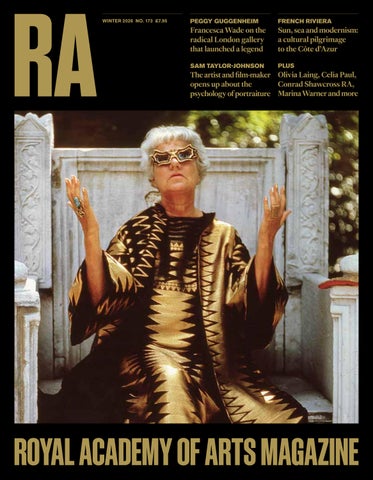
On the cover Peggy Guggenheim in the garden of Palazzo Venier dei Leoni, Venice, ca 1966
Right Herbert Read and Peggy Guggenheim, 1939 (printed 1977), by Gisèle Freund
8 Introducing the issue
28 Love letter Olivia Laing writes in praise of a photograph by Nan Goldin
Preview 13 Showcase Ten art-related events for your winter calendar 16 Festive gift guide Charlie Billingham selects his favourite artist-made treats from the RA Shop 18 Exhibitions diary RA shows on this winter
Features 23 Portrait of an artist Emily Steer visits film-maker and artist Sam Taylor-Johnson in her Somerset studio 6
ROYALACADEMY.ORG.UK
31 Mother and son Hettie Judah meets Conrad Shawcross RA and his mother Marina Warner 35 Dinner dates The RA’s Artistic Director, Helen Legg, and Secretary and Chief Executive, Simon Wallis, chat over a meal at José Pizarro’s restaurant 39 Creative baggage RA Schools student Woodsy Bransfield reveals what he’s carrying in his bag of tricks
40 Opinion Wendy S. Walters argues against the use of white paint 43 When art meets stargazing Alexandra Harris explores the art of the night sky 48 Take and give Three RA Schools students share a work that changed them and one they think will change you
Agenda 83 Cultural curator What’s on broadcaster and artist Sadie Clayton’s radar 86 Events and member news Find out about courses and talks at the RA this winter 91 RA news A roundup of Royal Academicians’ projects
51 Artist in residence Rana Begum RA shows Nancy Durrant her home and studio
95 In memoriam Chris Orr RA pays tribute to fellow Academician Mick Rooney
57 Postcard from the studio Celia Paul writes in and shares a study of a Tintoretto
98 Life study Gallerist Alison Jacques on falling in love with art
O N TH E C OVE R: © P H OTO R O LO F F B E NY / NATI O NAL AR C H IVE S O F CANADA. TH I S PAG E: P E G GY G U G G E N H E I M C O LLE CTI O N AR C H IVE S, VE N I C E. P U R C HAS E C O U RTE SY I KO NA GALLE RY, VE N I C E, 1988. © P H OTO G I S È LE F R E U N D / I M E C / FO N D S M C C
60 70
WELCOME
Meet the queen of the avant-garde
Contributors
When Peggy Guggenheim opened her gallery on London’s Cork Street in 1938, it sent shockwaves through the conservative art establishment. One show was so inflammatory, a fight broke out on the opening night. Others were so experimental, they caused crises at customs. The RA’s exhibition ‘Peggy Guggenheim in London: The Making of a Collector’ celebrates this gallery and its role in establishing its namesake. Guggenheim went on to become the queen of the avant-garde, with a palazzo in Venice, a peerless art collection and – as our cover shows – a penchant for exceptional sunglasses. But, as Francesca Wade explores on page 60, it all started a stone’s throw from the RA. In a former pawnbroker’s with a damp problem, no less, with exhibitions by the likes of Dalí, Duchamp and Moore. Elsewhere in the issue, swap the winter blues for the blue seas and skies of the South of France with our pilgrimage to the Côte d’Azur – featuring destinations that inspired the artists of the RA’s exhibition ’Painting the French Riviera’ and beyond (page 70). Sam Taylor-Johnson is visited by Emily Steer in her Somerset studio, and the RA’s own Secretary and Chief Executive, Simon Wallis, and Artistic Director, Helen Legg, have a dinner date at José Pizarro’s. Olivia Laing writes a love letter to Nan Goldin, Conrad Shawcross RA and his mother Marina Warner discuss their creative bond, Celia Paul sends us a postcard from her studio, and gallerist Alison Jacques reveals an encounter with the ghost of Peggy Guggenheim. We could all do with channelling the spirit of Peggy this winter: a cultural tour de force, she was, above all else, a great lover of art. Rosanna McLaughlin, Editor
Some of our writers on their cultural icons...
Head of Editorial Content Harriet Lloyd-Smith Editor Rosanna McLaughlin Deputy Editor Dale Berning Sawa Designer & Production Manager Catherine Cartwright
Olivia Laing, who writes a love letter to Nan Goldin (p28). ‘The performance artist Mx Justin Vivian Bond, who is like the radical, radiant inverse of Trump, a good witch alchemising rage into joy.’
Sub-Editor Michaela Twite Digital Content Lead Thomas Hutton Editorial Advisers Eliza Bonham Carter, Michael Landy RA, Goshka Macuga RA, Fiona Mahon, Níall McLaughlin RA, Kira Milmo, Nikita Sena Quarshie, Charlie Porter, John Shevlin, Simon Wallis SUBSCRIBE TO RA MAGAZINE Visit roy.ac/shop or contact the RA Shop
Wendy S. Walters, who argues against the prevalence of white paint (p40) ‘John Milton. His essay, “Areopagitica”, an argument against censorship, was one of the first polemics I ever read.’
ADVERTISING ENQUIRIES Advertising & Partnerships Manager Tamsin Luck tamsin.luck@royalacademy.org.uk Colour reproduction by Dawkins Colour. Printed by Walstead. Published 13 November 2026 © 2026 Royal Academy of Arts. ISSN 0956-9332 EU Authorised Representative: Easy Access System Europe – Mustamäe tee 50, 10621 Tallinn, Estonia, gpsr.requests@easproject.com CONTACT THE ROYAL ACADEMY Burlington House, Piccadilly, London W1J 0BD 020 7300 8090 friends@royalacademy.org.uk tickets@royalacademy.org.uk
RA SHOP 020 7300 8090 (select option 2). Visit roy.ac/shop or email raonlineshop@royalacademy.org.uk
ROYALACADEMY.ORG.UK
I LLU STRATI O N S: LU C I N DA R O G E R S
Francesca Wade, who travels back in time to visit Peggy Guggenheim’s London gallery (p60) ‘Gertrude Stein, who moved to Paris in order to kill the 19th century.’
JOIN AND SUPPORT THE RA Membership starts from £72. Find out more at roy.ac/join
All reasonable attempts have been made to clear copyright before publication. Registered charity number 1125383 RA Magazine is the quarterly publication of London’s Royal Academy of Arts. Established in 1983, it is one of the most widely read art magazines in the UK, with a circulation of around 75,000 copies. RA Magazine is published in March, May, September and November, and mailed to Friends and members of the Royal Academy of Arts as part of their membership. It is also mailed to patrons and other supporters of the RA, and can be purchased from the RA Shop, newsstands and on subscription. The opinions in this publication do not necessarily reflect the views of the RA. Paper used in RA Magazine is sourced from responsibly managed forests and other controlled sources.
8
Roi Soleil
EDITORIAL ENQUIRIES ramagazine@royalacademy.org.uk
147 Sloane Street London
Preview 13
Showcase Ten shows, books and events to watch out for this winter
16
Festive gift guide Charlie Billingham selects his favourite artist-made treats from the RA Shop
18
RA exhibitions diary Essential dates for your calendar
PREVIEW
SHOWCASE Ten shows, performances and books to know about this season
Brushed Cottons
www.emmettlondon.com
© I S SY WO O D. C O U RTE SY TH E ARTI ST, CAR LO S I S H I KAWA, LO N D O N, AN D VE N E K LAS E N, N EW YO R K AN D LO N D O N. P H OTO: EVA H E R Z O G
112 Jermyn Street
2
1
Issy Wood’s selfies hit London
The acclaimed painter at The National Portrait Gallery ‘You’re just the nearest life drawing subject, and I’m learning that you can be as adventurous as you want,’ British-American painter Issy Wood has said of her growing obsession with self-portraiture – the focus of this
National Portrait Gallery solo show (until 28 Feb). Since graduating from the RA Schools in 2018, Wood has garnered critical attention for her muted figuration, steeped as much in historical reverie
The ‘dance-as-design’ choreographer, Georgia Tegou, stages In the Quiet of Us at Sadler’s Wells. This experimental performance combines dance, sound and visual installation, to explore micro-signals and human connection (19-21 Nov).
as in millennial extremely-online-ness. This debut institutional showcase comprises 11 paintings based on carefully considered selfies. Tightly cropped, the artist’s face is hidden by face masks, acrylic nails, crushed softdrink cans and the distortion of a mirror held too close to an eye (Self portrait 71, 2025; above left). Wood’s knack for deftly homing in on the uncomfortable and the uncanny continues to take her places. RA MAGAZINE WINTER 2026
13
PREVIEW
4
The UK’s most exciting new art tours the country
With the subtitle ‘A Chorus of Strangers’, this 10th edition of the Hayward Gallery Touring British Art Show explodes, in sonorous and exhilarating ways, the meaning of being from elsewhere, or many places at once. Curator Ekow Eshun has convened 37 artists from across the UK. Painters Nengi Omuku (One Particular Man, 2026; above), Mohammed Sami (the National Gallery’s 2027 artist in residence) and Louise Giovanelli (recently announced
Charleston comes to Millbank
5
The friendship Vanessa Bell and Duncan Grant forged has been described as likely the most important in both their lives. ‘Vanessa Bell & Duncan Grant: Inside Bloomsbury’ at Tate Britain explores what made it so (until 11 April). As founders of the Omega Workshop (with Roger Fry), they held that art should be what everyday life is made of. It will include the portraits (Self Portrait, c. 1915, by Vanessa Bell; right), still lives, painted landscapes, ceramics, handpainted furniture and exuberant textiles that make their farmhouse in Sussex the art-lover’s perfect day-trip destination. 14
ROYALACADEMY.ORG.UK
as the Government Art Collection’s Robson Orr TenTen Award 2026 recipient) are included, alongside Turner Prize winners Nnena Kalu, Jasleen Kaur and Jesse Darling, RA Schools graduates Alex Margo Arden and Hannah Perry – and a host of others at the top of their game. Throughout 2027 and 2028, the show will go from Coventry to Swansea, Bristol and Sheffield, before ending in Newcastle Gateshead. 6
KOREA UNFOLDS In 2021, former Samsung Chairman Lee Kun-Hee gave an extraordinary 23,000 art objects to South Korea’s national museums that, together, tell his country’s story. Visitors to the British Museum have until 31 Jan to take in a good chunk of them – from ancient golden armour and painted wooden marvels (below) to the newest national treasures.
20
... is the number of Monet’s ‘Water Lilies’ to go on show at Tate Modern, when the museum opens its first exhibition dedicated to the French Impressionist (25 Feb to 27 June 2027). Over a period of three decades, Monet produced more than 250 paintings of water lilies, based on the garden he created at his home in Giverny.
7
COURTESY TAIBA AKHUETIE. THE IUCHI COLLECTION, ON DEPOSIT AT THE NATIONAL MUSEUM OF WESTERN ART, TOKYO. PHOTO: NORIHIRO UENO. KILL JACKIE PHOTO: UNAI MATEO, © FREMANTLE AND STEEL SPRINGS PICTURES 2026. FITZCARRALDO BOOKS
The ‘British Art Show’ turns 10
© 2026 E STATE O F VAN E S SA B E LL. ALL R I G HTS R E S E RVE D, DAC S. C O U RTE SY O F TH E ARTI ST AN D P I P PY H O U LD SWO RTH. © NATI O NAL M U S E U M O F KO R EA, LK H4302
3
SHOWCASE
The peak that captured Hokusai
With his Thirty-six Views of Mount Fuji (1830-1833; above), Japanese printmaker Katsushika Hokusai achieved that rare thing: a series of images as ubiquitous as they are miraculous. Japan’s premier mountain deity, Fuji-san, is depicted 8
Catherine Zeta-Jones dons silk headscarves and big shades as Jackie Price, a drug lord turned art dealer in Kill Jackie, a big-guns adaptation of Nick Harkaway’s novel The Price You Pay. Expect badass bust-ups, corny art and the actor using her own Swansea accent (on Prime Video).
from every angle, its indelible, truncated summit variously looming in the mist, glowing in the breeze or dwarfed by a great big wave. Dulwich Picture Gallery presents the complete collection for the first time in the UK (until 17 Jan).
The Nue Black Aesthetic
Curator, author and journalist Charlene Prempeh showcases a constellation of contemporary Black designers at the
9
Design Museum (until 8 Aug 2027). Dispelling the notion that there’s any such thing as a singular Black design aesthetic, the exhibition deals instead in multiplicity and fluidity. Nigerian heritage is threaded through both the Californian designer Ini Archibong’s beaded chandeliers and British artist Taiba Akhuetie’s use of synthetic hair in chairs (left) and curtains. Artist-architect Giles Tettey Nartey reimagines communal activities as crafted objects, such as a communal pounding table for making fufu carved out of black maple. East London designer Saul Nash brings carnival sensibilities to a fashion collection destined to be run and danced in. And fellow Central Saint Martins alumnus Feben weaves both the Swedish and Ethiopian facets of her identity into glamorous clothes, favoured by the likes of Raye, Tems and Olivia Dean.
10
ARTWORLD SATIRE This latest Fitzcarraldo Editions novel opens on to a Roland Barthes quote and elicits from its blurbists comparisons with JG Ballard and Italo Calvino. In The Floating World, art critic, editor and debut novelist Ben Eastham tackles – with all the heft those references suggest – the artworld’s intractable connections to power, big money… and existential loss.
RA MAGAZINE WINTER 2026
15
PREVIEW
SHOPPING
FESTIVE GIFT GUIDE Visit the Royal Academy Shop: roy.ac/shop
RA Schools graduate Charlie Billingham picks his favourite artist- and artisan-made products on sale at the RA Shop this winter, and introduces his new homeware range 1. Seaweed geometric scarf Made with lambswool by a female-founded business, using sustainable practices (£110)
1
2
3
Charlie Billingham x RA
8
‘The “Little Academicians Apron” is the perfect gift to inspire children to create’
2. Striped cocktail shaker Add something special to party nights with this hand-painted shaker (£48) 3. ‘Fruits and Vegetables’ tea towel I love this tea towel, featuring art from chef José Pizarro’s recent book (£12.50) 4. Duckhead umbrella Essential for London in winter, and way too special to leave on the Tube (£42) 5. ‘Blue Window View’ mug It’s a treat to start the day with a hot drink from a handmade mug by Beth Holgate (£32)
Charlie Billingham is an artist and RA Schools graduate 4
5
9
10
11
12
‘This duckhead umbrella is essential for London in winter, and way too special to leave on the Tube’
6. Harlequin hot water bottle Bring joy to an everyday object with this lambswool cover (£52) 7. The Rock Pool, 2026, by Caragh Thuring RA This print captures the elegance of the French Riviera (£3,000) 8. Little Academicians Apron The perfect gift to inspire children to create. Designed by RA Schools student Dominic Myatt (£12.50)
The idea for my homeware range began with the drawings and watercolours of Georgian-era caricaturist Thomas Rowlandson. Ever since I was a child I’ve been fascinated by caricaturists. Like me, Rowlandson studied at the RA Schools, and when I joined in 2010 I started to look deeper into this aspect of art history. For the range, I pulled out food-related details from Rowlandson’s artworks and made a series of ink drawings from these snippets. Among the items for sale in the RA Shop are a wooden chopping board, wooden utensils, a table runner and a set of napkins – all engraved or embroidered with my ink drawings.
6
7
9. Glass bauble One or more of these will make for a memorable Christmas tree (£25) 10. Abstract mohair throw Keep warm as the days get shorter (£195) 11. Summer Exhibition Poster, 1969 Take home a piece of history with this work by Edward Ardizzone RA (£20) 12. Blue fish glass decanter The perfect addition to any festive table (£45)
16
ROYALACADEMY.ORG.UK
Clockwise from top Four embroidered cocktail napkins, £25; olive wood small handled board, £20; three olive wood mini cheese tools, £18
RA MAGAZINE WINTER 2026
17
EXHIBITIONS DIARY
THIS SEASON AT THE RA
Left The White Lady, 1926, by Kees Van Dongen Above November 16, 1937 at 2:30, 1937, by Grace Pailthorpe
Painting the French Riviera Peggy Guggenheim Until 31 Jan 2027 in London 21 Nov to 14 March 2027 Main Galleries Supported by Kenneth C. Griffin and Griffin Catalyst, the Idan & Batia Ofer Family Foundation, the Huo Family Foundation, CMA CGM, Christie’s, Miraval and David and Molly Lowell Borthwick. With additional support from Ömer Koç, the International Music and Art Foundation and the Risman Foundation
18
ROYALACADEMY.ORG.UK
The Jillian and Arthur M Sackler Wing of Galleries Friends previews: 18 Nov, 10am to 6pm, 19 Nov, 10am to 6pm and 20 Nov, 10am to 9pm Lead philanthropic supporter: Kenneth C. Griffin and Griffin Catalyst. Supported by Bottega Veneta, Riverstone Living, the Reuben Foundation and Kathryn Uhde
Coming in 2027 Rembrandt: Radical Printmaker 9 April to 19 Sep 2027 The Jillian and Arthur M Sackler Wing of Galleries
Opening Hours The RA is closed on Mondays. The rest of the week, it is open 10am to 6pm, and until 9pm on Fridays
P R IVATE C O LLE CTI O N, C O U RTE SY O F GALE R I E P H I LI P P E DAVI D, Z U R I C H. P H OTO: ALAMY. TH E J E F F R EY S H E RW I N & FAM I LY C O LLE CTI O N, P E R MAN E NTLY H O U S E D AT TH E H E P WO RTH WAK E F I E LD. P H OTO: B R I D G E MAN I MAG E S. © TH E ARTI ST
Peggy Guggenheim arrives, plus the art of the Côte d’Azur
CONCIERGE@FORTNUMANDMASON.COM
Features
MODERN ART ON THE CÔTE D’AZUR
23
Portrait of an artist Emily Steer visits Sam Taylor-Johnson at her Somerset studio
28
Love letter Olivia Laing writes in praise of Nan Goldin
31
Mother and son Conrad Shawcross RA and Marina Warner discuss their creative bond
35
Dinner dates The RA’s Simon Wallis and Helen Legg share a meal at José Pizarro’s
39
Creative baggage RA Schools student Woodsy Bransfield reveals what’s in his bag
40 Opinion Wendy S. Walters argues against the use of white paint See Europe’s greatest concentration of classic modern art in the idyllic Mediterranean setting where it was created, explored in the company of leading experts. In small groups, discover rich collections with masterpieces by Renoir, Bonnard, Braque, Léger, Miró, Giacometti, Cocteau, Chagall, Matisse and Picasso.
43
When art meets stargazing Alexandra Harris on the art of the night sky
Or call us on 020 8742 3355
48
Take and give RA Schools students on a work that changed them and one that might change you
99% of travellers rate us excellent or good in over 1,100 reviews.
51
Artist in residence Nancy Durrant drops in on Rana Begum RA at her Hackney home
57
Postcard from the studio Celia Paul writes in
Book now at martinrandall.com
ATOL 3622 | ABTOT 5468 | AITO 5085
We stay in Nice throughout, within easy reach of galleries both storied and surprising.
Image: Chapelle Saint-Pierre in Villefranche-sur-Mer, France, as seen on ‘Modern Art on the Côte d’Azur’.
Barbara Rae
FEATURES
Charting South
‘WHAT’S BEHIND THE PERSON WE THINK WE KNOW?’ 21 Nov 2026 - 24 Jan 2027 Royal Scottish Academy, Edinburgh Free entry royalscottishacademy.org
Image: Dame Barbara Rae RSA RA, Trinity - Antarctic (detail), monotype RSA Scottish Charity No: SC004198
At her studio in Somerset, artist and film-maker Sam Taylor-Johnson opens up to Emily Steer about the psychology of portraiture and embracing her own vulnerability RA MAGAZINE WINTER 2026
23
SAM TAYLOR-JOHNSON
FEATURES
Sam Taylor-Johnson relishes precarity. In her portraits and films, the British artist reveals a delicate junction between power and collapse. Famous men cry. Icons fall apart. Taylor-Johnson’s own tiny but mighty body is caught midtumble. ‘I constantly find myself focusing on that fine line between survival and being emotionally present,’ she says. We meet on a rainy autumn morning at the 16th-century farmhouse where she lives and works near Frome in Somerset. The studio is a cavernous converted barn, featuring an efficient selection of furniture. Taylor-Johnson’s vast worktable, covered in buttery leather, was crafted locally by Bill Amberg. A rickety ladder leans against a back wall. A metal bookshelf contains an exhaustive selection of photography publications, including Sally Mann’s Deep South and Nan Goldin’s The Ballad of Sexual Dependency. The artist finds herself in a precarious moment. She has all but lost her voice after a series of trips and family emergencies. ‘I’m always asking everyone else to be vulnerable, and now I have to be vulnerable,’ she says. When she becomes ill, she tells me, ‘I panic’. Nonetheless, she presents herself potently, a force of nature dressed in slick double denim and statement jewellery. One of Taylor-Johnson’s most famous images was created in the wake of illness. Self-Portrait in a Single-Breasted Suit with Hare (2001) makes playful, painful reference to the treatment for breast cancer and the mastectomy she underwent in 2000. In the image she stands, self-possessed, in a sharp black suit, swinging a large hare by the feet, as though ready to clobber someone. A similarly defiant self-portrait, Fuck, Suck, Spank, Wank (1997), shows the artist with her trousers down, wearing sunglasses and a T-shirt emblazoned with the title. This 1997 image, which she describes as ‘the Venus de Milo, my way’, is in the Tate exhibition ‘The 90s: Art and Fashion’. The show (which runs until 14 Feb) celebrates the era during which Taylor-Johnson (then Taylor-Wood) and her contemporaries burst on to the UK art scene as the Young British Artists. But while she shares a confident disobedience with the group, her practice has always sat at the more emotionally nuanced end of the spectrum.
In ‘Crying Men’, a series shot between 2000 and 2004 of Hollywood leading men in tears – including Philip Seymour Hoffman, Paul Newman and Robin Williams – she reaches behind looks and charm to reveal a deep well of fragility. The feature films that she has directed likewise focus on icons with recognisable veneers who contain a complex inner world, from Amy Winehouse in Back to Black (2024) to John Lennon in Nowhere Boy (2009), starring the artist’s now-husband Aaron Taylor-Johnson. ‘When I’m photographing people, I can see the image of who they want to present, and I can often see a tsunami of things behind the eyes,’ she says. ‘That for me is the most interesting thing, even if someone is in full hair and makeup, in the depths of their eyes you can see so many hidden feelings. What’s behind the person we think we know?’ Taylor-Johnson’s new book, The Self and the Portrait, homes in on her richly psychological approach to portraiture. It includes images of herself submerged and distorted within a dark pool of water, intimate shots of her four children, and her crying men. The latter series is also featured in ‘Harder Better Faster Stronger: Are Men OK?’, a group show exploring contemporary masculinity currently at Fotografiska in Stockholm (until 7 Feb). Of her depiction of male fragility in ‘Crying Men’, she says, ‘At the time, I felt like people didn’t really understand what I was trying to do. But with distance and the conversations now, it feels timely to reflect on it.’ The photographs were originally commissioned for GQ. Taylor-Johnson told no one, including her editors, that she wanted each actor to cry, until they arrived on set. ‘Asking them to cry as themselves confused them because there was no narrative behind those tears,’ she says. ‘I thought, they’re actors, they’ll be able to turn it on. But it was a lot for some.’ Robin Williams cried for ‘a flash of a moment’ before returning to his entertaining personas. Since their untimely deaths, and the conversations sparked about men’s mental health, her images of Seymour Hoffman and Williams have a new weight. ‘They’re so much more profoundly sad,’ she says. ›
Page 23 Sam Taylor-Johnson photographed in her Somerset studio Left A photo of Daniel Craig on her pin board
24
ROYALACADEMY.ORG.UK
Opposite page Scenes from the studio, including a 2004 photograph of David Beckham; boxes containing works from the series ‘Crying Men’; a bookshelf and sofa, and a pair of stone shoes from a recent project
ALL P H OTO S: GAB BY LAU R E NT
‘When I’m photographing people, I can see the image of who they want to present, and I can see a tsunami of things behind the eyes’
RA MAGAZINE WINTER 2026
25
FEATURES
‘She describes a fear of the abyss that runs through her work, but also “a feeling of falling into the safety of darkness”’
Below Taylor-Johnson in double denim
› Taylor-Johnson examines herself with equal intensity. Roughly every five years, she photographs herself suspended or tumbling – with the wires, props or people holding her up often edited out. In one set, she teeters on a chair that is about to fall over. In another she dangles above a car in the California desert. These works land around big transitions in her personal life. ‘There comes a moment, it’s like a self-check-in. Where am I and how do I feel in this moment? I don’t necessarily understand it at the time. Sometimes it’s a few years later.’ Most recently, she has photographed herself as though running through the air wearing stone shoes. The footwear sculptures, made by a stone mason and weighing around 13 kilos each, now sit ominously in her studio. In some images, the white boiler-suited figures who hold her up are visible. ‘There is support, but I feel so fractured. I think that fractured feeling partly comes from being an artist, being creative, being slightly unhinged,’ she laughs. ‘From managing too much. From falling apart. From having a multitude of life jobs.’ Taylor-Johnson comes to ideas intuitively, amid a frenetic life. ‘Somewhere I get this force of an idea out of nowhere. It’s like I have to smash and grab because life is so busy with four kids, work and travel, and Aaron is busy too.’ We come back to how she is feeling today, finally able to focus on herself yet physically held back from doing so. She describes a fear of the abyss that runs through her work, but also ‘a feeling of falling into the safety of darkness’. Sometimes, she says, we need ‘to disintegrate in order to come back’. The shoes are ‘such a clear message. This balance between vulnerability and the curtain we put up to try and hide it.’ Next to us on the wall are the seeds of her next big project: storyboards for the first movie she is writing herself. The film is immersed in 90s London, celebrating ‘a kind of special madness that we were allowed to have, in a time before everything was viewed by everybody. It was like the last gasp of having the privacy to be mentally fucked up!’ While not strictly an autobiography, and set outside the art world, it will channel her own experiences. ‘I’m going through a very deep place of examining who I was and what society at that time was. I’m really enjoying it, but it’s really hard. It’s interesting to look from a distance and see that it was quite a magical time. Fucking hell that was great, but also, how did we survive?’ The film comes back to Taylor-Johnson’s sprawling definition of portraiture. ‘Every single thing I do, I think I’ve broken away, and then I realise it’s all the same thread,’ she smiles. Her works are united in their serious ambition, too. When she made the move from art to feature films in the early 2000s, she jumped in headfirst, directing at a major scale. What keeps her going? ‘I have such a childish excitement about everything most of the time. When I get the opportunity to make a film, it’s like a Charlie and the Chocolate Factory golden ticket. When you have a creative, mad brain, you can apply it to everything. It’s a creative spirit that is never at peace unless it’s being challenged.’ Emily Steer is a freelance arts journalist and psychodynamic psychotherapist in training The Self and the Portrait (Rizzoli) by Sam Taylor-Johnson is out now
26
ROYALACADEMY.ORG.UK
The exhibition is made possible through the courtesy of the Iuchi Collection, in partnership with the National Museum of Western Art, Tokyo
Paint Partner
Digital Exhibition Guide
FEATURES
LOVE LETTER
A LOVE LETTER TO NAN GOLDIN It’s an image of total composure. The Suzanne of Suzanne on the train, Wuppertal, West Germany (1984) is Suzanne Fletcher, a long-term friend of Nan Goldin, and one of the editors of her 1986 visual diary, The Ballad of Sexual Dependency. The book contains plenty of images of Suzanne in disarray, and a famous one of her crying. But this Suzanne has got her shit together. She’s contained and inscrutable, lost in thought, gazing out of the train window, the landscape reduplicated on her sunglasses. Her whole look epitomises the 1980s international set. Black everything, a sharp, thin blazer, its sleeves slid up. Her fine wrists, fingers, ears and neck are hung with silver, the jut of a buckle at her waist. Of course she’s smoking, the lit cigarette held languorously in one outstretched hand, the other cupped moodily at her chin. Perhaps a film she’s acted in is on at the Berlinale; perhaps she’s just come from a lover’s bed. A train carriage, especially in that pre-smartphone age, is a place to dream, a cinematic cubicle where hours of documentary 28
ROYALACADEMY.ORG.UK
footage flow past in real time. Ruined farmhouse, unknown city, miles of prairie or forest: it all rolls by in a continuous stream, engendering a pleasurable wash of reverie and reminiscence. Is Suzanne planning the future or sunk in memory, be it of childhood incident or the night before? The train traveller moves through time but is at the same time suspended in it. Untethered from obligation, they need distractions to while away the hours. Suzanne is well-stocked in this regard. The table in front of her is furnished with two all-American icons: a soft pack of Marlboros and a can of CocaCola. These are capitalism’s real things, twin scarlet testaments to consumer pleasure. The scarlet logos of these mega-brands burn especially fiercely in this place and time, given that across the border in the German Democratic Republic, both are banned as symbols of Western decadence and decay. A woman alone on a train is a classic trope of the movies, from The Lady Vanishes to Vertigo to Before Sunrise. But for anyone who cut their teeth on European cinema, the placename Wuppertal irresistibly recalls the 1974 Wim Wenders film Alice in the Cities, in which the titular young heroine, abandoned by her mother, attempts to remember the German city where her grandmother lives. For a hopeful moment, she’s sure it’s Wuppertal. I wonder if Wenders was on Goldin’s mind when she clicked her shutter. The photograph is suffused with red: the cardinal colour of the Coke and cigarettes counterweighted by the arterial scarlet of what could be a corduroy bag or cushion, as well as the leather or pleather rest behind Suzanne’s head. This lush tonal symphony, undercut by yellow, is deeply reminiscent of the colours in Wenders’ 1977 masterpiece, The American Friend. Wenders was working with the late, great Dutch cinematographer Robby Müller, who deployed a hyper-saturated palette of reds and yellows for this German take on American noir aesthetics. The screen is constantly pierced by scarlet objects, among them cars, poles, candles, football scarves and of course Marlboro cigarettes. It’s the iconography of America reflected in a flyblown European mirror, its allurements seedy and uncertain. No one could describe Nan Goldin as a booster of American capitalism. The Suzanne photograph is like a riff on Wenders’ moody German vision of Americana, a lost outtake, dropped on the cutting room floor. It captures the anti-home of travel, a space of transience, reverie, suspension and delay. To quote another Wenders’ movie, Paris, Texas, ‘I know that feeling’. Of course I’m writing this on a train. The Silver Book by Olivia Laing (Penguin) is out now Nan Goldin: You Never Did Anything Wrong Hayward Gallery, London, 24 Nov to 14 Mar 2027
© NAN G O LD I N, C O U RTE SY TH E ARTI ST AN D GAG O S IAN
Olivia Laing muses on a favourite work from the back catalogue of revered photographer Nan Goldin
Above Suzanne on the train, Wuppertal, West Germany, 1984, by Nan Goldin
RA MAGAZINE WINTER 2026
29
Ndidi Ekubia, Resonance Vase, 2024. Presented by BISHOPSLAND at Collect 2027. Photography: Ollie Tomlinson. Creative Direction: TM — TsevdosMcNeil. Location: GUBI House London.
Sign up now for early bird tickets
FEATURES
MOTHER The Art Fair for Contemporary Craft and Collectible Design
26–28 February 2027 Previews 24 & 25 February Somerset House, London
Conrad Shawcross RA discusses influences, inspirations and familial bonds with his mother, the legendary author Marina Warner. Hettie Judah visits his studio to listen in
AND SON RA MAGAZINE WINTER 2026
31
MOTHER AND SON
FEATURES
a carved wooden rod that carries – at one end – an oar, and at the other a stylised winnow (a tool used to separate grains from chaff). The sculpture refers to Tiresias’s prophecy to Odysseus, that after returning to Ithaca he must ‘take an oar/ to people with no knowledge of the sea’ and carry it on his back until he meets a traveller who refers to it as ‘a winnowing fan’. The sculpture is a tribute to the impossibility of peaceful return. It is also, of course, Shawcross’s tribute to his mother and her scholarship. While Warner tends to her world of words, and Shawcross to his gravity-baiting adventures in sculpture, they are united in their conviction that creativity plays a crucial role in communicating important ideas. Sanctuary explores concepts of home, belonging and asylum, and was inspired by Warner’s involvement in Stories in Transit – a project involving young people who had made the perilous crossing from Africa to Sicily in search of refuge. Warner describes a ‘commons of the imagination’ – stories as shared territory – through which people separated from their home can locate themselves culturally and historically. Shawcross’s fascination with mathematics, time and the cosmos is stimulated by interdisciplinary conversations. In 2023 he undertook a residency at the University of Nottingham with a focus on quantum science, and access to the early universe laboratory. While he had felt ‘slightly guilty’ that he might be ‘parasitically feeding off science’, through the residency, he came to realise ‘just how much scientists need artists to help them represent these things visually.’ The exhibition ‘Shadows of the Mechanism’ includes further works from his new
32
ROYALACADEMY.ORG.UK
We’re meant to be talking about Shawcross’s show at Victoria Miro gallery this winter, ‘Shadows of the Mechanism’, but since both he and Warner – an Honorary Fellow of the RA – have an endearing habit of trying to throw the conversational spotlight back on to the other, it’s hard to stay on track. Seated between mother and son, beneath a kinetic light sculpture that casts moving shadows back and forth, I soon abandon my interview structure and resign myself to following the quick-witted familial chat, as it flows from The Odyssey, through Warner’s collection of stones and Shawcross’s teenage experience volunteering in Sarajevo, to black holes and AI. Their closeness is evident. (In the acknowledgements in Sanctuary, Warner writes of her son that he ‘continues to give me my compass bearings’.) In 1985, when Shawcross was eight, he made a little sculpture of his mother reading (‘my mum kind of eats books for breakfast’, he tells me). Warner was one of the judges for the Booker Prize that year, and recalls that while the sculpture was funny, she ‘felt guilty too – because I felt that I had not been paying attention’. Her son had captured her as he saw her, intent on her book. Shawcross is dyslexic, and didn’t share his mother’s enormous appetite for print. Instead, from an early age, he wanted to take things apart and rebuild them: ‘I was very three-dimensionallyminded.’ He’s now glad that his ‘brain was wired differently’ to his mother’s: ‘It’s actually a blessing. If I was a writer, it would probably be quite tough being under such a shadow.’ Nevertheless, Warner’s influence is palpable. As we discuss The Odyssey, Shawcross leaps up to retrieve an early sculpture,
Page 31 Conrad Shawcross RA and his mother Marina Warner, photographed at Shawcross’s East London studio
P H OTO S: B E NJAM I N M C MAH O N
I travelled to Conrad Shawcross’s East London studio in early September, his mother’s voice in my ears. I’ve been a fan of the cultural historian Marina Warner since reading Alone of All Her Sex (1976), her stirring – sometimes furious – examination of the myth and cult of the Virgin Mary. In the audiobook I was listening to of her latest book Sanctuary (2025), Warner reads with a gentle cadence that left me ill-prepared for Shawcross’s hectic studio. Near the entrance, Shawcross’s assistants were assembling Eye of the Needle (Time Pebble (E30A13)) (2026), which was due to be installed as part of Frieze Sculpture the following week. Pieced together from more than 1,000 individually perforated sheets of anodized aluminium, the sculpture filters the shifting light of the sun, through a geometry inspired by the expanding universe. Beyond it, the workshop was packed with sculptures, mechanisms and structures at every stage of completion. In a storybook world, this might have been the workshop of a natural philosopher, striving to comprehend the secrets of the universe through methods both mathematical and supernatural. When I meet Warner upstairs in Shawcross’s flat, she reminds me that her son has indeed grown up in a storybook world. In the early 1980s, she wrote books for children featuring a boy called Conrad who, like his namesake, was insatiably curious about how things worked. In one, The Impossible Object, little Conrad attempts to make a tower that defies the laws of physics. In many ways, Shawcross’s interests and objectives have changed little in the intervening years. As he notes: ‘With sculpture, my main constraint is gravity and how to overcome it.’
Opposite, and this page: A large collection of maquettes fill the studio’s shelves; Warner and Shawcross; Shawcross’s team at work
‘Time Pebble’ series, structured around a geometry inspired by the expanding universe. The ground floor gallery will be flooded in light and sound that evokes the complexity of planetary motion. This autumn, Warner turns 80. Conversations between mother and son have evidently taken place about her legacy, to which Shawcross’s response has been characteristically three-dimensional. He has designed a set of interlocking pods to house a constellation of the most significant books in his mother’s vast collection. Each of the 13 pods will have a presiding theme – among them sanctuary, cartography, the Virgin Mary, fairy tales, feminism, sleep, madness and dreams – and the whole structure has been designed to be watertight and self-contained. It is, as he says, ‘like a memory palace’, a vessel in which to carry his mother’s idea into the future, a sanctuary of the intellect. Hettie Judah is a writer and curator Conrad Shawcross: Shadows of the Mechanism Victoria Miro, London, 26 Nov to 23 Jan 2027 Marina Warner’s book Sanctuary: Ways of Telling, Ways of Dwelling (William Collins) is out now RA MAGAZINE WINTER 2026
33
California
Film, Art, Culture and Confessions
No. 09 The Senses – 2024
No. 11 Riviera – 2025
A RABBIT’S FOOT
A RABBIT’S FOOT
Film, Art, Culture and Confessions
LE DOSSIER BENICIO DEL TORO BONJOUR TRISTESSE REVISITED AMANDA LEAR ON DALÍ DEREK RIDGERS’ CROISETTE GLAMOUR AKILA BERJAOUI’S SUMMER ATHENS WITH ARIANE LABED SEASIDE CINEMA SPECIAL CAMUS IN ALGERIA SAILING WITH SAM SPIEGEL
What happens when the RA’s top brass meet José Pizarro’s cooking? Cue the small plates and big ideas
FEATURING: SEAN BAKER MIKEY MADISON ROSE WYLIE AL PACINO BRUCE ROBINSON RICK RUBIN FRANCIS MALLMANN AUDREY DIWAN NOÉMIE MERLANT RAMATA- TOULAYE SY MARTIN BREST KNEECAP Film, Art, Culture and Confessions
Film, Art, Culture and Confessions
Film, Art, Culture and Confessions
Film, Art, Culture and Confessions
DINERS Helen Legg, Artistic Director, RA Simon Wallis, Secretary and Chief Executive, RA
9
11
Film, Art, Culture and Confessions
FEATURING: MICHAEL MANN PATRICK DEMPSEY ALEXANDER PAYNE NIA DACOSTA RYUSUKE HAMAGUCHI JEFF NICHOLS DANNY LYON IRA SACHS ADÈLE EXARCHOPOULOS THE ROSS BROTHERS TIERNEY GEARON AMOR TOWLES Film, Art, Culture and Confessions
MENU
FEATURING: ALFONSO CUARÓN WIM WENDERS PETER WEIR ALICIA VIKANDER PAUL SCHRADER MOLLY MANNING WALKER CELINE SONG EMMA SELIGMAN DAVY CHOU ANNA BILLER SNOH AALEGRA JONATHAN BECKER
What they drank: Sparkling water Estrella 0% Cortados What they ate: Pan con tomate Spinach and manchego croquetas Padron peppers Wild prawns with fried eggs
Film, Art, Culture and Confessions
Film, Art, Culture and Confessions
Film, Art, Culture and Confessions
Spirit of the West
No. 06 Movies and Motors – 2023
No. 07 Spirit of the West – 2024
Film, Art, Culture and Confessions
FEATURING: MARTIN SCORSESE CLINT EASTWOOD JEFF BRIDGES GUS VAN SANT WILLEM DAFOE EMILY BLUNT RAMY YOUSSEF RICHARD PRINCE TODD HAYNES VIGGO MORTENSEN ALICE ROHRWACHER DOUG AITKEN LUNA CARMOON
A RABBIT’S FOOT
6
5
£20 $23 €23
£20 $23 €23
Film, Art, Culture and Confessions
FEATURING: OLIVER STONE DARREN ARONOFSKY KEN LOACH NADINE LABAKI SHARMEEN OBAID-CHINOY TODD FIELD AI WEIWEI ABEL FERRARA TAHAR RAHIM ALICE DIOP EDWARD BERGER SIR DON MCCULLIN WILLIAM KENTRIDGE REINALDO MARCUS GREEN
THE ITALIAN ISSUE
No. 02 Film – Italy 2022
A RABBIT’S FOOT
Film, Art, Culture and Confessions
No. 03 Power of Film – 2023
FRENCH FILM ISSUE
FEATURING: MARION COTILLARD ETHAN COEN GASPAR NOÉ AVA DUVERNAY SAM TAYLOR-JOHNSON ISABEL SANDOVAL ALEX COX FANNY ARDANT SIR ANTONY GORMLEY NICK BROOMFIELD SIR ROGER DEAKINS JOHN PAWSON
PAOLO SORRENTINO PENÉLOPE CRUZ TONI SERVILLO MONICA BELLUCCI FRANCESCO CLEMENTE ALBERTO BARBERA ARRIGO CIPRIANI VALERIA GOLINO AL RUDDY MIRELLA RICCIARDI Film, Art, Culture and Confessions
No. 01 Film – Cannes 2022
FILM NOIR COLLECTOR’S EDITION COVER BY NADIA LEE COHEN
LE DOSSIER NADIA LEE COHEN PAUL SCHRADER SPEAKS OTTESSA MOSHFEGH GOES TO PARIS PETER BRADSHAW ON GILDA WEEGEE, METINIDES, ARAKI FEMMES FATALES: UN RENDEZ-VOUS RAY WINSTONE IN CONVERSATION SEIJUN SUZUKI: AVANT-GARDE NOIR TWO PORTRAITS OF GEORGES SIMENON
No. 05 The Journey – 2023
£20 $23 €23
A RABBIT’S FOOT
ISABELLE ADJANI WES ANDERSON JULIETTE BINOCHE VALERIA BRUNITEDESCHI CLAIRE DENIS AUDREY DIWAN THIERRY FRÉMAUX ISABELLE HUPPERT VINCENT LINDON MATTHEW MODINE WHIT STILLMAN FLORIAN ZELLER Film, Art, Culture and Confessions
Film, Art, Culture and Confessions
3
Jean-Luc Goddard, Cannes Film Festival 1975 Photograph by Brigitte Lacombe
£20 $23 €23
MONICA VITTI (1931-2022) KELLY_210x270_A RABBITS FOOT_ROYAUME UNI_UK.indd 1
21/12/2022 16:39
D I G I TA L P L AT F O R M & P R I N T M E D I A
C R E D IT XXXX
No. 08 Film Noir – 2024
Film, Art, Culture and Confessions
Film, Art, Culture and Confessions
Film, Art, Culture and Confessions
Film, Art, Culture and Confessions
A RABBIT’S FOOT
FEATURING: ISABELLE HUPPERT JOHN MALKOVICH HARRIS DICKINSON CELINE SONG EMILY YOUNG WARREN ELLIS RACHEL KUSHNER FERNANDO MEIRELLES JUSTIN KURZEL FRANK DILLANE
£20 $23 €23
No. 04 Love & Passion – 2023
PARK CHANWOOK DAMSON IDRIS JOACHIM TRIER GUILLERMO DEL TORO RENATE REINSVE MIRA NAIR EVA VICTOR AKINOLA DAVIES JR DOMINIC SESSA CHARLIE POLINGER LEE BYUNG HUN
£20
12
£20
DINNER DATES
CHARLI XCX
No. 13 Tomorrow – 2025
Film, Art, Culture and Confessions
FEATURING:
14
15
£20
No. 12 Sanctuary – 2025
No. 14 California – 2026
Film, Art, Culture and Confessions
FEATURING: CHARLES BURNETT BOOTS RILEY ALANA HAIM JEFF BRIDGES OTTESSA MOSHFEGH KATHRYN BIGELOW DANNY TREJO MICHAEL B JORDAN MARÍA ZARDOYA ED RUSCHA AROOJ AFTAB
A RABBIT’S FOOT
ALEJANDRO JODOROWSKY GEORGE LUCAS ON STAR WARS URSULA K LE GUIN THE HISTORY OF JAPANESE MECHA DAVID HOCKNEY SPEAKS INSIDE TERRY GILLIAM’S HOME METAL HURLANT MADNESS FEMBOTS ATTACK! ANDREI TARKOVSKY’S FUTURE SIRI HUSTVEDT’S GHOSTS MEETING MEREDITH WHITTAKER AND… THE SCI-FI BOOKS TO KNOW
A RABBIT’S FOOT
A RABBIT’S FOOT
No. 15 Sci-Fi – 2026
D I S C OV E R A R A B B IT’S FO OT
Helen Legg: Should we talk about where we met? I actually can’t remember. I just know we’ve known each other for a very long time. Simon Wallis: About a quarter of a century. But that is strange because you don’t seem to have changed. HL: I certainly knew you before you were at the Hepworth Wakefield. I think you curated a show at Kettle’s Yard that my partner was in. Simon Wallis: Yes, ‘Physical Evidence’! That was in 1999. I’m really very attached to the artists in the show. Marlene Dumas and Marc Quinn were in it, too, and others. It’s interesting that we share some DNA with those connections. HL: We were also both at Tate Liverpool. Having worked in important regional spaces, I think we understand what they mean to audiences. SW: I’m not a Londoner by birth. You’re not a Londoner by birth. Bringing that outside perspective to London means you don’t take for granted what’s here, and you have a broader sense of what the UK is about. HL: And of what can be achieved in a space like the RA. I love the challenge of working in the RA’s galleries – the most beautiful in the country. For both of us, being here is a step change. SW: Completely. At the Hepworth Wakefield, we had about 80 people in the organisation. Here, we’ve got over 270. You couldn’t get more starkly different than being on the outskirts of a city like Wakefield, in one of the most socioeconomically challenged regions in the country, to being in the centre of one of the richest cities on earth and being in this people’s palace. So, what was the exhibition that made you want to work in the arts in the first place? HL: I was an au pair in Rome after I graduated and, while I was there, I saw early exhibitions by Martin Creed and Massimo Bartolini at the British School at Rome. I was blown away. SW: For me it was the shows that Charles Saatchi did in his old space in St John’s Wood, in a converted factory on Boundary Lane. ›
W W W. A - R A B B I T S F O O T.C O M RA MAGAZINE WINTER 2026
35
DINNER DATES
› HL: What was your impression of the RA before you joined? SW: My earliest memories of coming here are from my childhood. I grew up in Brighton. My grandparents were refugees from Poland who came during the Second World War. They loved London with a passion. For them, it was the most incredible city on earth. Whenever I stayed with them, they would take us to the museums. I remember they brought me here to see a show called ‘Light Fantastic: The Art of the Hologram’, full of holograms from Star Wars, which was the big film at the time. I was eight. It blew my mind. HL: I would say my experience of the RA has been very different. It wasn’t a place that I typically visited when I came to London. For whatever reason, it remained this hidden gem that wasn’t on the top of my list. I only really began coming regularly in the last few years. And I guess that begged the question in my own mind of why I wasn’t compelled to come in the past, which poses an exciting challenge for an artistic director. How do you speak to a broader audience? Now I’m here, I think it’s wonderful and very special, but it is a question of how we open that up to more people. SW: We’ve both arrived at a moment of change for the institution, with the expansion of the Collection Gallery. And we want everybody to feel invited. Beyond the incredible galleries, there are so many other spaces at the RA where you could be meeting and rubbing shoulders with artists and fellow art lovers. HL: I think the expansion is looking exceptionally beautiful… The other critical thing about why I wanted to work at the RA is that it’s an organisation led by artists and architects. The new Collection Gallery will be curated by Royal Academicians. And then, on top of that, we have a school – the oldest free art school in the UK. I love the idea that I’m working hard to support that. SW: The fact that this institution is absolutely artist-led is definitely very special. HL: It’s not without its complexities and its challenges… but that’s also the fun of it! SW: Exactly. Before coming here, I hadn’t fully appreciated how complex putting the Summer Exhibition together is, and how much time and effort and dedication it takes from the RAs. I hadn’t taken on board the magnitude of what it means to select and hang 1,800 works. It was quite something to behold. And that is definitely a thing that no other arts organisation does, on that scale. HL: There are a lot of quirks and traditions that I think are remarkable. For instance, I love that, on the death of an RA, we plant three trees in the National Forest. SW: Oh I didn’t know about that! That is lovely… HL: It’s a beautiful thing.
Image: Martin Goold VPPS, The Crossing
‘My earliest memories of coming to the RA are from childhood. Whenever I stayed with my grandparents they would take us to the museums’
DRAWN to COLOUR Annual Exhibition 2027
The Mall, London SW1 mallgalleries.org.uk | artsales@mallgalleries.com | 020 7968 0966
27 January to 13 February
Previous page, and above Helen Legg and Simon Wallis dining at the Keeper’s House by José Pizarro
STATES OF SOLACE
DIGESTIF Name an artist you’re obsessed with HL: Marcel Duchamp SW: Philip Guston
BRITISH ARTISTS OF THE 20TH AND 21ST CENTURIES
Who is your dream dinner guest? HL: Jürgen Klopp SW: I like Jürgen Klopp too, but he’s not an artist! HL: I’ll say Duchamp again, then. SW: In which case, you’ve got mine!
A Collection of Works on Paper David Bomberg • Eric Kennington Gwen John • Henry Lamb Keith Vaughan
What’s your artworld ick? SW: Art as an asset class HL: I totally agree
13 NOVEMBER - 12 DECEMBER
Simon and Helen ate at the Keeper’s House by José Pizarro, a membersonly restaurant at the RA. Booking ahead is strongly recommended. To view menus and book, visit roy.ac/keepershouse
Monday to Friday 10:00 am - 6:00 pm Saturday 11:00 am - 4:00 pm Sunday by appointment
36
ROYALACADEMY.ORG.UK Untitled-3 1
16/10/2026 15:05
FEATURES
CREATIVE BAGGAGE RA Schools student Woodsy Bransfield empties his bag of tricks for surviving the artworld
‘A martini glass, for making an ice cold ‘Bransfield’ – a very dry and dirty martini. Drink a few of these at a private view and whichever dullard is harping on at you suddenly becomes absolutely riveting’
‘Yorkshire Gold tea. Drunk from a mug my mum made me for my 21st birthday, with pure set honey. Anything else is vulgar’
‘José Esteban Muñoz’s book Disidentifications: Queers of Color and the Performance of Politics (1999). Go buy a copy’
‘The Best of Glenn Miller. I listen to this every morning. The Complete Ella Fitzgerald and Louis Armstrong. I listen to this every evening’
‘I make my own oil sticks. I’m very into 80s pastel colours: Miami Vice, Dynasty, The Golden Girls. It’s a palette I call “MTV meets NHS”, and it goes without saying that I like them very big’
‘Ritalin, painkillers, prophylactics, effervescents, magnesium and, this being England, vitamin D. If you’re going to spend more than a few days in the artworld, you’re going to want to be heavily medicated’
‘My pink boiler suit, for wearing in the studio. It may look like it’s covered in paint but the stains come from all kinds of sources’ ‘Sequence’, an exhibition featuring RA Schools students Woodsy Bransfield, Joshua Clague, Elliot Jeffries and Seren Metcalfe, is on view in the RA’s Weston Studio, 20 Nov to 10 Jan 2027. Supported by Convex RA MAGAZINE WINTER 2026
39
OPINION
FEATURES
The ubiquitous paint choice is corporate and artificial, and worthy of our scrutiny, argues Wendy S. Walters
In the end, Wright lost the battle, and much of the interior of the museum was painted white. But his rhetoric reveals the intensity of his objections. He disliked how white paint appeared to separate the building from the outside world. Its use was detrimental to his belief that the building was an extension of the natural environment, and he believed that its presence on the walls of the museum would distract visitors’ attention from the architecture, not to mention from the art it contained. The risks of using white paint – the ‘menace’ that Wright wrote of – would again come to the fore in the early 1960s. When the International Business Machines Corporation (IBM) installed a ‘white room’ to photograph technological equipment in a temporary building on a campus in Poughkeepsie, New York, a new kind of artificial space was born, one that intentionally stood completely apart from the natural environment. This space was designed by Eliot Noyes, a Boston-born architect and veteran airman who studied at Harvard under Walter Gropius, the founder of the Bauhaus school. Noyes was hired as a consultant by IBM to promote engagement between humans and machines, and he needed to communicate this to audiences in a simple and instantly recognisable way. His white room established a new design language for advertising technology, in which mainframe computers floated in a secular heaven, a boundless cloudscape with no visible limitations. Despite the initial idea to showcase the relationship between humans and machines, what distinguished IBM’s white room was its enveloping emptiness, its lack of humanity. Today, we can see Noyes’s design language echoed in the prevalence of the white painted office. This sterile aesthetic is arguably designed to exalt technology rather than the people who use it. Like Frank Lloyd Wright, we should all remain vigilant about its creep.
‘White – a devastating color under daylight – is the sum of all colors. Even used as a frame of reference for paintings (to say nothing of sculpture), it is a makeshift or a menace... This setting is new and may stimulate a new impulse in the art of painting whereas the old cliché of a white shroud for the painting seen by gaslight may in future well be called not only, the “grave of modern art” but now the destruction of a great building.’
A Dead White: An Argument Against White Paint (Scribner) by Wendy S. Walters is out now
I LLU STRATI O N: J OÃO FA Z E N DA
DOWN WITH WHITE PAINT
White paint is everywhere. It is applied liberally to the walls of clinics and hospitals, schools and universities, houses of worship, galleries, offices, local businesses, even our homes. It’s used so frequently that many don’t notice it at all. But what happens if we start to pay attention to it and the ways that it appears? What might we see? You might think that looking critically at white paint is absurd. It’s just a chemical composition, after all. But consider its history as a toxic material, containing sometimes lethal levels of lead until the mid-20th century. And then there is the matter of its blankness, its artificiality and its close ties to the corporate world. White paint has become an established standard for a wide range of surfaces, though often without much thought given to the reason why. This unconscious deployment is surely a reason for greater scrutiny. Frank Lloyd Wright, the architect behind the Guggenheim Museum in New York, was vocal in his dislike of white paint and the dangers its overuse posed. In March 1958, Wright, who was 90 years old, made this a point of contention between himself and James Johnson Sweeney, the museum’s new director. Initially, Sweeney requested that his office be painted white, as a matter of personal preference. But soon he was drawn to the idea of painting the galleries white for the sake of curatorial flexibility. Unhappy with this direction, Wright composed a memo to Harry Guggenheim, who was managing the building’s construction, imploring him to change Sweeney’s mind:
40
ROYALACADEMY.ORG.UK
RA MAGAZINE WINTER 2026
41
FEATURES
WHEN ART MEETS STARGAZING BOCCI.COM
As a show at the Warburg Institute puts the cosmos on the map, Alexandra Harris explores contemporary responses to the symbolism and beauty of the stars The night sky is one of the pleasures of autumn’s lengthening evenings, and is best experienced in the cold clarity of deep winter. We’ll see Jupiter brightening, Orion arching slowly over us. We’ll be drawn away from daily troubles into the impersonal universe. But though we stare into great distances, what we see is partly a reflection of our circumstances here on earth. Our skies are mapped and ordered according to our times, our cultures, our nation-states, ourselves. ‘Night Maps’, currently on view at the Warburg Institute (until 17 April), presents the celestial sphere in an astonishing array of versions, from a ritual stone plaque or ‘cosmogram’ made by the Valdivian people of ancient Ecuador some 4,000 › RA MAGAZINE WINTER 2026
43
JAMES HART DYKE
Void K2 oil on canvas 110x110cm
Monday 16th - Sunday 22nd November 2026 Evening viewing Tuesday, Thursday and Friday
Marquis House, 67 Jermyn Street St James’s, London, SW1Y 6NY December 12th 2026 - October 31st 2027 Forte di Bard - The Museum of the Alps 11020 Bard, Valle d’Aosta, Italy
Curated by William Mitchell www.johnmitchell.net
P R EVI O U S PAG E: ©TH E S U N D E R LAN D C O LLE CTI O N. TH I S PAG E: C O U RTE SY O F TO M HAM M I C K
K2
FEATURES
‘What would it mean to make art with cosmic materials such as deep time and ancient light from distant corners of the universe?’ Previous page Harmonia Macrocosmica (‘Atlas of the Cosmos’), 1660, by Andreas Cellarius This page Sky Atlas EV 3-16, 2017, by Tom Hammick
› years ago, to the satellite images of today. Each map is eloquent of the age and mind that made it. A woodcut published in the 1540s by the Transylvanian cartographer and humanist Johannes Honter shows the constellations as mythic creatures and gesturing people crowding the whirligig of the northern sky. It’s a Renaissance carnival as much as a guide to the stars. The immense baroque atlas of the cosmos made by the DutchGerman scholar Andreas Cellarius contains the rival systems of Ptolemy and Copernicus within one binding (Harmonia Macrocosmica, 1660; page 43). Including rare cartographic objects from the Sunderland Collection, the Warburg display reveals histories of human observation and imagination as projected on the heavens. ‘The night sky’, as the organisers tell us, ‘has been a canvas for the writing and re-writing of power’. While these maps at the Warburg invoke the long history of humans recording the heavens, bringing into altered focus the current geopolitics of space, the winter traveller among the stars might consider, too, the kinds of exploration currently underway in the contemporary arts beyond the exhibition. Painters, sculptors, printmakers, conceptual artists and others are negotiating our relationship to the alluring and disquieting cosmos that flickers in the dark. Maps recur as questions posed: the way we’ve recorded our knowledge, the thinking we adopt and the role of art in fostering new kinds of observation. If the night sky is a canvas on which contours of power are drawn, it’s one that is being playfully, angrily, radically represented by artists today. In the ongoing series ‘Black Liberation Zodiac’, South African artist Nolan Oswald Dennis invokes the traditional European iconography of the zodiac in order to suggest other perspectives, other systems (page 46). Adapting planispheres from the South African Astronomical Observatory, and with the Southern stars made central, Dennis replaces the customary symbols of the zodiac (crab, fish, ram) with the signs of international struggles for Black freedom. Doves, fists, the Black Panther logo: all become symbols for constellations in this rewritten sky. British painter Tom Hammick must be the most exuberant of contemporary night-seers, though his iridescent colours glow through depths of melancholy. He routinely works nocturnally, his studio a lit cabin in the Sussex darkness, his images made between dusk and dawn. In a 2017 print series called ‘Lunar Voyage’, a wanderer yearns for the distant otherness of space and sets off in a blaze of jet fuel, leaving behind all love, comfort and verdant growth (Sky Atlas EV 3-16, 2017; left). It’s both a heroic voyage and a childish wish fulfilment pursued in a toy-like rocket. Hammick sends his astronaut flying across beguiling star-maps that have beckoned him with their jostling constellations. Yet, camped on a lunar wasteland, this adventurer turns to thoughts of earth. Its colours gleam in tableaux above his lonely, home-sick head. ‘Lunar Voyage’ is a series of coloured woodcuts, and the grain textures every image. These visions of space are inseparable from the lively materials of earth. What would it mean to make art, by contrast, with cosmic materials such as deep time and ancient light from distant corners of the universe? Scottish artist Katie Paterson’s All the Dead Stars (2009) presents, within a 200cm x 300cm rectangle, › RA MAGAZINE WINTER 2026
45
FEATURES
› the locations of the 27,000 exhausted stars known to science. Each is a miniscule silver spot in blackness – a pinprick etched in blackened aluminium. It’s both an epic and elegiac subject, but the black sheet with its faint glimmers has a quiet presence. There’s no bombast, no explosiveness; the awe-inspiring comes to feel strangely close and delicate. ‘Short-sightedness may be the greatest threat to humanity’, says Paterson, whose ecological engagement with the future of our own planet is powerfully linked with her interest in astrophysics. To send our minds across great distances is a kind of responsibility, and the large-scale concepts in her work provide a kind of training in that mental stretch. So she gathers her History of Darkness (2010-): photographic slides showing squares of black from different points in the outer universe. ‘Let us embrace our cosmic context’, Paterson urges, as she renders it grand and ordinary at once. Instability of scale and tone is part of what’s so intriguing in the way a number of artists are approaching space-work. They won’t give us a settled sense of what’s large and small; they’ll rarely let loose the aesthetic language of the sublime. Alison Turnbull surprises us instead with an ethos of patience and steady concentration. Working with found papers of many kinds (graphs, blueprints, scientific diagrams), Turnbull has long been fascinated by documents relating to astronomical data. 46
ROYALACADEMY.ORG.UK
Observatory (2010) began with one of the pioneeringly accurate 1950s star-charts or ‘sky atlases’ made by the Czechoslovak astronomer Antonín Bečvář. Painting coloured circles with meticulous care, Turnbull followed the patterning of Bečvář’s night sky until the painting took on its own identity as an abstract composition. The process is one Turnbull thinks of as ‘translation’. She is a translator working between science and art, between information and aesthetic form, between the skies we are given and what we go on to make. Each of these artists is concerned as much with processes of looking as with the objects seen. Turnbull has talked about the potential of an art gallery to be an alternative observatory: a place for long gazing, and for pushing the boundaries of sight. This winter, then, as the stars wheel around our changing planet, astronomers, artists and cartographers offer different guides for our eyes and minds. Turnbull once made a painting called Moon-Viewing Platform (2010). It looks like an architectural plan, though you wouldn’t get far by trying to build it. Moon-Viewing Platform: it’s a good name for the works of art and for the multitude of night maps that give us platforms for seeing further. Alexandra Harris is the author of The Rising Down (Faber & Faber) Night Maps The Warburg Institute, London, until 17 April 2027
P H OTO: D I LLO N MAR S H. C O U RTE SY TH E ARTI ST, Z E ITZ M O CAA AN D G O O D MAN GALLE RY
Above Black Liberation Zodiac (Molalatladi), 2018-2024, by Nolan Oswald Dennis
FEATURES
TAKE
1
Ahead of ‘Premiums’, the RA Schools second year show, three students pick a work that changed them, and one they think will change you
Jovan Matić: The Garden of Earthly Delights, c. 1490-1510, by Hieronymus Bosch (2) As a child, I stood in front of this painting and it stopped me in my tracks. Bosch painted a world no one had seen and, in painting it, made it exist. Five centuries on, it still feels ahead of its time. It taught me early that a painting can hold an entire invented universe, and that radical ideas often arrive as images before they arrive as arguments. Seren Metcalfe: Savage Beauty, 2015, by Alexander McQueen (3) I know it’s an exhibition rather than an artwork but, in 2015, my A-level textiles class took a college trip to London to see Alexander McQueen’s show at the V&A. It was one of my first times in London; I hadn’t really ventured far outside Yorkshire before. It completely blew me away. McQueen’s work, the lighting, sound, scale and the way you moved through the rooms showed me the potential of exhibition making. 48
ROYALACADEMY.ORG.UK
2 © D O R I S SALC E D O, P H OTO © STE P H E N WH ITE, C O U RTE SY WH ITE C U B E. PA I MAG E S
Elliot Jeffries: Shibboleth, 2007, by Doris Salcedo (1) I was taken on a school trip to Tate Modern to see Shibboleth when I was around eight. I remember it being so confusing and exciting, not understanding that it was art but also being asked to look and take our time with this tectonic rupture. As a young sci-fi fan, it was mesmerising. And, of course, another student getting their shoe stuck in it added to the experience.
ATLANTI S S P R I N G / S U M M E R 2010 C O LLE CTI O N, AT TH E E X H I B ITI O N ALE XAN D E R M C Q U E E N: SAVAG E B EAUTY AT TH E VI CTO R IA & ALB E RT M U S E U M. K E NTAR O O H N O. C O U RTE SY WO LFGAN G TI LLMAN S. LIVI N G E NTITI E S AN D I NAN I MATE TH I N G S, MAD E O R N OT MAD E, I N C LU D I N G U NTI LLE D (LI E G E N D E R F RAU E NAKT), 2012, C O N C R ETE CAST W ITH B E E H IVE STR U CTU R E, WAX. C O M M I S S I O N E D AN D P R E S E NTE D BY D O C U M E NTA (13) W ITH TH E S U P P O RT O F C IAC, I SAB E L AN D AG U STI N C O P P E L C O LLE CTI O N, C U LIACÁN, M E X I C O; FO N DATI O N LO U I S VU ITTO N P O U R LA C R ÉATI O N, PAR I S, F RAN C E; I S H I KAWA C O LLE CTI O N, O KAYAMA, JAPAN
TAKE & GIVE
3
4
6
& GIVE
Elliot Jeffries: Untilled, 2011-12, by Pierre Huyghe (4) Installed at the exhibition Documenta (13), this work included psychedelic flowers, discarded art objects, a reclining sculpture with a beehive head and an Ibizan hound with a pink leg named Human. It’s an important document of strangeness, control and chance that asks us to consider non-human scales and experiences.
5
Jovan Matić: Teshima Art Museum, 2010, by Ryue Nishizawa and Rei Naito (5) The Seto Inland Sea in Japan is home to an archipelago of art islands. On one of them is the Teshima Art Museum: a pillar-free concrete shell shaped like a water droplet that is a single work of art. It asks what counts as art and where it begins and ends. I want the next generation to know the answer keeps changing. Seren Metcalfe: The State We’re In, A, 2009, by Wolfgang Tillmans RA (6) I have a tendency to over-explain my work, and this piece reminds me that sometimes you don’t need to. There is something simple about it – a photo of the ocean – but standing in front of it you feel engulfed. I like that it doesn’t seem to ask you to work anything out. It just gives you the space to feel something. Premiums 1 The Weston Studio, 22 Jan to 28 Feb 2027 Premiums 2 The Weston Studio, 12 March to 18 April 2027 Supported by Convex RA MAGAZINE WINTER 2026
49
FEATURES
JOE TILSON - A LIFE’S WORK
A former asbestos-filled factory next to a cemetery might not seem the perfect spot for a home, but Rana Begum RA has transformed this Hackney site into a magical living space and studio. Nancy Durrant pays a visit
Selected ArtWorks from the estAte
AT HOME WITH RANA BEGUM
JOE TILSON (BRITISH 1928-2023) FINESTRA VENEZIANA, VENESSIA 3 Est. £2,000-3,000 (+ fees)
AUCTION | 13 JANUARY Enquiries: pictures@dreweatts.com 01635 553 553
261014 - Royal Academy - Tilson Studio - 117h x 182w.indd 1
04/10/2026 11:05
Peter Graham ROI RSW A Scottish Artist on The French Riviera
1st November 2026 to 31 January 2027
By appointment at 8 West Shore, St Monans Kingdom of Fife, KY10 2BS
C R E D IT XXXX
(12 miles from St Andrews)
tel: 07575 866772
Afternoon Light, Saint-Tropez, oil on canvas, Framed size 44cm x 51cm PeterGraham_Win26_v2.indd 1
gallerystandrews.com 16/10/2026 16:47
RA MAGAZINE WINTER 2026
51
ARTIST IN RESIDENCE
FEATURES
‘It feels very much like a sanctuary. I can really appreciate the calmness the space gives’
Page 51 Rana Begum RA holding her Bengal cat Noodle on the staircase in her North London home
‘I did it!’ Rana Begum’s delight – and incredulity – is palpable as she drops to the floor, having managed to do a single pull-up on the smooth wooden circus rings that hang from the ceiling of her open-plan living room. They were installed, she says, when her children were younger and learning circus skills after school. There’s an elegant quirkiness to these rings that perfectly reflects the atmosphere of the North London home and studio in which Begum works and lives. She shares her home with her two teenage children, Jibril and Aisha, and her partner, Steve Webb, a structural engineer. Over the last nine years, she has developed this site in collaboration with the architect Peter Culley of Spatial Affairs Bureau. The factory that originally stood here was covered with asbestos and had to be demolished; her brief to Culley, she says – other than the need for a largescale working studio on the basement and ground floors, where she and her team can test materials and fabricate all but her biggest paintings, sculptures and installations – was indeed brief. ‘I said no water features, I need natural light and I don’t want to wear any thermals,’ she says. ‘In my old studio, in the winter we would wear probably three layers of thermals and, sometimes if I was working in the office, I’d have to get myself into a sleeping bag.’ It is pretty toasty inside the space, even as the intense summer heat begins to recede, but it is the light that pours in from skylights and the vast wraparound windows at the back of 52
ROYALACADEMY.ORG.UK
the building that is really striking. The living quarters overlook Stoke Newington’s Abney Park Cemetery and, on the first floor, you emerge from the studio below to find yourself amid the tree canopy. As a child in Bangladesh – the family moved to Hertfordshire in 1985 – Begum tells me she was ‘surrounded by green’, and the view reminds of her of those days. ‘I was surrounded by rice fields and water, and I loved the lushness. Here, when it rains, it really is so beautiful, you feel like you’re somewhere exotic.’ She loves waking up early ‘and working on watercolours, seeing the dappled light come through.’ The flat is on two floors, the upstairs study leading out onto a roof terrace where Begum is slowly building a garden with herbs and fruit trees. She says the open layout was overwhelming for the family at first. ‘We weren’t used to having all this space, so we spent a lot of time in the bedrooms, which are much more modest.’ In the first week or so, she remembers, ‘we struggled with the number of doors. Once we left the terrace door open and squirrels came in and rummaged through everything. I was like, “Who is coming into the house?” But now I like it. It feels very much like a sanctuary for me. When the studio is shut, I can really appreciate the calmness the space gives.’ Begum’s white-painted living space is decorated with artworks of her own and by the likes of Haroon Mirza, her late friend and mentor Tess Jaray RA and several of the artists who help her in the studio. The feeling of serenity the design
P H OTO S TH O M ATK I N S O N
Opposite The kitchen, featuring green terrazzo worktops
This page, right The hallway and staircase This page, below The entrance to the home and studio features Begum’s yellow sculpture, No. 1124 Reflector Tower, 2022
of the interior evokes is a clear link to the concerns that have preoccupied Begum since her days at the Chelsea Art School and Slade School of Fine Art: light, colour and form, explored through geometry and repetition, materiality and natural processes. Textures and materials play off against each other. The speckled grey gypsum floors, an environmentally sound alternative to concrete, give way via a slope to the dark green terrazzo of the kitchen worktops (prowled by the Bengal cats, Noodle and Brie) – a choice Begum is now regretting, because when she puts her glasses down on it she can’t find them. It’s still one of her favourite spaces, though. ‘When I first moved in, just before Covid, I couldn’t afford any furniture. The priority was getting the workshop and the studio up and running, so the kitchen went in almost a year and a half after I moved in. We only had an induction hob, but I was quite happy because it was a bit like camping, and I love camping with the kids. When they were younger we’d spend a lot of time in the kitchen. They love cooking, they love food. Peter’s thought things through with the design in a way that encourages us to really spend time together.’ The separation between the studio – which incorporates storage, two very tidy workshops and a busy office – and home was always important. ‘I’m a workaholic and I need boundaries,’ she says. In the early days, on one occasion her son Jibril came into the makeshift studio and ‘basically pushed everyone out. › RA MAGAZINE WINTER 2026
53
Goodwood Art Foundation Ragnar Kjartansson
FEATURES
26 Nov 2026– 12 Apr 2027
Above In Begum’s ground floor studio, her recent paintings, No.1634, No.1630 and No.1640, all 2026, hang on the walls Below A detail of Begum’s painting No.1420, 2024 and the mesh sculpture No.162, 2026
› He was like, “It’s six o’clock, this is my time.”’ The doors can be locked and the studio can recede, ‘but I just love when you open everything. It feels all connected, there’s a beautiful kind of flow,’ Begum says, reflecting that it reminds her of where she grew up. The courtyard that greets you on arrival through the first – rather anonymous – door to the studio has an echo of the one in her childhood home, although ‘not the planting. I grew up on a farm, and I’d love to have loads of coconut trees and mango trees. I miss that. I’ve tried, but we have got a pomegranate tree and jackfruit. I think I have quite a picturesque, romanticised view of Bangladesh.’ There is one curious thing. Is that the sound of a water feature coming from the kitchen? Begum grins. ‘It’s the cats’ water feature – their drinking fountain.’ Ah well, you can’t have everything you want, and at least the cats keep the squirrels out. Nancy Durrant is a journalist and broadcaster 54
ROYALACADEMY.ORG.UK
Ragnar Kjartansson, Margrét Bjarnadóttir and Bryce Dessner’s No Tomorrow (2022). Courtesy of the artists; Luhring Augustine, New York and i8 Gallery, Reykjavik.
Book exhibition tickets: goodwoodartfoundation.org Chichester Free shuttle bus
FEATURES FEATURES
Discover and buy exceptional art from leading modern and contemporary galleries
POSTCARD FROM THE STUDIO
Celia Paul writes in to tell us what’s on her mind, and shares a study of a Tintoretto painting
20–24 January 2027 VIP Preview 19 January 2027 Islington N1 0QH Secure your tickets londonartfair.co.uk
© STAM P D E S I G N R OYAL MAI L G R O U P LTD (2026). C O U RTE SY C E LIA PAU L AN D VI CTO R IA M I R O
Celia Paul: Objects of Desire at Victoria Miro, Venice, until 12 December. Objects of Desire: An Artist in Venice ( Jonathan Cape) by Paul is out now
RA MAGAZINE WINTER 2026
57
Shows On a visit to Venice , Ochre’s founder s were captivated by the daily ebb and flow of the tides in the canals, the ever-changing hues and the deep mar ks on moor ing poles. The impressions are distilled into Marea, a collection of dome-shaped glass pendants handblown in Mur ano. The ingenious br ass spir al within each dome was prompted by Alexander Calder’s sculptur al jewe ller y, on display at the Peggy Guggenheim Collection on the Gr and Canal. Light refr acts through the glass much as it moves across water, making Marea a quintessential Ochre ar tefact, cr afted by hand. By Har r iet Quick
60 When Peggy came to town Francesca Wade introduces Peggy Guggenheim’s legendary London gallery
OCHRE
70
22-24 Pimlico road, London SW1W 8LJ
96 Gr and st New Yor k, NY 10013
ochre .net
Into the blue Rosanna McLaughlin goes on a cultural pilgrimage to the French Riviera
When Peggy came 60
ROYALACADEMY.ORG.UK
C R E D IT XXXX
to town
C R E D IT XXXX
Francesca Wade delves into the gallery that established a cultural icon, as ‘Peggy Guggenheim in London: The Making of a Collector’ arrives at the RA
PEGGY GUGGENHEIM
SHOWS
62
ROYALACADEMY.ORG.UK
Previous page Peggy Guggenheim photographed at Palazzo Venier dei Leoni, Venice, in the early 1950s, with Arc of Petals, 1941, by Alexander Calder. Behind her is Overturned Blue Shoe with Two Heels Under a Black Vault, 1925, by Jean (Hans) Arp Opposite Behind the Mirror, 1937, by Rita Kernn-Larsen
M U S E U M S Ø N D E R JYLLAN D, D E N MAR K. © 2026 DAC S
‘A space was found at 30 Cork Street, a former pawnbroker’s shop with no working phone or electricity and a damp problem’
P R EVI O U S PAG E: S O LO M O N R. G U G G E N H E I M FO U N DATI O N, P H OTO AR C H IVI O CAM E RAP H OTO E P O C H E, G I FT, CAS SA D I R I S PAR M I O D I VE N E Z IA, 2005. © 2026 CALD E R FO U N DATI O N, N EW YO R K / DAC S, LO N D O N; © 2026 DAC S
S
hortly before opening a London gallery dedicated to new and recent works by contemporary artists, Peggy Guggenheim confessed to her new lover Samuel Beckett that she really preferred Old Masters. Beckett, whom Guggenheim later remembered as a lanky, dreamlike and often drunk 30-year-old dressed ‘badly in tight-fitting French clothes’, was nonplussed. ‘Beckett told me,’ Guggenheim recalled in her memoirs, ‘one had to accept the art of our day as it was a living thing.’ His advice served her well. Guggenheim’s shortlived London experiment launched her remarkable career as an art collector, gallerist and patron, whose judgements – despite her own cheerful claims to a lack of taste or training – decisively shaped the course of 20th-century art. Guggenheim had not set out to start a gallery. In 1937, she was living in a cottage on the South Downs, mourning the sudden death three years earlier of her partner, the literary critic John Ferrar Holms, and recovering from the end of her subsequent relationship with the writer and communist activist Douglas Garman. With her children Sindbad and Pegeen at school, Guggenheim found herself ‘rather at a loss for an occupation’. A friend, Peggy Waldman, suggested she either start a publishing house or open an art gallery. Thinking a publishing house would be too expensive, Guggenheim resolved to take the second course. Plans were hatched with the help of several friends – among them the Parisbased artist and bookbinder Mary Reynolds, the influential art historian and editor Herbert Read (a long-time advocate for modern art in London), Humphrey Jennings, a filmmaker described by Guggenheim as ‘a sort of genius’ who ‘looked like Donald Duck’, and Wyn Henderson, a professional typographer and a ‘Titian beauty with a genius for remembering faces’. Henderson found a space at 30 Cork Street, a former pawnbroker’s shop with no working phone or electricity and a damp problem (they agreed that artworks could cover up the wet patches on the walls). Henderson signed on to manage the gallery; throughout its run she was the sole employee, instrumental to its efficient daily operations and its elegantly designed invitation cards. Guggenheim signed an 18-month lease to begin on New Year’s Day 1938, and dashed to Paris in search of artists to exhibit. In her memoirs, Guggenheim blithely admitted that ‘at that time I couldn’t distinguish one thing in art from another’. She did, however, come from an American family with wealth and artistic connections. Her uncle, Solomon R Guggenheim, had been collecting art for decades, which he displayed to visitors in his apartment in New York’s Plaza Hotel, and he was soon to establish his own premises in Manhattan, to be known as the Museum of Non-Objective Painting. During a formative early visit to Europe, she had taught herself all she could about art by studying the works of Bernard Berenson – but her inclinations, as yet, remained traditional. She had refused to attend the notorious ‘International Surrealist Exhibition’ held at New Burlington Galleries in 1936, declaring that ‘Surrealism was over long ago’. It was Marcel Duchamp – whom she had met through his partner, her friend Mary Reynolds – who took responsibility for her education. ‘I don’t know what I would have done without him,’ Guggenheim wrote later. ‘To begin with, he taught me the difference between Abstract and Surrealist art. Then he introduced me to all the artists.’ Guggenheim had hoped to launch her gallery with a show by Constantin Brâncuși, but when she was unable to reach him, Reynolds and Duchamp introduced her to Jean Cocteau. He was not much easier to make arrangements with – most business was done in his hotel room while he smoked opium in bed – but together he and Guggenheim made a selection of his works, including drawings, stage furniture and dinner plates designed for his 1937 play Les Chevaliers de la Table Ronde. Guggenheim faced her first brush with British bureaucracy when one ink drawing by Cocteau, showing three male nudes, was held up at customs due to the border guards’ dismay at the depiction of pubic hair. Guggenheim was able to retrieve the item only after promising to restrict its audience to friends in her private office. (She later bought the work.) The exhibition’s catalogue featured a preface by Cocteau and its opening, in January 1938, was widely covered by the press: the Evening Standard, perhaps rather stiffly, praised Guggenheim for her efforts ‘to give foreign artists an opportunity of showing their works in London.’ ›
RA MAGAZINE WINTER 2026
63
PEGGY GUGGENHEIM
Left Collage Head, 1937, by Eileen Agar Opposite, top Herbert Read and Peggy Guggenheim, 1939 (printed 1977), by Gisèle Freund. In the background is The Sun in Its Jewel Case (Le Soleil dans son écrin), 1937, by Yves Tanguy Opposite, bottom Untitled, 1931, by Salvador Dalí
64
ROYALACADEMY.ORG.UK
TH E M U R RAY FAM I LY C O LLE CTI O N (U K & U SA). © E STATE O F E I LE E N AGAR. ALL R I G HTS R E S E RVE D 2026 / B R I D G E MAN I MAG E S
› In the 18 months of its life, Guggenheim Jeune – named in reference to the famous Bernheim-Jeune gallery in Paris, as well as to Peggy’s status in the art world in relation to her uncle Solomon – hosted 21 exhibitions. It quickly acquired a reputation as an important incubator of the very latest developments in modern art. Most institutions in London, at this point, remained comparatively conservative, and word soon spread of Guggenheim’s willingness to take a chance on new and radical ideas. Not all her exhibitions were critical or commercial successes – ‘the London public is apathetic to modern art,’ she lamented to a friend – but her gallery quickly became a haven for London’s burgeoning avant-garde scene, which had swelled with the arrival of several émigré artists fleeing Nazi persecution in Europe. Through her friendships with Duchamp, Read, Jennings and artist and historian Roland Penrose, Guggenheim overcame her aversion to Surrealism, which became a mainstay of her gallery’s programme. She devoted a show to Rita Kernn-Larsen, a Danish painter (and Fernand Léger’s star pupil) whose intriguing paintings often draw attention to their own status as artworks. One painting, Behind the Mirror (page 63), features a flight of steps leading down the canvas, as if the protagonist – already halfway down – might simply step out. She took this conceit even further in the
P E G GY G U G G E N H E I M C O LLE CTI O N AR C H IVE S, VE N I C E. P U R C HAS E C O U RTE SY I KO NA GALLE RY, VE N I C E, 1988. © P H OTO G I S È LE F R E U N D / I M E C / FO N D S M C C. P E G GY G U G G E N H E I M C O LLE CTI O N, VE N I C E (S O LO M O N R. G U G G E N H E I M FO U N DATI O N, N EW YO R K)/ © 2026 SALVAD O R DALI, F U N DAC I Ó GALA-SALVAD O R DALÍ, DAC S
SHOWS
bespoke frames she designed for the Guggenheim Jeune exhibition: one actually featured a small staircase and red carpet protruding from the bottom of the painting, for an even more definite escape. She gave space to the Austrian-Mexican painter Wolfgang Paalen, who filled the gallery with works made by holding a burning candle up to a canvas and overlaying the ensuing smoke forms in oil paint. Another show was given over to the dreamy moon landscapes of Yves Tanguy, several of which were lent to Guggenheim by Man Ray, which The New English Weekly described as ‘almost certainly prophetic’. A November 1938 exhibition of collages, papiers collés and photomontages, the first of its kind in the country, featured an eclectic array of Surrealists, Cubists and Dadaists, including Max Ernst, Georges Braque and Paule Vézelay, while a group show placed established international figures, including René Magritte and Pablo Picasso, next to British talents such as Paul Nash and Eileen Agar (Collage Head, 1937; opposite). One critic praised her for showcasing artists ‘whose art is not facile or easy enough to attract the commercial galleries and which only gets a showing usually after the artists have achieved fame in the ordinary way. Miss Guggenheim is willing to experiment.’ On occasion, her experimentation raised existential questions Guggenheim hadn’t anticipated. By far her most controversial show was the ‘Exhibition of Contemporary Sculpture’, which opened at the gallery in April 1938. Duchamp helped her bring together works by artists including Jean Arp and Sophie Taeuber-Arp, Henry Moore (Reclining Figure, 1938; page 67) and Constantin Brâncuși. When the shipment arrived from Paris, customs officials called on the director of the Tate Gallery, James Bolivar Manson, to help them decide whether or not the materials should be classified as art. While paintings had long been exempt from import duties, in 1934 Parliament had stopped short of extending the privilege to sculpture: ‘there has not,’ declared Edward Leslie Burgin, parliamentary secretary to the Board of Trade, ‘been any possibility of defining where granite stops and art begins.’ Manson’s scoffing attitude (he denounced the sculptures as ‘idiotic’) was emblematic of a widespread suspicion towards sculpture among the British art establishment; Guggenheim was forced to pay import taxes for the works as mere marble, bronze and wood. The ensuing debate – fanned by a furious statement from Guggenheim to the Evening News, complaining that ‘we should be under the dictatorship of Mr Manson, as though he were the only person to decide what is art’ – recalled the ›
‘Guggenheim Jeune quickly acquired a reputation as an important incubator of the very latest developments in modern art’
RA MAGAZINE WINTER 2026
65
SHOWS
PEGGY GUGGENHEIM
‘The show proved so controversial that the walls ended up spattered with blood after a fight broke out’
Below Dominant Curve, April 1936, by Vasily Kandinsky
66
ROYALACADEMY.ORG.UK
C R E D IT XXXX
C R E D IT XXXX
Below right Reclining Figure, 1938 (cast 1946), by Henry Moore
› Third Reich’s exhibition, the previous year, of ‘Degenerate Art’. Parliament, uneasy with the associations, reversed the decision, and the exhibition enjoyed record attendance. Guggenheim’s great strength as a gallerist was her openness to new ideas, forms and media, and her can-do attitude when artists – or, sometimes, members of the public – made outlandish propositions at which other gallerists might have baulked. A schoolteacher, having admired her show of Vasily Kandinsky’s paintings – his first retrospective in the country – asked to borrow a selection for his classroom. Guggenheim agreed (with Kandinsky’s permission), and a few months later the teacher contributed several works by his pupils to an exhibition of paintings and drawings by children at the gallery. This groundbreaking experiment – drawing on the flourishing alternative schools movement, and Kandinsky’s own ideas about the relationship between education and creativity – included works by Guggenheim’s own children, and the first artwork ever exhibited by Lucian Freud. That spirit of experimentation often produced unexpected results. Guggenheim might have hoped that Cedric Morris, when offered carte blanche in the gallery at the suggestion of Mary Reynolds, would choose to exhibit the paintings of irises for which he had shot to fame. But she accepted with good humour when he instead hung over 100 boldly coloured portraits, mostly of his bohemian friends, which proved so controversial for their exaggerated style that, at the opening, the walls ended up spattered with blood after a fight broke out between Morris and the architect Ernö Goldfinger, who had begun to burn the catalogues in disgust (Barbara Hepworth, 1931; page 68). The major Paris salons had placed Marie Vassilieff’s ‘portrait dolls’ – uncanny, effigy-like totems resembling celebrity artists, actors and dancers – in their less-frequented sculpture › RA MAGAZINE WINTER 2026
67
PEGGY GUGGENHEIM
68
ROYALACADEMY.ORG.UK
‘With war looming, Guggenheim Jeune closed with a raucous wrap party. A revolving projection of famous faces was a fitting send-off’
S O LO M O N R. G U G G E N H E I M FO U N DATI O N. P H OTO: AR C H IVI O CAM E RAP H OTO E P O C H E. G I FT, CAS SA D I R I S PAR M I O D I VE N E Z IA, 2005
› sections, but Guggenheim, willing to accept them as a new artistic genre, displayed them alongside Vassilieff’s paintings, making no hierarchical distinction between art and craft (Dolls, 1938; above). To please Beckett, she took a chance on a show of paintings by Geer van Velde, a little-known artist he greatly admired. To assuage disappointments at the lack of sales, she bought several works herself under false names, though the tactic backfired when van Velde, unaware of her purchases, asked her for additional money. With war looming, Guggenheim Jeune closed in June 1939 with a raucous wrap party (attended, Guggenheim recalled, by ‘hundreds of people… mostly gate crashers’) featuring a slideshow of Gisèle Freund’s pioneering colour photographs. A revolving projection of famous faces was a fitting send-off for a decidedly sociable gallery that had always placed people, and friendship, at the heart of its programme. Guggenheim spent the next two years in France, adding voraciously to her personal collection. She had bought works from most of the shows she had mounted in Mayfair, keen to support her artists, who often stayed with her at Yew Tree Cottage near Petersfield while working on their shows – but now she extended her sights, later claiming ‘My motto was buy a picture a day and I lived up to it.’ She briefly considered founding an artists’ colony, paying residents an allowance in exchange for artworks, but soon realised that ‘so many little feuds and jealousies’ would have made life hell.
P R EVI O U S S P R EAD: S O LO M O N R. G U G G E N H E I M M U S E U M, N EW YO R K, S O LO M O N R. G U G G E N H E I M FO U N D I N G C O LLE CTI O N / P H OTO: K R I STO P H E R M C KAY © 2025 TH E S O LO M O N R. G U G G E N H E I M FO U N DATI O N, N EW YO R K. P E G GY G U G G E N H E I M C O LLE CTI O N, VE N I C E (S O LO M O N R. G U G G E N H E I M FO U N DATI O N, N EW YO R K). P H OTO: DAVI D H EALD © 2025 TH E S O LO M O N R. G U G G E N H E I M FO U N DATI O N, N EW YO R K. © 2026 TH E H E N RY M O O R E FO U N DATI O N. ALL R I G HTS R E S E RVE D, DAC S / WWW.H E N RY-M O O R E.O R G. TH I S PAG E: C O LLE CTI O N RAW. TH E M O N S O O N C O LLE CTI O N. © M I C HAE L C HAS E. ALL R I G HTS R E S E RVE D 2026 / © E STATE O F C E D R I C M O R R I S. ALL R I G HTS R E S E RVE D 2026 / B R I D G E MAN I MAG E S
SHOWS
Opposite, top Dolls, 1938, by Marie Vassilieff Opposite, bottom Barbara Hepworth, 1931, by Cedric Morris This page Peggy Guggenheim on the roof terrace of Palazzo Venier dei Leoni, Venice, early 1950s
Instead, in 1941, she sailed to New York, with her inventory packaged up and designated as ‘household goods’. There, instead of the grander-scale London museum she had begun to plan before war thwarted the project, she opened her new gallery-museum, Art of This Century, at 30 West 57th Street. New York was beginning to replace Paris as the epicentre of the Western art world: Guggenheim’s gallery soon became the meeting place of the city’s vanguard, where American artists experimenting with bold new styles could mingle with the displaced European avant-garde. Art of This Century closed after five years, and in 1949 Guggenheim settled in Venice, where her collection remains housed in her palazzo on the Grand Canal, which continues to bear her name. Guggenheim’s brave London venture left behind a legacy in British art that resonated – and continues to resonate – around the world. Francesca Wade’s latest book Gertrude Stein: An Afterlife (Faber & Faber) is out now Peggy Guggenheim in London: The Making of a Collector The Jillian and Arthur M. Sackler Wing of Galleries, 21 Nov to 14 March 2027 Lead philanthropic supporter: Kenneth C. Griffin and Griffin Catalyst. Supported by Bottega Veneta, Riverstone Living, the Reuben Foundation and Kathryn Uhde For related events see page 86 RA MAGAZINE WINTER 2026
69
INTO THE The light, landscape and freedom of the Côte d’Azur inspired the artists of the RA’s ‘Painting the French Riviera’ show. Editor Rosanna McLaughlin takes a trip to see the coastline’s cultural gems. Illustrations by Emily Bornoff
BLUE
PAINTING THE FRENCH RIVIERA
SHOWS
Below In the Time of Harmony: The Golden Age Is Not in the Past, It Is in the Future, 1896, by Paul Signac, the artist’s utopian vision for the coast around Saint-Tropez
Caption headingx: Captionxx
72
ROYALACADEMY.ORG.UK
Left Three Bathers, Juan-les-Pins, 1920, by Pablo Picasso, a pastel of the beach at Antibes
C R E D IT XXXX
Caption headingx: Captionxx
KAS S E R M O C HARY C O LLE CTI O N. P R IVATE C O LLE CTI O N, C/O WAR D M O R ETTI LTD. © 2026 S U C C E S S I O N P I CAS S O / DAC S, LO N D O N
Saint-Tropez is famously a playground for the global mega rich: a place where Brigitte Bardot is buried in the local graveyard and you are more likely to find a Celine handbag in the local shops than you are a postcard. Yet, if you pay attention, the ghosts of artists past are still palpable. Look beyond the superyachts in the harbour and you may be able to picture the great Pointillist painter Paul Signac at the helm of his beloved boat Olympia. When Signac sailed into Saint-Tropez in 1892, it was love at first sight. ‘I have enough here to work for a lifetime,’ he wrote to his mother. ‘I’ve just discovered happiness.’ After Signac came a host of artists, including Matisse, Bonnard, Cross and Braque, each drawn to the light and the charms of the humble fishing village. During the 1950s the town became a holiday destination for the intellectual elite, among them, Simone de Beauvoir and Jean-Paul Sartre. Roger Vadim’s 1956 film, And God Created Woman, turned Bardot – and Saint-Tropez – into an international sensation. Today the town is a byword for flashy glamour. The stridently left-wing Signac once saw in the region’s untouched landscape the possibility of a new ‘golden age’ for society – how changed he would find it.
Once a defence against warring neighbours, Antibes’ iconic medieval ramparts now lend themselves to more tranquil pursuits: taking in the view of the sparkling sea flecked with sailboats and the splash of swimmers. This historic town has cast a productive spell on the artists who have stayed there. During a visit in 1888, Monet made 39 paintings that capture the coastline’s ethereal light and the blue-green hues of sky and sea. In early 1955, in the weeks before his death, Nicolas de Staël produced 91 works while living in an apartment on the town’s ramparts. Perhaps most famously, for a period of six months in 1946, Picasso set up studio in Musée Grimaldi, a chateau overlooking the sea, having been a visitor to the French Riviera since the 1920s. Buoyed by his love affair with Françoise Gilot, and the mood of freedom that followed the end of World War Two, he created an abundance of ecstatic works replete with mythological creatures, often working with locally available materials, such as the enamel paints and plywood used by fisherman. When Picasso departed Antibes, he gifted everything he had made during his stay to the town. In 1966, the castle-museum was officially renamed Musée Picasso. Visitors nowadays can enjoy the Spaniard’s work against a uniquely Mediterranean backdrop. Picasso and Gilot also took something with them when they left – a pet owl named Ubu. Finding the injured bird in the studio, the couple nursed him back to health, tamed him and eventually transported him to Paris. Ubu was not a universally popular addition to the Picasso household. ‘He smelled awful and ate nothing but mice,’ Gilot recalled. Though unsuited to domestic life, the owl nonetheless became a treasured muse, inspiring a recurring motif throughout Picasso’s oeuvre for years to come – and with it the memory of Antibes. RA MAGAZINE WINTER 2026
73
PAINTING THE FRENCH RIVIERA
SHOWS
‘“It is the result of my entire working life,” Matisse said of the chapel, which was consecrated just a few years before his death’
By the time Pierre-Auguste Renoir moved to the sleepy village of Cagnes-sur-Mer, he was both rich and famous. His paintings, once mocked in France, had become the toast of American collectors who opened their hearts and their wallets to his Impressionist charms. In his 60s and suffering from rheumatoid arthritis, Renoir was advised by his doctors to move to a warmer climate. And so in 1907 he bought Les Collettes, a sizeable plot of land with a farmhouse and an olive grove. There he lived with his former model and wife, Aline Charigot, and their three sons, until his death in 1919. He had a large modern villa built, kitted out with water, electricity and heating, from the bourgeois comforts of which he could enjoy the bucolic fantasy. Today, the grounds remain a little slice of Eden. Protected and celebrated for its biodiversity, the property boasts an orchard of 500-year-old olive trees that is regularly visited by rare species of birds, and the air is filled with the scent of jasmine and orange blossom.
TH E C LEVE LAN D M U S E U M O F ART, P U R C HAS E F R O M TH E J. H. WAD E F U N D, I NV. 1939.269
Left Bathers playing with a Crab, 1897, by Pierre-Auguste Renoir
74
ROYALACADEMY.ORG.UK
Multicoloured robes for priests, custom stained glass, painted tiles and an unlikely friendship between a modern master and a Dominican nun – the Chapelle Matisse in Vence has it all. Work on the building began in 1949, but the idea was born nearly a decade earlier. While recovering in Nice from extensive surgical treatment for cancer in 1941, Henri Matisse hired a night nurse, named Monique Bourgeois, and the two became friends. Bourgeois began to pose for Matisse as a model. In 1943, the painter settled in Vence, and when Bourgeois joined the Dominican sisterhood in town the following year, she appealed to Matisse for his assistance in the creation of a chapel. Over four years, he designed the exterior and interior of the building, filling his studio with life-size maquettes. ‘It is the result of my entire working life,’ Matisse said of the chapel, which was consecrated just a few years before his death. ‘Despite all its imperfections I consider it to be my masterpiece.’ Less than an hour’s drive away, in Villefranche-sur-Mer, is another artist-designed place of worship – the Chapelle Saint-Pierre, a 14th-century fisherman’s chapel transformed by Jean Cocteau into a mystical fantasia. Cocteau first came to the town in 1924, following the death of his lover Raymond Radiguet from typhoid fever. In the 1950s the poet, painter and filmmaker would decorate the local chapel with frescoes depicting scenes from the life of St Peter, interspersed with images of his friends and characters from his films. RA MAGAZINE WINTER 2026
75
SHOWS
‘Matisse painted the view through the windows, giving way to a rectangle of sea and sky that pulls the viewer into the blue’
Left Interior at Nice (Room at the Beau-Rivage), 1917-18, by Henri Matisse Right The French Riviera SNCF: Visit France, 1950s, a poster advertising train journeys to the French Riviera
Matisse’s lifelong love affair with Nice almost didn’t happen. In the winter of 1917 he was staying at the Hôtel Beau Rivage, suffering from a bout of bronchitis, and it rained so much that he decided to move – and then the sun came out and he fell, he said, for its ‘silvered’ light. ‘I decided not to leave Nice,’ he later reflected, ‘and have stayed there practically the rest of my life.’ While at the Beau Rivage, and later the Hôtel Méditerranée, Matisse painted the view through the windows, the decorative interiors giving way to a rectangle of sea and sky that pulls the viewer into the blue. The open window would become a theme for artists. A few years later, Raoul Dufy would contrast the soft furnishings of his own lodgings in Nice with the explosive blues and greens of the ocean. The Beau Rivage is a short walk from the Promenade des Anglais, a 7km sweep of road dotted with palm trees, flanked on one side by Belle Époque and Art Deco buildings, and on the other, by water. The interiors of the hotel may have changed beyond recognition, but that view remains, beckoning you into the light. 76
ROYALACADEMY.ORG.UK
O P P O S ITE PAG E: P H I LAD E LP H IA M U S E U M O F ART: A.E. GALLATI N C O LLE CTI O N, I NV. 1952-61-79. TH I S PAG E: ANTI K BAR – O R I G I NAL VI NTAG E P O STE R S. © TH E E STATE O F TH E ARTI ST. ALL R I G HTS R E S E RVE D
PAINTING THE FRENCH RIVIERA
RA MAGAZINE WINTER 2026
77
SHOWS
PAINTING THE FRENCH RIVIERA
Of all the luminaries to have graced the French Riviera, Gabrielle ‘Coco’ Chanel is arguably the most revered. It is no exaggeration to say that she defined the Riviera as we know it today. During the 1920s and 30s, Chanel helped transform the region from winter destination to summer playground. Naturally this required a new wardrobe. Thick stockings and heavy dresses? Sweaty and un-chic. Taking the fabled designer’s lead, the modern woman arrived on the Côte d’Azur in wide-legged trousers and silk pyjamas, as ready for the beach as she was the casino. La Pausa, Chanel’s holiday home, was built in the 1930s, a villa with sweeping staircases, a tennis court and grounds filled with lavender. In 2015, the Chanel fashion house set about carefully restoring the property with the help of designer Peter Marino, returning La Pausa to its rightful position as a cathedral of Riviera style. Left E-1027, nestled into the rocky coastline of Roquebrune-Cap-Martin
78
ROYALACADEMY.ORG.UK
R O G E R S C HALL – S C HALL C O LLE CTI O N
Nestled into the craggy coastline of Roquebrune-Cap-Martin, surrounded by luscious greenery and lapped by peacock blue waters, sits a masterpiece of early 20th-century architecture. Created in the 1920s by the Irish architect and designer Eileen Gray in collaboration with her lover Jean Badovici, the white rectangular building, with its blue awnings and elegant concrete pillars, has the feel of a magical modernist boat that has somehow come aground. Gray’s intention was, she said, to create ‘a homogenous whole built for man, to the human scale, and balanced in all its parts’, and in E-1027 she achieved exactly this. She crafted every rug, cupboard and item of furniture herself, as part of a holistic composition. For such an idyllic building, it has seen its share of strife. While visiting the property in the 1930s, the architect Le Corbusier painted a characteristically bombastic mural over the white walls, disrupting Gray’s design – an act that she called ‘vandalism’. In the decades that followed, the house fell into disrepair, abandoned to squatters, and a destination for architecture fanatics willing to jump the gates. A comprehensive restoration campaign in 2021 returned E-1027 to its former glory. The furniture and rugs are back in place, the blue awnings once again like sails against the wind. Corbusier’s mural remains on the walls, a testament to the building’s contested history.
P H OTO: AN D IA / ALAMY
Below Coco Chanel at the entrance of La Pausa, photographed by Roger Schall
Rosanna McLaughlin is editor of RA Magazine Painting the French Riviera Main Galleries, Royal Academy of Arts, London, 2 Oct to 31 Jan 2027. Supported by Kenneth C. Griffin and Griffin Catalyst, the Idan & Batia Ofer Family Foundation, the Huo Family Foundation, CMA CGM, Christieʼs, Miraval and David and Molly Lowell Borthwick. With additional support from Ömer Koç, the International Music and Art Foundation and the Risman Foundation For related events see page 86
‘During the 1920s and 30s, Coco Chanel helped transform the French Riviera from winter destination to summer playground’ RA MAGAZINE WINTER 2026
79
Agenda
AC E C U LT U R A L T O U R S
Art Treasures of the Côte d'Azur Impressionist & Modernist Masters October 25–November 1, 2027 Join expert art historian Andrew Spira as we discover what drew a succession of Europe’s leading artists to the picturesque French Riviera, and experience their enduring cultural legacies at dedicated museums and cultural sites.
83
Cultural curator Artist and broadcaster Sadie Clayton shares what’s on her radar
86 Events at the RA Talks and courses, plus updates for Friends
aceculturaltours.co.uk 01223 841055 ACE Cultural Tours Ltd is wholly-owned by The Association for Cultural Exchange (registered charity number 279567), founded 1958. ATOL 10204 | A BTOT 5 2 3 7 The Fort of Antibes by Claude Monet, 1888 | Public domain via Wikimedia Commons
91
RAs news and projects Where to see the work of RAs this season
95
In memoriam Chris Orr RA remembers Mick Rooney RA
98
Life study Alison Jacques on falling in love with art and artists
AGENDA RUNNING HEADER RIGHTXX
Sub section heading CulturalCurator
New book for Winter
Artist,standfirst Small educator -and rulebroadcaster abovexx Sadie Clayton tells us what’s on her radar, and what films she’s watching with her two-year-old son Barbara Rae, Charting South 176 pages, 152 illustrations 29 x 23.5 cm Hardback £30 RRP | SKU 12098405 Special Price £25 in the RA Shop and at roy.ac/shop
biggest inspiration for me. So to have seen those huge forms and vessels in his Southbank Centre show earlier this year – all the colour and shine and texture – was really empowering (Descent into Limbo, 1992; page 84). They make you feel small. I love it. What’s on your studio playlist ? I went to Jamaica recently, for the first time, to discover my heritage and ‘Pull quote - agenda’ connect to my roots. The streets were filled with the soundtrack of reggae, which, since day dot, has been my number one. So reggae is definitely my current studio playlist, including Beres Hammond, Sizzla, Dennis Brown, Sanchez, Romain Virgo and Bob Marley. It’s music that makes you smile, it makes you feel uplifted. It makes you want to rise.
The renowned Scottish artist Dame Barbara Rae DBE RA has long been fascinated by the polar regions. Published to accompany an exhibition at the Royal Scottish Academy, Edinburgh, in its bicentenary year, this sumptuous volume reproduces a host of new works made on Rae’s recent voyages to Antarctica. There she traced the journeys of the explorer Sir Ernest Shackleton during the ill-fated Imperial Trans-Antarctic Expedition (1914–17), visiting such remote locations as South Georgia and Elephant Island. The expert contributors include Duncan Macmillan, Professor Emeritus of the History of Scottish Art at the University of Edinburgh, art critic for the Scotsman, and an art historian; Jamie Owen, Licensing and Commercial Partnerships Manager at the Royal Geographical Society, London; and Nick Lambert, master mariner, former captain of HMS Endurance and UK National Hydrographer.
‘Reggae is definitely my current studio playlist. It’s music that makes you feel uplifted. It makes you want to rise’
Enjoy 10% off online & in-store with code Limited edition A limited edition of 50 copies of this book, signed by the artist, contains the work Sea Ice – Gerlache Strait, 2026. Woodcut on paper, 21 x 21 cm. Signed and numbered by Dame Barbara Rae DBE RA Hardback £500 | SKU 12098406
saharalondon.com
*RAAW26 code is valid on full-price clothing only. Does not include accessories. Expires 31st December 2026.
I LLU STRATI O N: U LI K N O R Z E R C R E D IT XXXX
RAAW26
Subheading xxxxxxx Which artists and creatives are you Body first paragraph Body italics most excited about? Body first paragraph + Body italics Tschabalala Self’s new piece on Trafalgar Square’s Fourth Plinth, Lady in Blue, represents a young metropolitan woman (page 84). The artwork symbolises optimism and moving forward. That’s what the world needs, that joy, that confidence! I’m also excited by the creative director and stylist Kim Howells. She’s styled people including the late Iris Apfel – the most colourful and maximalist fashion icon there ever was – and Skin from the band Skunk
Anansie. Kim regularly champions young designers as well. And then there’s the artist Phoebe Boswell. In her current Art on the Underground piece, we move through scales of blue (page 84), she explores water as a container for resistance and joy, and obviously the Tube shares that space beneath the city with the river and the waterways. Which recent exhibition has blown you away? When I first went into arts and fashion education, Anish Kapoor RA was the
What book is on your bedside table? I’ve just finished Eat Bitter by Lydia Pang. It’s about the connection between guts and food, family, emotion and empowerment, and that all resonates with me because I’m also a mixed-race creative girlie from a small town where I didn’t fit in. One quote really stopped me: ‘We should not mistake liminal with lost.’ We spend so much of our lives chasing a rival, the next milestone, the next version of ourselves – some sort of finish line called ‘enough’. But actually not every pause is a wrong turn – some are just the › RA MAGAZINE WINTER 2026
83
RA advert_Autumn 2026_On Demand FINAL.pdf
3
11/10/2026
10:49
AGENDA
What’s your favourite artworld destination? Florence. I recently went to see the Mark Rothko exhibition at Palazzo Strozzi. I’m a massive colour enthusiast, so I really felt connected to his artworks. They’re so old school yet at the same time they feel so contemporary. Also, while I was there, I stopped by the Gucci Museum, which I didn’t have down as a must-do thing in Florence, but actually it was amazing. It was so innovative. There was a robotic arm. I love robotics, I love tech, and there were archive pieces, too. The curation was beautiful, and it was quiet, so I basically had the museum to myself. 84 80
ROYALACADEMY.ORG.UK
Which TV shows and films have grabbed your attention recently? I’m not a film buff but I recently watched Toy Story for the first time in years. I’ve got a two-year-old – it was raining and, oh my goodness, he loved it. We spoke about it for ages after and made Buzz Lightyear’s rocket out of Lego. That’s where I’m at with films, as a mother. I’m actually on a TV show at the moment, Race Against the Tide, on the
New online course Drawing Foundations
Below A still from we move through scales of blue, 2026, by Phoebe Boswell Below left Descent into Limbo,1992, by Anish Kapoor RA
Eight artists from the Royal Drawing School share their approach to observational drawing in this flexible, online course.
C
BBC. It’s a bit like MasterChef and The Great British Sewing Bee, but people are making sand sculptures. After six hours, the tide comes in and washes the scupltures away, hence the title. So, I’ve actually been watching that – through my fingers, I might add. I filmed it last year. I was 11 months postpartum and still breastfeeding. I had my son with me on set, and I had to remember my lines and the script, and I was panicking. Am I going to have enough milk to give him? You know, the whole thing. But I’m really proud of it, and it’s really fun. And then Vigil on BBC One. I love a drama when I get to watch one, if I’m not falling asleep. Any cultural guilty pleasures? Married at First Sight. There’s something about the chaos of it; it’s pure escapism. You’re so drawn in you can’t think about anything else but the absolute madness. Sadie Clayton is a judge on the show Race Against the Tide, available on BBC iPlayer now
M
Y
CM
• 20 hours of artist-led tuition • Study anytime, anywhere • Certificate of completion
MY
CY
CMY
Fee £245 Gift vouchers available
K
royaldrawingschool.org/ drawing-foundations
D E V E L O P YO U R A R T I S T I C P R AC T I C E a t o n e o f B r i t a i n ’s l o n g e s t established Art Schools DAY / E V E N I N G C O U R S E S Life Drawing - Portrait - Still Life Printmaking - Sculpture - Ceramics D I P LO M A S & P O S T D I P LO M A S IN PORTRAITURE AND SCULPTURE
C R E D IT XXXX
› story catching its breath. As an artist, I’ve not really put any new work out recently and I’ve been beating myself up about it. But I realised from reading this book that it’s still part of my identity, and that it’s okay. I’m just pausing for a second while I work on my TV show and my writing and everything else I’m doing. And I’m going to come back.
Any podcasts you can recommend? Well, I want to recommend my own, because I think it’s so important. ‘Black People Can’t Swim’ is about debunking the myth that Black and Brown adults and kids in the UK can’t swim. I look through history, and at education and accessibility, interviewing different people: GB Olympic swimmer Alice Dearing, PC Williams, the BAFTA award-winning costume designer, who is African and grew up with a nanny who had her in the water day in, day out, and Nathaniel Cole, co-founder of Swim Dem Crew. ‘Black People Can’t Swim’ has had such great feedback globally. The thing that’s really stayed with me is how emotional people feel with the connection to water. And then there’s ‘Well Nice’, which is a couple of wellness junkies curating contentment. For me, as an artist looking at that intersection of art and wellbeing, it’s just right up my street.
J E F F S P I C E R / PA M E D IA AS S I G N M E NTS. P H OTO: F I LI P E B RAGA / © AN I S H KAP O O R / ALL R I G HTS R E S E RVE D, DAC S, 2026 C O M M I S S I O N E D BY ART O N TH E U N D E R G R O U N D / C O U RTE SY O F TH E ARTI ST
Below Lady in Blue, 2026, by Tschabalala Self, on the Fourth Plinth in Trafalgar Square
Heatherleys is controlled by The Thomas Heatherley Educational Trust. Registered Charity No. 312872.
w w w. h e a t h e r l e y s . o r g | 0 2 0 7 3 5 1 4 1 9 0 @ h ea t h e r l ey sf i n ea r t
WHAT’S ON
A selection of RA talks, workshops and other events. Visit roy.ac/events for full listings. Book online, in person at the RA box office or by telephone on 020 7300 8090
THE ART SALEROOM 2026 24 Nov to 6 Dec Your chance to own rarely available works of art and limited edition pieces by RA Schools graduates, Royal Academicians and invited artists, including some from the Summer Exhibition. Revenue raised helps the RA and the artists. Ronald and Rita McAulay Gallery, Burlington Gdns, visiting hours; free FESTIVE FORTNIGHT
Friends Festive Fortnight A fortnight of offers and events This year, we’re celebrating the festive season with a fortnight of special events and offers just for our Friends and members. Take part in a life drawing class, join us for an evening of Christmas carols in Burlington House and don’t miss the chance to buy original artworks in our pop-up Art Saleroom. It’s all taking place between 23 November and 6 December. For more information, visit roy.ac/festivefortnight
FESTIVE EVENING: FRIDAY LATE OPENING 27 Nov An evening of festive celebrations for Friends and members. There will be seasonal carols performed by Vivamus Choir, wine tasting, access to the Art Saleroom (see above) and exclusive discounts to enjoy. Burlington House, 6pm to 9pm; free for Friends and members
FESTIVE FORTNIGHT
CONSTABLE AND THE ROYAL ACADEMY: A LATE BUT LOYAL MEMBER 27 Nov World-leading scholar Anne Lyles will draw on our collection to discuss Constable’s methods and love of English landscapes. Benjamin West Lecture Theatre, Burlington Gdns, and online, 11am to 12.15pm; £15/£10 FESTIVE FORTNIGHT
LIFE DRAWING WITH COLOUR 1 Dec Led by Violeta Bravo, an award winning visual artist and set designer, you’ll work with a life model and a seasonal arrangement. You’ll play with colour, line and form, using a variety of materials. Dunard Fund Life Drawing Studio, Burlington House, 2pm and 6pm; £65
Friends festive shopping fortnight Exclusively for Friends and members, enjoy a 20% saving at the RA Shop from 23 November to 6 December (restrictions apply). Simply show your membership card when you pay in store or use the code found in your regular newsletter at the checkout online. A gift that’s not just for Christmas Treat a loved one to a whole year of great art with a Friends gift membership. Your lucky recipient can look forward to a stellar line-up of exhibitions, including ‘Painting the French Riviera’, ‘Peggy Guggenheim in London’ and ‘Summer Exhibition 2027’. Plus, access to a members-only dining experience in the Keeper’s House by José Pizarro. Membership starts at £72 for Young Friends aged 16 to 35. Purchase your gift in person at the RA until 23 December.
86
ROYALACADEMY.ORG.UK
MONET’S LETTERS 4 Dec Marking the centenary of Monet’s death, this talk will celebrate the first major English-language publication of the artist’s letters. With Teresa Krasny and RA curator Ann Dumas. Benjamin West Lecture Theatre, Burlington Gdns and online,11am to 12.15pm; £20/£12 in person or £8/£10 online
MODERNISM AROUND THE WORLD 19 Jan; 26 Jan; 2 Feb; 9 Feb; 16 Feb and 23 Feb This talk series explores the works of artists and creatives who shaped Modernism in a variety of contexts, and across multiple continents. John Madejski Fine Rooms, Burlington House, 6.30pm to 7.45pm; £340
P H OTO: © R OYAL ACAD E MY O F ARTS, LO N D O N / B E H R MAN M E D IA. VAS I LY KAN D I N S KY, C O S SAC KS (D ETAI L), 1910-11. O I L O N CANVAS. 94.5 × 130.2 C M. TATE, LO N D O N, P R E S E NTE D BY M R S HA Z E L M C K I N LEY, 1938. P H OTO: TATE. E MYR W I LLIAM S, “T-4C” (D ETAI L), 2007. P E G GY G U G G E N H E I M O N TH E TE R RAC E O F PALA Z Z O VE N I E R D E I LE O N I W ITH VI N I C I O VIAN E LLO, ‘ATO M I C B O M B. E X P LO S I O N I N LAS VE GAS (B O M BA ATO M I CA. E S P LO S I O N E A LAS VE GAS, 1956)’, VE N I C E, 1956 (D ETAI L). S O LO M O N R. G U G G E N H E I M FO U N DATI O N, P H OTO AR C H IVI O CAM E RAP H OTO E P O C H E, G I FT, CAS SA D I R I S PAR M I O D I VE N E Z IA, 2005. MAR I E VAS S I LI E F F (1884-1957), ARTI STE R U S S E DAN S S O N ATE LI E R, AUJ O U R D’H U I M U S É E D U M O NTPAR NAS S E, PAR I S, VE R S 1930 (D ETAI L). © ALB E RT HAR LI N G U E / R O G E R-VI O LLET. (I SAAC) R O B E RT C R U I KS HAN K AN D G E O R G E C R U I KS HAN K, A S H I LLI N G W E LL LAI D O UT. TO M AN D J E R RY AT TH E E X H I B ITI O N O F P I CTU R E S AT TH E R OYAL ACAD E MY (D ETAI L), 1 J U LY 1821. HAN D-C O LO U R E D AQ UATI NT. 105 M M X 191 M M. © R OYAL ACAD E MY O F ARTS, LO N D O N. (RA R E F. 08/2802)
Around the RA this season
FESTIVE FORTNIGHT
TH I S PAG E: P H OTO: © CAR O LI NA FAR U O LO. A B OAT PAS S I N G A LO C K (D ETAI L), 1826. O I L O N CANVAS. 101.6 X 127 C M. R OYAL ACAD E MY O F ARTS, LO N D O N. D I P LO MA WO R K G IVE N BY J O H N C O N STAB LE RA, AC C E PTE D 1829. P H OTO © R OYAL ACAD E MY O F ARTS, LO N D O N; P H OTO G RAP H E R: P R U D E N C E C U M I N G AS S O C IATE S LI M ITE D. F E STIVE STI LL LI F E 2025, S ET D E S I G N C R EATE D BY VI O LETA B RAVO. C LAU D E M O N ET: A LI F E I N LETTE R S © THAM E S & H U D S O N. MAR IA I Z Q U I E R D O, S U EÑ O Y P R E S E NTI M I E NTO (D ETAI L), 1947. O P P O S ITE: P E G GY G U G G E N H E I M W ITH ALE XAN D E R CALD E R, ‘AR C O F P ETALS’ (1941); B E H I N D H E R J EAN (HAN S) AR P, ‘OVE RTU R N E D B LU E S H O E W ITH TWO H E E LS U N D E R A B LAC K VAU LT’ (1925), PALA Z Z O VE N I E R D E I LE O N I, VE N I C E, EAR LY 1950S (D ETAI L). S O LO M O N R. G U G G E N H E I M FO U N DATI O N, P H OTO AR C H IVI O CAM E RAP H OTO E P O C H E, G I FT, CAS SA D I R I S PAR M I O D I VE N E Z IA, 2005. © 2026 CALD E R FO U N DATI O N, N EW YO R K / DAC S, LO N D O N; © 2026 DAC S
AGENDA
CURATOR TALK: PEGGY GUGGENHEIM IN LONDON 22 Jan Curators Gražina Subelytė and Simon Grant discuss Peggy’s controversial Guggenheim Jeune gallery, which was the catalyst for her life as a prolific art collector. Benjamin West Lecture Theatre, Burlington Gdns, 11am to 12.15pm; £20/£12; £10/£8 online
COLOUR AND FORM: WORKING IN ABSTRACT 23 Jan This workshop will help you take inspiration from the pioneers of abstraction. Led by artist Emyr Williams, you’ll play with colour, shape, space and line to create dynamic compositions. Burlington Gdns, 10am to 2pm; £75
Plan a winter visit SATURDAY SKETCH CLUB: OBSERVATION TO ABSTRACTION 13 Feb This class is designed to teach you how to turn everyday observation into extraordinary abstraction. Artist Emyr Williams will guide you as you draw from a life model. Live-streamed online; 10.30am to 11.45am; £10/£8
FILM SCREENING: PEGGY GUGGENHEIM: ART ADDICT 19 Feb Discover Peggy’s vision for 20th-century art, culminating in her own extensive collection. Followed by a conversation with director Lisa Immordinto Vreeland. Benjamin West Lecture Theatre, Burlington Gdns, 6.30pm to 8pm; £20/£12
Get the star treatment This season, make the most of your RA membership by meeting an all-star cast of 19th- and 20th-century artists through two spectacular exhibitions: ‘Painting the French Riviera’ and ‘Peggy Guggenheim in London’. Being a Friend gives you and a family member free entry to all our exhibitions. Treat them and yourself to a great day out. Late openings on Saturdays We’re excited to be hosting late openings on Saturdays, till 9pm, for the duration of ‘Painting the French Riviera’ – meaning more opportunity to immerse yourself in a Mediterranean paradise. Newly refurbished spaces in the Keeper’s House The Sir Hugh Casson Room and Belle Shenkman Room on the ground floor of the Keeper’s House have recently been refurbished. They’re the perfect setting for a coffee break or a light lunch between exhibitions, surrounded by the works of Emmanuel Awuni and Barbara Rae RA in our two new art sales displays. During the festive period The whole of the RA, including its phone lines, will be closed from 6pm on 23 December until 10am on 27 December. We will be open on 28 December from 10am to 6pm, and on 1 January 2027 from 12pm to 6pm.
AVANT-GARDE PORTRAITURE: MAKING MARIONETTES 6 & 7 March Inspired by the work of Marie Vassilieff, you will create your own theatrical figure over two days, starting with a portrait. This will include drawing, designing, carving and assembling your own character. Burlington Gdns,10.30am to 5.30pm; £490
THE COLLECTORS WHO SHAPED ART HISTORY 13 & 14 March During this weekend art-history course, you will hear about the impact of the most consequential art collectors, from the Hapsburgs to the Guggenheims. John Madejski Fine Rooms, Burlington House, 10am to 5pm; £430
Contact us The Membership Team is here to help. We’ve been dealing with a high volume of calls, so please bear with us. During this busy period, the best way to reach us is at friends@royalacademy.org.uk Thank you for your support We are an independent charity, and your membership makes everything we do possible. Thank you for being a Friend and for your continued support. We look forward to welcoming you to the RA throughout the winter.
RA MAGAZINE WINTER 2026
87
ADVERTISING PARTNERSHIP
ADVERTISING PARTNERSHIP
Home is where the art is Downsizing a large collection in later life is one of the many tricky choices Riverstone helps its art-loving residents navigate
There are few downsides to living in a chateau. But it wasn’t a wrench, exactly, for Kim Poster and her partner to sell their place in the Dordogne, which they’d owned for a decade while going back and forth from London. ‘We loved living in it,’ she says, ‘but Brexit caused a lot of problems. So letting it go was actually okay.’ Spending time away from their flat in Covent Garden also convinced them that a concierge service would be essential for their next home. ‘That’s the reason we moved to Riverstone,’ says Poster, a Broadway 88
ROYALACADEMY.ORG.UK
theatre producer from Manhattan. ‘I thought, “We might be a bit young now, but we won’t be in 10 or 15 years.”’ Riverstone offers bespoke luxury residences for over 65s who are ready to simplify their lives and streamline their affairs, while being within touching distance of London’s ebullient cultural life. With locations in Fulham, Kensington and The Bishops Avenue near Hampstead Heath, Riverstone residents enjoy all the conveniences of prime London postcodes. One confounding aspect of downsizing in later life is the question of what to do
with the possessions you’ve accumulated during a well-lived life. Knowing what art pieces to keep can be especially fraught. It helps, as Poster says, to imagine a new space as a ‘black box’ in which to ‘envision a universe’. The contemporary layout of a Riverstone apartment, from Poster’s perspective, required a literal reframing of her art. Given monochrome sketches by Georges Seurat by her partner one Christmas, Poster hung them in a minimal style with matte mounts in burgundy.
The interior living area of their apartment, which overlooks the Thames via a large terrace, is a balm of cool greens and blanched purples, a palette they were able to coordinate with Riverstone. That considered serenity extends to the bedroom, where a lochside oil painting by Zarina Stewart-Clark, Light Veil over Beinn Sgulaird – Loch Etive, adds a dreamy calm. While Poster and her partner left most of their belongings behind with the chateau as part of the sale, Tony and Janice Isaac had one question that recurred as they viewed their Riverstone apartment for the
first time: ‘Where are we going to put all of our stuff?’ As part of Riverstone’s service, they joined with The Senior Move Partnership, an independent firm that handles the process of moving while mediating with auction houses to help prospective residents sell unneeded belongings. ‘This lifted a whole weight off my shoulders,’ says Janice. An ambitious finance director throughout his career, Tony travelled extensively and usually returned with art, now spread in eclectic style throughout
their Riverstone apartment. One of the largest pieces is a painting of a jewel-toned floral courtyard from Santa Fe. These sorts of mementos, Tony says, are essential to their wellbeing – as is the community at Riverstone. ‘People don’t look after each other,’ he says, ‘but they look out for each other.’ Riverstone Living are supporting ‘Peggy Guggenheim in London: The Making of a Collector’ at the RA, 21 November 2026 to 14 March 2027 riverstoneliving.com RA MAGAZINE WINTER 2026
89
AGENDA
Royal Academicians’ news and projects
HAMISH MACKI E SCULP T URE
LI FE I N BRONZE
London
www.hamishmackie.com • hamish@hamishmackie.com • + 44 (0) 7971 028 098
P H OTO: STUART B U N C E, © E M MA STI B B O N. P H OTO: DAN NY LO O
The King Edward Memorial Park in Wapping welcomes a new fleet of permanent bronzes by Hew Locke. The series ‘Cargoes’ (2026; below) depicts six sea-going vessels (a carrack, a tugboat, a Thames barge, a Bangladeshi river boat, a rubbish barge and a Chinese junk), whose symbols and embellishments reflect on the long history of the Thames. At the Garden Museum, Frank Bowling opens a two-man show with Dennis de Caires, rooted in their 40year friendship and a shared love of floral beauty (13 Jan to 28 Feb). Alongside six new paintings that respond to the Garden Museum’s medieval church architecture and stained-glass windows, Bowling will show works from throughout his storied career (Rose, 2004; page 93). Allen Jones has a solo show at Gazelli Art House (until 18 Dec), while Christopher Le Brun expands his inquiry into the formal possibilities of
painting in a presentation at Lisson Gallery (19 Nov to 13 Feb). Mali Morris takes part in Vivienne Roberts Projects’ winter group show (17 Nov to 22 Jan), and Swedenborg House Gallery puts contemporary artists including Jock McFadyen in dialogue with historic works by the likes of William Blake and Mauritian painter Malcolm de Chazal (until 16 Dec). At Cristea Roberts Gallery, Antony Gormley presents new works on paper (until 23 Dec), including ghostly woodblock prints and a series of body prints in crude oil, linseed oil and petroleum jelly (Proof VI (Test), 2025; page 93).
Around the UK New work by Bowling goes on display at the Royal West of England Academy in Bristol (30 Jan to 9 May). Le Brun’s work is featured in Portsmouth Museum and Art Gallery, where a gallery has also been named after him, as part of the city’s ongoing ‘Portsmouth100’ celebrations. At the Royal Scottish Academy in Edinburgh, a show by Barbara Rae contains work made following a trip to the Antarctic, where she visited locations along Ernest Shackleton’s route (21 Nov to 24 Jan). At the Holburne Museum in Bath, Clare Woods shows 16 still-life paintings of familiar objects inspired by the institution’s magnificent
permanent collection (23 Jan to 9 May). For a solo show at Towner Eastbourne, Ryan Gander installs Closed Systems (2024) – about 50,000 plastic toys arranged on the floor of a fully mirrored room – along with new and earlier pieces (14 Nov to 11 Apr). Gander also participates in a group show at the Lowry in Salford, exploring the overlap between comedy and contemporary art (21 Nov to 17 Jan). RA MAGAZINE WINTER 2026
91
switch to RHP folios etc
VARVARAROZAGALLERIES.COM Gallery 8, 8 Duke Street, St James’s, London SW1Y 6BN T: 00447708250089, 00306974721110 E: info@varvararozagalleries.com IG: @varvararozagalleries
P H OTO: EVA H E R Z O G, © F RAN K B OWLI N G. ALL R I G HTS R E S E RVE D, DAC S 2026. C O U RTE SY TH E ARTI ST AN D HAU S E R AN D W I RTH. P H OTO: STE P H E N WH ITE & C O. © ANTO NY G O R M LEY
ACADEMICIANS
Previous page, from top Blasted Tree, Rügen, 2026, by Emma Stibbon; Cargoes, 2026, by Hew Locke
This page, from top Rose, 2004, by Frank Bowling; Proof VI (Test), 2025, by Antony Gormley
International
Ann Christopher has a solo show of sculpture and works on paper at Rosenberg & Co, New York (19 Nov to 16 Jan).
At Berlin’s Bastian Gallery (28 Nov to 6 Feb), Emma Stibbon shows new drawings, watercolours and prints (Blasted Tree, Rügen, 2026; page 91). Also in Berlin, Tacita Dean participates in a group show at Hamburger Bahnhof National Gallery of Contemporary Art with Thomas Demand, Olafur Eliasson Hon RA, Henrik Håkansson and Tomás Saraceno, artists who all had studios at the museum in the 2000s (until 27 June 2027). In Zürich, Nigel Hall opens a solo show of sculpture and drawing, at Galerie Andres Thalmann (26 Nov to March). Barbara Walker features in the inaugural programming of Brussels’ newest museum, Kanal-Centre Pompidou, as part of a show exploring the Black female imagination (28 Nov to 25 Apr). At Milan Drawing Week, Margarita Gluzberg brings new works exploring the connections between musical structures and drawing (21-29 Nov). Anish Kapoor shows polished stainless steel sculptures at Mennour in Paris (until 28 Nov), while in Brussels, at Bozar, an exhibition by William Kentridge Hon RA comprises new and older works (until March 2027). Tracey Emin’s ‘A Second Life’ travels to Louisiana Museum of Modern Art in Humlebæk, Denmark (until 18 Apr).
Architecture Platform 37, Google’s new UK HQ in King’s Cross designed by Heatherwick Studio, the studio of Thomas Heatherwick, is due to be completed this winter. David Chipperfield celebrates the completion of his latest project, Faro Santander – an historic bank reimagined as a museum and cultural venue in northern Spain. The Commemorative Bridge Ian Ritchie designed for the Irish National War Memorial Gardens in Dublin will be completed in early 2027.
Books Poet Laureate Simon Armitage publishes a new translation of the ancient Mesopotamian epic, Gilgamesh (Faber & Faber) with drawings by Antony Gormley. Of these, Gormley says they are ‘a response to the poem’s atmosphere – set between the roof of the sky and the floor of the world.’
Last chance Head to the International Gallery of Modern Art at Ca’ Pesaro, Venice, to catch Jenny Saville’s solo show (until 22 Nov). RA MAGAZINE WINTER 2026
93
IN MEMORIAM
Left Mick Rooney photographed in his London studio in the 1990s
and enjoy the finest Italian olive oil all year from your own tree
Screenshot in place
Save 15%
RA15 off first pack
Mick Rooney RA Chris Orr RA remembers a decades-long friendship with an omnivorous painter who had a lust for life
Untitled-1 1
CARLA ACCARDI
ESTORICK COLLECTION 20 JAN – 13 JUN 2027
ABSTRACTION and ACTIVISM IMAGE:
Sexual intercourse began in nineteen sixty-three (Which was rather late for me) – Between the end of the Chatterley ban And the Beatlesʼ first LP Philip Larkin
Accardi in her studio, 1957, Photo courtesy of Libero Ferretti HR.
SUPPORTED BY:
POMORA.COM/RA
P H OTO: LI N DA M C CARTN EY
COMPTON VERNEY 23 JAN – 13 JUN 2027
15/10/2026 15:43
The passing of Mick Rooney is a great loss to us all. I was his contemporary at the Royal College of Art between 1964 and 1967. This was a generous three-year postgraduate opportunity slap bang in the middle of the Swinging Sixties and cosmopolitan South Kensington. The RCA was a powerhouse of design, fashion and the fine arts. At the time, the painting and printmaking departments were in part of the Victoria and Albert Museum building. To get a cup of tea we had to go through a secret door and walk through the galleries, glancing at glorious artefacts on the way. Elements of his iconography might have come from what he subconsciously absorbed en route. Mick was omnivorous when it came to artistic influences. His paintings
contain all sorts of mysterious landscapes, from Spain to Mexico, and he drew from both high and low art. After graduation he went to the British School at Rome, where the full force of Italian art took hold of him. While there, he was commissioned by the Franciscan Order to make a mosaic for a new basilica in Nazareth. He joked that the only reason he was chosen was because the priests went through a list of names and, seeing ‘Rooneyʼ, decided he must be a good Irish Catholic. Mick was above all committed to painting. He worked nonstop, and said artists never went on holiday. Even when he was ill he carried on painting, while lying in bed. He was also a wonderful cook – particularly fond of kippers and bloaters – a marvellous storyteller and very supportive of colleagues. When
‘He worked nonstop, and said artists never went on holiday. Even when he was ill he carried on’
I published my first book, I remember that Mick rushed in and bought six copies, one for each of his family. I thought I had hit the jackpot! Mick lived the later years of his life in Charlbury in Oxfordshire, where his work became more ecological and pastoral. Many actors and artists have found a home there. Conversations in the local pub, the Rose and Crown, could be about anything and everything. His open and gregarious character meant he was just as at home with the plumber as he was the professor. Mick and I were collected by a man named Robin Farmer, who bought so much of our work that he had to build an extension to his house. In something of ‘an Academy hang’ it was floor-to-ceiling Mick and Chris pictures in every room. An enthusiastic Royal Academician, Mick always showed his work in the Summer Exhibition and built up a powerful following. He fitted into an illustrious succession of narrative painters associated with the RA, from Henry Fuseli to David Hockney. Although he was absolutely at home in the Academy, and was for a time Head of Painting at the RA Schools, he was sceptical of authority and remained a critical but loyal member. Above all else, he was a wonderful man and a great artist.
THE PROJECT WAS POSSIBLE THANKS TO THE SUPPORT OF THE ITALIAN COUNCIL PROGRAM (2025).
RA MAGAZINE WINTER 2026
95
LISTINGS
Gallery listings RA Magazine’s paid listings section
155A GALLERY 155a Lordship Lane SE22, 07930 340092, 155agallery.com One: Object Group exhibition, 26 Nov to 30 Jan 2027.
MALL GALLERIES The Mall SW1, 020 7930 6844, mallgalleries.org.uk The Pastel Society: Drawn to Colour Annual Exhibition 2027 27 Jan to 13 Feb.
BROOKE-WALDER GALLERY 2nd Floor, 15 Duke Street, St James’s SW1, 07770 477661, brookewalder.com States of Solace: British Artists of the 20th and 21st Centuries 13 Nov to 12 Dec.
ROYAL DRAWING SCHOOL 19-22 Charlotte Road EC2, royaldrawingschool.org The Drawing Year 2026 Exhibition Over 450 works for sale, by the 29 artists on the postgraduate-level Drawing Year programme. 2 to 19 Dec.
CRISTEA ROBERTS GALLERY 43 Pall Mall SW1, 020 7439 1866, cristearoberts.com Antony Gormley: Where until 23 Dec. Jim Dine 13 Jan to 13 Feb. Carlos Cruz-Diez 19 Feb to 10 April.
THACKERAY GALLERY 18 Thackeray Street W8, 020 7937 5883, thackeraygallery.com Alice Mumford: Solo Show 1 to 18 Dec. Gallery Artists Show 12 Jan to 19 Feb 2027. David Atkins: Solo Show 2 to 18 March 2027.
DULWICH PICTURE GALLERY Gallery Road SE21, dulwichpicturegallery.org.uk Hokusai: Thirty-six Views of Mount Fuji from the Iuchi Collection until 17 Jan 2027. Charlie Mackesy: The Boy, the Mole, the Fox, the Horse...and You 3 Nov to 7 Feb 2027.
Around the UK
FOUNDLING MUSEUM 40 Brunswick Square WC1, 020 7841 3600, foundlingmuseum.org.uk Where We Grow: Nature, Nurture & Childhood 17 Nov to 18 April 2027. HANINA FINE ARTS 21 Woodstock Street W1, 020 7243 8877, haninafinearts.com Paris | Cuba – The Post-War Affair until 13 Feb. JOHNMITCHELL.NET K2 Artistic Expeditions: James Hart Dyke curated by William Mitchell at Marquis House, 67 Jermyn Street, St James’s SW1, 16 to 22 Nov.
96
ROYALACADEMY.ORG.UK
ART FAIR EAST The Halls, St Andrew’s Plain, Norwich, 07792 419898, artfaireast.com Art Fair East 4 to 6 Dec. BRIDPORT CONTEMPORARY 11 Downes Street, Bridport, Dorset, 07983 465789, kitglaisyer.com Kit Glaisyer: Where the Light Leads 14 Nov to 27 Feb 2027. CAROLINE WISEMAN AT THE ALDEBURGH BEACH LOOKOUT & ARTHOUSE 31 Crag Path, Aldeburgh, Suffolk, 07808 723309, aldeburghbeachlookout.com John Hoyland RA: A Modern Master of Colour and Expression Through November by appointment. Picasso and Modernity Through December by appointment. Royal Academicians Mixed Show Ongoing by appointment.
Above: Solar Chroma Rug and Cushions
Caption heading Captionxxx + caption italics
V I B R A N T C O N T E M P O R A RY R U G S , R U N N E R S & WA L L H A N G I N G S
Visit our Showroom & Studio at: 14 York Rise, London, NW5 1ST, UK or book a video consultation. Browse our collection and buy online at:
Above Induction du Jaune Tepuy 3, 2018, by Carlos Cruz-Diez, at Cristea Roberts Gallery GALLERY EAST LIMITED 24 Church Street, Woodbridge, Suffolk, 07836 325497, galleryeast.co.uk The Garden: Moments in Time Featuring East Anglian artists Jane Human and Lara Cobden, with sculpture by Stuart Anderson until 5 Dec. Moments in Time: Part II 5 to 24 Dec. GALLERY ST ANDREWS 8 West Shore, St.Monans, Kingdom of Fife, 07575 866772, gallerystandrews.com Peter Graham ROI RSW: A Scottish Painter On The Riviera 1 Nov to 31 Jan 2027. GOLDMARK GALLERY 14 Orange Street, Uppingham, Rutland, 01572 821424, goldmarkart.com Anne Mette Hjortshøj: Ceramics 21 Nov to 3 Jan 2027. GOODWOOD ART FOUNDATION New Barn Hill, Goodwood, Chichester, 01243 755090, goodwoodartfoundation.org Ragnar Kjartansson 26 Nov to 12 April 2027. THE HOLBURNE MUSEUM Great Pulteney Street, Bath, 01225 388569, holburne.org Ancient Landscape, Modern Times: Eric Ravilious and the
Artists of the Chalk Downs until 10 Jan 2027. Richard Slee: Sunlit Uplands and Withdrawing Rooms until 10 Jan 2027. MIDDLEMARCH FINE ART The Courtyard Gallery, 152a High Street, Aldeburgh, Suffolk middlemarchart.co.uk Modern British & Contemporary Art For full details of exhibitions please see the website. PETERSFIELD MUSEUM AND ART GALLERY St Peter’s Road, Petersfield, 01730 262601, petersfieldmuseum.co.uk South Downs Open until 13 March 2027. ROYAL SCOTTISH ACADEMY The Mound, Edinburgh, 0131 624 6110, royalscottishacademy.org Barbara Rae: Charting South 21 Nov to 24 Jan 2027. RWA Queens Road, Clifton, Bristol, 0117 973 5129, rwa.org.uk 173 Annual Open Exhibition until 3 Jan 2027. RWA Biennial: Paint 30 Jan to 2 May 2027. Frank Bowling: New Work 30 Jan to 2 May 2027. To advertise in RA Magazine, please contact tamsin.luck@ royalacademy.org.uk
322 King’s Road, London, SW3 hommage-art.com
C O U RTE SY E STATE AN D C R I STEA R O B E RTS GALLE RY, LO N D O N © CAR LO S C R UZ-D I E Z / B R I D G E MAN I MAG E S 2026
London
ORIGINAL POSTERS & LITHOGRAPHS From the Masters of Modern Art
www.sonyawinner.com Enquiry@sonyawinner.com
Tel: +44 (0)20 3283 8776
We ship throughout the UK & Worldwide
AGENDA
Life Study Cork Street gallerist Alison Jacques describes falling in love with art, an encounter with the ghost of Peggy Guggenheim and being ‘absolutely unemployable’ ‘Each artist is a single door and it’s locked, and it requires a bespoke key’ hidden something that is beneath everyday life. It shows me that there’s always tension in everything. Is beauty essential to art? No, I don’t think so. Some work is dark, some work is twisted, some work is ugly – to some. But the uniting factor is that it is something that can touch your soul.
What is your earliest memory of art? I remember as a teenager my friends would come up to London to go to Topshop. I was too scared to ride the escalators, which were the only way down to the store. So I would go to Tate Britain instead and see the Turner paintings. I became a bit obsessed. I loved his use of light and atmosphere.
stay late downstairs in the offices. The conservator, who’d been there for a long time, asked me if I ever heard anything. And I told him that, at around 9pm, literally every night, I would hear this rustling down the corridor, and the temperature would go cold. And he said, ‘Oh yeah, that’s Peggy.’ There was definitely some sort of spiritual presence.
Your greatest creative influence? Without a doubt, Peggy Guggenheim. When I first entered the contemporary art world, in the early 1990s, I worked at the Peggy Guggenheim Collection in Venice. I often used to
Is there an artwork that means home to you? A painting that I own by Dorothea Tanning, from 1968, the year I was born. It’s called Potential. It encompasses dreams and desire, and this strange
98
ROYALACADEMY.ORG.UK
What is one trait all your artists have in common? I always say to my team that each artist is a single door and it’s locked, and it requires a bespoke key. A one-size-fitsall approach is basically the road to nowhere: you won’t keep your artists and you won’t deliver for them. If you had to live with only one work, what would it be? Robert Mapplethorpe’s Self-Portrait (1988), the one with a skull cane. For me, it’s one of the most iconic memento mori works of the 20th century. He made it just a few months before his death from AIDS. He was clearly ill, but it’s very composed. He’s defiant, unflinching in the face of death. It reminds me every day that time is ticking. It’s an immensely inspiring image.
P H OTO: S O P H I E DAVI D S O N. ALI S O N JAC Q U E S, 2023. © S O P H I E DAVI D S O N
What is the best thing about being a gallerist? Having the freedom to make things happen. There’s no red tape. I’m a bit of an entrepreneur, and I also think I’m absolutely unemployable. Supporting an artist to achieve what they truly want to do is incredibly fulfilling.
Let art be your legacy
Protect the future of the Royal Academy with a gift in your Will For over 250 years, the Royal Academy of Arts has given art lovers a sense of wonder; artists a chance to create. Together we’ve been absorbed in past masterpieces and inspired by future marvels. As a working Academy with no government funding, our community is our lifeline. With a gift in your Will, you could help the Royal Academy to make, debate, and exhibit art for years to come. To find out more about how you can support, please contact us –
legacies@royalacademy.org.uk
JOHN PIPER
Kirkham Priory Gateway, etching, 1988, ed 100, signed, 39.5 x 51.5 cm, £3,750
VIEW OUR LARGE SELECTION OF ORIGINAL PIPER PRINTS, PAINTINGS AND DRAWINGS AT GOLDMARKART.COM
goldmark Orange Street, Uppingham, Rutland, LE15 9SQ • 01572 821424 A shop like no other
VIEW ONLINE