Linear Light: The Key To Successful Photography
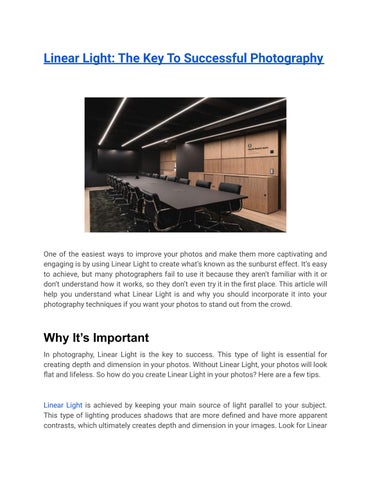
One of the easiest ways to improve your photos and make them more captivating and engaging is by using Linear Light to create what’s known as the sunburst effect. It’s easy to achieve, but many photographers fail to use it because they aren’t familiar with it or don’t understand how it works, so they don’t even try it in the first place. This article will help you understand what Linear Light is and why you should incorporate it into your photography techniques if you want your photos to stand out from the crowd.
Why It’s Important In photography, Linear Light is the key to success. This type of light is essential for creating depth and dimension in your photos. Without Linear Light, your photos will look flat and lifeless. So how do you create Linear Light in your photos? Here are a few tips.
Linear Light is achieved by keeping your main source of light parallel to your subject. This type of lighting produces shadows that are more defined and have more apparent contrasts, which ultimately creates depth and dimension in your images. Look for Linear
Light during both day and night shoots. Whenever possible, position your subject so that their face is directly illuminated by a natural source of Linear Light, such as a window or skylight.
Lighting Issues As a photographer, one of the most important things you can do is understand lighting. This is especially true when it comes to Linear Light. Linear Light is a type of light that is emitted in a straight line. It is often used in photography to create the illusion of depth and dimension. However, Linear Light can also be very tricky to work with. If not used correctly, it can create unwanted shadows and highlights. But when used correctly, Linear Light can be your best friend.
Linear Light is often used as a background in photography because it creates an even plane of light across which your subject can be viewed. To use Linear Light effectively, you’ll need to ensure that your background is evenly lit and free of shadows or highlights. It should also be several shades lighter than your subject, otherwise, your subject will stand out too much from its background. By ensuring these things are true for your lighting setup, you’ll create a truly stunning image without any unwanted distractions.
Isolate Your Subject In photography, the term Linear Light refers to a light source that emits light in a straight line. This type of light is ideal for taking pictures of isolated subjects, as it creates a stark contrast between the subject and the background.
Linear Light is created by a single light source shining down on your subject in a straight line. This type of lighting creates harsh shadows, which are great for photos where you want your subject to stand out from its background.
Use Natural Or Artificial Lighting Whether you’re a Professional Photographer or a hobbyist, using Linear Light is the key to successful photography. Linear Light is a type of light that is evenly distributed, making it ideal for taking pictures. However, finding the right type of Linear Light can be tricky. Here are some tips on how to use Linear Light for your photography.
If you are using Artificial Lighting, you have a few different options. You can use Tungsten Lights or Fluorescent Lights to produce Linear Light. Each of these types of bulbs creates certain colors in your photos that may not be ideal for every photo shoot. For example, Tungsten Light is commonly used with incandescent bulbs and produces a yellow color while Fluorescent Light emits a more blue-toned color. Natural light can also be used to create Linear Lighting, although it requires some additional equipment.
Get Down Low In photography, light is everything. The way light hits your subject can make or break a photo. That’s why it’s so important to understand the different types of light and how they can affect your photos.
Linear Light is exactly what it sounds like—light that comes directly from a source and travels in a straight line. It can be soft or hard, depending on how far away your subject is from your light source.
Avoid Shadows Linear Light is one of the most important things in photography. It can make or break a photo. That’s why it’s so important to understand how to use light to your advantage. Different lights produce different effects. For example, light coming from a side angle can cast deep and dark shadows. These are an important part of many images, but there are also times when you want as little shadow as possible in your photo. One type of light that produces no shadows is Linear Light. Ideally, you’ll be able to have your Linear Lighting source located above or below your subject so that it illuminates them from a top-down direction. Try experimenting with reflections, too!
Show Depth in Your Images No matter what type of photography you do, depth is an important element in your images. Depth can be used to create a sense of scale, add interest, and direct the viewer’s eye. Focus your viewer’s attention by uniquely using Linear Light. This will create dimension and help your viewers better understand what they’re looking at. Linear Light can be used in combination with other elements to help guide your viewer through each image. Keep track of how you use these techniques so you can reproduce them later on! Define Your Subject, Set Up for Depth: When deciding how much depth to include in an image, define your subject as well as possible before you start shooting.
IMPORTANT LINKS ● ● ● ● ● ● ●
Architectural Lighting Downlight Linear Light Strip Light Wall Washer Magnetic Track Light Outdoor Lighting