n
.
'The Magaziqe.. f the National TrS.ctioii Engine Trust
Looking Back at The Run Reflections on Steam and Beer . Henton Reunion Green Debut --_--:PRESERVING OUR HERITAGE WITH STEAM ON THE ROAD primary 2015 Volume 58 No, I
The list of the Trust officers and their contact details, usually appearing here, will be found in the AGM report on page 8.
January 2015 Volume 58 No I
Editor: Roger Mills I 0 Sultan Road,- Emsworth, Hampshire. P010 7PP steaming@ntet.co.uk Contributions of suitable articles, shorter items or photographs are warmly invited. Copyright © Individual contributors or the NTET 2015. The opinions expressed in the magazine, with the exception of Trust announcements, are those of the contributors and do not indicate the views of the Trust. Copy date for next issue: 10th March 2015. Published by: The National Traction Engine Trust Ltd 4 Church Green East Redditch Worcestershire B98 8BT Artwork & Design by Roger Mills Editorial Assistance Key Mills, Cliff Pypard Printed by: Holbrooks Printers Ltd, Portsmouth P03 5HX ISSN 0260 - 2962
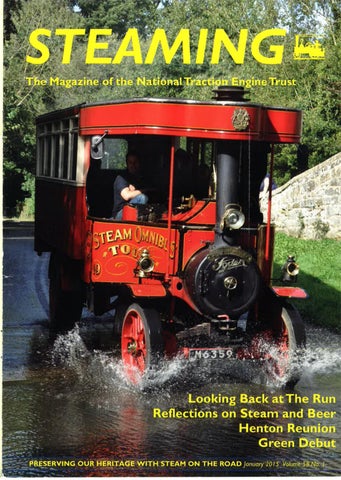
(Cover) lan Langley prepares to ford the Foden bus on the Run (David Warren) (Opposite and above) Two exhibits at Dorset 2014 though the above was actually snapped at Liss. The massive Marshall Portable Double High 28 NH? 53360 Leviathan built in 1910. Early history is unknown but in 1936 she went to WH Liners' brickworks in Kettering as a stationary engine with an engine house built around her. After lying derelict for many years in a partially collapsed building she was rescued in 1973 and partly restored afterwards by Robert and James Hodgson, and indeed was towed to the 1975 gathering, but the work has recently been completed by Alan Sparkes. Above is the recently outshopped Tasker Steam Wagon with new owners as reported later in Steaming Around (Both Roger Mills)
NEEDED - A NEW BAG OF CLUBS? Do you recall John Major's doomed 'big society' evocation of district nurses on Raleigh bikes and cricket on sun drenched fields? When Noah was a lad, this 'golden age thinking' ran, we a nation of joiners in in a network of of voluntary groups all beavering away for the common good. I always doubted that was true — memory recalls the same two or three dozen volunteers keeping everything going! Collecting the subs was always a struggle... Which brings me to a recent steam club mag editorial which urges: "If we could all recruit one more member then our problems would be solved." Then came another including a flyer: "Wanted Urgently Editor for Newsletter. November issue will be your last if somebody does not take this on." As we go to press I hear of a crisis meeting around the survival of a very old steam society, after a number of committee resignations. Amongst myriad reasons offered for declining memberships and participation, an item at the FBHVC AGM on the subject of Owners Clubs too as it happens, is a common feeling that the 'younger generation' are not 'joiners or doers' any more. Wrong I think — but they do want different things. Back in 2004 I covered a Youth Council debate about some government inspired competition where contestants had to compile manifestos, attend hustings, get their PR together. In fact to turn themselves into a junior MPs. The chair was having none of this. Cheered on by her peers this delightful, petite, firebrand (who's probably made an enchanting if explosive partner for some lucky soul) tore into the 3
idea with gusto, her scorn boiling down to: "We don't want this rubbish. We just want it to get things done!" Younger people are no less keen to get things done, to make changes, to improve things. They aren't apathetic. But they won't sit through endless hours of meetings, with people spellbound by their own voices, ending up producing only minutes to be discussed, naturally, at the next meeting. Their new, highly levelheaded, mantra seems to be either A) ask me to do something and I'll volunteer. But if it's meetings and paperwork leave me out; or B) if we can do something let's do it. If we can't, leave it and get on with the next thing. Another factor is surely the almost universal departure to college at I8 which breaks up the natural 'succession joining' of years gone by. None of my generation joined TocH with dad. We were in the SU bar hundreds of miles away! Which makes me think that the NTET might like to facilitate the formation of some kind of 18+ structure which takes account of these new conditions. Facebook plus face to face somehow... For the rest of us? I think many have fallen out of love with old-style clubs. Why? A lot of us have embraced the web based social networks. Maybe society fees are too high set against the perceived benefits. Some are too formally organised — it's a hobby after all. (Dad, LRPS, fled the camera club circuit due to their love affair with competitions!) I fear that, in preservation, non-owners frequently feel they really won't be welcomed — no matter what we say to the contrary. Can we seem a tad cliquey? One other powerful disincentive reared its head while I was helping out at the MME exhibition; meeting times and venues. Several folk over fifty told me they'd left a club: "as they have their meetings mid-week and I'd have to do a 40 mile round trip. I don't like turning out in the winter evenings." Especially, I mentally added, to go to a 'community' hall — surrounded, naturally, by the trappings of a nursery school, the remains of last week's jumble sale, photographs of all the rectors since 1912 and a notice threatening you with death should you touch the piano — donated in 1876 by the Reverend Compton Spindleberry. Last year I refused point blank to go to two club meetings because the venues were so perfectly loathsome. That quietly humorous series on BBC4 'The Detectorists' skewered such places with perceptive accuracy. No wonder the web, with a glass of Pinot to hand and the fire well banked up, conversing with enthusiast on the other side of the world, has an attraction. On that subject the FBHVC AGM heard from Tony Lake and Jules Gallagher of the Stag Owners Club which has: "embraced social media in all its various forms". In his report Geoff Lancaster commented: "This was a fascinating insight into one club's journey into the unknown and with an audience whose average age 4
looked to me to be somewhat on the wrong side of fifty, you could have heard a pin drop so intently were they listening. Let's hope It inspired some of you to dip a toe in the water. There is probably no single thing that a club could do (My bold. Ed.) that would appeal more to the next generation of historic vehicle enthusiasts." My non-web thoughts? Have your meetings Saturday/Sunday lunchtime above a decent pub (many will give you a room free if everyone buys a drink and sandwich) on a bus route/near a station. Run things simply with the social side to the fore and include families from time to time. If you can't produce a mag easily — don't bother. Put stuff on the web not on some reluctant volunteer's shoulders. Rally - ditto. Take the engines to the school fete where they really will attract some interest. Don't bother with a big committee. Go places together or simply meet to chew the fat. Just be a group of mates 'going to the cricket'. I think many would be prepared to pay a fiver a year and a couple of quid a meeting to facilitate that kind of informal enthusiast group. In the words of Berry Gordy "Kiss!" (Keep it simple, stupid!) There's a part of me very sad to see the decline of the traditional club - as a young man I was a member of several for various interests. But we all, not just youngsters, live in different times and with different calls on our time too. Nurses don't ride bikes any more and men are mostly not allowed to play cricket every summer weekend, I've just returned from a breakfast AGM. Maybe we need new styles of 'club', which reflect new times, in which to share our interests. Roger Mills
Our highly respected member and patron Richard Preston passed away recently. Richard was a wonderful supporter of the NTET and wider preservation movement and will be greatly missed. We send our condolences to Anne and the family. Here we see perhaps the two engines he was most associated with. {Above) Burrell Gold Medal tractor 3618 The Scout built in 1914 and bought second hand by Isaac Ball for use in his road surfacing business. (Below) Although many showmen apparently considered green unlucky Burrell 3526 Lightning 11 was ordered in that colour, for Emerson & Hazard at a cost of if,300. Later bought by Richard Preston for threshing and wood•sawing duties it was used during the Suez Crisis of 1957 (when diesel for lorries was in short supply) to haul 20 tonnes of bricks between Darlington and Ampleforth every day for three months. When diesel become readily available again Richard Preston purchased a lorry to maintain the contract and the eponymous haulage company was founded. See also pages 13 and 14. (Both Roger Mills)
Chairman's Notes Anthony Coulls When I joined the Steam Apprentice Club as a 14 year bodies to ensure that we are strong in our purposes old in 1988, I had no idea what would happen 26 years and relationships with each other. later. Even 18 months ago, I had no thoughts of Likewise, I hope that our relationship with affiliated becoming Chairman of the NTET - how time changes clubs continues and note that we are taking steps to things. So here I am, new kid on the block, Chairman improve activity in that direction. at the tender age of 40! I have only been in position for I am concerned that we have no Head of a month as I write this, so much is still taking place in Communications and wish to examine that closer as a my thoughts, but I am heartened by the good wishes matter of urgency — and also how we communicate as of everyone since the AGM - I hope I can serve you to Trust members and individuals through the various the best of my abilities. media that we engage with. If you feel that you would I want to place on record my thanks to Robert like to be involved with Trust communications, please Herring for his spell in office but also note that those get in touch, it isn't as daunting as it sounds and can be of you expecting me to follow his style will be quite fun. disappointed. That is no criticism of Robert. but I have Last issue, David Smith asked for assistance with my own thoughts towards the future direction that the running the Technical Services Unit, please consider Trust ought to take and I will expound on those further this - and also if that's not your thing, Kathy Smith in due course. I grew up with the company of many would love to have your assistance at rallies in 2015 Midlands gentlemen of steam, such as Doug Smith, Jack with the Exhibition and Sales Unit. There's always Marshall, Arthui & Hylbert Smith, Tom Brown and plenty to do with the NTET! Trevor Daw - who I respected (and in the case of We face a number of challenges, not least a Trevor, still respect!) immensely, and these folk changing demographic in membership, but we cannot influence who I am greatly to this day. afford to be complacent and I look forward to Members have read my statement for election, developing this aspect in 2015 - more of that as the which basically sums my style. I believe in consultation, year progresses. Living in the North East, I also want openness, dialogue and listening. I want all members to to spread the geographic operations of the Trust if feel involved and that they have an important role to possible. play in the future; to that end, I am considering the Finally, I want all who are interested in road steam, structure of the Trust — but nothing will be changed in be they members or otherwise, to feel that the Trust a hurry or without talking to everyone. is there for them - to represent their interest, to Likewise, I would like to streamline our operations educate and entertain. I need to hear from everyone, to bring us in line with current trends with similar the things you like or don't like, how you can help or Trusts and member organisations. I want to work how we can help you. together with colleagues in the Road Roller My contact details are In the magazine and I look Association, Road Locomotive Society and other forward to hearing from you.
FBHVC Dan Brothwell As the cold winter nights are drawing in, many of us either have our engines drained down and cleaned out, or just laid up dormant ready for the Boxing day or New Year's day road runs, or of course your busy carrying major or minor overhaul work ready in preparation for the 2015 rally season. Some of you may have even planned out your 2015 season already! The NTET 60th Road run back in September more or less spelt an end to the 2014 rally season and I must say, what a way to end the season for the NTET. With over 160 engines out there on the public roads, showing all road users what we do and what we're about and of course, preserving our heritage with steam on the road! I would like to add a great thanks
6
to all the owners, crews, support crews and organising teams etc. for helping to make such a momentous occasion within the NTET's history. Carrying on from this, the Federation of British Historic Vehicle Clubs have announced their annual "Drive It Day", so folks, get your engines prepared and ready for Sunday 26th April 2015! This is an event which we as engine owners or crews can help make, each year, to be just as big as the 60th road run! Beside, we all know how much fun can be had out on the roads with an engine and surely this is as good excuse as any to have some steaming fun? The FBHVC have said that the event was originally devised and continues to promote the right for owners
of historic vehicles to use the public highway. The event they regard to be a peaceful demonstration of enthusiasts exercising that right. To give a little history to the event, Drive It Day is held on the Sunday nearest the 23rd April to commemorate the 64 cars that left London on the first day of the Thousand Mile Trial on 23rd April 1900. The Royal Automobile Club Thousand Mile Trial started in London and passed through Bristol, Birmingham, Manchester, travelled through Scotland, then passed
back through more English locations until they were back in London again. The tour lasted until 12th May and 46 out of the approximate 64 starting cars made it to the finish line. (I wonder if this will be the next major road trip for a certain little Aveling and its team of intrepid adventurers?) The FBHVC have estimated that somewhere in the region of a quarter of a million historic vehicles take to the roads on Drive It Day, so get your fires lit and show your support to the FBHVC and the NTET!
Membership Lisa Crankshaw To streamline Membership Services, we're going to be making some small changes. First is a new style 'peel-out' credit card size membership card, an easier fit for wallets and purses. Second with your 3rd issue of Steaming each year you'll receive advance reminder that your membership expires with your 4th issue. Hopefully this will eliminate the need to send out extra reminders saving on postage and help us to put more time into other ways of making your membership to the NTET more beneficial. Space issues squeezed the new members list the last issue. Here are the names of those who have joined since July.
15588 Mr Keith Dickens Nr Crewe, Cheshire 15589 Mr David Gregory Matlock, Derbyshire 15819 Mr Martin Patrick Wymondham, Norfolk 15820 Mr James Llewellyn Petersfield, Hampshire 15818 Mr Trevor Monahan Skegness, Lincolnshire 15575 Mr Matthew May Stonehouse, Gloucestershire 15576 Mr Leonard Bonsall Chesterfield, Derbyshire 15577 Mr Kenneth Potts Oldham, Lancashire 15834 Mr Phil Pettinger Dewsbury, West Yorkshire 15821 Mr Cedric Lawson Filey, North Yorkshire 15835 Mr Matthew Fletcher Wakefield, West Yorkshire 15822 Mr Ian Montgomery Thorngumbald, East Yorkshire 15827 Mr Jonathan Kitcher Ryde, Isle of Wight 15823 Mr Martin Davidson Montrose, 15824 Mr Daniel Rice Diss, Norfolk 15825 Mr Mathew Vercoe St Austell, Cornwall 15826 Mr Ged Morris Pershore, Worcestershire 15855 Ms Maria Mewett Eastbourne, East Sussex 15836 Mr Nick Helme Leominster, Hereford 15833 Mr John M Mills Warwick, Warwickshire 15829 Mr Niall O'Gorman Co. Donegal, Ireland 15830 Mr Mathew Gunn Falmouth, Cornwall 15831 Mr Peter Jewell Guilford, Surrey 15832 Mr Mark Gale Torfaen, South Wales 15828 Mr Arial West Oswestry, Shropshire 15837 Mr Richard Taylor Leicester, Leicestershire 15838 Mr Liam Oakley Shrewsbury, Shropshire 15839 Mr Charles Teall Chipping Norton, Oxon 15840 Mr Stephen Moody Bakewell, Derbyshire 15841 Mr Bobby Lawrence Wellingborough, Northamptonshire
15842 Mr Gerald Packer Gloucester, Gloucestershire 15845 Mr Michael Green Wareside, Hertfordshire 15843 Mr P J Wisniewski Tibberton, Worcestershire 15852 Mr Erhard Belock 46514 Schermbeck, Germany 15854 Mr David Coombes Hatfield, Hertfordshire 15853 Mr Simon J D Smalley Shoeburyness, Essex 15848 Mr Roger Jackson Alcester, Warwickshire 15847 Mr John Blundell London, 15846 Mr David Healey Spalding, Lincolnshire 15844 Mr David Chilvers Ipswich, Suffolk 15850 Mr Nick Houghton Barton le Clay, Bedforshire 15849 Mr John Livesey York, Yorkshire 15851 Mr Nigel Smallbone Didcot, Oxon 15856 Mr Andy Rime!! Redditch, Worcestershire 15857 Mr Mark Fry Yeovil, Somerset 15858 Mr David Eves Bordon, Hampshire 15859 Mrs Verity Percival Colchester, Essex 15855 Ms Maria Mewett Eastbourne, East Sussex 15860 Mr Dean Sears Higham, Kent 15861 Mr Chris Cox Ironbridge, Shropshire 15862 Mr Alex Howard Wirksworth, Derbyshire 15863 Mr Gavin Young Huntingdon, Cambridgeshire 15864 Mr David Brain Bristol, 15866 Mr John Lambert Bridport, Dorset 15867 Mr Rowan Clark Stotfold, Bedforshire 15865 Mr Chris Arrowsmith Burton on Trent, Derbyshire 15868 Mr Robert Covill Ely, Cambridgeshire 15869 Dr John Reid Royston, Hertfordshire 15872 Mr Matthew King Wells, Somerset 15870 Mr Graham Atkinson Scarborough, 15871 Mr John Marshall Leeds, 15873 Mr Paul Fuller Polegate, 15874 Mr John W Marshall Thirsk, North Yorkshire 15875 Mr Simon Tansley Loughborough, Leicestershire 15876 Mr Antony Theaker Leeds, West Yorkshire 15880 Mr Nicholas Hirst Southampton, Hampshire 15877 Mr Matthew Cobb Retford, Nottinghamshire 15879 Mr Steve Arrowsmith Burton upon Trent, Staffordshire 15878 Mr Colin Bellamy Witney, Oxfordshire 15881 Mr James Shackell Whitney, Oxon 15888 Mr Stuart Carrier Heanor, Derbyshire 15887 Mr Paul Richards Christchurch, Dorset 15886 Mr Barry Salmon Stowmarket, Suffolk 15885 Mr Steve Stanley Cirencester, Gloucestershire 15884 Mr Lindsay Clark Daventry, Northants 15882 Miss Michelle Maris Chesterfield, 15883 Mr Stuart Conner Southampton, Hampshire
.................---------------..............................--------------------; Readers will note that there are fewer section reports than usual. This is to avoid repeating matters in the various officers' reports at the AGM. which is covered on the following pages.
See also important notice re the 2015 AGM on page 21 l.......................................... ..........................-----------------...............-i 7
AGM 2014 Roger Mills reports Nestling just behind the Grand Hotel like a cheeky little brother Scarborough's Palm Court Hotel proved itself to be a warm and welcoming venue for the 2014 AGM which was followed by a most enjoyable dinner. On the following day many made their way the few miles along the coast to Graham Atkinson's Fairground Collection which was opened specially for the trust. Your editor was particularly pleased to be re-aquainted with one of the Showtrac look-alikes that sparked his life-long interest in the fairground business. Spellbound too by the schmaltzy sound of the mighty Wurlitzer which may be saccharine sweet — compared to a Compton or the more showbiz products of HIll Norman and Beard — but still packs a punch at close quarters. Anyway enough of that ,on to the nitty gritty. After Andrew Semple welcomed members to what he called the premier county and expressed delight that his wish for younger members to offer themselves for election had bourne fruit the formalities got under way with some alacrity after the initial agenda items were rapidly despatched. After outgoing chair Robert Herring added nothing to his printed report Elaine Massey brought members up to date with the doings of the SAC. Aside from the launch of the Burrell Lady Sylvia mentioned in the last Steaming and a visit to Sylvia Dudley herself, covered elsewhere in this issue, she reported on a successful visit to the Midlands Model Engineering Exhibition and outlined a number of other planned outings for the engine in 2015, including the Big Bang youth science festival. She thanked all who supported the club and paid proper tribute to Hugh Dyson the Burrell project manager. Jo Donkin, giving the Rally Organisers Section report on behalf of Lance Jackson, said monitors managed to attend quite a number of Rallies including one in Northern Ireland, and found very few issues of concern. More monitors are needed and if anyone feels that they would like to take part then please get in touch. Apart from a general knowledge of events no previous experience is need; full training and mentoring will be provided. The annual Rally Organisers' Seminar saw seventy people taking part in a full agenda of issues relating to staging an event and a lot of information was shared. This will be repeated on 7 March 2015. On Communications Mike Dyson, who was standing down to make way for younger people who have skills to offer, thanked Key Mills and Dan Brothwell for the excellent special issue of Steaming 8
issued to celebrate the sixtieth anniversary. Other achievements for the year were a promotional video, Facebook page (maintained by Jeff Shackell and Key Mills) and the beginning of an archive for which a collections policy was being drawn up. Moving on to the Commercial Section Stuart Gray told members that there was an in-depth look going on into the commercial activities of the trust including its image and branding. This year's WW I display jointly with the organisers at Dorset had exceeded expectations both In quality and size and this was due in large part to the wonderful team who put it together. The exhibition unit was worn-out arid plans were being made for its replacement, money having been put aside over the years for this purpose. Bob Siddall from the Engine Owners Section reported on a successful January meeting and another well attended — 44 participants — Driving Course at Astwood Bank. This was made possible by the Davis family who gave wonderful support. Four scholarships were awarded and the same number of applications had been received for 2015. The Code of Practice was being updated to include information on wash-out plugs (see also the article on page 16) and a presentation had been given to the Model Road Vehicle Society. On Technical Services David Smith confirmed that the ZRP scheme, allowing the sharing of information on boilers stopped or on limited pressure, resulting from the proposal at the last AGM was ready to roll out. However a decision had been made to delay this pending the production of an agreed scheme of inspection by the AIBI, which was now progressing under the leadership of Dave Wothers. He acknowledged that the issue of ZRP had been controversial but, pointing out that 92% of all engines were inspected by independent firms, he said the trust could not afford to ignore what seemed to be disparate standards across this group. In an addition to the formal agenda Tony Hunt gave an update on BESTT and how the £468k Heritage Lottery Fund grant was being spent on training sixteen boilermakers over two years. Eight trainees were already in place at approved boilershops with John Pridmore employed as a project manager to provide oversight. He thanked the trust for its support and the £5,000 grant which had helped to put the successful lottery bid together. Julie Smith had nothing to add to the Treasurer's report but emphasised that the resources of the Trust were sufficient for it to remain a going concern.
MOTION IN ACCORDANCE WITH ARTICLE 16 We propose that the National Traction Engine Trust furthers its policy on the conversion of engines by making a £500 annual award, to an engine owner who reconverts and restores an engine back to a form in which it operated commercially before 1950. (For the purpose of this motion a conversion is defined as an engine which has been materially changed into a form in which it never operated in commercial days. e.g. A roller which has been converted into a tractor.) Proposing the motion Mike Dyson said it was not an attempt to re-open the debate on conversions, and he hoped the meeting would resist that temptation. There were people who felt the trust was not doing enough
on the issue while others took the view that what people did with their own property was up to them. The aim of the proposed award was to replicate the approach used by both the RLS and the RRA in recognising such work when it was done. The suggested £500 was too little to encourage anybody who wasn't already embarked on such a project. In the ensuing discussion issues raised included the appropriateness of spending members money on such an award, the number of awards to be made, whether the sums could roll up if no award was made in a twelve month period, and whether a trophy rather than money would be a better idea. Despite the fact that there was clear approval for the idea of anything that reinforced the Trust's position, there was doubt about the proposal being the best course of action and it was defeated on a show of hands.
ELECTION OF OFFICERS The full list of officers and Council members either is as follows sitting or elected at the AGM is as follows: Chairman Anthony Coulls I Vaughan Street, Shildon County Durham DL4 I LD Vice-Chairman & Engine Owners Section Bob Siddall Stud Farm House, Castle Hill, Carbon on Trent. NG23 6QR General Secretary Jeff Shackell 41 Kingsfield Crescent Witney. Oxfordshire 0X28 2JB Membership Secretary Lisa Crankshaw NTET Membership PO Box 10348, Hinckley LE 1 0 9FB Treasurer Julie Smith FCA Contact details as for Technical Services below Technical Services David Smith Yew Tree Cottage, 98 The Ridgeway, Astwood Bank, Redditch, Worcs. B96 6NA Rally Organisers Section Lance Jackson Mangerton, Lea Cross, Shrewsbury. SYS 81-IR Steam Apprentice Club Elaine Massey 21 Down Close, Northolt, Middlesex, UB5 6NS Rally Authorisation Jo Donkin I 6 Wiltshire Road Orpington Kent BR6 OEY Public Relations Officer Vacancy V765 Administrator John Riley 52 Main Street, Woodnewton, PE8 SEB Insurance Officer Ian Cooper 14 Millmead, Sutton Road, Shrewsbury, Shropshire. SY2 6DR Commercial Section Stuart Gray 9 Walnut Way, lckle ford. Hitchin, Herts SG5 3XT Salse Officer Kathy Smith The Cottage, Main Road New Bolingbroke Boston, Lincs PE22 7JU
01388 772213 01636 821991 01993 703375 07935 312695 01527 893427 01743 860091 0208248 6570 01689 27468 01780 470384 01743 236558 01462 431848 01205 480836
General Council Bob Garnett, Colin Hatch, Richard Hurley, Kevin Munn, Tony Seddon, Joe Black, Paul Davis, Tim Holt, Dan Brothwell, Bob Allison, Nick Bosworth, Kevin Mills, Guy Debes, Paul Cook, John Gilbert, John Wharton, Charles Cribbes, Mark Waite, Bill Evans, Reg Mattless.
AWARDS 20I 5
Authorised Rallies Administrator. Jack Holloway Trophy — Robin Drury for his many years of dedicated work to the steam movement, the Arthur Napper Cup — Vernon Smith owner of the Driver Training courses and Driver Competence scheme. Sentinel bus Elizabeth which has given thousands of Percy Hirons Bowl —Anthony Lister owner of Clayton visitor's rides around Whitby since 2005. & Shuttleworth engine 38742 Louise which he roads Curtis Bowl — Michael Fuller owner of Aveling Rhoda where possible. He is well known for his demonstrations the first steam roller to have undertaken the 'End to End' showing how the engine would have been worked in its trip, to raise funds for the Demelza Children's Hospice. day. Dacre Lacy Cup — Mike Middlewood a key member of Baker Toc-H Cup — Graham Atkinson for his many the Driffield Rally, owner of Fowler 7hp Road Loco Ajax adventures travelling around Europe and for the UK and a pair of Fowler BB 's, Ward and Dale. showcasing of the preservation movement. Choisy & Simpson Cup — David Ragsdale for his Jack Holloway Portables Fruit Bowl — Alan Rundle outstanding work in helping many engine restoration and for the outstanding restoration of his Tuxford Portable preservation projects. 1 245, including a brand new boiler and the construction Golden Film Shield — Bedford Steam Engine of new wooden wheels. Preservation Society for organising and hosting the Connie Hutchens Memorial Trophy — Val Brown for NTET's 60th Anniversary Road Run. many years with her late hudband Colin joint Sales Officer John Crawley Trophy — John Marshall a one time road for the Trust. roller owner usually to be found with the Road Roller Eric Middleton Trophy — Mark Ellis of Dalton who is section at GDSF in the capacity of surveyor. undertaking the restoration of two engines which are in Edney Shield — Bill Evans, for many years the NTET's a derelict state.
DAWNING OF THE LIGHT By Roger Mills It's easy to lose count of the books and articles claiming that many, no doubt saucer-eyed, country yokels — like yours truly one guesses — got their first sight of the wonders of electric light through the visiting fairground making its regular stand on their village green. Mind you it could well be true but runs the risk of giving the impression that somehow overnight our fairground went from being oil-lit collections of primitive stalls to a fully illuminated steam driven rococo extravaganza attended by gleaming showmen engines. I don't think that was the case. That's not to say that the novelty value of electricity wasn't important to the showmen' and especially roundabout proprietors who used the word `electric' with great prominence to appear to be abreast of the times with the latest thing. Indeed in the same way they gave themselves peerages by christening sons 'Lord', once the first dynamo appeared anywhere in the show the public were encouraged to believe that it was now all electric. Despite the fact that those electric gallopers were still steam driven and only lit by the juice. And in truth not much lighting either. We're used to the likes of Noyce's Three Abreast rotating like a lit up birthday cake — in the memorable words of Gloucester Showman Ernie Cullis - with lamps garlanding every surface. But using evidence from the ex Bob Edwards
I0
machine, now with the FHT at Dingles it's clear that up to 1933 this machine's complement of lighting was relatively modest. For the record the crown centre had one lamp on alternate panels (6) the droppers eight each — in 'Fairyland Strip' (96), rounding boards five (60) miscellaneous ten a total of 172 drawing at 40 watts each about 60 amps. Yes it would look pleasing and in the context of the surrounding village gaudy in the extreme but compared with their fully built ark after its 1946 conversion nothing. And we're talking about when the three abreast was laid up in 1933 only a few years earlier. New? Probably a few flare lamps then electric enclosed arcs — that opaque globe on a massive holder seen the pictures of a simple tober in Lanner and A&R's more complex Scenic. Most contemporary pictures show half a dozen or less, probably Crompton, enclosed arcs over the extension front of machines or simply hung on a simple framework somewhere in the middle of the ground. In this respect the installations are similar to those described in early public realm installations and for their time very efficient too.2 A clever device these arcs. Using the fact that if you pass electric current through two carbon rods touching each other when you draw them apart the current jumps the gap making a very bright light when it does so. The massive holder, sometimes called the chimney, contains the gizmos for both striking the arc i.e. starting it up and vitally the mechanism for making sure the two rods are kept at an optimum gap as the carbon wears
(Left) airchall's little switchback at Lanner with primitive lighting set up. (Below) Anderton & Rowlands standing top switchback with a set of arcs above the run -ups but as far as I can see no other electric lighting. (Bottom) Hancock's machine ready to open with a 1 d ticket but no electric, or indeed any, lighting as far as one can see. (All Roger Mills collection)
away while burning. Clockwork was used for a time before an ingenious solenoid mechanism was invented. Mind you the 'Hand Fed' arc survived in the West End theatre under the aegis of TJ Digby until at least WWI. The globe is for decoration and to make sure no waste products escaped. Early research reckoned that the arc provided much brighter light with less heat to be dispersed than alternatives — so bright in fact it was ideal as the source for film projectors and an essential tool of the bioscope which probably explains its early popularity amongst the showmen too. When did fairground electric lighting start? Well certainly one of the innovators was menagerie owner E H Bostock who first used electric lighting in Darlington in November 1890 — as much as an attraction as for the illumination itself. He went about it pretty simply by getting hold of a portable, fixing a dynamo to another waggon, belting the two together, steaming up and switching on. And yes, contemporary reports reckon punters did pour in to see the modern marvel. But you get owt for nowt- as they no doubt say in that neck of the woods — the engine was heavy it took some manhandling, alignment was difficult and they still needed to keep existing lamps going in case of a fault. No picture of this lash up survives but Smith and Scrivens' Harry Lee book does contain a snap of
Codona's McLaren tractor belted to a dynamo on a dray in a similar set-up. But Bostock was on the right track and when someone hit on the idea of putting the engine and the dynamo on the same sprung truck the portable electric light engine was born. Mind you other sources reckon Wallis and Steevens made one such as early as 1879 when two 8 NHP engines were sold to British Museum as generator. A case of simultaneous invention? Ah yes the dynamo. We're so used to seeing this
clever device everywhere that it's a shock to realise that, although the theory was known quite early on, it wasn't, at least according to RA Whitehead, until Dr Hopkinson's invention of the modem carbon brush dynamo in 1886 that the thing became a practical proposition for general use. (Hopkinson also invented the three phase method of high tension AC distribution.) Others — including Siemens and Brush might disagree with Bob's claim — I suppose it all depends what one means by general use. Anyway a pioneer builder of such dynamos was W H Scott who designed one for the Norwich 'Mustard Kings' Colmans. Scott used the job as a springboard too for his own business with EA Paris and later jointly with R Laurence in 1887 to form LSE the initials funnily enough on the dynamo in Bozz Dram's 1891 Savage lighting set — to use the showman's terminology — which
II
(Above) A sunlit snap ❑ f Box Gram's Savage Electric Light Engine at Dorset in the early 1990s on a rare - if not unique visit. Worth a close inspection for an insight into the life of the showman in horse haulage days. (Below) Later on the same day an attempt was made to move the set by horse power, which memory tells me was an experiment terminated quite quickly. (Both Linda Mills) Thomas Green of Leeds who, depending who you survives complete with the shafts for horse haulage. Dating from just a year after Bostock's pioneering believe, turned out forty or fifty; including 1769 to Alf attempts this Savage 4 NHP Electric Light Portable Ball in 1895 and no less than four to Pat Collins Engine 537 was built for George Aspland to accompany between 1893 and 1898. These superbly finished tools illustrated in John his Gondolas — which contrary to the well known myth is not the ride pictured in the Savage 1902 catalogue Middlemiss' book a Zoo on Wheels contained a vertical but is the one that now resides at Thursford with the boiler driving a dynamo through a vertical steam engine everything decorated to a very high standard. Another Cole name sadly removed. It accompanied the machine until 1896 before, signed to accompany W Shaw's Steam Yachts appeared according to Roger Tuby, being used with their in the Fairground Mercury of September 1991. Other bioscope users of portables were William bioscope until replaced by Fowler 10696 George the First. Staying with the original owners until 1940 it was Haggar (from 1901) the same year Pat Collins bought, purchased by W. Taylor of Boston Lincs, thence to E. from the King's Lynn Novelty Company, a Savage 1898 Middleton, Bill McAlpine and finally the Oram family booth with 87 key Gavioli, and electric light engine. who purchased it in 1981 and totally rebuilt it from bits What would they run? Well Randall Williams was offering a 'Portable engine by Savage of Kings Lynn, on and pieces. But surprisingly Savage were not the only makers truck, complete. Will drive about 20 arcs. Runs like a of such sets, indeed the market leader may have been top, splendid. Can be seen working nightly.' in a 191 I World's Fair. Oh yes then there was the well known Bioscope partnership of Relph and Pedley who ordered Savage 761 in 1900 for use with their show. This fine example survives complete with all the ornamental brass work (opposite) and is a quite marvellous evocation of that short lived period before the cinema and with it most of its showland pioneers settled down in permanent homes to rake in the profits. She's been though both John Middlemiss and Tom Paisley's hands before entering the Preston of Potto stable.
One of the highlights of the NTET Fiftieth exhibition of rarely seen engines, shown by Richard Preston, was this superb Savage Electric Light Engine turned out for the pioneer bioscope operators Relph & Pedley. The care and attention paid to the finish is surely a testament to the money that could be made at one old penny a time in the 'golden age' of the travelling fair before the Great War. (Roger Mills)
Nriv i - SAIrAA '
ans. umino
EL EC
The final survivor is unique in being the only Foster electric light engine built (pictured above and below) and — despite the presence of a small 1875 Gavioli organ - wasn't new to showland either. She went to the Lancashire Electrical Engineering Co before being rescued by George Flynn. How long did these early lights last? Scrivens and Smith's Hull Fair book shows a 1920s Walton Street view with a full complement of arcs as far as the eye can see. By 1935 the same fair has Bostock's Zoo festooned with vacuum lamps in modern style while Barry's Sensational Motordrome Wall of Death has GES lamps topped by enamel shades. By the time Phillip Bradley was out and about in 1936 three abreasts carried a mixture of festoon or clear GES hung from flex in the style common above the nets on Dodgem tracks until very recently — mimicking Arc practice. Maybe looking at the changeover• from fairground lighting qua illumination to lighting qua decoration would be a fruitful subject for further research! Anyway to the $64,000 question why the portable electric light engine and not the showmen's we know and love today? After all Jacob Studt had Monarch built complete with a dynamo bracket in 1889 so the idea was known. I think, again, Whitehead gets to the nub. These showmen, he reminds us, were horse people. The motive power they knew best was equestrian — no wonder that well known Savage 1902 catalogue reprint shows as many shafts as drawbars. If they 14
needed steam haulage they were likely to hire it, looking askance at spending hard cash on plant standing idle much of the time. In this mentality the horse drawn lighting set isn't an aberration; more like common sense. The change came with the proliferation of really massive showfronts that steadily replaced the earliest simple canvas booths. Monstrously heavy—though one wonders just how often they were fully built up — complete with padded seats, and electric light in the projectors and auditoria these baroque masterpieces needed some hauling and by something rather stronger than any quadruped. One supposes to that any entrepreneur willing to buy the best from Burton wouldn't baulk at the cost — if only second hand — of a suitable road engine.
I
Notes One can guess at the fate of the majority of And not just showmen either. Built in 1888, Electric Avenue in portable lighting sets. A lot probably went into plant I. Brixton — made famous by the Eddy Grant song - was named to sheds when the owners settled down with permanent celebrate its place as the first shopping street in the UK to be lit by picture houses, then pensioned off when the town electricity. Now stripped of its glazed canopies but recently awarded electric supply arrived. Others probably had the a large refurbishment grant it has been Brixton's focal point for many dynamo salvaged to take part in a 'conversion' - there years. Godalming, which in September 1881 became the first town are still some very old stagers about even these days — 2. in the world came to world to have a public electricity supply, was lit with the engine sold for other uses. I'd say we're probably lucky to have as many as by a similar Calder & Barnet installation using a Siemens AC Alternator and dynamo which were powered by a waterwheel, lighting three portable electric light engines left to enjoy. Look the streets with seven arcs and thirty four Ediswan incandescents. them out if you have a chance; they really are very charming and very honest links to a pioneering age.
DYNAMOS OLD & NEW(ER) The 2005 the Holcombe Festival of Steam offered this `greek meets greek shot of two Burrell showman s engines Emperor - the oldest in preservation - and Princess Mary. The former is. I think , the only example carrying an open frame dynamo while the later sports a Mowdsley of conventional style. No doubt it was this efficiency combined with ruggedness that made Mawdsley Dynamos the choice of many travelling showmen who purchased them, specially painted ready for mounting on the bracket at ZI per ampere. Jacob Studt Junior selected a Mowdsley generator for the pioneer chain drive lorry mounted lighting set. This dynamo — specially plated by the makers Mowdsley Dynamo specially built for _Jacob Studt' - had an output of 33kW at a low speed of 200 revs per min and, weighing in at 3Y tons, provided useful ballast over the back wheels too. Readers may not be aware of just why this item of fairly heavy electrical gear was turned in the depths of rural Gloucestershire. As usual in Dursley it's down to Listers. In 1907 H.StHill Mawdsley, renowned as a designer of electrical machines, took over R.A.Lister & Co's electrical branch and renamed the company after himself Mawdsley's development work concentrated on improving the output of DC_generotors, his so called Zone Patent led to Mawdsley's factory being christened Zone Works.
Technical Tips WASHOUT PLUG ANOMALY Colin Hatch writes...During routine preparation for ten year hydrostatic testing of a traction engine boiler, an anomaly was identified with a tapered washout plug, nominally I 1/2" BSPT. The threaded hole in the boiler plate needed a tap inserted to 'chase' or re-instate the thread to full form. Prior to inserting a tap a thread pitch gauge was used to confirm number of threads per inch, (11 in this case), the size and taper being confirmed as I 1/4" BSPT. A visual inspection of the plug caused concern as it looked too steep an angle. Further checking revealed that the angle was steeper than I in 16 taper for a BSPT thread. Photograph I shows the plug in the 4 jaw chuck of a lathe equipped with a taper turning attachment. The plug was clocked with a dial test indicator (DTI), to run concentric. A
cut has been taken at the correct taper of I in 16, and the difference can be seen at the large end of the plug. Photograph 2 shows the re-cut thread, done so by 'picking up' the original first thread on the small end of the plug, then screwcutting in the normal manner, achieving the correct depth of thread, (.058" in this case). Fitting the plug into the thread in the boiler plate proved a perfect fit, and although the plug tightened in to a greater depth, there remains plenty of life in it. Photograph 3 shows three tapered washout plugs which at first glance look similar. From left to right we
16
have 10 TPI with a taper of I in 12, 11 TPI with a taper of I in 16, and 12 TPI with a taper of I in I 2. Although modern repairs to traction engine boilers are most likely to be utilising BSPT for tapered plugs, it is by no means certain that historical / in service repairs had done so. Accurate measuring of the pitch and angle of plug / hole is essential for the safe use of washout plugs. Incorrect angles can lead to limited engagement of threads. Incorrect pitch of threads can lead to tearing & stripping of threads. Both of these scenarios possibly culminating in the plug blowing out under strain of working pressure, especially if 'following up' is taking place. Some Tips for checking threads/ angles on holes and plugs: Use of a screw pitch gauge will identify number of threads per inch. Measuring the angles with a vernier protractor will give a comparative indication that the angle is the same. Any good workshop tables pocket book will give all the information required to assess thread details. A quick check on thread angle, if you have a matching tap to hand, is shown in Photo 4. Invert the tap against the plug as shown, then take a measurement across the crests of the threads, at each end of the threads, if the figure is the same, then the tap and plug will have the same angle. Continued on page 18
oeritage Steam Suppeles
•
ino.qtm
industrial Boilethouse Supplies Ltd.
tREE ..
Unit 34 Brand Way, Segensworth East, Fareham, Hampshire P015 5SF England
Onlne or des
www.heritagesteamsupplies.co.uk • OUR NEW 2014 CATALOGUE IS HERE Featuring Over 400 Pages Of Products Our NEW 2014 Catalogue will be distributed to all our customers over the coining weeks. Request a new catalogue today to be the first to receive your copy.
OrplJE COUNT STEAM sonar Steam SuPpiiers
IN=1111=1.111E
RRIS
ML R
GOLDEN FILM
CYLINDER OIL T
UNIVERSAL STEAM Olt
PRFSF kVA!
ONLINE CATALOGUE View the entire catalogue on our website using the brand new e-catalogue at www.heritagestearnsupplies.co.uk or scan the QR Code to view on your mobile or tablet device.
All Ma or Credit Cards Accepted VISA
[MI
Secure Online Payment Powered by Minimum Order Charge LI 0300 +VAT
0
spay
Contacts & Opening Hours Monday-Friday 01489 570737 (8 Lines) 01489 570767 1 7:30arn-4:30pm Saturdays Stuart Gray: 07785 258169 Sam--12 Noon &mail: sales@heritagesteamsupplies.co.uk Sales Office:
Fax:
Using a lathe with a taper turning attachment, a simple way of setting the plug to the known tap is to put the tap in the chuck to run true with a DTI. Engage the taper turning attachment, wind the saddle along, set this to clock true with the tap. The plug can then be set in the chuck, clocked to run true, and the angle checked using the saddle and DTI. When generating a thread onto a plug blank, the other variable to consider is that the centreline of the tool is perpendicular to the axis, in the case of BSPT, and in other cases, the tool centreline may well be perpendicular to the taper. Importantly, in the case of all types, the hole and plug should be produced to the same standard. In the case of more than one plug of the same size being used on a traction engine boiler, a system of number stamping for each will ensure the correct plug is fitted to its mating hole. During annual inspections the competent person should check the condition of the thread, including wasting or rounding of the threads, easily shown up by the use of a straight edge. The Heritage Railway Association has produced a Guidance note for railway locomotives on washout plugs, HGR-B9009-1s0 I . Page 5 of the document tabulates no less than I I variations of taper plug.
The Trust are planning to replace their
SALES EXHIBITION TRAILER and as a result this is now offered for sale. 7m turntable chassis trailer, designed gross weight 3.500 Kg. unladen weight approximately 3,150 Kg. Extends by a 3 m rear pod to provide excellent internal Exhibition Space.
Price E38500 + VAT For full details and viewing contact Charlie Cribbes on 07813 690173
18
Introducing Sylvia to Sylvia For anyone involved with the NTET over the years John collected the engine from Astwood Bank and one of the key personalities has to have been Sylvia we met at the care home. It was a sunny but cold day Dudley. and we went in to see her. Finding her in good spirits Thinking about the Steam Apprentice Club, then, I dropped hints that we had something to show her. Sylvia was one of the people involved at the very start Her eyes lit up, "the Burrell" she said. I couldn't help of the club in 1979. Sadly she is currently not very well but grin in response and we all went out to the parking and has been unable to attend any of the recent NTET area and unloaded the engine. events. Sylvia was so happy to meet her namesake at last, The Steam Apprentice Club project to build a 4" and by the time we had a fire in the engine we had scale Burrell is now complete and the engine has been attracted a lot of attention from the staff. named Lady Sylvia after Sylvia Dudley. Well, the two I am so glad that we made the effort, more on Sylvias had not met, and John Durling and 1 set out one John's part than mine. He put in such a long day to Saturday at the end of October to put that right. collect and return the engine. Thanks John! Elaine Massey
FOR YOUR NEW HANDMADE TINPLATE ENGINE LAMPS IN MOST CASES YOUR OLD LAMPS CAN BE REFURBISHED WITH NEW GLASS & BEZELS, BURNERS & OIL TANKS, HANDLES, DOOR CATCHES AND MORE... TELEPHONE TO DISCUSS YOUR REQUIREMENTS. TEL: 0044 (0)1938 850 393 EMAIL: enquiries@hetheringtonlamp.co.uk WEBSITE: www.hetheringtonlamp.co.uk
&earning
19
Looking Back to 1966 with Roger Mills This was the year The Times put news on the front engine was known as Dreadnought when Pat page — up till then it was only ads! Just in time to report Collins took it round the fairgrounds. It has had a England's first, and to date only, World Cup - the first new firebox and new tubes. The tender, which victory too for a home team. A certain F Laker bought occupies his garage while his car stands out in the 12 obsolete bombers, converted them to cargo carriers open, is being rebuilt. He is assisted by his son and founded Laker Airways Michael." — the real forerunner of the Also on show were likes of EasyJet. And who Ruston and Hornsby 6 can forget the horrific news NHP agricultural owned footage from Aberfan where by Vice President R. a slag heap slipped engulfing Pumfrey; Taylor Bros' Pantglas Junior School and Two /me John Fowler Road Locomotives which Mite in roman( 4orwce al Aveling and Porter Road Thompson's Wolverhampton ~its until 2 veal a vuu era now WI:arm 16 homes killing 116 John giving for sale. They aro excellent *Amines lion.* in sound structural ass Tractor Lucy May mechanical condition, children and 28 adults. trailer rides and Barry No. 17212 (right) Class 13.8 No. 19783 Class B.8 1932 10 H.P. John Thompson Ltd 1920 10 H_P. Compound Compound road kw-motive, OliginolIy Freeman's Burrell wing-mounted locomotive supplied to a travelling Iliewman and offered two Fowler Road wilt' 8 ton jib crane. known as 'King Carnival. Agricultural Jessie. Anyone interested in the purchase of these fine examples of early locoLocomotives for sale, used motives Showland-wise Fowler should contact the Group Publicity Manager, until 1964 in their works and Showmen's Engine Carry sound mechanical in On and Tidman Centre JOHN THOMPSON LTD , ETTINGSHALL, WOLVERHAMPTON Engine City of Cardiff condition. They are now to Telephone: Bileton 41121 be seen in their original were mentioned. guise as Wolverhampton Further north at Wanderer (see page 28) and Winstersett Jack 'Cyclist'
JOHN F OWLER ROAD LOC OMOTIVES FOR SALE
King Carnival II.
Wilkinson felt sorry for If Dick Beeching could anybody who'd come along have seen forward fifty tears by public transport as there it's almost certain he was a 'lot of foot slogging wouldn't have ditched much from the nearest bus stop!' of the Great Central, as he Owner Ted Meadowcroft did. But in 1966 it was gave showmen visitors C. reported at least Quainton William Henry and Road Station might be saved. Goldthorpe Marshall the A £5000 appeal was launched in April by the London freedom of the showman type road loco Prince of Railway Preservation Society, hopeful of developing a Wales - William Henry driving and Goldthorpe rail centre — and keeping a connection with the BR steering into the arena for the final parade. Jack goods line. In case modern eyes think the sum trivial writes: "It must have revived memories for them they equate to £112,000 today. Later in the year the both as they used to carry out these two duties on Thames Valley TE Club supported - with Burrell the Fowler Big Lion General Buller." Furious and Bill McAlpine's Garrett tractor - a steam Another showman to return to steam was Albert day at Taplow Station run by the GW Society. Arnold who got to 21 rallies with his friend Arthur Pendennis Castle was in steam on the iron road and Nosey and had been able to drive all the surviving 7000 came along. engines that had passed through Arnold Bros' hands. Lesley Berry reported no less than 20,000 visitors They were Fowler Evening Star (Castle Howard), at the East Anglian TE Club rally at Ingatestone. After Burrells Island Chief (Burnham Market) Island Prince listing virtually everybody involved or who he'd met on (Gaddesden Row) and Edward VIII (Bognor). the day Leslie (finally!) admitted: "Without doubt the But some wondered if two day rallies simply spread big attractions at the Rally were the engines the attendance. Saturdays at Wintersett had been themselves with their noise and smoke and sparse and Jack reckoned: "It seems to me that movement. There was a good assortment including Sunday is unquestionably the "big day" and even the President's A Clarke Esq's Aveling and Porter engaging top-line television personalities to perform Roller 8672. Mr. Clarke told me that he is at the opening ceremony on the Saturday fails to present rebuilding his Fowler, named Goliath. This even things out. I wonder if bringing Saturday's prices
20
down to half-price would have the desired effect?" Finally to Bressingham, home of plants and steam, where a Steam Gala and rally was held. By 1966 Alan Bloom had two railways. A 2' gauge ex Welsh slate-quarry railway offered half a mile of track, and two engines. A 9" gauge garden railway housed a 4-6-2 Pacific class engine. Eleven out of the fifteen entries on the programme also belonged to Blooms. One reporter's eye was caught by two engines still in 2005 housed at the gardens. Sentinel Timber Tractor No. 8765, with its two engines, was used for timber work and cost £2,500 when new. (She's now back to full working order and in use in the museum Burrell Black Prince owned by Liz Bloom) converted in 1925 to a Showman's engine for Grays of London and last used commercially in 1940/41 for demolishing blitzed buildings in London. But there was a nod to the future as Insurance raised it's head. The Hykeham Rally Committee, Lincolnshire Steam Engine Preservation Society, NTEC Reps and insurance industry figures met to discuss the potential liabilities for organizers and participants alike as a result of an accident. "Certain misunderstandings were revealed as regards the obligations of the engine owner," WF readers learnt. "It would appear that there was an assumption from some quarters that the organisers' public liability policy would cover all accidents." The industry soon put that foolish
view right! Cover for most mishaps there would be, but certainly not for explosion or collapse of a steam boiler. Organisers should insist on proof of cover from the owners. The NTEC Rep pointed out that organirers should check but, short of inspecting every policy, there was no set procedure. The problem could be overcome by organisers requesting the entrant to provide his policy number on his entry form. All agreed that the movement "cannot afford to allow an uninsured, or even an insufficiently insured, boiler to attend a public event such as a rally, since a mishap involving such an entrant could be disastrous to all concerned." Well yes I suppose even I can't disagree with that! NTET AGM 2015 — ADVANCE INFORMATION The 2015 AGM will take place in Aberdeen on 21st November 2015. To offer members a short break holiday based on the AGM coach trips to local attractions are planned for 19,h, 20rh and 22nd November. On AGM day the programme will be as usual with a ticket only dinner in the evening. The Trust has negotiated a deal on hotel accommodation from the night of Wednesday 18th with departure on Monday 23rd. The B&B rate for a double room will be E9.5 per night. There will be more details in future Steamings but organiser Anthony Thompson would welcome early responses from interested members. Please email him at a.thompson6@btinternet.com
For specialist cover speak to the specialists STEAM TRACTION INSURANCE for full size road going engines & wagons (inc those above 6in scale)
PORTABLE & RESTORATION STEAM INSURANCE for portable engines and road engine & wagons which are off the road or undergoing restoration
MODEL ROAD STEAM INSURANCE for miniature road engines & wagons up to and including 6in scale
STEAM CAR INSURANCE for all steam cars including new builds
VAN LORRY & LOW LOADER INSURANCE social domestic & pleasure — fully comprehensive — any driver
RALLY ORGANISERS' INSURANCE property, liability, cancellation
Walker Midgey Insurance Brokers Yorkshire Bank Chambers, Fargate, Sheffield S1 2HD For full details phone 0114 250 2770 or visit www.walkermidgley.co.uk
&teaming
2
Alan Eaton from Northampton, the steam section leader of the Malpas Yesteryear Rally, produced the rare sight of three conventional portable engines, two of which were making their debut at the event. In the wood sawing area and easily spotted by its sheer unrestored bulk was the Ruston Proctor class PSG 8 NHP single cylinder engine 52721, new in 1919 to W F Wilson of the Knapp Turning Mill in Inchture, near Dundee. The engine came into preservation in 1973 but has not been rallied since the mid 1970s. Present owner is D J Worthington of Whitchurch. The second new portable was the much smaller 6 NHP Ransomes, Sims & Jefferies 27441, new in 1918 to Henry Sykes Ltd. Present owner A Tatton of Haslington, Crewe acquired the engine from Scotland in 2013. In the engine line up could be found the third conventional portable, the rare Davey Paxman 6 NHP single 15584 restored from derelict condition by owner Will Dakin of Sandbach. Also in the portable category was the veteran steam powered and horse drawn fire pump built by Shand Mason in 1875 and now in the care or Cheshire Fire Service. 22
Two rollers were making their first appearance at Malpas and both were built by Fowler of Leeds. No. 19053 Patricia B was new in 1931 to West Riding County Council who sold the roller in 1961 to Montgomeryshire contractor Corfield of Abermule. Present owners the Mason family from Hereford acquired the roller in 2012. A much earlier machine and second debutante was 15851, new in 1923 to Royal Leamington Spa Corporation and acquired by present owner Niall Byrne of Eyton, Wrexham in October 2013. Other engines of note were the brace of Marshall tractors owned by Neil Thompson and Hedd Jones along with the pair of road locos belonging to Stuart Philips and Robin Battersby & Phil Steer. Another twosome was the Aveling & Porter agricultural engines Valentine of Neil Wiliams and Avellana owned by Tony Seddon. For the roller enthusiast there was a brace of Burrells, 8 ton compound 4004 owned by Richard Bridge of Whitchurch and 10 ton single 4069 owned by Mark Walker of Nantwich. At the end of the line up was the 'Tarmac Sentinel', S6 tipper no 8821 of 1933 owned by Peter Walker and, out for the first time in 10 years after a thorough overhaul, was Sentinel S4 no. 9086 of 1934, steamed from its home base in Oldham by owner Hughie Winterbottom. In the miniature engine paddock were the Morgan brothers with their 4" Burrell scenic showman's engines, a 41/2" Foden C type wagon and a host of 3" and 4" agricultural engines representing makes such as Burrell, Foster, Garrett and Marshall.
(Above) Ruston Proctor portable 52721 is fired on wood by her owner. (Below) Brian Harris and steam dog having a trundle on a 4" scale Garrett roller.
Qrds by Rogr Mills ing by Key Mills ictures b David Warren, feri and Roger Mill The problem with being lazy and leaving writing up something until months after the event is that it's hard to really recapture the mood of the day. Which might be why I went back to that 'steam Genevieve' The Iron Maiden, probably because of the location, a movie in which the Duke Of Bedford proves once again just how difficult it is to 'act yourself in front of the cameras. While it's a film of its time it is a wonderful romp with none of the 'little Britain wasn't it all better in the old days' feeling that makes The Titfield Thunderbolt a tad tedious. Beautifully filmed, it offers a number of lessons we could well take on board in 2015 — though whether it would be considered politically correct to spank a young woman who pinches your Fowler showman's these days is open to doubt! (Whatever your views on that — don't write in!) Always a treat to see Casey Jones back on a footplate too... Where it scores, and where the 2014 anniversary run scored too, is that it realised the truth that 'it's the engines, stupid'. They took centre stage at the filmed Woburn rally as they took centre stage in the same county fifty two years later on September 27th. On the road, amongst ordinary traffic, doing what they were designed to do. Maybe that's why the immediate reaction of most participants was — why only every ten years? Personally as a mere spectator the few hours I spent at Sandy that morning beat the total of virtually everything else I've covered over the past couple of years into a cocked hat. No it wasn't just the parade of delightful steamers
alb-rail road *a 3257 ' Sentinel 80,84 .e45 Simon Church (D
— though that was stunning. It was the expressions of enjoyment on the faces of those on board. Yes there was concentration too but plenty of grins, look at Ian Langley on the front cover. Steam has a magic and it shone through. It's why Kathy Fisher (Anne Helm) succumbs in the final scenes of 'Maiden' arid its why we spend inordinate amounts of cash on keeping engines going. It's why so many engine owners wanted to enter. It's also why the general public; die bystanders on the run route; the dad with the toddlers who stopped to stare; the biker I spoke to who was rushing from viewpoint to viewpoint; even the motorists who were held up at times I suspect are very grateful that this movement has taken the trouble to preserve what's worth preserving.
(Above) Avefing & Porter 8837 leaves Shuttleworth Park (Below) Armstrong Whitworth 10R2 (Opposite Clockwise from top left) Sentinel 5256, Wallis 7372 as far north as it has ever been, Burrell 3121 Keeling and Foden Earl of Eldon. (All David Warren)
1
SEEN AT'
With only a couple of hours to spare or' as a location, largely because I knew it F meaning that there would be - with ari) traffic. As it turned out it was an inspired only three or four were impossible to si new to me, were captured and a very ph summer sunshine. Here then are eight (clockwise from top left) Marshall roller Burrell road loco 3593 Duke of Kent; F: the layby as I arrived, and Fowler tram Mayor with the Harry Lcc Yacht loads road train might have been like in the da unaware that such machines could be so suffered a few problems later and the I Finally come Foden tractor 14084 Duch 3395 The Dalesman. More or
•• _ URCH&SONSf[b"B 3°". TRACe.,7)RS 4IERIEIGh a___-
3 )EVO1
50^ in
if &Couan.; C • [..P. irark, ;16?
KEA
SANDY
Run day I selected Sandy railway bridge lad a mini roundabout on the east side luck - enforced stops and gaps in the choice as, of the engines passing, I think oot satisfactorily. In the end sixty, many asant two hours or so spent in the late if the participants on the medium route 7720 the only roller to do the 26 miles; ,den wagon 13764, which had stopped in 3r 15632. Then come two views of Ex giving a real idea of what a fairground iys of steam. Many uninitiated would be conveniently stowed. Sadly the Burrell oads were taken on by other engines. ass of Gloucester and Burrell road loco back cover! (All Roger Mills)
Ir 44"
(Above) Lunch Stop at Bedford Growers near Sutton - around SO engines present by noon (DW) (Below) Wallis & Steevens /922 Expansion engine 7690 and Fowler tractor 19338 Monty (MR)
THE RUN - CONFIRMED RUNNERS AND SUBSTITUTIONS 001 SAC Burrell 4" Lady Sylvia 002 Burrell Margaret 3926 003 Fowler Renown 15653 3669 004 Burrell Nero 005 Burrell Britannia 2668 14589 006 Foster Lord of the Isles 008 Foster Venture 13149 009 Foster Obsession 14205 010 Foster 14564 Victoria 011 Fowler Black jack 8635 012 Burrell Peter Pan 3433 014 Burrell Ex Mayor 4000 015 Fowler Carry On 14425 016 Garrett Little Billy 33566 018 Burrell The Dalesman 3395 019 McLaren Mr Tweedie 1295 020 Foden Earl of Dudley 1308 021 Fowler Jo 13141 023 Fowler Titan 12226 024 McLaren Gigantic 1332 025 Foden Monarch 3534 3593 027 Burrell Duke of Kent 028 Fowler 17212 029 Burrell The Badger 3941 030 Burrell Clinker 3257 031 Burrell Lord Kitchener 3633 33296 033 Garrett Adventurer 034 Burrell The Cranleigh Belle 4072 035 Ruston The Lincoln Imp 52607 036 Fowler 16854 15288 037 Fowler Mr Blower 038 Marshall 74614 Scrumpy 039 Foster 14739 Johnboy 040 Foreman 9801 The Hamster 041 Fowler Lord Doverdale 14805 042 Garr et'. Patricia 33991 043 W&S Little Atom 7881 044 Fowler 15632 16365 046 Fowler King of the Road 047 Burrell 3540 Gladstone 050 Burrell Harry 3442 051 Burrell Laddie 3808 053 A&P The Whippet 9197 054 W&S Loki 7372 055 W&S 2758 056 Burrell Little Dorothy 3862 33829 057 Garrett Empress 058 A&P Orinoco 12766 059 Garrett 31210 Wallace 061 Fowler John Fowler 15629 063 Robey Village Queen 33957 114059 064 R&H 158623 Moonlight Magic 065 R&H 9246 066 A&P William 067 A&P Bertha 9370 068 W&S Big Emma 2357 069 A&P 7385 070 A&P George 8837 071 A&P 5156 Lydia 95/4009 Toby 072 B&W 073 AB AE998 074 AW 10R2 075 A&P 10647 10399 077 A&P City of Rochester 77201 078 Marshall 079 A&P 11542 Leeson 080 A&P Jupiter 8717 AC624 081 AB 082 A&P George 9008 083 A&P Ophelia 8794 084 Burrell Pride of Dorset 4025
085 A&P 086 A&P 087 Fowler 088 Marshall 090 Marshall 092 W&S 093 R&H 094 Marshall 095 Burrell 096 Fowell 097 Fowell 098 Fowler 099 Fowler 100 RS&J 101 Burrell 102 C&S 103 A&P 104 W&S 106 C&S 107 Burrell 108 Allchin 109 Marshall 110 W&S I II C&S 112 McLaren 113 W&S 114 R&H 115 Allchin 116 C&S 117 Burrell 118 Marshall 119 C&S 120 Marshall 121 C&S 122 Burrell 123 Foster 125 Marshall 126 C&S 127 A&P 128 Fowler 129 RS&J 130 Burrell 132 Marshall 133 Foden
10906 14002 17560 28922 34151 7248 113043 36258 4014 91 92 11357 11700 18504 4055 32900 9096 7008 48224 1426 1499 43560 7690 48232 1642 7498 1 15100 1458 36336 3903 42655 38742 51007 48154 3121 14410 57304 43200 8401 19338 36020 3763 37690 13068
Cinderella Jimmy Alderman Jimmie B Pedler Oliver Punch Pride of Devon
(replacing M36575) Sybil Crimson Lady Jubilee Eileen Valiant Old Faithful Evedon Lad Winifred Elizabeth Chatham Progress Hildary Peggy Excelsior Sir Philip Louise Jess Keeling Sprig Challenger The Gaffer Avellana Monty The Model Old Timer Perseverance
Duchess of Gloucesmr 14084 134 Foden Boadicea 13708 135 Foden 46837 136 C&S 30826 137 Garrett 8571 138 Sentinel 8393 140 Sentinel 8084 141 Sentinel 3510 142 Foden 9192 143 Sentinel 12770 144 Foden 5256 145 Sentinel 9293 146 Sentinel Emily 12018 147 Foden George 13266 148 Foden 13764 150 Foden 12300/13484 151 Foden The Mighty Atom 14078 152 Foden 8714 154 Sentinel 13008 155 Foden Puffing Billy 11340 156 Foden Hero 1552 157 McLaren 15673 158 Fowler Ajax 15 I 83 159 Fowler Surprise 14247 162 Fowler Sunrise 14248 163 Fowler 164 6" Burrell 165 6" Burrell crane 166 9" Tasker 168 6" McLaren 169 6" Savage 170 6" Foden 171 6" McLaren 172 4" Burrell 173 4" McLaren 174 4" Burrell 175 4.. McLaren 176 4" Allchin 179 4" Garrett 180 Stanley E2 car 181 Stanley 710 car 182 Stanley 10hp car 183 Calder van 184 Stanley U car 185 Stanley 60 car
• Burrell Lord Kitchener new, as the canopy sides confirm, to Chivers of 0 Devizes rescues the Lee's Yadas centre engine after Ex Mayoti hit tre41 , e. (DW) Aftel4
fy
n4 • ' 1L-r1Foden 12015, Unipolvc- TimbtYrrO. Burrtgf 390 and Fader! +•W85 IAIRj
Len Crane's well known Fowler - for 'Dore detatis see page 20. (MR)
Lord Doverdale overtakes a more modern trciaOr.(MR)
e inaugural road„ Rpf-T Gfreen
By Phil Braithwaite On weather dependant days much work was done both on my engine and my living van getting it ready for its inaugural run to the Goostrey Steam Party. We did a lot of painting and varnishing on the engine but did not manage to complete it all, the last being two coats of red oxide, after cleaning out the coal bunker. I fitted the transfer also and then gave it two more coats of varnish, mechanically she was ready. So we tackled the living van, fitting the fridge properly, the water supply, an orange warning lamp to the back of the van, next to our 'long vehicle' sign'. Greasing the turntable and the wheel bearings and checking the tyre inflation and tools completed the job. To help see my gauge glasses, which are set back behind the second shaft, I obtained and fitted two magnetic 'LED' torches either side, clamped onto the bulkhead. This works well and helps tremendously. We loaded the bunker with 21/2 cwt of steam coal, filled the water tank, and all bar the shouting, we were ready to go. The morning of the 25th October loomed, cloudy but dry and not too warm, good steaming weather. The fire was lit, the engine oiled, the whistles were fitted and we waited for enough pressure to manoeuvre the engine onto the tow hitch. A last check around and away we went, Helen, my good lady wife, driving the support car, with Bob Chown and myself at the controls. We had previously 'reccied' the route, so we knew where the laybys and fire hydrants were but it was the first time that we had attempted this sort of distance, (9 'A miles) and could only gauge how far our water supply would take us. Firing on the run proved to be difficult, until we got the hang of it. We stopped at our designated lay by to check the engine, the clack valve was weeping a bit, so it was tightened, OK, water
supply looked OK to the fire hydrant (6 miles). Out of the blue Phil Wragg, an old friend, turned up at the lay by with Yvonne, his partner. Well you could have knocked me down with a feather. So time passed and I said we have to get going as we must make the pub before dusk. On we pressed, we were now getting the hang of the engine better and we made the water hydrant in good time getting enough water to get to Goostrey and back to the hydrant the next day. We took the opportunity to oil up, whilst watering. We set off on the final leg to Goostrey in good spirits, however after about a mile there was a ping of flying metal and then a banging. I immediately stopped the engine to find that the wedge had come out of the 'LP big end ' bearing. Wow! we located the wedge and found that the split pin holding it in had sheared and allowed the tapered wedge to work its way out. All replaced Bob and I looked at each other - that was close. By now it was a mile to the pub and about 3 pm. On arrival at the pub we were greeted with whistles and cheers, from a huge crowd, there were 18 other engines with an amazing array of living vans. 1 leaned on the big SAR chime whistle and we gingerly made our entrance. It was at this precise time that the HP little end wedge worked itself loose but 1 just coasted her into position, willing hands removed the living van and moved it into position, and we had arrived! A pint was put into my hand by Clive Plane, a good friend, and we settled the engine down. Much talking and stories were then told and many friends in the movement were all around, with great interest shown. 1 later got cleaned up in the living van and Clive left and we had a meal with friends. You would approve, as a hearty plate of fish and chips and mushy peas was
31
put in front of me. I did not complain. After this we covered 2135 for the night and watched as Supremacy generated power for the lights and the revelry went on into the night. For the return journey Sunday loomed dry but again overcast. I took another 21/2 cwt coal in the car to the pub in Goostrey and after collecting Bob we filled the bunker, lit the fire, oiled around and checked the engine. By midday we were ready to roll again, but we had to do the return trip without the use of the water pump as we had a problem with it, which we tried unsuccessfully to resolve. After saying our goodbyes and with a flourish on the whistle we rolled out and on our way back to base. All went well until we saw a lone horse rider in front of us, so we decided to pull over and wait for it to get well ahead, rather than to spook it. We arrived timorously at the Hydrant and filled up with water, oiled up and set off, stopping at the large
lay by for a drink and something to eat, before continuing. About a mile from base, the LP big end overheated, caused by lack of oil, lost as the bearing cup had come loose. A stop was made to tighten and refill the bearing and we then proceeded slowly until the bearing cooled and we then proceeded all the way back to base with no further problems. We had learnt much about roading 2135 those two days, on arrival back at base we had a 1/4 tank of water and 1/4 bunker of coal left. We positioned 2135 and put her to bed, both weary by then and didn't need much rocking that night. Subsequent to the water pump problem, we think we have sorted it, but as the weather had deteriorated it was decided to winterise 2135 during the following week. So she is now drained and lifted onto timbers, and most of her pipe work and brassware has been removed .
Stocking a Steaming shelf Roger Mills recommends an out of print title well worth looking out for...
Talking to bystanders at the 60th anniversary run it was quickly apparent there was an appetite for a basic introduction for those who'd like to get something of a flavour of the Traction Engine but haven't the time — or degree of interest - to wade through the massive and research filled tomes that weigh down our shelves. With that thought in mind I went looking for a rich but concise taster and I think I found it in Harold Bonnett's 1975 hardback Steam Traction Engines Memories Of Men And The Machines (Tyndall nla). I suppose Harold is best known for his book on the Steam Plough but there were a number of others on a lesser scale and this one at 48 pages comes into that category. Small then — agreed — but like the Tardis what it crammed in here is astonishing. The tone is set in a short foreword — at a guess a mere 180 words — where we're given a) the appeal of road steam b) the reasons for its decline as well as c) an idea of the power of the machine. After that there's a canter through the pre-history before the portable makes its appearance. Then it's an engine type per chapter really — a structure most would use faced with such a task. What sets this apart is how the author's memories - mixed with little character studies of real steam men and various working case-studies - make the machines come to life. Along the way threshing by flail, the various qualities of cast and wrought iron as well as steel are explained — with the simplest explanation of steel-making I have
32
ever seen, lighting up, kinds of loads carried and a saunter through the various makers are included with such a light touch that we don't realise we're being taught. The Great War gets a chapter to itself and even M. Cugnot gets his due. Then there are the monotone plates, usually two per page. The tone is set by the dust-jacket which carries not a preserved showman's with its unprototypical fairy-lights but rather an archive shot of the 1869 Tasker chain-drive maybe on her trial run certainly with the red flag man in front. Other highlights are working shots of a Thompson Road Steamer, the Tennant & Co 1870 10 NHP road loco and a superb study of Joe Coddington at the controls of BB I 15427 working on Counter Drain Lincs in 1950. If the half-tones are a tad muddy put that down to the paper and the technology of forty years ago, trust me the selection can't be faulted. In short then I can't think of a better book to put in the hands of the casual bystander who wants a bit of background for the one or two rallies they go to each year or the youngster setting out on a preservation career. It'll never be reprinted so you'll have to scour the second-hand outlets but this little gem is available for a fiver from more than one as I write.
HENTON ENGINE REUNION by David Dean In the Summer 1994, Spring 1999, and July 2012 issues of Steaming three articles, which I had a hand in writing, were published about the firm of John H. Henton, of Hopwas, near Tamworth. Six of the firm's engines have survived into preservation, these are Burrells 3996 Conqueror (above), 2336 Stanley Monarch (I believe this engine is named after the same Stanley as Accrington Stanley football club), 3395, this engine was not named in its working days, but was referred to in the yard as 'the Exeter engine' which is what I shall call it (why this craze for sticking names on everything, compare an early Traction Engine Register with the latest, and what extraordinary names some people come up with!), 3509 Rajah, and 3669 Nero, and finally Marshall 52483. These engines are now scattered far and wide, but as the owner of the Marshall I had long hoped these six could one day be brought together again, the ideal venue for such a gathering would have been the yard at Two Tree Farm, but that has disappeared under a modern housing development. Perhaps the next best thing would be a line up in Hints Road, but I doubt if that would go down very well with the present day residents, it is highly unlikely any of them have any knowledge of Jack's activities, let alone any recollections. Bill's yard at Balls Bridge is still there, but that was never any part of the firm, and although they regularly went that way in years gone by I would be very hesitant about taking six engines over that bridge today. Imagine my delight therefore on receiving a phone call from Garry Nelson one evening asking if I would take my engine to a Henton engine
reunion he was organising at South Cerney rally. Although this was far from the area of Jack's commercial activities it was an offer that I simply had to accept. Fortunately I had several months in which to prepare the engine as at the time there was no lagging on the boiler following the fitting of a new barrel, all the black hot parts needed repainting, and various other parts needed touching up. I usually carry all the oil cans and other bits and pieces in the spud pan, but thought it would look more like a 'Henton engine' if used for its proper purpose, so I got to work on the spuds with the needle gun and blacked them up. We took the engine to Strumpshaw rally for a shake down and to check all was in order. Our expedition started in the afternoon of the Tuesday, my good friend Clive came to help me raise steam and drive the quarter of a mile or so up the lane to where there is room for loading onto the lorry. We timed it well, arriving at the appointed spot virtually at the same time as Richard the lorry man. He had already picked up another engine that was to travel with us, being smaller than mine it was at the front with its front wheels up on the swan neck. While the Marshall was being loaded and secured Clive walked back to my house and returned in his car with the curtains and other bits and pieces I needed to take. For the final act of the day Richard took the lorry back to his yard ready for an early start the next day. And it was an early start, Richard picked me up at 0530 on his way to the yard where after checking round we set off at 0625 travelling via Bury St. Edmunds, Cambridge, and Huntington. How do professional drivers manage to spend all day, every day in that 33
sort of traffic without getting ulcers or having a nervous breakdown? We stopped for a half hour break in a lay by where I bought a bacon butty for £2.40, at the rally they were priced at £3.80 and didn't contain as much bacon! Apart from having difficulty finding the rally site we had a good journey arriving at 1310 where we were met by Garry who very quickly organised our unloading using the tractor unit from Craig Colledge's low loader. Time was then spent talking and generally socialising until it was time to cover the engine up and Garry kindly took me to my hotel in Cirencester, where, after a shower, I had an excellent curry dinner and pint of cider. I did not sleep well that night or indeed any night that I was there, why do hotels have to supply such heavyweight duvets in mid summer? I had deliberately gone a day early to have time to recover from the journey and spent Thursday looking round firstly the town and then, using my old fogies bus pass, further afield. Being a part of the country I had not seen before it was all very interesting, from the bus I saw several engines roading to the show. My colleague Geoff joined me for dinner at the hotel that evening. Friday's weather was best described as changeable, at times we were very thankful for the canopy, I went for a walk round the engine lines and twice had to seek shelter in tents. However we managed to have the planned line up of the six Henton engines outside the Road Locomotive Society tent in the afternoon. They were set out in the same order as in a photograph of them in the engine shed at Two Tree Farm in their working days. That evening Geoff and I ate at a restaurant which appeared to be connected to a local supermarket, bad mistake, we had no complaints about the food but was it noisy! Next night it was a pub meal for us. Saturday was even wetter than Friday, it simply belted it down for most of the morning, things improved in the afternoon and we had another line up, but there did not seem to be many visitors, it must have been very disappointing for the organisers. Things were greatly improved on Sunday, good weather and I would imagine a very good attendance. Unfortunately I woke up on Sunday morning having hatched a cold during the night which rather spoilt the rest of the proceedings for me. Geoff had to leave fairly early as he was required elsewhere for domestic duties, Garry's father Mike steered for me when it was time to drive up the field for the day's line up. Richard arrived with the lorry at about midday so he had time for a quick look round before loading up for the return trip. I never like to be seen as the first to put the tilt on or prepare to leave but have no qualms about being second, however this time there were plenty before me. We loaded the two engines and prepared for an early start on the morrow. 34
South Cerney was by far the biggest rally my engine has ever been to. Any owner will confirm that having an engine at a rally leaves very little time to look round, I fear about all I managed to see were the engines and models, but being so far from home practically all the engines were new to me, and I had some very interesting conversations on my perambulations. One gentleman started by asking if he had seen my engine in Suffolk on Wednesday so like us he had come a long way. Another remarked how nice it was to see an engine still on strakes, there were only another three there like that and one of those is under threat. Thank you particularly to the gentleman who explained the mysteries of varnish fix transfers, I am sorry I did not get your name. As I walked round I could not help thinking how things have changed over the years, the first rally I went to (mid 1953?) was near Canterbury, there was no admission charge, just a bucket by the gatepost inviting donations, the organisers had expected so few to turn up that cups of tea and cakes were given out free. There were several engines there, a portable and a Mann's tractor, a Sentinel lorry, an Aveling and a Fowler road locomotives, and a couple of single cylinder agriculturals. There was no display ring, just a race track marked out with oil drums, it was up to the spectators to keep out of the way. From there things developed to the likes of the early Woodton (Norfolk) rallies where there was nothing but engines, spectators were about four deep round the ring all day, toilets were constructed mainly from hessian sacking material which tended to get a bit transparent when the sun was shining through it, engines arrived either under their own power or on low loaders with knock out back axles and ramps that had to be built up with railway sleepers. Today the engines are just a small part of a much larger and more diverse show, and there seems to be a lot less interest in them, there are always far more people around the market traders than the engine lines. In some cases I wonder if it would be more appropriate to rename the Great Anytown Steam Fair as the Great Anytown Jumble Sale, or even perhaps the Great Anytown Caravan Gathering? Things were so much simpler and friendlier in those early days, a lot of things were just done verbally, much less form filling, no insurance discs, no safety officers, no health and safety, no wrist bands, no armed guards on the gate, no number plate recognition cameras which I saw at one rally this year. (whatever has the rally movement come to if they need things like that?) I remember a show I took my engine to in 1977 was a new venture to raise funds for the local church, I was told the most important thing was that everyone should enjoy themselves, hopefully they would not make a loss, and if they made a profit that would be looked upon as a bonus. In the event they were
absolutely thrilled to have made about a hundred pounds. I think you would be hard pressed to find a similar attitude these days. At another show I have been going to for a long time the chief organiser used to walk round, thank you for coming, ask if everything was alright, and insist you left with your tender piled high with coal. I have no idea who runs it now, just a faceless committee.
Engines themselves have changed over the years. In the early days all were in original condition, some indeed were still in their working clothes, if you saw a showman's you knew it was just that, these days what is it, a tarted up general purpose engine or vandalised roller? So many other changes have taken place, rollers have lost their scarifiers, motion work chrome plated, silly whistles, showmen's
Above in the shed or Hopwas and below on the field az Cerney l-r Burrells 3996 and 2336. Marshall 574131, and AweIts 739 5,7509 R,
3669) (Author)
35
engines with far more twiddly brass bits than they ever had in working days and practically every one absolutely festooned with lights, gear ratios altered to make them go faster, wagons that spent their entire life as tar sprayers now with ordinary lorry bodies. Why is it only in our world that such things go on? In the railway world some engines have been painted in inappropriate colours but as far as I know no 4F has been given a streamlined casing and reclassified 7P which is the nearest equivalent I can think of for calling a roller a showman's road locomotive. I believe the Veteran Car Club sets very high standards of originality for its member's vehicles, what a pity we do not have a similar organisation. Not only have rallies and engines changed, but so has practically everything else connected to our hobby. In my early engine owning days if I needed a small piece of jointing or a short length of gland packing I simply went to the local ship chandlers (in Great Yarmouth) and they would cut off whatever I needed. They stocked all sorts of useful things, gauge glasses, numerous sizes of boiler door joints on the shelf or order to your specific requirement, oils and greases, boiler compound, graphite. One local firm, Arthur H. Webber (see Ronald Clark's Steam Engine Builders of Norfolk) cast my new little end bearing brasses, their store was a veritable treasure chest, if you went to one of the engineer's merchants for something out of the ordinary that they didn't have the first thing they would say was 'have you tried Webbers?' Both those firms have now gone as have Crabtree (1931) Ltd. and Edgar C. Burrell & Sons (both engine builders) and Gus, Lee & Boswell (boiler makers). The only engine firm to survive in the town is Pertwee & Back Ltd, now trading as a garage, but I can remember seeing their machine shop and foundry many years ago when it was already out of use. That is not all we have lost in the town, at one time there was a whole fleet of small steam ships that would take you on short pleasure trips out to sea or up the rivers, the Norwich Belle (twin screw compound Crabtree engines), Queen of the Broads (compound engine by Thomas Bradley, Great Yarmouth, scotch boiler by Alfred Dodman & Co., Kings Lynn), Resolute (compound engine by Plenty's of Newbury), Southtown, Cobholm, Yarmouth (all compound engines) The last four were all double enders, propeller and rudder at each end so they did not have to turn round for the return trip. All of them long gone. I wonder what people will be reminiscing about in another sixty years, will some old boy be heard to say "you will find this hard to believe, but in those days people were allowed to go right up to engines when they actually had steam in their boilers" Don't scoff, it could easily happen, didn't a local council
36
recently ban steam propelled model boats from its yacht pond? There is no telling what Tomfoolery could yet be dropped on us. The Henton display was very well presented in the Road Locomotive Society marquee, consisting mostly of material from the articles mentioned in the opening paragraph and historic photographs, which seemed to generate considerable interest, and as mentioned earlier with the engines lined up outside for a few hours each day. Silly old fool that I am I found it a rather moving experience the first time we lined up, it was a great pity ill health prevented any of the Henton family attending, the sight would have transported them back many years as it did me. I had not seen Stanley Monarch since 1961 when I was buying the Marshall, or the Exeter engine and Rajah since 1953, where have all the years gone? I wonder what Bill would have thought if he could have been there to see what he always considered to be 'his' engines. He could not have failed to be delighted and impressed at their general condition, and would have probably taken a pragmatic view about the ones that have been put on rubbers. Going along the line I think he would have found Conqueror just as he remembered it, he would have been very pleased the dynamo had been taken off Stanley Monarch, I have still got the letter in which he told me about that, it wasn't very complimentary. I do not know what he would have said about the colour, I feel his thoughts would echo mine. He would be gratified to see I have put the canopy back on the Marshall, he wasn't exactly overjoyed when I told him I had taken it off. I always say an engine should be kept as near as practically possible to the state it was in at some time in its working life, without the canopy I claimed it was as it was with its first owner, but even that gave me problems. It was obviously not issued with number plates until 1921 when they were fixed on the canopy, so on taking that off wherever I put them was wrong. I hope he would not have been too critical about the new one not being quite the same as the old, working from photographs it looked about right when it was just the bare frame, but as the boards went on it became apparent it is not quite wide enough and has too much camber. I know his thoughts about the Exeter engine loosing half its cab as that was done in his lifetime, I do not know what he would say about the colour, but he could not fault its mechanical condition or the way it is presented, absolute perfection. At some point in its preservation days this engine lost its brass Henton name plate, for the reunion Ted had a new one cast using the one from Conqueror as a pattern. Only about a week before the show I discovered from an old photograph it should have had different wording, the top line should be J. H. Henton instead of John H. Henton, and the bottom line
Steaming
Nr Tamworth instead of just Tamworth. I suspect this name plate will be like my canopy, not quite right but that is the way it will stay. I was able to tell Ted that the whistle that should be on his engine is in Yvonne's (Maurice's widow) hearth. At one time the firm had a Fowler, when this was disposed of Maurice kept its whistle, when the Exeter engine went he did a swap and kept that one. As for the two showmen's engines I think Bill would consider them the icing on the cake. Bill had strong views about engines being 'messed about with' and also expected the highest standards of driving skill. He once told someone who he had seen doing something stupid that if he had been driving for him he would never be allowed on another engine. I wonder what he would say about people who are seen on television with their front wheels four feet off the ground? The reason I ended up with the Marshall is it was the only one left when I went out looking for one to buy. I have often thought that in my innocence it would have been my last choice if I had got there earlier, but having grown an awful lot older and hopefully just a little wiser I now realise just how lucky I was. It was without doubt in far better condition than any of the others, apart from the inevitable boiler work I have had no major jobs to do. I have never had the facilities, and probably not the wherewithal, to tackle the sort of work the others have needed. Just as importantly I think it is the one best suited to my temperament, these days when I look at a showman's all I see is acres of brass that needs polishing, and what can you actually do with one? I should think the opportunities to actually power a fairground ride are very few and far between, at least with an agricultural I get an occasional invitation to drive a saw bench or drum. When it comes to road locomotives their natural habitat is obviously on the road, but with traffic the way it is these days I am not at all sure if that is a good idea. I am not saying we should never go on the road, far from it, we all have that right, but it is a right that could very easily be taken from us and is one that should be exercised with the utmost care and consideration for other road users. The one sure way to upset Joe Public these days is to do anything that will in the slightest way impede the progress of his steamless carriage, at one time our engines were undisputed kings of the road, but ask today's driver who you have just held up for perhaps only a few seconds and you will get a completely different definition. I suggest we should keep our use of the roads to an absolute minimum so as to avoid drawing attention to ourselves, I know there are those who agree with me, but I fully expect to be castigated for expressing these thoughts. Of course another incentive to keep off the
roads is driving a block engine that is still on strakes! On Monday morning I had the alarm set for 0430 and a taxi ordered an hour later to take me to the rally field. Richard was still in the getting up process when I arrived, but we were on the road by 0715, we returned by a different route, M4, M25, MI I, A 14, Al 1. We just sailed round the M25, Richard said the traffic was as quiet as it usually is at night. Our first stop was near Newmarket for much needed refreshments. We had to make a detour from the direct route to drop off the other engine for a show it was appearing at the next weekend, my engine had to be pulled off, then the other one, and mine winched back on. All this added about three hours to the journey which by then I was feeling I could have done without, however I took advantage of the stop to put a fire in the engine in readiness for the last leg of the journey. Clive was waiting for us when we arrived, there was just enough steam to get the engine off the lorry so Richard could get away, and while I built up the fire and got a bit more pressure Clive took all the bits and pieces home for me. We then drove the remaining few hundred yards, I have to confess I should not have been driving, I well and truly transgressed the clause in the Highway Code about driving when tired. We backed into my garden, shut the gates, took the trimmings out of the oilers, hung the curtains on and that was it. All this has inspired me to get on and finish writing the Henton history, and hopefully have it published. I have high hopes that I may be about to find more on the British Newspaper Archive website which I have just learnt about, but please could I ask anyone who has any recollections of the firm or working day photographs to contact me via the editor, I will be very grateful. One of my biggest worries before setting out on this expedition was would I be up to it? I fear the combined effects of the outing plus having a cold really took it out of me and it took me about two weeks to recover. Some time earlier I had been wondering if I should make 2014 my last year for taking the engine out (I wonder if I will be saying something similar next year?), if I do then the Henton Engine Reunion was a truly wonderful swansong on which to finish. A heartfelt thank you to all who in any way made this possible, to the chief organisers Garry and his colleague Matt Shipton, John Keedwell and the rally committee for agreeing to it, the Road Locomotive Society for their contribution, to all the other Henton engine owners and their crews, to Richard for getting me there and back, to Geoff for coming to help, to Clive for all his help at this end, and by no means least to my wife for letting me go and to our daughter for coming home to look after her while I was away. 37
David Wqrre One year on from celebrating its 50th anniversary the Hetherington sale in County Durham. Making a Great Yorkshire Traction Engine Club held its annual welcome return after some 12 years away from the rally in the magnificent surroundings of Duncombe rally scene was 1889 Fowler road locomotive 8429 Park, Helmsley on the 5th & 6th of July. Lady Hannah (below) which is now seen with a very Once again just short of 50 engines were present, pleasing half-length canopy of the type which it carried including many regulars and a few at the rally for the in its working days. A further Fowler compound engine, first time; these included two Sentinel steam waggons. class R 9271 Alice owned by Mike Walters looked very Richard Straughan's unique 8 wheeled DG 8 8016 much at home in North Yorkshire where it spent many which he has recreated from a collection of parts over years working with Turners of Lazenby, this was many years, was at one of its first ever rallies following accompanied by and seen working with a Jones its debut at Beamish in April. The other being S4 No stationary baler. Eight steam rollers were present 8970 of 1934 which finished its working days at Hoyland including Aveling & Porter 10575 now named Pride of Brick Co. hauling clay and was saved for preservation Marwood which has benefited from a complete repaint in 1972. Following acquisition by John Colwill in 1983 to a very high standard following purchase by Tim Bone restoration from a very derelict state has been of Great Ayton in 2013. This was awarded the Tom undertaken with a first steaming in 2010; the bodywork is now complete including a less usual canvass roofed cab. Wallis & Steevens 5 NHP traction engine 7159 Castletown (above) was also at Duncombe Park for the first time having taken four days to travel under its own steam form Northumberland with living van and trailer in tow. At its first ever rally was Allchin traction engine 570 which is being restored by Mark Ellis, having come back from Australia as basically just wheels, boiler and firebox, and very little top works, it is hoped that it will be returned to working order next year as most parts have now been sourced or manufactured, including a new cylinder block which was temporarily attached to the engine. Less usual to British eyes was Canadian built George White traction engine 1470 of 1924 which has just come to Yorkshire from Ireland following the recent Cheffins sale. Another newcomer was a 1946 Marshall Diesel roller 91143 which was recently purchased by Ian Craggs at the Bill
38
Varley memorial trophy in recognition of this work. Unfortunately Kevin Gray's Aveling roller 4232 Venture was absent following recent damage to the front forks, a replacement is being sought. A new introduction this year was an engine viewing platform giving the opportunity to get a closer view of the succession of engines which occupied it over the weekend, this seemed particularly popular. Miniature engines were also in abundance with around 40 gathered together, one which certainly caught my eye was a 6 inch scale McLaren road loco completed just last year. Away from the engine lines a star exhibit was Graham Atkinson's Oktoberfest organ making its first and possibly only rally appearance following a full restoration which has cost well into 5 figures. Also
coming from Graham's Scarborough Fair Collection amongst the impressive display of tractors was his 1921 Case 1220 cross motor which has just received attention to make it operable after some years of inactivity. There were also very strong entries of vintage commercial vehicles, cars and motor cycles as well as stationary engines. It was good to see Jack Schofield's steam driven set of gallopers at work in the fairground once again. The ever popular Saturday evening run into Helmsley saw many of the exhibits converge on the market square before returning to the rally site; here twelve showman's type engines were gathered around the beer tent generating as the night drew in. Next year should see the club hold its 25th rally at Duncombe Park on the first weekend in July.
to letters on the thorny subject of conversions. Amongst them was a letter from the heavy haulage author Tam McTaggart who said that in his opinion Fowler 9177 Dawn of the Century was no more a conversion than those engines rebuilt by Openshaws in working days as it had often worked with Graham's gallopers in recent years. Would he have taken the same view with partially rebuilt Fowler Roller 12905 that Carter's Steam Fair had bought for full conversion and use? Stuart Gaines looks back 25 years... John Boughton provided an article on Foden Speed wagons. He and his father had been impressed by how The Winter 1989/90 issue of Steaming reported that advanced they were when compared to their overtype largely it had been the best rally season for weather for wagons and in 1934 bought one that had been cut down some years, though Steaming Around detailed a into a tractor. For a period following completion of number of events that had been unfortunate enough conversion into a timber tractor it was a great success. to be on the few wet weekends. It however developed a crack just above the foundation Steaming Around also reported a couple of low ring which could not be repaired to the insurer's loader related incidents, though not this time engines satisfaction. Unsuccessful attempts were made to falling off them. The Fowler Carry On broke its perch source a replacement before they came up with the bracket on arrival at Ft iichninnr in Aldershot idea of trying n CentinPI nne.. InfrIrtunatPly riPspitP remember being woken early on the Saturday morning trying different blast pipes and chimney lengths they by the loud bang when this happened!) but was could not get the draught right and the engine was reported to be back out and about by the end of the scrapped. season. The Vickery family suffered a broken back axle on their early Wallis and Steevens roller 2357 (right) whilst loading at Roxton rally — an old crack from a keyway had finally caused it to give way. vmri ife fir4 Yip l Also reported was an open day at the Science Museum's site at Wroughton. Four of their engines had been steam and the ploughing engines had only not been steamed due to "technical problems". A far cry from the current situation of virtually non-existent public access and decisions never to conserve the engines by not steaming them. Nearly four more pages were given over 39
MIDLANDS MODEL ENGINEERING EXHIBITION By Roger Mills
40
An invitation to help out on the NTET stand led me to the first model show I'd visited for far too long. Mind you I've always looked around such events with mixed feelings as, though I am a 4mm scale worker, my skills only aspire to the description 'limited' and so I view most exhibits with what I can best describe as admiring jealousy. Fact is though that I simply don't have the patience and attention to detail required for success at any scale — but I am very impressed by those who do. All in all it was a splendid day out as shown by this selection. (Opposite clockwise from top left) Made from a drawing dated 1874 this twelfth scale model of a Tasker Chaff Cutter by Brian Young seems to indicate the designer was also a bit of a joker. Gordon Lees' nearly completed Durham was very nicely detailed as was John 011erenshaw's Shand Mason Firc Engine made, the caption informed me, as a change from railway subjects. Graham Pugh's 2 two inch scale Burrell showman's won first prize in Class 6. Finally we see a nice 2" model of a Lampitt by Tony Webster. On this page above is Chris Smith's third scale McLaren road locomotive based on 1332 Gigantic and using castings made by Double B Designs. Completed in 2014 the engine has undertaken several long road runs. Winner of a second prize at the show. Amongst a showing of over fifteen live steam traction engine models, including the Steam apprentice Club's recently completed 4" Burrell Lady Sylvia, was Ray Sweetin's six inch Savage 'Little Samson' Traction engine which takes as its prototype the few four horse singles made around 1912 which found their way into fairground use with, amongst others, Pat Collins.
41
chapter alone makes the work well worth buying. This is model making of supreme quality — indeed it would not be an exaggeration to call them works of art. The pictures here make that clear. Of Sir Christopher Wren they say Si monumentum requiris, circumspice - if you seek his memorial look around you. And I suppose the same could be said of Cherry's models. But while reading I kept wanting to know just what 'voice in her head' resulted in such a lifetime's endeavour. In a detailed text writer David Time for a confession — until a few weeks ago I'd never Carpenter gives us us the 'how', 'what' and 'when' but heard of Cherry Hill. I'll bet though there are readers sadly the 'why' is a different matter. Cherry Hill as a view this remarkable lady miniature engine builder with person remained, for this reader, elusive right to the something approaching awe. After reading, though last page. that's not maybe the right word as we'll see later, No-one wants warts and all. But here the chance Cherry's Model Engines just published by Robert Hale to help mere mortals understand as well as appreciate I too was thunderstruck. the motivation of a master Now around 84 Cherry what makes Cherry remarkable Hills, born Hinds in Malvern to - seemed to me to have been a family eventually concerned largely missed. with manufacturing hop picking Despite this reservation I'd The Story of the Remarkable Cherry Hill machines, started out making advise anybody with an interest miniature furniture in her in model making or steam in David Carpenter father's workshop. While general to seriously consider attending St Andrews University shelling out the £30 cover price she built a Humber Special car for this book. making her own hydraulic It's gloriously illustrated, brakes to boot. Her miniature though the captions are terse, engine building career started and a joy to the eye on every with the Bonds 0' Euston Road page. catalogue and a set of castings Every evening since the for the Stuart No 9 engine - an review copy has arrived has eighteen month project seen this well presented culminating in a Bronze at the hardback picked up. 1964 Model Engineering Exhibition where she also But perhaps a word of warning too. After reading exhibited a 3/4" scale model of Royal Chester which this book anybody thinking about starting out on model took a silver. This was followed by eighteen steam might by a wee bit discouraged! It's worth remembering models — most at her preferred 3/4" scale and many gold that we all - even Cherry Hill - have to start medal winners — including examples where it's not even somewhere! Fraser McMaster known if the prototype was anything more than a
CHER RY'S MODEL ENGINES
dream and a set of drawings at the Patent Office. Actually the next few, chronologically, were of well-known types including a Wallis Simplicity Roller. But in 1978 came what the author describes as a 'seminal moment' the construction of a Taylor Steam Elephant. Later came a Batho roller, a Law & Downie road locomotive of 1863, a Gellerat steam roller of 1881 and Andrew Barclay's traction and boring engine of 1862 amongst others. Here Cherry Hill moves from replica to research and in the case of the remarkable Blackburn agricultural engine of 1857 — the one with the engine inside the rear roller wheel — something near to genius. Even if the quality wasn't here — which of course it is — the value of the process in what is fancily termed research archaeology would still be inestimable. This 42
Wilton Model Engineering Exhibition 2015 Many members, especially those who attended the early Parham rallies will be interested to hear that the 2" scale model of
f4s4r4 Nevet's &menu started by the late Ernie Summerhayes and being completed by Stuart Legg will debut at the 2015 Wilton show. As well as an enlarged fairground section the theme will be model ploughing engines from 2 to 6 scale along with the usual high quality exhibits in all popuity scales
.
21- 22 March 2015 Michael Herbert Hall South Street Wilron SP2 01S. All profits to be donated to local hospital charities
Thanks this time to Alan Porter, Ken Moorman, Graham Downie, David Richards, The GDSF, The Steam Plough Club, Fraser McMaster and 'Dungricing'. Berkshire The Museum of English Rural Life (MERL) galleries and garden are now closed until early 2016 for work on the Our Country Lives redevelopment project. The gift shop, staircase hall and reading room remain open as usual, and staff are continuing to deliver many of the usual services. Archives and Library staff will barely notice the closure! The reading room will still be open and the Special Collections Service will operate as usual. On 21st November 'Takeover Day' saw the launch of the MERL Youth Forum (14-17) and Student Panel (18-25). Members of the Youth Forum and Student panel will work on a number of exciting and interesting projects that will contribute to the planning of the new MERL. This praiseworthy activity follows the pilot Student Panel running a Vintage Night for Museums at Night in 2014, and offered a taste of the kinds of things young people could get involved in as part of the Our Country Lives redevelopment project. In December a consultation exercises was planned with museum designers to give panel members a say in the future of MERL and gain some amazing experience! Cheshire A grand total of 18 full size steam engines, four first timers, gathered for the Little Leigh Steam Party over the weekend of 4th & 5th. Single cylinder Marshall traction engine 74614, only purchased from North Yorkshire a couple of weeks previously by Alan Thwaites, was joined by Fowler 8 ton compound roller 16519 owned by Sam Bozson from Dunham Massey. Aveling & Porter D type roller 11024, new in 1924 to Noyes Bros of Sydney, Australia was repatriated in 2004 and acquired by Alan Schofield of Bromborough a year later in a terrible state of dereliction and without a front end. Fourth fresh face was Sentinel S4 drop side wagon 9086, driven 35 miles to the party by Diane Carney and fired by the owner Hughie Winterbottom. New in 1934 to Cordons Granary of Banff but in Hughie's hands since 1975. Peter Walkers Tarmac S6 8821 also steamed 35 miles on the Sunday returning to Bronington near Whitchurch in Shropshire. Also roaded, 26 miles from near Nantwich was
Burrell 10 ton single cylinder roller 4069, new in 1929 to Cornish contractor R Dingle & Sons. She joined the ex Leyland UDC 10 ton compound 3535 and the. Another brace of Burrells was Max Cowap's 5 NHP road loco 3398, new in 1912 to Fylde RDC, and the later 5 NHP agricultural 4037 of 1926 owned by Steve Allsop, Russell Bolger and Steve Peach. Also steaming in was Garrett 8 ton compound 34084 owned by John Millington. Another rare pair of engines was the Clayton & Shuttleworth 7 NHP single cylinder agricultural engines of George Coles (6059 of 1913) and the later model of Richard Metcalfe (48232 of 1919) which was new to T W Brew of Lonan on the Isle of Man. A second engine to originate from the same island was the unique Wallis & Steevens T Series agricultural T 169, new in 1883 to J McWhinnel of Glenduff, near Ramsay. This engine was acquired in a totally derelict state by present owner Bill Briggs and rebuilt over a period of 16 years. Also rebuilt from derelict condition was Fowler R class agricultural 9187, owned by Terry and Des Bostock. Other entrants were McLaren 5 NHP compound 1642 brought by owner Will Woodward from Congleton; John McDonald-Smith's Tasker B2 1424 of 1909 which was roaded from its base in Plumley; Marshall 8 ton roller 74450 of Keith Dickens and the 6 ton AvelingBarford roller AG 760 owned by Nick Whittaker. Some fifteen engines along with their associated living vans and trailers crowded onto the car park of The Crown Inn at Goostery over the weekend of 25th & 26th October. A surprise appearance came with Green 12 ton compound roller 2135, out for her first event in England since being repatriated from South Africa in 2006 (see also page 31). Owner Phil Braithwaite of Barnton, near Northwich has had to complete several major repairs to the motion and gearing during recent years. Though the roller gave a few teething troubles on her six mile run from her base in Knutsford, the return trip the following day was much better. Pleasing also to see Adam Clarke's Aveling & Porter 8 ton roller 8788 back in steam after a 16-year long overhaul. Another 8 ton Aveling not seen for some time was 10905, owned by Gary Hudson. There were a further five rollers present including John Millington's 8 ton Garrett 34084, the T3 Fowler 17071 of Graham Morrison and Keith Dickens' 8 ton Marshall compound 74450. Oldest of the agricultural engines was Bill Briggs Wallis & Steevens T Series while another veteran was Fowler R Class 9187 belonging to Terry and Des Rostock. Roading in from Sutton, near Macclesfield was Francis Hollinshead's Fowler showman's engine 15375 Supremacy with Richard Metcalfe at the controls. One portable engine on show was the rare Davey Paxman 6 NHP single 15584, beautifully restored from derelict 43
condition by owner Will Dakin over a three year period. Jr) , JIJ Another rare make of engine to • Engine alignment problems solved attend was the 5 NHP McLaren • Valve setting, motion overhauled agricultural 1642, steamed from • Crankshaft bearings re-fitted Buglawton by owner Will • Lap jointed chimneys Woodward. acquiring Shortly after Marshall agricultural 74614, Alan Thwaites bought the rare Robinson & Auden traction engine 1376 from the Lyon • Boiler repairs, fire boxes, re-tubing • Tenders repaired or renewed family of Bedale. This engine is in need of major repairs which • Cast iron welding • 30 years experience will include a new boiler and George Hudson, 64 St James Gardens, Leyland, Lancashire PR26 7X8 overhaul of the motion. Having a new flanged firebox at the Tel: 07811 664363 or 01772 451383 Email: georgehudson192@blinternet.com Shropshire workshop of Brian Allison is Aveling & Porter class XAC tractor 6021, County Council and Winchester City Council, including owned by Roddy Swain. Milestones Museum at Basingstoke will be leased to the Dorset Trust, meaning that the Tasker collection amongst Following the very wet and muddy Stourpaine 2014 other important industrial artefacts are under new Martin Oliver has said he'd: "Personally like to express control. Museums in Portsmouth and Southampton are my gratitude to our visitors, exhibitors and staff for not affected. their support at the 2014 show because its the people The six trustees are Alan Lovell ex CEO of who make this event so special. Due to the appalling Costain; Rachel Bebb a garden designer; Yinnon Ezra weather conditions, we know it was a tough start for and ex council chief executive; Helen Jackson who is everyone but you literally stuck with us and once again described as an experienced charity chief executive, we had a successful show. The WW1 Commemorative heritage professional and consultant; Roy Perry, Leader Display, marking 100 years since the outbreak of the of Hampshire County Council since May 2013 and Great War, was the most interesting and moving Winchester Councillor Mike Southgate. Happily the section I have ever worked on. The display was CEO is a museum professional Janet Owen. carefully and sensitively compiled and we hope seen as A spokesman commented: "It is anticipated that the a fitting tribute in honour and memory of all those who move will not only safeguard the long-term future of served their country in WWI." Hampshire's cultural venues for future generations, but As hinted in the last Steaming it's been confirmed also help Winchester City and Hampshire County that the replica trenches from 20 I 4's special display Councils to save money by placing responsibility for all will remain until 2018. Martin commented: "The sites under one charitable trust. As a larger exhibitors who participated in this years WWI Display organisation, the Trust will be able to generate have said that our trenches were the best replica significant additional investment, have access to system they had ever seen. Many of our visitors told external grants and donations and therefore reduce us that this years WWI Special Display was incredibly dependency on local authority." moving, and it would be a shame to remove a spectacle Janet Owen said: "This is an incredibly exciting time that causes such reflection before the centenary is for arts and culture in Hampshire. The county has so over." much to offer culturally, both to residents and visitors, More details plus pictures of Martin on a drier site and our aim is to build on the fantastic success of what at tinyurl.com/o67gtqq is already on our doorstep and elevate our portfolio Hampshire into something world-class (See what 1 mean? Ed) that A significant change in the way Hampshire's council- has the power to transform peoples' lives." owned museums are run took place in November when Councillor Roy Perry, Leader of Hampshire County Hampshire Cultural Trust took over the operation and Council, said: "We are very proud of Hampshire's funding of all venues. The stated aim is to boost the heritage and all that our museums service has achieved county's cultural offering and make Hampshire a in looking after its world class (Encore!) collections and world-class destination - this phrase is used a number unique heritage. I am truly delighted that Hampshire's of times in an over-excited press release. Buildings, museums, arts and cultural services have this assets and collections belonging to the Hampshire opportunity to grow and flourish, bringing in more
_I)
44
I1 J rI
IJ
'I-
f'
visitors to the local economy." Herefordshire An Aveling & Porter engine now in tractor form formed part of a dispersal sale held at Rosemaund, Herefordshire, on Saturday 29 November. The auctioneers' catalogue gave only minimum information, with no history or provenance given for any of the vintage items. The engine, which bears the works number 14068 and the registration VN 2092, originally turned out in 1930 as a road roller but was sources claim converted to a showman's tractor around 1970 with the name Hunslet — although whether this was its original name is unclear. The bidding went up to £59,000, but it was withdrawn when it failed to progress beyond that figure. Kent A small road run was held in October to a pub near East Peckham. The Pierce family took along Fowler Endeavour (above) an A9 road loco 14754 of 1920 which was steamed from Mid Comp farm, rather than the usual nearer farm at Hadlow. Fowler ploughing engine 2861 of 1876 came from Hadlow, along with Ian Gilbert's Foster tractor 14739 John Boy of 2007 and Colin Wheeler's Foden wagon 7536 of 1917 freshly cleaned after its trip to Dorset to take part in the First World War display. The Foden was steamed back to its base at Dartford during the following week and will now be prepared for serious repairs to the water tank over the winter. Also in steam at the pub was Will Day's Aveling & Porter tractor Flower 8809 of 1917, this being the first public steaming since a lengthy restoration involving a new boiler and tender, hopefully
it is now fit for many more years steaming. A couple of engines from Kent took part in the 60th Anniversary Road Run; Colin & Vicky Hazlehurst took Aveling & Porter 8 ton roller 10399 of 1922, Ian Gilbert took Foster tractor John Boy 14739 of 2007 and Paul Turver took Burrell tractor Gladstone 3540 of 1914, all completed the run without trouble.
LT[rD
lc fill
crJr2
Road Roller Association - for all who are interested in steam or motor rollers, road making machines, practices and history. Quarterly journal Rolling. Subscription £16.00 per year. Membership Secretary, Dorothy Rayner (RRA), 9 Beagle Ridge Drive. Acomb, York Y024 3JH. J.B.Weld Flat & V Belting. Castors & Wheels. Alligator Fasteners. Chains & Sprockets. A.CBelting, 58 Kingshoim Rd, Gloucester. Tel 01452 410968 www.acbelting.co.uk Steam Plough Club — for all interested in steam cultivation. offering regular magazine, events, visits, history and technical advice. Subscription £20.00 per year. Contact the Secretary — Dick Eastwood, F)ant-y-Cae, Clyro, Hereford HR3 6JU or e-mail rceastw@titinternet.com or visit www.steamploughclub.org.iik Firebars — we can offer a casting service for firebars up to 40in long. Please contact Andrew Semple for details on — 01588 630664. 45
Terry and Val Maynard have recently purchased Burrell 5 NHP road locomotive 3777 Queen Mary of I 9 I 7 from Norfolk, it has already been stripped down and the boiler sent to Bicknells. The rest of the engine will now be assessed; it seems to be quite worn and new gears will probably be required. Roger Luck, Simon and Melanie Fisher's Fowler 6 nhp traction engine 9691 of 1903 reached a significant milestone in its restoration when, after 10 years work, it was steamed in November for the first time in 60 years. Apart from a few adjustments all went well and should be seen out at rallies next year. Pembrokeshire The Welsh National Ploughing Championship took place recently near Letterston and steam interest included Robert Rees and Simon Smith roading in Robert's Marshall Traction 31022 of 1899. A round trip of over I0 miles and all day driving a Marshall thrashing machine saw the engine doing the work it had done locally all its working life many years ago. Also touring the ploughing fields was Jeff James Foster traction 12394 of 1909 looking as smart as ever. The Fishguard and Goodwick Autumn Festival had a strong steam showing for the first time this year with Burrell Lord Nelson 2879 of 1907 accompanying a fair organ, two Foden wagons being the Jones' 13762 and Hirst's 13454 which used their speed to visit some outlying hostelries, and Robert Rees local Marshall which travelled through the towns she would have visited over a hundred years ago. Sussex The Bicknells who do their best to support many local events gave a display of wood sawing with their Marshall Firefly at both the excellent Wood Fair at the premises of West's of East Dean in June and Harvesting the Old Fashioned Way at Oldwick near Chichester in September. Wiltshire At the Crofton Engines the recent statutory boiler inspection revealed some rivets with early stage corrosion. The society are not required to perform remedial work for a couple of years, yet, but the work will be expensive hence a special Boiler Rivet Appeal. Those wishing to support this might like to note that though the pumping station is now closed for maintenance until 14th March, 2015 there are special winter openings on 7th February and 7th March, giving a rare opportunity to see volunteers working on the engines and to make a donation towards the up-coming work. Its free and hot drinks will be available to keep you warm! Yorkshire To mark the 150th anniversary of the death of John Fowler an Information board has been erected beside the Fowler Monument in South Park, Darlington. Designed and funded by the Friends of
46
South Park and the Steam Plough Club the board summarises the achievements of John Fowler and the Company that he founded. The worshipful the Mayor of Darlington, Councillor Gerald Lee, officiated at the ceremony and guest speakers were Chris Lloyd, local historian and Dick Eastwood Later in the Autumn the Leeds Civic Trust and the Leeds and District Traction Engine Club jointly organised the installation and unveiling of a blue plaque on the site of Fowler's Steam Plough Works in Leathley Road, Leeds, to commemorate the I 50th anniversary of the death of John Fowler on the 4th December 1864. Sponsored by the Leeds club, the plaque is attached to the stone plinth cut from stone that once formed part of the entrance arch to the Works. Fowler ploughing engine 2528 was brought along by Guy and Hal Debes to add authenticity to the proceedings. It is believed that this was the first time this engine had returned to Leathley Road since it was built and dispatched in 1875.
RALLY ORGANISERS, SAFETY OFFICERS AND AFFILIATED CLUBS SEMINAR 2015 Will take place at Kilsby Village Hall. Kilsby, Nr. Rugby. CV23 8XX 7th March 2015 Starting at 9.00am TOPICS PLANNED INCLUDE Tax And Insurance Of Road Vehicles, Mobility Scooters Insurance, Fire Extinguishers, Drinking Water Bylaws, Passengers On Trailers And Tractors, The Movement Of Vehicles On Site, First Aid, Safety Officers' Responsibilities, NTET Matters
The cost of the full day seminar, including coffee and biscuits, light luncheon and tea/biscuits before departure is E25 per head for authorised events and £30 otherwise To reserve places contact Lance Jackson Volunteers Needed for Rally Organisers Section We are now actively seeking new recruits to join the team. No previous experience needed other than a general knowledge of steam and vintage events. Commitment is two committee meetings a year (normally held near Rugby), mainly to arrange and the undertaking of monitoring Authorised Events and then to make rally visits. Suitable training will be provided and recruits will be allocated an experienced mentor who will accompany them on their initial visits to give advice. Reasonable travelling and other expenses will be paid. Ideally volunteers should have access to a computer and to a car or other means of transport. If you are interested in joining our team or wish to discuss the role in more detail please contact Lance Jackson, ideally by email in the first instance.
Lance Jackson Head of Rally Section, Mangerton, Lea Cross, Shrewsbury, Shropshire SY5 8HR 0 1 74386009 1 rally.chair@ntet.co.uk
Trip .1w ger 1•6\ Nov":
SET 2014
ords and pictures by Barry Thirlwall Our GDSF count this year was based on those unfavourable conditions. Inevitably however there was engines present on the Wednesday and Friday of the little that could be done in the way of ring events until event. Both Syd Brown and I attended on the things began to dry out on Friday. Wednesday and I made a further visit on the Friday. This year's special theme was the centenary of the Despite the less than perfect conditions for moving outbreak of World War I and the many displays, around the site we nevertheless endeavoured to record including a trench complex recreation, told the tragic what was there, and have reached agreement at a grand story in a sensitive yet informative manner. The total of 215, which includes the Savage and Tidman ride organisers actually got things off to an early start a engines and their associated organ engines. As usual couple of weeks previously with a military style convoy we give no guarantee that this is the definitive list for from Bovington Tank Museum to the event site. Road the entire show, as some engines were still arriving on locomotives McLarens 1332 and 1652 and Burrell 3257 site late on Friday afternoon, and it is therefore quite took part together with Foden wagon 7768 and other possible that further stragglers turned up after this. motor vehicles in period livery. The McLaren 1332 was The usual analysis of the engines present on our list repainted in drab army green with suitable WD revealed that Burrell had the largest representation lettering, and all crews were in khaki, making a fine with 50 engines, followed by Fowler with 34. Other spectacle for the many onlookers on the roadside and manufacturers in significant numbers were Aveling & in Blandford where lunch was taken. Porter with 17, Foden and Garrett with I S Interesting newcomers to GDSF this year included representatives each, Wallis & Steevens with 13 and a Burrell SRL 3833 Queen Mary, visiting from the very creditable showing of I I from McLaren. Burrell Museum at Thetford. In its clean yet well worn The start of the show this year was not blessed livery it looked every inch a working machine. Another with good weather as the Bank Holiday Monday deluge SRL making its debut was the celebrated Fowler 9386 and further rain on Tuesday conspired to turn the Maid of Cefn Yd fa, not quite finished but nearing the showground into a sea of mud, perhaps adding further end of a long and painstaking restoration by Gerald realism to the World War I display! On Wednesday Williams and family. and, to a lesser extent on Friday, conditions underfoot The appearance of Carter's Fair at the show for were the worst that I have known since the notorious the first time meant that this year there were two sets Stourpaine mud baths of the 1970s, and the show of steam yachts and three sets of steam driven gallopers organisers deserve credit for keeping going despite the in action on the site, something that has not been
achieved on too many occasions in the heritage era. An engine over from Ireland was Bernard 0' Gorman's nicely restored ex South African Fowler B6 road locomotive 10184 pictured in previous page. This was the engine's first visit to England since it was built in 1905! Three Burrells that attracted attention were immaculate RL 3455 Semper Fidelis owned by Alfie Cheyne of Banffshire, Scotland and TE's 2819 Validus and 3763 The Model, the latter newly owned by NTET chairman Robert Herring. A welcome addition to the programme was well presented ex Liverpool Sentinel tractor 5558, in preservation with the Clarke family of Gawsworth Cheshire for an astonishing 50 years. (Above) Engines from three overseas manufacturers caught the eye. Haubold Kemna TE 4101 was built for the German army in 1916 and after an extensive restoration by a Dutch group was bought over by them especially for this year's show. Peerless (USA) TE 4726 of 1895 is owned locally by Ian Mackins of Ferndown, Dorset and was making its GDSF debut.
It is noteworthy for having wooden front wheels and wooden spoked rear wheels. Another interesting engine not in the programme, but shown below, was from the little known manufacturer George White of Canada. The engine concerned was number 1470, recently imported into the UK from its country of origin.
THIRLWALL & BROWN'S MASTER LIST 2014 TE TE TE TE
Aveling & Porter 4255 5156 6091 6093 8401 8788 0431 1671 0893 1206 1423 1675 2335 2766 4044 4060 4070
QUEEN VICTORIA LYDIA DUCHESS JULIE AVELLANA JENNY CHURCHILL SAMMY LOU SMOKEY HILDA ORINOCO RHODA SIR KAY BILLY BOY
CTE RR SRL+ ST TE RR RR RR RR RR T RR RR T RR* T ST+
Burrell 840 2072 2159 2646 2668 2819 3121 3126 3159 3197 325/ 3285 3288 3413 3423 3433 3442 3444 3453 3455 3483 3489 3526 3555 3593 3631 3633 3651 3665 3718 3737 3746 3763 3786 3824 3829 3833 3865 3886 3888 3902 3912 3917 3926 3991 4000 4028 4030 4041 4066
DUKE OF WINDSOR THE MAS I ERPIECE
TE SRL TE HAWKES RL BRITANNIA SRL VALIDUS TE* KEELING TE TE THE GLADIATOR SRL OLD TIM RI CLINKER RL KING GEORGE V SRL NANCY SRL THE PHILADELPHIA SRL STAR SRL PETER PAN ST HARRY T HIS LORDSHIP SRL THE MAY ST SEMPER FIDELIS RL PERSEVERANCE I 1 SRL KING GEORGE V SRL* LIGHTNING II SRL THE BUSY BEE SRL DUKE OF KENT RL KATHLEEN ST LORD KITCHENER RL EARL KITCHENER SRL TE LION T THE LAIRD TE CHARLIE B TE THE MODEL TE TIGER T LORD FISHER OF LAMBETH RL HIS MAJESTY RL QUEEN MARY SRL NO 1 SRL LORD LASCELLES SRL GENERAL GOUGH SRL ELIZABETH TE DRAGON SRL TRIUMPH RL MARGARET SRL DAFFODIL RR EX MAYOR SRL SUPREME SELs DOLPHIN SRL RR JOHN OF GAUNT RL
Clayton & Shuttleworth 32900 37575
TOM THUMB
9801
THE HAMSTER
2728 STARGAZER 3149 VENTURE 4066 ENDEAVOUR 4205 OBSESSION 4564 VICTORIA 4589 LORD OF THE ISLES 4638 THE LITTLE GEM 4639 JOHN MICHAEL 4739 JOHN BOY
TE ST ST ST+ SRL+ ST TE ST+ T35
Fowler 1368 MARGARET 8920 THE GREAT NORTH 9005 LORD KITCHENER 9009 DEFIANCE 9386 MAID OF CEFN YDDFA 9475 DUKE OF RUTLAND 0184 1111 CITY OF HULL 1352 ROLAND 2063 3140 VOLUNTEER 4321 YORKSHIRE BELLE 4425 CARRY ON 4805 LORD DOVERDALE 4862 EVENING STAR 4893 MIDNIGHT 5163 5164 BERKSHIRE LADY 5199 5257 REPULSE 5279 NEVILLE 5288 MR BLOWER 5436 PRINCESS MARY 5629 THE TIGER 5653 RENOWN 5657 THE IRON MAIDEN 5970 DC VER 6134 PROGRESS 7106 DUKE OF YORK 7506 LITTLE DAWN 7578 EVENING QUEEN 8503 ROYAL SOVEREIGN 9481 KING OF THE ROAD 20223 SUPREME
PLG RL RRS SRL+ SRL SRL. RL RL TE TE TE SI+ SRL T SRL RL PLG PLG PLG(DSL) PLG PLG T PLG T* SRL SRL ST+ RR RL ST+ ST+ ST+ SRL+ SRI)
TE
28758 29764 30959 32762 33259 33278 33284 33353 33374 33459 33486
EARL OF ELDON OLIVE CORNISHMAN PRINCESS MARY INVINCIBLE PRINCESS MARY PRINCESS MAUD THE CHOUGH VERITY SAMSON QUEEN OF GREAT BRITAIN
33566 33818 33991
LITTLE BILLY LADY OLIVIA PATRICIA
TE TE ST ST ST+ TR ST T ST ST ST ST+ ST ST T*
George White TE*
Haunold Kemna 4101
EARL OF DUDLEY PROSPECTOR WATTIE POLLOCK KATE
RL SRL TE W W
1145
DE MAJOOR
TE
MISSES MANN
RR
Marshall 36033 37690 53360 60207 65944
HAYDEN PRINCESS OLD TIMER LEVIATHAN TUTOR
This list was checked against another produced jointly by Brian Kiddy, Brian 1-1illsdon and others. Through this means it was confirmed that the AGE manufactured A&P bodged roller 9158 was on display in the trade stand area as a promotional tool. From this latter analysis it is possible, but impossible to confirm with any certainty, that A&P Princess Victoria and Burrells 3057
72446 CHARLIE 75015 PRINCESS MARY 80608 OMON 86104 MAJOR HENRY
TE TE RR RR
McLaren 682 897 COLLOSUS 160 THE FAVOURITE 181 KING HARRY 295 MR TVVEED1E 332 GIGANTIC 421 CAPTAIN SCOTT 534 CRACKER 623 GOLIATH 642 CHATHAM 652 BOADICEA
TE RL TE RL RL RL RL TE SRL RL RL
Peerless 4726 PRINCESS TAMMY
TE
Ransomes, Sims & Jefferies 12622 POPPY 39127 GENERAL WOLFE
PE T
Robey 10364 29333 WALLY
PE TE
Ruston & Hornsby 113043 OLIVER 163844 TINY IMP
TE PE
Ruston, Proctor 50278 SUCCESS 52573 LUCIFER
TE T
Savage* 638 JOHN BULL 640 664 LADY GU LIUH I LY 748 YORKY 793
REG 867 Sentinel 5260 TIGER 5558 MAGGIE MAY 6979 ELIZABETH 8084 8393 HMS SULTAN 8714 MARTHA 9075 HOLMEVALIAN 9293
CE OE CE SYE OE SYE
Tasker 424 WILL 0 THE WISP 513 TWILIGHT 625 EMILY 709 915
TE 1 T TE W
Tidman* 38 ANNA 39 ANNA
CE OE
Wallis & Steevens
Garrett
Mann
THE TZAR
Foden 1308 2104 3384 7536 7768
Foreman Foster
1470 TE PE
Floether 7880
1414 FREDDIE 2116 ENTERPRISE 2310 PERSEVERANCE 3008 3316 SIR LIONEL 3444 LITTLE LADY 3454 SAMANTHA 3708 BOADICEA 3746 MAJOR STANLEY 3752 RELIANCE
**
1311 3251
AQUARIUS LENA ROYAL CHESTER
-1-1-1-1
1173
-1
Al!chin 1105 ELLEN
TE* TE* P* RR RR
2656 LITTLE OLGA T 2694 GOLIATH T 7155 FORAGER TE 7294 THE SHEAF OF ARROWS TE 7482 ROYAL STAR ST 7487 T 7498 PROGRESS 7751 GERTRUDE LUCY RR 7683 EILEEN THE ERRING TE* 7779 SIR LANCELOT RR 7881 LITTLE ATOM 8052 EAST LOTHIAN STAR TE 8100 RR
Legend + Modern Conversion * Not in Show Catalogue I. Displayed in Road Locomotive Form 2. New Build 1980 3. New Build 2007 4. Carries Maker's Plate 5665 5. Carries Maker's Plate 3951
Lord Roberts and 3166 Joe Chamberlain may have been in site at some point during the show. These were only observed by one recorder. Given the challenging underfoot conditions those who contributed to this list deserve the greatest possible credit Any corrections and observations are welcome. E&OE
Photo b Alan Tanner courses of Brian Wells who 4. 0
..444,44444.0
c
II
G ON with Allan Lloyd
The column kicks off this time with a question which has been on my mind for some while. The photo above shows Starlight in Dan Shorey's ownership driving Noyce's gallopers at Banbury Fair in (I think) 1974, with a youthful Brian Wells on the footplate. This appears to be the first time in preservation that an engine had driven a ride for real at a genuine street fair, as opposed to a rally. Dan and Brian took the engine to the fair confident that it was up to the task as they had powered the same machine at Expo at Peterborough earlier in the year. Does anyone know of a verifiable instance of a preserved showman's engine working an adult ride at a commercial fair prior to this? If so, please do tell, via the Editor, with a photo if possible. oOo Steam and beer — what more natural a combination has enriched the history of our island over the last two hundred years? From the first pumping engine installed in a brewery (at Whitbreads, by Bolton & Watt in 1785) to the inevitability that there will be a beer tent on every rally field, and not forgetting the stake in that very first traction engine contest, they have been inseparably linked. A familiar image in the photographic history of road steam is that of an engine with its loads standing outside a country pub while the men refresh themselves inside. Today we maintain the tradition with a pub stop being an obligatory part of almost every long journey or organised road run. At each stage of the brewing process steam was involved — thrashing the barley, hauling the malt, running the great Victorian tower breweries, delivering the ale and, (most important!), quenching the thirst of the steam man through the ages. Throughout the nineteenth century brewing moved from being a cottage industry to a major industrial enterprise with
50
much of that change made possible by steam power. As breweries grew ever larger so the need for greater power to draw water from the deep artesian wells and drive the machinery grew too and was met with more and more steam power. Wadworth of Devizes and the Hook Norton Brewery are two that still retain their engines. Major brewing towns such as Burton-on-Trent became a maze of railway sidings and links as the large breweries used steam to move vast quantities of their products around, often to the docks for export to the Empire (hence India Pale Ale). The emergence from around the turn of the twentieth century of useable and efficient steam wagons enabled the market town breweries to expand their radius of business for both the tied and free trade and so establish the pattern of independent provincial breweries that lasted throughout almost all of the century. Meanwhile at the business end of the beer trade, pubs had changed little in the hundred years of peace between the victory at Waterloo and August 1914. The village inns and roadside hedge-taverns of rural England and the town boozers of all but the big cities would have been as recognisable to the returning warriors of 1815 as to their hapless counterparts departing (again to Belgium) a hundred years later. Road traffic had declined steadily with the burgeoning rail network, diminishing to near extinction save for the occasional gentleman rider, farm cart or passing traction engine until the coming, first of the safety bicycle and then (soon after, around 1900) the motor car. With the car came three things; dust, an increase in trade for the wayside houses (to wash away the dust!), and improved tar-bound roads to solve the first and add to the second. This was the heyday of the steam brewery
6te, 3ing
wagon (as depicted by the Sentinel in the photograph) and the reason why so many wagons were sold as drays in the livery of a multitude of brewers, almost all long-forgotten now. The twenty-year long interruption in the war with Germany was a time of great and rapid change in the brewing business. Brewery takeovers and amalgamations saw the emergence of larger regional breweries with the need for faster delivery of beer over longer distances. This became possible with the development of the liquid-fuelled lorry — firstly with the availability of cheap ex-army petrol machines, soon followed by the diesel engine, often in the guise of the Gardner. The public house also underwent great change in the interwar period. Pubs were built to service the rapidly-expanding new towns and the huge housing estates springing up, with many breweries trading in several old licences of pokey, run down Victorian hovels for a new purpose-built house often to a modernist design. This was the last era of the pub as an establishment principally for drinking, as opposed to the restaurant which so many have now become. Epitomising these new, large, futuristic houses where hundreds of people would congregate at peak times in (to our eyes now) spartan bars were pubs like The
Comet on the Great North Road outside the De Havilland works at Hatfield (by E.B.Musman for Benskin's Watford Brewery Ltd, 1 936, now the Hatfield Ramada) and The Myllet Arms on the A40 Western Avenue at Perivale (also by Musman for the same client a little earlier). No steam wagon was expected to deliver to houses like these, and no traction engine was likely to call; the public house had left the steam age behind, even if one or two traditional breweries had not. This glorious future for the English beer house was to be sadly short-lived; the coming of war and then television saw to that. However, the lasting association between steam and beer was re-forged at the very start of preservation and will continue as long as people gather together around the warmth of an engine with pints in hand — long may it be so!
And finally... Well done Tim Watson for correctly identifying the picture poser in the July column as the airship mast at Cardington while under construction in 1924. The load behind the engine about to be hoisted up the centre of the structure was in fact the masthead mooring gear into which the nose of the airship was secured, allowing the vessel to ride at the mast and turn with the wind into any direction. The photograph here (probably dating from one of the November 1929 flights) is a fabulous shot taken from the port bow hatch of-12101 as she approaches the mast with the mooring winch rope already attached. The rope in the foreground is the port guy rope, running away to a snatch block on a concrete ground anchor and thence back to a second winch, allowing the landing officer to control the yaw of the ship's nose as it closes in on the masthead coupling cone. The cloud of steam enveloping the building to the right of the mast shows that the Belliss & Morcom winch engines housed inside are working hard to haul the ship in. However, no-one has made a suggestion about the make and identity of the traction engine seen drawing the masthead load in the July photo., which was the point of the question in the first place! Come on, all you knowledgeable engine folk out there — have another look and offer your ideas, please! 51
Again all seen at Sandy. (Above Left) The Astell Bros liveried Foden 14076 was accompanied by a super trailer in the same attractive colours, (Above Right) Burrell 3808 (Below) Mike Dyson dressed his Garrett in Ministry of Munitions clothing and very smart it looked indeed. (Roger Mills)