The Magazine ❑f
Steam on the More on Tacica A New Ze
'RESERVING OUR HF-RITAGE WITH STEAM OH THE ROAD Cicipber .2014 VcArne 56 No. 4
The National Traction Engine Trust Patrons Hal Bagot JP - Robert Goodwill MP - Lord Forsyth The Rt Hon Sir William McAlpine Bt - Richard Preston - Malcolm Harbour MEP Chairman Robert Herring Glebe Court. Fringford, 8icester, Oxfordshire OX27 8RJ Vice-Chairman & Engine Owners Section Bob Siddall Stud Form House, Castle Hill, Carlton on Trent NG23 6QR General Secretary Jenny Holt South View, Hutton Roof Kirkby Lansdale, Carnforth. LA6 2PF Membership Secretary Lisa Crankshaw NTET Membership PO Box 10348, Hinckley LE 10 9FB Treasurer Julie Smith FCA Contact details as for Technical Services below Technical Services David Smith Yew Tree Cottage, 98 The Ridgeway, Astwood Bank, Redditch, Worcs. B96 6NA Rally Organisers Section Lance Jackson Mongerton, Lea Cross, Shrewsbury. SY5 8HR Steam Apprentice Club Elaine Massey 21 Down Close, Northolt, Middlesex, UB5 6NS Rally Authorisation Bill Evans PO Box 102, Wrexham, Clwyd. LLI3 OZS Public Relations Officer Mike Dyson The Haven, Nelson's Lane, Haddenham. C86 3UH V765 Administrator John Riley 52 Main Street, Woodnewton, PE8 SEB Insurance Officer Ian Cooper 14 Millmead, Sutton Road, Shrewsbury, Shropshire. 5Y2 6DR
Membership is open to all interested in road steam preservation. Annual subscription 00 (05 non EU members requiring Steaming by air mail). Details at www.ntet.co.uk or simply send a cheque with your name and address to the Membership Secretary or scan this code:
01869 277410 01636 821991 01524 271584 07935 312695 01527 893427 01743 860091 0208248 6570 01978 780749 01353 740470 01780 470384 01743 236558
The Steam Apprentice Club is the junior section of the NTET, formed to support youngsters up to the age of 21 in learning about and appreciating road steam. To find out more please contact the Chairman - address above, visit www.ntet.co.uk/sac, or scan this code:
For specialist cover speak to the specialists STEAM TRACTION INSURANCE for full size road going engines & wagons (inc those above 6 in scale)
PORTABLE & RESTORATION STEAM INSURANCE for portable engines and road engine & wagons which are off the road or undergoing restoration
MODEL ROAD STEAM INSURANCE for miniature road engines & wagons up to and including 6 in scale
STEAM CAR INSURANCE for all steam cars including new builds
VAN LORRY & Low LOADER INSURANCE social domestic & pleasure — fully comprehensive — any driver
RALLY ORGANISERS' INSURANCE property, liability, cancellation
Waker Midgley --m• Insurance Brokers Yorkshire Bank Chambers, Fargate, Sheffield S1 2HD For full details phone 0114 250 2770 or visit www.walkermidgley.co.uk
October 2014 Volume 57 No 4 Editor: Roger Mills 10 Sultan Road, Emsworth, Hampshire. P010 7PP steaming@ntet.co.uk Contributions of suitable articles, shorter items or photographs are warmly invited. Copyright © Individual contributors or the NTET 2014. The opinions expressed in the magazine. with the exception of Trust announcements, are those of the contributors and do not indicate the views of the Trust. Copy date for next issue: 10th December 2014. Published by: The National Traction Engine Trust Ltd 4 Church Green East Redditch Worcestershire B98 BBT Artwork & Design by Roger Mills Editorial Assistance Key Mills, Cliff Pypard Printed by:Holbrooks Printers Ltd, Portsmouth P03 5HX ISSN 0260 - 2962
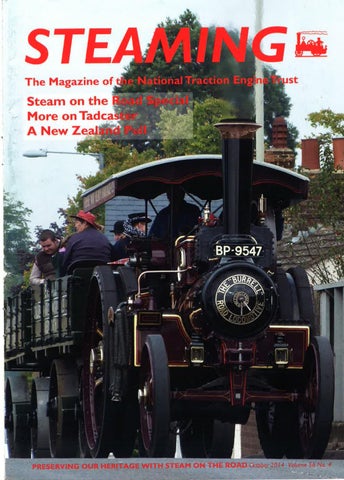
THE RUN What a superb event! Plea weather and, by all accounts, perfect organisation. Congratulations to the Be ford dub and the Trust. Already many are suggesting a repeat in five years. Your editor, who could only make a short visit due to business commitments, planted himself on the medium length route, and snapped over sixty engines, missing a few more when other traffic got in the way. Here are representatives of the biggest and smallest_ On the cover Burrell 394! The Badger breasting the slight incline over Sandy railway bridge heading for Ninon. Above Brian Wainwright's 4" scale replica of the same outfit but with the addition of water cart. More pictures and a full report in the next issue. (Roger Mills) Private Beauty Twelve months ago Michael McMillen, who hails (like that sainted candy-striper Hilary O'Neill) from the Oakland area of San Francisco, got in touch via Steaming. (The power of the web again!) A month's tour of the UK was being planned and how could he fit in as much steam as possible? Several months of to-and-fro itinerary planning followed but each one took as a 'given' my very clear recommendation to include Dorset for at least a couple of days. So much so obvious I hear you say — and you'd be right of course. But, and this is the point, I was totally unprepared for his reaction. Blown away would be an understatement, Mike reckoned it was the best thing he'd ever been to. He was astonished at the numbers of engines, the friendliness of the owners, the range of activities and all the associated stuff that packs Tarrant Hinton and that we take for granted. (Thanks on his behalf to the many owners who welcomed him onto various footplates. You did us proud!) As an ex Steam Fitter turned College Lecturer the stunning engineering on display naturally impressed him, but the word he used most I think was beautiful. A simple word but it peppered almost every one of his delighted reactions. Well as Keats put "Beauty is Truth, Truth beauty. That is all ye know on earth and all ye need to know." Another warning I think to yours truly and maybe most of us in one way or another to a) fight becoming blasé about seeing His Majesty yet again and b) count our blessings. As
3
we celebrate sixty years of the NTET it's worth remembering that it could all have been very different without those pioneers who saw the beauty in everyday things and saved them, in many cases on ordinary wages. That's a thought that chimes in with personal experience of trying to protect for the future a heritage asset, a unique oyster boat, deemed too expensive to maintain by the public body that restored it in the first place — surely a common theme in industrial heritage over the past five years. Are we seeing the end of an era? A time when, say, a council could rent an old bus depot to a set of preservationists for a peppercorn rent? Here it was a detailed audit by a new broom, which revealed startling staff costs for what seemed to be a simple project. That led to the usual public 'what shall we do meeting' — with a clear preference to pass the historic item to a local group who could focus more fruitfully. Incidentally I think they can and You see I wonder if we realise just how lucky we are that the vast majority of steam road vehicles and tackle are in individual hands or privately/independently run self-supporting collections. While that has spawned some debatable p. —ices — conversion and barn store neglect — overall the result has been almost wholly positive especially in access terms. OK the public purse has by and large has never given us any money, but by
the same token we are beholden to nobody either. We just save the stuff and then do our best with it. And you won't get much better than the WWI special at Dorset this year... Which brings me to the late Maurice Poole who died around the turn of the year. He'd contributed pictures and other archive material to Steaming for many years and back last summer I spent a day with him at his West Sussex home with an open invitation to make use of anything from what I would describe as the most comprehensive library of books catalogues and ephemera I have ever seen. A claim to possess every road steam related book ever published seemed to me to be perfectly justified and amongst the other materials there was treasure indeed. As a little tribute to Maurice this issue contains a number of his pictures and cutting collections. A nice man and generous to a fault with his collection. From sad news to good news from custodians of much larger artefacts, generous too to the Trust, the Davis family at Astwood Bank who've been granted planning permission for a display building and combined .""ri"arl ‘-h-m,,nstr,ti^n facilities for a rural vintage machinery museum and visitor centre. Congratulations! Roger Mills
(HETHERINGTON OIL CAN COMPANY
1 PINT POURER
1 LITRE OIL BOTTLE
ALSO AVAILABLE FROM SEDDON & BLACK... 1 LITRE POURER
TEL: 0044 (0)1938 850 393 EMAIL: enquiries@hetheringtonlamp.co.uk
4
10 PINT OIL BOTTLE
From the Arthur Napper collection, via Jeff Macke, comes above is what Jeff reckons is; "almost completely sure is the Aveling Ladygrove when at work for Wilders. This is a rare photo and 1 was amazed when Arthur's son in law, Richard Payne, produced it Unless anyone else feels differently I'm convinced it is an Aveling and Trevor Smallbone has confirmed from the RLS records that Wilders only had one Aveling." Below a scene almost certainly from the 20th August 1950, the date of the second race. Chris Edmonds recalls that Arthur decided to take Old Timer up the village street to meet his adversary and Jeff thinks this is almost certainly that rendezvous.
Steaming
5
Chairman's Report Robert Herring The highlight for the year must be the celebrations of General Secretary's position on a temporary basis but our 60 years existence, the first of these events at has supported me for the duration of my tenure. GDSF, in conjunction with a celebration of the First This will be my last report as your Chairman, it has World War. I doubt whether anyone expected to been a challenging nine years but I am convinced replicate the dire conditions experienced in the Somme despite some awkward decisions we continue to move but due to heavy rain at the beginning there were some forward. similarities. I am indebted to a dedicated team that I have Many expressed their condolences particularly to worked alongside whose one concern is to keep our be passed on to Val Brown on the loss of Colin, our hobby safe for the future, despite some that wish to sales officer, his presence was very much missed at criticise and continue to comment that the fun has gone GDSF. However a new team, headed by Stuart Gray out of the hobby due to rules and regulations. did extremely well. Mark and Lynn Waite the new Recent personal experience emphasises to me that managers of the marquee, Kathy Smith managing sales, to totally ignore such matters would not be the and established organiser of the refreshments solution. Being questioned by the judicial system Charlotte Keeley-Knott all making the NTET's whether criminal or civil is a daunting experience, presence most welcome in difficult conditions. There especially if they find you have not complied with were of course all the usual helpers supporting them. legislation that is in place as a means of protection. Our thanks go to them all. New membership secretary One final observation would be whilst it is good to Lisa Crankshaw took the week to meet many members see members volunteering for Council it should not be and establish herself to all that visited the marquee. viewed as just a talking shop, the new chairman will The second major celebration will be the need as much support and help with unforeseen tasks Anniversary Road run at Old Warden near Bedford, it as can be given. promises to be a unique event in numbers alone_ At a recent GC meeting the members by majority Mention must be made of the Anniversary souvenir voted to support the nomination of Anthony Coulls as programme, a desirable collectors item for its content my replacement, a decision I am pleased to support. and extensive number of photographs. It was produced Anthony will be known by many as an engine owner by a small team undertaking a large amount of work, and within his professional capacity with the National in particular Kevin Mills who pulled it all together. Railway Museum services. I have invited him to respond Thanks also to Colin Tyson and Old Glory for their and outline to you all his reasoning for taking on this generous sponsorship of its publication. important task and what he has to say can be found Happily there appear to be a number of new with all the other profiles in the AGM booklet. nominations to join the General Council. Of those For my part I thank you all for your support and retiring thanks go to Mike Dyson, and a personal thank wish everyone continued good steaming and may we you to Jennifer Holt who stepped in to take on the be able to keep steam alive on the road.
Seddon Facebook & lack Consumables Find us on
a
Stockists of steam and heritage consumables. View and order online at w w w.seddonandblack.co.uk or call 01948 780474 to discuss and place your order. 6
the erith or he enth u se v.,4 t
Communications Mike Dyson Last year we commissioned a video to illustrate the work of the Trust and in particular, the annual Driver Training Days. We are fortunate that Ian Cooper has the necessary technical expertise to make the video and being an engine driver, knows exactly where to point the camera. Ian hired high quality video equipment so he could film at Astwood Bank, the Shrewsbury Steam Rally, the Great Dorset Steam Fair and also out on the road with his own roller. The final result, produced to a very high standard, will provide a very useful piece of publicity material which can be shown on our new video equipment in the exhibition unit and elsewhere. By now many people will have seen the Souvenir Programme for the Road Run which provides the history and numerous photographs of all the participating engines. We are indebted to Kevin Mills for producing this excellent publication. If you haven't already purchased a copy, then I suggest you buy one soon - before they have all been sold! I receive many enquiries from people researching their family history. Usually I am able to find information about engines and their owners quite easily but one recent request has me baffled.
The very poor quality photograph shows a Sentinel waggon belonging to J E Nadin & Son Ltd of Yarncliffe Quarries in Derbyshire who also had premises in Sheffield. The registration number is clearly visible — WE I901(a Sheffield registration number dating from around 1927 or 1928). Perhaps someone reading this can identify the waggon?
ANNUAL GENERAL MEETING The 2014 AGM of the Trust will be held on Saturday 15th November 2014 at 2.00pm at the Palm Court Hotel, St Nicholas Cliff, Scarborough, North Yorkshire. YOI I 2ES 0 I 723 368161 Room rate - E100 per room per night. Bookings can be made by ringing 01723 384368 or by visiting http://tinyurl.com/pwbbtvf and entering the access code palmcourtagm You must confirm that you are attending the NTET function. Formal notice of the meeting with the Agenda and Annual Reports and Accounts is distributed as a separate booklet with this magazine. The names of nominees together with a motion under Article 16 of the Trust's Articles of Association will also be found in the Report and Accounts. At the conclusion of the formal meeting the Trust's trophies will be presented and tea, coffee and biscuits will be served. In the event of voting being necessary at the AGM, only current members are eligible to vote and you should therefore ensure that you bring your current membership card as evidence. If you wish to appoint a proxy the necessary form is on the reverse of the Report and Accounts booklet. In the evening an informal dinner, private to the Trust, will be held at 7.30 for 8.00pm in the Palm Court Hotel. Tickets are £28.00 per person and must be booked and paid for in advance from the NTET General Secretary Jenny Holt (contact details inside front cover). A vegetarian option is available on request. Dress code — dinner suits optional. Raffle prizes for the evening will be very welcome. Bookings to be received by 7th NOVEMBER 2014 Cheques payable to NTET. On Sunday 16th November 2014 from 9.30am there is a splendid opportunity to visit Graham Atkinson's Scarborough Fair Collection at the Flower of May Holiday Park, Lebberston Cliff, Scarborough Y011 3NU. Alongside the steam engines and fairground rides there are continental fair and street organs and vintage vehicles from America. 7
Technical Services News David Smith AIBI Developments General Council has been concerned that since AIBI lost the services of a facilitator there has been no progress in fulfilling the requirements of Inspection Industry Standard ISO EN 17020. Consequently Bob Siddall and I met with Richard Hulmes and Peter Wilson at the Safety Assessment Federation (SAFed) to explore the options available. Their recommendation was that AIBI should assemble the necessary supporting information with a view to it being reviewed and commented upon by an external body. A few weeks later, in March, Bob Siddall and I met with AIBI members to explain our SAFed meeting and its outcome, and also to demonstrate the proposed ZRP scheme. The ZRP Scheme was met with unanimous and enthusiastic support. On EN 17020, following much discussion it was agreed that almost all of the information and material that would be required was to hand in various forms and it ought not take too long to assemble it into a document that could be scrutinised and commented upon. Analysis of the current disc database shows that 'independent boiler inspectors' pynminP more than 92%
demonstrated to members of the General Council and also to Engine Owners, Rally Organisers and to members of AIBI. On each occasion the scheme has been very well received, with encouraging comments being made about its simplicity. A number of constructive changes have been introduced as a consequence of these discussions. Following discussions with some corporate inspection companies, the design draft of the scheme was lodged for comment with the Safety Assessment Federation (SAFed), the organisation that represents boiler inspection organisations through its Technical Committee I (TC1). It is true that the ZRP scheme continues to be an emotive subject. Not for the first time the NTET finds itself in an invidious position; endeavouring to keep the hobby safe without becoming the policeman. At the time of writing the scheme development is in a state of limbo awaiting progress from AIBI in the development of its procedures and operations manuals and for the deliberations of SAFed's TC I to be made known to us. Head of Technical Services Tempus Fugit. By the time you read this article I will have enjoyed my 72nd
of engines; that is why the NTET is anxious that AIBI, birthday and by the AGM I will have sat at the side of on behalf of its members, shows progress in its four chairmen. For some while I have been considering endeavours to demonstrate compliance with the how to plan for my retirement from the role as Head relevant standards. The meeting we attended was back of Technical Services, to make way for a younger in March and although to date nothing is ready to be person. put on the table I can report that some progress is now The role has grown considerably and although I am being made. I am advised by Dave Wothers of AIBI ably assisted by Ian Cooper as Insurance Officer and that they are planning to have their operations and John Riley as V765 Administrator I am personally standards manual ready for scrutiny by a third party by responsible for the Breakdown Recovery Scheme, the end of 2014, hopefully sooner. NTET's Officer IT support, NTET legal business and Zero and Reduced Pressure (ZRP) Development business management processes of the NTET as well The scheme is designed to prevent the issue of as the membership system, authorised events system insurance discs for engines reported to be at Zero and the NTET disc system and now of course ZRP. I Working Pressure. In the case of a reduced pressure also maintain a watching brief on government bodies regime only the prescribed 'Maximum Safe Working and agencies. Pressure' is printed on the disc. To find another person aspiring to undertake or Whenever ZRP is being discussed confidentiality is indeed wanting to undertake all of these functions will, invariably raised. ZRP does require a very small amount quite frankly be a challenge, and the scope of the job of information to be held relating to systems currently must be re-appraised in order to make it more tenable at Zero or Reduced Pressure. This information is for my successor. secure and is made available only to the disc control Although no one in the Trust gets paid for the job system, participating inspectors and to owners wishing they do, we should all endeavour to undertake our to see what information is held about their engines. work in as professional a manner as possible. I am not Importantly Part 4, Section 2, paragraph I of ISO in a rush to go, far from it but the sooner we start the EN 17020 states that information may only be shared ball rolling the sooner we will have accomplished my if its nature and its use is fully described to the engine personal ambition of having the Trust managed by a owner before the examination takes place, thus much younger generation. If any of the above interests becoming part of the contract. you please contact me with an indication of your area The prototype of the scheme has been of particular interest and I will forward further details.
8
&teaming
Treasurer's Notes Julie Smith The accounts for the year ended 31st March 2014 are enclosed with every member's copy of this edition of 'Steaming'. The accounts show that after transfers of £8,729 from designated funds there was an overall surplus for the year of £19,637 compared to a surplus last year of £26,073. The figure for donations includes £5,000 donated to BESTT (Boiler Engineering Skills Training Trust) which had been suggested by the members present at last year's AGM and this was ratified at the next General Council meeting.
The surplus has been transferred to the following designated funds: Commemorative Events Fund £12,500 Exhibition Unit Replacement Fund £5,000 SAC Burrell Project Fund £1,000 Website Development Fund £500 As always the Trust is indebted to its officers and members of the General Council for the significant amount of time voluntarily spent on the Trust's affairs. It is impossible to quantify this time and effort but without it the work of the Trust would be radically curtailed.
Engine Owners, Drivers and Crew Meeting Sunday 25th January 2015 The Village Hall, Kilsby, near Rugby, Warwickshire. CV23 8XX Commencing at 1 100 with coffee served from 1030 Buffet lunch provided. All engine owners, crew and other interested parties arc invited to attend whether members of the Trust or not. An Agenda for the meeting will be published later on the NTET website. For more information, or if you have a topic for discussion, contact Bob Siddall 01636 821991/engines@ntet.co.uk
Steam Apprentice Club News Elaine Massey After an extraordinarily challenging Great Dorset, where our opportunities for the apprentices were very limited due to the conditions, we are now nearly at the end of another rally season. The SAC still have a couple of driving days to look forward to, but overshadowing those is the launch of our 4" Burrell model, Lady Sylvia at the Bedford Steam Rally on the 13th September. SEE PAGE 5I!!! As I write she is out on test, on schedule, thanks to the work of Hugh Dyson, our Project manager, and those on his team. For those of you who have read the Road Run brochure for the 60th, you will have spotted that she is entered as engine 001! This winter she already has several appointments around the country at Model Engineering shows as an ambassador for the SAC and NTET. She will be at the Midlands (16th - 19th October), Sandown (12th - 14th December) and Alexandra Palace ( 16th - 18th January) Most importantly at this time, I would like to thank all those who have worked with or for the SAC this last year. My committee obviously, they have had to put with me! All those involved in making the driving days happen, and those engine drivers who have invited SAC
members onto their engines at rallies, a very big THANK YOU.
NTET DRIVER TRAINING COURSE CHRISTMAS It COMING! What present would you like? Ask someone to give you a voucher for the NTET Driving Course on 9th & I Oth May 2015 at Astwood Bank. £230 for the two days (reduced cost for SAC members) DISCOUNT of 15% if you pay for 2 years at the same time.
Contact Joe Black oeelinkmotion.co.uk 07595 466353
THE TRUST AT DORSET Stuart Gray reports on a busy and successful show...
Well Dorset is done for another year and for those of our members who went you will appreciate the challenge we all faced this year, but no more so than the team who helped put on our exhibition and hospitality in the marquee, which for the first time we shared with GDSF to include their WWI Exhibition. I think had we all envisaged just how much interest there was going to be then GDSF may have had their own dedicated marquee, but that said, I am certainly not disappointed in anyway. In fact I feel we all benefited, NTET and public alike from this joint venture, as despite it being our 60th year, we also wanted to portray the role that the Traction Engine and manufacturers had in the war and also we wanted to play our part on these commemorations. We were also fortunate, since the WW I display was a focus of interest and as a result the Trust marquee section was busy for the whole of the week and with norhanc a miv of vicitnrc that wry
not
necessarily seek us out. I don't yet know the results of all our efforts, but I understand our sales stand was up on sales over last year, the hospitality side tell me they seemed far busier than previous years also. So at this point I also need to thank all those who helped this year, especially the hospitality team who continually severed tea and coffee all week and for our drinks reception then took on the role of bar staff. A huge thank you to Charlotte Keeley-Knott who was terrific in bringing the whole team together to manage this task. I can't list the whole team here, but thanks for keeping us all and our visitors refreshed all week. The whole team has changed this year, the marquee was managed on a daily basis by Mark Waite, who hopefully will join our General Council this year, but without his help we would not have been able to put on our 60th Exhibition. Mark was thrown in the deep end but really pulled everything together. Hopefully Mark will be our Dorset marquee Manager for many more years to come. Lisa Crankshaw, our new Membership Secretary had her first experience of renewing and taking new membership from a dedicated membership table all week, ably helped by Fiona. Talking of our exhibition, this year we wanted to
10
bring back together those engines that started it all. Our star attractions being, Marshall Agricultural Old Timer and Wallis and Steevens Eileen The Erring. We were honoured when Dr Giles Romanes travelled to GDSF specially on the Friday to join our drinks reception, leaping up on Eileen once again to give us his own account of the Appleford Races. Alongside we had the Wallis and Steevens Progress that was to help finance the start of the then National Club, with a 5/- (25p) raffle and then to cap it all, Burrell King George VI, the first Showman's engine to attend a Rally. To make this happen and to finish our exhibition off to such a standard, I have to thank Nick Bosworth, who produced all the graphics and of course those who
also contributed to these story boards. Nick in the end worked late to produce these boards together with Andrew Semple who made all the supporting wood surrounds. Finally on GDSF, I have to talk about our Sales stand. With the loss of Colin Brown our sales team took over and prepared for Dorset without the knowledge and experience we had become so used to. Kathy Smith who has helped Colin and Val for so many years stepped up to this task going beyond the call of duty to put together the sales stand and stock this year at very short notice. The regular team were all there to help and thanks to them all. Kathy will now take over the role of Sales Officer for the Trust and hopefully I can give her all the support she needs.
St Mary's Cartage Company Ltd's Sentinel DG6 tippers at Turnpike Lane station site on 26th March 1931. Left is 8439 leaving loaded with clay from tunnel boring, right is 8446 in the loading bay. (Maurice Poole collection)
•
darkNiii .% -.- .....
-. •
_,
f e%411 NI,.1,A
11.ft,
i
___ ----i
V
..-
fit! '1,
11' 411:
,
!
4,
tIP!'Wht
ATliae0 le
.1
i
et
OOKING BACKTOTHETWE -11°Y FIRST BIRTHDAY ROAD RUN June 1974 saw Ran Hawthorne in "Blow Off" Steaming's opinion column write: 1975 sees the coming of age of our Club. The executive committee feel that some special event or celebration should be held. One suzeestion that has been made is that the rally that was staged at Appleford twenty-one years previously be re-enacted with, as far as possible, the same engines that were present in 1954. Taking a serious look at rallies over these twentyone years leaves one in little doubt that, in different ways, money is more than ever dominating our activities. Not only organisers but engine owners (and we have some sympathy with them) are looking out for the biggest and brightest penny. Over these years we have "grown-up". We don't hold flat races any more, we are conscious of boiler risks, we have rallies and steam workings (long may they continue). As we as a Club enter manhood Steaming would make the suggestion that, as we did twenty-one years ago, we put something on, not for profit, but for the pleasure of others and for our own satisfaction. Our suggestion is that we, the NTEC, institute a "run" on similar lines to the London - Brighton runs organised by the Veteran Car Club and the Historic Commercial Vehicle Club. We do not suggest London as the departure point, nor Brighton as the destination. Obviously the points must be nearer together and we feel the run must be in the country. Traction Engines were and are essentially of the countryside. Steaming would suggest that if the idea of a steam run finds favour the villages of Appleford and Nettlebed could form the starting and finishing places. (The very first T.E. event was at Appleford the second at Nettlebed).
These villages are about fifteen miles apart. The journey would involve a considerable climb from the valley of the upper Thames into the Chiltern Hills, a reasonable test of engine and driver. A National Traction Engine Club Run could become the Traction Engine event of the year. What better than that we should inaugurate it in 1975. What better way indeed and within a very short time the following notice appeared in Steaming: 2Ist ANNIVERSARY In 1975 the NTEC will have been in being for twenty-one years. As befits the occasion special events will be held. It is difficult to know when Traction Engine preservation started but we regard the 1950 "Race" at Appleford as the first organised preservation activity and so we have a double celebration — twenty-five years of events and twenty-one years of NTEC. It is therefore fitting that your committee should organise a double event and equally fitting that Appleford should be the venue. After due consideration on the part of the Executive Committee, the Management Sub-committee and the "Steam Party" Committee it has been agreed that a "Steam Party" be held at Bridge Farm, Appleford, near Abingdon, Oxon on Saturday and Sunday 12th and 13th July 1975, starting with a road run from Nettlebed to Appleford. Engines will assemble at Nettlebed on Friday, Ilth July (parking for the week previous will be arranged) for departure on 12th, at intervals, from about 8 a.m. It is about 18 miles to Appleford. The space at Bridge Farm is strictly limited. Entries will be confined to steam and ancillary equipment only. It is hoped that as many as possible of the
engines that attended Appleford in formation year (1954) will attend. Engines that attended in the late 50s and early 60s, together with other interesting engines, may be invited. The event will not have "ring events". There may be a small ring for "setting to a drum" and parades will be held around the field. Wood sawing, threshing etc., may be possible. There will be a small Fair with Old-Time rides only. On the Saturday evening the 21st anniversary buffet will be held. The tent and surrounding area will be lit by showman's engines. Arrangements will be made for a limited number of members (owners and non-engine owners) to caravan or camp on the ground. The police have been very co-operative and up to 40 engines may be entered. All types of engines, steam wagons, steam carts and steam cars will be invited and it is hoped that at least some Tractions will pull threshers, some Rollers will pull their vans and water carts, some Showman's engines will pull
suitable living wagons and that at least some steam Tractors will pull suitable trailers, etc. As well as engines that attended in 1950s and 60s and engines of special interest, the committee hope that affiliated clubs throughout the country will send an entry to represent their club at this historic event. Would affiliated club officials and individual owners who would like to have engines considered for invitation please write to the events secretary: E. A. Fillmore 34 Northwick Park Road Harrow, Middlesex giving brief details of the engine in question. We would ask all clubs, rallies and members to remember the dates and keep them free Well the run did take place, recorded in both Steaming and a special booklet produced by The Worlds Fair with each engine pictured actually on the day. The entry list is below. For me the real shock is that it was all so long ago - it seems only yesterday!
The 1975 Participants Sentinel 8942 (1934) ATN 390. David Webster, Ludlow. Representing Salop Steam Engine Society. Sentinel 9163 (1935) AER 800. Entered by Ben Vaughan, Knowl Hill. Sentinel 5509 (1924) PD 170 I. Burberry, Lawrence & Reason, Aldershot Representing The Three Counties S.P.S. Foden Tractor 13832 (1930) HX 2197 Dorset Wanderer. W. H. McAlpine, Henley. Foden 6 ton Wagon 12018 (1925) EU 2684 Emily. Robin Greenaway, Stoke Row. Foden 6 ton Wagon 13488 (1929) RO 6330. Dennis Brandt, London Burrell S.E. 3489 (1913) PB 9624 King George VI. Jack Wharton, Minster Lovell. Foden D type 12852 (1927) RX 1719 Early Bird. John & May Keeley, Knowl Hill Burrell Sh. Tr. 3458 (1913) AB 8795 Defiance. Peter Barker, Hurst. Tasker Sh. Tr. 1872 (1920) HO 6658 Little Jim. Peter Barber, London. Garrett Sh. Tr_ 32122 (1914) BH 8900 The Greyhound. Dick Woodruff, Ascot. Representing Thames Valley T.E Club. Wallis & Steevens Tr. 7872 (1925) OU 5247 Dr. John Cam, Purton, Wilts. Aveling & Porter Tr 6021 (1906) D 2608 Doogal. Doug Charlett, Yarnton, Oxford. Representing Old Steamers Club. Robey Tr 37657 (1918) AP 9341 The Guvnor. Mike Harmsworth Aveling & PorterTr. 11486 (1926) KM 7100. Steve Cook, Eversley Wallis & Steevens Tr. 7641 (1920) BW 4668 Surprise. Jack Field, Andover. Burrell R.L. 4066 (1927) VF 589 John of Gaunt. J. & B. Newton, Hungerford. Burrell R.L. 3057 (1908) BE 7217 Lord Roberts. Jim Sarney, Flackwell Heath. Burrell Sh Tr. 3497 (1913) HO 5993 Conqueror. E. Gale, War-field. Garrett Tr. 33991 (1921) FK 1300 Patricia. Mrs. E. & Albert Fenson, Markgate. McLaren R.L 1652 (1919) WF 1864 Boadicea. Anthony Heal, Beaconsfield. Burrell Sh. Tr. 3631 (1915) OR 2729 Kathleen. Jack Lawrence, Gt. Milton. Aveling & Porter Tr. 12152 SC 1577 Sarah. John Crawley, Rep. Bedford S.P.S. Burrell Tr. 3554 (1914) AH 018I King George V. David W. Davis, Gt. Missenden Foster Tr. 13031 (1913) FE 1456 Mighty Atom Tony Parker, Lincoln. Burrell Tr. 3846 (1920) AD 7782. Mrs. Jill McAlpine, Henley. Foster S.E. 14507 (1920) XC 9862 Victory. D. A. Robinson. Representing Irnaffnshire 5. P. S. Fowler R.L. 15463 (19201 DW 2121 Dreadnought. Robert Wynn & Sons, Newport. Representing Welsh S.ES. Fowler Crane Loco 17212119291 RF 6092. Len Crane. Wolverhampton. Reptescong North Staffs & Cheshire T.EC Fowler Hauling & Winding Engine 14958 (1918) E 9600 Marina. Vic Greenaway, Whitchurch Hill Clayton & Shuttleworth R.L 47216 (1915) CT 4817 Lady Jean. Phil Johnson, Hungerford. Garrett direct traction ploughing Tractor 33180 (1919)131 4-483 The Joker. Jim Hutchens. Burrell T.E. 3262 (1910) AH 5278 Perseverance. Jack & Jim Vaughan. Representing Welland Valley Vintage Traction Club, Marshall T.E. 37690 (1902) BH 7373 Old Timer. Arthur Napper. Wallis & Steevens T.E. 7683 (1919) BL 795 Eileen. F Upton, Maidenhead. Wallis & Steevens T.E. 7370 (1913) BL 4707 Fair Rosamund. Ted Freeman, Deddington. Fowler T.E. 9698 (1903) HR 4732 Farmers Friend George Moore, Aylesbeare, Devon Representing Exeter and Torbay Steam Club. Farmers Friend steamed the longest distance to Nettlebed. Ransomes, Sims & Jefferies T.E. 15012 (1903) NO 4034 Countryman. John Marshall. Representing Hocldey Heath Steam Association. Fowler P.E. 2693 (1875) NR 1212. Beeby Bros., Rempstone. This was the oldest engine on the Run. Fowler P.E. 15183 (1918) HO 5868 Ajax. R. Griffin & M. 0. Davies. Representing Banbury Steam Society. McLaren P.E. 1552 (1918) BD 5504 Hero, Rob & Charles Daniel, Bodmin. Representing Cornish T.P.C, West of England EES and the Steam Plough Club. Aveling & Porter R.R. 14077 (1930) VC 6120 James Harvey-Bathurst, London. Burrell R.R. 3305 (1911) TB 3722 Big John. Peter J. Barnes, Woodley. Representing Lancashire T.EC. Fowler R.R 14674 (1922)13W 9937 Busy Bee. Audrey & Ran Hawthorne & Sons, Woodcote. Fowler R.R. 16235 (1924) AV 45 The Highlander, Arthur Hall. Representing Road Roller Association. Fowler R.R 18637 (1929) YD 1601. Harrison, MIllbank, Neale & Tomlin. Wallis & Steevens Advance R.R. 8100 (1934) BAA 432, Dave Antell, Shillingstone. Aveling-Barford R.R. AC 624 (1938) CVC 979. Dick Blenkinsop. Representing the Warwickshire S. E S. This was the youngest engine on the Run. Fowler T.E. 1 1698 (1909) NK 925 Edno, Michael Woodroffe, Swindon. Representing Fairford Steam Club. Wallis & Steevens T.E. 7498 (1916) HO 5629 Progress, E. J. Evans & R Long, Bicester. Was once raffled for NTEC funds Wallis & Steevens Tr. possibly 2737 (1902) GRX 400. Giles Romanes, Dorset. Stanley Steam Car 5263 (1910) SWL 99N, built in USA. M. Scott, Henley
NETTLEBED TO APPLEFORD An Enthusiast's Impressions When the news was announced some 12 months ago that the N.T.E.C. were to celebrate their 'coming of age' in the form of the first organised Road Run, I, amongst countless others, no doubt, made a longstanding booking for the weekend July 12th and 13th. No work for me on that occasion —I was to be over 250 miles away at Appleford! Arrangements being firmly established, the eagerlyawaited weekend soon came around. Friday 1 I th saw my wife and 1 up at 4.00 a.m., and en route less than half an hour later. I'm often informed that I'm mad to set off at such unearthly hours, but on this occasion, I must have been in the company of a few thousand fellow-members as well! On arrival, we met up with some colleagues, pitched our tents, then made off to take stock at Nettlebed, dropping off our other halves on the way, to spent the afternoon at sunny Didcot! Arriving at Nettlebed, we made numerous other acquaintances. Engines were continually arriving and the atmosphere had certainly begun to build up. This was in no uncertain terms going to be an occasion to remember. Back then to Appleford, not forgetting to collect our wives, of course, some refreshments, a few jars at the Waggon and Horses that evening, and then some sleep before being up bright and early for the main event of the weekend. On Saturday morning, we made our way towards the stretch of road at Culham College, one of the best vantage points for photography, and waited in great anticipation the first steamer's arrival. An hour passed
and we began to wonder whether we had taken the wrong route! Then a column of smoke was noted on the horizon, and within a matter of minutes, the familiar features of David Webster's immaculate S4 Sentinel No. 8942 reached us, followed in rapid succession by five more wagons and a tractor. This was it. The day's entertainment for us was under way. John Butler's Yorkshire Wagon No. 652 was next to appear, followed by our President's Burrell Showman No. 3489 "King George VI". A few more entries came along, and then what I considered was the most attractive outfit taking part, Dr. Cam's beautiful Wallis & Steevens Tractor No. 7872, complete with living van and trailer in similar livery. This ensemble really looking a treat in the sunshine — which was still around at that time. Following this one a while later was Doug Charlett's extremely interesting Aveling & Porter Tractor No. 6021 "Doogal", the only one I have seen fully restored with a front spectacle plate and top motion splash guards. Some more tractors passed, then the first of the 'heavy brigade' came on the scene — John Newton and Jim Sarney with their respective Burrell Road Locos, "John of Gaunt" and "Lord Roberts", and Anthony Heal's McLaren "Boadicea" — sounding particularly good, with an exhaust beat that only a 'Mac' can produce. Ted Gale's Burrell Showman's Tractor No. 3497 "Conqueror", I was please to see for the first time, the canopy lettering 'Old England's Past Glory' being most befitting, I thought. Tony Parker's Foster Tractor No. 13031 "Mighty Atom" was another new one, splendidly restored in its maroon livery. Robert Wynn a Sons' and Len Crane's (left) heavy Fowlers next passed through, followed by Don Robinson's Foster Showman "Victory". There then being a gap, we decided to retreat to Appleford once more for lunch. Our lunch break was later interrupted by the arrival of Vic Greenaway's 'Russian' type Fowler No. 14958 "Marina", hauling a steel tyred traction wagon. Afterwards, it should have been back to Culham College, but the weather decided differently. A thick mist descended, to be followed by almost continuous rain for the remainder of the day. A big disappointment, but as it so often happens, everyone has to make the best of it. I then accordingly decided
to take up position at the site entrance, where there was still for scope reasonable photography, and was rewarded by next witnessing the arrival of George Moore's Fowler Traction No. 9698 "Farmer's Friend", all the way from near Exeter under her own steam, and not a moment's trouble, her crew assured me. A real trial for an engine which had only recently been reassembled following firebox replacement. Not so long after, Arthur Napper's Marshall "Old Timer" arrived on the scene, still flying the flag after all these years, one of the few engines to have remained active in rallying without being laid aside at some time or another. Shortly afterwards, along came another of the early rally attendees, Ted Freeman's Wallis & Steevens Traction No. 7370 "Fair Rosamund", once rallied at Appleford in the ownership of Bill Tame, when she rejoiced in the name of "Sylvia". A few minutes to wait before the next arrival, but then the distinctive ringing of gears told me that this could be none other than and old friend from Cornwall, the Daniel Bros.' McLaren Ploughing Engine No. 1552 "Hero". A few more arrivals, then the first of the roller entrants came along, James Hervey-Bathurst Aveling &
Porter No. 14077, yet another impressive road train, with its traditional living van and water cart in tow. After this, there was a steady stream coming in. Griffin & Davies' Fowler Ploughing Engine No. 15183 "Ajax", Frank Upton's Wallis & Steevens Traction No. 7683 "Eileen the Erring", our Editor's Fowler Roller No. 14674 "Busy Bee", well turned out with its new canopy and paintwork, pulling her original Allen living van, and Peter Barnes' Burrell Roller No. 3305 "Big John", new to me, and certainly living up to its name, traditionally restored to its original status, as it was when working for Isaac Ball in Lancashire. Dave Antell's Wallis 'Advance' Roller No. 8100 coaled up just before arrival, and photographers were rewarded with ample emission of black smoke as she came along the final stretch. Only a handful to go now, so a quick break to change films before the next one came along, this being Dick Blenkinsop's neat little Aveling-Barford Roller No. AC624, (overleaf) complete with umbrella! The final entrants were one by one coming into view, now. Messrs. Neale, Millbank, Tomlin & Harrison's Fowler Roller No. 18637, Ted Evans' Wallis & Steevens Traction No. 7498 "Progress", and Michael
Garrett 33991 Patricia
Ave1ing Borford ACtil ,S the youngest engine on the run
Woodruffe's Fowler Traction No. 11698 "Edna". Bringing up the rear was another of the "originals", Dr. Romanes with his little Wallis & Steevens 3-ton Tractor "Goliath", a fitting entry to complete the line-up. One more did arrive later in the day, Jim Hutchens' Garrett 'Suffolk Punch' Tractor No. 33180 "The Joker". This one had the misfortune of breaking down right at the start of the run, but undaunted, her owner was able to get repairs in order at a local engineering works and later on in the day to complete the run without further trouble. A most commendable effort, which was undoubtedly echoed by the other enginemen when she arrived, who gave her a rousing whistle blast in recognition of her owner's efforts. Something that I was pleased to note, and I'm sure countless others will agree with me, was that every engine taking part was, as it was, during its working life — modern day conversions were not considered for acceptance by the organisers. This has just been a brief resume of the Road Run. I regret that space does not permit my mention of every engine taking part, but without exception, each owner showed the true spirit of the real enthusiasts for enthusiasts. This was, after all, the original idea way back in the early days of preservation, and in my opinion is still by far the best. To all those who participated, I extend my own gratitude for one of the most memorable steam occasions which I can recall. Appleford to Nettlebed 1975 will undoubtedly be remembered as an historic occasion. Editor's note. This item, reprinted exactly as typeset at the time but with new pictures, is un-signed but I suspect - without any hard evidence - that it is the work of the late and much missed AVK Thomas who edited the WESES journal with such aplomb. Some of his pictures also appeared in the commemorative brochure produced after the event by The Worlds Fair. If I'm wrong and anybody knows the correct attribution please let me know.
ON THE ROAD WITH BUSY BEE Bob Allison recalls a 1960s road trip In the back end of 1968 Dr. John Middlemiss moved south, from Northumberland to a practice just north of Banbury. This meant steaming his engine some 250 miles in late October, with three trailers. It was a trip which I would not have missed for the world. Our starting point was Bellingham which is the last town in England up the river North Tyne towards Kielder and the Scottish border. John's engine was the five horse Burrell three speed showman's engine The Busy Bee. It was new to Taylor Bros of Workington in 1914,and from Taylors it passed to Suttons of Beckermet for threshing, and finally to Davisons of Papperhaugh. John had known the engine since Taylors attended the fairs in his childhood home of Settle. He had bought her from Davisons in 1953, when he and his wife Maria had steamed her from Papperhaugh, which is near Rothbury, over the hills to Wall, near Hexham, for desperate repairs to the smokebox. At that time neither the clock nor the glass were working but Burrells are forgiving engines. Since then, besides running a busy practice which was spread thinly over an area the size of a small county, John had spent fifteen years repairing the engine, with the help and advice of such men as Gordon Smith of Hexham, and Jack Wakefield of Hetton-le-Hole, but with scarcely any local help. For the journey south we would be towing a heavy trailer of coal, water and wood, which we would pickup at Chester-le-Street, and a heavy showman's living van bought just that week from Jobsons of Washington. Our third man, Michael Salmon, came up from Wales in his Landrover fitted with an A bar. We then had about 10 tons behind the engine. On Monday morning 21st October John had lit up before dawn, and by nine o'clock the engine had climbed up through the town for the last time and coupled to the living van, which had been generously provisioned for us by Maria, the Land Rover was then coupled on the back of the van, and we were away. John stormed up the first hill out of the town in middle wheel, then eased down the other side, into big wheel,
and we were on the way to West Woodburn. Here we brimmed the tanks from the River Redewater, and reassured our selves that the water lifter was behaving itself and lifting cold. Then back into middle wheel for the half hour slog up Woodburn Bank on the A68. At that time Woodburn Bank was a test hill for the Commercial Motor road tests. By now it was overcast and drizzling, and as I trudged along in the gutter, so as to be ready with the block and the van brake if need be, I was aware that with each stroke of the r low pressure piston the rubbered engine wheels ni were slipping slightly on the wet road. That may be why rubbers tend to wear into pockets. Before the last pitch of the bank at Ridsdale we turned off to the east to reach the Newcastle road, across the plateau of moor and bog known as the Wannies where the River Wansbeck rises. There we stopped for a change around. Tot Telfer, John's neighbour from Bellingham, was steering, and made the mistake of moving off the crown of the road. Before long the soft moorland road began to sag beneath the engine's weight, and the engine might have gone through, or even toppled over, but a quick shunt put things right. Michael was promoted to the seat and when we reached the A696 Newcastle road at Knowesgate, we uncoupled the van and let him reverse the engine down to the infant Wansbeck to take more water. Tot now left us, Michael took over driving, and I steered as we set off for Newcastle, in big wheel for virtually the rest of the trip. Michael reckoned that promotion was quick on this firm, from back boy to driver in a morning. The rest of the day was unremarkable as we rolled along the familiar road, then up over Kenton Bar and down into the middle of Newcastle at Barras Bridge. From here our road was the main AI, which was then no more nor less than a two lane main shopping street leading to the Tyne Bridge at the foot of Pilgrim Street. Here Michael's eyes bulged a bit and he had his foot up on the cannon bracket to hold the reverse back, as an eight wheeler of wet fish from North Shields ground 17
out of City Road and across our bows to cross the bridge ahead of us. Eighty feet up above the river we fired heavily and made our smoke, before climbing up into the new multi lane traffic schemes which bypassed Gateshead High Street. Here we just held our speed and course, and gave no quarter. Our passing created no interest, except in the case of a Pickfords second man, who nearly fell from his cab getting a look as they passed us. At Chester-le-Street I boobed in my choice of route. This meant that we missed Jack Wakefield, who had fetched the coal and water trailer from Hetton-leHole to meet us with his Burrell tractor Cock o' the North. Friends who had caught up with us told us that Jack had left the trailer parked up for us, and left for Hetton before the dark would catch him. We parked for the night a couple of miles further on at Chester Moor. Michael tried to retrieve the trailer with the Landrover, but with the full water tank at the front the trailer steering was too stiff for him, and so he left it. We now learnt that Jack was unable to join us for the journey due to pressure of work, and so we three amateurs, doctor, vet and lorry driver, were to fend for ourselves. Next morning we doubled back with the solo engine and picked up the trailer, making up the train with the help of the Landrover. Then we were away through County Durham, travelling up arid down across the grain of the country down the old A I to Darlington and Scotch Corner. We were already settling into a routine, each of us doing what he felt he could do best. John was up first and out of the van to light up and oil round, then I was up to make a first breakfast, before Michael emerged from the cross bed at the end of the van. Michael cleaned the fire and bunkered up each evening, and I took charge of cooking. Once on the move each morning, I sorted the van and cooked a second breakfast, hot bacon and egg butties and a flask of tea. Being young and fit I could jump down from the van on a slow bit and deliver these to the crew in a bag without us stopping. We always stopped for a proper hot lunch break in the van, and dined out in the choicest transport cafes in the evenings. There were some decent cooks in transport cafes then. Pubs did not cook, they sold beer. We had not had time to commission the coal range in the van, but managed very well on a pair of gas rings. Driving and steering we shared between us, Michael being the most confident in traffic. We also had our guest drivers. On the Tuesday Dick Preston, owner of Lightning 11 and Matty Rea joined us just beyond Darlington. Dick was soon in the saddle, and I brought Matty along in Dick's car. Dick cracked on past Scotch Corner and down the new dual carriageway past Catterick. The afternoon drew in foggy that day, and 18
we were relieved to turnoff onto the old road and park at Leeming Bar after 64 miles, which was to be our best day's mileage. Michael cleaned the fire, and found that we had four tubes weeping. We none of us fancied a night in the firebox with the expanders, and so we decided to chance it and watch and nurse the tubes. Next day we rolled down most of the length of Yorkshire to Woodlands, north of Doncaster, where we parked on the site of the old Carlson Café, and ate just down the road at the Red House Café. Arthur Fearnley from Castleford was brought out to join us by Sentinel owner Ted Ashton of Knottingly, and with his steady handling the tubes had taken up by evening. Next morning we were straight into the morning traffic. into Doncaster. As I steprerl past a hus queue, my feet on a level with their faces, not a head turned, nor an eye blinked as our procession steamed slowly past their noses. This was surprising, because we had got down to some poor coal in the trailer, and were making more smoke than was really nice. We were not making any too much steam either and, by 011erton, on the A6I4, Michael was in difficulties. We had stopped to clean the fire and sort out some lumps when Jack Beeby from Rempstone came to join us, but even he ended up struggling for steam on some of the stiff banks climbing onto the Wolds on the A46 Fosse Way. Here Michael saved the day by sneaking back into the Landrover and pushing until he felt the overrun brakes on the living van coming on. Despite this cheating we ended a few miles short of our target a Six Hills for the night, and the telephone in the layby did not work either! We dined at the Six Hills Café and made our telephone calls, and then returned to the van to find that Jack Beeby had very kindly left us several bags of best lumps. We then went to spend a very hospitable evening at the Beebys' fireside at Rempstone. Next morning we cleaned a barrow load of rubbish out of the firebox before lighting up. Because we had not managed our usual evening fill up, in a few miles we had to do a smart bit of shunting in order to fill first the engine and then the trailer from a hydrant down a lane. Once again the Landrover did well. Further down the Fosse towards Leicester I was driving, when the shims from the LP big end flew past my ear. We picked them off the road and put them back, and checked the other crank bearings. With the shortage of steam the day before perhaps the button had been used a bit much. Entering Leicester I was steering when a bus driver had thoughts of pulling out ahead of us. An earful of the whistle into his open sliding cab door changed his mind. Later I forgot for the moment that I was not heading for the MI, but that we had to go straight through the city towards Lutterworth and Rugby ; and
so we chased our tail all the way around a roundabout, appreciated it. I had chosen our route to avoid Daventry and the much to Michael's surprise. Climbing up out of Lutterworth I was cooking lunch in the van. When John steep A36 I , but was not sure of our last few miles dropped the lever forward into full gear the whole van through the lanes. Fortunately Jack Wharton had kindly began to shuffle and creak in time with the LP piston, rung John Mitchell of Boddington, who met us at Fenny and I had to hold the pans steady on the gas, to prevent Compton Wharf and led us through Wormleighton to them shuffling away downhill. Double crank Burrell our destination at Chipping Warden. Now we found that the local paparazzi were lying Devonshires are like that. John's son Willem, and then Jack Wharton and John in wait for us. By now we were all more than somewhat Hirons met us just while we were stopped for lunch 'shop soiled' to look at, and John quite correctly did just before Rugby. Jack and John were in suits, so not fancy having his tired and sooty face in the Banbury Guardian, under the headline' New Doctor Steams In', declined the offer to drive. Rugby was the tightest place which we went or some such nonsense , and so we told them that John through. In those days one went straight through the had already returned up north. Meanwhile John middle along the shopping streets, and at the top of shambled around, playing the part of 'Daft Jack' from Sheep Street we were twice stopped at lights with our Bellingham, useful around an engine, but never tail out of sight back around a corner. I still managed interview material. We had never suspected his to miss the very sharp corner of the School by hanging dramatic talents. Michael enjoyed himself turning the train in through well out early on. That night we parked a mile beyond the field gate, spot on, and then it was time to uncouple Dunchurch on the Southam road. Next morning we were met in Southam by a water and shunt the vehicles. Journey's end, and a lot of board man, by the name of Middlemiss who led us right marvellous memories. Thank you John, and Michael. through a housing estate to use his favourite hydrant. It was a Saturday morning, so I suppose that the kids
On retirement he became a volunteer at The Hospice helping with Smiley Sam and having a collection box round. He loved his garden and grew over 200 THE LATE COLIN BROWN tomato plants for the Park Street Hospice Shop to sell A great supporter and contributor to the work of the — and if asked there was always room for another plant NTET sales officer Colin Brown died recently after a in the garden. Colin was never one to sit still and would short illness. Colin was born in Luton on 22nd be in and out of the garage working on some DIY September 1935 and lived all his life in Devon Road. project. After Hart Lane Infant and Junior Schools and Luton Twenty years ago Colin reverted to his first love — Boys Grammar School, he took an engineering road and rail steam and became the Sales Officer for apprenticeship at Vauxhall and studied with day release the National Traction Engine Trust. Colin and Val to gain his HNC with endorsements. Such was the bond became the face of the Trust staffing the Exhibition Unit that over the last ten years their apprentices group has in many places including Ireland and Holland. In met at The Plough at Wingfield. After 36 years' service between times Colin dealt with the mail orders as well Colin retired from Vauxhall and then worked with the as manning a sales stall at Steam Plough Club and NTET Council in the Rent Office. events. With a wealth of knowledge on books and sales Colin was very involved with Beech Hill Methodist items, he was a regular attendee at General Council Church, ran the Youth Club for 20 years and was meetings and has been instrumental with Val in Senior Property Steward for over 20 years. It was there providing welcome income through sales for the Trust. that he met Val and where they were married on 10th Colin and Val enjoyed their travel and had holidays December 1960. They have two children Steve and aboard including Russia, Turkey and China as well as Andrea. train holidays including the Settle and Carlisle railway. In the 1970's Colin and Val, Steve and Andrea spent In April this year they went to the World War One much of their weekend and holiday time caravanning battlefields. Colin was diagnosed with cancer in May in East Anglia as Colin and Val acted as crew for the this year and died just 10 weeks later. He will be sadly Eastern Region of the British Ballooning and Airship missed as a good friend and loyal supporter of the Club. Colin was also a keen plane spotter and Devon National Traction Engine Trust. Our sincere Road was an ideal spot, the binoculars were kept ready condolences go to Val, Steve and Andrea during this on a tripod and the air band radio was always on, and sad time. Robert Herring journeys out always went via the airport.
The Golden Roll
, aming
19
Contributions from Drivers and Mechanics. Ten Shillings Weekly for the Best Communication Received, and One Penny a Line of ten words for anything else published. Rapid Replacement JR (Preston) submits the following communication. "I am taking the liberty of sending you a report of a repair I did on a Leyland wagon on the road. Some drivers usually run down Leyland wagons on account of the engines being underneath the platform and being awkward to repair in case of breakdowns. A few weeks ago I was driving my wagon and trailer, both laden with machinery, when I heard a severe knocking in my engine. I drew to the side of the road, took the engine cover off and found that the crankshaft pinion was broken. I was three miles from a station, but there was a telephone call office close by, so I telephoned to Leyland Motors, Limited, for a new wheel. In the meantime I took the crankshaft bearings off and uncoupled the connecting rods, took the crankshaft out and removed the broken wheel. I was six miles from Leyland. When the new wheel arrived it fitted so accurately that I had no trouble in putting it on, thanks to Leyland Motors, Limited. There are four bolts and two set screws to fix it on, and from the time of telephoning to getting on to the road again I was only an hour and forty minutes." (1909) A Burst Tube JS (Reading) writes: "About six months ago I was driving my steam lorry from Basingstoke to London with a heavy load of steel girders on board. All went well until we got about two miles beyond Bagshot, when suddenly there was a terrific escape of steam 11 From the top of the boiler. I immediately shut off steam and stopped the wagon, then drew the fire, and waited for the boiler to cool down. I then unbolted the top of the boiler and found that one of the tubes had burst about six inches from the lower end. As we were in the country, and could not find any help at hand, I had to leave my mate on the wagon and tramp into Bagshot. I went to a blacksmith and got a length of 1/4" iron rod, screwed at each end, with nuts, to fit; also two lead washers about 1/4 in. thick. I carried these back to my wagon and proceeded to work. I first of all screwed a nut on one end of the iron rod with a lead washer on the inner side, and slipped the lot through the burst tube from the top. Next, I slipped the second washer on the lower end, and screwed up the nut as far as possible with my fingers. After getting all nicely fixed I got a spanner on the top nut and screwed up the whole lot as tight as possible. I then lighted the fire, after filling the boiler with water, and got steam up. The tube held all right until I got to my destination, when we had a
20
new tube fitted. I thought my experience might interest your readers as it is useful to know how to get out of a difficult by the roadside when one occurs." (1905) Home on One Cylinder The prize of five shillings this week goes to H. E. West, 249, Western Street, Bermondsey, for this account of how he got his wagon home on one cylinder. "On the 24th of last December I was driving my Yorkshire steam wagon along the Brixton Road. Suddenly I heard a knocking in my L.P. cylinder, and at once stopped the lorry to find out the cause. After examination I discovered a large hole in both top and bottom of the oil bath, and on detaching this casing, found that the thread on the cotter pin had become stripped, thus allowing the pin itself to come loose and get jammed between the gland and crosshead. I found also that the connecting rod had a nasty bend in it. Seeing no other way, I telephoned to the brewery to send another lorry. When this arrived we transhipped the load, but not wishing to be beaten I thought I would see what could be done, hardly relishing the thought of to wait about for some hours until a lorry could be sent to tow me back. After some thought, I determined to try and get home on the high pressure engine. I took the connecting rod down and unscrewed the crosshead front piston rod. This done, I detached the cylinder cover and withdrew the piston with its rod attached, after which I replaced the cover, carefully collecting all loose parts and putting them away for safety. The next difficulty was this, how to prevent the egress of live steam from the cylinder through the stuffing box? At last I hit upon the idea of placing a penny in the gland and screwing the nut down tightly upon it; I did this, put in the low gear, and started the lorry, and to my delight she went fairly well all the way home to her stable at Messrs. Barclay and Perkins Brewery at Southwark." (1905) Trouble on Trouble. HD (Weston-super-Mare) writes us as follows: "Having seen several letters lately from drivers of motor wagons on the subject of unlucky runs, I send you an experience of my own which was the most unfortunate trip I ever had with a motor vehicle. I am driving a five-ton wagon, and on one particular morning I started off for a journey of 15 miles over a very bad road to pick up a load of bricks. All Went smoothly until I reached the brickyard and had backed up to the loading stage. I had just dropped the fire bars, preparatory to
clearing out my fire, when I noticed that water was falling on it, and that there was evidently a bad leakage somewhere. I took out the fire, and the bars, and then made an examination for the cause of the trouble. On looking up inside, I found that the joint on the inner water space had broken, so I blew all the water out of the boiler and made a fresh joint. Next morning I got up steam, and was just starting from the brickyard with my load up, when I heard a hissing noise in the fire-box. After drawing the fire once more, I had a look for the damage, and found that one of the tubes in the bottom row had burst. I could do nothing, so I wired to my employer and told him what had happened, and asked that a man might be sent out to help me. Eventually a mechanic was sent from the makers to help me to repair the wagon, and he decided that the only thing to be done under the circumstances, was to take the entire boiler out and send it to the works to be thoroughly overhauled and repaired. After some hours' work we got the boiler out of the frame, and placed it on a trolley ready for taking to the station the following morning. While it was being repaired, I employed a local fitter to put two new pins in the valve rods and do a few other small repairs which I thought it was better to have done while the wagon was standing idle. A few days later the boiler was returned, and we fitted it in the frame, and got up steam, ready to start for home. I put the slow speed in, and opened the regulator, but found that the vehicle would only run backwards, for some reason. I got down and looked over the engine, and, in doing so, found that the fitter had set the valves wrongly, the consequence being that steam was only admitted into one end of the cylinders.
HI) of W-S-M would certainly have known this firm if not the engine. Lalonde Brothers & Parham were 'auctioneers, valuers, estate agents and removal contractors by steam mad locomotives'. Their offices in Bristol were at 7 Royal Promenade, Queen's Road. There were also warehouses for storage at Clifton and Weston-super-Mare.(Maurice Poole) I started off after a few minutes' time, and made for home, as the bricks were wanted without fail the next day. By this time it was getting very dark, and raininghard, so I lighted my lamps and hoped for no more hitches. We had nothing but trouble, however, as, owing to the valves being wrongly set, the boiler could not supply enough steam for the engine, and we had to keep stopping for the pressure to rise again. Then our coke began to run short, and I stopped at public house and asked the landlady to let me have some, but she had run out of it, so could not supply my wants. We went on, and, after a mile or so, I found that the pump was not passing water to the boiler. I got down off the footplate to ascertain the reason, and, in walking round the back of the wagon, found that some malicious person had opened all the test cocks on the water tank. This happened at 11.30 p.m. and it looked like spending the night on the roadside without water or coke, and with valves all out of order. I drew the wagon to the side of the road, and my mate and a fitter started to walk to our destination, a distance of about five miles, whilst I wrapped myself up and tried to go to sleep on the seat. About 6 a.m., the next morning, they returned by horse and trap, with some coke, and a big drum of water. We filled the bunkers with fuel, put some water in the boiler and lighted a fire. After getting up steam, we started for home and arrived 21
there without further incident. I hope other readers will send in some accounts of runs they leave had." (1906) How to Mend a Reversing Link. SJC (Wimbledon) writes: "1 hope the following account of a mishap which I had some time ago, will prove of sufficient interest for inclusion in your Drivers News. A few months ago, while driving a steam tractor, I had the misfortune to break the slot link connecting the slide valve rod with the eccentric rods. The fracture was located near the eye which held the pin of the forward eccentric rod, and it appeared, on Inspection, to have happened owing to a flaw in the metal. At the time, I was some 14 miles from home and right away therefore had to help myself as best I could. First of all I took the link out, and found that it was out of the question to use it, as it was badly damaged, so I decided to connect up the valve spindle to the forward eccentric rod. I obtained a piece of wrought iron 11/4 inch wide, by 1/4 in. thick, from a farm close by. The material had originally been part of a tyre belonging, to a farm cart, and the piece in question was about four feet in length. My task was to make a link which would just fill the gap between the ends of the valve and eccentric rods. I
found the distance required, and made two holes in the iron with the aid of a punch fashioned from an old file and then cut the piece off. I found that three thicknesses of metal were required to make up the width between the jaws of the rods. When all was ready I bolted everything in place, and then took off the steam chest cover to see if the valve was in its right position. I found that it was 1/4 in. out of its correct position, but, luckily, I found enough screwed end on the valve rod to be able to adjust it. The next difficulty was to find something to make a new joint on the valve chest. The only thing procurable was a piece of sacking which I found answered well. I then started off, and went steadily for a mile, at which point I intended to take in water. While, I was doing this, I examined the improvised link, and found it standing up well. My only difficulty was when I wished to reverse, as I had to disconnect the forward eccentric and connect up the other one in its place. However, we sent for a new slot-link, which arrived the following day." (1906) These extracts were submitted to the then editor P•knkin ,-sp in 1•1,,vernkr 1979 by monihr R.An Bennison of Leyland and so it is about time they appeared!
A glimpse bark to the glory days of fairground steam on the road in spring by the looks of the trees. We see, according to the print, en route Wallis & Steevens 7130 Minoru owned at the time by well known showmen Marshall and Ernest Hill then based in Bristol. The picture is undated but your editor estimates it at around 19I8. It is quite likely that this is the complete rood trainor a three abreast though the third vehicle repays closer examination since at first glance it seems to hove only one axle! (Maurice Poole Collection)
These two scenes come from Maurice Poole's immediate area. Above we see one of
two dozen engines owned over the years by Petersfield contractor George Ewen TWO MORE inthesome trouble. This is a many times copied picture with no details but other shots of the same accident show a railway bridge and pub leading to the suspicion that this FROM may be at Elsted Marsh, Sussex, near the now dosed railway there. Below there is about the date of the job - this is the delivery of the boiler for the then new MAURICE noKingdoubt Edward 7th Sanatorium at Midhurst in 1905.
Dan Brothwell describes taking a trio to Rempstone... The Rempstone event always has a good supply of to helm of 13141, 2528 relaxed in the middle but with Fowlers but for 2013 a john Fowler Special was added a fire laid (just in case) with john Eastwood keeping a to the mix. And in the week before Hal & Guy Debes careful eye on bearings and being master of the chock, were out and about collecting and delivering of some whilst Andrew & Hal set about putting 14100 through rarely seen engines, viz Michael Davies' Fowler Road her paces. Paul Cook was on hand to record and Locomotive 13141 Jo & Gez Leigh's Fowler Road provide photographic evidence of the run setting off Locomotive 14100 Empress. So the yard of Israel and follow them across three counties to arrive at Newton & Sons was temporary home to the last their destination. remaining pair of Ex-Cuthbert Fowler Road Good progress was made and Fowler 13141 locomotives. It is understood that the two engines appeared to be on top form as they stormed along hadn't stood side by side since the Cuthbert sale of the A6 from Cromford, through Whatstandwell and 1984. Then on Tuesday evening Andrew Turner, Guy Ambergate to Belper. This stretch of the terrain is Debes and I set off to extract what was set to be the very gentle downhill gradient and nothing too crown jewel - Fowler 7232 from Sheffield Industrial stressful, so excellent time was made. A left turn at Museum Trusts Keiham isiand Museum. This added Beiper pointed the impressive, anti-Burreii road train more weight to the special occasion as it meant that at the first real hill and the climb through Belper itself. there would be no less than all four of the remaining The engines really got going here and with every turn Cuthbert engines on display at the event. 7232 was of the crank the engines beat was clear to see and swiftly transported away and hidden in a secret hear with the 20 ton dead weight in the middle. Simply location not too far away from the rally field where awesome - and that from a man who loves Burrells. it would be relatively easy to extract the engine and Once up this hill, there is a steady descent, two miniislands and then another climb up into Openwoodgate haul her to the site Friday evening. Wednesday & Thursday evening were spent by past the Seven Stars public house, past the Hop Inn the Debes Brothers and one or two unwilling and The Black Beauty and the down to the traffic lights volunteers preparing three engines for the journey by at Kilburn. Up through Kilburn and into Smalley saw road to the rally. Fowler 13141 was coupled to the crew pull up outside well known engine owner Fowler 2528 The Chief and 1'1100 was attached on John Bosworth's house, which some would believe is the back to give additional braking and additional also quite convenient as its also opposite The Bell Inn, pushing power if and when required. 5 am Friday but alas, the Inn was closed and the disciples would morning, Andrew Turner and Chris Arrowsmith have to press on before the traditional engineman's (complete with crutches in hand) arrived to fire the refreshments could be taken on board. However at engines up. By 8 o'clock the chosen team of engine this stop, fires were sorted, water was taken on, ash crews were prepared and ready to tackle the 40 miles pans were emptied (into john B's wheel barrow), of terrain that lay ahead of them. Guy & Chris took motion work was oiled and the team were briefed on 24
what the next section of terrain had in store for them. Away they went, down to Smalley Cross and left at the Rose & Crown up into Stanley Common, past the White Post, after this the road get a little narrow and there is always a row of parked cars. The road ahead was clear, the signal given, the team moved out with no option of pulling back in to let traffic by, they had no option but to clear the distance. Cars began to come towards them, surely they'd noted the 55 tons of impressive monsters that were heading towards them with the bulging clouds of black smoke? As it was three Fowlers on the road, surely they'd heard the clanging of church bells, like a collapsing cathedral spire? Alas no! The drivers continued towards the team insistent on squeezing past them despite the fact the ploughing engine was slightly wider than the lead Road Loco. After some pleasant
the team met their busiest section of traffic. A left here saw the team take their mammoth display on the A52 down to the QMC and then over Dunkirk island and on up to Nottingham Knight Island where eventually the team could turn off and head for Ruddington. The end was beginning to get in sight! A stop at the Rancliffe Arms saw the team take on water for the engines and several pints of water, coke, lemonade and of course with the infamous Nottinghamshire tea monster in the crew, it proved too tempting to supply Colin Brothwell with a pint of best bitter, but with a reputation at stake, a large pot of tea was supplied instead! The stop also saw Guy & Chris drop Fowler 13141 off the front due to steaming issues and David & Cohn Jumped on the front with the BB1. With the aid of Andy Holmes & his ever reliable coal team, coal was also brought out ready for them to continue the remaining part of their journey. After the Rancliffe Arms, Bunny Hill has to be ascended. First into view
was Guy, Chris and Andy Holmes with Jo, although just when all the spectators believed they were about to get a spectacle of this engine negotiations with car drivers, the team finally managed now racing along light, they dived off to fettle the fire to proceed! On to West Hallam now and past the a bit more and clean out a bit more of the clinker that Newdigate Inn until they reached the heart of had built up in there over the days journey. However Ilkeston. A right turn saw them progress down not to be disappointed Jo pulled out in front of the Nottingham road, a potentially tricky descent due to road train and simply scorched up Bunny Hill in top having to avoid pelican crossings, parked cars, mini gear running better on fresh Holmes steam coal. traffic islands, speed cameras and of course public Upon getting to the top of Bunny Hill Tiger came transport's favourite, the bus! Up and over the canal off the front due to new bearing running hot and it at the Gallows Inn which the team sailed past towards was now the task of Hal & Andrew on Gez's Empress another one of the accursed establishments, the to get The Chief to the show alone! What had Festival Inn. Although again, no stop for the team. started out as an easy days drive was actually proving Here they were joined by David Shelmerdine with to be one of the most challenging and frustrating days Fowler 15441 Tiger and the chief steam veteran for the crews. From here, the BB1 & Jo continued troublemaker Colin Brothwell. light engine down to Costock and Empress continued The quartet , with the gently snoozing Chief now from there on alone with The Chief remaining in tow. travelled across Trowel! Moor, down through It was Costock that claimed the real casualty of the Wollaton Vale past the Hemlock Stone & Dragon, day, despite clocking up thousands of miles on a 3 down to the Toby Carvery at Priory Island and here speed Foster Wellington and a prehistoric McLaren, 25
Chris Arrowsmith threw the towel in thanks to him being only partially recovered from a severe leg injury. The team continued onwards to Rempstone Village, where they this time paused at the White Lion to take on refreshments. Rempstone Village, five more miles and they'd be on site at the beer tent! Here Colin & David pressed on with the BB1 along with the stalwart team of Andrew, Hal and Empress with The Chief still in tow. Guy & Andy Holmes split off to what remains of Beeby Brothers yard and collected the engine which was to make the Cuthbert reunion, the Fowler B3 single. A push pole was coupled on and Jo set off with the former stable mate with Dan doing his best to steer the ancient engine. This was the slowest part of the journey for the speedy Jo due to the B3 still being on strakes but eventually all the teams made it to the field just in the final remaining light, only to be prevented entry by Security for not displaying a pass! All thoroughly shattered from a long day but glad to have made it. Most credit must go to Andrew Turner who drove all day without fault even though he had to rely solely on the pump for over half of the journey due to a blocked injector, and to Fowler Empress which provided a continuous source of reliable power throughout the day without faltering and at one stage it looked as if Empress might have to haul both Jo and the BB1 into the rally, had Empress failed the final solution was to light the fire in The Chief and haul them all! Back at the yard the poor steaming issue with Jo was investigated and it was found that a small section in the exhaust port of the high pressure slide valve had come out leaving a hole approx 1/2 x 1/2. This hole was due to a sand inclusion in the original Fowler valve which had finally decide to give way. The fact that high pressure steam could pass directly through the valve and into the low pressure valve chamber had caused the poor steaming and lack of performance. The bronze valve was quickly repaired, both valve positions set by Dave Cope and Jo was ready to be tested again. The engine was transformed into a smooth, controllable, speedy, powerhouse, using far less coal and water and was a joy to drive which meant a new testing challenge had to be sought... To make sure that all the repairs to Jo were sound it was decided that Guy & Helen Debes would drive the engine the sixty miles to Lincoln Steam Rally and 26
back, so with trailer in tow they set off at 9am on the Friday morning to head onto the A38 for Mansfield, then to Newark, crossing the AI and out into Lincolnshire to the Rally. The Fowler ran beautifully and with its increased ratio top gear made good time and excellent distance, draining the belly tanks and tender in around 30 miles of easy going terrain. Guy had promised Helen 'a nice relaxing pub lunch' on route but between Mansfield and Newark not one solitary open pub could be found which was not either closed and for sale or converted into a house! On this temperance ridden road the canopy side boards even had enough and bit by bit the old parched timber rattled off which at one stage involved Helen running back up the road to retrieve the Tax disc and NTET boiler disc holder from the verge! Before Newark the main road was diverted due a bridge closure which involved ascending a hill, whilst watering/oiling up a local resident warned of the steepness of the diversion so the crew bolstered themselves to tackle the north face of Everest but found that Jo simply flew up the fearsome hillock and was descending the other side with a full head of steam only to rejoin the main road at Newark. The terrain levelled out and Nick Bosworth reported that Jo was travelling at a steady 15 mph along the dual carriageway heading towards Lincoln. The jubilant crew arrived at the rally at
around 5pm with the only engine repairs being a good wipe down and new canopy side boards! There was much amusement in the wood sawing demonstration as Jo's winch was put to good use hauling a large enough baulk of timber onto Willi Cut It's Ruston powered saw bench to cut two new canopy side boards, these were duly sawn to size and traditionally fitted with a brace an bit to drill the holes. The newly strengthened canopy was now ready for the 60 mile journey home 25 miles of which was done on the Sunday evening before dark. It is with huge thanks to Michael Davies for the kind loan of this superb engine which allowed for a most enjoyable and memorable summer. The old canopy has now been completely replaced by Miles Banks and is superb. Medals have been won for less. Chris Arrowsmith reluctantly withdraws from the fray but many, hobbling on crutches, wouldn't have started at all! The author reckoned he needed a vet not a doctor. The editor couldn't possibly comment!
Between April and July 1927 Herts Gravel & Brickworks Ltd of Welwyn took delivery of eight 8 ton 3 way tippers from Garretts. There were two batches; 3505.5.8 and 35102-5 given fleet numbers 10-14 and 20-23 respectively with the unlucky number omitted. No doubt the gap in the fleet numbers was intended to give an impression size and prestige. Here we see 3502 with an interesting trailer and a crew of suitably attired workers at an unknown location. The following year the same firm took 35170, a May outshopped 6 wheel poppet valve 3 way tipper, a demonstrator, off the maker's hands in November but, at least according to Bob Whitehead's book these were the only Leiston products they ever bought. (M Poole Collection)
27
1 S
fi
if
First time at Do' pioneer Viv Kirk's 8 purchased in 1949! E60. The 'clerk of the weather' is such a contrary cove one's tempted to think he/she hails from South Gloucestershire. Unpredictable at the best of times but seemingly taking real umbrage at mere mortals temerity in calling something special or a celebration, Then, as often as not, the weather turns instantly westerly and a considerable proportion of the Atlantic pours from the heavens. Maybe due to the organiser's planned Great War display this personage really outdid themselves for the 2014 Dorset breaking the weeks of dry and settled weather with monsoon style precipitation on the most crucial set up days and then topping things up intermittently so that it was really only late Friday and Saturday when ground conditions could be describes as good. The Alleleys' locomotive rig got no further than the top of the hard road, a number of low-loader outtits were iert wnere they got towed to, with engines still aboard, and i suspect quite a few simpiy drove past the site and went on their way. Of course it wasn't like the Somme, but it did show the limitations of the steam engine in mud. Weekday attendances must have been hit - a pity because this was without doubt the very best event marking 1914 I've seen. A complete set of trenches, bombed out buildings, uniformed re-enactors, horses, mutes, vehicles, - all deservedly mobbed by crowds waiting to take a tour. I'm told those who know about such things reckoned it was the most realistic recreation they'd ever seen. Apparently, too. the show has been given permission to leave these trenches in place until 2018. The tent shared between this special and the NTET was packed with choice exhibits while outside engines closely nd notes connected with the hostilities were gathered. In the next issue we'll have Thiriwall and Brown's Master ' together with more pictures — but here's just a taster to be getting on with.
"he Pumphrey family's Ruston, Proctor 50278 ;uccess, new in 1914 and requisitioned by the my a year later.
F
Tony Secidorr. Aveling Ave Mona 8401, maybe delivered on the some day as the Saretevo assassination, while Neil and Tracy Gough's Gigantic is in WO Drab Green as a tribute to the lost 55 WD McLoren 10 horse engines used in the war.
'14,
.40. v.
)an't be fooled by the blue skies and green gross in these pictures you had to pick your way very carefully round the site as all the valkways were like this. But it was worth it to see exhibits like the .eplica battlefield forge, with steam hammer powered by portable
'7, •
.1111.0—Ji -ad 0 U I 30104
TADCASTER IN THE STEAM ERA
•
ilk -
-
p
s•
my
i!•••••
AGRICULTURAL USES Turning now to road steam used for other purposes; in the flat agricultural lands at the southern end of the Vale of York where Tadcaster is situated, corn was grown and the local farming communities utilised steam engines for their usual agricultural activities such as threshing. There were several threshing contractors and farmers in villages in the surrounding area who owned engines. One of the most remarkable of these was situated only a short distance away - and within Tadcaster Rural District Council's domain. Michael Welsh lived at Laverack Hall between Garforth and Barwick in Elmet. This farmer owned a couple of the extremely rare traction engines built by the Durham & North Yorkshire Steam Cultivating Company in Ripon, North Yorkshire. These were constructed in around 1880 and one of them is recorded as being scrapped in 1934, the other some ten years later — in 1944! In the immediate Tadcaster area, however, the demand for threshing was met by two contractors who were active there until the demise of steam-driven threshing sets in the 1940s. One of these, very close to Tadcaster was E Laycock of Islington, a hamlet just off the A64 York Road immediately to the east of the town. Starting in 1901, he bought an unidentified traction engine in that year from Thurlow's of Stowmarket, the dealers in Suffolk. Then, in 1905, a new McLaren single cylinder 6 NHP engine, 854, was purchased from the Leeds manufacturer which records indicate was sold sometime prior to 1921, possibly to Harold Calvert, a farmer in the small village of Catterton, around three miles to the east of Tadcaster. Incidentally, in 1922, Calvert also had Marshall 41745
.,
I AC:
PART 2
(WY 1799), a 6 NHP single traction engine of 1904 that he sold on to Thackray's of Old Malton in the North Riding in 1928. A further machine came Laycock's way in 1911 in the form of second-hand 1890 Ransomes Sims & Jefferies 6 NHP traction 8145 which was also sold in 1921, this one to W A Webster of East Keswick between Collingham and Harewood. A change in direction into haulage followed since his next purchase was a new but unidentified Mann's wagon in November 1913 followed by another new wagon, via Thurlow's, in March 1916; this one being Clayton & Shuttleworth 47478 (FE 1959). Another Mann's wagon came into his ownership in November 1922, second-hand from Mann's, 1043 (U 3104), which had been built in 1915. This was the last machine to be sold on - in 1927. After that date, nothing more was recorded about the business, so the proprietor possibly retired after a long period working with steam. The town's other threshing contractor was Herbert Dunnington. His premises were, coincidentally, also down the same small road at Islington. Starting somewhat later than Laycock, it may have been that Dunnington worked with him or for him for some period prior to starting his own business. His first engine, obtained around 1921 and possibly via Harold Calvert, was the ex-Laycock 6 NHP McLaren single 854. According to the records, this came to him in around June 1921 and was followed in 1928 by 6 NHP Burrell traction 2817 of 1906 (CF 4301) from Thurlow's and then Davey Paxman 8 NHP single 14618 (VVR 7114) from W Dobbs of South Yorkshire in 1933. Having scrapped the McLaren in the early 1930s and disposed of the Davey Paxman to C Gaunt of Tickhill
in 1938, the Burrell and 1903 Marshall 39820 (SE 1025) were part of Dunnington's tackle sold at auction on 21st June 1941. The first of these engines went to RH Kay, threshing contractors of Linton near Wetherby and the other went to Jack Craggs of Ebberston near Scarborough in the North Riding. In order to process the locally-grown grain, a corn mill was established on the banks of the River Wharfe very many years ago. Originally an old soke and grist mill, in the early nineteenth century it was operated by John Allenby and then a Mr Rishworth who retired in 1869, being succeeded by John A Ingleby, who purchased the property in 1873. Considerable improvements were made at the mill when it was in the ownership of Messrs J A Ingleby & Son. John H Ingleby of Fircroft, Tadcaster East, one of the proprietors, owned two steam cars, both American manufactured Whites — a 1904-constructed 10 NHP, noted as being for sale in January 1905 and then a 1907-built 30 NHP model which was offered for sale in June 1907. The firm later traded as Rishworth, Ingleby and Lofthouse Ltd with other premises in Yorkshire and elsewhere and in 1919, acquired a very early 1905-built Yorkshire wagon, No 102 from J Hindle & Co of Hull. This Yorkshire was last licensed at the end of 1921. These millers also had new Sentinel Standard 2335 in 1919 (AW 4809) that the records indicated was based at Hull and it is therefore possible that it was a replacement for the previously mentioned Yorkshire wagon. According to the painted legend on the Standard's cabside, Rishworth, Ingleby and Lofthouse Ltd had mills in Leeds, Hull, Borobridge (sic), Selby, Rotherham and Newcastle. Another later Sentinel wagon owned by the firm was a Super, new in 1923, this being 6ton 5074 (NW4978). Since it carried a Leeds registration, it is presumed to have worked from the Leeds mill. As far as is known, no steam wagon was based at Tadcaster but the mills there were certainly serviced by a steam wagon, probably Sentinel 5074 from Leeds. The firm later became Spillers Ltd (in 1927) and the Super wagon was sold on in 1931 to H Kemp of Doncaster. A further locally-produced steam vehicle in the vicinity was an unidentified Mann's steam cart. This was new in August 19I 7 to Captain Riley-Smith of Toulston Grange on the western outskirts of Tadcaster but it has not been definitely established whether it was for agricultural use or not. In addition, another steam wagon owner was Arthur C Hall of Hillside, Tadcaster. He had an engineering business and in 1927, bought one of John Smith's Garrett wagons - superheated 5ton 32644 of 1915 (BJ 2405). He later sold this on in the same year to J Sawdon of Bridlington but any further circumstances relating to this sale are not known.
ROAD REPAIRS Tadcaster Rural District Council bought their first steam roller in July 1895; this was a locally-produced 10ton single cylinder machine built by Thomas Green in Leeds, only around 15 miles away. It was Green's 1420 and thereafter, the council purchased new rollers at regular intervals until 1931 when, as a result of a governmental reorganisation of such activities, the maintenance of the local highways passed by statute to Yorkshire's West Riding County Council. After the Green's, Aveling & Porter 4201 was acquired in 1898 and then another Green's arrived in June 1908; this being I 5-tonner 1654. This latter roller served the council well for 21 years until it was consigned to Birdsell & Sons, Leeds scrap merchants, in 1929. The council's fourth roller was newly-built 1913 Fowler 10809 which was eventually, after being registered WY 6015 when such became compulsory for these vehicles in 1921, taken in part-exchange by Fowlers in respect of another new roller from them in the shape of a new DN 1, 19353 of May 1932 (YG 914). Later that year this roller became the property of the West Riding County Council but continued to work from the Oxton Lane highways depot of the council at Tadcaster. Its WRCC Fleet No was 60 and this was painted on the end of the canopy side-boards as well as on the front. These two last Fowlers were driven by one of the author's neighbours, Walter 'Golly' Hobson. Walter had driven Foden steam wagons in France during his time in the army during World War 1. He would have been delighted to learn that the last Tadcaster Council steam roller is still in existence, having been bought for preservation by the late Arthur Fearnley in 1964. Walter Hobson's daughter once told the author that he fell foul of the law on one occasion. Walter had apparently been exceeding the speed limit when driving the roller in Tadcaster — and was fined for this most heinous of crimes! A couple of photographs exist of another WRCC steam roller at work in the Tadcaster area, this being Fleet No 10, Fowler DN type 15695 (WR 6800) which had been new to the Council in 1920. It was being driven at the time by Walter Hobson and featured several of the local council's workmen who were also in attendance at the time. It is only speculation but since Walter Hobson was involved, it can only be assumed that the 'regular' roller was out of service for some reason — for repairs or as a result of a breakdown — and the Council had substituted another from its substantial fleet of steam rollers as a replacement to cover the regular machine for a period. Towards the end of working steam in the vicinity of Tadcaster, the author, to his regret, is not of a sufficient age to have seen most of the engines here Continued on page 34
A pair of Fowler works photographs of their D4 type roller 10809 which was new to Tadcaster Rural District Council in October 1913. It is in photographic grey livery and complete with powered sweeping brush and Fowler-Woods tar-spraying gear.
(Above) 1920 Fowler DN roller 15695 (WR 6800) - WRCC Fleet No 10 — posed outside the London Road gates ofJohn Smith s Brewery with the road gang. The driver was Walter Hobson, the regular local roller driver and this 'interloper' is presumed to have been deputising for the allocated machine whilst it was our of service for some reason. (Below) Tadcaster's regular DNA Fowler roller was 19353 of /932. It carries its WRCC Fleet No 60 on the front above the 'Fowler' plate and also on the canopy side-board. A 'sheet rail' is fitted over the cylinder and in 1948, the roller has paused during its rolling job at Acaster Molbis with driver Walter Hobson (right) and mate. This machine is now in preservation.
previously mentioned. However, the Tower Brewery But then, the engine didn't ever come back, so it would Sentinel Super wagon Evelyn is well remembered — not have had the opportunity - for that was almost at although it was never actually seen. As a young boy the very end of the steam era. CONCLUSIONS attending the school on Westgate and sitting at his desk, this wagon passed by on many occasions when As far as the author is concerned, steam's working days he was in class. However, the windows in the building around the town concluded with a memory of a couple were at a high level and, in consequence, when looking of Fowler traction engines standing in the quarry at out of them from that angle, only the smoke and steam Scarthingwell, just outside Tadcaster — a place where from the wagon's exhaust was observed as it made its one would be hard-pushed to tell now that there was way past the school, either going out on deliveries or ever a quarry there - since it is presently so overgrown. back to the Brewery at the end of its day's work. The These two machines were cut up for scrap 'in situ', noise it made was quite unlike any other vehicle on the having been there for several years at the time when road at that time — for not only did it chuff from the no-one wanted such agricultural dinosaurs any more. exhaust, of course, but its chains made a sort of They were an 8 NHP B5 engine on a B6 boiler, 11274 `tarradiddle-tarradiddle' noise as it went by — very of 1907 (WR9323) and another 'oddity', this being an 8 NHP Class C 'special road engine' 14883 of 1913 (CT recognisable and never forgotten! On one occasion, the Council roller, Fowler 19353 7428). Both of these belonged to Castle Brothers, and driven by Walter Hobson, was once seen scarifying threshing contractors at Saxton, one of the villages just in Chapel Street and on another, there is a recollection to the south of Tadcaster. Their other two engines, of seeing Kay's 1932 Ruston & Hornsby traction engine McLaren 8 NHP traction 579 of 1897 (WR 9322 and 166246 (TL 2365) powering a threshing machine at 1902 Allchin 7 NHP 1196 (j 7345) were disposed of Castle Hill Farm in the middle of Tadcaster. These previously, the former in 1931 and the latter in 1941. premises belonged to Mr Umpleby and were located Then, following the demise of these two Fowlers, it in Westgate. The farmyard had a very awkward was all gone — that is until the dawn of another steam entrance from Westfield Crescent and the engine took era and the preservation purchase by the author of a down the left hand gatepost, an item that was never 1923 Aveling & Porter steam roller for restoration in replaced — perhaps so that it would not happen again. June 1966 — but that, as they say, is another story!
John Smith's Fowler 9381 of 1 902 pictured in Station Rood. Tedcester when refotively new. The crew consists of {L to R): W Croft: R Goodwill Steed and F Thompson. The engine's set-bark front wheels to aid manoeuvrability ore prominent in this view.
Mascot on the Move By Mike Jones On April 96 2011 it was decided to use Marshall 68754 mile route was quite demanding especially the section Mascot to collect parts of Hedd Jones' Fowler roller from Hodnet to Weston. 15489 of 1920 from Brian Allison's boiler works in We believe the trailer is a pre-war Dyson, ex Wem Wem and transport it back to base near Woore on Brewery, which was bought as scrap by the writer. It the Staffordshire/Shropshire border. At the time Hedd was rebuilt including new tyres and drop-side body had been slowly but surely bringing this roller back to while waiting for a crankshaft to materialise for the life. From Woore the route taken was Market Drayton, Marshall some thirteen years ago. Hodnet, Weston-under-Redcastle and Wem. For this Upon arrival at Brian Allison's yard and unloading outward journey an Aveling steam roller wheel which the wheel the boiler, together with cylinder and had been shot-blasted and painted by Paul Woodcock smokebox were loaded for the return journey. The for Brian was loaded on the trailer. The twenty two garden seat was well lashed to the rear of the trailer was for the relief engine crew. The journey back to Woore went very well — the only small probiem was the spring mechanism holding the catch on the reversing lever chose this moment to become life-expired. As is so often the case this problem struck on a very narrow and steep part of the route leading down to the main road at Hodnet. Overall this was a very good road test for the Marshall after undertaking a thorough overhaul of the top works at John Johnson's engine works in banks near Southport over the winter of 2009/10. The second picture shows the Marshall with a Carrimore trailer both ex Bridsons of Neston on the Church Stretton to Bishops castle Road Run in August 2011.
As seen at the time...
DOUBLE CYLINDER ENGINE, 10In. DIA., 201n. STROKE, BENT TO BRAZIL, IMO
TAKING YOUR OWN ROAD WITH YOU! THE BOYDELL TRACTION ENGINE (As recalled in the Engineer 1895) Traction engines and all matters connected with them are receiving so much attention just now that we feel certain a considerable number of our readers will be glad to see some of the facts connected with the Boydell engine rescued from oblivion. The distinguishing feature of that engine was that the wheels laid down an endless railway for themselves in the shape of flat wooden shoes attached by suitable links to the tires of the driving wheels. The device has so much to recommend it that it has been repeatedly patented in one form or another. Its great defect is that it cannot be used at any but very moderate speeds, say
1802 EXHIBITION ENGINE
36
2 1/2 miles an hour. At quick speeds the shoes slap themselves down on the road with such violence that they are broken, and centrifugal force interferes to prevent their proper action. We suppose that these objections can be got over, but they were not got over by Mr. Boydell. The Boydell engine was built by Messrs. Charles Burrell, of Thetford, and we are indebted to Mr. Frederick Burrell for the original working drawings of a Boydell engine, which we have reproduced to a smaller scale above and on page 137, and for certain engravings which show the engine's various modifications. These engravings are, of course, many years old. In reply to a request which we made, Mr. Burrell has courteously supplied us with the following notes concerning the Boydell engine: "The steam horse, as the Boydell traction engine was called, caused a deal of interest forty years ago, and about that time my firm received orders for such engines for many of the principal countries of the world, including the British, Russian, Venezuelan Egyptian,
by us to the order of the British Government for Woolwich Arsenal in the year 1857, and this engine went by road to Woolwich from Thetford, and was escorted by soldiers on its journey up to London." "Some of the early Boydell engines were arranged to be steered by a horse in the shafts, and worked for some years in that way. It was very amusing to see the effect it had upon a strange horse in the shafts. The horse would probably refuse to start at the right moment, with the result that he would be gradually pushed forward until he assumed a sitting position like a dog, and then would be slid along until he realised that such a position was not a comfortable means of progression, when he would get up and commence to pull as hard as possible, and, of course, having no effect upon TRACTION ENO'NE, 1856 the engine behind him. This would last until it gradually dawned upon the animal that dragging was unnecessary, and Peruvian Governments, and for the Royal Arsenal when all would go well. These traction engines were a at Woolwich. splendid cure for jibbing horses, and generally cured "In May, 1857, an exhibition of steam ploughing them of all bad habits." with a Boydell engine took place at Croxton. In August, "On one occasion, in the year 1861, a ploughing engine 1857, an exhibition of steam ploughing with a Boydell happened to sink down in a meadow near our works and engine took place at could not Louth, and was extricate itself described in the easily. Having a Illustrated London Boydell engine News of August 15th, in the yard, 1857." steam was got "The Boydell 1 up, and this engines were capable engine sent to of hauling immense the rescue of loads, being geared the other very slow, and having engine. The ..44,111s.n At CROXIGid, ma shoes which could not Boydell walked possibly slip. Fifty tons was the usual load for us to test easily over the soft meadow, was hooked on to the them with round the town, such load being carried in mired ploughing engine, and drew it safely out on to hard four or five wagons. Great care was exercised in those ground. The shoes of the Boydell engine prevented the days in the design of the wagons and couplings, so as weight of the latter from making more than a slight to enable them to turn sharp corners and keep in the impression upon the meadow." Clipping courtesy of Maurice Poole same track. In this we met with great success, and the experience gained over forty years has proved very useful since in road locomotive work." "In the year 1859 a Boydell engine was built by us for the British Government for presentation to the Viceroy of Egypt, and was delivered by us in London for shipment. As soon as the Viceroy heard that it had arrived he got up very early in the morning and went to see it, and had his own carriage put behind the engine, and was thus drawn through the streets of Cairo. A Boydell's patent engine was made
TRACTION ENGINE WITH HORSE STEERING, 1858
37
an indeterminate variable. On John's remaining comments, we might hypothosise that the stress imposed on a particular component exceeds its design limit / safe-working limit / fatigue limit or other safety maximum and is in danger of failure. But until such hypothesis is tested the debate remains unsubstantiated, which is why the Trust have commendably realised this and commissioned the Steaming multi-engine pull analysis. Cantering through the analysis, I would only John Page continues the stimulating analysis of the multiple comment that at every stage there are losses which engine pulls debate. He writes... Calculations always reduce the drawbar pull still further than calculated. intrigue me and the efforts of the Messrs Barraclough Using Heather Holman's Fowler connecting rod and and David Smith in the April 2014 copy of Steaming crankshaft dimensions (but without her knowledge so are to be commended. John Monday's initial letter, thank you Heather and father Garth, who did the deed) whilst laudably raising some very valid points, was fairly calculations show that by the time the crank and empirical and accordingly is also worthy of comment. connecting rod are at right angles, the piston will have I agree wholeheartedly with the tenor of the steam travelled 46% of its stroke; Garth believes that the tractor pull text, though the moment the front wheels steam will not have entered the expansive stage of the leave the ground, the engine centre of gravity starts to work cycle (just), avoiding the pressure imposed on move rearwards, reducing the turning moment on the the piston dropping below steam chest pressure (which back axle and thereby reducing the hauling force. may place the maximum torque crank position Therefore achieving nothing in terms of additional differently) and confirming the validity of the analysis performance but, to be fair, this can happen accidentally starting point - at least for this Fowler. Next, the force available at the crank will also have been reduced by so one mustn't be too judgemental. We are fortunate that traction engines are the off-centre thrust experienced by the crosshead manufactured from materials that are remarkably guide (not calculated here). In addition, there will be resilient. In contrast to, say, duralumin connecting rods inertial (including reciprocating) and frictional losses in some pre-war car and aircraft engines which are throughout once each engine is working, all of which very likely to fail at some stage owing to the cyclical contribute to a reduction in available drawbar force nature of their function and so are replaced well before and perversely add to the safety case. Perhaps the key aspect is that of the load which their fatigue life is reached. So may an engine rear axle fall into the category of defines what is expected of the engines. This is entirely critical and justify replacement in anticipation of verifiable but determines whether an engine has been possible failure? Regarding materials, applying X-rays put into a position where self-lifting of its front wheels to aluminium is a practical proposition but, for example, off the ground whilst hauling has become a possibility. I was surprised at the substantial figure of 13.56 X-raying a thick steel back axle is really a non-starter as there is a limit to X-ray penetration. Ultrasonic tons net drawbar force available from the Steaming testing is possible, but the wheel retention analysis. This appears enormous when you consider arrangements would impede and distort the passage of an owner, just before a long gone Chiltern rally tug of the beam considerably and access for use of ultra-sonic war, reckoned '100 good men can hold this agricultural crystals, eddy current probes, dye-penetrants or engine to account' - estimating a hundredweight force each, that is 5 tons force. (Bear in mind that 2.2 tons magnetic fields is problematic. Moving on to the haulage part of John's letter: as force, albeit at almost 70 mph, was GJ Churchward's long as the trailer engine is contributing to the overall achievement for a GWR Star Class locomotives. (Stars, haulage effort, at constant velocity the load on the rear Castles and Kings, 0. S. Nock 1967). Using the same corroborated rolling resistance drawbar will always exceed that on the front and it can never under normal circumstances be considered value used in the engine analysis and applying a notional 'double loaded'. Exceptions include the unlikely event 50 tons force load under the same conditions (but that the trailer engine is doing no positive work - if the ignoring the effects of varying trailer wheel diameter load is too heavy and is stalled, sudden loss of traction, and so on), the force required to sustain the moving mechanical failure or if steam has not been applied in load is 50 tons force X 0.04 tons force/ on force weight parallel with the pilot engines. If exerting just sufficient = 2 tons force. Surprised? So was 1. This is a lot less effort to propel itself and no more ('exactly double than that available from the Burrell in the analysis and loaded'); the additional force required for acceleration well within its capabilities. Things start to hot up a little has been ignored and double loading itself can also be if the gradient is included however. Assuming the
38
GDSF hill at I in 10, gives an incline of 5.71 degrees big end lubricators. In my circle of engine friends, over meaning the additional force to overcome gravity and the years, three lubricators (2 on 4-shaft engines) have get up the hill is 50 x sin 5.71 degrees ie 4.97 or almost detached themselves and whistled off at great speed, an additional 5 tons force, so the engines have now to all of them lucky escapes. The potential for back axle exert 7 (5+2) tons force. According to the failure is also a concern, mainly because steel is Barraclough/Smith analysis this is still within the excellent in tension, good in shear and moderate in capabilities of one engine; no wonder Boadicea seems torsion. Back axles are in torsion as well as constantly to take anything in her stride single-handedly and maybe varying shear when working whilst being impacted by this is the reason why. Upping the gradient to 1 in 5 shock and vibration from the ground surface. They (possibly a lot steeper than GDSF) gives an angle of have keyways cut in them, differential gears are forced 11.3 degrees, now requiring an additional 9.8 (10) tons on them and ridges wear adjacent to bearings, all of force - nearly 12 (10+2) tons force in all - still within which are stress raisers as is poor surface finish; the capabilities of a one-engine effort from the original deviation from the original design with a lesser analysis. Maybe then the engines are operating within dimensional or material specification is a third. Steering their capacity and all that heat and noise overplays the chains, Hackbridge? The engineering design fraternity from the era of state of affairs explaining why nothing untoward, so I understand, has ever happened in preservation days. our surviving engines knew what they were about; In working days, no doubt plenty will have happened; engineering principles, manufacturing processes, for example, a long gone friend Stan Burgess did once metallurgy and metallurgical testing were well witness a smokebox pulled off an engine. As this was established, which is probably why traction engines clearly the weakest point under the circumstances have well outlasted their design life and still seem pertaining - maybe such working day incidents are good capable of working under quite arduous conditions indicators of where to focus future analysis - perhaps without complaining. 11nforninately, with their design approving wP need to accumulate all these anecdotes before they are lost. The heavy haulage sight at GDSF remains one authorities long gone, we are to a large degree on our of the great traction engine preservation sights, which own with respect to engineering standards but there is a wealth of experience and help within our hopefully will sustain. John Monday is I believe quite right to signal a note community which I've always found freely available. As of caution about our activities. My personal item of no-one knows it all, we are very fortunate. concern likely to cause serious injury is the hazard of Now back to my very patient Garrett 4CD. On the subject of WW I Jeep van Pelt, former editor of op stppm, magazine of the Dutch Steamrollersclub writes... A couple of years ago I published an old photo dated early 1914 showing the transport of German mortars and guns, both by horses and steam engines like the specially built Kemna engines. Below is a photo made at the German front. Looking at the chimney it was probably not a Kemna, these have no connecting part (the wide section) in the chimney. Any ideas?
39
ti
1.1
A a -kt
Sandy Garden, inspired by the article on Tarroads in the last Steamin_g, sent in this image from the STES archive, o one of their Mann wagons, taken in 1950 at Willie McFarlane's yard, Dunfermline. Going back a few issues to the Allan Littlemore Foden piece as well as John Haining's recollections Richard Nixon sent in a very interesting letter. He writes... As a former member and only recently having seen the January 2013 issue of Steaming, it is hoped that belatedly, the following is of interest. While Allan Littlemore in that issue debunks a Foden myth, the report on a talk by the late John Haining some 30 years before unfortunately includes another myth, this time in connection with Sentinel, which I have seen stated in print several times elsewhere. This is that Sentinel gave up the spiral tube fireboxes in both road and railway vehicles due to the makers, Galloway of Manchester, going out of business in 1924. Back around 2005 I discovered that a long-time acquaintance had managed to rescue some 327 Record Cards that were sent from the works at Shrewsbury to the Sentinel Service Depot in London of waggons that were supplied new within what was considered the catchment area covered by that Depot. These cards covered the period 1923 to 1937, contain details of Works No., customer, Registration No., boiler supplier and No., also notes on various assemblies and some drawing numbers. From them I worked up a series of articles that appeared in 'Sentinel Transport News', the magazine of the Sentinel Drivers Club, the one covering boilers appearing in the August 2006 issue. For this type of vertical boiler Sentinel had three known suppliers. Galloway of Manchester were the bulk supplier, Abbott of Newark who seemed to deal with experimental ones and 'oddities', and finally, 40
Spurr-Inman of Wakefield who took over from Galloway, although there was an overlapping period when both firms were supplying them. The spiral-tube firebox came in with the introduction of the "Super-Sentinel" waggon in 1923 and was used also in tractors and in 'Short' and 'Long' versions (the latter being the bell-bottomed type and about 6" taller than the 'Short'), and additionally from about 1926 the larger still in diameter and height version as used in railway locomotives and railcars known as the 25% LTS (Larger Than Standard) boiler. Thinking on boiler design changed in early 1928 when Messrs Abbott made a batch of 12 boilers to Sentinel drawing 9858 which records show were fitted in DG6 wagons 7589, 7640, 7654/5/8/9, 7666, 7680/1/5/6/7. Like the "Super-Sentinel" and other early DG wagons these retained the safety valve and fusible plough with its attended hand-hole on the driver's side, but with a 'square' section in the firebox with no less than 72cross- tubes, 60 at 1-1/2" diameter plus 12 plain tubes of 11/4" diameter in the top 3 rows. As these boilers were considered a success the design was tidied up with drawing 10703 of November 1928 in which amongst other things the safety valve and fusible plug/hand-hole assembly were transferred to the Fireman's side. Locomotive and railcar boilers also reverted back to a 'square' firebox with cross water tubes at about this time. The 'Short' "SuperSentinel" waggon boiler also appears to have reverted back to the cross-tube arrangement with drawing 11142 of June 1929 with 54 tubes, obviously based on
the old 'Standard-Sentinel' boiler, but with the safety valve and fusible plug re-positioning as per the DG boilers. The suspicion is that the 72-tube type in particular was likely to suffer from the closely positioned tube spacing becoming choked with with char, etc., as by August 1930 a new drawing 12108 revised the firebox of the 'Long' boiler to have only 36 tubes at 13/4" diameter rather than the 72 tubes of the earlier design. From personal experience I would rate this as the best waggon boiler design that Sentinel produced. With the lightening exercise and introduction of pneumatic tyres in 1931 a completely new boiler was introduced in the form of the 'Short' 28 tube 'Economy' boiler now with 2" diameter tubes and thinner outer shell and firebox material to save weight, and was fitted in virtually all waggons from that time on, and with modifications to suit installation in the vehicle it was also adapted for use in the 'S-type' waggon introduced in May 1933. Galloway were still making boilers for Sentinel at this time and the first recorded boiler by their successors, Messrs Spurr-Inman (boiler No. S I 000), was fitted in DG4P No. 8575 supplied to the County of Southampton Roads & Bridges Committee on September 9th, 1931. From available information Galloway rpacPri trading ac of December 11 ct, 1937,
than those in a cross-tube boiler and could have suffered more from over-heating and erosion. As I said earlier, the actual reasons for the change are long lost, but one never knows if someone out there knows differently. In reply to Jeff Shackell's mystery photo in the last issue Richard Willcox writes... Burrell 3210 was quite a well photographed engine in it pre showman days invariably carrying a proper Burrell style Pride of the Wye nameplate. Referring to the appropriate Burrell build books, in my care as RLS Chairman, it is recorded as Queen of the Wye which I feel must be human error in writing up the name in the book. If it was sent out as Queen this must have been very speedily corrected by the works but I doubt this was the case as the specification would have been altered accordingly. Again the build book tells us that it is actually an 8 NHP cylinder on a 7 NHP boiler— it has the same boiler size as 3201 — a 7 NHP traction and the same cylinder and gearing as 3200 Thurston's Unity. 3201 has a cylinder 6"x I 0"x I 2" — standard 7 NHP size and 3200 has a 4" longer boiler, 2" extra diameter — standard 8 NHP size. The late Horace Nicholls of Cheively writing about his Burrell apprenticeship tells of going to repair this engine referring to it as an 8 horse. Burrell also recorded it as at one time belonging to Wm Hughes & cons of 11 ,1=.1y but no date is given. A dynamo bracket however the last recorded Sentinel boiler for conversion to showman's was supplied to Elias in manufactured by them - boiler No. G 19007 - was fitted 1920 and Alan Duke's lists record her as derelict by in S4 wagon No. 8798 as supplied to H. A. Newport 1933. of Fordham, Ely, Cambs on June 26th, 1933. One more thing — I have never seen a photograph This cease trading date is nearly 5 years after the of this engine in showman's form. Is there one out there first moves to revert from the spiral-tube arrangement somewhere? back to a 'square' firebox, and getting on for 4 years Tim Watson correctly identified Allan Lloyd's picture following delivery of the last known recorded spiral last time writing ... it is the base of the Cardington fireboxed boiler as fitted in DG6 7789 as delivered to airship mast. Looks like the substantial winch being E. A. Simpson of Battle, Sussex on April 10th, 1929. positioned. One of my other interests is in airships. From the above history it can be seen that any talk of My parents separately both saw R101 leave on its last dropping the spiral-tube firebox and reverting back to flight, one from Cardington, the other as it flew over the 'square' type due to the demise of Messrs Galloway Kent, obviously as youngsters at the time. They must is just so much bunkum. have been magnificent sights. As to what the causes were for the spiral firebox The engineering timeline website fives the details going out of favour after only 4 years is long lost in the of the 62m high, 21 m in diameter at base, steel framed mists of history so one can only speculate. From open mooring mast, which stood on the site until 1943. personal experience with the re-tubing of a 'Short' Measuring at its base, and the first cantilevered tower firebox for a "Super-Sentinel" boiler it was found that of its type, a winch was used to bring an airship into due to the angle of the tubes the expanding caused dock at the mast head. The mast had a staircase them to lengthen slightly which resulted is a 'twist' in climbing up the centre of the tower for passenger and the firebox between the top and bottom. This resulted service personnel access. Hydrogen from a generating in many holes having to be dragged by filing plant and a water supply were available at the mast In retrospect should perhaps the ends of the tubes head. The winch house for the winding gear was a brick have been annealed beforehand? Again, in use could built structure at the base of the mast. the tubes with expansion and contraction due to the A mast similar to Cardington's near Montreal in length and temperatures they were subject to have Canada was used in R I 00's 1930 trans-Atlantic trip (for been prone to leakage? Yet another possibility is that a full account see Shute N Slide Rule). However, facilities (in particular) the longest tubes were closer to the fire in Egypt and India were never used. 41
John Sawle wants us all to 'sign the pledge' opposing is done to the machine in the intervening years. In sixty years the NTET, which claims that it, 'Is conversions...This article is aimed, firstly, at those show organisers who profess to have as one of their aims pleased to be regarded as the World's Premier Steam the Preservation of Road Steam Engines and, secondly, Traction Preservation Organisation' (their capitals), have at every member of the Heritage Steam Movement. I achieved nothing in halting the destruction of rollers have been spurred into writing it because of my long by conversion. They are making hypocrites of held view that Roller Conversion is wrong and selfish themselves but they are not alone in this. Their and because this year marks the sixtieth anniversary of Chairman has said, "Confrontation achieves nothing". the NTEC/NTET and next year the same anniversary Tell that to the trade unions that fight for better pay of my own club, the West of England Steam Engine and conditions, or repressed people who oppose their Society. I am referring only to conversions done in dictators, or the Suffragettes who achieved Votes for preservation years. Any such conversions done during Women. They claim that the NTET, "continues to a machine's operational life are valid, and form a part oppose roller conversion". How, I wonder? Some of its working history. The difference is that then they effective action from them would be welcome. My own club, the West of England Steam Engine were working plant, now they are historic vehicles. They represent a way of life that is gone and if they Society, claims that its main aim is, "To encourage the were built to repair roads then they deserve to be kept preservation of Steam Engines, with particular emphasis in that form and not turned out as fake `showmans' on steam road vehicles", yet they have no policy on roller conversions. engines. There will be those reading this who perhaps We, who own a road steam engine should count it a privilege, and with ownership comes an obligation to believe that there is no harm in roller conversion but care for the historic vehicle as best we can and pass it I have yet to hear a well reasoned argument in favour on to our successors in as near its original condition of the practice. The best that can be said is that it is as is practicable. It is clearly impossible to keep a legal and, "It's my money and I'll do what I like with it". machine running year after year without routine If someone who supports conversion would please maintenance and occasional rebuilding, and private reply to this and defend their opinions then I would be owners wish to run their engines. Without private glad to read it. I hope that road steam preservation organisations ownership most engines would be left to decay and eventually face scrapping. However maintaining an across the country will, in future, decline to accept the engine should not involve damaging it and conversion exhibition of rollers converted in preservation years, certainly damages a roller. Conversion is not at their events. I don't suppose this ban will ever preservation, it is vandalism and no self respecting encompass even the majority of shows but it might limit preservation club or society should support or the display of fake engines, which deceive the public. condone the practice. Vandalism is defined as, `Deliberately damaging or destroying a valuable or MYSTERY LOCATION venerable object'. Rollers are damaged by conversion A long shot naturally, but does any reader have the slightest idea where this rather pleasing picture from since original parts are removed and in many cases Maurice Poole's collection was token and around when? discarded or, like rear rolls, machined down to make The wagon owner operated the Roller Flour Mills Rowsley them more suitable as tractor wheels. The roller is destroyed by conversion since, when the process is completed, the machine is no longer a roller and will probably never be one again. A roller is certainly valuable, not only for its monetary value but as an historic object and it is venerable. Venerable meaning simply 'old'. Thus conversion fulfils all of these definitions of vandalism, so why on earth does the steam movement not do something effective to stop it, or make it less attractive to selfish people? There are many expressions in English which might explain this lack of action, to keep ones head down, to saw wood and say nothing, to look the other way, to sit on the fence, to pass by on the other side etc.etc. The main criterion in the care of historic vehicles is that no damage is done. Adding extra fittings to an engine is generally accepted, since the additional parts can easily be removed by a future owner and no damage 42
steaming
The Big Pull — Guise's Dredge By John Scandrett Four traction engines pulling a dredge is a sight Ritchie Lindsay will never forget. The year was 1930 and as a young boy Ritchie was taken on a Saturday from Drummond down to Isla Bank by his father to see the engines at work. When they arrived the engines were stopped and the men were in a group, perhaps having a late morning tea. They stopped every so often to take on water and coal. The sight of four 8 NHP engines barking up the funnel, some with front wheels in the air until they were pulled down, as they tried to start off in unison, would leave a lasting impression in anyone's mind. The grass and even gorse hedges were set on fire as the engines were working hard and it was a grass road, surveyed but unformed, that they were on for this stage of the journey. In Ritchie's case there was also a family interest as his father had driven one of the Marshalls involved, works number 33836, from 1913 for a few years before selling it to McKenzie Bros in 1917. At that time Vessie and Tang (Trevelyn) McKenzie were away at the First War so Angus. aged 20. got a special ticket to drive it until he was 21. There were eight crew on the four engines plus others carting water and coal. The dredge had finished up its deepening of the Waimatuku stream at the foot of the Ringway Ridges and was to be towed up to the top of the ridge and down Teviotdale road and beyond to where the Otahuti Stream joined the Waimatuku as this was the next drainage project. Initially Tang and
The subject of the pull Guises Dredge itself!
Angus McKenzie with their 8 NHP Marshall were joined by Caldy Lindsay with his 8 NHP Aveling and Porter and after hooking on to the dredge they found the two engine couldn't shift it on a direct pull. It had to be winched up the slope and the dredge provided assistance with its winch. Winching it ten miles would have been too slow so two more Marshalls were called in, belonging to Tom Kennedy and Bill Woods. Where they could the engines pulled two abreast. When they came to a rise the two front engines unhitched from the other two and went ahead and used their winches to wind them up to the top as it was too much for the four engines attached to one another. There were places where the roadway was too narrow and the engines were hooked four in a line. The engine connected to the dredge had three engines pulling on the front of it. It is testament to Marshall and Sons Co Ltd design and construction that Marshall 33836 withstood the strain of three engines pulling on the smoke box hitch 30 years after it was built. Guise's Dredge is an interesting story in itself. The Waimatuku flat -1rairicd which could only happen if the Waimatuku River was deepened. A meeting was called and the Waimatuku River District was formed in 1912. All ratepayers had to be consulted and their approval was gained in 1914 for the works. In 1917 the river was surveyed and plans and specifications were prepared but any further work was delayed until after VVVV1. By 1920 the River Board had decided to raise loans for the work but it was 1923 before money was secured and prices were then called for. They ranged from £ 14,000 to £42,000. The engineer's estimate was £12,000 so there was no progress until Mr Alex Guise signed an agreement in August 1923 to carry out the work for £12,000 pounds with a machine provided by the board. Guise Alex assisted the Board engineer with the machine design which
0
43
was built by JJ Niven for 1,500 pounds. It was steam powered and worked like a face shovel using winch drums and wire ropes to slew and move the bucket which worked on the end of a long arm. It started work in May 1924 and a man was employed carting coal from the railway siding with horse and dray and another dug anchor holes 10 to 15 chains ahead so it could winch itself forward. An article in the Otautau Standard and Wallace County Chronicle 17 June 1924 is suitably descriptive; "Members of the Board visited the scene of operations near the Waimatuku River on Saturday, and inspected the machine at work, and there is no doubt about its capacity to shift material. It works with almost human intelligence. It is fitted with several drums, all under perfect control, for hauling the bucket or scoop either forward or backward, up or down. The scoop may be worked on both banks, one bank, or straight ahead, and an adjustment, affected almost instantaneously, converts the gear into log hauler, by which timber, either standing or embedded in the stream, can be hauled out. Willows growing along the banks are hauled out by the roots as easily as a dentist pulls a tooth. The dredge is at present cutting a straight course to divert two long bends of the river, and is digging a channel through a cutty grass swamp, with sand and gravel below and making a good job.
Stuart Gaines looks back 25 years... The editorial in the Summer 1989 Steaming brought forth such a response that six pages were given over to letters received in response. Points made included paying less expenses for conversions than genuine engines, some form of register or listing system to define an engine's history, organisers being encouraged not to turn down entries from rollers. What this all ignores is that not all engine owners interest stems from preservation roots, with many just seeing engines as fun things to play with. Most probably have views somewhere between the two. While this situation continues there seems little that can be done unless legislation is put in place to list vehicles in the same way as buildings. The area notes continued on the conversion theme. The County Durham notes reporting that Robert
44
Before getting into the river proper its next job is a 30 chain cut, fourteen feet deep and thirty feet wide, out of solid. At present the scoop is worked between the dredge and a derrick two chains away on the opposite bank. With anchors ahead and a system of wire ropes and pullies either the dredge or the derrick are self propelled along the creek as the work progresses. When working in the river itself the dredge will practically eat its way ahead while following on its own pontoon." Ritchie did see the dredge operating in 1929 as he had to cross the Waimatuku Stream to get to school. When the dredge went through the bridge had to be removed to let it pass. A long plank with handrail was put in place for the children to get to school. A further article in the 10 September 1929 edition is also informative; At a complimentary social for Mr and Mrs Guise the Board Chairman asked the Clerk to give a brief history of the operation of the board. "Area of District, 18,641 acres 2 roods 37 poles. Valuation, 242,983 pounds. Length of the work done, 20 miles 23 chains. Cost of work £ 1 1,500. Work started May 1924 and finished May 1929. Total quantity of spoil shifted 245,000 yards."
Oliver's Clayton and Shuttleworth showman's conversion had sold for £80,000 at auction. The Oxfordshire notes meanwhile reported that Ralph Fear's Fowler roller 17506, fitted with full FowlerWoods tar spraying equipment made its first post restoration appearance at the Thames Valley Traction Engine Club's first road run at Stoke Row. Sadly this engine no longer exists in this rare form. The theme even continued into the adverts where Fowler T3 15790 was for sale "as a tractor". Both the Fowlers are ex Mechanical Tar Spraying and Grouting Company of Reading. The Engine Owners Column recommended organisers to provide quality smokeless coal at events as already the green lobby had fired some warning shots about smoky coal at events. Also stemming from the Engine Owners Subcommittee was the first part of a register of suppliers focussing on those able to provide jointing materials. A quick Google search surprisingly shows most are still in business though not whether still supplying items relevant to our needs — I have not spotted mudhole rings or packing when flicking through a BSS catalogue for example. To finish on a poignant note the full page list of new members recorded one Colin Brown. R.I.P. Colin you will be sadly missed by many.
Its August BH and with the rain swilling down from leaden skies and the annual flower show being washed away just up the road it seemed a good idea to catch up with a spot of work — others must be thinking the same way as there's been quite a trickle of contributions coming in all day. Talking of wash-outs there'll be plenty of southern steam events looking at empty coffers and a difficult pull out today and with the forecast for tomorrow, and indeed the end of the week, not looking much better the Dorset set-up could be a tad interesting too. I hope the Meto is wrong. (But returning to this on Tuesday am it was still pouring down, though the weather was meant to dry up from noon and improve towards the weekend - which thankfully it did!) In the re-vamped WESES magazine Charlie Daniel gives some challenging thoughts on the future of their avant — which has been hammered by the 'clerk' more than most over the years — concentrating on size and running costs set against visitor numbers. Well timed I think as the aforementioned flower show has mushroomed over a decade from a 'two poler' in the rec and the loos in the cricket pavilion to Heras fencing, turdises, arena seating and all the other expensive frills the 'event industry' so successfully sells as a must-have in 2014. Wash-outs cost far more these days methinks. Monitoring the Cheffins Vintage Sale results there seem to have been a lot of lots unsold recently but one item, that was knocked down for £16,000 was a 1904 JI Case 60 NHP single cylinder Agricultural Steam Traction Engine recently purchased from a deceased estate in the USA. According to the catalogue a new boiler and firebox were fitted in 2000 and the engine was last steamed about five years ago. The hammer price was £4000 less than the lowest estimate. Also sold at the same sale was a Y reg Austin Metro for £432! Thanks this time to Peter Haywood, Bob Moorman, Barry Job, Fraser McMaster, 'Dungricing', Dave Arthur, David Warren, Alan Porter, Kevin Lean, Gerry Doherty, the SPC and WESES. Cheshire Kelsall Steam & Vintage Rally saw a newcomer in veteran Aveling & Porter engine 3199, built in 1893 as a 10 ton roller. From Hereford came Fowler 10 ton roller 19053 Patricia-B owned by the Mason family. Third fresh face
was Foden D type tractor 13266 George, new in 1929 to Hereford County Council and now owned by Mike Wilkinson. Other newcomers were Fowler agricultural engine 11352, a class A4 single cylinder engine, and Sentinel S4 wagon 8980 owned by Philip Wedgewood of Ramsey. Also here were rare type HH Foden 13848 owned by Peter Jones and 8304 Cheshire Pride, new in 1918 to the War Dept and now owned by Dave Gleave who also entered his Foden showman's style tractor 12782 Angelina. Amongst other entries were Burrell 7 NHP 2879 Lord Nelson, Fowler showman's type tractor 21221 Forest Queen and tractor conversion 21220 Wee McGregor, new in 1927 as a roller to Ayrshire County Council and Black Jack, a Fowler B4 single. The six rollers on show were all regular attendees and the tractors were Aveling 6021 (Roddy Swain), Burrell 3862 (John Johnson) and in his care for owner John Moores was Tasker I 296 The Horse's Friend. Unusual to the English eye was an American-built threshing and direct ploughing engine produced in 1906 by the Advance Threshing Co of Battle Creek, Michigan and brought from Ross-on-Wye in Herefordshire by owner Hadrian Spooner. Showing how threshing was done in England was Burrell 4037 powering retired farmer Frank Walker's 54" Foster threshing drum and a baler built by rlaviac ‘-‘f Chrawcbnry No less than nine debut engines for the Cheshire Steam Fair over 12 & 13 July. Furthest travelled was Garrett showman's tractor Little Billy 33566 new in 1919 as a haulage tractor but later with W Cole of Staple Hill, Bristol who converted her to showman's trim. Also coming from afar was Marshall 75408, an 8 ton compound roller, new in 1922 to the Isle of Man Highways Board, brought from Appleby by Paul and Dan Brook. Other newcomers were Fowler road loco 12906 Foremost, Burrell 'Devonshire' type traction engine 3135 and Tasker B2 tractor 1624, owned by John McDonald-Smith. Aveling & Porter 3199 Vanguard made its debut with new owner Chris Adamson. A pair of Aveling rollers complete the newcomer line up, these being D type compound 11024, and 10 ton single 7632 Betsy. Other rollers were Marshall 8 ton compound 74450, new in 1921 to Ruthin RDC and now owned by Keith Dickens of Higher Whitley. Richard Bridge brought his 8 ton Burrell compound no. 4004 while Alan Atkinson from Preston showed his 10 ton Wallis & Steevens 'Advance' 7851 and Richard Fairhurst from Worsley had his Fowler DN 1 compound 16436 on show. Two Aveling piston valve rollers (10753 of Dave Lomas and 11788 of Ray Pearson) completed the line up. Of the agricultural engines there was a brace of Clayton & Shuttleworth machines, a 5 NHP Burrell, an ex Australian Fowler and Winnie the 6 NHP Foster compound owned by Frank Lythgoe but in the care of 45
Phil Moston and son Giles. Other showman's were Aveling & Porter tractor 6093 Julie • Engine alignment problems solved (Adrian & Julie Bailey), Foden • Valve setting, motion overhauled 2104 Prospector (Mike • Crankshaft bearings re-fitted Wilkinson), Fowler 14862 • Lap jointed chimneys Evening Star (Mike Priestner), and Fowler 15653 Renown (Ian & Gary Howard) which was appropriately located next to their set of Savage three abreast gallopers powered by Savage • Boiler repairs, fire boxes, re•tubing centre engine 664 Lady go • Tenders repaired or renewed • Cast iron welding Lightly. Also in the engine line up • 30 years experience George Hudson, 64 St James Gardens, Leyland, Lancashire R26 7X8 was a Shand Mason steam fire georgehudson192@btinternetcorni pump built in 1879 and owned iiiillifilfisaa4513133 by Cheshire Fire Service, and an Aveling-Barford DX8 motor roller AE 576 of 1949 Richard Metcalfe, while Will Dakin contributed his which was acquired towards the end of 2013 by pair of Davey Paxman engines, portable 15584 and 6 owner Clive Hearsey who also exhibited his 4" scale NHP traction 16849. Concluding the line up were Burrell contractor's road loco. Other fine examples of Foster 6 NHP compound 12539 with Phil Moston in miniature engineering came from Dwain and Brian charge and McLaren 5 NHP compound 1643 brought Morgan (4" Burrell Scenic Showman's Engines), Anne by Will Woodward. For the roller enthusiast there Metcalfe with a 3" Garrett roller, Brian Wainwright (4" were some 12 machines to admire including five by Burrell road loco) and Phil Ouston and Ben Roberts Aveling & Porter, four by Fowler, a Burrell 10 ton DCC, a Marshall 8 ton compound and a 6 ton Aveling Barford, with Burrell agricultural engines. Astle Park Rally on Sunday I I th August saw the new in I946 to Kings Lynn Dock & Railway Co. Other engines of note were Fowler 8 NHP road remnants of hurricane Bertha dumping torrential rain onto already waterlogged ground. A very different loco 12906 Foremost brought from Derby by Joe and scene to the previous day which was ideal for rallying Linda Walker and a rare Tasker B2 tractor 1424, with warm sunshine and a pleasant breeze which owned by John McDonald-Smith. Cornwall attracted visitors in their thousands. Amongst 45 steamers were three debutantes Burrell Devonshire At the Liskeard Steam and Vintage Club 16th Boconnoc engine 3135 of 1909, Wallis & Steevens 6 NHP single Event Fowler BB I ploughing engine 15529 was the main agricultural 7008 steamed over by Andrew Hall of subject of interest, having recently been returned to Waterhouses, near Leek and, from Penrith in Cumbria, steam following a long term restoration programme Richard Straughan brought his unique Tarmac liveried which will continue for a little longer yet in the hands rebuild of a Sentinel DG8P tipper, based on 8016, one of Steve Gunn. Built in 1920 it was retained alongside of a batch of DG6 tippers supplied new to Tarmac of its sister engine as a demonstrator and during that time Wolverhampton in August 1929. A second Sentinel it was oil fired. In 1926 it was sold to the Essex Water Authority for construction of Abberton Reservoir and tipper in Tarmac livery 8821 was parked next door. Showman's were Foden 2104 Prospector, Fowlers interestingly was later modified for use as an emergency 15653 Renown and 14862 Evening Star and two colliery winding engine. It was utilised during the conversions 14948 Prince of Wales and 9009 of Second World War at the Baggeridge Colliery in 1901 Defiance. Aveling & Porter showman's tractor Staffordshire where, in the event of a collapse, the 6093 Julie was used on the fairgrounds of Kent in the miners could be winched to the surface as quickly as possible. Another first timer was 8-ton Aveling & late 1940s and is owned by Aidrian and Julie Bailey. Oldest agricultural was Wallis & Steevens T 169 Porter steam roller 12205. other rollers were regular along with Fowler 9 187 of 1902, Burrells 2336 of 1900, attenders Mann patching roller 1145 Miss Mann, Devonshire 2950 and 4037. A brace of contrasting Lester Solomon's Robey tandem steam roller 42129 Aveling & Porter agricultural engines were the single Bullet, and the three rolled version 45655 Herts cylinder 7 NHP machine 8597 of Jack Hardman and Wanderer. The Dicker family's special order Burrell 3903 the 6 NHP compound engine 8401 owned by Tony Seddon. Another brace of same make engines were Excelsior now looks magnificent following completion the Clayton & Shuttleworths of George Coles and of its paintwork. This engine has a number of special
J 1! JffJ L:f f. i'fJ,...7) %
46
order features usually found on road locomotives such Ponsanooth for a handful of seasons before heading to as solid flywheel and belly tanks. Another regular visitor Yorkshire with Nigel Crisp. to the event is John White from Wotton-under-Edge Cumbria with 3655 dating from 1915. Michael Pearse's closely For the first time in what seems like ages we were numbered 3676 only tends to make a solitary outing blessed with a weekend of good weather for the 42nd each year but is certainly worth seeing, still being on Steam Gathering. The enthusiasm of the exhibitors strakes and conjuring up an image of how an engine seems to be undiminished even in these cash-strapped would have been restored in the early preservation times with most classes being over-subscribed well days, fifty plus years ago. before the March entry closing date. Steam exhibits Other engines were to be found working hard in were headed up by a quintet of showman types, Mr the wood sawing area, whilst with so many willing Wilkinson's Foden, 2104, Prospector entered by Alan volunteers there was a rota of engines put to use Atkinson with the Turner's Garrett, 33486 Queen of providing trailer rides around the site. Unusually for Great Britain being joined by Mr & Mrs Bowron's this part of the country a couple of those were Tasker Aveling & Porter, 8601 Albion, Turner's Fowler, 19481 steam tractors, 1513 Twilight owned by the Gliddon King of the Road and, recently rebuilt, Derek brothers and 1902 owned by Mike Lewendon. Hubbuck's Fowler 21221. This latter engine being a As a precursor to the West of England Steam sister to Derek's Fowler tractor which carries makers Engine Society's 59th Annual Rally committee member number 21222. Steve Sanders and Robin Daniel undertook some There were no fewer than three new build engines valuable publicity work with their pair of road on show, the Foster single cylinder tractors of Martin locomotives, 8 NHP McLaren 1181 King Harry and 6 Young and Derek Hubbuck with the three quarter scale NHP Burrell 3937 Janet respectively hauling a load Burrell from Mr Evenson. Stuart Harrison roaded his consisting of 15 plus tons of Cornish granite, making Fowler 12899, Western Star to the event as usual up a gross weight of around 25 tons when taking into while Alex Sharphouse elected to bring his Aveling account the heavy haulage trailer that they were roller 3675 and AA7 ploughing engine, 15563 utilising. This commemorative run commenced at a Wayfarer by low loader this time. Incidentally, Alex quarry at Longdowns stopping off at what are now hoar has aLso Ruston Rucyrus 17Rn fac- sh-v-! tyards known as Freemans Wharf, the site of the former his ever expanding collection and it was on display in granite works, before undertaking two severe climbs the livery of local quarry owners and roofing material where they were greeted by large crowds of onlookers suppliers, the Burlington Slate Company. The steam before heading back to the quarry. tractor line up was completed by Mr Cowell's Burrell The rally itself saw a number of out of county 3808 and Rob Douglas' Garrett 33953. visitors including the Dicker family with refurbished A nice cross section of the various types of steam Burrell S NHP special order traction engine 3903 roller was on show, Mr Lomas' Aveling & Porter 10753 Excelsior, the Gunn family with Fowler BB I ploughing contrasting in style with the Wallis Advance 7851 engine 15529 and Wallis & Steevens Advance steam entered by Alan Atkinson and the Marshall convertible, roller 8030 Wilma. Another first time visitor again 75408 owned by Mr & Mrs Brook. Pride of place in the from over the border into Devon was the Yelland steam wagon line up had to go to Richard Straughan's family's 10-ton Aveling & Porter single cylinder slide Sentinel DG8 which made a fine site alongside Mr valve steam roller 11496 Cumbria Lady. It was Walker's S6, both of these waggons carrying the same supplied new in 1926 to Henry Dowthwaite of Skelton, striking Tarmac black and gold livery. Cumbria and fitted with a winch drum so that it was Another regular entrant, Peter Wareing was able to be utilised when required for winching other exhibiting his S4 Sentinel and 61 Key Verbeek organ rollers up the steep gradients within the county. The while the wagon entry was completed by Jason Varle's working section which this year offered two portables Fowler and the WD liveried Foden 5 tonner entered Ransomes, Sims & Jefferies engines of Ben Ralph's by Alan Atkinson. It was good to have a steam fire 15650 and Raymond Hoskin 19439, along with Graham pump in operation again, Derek Coultherd's 1944 Viant's Robey 37958 Jill. Vice President Charlie Daniel's Merryweather happily circulated water all weekend. single crank compound Burrell traction engine 3919 Hampshire Susie was paired up to a stone crusher. The Sewards of Peters field Steam and Vintage Gathering An engine to come into the county or more at Liss saw a rare rally-field steaming of the Tasker Little accurately return to the county is the Wallis & Steevens Giant steam waggon 1915 owned by Hampshire Advance steam roller 8069 Tess which is now owned Museum Service as part of the Tasker Collection. Built by Treve Nicholls of St. Just. The engine was new to in 1924 and owned by WJ King she worked only until Henry Woodham & Sons of Catford, London and 1930 when laid up. previously rallied in the county by Ross Theobald of (Continued on page 49) 47
TANNERTHRESHING CELEBRATION
Edward Tanner & Sons operated five threshing sets in Cynorthwywr, new in 1924 and registered EP 2938, the Mid Wales area. The business was originally formed and a Lanz straw press. Set 2 operated by George in 1853 by Edward Tanner, a farmer from Caersws, Tanner comprised a Clayton and Shuttleworth 54" near Newtown, Montgomeryshire, who purchased a threshing box with Fowler D5 road locomotive 19338 Clayton and Shuttleworth portable engine at the RASE Monty, new in 1930 and registered RX 8106, and a show, held that year in Gloucester. This was replaced Lanz straw press. Set 3 operated by Edward and Tom in 1917 by a Ruston and Proctor portable which, in Tanner comprised a Clayton and Shuttleworth turn, gave way in 193 I to a Fowler D5 road locomotive threshing box originally with Ruston Proctor 5 NHP Cynorthwywr which in English means helpmate. This portable engine 51981, new in 1917 (and latterly the was so successful that an identical engine, later named Garrett steam tractor) and Jones 'Panther' bailer. In Monty, was purchased in 1937. This was followed by addition five tractors; a Field Marshall Series 3, a the purchase of a Garrett steam tractor, but by 1947 Fordson model N, a Case DEX, a Field Marshall Series they had all been replaced by internal combustion 2 and a Fordson Major, were all used in the business, tractors. The introduction of combine harvesters from each took their turn at driving a threshing box. the early 1960s gradually saw the end of corn being cut, This significant reunion of threshing tackle tied into bundles and stacked in a barn to be threshed equipment must be a unique occasion. at a later date and hence the end of the threshing contractor business. As the Tanner family were steam enthusiasts and early preservationists; they found good homes for nearly all of their old threshing equipment. So it was possible to put together three of the original Tanner threshing sets at the Shrewsbury Steam Rally in late August for a reunion. Set I operated by Dick Tanner comprised a Clayton and Shuttleworth heavy duty 54" threshing box with Fowler D5 road locomotive 15787
Alongside was the collection's newly restored of 1928 completed the field. The last was originally Thornycroft J Type military general service lorry of built as an agricultural tractor unit and later re-built by 1916 restored to mark the anniversary of the Great Fodens as a drawbar tractor. As such she was used by War. A debutante here was Nigel Spender's Aveling & Beck & Pollitzer for machinery haulage. Subsequently Porter D type roller 12335 of 1929 after an eleven year used by Maxims on Waltham for haulage of steam restoration (above). Also new to the show was Garrett hnilprs the wagnn was passpci into prpsprvatinn in 1970 4CD Showmans Tractor 33818 of 1920. Owned by when it was purchased by the late Derek Trice. John and Mary Rackham, she's one of only 16 Leicestershire convertible 4CD tractors built by Garrett and is the A surprise return into the county is Fowler traction only surviving engine that has retained its convertible 14600 into the ownership of Arthur Henton. The facility. Dispatched to Walter Odham of Thorney, Isle particular engine first arrived in the county in the mid of Ely, with various extras including: encased steering, 1950s being owned by Jack Ford. Some years back the extended awning, gun metal slide valves and smoke box Fowler was sold by Jack's son bill into Sussex. attached by angle rings and bolts to enable complete An Aveling to change hands is 11366. Not seeing fronted change for conversion to a roller she then went the light of day for some ten years whilst owned in the to William Summers, Amusement Caterer of Norwich north of the county. The new owner is Richard Taylor. who converted it into a Showman's Tractor. This eight ton roller is now based at the Welland Valley Other steamers were the organiser's Marshall Club yard in Market Harborough. 14242 Victoria Empress of India Burrell Showman's Another change is that Phil Tansley had sold his Lady Pride of England, McLaren General Purpose new-build Foster tractor 14741 to Derek Hubbock of Traction Engine 1160 from 1912 The Favourite owned Hexham. by Jenny and Mike Hillary and the ex Horsham Council The East Midlands Steam & Vintage Society celebrated Aveling & Porter BS Roller Rosalyn went into thirty years of operation with a special day at Bridge preservation in the mid sixties before a long period of Farm in Kegworth. Nine road steamers participated lay-up and reassembly three years ago. amongst which were, having its first outing for The rest of an attractive field was made up of the seventeen months; Mark Johnson's Sentinel Super 7651; immaculate Ramsomes Sims & Jefferies wagon 34270 Alex Baker's Aveling Roller 11171; Joe Walker's Fowler of the Savage family supplied to Melbourne Australia road loco 12906 and — roaded some 25 miles for the council as a flatbed tipper but rebuilt on her return as day — Robert Tyler's Fowler T3 tractor 15288. A piece a brewers dray; Peter Lyons' Clayton 5 ton tipper of nostalgia was the return to the village where it 48637 of 1920 Charles and Diana Pye's Sentinel, new attended its first rally in 1954 of Michael Beeby's to Aberdeen Corporation Electricity Works, Michel Clayton traction 44103. She was roaded from East Vaughan's pretty little Marshall S Type tractor which Leake by Bill Wright and Frank Santoro in the pouring he obtained in 1996 from Prince Edward Island, Michael rain. Lugg and Gerald Russell's Foden Steam Wagon 13090 Celebration time too for the Welland Valley Club, 49
this time fifty years. A special evening back in March saw Market Harborough's rugby clubhouse packed with friends old and new. The annual open weekend at the club premises in late July saw a number of engines kept there in steam. Alan Walker's Burrell roller greeted visitors whilst not far away was the rare ArmstrongWhitworth roller 10R2 of Mick George a founder member of the club. A guest steamer here was Foden wagon 13068 of Peter Richardson. Being readied for its ten year test is Mark Jink's Aveling roller 12468 whilst under repair Fowler roller 18882 of Bob Payne and Mick Dix. A traction engine to undergo remedial work at Fred Dockray's premises is Audrey Boston's Foster 14593 while noted as for sale is Clive Poole's Clayton & Shuttleworth roller 34980. Lincolnshire June 14th and 15th 2014 saw a Steam Plough Club event in Sleaford to mark the 75th Anniversary of the closing down sale of the world's largest steam plough contractors Ward and Dale, mounted at the suggestion of John Dale a descendent of one of the partners. Focus of the day were ex Ward and Dale engines 15154 and 15155, belonging to Mike Middlewood which toured the town centre before going into the ex Bass Maltings for a photo session. The Steam Plough Club's new book on Ward and Dale was on sale for the first time and enjoyed heavy demand. Sleaford Museum Trust put on an interesting exhibition of items from by-gone Sleaford. John Dale and his family presented a display of items relating to the Dale family. On the Sunday the engines moved to the Nichols family's Willow Farm at Little Hale where eight acres, down to 'elephant grass' for seven years, were tackled. The 'grass' had developed a strong root system described by one knowledgeable on-looker as trying to cut your way through a bundle of tangled cart rope. The Fowlers were well up to the job and was soon putting on a good display. A steady stream of spectators came and went all day and it has to be said the engine crews knew their job and it was a pleasure to see the operation being done as it should be done. The engines were, as it is said in this part of the world 'Steadily Away', meaning the operation was progressing with the minimum of fuss and maximum output. Kent Preston Rally, just South of Canterbury, was held in June with a large array of steam engines. In addition to the resident collection was a small sample of engines, Colin & Vicky Hazlehurst had their Aveling & Porter 8 ton roller 10399 of 1922 on show along with Will Day's Burrell 2767 of 1905 Sedgemoor, Tony Bastick's Fowler converted tractor 15732 of 1923, Aveling & Porter 6 ton roller 5636 of 1906 Iona Lui and Sentinel
50
tractor 9097 of 1934 from the Claude Jessett collection in Sussex. Peter Stanier and Richard Pierce brought along their two Fowler ploughing engines 2861 of 1876 and 3195 of 1877 to do a bit of ploughing. The only resident engine in steam was Foster tractor 14741 of 2008 St George which had just passed its boiler inspection. The wedding venue in the yard has now got a set of gallopers permanently set up in the corner, for those who want something different at their wedding. The Kent Show in July had a small steam section. The Claude Jessett collection brought along Burrell tractor 3851 of 1920 The Tinker and a small model railway which was set up in the woods to give people a ride. Fowler 8 ton roller 15854 of 1923 Peace came over from Sussex as did the Burgess family's Aveling & Porter 6 NHP traction engine 5862 of 1905 Emma which was driving a shingle cutter turning out wooden tiles. Will Day was using his Burrell 6 NHP single crank compound traction engine 2767 of 1905 Sedgemoor to drive a threshing drum, it did not do much on the Friday due to the rain but Saturday and Sunday were sunny so they could work their way through the stack. Bill Best's Garrett 7 NHP traction engine 33442 of 1919 was driving a rack saw bench. Other engines on site were Bob Watts's Aveling & Porter 10 ton roller 6847 of 1909 Royalty, the Pierce family's Fowler A9 road locomotive 14754 of 1920 Endeavour, Ian Gilbert's Foster tractor 14739 of 2007 John Boy and Aveling & Porter 6 ton roller 5636 of 1906 Iona Lui which developed a crack in its front forks which prevented it being moved about. This roller is well equipped for the wet weather as its owner has made a full set of ice spikes which were needed to move on the slippery grass on the Friday. Sussex The Mid August vintage and steam event at the Weald and Downland Museum Singleton near Chichester included amongst a packed programme of arena events two four inch Fowlers towing, with no apparent effort, a full size Burrell tractor - Lion. Other entries were Arthur Thompson's Fowler Super Lion Lion, lighting James Horton's Gallopers; the Burrell Lady Pride of England and Garrett showman's style 4CD 32981 Katrina. Fowler Edna, 11698 of 1909 was joined by Garrett 29764 Olive, the sole surviving superheater type from 1911, Edward Snodin's Tasker, Marshall Victoria Empress of India, the Pye family's Sentinel, Peter Lyons Clayton wagon 48637, Mike Lugg's Foden and Garrett Tractor 33782 Dorothy new to William Flowers in Berkshire. Aveling Rollers were 11640 and 5156 - an RC I 0 supplied new to Cheshire County Council before going to Jacksons and then very early into preservation
Apparently it took a bit of 'midnight oil' but the SAC's 4 in scale Burrell Lady Sylvia was ready to be transported to Old Warden for an enveiling ceremony at the Bedfordshire Steam & Country Fair. The Build a Burrell project, which started under the chairmanship of John Durling, has given many apprentices the opostunity of hands on engineering experience and many were there to see the result of all their hard work. A number of the Burrell's sponsors were also in attendance, delighted to see the finished result.
AIMMIL-tak
NI9 3 •••+a-
sson.
•
.
VIOUGLAs
CAS0 ECON OMY
GRADED CO6
GASLIGHT CO PHONE 179
ECONotAN
— • • "1,..e.z. Despite rather wet weather on the preceding days the Cox on its second outing following completion of 55th Carrington Rally enjoyed sunny weather on the restoration after over sixty years of inactivity, so this 25th & 26th of May, enjoying two fine days with plenty super looking little engine is still being handled with of sunshine though soft ground conditions lomited some care. The Barker family brought Burrell Gold engine movement and the planned steam ploughing Medal tractor 3459 Defiance and Garrett 33374 Verity with Fowler BB 1's 15154/5 (ex Ward & Dale) was while the Greenaway's Aveling & Porter tractor 9179 unable to take place. Tractors are always a big part of Whippet and Garrett 33545 Henry were joined by Carrington the oldest being the Ackroyd/ Hornsby Oil Richard Hawthorne with his Gold Medal tractor 3626 tractor of 1897 from Robert Crawford's collection. Jane Eyre. Three Aveling & Porter rollers also took Amongst the many other items from the Crawford part in the party plus a few vintage tractors, cars and collection on display was his superb Robey steam commercial vehicles. After some thundery rain early wagon 42657 of 1925 and the magnificent 1917 built Saturday morning the weather conditions became Fowler TE2 'Russian' engine Challenger which he has warm and sunny so adding to the enjoyment of all owned since 1948. Showman's engines were very well present. From humble beginnings the Belper Steam & represented with Brown & May General Buller and Foster tractor 13149 Venture which was new to the Vintage Society rally in Derbyshire, reached its 25th year owners 100 years ago in 1914. Owned by Smith's of in fine style on the I5th& 16th of June. The current site nearby Old Leake Foster 6 NHP engine Aquitania at Street Lane, Denby was formerly Denby Hall Colliery looked very well, as did Foster 14589 Lord ofthe Isles meaning the ground can be a little unstable when wet. and Garrett The Leader both of which have recently Aveling & Porter 2957 of 1892 looked very smart in seen completion of much restoration work. Five steam the livery of the local Amber Valley Borough Council rollers were present; it was also pleasing to see three where it spent its working days and there were several portable engines at work from three different interesting steam wagons including Yorkshire 117 manufacturers Tuxford, Ransome, Sims & Jefferies and which was awarded the trophy for best engine and Brown & May. Standard Sentinel 1488 which spent some time in the With Stoke Row Rally cancelled due wet ground Bass museum. A special visitor coming from the Isle of condidtions members of the Thames Valley Traction Man was Sentinel S4 8980 owned by Phil Wedgewood, Engine Club held an impromptu Steam Party at The Sun in its striking Douglas Gaslight Co. colour scheme. This at the hamlet of Whitchurch Hill south of Woodcote was accompanied to the rally by Fowler A4 General village on the 6th & 7th of June. The field and adjacent Purpose engine 11352 which has recently moved to pub, belong to Richard Hazell who was to bring three the island now owned by Chris Wedgewood. engines, Sentinels S6 8928 and S4 9074 plus Wallis oil Foster14410 Sprig was busy in the working enclosure bath 7872 Duke of Wellington. All the 12 engines driving a Pickles circular racksaw; this was one of two present had come in by road under their own steam Foster traction engines in attendance the other being except for Aveling tractor 7271 owned by Roxanne named after its maker 14622 Sir William.
(Opposite) Sentinel 8980 of February 1924 in Douglas Gaslight Co livery and looking very nice too. (Above) Unmistakably based on steam practice the impressive Hornsby ! 897 oil tractor with owner Robert Crawford. A nr !A,2 of gpuipr 'Rrittirtn' Fowler TF 2 14933 fRoinu,, fir top left) AvAhng Porter 79{7 hallenger at Carrington, at the Steam Party Aveling 7271 at only its second event and Gold Medal tractors
-1,-.
Defiance & Jane Eyre
THE PETERBOROUGri GAS CI
LOOKIN with Allan Lloyd By the time you read this, the 2014 season will be all over fitted into Hudson chassis and bodies, and few were bar the shouting, and one or two events may well have made during a short production life of little more triggered a bit of that, especially those where the business than two years. The result as you can see was a plan seems to be entirely based on the hope value of fine looking large sedan in the best "Chicago gangster" sunshine. All event organisers pray for fine weather each style (thought I have never heard of any of them year, but here in the British Isles we all know that we aren't choosing steam over petrol — if the cinema is to be going to get it every time, and the real test of a believed their favourite mounts tended to be well-organised show is how well it copes with rain Packards or Springfield-built Rolls-Royces). But it was — whether contingency plans are in place to cope with a the Doble that intrigued me most. Abner Doble was a wet pull-on, a muddy close, the point at which is it to be perfectionist engineer who believed passionately in the called off; the channels of communication if that happens, inherent superiority of steam traction over the internal and the financial repercussions of a ruined event. combustion engine. He set out to turn his belief into Complete wash-outs area mercifully rare occurrence, but commercial reality by overcoming the two most far better is the clear, timely decision to abandon than a significant drawbacks associated with steam, the length hang-on-and-hope dither that leads to a muddy disaster. of time needed to get going and the excessive What's your view on this? weight and limited range caused by the amount of oOo water that must be carried. While on holiday in Norfolk in the summer I happened His solutions to these two problems were the upon a visitor attraction outside Great Yarmouth that same as those devised by other steam car builders I had not previously heard about, and as I had a spare — flash boilers and condensing water systems. hour to fill I called in. This was the Caister Castle Car However, Dobles's technically inventive mind Museum, and as I drove up I expected little, only to produced the most sophisticated answers, which have my pessimism well and truly trounced by the according to Georgano in The Complete Encyclopaedia treasure trove it turned out to be. Apparently this is of Motorcars, enabled his cars in their final 1923 form the largest collection of motor cars anywhere in to raise steam to working pressure in a fully automatic Britain, all housed in an extensive new building with boiler in less than 90 seconds and travel 1500 miles on helpful and friendly staff. With cars dating from 1893 24 gallons of water. to the 80s and beyond I thought I might find the odd Over a period of more than fifteen years and three steamer, but the line-up of five in a row all of different successive companies Doble pursued his steam car makes was a real surprise made even more impressive ambition, but without commercial success, and it by the rarity of two of them. From left to right in my seems that the total production was no more than photograph (above) are a White (yellow), a Stanley about 50 in all that time. Unlike his contemporary (blue), a Locomobile (almost hidden except for the Henry Royce whose obsessive determination for buggy-like hood), an ASAC and a Doble, these last two nothing but the best was matched by astute business being the real rarities. acumen, Doble's car making effort failed to command A Doble I had never seen before, and ASAC the necessary wealthy clientele for it to become a (American Steam Automobile Co of West Newton, sound and profitable concern. In essence he spent Massachusetts) I had never heard of. These were built those years conducting a lengthy but seemingly fruitless by Thomas Derr, who used improved Stanley boilers experiment into the future of steam propulsion. 54
(Steaming
However, after ceasing his car-building exploits he turned his inventive mind in 1932 to the improvement of the steam-powered lorry where the advantages gained by his developments could have the greatest benefit — instant starting and all-day running on a few gallons of water were unimaginable to steam waggon operators at the time. Doble went to Shrewsbury as consultant to Sentinel, where the new S-type was already the most technically advanced machine of its kind, better than any diesel truck of the time. Here he developed the most advanced steam waggon ever built in England (pictured), capable of high speeds with good payloads, but only the prototype was made and although it was used as works transport
during the war It was scrapped soon after. While Abner went to Shrewsbury his brother Warren took the Doble ideas to Henschel & Sohn of Kassel in Germany, where even more refinements were perfected and altogether 18 chassis were built between 1933 and 1936, five of them buses. I stood in that obscure museum in Norfolk looking at this rare car and mulling over the career of the perfectionist genius who made it. Doble could have given steam power a great future which might have led who knows where, possibly even into our own time. Fate decreed instead that he became no more than a little-known footnote in history. oOo At Welland rally I was chatting to some fellow enginemen when the subject of lamps and lighting came up. We all agreed that whilst it is splendid to see the proper lamps fitted to an engine, the use of oil lighting on the road after dark is wholly insufficient in this day and age amongst modern traffic. It is essential to be seen, and although it is possible for an engine crew to see something of the road ahead by oil lamp if the road is deserted, the moment other traffic appears in
either direction one's night vision is temporarily destroyed and takes time to return. It seems to me that the very minimum needed is electric tail lights at the rear of the train, and headlamps with adequate brightness and aim for both driver and steersman to see the road and verge ahead. A couple of years ago I rigged up a simple headlamp arrangement for Starlight using a pair of old lorry headlights on clamps to attach to the lamp brackets with a cable running back to a battery on the trailer behind (made much easier by the full-length canopy). Rear lights for both living van and trailers, and of course a flashing beacon, have always been on my kit anyway — and as far as beacons go, I think the traditional rotating sort are the best for night work as the "lighthouse effect" illuminates the trailers and gives a greater sense of the obstruction ahead to following motorists. Now with the advent of modern LED lighting the need for big lights and lorry batteries is surpassed, and tiny lamps on torch batteries can provide adequate fe.rward illumination. Perhaps there is an opportunity for one of the steam supply companies to develop a self-contained LED pack to substitute for the burner in an engine lamp? With bonfire night coming up, go out with your engine and enjoy yourself, but please be seen and be safe. And finally.... Irony of the season: the only dry place amid the sea of mud in the early stages of the Dorset show was in the trenches!
Smog Ado Road Roller Association - for all who are interested in steam or motor rollers, road making machines, practices and history. Quarterly journal Rolling. Subscription 616.00 per year. Membership Secretary, Dorothy Rayner (RRA). 9 Beagle Ridge Drive, Atom's, York Y024 3JH. J.B.Weld Flat & V Belting. Castors & Wheels, Alligator Fasteners, Chains & Sprockets. A.C.Belting, 58 Kingsholm Rd, Gloucester. Tel 01452 4110968 www.acbelting.co.uk Steam Plough Club - for all interested in steam cultivation. offering_ regular magazine, events, visits, history and technical advice.-Subscription £20.00 per year. Contact the Secretary - Dick Eastwood, Pant-y-Cae. Clyro, Hereford HR3 6JU or email rceastw@btinternet.com or visit www.steamploughclub.org.uk • Firebars - we can offer a casting service for firebars up to 40in long. Please contact Andrew Semple for details on - 01588 630664.
55
•
oerstage Steam
Supp
.1 Thi
eS
Industrial Boilerhouse Supplies Ltd.
Unit 34 Brunel Way, Segensworth East, Fareharn, Hampshire P015 5SF England
www.heritagesteamsupplies.co.uk •
OUR NEW 2014 CATALOGUE IS HERE Featuring Over 400 Pages Of Products Our NEW 2014 Catalogue will be distributed to all our customers over the coming weeks. Request a new catalogue today to be the first to receive your copy.
COMPOUND STEAM CYLINDER OIL T
oettege Stearn Supplies
IMMISOCIMMIMINEZ
',CAUTION IOTECT M FROST
SERVING 1.104.17/V) dkr
FIVA ION
ONLINE CATALOGUE View the entire catalogue on our website using the brand new e-catalogue at www.heritagesteamsupplies.co.uk or scan the QR Code to view on your mobile or tablet device. All Major Credit Cards Accepted
VISA Secure Online Payment Powered by Minimum Order Charge t10.00 +VAT • Inc S'AT I LT Nlainland Onl)
!,
sacy pay
Contacts & Opening Hours 01489 570737 (8 Lines) Sales Office: 01489 570767 Fax: 07785 258169 Stuart Gray: sales@heritagesteamsupplies.co.uk E-mail:
Monday-Friday 7:30am-4:30pm Saturdays 8am—I2 Noon