The Magazine of the National Traction Engine Trust
Military Thinking on Steam 1900-1910 Coming Home in 1918 What If WWI Hadn't Happened? PRESERVING OUR HERITAGE WITH STEAM ON THE ROAD July 201 4 Volume 57 No. 3
The National Traction Engine Trust Patrons Hal Bagot JP - Robert Goodwill MP - Lord Forsyth The Rt Hon Sir William McAlpine Bt - Richard Preston - Malcolm Harbour MEP Chairman Robert Herring Glebe Court, Eringford, Bicester, Oxfordshire 0X27 Vice-Chairman & Engine Owners Section Bob Siddall Stud Farm House, Castle Hill, Carlton on Trent. NG23 6QR General Secretary Jenny Holt South View, Hutton Roof, Kirkby Lansdale, Carnforth. LA6 2PF Membership Secretary Lisa Crankshaw NTET Membership PO Box 10348, Hinckley LE! 0 9E8 Treasurer Julie Smith FCA Contort details as for Technical Services below Technical Services David Smith Yew Tree Cottage. 98 The Ridgeway, Astivood Bank, Redditch, Worcs. B96 6NA Rally Organisers Section Lance Jackson Mangerzon, Leo Cross, Shrewsbury. SYS 51-/R Steam Apprentice Club Elaine Massey 2l Down Close, Northolt, Middlesex, UB5 6NS Rally Authorisation .Bill Evans PO Box 102, Wrexham, Clwyd. LL 1 3 OZS Public Relations Officer Mike Dyson The Haven, Nelson's Lane, Haddenham. CB6 3UH V765 Administrator John Riley 52 Main Street, Woodnewton, PE8 5EB Insurance Officer Ian Cooper 14 Millmead, Sutton Road, Shrewsbury, Shropshire. SY2 6DR
Membership is open to all interested in road steam preservation. Annual subscription E30 (C35 non EU members requiring Steaming by air mall). Details at www.ntet.co.uk or simply send a cheque with your name and address to the Membership Secretary or scan this code:
01869 277410 01636 821991 01524 271584 07935 312695 01527 893427 01743 860091 0208248 6570 01978 780749 01353 740470 01780 470384 01743 236558
The Steam Apprentice Club is the junior section of the NTET, formed to support youngsters up to the age of 21 in learning about and appreciating road steam. To find out more please contact the Chairman - address above, visit www.ntet.co.uldsac, or scan this code:
For specialist cover speak to the specialists STEAM TRACTION INSURANCE for full size road going engines & wagons (inc those above bin scale)
PORTABLE & RESTORATION STEAM INSURANCE for portable engines and road engine & wagons which are off the road or undergoing restoration
MODEL ROAD STEAM INSURANCE for miniature road engines & wagons up to and including bin scale
STEAM CAR INSURANCE for all steam cars including new builds
VAN LORRY & LOW LOADER INSURANCE social domestic & pleasure — fully comprehensive — any driver
RALLY ORGANISERS' INSURANCE property, liability, cancellation
lAV
,
Walker Midgiey
W"-1 - Insurance Brokers
Yorkshire Bank Chambers, Fargate, Sheffield S1 2HD For full details phone 0114 250 2770 or visit www.walkermidgley.co.uk
July 2014 Volume 57 No 3 Editor: Roger Mills 10 Sultan Road, Emsworth, Hampshire. P010 7PP steaming@ntet.co.uk Contributions of suitable articles, shorter items or photographs are warmly invited. Copyright © Individual contributors or the NTET 20 14. The opinions expressed in the magazine. with the exception of Trust announcements, are those of the contributors and do not indicate the views of the Trust. Copy date for next issue: 1st September 2014. LPublished by: "The National Traction Engine Trust Ltd 4 Church Green East Redditch Worcestershire B98 8BT
Artwork & Design by Roger Mills Editorial Assistance Key Mills, Cliff Pypard Printed by: Holbrooks Printers Ltd, Portsmouth P03 5HX
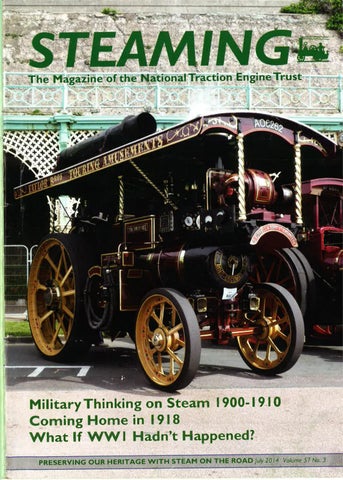
The 2014 Brighton Run offered two steamers with WW1 credentials. Burrell 3555 The Busy Bee (cover)was built in in 1914 as a showman's but without brightwork and was sent hauling timber for the war effort while 1918 Ruston, Proctor SCD Tractor 52607 (above) ordered by the Wor Office in 1916 was delivered in 1918 after the Armistice. it is not known how long the Army kept the engine. By 1921, it was registered to Courtaulds. (Roger Mills) In what's been a charmed life I suppose I'm most grateful for the fact I never had to take up arms. I'm the first for three generations who can say that and both my grandfathers had two lots — indeed conflict was' a background to virtually their entire lives. Paternal was killed at Dunkirk on his second war, called up from the reserves; maternal served in France in 1916-18 before doing his bit as an auxiliary fireman in the Bristol Blitz in the second lot. (And he wore leg irons!) Father in Law served in the RAF from 1939 and dad did his national service during the earliest years of the 'Cold War'. Actually thinking back my early life was really overshadowed by effects and threats of conflict. Most of my infant and junior school teachers were unmarried women in their late fifties who, with, hindsight, were clearly incredibly frustrated spinsters single through no choice of their own, and doomed, remember, to a lonely old-age. There was no one left to marry when they were twenty. Even when I started work older colleagues who'd gone through 39-45 were, I think, more traumatized than they realised and those who ended up in Japan did not make old bones, some incredibly mentally damaged. We had the `one in three' talks... Now I know I wouldn't have been courageous enough to make any kind of pacifist protest in 1914 but I like to think that I'd have been brave enough to willingly fight in 1939. Whatever — I am lucky not to have been faced with the dilemma. Mind you with the family `regiment' being the Royal Army Service Corps (`Run Away Someone's Coming' was a widespread view of their warlike nature according to Dad) it would probably have been spud hauling for me anyway. In 20 I 4's outpourings about 19 I 4-1918 so far the one thing that struck 3
me most was a quote from Lance Sieveking. (Incidentally the first BBC TV drama producer. Pirandello's The Man With a Flower in his Mouth in 1 930 as you asked. Broadcast first on the Baird system then immediately repeated on the Marconi/EMI system thus providing a model that BBC 4 has religiously kept to.) "I didn't realise it at the time," he recalled, "but in 1919 I was a comparative rarity; a complete young man with two arms, two legs, two lungs, two eyes." It's a cliché to say the Great War changed everything but Sieveking's assertion proves its truth. If nothing else the cost of living was 120% higher at the end than the start. COUNTRY BOY So. What was it like in 1914? "All traffic of importance had long ago deserted the roads for the rail, though the first sign of something different was just appearing as a rare motor car passed along what was still called the turnpike in a cloud of dust. The byelanes were overgrown with grass, except where the passage of infrequent farm carts wore the herbage down a little. You could walk along them on a summer day and know that over mile after mile of meadowland and small streams not a dozen people were stirring, but the animals, the birds and die insects possessed it all. Out of that quiet world, which has now gone for ever, the people and events of this book have been recalled." So concludes the foreword of Country Boy by Richard Hillyer — the best possible insight any preservationist could have into the reality of rural labouring life when steam and horse held sway and when a lot of the stuff we have saved was used in anger. Hillyer is a pseudonym for Charles Stranks, a village schoolboy self taught through books bought from the local market who ended up a canon of Durham Cathedral. Writing in 1966 he does for the unrecorded working poor of the pre 1914 countryside what Alfred Williams did for the hired hands in railway works and should be similarly required reading. For years this was possible only through the second hand trade but now at last a publisher of rare discrimination has seen fit to reprint Country Boy (Slightly Foxed Editions C16). Those, like yours truly, who find it impossible to tear oneself away from a threshing drum, reaper and binder and horse plough will gain even more enjoyment from the spectacle after reading this little masterpiece. As we experience the commemorations of the start of the Kaisers War Country Boy tells us just what had been lost in the everyday life of the 'quiet world' by 1918 while questioning, from the point of view of the 'fifteen bob a week man', whether this loss was necessarily entirely a bad thing. Pastoral it is, sentimental it ain't. LOOKING BACK Which leaves me wondering what to do with Steaming
4
as we approach the August anniversary. Researching the evidence one thing becomes clear. 1914-18 wasn't really a steam war, (I leave aside the Railway Operating Department and a fair' bit of 'logistics' here) indeed the pictorial evidence would back claims that it was a horse and motor conflict. Yes the War Department had for years been leasing engines, the Army Service Corps had their own fleet and ministers had put in place, as early as 1912, procedures for an engine call up should an emergency arise, and yes at home there was a lot of war linked contracting. But at the front — with the exception of fleets of steam lorries - the day of the petrol engine had dawned. It's no surprise for that the LT Museum's exhibition is on the buses that went to war... So in the end I decided rightly or wrongly to build this issue round recollections of life before during and after the Great War of those who were connected with our world alongside some archive of steam engines in military use and a couple of reprints of appropriate articles and a little attempt to give a bit of context to the events. Let's call it Steam 1900-1920 A Miscellany. Oh yes and I asked Tony Brown to do a bit of 'what might have been' thinking... And that will be it — at least until 2018. Roger Mills My wife's grandad, Eli ❑racup, who went into the Royal Flying Corps when it was formed was sent, as were many, in 191 8
far flying training in Canada and sent this picture hack to his . An ideas on the roller?
+.47
4.1146e.
r-s
11.0c.41,-te- tit ;14474-
toe, rtt s44- ewe- e.
-werzt._ te
4tAe
8tea rill rig
Steam Apprentice Club Elaine Massey The year thus far has been rather up and down for the SAC. On the positive side, membership is up on recent years and that is obviously very good to see. We even have a couple of new volunteers with us and that is really great. The Burrell Project, building a Steam Traction World 4" scale engine named Lady Sylvia is now nearing completion under the most able hands of Hugh Dyson, and will have her launch at Bedford Steam Rally, followed by her attendance at the NTET road run later in September. A massive thanks goes to all who have assisted in this project, sponsors, those who have offered premises for build sessions, all helpers, and of course those apprentices and their parents who have made it happen! Most sadly, we have had to cancel a driving day which was set up for Malpas Rally site in June. This was originally planned because we had an influx of new
members from the surrounding area and it was felt that it was critical to try and reach as many members as we could with events. After much advertising, ( Raising Steam, website, Facebook) we only had two applicants. Why? I have no idea. My thanks go to all involved, we will try again. We are holding an extra meeting this year to try and address issues we are facing, and come up with new ideas to maintain enthusiasm within the club, and capitalise on the enormous respect we have within the heritage community. I currently have offers to link with several other organisations, but have not yet done so without knowing that we will get support from members. Lastly, I reiterate, if any of you reading this have ideas, constructive criticism or would like to offer help or input, then please do not hesitate to get in touch!
Commercial Section Stuart Gray Plans for the Trust's Dorset presence are now advancing well. The marquee this year will be a joint presentation with GDSF, who are planning a WW1 Commemoration along with the Trust, who will present as part of a special exhibition the work contributed by some of the better known engine manufacturers to the war effort and engines at war. The main part of our participation in the marquee will however be part of our 60th Anniversary, where we aim to present some of the engines that have been the stalwarts themselves of our movement and their history. Also, how the movement has changed over the years and the work of the Trust and how this has also and continued to contribute to our freedom of movement on our roads today. We do not intend to have a Forum this year at GDSF, but replace this with an open invitation on Friday 29th August for both members and non members alike, to come and join us at 19.00hrs for an informal drinks
reception in the marquee. We hope that as many can attend as possible. The Trust's exhibition unit is out and about this year, but as some have noted is beginning to look a little tired. We are in the process of looking at a number of design options for the exterior look of the unit, which will have this revamp at the end of this season and in time for early 2015. The Sales Team are very much on the look out for new volunteers from around the country who would like to represent the Trust at local approved rallies. There is no requirement to take any part in moving or setting up the unit, other than opening up and working with the current team to promote the Trust, sell membership together with books and regalia. You only need a car and a tent or caravan to take part and become one of our sales team. To apply or express an interest, please contact me on the contact information published in the front of Steaming.
NEW MEMBERS
Mr M Lewis Mr B Boughton Mr A Thompson Mr S Hawkins Mr K Gays Dr R Schofield Mr D Weavers Mr G Paddock Mr T Gurdler Mr C Rimell
Mr J Shadbolt Mr N Harvey Mr L Salter Mr S Hill Mr A Kerr Mr J Hutton Mr H Atkins
Machynlleth, Powys Sapcote, Leicestershire Taunton, Somerset Turves Green, Birmingham Dumfries, Dumfries & Galloway Matlock, Derbyshire Fareham, Hampshire
Rugby, Warwickshire Maulden, Bedfordshire Workington, Cumbria Wadebridge, Cornwall Whitby, North Yorkshire Woodham, Surrey Sudbury, Suffolk Wolverhampton, South Staffs Eastleigh, Hampshire Kempsey, Worcestershire 5
Technical Services News David Smith Drawbar Calculations Since my article on drawbar stresses was published in the previous issue of Steaming I have been pleased to receive a number of letters from members and whilst being supportive in the main, most of them point out that the basis of my 'argument' did not cover all of the possible points that would be subjected to stress. This is quite true and although I didn't make the point clear in my article it was quite deliberate. This is because to cover this potentially complex and possibly convoluted topic fully could potentially take up most of the pages for a whole year's Steaming Magazine. That said the subject should be treated seriously and in the event, I sought merely to put peoples' minds at rest by giving an indication (albeit based on complex logic) of the factors involved and the degree of safety margin that the design and construction, materials and proper 'engine management' provides. The author of the letter that gave rise to this discussion was correct in his own way in reminding us that we should not take things for granted and conversely that in particular we should maintain and manage working engines to a high standard. Please keep your comment coming on this and any other technical subjects Towergate - Walker Midgley update Like me, some of you may have received responses to emails sent to Tony Wood at Walker Midgley saying that he was away from his desk until 27th December. Tony assures me that this is not the case, he was merely remiss in not correcting his 'out of office' wording on his email service for the single week that he was out of the office. Oops! Tony also tells me that he is pressing on with producing the promised 'best of breed' policy resulting from the augmentation of the Footman James and Walker Midgley steam policies. As might be expected many questions arise when an exercise of this nature is undertaken and he is awaiting the outcome of deliberations to queries he has raised. He tells me that a meeting is scheduled to take place sometime by the end of June that should provide the clarification he seeks. Until the scope of the augmented policy and rates are agreed cover will continue to be issued on steam related policies using Walker Midgley policy wording. Driver Training I am sure that you will read elsewhere in the magazine about this year's successful driving course. I simply want to relate to you the positive response I personally had when presenting the subject 'This is the NTET'. In it I put emphasis on the fact that for a number of 6
reasons at its 60th Anniversary the NTET would not be recognised by its founding fathers. I based my observation on the changes we see in legislation, the advent of the push-button age, the proliferation of engine owners and events (despite rising costs) and the assumed general fall in interest of younger folk in the equipment we cherish and preserve. I also made the point that a large number of those people who have assisted in the management of the Trust's affairs, helping to organise 'hands on' and 'training days', running the exhibition unit and helping out at events and a myriad of other tasks are themselves getting on a bit and consequently we need to convince the younger element of our membership to pick up some of the workload. However, we agreed that there is not a simple solution and I put it to my audience that one of the problems is possibly because folk do not fully understand what the NTET is about these days. Almost everyone agreed that, had they not attended my lecture, they too would have been somewhat in the dark on some aspect or other. What I found particularly interesting was that despite loads of effort being expended into communications in all of its forms; website, Facebook, rally lists, Steaming and SAC magazines and the advent of information leaflets we somehow still don't appear to be getting the message over. There is lots of good work being undertaken within the NTET right across the board but it can't continue without support, your support and that of potential members. I know 'What's in it for me?' plays a big part in why people get involved in any organisation and frankly, in the case of the NTET the answer is based mainly on receiving a good quality magazine followed by a large dose of philanthropy which makes the choice quite complex and potentially lacking any sense of touch or feel. I am pleased to see that gatherings like the training weekend however, dispel the latter entirely. Despite sombre tones used in some discussion we are essentially a fun loving organisation but put simply, without preparing adequately for the future and without the input from the younger generation the NTET could eventually struggle to meet its objectives.However, I do take great heart from the highly successful and well organised event that Guy Debes and his pals put on in the Derbyshire hills around Wirksworth over the weekend of the 17th and I 8th of May. No, this wasn't an NTET event, but it was a large group of enthusiastic engine owners and their friends, some who were NTET members, who were putting the fun back into 'playing with traction engines'.
Communications Mike ❑yson The launch of the Trust's Facebook pages on the
be given as to what should be done with this growing
internet has been a great success. There are almost
collection of archive material; most important is who
daily updates resulting in large numbers of people
will be able to make use of this material and how will
visiting the pages on a regular basis. There is also a link
they be able to gain access to it. Sadly there are
to the news pages on the official NTET website. A major part of the success is down to Jeff Shackell who has added photographs of many of the engines taking part in the 60th Anniversary Road Run.
collections of archive material that gather dust and do not see the light of day. It is important all our members have easy access to our collection. As the collection grows it will be a great resource
Over the past 60 years the Trust has collected a
to the editor of 'Steaming' and all those who write for
lot of archive material. Most of this consists of minute
our magazine. We are already having an extensive
books, correspondence and other documents which
collection of colour slides digitised so photographs of
date back to the start of the preservation movement.
engines from the 1960's and 1970's can be made
Recently the Trust has been given two photographic
available to all members via our website. In time we
collections and an interesting selection of memorabilia
would like to add an archive collection of old black and
dating back to the 1950's. Most of the photographs
white photographs.
have now been transferred to storage in acid free
It is hoped that a statement about our collections
transparent envelopes but the slow process of
policy will be published in the next edition of Steaming.
identifying photographs without any information is an
This will state clearly what items we are interested in
on-going process.
collecting which may possibly encourage further
The recent donations have prompted thought to
donations.
60TH Anniversary Road Run Those entered for the Road Run on Saturday 27th September 2014 should have received confirmation. If you have not received any response contact the Bedford Steam Club immediately by email to roadrun@bseps.org.uk or by telephone 01462 85171 I. The Road Run is set to be a spectacular event with around 190 road steam vehicles taking part including miniature engines and steam cars. This is the most ambitious road run ever planned and the chance to see so many engines on the road at one time is never likely to be repeated. The event is based at Old Warden Park, Bedfordshire, home of the Bedford Steam Club's annual rally. From early morning traction engines of all types will be leaving the Park at timed intervals to take to the roads of Bedfordshire and Cambridgeshire on three different routes. The 28 mile route is likely to be the most popular but there is a shorter one for miniatures, rollers and slow moving agriculturals plus a much longer route for steam wagons and fast road locos. For those members who would like to come for the weekend as spectators, camping for caravans and tents will be available in the Park on Friday and Saturday nights. The charge will be 10 per night and payment should be made in advance. Caravan and camping passes will be sent by return. On arrival at the event, spectators will receive information about the various routes and lunchtime stops plus some suggestions for ideal viewing positions. If you would like to book, please contact the organisers by post only stating clearly which night(s) you require: Friday, Saturday or both. Attach a cheque for £10 or £20 payable to Bedford Steam Club Ltd. Send to Road Run Camping, Park Farm, Arlesley Road, Henlow, Bedfordshire, SG 16 6DF Include a stamped addressed envelope. The closing date for booking is 9th August 2014.
STEAMING - NOTE TO READERS Steaming is published in January, April, July and October. The aim is to have it posted to members on or around 20th of the month of publication and delivered at the worst by the very end of the month on the cover. Therefore you have not received your copy by 5th of the following month then contact the Membership Secretary with your details. Do not contact the Editor as this will merely delay any response. In the case of any known severe delays we will post a message on the website.
ANNUAL GENERAL MEETING The 2014 Annual General Meeting of the Trust will be held on Saturday 15th November 2014 at the Palm Court Hotel, Scarborough, North Yorkshire. Full details of the arrangements for staying the weekend, the two day programme, formal notice of the meeting, Agenda, Report and Accounts for the year and an appointment of Proxy form, will be distributed with die October edition of Steaming. Any member may submit a Motion for discussion at the AGM. All such motions must be in writing and signed by a proposer and seconder stating their respective Trust membership numbers. Under Article 16 of the the Trust's Articles of Association items for discussion, must reach the General Secretary, Jenny Holt (address inside front cover) on or before Saturday 601 September 2014 in order that they can be published in the Agenda.
Members retiring by rotation at the AGM in November 2014 after their three years term of office are: Mike Dyson, Stuart Gray, Colin Brown, Bill Evans, Bob Garnett, Richard Hurley, Kevin Munn, Joe Black and Bob Allison. All are eligible for re-election. Robert Herring is resigning as Chairman after nine years and does not wish to stand for the General Council as he feels the running of the Trust should, as far as possible, be put into the hands of younger members. Mike Dyson is also standing down. A nomination form is published below and may be cut from this magazine, or photocopied or written out on plain paper. All nominations should be sent to the General Secretary, Jenny Holt (address inside front cover) and must be received on or before Saturday 60 September 2014. Those standing for election will be required to provide a brief introductory profile of themselves and their interests. (Approx 150 words)
National Traction Engine Trust Form of nomination for election of Vice President* Chairman* or a member of The General Council* *delete as appropriate (Complete in Block Capitals please)
Name of Nominee
Membership No.
Address I agree to accept the nomination for this office and if elected serve the Trust and abide by its constitution. Signature of Nominee
Date
Proposed by
Signature
Membership No.
Seconded by
Signature
Membership No.
A separate form is required for each nomination which must also be accompanied by o brief introductory profile, provided by the nominee, for inclusion in the AGM papers.
INTERESTED IN STEAM CARS? Then why not Join, The National Steam Car Association?
\.... rk , .... -.....:-.--.,....
Join The National Steam Car Association & obtain a FREE copy of Jonathan Eckardt's DVD
AN INTRODUCTION
TO STEAM CARS
.-kmAtfirjr." _ As a member, you don't need to own a steam car. The Associafton enjoys tours and attends a number of events and rallies each year and publishes SHAM CAR WORLD. Membership is E25.00 annually (UK Mainland.)
8
To apply for membership contact: Mrs Dana Goddard, ni• Membership Secretory. 29 Nibs Heath, Monitord Bridge, Shrewsbury, Salop, SY4 1HL Tel : 01939 260595 or see our website for details: www,sto Jaw a ro s s oc ro non uk
1
•
.
Bernard Mattimore sent in this lovely picture which he bought from the local photographer in Henley on Thames about twenty five years ago. Bernard was told at the time that this Fowler Engine, just about to cross Henley Bridge, was off to the Second Boer War having been requisitioned by the then War Office. If that's so the date could be as early as 1899. Do any members know the engine date and whether the attribution is correct? he delivery vans outside the Red Lion Hotel and the 'Bobby' may help and your editor's guess is that the absence of any sign of a motor would hint at the turn of the century. A glance through a lens shows the engine in patriotic trim, immaculately presented and the crew - who look like they may be brothers - dressed to the nines for the occasion. Although this issue concentrates on the period around the Great War it could be argued that experiences in South Africa shaped much of what happened between 1914 and 1918 and, in the shape of concentration camps, 39-45 too. Bernard also points out that apart from motor vehicles today this part of the town is as it was then. There are signs at each end of the bridge warning Engine Drivers to only 'take one Wagon at a time over'. Still there today.
The changing mood of the period is encapsulated in these military contracting work before hostilities and the two images, the above showing Anderton & Rowland's examination paper for the last pre-war Commercial Switchback loads fording a stream en route to Sidmouth Motor Users Association Whitsun Parade - a parade on in 1912 while below in a postcard entitled Chipping which it apparently rained. A look at a particular steam Sodbury in Time Of War supplied by Maurice Poole we run marks 1918. The profiles of Jim Lewis and Sidney see Foden 4420 surrounded by military personnel. Harrison take us back to those times from the point of Interestingly though, as we'll see, the military - or at least view of both sides of the footplate, and in the case of the some officers of the Army Service Corps - were latter also introduces that most misbegotten of combines questioning as early as 1905 the place of steam in warfare AGE which emerged from the post-war trade difficulties. with Major CEI McNalty deploying the results of the The career of Thomas Aitken, who died in 1918, while 1902 Fowler trials in his analysis. Captain HCF illustrating one application of steam to new technology, Cumberlege on the other hand looks at the claims of also hints that that modern business methods may no be large as against small engines, while Lieutenant CS Lyon so modern after all! Thanks to the National Motor describes the mobile facilities need to keep steamers Museum and the Royal Logistics Corps Museum for the going in the field. We take a look at the options for use of articles and images.
MEN OF THE STEAM AGE - JIM LEWIS Roger Mills recalls one of the earliest steam `scribes'... the first Big Wheel to travel. And it set him off on a career detailed in an obituary letter from 'Broughton' who noted that following his stint with Leiskies: He became stepman on Mrs. Flora Collins's Wonderland Show. His initiation in steam came while employed as "water rat or parney man" to Ernie Long, driver of Pat Collins's Fowler engine Leader. Eventually becoming a fully-fledged driver himself he continued this way of life, man. Back then the Worlds Fair was the home to many working for many of the leading riding masters of the times a freelance scribbler whose slogan could have been among these Pat Collins, P. Ross Collins (young Pat), Miss 'never knowingly under-written', sticking rigidly to the M. Collins, (Auntie Maggie), John Collins Snr., (Liverpool), rule of never using-one word when ten would do. In Wm. Davies, James P. Collins, Codonas of Scotland, and Hill contrast Jim's News from the West column was pithy, Bros. In the close season he often drove hauliers engines short and to the point, usually led with a list of the and steam rollers. Cyclist — Jack Wilkinson — who we'll be meeting letters he'd received but not yet acknowledged, the state of his health and that of steam and fairground in a future edition - recalled his first encounter with figures in his patch, who'd visited in the last week and Jim: "Our first meeting was in the middle twenties when he only then going on to perhaps four brief reports of the drove the engines for William S. Davies, of Stoke-on-Trent usually he was with the Burrell special scenic road loco The tobers he'd visited or been told about. (see next page), but occasionally on the ex-WD Dolphin minor only of be he'd I suppose if that was all Jim did interest but there's more. This was a journalist who'd Fowler road loco. Princess Royal. I used to leave my bicycle done what he wrote about rather than just knowing under the watchful eye of Jim when I visited fairs so that I about it or like so many of us these days hearing or could listen to the music played by the sweet-toned reading about it. You see Jim went back to the very Marenghi organ on Davies's Diving Dolphins. But Jim had early days of the steam fairground as he recalled in the urge to travel and see as many places as possible, so he changed jobs frequently. In the middle thirties came 1967: It is about 62 years since I last worked on Leiskies' Big across him in charge of the Foster Irene with Jenning's Flying Wheel. I was a teenager at the time. This was my first Chairs. He left Jennings and this engine in 1936. And travel Jim did, as he revealed again in 1967 experience as a fair-ground employee, and my job was to WF's letters pages rang with a controversy when steam supplying to was which boiler pull water to supply a to drive an engine which turned the Wheel, a model engine sparked off, some will suspect inevitably, by Van Talk to drive the organ and a model engine used to keep the about the number of loads drawn by showmen's animals moving on a shooting gallery target. When the tanks engines. Jim weighed in with a) scathing comments were full I had to fill and clean the flare lamps. My other about George Eave's levels of knowledge and b) his job was to be used as a counter-balance. In other words, I recollections of driving a Fowler engine for a Mr James had to occupy an otherwise empty car, to keep the machine Murphy in Southern Ireland with seven loads coupled balanced while in motion during slack periods, and as these behind it in 1913: I was in the employ of Messrs. George occurred frequently in those days, much of my time was Green and Sons, Glasgow. The loads were those of a spent riding on the Wheel. As the Wheel turned the cars complete Fancy Fair, comprising a three-a-breast set of rotated and until I got more or less accustomed to this Gallopers, a set of six big swing boats, and several hooplas motion, riding on this machine was far from pleasant. and side stalls. The Gallopers were, I believe, a converted Looking back over the years I suppose that I could say that set of Dobbies at one time owned by T. Harniess of the Leiskies treated me well under the circumstances. They Yorkshire. The loads were comparatively light and the trucks fed me and gave me a few shillings a week wages, out of and living van were short. Nevertheless there were seven
You won't have heard of 41 Southville Yeovil. But if you'd been a preservationist in the 1960s you would almost certainly have been familiar with the address. That's because, up to 1970 steam buffs would be assured of a welcome either through the door or letterbox as this was the home of Worlds Fair columnist JW (Jim) Lewis. He was a very remarkable
which I had to pay for outside sleeping accommodation. I eventually got tired of being used as ballast and left them. I then walked from Rochdale to Ashton-under-Lyne, where I found another job the same day. But that is another story. Oh yes we're talking about an old man remembering being seventeen in 1905 involved with
loads. In 1923 I was in the employ of the late Mr. G. T. Tubv of Doncaster as driver of the Burrell No. 3284, Alderman, attached to a steam driven Motor-car Switchback. The loads of this machine included two car trucks two carved work trucks, two gate and packing trucks, centre truck, organ II
truck, living wagon and water cart—nine loads, plus water cart. These loads were divided between the Burrells No. 3284 Alderman and 3163 Doncaster. Or these glimpses of Nottingham: Reading these comments reminded me of the days before the First World War when I was a fair-ground employee and made several visits to the Goose Fair, and had the pleasure of seeing Mr. P. Collin's steam-driven Motor Car Switchbacks; Hall and Proctor's Motor Car Switchback with Dreamland centre; John Collins's four-abreast Steam Yachts; George Green's (Glasgow) Venetian Gondolas, and several other rides. The last time I was on Nottingham Market Square as an employee was in 1914 when I was employed by George Green and Sons of Glasgow as the driver of a portable steam engine which was normally attached to the Scenic Railway. On this occasion it was attached to the Gondolas and had travelled from Scotland for the Nottingham Goose Fair and Hull Fair. My last visit to the Goose Fair as an employee was on the Forest in 1930 when I was in the employment of Mr. A Holland of Swadlincote. This was my one and only visit to the Goose Fair as an employee since it has been held on the Forest Recreation Ground. He makes no mention of 14-18 that I can find, but then my grandfather never talked of his time in France. Though he does, in one column in 1966, recall being stationed at Kempton Park in 1944 when as a Senior NCO he escorted a prisoner of war from Kempton Park Racecourse to Glen Mills, Oldham — and made his last visit to a Lancashire Fairground ever. After the Hitler war he went back to the tobers, but eventually even the committed gaff lad settles down. For Jim that time came in 1946 when, aged 58, 12
he arrived on the fair ground at Yeovil in the employ of Hill Brothers. The last machine he regularly travelled with was the skid which went to R Edwards & Sons and is now at Dingles — but this must have been before his POW duties. At this time the end of the traction engine era was in sight but undaunted Jim took a job doing the next best thing, driving an 8 ton diesel roller. Settling down in Yeovil he began to build up a comprehensive library of records and photographs of engines throughout the steam age. Here we meet a strange dichotomy. Some, like Peter Parrish - who recalled Jim as a big strong man, six foot odd, kept going towards the end on whisky are utterly convinced that he lived alone at 41 Southville. Yet in columns he talks, as do some correspondents, of a wife and daughter — he mentions a grand-daughter Sheila — and an acknowledgement notice on 27th June 1970 is signed by his daughter. Perhaps the truth of the matter is that he generally wrote about 'I' and travelled alone or in the company with male companions when visiting rallies. Ah yes rallies. The growth of steam preservation gave Jim a new and vibrant interest he helped out with engines and roamed the UK visiting rallies often ferried by friends thanked publicly in his columns. In 1968 at the Midland Festival of Steam he was pictured with fellow ex Pat Collins driver Jim Morley (86) along with Burrell 3847 Princess Marina. At the rain affected 1966 Weymouth Rally he and Albert Arnold (75) drove the oldest engine on show, Burrell 1840 Duke of Windsor (opposite). Exhibited new at
the Bath & West Show of 1895 she was younger than either of the crew. Shortly after his 74th birthday, he came out of retirement and spent five months driving a diesel roller working in Glastonbury Bridgewater and Wincanton, his home patch, commenting: "If I stay put I am miserable and have more aches and pains". I haven't been able to pin down exactly when he took over from Alf Hurd as the West of England 'scribe', but he began to use the column what we'd now call interactively like a slow internet. The ISP was — yes — good old WF and the modems those red boxes with slots on every street corner. Regularly Jim posed the questions he'd been sent waited a fortnight and then posted the answers received. I never knew — or to be honest even read - Jim Lewis at the time. He died, just about the time I came across WF, after a seemingly continual struggle against illness. Frank Larkworthy wrote: "Not many will know how grievously he suffered through the last years of his life." It's a sad picture — though given his work-rate ultimately inspiring. Instead I sit here trying to visualize that Northern Fairground over a hundred years ago when a lanky Yorkshire lad tried his luck with Leiske's. Free as air, paid in cash money, surrounded by the gaudy temptations of the fun fair. Seventeen's a testosterone fuelled age when everything seems possible, mortality
has been abolished and the sight of a pretty girl is enough to make your day. Jack Bradshaw first met Jim taking money on a section of Gallopers — move on fifty years he'd be walking the platforms of a Waltzer — and human nature doesn't change much. GW Essex reckoned Jim repeatedly refused all demands to set down his life on the tobers. It pleases me to think this might be the nostalgically smiling discretion of the retired Jack-the Lad. Happily though Jim Lewis lived to tell us, if not the whole tale, enough to give the flavour of what's without doubt the 'Golden Age' For that we should be thankful... This article first appeared in a different form in the Fairground Mercury.
FOR YOUR NEW HANDMADE TINPLATE ENGINE LAMPS
BRING YOUR OLD LAMPS TO DORSET FOR ASSESSMENT OR REPAIR OR TELEPHONE TO DISCUSS YOUR REQUIREMENTS TEL: 0044 (0)1938 850 393
EMAIL: enquiries@hetheringtonlamp.co.uk WEBSITE: www.hetheringtonlamp.co.uk
THE SUPERCESSION OF STEAM AS A SOURCE OF POWER FOR MILITARY SELF-PROPELLED VEHICLES. (1905)
0.Airadi By Major C. E. I. MC UT Picture courtesy of the National Motor Kis
The statement made in the title of this article may be considered premature if interpreted in a past tense ; it is in the present and future tenses that it should be read. Valuable no doubt are the lessons to be learned by studying evolution of mechanical locomotion from its infancy up to the present day; but it is the future of this form of transport, and not its past history, that is of importance to those interested in the subject of military transport. This paper is written with a view to demonstrating that this future will be the successful substitution for steam, by the application of the principle of internal combustion as a source of power for Military mechanical vehicles. Steam - the father and pioneer of mechanical locomotion- has endeared itself to engineers by the many estimable qualities it possesses, which simplify the construction of an engine for its service. It is with a sigh of regret that the designer turns from the steam road engine, which has been brought to such a degree of efficiency by the thought of master minds, and by years of experiment and experience, to endeavour to bring to similar perfection a self-propelled vehicle of a heavy type whose source of energy is only of recent application in this capacity. A summary of the distinctive differences of the steam and internal combustion engine may be of use to those readers who have not studied the question of mechanical transport or have experience of selfpropelled vehicles. [...] Briefly then, a steam engine is a machine, the power for driving which is obtained by heating water to such a temperature that it will give off steam. [...] Thus we 14
see that a steam engine has to have a furnace or firebox to burn fuel to heat the water, and a boiler in which the water is contained and the steam generated, in addition to the cylinder where the primary motion takes place. The internal combustion engine obtains its power from the explosion or combustion of a gaseous vapour or gas formed, so far as road vehicles are concerned, by the vaporisation of a more or less volatile oil, and the ignition and consequent explosion of this gas taking place inside the cylinder gives the motion to the piston. Thus we see that both engines require the 'same essential part, the cylinder, wherein the power created either one way or the other is diverted into motion. Whatever mechanism is subsequently provided to convey this motion to the propelling wheels does not immediately concern us, as it may be similar in both cases. Having briefly stated the general principles of steam and internal combustion engines, let us endeavour to ascertain their relative values for army transport purposes. Before, however, we do so it is necessary to sub-divide self propelled vehicles into two classes, i.e., the traction .which hauls its load behind it, and the lorry which carries the whole or part of its load on the same structure as the engine. Steam v Internal Combustion Traction Engine It has been pointed out that steam engines require a furnace and a boiler in addition to the cylinder- and its fixings. Now we know that in order to obtain sufficient adhesion for the tractive effort necessary to move the train, the weight of the hauling engine must be proportionate to the load, and in addition the engine
must possess sufficient hauling power, so that the reduction of weight that may be obtained by the use of the internal combustion engine may not appear to be an advantage; but that it is an advantage is clear, as the necessary weight can be obtained by carrying additional fuel, thus increasing the radius of action. When comparing the two types of engines in question, water must be considered as part and parcel of the fuel in the steam engine, as the internal combustion engine needs no water. Very interesting consumption trials were carried out in the autumn of 1902 with steam traction engines: the roads were fairly good and the gradients were those ordinarily met with. (Pictured on previous page.) The tractors were driven by experienced men. The exact places where water was obtainable, the places where a reserve of steam was required, or where the use of the winding drum might be necessary, were all known. We may take it then that the figures shown in the consumption records are the best that steam tractors can produce under favourable circumstances; hence in taking these figures as a basis of comparison, every opportunity is given to the steam engine to justify its retention. The primary object of the trials was to demonstrate the practicability of supplying an ammunition park for an Army Corps with mechanical instead of animal transport, and to test the capacity of tractors for carrying sufficient fuel for long marches. The tractors used in the trials consisted of two Lion Type engines, built by Messrs. Fowler, of Leeds. These engines weighed about 20 tons and may be accepted as the most economical road engines so far as fuel and water consumption is concerned. The task set before these tractors was as follows : To complete a journey of 250 miles drawing a useful load of 17 tons, and in addition carrying fuel for the whole journey and water sufficient for 15 miles without refilling. The results of this important test show that, in order to complete the journey under the conditions set forth, five and a half tons of coal and two and a half tons of water had to be carried by the tractors. One tractor used coal for fuel, and the other crude "Texas" oil, and we may take these two fuels as the least in bulk and weight that can be used on a steam tractor. Suppose that the water in the above-mentioned trials was not available every 15 miles, but only every 100 miles, then the whole of the useful load would have to be replaced by water, or if there was no water along the whole 250 miles, two and a half times the load that the engine could pull would be required for water and fuel alone. An internal combustion tractor of similar haulage capacity would require only I 1/2 tons of paraffin or petrol to complete the whole journey of 250 miles.
Important, no doubt, as is the enormous radius of action of the internal combustion engine when compared with those driven by steam, there are other considerations which equally affect a claim to preeminence, these may be classed under two headingsSupply of Fuels and Reliability. In the steam engine, coal, coke, oil, wood, and patent fuels of various kinds, may be used to produce the heat required to turn the water into steam-none of them present any very serious difficulties so far as their transport is concerned. Now, in the internal combustion engine the great problem has been the supply of fuel. Petrol, or petroleum spirit, which is easily vaporised and formed into the gas required for combustion, is considered dangerous to handle and convey, indeed so dangerous that its use in military tractors is prohibited ; therefore a means of vaporising a heavier and less volatile oil had to be found. This problem has taken a great deal of thought and experience to solve, but a successful solution has been arrived at and the statement made as to consumption is based on the actual performance of the engine constructed. The supply of Petroleum or ordinary household paraffin, is a simple matter. Throughout the world, in every small town and village, it is to be obtained. Therefore, we see that with paraffin as fuel, the internal combustion engine presents no more difficulty than the steam engine. When considering their relative reliability, the steam engine occupies at present the foremost place, but this is only temporary. We must not lose sight of the fact that the application of the principle of internal combustion to heavy road vehicles is only of recent date, and increased reliability is daily being obtained. The near future will undoubtedly see the internal combustion engine made perfectly reliable. Steam Lorry v Internal Combustion Lorry. Great as are the advantages of the internal combustion traction engines over the steam engines of that class, they are only repeated and emphasised in the internal combustion lorry. The performance of the steam lorry when carrying out a journey of 300 miles, showed a consumption of 21/2 tons, and of water 262 gallons per 15 miles of march, making a total of fuel and water for the whole journey of 26 tons. An internal combustion lorry could have performed the journey on about 3/4of a ton of ordinary paraffin or of petrol. In making the above comparisons, the vehicles in question travelled at the same average of miles per hour. If the pace had been faster, even a greater economy in consumption could have been obtained by the internal combustion engine. Can we doubt that in the future the application of the principle of internal combustion must supplant steam in military selfpropelled vehicles? I5
LARGE OR SMALL ENGINES FOR MECHANICALTRANSPORT EQUIPMENT? (1910) By Captain H. C F. Cumberlege (Army Service Corps) To this question can be given only a qualified and technical terms will be avoided as much as possible, tentative reply, for the answer to the larger one, and the engineer's point of view will be passed over, namely, to what extent can mechanical transport be so far as details are concerned, in favour of military utilized for military purposes, is still awaiting the results considerations, the latter being more easily of experience. Therefore I shall not go beyond a review comprehended by the soldier, and of more interest to of some of the salient features affecting the him, besides being of primary importance to the military employment generally of steam engines for military side of the question, the one at present under transport purposes, stating only the pros and cons of consideration. both large and small types, and shall avoid any tendency The term engine means, in this article, a steam to force conclusions. engine. The argument applies more or less to internal Mechanical transport, being typical of the coming combustion (familiarly i.c. engines), but the conditions era, must ere long engage the serious attention of the which govern their use differ in so many ways that the army in general, and of all Army Service Corps officers question as applied to them needs separate treatment in particular. Therefore it is high time for a general in order to avoid confusion. interest in mechanical transport problems to be aroused. [...] Until comparatively recently I had only a guarded quasi-assent for the oft repeated claim that the horse must always remain a necessary component of the army machine. But the remarkable strides of aviation, since the first cross-channel flight brought this form of locomotion prominently before the public eye, has confirmed latent suspicions and enlarged expectations. A few weeks ago there appeared in print a suggestion of the possibilities of a hybrid motor car which would be driven forward by means of a screw propeller after the manner of an aeroplane. It would run upon light wheels and trust to small planes to produce a skimming mode of progression over the surface of plough or marshy land, and to lift it altogether off the ground for Was this what the writer had in mind? The last roadworthy Marcel Lem a few yards whenever necessary in order Helica. This 1922 French propeller driven roadster proved a valiant if unsung to clear hedge, wall, or ditch. The idea is member of the resistance in 1944. Hastily commandeered by German soldiers it ran itself into a tree and rendered itselfand them hors de combat. startling but far too possible to ridicule. In the presence of aeroplanes, submarines, and a large variety of self-propelled road vehicles, it is Although we have a few big engines in commission, well to beware of judging the future by the present, the pattern selected to govern future manufacture is a and of condemning rashly. light engine not exceeding 6 tons in weight It can draw In the light of these facts about the progress of a gross load of about 8 tons behind the drawbar over mechanical traction, it must be admitted that the fair country without risking tearing up a decent road. subject is of special interest to the army. We are The arguments in favour of such an engine are very probably much nearer to the day when MT will have weighty, but in these early days it would be foolish to become recognised as part of the normal duties of suppose that finality has been reached. The difficulties every Army Service Corps officer, than is as yet attendant upon the employment of big engines are by recognised by the majority of those now serving. [...] no means insuperable, and there can be no question of In discussing the question "large or small engines" their manifold advantages. There can be little doubt
16
moreover that when, if ever, it comes to the point of actual war on a large scale in Europe, or elsewhere, the sudden and imperious demand for large numbers of transport animals and vehicles which has characterised all modern warfare, will this time result in the impressment of every self-propelled vehicle that can be found, and the big engine will undoubtedly be among them. The small engine's gross load of 8 tons means a truck and a light vehicle in addition, carrying between them about 5 tons of stores, constituting the net or useful load. The big engine may be regarded as capable of drawing from 12 to 16 tons net, or 20 to 26 tons gross, behind the drawbar, and will itself weigh from 12 to 16 tons. It will be seen then that the big engine carries three or four times the useful load that the small engine can take. Under the existing law relating to the use of road locomotives, the big engine requires a crew of three or four men according to the number of trailers, but two are sufficient from a mechanical point of view. Probably in war only two would be provided. The small engine also needs two men, so that in the matter of personnel the big engine has the advantage
open to some criticism on the score that the sum charged for depreciation is not always a fair representation of the capital cost. With regard to the latter objection, a certain degree of inaccuracy or incompleteness in data is unavoidable in any experimental stage, when statistics are meagre. Nevertheless the margin is so great that the advantage of greater financial economy must be conceded to the
big engine. The big engine has a reserve of power which is very useful in an emergency. When it comes to pulling some vehicle or another engine out of a hole by sheer power, owing to lack of tackle or other facilities for obtaining a mechanical advantage, the big engine is an easy first, and the rest nowhere. The men like the big engine and dislike the little one. Driving the latter entails the harder work and greater discomfort. A tall man has figuratively to stand on his head to see into the firebox of a small engine. If at first sight this plaint appear frivolous, it should be remembered that a man's interest in or dislike of his work has a good deal of influence on the measure of his efficiency. A big engine and its load represent a high order of concentration. This feature has its advantages and its of greater economy. Running expenses vary a little with the type of disadvantages. Some of these, especially-the latter, willengine, but roughly averaged the big engine costs 2d. be referred to later. Of the former probably the chief per net ton mile, the small one 6d. In other words there is economy of road space, a most important is little difference between the two in out-of-pocket recommendation in these days of large armies and expenses, yet one carries at least three times the enormous trains. Again, a group of big engines makes other's load. This calculation excludes wages which, in a large yet compact unit and therefore is easily and war, make no difference to the comparison, and it is economically supervised on the line of march. There is
Picture courtesy of the National Motor Museum
less straggling, less checking, less overrunning, less trouble in negotiating steep gradients than may be experienced with light tractors of an equal total capacity. The big engine is naturally more solidly constructed, and is less liable to petty mishaps, needing minor repairs, than the small engine, the lighter mechanism of which is not so well able to stand the rough usage it gets even under the most favourable conditions. The following figures give a fair idea of the behaviour of the two types of engines working under the same conditions. They are taken from the log books of engines in commission at the same station: Two large engines—days under repair in 6 months, 5 and 3. Two small engines—days under repair in same 6 months, 24 and 21. The large engines were then six years old, the small ones 18 months, and all covered approximately the same mileage. So far the case for the big engine has been most in evidence, But even its warmest partisans have perforce to admit that it has serious disadvantages, For instance, a big engine and its load instances a great many eggs in one basket. If the engine breaks down, 15 tons, more or less, of eggs are likely to be sadly missed. But if one of three small tractors, each drawing five tons, breaks down, at the most five tons will have to be lamented and it is tolerably certain that none at all would be lost, for the remaining two tractors would generally be able to divide the derelicts' load between them. There is yet another serious disadvantage pertaining to the concentrated power of the big engine. The load must be taken from point to point intact, otherwise its working is far from economical. For instance, were it desired to deliver five tons of stores at each of three points B, C, and D, each ten miles from one another and from the starting point, A, one big engine would need to travel at least 30 miles, occupying about ten hours, doing part of the journey with only a nominal load, while three light tractors would do the job in three hours, each travelling ten miles, and without waste of loading capacity. Again a big engine weighs from 15 to 20 tons in service trim ; the standard light tractor about 4 tons, being well under 6 tons official measurement which omits a good deal of the engine's equipment, including not the least important part of it, namely, its fuel. The latter will travel with safety over many un-metalled by-ways, over which it would be unwise, possibly even dangerous, to take the former. The light tractor can often reach a camp when the big engine must stop a mile or more away. The advantage of the little engine in this respect is well shown up in Ireland. Many of the main roads cross the bogs that are characteristic of that country. The light tractor can cross these if reasonable care is taken, but they will not stand the 18
weight of the big engines which have constantly to make detours of many miles. The greater range of action of the light tractor is of considerable importance when viewed from the military standpoint. Water is the principal difficulty. A steam engine consumes of water three to five times the weight of the coal it burns, and a big engine needs to find water along the road every 12 to 14 miles, or thereabouts, unless it draws a tankful after it at the expense of its useful load. The light tractors tanks and bunkers will hold sufficient water and coal to take it 25 to 30 miles. On the other hand the big engine can draw extra water in trailer tanks, and extra coal in the wagons sufficient to multiply its range of action by four, while reducing its useful load by not more than one-fourth or thereabouts. This initial greater range of action of the small engine is not after all such a great factor in its favour as seems to be the case at first sight These objections to the big engine are very important. Their relative value alongside the big engine's admitted advantages is, however, most difficult to assess. While there remain so many scarcely tested variations of design, it is not surprising that considerable divergence of opinion exists. Probably the future will produce a type or types of mechanical, transport which will embody all the best points of both large and small engines, and words, to approve only of those designs which lend themselves most readily for expansion or alteration to suit new departures. The little engine policy, in all probability, did not receive any direct stimulus from the fact that the prevailing tone of the internal transport systems of this country is littleness, but it is probable that the facts and fashions with which we are familiar had an indirect influence in favour of its adoption. Compared with similar vehicles in use in other parts of the world, our road wagons and our railway wagons are small, and our mechanical road trains are assuming the same characteristic. The reason for this smallness is an obvious one; our vehicles are designed to suit the traffic, which consists generally of a large number of small parcels to be carried small distances. Hence our road wagons rarely have a capacity exceeding 2 tons, and our standard railway wagon is the 7 to I 0 ton truck. It is waste to build a wagon capable of taking 20 or 30 tons when the average load barely exceeds 2 tons. In countries like South Africa, Australia, Asia and America the transport problem more often presents the phase of large consignments to be conveyed long distances, and in those countries we find road vehicles of much greater capacity than are to be found in these islands, and the 30 ton truck. That the smallness of our vehicles is due to our insular surroundings is also indicated by the fact that as soon as the Briton embarks upon the water, all his sense of littleness vanishes, and he builds the biggest ship that is to be found upon the
high seas. The universally admitted economic value of bigness in working transport lies in the demonstrable truth that the bigger the containing vessel or vehicle, the greater is the proportion of useful or profitable load carried to gross load hauled, which latter includes the tare weight or unprofitable load, and the greater are the earnings and percentage of profit out of proportion to and despite the larger capital outlay and increased running expenses. The small engine seems to find favour in commercial circles in the British Islands, but it by no means follows that the small engine will suit our small army best, because military requirements often entail departure from the ordinary rules of economics. I am inclined to think that the nature of military transport work more closely resembles the "commercial conditions" of large countries and that any inclination to adopt the small engine because the trade builds it for the commercial world, would be a mistake. The strategical role of the British Army has undergone considerable change of late, and it is a pertinent question to ask whether the expensive and elaborate wagon of the horse transport, designed to be capable of going all over the world wherever four-wheeled vehicles can travel, is any longer necessary. It has been the axiom of the British transport officer that he needs a wagon of world-wide capabilities. To-day, however, our ideas as to the possible fields for employment of our regular transport establishments are more limited. For any small affair, and in the East, we should, as hitherto, utilise local resources, and now that South Africa seems to be peacefully established as a self-governing commonwealth, the possibility of our army becoming again engaged in a large war outside Europe seems to be very remote. The greater part of western Europe has good roads and plenty of them, and it is probable that for military purposes the big engine and a lighter and less costly horse wagon could be used with advantage. The statute law of the British Islands looks with much disfavour upon the big engine, and there is certainly every excuse for the dislike to it which is manifest amongst the mass of the people. They are very ignorant of the compensating advantages to trade generally, and incidentally to the impetus to road improvement, which the road locomotive brings with it wherever it can be profitably
employed; but as they become better informed, it is likely that the restrictions upon them will be removed. Not many years ago the first motor cars to be built were required by law to be preceded by a man on foot carrying a red flag, and cyclists by whom fifteen miles per hour on the machines of those days was almost unattainable, figured frequently in the police courts charged with riding to the public danger. It may confidently be expected then that the law will be altered in the near future if a need can be shown, that is to say if the practical and reasonable expansion of the use of road locomotives is found to be unduly restricted. As an economiser at manoeuvres and training camps, etc., the big engine is "par-excellence", and a number of such could with great advantage be included in the peace establishments, while it is inconceivable that there would be no use for them on active service. A glance back makes it appear that this article might be better entitled "A plea for the big engine" - and indeed the big engine has very much to commend it But it is fully recognized that though the big engine had 50 advantages over the small one, yet one supreme disadvantage would counterbalance the lot, and necessarily win the day for the small engine. If this, that, or the other make the small engine essential and the big engine taboo, it may be inevitable but it will cost a very great deal of money. It is very hard however, to assent to a proposition that the big engine has no place in the army.
A big engine - Fowler Road Locomotive 14115 Lafayette of 1914 seen at the 1996 Dorset Fowler special in WD trim. She spent most of World War One on French front lines. Sold in 1921 to London & Kentish Haulage Co, thence absorbed by Pick fords. In1932 she went to Wafter Denton, Manchester and worked on until 1946. (Roger Mills)
ADVANCE REPAIR DEPOTS FOR MECHANICALTRANSPORT (1906) By Lieut C S Lyon, Army Service Corps.
With the employment of Mechanical Transport at of work, from the repairing of a motor tyre to the considerable distances from fixed repairing Depots, it casting, machining and fitting of an eccentric strap, or has been found necessary to devise some means of the forging of an axle. It will consequently have to carry keeping a small repair Depot within easy reach of the a large variety of tools and appliances; and the many trains. Owing, of course, to the vital necessity for trades which mechanical engineering involves must be keeping the vehicles running during manoeuvres and in represented by its personnel. (3) What condition of country must such a time of war with as few and short delays as possible, This Repair Depot could then carry out slight repairs Depot he capable of operating in ? and adjustments on the spot, obviating the delay It must be capable of operating in any country which is consequent upon sending parts and in some cases possible for Mechanical Transport. It would appear then that this Depot must be complete vehicles down to a base repair shop. This has been attempted on a small scale, several capable of being put bodily into traction engine waggons times, both by the army and by commercial firms. which are then divided into trains which do not exceed During the manoeuvres of 1903, the Royal in weight those usually hauled by traction engines. It is clear that the loading and unloading of trucks Engineers established a Repair Depot at Basingstoke. In this case the machinery was driven by shafting, with this machinery would take considerable time and carried on wooden trestles, the machines being placed consequently the mobility of the Depot would be on a platform of sleepers laid on the ground, marquees seriously impaired, therefore if possible all the heavier being pitched to protect them and the operators from machines should be worked in the trucks, only the light the weather. The plant was driven by a traction engine. and easily handled articles being removed. This arrangement has the disadvantage of detaining At the present time, in London there are one or two motor cars owned by commercial firms, which are a number of trucks from ordinary transport duty, but equipped as small workshops, which at a call from an as will be seen later it only involves the detention of unhappy motorist, proceeds to the scene of disaster some eight or ten, and the increased mobility obtained, and, if possible, repairs the damage on the spot. The would seem to compensate for this being done. The scope of these cars is, however, very limited, and what engines employed to move the Depot can be utilised successes they achieve are probably due more to the for other duties when the move has been carried out. In order to obtain some idea of the feasibility of handiness of the individuals in charge, than the variety of the appliances they carry. working Advance Repair Depots it was decided to In discussing the question of Advance Repair construct in the Mechanical Transport Depot at Depots. there are several important points which Aldershot, an experimental repair train from the material already at hand, and to send it out with the require consideration. (I) What degree of mobility can be obtained detachment of Mechanical Transport proceeding to the compatible with efficiency ? Army Corps manoeuvres in Berkshire last Autumn. It is obvious that the Depot must be capable of moving The most suitable vehicles available were the eight with little delay to a new theatre of operation, such ton trucks supplied for use during the South African move to be carried out at least as quickly and preferably War. by the same routes as those taken by the engines it is These waggons or trucks are of extremely strong to keep in repair. Hence it would seem that it should construction, having high sides and a tare weight of be moved by Mechanical Transport and not be about four and a half tons. Superstructures of wood dependent on railways. and canvas, having pent house roofs, were made and (2) What repairs should such a Depot be fitted in such a manner that one side and half the roof capable of successfully carrying out ? could be removed, to allow of the machines being lifted To be of any practical use it must be capable of carrying into position by a crane engine. Curtains of canvas with out all running repairs and adjustments likely to be rollers attached were arranged to hang from the eaves. required by the engines it accompanies, cases of These were devised to prevent any damage being complete overhaul of exceptionally extensive failures done should any trucks be detached from the train only being sent to the base. without the wires being disconnected. To do this it will have to undertake a great variety In addition to these wires, others are run right 20
through the train, in the same manner, to provide for light, every truck being fitted with two fixed lights of 32 candle power each and two wandering lights, enclosed in wire guards on flexible leads. In the first truck is carried a continuous current dynamo with an output of six and a half kilowatts; this is securely bolted to the floor near one end, and an opening is made in this end, through which a belt is brought from the flywheel of a traction engine to drive the dynamo. On the opposite end of the truck is fixed a small switch board, with the usual fittings, consisting of voltmeter, ammeter, fuses, and some half-dozen distributing switches. The sides are fitted with racks to carry some 2,000 yards of wire, six 800 candle-power arc lamps obtained, and all the small stores used by electricians, such as fuse wire, carbons, insulating material, etc. The wire and arc lamps are for lighting Bakeries, Supply Camps,
feature, it is capable of turning out castings in brass or iron, up to eighty pounds in weight. The furnaces, two in number, are oil fired, burning green creosote oil, or heavy petroleum, the blast is supplied by a small motor-driven fan which will work the furnaces simultaneously, melting down 45 lbs. of metal in each, in less than an hour. The sand is carried in two wooden boxes, containing about half a ton each, the boxes being fitted with rings to facilitate lifting in and out by a crane engine, the whole plant being arranged on the ground when working. The utility of this branch of the train is very great indeed, it does away with the necessity of carrying a large number of spare parts as renewals for the engines, as these can be made on the spot when they are required, and further, it enormously increases the range
of repairs that can be undertaken. The fifth truck is known as the fitter's shop, a bench being placed along one side, to which are fitter's etc., which may be near. The second truck contains two machine tools bolted four heavy vices. In racks under this bench, are namely, an 8-in. sliding, surfacing, and screw-cutting carried the fitter's tool boxes, to the number often, lathe with an eight foot gap bed, and all its necessary four fitters working on the bench, and six as erectors. A bench and chest of tools for two wheelers are appliances, including a very ingenious grinding attachment, separately driven by a small motor carried carried in the truck, but are lifted out when required on the saddle of the lathe. The second tool is an for use. The sixth and last covered truck is fitted up as universal milling machine, with a divided head attachment for cutting toothed wheels and skew a tool and material store, containing the bulk of the small tools and the raw material, while a desk for the gearing of all sorts. In the third truck are bolted three tools, a pillar, store man and shelves for ledgers, etc., are also drilling machine capable of drilling holes in steel up to I 1/2 inches in diameter, a tyre vulcanising machine for repairing punctures, cuts and bursts in motor car tyres, and a large emery wheel for sharpening tools, dressing, casting, etc., and fitted with an appliance for accurately grinding twist drills. The fourth truck is perhaps the most interesting, it is fitted at one end with a small bench for the coppersmith, the remainder of the truck being left clear for the stowage of the blacksmith's forge and tools, the boiler maker's tools, and a complete equipment for a miniature foundry. The forge is the service wooden frame pattern, the blacksmith working on the ground, with a tarpaulin shelter erected on light poles, to screen him from wind and weather. The boilermaker's kit consists of a large chest of tools, a small hearth for heating rivets, etc., and a portable electric drilling machine. This machine can be run about on two small wheels, and is used for drilling holes in parts of engines that are too cumbersome to be placed under the pillar drill in the train. It entirely supersedes the old and laborious ratchet brace method of drilling out broken firebox
provided. The last truck of the train is devoted to breakdown tackle ; heavy coils of rope, differential tackles, crab capstans, skidding, and poles for bearing electric lights being amongst its miscellaneous contents. The heavy raw material, such as pig iron, ingot brass, copper and tin, is also to be found here. The remaining two 4-ton trucks, carry the camp equipment and supply of coal and oil, for the engines. To haul these nine trucks three engines are required, and two should always be in attendance on the train, one to drive the dynamo, and the other, a crane engine, to handle heavy weights, and shunt the cripples that come in for repair. The staff required to work a train of these dimensions is about one officer, and thirty other ranks; and it should then be capable of catering for the urgent needs of some forty or fifty engines.
stays, etc. The foundry is undoubtedly the most unique
21
.
c. 1911 - THE WAR OFFICE TERMS OF ' HIRE FOR MOTOR VEHICLES AND TRACTION ENGINES.
We assume that owners of traction engines and trade and commerce, since different terms apply to mechanical vehicles will have no objection, if only on different periods of the year. Thus the hiring rate for patriotic motives, to say nothing of commercial a tractor is 50 per cent. more between March and considerations, to fall in with the idea of the War Office September (during which time it is in greater demand in regard to industrial vehicles being, when necessary, for agricultural and general haulage purposes) than hired for military transport purposes, provided the during the months of October to February. When the terms offered by the Government are sufficiently War Office wishes to purchase out and out, a course liberal. Upon this last point differences of opinion exist; which it can take at only ten days' notice, a bonus of for ourselves we consider that at any rate the War 25 per cent. on the agreed value of the vehicle, Office has not erred on the side of generosity. according to a published scale of depreciation, will be We have before us the official 'Schedule of Terms paid by way of compensation for disturbance. for Hire or Purchase of Motor Vehicles by the War The full registration fees are as follows (all per Department'. This schedule is the result of the decision annum): of the military authorities to pay an annual fee to the Class A £2-2-0. Each extra traction wagon 2/6 owner of any motor vehicle or traction engine who Class B I £2-0-0. Each extra trailer, capable of registers his machine with the War Office for hire or carting a useful load of 3 tons and over 2/6. purchase when required. The annual registration fee Class B2 £2-0-0 varies according to the class of vehicle concerned, but Class B3 I - 10-0 in no case exceeds £2 per annum, except in regard to Class B4 £ 1 -0-0 a 'traction train', for which the fee is £2-2-0. Class BS £2-0-0 These figures seem to us to be too low when one The foregoing classes relate to the following considers the comparatively small amount of the actual descriptions of vehicles Class A Traction train units, each consisting of a Heavy hiring payments. These payments, which are calculated road locomotive, three traction wagons, and a traction from the time a vehicle leaves the owner's depot to water cart. the time when it arrives back at such depot, are Class B Heavy Motor Cars further subdivided as arranged on a mileage basis per day, according to follows: classification: whilst the hiring periods are divided, in 1 Tractors with one trailer capable of carrying a order to suit different owners, into specified lengths, useful load of 3 tons and over of which at least thirty days' notice in writing shall be 2 Motor wagons with a carrying capacity of 3 tons, given by the War Department. It can, however, be conceded that the War Office of useful load and over 3 Motor Vans with a carrying capacity of not less has been careful in its endeavour not to interfere with
22
7.5 A BI 10 % I2% B2 B3-5 15% Trailers 7.5% provided that the value thus calculated shall never be less than 30 per cent of the original cost. It appears it is possible for a vehicle to be withdrawn from the register before the complete year of registration has terminated, but only on payment by the owner of a fine, equal to twice the amount of the registration which has been already paid. Registrations are annual contracts renewable year to year by mutual consent. officially as follows :Full details of vehicles it is desired to submit for Class A, inc. driver and two assistants £4-0-0 registration must be forwarded to the Secretary, £0-5-0 Each additional traction wagon Mechanical Transport Committee, War Office, London, Including a driver and, when a trailer is used, and no vehicle will be registered until inspected and one assistant:— approved by him, and until the form of agreement is £4-0-0 Class B I. October to February signed by the Director of Transport and Remounts. An £6-0-0 March to September officer will require to travel on the vehicle before £0-5-0 trailer Each additional approval, and may, if necessary, request to see the £4-0-0 Class B 2 machinery operated, which must he done free of cost £3-0-0 Class B 3 the War Department. Whilst in the case of a steam to £2-0-0 Class B 4 vehicle, it must be stated whether the boiler is insured £15-0-0 Class B5 June to September by a recognised insurance company. £7-0-0 October to May We anticipate a large response by owners of It has to be remembered that the owner has to pay vehicles to these new propositions from the War all wages of drivers and assistants, and find them food Office, which cannot fail to further popularise the use and lodging wherever they may be called upon to go, of these extremely serviceable vehicles, both in times so that the expenses under some circumstances may of peace manoeuvre and also in the, let us hope, seldom be very considerable, quite warranting the at first sight and far off, time of actual warfare. (Combined from three unnamed sources - dates somewhat liberal terms offered. It is stipulated that inferred from other evidence.) upon arrival at the depot, drivers and assistants, shall
than 2 tons or more than 3 tons 4 Motor Vans with a carrying capacity of not less than 20 cwt or more than 30 cwt. 5 Omnibuses with a useful capacity of 3 tons. FULL registration fees will be paid for each vehicle available both for hiring and for purchase, but in the case where only a percentage of the vehicles registered by an owner are available for hiring in peace, the amount to be paid on account of each of the vehicles not available for hire will vary from 25 to 75 percent. of the full fee. With regard to the rates per day to be paid by the War Office for hiring, these are given
come under the orders of the military officers, and shall thenceforth, until the departure of the vehicle on its The picture which heads the above was purchased a few return journey, act as servants of the Crown. The months ago by Irish member Graham Smith who is hoping owner is to provide for the upkeep of the vehicle, and for help in identifying the three engines shown. He writes... The second two engines appear to have been cut down to supply all petty stores and spare parts necessary. from showman's outline. The only information I could provide to undertakes The War Department without charge all water, fuel, paraffin oil for lamps, gather from the photograph was that the name Alfred lubricating oil and grease required for the running. The James Bartlett Fordingbridge Hants is on .the canopy War Department will not be responsible for damage sides of the first, this being a double crank compound to a vehicle nor for any derangement of its mechanism Burrell with the name Queen of the South on the which may arise whilst a vehicle is being employed by canopy front. The second and third engines are also the War Department under normal conditions, but in Burrells but of the single crank compound type. The three engines appear to be hauling trailers of the case of damage or derangement attributable to the special and peculiar nature of the work on which the stone or other materials and the letters OHM appear vehicle is employed, the War Department will make on the side of a trailer in front of the third engine. After a post on Traction Talk I was put in touch good such damage, and will pay for the hire of the vehicle during the whole time that it may be with Steve Bailey, a direct descendent, who has lots of information gathered on the family. consequently away from its regular work. Steve told me that Queen of the South was Burrell With reference to -out-and-out purchase, the price to be paid by the War Department shall be the then 2337 from 1900; an 8 NHP two speed engine with value plus 25 per cent. depreciation, to be estimated single driving gear with large wheels — 7'0" hind and 4'71/2" front. The cylinders were 6 1/2" and I I" and I 2" at the undermentioned rates :stroke. Sold from Burrells West Country agent S Ford Depreciation per annum by Class: 23
of 97 Somerville Road Bristol to Henry Arden of Heavitree Devon in September 1904, it went to Bartlett in May 1907 and was given the registration number HO 5943. Later she went to Martin Slater of Totton during which time it was commandeered for war work. Its next owner was also local - Chas. Burry of Neacroft Christchurch. Steve knows it was used for threshing at Mudeford Farm Christchurch and also at Mills Estate Bisterne near Ringwood for timber cutting. She was cut up by Southern Steel (later Wards Scrapyard) at Ringwood. George and James Bartlett, and George's son Alfred had a number of Burrells through their hands. 1470 Pride of the South (new), 1909 Majestic, 1433 Rambler, 3337 Queen of the South, 3621 Excelsior, 3413 The Philadelphia, 3906 Earl Beatty and also a Fowler, 14862 Evening Star. I had thought that the second engine was Burrell 1909 Majestic - the plate on the boilers looks like this when viewed through a glass and Steve Bailey thinks I may be right as the man stood up on the engine looks
like Dick Hallett one of Alf Bartlett's permanent drivers who hailed form Fordingbridge. The numbers being carried by two of the engines — 142 & 143 — might indicate that the two engines are from the same owner while the other - 99 - being out of sequence might indicate another owner. Steve reckons the location could be near Fordingbride as Dick is the driver. Incidentally I have often wondered why none of the Bartletts took part in either world war but this picture might indicate that mean had to stay behind if they had the skills which were vital to the war effort. The only other clue, Graham adds, is that a John Middlemiss Steaming article on Bartletts mentions that during the war many showmen's engines were commandeered for gravel hauling from Brambridge pits near Eastleigh. Would this be where the photo was taken I wonder? Any information sent to the editor will be passed on.
Jeff Shackell writes...this picture comes from the John Crawley Burrell postcard collection, now owned by Richard Hurley, showing what purports to be A. J. Lewis's Burrell SCC 3210 Pride of the Wye on government service at Pembroke Dock during the 1914-18 war. However other sources list 3210 as being Queen of the Wye, 7nhp and sent out on 13th June 1910 to Mr Lewis. But the cylinder block of the engine in the image looks to be of an 8nhp design? Michael Lane reckoned 3210 was the final 7NHP SCC road engine, with 6 112 x H ins dia x 12 inch stroke cylinders, a 200psi boiler, double geared to the hind axle with leaf type springs. After Lewis it went in 1920 to Clifford Hill of Ross-on-Wye who had it converted to a full Showman's type engine by Elias Ltd of Gloucester and renamed it Pride of the Wye. According to Trevor Smallbone Mr Lewis traded in an older Burrell, 2301 a SCC, in 1910 probably in part exchange for 3210. There is no doubt the engine in the image is called Pride of the Wye but there is nothing to suggest it was de-converted from full showman's specification and in any event this is supposed not to have happened until after the war so why the name during what looks to be a wartime image? Have 1 missed something? 24
1913 - The Examination Paper for Drivers of Steam Wagons and Tractors. Read this sheet very carefully three or four times before making any attempt to answer the questions which follow. First write your name and address, the name of your employer, and the maker's name and load capacity of the machine which you drive, on the slip attached hereto. Head each sheet with your name and the number of the question you are answering. You must make an attempt to answer the first six questions. You may also attempt to answer any six of the remaining questions, but not more than twelve questions altogether are to be attempted. Note - it will be far better for you to do only the six compulsory questions and do them very well than to attempt more than you can do in the time allowed for the examination —three hours. You will get no additional marks for answering more than twelve questions. The numbers, which are given in brackets at the end ofeach question indicate the number of marks which will be given for a correct and carefully-written answer to that question.
If so, in what way? (20) 10. Describe how a compound engine with double eccentrics for each valve is reversed. It will not be sufficient to state the bare fact that the reversing lever must be moved into the "reverse" position. (30) I I. When the reversing lever is "notched up" what effect has it on the engine's power, and why? (30) 12. Why do not makers of steam wagons and tractors fit governors, whereas most traction and agricultural engines have them? (20) 13. What do you understand by the terms "clearance" and "cushioning"? At what part of the stroke does "cushioning" occur ? (25) 14. Describe some method of packing a piston or valve gland so as to make it steam-tight. What kind of packing material would you use, and would you draw the old packing before putting in the new ? If so, how would you remove the packing if it had become very
hard? (20) I. Give a short description of any make of steam 15. How would you set the valves of your engine so wagon or tractor. The examiners will give no marks as to give you running results, and would you set them for bare statements of horse-power, load capacity and while the engine is hot or cold? (30) make, but you must give a clear description of its 16. Why are the cranks of two-cylinder steam engines generally set at right angles instead of opposite each construction. (25) other? (20) machine the to do you what examiners the Inform 2. before lighting up the fire, and state how you fill in the 17. What would you do if the fusible plug of your wagon or tractor boiler melted when you were many time until steam is raised. (25) from the nearest village or town, and could you miles admitted is water dirty or oily if happen will What 3. into the tank and allowed to pass through the pump or get home with your wagon if you did not have a spare injectors into the boiler? Supposing the water also plug with you? (35) contains grit as well as oil or dirt, what effect will it 18. The following is a copy from the record book of a five-ton steam wagon for a 40-mile journey: have on the cylinders, valves and glands? (25) 4. How can you take the greatest advantage of the Cool used - 4 Cwt. expansive power of steam? (25) Water used - 500 Galls. 5. Which valves and cocks would you open before Oil used -I Quart. opening the regulator if you wished to start your engine Full load carried - 5 Tons. after it had been standing for a long time, and which of Distance run with full load - 20 Miles. them would you close again after the engine had run Distance run with three-ton load - 20 Miles for a few minutes? (25) Total running time - 8 Hours. 6. Describe some form of wagon or tractor boiler, and state how you would remove and replace a faulty tube. (25) 7. Explain the action of an injector, and state why an injector will not work if the water gets very hot (40) 8. When the accelerator or by-pass valve of a compound engine is opened, so as to admit live steam to the low-pressure cylinder, does the steam in the high-pressure cylinder do any useful work? (35) What is the meaning of superheating, and if steam 9. is superheated before it enters the cylinders will it have any effect on the rate of coal and water consumption?
From the above particulars give answers to the following questions: I. How many miles did the vehicle run on I cwt. of coal? 2. How many gallons of water used per mile? 3. How many miles to a gallon of oil? 4. Average speed of the vehicle in miles per hour. 5. What was the cost per ton-mile of load if the average total cost of the vehicle per mile was I Od? (35)
25
2014 DRIVING COURSE
Worms by Bob Stddall Pictures by Malcothi Ranieri A very successful Driving Course was held at Astwood Bank in early May during showery and windy weather. A total of 47 students took part (17 Foundation, 20 Intermediate, 7 Advanced and 4 Experienced). A quarter of these were female. As an added attraction was a miniature in steam which we were able to use to explain and point out various components, particularly to the Foundation Students. Another added attraction on the Saturday was the SAC building their Burrell. My thanks go to all who took part, in particular the lecturers, engine owners and crew and helpers. A special thanks must go to the Davis Family for their hospitality and effort that goes in to hosting the course at Astwood Bank. Finally a big thank you goes to Joe Black and Vicki (soon to become Mrs Black) who organised the course between moving house and planning their wedding. As far as next year goes we have been invited back to Astwood Bank over Saturday and Sunday 9th and I Oth May 2015. Already, 21 students have paid to come on next years course.
r
LI)E3i IC K
••1
tiblik:NON
CENIC HAl LWilkY • •
No. I ORDNANCE WORKSHOPS RETURN FROM FRANCE 1918 This article, reprinted from Steaming August 1972, was compiled from a small souvenir album of photographs and notes loaned by A. H. C. Todd, Esq., and historical notes, the result of research by T. B. Paisley.
During the 1914-18 War Mechanical Transport was the responsibility of the Army Service Corps. ASC MT Companies (eventually totalling 648) moved heavy artillery as well as ammunition, supplies and other stores, and ASC workshops maintained these vehicles. The Army Ordnance Department was the Army's wholesaler, holding and issuing weapons, ammunition, stores and clothing. Different Ordnance units were formed to perform these functions, and as early as September, 1914, the first Ordnance Mobile Workshops were established for repairing guns, the design of which had become more complicated since the Boer War. By 1918 there were 65 of these Ordnance Mobile Workshops, of three types. Although called Mobile (as opposed to Base) moving these Workshops in a hurry was not always easy, as was discovered during the German
push in 1918. The illustrations show the move home, at the end of the War, of No I Ordnance Workshops from Denain, which lies about 50 kilometres east of Arras, to the docks at Dunkirk. The Workshops had its own transport, comprising one staff car, one motor lorry and two B6 Fowlers, each hauling five traction wagons and a GS wagon. It is likely that these vehicles were driven by ASC personnel, but the unit name painted on the belly tanks of the Fowlers indicates that the engines were permanently allocated to No I Ordnance Mobile Workshops, and were not merely provided for this special journey. The journey took five days on the road, arriving on Dunkirk docks on the sixth. On day one they left Denain and covered approximately 37 km (23 miles) to Orchies. The next day they covered just over 32 km (20 miles), stopping at Lille. On day three they passed through
Second day, near Orchies. Engine 'A' and six loads.
Second day, arriving at Lille. Engine 13' and loads. 28
Third day, about to leave Lille. Engine 'A' on left, engine 'B' on right. Note lorry with water cart.
Fourth day, arriving at Baileul, engine 'B' on left, 'A' on right.
Fifth day, at Aubrey, lorry and water cart ,engine 'A' and loads, engine 'B' and loads. Armentiers and having covered a similar distance they rested for the night at Bailleul. The next place mentioned is 'Aubrey' where they stopped the night of the fourth day, unfortunately the identity of Aubrey cannot be confirmed.* On day five we see them leaving Aubrey and on day six they are loading at Dunkirk presumably having stopped outside of the town overnight. From Bailleul to Dunkirk is about 51 km, making a total distance of 152 km by the shortest route but it would seem more than likely that the actual distance covered would be considerably greater due to detours caused by destroyed or weakened bridges and damaged roads. As it has been impossible to locate Aubrey it
is difficult to work out the average daily mileage for the whole journey but at least it is clear than on the first three days the whole outfit averaged at the very least 21 miles per day. A very creditable performance when we consider the loads carried, the state of the roads and bridges and the many other difficulties that had to be contended with. *(Using modern computer mapping it's clear that the route used was the modern A23 and A25. There is a place near Bergues called Quaedypre which might have been anglicised to Aubrey one hazards. This would make an ideal staging point to reach Dunkirk next day)
29
THE TARROADS SYNDICATE The life and work of Thomas Aitken (1856-1918) This is an edited version of a paper given by
Dr. Robert C. McWilliam, MSc, MBA, PhD, CEng, MICE, FIES, FRSA, Chairman, Editorial Panel, Biographical Dictionary of Civil Engineers & Technical Secretary, Panel for Historical Engineering Works,The Institution of Civil Engineers, London, UK We are grateful to Dr McWilliam for granting permission to reprint his work.
Thomas Aitken was born in Edinburgh, Scotland, on 28th February 1856, he was educated at the city's High School and Heriot-Watt College. While at college in 1872 he became an engineering pupil of the North British Railway Company, then Scotland's second largest railway. At the end of his pupilage he became an assistant and then a resident engineer in the northern district of the Company's system, until he was 26 when he was appointed road surveyor of Fife. He was still in that post when he died at the age of 62 on 27 May 1918. At first sight Aitken's was a simple career, but its longest strand as a paid official was only one of the four strands of a diverse engineering career, which is complex to unravel. The second strand, which he began at the age of 30, was as a technical author, and resulted in texts still in use several decades after his death. His third strand, as a consultant, began a year later. At the age of 52 Aitken was one of two consulting engineers "of international renown" hired by Coleman duPont, a member of Delaware's leading industrial family, to visit Wilmington to advise on the formation of a visionary superhighway intended to run the length of Delaware, which would be handed over by the family to the state as each ten mile section was completed. The fourth, and nowadays perhaps most surprising, strand began in 1906 when at the age of SO he became the Managing Director of a road surfacing contractor, which numbered his employers in Fife amongst its customers. THE FIRST STRAND —SURVEYOR In 1882 the decline of turnpike roads was well advanced as longer distance traffic transferred to the parallel railways. The county councils had begun to improve roads for the agricultural and local road traffic which now ran to the railway terminals. The tempo of development ensured that traffic had very much increased. In the earlier words of a member of Parliament, as railways took over the long distance traffic county roads required to be renewed such that "the veins of traffic (became) arteries, and the arteries veins'. Although contractors were sometimes used, the
30
bulk of the manual work in both roads and quarries was undertaken by hourly-paid employees controlled by trusted foremen. Surviving records indicate that for the first five years of his appointment Aitken concentrated on the tasks before him as a paid official. During this time he undertook his most scenic project, which was also in the best tradition of Thomas Telford's practice, a new road running obliquely down the Garlie Bank, now the A9I6 south of Cupar, Fife, to link two valleys to replace a route with gradients as steep as I in 10 while saving 11/2 miles with a maximum gradient of I in 30 suitable for mixed traffic i.e. horse and traction engine. Aitken's position in the first strand of his career was enhanced in 1900, when he was elected President of the Road Surveyors' Association of Scotland. THE SECOND STRAND - PAMPHLETEER At the age of 30 he began the second strand of his career - writing what he called "pamphlets" on topics such as masonry bridges and rock-drilling. He applied for Associate Membership of the Institution of Civil Engineers (ICE) in 1893 at the age of 37. His application made much more of his first ten years with the North British Railway than his subsequent eleven years as a Road Surveyor. His supporters were all from railway organisations. Two years later he described his more recent experience in a paper on the maintenance of macadamised roads, which was published in the Minutes of Proceedings of the ICE in 1895. This seemed to whet his appetite for fully developing the second strand of his career and five years later the first edition of his seminal work was published, Road Making and Maintenance: a practical treatise for engineers, surveyors, and others with an historical sketch of ancient and modern practice, by the London publisher, Charles Grifffin and Co. Ltd. Aitken's 456-page text dealt with the issues that concerned county councils, whose responsibilities for highways had increased in scope following administrative changes in the previous decade. In this first edition Aitken described 'mixed traffic' as horse and steam traction and dealt with road alignment,
bridge-works, stone-breaking and the metalling of the fourth strand of his career. Motor vehicles roads. Much space was dedicated to the use of brought a dust problem to the unsealed roads of machinery for macadamised roadworks. At that time Europe during the dry summer of 1905. This problem the county council involvement in macadamised was addressed by Aitken, who developed 'a machine roadworks included local quarrying, stone-breaking, to add materially to the life of the road'. Aitken's rolling and keeping the surface clean. The latter was pneumatic tar sprayer was entered for the UK Road important then as bituminous materials were not in Improvement Association's prize at an international routine use. This was soon to change. competition held near Windsor during the last week In 1907 the second edition was published running in May 1907, the trials backed by finance provided by to 540 pages, 84 pages more than the first edition. the Royal Automobile Club and the Motor Union. The extra pages dealt with the attributes of motor The three chosen stretches of road near Windsor cars. Shortly before his death Aitken had received the were a four mile stretch of Middlesex County Council proofs of a large part of a third edition from the same macadam road from Baber Bridge to the Staines publisher. boundary, two miles of flint road between THE THIRD STRAND — CONSULTING ENGINEER Twickenham and Kempton, maintained by Staines His career as a consulting engineer can be traced to Rural District Council and three miles of gravel road 1887 when he commenced his 'concurrent private at Ascot under the control of Berkshire County practice' with a small sewerage scheme for the Burgh Council. of Ladybank. In 1902 he also attempted to transfer to Three other competitors had brought completed senior membership grade of the Institution of Civil machines to the trial, all of these other machines were Engineers. He failed after re-submitting his 1893 failures for one reason or other. Aitken entered one application with brief additions referring to his work of his patent pneumatic sprayers on a Mann undertype in Fife, his being consultancy work for "several County steam wagon. It was the only machine that met the Councils in Scotland and Ireland" and his 456-page stipulated requirements. Aitken gained both a gold book. In the following year Aitken re-applied medal and a prize of 100 guineas. successfully with the additional support of the most Aitken transferred his patent rights to the Taroads important railway engineer in Scotland, Donald Syndicate Ltd and from 1906 until his death Thomas Matheson, Engineer-in-Chief and later General Aitken was listed as manager and representative in Manager of the Caledonian Railway Company and a Scotland for the Taroads Syndicate Ltd., sometimes much more detailed list of both his publications and known as the Aitken Taroads Syndicate. It was among other works, which included the reconstruction of the first tenants of a new office block completed at the main road between Belfast and Lisburn and his 29 St.Vincent Place, Glasgow, for the Scottish detailed planning for one of the last independent Provident Institution in a style described as French railways proposed to be built in Scotland, the un-built Second Empire Renaissance. Falkland Light Railway. Aitken's machine was patented not only in Great In the summer of 1908 Thomas Aitken travelled Britain, but in United States (Patent No. 918,490) as to the United States. Coleman duPont was a member well as France, Germany, the Netherlands, Belgium, of the American state of Delaware's leading industrial Australia, South Africa and other countries. Several family, an automobile enthusiast, a leader in the U.S. of these foreign patents were sold within a few years, Good Roads Movement, and serious student of while the Taroads Syndicate continued to exploit the roadways. He had travelled throughout Europe and technology with plant on his principles sold all over the United States examining road design and the world. Most machines were on steam wagon construction technology. He offered to construct a chassis, many of them by Mann of Leeds or Aveling & visionary superhighway the length of the state of Porter. The last of the Aitken sprayers in Scotland Delaware, no less than a multi-modal highway design was broken up in the 1950s. unlike anything that had ever been built. It would have The 1907 trials gave impetus to the tarring of had central lanes for highspeed automobiles, and roads and the introduction of mechanical spraying flanking lanes for trolleys, heavy motor freight, horses plant for the purpose. When a spraying machine was and horse-drawn vehicles, and pedestrians. DuPont mounted on a steam wagon steam coils could be used brought to Wilmington 'two consulting engineers of to keep the tar melted, but where bitumen mixes or international renown, Thomas Aitken from Scotland pure bitumen were used, as happened on a substantial and Ernest Storms from Belgium'. scale from the mid-twenties onward, steam provided THE FOURTH STRAND - TAR SPRAYING insufficient heat and a separate heat source either It was the motor car that enabled Aitken to launch solid fuel or oil fired had to be provided. Any bitumen
3
boiler, whether equipped with a sprayer or not, needed a double pass flue bringing the chimney to the same end as the firedoor and the grate area was generally larger. In the interwar years a large part of this trade was in the hands of Wm. Weekes & Son Ltd., of Maidstone. Their chief designer, Leonard Pearch, bought a map and gazetteer of New Zealand and set himself the target of selling at least one appliance to every road authority in that country — an ambition he did achieve eventually. CONFLICT OF INTEREST? Aitken's personal involvement in the syndicate was no secret, but was not acknowledged in any official documents in Fife. Throughout the period from 1906 until 1910 Aitken continued to publish a series of articles on his system, which was intended to meet the requirements of the highway authorities in Britain to both preserve roads and prevent dust as motortraffic increased. Aitken's annual report to the County Council in 1912 noted that 'vehicular traffic is still on the increase, necessitating the application of larger quantities of metalling and the employment of additional labour'. He continued: 'the surface spraying of certain roads with prepared tar has had good effects, and has been greatly appreciated by the occupiers of houses situated near the highways and by travellers generally. It is very noticeable where roads are so treated that the number of pot-holes,
32
caused principally by motor-cars, are practically non-existent compared with untreated portions of roads adjoining. The grant provided by the Imperial Road Board will be principally allocated to making tar-macadam through the villages situated on the selected route and also for surface spraying at different places'. At that time Aitken's annual salary as the Road Surveyor was £325 equivalent to between £151,500 and £210,600 depending on which inflation measure is used. However the conflicts of interest were becoming more obvious. Lessons about such conflicts, which had been learned in other public works over the previous century, were being learned in Fife. In July 1915 the County's Treasurer reported that there were 'considerable difficulties in passing accounts incurred to the Taroads Syndicate, certified by the Road Surveyor'. Contracts had been offered in competition but other contractors seldom submitted bids and if they did they were always undercut. On 4 June 19 I 8 a special committee meeting was called 'for the purposes of considering what arrangements should be made by the Council for carrying on the work on the roads following the death of the Surveyor, Mr Aitken' [...] It was soon learned that Aitken's daughter Margaret, who had been working in his office, had removed various plans and other articles from the Council's office and contended that these had belonged to her An Asphalt Mixing Wagon father. The Committee from the 5th edition Foden believed that the plans publication A Few Types of were not his property the Foden Steam Wagon. and began formal procedures to recover them. At the same meeting the Assistant was Surveyor authorised to procure any necessary drawing materials required by him and was asked to make an inventory of what remained in the office. It was also that agreed arrangements should be made to purchase from Mr. Aitken's the representatives engineering level that had been used by him.
MEN OF THE STEAM AGE - SIDNEY HARRISON This un-signed tribute to Sidney Harrison who'd just passed away appeared in Steaming Volume 1 I No 2 back in Spring 1967. Harrison was involved with both steam and showmen for the majority of his career and aside from his formal sales activities was, your editor was informed by a showman who knew him, a networker par excellence and a bit of a dealer on his own account too. Some corrections have been made to the text but otherwise it is unaltered. Sidney Harrison was born in Thetford on March 24th, 1886. His father, Thos. H. Harrison, was managing clerk and buyer for Charles Burrell & Sons Ltd., at St. Nicholas works, the works manager being a Mr Burrell at that time. He was educated at Thetford Grammar School from 1896-1900, where he was by no means brilliant. (His own words.) In September, 1900, Sidney started work as an apprentice at the St. Nicholas works, going first into the cast iron foundry to be followed by a spell in the brass foundry. After ten months of this he spent four months in the boiler shop. From there he spent twelve months in machine shops or training on lathes, boring, drilling and planing machines. This was followed by a further twelve months in the toolmaking and maintenance shop, after which he finished his practical engineering in the erecting shop on the construction of new engines, and overhauling those engines sent in by customers for repair. At this time he was engaged on the first steaming of engines for valve settings, road tests and brake tests. On occasions he was sent out as assistant to Herbert Drew, who at that period was Burrell's most experienced outside engineer. One of the biggest jobs with Drew was at the depot of Messrs. Meissner & Dietline (Burrell's German Agents), where a new single crank compound cylinder had to be fitted to a ploughing engine as a result of frost damage. The foot of the cylinder had to be handchipped to fit the boiler barrel and it had to be lifted on and off during this process by sheer-legs and chain-block tackle. This job had to be as perfect as possible as in those days the only jointing used was red lead and asbestos string. Both Sidney and Herbert Drew had queer feelings when the engine was steamed for the first time. In 1905 he went into the drawing office where he remained until 1910, when it was decided to try him out as a salesman, to relieve Mr. Wilberforce Burrell. The Salesman His first assignment was a Mr. Smith, Threshing Contractor and Seed Merchant of Mid Calder, who he was told before leaving the works - was a 'certain buyer', and securing the order would be dead easy. Sidney set forth to Edinburgh on the train and spent the night in an unpretentious hotel before setting off
for Mid Calder. Unfortunately Mr. Smith took him for what he was, a greenhorn, he quibbled about the price which he knew Sidney could not alter, he also wanted thicker firebox plates, etc. as well as many other requirements outside the normal specification. To get away and collect his wits Sidney left him several times ostensibly to get in touch with the firm by telephone - a well-nigh impossible effort in those days. Shortly before the last train left for Edinburgh, he signed the order and Sidney then had a half-mile run to the station. In the train he sat and reflected. If this, he pondered, was selling engines to 'certain' buyers it was not a very desirable occupation. But he learnt certain lessons which he never forgot and which were to stand him in good stead in the future. During the winter of 1910-1 I he became very friendly with Billy Barker of the Barker and Thurston family, who at that time wintered at Thetford. Billy used to hire the Oddfellows Hall for two days per week for the winter period to operate moving pictures which he hired together with the projector from a firm called Cinema Halls Ltd. He used his traction engine at the rear of the hall to generate electricity, and of course in those days there were no fire risks to take care of. These two nights proved very popular, so much so that a local builder, W. Boughton, came along with a suggestion to build a proper cinema on the site of some old cottages he had, this was completed during the summer of 1913. Sidney had an oil engine made for him by a local firm in Brandon which was installed for the electricity supply and a good start was made, but unfortunately the 1914 war effectively put a spanner in the works. The cinema, I believe, still stands.* Around this time Sidney was off to Seascale in Cumberland to see a Mr. Emerson as the firm had
*The Palace Cinema. It was acquired by Ben Culey in 1931 and talkies were introduced, the first sound film to play here was Leslie Henson in "A Warm Corner'. Bert Culey operated the cinema until early 1976 when he sold it to Breckland Cinemas Ltd. It closed in summer 1985 with I5 people turning up to see Michael Douglas in "Romancing the Stone". It became a full time bingo club. It featured in two episodes of Dad's Army: 'The Big Parade' (1970) and 'A Soldier's Farewell' (1972). The cinema was also the place where the cast watched the 'rushes' at the end of each week 33
received an enquiry for a new showman's engine. He duly arrived on the Friday night, only to find him knee deep in trouble with his single cylinder Fowler traction engine whose tubes were leaking as fast as they could. His driver had run off and the poor owner was single-handedly driving the Gallopers, taking money, putting oatmeal in the boiler feed water apart from looking after firing the engine. He apologised for not being able to discuss business with him for the reason
had no qualms as to his capabilities also his vocabulary was not lacking. However, due to the commotion in what was normally a sedate place of business, a gentleman who later proved to be the Managing Director came out of his office and in a very calm way told the traveller that he was not at all interested and turned on his heel back into his office. Sidney thought that the traveller would have an apoplectic fit, he swore and cursed as he collected all the carpet patterns which he had spread around for inspection. Whilst this was going on, Sidney was called into the office to meet the managing director and his engineer, where he had a most pleasant
which was readily apparent. Sidney therefore offered to drive his centre engine, which left him free to take money and to attend to the old Fowler. The next morning he left for Thetford with his order for a new Burrell showman's engine in his interview. At the end of the meeting the managing director pocket - Lightning II. Not long after this a rather embarrassing said he was pained by the profane language which he experience came his way with a first class firm of had heard and proceeded to give him a talk on furnishers with whose managing director he had an 'Christian' living and, as a climax, suggested to his appointment. On arrival at the shop he noticed outside engineer that a few words of prayer were obviously some commercial travellers skips on a barrow but in needed, whereupon they both went down on their the somewhat dim light he failed to notice anyone. He knees at their chairs and offered impromptu prayers handed his card to a clerk and awaited his call. Someone for Sidney and for guidance on their business decision, then said to him, "If you knew the rules of the road you which was of course the purchase of a steam wagon would **** ***". As he did not reply, the man in from him. His biggest dread was that they would call question walked up to him and in a very menacing upon him, but he said they had obviously weighed him manner threatened him with dire consequences. During up. Messrs. Charles Burrell's had a very nice letter his works training Sidney had been taught to use his hands for other purposes than pushing a file, and he subsequently thanking them for his services and saying
twitage Steam Suplies lm/i
C1
lifillerhouse Supplies lid.
1TECH&1 R
9k-a2ei=
vs7wwheritagesteamsupplies.co.uk 34
that due to the nearness of the Foden works they had decided to order that make. During late 1913 he sold a Burrell steam wagon to a Mr. J. Crowther, which was delivered just after war was declared. They were so anxious to get it they would not wait for a man from the works to unload and deliver it. They proceeded to unload it themselves in the black-out. In the conditions existing they failed to give it sufficient lubrication, and on the way to the fairground an eccentric strap seized and resulted in the breaking of the slide spindle bracket. Sidney was delegated the job of fitting a new bracket which, like the cylinder job in Germany, was a matter of fitting to the round boiler. In this case he was helped by Harry Foulger, who at that time was Burrell's chief out-working engineer. The Great War Having been rejected for military service due to a defective left leg, he continued to travel for Burrell's until mid- I 9 I 5, when the works were taken over for war work, chiefly the making of 18-pounder shrapnel shell bodies and fuse parts. He was put in charge of the final works inspection department, subject to the overall control of a resident government inspector, who was a well-meaning soul but it was obvious very early on that he was not a practical man. He would reject certain items, but when the same item was re-submitted at a later date he passed it without any alterations having been made to it. Various reasons were advanced - unofficially of course, the chief reason being suggested that it was because he had been in private life a quack dentist. Back to Sales When a start was made on traction engine production on the conclusion of hostilities, orders came in thick and fast, but due to the dislocation of material supplies deliveries were badly held up and quite a number of orders were in fact never completed. In 1919 he got to know W. J. King of Bishop's Lydiard, Taunton, in Somerset, also William Elworthy of Tiverton. As time went on he developed a personal friendship with Billy King which lasted until his death. He sold him several Burrell steamrollers, but the chief point of interest surrounds his early visits to him. Billy King frequently asked Sidney to drive him around the county where he spent his time picking up bits of granite from numbers of fields at which they stopped. Later it turned out that with a few exceptions all the granite needed for tarmac was coming from Leicestershire as local material was not considered suitable. Billy was not prepared to believe that somewhere in the county a suitable material could not be found. All the stone samples he picked up from where he thought likely material might be found he had analysed, and if he received a favourable report, he either bought or secured a lease on a suitable plot.
When he eventually set up a tarmac plant, which was seen to be profitable, competitors found that he had to a major extent forestalled them. He was a very faithful friend right up until his death and he always stuck to Sidney for rollers in the same way he stuck to Bill Beach of Foden's for his wagons. AGE The formation of Agricultural & General Engineers Ltd., known as A.G.E., sounded the death knell of Messrs. Burrell. It was a very ill-starred venture from the start. The moving light was a bombastic individual, and how he managed to pull the wool over the eyes of certain hard-headed directors of the constituent companies will for ever remain a mystery. Nevertheless, he did. The buying of materials and the whole of the sales organisation was centralised in London. The country was divided into areas. Sidney was at first delegated to an area in the South East of England, which he would not accept. Eventually he was given the Manchester area, but he made no attempt to go and live there. One very good friend he made there was the late Norman E. Box, the heavy haulage contractor, who remained a very good friend until his death a few years back. In the Manchester area Sidney was supposed to sell Aveling rollers, Garrett steam wagons and of course Burrell traction engines. What a hope! The bombastic Mr. X expected sales of these products to be made like selling groceries. Most of the representatives were completely in the dark about the products of the other companies in A.G.E. Ltd., yet they were supposed to handle all the products of the group in their appointed area. Sidney could not lay claim to either selling an Aveling roller or a Garrett tractor, but he did manage to take over the handling of the whole of Messrs. Burrell's showman's business and remained living at Bury St. Edmunds, and his visits to the Manchester office grew less and less. To Fowlers During the early twenties Harold Livesey, who had been Works Manager of Messrs. John Fowler & Co. (Leeds) Ltd. for a number of years, left them due to some disagreement with Mr. Charles Fowler, and this resulted in him taking the post of General Manager of Messrs. Chas. Burrell & Sons Ltd. A very friendly attachment grew up between him and Sidney, but his appreciation of A.G.E. methods became less and less as the months went by and after a few months he left and returned to Fowler's. Early in 1928 Sidney followed him and joined Messrs. John Fowler. Harold Livesey's knowledge of the Burrell product and its popularity with showmen, together with the ready collaboration of the late Alf Pepper with whom he had been very friendly for some years, enabled several modifications to be made to the Fowler B6 and Sidney was successful in selling the last 35
four showman's engines to be made by Fowler's, namely like the Mann could not equal this performance at all. Unfortunately none of the various representatives from Lion, Onward, King Carnival II and Supreme. Mention must be made of the special diesel-engined the firms had been briefed and little if any useful showman's tractor Jubilee which was built at Sidney's information had been obtained from the respective request and which he eventually sold to Hibble & manufacturers. The test was poorly organised as drivers found that Mellors. Jimmy Nibble was in fact one of his earliest friends coal which had been arranged for the start of the run in show business. He came to Thetford around the was thereafter their own responsibility. No thought autumn of 1906 with his uncle Jimmy Creighton's had been given to picking up water en route and this engine in need of a new firebox. Sidney went along the turned out to be quite a problem for the drivers with Mundiford road to meet the engine and pilot it to the small tank capacity wagons in an area of Lancashire works. It had to be ready for King's Lynn Mart the where chemically saturated canals abound. One wagon following February 14th. Their friendship grew steadily did in fact have serious trouble on this account. As the itinerary had been arranged with specific and for several years Sidney used to spend a day or so with him at his uncle's tine show at Norwich Tombland times of arrival so that various Mayors could greet the convoy on arrival, it was decided that a number of Fair. In November, 1927, The Commercial Motor tried towns would have to be cut out and in several other to stimulate interest in the steam wagon with a cases only the fastest vehicles managed to arrive comparative testing exercise. This was a well-deserved anywhere near the appointed hour. In order to help effort to foster, and if possible, increase the interest matters two representatives were detailed to go ahead amongst haulage contractors, by proving the efficiency and site the various places where water could be of the steam wagon in comparison with the internal combustion engined vehicles. Sadly it would appear that If there was one community Sidney Harrison knew it was insufficient forethought was given to the scheme as it showmen and here we see perhaps the alpha and omega of would appear that none of the manufacturers were his career with this industry. On the left a well known A&R Burrell on the right Showtrac chassis number 6317 supplied consulted or their opinions sought. new also to Anderton & Rowland without a winch but with Twelve different makes of steam wagons were the full Brown Bros bad/. She was named John Bull and entered, some like the Garrett Undertype and the joined a number o this toe sole breed of IC engined tractors Sentinel could travel at 15 mph or more and carry designed for the airground, supplied in any quantity, which ended up in theWest Country - three to A&R, one to Thomas enough water for at least twenty miles, whereas others Whitelegg. (Roger Mils Collection)
36
&earning
obtained, and in certain large towns arrange for a water engineer to be present with a • Engine alignment problems solved stand pipe. • Valve setting, motion overhauled One of the many faulty • Crankshaft bearings re-fitted arrangements was that in • Lap jointed chimneys Huddersfield it was planned for the wagons to park the night in one of the bus depots. Hands went up in horror to see steam wagons appearing and various odd places had to be found for Boiler repairs, fire boxes, re-tubing them which was not conducive enders repaired or renewed Cast Iron welding to an efficient start the next 30 years experience morning. George Hudson, 64 St James Gardens, Leyland, Lancashire PR26 7X13 However, with wonderful co-operation on the part of the Tel: 07811 664363 or 01772 4513113 Email: georgehudsonI920b1internetca% various drivers, all the wagons duly arrived at Olympia, London, on November 17th, which he was present. I927, for the final inspection when the usual bouquets From his experience he knew that steam was on were handed out, but to Sidney it all spelt only one its way out, and after the war he knew that the thing, and that was the end of the steam wagon in the showmen would be in the market for a lot of new face of ever mounting competition from the petrol and tackle. Early in 1946 he approached Messrs. Scammell diesel engine. and the Scammell Showtrac was the result, but of The outbreak of war in 1939 once again put a stop course that's another story just as it was another way to steam engine sales and Sidney was employed on war of life for so many people. work, one appliance being the flail, which was a mine exploding attachment for tanks, at the first trial of
r:TJ r
.;),_-__1:)P.._JfirDIJ
FROM THE GOLDEN AGE OF CATALOGUES An Atkinson brochure of around 1923
ATKINSON WALKER WAGONS LTD..
k's-elich=oud
Wort I, PRESTON,
England
37
WHAT IF THE I ST WORLD WAR NEVER HAPPENED? Tony Brown gives few thoughts.... One of the strangest, but most interesting, questions to be asked is to give some thought to how the traction engine development was altered by the war and would development have been different if history had taken a different path. As I understand it the general belief is that even if the war hadn't have happened some other major conflict would very likely have taken its place as the system of pacts entered into to help preserve the peace had created a house of cards waiting for something to collapse it all. As it was the few years at the start of the 20th Century were generally good years for the various companies and all seemed good — then the war comes along, and after that the depression and things changed for ever. Many of the manufacturers lost various export markets — in some cases because companies from other countries expanded into the same areas. Some countries were in the old AustrianHungarian empire, and Russia was lost because of the revolution and the cancellation of a lot of orders they had already placed. In some cases though those markets were likely to have been gradually eroded anyway as foreign competition increased along with new innovations in tractors etc. Fowler being in a specialist market may have not lost such large part of their overseas income as they actually did in practice. One of the major impacts of the war was the placing of various large official orders — what is not generally realised is that this was a reversal of a pre-war position that was tending towards only using internal combustion for military purposes. One reason for steam being re-adopted was clearly the capacity of the 38
makers to produce engines. Another, less obvious, is that suddenly the large internal combustion engines were needed for tanks. These orders for engines combined with other official work such as ammunition, wheels for guns, guns themselves and tanks helped keep the companies going throughout the war. Of course, in many ways this was a double-edged sword since it eventually led to a lot of second hand engines being placed back on the market depressing new sales at a time when the manufacturers really needed them. It was adapting, or rather failure to adapt, to these difficult conditions which lead to poor choices such as the formation of the AGE group and worrying many years, and not just for makers of engines. traction casting Petter, for around something to do for reason some decided that making player-pianos was an ideal market for it — the resulting product had more in common with a piece of engineering than a musical instrument and, in the case of at least one survivor, the fabric on the bellows was taken from the aircraft manufactured during the war — complete with traces of roundels. Because it is overshadowed by the depression later in the 1920s it is generally not appreciated how desperate things were following the war. However it was difficult to get coal, farmers were reduced to asking contractors not to bother coming to thresh crops as it was going to be better to let them rot in the fields, the clover market in particular seems to have been hit badly. One of the few groups to have not suffered so badly at this point are showman — who took advantage of the
ready supply of Garrett Tractors and Fowler Road Locos being sold off as surplus — the later giving Openshaw's a ready supply of engines to convert for showland use. The loss of some overseas markets seems inevitable, in hindsight, with the rise of companies in the USA and elsewhere who moved to increase their sales in South America and various parts of the Empire. So it seems likely to me that rather than hastening the demise of engines and the associated companies the war delayed it by giving a ready supply of newer engines which could be worked for several years before they needed replacing. It also looks to be one of the reasons why Foden and Sentinel became so dominant in the steam lorry market, not only were their vehicles easily available thanks to sales of ex-Military Vehicles but they had the experience gained from large amount of use in extraordinary conditions. So imagine for a moment the war hadn't happened — what impact would it have on what we would be likely to see as surviving engines? Although the number of surviving engines would most likely be smaller there would, undoubtedly be a greater variety. Without the large official orders of ploughing engines to aid with food production then some of the older machines would have carried on in use long enough to have entered preservation. With luck that means that there may have been a few of the earlier Aveling & Porter Ploughing Engines survive (including hopefully at least one duplex one), similarly more Howards may also have made it into preservation. The same is true for almost every other type of engine except perhaps for rollers. Which leads on to the $64 question. Would not having a major war between 1914 and 1918 have made it more likely that steam engines would remain in use as a main power source for a while longer? Actually I think there are a couple of points where history, if altered slightly, may have made such a difference. Obviously there are technical issues which would have perhaps, improved things, such as uniflow engines (it was tried in the USA). One place where the development of engines may have been different is if the Heavy Motor Car Act had been worded differently. Although the evidence given to the relevant select committee is considerable and
covered the subject very well there was an oversight which would only become clear later. Use of an engine for agricultural purposes was not covered and so it was ruled by the courts that it was not legal to have an engine used by a Threshing Contractor and towing a drum and associated equipment registered as a heavy car, rather it fell under the earlier legislation on Heavy Locomotives. At least one poor operator ended up having a Tractor on the Heavy Motor Car list, and Registered and Licensed under the 1898 Act to make totally sure that he was covered legally regardless of how he used his engine. After 1921 when the all the systems were combined into one then it became possible for to use lighter and faster wagon based tractor designs for contract threshing — but too late to really develop a market for them which could have happened in 1905, as it was it became a niche export market of little consequence. Another point where development could have taken a different route is to imagine a lighter vehicle, capable of working on the land directly with implements directly coupled to it and capable of being raised and lowered by steam power. Such a vehicle existed in the 1870s and other than some aspects was fitted with most of what would latter become the Ferguson System — as it was the inventor was in ill health and died as did his idea. Two examples of the problem facing the steam industry after 1918. Opposite Fowler Midnight built for the Ministry of Munitions in 1917 - many such flooded on to the surplus
market soon after. Below a scene that could have been seen on many a fairground after 1918 when go-ahead showmen snapped up the 4WD lorries they or their staff had become familiar with in the forces. (Roger Mills)
39
_ • ▪
_
Nearly the end on an era in more senses than one. A fleet of six Garrett six wheeler undertype wagons supplied between March and May 1930 to Builders Materials Transport of Hounslow but built under the aegis of AGE There were very few further sales of such chassis and this delivery came immediately before the ly,_ , precipitate decline of the Leiston works. As Bob Whitehead puts it in his Garrett Undertype book: "In ju_F 1930, 462 men and 169 boys had been employed, by December the numbers had fa l len to'205 azid!er respectively. During 1931 most of the survivors were on a three day week. As from December 1. 1930, a salaried staff earning more than £5.0.0 per week has lheir salary cut by 10% with those earning X5.0.' -.,wry taking a 5% cut. Further jobs were shed all through 1931. The effect on morale was aims taking Maurice Poole survivor figuratively looking over his shoulder." Picture from the H Whitwick Collect•
The Golden Roll JOHN F DILLON I928-2013 Men may come and men may go but the memory of John 'Johnny' Dillon will linger among the steam engine and vintage enthusiasts on both side of the Irish Sea. John was born in Monsterboice near Drogheda in County Louth in 1928. His father Michael was a well-known and respected blacksmith with whom John served his time — the last of a long line of blacksmiths in the family. With the death of his father and the move to tractors for farm work John took employment with James Carroll Director of PJ Carroll and Co the well-known Irish tobacco manufacturers where his job as chauffeur gave him great pleasure when driving the Rolls Royce and Ford V8 cars. He later went as a lorry driver with Peter Lyons and Co a bakery in Drogheda and later drove lorries for the Great Northern (Ireland) Railway. In 1956 John went to England and settled in Ilford beginning a long career in transport starting with London Taxis and then Trolley Rica driving Later he went to London Wire, the Co-op, London Bus and later with British Oxygen where his skills as a fitter/mechanic were widely appreciated. His first engine in preservation was an Aveling & Porter steam roller which came out of a playground in London. It required a new firebox, made by Boughtons, which he fitted in what were quite Spartan working conditions in the early days of preservation. He named this roller Smokey Joe and there then followed a succession of engines. First was a Wallis and Steevens roller rubbered for rolling cricket pitches ex Potters of Norfolk in which he also fitted a new firebox. Then came an Aveling & Porter roller ex Fairlop Infant School and another Aveling which came from the Essex Downs fairground family. On returning home to Ireland he took Smokey Joe with him. He then purchased an ex Drogheda Corporation Fowler roller and a Ransomes Single Cylinder traction engine and then finally a 6NHP compound Ransomes traction engine in which, yet again, he fitted a new firebox. His last job in steam was fitting a new boiler barrel to Smokey Joe. To his wife May, daughters Mary and Margaret and son John we offer our deepest sympathy. Gerry Doherty DOUGLAS SMITH - AN APPRECIATION Doug Smith, a proud 'Moonraker', was born on 23rd July 1920, in the village of East Grafton in Wiltshire where his parents, proud owners of the first motor car in the area, ran the village bakery. His interest in steam
engines started here and he used to watch the ploughing engines working in the fields. The village overlooked the valley of the River Kennet and he could see the Crofton pumping house on the Kennet and Avon Canal. Little did he realise that one day he would become Chief Engineer in the days of preservation. On leaving school he moved to Middlesex to undertake an engineering apprenticeship. While there he met and married his wife May who pre-deceased him nearly twenty years ago. Much later on he and May moved to Andover and he went on to become the Managing Director of a large Garage and Showroom. When the premises were enlarged he was very pleased when TV presenter Cliff Michelmore agreed to come to Andover to declare the premises open. At this time their daughter Julie was born, and she has happy memories of learning to ride a bike on the forecourt. She recalls that her father gave her a severe reprimand for trying at the age of five, to serve a customer with petrol. He met and became friends with Gordon Howell, at that time owner of Foden wagon 14078, Mighty Atom and both were both founder members of the Andover Steam Rally Association. The family used to stay in Gordon's living van and Doug cooked breakfast on the shovel through the firebox door plate. By this time Doug was working for Norwich Union Insurance as a vehicle assessor in the West Midlands living in Hollywood where, pursuing his love of traction engines, he quickly became friends with the late Jack Marshall who owned 7 NHP Ransomes 15012 of 1903. This led on to meeting Arthur Smith who then owned 5 NHP Burrell 3669 of 1915. Soon the first of the Hockley Heath Steam Association rallies took place supporting local causes. Doug was well known for his antics in the area, riding a penny farthing cycle and taking part in tug of wars. His biggest contribution to the rally scene was his erudite commentary at rallies such as Andover, Seend, Doddington Park, Swindon Works, Fairford and Stoneleigh. While resident in the Midlands he purchased, from Lawrence Watts of Hockley Heath, 4 NHP Aveling & Porter roller 8489 of 1915, ex IMI Witton, Birmingham. He kept it in the yard at Spring Lane along with others that had arrived during the 1960s. During the late eighties he bought, from Herbert Allibone, 7 NHP Burrell traction 3068 Victory of 1909. A lifelong member of the R.N.L.I. he was a supporter of the paddle steamer Waverley, although he was not a good sailor, cruising as often as he could, spending many hours in the engine room and knew the crew members by their first names. After retirement he became involved with the Crofton Engines where he could be seen most weekends firing the boiler, 41
dressed in blue overalls, flat cap and red cravat. He rose to become Chief Engineer and was responsible for the safe operation of the pump house. When his health began to fail he gave up his duties at Crofton, but kept in touch as much has he could. His final months were spent in a comfortable environment where dedicated staff looked after him and made sure he had a good quality of life, until his death at the age of 93 in March this year. Friends from the Midlands and Crofton attended his funeral at Eling Parish Church on 10th April. He is buried overlooking the Eling Tide Mill basin; an area that he knew well in times past. I am indebted to Julie Parfitt and Peter Coulls for additional information. Derek Billings took the photograph of Doug on his last day commentating at Fairford Rally in year 2000. Trevor R. Daw
Stuart Gaines looks back 25 years... The Editorial in the Summer 1989 Steaming covered the thorny subject of conversions, reporting that a converted T3B Fowler roller had just changed hands, at auction for £35,000, then significantly in excess of the price as a roller. This must have been one of the first times this occurred as the piece went on to say that previously many people "considered that the lessened monetary worth of engines deprived of their pedigree would protect the vast majority of our honest engines from conversion". What then happened in 1989 to change this situation. John Scott and Partners, the Trust's recommended insurers at the time, reported that the Trust had asked them to stop issuing boiler discs until they had received both the cold and in steam inspection reports as it had been found that a number of owners were not having a steam test at all! Others were having the test carried
42
Doug & Peter Coulls at Fairford in 2000 the last time Doug commentated after forty years. Peter took over for 2001 onward.
out at the first rally of the season. Surprisingly there was a recommendation that if the steam test did really need to happen at a rally it should be done before the public arrived, though quite where that would have left other exhibitors etc. making a claim if something went wrong is not made clear. The 25 Years Ago section reported that three steam rollers were still working in South Wales. Rhondda BC were using two Aveling Barfords and Pontypridd UDC had just retubed their, now my, Wallis Advance. Ian Thomson provided another article on portables that were still in us in Chile. This time he covered the Gorbea, Curacautin, Temuco and Victoria areas. The engines seen were largely Marshalls or Ransomes, Sims and Jefferies and mainly used in sawmills. Unlike the previously reported on areas, portables were still very much in demand and commanding high prices to the extent that one gentleman, who was engaged in overhauling them enquired if there were any companies still building them. Regular readers of the 25 Years Ago section, or indeed of Steaming from that far back, may recall previous mention of articles by Percy Dabbs on his tarspraying activities in Yorkshire. The Yorkshire area notes reported that Percy, then well in his eighties, had driven Richard Preston's Burrell tractor (3618) 40miles back to base from an event at Hunton.
Paul Hawkins adds...In his calculations David Smith has omitted or ignored the effect of the flywheel on the maximum torque of the engine. I would expect the flywheel to even out the engine torque, after all that's why they are fitted, so instead of torque reducing rapidly after the peak position the delivered torque would reduce slowly as energy stored in the flywheel at the peak is delivered throughout the cycle. This would depend upon the mass of the flywheel and perhaps the speed of rotation. So overall the maximum Sandy Garden, of Kirriemuir wrote re Multi-engine pulls... engine torque delivered to the wheels might be less I commend David Smith for attempting to quantify the than calculated. Although I am an engineer, my main risk posed by the above, but I'm a bit dubious about expertise is not mechanical, so I am not able to express the method used to calculate torque. It's about 40 years my comments mathematically. since I studied applied mechanics but here's my oOo thoughts, which may or may not be correct. Tore Blom writes regarding Gert Berntssons article on The A double crank compound has 4 equally spaced Tuxford TE 1861 and comments on the drive pulleys, and power strokes per crankshaft revolution, and the transmission... it is known the engine was abandoned for flywheel will further smooth out torque delivery. I don't road duties already in the 1860s and was permanently recall having seen a maker's figure for torque, but for fixed as a power unit for a coal crane. I would guess an 8NHP compound the Fowler catalogue gives a that these pulleys have nothing to do with the engine's maximum IHP of 109/120 for short periods, say 100 original drive line. 1 imagine it is brought to the engine BHP at the shaft. Unhelpfully, no RPM is given. It does, as for the purpose of the crane motor. The original however, quote 45 belt NHP at the governed speed of gearings and driving outfits was taken of the engine and 150 RPM. apparently disappeared over the years. This system with V-groove pulleys is common and could be seen on hay Using Wikipedia as an aide-memoire P = tw where is P is power, t is torque, and w is angular speed. elevators in farmer's barns. It is, 1 assume a clutch But when using other units, or if the speed is in system for the coal crane. The missing steam engine revolutions per unit time rather than radians, a parts I aways understood were dismounted when a conversion factor has to be included. When torque is movie was made in the 1940s, to avoid the machinery in pound-inch units, rotational speed f is in rpm and being forced into motion whilst rolling down the hill. Unfortunately they were never replaced, which is why power is required in horsepower: those parts went astray. t(in Ibf) x f(rpm) P(NHP) = 63,025 The constant 63,025 is the rounded value of (33,000 ft •Ibf/min)x(I2 in/ft)/(2n rad/rev). Transposing the above we find Torque = P x 63065 ÷ rpm, so for our 8NHP engine, torque with the engine governed at 150 rpm is 45x63065÷150 = 18900 lb ins. Road Roller Association — for all who are interested in steam or motor rollers, road making machines, Using the max NHP figure and assuming it is practices and history. Quarterly journal Rolling. delivered at 300 rpm gives a torque figure of 100 x Subscription £16.00 per year. Membership Secretary, Dorothy Rayner (RRA). 9 Beagle Ridge Drive. Acomb, 63065 ÷ 300 = 21000 lb ins York Y024 3IH. With reference to the strength of the boiler, a traction engine requires rather complex analysis, as the .B.Weld Flat & V Belting. Castors & Wheels, Alligator asteners, Chains & Sprockets. A.C.Belting 58 barrel is subjected to hoop loading from the steam Kingsholm Rd, Gloucester. Tel 01452 410968 . pressure, longitudinal loading from pressure on the www.acbelting.co.uk boiler ends, plus loading from the piston thrusts and the fact that it forms the "chassis" of the engine. Steam Plough Club — for all interested in steam cultivation, offering regular magazine, events, visits, However this is not all borne by the shell alone. There history and technical advice. Subscription £15.00 per are longitudinal stays (Burrell) or tie rods (Fowler) in year. Contact the Secretary — Dick Eastwood. Pant-ythe top half of the barrel, and palm stays (both) at the Cae, Clyro. Hereford HR3 qu or e-mail rceastw@btinternet.com or visit riveted throatplate joint. Presumably the latter will www.steamploughclub.org.uk relieve some of the load on the joint imposed during Firebars — we can offer a casting service for firebars up multi-engine pulls. to 40in long. Please contact Andrew Semple for details Over to the Membership for comment... on — 01588 630664.
Xun dil Ads
F
43
Even those with modest incomes were given hope at the April Cheffns sale when Aveling and Porter F Type Steam Roller 10079 a 1921 DCC Piston Valve 10 Ton roller was knocked down for £27500 coming with a good history and a current boiler ticket. The estimate was around £7k higher. Two Marshall portables 47785 of 1907 and another with no details known both in need of considerable work went for £3200 and £1800 respectively. A Canadian George White Traction Engine 1470 of 1924, one of the last produced by this maker realized £24000. Coming to the market after being dry stored at Stumpshaw since 1975 were the Fowler BB I s 15340 and 15341 of 1919. pair of According to the Steam Plough Times the buyer, who netted both for £120000 has a fair bit of work in front of him. Not sold, with an estimate of £110,000 £120,000 and a long ticket, was Fowler B4 Traction Engine Blackjack 8635 of 1899. After that the season got off to a variable start weather-wise, at least for the editor, who managed to at least stay dry. Sadly the Camborne Trevithick Day
took place in damp conditions and several other early season events suffered at least one wet day. Perhaps the biggest tragedy was the cancellation of the Wiltshire Rally which was to mount a special celebration of ten years at the lovely Rainscombe Park. That makes 2 1/2 washouts in 4 years. Stoke Row was called off on the same weekend I understand Thanks this time to Michael Watts, Fraser McMaster, Reg Podmore & Les Robson, The Steam Plough Club, Kevin Lean, Bob Moorman. Bedfordshire A visit over Saunders engine works saw Richard Woods, John's chief engineer working on Wallis and Steevens 3 ton tractor 2529 of 1902. The boiler has been rebuilt by Bicknells and Paul Coulson has made a new tender from the original drawings. The wheel are over at Maskells to have the new rims made and then re-straked. Wallis Wheatsheaf is also likely to go to Maskells soon — if she is not already there. Burrell showman's Majestic 3890 of 1921 is also having boiler work done, possibly a barrel and firebox. John and John jnr Forshaw have just had delivered a new boiler for the Sentinel wagon they are restoring. Built by Mendip Steam it looks a strong job. The waggon 8070 is being restored as a three-way tipper and the owners are making the necessary components.
Pictured at thefi rst Dial Post Rally in 2008 when owned by Paul Brown of Rusper 8635 Blackjack was new to a haulage contractor in Co. Down, N. Ireland, where it spent it life delivering goods around Newry. it lay in a woods for 50 years before being recovered in 1982. (Roger Mills)
Cornwall Solomon's Robey tandem steam roller 42129 Bullet Camborne's popular 31st annual Trevithick Day event and Bob Gunn's Wallis & Steevens Advance steam suffered a mixed bag of predominately wet weather, roller 8030 Wilma. very heavy at times with the odd bright spell mixed in The clerk however provided the Cornish Traction with the plentiful grey skies. The stand out entry this Preservation Club to a much more favourable day this year being the Gilbey family's 1913 Burrell 8nhp Scenic year when staging their annual one day steam up in the showman's road locomotive 3483 Perseverance II grounds of Shires Adventure Park at Tredinnick near making her first visit to Cornwall. Daniel brothers' Wadebridge. Here were Francis Hambley's Ruston & Fowler BB1 ploughing engine 15163 new in 1918 to G. Hornsby portable engine 52591 dating from 1919. Gunter of Wetherby, North Yorkshire. Also on display Dorset; Burrell 5nhp special order 3-speed traction from the Daniel brothers stable was the 22-ton engine 3816 Cornish Maid with the owner's Foster McLaren ploughing engine 1552 Hero, the largest of thrashing machine in tow; Charlie Daniel's BBI class only two surviving ploughing engines from the Leeds ploughing engine 15163; Wyon Hawkins' T3 class steam based manufacturer. roller 18843 Princess Caroline; David Boyling's Fowler Steam rollers dominated the entry with Avelings showman's style tractor 14798 Firefly and from including steam section organiser Jon Eastman's 8301 Garrett's Leiston works was the Williams family's Mawla Well, absent from the rally scene for some time 34706 Lady Sylvia. Wyon Hawkins used his also had as was Neil Jones' 8581; Steve Corbett's 9128 Major, his Ransomes 38088 Enterprise throughout the day Alan 'Pasty' Caple's 10594 Hercules and Stephen providing trailer rides around the site. Also taking part Hawkins' 9008 George. in the event were Chris Smith's rubber tyred Marshall Another engine from the Hawkins family making its S-type steam roller 88097 Toby and a pair of Aveling first appearance at a Trevithick Day event was, Fowler & Porter steam rollers - 10-ton 10824 Smokey owned 6-ton T3 class steam roller 18843 Princess Caroline. by the Killen family and Alan 'Pasty' Caple's 10594 Also in attendance and always looking resplendent since Hercules which was the first steam engine to be its return to the rally scene a couple of years ago, is featured in the Salvage Squad television series a few the last steam vehicle built by Fowlers in 1937, 10-ton years back. steam roller Evening Star owned by Paul Wood of St. The Royal Cornwall Show saw the Howard Ives. brothers down from Derbyshire with their gallopers Marshalls were last year's prize winning engine, and the Saunders Collection down from Bedfordshire Mark Fellows' S-type 81119 Joan and this year's winner with their ex Harry Lee steam yachts. Accompnaying of the Stuart Solomon Memorial Trophy another S-type these were Fosters 14446 The Leader plus Burrells 89543 Ultimate now owned locally by Ian Burley. Two 3471 The Rover, 3509 Rajah and 3159 The Gladiator further S-type Marshall steam rollers were the making sure there were 5, 6 and 7nhp engines on consecutively numbered former R. Dingle & Sons display. Chris Vincent's Garrett showman's style engines, 88096 Hilda owned by Cyril Thomas and tractor 30959 Cornishman and Burrell traction engine Chris Smith's 88097 Toby. 2298 were joined by Burrell traction engine 3816 Amongst the other engines were Andy Williams's Cornish Maid and Marshall compound traction engine Garrett steam tractor 33353 The Chough, Lester 84921 Reo whose owner Willy Alford had sadly passed away shortly before the event. Making its debut was Francis Hambley's Ruston & Hornsby portable engine 52591 and others were McLarens 1181 King Harry and 1534 Burrell road Cracker, locomotive 3996 Conqueror, Fowler K7 ploughing engine 14695, Aveling & Porter F-type 10824 Smokey and Wyon Hawkins' Fowler T3 roller 18843 Princess Caroline. Continued on page 48 A 1974 shot of The Gladiator from the editor's collection.
Location unknown but the engine looks in wonderful trim. 45
My first visit to this remarkably interesting event, found the engines were mainly old friends — none the worse for that of course. Mounted in memory of the late Bill Targett the event centres on a large working area devoted to sawing where could be found the Bicknells with the attractive Ransomes Sims and Jefferies crane engine Hooky (above) and the Marshall Firefly. Dave Freemantle's Fowler A8 Traction Engine 13140 Volunteer was belted to a saw bench as usual. Other engines were Mike and Jenny Hillary's McLaren agricultural I 160 The Favourite, built in 1912 for Mike's grandfather, who was threshing contractor in Mitcheldever, costing £568 new and working for the firm until 1946. Gleaming in the lovely spring sunshine was 1919 Garrett tractor 33782 Dorothy, new to William Flowers in Berkshire for timber work including hauling ammunition boxes in WWII. Doug Hynd's Aveling and Porter tractor 4255 was new to Mounce & Hayward for contracting before going to sawmill work in 1950. Next door
was RCIO type roller 4765 new in 1901 to a contractor in Tottenham this is another survivor rescued from Hardwick's. After a complete rebuild it was first steamed in 2012 and is now in the care of the Pimm family. Two engines which worked in the east of England were Wallis and Steevens 7155 Forager, new to a customer in St Neots, while Marshall Roller 86104 went, in 1931, to Roberts of Caister in Lincolnshire. Sold through a WF ad in 1971, the price quoted £5,000, Major Henry is named for last member of the Marshall family. Ransomes Simms and Jefferies General Wolfe 39127 and Burrell Elizabeth 3902, new in 1921 to R Barbour of Bolesworth near Chester, were joined by Adagio, Fowler DNA 19045 from I931. The line-up was completed by, the HMS Sultan Sentinel, the Foreman replica, Foden 12116 and Tasker 1625. Oh yes and Ian and Eric Best's Wallis & Steevens Roller Sir Lancelot new to Parry's of Putney on contracting work before going to Wards of Egham thence to Hardwicks for scrap. The present owners have been looking after this gem since 1980 and very nice she looks too. (Above) Hooky and a Jones "Street Crane" compare equipment? The Jones is so called because, though self propelled, they could straddle a trench without the hook moving outside the footprint ofthe chassis, making them safe to work in tra it and amongst the _public. (Below) Ransomes Sims and Jefferies General Wolfe 39127.
(Above) Quite unconsciously and accidentally in a scene that mimics the classic Southern railway 'I'm taking an early holiday cos I know that summer comes soonest in the South' advertising poster the driver of Major Henry chats with a young enthusiast. (Below) RCIO type roller 4765 sets off got a trip round the rally site (Both Roger Mills)
Hampshire Lloyd and Wendy Wakelin's ex Walter Seward Marshall 14242 attended the Sheet Vintage Gathering where collector par excellence John Lovell runs annually what he once described to me as 'a nostalgic get together with reminiscences' — an apt description. Designed as a local event with little formality aiming to raise money for a local charity anything old and interesting is welcome. Mind you John's own collection would be worth the price of admission alone since both house and farm are replete with John's lifetime's gathering. Filling every corner all sorts of by-gones are here from a row of sack lifters, through a barn of tractors and another of organs and enamel signs - to a diesel engine carefully stored in a greenhouse! Kent The late John Bailey's Burrell 7 NHP traction engine Validus 2819 of 1 906 has been sold to Alfie Cheyne in Scotland to join his growing collection of engines. Validus has been in Kent all its preservation life, John having bought it in the mid 1970's from another Kent owner. At Easter Chatham Dockyard held its annual steam rally, the weather was not very kind as it rained all day on Sunday but was much better on Monday, seeing record crowds attending. A new exhibit this year was the Hopper family's Marshall portable 20146 of 1891 (right). Julian bought it from Steve Neville 25 years ago in a bit of a sorry state. It worked in Audley End but the boiler was not maintained very well and was condemned in 1904 but rather than repairing it they just used the crankshaft as a way shaft. Julian started replacing the boiler when he first got it but it stood in Chatham Dockyard with no fire hole cut in the inner fire box for several years before he finally finish off the restoration this year. It is now being used for training of his two young sons who seem to have mastered it very well. Julian's portable was joined by Colin & Vicky Hazlehurst's Marshall 6 NHP portable 44110 of 1905 which was driving a saw bench. Several resident engines were joined by two from the Claude Jessett collection Aveling & Porter showman conversion 7899 of 1913 Southern Queen and Sentinel tractor 9097 of 1934. After the rally the Jessett engines along with Colin Wheeler's Foden wagon 7536 of 1917 drove over to Hadlow for a road run to East Peckham the following week-end along with two 48
Fowlers from the Pierce collection. Roger Luck took his Clayton & Shuttleworth 8 NHP portable 43069 of 1910. Ian Gilbert brought his Foster tractor 14739 of 2007 having also attended the apprentice training day at Searle's yard at Horsham, the Foster being just the right size for young apprentices to use. At the beginning of May Colin Wheeler organised the annual event in Dartford to commemorate the fact that Richard Trevithick is buried in the town. Engines attending this year were Martin Bygrave Jones's Aveling & Porter 8632 of 1915 Deborah C1air which is a traction engine converted from a roller some years ago, Roy and Ruth steamed Fowler Nightmare 12754 of 1912 over from Essex, also from Essex was Wallis & Steevens Eileen of Erring 7683 of 1919 which looked good steaming around the town on the Sunday as it has not been fitted with rubber tyres. The Sentinel tractor from the Jessett collection steamed over for the week-end and the Pierce family's Fowler Endeavour 14754 of 1920 attended on Saturday. The Searle family Foden steam bus 11340 of 1 923 was due to attend but had tube trouble while steaming over so turned back, it has now been retubed and it attended the McAlpine birthday party rally the next week-end.
Middlesex Kew Bridge Steam Museum, reopened re-branded as the London Museum of Water & Steam earlier this year. The main obvious changes start with visitor admissions which have been combined with a smart new cafeteria, offering a very pleasant ambience, and the shop. The tour still starts with the wall of water appliances but added to that are sparkling new displays about water supplies including a series of dolls houses furnished to show how home plumbing has changed over the years. A really nice touch. At first glance the main steam hall seems unchanged, until you try to take photographs! Then it's apparent just how the lighting has been improved. The engines? Well they just sparkled. In the rear yard there are two wonderful Interactives' where kids can play with gravity pumps, Archimedes screws, and the like while the Hindley wheel (above) which also looks as if it's come out of the works last Tuesday serenely rotates. Overall, while it might be sad to see the old KBSM name disappear, the new appellation gives a much clearer idea of what is on offer and the trustees are to be congratulated on what they
have achieved — assisted by the lottery. Nostalgia, heritage and education go hand in hand here in the best possible way. Surrey The annual Haslemere classic car show was visited this year by Peter Lyons Clayton Steam Wagon 48637 which stuck to the nearby road but steam was on the reasonably hard grass surface in the form of Mike Mutters' Stanley 606 (below) in wonderful trim. Dating from 1914 she was restored in the late 1990s.
49
LOOKING ON with Allan Lloyd To Pinkney's Green for the May Fair as my seasonal opener. Standing in the gateway of a very muddy tober was what appeared at first glance to be an unfamiliar Fowler road loco. Not so! For this was none other than 20223 Supreme, back in action after its lengthy rebuild following a return to the Wharton camp from languishing in the Motor Museum at Beaulieu. John and his merry band deserve applause not only for the thoroughness of their work but also for turning the engine out in its wartime road loco guise, not seen since the engine was bought from Hardwicks in 1958 by John's father. Could the ghosts of Simplicity and the Loch Ness Monster have been far away? oOo My photograph for this issue poses a couple of questions for you to have a crack at. Can anyone identify the engine in the picture — what make it is, and (as is surprisingly often the case when a photograph like this is presented to a large and knowledgeable audience) the actual engine depicted? I don't know, although I have a couple of ideas about the first of these points. To answer the second it is nigh-on essential to know much more about the location, the date, the nature of the job in hand and any other peripheral detail that might be available, and here I am on firm ground. So, for the supplementary (as they say in Parliament), can you tell me; what is the structure being built, where is it, and what is the purpose of the large piece of machinery about to be lifted off the bogies and hoisted up through the centre of the structure? I shall offer the following clues; the picture was taken in 1924, the construction was being built by the Cleveland Bridge and Engineering Co Ltd (but the site is nowhere near the River Tees), and although the structure in the photograph is no longer extant the two nearby buildings also erected by Cleveland Bridge and which formed part of the same project most certainly are. Answers via the Editor please, and all will be revealed (including your suggestions regarding the engine, so do please have a go) in a future issue. oOo One of the things I dreaded most about moving house during the winter (my advice if you're considering it — don't) was the books. It's an old aphorism of the antiquarian book trade that a family needs every third generation to be illiterate (which clears out the old and in so doing keeps that trade in business). No such philistinism has plagued my family for centuries and as a result I've had to sort through several thousand volumes choosing which to keep in the much smaller space now available. Having spent my life thus far in almost total ignorance of the content of the family 50
library this has proved to be a pretty abrupt education, but I must confess to having enjoyed much of the task now that it is nearly complete! Among the works that I have kept is my Grandfather's set of the Dictionary of National Biography. It is the 1906 edition, which given the time needed to revise, edit and print the thing (all 29 door-stop volumes amounting to over six feet of shelf space) really makes it the final version of the Victorian era. While unpacking and sorting this monster (rendered, needless to say, wholly redundant and quite worthless I by the internet) a thought occurred. Hmmm wonder... So I started looking. Volume VII (Finch to Gloucester) revealed Fowler, John (1826-1864), "inventor of the steam plough". A creditable columnpage and a half gives a detailed sketch of his life and work, from which I learnt a fair deal and which included this splendid remark; "the mental strain to which Fowler had been subject had wrought his brain into a state of undue activity...". As a result he retired from the business to adopt the life of a country gentleman and took up hunting, whereat he suffered a fatal fall in the field. It was Surtees (who else?) who said that hunting offered all the thrill of warfare "with but five and twenty percent of the danger", but that was enough for poor John Fowler. Thus intrigued, I delved further. In Volume III (Brown to Chaloner) a couple of pages of Burrells contained no reference to Charlie B. and a return to Vol. VII drew a blank for Richard Garrett. In amongst pages of them in Vol. XVII no mention was to be found of Fredk. Savage (apparently East Anglian blacksmiths had made no impact on the dusty world of Victorian academia), and neither Clayton nor Shuttleworth were deemed worth an entry —it would have been unfair to have one without the other, I suppose. Heading south into Kent, I reached for Volume I. Yes! Thomas Aveling (d. 1884)! But no, the wrong one — this one was a man of the cloth, not a man of steam. I was beginning to despair of finding somebody —anybody — to prevent the thing becoming a Fowler walkover (was that a muffled cheer from the North I heard just then?). Grasping Vol. XVI (Pocock to Robins) at last I struck gold with more than two pages on Robert Ransome (1753-1830), "agricultural-implement maker", who perfected the chilled cast-iron ploughshare, "the most important invention ever made in connection with ploughs". With a sigh of relief that a hollow victory for Leeds had been prevented - by an East Anglian blacksmith! I decided that I shall return to the DNB on a long dark winter's night in front of the fire. There is a great deal
to learn from among those six feet of shelving. And Finally... Some footnotes from Pinkney's Green; • Full marks to Joby Carter for his magnificent restoration of the ex-Billy Smart Royal Windsor No. 2 living van, the one built by Southern for Ronnie and Kay Smart and the first of the three to be completed. Joby and his team of craftsmen helpers have done an incredibly thorough job on this extraordinary creation and it will make a fine home for him, Georgina and their children for many years to come. Just don't mention TK Bedfords to Joby! • Authenticity Corner: Seeing Supreme plonked in the
gateway of the sodden ground reminded me of an observation by the late Dick Davies — "that's where you stopped with a Super Lion because you wouldn't get any further" — and he knew if anyone did! • And a feather in the cap for the 3836 team, who had two riding machines on (Chairs and Ark) for the whole of the fair, the first time we have done that with the engine (and it only came about because the big set which drives half the stuff broke down when the fair opened so the Ark was left without power). The two rides together made a good hard 6 horse load. Test opener saves the day and curries his bat!
ANYBODY GOT A SET OF WHEELS FOR THIS NEW LIVING VAN? Well actually I don't think any are required but my eye was caught by this lineup at Amberley recently. The interloper is the signal box from Billingshurst, just rendered redundant by the Mid-Sussex line resignalling and now at the museum for safe-keeping. Those at Pulborough and the, unique knee-frame equipped, platform box at Amberley remain in situ. (Roger Mills)
ritcrAfogg e
51
'am* 7;
•
16
of .
TWO MORE OLD SOLDIERS engines Swords inw ploughshares for /4425 Carry On of f 915 commandeered to tow Howitzers before joining the many her on to selling form showmans to her converted who Reading of show Open Charles deafer of hands the through going Codonas. McLaren Boadecia built in 1919 for the army, the only one of the batch to remain in the UK.