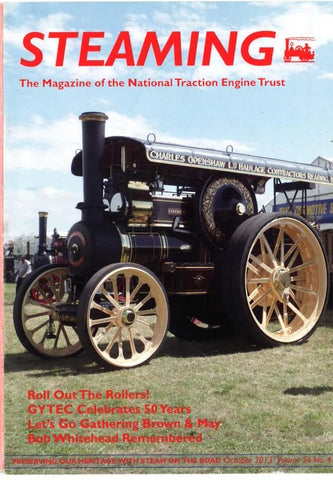
STEAMING The Magazine of the National Traction Engine Trust
Roll 04tThe .out Rollers! GYTEC Ce'ebrates 50:Yeidns let's Co Gathering Etror*ri. ok.Ma
The National Traction Engine Trust Patrons Hal Bagot JP - Robert Goodwill MP - Lord Forsyth The Rt Hon Sir William McAlpine Bt - Richard Preston - Malcolm Harbour MEP
President - Andrew Semple Vice President - Charles Daniel Chairman
Rally Organisers Section Lance Jackson
Robert Herring Glebe Court, Fnngford, Bicester, Oxfordshire 0X27 8RJ
01869 277410
Mangercon, Lea Cross. Shrewsbury. SYS 8HR 743 86009/
Vice-Chairman & Chairman, Engine Owners Section
Chair Steam Apprentice Club Elaine Massey,
Bob Siddall stud Fano 1-iou>o, Castle Hill Carlton on T1 CA L NG2i &Nix 01636 821991
21 Down Close, Northolt. Middlesex. UBS 6NS 0209 248 6570
is open to all interested in road steam preservation. Annual subscription 430 (435 non EU
members requiring Steaming by air mail). Details at www.ntet.co.uk or simply send a cheque with your name and address to the Membership Secretary
geode:
Rally Authorisation
General Secretary Jenny Holt
Bill Evans 1O Box 102. Wrexham, Clwyd. LL13 OZS 0)978 780749
South View, Hutton Roof, Kirkby Losisdale. Carriforrh. LA6 2PF
01524 271584, for 01524 271768 Membership Secretary Sue Cook. 74 Church Lane. Kirkby la Thorpe. Sleaford, Lincolnshire. NG34 9NU
01579 303160 Treasurer
Julie Smith FCA Address as below Head, Technical Services David Smith Yew Tree Cottage. 98 The Ridgeway, Astwood Bank. Redditch. Worcestershire. 696 6NA
Public Relations Officer Mike Dyson TI A! Riven. Nelson's Lanc. Haddenham. CB6 3UH
0135.3740410 V765 Administrator
To find out more please contact the Chairman - address above, visit www.ntet.co.ukisac,
John Riley 52 Mam Street Woocinewton. FEB 5E8
01780 470385 Insurance Officer Ian Cooper 141 Millmead Sutton Road Shrewsbury Shropshire ST2 6DR
01743 236558
Registered Office 4 Church Green East. Redditch Wurcestershit c 898 SST
01521 893427
Steam Sup a e Proud of our Service
iii
"What is good, is the advice we get from you"
• "The guys in the office are just great, I phoned an order in .14.1 1 yesterday at 3pm and it was with me by 9.30 today!"
"You just can't beat your service" "Nothing is too much trouble" A
au what just some of our customers say about us!
day on (01489) S70737 to see for yours www.heritagesteamsupplies.co.uk
_„49
r 2013
{Cover) Gleaming under the lovely sunshine at South Cerner is Fowler Foremost making one of her first rally appearances since being beautifully restored (Picture by Roger Mills) Above is a timeless image that could have been captured on any lovely summer's day from 1910 until when it was taken this July at Ducklington near Witney by jei Shackell, New in December 1909 Dauntless is Burrell 3464 a seven horse sing ecrank compound Traction Engine
0 Ume 56 No .1
Editor: Roger Mills 10 Sultan Road. Ernsworth. ampshire, P010 7PP tecnning@ntet.co.uk Contributions of suitable articles, shorter items or photographs are •tarmly invited. Individual tontrilautori or Copyright the NTET 2013. The opinions expressed In the magazine. with the exception of Trust announcements. are those of the contributors and do nor indicate the views of the Trust.
Copy dote for n1:10I r1Sur: Oth December 2013. ublisised by• he National Traction Engine Trust Ltd
Church Green East l edditch
orcesterhhire i 98 88T
Artwork & Design by Roger Mil!I Editorial Assistance Kev Milla, Gift Pyparti Pritned Halbrookr. Printers Ltd. Portsmouth P03
AT LONG LAST - GLORY! If you've never seen me I look like a 'refugee from the sound desk', which I suppose in a way I am having started out studying Theatre Arts in 1972. My mediocre acting skills ("Any one for..... Yes") doomed me to be a backroom boy and this suited my drinking plans admirably. But every so often some director or act would take, what I am sure was only, pity on us and insist we took a call at the end of the show. After stubbing out our fags in the fire bucket on we'd sheepishly troop, blinking in the glare of the lights we'd rigged, probably looking like a police identity parade — but grinning mightily very glad for once to have our day in the sun. Did I sense the same feeling in the wonderful line-up of rollers at Dorset? Elbows stretched, smiles polished up, chests swollen with pride. Do you know I think I did! And quite rightly so too - honest toil always deserves credit. The steam roller has always been the wallflower at the dance — yet the more you think about it the more unfair that is. Rollers were made, and worked on, longer than any form of road engine, they were fit for purpose, have an outline that is still recognisable in some modern tackle, and undertook with sterling effectiveness some pretty unglamorous and often dirty work. Some big and masculine others more feminine and pretty as a picture, all a delight. But never seemingly the star... Dorset 2013 changed that not with a hurried curtain call but with a massive space — for which other more established sections were moved — and a covered display marquee bigger than anything else on that section of the site, at least to my eyes. It'd be hard to fault the selection here, or
S1-lx 159
the numbers for each maker. Better still the uninitiated had several chances to see just what is involved in restoring a wreck, even when all the parts are there. There was too much to even give a flavour in one Steaming— but too much simply to pass over with the excuse of lack of space — so over the next few issues we'll find space for as many as possible. It was a triumph of selection for which I understand Derek Rayner and Michael Goakes are chiefly responsible. At the show end we should also thank Robert Coles, Robert Rymer and John Wakeham. I take my hat off to all of them - and Martin Oliver for making it all possible - and, while it's off, scratch my head wondering just why anybody would want to turn an honest to goodness roller into anything else. After all Prince Charming loved and valued Cinders for what she was - a lesson that perhaps needs re-learning and was well taught at South Down this year. Talking of Dorset I was favoured with some fresh insights this year - courtesy of a visitor who came along with us for his first time. To say he was overwhelmed, stunned and mightily impressed would be an understatement and I think he'll be visiting again. Listening to such an enthusiastic response made me re-examine my own feelings on the show - and perhaps especially what I'd feel if it suddenly disappeared. Yes there are things that don't appeal to all but overall, I suppose, for me when the chips are down I'd give the same answer proffered by Edward Lewis when asked why he took the penthouse suite even though he was scared of heights.
The Past During Dorset the death was announced of noted steam writer Bob Whitehead, and we carry an extensive tribute in this issue. Personally I found his writing both stylish and satisfying, his books amongst the few I can read again and again. He knew his stuff but wore that knowledge lightly, never falling into the trap of cramming in absolutely everything he'd researched. My own favourites are Steam is the Essence - described rightly as a 'reverie on steam in the landscape' and Glossops - Kings of Tarspraying. Both are required reading. The Future Later on you'll read about the continuing success of the SAC 'Driving Days', the experience of a bursary recipient and news of a welcome boost to the funds for these grants. Now is the time to get the applications in. See advert later for details. BOZ ORAM Just as we went to press we heard of the sudden death of Boz Oram. Amongst a variegated career in preservation Boz was owner of perhaps the most musical mechanical organ in preservation and a Savage electric light engine. He was also producer of an email newsletter which was always a serendipitous delight. Later, as a tribute, we include his recollections of an early family acquisition. We send our condolences to his family and many friends.
Wentlet 85.5'. Etienne (Loire). ;.% Coattipitt Mat C1-slikut
flifir 'N4
Roger Mills
THE TRUST AT DORSET There are few places to sit down at the Great Dorset, and perhaps too much to see to want to sit down! But at least the footsore and weary were sure of an comfy chair and a refreshing cuppa once again. For 2013 they were also treated to a wonderful gallery of art, three interesting engines and enough opportunities to spend a few quid to satisfy the most ardent steam bibliophile. Attracting the most interest perhaps was the Sentinel 8646 - recently returned from Canada - owned by the Lee family. Showing signs of many years of barn storage this example seemed, at least at first glance, to be incredibly complete. (There's a present day picture in Looking On and more details on the next page.) Greeting visitors was Richard Scourfield and family's Ransomes Sims and Jefferies portable 22685, a really pretty little thing that merited a bit of the limelight. Robert Millington and family presented their Bellmec Replica Savage 904. We send our thanks to the helpers listed on the 'Honours Board' below without whom as Sue Cook rightly says - all this would be impossible. Hospitality Jenni Rogerson Mary New Debra Manning Macy Manning Mary Fletcher Shirley Maidment Charlotte Keeley-Knott Mary-Lyn Hill Ian Greenhough
Val Wingate Wendy Chapman Christine Giddings Angie Head Angela Cornell Margaret Sharp Dulcie Stagg Bronwen Jones Robert Catchpole 011ie Boulton
Lizzie Chick Katie Chick Sue Page Jenny Hillary Art Exhibition John & Karen Robinson Membership Fiona Rashleigh Sales Kathy Smith
Steve Wagstaff Peter Stanier Ken Hickson Annette Ager-Fletcher General Nick Herring Chris Herring Ian Gilbert James Giddings
(Top) The very interesting
replica Savage. (Right) Complete with highly detailed information folder the Scourfield family's Ransomes Sims & Jefferies portable. (Left) Manufactured by Chataignier of St Etienne in the Loire 7nhp Compound 15-ton Roller 141 Bello was new in 1913 to Bergers of Pont-a-Mouseon. After seizure by the Germans in 1915 it remained in Belgium until 1940 when it entered enemy hands once more. After hostilities it went to Austria before ending up in The Netherlands. Owned by John Can; Meersbrook,
Sheffield since 2004, repair work has included a new axle, new wheel bearings, rubber tyres, new third shaft and bearings. All parts manufactured by M Hadfield. (Pictures by Roger Mills) 161
8646 - Some History New in January 1932 Sentinel 8646, registration number RH 4588 is a DG4P new to Spillers Ltd (the millers as those of us of a certain age will rhyme) in Hull. She then went to Bituminous Road Products Ltd of Middlesbrough who converted her to a tar sprayer. In July 1952 she was exported to Ontario, Canada by C.R.Matthews and remained there until July this year before returning in the ownership of the Lee family of Tamworth. (Another survivor that went through Bituminous Road Products Ltd's hands is DG6 Waggon 8590, now
O lnemi
tii!DDJSOROU61+ 3715 33€7 SH E Visit iiRv 6 308
the well travelled Steam Bus, which was supplied new in November 1931 to Cement Marketing Co. Ltd of London and was used for haulage purposes. In 1948, she went to Middlesbrough, was renamed Joyce and fitted with tar spraying equipment.) Below we see 8646 tar spraying for Bituminous Road Products - probably in the 1940's and bottom arriving in Canada 1952. (Pictures and information courtesy of the Sentinel Owners Club and records office Tony Thomas to whom many thanks)
Chairman's Report Robert Herring Due to the recent resignation of John Durling from his Trust posts Elaine Massey will become Chairman of the Steam Apprentice Club and Andrew Semple will take on the administration of the Voluntary Competency Schemes. Some of us would have watched the recent feature on traction engines in the "Hairy Bikers" series on television, a light hearted approach to some serious business - engines ploughing, rivet manufacturing, new gears being fitted - the sort of thing that most of the general public will be unaware of when visiting a conventional rally. Such exposure that reaches a mass audience can only be good for the movement, and there promises to be more in the future. Recently we have been in discussions with other producers who are about to embark on a series devoted to traction engines and filming is scheduled to start at this year's Steam Plough Club Great Challenge. It is nearly sixty years since the general interest started in traction engines and many changes have occurred in much that we do, but one age old item that continues to surface time and time again is that of differing standards of engine inspections. This has been highlighted yet again with several instances brought to our attention recently. Some five years ago we tried to introduce a scheme that could have addressed these concerns. At the time it was not deemed acceptable but after much deliberation the eventual outcome was the formation of the Association of Independent Boiler Inspectors (AIBI). Sadly, though, despite their endeavours we still receive these concerning reports. The question posed 60 years ago is still the same today. Does it need a failure to bring change! In responding to Allan Lloyd's column of the last edition on the subject of membership, we have to recognize part of what we are has been reshaped over that same sixty year period; inevitably profiles change as do perceptions of our role. Some of the older members are reluctant to accept change, and the younger generation has differing interests. In its heyday we spoke of overall numbers around 3,000, today we continue to maintain interest for in excess of 2,000 members, excluding Steam Apprentices who we must consider as our future, and they number nearly 400. More importantly the question must be: is there still an interest in what we do? The introduction of 80 new members so far this year it must be a healthy indicator. No way are we complacent about these facts and throughout we continue to monitor the situation. Despite these numbers it is a growing concern that there appears to be no interest from the membership
in filling the roles that will become vacant within the next twelve months. In particular the exhibition unit is in need of staff for next year and along with it an opportunity to visit varied events and meet fellow enthusiasts. Despite Allan's recent suggestion that I should try to find two candidates for the Chair, to create some form of contest, to find one candidate at the moment would be excellent. And of course with that goes the need for a General Secretary and someone to oversee the sales operations. If any member has any interest in these posts I suggest you make contact through any of the members whose addresses can be found at the start of this magazine, or better still come to our AGM in Sussex, details elsewhere, make yourself known and be encouraged by the proceedings of the day.
ENGINE OWNERS DRIVERS & CREW MEETING Sunday 19th January 2014 The Village Hall, Kilsby, near Rugby, Warwickshire CV23 8XX Commencing at 1100 with coffee from /030 A buffet lunch will be provided All engine owners, crew and other interested parties are invited to attend, whether members of the Trust or not. An agenda for the meeting will be published later on the NTET website. For more information, or if you have a particular topic for discussion, contact Bob Siddall 01636 821991 or- engines@ntet.co.uk
THE NATIONAL TRACTION ENGINE TRUST
60th ANNIVERSARY
ROAD RUN 27th September 2014 at Old Warden in Bedfordshire PLEASE NOTE CHANGE OF DATE FROM THAT IN THE LAST STEAMING
Open to full sized engines/waggons, steam cars and model engines over 4" scale. Numbers are limited to 200. Entry forms downloadable from the website www.ntet.co.uk Closing date for entries 3Ist December 2013.
163
Technical Services News David Smith NTET Insurance Disc System - Time for an overhaul? The 'NTET Disc' has been part of the NTET Safety Management System for a good number of years now. Whilst the Disc has no legal status, the main objective has been to eliminate the need for engine owners to carry reams of paperwork relating to insurance and inspection as required by event organisers. A few years ago a rule was introduced to provide protection to the owner which made the issuing of a disc conditional on the independent boiler inspector holding current Professional Indemnity insurance, and since then the 'Disc' started to become a controlling tool, albeit in a small way. In more recent times the disc scheme has moved from being a wholly manual system to being computer based with links to an internet enquiry system aimed at assisting event organisers by reducing the time spent on checking discs on engines whilst at an event. Today the Disc Scheme has become almost universally accepted by owners and rally organisers alike with some 2500 discs issued every year. Ironically during this rally season the strengths and also the potential weaknesses of the scheme have been demonstrated on a number of occasions. Due to the vigilance of event organisers and of NTET members during this season we have been made aware of engines steaming at pressures higher than that indicated on the disc or being steamed in public after the disc has expired. We are also aware of engines that have been declared by an inspector as 'zero working pressure' i.e. in need of remedial work, which have subsequently been declared as 'safe to steam' by another inspector and with no remedial work having been undertaken;
eddon S & lack
tVvec 11 t l 1. uz s inFind us on
Lonsuniables Stockists of steam and heritage consumables. View and order online at www.seddonandblack.co.uk or call 01948 780474 to discuss and place your order. 164
nothing new there then I can hear you say. There may of course be a rational reason why the second inspector says the engine can be steamed but currently that reason is not being made available to other interested parties such as the NTET or the AIBI. This type of activity exposes a potentially serious failing in the Safety Management System that makes for 'inspector hopping' and the attendant 'self healing boiler; despite much work having undertaken by the AIBI, applauded by the NTET, to establish control systems for its members. At the recent GDSF the NTET held its usual Friday night forum at which much debate took place relating to misguided owners, poor inspectors and the ongoing suspicion regarding 'self healing boilers; all of which were agreed by those in attendance to be unacceptable practices and a significant straw poll majority wanted the NTET to take remedial action. Although not a formal meeting the NTET considers the views of the GDSF forum to be important, it is after all the one place where so many interested parties meet each year. Consequently serious consideration is being given to how the Disc Scheme might be bolstered and to that extent I am talking with the AIBI and to Disc Issuing Agents. Some detractors are telling us that a third party cannot be privy to information about a client's engine that is held by the boiler inspector and therefore deemed to be confidential. I find myself wondering how a corporate inspector knows if a colleague has reported 'zero or reduced pressure' and, if that info is shared, why can't the independent inspectors do the same? Anyway the information would be minimal and not of a personal nature. The big question is do we want a safe hobby? It's a no brainer really, or is it?
t‘--1e ell 11. I tus .4
.
st
SAC On-Line membership joining and renewals More development work has been taking place on the SAC Membership Manager and we are now nearing the point where we can turn on the web based Joining Applications and Renewals process. However we have had to consider carefully what information should be submitted at the time of joining and again at the point of making payment when joining or renewing. Obviously the name and address of the new member are two important elements for those joining but in order to know when the Apprentice reaches age 21 and also to manage seamlessly the eventual but optional transition to full NTET membership the SAC database needs to know the Date of Birth of the member and therefore this information is also needed at the time of joining. Just to remind you and to set your mind at rest the work of the SAC Membership Secretary is administered under the NTET's Child Protection policy. Also to be catered for in the case of an application or renewal being made for a young person is that the name on the credit card supporting the payment will not normally be the name of the new applicant or the current SAC member. Therefore the web-based system will need to know the name and the contact details of the payee. David Collidge and Nick Bosworth are working on the design of the on-line application/renewal form and other aspects of the process and it is hoped that we will have this facility up and running before the 2013 AGM.
roller crews. If the person driving, i.e. hands on the regulator, has a Category 'G' licence then there are no additional legal requirements. (I would however re-iterate the NTET's advice that for the sake of road sense and awareness the steersman ought to hold some sort of licence, but it isn't a legal requirement). If the steersman holds a Category 'G' licence but the person who is on the regulator has only a Category 'B', then 'L' plates must be displayed when on the highway; the Category 'G' holding steersman becomes the supervisor. Things are quite different however if neither of the persons on the footplate hold a Category 'G' licence, in which case the roller is being driven illegally. Although your average policeman might not be aware of that but on the other hand should something go wrong the insurance company just might take a less than helpful view! Any injured party would be covered by the policy but whether payout for the repairs to the roller is made would be a matter for conjecture. By the way, none of the legal requirements for licences, including that of displaying 'L' plates, follow the driver onto the Rally Field. However, the organiser can make it a condition of entry. I hope I have said that quietly enough.
Boiler Explosion Insurance Cover in the Republic of Ireland As is usual I met up with a number of Irish friends who were visiting the GDSF. A good time was being had by all of course but I was amazed when some of them told me just how much they were expected to pay for boiler explosion Road Roller Driver Licences From time to time the insurance which has to be bought additionally to the subject of driving licences and road rollers crops up, as equivalent of the Road Traffic Act insurance. A second it did recently at the South Cerney event. On that mortgage comes to mind. Apparently things aren't quite so bad if your occasion a number of engine owners were having a fairly heated discussion amongst themselves on the traction engine is based on an old long lived policy but subject and I was somewhat amused at the varying new comers to the hobby, or youngsters starting on a opinions held as to what was legally required and what new policy, are faced with paying inordinate sums of money, four figures!. I was told that a small number of was not. I think this particular conversation was sparked off full sized engines but many model engines are being left by an incident where a steam road roller had finished in the shed or field because the owners cannot afford up in the side of a building after the driver had taken to insure them and no-one wants to buy them for the emergency action to avoid collision with another same reason. We have been down this road with our Irish vehicle. For the sake of ensuring that there is no misunderstanding I thought I should re-iterate the members before when they have hoped that insurance purchased in the UK would transfer into Eire or some requirements. If the driver of a road roller (steam or diesel UK company would broker business in Eire. But propelled) is driving single handed and is the holder of regrettably such options are not at all straightforward, a 'G' category licence then they are driving in if not down right not an option. My suggestion at GDSF accordance with the condition of their licence. If on was to find a way to lobby those responsible for Irish the other hand that same driver holds only a Category heritage in an endeavour to raise the profile of this 'B' licence then 'L' plates must be displayed when on problem. Any workable suggestions would be gratefully the highway. If there are two people on the footplate then things received, I can assure you. are somewhat different and not fully appreciated by all
165
Treasurer's Notes Julie Smith The accounts for the year ended 3Ist March 2013 are enclosed with every member's copy of this edition of `Steaming'. The accounts show that after transfers of £3,031 from designated funds there was an overall surplus for the year of £26,073 compared to a surplus last year of £15,902. The major contributor to the increase in the surplus for the year is the reduction in the cost of producing Steaming. The figures for the year ended 31st March 2012 included only one issue of 'Steaming' produced by the new printers. The surplus has been transferred to the following
designated funds:
Commemorative Events Fund £ 10,000 Exhibition Unit Replacement Fund £5,000 Education and Scholarship Fund £10,000 SAC Burrell Project Fund £1,000 As always the Trust is indebted to its officers and members of the General Council for the significant amount of time voluntarily spent on the Trust's affairs. It is impossible to quantify this time and effort but without it the work of the Trust would be radically curtailed.
Steam Apprentice Club Elaine Massey The most important thing to say this issue is to thank John Durling, who has given up the chairmanship of the club for all he has done over the past few years and to thank all those enginemen and crew who have assisted the SAC this year. Without your continuing support we could not exist. After Dorset we now have driving days and Burrell build days left on our calendar - I will give an update on the Burrell "Lady Sylvia" next issue.
As the new chair of the SAC I will be giving a talk to the Federation of British Historic Vehicle Club's AGM next month. This will be around the topic "involving young people". I firmly believe that everyone in the heritage movement must communicate and be able to act together in providing opportunities for young people to learn about and experience historic vehicles of all types.
Engine Owners' News Bob Siddall As reported elsewhere very successful Road Roller Special took place at the Great Dorset Steam Fair this year when 102 rollers steamed over a piece of road in the road making demonstration area. Thanks must go to all those at the Great Dorset Steam Fair, the Road Roller Association and owners who made it such a memorable event. Competency Scheme With the resignation of John Durling (see Chairman's report), Andrew Semple has agreed to take over as administrator of the Competency Scheme. I would like to thank John Durling for all the work that he has put into that scheme. 60th Anniversary Road Run The application forms for the 60th Anniversary Road Run are now available, downloadable from the website or hard copy from Stuart Gray. The successful applicants will be selected after the closing date, 3Ist December 2013. If the run is oversubscribed, they will be selected to give a fair selection of types, makes and location. Driving Course & Scholarships The 2014 Driving 166
Course will be held at Astwood Bank on 10/1 I May 2014 and the Trust will again be awarding Scholarships for this. Engine Owners, Drivers and Crew Meeting The 2014 Engine Owners, Drivers and Crew Meeting will be held on Sunday 19th January 2014 at Kilsby. Details of the meeting, driving course and scholarships can be found in adverts in this issue of Steaming. Hill Descent An experienced engine driver at Dorset, watching engines going downhill with and without loads, commented that, when going downhill, the driver should always be in control and be able to stop in an emergency. In particular, if they have a load behind they must also be able to stop the load. A further observation was the number of engines going downhill with the brake on or partially on and the reversing lever in full forward. When going down hill, the speed should be controlled by having the regulator closed and the using the reversing lever in mid gear to control the descent. The brake or the flywheel brake can then be used in an emergency or as a second line of defence.
Annual General Meeting News Jenny Holt The 2013 AGM of the Trust will be held on Saturday to vote, please 16th November 2013 at the Hickstead Hotel, Jobs Lane, ensure that you your Bolney, Hickstead, West Sussex RH 17 5NZ Tel: bring 08446932959 tinyurl.com/pwjffa4 Arrangements have current been made for members to book accommodation at membership card D. J. Wothers Engineer surveyor and boiler inspection the venue on Friday and/or Saturday nights. By quoting as evidence. If sis-vice on all typee of steam traction the code 'BK 34350' when booking the B&B rate should you wish to engines and loco type bodom oral] sizes be £155 for two nights based on two sharing; £89 for appoint a proxy • NT17,1compliant • Reports and Certificates issued on site necessary one night based on two sharing. A single supplement the game day form is on the • Internal camera inveclacin of all areas will apply. with colour monitor and recording service available reverse of the Timetable for the weekend • N.D.T. die penetrant testing myriad out and • Naillignion to insurance turn pony name Saturday Morning Visit to the Amberley Museum Report day Houghton Bridge, Amberley nr Arundel BN18 9LT Accounts A professional independent inspection at an tinyurl.com/o27sgdu The Museum is being opened at booklet. affordable price for that peace of mind 10.00 (or perhaps a little earlier) especially for the Saturday % 07815 771245 email: djwothers@hotmailco.uk An NTET visit. Please allow enough time for travelling to Evening Hickstead (20 miles by road) for the AGM. (NB The informal dinner train journey time Amberley Station to Burgess Hill - for will be held at 7.30 for 8.00pm. A vegetarian option is available on Hickstead by cab - is I hr 35 mins) See also page 173. Saturday Afternoon The Annual General Meeting will request. Dress code — dinner suits optional. Raffle be held at 2.00pm in the hotel. Formal notice of the prizes for the evening will be very welcome, proceeds meeting with the Agenda and Annual Reports and will be awarded to a local charity. Tickets are £32.00 Accounts is distributed as a separate booklet with this per person, paid for in advance, from Jenny Holt, South magazine. The names of nominees together with a View, Hutton Roof, Carnforth. Lancs LA6 2PF (015242 motion under Article 16 of the Trust's Articles of 71584 or 07774972906 ) Bookings to be received by Association will also be found in the Report and 7th November 2013 Cheques payable to NTET. Accounts. At the conclusion of the formal meeting the Sunday By kind invitation a visit has been arranged to Trust's trophies will be presented and tea, coffee and Les Searle's yard at Parsonage Farm, Parsonage Way, Horsham RH 12 4ZF tinyurl.com/ps9dfbj Full visit details biscuits will be served. In the event of a poll only current members are eligible will be given at the AGM.
BOILER INSPECTION SERVICES
NEW MEMBERS Bristol, North Somerset Mr P Jewell Dartford, Kent Mn J Ansel! Aldborough, Hull Mr A Kirk Shipton Mrs M Rockliff-Simpson Norwich, Norfolk Mr S Frost Crediton, Devon Mr N Cook Coalville, Leicestershire Mr R King Mr L Roberts Belper, Derbyshire Mr R J Robinson Nassington, Peterborough Mrs C Kinnear Farnham, Surrey Swerford, Oxfordshire Mn J Butler Chelmsford, Essex Mr R Bunn Gosport, Hampshire Mr H Stannard East Goscote, Leicester Mr N Glover Mn J Eatwell Henfield, West Sussex Grantham, Lincolnshire Mr M Gibson Bury St Edmunds, Suffolk Mr A Gilbert Ledbury, Herefordshire Mr R Vernall Mr A McIntosh Whitehaven, Cumbria Mr R 0 Holland 2259, Australia Downend, Bristol Mn J Fox Barton on Sea, Hampshire Mr S White New Ross, Ireland Mr F Cullen
Ferryhill, Co Durham Mr A Remmer Mr R Walker Chesterfield, Derbyshire Cwmbran, Torfaen Mr C Purnell Knebworth, Hertfordshire Mr C Cain Mr I Dunstan Redruth, Cornwall Kings Somborne, Hampshire Mr AS Down Mr N B Spender Basingstoke, Hampshire Leamington Spa, Warwickshire Miss K Cleal Mr A Prout Newent, Gloucestershire Colchester, Essex Mr R Murphy Carnforth, Lancashire Mr R Blacklee Bicester, Oxfordshire Mr S Hawker Daventry, Northamptonshire Mr T Attwood Mr R Bridge Whitchurch, Shropshire Mr & Mrs P Kerly Chelmsford, Essex Mn J Pinnock Thatcham, Berkshi -e Mr P Smith Corwen, Denbighshire Brigg, North Lincol.ishire Mr T Drake Mr G Townsend Southport Tullow, EIRE Mr N Tynan Burton-upon-Trent, Staffordshire Mrs J Lee Mr P Hawkins Yapton, West Sussex Leighton Buzzard, Bedfordshire Mr K Edwins Mr V Young Andover, Hampshire Mr N Jones Camborne, Cornwall
167
DORSET ROLLERS A FIRST SELECTION bedding which of the over 150 entries to cover first 1 plumped for the Coffee Pot Tandems and on this page we see, circling the playpen and parked up in the lines, Aveling & Porter Class 0 3NHP 6 tanner Buster new in 1925 and going into preservation in Ireland in 1970 in derelict condition. In the years up to 2009 restoration, by Donal and Neal O'Callaghan, included a new firebox, boiler and rebuilt gears. Opposite top is Buffalo Springfield Tandem Conqueror 7 ton roller built in 19)9 for dry roads but later used on macadam work. After some years in a museum in the USA it was imported into the UK by Preston Services and is now owned by David Wood. Completing the trio is Marshall V8 87125 new in 1933 to Norwich Corporation but apparently requisitioned for airfield work during the Hitler War. One of the many engines passing through George Cushing's hands it entered preservation in 1971 being regularly rallied from 1987 to 1998 when she was last seen at Dorset Unseen for fifteen years while under restoration by the present owners Edward and Sally Jones and 2013 sees the reappearance of this representative of a class of 2 f of this type built by Marshall of which this is the only 10 tanner surviving. (All pictures by Roger Mills)
164 •
t•
LEARNING TO SIGNWRITE - COURTESY OF THE NTET Katriona Cotgreive explains how she made use of one of our bursaries After reading in Steaming magazine that the National Traction Engine Trust were offering grants, I applied for one to help pay for a five day signwriting course with Joby Carter of Carters Steam Fair who also runs White Waltham Restoration. After contacting Kevin and completing the relevant application form I was lucky enough to be successful. I wanted to gain this skill as I am interested in steam traction engines and waggons, and as a volunteer on HMS Sultan the Sentinel waggon based in Gosport, I wanted to add the lining back on the sides of the cab that had been rebuilt and painted over the year. I also had some offers of being able to practise this new skill on a couple of other engines, so I could then be more useful as a volunteer, my engineering skills not being the same as the lads at HMS Sultan. The week started after a hectic weekend, and then a drive to White Waltham on the Sunday night to spend the week with a couple in the village that offered bed and breakfast for me and another student on the course as well. It was like staying with your grandparents, take your shoes off as you come in the door, the kettle was put on and a pot of tea made along with homemade biscuit. Monday — Day One The class started by looking through some books about fairgrounds and different writing styles while waiting for some late arrivals to the class. Joby explained about writing styles all having basics in the Roman font and having a thick side and a thin side to each letter. He told us about rounded letters actually being slightly larger than the lines we usually write. He also explained that the negative space around letters is what draws the eye, and the importance of getting these correct. Then came practise writing letters, in the roman style, on a page with pre-printed example letters already printed on and boxes to try to copy them. After corrections and assistance from Joby, we stopped practising and watched as he showed us how to set out work, and keep adjusting the letters or words until you are happy with the spacing. Then we were shown how to have sharp corners on the letters, which of course Joby made look easy (but I know would not seem so easy when I tried it!) Joby then painted a sign with 'Simples' on it to show us how to sign write S, which goes slightly above and below the guideline but needs to be balanced as well. It was then explained what your brush should look like, how to clean it properly before use (it should
170
always be put away with grease or Vaseline on) then how to clean it as it is used so that it lasts as it should and doesn't go hard and need to be thrown away. Then it was time for a break and we had a great lunch. After lunch I took some plain paper and practised writing in different styles using only 3 or 4 letter words, again Joby was able to help with questions, and help with the styles I had chosen — no signwriting for us today. Joby showed us his lining skill on a couple of the signs he had shown us earlier, and we were impressed with just how straight he actually managed to make the lines freehand. I can't imagine having that level of control on my lines. After more practise, and some thought of what we each want to actually put on our sign that we will make this week, it was time to pack up for the day. Tuesday — Day Two I practised my letters and setting out again today, as well as jotting down a few ideas for how I want to do
my sign later in the week. We saw the boards we were going to be using for our signs, so now I have an idea of the size of the sign. We were given practise boards and told to choose a palette and mahl stick ready for when we started to
unfortunately spelt lobby'! A company was trying to get business by getting him to sell brushes with his name on them for advertising, however this did not go down well by spelling his name incorrectly on the sample
brushes. Every thirty minutes we cleaned the work off our practise our painting. board and started again, this enabled us to keep practise Joby did a second coat of paint on the signs we saw same practise board before the paint the using on shading some put also him start yesterday, and he the brush and palette, this another sign that we saw him star. It has made the sign hardened — we also cleaned and stops the brush order good in everything keeps look quite different from how it started - very effective. the day practising spent I useless. and stiff going from bits fancy (the serifs Joby drew up an alphabet with them then cleaning painting words, or letters writing painted and font) Roman the in example for on letters, it throughout the day. This was to get us all to use the everything and starting again. I ended the day looking forward to day four as we same type of script by practising using a brush by be starting our own signs which will have to be should could We boards. practise our on 'CARTERS' writing last day of the course. wipe out the letters and try again if we did not quite finished on Friday as that is the see what everyone to interesting be to going was It see get them right first time. We were also be able to up — I know what end they how and sign their for does go we as shapes and angles different how Joby gets the could ciange. layout the but mine, words I want on along. the end of the at house the to back got we When I spent some time practising a couple of the letters going out for were they us informed owners the day, on need, would I than size smaller needed, in a slightly to let ourselves in with when my practise board, and then started to mark my board the night and gave us a key where we had been going up with a chinagraph pencil. The letters are to be 4" we got back from the pub, meals. evening our for to largest the and 1/2" high, with the smallest side being After having our dinner we made our way back and being I ". I started to check the spacing of my letters in, only to hear — beep beep beeeep — the ourselves let but by the end of the lesson had too much space at one set and we had set it off without been had alarm too letters the had end of the board, and the other end to reset it. The external alarm then code the knowing added then and off letters the wiped I so together, close we were... Door open, keys in there and the top and bottom lines back in ready to have another sounded, sounding. alarm and hand go tomorrow morning. A neighbour arrived and after explaining who we Wednesday — Day Three have the code either, but would I had my second attempt of marking out 'CARTERS' were, said he didn't for us and to go back to the owners the contact to try and then painted the letters. I also had my mahl stick warm. keep to pub all. of first well very it use didn't so in the wrong place After about an hour or so we had heard nothing, You have to pretend you have a football under your that they would be home soon, as they had thought but arm to get the initial angle correct, but then move the up and going to bed by 2230 every night locking been the down hand right your stick and left hand/arm, not not be out late, so stick! Joby makes it look so easy, but he has been doing so far, and we reckoned they would back. headed it for some years now, and had a proper apprenticeship. we Unfortunately it was not to be, luckily we had a set I am using a number six brush with Joby's name on it, 171
of car keys so we took refuge in our car and started the engine to keep warm, we finally got in when they arrived home a bit embarrassed at 2315. It made a night to remember. Thursday — Day Four After having a laugh about the previous night's events, I practiced drawing and painting 2 — 3" letters, and laying out the words for my final sign. Joby gave me some feedback on the layout I had planned for my sign, and suggested that we could draw our sign layout on paper to then chalk onto the final boards if we felt that was easier than using the china graph pencil straight on the board (as we had found that the china graph sometimes left tell-tale signs of where it had been). I felt the paper plan was my best option so I started to layout my sign across two sheets of A3 paper, which was amended after more advice from Joby. My last task of the day was to choose the board for my sign, chalk the back of the paper that my layout is on, tape the pages to the board and trace the design onto the board. I have left the paper on the board in the hope that it stops anything altering it before I get to it on the last day of the course. Tomorrow I need to choose the colours I want to use, with some advice from Joby, and then to start to paint. Once the words have been completed I will need to consider what else
to do with the space on the sign to add to the overall effect. Friday — Day 5 First task today was to take the paper off the board to check that the words had transferred over legibly; yes they have, if fairly faint, they will do. I painted 'Neil's' in Royal Victor Green —'Pop Pop' in Orange Chrome — 'Boats' in Light Saxe Blue. What to do when these are dry? I saw someone else in the class use Cardinal Red paint on their sign and decided that would be a good colour for me to back shade 'Neil's', but while the green was still tacky Joby suggested I use the Light Saxe Blue on the 'Pop Pop' words as I said I wanted to back shade these, so I did that while waiting for the green to be ready. I Just had time left for the cardinal red back shading on 'Neil's' and that was all I could do. What a great week, I now need to finish this sign at home once I've decided what else I would like to do to it, and buy some lining brushes so I can practise that as well as that is something I need to practise to be able to put the lining back on "HMS Sultan" Sentinel waggon cab sides. Thank you NTET for allowing me a grant towards the costs of this course, it was well worth doing. I learned a lot in the five days, and I would recommend it to anyone interested in signwriting.
Nt;11's QTY o NTET DRIVER TRAINING SCHOLARSHIPS The NTET is awarding Scholarships to parlicipale in the NTET Driver Training Course which is held in May each year The Scholarship caws 11w course fees for one year. hut incidental such as travelling. accommodation and food. The scholarships are open to non-engine owners being members of non-engine owning families. who are members of the NTET.
For more details of the Scholarship and Course, visit www.ntet.co.uk 172
Museums & Collections
If you're quick you can still arrive at Amberley Museum via a country railway station where the ting ting of the block bells rings out, the shadowy figure of the signalman moves to respond - at a unique LBSCR 'knee' frame - and the clang of the semaphore arm breaks the silence. A linger here on summer days is a pleasure but one shortly to be abolished by the march of the multiple aspect as the Mid Sussex line reaches mechanical controlled capacity. The walk to the
()Learning
museum takes you on the curved alignment of the long siding that once linked Pepper's Lime Works with the main line and once inside the gates it's obvious just how much was quarried and processed here. Which I suppose is why the original name was the Chalk Pits museum. It's been a favourite of mine since I moved down to the area offering a wonderful mixture of industrial archaeology. This ranges from the printing shop, where 173
Don Beech once benevolently presided via the nearby line shaft powered engineering workshop to the recently restore massive de Witt kilns where lime was burnt on an industrial scale. Over the years all sorts of additions have been made, some through the innovative Manpower Services Commission Job creation schemes in the eighties which saw several buildings constructed. There's a typical country garage, a couple of Southdown Motor Services structures nostalgically familiar to anybody who lived in SMS territory where stops were invariably for 'omnibuses'. A large area is devoted to roadmaking equipment, there are reconstructed workshops for a number of trades as well as craftspeople who actually wok on the premises. A narrow gauge railway links the ends of the large site which is also provided with a network of roads,
and there are lengths of standard gauge track, as well as the recently reconstructed mineral monorail system. Part of the BT collection is here in the Connected Earth Gallery, while another hall tells the story of electricity supply with an enthralling collection of early domestic devices. Here too are sections of the remote control equipment introduced when the Mid Sussex was electrified in the thirties. Elsewhere are a vintage radio collection and a timber yard with its own steam crane. Several road steamers are resident, including West Sussex County Council's roller, Marshall Oman and the recently acquired Aveling. Large and small stationary engines, including a domestic power plant with battery back-up are dispersed around. Vintage buses provide service round the grounds. Allow at least two hours for your visit and don't forget to sample the ice creams. (Photos by Roger Mills)
HOWARD STENNING
personal link between the exhibitor and those listening. Long will we remember his delight and infectious laugh as he interviewed or recounted stories of the exhibits. The director of the Amberley Museum until 2008, he still found time to commentate at many rallies including the London to Brighton Veteran Car Run at Crawley and Historic Commercials Run at Brighton. Although not an engineer he did own a number of veteran bicycles and several motor cycles. In the steam world many owners were very willing to let him assist or drive their engines as were car and motor cycle owners; favours he greatly appreciated. Howard died the day before the annual Wiston Rally where he was due to commentate. On the Saturday a very moving minute's silence throughout the site that concluded the grand parade was followed by a fusillade of whistles. The venerable Marshall 14242 of 1886, which held special memories with Howard's family, conveyed him to his funeral held on the rally field of the Weald & Downland Open Air Museum at Singleton on July 30th. Brian Johnson.
The South East road steam fraternity lost a popular colleague with the passing of Howard Stenning in July. Probably best known for his informative rally commentaries on all types of historic road vehicles made possible by his forty five years experience in the subject. He also engaged in a wide range of other activities. Born in Maidstone in 1950 he grew up visiting rallies in Kent and became fascinated by older vehicles. Although initially interested in early cars and motorcycles by the time he joined the Southern Counties Historic Vehicles Preservation Trust in 1969 a strong interest in commercial and steam vehicles was developing. He quickly became involved in their steam rallies and soon became editor of the Trust newsletter. Howard had trained as a teacher so his skill in explaining facts to others, and an impressive recall of information about engines and vehicles soon involved him in providing commentaries at events. In September 1981 he joined the Amberley Museum as deputy director and education officer, the ideal person to interpret and demonstrate early buses, motor vehicles and steam road engines to visiting school groups, and soon became well known among Sussex engine owners attending the then major rallies at Parham, Ardingly and Hadlow Down. At all of these events he used the commentary to engage with the owners to make a 174
JAMES DOHERTY 1925-2013 The ranks of men who worked with steam engines for a living has grown smaller still with the recent death of James Doherty of Randlestown Co. Antrim N Ireland. James was the eldest of a family of six born to William and Mary Doherty in the village of Loguestown about a mile south of Portrush. James always had an interest in anything mechanical and from an early age took a keen interest in the many steam rollers and traction engines that were part of everyday life in the twenties and thirties. He always had an ambition to own a steam roller and this he duly did in later years when he acquired Aveling & Porter Type AF Compound 14007 from 1930 which he restored and rallied for many years. Another wish he had was to compete in the North West 200 motor cycle races, as it was the only sport he was ever interested in. Alas this did not become a reality as the Second World War put an end to this and, when racing came back again, he was away at sea. A visit to the Destroyer HMS Wessex when moored in Portrush Bay and particularly sight of the engine and boiler room fascinated him and he decided
G uenaii
that when he was old enough he'd join up. However when GEARS UP TO eft ein DIA the time came SPUNED SHAFTS UP TO 2511 LONG and he went to Broaching and Wining - Spurs , Recite, Helicals Belfast for the Worms and Wheels, Bevels - Straight and Spiral Stock Gears and Splines medical he failed Wire Culling - Gearbox Rebuilding and so joined Specialist Supplier of Gears and McCaghan's Splines for all Vintage Vehicles Garage where he and Traction Engines served his time Telephone Mike Horns* LLEWELUN'S GEARS as a mechanic. KING SQUARE, BRISTOL B332 tk1J he Later TEL: 0117 942 40211 to went FAX: 0117 923 2028 Fleetwood and Infaensweinna.aa.uk Web: wvAv.lhavanins.co.uk got a job as an apprentice fireman on a fishing trawler and so began a life at sea in ship's boiler rooms and later as a marine engineer on steam and diesel. When he retired from sea he worked as Engineer/Driver on the Shanes Castle Railway and when it closed he worked with Rory Woolf Engineering at Ballymena on steam restoration for many years. A true man of steam and to his sons and daughters we offer our deepest sympathy.
(HETHERINGTON OIL CAN COMPANY)
AO
1 LITRE OIL BOTTLE
PINT POURER
C1:1 11 11111 ALSO AVAILABLE FROM SEDDON & BLACK... 1 LITRE POURER
TEL: 0044 (0)1938 850 393
10 PINT OIL BOTTLE
EMAIL: enquirie s @he theringtonlamp.co.uk 175
FOUR Ir:ROM PAUL BISHOP The editorial stock passed on to me two years ago now contained a number of pictures from the camera of Paul Bishop which deserve a wider audience and, given the time they've been on the shelf, preferably all together. Top left we see Burrell 2336 Stanley Monarch. a Single Crank Compound 8 NHP dating from 1900 at the Astle Park event in 2008 while below is Wallis Simplicity 7936 Pepperpot at Malpas in 2010. Above is another Burrell 3218 Cromwell a 7 NHP again at Malpos in 2008 while the quartet is completed by 1928 Fowler BB roller Stitch at Marcie Steam Rally in 201 I.
It was 48 years ago today..... Roger Mills looks back to the year of UDI and Betamax... 1965 was the year when Ian Smith declared Rhodesian independence unilaterally, the first commercial geostationery commercial satellite Early Bird was put into orbit and, believe it or not, Sony introduced the Betamax 'videocorder' which led eventually to Japanese domination of the video industry. No use in seven US States and Ontario on November 9th though, when the worst power failure in history affected 30 million people in an 80,000-square-mile area - reputedly there was a birth rate explosion nine months later. It was a big year too at that famed storehouse of preservation the Ferndale Road yard of R Edwards and Sons Ltd Showmen and Scrap Dealers. In January they advertised for sale parts of a 7 NHP 3 speed Burrell including back wheels on rubber, axle bearings and front crane. They were also dismantling a six horse Burrell Devonshire type. So rich was the variety that, later in the year, the firm were forced to place a guard on the premises following thefts, including a complete crankshaft and flywheel, from engines stored there! In March 'Young' Bob Edwards announced that they were restoring Earl Kitchener stored for 30 years. It had not deteriorated much in storage, he said, the biggest replacements needed had been a set of boiler tubes and a new firebox door. As soon as the snow had cleared away she would be sent for steam cleaning Scrappers or saviours? A bit of both of course. The five Edwards brothers all but Jim in hats, naturally, pose in front of an Armstrong Sourer (l-r) Charlie, Young Bob, Albert, Frank & Jim. (Frank Edwards Collection)
prior to a complete repaint. Asked about their three abreast he said they were safely packed away under cover. The family had no plans out bring them out but: "You never know. No money could buy them!" On an autumn visit to the yard Ken Miles of Charminster and Jim Lewis were told that Progress would be restored when the work on Earl Kitchener was finished, Lewis commenting: "An hour or two is too little time to see the many rare and various makes and types of steam engines to be seen at this depot." Seven horse 3651 of 1915 Earl Kitchener was supplied new to Edwin Hill and Sons, Haulage Contractors and Brick Manufacturers, of Swindon so was probably familiar to Bob and the boys who would have seen her working round the town. Yet Bob came to hear of the availability of this engine purely by accident. His eldest daughter Dolly was visiting Oxford St Giles fair in 1923 and called in to see Micky Nichols. In the trailer was Sidney Harrison, who was attempting to sell his host 'a very nice seven horse Burrell that's available in Swindon in a timber yard'. On hearing this tip-off Bob knew that there were only two possible locations. Barnes had none for sale so he went to Edwin Hill's yard and bought the engine when it returned from a job at 12 midnight. The family transformed her to full showman's style, but with chrome rather than brass bright work, for ease of cleaning. When fully restored she appeared at a number of rallies and some of their larger fairs. The author can remember Young Bob and Fred Smith driving her around the recreation ground Tetbury, much to the consternation of the groundsman. Mike Dyson recalls her at Salisbury when he was on a late 1960s visit with Archie Parrish.
Earl
Kitchener
appeared at the Stratford, Warwick and Tewkesbury Steam Fairs, but was stored again in the early 1970s and was sold at the 1987 auction (a sale needed to finally settle the estate of Bob following the death of Jim Edwards) to Keith
178
Service (now Radio 4). Called Blaze Away it several featured recordings made specially at the St Albans Organ Museum. Elsewhere Brian Oram announced that his Gaviolli La Cascade raised £66 I 5s 3d in Whitney Square including £1 5s 3d collected during a short programme of hymns. Today's money? £530. Perhaps it was all this activity that led Edward Hine, of Great Yeatmans Shaftesbury, to advertise for an '89 key Marenghi Scenic or similar. Price (Above) Ear! Kitchener while working for Hills of Swindon - a firm still in existence but immaterial if good.' showing the wrong Kitchener on its website the last time I looked! (Below) Earl Kitchener Alternatively he could is at the left of the line-up in this W Butt shot with Progress and Starlight, all of course have picked up a 1954 now in preservation (Frank Edwards Collection) Leyland Octopus for £375, (£2977) a 75x40 Lang Emmett and thence to Dave Corbin and Sons who Wheels Speedway with 8 cars for £1000, (£7940) a repainted the canopy sides to read 'Golden Gallopers Scammell showtrac 'would make good breakdown lorry for garage' no price given, or make an offer to West on Tour'. Major repairs and a complete repaint were carried Oxfordshire Technical College for a compound steam out by her present owner David Fowler of Tadley who generating set which would go for scrap if not sold. What motivated a group of sixth formers from has fitted front canopy boards reading 'Edwards Mirable Visu' just as she carried in her working days Bolton School to buy a steam roller isn't known but and, Frank Edwards tells me, is also replacing the brass apparently in 1965 they paid E60 to save one from a dynamo cover that was on the engine during working scrapyard. On a January Sunday this was driven in convoy to Parbold, the home of some of the boys, in days. From one stalwart firm to another. Victor a ten hour journey. If any of these intrepid spirits is Chiappa's 20 page catalogue of over 1000 tunes in 98, reading this - details please! Later in the year four year 89 and 87 key sizes, marked the end of an arduous old Mark Riggal was pictured on Mary a roller brought, project to rebuild stocks after a wartime arson attack on the night he was born, from Cheffins at Croft near on the works. He'd been greatly helped by showmen and private collectors who loaned books for copying. Chiappa's were overhauling an 89 key Gavioli for Mr A Reed of Amersham who planned to incorporate it into his Walker Gallopers replacing the '46 keyless Bruder he's used to date.' Dennis Chapell imported an 84 key organ purchased from Grymonprez to accompany his preserved, ex T Whitelegg and Sons, Burrell 371 I . Organs featured in a special BBC Bank Holiday feature programme on the Home
JON -
-
r'•
-;;,; . _
179
Allchin 3251 and a Wallis and Steevens Advance Roller were owned by D Eastwood of Tonbridge. The West of England Steam Engine Society's Sinns Barton Rally saw it's Grand Parade led by Jack Archer (Dennis Folwell) and featured GR Gillbard's Marshall 38024 Cressing Temple and BH Broad's Garrett The Chough. Wilkinson Jack reported the glories of (Above) Burrell 3711 King o the Belgians seen at Ashcross rally near Taunton on 24th July the old time steam fair 1965. New to SD Melluish of Chard for heavy haulage she went to Thos Whitelegg in 1921 and at Castle Howard but was converted to showman's form. Bought by Dennis Chapel! in 1955. (Below} Garrett tractor he criticised the The Chough in showlond form when owned by BH Broad (Pictures Roger Mills collection) expense of getting there and the Skegness for £30. It was during this year too that Viv admission, adults 4/- children 2/-. (£1.58 & 79p)And if Kirk purchased for preservation the old scenic railway that makes it all seem a long time ago what about the loads that had been laid aside for many years at Barry show line in the fair? Alf Testo's Flea Circus and island. Jim Sarney took delivery of a Southern Monkey Show, John Whites Boxing Pavilion and rat Girl mollycroft waggon decorated by Bertie Locker of and Leslie Wright's Mouse Circus! So near in time - yet Whitney which had been home to Henry Gammon for so far away. twenty years. Talking of stalwarts 1965 saw the sudden death of Old Timer, one the engines that started it all, was Frank Mellor, editor of the Worlds Fair, in October. to have a new look after a complete re-paint and other Tributes were rightly paid to his journalistic skills and work at the Durrington firm James and Cockerel!. coverage of show business (that's not a mistake by the Another visitor to Durrington was Chris Edmonds' way) but as editor he also gave preservation a means Princess Royal. 'Trouble which kept the engine out of of communication, proper press recognition and a the parade at Appleford proved to be more than was forum that has served it well. first thought and a new firebox, tubes and smokebox are required.' Coronation Street's femme fatale Elsie Tanner (Pat Phoenix) opened Pickering Rally before touring the arena on Burrell Cock 0' The North driven by Jack Wharton. While `me old pal me old beauty' Walter Gabriel of the Archers (Chris Gittins) did the same for Detling which saw 24,000 through the gates. Most of the engines entered here, Burrells 3285 & 3941, Fowler 9456, 180
ntetshop MAIL ORDER - ONLINE - RALLYFIELD TRACTION ENGINE READING NEW Traction Engine Design & Construction A reprint of the Geoff Gilbert classic WESES Photo Collection No.I All the Way From Engine Lane (Moore) A delve into a family's working history Aliens of Oxford (Jonathan Brown) Brown & May Ltd (Bedder) 50 Glorious Years ("Cosses") The story of the County of Salop Rallies Preserved Steam Powered Machines (Hanavy) Threshing Days (Alderson) Traction Engine Museum Guide Herberts of Dorchester The story of a show family and their transport The Steam Age Interesting, surprising and little known facts The Great Dorset Steam Fair Images from 1989 to the present day Traction Engine Register Threshing Machines (Trevor Gregory Classic Commercial Vehicles (Ranieri Traction Engines - Preservation and ower (Stratford) Steam at Southbrook (New Zealand) t-233:00 I worked with Traction Engines (Hampshire) (Reprint of 1967 edition) The Story of the Invicta Works - a history of Aveling & Porter (Lane) £27,00 A Life with Steam (Challis)
E45.95* £16.99* £17.50* £27.00* £32.00* £19.50 £9.99 £9.99 £8.50 £8.50 £9.99 £14.99 £8.95 £27.95 £19.99 £19.99 £19.00 £7.95 £30.00 £25.00
£9.95 Best of the Tests (Dyson) Driving and Operating Traction Engines (Dyson) £25.00 A Good Mixture Road Locomotive Society Archive series. {17.00* The Traction Engine Archive (Willcox) £26.00* illcox) The Traction Engine Archive, Vo1.2 £22.00* The Traction Engine Archive, Vol.3 Meredith) £7.99 Industrial Revolution Explained (Yor e) Pictorial Albums E5.99 (Ranieri) Burrells of Thetford E5.99 Aveling & Porter of Rochester (Ranieri) £5,99 Fowlers of Leeds (Ranieri) £5.99 Garretts of Leiston(Ranieri) DVDs £13.50 The Stanley Steamer (78 mins) Garrett Portable and Fixed Engines (Whitehead) £10.00 (Book in CD form) arrett Threshers and other Machines (Whitehead) £10.00 (Book in CD form) CLUB ITEMS Magazine binder for 12 copies Vol 24 onward) £7.25 £7.00 Magazine binder for 12 copies up to Vol 23) £2.60 NTET Members adge - members only £2.95 NTET 2000 showman's badge (boxed) £2.95 NTET traction engine lapel badge (boxed) £2.95 NTET Foden wagon badge ('indicates price includes part p&p) To claim UK post free purchase, just do the following *Write your name, address, and your purchase order. *Enclose your current NTET membership card. •Make cheques payable to National Traction Engine Trust •Send your order to NTET Sales, 90 Devon Road, Luton LU2 ORL Card purchases (£10.00 min) available on 01582 733971 Non-members/non UK members add 10% for postage See the full sales list on the Trust website: www.ntet.co.uk/sales-Iists.html
The NTET is an organisation with a mission statement
'To Preserve Our Heritage With Steam On The Road' To accomplish this many disciplines and skills are required. To achieve this aim the NTET as a registered charity will assist and promote individuals or group of individuals to learn more about the various disciplines and skills required to operate, maintain and understand road steam by way of contributing funding for them to attend courses, work alongside specialists, or any other type of event which will assist them in furthering their knowledge. This funding will be offered to both members of the NTET and the public upon application to the Education Funding Committee. The type of activities the committee will be looking at, but not limited to: • • •
Boiler maintenance Boiler management Boiler inspection
• Sign writing • Welding • Fabrication
• Lathe and millwork • Hand metalwork skills • Pattern making
The list is not exhaustive and any application will be considered which shows that it informs and educates about Road Steam as in the mission statement. An application form can be obtained by email from Kevin_steam@yahoo.co.ukor write, including a S.A.E, to Mr K. Munn, 56 Blacklands Drive, Hayes End, Hayes, Middlesex UB4 8EX Applications to be received 31st December 2013 181
iin tA,T,
%tlifIRTHDAY
- v6, moo.. 114,111111111111111119 oral.
•
4+-
•
, (Above) Paul Dun fords new Burr:ell fkiller roaded to Duncombe from Thirsk, hovin come through the gates. (Below) Yorkshire 1: climbing Newgaie Bank with Scamm&Is following. —
•
I 11
4
The Great Yorkshire Traction Engine Club celebrated its 50th anniversary in fine style with a 22 mile road-run from the Stokesley area to the site of the annual rally at Duncombe Park, Helmsley on Friday 5th July. Starting out from both Richard Preston's yard at Hutton Rudby and the home of club chairman Mike Gaines-Burrill at nearby Potto Hill Farm at around 10a.m., the participants made their way along the easy going roads in the lea of the Cleveland Hills to the market town of Stokesley where after traversing the busy High Street they gathered on the showfield, where what is reputed to be the country's biggest one day agricultural show is held in September each year. After taking water the opportunity was taken to photograph most of the engines together before setting out along the B1257 towards Chop Gate with the prospect of some spirited running in store on the route. The first major climb was that of Clay Bank south of Great Broughton, Ian Thompson's Foden 13218 Cestra and Gary Scott's Sentinel DG6 8351 got a head start on the rest and were well away by the time the main group reached that point, first of these was Burrell 7 NHP showman's Lightning 11 in the capable hands of Richard Preston's grandson Jamie. Hard on its heels were Burrell scenic 3888 General Gough and Ed. Wright's Fowler road locomotive 14893 both working very hard. The scenic was to pay the price as upon reaching the summit it was found to have a fair bit of water entering the firebox from leaking tubes, so its journey had to be completed using a low-loader. Next at little more steady pace, came Graham Atkinson's Burrell His Lordship which was followed soon after by the first of the Ward family's two splendid steam wagons, Standard Sentinel 1488 of 1928 taking things very much in
"MI e
Tr ,? itt-fr y-
General Gough and Fowler 1 4893 on Clay Bank
its stride making the climb with little apparent excess exertion. A second engine from the Scarborough Fair collection Fowler R3 showman's The Iron Maiden was next up the hill sounding really well. Unfortunately it was having problems in getting water into the boiler and would also continue to Helmsley on a low-loader from the top of Clay Bank. Last but by no means least was the Ward's second wagon Yorkshire 117, this was also encountering some difficulty with what turned out to be a worn valve seat on the water pump meaning it wasn't working as efficiently as it should have, this becoming particularly obvious when working harder so requiring stops to manually transfer water to the boiler. However Andy Ward and his crew persevered and in a race akin to the tortoise and the hare with His Lordship which was having steaming difficulties due probably to poor coal, the gutsy little Yorkshire was to reach Helmsley first. A convenient lunch break was had at the Buck Inn at Chop Gate before continuing along the undulating road amongst the scenic splendour of Bilsdale before taking on the even steeper climb of Newgate Bank at the head ofthe dale, where a good number of people had gathered to witness the spectacle. Lightning II had been having some problems with a tight bearing with sustained running and the warm conditions , meaning it had to pull up several times to allow things to cool down. Once the second big climb was over and some of the engines had taken on water, 2 Scammells and a truck acting as tenders, it was a relatively easy run the last few miles down into Helmsley. A further group of engines also roaded in from the Thirsk area, although they seemed to have a smoother trip with no problems encountered, before they converged at buncombe Park.
(Above) His Lordship in Stokesley High Street (Below) Scott's Sentinel DG6 in Bilsdale
Wu] 11 Tau Ern A QUARTERLY MUM' FOR POWER USERS THE MAINTENANCE OF FUSIBLE PLUGS FOR STEAM BOILERS (1951) The most frequent cause of damage to steam boilers is overheating due to low water conditions. This has been so since the mid 1880s when the various types of cylindrical shell boilers in present-day use began to assume their modern form. The rate of such incidents has not decreased through the years, and in fact, of late has shown a definite increase. There is, of course, little excuse for loss of water in a steam boiler, a vessel normally containing latent energy which if released without control is capable of creating catastrophic damage. Accidents due to low water cannot occur when the water gauges are kept in good order and are kept under efficient observation, but in spite of all precautions the fact has to be faced that such accidents do take place, and in consequence it is only wise that additional safeguards should be fitted to act as a warning of low water conditions, and to mitigate the severity of the consequences as far as possible. With this end in view, two distinct types of apparatus have been developed and have been in use, for many years, namely the low water alarm and the fusible plug. The value of these devices was recognised in the 1937 Factories Act which, for boilers coming within the provisions of that Act, stipulates that either a low water alarm or fusible plug should be fitted. In general it had become the rule more and more since the advent of this century to fit boilers of the Lancashire and Vertical types with either, and in fact, more often than not, Lancashire Boilers are equipped with both of these
Fig I A collection of defective fusible plugs
184
mountings, so that the 1937 Act merely legalised what had become common practice. The first mention of a boiler fusible plug that we can trace is in connection with one of Trevithick's boilers made in 1804 in which the safety appliances were described as follows: "the mechanism for ensuring the safety of the boiler is to be a safety valve loaded with a weight equal to the pressure the apparatus can sustain. A plug of lead or other metal inserted into the side of the boiler, which will melt when the water is heated to a certain point or when it may have fallen below the assigned level..." It will be noted that this fusible plug was incorporated not only as a provision against shortage of water, but also to give relief in the event of overpressure. Throughout the years following Trevithick's age, fusible plugs fell out of favour due to the difficulties encountered with increasing pressures and the lack of a suitable alloy to withstand the correspondingly increased temperatures. Fusible plugs were reintroduced and fitted, to the furnace crowns of Lancashire boilers about the year 1880, and consisted simply of a lead rivet, or of a bolt, with a hole drilled down the centre into which lead was introduced and riveted over. Considerable ingenuity and experiment were expended in improving this device during the succeeding years, as will be observed in the heterogeneous equipment shown in the photograph Fig. I taken in 1908. Not the least disadvantage of such plugs was that if and when they did function, the rush of steam through the plug was so great as to often result in the fatal scalding of the boiler attendant. An example of a modern plug is given in Figs 2 and 3. The basic design of this plug was evolved by this company (The Vulcan Boiler & General) in 1904, and has proved so satisfactory that little modification has since proved necessary. This plug when functioning, allows steam to escape into the furnace as a regulated spray, checking combustion and giving warning of water shortage. The plug seen in sectional view in the illustrations (Figs. 2 and 3) consists of four parts :I. The brass shell which is screwed into the furnace. 2 The serrated brass cone screwed into the shell. 3 The serrated copper pendant. 4 Fusible alloy. The serrated Copper pendant, as will be seen in the illustrations, is embodied in the fusible alloy attached to the serrated brass cone, and
(4) FUSIBLE ALLOY (21 SERRATED BRASS CONE-IR
(3) COPPER PENDANT
(I) BRASS SHELL -I. WEB
FURNACE PLATE-RE
1.
Fig. 2—Section of Complete Fusible Plug showing component parts.
this combination is screwed into the shell. The stem or underpart of the serrated copper pendant has a spherical end which practically closes the entrance to the cavity of the shell over the fire. The copper pendant acts as a conductor for transmitting the heat to the fusible alloy and the spherical end tends to protect the shell cavity against accumulation of deposit from the fire side which might otherwise form an incrustation and prevent the cone from dropping. When the alloy fuses, the copper pendant is not blown into the fire, but after dropping a certain distance is held suspended on the radial webs in the shell, while at the same time a free-way is provided for steam to escape. This arrangement of suspended pendant serves a particularly useful purpose in the case of Lancashire and Cornish type Boilers when, as sometimes happens, an empty water gauge is mistaken for a full one and fires are lighted without sufficient water in the boiler. In such circumstances the alloy would melt and the copper pendant would drop on to the webs of the shell leaving its stem projecting into the furnace. When the boiler attendant inspects the fires the projection of the stem should draw attention to the abnormal conditions. It will be appreciated that in common with other boiler fittings, the fusible plug should be maintained in good working order, and should not be neglected as is so often the case. The nature of the fusible alloy and its melting point are adversely affected by prolonged service, and in order to ensure efficient operation, it is advisable to renew the alloy at least annually. It is not uncommon for the Surveyor at the thorough examination of a boiler to find the cavity on the bottom fire side of a fusible plug to be choked with a solid mass of matter deposited by the combustion products. For types of plugs not fitted with a projecting cover such as detailed for the plug illustrated in Fig. 2, rapid wasting of the fusible alloy may be developed by the
3.— Section of Fusible dropped Pendant and Stem the Furnace after alloy
Plug showing projecting into has fused.
presence of such deposits resulting in early failure. Furthermore in the case of a boiler becoming short of water, it is improbable that a plug so blocked would function, as such deposits have great tenacity and would effectively prevent the boiler contents forcing a passage through the plug in spite of the molten alloy. A similar state of affairs may develop if a hard impervious layer of scale is allowed to build up on the water side of the plug. Occasionally reports are received of leakage having taken place from fusible plugs, or of these having operated without other evidence of low water conditions. In such cases it is usually found that the plug central fitting has dropped slightly, indicating that movement of the fusible alloy has taken place. Once this has occurred, actual leakage may commence at once owing to a path having been opened up between the component parts of the plug or, if the water conditions are unfavourable, chemical attack of the alloy may be rapidly initiated or galvanic action may commence. Slight movement of the fusible alloy may be occasioned by the plug being subjected to excessive mechanical or thermal stresses which may arise from a variety of reasons. The alloy of a fusible plug is normally designed to fuse at a temperature of from 550 to 600°F, and under working conditions is subject to a shearing load dependent on the boiler pressure and the area of the movable parts of the plug exposed to this pressure. At elevated temperatures the alloy will creep at a rate increasing with its temperature. In furnaces subject to forced firing conditions, or if the area of the furnace in which the plug is situated is subject to local flame impingement temperatures higher than normal may be developed resulting creep of the plug alloy. Under such conditions it will be necessary to renew the plug at more frequent intervals than would normally be necessary. High plug temperature, may also be caused by the blanketing effect of sludge; by high density boiler water due to dissolved salts, or by scale deposition.
185
The presence of oil or grease in the boiler water it not promptly eradicated is certain to result in maintenance difficulties. The fusible plug standing proud of the furnace is usually one of the first lodgement areas, and if the plug is enveloped in a greasy film, high temperatures may quickly result. On the other hand, such an impurity may first reveal itself by local furnace deformation which not infrequently is at once attributed to low water conditions, particularly as the overheating of the furnace usually results in evaporation of the grease deposit. A case of this kind was recently investigated after a complaint had been made that low water conditions had caused local furnace deformation without the fusible plug having functioned. A metallurgical examination revealed the plug to be in perfect condition and the suggestion of the presence of oil in the feed water was put forward but strongly refuted by the engineer in charge. Eventually a detailed examination of the feed supply revealed that in fact oil was entering the system, and there is little doubt that this had been the cause of the trouble. Erratic firing or iced water supply conditions with consequent fluctuating or excess thermal stresses imposed on the plugs may also cause early breakdown. In some works, for example, it is the practice to dispose of highly inflammable waste in the boiler occasioning short but frequent, periods of high local furnace temperature. Similarly banked fires may result at times in excessive local temperatures, due to the formation of static steam bubbles consequent on the absence of normal circulation and damage to ensue either to plugs or furnaces An interesting example of the effects of rapid temperature variation was recently revealed by the repeated failure of the fusible plug situated in the right hand furnace of a Lancashire Boiler, whilst the plug in the left hand furnace operated normally. The trouble was eventually traced to an internal feed pipe which allowed the incoming cool feed to play directly on the right hand fusible plug and this matter was rectified by a minor modification to the feed pipe. The design of many boilers is such that the fusible plug crowns are only a short distance below the working normal working water level, and load changes may expose the plugs clear of the water for short periods with consequent excessive temperature variation in the plugs and ensuing frequent failure. Locomotive type multi-tubular boilers are particularly prone to such conditions as, owing to their small water content, substantial variation in level is liable to take place; moreover in such boilers the plugs are liable exposure, perhaps for long periods, when the locomotive is on an incline. In one boiler which recently came under survey, when the water was just showing in the bottom of the water gauge the fusible plug was covered by only I inch of water and tests showed that variation in load demand produced fluctuation in the
186
water level ranging from 3 to 5 inches, occurring at times for substantial periods. Under such conditions unless a high water level was carried (which in its turn resulted in priming troubles) plug re-metalling more frequent than normal could not be avoided. Nowadays engineers are alive to the dangers of acidic attack on boilers and fittings, and this former potent source of plug breakdown only occurs fortuitously. It is, however, not always appreciated that excessive alkalinity may initiate rapid attack on the metal fittings and alloy of the fusible plug. Such attack has sometimes been found to be concentrated on the screwed threads of the plug components which are rapidly eaten away. A photograph of a plug subject to intensive alkaline attack is given in Fig 4, on which further comment is needless. For water of high alkaline content, fusible plugs with the body components constructed of steel may be used, but in general it is preferable to treat such waters to reduce the alkalinity which we advise to be limited to a maximum total alkalinity of 100 grains per gallon, and a maximum, caustic alkalinity of 40 grains per gallon. The safest procedure for any plant is for the feed and boiler waters to be scientifically analysed and treated by experts in the subject. No properly constructed plug in contact with treated water, and subject to proper working conditions, should give trouble. In conclusion, and summarizing the points dealt with in this article, it is emphasised that firstly the fusible plug should be treated with as much care, as, for instance, a safety valve and that it should be kept under close supervision and maintenance. Secondly that careful consideration should be given to working conditions, so that all undue thermal and mechanical stresses are eliminated. Thirdly that the feed and boiler waters, should be subjected to analysis and treatment by an expert. If these matters receive proper attention, the fusible plug will give little trouble and will adequately fulfil its function as a safeguard for the boiler
Fig. 4.—Wastage of Fusible Plug.
ENCOURAGING THE NEXT GENERATION OF OWNERS Kevin Munn writes...Steam Apprentice Club Driving Days, what are they all about, what do they involve? Well, as the SAC committee member who deals with organising them I will answer the question. We hold driving days around the country purely for apprentices to learn how to steer and drive a steam engine. What we do with the help of local enginemen and owners is have a location which is suitable for the apprentices to drive and steer without the worry of other vehicles or members of the public around. The day normally lasts about 7-8 hours. During the morning the apprentices are taken from 'sheets of the engine to cleaning, lighting up, operation of gears, operation of regulator, daily maintenance of the boiler and engine, lubrication of necessary parts and any other activities that might be necessary. After lunch they normally have a go at steering and driving not only the engine they have been working on, but others to give them the experience of the various types that are out in the steam world. All their experience they will then hopefully record in their log books which their drivers will sign if they deem' them competent at the tasks they have carried out. The SAC does all the administration of getting the apprentice's names, ages etc. The organiser of the event
arranges all the engines etc that goes to getting together a 'mini rally' without all the extras that go with it. Without these events non engine owner apprentice families would not get the chance to learn and experience these wonderful machines. Apprentices are charged LI 0 currently to attend and the NTET will make a donation towards expenses to the organiser. For those people who do this for us we say a big thank you. BUT demand means we need more venues especially in the North. If you think you can help contact the SAC Chairman or myself on sac.contact6@ntet.co.uk
Footman James is one of the leading specialist insurance brokers for vintage vehicle owners, collectors and professionals. All Footman James policies offer more of the benefits that are important to you. Policies include'• • Boiler explosion cover • £1,000 accessories cover • Agreed value (Fitted/Not fitted) • £5 million third party damage • Specialist club member rates cover for low loaders • Multi vehicle cover At home in this market, our friendly UK team is available to quote.
Footman James is a lading Malt af Aon UK Limited, which is authorised and regulated by the Financial Conduct Authority In respect of insurance mediation activities only. Telephone calls map be maker ea ca recorded for your protection. tCover offered for social, domestic and pleasure use only • Term and conditions apply. Fe7758.12.12 Aon if one of the reorkre tog& keen/wham, peptide" Imam. NoLeelevt let dakeuedk ol anlerner tweak.* Aan UK Limited negottalft with Al rnajer UK harem Opening ham Mon- Fri earn- Sprn erld Set An 1pm
187
!MEM" A Legend Passes On
It's with great sadness that we have to report the death of R A Whitehead F.R.I.C.S., A.I. Arb, or Bob as he was known to so many of us, on Saturday August 31.
Seen at the Kent Show in 1994 L-R engine steward Neal Herridge, Bob Whitehead and Les Warren with Peter Love's 3hp Marshall portable that worked in Wales all its life.
the 1960s onwards. He produced in 1968 A Century of Service an illustrated history of Eddison Plant Limited, the UK's largest road rolling contractor. Later on in 1975 came A Century of Steam Rolling another hardback book of 192 pages looking at UK steam roller manufacturers and including some i/c machines. It was an excellent work but publishers Ian Allan remaindered the work very early, and so today it's a very sought after 'gem.' Bob always said his most popular book was Steam in the Village written for David & Charles in 1977 giving an insight for non steam enthusiasts into what it was like over a century ago using steam engines on the road and farm. However he is mostly remembered for Garretts of Leiston published in 1963 by Percival Marshall. It was the start of a love affair that went very deep indeed and he held the engine records for this make to the end. He was always willingly to pass on information to owners from giving guidance on paint schemes to technical details, invaluable information. Later on more books on Garrett were published, including sorting out the whole of the portable line which this company made. As always Jean helped immensely and after years of research the information became available on disc only. In fact his interest in Garretts is continued to this day by his son-in-law Mick Walters, who is well known in his own right. Bob's book on Jessie Ellis of Maidstone generated more interest in local Kentish history, produced in such great detail it made some other researchers work pale into insignificance by
Bob lived in Tonbridge, Kent and was the man who really got together the Weald of Kent Traction Engine comparison. However one must not forget that Bob was at one Society around 56 years ago. He was the instigator of the associate editor of Old Motor magazine that time Kent, west in them know the very first rallies as we which even included a class for working steam rollers. was the forerunner one can say to most of today's A steam engine owner himself for many years always magazines on vintage transport, particularly road championing the humble steam roller wherever he steam. When managing editor and owner the late could. He even showed interest in internal combustion Prince Marshall became ill, it was Bob Whitehead who put the product together for a time. In the 'Special rollers when they were not fashionable at all. As an early member of the National Traction Steam Issue' of April 1967 Bob wrote at some length Engine Club, as it was called in those days he wrote the about Jessie Ellis in a solid six page feature. In Bob's early days he wanted to be a locomotive Kent area notes in Steaming. He was for a time a leading light in the Road Locomotive Society and engineer and was a pupil under the Southern Railway became president in 1970. His wife Jean edited the RLS chief mechanical engineer OVS Bulleid at Ashford, Journal from the April 1964 issue until November Kent until ill health prevented him from continuing. He 1974 and was made president in 2001. Together they ended up in the building industry as a quantity surveyor were a solid team and that was the way it was until with his own partnership, based in Tonbridge. Bob actually travelled on the Kent & East Sussex Bob died. RA Whitehead became this country's most Railway before World War Two and his story of this proficient and accurate steam author, producing a trip was a fascinating one to hear. Of course Colonel whole range of books that are today still very readable Holman Stephens of light railway fame ran his lines and are as relevant now as when first released from from Tonbridge, Kent, which the K&ESR was one of
188
them. In fact Bob wrote The Story of the CoMe Valley and had been a contributor early on to Locomotive Magazine and Modern Transport. Like so many in Kent he was introduced to road steam by Chris Lambert of Horsmonden fame and became an engine owner himself when he bought, in late 1955, 1904 John Fowler A4 compound traction engine 9924, spare engine of James Penfold at Arundel, West Sussex. When the engine was rallied at Paddock Wood it ended up with tube trouble, to the great embarrassment of its owner. In a way this was always Bob's spare engine and it was rallied at various times by various people over the years, before having a thorough boiler overhaul
and making a triumphant return appearance at the Beltring Hop Farm Rally in the late 90s driven to the rally by Brian Hope. The engine today is in the ownership of Bob's daughter Gillian Walters and appeared at the excellent 2013 Rockingham Castle Rally. It looks today just like its former owner liked engines; 'working' but hopefully clean at the same time. Bob along with John C Butler of steam wagon fame and the late Malcolm Rostron (the then owner of 1923 Allchin Royal Chester and others) kept a raft of engines - though not Chester - at Cedric Streeter's farm at Hildenborough near Tonbridge, Kent. After Malcolm's untimely demise in the early 1960s, progress was slow but various projects at
the site carried on for a number of decades. These included the ex Thomas Wood Fowler ploughing engine 1050, which of course carries the Burrell singlecrank cylinder block. It was converted by Thomas Wood & Sons, Crockenhill, Kent and came to Hildenborough on Saturday March 8 1964 behind an ERF CI5 and Tasker lowloader from Otley's of Erith. The Fowler's last job was on soil sterilisation. It was missing its ploughing drum which eventually came from a scrapped BB I in Hardwick's yard at West Ewell with a set of new boiler tubes. The engines arrival was rather unceremonial as the steersman had a 'bit of bother' shall we say and it hit the pillar of the new Tyler's building on site with such a thud that one thought the building was going to collapse, but it didn't. The engine
(Top) Marshall 59763 under restoration in 1978 at Hawden Farm, Hildenborough, Kent. (14 L-R Bob and Jean Whitehead and 'Uncle' Les' beside the just restored Fowler 1050 in July 1990, making its public debut and (below) looking very glamorous in a more recent shot
became to be known as Heinz and is very much 57 varieties! Also the famous James Penfold living van arrived and was used as the 'mess room' for decades here. Many wonderful meals were cooked by Bob and Jean using the oven and stove there and enjoyed by myself and others. The authority on steam cultivation in the UK Reverend Reuel Stebbing was a regular visitor to Tonbridge and also enjoyed the hospitality in the living
made its public debut at the July Kent Show, Detling, Kent. The weather was glorious and it gave Bob and Jean great satisfaction to see the job basically complete. By then the site at Hildenborough was no longer available, so the tackle was moved to Richard Pierce's premises at Goblands Farm, Hadlow, Kent where the living van is today - now used by a new generation of 'Saturday Club' steam people here. As time went on, Heinz became the property of Richard Pierce and with his crew they have rebuilt the boiler work on this wonderful engine. It's satisfying to see that the oldest ploughing engine to survive, (well parts of it anyway) is now out and about doing its stuff days and being looked after so well at that. It's particularly satisfying for me who, as a 12 year old, went with Bob to collect this engine from Thomas Wood in March 1964. In April 2007 the Weald of Kent Traction Engine Society celebrated 50 years of existence at Goblands Farm, which its founders very much enjoyed. This modest man didn't mind getting his hands dirty and was very much respected. He had extreme knowledge and if asked would tell you the correct facts on a vast range of subjects and companies, many of whom are long gone today. As life got harder with various health issues cropping up, Damon Holah, a steam/tractor owner himself, would come and help the couple, as did others. It's sad to think that Bob Whitehead passed away in the evening of the same day that the Guinness Book of Records for the most steam and i/c rollers rolling a new road had been created. This particularly applies as he championed the 'underdog' of the steam preservation field for so long and so well in his own
van. Bob had good taste in cars and besides the BMC Cambridge/Oxfords, he later went on to a number of Mercedes including a mighty V-8 which travelled along at great knots, before speed limits intervened. For many years the couple took their holidays abroad way. Bob had a strong Christian faith and will be sorely travelling particularly to Austria, Luxemburg and Belgium where they enjoyed the railways, road steam missed by so many. We send our condolences to his preservation and book research. Their winter slide wife Jean their two daughters Mary and Gill and the shows were always fascinating and enjoyable, as were respective families, besides the many, many friends this the famous Hadlow Road Saturday night suppers man had made over the years here and all across where, in its early days, the Weald of Kent Traction Europe as well. Engine Club met on occasions too. (Top) Bob Whitehead's hand on the trigger of the rivet gun as the Progress was slow on the ploughing engine, but tubeplate is riveted back in on AW/ OR15, which Bob owned with with the wonderful skill of Les Warren, who is still others at pine time. (Below) Just some of the legacy that R A leaves behind him. known as 'Uncle', the 'Saturday Club' as it became Whitehead known made progress. In addition we mustn't forget Bob's venerable and now rare, maroon estate car that was always loaded up to the hilt with all sorts of items, a vehicle that still exists today in the Whitehead ownership. Neighbour and friend Denis Goodland allowed the boys the use of his engineering business, where Les Warren also worked and this always helped the project along. Progress was at times hampered by Cedric Streeter's 'just jobs' around the farm, but these were always sorted out with good grace. In 1990 the engine
190
Miniatures and Models... Cooking with Miniature Traction Engines Your traction engine or road locomotive is, in essence, a mobile AGA (or Rayburn) cooker. There are three places to cook on the engine: the firebox, the smokebox and above the chimney. Using boiler steam to power a Windermere kettle is also an option. Engine cooking is great fun and always draws interest from the public at shows. It is also much cheaper and healthier than the food often found for sale at rallies!
with thick rashers or two thin rashers together) may need to be folded over to fit in the small shovel. Half way through cooking it will need turning over, at the same time draining away any excess fat. The second bacon rasher is usually better, as the coal dust seasoning on the shovel has usually gone by then. We have cooked quails eggs on the shovel, but they were more hassle than they were worth. We know of one quite large dedicated frying box made up from stainless steel sheet with a forward facing spike that engages in In the firebox a boiler tube to stabilize the front end and a double Frying bacon is possible if you have a shovel with a wire handle that rests through the firebox door. suitable insulated handle and there is an angle between Kebabs can be cooked over the fire, through an the handle and the blade. The heel of the shovel can open door. Some small copper tube to extend the then rest on the opening of the firebox with the blade length of the handles of the kebab will balance their over the fire and the doors almost closed. This weight over the fire and rest on the man-stand. Better prevents the fat from the bacon dripping into the fire to use chunks of meat, rather than ground meat as this by pooling at the back of the shovel. The bacon (better will drop off the sticks. Smokebox The author's new 4" showman's Scenic, made from Steam This cooking area is essentially an oven but with one Traction World kits over 31/2 years, taken at Bressingham Gardens in August while awaiting fitting of dynamo very hot side. Any food being cooked needs to be mechanism and lettering of the canopy sides. Livery based protected from the heat blast from the fire. This will on advice from Richard Wilcox and similar to King William obviously vary depending upon how hard the engine is V. It is a Burrell Contractors type with Ex Mayor being the prototype that was used for details, when Steve Baldock was working. The most important component for designing the engine. smokebox cooking is aluminium foil.
o!AVA1).$4
LtL.
•. Atli& 191
• Each item to be cooked will need at least three layers of foil. • This can be dispensed as a strip and folded over two times and then the three layers wrapped
added sun dried tomatoes and their oil covering the meat. Season to taste. Better to make reasonable sized parcels of meat, two breasts together rather than individual breasts, as these will dry out rapidly. Duck breast and sliced oranges, with plenty of butter, is also
around the object. • It is a good idea to produce a 'tinman's joint' by a little exotic. wrapping the loose edges over each other and folding them down to seal the food — similar to a Pork Gammon steaks are easily cooked, but definitely Cornish pasty. The ends will also be wrapped over benefit from the addition of pineapple rings, stem ginger and again plenty of butter. to give a parcel ready for the oven. • A final minimal fourth layer can be useful as an outer covering which can be removed to leave Lamb steaks are excellent with sun-dried tomatoes, clean foil beneath: this makes life easier for serving but also mint or redcurrant jelly helps to keep the meat moist and sweet. Butter may be required depending up. • During cooking it is a good idea to turn your food upon the amount of fat on the lamb. Season with mixed around in the oven. It is also better to have the herbs to taste. thickest foil layers next to the tubes Tin boxes (Tiffin tins') can be useful or cutting down on the amount of foil as they shield the aluminium foil from the blast — this can be easily shredded! It is amazing how full the smokebox can be before performance is affected sitting quietly on the rally field or trundling around, but if it is very full then the blast may be compromised if you require major output from the engine, or the food burnt or both. Main Course Potatoes These should be roasting types, but not too big otherwise there will not be room for other items. The skin must be pierced with a fork or knife. They will take about 45 minutes to cook, but his will depend upon how hard the engine is working. Oven ready chips can also be cooked in the same way: better that the engine is working hard for these, rather than a slow cook. We are reliably informed that one blast up Engine Hill in Cornwall made a good job of some oven chips. The smell from the chimney will tell you when the potatoes are ready, and being able to squeeze the soft potato under foil is also a good test. Serve up when ready, but they will keep warm for some time in the aluminium foil. Meat The risk with cooking meat in a smokebox is that it will severely dry out: it certainly does not take long to cook. Meat should be put in the smokebox well after the potatoes and does not take many trips round the rally field. Generous use of butter or oil is a good idea. The aroma from the chimney is a good indicator of progress. If you can smell the meat cooking then it is probably ready, or at least needs turning. Poultry A complete roast chicken is difficult to cook in a miniature, but stuffed partridge or poussin, wrapped in bacon and butter fits well into a 4" TE smokebox. Chicken breasts do well, especially with
192
Fish Has been attempted but the smell up the chimney was a bit off-putting: it didn't take long to cook. Vegetables Tomatoes can be heated, but don't forget to score the skin, and mushrooms cook well with loads of butter. These only take a few minutes and can be put in the smokebox just before serving up. Tinned food Obviously these can be warmed in the smokebox, but don't forget to pierce the lid. Failure to do this causes tin explosions, as was found out by a friend who heard two bangs like a double barrelled shot gun going off: the baked bean contents never were found. Dessert Apples bake very well in aluminium foil, but must have there skins scored in a spiral, or like flower petals, otherwise they explode. It's worthwhile coring them with sultanas or raisins and brown sugar in the middle. Bananas cook very rapidly but need to be laced with plenty of butter and brown sugar (rum as well, if available). You can put these in the smokebox at the same time as the first course is removed and they will then be ready for pudding. Lychees, stem ginger and brown sugar is also a very tasty combination. Chimney Cooking & Boiling water If an open trivet is made to fit over the chimney then it is possible to put a saucepan on this (when stationary) and do any pan cooking you would do at home. The pan must not seal off the draft or the fire will be put out very rapidly!It goes without saying that the engine is boiling water and this can be harnessed and used in a Windermere kettle which consist of a coil of copper pipe, steam-fed from the boiler, immersed in a suitable vessel containing water. Our kettle boils the water as fast as you can get the teabags, milk and cups out of the car.
Stuart Gaines looks back 25 years... Trevor bow of Warwick writes.. 1 was intrigued by the The editorial of the Autumn 1988 magazine pondered photograph that Alan Lloyd featured in his 'Looking how long people would continue to call the GDSF On' article. This showed a line of living vans parked `Stourpaine'? Recent experience suggests most people facing up hill in Newhall Street, Birmingham. This was now just talk about going to "Dorset" or the GDSF. the preamble to the wonderful Birmingham Science So: a) does anyone still call the event Stourpaine? (Yes, Museum rallies of blessed memory held through the me! Ed.) b) when over the last 25 years did people stop sixties, seventies and into the eighties. Until closed talking about Stourpaine? My recollection was that it down by Birmingham City Council owing to lack of was still widely used in the early 90s? funds, and later moving some exhibits into a modern 1988 had been the first year the Trust had operated soul less building in the East of the city. the current large hospitality area, with some members I have had a great deal of fun identifying the vans apparently questioning the benefit.. Having seen how shown. The maroon van furthest from the camera is busy the area was during this year's event with a mix that owned by Paul Lafford, having been hauled there of engine crews and visitors I guess any doubts have by Burrell 3068 Victory when owned by Doug Smith now been overcome. of Lyndhurst. The next in line is a Bomford & Evershed The Chairman's notes reported concerns that the van owned by the Hockley Heath Steam Association, greatest threat to our movement was from legislation hauled there by Ruston and Hornsby road roller coming out of the "Common Market" (no change there 114059. At the time my own Bomford van No. 83 was then). He further went on to advise that the Federation being overhauled. Another Bomford van is close of British Historic Vehicle Clubs had been set up as a coupled to what I believe to be the van owned by David successor to the Historic Vehicle Clubs Committee and Julie Smith of Astwood Bank. I recall that around aiming to ensure legislation coming out of the EEC that time David asked me if we could haul this van to didn't adversely affected the vehicle preservation. Bromyard rally to avoid running a double journey for The Honorary Safety Adviser advised that the new engine then van. As we always roaded to events this Traction Engine Code was progressing well but that he was a nice extra load for the old R&H to haul. Next was surprised to find, from information he had we come to the Land Rover coupled to the brown van gathered, how few people used boiler treatment in belonging to Steve Arrowsmith with tender trailer in their engines. I suspect that this situation has not front, probably hauled to Newhall Street by Fowler changed significantly since then — time for another Roller 19049 Bacchus. I cannot be sure about the van survey perhaps? and tender trailer nearest to the camera, perhaps Following on from the Summer magazine two more someone will tell us who owned it and perhaps who articles related to the WJ King sale. Dennis Cook the person was we see standing inside. Could it be provided some Somerset Recollection s about his father David Harding? and two brothers who had been engine drivers for a On a different topic I was pleased to see Tony number of firms in Somerset including Kings. The first Seddon's photo of very worn steering chain links. I too wagon he could remember seeing was the Tasker found the same problem when I rebuilt my Ruston wagon now owned by Hampshire County Council roller. Unfortunately very little attention is paid to this Museum Service. The second piece was by Richard vital part of an engine. Total replacement is the only Parkinson about his interest in, purchase at the auction solution and it is not that expensive when compared and subsequent recovery of the Foden Speed Six wagon. with the devastation caused by a failure. The annual Doc' Romanes wrote on medical considerations NTET driving course includes a lecture on steering relating to traction engines. Aside from the obvious chains and I've a sample piece of worn chain that I perils from exposed moving parts and belts, hot parts dangle in front of the students similar to that in the and steam leaks etc. other things to consider include photo. The reaction from them is one of mild shock bronchitis from excessive smoke exposure, cancer of when they get a closer look. Thanks for publishing this the scrotum from prolonged contact with soot or oil which I hope will be a warning to all engine owners. soaked overalls and of course asbestosis. 193
DCOTE AT FIFTY Words and pictures by David Warren the 13th On the 22nd of August 1964 the first Woodcote the very wet conditions but the 2013 rally on with hot weather, different Veteran Transport Rally was held at Jack Hatt's farm, & 14th July was held in very weekend. whole the over 2013 making conditions thus sunny and dry Oxfordshire Goring Heath in South Although Ran died in 2004 his family were well its 50th Anniversary . The event was instigated by Ran showing Hawthorne as a means of raising funds for the village represented at the rally with his son Richard Eyre Jane 3626 tractor steam Medal Gold Burrell his hall; it has gone on over the years to raise £368,200 a carrying trailer Eagle matching a by accompanied by administered now charities for a selection of local 2 tons. (above) the Woodcote Charitable Association. The small group forged steel anchor weighing well over grandson of original committee members each contributed £5 Also present were his widow Audrey, older were who Tom and Jess children Richard's Jonathan, event, first the fund to or £10 each [a week's wage] inch scale eventually making a profit of £476 - the rest as they say listed in the junior section with Foster 4 only nephew. is history. The 2012 rally had to be cancelled due to traction engine Dolly and myself as Ran's Unfortunately Ran's Fowler roller 14674 Busy Bee which attended the first rally plus many more since was unable to be there as work has recently commenced stripping it down in order to fit a new firebox, the original one having finally come to the end of its life after 90 years! One engine from 1964 did attend however, indeed it has been at most of the rallies over the years was another Burrell tractor 3554 King George V (left) having been with the Davis family since 1956 after spending all its working life with Messrs E.J. Barnes & Son of Swindon, who fitted pneumatic tyred front wheels in its latter days. The Davis's also presented Burrell 8 NHP showman's engine 2668 Britannia which since 2009 has undergone a major overhaul including boiler repairs, new gears and a complete repaint. This was seen alongside a second Burrell showman's road locomotive 3427 Star which, like a good proportion of the engines, had made the journey to the rally under its own power. Geoff Wingfield's unique Aveling & 194
Porter MLD shay drive, 6 ton tandem roller 741 I (bottom right) arrived rather late, around 4 O'clock on the Saturday having roaded the short distance from Stoke Row this was delayed by a leaking gasket within the oil bath mechanical system. This prototype roller of 191 I was saved for preservation by Norman Buncombe having worked with W.W.Buncombe of Highbridge from 1928. This was just nnp of nn less than a dozen Steam Rollers to attend. Several of these were at the rally for the first time, including Aveling & Porter 14062 Amy of 1930; named after the pioneering aviator Amy Johnson. This had worked with East Ham Borough Council until the 1960s. It was purchased by Peter Haugh from Staffordshire in 1972 and remained with him until being purchased by the Humphrey family of nearby Crays Pond last year, who become just the third owner of this rare A F class machine. Fowler DNB 12 ton roller 18659 Arfur also of 1930, which went to Lisbon, Portugal when new and returned to the UK in 1975, is new to the Marcham family of Woodcote. It was particularly good to see a portable engine at Woodcote for the first time in many years, this was a 1905 built 6 NHP Marshall, owned and restored by Colin Hazlehurst of Kent. Returned from Chile in 2005 by Tuxfords, a great deal of work including boiler and firebox repairs have brought it to excellent condition since 2007. Possibly for the first time in preservation
three engines (left) which were all previously owned and operated by R.J.&H. Wilder at nearby Wallingford were together once more, starting with Burrell single crank compound 2426 which had the same driver, Tommy Yeo, for 40 years. This was standing next to Marshall 37690 Old Timer. When Arthur Napper choose to purchase this one from Wilder's in 1949 for 45, its involvement the following year in the first ever preservation event are now legend. It stayed with Arthur until his death in 1998 before passing into the capable hands of Ben Brown. The third engine, Wallis & Steevens 7 NHP Expansion engine 7370 Fair Rosamund was purchased by its driver, Bill Tame, when retired in 1948 for £28. It has been with Vince Hawkins of Bristol since 2001. It was also nice to see a most original looking engine in Burrell 3 164 (see page 159) which sat in a shed in Essex from 1962 until 2002, it is now owned by Jeff Shackell of Witney. As well as steam almost 200 tractors of great variety many with associated equipment were to be seen including a special display of single cylinder machines which was sited in a second field where there was a working and ploughing area. Also there were fine displays of all types of road vehicles of many ages, both days saw an aerial display by the Battle of Britain Memorial Flight with a Spitfire, Hurricane and Lancaster bomber as impressive as ever and keeping the memory of those who served in in them alive for us today. Altogether this was a fine way to celebrate the golden anniversary and long may it continue.
195
Twenty years ago there was only one Brown and May engine in Wiltshire and that rarely seen. Due to the efforts of Michele & David Goddard, Tim Card. Paul Downs and friends there are now seven. And the centenary of the works closure in 1913 provided the prompt for a Brown and May Day in Devizes in July with engines coming from far and wide. Few Brown and May engines which are resident in the UK which did not attend. Six were owned locally starting with the c.1860 21/2 NHP portable (unless stated otherwise all are portables) — a lovely little engine recently returned from the George Milligan collection in America. From fifteen years later — 1875 — came a 6 or 8 horse on which restoration has begun. Others were the ex Joe Powell six horse 868 from 1872. 4561 Sam an 1890 6 NHP and the 1907 5 NHP 7770 while the 1910 10 NHP 8320 was the biggest engine present, on which restoration is to start soon Corning from further afield were Lyndon Shearman's numberless Little Dragon a c1860 31/2 NHP, Tony Beeching's 1884 3 NHP 3456 and 6226 c.I 898 10 NHP acquired by the newly formed Brown and May Trust during the week before the event. Completing the potables were Steve Veal's five horse 8262 of 1910 and 8677 of 1912 owned by Alan Rundle. The
two road engines were 8130 Alan Rundle's 1909 tractor 8742 and inevitably the 1912 showman's General Buller. There were three models: Llew Bedder's 1/10ii, scale model of portable 7838 built with dimensions taken from the full size engine before it was scrapped and Martin Spearey's model traction engine. The 4" scale Traction was built by Keith Fenemore from works drawings of 1910/1 I. Some 74 patterns were made from which to make the castings and a full set of drawings produced. A fair chunk of Keith's life has been consumed on this project. A number of former Brown and May owners were also present. Peter Shadbolt, who rallied 4561 from the 1970's and David Pollard who later owned the engine. Also there was Malcolm Randall who, with his brother, bought a B&M portable from Maxen's yard in Hertfordshire, this engine is now in Oxfordshire and although couldn't come to the B&M day should be at Woodcote later in the year. The newly formed Brown and May Trust showed the rare Nalder and Nalder threshing machine previously at Wantage. To bring the display up to date, Alan Rundle had arranged the loan of the oil engine from Thursford Museum. The definitive book on the Company was for sale, Llew Bedder himself present to answer questions.
(Above) Pretty enough for a display case but with few details known► the ex USA portable makes a worthy subject for the camera, while below Is 6226 a ten horse from 1899 now resident in Wiltshire. Opposite the main picture shows Lyndon Shearman's tittle gem Little Dragon new around 1860 while the insets are (top - bottom) Keith Fenmore's attractive model traction, the f 910 1 0 NHP 8320 on which restoration is due to start, and the S horse portable 8262 of 19! 0
Boz and Another Nalder & Nalder The late Boz Oram recalled his family's involvement with a Nalder & Nalder box similar to the one on show alongside the Brown & Mays in July... Many years ago, in about 1961, my Pop bought a steam traction engine renamed Black Diana and with that he then bought an E & H Hora showman's living wagon (pre 1886, now at Holycombe sinking into the soil) from a local dealer in Andover. But to make the whole entourage more complete he found, a couple of years later, a thrashing drum up in local Oxenwood on a farm. He decided to buy it and bring it home to the family roost. I remember him taking the old steamer off up to the farm about 13 miles away. Now with a range of about seven miles on a tender full of water, the water cart was filled up and coupled to the engine to get them there without having to stop. I remember my mum taking me in the car to see it at the Box Farm as I'd gotten the steam bug by then, being about four or five years old at the time with wide eyes and the innocence of just being a child full of anticipation. What a sight — the steamer all coupled up to the thrasher and a goodly head of steam with the engine waiting to get back onto the road. The engine started to move with the sound of the iron wheels crunching the gravel on the concrete road and the sound of the gearing meshing with itself and a mighty puff out of the chimney, meant that it was on its way to a new home. My mum sensibly took a hasty retreat back home to await the arrival of the new piece of equipment, rather
than follow behind and pick up the bits and pieces that may have fallen off. A few hours later the sound of the whistle told me that the engine was nearby to the village. It was just great to see all of the stuff arriving in town, but for some inexplicable reason, the engine broke down right outside the Coronation Arms public house — it was amazing how many engines did that naughty little trick in those early years; steam everywhere and a whole load of people milling around trying to fix said problem (that may or may not have existed!). Shortly afterwards the engine, water tender and thrashing drum ended up on the family home, to then be taken later on in the year to the local steam rally at Finkley Farm near to Andover. The whole lot was coupled up together and a demonstration took place at the show. It all worked and a day of fun happened with many engines and their stuff returning back to the family home to then eventually go onto the next show. It was always a hive of activity with engines popping in to stay for a while and then move off later on in the year, it was however the last time that the thrasher worked with us as the engine was sold to John Antell and now given its original name of Dreadnought. Now we had no way of driving it, the thrasher stayed on the land with me going up to it and turning over the various pulley wheels and making sure that it was lubricated, but time marches on and it wasn't being used and needed to go to a new home where it could be cared for. Locally in 1971, there was a sale, organised by the Hirst family, of WJ King's engines from Bishop's Lydeard, so the thrasher was towed up there behind our ex Stokes's Foden Diesel of 1933/4, also put into the sale. I lost track of the thrasher from that point. So the 14th July was a pretty important day for me too, even though I didn't realise it until I'd arrived at the event in Devizes. Thanks to Michele and the band of merry helpers and exhibitors. for putting the show on. The rare box on show at Devizes Picture courtesy of Peter Hammond
"GIGANTIC" at 1216
Alongside the rollers and other attractions there were two imposters at Dorset both re-enacting a short period when showman Edwin Corrigan ran a large McLaren Road Locomotive as a showman's. Above we see a very temporary reconversion of Boadicea by owners Les & Dee Searle which made your editor and many others stop dead in their crocks wondering just what they d failed to notice all these years. Below is Bil Kiddell's half scale model of 1652 that can also convert to showland form in an hour. Another of those little annual delights to be found around the Tarrant Hinton site each year.
199
AaDeondl rair wows oe cancelled cnis June as the ground has still not recove sup the Ar ey have shown no decline in the am of terlogged ground and everywhere here is st sodden. But, hey, it's the Ashes this summer so it's bound to be a scorcher! Witton's bi-annual miniatures gathering w . exce with all scales re res.r alt the added the pleasure o up with people after
Steaming April 2013 page 91 Well you read it here first! It's only a pity that the test series didn't quite match the weather in quality but the outcome was most satisfying. And we were, totally unjustifiably, saved by the rain on one occasion too. But I am making no more predictions — quit while ahead is good advice. Mind you as I lay on a grassy couch under boiling sunshine at Twyford in May even I didn't realise that we'd seen, in my neck of the woods at least, the end of significant rain for months. No doubt some events got walloped by the weather Robin Daniel told me of a wet Saturday in Cornwall for example - but after last year we really were done proud. Mind you all such settled weather had to break sometime and as I write this, on Sunday 8th September, any event in these parts is probably being washed out! Everyone will have their own highlights of the season but for me the appearance of Fowler Foremost along with McLaren Mr Tweedie at South Cerney must rate pretty highly. I think Foremost is without doubt the best turned out restoration for many a year. Space restrictions mean that several event reports have had to be held over and so I propose to revive an approach used by Dick Blenkinsop and Ran Hawthorne and devote much of the winter issue to rally reports and pictures - concentrating on smaller events - together with the Dorset Master List. Apologies too to Ian Thompson for calling him Anthony in the last issue and to Peter Heywood for failure to read his always clear handwriting. Which leads me on to remind members that contributions to this section are always welcome either typed or handwritten and by post or email. Marked up programmes are quite sufficient to give rally details and club newsletters are very welcome too. Send your news to the editor - address on page 159. Copy date is the 10th of the month preceding publication but any time before that will do.
200
Thanks this time to: Alan Porter, Peter Heywood, Bob Moorman, 'Heel', Linford Shobley, 'Dungricing', Fraser McMaster, Brian Hillsdon, David Warren, John Maund, Colin Harris, Colin Coomber, David Foster, Roy Goddard and Peter Hammond. BUCKINGHAMSHIRE Chiltern Traction Engine Club members turned out in strength on 8th September 2013 to support Amersham Town Council's Local Heritage Day. Engines attending were Stuart Ruffs Burrell traction engine 4005 Santon, on its first outing after a six year overhaul; D&C Knott's Aveling & Porter AC6 traction engine 9096 Jubilee; Aveling & Porter RIO steam roller 9314 Highwayman driven by Barry Stevens; R&J Walker's Foden D type tractor 14084 Duchess of Gloucester and the Davis family's Bun-ell 'Gold Medal' tractor 3554 King George V. Three 4 inch miniature traction engines - Alison Green's Foster and the Bun-ells of Colin Alexander and Roy Goddard gave rides all day to children and parents. Amersham was the home of Boughton's the timber and agricultural contractor so it was appropriate that three timber tractors attended — Malcolm Biggerstaff's 1941 AEC Matador, Ben Latchford's 1954 Unipower Hannibal and a 1937 Automower driven by Roy Latchford. CHF:SHIRE One newcomer to the area is Burrell Agricultural 3135, acquired in March through Alan Painter by Ray and Rob Houghton of Paddington, Warrington. Rob's Aveling conversion 3199, which has had a complete rebuild lasting four years and a replacement cylinder block, has been sold but will not leave Robs ownership until November. After major boiler work and a repaint, Foden showman's style tractor 12782, owned by Dave Gleave of Nantwich, returned to the rally field at Astle Park in August. Another engine to return after major refurbishment is Andrew and John Bradbury's Fowler DNB 10 ton roller 18663 which has had a new set of gears, new axle bearings and a new set of tubes. More steam engines made this year's Kelsall Steam & Vintage Rally better than ever. From Hexham Derek Hubbock had brought his Fowler T3 roller 15965 Irish lady which was new in 1923 to Antrim County Council and acquired by Derek from Tarmac Roadstone of Southampton. He also brought his Fowler T3 tractor conversion 21222 Wee McGregor, new as an 8 ton roller to Ayrshire County Council. From the same stable was the new-build, by Dawsons of Bicker in 2009, Foster single cylinder tractor 14740 Annie. Hadrian Spooner from Ross-onWye with an American built threshing and direct ploughing engine, produced in 1906 by the Advance Threshing Co. of Battle Creek, Michigan. Steamed all the way from Llanddeiniolen, near Caernarfon by owner Dave Broatch was Sentinel S4
drop-side wagon 8827 supplied to Charles Prior of Braywick in Bedfordshire after some months as a demonstrator with W J King. The wagon was acquired by the Based South Central England present owner in 2011. A second Sentinel S4 wagon was 9003, MARTW CLARK MSc- FtEr,.. MBES Offers a fast, friendly and highly professional service for: new in 1934 to Paul Bros of Annual Inspections, Hydraulic Testing, Repairs, Advice Cambridge (trading as Foster NTET Compliant Mills), bought from the late Tom Full size and miniature engines Endoscope camera with recording Varley in 1978 by present owner On site report and certificate production Peter Wareing of Wrea Green. Immediate insurance company notification Foden steamers were represented by 4 ton wagon 8304 Cheshire Pride, new in Now stocking Welsh steam coal in North Hampshire 1918 to the War Dept, and showman's style tractor 12782 Angelina, both owned by Dave Gleave. Foden type HH wagon 13848 is owned by Peter something like it would have done when hauling timber Jones of Andreas on the Isle of Man, who also had his for H Price of Quedgeley in Gloucestershire in the Burrell 7 NHP showman's 2879 Lord Nelson on show. 1920s. This was another Openshaw conversion, going Burrell 4037 - owned by Steve Allsop, Russ Bolger and in 1931 to Scottish showman John Codona. Present Steve Peach - was belted to a 54" Foster drum owner is Francis Holinshead of Audlem, but the engine and straw press built by Davies of Shrewsbury; is at present in the care of Richard Metcalfe of Sutton, all under the supervision of local retired farmer near Macclesfield from where the engine was Frank Walker. Other agriculturals on show were the steamed, on one of the hottest days of the year, 1913 Clayton & Shuttleworth of George Coles and complete with traction wagon in tow, to the rally the 191 1 Foden King George V owned by the field. Second newcomer was veteran Aveling & Porter Barlow family since 1924. 3199, built in 1893 as a single cylinder 10 ton roller For the roller enthusiast six different for Middleton Corporation, rescued for manufacturers were represented, from the 6 ton preservation in a derelict condition and minus the front Aveling-Barford AG760 of Nick Whittaker to the 10 end in the late 1990s. Present owner Rob Houghton ton Wallis & Steevens Advance of Tony Shadbolt. of Warrington has just completed a four year Others included the rare Burrell 10 ton compound rebuild which included the finding and refurbishing 3535 (Alan Porter), Fowler 10 ton 16078 (Lee Fisk), a replacement cylinder block, rebuilding the motion Marshall 8 ton 74450 (Keith Dickins) and a pair of and a repaint in fully lined out maroon livery. Avelings; D type 10753 (David Lomas) and F type In the fairground Fowler class R3 15653 Renown, 11788 (Ray Pearson). owned by Gary and Ian Howard, joined their Savage Marooned amongst the commercials was three-abreast, powered by Savage Centre Engine 644 Cheshire Fire Service's veteran steam fire pump City Lady Go Lightly. Foden 2104 Prospector owned of Chester, built in 1879 by Shand Mason of by Mike Wilkinson of Blackpool could be found London and recently fitted with a new boiler made in the engine line up. Neither engine did any by Israel Newton & Sons of Bradford. serious generating, probably due to the very smoky Miniature steam engines were also out in force, coal given to the engines. numbering some 17 and ranging from 3" and 4" scale Other Fodens were 5 ton tipper 6216, new to the to an 11" to the foot Stanley two seater steam car War Dept in 1916 acquired by present owner Mike owned by Bill Chorlton of Knutsford. A brace of 6" Wilkinson in 2010. Another WD wagon was Dave Burrell engines owned by Mike Rudd and R Gregory Gleave's 4 tonner 8304, new in September 1918 but were complimented by the impressive 6" Fowler sold in 1920 to Croydon Corporation. Dave also Tiger tractor built by owner Dave Bennion. brought along showman's style tractor 12782. Final In contrast to last year's mud bath, the 2013 Foden in the line up was 6 NHP agricultural 2654 King Cheshire Steam Fair had blazing hot sunshine. Two George V, bought from Fodens in 1924 by William full size steam engines were debuting; looking Henry Barlow for threshing and used until the 1950s superb in its work-a-day maroon livery was Fowler A9 and now looked after by Greg Barlow and his son Chris. Road Locomotive 15375 Supremacy, shorn of its full Other agricultural engines to see were Burrell 4037 length canopy, dynamo and twisted brass and looking owned by Steve Allsop, Russell Bolger and Steve Peach;
AIIIBI MGC Engineering Buig_&.ii INSPECT-ION SERVICE
201
Clayton & Shuttleworth 7 NHP single 46059 owned by included Aveling & Porter 8601, Garrett 4CD tractors George Coles and Foster 6 NHP compound 12539 32762 and Queen of Great Britain 33486 exhibited owned by Frank Lythgoe but in the care of Phil and by the Turner Bros. The Turner stable was also Giles Moston. Four rollers were Fowler DN1 16078, represented by Fowler 14321 and the line up was a 1 0 ton machine owned by Lee Fisk; Marshall 8 tonner completed by Sandy Steele's Fowler 17506. These 74450 owned by Keith Dickens; Aveling D type 10753 latter engines, along with Queen of Great Britain, of Dave Lomas and Aveling F type 11788 belonging to were generating light as part of the Saturday night Ray Pearson from Goostrey. entertainment accompanied by Sandy Steele's Gavioli Five ton tractors were represented by a pair built organ. by Aveling & Porter. Oldest was 7838, a type KND New build engines were prominent in the line up built in 1912 for West Sussex County Council, going of general purpose machines. Derek Hubbuck and in 1920 to Devon County Council who converted the Michael Young both brought Foster Wellington types, engine into a roller. Present owner is Knutsford while Mr Evenson was exhibiting his pair of Burrell businessman Michael Oliver. The other tractor was road locos, one in three quarter scale, the other half a type GND 9354 built in December 1921 for Skirlaugh size. Robert Douglas arrived with Garrett 4CD 33953 RDC in the East Riding of Yorkshire. Present owner and Stuart Harrison drove in on Friday night with is Alan Thwaites who obtained the engine in 2006. Fowler D2 road loco 12899 Evening Star. An engine CUMBRIA that has returned recently to the rally scene after an Cumbria Steam & Vintage Vehicle Society held their 41st absence of some years and is now owned by Mr Steam Gathering over the weekend of 27th and 28th of Walton, is Aveling & Porter tractor conversion 11451, July, and after the recent hot dry spell the ground a first time visitor to Flookburgh. conditions were pretty much perfect. South Lakeland In the steam roller line up were Mr Lomas' Burrell is not an area heavily populated with steam engines, 2623, Fowler 15965 owned by Derek Hubbuck and but a nice selection of all the major types was the Wallis Advance 7851 brought by Mr Atkinson. assembled including Foden showman's 2104 The Dibnah Brothers, Jack and Roger, attracted Prospector along with, driven up from Levens Hall, the attention of the residents of Grange-over-Sands Fowler 15116 Bertha. Other showman's type engines earlier in the month by driving their Aveling roller
For specialist cover speak to the specialists STEAM TRACTION INSURANCE for full size road going engines & wagons (inc those above 6in scale)
PORTABLE & RESTORATION STEAM INSURANCE for portable engines and road engine & wagons which are off the road or undergoing restoration
MODEL ROAD STEAM INSURANCE for miniature road engines & wagons up to and including 6in scale
STEAM CAR INSURANCE for all steam cars including new builds
VAN LORRY & LOW LOADER INSURANCE social domestic & pleasure — fully comprehensive — any driver
RALLY ORGANISERS' INSURANCE property, liability, cancellation
Walker Midgey wm Insurance Brokers Yorkshire Bank Chambers, Fargate, Sheffield S1 2HD For full details phone 0114 250 2770 or visit www.walkermidgley.co.uk 202
7632 through the town following their appearance at the Chipping rally. Accommodation for their roller had been arranged at Alex Sharphouse's Old Hall Victorian farm in the village of Bouth near Ulverston. From there it is a relatively short journey back along the A590 for the Steam Gathering weekend. They were accompanied by Mr Sharphouse himself taking a break from his duties at the Lakeside and Haverthwaite Railway, driving one of his pair of Fowler AA ploughing engines - 15563 Wayfarer. Sadly we did not have the pleasure of the company of Peter Wareing with his Sentinel due to family illness, but steam wagons present were Mr Atkinson's military liveried Foden 7768, Jason Varley's Fowler 19708 and the Sentinel six wheeler 8821 in Tarmac colours from Mr Walker. Heavy rain during the early hours of Sunday morning reduced the area available for arena parades for the bigger vehicles but by mid morning the sun broke through and most of the day's activities were able to go ahead as planned. Four engines roaded to the Seward's Steam & Vintage gathering at Liss, one being Burrell showman's Lady Pride of England, ordered in 1903 and delivered in 1904 to Bucklands of Buckingham for use with a set of gallopers. She was preceded, perhaps inevitably, by Tomboy that very attractive Wallis & Steevens I 0 Ton Advance 7905 new to Devon County Council and working until 1968. Next came McLaren General Purpose Traction Engine 1160 from 1912, The Favourite owned by Jenny and Mike Hillary. Winner of a Grand Prix at the 1910 Brussels Exhibition for McLarens, and retained as an exhibition engine until 1912 it was sold to Mike's grandfather, a Micheldever Thrashing Contractor, at a cost of £568.16s.0d. Finally Michael Oldham arrived with the ex Horsham Council Aveling & Porter BS roller Roslyn bought in March 2010 after sitting in a shed since 1989. Other engines were Marshall 14242 Victoria Empress of India owned by Lloyd and Wendy Wakelin and bought new in September 1886 by Lloyd's great great grandfather Walter Seward of Petersfield to start his engineering and threshing business; the immaculate Ransomes Sims & Jefferies 34270 supplied to Melbourne Australia council as a flatbed tipper but rebuilt on her return as a brewers dray and Charles and Diana Pye's Sentinel, new to Aberdeen Corporation Electricity Works. Always a pleasure is the Mann 5 ton wagon Nobby with liftvan body in the livery of Pimms. Michel Vaughan doesn't know much about his pretty little Marshall S Type tractor which he obtained in 1996 from Prince Edward Island but it is known that Foden Steam Wagon 13090 of 1928 was originally built as an agricultural tractor unit and later re-built by
Fodens as a drawbar tractor. As such she was used by Beck & Pollitzer for machinery haulage. Subsequently used by Maxims on Waltham for haulage of steam boilers the wagon was passed into preservation in 1970 when it was purchased by the late Derek Trice. Now owned by Michael Lugg and Gerald Russell. The Kent Show held in July was a hot dry event in contrast with last year. In a small steam working area Bill Best's Garrett 7 NHP single cylinder traction engine 33442 of 1919 was driving a saw bench, Will Day was using his Burrell 6 NHP single crank compound traction engine Sedgemoor 2767 of 1905 to drive a threshing machine, while Jeff Burgess had his Aveling & Porter 6 NHP compound traction engine Emma 5862 of 1905 driving a shingle cutter turning out wooden tiles. This is a very interesting machine to watch working as it automatically increments the log forward at the correct angle to produce a tapered shingle, the next shingle is then set at the opposite taper so the log is kept roughly square after each pair of shingles. After the log has been cut the shingle is trimmed square using another blade on the side of the machine, similar to a chaff cutter, during which thin slithers of wood fly all over the place giving the public something to watch. Jeff Burgess imported the machine from Canada recently having been looking for one for a while. Peter Stanier exhibited his Fowler AA6 ploughing engine 13877 of 1917 and gave a small demonstration of cultivating in the arena but for some reason was not allowed to drop the tines!! Preston Rally near Canterbury saw a good steam turnout. New this year was Bob Hobbs Burrell 6 NHP single crank compound traction engine Cornishman 2909 of 1907 which was rallied some years ago but when the boiler gave up disappeared from view. Bob has done a large amount of work to the engine including the boiler, tender and new gears. The new paintwork and canopy was done by his father Malcolm. Jock Murray was exhibiting his latest purchase Fowler T3 roller 16395 of 1925, having replaced his Wallis & Steevens Advance roller 8065 of 1930. Unusually there were three Sentinel tractors on show; 9097 of 1934 owned by Claude Jessett collection, 8413 of 1931 still in its Fremlin livery and Derek Gransden was driving Brutus 8756 of 1933. Derek is making progress with the restoration of his Sentinel S4 8850 The Lion of 1933, all the axle bearing need replacement after damage when the wagon was removed from its resting place some years ago. They'd seized on the shafts so, when moved, rotated in the housings making an expensive mess. Richard Pierce and Peter Stanier had their two early Fowler ploughing engines on show; 2861 of 1876 and 3195 of 1877, though no ploughing was done on
203
Saturday, due to the low loader bringing the plough was Jamie Tuckwood's Humphries portable 1642 from breaking down. Normal ploughing duties were 1886 last seen in public in I979. Amongst fresh faces at Rempstone were David resumed on Sunday. Chatham Historic Dockyard Trust has been awarded Shelmerdine's Fowler Plougher 15442 with sister the prestigious Sandford Award for Heritage Education 15441, Ransomes 20760 of Nigel Burton and Graham for the second time in less than ten years. A spokesman Lees 4 Ton Foden Wagon 13222. The East Midlands Steam & Vintage Society had a for the awarding committee said: "The Historic Dockyard Chatham ably shows how science, summer bash at Kegworth in late July with road steam technology engineering and maths can be taught whilst represented by Richard Buck's Aveling roller 9347, the Hurley family's Marshall roller 78572 and Barry & Mary exploring the site's heritage." Wallis 6 Ton roller 7784. Johnson's Chatham of Executive Chief OBE, Ferris Bill N COLN 5Historic Dockyard Trust said; "This is an incredible achievement that our splendid Learning Department Peter Auger put in an appearance at Rempstone with can be proud of. They work tirelessly so that visiting his Sentinel S6 9084 - the dualling of the A46 meant a schools may receive an education experience second journey time of ninety minutes with an estimated 30 to none - the foundation of which is delivering both mph maintained. A very good run for this 1934 built outstanding programmes and superb service. As the machine which lives in the outskirts of Lincoln. NORFOLK Chief Executive of a charity whose primary charitable Visitors to Mervyn Mayes' boilerworks saw David purpose is Education I could not be more proud!" Dean's 7nhp Marshall 52483 of 1909 having a new LEICESTERSHIRE In the north west of the county a name missing from barrell fitted. Whilst there Keith Grimsay's DCC events recently is that of Arthur Henton who owns a Burrell roller 3994 of 1924 left, in steam, headed for handful of road steamers. This does not mean that Weeting, following boiler work. Awaiting repair was Arthur has been neglecting his collection. After twenty- Mr Dann's Marshall traction 75077 of 1922, a rarely two years off the circuit his Aveling & Porter roller seen engine, which has attended few rallies. The Raveningham Country Fair was supported by 14129 has just received a new firebox etc. at Statfold Taylor, who brought his 1916 Wallis & Steevens Natal local a at fray the in back be will Barn and, hopefully, event in September. An ex-Galliford machine this Expansion traction 7497 and Clive Fance with his 1910 roller's last major job in its working life was on the Single Crank Compound Burrell traction 3201. The Norfolk & Suffolk Steam Engine Club also brought their construction of St Margaret's Bus Station Leicester. Ian Lander's Wallis steam tractor 7572, which was 'Faithfull' type Marshall traction 54486. For a long time returned to this country form the USA in 2005 before this 1910 example was the only 'Faithfull' rallied, but being partly rebuilt after major boiler surgery, has earlier this year Natal Taylor put the only other such moved south to Dorset where she will join the Loader family's collection. Super Sentinel 7651 belonging to Mark Johnson is currently stripped for the fitting of a new firebox. Mark's plight was heard of by Nigel Hollis who owns a Sentinel DG4 and, believe it or not, had a spare firebox produced for this machine which he was only too A Code of Practice "The Management of Traction Engines and similar pleased to let Mark have. Mark records his thanks. Devices'. is published by the Engine Owners Section of the NTET. The COP has for a long time been widely accepted in the Insurance, Incidentally Mark reckons he has travelled 10,000 miles Boiler Repair and Steam Engineering communities as a 'de facto' since the completion of the waggon's restoration ten reference manual. years ago. Vaughan Wray's Ransomes Traction 18504 has The COP includes practical advice on every aspect of engine successfully passed its ten year hydraulic test and one ownership, operation and maintenance, and is available for download of the projects undertaken by Vaughan was to scrape in PDF form from the NTET website. Importantly Part 4 of the in the cylinder head which he reckons: "has had 107 COP, the Written Scheme of Examination for boilers and Part 6, years of abuse!" detailed notes on Repairs, have both been approved by the Safety Rempstone Steam and Country Show took place in Assessment Federation (SAFed). lovely weather in July and seen together for the first You can view or download each part of the Code of Practice in PDF time in preservation since the 1984 Cuthbert Sheffield form by accessing the NTET website (www.ntetco.uk). Alternatively 13141 Michael of Locomotives Road Fowler were sale you can purchase a hard copy in a loose leaf folder for £25 from the Davies and 14100 of Gez Leigh, while Fowler Traction NTET Sales Unit or from the Chairman of the Engine Owners Section Engine 7232 was having its first outing to a steam rally (address inside the front cover) from its home at Kelham Island Museum. Also debuting
Engine Owners Code of Practice
204
origins as a 6 ton roller obvious for those who know what to look for. Also new to this event was the • Engine alignment problems solved rather impressive looking Marshall • Valve setting. motion overhauled • Crankshaft bearings re-fitted Q Type 73040 of 1920. Paul • Lap jointed chimneys Atwater's three-speed general purpose 51007 was on show with restoration complete. In the demonstration area joining Deborah Clare and also on sawing duties were Dave Young's • Boller repairs, fire boxes, re•tubing Burrell Buller and Ian & Lucy • Tenders repaired or renewed • Cast iron welding McConachie's Allchin Ellen. • 30 years experience Singleton Festival of Steam was George Hudson, 64 St James Gardens, Leyland, Lancashire PR26 7X8 under new management this year but with many regulars. In the Tel: 07511E or 01772 451383 Email: georgehudson192@btinturnet. fairground were James Horton's Gallopers powered by her own traction 55437 of the same year back in order to allow Savage centre engine Warrior, with lighting by Fowler it to attend a family wedding in Suffolk. Super Lion Lion. Other showman's were Burrell Lady SUFFOLK Pride of England and Garrett 4CD 32981 Katrina The thirty-ninth Grand Henham Steam Rally in late rebuilt into showland style in the 1960s. September was a very well supported event, with Wood sawing was moved to the steam showground warm, dry weather, in contrast to the previous week. in the hands of Marshall portable Old Bob. Debuting A carefully selected display included Norman Millett's were Alan Eatwell's Foden Road Locomotive Earl of.. 1912 Single Crank Compound Burrell 3420 The Dudley and Bob Jameson's Fowler AA7 ploughing Duchess looking superb, the Hines' Robey showman's engine 15257 Repulse. They were joined by Fowlers tractor 41492 Bathsheba dating from 1924 and 1901 11111 City of Hull and 11698 Edna. Others were Burrell Single Crank Compound portable 2363 from Garrett 33798 Lord Raglan, Edward Snodin's Tasker, Bressingham Steam Museum. This latter engine has the Aveling roller Naiad, Marshall Victoria Empress returned to steam following work carried out by of India Burrell tractor Lion and the Pye family's Jonathan Wheeler, who has had a very long association Sentinel. with the museum. SUSSrX Wiston Rally took place in blazing sunshine on a bone hard site with a good many of the county's engines on show. Amongst around 40 entries, not all listed here, were Avelings 10651 Sparky a rather nice roller, 9079 Southern Queen and 5156 a 1902 RC I 0 roller now owned by Karl Woolford. New to Northwich RDC Road Roller Association — for all who are interested in and later going to Cheshire CC she's now called Lydia steam or motor rollers, road making machines, practices having first been Duchess of Kent. Nick Field's 11675, and history. Quarterly journal Railing. Subscription C16.00 per year. Membership Secretary, Dorothy Rayner (RRA), 9 traction 6601, the local roller Naiad and 8632 the Beagle Ridge Drive, Acomb, York Y024 3JH. traction, reconstructed from a roller, Deborah Clare. Princess Marina was up the hill on lighting J.B.Weld Flat & V Belting, Castors & Wheels, Alligator Fasteners, Chains & Sprockets. A.C.Belting, 58 Kingsholm generation duties for the ex Duncan Price Three Rd, Gloucester. Tel 01452 4 I 0968 www.acbelting.co.uk Abreast which had on the centre of the ride, out of use Firebars — we can offer a casting service for firebars up to and with the chimney blanked off is a Savage Number 40in long. Please contact Andrew Semple for details on — 01588 630664. 5 Centre Engine 692. Externally this engine, named Who'd Have Thought It?, looked pretty complete but Burrell safety valve spring, exact brand new copy of the original, to suite 5NHP Devonshire Type engines. Whistle the ride has been electrically driven since at least 1952. I '7 diameter Organ Pipe /4" long including valve 3/4" BSP Admirers of Burrell tractors were will served with fitting. George Hudson 078I 1664363 01772 451383 3540 Gladstone, 3718 Lion, 3786 Tiger and 3245 Back axle for small traction engine/roller, bought 40 yrs End2End all present while 3851 was on passenger ago as a spare for Aveling tractor but never needed (now rusty). 5' 6" inches long, 41/2 " diameter. C50 buyer collects shuttle duties. A newcomer to the show was Ross Bishop Auckland area. Contact 01388 607381 after 6pm. Anderson's Wallis & Steevens 2706 Beth, whose
2cmcAll
catio
205
LOOKING ON with Allan Lloyd At last - a summer worth remembering for all the right reasons, with good weather at the top of the list. It was very noticeable how the arrival of the sun after such a long, cold winter cheered everyone up, and the shows I visited (especially in July) were full of happy exhibitors and good crowds eager to make the most of a proper summer. Rally organisers seemed to be pretty relaxed, too! oOo One of the consequences of hot weather is that people are inclined to remove most of their clothes, often well beyond the point of modesty in many cases. I'm sure that anthropologists would claim that this is in response to a primeval instinct that pre-dates homo sapiens by many millions of years, but it is only natural for people to want to feel comfortable. However, such fine weather always brings out a rash of shorts and t-shirts on engine footplates, a sight guaranteed to make me wince. I am lucky to have been in the traction engine game long enough to have known many of the preservation pioneers, men who worked with steam for a living, and to have picked up some of the lore that governed their working lives. On the matter of dress they were unanimous; your clothing is your first line of defence in the event of a steam leak. Legs should be covered with two layers of cotton (trousers and overalls), because when a gauge
206
glass blows you won't get out of the way in time. Arms likewise, though some leeway is possible here — in hot weather it is OK to roll up your sleeves because you can move your arms much quicker than your legs. There is a strong temptation to dress for the beach rather than the footplate during a hot summer, but those who do are advertising their ignorance of the ever-present danger. I'm not insisting on period dress, though it is always good to see engine crews who go to the trouble of wearing historically suitable clothes (bib-and-brace overalls and a plain shirt will do very nicely), just that you have sufficient covering. My doctor (splendid fellow, fine GP) is well known for driving a certain Ransomes aggie while sporting a calypso shirt under his b&bs, demonstrating a colourful mix of the summery and the safe. And please, no plastic boiler suits! oOo It was the late John Carter who, when guest speaker at a Dorset Steam Fair dinner many years ago, memorably said of the show "About one in five is a good 'un — the other four are Great Workings of Transit vans!" This year wasn't just a good one; it was close to vintage in my view, and not just because of the roller special, although that was at the heart of the show's success. Having to squeeze more than 150 full-sized exhibits into the "show area" in front of the marquees forced the layout changes that the event had needed for quite some years. No one could deny that a modicum of stagnation had set in to the show, constrained as it was by its own geography. But by shifting the wood sawing and thrashing sections to the lower field, a new freshness appeared. The layout seemed more balanced, with steam on both sides of the main road and a much more open feel to those demonstration areas. I hope the thrashing and sawing lads were happy with the new arrangement (enough space, away from the dust — was it worse than ever? and their own bar), although it must be said that they were remote from the centre of the show with a long trudge against the tide of humanity to get back
Borough Surveyor of Tarrant Hinton, John Marshall. And thank you, Martin, for making it all possible and allowing so many of us to be part of it. Your Dad would be proud of you. oOo Thank you also to the ladies of the Trust and their helpers who have made the NTET marquee into the best tea shop in Dorset. The tent has now matured into an excellent facility and a first-class advert for our club, with a relaxed and hospitable atmosphere in which members and officers can mingle and chat in comfort. There were good exhibits, too — especially the barn find DG Sentinel from Canada (shown pictured below). Well done to all concerned.
to it. However it must have drawn bigger crowds into that part of the show than for many years. The supporting cast played its part all over the site, but the show belonged to the rollers. Here, laid out before us, was the finest antidote imaginable to the curse of conversion. The superlatives and the clichés have crowded the glossy magazine reports and need no reprise here, but I don't think any previous "special" bettered this one, although as a diehard rollerman you might expect me to be a little biased. The display of living vans was tremendous, let alone the rollers themselves. Anyone who predicted that having a ton of steamers and half as many diesels all together would create a bland, uniform or repetitive display had to swallow their words in haste; the astonishing depth of variety and quality should have stirred all but the dullest heart. My pictures demonstrate this with two from Gainsborough. Inside the tent stood a cL vast piston-valved example while ricr outside an equally impressive thing best described as a mill engine on rolls nonchalantly blew !" smoke rings wherever it went. Congratulations to the organising team of Rob Rymer, Robert Coles and John Wakeham, ably assisted by the rag.,
And Finally.... If you only read one book this winter, make it Watermelons by James Delingpole. You may not agree with what Mr Delingpole has to say, but he goes a long way towards explaining how and why we are required to believe what we are told by those in authority over us. You can get it from any good bookshop or Amazon, and there is plenty of time to include it in your letter to Santa (after all, you're not asking him for a bicycle). Give it a try.
207
Our front cover was snapped at South Cerney and here ore two more from that superb event. (Above) McLaren 127 Mr Tweedie was erected in the UK, then dismantled and sent in crates to South Americo for the customer Mr John Tweedie to re-erect for use on farm haulage. It was returned to the UK in 2002 and has undergone a complete restoration. A very impressive machine indeed. (Below) The genuine Foster traction trailer which accompanies Richard Willcox's Foster Matilda. (Roger Mills)