"iy-T4 I "
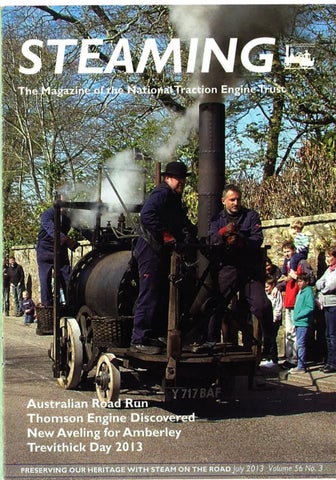
d Run Australian Thomson Engine Discovered New Aveling for Amberley Trevithick Day 2013 PRESERVING OUR HERITAGE WITH STEAM ON THE ROAD July 2013 Volume 56 No.'3
The National Traction Engine Trust Patrons Hal Bagot JP - Robert Goodwill MP - Lord Forsyth The Rt Hon Sir William McAlpine Bt - Richard Preston - Malcolm Harbour MEP
President - Andrew Semple Vice President - Charles Daniel Chairman Robert Herring Glebe Court, Fringford, Bicester, Oxfordshire OX27 8RJ
Rally Organisers Section Lance Jackson Mangerton, Lea Cross, Shrewsbury. SY5 8HR
01869 277410
01743 860091
Vice-Chairman & Chairman, Engine Owners Section Bob Siddall
Chair Steam Apprentice Club John Durling 19 Mill Lane,
Stud Farm I louse, Castle Hill Carlton on Trent, NG23 6QR 01636 821991
Barton under Needwood, Staffs. DE I 3 8HE
General Secretary Jenny Holt South View, Hutton Roof, Kirkby Lonsdale, Carnforth. LA6 2P1--
01283 712818
Rally Authorisation Bill Evans PO Box 102, Wrexham, Clwyd LL13 OZS 01978 780749
01524 271584, fax 01524 271768
Public Relations Officer Mike Dyson
Membership Secretary Sue Cook,
The Haven, Nelson's Lane,
71 rr Kirkby la Thorpe, Sleaford, Lincolnshire. NG34 9NU
HazIricam.:22,6 3UP,
01529 303160
Treasurer Julie Smith FCA Address as below Head, Technical Services David Smith Yew Tree Cottage, 98 The Ridgeway, Astwood Bank, Redd itch, Worcestershire. B96 6NA
tlembei is open to all interested in road steam preservation. Annual subscription £30 (L35 non EU members requiring Steaming by air mail). Details at www.ntet.co.uk or simply send a cheque with your name and address to the Membership Secretary or scan this code:
01353740470
V765 Administrator John Riley 52 Main Street Woodnewton, PE8 5E6
II ... r
is the nior section of the NTET, formed to support youngsters up to the age of 21 in learning about and appreciating rnarl choArtl Tes finrl c.ut more please contact the Chairman - address above, visit www.ntet.co.ukIsac, or scan this code:
01780 470385
Insurance Officer Ian Cooper
14 Millmead Sutton Road Shrewsbury Shropshire SY2 6DR 01743 236558
01527 893427
Registered Office 4 Church Green East, Redditch Worcestershire B98 8BT
FREE shipping for online orders over £50 oe,R 1 TA Gt. *
STEAM SUPPLIES A Divfsion Of
Boilerhou.ve Supplies Lid.
wwvv.heritagesteamsupplies.co.uk
t www.heritagesteamsupplies.co.uk
Unit 34 Brunel Way, Segensworth East, Fareham, Hampshire P015 5SF England Stuart Gray: 07785 258169 Phone : (01489) 5707 37 --- 8 Lines Fax: (01489) 570767 E-mail : sales(aheritagestearnsupplies.co.uk '101cr applies so online orders shipping to UK mainland only.
(Cover) The replica Puffin Devil in steam and attracting the crowds at Cambourne earlier this year(Colin Coomber) (Above) No it's not Luigi Fercotti but a salesman on John Fowler td's Italian agency's display at a trade show in the thirties. See also page 1 14. As this issue reminds us even if the pioneers like Trevithick made little money out of their innovations - others did; supplying the world in the process. (George Bridson Collection)
July 2013 Volume 56 No 3 Editor: Roger Mills 10 Sultan Road. Emsworth, Hampshire. P010 7PP steGmingifentet.co.uk Contributions of suitable articles, shorter items or photographs are wzrmly invited. Copyright 07/ the NTET 2013.
contrIbutcrs or
The opinions expressed In the magazine, with the exception of Trust announcements, are t',.ose of the contributorS and do r.ot indicate the views of the Trust. Copy dine for next issue: 1st September 2013. Published by: The Nation! Traction Engine Tans Ltd 4 Church Gretm Ent Redditch VVorces;-.ersI-.Ire 898 8BT Artwork et Design by Roger Mills Editorial Assistance Ker Mills, Cliff Pyparl Printed by; Hoibrooks Printers Ltd. Portsmouth P03 5HX ISSN 0260 - 2962
The other day, with a spare hour between appointments coming into town on the District Line, I got off at South Ken for a mooch round and was a tad startled to find that that the Science Museum seemed to be the only Exhibition Road collection without 'free' emblazoned on the outside walls. Indeed on entry one's confronted by admissions desks (designed to look like cash registers) soliciting a £5 'donation'. But at least it is open. Unlike Wroughton any longer except, apparently, to researchers. No surprise — no sensible ideas on what to do with that treasure house have been mooted since at least 1995. Except for the ambitious multi collection store idea torpedoed by that TV lottery farce. Yet up to the late eighties it was possible to open several times a year... After that revelation in the specialist press Science Museum bosses were on the national front pages threatening that, given mooted cuts, one or more of their northern sites might have to close. Ian Blatchford, Director and Chief Executive of the Science Museum Group (SMG) said: "I would rather have three world class museums than four mediocre museums." Closure rumours were squashed by the Culture Secretary but only after enraged northern MPs triggered a Select Committee inquiry to look into the future of the SMG and its funding. One, Manchester's John Leech, said: "Securing this inquiry will allow us to get to the bottom of funding issues and the priorities of the London-based Science Museum Group." Mind you, when a government spending review subjects museums and galleries to a cut of 5% while protecting 'elite sport' one has to sympathise with Mr Blatchford. Elite sport, an oxymoron if ever there was one, is well able to look after itself it seems to me. Nevertheless Mr Leech is right. The Science Museum Group's present
107
offerings, the priorities driving the exhibitions (dare one suggest an overconcentration on the railways?) and the sheer invisibility of most of the really engaging transport artefacts gathering dust in rolling the Wiltshire countryside all need subjecting to the harsh light of scrutiny. THE SOUND OF SILENCE I never see an HST without being utterly thrilled. It's been the same since Mrs M and I caught the prototype at Swindon one Sunday in 1976. BR didn't do much right in the corporate design department but the HST was perfect. Except of course for the noise! In the nineties Virgin ran one from Portsmouth to the north via Guildford and when it was in Havant the whole town benefitted form the roar of the engines. Reading General is still a deafening place to be when they pull in. How different steam. In May we took a trip on the National Trusts's Steam Yacht Gondola on Coniston Water. In motion almost complete silence, drifting into the piers you could hear nothing more than the lapping of the wavelets against the hull. Elsewhere only in the depths of the dales or the fellsides did one get away from the noise of a motor. I am not a Luddite. I have a car - and always fancied a Scammell. But it has to be admitted that the internal combustion engine has robbed us of one thing we should cherish — silence or at least quiet. That's something that the steam engine never did, until you blew the whistle anyway. Talking of the Gondola a trip on this little gem is highly recommended perhaps combined with the Lakeside and Haverthwaite and Stott Park. It is superbly presented and astonishingly good value for money. VOLUNTEER TRAINING Chewing the fat with the chairman of a preservation trust — I won't name it, you'll see why - recently the talk turned to volunteer recruitment and the skill sets required for steam and industrial preservation. One point he made was thought provoking. "We need a different type of volunteer now that the things are saved," he opined. "And for some people maintenance isn't quite as interesting or attractive as rescuing and rebuilding." He then went on: "Trouble is most of ours are older and to be frank some of the work, especially the heavier tasks, is getting beyond some of them. And the younger ones are keen as mustard but simply don't 108
have the engineering background." "Sooner or later the preservation movement is going to have to get together and decide how it is going to deal with this, perhaps through joint training schemes. If we don't, sooner or later we'll be left with no-one to carry it on. It's something we have to face up to or there'll be trouble." Well is he right? What do you think? RALLY TRAVEL A number of older members have told me that their rally going has been curtailed or ended because they no longer drive or have access to a car. But this need not be the case. Indeed several years ago as an experiment I attended all my diaried events by public transport using traveline.info journey planner. Granted a bit of jiggling of days, it worked. I also know that several events run courtesy buses from the nearest railhead. If they'd like to send me the times I will gladly print them - as a service both to those with transport issues and real ale drinkers! There are two in this issue, following Steaming Around. Roger Mills
HOWARD STENNING Just as we went to press we heard of the sudden death of Howard Stenning on Friday 5th July. A well known commentator in the Southern counties, he was due to carry out such duties at Wiston that weekend. Howard had long connections with preservation and was with Amberley Museum for some 27 years, until 2008, firstly as Education Officer and later as Director. A very fitting minute's silence followed by a full scale blast of whistles was observed at the grand parade at Wiston Rally on the Saturday afternoon. A full tribute will follow in a future edition.
Chairman's Report Robert Herring For some several issues the preservation magazine Old receives Authorisation does so for the benefit of all Glory has published readers letters on the subject of exhibitors in attendance, by providing protection from expenses paid to exhibitors, particularly traction engine prosecution on three counts; • Causing Death by Dangerous Driving. owners and in the latest June edition questions were • Dangerous Driving. aimed at the NTET. • Careless and Inconsiderate Driving. For those of you that may not read that magazine I include an extract of a letter I have sent in response. There is no immunity from prosecution for drink driving on a rally field, and the full effects of the Road Payment to Engine Owners. Traffic act apply to all non authorized events. Due to the varied situations that are involved on the The trust has now published the first of a series subject of exhibitor remuneration the NTET takes the of fact sheets; they cover numerous topics with the view it is not a matter for their consideration, idea of addressing the frequently asked questions from consequently when approached on the subject our both members and nonmembers. They are available on response has always been that any such arrangements the Trust exhibition unit, can be accessed from the are a personal matter between the exhibit owner and website and further details are mentioned elsewhere the event organizer. Reference has also been made to that of an event in the magazine The first three are available now covering, being Authorised. The NTET is one of eleven bodies appointed by Bursaries, Trust History and the Steam Apprentice the Department of Transport to oversee the Motor Club. In due course there will be others which we hope will provide a clearer understanding for all of the work Vehicles (off road event) Regulations 1995. Further details can be found at www.ntet.co.uk that goes on within the Trust. within the Rally Organisers COP. An event that
Steam Apprentice Club News John Dulling The SAC Burrell Project has progressed well, with the engine now on its wheels and assembly of the motion started. The next work weekend will be at Craftmaster Paints at Over, Cambridgeshire. This will be followed by a visit to Elvaston Castle Rally in Derbyshire and then South Cerney rally. We will of course be continuing with the building at the GDSF. Those of you who see the FBHVC News magazine will have noticed the full two page spread that this project has been given in their last issue. This is great publicity for this project, the SAC and also the NTET. We're grateful to the FBHVC for giving us this opportunity. The scheduled build days for the remainder of this summer are agreed with the various venues. Hugh Dyson, the Project Manager for this build, is talking to those museums, workshop owners and engineering exhibitions that have made offers of hosting a build weekend. These are being notified in Raising Steam (where possible) and on the website. The SAC, in conjunction with organisers of the South Cerney Rally, are again running a Parent and Apprentice day on the Friday of the rally. This will be an opportunity for Parents to learn a little about the running of engines and we are hoping to have a couple
of challenges in the afternoon to see who drives better, the kids or the big kids. We learned a lot about running these days last year and hopefully this one will go more smoothly: less rain will be a great help. The Driving Days continue to be popular with the members but we desperately need more venues/organisers to take pressure off our existing supporters.
ENGINE CONTACT WANTED. Jack Wallbridge, a young man from the Netley Marsh area, has asked the Steam Apprentice Club if we can help him with an introduction to an engine nearby. Do you have such a thing and a willingness to help? If you think you can help Jack please contact John Durling - address inside front cover
109
Engine Owners News Bob Siddall Driving Course A very successful Driving Course was and enthusiastic assistance the course would not be so held at the premises of S.E.Davis Ltd in early May. A successful. Bob Davis has invited us back to Astwood total of 42 candidates took part including one member Bank again next year and the course will take place on from Sweden. This year's course was over subscribed, 10th and 11 CFI May 2014. so unfortunately some applicants were disappointed. Miniature Engines As you may have read elsewhere At present there are potentially 34 bookings already in this issue and in other publications, the Trust has for the 2014 course. been approached by several miniature and model engine David Whale, President of the Federation of British owners about representation within the Trust. The Historic Vehicle Clubs visited the course on Sunday Trust has decided that the owners of miniature engines and was able to gain experience of the course content. form a part of the Trust's area of interest, and that they Four miniature engines attended the weekend and are not only very welcome as members - as they have during the forthcoming year we will be discussing with always been - but that they can now be assured that owners of miniatures their ideas as to what the Driving the NTET includes, considers and represents their Course can provide for them. interests in all that it does . Our thanks go to all those engine owners and crew As a first step, the Trust will recruit a representawithout whom the course could not take place. Also tive owner to their Engine Owners' Committee. to the Lecturers and helpers during the weekend and However, if any additional services special to miniin setting up and taking down the equipment and in ature owners are wanted from the Trust, then it will particular to Joe Black and Vicky Simcox, who organise be necessary that volunteers (with the necessary exthe course. pertise) from the ranks of the miniature owners come Finally our thanks to the Davis family, in particular forward. Bob Davis and Paul Davis without whose hospitality
THE NATIONAL TRACTION ENGINE TRUST
60th ANNIVERSARY ROAD RUN vv..,
1A/ill
cp pa le
20th Septem'oer 201-p A at Olu -' vvarden in Bedfordshire
Open to full sized engines/waggons, steam cars and model engines over 4" scale. Numbers are limited to 200. Entry forms will be available at the Great Dorset Steam Fair and downloadable from the website after that date. Closing date for entries 31st December 2013.
Seddon
&Black
A e erithU s
Era Find us on
Ed Facebook
Consumables
Stockists of steam and heritage consumables. View and order online at www.seddonandblack.comk or call 01948 780474 to discuss and place your order. 110
r IL
01e e. r
S
Nt.
ANNUAL GENERAL MEETING 2013 The 2013 AGM of the Trust will be held on Saturday 16 November 2013 at the Hickstead Hotel, West Sussex. Arrangements for staying the weekend and visits arranged over the two days will be published October's Steaming. Formal notice of the meeting, the Agenda, Report and Accounts together with the names of those standing for election and an appointment of Proxy form, will also be distributed to all then current members with the October edition of Steaming. Any member may submit a Motion for discussion at the AGM. All such motions must be in writing and signed by a proposer and seconder stating their respective Trust membership numbers. Under Article 16 of the Trust's Articles of Association items for discussion must reach the General Secretary, Jenny Holt (address below) on or before Saturday 14 September 2013 in order that they can be published in the Agenda. J
Members retiring by rotation, after their three years term of office, are :- Andrew Semple, Robert Siddall, Lance Jackson, Paul Cook, Dan Brothwell, and Paul Hemstritch. All are eligible for re-election. Irvin Barraclough, James Blenkinsop, John Riley, Emily Drury, and David Temple also retire but do not offer themselves for re-election. A nomination form is published below and may be cut from this magazine, photocopied or written out on plain paper. All nominations should be sent to the General Secretary, Jenny Holt (address inside front cover) and must be received on or before Saturday 14 September 2013 The names of the nominees will be included in the published Agenda to be distributed with the October magazine. Those standing for election will be required to provide a brief introductory profile, length about 150 words, of themselves and their interests.
National Traction Engine Trust Form of nomination for election of Vice President* Vice Chairman or a member of The General Council* *delete as appropriate
(Complete in Block Capitals please)
Name of Nominee
Membership No.
Address I agree to accept the nomination for this office and if elected serve the Trust and abide by its constitution. Signature of Nominee
Date
Proposed by
Signature
Membership No.
Seconded by
Signature
Membership No.
Photocopies, and nominations in this form on plain paper, are acceptable.A separate form is required for
each nomination which mast also be accompanied by a brief introductory profik, provided by the nominee, for inclusion in the AGM papers. Send form to NTET Secretary, South View, Hutton Roof, CARNFORTH, Lancs LA6 2PF to arrive on or before 14 September 2013. Forms received after this date cannot be accepted.
FOR YOUR NEW HANDMADE TINPLATE ENGINE LAMPS
BRING YOUR OLD LAMPS TO DORSET FOR ASSESSMENT OR REPAIR OR TELEPHONE TO DISCUSS YOUR REQUIREMENTS TEL: 0044 (0)1938 850 393 EMAIL: enquiries@hetheringtonlamp.co.uk WEBSITE: www.hetheringtoniamp.co.uk
III
THE LATE HARRY LYON St. Patrick's church at Patrick Brompton near Bedale was filled to overflowing on the Ilth of May with in the region of 600 people attending the funeral of Harry Lyon. Harry died on the 30th of April, the day before his 68th birthday, following a battle with cancer in recent months. The journey to the church from his home in the village was made appropriately on the back of a vintage Bedford pick-up truck as he had worked with commercial vehicles most of his life, initially with his father's business M J Lyon and then running his own haulage company Bedale Transport,
which Auld evettjtvIly be.Aold out. to Harry coritlrwid -O'drive i f-lareaves. ; t h IIIIIVer: deal n wagons: and t l l':dutparticulatlyin.§caftivaihich heuf - ' ''''b visit, liiiwas justly proueof.11 titi achieved. i.ir,-, . In 1980 he purchased the unique Robinson
& Auden traction engine at .the famous Paisley sale and will be familiar to many for attending rallies not only near to home, but in most parts of England and Scodanit often accompanied by his locally matei,saw bench. He was always keen to ence,u.' particularly yOungiefitfiusiasts onto hi&eng!t e` no Mother join , pl..80dand. SInee20.09then the-e reached the painecGe re Tt-rebox work was 'needed„-Which he had planned to have done. he had had use of Fowler No 9055. this ,IFood at the gate to the churchyard dtfiit g the funeral and sounded a final tle to its driver. The coffin was carried lour of his fellow enginernen dressed in blue overalls, many people could echo the sentiments expressed by one of these ying, Harry was a good friend, a tt-tte ntleman and a great character of the f ly fields. David Warren.
112
r+.
it ea mi
JOHN BAILEY 1940-2013 children visiting the events. Not long after completing his apprenticeship he helped to start a business manufacturing stainless steel photographic developing equipment and as the business flourished the firm began exporting their products to Europe and the USA. A precision engineering arm of the business was also developed and in 1976 John bought his first traction engine, a Burrell, which was named "Validus". At the end of each working day he and his friend Les Cox would work on the Burrell until late into the evening completing restoration work of the highest quality. John loved to work the Burrell and if he agreed to take the engine to an event it would usually be on the condition that he was able to hook it up to a sawbench or threshing drum. In 1980 he bought a second engine, this time a Fowler, but pressure of work meant that he was unable to spend as much time as he would have wished on his beloved engines. John was one of the kindest men you could wish to encounter and would offer his help and engineering knowledge and skills to anyone. He had become a brilliant engineer and also a talented designer and he would often design and machine particular pieces for people who had found difficulties in their own projects. He also developed an interest in mechanical music and although his trips to Europe had only taken place in the latter part of his life he loved the Black It is with great sadness that we have to inform you that Forest area. He visited many of the music museums John Bailey died on 15th April 2013 following a long especially in Germany and Holland. battle against the illness which began in 2000. Happily While he had developed his consummate he benefited from two periods of remission but despite engineering skills during his career he did not have any his long term ill health he still managed to do a great great enthusiasm for modern technology and the digital deal of work on his beloved steam engines. He also age and had no time for anything that had more than made a number a steam models, a hobby which brought one button to press. him a great deal of pleasure. John will be missed not just by his friends but mostly John was born in Bexleyheath in 1940 and as a by his devoted wife Pat who he married in 1970 and young boy developed a love for the countryside with she had worked alongside her husband and had a particular interest in birdwatching. His interest in supported him not only in his business but also in his steam engines also started at a very early age and at love for steam engines. Pat cared for him and supported sixteen he began an apprenticeship with Fraser & him throughout his illness. He will be especially missed Chalmers in Erith and joined their engineering club by his two nieces Lian and Donna who he used to play where he began to build model railway locomotives. with when they were small and gave them wise advice The steam club called themselves the Erith Live when they were grown up. We will all miss him so Steamers and the members would take their engines much. to company and school fetes providing rides for the Roger Mortimore 113
THE EXPORT TRADE
6-Ton Steam Wagon with end-tipping body. These two evocative pictures, from Huh Whitwick via Maurice Poole, are a reminder that a thriving export trade could be developed without the paraphernalia of modern communications that sees execs flying the world. Aft that was required was a chain of agents with local knowledge on decent commission!) the odd trade show (see page 107) and products folk wanted. Or even, in the case of the likes of the Thompson Road Steamer, a legal regime that actually allowed engines to be worked commercially. I have no details on either of these pictures - so any help in positive identification would be appreciated.
114
AN AUSTRALIAN OUTBACK ROAD RUN 2 - 4sie Words and pictures by APirw , Warwick Bryce
101
•
Sam Newman announced his intention to drive his 1927 Foden r Steam Tractor to Lake Goldsmith 100th rally with the hope that :At others would join in. As the plan firmed up his enthusiasm became infectious and others realized the opportunity to have a steam adventure of a lifetime. Eventually four steamers and a vintage truck came on board and despite numerous dramas along the way all achieved their objectives.
THE CAST I. 1923 6 ton Foden Steam Wagon 2. 1927 Foden Steam Tractor 3. Marshall 8 HP double crank compound Road Loco 4. Replica Wallis & Steevens Tractor 5. 1955 Foden Diesel PLANNING A 180 km run by vintage steam vehicles is no small undertaking so requires careful planning. Many factors needed to be considered due to the vehicles limited speed and range. First a route needed to be found that avoided the heavy traffic and high speeds of the major roads. This meant sticking to back roads but, in Australia, these are not always shown accurately on maps, the only way to be sure was for Sam to drive them in advance while keeping an eye out for steep pinches, watering places, bridge weight restrictions and suitable places for overnight stops. At last a route was settled. Starting from Steam Rail Newport following back roads through Derrimut, over Mount Cottrell to the Werribee river crossing at Exford. Day two was through Bacchus Marsh then the scenic route following a winding dirt road through the Werribee Gorge Park to the Ballan Machinery club's grounds. From there it was along Old Melbourne Rd to Ballarat and a lay-over day at Sovereign Hill. Thursday was then the 25 km to overnight at Carham
where the Navy have access to a property. Day five would then be a short run into Goldsmith. With the route settled thoughts then turned to arranging fuel supplies, watering places, equipment, various support vehicles and of course the crews. (Follow this link to see the approx route http://tinyurl.com/qfpgko2) LAST MINUTE DRAMAS That was not the end of it all though as the departure day neared dramas with the vehicles began to unfold. My Foden Diesel developed a serious gearbox issue that for a while looked like a show stopper until a non overdrive box was fitted as a last resort. The Atkinson's had their hands full with their reproduction Wallis Steam Tractor and spent several days at Scoresby debugging and doing speed trials, with it becoming more and more obvious that the trip would be rather pedestrian. Not the least challenge was getting it registered on club Red Plates but these came through with just days to spare. All was looking good for the Navy Steam Club with their Foden wagon in fine form after extensive work on the crankshaft but disaster struck when it was discovered that their prime mover had serious issues and would not be available for transporting the wagon from Cerberus to Newport. Jo & Ross Lloyd's Marshall Road Locomotive refurbishment which included fitting of counterweights
to the crankshaft started in good time but took longer than expected and it was getting down to the last few days when it was discovered Vicroads had cancelled the registration on the road loco without notification. (It seems the traction engine category had been deleted without any thought to machines on it!) That looked like it was the end of the run for them but Jo was determined bureaucracy would not win after a day spent organizing inspections and documentation it finally was re registered in the tractor category. That should have been all but there was still the issue of the 10 tonne load limit on the bridge coming out of Bacchus Marsh and no practical way around it left no option but to float the engine and join the run at Ballan. Of course things weren't going well for Sam either; so much time was spent fitting windscreen and panels to his Foden wagon that he underestimated the amount of organizing required to put such a venture in to place. To top it all off he discovered on the morning of departure his support truck was broken into and various items stolen. THE OFF The day all too soon arrived and it was off to the starting point at Steam Rail ready or not. When I arrived furious activity was taking place bagging and loading coal into the engines while other crew raised steam and oiled up watched by a few friends and members who had congregated to see the show on the road. About this time I was introduced to Robert Barry from the Ballan club. Impressed with the effort being put in by Sam he had stepped forward and offered his assistance with the logistics of the run. With his extensive local knowledge and vehicle he was to prove invaluable a number of times. The Navy was first off but Sam still had to pump up the tyres on his vintage caravan. Try finding a tyre pump at a railway depot! They do not have much use for them. This then just left the Wallis but still no sign of the steam tractor. It seems they were so behind in preparation it was no longer practical for them to depart from Newport. It was now the value of Robert started to become obvious, he soon had in place arrangements for the Wallis to steam up and depart from a Truganina farm half way alone the route of the first day's run. ON THE ROAD I tagged along in the Diesel behind Sam. Progress was slow, at about 10 mph, then a couple of miles later a halt at the bottom of an overpass. It seems they were
Steaming tip David and Joe Atkinson's reproduction Wallis steam tractor at Truganina farm having trouble with the fire, and pressure was down. Anyway twenty minutes later with a blazing fire and pressure up the overpass taken in style. Three miles further on another overpass and another stop to build up pressure. A good run for half an hour or so followed then they pulled over into a housing estate service road. What now? Low water! Here was Robert with a stand pipe and hose at the ready. While filling up smoke was seen rising from the farm across the road and the Wallis could be made out steamed up and ready to join the run. We were just getting out of suburbia now and traffic was getting chaotic as the road had become single lanes and cars anxious to get home were banking up behind. To ease the situation a minor back road was taken this soon turned to dirt and the hobby farms gave way to sparse farm lands. Real country and the place to get some shots so I overtook the two Foden wagons and 'sped' ahead to find a nice location. I was soon joined by the Navy support crew and we waited and waited while enjoying cups of coffee from their mobile camping trailer. At last columns of smoke heralded the arrival of the steamers and after a drink and stoke up they were off again to assault Mount Cottrell. The hill soon taxed the steam pressure and both engines soon chuffed to halts to attend to the fire and I gradually became bored with this slow progress and enquired how much further and was surprised to be told we were almost at the first night's stop. The ever helpful Robert had teed up with the local farmer for us
to use his machinery paddock which was a far better alternative to camping beside the road in a picnic area by the Werribee river. What's more he had an army tank with a radial engine. With that information I was off and soon found the yard, the Navy support group was already there. In due course the Foden steamers pulled in and while they dropped fires and cleaned boilers I inspected the tank while the owner took a keen interest in my truck. It soon came out that it had been used over 30 years ago to move his D9 bulldozer in outback NSW. With only the Wallis still to come and daylight running out they eventually decided to load it onto their tandem trailer and tow it the last little bit. Such is the advantage of a machine this size as it can be handled by a 4x4. With tents up and bellies full discussion around the campfire turned to the days events. Everyone rated it a success with much learnt about firing rates, coal characteristics and water consumption as only the Navy had been out on the open road before.
DAY 2 THE HILLS This was the leg everyone had been looking forward to (or dreading). Immediately on leaving the property the road dropped down into the gully of the Werribee river with a very steep climb up the other side. Tubes were cleaned fires built up and the engines were off. Sam got about 2 metres and hissed to a stop, the high pressure cylinder cover had blown due to priming, not a good start. Meanwhile the Navy had shot off but only got to the gate before realizing more pressure would have to be built up before attempting the short but stiff climb up onto the main road. Now was the time for the support vehicles and Diesel Foden to race ahead and find a good photo position for the pull out of the gorge. The Navy got through with only one halt
Jo & Ross Lloyd's Marshall and wagon make a fine sight entering the Old Melbourne road heading to Ballarat
to build up pressure. Sam stormed the hill with his caravan in tow and having selected first gear with a good fire and strong draft made a fine spectacle of the assault. Soon the Wallis could be seen in the distance descending into the gorge with a procession of cars trapped behind at walking speed. Before long they crossed the bridge and started the climb and slowly lost speed as the grade stiffened but still making a magnificent sight working hard but now down to half walking speed. Speed dropped off even more and any moment it seemed the engine would stall. We could see frantic action on the foot plate and just as the crest was reached it was decided to pull over and drop the fire as water was low and pressure had fallen too low for the injectors to feed the boiler. This was obviously going to mean quite a delay while the pressure dropped enough to open the boiler to bucket in more water and then relight the fire but - they had conquered the gorge! Sam was getting away and the next and greatest challenge was not far ahead, the climb out of Bacchus Marsh so I set off to get ahead and soon found him on the side of the road, under the railway loop of the Ingliston bank replacing a blown out piston rod packing while on the horizon the Navy could just be seen tackling the climb. By now we were nearing 'The Marsh' and news of the road run had spread. A number of members from kindred clubs, including the President of Lake Goldsmith and his wife, came out to enjoy the sight and
(Above)The scene at the Balton Machinery Clubs facilities. The Lloyd's magnificent Marshall road loco and wagon had already arrived by float ready w join the run now the weak bridge was behind us. (Below) The diesel wagon waits while the two steamers build up pressure for a continued assault on Mount .Cottrell. Nearest the camera is the Navy Steam Club's 1913 I-oden Steam Wagon acquired in a derelict state in 969 from a quarry by the Navy as an apprentice training project a role it is still performing. in the distance we see Sam Newman's 192 7 Foden which was rebuilt to tractor specification from a collection of parts brought from the UK
Gears
offer any assistance that might be needed. Some, to only one their delight, even had a short steam ride into town to incident when, the lunch stop and watering place. despite being The dreaded hill could not be put off any longer so warned, one GEARS UP TO eft eln DIA it was on the road again. I passed the wagon and picked motorist SPLINED SHAFTS UP TO 25ft LONG a photo stop at the steepest section three quarters of decided to Broaching and Sighing - Spun; , Reeks, Hellcats the way up. Again Sam made it in fine style and shot overtake on a Worms and Wheels, Bevels - Straight and Spiral Stock Gears and Splines past not waiting for anyone. Luckily I got picked up by crest and was Wire Cutting - Gearbox Rebutiding a passing car which went ahead giving an opportunity surprised to find Specialist Supplier of Gears and for another series of shots with the wagon crossing the someone Spilnea for all Vintage Vehicles 10 tonne railway bridge. It was then a gentle amble up coming the and Traction Engines though the Werribee Gorge State Forest with a couple other way. Telephone Mike Horlick of railway crossings and undulating dirt road to add to Water along LLEWELLIN'S GEARS KING SQUARE, BRISTOL B92 8JJ the atmosphere. There was nothing to give away that this stretch was TEL: 0117 942 4026 it was not 100 years ago. This was what I had come to just a little bit FAX: 0117 928 2028 see. too far apart but Into@llewellIns.co.uk Web: www.11ewellInceo.uk With the challenging bits over for the day it was as usual help was along the plateau to Ballan and the Vintage Machinery on hand this Clubs facilities for the night. time from the fire brigade. About this time a debate The Navy support team had already moved in and arose about a 'short cut' so the steamers waited while had the kettle on and I found room in the historic I went ahead in the truck to check it out. On return I jockey's quarters, no need for the tent that night. As reported while it was quite navigable I doubted if it was soon as Sam arrived we lined up the 3 Fodens for a actually a saving nevertheless part of the group decided photo shot and display for the steady trickle of locals to give it a go anyway. While they got through, it was dropping in. The Lloyds arrived by car shortly and we not without a bit of unplanned excitement. From here pitched in fitting the firebars to their engine and it was a gentle run through the outskirts of Ballarat to generally making ready for tomorrows leg. Just as the the overnight camp and lay day at Sovereign Hill sun was setting the Atkinson's arrived with the Wallis outdoor gold museum. on the trailer and another lesson learned. They had no At this point circumstances dictated I leave the road end of priming after filling up with water from 20 litre run and return to Melbourne to prepare other exhibits plastic containers carried on their support vehicle. for the Lake Goldsmith rally. THE LAST LEG Whatever they had contained caused foaming of water in the boiler so rather than tackle the dreaded climb Wednesday's run was bitterly cold and showery not out of "The Marsh" in this condition they took the safe much fun for those on exposed engines, freezing on way out and opted for the tandem trailer again. the top half and cooking on the bottom seemed to be ON TO BALLARAT the order of the day, Sam must have been glad of this Next morning broke with the promise of a great day new windscreen. The run took them from Ballarat to with the road run now up to its full contingent. The Snake Gully where the Navy's friends property makes steamies were up before the sun adjusting glands, oiling a good overnight camp. and greasing, filling water tanks, loading wood, sweeping From there it was a simple run to the Goldsmith soot from tubes and emptying ash pans and lighting Steam Rally site and the achievement of their objective. fires. Three hours later steam was up and they were REFLECTIONS ready to go, then a little lesson in something. I climbed On the drive back to Melbourne I reflected on the into the Foden Diesel truck pushed the button, waited goings on. By the third day the crews had got to know 30 seconds for the oil pressure to build up and drove their machines and minor problems had been sorted off. Not sure who had the most fun though. out giving good running from that point on. On the road gave the first chance for photos of the With this type of activity if you are seen to be giving Road loco and wagon. It made an impressive sight , it a go by the locals very generous help is likely to come something rarely seen these days but would have been from unexpected quarters. What takes three days in a common in its day. I am sure this made all the effort Steam wagon only takes three hours in a Diesel wagon. that had gone into its preparation and transportation The run was a great opportunity to promote the worth while. Steam movement. All in a great adventure and a credit Initial progress along the undulating sections of the to all involved. Old Melbourne road to Wallace and Gordon was a bit (Reprinted with kind permission from Steam slow. Double lines for much of it often caused quite a Supreme - newsletter of the National Steam Centre hold up for motorists with nowhere to pass. There was Melbourne, Australia)
ty
•
Words Ali Azeez Pictures Roger Thiedeman -:Ardast-arikti=thataixr Many types of steam vehicles were imported to Ceylon uncomfortably placed over a boiler, and tiller steering. (now Sri Lanka). For example, steam locomotives for There were several other steam cars, including some rail travel; steam rollers for road construction and made by White, but none survived after petrol-driven repair work; steam passenger cars; and steam cars became popular. Many Sentinel, Foden, and Robey steam wagons wagons/traction engines for hauling goods. Steam engines worked later here than in the countries they were imported to Ceylon. No Foden wagons have were produced. But eventually a large number of steam survived but one Sentinel wagon (C-92I8) remains out locomotives were scrapped when rendered obsolete of the original eleven. This is displayed at the Old Town by diesel power. In fact, in 1984, fifteen steam railway Hall Museum in Pettah in a neglected state and badly locomotives were advertised in the Gazette to be sold in need of restoration. It was used by the Colombo as scrap. Fortunately the Model Railroad Club appealed Municipal Council. The two surviving Robey wagons (C-6037 and to the Minister of State and Tourism and the sale was X-2553) are in running condition, stopped. There are twenty steam and are presently in the custody locomotives lying at the railway yard in Dematagoda, but most if Robey Steam Wagons Exported of the Sri Lanka-German Railway to Ceylon - 1924 to 1934 not all are in need of care and Training Institute (SLGRTI) at No. Y.r Payload Ratmalana. They are all that maintenance. 1924 5 ton 41601 1924 6 ton remain of twenty-four Robey There are also several steam 41613 1924 6 ton 42152 Steam Wagons despatched to rollers scattered all over the 42265/66 1925 6 ton (end tippers) 1925 6 ton (end tipper) Ceylon between 1924 and 1934. country, and some are displayed 42288 42385 1925 6 ton (end tipper) Most of the two dozen on the Kandy road and at the Old 42582 1925 6 ton 1926 6 ton wagons were owned by the Town Hall Museum in Pettah. The 42929/30/31/32 42995/6/9 1926 6 ton 1927 6 ton Colombo Municipal Council, first car imported into the 43003/5 43157 1927 6 ton and private companies, country in February 1902 was a 43164 1927 3 ton (chassis only) 1928 10 ton (articulated) Government Departments such Locomobile steam car owned by 43757 45979/31 1931 6 ton as the Public Works Dept and E.G. Money of Bousteads Ltd. It 46427 1931 6 ton 1934 6 ton Irrigation Department. But six of was fitted with two seats in front, 47384
120
these Robeys were owned by British Ceylon to display the Wagons at this show. The VCOC Corporation Ltd. (BCC). Two wagons (C-6084 and member, Shirley Gunawardena, was entrusted to X-6439) were sold in 1961, and another two (X-2868 arrange this part. He met the General Manager of SLR and X-2589) were scrapped in 1970 and 1971. The two several times and managed to get the Wagon C-6037 surviving wagons were in service until the late 1970s, towed by a tractor from Ratmalana. At the Oberoi mainly transporting coconut oil in drums to the port Vintage Motor Show held from March II to 14, 1999 for export. They are 42288 of 1925, registered on held at the Hotel Lanka Oberoi, Colombo, both 8/6/1925 as C-6037; and 43757 of 1928 registered on Wagons C-6037 and X-2553 were displayed after they 26/5/1931 as X-2553. The latter is the only articulated were towed to the venue by tractors from Ratmalana. steam wagon known to survive anywhere in the world, The Vintage Independence Peace Run was held on March 22, 1998 with the collaboration of the Ministry the trailer was registered TR-I50. The BCC was nationalised by the Sri Lanka of Transport to celebrate the Golden Anniversary of Government in 1972 and the two wagons were Sri Lanka's Independence. The route was from preserved by them. In 1994 these two rare and valuable Grandpass to D.R. Wijewardene Mawatha opposite the vehicles were handed over to the Sri Lanka-German Ministry, where a meeting was held with Hon. A.H.M. Railway Training Institute (SLGRTI), where they remain Fowzie as Chief Guest. The Wagon C-6037 was in attendance at the finish, its presence having been in working condition. I remember the Robey Steam Wagons belonging arranged by the Ministry at the request of the VCOC. to BCC, Colombo Municipal Council, and Colombo Gas and Water Company Ltd. plying the roads of Colombo. They were black in colour and had a 'yakada Number 42288 43757 yaka' ('steel devil' in the Sinhala language) look, to use Registration No: C-6037 X-2553 6-ton, 4-wheeler 10-ton,6-wheeler, articulated Type: the nickname sometimes applied to steam railway Overtype 3 Speed Overtype 3 Speed locomotives. In the 1970s the BCC wagons were Engine: Compound engine*, mounted on top of boiler 4.5 ins. H,P, Bore 4.5 ins. painted yellow, but in 1981 the Wagon X-2553 was L.P. Bore 7.25 ins. 7.25 ins. painted sky blue to take part in a trade fair. Both Stroke 7.0 ins. 7.0 ins. HiP Cylinder 111 cu. Ins. 111 cu. Ins. Robeys now have yellow paintwork. LP Cylinder 289 cu. Ins, 289 cu. Ins, The Robey Steam Wagons took part in vintage Boiler: Locomotive, multi-tubular type fired by coal 3.14 sq. ft. 3,14 sq, ft. Grate area motor rallies conducted and sponsored by various 78.17 sq. ft. 78,17 sq, Heating surface 250 p.s.i. Pressure: 250 organisations and newspapers. The Vintage Car Steering: Pivoted Axle type Ackermann type Owners' Club (VCOC) was formed in 1987 and their Wheels: Steel wheels with solid rubber tyres members recognized the value of the two Robey Dimensions: Front track 4 ft, 0 ins. 4 ft. 0 ins. Wagons and, keen to see them at their events, enrolled 5 ft. 9.75 ins. 5 ft. 9.75 ins. Rear track 12 ft. 11 ins. 10 ft. 5 ins. (unit) Wheelbase the Sri Lanka Railways (SLR) as an Honorary Member. 20 ft. (trailer) Platform length 13 ft. 6 ins. At the Lions Club Trade Fair and Vintage Motor Show 48 ft. Turning circle 52 ft. 4 cwt. Bunker capacity 4 cwt, held from November 29 and 30 to December I , 1996 250 gaL Water capacity 140 gal, at the Viharamahadevi Park, Colombo, it was decided 7 tons 15 cwt. Tare weight 6 tons
Survivor's Specifications
121
On January 5, 1997 the 'Pathum Vimana' Vintage Car Parade was held in collaboration with the Hatton National Bank from the Weera Puran Appu Park, Moratuwa to Green Path, Colombo opposite the Art Gallery. Because there were a large number of participants, the VCOC Committee decided that Wagon C-6037 should participate this time by travelling the whole route under its own steam. Shirley was again entrusted to speak to the GM of SLR. He agreed but there were various snags. Some repairs were needed and there were no personnel to repair and drive the wagon. The former driver and mechanic of BCC, retired and living in Maradana, were traced and their services obtained. The SLR staff were very helpful. The VCOC paid all the expenses including coal to fire the boilers. The Wagon ran very well all along the route on the left side of Galle Road at a fair speed. At the start, the spectators were fascinated to watch the driver and mechanic shovelling the coal, heating the water in the boiler, and then moving the wagon by manipulating an array of levers. The driver was in an entertaining mood and thrilled the spectators by
Above the 42288 as seen by the author but, just as this edition went to press, we received the picture below which shows her as she's recently been turned out by the Sri Lanka German Railway Training Centre (Gamini Weerasinghej
stepping continuously on the bell, 'clanging' it like a tramcar of the past. At the same time he pulled a cord overhead to sound the steam whistle. The children in particular saw an unusual vehicle for the first time. My nephew Yakoob Bin Ahmed and I visited the Sri Lanka-German Railway Training Institute at Ratmalana in August 2012. The Wagon C-6037 was inside the workshop undergoing restoration which was almost complete. The Wagon X-2553 was outside and approval had been obtained to restore this vehicle as well. One of the officers, Mr. Weerasinghe, was very helpful in explaining in detail the working of the Robey steam wagons, which we were not familiar with. The Britishish Ceylon Corporation Ltd and, later, Sri Lanka Railways must be commended for maintaining the two Robey Steam Wagons In near-original condition for over 80 years.
L:turns and Collections... Dardanup HePitage Park and the Ruston Proctor SC 8nhp Traction Engine 409
DARDANUP HERITAGE For some years Gary Brookes had been employed as a truck driver, bulldozer and sawmill operator in the South West of Western Australia. He had earned a reputation for being reliable and hard working. In 1976 Gary and his wife Jill purchased their first truck, a tandem axle 1970 180 hp Mercedes 1918. This was naturally called Nol. They established Brookes Transport in 1977. Steadily their business grew and one by one they added more trucks to their growing fleet; never buying another until the previous one was paid for. The business was heavily involved in the timber industry. They were falling timber, extracting timber and they had established their own wood chip mill. The haulage side was busy carting fibre and chipboard from a local Dardanup company to Perth, but in time they were carting livestock as well as running their own herd of Saler cattle. General goods were transported all over the State of Western Australia and occasionally to the eastern seaboard of the country. By 2008, through dint of sheer hard work and good business acumen, they had ninety-six trucks and about one hundred and forty trailers on the road and employed 140 people. For some time Gary had a dream of starting a collection of old dozers and tractors and in June 1992 Bob Lukin gave him two International TD 35 bulldozers. Gary made one good one from the two. This became the start of Dardanup Heritage Park.
Truck No I was pensioned off in 2001 with nearly 2,000,000 kilometres on the clock and naturally forms an important part of the collection. It is still in running order. In 1999 a major undertaking was the purchase of an 1898 twin cylinder Marshall undertype steam engine. At the same time they also bought an electrically powered sawmill set up from Collie. This engine had been set up to work in Subiaco in 1898 when purchased new by Whitakers, the premier timber business in Western Australia. The timber industry played a very important in this part of Australia and in the 1930 the trade boasted that it operated the largest privately owned railway system in the world. But as the City of Perth gradually grew and complaints were made about the noise and smoke from the yard. In 1948 the engine was moved to Cowaramup, a small timber town in the south west of Western Australia. The engine ceased operation in 1962. A lot of work was carried out on the engine including a new barrel. The original firebox was retained. Then over a period of about ten months the sawmill was installed at Dardanup to be powered by the Marshall. The engine and saw bench first operated in January, 2001. The mill was used to supply all the timber for the eighteen or so large sheds in the Park providing 7000 square metres of display area. There is also a 120 seat tearoom. The Park itself covers some fifteen acres.
123
the collection grew. Steadily Internationals were Gary's main interest and there are thirty-six wheeled tractors and dozers together with a number of IH implements and trucks by this manufacturer, all in going condition. The smallest dozer is the TD5 and the largest is the TD24. Other makes include David Brown, Ford, Case, Oliver, Lanz, Cockshutt, Chamberlain, Muir Hill, Nodwell and the TC 12 Jolly Green Giant' Euclid, at one time the world's largest dozer. This is powered by two General Motors 671 two stroke diesels; one engine driving each track. Mention must also be made of the collection in the Ferguson shed run by Hugh Cawdell. There are four little grey Fergies, one grey-gold, eight red models and a couple of yellow ones, a couple of Massey Harris and a good collection of implements and associated Ferguson gear. Warwick Turner doing a spot of firing The oldest tractor in the collection is a 1926 model N Fordson. The smallest is an IH Cub and the largest two-wheel drive is the Chamberlain Bunbury Army Drill hall. The collection latest addition Super 90. The smallest tracked vehicle is the Ransome's is a Tiger Tank. The mill was used to process all the timber required MG5. Sadly Gary died of a heart attack but Jill and her to build all the sheds. Also built are a manager's house family with great resolve and determination have and three men's cottages to illustrate what it would carried on building up the collection as Gary would have been like to live in an early timber town. These are fully fitted out as they would have been some eighty have wished. On Gary's Memorial Day, every March, a good years ago. number of tractors, dozers and other various engines In 1997 they purchased the 1903 8 NHP Marshall are fired up and put to work. There are many traction engine from James Erskine of Mount Barker. demonstrations including blade and machine sheep It is believed that this has the largest rear wheels fitted shearing, milking in the replica traditional dairy, a team to a Marshall. They are seven feet in diameter. The of working bullocks. The demonstration by the two engine was in working order when purchased but more large, three wheeled Bell Loggers are always very work has been done on it over the years since it arrived. Around thirty retired people regularly do voluntary popular. Altogether there are around one hundred wheeled work at the Park restoring a whole range of things. Ray tractors and dozers, most in working order in the Hughan is the general factotum and oversees the collection. Apart from all these infernal, internal general day-to-day operation of The Park, as well as combustion engined vehicles there is a circa 1920's running the herd of some eighty cattle. One of the Afghan hawkers wagon, numerous stationary engines, intangible assets of the Park is the tremendous spirit an extensive collection of hand tools, chain saws, gem of comradeship that is enjoyed by all the volunteers. stone collection, all sorts of domestic ephemera Ray deserves much of the credit for this and it is due including a number of `guzunders' and other domestic to his great ability in ensuring that we all to work crockery. There is a horse drawn hearse, a period together in a very co-operative way. Jill and her family dentists surgery (but not operating), a collection of put a great deal of effort into fostering this wonderful community spirit that is so evident. Jill's brother Barry early children's toys and much more. A fully operational printers shop is a most tells me that instead of Women's journals when she interesting part of the Park. Ian and Laurie, two local retires it is Li actor magazines dial she reads. Jill refers to us as 'Dads Army' and most of us are retired printers, have this up and running every week. The operation includes two printing machines, a not as fit or as strong as we once were. It is to Ray's linotype, a Ludlow, a Super service slug casting machine. great credit that he is always there when any heavy work is required to be done. He is as strong as an ox One type setting machine dates from 1892. One shed houses an extensive military collection but does tend to be over fond of his 1/4" rattle gun and run by Gerry Tyrell. The shed is actually the old disparages the use of a good file, a die grinder being his
124
tool of choice. Ron Smith and his late brother, Fred, restored a number of Tangye engines. Ron starts the two largest, a 50 and a 100 HP engine every week. There are seven Tangye engines as well as twelve other old and interesting stationary engines by some fairly obscure makers in the Tangye shed. Ron is eighty-three years old and a great source of knowledge and a great character. In 2001 Jill purchased a Ruston Proctor traction engine from York Motor Museum, 100 km east of Perth. It had not been in steam for many years but when Gary and Bob Ness brought it back to Dardanup they put some water in it and lit a fire. Pressure was raised just enough to get it moving. It was then put in one of the sheds, as it was, for general exhibition. In 2009 I had finished building my Vans RV7 aeroplane and was looking for something a little different to do. When Jill Brookes said that she was looking for someone to get the Ruston restored I was keen to take up the challenge. I had some experience, whilst still living in England, as I had restored a 1927 4 NHP Aveling and Porter convertible, 11728, TW67I3, that I named Tolerance. I had also jointly owned a Wallis & Steevens twin cylinder high pressure Advance roller. We knew little about the Ruston so I contacted the NTET and I was put in touch with Mr Ray Hooley, the well-known UK Ruston archivist. I was able to give Ray the boiler number, 35855 and from this he was able to relate this to engine
&earning
number 40909. The engine was dispatched from Ruston's works in England on 3 I st March 1911 for shipment to their agent H.V. McKay in Sunshine, Victoria, Australia. We do not have full records of the engine's history, but it may be that McKay's kept this engine as their demonstrator machine for some years. Initially the engine came under The Boiler Inspection Act of 1906. (BIA). Stamped in to the left hand horn plate is the following information: - BIA 7074 T.P 240 W.P 120 16/6/1928. The horn plate is also stamped: - MDH TP 240 WP 160 05/12/1934. This would seem to indicate that at least until 1928 inspection and testing was carried out in accordance with the BIA 1906. Rohan Lamb and Peter Evans in Victoria did some great research and kindly sent me a copy of 'Record of Inspection and Test of boiler number 133 of the Mines Act 1928'. The certificate carries this: - 'NOTE. - British Board of Trade Rules relating to steam boilers to be applied in testing stresses'. When the engine was sold to J.P. Doherty for use in his quarry at Grange Road, Fairfield, it came under the jurisdiction of The Mines Department of Victoria, and so the testing and inspection was then carried out to comply with The Mines Act; hence the MDH stamping. Fairfield is now a northern suburb of Melbourne. It would seem possible that Mr Doherty was the first private owner of the engine. This record is dated 18/12/1934 and is signed by Unloading the boiler on its return from the UK
125
inspect^r, Thos Platt who states. "2nd hand tractor purchased by present owner from Messrs N.V. McKay Pty, Sunshine some years ago, and then subsequently working at 180 psi. Messrs George & George have just fitted new stays upwards of 100 — for all wasted ones around firebox. The boiler is now in good condition. There is no apparent wastage and there is no weakness in testing." A further note indicates that in February, 1947 the file was transferred to Mr White in the Boiler Inspection Department. Again it would seem reasonable to assume that 40909 was no longer in work at the quarry. We know little more of the early history of this engine but from J.P. Doherty it went to Clarkfield, Victoria, and C.W. Ratcliffe of Bullengarook. In 1984 it was part of the clearing sale held by T.K. Brown (the local Holden dealer in Coleraine NSW) of his considerable collection of engines. It went to Greens Motor Museum in Sydney and subsequently was purchased by York Motor Museum in Western Australia when Greens museum was closed down. "T.K." as he was known can be credited with saving quite a number of engines. In 2009 we moved 40909 in to the workshop area of The Park and began dismantling it. Traction engines are mighty thin on the ground in W.A and restored ones even more so. We believe that our 1903 8 n.h.p Marshall is the only other traction engine in operating condition in W.A. We were therefore embarking on a project with very little Inral knowledge nr experience available. However about this time we were fortunate to have a visit from Robert Herring with his son Stuart
126
The restored axle and wheels
who lives in Perth. Robert is not only an engine owner but also the current chairman of the National Traction Engine Trust in England. Robert was able give us a lot of help and advice and offered to help in any way that he could. Eventually we had the machine dismantled. We decided that the front throat plate needed replacing. It was also easy to see the poor state of some of the stays that had not been replaced in 1934. We now had some better idea what needed doing. Removal of the firebox was hard work and took some time. We could find no companies that were really interested in taking on the project in the state (most are too busy supporting the booming mining industry) and certainly none had any real experience of these things. I made enquiries 'over east' but we were not confident in the one company who claimed that they could do the work to the standard that we required. I subsequently heard that this company had gone into liquidation for a while. Peter Dymond, who operates a Clayton portable in Northam, W.A said "Just ship it to England". This soon turned out to be a lot easier and more practical than we first thought. Robert Herring had confirmed his offer to oversee the project for us if required and this sealed the idea for us and so after obtaining quotes from Graham Lee of The Hunslet Steam Cn we made the decision to send it to his works at Statfold Barn Farm in Staffordshire. The cost of shipping the engine to and from England was no more
than trucking it to and from the eastern states, and the spark arrestor. These items came out from England in whole shipping process was really quite straightforward. the container along with 18 metres of thick wall copper Jump forward to September, 2011. A year has pipe unobtainable in Australia. We had no trouble with passed and finally the engine is now back with us at customs or quarantine at Freemantle. All the old parts Dardanup. It was a moment of some relief and have been returned and saved and will be set up for excitement to finally unload it and inspect it back at display with the finished engine. January 2012. Eccles Foundry in Perth cast a new our workshop. Alan, Richard Goodall, and the team at The Hunslet chimney base. New bushes for the cannon shaft have Steam Company have done a first class job. We were been made. When trying to fit the new gears we found keen to retain as many of the original parts as possible that the gear centres were out by 6.7mm so we have and when they found that the original barrel and front to lower the rear axles by that amount to allow the tube plate were in good order these components these compensating spur gear and the new gear on the were retained. They have made and fitted, with second countershaft to mesh correctly. The axle blocks traditional riveting techniques, a new firebox, with new oversize bushes are in place. We are now foundation ring, smoke box, backhead, and throat plate waiting for a local engineering to line bore them offset amongst other things. There was wastage to the horn to drop the axle the required distance. The front axle plates adjacent to the foundation ring. New 14" and bearing surfaces have also received attention. We sections were welded in to the corresponding areas are still waiting on our local machinist for other work adjacent to the foundation ring. The centre section of and we are waiting for delivery of a quantity of pre war the cylinder block also needed some professional sized Whitworth nuts and bolts from a machine shop welding attention. The cylinders were rebored and in Perth. All four wheels were generously rubbered by South West Splicing in Bunbury. This will allow us to refacing of the valve surfaces was carried out. Hunslet made six new gears including the large 4' use the engine on the bitumen roadways around the compensating gear. They steamed the boiler for a Park without causing any damage. Work is now proceeding slowly but steadily and couple of days at low pressure to settle and seal things. Dave Wothers, the UK inspector witnessed the Jeff Smith has joined me as my 'offsider'. His humour, hydraulic test to 270 psi. Gordon Hopkins spun a new companionship, and knowledge is greatly appreciated. copper cap and Jonathan Wheeler made a traditional
ntetshop MAIL ORDER - ONLINE - RALLYFIELD
A Good Mixture Road Locomotive Society Archive series. The Traction Engine Archive (Willcox) £ 17.00 The Traction Engine Archive, Vol.2 (Willcox) £26.00 The Traction Engine Archive, Vot.3 (Meredith) £22.00 Note that prices include £2.00 part postage costs. Industrial Revolution Explained (Yorke) £7.99 Pictorial Albums
TRACTION ENGINE READING NEW
Aliens of Oxford (Jonathan Brown) inc. part p&p £27.00 £32.00 Brown & May Ltd (Redder) inc. part postage
£19.50 50 Glorious Years ("Cosses") The story of the County of Salop Rallies E9.99 Preserved Steam Powered Machines (lianavy) E9.99 Threshing Days (Alderson) E8.50 Traction Engine Museum Guide £8.50 Herberts of-Dorchester The story of a show Piney and their transport E9.99 The Steam Age Interesting, surprising and little known facts E14.99 The Great Dorset Steam Fair Images from 1989 to the present day £8.95 Traction Engine Register £27.95 Threshing Machines (Trevor Gregory E19.99 Classic Commercial Vehicles (Ranter' Traction Engines - Preservation and ower E19.99 (Stratford) E23.00 Steam at Southbrook (New Zealand) I worked with Traction Engines(Hampshire) £7.95 [Reprint of 967 edition) The Story of the invicta Works - a history of £30.00 Aveling & Porter (Lane) £27.00 A Life with Steam (Challis) E9.95 Best of the Tests (Dyson) Driving and Operating Traction Engines (Dyson) E25.00
;ng
Burrells of Thetford (Ranieri) £5.99 £5.99 Aveling & Porter of Rochester (Ranieri) £5.99 Fowlers of Leeds (Ranieri) £5.99 Garretts of Leiston(Ranieri) DVDs £13.50 The Stanley Steamer (78 mins) Garrett Portable and fixed Engines (Whitehead) £10.00 (Book in CD form) Garrett Threshers and other Machines (Whitehead) £10.00 (Book in CD form)
CLUB ITEMS Magazine binder (for 12 copies Vol 24 onward) £7.25 £7.00 Magazine binder (for 12 copies up to Vol 23) NTET Members Badge - members only £2.60 £2.95 NTET 2000 showman's badge (boxed) £2.95 NTET traction engine lapel badge (boxed) £2.95 NTET Fader' wagon badge To claim UK post free purchase, lust do the following •Write your name, address, and your purchase order. •Enclose your current NTET membership card. •Make cheques payable to National Traction Engine Trust .Send your order to NTET Sales, 90 Devon Road, Luton LU2 ORL Card purchases (£10.00 min) available on 01582 733971 Non-members/non UK members add 10% for postage See the full sales list on the Trust website: www.ntet.co.uk/sales-lists.html
127
STECAN
I
A Quarterly Journal for Power Users.
NATURAL WATERS AND THEIR USE AS BOILER FEED (1941) Rain, of course, forms the original source of all natural waters. During its passage through the atmosphere and the various strata of the earth the rain collects impurities which will vary in type and amount according to the particular locality. These consist in the main of the following substances: mineral salts - chiefly the bicarbonates, carbonates, chlorides, sulphates and nitrates of calcium, magnesium and sodium, also silica (generally in small amounts) and sometimes appreciable quantities of iron and aluminium salts; dissolved gases - oxygen, carbon dioxide, and in industrial areas, possibly acid vapours. Apart from dissolved impurities the water may also contain suspended matter of mineral or organic origin. The suitability of a natural water for boiler feed purposes depends, of course, on the nature of the impurities present, and, in view of this, the different types will now be dealt with separately. Rain Water Rain water is regarded generally as a soft water, and it is, of course, purer than most natural waters. It contains, nevertheless, appreciable amounts of dissolved oxygen and carbon dioxide, which are corrosive gases. Moreover, acid in rain water, produced by the solution of sulphurous gases from the atmosphere, can be a decidedly corrosive factor in industrial areas where large amounts of coal are burnt. Nitric acid is sometimes present, being produced by the oxidation of the nitrogen of the atmosphere by electric discharges during thunderstorms. Also the constituents of rain water derived from the solution of atmospheric dust must be considered, and in industrial areas these would be very variable, as the dust may contain silica, iron oxide, calcium carbonate, calcium sulphate, ammonium chloride, magnesium sulphate, sodium chloride and organic materials. In the vicinity of the coast, rain may also pick up appreciable amounts of sodium chloride. If rain water is used as boiler feed, therefore, care should be taken to see that no free acid or dissolved gases enter the boiler. The amount of scale-forming salts will be very small, but some hardness may be present in the form of salts, which will hydrolyse under boiler conditions to give free acid. Thus, it is desirable to treat the rain water in order to avoid any corrosive troubles that might arise from its use.
128
Surface Water On reaching the ground rain can either percolate through the earth until on meeting an impervious stratum it collects to emerge eventually from a fault or hillside as a spring, or it can remain on or near to the surface to feed streams, rivers and lakes. In both cases the dissolved gases and acidity present in the rain water will facilitate the solution of further impurities. Surface water will be saturated with dissolved gases generally, owing to it being exposed continually to the atmosphere. A considerable amount of suspended matter may also be present, and in moorland districts surface water may contain peaty matter which will decompose to give humic acids. It is usually very little harder than rain water but, nevertheless, is corrosive and requires suitable treatment. River Water River water is invariably much less pure than rain water, and as surface waters form the chief source of river supply the composition of the river water will depend largely upon the geological nature of its drainage area. A considerable amount of suspended matter which is fine and not easily removed is generally present, and this will increase in times of flood. The effect of prolonged drought on river water is to increase dissolved solids, as less dilution by rain and surface waters takes place. This effect is also marked in tidal estuaries where, under drought conditions, a greater influx of sea water will take olace which_ of rnursp_ increases the "solid" content and the amount of corrosive salts present. River water is frequently contaminated with industrial effluents, waste liquors and sewage. In agricultural areas the use of artificial fertilizers within the drainage area of the river has also been known to increase the acidity of the water. It always contains much dissolved oxygen and carbon dioxide. These various factors render controlled treatment of river water necessary before it can be used as a suitable source for boiler feed. Spring Water The appreciable amount of dissolved carbon dioxide or carbonic acid which is contained in rain water enables it to dissolve calcium and magnesium carbonates, forming the bicarbonates, as it passes through the soil. At the same time the water is filtered free from suspended matter, and any free acid absorbed by the rain is neutralised by the basic oxides and carbonates in the strata. Spring water does not contain an excessive amount of dissolved oxygen, and the necessary treatment before use as boiler feed will consist of removing what dissolved gases are present and dealing with the scale forming and corrosive salts. The bicarbonates will decompose under the action of heat to form the original carbonates and carbon dioxide and comprise the temporary hardness of the water.
Well Water recently by our laboratory. In this instance the Well water for industrial purposes is generally obtained character of the original boiler supply, which was largely from the artesian type of well and can be compared in surface water, had been drastically affected by the properties with spring water, as the well is formed by commencement of open-cast coal mining in the tapping a subterranean source of water which has drainage area. Evidence that the boiler feed water was collected at an impervious stratum. It should be corrosive was gained in the first place from the large mentioned that some deep well water is strongly amount of rust present in the boiler "blow down." Later alkaline. This is due to the water having percolated an internal examination of the boiler, a Lancashire type, through beds of natural zeolite or sodium showed that considerable corrosion was taking place. An analysis of the boiler feed water and of the aluminosilicate which is a base exchange mineral and converts the original calcium salts present to sodium boiler water are as follows :BOILER FEED WATER salts. Although the water is thus softened the amount pH Value 3.15 of sodium carbonate formed might be excessive for Total Acidity 6.94 degrees* boiler conditions and thus treatment is nearly always Permanent Hardness (including acidity) 31.12 degrees* necessary. Total Chlorides = 2.94 grains per gall. C I2 Canal and Pit Waters Total Sulphates = 39.71 grains per gall. SO4 Water from both these sources is generally BOILER WATER pH value 2.90 objectionable owing to the corrosive nature of the Total acidity 11.46 degrees* impurities which are often present. Large quantities of Total dissolved solids 560 grains/gall industrial effluents are allowed to enter canal systems Total Chlorides = 48.88 grains per gall. C12 *The degree equals grains per gall CaCO3 into which, also, pit water is sometimes pumped. Pit water or water from coal workings is in most cases To render such a water safe for feed purposes would strongly acid and contains large amounts of sulphates, necessitate continuous and carefully controlled these sulphates being either scale-forming salts or of a treatment with a strong alkali, but if this were carried type which will decompose to give free sulphuric acid. out the treated water would contain an excessive A typical case in which a water from coal workings amount of dissolved solids. Such waters, therefore, are was being used as boiler feed has been investigated quite unsuitable for boiler feed. V
I-IETHERINGTON OIL CAN COMPANY-
j
JO 1 PINT POURER
1 LITRE OIL BOTTLE
ALSO AVAILABLE FROM SEDDON & BLACK...
1 LITRE POURER
TEL• 0044 (0)1938 850 393
10 PINT OIL BOTTLE
EMAIL: enquiries@hetheringtonlamp.co.uk 129
TREVIT
Camborne's great Trevithick Day pro engines through th attractive Cornish t in lovely sunshine fo good crowds intent c variety of preserved other vintage vehich that came along f round-up (going ck left) starts with a c faces aboard the Bui compound Tracti. 1922 with three sl following. Sentinel 6 tipping Super frorn looks sumptuous it suited to that of a ci always draws app Marshall convertib Puffin always look anything including around the town. A of 101 Wallis & single cylinder 10 product, showed spt would have been many years ago accommodation on next job. Read moi in Steaming Around
-
r
free show, the 'cession of steam e streets of this own, was bathed r 2013 and drew )t- enjoying a great steam as well as and miniatures or the ride. Our )ckwise from top :ouple of familiar I I rrell single cylinder 4 I Engine Susie of Seed 3937 Janet 979, a three way 1927, invariably a livery ideally Dal merchant and roving reactions. Iles like 81119 ready to take on a simple stroll ' t the ripe old age teevens 7247, a ton Basingstoke .ctators just what a common sight engine and living the way to the re about the day
A Surviving Engine from a Thomson Road Steamer awy describe this rare days of road steqxri
•
For the first few years of the 1870s several companies produced Thomson Road Steamers under licence — or their own designs influenced by them. One of the Burrell designs with a horizontal boiler survives in Germany, although that is not complete nor is it of the original Thomson design. However in Australia the engine section of a Thomson Road Steamer has survived and been restored to running order. Emile Badawy purchased the engine in unrestored condition in 2002 and at the time did not know what the engine was, instead his decision to buy it was based on its portability, it was a reversing engine and it looked interesting. A few months later, after cleaning the engine, it was run for the first time using steam from his Aveling & Porter roller. Given that the Rochester firm were not greatly impressed with this design of engine there is a certain irony there.
132
tiitLthevery *a ly
(Above) The engine after it had first been steamed in October 2002. At this point the engine had been cleaned and restoration started - after this it was dismantled to allow other problems to be fixed and repainting. The original colour is unknown. {below} A contemporary illustration of a road steamer in plan view, coloured to show the surviving section and where it fits. The machine appear to match the Colonist model. Over the next couple of years the engine was restored which included new valve rods, new actuating levers (based on the remains of an original), straightening a lifting link that had been bent at some point. In addition some lubricators were fitted as well as a flywheel which aids the smooth operation of the engine. This flywheel has been added without any changes to the original crankshaft and can be easily removed. It was during the restoration stage that the similarity of the engine to that in a picture of a Road Steamer was noticed by Emile's friend David Rossington and this started Emile on researching those machines, especially the ones which went to Australia. The engine is clearly from a Road Steamer, it is the duplex unjacketed design typical of most of the machines, as importantly it is still mounted on part of the chassis and this starts to widen out where the vertical pot-boiler would have been fitted. Additionally the pinions which would have originally driven the back
wheels are still fitted to the crankshaft. The engine matches the drawing used by John Head of the 'Colonist', an 8hp machine built by Tennant used to illustrate his talk "Steam Locomotion on Common Roads" in 1873 and the dimensions for the cylinder are a very good match. John Head would have known 'Colonist' extremely well, he was instrumental in Ransomes, Sims & Head making machines to Thomson's designs. As part of that deal Colonist went to Ipswich for them to study and use as an experimental machine. The remaining sections of the frame match the riveted construction seen in pictures of Tennant built machines. Stamped in several places is the number 64 which would make identification of where the engine came from very easy had the original list of numbers survived — but of course no such list is known to survive. It is not even possible to be certain what that number represents, was it from Tennant's own list of products, or is it a number from a specific list of Road Steamers? Research in the last few years makes it clear that there were more of them produced than had been previously realised with many being exported. It is believed that the most likely source of the survivor is the Tasmania. This was shipped out on the ship 'Ethel' and there are various reports of it being
(Clockwise from above left) I The mounting far the governor grafted on to the original engine. The reversing lever seems to hove been moved from where it would have been originally fitted. 2. The frame and mounting for the Pickering Governor that was added to it for use cis a stationary engine. 3. A close up of the valve gear on the Thomsen. 4. The crankshaft in situ - the pinion at the left end is original but now fixed in place. Originally there would have been one on each side and capable of being slid on the shaft. These engaged a toothed ring inside each back wheel. The other nion originally drove the countersha ft for the other speed. This corned a similar pair of sliding gears. Also this picture shows how the chassis widened out at this point to go around the vertical boiler.
landed as a set of cases which were then assembled in the workshop of Mr Clark an engineer at the New Wharf, Hobart. It was tested a few days after arriving and then driven across the island to Launceston and finally shipped to its eventual destination. This was in October 1872 which would means it is some 30 months after Tennants started making them. Although the Tasmania reached its destination in Leven it does not seem to have been a success in the poor conditions of the area and a year later another report on Reid's sawmill notes that the circular saw is driven by the engine of the Road Steamer imported by them some time ago.
When the Wiltshire Agricultural Preservation Group moved their annual rally to Rainsombe Park near Pewsey they settled in a site of great beauty overseen by a stately mansion and ideally suited to a working event. Over the past few years this has evolved to offer one of the best demonstration arenas at any rally, invariably offering steam ploughing alongside horse and a continually changing parade of tractors. Opposite (top) is Fowler 15222 which was working in tandem with Ajax. For 2013 however they went even further offering (above) threshing using a very unusual Grain Marshall box belted to Marshall 65908 of 1914. The box was new to local farmer Mr Church of Bishop's Cannings. Unusually for any middling size rally there was only one full size roller present - lan Baker's 1929 Fowler 17480 Survivor (opposite bottom). Exported new to Portugal in that year she spent her working life in Lisbon before coming back home in 1981 laying derelict and dismantled in a builders yard. Also on show, amongst around a dozen steamers, were David & Michelle Goddard's Stanley Model 72 and Robin and Rachel Neave's freelance funster Bitza originally the work of Jim and Walter Borthwick using a Foden Ston front axle, an horizontal single cylinder Bryan Donkin engine from Stranrear gas works and a 1951 CFB vertical multi tubular boiler of riveted steel construction. Gear box courtesy of a dumper truck.. Not for the purist but great fun.
Having one week commiserated with an engine owner having to sell to fund a mortgage (and that was well after I penned my affordability comments in the last issue) to meet the very next weekend someone who's just completed one of the Steam Traction World's 4" Burrells was interesting to say the least. At £695 a kit, for 30 off, you're still talking £21k overall. So even here affordability is a relative term. But hey their 2" can be done for £8k, £300 a kit. Cutting out fags, a daily paper, or buying lunch might be enough to do it! Kevin Chambers, builder of His Majesty, seen above when nearly complete last September, votes it excellent value for money. He should, the end product is superb. Even last backend, on first acquaintance it gleamed and this May, completed, it is mouth-watering. The pictures show it without the completed canopy — Kevin doesn't want to ruin the outline by cutting that about for driving and an experimental lower seat hasn't yet been proved in testing. But she goes like a dream and also cooks bacon sandwiches to the manner born. The resemblance to The President in colour scheme isn't accidental, that lovely machine was the inspiration getting Kevin started. Speaking at the end of the build Kevin was full of praise for the kits: "The boiler came ready built with a certificate — so that was one real worry of the mind. I'm not sure that I would have even started without that. As for the kits they come with full instructions
which are very clear and easy to understand." STW publicity reckons all the bits and pieces come fully machined ready for assembly after final de-burring, sanding and paint and Kevin backs that up: "The components are really good and only a bit of light fettling and making fit is required. It's good fun but I don't think this size could be called a kitchen table Job — you really need a shed to do it." Certainly the STW website is full of information and guidance including avi video files of the various sub assemblies and how they fit together, and as we've seen with the SAC 'Build a Burrell', it does seem to be child's play. For those of us without the training or the facilities this does look to be a reasonably practicable way into live steam — at a fixed price. STW has a forum where they frequently issue updates and builders can post queries, and the pictures of finished parts awaiting shipping were heartening. I suppose the only caveat is that you have to have faith that the supplier will be in business long-term and you won't be left holding a half-completed baby. But these days there is absolutely no certainty with anything, and at least with this project you do pay as you go at a fixed price. Now this is not an advert, certainly not a recommendation beyond Kevin's comments, so the advice must be to do some research first by talking to those with projects in progress.
(Above) Some detail shots of the finished Burrell (Below) The President at Ardingly the year she was outshopped and while still being run in by Dimmer Marsh (All pictures by Roger Mills)
Heritage News... Amberley Acquires A&P 12023 Amberley Museum and Heritage Centre has acquired Aveling & Porter tandem road roller No. 12023 as part of its roads and roadmaking collection. The roller was made at Rochester, Kent, and dispatched in January 1928. Aveling & Porter used a design originated by the Buffalo Steam Roller Company of New York State, U.S.A. around 1905 and later built by the Buffalo Springfield Company. As more sophisticated road surfacing materials were introduced after the First World War rollers with wide rolls and a quick reversing ability were particularly useful for consolidating hot asphalt road surfacing materials. The tandem design principle pioneered by this machine has continued into the present day and is in very common use for road surface finishing. The roller is therefore a significant roller design in roadmaking history and a worthy addition to the Paviors Museum of Roads and Roadmaking at the Amberley Museum and Heritage Centre. 12023 is a type P 8 ton tandem roll machine fitted with a coal fired vertical boiler and powered by a Klug design double cylinder (duplex) high pressure, quick reverse, steam engine mounted horizontally on the off side that drives via gears to the front roll. Steering, by the rear roll, is power assisted by a three cylinder radial steam engine. Aveling & Porter produced the tandem rollers in two sizes between 1921 and 1929. A 6 ton type 0 of which 181 were built and an 8 ton type P of which 21 were built. Over 50% of the overall production was exported worldwide. At present known survivors are three 0 type, all in Ireland, and two P type, this example and an incomplete one in New Zealand. 12023 was delivered new to John Smith, a quarry owner and road contractor at Portadown in County Armagh, Northern Ireland where it was destined to spend its working life. Bought to England as a derelict by David Hirst of Andover c 1975 it was rebuilt with a new boiler by Colin Knight in Hampshire 1982-4. Briefly displayed locally it was sold to a Dutch owner in 1987.
138
It was regularly demonstrated in Holland and adjoining countries until 2002 when it passed to a German owner. He used it sparingly before it returned to England in 2008. Here it was used privately until 2013 before it passed to the Amberley Museum in June 2013. The roller, named 'Murphy' because of its Irish origins, will be on display whenever the museum is open and regularly demonstrated as it is in full working order.
BESTT in Major Boost for Heritage Skills The Boiler Engineering Skills Training Trust is one of the beneficiaries in a Heretaige Lottery Fund tranche of grants designed to deliver 876 new training placements in heritage skills as part of Skills for the Future. Launched in July 2009, Skills for the Future is an HLF programme supporting organisations across the UK to develop vocational learning programmes. HLF has awarded grants totalling £47m under this programme enabling high-quality work-based training, the development of new qualifications and capacity building in the sector. A new feature for 2013 is the inclusion of business skills, equipping new people to set up and run the next generation of small businesses that will sustain the industry. BESTT's `Locomotive-type Boilersmiths' training programme will recive initial support for a £386,200 HLF bid, including £17,000 development funding. The Trust, based in York, is championing skills relating to the manufacture, repair and maintenance of the
locomotive-type steam boiler and has recognised this area needs further investment. Ten trainees will undertake 12 month-long paid traineeships with each person receiving training from experienced engineers at a heritage boilershop such as Severn Valley Railway or Llangollen Railway. Trainees will go on short placements with other workshops as well as attending a day-release course at local engineering colleges to complete a course on boiler repair and manufacture. Chairman of BESTT Gordon Newton said: "We're delighted that the Heritage Lottery Fund has given us this support. The steam engine is one of Britain's greatest gifts to the world and people need to be able to see it in operation." "This will be threatened as experienced boilersmiths who grew up with steam retire. Without this initiative many heritage centres would have been forced to cut back their operations." There are over 200 heritage centres in the UK where steam operations are an important feature and around 6,000 working or restorable boilers on railway locomotives, traction engines and road vehicles, ships and stationary engines, As a safety critical component, boilers require skilled manufacture, maintenance and repair. BESTT has come into existence, representing all steam sectors, to create a training programme to address this shortage. Grants For Unlocking Unused Heritage In an iniative that may well interest preservationist groups struggling with local council indiference or parsimony the Heritage Lottery Fund (HLF) has launched Heritage Enterprise, a pioneering new funding programme designed to stimulate local economic growth by unlocking the commercial potential of unused historic buildings and sites. At least 05mi11ion per annum will be available over the next five years for not-for-profit organisations, such as community groups and social enterprises to work in partnership with the private sector to rescue and return neglected historic buildings to productive use. The move follows new research showing that historic buildings are particularly successful in attracting creative industries and new business start ups, which are particularly economically productive. Heritage Enterprise, proponents claim, will help tap into this potential for commercial enterprise, boosting local economies, jobs and skills. The research shows that historic buildings and historic quarters of our major towns and cities are the very places where new ideas and new growth are most likely to happen. The key findings of the analysis demonstrate that in the places surveyed, a commercial business based in a historic building generates more wealth than is the average for the UK. :
In part Heritage Enterprise is designed to help historic buildings where the cost of repair has meant that it is not commercially viable for private developers to take on. Additionally grants might support urgent stabilisation repair works or new temporary structures designed to allow 'meanwhile uses', so that vacant sites can be brought back into use at the earliest opportunity ahead of full restoration. To help local communities begin a Heritage Enterprise project and organise themselves to take on a heritage building with a constitution which will be eligible for funding, HLF is also offering start-up grants between £3,000 and 10,000. The deadlines to apply for a Heritage Enterprise grant will begin May 2013, with first decisions in autumn 2013. Twitter: #heritageenterprise
Books For Sale - disposal on behalf of owner of a large collection including: Chronicles of a Country Works & The Development of the English Traction Engine (Clarke): Engines in Focus series (Crawley) several volumes: An Album of Sentinel Works Photographs I (Thomas) signed: Undertype Steam Wagons & Overtype Steam Wagons 'Kelly): Manual for Drivers of Steam Road Vehicles, -Fraction Engine Locomotives & Some Ploughing Engines (The Road Locomotive Society): Discovering Traction Engines (Bonnets ;Traction En me Pictures & Traction Engines on Parade (Beaumont}: Ploughing Engines at Work (Finch): Steam on the Road (Burgess-Wise): Steam in my Family (Newton); Wood, kArurlimer arid Wesley, Mud Men and Machines & Stories of Road Timber Haulage (Sanders). Many other interesting and hard to finci items available. Send sae for lists, no phone calls please, to Maurice Poole 89 Glebe Lands Pulborough West Sussex RH20 2j1-1 Road Roller Association -for all who are interested in steam or motor rollers, road making machines, practices and history. Quarterly journal Stoning. Subscription £ 16.00 per year. Membership Secretary, Dorothy Rayner (RRA). 9 Beagle Ridge Drive, Acomb, York Y024 3JH. J.B.Weld Flat & V Belting, Castors & Wheels. Alligator Fasteners, Chains & Sprockets. A.C.Belting. 58 Kingsholm Rd. Gloucester. Tel 01452 410962 www.acbelting.co.uk Steam Plough Club - for all interested in steam cultivation. offering regular magazine, events, visits. history and technical advice. Subscription £ 15.00 per year. Contact the Secretary - Dick Eastwood, Pant-yCae, Qtro, Hereford HR3 6JU or e-mail rceastwabtinternet.com or visit www,steamploughclub.org.uk Firebars - we can offer a casting service for firebars up to 40in long. Please contact Andrew Semple for details on - 01588 630664.
139
valves blowing — at least the cold inspection had been made by a more knowledgeable colleague a few days before hand! Articles covered two fairly significant events during the course of the year that it is surprising to find were as long as 25 years ago. Firstly the well known final sale of engines belonging to W J King of Bishops Lydeard had taken place on May 14th seeing nine Foden wagons and three traction engines sold off, many in what could Stuart Gaines looks back 25 years... only be described as hedge row condition. The other event was that on the HCVS London — Brighton run The Summer 1988 copy of Steaming reported worrying the Burrell "Princess Mary" and the Fowler "Renown" news coming out of Europe of new regulations to be had hauled loaded fairground trailers belonging to the implemented by 1992. The EEC's intention was that Harris Family. The engines took about 10 hours to vehicles that were not compliant with current complete the run, leaving Battersea just after 2a.m., Construction & Use Regulations would only be with each engine burning about 15 cwt of Welsh dry permitted to drive on the highway when travelling to steam coal. "approved" preservation events. The Trust made a On a final safety note Steaming Around mentioned donation to a fighting fund to assist the Historic Vehicle two roller owners who had found that their Club Committee fight the proposal, which history has smokeboxes needed replacing after removing fortunately shown to have a successful outcome. headstocks for other work and finding the top section Insurance and boiler inspection matters continued very thin. Perhaps a request for the boiler inspector to to receive coverage. With many owners now having run his thickness meter over that area too would not used independent boiler inspectors who specialise in go amiss. locomotive type boilers for many years the Engine Owners Column suggests that 25 years ago this was a On the matter of metal thickness Tony Seddon relatively new practice with concern being expressed sent in this picture of the steering chains from that the independents did not have the back up that their Aveling with the warning that they 'have insurance company inspectors did if something went worn badly where the links meet — from 5/8" wrong. The Trust stated that it could not support any original to less than a third of that now. boiler report, no matter how experienced or I know of an engine that recently broke a chain competent the surveyor, if evidence of professional when they hit a pothole and ended slewing into a liability insurance cover could not be provided. It also hedge. Fortunately nobody was hurt and no real stated that one "leading inspection and insurance" damage occurred. Perhaps a warning to us all?' company would no longer accept reports issued by an independent surveyor — perhaps it is a little cynical to wonder whether they were loosing sufficient business as inspectors to play a part in this decision. By contrast a long letter from Lyndon Shearman raised the question of what defined a competent person, going so far as to quote legal case law. He raised the point that at that time many insurance company surveyors came from a marine background where locomotive type boilers were extremely rare and how one company sent out such a surveyor with a more experienced colleague on just one real inspection of a traction engine boiler before deeming them qualified. Lyndon therefore called on the NTET to lay down guidelines against which the competence of inspectors could be assessed. Despite these concerns being raised I came across an inspector from a large insurance company a good five years later who was convinced that the steam tractor boiler he had come to carry out a steam test on was of return flue construction and expressed concern that relevant automatic systems had not cut in to stop the safety
140
otearning
Fcarnifo Roger Mills writes... I too was charmed by the Goold Bros Sentinel in Timber Tractor form, as mentioned in Looking On by Allan Lloyd last month, and vividly recall the day I took the picture, printed as an inset in 56.2, at one of Ian Dean's excellent Downs Rallies on that lovely site just outside the Sussex Village of South Harting. But I'd forgotten that when she was turned out in that form this was not how she'd been outshopped originally. However that was the case, as Fraser McMaster reminded me with the contemporary evidence, when in these pages in December I 979 JL Thomas wrote... No "S" or shaft drive timber haulage tractors were ever built The cover that caused the controversy
by the Sentinel Waggon Works Ltd., but five only model S4 road haulage tractors were constructed using standard S4 waggon parts and mounted on nine seventy five by twenty four tyres, singles at front and twins at rear. No separate haulage engine or drum was fitted. Of these five tractors, none were sold in England. 8956 was sent in February 1934 to a Mr. Charvet of Lyons, France. 9039 was exported on 4th May 1934 to Geo. Elcombe & Son of Salisbury, Rhodesia and at the end of March 1934 tractors 9288, 9289 and 9290 were exported to South Africa (Adams). Mr Thomas then went on to inform readers that 8843, correct registration No. UJ2112, had been rescued with the timber frame of a tipping body before concluding rather sternly: So 8843 could have been rebuilt as original. [...] in any of the Sentinel S model catalogues or brochures this actual waggon was always the one used to depict their three way S4 model tipper. 8843 was only the second S4 three way tipper built, No. 8827 UJ2225, now preserved by Mr. D. P. Price of Chilworth, Surrey, was the first. So now we see she has a twin cylinder Sentinel loco engine fitted over the rear axle, with single tyres on rear and is being passed off as something that we at least are very certain the Sentinel Waggon Works Ltd. never built in their life time —"an S4 timber haulage tractor. The reaction came in the following June (in Roger West's first edition as it happens) with the Goold Bros replying... Articles in Steaming are usually interesting and accurate, but we found the comments by Joe Thomas on the restoration of S-type Sentinel 8843 to be misguided, and as owners would like to make some comments of our own. Firstly, we have never tried to pass off the winch conversion as of Sentinel manufacture, and would not be so presumptuous as to do so. The wording on the front apron is designed to inform the public the function the wagon now performs. The wagon was not purchased solely for preservation but to be converted into a timber tractor for use on the land and for work in conjunction with our steam restoration. The machine is proving extremely successful and readers of the railway enthusiast press may have seen a picture of it on subcontract to haulier Mike Lawrence. The tipping framework and mechanism mentioned in the article were viewed but found to be a rusted frame with the
mechanism long gone. The cab, chassis and running gear have been rebuilt to Sentinel specification. Parts that were missing such as front apron, windscreens, wings, castings, have been manufactured to original form. As to the winch construction, special care has been taken to mount the Sentinel loco engine which powers the winch drum on its own separate sub-frame, leaving the wagon chassis completely unaltered. [...] Finally, may we point out that over the past years we have worked on some thirteen Sentinels, many of which have been complete restorations. We feel the work we have done for steam preservation in general deserves a little more recognition. But also some interesting information came from J.A. Williams of Harpenden... I beg the Goold brothers, that if they continue to use their Sentinel as a timber haulage tractor, they should firstly fit the correct number of tyres and wheels to the rear axle, and secondly see that the suspension and framing is made strong enough to take the above extra thrusts, for which it was never designed! A few words about the building of 8843 may be of interest. At the time, around October 1933, I was working as an apprentice to fitter Charlie Holt, under the eagle eye of Mr Hallam, foreman of the erecting shop. Charlie, incidentally, used to chew tobacco instead of smoking and in consequence had a fine set of jet-black teeth — when he smiled he looked like a benevolent gnome! We made the engine for 8843 and, as usual, it was our responsibility to see that the vehicle
it went in was absolutely correct before it left the works. For this reason the fitter and apprentice had to stamp their check numbers on the end cover of the engine — and woe betide them if the wagon came back with a fault within its guarantee period! It was the same for the locos and rail-cars. She was used as a demonstration wagon by Sentinels before she went to Prices of Dawley. I can remember her tipping coal into the bunkers of Sentinel's power house as can be seen in the photograph reproduced in the December issue. I was able to pay surreptitious visits if I was working evening overtime and if Hallam's eagle eyes were not so alert! The only time that wagons were moved with single tyres on the rear axle was if there was a rush on, and deliveries of tyres and wheels from the suppliers had not kept pace with the wagons leaving the erecting shop and going up the yard to the paint shop. We then had to use single tyres, but it was a strictly controlled arrangement between the erecting shop and paint shop foremen. The latter didn't like having 'dirty fitters' in his domain to put the extra wheels and tyres on later. He was afraid the dust they brought in would spoil his beautiful finishes — five coats of paint and three coats of varnish. How few of the Sentinels I see at rallies come up to the high standard of finish they had when they left the works in years gone by. Well you can't please everybody and anyway both Allan and I liked this "S4 Timber Tractor" greatly. Either in that form and the delightful restoration the Goold's have carried out now she is a delight.
Inspired by Jack Wilkinson's report on the tug o war at the Pickering Rally, (56.2) Dave Foster of Carlisle sent this picture which he thinks think shows the contest taking place. The picture is part of a collection handed down from relatives of Dave's, jack Peirson from Darlington and Jack Richardson from Kirkby Thore who at that time were joint owners of McLaren I OS with which they attended some of the early Pickering events. Judging by the photograph the competition seems to have attracted considerable attention, lots of cloth caps and not a roped off area or safety barrier in sight!
BOILER INSPECTION SERVICES
1.1.1
% 07815 771245 em ail; djjwotbem@hotmuil.co.ult
JIJ
• Engine alignment problems salved • Valve setting. motion overhauled • Crankshaft bearings re-fitted • Lap jointed chimneys
D. J. Wothers
Engineer surveyor and bodes ins-wet:on service on all types of steam traction engines and low type hoilore oral! gives • WET compliant • Rep orte and Certificates irnated on erne carne • interns camera inspectionufall omits with colour monitor aryl rots:Ming service available • N.D.T. die penetrant testing carried uur • Notification to ineunineo cowpony name tiny Algol independent inspection at eui alibedabla price for that peace of mind
:Jr rJij
• Boiler repairs, fire boxes, re-tubing • Tenders repaired or renewed • Cast Iron welding • 36 years experience
1 L
George Hudson, 64 St James Gardens, Leyland, Lancashire PR26 7X8
: 07811 664363 or 01772 451363 Email: georgehudson192438:4internetcom
NATIONAL TRACTION ENGINE TRUST
GENERAL SECRETARY The post of General Secretary will become vacant in November 2014 (or earlier by arrangement) Applications are invited from existing members of the Trust or individuals who have already had some involvement with the Trust and its work. • Duties in accordance with the Articles of Association and Charities Commission • General point of contact • Executive and General Council services • Support to the Annual General Meeting • Diary Co-ordination
• Organisation and minutes of the Rally Organisers Conference • Organisation and minutes of the Engine Owners Conference • Care of Trophies — maintain the hook of annual recipients and contact details
• Arrange valuation of trophies every five years. • Management of the NTET's Data Protection Act Registration • Maintain and manage the NTET archive material.
The General Secretary, who is appointed by the General Council, combines the role of Company Secretary, and that of the Club Secretary thus extending the role to provide a secretarial service to the NTET as a whole. There is no salary but office and other expenses are met by a fixed donation, made annually, by the NTET. The duties include: Applicants must have at least basic computer skills and be familiar with meeting and office procedures. An interest in the Steam movement and the aims of the Trust would be an advantage. If you have any queries about the role please contact Jenny Holt, E mail : general.secretary@ntet.co.uk Please apply by letter of application together with a C.V. to
Jenny Holt, South View. Hutton Roof. Carnforth, Lanes LA6 2PF Interviews will take place later in the year.
New Members Mr P Williams Mr N Byrne Mr R Holt Mr D Taylor Mr D Sibthorpe Mr H Speedy Mr P Gunnell Mrs A Cave Mr R Chinn Mr M C Farmer Mr P Britton Mr L Parkes Mr R Simpson Mr R Laban Mr J Bailey Mr I Lloyd
Clacton on Sea, Essex Malpas, Cheshire Hinckley, Leicestershire Worcester, Worcestershire Chichester, West Sussex Hastings, NEW ZEALAND Cheshunt, Hertfordshire Macclesfield, Cheshire Northampton Chard, Somerset Braintree, Essex Walsall, West Midlands Longhope, Gloucestershire Stourbridge, West Midlands Grays, Essex Castle Donington, Derby
Mr P J Wootton Mr N Hall Mr N Marks Mr P Shakespeare Mr R Wright Mr M Smith Mr R McCormick Mr R Naylor Mr R Spooner Mr D Rogerson Mr J Gregg Mr A Walton Mr P Bettison Mr I Nelson Mr C Perkins Mr J K Hall Mr A Vale Mr D Brook Mr S Hardy
Colchester, Essex Battersea, London St Albans, Hertfordshire Alton, Hampshire Preston, Lancashire Luton, Bedfordshire Highams Park, London Rotherham, Yorkshire Kings Lynn, Norfolk Hull, East Yorkshire Huntly, Aberdeenshire Smethwick, West Midlands Worksop, Nottinghamshire Bracknell, Berkshire Orton, Northamptonshire Gosport, Hampshire Cradley Heath, West Midlands Warrington, Lancs Selby, North Yorkshire
143
As some of you will know I cover preservation events for Worlds Fair 'turn and turn about' in the south with my colleague Peter Hammond — and despite what some think we are not one and the same person. Brian Gooding I think has a picture of us both at an event at the same time! This year the way the diary turns out has meant I have spent my time at smaller gatherings — and I have to say I have found these in many ways more worthwhile than certain bigger ones I've experienced. And more fun too. On early May Bank Holiday weekend I was lying on a grassy couch under blazing sunshine at Twyford Waterworks thinking of Peter slogging up and down Madeira Drive trying not to miss that elusive commercial. It made 2012 seem like a bad dream... Talking about dreams the owners of a roller had a nightmare when the machine was badly damaged in a collision with a rather solid building in Corfe Castle ending up on the national news. Thanks to everybody who sent in cuttings. I have to say the coverage was rather better, or should I say not as terrible, as it usually is in these cases.
Listed as a Convertible Burrell 3398 of I912 Jack enjoys the Cheshire spring sunshine. (Alan Porter)
144
On the matter of accidents my attention has been drawn to an incident on the Great Central Railway recently which was recorded by bystanders and published, as you'd expect in these modern times on YouTube at http://tinyurl.com/p37ckp4. While sympathising, in the 'there but for the grace' way, with those involved this incident it seems to me involved a number of quite elementary mistakes, as well as reminding us that steam engines of any size are not really toys. There are number of morals to be drawn from this I think. Has it got cheaper to get into road steam? Well the latest Cheffins auction result seems to suggest it might have levelled off at least. £62000 seemed a very reasonable price for Aveling and Porter 2107. After all it is the sixth oldest Aveling steam engine in preservation and has been unseen at events for over thirty years. The auctioneers described it as presenting: "a superb opportunity to acquire one of the earliest traction engines known to be in preservation" and it's hard to argue with that. At £32500 even I might have stretched to Aveling and Porter 11647 a Class E, 6NHP I 0 ton roller from the collection of the late Jack Joyce while one wonders if it was good taste that left Fowler conversion 19481 King of the Road unsold. Thanks this time to Alan Porter, Bob Moorman, Peter Heywood, Lin ford Shobley, Dungricing; David Warren, Barry Thirlwall, John Champion, John Mound, The Steam Plough Club, The Robey Trust, WSES, Fraser McMaster,
Dan Brothwell, Colin Coomber and David Llewelyn !oe One newcomer to the area is Davey Paxman portable 12729, a 6hp single cylinder machine built in 1906, which will join two more Davey Paxman engines,
tcaffifilll
portable 15584 and traction 16849, in Sandbach at the premises of Will Dakin. This latest acquisition was bought at the Kivells Auction in April and was previously owned by Simon Cauldwell of Cullompton, Devon. Over the winter, Keith Dickens of Higher Whitley has retubed his 8 ton Marshall roller 74450 while another roller to undergo major boiler work is 7 ton Robey tandem 41602 owned by Dave Riley of Stapeley. The first Chetwode Vintage Gathering took place over the weekend of 11 and 12 May and was initiated by local model engineer Clive Hearsay of Bamton, himself the builder of a 4" scale Burrell contractor's road loco which he steamed to the event. First of the full size engines to arrive was Aveling & Porter type BSD 10 ton roller 9024 Rosetta owned by Julian SLafford from nearby Lower Siraiion. Also steaming from winter quarters at the same location was Burrell 10 ton compound roller 3535 Old Ernie with Phil Braithwaite and Darren Curryer on the footplate. Next to arrive was another Burrell engine, 5hp compound agricultural 3398 driven by owner Max Cowap with Paul Kohut as steersman. Shortly after engine number four arrived in the form of Michael Oliver's Aveling & Porter KND tractor 7838 Fred complete with two-man living van in tow and being crewed by Roger Dibnah and Lee Humphries all the way from Knutsford. Engine number five to arrive was Aveling-Barford 6 ton roller AG 760, driven single handedly some fourteen miles from Winsford by owner Nick Whittaker. Now that's dedication! In the early afternoon engine crews were pleasantly surprised with the arrival of Tasker B2 tractor 1424 of 1909, owned by John McDonald-Smith from Knutsford, calling at the inn for some refreshment while on his way to the Isle of Anglesey Vintage Rally. He was aiming to reach Ruabon that afternoon and by all accounts he made it. A very special birthday celebration took place on Saturday 18 May when a steam roller, a traction engine and a steam tug gathered at the Leigh Arms pub and restaurant in Little Leigh, Cheshire to celebrate becoming one hundred years old this year. Already 100 years old, by being built in March 1913, the steam tug Kern (Gaelic for 'Vagabond Foot Soldier') arrived the day before from the Boat Museum at Ellesmere Port to join the two road steam engines, Clayton & Shuttleworth 46059 Lucy Ashton built in July 1913 and Burrell 3535 Old Ernie built in December 1913. This was the only time that all three could be together because the Weaver Navigation will soon be closed to all but the smallest of vessels due to the swing bridge on the A56 at Sutton Weaver being out of action for many months for much needed refurbishment.
During the afternoon, and to much greetings from their whistles, the two birthday engines were joined by Michael Oliver's Aveling & Porter KND tractor 7838 Fred, steamed the eighteen miles from Knutsford by Roger Dibnah, Lee Humphries and Jeremy Sheldrake. They then joined the rest of the party inside the pub for much chat and liquid refreshment! Of much interest to the crews of the engines and the tug was a supply of 'Centenary Steam Beer' specially brewed by Robinsons for the occasion. In the evening sixty invited guests sat down, in a specially erected marquee next to the pub, to partake of a hot pot supper augmented with a chicken curry and rice plus mounds of chips! Then it was back inside the pub for more celebration beer! An unusual, yet under lying, rata surrounding the party was that a majority of the guests have known each other for the best part of forty years or even longer in some cases! And this phenomenon is all due to the preservation of steam engines. George Coles was the first of the trio to enter the preservation world when he acquired his Clayton in May 1968 from Albert Deans of Baldock, Herts. A year later, in July 1969, Alan Porter bought his first engine, unrestored Aveling & Porter 10 ton roller 6544 from Lyndon Shearman, then of Mytholmroyd, Yorkshire and it was not until late 1975 that he acquired the Burrell roller. Kerne was saved from the scrapyard in 1971 by a group of maritime steam enthusiasts who founded the North Western Steamship Company Ltd in 1977, the tug's present owners, though she is operated by 'The Steam Tug Kama Preservation Society', established as a charity in 2008. So, with all this nostalgia and the specially brewed beer, no wonder Saturday evening became quite a party! Cornwall Engines returning to steam after long periods of rest included Foster 14446 The Leader fresh out of the Dingles repair works, looking fantastic and powering the Swingboats at the Royal Cornwall Show. Other debutantes there were the Hynds Family's Roller Prince Albert and a fantastic 3" model of a Marshall S Type Traction Engine Hann-Shandy owned by the Wills Family of Liskeard. The show also gave a first opportunity for testing out Burrell 2298 on the belt, to Dave Mortimer's Rack Saw Bench. There was also a fantastic road making display with the help, of course, of all the wonderful exhibits and a great array of different road making equipment! Camborne Trevithick Day celebrated its 30th Anniversary under lovely sunshine (see also centre pages) though the day started with an ominous downpour. However as the convoy of engines prepared to leave Carn Brea Leisure Centre, the rain stopped and the sun began to dry everyone out. 145
Lining up in Bassett Street a total of 23 engines, 3 portables and 2 steam cars filled the tarmac. Trevithick day is very well supported by local owners each Based South Central England year, this time joined by out of county engines; Mike Hynd's '113E5 recently renovated Aveling and Offers a fast, friendly and highly professional service for: Annual Inspections, Hydraulic Testing, Repairs, Advice Porter steam roller, Richard NTET Compliant Vincent's Fowler traction engine Full size and miniature engines and George Balsdon's Garret 4CD Endoscope camera with recording On site report and certificate production tractor. The Stuart Solomon Immediate insurance company notification Memorial Cup was awarded this rseintvi . ;-• year to Mark Fellows for his Marshall steam roller, seen at Now stocking Welsh steam coal in North Hampshire Trevithick day for the first time in several years following much restoration work. To celebrate the anniversary, Charlie and Robin Windermere area. Daniel hauled a Cornish Boiler, rescued from a garden The new museum will replace the existing runin Perranporth, kindly on load by King Edward Mine, down facilities and be of the highest design quality. The Troon, the boiler being hauled into Camborne by their project will create public access to 250 metres of Burrells Susie and Janet. lakeshore and the seven-acre site. After several hours of being parked in Basset Councillor Graham Vincent said: "This will help Street, catching up with friends from the previous create a world-class centre. This project will preserve season and enjoying the street entertainment in the the economic future of Windermere and it fits in sunshine, it was time to prepare for the 3. I 5pm steam completely with what we are trying to achieve as a local parade. Last year's winner of the memorial cup, Ben authority. "It is a positive boost for the economy which Jacka of Camborne led the parade with his Wallis and will help make South Lakeland the best place to live, Steevens steam roller. Ben was followed by the Puffing work, and explore." Devil, receiving its usual round of applause from the Di•r%rs!-17., crowds lining the streets, often 10 deep trying to The winter period has been a hive of activity for the get a view of the procession. Once the engines Derbyshire area. January saw Israel Newton & Sons Ltd returned to Basset Street, they were given water if move again! This time from the Debes Bros Chapel-enneeded, before taking the salute to Richard Trevithicks le-Frith branch to the new workshops at Cromford. statue as they heading back to Carn Brea. During this move, a complete overhaul on the old The Enginemen's Dinner was held at Tyacks Hotel, tubeplate press from Bradford was also undertaken, included an after dinner speech by Andrew Semple, something which hasn't been done since it was installed. along with light hearted observations from Kingsley In addition to this, a new oven has been purchased, set Richard. A slideshow kindly compiled by Kevin Lean up and is serving its purpose to full potential after a few featuring photographs and slides taken over the 30 hiccups. years of Trevithick Day ran throughout the evening. Current boilers undergoing repairs are Bernard The weekend was rounded off with the Sunday Luck's Aveling & Porter 8 ton roller, John Carr's road run, taking in Camborne Hill and Beacon Hill, Aveling & Porter roller & Fowler T3 roller. Alfie where some engines returned to Carn Brea via the Cheyne's new build Foden C type boiler is progressing Countryman Inn at Piece, while others made their way steadily, Rodney Ford's 8hp Robey road locomotive to Stithians Showground for the WESES Steam 33429 is undergoing boiler work and the Swiss Fowler Apprentice weekend. DNB roller of Markus Ziegler has been completed and hydraulic tested. His Aveling-Barford has received a South Lakeland District Council Cabinet has agreed a new front tubeplate and a new flanged & riveted firebox request to grant £200,000 to help redevelop is currently under construction. Mike Wilkinson's new Windermere Steamboat Museum. build Thornycroft wagon boiler is also well on its way. The money will be used by the Lakeland Arts Trust In addition to all this Cheshire Fire Service have as part of a £ I 3.37m project to deliver a world-class taken receipt of their new Shand-Mason fire engine visitor attraction which, it's hoped, will create new jobs boiler, which was rebuilt and tested at the High Peak and bring an estimated 100,000 visitors to the Works. A new flanged boiler shell for the last surviving
ifiGC Engineering
e•CAL.th ioiSPECTION SERVICE
146
Atkinson Steam wagon has been supplied to Alan Prout. James Hervey-Bathurst's Foden 12770 arrived at the works at the beginning of February and has since left after receiving a new barrel, firebox, backhead and front tubeplate. In addition to these works on road steam boilers, Newton's are still busy repairing and overhauling locomotive boilers for some of the preservation railways. April saw a private invitation only viewing for the Steam Plough Club AGM. Engines in attendance were Dave Cope's Fowler Tiger Lord Doverdale, David Shelmerdine's BB I Tiger which completed the eighteen mile run from Ilkeston the day before. Also on show with Guy & Hal Debes' Fowler Ploughing engine The Chief were the remains of the sister engine 2529 which is in the pipeline for restoration once the premises move has settled. Andrew Turner was displaying his recently imported Ruthermeyer roller and as ever, the Brothwell family's Ruston & Hornsby Hildary was also in attendance, having completed the eighteen mile run over from West Hallam the Sunday before. However at the event the Brothwell boys simply couldn't resist
the opportunity to work their Ruston & Hornsby traction engine, this time being employed to crush the remaining lumps of granite in the yard which Andrew Turner & James Tilbury proceeded to roll into the yard later that day. There was plenty for the Steam Plough club to see, with two of the Israel Newton team being employed in the task of demonstrating hydraulic riveting, this being done on Ravenglass & Eskdale's River Irt locomotive boiler. The highlight of the event was the demonstration of the hot pressed tubeplate. With the press shop door way filled with spectators, the plate was withdrawn from the oven, swiftly moved across to the press, positioned and - Guy on the levers - a few moments later, what'had originally started out as a steel disk, was now a hot pressed tubeplate. Later that day saw the engines travel up to Wirksworth for the AGM, pausing in the Cromford market place for engine water, chips and a more respectable, responsible and traditional engineman's refreshment of Tea, Coffee and the odd soft drink. The crews then prepared themselves to tackle the I in 8 incline that is Cromford Hill, which has been documented in the past for engines running away whilst descending and ascending. However, there were no incidents occur on this glorious afternoon! It is understood that it was quite a display watching the Ruston and the Fowler ploughing engines climbing up the hill, some even missed the start of the SPC AGM to witness it. With a brief pause outside Wirksworth town hall where the AGM was being held to allow for everyone to regroup again they were now joined by Dave Cope, who is a veteran driver on the hills of Wirksworth, with his Tiger tractor. Down to the Ecclesbourne Valley railway and again, another hill to climb and with every corner it seemed like the hill was never ending! Eventually though the engine refreshment point of the Malt Shovel emerged around the last corner. Here the crews stopped to take on water for the engines and again partook in a cup of tea or two before preparing to descend Longway Bank to get back onto the A6 and back to the yard. Burell 2298 The Monk pictured at Launceston by John Mound. This 1900 Traction Engine was resident for many years in Sussex. 147
Despite the weather turning on the enginemen half way round the route, the challenges of the inclines and descents tested the drivers' abilities and would make a fabulous road run or potential assessment trial route! The next day saw two engines take to the road again, same destination, just different routes! David Shelmerdine & Graham Brothwell on Fowler BB I Tiger returned to Ilkeston via the A610. Simon Atkins joined Dan Brothwell, returning back to Ilkeston with Ruston & Hornsby Hildary, who opted to continue along the A6 to Belper and then across country for the odd hill. Dave Cope has been busy over winter, complaining bitterly about attending the 2nd Buxworth Steam Party and not getting a mention in Steaming, so here is your acknowledgement Dave! He also completed another Charity pull in Nottingham again between the city's two hospitals, Queens Medical Centre & the City Hospital, this time raising in excess of £10,000 in aid of E Children's cancer ward. Shipley also celebrated St. George's day with a marching band parading and Cliff Rogers Marshall S type roller Goolie and John Bosworth's Foster Sprig residing at the Garden centre and the Brothwell Family's Ruston & Hornsby Hildary & David Shelmerdine's BB I Tiger on display down at the village hall for the event.
Andrew Turner has been busy repainting his Ruthemeyer roller which is set to debut later this year at Lincoln. The Robey Trust's annual Steam Fair was very successful with visitor numbers up by 25%, and the group has also revealed that kind offers of free low loader usage puts them in the position of being able to attend more distant rallies such as Torbay (with the Tri-tandem) and the Great Dorset with no less than four of their engines. There has also been a sudden spurt of activity on the c 1900 ex Mashfords Boatyard Undertype engine which has resulted in the underframe being welded together and the engine bed positioned above its final resting place. The frame has been painted a tasteful shade of grey then bolted down. After all these years the last Woodhams Bros scrap locomotive, ex GWR 2-8-0 2861, has left Barry to be rebuilt at Llangollen Railway Workshops. Although Barry Scrapyard closed for business twenty three years ago and most of the remaining steam locomotives left for preservation by that time, ten locomotives stayed in the Barry and Cardiff area until recently. This group of steam engines became known as the Barry Ten and have latterly been kept at the Barry Tourist Railway
Footman James is one of the leading specialist insurance brokers for vintage vehicle owners, collectors and professionals. All Footman James policies offer more of the benefits that are important to you.
• Boiler explosion cover • Agreed value • £5 million third party damage cover • Multi vehicle cover
£1,000 accessories cover (Fitted/Not fitted) Specialist club member rates for low loaders
At home in this market, our friendly UK team is available to quote.
0843 357 1332 visit: footmanjames.co.uk
Acov
Footman lames is a loading name of Ann1.11( limited, which Is authorised and regulated by the Financial Conduct Authority In respect of Insurance mediation activities only. Telephone calls may be monitored or recorded for your protection. tCover offered for social, domestic and pleasure use only.* Terms and conditions apply. FP7758.12.12
Me 1t enoeea wad,lulo,lbowv Nylon porft rnuerree uM1awlu theqsard of co:stoners wodoodda Am UK United negotlelas with 11 oftkr UK hymn OpenVe haumVon Fd 9an Sprn end Sat 9arn - 1pm
148
Aveling & Porter 6298 Little Lucy one of seven Main Depot near Barry Station. Components from 2861 are to be used to help exhibited at the Royal Show in 1907 and sold for £500. create a similar but larger-wheeled 47XX class 2-8-0 Since 1993 John's put a lot of work into the tender locomotive type that became extinct in 1964. replacement of many fittings removed down the years Churchward's last great masterpiece, only nine of these and extending the canopy to three-quarter length for huge mixed traffic engines were ever produced, weather protection. She's listed in the TER as a tractor primarily for fast overnight freight work, earning them these days but it's thought she was built as convertible though she spent most of her life on haulage work. Ian the nickname 'Night Owls'. None of the class survived, but over the years many and Eric Best's Wallis & Steevens Roller Sir Lancelot people have expressed a desire to see a 47XX 2-8-0 was new to Parry's of Putney on contracting work in action again. Now the Great Western Society is before going to Wards of Egham thence to Hardwickes for scrap. creating a new member of the class, No 4709. At Twyford Waterworks some more, albeit stable and The season started with a rally at Chatham Dockyard encapsulated, asbestos has been found in the boiler at Easter which was well attended despite the cold but house bringing the work there to a halt while the dry conditions There were only a small number of Waterworks Trust and the building's owners Southern engines present, Colin & Vicky Haslehurst exhibited their Aveling & Porter roller 10399 of 1922 and their Water decide how to deal with it. Early May Bank Holiday saw three full size steamerr-'6 nhp Marshall Portable 44110 of 1905, which was on show at the Twyford Spring Rally, all in their own driving a small saw bench. They were also looking after way interesting. Dave Wiseman brought along his 1924 Bill Best's Garrett Showman's tractor 33305 of 1918 D type Aveling & Porter piston valve compound roller The Mighty Atom which has just had its 10 year test. 11047 superbly presented in the livery of the first This engine is normally to be found at Bill's Bredgar owner Devon County Council. Dave bought the engine railway and is seldom seen at rallies. John Hughes as a 'bit of a wreck', but with a sound boiler and the steamed his Wallis & Steevens Advance roller 8033 of original firebox in 2002, started the six year restoration 1930, Tony Radford was showing, for the first time, his some years later and debuted the machine in April Burrell traction engine 3739 of 1916 Pride of the West, which is kept at the dockyard. He is still getting 2010. The other engines visiting were John Rackham's used to it having purchased it last year after selling an Aveling & Porter roller. Nick Seymour exhibited his Fowler showman's conversion 17502 of 1928 along Fowler Road Locomotive Endeavour 14754 of 1920 at the with his organ. Ian Gilbert steamed his Foster tractor Dartford Park event. (Bob Moorman) 14739 of 2007 and Colin Wheeler was showing his Foden wagon 7536 of 1917. Colin and Ian steamed the Foden to the dockyard in the week from Dartford in very cold weather, which caused problems with the flow of oil to the back axle which tightened up on the way, but was fine after some adjustments had been made. After the Dockyard rally Colin Wheeler steamed his Foden over to Hadlow for a road run to a local pub near East Peckham, which was also attended by Terry & Val Maynard's Burrell showman's engine No. I 3865 of 1920, and Sentinel tractor 9097 of 1934 driven over from Hadlow Down by Peter Haining. The Pierce family steamed Fowler road locomotive Endeavour 14754 149
ABERINfir CORPORATION 4
osir. ELECTRICITY WORKS
(Above) Sparkling in her new paintwork and newly finished off with some excellent signwriting the Pye family's Sentinel seen at the spring event at Amberley Museum (Roger Mills) (Below) Steaming gently away at Twyford Waterworks in May is 1924 Aveling & Porter C Type roller - soon to change hands apparently. (Roger Mills)
of 1920 and Roger Luck had his Clayton & Shuttleworth 8 nhp portable in steam outside the Pub. As it was "drive it day" there was a good selection of other vehicles on show. At the beginning of May a small event was held at Dartford Park to commemorate the fact that Richard Trevithick is buried in the town. Engines in attendance were Colin Wheeler's Foden 7536 of 1917, Ian Gilbert's Foster tractor 14739 of 2007 and Richard Pierce with Fowler road locomotive Endeavour 14754 of 1920. Visitors from some distance were Roy & Ruth's Fowler road locomotive Nightmare 12754 of 1912 complete with living wagon, which they steamed over from Essex. Wallis & Steevens 7 nhp traction engine Eileen the Erring 7683 of 1919 also came from Essex, though on a low loader. Nick Seymour brought Fowler Showman's conversion 17502 of 1928 along with his organ and David Rushton roaded his Aveling & Porter tractor 6943 of 1909 from near Sevenoaks. On the Sunday the engines drove around the town and the recently elected mayor laid a wreath near East Hill where Richard Trevithick is buried. Dave Main has now shot blasted and painted the boiler and block of his Aveling & Porter roller "Canterbury" 14039 of 1930, but now thinks the colour chosen, some time ago, for the rest of the engine is the wrong shade of green, so might change it.
Some think it should be black to match the rest of the engines kept at Hadlow (Fowlers) and the rest of us see it as another ploy to avoid finishing the restoration and getting it dirty by steaming it! On a sad note local engine man John Bailey lost his battle with cancer towards the end of April, he owned two engines Burrell 7 nhp traction engine Validus 2819 of 1906, which he rallied for over 30 years and Fowler 8 nhp road locomotive Lord Roberts 8903 of 1900, which John bought at the Paisley sale in 1980 and had been restoring ever since. The engine was steamed in his yard for its 100th birthday but has never been finished. John did manage to pass on some of his considerable knowledge and skill to Chris Bedow who is restoring a Burrell 10 ton roller 2551 of 1903. Chris hopes to be able to steam it soon but still has a lot to do before it is finished. Noted as for sale within the county is new build Foster Tractor 14741 owned by Phil Tansley. A rather cold Easter weekend saw just five road steamers contest Road and Rail Steam in Quorn and Woodhouse Goods Yard on Lhe heritage Great Central Railway. Joining the aforementioned Foster were Fowler showmen's Renown of Howard Bros, Fred Dockray's Foster showman's style tractor 14431 and the two ex Leicestershire County Council rollers
For specialist cover speak to the specialists STEAM TRACTION INSURANCE for full size road going engines & wagons (inc those above 6in scale)
PORTABLE & RESTORATION STEAM INSURANCE for portable engines and road engine & wagons which are off the road or undergoing restoration
MODEL ROAD STEAM INSURANCE for miniature road engines & wagons up to and including 6in scale
STEAM CAR INSURANCE for all steam cars including new builds
VAN LORRY & LOW LOADER INSURANCE social domestic & pleasure — fully comprehensive — any driver
RALLY ORGANISERS' INSURANCE property, liability, cancellation
Walker Midgey Insurance Brokers Yorkshire Bank Chambers, Fargate, Sheffield S1 2HD For full details phone 0114 250 2770 or visit www.walkermidgley.co.uk 151
Aveling 5163 of Michael Stokes and David Hurley's Marshall 78572 from Lincolnshire. The first weekend in June saw steam gently raised on Wallis & Steevens 6 ton Advance roller 7784 owned by Barry & Mary Johnson. It's been a handful of years since the Wallis last steamed on Boxing Day in Kegworth since when a complete rebuild, including a new boiler and firebox has taken place. This ex Woodhams of Catford roller has also received a new front axle. No posh workshop here. After a short running in period 7784 was due to return to the rally scene at Elevaston Castle in early July. Although not quite at the finished stage work continues on Marshall roller 76116 of Fred Dockray. This example has been absent from the action for a long time.
Lincolnshire Making a first time appearance at Carrington Rally in late May was Marshall roller 74648 which had been steamed the sixty miles to attend by owner Neil Smith. Also in action here amongst the 25 plus steamers Peter Auger's S6 Sentinel 9084, Richard Hinch's Ramsomes compound traction 37087, returning to the rally scene after major boiler work carried out by Alton engineering in Derbyshire, and Pat Allen's Fowler D5 road loco 19338. Expert commentary for the grand parade here was given by Ron Heugh who has owned many road steamers since the early days of preservation.
Pembrokeshire A display of engineering products at Tata Steel, Port Talbot included Richard Scourfield and family's Joe Chamberlain, Burrell 3166, as an example of skilled engineering using various metals. Richard Scourfield's Ransomes 2hp portable 22683 has passed all the boiler tests is running very sweetly and is now being painted. His rebuild of compound Marshall traction 44977 of 1906 continues with extensive boiler work. Cefn Coed museum colliery's rally saw road steam with Hywel Mason's RSJ traction 42032 of 1931, Nick Jones' Aveling roller 12442 of 1929 and Richard Scourfield and Family's Garrett 32969 of 1917. Nottinghamshire Leading the St Patrick's Day parade through Nottingham City centre in March was Ian and Wendy Thompson's 152
Foster showman's style 14564. Friday 3rd May, saw Dan Brothwell head off, again by road, to the Great Central Railway at Ruddington for their Closing the Gap Gala held over the bank holiday weekend with Ruston & Hornsby Hildary. Following through behind about an hour and half later was Graham Brothwell with David Shelmerdine's Fowler BB I 'Tiger'. Also at the event were John Bosworth's Foster Sprig, Guy Debes' Fowler ploughing engine The Chief, and joining them on the Monday was Michael Beeby's Clayton & Shuttleworth Enterprise. The weekend after saw the Newark & Notts country show, Engines in attendance were David Palmer's Ruston, Proctor Traction engine, Russ Inman's Fowler Roller, Cliff Rodgers Marshall roller, Tony Ledbury's Case, Howard bros with their Savage Gallopers, Colin Brothwell's Ruston & Hornsby sawing for the first time this season and Dave Cope's Fowler Tiger Tractor was found to be posing in the stone crushing demonstration area. It is understood that Dave enjoyed himself that much, that he is intending to convert Lord Doverdale to a roller over the next winter.
Sussex Amberley spring rally was an early outing for the Pye family's 1934 Sentinel after a complete repaint. The result of a fifteen year restoration carried out as money and time allowed, she was new to Aberdeen Corporation. For years the owners have been trying to source a photograph of her livery in working days but last year met up with a nonagerian Aberdonian who With its network of hard roads Singleton makes an ideal venue for a rally as seen here when Fowler 14700 Victoria went for a potter at the first event in 2007 (Roger Mills)
gave them his memories of what the fleet looked like. That's led to a repaint and a very attractive dose of sign-writing. Looks a treat.
section of commercial vehicles and on Sunday only there will be an MG Club attending the show and 22
Also in contrast to this time last year the canopy
miniatures are booked, with a good mix of makes and models. With all this as a free add on to the museum's
was back on the Chaffer's Marshall 10 ton Omon new to Dunfermline contractors Heggie & Robertson where
wonderful collection of vernacular rescued buildings this might be one to add to August's diary.
it worked until 1964. She wasn't in steam but Marshall 8 ton 79669 Joan the last steam road roller to work
The 7th Great Challenge takes place on 14th & 15th
for a council in the country was — as were the perfectly
of September 2013 on 60 acres of land at Hill Farm,
delightful Tasker 5 ton Tractor 1396, owned and
Fenny Compton.
driven by Edward Snodin and the Pimm liveried Mann steam wagon Nobby 1120 of 1916.
Competitors will he vying for The Challenge Cup awarded to Robert Fowler in 1888 (donated by his
After running the summer steam event at the Weald & Downland Open Air Museum near Chichester
grandson, Robeet Pelly); the Beeby Cup for the best
since its inception some years ago Michael Webber has decided to take a rest. The event will gn nn, however, under the management of the museum itself with the addition for 2013 of other vintage exhibits. At the time of writing around fifteen engines are expected including Arthur Thompson with The Lion attending James Horton's Gallopers. Others expected
work with a shallow plough; the Fowler Gold Medal for best working plough; and the Joe Challis, Trophy for best engimenanship. There will be twelve plots of 5 acres on gently sloping land with similar soil conditions and even terrain. Invitations have been sent to Steam Plough Club member owners of all known operational engines with 13 confirmed to date.
include Paul Brown with Fowler City of Hull, Alan Eatwell with Foden Earl of Dudley and Burrell Showman's Engine Lady Pride of England. The wood sawing demonstrations will be held in the main show ground this year, alongside threshing displays. This year the Museum is also including a small
Gloucestershire Extravaganza South Cerney 2-4 Aug
SPECIAL BUS SERVICES As a service to members who no longer have access to their own transport we will publish details of special rally bus links that are sent to us - on the express proviso that neither The NTET, the editor, or the individual show organisers accept any responsibility for any inaccuracies. The fact that a service is scheduled is no guarantee that it will run. Where a service is scheduled to run to/from a rail head readers are strongly advised to check with National Rail Enquiries regarding service alterations particularly on Sundays.
Operotine (let Kemble Station depart South Cerney (Elliot Arms) Extravaganza arrive Extravaganza depart South Cerney (Post Office) Kemble Station arrive:
Set Fri Sun 1015 1125 1000 11001015 1115 103011401015111510301130 1035 1145 1020 1120 1035 1135 1525 1625 1600 1700 1535 1635 1530 1630 1605 1705 1540 1640 1545 1645 1620 1720 1555 1655
(The above buses are timed to connect with trains from both Swindon & Stroud on the days specified)
These services .perote on ail three days Cirencester (Market Place) 0945 1045 1145 1420 1520 1620 1720 Extravaganza Pay Gate 1005 1105 1205 1440 1540 1640 1740 Extravaganza Pay Gate 0925 1025 1125 1400 1500 1600 1700 Cirencester (Market Place) 0945 1045 1145 1420 1520 1620 1720
Cornish Steam & Country Fair (WESES) I6-18 Aug Troon Square Camborne Church Morrisons (c.amborne) Rounding Walls (Cambome) Lanner Garage Stithians Show Ground
Threemilestone PO Truro Coach Park Carrion Downs PO Stithians Show Ground
TO SHOW 09.20 & 11.20 09:30 & 11:30 09:40 & 11:40 09:45 & 11:45 10:10 & 12:10 10:30 & 12:30
10:30 10:40 10:55 11:10
RETURN I 6:00 & 18:00 15:50 & 17:50 15:40 & 17:40 15:35& 17:35 15:10& 17:10 15:00 & 17:00
17:40 17:30 17:15 17:00
Falmouth Hotel (Melville Rd) Falmouth Moor Penryn Seven Stars Mabe Post Office Longdowns Stithians Show Ground
09:30 & 11:30 09:40 & 11:40 09:50 & 11:50 10:00 & 12:00 10:05 & 12:05 10:15 & 12:15.
15:45 & 17:45 15:35 & 17:35 15:25 & 17:25 15:15 & 17:15 15:10 & 17:10 15:00 & 17:00
Penzance Bus Station Marazion Square Falmouth Packet Ashton Porthleven Square Helston Factory Shop Rame Garage Stithians Show Ground
09:30 09:40. 09:50 10:00 10:10 10:20 10:30 10:40
18:10 18:00 17:50 17:40 17:30 17:20 17:10 17:00 153
LOOKING ON with Allan Lloyd At this time of year, as the season opens, we can look forward in hope to warm sun, dry ground and good company to make the summer memorable for all the right reasons. Time was when we used to kick off with that excellent Sunday do at the Birmingham Science Museum. Living vans lined Newhall Street all the way to the top (as my photograph shows, if you hadn't got enough packing you would roll out of bed), almost all the engines roaded there, and Sunday evening was a rush away down the Pershore Road to wherever you were parking the engine up for the week. Oh, and it was the gricers' AGM — they all abandoned the end of the platform at New Street Station for the day to come and look. When the postman brings you this issue the history of half the 2013 season will have been written, and if it hasn't turned out as we would wish, apply the time-honoured remedy: chuck some more coal on the living van stove and open another bottle!
York for a bit of improving history and culture, of which there is plenty in that great city. Alighting from the Park and Ride bus outside the Railway Hotel brought back fuzzy memories of an epic Trust AGM weekend in the nineties (my hangover lasted for days), but we were there for the Museum, not the hotel. My daughter's class studied transport during last term and had learned about the record run by the Mallard in July 1938, so seeing the engine was the highlight of our visit. The picture shows Miss Lloyd sitting in the seat from where Driver Duddington hurled the locomotive (75 tons of glorious Art Deco) and the seven coaches in train down the LNER track at that never-to-be repeated speed of 126 mph. Duddington must have been selected for his boldness (surely bordering on recklessness), and Fireman Bray for his steadfastness as well as his fitness.
oOo One of the items of Trust business that we don't hear much about in the front pages of this magazine is membership, and about membership numbers we are told nothing at all. Am I alone in sensing that numbers are declining and have been doing so for some time? If the Trust is a shrinking body, then this is a problem that should concern us all, and it is a problem that will not go away by being hidden from view. Only by being open and clear with the facts can we all see what is happening and only then can we start to have a proper debate about how (if indeed it is possible) to reverse the downward trend. Some may then argue that it doesn't matter, and that becoming a more select (or, more correctly, self-select) group does not threaten our interest, but I would disagree — in the case of a group like ours more always means stronger to my mind. A welcome starting point would be for a short article by the Membership Secretary to appear in these pages outlining the trend in membership numbers over the last 10 or 15 years, illustrated perhaps by a simple graph or two. It may be that my gut feeling is wrong and numbers are on the up (I do hope so) but if so let's be told — good news deserves to be broadcast even more than bad.
Some claim that the limiting factor was Bray's inability to heave more coal into the box, but I'm not so sure — nowhere in the reports I have seen was the locomotive observed to be short of steam, and Duddington claimed afterwards that if it hadn't been for speed restrictions at Grantham delaying the start of the run they could have made 130. If physical constraints did limit the ultimate speed of the engine, it was more likely to have been the velocity of the gas through the ports and passages between the superheater and the cylinders. Anyone like to comment? oOo
oOo As this issue is dedicated to the theme of engines in While holidaying in Yorkshire over Easter, we visited foreign climes, I can claim a tenuous connection with
154
C
4
that business through my family on my mother's side. She is descended from a long line of merchant adventurers whose seafaring exploits go back to the I 600s. When at the start of the nineteenth century the opportunity to transport — ahem! — passengers across the Atlantic came to a timely end, the family (like many others) looked east to the great potential of Australasia. The vessels sailing out carried manufactured goods, and returned to England with wool and, after the introduction of refrigeration, meat. An increasing part of the outgoing trade was in steam engines, thrashing tackle and other agricultural machinery. The Gibbs, Bright firm won the contract to export the products of Marshalls of Gainsborough, and also established the Sydney sales agency for them. The University of Melbourne has the family's records of their Australian trading activities (believed to be the most comprehensive such records anywhere in the world) which included operating the S.S. Great Britain in the I 880s, though by this time her engines had been removed and she was powered only by sail. These records must contain valuable and revealing material about the Marshall concern, so does any Australian member fancy doing some research? And on an entirely personal (and selfish) note, has anyone down there got a Gibbs, Bright plate I could have?
And Finally.... Here is another passing nod to overseas engines, this time from the camera of Phil Earles. While travelling sur le continent with the Ron Dennis Roadshow during the mid
90s he snapped this Breloux portable on display in the South of Franca I know less than nothing about such things, so would any intrepid Euro-traveller (do you find that the prefix `euro' sets your teeth on edge as it does mine?) like to tell us more? 155
A Couple of Monos Pictures selected by Roger West
(Above) A view at on Astle Park rally of years ago. It is 1986 and Cinderella. Aveling & Porter E type 10906. and her companions are outlined against a smokescreen background. (Jim Stevenson) (Below) Burrell double crank compound traction engine 3368 of 1912 parades the excellent hard surfaced running area at the 2008 event at Kemble Airfield, Gloucestershire. (fan Cooper)