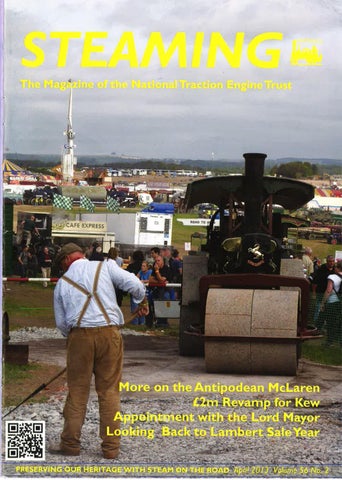
More on the Antipodean McLaren 42.m Revamp for Kew Appointment with the Lord Mayor oohing Back to Lambert SaleYear
PRESERVING OUR HERI
The National Traction Engine Trust Patrons Hal Bagot JP - Robert Goodwill MP - Lord Forsyth The Rt Hon Sir William McAlpine lilt - Richard Preston - Malcolm Harbour MEP President - Andrew Semple Vice President - Charles Daniel Chairman Robert Herring Glebe Court, Fringford, Bicester, Oxfordshire OX27 BRJ
01869 277410 Vice-Chairman & Chairman, Engine Owners Section Bob Siddall Stud Farm House, Castle Hill Carlton on Trent_ NG23 6QR
01636 821991
Treasurer: Julie Smith FCA Yew Tree Cottage,
Rally Authorisation Bill Evans PO Box 102,
98 The Ridgeway, Astwood Bank, Redditch, Worcestershire. B96 6NA
Wrexham, Clwyd. LL 13 OZS
01527 893427
Insurance Officer
01978 780749
Vacancy - Contact Head, Technical Services
Rally Organisers Section Lance Jackson
Public Relations Officer Mike Dyson
Mangerton, Lea Cross, Shrewsbury. SY5 8HR
The Haven, Nelson's Lane, Haddenham. CB6 3UH
01743 860091 General and Company Secretary Jenny Holt South View, Hutton Roof, Kirkby Lonsdale, Carnforth. LA6 2PF
01524 271584, fax 01524 271768 Membership Secretary Sue Cook, 74 Church Lane, Kirkby la Thorpe, Sleaford, Lincolnshire. NG34 9NU
01529 3 03 16 0
Head, Technical Services David Smith
01353740470
Yew Tree Cottage, 98 The Ridgeway, Astwood Bank, Redditch, Worcestershire. B96 6NA
Commercial Section Paul Cook 74 Church Lane, Kirkby la Thorpe Sleaford NG34 9NU
01527 893427
07905813095
Chair Steam Apprentice Club John Durling 19 Mill Lane, Barton under Needwood, Staffs. DE13 8HE
Registered Office 4 Church Green East, Redditch Worcestershire B98 8BT
01283 712818
Membership is open to all interested in road steam preservation. Annual subscription £30 (L35 non EU members requiring Steaming by air mail). Details at www.ntet.cn.uk or simply send a cheque with your name and address to the Membership Secretary - address above. The Steam Apprentice Club is the junior section of the NTET, formed to support youngsters up to the age of 21 in learning about and appreciating road steam. To find out more please contact the Chairman - address above - or visit www.ntet.co.uk/sac
oeft1TAG STEAM SUPPLIES A Division Of
Industrial Bullet-house Supplies Ltd. WWW, heritagesteamsupplies.co.uk Unit 34 Brunel Way, Segensworth East, Fareham, Hampshire P015 5SF England Stuart Gray: 07785 258169 (01489) 570737 — 8 Lines Phone : (01489) 570767 Fax: E-mail:
www.heritagesteamsupplies.co.uk
sales@heritagesteamsupplies.co,uk
"Offer applies to online orders shipping to UK mainland only.
4-11ft' r
April 2013 Volume 56 No 2
Editor: Roger Mills 10 Sultan Road, Emsworth, Hampshire. P010 7PP
steaming@ntet.co.uk Contributions of suitable articles, shorter items or photographs are warmly invited. Individual contributors or Copyright the NTET 2013. The opinions expressed in the magazine, with the exception of Trust announcements, are those of the contributors and do not indicate the views of the Trust. Copy date for next issue: 10th June 2013.
Published by: The National Traction Engine Trust Ltd 4 Church Green East Redditch Worcestershire B98 BBT Artwork & Design by Roger Mills Editorial Assistance Key Mills, Cliff Pypard Printed by: Holbrooks Printers Ltd, Portsmouth P03 5HX ISSN 0260 - 2962
(Cover) Just to prove we did have some good weather last year Graham Avery's Aveling & Porter 10 ton roller 10983 gets down to work at Dorset. (Roger Mills) (Above) This fascinating shot comes from a collection ofgloss negatives in the care of the Kew Bridge Museum and drawn from the collection of the Metropolitan Water Board. Richard Albanese, from the Kew Trust, writes that they know very little about the 'Electric Light Engine' and the photos (see also page 71) so far are the only records found. The high speed engine looks as though it may have been purchased (though it's not of on obvious make), but could have just as easily been built by waterworks staff in their workshops. They certainly built or adapted others for pumping uses. The boiler is a standard Merryweather unit, with all the remaining equipment housed in a chassis/body constructed within the waterworks workshops.
It's seemed to me for some time that the entry barriers to road steam preservation are now almost insurmountable for the person without significant disposable wealth or the engineering know-how to buy a basket case and do it up. Where I live even someone on a good salary would have precious little spare after going in for house purchase. (It's kept me on the back foot since 1977!) And now we've moved over to the American style of university financing one wonders where all that will end for the average parent, or indeed student. These aren't of course new concerns as indicated by some thoughts of Michael Salmon in 1958; "And what of the future? Will the continued presence of the professional job eventually so discourage the 'back-yard' owner that he will give up? [...] Or will the expense of keeping the engines up the expected standards and of carrying them about get to the stage that none of us
can afford it?" But it has led me to wonder if the era of widespread joint engine ownership may, inevitably, be round the corner. Now I'm aware that the late 'lay chaplain' always asserted that the only example of group ownership that ever worked was the Gladiator Club. I'm also aware of some of the volcanic bust-ups that have occurred when good friends have tried a partnership. (One remembers, too, the cautionary tales of joint boat
55
ownership related by Mike Green in his 'Coarse Sailing' get its teeth into things like the Coniston Coppermines books!) But really what other route is there — when the results were always interesting and enlightening. £70k is seen as a reasonable price for an artefact? You The 'stars', if that's the right word, emerged naturally have to earn around £130,000 before Lax and NI to rather like that other much missed serious educator stash that cash.... The truth is that if things go on the Patrick Moore. All will be missed at this desk, as way they are Mr, Mrs, Miss or Ms Ordinary will have Carenza has been for several years. to have help to climb the wall being built brick by brick by the market round the road steam engine. At least if the rather fancy prices of the past few years are to be Looking at an archive of old Steamings presented to sustained. Yet if partnerships are as problematic as me by Jim Walker of Portsmouth one thing standing out clearly was that , especially under the editorship some claim? Now market forces might be an inescapable fact of of Ran Hawthorne, coverage of steam preservation in life but their implications have to be faced. If this its widest sense was given a fair amount of space. I think movement becomes the preserve of the wealthy, (or that's a good idea so we'll be taking an occasional look even just those whose kinfolk are willing, even with bad at developments in museums and collections. I also grace, to stake all the familial wherewithal on an want to give some coverage to miniatures and models engine) we are, I fear doomed to become a rTiinoriLy as I suspect, for many, this will be the only way they'll ever own a steam engine of any kind. hobby. Or am I being just too pessimistic? Anyway can I urge engine owners to make use of our Labour Exchange and really think about offering the chance of involvement with live steam to people with no expectation of engine owning Need help operating or restoring your engine? who aren't lucky enough to know Want to be involved helping an engine owner? someone who'll give them some experience. Here's a new service aimed at uniting members seeking help with those
NTET `LABOUR EXCHANGE'
id.i, If you sound and look like me the notion of Phil Harding as a TV star has been incredibly empowering. But not for much longer, now Time Team like most serious programming is consigned to the dustbin — in favour of Celebrity Strictly Come Big Brother Digging perhaps. TT didn't do many industrial sites but it was a serious programme doing serious work - and when it did
offering help. Using the Trust's website we'll attempt to put you in touch with each other. Owners, just email us with details of your engine, location and the type of help you are expecting. We assume you will want someone to do more than sweep the tubes and clean the brass. Potential helpers also email us mentioning what experience you have, location and the distance you are prepared to travel on a regular basis. Your offers, but no personal details, will be posted on the website.
Then if you see a request or offer of help which you would like to learn more about let us know and we'll put you in touch. ALL OFFERS TO MIKE DYSON public.relations@ntet.co.uk
Picture Puzzle Con you identify the engines in this line-up, captured by Co/in Harris lost year? if you could get the venue first that might help. No prizes - just for fun as they say!
56
Chairman's Report Robert Herring Although a rather distant memory now I visited family in Perth Australia over Christmas. Whilst there I was invited to meet Peter Dymock, President, and members of the WA Preservation Society at their ex railway buildings just North of Perth. Excellent facilities which afforded them the opportunity to work and display members equipment under cover, welcome when dealing with 40C! As well as the members we were joined by Mick Platts the local independent boiler inspector and lain Rennie the principal inspector in WA for Work Safe, their equivalent to our Health and Safety Executive. The opportunity was taken to exchange views on the various aspects of the safe repair and operation of traction engines applied in Australia especially the differing policies amongst the various States. In providing them with a copy of our Engine Owners COP we were commended on an excellent document. It was an interesting and worthwhile meeting that highlighted to me the progress we have achieved over several years I am pleased to announce the appointment of Mike Dyson to the position of Head of Communications, Mike will be well known to many, both as an engine owner and someone that has undertaken the position of our Public Relations Officer, which also encompassed the website since its inception several years ago. Mike has always strived hard to improve our communications with members and non members and within that remit we look forward to a continuation of his endeavours with the support of all
place in September 2014 is beginning to take shape, and it promises to be quite a spectacle with every likelihood of 200 engines taking part, elsewhere in the magazine are more details, if you are interested in attending this year will be the time to express your interest. Having received this year's Rally List within the last Steaming, despite the horrible weather of last year it is pleasing to see the continuance of the majority of events, lets hope mother nature is kinder this year and enjoyment will be created for all. The first events are not very far away now.
MICHAEL MASKELL 1948-2012 Well known engineman and boiler engineer Michael Maskell passed away peacefully at his holiday home in Scotland in October last. Witshead village church was full and overflowing and his coffin made the final journey on a trailer pulled by his Fowler Lord of the Isles 14012 driven by his sons Darren and Richard. A sociable man he will be greatly missed. I had the pleasure of knowing Michael fore many years , he was a member of many steam and tractor clubs in the area. He had suffered ill-health for many years but he was always very helpful to many in the steam world who sought his advice. We send our condolences to his family. Michael Watts
The 60th Anniversary Road Run which is to take
Technical Services News David Smith Insurance Officer Following on from the last edition of Steaming where I explained that Ian Cooper had stepped into the breach as 'Disc Monitor', after James Blenkinsop had vacated the Insurance Officer desk, I am now pleased to relate that Ian has picked up that role very quickly indeed and is already chasing some of the independent boiler inspectors about their current Professional Insurance details. I can now also tell you, with a great deal of pleasure and relief that Ian has now also taken on the full roll of Insurance Officer. Whilst being a very capable person he is not, at this time, totally insurance savvy and I will be supporting him for as long as it takes for him to feel comfortable with the job. To that end Ian is considering taking up the invitation of Footman James to visit their premises
to get to know folk and to learn more about the rudiments of the schemes that they broker on our behalf; thank you Ian. Rally Lists Mike Dyson has taken on the mantle of Head of Communications, but as he says, only on a temporary basis. Well I've heard that before. Anyway the reason for this piece here is to explain that during the period that the post has been vacant I have been undertaking some of the admin work. This has included chasing up the printing and despatch of Steaming and also the Rally List. It is the latter which caused me to scratch my head because despite being printed and despatched with Steaming to our members in January, due to internal problems at the printers it didn't get sent to Tourist Information Centres and the places it 57
usually goes to until the end of the second week in propose that in the event of a member not getting the March. I am assured by Holbrooks that this problem support or response that was expected from the was a 'one-off and to some extent out of their control. account team member he was to be contacted I apologise to any members or interested parties that personally on 0121 561 6264. I welcome these were affected by this delay. Thanks to David Collidge proposals and await with interest the details of the the on-line Rally List is also now fully updated and improved policies. I was reminded that Footman James continues to includes the website addresses of the majority of events offer NTET members discounted insurance cover on listed there. On-Line Membership Facilities David Collidge has every type of policy, not just steam related and also been working very hard for us in recent months importantly on every transaction the NTET earns on the on-line Joining and Renewals membership commission. service. Although a little bit later than planned we got Water Hydrants — an update of sorts I was reminded the scheme up and running on the NTET website by by someone commenting on the poor deal that is the mid February. The delay was caused by some foible of NTET that we hadn't made much progress on the topic of a 'single licence, multi-user arrangement' for road PayPal, but all is OK now. Already the new service seems to have been well going engines. Co-incidentally I also learnt of a fair in received. Since its launch and in the three or so weeks the south west of England being fined a considerable it has been running as I write this we have had 18 amount of money for illegally taking water from the transactions, 12 joining and 6 renewals. Not a great South West Water system. It turns out that there number in the scheme of things but a very encouraging were no standpipe licences held nor were there any indicator of what a website facility can do for us. attempt to protect the water system itself with double It is the stuff of things to come as is the use of QR check valves. I am told that the infrastructure that makes up the (Quick Read) code blocks. Those of us with modern so called 'smart phones' can use an 'app' (Application) South West Water region, and also in adjacent regions, to scan this peculiar looking piece of graphic art and does not recover easily from a sudden drop in pressure then be taken automatically to the website that it and that in an endeavour to protect the system licensed depicts in its hidden message. If you or your non- standpipes which can only be used at designated member friends have a smart phone with the app try hydrants are issued on behalf of SVVVV by Jewsons the builders. this here, it should take you to www.ntet,co.uk/joirt. I rang Jewsons headquarters in Coventry and got Having hopefully got the wrinkles out of the PayPal system and with the help of Nick Bosworth, the SAC to speak to the man who had negotiated these webmaster, we are looking to bring the same Join and arrangements with South West Water in the hope that Renew facility to the SAC website. There are a few the service might be extended. No such luck! obstacles to overcome but hopefully by the time you Although he had tried to introduce the scheme with read the next edition of Steaming at least the Join Severn Trent he had little or no success in getting his element will be up and running if not the Renew. proposal accepted. Mindful of the lack of support we have received on Footman James In the early part of March I met with Martyn Raybould the Account Manager with insurers this topic from within the water industry, including Footman James responsible for our business. The tenor OFWAT I am going on another tack. This time I am of the meeting was to update each other on events and going to write to our Patrons and ask if they are able aspirations within our respective organisations but to bring our concerns and requirements to the more importantly to explore how the value and attention of someone they may know in an appropriate benefits to members could be improved in the policies authority. It is not my intention to put our Patrons on the spot, on the contrary, but I do seem to have and services offered to NTET members. Subsequently Martyn agreed to review the scope exhausted the avenues normally available to us. of the Steam Vehicles policies and also the Events More on Quick Read (QR) Code Blocks Just to whet Policies with a view to improving the extent of cover your appetite a little more • I provided. Significantly the conversation focussed on here is the QR code that the way the customer/member expects to be dealt with will takes you directly to the by FJ's front line staff, i.e., those that handle our phone NTET website. Hopefully calls and enquiries. I had a few tales of woe to relate we will be using this on our which we discussed in details. Subsequently Martyn future publications as the proposed to make available to Trust members a single opportunity presents itself. telephone number that would bypass the normal calls handling system and which places the caller at the desk of the NTET account team leader. He went on to 58
Engine Owners' News Bob Siddall Engine Owners' Meeting The weather contrived to reduce the attendance at the EO meeting. Those who did attend were treated to an excellent talk by David Whale, Chairman of FBHVC, and Senior Vice President of FIVA (Federation Internationale des Vehicules Anciens, the body representing the international historic vehicle movement). The meeting was terminated at lunch time because of the deteriorating weather. Hydrants At a recent court case in Exeter a circus was fined a 1000 for each of 3 offences plus court costs for contravening the Water Industry Act 1991, section 174 after using an unauthorised standpipe to access the water supply via hydrants without the permission of the water company. The Court noted the seriousness of the offences committed and the real risk of contaminating the public water supply. South West Water stated that unauthorised use of standpipes could result in a fine of up to £3000 for each incident. In order to assist all customers holding outdoor events, South West Water has set up a special stand pipe hire service with Jewsons. Road Run 2014 Application forms will be available at Dorset this year with a specific stand in the NTET tent. Entry forms need to be returned by 31st December 2013 to enable programmes etc can be produced in plenty of time. Participants will be notified of their
New Members Mr D Bannister Luton Milton Keynes Mr R Sweeting Bristol Mr A D Dando Mr G J Bell Cradley Heath Mr A P Jude Hardwick Mr M Tuck Bosham Burgess Hill, Mr K Woolford Mr S M Moore Fosters Booth Mr A J Parrish Haynes Mr G E Berntsson Sweden Bampton Mr P Edwards Grantham Mr G Taylor Mr D T Miller Winchester Mr A J Hills Merthyr Tydfil, Malmesbury Mr D Edwards Ridgewell Mr J Webb Mr D McVay Australia Mr I Mason Lutterworth Mr R Clarke East Dereham Mr I Lyford Thatcham Swindon Mr R Johnson Mr N Meyers Australia
acceptance by 30 April 2014. An entry fee of £20 will be charged for each exhibit. This will go part way to off-setting the costs of a souvenir programme which will list all entries with their history and try to show a present photograph and a photograph of the exhibit during its working life. Commemorative plaques will be provided to each entry and a different commemorative plaques will be on general sale to the public Driving Course The Driving Course is on track for early May. Joe Black will be able to update the meeting further. There has been only one application for a Scholarship and that has been awarded to Barney Hill. Competency A meeting of the Competency Scheme Assessors took place recently and agreed to recommend to Council that both elements of the scheme should be maintained for a further year and be reviewed at the next Assessors meeting at the beginning of 2014. Welsh Dry Steam Coal We have received notification from Coal4Energy that they have now introduced lorry loading facilities at Ffos-y-fran which should improve the availability of Welsh Dry Steam Coal. They are expecting to produce 40,000 tonnes of sized coal this year. It is available in 3 sizes and more details can be obtained from Paul Paddock on 07968-048482, e-mail: ffos@coal4energy.co.uk
Mr M Davenport Sandy Mr D Davenport Sandy Mr J Ansell Coventry Mr R Hilton Crewe Mr J Kistle St Columb Mr J Hunt Bishops Stortford Mr C Crocker-White Bude
111r E:fif.JJ1J?, 111111111)1" • Engine alignment problems salved • vaive setting. motion overhauled • Crankshaft bearings re-fitted • Lap jointed chimneys
repairs, fire boxes, re•tubing • Tenders repaired or renewed • cast iron vvekding • 30 years experience George Hudson, 64 St James Gardens, Leyland, Lancashire PR26 743 Tei: 07811 664363 of 01772 451383 Email: georgehudson192@bfinternet.corn 59
Steam Apprentice Club News John Durling As the season gets underway the SAC year is following what by now has become an established pattern; we start with the driving days in Horsham (already fully subscribed), Old Warden and Weeting. It is with sadness that we can't run one at Stanton Drew this year but even Alan can only do so much for us. I hope we can find another venue in part of the world. We have also lost the Flookburgh driving day which leaves the North West completely un-represented; in fact the whole of the North of the Country is very short of SAC activity. I do, of course, say a big thank you to all of the engine owners and crews who turn out for these driving days because without you they could not happen. SAC members will be taking advantage of the substantial discounts available on them on the Driving Course at Astwood Bank. Also many rallies up and down the Country also make SAC members welcome by offering free entry so perhaps now is a good time to remind ourselves of the 'rules' governing youngsters driving engines at rallies. Underage, non-licence holders may be allowed to steer or drive a steam vehicle at an authorised event if all of the following conditions are met: I The insurance for the vehicle covers Steam Apprentice
Club members. 2 The person is a bona fide member ofthe NTET Steam Apprentice Club. That, age not-withstanding, the Apprentice is not 3 prohibited from applying for or holding a driving licence.
4 The Apprentice is closely accompanied at all times by a full licence holder for the type of vehicle being used. 5 The minimum age shall be 13, with a minimum height of 1.40m. The known conduct of the Apprentice is not likely to detract from the Safety standards of the event. 6 The Safety Officer has given formal permission following a risk assessment of the roadways and vehicle manoeuvring places. 7 The Rally Organiser has given written notice to the exhibitors and public of his intention to allow such movements (via notices and the rally programme). The Club's 4" Burrell is coming on in fine style following successful build sessions at the Model Engineering Exhibitions at Sandown Park and Alexandra Palace: by the time you're reading this I hope that she is on her wheels! The funding for this has benefited from several generous donations both of cash and services including a bequest of a large number of Corgi and Matchbox model engines, wagons and rollers, some of which have proved to be quite rare. These have been given to us to sell on behalf of the Burrell Project, a wonderful boost to our funds. The whole of the SAC offers sincere thanks to the family that made this possible. We are still actively pursuing other sources of sponsorship of course and all offers will be greatly received. Here's looking forward to a drier and busier season.
Commercial News Paul Cool WANTED 2013 EXHIBITION UNIT VENUES 18-19 May 25-27 May 1-2 June 15-16 June 6-7 July 13-14 July 26-28 July 2-4 Aug
Fawley Hill Strumpshaw Rockingham Castle Banbury Chiltern Rempstone Welland Gloucestershire Steam Extravaganza - South Cerney 17-18 Aug Lincolnshire Steam & Vintage Rally 28 Aug - I Sep Great Dorset Steam Fair 7-8 Sep Haddenham 13-15 Sep Bedfordshire Steam & Country Fayre If any members are free to help out with the unit at any of these venues please contact Paul Cook -
details alongside.
NEW SALES OFFICER(S) to take over from the retiring officers at the 2013 AGM. The commercial side of the Trust is an important area bringing in much needed revenue. The existing structure of the sales officer role does mean that it is a big undertaking, so we are looking at splitting the role into two, a Sales Officer and an Exhibition Unit Officer. Sales Officer - responsible for operating and looking after mail order and web sales. Including stock control, storing and distribution as well as looking for new lines that the trust could possibly stock. Previous experience would be useful, but it is not essential. Exhibition Unit Officer- the exhibition unit is the main public focal point of the NTET attending rallies throughout the season, providing an information point for members and the public and an opportunity to purchase traction engine related items. We hope to find someone who will help organise the itinerary and stock and work with the exiting sales unit volunteers on the rally fields. NB! Worry not - this role DOES NOT involve towing the unit to events. If you are interested please contact Paul Cook commercial@ntet.co.uk 01529 303160 07905 813095
60
NTET Competency Scheme John Durling Since I last wrote on this subject the group of people involved with running and managing the Competency Scheme have met and re-affirmed the NTET's commitment to the provision of a Voluntary Competency Assessment. Both of the certification methods, test and experience based, are available to members. There is, however, still a certain amount of confusion over what is actually involved in the test based version, with some people believing it to be very complicated. On the contrary, while it covers all of the basic skills required to manage an engine safely as the main part of the test syllabus below should show there is nothing to worry about.
I. Preparation Driver: A current driving licence should be provided. Where applicable the Student Log Book and Mentor's 'proposal for examination' should be available for scrutiny. Engine: A current NTET disc, and road tax disc if applicable, should be prominently displayed or the relevant insurance and inspection documentation should be available for examination. The Engine should be presented in a clean and workable condition, with an appropriate set of 'tools' and spares, parked on level ground with the brake set on, scotches in place and out of gear. No trailers to be attached at this point. The examinee will be required to describe, in simple terms, the operation of each component and all fixtures and fitting attached to the engine.
2. Raising Steam Practical demonstration of the method of raising steam for the particular type of make/engine. Pre fire lighting routine: general steam circuit condition checks; water level checks; fire tubes condition, fire grate cleanliness; smoke box condition; use of chimney covers and spark arrestors. Fire management and Steam Raising: Method of laying and lighting the fire; transition to coal only; general combustion control; gauge glass blow-down routines; injector checks; safety valve operation and
approximately 30 metres and stopping. Turning the engine in a 'tight' road: The engine should be turned around to face the opposite direction of travel using the minimum number of shunting manoeuvres and without coming into contact with roadside kerbs, masonry or street furniture. Emergency Stop: At some unspecified part of the examination the examiner will require the vehicle to be stopped under simulated 'emergency conditions'. The Driver's ability to safely bring the vehicle to a halt with due consideration for other traffic and pedestrians and the engine's well being will be examined. The driver will be advised when the 'Emergency Stop' examination is imminent. Starting and stopping on an incline: Move off from a dead-stop condition up an incline, travel 30 metres and stop; move of from a dead-stop condition down an incline, travel for 30 metres and stop. Changing gear on an incline: Demonstrate gear changing routine, high to low and low to high; use of safety measures Reverse to hitch: Reverse accurately to a trailer hitch (or fixed point) set at an obtuse angle; demonstrate coupling and uncoupling the trailer. This manoeuvre can be simulated with road cones or other similarly visual devices in which case a commentary will be required
and cleanliness.
to describe the coupling/uncoupling routine. Removal and subsequent refitting of a drive pin(s); where appropriate 6. Parking up Practical demonstration of how to set the traction engine to a passive state. The following aspects will be examined: Setting of motion gear; gears, brakes, scotches and drain cocks; management of the fire, water levels and steam condition.
3. Preparation for engine movement
7. Dealing with an Emergency
Practical demonstration of the preparation ofthe traction engine prior to being put to work or moved. Included are water levels and steam pressure checks; drains clearing routine; steam cylinder lubrication
Describe, using narrative and aided by hand drawn diagrams where thought appropriate, how various 'emergencies' might be dealt with. The list of possible emergencies includes, but may not be restricted to; a broken gauge glass, fusible plug failure, leaking tubes, a sticking clack, injector failure, broken motion link pin, failed cylinder oil
calming. Lubrication routines; mechanical checks; Engine Preparation: bunkering and provisioning; general engine and motion examination
checks; drive-gear selection and moving off technique.
4. Driving - General Practical demonstration of driving the traction engine and the management of the steam plant. The following aspects will be examined: General all-round awareness; attitude to other vehicles and pedestrians; empathy with engine under changing conditions; reaction to changing circumstances; fire and steam management; progress planning.
lubricator.
V 10am-5pm Daily
10am-5pm Daily g R lip F
S. Manoeuvring Practical demonstration of the ability to manoeuvre and manage the traction engine. Examinees will be tested on driving straight-ahead and stopping at a marked position; reversing and stopping at a marked position. 'T' junctions - from the 'T' junction ahead position: Turning Right at the junction and driving for approximately 30 metres and stopping; reversing back into the 'branch' road, turning Left at for the junction and driving
VINTAGE & CLASSIC, 1'~ f, VEHICLE SHOW'''' ) j v vrauu
See Around 1500 Exhibits, Various Displays And Attractions Trade Stands • Autojumble • Craft Marquee • Diggerland Real Ale Marquee • Harris Bro' Vintage Fun Fair • Arena Parades Kent Spitfire Display • Scale Models • Hot 8. Cold Refreshments ,
:
.
SOUTH OF ENGLAND SHOWGROUND ARDINGLY, WEST SUSSEX
ADULTS £10 OAPICHILD £7 FAMILY 2+3 £25
www.ardinglyvcvshow.org.uk 61
Two lovely archive shots for you to have a think about. Above is a very interesting panorama of some large scale sawing operations by the looks of it, though the engine in the foreground does not seem to be belted to anything. But what make is this portable, Don Fox would like to know. Below, this rather grim looking group, who may have been terrified by the snapper's orders not to move, are obviously getting ready to thresh but where? Wendron in Cornwall is one suspicion but has anybody seen this shot before? Is engine identification possible from the glimpse of chimney and flywheel? The picture was sent in by Carla Eddy whose husband's family have farmed there since 1870.
McLaren 957 Part 2 - Now 121..111a1M- 1,
•
' \la/ 1114Lili r
•
T.B.,10NES HORORA fA
Earle Warwick describes somrecent. work on this antipodean gem For some time I'd suspected that the main and big end bearings on my McLaren were getting a little tired, and the need to remove the crankshaft for some crownstay work confirmed my suspicions. At that time though, following the stay work, there was a need to steam the engine to a new home, so since the bearings were still serviceable all was reassembled with a view to doing the work in a couple of winters' time. I'd also taken the opportunity to measure the big end journals, and found that not only were they rather oval but also somewhat tapered. After reassembly I did a little measuring and found that the crank had been sitting well out of square with the cylinders, and so thinking the engine would run a little nicer if all was squared up, set the crankshaft up to sit a lot squarer than it was. This unfortunately proved the saying 'If it ain't broke, don't fix it', since the realigned crankshaft was now at odds with the second shaft and the vibration from the worn second gears only succeeded in continually shaking the flywheel key loose. I could certainly have shimmed up the main bearings to get the gears meshing as they were previously, but with the
state of the bearings and gears I decided to bite the bullet now — new bearings and gears were the only sensible answer. First job was to remove the flywheel. The key was already loose thanks to the second gear problem, and the flywheel could be turned on the crankshaft after a little jiggling, so no problems were anticipated. Indeed that turned out to be the case, for when I got to the yard after work, Dad had pulled the engine out of the shed, jacked it up and sat it on blocks, removed the hind wheel and slipped the flywheel off the crankshaft, replaced the hind wheel and let the engine back down. All good I thought, until Dad showed me a rather battered pressure gauge. Turns out that while slinging the hind wheel back in to position, diligently watching to make sure the wheel slid nicely over the axle as he inched the tractor forward, the pressure gauge was valiantly trying to halt his forward progress by getting in the way of one of said forks. Result — new gauge necessary! Although the new gauge is nicely printed with J & H McLaren, Leeds on the face, so it wasn't all bad. 63
After that it was straightforward to remove the motion and lift the crankshaft out. Stripping the big ends revealed just how worn the bearings were. (When they had been removed previously there had been no need to take the shells out of the back of the straps and the bearings extreme wear was not visible on the front shells, but the back shells were well past it.) The LP bearing had been set to with a copious amount of bronze weld on the back side where it butts against the strap, or rather against a multitude of shims which butt against the strap, and even with the additional material it was less than a sixteenth thick. If it hadn't worn all the way through at some stage, it must have been damn close to it! With the key out, the top gear pulled off the shaft with comparative ease, revealing it had been pressed on over a shim - the flywheel too. So I guess at some point the shaft had been turned to remove wear. With the low pressure eccentrics removed, it looked like second gear was also pushed on over a shim, and after a 30 ton puller and plenty of heat had failed to unseat it, I finally had to resort to cutting it off. I'd planned to make two new top gears, building up the second gears and having them recut, but that was now out the window! A few cracks emanating from the corners of the square in the centre of the second gear pinion on the second shaft helped my decision to cut the other gear off the crankshaft. Cleaning revealed a number of casting flaws, and should there be any hidden inside the casting itself, possibly building up wasn't a good idea. The flywheel side main bearing journal was quite Boring the main bearings
64
tapered also, and the gear side was heavily scored, so I dropped the shaft in to town to be ground. The flywheel side journal was metalsprayed a little oversize, extending out to cover the diameter where top gear is located, so when fitting the new top gear I didn't have to push it down the whole length of the end of the crankshaft. Unfortunately, their crank grinder was about an eighth of an inch too small to accommodate a six inch throw, so I finished the big end journals by hand, using the method described by David Walker in his book Steam Locomotive Design and Maintenance for Road and Rail. Firstly I measured up each journal and then bored a split aluminium gauge to the smallest measured size. The gauge was the width of the parallel portion of each journal. Using a fine file I filed round each journal, using some bearing blue on the gauge to highlight where material needed removing. Once the blue showed right around and across the journal I covered the gauge with lapping paste, put the two halves together and set to lapping the journal. This removed any high spots left after the filing and left the journals nice and round and perfectly parallel. Lastly I gave the journals a rub with some fine emery to remove any embedded lapping paste. This took about right hours on each journal, but I managed to get them round to within half-a-hundredth of a millimetre, so well worth the time spent. The file had a radius ground along the edges in order to avoid putting any sharp nicks in the radius at the edge of the journal. Interestingly, close inspection of the journals before refinishing them revealed that some enterprising soul had welded them up at some point and turned them. Prior to removing the crankshaft, I enlisted the
blowholes which only showed up during machining, the upshot of which is that they had to be recast seven times. The job took nearly ten months to complete, with two of the bearings only showing their blowholes on the finishing cuts, when on the engine being line bored. By the time I discovered the last blowhole I'd well and truly had enough and had the bearing whitemetalled rather than getting it recast again. The one good thing though about having to do so much bearing machining is that I now have a mountain of gunmetal swarf to take to the scrap man, so much so that I may even come out on the right side of the ledger! After machining the mating faces The new second shaft second gear set up on the mill to rough out the square in of the bearings, they were glued the centre prior to sending it out to be cut to final size. Roughing it out myself together rather than soldered for all saved the man with the slotter quite a bit of time, and hence me some money! the subsequent machining operations. For those interested, the glue was knowledge of a gear professional to advise on the new Loctite 324, a two component structural adhesive along gear sizes, ordering blanks before Christmas 2010, so with Loctite 7075 (the activator), the activator being that some holiday time could be spent machining them sprayed from a little squirty bottle onto one bearing up. Patterns had also been made for the new bearing shell, the glue from the traditional Loctite squeezy shells and delivered to the foundry, and the castings bottle squeezed onto the other bearing shell and the for these were picked up two days before Christmas. two popped together. One has to be fairly quick in The turning of the gear blanks was a straightforward lining the two up since the glue fixtures in about fifteen job, but one was too big for the lathe so was farmed seconds, then after 24 hours it should be strong enough out. Leaning on the lathe on Boxing day, turning away to commence machining. I had my doubts about this, happily, the lathe seemed to give a little lurch towards but it held things together with much tenacity. Indeed, me and away again. I thought it was a bit odd but put on one of the blowhole bearings where it no longer it down to a couple too many drinks the day before mattered whether it got a little hammer treatment, and dismissed it, but it happened again a few minutes with one half held firmly in the vice while the other later. I thought to myself 'Cripes, am I about to keel Pulling the new second gear on to the crankshaft over here or what?', but then I glanced upwards and noticed the lights in the workshop swinging away heartily — just another bloody earthquake, no cause for alarm! With the gear blanks machined up and away to be cut, it was time to turn my attention to the bearings. First they were clamped down to the milling table and the mating faces cleaned up, and here it was discovered that three of the eight shells had sand inclusions. Unfortunately the foundry was closed for three weeks, but I was able to crack on with the others. Unfortunately again, most of the shells I had been supplied were a special lightweight version, full of
65
received some hefty hammer blows, the glue remained firm. To unglue, the bearings need only a little warm up — just too hot to hold by hand for more than a second or two is about enough, certainly not enough to discolour the bronze. With the outside of the main bearings now fully machined it was time to line bore them in place on the engine. An attempt with a boring bar borrowed from a mate resulted in bearings having to be recast thanks to the blowholes. It did the job admirably but lacked a self feed, so I decided a more permanent line boring arrangement with a self feed might be worth making, especially with an eye to the future and the fact that my Marshall had recently been visiting the UK for some major boiler work and may need its bearings tickled up once it started to come back together. The bearing shells were picked up from the foundry, glued together and machined. Once that was done I spent several weekends making and then fine tuning my boring arrangement, until finally I was able to set it up on the engine again. The way I set it up square, and true to the cylinders, is as follows. On a McLaren, the trunk guides have a turned diameter at their outer end, so I measured each diameter and to the smallest one added a piece of shim of the thickness of the difference in radius, such that they were now effectively the same diameter. Then with a piece of gauge plate resting across the two, I checked the level with a machine level. As one might expect, the engine was well out of level so one hind wheel was packed up with pieces of carpet until the bubble on the level read within its graduations. Once level, I could start setting up the bar itself. To do this I made a pair of L shaped blocks, sized so
that my 60mm diameter boring bar when sitting in the crook of the L would be in the same position as if sitting in the centre of the bearing. One block was sat in the centre of each bearing housing, and the bar clamped in place to hold the block against the bottom and back faces of each housing. The level was then sat on the bar and one side or other shimmed up or down to bring the bar level in comparison to the trunk guides. Once this had been done, liners were made and surface ground to the appropriate thickness to replace the multitude of shims. I cross-checked the level with the machine level set across the piston rods, and all was as it should have been fortunately. The bar was now theoretically parallel to the centre line of the cylinders, but not yet square to them. To achieve this, I first set up a stout piece of steel angle with a couple of small blocks welded to it about fourteen inches apart on the mill, and using the digital readout, start drilled a small tapered hole in each block to an identical depth. (A start drill is a short rigid drill with a 90° point angle typically used for starting holes in CNC machining.) The angle was clamped to the end of the longest trunk guide and measured back to the machined face on the front of the cylinder to ensure it was square. It was also set up level with the machine level. Next I made two lengths of rod, each threaded at one end, one with a point and the other with a radius, and screwed them into a long nut with a lock nut each side. Then with the radius end in one of the holes on the angle, the length was adjusted until the pointed end just rubbed the boring bar. It was then moved to the other hole and the boring bar shimmed back or forwards until the pointed end just rubbed it again. I repeated this from side to side a few times until the
Setting up the boring bar to bore the second shaft bearings. The two flat bars have bored bosses at each end corresponding to the centre distance between the crank and second shafts.
Using the length bar to set the boring bar up square to the cylinders
point just touched the bar on each side, then I made some spacers to replace the shims he level of the bar again with the machine level, just in case, but fortunately found it hadn't moved. Next task was to mount the boring bar mounts. This was simply achieved by slipping them over the bar and bolting them up to studs welded to the hornplates. The bar was then withdrawn, the L shaped blocks removed and the bearings installed in the housings. With the bar back in and some tool bits ground up, I was ready to commence the boring. The whole arrangement was driven by the bar itself, which had a nut welded on one end. A small hydraulic motor drove the bar. I was a little nervous before starting the operation, but fortunately it performed faultlessly and both bearings were machined in a day. I was rather annoyed, though, to find I'd bored into yet another blowhole in one of the shells, and so this was the bearing I had whitemetalled. Fortunately, with the bar out, it could be removed and replaced later without disturbing the mounts, so it was a straightforward job to rebore it once it came back from the whitemetallers. While the boring bar was still in position, I thought it would be a good idea to check the alignment of the second shaft since I was fitting new gears. Two bored discs were machined up to fit closely in the second shaft bearings, and a piece of bar slid through. Measurement revealed the shaft to be about 5mm closer to the crankshaft at the gear side, which wouldn't do my nice new gears much good at all, so boring the bearing housings and fitting new bushes was the next job to do. Before knocking the old bushes out, I measured the centre distance between the second and third shafts. The boring bar mounts disassembled, two more bored discs were turned up to fit in the crankshaft bearings. Two flat bars were then made with a bored boss at each end, the centre distance between the bosses
corresponding to the crank and second shaft centres, and these were slid over a bar which was slid through the crankshaft bearings. The boring bar was then slid through the other ends and wedged up to the correct centre distance with the third shaft, and the boring bar mounts were slipped over and bolted to more studs on the hornplates. The second housing had quite a hard surface though, which destroyed my HSS tool bit, but a carbide tipped tool certainly showed the hard spot who was boss. Once the housings were bored it was a simple job to machine up some new bushes, and once these were done they were stored in Mum's freezer overnight and pushed into place the next day. Installing of the second shaft bushes marked the point where things were starting to come back together. Their oil and dowel holes were soon drilled and some oil galleries cut, and it was time to slip the shaft into place. The new second gear was lifted up and sat on the crown in readiness, and we drew the engine out of the shed to install the shaft. Slung from the front end loader, it was soon slipping nicely through the bearings. Second gear jiggled into place on its square, the shaft pushed right home. Once it was all the way in it was immediately taken out so I could fit the retaining collar and pin which had been left in readiness on the belly tank and forgotten about. The gear selectors were given a trial fitting which showed some filing and scraping necessary on the top gear fork, which had been built up to remove excessive wear. I was on the footplate doing a little work on the gear selectors two days before Christmas, when things started moving a little. After a few seconds things were moving a lot, as one of our lovely earthquakes put in an appearance. I swear the engine's wheels were coming off the ground and had I not been holding on I suspect I would have ended up backside first in the bunker, and I am quite confident now that the springs are in good order! The Christmas holidays meant ten days off work more reassembly work beckoned. The main job was to lift the crankshaft into place and see how it fitted. I expected to have to do a bit of fitting on the gear side bearing. This was a little tricky but I managed to get within the ball park by measuring from the inside of the crank web across to the side face of the journal, and on the engine from the side of the big end of the connecting rod across to the face of the bearing 67
housing, and used the difference between the two to engine wasn't! The idea of leaving the crosshead in the give me the thickness of the bearing side flange. The trunk guide by a couple of mm was to allow for crankshaft was suspended over the engine and lowered expansion as the engine warms up, with the magic using a block and tackle. The hornplates are bent number of one eighth of an inch meaning the crosshead inwards at the top, and consequently the bearing will just sneak out of the guide, as it should when the housings form a very shallow vee which meant the engine is in steam. bearings needed a tickle up on the mill to get the The bearings were machined up and given a light crankshaft to sit in place. The old bearings had a scrape here and there to get them fitting nicely, and the horrendous clearance in the housings, presumably for motion reassembled on the engine. All the bearings this reason, but I'd made the new bearings a somewhat were liberally dosed with oil and everything turned over better fit. As it turned out, the shaft needed a sideways freely with only the second gear to pull the shaft round move to get the big ends to line up, so the gear side with, so I was quite happy. Top gear was fitted next and bearing had to have the inside of one flange machined its key made and installed. I had decided to make some slightly to sort this out, which in turn made the whole guards to go over the gears in a concession to user shooting box a little easier to drop into the misaligned friendliness, the top gear inside the flywheel always housings. Once it was all in place and lined up, I made covered the steerer with plenty of spots, and the plan a square C shaped piece from some brass sheet to slip to use a nice sticky open gear lube meant that said spots over the bearing between the flange and housing to would require some extreme exfoliation to remove. prevent any sideways movement of the bearing in the The second gear cover took a few trial fittings as it had housing. Wouldn't it be easier to sort out the to clear the LP crank on one side and the eccentrics misaligned housings once and for all? I did consider it, on the other, and also accomodate the rack for engaging but the engine has been running like that for over a top gear, but with a bit of cutting, bending and welding hundred years, so why mess around with it now? The it came up ok and doesn't look too out of place. The fitters of old had got the thing set up nicely, so there top gear cover was a simpler affair, split along its centre was no reason why I couldn't too. line so it can be removed with the flywheel in place. Once the crank was in place and rotating freely, it With the covers mounted on the engine and was the turn of the big end bearings. The was no point painted, the last job is to fit the flywheel. At the time measuring up the old bearings to get the sizes, since of writing however, our earthquakes have reared their they were exceedingly worn and had been packed up ugly head again and our factory building at work has with all manner of shims, and if possible, I wanted to been assessed as earthquake prone, so we are currently assemble things shim-free. Exactly where the shells working all the hours to get the building up to standard. would sit in the strap was the big question, and hence Unfortunately this means no engine work for a while, how thick to machine the back shells. To get a which is a right bugger since I'm so close to getting it measurement for this, I pulled each connecting rod back back in action! until the edge of the crosshead was sitting a couple of millimetres inside the end of the trunk guide. The crank was then turned to back dead centre and the distance between the end of the connecting rod and the crank journal measured. The distance from a bolt hole centre in the big end of the connecting rod to the end of the rod was measured too, and measuring from the corresponding hole in the strap to the inside of the end of the strap meant it was a simple bit of maths to work out the thickness of the shells. It would have been easier to do the above but with the strap assembled on the rod instead, and just measure between the strap and the journal, but the straps were at work and the
68
Roger Mills, with a bit of help from a previous editor, looks at ambitious revamp plans for Kew Bridge Steam Museum
Kew Bridge Steam Museum is housed in one of those temples to clean water dotted around the country. Lying aside the Thames, its ornate chimney echoing the botanical pagoda across the river, it also reflects the proud arrogance of the Victorian era. Externally though — apart from boasting a quality of building and architecture modern public works find a tad elusive — it could be seen as just a building. But for anybody interested in preservation it is, simply, a cave of delights from the age when steam was king. Certainly my predecessor Ran Hawthorn was a big supporter of the place giving it regular mentions in Steaming and marking each new stage in the development of this unique resource. In 1980 he reported the inaugural steaming and his words give a pretty good idea of the progress made to that time: "After some months of restoration work, the first of the five engines at Kew Bridge Pumping Station was steamed on November 8th. The oldest at the station, this Boulton & Watt beam engine was built in 1820, erected at Chelsea and moved to Kew in 1839-41. It has a 64" diameter cylinder, 8' stroke and a pumping capacity of 130 galls per stroke, giving 2.5 million galls a day. The engine and pump have been completely dismantled and reassembled by members of the Trust. It is not permitted to pump water into the public supply, but the engine, idle since 1943, is now pumping recirculated water. In the adjacent west engine room, there are two engines. The 65" built in 1837 by Maudslay & Field of Lambeth was the first to work at Kew. Similar in design and almost identical in capacity to the Boulton & Watt,
it was extensively modified in 1840 and later many parts replaced. The second, now unique, is a 70". Bull engine, manufactured in 1859 by Harvey & Co. of Hayle, Cornwall. The cylinder is mounted immediately above the pump, which is driven directly by the piston. Thus this arrangement takes less than half the space of a normal Cornish engine, and since the working parts are concealed in a panelled compartment, there is very little to see. The stroke is 10' and the pump capacity 235 galls per stroke, giving 4.3 million galls per day. Behind this engine house is the original boilerhouse, which contained six boilers. After many alterations and varying designs, the final installation of 14 boilers was removed in 1958. In the former coal shed, the Trust has installed two large Lancashire boilers converted to gas firing. In 1845, the buildings were extended to accommodate a 90" engine built by Sandys, Came & Vivian at the Copperhouse Foundry, Hayle. With an 11' stroke and pumping capacity of 472 galls per stroke, giving 6.5 million galls a day, this was the first Cornish engine specifically designed for waterworks use. In 1869, the building was again extended for the new 100" Harvey engine, which also has an I 1 ' stroke, but a pumping capacity of 717 galls per stroke, giving 10 million galls per day. These engines are enormous, powerful and beautifully designed and produced. The restoration of this magnificent station is only possible because of the enlightened approach of the Thames Water Authority. In 1942, the Metropolitan Water Board approved in (Continued on page 72) 69
To coincide with the feature on Kew this is the first time these photos from the Thames Water Collection, which is in the care of the museum, have been published for at least 100 years. Above is the scene during construction of the 'Island Barn' Reservoir in 1909. Below are a number of portables shown providing temporary pumping for shaft sinking operations during the construction of the 'Kingston Tunnel' used to carry water pipes under the Thames in Surrey. Opposite top is another view of the electric light engine seen on page 3 while below that is a steam carriage of 1869. This photo carries the caption 'Made in 1869 by Mr Patterson' Nothing else is known about this but the image was in a batch of New River Water Company photos so was this vehicle used by them at one of their depots or sites? Any comments and suggestions as to makers etc for any of the pictures are welcome. All images are the copyright of KBSM/Thames Water
principle the establishment of a museum station, where today we have one of the finest collections of 19th Century engines in the world. The Trust has received many donations from many sources and it is to be hoped that the Steam Fraternity will give every support and encouragement to the venture." The magnificent 90" engine was for several years the single largest piece of machinery moving anywhere on the planet allowing, for the first time, water to be pumped in large amounts up-hill efficiently. This technology paved the way for supplying water to a far greater geographical area and to upper storeys of houses for more people, more of the time, and helped London greatly expand as a metropolis. By 1869 when the 100" Engine was installed, the Kew Bridge site was struggling to meet demand and usage of Cornish engines for waterworks was in decline. The I00" engine's beam broke completely on one side in 1879 narrowly avoiding a serious disaster. Repaired and returned to operation it was when finally retired in 1957 the last of its kind left still in use. Since Ran was writing the main steam hall has also come to accommodate a 1910 Hathorne Davey Triple Expansion, an 1867 James Kay, the 1863 Easton & Amos Compound Rotative and the last reciprocating steam engine in regular use in the British Water industry, the Simpson of 1910, which soldiered on to 1983. That roll-call is well known of course, though it bears repeating so we can all thank whatever deity we choose or at least our lucky stars. What's less known is that the museum has been soldiering on for the past In 1981 Ran Hawthorne wrote... On 17th February British Rail chairman Sir Peter Parker opened the steam valves on the ex Newmarket Waterworks Co 1910 Hathorn Davey triple expansion marine type engine which was successfully adapted for the water supply industry. The engine hos three cylinders and a main crankshaft to which are attached three cranks and two flywheels. the latter give a smooth running engine; other features are semi-rotary Corliss valves and re-heat receivers between the cylinders which maintain the steam temperature as steam passes from one cylinder to the next. Working pressure is 160 lbs per sq in and on the inaugural day Ivan Fear's Marshall portable provided steam in deference to Kew's Lancashire boiler's task in supplying the other preserved engines. The dismantled engine was received in good condition and the only major work needed at Kew was the remetalling of the main bearings. A 20ft long, 12 ft deep pit had to be formed for housing the condensers and air pumps, hut although capable ofpumping 1000 gallons per minute the engine will now run unloaded. Watching the ceremony were two Newmarket men responsible for the engine 40 and SO years ago — Bill Smith was the Water Company's station superintendent and Ron Palmer drove the machine. 72
few years in the face of numerous difficulties, ranging from robbery of lead from the roof (twice) and spiralling costs of fuel meaning that most engines are steamed now only at weekends and then not all at the same time. And to frank on my last visit it was looking its age, the visitor facilities a little tired, and access for those without full mobility variable. Visitor numbers are falling apparently and so it was felt time for a bit of a refresher. And what a refresher. To cut a long story short in April 2012 the HLF awarded the Trust LI.845m which will fund what's been dubbed 'Project Aquarius'. The full amount to be spent, including notionally valued volunteer time, will be £2.45m and amongst the plans are re-branding the museum to reflect its heritage waterworks theme, new educational displays across all areas - bringing the history of the pumping station and its engines to life, and a major new gallery exhibition on London's water supply - past, present and future. Here though we'll concentrate on those areas of most concern to steam enthusiast—the engines. In the 'Steam Hall' collection of water supply pumping engines there will be three new linked displays which help put the machinery into context both in terms of the Museum's collections, the story of the whole site's history and the wider water supply story for London. Included in the proposals are a large model recording the changes and phases of Kew Bridge Waterworks' development over time. The Steam Hall engines within will receive new historical interpretation, explaining how they are representative of many similar machines
In 1979 Ran Hawthorne described this little beauty thus...A rare steam powered twin beam water pumping engine which supplied the needs of the Rothschild family estate at Dancers End near Tring in Hertfordshire for many years. The engine, which has twelve fluted columns supporting the beams, and which also incorporates an 1 I ft diameter 6 ton flywheel was built by James Kay of Bury, Lancashire in 1867. One of the rfirst privately owned steam water pumping engines to be erected in a rural area, the Kay engine drew water from a well to feed a reservoir in the Chiltern Hills. It was installed in a typically elegant Victorian pump house, which still stands today, and from which water is still pumped to the reservoir by electric motors. All the parts are half the size of similar parts on a single beam engine. This is because the work load is shared by two beams. The engine has been designed to allow the two pumps to operate alternatively thus giving a constant flow of water. The steam pressure is 80 psi and the engine is equipped with two condensers and air pumps. which are now lost, but were once used to pump showing how the waterworks played its part within the billions of litres of water to London households up to local community benefitting a range of people across different areas. This is an extension to the display the 1960s. New displays to the East & West Engine Houses proposed for the 'Steam Hall' area. One of the most interesting aspects of the project will show how the Grand Junction Canal Company became a water utility and reached Kew, an interesting centres on the Electric House Project. This building story that is rather lost on many existing visitors (Ok. was constructed in 1891-93 to house a large horizontal, Me!). Established as canal company they started to triple expansion 'Worthington' type non-rotative steam pump their water from a station in Paddington, for pumping engine by James Simpson & Co, the last steam domestic use, via a network of pipes and one of the engine to be installed at Kew Bridge. But by the mid first uses of steam power. But the Grand Junction 1930's the age of the other steam plant and its Waterworks became one of the most vilified water unreliability lead to the installation of back up supply undertakings of the day, poisoning people by emergency 'Allen' Diesel engine plant. In 1943-44, the pumping the heavily polluted canal waters into their Worthington engine was scrapped and removed and homes. They moved to Chelsea in 1820 and using their its house converted to house five new electric new Boulton & Watt engines took a new supply from pumpsets, made by Hathorn Davey & Co of Leeds the Thames instead. Finally they moved their one of the first large installations of their kind in London. This area will be used to exhibit more modern undertakings to Kew, bringing the Boulton & Watt engines with them, installing the new ones. Appointing pumping equipment like No I pump, which with its new engineers to 'clean up' their image they built one pipes, fixtures and fittings were retained as part of the of the first large scale treatment works several years Museum, with a view to creating an electrical themed display in the future. This will feature a small collection before it became compulsory under law. The 90" engine corridor will have a new display of electrical objects and artefacts was built up to help showing the key dates, evolution and design changes illustrate the storylines which are planned. Recently the to the waterworks site as it has grown from 1836 to Electric house was completely re-roofed and restored its height in 1900 and subsequent decline. The Trust externally having been allocated part of the grant hopes to build in local history elements to the story, funding awarded to the East & West Engine Houses. 73
All in all it's an ambitious project and taken together should give Kew a new lease of life making it more attractive to the general visitor as well as giving a clearer understanding of the technology and where it sits in modern civilisation. But inevitably there will be some disruption starting around the time you read this - so those planning a visit to the metropolis takes note! From April the Museum is closed weekdays for the rest of the year. It's hoped to run engines as normal at weekends and even have a few special event weekends lined up. Most if not all the engine houses will be open to view and there will be a small temporary shop and reception area. They
Railway Society who have recently laid a large loop of
hope to still be able to provide basic light refreshments
track.
such as tea, coffee and cakes, but no full meals! All the railway rolling stock will be moved to the Kempton Park Pumping Station home of the Kempton
Finally the museum is looking for new volunteers to join in helping deliver these exciting works in time for a grand 're-opening' in early 2014.
Great Engines Trust, where it will be put on loan for most of the year to the Metropolitan Water Board
ntetshop MAIL ORDER - ONLINE - RALLYFIELD TRACTION ENGINE READING NEW Aliens of Oxford (Jonathan Brown) Inc, part p&p £27.00 Brown & May Ltd (Sadder) inc. part postage £32.00 50 Glorious Years ("Cosses") £19.50 The story or the County of Salop Rallies Preserved Steam Powered Machines (Hanavy) £9.99 Threshing Days (Alderson) £9.99 Traction Engine Museum Guide £8.50 Herberts of Dorchester £8.50 The stogy of a show family and their transport The Steam Age £9.99 Interesting, surprising and little known facts £14.99 The Great Dorset Steam Fair Images from 1989 to the present day E8.95 Traction Engine Register Threshing Machines (Trevor Gregory) £27.95 Classic Commercial Vehicles (Ranieri £19.99 Traction Engines - Preservation and ower (Stratford) £19,99 Steam at Southbrook (New Zealand) E23.00 I worked with Traction Engines(Hampshire) &print of 1967 edition) £7.95 The Story of the Invicta Works - a history of Aveling & Porter (Lane) £30.00 A Life with Steam (Challis) £27.00 Best of the Tests (Dyson) 49.95 Driving and Operating Traction Engines (Dyson) £25.00
74
A Good Mixture Road Locomotive Society Archive series. The Traction Engine Archive (Willcox) £17.00 The Traction Engine Archive, Vol.2 (Willcox) £26.00 The Traction Engine Archive, Vo1.3 (Meredith) (22.00 Note that prices include £2.00 port astage costs. Industrial Revolution Explained (Yorke) £7.99 Pictorial Albums Burrells of Thetford (Ranieri) £5.99 Aveling & Porter of Rochester (Ranieri) £5.99 Fowlers of Leeds (Ranieri) £5.99 Garretts of Leiston(Ranieri) £5.99 DVDs The Stanley Steamer (78 mins) 113.50 Garrett Portable and Fixed Engines (Whitehead) (Book in CD form) L10.00 Garrett Threshers and other Machines (Whitehead) (Book in CD form) 410.00 CLUB ITEMS Magazine binder (for 12 copies Vol 24 onward) £7.25 Magazine binder for 12 copies up to Vol 23) £7.00 NTET MembersBadge - members only £2.60 NTET 2000 showman's badge (boxed) £2.95 NTET traction engine lapel badge (boxed) £2.95 NTET Foden wagon badge £2.95 To claim UK post free purchase, just do the following *Write your name, address, and your purchase order. *Enclose your current NTET membership card. *Make cheques payable to National Traction Engine Trust *Send your order to NTET Sales, 90 Devon Road, Luton LU2 ORL Card purchases (£l0.00 min) available on 01582 733971 Non-members/non UK members add I 0% for postage See the full sales list on the Trust website: www.ntet.co.uldsales-lists.html
Steaming
ENGINE OWNERS' CONFERENCE Despite the wintry weather Bob Siddall was able to welcome thirty delegates to Kilsby with the agenda kicked off by a presentation given by David Whale, Chairman Federation of British Historic Vehicles Clubs and Senior Vice President of FIVA the pan-European lobbying group. David explained that the Federation represents 507 clubs, 254,000 individual enthusiasts, 196 trade suppliers, and 22 museums. Its mission was to keep yesterday's vehicles on tomorrow's roads — be they cars, tractors, wagons, motorbikes, steamer vehicles, buses, or military. The Federation had established that the Historical Vehicle industry generated a revenue of £4.3 billion, 28,000 jobs and represented 0.24% of the total annual mileage in the UK . At the moment the Federation was working on the proposed EU legislation on roadworthiness. There was a good working relationship with DVLA and VOSA and Malcolm Harbour MEP was a leading person in the European Vehicle Group. It was pleasing to note that he was now a Patron of the NTET. Andrew Turner was an important lobbyist in Europe and influential on behalf of the FBVHC. A key priority he reckoned was recruiting the people the heritage vehicle industry needed to learn the necessary trade skills and carry them on. That meant raising the profile of the FHBVC and the preservation movement in general, The Annual Driving Day was now well established and Heritage Open Days had now been launched which including displaying vehicles at National Trust properties. But the plain fact was that not enough people were being attracted to the cause and without people he said there could be no progress. A new website was due to be launched in February and the branding of the Federation was to be changed in order to raise the image amongst the public. In the discussion that followed David Smith commented that Road Steam had different problems to other vehicles. David Whale said he wanted to flag up all vehicles which came under the Federation banner and would appreciate all volunteer help with this endeavour. Bob Garnett felt that the Federation was going the right way and workshops providing all sorts of skill training and bursaries were important. In reply to a question regarding the Roadworthiness Directive David was clear that the standardisation of all vehicles would be impossible and the UK directive must be 'tailored to fit' individual classes of vehicle. Bob Siddall thanked David Whale most sincerely for his excellent presentation. Moving on to other matters David Smith
announced that James Blenkinsop who had served as the NTET Insurance Officer for 10 years had now retired due to pressure of work elsewhere. He had been replaced by Ian Cooper therefore all future correspondence should be sent to him. On Technical Matters David explained that the 'on line' joining service was to be launched very soon. Members could pay by credit card or Paypal and the membership card would be sent as usual by the membership secretary. The V765 scheme was now being administered by John Riley and seven members of the TSU formed the team of authenticating officers. Each request was researched by one member but the team decides the outcome. Martin Clarke, Chairman of the Association of Independent Boiler Inspectors, explained that in the last year the Association had moved forward and joined become a branch of the Bureau of Engineering Surveyors. Good progress had been made with the written scheme of examination on different types of engines and internal and external audits were in place. The AIBI website had given the Association a higher profile and communication. The difficult area of consistency was now being addressed. On the Steam Apprentice Club — John Durling reported building of the 4" Burrell was progressing well. Further workshops were planned at the Robey Trust premises in February and at Astwood Bank in March. The project was still looking for sponsorship, however almost 50% of the target had been achieved so far. Old Glory had donated some original Wilford' cartoons of which four had been sold and others remained at £100 each. A box of models had been given to the Trust to sell and they had raised approximately £800. The SAC were looking to organising driving days further North. On other matters Tony Seddon is leading a working party which had a wide ranging remit based on membership. It was commented however that looking back it was apparent that the Trust had achieved much more than was thought. Bob Garnett said that more enjoyment should be encouraged and had written a paper on his thoughts which would be presented to the March Council meeting. It was commented that the mistake was made when the Regional Sales Stand was discontinued in favour of a national one and it was pointed out that the present one was not 'disabled friendly.' These comments would be passed on to Paul Cook, Head of Commercial Section. There being no other business and in view of the increasingly bad weather the Chairman again thanked everyone for attending and the meeting closed at 1.00pm.
reason for the failures and in order to illustrate one type of rivet failure we have selected two characteristic examples. These rivets were amongst those which failed in the longitudinal seam of a multi-tubular boiler. Visual examination of the fractured surfaces showed that all A Quarterly Journal for Power Users. the fractures were of a similar type, it being possible in most cases to determine the point at which the fracture commenced. FAILURE OF RIVETS (1938) It was noted that the rivet holes had not been Of the troubles associated with riveted seams in countersunk, with the result that a sharp corner was pressure vessels, it is not unusual to experience failures formed at the junction of the rivet head and shank. of rivets, sometimes after a number of years of more Most of the fractured surfaces showed evidence of or less trouble-free service, and in such cases it is usual the gradual propagation of the fractures, and this feature was confirmed by microscopic examination of selected specimens. Two rivet heads were sectioned for microscopic examination, one having fractured completely at the level of the plate surface (Fig. I) whilst in the other example, part of the shank remained attached to the rivet head, although in this case a fracture, which had been propagated only a short distance through the rivet material, was present at the junction of rivet head and shank, as will be noted from the illustration (Fig. 2). On referring to the case of the rivet shown in Fig. I it will be noted that two fractures had been involved in the failure of the rivet, one commencing at the Fig I Section through rivet head A showing fracture commencing at sharp right-hand side of the illustration, whilst corner at junction of head and shank on the right the other fracture commenced some little distance down the shank from the to remove any remaining portion of the old rivet and and thus furnishes a considerable amount of to re-rivet after some examination of the plate in the information as to their manner of propagation. All the vicinity of the rivet hole. When consideration is given to the stresses acting upon rivets, including the tensile stress in the shank, due to thermal contraction after the riveting operation, occasional rivet failure is not surprising. It should be mentioned, however, that the fracturing of rivets has been at times an indication of some serious trouble in a riveted seam, hence the advisability of making a careful examination before re-riveting, as this is generally the only manner in which cracking of the shell plate or butt straps may be detected without the removal of the whole of the rivets. In those cases, however, where only the rivets themselves have been affected, an examination of the broken Fig 2 Section through rivet head B showing the main fracture in the shank portion, and also a smaller fracture commencing at the sharp corner at the rivet material will often indicate the junction of head and shank
TeCAN
76
magnification. Fig 5 is a photomicrograph at a magnification of 500 diameters, illustrating part of the fracture shown in Fig. 4. It will be noted that the fracture is apparently not continuous. But in this connection it should be remembered that the region illustrated represents only one plane of the subject, and that the direction of any particular fracture which is being slowly propagated by means of fluctuating stress through material such as the rivet material under examination, is determined at any point by two main considerations. These being the direction and magnitude of the local stress at that particular point, and the presence or absence of some local lower
Fig 3 Photomicrograph at eight magnifications showing the crack visible in Fig 2 at the junction of the rivet head and shank. The smaller crack is indicated by an arrow. fractures were of the trans-granular type and contained iron oxide, these features being visible in the photomicrographs, Figs. 4 and 5. The former, which was taken at a magnification of 150 diameters, illustrates the material in the immediate vicinity of the arrow shown in Fig. 3, and shows the transgranular nature of the fracture. As regards the general microstructure of the rivet, this was normal for rivet material. The visual and microscopical examination of the rivet heads showed that the failures were brought about by fluctuating overstress with accelerated oxidation at the leading edge of the fracture. Oxide was observed to be present along the fractures, even the extremely minute ones visible only at high Fig S Photomicrograph taken near the leading edge of fracture illustrated in Fig 4. Unetched specimen at a magnification of 500 diameters
Fig 4 Photomicrograph at a magnification of 150 diameters showing the minute fracture of the rivet shank shown in Fig 3. Specimen etched in alcoholic picric acid resistance to the propagation of the fracture. In order to bring about the rivet failures described, the heads must have been stressed in such a way as to press them away from the shank. Absence of countersinking, resulting in a sharp corner at the junction between rivet head and shank, may have contributed in some degree to the rivet failures, owing to the concentration of stress at the abrupt change of section, but it would appear that slight relative movement of the boiler plates, probably due to the vibration of the engine mounted on the boiler, has been the primary cause of some additional stress, which, superimposed on the steady stress due to thermal contraction after riveting, resulted in the gradual fracturing of a number of rivets.
tR CITY
'Mk
Ai-
. VV.I.Jr%11
The Border City Steam 2012 event attracted in excess of 10,000 visitors. Amongst north of England as well as a good proportion travelling quite some distance from Clayton & Shuttleworth 48656 Sonsie Quine (above) transformed into a rood loco derelict traction engine in the 1970s. Also two engines each from the Nicol collection Charlton brought his two fine Burrell traction engines Duke of Ongar and Old GI Marshall 16 n.h.p. portable 26790 which is unique in having Stevenson's link reversi (left). From the West Coast it was lovely to see Garrett 4CD tractor 33953 Anne wi recent change in land management policy by the city council means that the site call the organisers have had to cancel the 2013 event. 111•111b
•
.
GI tk.t v it_Lares
L..
,I I
—341414k°,* more than 1000 exhibits were 23 (WI size steam engines coming from around the north of the Scottish border. These included a debut appearance by Gary Scott's from the showman's style engine Old England created by Robert Oliver from a near Aberdeen and the Cook family in Fife (below left). From Northumberland Mike ory (below right) and making a return following a first visit the previous year were ng gear, and venerable Foster traction engine 2373 of 1899 from County Durham hich hos been with the Sutton family at Beckermet for many years. Unfortunately a not now be used for a traction engine rally and unable to find a suitable alternative
W` ,)'• • '1;fer'
It Was Fifty Seven Years Ago Roger Mills looks back to reports of road steam preservation in the year the Chris Lambert Sale took place. 1955 was a year of firsts. The first Disneyland opened George VI with SJ Wharton, 3887 Prince of Wales on July 17, Coca-Cola used the name 'Coke' officially with R Corbett of Winchester, Garrett 33295 Felix for the first time, Colonel Sanders' Kentucky Fried with W Cobbold of Norwich while Arnold Bros. are Chicken had its first outing as did the Guinness Book apparently owners of Fowler 14862 Excelsior. of World Records. There were at least two straws in Writing in BFS notes on 26th February HJ Barker the wind as well. Japan's Yamaha Motors was reported that 'Supreme is still at Ewell and it was Mr established and, for the first time, Britain earned WC Druce who drove her away from Glasgow on her £150m in foreign currency from tourism - worth about journey south. I on behalf of the society would like to £2.35 billion at today's prices - mostly from Americans. do something about this engine but it involves a lot of Post-war western consumerism was on the march! money.' Quo Vadis was also in Hardwicke's yard. So was the race to preserve the fruits of our According to Father Greville Lord Fisher (ex pre-war western industrialism, though race is a bit of Edward VIII) had gone to Wales. Originally Stricklands an exaggeration for the tentative and piecemeal Pride of Worcestershire 2894 was last used by Mrs S struggle to save as much as possible from the breakers Beach. General Gough was in the hands of Viv Kirk torch. Movement's too strong a word to describe, in while Mr DR Chappell of Wellington had acquired the 1955, the diverse groups and individuals who founded ex Thos Whitelegg King of the Belgians, which left preservation as we know it today. their Exeter yard at about 10.30 on 30th June to steam Coverage is similarly fragmented with a natural to its new home. In the following month Sydney Sutton concentration on Showmen's engines. Early in the year steamed a Robey agricultural Edwina from Aspatria for example in West of England Notes TEO, presumably to Beckermeet to join his collection. the late Ewart Opie of Lanner, mentions four ex Yes some familiar names are making their first showmen's in private hands. Burrells 3489 King appearances. Dr JL Middlemiss of Bellingham is proud owner of Burrell Busy Bee. A good start too for the Garrett 34461 which spent some years as a roller was one North of England Traction Engine Society, sixteen ofthe engines that went through Chris Lambert's hands. (John engine owners had joined and a rally was planned for Mound) May 1957 at Lambton Park County Durham. While on national service Eric Best found Presland's Princess Mary at home in Tilbury and visited a yard at Billericay where he noted 'There are a good number of Burrells and several Fowler ploughers owned by Keelings, Threshing Contractors of Crays Hill'. If you were in the market what was available? June 15th saw the auction of Chris Lambert's collection. 1928 Fearless Burrell fetched £300 (around £16,000 at today's
prices) while an Aveling & Porter Road Loco Jimmy realised £85 (£4,600). Silcock's The Bailie was also available, firebox re-tubed, tested, gilded and painted up. Some long distinguished careers had started. In February we heard that 'White Brothers Mammoth Scenic Organ is coming along nicely in the hands of its new owner George Parmley of Chester-le-Street County Durham where this huge Gavioli is now. We all look forward to receiving news that this famous instrument, one of the finest in the country, is ready to play again'.
weather was kind, twenty four engine were present including three ex showland. Downton Carnival Committee wanted 'as many engines as possible' and promised Foden 74078 Mighty Atom, and Fowlers Alfred and The Lion. One event making the front page was Jack 'Cyclist' Wilkinson's report of the third Pickering rally something approaching the kind of coverage we've come to take for granted. For Jack the most exciting item was a tug of war between Clayton & Shuttleworth 36731 Old Glory and four modern Fordson tractors coupled together. The steamer won on best out of three. Freddie Mills, no relation, was to open the NTEC/Epping police Sports Club event with twenty engines expected while WH Dorman's Showmen's Challenger would be among the attractions at Bunny (Notts) Park. Plenty of activity but already there were voices urging caution. 1955 ended with BFS Notes warning: 'I stated in my note recently that we might hear of more engine rallies next year. The ink was hardly dry before news came that one might be held near Worthing. If we are not careful theses rallies will become too numerous. People will get tired of seeing the same engines time after time and the rallies will be a financial loss for the organisers. I should hate to see this happen'.
General Gough, above sometime in the 1950s (Roger Mills collection) and below last year (David Warren)
Rallies? Of course, but researchers should note that they weren't reported as frequently or in as much detail as today - like gold mining you have to search to find the gems. May 14th saw that early and still missed event Andover. For various reasons Lucas' The Lion, Wharton's King George VI and the Garrett Lady Raglan were absent and the weather wasn't kind either. During a heavy thunderstorm 'some excitement was caused when Mr Napper's King Edward bogged down and was roped out by Mr Nichol's Burrell Norah. A good crowd gathered to watch this and I would say everybody enjoyed themselves!' Appleford rally was on June I 1th while July 9th saw the East Anglian traction Engine Club's event at Sailing Oak Aerodrome Braintree. The
As seen at the time
A Steam Track Tractor. The First Description of a Modern Commercial Product Steerable by Side Curvature of the Tracks. In the accompanying drawing we are able to Illustrate not only the first example of a modern steam- driven creeper tractor in this country, but also the first example of a commercial track-laying machine steering on the principle of the sideway flexible track detailed elsewhere. The Track Construction. The vehicle in question has been constructed by Messrs. J. Fowler & Co. (Leeds), Ltd., of Leeds, to apply the principle of track transport as developed by Roadless Traction, Ltd. (of Sentinel House, Southampton Row.). Each track consists of a series of pressed steel shoes, each attached to a section of steel tube connected to its neighbours by the spherical joints detailed in the other article mentioned. All dirt and grit is excluded from the track joints as far as possible even when wear has taken place,for the spherical joints are in tension,and consequently their surfaces are continuously held in contact by the pull of the track, while further they are lubricated from the inside of the tubular link, which is filled with suitable lubricant. Steerage Details. This arrangement not only allows a vertical flexibility capable of absorbing movement over
obstacles 4in high without raising the body of the machine, but gives lateral movement that enables the tracks to be flexed, to steer the tractor without skidding the track shoes sideways on the ground. This steerage is effected by throwing out of action and braking whichever track is on the inside of the curve to be traversed. But as the friction clutches for this work have to be near the finally driven end of the transmission, which is subjected to a very powerful torque (in proportion as the engine is geared down), and it would be difficult to operate them by hand, a simple device is introduced for operating them by power. The clutch consists essentially of the brake drum loosely mounted on the driven member, which when the brakes are applied, exercises a movement slightly rotational to the driven member. It is this movement that is utilised to withdraw the clutch. To turn sharply with an all-track vehicle it is generally necessary, besides declutching, to apply a brake on the inner track ; but in this case the cam clutch and brake are in a single unit, controlled by a single action. The arrangement is claimed to be for all practical purposes fool-proof, to obviate the possibility of the brakes being applied without the clutch being disengaged, and, by the very quick cam action that withdraws the clutch, to prevent undue slipping and consequent excessive clutch wear.
The first Fowler Roadless steam-driven tractor is steered by sideway flexing of the Tracks. This action is automatically effected by the ingenious mechanism described on these pages. (Also see page 84)
f OWLET! ROOMS TRACTOR
82
The now well known cable suspension is embodied in this design, with four suspension ropes to each track, to provide practically uniform ground pressure throughout the length of the tread surface. In passing over an obstacle the roller immediately above rises against the spring tension of the cable and passes on without materially affecting the level of the machine as a whole.
and control is so devised that the tracks must inevitably be out of action must inevitably be out of action before the winding gear is brought in. In all cases the boiler is stated to be capable of using wood as fuel, and in all the working pressure is 180 lb. per sq. in. Water is fed alternatively by injector or feed pump, with a water lifter in addition, but two injectors without pump can be provided if required. Special spark-arresting precautions are provided in the The Steam Driving Unit. chimney, and to enable the engine to cross shallow Machines on these lines are being made in four sizes streams or rivers a closed ashpan can be fitted to weighing respectively 10, II, 14 and 16 tons empty and exclude the water and enable the machine to pass 11 1/2 12, 151/2 and 18'/2 in through water some 2ft. deep. CREEPER TRACK TRANSPORT. working order. Their length The engine, being carried on Progress in the construction of creeper ranges from 17ft. 6in. in the track vehicles during the last few years, the boiler, is of course steam smallest to 24ft. in the largest thanks largely to the war, has been so jacketed to ensure a supply of size, and the cylinders of the remarkable that their largely extended dry steam and prevent priming, use, especially for transport in compound engines by which undeveloped countries, may be confidently with of course a double highthey are driven measure 43/4 and expected in the not far distant future. pressure for starting and Motor Transport" believes that there is an 8in. bore by 9in. stroke, for the immense future for vehicles with self-laying emergency working. smallest size; 53/4 and 10in. x tracks, the more so as numerous There are two tanks, the 10in, for the next; 61/4 and Ilin. important developments of a radical one at the back, the other nature are imminent. Some of these will x I 2in. in the third; while for the be found for the first time described in this under the boiler barrel, biggest the diameters are 61/4 in. issue. This journal has hitherto recorded connected together by an all the most important advances made in and 111/2, the stroke 12in. The creeper track vehicle design and will equalising pipe, that is of course tractor already constructed, and continue to keep its readers well informed fitted with a stopcock. here illustrated, is the smallest of future developments. Embodying, as it does, the but one size. first modern application of Apart from dimensions, in other details these steam to track transport in this country, combined with machines are on generally similar lines. The chain a new principle of steering that possesses far-reaching transmission from the fourth motion shaft can be seen possibilities, this new tractor marks an era in transport in the drawing. In all cases two gears are available, the development, and its performances will be watched lower giving road speeds of 11/2 to 2 mph, the higher with the greatest interest not only in Great Britain, but gear 3 to 31/2, while additionally a winding drum, for in all young and relatively undeveloped countries emergency work and ultra-difficult ground, is mounted throughout the world. It is the first of numerous on the hind axle, and carries 150 yards of steel wire important developments that may be expected. rope. From this, top and bottom vertical flange-less guide rollers give a fair lead at any angles, and so Reprinted from Motor Transport December I I th contribute to prolong the life of the rope. The drum 1922 and supplied by Mike Jones. is braked by a separate pedal or lever on the footplate,
FOR YOUR NEW HANDMADE TINPLATE ENGINE LAMPS IN MOST CASES YOUR OLD LAMPS CAN BE REFURBISHED WITH NEW GLASS & BEZELS, BURNERS & OIL TANKS, HANDLES, DOOR CATCHES AND MORE... TELEPHONE TO DISCUSS YOUR REQUIREMENTS. TEL: 0044 (0)1938 850 393 EMAIL: enquiries@hetheringtonlamp.co.uk WEBSITE: www.hetheringtonlamp.co.uk
83
in 1920 John Fowler authorised the building of four similar engines based on the Class A9 compound traction engine. Only one was completed and allocated works no. 1476 1. It is not clear why the decision to build this engine was taken; possibly they too received an enquiry for such an engine from an overseas customer, or as is more likely, the decision stemmed from preliminary negotiations with the Roadless Traction Company Ltd. The '5naketroc l, as it was christened, was thoroughty tested and proved its ability-to negotiate almost impossible terrain but like the four-wheel drive vehicles of half a century earlier it was too heavy and cumbersome to be of any real commercial value. illustrated above, in image provided by, and the copyright of, MERL at Reading University this engine was probably the first of the several postwar ideas which proved abortive and helped to fritter away the company's precious resources. (Caption material extracted from The Story of the Steam Plough Works by Michael Lone)
84
Miniatures and Models... THIRTYYEARS WORK CONTINUED many given away as gifts or for services rendered. The roundings and droppers were also present and correct and a start had been made on the centre which was on show for the first time at Peter Parrish's Wilton Model Show in March. It was displayed by top fairground modeller Stuart Legg who's committed to complete the ride, reckoning it'll take another 4000 hours - or four years. Stuart has completed - or nearly - the Savage Centre Engine. It's not live steam though the construction has been undertaken to allow conversion in the future should a succeeding owner like the idea. I suppose the difficulties of control and stoking would make prototype operation problematic and, as Stuart pointed out, it was also possible Lu use Lrue scale fiLLings. Nevertheless nothing has been skimped and the detail work is amazing. No surprise there, perhaps, as many of the parts have been made by the maestro of miniatures Ron Dawe. But moving away from the engine the level of skill and build quality on the underworks and even the jacks and the gantry are phenomenal and - having spent some days in 1988 under such a centre cleaning paintwork of sixty years grime accurate to the nth degree. Maybe because Ernie took most of the dimensions off the prototype itself. Remember, too, one sixth Back in the nineties one of the pleasures of visiting scale the weight to be carried by the centre pole and Parham Steam Rally was catching up with the progress taken away by the cross members will be pretty made by Ernie Summerhayes who'd embarked on substantial! constructing a 2" scale model of Jim Noyce & Sons Gallopers. Well it's not a bad prototype, having a complete stud of Anderson horses and a pedigree going back to John Cole. The machine also had one of the best runs of positions being a staple of many major fairs across the country. But to be honest, even in 1992, one wondered if Ernie would live to the age of 175 which seemed to be a conservative estimate of the period needed to complete the project to the very fine standards he was imposing on himself. And indeed sadly he had to give up on being taken Ill a few years ago. Ernie had completed all the horses - 36 in five patterns - reckoning that in fact he'd made 54 all told,
The detail shots show the astonishing level of finish in the work on this super model which surely merits the description The Masterpiece - as good an excuse as any to also feature Burrell 2072 built to accompany the full size machine and seen at - which is the oldest double en Dorset in 2012 with the canopy sides repainted to show the original owner's details. This engine crank compound showman's in existence - went straight Into preservation from the Cole airily to Jim Hutchens but was o Mills) restored mainly by the &old family. She is now owned by Keiston Sparks. (All pictures by Roger
JfAtiN (*MA'S LIC,CTRIc.
1"1, 11111Wir .._ _.L.,r
WO
k
--7 .'pit vim „ Eiti it 741 ..1 _1 r
1
t,I;APINc
NTET Photographic Competition 2013 At steam events throughout the summer months we see large numbers of people photographing traction engines. Modern cameras of all types enable many people to obtain excellent photographs, so the Trust would like all members who are keen photographers to share their results with a wider public. So we are running our third annual photographic competition, with winners and commended entries to be displayed in the Trust's marquee at the Great Dorset Steam Fair. Although the entries last year were down on 20I 2, there were more new entrants wishing to have their work judged, which has spurred us on to continue with the same format to help further establish this event for the membership. The arrangements will be exactly the same as before but for those who would like a reminder of the details and categories, the following is a repeat of last year's invitation to enter. This free competition is open to all NTET and SAC members — and there will be prizes for the winners! There will be four categories with entries split into two groups - under I 8's or Apprentices and over 18's or Seniors. I. Portrait - this should be a sharp, colourful image of a steam traction engine (this means all types) with a complimentary background. 2. Working Steam - this should be active steam recreations of ploughing, threshing, woodcutting, stone crushing, fairground, carriage etc. 3. Road Runs - this is self-explanatory, but the image should be taken away from the rally scene on a club run for example, actually in action on the road, or at rest in preparation or at the destination. 4. People — these should be images of the crew, operating, preparing or disposing their engines, or restoring them. It is important the images are of the people involved rather than the engine. S. An overall category — this will be judged at the end and will not necessarily be taken from the winners of the four categories but will be an image which best portrays real working steam in the preservation era. To enter, please submit no more than 6 prints, maximum A4 (I 0"x 8") size, in either monochrome or colour. All prints are to be the work of the entrant who is a member of the Trust or SAC and must be taken in the preservation era. Previous winning prints should not be entered. With each submission it is important to include the following details;
Name and address and contact number, NTET/SAC membership number, date of birth if under 18 years, location of image, date taken if known and any other relevant details, all to be noted on the reverse of the print. If the prints are to be returned to the entrant then please provide an SAE. The original image source may be required from a winning entrant to enable a large scale print to be produced for display in the Trust's marquee at GDSF. The copyright will remain with the author but reproduction by the NTET of the winning images is implicit in entering the competition. The closing date for entries will be 19th July 2013. This will give the necessary time for judging, sourcing the original material, printing the images, and mounting them for display at GDSF. The Trust will be using the services of up to four experienced judges, all of whom are highly respected in the field of photographing traction engines. Please note that the judge's decision is final. To enter please post your prints to NTET Photographic Competition, 4, Ivy Lane, Ettington, Stratford Upon Avon,
(-Q
n
)IJ LI Lft(__, -i JLI LI Ly'Ll
)
Road Roller Association — for all who are interested in steam or motor rollers, road making machines, practices and history. Quarterly journal Rolling. Subscription £16,00 per year. Membership Secretary, Dorothy Rayner RRA), 9 Beagle Ridge Drive. Acomb, York Y024 3j . J.B.Weid Flat & V Belting, Castors & Wheels, Alligator Fasteners, Chains & Sprockets. A.C.Belting, 58 Kingsholm Rd, Gloucester. Tel 01452 410968 www.acbelting.co.uk Steam Plough Club — for all interested in steam cultivation, offering regular magazine, events, visits, history and technical advice. Subscription £15.00 per year, Contact the Secretary — Dick Eastwood, Panty-Cae, Clyro, Hereford HR3 6.1l) or e-mail rceastw@btinternet.com or visit www.steamploughclub,org,uk Firebars — we can offer a casting service for firebars up to 40in long. Please contact Andrew Semple for details on 01588 630664.
could become liable for the claim if the inspector could not meet it, either personally or through insurance. Staying with boiler inspectors the Hon. Safety Adviser, Jim Newnham, was requesting various information from owners relating to both inspection and more general boiler issues, like water treatment, as part of a survey for the Trust. Engines falling off low loaders during transport was clearly very much a vexatious issue at the time. Both Stuart Gaines looks back 25 years... the insurance officer and John Scott and Partners (the Trust's official insurance brokers at that time) notes As might be expected the Spring 1988 copy of Steaming made reference to the potential impact this could have contained further reference to the clear up operations on premiums, with consideration being given to those following the Great Storm of October 1987. At who used low loaders having to pay more than those Hollycombe Charlie Russell's that did not. Then three pages Foden timber tractor 12370 were given over to two articles Island Chief had been used to by transport experts on how best extract about 50 trees out of 260 to secure engines. Finally a letter which had been blown over. from an engine owner complained Other damage there included the that he was likely to see increased roof being blown off the tea room premiums due to others not and the bioscope front being securing their engines to low damaged. Meanwhile in Kent loaders adequately. Robert and Malcolm Hobb's An article on Allen's of Garrett agricultural 35461 Rob Oxford was based largely on the Roy spent eight weeks on reminiscences of a former contract to Canterbury City apprentice who had worked both Council pulling up tree stumps. within the works and out on The Trust's requirement for contract ploughing. independent boiler inspectors to It ended with the hold professional indemnity recommendation that members insurance may seem to be a needed to get out and talk to nn •t.17.1., On Ra ined UK 0011 DOM/ 1fl relatively new issue. The reasons those that had worked with The Spring 1988 cover was an Alan Thomas for this being required were shot of Aveling & Porter E Type roller 10707 engines and record what they had however set down 25 years ago. crossing the Pennines near Howes to say so that not just the The main reason being that if a machines got preserved. boiler failed causing injury/other damage and the Similarly a long (10 page) article on Hovis' fleet of inspector was found to be negligent the engine owner steam wag(g)ons included both details of the vehicles and stories from a former driver, including how he had driven their last waggon out of the London depot (a Sentinel DG6). Finally an article recorded at least GEARS UP TOEitt fin DIA three instances of Foden traction SPLINED SHAFTS UP TO 251t LONG D. Broaching arid Splming Spun; . Flacks. Holicals engines having broken their back Engineer surveyor and boiler inspection service on all types of gem traction Worro end Wheels. Bevels - Straight and Spiral axles historically — one with fatal engines and loco type boilers of all sires Stook Gears and Splines consequences when as a result a rear • WET compliant Wire Cutting • Geatax Rebuildin9 • Reports and evrtificates issued on Ole wheel fell into the flywheel and the same Specialist Supplier of Gears and steersman was hit by a broken • Internal camera inspection of all areas Splines for all Vintage Vehicles with colour monitor and recording section. and Traction Engines service available The article suggested that the • N.D.T. die penetrant resting carried out Telephone Mike Horlick • Notification to insurance company acme axles had broken on the side fitted LLEWELLIN'S GEARS daY KING SQUARE, BRISTOL BS2 8,1,1 with the brake drum and that in the A professional independent inspection at an TEL: 0117 942 4028 affordable price for that peace of mind case of the fatality it was on the near FAX: 0117 923 2028 %07815771245 side and the other two on the off side. infogliewellIns.co.uk email: djwothers@hotmail.co.uk Web: WWW. I lewellirts.co.uk
BOILER INSPECTION SERVICES J. Wothers
88
Gears
&Leaning
Stuart Gray responds to Steve Arrowsmith's rally thoughts in Vol 55 No 4...Steve Arrowsmith's thoughts concerning what is happening to our hobby certainly raises the debate once again. But without wishing to be critical of his remarks, he has left one considerable element out of the equation and that is 'our public!' I'm old enough to remember what rallies used to be like and yes running an engine on a budget then as we know, was also greatly supported on the whole by the three or four rallies we attended each year which paid out reasonable appearance money and relative costs of running and maintenance were also on the whole a lot less. The situation as I see it, Steve, is that the dynamics of rallies and events have changed significantly, to the point that even at Club and Society level, we are running commercial events, where the public desire and needs have to be met first and foremost, if we are to consider that any event has a chance of success. When I started rallying an engine, costs of running an event must have been minimal by comparison to the demands of today and as a result engine owners were offered a share of the profits as appearance money, in some cases as much as 50%. Your letter seems to hark back to 'the good old days' when beer flowed effortlessly from an ex-army marquee or a troop tent that was borrowed from the local Scouts, to when all engines roaded from one event to the other, in the proceeding and following weekends. Metal theft was unheard of in those days (60's / 70's) and toilets were only provided behind the beer tent, or should I say a latrine surrounded by hessian sacks and of course the girls had to wait till they got home! Low loaders, what were they? And conversions were mostly road engines converted by Charles Openshaw after the WW I . The facts are very different today. Our public no longer come to re-live the past, but to participate in a weekend rally, good day out or festival. An event that in the most part is no longer just a breed of different types of traction engines in the eyes of the public, but all forms of transport and at some events the full sized exhibits are now outnumbered by models, let alone a whole area set aside for trade stands and a market industry that has grown up around us. In addition, we are now regulated to the hilt! Not something I personally condone, as I feel we are sometimes stifled
by the risk adverse society that surrounds us, but it brings again another drain on costs that have to be added to the budget. I do not accept your argument that engines that arrive on pristine matching low loaders take precedent over an engine that has roaded to the event, but I can understand from an organisers point of view, and I have never been an organiser, that within a budget the need to see a realistic return and that also means a return of our public year on year, despite no guarantee of fine weather and that will to some extent depend on the perceived quality of the rally or exhibits on offer. My own personal requirement to that being an organiser should prioritise first a local club and their engines or exhibits, but the balance is important and I appreciate sometimes difficult to achieve. Special events that bring together types or manufacturers engines are one such example that can contribute to continual public desire, but surely the costs will increase. As for the right to appearance money to cover in part the costs of attending an event, that really has to be down to the organisers and in the society we live in, money talks and if that comes as part of a revenue earning exhibit as opposed to one that is less well presented, be it in ex-working condition or left unattended all weekend, then so be it. Each exhibit or collection has to have a commercial attractiveness and I would argue that there is a good balance that can be obtained from both engines that arrive in pristine condition and those that have taken all day on the road to get there. This last year we have seen a record number of events cancelled due to inclement weather and locally to me in Henfordshire we have lost two events that will not open again due to falling gate numbers and rising costs. The world is changing and without any doubt rallies and outdoor events are changing as fast. Thankfully and in my opinion the NTET have through their continuing efforts and codes of practice keep our freedom to exhibit and road our engines away from more draconian measures that would otherwise see all engines transported on low loaders and always behind barriers and away from our public. Such conditions would in my view also see the demise of rallies themselves and engine ownership. In my view we need to read our public, make our exhibits as attractive as we can and entertain via working our engines. Sadly the economics of running a successful event are always going to be a challenge and I predict the challenge can only increase. As for engine ownership, likewise, as the bar and expectations on restoration and maintenance has lifted so has the expense. It is fact that running an engine is no longer something that can be managed on a small budget, some can, but the amortised cost for maintenance and repairs, especially of the pressure system, does mean that there will
89
always be a looming expense of some magnitude around the corner. At least for the moment, we can take some comfort from the continuing desire by clubs and organisers to recognise the costs that we as engine owners incur and their endeavour to help out with coal and some contribution to our costs, after all, full sized engines are the core of an event as we know them and without we would not have an event at all. In my view, costs will continue to increase, rallies will continue to face challenges and the numbers decline. What I can predict is more local events that we arrange ourselves just for owners and drivers and club members that our public will enjoy as we pass by. Hopefully then we can all continue as enthusiasts together to continue to enjoy our hobby. Like you Steve, after 50 years in steam preservation, I don't know the answers and I can only predict what I see. In the end, when all is said and done, when I can no longer afford to either pay my way or enjoy my Sentinel as I intend, then it will be my time to hang up my overalls. Allan Littlemore... follows up on his ER Foden story we printed in the last issue (Foden Fall-out Was a Fabrication) sending us a letter from the great man, published in Commercial Motor in 1930 and passed on by David Bloor, where ERF comments on the state of the transport industry... "THE very fact that road transport has survived and continued to develop to such enormous proportions as it represents to-day speaks well for the future, especially when we consider that it has always had to struggle against Governmental restrictions. The one great fact that fills me with optimism for the future is that while struggling under legislative difficulties it has continued to grow and expand, until to-day road transport has definitely established itself as an essential part of our national and commercial life. Being the head of the Foden steam-wagon works my faith is naturally pinned to steam engines I am more than convinced that we have not yet exploited, by any means, the enormous advantages to be derived from this source, but rather we have only touched the fringe of the cheapest and most reliable form of power. Road transport generally is well advanced, but I predict that far more revolutionary developments await us and that the future of the commercial-motor vehicle is full of promise. Pneumatic tyres are going to play a large part in these developments, making possible lighter construction and higher average speeds, with an enormous saving in maintenance owing to the absence of vibration. The only thing which surprises me is the apparent lack of interest in steam wagons shown by the general public of England. Here we have a commercial vehicle using home-produced fuel, economical in running costs, and reliable in every way; unlimited supplies of coal at our 90
disposal, and yet we send millions of money abroad for petrol and oil. To my mind the whole question is ridiculous, when a good proportion of the money could be spent in this country, more employment provided and, incidentally, the country would be, to a large extent, independent of foreign fuel. God forbid that there should be another war, but it needs only such a situation to arise to show England the fallacy of depending upon foreign resources." Allan comments...I have been saying for years that ER Foden was a steam man and the story put out that he was a progressive diesel man was not true. Only a few weeks after this letter, he was forced to go to Gardner's at Patricroft and buy a diesel. Who put the story out? Why his second wife, of course, to explain to his second son Peter how he came to leave Fodens. What I never found out, although I knew him quite well, was whether Peter believed his mother's story or not. Bob Smith of Rowlands Castle writes... It's interesting that the January 2013 edition of Steaming features two former Portsmouth based machines. As recorded in the July 2012 edition Foden 6368 was new to the Portsmouth and Gosport Gas Coke & Light Co and was eventually sold back to Fodens. I knew the transport manager at Hilsea gasworks in the 60s and by the way he spoke then the sale was relatively recent, but I suppose ten years before than would be just that. The Gas Board continued to be Foden customers having some eight wheeled two stroke diesel tippers used between the Rudmore and Hilsea works. Regarding the Wallis & Steevens Advance 7886 as I understand it this was used in Portsmouth Dockyard and was later sold to SE Borrow Builders and Builder's merchants of Waterlooville. I first saw it in a shed in their sandpit at West Heath Common east of Petersfield in the 60s. At some time it was dismantled and some boiler work was done. But it was never re-assembled seemingly, until the present owner acquired it. I don't know why it has a Middlesex registration number — possibly some Admiralty department to do with plant was located in the county rather than central London. I have seen, but can't recall where, a picture of a Foden steam wagon belonging to Borrows probably dating from the 1920s. In my Kelly's Directory of 19278 there is a Stewart Edwin Borrow listed as a haulage contractor so this is probably where the business started. As for the Navy's need for rollers what I think was a one-off went to HMS Daedalus Lee-on-Solent in the early 70s. I saw an Aveling Barford 2-3 ton motor roller with a naval registration in the establishment at the time.
I suppose after this seemingly interminable winter — though I say 'after' but I am wondering given that as I
thought, due to the almost complete absence of heavy crafts in schools these days and the scarcity of engineering apprenticeships too. Makes you think though — I took the academic path at school but still left knowing how to operate a lathe, use taps and dies and, if I say it myself, could turn out a bit of quite acceptable brazing. Later working vacations in industry, every one dis then, I added milling and presswork to that CV — as well as working to drawings. I don't think those opportunities are there today, others have taken their stead, But also my own thoughts centre on whether, in what is an instant world these days, youngsters are prepared for tasks that take hours or days rather than minutes. Don't get me wrong — I'm not blaming them. Their world is their world and in many ways I envy them. It does, though, emphasise how far seeing the SAC has been to get its Build a Burrell project off the ground — and how worthwhile. I take my hat off to anybody lighting up an engine or working in the shed during these past months but as a pretty sparse Steaming Around will show there has been precious little going on. Or at least precious little that's been reported. My predecessor Derek Rayner, I know, regularly invited contributions from all parts with the assurance that they need not be more than notes or marked up programmes. I simply repeat that message. Thanks this time to Michael Watts, Alan Porter, Fraser McMaster, David Llewellyn, David Smith, Peter Heywood, (Continued on page 93)
write this on 22nd March most of the north is in the grip of freezing weather — it was inevitable that Peter Parrish's model show at Wilton took place, at least on the Sunday, amidst falling snow and under lowering skies. Just previously the Worlds Fair had carried a quarter page ad from the Freemen of the City of Newcastle warning that in all likelihood the Town Moor fair would be cancelled this June as the ground has still not recovered. In truth my regular journeys up the Arun Valley have shown no decline in the amount of waterlogged ground and everywhere here is still sodden. But, hey, it's the Ashes this summer so it's bound to be a scorcher! Wilton's bi-annual miniatures gathering was an excellent show with all scales represented with the added the pleasure of catching up with people after months of hibernation. But I was concerned again at the absence of younger faces. All the exhibitors as far as I could see were around my age, I think 95% male, and that has to be a worry. In conversation with a Raising a good cloud of sawdust at last year's Old Warden number of model club officials I heard that new younger event is Aveling Jubilee 9096 of 1920 with an attractive members were few and far between, probably, they Ransom es portabfe to o smaller bench alongside. (John Mound)
• -4
Three pictures showing sunny and dry days last season certainly merit some space in out pages - doubly so when they are such excellent subjects. All are from the north east starting above with the Foden 'freelance bus bodied' 4258 of 1 914 of 1907 s 4 Irene in the main street at Chipping on a short road run from the rally field on 26th May. Right is Burrell Showman's Lord Nelson 2879 of 1 907 at Scorton Steam on 7th June Finally comes the charmingly named Aveling & Porter roller Earl-e-Rizer 10753 of 1924 in the show ring, again at Chipping Steam Rally on 26th May.
9.9‘f li4141140 _
.
county, Burrell 2298 The with the traction wagon in tow soon met David and John Boyling on Firefly. Also at the pub were Charlie and Nickey Daniel with their Burrell Susie complete with traction wagon and David CP Goodwin The with Gladiator. The steamers were joined by a number of tractors, an AEC militant and a number of different old Land Rovers from around the county. The Menear's 4" McLaren road loco Murphy soon appeared in front of the pub, having also made the journey from Tredinnick. Once everyone had eaten and had a liquid refreshment, we headed our separate ways, some headed for Tredinnick and others headed for St Columb for an event which was to take place a couple of weeks later.
Monk
It was clearly beginning to dry out a tad at Dorset when Colin Coomber snapped the Sentinel DG4P 8714 of / 932 which was fitted with a replica bus body in 2004.
Linford Shobley, "Dungricing", Bob Moorman, The Steam Plough Club, The Robey Society, Colin Harris, David Warren, John Maund, Colin Coomber, LTEC, WESES and The Leyland Society.
David Philpott who has owned Clayton & Shuttleworth 48154 since 1961 has this year decided to safeguard his eardrums after hearing how quiet the new gears are on young John Forshaw's Ransomes 36020. David has sent the engine to Jinnmer Marsh to have four new gears made and the square on the second shaft built up. David roads the engine to all rallies and is not afraid to make her work on sawing, haulage and even a bit of direct ploughing. Jonathan Vickery's Aveling & Porter tractor 6319 Queen of Hearts, which was built as a tractor in 1907 and was converted to a roller in 1921, was put back to original form by the owner in 1991. But the engine retained the roller flange on the smokebox. Now a replacement over the winter has finally seen this flange disappear.
On the wet and windy morning of 27th of December the Cornish Traction Preservation Club intended to hold their annual Road Run to the Quarryman Pub near Wadebridge. First off down the road was Stephen Hawkins with his Aveling & Porter roller 9008 George, closely followed by Mark with Enterprise and Chris Smith's Marshall roller 88097 Toby. New arrival in the
CHESHIRE In July Nial Burn of Malpas acquired partly restored C type Aveling & Porter roller 10486, new in January 1923 to The Eddison Steam Rolling Co of Dorchester. Restoration of the roller has been completed by Metcalfe Engineering of Sutton, near Macclesfield. Engine owners, crews and visiting steam enthusiasts got a pleasant surprise on Boxing Day 2012 when they attended the annual Tom Barlow Memorial Run for, in addition to four regular attendees, first time participant Fowler showman's engine 15375 Supremacy rolled into the car park of The Jolly Thresher inn at Broomedge minus its full length awning and bereft of its showland fittings. Reason for the change is that the engine is in need of a new smokebox and owner Francis Hollinshead gave Richard Metcalfe, in whose care the engine is, permission to run the engine in road loco form, much as it was when new in 1919 to H Price of Quedgley in Gloucestershire for timber haulage. It was not until 1931 that Supremacy became a showman's engine, being converted by Charles Openshaw of Reading and sold to Scottish Showman John Codona of Glasgow for use with his dodgem ride. Helping Richard with Supremacy and his miniature 6" scale McLaren road loco were Jack and Roger Dibnah. A second 6" McLaren road loco was also present, on display in a Transit van. Stalwart of the event George Coles steamed his 1913 Clayton & Shuttleworth agricultural engine 46059, assisted by Malcolm Hartley. Another agricultural 93
engine was Foster 12539 Winnie owned by Frank Lythgoe but in the care of Phil Moston. From Dunham Massey, Nick Parker and Sam Bozson had steamed Nick's veteran Wallis & Steevens conversion 2394 of 1898, which started life as a steam roller but was rescued for preservation in the 1960s in a derelict state and minus its front end. Last of the full size steamers was the speedy Sentinel S6 tipper 8821 resplendent it its Tarmac livery and owned by Peter Walker and Diane Carney. After a while at The Jolly Thresher, the engines, along with a host of vintage tractors and a few historic commercials departed for the short run to The Wheatsheaf Inn for a brief stop before moving on the Ye Olde No 3 for more refreshment! DEVON The Robey Society is well advanced in the organisation of this year's steam event. This will be their seventh year at the Wharf/Bedford car park site which proved a very successful site which as provided the space for a large display of steam engines, vintage vehicles, farm tractors, stationary engines, trade stalls and entertainment for the visiting public. Not only will this be the 23rd Tavistock Steam Fair but also the 30th Anniversary of the Robey Trust so
Colin Harris visited what he described as a 'super little event' at St. Columb, Cornwall last October where he captured this excellent shot of Mark Syms Burrell 3816 Cornish Maid threshing under the kind of skies some of us have completely forgotten existed.
94
they will be trying to make it a very special event and would like all exhibitors, stallholders and helpers to make it special too with extra decorations, fancy dress or `anything else you can dream up'. KENT Preston Services decided not to hold its traditional Christmas/New year open week-end this year due to other family commitments, which deprived many of their 'steam fix' over the Christmas holidays. Colin Wheeler's Foden wagon 7536 of 1917 and Ian Gilbert's Foster tractor 14739 of 2007 have returned from Neil Gough's workshop in Sussex having had minor boiler repairs. Ian's Foster ended up being re-tubed and having a blow down valve fitted along with other work on the filler and mud hole plugs, the original design, surprisingly, did not include a blow down valve. Both engines will now be able to attend the rally organised by Colin and Ian at Dartford on Ilth May. Neil Gough is now getting on with Foden tractor 12770 of 1927 which was new as a wagon to C & G Yeoman of Canterbury, being cut down to a tractor in its working days. The Foden is to be stripped down for mechanical overhaul and the boiler will be sent away for repairs. Apparently the Foden has not received any major work on it for about 35 years, so is due some attention. Dave Main is still working on his Aveling & Porter roller Canterbury 14039 of 1930 despite its appearance! It was going together nicely with a very shiny paint finish utilising Paul Turver's technical expertise but then Dave decided to strip it apart again
to shot blast the boiler, the boiler having been repaired their annual winter bash on Boxing Day at the Kings some time ago at the start of the project. The engine head in Sutton Bonington, full size steam being being restored next to the Aveling at Hadlow is Roger represented by Mark Johnson's Sentinel Super 7651 of Luck and Melanie & Simon Fisher's Fowler 9691 of 1928. Steam Toys in action in early February at Abbey 1903, which is going together well and will hopefully Pumping Station in Leicester saw Aveling & Porter be in steam this year. The paint finish will not be as roller 3319 in steam on a cold day. glossy as Dave Main's as they intend to use the engine for some direct ploughing, for which it was designed, but they might have to wait awhile for the ground to Aveling & Porter 8956 has left the county. This ex dry out a bit! Loughborough Corporation machine rescued for preservation in the late 1950s by John Beeby was in the ownership of Harry Curry for many years but now Having its first outing for many years at the Hollowell dwells in Shropshire. event was Burrell Devonshire type traction engine 3662 Burrell showman's 3334 The Bailie owned by Don owned by David Vaughan. The engine was steamed to and Dorothy Robinson was to be seen in Market Rasen the site by roller owner Michael George whose town centre of Christmas Eve with Andrew Johnson Armstrong Whitworth 10R2 celebrated its 90th and Michael Drury at the helm. Finally Boston Steam Festival will DEFINITELY be birthday on 24th March with a special steaming planned taking place over the first full weekend of September. for the occasion. A steam roller owner in the wars is Alan Walker Organiser Robin Kew would like this known as widely who fell from the footplate of Burrell 4025 resulting in as possible. a couple of broken bones and plaster up to the knee. Wallis & Steevens Advance roller 7784 owned by Barry and Mary Johnson continues to be worked on, with all the rolls off to be fitted with rubbers - these expected back in early March. With the fitting of new piston rings and everything else in place this 1923 built machine was run on compressed air. Painting is well underway and all looks set for a return to the fray this coming summer. The East Midlands Steam and Vintage Society held - •
PEMBROKF.S1-11(11. The Christmas break saw Richard Scourfield make the most of it to re-assemble his 2hp Ransomes portable 22683. With the all new flanged and rivetted boiler already constructed and the motion work, cylinder and fittings overhauled, the pretty engine was running on air by the end of the holidays. Next on Richard's list is his compound Marshal traction engine 44977 of 1906. With a new firebox,
'
From a Burrell to a Sentinel.
NAl ION1f, TRA 01108 FACiNE TRUsT
•
Whatever your pride and joy, we'll get you covered.
•
yaw "V"4"'" tap se."'"' reespt ra wawa to 4et te4.6M4 ,, ,w yam. „vaLgraa The enthusiasts' favourite for over twenty live years, Footman James is one of the leading specialist insurance brokers.
ID
With a UK client base of 140,000 owners of classic
FOOTMAN JAMES
and vintage vehicles, Footman James consistently uses its enormous influence to arrange our best deal for you.
Insurance specialists. At your service. So whatever your pride and joy, you can be confident that
Tel. 0843 357 1915
with Footman James behind you, you've adopted our best policy
www.footmanjames.co.uk
Talk to us soon.
Footman James is a trading name of Aon Limited, which is authorised and regulated by the Financial Services Authority in respect of insurance mediation activities only. Telephone calls may be monitored or recorded for your protection. FP 5349.01.09 'Cover is offered for social, domestic and pleasure use only
COMPETITIVE RATES on modern car, ,7-10t,,t ,
home and contents insurance
95
backhead, front-tubeplate etc. already made, some heavy boiler work is on the go. Burrell 1694 of 1893 is at Bartlett Engineering for some serious boiler work, the construction of which shows the transition to full hornplates etc. and will be very interesting when complete.
Antiques Roadshow's Paul Atterbury, who's also DAPS president, commented: "I am so pleased to hear that the HLF round one application has now been approved. This is a major step and the door is now open to the road that, hopefully, will lead to the fulfilment of all our hopes. It brings the dream of seeing 'the Danny' back in service a big step nearer to reality. It is also a vindication of all those hours, weeks and years of dedication and hard work by the volunteer team, without which this simply could never have happened. We all know it can be done. Now the nation
(Or maybe Cheshire? Info from the LTEC anyway!) Celebration Weekend 2013 sees the Centenary or not only George's Clayton Lucy Ashton but also Alan Porter's Burrell Old Ernie and Steam Tug Kerne. It is is starting to believe us." hoped there will be a number of events over the course of the year to mark these milestones, but the first will be a celebration weekend on 18th and 19th of May, at Tim Bowman, owner of Aveling & Porter 10073 the Leigh Arms, Little Leigh. Kerne will be on the water, Angelina and Tony Harrington owner of Wallis & the two engines will be at the pub, plus a few invited Steevens 7248 Pedler were determined that 2013 guests and anyone else who fancies it. Very much like should start with a steam trip and so, along with their the end of season do in October, all corners with any crews, steamed the to the local pub, The Cottage at interesting exhibit, will be welcome. Get your insurance Fillongley for lunch. Pedler and Angelina met up on the route and travelled the last mile or so together. tickets in order and come and join the party! 2013 sees the fifteenth birthday of the Leyland The party included people from as far apart as Cornwall Society and to celebrate the Society will be holding to Cambridgeshire who had all come together to its annual gathering in Leyland, its spiritual home, on celebrate the New Year. After the New Year run Wallis & Steevens 7248 7th July. It's also announced that the British Commercial Vehicle Museum is organising a road run on the day Pedler of 1914 required some minor adjustments that prior to that event, Saturday afternoon, 6th July. Starting needed, once repaired, a steam test (any excuse), so it from Leyland, the route is expected to include some was steamed on 16th January, a very cold day that had challenging roads and allow drivers to take in the icicles hanging off the trees. After a short run around local scenery with some stops en route for the local roads and the farm drive the boiler was blown down and it was put into its shed to be drained off. photographs and refreshments. WEST MIDLANDS Living Museum's full size replica of Country Black The application pass first-round a approved has The HLF from the Daniel Adamson Preservation Society (DAPS), the Newcomen steam engine has been given the which is restoring the historic Mersey tug tender SS Institution of Mechanical Engineers' Engineering Daniel Adamson. The funding will assist the society's Heritage Award. The replica engine was built in 1986 to honour work towards a second-round application next year. SS Daniel Adamson is the UK's last steam tug engineer Thomas Newcomen, who first constructed tender, built at Tranmere in 1903 for an Ellesmere the machine in 1712 to pump water from the coal mines Port-Liverpool passenger ferry and barge towing on Lord Dudley's estates. Announcing the award the Institution's John Wood service. Later sold to the Manchester Ship Canal in 1921 as a tug and, with a new art deco double-decker said: "It is impossible to overstate the importance of the Newcomen Engine. This engine marked the dawn saloon, acted as the directors' inspection vessel. The coal-fired ship will be restored to public of the industrial revolution. It was the first practical service, sailing from Liverpool Cruise Terminal or the device to use the power of steam for mechanical work city centre Canning Dock all over the Mersey, Weaver and these engines were crucial to the development of the 18th Century coal and metal mining industries in and Ship Canal. A HLF spokeswoman said: "We're delighted to be the Midlands, West Country, North Wales and giving our support to the Daniel Adamson Preservation Society for their vision to restore this very special historic vessel. We believe their latest plans have great potential and we'd like to commend everyone involved for their tenacity and passion in developing them. We'll be working closely with the society in the coming months as they progress the project further."
96
Cumbria." "This impressively accurate working replica is a glimpse into the techniques of these early pioneers and enables us to see exactly what it was like to operate these early engines which revolutionised engineering history." "This award is testament to the hard-work of the
Museum in researching and building this replica which I hope will be enjoyed for generations to come" WORC EST E RSH I RE Progress is being made on the rebuild of Acrise Maid the 6 ton Aveling and Porter piston valve roller 11114 of 1924 and on the rebuild of the 8nhp, single slide valve engine 3121 of 1909, Keeling, with a full set of new gears and new paint work, both owned by David and Julie Smith of Astwood Bank. And, despite atrocious weather conditions work continues on the almost entirely outdoor rebuild of Jessica, the 1923 Fowler Road Roller number 15902 owned by Daz Wardell and ably assisted by Fiona his fiancé.
YORKSFHRE To celebrate the fiftieth birthday of their annual rally the GYTEC is formulating plans for a pre rally road run from the Stokesley area through Bilsdale to Helmsley on the 5th of July, it is also expected that other engines will road in from the Thirsk and Scarborough directions. For the rally itself it's hoped some now out of county 1963 attendees will join those normally in attendance. Also the North Yorks Moors Vintage Machinery group are to help provide a steam threshing display along side the usual wood sawing and heavy haulage on site. STEAM PLOUGH CLUB After the disappointment of having to cancel,
due to the bad weather, the 2012 Steam Plough Club Challenge, plans are well advanced for a Great Challenge to be held in 2013. By kind permission of Michael and Jennifer Davies it is proposed to hold the event over the weekend of 14th- 15th September 2013 on their farm at Fenny Compton nr. Banbury, The Secretary will shortly be sending out invitations for participants to confirm their interest. The number of sets that can be accommodated will be limited. While it is hoped to match the number of engines registered last year, some may well be different as a result of ownership transfer, completed restorations and other circumstances. The event will be for SPC members only. 2014 will be the 150th anniversary of John Fowler's death and the SPC, along with other interested organisations, is in consultation with the Friends of South Park, Darlington, to commemorate the event. It is proposed that the monument to John Fowler in South Park be in some way rejuvenated. This may take the form of additional engraving or the attachment of suitable plaques to the stone monolith. Whatever is done it will have to be as vandal proof as possible, the original bronze model of a balance plough that was on top of the monument suffering this fate many years ago.
From David Warren comes this nice picture of the Peacock brothers' Ransomes Sims & Jefferies traction engine 24774 of 1 912 taken at taken at Lincoln rally 19th Aug. This was its first rally following much work at Alton Engineering.
AN APPOINTMENT WITH THE LORD MAYOR Bob Siddall took a roller along to the City of London for an ancient ceremony The Corporation of the City of London has exercised its rights over carts and carriers since its inception, for transport is the lifeblood of commerce, and the City was ever the hub of the nation's prosperity. A Carman fellowship existed in 1277 and the City regulated its trade. In the 1500's, the Carmen sought protection — they ceded control to Christ's Hospital and paid fees to the School, though the number of carts and 'carrs' plying for hire within the City was limited. Christ's Hospital took over in 1665. It was agreed that all licensed vehicles should be marked with the City's arms on the shafts and numbered on a brass plate. In 1681 there were 420 licensed carts. The Hallkeeper is empowered to license and mark carrs and carts to stand and ply for hire in the City's streets, so long as the owner is a freeman of the City and a member of the Fellowship of Carmen. Every vehicle has to be brought to Guildhall once a year to be marked. Each year is distinguished by a letter reference, each carr by a number. For the year 2012, it was the letter 'U'. Once a year, usually in the summer, Carmen bring their horse-drawn waggons and carriages, steamers, veteran and vintage lorries, buses and coaches, and modern trucks and tractor units, to be branded, or
marked, with a red-hot iron, on a wooden plate, with the year letter and the carr number. This is done as a reminder of centuries of service to the City and to maintain their ancient tradition. Organised by the Carmen, the Corporation's ceremony itself, in Guildhall Yard, sees each vehicle brought for the Master's inspection, then branded by the Keeper of Guildhall, using a special brazier and gloves provided by the Glovers' Company. The duties of the Keeper are shared with the Lord Mayor, and also the Master Carman. Afterwards the Lord Mayor, Sheriff, Master Carman and Wardens doff their caps as each vehicle passes the rostrum, and then Carmen, partners and guests join in fellowship for lunch in the Great Hall. This year, at the invitation of a Carman, we were involved in the ceremony, taking 1926 Babcock and Wilcox Steam Roller 95/4009 and Foster Traction Wagon. Other vehicles involved included horse drawn carts and buses, commercial vehicles of varying ages from old to new and buses, a Routemaster and its new replacement.
(Below) The actual marking ceremony carried out by the Lord Mayor. (Opposite) Moving into position for the ceremony.
STEAMING
AIBI IGC Engineering
DISPLAY ADVERTISING
BOILER INSPECTION SERVICE BnsociSputh Central Engand s'IARTir
I IBES 6 Offers a fast, friendly and highly professional service for: Annual Inspections, Hydraulic Testing, Repairs, Advice
is surprisingly affordable - and effective too!
NTET Compliant Full size and miniature engines Endoscope camera with recording
For rates and discount offers contact the Editor
On site report and certificate production Immediate insurance company notification
Now stocking Welsh steam coal in North Hampshire
Is yours Full-Size or a Miniature? Don't worry - size doesn't matter! MODEL ROAD STEAM INSURANCE for miniature road engines up to Gin scale
STEAM TRACTION INSURANCE for road going engines above bin scale including full size
PORTABLE & RESTORATION STEAM INSURANCE for portable engines and for road engines which are off the road or undergoing restoration
All include optional cover for home workshops, and personal accident Cover for Living Vans, Trailers, Water Carts and Implements is available on the Steam Traction and Portable et. Restoration policies For full details call us free on 0800 783 0878 or visit www.walkermidgley.co.uk Return of opal urylco to, policy alma ytifIC. IN Mu lde mid }Cr FTItT die.. Np n lhly iirmmimii pxymeIrd Plan ivalloblo
1AV
Walker dgk
Si am Traction inm Lim lice P.orlablii ■ RellL1411.10.9 Slnarn Inguiinc
'WM ins,Jrance Brokers Yorkshire Bank Dfurrnbiirs, Fargate, Sheflield Si 2H0 M.M.Mm 1"mmirim, Womm, Lin I Singeredlihri bq 17..dimi i San.A.Limomi ANY
aru 51ST Ellciorpiod Punbotia
Pk
Alithrvidry4 aria R01,..14140 on 14 Fouidcml &row* AmindiTly
Steaming
99
STEAM CULTIVATION - SOME 1940s OPINIONS Fraser McMaster writes... I've always been interested in old farming books and have been spending some of the dark winter months looking back at some gems in my collection finding some pretty frank contemporary views on various aspects of agriculture. I've selected three on aspects of soil cultivation which give an insight into how mechanisation was seen at the time. Incidentally Mr (I assume) Gunston in his book attempts a lot of futurology with varying degrees of success - for example he still saw a place for the horse on small farms which even in 1947 must have been a bit shortsighted. On the other hand though he foresaw the almost complete abandonment of the railways as a means of distribution a prediction that few would have dared to make at the time. It's a book well worth searching out.
can do this, whereas other tools with the exception of the Gyrotiller, in picture would find the work too hard. Ploughing and cultivating with steam tackle is quick work, for the implements are very wide and move quickly. Cultivation can also be deeper than by other means, for the power does not depend upon the grip of the land wheels, as it does in all tractor work. Large fields are best suited to the work, for setting up the engines takes time and labour, and this is not worth while for a small field.
(From Young Farmers' Club Booklet No. 7 Farm Implements Written For The National Federation Of Young
Farmers' Clubs By H. J. Hine, B.Sc.(Oxon) Assistant Technical Adviser On Machinery To The Ministry Of Agriculture 1944)
STEAM CULTIVATOR The large, two-wheeled PREPARATORY CULTIVATION Subsoiling by Steam cultivator is hauled backwards and forwards across the Power (Arable land) No preparation for fruit planting field by two engines, one on each headland. (See next is better or cheaper than steam subsoil ploughing, page) A steel cable connects the engines, and is hauled provided areas of land are large enough to allow of this in by each in turn. The drum for this is mounted method. The steam plough is of the ordinary type, but underneath the engine, between the front and back attached to each plough is a subsoiling tine, which, wheels. There was not room in the picture to show under average conditions, will thoroughly stir the both engines, and the other must be imagined far away subsoil without bringing it to the top, The plough on the right. Ploughing can also be done in this way by breasts turn over the land in the ordinary way and, steam tackle, and is then called cable ploughing. A when fit, the, land only needs harrowing before being one-way, balance plough taking several furrows at a prepared planting. Steam cultivation is suitable only if the land is quite time, is used. If a field is ploughed the same depth, season after clean and free from weeds. If the land is weedy or as season, a hard layer, or pan of closely packed soil forms left after a corn crop has been cut, the conditions must at this depth. Neither roots nor water can pass through be extremely favourable for the steam cultivator to do this pan easily, so it has to be broken up. Steam tackle good work. The slightest damp or smallest amount of
Suppliers and stockists of steam spares and consumables, including oils, boiler water treatment, polish, gland packings,
Seddon &Black kilns uma.b1 es
jointing materials and much more. Ton Seddon Joe Black
01948 780474 info@seddonandblack.co.uk
www.seddonandblack.co.uk 100
weed will cause the tines to clog and drive, resulting in uneven work. In any case steam subsoil ploughing is preferable as it leaves the land in excellent condition for harrowing and marking out. The cost, including coal and carting water, is about 35s Per acre. It may sometimes happen that the engines will break mole or tile drains or their outlets. After the work is done, all head drains and outlets must be looked to and cleared or re-made. A new subsoiling machine called a Gyrotiller is sometime used. It leaves the subsoil so broken up and loose that a year should elapse before planting to enable the subsoil to settle somewhat.
(From Modern Fruit Growing By W. P. Seabrook W. Seabrook & Sons, Ltd The Nurseries, Chelmsford Eighth Edition, Completely Revised 1947 Ernest Benn Limited London: Bouverie House, E.C.4) GYROTILLER If the plough shirks at the same places each time, the field becomes incapable of growing a level crop. Probably the best remedy for such fields is to have them gyrotilled or ploughed with steam tackle or its equivalent. The great weight of these machines should ensure good penetration, everywhere. The ordinary plough should then be able to do its work properly for several succeeding years. [...]Gyrotillers are not very plentiful as their manufacture ceased some years ago, but no doubt they will be forthcoming in the future,
especially for use by contractors. If they are fitted with tracks instead of wheels they will be more widely used. The chief difficulty will be to get crews to work them unless a good type of caravan accommodation can be obtained.
(From Farming Today and Tomorrow By J. Gunston N.D.A., N.D.D., C.D.A., C.D.D. First Published 1947 Methuen & Co. 36 Essex Street, Strand WC2) The picture above - which is taken from the Young Farmers Club Equipment manual providing the quotation shows an engine which has survived. Fowler 881 15223 Paddy was built in 1918 and is now preserved in Ireland. The picture below, by Fraser McMaster, shows her when vsitin? Dorset for the Fowler special in 1996. Her 'matched pair partner 15222 also survives.
101
LOOKING ON with Allan Lloyd One of the pitfalls of writing a quarterly column is that as he spluttered most of it over the table in front of there is a yawning crevasse between me churning out us. I had broken the commentator's cardinal rule of this guff and it landing on your doormat. In that time Being Nice About Everything, but that's not for me; I things can easily change to make these scribblings even say it as I see it. I once upset an old boy in a Trabant more absurd, irrelevant or bonkers than they (he had a curious penchant for Eastern European cars) otherwise might be. It is now a year since this column by telling the crowd what an awful car from an awful elbowed its way onto these pages, booting out the last regime it was and advising anyone with the misfortune remnants of the classified ads and claiming squatter's to be in one not to get caught in the rain as the body rights (I suppose next year it will be Guild rights), and was made of a sort of papier mache and was likely to I think I can fairly say that I have so far avoided toppling go all soggy around them. He seemed surprisingly into the bottomless depths, although I might have chewy when he spoke to me afterwards, so I told him teetered on the edge once or twice. I've even managed that if he really wanted to hear the crowd entertained to get through a whole year with hardly a mention of he should bring his Zil next time. I don't think he's been conversions! back to that show since — so be it. oOo oOo Taking tea with the Chairman last summer, I urged Down Memory Lane (I) One of the reasons that I haven't mentioned Robert to consider the succession when he steps down conversions is that others are doing a fine demolition from office. I suggested that the single most important job without my help, none more so than David Dean. task for his final term was to present the membership His piece in the last Steaming about Burrell 4083 with two willing and capable candidates for the chair reminds me of an occasion many years ago when I was and allow the membership to choose. I admit that this sharing the commentary box at a local show with my is easy to say but no mean feat to achieve. I shall now dear and much missed friend John Bush. Bushy spotted go further and suggest that, in the desirable event of a the aforementioned contraption wheezing towards us vote for the chairmanship, it should be by postal ballot. and deftly bowled me a googly. "The next engine is a Oh! The expense! The complication! I hear you cry. Burrell — you know all about these Allan". Luckily I Not necessarily so. A single slip with a photograph and knew enough about the engine to be able to describe brief CV of both candidates which also acts as ballot it to the audience without recourse to the bulls**t in paper, and a second slip with name, membership the programme, and I finished by saying that I didn't number and signature for verification could be enclosed understand why it was now fitted with wheels as they with Steaming, to be sent back in one envelope at the made it pretty useless for rolling. Bushy, confident that member's expense to the returning officer. With the I would occupy the microphone for some time, had ballot paper folded it would be as near as possible a just taken a hefty swig of something refreshing which secret ballot, and while I accept that turnout would probably contained apples and nearly did the nose trick probably be disappointingly low, no member could then
claim that they were disenfranchised by not being able to attend the meeting where a "show of hands" vote was taken. Any views on this idea? oOo
debate: "This House believes that the fun has gone out of Steam Rallies". (Any takers to organise one?) In the meantime let us all try to heed the Editor's urging at least to look as though we are enjoying ourselves this
summer! oOo Down Memory Lane (2) The Editor's AGM report in the January issue mentioned Andrew Semple's after dinner speech (what And Finally... a wonderful raconteur he is!) in which he retold the A tailpiece photo for this issue. The centre spread of tale of Doc having a go at Noyce's Gallopers while in John Maund pictures from Old Warden in the last issue Holland once. This took me straight back to Cornwall included a fine shot of the Goold's Sentinel S4 8843 in in '95 and a memorable holiday in that long hot summer its current three-way tipper guise. However, I much when a gaggle of us roaded down to St Agnes for the preferred the waggon in its earlier form as seen here show (that was the time we first saw London in my very low-grade snap taken at the Dorset Underground motorman Chris Lee ride Allan Ford's gathering in 1986 (first of the two shows held on the Wall of Death — sensational!). John Dyke's Burrell 3423 Everley Hill site.) Hardly surprising from someone with Star was driving Wareham's Gallopers and Dimmer a lifetime interest in timbering and timber tractors, you Marsh arranged to put the Oilbat (Wallis 7641 Gunner might suppose, and you'd be right; with its twin cylinder for the uninitiated) on the ride, as my photograph Sentinel engine driving the winch, a well-proportioned shows. The tractor was belted up to Star's dynamo and jib and distinctly Automower style anchor it looked all proceeded to demonstrate (again) what a marvellous over the part and I bet it could pull, too. I remember free-steaming little thing a good oilbath is. A well- leaving the show thinking that if I could take just one known grandee of the movement settled himself down machine home with me, this would be it! upon his shooting stick to watch the action, and seeing me lurking nearby, beckoned me across. "What's going on?" he inquired. "Well sir" I said, "Dimmer's driving Mr Wareham's Gallopers using Mr Dyke's dynamo." "Oh, I see", replied that gentleman, "and tell me, is he doing it just for fun?" That left me momentarily lost for words. Gathering my wits about me, I gestured to the expanse of the large rally all around us. "Surely" I said slowly, "all of this is just for fun". There has been some discussion recently (including at the AGM) about whether steam rallies can still be fun in today's regulated atmosphere, and I'm sure all us old hands have a view on the matter. I still enjoy the shows that I attend (although, like old Mr Grace, I don't get out much these days), but probably not to the same extent or in the same ways that I used to. The role of the ageing grump was ever thus — to hanker after the "good old days", even if they really weren't that much better. Perhaps it is time for another grand Oxford
103
Engines of Interest Pictures selected by Roger West
(Above) Marshall 10 ton roller 40047 — dating from March 1904 it is the oldest Gainsborough built compound roller to survive in Britain. Anthony Coulls took the picture at the Pickering event in July 2007. (Below) Marshall 8hp traction engine 17134 of 1899, pictured by John Maund at the Carrington event in May 2011.