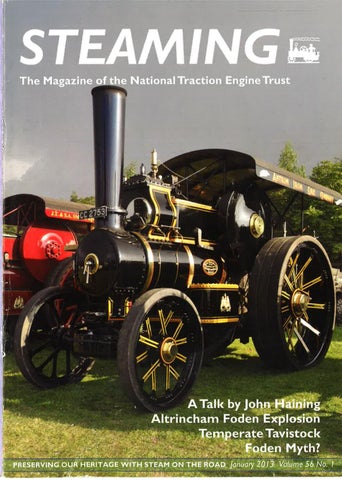
STEAMING The Magazine of the National Traction Engine Trust
rc 2753
g A Talk by John - 1410111P. Altrincham Foden Explosibn Temperate Tavistock Foden Myth? PRESERVING OUR HERITAGE WITH STEAM ON THE ROAD January 2013 Volume 56 No.
The National Traction Engine Trust Patrons Hal Bagot JP - Robert Goodwill MP - Lord Forsyth The Rt Hon Sir William McAlpine Bt - Richard Preston - Malcolm Harbour MEP
President - Andrew Semple Vice President - Charles Daniel Chairman
Treasurer:
Rally Authorisation
Robert Herring Glebe Court, Fringford, Bicester, Oxfordshire OX27 8RJ
Julie Smith FCA Yew Tree Cottage, 98 The Ridgeway, Astwood Bank, Redditch, Worcestershire. B96 6NA
Bill Evans PO Box 102, Wrexham, Clwyd. LL 13 OZS
01869 277410
01978 780749
01527 893427
Vice-Chairman & Chairman, Engine Owners Section Bob Siddall Stud Fai in House, Castle Hill Cal lion on TI et IL. NG23 6QR
01636 821991
Insurance Officer Vacancy - Contact Head,Technical Services
Rally Organisers Section Public Relations Officer Mike Dyson
Lance Jackson Mangcrton, Lea Cross, Shrewsbury. SY5 8HR
The Haven, Nelson's Lane, Haddenham. CB6 3UH
0/743 860091
01353740470
General and Company Secretary
Head, Technical Services
Jenny Holt South View, Hutton Roof, Kirkby Lonsdale, Carnforth. LA6 2PF
David Smith Yew Tree Cottage, 98 The Ridgeway, Astwood Bank, Redditch, Worcestershire. B96 6NA
01524 271584, fax 01524 271768
Membership Secretary Sue Cook, 74 Church Lane, Kirkby la Thorpe, Sleaford, Lincolnshire. NG34 9NU
01529 303160
Commercial Section Paul Cook 74 Church Lane, Kirkby la Thorpe Sleaford NG34 9NU
07905813095
01527 893427
Chair Steam Apprentice Club John Durling 19 Mill Lane, Barton under Needwood, Staffs. DE13 8HE
Registered Office 4 Church Green East, Redditch Worcestershire B98 8BT
01283 712818
Membership is open to all interested in road steam preservation. Annual subscription E30 (E35 non EU members requiring Steaming by air mail). Details at www.ntet.co.uk or simply send a cheque with your name and address to the Membership Secretary - address above. The Steam Apprentice Club is the junior section of the NTET, formed to support youngsters up to , the age of 21 in learning about and appreciating road steam. To find out more please contact the Chairman - address above - or visit www.ntet.co.uk/sac
FREE shipping for online orders over L50 0011 TAA STEAM SUPPLIES
i (a -s
A Division Or
Industrial Boderhouse Supplieg Ltd.
wwvv.heritagesteamsupplies.co.uk
07 , Bit*
tA
•••
ANIt
www.heritagesteamsupplies.co.uk
Unit 34 Brunel Way, Segensworth East, Fareham, Hampshire P015 5SF England Stuart Gray: 07785 258169 Phone : (01489) 570737 — 8 Lines Fax : (01499) 570767 E-mail : salesaheritagestearnsupplies,co,uk 'Offer applies to online orders shipping to UK mainland only.
(Cover) As an illustration of just how quickly things date the latest TER has Fowfer
January 2013 Volume 56 No I
Editor: Roger Mills 10 Sultan Road, Emsworth, Hampshire. P010 7PP
steaming@ntet.co.uk Contributions of suitable articles, shorter items or photographs are warmly invited. Copyright © Individual contributors or the NTET 20 13. The opinions expressed in the magazine. with the exception of Trust announcements, are those of the contributors and do not indicate the views of the Trust. Copy date for next issue: 10th March 2013.
Published by: The National Traction Engine Trust Ltd 4 Church Green East Redditch Worcestershire B98 8BT Artwork & Design by Roger Mills Editorial Assistance Key Mills, Cliff Pypard Printed by: Holbrooks Printers Ltd, Portsmouth P03 5HX ISSN 0260 - 2962
7871 of 1897 listed as a Showman's Road Locomotive but, as described in Steaming Around, she debuted at Pickering this year in this fine fettle which is where David Warren snapped her. (Above) Chiming In with a bit of a Foden theme in this issue, Anthony Coulls was able to capture this Foden, which also featured in Steaming last year in a monochrome archive shot, at the Science Museum Store Wroughton when he was at this rarefy accessible venue moving their McLaren tractor. 6368 dates from 1916.
YOUR TRUST NEEDS YOU! It's a miracle that you're reading this at all as I am typing it sitting on my hands. Why? To stop myself volunteering to take on AGAIN the Treasurer's job at a local youth advice charity. On the committee since 2001 it's about time I was booted upstairs to some honorary role making way for fresh faces with new ideas and less baggage. This time it'll be different though as I am resolutely not going to do the books again! Which means, naturally, by the time you read this there's an even money chance I will be. So the same old shoulders take on the same old burdens! Maybe that's why I've long held the view that every organisation should have in its constitution the requirement for elected officers to stand down after, say, six years, no matter how well they are doing a job or how happy the members are with them. Committee members should also be forced to take a break. You could call it the post-Roosevelt system! That way every AGM becomes significant not only in the democratic sense but also in challenging members to put up or shut up in terms of the future of the body concerned. It would also do a lot for corporate governance and scrutiny. Oh yes and continuity... At the last General Council meeting it became apparent that this issue of succession management was shortly going to face the NTET fair and square, with a number of long-serving officers considering their positions for a variety of reasons, mostly a combination of age and length of service. I got the distinct impression that they meant it too. Some crucial positions
3
will need filling in pretty short order if I read things aright. Which puts the onus on, you dear reader. Are you interested in standing for election to the General Council with the clear willingness to take on an officer's role? If so then please make yourselves known, and before long too. Do it now! AGMs The inaugural AGM of the Terrence Rattigan Society, of which I'm a founding member, was combined with a dinner, I thought, rather cleverly. All the reports, printed together with the menu, were taken as read. After we sat down to eat the formal business took place between the courses, with a speech from the guest of honour (Robert Hardy) to complete the formalities. Everybody agreed it was the best AGM of anything they'd ever been too and I simply pass it on as an idea that preservation clubs might like to copy. Rattigan, perhaps the greatest playwright of the twentieth century, was a convivial soul and I like to think he'd have approved too. THE LITERATURE My last few week's bedtime reading has been bound volumes of Vulcan, a digest of technical tips, accident reports, learned papers and the like. I was staggered at the incident rate especially at the number of boiler explosions that took place annually right up to the 1950s. Bob Garnett, who rescued the volumes from a skip, loaned them to me with the words "I reckon some of these articles are still relevant now." One of his colleagues went further dubbing them a body of knowledge we've largely forgotten. I agreed and so each issue will carry a reprint relevant to us. FUN FUN FUN I don't know about you but I thought Brian Wilson looked pretty good on the Beach Boys 50th anniversary tour all things considered. There he was behind that
white grand piano; survivor of nervous breakdowns, various addictions, every 'high' available in the sixties; still able to knock out Good Vibrations with some style, even though he's obviously like the rest of us getting older. I've a special affection for that tune as it was the first single I ever bought — from the shop of the founder of Lux Traffic Controls actually — price 6/8. That's about £9 adjusted for inflation. That Christmas I used some of the cash gifts to buy the LP Best of the Beach Boys which I loved at the time and wish I had in vinyl still. On it was Fun Fun Fun. Can there be any more thrilling lyric in the history of song writing than the one that fires off: 'Well, she got her daddy's car/And she cruised through the hamburger stand, now'? Forgetting the library and turning up the radio full blast appeals still. And if one didn't know what a T-bird was - well it must have been something special to have to be taken away. Bursting with adolescent optimism it makes me so much want to be eighteen again it hurts. Surely too this was the spirit that drove Arthur Napper, Miles Chetwynd-Stapylton and the others back in the fifties with their races for a barrel of beer. I must say I don't get much sense of fun looking round many a rally these days, and from some comments made at the AGM I'm not alone. So let's make a new year's resolution to bring back that light hearted spirit in the wonderful sun drenched Ashes summer we deserve in 2013. And if you are lucky enough to be an engine owner please look as if you are enjoying it! Happy New Year Roger Mills Sadly as we went to press we heard that Brian James died on Monday 14th January. He was a past Council Member, Chairman of the Rally Section, NTET Safety Officer and an NTET Honorary Member. We send our condolences to his family.
NTET TRAINING BURSARIES I expect you will have watched heritage industrial shows on the TV ,be it Fred Dibnah or more recently Guy Martin where they looked at our industrial past and watched or assisted in repairing items. Has that interested you in helping and assisting in the repair and restoration of our Industrial past? But do you lack the skills? Well the National Traction Engine Trust , to encourage and support road steam, isoffering assistance and bursaries for those who would like to improve their knowledge and skills so they can help and take part in maintaining steam on the road. The type of activities the committee will be looking at include, but are not limited to, Boiler maintenance, Boiler Management, Boiler Inspection, Signwriting, Welding, Fabrication, Lathe and Millwork, Hand Metalwork skills and Pattern Making. The list is not exhaustive and any application will be considered which shows that it informs and educates about Road Steam as in the NTET mission statement.
An application form can be found at: www.ntet.co.uk/hertitageeducation. For further details or to apply email kevin_steamchat@yahoo.co.uk or write, including a sae to Mr K. Munn, 56 Blacklands Drive, Hayes End, Hayes, Middlesex UB4 8EX Applications to be received 31st July 2013 4 IF
Chairman's Report Robert Herring As a rather dismal year draws to a close, as far as outside events are concerned, the AGM at Tavistock was a welcome boost, not because of the weather although it was kind, but for the warmth of hospitality offered to those that attended. We were reminded it has been 12 years since we visited this part of the country but the reception was great. Saturday's visit to the Robey Trust's premises and to see what they have achieved was a credit to all involved, pristine but busy workshops, engines in steam, and involvement of all age groups. Youngsters, girls and boys if not in overalls were dispensing refreshments. A big thank you to all but in particular David Davies. Sunday's visit to Dingles and particularly the Fairground Heritage Trust's collection was equally interesting. How fortunate this country is to have dedicated people whose intention is to preserve items that represent our heritage. To see large fairground rides and artefacts in undercover and comfortable surroundings must be quite unique. A sincere thank you to all those engine owners, helpers and importantly Richard and Anthea Sandercock for them allowing us access and the hospitality they provided. The AGM itself was a better natured affair this year, but none the less as equally important. The election of one of the West Country stalwarts as Vice President will I am sure maintain our involvement in the area as well as being an ambassador for the Trust. Welcome Charles Daniel, better known to all as Charlie. With the rest of the business including election of three other nominees to Council, the meeting took on a brisk pace, allowing ample time for the meeting to be
opened to the floor. An interesting topic was that of the direction of the Trust. This allowed a few to present what was said to be the views of non members, but were unable to describe what is perceived to be taking some of the fun out of the hobby. Whilst we need to be mindful of all interests, other long-standing members took the view that we must continue to maintain the links we have established, to ensure we can continue to enjoy our freedom as much as possible, to use engines in what inevitably has become a more legislative environment. With another AGM behind us I feel it is time to take stock of the future. My term of office in the chair now has less than two years to run and some of the other officers like me are considering their positions. It would be very nice to see a younger generation who would like to maintain the continuity of "keeping steam alive on the road" come forward to take over the reins. I would ask all members to give careful thought as to what part they may be able to play. If you feel you have something to offer and would like to be involved in any way there is no time like the present to discuss this with any of the officers. The forthcoming year will hopefully see more rallies taking place, particularly as far as the weather is concerned. Your team of dedicated officers will be at work with the first New Years meeting in January, and the Engine Owners Conference. To them we offer grateful thanks for their hard work during the year, and to all members I wish a Happy and Prosperous New Year.
Engine Owners' News Bob Sidciall The Engine Owners Conference will be held on Sunday 20th January at Kifsby. Apart from the usual contributions a talk will be given by David Whale, Chairman of FBHVC, and Senior Vice President of FIVA (Federation Internationale des Vehicules Anciens, the body representing the international historic vehicle movement). Also Steve Hancock from Footman James will talk about insurance. The next Driving Course will be held at Astwood Bank on 11 and 12 May 2013. Scholarships to the Driving Course are available and applications must be received before 1st January 2013. 60th Anniversary Road Run September 2014 At the request of the membership a Road Run will take place
Ling
on 20th September 2014. The Road Run will be supervised by the Bedford Steam Engine Preservation Society for the NTET. Applications will only be accepted from those who have been a member of the NTET for 18 months prior to the event. i.e. have joined before the end of March 2013 and the number of engines taking part will be limited to 200. Application forms will be available from the NTET at the beginning of 2014 and will be considered - and places allocated - to give as wide selection of types of steam vehicles as possible.
FBHVC News Stuart Gray Important FBHVC Survey Addressing the issues of how the necessary technical knowledge to repair and restore classic vehicles can be retained for the future, the FBHVC and FIVA with its seventy member countries are undertaking a large-scale survey of enthusiasts and owners of historic vehicles. The questionnaire, which can be completed via the Internet is open to all owners of classic cars, motorcycles, commercial and military vehicles etc. and only takes a few minutes of your time. By taking part you will be helping to maintain your freedom to use yesterday's vehicles on tomorrow's roads. The findings will serve as a reference during many upcoming considerations and discussions to propose solutions for these issues. So please either enter http://tinyurl.com/8cpqxvf on your browser or scan the QR code (right) with your Smartphone and you will be
automatically directed to the questionnaire. A FBHVC spokesman said: "The key objective of this questionnaire is to establish the personal opinions of the historic vehicle enthusiasts on the availability, or otherwise, of relevant restoration skills. And, to further our cause, we'll be expanding our search for such information to the trade and professional service providers to establish their views on the IMIì? subject. Small and very small enterprises are, we believe, the most under threat."
Technical Services News David Smith Directive 2006-126-EC - Category B Driving Licence concessions Those parts of the above so called 'third directive' that have been adopted by the UK Government come into force in January 2013. Nearly two years ago the NTET, along with other members of the FHBVC, made strong representation to the government offices that were charged with drafting the UK's interpretation of the Directive for the retention of the Category B driving licence concessions that allow traction engine drivers to drive on their car licence. Recently the DVLA has released details of the changes to the licensing requirements for various
classes of vehicle. Significantly the withdrawal of the Category B concession is not included. This means that drivers of traction engines can continue to drive on the basis of them holding a Category B licence. The requirement for a Category 'G' licence to be held by drivers of road rollers also continues. Insurance Officer Regrettably due to pressure of work James Blenkinsop is standing down as the Trust's Insurance Officer. I am sure that I am joined by all of our members in thanking James for undertaking this role in his friendly and conscientious manner for several years now. I am pleased to say that James will continue as a member of the General Council.
INTERESTED IN STEAM CARS? Then why not join, The National Steam Car Association? Join
The National Steam Car --- Association 4,-- & obtain a -* FREE copy of Jonathan Eckardt's DVD
AN INTRODUCTION
1 TO STEAM CARS
6
Free DVD worth £13.95'
As a member, you don't need to own a steam car. The Association enjoys tours and attends a number of events and rallies each year and publishes STEAM CAR WORLD. Membership is £25.00 annually (UK Mainland) and included with your first years membership will be a copy of Steam Car World magazine and the excellent FREE DVD. (11in-riled lo the Aral 20 new members enrolling in 2013)
To apply for membership contact: Mrs Diana Goddard, Membership Secretary, 29 Nibs Heath, Montford Bridge, Shrewsbury, Salop, SY4 1HL. Tel : 01939 260595 or see our website for details: www.steamcarassoclation.org.uk
As an interim measure the politics and issues that are the stuff of insurance will come back to my desk but significantly the administration of the NTET Insurance Disc Scheme has been picked up by Ian Cooper, a member of the NTET who resides in Shropshire. I am very grateful for Ian volunteering himself into this role and I very much look forward to working with him. We are in the final stages of handing the 'tools of the job' over to Ian and by early spring
2013 he should be up and running, in time for the new Disc season. In the longer term I will be seeking to appoint the Insurance Officer and I will also be quietly looking around for my own replacement, as part of the Trust's succession management policy. Heritage Engineering Workshops The report, commissioned by the National Railways Museum relating to the restoration of 4472, Flying Scotsman was published in October. 'What has this got to do with steam traction engines?', you will no doubt be asking. Well a few of the more serious findings of the report, though not the overrun of £2.4m, could potentially be applied to the purchase, restoration and repairs of steam traction engines. I won't go into the nitty-gritty of that report here but instead I relate to some important elements in the reports that could affect the prospective owner and/or restorer of a traction engine. • The pre-purchase inspection was not sufficiently detailed to allow the `buyer' to create a realistic 'cost of ownership plan' • Due to an increasingly apparent poor condition the
engine was in practical use for a far shorter period than anticipated • The estimated cost of repairs and attendant timescale were unrealistically low because they were founded on too little information which itself was not properly documented • The work undertaken by what was termed 'the cottage industry' that is heritage workshops was not the subject of formal contracts, relying only on handshakes and in addition was from time to time at the mercy of a complacent workforce • The project management process did not exercise sufficient control over sub 'contractors' • The actual amount of work undertaken and the timescale and attendant costs were substantially in excess of those budgeted for We are well provided for by engineering workshops allied to our hobby. Generally it appears that all enjoy good reputations and a good reflection of reputation is how busy they are; but we should not be complacent. I have lengthy first hand experience of three such works and certainly my earliest experience fell directly into the mould described in the report; reflecting my own naivety maybe. Currently we are enjoying a good experience with the overhaul of the running gear on Keeling, our 8nhp single cylinder Burrell of 1909; there is lots of dialogue and being kept up to date on progress and projected costs counts for a lot. 4472 is not a road engine but the elements of pre-purchase inspections, pre-works job specifications, materials costs, delivery dates and time scales do apply. How often do we accept that 'special relationship' that binds all traction engine enthusiasts together to be the contract between us? Caveat Emptor.
Rally Organisers Lance Jackson The very wet summer decimated our plans for event requests for several further similar presentations in monitoring. Having said that our team of monitors still other parts of the country. As Tim Holt and I have both said in the past, if managed to attend quite a number of Rallies and found very few issues of concern. The reason we attend, of event organisers can provide a venue, refreshments course, is to fulfil our duty as an Authorising Body and put bums on seats then, for the cost of the fuel, I under the Motor Vehicles (Off Road Events) Regula- will come to your location and provide such a seminar. Most of you will have heard of the sad accident at tions and ensure that such events are doing their best Open Air Museum and there has been much Beamish to comply with our Code of Practice. relative to the cause. As previously stated speculation moniPractice In September most of the Code of tors attended a meeting at Kilsby where we spent a in Steaming, the NTET does not wish to comment day discussing issues in relation to Rallies and the code until the full details have been confirmed by the auof practice all with the aim of ensuring consistency of thorities. Although it did not involve a steam vehicle directly, reporting when we attend such events. In early October we held what has become the accidents such as this can taint our hobby so we must annual safety seminar for Rally Organisers and Safety ensure that any comment is accurate. Finally can I Officers. This was an action packed day where a large please thank my team for their support and particularamount of information was shared. The feedback from ly Tim and Jenny Holt for mentoring me during these
the event was good and, as a result, I have received
early stages in this role. 7
AGM 2012 Roger Mills reports on a successful and enjoyable weekend
What a difference a year makes. In November 2011 I Steaming for the enjoyment of members was Robey 32387, reeled away from Birmingham astonished at what I'd a ten ton three point roller new in 1913 to J. Stevens & Son, Contractors, Pembroke, South Wales. Purchased by the Robey witnessed that afternoon and was attempting to report Trust in 1994 she was collected from Pembroke and taken and — now it can be revealed — wondering just what to Dingles for temporary storage till The Robey Trust works the hell I was letting myself in for and what January's was finished. {Picture by Nick Bosworth} Steaming would contain! Despondent might be the best word. Twelve months on and what a difference. printers but reckoned the new style magazine appears No displays of righteous indignation, leave alone to be being received very well. distribution of YouTube videos. Just reports of sensible Recalling the lively debate at the 2011 AGM he progress in virtually every area of the Trust's believed the issues raised have been responded to the operations, all over in 49 minutes (time confirmed by satisfaction of the officers and the majority of the Trust John Reeves). Then followed a thoughtful open forum membership, though he did report that obtaining legal discussion. In short, Andrew Semple's plea to get the advice confirming the correctness of the conduct of business over with and then have a chat afterwards was the meeting had cost the Trust £1600. answered in good style. Maybe though that was because Praising the fledgling Association of Independent many had enjoyed a wonderful visit to the Robey Boiler Inspectors progress on their endeavours Trust's premises where a marvellous display had been towards a professional inspection regime with agreed laid on by this most inspiring of groups. standards, he promised the Trust's assistance where requested. The Formal Business After outlining plans for a large engine road runRobert Herring in his Chairman's Report said — around the Bedfordshire countryside to celebrate our or didn't as in response to Andrew's hint it was taken 60th Anniversary in 2014 and paying tribute to the as read - that progress on the 2010/11 review was work of the SAC he concluded: "The management of being made but implementation is very much dependant the Trust's interests continues to be overseen by a on volunteers who are prepared to oversee some of dedicated number of officers and members. I am the tasks and create a workable structure. On Steaming confident that despite a changing age profile of the he regretted one or two glitches with the change of membership there is sufficient commitment and skills
The oldest Robey thrashing machine to survive, by far, yet discovered anywhere. New wheels have had to be made by Gavin Graham but restoration proper has, according to the Robey Trust, to wait till they find a competent woodworker to make a start on the top boards. (Picture by Nick Bosworth) to demonstrate we are able to manage both our resources and implement initiatives to maintain our position in representing those that are interested or involved in any form of road steam preservation." On Technical Services David Smith confirmed that the category B driving licence concessions were to remain as lobbied for by the Trust back in 2010. The Trust's membership management system had been rebuilt partly to enable Steaming to be dispatched directly from the printer and after a few teething troubles this seemed to be working well. The on-line sales went live and took off immediately, membership on-line will arrive shortly while the rally organisers web-disc system has been modified to enable access for seven days after the event. Following the departure of the previous incumbent, the TSU has taken over responsibility for the V765 scheme with all members registered as authenticating officers. On insurance it was confirmed that the cover under the Footman James policy was unchanged despite the ambiguity of recently issued certificates. Members were advised that full details of the cover provided were in the policy booklet. Now that all members of the Association of Independent Boiler Inspectors were registered with the appropriate professional bodies the Trust had to decide how to deal with non AIBI inspectors though it was reiterated that there would be no closed shop. Discussions involving the TSU and Engine Owners sections were underway to decide an approach. An excellent January meeting, the revision of part three of the code of practice and a highly successful Astwood Bank course were singled out by Bob Siddall in his Engine Owners report in which he paid a well
merited tribute to the Davis family who ensured that the event took place despite a very wet ground. Four scholarships had been awarded for the course and so far 234 certificates under the CofC scheme. Several wash-outs limited the activities of the sales unit but Paul Cook in his Commercial Section round up reckoned that where events did take place the results were well worthwhile. Several new volunteers were welcomed but the search was now on for someone to undertake part of the sales co-ordination role. On the Rally Organisers brief Lance Jackson claimed, or at least Jenny Holt did on his instructions, to be on a steep learning curve which was steepened by the very wet summer limiting event monitoring, though there were very few matters of concern on the rallies looked at. In October the annual safety seminar was an action packed day where a large amount of information was shared. He repeated that he will provide safety seminars for event organisers in return for a venue, refreshments, expenses and, naturally, bums on seats. The Steam Apprentice Club's build a Burrell project was seen by John Durling as perhaps the highlight of the year with massive progress made at Dorset and a successful session at the Model Engineering Show later in the autumn. Three quarters of the money needed has been raised. The parents and apprentices driving day at South Cerney, facilitated by Matt Shipton, was slightly affected by the weather but nevertheless went ahead and was voted a success. With the Report and Accounts accepted unanimously the elections saw Charles Daniel voted in as Vice President with Nick Bosworth, Key Mills (no
relation) and Guy Debes joining the general council along with all the retiring members who offered themselves for re-election.
organisers to be aware of where their responsibilities lay and just what they were expected to do. In response Robert Smith hoped that the new Purple Guide would Open Forum help but a caveat was entered by yours truly in rather With the floor opened for general discussion pompous terms after which I was rightly chided by the several members raised concerns about the image of chair for bringing gloom to the proceedings. Chastened the Trust amongst non-members. There was a feeling I shut up for the rest of the proceedings. that we were seen, by some non-members, as a Awards Time policeman determined to squeeze the fun out of the Honorary memberships were presented to both Len hobby and there was some misapprehension about the Crane and Roger West, whose many years on the activities of the Trust in its discussions with Trust's General Council came to an end with this AGM. government. With the selection of awardees in the hands this year David Smith recalled the 2010 meeting with HSE of Richard Sandercock there was a distinct West where the regulators concluded that the various codes Country and perhaps Dingles flavour, to the winners of practice and authorisation schemes meant they need list but nowt wrong with that. not get involved while Robert Herring stressed that Presenting the SAC awards John Durling reckoned dialogue with government was essential to ensure the recipient of the Technical Achievment Award, legislation was scrutinised and exemptions ought where George Balsdon, is more than capable of looking after needed. In response to a remark by the chairman Joe an engine single handed, and appears to enjoy doing so! Black was clear that the views of non-members must Josh Menear who snapped up the Jack Beeby Cup has be at least listened to while others stressed that it was not only made second shaft oilers for the family's up to the NTET to communicate its missions and engine, but also much machining on a 6" scale Burrell approach more clearly. as well as helping considerably with the work on the In a thoughtful contribution Jeremy Batters urged SAC'S own 4" Burrell. everybody in the movement to recognise both the over-cautious approach to everything in life prevalent The Evening these days as well as the part played by Brussels in the First a word of congratulation to the Thompsons for development of legislation. The Trust, he said, had to maintain a very delicate balance. 12787 is a Class A single cylinder horizontal engine supplied Finally Peter Cooper related his own and fellow new to Pearson's Pottery, Chesterfield, in 1892, and rescued from the derelict remains of the pouery in I972 by a local directors' experiences with the various authorities in haulier and later purchased by Dave Davies. This f 6nhp the post-mortem following the damage caused by bad engine weighs 5 tons and has an aft diameter flywheel. Its weather at the Royal Cornwall Show. He urged rally maximum speed is 88 rpm. (Picture by Nick Bosworth)
a dull glow in a few of the bulbs before the belt flew off for the sixth time and the experiment was terminated. It may have been on the same trip that Beano Hill appeared form his living van attired only in a bowler hat to ask what all the noise was about, only to be confronted by Doc who said: "is that the best you can do Beano?" before, in Andrew's words, doing a streak himself. Andrew also filled in the details of his trip to Porthmadog with Princess Marina and recalled his early years working with Dick Preston snr. After the remarks made during the AGM about the absence of fun in today's road steam world it all gave a good deal of food for thought once the laughter had died away. Reluctance to leave — at least until the staff are pointedly clearing the tables and looking at their watches — is usually a sign of a good evening and the fact that the stragglers were only departing at 1 1.59 probably tells its own tale.
SAC award winners George Balsdon (left) and Josh Menear (below) photographed by Nick Bosworth their selection of the Bedford Hotel. Personally I cannot remember enjoying a stay in a hotel as much in a long time. The service by a uniformly young staff gave the lie to that canard, repeated so often in certain newspapers (and by those paragons of good behaviour politicians), that our young folk have gone to the dogs or some such. The evening dinner was excellent, the wine drinkable and affordable — a pairing not invariably to be made — and a special mention for the Stilton. Sadly a family bereavement meant that Dave Goodwin couldn't give the planned talk but his place was taken by Andrew Semple who enthralled the audience with stories from his career in steam preservation which started, as it happens, helping the Hellifield drivers at Settle and then moving on to crewing for John Crowther. Off all the tales the most memorable featured Doc Romanes. Apparently on a trip to Holland which included Jim Noyce's gallopers it was decided to see if Goliath could drive the ride. So it was chained to a larger engine, the belt put to a dynamo and away to go. Jim Noyce reckoned he saw
The 2012 Awards Award Arthur Napper Cup Curtis Bowl Dacre Lacy Cup Choisy And Simpson Cup John Crawley Cup Edney Shield Jack Holloway Cup Percy Hirons Bowl
Recipient Andrew Williams Lester Soloman Roger Pridham Clive Gibbard John Reeves Charles Daniel Robey Trust Roy Hebdich & Gordon Orme
Baker Toc-H Cup Jack Holloway Fruit Bowl Connie Hutchens Memorial Eric Middleton Cup Golden Film Shield John Cook Memorial Trophy SAC J.T. Beeby Cup SAC Technical Achievement
Robin Daniel Jim Young Judith Walker William Friend & Mark Spry Richard Sandercock Paul Cook Josh Menear George Balsdon
On the Sunday morning many members accepted Richard Sandercock's invitation to visit Dingles Fairground Heritage Centre where a goody number of engines were in steam and they had the chance to view, in all or part, the classic machines of R Edwards & Sons Ltd of Swindon, including what in the editor's opinion the finest Swirl ever to travel. Above (I-r) can be seen a selection of the Anderson horses and Lines Bros cockerels from the Gallopers, three bays of the sole surviving Orton & Spooner Brooklonds Speedway with original Howell decoration, FWD lorry and Gallopers centre truck. Just visible between the first and second horses is Bob Edwards' paybox which is the bottom pedestal ONLY of a false pillar from William Taylor's Bioscope Show (Nick Bosworth). Below is Burrell 6nhp showman's engine 3471 The Rover which was supplied to Arthur Newsome of Darlington in 1913 and is now owned by Bill Hunt. (Mike Dyson)
uncap Marston remembers BOB HAWKINS For those who knew him, grief at the death of Bob his engines, will be best remembered enjoying the Hawkins was made the more bearable by gratitude at camaraderie and atmosphere at some of the UK's finest being able to call a man of his calibre a good friend. I steam preservation events. Bob Hawkins was born a New Zealander although met Bob for the first time at Weeting Rally more than twenty years ago. The New Zealander was a regular his parents originally came from Buckden. He possessed visitor to Richard Parrott's event and Bob was already a wonderful Kiwi mix of common sense, laconic well known within the steam preservation movement. humour and easy charm but equally he was a shrewd At our very first meeting I learnt something of his businessman and was extremely proud of his family and tremendous knowledge of working with engines as I their achievements. Alongside his interest in steam, he was trying to line my little Ransomes portable up with was also passionate about horses and showed his Clydesdales with great success, latterly sharing this its stone mill. As I was using a tractor to line up the two, Bob enthusiasm with his grandaughter Jaime. Many visitors gently informed me how it used to be done with horses. to his house enjoyed the treat of a ride out with the "Just lay a little trail of straw on the ground finishing in horse and cart usually stopping at the nearby pub. But it was his love of steam for which he will be a straight line where you want the engine to be" , he said, before reminding me of the need to be able to best remembered. I will never forget the time I was walk in a straight line in the first place. This chance driving the Big Engine with Bob to the great Burrell encounter led to many happy times with Bob and his Rally in New Zealand. He and I were taking the Big family, and with other friends, both here in UK and in Engine and a drum and as we left his place, his son John said to me: "Make sure the old man lowers the straw New Zealand. Bob made his living with a variety of engines but he jack a bit, there are some low wires on the way." We became legendary in the steam world for his big 10 stormed through some roadworks, scattering workmen horse power Burrell 3130 known simply as 'The Big along the way. And as we passed further engines we Engine' which was shipped over to the UK and rallied forgot all about the straw jack. Of course, we caught the telephone wires we were here for a couple of years. He had been taken out of school at 12 years old to drive the Burrell for his father meant to avoid ,cutting off the connection of the nearby Arthur who was ill with rheumatic fever. He drove the town of Clarksville to the outside world. In typical Burrell for all his working life, so handled it like no-one fashion Bob took a practical view announcing that at least we would be first to the pub. else could and was a joy to watch at the controls. We shall all miss Bob Hawkins but we can count Bob told the story of how his father took him to the bank one day whilst he was still a teenager. At a ourselves lucky to have known such a man, he was a young age he had quickly become the driving force at true gentleman of the steam world. He was a man of the family business and it had become necessary for great knowledge, gently and kindly shared and those of Bob to able to sign cheques. When old Mr Hawkins us who got to know him over recent decades during asked if his boy could now sign cheques the reluctant his many visits to the UK will remember him with great banker looked over his glasses and answered yes as fondness and affection. I enjoyed every moment I spent in his company and long as young Bob was limited to twenty dollars. The quick thinking Bob replied that the limit would cause benefited hugely from his expert knowledge. And as no problems as he could easily write two cheques if we think of his family he left behind, we give thanks for knowing such a lovely, kind and generous man. one was not enough. It is with his family that Bob, along with the rest of 13
The Late Margaret Cook Peter Hammond & Robert Herring write... In the 70's playing with steam engines was very much a male orientated hobby so to see a female in blue overhauls both on the footplate and around the rally field was to see a trend setter. One such was the late Margaret Cook, owner of the 93 keyless Andreas Ruth & Sohn Fairground Organ and more recently the 46 keyless Wilhelm Bruder Sohne organ, who sadly lost her relatively short battle with cancer on Sunday 12th August. Born Amelia Margaret Andrews in 1934 she was proud of her family's association with Knowl Hill, the place of her birth, where her great grandfather, a journeyman bricklayer, set up residence around 1850. She had fond memories of her childhood days when, with the large family of evacuees that her mother looked after during the war, they were allowed to go blackberrying amongst the proliferation of small domed brick kilns in the area. Leaving school in 1950, Margaret started her working life at Paddington Station in the Western Region District Engineers Office, remaining here until 1952 when her mother passed away, after which she took an administrative job nearer home. Margaret always credited her introduction and subsequent love of fairground organs to the August Bank Holiday weekend of 1964 at the Great Shottesbrook Steam Fair where local businessman John Keeley cajoled her into putting a book of music through the keyframe of his Limonaire organ. Five years later in 1969 and it was the same John Keeley who came up with the idea of holding a steam rally in Bottle Meadow, Knowl Hill. Indeed our Chairman Robert Herring's first recollections of meeting Margaret was in the company of John Keeley when they arrived together at Marsh Gibbon Rally in 1973 in John's Sentinel lorry, having driven from Knowl Hill. In those early days Jim and Connie Hutchens were good friends to many other preservationists and after Connie's passing Margaret became part of Jim's life and I saw more and more of both of them together, usually on rally fields but also at Witney when Jim had commissioned another good friend Fred Harris to rebuild the driving wheels for the Showman's engine The Masterpiece which Jim was restoring. Margaret's nature was to be totally involved and committed to anything she was a part of and no more so than working with Jim's engines, she became an accomplished driver and was always at home with the Punch. During that partnership they rallied their engines including Burrell Roller Heather and of course
14
the Garrett Suffolk Punch, they were usually accompanied by Ben and Phoebe Vaughan who were usually in charge of the Sentinel S4, much preferred to be remembered by Margaret under the name Early Bird Transport. It was cruel luck that on the NTET 25th anniversary road run in 1975 Punch's front wheel decided it was going to part company with the engine, causing Margaret to burst into floods of tears. Turning their attention from steam preservation Margaret and Jim decided to purchase the Ruth organ in November 1976, although it wasn't until after Jim's passing that restoration was completed and the instrument made its public debut in April 1993. Not one to shy away from a situation, in order to get the organ to rallies Margaret had to learn to drive the artic unit and trailer in which it was mounted, taking and passing her HGV in her stride. They would relish the challenge of exhibiting the Garrett Suffolk Punch undertaking what is was designed for, direct ploughing. With Margaret driving and Peter Cox on the Howard plough they demonstrated at several events. They ploughed at the World ploughing match at Horncastle in 1984 and would be regular competitors at the Woodlarks event near Farnham. Although they were never married they were partners for nearly twenty years until Jim's sad passing in 1992. In 1995 a new man entered her life, Eric Fagg and for the last 16 years he has been her close and loving partner, together they travelled the Ruth organ to an ever widening list of events covering many miles. Despite transferring it onto a drawbar trailer to try and make life easier they recognized that the transport arrangements were becoming more and more difficult. Margaret's solution was to look for a smaller organ in need of restoration, one they could set their mark on so in 2006 they purchased the Bruder and commenced rallying it the following year. For four years on certain occasions they would exhibit both organs together Margaret then set about finding the right person to buy the organ and be its custodian for the future and it was only then that it changed hands. Regrettably it was only a matter of weeks following the sale of the Ruth that Margaret was diagnosed with an inoperable cancer, which she fought bravely until the end. A constant stream of visitors wishing her well, reciprocating for all the welcomes and hospitality that she, and Eric had dispensed on the rally field and as a Trustee at the Amersham Organ Museum. An extremely well attended service on Wednesday 22nd August at St Peter's Church, Knowl Hill, the very
Steaming
church where all those years before she had pumped the organ bellows, saw the Ruth in attendance as a fitting tribute to a much loved lady. A trio of eulogies spoke volumes of her character, a lady of confidence and warmth who will be sadly missed. At this sad time our thoughts go out to Eric, Margaret's close family and those friends from the world of steam and organ preservation across Europe. Boz Oram adds...When I took over as Chairman of the MOOS, the society was in dire financial trouble and basically I didn't know what to do. I spoke to Margaret and asked for help. Her answer was "I'll be membership secretary for one year — you get the membership up to an acceptable level and we'll work
together in making your father's dream stay alive". True to her word, the subscriptions were all collected, I got the membership up to a good level and in the end took over as editor! Yes a dyslexic editor with virtually no knowledge of mechanical instruments and Margaret showing me how to write in English, using verbs, adjectives and nouns in the correct sequence! Yes Margaret made sure that the MOOS was going to survive and after that year she took a back seat. Margaret managed a drop of wine and was able to bid everyone farewell while the Olympic Flame was being extinguished in London. A most fitting end to wonderful and most successful life.
THE LATE GEORGE WILKINSON In September Peter Wareing's Sentinel 54 waggon 9003 was on funeral duties carrying the coffin of the late George Wilkinson at the request of his son Michael, the owner of Foden Showman's 2104 Prospector and 1916 5 ton tipper 6216. This superbly presented Sentinel is seen on the three mile journey to the church in Out Rawl* in the Borough of Mire. {Photograph by Robert Whitby) Your editor, hating black at funerals with a passion and loathing the modern trend for undertakers to fit hearses with personalised number plates and adverts alongside the coffin, can t imagine a much better way to make a final journey.
15
TRIUMPH OVER ADVERSITY AT DUNCOMBE PARK By David Warren
The Great Yorkshire Traction Engine Club's rally at obviously put in so much work to bring this wagon up Helmsley went ahead on the 7th & 8th of July despite to such a fine condition. Also making a first appearance at the event and the adverse weather conditions resulting in the field being rather soft. A great asset in this case was the possibly at any rally was Ruston & Hornsby 320 class concrete road which runs on 3 sides of the site; the big 41/7 n.h.p. portable engine 1638.54 which was supplied engines were restricted to this whereas most of the new in 1932 to Grand Union Canal, Cambridge as a other exhibits made it to the field where movements standby engine, but not ever put to use. It was never steamed for around 50 years and is therefore in totally were kept to a minimum. A few of the large engines had managed to get on original condition. For the last 10 years it has been with site earlier in the week before a rather wet Friday. Ian Craggs from Sedgefield who also has sister engine These included Graham Atkinson's showman's engines 163856, he was also showing Fowler T3 roller 16851 Burrell 3444 His Lordship and Fowler 15657 The Iron Whitby Jet which was first seen at Duncombe Park last Maiden either side of his show stage and the year following a complete rebuild from 4 pallets of bits. Making a welcome return to a Great Yorkshire magnificent sight of the Ward family's steam wagons Yorkshire 117 and ex Brown Bailey Standard Sentinel Club rally was Anthony Cowell's 1919 built Burrell 1448 (opposite). This was making it debut following an Gold Medal tractor 3808 Laddie now back in extensive 28 month restoration which has included a Lancashire where it worked with Issac Ball. It was complete rebuild of the seized engine with many new owned in the past by former club president Philip parts. Also new are body, cab and water tank, the back Ogden. Another welcome returnee to Yorkshire was axle has been realigned and fitted with a new drive gear Fowler R class traction engine 9271 Alice which spent and chain. The end result being absolutely superb and many years threshing around farms in the north of the a credit to all members of the family who have county in the care of engineman Johnny Wallace. It has
16
recently come to Mike Walters of Liversedge having been down in Cornwall for 3 years where firebox work was carried out, not that this is particularly evident as she appears in very much working condition and looked almost as if she had been steamed over the moors from Lazonby to the rally, as she was in 1955 to Pickering. Another ex Turners of Lazonby Fowler in attendance was road loco 15462 Ajax now with Middlewood Bros. of Driffield. Working days for Alex Steele's 6 n.h.p. Fowler 11352 (left) were a long way from its native Yorkshire in New South Wales. It came back to the UK in 2004, was rebuilt and is now based in Fife. A further engine which returned to the UK, this time from New Zealand, was Mike Ellis's Burrell 8 n.h.p. engine 2696 The Maori looking as impressive as ever. For a good part of Saturday Bill Summerell's Aveling & Porter roller 10575 Luci was down in Helmsley market place, carrying a sign for the rally it created a good deal of interest and hopefully a few visitors. In the evening it was joined by quite a few of the other steam engines large and small as well as vintage vehicles and tractors. Once back on the rally field entertainment continued around the beer tent with showman's engines generating into the night, included were Garrett tractors 32762 Princess Mary and 33486 Queen of Great Britain plus 3 Fowler conversions. Working demonstrations were somewhat
restricted, but the Wall's team managed to cut a fair bit of wood using a Standard Fordson model N; also a thrasher and stationary baler driven by a Field Marshall were placed in the middle of the main ring. Although parts of the field were rather muddy at least the majority of both days were dry and there was even some sunshine!! Hopefully next year's event will be a bit drier as plans are already being made for the club to celebrate its 50th anniversary. Details next time.
FOR YOUR NEW HANDMADE TINPLATE ENGINE LAMPS IN MOST CASES YOUR OLD LAMPS CAN BE REFURBISHED WITH NEW GLASS & BEZELS, BURNERS & OIL TANKS, HANDLES, DOOR CATCHES AND MORE... TELEPHONE TO DISCUSS YOUR REQUIREMENTS. TEL: 0044 (0)1938 850 393 EMAIL: enquiries©hetheringtonlamp.co.uk WEBSITE: www.hetheringtonlamp.co.uk
I7
FODEN'S 'FALL OUT' WAS A FABRICATION! Or so says Allan Littlemore... I came with my parents to live in Elworth on 3rd January 1948; I can be precise because it was my tenth birthday. Very soon I made three discoveries; Fodens Motor Works; Fodens Band and Elworth Cricket Club. Each was to play a very important role in my life. A little later I made another discovery; there existed a smaller truck manufacturer in Sandbach named ERF. Everyone seemed to know how this came about. It was because the two Foden brothers fell out over the future of steam power versus diesel power for road vehicles. Billy Foden was personified as the old stick in the mud who could see no further than steam power, while his younger brother Edwin Richard Foden (ERF) was seen as the pioneering member of the family who saw the future in diesel power. What tosh and twaddle, I subsequently found out many years later. It was no such thing. August 2011 saw the centenary of the death of Edwin Foden, the Founder of the Dynasty. His wife of thirty years, Sophia had died in 1893 when only 51 years old. They had two sons, William (Billy) and Edwin Richard (ERF). Within the same year, Edwin married for a second time, his new wife being Annie Cowap of Nantwich. It was a good catch for both of them; he was aged 52, handsome and very wealthy, while she was strikingly attractive and aged just 20. No, that is not a misprint! This marriage produced two daughters, Amy and Patty. After the War Department Trials of 1902, when the Foden entry, while technically not winning, proved so successful, orders rolled in. So much so that it became necessary to form a Limited Company. The Fodens became very wealthy. Shareholders received huge dividends on their shareholding, one year being as high as 18%. (Editors note: It was common then to declare a dividend as a percentage of the nominal price rather than a monetary figure.) All through the Great War, business was very profitable but peace in 1918 brought with it a great problem for Fodens Ltd. The market became flooded with steamers delivered earlier to the War Department, who were now disposing of them at knock down prices. Who in their right mind would buy a new Foden when a nearly new one could be bought for around half price? Profits collapsed and dividends were negligible. Annie Foden, the biggest shareholder, blamed her two step sons for this state of affairs, and made their life a misery. So she brought into the company a series of General Mangers, all with a background in steam power, and things went from bad to worse; very much worse. In their different ways,
18
the Foden brothers cracked under her relentless criticism. Billy decided to leave the family company and bought a sheep station in Australia. His son - Reg's father in law - was Louis Fitton of Tetton Hall Farm, just down the road from the Foden factory. So Louis sold up and was despatched to Australia to find a sheep station and accommodation for the whole tribe. He found a suitable property at Hunter Valley in New South Wales; it was enormous. So too was the house that went with it. It was named Minimbar; sometimes spelled Minimbah. So in 1924, Billy Foden, his wife Ellen (Nellie), his sons Reg and Ted (JE), his other children, Reg's wife, the Fittons et al, sailed for Australia and a new life. In his own way Edwin Richard, ERF, dealt with the pressure differently. He left Elworth to go to live in Blackpool at Sunray, 37 Preston New Road, to be precise, with his resident house keeper and visited Elworth typically once a fortnight. In particular he came for the monthly Board Meeting, because he still held the title of Managing Director, which additionally gave him the opportunity to take in a Fodens Band rehearsal and a game of snooker at the Foden Recreation Club. This behaviour irked Annie immensely and in 1932, she engineered his dismissal. In short ERF was fired by the Board of Directors. Many years later his daughter, Florence, told me that he cried for days. Just before he was fired, he was instructed by the Board to visit Messrs Gardner, the diesel engine manufacturers, at Patricroft, Manchester, with his nephew Edwin Twemlow to buy a diesel engine to power a new vehicle. ERF followed the Board's instructions and proceeded to guide Edwin Twemlow in the design of the first diesel powered Foden vehicle. It was 1931. So it wasn't that ERF was keen to stick with steam power - or, for that matter, keen to move into diesel power. He had no enthusiasm to do either he had really lost all heart. So by 1932, Billy Foden was living on a sheep station in Australia and his brother Edwin Richard Foden was retired in Blackpool. So I think that explodes the myth of two brothers falling out over steam versus diesel. Finally, to round up this article, I go back to the story of Minimbar. Fifty years or so ago, Cyril Pass, the Editor of the Foden News, made reference to it in a brief article. To illustrate it, he copied a charcoal drawing made of it while the Fodens were out there. Reg Foden's son, William Louis (Bill), now owns it. Bill was actually born out there in 1930 and later went back to Australia to work as a jackaroo. Of course Cyril
ning
had never actually seen the building and suggested that maybe the artist had taken some licence and exaggerated its scale. Fifty years later, just as keen as Cyril on the story, but now aided by my friendly helper, Google, I searched for it. The sketch is certainly no exaggeration.
That only leaves the question as to how the steam versus diesel story originated, by whom and why? Oh the wiles of the women in the Foden Dynasty! Hopefully I will tell you all about that another day. (Reprinted from the Foden Society journal with kind permission from the author and editor)
(Above) Looking somewhat age-worn 3210 Tewlass at least benefited from a burst of sunshine that favoured the South Cerney event fast August. Dating from 1912 and new to a firm in Tewksbury she was first restored by David Hirst who ran her until 1988 when she was relegated to a shed. Stephen Hirst is now happily bringing her back to the public gaze. (Roger Mills) (Below] Chiswick brewers Fuller Smith & Turner, who now control. the beers of Gales of Homdean, had this Foden six tanner London Pride 13138 in 1928. Gales also ran a fleet of Fodens in their South Hants territory but in a less vibrant colours. (Paul Cook)
A SPOT OF BRIDGE TESTING With Mike Jones
These heavy loads are ready to go to work during the testing of the new bridge at Queensferry, Flintshire, in 1926 using bricks supplied by the Castle Firebrick Company of Buckley in the same county. The two Foden steam wagons together with a trailer each in tow are owned by the Hughes Bros. According to the signwriting on the Foden next to the petrol lorry they were general contractors based in Hawarden, some two miles away from the castle works. The signwriting on the other Foden reads Hughes Bros Builders and Contractors, the telephone number 57 is the same on both. The petrol lorry is owned by the Castle Brick Company, Northop, just a stone's throw from Buckley. The trailers behind the two Fodens are particularly well loaded. The final vehicle on this image is a Standard Sentinel owned by Flintshire Haulage of Mold and Buckley. Registered DM 1609, I cannot find any reference to this waggon in the Thomas' excellent work on Standards and Supers Vol I No I. It's very hard to determine where the photograph was taken. One can only assume that the bridge would have been tested only when construction had been completed. The Queensferry Bridge was of steel construction designed to open when River Dee traffic dictated, and though the crossing is still in use, a completely new structure and associated roadwork now form part of the upgraded A55.
20
I suspect the photograph was taken in one of Castle Brick's yards in the Buckley area after loading the bricks for the test but before departing for the site. One can only assume that the well dressed men inside and alongside the petrol lorry and the man in the trilby alongside the Foden are the respective representatives of the Castle Firebrick Co. and perhaps one of the Hughes Bros. Talking of that firm the picture opposite shows their Super 7011 DM5614. New in July 1927 to Hughes Bros of Buckley, Flintshire and with no other recorded owner, she would have worked in the same area as the Castle Firebrick Co. Sentinels. Although it has No 2 as the fleet number I cannot find any other Sentinels owned by the same company, so if anybody reading this knows any different please let us know. Going back to the article on Sentinels in Volume 55 No 4 my recollections of the origin of the Atkinson steam wagon rear axle have obviously been dimmed by time. At the time I found it we had concluded that it was a pneumatic rear axle conversion fitted to Messrs Bibby's of Liverpool six wheeled Atkinson steamers. This axle would have been fitted behind the main driving axle, hence there was never a driving cog and associated differential gear fitted to this axle when the conversion from solids to pneumatics was undertaken.
IDENTIFICATION PLEASE
Derek Bird, a member of a team collecting items for a second book on the history of Grafton Regis in South Northants, wonders if anybody can help identifr the engine pictured above which has fallen from the A508 into the River Tove - and, perhaps, even the incident? Any information sent to the editor will be passed on. What a lovely picture this is too leave aside the main subject. It's a pretty little bridge though there doesn't seem to be much in the way of a parapet or wall to stop any vehicle taking a tumble does there? The bridge is still there, though by-passed by a new section of road, and still looks as attractive - see tinyurl.comkgpandw
2I
iT,C t AN
A Quarterly Journal for Power Users. THE RE-ISSUE OF "VULCAN."
In 1922 the Vulcan Boiler and General Insurance Co. Ltd - now part of the RSA group - was responsible for the insurance and supervision of over 100,000 boilers, pressure vessels, dynamos, electric motors, etc., steam, gas and oil engines, steam turbines, motor cars, commercial vehicles, lifts, cranes, etc. In dealing with this vast quantity of plant the Company acquired a large amount of specialised engineering information and data, and published their own journal with the object of disseminating and sharing that Information, as far as possible, amongst its clients. Now courtesy of RSA and its Heritage Steam specialist Bob Garnett we will re-print in each issue a technical article of continuing relevance to steam
plant operators. We repeat the advice of the Company, viz: "As this information is of great educational value we would suggest that our clients after perusal pass the journal to the attendants in charge of their plant or machinery." We start with two articles concerning a boiler explosion in a Foden wagon on its way to the works in 1928... STEAM MOTOR WAGON EXPLOSION. RESPONSIBILITIES OF MAKERS AND USERS Formal Board of Trade Inquiry into the fatal explosion of the boiler of a steam motor wagon, occurred at Altrincham, Cheshire, on the 11 th July last, was held at Bradford, Yorkshire. The inquiry, which extended over four days, November 2I st to November 24th, was held re Mr. A. Hudson, K.C., and Mr. J. Hamilton, M.Inst.C.E., acting as Commissioners under Boiler Explosives Acts; and has an important bearing on the responsibility of makers and users of steam motor wagons travelling on public roads. Full technical details of the boiler and of the circumstances leading up to and accompanying the explosion will be given in the official report published later, which we shall reproduce. Meanwhile the questions of responsibility discussed by the Commissioners are of great importance. Mr. G. C. Vaux, Board of Trade solicitor, in opening the inquiry, briefly outlined the facts of he case as follows :In 1919 the wagon was sold new by Messrs Fodens, 22
of Sandbach, Cheshire, to the present owners, and in June last a defect was remedied by one of their employees. The wagon resumed work, but on 4th July the driver reported a slight leakage from a fine crack at the bottom of the front end plate of the boiler. This was inspected by a boilersmith of the makers, and according to in his statement he told the engineer of the owners that the work would have to be done at Sandbach, and when asked if the wagon could proceed there under its own power said it might be able to do so, but the attempt would be dangerous. On 10th July the wagon was sent to the makers works at Sandbach, and while passing through Altrincham on its way, the fatal explosion occurred, and killed the driver of the engine. The immediate cause of the explosion was the ripping of the front end plate at the bottom of the boiler where the crack and escape of steam had been noticed, and this was due to the formation of a groove caused by the " breathing or panting " action of the end plate set up by variations of pressure and temperature as a result of fractures of the screwed stud stays supporting the end plate, which had taken place some time previously. Evidence was tendered by various witnesses as to what passed at the interviews between the boilermakers' representative. the secretary of the owners and their chief engineer, before the boiler was dispatched to the makers' works on Ilth July. It is not necessary to go into the details of this evidence, some of which was conflicting, suffice it to say that after hearing it the Commissioners ordered the secretary to the owners to pay £100 and their engineer £25 towards the costs of the inquiry. In giving their judgment the Board of Trade Commissioners said the secretary failed entirely to give his evidence in a straightforward way. He chose his words with great care with a view to misleading us. He called himself the secretary when all the time he was the manager; he must have known that the difference in responsibility was considerable. He called the boilersmith an expert when he was not an expert, but only a boilersmith sent to do a repair, and the conversation between the boilersmith and the owner's engineer was magnified and described as a report. In their view he took upon himself the responsibility of sending the wagon under its own steam. Comparing the evidence of the owner's engineer and their secretary, they found that the engineer took upon himself the responsibility of declaring that he considered that the boiler was safe to send under its own steam, and reported that to the secretary, whereas he said that he gave the order following the boilersmith's report. The Commissioners were of the opinion that the makers' boilersmith gave his evidence straightforwardly and clearly, although there was some
in the secretary of the company owning the wagon being ordered to contribute £100 and their engineer £25 towards the cost of the inquiry, and promised when the official report was issued to give the details more fully. This report has since been published, and the general construction of the boiler taken therefrom is shown in the accompanying sketches, giving a longitudinal section, cross section, and front end view. The boiler, it will be seen, is of the general type employed in road wagon service, and as far as could be ascertained from the evidence tendered at the formal investigation, nothing abnormal had occurred in the working of the boiler, and the serious defect which had been manifested was leakage at the bottom of the front end plate where it was joined to the rectangular block ring at the bottom of the water space surrounding the box. It was along this line that a rupture, 15 inches in length by 3/8 in. wide, occurred while the wagon was being taken along the highway to the makers' works, In the following year Vulcan returned to the under its own steam, to be overhauled and repaired. The rush of steam and hot water occurred scalded the subject. two men in charge, one so badly that he died two days STEAM MOTOR WAGON EXPLOSION. In our issue for January last, we gave a brief account later. Examination by the Board of Trade surveyor of the of a Formal Inquiry by the Board of Trade respecting the explosion of locomotive type of boiler operating a firebox after the failure and when it was opened for steam motor wagon, which occurred at Altrincham, inspection, showed that where rupture occurred there Cheshire, on the Ilth of July last, and which resulted had been a fracture for some time and that "all the
conflict of evidence as to his conversation with the owner's engineer regarding the safety or otherwise of taking the wagon under its own steam to Sandbach. The Commissioners said that in their investigation they had simply to consider the question of moral responsibility. They did not think that either the owner's secretary or their engineer had sufficient knowledge fully to understand the risk they were taking, and they had no right to take such a risk, nor was it any excuse that a similar risk was taken on a previous occasion without serious results. They thought that if the engineer had been left to himself he would not have risked sending the wagon under its own steam. They did not hold the owners responsible but their secretary and their engineer were to blame. Taking into account the design of the boilers the commissioners expressed the opinion that they should be submitted frequently to a hydraulic tests.
ENGINE SHAWL'
STAYS
WATER
MMHG
THREADED STAYS
EJECTOR Tifis my WASTED
THIS STAY WAS NOT BROKEN BUT PLATES SHOWED RADIAL CRACKS ON THE WATER SIDE
AT FIRE BOX END BUT BROKEN AT END NEAR FRONT PLATE
RATE DEFLECT ED 3/4
'PLAIN' STAY!
SEYERZ BR:VANS ON INSIDE OF FRONT RADIUS
POSITION OF FRACTURE VIEW LOOKING ON TO FRONT PLATE OF BOILER
-4-4—
INDICATES THREADED STAYS
SECTION THROUGH A.B. LOOKING TOWARDS TUBE PLATE
PI, AIN STAYS BROKEN STAYS
4i:GgRad
23
FEET
ELECTRIC WELDED BLE PLUG
__wsooptruy pig
.V,k drI 14
• • • • • • • • • • • 4+ ID
• • • •
SCREWED PLUG
MUD HOLES TWO ON EACH SIDE F APERTURE Igr SEVERE MECHANICAI. GROOVING ON INSIDE OF RADII
LONGITUDINAL SECTION
SECTION THROUGH C. D screwed stud stays except one in the front water space were broken, and all the stays except five in the right-hand space (facing the fire door) were also broken." The stays were not wasted by corrosion and the fractures occurred close to the plate of the firebox casing. Further, it was stated there was no question of the feed water being bad, as it had been, practically speaking, taken on all occasions from a town supply, which was very good. How the stays came to be fractured in this wholesale way without wasting or other apparent is not discussed in the report, which confines itself to stating that " the cause of the explosion was that the stays at some date before the day of explosion were fractured, and the boiler, not having their support, was unable to withstand the pressure of steam to which it was subjected at the time of the explosion." It may be added that the normal working pressure which the safety valves were adjusted was 220 lbs. per square inch, and during the journey to the makers' works on the day of the explosion it was stated in evidence the pressure did not exceed 150 lbs. per
24
square inch, but even this, the report observes, " was far in excess of the safe pressure, weakened as it was by the broken stays." In giving their judgment the Board of Trade Commissioners commented strongly on the lack of judgment on the part of the men responsible for sending the wagon to the makers under its own steam in its dangerously weak condition, and added that "having regard to the peculiar construction of boilers of this class they should be submitted frequently to the hydraulic test." Roger Mills writes... and there it ends but of course readers will be wondering about what is missing from the Vulcan account which is heavily 'redacted'. Just who were the players in this little tragedy and which vehicle was involved? Well luckily the whole enquiry bundle is preserved at the PRO Kew, and it has an interesting story to tell. Owners were Holden Burnley & Co, Wool Combers of Cumberland Works, Bradford and the wagon detailed only as MAI73 was, Mike Dyson kindly informed me, a three tonner 8708 built in 1919. The
company's Colin Leslie Anderson was their main player. Management of the fleet of steam wagons was in the hands of Chief Engineer John Midgely. He was responsible for running repairs but had no staff, the work invariably being carried out by Fodens either at Sandbach or by a field engineer they sent out on request. For his maintenance regime Midgely relied entirely on the reports of the insurers, Royal Exchange's, company inspector and, between annual examinations, when drivers reported faults the result was a stop order until Fodens had done the work. As so often in such cases — and readers of railway accident reports will be familiar with this — after the event the witnesses had very different recollections of what occurred. What is agreed — largely because Fodens kept a log of their telephone messages — was that their service manager Ernest Mason sent a boilersmith, Joseph Condliffe, to simply carry out some
explosion, of shock following scalding. The steersman Jack Kendall Bradley was seriously scalded but survived. One wonders with hindsight whether Kilburn's 'route blindness' might have been connected with his presence at the inspection and a sense of some discretion! So why was the journey made at all? The commissioners concluded, reading between the lines, that if Anderson didn't order it directly he at least pressurised both Condliffe and his various subordinates into agreeing that it was safe enough in order to save the money involved in towing cold to Sandbach. That at least is the clear inference the commissioners drew as the Vulcan report hints and the fines imply. Of Anderson they had this to say: "He was the dominant sprit. He called the boilersmith an expert when he was only a boilersmith sent out to do a repair and he magnified a conversation between this boilersmith and his engineer and described it as a
report." unspecified repairs. The bundle also contains a number of opinions What happened next is recorded in the preliminary enquiry and summarized by Vulcan. In fact Foden's man obtained from various specialists and independent inspected the boiler in the presence of Midgely and inspectors and despite what the Vulcan report states Richard Kilburn, the regular driver. According to the commissioners concluded that it seemed probable Condliffe's witness statement Midgely then asked that a number of stays must have been broken at the whether the wagon could be taken back to Sandbach time Royal Exchange Insurance inspector Robert Smith under its own steam and he replied that as the wagon Beck made the last thorough inspection of the boiler had been working in the condition it was then it "might on 15th October 1927 and the grooving of the plates run to Sandbach but it would be dangerous." Midgely may have started then. Hammer testing was not, they on the other hand reckoned the reply was "Oh yes it felt after taking advice, enough in the case of this design is quite safe." For what it's worth, under oath Kilburn of boiler, which it also appeared, had not undergone was clear that Condliffe had not declared the boiler an hydraulic test for seven years. unsafe to travel under its own steam. Condliffe flatly And the aftermath? The commissioners Mr AA denied this saying he told Kilburn: "it would be better Hudson KC and Mr J Hamilton Gibson MICE pocketed their fees of £75.9.2 and £58.8.0 respectively (a total to tow a wagon with a crack like that." What happened next is fully described in the Vulcan at today's earnings values of £19,000) while 8708 account but Kilburn had a very lucky escape. He didn't, soldiered on to end up with the Middleton Mining Co apparently, know the way to Sandbach so his place was Ltd in 1931 though she was scrapped soon afterwards. taken by Jack Hamden Epworth who died, after the
Suppliers and stockists of steam spares and consumables, including oils, boiler
Seddon &Black Lonsumables
water treatment, polish, gland packings, jointing materials and much more. Tony Seddon
Joe Black
01948 780474 info@seddonandblack.co.uk
www.seddonandblack.co.uk 25
NOIS3111Vil
se 11111Lil
punnyvvqo q uopaopas V •
A.V9N119
,NO,LSHVIN SY1Z1VH3 ,
en
1101 k
2012's Old Warden event was certainly the year of the wagon with a special gathering of Sentinels celebrating that owner's club's twenty-fifth. But Shrewsbury did not have it all its own way as John Mound's camera shows. Storting above left we see Garrett 30826 which is reconstructed from a chassis and various spares - and very nice it looks too. Above is Sentinel 8843 an 54 Three Way tipper - doesn't the light chocolate brown suit her a treat too? below is another reconstruction this time a bG4 dated by the IER to 1929. the note says identity to be verified, but a rebuild using old parts around a new chassis. Again a rather unusual but highly pleasing colour scheme. Your editor came across Martin Fagg's sole surviving Foster wagon at South Cerney but was unable to et a decent picture, John's does it more than justice. An export to Australia 14470 was amongst the machines repatriated by Tom Varley. The aim of the present owner is to give some idea of how such a vehicle would have left the works in 1922.
JOHN HAINING ON PLOUGHING ENGINES, STEEL BOILERS AND LIFE AT SENTINELS... David Hall recalls an interesting talk from over thirty years ago While reading the latest Steaming (Vol 55.1) with its the ploughing engines." "But I have a special affection for the two ploughing Shrewsbury theme my mind went back to a very interesting talk given to the City of Newport Model engines now working near Peterstone, they are both Engineer Society in May 1980 by the late John Haining. Fowler AA7 compounds, Numbers 15364 and 15365, John, who was a walking encyclopaedia of agricultural built in September 1919. They were used on contract steam, on retirement designed and built many steam ploughing and cultivation work by John Patton of models, such as ploughing and traction engines, Sentinel Hertfordshire. Named Windsor and Sandringham I derivatives, threshing machines and many other models, spent many hours on them when they were in John many of which have been built around the world. But Patton's ownership, and I learned to drive on them. "The engines are not kept up as well as John Patten on this occasion John decided to give us a talk on ploughing engines, steel boilers and his early years would have them, he had about eight sets on the go, plus a very large farm of his own. He prided himself on working for Sentinels on their design team. At the time of his lecture a boggy piece of land and not leaving any field more than one day after harvesting a lake, between Newport and Cardiff, were being before the ground was broken first with a Drag (a tined excavated by a pair of ploughing engines and John cultivator) and then ploughed. After John Patton's death kicked off with memories of these: "The engines are in the early 1960s, all his steam tackle was sold off dredging an area known as the "Gout". This was last Windsor made £255 and Sandringham made £205. dredged about twenty years ago (That'd be c 1 960 Ed] At first they went as a pair (ploughing engines were by two other Fowlers, No 14381, Reg NM 558 and always made in pairs) then separated. They came back 14382, Reg NM 557. They were a type BB, named Excalibur and Excelsior, built in July 1917. To save Fowler 15365 Sandringham looking a trifle work-stained of the ClaudeJessett collection expense the water authority have tried diesel crawlers, at Tinkers Park, where it is part in 2011. (Picture by Pau! Cook) drag lines, excavators etc but nothing compares with
28
anti balance, just one man on the plough, and that in later years far more cultivating was done than ploughing. John also made sure we realised that the Germans were also very much to the fore in steam together again in the ownership of Mr Lowther of ploughing. Henshall and Ottemeyer built engines up to Masham in Yorkshire. 1955, all welded jobs with 400psi boiler pressure where "Their curved back tenders tells one they were English ones rarely exceeded 200psi. These German built after 1911, as before that they were straight engines were used on peat and land reclamation work, backed. They were ordered with handbrakes, a rarity and single furrows of eight feet deep have been on ploughing engines, and extra large winding drums ploughed. due to the very wide Hertfordshire fields. They are 000 probably the only ploughing engines in daily work. Large According to John, his next topic, steel boilers, numbers were built during the First World War for were a "very emotive subject" recalling a friend's the Ministry of Agriculture. After the war they were experience of giving a talk on model steel boilers to sold off to contractors, who then disposed of their another society, saying the meeting ended in turmoil single cylinder engines in favour of the more effective with two people arguing the pros and cons. It turned compounds. These were mainly BB I s which had been out that neither had built or had any experience with redesigned by Fowlers from the BB type, they were steel boilers. excellent engines. "Welded boilers," John reckoned, "were pioneered "In the 1923 agricultural census it was found that on a large scale by Fosters who received a large order 540 sets were still working, representing some 1,080 for portable engines during the last war, all of welded engines. Up to and during the First World War there construction. The golden rules for steel boilers are ( would have been a great many more sets than this. On good sound design, (2) first class material and a typical days work from 4.30 to 5 a.m. to 11 p.m., a fabrication. The enemy of any steel boiler is corrosion, pair of engines could cultivate 40 acres, or plough 30 neglect, misuse, and on models over-testing. On full acres. A horse team could only plough 3 acres a day." size and models the welding must be very good, and Then followed questions and answers, where we guidance is given in the spec BS 2790. learned such things as Fowler's development of 822 After serving his time with Adamsons the boiler different implements for use by ploughing engines; the makers in Cheshire and later working for Camel! turning mechanism of cultivators; plough balance and Lairds John outlined these firms' codes of practice on Seen on the headland CH the 2007 Dunham Massey event 15364 Windsor is receiving some pretty close attention. (Picturte by David Cadge)
29
boiler making, which had evolved over 75 years. "Corrosion should be allowed for in the design stage. I have the boiler drawings for the Fowler single cylinder ploughing engine boilers, and the Oxford Steam Plough Company's boilers that replaced the Fowler ones when they wore out. The backhead on the Fowler boilers is 3/8 of an inch thick, on the replacement Oxford boiler it was 3/4 inch thick. Fowlers' early boilers were built very light. "But crucial is the prevention of corrosion. Feed water treatment can turn acid water into alkaline, but if you use water treatment you must keep your boiler in one locality. In the next town the water may be quite different, and the treatment rendered useless. Feed water should always be discharged into a boiler above the water level. It is the oxygen trapped in the water which does the damage. Releasing it above the water level helps dispel the 02 from the feed water. This was realised by the GWR, the LMS, and Aveling & Porter about 1920. Feed from an injector is much more preferable than cold water from a pump, as the 02 is more readily released by the hot feed water." "On full size and models do not wash out a boiler too often," was the clear advice. "Aim for twice a season as a little dissolved iron oxide in the water actually helps prevent corrosion. On the last day of steaming blow down the boiler when hot, when empty and dry, suspend a bag of silica gel inside and close the boiler up. Do not use oil to paint inside the firebox to prevent corrosion, as on lighting up traces of oil in corners and crevices will turn acid and cause very rapid corrosion. Between steamings (full size and models) keep the boiler full, right up to the top. This will exclude oxygen. Rainwater can be acidic due to pollution so beware. I have done tests which show that rainwater on the Newport side of Westwood is more acid than rainwater from the other side at Usk, due to airborne industrial pollution. "I have found steel boilers on model ploughing engines most satisfactory. They are made from medium carbon mild steel, unstamped which I obtain from Hub Gillespie Now Hub Le Bas Ed] in Bristol. A 2 inch scale boiler worked at 80 to 90 psi is virtually indestructible. I use copper tubes expanded, or rather drifted in. The drift must have an angle of 2/1-2 an inch, no more else it will cut the tube ends. Years ago full size boilers were fire welded by hand of Lowmoor Iron or Bowling Iron, lovely stuff it was too, would last for years. Unfortunately it is no longer available. Good design in boilers is most important, and allow sufficient dimensions for the joints to be welded. Boiler steel should be to BS 968 or BS 4360." oOo After serving in the Hitler War, John wrote to Sentinels for a job but before filling in some of his 30
experiences at Shrewsbury he kicked off with a bit of history: "The very first Sentinel built was built in Shrewsbury by Alley and McLellan at the Horsehay Foundery in 1906, but plans to start production in Salop fell through, and production was switched to Glasgow. The first Standards could produce 50 bhp at 50 rpm and a 4 ton waggon could carry 18 tons. Brakes were put into 'counter pressure instant', which caused some problems. The Supers were introduced in 1923. The DGs in 1927, and the 4 cylinder, shaft drive S in 1933/4. This was the best steam vehicle ever built. The "Spiral" firebox fitted to the Supers was superb. They were made by Galloways of Manchester, but in 1924 they went bust, a really big blow to Sentinel as nobody else could make them, and they had to revert to the old type of box. "The Doble brothers led by the elder Abner did a lot of experimental work at Sentinels and perfected their double acting engine with Stephenson's valve gear, This was fitted in two cars one an open sports named "Beutiftie" and shipped to America, the other to a very large saloon limousine. This was used by the Directors, and to ferry VIPs to and fro. The car was silent, and only betrayed it was steam by a slight whisper of vapour from the exhaust as it started off, and of course the mass of dials on the dashboard. "Sentinels were always falling for lost causes. Such as when a Mr Daveney appeared with a "see through" drawing of a 6 cylinder diesel engine with two blowers, which would produce 630 h.p. unblown and 850 blown. He managed to talk Sentinels into building it, two in fact. Being only one drawing full drawings had to be produced and copied by a contract firm in London they were a mess. When the first engine was being erected I noted that the crankshaft when rotated struck the sides of the crankcase. After many mods the first engine was built. When run the blowers used up too much power and were discarded, The engine after much fiddling could only produce just over 400 h.p. and was given up. "Then there was the Argentine Contract. The works limousine was sent to the station to pick up four little men, only one of them could speak English. Each one carried a carrier bag, and a tall wicker bag with rope handles. The men refused the offer by the chauffeur to put the wicker baskets away but held on to them on the journey to the works. On arrival they were met by Reggie Woodvine. They wanted to see an S type, but all that was in the works that day were two DGs which ferried things all over the country. They were very anxious to see one and got on still clutching those wicker bags. Whist one of them was getting on his bag caught on something, and much to the surprise of the onlookers coal fell out. They had brought the coal from their mines in Argentina. The
coal was very clean and dust free, and in pieces about the size of peas, and of a grey colour. It burnt very well, and was likened to "Lady Windsor". It was ideal coal for "automatic stoking" as it ran very well. The Argentines were very impressed, and the famous order ensued. "Anyway after I applied I was invited to the works by Reggie Woodvine, (the Woodvines "ran" Sentinels, old man Woodvine virtually "ran" Shrewsbury). I was given a tour of the works just chatting informally, this was his interview. The firm was then part of the Metal Industries Group, which among other things salvaged the former German fleet at Scapa Flow." "I was then introduced to a man with enormous sticking out ears, whom Reggie Woodvine called "Wing Nut". He was Mr Charles Newark, the Chief Designer who actually preferred to be called "CAN", his initials. Charles Newark had been the Chief Designer with Garrett's of Leiston, and Chief Designer with Davey Paxman. However he left after a bust up with their Mr Stebbing, (later Rev Stebbing )"
"Soon I was put to work on the special project design wing. I soon realised that a lot of designs were thought up in the Harscott Arms, Public House! The test driver for the waggons was a Mr Smith "Smithy" a real character." "Sentinel were the first company in the world to introduce 4 wheel front steering. The "S" type would officially cruise at 30 - 35 mph. But on test would be taken up to 60 plus mph by "Smithy", who would often do this with a prospective buyer in the cab,uphill! His wife was in charge of the canteen, and she had the habit of giving hard peas to anyone who upset her. When you were eating she would walk up and down the tables listening for complaints. One day I was dining a rep whose peas were so hard they rattled around his plate. She overheard him complain and a row broke out with the rep throwing the plate at her! He was banned from the canteen." The lecture ended to much applause, and a presentation to the speaker.
By Water is Cheaper? In 1910 the indefatigable Country Surveyor Henry Maybury (see Vol 55 No 2) was urging Kent Council to back a scheme that would spend £29,000 on making the lower Medway River navigable by barges. Yes that might not be of interest to readers of Steaming but in fact in his arguments he deployed some figures on claimed road wear costs of traction haulage that are I think interesting — the results of a chance comparative traffic study. Addressing the full council he observed: "I do not think I shall be putting it too high in estimating that the direct benefit of a navigable river to the county, as a whole, will be £500 a year. The Rural Districts of Maidstone, Malting and Tonbridge would benefit in like manner but to a lesser extent." "It is conceivable that, if the river were to be unfit for traffic, that the County rate would suffer in consequence of commercial undertakings, now existing, being unable to continue operations. In that event in addition to the loss of rateable value, displacement of labour would ensue. Other affected interests, would be hop-growing and agriculture generally. These however may probably be considered local considerations, thus only indirectly affecting the county, at large." "Now as to the direct effects upon the main road. A good object lesson was given for about three months, last winter, at the time when Farleigh Lock was out of repair. Messrs Arnolds of Brandbridges had the whole of their flour, corn, and coal unloaded at Maidstone into traction wagons and hauled thence over some seven or eight miles our roads. Having two traction engines, running almost continually the
damage to the roads was so evident that I gave instructions for the trips to be enumerated in order to be in a position to prove extraordinary traffic, had it been continued for a longer period." One assumes that a clerk was put to do the maths to enable Mr Maybury to warn: "Generally it may be assumed that, in good weather, say eight months of the year traction engine haulage costs the county rate in wear and tear of roads about 3d per ton per mile and in the four winter months, under certain climatic conditions, it would not be an exaggeration to suggest a figure as high as a shilling per ton per mile." "I have no means of ascertaining how much of the traffic, which has been waterborne hitherto, would in the event of the river becoming derelict be put upon the roads. I have endeavoured to get figures from responsible persons, the estimates received being from 10,000 to I2,000 tons per annum. In all probability, the gentlemen to whom I am indebted for this information are more or less interested in the project, and therefore I have assumed 5,000 tons only being hauled half the distance front Maidstone to Tonbridge, say seven miles. This would represent 35.000 ton miles, which at 3d would mean wear and wear equal to about £430 a year." 1.£143,000 at today's prices. Ed] "As the officer responsible for the maintenance of main roads with their ever increasing burden, I view with regret the possibility of the river traffic being, if only in part, diverted to them and I am confident that the best interests of the county would be served by the council I giving the scheme all the moral and material support possible." (Source: Kent Messenger) 31
JOHN P COLLINS THROUGH THE YEARS The final part of Rowland Scott's recollections Big changes were to come during the Winter. Grandad (as John P Collins was known) had two runs of fairs going now, with Scenic, Gallopers and Yachts Kitchener was sold to Danter's of South Wales and on both runs. The Four Abreast was a grand affair and the Dragon Scenic modernised as regards its centre. A new opening sided box van was built at Ortons required seven trucks for transportation, all built for rail travel. The centre was small and compact and was to take the organ and centre pole, another large box raised on to a very high gantry to achieve the height truck was built to take run-ups and odds and ends and required. The organ was also on a gantry of its own. the loads were cut down from nine to six. There was also a change round with engines for the The carved work on this machine, main colour scheme being red, green and gold, was wonderful, right brothers had sought 'pastures new' for the Swirl and the Burrell Emperor, being fastest engine was down from domes and droppers, to base shutters. In I926 when I was five years old and just beginning transferred to the Swirl, and its Savage crane post was to really take notice the Dragon Scenic was repainted transferred to Foster Clara. This engine always carried an exciter whereas with a good picture of St. George and the Dragon on the extension front, reaching the pinnacle of its Emperor, although it was fitted with a secondary John Jnr got a set of Chairoplanes and a platform it never had a motor at this time. The loads beauty. further Foden steam lorry was acquired to go with of the Scenic were now shared by the Foster Clara and Fowler Our Fancy renamed Felix. this. 1933 saw the introduction to Lancashire of Michael At my home town of Gorton the location of the brand new Waltzer and a third Foden Collins's A. famous the opposite land of Fair had been on a piece Beyer, Peacock locomotive works, but in 1927 the wagon was acquired to accompany this. It was soon location moved to Taylor Street, a few hundred yards found that the ringed platforms of the ride were too nearer my home and it is here that I have my best heavy for man-handling, so a second-hand Thompson memories of The Collins. The Wakes fair that year & Walton crane was acquired. The crane pole itself included the Whales Scenic and both engines with the was only about half the length of a Scenic pole. The ride had on the cab sides "J.P. Collins's Scenic Whale- Swirl was relegated to local fairs and the two Foden steam wagons were put with this. Way". Rotherham Fair always was the third week in On the Dragon Scenic the transit order had been revised as follows; Burrell Emperor - large box truck October and The Dragon Scenic, which was open at and two car trucks; Foster Clara - platform and gate Wigan in Lancs. on the Tuesday night, made the long truck, waterfall truck and organ; Burrell Kitchener - journey behind the two engines across the Pennines jumbo wagon and two railway type box trucks while a and opened at Rotherham on the Friday (even today Tilling Stevens Petrol Electric lorry towed Michael's with modern lorries and light-weight machines, this living wagon. I never saw the Whale Scenic in transit and can only slightly remember the Foster Monarch but I can remember Burrell Kitchener reasonably well, for until the end of 1931 it towed about a large Square end Dodgem, for Billy Butlin, by arrangement with J.P. Collins. In February 1929 came the first big blow, with the sudden death of Grandad and the Four Abreast passed into the hands of James Patrick and the Ike Richards Yachts sold. The chairs were sent to New Brighton and Michael, in partnership with brother James, acquired a continental Swirl with lantern roof and to tow it the Fowler No. I 1126 Our Fancy. John Collins Jnr. sold out his birthright to his brothers and went it alone, first of all with Yachts and Fairy Coaster, the latter being eventually replaced by his father's Gallopers.
32
journey is no easy task). In 1935 John Collins Jr. sold his Steam Yachts to Sharpies in Ireland and had in place a small Ark for a He also acquired a large front entrance living time. wagon and huge Limonaire barrel organ for the Three Abreast. The little Garratt Wait & See spent much time with this ride, and it was quite common to see it towing the large living van, small living van, and organ truck. She then returned for large box truck big centre and platform truck and on arrival with this load, whilst steam was at high pressure, haul the Centre on the gantry. At the end of the 1936 season the famous Four Abreast was opened for the last time. The Swirl was put in the sole ownership of J.P. Collins and to haul it the big Fowler Duke of York was bought off Miles Jarvis, renamed after the 1937 Coronation King George VI. In July 1938 M.A. Collins bought a Moon
Rocket and again the Foden ‹q".4.Nr• steam lorries were brought into use to tow and drive it. It was to be used for about two seasons only, for on the outbreak of war it was put in store. In September 1939 Collins's were at Gorton where the fair opened on Friday Ist and after only two nights of opening war was declared. There was hasty pull-down on the Monday and all the loads taken to Harpurhey Fairground. T h e Swirl, with J.P's son Kevin in charge and the big Fowler were on tour in Mid-Wales and there was a hasty journey back to Harpurhey. These M. A Collins' Foden 6 ton wagon 12186 Albert - photographed July 1936. New in 1926 two trips were to be the last for The Silver Springs Bleaching & Dyeing Co Ltd.. Buglawton, Cheshire. In 1935 it went that the two Fowlers were to to ERF in port exchange. The Foden was then sold to William Mukaster & Co (Contractors) of Hmlingtun near Crewe and re-sold in the same year to Robert Show of make for Collins's. Manchester who was a showman. It was acquired by Collins in 1936 and last licenced John Collins, the eldest by him in 1945. (NFA Digitisation and record funded by the Pilgrim Trust) brother, passed away in April 1940 and Burrell Albert was put into stnrage, I never were cut d own_ The Burrell Aiken was stored at found out what happened to Wait & See. This year Stretford and J.P. Collins now had Armstrong Saurers was the last time Pat Collins sent any rides to to tow his big Ark, so Emperor, Clara and the steam Lancashire, this being a Dodgem with the Fowler wagons shared the loads of The Dragon Scenic and Dreadnought No. 14426 in charge. Waltzer, with the cranes of both engines constantly in The Summer of 1941 saw a lot of changing about use. with engines and rides of M.A. Collins. After the In June 1942 Burrell Albert was brought out of Manchester Blitz, the engines were commandeered for retirement when Emperor was in dire need of a refit. demolition work. The two Fowlers never returned, but It had by this time received a Thompson & Walton pillar M. A. Collins' Foden 13028 photographed June 1937. (NFA Digitisation and record funded by the Pilgrim Trust)
(Above) M. A. Coffins' Fowler engine Duke of York photo_graphed derelict 1943. Photograph from the Cliff Marsden and Cedric H. Conway collections. (Below) Collins' Foden 13028 (BA7403) named Michael was a 6 ton wagon but built in 1928 for the Bleachers Association Ltd of Safford, sold to John Lawton Ltd, Manchester in 1931 and purchased by Collins in 1936 when it may have been fated with a dynamo. There are no details about when it was sold.
crane, but being of the light variety of Burrell the owners considered that the Dragon Cars were too heavy for this engine to perform with, so it stayed with the Based South Central England Waltzer, towing the loads and lifting the platforms. For August MARTIN CLARK MSc BEng CEng MIET MSOE MBES weekend fair at Lees, Nr. Oldham, Offers a fast, friendly and highly professional service for: Annual Inspections, Hydraulic Testing, Repairs, Advice Emperor returned and she looked NTET Compliant like new, and I took a good Full sat. Ind (imam, e engine' closeup photo of her at Hyde Endo, ape camel a with rec.°, dilig On site i enc.r r and certificate pi o,luction (Cheshire) a month later. Immedoam inwrance company notification By this time the steam wagons were beginning to show signs of age, so each one was sent in turn Now stocking Welsh steam coal in North Hampshire to be repaired as, was the Burrell Albert for another season's service. The rest of 1943 and 1944 were a "blank" for me for I was otherwise engaged, but September 2nd the sad blow fell. The entire centre, both the Foster and the Burrell remained in service. including organ, was totally destroyed by fire. Michael The next I saw of the firm was in April 1945 and A. Collins and myself were in tears as we surveyed the by this time only the Foster was in regular service.The damage, he saying: "My organ and yours - gone". He Burrell was stored away and the steam lorries gone tried to get a replacement centre, but with no success. and the Foster was relegated to towing the big load, So this magnificent 'old pal' of a ride went to the i.e. Large Box Truck and two Car loads, and to lifting graveyard and with it a lot of "Tradition" too like the the cars. An 8 wheeler Leyland lorry carried all the Sunday concerts, the religious service at Buxton in gates and run-ups and towed the organ truck, now on Wells Week, Collins presenting the reigning 'carnival pneumatic tyres. queen' with a bouquet of flowers on the steps of the Emperor was to appear for the last time at Scenic. Then there was Charley the "Step-man" and an Christmas 1945. In 1946 J.P. Collins acquired the excellent female impersonator and could do the original Waltzer, built to the order of Charles "high-kick" as well as any Tiller Girl. His make-up was Thurston, from the New Brighton Tower Co. Then in so convincing and his dress so immaculate that many February 1947 M.A. Collins gave the grand news that male punters tried to "make a date". the Scenic was to be repainted and at the end of the The Foster was also broken up and things didn't season the organ was to go away to be rebuilt. seem the same afterwards. The Collins firm continued The painting was completed and The Dragons in the business of course but the days of steam and travelled that whole summer, but on the night of organs was over. Things were never the same again.
MGC Engineering
BOILER INSPECTION SERVICE
NTET `LABOUR EXCHANGE' Need help operating or restoring your engine? Want to to be involved helping an engine owner? Here's a new service aimed at uniting members seeking help with those offering help. Using the Trust's website we'll attempt to put you in touch with each other. Owners, just email us with details of your engine, location and the type of help you are expecting. We assume you will want someone to do more than sweep the tubes and clean the brass. Potential helpers also email us mentioning what experience you have, location and the distance you are prepared to travel on a regular basis.
Your offers, but no personal details, will be posted on the website. Then if you see a request or offer of help which you would like to learn more about let us know and we'll put you in touch. ALL OFFERS TO MIKE DYSON public.relations@ntet.co.uk
New Members Mr T J Howkins Ramsey Mr D Chidgey Chelmsford, Mrs T Bishop Wick, Bristol Mr W F Ives Queensland, Aus Mr C Vincent Newquay Mr T Allen Potton Mr G Thomson Stonehaven Mr A G Bryant Wetherby Mr P Strange Matlock Mr W Cleal Yeovil Mr S G Nuttall Little Somerford Mr G P Wigglesworth Ely Mr I A Cooper Shrewsbury Mr S Griffin Chatham Mr M J Haig Paignton Mr B Kelly Borris, Eire Mr T Middlemiss Godmanchester Mr T Bone Great Ayton Mr D March Andover
35
Brown & May Ltd North Wilts Foundry Devizes. Li Bedder. Alan & Ruth Rundle, New Bolingbroke. 2012 £30. Available from NTET Sales. In 1895 when it became a public company, Brown and May of Devizes was worth between £16m and £43m at today's prices, depending on what measure you use. In the five years leading up to floatation the annual profit was £4395 or something between £2m and £4m today. Yet within less than twenty years a Devizes auctioneer acting for the receivers could find no realistic bids for the premises (though WE Chivers later bought them for a 'grand' by private treaty) leave alone the `whole bag of tricks'. Eventually the goodwill and trade name were sold to Robey's, who also completed the last few orders, for a mere £300. (Taskers bought and completed two more engines.) Robey must have thought it had some value as they issued a catalogue as 'successors to B&M' and even opened a short-lived London office. But in very short order the maker of 9,000 engines of all types exported all over the world was a thing of the past. Llew Bedder, in his newly published history of the firm, refuses to reach any conclusions on the causes of this pretty precipitate fall. In contrast Peter Dewey in the excellent Iron Harvests of the Field gets to the nub crisply in half a page. Actually it's the old story of unwise experimentation, hare-brained expansion into unrelated business areas, unsuccessful management appointments and of course bad debts. Looking back over 110 years it's obvious the limited company taking over the existing firm was grossly under-capitalised — after buying out the founders the working capital was broadly equivalent to one year's net profits. Only, in modern parlance, rights issues of various kinds, plus director's personal guarantees, kept it afloat as long as it did. Eventually it was the failure of an old-established Russian customer that administered the coup de grace. Mind you had they been able to soldier on for another few months into 1914 who knows what War Office contracts could have come to B&M, rather than Chivers who built their prosperity in WWI? Compared with the mass of detail covering the
36
decline and fall, information about the founders William Brown and Charles Neale-May is scanty, though Bedder clearly views the latter as the innovator. Indeed the story of the family and the history of the firm occupy a mere 15 pages of this 300 pager — the works and its employees only five more. B&M come over as typical Victorians as do their workers, though masters and men obviously like and respect each other. What details we do get are clearly from contemporary newspaper reports — mostly unattributed — and a scattering of first hand recollections recorded by chance. The author is on stronger ground with the products of the firm and there are multifarious catalogue pages, tables and drawings - grouped by engine type and backed by concise summaries of product features and technical developments. A chapter on the steam carriages designed and built by William's son William Henry is also worthwhile. For non-engineers the most interesting section is a series of contemporary accounts of the activities of the directors over the 17 years of the limited company. Sadly these are presented without real analysis as to their part in the collapse of the firm — though the reader is given half a page of questions to ponder. Aesthetically the quality of the publication is high, though it could have used some desk editing, and a few notes on sources too. The standard of photographic reproduction is excellent and there are some good subjects. We should be grateful that Llew has devoted so much time and space to B&M and overall there is much to fascinate and enjoy in this hardback. But general readers, faced with the prospect of laying out £30, should note that nearly a third of the book is taken up by a complete reprint of the two B&M engine registers known to exist, together with a couple of other listings, details of patent applications and the like. Roger Mills
(Editor's Note: Llew wonders if the WJ Affleck who was Brown & May MD for, it seems, less than a year in 1903-4 is one and the same Affleck who was also involved with Savages of Kings Lynn. I reckon it's a certainty based on the fact that, in his book on Savage, David Braithwaite reckons Affleck came from Brown & May in the first place. That would accord with B&M's Chairman Harry Fisher's claim of knowing Affieck for twenty five years, and maybe for the high hopes placed on him in Devizes. Ifthey are one and the same, WJA slotted immediately back into Norfolk where he stayed until St Nicholas Iron Works also ran into trouble. Indeed, one wonders whether there was more to such an appointment than meets the eye. Could it have been some kind of cosy arrangement between the two companies? Interestingly, too, Affieck was the prime mover in B&M's experiments with steam motor lorries which Savages also dabbled in at around the same time and with similar commercial disappointment. )
steaming
Preserved Steam-Powered Machines. John Hannavy. PiXZ Books, Wellington. £9.99 Available from NTET Sales
Even those whose knowledge of such things is limited would probably begin to wonder a little when told that: "Waterwheels only turned when there was a lot of water in the river that fed the wheel." Surely, they'd think, it wasn't as chancy as that? It wasn't actually, of course. Pretty well all such waterways are substantially engineered if not wholly man-made. Others would boggle when it was asserted that Aveling & Porter developed the first self-moving engine apparently, well well. Lion travelled 1500 miles in the making of the Titfield Thunderbolt. Did you know that? Is it true? I'd be surprised. The significant story about Lion's experiences making that film does not appear. Yet these are all facts gleaned from what is described as a handbook on various aspects of industrial heritage which also asserts, inter alia, that sentiment about steam on the railways was unheard of in 1968. In another section the author tells us that the steam fairground centre engine was pioneered by JH McLaren of Basingstoke in 1880 and this development may, and I quote: "have eventually reduced the workload of showmen's engine while the fair was open but increased the load which had to be handled between venues. The dedicated carousel [sic] engine was a dead weight that had to be loaded on to a trailer for transportation." Well stamp me vitals, I always thought steam preceded electricity on the tobers! There's more in this vein too.
ntetshop MAIL ORDER - ONLINE - RALLYFIELD TRACTION ENGINE READING NEW Aliens of Oxford (Jonathan Brown) inc part p&p L27.00 Brown Pe May 1rd (Redder) inc. part postage £32.00 50 Glorious Years ("Cosses") £19.50 The story of the County of Salop Rallies Preserved Steam Powered Machines (Hanavy) C9.99 Threshing Days (Alderson) £9.99 Traction nine Museum Guide E8.50 Herberts of Dorchester E8.50 The story of a show family and their transport The Steam Age £9.99 interesting, surprising and little known facts The Great Dorset Steam Fair £14.99 Images from 1989 to the present day Traction Engine Register £8.95 Threshing Machines (Trevor Gregory) £27.95 Classic Commercial Vehicles (Ranieri £19.99 Traction Engines • Preservation and ower (Stratford) L19.99 Steam at Southbrook (New Zealand) L23.00 I worked with Traction Engines(Hampshire) (Reprint of 1967 edition) L7.95 The Story of the Invicta Works - a history of Aveling & Porter (Lane) £30.00 A Life with Steam (Challis) £27.00 Best of the Tests (Dyson) £9.95 Driving and Operating Traction Engines (Dyson) £25.00
Leaving aside these worries - and I'm not qualified to assess the sections on marine preservation, pumping and industrial railways which may be equally debatable - it's hard to see just who this superficial romp through the main areas of steam preservation is aimed at. A beautifully presented hardback with superb colour reproduction, agreed. But it's quirkily photographed, and some nice pictures are rendered almost in postage stamp size. With a chatty text, that's well garnished with screamers, its tone is breathless. And some would cavil at a few of the opinions expressed, not to mention side-swipes at Dick Beeching. There is a gazetteer which, amazingly, lists only one steam railway in Wales. I soon found several other worrying inaccuracies there within the first skimming. D. J. If you need a Engineer surveyor and boiler inspection for present service on all typos of steam traction engirtect and loco type boilers of all sizes someone with a • NTET compliant passing interest • Reports and Certificates issued on site same day in the subject • Internal-camera inspection of all areas with colour monitor and recording this might do. service available Otherwise there • N.D.T. die penetrant testing carried out are better ways • Notification to insurance company same day to spend a A professional independent inspection at an tenner. affordable price for that peace of mind
BOILER INSPECTION SERVICES Wothers
Fraser McMaster
% 07815 771245 email: tbwothereethotmail.co.uk
A Good Mixture Road Locomutive Sot.iuty Art.iiive series. The Traction Engine Archive (Willcox) £17.00 The Traction Engine Archive, Vol.2 (Willcox) £26.00 The Traction Engine Archive, Vol.3 (Meredith) C22.00 Note that prices include £2.00 part postage costs. Industrial Revolution Explained (Yorke) £7.99 Pictorial Albums Burrells of Thetford (Ranieri) £5.99 Aveling & Porter of Rochester (Ranieri) £5.99 Fowlers of Leeds (Ranieri) £5.99 E5.99 Garretts of Leiston(Ranieri) DVDs The Stanley Steamer (78 mins) £13.50 Garrett Portable and Fixed Engines (Whitehead) {Book in CD form) £10.00 Garrett Threshers and other Machines (Whitehead) (Book in CD form) £10.00 CLUB ITEMS Magazine binder (for 12 copies Vol 24 onward) £7.25 Magazine binder for 12 copies up to Vol 23) E7.00 WET Members adge 3 - members only E2.60 NTET 2000 showman's badge (boxed) E2.95 NTET traction engine lapl badge (boxed) £2.95 NTET Foden wagon badge £2.95 To claim UK post free purchase, just do the following -Write your name. address. and your purchase order. 'Enclose your current NTET membership card. 'Make cheques payable to National Traction Engine Trust 'Send your order to NTET Sales, 90 Devon Road, Luton LU2 ORL Card purchases (110.00 min) available on 01582 733971 Non.members/non UK members add 10% (or postage See the full sales list on the Trust website:
37
C:=3
Paino
CONVERSIONS AND FALSE HISTORIES David Dean writes...This year for the first time I visited the Lincoln rally, the organisers are to be congratulated for putting on a fine show. As far as I was concerned there was only one sour note, the number of conversions that were on show. Having brought together so many genuine engines, why bring in these ridiculous caricatures which only serve to devalue the whole display? However, credit where credit is due, most of them were correctly described in the programme with entries such as "originally a roller." As far as I could see there were only two not correctly identified, a large road loco which seems destined to spend the rest of its days festooned with fairy lights, and Burrell number 4083. This was the last roller built by Burrells, and unusually for a roller it had both differential and winding drum. It worked for Lothingland RDC and ended up in Hales' scrap yard in Beccles from where it was rescued by Roy Francis who paid £50 for it. At the time he was proprietor of a boat hire firm on the Norfolk Broads and used the winch for pulling his boats out of the water. I first met up with this roller at the early Woodton rallies, but lost track of it when it was sold away from the area. I did, however, hear from someone who had seen it at one of the Expo Steam events at Peterborough when it being restored as a roller with the Council title on the canopy which was very pleasing. The next time I saw it was in 1985 at an event at the brewery museum in Burton on Trent. It would be difficult for me to put into words the feelings of dismay and disgust which I experienced on seeing how it had been vandalised. It was accompanied by a completely false history which claimed it had been built as a tractor, but did not sell, and so was converted to a roller by the makers. To add insult to injury it had been given a name So Be It which, unless I'm being unduly sensitive, seemed to be telling me that if I didn't like it I could lump it. It still carries this, to me, highly offensive name, but now has a new history, and I quote "converted to a road roller during its working life." To counter here are extracts from the minute books of the Roads Committee of Lothingland RDC. 38
22 September 1927 The Surveyor submitted Tenders Lrr a new Steam Roller and stated that the Council's Roller had now been in use over 20 years. Resolved to recommend that the Council purchase a Burrell's single cylinder Steam Roller together with scarifier at a cost of £774, the payment to Messrs. Burrell being made by three equal annual instalments, the Council paying interest at £5 per cent on the balance for the time being owing and Messrs. Burrell purchasing the old Roller for £185. 15 December 1927 Also that he had visited Burrell's works and inspected the New Road Roller in progress of construction, He had received a letter from the makers stating that the Roller would be under steam next week. 19 January 1928 Also that the New Road Roller was under Steam and ready for delivery. He proposed to accept delivery forthwith and to dispose of the old roller. Resolved that the Clerk be directed to write to the Insurance Company asking them to transfer the existing Policy to cover the New Roller. I6 February 1928 The Surveyor reported that the new Road Roller was delivered on the 30th ult., and commenced working forthwith. The coal consumption was approximately 50% less than the old roller. It was working at New Road, Belton upon resurfacing works. 22 March 1928 Also that a steel wire rope had been found necessary for the Steam Roller and submitting tender of Messrs. C. Burrell & Sons Ltd of £6. 12. 6. for supplying the same. Resolved to recommend that the tender be accepted. As it was ordered as a roller, built as a roller, and delivered as a roller how come it had to be "converted to a roller during its working life"? Perhaps the present owner could explain. The compilers of the latest Traction Engine Register are to be applauded for listing all the conversions, but it makes grim reading, 28 Aveling rollers destroyed, 6 Burrell rollers destroyed, 41 Fowler rollers destroyed, 25 Marshall rollers destroyed. Of course this is just the tip of the iceberg, to these have to be added all those other engines that have been vandalised in one way or another. Faced with statistics like these I wonder if the Trust hierarchy will now do what they should have done years ago and take a lead in condemning the practice. Somehow, I very much doubt it.
C:23
Fein
Stuart Gaines looks back 25 years
The Steaming Around section of the first magazine of Volume 31 (Winter 87/88) reported a number of weather related events. Several events had been badly affected by rain and mud though, unlike 2012, none were reported as having been cancelled. More noteworthy though were reports of the severe storm in October that had caused so much damage across southern England. Keith Leadbeater's Tasker tractor had been spotted on timber work a few days later, Bicknell's Ransomes crane engine was pictured picking up a large branch at Hollycombe and there was a photo of the damage caused to the Wheeler family's Ruston "Oliver" by sails blown from their recently purchased Bardwell Mill. Also mentioned was an article and photograph that has appeared in the Daily Mail of Foster "Master Fred" negotiating flood waters in Essex caused by the storm — almost certainly a photo that I remember having on my wall at university around that time. More worryingly Steaming Around also reported two incidents of engines falling off low loaders whilst negotiating roundabouts. Fortunately no one was injured but both engines suffered extensive damage. Despite this being well before the days of "social
media" clearly news of these incidents had spread on the grapevine as one of the letters includes a suggestion that the rally code should be extended to include checking that engines on low loaders were properly secured before leaving the event. It is probably just as well that this was not adopted as one can imagine the debate about the competency of the those doing the checks and it would have been interesting to see what the insurance companies made of it if it came to deciding liability following an accident. With few, if any, similar incidents in recent years it does look as if the message of the need to properly secure engines did however get out. Most of the Trust's fellow national organisations received coverage in some form in the magazine. The Road Locomotive Society had been represented by their chairman at the AGM, the Historic Vehicle Clubs Committee (the forerunner of the Federation of British Historic Vehicle Clubs) biennial conference was reported and articles covered the 21st anniversary of the Steam Plough Club and a practical road making course that had been organised by the Road Roller Association. After a break of several years from providing articles, Percy Dabbs again wrote with memories of tar spraying and more particularly "A Good Journey Home" recounting in remarkable detail a trip back to base following the end of the 1930 spraying season. Having carried out a morning's work they then drove 32 miles with a Ransomes traction engine towing the tar tank and living van. In the same article it was also recorded how another Ransomes belonging to the firm had been the first engine to take a tar tank up to the Tan Hill Inn, at 1732 feet the highest pub in England.
WANTED
NEW SALES OFFICER(S) to take over from the retiring officers at the 2013 AGM. The commercial side of the Trust is an important area bringing in much needed revenue. The existing structure of the sales officer role does mean that it is a big undertaking, so we are looking at splitting the role into two, a Sales Officer and an Exhibition Unit Officer. Sales Officer- responsible for operating and looking after mail order and web sales. Including stock control, storing and distribution as well as looking for new lines that the trust could possibly stock. Previous experience would be useful, but it is not essential. Exhibition Unit Officer- the exhibition unit is the main public focal point of the NTET attending rallies throughout the season, providing an information point for members and the public and an opportunity to purchase traction engine related items. We hope to find someone who will help organise the itinerary and stock and work with the exiting sales unit volunteers on the rally fields. NB! Worry not - this role DOES NOT involve towing the unit to events.
If you are interested or have any further questions please contact Paul Cook Head of Commercial Section commercial@ntet.co.uk 01529 303160 07905 813095
LLEWELLIN'S
ears
GEARS UP TO8ft6In DIA SPLINED SHAFTS UP TO 25ft LONG Broaching and SplinIng - Spurs , Racks, Hellcats Worms and Wheels, Bevels - Straight and Spiral Stock Gears and Splines Wire Cutting - Gearbox Rebuilding
Specialist Supplier of Gears end Splines for all Vintage Vehicles andflaction Engines Telephone Mike Horlick LLEWELLIN'S GEARS KING SQUARE, BRISTOL 592 8JJ TEL: 0117 942 4028 FAX: 0117 923 2028 E-Mail: info@liewellins.co.uk Web: www.ilewellins.co.uk
39
Although it would be rash to describe Autumn 2012 as settled the countryside here looked magnificent. The rather kinder weather allowed several postponed events to finally go ahead and bathed every harvesting event I covered in lovely warm sunshine. I suppose the main talking point was the John Crawley dispersal auction where many interesting lots were offered and proceeds exceeded the expectations, I understand, by about a third. Having no interest in ephemera of any kind and with my one experience of auctions - a disposal of stage lighting equipment where bidding hysteria swept the room - terrifying, I only heard about things second-hand. I was shown, though, a wonderful book of Burrell Testimonials which was worth every penny — whatever it cost! Thanks as usual to our contributors Dan Brothwell, Colin Coomber, Nicki Eansworth, Richard Francis,
40
Colin Harris, Peter Heywood, Barry Job, Brian Kiddy David Llewellyn, John Maund, Bob Moorman, Penny O'Keeffe, Ann Parrish, Linford Shobley, Barry Thirlwall, David Warren and the Steam Plough Club. Items for Steaming Around can be sent in at any time, contacts in the front of this Steaming, deadline for next issue lOrh March 2013. CHESHIRE Summer finally arrived for the 39th Ma/pas Yesteryear Rally with two days of dry and sunny weather welcoming thirty full size steamers. No less than six were making their debuts here including a rare 7 ton single speed Robey Tandem 41602, built in 1924 for the Limmer & Trinidad Lake Asphalt Co and now owned by Dave Riley of Stapeley, near Nantwich. This was joined by two Fowlers; class T3 roller 17071, built in 1928 and exported to South Africa and Fowler 17022, a 10 ton single new in 1927 to Wetherby RDC, later passing to West Riding County Council and owned by George Bridson. Fourth new roller was Marshall 8 ton compound 74450, new in 1921 to Ruthin RDC but soon
A lovely mid-November shot by Andrew Goddard of the family's Burrell 2512 General CR DeWet thrashing about .5 acres of wheat in Kinnerley, Shropshire. The engine was bought new in 1902 by Isaac Ball and worked thrashing for him until 1947, laid derelict until 1963 when Andrew's Grandfather and Father purchased her from them for restoration. A little known fact is that in 1965 the engine was steamed from Preston, Lancs to Malmesbury, Wilts. Not bad for a 2 speed unsprung engine.
passing to Denbighshire County Council. After several owners in preservation, the roller was bought from the Isle of Wight by present owner Keith Dickens of Higher Whitley, near Northwich. Will Dakin's rare Davey Paxman 6hp engine 15584 Little Sheila and Wallis & Steevens conversion 2394 completed the newbies. The latter started life as a 10 ton single cylinder roller in 1897 and the derelict remains, minus the front end, were acquired for preservation in the 1960s. Present owner Nick Parker of Cotebrook bought the engine in 2006. In addition to the fresh faces, there were some rare examples of road steam engines, such as the pair of Marshall road locomotives. S Phillips of Newport, Shropshire brought his compound engine 57304 of 1911 while Robin Battersby and Phil Steer exhibited their single cylinder engine 46276 of 1906. Another rare Marshall was Hedd Jones' 4hp tractor 68754, built in 1915, which was acquired in roller form in 1927 by contractor Robert Bridson & Son of Neston and bought from them by the present owner's father, Mike Jones, in 1969. Engine steward Alan Eaton of Northampton showed his Allchin agricultural engine 1546 along with his Ruston Proctor roller 52694 which was converted to diesel power using a Nuffield tractor engine while in commercial use. In the road making area Aveling & Porter agricultural engine 2436, owned by Neil Williams of Eglwys Cross, was belted to a stone crusher. Six ton Aveling & Porter roller 10460, owned by Paul Woodcock of Market Drayton, took on rolling duties along with 8 ton Wallis & Steevens type M motor roller POR 997 owned by Peter Beale and Val Pegler. By common consent this year's Little Leigh Steam Party, held in ideal conditions with continuous sunshine both days, was the best ever. With nineteen full size steam engines, ten miniatures, a new-build steam buggy, vintage cars, motor cycles, agricultural tractors, a genuine horse-drawn bow-top caravan and even an ex London Transport double decker bus there was plenty to enjoy. Also moored on the River Weaver, which flows alongside were ten traditional narrow boats. Eight engines were making a first time appearances. From Bronington in Shropshire came Aveling & Porter 6hp compound agricultural engine 8401, new in 1914 to contractor Messrs Weeks of Launceston in Cornwall and recently acquired by present owner Tony Seddon who also brought Brian Allison's little 6 ton Aveling & Porter roller 8794 in the same covered transporter. Marshall 8 ton roller 74450 was steamed from nearby Higher Whitley by owner Keith Dickens. Third fresh face and brought by owner John Millington and crew under its own power,nother roller Garrett 8 ton compound 38084, new in 1922 to East Suffolk County Council. Other rollers steamed to the event were D type Aveling & Porter 10072, new in 1922
to Bridgewater RDC coming 26 miles from Congleton, and Fowler T3B eight tonner 17071 which had been steamed by owner Graham Morrison 10 miles from a farm in Byley, near Middlewich. Will Dakin's Davey Paxman and Aveling & Porters Type KND 7838 of Michael Oliver (steamed from its base in Knutsford by Lee Humphries and Roger Dibnah) and Type XAC 6093 completed the debutantes. Regulars included Aveling Type GND 9354, a brace of Burrell rollers in the form of 10 ton compound 3535 owned by Alan Porter and the single cylinder version owned by Mark Walker and 6 ton Aveling-Barford roller AG 760 brought by Nick Whittaker of Winsford. Interesting agricultural engines were the veteran Fowler class R 9178 of 1902 owned by Terry and Des Bostock, 7hp Clayton & Shuttleworth owned by George Coles - which had been steamed some 26 miles from the Malpas Rally - Foden 6hp compound 2654 owned by the Barlow family since 1924 and the Burrell 5hp compound 4037, new in 1926. Over the last weekend of September five engine crews, organised by local engine owner Mike Priestner, steamed some two miles from Longridge Farm, Warburton through Dunham Massey to the Bay Malton Inn on the outskirts of Altrincham. Leading the procession of engines out of Longridge Farm was Aveling & Porter type XAC tractor 6021 Dougal driven by owner Roddy Swain who hails from Burleydam in the south of Cheshire. Right behind was Burrell tractor 3862 Little Dorothy sold in December 1921 to haulage contractor J & G H Austin of Malpas, Cheshire. Sam Bozson and Mark Lewis were in charge of Mike Priestner's Fowler BB1 ploughing engine 15148, new in 1918 to contractor Ward & Dale of Sleaford. Mike's ex Jacob Studt Fowler class R3 showman's 14862 Evening Star was helmed by husband and wife team Guy and Helen Debes. Bringing up the rear was Eskdale a 6" scale freelance single cylinder tractor owned by Richard Preston of Potto, North Yorkshire and driven by his grandson Jamie. Joining these engines and crews later in the afternoon was Tommy, Fowler 7hp agricultural engine 15710 of 1922 and purchased in June this year by Michael Oliver of Altrincham. The engine, which is still on strakes, was steamed some 10 miles from its base in Knutsford by Jeremy Sheldrake, Lee Humphries and Roger Dibnah. October's get together of steam enthusiasts organised by Steve Syms and saw four local ploughing engines paired up and cultivating the land at Trebudannon Farm, St. Columb. Leading up to the Friday evening torrential rain hit Cornwall but this did not deter arrangements and the Saturday dawned with glorious sunshine and it wasn't long before engines were ready for work. (Continued. on page 45) 41
GREAT DORSET 2012 For many a highlight of the show was Alan Eatwell's Australian export Foden 7 horse Colonial road locomotive 1308 Earl of Dudley. New in 1907 and one a batch ordered by Foden's Melbourne. Agents. Repatriated with an Australian Government permit, restoration was commenced by the previous owner and completed by Alan resulting in a wonderful addition to our rally pelds. (Roger Mills)
samisTAFfs.gwitclo-
V7:
Once again, as a service to members, we publish a master list of the exhibits at what, after a washed out first day turned into a very enjoyable event indeed with a number of innovations, somewhere to sit around the playpen for example, and dotted around the site some very fascinating new sections. Your editor's choice being the 'Clampett Style' Honest Arthur's Scrapyard. Barry Thirlwall writes...The count was undertaken by Syd Brown and myself independently of each other on Friday and Saturday and whilst we have reached consensus we make no guarantee that the list is 100% accurate. The counted total was 204, including the 3 Savage ride engines, the Shand Mason fire engine and two engines present only in boiler form. No less than 24 engine manufacturers were represented. As usual, Burrells constituted the greatest attendance with 56 engines against their closest rival Fowlers with 37. Other manufacturers present in double figures were 14 each by Garrett and Wallis & Steevens and 13 each by Aveling & Porter and Foden. Although there was no specific engine theme this year there was nevertheless a special display featuring well known Bournemouth contractors Mark Loader and Sons. No less than 8 engines owned by the company over the years were reunited to make an interesting feature.
Interesting new attendees included resplendent Garrett tractor 31210 Wallace and equally well presented Ruston & Hornsby RR 122282, the latter owned by Thomas Baines of Lincoln. Amongst the road locomotive section two that caught the eye were Fowler 14893 Midnight owned by Edward Wright of Co. Durham and Foden 1308 Earl of Dudley owned by Alan Eatwell of West Sussex. The Foden is a former colonial machine re-imported from Australia and had latterly been set in concrete as a children's playground item. Hard to believe given its current excellent condition! Marshall TE 73901 Princess Mary owned for many years by Hamish Orr-Ewing and now with Dave Wothers of Evesham was another welcome first time visitor. An outstanding addition to the steam wagons present was Sentinel 9087 recently rebuilt by Goold restorations of Camerton and owned by John Griffiths of Nelson, Mid Glamorgan. Other engines of note were Ransomes Sims and Jefferies TE 23803 William Fletcher, purchased by Andrew Roan of Melksham last year after being in store for over 50 years and the Davey Paxman portable 15584 owned by Will Dakin of Sandbach which returned from Australia in 2001 and now very nicely restored.
THIRLWALL & BROWN'S LISTING
*,7.1 ,1'
4030 Dolphin S 41493 Our Nipper 31210 Wallace 4053 The Dreadnought TE 32762 Princess Mary ST Ruston Hornsby 4070 Charlie ST 113043 Oliver RR 33091 Margaret TE 4093 Dorothy RL 33284 Princess Maude ST 122282 RR Clayton & Shuttleworth 163844 Tiny Imp 33353 The Chough T 32900 TE 33374 Verity ST Savage Davey Paxman John Bull 33459 Samson ST 638 CE 15584 P 33486 Queen Of Great Britain ST 664 Lady Golightly CE Floether 33566 Little Billy ST 867 Reg CE 7880 The Tzar TE 34706 Lady Sylvia ST Sentinel Foden 5260 Tiger Mann 1308 Earl Of Dudley 1145 RR 6979 Elizabeth Misses Mann 3384 Wattie Pollock 8393 HMS Sultan 1325 Myfanwy 11414 Freddie Marshall 8714 Bus 11962 Rosie 37690 Old Timer TE 8821 12018 Emily P 9075 Holmevalian 44110 12370 Perseverance 60207 Tutor RR 9087 12788 Sir Ector 69254 Dimples TE 9293 13008 73901 Princess Mary TE Shand Mason 13454 Samantha 80608 Omon RR 2017 St George FE 13624 Bishops Move 85060 Porky RR Tasker 13708 Twilight McLaren 1513 13746 Major Stanley 682 TE Wallis & Steevens 13752 Reliance 897 RL 2656 Little Olga Colossus Foreman 1038 TE 2694 Goliath 9801 The Hampster TE 7155 Forager 1160 The Favourite TE Foster 1181 RL 7294 The Sheaf Of Arrows King Harry TE 2728 Stargazer TE 1534 Cracker TE 7498 Progress TE 14205 Obsession ST 1552 Hero PE 7742 Clausentium RR 14564 Victoria S RL 7751 Gertrude Lucy 1642 Chatham RR 14589 Lord Of The Isles ST 1652 Boadicea RL 7779 Sir Lancelot RR 14638 The Little Gem TE Ransomes Sims & Jefferies 7844 Old Ken RR 14739 John Boy 7881 Little Atom T(Re) 12622 Poppy P Fowler 27596 TE 7905 Tomboy RR 1368 Margaret PE 23803 William Fletcher TE 7967 Lillian RR 8920 The Great North RL 39127 General Wolfe 8052 East Lothian Star T TE 9009 Defiance Catriona Robey W 11111 City Of Hull RL 10456 p 12063 TE 29333 Wally TE 12226 Titan RL 12255 Princess RL 13140 Volunteer TE Second year out since restoration for Andy 14321 Yorkshire Belle ST(MC) Sellwood's Ransomes portable 12622 14425 Carry On Poppy which was exported new to Chile 14805 Lord Doverdale T 14862 Evening Star in 1898 after four years in stock at the 14893 Midnight RL works. 14948 Prince Of Wales 15164 Berkshire Lady PE 15199 PE(Dsl) 15206 Hercules PE 15279 Neville PE 15288 Mr Blower T 15436 Princess Mary PE 15629 Tiger T 15632 T 15653 Renown 15657 The Iron Maiden 15970 Dc Ver ST(MC) 16134 Progress RR 16144 Rosie RR 16148 011ie RR 17106 Duke Of York RL 17578 Evening Queen ST(MC) ST(MC) 18503 Royal Sovereign 18874 Lord Jellicoe RR 19049 Bacchus RR 19481 Galaxy ST(MC) 19708 Pendle Prince W 19782 The Lion Garrett 21647 Kinsale TE 27160 British Hero 28758 Earl Of Eldon TE 29764 Olive TE 30959 Cornishman ST
1-1-1 -
Al!chin 1105 Ellen TE 1173 Aquarius TE 1311 Lena TE 1652 Little Mo TE Aveling & Porter 2603 TE 4255 Queen Victoria (Con)TE 6091 Duchess S(MC) 6093 Julie ST 8376 Princess Victoria ST 8471 Clyde RL 8489 RR 10671 Churchill RR 10893 RR 11423 Smokey 11486 Morning Star 11675 RR 14060 Sir Kay Babcock & Wilcox 95/4014 Monarch RR Brown & May 8742 General Buller Burrell 1840 Duke Of Windsor TE 2072 The Masterpiece 2646 Hawkes RL 2668 Britannia 2789 The President RL 2877 His Majesty 3057 Lord Roberts RL 3126 TE 3159 The Gladiator 3197 Old Tim RL 3245 End To End 3257 Clinker RL 3285 King George V 3288 Nancy 3413 The Philadelphia 3423 Star 3433 Peter Pan ST 3444 His Lordship 3453 The May ST 3455 Semper Fidelis RL Perseverance II 3483 3489 King George VI 3497 May Queen ST 3526 Lightning II 3593 Duke Of Kent RL 3665 TE 3689 Sunrise 3703 Princess Of Wales 3718 Lion 3737 The Laird TE 3746 Charlie B TE 3786 Tiger 3807 Nobby 3824 Lord Fisher Of Lambeth RL 3829 His Majesty RL 3865 No. 1 3886 Lord Lascelles 3868 General Gough 3890 Majestic 3896 Earl Beatty 3902 Elizabeth TE 3912 Dragon 3917 Triumph RL 3926 Margaret 3938 Quo Vadis 3941 The Badger RL 3950 Progress 3951 Supreme 5 3991 Daffodil RR 3996 Conqueror RL 4000 Ex Mayor 4019 Britannia TE
Above is a first timer at Dorset and indeed an engine that hadn't been seen our in the previous fifty years, Ransomes 23803 William Fletcher which worked on threshing with her final commercial owner right up to 1947. (Picture by Cohn Coomber) Below we see Marshall 73901 Princess Mary which was 'transferred' at the 2011 AGM from Hamish On'Ewing to Dave Wothers and also making a first visit to the show. (Picture by Roger Mills)
were ready for work. The theme for the weekend was a Harvest Home and as well as the ploughing engines we saw an area of thrashing with Steve Syms with his 1919 Burrell compound agricultural engine 3816 Cornish Maid, an extremely local engine to the area having worked in the locality since new and here powering Steve's own Foster thrashing machine. David Tremayne's Ransomes engine Sister Wendy powered a stationery bailer and Dave Goodwin's Burrell showman's Gladiator provided illuminations during the evening. Also attending was Chris Smith's Marshall roller Toby, Andrew Williams' Garrett 4CD tractor The Chough along with Chris Vincent who came with his Fowler road loco Dreadnought. The weekend raised £300 for Charity. DERBYSHIRE It was a mild Tuesday morning when Jack Hardman set sail from the premises of Israel Newton & Sons Limited at Chapel-En-Le-Frith for Lincoln showground with Aveling & Porter traction engine Maud Foster 8597 of 1915 complete with road train of supplies trailer, John Carr's ever trusty Land Rover & Jack's own caravan. It was almost reminiscent of the road trains we now see in "Days gone by" articles or the odd cine-film footage, it certainly looked like the road train had just emerged from the 1970's! Jack completed the road trip to return the engine back to the county where she had spent many years working and to where she gains her name from and had a successful weekend at Lincoln Steam Rally. Sadly, due to the rotten weather we've had this year, Jack wasn't able to return her to Boston where
Excelsior taking on water at Stoney Middleton on the return home from the Buxworth Steam party. (Picture by Nikki Eansworth)
he hoped to exhibit. It's been a busy year for the Debes Brothers in the High Peak, kept busy at work with Israel Newton & Sons Limited. This year has seen the Newton's team complete a new Savage Centre engine boiler for Jack Sheffield, heavy repair work to Orwell 103 and Sam Barrack's Foden 'C' type wagon has received extensive boiler work. Other projects include a new Thornycroft steam wagon boiler, new build 3ft Avonside locomotive boiler for Ireland, two new locomotive boilers for the Kirklees light railway and the Bodmin & Wenford steam crane boiler. Darren Wardell's Fowler D5 roller boiler was returned earlier this year and currently is having its headstock repaired, Fowler DNB roller 18226 and Aveling — Barford AC607 have been shipped from Switzerland for new front tube plates and the Aveling is receiving a new firebox. In addition to all this, Israel Newton & Sons managed to find time to aid the NTET in displaying examples of their currently on going boiler work, withdrawn from the workshops to display were Alfie Cheyne's Burrell road locomotive Semper Fidelis, which has now been sent to Jimmer Marsh for full mechanical overhaul, and his new build Foden 'C' type boilers. Cheshire Fire Service's Shand-Mason is having a completely new boiler, which is half way through production, Tony Ledbury is having a new firebox and front tubeplate for his latest acquisition, the 75hp Case 45
two engines new to our correspondent David Hallam's traction engine. In addition to this, Newton's have taken a step back Fowler roller 17487 and Wallis & Stevens roller 7920. in time, as engine owners are able to drive in, have the This, according to the latest TER, is registered in boiler work done, required tests and inspections and Shrewsbury perhaps a recent acquisition locally? Other then drive out again, one such example of this is Pete engines were Green roller 2054 under repair in the workshop, Fowlers 15787 Cynorthwywr and 18507 Van Houten's Foden steam tractor Pride of Fulham. The 2nd revived Buxworth Steam Party was very much Morning Star. McLaren 127 was joined by Avelings dedicated to the man who founded the event, the late 8316, 11486 Morning Star, 9264 Lady Hesketh and Dr Tony Marchington. Engines present were Maud 9027 sheeted over. Wallis & Steevens were Foster after successfully returning from her journey to represented by 7008 Eileen, 8099 Chichester and Lincoln, the Debes Bros' Fowler ploughing engine The 7920. Others were Ransomes portable 14329, Sentinel Chief, Dan Brothwell with Hildary, Tim Clarke's 8884, Marshall 56125, Foden 13196 Pride of Fulham Sentinel steam waggon and Mike Preistner's Fowler and the Allen/Fowler 8111. Out of steam and sheeted showman's Evening Star. John Johnson attended with over were Marshall Britannia and Foster tractor his Burrell Gold Medal Little Dorothy, David Lomas 14608 sheeted over. KENT with Earl E Ryzer, Will Woodward's McLaren tractor along with the Dibnah Brothers' Aveling & Porter roller At Barleylands Rally in September David Rushton Betsy and Frank Marchington's Fowler roller Susan exhibited his Aveling & Porter GND tractor 6943 of Mary. But credit must go to two parties, the first being 1909 along with the rolls provided by Aveling's for its Richard Metcalfe who roaded his 6" Scale McLaren road conversion. The engine has only been put back into locomotive Hogwart completing the 18 mile journey tractor form in recent years having spent most of its in just ninety minutes on 13kg of coal and the second, latter working life as a roller. The engine was exhibited to David Eansworth & his daughter Nikki who made on a replica Aveling & Porter sales stand along with the epic road trip of 65 miles, coming across the tops various other items, giving the rally-going public a rare from Crich to Chesterfield on some of the more chance to see all the parts of a genuine convertible daunting roads (where real road runs should happen) engine. David Rushton also steamed his Aveling & Porter to attend the event with Fowler 15323 Excelsior. October 20th saw the Bosworth clan have their tractor to a small gathering at a pub in East Peckham small road run, this year with a change of destination towards the end of October. The gathering used to be to Little Eaton. John Bosworth's Foster Sprig was out held at Offham but had out grown the space available for the run as was Cliff Rodgers' Marshall Roller Goolie, so a change of venue was chosen. Also attending was with David Bosworth at the helm under test for his Will Day's Burrell Sedgemoor 2767 of 1905, the Pierce CofC. Also in the convoy was Rob Tyler's Fowler King family's Fowler road locomotive Endeavour 14754 of of the Road and Colin & Dan Brothwell with Hildary. 1920 along with one of their early Fowler single cylinder ploughing engines, Peter Stanier drove his Fowler AA6 An enjoyable outing was had by all! The county lost a popular character when Grayham ploughing engine 13877 of 1917 and David Main drove Love from Crich passed away in September. For thirty Damon Holah's Aveling & Porter tractor Clementine years Grayham owned Fowler road locomotive 15323 9225 of 1920. Colin Wheeler's Foden wagon 7536 of 1917 and after becoming acquainted with the engine in it's previous ownership under John Reynolds. Before Ian Gilbert's Foster tractor 14739 of 2007 would ill-health forced her sale in 2008 the pair were familiar normally have attended the above pub gathering but sights at events across the country and so it was fitting have both been taken to Neil Gough's premises in that Excelsior was present at the funeral to say her Sussex for minor boiler repairs. Colin's Foden is having the boiler filler plug hole bushed and a new plug made own farewells. Another Fowler road locomotive under restoration and Ian's Foster is having similar work done to the drain in the county is 17 ton 12906 owned by Joe Walker plugs and fusible plug. Paul Ransley is making good progress on his rebuild which appeared at Elvaston and Rempstone in unrestored form during the 2009 season. The boiler of early Fowler ploughing engine 1908 of 1873. Work and firebox are now finished and awaiting testing, all is continuing on riveting the boiler together and some the motion and top works have been aligned and a major parts have been cast including a flywheel and the crank shaft brackets, which are huge as they do the job wrapper made for the tender. The autumn gathering at Klondyke Mill was an of the horn plates as well as the bearing housing on enjoyable day mostly in sunshine but very cold these early engines. Roger Luck and Simon & Melanie temperatures with two fields, one used as a car park Fisher's Fowler A4 traction engine 9691 of 1903 is the other used for exhibiting tractors and vintage looking more like a complete engine now the tender motor vehicles, being particularly soggy. There were has been fitted along with the rear axle. The current
46
task is fitting the other shafts and gears. Richard Francis in Sevenoaks has bought Aveling roller 5697 Old Lady. Formerly with Rod Henton of Heathfield, she has not been seen out for several years but plans are in hand for repairs and an early return to steamable condition.
Lightwater Valley in North Yorks — never to be seen again. Any help with locating this piece of equipment would be most welcome and messages sent to the editor will be passed on immediately is7c71-111;r1R..r.'; Steam veteran Colin Brothwell has celebrated two milestones in steam this year; the 90th birthday of his Rapidly coming back to life is 6 ton Wallis & Steevens well worked 1922 Ruston & Hornsby traction engine Advance roller 7784 owned by Barry and Mary Johnson. 115100 Hildary and the 30th anniversary of he and wife A hydraulic test prior to Christmas 2011 has been Hilary's acquisition off the engine on the 2 I st followed by the manufacture of a new smokebox and December. Colin has been kept busy over the last repairs to the front headstock after the discovery of winter with the final tweaks being ironed out on David star cracks round bolt holes. Fellow engine owner Joe Shelmerdine's Fowler BB1 ploughing engine 15441 Walker has cut some new gears and bored out the Tiger which could be seen ploughing at Moor Green trunk guides for the machine which Barry and Mary show on the August Bank Holiday, and at Mike acquired from the 1980 Tom Paisley sale . Hammond's ploughing weekend. Also in the news is Wallis tractor 7572 owned by In addition to this Colin, his eldest son Graham and Ian Lander. Out of steam for over five years a new David Shelmerdine have been busy dismantling Fowler boiler has been completed with the help of Fred BB1 15442 ploughing engine Lion ready to carry out a Dockray and the cylinder block is ready for fitting. full mechanical overhaul. It is hoped that over this After its visit to Stapleford Park over August Bank forthcoming winter, this will be completed ready to Holiday, Peter van Houten's Foden tractor 13196 was have both engines on the prowl in the local area in the roaded to the High Peak home of Israel Newton for 2013 rally season. work on the fusible plug area of the firebox to he The Ilkeston Crusher's organised a charity carried out by Hal and Guy Debes. fundraising event earlier in the year which featured In the south of the county, at the Welland Valley David Cope's Fowler 14805 Tiger tractor Lord Club yard in Market Harborough, Michael George's Doverdale of 1920 being hauled round Ilkeston by fifty Armstrong Whitworth roller 10R2 has received a new men who successfully raised L10,000 for prostate boiler barrel and tube plate and is now back together cancer. with only minor problems arising during the work. Robert and Jacquie Tyler held their end of season Further north Chris Norton, owner of Garrett tractor run in early October with half a dozen steamers;, 29781, is busy on riveting duties on a tractor he including Foden wagon 12388 owned by Albert White purchased from Michael Ward in Nottinghamshire but under the care of Anthony Thoppson, Phil some years ago. Tansley's new build Foster 14741 and Fowler16365. The previous month Michael Beeby's Clayton traction The pair of Ex Thorlby Fowler BB1 ploughers 15428/9 44103 and Nigel Burton's Ransomes 20760 provided residing at Armley Mills Industrial Museum in power for threshing and wood sawing displays at Harby Leeds, have now been placed on long tern loan for a vintage tractor event. to The Chainbridge Honey Farm at Horncliffe, HR Berwick upon Tweed, Northumberland after an Jeff James' Foster traction 12394 of 1909 and Nick agreement was brokered by Willy Robson and Jones' Aveling roller 12422 of 1929 took a long journey Matthew Rawlings under Leeds City Council's Loan to visit the Welland show in September and the crews Out policy. The engines will be maintained and improved enjoyed the weekend. at the farm's own private museum. One engine had An unusually fine autumn Saturday saw Richard been on static display following a rebuild by Dorethea Scourfield and family's Burrell 3166 Joe Chamberlain in the early 1980s but has not been steamed since the of 1911 visiting a local ploughing match. An enthusiastic 1990s. The other engine has been in the museum's crew enjoyed the run along country roads with a visit store and is it need of a total rebuild including firebox, to the local hostelry on the way home. A much longer possibly lower part of the barrel, full tender and trip for the engine was a 400 mile round journey to the smokebox. SODEM road run near Banbury in November where The loan agreement also covered a 6/7 Furrow Bevel everyone had an excellent day of road running and Frame Plough, 11/13 Tyne Heavy Cultivator, 15' Folding socialising. The crew even managed a spot of recovery Harrows, Mole Plough, 2 Wheel Water cart and the work for a stricken engine. remains of a 5/6 Man Sleeping Van. However the pair's Inclement weather, including the odd hail shower, plough's whereabouts remain a mystery as it went out on failed to stop Paul Robinson using his Aveling engine loan in the early 1980s — appearing at an event at 6573 of 1908 to drive a thrashing machine in November
Ste •
47
when the crop of black oats was soon despatched by WILTSHIRE the local enthusiasts. Engines attending Salisbury Carnival in October 2012 The recent Cheffins sale saw Richard Scourfield were Fowler ploughing engines 15436 Princess Mary secure a number of Fowler engine lots which added up and 15279 Neville; Burrell 3126, Foster 14638 The to the remains of Fowler K7 ploughing engine 14255 Little Gem and Wallis & Steevens 7102 The Reeder Lord Kitchener of 1916. The works plate, confirmation Express now in the ownership of Clifford Dibben. The of identity, block, crankshaft and various parts were Wilton Model Exhibition will be held on the 16th and included. Since the sale a detailed history of the engine 17th March 2013 at the Michael Herbert Hall, South is being built up. Street, Wilton, Wiltshire from 10am to 5pm each day. STAFFORDSHIRE All enquires P Parrish 01980 610346. Foxfield Railway's Traction Engine Steam Party, held YORKSHIRE over the last weekend in September, saw fewer engines A good selection of engines were to be seen at the than in previous years. However, of particular interest Pickering Traction Engine Rally on the first weekend in was the Fowler roller 17487 Little Stoke, new to August, although the claim in publicity that over 100 Samuel Jackson, Wistaston near Crewe in 1929. We would attend wasn't fulfilled as our correspondent understand that it has not been out for many a long could only find 50! Nevertheless some of those were year, but most attempts to rally it this year have been of particular interest; two Fowler engines were making thwarted by the wet weather. a first rally appearance following extensive restoration SUSSEX work. Road locomotive 7871 of 1897 was sold at the Burrell showman's 2804 White Rose of York is now Willie Smith sale in Scotland a couple of years back and with Paul Brown of Rusper, West Sussex and McLaren is now resplendent in the livery of the Antrim Iron Ore road loco 1332 Gigantic has changed hands from Tony Company after much work by John Smith and his Warwick to Neil and Tracey Gough in the same county. helpers of Dalton, Thirsk. (See cover picture) The latest Their Burrell traction 4019 Britannia is now with Tony product from the workshop of Graham Whitwell is Warwick. Neil intends to produce a new cylinder Fowler 9009, a large showman's engine created from casting and restore the engine to 1 Onhp. Many trips the remains of a road loco returned to Yorkshire from have already been made up the road to closely inspect Down Under. The project has included new wheels, Les Searle's Boadicea in Horsham. Fowler 12 ton roller 17487 Little Stoke of 192, seen by Barry Job at the Foxfield Party.
48
boiler, tender and motion parts as well as brass fittings, a few finishing touches are yet to be completed, but Defiance as she is now known is certainly an impressive machine. Other first timers included Foden wagon 13708 and Sentinel steam bus 8714 which were among no less than eight engines from the Saunders collection, plus the steam yachts. Most of the twenty plus showman's engines on site were seen working well into the Saturday evening and were complimented by the traditional firework display. Dave Robinson and his team once again staged the ever popular Hunton Steam Gathering in North Yorkshire. A notable absentee was Roy Wakefield with Mann tractor Brinkburn Lass; sadly he was taken ill and died while preparing to set out for Hunton. An impromptu memorial was set up in the place that had been allocated to him, by fellow engineman Bill Summerell. There was good variety in the six traction engines present, coming from no less five different manufacturers, these being Clayton & Shuttleworth 38742, Ransomes 24585, Marshall 38024 and Fowlers 16289 and 9055 which was at work with Harry Lyon's saw bench, while the Countryman Trophy for the best steam engine went to Burrell 2417 Old Duch of 1901. Four rollers were to be seen, three Avelings and Fowler 15589 Hilda which carries full tar spraying gear, making its only rally appearance this year along with an extensive display of associated road making equipment. Showman's style engines were represented by Fowler
conversion Yorkshire Belle turned out in immaculate condition by the Turner family. With good weather on both days many people enjoyed this most friendly gathering.
Xmall cab Road Roller Association — for all who are interested in steam or motor rollers, road making machines, practices and history. Quarterly journal Roiling. Subscription £16.00 er year. Membership Secretary, Dorothy Rayner RRA). 9 Beagle Ridge Drive, Acomb, York Y024 3J . J.B.Weld Flat & V Belting, Castors & Wheels. Alligator Fasteners, Chains & Sprockets. A.C,Belting, 58 Kingsholm Rd. Gloucester. Tel 01452 410968 www.acbelting.co.uk Steam Plough Club — for all interested in steam cultivation, offering regular magazine, events, visits. history and technical advice. Subscription t 15.00 per year. Contact the Secretary — Dick Eastwood, Panty-Cae, Clyro, Hereford HR3 6JU or e-mail repastwOhrintprner rnm nr visit www.steamploughclub.org.uk Firebars — we can offer a casting service for firebars up to 40in long. Please contact Andrew Semple for details on — 01588 630664. Steaming - over 100 issues 1987-2012 all immaculate, plus Ransomes Steam Engines by Anthony Beaumont and Traction Engines by Andrew Morland. All for £75. 01579 350447 (Callington Cornwall)
Is yours Full Size or a Miniature? Don't worry - size doesn't matter!
MODEL ROAD STEAM INSITWAIICE for miniature road engines up to bin scale
STEAM TRACTION INSURANCE for road going engines above bin scale including full size
PORTABLE & ItSBTORATION STEAM INSURANCE for portable engines and for road engines which are off the reed or undergoing restoration
All include optional cover for home workshops, and personal accident Cover for Living Vans, Trailers, Water Carts and Implements is available on the Steam Traction and Portable & Restoration policies For full details call us free on 0800 783 0878 or visit www.walkermidgley.co.uk Return of proof aorema for pottcy and continceen melte and too NIET tflace Monthly ttrronnurn payment plan Rennin,.
Walker Mitley
V V.14 Insurance Brokers
Stearn Trigg:1to11 Irani ono* 6 Portable I keetorotion 5toam Intsurelma ere POET &gentlest Products
Yorkshire Bank Chambers. Forget°, Sheffield S1 2HD #,,..noad by W.--# VattlktY Inewancs On 4 unnotennien fly ROyal S So, AlLinar Impotence, elk Anthem*, and Relegated oy IS. I enegintal Segregate ettetonly
&earning
49
LOOKING ON with Allan Lloyd As you read this all thoughts of festive cheer will be long gone, but for all except the most cynical souls (OK, that probably includes me) this year should offer hope and expectation. After the last one, which seemed to be jam-packed with distractions (endlessly sending the Titanic to the bottom again, then Her Maj's Diamond bash — thank goodness her barge didn't sink — and an Olympic games that seemed like it went on for four years, rather than coming round every four years) we can only wish for a quieter public scene into which to weave our season of shows to lure them to. Enjoy the peace, for it will be short-lived; in no time at all we will be being forcibly rounded up and transported across the Channel to be frog-marched back into the trenches in 2014. Make the most of it! oOo My pictures this time are without steam content, but I make no apology for brightening the deepest gloom of winter with summer scenes. After an absence of 50 years the binder returned to the Cummins Farm in 2006 when my old friend Chris Folly cut a couple of acres of wheat for his thrashing demonstration, and he has been back every year since. The photographs (taken in 2009) illustrate a significant point; working a thrashing box is the only steam-driven activity that still needs the original techniques to be used in its preparation. The log that is being cut on the rackbench may never have been touched by human hand until the sawyer positions it on the table if it has been
50
mechanically harvested and loaded, but the rick of sheaves being thrashed has required the same machinery and the same labour as it always did. The only concession to the modern world is a merciful one, in that horses are no longer used to draw the binder. Witnessing the Fordson's failing effort to drag the machine through this year's crop with the bull wheel sinking 6" into the sodden field made me realise for the first time what a ghastly, agonising task it must have been for a pair of Shires in such a season. It is no wonder that almost all the harvesting photos taken between the wars show the binder being pulled by a tractor, and often a crawler at that. oOo On the subject of photographs, I shall now reveal the answers to the pictorial quiz I set in the summer issue last year. From a very — ahem! — select response no-one got it quite right. The identity of the engine was easy (yes, it is 3836), but respondents tended to confuse owners (it was when still with Noah Judd, the original purchaser, not Darkes who bought it in 1922) and indeed Judds; Noah was from Chackmore near Buckingham and was a relative of the Reading Judds. As for the location, I'm not wholly sure; I had been told it was taken in the outskirts of Aylesbury, but the Chairman suggested that it could be outside Stowe Gardens, the well-known National Trust property which is just down the road from Chackmore. Further
(steaming
informed opinion is welcome. oOo It was a splendid idea to bestow the apprentices' model Burrell (hooray!) with the name Lady Sylvia in honour of the instrumental part played by Mrs Dudley in the formation of the Steam Apprentice Club over 30 years ago, and the huge amount of time and effort she devoted to it since. The SAC is arguably the single greatest success of the NTET's long existence, and one which is envied by other organisations within the broad preservation umbrella. Sometimes when visiting vintage events run by car clubs and the like one can find a huddle of old boys in their Barbours and cords at the bar bemoaning into their pints the lack of younger members coming along to give the whole thing a future. Compared to the traction engine movement, they haven't got that much to worry about, but that does not allay concern. When they have the SAC explained to them, the usual response is along the lines of "We should have been doing something like that years ago." The point is, surely, that without the Steam Apprentice Club, the outlook for us ageing engine enthusiasts would be even bleaker than it now is. Thirty years of feeding other people's children on dubiously cooked bacon and eggs from a grubby shovel and hoping their polishing is good enough to last the whole weekend (I shall gloss hastily over the occasional "break an apprentice" contest) has provided a steady trickle of youngsters whose lives have been enlightened by an enduring love of traction engines, but has it been enough? Decline slowed is merely decline postponed, not reversed. One of the problems we face is the value of the machines we cherish, given that ownership is the ambition that drives most people's involvement in a hobby like ours. The cost of even an Aveling roller must seem impossibly unattainable to a lad or lass setting out on adulthood, whereas their vintage car loving contemporary can see beyond pocket money to an Austin 7 much more easily. And it is not just potential young owners we need; we also need the next generation to provide the organisers and leaders to see
&earning
the Trust and the movement through the next fifty years. I'm not denigrating the work of Mrs Dudley and her successors in the slightest; but what we have must never be seen as sufficient. oOo But hang on a minute — haven't we been here before? Hasn't an NTET owned engine already been similarly christened? This curious Polaroid photo from the depths of the '95-'96 winter would suggest so. What can it all mean?
oOo And Finally.... To London, for a pre-Christmas drink with the lads. After calling in at the Coach & Horses (and trying a couple in the Grapes) we repair west to view the longoverdue Bomber Command Memorial in Green Park. The enginemen's noisy banter fades on the thin December wind as we stand around in ones and twos in awed silence, gazing up at this extraordinarily moving edifice, perhaps wiping away the odd tear. Why has it taken over 60 years to commemorate the 55,000 young men who died alone and terrified in the cold skies over occupied Europe? Go to see it, and when you do, thank God that they did what they did, so we didn't have to. 5
TWO SUSSEX DEBUTANTES (Above) Chris Hale out for the first time with Walls & Steevens Advance roller 7886 which he's been rebuilding for the last year. New to The Admiralty in 1926 there are clear signs ofspecial instructions at the ordering stage, including a cast front roll and special fixings ofvarious kinds. Chris found her dismantled with a re-tubed boiler and the rebuild all done outside — has been fairly straightforward, Well those were his words. Most ofthe engine is in battleship grey but she le ft Basingstoke in red oxide apparently and the owner has no idea what the Navy wanted with such a thing. (Roger Mills)
(Below) Making its first appearance at Wiston, Marshall three-speed general purpose 51007 following a thorough and very painstaking restoration by owner Paul Attwater. Exported to Tasmania when new, where she had a typical career on threshing and haulage before ending up as a playground machine. Yes they hove those down-under too. Rescued for preservation she was re-patriated by Michael List-Brain but has had pretty well a complete rebuild around the original boiler, all done according -to Marshall works drawings. New gears and new bearings have been machined, a new tender produced at Bicknells and a super half-length canopy make this an attractive engine. The original colour was Marshall Crimson and once the final work is complete and the lagging back this is the chosen finish. (Roger Mills)