A
The Magazine of the National Traction Engine Trust
Preserving our heritage with steam on the road Vol 54 No 1 — Winter 2010/11
tlia • a • allOW hi .111,MVP11.-Vina1.V141311 gerutlif, 40.
THE NATIONAL TRACTION ENGINE TRUST Preserving our heritage with steam on the road The membership of the National Traction Engine Trust is open to all of those
who, whether they are engine owners or not, have a genuine interest in the preservation of self propelled steam road vehicles, portable engines etc.
The annual subscription rate is £30.00. The Trust's profusely illustrated colour magazine Steaming is sent free to members during the early part of January, April, July and October, and other benefits of membership include very advantageous terms for boiler and other types of insurance cover as well as access to advice on technical matters. The Steam Apprentice Club is the junior section of the NTET, formed to support youngsters up to the age of 21 in learning about and appreciating road steam. To find out more please contact the Chairman (see right) or view the SAC website at www.ntet.co.uk/sac
President: Richard Sandercock Vice Presidents: Andrew Semple; Len Crane Chairman: Robert Herring, Glebe Court, Fringford, Bicester, Oxfordshire 0X27 8RJ (n 01869 277410) Vice-Chairman: Bob Siddall
General and Company Secretary: Jenny Holt, South View, Hutton Roof, Kirkby Lonsdale, Carnforth LA6 2PF (Tr 01524 271584; fax 01524 271768) Membership Secretary: Sue Cook, 74 Church Lane, Kirkby la Thorpe, Sleaford, Lincolnshire NG34 9NU (17 01529 303160) Treasurer: Julie Smith FCA, Yew Tree Cottage, 98 The Ridgeway, Astwood Bank, Redditch Worcestershire B96 6NA (' 01527 893427) Chairman, Rally Organisers Section: Tim Holt, South View, Hutton Roof, Kirkby Lonsdale, Carnforth LA6 2PF (zr 01524 271584; fax 01524 271768) Chairman, Engine Owners Section: Bob Siddall, Stud Farm House, Ossington Lane, Sutton on Trent NG23 6QR (Tr 01636 821991) Head, Technical Services: David Smith, Yew Tree Cottage,
98 The Ridgeway, Astwood Bank, Redditch, Worcestershire B96 6NA (Tr 01527 893427) Chairman, Steam Apprentice Club: Kevin Munn, 56 Blacklands Avenue, Hayes, Middlesex UB4 8EX (71- 0208 573 9180) Rally Authorisation/Affiliated Groups: Bill Evans, PO Box 102, Wrexham, Clwyd LL13 OZS (IT/fax 01978 781196) Insurance Officer: James Blenkinsop, Forge Cottage, Combrook, Warwick CV35 9HP (v/fax 01926 642016)
Patrons
Hal Bagot, JP; Robert Goodwill, MP Dr Tony Marchington; The Rt Hon Sir William McAlpine, Bt; Hamish Orr-Ewing; Richard Preston
E-mail: ntet@ntet.co.uk Internet address: http://www.ntet.co.uk A full list of the e-mail addresses of officers can be found on the Trust website - www.ntet.co.uk
Steaming
Back issue references are shown as Volume/number in year (as shown on cover) and page number.
back ...
Boiler inspection - 51/3, page 116; 51/4, page 168; 52/1, page 6 and 14; 52/2,
This panel is a selective index to topics from past issues which readers may wish to refer back to. It is confined to items such as legislation, insurance and other subjects which may not be totally absorbed by members at first reading. The index will be maintained on a rolling basis, with topics retained from issue to issue, depending on their currency and association with on-going discussions and announcements.
Boiler joints - 48/3, page 177; 49/3, page 145; 50/4 page 198.
page 60 and 75; 53/1, page 5; 53/2, page 65; 53/3, page 112; 53/4, page 160/161. Coal - 48/3, page124; 50/1, page 26; 50/2, page 10; 50/3, page 143. Driver competency - 51/1, page 6; 51/2, page 84; 51/3, page 117; 51/4, page
169/177; 52/1, page 7/8; 52/4, page 164/5; 53/1, page 6; 53/3, page 112/113. Engine insurance - 48/4, page 188; 49/2, page 69; 49/3, page 127; 50/1, page 7; 50/2 page 69; 50/4 page 190; 53/2, page 66; 53/4, page 163. Engines on the road, inc licences - 48/3, page 126/127; 49/1, page 9; 49/4, page 185; 50/1, page 38; 52/4, page 161/162; 53/4, page 162. NTET Disc Scheme - 49/3, page 127; 51/2, page 65; 52/1, page 10; 52/3, page 108. Traction Engine Code - 50/1, page 4; 50/2, page 68; 50/3, page 128; 50/4 page 184; 52/4, page 161. Water - 48/2, page 65 and 86; 49/3, page 145; 52/2, page 75; 53/4, page 162.
The Magazine of the National Traction Engine Trust Volume 54 Number 1 Winter 2010/11 Editor:
Roger West, 14 Charles Street, Market Harborough, Leicestershire LE16 9AB (23' 01858 467326) e-mail steaming@ntet.co.uk Steaming Around (only):
Derek Rayner, 'Invicta', 9 Beagle Ridge Drive, Acomb,YorkYO24 3JH Display Advertising and Small Adverts:
to the Editor Distribution and Change of Address:
Sue Cook, 74 Church Lane, Kirkby la Thorpe, Sleaford, Lincolnshire NG34 9NU (Tr 01529 303160)
The Editor is pleased to consider contributions of suitable articles, shorter items or photographs for inclusion in future issues. All material submitted is voluntary and payment cannot be made for any material published, although expenses incurred may be met. The opinions expressed in the magazine, with the exception of those printed asTrust announcements, are those of the contributors and do not indicate the views of theTrust as a whole. All items are held copyright by the contributors and/or the NTET. Next issue:The press date for news
items, recent photographs and small adverts is 10th March 2011. For the date for Steaming Around see that section. ISSN 0260 - 2962 Published by the National Traction Engine Trust at 14 Charles Street, Market Harborough, Leicestershire. Printed by AB Printers, Montrose, Crown Hill, Great Dalby Leicestershire LE14 2ER STEAMING Winter 2010/11
From the Chairman The weekend's weather for the Annual General Meeting in Durham may not have been as we would have liked, but if it had been a week later I dread to think what the implications would have been; as it happened the meeting was well attended and everyone enjoyed the whole weekend.The hospitality from our northern members was second to none and all those involved deserve our utmost thanks. Michael Lane, joined by his friends and family, made the launching of his latest book, on the Aveling & Porter company (and theTrust's first venture into publishing), into a great occasion. I would like to publicly thank Michael for his fortitude and dedication in making it happen. Despite many setbacks over the last three years — including being in hospital on several occasions, a loss of mobility both on his legs and the use of his car, and more than one serious hiccup on his arrangements within the publishing trade — he did not give in on the task of completing his book and seeing it to fruition. Since the book's launch the demand has kept our sales team, Colin and Val Brown, extremely busy. Also at the AGM, through the good offices of business consultant John Douglas, we were presented with the first product of the Review Team's endeavours. The work commenced immediately after last years AGM, and the next stage will be for the General Council to consider the recommendations, to be put forward at the March meeting. There is still work to be done and progress will be updated in Steaming and can also be viewed on the Trust's website www.ntet.co.uk, which has through the year been updated and modernised. continued on next page
This issue 4 14 16 24 26 29 30 32 33 34 47 48
Trust News Avelings' history recorded Hessle steam More on Chinese steam rollers A Lost Opportunity The Titanic Workshops Steam in the Far North The Intelligent Driver New from Leeds Steaming Around, complied by Derek Rayner Letters Reading and Viewing, Small Adverts
Sandy Ross Derek Rayner Dirk Forschner Derek Rayner Lyndon Shearman
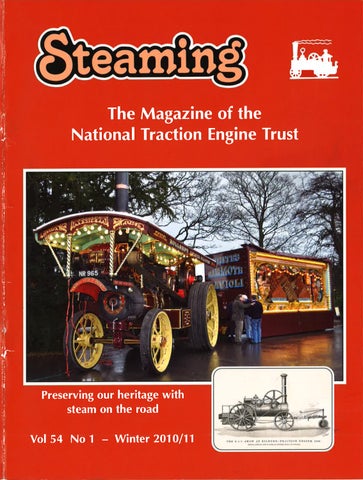
Front cover The weather for the weekend of the Trust's AGM in Durham in November was thoroughly miserable, dull, cold and wet. Yet by the entrance doors to the meeting on the Saturday afternoon, Neil Corner's Burrell scenic WINSTON CHURCHILL and the White's Mammoth Gavioli organ, together with their dedicated crews, managed to provide a splendidly warm and stirring sight, and somehow, photographer David Warren was able to capture that brightness.
3
Trust News concluded from previous page With the loss of our Vice Chairman John Cook, we were grateful for the support immediately offered from Sue Cook. It did though leave the requirement to find a second Vice Chairman from within the Executive members, and I am pleased to say David Smith as Head of Technical Services accepted the invitation to take on the position, which was unanimously accepted by the voting members of the General Council at their October meeting. At the December Council Meeting it was refreshing to welcome the new members who were elected at the AGM in November and, importantly, the fact they all took an active part in the discussions — we welcome them and their contributions. (Robert Herring, Chairman)
Rally Organisers Column Rally Organisers Section — The 2010 Rally season is now long gone, but we will all have some wonderful memories relating to our hobby. In October the Rally Organisers
Conference was held at Kilsby, Northamptonshire, attended by 84 delegates representing 29 authorised rallies. David Smith opened the batting with a presentation on the NTET Insurance Discs and how they were used at events to aid administration and assist the safety officers. He also gave an informative update on the Event Safety Guide — 'The Purple Guide.' Lance Jackson, who has since been elected to the General Council at the AGM, gave two comprehensive lectures on rally safety and the running of a safe event. We can always rely on Lance to take the common sense approach to the subject and appreciate the problems encountered on a rally field. New on the agenda was a talk by Marie Marriot, a retired food safety consultant, who guided us through the dangers involved with supplying and handling food, the selection of caterers and how to establish their suitability in this high risk area. Brenda Morley, a trainer with St John Ambulance, spoke on providing first aid cover at events and how it should be implemented. All these subjects promoted healthy discussion and after a substantial lunch and the afternoon safety session by Lance, the open forum provided an
Engine Owners Meeting The next meeting will be held at The Village Hall, Kilsby, near Rugby, Warwickshire CV23 8XX
on Sunday 23rd January 2011 commencing at 11.00am with coffee from 10.30 A buffet lunch will be provided All engine owners, crews and other interested parties are invited to attend, whether they are members of the Trust or not. An Agenda for the meeting will be published later on the NTET website. For more information, or if you have a particular topic for discussion, contact Bob Siddall IT 01636 821991 or engines@ntet.co.uk
4
opportunity to discuss anything pertaining to the speakers, or to rally general. A organisation in comprehensive report on the Conference has been prepared, and copies are available from the General Secretary. For elsewhere in this issue of Steaming I have prepared a short article prompted by a number of concerns about bad behaviour at rallies, which you may find useful in planning your 2011 event. The remit of the Rally Section is to help organisers run an enjoyable but safe rally; therefore if there are any concerns or information required please get in touch with me by 01524 271584 or email — general. secretary@ntet.co.uk — and we will try to help. The Rally Section would like to hear from any existing safety officers, or members who have some experience of safety matters, and who feel they have the necessary people skills with a view to becoming additional rally inspectors on behalf of the Trust. (Tim Holt, Head of Rally Organisers Section)
Engine Owners Column Association of Independent Boiler Inspectors — the following report was presented by myself and two members of the AIBI, Dave Wothers and Trevor Coatham, to the November AGM at Durham. (Trevor has taken over from Alan Bulmer in the north-east, on Alan's retirement.) 'The NTET has facilitated two meetings of the Association, in March and October. At these meetings considerable progress has been made, although the rate of progress has been limited because of the indisposition of Chris Boocock, who has now resigned as facilitator due to ill health. At this point we should thank Chris for all the work that he has put in during the formation of the Winter 2010/11 STEAMING
Association. The Association has agreed a Professional Code of Conduct, and is in the process of conducting a survey into the knowledge, training, and experience of its members, with the object of setting bench-mark standards for membership. It is intended to prove competence, as near as possible, to the requirements of BS 17020 including Quality Systems and agreed standards. 'The NTET would like to see the AIBI use the SAFed agreed NTET Written Scheme of Examination and Inspection Protocols, but are prepared to consider any scheme that the AIBI might propose that is equivalent to or better than the NTET Scheme. For a requirement to enable auditing to take place, as a step towards harmonising standards of inspection, the NTET has requested that the AIBI adopt standard reporting forms, which are available in Part 4 of the Engine Owners Code of Practice. These forms are already being used by some members of the AIBI. 'The NTET does not wish to have any form of control of the boiler inspectors, and will continue to provide help and assistance to the Association to enable them to become a credible body which as far as is possible complies with BS17020 and PSSR 2000; conforms with Quality Systems, and has consistent standards. The NTET believes that this is necessary for the survival of the independent boiler inspector, before some higher authority imposes onerous requirements upon these inspectors and hence our hobby. To assist with the start up administration of the Association, the Council of the NTET has agreed that it will match the Association's total contribution, up to £1000: Engine owners' responsibilities one point that has been raised with the NTET by the AIBI is that many engine owners do not understand their responsibilities with regard to keeping records, and preparing the boiler for examination. The best advice that I can give to owners is for them to read and comply with Part 4 of the Engine Owners Code of Practice. • It must be emphasised that it is the owner's responsibility to: • have the boiler examined • appoint a competent person to draw up the Written Scheme of Examination • appoint a competent boiler inspector In addition it is the responsibility of the owner to provide, at the time of examination, the Written Scheme of STEAMING Winter 2010/11
Printed Paper Rate.
Memo from CHARLES BURRELL & SONS, Ltd.
77, • , /e-i,es, obi,' 1,,
wriM, /re,
ENGINEERS, THETFORD. NORFOLK.
WO hell,, 0.1 uiRrif
/I02— 2-‘ er aritirqf far
k-K .
'--)'
_
--)
1 --1.-4)--m c„,42- ,fr . r ...-...
—rimmin.
; - T/1-. 70 , Z-"C4-.- • •-i-
/ L 41E-e._a
I/ /47 / ;:../....
9,—
4,4,4_,:: ter_ i ,, 71,7:.
( 1' L..
/ 7-7...-,„,,
-. ..."
• „,---..., ...,4.,4a•?),..Aer.734/4404--• X ,.. .,,, ,•. ,...•.41 4...i•f..}... cit-•,-.1... 0i4 , • --t, • (34. 41-0-
, '1111....1 41 1"
.
7-1-- • 4 • .
Z7
BURRELL'S SPECIAL GOLD MEDAL TRACTORS
I
AS
.yd
SUPPLIED 10 AMLitit:MFN-r CA rElitR%._
301,4S,
HIE FORP, 15(31_1150,
This Clayton & Shuttleworth 5 ton steam wagon was delivered new to Rotherham Corporation in Yorkshire in August 1916, for use by the Electricity Department; it was Claytons' works number 47606 (FE2143). The Corporation's power station on the Rawmarsh Road had been opened in May 1901, its initial purpose to supply electricity to the town's proposed tramways and to light the streets. The coal needed to power the generating plant was delivered on the adjacent canal, so just what the high-side bodied Claytons' work was is not known, but during World War 1 the power station's capacity was not meeting the demands of local munitions factories, and extra transport may well have been sanctioned by the Government in the shape of the steam wagon. RLS lists reveal that at an unknown later date the wagon moved to G Vickers of Kilburn, Derbyshire, its only other registered owner. The photograph is thought to have been taken during the World War 1 period. The pipesmoking un-named chap at centre left could be the yard foreman, standing slightly forward to demonstrate his seniority, but of those recorded by the camera it is Arthur Nicholson's identity that has endured - he is on the left with his hand on the front wheel. Arthur's great great grandson Jay Price presented the photograph to the Markham Grange Steam Museum, where it is displayed by the operating Pollit & Wigzell compound mill engine; thanks are due to the Museum for permission to reproduce the picture.
General Council and Officers 2011 This column lists, for the information of members, the General Council and Officers of theTrust for 2011.The addresses/ phone numbers of those. with special duties are given inside the front cover of each issue of this magazine; others may be contacted by phone or via the General Secretary or Heads of Sections. Names marked with an asterisk* are appointments by the Council and are non-voting positions. President Richard Sandercock Vice Presidents Andrew Semple, Len Crane Chairman Robert Herring Vice Chairmen Bob Siddall, David Smith General and Company Secretary Jenny Holt* Treasurer Julie Smith, FCA* Public Relations Officer Mike Dyson* (Er 01353 740470) Membership Secretary Sue Cook* Editor, Steaming Roger West Sales Officers Colin and Val* Brown General Council
The above and also: Irvin Barraclough (S. Yorks, Tr 01709 850346) Joe Black (Yorks, 12 01748 829601) James Blenkinsop (Insurance Officer) Dan Brothwell (Notts, Tr 07912 660014) Colin Brown (NTET Sales) Paul Cook (Lincs, Tr 01529 303160) Paul Davis (Worcs, Tr 01527 893343) Sue Doncaster (E. Anglia, Tr 01206 230689) Emily Drury (Notts) John Durling (Derbyshire, to 01283 712818) Bill Evans .(RallyAuthorisation) Bob Garnett (Avon, Tr 01275 878054) Stuart Gray (FBHVC, 'Er 01462 431848) Paul Hemstritch (Yorks, 'e 01274 608421) Tim Holt (Head, Rally Organisers Sec) Richard Hurley (Wilts,v 07867 758366) Lance Jackson (Shrops, 13. 01743 860091) Adam Marriott (Worcs,v 01299 890128) Elaine Massey (London, Tr 0208 248 6570) Kevin Munn (SAC chairman) John Paulson (Shrops, 17 01939 250678) John Riley (Northants, Tr 01780 470384) Tony Seddon (Shrops, 12 01948 780599) Bob Siddall (Head, Engine Owners Sec) David Smith (Head, Technical Services) David Temple (Oxon, .17 07834 475217) Representatives Reg Mattless (NVTractor & EC)* Auditors: Charles Lovell & Co, Royal House, Market Place, Redditch, Worcestershire BN98 8AA
6
Foden C type 13178 of 1928 poses in a stately manner at the Bedford club's 2008 event at Shuttleworth House, Old Warden. (Keith Broth well)
Examination, records of previous examinations, a record of steamings since the previous examination, and a record of repairs carried out since the previous examination. A further requirement is to provide proper facilities for the boiler inspector to enable him to carry out his inspection in a proper manner, and to ensure that the boiler is properly prepared for inspection as detailed in section 4.12 of the Engine Owners Code of Practice. December meeting of AIBI another meeting of the AIBI took place at the beginning of December. The meeting was attended by — Chris Beeson Trevor Coatham Graham Morris Andrew Reen, representing SFP Hal Richardson .Innathan Wheeler Dave Wothers Apologies were from Martin Clarke, Ian Farrance and John Glaze.
At this meeting further progress was made. Unfortunately it has not yet been possible to appoint a new facilitator, but it is intended to have one in place in the near future. A further meeting has been arranged for the beginning of March 2011. Engine Owners Meeting - the 2011 Engine Owners Meeting will take place on Sunday 23rd January at the Village Hall, Kilsby, commencing with coffee at 10.30am for the meeting to commence at 11.00am. Topics for discussion will be traction engines and the law; insurance matters; the Association of Independent Boiler Inspectors, and other technical matters. All engine owners, drivers, crew and other interested parties are invited to attend whether members of the Trust or not, (all paragraphs, Bob Siddall, Chairman, Engine Owners Section)
Winter 2010/11 STEAMING
Technical Services Unit Registration numbers for new or previously unregistered vehicles - both the DVLA and the FBHVC have made recent statements regarding the qualifying pre-conditions that are required to be met when applying for a registration number for a new or previously unregistered vehicle. The NTET is concerned that the newly introduced advice, given in the DVLA document INF26 and presented in detail in the FBHVC's Newsletter 6 of 2010, does not cover some conditions that specifically affect vintage road going steam vehicles. (The full document is available to download at www,direct.gov.uk then search using INF26.) Consequently, if the advice were followed precisely, owners in the process of a major restoration using donated components from 'scrapped' engines, or newly manufactured components may not be able to claim an agerelated registration number for their projects. In January the TSU will meet to discuss this issue, and I am pleased to say that both David Hurley of the FBHVC and Derek Rayner, the Trust's Registration Officer, have agreed to attend that meeting. I hope, through David Hurley, that we can convince the FBHVC to assist us in making a case to the DVLA for modification of the rules, so as to remove adverse results for traction engines. Modifications to Insurance Disc in response to requests from some disc issuing agents, the layout of the NTET Insurance Disc has been modified to accommodate the full length of makers' name and the engine type. The result is that the keeper's name and make/type fields have been swapped and the other fields have been moved slightly in order to balance the look of the disc. A sample
STEAMING Winter 2010/11
of the new look disc is given here. Prior to the release of the new discs to the issuing agents, we shall be furnishing them with modifications to the disc management system which prints the owner/engine details onto discs. Steam vehicles at rallies in the UK - in light of some recent misunderstandings on the subject of engines visiting this country, the NTET makes the following statement. 'The NTET advises that should overseas engine owners wish to operate their own engines in the UK, they should ensure well in advance of their visit, that the boiler certification is valid for use in the UK. This can be achieved by obtaining a written declaration from their own inspecting body to the effect that the inspection complies with the current regulations in the UK. At present this means complying with the Pressure Safety Systems Regulations 2000 which requires that a Written Scheme of Examination is drawn up by a competent person or body. 'If there is any uncertainty as to whether the home based inspection meets the requirements of PSSR 2000 the boiler will need to be reinspected in the UK to the current regulations, before use. For the avoidance of doubt, an NTET insurance disc will only be issued to engines of which the boilers meet the current UK regulations.' Water Extraction, a small update -thanks to the fortunate professional relationship between a Trust member and one of his colleagues, we have a small glimmer of light in this otherwise murky tunnel that is a 'central licence for water extraction by road going engines'. The contact is also a member of the board of a water utility, and it is through this arrangement that we hope to make progress. No promises, but watch this space. Born again engines - this hoary subject still exercises the mind of the General Council and also continues to give rise to great concern to members. In order to get closure from the HSE in relation to a particular engine, I have been invited to meet with one of its officers in mid January. I am hopeful that as a consequence we will be able to more clearly define the extent of the HSE's jurisdiction into the world of hobby steam, and the juxta-positions of the NTET and the HSE. In the absence of clear cut boundaries which separate 'being at work' and 'hobby steam', and around which the HSE can sensibly operate,
Sections and Services 2011 This column lists the members of the Trust's Sections for 2011. Names marked with an asterisk* are co-opted; others are elected General Council members. Addresses/phone numbers of the chairmen or heads appear inside the front cover of each issue. Engine Owners Section Bob Siddall (head) Nick Allen* Irvin Barraclough Joe Black James Blenkinsop Michael Davies Sue Doncaster Sylvia Dudley* John Durling Bob Garnett Colin Hatch* Andy Hawkswell* Kevin Munn Tony Seddon David Smith Rally Organisers Section Tim Holt (head) Jo Donkin* Norman Douglas* Trevor Evans* Bill and Pat* Evans Paul Hemstritch Lance Jackson Brian and Dillis James* Keith Stott* Jerry Sullivan* JoTilling* Tony Wills* Gavin Young* Technical Services David Smith (head) Irvin Barraclough James Blenkinsop Bob Garnett Stuart Gray Colin Hatch* Richard Hurley Tony Wood* Membership Services Colin Brown Val Brown* David Collidge* Mike Dyson* Roger West Steam Apprentice Club Kevin Munn (chairman) John Durling (president) Elaine Massey (vice chair) Joe Black Nick Bosworth* Emily Drury Matthew Lund* Nanette Durling* Barry Sumsion*
7
the NTET finds itself increasingly taking on the role of 'policeman' and even 'whistle-blower' in defending the hobby against those who clearly do not share the ethics of duty of care to others, or even subscribe to our by line - preserving out heritage with steam on the road. This is not a role the NTET relishes, but who else would we have fight our corner? (David Smith, Head of Technical Services Unit)
From the Treasurer The Report and Accounts booklet, distributed with the last issue, contained the accounts for the year ended 31st March 2010. Unfortunately the Income section was omitted by the printers from page 9 therefore the missing information is presented opposite the inside rear cover of this issue, alongside the summary AGM report. (Julie Smith, Treasurer)
The Trust Trophies, 2010 Following the completion of the formal business of the 2010 AGM at Durham, several of the Trust's collection of trophies, presented over the years by or in memory of worthy names in the preservation movement, were distributed to deserving recipients - some local to the northeast; others of the membership in general. The presentations were handed over by Trust President Richard Sandercock, with the citations being read by Secretary Jenny Holt. The ARTHUR NAPPER CUP was presented to Ian Thompson of Pelton Fell, marking the successful rallying of Foden wagon 13218 CESTRIA by three generations of the Thompson family. The CURTIS BOWL is usually given for taking an engine on long road journeys under steam and was awarded to Ian Fearnley of Castleford with Sentinel DG6, which is roaded to rallies, never going anywhere on a trailer. The DACRE LACY CUP is presented for outstanding preservation renovation, and the recipient 8
As members will have seen from the Agenda page of the Report & Accounts sent with the last magazine, the 2010 AGM was noteworthy for the large number of nominations that had been received for election to the General Council - and that among the eight there was a good mixture of those of a younger age, and others that had already spent some time assisting under Trust section heads. Appearing here in front of Mike Dyson's camera are, from the left - John Paulson, Emily Drury, Dan Brothwell and Paul Cook. Thanks go to Anthony and Wendy Thompson for their excellent organising of the arrangements for the meeting room and the hotel, and to Neil Corner and Stuart Ritchie and their vintage bus and engine crews. A raffle held during the Saturday evening dinner gathering resulted in a £255 donation to the local air ambulance charity. was Richard Preston of Hutton Rudby, for the recent outstanding renovation of Burrell showmans LIGHTNING. The CHOISY & SIMPSON CUP for excellent engine preservation was given to Tim Clarke of Stockton on Tees' for his Burrell engine WHITEHALL, an engine severely damaged by fire some time ago but now in pristine condition. The JOHN CRAWLEY TROPHY is for outstanding service to theTrust or the movement, but not connected with engines. The recipient was John Graydon of Seaham, who is to be seen at rallies in every part of the country, having a wealth of knowledge, and always willing to help anyone to find original details. The EDNEY SHIELD was purchased by the club in memory of the late Ernest Edney, an early Treasurer and regarded as saviour of the Club in its early days, and is awarded to persons who have given con-
Presentations of Trust trophies at the Durham AGM by President Richard Sandercock included the CURTIS BOWL to Ian Fearnley, and the EDNEY SHIELD to Sue Cook, marking the extensive and diligent work of her late husband. Winter 2010/11 STEAMING
i,,ijo.:,4,IN:._ 4444,',
P''NDE ELECTRIC REITio°,iti r'S --OpE
,i, ..4, A ,
444,4
,,,A ,64‘1,44444 I
siderable personal service to the club. For 2010 it was is awarded to the late John Cook, for his outstanding and dedicated service to the Trust until his untimely death. The PERCY HIRONS BOWL is awarded to the owner of an engine used for demonstration purposes. The recipient was Harry Lyon, for his working presentations of the rare Robinson & Auden agricultural, usually accompanied at rallies by a saw bench. The BAKERTOC-H CUP, by size the largest in the Trust's collection, is usually reserved for the big engine owner, whose standing and stature is countrywide. It was awarded in 2010 to Neil Corner, for his rallying of the Burrell scenic WINSTON CHURCHILL. The JACK HOLLOWAY CUP is also for considerable services to the Trust and a joint presentation was made to Roger and Celia West. In 2010 Roger passed the 30 year mark as editor and designer of our members' magazine Steaming. It has all resulted in a fine accumulation of work for all those with an interest in the traction engine. Celia has been assisting at the task from day one — proof reading, tolerating domestic upheavals, and in recent years taking on the provision of the lunchtime buffet atTrust Council meetings. The JACK HOLLOWAYTROPHY for PORTABLES was awarded to David Warren of Stockton on Tees, the only person to seriously rally a portable engine in the north of the country. The CONNIE HUTCHENS MEMORIAL TROPHY is reserved for presentation to a lady within the STEAMING Winter 2010/11
144 1
p v , ,
The weather of the Sunday morning after the AGM was still uncompromisingly dull, but the warmth of the welcome by the Preston family and their friends to the Preston Collection made up for that. No fewer than seven engines were in steam, including LIGHTNING and Savage light engine 761 of 1900 providing their own brightness. Against the background of the Gavioli fair organ (above) Richard Sandercock thanked Richard and Ann Preston for their generous hospitality of the morning, and presented the Trust's premier trophy, the GOLDEN FILM SHIELD, awarded for outstanding work within the traction engine movement. (David Warren) movement for outstanding service. Florence Grainger of Masham was selected for her work over many years in running the Masham Rally, and for promoting engines and the Trust. The ERIC MIDDLETON TROPHY is presented to a well restored steam exhibit, undertaken with limited financial means and minimum equipment. The winner was Nigel Crisp of Grosmont, for his ongoing work on Aveling & Porter tractor. The presentations then changed to those being awarded by the Steam Apprentice Club. The JACK.BEEBY CUP was awarded to Kristian Jones of Bishop Auckland, a youngster dedicated to engines and with very supportive parents who manage to take him to many rallies. The DOC ROMAN ES TROPHY was presented to the Cumbria Steam and Vintage Vehicle Society for hosting SAC Driving Days on several occasions at the Cumbria Steam Gatherings. TECHNICAL SAC The ACHIEVEMENT AWARD, established to encourage SAC members to learn and use engineering skills, was
awarded to Jack Ayland of Devon. Jack has shown he is competent in many tasks on workshop machines, and can also can read and understand the drawings that are mainly in imperial measurements, a skill not usually found in the younger generation.
NTET Sales The Aveling book — Michael Lane's long awaited new work, The Story of the lnvicta Works — A History of Aveling & Porter, Rochester, was launched to members arriving for the AGM at Durham in November. Sales were brisk, Michael being kept busy signing copies for purchasers. Subsequently, the Trust's sales team of Colin and Val Brown have been similarly busy at home, packing and despatching the large number of pre-ordered copies, as well as keeping up with the flow of new orders. By the second weekend in December, just three weeks after the 9
The County of Salop club's rally tradition of many, many years, with showmans engines entering the ring to advance two abreast, continued at the August 2010 event. As usual, retired policeman Joe Davis from Wolverhampton led the way, the enaines at the front being 1921 built Rorrell scenics 3886 LORD LASCELLES (left) and 3888 GENERAL GOUGH. (Paul Bishop) bulk delivery from the printers and the AGM, almost 600 copies of the book had gone. The post-free member's price of £30.00 is, of course, still available, and the sales leaflet distributed with the Autumn issue continues to be valid. Prize Draw - to encourage members to complete and submit the 'What do you think' questionnaire leaflet distributed with the Summer 2010 issue, a Prize Draw was arranged for five copies of the Michael Lane's Aveling book. At the November AGM in Durham, Michael randomly drew five completed forms from the 280 in the bag.The fortunate winners, were Peter Bowron of Co Durham; Tom Henderson of Herefordshire; Kevin Mills of Rutland; C G Saunders of Hampshire and Peter Wells of Norwich, who by now will have received their copies by post. The Exhibition Unit - is one of the Trust's most important features in presenting itself at rallies and other steam events - to members, to those potentially interested in joining our ranks, and to the general public. For the forthcoming 2011 rally season, an increase in numbers of the team that 10
staffs the Unit is required - so, please, can you help? The task can be very enjoyable: a chance to meat fellow road steam enthusiasts, to become more closely involved, for those who may feel themselves a little on the outside, or for others, to be a way in which they might like to support the work of the Trust. If you are interested, firstly look at the list in the Spring 2010 (page 66) to see where the Unit travelled to last year - this will give a basic idea of the areas of the country that we try to cover - and then contact Colin or Val Brown (see any of the sales adverts in any issue) to find out more.
Trust News will always appear in Steaming, so that all members can be aware of what is happening within their nrgnniqatinn, hnt if •u want more immediate information about the Trust's developing activities or progress on problems to be solved, please go to http://www.ntet.co.uk. We try to update the website's news pages on a daily basis. (Mike Dyson)
Affiliated and other groups Chiltern Traction Engine Club the Club will be celebrating its 50th year in 2011, having been formed in 1961 by a group of enthusiasts that included the late Chris Edmonds, Robin Brazil andT L de Fraine. Its 50th rally will be held at Prestwood, near High Wycombe, on 2nd/3rd July, when it is hoped some engines from the first rally will appear. On Friday 1st April, a 50th birthday party and buffet is being
http://www.ntet.co.uk
continued on page 12
The new Trust website has been well received and in the first month received 2280 visits. The site is being viewed by people across Britain and further afield, and by visitors from around the world. So far, it has been seen in forty-seven countries!
Moonlight at the 2010 Dorset gathering, but the crowds have their eyes on the spectacle that is the lineup of showmans engines in front of the fair. (David Warren) Winter 2010/11 STEAMING
Large or small — the risk is the same Unfortunately, in all walks of life we regularly hear of the disruptive and dangerous behaviour of a few which affects the lives of many. Rally fields are no exception. Childhood pranks and the like we can probably deal with, but when drink or drugs are involved it is surely a matter for the professionals. But these come at a price, and it is usually a price that small rallies may find hard to meet within their budget. So, in planning a rally it is wise to consider the following — • is it fair to expect a volunteer steward to deal with a gang of drunken individuals intent on causing trouble around them? • is it fair to expect the public to put up with bad language and abuse? is it fair to put children in this sort of environment? • I think not, but what are the solutions? Think about the following — • do you need a beer tent, and if so does it need to be operating day and night? • do you need to supply public camping? • do you need a modern fairground which seems to be a magnet for undesirables? If your rally does not have these problems, well done — if it's not broken, don't fix it. But it is becoming apparent many rallies do, and the issues need to be addressed sooner rather than later, or they can escalate to a serious loss in gate receipts as the public start to boycott events, and to withdrawal or difficulties with insurance cover, police intervention, and even the loss of a venue. My own
local rally, Cumbria Steam Gathering, had these behaviour problems a few years ago. Drunks, brawling, theft, fireworks in the camping field, generators working at all hours, youngsters damaging silage bags on the site. Something had to be done. We took the following steps, not all popular at the time, but it was soon clear that the situation was improving. The public camping was discontinued, and responsible visitors took advantage of other campsites in the area which had built-in security and rules of admission as well as permanent facilities. Our revenue from the camping was, of course, lost, but so was the cost of bringing extra water to the site, disposing of extra sewage (very costly) and providing extra toilets, showers and manpower. Surprisingly enough the resulting net income from public camping had not been that great and the first rally without it was unbelievably trouble free. To accommodate the friends of exhibitors who inevitably tag along we offered the facility of pre booking, done by the exhibitor with their entry form.This had the effect of being self policing, and it worked well. I am not suggesting that bad behaviour comes only from the attending public — there are 'characters' amongst the exhibitors, but the advantage is that we know who they are, and we can flag them up so that they are not invited in subsequent years. Cumbria took the unpopular step of closing the bar at 6.00pm. It had become apparent the evening bar was populated only by the general public — not an exhibitor
or a club member in sight! The beer tent had started primarily for exhibitors and staff to discuss the day, swap yarns and relax with a pint, charging up for the next day. No longer; they seemed to have stayed on the campsite in huddles. So the beer tent was replaced by a catering circle to give a focal point for the evening. It provided a convenient choice of food all in one place, and folk music or similar was provided from the back of a lorry and the beer and cider bar was open until 8.30pm, allowing people to have a drink with their evening meal. By changing the environment we changed the atmosphere. The modern fairground also seemed to attract undesirable behaviour, so this was discontinued, and only the olde tyme fair was retained. This was, I guess, seen as tame and the local yobs ceased to invade and cause damage at the venue in the evening. Some rallies, in an attempt to control theft, introduce a 'no white van' policy, which probably goes some way to alleviating the problem, but is not easy to police, and discriminates against those whose only vehicle is the family firm's van. Looking 'outside the box' and making radical changes when thought necessary can often open doors to the introduction of new ideas and attractions. A planning and environmental officer at the Rally Organisers Conference in 2008 said that from his position steam rallies, compared with such events as Glastonbury, were like a stroll in the park. Let's keep it that way. (Tim Holt, Head of Rally Organisers Section)
Fowler A7 class road locomotive 13141 of 1913 makes spirited progress on a road run around Astwood Bank, Worcestershire in 2008. (Malcolm Ranieri)
concluded from page 10 held at Hazlemere, near High Wycombe - an evening of old photographs, films and slides and plenty of nattering and reminiscing. The Club will be pleased to see friends old and new on the night, with their photos etc - just ring me on 07889 965604 to let us know you are coming. (Malcolm Biggerstaff, chairman, CTEC) National Steam Car Association The National Steam Car Association Ltd owns the copyright on all the published works of John N Walton, who was mainly known for his magazine Light Steam Power, published from 1949 until 1983.
The Association has recently completed cataloguing the articles included in these magazines and is now making copies of them available for reprint. In addition to this, the Association is making available sets of dimensioned drawings for many steam items - engines, boilers, injectors etc. Access to the whole LSP archive can be made through the Association's website: www.steam carassociation.org.uk From there it is possible to select articles or drawings, and order them for reprint at a small fee (discounted for members of the NSCA). (NSCA) Museum of English Rural Life - A further workshop on a steam engine and agricultural machinery builder,
this time a full day event, has been arranged at MERL, Reading. Jonathan Brown and Caroline Gould will be leading a workshop on 'Ransomes of Ipswich: the firm and its records' at the Museum of English Rural Life on Friday, 25th March from 10.00am to 4.00pm. This popular workshop, one of the 'Heavy Metal' series, is an introduction to the history of one of the most important firms in agricultural engineering, and the wide range of documents that survive. There are opportunities for practical experience with the material, and for your own study. Places are limited - please book early. The cost is £25, which includes tea and coffee; bring your own lunch or there is a catering house just outside the museum.To book contact merlevents@reading.ac.uk; 17 0118 378 8660, or write to Museum of English Rural Life, Redlands Road, Reading RG1 5EX.
Trust Diary 2011 This is the diary of Trust events of a business or social nature during the coming year. It includes, in bold type, dates of Conferences and other gatherings for members, and, in italic type, General Council and Executive Committee meetings for the knowledge of members who may wish to contact a Council member to raise an item of concern. Further details of the members meetings will be given in the Future Dates paragraphs or in display adverts in issues of Steaming nearer the dates. 23rd January Engine Owners Meeting 3rd March Executive
It's a very wet September day in 2006 as Burrell agricultural 4037 of 1926 starts its return journey from the Glossop Carnival, home to Knutsford. The first part of the route is climbing the west side of the slopes of The Peak to Hayfield - here in particular the 1 in 10 gradient past Chunal village, the damp autumnal colours as a backcloth. (Russ Bolger) Winter 2010/11 STEAMING
General Council 13th March Steam Training Course 7th/8th May General Council 12th June Executive 18th August 2nd September Dorset Open Forum Rally Organisers 15th October Conference General Council 16th October Executive October 19th November Annual General Meeting 11th December General Council
Future dates Engine Owners Meeting - the 2011 Engine Owners Meeting will be held on Sunday, 23rd January at Kilsby Village Hall, near Rugby, Warwickshire (2 miles from M1 junc 18; CV23 8XX) at 10.30 am for an 11.00 start. All engine owners, drivers, crews and any one else who is interested is invited to attend, whether or not they be members of the Trust. The agenda will be posted on the Trust website about the time this magazine is with members. Drive it Day - is the day the Federation of British Historic Vehicle Clubs encourages all owners of historic vehicles to use them on the road, enabling everyone to see the widespread extent of the hobby. Generally, the annual date is the Sunday nearest to St George's Day, but as this falls on the Easter weekend in 2011, the Drive-it-day will be 17th April. Despite it being maybe rather early in the season for steam engines, members are encouraged to take to the roads and informally join up with other vintage vehicle owners to show support for steam and old vehicles on the road. NTETTraining and Driving Course - the 2011 NTET Course will take place on 7th/8th May at Astwood Bank in Worcestershire. Further details and contact addresses can be seen in the display advert elsewhere in these pages.
New Members A warm welcome is extended to these new members who have joined the Trust in the last three months. We hope they will gain friendship, information and enjoyment from their membership over a period of many years. Full addresses are not STEAMING Winter 2010/11
This is Angus Mackay's yard at Broxburn in West Lothian, Scotland in August 1952 - a few years on thoughts might have been to save the engines for preservation, but when photographed they were awaiting their fate as scrap metal. The Aveling & Porter compound tractor is 9015 of 1919 (KN3499), and the C type Foden is 13236 of 1929 (TR6921), a wagon one time used by Ind, Coope & Allsopp, the brewers. It is still showing signs of white paint to the edges of the front mudguards, blackout regulations from World War 2. (Jack Turner collection)
included, but the Membership Secretary is always willing to put members in touch with one another by forwarding mail. C Bellamy, Witney, Oxfordshire S K Smith,Thatcham, Berkshire J C Kyle,Timaru, New Zealand J Blake, Mickleham, Surrey S J Miles, Westbury, Wiltshire W H Summers, Branton, Doncaster M R Hartley, Grimsargh, Lancashire J R Parker, Skegby, Nottinghamshire M R Oliver, Hale, Cheshire N Chadwick, Chaddesden, Derbyshire R J Dormer, New Bradwell, Buckinghamshire H C Nash, Cockerham, Lancashire P Garvey, Pegswood, Northumberland P MTocknell, Horndean, Hampshire G Rutter,Trimdon Village, Co Durham P R Garrett, Chesterfield, Derbyshire R J Holdom, Warminster, Wiltshire G Verity, Ottershaw, Surrey T Richardson, Pershore, Worcestershire PTaylor-Searle, Chichester, Sussex S Hawkins, St Issey, Cornwall P and L Crankshaw, Bedworth, Warwickshire Mr and Mrs J Greenhough, Maughold, Isle of Man A E Barber, Chelford, Cheshire A Robinson, Basingstoke, Hampshire M J Kitchen, Wigginton, Hertfordshire W Glyn, Co Carlow, Ireland J Ellway, Liskeard, Cornwall PT Chard, Enfield, Middlesex Mrs M Astbury, Shortwood, Bristol M Astbury, Shortwood, Bristol PW Beaumont, All Stretton, Shropshire A Weale, Sudbury, Suffolk J A Smith, Bury St Edmunds, Suffolk R Gale, Moggerhanger, Bedfordshire
L Jackson, Shrewsbury, Shropshire A P Sell, Milton Keynes, Buckinghamshire D Walker, Mentmore, Buckinghamshire D J Spencer, London K G Raistrick, Lytham St Annes, Lancashire J Thomson, Sanderstead, Surrey R Morris, Wickford, Essex D J Coker, East Ham, London C Pertwee, Great Dunmow, Esex A Spracklen, Weymouth, Dorset J G Griffiths,Treharris, Mid Glamorgan K J Hickson, Lydney, Gloucestershire D J Canniford, Honiton, Devon Mrs J Brookes, Dardanup, Australia DW Croser, Chalfont St Giles, Buckinghamshire S Sanders,Truro, Cornwall R Frank, Orton, Cumbria M C van der Giessen, Rotterdam, Netherlands
Poor Steaming Readers will have noticed the same caption appeared beneath two different pictures in the last issue. That below the photograph on page 197 is correct, but the annoyingly similar words that muscled their way under the agricultural Fowler on page 203 should have read Fowler class A4 class 6hp compound agricultural at the Harewood House rally, August 2010 (David Warren). Apologies are due to members and, particularly, David. 13
Avelings' history recorded The Trust publishes Michael Lane's latest work THE STORY OF THE INVICTA WORKS — a history of Aveling & Porter, Rochester, by Michael Lane. 238 + viii pages; A4 cloth bound hardback with colour jacket; 234 black and white illustrations and 16 appendices. Published November 2010 by the National Traction Engine Trust, price £30.00, and available from NTET Sales.
Reviewed by Sandy Ross, an Aveling owner
It has been common knowledge in the steam world for some years that a comprehensive history of Aveling & Porter was underway, so there will be many eager purchasers of this book amongst our members. In view of the technical and commercial prominence of the firm, it seems strange that nearly all other large scale steam road engine manufacturers have been the subject of detailed historical reviews, but perhaps it has been the magnitude of any Aveling history that has put off all but the most determined. So we must congratulate Michael Lane for his perseverance, and thank the NTET for underwriting the publication of the book. For many years the only Aveling. source book was A Hundred Years o f Road Rollers, published by AvelingBarford Ltd in 1965; although partly seen as a promotional tool at that time, it benefited from being largely written by those who had links back to Rochester, and of course access to material that is now lost. Later J M Preston's 1987 book Aveling & Porter provides a short, but well balanced, largely chronological overview of the firm, including many fascinating photographs of the factory itself. For engine owners and lay researchers such as your reviewer much information can be gathered from the Royalty books, drawings and other surviving registers that were placed with Lincolnshire Archives by Aveling-Barford some years ago. However, these engine records can only hint at some of the business dramas that took place, as can be seen by an intriguing 1926 note in the Royalty book entry for an F type sold to Aberystwyth RDC: 'Will you please see this Roller has extra 14
care and finish as the defeated section of the Council will make the most trouble possible of any detail.' Michael Lane has been able to access documents held at Lincoln not normally available to casual enquirers, together with other source archive material that has remained hidden. Some readers will be aware that the remaining Aveling archives are not catalogued, that the sheer volume of Royalty book entries is daunting, and that the intervening years since the closure of the Rochester business has inevitably resulted in the loss of much valuable material. Michael refers extensively to the early collaboration between Thomas Aveling and John Fowler of Leeds, which reminds us that in 1974 he was in the privileged position of having access to all that firm's historical records; he noted then that 'rarely can an amateur historian have been presented with such a galaxy of material'; the result of this fortune was the publication of The Story of the Steam Plough Works, which enabled a much more rounded story than Michael's current publication. Sadly such a goldmine was not available this time! Although titled The Story of the Invicta Works, there is very little detail of the factory, the plant or the thousands or employees who laboured within it — there is but one photograph (previously published) of the erecting shop and an external sketch of the site, published by Aveling. So, for Messrs Allington, Smith, Capper, Robbins (the company's rivetters — and that is the spelling Avelings used, as per their HydraulicTest Book) and others, their only testament is the unique mark
that they stamped on the firebox plates of the boilers that they have left us — see the article in our Summer 2006 issue. We learn nothing of the production work flow. Were boilers made for stock? Which items were bought in? How did they manage to send out engines so quickly after the order was placed — for we know that an order entered on a Monday could be promised for delivery the following week. Apart from Chapter 1 'The Origins of Aveling & Porter' and the concluding chapter noted below, each chapter studies a product range. This approach results in duplication of information on technical developments, since in later years changes in design were generally propagated across all (steam) production. We also find that the firm's living vans and water carts are described under the ploughing engine section, when in practise these products were probably sold in much greater numbers to accompany road rollers. But a greater problem is that there is no logical place for the managerial changes, financial and political forces, and the worldwide influences that were to affect the business, so these references are scattered throughout the book; only the later years are logically documented in the final fascinating chapter 'AGE and the decline of Aveling & Porter Ltd'. The untimely death of the founder, Thomas Aveling, is lost amongst the engines in Chapter 5 'The Agricultural Traction Engine'. The early history of the firm is well documented in the first four chapters, which in addition to the origins of the firm, includes the subject of the chain driven traction engines, the Batho type steam road roller and the Steam Sappers. Despite the lack of early company archives, the ground breaking engineering developments pioneered by Aveling were fortunately recorded in newspapers and learned professional journals of the time, and references to such material are provided as notes to each chapter. Much of the research that Michael has carried out relates to the production totals and sales market of each product, in many cases analysed by customer; collating this information alone must have been a monumental task. Background information on many of these customers, both at home and abroad, is provided and this helps to expand the story. For many readers it will be the chapters relating to the engine types that they own that will be of most Winter 2010/11 STEAMING
interest; roller development is covered in Chapter 8 'Development of the Three-point Road Roller 188089'; Chapter 9 'The Heyday of the Conventional Steam Roller', and Chapter 10 'The Belpaire Boiler and Piston Valve Steam Roller'. Some
may consider that Michael has too readily accepted the sales patter contained in the Aveling promotional material of the time; flat topped Bel paire fireboxes, introduced in 1909 may have a larger steam space than the round top design, but the
downside is that the greater volume of water results in slower steam raising. Michael details the background to the introduction of the piston valve engines, but hardly touches on the total redesign of nearly every component of the rollers
that took place at the same time. The final 1930 series rollers, the flowering of more than fifty years of development, receive less than one column of detail. Other chapters are dedicated to tandem rollers, portable and semi-
portable and stationary engines, tramway engines, steam tractors and showmans engines, steam wagons, and finally internal combustion engined rollers, lorries and cement mixers. For those interested in these subjects there is a wealth of
information to feed on. The extensive repair business operated by the firm is not referred to; local authority minute books indicate that some well endowed undertakings within a reasonable distance of Rochester were always happy to accept Aveling's pessimistic
engine condition reports, and pay their inflated prices for spares and repairs! The book is well illustrated (except for the works itself, as noted above) with some 234 photographs,
A classic and typical Aveling road roller. Now over 125 years old, Royalty number 2031 is the second-oldest working steam roller in the world, having been despatched from the works on 11th December 1884 to the Acton Local Board in west London, though the oldest steaming example, 2018, was but 36 days earlier. The picture was kindly taken by a rallygoer when 2031 was posed away from the crowds at the Sheffield Rally in June 2010. Barford Ltd being substituted by an ampersand. Some will find the repeated substitution of the word 'tons' by 'nhp' confusing when describing the piston valve rollers. Michael notes in Chapter 9 that
'Clearly because of the sheer volume of Aveling's production of road rollers it is not practicable to mention the Numbers, build date, Royalty
nuggets of previously unpublished information, while today's engine owner may learn more of their treasured possession. Specialist researchers who have been able to carry out detail study of some narrow
subjects may challenge certain conclusions. Treat yourself now to a copy, but be aware of its boundaries.
ownership and any special features of every engine built. The writer hopes that it will be felt economically
sketches and drawings; the glass negative collection held at Lincoln will have been the source of some previously unseen photographs. The
justified to produce a supplementary publication in due course containing this information.' The availability of such a record would have made the
captions are in some cases obviously incorrect — Fig 134 shows one of the series of later 'AC' types delivered to
written story more complete and easier to follow — better still, put the whole file on a computer database
Rochester, showed, on Stand 17, three engines of a type so well known as to need no description here; but we cannot pass over in silence the
Barnes Bros of Trowbridge in 1930, yet is described as a 15 ton roller of 1899. There are 16 Appendices, some
and every statistic would have been available! However, the magnitude of such a project cannot be overestimated.
admirable workmanship of one of the boilers, which is quite equal to the very best locomotive work in existence, the joints, both transverse
Despite some of the comments noted above, the book does bring the available information together and
and longitudinal, being butted and strapped and double riveted by steam power. It is difficult to conceive
the 1930 single cylinder slide valve series. Sadly there are numerous
Michael is to be commended for this. For those interested in Victorian engineering the early chapters
spelling, typesetting and other mistakes throughout the book, including such basics as the hyphen in the company name of Aveling-
ensure that Thomas Aveling, his successors, and his Company take their justified position in history. Students of Aveling products will find
that such boiler shell can ever need repairs or wear out' (Editorial comment from London Iron Trade Exchange, 9th December 1876, which unfortunately, by these days of preservation, has turned out to be a trifle optimistic.)
of which are based on contemporary unfortunately material; sales Appendix 12 is titled 'Piston Valve Road Rollers', but the data itself is of
STEAMING Winter 2010/11
'SMITHFIELD CLUB SHOW. .... Messrs Aveling and Porter, of
15
Marshall 35702, supplied in June 1901. To accompany it, the council also purchased a 200-gallon street watering cart from W Smith & Son of Barnard Castle, price £27.15s.0d. When the post of steam roller
driver was advertised, the council received no less than 28 applications for the job, and the applicants had requested an average weekly pay of
Derek Rayner
delegation the opportunity to visit Rochester, providing free rail passes for the purpose. The deputation of three - Councillors Grantham and Stow, accompanied by William
About five miles to the west of the City of Kingston upon Hull in East Yorkshire is Hessle, a small town with a population of some 15,000 inhabitants - indeed many people outside the area think it is part of Hull, but the town is fiercely independent and if the locals are asked, they will tell in no uncertain terms it is definitely not part of Hull! Hessle was famous in the last
Marshalls at Gainsborough, but not to burrells at I hettord, who also had tendered. The eventual decision was to purchase. 'a Marshall 121/2ton compound overhead valve roller,
century for its quarries, the cement works of G & T Earle Ltd taking massive quantities of chalk, with more firms working the same local mineral deposits for other products.
fitted with a scarifier, at £557.10s,0d, plus £8:109.0d for an awning, carriage paid to the North Eastern Railway station at Hessle. The price, incidentally, was by no means the
The town, being on the north bank of the River Humber, was also a centre for small shipbuilding firms. The latter included Livingstone & Cooper, the largest, and Henry Scarr's yard,
cheapest tender. The sum of £3.10s.0d, the price of the rail tickets to Rochester, was later returned to Avelings as the order had not gone to them. The purchased machine was
Coulson, the clerk to the Council also went to Fowlers at Leeds and
around £1.7s.0d. However, this did not find favour with the council and eventually Henry Speck, the council's contracted joiner, agreed to provide a man at a wage of 6s.6d per day, a sum apparently deemed satisfactory.
Marshalls sent a man to remain with the roller for a week following its delivery - presumably for instructional purposes - and it was insured with Vulcan Insurance for £750 cover (including boiler) at an annual rate of £2.7s.6d. A shed was subsequently provided for the steam roller adjacent to the Town Hall in South Lane, and
Henry Speck again had a bit of business come his way, constructing it at a cost of £89.10s.6d. Hessle's early Marshall roller became a star for the day at the UDC's celebrations for the Coronation of King George V. The ceremony in London took place at Westminster Abbey on 22nd June
which was taken over by Richard Dunston in the early 1930s. They all built steam- powered vessels at one time or another. Livingstone & Cooper were on one side of the inlet from the Humber known as Hessle Haven, and Richard Dunston, the last to close, was on the other, the yard shutting down as recently as 1994 after 97 years of activity. Hessle had
its own Urban District Council until 1935 when the Local Government Review Order of that year amalgamated it with the adjacent local councils of Anlaby, Willerby, Kirk Ella and Cottingham, to form Haltemprice UDC. This is the geographical
background of those who might have had reason to operate steam road vehicles around Hessle. The local rollers In late 1900, Hessle UDC decided to buy a 12ton steam roller, with suitable scarifier and a water cart.The East Riding County Council at
Beverley was to contribute the sum of £350 towards its purchase, as they did for several other urban and rural district councils within their area. Tenders were requested and Aveling & Porter provided a price of £577 for a roller including scarifier and awning; they offered a council 16
Hessle UDC's Marshall roller 35702 of 1901, interestingly decorated for the occasion of King George V's Coronation in 1911. In the centre of the not-tooqood quality photograph is Henry Speck whilst above him and the engine's motion, presumably standing on the roller's running board on the far side, is Fred Speck. Amongst others in the picture are Messrs Howard, Cross, Firth, Shadwell, Lowthorpe and the driver, Harold Wray, on the footplate. (East Riding of Yorkshire Council Archives) Winter 2010/11 STEAMING
13th June 1911. Engine prepared for Coronation Engine lifted and tank washed out, boiler washed out, glands and taps packed, valves taken out and cleaned. 1 rubber washer for tank, 1 ring for manhole. Flywheel and engine front painted red, white and blue. One pint of black varnish, 6 split pins and flagpole fixed on engine. Engine decorated and cold water cart fixed to engine. Pipe fittings, screwing pipes and fixing taps to water cart. One man 83 hours, one man 53 hours. Total
1911, but the event was also celebrated throughout the country. Hessle's own festivities commenced with a combined service at the Parish Church, following which a procession formed and started for the park at Hesslewood, with the Queen's Hall (Hull) Silver Band, the council's fire engine and brigade, together with Council officers etc. A 'monster' tea was provided and this was followed by dancing. It had been decided that the Council's steam roller would take part in this parade, suitably beflagged and decorated in patriotic colours for the occasion. There was seemingly a dual-requirement for it to be there, for it was to provide the day's requirements of both cold and boiling water - the latter presumably for tea-making facilities, and perhaps also for washing up afterwards. In order that the ten year old roller should look the part on the special day, preparation work had to be done and this was placed, not surprisingly, in the hands of Henry Speck & Sons of South Lane, Hessle - who were also, by that time, the local plumbers. A copy of Specks' submitted account to the Council for this work on the roller survives in Hessle Public Library in the Stan Owen Archive (XXXVII). Incredibly (nowadays), the cost for the labour of £2.4s.2d (£2.21) works out at a rate of just over 1d. (around 1/2p) per hour. Earlier in the month of June 1911, it was reported in the Council minutes that one of the roller's driving wheels was in a poor condition. Someone from Marshalls came to inspect, resulting in a recommendation that a new cast iron boss with brass bush and 'wrot' steel spokes should be obtained (capable of fixing to the existing cast iron rim) - all for the sum of £7.10s.0d plus the necessary bolts for 7s.6d,The council agreed•and Henry Speck was to fit the existing rim, for which he was later paid £6.10s.11d. Hessle's roller was registered BT4642 on 17th September 1921. Later, on the formation of STEAMING Winter 2010/11
£
s.
2 £2
5 6 3 7 2 6 2 0 1 6 4 2 19 3
d.
the new amalgamated council, it passed to Haltemprice UDC. Another of the local constituents of this new council in 1935 also had a steam roller. Cottingham (about 5 miles north of Hessle) had purchased S class Marshall 84620 new in May 1929 (WF2388), replacing its earlier Aveling 4576, a 12 ton overhead valve compound new to them in July 1900. The Marshall was kept at their depot at the wonderfully named Great Gutter Lane in Willerby, and it joined the ex-Hessle 1901 Marshall in the service of the new enlarged authority. Around the time of the council reorganisation, in April 1936, Haltemprice Council appointed a new roller driver by the name of HarryT Ellerker, at a weekly wage of £2.14s.6d. On the • interview board for this position were the previously noted Messrs Stow and Coulson, both of whom were involved in the Hessle roller's purchase 35 years previously, and the latter was still the Council clerk. In March 1939, the Council minutes reported the old Hessle roller was 'worn out', and no further repairs were to be carried out on it. It was suggested that a replacement should be considered, but there was no further mention in the minutes, and no disposal details in RLS records. Maybe the subsequent hostilities meant the 1901 Marshall was scrapped and the newer machine was relied on to attend to the necessary road repairs within the Council's jurisdiction. Marshall roller 84620 was not retired until 1964, by then being one of the last steam rollers to see use in the area. An advertisement appeared locally seeking tenders for its disposal and the successful bidder was W H M (Harry, but known in the steam world as Bill) Ellerker from the Fish Shop in Lockington, a village just to the north of Beverley. The coincidence in surnames with the Council's roller driver of days before is explained by the latter being Bill's cousin! So it seems fitting that the Ellerkers, who had been in the
threshing business since the 1930s, continued the tradition of having steam in the family — and in Bill's ownership the roller was rallied around Yorkshire until 1983. It is now with the Baines family in the Bardney area, just to the east of Lincoln, and is understood to be awaiting boiler repairs. The extremely weighty patent Thackray-Barford trailed scarifier that worked with Cottingham's 84620 has recently been restored, and is part of the large collection of road making tackle owned by the Craske family in North Yorkshire. It is usually displayed with their ex-David Wood of Yeadon Fowler tar-spraying roller. The errant Aveling Ferry Road, Hessle, leading up to the bridge over the railway and thence down to Hessle Haven, was the scene of a major accident in the early 1900s when a traction engine hauling two wagons went off the road and finished upside down at the bottom of the approach embankment. Three undated photographs have come to light of the accident and examination of the engine reveals it to be a large Aveling & Porter single cylinder slide valve convertible machine of late 1890s to early 1900s vintage. The convertible flange is visible above the (missing) smokebox door - and it has a sheet awning somewhere metal underneath it, with the various misshapen supports just visible. The Road Locomotive Society's historic records of convertible engines owned and worked in Yorkshire's East Riding show it was likely to be a Council-owned machine, rather than one belonging to an individual or a firm in the area. There were a number of both overhead valve compounds and side valve compound Avelings in the county, and Driffield Rural District Council had a single cylinder engine - 4249 of 1898. How the councils worked on road repairs in the years prior to World War 1 is not known in detail, but Hessle is over twenty miles south of' Driffield and outside that council's area, and it seems too far a distance for their machine to have needed to venture, even to fetch roadstone from boats on the Humber. However, the East Riding County Council at Beverley-which had been set up in 1889 - had two similar single cylinder machines: 2708 of 1890 and 4552 of 1900. The latter was their fleet No 2. The older engine can be discounted as the one in the photograph for the upside-down machine has pressed boiler plates 17
The aftermath of the accident with Aveling convertible 4552 at Hessle on 27th August 1906. News of such accidents travelled fast and, as always, curious spectators have gathered to see what has happened. The engine's spud pan, front axle and wheels have been torn off, though restrained by the steering chains. The edge of the convertible flange is very evident in the second view. Although the report to the Councillors mentioned the wagons were carrying stone, by now they look neatly empty. (Pat Howlett collection)
(revealed by the position of the mudhole) and water tank, features which date from the installation of hydraulic presses in the Rochester works around 1892/93. It can also be seen to have a Penberthy injector whereas the earlier machine was fitted with one to Aveling's own pattern. So it seems the casualty was 4552. Looking in the surviving Council minutes gives us further detail — a meeting in March 1900 resolved that an additional steam roller be purchased, and the inevitable subcommittee looking into the matter recommended that a 16ton 'steam
roller and traction engine combined' be purchased from Aveling & Porter for the sum of f6UU: /b% of the purchase price was to be paid on delivery and the balance after three months, the delivery to take place within two months. It was provided with an awning extending to the chimney. This machine was Aveling 4552. The customer is recorded in Aveling's records as Yorkshire CC (a title somewhat strange to a Yorkshireman!), but it was qualified by the addition of East Riding County Council on the second line. The
engine was ready for despatch on time, noted as 20th June 1900. The record for 4552 had been added to at a later time with the word 'Show', the inference being that the engine was either finished in 'show condition' or exhibited, by arrangement with the council, prior to delivery. The Yorkshire Agricultural Society's 1900 show was held from 18th to 20th July in Doncaster, and this is the likely venue on the engine's way to its delivery destination of Beverley. The engine was No 2 in the fleet - the previously mentioned Aveling 2708 of 1890 was the first - but no nameplate details were given for 4552. The East Riding County Council had a large area of responsibility for what were then described as 'Main Roads' (the smaller local councils had responsibility for the minor ones) and ERCC records reveal more for us. In January 1906 the 'County Traction Engine' (that is, the Aveling convertible) was hauling whinstone from railway stations to sites of rolling work, and in March 1906, one of their rollers was working at Hessle. A report of 8th October 1906 for the Councillors gave them an account of the accident at Hessle. It states the traction engine had hauled 400 tons prior to its accident. The mishap occurred on Monday, 27th August 1906 when coming from the wharf at Hessle Haven in the charge of driver John Elvidge. Part of the text reads: 'On this occasion it was drawing two trucks of stone and was being driven over the bridge which spans the North Eastern Railway and whilst descending the declivity it appears from the evidence of the men in charge that the steering gear became 'jammed' and before the engine could be brought to a standstill, it got onto the soft ground on the side of the road and toppled over the embankment into the field adjoining, dragging the two trucks with it. The engine had turned completely over and laid on its back, as shown in the enclosed photographs; one truck was also on its back and the other was half-way down the embankment. Considerable damage was done to the Engine but the trucks were not so much damaged.' The photographs referred to do not now accompany the archived minutes, but it is fortunate that copies have survived elsewhere. Fortunately no-one was killed, but driver Elvidge was in a state of unconsciousness and taken to the Hull Infirmary where it was established that he was suffering from a contusion of the spine. He remained STEAMING Winter 2010/11
Looking down on the traction engine wreck from above. The first trailer's twisted drawbar, still attached to the engine, is evident on the left, and we are able to see the type of injector fitted to the tender - as mentioned in the text. (Pat Howlett collection) there until the following Sunday when he was allowed to return to his home in Beverley. The County Council later authorised him to receive the sum of £16.16s.0d as a special grant; this to pay for expenses incurred as a result of the accident - for the policeman and doctor at Hessle who attended, and also the Hull Infirmary's costs. What happened to the future employment prospects of the crew is unrecorded. The engine was subsequently sent to Avelings for repairs and, according to the Council minutes, was back in service by the end of the year.
came in the form of a Ruston Proctor steam excavator and later, in 1931, a Ruston-Bucyrus RB25 steam navvy. Following the quarry closure, the RB25, with its 3.75 cu yard capacity bucket, was taken for preservation at Beamish Open Air Museum in Co Durham. Visitors can see it there today. As was usual in the quarrying industry, railway lines from the working face to the manufacturing plant, and sidings from there to the main line were the preserve of industrial shunting locos, and Earles' used a number over the years - four were available in the early 1960s.
The chalk quarries and cement works As mentioned earlier in this account, chalk-quarrying was a major industry at Hessle, and accounted for the use of some steam machines, though not directly road steam engines. The industry started in the 14th century and continued into the 1960s, and the former quarries and their scars can be seen to the west of the town, the largest now transformed into the Humber Bridge Country Park. G & T Earle's Hessle Quarry grew to a large size, the chalk removed and the cement produced being essential for the construction industry; it also provided lime for agricultural use. Mechanisation within the quarry
Hearfield's Fodens Another allied product of the Hessle area was whiting - made from crushed and finely ground chalk, it was an essential ingredient for paint and whitewash, and also used to produce putty when mixed with linseed oil. The Hearfield family were active in this trade for many years, from 1882 operating the sixstoried Black Mill, built in the early 19th century on Cliff Road, and a building which survives as a scheduled ancient monument. It was unique in the area in having five sails to power the grinding stones to transform the chalk boulders into whiting. The mill worked by wind power until the mid-1920s when it needed extensive repairs to its sails 19
workers at the firm's business. This ceased around 1960 but the street name lives on, commemorating a once large and important local production industry. Following the death of Bill Hearfield, one of the Hearfield brothers, a few years ago, Robin Turner of Hessle acquired some of his papers and photographs: a group of the pictures gives excellent views of three Foden steam wagons owned by the firm, and which reveals them to be the owner's fleet numbers 3, 4 and 5. The pictures are undated but were probably taken on occasions around 1930. Enquiries of the Road Locomotive Society records, however, reveal that one of the wagons is a 'new discovery', there being only four in the RLS list -
•!,;q
.141J
O.Rc
?SO,
The 'newly discovered' Foden - registration AW9767 - outside Hearfield's steam wagon sheds at the Hessle Mill site. Unfortunately, the vehicle remains unidentified by maker's number. (Robin Turner collection)
etc, so they were removed and it was converted to electric drive. Adjacent to the mill was its own community with workers' cottages. For many years transport away from Hessle for the high-grade whiting was provided by Humber keels, loaded on Hessle foreshore, hut steam wagnns were also employed in the 1920s and early 1930s. Hearfield Brothers of Cliff Road, Hessle were also listed as producing hard road chalk and building sand. They had a depot for their steam
wagons adjacent to the Black Mill, in the area called Little Switzerland, and this appears to have been a speciallybuilt shed not far from the mill. None of the older buildings now exist in the area but some of the large mill stones are still to be seen, including a huge vertical pair with metal hands, driven by a large bevel gear-these are now almost hidden in the encroaching vegetation near the mill. There is a Hearfield Terrace off Eastgate in Hessle - the houses there were constructed as accommodation for
Three of the Hearfield wagons. Foden 8684 of 1919 (MA 243) is in the foreground, but the other two are not fully identified. (Robin Turner collection)
Foden 1449 of 1907 (M1712) ex J Stubbs & Son of Anlaby, Hull. Scrapped about 1927 Foden 1732 of 1908 (M2112) exT R Buffey of Hull around July 1928. Partially scrapped by March 1932. Foden 7936 of 1918 (M9607) ex George Clark & Son, Hull in 1926. Scrappcd about 1928. Fudeil 8884 of 1919 (MA243) ex Brough, Nicholson & Hall of Leek, Staffordshire in 1925. Scrapped by Walker of Anlaby, Hull in 1931-2. All of these were 5 tonners, but fleet numbers are absent in the list. From the pictures we can see Hearfield's fleet numbers 3 and 4 clearly display both those figures and the respective registrations. This identifies the latter to us as works number 8684. On number 5 the index plate is hidden by the bodywork of the Foden parked in front, so cannot be directly matched to the above list; it is however, one of the makers'
WHITING MANUFACTURERS
HEARFIELD BROS THE CLIFF MILL. HESS1E • •4.3m-1, • *IL
•
HARD ROAD CHALK. BUILDING SAND E''
_
V
older examples with convex sheeting over the cylinders, and could well be Foden 1732, or even 1449. What of the 'newly discovered' wagon? Number 3 carries the index AW9767, and following the trends shown in the table, it is presumed was also purchased second-hand by Hearfield Brothers. Except in the earliest and final days of steam,
Foden wagons were given their road registration numbers at the works, in the Cheshire M or MA series, and it seems likely that AW9767 came from an owner in Shropshire, having had to have a fresh number allocated to it as a machine that was ex War Department, with possible overseas use during World War 1. The registration
doesn't appear in the RLS records as a steam vehicle, and must have been
missed when Shropshire records were accessed many years ago. But information presently held at the
Shropshire Records Centre confirms the registration was issued to a Foden wagon, though the buff record card gives no reference to the maker's serial number - only a date of 1st December 1932, which is presumably when the wagon was declared scrapped. So it unfortunately remains unidentified by works number or build date. A photograph showing four of Hearfield's Foden wagons at a chalk quarry face has also been found, but they are too far away for identification and it is unfortunately not suitable for reproduction. Having discussed the Hearfield firm's Foden wagons with Robin Turner, he mentioned they also owned a steam roller at one time and he said that a photograph of this had once been in his family's STEAMING
Winter 2010/11
Hearfield Bros fleet No 4 was Foden 8684 of 1919 (MA243). It is posed outside the sheds - glimpsed partially hidden in the background are No 5 behind the front of the wagon, and No 3 at the right; the mill cottages are further away. Whilst the colours used for painting the Fodens are not known it is clear the bodies and cab backs were white, or nearly so, an appropriate tone for the chalk products being moved about. (Robin Turner collection) collection, and showed the roller over on its side in Hessle,The RLS records reveal no steam roller for the Hearfield firm, and local historian Patrick Howlett wonders if it be a case of mistaken identity over the Aveling convertible engine in the accident on Ferry Road, Hessle. However, Robin was adamant the machine was a steam roller and although the incident happened on Ferry Road, it was not in the same location. Further proved have investigations inconclusive.
More visitors, and passers-by Although there were farms in Hessle, RLS records do not reveal
anyone there owning traction engines. Local History Society sources recall that circus proprietors Bostock & Wombwell brought their show to the town in September 1930 and set up in The Square, in the middle of the town. Bostock's show transport was sold after the. Town Moor Fair at Newcastle upon Tyne in November 1931, so it is presumed the motive power used at the time of their Hessle visit would have been their legendary pair of 5hp Burrell showmans engines - RAJAH and NERO - both of which have survived into preservation. From the same source, in a 1998 interview with local man Kenrith Wise, then aged 83, he recalled that many showmans
engines came through the town around October time - en-route to the Hull Fair. They always used Eastgate in Hessle rather than Cow Lane, as would have been expected, because the engines took water from the historic pump at the corner of Eastgate and Hull Road, but sadly the pump had disappeared by the time of the interview.
A visiting roller The location of the above discussed accident of 1906 was close by a much later new housing development, the construction of which took place in the early 1950s. The contractor was the firm of Sangwin Ltd of Sculcoates Lane and Stepney Lane in Hull, and a rather distant photograph of their Fowler class D2 roller 11343 of 1908 (A17047), engaged on new roadway construction for the new works, has been found. At the time the roller was nearing the end of its days for it was last licensed in 1956. By remarkable
co-incidence, the Fowler was photographed standing almost by the site of the house, still-to-be-built, now occupied by Patrick Howlett, the Hessle historian, and it is only some
200 yards from the Ferry Road location where the Aveling traction engine accident took place. The whole area changed significantly in more recent times 21
Haltemprice Urban District Council's Marshall roller 84620 of 1929, pictured during a pause at work in Hessle on 28th July 1951. It is standing on Park Avenue, and the house behind is number 59 Beverley Road. (P N Williams) with the advent of the Humber Bridge (the northern pier is within Hessle's boundaries) and Clive Sullivan Way (A63), which parallels the railway on its way into Hull city centre. The imposing bridge was opened by the Queen in July 1981. Ferry Road is now a cul-de-sac leading only to light industry close to the railway, though a footpath bridge over the main road goes to the remains of the Dunston shipyard, adjacent to Hessle Haven, a scrapyard (previously Livingstone & Cooper premises) and, of course, the foreshore.
which then took them along a specially constructed road to Hessle station to continue their journey. Much later — around 1901/02 — Hessle Pumping Station, adjacent to the station, included a huge water softener because of the indifferent quality of the local water. The softener could treat 2 million gallons a day, drawn from a well, and at one time was probably the largest such
plant in Britain. Water was pumped the five miles to Hull from the plant's storage tank by two triple-expansion vertical steam engines. Unfortunately the manufacturers of the engines in the pumping station are not known. It also supplied treated water to the locomotive sheds at Dairycoates and Botanic Gardens and other premises in and around the Hull area which originally belonged to the North Eastern Railway. Going back to water transport, one of the three well-known Humber vehicle ferries, the paddle-steamer LINCOLN CASTLE, was berthed for a time on Hessle foreshore as a floating restaurant. She, along with TATTERSHALL CASTLE, now on the Thames in London and WINGFIELD CASTLE, now at Hartlepool, had criss-crossed the Humber for many years between Hull Corporation Pier (a railway station without a railway) and New Holland Pier in Lincolnshire, which was rail connected. LINCOLN CASTLE is now berthed at the National Fishing Heritage Centre in Grimsby, providing a fascinatingly different location as a restaurant, bar and function suite. The Humber ferry service became unnecessary when the Humber Bridge opened in 1981. Acknowledgements I am grateful to member Vic Makey for initially drawing my attention to a 2007 newspaper article in the Hull Daily Mail and to the paper's editorial staff for enabling contact to be made with Hessle resident Robin Turner. Also to Robin for his kindness in the subsequent
Steam and water Two other aspects of Hessle steam can be mentioned to conclude this article. Firstly, the railway came to Hessle in July 1840 and prior to the start of the railway-operated Hull to New Holland ferry across the Humber, there was a service between Barton-on-Humber and Hessle Cliff, where a new jetty was constructed for the steam packets ANN SCARBOROUGH and LAUREL to ply their trade. Passengers on the north bank were met by a 'conveyance' The Haltemprice Marshall at work in Southgate, Hessle. Believed to have been taken in the early 1950s; the scene is close to the present location of Hessle Library. (Pat Howlett collection) 22
Winter 2010/11 STEAMING
Fowler roller 11343 of 1908, owned by Sangwin Ltd of Hull in the emerging Castle Way, Hessle. The picture was taken in 1953 during roadway construction the new housing estate off Ferry Road. (Pat Howlett collection)
loan of the Hearfield photos for use with this article and for his help in enabling later contact with Patrick Howlett, the local Hessle historian. Patrick provided more photographs from his collection and much information of local interest. There
was helpful assistance also from the North Eastern Railway Association's Terry Morrell and David Williamson, and the staff at the British Library, Hessle Library and the East Riding of Yorkshire Council's Treasure House Archives at Beverley. Geoff Ellerker,
Lyndon Shearman and Paul Jarman have helped with information — and details of the local steam road vehicles have come from the historic records of the Road Locomotive Society. 104
For specialist cover take your pick STEAM TRACTION INSURANCE for full size road going engines (inc those above 6in scale)
PORTABLE & RESTORATION STEAM INSURANCE for portable engines and for road engines which are off the road or undergoing restoration
MODEL ROAD STEAM INSURANCE for miniature road engines up to 6in scale
STEAM CAR INSURANCE for all steam cars including new builds
LORRY & LOW LOADER INSURANCE social domestic & pleasure — fully comprehensive — any driver
1111
Walker Midgiey -wira Insurance Brokers
UK Broker Awards 2009 — Schemes Intermediary of the Year Yorkshire Bank Chambers, Fargate, Sheffield S1 2HD For full details phone 0114 250 2770 or visit www.walkermidgley.co.uk STEAMING Winter 2010/11
23
More on Chinese steam rollers I Dirk Forschner of Berlin, Germany I was very pleased to see the article on steam rollers in China in the Autumn 2009 issue of Steaming and offer my congratulations to Derek Rayner for piecing together the details of the unusual Aveling & Porter machine in Port Arthur. I would like to present to readers some pictures that I was able to take in more recent times. My first photographs of a Chinese-built roller were taken in Datong in May 1980, during my first visit to the country. Then, a First Beijing Common Machinery Plant 'replica' of an Aveling & Porter steam roller was working in front of Datong stadium. At this time new steam locomotives were still being constructed in the railway works in that city. Later, when I was in China as a student at Beijing University in around 1985, I saw at least one steam roller in operation which I photographed, and this excited and encouraged me to find out more. As a result of this interest, I established that there were at least four manufacturers of steam rollers in the country and that these were perhaps, rather surprisingly, not established until the 1960s. As a result of this, and having learned the language, I was later fortunate to trace various people who were
An Ston vertical boilered tandem roller from the illustrated page of Chinese Plant and Equipment. The caption reads 'Tianjin City Mechanical Engineering Plant:The design may have been based on that of the Aveling & Porter company from the 1920s. At least ten examples of such rollers were supplied by Rochester to Shanghai and Tientsin during that decade. However, it could also have had its origins in a similar American design.
24
NY-1112 0(515,Eraa Included in the page of illustrations of Chinese Plant and Equipment dating from the 19b0s mentioned in the text were two designs of steam roller. The first was a conventional two cylinder machine based on an Aveling & Porter design, but with some differences. As type NY 1112, it was probably compound and probably superheated. The caption reads 'NY 1112 First Beijing Common Machinery Plant' and indicates this type of roller may have been made in two works, the other being the 'Locomotive Plant Feb 2nd' in the Fengtai District of Beijing, where that factory is still located.
8t FA5VIEtit EI3X5tifigtILIZI-±7 Winter 2010/11 STEAMING
▪
•
involved during the time that steam rollers were actually in use in China. I was subsequently able to set up meetings with these people in Beijing, Tianjin and Xuzhou, the results of which may be of interest to readers. In February 2006, I met with Deng Xiaochun in Xuzhou. Master Deng was then age 63 and he had been a licensed master boiler operator (Kesselwarter) of the steam rollers owned by the Xuzhou Road Construction Company. He had started his career in 1958 and became foreman over the rollers in 1962. From this time, until the end of the company's steam roller operations in 1974, he headed the operations of their four machines. One of these was a 10ton Aveling & Porter which had been shipped from Tianjin to Xuzhou. This type of roller was similar to the steam rollers built in China by the First Beijing Common Machinery Plant. Another roller was a twocylinder compound built in Japan, manufacturer unknown, and also of 10 tons weight. A further compound example originated in Dalian (Port Arthur) and this was of 12 tons weight - and it is not impossible that it could have been the roller which was Derek Rayner's postcard roller: Aveling 5147 illustrated in the Autumn 2009 issue. The company's final steam roller was a Xuzhou-built single cylinder machine, similar in looks but not a totally exact copy of the old Tianjin Aveling roller. I was interested in these revelations and subsequently another meeting took place with Engineer Yin Jiyao from the Xuzhou Construction Machinery Group (the short form is Xugong). Engineer Yin STEAMING Winter 2010/11
A type NY 1112 steam roller built by either the First Beijing Common Machinery Plant or Locomotive Plant Feb 2nd. The two photographs show it at work in Beijing in 1985. The inverted tapered pin arrangement at the front end has a distinct American influence in its design. An interesting addition, and very strange to British eyes, is the totally enclosed glazed and metal cab and the all embracing sheet steel cover over the engine - undoubtedly very necessary with extremely cold climate and the dusty conditions of the roller's usual working environment. (Dirk Forschner) started with the Xugong firm in 1964 and was involved in the construction of steam rollers there from 1964 to 1966. Yin told me that the planned production number of 50 rollers per year was never reached and that in 1964, the group produced 44 rollers, in 1965 just 30, reducing to only 20 rollers in 1966. The total production from 1960 until 1966 was just 116 machines. Eng Yin very kindly gave me a collection of papers, a page of which contained photographs of different types of Chinese-built construction machines from the 1950s and this included two designs of steam rollers, one of them being of the tandem type. Sometime later I also had a meeting with Gao Heng and Zhang Jinxin in Tianjin. Tianjin City Mechanical Engineering Plant was the largest steam roller producer in China. They built the two types as mentioned above -the tandem roller, and one of a conventional design.The production at Tianjin started in 1951 and finished in 1963, during which time they manufactured 171 rollers. Rather interestingly, in 1948, some years prior to the now known dates of steam roller construction in the country, a German-built Henschel roller could be found on the first issues of 5ORMB banknotes of Peoples Bank of China. This was
featured in Steaming for Winter 2007/2008. However, it is not thought that this design of roller was ever constructed in the country. Chinese steam roller manufacturers • First Beijing Common Machinery Plant • Xuzhou Construction Machinery Group • Tianjin City Mechanical Engineering Plant • Locomotive Plant Feb 2nd
BOILER INSPECTION SERVICES D. J. Wothers
Engineer surveyor and boiler inspection service on all types of steam traction engines and loco type boilers of all sizes compliant NTET • • Reports and Certificates issued on site same day • Internal camera inspection of all areas with colour monitor and recording service available • N.D.T. die penetrant testing carried out • Notification to insurance company same (lay A professional independent inspection at an affordable price for that peace of mind
07815 771245 email: djwothers@hotmail.co.tik
25
A lost opportunity The Royal Agricultural Society of England's annual Show in July 1879 was their 40th event. To celebrate the anniversary-the period had covered years in which immense improvements had been made in both husbandry and mechanisation - a 'museum' of Ancient and Modern Farm Implements was presented as one of the additional attractions at the showground at Kilburn, west London. The Committee assembled a Loan Collection, an assortment of ploughs, carts (one said to be 200 years old) and early machinery. It was claimed that although the exhibits were not very numerous they were sufficient 'to carry us back by
representation ... to two thousand years ago. The hope was that the older items could later go to the Patent Museum at South Kensington, to form the nucleus of a national collection to be preserved for the future. Alas, the meeting was beset by atrocious weather and poor attendance, and the dire financial straits in which the Society consequently found itself precluded any development of the idea. The
exhibits were no doubt dispersed to be broken up, and we are left with a few illustrations of them that were published in contemporary magazines and journals. These editorial notes concern the four ancient steam engines. Exhibition catalogue item number No 108 was an early Aveling & Porter traction engine. The Engineer, in one of its reports of the 1879 Show on 4th July noted that 'It was shown at the Smithfield Club Show in 1860; so that this is its second appearance in public. It was sold to Mr Curling of Herne Hill, who has lent it for exhibition. It will be seen that it has little in common with the modern traction engine, but it is far more a self-propelling portable. The maximum pressure which it carried was 601bs, or just one-half that now adopted by Mr Aveling. The pitch chain is of small size and considerable length. In the modern engine the chain has been dispensed with, and gearing used instead; but the substitution of gearing for the chain was not a result reached at a bound; on the contrary, it was an end only attained gradually, and after much trial and experiment. Mr Aveling once said, when he was asked what he
THE R.A.S. SHOW AT KILBURN—TRACTION ENGINE, 1860. MESSRS. AVELING AND PORTER, ROCHESTER, KENT, ENGINEERS.1
A Swain engraving in The Engineer, 4th July 1879, depicting the 1860 Aveling chain engine exhibited in the museum at the RASE Kilburn Show - 'one of the first traction engines ever built by Messrs Aveling & Porter: The 'improved steering gear; subsequently made the subject of a patent, was an advance on the shafts previously provided for a horse to steer the machine as it progressed. The steersman sat on a board nailed
26
across the timber shafts, near to the smokebox, and turned the disc steering wheel 'with the greatest of ease' - but not when going round sharp corners. The arrangement only worked when the engine was in motion, and must have been quite useless when the engine needed to be adjusted in position in the confines of a stackyard. Note what might appear to be steering chains beneath the boiler - other
contemporary illustrations show them to be crossed restraining chains to prevent the front axle turning beyond a certain point. It would be interesting to know from where Swain obtained the details for the elevational engraving - was it from a drawing of c1860, when the machine was new, because it seems too precise to show an engine with twenty years' wear and tear.
Winter 2010/11 STEAMING
broke most in his early practice with traction engines, "We broke everything most" Note the past tense where the boiler pressure is mentioned — it seems the old engine's working days were over and that the owner had kept it as a relic. Indeed, from the RASE catalogue of the Show we learn that J R Curling — his Herne Hill farm was near Faversham in Kent — had bought the 8hp Aveling new at the Christmas show in 1860, and used it successfully until Christmas 1876. Two very early portable engines were on show. Exhibit No 109, presented by Brown & May of Devizes, was described as 'Cambridge's First Portable Steam Engine, exhibited at Newcastle, manufactured in 1846; his next engine took a prize at Northampton in 1847.' These details from the Kilburn catalogue differ from Wensbroug h's account (The Portable Steam Engine, 1911) of Cambridge's pioneering activities with portable agricultural engines. That text-book claims he exhibited an oscillating
1848. 'Introduced at tlieYork meeting of the RASE, where it gained a first prize of £50, that being the first trial at which dynamometer tests were applied. It has been in constant use to the present time.' The accompanying sketch of the ploughing engine is also from The Engineer for 4th July 1879. This was entry No 106. The magazine described the exhibit as 'the first ploughing engine made by Messrs Ransomes and Sims ... shown by Mr Henry Pye, of St Mary's Hall, Rochester. It made its first appearance at the Royal Agricultural Show at Salisbury, in July 1857, as arranged for Mr John Fowler, jun, by William Worby. At that time it was provided with two horizontal winding drums
engine was altered no less than three times. The first alteration, in 1858, was the replacing of the two winding drums by grooved drums, thus introducing the system of working with an endless rope. By this change the weight of the engine was reduced by 21/2 tons. The next alteration was effected by substituting three drum sheaves for the two grooved drums, the central one only being worked by the engine. This alteration was effected by Messrs Hunter and English, in 1859. Finally, in 1861, the three grooved sheaves were replaced by the clip-drum, in which form the engine is exhibited.' Additional information in the Show catalogue reveals the engine was of 14hp, and that it had been 'finished literally on the road to the show grounds' at Salisbury in 1857. It is a great pity that the imagination shown by the committee arranging the museum at the 1879 Show was brought to nought by the vagaries of the British weather which so cruelly spoilt the Kilburn event. Reading between the lines of the various reports (and noting that two of the engines came from north Kent), it seems Thomas Aveling could have been involved with gathering the larger exhibits. Certainly he sent and showed some portions of firebox crowns that had been burned by the neglect of drivers. Later in July 1879 the secretary of the RASE issued
• THE R.A.S. SHOW-MESSRS. BANSOMES AND SIMS' PLOUGHING ENGINE, 1557.
cylinder machine at Bristol in 1842, and that the later Northampton prizewinner — it had an oval flue the length of the boiler through which the gases wandered three times before reaching the chimney — was the exhibit at Kilburn. W Cambridge came from Market Lavington, near Devizes, which presumably accounts for Brown & May being able to present the relic. Catalogue entry No 110 was a 6hp portable built by Richard Hornsby, Spittlegate Ironworks, Grantham in STEAMING Winter 2010/11
The illustration of the Ransomes & Sims ploughing engine at the Kilburn Show in the same issue of The Engineer had the style of a freehand sketch — probably based on a photograph, but this was before the times when magazines could print photographs as half-tones. carrying the two ploughing ropes, and an additional small drum for a headland rope, by which it hauled itself along the headland parallel to a self-moving anchor at the other end of the field. The engine had two cylinders, and the boiler was carried on wooden wheels. Subsequently the
a circular to exhibitors of steam power machinery, asking for instructive samples of engines, or parts thereof, that had been damaged through the negligence of the men in charge, all to be exhibited in a special shed at the next year's Show at Carlisle. A kind of 'Black Museum'. 27
The four ancient relics at Kilburn, regrettably, failed to survive — how nice it would be if they could be viewed by us today in the Science Museum collection, conserved more or less in the condition they finished work, as is the case with two of their early railway locomotives. At least four owners had seen fit to keep an item of machinery that had once been innovative and had proved its worth, but by 1879 had passed its usefulness. It is a shame their interest was not able to be handed down to us.
reflections on our magazine of 25 years ago
The Chairman's report in the Winter 1985/86 magazine, started with the information that following the change from a Club to Trust status, the accounting year had been altered, and enabled the AGM to move to the autumn to be held at 'interesting venues where an attractive programme can be organised.' The Chairman then went on, with further pieces by other committee members, to cover safety issues that are probably as relevant now as they were then. After dark engine movements on the rally field, heavy
The above notes have been made from paragraphs from The Engineer, 4th and 25th July 1879, and the Catalogue of the Royal Agricultural Society of England's 1879 International Agricultural Exhibition, the latter courtesy of the Museum of English Rural Life at Reading University. Maurice Poole kindly provided the Aveling & Porter engraving. Many of the Aveling & Porter records survive in the care of Lincolnshire Archives, including the marvellously detailed Royalty books, and the dated Dispatch books.
However, the ledgers seem to have been started a few years after production got under way, and details of the very earliest products were entered up in sequence at a later date, probably about 1864. From these often sparse transcribed entries, put into the headed and printed columns of the early Dispatch book, the Kilburn Show machine seems to be Royalty number 18, horsepower 8, and buyer John Curling, but there is nothing set down in the 'date forwarded' column
haulage demonstrations, the fencing of working demonstrations (though mere ropes were then considered sufficient) and advice to drivers going on evening road runs (a nondrinking crew and more effective lighting than oil lamps), are all topics that could still be cause for concern, and indeed still give rise to letters in preservation magazines and internet debate. A paragraph in the Engine Owners Column referred to rumoured risks of rallies becoming static events. For some present day rallies, where movements are restricted to a once a day, closely marshalled foray in to the arena, it could be difficult to argue that this fear has not been realised. Fortunately other events are more enlightened, either with limited restrictions, or a dedicated 'playpen'. An article by Sandy Ross on his ex-City of Oxford 4 ton Aveling & Porter roller 7385 shows the amount of information that can be found from council minute books. The records covered not only why it was
needed (one reason was that the gas company was digging up a lot of roads to lay new mains, many of which are only now being replaced — as I can personally attest), the alternative quotes obtained and also some of the maintenance issues experienced.They even went as far as needing to provide a new overcoat, at a cost of 3 guineas (£3.15) to the driver, as the old one was 21/2 years old. With the significant contribution that he subsequently made to the Trust, I was surprised to find John Cook amongst the issue's list of new members — and by jumping ahead I see he became Membership Secretary less than five years later. Maybe of concern to us all of us in the Trust should be that in the mid eighties the list of New Members regularly took up a page or more, compared to the part of a column of more recent times — though by now full addresses have ceased to be shown. (Stuart Gaines)
eddon &Black onsumables
C
28
Suppliers of: Steam and Vintage Spares, Lubricants and Workshop Consumables www.seddonandblack.co.uk Tony Seddon: 07854 226251 tony@seddonandblack.co.uk Joe Black: 07595 466353 joe@seddonandblack.co.uk
Winter 2010/11 STEAMING
The Titanic workshops Derek Rayner This photograph is a view inside Clayton & Shuttleworth's imposing Titanic Works in Lincoln, showing steam wagons under construction. The works was so named as its length was the same as the ill-fated and iconic vessel TITANIC that sank on her maiden voyage in April 1912. It was a huge building, and still stands
today, being presently in multipleoccupancy by a local radio station and some Lincolnshire County Council offices, as well as a fitness studio.
As can be seen in the photograph, the original upper gallery floor accommodated offices and many belt-driven lathes and perhaps other small machine tools, thus keeping production within the one building. Larger components can be seen on
the shop floor below where there are other belt-driven production machines. The Clayton steam wagon nearest the camera is almost complete and
possible fleet number 12 mentioned above that we might guess was intended to follow on from the eleven Mann's vehicles. However, this may
ready for despatch, probably in the final stages of being signwritten, and
not have come to pass, for records show the only brand new wagon that
it is unfortunate the road registration number plate has yet to be written with its numbers. The words 'West Riding' have been put, it seems in chalk, on the smoke box door per haps a., a workshop referenre The finished body paint is very shiny and lettered and lined out, and the words WEST RIDING COUNTY COUNCIL in large
was purchased carried fleet number 20. In 1920 the County Council
letters are just discernable on the left hand engine cover sheet. On the front of these sheets is the large number
acquired, second-hand from the War Department as ex-military surplus, eight Clayton & Shuttleworth wagons built between 1915 and 1918. On 31st January 1921 these ex-WD machines
were given consecutive West Riding registration numbers WR6382 to WR6389, following on from the series
WR6390 in January 1921; I presume that 48642 was merely tagged, chronologically in of order acquisition, onto the end of the long WRCC steam wagon number sequence and thus became the last of this line. Why Yorkshire's local licensing office should want this reregistering arrangement is not known. This wagon was recorded in
local authority records as being at Wakefield (and painted dark blue with a fixed wagon body) and was eventually sold out of Council service on 8th September 1931 to local scrapman E Sheard at Flanshaw,
Wakefield. It is recorded as being
reference to be made to the records of the Road Locomotive Society. These reveal that Yorkshire's West
allocated to the Mann's wagons. RLS records indicate the WHCC then bought just one new Clayton & Shuttleworth wagon - this being 48642, and the one, I suggest, that is the subject of our photograph. A caveat could be that the Council had the ex-WD machines returned to Lincoln for overhaul by the makers prior to delivery, and we are seeing
Riding County Council had a number of steam wagons in the period
one or more of those, but I feel this is unlikely. A further doubt on the
acquired by transfer from various Rural District bodies: four Yorkshires, three Fodens, two Mann's, one
immediately after World War 1. These included eleven locally produced
identity is that the print has the date 1918 on it, but this being in pencil, it could be considered somewhat
Fowler and one Clayton & Shuttleworth. They also went on to buy two new Fodens in 1931.
circumspect. Clayton records at MERL at
I am grateful to Lincolnshire Archives for allowing us to share this
Reading list the WRCC vehicle 48642 as 'going out' on 8th October 1920. The makers registered it as FE3850 (with Lincoln Borough), but it was quickly re-registered in Yorkshire as
photograph from their collection.The document reference is 18 MLL 6. Thanks are also due to the RLS and
12 - which may have been the wagon's intended fleet number.
Other wagons further down the shop unfortunately have no similar means of identification visible. The above detail enables
Mann's 4-ton overtypes (in dark blue livery, and with an end tipping cart body), which were new from the Leeds firm in 1920, receiving consecutive registration numbers WR6371 to WR6381. The wagon in our picture is less
easily recognised, despite the STEAMING Winter 2010/11
scrapped by him by 14th January 1932. To conclude the WRCC's involvement with steam wagons, in
addition to the above mentioned, the WRCC also purchased in the early and mid 1920s eight Foden wagons and then in April 1930, following the local authority reorganisations, it
MERL for engine details and the West Yorkshire Archives at Wakefield. 29
Steam in the Far North The Earl Caithness' steam carriage
Lyndon Shearman In recent years, a number of steam engines have travelled the roads from John O'Groats to Lands End, but probably few people would associate the Far North of Scotland with pioneering work with steam on road and farm, dating as far back as the early 1860s. The railway to Wick and Thurso did not open until 1874, and even Inverness, 150 miles to the south, was not connected by rail to the rest of Britain until the opening of the connecting line to Keith and on to Aberdeen in 1858. Yet the enterprising 14th Earl of Caithness was using steam on the road by 1860, and on the farm by 1863. The location of this enterprise was Barrogill Castle, six miles or so west of John O'Groats. The Castle is now known as the Castle of Mey, and remembered as the holiday home of the late Queen Mother. The 14th Earl, Sir James Sinclair, was also the 12th Laird of Mey. Having inherited the title of Earl of Caithness and having thereby become a Peer of the Realm, he moved south, but remained in constant contact with his factor (manager) at Mey, Peter Keith, and visited his Scottish estate at least three times a year. He was very much involved in the mid-Victorian world of engineering, having been in charge of the Mechanical Engineering Section of the Great Exhibition of 1851. He was also tutor to the Prince of Wales, and it may have been while at Windsor Castle that he first saw Thomas Rickett's steam carriage, which was demonstrated there to Queen Victoria early in 1860. At this point, another of the principal characters in our story enters the scene. The Marquess of Stafford, later to become the Duke of Sutherland, in 1858 asked Thomas Rickett, of Castle Foundry, Buckingham, to build him a steam carriage. According to Fletcher in English and American Steam Carriages and Traction Engines, this had chain drive to the rear wheels. An article in The Engineer in 1859 stated that 'Lord Stafford and guests took an outing from Buckingham to Wolverton. His Lordship drove and steered it. Although the roads were difficult, it took no more than an hour 30
to cover the 10 miles.' Whether or not inspired by this, the Earl of Caithness purchased a similar carriage from Rickett in 1860. This example, according to Fletcher, had spur gearing to the rear wheels, and two speeds giving 4 and 10 mph, although as we shall see, these speeds appear to have been exceeded! Like Stafford's carriage, it was three-wheeled, had seats for the passengers at the front, and a horizontal boiler with the chimney to the rear. There were two cylinders behind the passenger seat, and The Engineer of 19th October 1860 records these were 3? inches bore by 7 inches stroke, but an account by the Parlour Journal quoted in Calder's History of Caithness, says they were 6 inches bore by 7 inches stroke. The Parlour Journal goes on to give more detail. The water tank carried 170 gallons water, which according to the Earl was enough for ten or twelve miles, and the carriage carried one hundredweight of coal which would suffice for 20 miles. A force pump driven by the engine delivered water to the boiler. The steam carriage set off from Inverness to Barrogill Castle on Friday 2nd August 1860 — how it had been transported to Inverness is not clear. Driving it was the Earl himself, with his wife Lady Louisa Philips alongside him at the front, and their close friend William Ross, Minister of Kintore (clearly the affinity that some members of the cloth have for steam engines is not new!). They took the road from Inverness to Beauly, taking 1 hour 20 minutes, including 15 minutes taking on water, and considering the distance is•14 miles, they were not hanging around. Between Beauly and Alness, apparently having got the measure of this steam travelling, they were said to have achieved speeds of 18mph! His Lordship did say later to The Engineer that he 'passed the mail coach, Lord Lovat's carriage, &c. &c. The people seemed more frightened than the horses. I shut off steam in case of accident, otherwise I should have done a great many more miles in the day'
At Alness, His Lordship turned off to the left and north on to what is now the B9176, negotiating steep hills, up and down. Perhaps he took this route in preference to the easier coastal road via Tain in order to test the carriage's hill-climbing abilities for what was to follow further north. The carriage had a wheel-operated screw brake close to the Earl's right hand, as opposed to the lever brake fitted to Lord Stafford's carriage, and this may have been easier to operate on long descents. Steering was by tiller, and one wonders how difficult it was to keep tight hold of it on the road surfaces of the day. Rejoining the road from Tain, the party turned left again and headed for Ardgay at the head of Dornoch Firth, where they took refreshments at an inn. Then they resumed the journey and steamed on to Clashmore, where they stayed the night, having covered a total of 70 miles. The following day, Saturday, was wet so they stayed at Clashmore until the afternoon, when they continued the ten miles on to Golspie, and there they stayed until Monday with the Marquess of Stafford. The conversation must have centred around steam carriage experiences! On Monday morning the party set out again, but from now there appears to be far less reported detail of what happened. Both the Banffshire Journal and the John O'Groats Journal reported (in exactly the same words!) '...and having perfect confidence in his carriage, from its working on Friday, he expects to reach Barrogill Castle, a distance of 80 miles, and over the steepest roads in Scotland'. Neither newspaper appears to give more detail of this most difficult part of the journey, although the Banffshire Journal a week later did note the 'successful trip of Lord Caithness from Inverness northwards with his steam carriage', and mentioned that 'it has answered well in the far north, but is not so suited for districts more populous, and where traffic on the roads is considerable'.The writer then gave an account of the accident which befell Russell's steam carriage on the Glasgow to Paisley road years earlier in 1834 — was this just sour grapes, or was there more of which we are not told? From Golspie, there were ahead of the steam carriage some serious hills, both ascending and descending. Calder's History of Caithness, describing the trip some time later, says 'the steep and still somewhat dangerous passes for wheeled vehicles at the Ord of Caithness, Berriedale, and Dunbeath, with a Winter 2010/11 STEAMING
gradient in some parts of one in twelve, were surmounted with the greatest ease.' The inclines at the Ord and Dunbeath have been eased considerably in recent years, but Berriedale remains difficult even for modern vehicles, and in 2010, almost exactly 150 years after the Earl's remarkable trip, a motor coach carrying school children was only saved by the crash barriers from going over a precipice. The Earl himself told The Engineerthat he had gone up hills of 1 in 6 or 7, which, to anyone who knows this area, must seem far more realistic than the 1 in 12 quoted by Calder. He also said 'such a feat as going over the Ord of Caithness has never before been accomplished by steam, as I believe we rose about 1,000 feet in about five miles: The Earl's photographer took a picture of the carriage and its occupants at the Ord, so we have to conclude that despite the Banffshire Journal's reservations, the carriage must have got up the hills successfully. And this was on unsurfaced roads, before the advent of the steam roller or tarred surfaces. On arrival at Wick, the party were greeted enthusiastically, and the Earl was subsequently given an honorary burgess ticket which conferred on him the Freedom of the Burgh of Wick
for his great journey and for promoting the safety of steam power in the form of a steam carriage. His wife commented 'as long as Caithness can boast of a steam carriage propelled on its common roads, it has no cause to be ashamed, and may claim to itself what the Americans would style the character of a go-ahead county'. That the carriage was something of a family pet is shown by the fact that an engine house was built for it in the Castle grounds, and the ruins can still be seen in the Woodland Walk in the East Garden. The Earl is reported as continuing to use the carriage for a number of years, but the Locomotives on Highways Act, 1881 limited the speed of a steam carriage to 10mph, then the Locomotive Act, 1865 further reduced this to 4mph in the country and 2mph in towns, with the requirement that it be preceded by a man with a red flag 60 yards ahead. The Earl, unable to use the carriage to its potential, converted it to a stationary engine and used it to pump water and hoist stones in his quarry at Rigifa', not far from the Castle.The quarrying of paving stone was an important industry in 19th century Caithness, and the Earl had built a harbour nearby at Harrow for
TIIr EARL OF CAITII'NESS' STEAM CARRIAGE.
The Far! of Caithness' steam carriage was illustrated, by an engraving made from a photograph, and described in The Engineer in its issue of 19th October 1860. That report seems to have been further prepared as a sheet for display — the image used here is taken from a framed copy that is at the Castle of Mey. STEAMING
Winter 2010/11
shipment of finished paving stones. And Rigifa' was close to the site of another of the Earl's steam ventures. The Mey Estates grew bere (a form of barley) and oats for its own use and for sale, principally to Edinburgh and Norway.The Earl, as an engineer, was always looking for ways to improve the land or bring new land into cultivation. To the south of the Castle was an area then known as Nessiter, and this was designated to be improved. In the spring of 1863, a steam plough was brought up, the fields having been squared off, and it was put to work bringing the land under the plough. The tackle selected was a roundabout set, from Howards of Bedford. In the roundabout system, a portable engine stood at one side of the field, driving a windlass, and by means of ropes carried around the field on pulleys, the plough or other implement was drawn across the field. Let the Earl take up the story: 'Fields are now turned up by the steam plough .... an invention as yet in its infancy in a manner that could never be done by mere hand-labour. Steam-culture has already penetrated as far north as John O'Groats, where I have one of the ploughs of Mr Howard of Bedford, and but for its assistance I could not have taken in the land I have now worked up: The Howards, it may be recalled, had worked with William Smith of Woolston in the development of his roundabout steam cultivator, and Smith had fallen out with them as he did with many others, so Howards went on to make and sell their own roundabout system. Some years later, the Duke of Sutherland, the same Marquess of Stafford who had had a Rickett steam carriage a couple of years before Lord Caithness, and who had entertained Caithness on his epic journey north, took up steam ploughing on his estate, but using the Fowler double engine system. How these two must have swapped experiences! Meanwhile, at Mey, no further land was reclaimed by the steam plough, and Nessiter eventually became known as the Philip Mains after the Earl's wife, Lady Louisa Philip. It was subsequently sold off from the estate, but is still known as Philip Mains, a reminder, perhaps, that the 14th Earl once brought the steam plough to Caithness. I record my thanks to Barbara Hiddleston, Archivist and Historian to the Queen Elizabeth Castle of Mey Trust, for providing most of the information in this article, and for giving permission to use it. 404 31
The distinctive steam tipping carts built by the Mann's Patent Steam Cart and Wagon Co Ltd of Hunslet, Leeds are well known to road steam enthusiasts, though regrettably only from illustrations, for none survived quite long enough to be saved for preservation. As was common practice in late Victorian and Edwardian times, the manufacturer issued a hard covered 24 page Handbook of Instructions and Useful Information for purchasers and drivers. We are grateful to Mike Jones for lending his copy of the small book, which probably dates from 1901, to enable us to present this interesting extract from the Introduction pages, describing the utopian conditions in which it seems the Mann's company would have liked to see its products spend their working lives.
The Intelligent Driver 'Before customers purchase one of our Patent Steam Carts or Wagons, we are able to demonstrate to them by an actual trial that they will take a certain load up a given gradient, and will travel at a certain speed, and for a given distance, with a definite amount of fuel, and that they are capable of being worked on bad roads. 'They next naturally ask — How long do we consider they will last, and what do you think they will cost a year in repairs? The answer to this is in a great measure conjectural, as so much depends upon the manner in which they are taken care of after they leave our hands, that we can only say they ought to last so many years, and only cost about so much per year in repairs, and it is in order to assist our friends in keeping within these limits that we are introducing this handbook of instructions ....
'The principal reason why on undertaking a railway journey we can depend on arriving at our destination without a breakdown is, because a locomotive is never allowed to start a journey Without every part of it being in good working order, so far as can be ascertained by examination, whereas the majority of road engine users and drivers appear to think that it is plenty soon enough to examine them after they have broken down.To be properly examined it is necessary that the engine should be clean. 'We strongly advise our customers to have a good well-lighted shed to run them into at night, and to have them cleaned and examined after every day's work. Saturdays might with advantage be given to the man for washing out boiler and tanks, packing glands, overhauling, adjusting, and thoroughly well cleaning the engine and oil bath,
trimming lubricators, and doing any jobs necessary to keep up to a high state of efficiency. Where there are several engines we think it would be well to adopt locomotive practice, and have a man come at night to clean the engines and get steam up ready to go out next morning. 'The shed for a lurry should be 28 to 30 feet long, for a cart about 24 feet long, and for both at least 12 feet wide. If possible It should be lighted from roof, sides, and ends, and should be provided with doors, a cowl and chimney for taking away the smoke when getting up steam, and with one or two ventilators in the roof. It should have a concrete floor, with a good fall for draining away the water; an adequate supply of water at a good pressure is necessary for washing out, or a force pump should be used similar to the one we illustrate. The gas lamps should be fixed for showing a good light on the parts necessary to be cleaned. A bench, vice, and suitable assortment of tools and appliances are also essential, and some strong roof timbers, for attaching a pair of chain blocks to, would occasionally be found useful. 'We recommend our customers to employ competent and experienced drivers. Some makers of road engines state in their catalogues that 'any intelligent labourer can drive their engines.' They can drive ours so far as driving only is concerned, but owners will find out that there is something required beyond merely driving them along the road. 'This (misnamed) economy of the 'Intelligent Labourer Driver' (who is frequently rough and reckless), has taken such root in the minds of many traction engine owners, that makers have been obliged to resort to unnecessary strength and heaviness in order to make the engines suit the drivers, whereas with these carts and lurries, which, although they are very strongly constructed, are by the Motor Cars Act limited in weight, it is necessary for the drivers to suit the engines. .... When a number of engines are sent out, all of the same design and construction, doing similar work, and some cost considerably less in repairs than others, we can only account for it by them being better taken care of, and in the hands of competent drivers:
A Mann's steam tipping cart as illustrated in the 1901 Handbook by the then contemporary means of an engraved plate. 32
Winter 2010/11
STEAMING
New from Leeds Margaret Elliot sought the help of the Trust in locating the present whereabouts of the Fowler steam roller that her grandfather drove, and which she knew had survived to preservation, having met up with it at a rally in Co Durham in the 1980s. This fine picture of the machine has also been passed down and we thank Margaret for allowing us to use it in our magazine. It shows the roller just after delivery from the Steam Plough Works to Edinburgh Corporation when new — probably, because it looks to be so fresh with hardly a mark of work or travel on it, posed with the crew that had unloaded it from a railway wagon and steamed it to the McLeod Street depot of the City Engineers Department. Margaret's grandfather James Melville is second from the left, head of the crew of men around him. The machine is one of the maker's DH class 12 ton compounds — number 16008, with a completion date of 2nd July 1923, and sold new to Edinburgh Corporation. It was allocated registration SG8149, though the picture fails to show that — maybe another indication that the engine had not been long enough in [lie city to have the number plate attached, though the tax disc is displayed. The roller has been supplied with Fowler's tar spraying apparatus — tar tanks beneath the boiler, with the pump to send the liquid to the spreader across the rear of the tender mounted on the tank, and worked by a chain from the flywheel. The spreader brushes were arranged in a number of different ways by Fowlers over the years, and on 16008 we can just see the semicircular end of the casing to the brushes, the rest hidden by the two men standing right. The crew, of course, make the picture more interesting, but they are rather in the way! From what can be seen between them, the roller seems to be painted in the maker's purple brown colours, with the red and black lining, but that judgement is partly because there is none of what would be the more noticeable amber lining that was matched with Fowler's black livery, and also because Margaret STEAMING Winter 2010/11
recalls, from her early sight of the machine, a wine colour. This leads to a conundrum — the second picture, taken in the Fowler premises at Leeds, shows a fascinating and varied group of engines ready for sale or dispatch, and the second roller from the right is thought to be 16008, for it has a display board propped on the front roll: SOLD to EDINBORO CORPORATION. 16008 was the authority's only Fowler roller, but the picture seems to show amber lining to the paintwork; the brass cap is fitted nearer to the top of the chimney, and there are one or two other very minor differences to the Edinburgh photograph, though both images
appear to show the cylinder is lagged with blue steel sheeting.This roller is a DH class tar sprayer, but has the display board been placed on another example? Margaret Elliot recalls, at a very young age, seeing the roller in Russell Road, Gorgie about 1954, and then in the area where she lived fairly soon after, and that was probably near the end of its working life. By 1975 the roller was in preservation in Lothian, and then had a succession of owners in the north-east and north Yorkshire, from where in the 1990s it was rebuilt as a conversion. Thanks are due to Margaret Elliot, the Road Locomotive Society and Museum of English Rural Life, Reading. i014,
Steaming Around
4t,
Compiled from members notes and reports by Derek Rayner
The sale of several steam rollers at Thursford is reported later in this section of the magazine. All sold — there were no reserves — and the vendors are to be congratulated on reducing the number of duplicated rollers at the Collection to provide new opportunities for others. This is certainly what's best for the machines — their restoration was unlikely to have happened had they remained at Thursford. At the same time, the sale has boosted funds available for the Collection's other restorations and maintenance of their existing equipment. A surprising aspect of the sale was that items had been recently removed from rollers (between the photographs taken for use in the catalogue and the sale itself) and other items clearly belonging to particular machines were sold separately — some of the lots earlier in the auction. One of the rollers went to a delighted trio from the Czech
Republic — from the Technical Museum in Brno. Some British enthusiasts will be sad to see its departure from these shores, and it has to be said there are many other steam rollers listed in European Traction Engine Register that are closer to hand if the trio desperately wanted one to restore. Czech-built and even British-built rollers exist in both in the Czech Republic and Slovakia. Following notes in this column last time, it was ironic that just at the time the magazine was through member's letterboxes, reports should be seen in national newspapers and on-line of a steam roller in major difficulties. The machine, complete with two trailers, was pictured having badly broken its front end — and also a wall — in a runaway. The warning carried in the last issue about driving rollers with only one driving pin in position certainly exhibited — the near-side roll was quite definitely without pin. The driver was one with
BEDFORDSHIRE
tractor 1386 of 1919 (U4943), and Sentinel Standard wagon 3549 of 1920 (AW8451) belonging to Barry Weatherhead. Others appearing at the event included NTET chairman Robert Herring's 1914 Allchin traction 1652 (EB4938), the Saunders Collection's Wallis Expansion traction 7666 of 1919 (BL8289), and 1924 Fowler roller 16175 (NW8198) belonging to Peter Johnson. Four New Zealand McLarens were also here and many people who had not been able to visit Dorset were delighted to see them. These were two traction engines: the Winter family's 1242 of 1911 and the
The Bedfordshire Club's Old Warden rally in mid-September was another event bursting with exhibits. It was extremely difficult to make an accurate count of all the engines attending the event — with such a large site and no major restrictions on movement many seemed to be constantly on the go. Engines numbers in the programme went up to 138, and although some were not present they were supplemented by others. In this latter category were Fowler traction 9055 of 1901, down from Yorkshire and in the custody of Harry Lyon, Roy Wakefield's Mann's 34
many road miles of experience of driving his steam roller — and the unfortunate circumstance just goes to show one cannot be too careful on the roads when in charge of such a machine. Other drivers and owners of steam rollers; be warned! I am grateful to members who have sent information to me for this issue, by taking time after visiting rallies and looking after their engines, to send reports in writing, by email or by marking-up programmes — from which the following notes have been compiled. I thank the following groups and individuals: East Anglian TES, East Riding Engine Club, Friends of the Long Shop Museum, Robey Trust, Scottish TES, Sentinel Drivers Club, Somerset TEC, Southern Counties HVPT, Steam Apprentice Club, Steam Plough Club, Thames Valley TEC, West of England SES and Malcolm Biggerstaff, Phil Braithwaite, Syd Brown, David Coates, Steve Corner, Anthony Coulls, Michele Goddard, Paul Griffin, Peter Haywood, George Hudson, Brian Johnson, David Llewelyn, Stephen Mael, Bob Moorman, Key Mills, Brian Parsons, Alan Porter, John Pyatt, Sandy Ross, Lyndon Shearman, Barry Thirlwall, David Warren and Michael Watts - and not forgetting The Traction Engine Register for the detailed references. The press date for this part of the magazine for the next issue is the last day of January. Information, club magazines, news and letters for this section by then to D A Rayner, Invicta, 9 Beagle Ridge Drive, Acomb, York Y024 3JH. Worldwide contributions can be accepted by fax to + (0)1904 331926 or they can be emailed to derek@invicta 1915.freeserve.co.uk and marked Steaming. Press dates for future issues are the last days of April and July.
Calder's 1266 of 1912, together with roller conversion and one time diesel-powered 1817 of 1926 belonging to John Kyle, and Peter Butterick's 3-speed tractor, converted to a roller by McLarens and later, in preservation, reverted to tractor form — 1835 of 1926. Maskell's boiler works are very busy at the moment — two Garrett 4CD tractor boilers are being worked on. John Batchelor's engine, 33414 of 1919 (BJ4195) ex-Harkness of Belfast, has had a new barrel and building up to the top of the firebox, and Chris Case's 33941 of 1920 (BJ2484) is in for major boiler work.Ted Wootton's 1914 Winter 2010/11 STEAMING
Sentinel 6979 of 1927, a Super 3-way tipper always presenting a smart appearance in recent years, has had a new and nicely authentic coat. Keith Brothwell's picture shows the fresh signwriting on the cab front - the insignia of the original owner Charles Franklin Ltd, coal merchants of London. For several years until sold on in 1935, the wagon would have been on the dusty work of backing under the coal drops at the St Pancras and Kings Cross railway yards, loading coal in bulk or bags for London customers. The Kings Cross drops survive as listed structures, and will be incorporated in the redevelopment of the area, alongside the high speed line to Europe.
Colin Piggott is dismantling his newly acquired Burrell traction 1426 of 1889 (AJ6705). This fully sprung engine is to go to Bicknell's in Hampshire in the NewYear for boiler work.
BUCKINGHAMSHIRE
Clayton & Shuttleworth traction 47015 (BD5483) has been retubed and received a tidy up; the boiler of Al!chin roller 1131 of 1900 (NH3416) is having a new backplate and firebox as well as other repairs. Owned by Northampton Borough Council from new, this roller's ownership was transferred to the Northampton & Lamport Railway Preservation Society's Educational Trust in 2009. The Trust is currently restoring it to working order within a five-year plan. When completed, it will be in the fully-lined maroon Northampton Borough livery that it carried when working.
On the last Saturday of October, the ChilternTraction Engine Club held its end of season steam up at Honour's yard, Little Chalfont. The event was well attended by members and friends with a good selection of cars, lorries, tractors and steam engines present. These included Phil Honour's 1921 Aveling roller 9314 (HR4399), Ian Woollen's 1930 Sentinel SDDG4 wagon 8448 (UX8724) and Dave Knott's 1920 Aveling AC6 traction 9096 (AF6001). Also there were the Grover family's 1920 Aveling tractor 9170 of 1920 (KN9352) and their 1928 Tasker tractor 1928 (932GRO). On the Sunday morning, most of the above set off for the last road run of the season to the Red Lion pub at Chenies. It is expected
these engines - and more - will be seen at the club's 50th Anniversary Rally at Prestwood over the first weekend in July this year.
CAMBRIDGESHIRE It was good that Haddenham Rally last year chose to commemorate the 30th anniversary of one of the 'Sales of the Century'. In October 1980 one of the most important traction engine sales in the preservation took place at Holywell, near St Ives in the county, when 27 engines, equipment and other memorabilia collected over a large number of years by the lateTom Paisley went under the hammer. Haddenham presented a special display at the 2010 rally and this included one of the engines that sold all those years ago - the rare Farmer's Foundry portable number 36 of 1910, owned by John Saunders. The event took place on its traditional second weekend in September, with around 30 engines on show. These included Fowler showmans CARRY ON from the Saunders' Collection; Fowler ploughing engines 15453 of 1925 (TW1803) owned by the Coles and 14258 of 1916 (KE2495) belonging to John Mann and also, looking a little like a traction engine but in fact oil powered, was a Walsh & Clark ploughing engine, built in Guiseley, near Leeds, working a saw bench. Others there included 1934 Foster showmans SUCCESS from Yorkshire and owned by David Byass, Barry Nice's 1898 Burrell traction 2112 (TB2849), Fowler 10373 of 1905 (CE7922) owned by David Gowlett, and 1926 Foden wagon 12364 (TW4207) owned by Nichola and Andy Caldow. Rollers included two centenarian Avelings - 5161 of 1903 (CT6902) belonging to Neil Clayton and the Jennings family's 5598 of 1904 (X08052).
CHESHIRE Clayton & Shuttleworth 5 ton steam wagon 48637 of 1920 has recently changed hands and moved from Northern Ireland to Sussex. Outings further east followed, and Keith Brothwell photographed it at the Old Warden rally in September. STEAMING Winter 2010/11
The late Fred Dibnah's Aveling convertible tractor, 7838 of 1912 (TA2436), was sold at auction at the end of July fora record-breaking sum for such a machine.The new owner is businessman Michael Oliver, who is 35
41151 (BH7607) and Nick Parker's Wallis & Steevens conversion which was in the workshop having work done on the motion and gearing. There was a surprise for local engine owners and visitors on the Saturday morning of the Little Leigh Steam Party in October when a Burrell engine appeared in the car park of the Leigh Arms pub proclaiming on its canopy sideboards WM DAY, HEADCORN, KENT! It transpired the engine, 5hp compound 3398 of 1912 (TD264), had been acquired by local man Max Cowap just couple of days previously, in a part exchange arrangement involving Max's Burrell traction 2767 of 1905 (YA1683).
CO DURHAM The Bowes Railway heritage weekend in August saw road steam appear in the shape of Neil Corner's Burrell showmans 3909 WINSTON CHURCHILL and Alan Borthwick's Aveling roller 11145 of 1925 (TN216), both in attendance at the Springwell workshops near Gateshead. Fowler B5 class road loco 8726 of 1901 was something of an enigma when it came to this country from South Africa a few years ago, bringing with it spurious suggestions of being one of the armour plated engines built at the Steam Plough Works for use in the Boer War. It is a great pity the engine cannot relate to us its own story, for it seems to have a history of hard use and much rebuilding over a hundred years ago, to keep it in peacetime service in Africa. Anthony Coulls took this picture in July 2010 on one of the engine's first steamings after a very careful restoration at Shildon, County Durham.
intending to complete its restoration and hopefully show it at events later this year. Two fresh faces attending the Astle Park Rally in mid August came from Yorkshire — Graham Whitwell's McLaren agricultural 1038 of 1909 (CT4212) and 1928 Fowler conversion 17506 (UA 3582), the ex-tar-spraying roller UNDAUNTED, being looked after by Graham for owner Colin Morris of Newtown, Shropshire. Surprisingly there were only three steam rollers on parade, these being David Lomas' 8 ton Aveling 10753 of 1924 (NU3041), Arthur and Richard Bridge's 1925 Burrell 4004 (YB2010), and Lee Fisk with 1923 Fowler 16078 (SV9427). At the Malpas Yesteryear Rally in mid-September a pair of newcomers to the event were Aveling & Porter roller 7857 of 1912 (SH4274), acquired by present owner James Thorley in 2009, and Wallis & Steevens Advance roller 7931 of 1927 (0T5350), bought by Tony Shadbolt in November 2009 from Andrew Simpson. A rare sight at this rally was a pair 36
of 3-speed 7hp Marshall tractions, these being single cylinder 46276 of 1906 (H05556) owned by Robin Battersby and Phil Steer, and 57304 of 1911 (TM4430) owned by Stuart Phillips since 2008. A third road loco in attendance was Allen Eaton's Fowler R3 compound 14888 (H06420), new in 1917 to the War Dept for gun haulage. At the end of September, Mike Priestner and friends indulged in a spot of steam ploughing at his brother's farm in Dunham Massey. Working Mike's Fowler six-furrow anti-balance plough were his own 1918 Fowler BB1 class 15148 (CT4663) and veteran Fowler 14hp single cylinder 2528 (AL8345) of 1875, owned by Hal and Guy Debes. A third Fowler engine, 15149 (CT4664), was on display but not in steam, still undergoing restoration from derelict condition, having been returned by Mike from Canada in 1997. Supporting this friendly and informal event were Mike's 1917 Fowler showmans engine EVENING STAR, Roddy Swain's 1904 Marshall agricultural
CORNWALL The West of England Society moved to a new site for their 2010 event. Their week started with the Alan Thomas Memorial Road Run on Sunday 15th August from the old St Agnes site, and though numbers were down on previous events, the ten participating owners thoroughly enjoyed the day, and a large number of people turned out to watch the event in good weather. Engines taking part included Burrell roller 4040 of 1926 (TT7917) owned by the Menear family, Robin and Sue Daniels with 1922 Burrell road loco 3937 (SU1212), Aveling roller 10159 of 1921 (N03867) owned by Graham Viant and Marshall roller 88097 of 1937 (DAF499) belonging to Chris Smith. The weather in the intervening week was poor and the new location — Stithians Showground — proved an advantage, for it has roads and engines could move without problem on the newly laid circuit road. Those attending the popular event included first time timers — the Vercoe family's newly acquired 1928 Wallis Advance roller 7962 (0T8117), which came to them from Lincolnshire, and the Exmouth, Devon-based Burrell showmans 3711 of 1916 KING OFTHE BELGIANS from the Sandy Bay Collection. At the event, many local engines were in attendance, including Steve Syms' 1919 Burrell traction 3816 (AF3518) which arrived under its own power and then drove a Foster Winter 2010/11 STEAMING
threshing machine. In mid-September, road steam joined with rail steam to celebrate the 175th anniversary of the Bodmin to Wadebridge railway line. Burrell 3937 was present at Wenford Bridge, along with the Charles and Nickey Daniel's Burrell traction 3919 of 1922 (BW6030) and later appeared at Wadebridge with Geoff Westlake's 1918 Fowler K7 class ploughing engine 14694 (MA5128), 1909 Burrell showmans THE GLADIATOR belonging to Dave Goodwin, and Andrew Williams's 1919 Garrett tractor 33353 (BJ4236).
DEVON The Robey Trust from Tavistock attended the local Mary Tavy fete in mid August and took both of their tandem rollers — 42693 of 1925 (FE7490) and the 1930 tri-tandem 45655 (VL2773). The machines created a lot of interest. One of the many aims of the Trust is to increase public awareness of their collection of steam and other engines relating to the Robey company housed and maintained in their premises at Tavistock. Such visits to local shows admirably fulfil this requirement. An engine at auction in November created considerable interest: Burrell
6hp road loco 3455 of 1913 (TA615) SEMPER FIDELIS. The engine had been ensconced in its shed for some 50 years — many say that there are few others now like this in the country — and bidding was brisk. With an anticipated selling price of around £150,000, there were many potential bidders from around the country and the hammer eventually came down at £335,000, and when buyer's premium and VAT are included, the final price was over £400,000. Quite an amazing price! The engine went north to Scotland. Another machine sold at the same time was ex-Eddison Aveling roller 10388 of 1922 (FX9640), previously owned by the late John Gundry. It was in better condition than the Thursford auction rollers, having been dry stored in the position it was driven into the shed many years ago, then only recently been overhauled. Following the sale it has remained local, the new owners being Mike and Judy Corbin, no strangers to steam for their family have other engines.
DORSET The McLaren Special Display at the 2010 GDSF was well up to the standard of previous special events and organiser John Wakeham, on
behalf of the GDSF, is to be congratulated in bringing together nearly all the surviving UK and Ireland machines as well as five very welcome visitors from New Zealand. Amongst the latter was the hulk of venerable McLaren works number 2, its (once) sliding joint to the cylinder attracting much interest. All but two of the booked engines were present and strenuous efforts had been made to present as complete a picture of the marque as possible. Carl Brown's McLaren 757 of 1904 (A13029) was undergoing heavy repair at the time, but was nevertheless represented by its new firebox and other parts on display in a trailer! The required engine count was undertaken on the first two ddYs. Wednesday and Thursday, but one portable was missed and so has since been added into the total of 232. The number includes the three Savage engines on rides. Burrells again topped the list of engines present with 52 but, as might be expected on this occasion, McLarens came a close second with 45 engines. Of the other makers with double-figure representation, there were 36 Fowlers, 20 Aveling & Porters, 14 Wallis & Steevens and 13 Fodens. The nicely presented 1911 Davey
From a Burrell to a Sentinel. Whatever your pride and joy, mall P*1ldts our mtat. c°^" .,,,,,da.d • ,etollovoll,". Ii‘g:ttodoeti N" go " some valw, i sow,viva 1,1116".',_..„..,...4 Rave Per4044104411,,43 ls1"1.,V e44 C..it. P1 i. ral7Ub4 -'- ,.....,,...oble ... v laultim1,.-- , c ,,,,k,,.1.o.r,"th"' ,Hits ouscf4 ": ..___..'.'.'_'':;,....,.....--
we'll get you covered.
' The enthusiasts' favourite for over twenty five years, Footman James is one of the leading specialist insurance brokers. With a UK client base of 140,000 owners of classic and vintage vehicles, Footman James consistently uses its enormous influence to arrange our best deal for you.
Insurance specialists At your service.
Tel. 0843 357 1915 www.footmanjames.co.uk
So whatever your pride and joy, you can be confident that with Footman James behind you, you've adopted our best policy. Talk to us soon.
FOULITIall James Is a trading name of von Limited, which is authorised and regulated by the Financial Services Authority in respect of insurance mediation activities only. Telephone calls may be monitored or recorded for your protection FP 5349.01 09 'Cover is offered For social, domestic and pleasure use only.
COMPETITIVE RATES on modern car, motorcycle, home and contents insurance STEAMING Winter 2010/11
37
On an evening run from the July 2010 Hollowell event, Davey Paxman single cylinder agricultural 16849 of 1911 has just completed its long descent from the Northamptonshire high ground to enter the village of Coton. (John Maund)
Paxman traction 16849 (AF3373), owned by Bill Dakin of Cheshire, was a first working appearance at GDSF by this maker — although an unrestored portable was shown some years ago. Two interesting Allchins were present. The first was Richard Poole's traction 1499 (AY9494), which celebrated its 100th birthday at the show. The second was the oldest Allchin in preservation — 669 of 1890 (AP9081) — presented by Stephen Hubbuck. Stephen's painstaking and thorough restoration has involved the construction of a new smokebox to the original specification with the distinctive flat door, quite unlike the Wallis & Steevens door that was fitted at some stage during its working life. This engine celebrated its 120th birthday at the show. The intriguing replica Hindley wagon built by Richard Vincent for Ron House of nearby Gillingham was exhibited in its completed condition. Apart from the wheels, which are believed to be of Hindley origin, and some small reclaimed parts, everything is of new construction and the result is most impressive. The 38
wagon was on display bearing 'show plates' FX33 — a registration carried by a locally registered and used Hindley wagon in days gone by. A newcomer to the regular ploughing engines was 1919 Fowler class K7 15279 (FA1302), recently acquired by Mark Farwell, having been previously owned by Graham Hayton from Co Durham. Also attracting attention was 1926 Sentinel Super tractor 6426 owned by Dave Maris of Derbyshire; it came back from Australia in recent years and was exhibited at the 2007 event in its unrestored condition with many parts missing. A great deal of work in the intervening years has transformed it into a fine looking machine. For the first time for some while the Ante!l bothers of Shillingstone had all their engines present at the event. These were Wallis & Stevens Advance roller 8100 of 1936 (BAA432), 1909 Fowler traction 11491 (AH6486), and Robey traction 29333 of 1910 (AD9899) — owned respectively by David, John and Paul. The large presence of roller conversions in the line up of showmans engines was again
disappointing, particularly as many engines with genuine showland histories were to be seen at various other locations around the site. Fowlers seem to have suffered more than most so far as these conversions are concerned!
GLOUCESTERSHIRE An image receiving quite widespread newspaper publicity in early October was of P K Smith's Aveling roller 3430 of 1894 (PB9801) in a most undignified position, having run into a wall, causing serious damage to the roller's front end. In typical poorly-informed newspaper style, the reports told of the 130 year old steam engine which had crashed into a stone wall and demolished it at Ford, near Stow-onthe-Wold, on its way from the Cheltenham Steam & Vintage Fair at Toddington. The picture showed the saddle and funnel base smashed, and a four-wheel trailer behind the roller jack-knifed. Peter Smith is a well experienced and well travelled roller man who has been on the road with his machine for many years. He has commented that in just a few seconds, you can go from happily steaming along to suddenly becoming the subject for daft headlines in the national press. The maybe furthest afield coverage was in the Daily Mail of Pakistan; many of the Winter 2010/11 STEAMING
reports referred to the roller as 'a contraption'.The cause of the incident has not been identified, but a significant aspect of the photograph was that it clearly showed the roller's rear nearside roll to have no driving pin in position.
The NTET's Engine Owners Section presents its 21st
STEAM TRAINING and DRIVING COURSE
HERTFORDSHIRE After an absence of some years, local road engines were invited to Whipsnade Zoo in August for the 40th anniversary of the opening of the Great Whipsnade Railway. As well as enjoying travelling around the zoo road system (but taking care not to startle the animals!), crews of the ten engines had the opportunity of riding on the 2ft 6in gauge line, where visiting Kerr Stuart MELIOR from the Sittingbourne & Kemsley Light Railway in Kent was performing. The railway also operates two 1951-built John Fowler diesel locomotives. The three-day Hatfield House Country Show was held again this year with a supporting team of road engines. To keep the exhibits fresh there was a change in faces this year; joining the established entrants were Sandy and David Ross' 4 ton Aveling roller 7385 of 1911 (FC4016) and Colin Pigott's 1889 Burrell traction 1426 (AJ6705). During the weekend, steam crews were provided with a demonstration of fire engine construction when Derek Wheeler replaced a gasket within the depths of the pump mechanism on his Shand Mason 2017 dating from 1876. The early September gathering of engines at The Three Blackbirds at Flamstead again took place, but without host Brendan Corcoran's ex Eastleigh & Bishopstoke UDC 1928 Wallis Advance 7967 (0T7256) — the piston valve rings were being replaced and the regulator re-faced. Subsequent steam testing has shown a marked improvement in the performance of the roller. On the first Sunday of October locally-based engines again visited the Stockwood Discovery Centre to support the efforts of the team restoring and operating the two surviving ex-Luton Corporation Aveling rollers. Unfortunately the engine attendance was well down as a result of poor weather. However, Steve Ward braved the elements with 1921 Aveling roller 9370 (YA1177), while Doug Williamson was more comfortable in the heated and windscreened cab of his Foden tractor 12300/13484 of 1976 (I 68784) It is understood that the boiler of the unique ex-Luton Corporation Aveling tandem roller 6530 of 1908 (NM291) now requires major repairs before it STEAMING Winter 2010/11
to be held at
Astwood Bank, near Redditch, Worcestershire on 7th and 8th May 2011 A practical course including instruction on boiler management, mechanical operation, care and maintenance, and on driving techniques. Adult members, f 180.00 for the two days Reduction for Steam Apprentice Club members Contact — Joe Black, Coach House Cottage, Clints, Marske, Richmond, North Yorkshire DL11 7LY or '27 07595 466353
can steam again. A fine autumn day saw the last outing for several engines based in the Redbourn and Luton area. As usual, David Philpot's Clayton & Shuttleworth traction engine 48154 of 1918 (NM1161) led the way for the Hertfordshire Steam Engine Preservation Society's President's road run, hauling Albert Fensom's Tasker I ittle Giant low loadpr, carrying a Nuffield tractor as well as appreciative passengers. Six engines enjoyed a circular trip through the lanes. Wallis traction 7658 of 1918 (NK1079), which has been visible in the east of the county near Ware for many years, has been relocated not far away, but no longer in the public gaze. An update to the status of Mark and Roger Fensom's Burrell compound traction 4055 of 1927 (VF1273) is that the new firebox has now been fitted and the cylinder has been satisfactorily located on the new boiler and refitting of other com-
ponents has commenced.
KENT Peter Stanier's Fowler class AA6 ploughing engine 13877 of 1917 (NO 5) is having new tithes and minor repairs to the barrel. Simon Fisher and Roger Luck have taken delivery, from Andy Melrose, of the rebuilt boiler of Fowler A4 class traction pnoir. 9891 of 19(13• they ran pow start re-assembly with the aim to have it in steam by September 2011, but this will require much work. Julian Hopper's 1935 Sentinel S4 wagon 9208 (BYL485) requires a new outer shell for the boiler which will be hopefully progressed over the winter. Meanwhile, Julian has finished making major new boiler components for Jim Hatfield's 1930 Sentinel DG6 wagon 8213 (GF8655) — the boiler fittings have been overhauled, the boiler reassembled and put back in the chassis. Terry and Val Maynard's Burrell showmans engine NO.1 of 1920 has
'STUDS ON WHEELS.' As this issue was being prepared, most parts of the UK had succumbed to snow (though not Market Harborough) and ice, but it is unlikely that at the time many traction engines were needing to go out on a threshing round. Not so in early 1926, as Sandy Ross lets us know from the records of the City of St Albans Highways and Planning and Nuisances subCommittee.The files reveal that it had received from the Ministry ofTransport Circular 239 (Roads), dated 22nd March 1926, which under the heading 'Studs on traction engines hauling threshing tackle' noted that the Locomotives on Highways (Agricultural Locomotives) Order 1917 had allowed the use of frost studs on engines hauling threshing tackle, but this was a wartime order which was cancelled at the end of the conflict. Winters since 1918 had been mild and there had been no requirement for frost studs, but the cold winter of 1925/1926 had brought demands for their use.The Ministry ofTransport did not wish to raise a new order, but suggested that local authorities might issue individual permits where necessary.There is no indication that any permits were sought or issued in St Albans. 39
had the rear wheels removed so further gears can be renewed over the winter. Martin Bygrave-Jones was at Barleylands rally working his father Alan's Fowler K7 class ploughing engine 13830 of 1913 (FN5020) for the first time in preservation. The engine was restored some years ago with the addition of an awning and a superheater, but it never carried a rope until this year. Bob Hobbs put his 1907 Foden Colonial wagon 1427 (BF5148) into the Cheffins auction near Cambridge in October to appear with John collection. Bidding Ullmann's reached £154,000 for the Foden, but it did not sell. John Ullmann's engines, however, did find new homes. Foden wagon 763/7926 of 1904 (D1396) was sold for £98,000; this wagon was built up from parts of several wagons in the 1980s and unfortunately brass fittings from it were stolen while the wagon was in store a few years ago, so they will require replacing. Sentinel DG4 tractor 8413 of 1931 (UY9878) also sold for £98,000; this was built as a 6-wheeled tipper on solid tyres, returning to Sentinels in 1934 where it was converted to a tractor on pneumatics and ending its working days in Liverpool in 1947,
The Trust, through its Engine Owners Section, is offering Steam Scholarships to its Steam Training and Driving Course to be held in May 2011. Further details can be found in the Training Engine Owners columns in the Trust News pages of this issue. Scholarships Applications to be made to the General Secretary by 31st January 2011.
entering preservation in 1951. Garrett traction engine 35461 of 1931 (0U9309) sold to Ireland for £128,000; this was the last engine built by Garretts. Wallis & Steevens 8 ton Advance roller 8064 of 1930 (0U5978) sold for £17,000; Aveling 12 ton roller 11240 of 1925 (R0641) sold for £24,000, and 1890 Aveling 2754 (KE1999) changed hands for £21,000. The latter is a 15 ton roller with bobbin steering and in its working days was owned by Folkestone Council. Another Aveling roller, 12156 of 1928 (YW4437), was sold for £15,500; this roller was unrestored but complete; originally being supplied to Wandsworth Borough Council. As foretold in the last issue, Will Day has part-exchanged his 1912 Burrell engine 3398 (TD264) - for
Burrell 6hp traction 2767 of 1905 (YA 1683). The engine has thus has returned to Lancashire, from where Will bought it some years ago. Will has also taken delivery, from Bicknells, of the extensively rebuilt boiler and tender for his 1917 Aveling 8809 (SG2850), so his efforts will now be on rebuilding the tractor in order to return it to the rally field.
LANCASHIRE Phil Braithwaite had hoped to steam his 1925 Green compound roller 2135 (BF4966) to rallies in 2010, but that was not to be. After a satisfactory boiler inspection and steam test in April 2009, mechanical restoration followed. Although some work had been done in South Africa, where the roller came from, it seemed to have stopped short on
A good mixture
ntetshop MAIL ORDER - ONLINE - RALLYFIELD The Mail Order service prices are post free in UK
TRACTION ENGINE READING
The Fowler Gyrotiller Story (Southgate) Steam Locomotive Design and Maintenance (Walker) Journeys on George (Lewendon) Lincoln's Excavators -The Ruston Years (Robinson) Lincoln's Excavators, Ruston Bucyrus Years (Robinson) RENOWN History and Restoration (Brian Steptoe) The Portable Steam Engine (Wansbrough reprint) Steam Traction in the Royal Engineers (Preston)
£9.95 £12.50 £5.00 £22.00 £26.00 £5.00 £14.95 £2.50
New The Story of the Invicta Works - a history of £30.00 Aveling & Porter (Lane) £19.99 New Fairgrounds at War 1939-45 (Townsend) New Greens for Caterpillars (Tommy Green) £12.95 New Album of Sentinel Works Photographs, No 2 (Thomas) reviewed 53/4 £24.50 New ClassicTraction Engines (Stratford) reviewed 53/4 £16.99 The Burrell Gold Medal Tractor (Smallbone) £28.00 inc part postage A Life with Steam (Challis) available again £27.00 Traction Engine Museum Guide (Woods) £7.95 Traction Engines andTractors (Ward) £5.95 Best of the Tests (Dyson) £9.95 Historic Steam Boiler Explosions (McEwen) £24.95 Steam Engines Explained (Yorke) £5.99 Industrial Revolution Explained (Yorke) £7.99 Steam on the Farm (Brown) £19.95 TheTraction Engine Register, 10th Edition (True/Johnson) £7.95 EuropeanTraction Engine Register (Toy/Rayner) £5.00
To claim UK post free purchase, just do the following • Write your name, address, and your purchase order. • Enclose your current NTET membership card. • Make cheques payable to National Traction Engine Trust • Send your order to -
Road Locomotive Society Archive series
NTET Sales, 90 Devon Road, Luton LU2 ORL
TheTraction Engine Archive (Willcox) TheTraction Engine Archive, Vol 2 (Willcox) TheTraction Engine Archive, Vol 3 (Meredith) note that prices include £2.00 part postage costs
40
£17.00 £26.00 £22.00
DVDs New The Stanley Steamer, in troduction (78 mins) New Steaming through Galloway (60 mins) New The Steam HaulageTractor (60 mins) New Sentinels at Shrewsbury (70 mins) New Aveling & Porter of Rochester (60 mins) The SteamTraction Engine (85 mins) Marshalls of Gainsborough (100 mins) The Steam Road Locomotive (85 mins) Steam Across the Stubble, SPC Great Challenge 2006 (75 mins, Moonlight) reviewed 50/1 This item only, cheques payable 'Steam Plough Club'
£13.50 £13.50 £15.95 £15.95 £15.95 £15.95 £9.95 £15.95
£12.00
Card purchases can (f10.00 min) be made on Tr 01582 733971 Non-members and non UK members to add 10% for postage Other ntetshop Mail Order lists in recent issues will show further selections, or see the full list on the Trust website - www.ntet.co.uk/sales-lists.html
Winter 2010/11 STEAMING
some areas — so attention was given to the motion, the water pump, the big ends and little ends. Also, the main steam valve was checked and reseated.The displacement lubricator was removed and replaced with a mechanical lubricator. A year later came another steam test, at which time it was found the motion was very quiet and smooth running, although the slide valves needed further adjustment. However, the noise from the gear train was dreadful! Investigations revealed a sorry state and the roller was again stripped down for bearings and shafts to be re-machined or replaced. Most of this has been done by Phil together, with by Rob Houghton and Alan Porter, with advice provided by Will IJakin, but it has meant the roller again missed a year's rallies. Hopefully the necessary work will all be completed in time for events in 2011 — by which time Phil will know his roller inside out. One change of ownership concerns E type Aveling roller 11308 of 1925 (PU9964), sold in June 2010 by Craig Saul of Whalley to Michael Hartley who lives only a few miles away. George Hudson is currently working on showmans style Burrell 3894 of 1921 INX947) for Richard Millband; the engine came in for a new firebox and front tubeplate. However, it has been found on closer inspection that the boiler barrel would need replacing as well — so the work is on-going. Also at the Banks works is the boiler of Aveling roller 5499 of 1904, brought back to England after 105 years in Europe, latterly in Germany. This is now owned by David Bickerdike of Northumberland and will need extensive boiler repairs. The rest of the roller will also need attention and David is to do as much as possible on this whilst the boiler is being worked on. With the assistance of Chris Harrison, George is also undertaking winter maintenance on the engines at Levens Hall owned by Hal Bagot. These are 1921 Fowler 8hp showmans 15116 BERTHA, Foden wagon 11892 of 1925 (DD7916) and a half-size machine. An engine new to the county is Aveling roller 7641 of 1912 (FX6996), now owned by Andy Mawdsley. Much of the work to replace the firebox is being carried out by the new owner and George is assisting with the fitting, riveting, caulking and technical detail. By the time this is being read, the roller should be back in steam. Due to arrive in November for repairs was Paul Dunford's Garrett STEAMING Winter 2010/11
showmans tractor 32762 PRINCESS MARY. It will be having a new piston and rings, a new lap-jointed chimney plus various other repairs. This engine paid a short visit last year for attention to the valve gear and valve setting at which time the worn pistons, rings and bores were noted. David Ragsdale has now cast new pistons to suit — these being quite special as they are hollow, in order to lighten them.
LEICESTERSHIRE In late July of last year, the Welland Valley Vintage Traction Club held an open weekend at their premises in Market Harborough. A
August. A young Welland Valley club member came away from the Thursford auction pleased that his bid was the final one for the roller he had chosen. Ryan Donovan, an engineering apprentice in his early twenties, secured Aveling 10345 of 1922 (N05893) — its an F type, not as listed in TER — and he now has the machine under cover for the first time in many years (and maybe ever), near his home across the county boundary in Northamptonshire, so that he can start planning a five year restoration. Mark Johnson's aforementioned Sentinel has received one of its
The re-opening of the Bury transport museum at the East Lancashire Railway in 2010, following building repairs, means Thomas Green 10 ton single roller 1978 of 1921, a 3-shaft machine, is again available for inspection. (Anthony Coulls)
welcome guest visitor on the Sunday was Mark Johnson's 1928 Sentinel Super 7651 (BS9215) which steamed some 30 miles from its base in the north-west of the county to attend. Amongst a trio of rollers in steam was Roger West's Aveling 10647 of 1923 (PD6727), and another resident in the yard — Armstrong-Whitworth 10R2 of 1923 (BD7511), belonging to Mick George. This has been in his ownership since 1964 but, believe it or not, in all those years it has never appeared at a rally in not too far away Lincolnshire. This was rectified a few weeks later when it attended the Lincoln Steam and Vintage Rally in
original worksplates from a sale at Stoneleigh. Mark was alerted of its impending sale by fellow engine owner Phil Tansley. Needless to say, the hunt is now on for the second plate! Having only its second 2010 outing at a small event held at Stapleford Park, near Melton Mowbray, was Burrell showmans WAIT AND SEE, owned by the Hunt family. Held in late-August, this event also featured Richard and Steve Knight's 1928 Foden wagon 13138 (AN9568). In Quorn and Woodhouse goods yard over the weekend of the Great 41
Central Railway's Autumn Gala in October, three road steamers took part in a transport display. Making a return to the north-west of the county after an absence of many years was Ransomes traction 42036 of 1932 (TL2366), owned by the Sage and Kirby families. This particular engine attended the first Kegworth Carnival way back in 1954 when owned byTim Sage and Jack Ford. Also at Quorn, another road steamer which has long been in the county, since 1956, was 1928 Foden tractor 13196 (GC5832) belonging to Peter van Houten, whilst from south Lincolnshire came Brian Knight's 1915 Robey tractor 33957 (FE1620), which also has long tradition of attending steam rallies.
LINCOLNSHIRE Our contributor remarks he likes attending the Lincolnshire Steam and Vintage Rally in August because of its reasonable admission and programme prices. As always, there was a huge engine attendance; included in these were Ian Houlgrave's 1920 Foster showmans VICTORIOUS, Paul Dunford's Garrett showmans tractor PRINCESS MARY and Ephraim Flear's 1917 Fowler class AA6 ploughing engine 13881 (NO 372). Also taking part were Jim Smith's Fowler A4 class road locomotive 8712 of 1900 (DE2439), Mrs Pat Parker's 1913 Foster tractor 13031 (FE1456) and Fowler B1 traction 6624 of 1891 (MA5821), owned by Gary Holder from North Yorkshire. Rollers included 1925 Marshall 79597 (FU4764) belonging to J Ward and son — out for its first season of rallying for 27 years — and Fowler 16433 of 1926 (UM3917), owned by
lain Jubb and, notably, attending its first ever steam rally. Returning to its place of birth of 100 years ago, prior to visiting the Lincoln rally, was Foster traction 12539 (MA5730), owned by Frank Lythgoe and in the care of Phil and Giles Moston.The Foster was taken to the former site of the Wellington Foundry where it gained many onlookers before steaming through Lincoln to the event at the County Showground. One disappointment for Phil and Giles on their visit to Lincoln was that an intended stop at Lincolnshire Life Museum in Burton Road was unable to take place due to the Museum Curator saying that a risk assessment would be required for it to happen. The end of season event in the Rundle family's yard at New Bolingbroke had a Savage theme to it. Creating a lot of attention was David Ragsdale's lighting engine — 459 of 1889, and amongst many other artefacts from the Kings Lynn, Norfolk company was centre engine 894 of 1922 from the Rundle family. James Waterfield put in an appearance with his diminutive Wallis & Steevens tractor 2758 of 1904 (A6781). In the Epton family yard, a guest visitor was Andrew Waling's Foster showmans style tractor 14589 of 1927 (UT2109) sporting a fresh coat of paint and lining. Jason Smith had his 1927 Marshall portable 82412 in steam whilst from the Epton stable,
their Foster showmans style tractor 14639 of 1939 (BWV338) was being looked after by young Ashley Epton.
NORFOLK The Cheffins auction sale at Thursford in September attracted considerable attention, when nine steam rollers which had been there for a very long time came under the hammer. Most were in relatively 'good' condition, in that they were essentially complete, even after some fifty or more years standing in the open — although in more recent years they have been well sheeted. Two of those offered were the makers 'combined engines' or convertibles, which were expected to reach a higher figure than the conventional rollers. On the day, a large crowd gathered in inclement weather and the bidders — and indeed the viewers — were well soaked. Prices ranged from £12,500 for Aveling 10780 of 1923 (PR1392), which had a rotten smokebox and in consequence had collapsed at the front (this one went to Somerset) to £25,000 for one of the combined engines, 10003 of 1921 (AH6130), which went to Wiltshire. A remarkable and surprising sale was of 10342 of 1922 (N05896), for which the winning bid came from the Technike Museum in Brno, Czech Republic.Two of the machines, 11454 of 1926 (PE9234) and 11822 of 1927 (UF1934), went to Graham Vincent in Cornwall, whilst John and Sidney Hutchby in Essex bought 11980 of
Aveling & Porter E type 10 ton roller 10575 of 1923 was pictured by David Warren as it approached Kirkby-in-Cleveland whilst on a road run organised by the Great Yorkshire club in September 2006.
oey‘tageS,t,,,,„a onOrti f %Prtes Industrial Boilerhouse Supplies Ltd.
Vi n ' (d
NB 1927 (DY4878).
NOTTINGHAMSHIRE Ruddington Heritage Centre staged an event for miniature steamers in early October but two full size machines present were 1902 Clayton & Shuttleworth roller 34980 (XC9578), belonging to Clive Poole, and Terry Gibson's 1920 Fowler showmans engine REP' ILSE. Also in early October, the Tyler family staged their now annual road run; among engines participating were John Bosworth's 1920 Foster traction 14410 (UP6481), PhilTansley's new-built Foster machine and Fowler tractor 15288 of 1919 (U4952) from ihe home stable. Foster showmans style 14564 of 1926 (FE8055) owned by Anthony and Wendy Thompson put in an appearance at Ilkeston Fun Fair.
OXFORDSHIRE Appleford was the site of the first traction engine race and it was therefore only right that the 60th Anniversary of this important event in our traction engine world should be celebrated there. This happened on 31st July and was competently organised by Jeff Shackell. Engines moved from Arthur Napper's old house and engine shed to the Carpenter's Arms and then on to attend the village fete in the afternoon. Later, the engines returned to the pub before going on a short road run to Sutton Courtney. The nine engines taking part included Ben Brown's 1902 Marshall 37690 (BH7373), previously owned by Arthur Napper and one of the engines that started it all, Rob Freeman's Fowler class T3B roller STEAMING Winter 2010/11
©ID-Maio E( ges AbaecodilJ @T1 MaiDcg iczs 0H 489 IY97/7f tuart @DEve, ®7C3, 2583g T
www.n e ri
21636 of 1938 (CS7859) and Colin Hatch and Richard Hurley's 1901 Burrell traction 2426 (BL4843), making one of its first appearances in public following extensive repairs after its accident on the way back from Dorset in 2007, when it was run into by a Land Rover. Former Sri Lankan Aveling roller 11695 of 1927, built as a single speed machine but now fitted with a .ei,ulld speed, has received age-related registration BF5307. It is owned by David Temple.
RUTLAND The excellent Little Casterton Working Weekend in mid September saw seven local engines take part, some of which were on their only public outing for this year. Working a threshing drum and baler were two portables — Richard Hinch's 1908 Ransomes 6hp 20737 and the small Ruston 175037 of 1935, in the hands of Matthew Knight. In the ploughing field, Brian Knight's 1925 Fowler class BB1 15451 (SD9378), driven by Brian and Julian Smith, was paired to work with a five furrow Fowler plough and Howard Bolton's BB 15337 of 1919 (D01928) from Staffordshire, with Chris Arrowsmith crewing; the two machines offered interesting detail comparison. Working with a Fowler cultivator was Jack Turner's 1917 Fowler class BB 14384 (NM1283), an ex-John Patten engine, and the mighty Fowler Z7 15670 of 1922, brought up from Warwickshire by Michael Davies and crew. On coal delivery duties with a period Carrimore trailer was Key Mills, with Brian Knight's 1915 Robey tractor 33957 (FE1620).
SCOTLAND Lyndon Shearman took his c1860s Brown & May portable engine to the Dounby Show of the West Mainland Agrinkiltoral Society in August, driving a bruiser, bruising barley for a local farm. The following day the engine was steamed at home to entertain the visiting Highland Old Skool Fords; these are Ford cars from the 19GOS on, Which wereon a iUdi of Orkney. At the end of August, the portable went across on the ferry to Shapinsay to take part in a school fun day, there driving a threshing mill made by 0 G Mainland of Shapinsay. As the engine is thought to have been built around 1859-61, it was decided to have its 'official' 150th birthday on 2nd September — the suggestion of the head teacher; this being the school's 40th birthday. The engine ran the mill again and the children made a birthday card and sang Happy Birthday around a specially-made cake. On 10th October, it being 10.10.10 and the day chosen to encourage people to do something they would normally do, but in an alternative way which reduced their carbon footprint, the engine was steamed on waste wood and ran a small threshing machine. Following the use of biomass fuels in the engine, Lyndon has found he has reduced the engine's carbon emissions in 2010, compared with the previous year, by 32%.
SHROPSHIRE The County of Salop Steam Engine Society held their annual rally at Onslow Park at the end of August. After a blustery and showery start, the weather fortunately improved to long sunny spells. Several changes 43
Coatham inspection services Ltd Trevor Coatham MIET MBES North Yorkshire based NTET compliant Independent Boiler Inspector.
Services Provided: Examinations of all types of Locomotive, Traction Engine & Industrial Boilers Examinations of compressed Air Systems Magnetic Particle Inspection (PCN Qualified) Supervision of boiler repairs (CSWIP Qualified Welding Engineer) Hydraulic Testing Endoscope Inspections with recording Preparation of NTET Written Schemes Discount possible for multiple items at one location Mobile 07985444896 Tel/Fax 01423 340958 Email Cisinspection@aol.com
were made to the traditional layout this time including a 'playpen' where engines could move about safely; in addition, showmans engines were placed in the fairground. Among fresh engines present were Burrell showmans EX-MAYOR from the Saunders' collection; Will Woodward's 1911 McLaren road loco 1292 — not in steam — and another McLaren, agricultural 1038 of 1909 (CT4212), belonging to Graham Whitwell. Also there were David Williams' Fowler class BB1 ploughing engine 15332 of 1919 (AL9854), looking very good after a recent extensive rebuild, also 15441 of 1920 (CT4177) belonging to David Shelmerdine. Other engines included the Atkinson's now unique Foden showmans PROSPECTOR, dating from 1910; Neil Williams' 8hp Aveling traction 2436 of 1889 (KE6281), and Paul Woodcock's Aveling roller 10460 of 1923
PRECISION ENGINEERS & MACHINISTS One-offs or small batches Full size or miniature
John Dunn Engineering North Cave, East Yorks Tel: 01430 424957 Fax: 01430 423443 Email: theworks@johndunnengineering.co.uk
44
(H06161). It was also good to see Fowler class D5 road loco 15787 of 1924 (EP2398), belonging to Phil Jeffs, back at a County of Salop rally for the first time in very many years.
SOMERSET Mark and Maggy Astbury have recently purchased Fowler ploughing engine 13310 of 1914 from Preston Services in Kent. It awaited major boiler work, expected to be carried out in December, and it is hoped that the engine will be in steam by the summer of 2011. Meanwhile the machine's very varied history both under Ottomeyer and the British Army ownership in Germany is being researched. Any input from readers would be greatly appreciated. Another new machine to come to the county in recent times is one of the Thursford rollers — this being 12205 of 1928 (VF4393) — which is now with David Coates. He was very grateful to John Saunders for arranging transportation. On investigation, David was surprised to find the roller was already on the DVLA computer system. A further engine to reach the county is c.1883 Richard Hornsby portable 4171.This was owned by the late Mick Smith of Berkshire and sold at auction in October to Michael White, owner of an ex-Swiss Aveling steam roller.
McLaren traction engines, 8hp 1242 of 1911, belonging to George and John Winter, is temporarily in the care of Michael Lugg. It showed its strengths whilst powering a sawbench at Amberley Museum in October, biting through two-foot thick oak butts with barely a change of exhaust beat. It stayed on for the Road Locomotive Society's AGM held at Amberley in late October, being in steam along with three others: Graham Chaffer's Marshall roller 80608 of 1926 (FG1191), Aveling roller 10017 of 1921 (FX8388) owned by Mick Sayer and the Museum's 1925 Marshall roller 79669 (PX2690). Within the roadmakers' exhibition was new RLS President Brian Johnson's Aveling-Barford roller AG758 of 1946 (FRM973), and outside on display was Gerald Russell's Foden tractor 13090 of 1928 (LG8781) — neither were in steam.
WALES
The 1906 Aveling & Porter tram locomotive 6158 SIRAPITE at the Long Shop Museum in Leiston was successfully steamed on several occasions in 2010 and many people enjoyed rides on the footplate despite the shortness of the track!The museum's volunteers who rose early on Sunday mornings to have the engine steamed and ready to go by 2pm are congratulated in giving up their precious free time to the Museum. Suffolk Coastal District Council has agreed to extend the planning permission for the engine's shed until May 2013. It is situated in the museum car park and remains unsuitable for permanent consent by virtue of its character, and impact upon its locality.
After a day at Pembroke Agricultural Show, Jeff James' 1909 Foster agricultural 12394 (6E7638) was the star attraction at the Pembroke Dock Carnival. A few weeks later, the Foster spent three days at the Pembrokeshire County Show under the careful custodianship of Julian Thomas. Also at this event was Nick Jones with Aveling roller 12442 of 1929 (MY102), making an authentic sight steaming the few miles with water cart and living van. Another local agricultural show, Martletwy, saw Richard Scourfield and family providing light on a somewhat - gloomy wet day with Garrett tractor 32969 of 1917 (BJ3280). Next year, Richard expects his recreation of Burrell engine JOE CHAMBERLAIN to be out in the vicinity. The all-new riveted boiler for exAustralian 1899 Burrell single crank road loco 2239 — originally exported to South Africa — has left Bartlett Engineering fully tested, with the fine quality of finish helped by the expertise of boilerman Brian. After the lighter overhaul of the National Trust's 1923 Fowler roller 16003 (AF6190) is completed, another old Burrell boiler is to be repaired.
SUSSEX
WARWICKSHIRE
Peter Lyons' recently acquired 1920 Clayton & Shuttleworth steam wagon 48637, from in Northern Ireland. There it has carried the registration MI 946, but the wagon has now been reinstated, courtesy of the DVLA, its original registration allocated by the makers — FE3704. One of the visiting New Zealand
Tony Harrington's Wallis & Steevens 8hp Expansion engine 7248 of 1914 (HR3555) had a weekend's action at a charity event at Maxstoke at the end of November. Giving rides in a trailer raised £93 for Alzheimers charities — the crew enjoyed the days, three miles each way from home and then half a dozen runs of about a mile
SUFFOLK
Winter 2010/11 STEAMING
on both days. They were well looked after with a little mulled wine to help keep away winter chill!
WILTSHIRE Martyn Blackburn's Aveling roller 7195 celebrated its 100th birthday in early October. The machine was brought back from Chile and boilerwork, including a new firebox, has been carried out recently. Two Avelings rollers which were purchased from the Thursford sale are now at home in the county. The Goddard family was the successful bidder for 10341 of 1923 (PW623), an M type combined engine, and Mr Card purchased the second example of that type, 10003 (AH6130), new in 1921. On inspection, the latter was found to be in remarkable condition, although missing some minor parts. It has recently been steamed and driven by its new owner, an amazing circumstance after being left unused for so many years! Research into the history of these two engines has started: 10341 was purchased new by Swaffham RDC. The original specification sheet states 'fitted Lip as tractor', and supplied simultaneously with roller parts. It was also supplied with two 6ton trailers, a 200 gallon water cart and a 3-man sleeping van. A phnthgraph wac published in George Cushing's Steam atThursford showing the engine in tractor form at Thursford Station, with George Cushing and Alfred Johnson standing in front of the machine. The engine was later with May Gurney, and then bought by George Cushing for his collection. Work on Mr Card's engine will commence shortly. Although recently steamed, it will need extensive boiler attention. Any history and/or photographs of either engine whilst in the Cushing collection or during their working lives would be gratefully received via the editor please. Also in the Goddard collection is Marshall semi-portable 73870, a duplex 20hp machine supplied new in 1920 to Harry Anderson Ltd, chair manufacturers at Stokenchurch, High Wycombe. It was sold for scrap in 1970, but fortunately ended up with the late Roy Pratt. He rallied it regularly up until 1979 and it then lay unused until purchased in 2007. The repairs to the boiler are now complete and reassembly of the motion work is well underway. It is hoped to have it steaming again by Christmas. At the Hatch workshops near Swindon, the boiler of John Wharton's Fowler showmans SUPREME is now complete and STEAMING Winter 2010/11
Foden 5 tonner 6368 of 1916 is the Science Museum's representative of the nation's steam wagon designs, but like so many other of its acquired artefacts of interest, the machine is held is store at their Wroughton, Wiltshire storage premises. Anthony Coulls took the picture in August 2010. awaiting its hydraulic test. Elsewhere, Carl Brown is making good progress on McLaren 757 of 1904 (A13029); the firebox plates have been flanged and the box is now being constructed.
YORKSHIRE The Leeds & District Traction Engine Club once again assisted Harewood House with a most successful rally at the end of August, with a good variety among the thirty or so engines present. Making its rally debut was 1910 GarrettHenninger 6 ton roller 28273 (BF5505), seen alongside another Garrett product in the form of Mick Walters' 1926 undertype steam wagon 34841 (RT1940). An interesting comparison was to be seen in three Sentinel wagons - DG6 8803, S4 8970 and Super 7591, all lined up together. Fowler steam tractors were David Mitchell's 15625 of 1920 (U7148) and RobTyler's 15288 (U4952) of one year earlier, and making its first appearance at Harewood. Larger products of the Steam Plough Works were Irvin Barraclough's 1917 road locomotive 14893 (CT6888) - recently sold to Dave Maris - and Mrs Gill Walters' 1904 agricultural 9924 (BP5767) which was in the working area driving a Jones baler. On another part of the site several steam rollers were involved in road making activities, including the nicely restored former York City Council
Wallis & Steevens Advance 7941 of 1927 (DN2005) belonging to John and Dorothy Knapton and Eric Ro bin son. A f rtiVer interesting steam exhibit was 1891 Shand-Mason fire engine CITY OF LEEDS, from the Armley Mills Industrial Museum. A slight disappointment was that despite all the entrants carrying numbers, there was no programme or list to explain what they were. In mid-September, the Middleton Railway in Leeds held its Steam Gala and in addition to the railway items of interest there were three visiting road steam engines. Ian Fearnley took his ex-WJ King Sentinel DG6 8803 of 1933 (YD7012), and was joined by Wallis Advance roller 7941 and Mick Walters' Garrett wagon. The 25th anniversary Hunton Steam Gathering was held in September in NorthYorkshire. Back in 1985 there were just 25 exhibits at the first event staged by Dave Robinson (owner of a Marshall traction engine) and his team; in 2010 this was the number of full size steam engines alongside hundreds of other exhibits of all types. Showmans engines were represented by the Turner's Garrett tractor 33486 QUEEN OF GREAT BRITAIN, whilst an Aveling roller present was David Hare's 8754 of 1916 (VN2370). Steam tractors included Roy Wakefield's 1919 Mann's 1386 (U4943) and two Fodens - the Thompson's 13218 of 1929 (BUP71) and Stuart Ritchie's flexible tractor 45
An event at the Middleton Railway in Leeds in September 2010 saw road steam mixing with the resident railway locomotives - almost all of them, appropriately, industrial shunting locos on this very ancient former colliery line. Wallis & Steevens 10 ton Advance roller 7941 of 1927 here pauses and gives way to a Manchester Ship Canal engine as it crosses the road, quite reasonably, for the loco was built but a short distance away at Hudswell Clarke's Railway Foundry in Hunslet, Leeds. (Anthony Coulls) 13536 of 1930 (RY9259). Making only its second rally outing in 2010, amongst traction engines of six different makers, was the immaculate 1886 Burrell 1212 (N028) owned by Tim Clarke. Living up to its title, the culmination of the rally on Sunday saw every one of the engines gathered in the arena - including exAustralian Fowler traction engine 9055 of 1901 in the custodianship of Harry Lyon, and David Warren's 8 hp and still unidentified Robey portable,
which he bought from Geoff Hayes in Scotland, and had been busy in the working enclosure. In late September, nine engines plus several miniatures took part in a run around the country lanes of North Yorkshire for members of the Great Yorkshire Traction Engine Club. It was held within sight of the Cleveland Hills and started out from the home of Mick Gaines-Burrill, who was in charge of Aveling & Porter tractor 12115 of 1928 (VW5172). The destination was the Black Swan at
oration • Engine alignment problems sots • Valve setting, motion overhauled • Crankshaft bearings re-fitted • Lap jointed chimneys -
,
4.4:1107•441
lti 41
fi". a
q.A
46
• Boiler repairs, fire boxes, re-tubing • Tenders repaired or renewed • Cast iron welding • 30 years experience
I 11
11,100;
,P7
George Hudson, 64 St James Gardens, Leyland, Lancashire PR26 7XI3 Tel: 07811 664363 or 01772 451383 Email: georgehudson192@btinternet.co 46
other via Kirkby-in-Cleveland convenient stops where entertainment was added to by the presence of Dr Busker and some of the infamous Dorset Rats. Jamie Preston was in charge of his granddad Richard's Burrell Gold Medal tractor 3618 of 1914 (TD4276), whilst making equally good progress were Stuart Ritchie's 1930 Foden and Roy Wakefield's Mann's estate tractor. Star of the show was Gavin Calder's 5hp McLaren traction 1266 from New Zealand, which is to over-winter at Mick's, though it was its last outing (following Dorset and Bedford) before Gavin's return to New Zealand the following week. By way of contrast Dave Bradley's 1899 McLaren traction 682 (6E7494), was very much in its working clothes. Another engine with connections with the southern hemisphere, having worked in Australia, was Fowler 9055, which managed admirably with a living van in tow under the care of Harry Lyon. Showmans engines were represented by the Turner family's Garrett tractor QUEEN OF GREAT BRITAIN. Early October saw a first in the south of the county, when Frenchbuilt Chataignier roller 141 of 1913 (BF4053), owned by John Carr, took to English roads for the first time at the small 'end of season steam-up' event staged at Abbeydale Forge, Sheffield. A number of other local engines were also at this wellattended show. The Somerset Traction Engine Club paid a visit to the Leeds area in October, taking a tour of the former engine building sites for which the city is famous; a look at the 1758 Middleton Railway; to Armley Mills Industrial Museum to view a couple of Fowler ploughing engines, and then some engine yards in the vicinity. At one of these, they were able to see work in progress on The Pudsey Roller - Fowler 15752 of 1921 (WR7508), on loan to the Road Roller Association from Leeds City Council. A surprise here for the visitors was Ian Fearnley's Sentinel wagon 8803, in steam for the occasion - once owned locally to the visitors by W J King of Bishop's Lydeard, near Taunton and bearing a familiar Somerset registration letters YD7012. Our last issue recorded that the Masham Rally had been held for the last time on its site of recent years now the organisers confirm the event will go ahead in 2011, returning to a former location of the late 1960s, near the quarry on the road between Masham and Leyburn. Winter 2010/11 STEAMING
Letters Harkness's yard in 1965 From Gerry Doherty of Dundalk, Eire - The editor's article in the last issue on his 1965 visit to Belfast was very good and for me brought back memories of a similar visit I made with a friend on Monday, 3rd May only a few months after Roger's 1965 excursion. But more easily than he, we quickly found one of the Garrett tractors that was working that day, when we saw it with a trailer as we were making our way to the company's yard. Running after it was to no avail, for we couldn't keep up and the yard the tractor went into had the gates closed by the time we got there. So we waited around and flagged down driver Hyndeman with Garrett 33414 (BJ4195) when he came out. We arranged to meet him later in a pub - he was fond of a drink, and I recall him claiming he drove the engine better when he had had a few drinks!That day he was driving on his own and the mate sat on the trailer. The Garrett had no gauge glass - I think it was broken - and yet he could manage alright. When I related this to the late Kevin McGivern, one time owner of Fowler showmans CARRY ON, he was not surprised, and said these old boys had a sixth sense and knew when to put on the pump. Another item I remember was that some of the men in the yard referred to Mr Hyndeman as Hangman. At the yard in Mountpottinger Street we had a good look at the road loco VERA and the second working Garrett tractor, 33545, which was not long from repairs at the Albert Boiler Works. One of the firm's lorry drivers named Dickenson took us round to their Ravenhill Road garage to see the out of use engine, and after that back to his house for tea, a very nice gesture; the Troubles had not started at that time. Here I come to an anomaly between our two visits - the Garrett we saw put aside for use as spares I noted as 33348 of 1918, registered SZ100, but Roger mentions it was 33419 (BJ4201). Earlier, in the autumn of 1962, I had asked of the future of the Garrett VERA.The reply came: 'We are not at STEAMING Winter 2010/11
the present time disposing of our large Road Locomotive, known as 'Vera', but we could perhaps let you have one of the smaller steam tractors.' In 1962, Belfast seemed far away from where I then lived at Drogheda, not that far north of Dublin, and with little money and the cost of getting an engine home across a border ... well, things lapsed. Roger West comments - It seems the Harkness firm may have had more than one place to take their out of use vehicles. When I first visited the Mountpottinger Street yard on a Saturday morning in April 1963, Garrett 33414 was in steam, but being put away, tucked in against the stables wall in the confined yard between the road loco VERA and 33419, and the latter, though looking unkempt, was quite workable. We were told another engine was elsewhere under repair, but I made no note of the identity of it, and probably none had been offered. Two years on, in February 1965, 33545 (BJ4384) had appeared and 33419 was now said to be at another yard, put aside for spares. But clearly it was not the same location that Gerry was taken to but three months later, to see Garrett 33348. The three 4CD compound tractors 33414, 33419 and 33545 were delivered new to Harkness between January and June 1919, whilst 33348 came to them secondhand, it having been sent off from Leiston in August 1918 as one of the large amount built for the Ministry of Munitions for the World War 1 effort, but which, at that date, probably never steamed for the nation in anger. The Belfast wharfingers and cartage contractors John Harkness & Co Ltd had built up a fleet
of Garrett tractors from 1907 - Bob Whitehead mentions that there were 14 over the years, but the arrival of four just after the armistice might suggest earlier examples had been requisitioned for war use. The firm's main office in Custom House Square had several photographs on the walls showing a line up of the steam tractors in front of the building. Have those pictures survived - and who can say where 33419 was in early 1965? All four of the tractors - and the road loco VERA - survived to be made available for preservation.
The Future of Boiler Inspection From Jonathan Wheeler, boiler inspector of Diss, Norfolk The editor kindly included my letter, under the above heading, in one of our magazines some years back - the Summer 2006 issue. It was of some length, but I was at pains to express my concerns of the time. However, quite a lot has happened since then, and it is credit to the Trust that it has been able to bring to reality some of the suggestions I mused upon. It is due to the Trust's tenacity and support that we boiler inspectors have been able to form the Association of Independent Boiler Inspectors, and I offer my thanks to the NTET for making it possible. It is our aim to become truly independent in time. Although we have had differences of opinion with the NTET at times, myself included, it is pleasing to report a very positive future is anticipated. Acknowledgement should also be given to Chris Boocock, who acted as an independent facilitator, and was instrumental in forging a sound foundation to our Association. Unfortunately, Chris has not been well and has had to step down from the helm; we are actively seeking a replacement, but Chris will be hard act to follow. Our latest meeting last autumn saw the development of our own Written Scheme of Examination, an important foundation stone in
Inarmoa. 1.0u3 amt., ..... FAMS: ..11ARKAWAY. inuntsr.
41,16.11 • •ittomut....... Irxux, idourorgannot“ Mono 4•••• IVO LAO.VIEW
el: 0Z Ig e.4.g 0ZZe ,5rwrom,c-Noreere*cae,
eofty.tvrve.,62-6419 Z‘teheroev.v.me
C
ANO VORwARDINO Accpers
effelh4
"th Nov. /962.
47
This is Robey 7hp single cylinder agricultural 29333 of 1910, hauling a goodly load of timber to the high ground at the 2010 Great Dorset event. (Paul Cook)
creating a level approach to our work. This item took up most of the meeting. It highlighted differences, on which we have now agreed a standard approach to actions where we had differing views — the timing and extent of a hydraulic test, for example. We also spent much time swapping notes on our experiences and findings. Examples which come to mind are excessive periods between hydraulic tests, sometimes in excess of 20 years; occasions where excessive corrosion has been found in boilers, and poor standards in repairs. The thorny subject of inspector hopping was freely aired as well. Future meetings are planned to discuss content and format of inspection reports, and exploring links with SAFeD etc.
Reading and Viewing BARRETT, EXHALL ANDREWES, THE READING IRON WORKS: the firm and its products, by Roy Green and Jonathan Green, with Tony Corley. 56 pages plus coloured card cover, 245mm x 170mm, 50 illustrations. Published November 2010 by the Road Locomotive Society, and available, price £6 including postage, from the Society, PO Box 1878, Andover, SP10 9AU.
This monograph, which has been distributed to RLS members as part of their annual subscription, is the flowering of Roy Green's sixty year interest in the Reading Iron Works, 48
with his research being brought together and published under the Society's project to support detailed works on road steam subjects. It therefore is, from the lengthy research period and the names of those collaborating, a most thorough account of this firm, nowadays considered obscure, but at one time almost among the greats of agricultural engineering. The works were started in Reading as a foundry in 1818, progressing under subsequent partnerships to the 1850s when the manufacture of steam engines was commenced, but from then gradually losing its momentum of business and management ability until 1887, when voluntary liquidation brought the enterprise to an end. But at the time of the Great Exhibition of 1851, Barrett, Exhall & Andrewes had been showing examples of their agricultural engineering alongside the famous and even today familiar names of Garrett, Ransomes, Clayton & Shuttleworth and the like — and being considered of equal merit. The firm's proprietors were worthies of the town of Reading, employing 300 and more workmen. In common with its contemporaries, the Iron Works sold a large variety of machinery, and the
description of them fills a goodly proportion of the book. Portable engines were produced in large numbers, as well as stationary steam engines built for factory and farm work. These engines, together, numbered some 1700 examples, but there is no estimation by the authors of what proportion of that amount were portables.The company in 1879 tried adding traction engines to its range, but the first — was its form influenced by Wallis & Steevens or by Fowlers? — seems to have led a life of being exhibited by its makers at shows, though sparse records of some other Reading traction engines have survived. The book is arranged in chapters respectively covering the history of the firm, its product range as it was developed from implements, small machinery, through to steam engines — the latter pages covering the considerable success the company had at Royal Show trials in its mid period — and concluding with Tony Corley's assessment of the decline of the firm in its late, incorporated, form. This last chapter, to some extent, involves returning in time to earlier days, but it would have been wrong to have chronologically integrated the detail into the rest of the text, forming as it does an Winter 2010/11 STEAMING
excellent account of the demise of a business. A lengthy bibliography shows the depth of research (though little noted from local newspapers) and an appendix lists the rather limited amount of products that survive worldwide — but it is a century and a quarter since the Iron Works closed its gates. The book is well produced and illustrated, and it is hoped the RLS will be able to encourage the publication of further single subject studies of this depth and quality. (Roger West) AN INTRODUCTION TO STEAM CARS, DVD, running time 78 minutes, produced by Jeck Films. Available from NTET Sales, price £13.50 including postage. Jonathan Eckardt has been producing fine films of steaming activities for many years and is best known for his numerous excellent programmes of the Great Dorset Steam Fair. Here, by way of a change from traction engines, he teams up with Stuart Gray and turns his camera on to the Steam Car. The past twenty years have seen an enormous increase in the number of people in the UK who have become interested in the restoration and use of steam cars. Some of these have come to the hobby by way of their interest in veteran cars, but others have had previous experience with traction engines or other hobby steam devices. So, why this new interest? Undoubtedly some new steam car owners may be accused of taking a ietileineul option hum their pieviuus interest in traction engines. After all, there is something to be said for retaining an interest in steaming without the physical demands and filth associated with other forms of road steam. Certainly, taking a steam car on the road today is a less fraught undertaking, and more agreeable to the ladies, than road steaming a traction engine and associated trailers. Some perhaps want to move on from the basic simplicity of a traction engine and find out a bit more about contemporarily-built steam vehicles of a more sophisticated nature. For those who just wonder why, this film is a good introduction. It explains the basics of steam cars, both with storage and with flash steam generators, and gives some idea of what steam car touring can offer. It is also interspersed with superb photography of Dumfries and Galloway, where much of the film was shot. (PGW) STEAMING Winter 2010/11
Sentinel DG4 tarspraying wagon 8122 of 1929 rests on arrival at the rallyfield atTywyn, Gwynedd in May 2007 Owner David Hilditch was a regular at the Tom Rolt Vintage Rally and brought the Sentinel in steam on the road each year, perhaps over the very roads it once worked on at surface dressing in its commercial days with the Lloyd Jones Brothers. (Anthony Coulls)
Wanted - Foden C or D type 6 ton wagon or tractor; anything considered in any condition, Please contact - Tr 07860 959878, or alex.eng@btconnect.com
Small Adverts
Bedfordshire Steam and Country Fayre - 2010 rally programmes still available, price £1.50 inc postage from Brian Sharp, 17 Castle Close, Stotfold, Hitchin, Herts SG5 413Z. J B Weld - flat and V belting, castors and whoole, alligator fasteners, chains and sprockets. -A C Belting Ltd, 58 Kingsholm Road, Gloucester GL1 38Q, '' 01452 410968 or www.acbelting.co.uk 55/1
For Sale, Wanted and Announcement advertisements, appertaining to road steam engines, etc are free to members, maximum of 75 words, excluding contact details. They must be sent in writing or by email, with the advertiser's membership number. Rates for non-members, and members using the columns for trade purposes, are 20p per word, minimum charge £4.00, in advance. Cheques to National Traction EngineTrust.The publishers retain the right to refuse or withdraw advertisements, and do not accept liability for errors, though care is taken to avoid mistakes. Small Adverts to be sent to the Editor; see title page of each issue for last date.
5th Model Engineering and Hobbies Exhibition - 19 and 20th March 2011 atThe Michael Herbert Hall, South Street, Wilton, near Salisbury. 10.00 am until 5.00 pm each day. Adults, £3.00; children, £2.00. The exhibition specialises in high quality modelling and includes several trade stands and outside working exhibits. Free parking and light refreshments available. Boiler inspection - independent boiler inspection services for full size and model steam boilers. All types covered. I am fully insured to NTET requirements, and a member of Association of Independent Boiler Inspectors. Contact Jonathan Wheeler - Tr 07929 648369 or jwheeler@wheeler-steam.co.uk
49
LLEWELLIN'S
Gears
GEARS UP TO 8ft 6in DIA SPLINED SHAFTS UP TO 25ft LONG Broaching and Splining - Spurs , Racks, Helicals Worms and Wheels, Bevels - Straight and Spiral Stock Gears and Splines Wire Cutting - Gearbox Rebuilding
Specialist Supplier of Gears and Splines for all Vintage Vehicles and Traction Engines Telephone Mike Horlick LLEWELLIN'S GEARS KING SQUARE, BRISTOL BS2 8JJ TEL: 0117 942 4026 FAX: 0117 923 2028 E-Mail: info@llewellins.co.uk Web: www.11ewellins.co.uk
0 Dave Bower
Steam Power Savage Engineos Ltd
Savage Engineers Ltd is the only company dedicated to building NEW English-style steam tractors under the "Dave Bower" brand name. Visit us at: www.savage-engineers-ltd.com
Steam Plough Club — for all interested in steam cultivation, offering regular magazine, events, visits, history and technical advice. Subscription £15.00 per year. — Roger Hales, 37 Cambridge Road, Oakington, Cambridgeshire CB24 3BG (v 01223 232836), or visit www.steamploughclub.org.uk An Album of Sentinel Works Photographs No 2: DG, S, Diesel and Rail, by Anthony R Thomas. — A companion to No 1 published in 1992, it contains 255 carefully selected works photos together with detailed captions. Album No 2 continues on from the pre 1927 Standards and Supers to cover the DG wagons and the revolutionary S wagons; pre-war Sentinel-Garner diesel, petrol and the gas producer lorries, together with post war Sentinel lorries and buses; Sentinel main line and industrial railway locos and railcars. Appendices include complete listings of all DG and S wagons and 154 surviving Sentinels and their locations; all 505 locos and 292 railcars and the 39 survivors around the world. Only 1000 copies were published by Woodpecker Publications in May 2010, and are selling well.To avoid disappointment send cheque for £24.50 (inc postage) payable to A R Thomas, at Woodpecker Publications, Woodpecker Lodge, Barneshall Avenue, Worcester WR5 3EU. For sale — steam fittings. 1 /2 inch Penberthy injectors; Penberthy water lifter and hose fittings; water gauge fittings and glasses; pressure gauges; fusible plugs; mechanical lubricators; displacement lubricator; oil cups; tube brush; boiler test pumps; steam boiler feed pumps, etc.
Please contact Robin Cakebread — 07938 820837 (Wimbledon). Firebars — we can offer a casting service for firebars up to 40in long. Please contact Andrew Semple for details on — a 01588 650105. Internal spark arresters — at the request of many engine owners, these are now available, Sturdy construction, hot dip galvanised, simply drop into the top of the chimney. 81/2 in to 121 /2 in diameter, £110; 121/ain diameter and bigger, £130. Prices include post and packing. Model sizes available in Spring 2011. Send your inside chimney diameter along with cheque payable to — Jonathan Wheeler, Crown House, Pooley Street, South Lopham, Diss IP22 2JX. (Traditional dome type, which sit on top of the chimney, are still available, prices on request.) Wanted — still looking for a 2 inch Burrell Gold Medal tractor or possibly a 2 inch Fowler A7 traction engine, complete or part built. Engineering must be of a good standard. — 01530 271863. National Vintage Tractor and Engine Club — caters for all enthusiasts (8000 members nationwide). 35 local groups organise meetings with illustrated talks and help for members. Club magazine VAPORISING with articles of interest and free adverts to members. Basic membership £11. Details from — Mrs J Pickering, Newlands, Ripon Road, Kirby Hill, Boroughbridge,YorkY051 9DP (sae please, sample magazine £1.00 stamps). For sale — Steam in the Village, by R A Whitehead. Good period photos and an interesting read; £30 including postage. — 71" 01530 271863.
Report & Accounts 2010 We apologise for an omission in the Report and Accounts 2010, the pink booklet distributed with all membership copies of the Autumn issue, due to an error at the printing stage of the magazine. On page 9, details of the Income should have appeared immediately above the Cost of Sales entry. The relevant figures are printed below, and should be read in conjunction with the rest of page 9 as printed in the Report and Accounts.
jrcook
THE NATIONAL TRACTION ENGINE TRUST Income and Expenditure Account for the year ended 31st March 2010
books for the traction engine enthusiast
2010
2009
Income
visit our website
www.johncooksbooks.co.uk or contact 74 Church Lane, Kirkby la Thorpe, Sleaford, Lincolnshire, NG34 9NU
Tel: 01529 303160
50
Subscriptions Sales Rally Authorisation Affiliation Fees SAC Driving Course Rally Conferences 60 COP & Lost Registrations Advertising Income Sponsorship Sundry
55,746 24,536 9,347 566 4,676 5,065 1,133 228 2,561 96 103,954
58,697 22,351 9,343 1,087 4,587 5,319 5,521 911 1,517 250 21 109,604
Winter 2010/11 STEAMING
Report of the 2010 AGM
prior to the meeting. The Chairman said we were indebted to Michael for having the confidence and generosity to entrust the Trust to become the publisher, and to John Cook for his hard work in making it happen. The Chairman closed his remarks by thanking all the dedicated volunteers behind the scenes, looking after the hobby in a modern society and hopefully ensuring there are enough Council members to step up to work at the tasks of the future. The Chairman's report was accepted.
These summary notes, which are not the formal minutes of the AGM, should be read in conjunction with the Agenda for the meeting, which was published in Report and Accounts 31st March 2010, distributed with the Autumn 2010 issue of Steaming.
Treasurers Report Julie Smith briefly explained the accounts for the year ending 31st March 2010, in which the overall deficit for the year amounted to £2222. The accounts were unanimously accepted. A full set of the accounts are available from the Treasurer on request.
The 2010 Annual General Meeting was held at the Ramside Hall Hotel, Durham on Saturday 20th November 2010, and the attendance register was signed by 102 members and guests. The minutes of the 2009 AGM were accepted and signed by the Chairman as a true record of the meeting. Chairman's Report Robert Herring said the latter part of the year had been overshadowed by the death of John Cook, Vice Chairman and Membership Secretary. His input over many years was immense. Succession management has been on the agenda for some time and John's passing brought home a stark message that the Trust needed to be ever mindful of finding successors. Since the beginning of the year an Internal Review of the workings of the Trust had taken place, and a progress report would be given later in the meeting. Proposals from the DVLA in January were of changes to the licensing rules for engine driving, affecting the continued use of class B licences. David Smith, head of the Technical Services Unit made strong representations on behalf of the Trust, the results of which are expected to be received early in 2011. Rally Organisers Section inspectors visited a percentage of the 107 NTET authorised events, checking compliance against the Code of Practice and offering advice where necessary. At the annual conference 84 delegates represented 27 events; presentations were given on catering, first aid and the disc scheme. The January 2010 Owners Meeting of the Engine Owners Seutiun VVdS well attended; there was a presentation on cast iron welding and a discussion on a possible 60th Anniversary road run. The popular Training Course held at Astwood Bank was almost fully subscribed. The Voluntary Competency Scheme has settled down to a steady flow, with 71 certificates issued. A further 105 drivers have undertaken the practical test; there are now 10 examiners spread around the country. The Steam Apprentice Club lies a membership of almost 600. Activities have included driving days and the appearance of the SAC stand at rallies; the help of the event hosts is gratefully acknowledged. Speaking of the Membership Services Section, the Chairman expressed his pleasure that Sue Cook had offered to take on the role of Membership Secretary, a task in which she had previously supported her late husband. The current membership was about 2700. Throughout the year John Cook had worked to represent the interest of the Trust in the preparation of the McLaren Display at Dorset; although his presence there was not to be, his son Paul did him and the Trust proud, and the event, based around the Trust marquee, was an outstanding success. The Trust website has been improved and determined efforts will be made to keep information up to date. Steaming continues to serve members via the printed word; other means of communication to outsiders include the Join Today membership application form and the 80,000 nationally distributed Rally List leaflets of authorised events. Michael Lane's The Story of the lnvicta Works was launched
STEAMING Winter 2010/11
Motions in accordance with Article 16 There had been no motions submitted. Election of Council and Officers The results of the election to Council were: Andrew Semple — re-elected as Vice President Bob Siddall — re-elected as Vice Chairman Irvin Barraclough and James Blenkinsop were re-elected to the Council Having previously been proposed and seconded, the following were elected to the Council: Dan Brothwell, Paul Cook, Emily Drury, Paul Hemstritch, Lance Jackson, John Paulson, John Riley and David Temple. For the help and support they have given to the Trust over the years, honorary membership was awarded to Dick Blenkinsop and Michael Davies. Appointment of Auditors It was unanimously accepted that Charles Lovell & Co be reappointed as auditors to the NTET for the forthcoming year. Presentations and information items under Any Other Business John Douglas, for the independent review body, explained the review's working structure. Of the questionnaires distributed 280 were returned — about 10% of the membership. From the information gained there appeared general satisfaction with the Trust's working and agreement that Charity status should be retained. Steaming was well supported, but members were looking for more return for their membership and more NTET activities. Such items would obviously carry a cost, and require volunteers. The still to be completed review and its proposals would be submitted for consideration to a General Council meeting. David Smith gave a presentation on Safety Management and the Trust's Duty of Care, explaining the relative roles of Executive committee and General Council; the working procedures in place and the interaction the Trust has with the HSE, SAFeD and ether outside bodies. Bob Siddall gave a progress report on the Trust's involvement with the Association of Independent Boiler Inspectors (AIM). Two meetings were held in 2010; Bob stressed the Trust had no wish to control the boiler inspectors, but would assist in the gathering of information to establish standards. He expressed concern that engine owners do not always understand their obligation to keep the necessary records (part 4 Engine Owners Code of Practice) and that an owner is, overall, responsible for the safety of the engine, not the inspector. Concern from the floor was on the quality of coal provided at rallies and the Trust was asked if organisers of authorised rallies would ensure smokeless coal was provided. However, Welsh smokeless coal, although ideal, is not always available. Robert Herring thanked members for attending the AGM and announced that the 2011 AGM would be held at Meriden, in the West Midlands on Saturday 19th November. The meeting closed at 4.00pm
taw 51
Final flowering - Wallis & Steevens' steam tractor designs can be compared in these pictures of authentically presented examples, out on evening runs from, respectively, the Quainton and Old Warden events. Number 7872 of 193Q (top) is a late example of the long line of Oilbath motors,
the weight by then probably over the stated 41 /2 tons. A fresh design taking advantage of a new legal weight of 71 /4 tons was started in 1915, but delayed by the War, so the steam tractor market had largely gone by the time the 5hp 7881 was delivered in 1927 (John Maund, Keith Broth well)
ISSN 0260 - 2962