The Magazine of the National Traction Engine Trust
Preserving our heritage with steam on the road
THE NATIONAL TRACTION ENGINE TRUST Preserving our heritage with steam on the road The membership of the National Traction Engine Trust is open to all of those
who, whether they are engine owners or not, have a genuine interest in the preservation of self propelled steam road vehicles, portable engines etc.
The annual subscription rate is £25.00. The Trust's profusely Illustrated colour magazine Steaming is sent free to members during the early part of January, April, July and October, and other benefits of membership include very advantageous terms for boiler and other types of insurance cover as well es ernes to arlvine On technical matters. The Steam Apprentice Club is the junior section of the NTET, formed to support youngsters up to the age of 21 in learning about and appreciating road steam. To find out more please contact the Chairman (see right) or view the SAC website at www.ntet.co.uk/sac
President: Richard Sandercock Vice Presidents: Andrew Semple; Len Crane Chairman: Robert Herring, Glebe Court, Fringford, Bicester, Oxfordshire OX27 8RJ (0' 01869 277410) Vice-Chairmen: John Cook; Bob Siddall
General and Company Secretary: Jenny Holt, South View, Hutton Roof, Kirkby Lonsdale, Carnforth LA6 2PF (Tr 01524 271584; fax 01524 271768) Membership Secretary: John Cook, 74 Church Lane, Kirkby la Thorpe, Sleaford, Lincolnshire NG34 9NU (Tr 01529 303160) Treasurer: Julie Smith FCA, Yew Tree Cottage, 98 The Ridgeway, Astwood Bank, Redditch Worcestershire B96 6NA (' 01527893427) Chairman, Rally Organisers Section: Tim Holt, South View, Hutton Roof, Kirkby Lonsdale, Carnforth LA6 2PF (Tr 01524 271584; fax 01524 271768) Chairman, Engine Owners Section: Bob Siddall, Stud Farm House, Ossington Lane, Sutton on Trent NG23 6QR (Tr 01636821991) Head, Technical Services: David Smith, Yew Tree Cottage,
98 The Ridgeway, Astwood Bank, Redditch, Worcestershire B96 6NA (Tr 01527 893427) Head, Membership Services: John Cook (as above) Chairman, Steam Apprentice Club: Kevin Munn, 56 Blacklands AVRI111A, Hayes, Middlesex 11B4 8EX (Tr 0208 573 9180) Rally Authorisation/Affiliated Groups: Bill Evans, PO Box 102, Wrexham, Clwyd LL13 OZS (Tr/fax 01978 781196) Insurance Officer: James Blenkinsop, Forge Cottage, Combrook, Warwick CV35 9HP (27/fax 01926 642016)
Patrons
Hal Begot, JP; Robert Goodwill, MP Dr Tony Marchington; The Rt Hon Sir William McAlpine, Bt; Michael Oliver, MBE; Hamish ❑rr-Ewing; Richard Preston
E-mail: ntet@ntet.co.uk Internet address: http://www.ntet.co.uk A full list of the e-mail addresses of officers can be found on the Trust website - www.ntet.co.uk
Steaming
Back issue references are shown as Volume/number in year (as shown on cover) and page number.
back ...
Boiler inspection - 50/2, page 68; 50/4; 51/1, pages 6, 7, 35; 51/2, page 64 and
This panel is a selective index to topics from past issues which readers may wish to refer back to. It is confined to items such as legislation, insurance and other subjects which may not be totally absorbed by members at first reading. The index will be maintained on a rolling basis, with topics retained from issue to issue, depending on their currency and association with on-going discussions and announcements.
Boiler joints - 48/3, page 177; 49/3, page 145; 50/4 page 198.
66; 51/3, page 116; 51/4, page 168; 52/1, page 6 and 14; 52/2, page 60 and 75. Coal - 48/3, page124; 50/1, page 26; 50/2, page 10; 50/3, page 143. Driver competency - 50/1, page 5; 50/3, page 128; 50/4, page 184 etc; 51/1,
page 6; 51/2, page 84; 51/3, page 117; 51/4, page 169/177; 52/1, page 7 and 8. Engine insurance - 48/4, page 188; 49/2, page 69; 49/3, page 127; 50/1,
page 7; 50/2 page 69; 50/4 page 190. Engines on the road, inc licences - 47/4, page 185; 48/2, page 67 and 69;
48/3, page 126/127; 49/1, page 9; 49/4, page 185; 50/1, page 38. NTET Disc Scheme - 49/3, page 127; 51/2, page 65; 52/1, page 10;
52/3, page 108. Traction Engine Code - 50/1, page 4; 50/2, page 68; 50/3, page 128;
50/4 page 184. Water - 48/2, page 65 and 86; 49/3, page 145; 52/2, page 75.
f•
The Magazine of the National Traction Engine Trust Volume 52 Number 4 Autumn 2009 Editor: Roger West, 14 Charles Street, Market Harborough, Leicestershire LE16 9AB (12 01858 467326) e-mail steaming@ntet.co.uk Steaming Around (only): Derek Rayner, 'Invictac 9 Beagle Ridge Drive, Acomb,YorkYO24 3JH Display Advertising and Small Adverts: to the Editor Distribution and Change of Address: John Cook, 74 Church Lane, Kirkby la Thorpe, Sleaford, Lincolnshire NG34 9NU Ca 01529 303160) The Editor is pleased to consider contributions of suitable articles, shorter items or photographs for inclusion in future issues. All material submitted is voluntary and payment cannot be made for any material published, although expenses incurred may be met. The opinions expressed in the magazine, with the exception of those printed asTrust announcements, are those of the contributors and do not indicate the views of theTrust as a whole. All items are held copyright by the contributors and/or the NTET.
•
Next issue:The press date for news items, recent photographs and small adverts is 11th December 2009. For the date for Steaming Around see that section. ISSN 0260 - 2962 Published by the NationalTraction EngineTrust at 14 Charles Street, Market Harborough, Leicestershire, Printed by AB Printers, Montrose, Crown Hill, Great Dalby Leicestershire LE14 2ER STEAMING Autumn 2009
From the Chairman Having returned home from the Great Dorset Steam Fair, removed the mud, returned to some normality and concentrated my thoughts, I hope this report will convey to you the activities that filled the week. It is always pleasing to meet and talk to so many familiar people and be introduced to new ones; the topics were many and varied, but perhaps the one to concern us that does not go away is that of inconsistent standards of inspections, emphasised by a complaint from one engine owner. The Wednesday evening presentation of the Voluntary Certificate of Competency for experienced operators was well received. After two years of highs and lows, and hard work by a smallish group, I think the success could be measured by the queue that formed at the end of the meeting to take away the application packs — congratulations to all those involved in completing this project. The Friday evening Forum was well attended and sensible discussion ensued on several topics: steam cars; what does the Trust do for members; conversions; guidelines on the operation of an engine on the road. They all deserve attention and I will take them to Council, with hopefully an update at the AGM. Without doubt the displays within theTrust marquee at Dorset attract many visitors. I think it was a winning combination — the variety of the Steam Apprentices, the engines and steam cars, books, paintings, engine lamp construction or just a very welcome sit down over a proper cup of tea. The numbers passing through speak volumes about our presence. It is always difficult when it comes to thanking so many, all volunteers, who combine to make it work for virtually a whole week.The list is extensive, so my apologies for an inclusive 'Thank you, all', but I do make specific mention of John and Sue Cook for the total management of the Trust's annual residence at the GDSF, and of Colin and Val Brown who front our sales activity. We now turn our administrative attention to, firstly, the Rally Organisers Conference and then the AGM — details of both meetings will be found elsewhere in the magazine. (Robert Herring, Chairman)
This issue 160 170 173 174 178 181 182 189 190 194 208
Trust News We hope the goods open up to your satisfaction St Albans revisited Chinese puzzles The later working days The story of a Monkey NIPPY puts her coat on A Malaysian survivor A Russian Odyssey Steaming Around, compiled by Derek Rayner Letters, Reading, Small Adverts
Sandy Ross Derek Rayner Gordon Brown G Georg Sonnebon Bob Payne Maurice Kelly
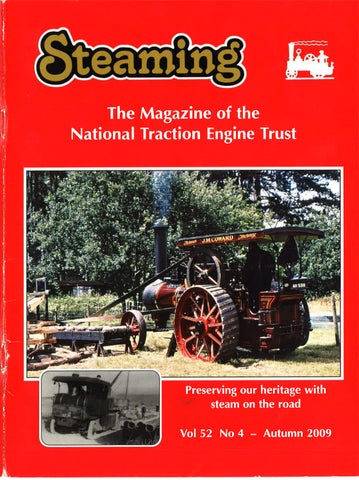
Front cover Burrell 8hp single traction engine 2425 of 1907 is seen working a rack sawbench in the nicely wooded demonstration area that has been provided at the Weeting rally in Norfolk, in July 2008. (John Maund) 159
Trust News Engine Owners Column Engine Owners Section Boiler Inspectors — a meeting has been arranged for the end of October, to which all the independent boiler inspectors have been invited. A report of this meeting will be given in the next issue. Engine Owners Meeting — The 2010 Engine Owners Meeting will take place at our usual venue at Willoughby, near Rugby, on Sunday 17th January. All engine owners, crews and other interested parties are invited to attend, whether or not they are members of theTrust. Please see the separate display advertisement in this issue for more details—and ensure you make a good note of the January date now, because the Winter issue of Steaming will only be with you at about the same time. Training and Driving Course — Next year's Training and Driving Course will take place at Astwood Bank, West Midlands on 8th/9th May. The fees for the Course will remain the same as they were in 2009, but we are offering a discount of 15% for those who would like to pay for two years at once. See separate advertisement. (all paragraphs, Bob Siddall, Head of Engine Owners Section)
Can the ground cope with wet summers? Are there such things as disused army camps, airfields, permanent show grounds within striking distance which would be more suitable? In my part of the world a number of agricultural shows were cancelled. The major Cumberland Show was cancelled the night before on the insistence of the local police, because of the danger of a river bursting its banks. Imagine the trauma and diplomacy required in pacifying traders, exhibitors etc who were already present, or still turning up, not to mention the expenses already incurred putting the show together. Such an experience could wipe out any society funds which were being put aside, literally, for the rainy day. Nevertheless, the gate numbers at most rallies seem to have been satisfactory, even though traders report that people are not spending, which is of no surprise in the present financial climate. An Autumn Conference has again been organised by the Trust for event organisers, safety officers and interested parties and will be held at Willoughby Village Hall, Willoughby, near Rugby on Saturday 31st October — further details are within the display
advertisement nearby in these pages. The provisional agenda will include items on insurance, security, traffic control, gate keeping, catering, cancelling events etc, and guidance on steam vehicles such as conversions, Certificates of Competency, steam cars and on Steam Apprentices and other young trainees at events. The day will conclude with an open forum when those attending can share their rally experiences, lessons learned, pitfalls and successes, as well as seeking for help on topics of concern. To assist with the catering arrangements at the Conference, it is essential that advanced bookings are made. Booking forms are available from me and must be returned as soon as possible. (Tim Holt, Head of Rally Organisers Section)
Treasurers Report The Report and Accounts for the year ended 31st March 2009 are enclosed with every member's copy of this edition of Steaming. I am pleased to report a satis-
To all event organisers, safety officers and other interested parties
Rally Organisers Conference Rally Organisers Column Rally Organisers Section We are now almost through the Rally season and, unfortunately, yet again events have had to be cancelled, postponed, or had activities curtailed — circumstances which have made the public reluctant to set out to events without first checking it is still taking place. Are we possibly moving to a situation where we must ask ourselves if the venue we have for an event is the right one? 160
will commence at 9.00 am
on Saturday 31st October 2009 at The Village Hall, Willoughby, near Rugby, Warwickshire CV2 8BX Conference fee of £20.00 per delegate includes coffee, a light lunch and afternoon tea. (booking for lunch is essential — contact Tim Holt) Information form and bookings to: Tim Holt, head of Rally Section, South View, Hutton Roof, Carnforth, Lancashire LA6 2PF 01524 2715846 or email general.secretary@ntet.co.uk
Autumn 2009 STEAMING
factory result for the year, and this has enabled a transfer of £4,500 to be made to the Legal Fund and £4,250 to the SAC 30th Anniversary Fund. The forthcoming year will present numerous challenges, as the operating costs of theTrust continue to rise, and the Trust's income levels will no doubt be affected by the 'credit crunch'. However due to prudent management over a number of years the Trust's overall financial position continues to be sound. As always the Trust is indebted to its officers and members of the General Council for a significant amount of unpaid time spent on the Trust's affairs. It is impossible to quantify this time and effort and obviously this is not reflected in the accounts. (Julie Smith,Treasurer)
the Trust or not, to implement the Written Scheme of Examination, particularly when using an independent boiler inspector. Our motto 'Preserving our Heritage with Steam on the Road' relies implicitly on the integrity and performance of the boiler inspectors to ensure that nothing untoward regarding the
pressure system can affect our hobby. Yes, it is true that it is the owner's ultimate responsibility to ensure that the pressure system is safe, but we are utterly reliant on the inspectors to give us the right information on which to make the judgement. The NTET's Written Scheme is designed specifically to
Technical Services Unit Guidelines when carrying passengers on trailers - In August 2009, in response to a number of enquiries, the TSU assembled a Guideline Document for those engines using trailers, particularly where passengers are involved. The Guidelines are available for download from the NTET website as a PDF file 'Use ofTrailers for Carrying Passengers', via the News Page (www.ntet.co.uk/news), but a hard copy can also be obtained from me by writing to the address in the front of Steaming. The Engine Owners Code of Practice and the Event Organisers Code of Practice will be updated to include the Guidelines. NTET Written Scheme of Examination - Despite the lack of dialogue with the independent boiler inspectors since last October, caused mainly by the hiatus whilst we wait for Chris Boocock's workload to subside, we continue to work on the development of the NTET's Written Scheme of Examination. Our recent endeavours have been directed at including the Sentinel type pressure system. The purpose of the NTET's Written Scheme of Examination is to bring consistency and accountability into the annual boiler inspections routine. It is not rocket science and the feed back from inspectors and owners who are applying the scheme has been very positive indeed. The Trust has no hesitation in encouraging any engine owners, whether members of STEAMING Autumn 2009
Contrasts under-wheel. Paul Bishop found some of his 2009 rally photography recorded rather different ground conditions for the engines. Burrell 7hp compound traction engine 3218 of 1910 had parched grassland at the Kelsall, Cheshire, rally; further south in Herefordshire the Marcie Steam Rally provided enough mud for Burrell 7hp single traction 1144 of 1884 to need to have its paddles or spuds fitted.
-:
. 1_
...,..0%.i.;_f.--7 .ftua.4.44.%::***._._, ._ t..7,-_....1.4..Y.41i-FL.:4A+L.,--W . -21-r+t,' -`,._ — - — '--• - ...'..`-W--!--.
aid that process. A perfect example of inconsistencies presented itself at Dorset this year where an irate owner came to us and berated an inspector for providing inadequate details on his report, identified only when problems had developed. Suffice to say, if there had been a Written Scheme of Examination in place and the report had been written in the 'NTET style', the problem would not have arisen. Licences: Road Fund and Driving - Beware of the subtle differences in terminology. One of the roles of the NTET is to keep a watch-out for changes in legislation that would affect the ability of drivers of steam propelled vehicles to drive on a public highway. Experience has taught us to be ever vigilant. Whilst there have not been any legislative changes regarding licences for some while now, a visit to the DVLA's website or a leaf through some of its brochures and forms shows that subtle but important changes in phraseology have crept in which are not necessarily supported by law or public announcement. One current example is that according to the DVLA website a steam vehicle is exempt from Road Excise Duty if its V5C document shows it to be taxed in the 'Steam Propelled' tax class. I know that some V5Cs show vehicles to be a 'Historic Vehicle' and others an 'Agricultural Tractor', whilst others are still 'Road Rollers'. I invite engine owners to take a look at their V5C, and tell me what it says and whether or not you 162
This is Mann's 5-ton tractor 1287 of 1918 (FU5027) taking a break when enroute to the North Staffordshire & Cheshire Crewe Rally on Saturday 4th June 1966. The engine, named TINYTIM and then resplendent in its new coat of paint, belonged to a small group of Club members who had acquired it from George Lazenby of Pickering in 1959 - one of the first engines owned by Club members. It is seen on the A5020 just south of the village of Weston, and about three miles from its destination at the King George V playing fields in Crewe. Having left an hour or so later - Allan Baker writes - their family transport had just caught up, prompting a break for the crew, consisting of Allan Baker, with his back just to the rear of the engine, along with a young member of the Leake family. Reg Leake and his wife kept the Crown Hotel at Red Street, north of Newcastle-under-Lyme, where the tractor was stored along with engines belonging to Dan Howie, the Club's Chairman. There was always a very warm welcome at the Crown for the crews when they arrived from their travels, as in those days the engines were always taken under their own steam. TINYTIM had just completed a rather lengthy part restoration, although this had not stopped the rallying of the engine while ihe work was underway: Unfortunately a rather weak firebox meant the group had to stop using it a couple of years later, and it has not worked since; as part of the Bob Lee collection at Audlem in Shropshire it is currently dismantled. Despite the boiler only being pressed to 1301bs due the condition of the firebox, TINY TIM would motor along comfortably in top gear on a level road at a steady 15 mph, and with that large water tank the crew did not have to stop very often! (photograph by the late SA Baker)
pay Road Tax. Take heart though - Form V112/G, depicting classes of vehicle exempted under Schedule 2 of the
Goods Vehicles (Plating and Testing) Regulations 1988-the good old MOT - lists at number 29: 'Steam propelled vehicles', so there appears to be some consistency - that is until you arrive at the Post Office counter to renew your tax disc and don't have an MOT certificate! Driving larger vehicles on a car licence - Normally, a category B licence allows the holder to drive a vehicle up to 3.5 tonnes maximum authorised mass (MAM). If the
vehicle you drive has a maximum authorised mass which exceeds 3.5 tonnes, but not 7.5 tonnes, then a category Cl licence is needed, and if the maximum authorised mass exceeds 7.5 tonnes then a category C licence is needed. It has long been understood that the holder of a 'car licence' may drive a steam traction engine on the road, although the car licence acts only as a provisional licence when driving a steam road roller. The DVLA, through its website and other publications, gives formal support to this arrangement and advises that there are special
Autumn 2009 STEAMING
The 2009 AGM The 2009 AGM will be held in the midlands — at Meriden, near Coventry. The arrangements are centred on The Manor Hotel, where the meeting will be held in the afternoon, and a block reservation has been arranged by the Trust for those wishing to stay on the Friday and/or Saturday nights; there will be an informal private Trust dinner with guest speaker on the Saturday evening. The 2009 AGM is at 2.00pm on Saturday, 21st November in the Aylesford Suite at The Manor Hotel. The hotel is situated on the B4104 in Meriden village, off the A45 — it is just a few miles east of junction 6 on the M42. A very adequate location map is available from the hotel's website www.manorhotelmeriden.co.uk Formal notice of the meeting, with the Agenda and Annual Report & Accounts, is distributed with this magazine. In the event of voting being necessary at the AGM only current members are eligible to vote and you should therefore ensure you bring your current membership cards as evidence. The names of the nominees for positions of officers or council members of the Trust, together with Motions under Article 16 of the Trust's Articles of Association, will also be found in the Report & Accounts. At the conclusion of the formal meeting, about 5.00pm, tea, coffee and biscuits will be served. A selection of the Trust's trophies and shields will then be presented, or at other appropriate times during the weekend's activities. Val and Colin Brown will as usual bring a good selection of items from the NTET Sales Stand. If you want to ensure a particular book, DVD or sweater is available, maybe for a Christmas present or a birthday, please preorder via Mail Order and ask for your purchase to be brought to the AGM.
The National Traction Engine Trust's
2009 AGM will be held at 2.00pm on
SATURDAY, 21st NOVEMBER 2009 at The Aylesford Suite at The Manor Hotel, Meriden, Coventry, West Midlands CV7 7NH Please refer to the formal notice in the Report and Accounts booklet which is distributed with this issue of the magazine for details of the Agenda etc, and to the other notes on this page for the arrangements that have been made for the rest of the day and on the Sunday.
Arrangements have been made for members to visit the nearby National Motorcycle Museum on the
Saturday morning. The museum is recognised as the finest and largest motorbike collection in the world, a tribute to and a living record of this once great British industry that dominated world markets for some sixty years. Over 700 exhibits in five halls span a total of 90 years from the earlier days of the motorcycle through the golden years of the 1930s-60s. A fully licensed selfservice restaurant and gift shop are available. The Museum is open from 09.30 and Trust members will be admitted at a concession rate of £3.95 (usually £6.95) on production of their current NTET membership card. The approach entrance to the Museum is directly off the interchange beneath Junction 6 on the M42, and is well signposted — the post code for satnav is B92 OEJ, but we are advised some devices are taking this as B9, central Birmingham, so beware! From here to the AGM venue is about 3 miles. It is regretted that the previously announced visit on the Sunday morning to the Statfold Barn Railway will not now take place. In its place the Davis family at Astwood Bank, just south of Redditch, Worcestershire, have kindly offered to host a gathering of members from about 10.00am.Their collection is of several steam road engines, plus many other
On the Saturday evening there will be an informal dinner, private to the Trust, in the Wessex Suite at the Hotel, at 7.30 for 8.00pm. Tickets for the four course meal are available at £26.00 per person. A vegetarian option will be available. Tickets must be booked with the Trust General Secretary and paid for in advance — please make your booking and send your remittance by 9th November at the latest (cheques to be made payable to NTET) to Jenny Holt at the address inside the front cover (IT 01524 271584).
licensing arrangements allowing category B licence holders to drive larger vehicles without having to hold the higher large goods vehicle (LGV) driving licence entitlement. Amongst the fairly long list of special exemptions to the category B requirement is 'a vehicle propelled by
steam, e.g. large goods vehicles with coal or wood burning engines'. Who told them to include goods in this definition? You won't find it in any legislation! We have apprised them of this anomaly, and await their reply with interest. Licences, what happens at age
70? — For the holders of a category B licence certain restrictions come into play when the age of 70 is reached.To start with you have to reapply for your licence and your new licence will be valid for three years only. Medical conditions and examinations may apply and declarations regard-
The Saturday and Sunday mornings
STEAMING Aulwnn 2009
items of vintage interest.
Staying for the weekend For those who wish to make a social weekend with friends around the AGM, a block booking of rooms for overnight accommodation has been arranged for the 20th and 21st atThe Manor Hotel. En-suite rooms are available at a special NTET rate per night of £50.00 per person per night (Friday, Saturday or Sunday), including breakfast. Members should make their own reservations direct with the Hotel (11° 01676 522735; www.manor hotelmeriden.co.uk) — please mention that you are an NTET member.
The Saturday evening
163
GERMANY - This is the scene on 3rd August 1926 in Munich suburb of Hirschau, at the yard of engineering firm J A Maffei Gmbh. The German company was largely involved in the construction of main line and narrow gauge railway locos, but it also had good business in the 1920s with steam rollers. These were made under the title of J A Maffei & Jacob, Leipzig, and these words were prominently cast into the fork over the front rolls. Prior to World War 1 the firm of Jacob & Becker were German agents to Aveling & Porter, but the conflict stopped that lucrative business and the result was the manufacture of rollers within Germany in conjunction with the Maffei company. The rollers to be seen in steam in the picture are relatively small single cylinder machines, of 8 tons or maybe less, and are part of a batch of 12 built for the Yugoslav Roads Ministry. The occasion is the formal inspection and handing over of the batch to the Yugoslav officials, standing centre left. The remainder of the order seem to be largely hidden from sight by the roller in the foreground, but reveal their presence by their excess of steam - one has its safety valves vigorously filling the underside of its awning. In the foreground, and then within the openings of the wooden sheds at the rear, are larger examples of Maffei & Jacob rollers - maybe 10 tonners one of which appears to have a works number, 9335, chalked on the saddle casting, below the maker's brass plate with its monogram of the superimposed letters M and J.
ing medication may also apply, although this could be the case for someone under 70 years of age, given certain circumstances. However, unless there are specific reasons given to the contrary stated on an individual's licence, the special arrangement allowing you to drive a steam propelled vehicle on the public highway still applies at age 70 and above. Voluntary Competency Scheme You will no doubt read elsewhere about the launch at the Great Dorset Steam Fair of the 'alternate route to a competency certificate'. For my part I 164
am pleased that drivers and crews of engines feel sufficiently strong about being known to be 'good at their trade' to want to participate in the Scheme, whatever the route they choose. Remember though, this Is a voluntary scheme. There should be no compulsion to apply for a test or to relate your personal experience and then seek out sponsors just for the sake of it. If you do, however, feel the need to participate I hope that you do so simply because you want our hobby to endure, and then lead by example. • As Administrator of the Voluntary
Competency Scheme, John Durling is preparing to see his workload grow to include all routes to the Certificate. The Administrator's role is to respond to applications, send out information packs and to liaise with the Assessors. The Competency Scheme is managed on behalf of the Trust by the Engine Owners Section led by Bob Siddall, and effectively the Administrator works on his behalf. I know that John won't mind me saying that the Administrator is not the Chief Examiner/Assessor - that role is held jointly by Irvin (all Barraclough and myself. paragraphs, David Smith, Head of Technical Services Unit)
Insurance Officer's notes Walker Midgley - award winners. I
start these notes by congratulating Tony Wood of Walker Midgley Insurance Brokers on winning the award for the best 'Schemes Intermediary of theYear' at the recent UK Broker Awards 2009 ceremony. If confirmation is needed that the insurance schemes he offers are fit for purpose then this is it. Well done Tony and all your team at Walker Midgley; it is well deserved. Web-based disc checking scheme
- Since the start of the new rally Autumn 2009 STEAMING
season, the Trust has launched the much promised web-based disc checking scheme.This allows Authorised event organisers to check on the status of the insurance discs for each engine prior to attending and during their event. The checked list is then either printed off directly or sent by email to the event organiser with a copy sent to the NTET Event Authorising Officer and the Insurance Officer. So far it seems to have been a success, but we have had little feedback to know how the users are getting on. We have had a suggestion that a listing of those engines not found on the data-base would be helpful, as would a separate listing of those whose discs have expired. As we are hoping to make improvements over the closed season, it would be helpful if those who have used the scheme could let us know of their experience, good or bad, so that we can consider and incorporate any suggestions. Please write or email to me at the address shown inside the front cover. Footman James — Some of our more observant readers will have noticed in the last edition of Steaming that the Footman James advertisement has changed and includes in the small print that it is the trading name of Aon Ltd. For those who didn't know, Footman James was acquired by Aon in May 2007. The new owner has taken a cautious approach to incorporating the business, as Footman James is considered to be not only a complimentary provider of specialist classic insurance policies, but a company which can develop all Aon's classic and club business. During the intermediate period there have been changes behind the scenes, but to the customer it has been business as usual. As a result of these changes theTrust has been allocated a specific Business Development Manager who we met with recently to discuss ways of cementing our relationship, and to
further develop the services on offer to our membership. There are certainly many good opportunities to benefit our members and affiliated clubs, which we hope to formalise in the near future. (all paragraphs, James Blenkinsop, Insurance Officer)
Certificate of Competency Launch of the experienced based option at GDSF A good number of engine owners and crew members dragged themselves away from the pleasures of their charges on the Wednesday evening of the Dorset event to attend the formal launch of the Trust's experienced-based Certificate of Competency — about 75 names were signed on the register. Trust chairman Robert Herring
explained the purpose of the launch was to outline what had been produced at members' request and on their behalf. He thanked Bob Garnett, Stuart Tomlinson and Tony Seddon for the hard work they had put into the Scheme over two years; he felt that members would not be disappointed with the result. It was again emphasised the Scheme was voluntary, and based on self declaration. In a light hearted but thorough presentation of the Scheme, Bob Garnett explained that if engine owners still felt any parts of it were incorrect, things could be changed. For example, the required qualifying hours had been changed from 500 to 750 hours at the request of the January Engine Owners Meeting. He explained that there were not yet sponsors in every area of the country, but once anyone was accepted into the new Scheme they could act as a suitable sponsor for other candidates. From among those present,
The first weekend in July saw Fowler 15787 of 1924 CYNORTHWYWR achieve its first rally visit since 1964, when it attended Elvaston Castle, Derbyshire, travelling there and back under its own steam from its Klondyke Mill base. Barry Job's picture shows the class D5 road loco on the return trip, waiting at the traffic lights by the Salt Box Café at Hatton. After many years, it is good to see that the original owner's plate has been reunited with the engine. And if you think the front wheels are not of the Steam Plough Works at Leeds, that is right — at a time when the originals had become damaged by misuse, suitable replacements, perchance, came from the Sentinel works at Shrewsbury, probably once intended for one of the firm's export ploughing tractors. STEAMING Autumn 2009
165
Engine Owners Meeting The next meeting will be held at The Village Hall, Willoughby, near Rugby, Warwickshire CV2 8BX
on Sunday 17th January 2010 starting at 11.00ann with coffee from 10.30 A buffet lunch will be provided All engine owners, crews and others interested parties are invited to attend, whether they are members of the Trust or not. An Agenda for the meeting will be published later on the NTET website. For more information, or if you wish to have a topic discussed
Competency Certificate. Those interested in participating in the Scheme are invited to apply for the information pack that has been prepared. Packs will be available for taking away from the forthcoming AGM. As has been explained (we hope adequately) in recent issues of the magazine the new Experienced Based Scheme will run alongside examinations through the Practical Assessment option. The latter will continue, and members wishing to mark their competency should select whichever method they feel best suits their circumstances.
contact Bob Siddall — Tr 01636 821991 or engines@ntet.co.uk
concern was voiced that not all rally organisers had sufficiently appropriate experience with steam vehicles to comment on a driver's competence. Bob explained that this was not what they were being asked to do; merely that they had no evidence of the applicant causing problems on a rally field. Alan Lloyd said in his view all the relevant points had been addressed and the final presentation should satisfy any outside agency; he was pleased with the voluntary nature of the Scheme, and the assurance that there was no attempt for it to be otherwise. Bob Garnett, in closing, asked if those present were satisfied with what had been done. This was confirmed and met with
The Forum at GDSF An Open Forum for those interested in the well-being of the road steam engine hobby was held in the Trust marquee at 7.00pm on the Friday evening of the event — a gathering of about 75 heard Trust chairman Robert Herring open the Forum by introducing Section Heads and Council members present at the event, and David Collidge and Mike Dyson. Ian Vinton questioned the presence in the Trust marquee of steam car exhibits from the newly formed National Steam Car Association, as this club had a considerable minority of the former members of the disbanded Steam Car Club of Great Britain, whereas the newly formed Steam Car Club, with the 166
applause. The Chairman concluded that he hoped everyone could work together to make the Scheme a success. Application packs and leaflets were available for those interested in taking part, but (both gratifyingly and annoyingly) the supply at hand was insufficient, and a forwarding list of names and addresses had to be made. (Jenny Holt, General Secretary)
Steam Apprentice Club
Distributed with each copy of this issue is an A5 leaflet giving full details of the Experience Based
As the draws to an end, may I start these notes by thanking all who have helped the Steam Apprentice Club this year, whether engine owners, event holders and then through to those who made us drinks. Your help is much appreciated. We are still on the look-out for new venues for holding driving days for SAC members only.This might be of benefit if you represent a charity organisation, as by holding one of
majority, was not represented. Robert Herring explained the NSCA had requested Affiliation, and that he had made statements in correspondence to the SCC regarding Trust policy on the safety of steam cars, but these had not been published. The Trust's policy was to ensure that safe steam vehicles, including steam cars, were on the road, but not to be involved with internal differences within the steam car fraternity. Ian agreed to publish this correspondence if copies were sent to him, but expressed concern that the picture being painted regarding the new Steam Car Club was incorrect; many of the members had MOTs and regular boiler inspections, even though they were not mandatory. Some types of steam car could not be steam tested. That the cars represented in the
marquee were only those of the NSCA gave out a biased message. It was confirmed the cars present had been inspected and complied with the standards of the NTET and of the GDSF organisers. Bob Allison asked of the answer if an engine owner questioned 'What does the Trust do for me?' He felt the Trust was selling itself short, in that not 'all engine owners were members. He asked what the non members were looking for, and what the Trust would need to do to encourage them to join. Was theTrust too rally orientated, and should it be offering insurance discounts for members.The Chairman felt the latter would almost certainly be criticised — 100% owner membership would be ideal, but was probably unachievable as some did not attend rallies. Stuart
And for those not at Dorset....
Autumn 2009 STEAMING
these days, you could demonstrate to the Charity Commission (if they were to ask) you are doing 'charitable
Burrell 6hp single crank compound traction engines at the 2007 Great Dorset Steam Fair. John Maund's picture shows number 3665 of 1915 nearest the camera, with 2426 of 1901 to the left.
work' associated with your status. So, if you can assist please contact me as soon as possible to discuss the matter. Though we have hardly finished this 2009 season I have to plan for next year, and to arrange for
Great Dorset Steam Fair. Engine movement was somewhat limited, which was frustrating to engine owners and apprentices alike - the
were probably better off in school, but I don't think I will have convinced them! The SAC is run by a small
latter all wanted to get on and steer and drivel This year, as some school terms commenced whilst GDSF was taking place, we didn't have as many Apprentices as normal. As it was wet,
committee, which to some extent limits what we can achieve. We would like to be able do more, and if you feel you can give a helping hand,
venues to be announced in the January/February issue of the SAC magazine Raising Steam. The major annual event that we attend for Apprentices was rather wet this year; I refer of course to the
I told those who missed out they
whether as a full committee helper, or maybe as an area representative
had since altered greatly and thought a similar publication was required regarding driving in modern conditions, and including the present legislation regarding steam on the
Gray said the Trust had over 2000 members, had held a Jubilee rally and other events, had the large marquee and use of the play pen for SAC members at the GDSF - what more could the Trust do? We could
owned conversions, would aim to educate, and to highlight the fact that engines must be preserved as far as possible. Peter Stevens explained that he had covered many miles on the road
not force people to join, but would be interested in any incentive ideas which could be put forward. It was agreed the General Council would
with a steam vehicle, but regretted there were no guidelines on the Trust website or elsewhere on the do's and don'ts and the safety of steam
roads. It was noted that Nick Allen was producing a paper on these lines, and a progress report was requested to be available for the AGM in November.
look into the question of membership, bearing in mind the comments made. An issue was raised on behalf of
vehicles on the road. Robert Herring advised that there was a recent item on the website regarding the use of trailers, and asked Peter to write in with the issues he felt required
The Chairman reminded those present that the venue of the AGM had been changed to Meriden, near Coventry in the Midlands, so as to be more accessible to the membership
clarification; the items would be addressed. Stuart Gray felt that a good point had been made by the question; he recalled reading, as a boy, a steam manual which had been
in general. The meeting would be at 2.00pm in The Manor Hotel on Saturday 21st November 2009. There being no other questions the meeting was closed at 7.40pm, and those
very informative. He accepted the fact that roads and driving conditions
present applauded the matters dealt with. (Jenny Holt, General Secretary)
John Wharton, who could not be present.This involved an explanation of the Trust's position on the conversion of engines. Robert Herring said the Trust's policy was that of education, and a leaflet was to be produced which, whilst not seeking to single out those who STEAMING Autumn 2009
167
who can be a focus point for Apprentices in a given locality, as well as a contact person for us, please do contact me for further information — my details are inside the cover of every issue of this magazine. (Kevin Munn, Chairman, Steam Apprentice Club)
Affliated and other groups Sentinel Drivers Club The Sentinel Drivers Club annni wires that it has now moved its website to: www.sentinelwaggons. co.uk A number of new and excellent features are available at this online website — the Sentinel section is now home to the 'History of Sentinel', 'Sentinels in Preservation', 'Sentinel Catalogues' (original S model and DG spare parts catalogues, with a pdf search facility) and the 'Sentinel Drawing Archive. Aveling's buildings at Strood From Jim Preston and the Friends of Medway Archives at Rochester, we learn of the current situation over the fate of the former Aveling & Porter building that survives on the Esplanade at Strood in Kent. The three storey brick building was designed by local architect George Bond, and is a good example of a carefully detailed Edwardian office building. It dates from around 1906, the very heyday of the world's most prolific builder of steam rollers, and a time when they would have been able to commission a best quality building. The workshops which constructed the many Aveling engines now owned by Trust members have long gone, but the office building, with its elegant riverside elevation, surely has by now come to have the merit of being very suitable for conversion to attractive flats, a small hotel, or being
168
made available as an appropriate home for the Medway Archives. But Medway Council, in seeking to re-develop the site following the removal of their offices to elsewhere in the borough, remain determined to demolish the building, and stated this at a council meeting on 30th July.The local group's petition of about 2000 signatures, handed to the council at the same meeting, was a strong demonstration of local support against demolition. More signatures could have been collected, but for the time constraints. There has been no response from the Council. The Council's estimates produced to enable the preservation of the building include for underpinning. However, from external inspection the structure lucks sound, and a request at the end of June, under the Freedom of Information Act, for a copy of any structural survey brought no reply, so perhaps it does not exist, and the suggested costings are to frighten wavering councillors. To further the campaign the support of the pressure group SAVE Britain's Heritage has been enlisted, and English Heritage has appointed an adviser. To give support to the local group working to keep this worthwhile surviving trace of a well known engine builder, members may like to view more on the Save Aveling and Porter website. This was created to highlight the fight to save the historic building — www.avelingandporter. org.uk Or make contact with the Friends of Medway Archives through james.m.prestnn@htinternet.com or on 07712 618004.
Dorset thanks Once again, theTrust's marquee at the Great Dorset Steam Fair was well supported by members and friends. To those who journeyed from around the country to assist, I thank them on
LLEWELLIN'S
Gears
GEARS UPTO 8ft 6in DIA SPLINED SHAFTS UFO 25ft LONG Broaching and Splining - Spurs , Racks, Hellcals Worms and Wheels, Bevels - Straight and Spiral Stock Gears and Splines Wire Cutting - Gearbox Rebuilding
Specialist Supplier of Gears and Splines for all Vintage Vehicles and Traction Engines Telephone Mike Horlick LLEWELLIN'S GEARS KING SQUARE, BRISTOL BS2 8JJ TEL: 0117 942 4026 FAX: 0117 923 2028 E-Mail: info@llewellins.co.uk Web: www.11ewellins,co.uk
behalf of all Trust members for their entirely voluntary time and effort. As usual, engines were exhibited within the tent, which probably encourages visitors to more closely inspect and understand them than if in steam. Michael Davison, Matthew Peacock and Paul Cummins kindly agreed to let their machines be displayed. A further attraction was the display of three steam cars by the National Steam Car Association, supported by their committee members. The art exhibition once more attracted people to browse among paintings and drawings hung by John Hancox, Robin Wheeldon and John Wigston. New for this year was a display of enaine lamps by Roger Mills. The tea and coffee in the tent was provided by a hard working team and I thank: Kathy Boulton, Wendy Chapman, Angela Cornell, Christine Giddings, Jan Greenhough, Angie Head, Mary-Lyn Hill, Sally and Kevan Humphrey, Charlotte Keeley-Knott, Irene Kelly, Shirley Manning, Dulcie Stagg, Gill Stoneman, John and Maureen Street with Ryan, and Val Wingate. There was excellent support from members (and of course their friends) into the donation bowls — I hope all members remember that although there is no charge for the tea or coffee, members can be assured the coins put into the bowls considerably exceed the cost of the materials used, and so go towards covering other expenses of the tent. The Trust's sales area was busy selling books, DVDs and many other items, and took appreciable sums from members and the general public, especially on the wet Autumn 2009 STEAMING
Wednesday. The sales helpers over the period of the event here were: Dan Brothwell, Nick Greenhough, Kathy Smith, Steve Snooks, Peter Stanier and Steve Wagstaff
There was general help at any awkward time from John Kelly, John Robinson and Paul Shergold. Jane Eminson and Fiona Rashleigh assisted at the membership desk, helping to process new and renewing members. It is our usual habit to not specifically name the wives and families of Trust Council members and officers who give their support before, during and after the event, but I wish to record my thanks for their many hours of work to support the Trust. (John Cook, Membership Secretary)
Future Dates Rally Organisers Conference The 2009 Conference will take place at the usual venue at Willoughby, near Rugby, on Saturday 31st October. Those organisations and clubs who have participated in previous years will have received postal invitations, but newcomers are always welcome. Further details are in the Rally Organisers column and the advertisement elsewhere in the Trust News pages.
Annual General Meeting Details are included elsewhere in these Trust News pages.
Steam Training and Driving Course For those wishing to think and plan ahead, the date of next year's Course will be the weekend of 8/9th May 2010. The venue will again be at Astwood Bank, Worcestershire, by kind invitation of the Davis family.
New Members A warm welcome is extended to these new members who have joined the Trust in the last three months. We hope they will gain friendship, information and enjoyment from their membership over a period of many years. Full addresses are not included, but the Membership STEAMING Autumn 2009
The Trust marquee at the Great Dorset Steam Fair — one morning before the front was opened for waiting visitors and customers. (Paul Cook) Secretary is always willing to put members in touch with one another by forwarding mail. J Fellowes, Colne, Lancashire T R Fry, Plymouth, Devon G J Gowing, Norwich D M Webster, Meols, Wirral J E Wright, Crook, Co Durham D Cullen, Co Wexford, Ireland C. Peacock, Boroughbridge, North Yorkshire A J Coombes, Chippenham, Wiltshire D Varley, Clitheroe, Lancashire I Langley, Hartfield, East Sussex Mrs B J Derbidge, Street, Somerset A J Griffin, High Wycombe, Buckinghamshire S K Hensby, Cirencester, Gloucestershire G Spencer, East Martin, Hampshire B J Wainwright, Mellor, Lancashire T J Ives, Bewdley, Worcestershire D Huxell, Dunnington,York T Barber, Brighton, East Sussex S A Cook, Alfreton, Derbyshire J Karmeen, Hitchum, Suffolk R Adams, Brandon, Suffolk J M Whitfield, Wimborne, Dorset S J Lewis, Verwood, Dorset P L RTrew, Chipping Sodbury, Gloucestershire M B Goddard, Bury St Edmunds, Suffolk K Burden, Crossways, Dorset W Clarke, Wigan, Lancashire J Carver, Rustington, West Sussex P C Adkins, Cullompton, Devon K R Prust, Wimborne, Dorset Miss V H Mercer, Barrow upon Soar, Leicestershire P Stevens, Pontefract, WestYorkshire C Warne, Fordingbridge, Hampshire S Cook, Wimborne, Dorset A J Blick, Shaftsbury, Dorset J P J Walrond, Langport, Somerset
D Smith, Buckingham J Webb, Leighton Buzzard, Bedfordshire K Blackmore-Palmer, Lacock, Wiltshire K Lilwall, Ross on Wye, Herefordshire M White, Taunton, Somerset J Kelly, Laoise, Ireland D Lidster, Spennymoor, Co Durham K Mills, Oakham, Rutland S Byrne, Craven Arms, Shropshire P George, New Plymouth, New Zealand J P Miles, Bristol K Cummings, Houghton le Spring, Co Durham A McKay, Ottery St Mary, Devon A S Loader, Bournemouth, Dorset Mrs A Fisk, Chichester, West Sussex
'Mr Thomas Boulton of Ashtonunder-Lyne, on Monday week, ran a small road locomotive engine, constructed by Mr I W Boulton, from Ashton — through Manchester Eccles, Warrington and Preston Brook — to Chester, paraded the principal streets of Chester, and returned home, the distance being over ninety miles, without a single mishap or stoppage for anything except to take in water. It is believed that this is the longest continuous run on record ever accomplished by any road locomotive engine within twenty-four hours. The engine has only one 4? inch cylinder, 9 inch stroke, 130 lbs pressure and five feet wheels. Six persons were carried throughout the greater part of the road: in some places eight and ten' (from Mechanics Magazine, 30th August 1867) 169
We hope the goods open up to your satisfaction
In these days of almost instant world wide communication by electronic means, it takes a little concentration to appreciate the amount of time it must have taken to provide for the acquisition and later maintenance of steam machinery taken from Britain to the other side of the world. These notes, in fact, cover some business from the relatively later days of the use of steam load vehicles, with the advantages of steamship services and cablegrams the very earliest colonial exports around 1860 would have had to rely on handwritten mail surviving a fickle passage by sailing vessel. Our thanks are due to Graeme Dawson of Invercargill, New Zealand for making available copies of the letters and invoices which came into his possession after he acquired for preservation the local authority's steam wagon; he has also added much interesting associated history. In 1925 the Lyttelton Borough Council in New Zealand had ordered a new Eton steam wagon to be supplied by the Yorkshire Patent Steam Wagon Co Ltd of Hunslet, Leeds. Lyttelton was, and is, the port town for Christchurch on South Island's east coast, and the three-way tipping wagon was initially destined for a life of public service - primarily
165 t.4,..AUCK LAND
to cart the Council's road material in the Borough. Lyttelton is situated on the edge of an extinct volcano, on the sea side of Christchurch, and the Council was responsible for the upkeep of the streets to the top of the volcano rim. It seems the very steep roads were the main reason for the Yorkshire's long working life, with former driver Bill Burgess telling that, even dile! WA Id War 2, it was still the vehicle of choice to carry road metal up or down the hill. The Council operated a quarry high up on the slopes, above the houses, and crushed material was brought down to bins of various sizes by a funicular, from there to be loaded onto the steam wagon below. The Yorkshire eventually survived to the time when it would be a nice thing to preserve and restore to working order, and so came to the ownership of Graeme Dawson at Invercargill, further south at the tip of South Island. With the steam lorry came a batch of old letters, and we are grateful to Graeme for letting us feature them in the magazine. Although the series is by no means complete enough to give a full history, and is often puzzling because we only see one side of the correspondence, there are sufficient pages to give us a useful glimpse of
LICIWIELD (P060% 640)
//
(7hh. 1 d4s/tee/f7// ,
3rd. January. 1928. Mr. H. H. Barnard, Engineer, Lyttel ton Borough Council,
1=21.T9.11, The Christchurch office letterhead of John Burns & Co Ltd, showing the head office and extensive warehouse at Auckland on North Island. 170
the business methods of the time. The process may seem slow and cumbersome to us today, but no doubt it worked efficiently - though it might seem that the builder of the wagon and the customer were never really in contact, and the whole procedure relied on much copying re-typing in those days - of letters between the various parties. The main players in the surviving correspondence are Brown Douglas & Co of 20 Eastcheap, London EC3, who were acting as sales or export agents at the British end, and in New Zealand, John Burns & Co Ltd, of Lichfield Street, Christchurch, a firm of iron merchants, their letterhead illustration depicting an impressively large warehouse and head offices in Auckland - which still stands. In December 1925 Burns' local manager George Smith sent to Mr H H Barnard, the engineer to the Borough Council, a copy of a letter from their 'London office' - this would in fact have been Brown Douglas's rooms in the City, the relationship between the two agents being what we nowadays call a partner company or the like, and no doubt the two firms would have done similar husiness together over other clients and an extensive range of engineering supplies. In what was quite normal practice of the time Lyttelton Council, wishing to purchase the steam wagon, had done so through Burns & Co, who forwarded the order to Brown Douglas, who in turn dealt with the makers in Leeds - but it would be interesting to know just how the Council decided the Yorkshire machine was the one for them. The respective experienced agents would have managed all of the correspondence and paperwork, and arranged shipping and freight charges, and finally added their commission to the costs for a task of which both maker and user were doubtless pleased to have been relieved.The agents also kept in mind that the vehicle would later need maintenance - further possible business for them. Back in November 1925 the Yorkshire company had responded to Burns over the question forwarded to Autumn 2009 STEAMING
them regarding the boiler for the shortly-to-be-completed and despatched 1535, which had to comply with the regulations of the New Zealand Boiler Inspection Department.The makers were going to have to increase the steel plate thickness from 5lisin to 3/bin. Yorkshire noted
that as already constructed 'our boiler is accepted by every Insurance Company in this country for a safe working pressure of 2151bs'. They considered it quite probable the standard boiler would be accepted in
New Zealand, but 'in view of your remarks, we think it will be safer to put a special Boiler in hand and so avoid any risk of the Boiler being rejected'. That would delay the delivery date for two weeks - but there was no comment on any
increased costs, so the existing scheduled boiler was probably put to one side in the works, for the next order. A later letter is from Burns to the Council. Dating from June 1927, it draws engineer Barnard's attention to the fact the merchants had Yorkshire
Steam Wagon spares in stock. Were the agents expecting to be serving otherYorkshires to come to the South Island?The list is of a rather extensive selection of items, for what was surely a minimal call for them in the
Christchurch area - cross head bushes, driving chains, chain and fast and slow gear pinions, axle brasses and bushes, injector cones and safety valve parts. There is no record of any response, but maybe Barnard called round at Lichfield Street when the need arose. Graeme knows of only
one other Yorkshire coming to South Island - 1341 of 1920, and being just a 3ton tipper, it would anyhow have needed a different stock of spares. He remarks that the spares stock, had it survived, would have been very useful to him after he bought the
wagon, especially the low speed pinion, which had of necessity been regularly in use: even running empty downhill the third speed, surely, would be rarely used.The old Council stables building (it is now Lyttelton
Museum) has behind it, off a steep street, a shelf-like yard where the Yorkshire was parked overnight. Even unloaded and empty, second gear would be needed with 1801bs of steam. By the autumn of 1928 the wagon
For over 40 years, since buying the Yorkshire wagon, Graeme Dawson has been trying to find photographs of it taken in working days, and only recently have a couple of small snapshots appeared from a box of sundries sold at a clearing sale. A big and pleasant surprise. The pictures probably show the steam wagon in its later working days - one shows a jib crane fitted to the platform, the rope driven by a capstan bolted to the engine flywheel. The corner of the cab was suitably strengthened to carry a pulley, and light loads could be lifted to or from other vehicles - no slewing movement was allowed for. The second photo shows the rather battered and work-worn condition of the wagon, and Graeme suspects it is driver Bill Burgess walking away to the rear. (collection Graeme Dawson)
was, apparently, causing problems, needing a new high pressure cylinder casting to its vertical compound
your friends in New Zealand'. A sketch had been sent from New Zealand, but the builders responded
engine. On 13th November the Yorkshire company wrote to Brown Douglas 'with regard to the cylinder casting which we shipped recently to
'we cannot account for their complaint that the valve seats [of the original engine's casting] were thin ... we assure you that there will be no
STEAMING Autumn 2009
fear of any complaint being received
in connection with this part.' About the same time the material for other parts was in dispute. On 8th October Burns & Co had on Lyttelton's behalf placed an order for a new combined speed lever die and also a slow speed 171
Yorkshire Patent Steam Wagon Co tipper 1535 of 1926, pictured by John Cook at the Rangiora event in New Zealand in March 2008. lever die — which the Council particularly wanted to be made in brass. The makers were nonplussed: in a further letter to Brown Douglas they explained at length that usually they are 'in mild steel specially hardened and we do not consider for a moment it would be advisable to have them made in brass, as they would not last very long when in use'. Further, special patterns would have to be made, causing some weeks to pass before dispatch. 'We cannot recommend this being done' said Yorkshire, and, to avoid delay, they wanted Brown Douglas to let them forward the order of conveniently small parts in a mail packet, and for them to explain the reasoning to their associates in New Zealand. Later that November Burns sent another stock list of available spares to the Council, and implied they would in future be stocking the wearing parts that had recently been ordered from England. They were much the same components as before, but a note at the bottom of the page confirmed that they had on order '1 only (Bare) Machined and Finished High Pressure Cylinder Casting for 6-ton Yorkshire Steam Wagon' — this was the item mentioned above which may, by then, have been on the high seas from Britain, but whatever the case Yorkshire's comments on the thickness of the valve seats did not arrive in New Zealand until 3rd January 1929. And during these 172
months the Council's steam wagon was probably out of use, awaiting the parts. The last clip of papers concerns more spares. On 23rd December 1931 Burns sent the Borough Engineer their Sale Note for many ordered items. The list included front spring leaves, a second motion shaft and bushes, fusible plugs, exhaust jets, five thou oversize piston and rings,
crank brasses differential bushes and pins, crosshead bushes, a fusible plug, and an injector complete, though no prices were noted. The Conditions of Sale — Burns were the sellers rather than Yorkshire — related that they were not responsible for delay in shipment or delivery, and any alterations in freight, duty, insurance charges or bank exchange rates would be to the buyer's account. Not surprising, considering the problems of time and distance. Accompanying sheets reveal the progress of these parts on their journey from Leeds to Lyttelton. Burns' order toYorkshire presumably left New Zealand at more or less the same time as the Sale Note was typed; The Yorkshire Patent Steam Wagon Co delivery note 889 for the parts (made out to Brown Douglas in London) was dated 17th February 1932. On 15th April, sixteen weeks after the order left Christchurch, Burns could write to the Council advising one case of spares had arrived on the SS ORARI, and was being forwarded by New Zealand Railways to Lytteiton. 'Vve trust you will have no trouble in obtaining delivery, and hope the goods open up to your entire satisfaction.' It is noticeable that even by 1931 none of the respective letterheads bore a telephone number, and business must have been largely carried on by mail sent by sea, or if it was a brief request or confirmation, by telegraphic cable, just as it had been done since the 1860s. 104
Autumn 2009 STEAMING
St Albans revisited Sandy Ross As part of the lead up to this year's St Albans Steam and Country Show in late May, the last surviving St Albans Corporation steam roller made an historic return visit to the city. Sold into preservation in 1958 for £40.00, Aveling & Porter roller 8064 of 1913 (NK1102) travelled from the rally site at Oaklands, on the edge of St Albans, to the sites of the two depots in Victoria Street where the roller was once based. The Corporation started using steam rollers in 1891, hiring Aveling 2741 from the Borough of Hertford as and when required. It was a period when the city was growing rapidly, following the opening of the Midland main line to London in 1868. A year later their first steam roller was purchased from Aveling & Porter, number 2991. The surviving machine of the fleet, their third purchase, is a typical 10 ton single cylinder product of the
Aveling 8064 roller at work in St Albans. Although the exact location is unknown, the date is sometime in the early 1920s — that can be judged from the damaged state of the saddle and funnel base. The makers supplied a new one in January 1923 at a cost of £15.0s.0d. (Road Locomotive Society collection)
time, although the Morrison scarifier and awning were added some years later. The last acquired steam roller was a compound tandem 9021 of 1921, but this was taken out of service in 1946 and sold soon afterwards. On its re-visit, after standing at the Museum of St Albans in Hatfield Road, 8064 travelled through the
On its return to the city it worked for, 8064 stands outside the surviving frontage of the later Corporation premises at the former Grimston Prison. STEAMING Autumn 2009
historic centre of the city to the old depot at 96 Victoria Street, which, remarkably, still survives with the Surveyor's offices and yard intact — despite being superceded in 1931. Still apparent is the gateway to the yard, of which, according to the 1919 minute book of the Highways and Planning and Nuisances subCommittee, the gates were 'really too narrow for rollers to pass through, and on several occasions had been either knocked down or damaged.' In 2008 a planning application to build flats on the site was refused, in part a result of the realisation of the historic nature of the site. It was then on to the larger and later depot housed in what had previously been Grimston Prison, with some of the buildings converted by direct labour in 1931 to 'comprise a steam roller shed to accommodate three rollers, one steam Foden shed for 2 Fodens, with fitters shop, coal and coke store adjoining, the erection of two 6 stall stables with 2 loose boxes and one isolation bay'. The minute books note that the bodies of four prisoners were exhumed, with a 10s. allowance being paid to the Corporation men involved in the task. Today the site has been converted into modern offices, although the historic and forbidding frontage survives. Thanks are due to owner Chris Griffiths for allowing his roller to make the historic visits, and to driver Kevin Flint for braving the traffic. 173
Irf
Chinese puzzles ••••••••=m
1.EVELtikThrtOUt::i:VV6 A re01,i-F.P.,
ad).4.5 *00)
Wig
11 - - u irla.a41,g
Persistent delving into archive records over a long period eventually provided an answer to a near inscrutable postcard image — and the realisation that not all the 'improvements' that the makers introduced to their products came to be standard fittings straight away.
Derek Rayner Being local to me, over the years I have often visited the annual International Postcard Fair atYork. On occasion it is quite amazing what pictorial views of road steam engines can be found there, together with one's surprise at the prices. Showmans engine cards a few years ago were on offer at £80, whilst a good quality steam roller postcard, priced at more than the going rate for scrap ones not too long ago, was £45. I also noted the latter there year after year, obviously it was overpriced! On one visit, however, I came across a more moderately priced postcard, of Oriental origins, showing an Aveling steam roller, the caption indicating it was working in Port Arthur. Strange name for a place in China, I thought — so took it home as an entertaining puzzle! Reference to old maps showed Port Arthur to now be Lushun, a port on a peninsular in the north end of China's Yellow Sea, strategically quite 174
close to South Korea, some 500 miles north of Shanghai and around 1200 miles north east of Hong Kong — distances as the crow flies. Most readers will be unaware of the complicated political circumstances in the Port Arthur area at the beginning of the 20th century, so a modicum of history is perhaps appropriate here. In the mid-1800s Lushun was an unfortified fishing village. Russian and Western powers subsequently adopted the British name of Port Arthur, from the actions of Lieutenant William Arthur of the Royal Navy, who, during the Second Opium War in 1860, brought his crippled frigate to the harbour for repair.The location is the southern tip of the Liaotung Peninsula and the deep water harbour is ice-free throughout the year, and in a strategic position at the entrance to the Gulf of Chihli. The port was captured by the Japanese in the 1894/95 Sino-Japanese War, but returned to China after the inter-
A vi;
The first of the author's postcard rollers — at the time the roller was pictured it was clearly not new, having suffered a scorched chimney. It was also minus its trade mark Invicta horse. The machine is going about its business in Port Arthur, China, compacting the road surface. The building in the background to the left of the roller could be its shed, referred to in the Chinese caption on the card.
vention of Western powers. Russia, anxious to have an ice-free port on the Pacific, occupied the Peninsula in 1897 and subsequently acquired its lease and the right to build a railway to connect with the Chinese Eastern Railway in Manchuria — and thence with the Trans-Siberian Railway. A Treaty at the end of the RussoJapanese War of 1904/05 saw Port Arthur transferred to Japan, and renamed Ryojun. Much later, after World War 2, the port was used jointly by China and the Soviet Union and became an important Chinese naval base. Today it is part of the major seaport town known as Dalian or Luda. Knowledge of that complex history, put here in greatly simplified Autumn 2009 STEAMING
•
form, was to go some way in helping my attempts to identify what I realised was an Aveling & Porter steam roller shown on the postcard. Let us now look at it more closely.The machine is a 10ton overhead valve compound machine - and an important feature to observe is the early design of the steering chains working on a 'bobbin' at the outside ends of the steering shaft. It is also fitted with a scarifier and the later design of chimney saddle - not the earlier type that had a straight lower edge, used on rollers from the 1880s. The arrangement of 'bobbin' steering and the associated balanced scrapers was re-designed by Avelings in the early 1890s. As a further clue to dating, the overhead valve Fowlertype cylinder was introduced by Avelings around 1892 and used until the outside valve style replaced it about 1902/3. Thus, to seek the roller's identity, there was a quite small span of time into which it fitted. Michael Lane, in researching Aveling records in preparation for his forthcoming Aveling & Porter book, found that ten 10ton rollers went to China or surrounding areas between 1883 and 1903 - and one of these was destined for the Chinese Eastern Railway. Further reference to the Aveling & Porter Royalty Books at Lincolnshire Archives unfortunately showed all ten were single cylinder machines. So it appeared that the compound roller on the postcard might have been shipped to the Far East via an agent, whose name was not readily associated with the area. In addition to the postcard's English caption, it is repeated in the Japanese and Chinese languages. By courtesy of Dr Dirk Forschner of Wildau Technical University, Berlin and one of his students, we learn the Japanese caption reads: 'View of a steam road roller on a road in front of a warehouse in the Kanto Area [the name given to the Japanese occupied area of Manchuria] used to compact gravel'. In the Chinese language, the building would have been referred to as an 'engine shed'. Whilst it is difficult to date the image, Dirk Forschner comments that the roller could have been photographed as late as the mid-1920s, by the traditional style of clothing and lack of pigtails seen on the men in the picture. With no further evidence, the specific identity of this turn-of-thecentury Aveling seemed destined to be inscrutable. I reasoned it could equally well have been sold secondhand to China by Avelings after STEAMING Autumn 2009
repairs, during which time it may have acquired the later design of front end.That would make it virtually impossible to trace - but I still thought the postcard a most interesting find. Not wanting to leave the mystery unsolved, I considered the physical evidence available on the earliest compound Aveling roller surviving in Britain. Royalty 3430, now resident in the Buckinghamshire area, was sent out from Rochester on 26th September 1894, and has conventional steering rather than the bobbin type. This might suggest the Port Arthur roller to have been built prior to that date. However, 3430 has the straight bottomed saddle with a line of horizontal bolts whereas the postcard roller has the later swept I was version. So, perhaps speculating too much in thinking the Chinese roller was a repaired and updated secondhand example -there may have been transitional periods at Rochester when new design features were not all implemented concurrently, and machines were constructed with both fresh and longexisting features, with them not neatly started or finished at one time. Also, of course, 3430 may have been modified during its working life from its possible original bobbin steering. I sought more information. The first compound roller made by Avelings was 2962, despatched on 14th March 1892. Unfortunately, a check through the compound rollers for the next four years revealed no likely candidate for the identity of the postcard roller, fitted as it was with sprung scrapers and bobbin steering. I found three rollers of the correct cylinder type noted as sold to agents H Simon of 10 Mount Street, Manchester for onward consignment to Russia - but I felt it unlikely that such rollers would have migrated to China, although as we have seen there was later Russian occupancy of the area we are discussing. But on checking further, I found all three were fitted with standard pattern steering and none had a scarifier. They, too, could not be the roller pictured. My further searches in the Royalty Books at Lincoln revealed three rollers supplied to the Crown Agents for the Colonies (the ultimate destination not specified) in November 1903, set down as '5hp Special 12tons Compound rollers'. These were 5396/97/98, recorded as having steerage with chain barrels and spring scrapers. Thus, I found bobbin steering was being supplied, presumably to order, as late as 1903.
My earlier theory on bobbin steering being only an early design feature on Aveling rollers was therefore discounted. The descriptions of the trio matched that of the roller shown on the postcard very well, but for one thing - they all had cylinders with valves at the side, not overhead! Though another avenue had closed, a further one opened up when I showed the postcard to Barry Wood, whose overhead valve roller 5308 of July 1903, is kept locally to me. He thought the style of the Chinese roller was later than the immediate turn of the century, and around the date of his own, rather than earlier, back in the 1890s. This was because of constructional features such as the position of the spectacle plate and the style of the regulator. The bobbin steering had perhaps been proving to be a bit of a red herring - making me consider too early a period. I looked again in Royalty Books for rollers heading for China in 1902 and 1903. In fact, I checked from July 1901 through to May 1904, by which time the overhead valve cylinder was no longer used. Some 700 or so Aveling machines were despatched from Rochester during the period and only one steam roller matched the features seen in the postcard. A 5hp 12ton compound roller fitted with inside valves and a long firebox was supplied to A Koppel on 6th November 1902. This was Royalty 5148, but unfortunately no forwarding destination was given. Technical details in the records for 5148 show the steerage was a WI (wrought iron► shaft, 4ft 8in long and 3in diameter fitted with old pattern chain barrels. It was also fitted with spring scrapers, a footboard on the side of the boiler and a scarifier (No 530) - all exactly as depicted in the postcard image. Intriguingly, this same roller is noted in the Aveling ledgers as having extra equipment sent off against its Royalty number, shortly after its despatched date. On 13th January 1903 there was a set of steam-powered brake equipment, and a month later on 14th February 1903 steam steerage gear and a set of rocking firebars - though again, no destination was given. Nothing can be seen of this equipment on the postcard roller, though the angle from which the photograph was taken might preclude us seeing it. Notwithstanding these extras, I came to the conclusion I had caught my quarry, and that 5148 of 1902 was the postcard roller. I later found that the German enterprise of Arthur Koppel was at its 175
height in the years after the turn of the twentieth century. From its head office in Berlin, and branches around the world, the firm was involved worldwide in the supply of light railway equipment, together with the export of other engineering items. Arthur Koppel also listed many agencies, the one for China in 1905 being Gipperich & Burchardi of Shanghai, who were possibly general trade and export/import agents. Incidentally, the Koppel name appears elsewhere in Aveling's books: an order from their London branch address of 27 Clements Lane, EC was for 5499 — a 4hp 71/2 ton roller with a sloping cylinder and outside flywheel. It was despatched on 10th May 1904 to Koppel's branch in Riga, Russia (now Latvia), and the roller has recently returned to England after a working life in East Germany. Thus I came to the conclusion that it might be that Aveling 5148 went to its ultimate customer via Koppel's Gipperich & Burchardi agency in Shanghai and so on to Port Arthur — with or without its additional equipment — eventually to be photographed in that far away location. The known facts on 5148 fit the photographic evidence, and I felt it all a very tidy way of bringing a satisfactory conclusion to my longstanding investigation on the postcard I bought at the York Exhibition.
Much time had passed during the above described researches — more than six years — and during that period I turned up more Orientalrelated postcards, advertised for sale on eBay. One of these showed the imposing Ketteler monument in Peking, through the arch of which can be seen a steam roller. In this instance the subject is too far away to determine much, but it does appear to have the familiar shape of a horse on the front! The monument commemorates an international incident at the turn of the twentieth century. Following the Boxer Rebellion in China during the early part of 1900, Klemens Freiherr von Ketteler, the German Minister in Peking, was murdered in the June of that year, the event becoming the reason for Germany to later conquer Shandong and to found a German Colony. Although the postcard, written in French, has lost its postage stamp, it was fortunately also franked '17th February 1910, Tientsin' on the reverse. A look through the list of ten single cylinder Aveling rollers previously mentioned as destined for 176
r
Peking gettler mona:netit
The Ketteler monument in Peking, with the unidentified steam roller in the background, tantalisingly posed between the imposing columns.
China reveals 5250 of 1903 was sent to Tientsin, via agents Pi ice & Belsham. It is interesting to speculate if this is the roller shown. A third postcard came to light of a more rural scene with barrows, carts and a workman posing specially for the photographer. The buildings to the left maybe have the style of a temple or the like, but in the right background the sheds and chimney are reminiscent of a brickworks. The roller is most definitely an Aveling
and appears to have a single cylinder. However, it looks strangely wrong; after a little puzzlement it becomes obvious the producer of the card has committed the cardinal sin of printing the image in reverse — for the Invicta horse on the roller front prances to the right, and the flywheel and steering are on the wrong sides! Having taken further advice from Dirk Forschner on translating the caption, it is felt this photo was probably taken in Changchun, the
The Japanese postcard. The roller, by the image of the prancing horse on the chimney saddle, shows itself to be an Aveling, despite the photograph having been reversed in the card's production process. Autumn 2009 STEAMING
Heritage Steam Supplies With over 36 years experience as enthuasists in road steam we are pleased to offer our advice Mudlid and Manhole Joints PILOTSEAL, BLUE MAX, TOPOG E Water Lifter Suction Hose Sole Agents for S Redfern & Co Packing and Sheet Jointing packings available in 2m cut lengths
J.
a —1- KtiVAM5gi20g04( Repairment of the roads by swan-loll taaba comttaction of the Military Administration.
tialassigue
What is possibly a steam roller of Chinese manufacture engaged in road making under the direction of the military in China. Thomas Green of Leeds sent four steam rollers off to China between 1905 and 1907 destination Shanghai or Tientsin - the outline of the front end of the Chinese roller, and its awning, as seen on the postcard, bears slight resemblance to the Green company's style, but probably not similar enough to consider that to be an identity. (courtesy Robert Bance)
former capital of Mandschukuo (Manchuria), which is the same general area where the compound roller in my first postcard was located. The text on the right says 'Genre picture from North China', whilst at the left is 'Coolee engaged on street repair works'. More text on the reverse is in Japanese and mentions mail service; the card is thus thought to be from the time when the Japanese occupied the area, but it is not possible to determine an exact date, neither to suggest an identity for the roller depicted. A final postcard, for the moment, also appeared on eBay. The rather murky outline shows a steam roller of unknown make, and is captioned 'Repairment of the roads by steamroll under construction of the Military Administration'. The machine does not have Aveling features, or come to that, any really clear affinity to other British or German makes. It could possibly be of Chinese construction, but the country's engineering ability in that sphere was extremely limited until after World War 2. This image has been kindly loaned by Robert Bance for the purpose of this article. Grateful thanks are extended to staff at the Lincolnshire Archives office, in particular Adrian Wilkinson, for uncomplainingly shifting to and fro for my use the weighty books STEAMING Autumn 2009
which form part of their 2AB Collection; to Michael Lane for his assistance with facts, and to Robert Bance for the loan of his postcard. Also to Dirk Forschner and Mareile Flitsch in Germany, both of whom have provided help with translations and other Chinese-related advice which was helpful in the preparation of this article. Lai,
'TIENTSIN. The Tientsin road steamer has been got under steam. Mr Wells, the engineer, with some coolie assistance, put the machinery together, and the engine has received a preliminary and private trial. When the omnibus is also set up, a public trial is intended' (from the London & China Telegraph 21st October 1872. From a previous report in the 17th September issue, it would seem the engine was for the North China Steam Carriage Co, and that some trucks for the engine had been erected. By the description 'road steamer' it may seem likely that the engine was one of the Thomson vertical boilered three wheel road engines; Hughes (A Century of Traction Engines) has a twenty page chapter on the breed, but there is no mention of China as a destination.)
Tube Brushes and Rods Coco, Wire and Brass Boiler Water Treatment Multitreat TC, a traditional tannin based treatment. 5 litre and 0.5Iitre Pressure Gauges New and re-calibration service, faces restored and gauges remade trufnurister Paints Heat Resistant Paints Firing and Clinker Shovels Full range of firing irons Penberthy Injectors Exclusive distributors for genuine Penberthy Automatic Injectors and spares Water Gauges, Glasses and Seals Plain, Red line and Reflex
Heritage Steam Supplies a division of industrial Boilerhouse Supplies Ltd. Unit 34, Brunel Way, Segensworth East Fareham, Hants, P015 5SF Tel: 01489 570737 Fax: 570767 Stuart Gray : 01462 431848 Email: sales@heritagesteamsupplies.co.uk www.heritagesteamsupplies.co.uk New 2009/2010 catalogue now out - call us for your own copy
177
The later working days
Just 50 years ago this autumn member Gordon Brown of Hitchin was able to record on large format colour film the later working days of one of the Fowler ploughing engine sets operated by John Patten of Little Hadham, Hertfordshire. His pictures form a very worthy record of engines and ploughmen that were kept in useful commercial employment long after other contracting firms had ceased business. We are grateful to Gordon for letting us use his photographs, and to Mike Goodman for providing a commentary on how the work was being done on the day. Firstly, Gordon sets the scene from his memories. The location, barely half a dozen miles from Patten's yard, was near the Essex village of High Wych, just to the west of Sawbridgeworth, and north of Harlow new town. The date was the 5th October 1959 — almost a swansong for the Patten firm's ploughing activities, for it was not long before John Patten's death in March 1960. I gathered from one of the team that they had been called upon to do the work as something of a last resort. In the landowner's crop
The photographs on this page show, from the top, a long view of SANDRINGHAM taking water from the water cart; the cultivator at rest by WINDSOR he. fore the start of the next pull, and a close view of a halt for the men to adjust the tynes, which were suffering from the almost rock-hard ground. Autumn 2009 STEAMING
rotation the field had lain fallow since the last harvest the previous year; the summer of 1959 had been hot and dry, and as a result the ground was very hard. The steam tackle was considered to be the only equipment that would work the field — it appeared that all else had been tried without success. And even though the engines and the implement were capable, they were working at reduced speed to avoid risking too much damage to the cultivator tynes. Now, Mike Goodman, President of the Steam Plough Club, describes the scene and the practices. It is perhaps best to start with introducing the engines and the implement — the former are Fowler class AA/ZA 18hp machines, numbers 15364/15365, sent off new from the Steam Plough Works at Leeds on 12th September 1919 to the Saffron Walden Steam Plough Co in Essex. They later passed to John Patten.The pair acquired the registration numbers NO1236/1235, and were patriotically named WINDSOR and SANDRINGHAM after the residences of Royalty. The Fowler 11/13 tyne cultivator in the photographs has been identified by Charles Roads and myself as number 12275. This was new with a different pair of engines — BB class engines 14383/14384, PRINCE and delivered on 16th PRINCESS, January 1917 to Ben Hawkins of Bromham in Bedfordshire. This cultivator is still in existence, having been converted for crawler use. Going back to WINDSOR and SANDRINGHAM, I gather they should be in action again this autumn, following some major boiler work. The year the pictures were taken, 1959, was the last one that this set of engines was at work, with the BB engines PRINCE and PRINCESS
The picture above shows WINDSOR's engineman taking a moment to glance at the photographer while SANDRINGHAM is hauling. The picture was taken standing halfway down the side of a ditch, holding the camera close to the ground. Below, the cultivator is seen coming over the brow of the rise in the middle of the field with SANDRINGHAM doing the pulling. being the only ones working at the time of John Patten's death in 1960. I can make most comment from the photographs that are taken nearer to the implement. The closeup of the back of the cultivator shows the crew resetting or replacing a tyne. A point of particular interest to be seen from this photo, as well as the one above it, is the replacement of the usual Fowler paraffin piston damper (or dashpot) by Patten's own — it has been exchanged for two swinging 'sprag' arms which are pivoted on the rear of the cultivator frame. These sprags had the
advantage of not only preventing the cast iron points from being broken when the frame was dropped into the work after turning, but also had the additional benefit in that the sprag nearest to the rear wheel on the inside of the turn would 'dig in' when the cultivator turned (the inside wheel tended to run backwards slightly upon turning, while the other wheel on the outside of the turn ran forwards) and help prevent the cultivator from tipping sideways as sometimes happens in certain ground conditions. This tendency is more of a problem with the narrower
Following one of its pulls, WINDSOR has stopped and the drive is disengaged. The ploughman is operating the tyne lever on the cultivator as SANDHINGHAM, at the other end, takes up the strain for the next pull 9/11 tyne cultivator. The work looks to be 'first time over', but the view of the implement at rest by WINDSOR might indicate 'second time over' work is being done, unless the shape of the field had dictated that an engine manoeuvre has been necessary. Notice also the wooden 'fellies' in the rear wheels of the cultivator to stop the edges of the wheels cutting in and picking up clods of soil; discs were fitted in the front wheel for the
jrcook
same reason, when turning. Other points to note are the scrapers fitted to the hack side of the rear wheels to shear off any soil sticking to the wheels when working in moist conditions and the rope guards clamped to the rearmost tynes either side to stop the trailing rope getting caught around the inside of the tynes, an item that is usually missing on present day operations. There is a home made towing bracket clamped to the left hand rear
STEAM ENGINE RESTORATION Fowler 15116 .
•
books for the traction engine enthusiast visit our website
www.johncooksbooks.co.uk or send for a catalogue 74 Church Lane, Kirkby la Thorpe, Sleaford, Lincolnshire, NG34 9N1.1 Tel: 01529 303160
of the frame for towing a plough when travelling on the road; it was the usual practice to remove the end mouldboard from the plough to avoid it snagging the towing bracket. All of John Patten's engines were fitted with 800 yard drums. At times 1nn0 y.rds of ropn was accommodated for some jobs, but in these circumstances perfect coiling was essential. In the photographs of WINDSOR that show the rope drum, the size of the coil is worthy of note, and is typical of working days even at this late date. There appears to be a fair hit of twitch grass and note that all of the crew are wearing traditional bib and brace overalls.
• Engine alignment problems solved • Valve setting, motion re-pinned • Cast iron welding • Crankshaft bearings re-fitted • 30 years experience Cr. -
Marshall 17134
• Boiler repairs, riveting, caulking, fire boxes, re-tubing • New tenders • Washout plug threads restored • Oversize fusible plug repair tap • Complete boiler overhaul service George Hudson, 64 5t James Gardens, Leyland, Lancashire PR26 MB
Tel: 01772 451383 or 07811 664363 180
Autumn 2009 STEAMING
The Story oTallilig n r% krg This is a story of a little monkey that has lived for longer than many steam enthusiasts have been involved in the pastime, and relating the tale recognises the beginnings of an extraordinary and very pleasing hobby. The monkey in question is to be found on top of the smokebox of Wallis & Steevens steam motor 2694 of 1903 (AA2111) GOLIATH! and which belongs to NTET past president Giles 'Doc' Romanes. But why is this brass miniature sitting there? Well, Doc used to tell the story of the naval saying dating back several centuries. In decades now long gone, on sailing vessels of the time, the British Navy employed boys to carry the gunpowder from the ship's magazine to the cannons. These boys were called the powder monkeys. On deck, the cannon balls were stored adjacent to the cannons in triangular-shaped brass frames, so that they would not roll around with the ship's movements. In different temperatures, depending on the weather, the frames, being brass, expanded and contracted differently to the iron of the cannon balls. Such that in very cold weather the brass shrunk so severely that the balls became loose and, to everyone's annoyance, came out of the frames and rolled about. These frames were called the brass monkeys. Thus the sailors' expression of the time, 'Its so cold, its freezing the balls off the brass monkeys'. It was this
STEAMING Autumn 2009
expression that Doc used many years ago in the presence of colleagues at the Queen Victoria Hospital, East Grinstead. One was an oral surgeon in the dentistry department who heard the story one evening in the companionship of others. A great deal of the work at the hospital at that time was the repair of facial fractures, using splints to fix the fragments holding the teeth. Doc's colleagues, in consequence, had a small monkey designed and cast in the laboratory — complete with a representation of one of the splints. It was presented to Doc, working at the same hospital in his profession as an eye surgeon. Being quite amused with this strange gift, Doc found himself in something of a quandary as to what to do with it. After a while he came up with the solution. He would put it on his Wallis & Steevens tractor, GOLIATH! — and the smokebox, just in front of the chimney, would be an appropriate, friendly and warm place for the brass monkey to sit. It came to pass, but, as Doc amusingly comments, "The monkey does not trust me. He fears that I will let the fire go out in the winter and that's why one of his hands is between his thighs!" The little monkey was mounted on its perch as early as 1951 or 52, and has subsequently been admired by many and, not surprisingly, the reason for it being there has been questioned, and answers given hundreds of times. However, any enquiries regarding the possibility of obtaining copies of the monkey were turned down — except for the owners of other Wallis & Steevens engines. Having asked that question on a number of occasions, the author then received a somewhat more positive answer, perhaps because he lives in Germany and a replica of the monkey would not do any harm there. However, and not unreasonably, Doc did put quite a number of hurdles in the way of this achievement — all of which had to be cleared in order to enable progress to be made. The monkey, of course, was too valuable to entrust to the post in order to get it to Germany, and so could only be borrowed by journeying to Doc's Kent home to collect it and later returning it personally. In addition, time-scales
had to be such that this could only be undertaken between mid-November and late December, as this would be the only time when GOLIATH! was not scheduled to appear in public. So the first journey was made shortly before Giles' ninetieth birthday in December 2008, when he very kindly took the monkey off its resting place of so many years. He told everyone that the little animal would be away on its first ever journey 'alone', and that it would be the first time the engine and the creature had not been together for 57 years. The valuable little monkey therefore did not leave the author's pocket again — except for a few hours at the brass foundry — until its return to Kent just before Christmas and replacement in its usual warm spot on the front of the Wallis. For many people now, the little monkey is a fascinating celebration for Giles, NTET founder and member No 2, and his kind, charming character and wonderful humour. He is a real 'Gentleman of Steam'. For the author it is not only that, but is significantly more. It is a reminder, with considerable gratitude, of all the men and women over fifty years ago, who with their interest and dedication, started saving and preserving the, by then, generally unwanted machinery for the sole purpose of having personal pleasure from it all. By doing this, they have given him the opportunity to take up this fantastic and pleasurable hobby for the whole of his family, and at the same time they have given fun and joy to millions of other people all over the world. Thank you all, and thank you especially Doc for allowing a copy of this particular 'brass monkey' to be now living in Germany. 181
NIPPY puts her coat on The last, Summer, issue of our magazine featured the recent landmark restoration by Barry Cousins of the Lyons Tea Sentinel DG6. Now, Bob Payne continues the story with explanations of the research that went into determining the correct detail and colouring of the wagon's gorgeous livery, and what he observed during the painstaking task of signwriting the van body.
The phone rings. "Barry here — calling to let you know I've just boLight the Lyons' DG6" "V/how; that should keep you quiet for a bit. Better start saving up for the gold leaf then" Barry chuckles. A few weeks later, in the autumn of 2001, I drive across Northamptonshire to inspect several heaps of bits masquerading as DG6 number 7966, new to the Lyons firm from the Sentinel works in late 1929. I readily offer my assistance in researching the sumptuous livery of this iconic machine, though on the ground I could see little evidence of the original paint. In fact, later closer inspection revealed some Holborn
Cream on a cab door handle and the 12mph lettering on the chassis, and that vvas ..h.,,.+ it. Nonetheless our little adventure was underway, and I resolved to gather up all the existing photographs I could find. This exercise would form, even though merely in black and white, the basis tor the coach painting and signwriting artwork. The sources for the photos were: a copy of a front view and a nearside view provided by Sue Doncaster; an original of the offside view from Derek Rayner; a copy of a three-quarter offside from Ian Fearnley and the original of a rear view from the London Metropolitan
Archives. That which remains of the original records for this once great firm of J Lyons & Co Ltd is kept at the London Metropolitan Archives, London EC1. During several visits there, the relevant paperwork was sifted through to get the feel of the company's business. It was, however, the large selection of professionally taken photographs of factory life and transport which occupied most of my time. Until, say, the 1960s, when the firm went into decline, the cameraman seemed to be on hand to record many of the latest additions to the fleet. All different makes and types — steam, petrol and diesel; vans, rigids and artics. Lettered up for tea, coffee, cocoa, cake, Swiss rolls and ice cream. Two things though were common throughout — all the vehicles were beautifully finished, and no two seemed alike. It was then a matter of gleaning, with the aid of a magnifying glass, the information from the appropriate period that we could not see on the NIPPY pictures we already had cllA,CSJ to. The first was the company secretary's name and address to paint onto the nearside cab door — this had been to meet the legal
Sentinel 7966 photographed just as its bodywork had been completed at Normand Garages in London in October 1929. In the total absence of any surviving part of the body panelling, this perfectly true elevational picture, lacking any perspective, was an absolute stroke of fortune for arranging the layout of the signwriting. (collection Derek Rayner)
These pictures of the time around some of the first test runs, and before the body building started, show the various undercoats that were applied. (Barry Cousins)
requirement for goods vehicles. Secondly the wording on the early version of the Normand Garages' (the Lyons company's own coachbuilders) transfer to attach to each side of the cab. I looked mainly at the van photos, because from their relative size the vehicle was nearer the camera and thus more easily read. Confirmation of the wording came from the 1929 phone book which offered the correct number; trade directories gave the address and contemporary secretary's name — in our case one G W Booth at Cadby Hall, London W4. I sketched out the artwork to this STEAMING Autumn 2009
body builder's transfer whilst surrounded by all the original material, and tidied it up at home. Like so many things in signwriting, the letters are compressed to fit the available space. Later, with the aid of a friend, fellow Welland Valley club member Graham Allen, further refinement on a computer resulted in the final version which was used in work. One other feature common upon completion of commercial signwriting is to paint, in small letters, the current date — in this case 10/29 meaning October 1929. This has also been done on the restored vehicle.
It always pays to be diligent whilst researching. A case in point is that during my last visit to the LMA I found a rear view of NIPPY, essential for the rear door ironwork details, door stops, lights etc — it was in amongst a packet of photographs labelled 'Ice cream delivery vans' Some ice cream van! Now for the J Lyons & Co Ltd emblem. Long time friend Mick George, well known for his Armstrong Whitworth roller, scaled up the original image on the works photo and drew it out on tracing paper ready for eventual gold leafing onto the cabsides. Mick spent his working life in the printing trade and has a good eye for this sort of thing. Originally, the Royal coat of arms, the Prince of Wales feathers and the Lyons emblem were all transfers.This was confirmed by Alf Aldworth of Olney, Buckinghamshire. In the early 1980s Alf had lined our Fowler roller 18882; Mick George, watching and absorbing whilst Alf worked, remembered him then saying that he had learned his trade at Normand Garages in Abbey Road, Park Royal — painting Lyons' vehicles. His father was a coachpainter there and Alf joined him as signwriter. Barry and I travelled to see him, to show our photos and to glean as much information as we could. Alf said Lyons' white was white, not offwhite, and that 'gold colour' paint was mixed in with the gold size so that any subsequent pin holes or tears in the gold leaf would not show up with a blue background. Masons of Derby supplied the coach paint at that time, being labelled Lyons Blue and Lyons Grey. We took along some painted samples of grey for Alf to pick out the nearest match. Most questions regarding the colour scheme were answered during this visit, a real heart-warming occasion. Today, Masons have no records for paint mixes of yesteryear. Luckily, the match for Lyons Blue came from a sample provided by Andy Gibb, another Lyons vehicle owner and restorer. Various transfer makers were contacted as a source of original Royal transfers, without success. As time went by it was looking inevitable that they would have to be signwritten. One massive leap forward though, was the acquisition from Gerald Hartley of Brighouse of a Royal coat of arms transfer, albeit a smaller version than we needed. It was later enlarged and altered to the appearance of the one on NIPPY and formed the starting point for this job. The Prince of Wales feathers 183
artwork came via a work colleague, Mick Phillips, who found a coloured version of a very near likeness on the internet. I travelled to the National Railway Museum at York to look at both of these subjects at first hand, and to check whether the blue scrolls for the lettering on the coat of arms had blended paintwork — indeed they had. So much for the research. As restoration and re-assembly progressed, the opportunity was taken to sand blast the wheels, chassis and other items of running gear. The surfaces were sprayed with an etch primer straight after blasting, followed by coats of zinc phosphate primer, undercoat and gloss black. Whilst the inside of the cab was relatively empty the woodwork was primed, undercoated and finish painted with Holborn Cream colour. This was mixed to a sample from the Keeps' Signwriters Enamel range that I had to hand. It matched the old door handle spot on. A slightly different procedure was used for painting the external cab sides and hody, which, you may remember from the description in my article in the last issue, were skinned in aluminium sheet. Here, an acid etch primer, widely used in the automotive-world, was applied with a foam paint iollei. Coats of undercoat were rolled on, then flatted off using a dual action variable speed sander with 400 grit sheet affixed. This gave a solid foundation for the colour coats. Quite early on in the project Barry had decided to use synthetic enamel from the Dacrylate (formerly Tekaloid) range, so the paint was already with him. The workshop was turned into a paint shop by draping the inside of the roof with polythene sheets and a vertical polythene sheet acted as a partitionto the rest of the building.To keep the dust down when painting was in progress water was spread over the concrete floor. Unfortunately, no daylight was available in the building, so fixed fluorescent strip and portable halogen lights were used to illuminate the job. After a massive amount of masking with old newspaper and tape, the Lyons Blue was sprayed on. There was more use of the sander for flatting between coats and more masking as the grey panels were sprayed, alternately with the blue. I called in frequently at this time to check on progress, or in one case lack of it. Neither of us were happy about the colour grey — first attempt, too dark; second attempt, too light. This was a bit of a low point on the job, as 184
Outlining the gold leaf with 1-Shot signwriters paint assisted by a mahlstick and Eurostar low tack masking tape. (Ian McMullan)
Gilding the NIPPY — a moment of levity during gold leafing. (Barry Cousins) the warm summer days were slipping away. However, with the aid of a Lyons Swiss Roll Bedford S type Corgi model in one hand, and colour matcher Mick George overseeing proceedings, we soon cracked it. Just a touch of Lyons Blue added to the original grey and a splash of black gave us the result we were after — simple. Within a few days I had brush painted the panels, using a 2inch Purdy nylon bristle brush, with two coats of better looking colour, and smiles all round. Now for the tricky bit: signwriting.
In our hearts we had always hoped to use, as on the writing of Barry's Shadrack S4 years before, Ian McMullan. Neither of us had kept in touch, but Ian was contacted and agreed to travel down for a look. It was good to see him. We exchanged some banter and he certainly hadn't lost his sense of humour. He was surprised and overwhelmed by what he saw, but agreed to undertake the work as a bit of a challenge. He took away all of our information and photographs to prepare all of the artwork at full size, Autumn 2009 STEAMING
ready to make a start As sign writers go, Ian is quite rare, inasmuch that he can understand the approach to the original task, and uses this as the foundation for his work on the restored vehicle. So when he immediately noticed the letters S, N and A were not executed to textbook proportions at Lyons, he expected these mistakes to be used on his work and faithfully reproduced them. Just what we wanted: no alterations or embellishments - all effort to be put into re-creating what was there on the 1929 works photographs. On 4th October 2008 started the first of 30 days of signwriting - on the rear doors as it happened. The paper artwork was fixed to the doors with masking tape and the letters pounced
e4:41414 .Y Fl" ,‘Pl'r N
Two stages in the signwriting of the Royal warrant. Above, coats of paint have been applied over the gold leaf (which had been pencil varnished) to the areas which are coloured light grey or blue or red. The second picture shows the fine detail being applied, paying close attention to the adjacent artwork. (Ian McMullan)
The Prince of Wales feathers is worked up. The top picture Ilustrates the areas which are to he in gold leaf; the '81/APPOINTMENT' lettering is an altered Times Roman typeface. The lower picture shows the completed device; now the Uncial (Celtic) lettering has been applied and the outline and the jewels in the crown painted in. (Ian McMullan)
through. Pouncing is the practice of running around the edges of the letters with a spiked wheel to produce a line or curve of tiny holes (before offering the paper up to the work) and then dabbing French chalk through the spaces. This, with the paper removed, gives the outline to work to when brushing on the three hour gold size, which was tinted with gold-colour from the 1-Shot signwriters paint range. As this became tacky the first of 51 books of 24-carat antique double weight gold leaf was applied. So far, so good. Over the following weeks a
j;-„-/-r
STEAMING Autumn 2009
routine was established. Gold size, gold leaf, and pencil varnish over (that is, over-varnishing just the letters with a 1inch flattie brush to seal the gold leaf) when dry. Then outline in white. Gradually winter was setting in. Though Ian avoided blooming as the paint dried, crizzling became a problem. This is where the second coat doesn't properly sit on the first, which hadn't fully cured in the colder weather. Years of experiences in the trade by Ian sorted this out, but the continued on page 188 185
Catching up on those 80 years We trust members will not be averse, following the two page spread in the last issue, to a second serving of Lyons Tea Sentinel pictures. For her first longer distance journey at the end of July NIPPY ventured the 30 miles from Byfield to the Welland Valley club's open day at Market Harborough. A side trip enabled a meeting and interesting comparison with today's heavy goods vehicles.
The journey is a pleasant 30 mile run across the Northamptonshire uplands, rising to nearly 700 feet in places; indeed, it is crossing the Midlands' westeast watershed. Dick Blenkinsop was again on hand on the Saturday morning to take pictures, catching the Sentinel climbing away from Welton village. The initial destination at Harborough was the depot of Stephen Sanderson Transport Ltd, UK and European hauliers, there to meet some of the 50 strong fleet of dark blue liveried Scania 45 foot artics and six wheelers, the latter making a fascinating comparison with the 1929 built DG6. First, NIPPY was posed with recent Scania 114L six wheel 26 ton curtainsiders — maybe, considering the 80 years that have passed, a reasonable match to the Sentinel, with Lyons' requirement for the steamer to cope with London to Nottingham runs. But the crew of 1930 could never have envisaged the speed,
the distances covered or the mechanical loading enjoyed by today's driver. Steve's men were intrigued by the Sentinel, surprised its capabilities were not that archaic, and impressed with the task it was purchased for, but they were no doubt content to climb into their usual cabs on Monday morning. Dick's other pictures show Stephen and Barry posed with their respective vehicles; Roger West caught something from the warehouse being loaded by lift truck, but its not Lyons Tea — the brand is now Irish! There followed an enjoyable few hours in the sunshine at the Welland Valley club's yard, joining the resident and a few visiting engines, with NIPPY being wondered at by Little Bowden villagers. It was a nice touch when, on steaming towards the gates on departure, the admiration for Barry's work was expressed by visitors and members alike breaking into spontaneous applause. Then it was down to work for the Sentinel, starting its climb out of the valley through East Farndon and back to the uplands, and home.
Autumn 2009
187
v.* BY APPOINTMENT
The Lyons emblem artwork is in place on the cabside on the left. The shading colour on the HIS MAJESTY, at the right, came with much experimenting with red, blue and finally, at Ian's suggestion, darkening the panel colour with some black. A common signwriter's practice. (Ian McMullan)
GARAGES rgEllSifi670192 GLOUCESTER R'so 10470 gs'949-'
continued from page 185
numbingly cold weather was to be something we could do without. Careful use of portable heaters helped, but condensation had to be avoided at all costs. It was to prove a battle of wills. The description of the re-creation of four Royal insignia, two to each side of the body, is probably best followed from the accompanying pictures of this work in progress, and the captions. Suffice to say the
The coach builders' transfer was achieved by gold leafing the background and when dry, sliding a clear vinyl thermal transfer print over the top. A squeegee was stroked over the transfer to remove any air bubbles. Then a micro fibre cloth was dabbed over it to dry off the surface. When fully dry the completed transfer was pencil varnished over to seal and protect it. (Dick Blenkinsop)
188
Footnote - For those of a younger generation it may be well to explain the name NIPPY. This was the affectionate title given to the neatly uniformed and speedily efficient waitresses employed by Lyons to serve all manner of drinks and confectionery at their once famous Corner Houses. Not a figment of the transport manager's imagination regarding the performance of his new Sentinel DG6.
Our coverage of the restoration of the Lyons DG6 Sentinel has spread across two issues, and owner Barry Cousins has asked that the final item be a heartfelt expression of thanks from him and his family to all those who have assisted with his task over the last few years. The information, the leads, and the advice and encouragement on the many mechanical and historical aspects of the work that was needed has been most welcome, and hopefully the appearance of NIPPY in steam, and looking like new, will be thought to be good reward for his friends.
NE
NORHAND GARAGES UKENsipig-ToN92 GLOUCESTER R'sw7
execution, of the Royal coat of arms especially, is a tour-de-force of this signwriters' art. Barry decided to have a go at the varnishing himself and with NIPPY's proposed debut at the Banbury Rally 2009 looming ever nearer it was to be a close run thing. Extra Pale 1-Shot body varnish was applied with a foam roller and brushed out with a 2inch nylon bristled brush.To help the varnish flow it was poured into a paint kettle and immersed in warm water for a while. With flatting off between coats this was a fantastic one-man first-time effort. The last of the five coats of varnish had barely dried when my phone rings. "Barry here. You're not going to believe this. Ian Woollett has just rung me to say someone near him has bought a drawbar trailer at a local auction and they've removed some loose tin on the headboard and found some original Lyons' paintwork." Ah well - such is life.
'For Sale - Crecraft's up-to-date travelling Cinema, complete. One of the finest fronts on the road, by Orton. Marenghi 89-key Organ, and 8hp Burrell Engine, compound, two speeds. Cheap for cash. Everything in first-class condition. Those wanting bargains come and see them. Apply Crecraft Brothers, Glynneath.' (from The World's Fair, 1st January 1916. Potential showland purchasers of the time probably didn't need more information where they were to post their letters - Glynneath is at the head of one of the coal mining valleys of west Glamorgan.)
'The Surveyor ... further stated that damage had been done to the roads at the top of Wrotham Hill through traction engines carting materials for building a house, etc, at Woodlands. Mr Terry asked for the names of the offenders, and his own was mentioned, although Mr Terry disputed the statement. It was agreed to approach the proprietors of the engines, and suggest they should give stone to make good the damage: (Tactful reporting of exchanges at a meeting of the Wrotham Rural District Council, at an unknown date.) Autumn 2009 STEAMING
A Malaysian survivor Several countries in south-east Asia seem to have practised the pleasant habit of not scrapping some old steam machines, but presenting them, suitably painted and sheltered, as exhibits at the entrance to factories and the like. Malcolm Wilton-Jones, on behalf of a group of Malaysian railway enthusiasts, asked the Trust for some information on a large portable engine. Jason Devadason's photograph shows a
Garrett SS type single cylinder piston valve superheated machine at a small palm oil refinery at Sungai Buloh, very near Kuala Lumpur, the national capital. It is now bereft of its makers works plate to give us a precise identity, but the rather sophisticated portable does still bear a Garrett affixed plate declaring AGENTS FOR STRAITS SETTLEMENTS AND F.M.S -THE BORNEO COMPANY LIMITED, SINGAPORE, which enables us to offer
these notes. The Borneo Co Ltd was a British based trading company dating from the 1850s, operating a wide range of import and export business, as well as shipping, in Sarawak (Borneo) and Singapore. In the years before World War 1, the company started to take large quantities of portable engines from Richard Garrett & Sons of Leiston, and many were destined for the palm oil and rubber industries, saw milling and brick making enterprises and other developing businesses requiring power. To the late 1920s a total of almost 150 portables are set down in the lists in Bob Whitehead's book (Garrett Portable and Fixed Engines, issued as a CD) against the name of the Romeo Co, sent off in batches of two and four to Malaya and the Straits Settlements. All but the earliest were of the SS type Patent superheater design, with the distinctive D shaped, flat topped smokebox that took the superheater coils in its upper portion, allowing, according to Garrett catalogues, 'perfectly free access to all the boiler tubes' for cleaning. The Borneo company seems to have taken a particular fancy to dealing in these superheated engines, with a working pressure of 1701bs, and the SS type was later slightly enlarger) to the viii model, exclusively built for their orders. The surviving portable in our picture seems to be one of the numerous SS vi type, sent out between the end of World War 1 and the mid 1920s. It now lacks the lagging to the boiler and firebox, and it is not known if the superheater coils were there and in use at the end of its working life. The catalogue illustration of an SS type comes from the makers' expensively produced 70 page promotional book for their superheated steam engines, probably issued from 1910.
'Among recent orders for "Sentinel" steam-wagons secured by Alley and McLellan may he mentioned one for a large firm in Bombay, and another for shipment to Spain.' (from Industrial Motor Review, March 1908) 'For sale - 10 ton steam-roller Marshall, No. 68244, Rs8000, delivered Sukheke, NWR - District Board, Gujranwalla, Punjab.' (from The Statesman, Calcutta, 1st February 1921) STEAMING Autumn 2009
189
A Russian Odyssey Steam on the road in the Soviet Union The NAMI-012/018 steam commercial vehicles, 1948/49
Maurice A Kelly Steam road vehicles have never been in the forefront of Russian technical expertise and from the 1860s onwards only a handful of such machines have been constructed.The first recorded units were the two engines manufactured by A Vradii and his son P Vradii in the city of St Petersburg; one of these was a fourwheel drive traction engine and the other an ice locomotive, but the date of production, the 1860s, may be suspect given the sophistication of the designs. Seven steam traction engines were built at the Maltev Works in Briansk during the 1870s and these were based upon an Aveling single cylinder design of the period. Following this a vertical boiler steam crawler was credited to F A Blinov in 1879, and finally in 1903 Alexander Basilevsky made a threewheeled steam car. These eleven units made up the total output in Czarist times. During the Soviet period there were, apparently, some steam road rollers, again, based upon Aveling product, which have been discovered by our member Derek Rayner. However, during the immediate post World War 2 era the Russians began to conduct many experimental programmes in motor vehicle design in an attempt to catch up with developments in the West; several of these exercises achieved production status, as in the case of the Gaz-M20 'Pobeda' passenger car, whilst others just added to the general technical knowledge amassed by the Soviet motor industry. One of these programmes, which unfortunately never progressed beyond the experimental stage, was the investigation into steam driven road transport in the late 1940s, which resulted in the construction of two prototypes, the NAMI-012 steam wagon and the NAMI-018 timber tractor. These two vehicles were based on research and development work carried out in Germany during World War 2, where a number of firms and 190
institutes were encouraged by the Nazi government to produce vehicles which could operate on primitive fuels in order to conserve oil for wartime uses. One of these concerns was Gebruder Sachsenberg of Dessau-Rosslau in Saxony which commenced work on a series of steam tractor designs from 1943 onwards with the hope of ultimate co-operation for full scale production with Krupp-Werke of Essen. However, due to the exigencies of war this co-operation was only sporadic and it did not achieve any real results. A liaison group named LOWA (Lokomotiv and Waggonbaau) was set up between the two enterprises and an interchange of ideas took place via the Versorgungs Zentrale des Deutsches Bergbaus (Central Institute for German Coal which was based at Mining) Heisingen, near Essen. LOWA was established eventually as Volks Eigenen Betrieb-Lowa (People's United Factory — Locomotive and Waggon Builders) at Werdau in Lower Saxony in the Deutsches Demokratik Republik after the war.
Gebr Sachsenberg constructed at least two large steam tractors and one smaller unit during the course of their programme and one of the larger examples was purchased by Ing Dr W Gumz of the VZDB for evaluation by Krupp-Werke; unfortunately, this machine was lost in transit and it was only discovered at the end of the war minus many components. It was rebuilt by a railway locomotive builder at Hattingen, near Essen (Westfalische Locomotiv-Fabrik Kare Reuschling Gmbh), being inspected later on by a British the from delegation Intelligence Objectives sub-Committee consisting of Messrs Arnold Fitton and G C H Sharpe during the September and October of 1946. At the termination of hostilities in 1945 Gebr Sachsenberg found themselves in the Russian sphere of influence in the defeated Germany and there it was Soviet policy to investigate all research and development work being undertaken by the German factories and technical institutes and remove a goodly part of it to the Soviet Union for further examination. This policy had been effected at the former DKW works at Zwickau, the plant at Eisenach formerly owned by BMW, and so on. In the case of Gebr Sachsenberg/LOWA it seems as if the Russians actually collaborated with the Germans in this instance on a joint programme, taking the place of Krupp-Werke as it were, for they allowed LOWA to continue their efforts until a production schedule was attained; the Russians also conducted similar research in parallel
The larger version of the Sachsenberg steam tractor which was built in Germany during World War 2. Autumn 2009 STEAMING
The NAMI-012 steam wagon. This vehicle was part of an experimental project which was carried out at the Nauchnii Avto-Motornii Institut (NAM!) of Moscow in collaboration with an organisation in the German Democratic Republic in 1948 and 1949.
at the Nauchnii Avto-Motornii Institut (Scientific Auto-Motor Institute — NAMI) in Moscow. All of the work in Moscow centred around the larger Sachsenberg tractor design, which in its original form was fitted with a twin-drum, bent tube, water-tube steam generator, condensing apparatus and a simple expansion, twin cylinder, double-acting engine which employed cam and poppet valve gear. This power unit developed 60.8bhp at 800rpm. The mechanical °laments of the two Russian prototypes, the NAMI-012 and -018, were more or less identical to those used in the post war version of the LOWA tractor, that is, encompassing the steam generation/condensing system of the war-time Sachsenberg, but having an extra steam cylinder in the drive train for increased power. In other respects the original German technology was repeated but modified to production standards. To build their first prototype, the NAMI-012 steam wagon, the Soviet engineers selected a standard, proven truck chassis which was in full production at Yaroslavl Automobile Works in the USSR. This was the YaAZ-200 unit which was a 6.5tonne payload vehicle propelled by a twoSTEAMING Autumn 2009
SPECIFICATIONS of the NAMI-012 STEAM WAGON Manufacturers:The NAUCHNII AVTO-MOTORNII INSTITUT (Scientific Auto-Motor Institute, Moscow) Date of manufacture: 1048 to 1949. Boiler Watertube, twin-drum, bent-tube, with superheater, economiser and condensing apparatus. Steam pressure 24 atmospheres, (341 Ibs) Steam temperature 3200°C (608°F) Heating surface i) Economiser 3.5m2 (38 sq ft) ii) Superheater - 2 35m2 (25 sq ft) iii) Boiler - 9.33m°(100 sq ft) Steam output i) Normal - 450 kg/hr (992 lb/hr) ii) Maximum - 520 kg/hr (1146 lb/hr) Fuel Coke, Brown coal briquettes, Non-coking bitumenous coal and Steam coal. Fuel consumption 200 kg per 100 km (7.8 per lb/mile) (Two cyl SACHSENBERG ) Fuel hopper capacity 400 kg (881 Ibs) Engine Three-cylinder, simple expansion, double-acting with cam and poppet valve gear Bore - 115mm (4.53 in) Stroke - 150mm (5.91 in) Swept volume - 4590 cm3 BHP - 100 bhp (74 Kw) @ 1000 rpm Cut-off positions - normal 25%, regulation for 36, 47 and 76% with Reverse 76% Condenser Air-cooled tubular condenser with exhaust turbine fan. Feed pumps Two steam/water horizontal units rated at 26501b per hr. Forced draught Blower driven off exhaust turbine. Gearing Normal to propellor shaft from crankshaft - 1.56 to 1, top gear 0.641 to 1 overdriven. Lubrication High pressure oil feed injection into live steam for cylinders. Gear pump for crankshaft shaft big ends, con-rods etc, Dimensions Length overal - 7690mm Width overall - 2630mm Height overall - 2600mm Wheelbase - 4250mm FrontTrack - 1950mm RearTrack - 1920mm (to C/L of twin rear wheels) Payload - 6000kg Vehicle weight ready for the road - 8060kg No of seats - 3 Maximum speed - 42 km/hr (26 mph) Range - 80 km (49.6 miles) Consumption for 80 km - 380kg (7 cwt approx.) wood fuel - on test 1949 200 litres (45 galls imp. approx) make-up water.
191
stroke engine derived from General Motors, USA technology. This truck was placed, later on, in extended production at the Minsk Automobile Works as the MAZ-200, and survived as a current item until the 1970s. Within this diesel-engined chassis the steam machinery was arranged in a similar method to that employed in the Sachsenberg steam tractor — with the boiler behind the crew compartment and the engine in the underfloor position.The result was an impressive modern steam lorry in the Sentinel tradition. The NAMI-012 steam wagon had a special cab-cumboiler compartment which was designed especially to fit the YaAZ lorry chssis and this feature is clearly shown in the drawing by the Russian automotive artist Alexandr Zakarov and which appeared originally in the Russian motoring journal Za Rulyem (The Driver(. The engine unit was mounted in the underfloor position behind the cab and it drove the rear axle via a two-speed gearbox and cardan shaft. A similar layout was employed in the NAMI-018 which was an articulated tractor version of the LOWA machine made at Werdau. A general description of the construction of the NAMI-012 follows and the mechanical elements are similar to those found in the NAM-018, the LOWA and the Sachsenberg versions. The water-tube boiler was mounted transversely on the chassis behind the driving area and it was of the twin-drum variety with inclined tube-nests; the roof and floor tubes of the combustion chamber were connected to a third, smaller element called the 'mud-drum'. Two fuel hoppers mounted in an elevated location, in a similar manner to those fitted to the Sentinel S models, fed the solid fuel down chutes to where quadrant style gates controlled its entry into the combustion zone. In the final design this plate was found to have problems with expansion and it was replaced with a heat resistant cast iron grate unit. A depth of fuel (either coke, brown coal briquettes or certain grades of coal) about one foot high was the optimum at the centre of this grate, and the carbon monoxide and other volatiles produced by the thick fire were burned off by the introduction of secondary air through a bank of 10mm diameter tubes at either side of the chamber. There were two banks of nine tubes each in this system and they projected through the gaps in the ranks of the boiler tubes, being set well clear of the fuel bed. A clinkering door was situated on the right side of the vehicle for 192
SerVen 711exl,4 farnare,
Snfdn Mroui,4 de, fors.
Venordundszenbala d.. rtildn1,11,611.. a
1 1 1 I 1 1
1 1
223
1 1 1 1 1
ebb
The NAMI-012 steam wagon boiler — sections through the twin drum, the bent-tube water tube Sachsenberg steam generator. daily ash removal. Superheater and economiser tubes were fitted into the gas uptake on the left hand side of the boiler compartment, with other ancillaries such as the feed water check valves, the safety valves and the water gauge being mounted on the front end of the steam drum, immediately behind the driver's seat. In the final design, as used in the NAMI and the post war LOWA units, the power train was assembled with three double-acting, simple expansion steam cylinders using cam and
poppet valve gear, having cut-off positions controlled by a reversing lever. Steam was supplied to the engine by a throttle pedal, whilst the exhaust steam passed through a flexible pipe to an exhaust steam turbine which drove a condenser cooling fan and the air blower. For starting purposes a small electrically driven fan was used to get the fire underway, with live steam from the boiler being introduced to the exhaust turbine to get the condensing apparatus going quickly. The Autumn 2009 STEAMING
air cooled condenser consisted of two 'radiators' mounted in a V formation in plan with the axial flow fan. The two feed water pumps were placed at the right hand side of the vehicle and these units were of the ordinary horizontal reciprocating pattern with steam and water pumping cylinders in line. One of these pumps was under the direct control of the driver, with the other linked to the throttle opening, and being adjusted to compensate for steam mass and steam load; this latter unit was the only automatic device used in the design and even here manual over-ride was available if required. No injectors were supplied. The transmission consisted of a two speed gearbox in unit with the three cylinder engine. The whole assembly was mounted horizontally underneath the framing with the cylinder covers to the left hand side and the crankshaft slightly off the centre-line to the right. The drive to the rear axle was taken in the normal manner using a propeller shaft and differential as in accepted automotive practice. Reversing was effected by altering the cam angle and allowing the engine to rotate in the opposite direction. The remainder of the specification followed normal truck practice, with the chassis having semi-elliptical leaf springing, pneumatic tyres, hydraulic brakes and pneumatically operated power assisted steering which was common to both the YaAZ and MAZ-200 truck models. The tractor versions were fitted with an air braking system for the trailer alone. Whilst the Russian versions remained only in prototype forms, the VEB-LOWA tractor did go into limited production as the LOWA SD65 between 1949 and 1952; the nomenclature translated 03 Sachsenberg Dampf 65hp. Apart
References BOIS Final Report No 1748 - Arnold Fitton died 0 C H Shaipe, HMSO Code 51-727548, BIOS, Trip No 2651, Sept/Oct 1946.
'On Wednesday afternoon two road locomotives or traction engines belonging to Messrs. Chittenden, Knight, and Co. were on their way to Lower Halstow, near Sittingbourne, to do some steam ploughing, and a halt was made at the Three Tuns Inn for the drivers to obtain some refreshment. Before going into the house they attended to their fires and saw that that there was plenty of water in the boilers. Just before they were ready to start, Luckhurst, one of the drivers, again went to see that the
water in the boilers and the fires were right, and he had only just got off his own engine when the boiler exploded. The engine was blown to pieces. Luckhurst had a most miraculous escape, as did also several other people; but happily no one was seriously injured. The front of the public house was blown in, and the fly-wheel of the engine came crashing right through the roof into the taproom below. It will cost at least £300 to repair the damage to the public house. Heavy pieces of
STEAMING Autumn 2009
The East German tractor version of the Sachsenberg steam tractor, which was manufactured in small numbers from 1949 until 1952. The vehicle was known as the LOWA SD65 and it was made at Werdau by the VEB-Locomotiv and Waggonbau. The tractor appears to have been photographed at work, being used to haul a standard aauae railway waaon loaded onto a road transport trailer for transfer to or from factory rail sidings isolated from the main system, a practice that was not uncommon in Germany and Scandinavian countries at the time.
from a few steam road rollers built in Jugoslavia and in Poland after the war, this steam wagon and its kindred tractor versions were the only steam driven road vehicles made in Eastern Europe after 1945.
Kraftfahrzeuge der DDR - Werner Oswald, Motorbuch Verlag, Stuttgart, 1975, ISBN 387943-370-4 (German text), Za Rulyem - Soviet motoring Journal, issue 10/84, October 1984, Moscow (Russian text). Russian Motor Vehicles, The Czarist Period, 1784 to 1917 - Maurice A Kelly, Veloce Publishing, Dochester 2009. ISBN 978-184584-213-0. Steaming - magazine of the NITET, Vol 51. No 4, August 2008. .44+
iron, &c, were blown in all directions to a considerable distance. The engine has been in use seven or eight years. It is stated that at the time the explosion occurred the steam-gauge only registered 1001b., and there was plenty of water in the boiler; but it is believed the accident was due to one or more of the stays giving way. There had been signs that the stays were getting weak, and one of them had recently been renewed.' (from The Times, 9th November 1877)
193
licence that they are breaking the law in driving a road roller without L plates; it only takes the reckless action of A N Other driver to cause an accident. Under these circumstances, a roller driver's insurance will be invalidated and risks a hefty claim, points on licence and a driving ban — and that is for all vehicle classes. I am, as always, grateful to those members, and groups, who have taken time out from attending rallies and looking after their engines to send written details and marked-up programmes for this issue, and from which the following notes have been compiled. My thanks go to:
Steaming PI Around Compiled from members notes and reports by Derek Rayner •
Beware before un-sheeting an engine in June, warns one correspondent. Having decided to get their steam roller ready for its annual boiler test, he and his son journeyed to the farm where the roller was, untied the ropes of the sheets but only when approaching the back, did wasps appear. The little creatures swarmed out, seemingly in thousands, clearly annoyed at being disturbed in the nest they had built around the water lifter hose on the tender. The rest of the sheet was undone in stages and dragged away, causing the circling wasps to be more excited. A diesel-soaked rag on the end of the tube brush was lit, by this method, the nest destroyed, but it took some hours before the air-borne pests finally dispersed. Preparations for the inspector's visit would not wait for another day, so eventually steam was satisfactorily raised late in the day, even though a few wasps lingered. Later, in the Wiltshire notes, you
BEDFORDSHIRE In mid-June, an event was held near Bolnhurst — the Vintage and Country Fayre — which turned out to be primarily a vintage vehicle rally. Expecting the advertised 23 steam engines and 56 miniatures to be there, as perhaps were other visitors, our correspondent was disappointed to find but one full size engine and four miniatures. He concluded that the details seen had hyphens missing in critical places and should have read 2-3 large and 5-6 small engines. Fortunately it had not been a long journey to find that Jack Joyce's Fowler showmans engine 14424 194
will find mention of the notably flighty designed speed of a recently arrived American built roller, and that mention provides a useful opportunity to set down the lawful requirements for maximum speeds on British roads for steam and other applicable vehicles. For a vehicle, the steel wheels of which are in contact with the road — and this includes a steam roller, traction engine etc on strakes and living vans being towed by other means — the maximum allowed speed is 5mph. For a vehicle on solid rubber tyres, it is 12mph. Some rollers on metal tyres or wheels can and have exceeded the 5mph allowed, and also steam tractors and showmans engines on solid rubber tyres have far exceeded the 12mph limit — but it is not lawful to do so. Further, as more steam roller drivers, even those who have been competently driving for years, obtain their Category G licences, it is useful to remind those without that G
VALIANT was the sole full-size representative.
BUCKINGHAMSHIRE The Chiltern Club's steam rally took place at Prestwood near Great Missenden on the first weekend of July. Ground conditions were good and the programme listed 39 engines of which one was a miniature and five were not present, at least on the Saturday. Of those that did attend, the Grover family's Aveling KND type tractor 9170 of 1923 (KN9352) is a regular attender. Another Aveling was E type roller 10596 (YA5385) owned by David Ross and driven by
East Riding Engine Club, Lancashire TEC, Leeds & District TEC, Friends of the Long Shop Museum, Robey Trust, Scottish TES, Somerset TEC, Southern Counties HVPT, Steam Apprentice Club, Steam Plough Club, West of England SES plus Ian and Denise Corfield, Andrew Craske, Dave Davies, Michele Goddard, Peter Haywood, George Hudson, Brian Johnson, David Llewelyn, Stephen Mael,T Mason, Gordon Newton, Brian Parsons, Alan Porter, John Pyatt, Sandy Ross, Lyndon Shearman, Trevor Smallbone, Graham Smith, Neil Smith, Barry Thirlwall, Tony Thomas, Deryk Vernon, David Warren and Michael Watts — and not forgetting The Traction Engine Register for the detailed references. The press date for this part of the magazine for the next issue is the last day of October. Information, club magazines, news and letters for this section by then to D A Rayner, Invicta, 9 Beagle Ridge Drive, Acomb, York Y024 3JH. Worldwide contributions can be accepted by fax to + (0)1904 331926, or they can be emailed to derek@invicta 1915.freeserve.co.uk and marked Steaming. Press dates for future issues are the last days of January and April 2010.
brother Sandy. Also appearing were David Philpot's 1918 Clayton traction 48154 (NM1161), the Walker family's Burrell Gold Medal tractor 4072 of 1927 (PH2900) and two Wallis Advance rollers — 7863 of 1926 (H06495) owned by Mike Portlock, and David Wren Davis' 7922 of 1927 (PP8588).
CAMBRIDGESHIRE Although named the Thurlow Rally, after the long-standing event, this show now takes place on Horseheath Racecourse, and therefore is located in Cambridgeshire — not Essex. Organised by the East Autumn 2009 STEAMING
A long distance visitor to the 2007 Pickering event — from Kent — was Ransomes steam tractor 23266 of 1910, BACK'US BOY (Anthony Coulls)
Anglian Traction Engine Society, it was held on the first weekend in August, and the organisers were lucky with the weather. There were some 25 engines on the field but it was observed that the programme did not include a number 13 — perhaps unlucky for some! Engines attending included Paul Whipps' 1913 Wallis tractor 7372 (H05608), Andy Caldow's Foden wagon 12364 of 1926 (TW4207) and 1935 Fowler roller 19546 (SR9484) belonging to Trevor Ellis. Others were David Gowlett's 1905 Fowler traction 10373 (CE7922) and Garrett tractor 33296 of 1918 (BJ5510) owned by Mike Dyson. The only showmans engine in attendance was Keith Honour's 1922 Burrell MARGARET and there was but one steam wagon — Melvyn Camps' Sentinel Super three-way tipper 6887 of 1927 (DL5'178). An unusual roller was Andrew Waling's Aveling-Barford AG757 (FRM960); at the time of delivery in 1946, this was one of a very small number of rollers being sold to the UK rnarket with ..L. certain councils demanding steam certain for their rolling work. The majority of steam rollers manufactured by Aveling-Barford after World War 2 went to India and the Far East, but AG757 was for Cumberland County Council, so too the last sold to the hrlraP rnnrkPt in iqRn 4I149R (JRM966).
A54 road from Kelsall. The others were Brian Allison's 6ton Aveling & Porter roller 8794 of 1917 (FX7043), and 1923 Aveling A type 10460 (H06161) belonging to P Woodcock, Burrell 10ton roller 4069 (RL9960) owned by Mark Walker, Aveling & Porter tractor 6021 of 1906 (D2608) hol^nging to Ftnr4rly
Fowler showmans style tractor. Two weeks later the Cheshire Steam Fair took place at its new venue of the County Showground at Tabley, Knutsford. There were no newcomers in the line up of 26, but there were interesting engines such
as a varying trio of Burrell rollers — the ex-Leyland UDC 10ton compound 3535 of 1913 (TB2710) of Alan Porter; former W J King 8ton compound 4004 of 1925 (Y62010) owned by Arthur and Richard Bridge, and Mark Walker's ex-R Dingle & Sons 10ton single 4069. Other rollers — all Aveling — inn!,dad Prin A!!!Qnn'Q 8794; Julian Stafford's 9024 of 1919 (NT2019); D type 10072 of 1922 (YA3783) owned by John and David Staton, and Raymond Pearson's 11788 of 1927 (CJ9720). Following refurbishment early in the year of the gear splines on the
CHESHIRE A new engine to the area is venerable 1899 Fowler B4 class single cylinder agricultural 8635 (185/0, a machine entered in the Cheffins sale in April, but which failed to find a buyer at £92,000. It was later purchased from owner Paul Brown of Sussex by John Paulson in the county at the end of May. The engine was one of six newcomers to the 9th Kelsall Steam & Vintage Rally held at the end of June at Churches View Farm, Ashton, just across the main Taking part in the Friday road run of the West of England club's 2009 August rally was Burrell 5hp traction engine 4019 of 1925, seen here about a mile into its journey and passing Coosewartha Farm, with the well known landmark of the 738 foot Carn Brea in the distance. (Kevin Lean) STEAMING Autumn 2009
195
crankshaft of ex-South African Thomas Green 10ton compound roller 2135 of 1925 (BF4966), owner Phil Braithwaite has had the link motion and valve rods refurbished and new die blocks made, prior to the valve timing being re-set.
CUMBRIA The late May bank holiday saw a new event taking place practically in the centre of Carlisle. Some fifteen engines present included one out of use for a very long time - Mike Burns' 1910 Marshall traction 54492 (CT3859), at one time with John Ostle in Yorkshire. This has seen recent major boiler work by Mike and father Gerry. Ian Thompson's Foden tractor 13218 of 1929 (BUP71) was also there, as well as Digger Lister's 1906 Clayton engine 38742 (NL1216) and Tim Clark's nicely restored Burrell
traction 1212 of 1886 (N028). Another similarly aged Burrell from the other side of the country was Michael Charlton's 2093 of 1898 (N06881), whilst from the south side of the Tyne came the magnificent Burrell road loco 2789 of 1905 (D02067), owned by John Bainbridge. Two Aveling rollers present, both piston valve machines, were 10575 of 1923 (PR280) belonging to Bill Summerell; and Alan Borthwick's 11145 of 1925 (TN216).
DERBYSHIRE At the end of May, a road rolling job at Heage Mill was undertaken by Brian Boucher using his ex-Eddison roller 1922 Aveling roller 10237 (FX8715). The mill was open to visitors, as usual at weekends, and the roller used for rolling the long drive and the car park. These suffer
under the traffic from an increasing number of visitors to this interesting visitor attraction. On the first weekend in July, Elvaston Castle rally was held to the south of Derby. It was good to see the pair of 1920 Fowler showmans together again - Howard Brothers' RENOWN and Terry Gibson's REPULSE were both supplied for north-east showman John Murphy. Also there, among the three dozen or so engines present, was the Fowler class B6 road loco 12906 of 1911 belonging to Joe Walker (returned from France in 2008); 1916 Wallis traction 7498 (H05629) belonging to Roy Herring, and Phil Jeffs' Fowler roller 18507 of 1931 (SM8832). Others included the Jeffs' Fowler D5 class road loco 15787 of 1924 (EP2398), Richard Greenwood's 1911 Marshall traction 56125 (NT595) and the Amber Valley Council's 1892 Aveling roller 2957 (MA9867) in the custody of John Cook.
DORSET The Portland Steam & Vintage Show was held on the 18th and 19th July. Though 10 full size engines had been anticipated, the actual attendance was disappointingly just half that number. These were Marshall traction 36033 of 1901 (NK2524), owned by the Dorset County Museum, Dorchester; Andrew Loader's 1910 Fowler D2 class 5hp road loco 12255 (FX7170); Burrell showmans 2879 PRINCESS ROYAL belonging to Alan Fry; Foden wagon 11414 of 1924 (TA9891) owned by Richard Vincent and the Fowler conversion of Anthony and Jo Gennard. Particularly noteworthy was the effort of Richard Vincent in steaming his Foden from his base on the Somerset/Dorset border to the show. This is quite possibly the first time a steam wagon has been on the island since the departure of the Sentinels used by the local stone industry.
CO DURHAM Fowler roller 15490 of 1920 (CA6328) has been loaned to the Open Air Museum at Beamish for five years by its owner Andrew Roan, and has appeared at several steam events this summer. Meanwhile, in the south of the county, 1894 Aveling roller
Mann's steam estate tractor 1386 of 1919 casts evening light reflections whilst paused on its journey across the edges of the Cleveland Hills, north Yorkshire, in September 2007 (David Warren) Autumn 2009 STEAMING
From a Burrell to a Sentinel.
NATIONAL TRACT/ON ENGINE
heritaye
TRUST 111 ...1/1 1111
Whatever your pride and joy,
the nod
we'll get you covered.
tiot cterrootut, 1116oile Mt our pobtio• , ,laViOrd 1/ Wk. 06°0' C't: use Motor Id ntuarclvd.woad
":nrre=1^1
liable
V Muhl '34:eeStovi wade, totes 6/V"Dlircoun
The enthusiasts' favourite for over twenty five years, Footman James Is one of the leading specialist insurance brokers. With a UK client base of 140,000 owners of classic
FOOTMAN JAMES
and vintage vehicles, Footman James consistently uses its enormous influence to arrange our best deal for you
F )ill Insurance specialists. At your service.
So whatever your pride and joy, you can be confident that
Tel. 0845 458 6788
with Footman James behind you, you've adopted our best policy-
www.footmaniames.co.uk
Talk to us soon.
Footman James is a trading name of Aon Limited, which is authorised and regulated by the Financial Services Authority in respect of insurance mediation activities only Telephone calls may be monitored or recorded for your protection
FP 5549 01 09
COMPETITIVE RATES on modern car, motorcycle, home and contents insurance
3315 (NL1309), on loan from the Museum to Anthony Coulls has had a new smokebox fitted and the repaired saddle and funnel remounted — a return to steam in the forthcoming winter months is still the aim.
EIRE The annual Innishannon steam and vintage rally, near Bandon in Co Cork, was held in beautiful weather on the June Irish bank holiday weekend of 31 May - 1st June. Around forty engines attended and the great weather ensured an excellent crowd over two days. Rain prior to the event gave soft ground, but all engines were able to move around. Visiting from the north of England were Stuart Ritchie's 1930 Foden wagon 13536 (RY9259) and Keith Collins' Fowler tractor 14406 of 1917 (U4171). A more local Foden wagon was Benny O'Gorman's 6350 of 1916 (M8681). Peter Wrafter took along his two Ransomes, Sims & Jefferies tractions — 27548 of 1919 (NL2563) and 41046 of 1930 (VX7317).The label 6hp compound was joined by Michael Barry's similarly dated and un-registered engine 42012. Also there was Peter's 1929 Ransomes STEAMING Autumn 2009
portable 40036. Other tractions from this same maker included Billy Mason's 13865 of 1901 (IP727), the Cavanagh family's 27258 of 1917 (IR1253) and Tom Sheehan's convertible 19609 of 1907, and the Glynns had their 1897 traction 11412 (FI407) in attendance. Donal O'Callaghan showed his recently overhauled Aveling & Porter 'coffee pot' type Aveling roller; this looked resplendent and is a credit to Donal and his brother Neill who have restored it over the past few years — it is number 11363 of 1925 (1 IF). Five engines from McLaren of Leeds attended the event: Tim Nagle brought the oldest example, the 1879 built number 60 (M12317), and the Cavanagh family had their traction 435 of 1892 (FI 5); Eamon McAleenan showed McLaren 1244 of 1911, Wesley Glynn 701 of 1901 (ZV163), and the Glynn family's 1497 of 1917. The Halfway Vintage Club's Burrell traction 3391 of 1912 (N0404) and 1927 Burrell roller 4067 (WW1556) were there together with another Burrell, William Boreland's traction 3763 of 1917, which spent its working life in Co Wexford. Matt Bermingham's 1930 Wallis & Steevens Advance roller 8046 (0U5346); Rodney McKendry's 1907
Marshall traction 47576 (IF 6088), and 1928 Marshall traction 83953 (IH2530) belonging to Declan Lordan also attended. Other engines were Willie Ellis' Fowler A9 class traction 15313 of 1920 (SX899); Alec Crosse's 1909 Fowell 98 (CE7858); Fred Jenkinson's 1905 Allchin 1311 (HR5059); Cathal Brady's Fowler roller 19191 of 1932
Dave Bower
Steam Power Savage Engineers Ltd
0
Savage Engineers Ltd is the only company dedicated to building NEW English-style steam tractors under the "Dave Bower" brand name. Visit us at: www.savage-engineers-ltd.com 197
At the Innishannon Rally in Eire in June 2006 -Wantage 7hp single cylinder agricultural engine 1522 of 1908. (Peter Love)
(IY2784); Peter Wrafter's 1908 Garrett showmans engine BRITISH HERO, and Osmond Bennett's Burrell 3295 PRINCESS ROYAL.
HAMPSHIRE The 'Eastleigh Works 100' railway event, held over the late spring bank holiday in May, had a road steam presence to complement the many steam and diesel railway locomotives on display. Road engines present included Foden wagon 12116 of 1925 (TU1215) belonging to Steve and Martin White, 1923 Wallis & Steevens roller 7779 (H06260) owned by Ian Best, and John Rackham's 1907 Aveling & Porter tractor 6298 (D3313). Near Ringwood, the miniature gauge Moors Valley Railway held its summer gala in June, with road steam exhibits present - Dave Parker's Robey tractor 41493 of 1924 (MF3946); 1912 Marshall roller 60207 (CA4775) in the custody of Andrew and Neil Cobb and 1925 Wallis & Steevens roller 7844 (H06442) belonging to Craig Henderson.
HERTFORDSHIRE A better start to the 2009 season for local engine owners was the relocated Herts Steam Club's annual rally - the St Albans Steam and Country show - held this year in the wooded parkland of Smallford, 198
belonging to Oaklands College, near St Albans. Poor ground conditions resulted in the cancellation of the Club's Leighton Buzzard bypass rally in 2008, so it was with relief the new site enabled a successful event to take place in glorious sunshine. Our correspondent described the programme as an excellent example of its type, with all the necessary information - and it was free! Over thirty full size engines were present, together with a yearly increasing assembly of miniatures. Making a return to its old haunts was John Saunders' Fowler showmans engine CARRY ON, built in 1916. This large engine was built for service in World War 1, being converted as a showmans engine in 1920. For many years it worked for the Codona family from Glasgow, before being sold to Northern Ireland and operated by Kevin McGivern, from whence it was acquired by the late Lance Statham of Redbourn. Simon and Sheila Vickery had both their Ruston rollers present; 158623 of 1930 (UR5657) has now been joined by 114059 of 1921 (CJ4853), new to Hereford County Council; this interesting compound roller was acquired from Warwickshire last year. Sunny weather at the event enabled Tomo Thompson and Christine Darby to have full benefit
from the new awning on their 15ton 1916 Aveling roller 8717 (SX923) - a sliding hatch being included above the driver's head, showmans style, though the crew advise that when ascending hills this has to be closed to avoid cinders! Also noted this year was the re-instatement of the Morrison 3-tyne scarifier to Paul and Ian Vickery's Aveling roller 4604 of 1900 (PM2141); this was supplied by Aveling some years after the roller was built, and the fixing arrangement shows much reinforcement to the tender and hornplate extensions to cope with the additional strains. The following weekend Andy Harvey's late Aveling E type roller 12103 of 1928 (SM7013), new to Dumfries County Council, revisited Oaklands for a local charity event and then made a return visit to Redbourn Museum. Previously reported for sale, the roller will now remain with the family. The following week saw the relocated Whitwell Steam and Country Fair, now held at Codicote, north of Welwyn. Heavy deluges just before the event and overnight on the Saturday saw deterioration in the ground conditions; public attendance was down as a result. Apart from the local engine contingent, Terry Petty's Marshall traction 61970 of 1913 (BJ5934) was noted - this has been a peripatetic engine for many years, the late Stan Hatfield having roaded the engine all over East Anglia from its Chilterns base. Another Marshall, piston valve portable 84480 of 1929, was out of steam on its low loader, the result of confusion with its insurance certification. The 41st annual Redbourn-based rally promoted by the Steam Owners and Drivers Club attracted the usual dozen or so local engines. Conditions were generally good despite overnight rain, and public attendances were maintained. A brief attendance was made by Pat Burbury's 1921 Garrett 4CD tractor 33991 (FK1300), on a proving run from nearby Friars Wash. The story of the problematic rivets used for the recent boiler repairs, now replaced, has been widely reported, but more recently further work was found necessary on the cylinder, which again delayed the engine's reappearance. Another unexpected arrival on the Sunday was Barry Weatherhead's Sentinel Super wagon 5256 (K05071) built in 1924. This contrasted well with the two Foden tractors and one wagon that were present, these being rally organiser Doug Williamson's estate tractor 12300/13484 of 1930 (LG8784), Albert Fensom's 13266 of Autumn 2009 STEAMING
1928 (VJ1476), and Andy Caldow's wagon 12364 of 1926 (TW4207). All three 10ton single cylinder Aveling rollers at the event (4604, 9370 and 10596) had steamed some twenty miles from the Prestwood event in Buckinghamshire during the previous week, a hilly route crossing the valleys of the rivers Misbourne, Chess and Gade; in addition the crews had to cope with the manmade wonders of the 'magic roundabout' at Hemel Hempstead. Later in July the third annual Dacorum steam rally was held at Potten End, a hill top village near Berkhamsted. Nine full size engines were present on the compact site, and good weather and extensive advertising produced an excellent attendance by the public. Only the public helicopter rides, a feature of many steam rallies in earlier years, rather spoilt the relaxed atmosphere of what is becoming an established event.
LANCASHIRE Among the engines receiving attention at Johnsons of Banks is 8hp McLaren 1236, a former Australian road engine built in 1911 as part of a batch of 17 engines. Initially the engine came in for new tubes, but after the old ones had been removed
it was clear major boiler work, in the form of a new all-riveted firebox and throatplate, will be required to put the engine back into working order for owner Mike Wilkinson. Also at Banks, George Hudson has been working on Guy Rutter's 1926 Wallis Advance roller 7861 (H06496); the roller should be finished by now. Work has included new bunkers and tool boxes made to works drawings, a new chimney, straightening of the hornplates, rebuilding the brake arrangement and re-riveting the left hand wheel centre (which had worked loose), as well as casting and machining new rear bronze hubcaps, which were missing. The roller has had the paint freshened up, but not a full repaint. George is also working on Ian Craggs' Fowler class ra roller, also from Co Durham. This machine, Fowler 16851 of 1926 (PY6070), has passed a hydraulic test after the fitting of a new firebox and front tubeplate. Work to complete the machine includes new second shaft bearings, slow and fast gears to be built up and bushed, the lower half of the smokebox to be replaced, repairs to the brakes and a new floor in the tender. This roller has been out of steam for quite a number of years; it was new to Whitby Urban District Council and supplied as a tar-sprayer
although this equipment, except the front tar tanks, has been removed. Work on Eric Marshall's 1924 Ransomes traction 35247 (PU4391) is almost complete. A new boiler barrel has been fitted by Alton Engineering in Derbyshire and the engine fully assembled. It has subsequently been steamed and given a trial run, and is now to be repainted to be back in operation by autumn. Peter Walker and Diane Carney have now got their Sentinel S6 model wagon 8821 of 1933 (BRF200) back together.The boiler outer shell of this popular wagon has been renewed and a new coal bunker is being fitted. Organiser of the Slaidburn Steam & Vintage Display, Dave McNamee, persuaded the owners of four full size engines to make the long journey to attend the mid-June event at the Hark to Bounty Inn. It was a first time visit for Ray Pearson with ex Hereford County Council 1927 Aveling & Porter F type roller 11788 (CJ9720). This was joined by regulars — Alan Porter with 1913 Burrell roller 3535 (TB2710); George Coles with 7hp 1913 Clayton & Shuttleworth agricultural 46059 (CE7943), and the Wareing family with 1934 Sentinel S4 wagon 9003 (VE9963). The wagon was steamed from its base in Wrea Green with Dick Parker driving and Ian Whitby firing.
• Is yours• Full Size oriNiniature? Don't worry - size doesn't matter!
MODEL ROAD STEAM INSURANCE for miniature road engines up to 6in scale
STEAM TRACTION INSURANCE for road going engines above ein scale including full size
PORTABLE & RESTORATION STEAM INSURANCE for portable engines and for road engines which are off the road or undergoing restoration
All include optional cover for home workshops, and personal accident Cover for Living Vans, Trailers, Water Carts and Implements is available on the Steam Traction and Portable as Restoration policies For full details call us free on 0800 783 0878 or visit www.walkermidgley.co.uk Return of post service for policy and certificate Issue and for NTET diem. Monthly premium payment plan available
Walker Midgley
Porto tri lr V. Ron tor alien SWAMI tesurwlico
Insurance Brokers
are NTET Endorsed Products
Steam Traction insurance &
Yorkshire Bank Chambers, Fargate, Sheffield S1 2HD Arranged by Walker Mldgley Insurance Brokers Lid 8 Underwritten by Royal 8 Bun Alliance Insurance plc Authorised and Regulated by the Financial Services Authority
STEAMING Autumn 2009
2008
199
Marshall 12 ton S class roller 88096 of 1937 heads back to the West of England club's rally field during a road run in August 2009, the Cornish landscape being completed with a glimpse of sea beyond Porthtowan. A thought occasioned by human references - when the engine made its appearance at the Society's first rally in 1956 it was but a mere teenager; now it would be eligible for a pension and is even past its three score years and ten! (Kevin Lean)
LEICESTERSHIRE The early season event at Belvoir Castle had some showers but a good show was put on by the organisers. Long distance visitors included Michael Davidson's immaculate 1889 Marshall traction 17134 (PY298) from Co Durham, and Ernie Eagle's later 1908 version 49725 (BW4509). Rather surprisingly there were no Aveling & Porter rollers at the show, though there were two Aveling-Barford versions - the Goakes family's AH425 of 1950 (JRM966) and Emma Jacobs' AE998 of 1943 (DTM540). John Ward was a long way from home in South Yorkshire with 1905 Yorkshire wagon number 117 of 1905 (CA170); from a closer distance came Mike Beeby with 1911 Clayton agricultural 44103 (AL9348). The following weekend, over the end of May bank holiday, Mick George celebrated the 45 years of his ownership of Armstrong-Whitworth roller 10R2 of 1923 (BD7511) with a local excursion in steam for his own pleasure. A traction engine in trouble has been Vaughan Wray's 1906 Ransomes 18504 (N06925); the perch bracket casting broke as the engine was pushed onto a low loader. On further 200
inspection, the central pin and boss were found to have been floating loose, and probably that way for many years. All the aforementioned parts were replaced and machined in time for the engine to attend the Rempstone rally in early July. A coup for the county was the first public outing for Burrell showmans 3910 of 1921 (DH3544) WAIT AND SEE - the extensively restored engine with a striking yellow and silver leaf livery which featured inside the rear cover of our last issue. The engine has now been in the Hunt family ownership for over 50 years, and was on exhibition at Stapleford Steam in mid-June. Another Burrell showmans new to this show was 3669 RAJAH, owned by Willem Middlemiss, whilst Ian Houlgrave's 1920 Foster showmans VICTORIOUS was among the seventeen other engines at the show. The only steam roller at the event was Mick Farmer's well-travelled 1930 Wallis Advance 8058 (0U4737); it has been fitted with rubber tyring over the winter period. A 'steamy evening' at the Cap and Stocking pub in Kegworth saw Anthony and Wendy Thompson's showmans style Foster 14564 present a fine sight driving lights on a
Wednesday evening in late June. A week later, the East Midlands Steam and Vintage Society celebrated its 25 years with a steam party at Fred Dockray's premises in Long Whatton. In steam for the occasion was Fred's Foster showmans style tractor 14431. Fresh faces at Rempstone rally in early July were Joe Walker's Fowler road loco 12906 of 1911; the recent repatriation from France has 7ft diameter rear wheels and stands high off the ground. Also new were Foster tractor 14608 of 1930 (PN5629) belonging to Dave Harding; Peter and Roy Green's 1907 Burrell traction 2933 (CF3507); Fowler traction 11700 of 1908 (SV5785) belonging to Andrew Biglands; the 1916 Canadianbuilt George White traction 1198 of Tony Ledbury, and new-build Foster tractor 14741 of 2009 belonging to exengine and roller owner PhilTansley the newcomer having its first public appearance on Phil's 50th birthday. Guy Debes' Fowler single cylinder ploughing engine 2528 of 1874 (AL8345) and Andrew Biglands' Fowler traction steamed to the event from Elvaston near Derby. In Kegworth, Andrew unfortunately took a wrong turning with his engine and had to be rescued by 'Haywood Recovery Services', which prompt action enabled him to complete his journey more easily than his inadvertent choice of route. At the end of the month Wymeswold rally, organised by local charity 'Heart Link', proved an interesting event with varied attractions. The eight engines included Dave Cope's 1920 FowlerTiger tractor 14805 (UG1496); David Palmer's Ruston traction 33189 of 1907 (CT3949), and Mick Pugh's Aveling roller 14017 of 1930 (SV6022), an unusual single speed machine that came back from Sri Lanka in the early 1990s. Also in attendance was Peter van Houten's 1928 Foden D-type tractor 13196 (GC5832) and Rob Tyler's superb rebuild of the 1919 Fowler tractor 15288 (U4952), bought in a very dismantled form at a sale in 1996.
LINCOLNSHIRE The Lincolnshire Steam Engine Preservation Society held an event in June to celebrate its 50th anniversary, and also the same anniversary of years of the first rally in the County. Appropriately, it was hosted by the Riggall family at their premises at Mawthorpe, near Alford, the venue of a number of working events in the 1960s and 1970s. The highlight of the Saturday afternoon was the launch of a celebratory book Autumn 2009 STEAMING
Lincolnshire at Work with Steam, assembled by past and present secretaries of the Society, Frank Strange and Jason Smith. The pages depict Lincolnshire engines in their commercial and early preservation
days. Two Lincolnshire built engines of note at the event were Marshall 8hp traction 69303 of 1915 (NM340), a single cylinder machine and only recently returned by new owners Harold and Gordon Smith to the county of its birth from Cornwall, and 1923 Marshall roller 76797 (FU1327) belonging to the hosts, Mark and Judy — an engine which has never left
the boundaries. In the north of the county Roy Bottamley has commenced work on his German-built Kemna ploughing engine number 338 of 1911, brought to the UK in recent years. The boiler and superheater tubes are currently being removed, and the piston-
valved duplex cylinder and engine stripped. Even in the ranks of ploughing engines this is a massive engine. The crankshaft, with its double-row roller bearings, displays 51/sin diameter crank pins! The North Lincolnshire Vintage Steam Rally was held at the Winterton showground, near Scunthorpe and within sight of the Humber Bridge on the 25/26th July. Two
Marshall S class 8 ton compound roller 77201 of 1923, pictured whilst attending the Klondyke Steam Centre steam party in October 2007 (Barry Job)
Further variety in traction engine builders was available with Foster 14637 (VL8371), built as late as 1936
showmans style steam tractors were present: 1920 Garrett 33987 (BJ5597), owned by the Ingalls, and the Macdonald's Burrell 4073, the latter
and exhibited after despatch at the Royal Show the following year, and Marshall traction 69303 belonging to Harold and Gordon Smith. From the
having been built as a roller. Another Burrell was Peter Green's Aberdeenshire engine 2933 of 1907 (CF3507).
latter maker was Mark and Judy Riggall's 10ton roller 76797. Another roller was the small N class Fowler
any major problems to rallies, other than that many events had been
reflections on our magazine of 25 years ago
smoky due to the lack of Welsh coal. One wonders what he would make of the current situation, with almost all coal at rallies being from non-UK sources, and pretty much all coal
being smoky. An interesting article byTore Blom recounted his experiences to bring his Swedish-built Munktells traction
The final magazine for 1984 started with an Editorial comment on the deteriorating visual appearance of many engines — un-cleaned, poorly applied paint, extra decoration etc.
engine from Sweden to the Corbridge Rally and the Royal Highland Show. It must be high time this engine, more American than European in appearance, pays another visit to our shores.
Fortunately this trend seems to have been reversed, with many owners putting a lot of effort into historically
The difficulties experienced by engine owners and drivers in the carly days of traction engines were
correct liveries, and few engines are displayed in a dirty state. The Chairman reported that the miners' strike did not appear to have caused
summed up in an item reprinted from the May 1892 issue of Implement & Machinery Review, accompanied by modern comments. An owner had
STEAMING Autumn 2009
12530 of 1912 (J7255) belonging to Glynn Macdonald. Complementing
these was Harold Bell's 1928 Sentinel Super steam wagon 7591 (WE3236).
NORFOLK It was pleasing to see a good number of engines at work among the display of nearly 50 machines at this year's Strumpshaw Rally, held
been fined numerous times for using an engine without the relevant county licence, and for travelling at the wrong time of day. He lived in one county and the engine was licensed there, often travelling to
adjoining counties where the fines were picked up, for he only held the one licence. Travelling time restrictions also varied between the counties, so more fines there. He had also been disturbed three times one night by policemen, even though the engine and living van were on the verge 81/2 yards from the road, for allowing a lighted engine to remain
on the Queen's Highway! With Fowler road loco ATLAS currently undergoing a major overhaul, it is perhaps surprising that only 25 years ago a two page photo spread recorded its appearance at Elvaston Castle rally following a long restoration. (Stuart Gaines)
201
near Norwich during the May bank holiday weekend. An engine which worked in Norfolk all its life, Burrell 1563 of 1891 (AH7350), belonging to J & H Bunn and in a rather unusual blue livery, was seen in charge of a hefty looking timber load. In the nearby working area two engines were in use driving saw benches — Terry Petty's Marshall traction 61970 of 1913 (BJ5934), and Ruth Groom's Foster 14422 of 1924 (CT6708), both 7hp machines. These were kept supplied with wood by Richard Parrott's 1915 Burrell crane engine 3695 (TB2740); the crane and jib now fitted to this engine came from Burrell works engine EMPEROR, now preserved at Hollycombe. Several of the showmans engines around the funfair were producing power for adjacent rides, including Ian Houlraves' Foster 14501 VICTORIOUS on the big wheel, and Burrell scenic NO.1 belonging toTerry and Val Maynard with John Downs' gallopers. Steam rollers were well represented by both visitors and examples from the Key family's home collection, from which Aveling & Porter F type 10079 of 1921 (BJ7116) was in steam on the rally field. Also from the Strumpshaw collection was 1918 Burrell showmans style 3789 (SW742) and 1931 Foden wagon (exD type tractor) 13802 (VN2912). An engine present on which a considerable amount of work has been done since its return from Tasmania in derelict condition ten years ago is Ransomes, Sims & Jefferies traction engine 24436 (BF5011), belonging to the Hart family. Built in 1912 the machine is having its first full season on the rally fields. Weeting rally took place in the middle of July. Rainfall on the previous day had made the Friday somewhat difficult underfoot, but the sandy site quickly dried up. A count of the exhibits revealed almost 70 engines; among these the oldest was 1877 Burrell traction 748 (CF3667) belonging to Richard Parrott. Others included Rodney Timson's 1908 Fowler traction 11421 (NT117); Peter Wyeld's 1908 Ruston Proctor traction 34987 (AH5654); Tim Mayhew's Burrell 3126 of 1909 (BJ7155); Wallis roller 2574 of 1902 (H06045) belonging to the Rhodes' family; the Earl family's Aveling roller 10121 of 1921 (ES4162); Burrell roller 3388 of 1912 (TB3718) owned by Richard Parrott, and Duncan Marston's 1917 Ransomes portable 27268 of 1917. A comment on the programme, otherwise good value at just £1, was the number of inexcusable errors that 202
One of the earliest events in the rally calendar each year is April'sTrevithick Day in Camborne, Cornwall, when a good variety of west country engines parade the town to mark the inventor's achievements and maintain his memory. Nearest Kevin Lean's camera at the 2009 event is Burrell B class 10 ton roller 4040 of 1926, and following up is Sentinel Super 6979 of 1927. They are about to pass the plaque, mounted in the wall on the right, unveiled in 1919 as a tribute toTrevithick, and marking the location of his workshop, and the starting point of his steam carriage's run up Camborne Hill on Christmas Eve, 1801. should have been eliminated by proof-reading.
NORTHUMBERLAND This year's South Tyne Steam & Vintage Rally in June was a week earlier than usual, but unfortunately not blessed with the best of weather. Had it been held on the regular date, it is of little solace that the weather would have been much better! John Bainbridge brought along his newly restored 1905 Burrell road loco 2789 (D02067) THE PRESIDENT and a fine sight it was.The working area always has something to offer for visitors, giving demonstrations of stone crushing, and wood sawing and log splitting. Driving Roland Webster's rack saw bench was Bob Arthur's 1908 Garrett traction 27341 (BL8322).
NOTTINGHAMSHIRE A showmans style engine to succumb to firebox problems is Richard Millband's Burrell 3894, but returning to the fray after firebox replacement is Steve Dorman's Fowler conversion 16236.
OXFORDSHIRE Fortunately the ground at the 41st Banbury Rally — at Bloxham — was generally dry, having escaped the worst of the rain the previous day. It stayed warm and dry, at least on the Saturday so there were plenty of visitors. Engines not in the programme included the Brothwell family's Ruston & Hornsby traction 115100 of 1920 (D02953) and AvelingBarford 6ton roller AC624 of 1938 (CVC979), owned by Dick Blenkinsop. It was a notable first time appearance at a rally for Barry Cousins' immaculately restored Lyons Tea 1929 Sentinel Super 7966 (UW2522), which featured on the cover of and inside our last issue. Also there was Burrell roller 4018 of 1925 (PR4449) belonging to Ted Freeman, and Ted's Burrell road loco 3395 of 1912 (FJ1536). Among agricultural engines at the show was Mike Thexton's 1907 Ruston Proctor 33471 (EW2691) and Paul Wallington's Robey 28094 of 1908 (A08932), whilst another roller was Darren Wardell's 1923 Fowler class D5 15902 (KR8728). Engine changes in the area Autumn 2009 STEAMING
include Clayton & Shuttleworth portable 37540 of 1905, purchased by Richard Hawthorne from Mark Buterfield. Acquired in a dismantled state, with many fittings missing, the engine has had a new boiler barrel made which requires fitting. Following his purchase of an American-built Iroquois vertical-boilered steam roller 8170 (and presently undated), David Spooner has sold his now unique Shay-drive Aveling roller 7411 of 1911 (XP2915) to Geoff Wingfield. There were some rare engines at the Woodcote rally in mid-July, the above mentioned Shay-engined Aveling roller being one of them. Another was the 1869/1927 Fowler/ Wilder ploughing engine 1190 (BL4150); Richard Hazell's Sentinel S8 model wagon 9'105 of 1934 (UJ36b2) also fitted the same category, along with John Forshaw's 1924 Ransomes colonial traction engine 36020 (BS9010) and P Hyett's Aveling YLD type road loco 8471 of 1914 (AF4478). On a first visit to Woodcote was David Fowler's 1915 Burrell showmans EARL KITCHENER; this was one of eight engines of this class, whilst a regular attender was David Wren Davis' Burrell Gold Medal tractor 3554 of 1914 (AH 0181). Rollers included Ewen Davis' Aveling 10282
of 1922 (FX9005) and the Vickery's Ruston & Hornsby 158623 of 1930 (UR5657). Traction engines included Noel Greenaway's 1921 Burrell 3917 (TA2374) and Allchin 1499 of 1910 (AY9494), owned by Richard Poole. The programme, at £3, was considered expensive though extremely well produced, but several people were seen turning away when they became aware of the price!
SCOTLAND A visitor to the Summerlee Museum at Coatbridge during the summer found many interesting exhibits on display, including Foster portable 14657 of 1940, set to drive a sawmill. According to an adjacent notice, it is part of the Museum's 'steam fleet' and is operational. I his would seem to spoil the claim by the Landmark Centre at Carrbridge that they have Britain's only working steam-powered sawmill.The Foster is noted as being new to the Brownlie sawmill at Gifford, East Lothian, then passing into the hands of an English enthusiast; it went to Summerlee in 1989. The Museum has recently reopened after a two year refurbishment. The Strathmore Vintage Club organised the 35th Glamis Rally in
National Traction Engine Trust
Books, DVDs and other items for traction engine enthusiasts are available from the NTET's Sales Section. This Mail Order service is post free to UK members, and also benefits Trust funds.
TRACTION ENGINE READING £24.95 £5.99 £7.99 £20.00 £20.00
E E
E E E £24.35 E £15.00 E
STEAMING Autumn 2009
There are now three more drivers with Category G on their diving licences. Brian Allison's 1917 Aveling & Porter roller 8794 (FX7043) was the vehicle chosen for the tests, and the three candidates, Brian, Alastair Evans and Hedd Jones all passed. A celebration flask of tea was called for and this was taken outside a pub, which ironically and unfortunately had burned out the previous year.
SOMERSET The narrow gauge Gartell Light Railway near Henstridge, running on part of the former Somerset & Dorset Railway trackbed, had an event over the weekend of 25/26th July. Road steam was present in the form of
E
£15.95 New Aveling & Porter of Rochester (60 mins) £15.95 I] New The Steam Traction Engine (85 mins) £9.95 Marshalls of Gainsborough (100 mins) £15.95 The Steam Road Locomotive (85 mins) Steam Across the Stubble, SPC. Great Challenge 2006 (75 mins, Moonlight) reviewed 50/1 This item only, cheques payable 'Steam Plough Club' £15.00 El Burrells ofThetford (110 mins) £9.95 Fowlers of Leeds, part 1 (115 mins) £9.95 £9.95 Fowlers of Leeds, part 2 (50 mins)
E E E E E
DVDs by Moonlight Productions Produced from original master tapes Steam over the Fells (115 mins) - Journey through the Trough of Bowland by traction egine Sentinels on Parade (45 mins) - 1991 Road Run over the maker's old test route
£12.00
To claim UK post free purchase, just do the following • Write your name, address, and your purchase order. • Enclose your current NTET membership card. • Make cheques payable to National Traction Engine Trust • Send your order to -
E
£21.00 £30.00
E
£17.50
E
Card purchases can be made on 13. 01582 733971 Non-members and non UK members to add 10% for postage
E E
k w
E
£17.00 £26.00 £22.00 Ei
E
£10.50 El
£19.95
Road Locomotive Society Archive series TheTraction Engine Archive (Willcox) TheTraction Engine Archive, Vol 2 (Willcox) The Traction Engine Archive, Vol 3 (Meredith) note that prices include £2.00 part postage costs
SHROPSHIRE
DVDs
Mail Order New Historic Steam Boiler Explosions (McEwen) New Steam Engines Explained (Yorke) reviewed this issue New Industrial Revolution Explained (Yorke) New Fair Organ Focus (FOPS) New Anderton & Rowland Photo Album (Belshaw) New Lincolnshire at Work with Steam (Linos SEP Society) (includes £4.40 post) New Showmans Engines at War (Townsend) Steam on the Farm (Brown) reviewed in 52/1 Thomas Walker (Downie and Middlemiss) reviewed in 52/1 Anderton & Rowland (Scrivens and Smith) Ploughs, Chaff Cutters and Steam Engines (SLHA)
the grounds of the castle in July.The event now extends to over 50 acres, attracts around 15000 visitors and 1300 entries. Three full size engines were in attendance - more would be welcome to future events. All were Fowlers, being Margaret Smith's class DNA roller 17273 of 1928 (SK6849), traction 11352 of 1906 (BF4855), recently imported and now owned by Alex Steele, and Sandy and Heather Mair's former roller 16276.
NTET Sales, 90 Devon Road, Luton LU2 ORL
/Ler f.!ail 0 lets in recant issues will show to rtherl. lectiOns of cat aelt, or visit the NTET uvebsite w.11tet.co.uk/sales-liste.html - for the full Siszing of traction 'engine reading, traction engine viewing, and NTET branded 5212 clothing and regalia.
203
Fowler 10 ton DN1 class roller 15813 of 1921 poses alongside a display of roadmaking tools and paraphernalia. Ian Cooper took the picture at the Kemble event in July 2008.
Foden wagon 13752 of 1930 (MW8324), belonging to Jess Walrond, and in the livery of the Cottage Brewery, appropriately advertising Somerset and Dorset Ales! Richard Vincent is making good progress in his reproduction of a Hindley steam wagon for Ronald Harris; the beginnings were first seen at the Great Dorset Steam Fair a year or two ago. It was hoped the finished vehicle could carry the registration of an original Hindley wagon, FX85, which was used in the area, but with
present-day DVLA registration requirements this is unlikely, for the re-creation is largely a replica with perhaps only the wheels being of original Hindley construction.
STAFFORDSHIRE At the Shareshill Vintage Fair near Cannock in June, Russell Cook exhibited 1916 Foster showmans ADMIRAL BEATTY, and Robert Bate took along 1926 Aveling roller 11520 (MK5128). In addition, there were three miniatures.
SUFFOLK
PRECISION ENGINEERS & MACHINISTS. One-offs or small batches. Full size or miniature.
John Dunn Engineering, North Cave, East Yorks. Tel: 01430 — 424957 Fax: 01430 — 423443 Email: theworks@johndunnengineering.co.uk
204
Since last issue's report there has again been considerable progress at the Long Shop Museum at Leiston on the restoration of SIRAPITE. Steady work by Trevor Wrench and his team has the 1906 Aveling & Porter tram engine 6158 really looking like a locomotive again, with the paintwork is beginning to shine!The buffers are now on and running boards fitted; the cylinders have been prepared and the pistons rods machined. The crankshaft needed attention and has gone to be repaired. It is intended the engine will be ready for viewing in time to comply with the Lottery grant deadline of 31st October. The other parts of the funded project will also be on show —the listening posts, with recordings of Leiston people who remember the days of SIRAPITE in use, will by then be installed in the
museum. Next year's great attraction at the Museum will be to see the locomotive steaming along a stretch of its old siding. Unfortunately, there is a shortfall in the budget for the loco's restoration of up to £10,000. Fundraising is ongoing — anyone wishing to contribute should please contact the museum at Leiston.
SUSSEX Amberley Museum Steam Show in mid-June saw twelve visiting engines, all of which travelled to the event under their own power, most with authentic living vans. Five first time visitors were Richard Francis with Burrell compound traction 3739 of 1916 (AF3836); Mike Fuller and 1930 Aveling single 6ton roller 14044 (DW7088); Douglas Hynd with 1899 Aveling 6hp compound traction 4255 (TA1063); Simon Bish with 1916 Tasker 6hp traction 1709 (PU4724) and Graham Lynn with Burrell Gold Medal 3786 of 1918 (PB9610).The four traction engines took turns on the Museum sawbench, attended by the resident Smith of Rodley, Leeds, steam crane. The roadmaking display included stone crushing and an authentic gang of workers, while the road engines were kept busy with traction trailers. Although only a second-time rally, the gathering at Dial Post organised by the Sussex Steam Club on the first weekend of July had a very creditable thirty-four engines attending. Les Searle presented his whole fleet of five, including recently rebuilt 1920 Burrell crane engine 3829 (PB9687) resplendent in the full livery of its Autumn 2009 STEAMING
Thirty years on from its inception, the junior section of the National Traction Engine Trust - the Steam Apprentice Club - celebrated its 30th anniversary on the weekend of 27/28th June with a special driving and experience weekend at QtrItieworth Fl^use ^Id Warden, organised by the Bedford Steam Engine Preservation Society. Twenty-four full size engines plus a selection of miniatures were made available by their owners for the 160 or so Apprentices who attended. From mid-morning on the Saturday engines were ready for the Club members to clean and oil round and prepare. This was followed by the
STEAMING Autumn 2009
opportunity to steer and drive as many of them as they could fit in either side of a barbeque lunch. At the end of the day everyone gathered together for the cutting of a birthday cake, and the presentation of attendance certificates to each participating memher hy cylvia Dudley, a past chairman of the Club. Following this was a group photo call for all those, young or old, who took part. The Sunday started rather earlier, with lighting up and engine preparation, after which breakfast was cooked on the engines - and enjoyed by all. There was then the opportunity once again to ride
around the site until mid-afternoon, when the winners were announced of several competitions held over the weekend. These included the photographic competition which was won by Richard Warren - the winning picture and much more can ho ce.n on tha of www.ntetco.uk/sac The whole weekend proved an excellent event, giving pleasure and valuable experience to so many SAC members. Special thanks must go to Paul Worbey and his helpers, and to those who helped with sponsorhip for the weekend. (David M Warren)
205
David Warren caught McLaren Bhp traction engine 1038 of 190.9 in good sunlight at the July 2009 Duncombe Park rally in North Yorkshire.
original owners, Hickey of Richmond. His Wallis & Steevens tractor 7289 of 1912 (AA5014) was originally owned by his grandfather, being repurchased last year. Also present was 1920 Burrell tractor 3851 (PB9359) now restored by the Claude Jessett Trust, and similar tractor 3540 of 1914 (AH 0171), repatriated from the USA in 2002, and now owned by Paul Turver from Kent. The relaxed, traditional and very un-commercial atmosphere at this event was much appreciated by all exhibitors.
WALES The Cardigan Vintage Show's steam interest this year was the attendance of Stewart Soper's 1938 Aveling roller 14186 (ENN173) and
Christmas is coming! Dreaming of your present? Ask someone to give you a voucher for the NTET Driving Course on 8th & 9th May 2010 at Astwood Bank, Worcestershire. The cost is £176.25 for two days (reduced for SAC members) There is a discount of 15% if you pay for two years now. Contact Tony Seddon at: The View, Fenns Bank, Bronington, Whitchurch, Shropshire SY13 3PE 17 01948 780599
206
John Parry's rare Barrows & Co portable 2506 of 1900, out for its first public showing in West Wales. Aberystwyth Agricultural Show was attended by Hywel Mason's Ransomes traction 42032 of 1931 (H12816), amongst others. A fine Saturday in May saw Jeff James's Foster traction 12394 of 1909 (6E7638) and a prepared trailer entrusted to take the bride and father to the church, and then the bride and groom to the reception. The engine looked and performed faultlessly, attracting many compliments. Jeff and Hywel also attended a truck show at Carmarthen, and steam rallies at Bournemouth and Welland; Pembroke Docks Carnival also saw Jeff's Foster as a main attraction. Workshop news includes that of Steve Soper dismantling in readiness for boiler work his 1903 Marshall portable 39785, an 8hp single with a Britannia firebox. Richard Scourfield's Burrell JOE CHAMBERLAIN continues its assembly at a good pace, with many new parts being machined in the workshop. Also here, new castings have now arrived for the eventual rebuild of Clayton & Shuttleworth crane engine 45333 of 1912, which was repatriated in a cutdown condition some time ago.
WILTSHIRE The weekend of 27th June saw the annual Strawberry & Steam show at Lotmead Farm, Swindon. This gathering is organised by Colin Hatch and his team, and saw the appearance of a number of showmans engines —John Newton's Burrell 3413 THE PHILADELPHIA and 3950
PROGRESS; John Wharton's KING GEORGE VI and the Barker family's Garrett showmans style tractor 33374 of 1918 (CE8250). Another new engine at the event was 1905 Marshall traction 43345 (AF3520), recently out after a long restoration by Tony and Marcia Beeching. The unique (in the UK) Aveling & Porter vertical-boilered tandem roller 12023 of 1928 (162834), belonging to the Goddard family, attended the event at Kemble airfield at the beginning of August. This was the first public appearance of the roller in the country for over 25 years, and Sam Goddard competently demonstrated the steam steering to good effect on the vast tarmac area. Steam organiser Matt Shipton had amassed over 70 engines for the weekend. (Actually, only half of the Kemble site is in Wiltshire.) Work on various machines is being carried out throughout the county. Robert and Clare Bullen's 1934 Sentinel S4 wagon 9151 (JH9994) with replica bus body is having a boiler rebuild and the new outer wrapper is nearing completion; Chris Wood's now unique Mann's patching roller 1145 of 1919 (KM514), which made its first in steam appearances earlier this year, is having new awning supports manufactured to original photographs; the Goddard family's Garrett showmans tractor 32122 THE GREYHOUND is also nearing completion — having passed a 10-year hydraulic test. It also has new lagging and work carried out to its motion. Good progress is being made on Burrell traction 2426 of 1901 (BL4843) owned Colin Hatch and Richard Hurley following its traffic accident last year, detailed in a recent issue. The new front axle is now manufactured, along with a new tender. There have been two recent imports to the country and to Wiltshire from the USA, now with the Goddard family. First is BuffaloSpringfield 10ton road roller 12760, from the Raymond Drake collection. This duplex cylinder machine, dating from 1925, is of the later design with 3-speeds and designed for 10 mph travelling — a speed illegal on British roads!The roller appeared recently at the Kemble show. The second import is Reeves steam tractor 1639 of 1903. This engine is with its original Monarch water tender, which has steerable wheels, an ingenious design which makes the engine 4wheel steer— surely the only example of its type in Europe. Images can be found on http://www.roadsteam. co.uk/page15.htm Autumn 2009 STEAMING
YORKSHIRE At the end of June, the Sheffield Steam &Vintage Club presented their 37th annual event. Engines present included Irvin Barraclough's Fowler road loco 14893 of 1917 (CT6888) and Jim Smith's earlier A4 class example 8712 of 1900 (DE2439). Among the rollers at the show were Les Donn's 1923 Fowler 15981 (SV5862), ex-Sri Lanka, and the oldest working steam roller in the world — 1884 built Aveling 2031 (ME3918) owned by Ian Corfield from Derbyshire. Ruston & Hornsby traction 122300 of 1924 (CJ7207), jointly owned by Beck and Dook, was also in attendance. The following weekend, the first in July, the Great Yorkshire Traction Engine Club's rally at Helmsley was possibly the best ever at the site, enjoying not only excellent weather on both days, in marked contrast to appalling conditions of the year before, but also a high standard of entries. The 45-strong steam section included Burrell scenic engines, 3888 GENERAL GOUGH and 3909 WINSTON CHURCHILL, although thoen worn it pctageri by A plAri locomotive making a [list Lime appearance — John Bainbridge's magnificently restored Burrell 2789 of 1905 (D02067). The former Bressingham collection engine was put to good use on heavy hauiage demonstrations. Also making a first ever rally
attendance was a nicely restored but unidentified Fowler engine, with the appropriate name of PHOENIX — according to the commentary it had been built up by John Smith and his team from Thirsk using a selection of parts amassed over the years, along with some re-manufactured items. However, some enthusiasts in the area with long memories are sceptical about the claim, recalling Fowler traction 11844 of 1909 was imported by Brian Hardy of Sheffield in the late 1970s/early 80s, though recorded at that time as number 11849. It was one of several engines which arrived from Australia. Fowler 11849 is in RLS records as being sold to theYork area by 1987, but although so entered in TER for several editions, it was never traced there and was later rumoured to have gone to Wales — by then with its works number believed to be 11844. There is speculation locally that this is the newly resurrected engine. Maybe 11844 is not 'lost'. Other engines new to the event included Garrett showmans tractor 33486 QUEEN OF GREAT BRITAIN, belonging to Alan Tutlier, and Marshall 5hp traction 35978 of 1901 (TA2434) belonging to Ken Myers, both of which have moved to North
BOILER INSPECTION SERVICES D. J. Wothers Engineer surveyor and boiler inspection service on all types of steam traction engines and loco type boilers of all sizes • NTET compliant • Reports and Certificates issued on site same day • Internal camera inspection of all areas with colour monitor and recording service available • N.D.T. die penetrant testing carried out • Notification to insurance company same day A professional independent inspection at an affordable price for that peace of mind
07815 771245 entail• djwothers@hoimail.muk Yorkshire in recent months. Steam wagons on show included 1925 Sentinel Super 6079 (YL2835), owned by Robert Goodwill and John Ward's small 1905 Yorkshire 117 (CA170). Steam rollers, of which there were seven present, were well represented with Barry Rockliff-Simpson's exNorth Riding CC 1930 Aveling 14071 (VN2095), recently returned to steam, and Fowler 12ton compound 14333 of
Burrell scenic showmans road loco 3865 of 1920, NO 1, at the 2009 Barleylands rally in Essex. (John Maund)
MGC ENGINEERING Martin Clark MSc BEng CEng MIET • Chartered Engineer • Consultancy • Full Size • Miniatures • Boiler Inspections • NTET Registered • Steam since 1985
Meadow View, Reading Road, Eversley, Hants RG27 ONJ Tel/Fax 0118 973 0098 Mobile 07974 960 292 Email martin.g.clark@googlemail.com
1914 (AD8773) belonging to Mike Sheardown from South Yorkshire. Mike's other roller, Aveling 7857 of 1912 (SH4274) was advertised for sale in mid-July — on the online auction site Ebay — and reached a figure of £38,900, which was below reserve. It is not known if the roller has since been sold. After much heavy rain on the Friday before the event, the mid-July Masham Rally became a two-part show, with those engines that had got to the field before the rain generally staying there, but with others nicely displayed in the Station Yard caravan park on the opposite side of the main road, courtesy of the site owners. This unfortunately led to some visitors missing many of the latter engines, despite regular announcements on the public address system. A major bonus for some of the engines at the caravan site was that they were able to take part in the Saturday evening run to the town square without worrying about getting back into the field — as has been the case on occasions in recent years. Most of the engines at the rally take part in this enjoyable off-the-field event. Those present at the show included Harry Lyons' now unique Robinson & Auden traction 1376 of 1900 (AD8889), and a newcomer to the event in the shape of Alan and Fred Jackson's similarly dated Wallis & Steevens traction 2489 (AD8906). Other newcomers included Garrett showmans tractor QUEEN OF GREAT BRITAIN and Fowler showmans style road loco 14321 of 1916 (BT4580), both belonging to the Turner brothers; the unidentified Fowler from the Smith stable, and John 208
Bainbridge's big Burrell road loco. Ian Fearnley's Sentinel DG6 wagon 8803 of 1933 (YD7012), Derek Rayner's 1915 Aveling roller 8506 (CT5012) and John Durling's 1926 Aveling tractor 11486 (KM7100), a long way from home in Staffordshire but on its way to Cumbria, were also present. Two engines took part in the HCVS Trans-Pennine Run in August. Peter Wareing's 1934 Sentinel S4 wagon 9003 (VE9963) came over the
hills from Lancashire, and David Mitchell's Fowler Tiger tractor 15625 of 1920 (U7148) joined the entrants relatively close to the finish in Harrogate. It is understood that Aveling roller 4808 of 1901 (CT5259) belonging to Alan Hirst in the south of the county has been offered for sale. The roller, at one time a playground object near Barnsley and then in the custody of a local model engineering club, has never been rallied. On-going work at Israel Newton's boiler works at Idle, Bradford, includes a new firebox and other repairs to the boiler of Davey Paxman traction 13073 of 1907 (NK967), belonging to Duncan Marston of Suffolk; new barrel sections for Martin Jones' 1907 Allchin traction 1406 (KE1985) from East Yorkshire, and a barrel, smokebox tubeplate and other items for 1901 Aveling roller 4842 (BH7168), belonging to Michael Goakes of Cambridgeshire. Another project, recently completed, is the production of a totally new boiler for Fowler steam wagon (exgulley emptier) 19708 of 1931 (UB8660), belonging to Jason Varley from Cumbria. It was the late Tom Varley who was responsible for bringing this now unique steam wagon back to life, after rescuing the remains from a scrapyard in Leeds.
Letters Persian roller From Charlie Daniel, Bodmin, Cornwall — Studying the pictures of the roller in the article Persian aid in the last issue, I wondered if the device attached to the chimney is nothing more than the engineer's way of indicating the shape that the road is to be laid to. The picture on page 124 shows a decided camber towards the edge of the road, and the nearside arm of the device seems to dip below the horizontal. Looking at the pictures one ponders at the effort required to provide water and coal on a regular
basis for the roller in this remote environment.
Principles From Richard Fairhurst, Worsley, Manchester — I read with interest the announcement from the RRA in the recent issue of Steaming (Summer 2009). I cannot believe the petty and narrow minded attitude of the Pudsey Roller Restoration Fund subcommittee. Surely if members of the public have donated to help with the restoration of the roller, the committee should ensure the funds are spent with the best value for Autumn 2009 STEAMING
, N,olfier
work can build confidence in a youngster with disabilities, it is a good club for all young people. Kate has now purchased her own engine, a 3 inch Burrell traction, and in July took it to her college fete, with Dad as mate. Her visual impairment means she can never have a driving licence and will always need supervision. May we express a big thank-you to the many engine drivers who have helped Kate over the years, and to Paul Worbey and the Bedford Steam society members for giving her the opportunity to do things she would not normally be able to do.Thank you too to the SAC for encouraging youngsters to take part in such an interesting activity.
-rfircir
f0 16 •
1.0"01§aN
Early departures
An impressive front view of Burrell showmans road loco 3886 of 1921 LORD LASCELLES, being shadowed by Burrell single crank compound 2536 of 1902, at the 2009 Kelsall, near Chpgtpr, avant (PRI!! Riqhnp)
money in mind. I would not be happy had I contributed to the fund to discover that the 'committee' had decided not to purchase a new tender at a very good price, all because the manufacturer was the one who had converted UNDAUNTED. The 'converter' is only trying making a living like the rest of us, and had he not done the work, then the owner of UNDAUNTED would have found someone else who would. What will happen when the boiler work is required? I hope the best value for moneV boiler barrel supplier has not previously supplied any to converted engines. Let common sense prevail with the remainder of the restoration, and the disposal of public money.
Encouraging youngsters From Howard and Su Cleal We are writing as parents of our daughter, Kate, who has learning difficulties and a visual impairment. Now 21, she has been a Steam Apprentice since 2003, and we attended the 30th anniversary weekend at Old Warden in June. We have been going to Old Warden since 2004, after asking Paul Worbey if Kate STEAMING Autumn 2009
would manage - his reply was there would always be somebody to help, and he has been right. On her first year Kate was very unsure, shy and withdrawn, but made a bee-line for Maskells 6 inch Foden bus. Driver Gary explained to her what to do, she rode around in the back and tried steering and driving until lunch time, without us being with her-which she had never done before. After lunch, following some reluctance, she was encouraged to try steering a full size roller and really enjoyed herself for the rest of the afternoon. The next day involved helping light up an engine and cooking the breakfast on the shovel which she thought was great fun. On that first year Kate was so tired, she went home in her overalls still covered in coal and oil, and was fast asleep before we left Old Warden. Each year since we have seen an improvement in her confidence, especially as she got to know some of the engine drivers and owners. With this being Kate's last year as an official Steam Apprentice we, as her parents, would recommend the SAC to anybody, as those involved are so friendly and helpful. If their
From Tony Waight, Hitchin, Hertfordshire My wife and I attend around a dozen or so rallies every year, all over the country. As regular visitors and campers, we have therefore got to know quite a few of the 'characters' on the rally field. In passing, we always enquire about trade etc, to regular stall holders. I was disappointed to learn that a n..mher of the trarLr.rs have expressed concern over lack of trade; one even queried if the steam rally had seen its best days and its popularity was on the decline. A shocking thought. A disturbing observation I make is the early packing up of some of the demonstrations on the rally field. I really feel that the public attending on a Sunday deserve a better deal. They are, after all paying the same as the day visitors on Saturday. At a recent rally the rack saw, the road making demonstration and the huge log saw were all quietly packing away at 3 o'clock on Sunday. I can understand this if the weather is bad, or visitor numbers low, but a rally that really brought this home to us was over the weekend in early July hardly any rainfall to speak of, temperatures in the late 60s, and public car parks full. A lot of disappointed people watching the gangs pack up. I don't think that is what they came to see. My point is that it we as steam rally fans don't urge the organisers to do something about this situation, public attendance will fall, the expenses incurred won't be met by the gate income and a result will be the beginniog of the end for the steam rally. Everything can't be blamed on the credit crunch. 209
Reading THE BURRELL GOLD MEDAL TRACTOR A Photographic Appreciation, by Trevor Smallbone. 176 pages, 81 /tin x 12in landscape format, 192 illustrations. Published September 2009 by the author, and available (cheques to T R Smallbone) from Road Locomotive Society, PO Box 1878, Andover, Hampshire SP10 9AU, price £25.00 plus £5 post and packing. I was particularly pleased to be asked to review this book, for having been in contact with the author on occasion whilst he was compiling it, I was really impressed by his enthusiasm, commitment, and determination in overcoming unexpected obstacles on the way, to ensure his project came to fruition. The Woodcote Rally of 2007, and its attendant centenary celebrations of the Burrell Gold Medal steam tractor, was a show I was unable to attend, owing to commitments at the Langport rally. However, it was there that the idea was suggested of producing a record in book form, using the information and photographs which Trevor had brought together from many different sources, including the Road Locomotive Society and private collections, to provide the commemorative display at the rally, which highlighted the Gold Medal gained at the Royal Automobile Club Commercial Vehicle Trials of 1907. Within Trevor's book the photographs depict Burrell tractors in their working days, arranged in build number order, and followed by a build specification for a typical Burrell tractor order, and very wisely at the end, a list of Burrell Gold Medal tractors built. Rather selfishly, my initial reaction when first opening the book was to see if he had managed to include a picture of the tractor our family once owned - having purchased it second hand in Norfolk through an advert in the Exchange & Mart; it was then driven back to Bournemouth before being put to work. Unfortunately, it wasn't to be for, like ourselves, Trevor hadn't 210
Burrell Gold medal tractor 3862 of 1921 pictured at a bonfire party event at Whitchurch in November 2007 (Barry Job)
managed to find one. However, this had been more than made up for by the content of the other pictures included, and that will be especially so for those of us who find working day scenes so captivating. The book clearly portrays how these little tractors had to earn their keep. Even for those people who may have no particular interest in Burrell products, the wealth of interesting detail in the scenes make this book so very appealing. As one might expect, because of their age some pictures have suffered a little over time, but this in no way detracts at all from the quality of the book. The printers, Amadeus Press, have produced a first class hardback book, on good quality paper, to a landscape format - generally one picture to a page; the occasional pair. All are in black and white. The number of books printed has been limited to a small run. Trevor never set out to produce a definitive work on the Burrell Gold Medal tractor, but his captions give enough information about the engine concerned to help with setting the scene. He has aptly subtitled his book 'A Photographic Appreciation', and this
is exactly what he has excellently achieved.This will be a book that will be picked up many times and revisited, since every viewing will be as individual as the last. Well done Trevor, for putting this together, it does you great credit, and I look forward to your future projects with great interest. With the dark evenings rapidly approaching as I write, and the festive season on the horizon, this volume will make an excellent present for someone, worthy of an easy-to-reach place on the bookshelf for an odd moment's glance, or an evening of careful study! (Mark A Loader) STEAM ENGINES EXPLAINED, by Stan Yorke. 64 pages, A5 format softback, 73 illustrations. Published 2009 by Countryside Books, Newbury, Berkshire, price £5.99, and obtainable from NTET Sales. This small book is of the type frequently found in information centres and tourist attraction sales shops, and indeed, that is no doubt the purpose of this new addition to the publisher's Britain's Living History Series - which aim to provide simple and instructive guides a Autumn 2009 STEAMING
Small Adverts For Sale, Wanted and Announcement advertisements, appertaining to road steam engines, etc are free to members, maximum of 75 words, excluding contact details. They must be sent in writing or by email, with the advertiser's membership number. Rates for non-members, and members using the columns for trade purposes, are 20p per word, minimum charge £4.00, in advance. Cheques to National Traction Engine Trust. The publishers retain the right to refuse or withdraw advertisements, and do not accept liability for errors, though care is taken to avoid mistakes. Small Adverts to be sent to the Editor; see title page of each issue for last date. For sale - Penberthy injector for 1/tin bsp; Fowler flange fitting Dewrance steam valve for 3/4in bsp; Penberthy type injector for 3/4 in bsp. - George Hudson,'' 01772 451282 or 07811 854263, Wanted - Stay taps, 14tpi, lin and
11/Thin. - George Hudson, 13' 01772 451383 or 07811 664363. For sale - military track idlers, 6 off, solid wheels 31in overall dia x 4in across solid tyre tread. One off pair of solid wheels and axle 31in overall dia, 3in across solid tyre tread, originally used under Bomford & Evershed living vans. £250 the lot, sold as seen and buyer collects from mid-Warwickshire. - please Tr 01926 484670. J B Weld- flat and V belting, castors and wheels, alligator fasteners, chains and sprockets. - A C Belting, 58 Kingsholm Road, Gloucester GL1 3BQ, Tr 01452 410968 or www.acbelting.co.uk 53/1 Wanted - to buy, all steam engine spares, tools, lamps, whistles, pressure gauges, etc. Contact - Heritage Steam Supplies, 9 Walnut Way, Ickleford, Hitchin, Hertfordshire SG5 3XT - IT 01462 431848 or e-mail Heritagesteam@aol.com Firebars - we can offer a casting service for firebars up to 40in long. Please contact Andrew Semple for details on a 01588 650105. 52/4 Engine wanted - Hamish lives in the Cambridgeshire/Bedfordshire area and is keen to join an engine crew to learn from and help with the running of their engine. If you can help Hamish please contact John Durling on 01283 712818 or 07885 263559. For sale - Marshall poi table, 1211p, number 26/90 of 1896, twin high pressure with reversing gear - a very rare engine. An English machine, not an import. History from 1930; in my ownership since 1969. All original brass fittings, new smokebox. chimney base, fire bars, ashpan, valve rods, piston rods and rings,
governor and regulator rod and lagging. Only the chimney to make; never rallied. Offers to - Tr 01665 711137 (Northumberland). Wanted - Instructions to Drivers, published by the Eddison Steam Rolling Co, and Chapter in the History of the Traction Engine by William Fletcher. please 2:r 01353 740470. Road Roller Association - for all who are interested in steam or motor rollers, road making machines, practices and history. Quarterly journal Rolling. Subscription £16.00 per year. Membership Secretary, Dorothy Rayner (UN, 9 Beagle Ridge Drive, Acomb, York Y024 3JH. For sale- traction engine and steam engineering books. I have been sorting out my collection and have approximately 45 duplicates, including some rare and old volumes, all in good condition. For a list of these books, all sensibly priced individually, please email gIrdesq@yahoo.com Wanted - Aveling-Barford GAX model manual, details please to - PO Box 54, Shefford, Bedfordshire SG17 5XD. The Burrell Gold Medal Tractor - A Photographic Appreciation. Limited edition hard back book, 192 black and white photographs of Burrell Gold Medal tractors in their working days, many previously unpublished. A4 landscape format, 176 pages, good quality glossy paper, hard backed, colour cover. Books can be obtained by sending your name and address and cheque payable to 'T R Smallbone' for £30 (which includes £5 postage Si packaging) to RI S PO Rnx 1878, Andover, Hampshire SP10 9AU.
_,--‘ • variety of subjects that encompass our industrial heritage. It has to be said that engine owners and crews will not gain anything from the book — but, at the moment, there are few good publications which introduce our interest to the complete newcomer, or to those of the younger generation. Stan Yorke's book will fill that gap, and can be recommended as a useful basic introduction that members might like to give to friends or relations, old or young, who have started asking questions about their engines that are beyond mere polite curiosity. The contents encompass all types of steam engine — but mainly stationary and road steam engines. The history of the very earliest Newcomen engines starts the book, and runs out to an explanation of steam turbines. The specially prepared drawings are clear and the photography is good, with an excellent quality of reproduction. A gazetteer of sites to visit is included at the final pages. (Roger West) STEAMING Summer 2009
L 31 Pouf tr ran ch pe.r.c-con, C
Ferret dens
rnnligah:on and aryitiy Chamfer far aid
poor
v4.4C1 a, an,
kind lad ti
,erna '' --- [
neddit-skini.
,y,& 0.--0 .,,,, ,. , 0.-aso4aii-P --, treeper• ol,ift, -, g.t Rd . I, Cory— .--•-•5 k 1 10 4 , - , „:. - 1. In dept; :4,64.. 51111.10 0[Wrfi 0 um, A ii rlb _ ta 1 !. ! oi
114414 4,,
IJ 1i
e
• / lox u.L iii.1,,:., .iiiii,11.1[111111,11,1.11.0.Afri. .. ...7 }- . -1. ..,-- m ..
-
4
a t kr Rux;liarry troLct- c n ..... _
r
..iralig4 - •._, _ =. . . -
,•
-
1 -•. ,_ C , ...:..*: - - -' . • -,... .
Additional
r,-',-•.'„OgA
---.. j
6,,
FOR THE PEG AND RABBIT-SKIN SPECIALIST.------11 -_,
More of the flippancy that was thought up to amuse Sentinel steam wagon drivers in their copy of the August to December issue of Sentinel Transport News in 1926. (courtesy Wilf Mole/Peter Love) 211
Twilight and after - is the time when the fairground comes brilliantly alive, and brings a special aura to the steam showmans engine. These two evening pictures are by David Warren, the result of some careful work with his camera. The top scene is of Fowler class R3 road loco 15652
REPULSE, one of the 'Plain but Powerful' engines delivered new to work John Murphy's Peacock ride. Below, reflections glisten off the brass decoration on Garrett 4CD tractor 33566 LITTLE BILLY an engine that once worked for Bristol amusement caterers Cole & Son.
ISSN 0260 - 2962